WO2022113295A1 - 空気調和システム - Google Patents
空気調和システム Download PDFInfo
- Publication number
- WO2022113295A1 WO2022113295A1 PCT/JP2020/044323 JP2020044323W WO2022113295A1 WO 2022113295 A1 WO2022113295 A1 WO 2022113295A1 JP 2020044323 W JP2020044323 W JP 2020044323W WO 2022113295 A1 WO2022113295 A1 WO 2022113295A1
- Authority
- WO
- WIPO (PCT)
- Prior art keywords
- remote controller
- conditioning system
- terminal device
- air conditioning
- specific
- Prior art date
- Legal status (The legal status is an assumption and is not a legal conclusion. Google has not performed a legal analysis and makes no representation as to the accuracy of the status listed.)
- Ceased
Links
Images


Classifications
-
- F—MECHANICAL ENGINEERING; LIGHTING; HEATING; WEAPONS; BLASTING
- F24—HEATING; RANGES; VENTILATING
- F24F—AIR-CONDITIONING; AIR-HUMIDIFICATION; VENTILATION; USE OF AIR CURRENTS FOR SCREENING
- F24F11/00—Control or safety arrangements
- F24F11/50—Control or safety arrangements characterised by user interfaces or communication
- F24F11/56—Remote control
-
- F—MECHANICAL ENGINEERING; LIGHTING; HEATING; WEAPONS; BLASTING
- F24—HEATING; RANGES; VENTILATING
- F24F—AIR-CONDITIONING; AIR-HUMIDIFICATION; VENTILATION; USE OF AIR CURRENTS FOR SCREENING
- F24F11/00—Control or safety arrangements
- F24F11/50—Control or safety arrangements characterised by user interfaces or communication
- F24F11/56—Remote control
- F24F11/58—Remote control using Internet communication
Definitions
- This disclosure relates to an air conditioning system including a plurality of air conditioners.
- Patent Document 1 discloses an air conditioning system including a centralized control device. According to the air conditioner system, the state of each of the plurality of air conditioners can be collectively managed by the centralized control device.
- a centralized management device that collectively manages the air conditioner harmonization system
- the space and cost for installing the centralized management device are required.
- a maintenance tool for collecting information (operation information) regarding the operating status of multiple air conditioners is connected to each air conditioner. Work to be done may occur.
- the present disclosure has been made to solve the above-mentioned problems, and the purpose thereof is to easily acquire the operation information of the air conditioner.
- the air conditioning system includes a plurality of air conditioners, a plurality of remote controllers, and a terminal device.
- the plurality of remote controllers control each of the plurality of air conditioners according to the input from the user.
- the terminal device wirelessly communicates with a plurality of remote controllers.
- Each of the plurality of remote controllers communicates wirelessly with the terminal device and the remote controllers other than the remote controller among the plurality of remote controllers.
- the terminal device transmits to one of the plurality of remote controllers a specific signal requesting information regarding the operating state of at least one air conditioner designated by the user of the terminal device among the plurality of air conditioners.
- the specific remote controller that has received the specific signal acquires the specific information of at least one air conditioner via the remote controller corresponding to each of the at least one air conditioner, and at least one air.
- the specific information of the air conditioner is transmitted to the terminal device.
- the specific remote controller receiving the specific signal acquires the specific information of at least one air conditioner via the remote controller corresponding to each of the at least one air conditioner, and at least.
- the operation information of the air conditioner can be easily acquired.
- FIG. 6 is a flowchart showing a processing flow when the remote controller of FIG. 6 periodically uploads operation information of the air conditioner to the server via the repeater and the Internet.
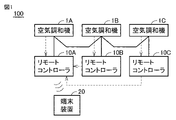
- FIG. 1 is a functional block diagram showing the configuration of the air conditioning system 100 according to the first embodiment.
- the air conditioning system 100 includes a plurality of air conditioners 1A, 1B, 1C, a plurality of remote controllers 10A, 10B, 10C, and a terminal device 20.
- the number of air conditioners included in the air conditioning system according to the embodiment may be 2 or less, or 4 or more.
- the air conditioners 1A and 1B are connected to each other.
- the air conditioners 1B and 1C are connected to each other.
- the air conditioners 1A to 1C are connected to the remote controllers 10A to 10C, respectively.
- the terminal device 20 can wirelessly communicate with each of the remote controllers 10A to 10C.
- the terminal device 20 is a remote controller for operating information request signals (specific signals) that request operation information (specific information) of at least one air conditioner designated by the user of the air conditioners 1A to 1C. It is transmitted to any of 10A to 10C.
- Standards for wireless communication between the terminal device 20 and each of the remote controllers 10A-10C include, for example, Bluetooth® or Wi-Fi®.
- the terminal device 20 includes, for example, a smartphone, a tablet, or a PC (Personal Computer).
- the remote controllers 10A to 10C control the air conditioners 1A to 1C, respectively, according to the input from the user.
- Each of the remote controllers 10A to 10C performs wireless communication with the terminal device 20 and the remote controllers 10A to 10C other than the remote controller.
- the remote controllers 10A to 10C collect operation information of the air conditioners 1A to 1C, respectively.
- the specific remote controller that has received the operation information request signal is a remote controller corresponding to each of the at least one air conditioner with the specific information of at least one air conditioner specified by the user.
- the specific information of the designated air conditioner is transmitted to the terminal device 20.
- Each of the remote controllers 10A to 10C sets the authority to confirm the specific information of the air conditioner corresponding to the remote controller and the authority to operate the air conditioner in response to the input from the user of the terminal device 20.
- Each of the remote controllers 10A to 10C sets the grouping which is the correspondence between the plurality of remote controllers 10A to 10C and the plurality of air conditioners 1A to 1C in response to the input from the user of the terminal device 20.
- the operation information of the air conditioners 1B and 1C is transmitted from the remote controllers 10B and 10C to the remote controller 10A (specific remote controller) wirelessly connected to the terminal device 20.
- the remote controller wirelessly connected to the terminal device 20 may be the remote controller 10B or 10C.
- FIG. 2 is a block diagram showing the configuration of the remote controllers 10A to 10C of FIG.
- each of the remote controllers 10A to 10C includes a communication control unit 90, a main control unit 13, a display unit 14, and an operation unit (not shown).
- the communication control unit 90 includes a first communication control unit 11 and a second communication control unit 12.
- the first communication control unit 11 includes a first transmission / reception unit 11A and a first communication unit 11B.
- the second communication control unit 12 includes a second transmission / reception unit 12A, a wireless device detection unit 12B, and a second wireless communication unit 12C.
- the first communication control unit 11 of each of the remote controllers 10A to 10C performs wireless communication with an air conditioner corresponding to the remote controller, for example, by infrared rays or the like.
- the first transmission / reception unit 11A and the air conditioner corresponding to the remote controller transmit and receive signals related to operation information and the like via the first communication unit 11B.
- the first communication control unit 11 may perform wired communication with an air conditioner corresponding to the remote controller.
- the second communication control unit 12 detects the terminal device 20 using the wireless device detection unit 12B, and performs wireless communication with the terminal device 20 by, for example, Bluetooth or the like.
- the second transmission / reception unit 12A transmits an operation signal or the like to the terminal device 20 via the second wireless communication unit 12C.
- FIG. 3 is a block diagram showing a specific hardware configuration of the remote controllers 10A to 10C of FIG.
- each of the remote controllers 10A to 10C includes a processing circuit 91, a memory 92, and an input / output unit 93.
- the processing circuit 91 may be dedicated hardware or a CPU (Central Processing Unit) that executes a program stored in the memory 92.
- the processing circuit 91 may include, for example, a single circuit, a composite circuit, a programmed processor, a parallel programmed processor, an ASIC (Application Specific Integrated Circuit), an FPGA ( Field Programmable Gate Array) or a combination of these is applicable.
- ASIC Application Specific Integrated Circuit
- FPGA Field Programmable Gate Array
- each function of the remote controllers 10A to 10C is realized by software, firmware, or a combination of software and firmware.
- the software or firmware is described as a program and stored in the memory 92.
- a control program for controlling each of the remote controllers 10A to 10C in an integrated manner is stored.
- the processing circuit 91 reads out and executes the program stored in the memory 92.
- the processing circuit 91 that executes the control program functions as the main control unit 13 of FIG.
- the memory 92 includes a non-volatile or volatile semiconductor memory (for example, RAM (Random Access Memory), ROM (Read Only Memory), flash memory, EPROM (Erasable Programmable Read Only Memory), or EPROM (Electrically Erasable Programmable Read Only Memory). )), And includes magnetic discs, flexible discs, optical discs, compact discs, mini discs, or DVDs (Digital Versatile Discs).
- the CPU is also called a central processing unit, a processing unit, an arithmetic unit, a microprocessor, a microcomputer, a processor, or a DSP (Digital Signal Processor).
- the input / output unit 93 receives an operation from the user and outputs the processing result to the user.
- the input / output unit 93 includes, for example, a mouse, a keyboard, a touch panel, a display, and a speaker.
- the input / output unit 93 includes operation units of the remote controllers 10A to 10C and a display unit 14 of FIG.
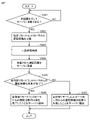
- FIG. 4 is a flowchart showing a flow of processing performed when each of the remote controllers 10A to 10C of FIG. 2 receives an operation information request signal from the terminal device 20.
- the remote controller remote controller 10A in FIG. 1
- the step is simply described as S.
- the user uses the terminal device 20 to specify a range (remote controller or air conditioner) for which operation information is desired to be collected, and transmits an operation information request signal for which the range is specified from the terminal device 20 to the host remote controller. ..
- the host remote controller that received the operation information request signal from the terminal device 20 selects the remote controller (designated remote controller) for which information is to be collected from the range specified by the user.
- the host remote controller can directly communicate with the designated remote controller by wire or wireless communication, the host remote controller transmits an operation information request signal to the designated remote controller. If there is a designated remote controller that cannot communicate with the host remote controller among all designated remote controllers, the host remote controller is another remote controller (relay remote controller) that can communicate with the designated remote controller that cannot communicate. Search for and send the operation information request signal to the designated remote controller that cannot communicate via the relay remote controller.
- the designated remote controller that received the operation information request signal via the host remote controller sends the remote controller (host remote controller or relay remote controller) that transmitted the operation information request signal to the air corresponding to the reception remote controller.
- the operation information of the harmonious unit is transmitted (S101, S102).
- the host remote controller waits for a certain period of time to collect operation information from all the designated remote controllers (S103). After waiting for a certain period of time in S103, the host remote controller transmits the collected operation information to the terminal device 20 (S104). However, if the amount of information (communication amount) received from all the designated remote controllers per unit time is larger than the reference amount, the received operation information may be transmitted to the terminal device 20 in order. As a result, the time required to transmit all the operation information from the host remote controller to the terminal device 20 can be shortened.
- the operation is performed using the plurality of communication methods.
- the information may be divided and transmitted to the terminal device 20.
- the reference amount can be appropriately determined by an actual machine experiment or a simulation.
- the host remote controller When the operation information can be collected from all the designated remote controllers within a certain period of time (YES in S105), the host remote controller notifies the terminal device 20 that the collection of the operation information from all the designated remote controllers has been completed. (S106). If the operation information cannot be collected from a part of all the designated remote controllers within a certain period of time (NO in S105), the host remote controller fails to collect the operation information from a part of all the designated remote controllers. Notify the terminal device 20 (S106).
- FIG. 5 is a flowchart showing a flow of processing performed when the remote controllers 10A to 10C of the air conditioner according to the first embodiment receive an operation signal from the terminal device 20.
- the user When the user performs remote control of the air conditioner by using the operation information of the air conditioner obtained by the process shown in FIG. 4, the user wants the remote control from the terminal device 20 (remote controller or air conditioner). Select the machine) and send the operation signal corresponding to the remote control to the host remote controller.
- the terminal device 20 remote controller or air conditioner.
- the host remote controller that received the operation signal from the terminal device 20 selects the remote controller to be operated from the request range specified by the user.
- the host remote controller can directly communicate with the remote controller to be operated by wire or wireless communication
- the host remote controller transmits an operation signal to the remote controller to be operated. If there is a remote controller that cannot communicate with the host remote controller among the remote controllers to be operated, the host remote controller searches for a relay remote controller that can communicate with the remote controller that cannot communicate, and the relay remote controller
- the operation signal is transmitted to the remote controller that cannot communicate via the above (S201, S202). Receiving the operation signal
- the remote controller sends a completion notification indicating that the operation corresponding to the received operation signal is completed to the remote controller (host remote controller or relay remote controller) that has transmitted the operation signal.
- the host remote controller waits for a certain period of time in order to receive the completion notification from all the remote controllers to be operated (S203). After waiting for a certain period of time in S203, the host remote controller transmits the received full completion notification to the terminal device 20 (S204).
- the host remote controller cannot receive the completion notification from at least a part of the remote controllers to be operated within a certain period of time (NO in S204)
- the host remote controller is one of the remote controllers to be operated. Notify that the operation request is incomplete for the unit (S206).
- the completion notification is transmitted to the terminal device 20 each time the completion notification is received.
- the air conditioning system 100 it is possible to remotely acquire the operation information of the air conditioners 1A to 1C from the remote controllers 10A to 10C by the wireless communication function. Since a controller for centrally managing the air conditioners 1A to 1C is not required, the user of the air conditioner system 100 can reduce the cost and space for installing the controller.
- the person in charge of maintenance of the air conditioning system 100 does not need to go to the air conditioning system 100, and can check the status of the air conditioning system 100 remotely (for example, the seat of the person in charge's office). As a result, the person in charge of maintenance can reduce various work costs such as transportation cost to the air conditioning system 100, travel time, and connection of the maintenance tool.
- the user can easily check the status of the air conditioning system 100. Therefore, accurate information can be promptly transmitted to the person in charge of maintenance when requesting maintenance of the air conditioning system 100.
- the air conditioning system 100 When an abnormality occurs in the air conditioning system 100, if it takes time for the maintenance person to arrive at the air conditioning system 100, the state of the air conditioning system 100 at the time of the abnormality is released, and what was the cause of the abnormality? Can be difficult to identify. However, according to the air conditioning system 100, the user can quickly convey accurate information to the maintenance staff, and the maintenance staff can quickly and remotely check the status of the air conditioning system 100. Therefore, the cause of the abnormality can be smoothly identified.
- the authority to confirm the operation information of each of the air conditioners 1A to 1C and to perform various remote operations is set by the user of the terminal device 20. Therefore, only the user and the authorized maintenance person can check the state of the air conditioning system 100 and perform remote control.
- the user can freely set the grouping of the air conditioning system 100. Therefore, even if a plurality of air conditioners cannot be connected by wire, the plurality of air conditioners can be grouped by using the wireless communication function.
- the air conditioning system According to the air conditioning system according to the first embodiment, it is possible to easily acquire the operation information of a plurality of air conditioners.
- FIG. 6 is a functional block diagram showing the configuration of the air conditioning system 200 according to the second embodiment.
- the configuration of the air conditioning system 200 is a configuration in which the air conditioners 1D and 1E, the remote controllers 10D and 10E, the repeater 30, and the server 40 are added to the air conditioning system 100 of FIG. Other than these, the explanation is not repeated because it is the same.
- the repeater 30 is connected to the Internet NW.
- the repeater 30 can wirelessly communicate with each of the remote controllers 10A to 10E.
- the repeater 30 includes, for example, a router or an AI (Artificial Intelligence) speaker.
- the server 40 is connected to the Internet NW.
- the server 40 includes, for example, a workstation or cloud system.
- the terminal device 20 is connected to the Internet NW via wireless communication.
- the terminal device 20 comprises an operation information request signal requesting information on the operating state of at least one air conditioner designated by the user of the terminal device 20 among the air conditioners 1A to 1E, and the at least one air conditioner.
- An operation signal for remote operation is transmitted to any of the remote controllers 10A to 10E via the Internet NW and the repeater 30.
- the air conditioners 1D and 1E are connected to each other.
- the air conditioners 1D and 1E are connected to the remote controllers 10E and 10E, respectively.
- the remote controller 10D is wirelessly connected to any of the remote controllers 10A to 10C.
- the remote controller 10E may be wirelessly connected to any of the remote controllers 10A to 10C.
- the remote controllers 10D and 10E control the air conditioners 1D and 1E, respectively, according to the input from the user.
- Each of the remote controllers 10D and 10E wirelessly communicates with the repeater 30 and the remote controllers 10A to 10E other than the remote controller.
- the remote controllers 10D and 10E collect the operation information of the air conditioners 1D and 1E, respectively.
- the remote controller 10D receives the operation information of the air conditioner 1E from the remote controller 10E.
- the remote controller 10D transmits the operation information of the air conditioners 1D and 1E to the remote controller 10C.
- the specific remote controller that has received the operation information request signal or the operation signal from the repeater 30 specifies the completion notification corresponding to the specific information and the operation signal of the air conditioner specified by the user. Obtained via the remote controller corresponding to each of the air conditioners.
- the specific remote controller transmits the completion notification corresponding to the specific information and the operation signal of the air conditioner designated by the user to the terminal device 20 via the repeater 30 and the Internet NW.
- Each of the remote controllers 10A to 10E operates the remote controller 10A to 10E via the repeater 30 and the Internet NW when the user has previously permitted the operation information of the air conditioner corresponding to the remote controller to be uploaded to the server 40.
- Information is uploaded to the server 40 on a regular basis.
- Each of the remote controllers 10A to 10E sets the authority to confirm the specific information of the air conditioner corresponding to the remote controller and the authority to operate the air conditioner in response to the input from the user of the terminal device 20.
- Each of the remote controllers 10A to 10E sets the grouping which is the correspondence between the plurality of remote controllers 10A to 10E and the plurality of air conditioners 1A to 1E in response to the input from the user of the terminal device 20.
- the operation information of the air conditioners 1B to 1E is transmitted from the remote controllers 10B to 10E to the remote controller 10A (specific remote controller) wirelessly connected to the terminal device 20.
- the remote controller wirelessly connected to the terminal device 20 may be any of the remote controllers 10B to 10E.
- FIG. 7 is a flowchart showing a processing flow when the remote controllers 10A to 10E of FIG. 6 periodically upload the operation information of the air conditioners 1A to 1E to the server 40 via the repeater 30 and the Internet NW. be.
- the flowchart will be described with reference to FIGS. 6 and 7.
- the host remote controller checks whether communication with the repeater 30 is possible, and then from the range (remote controller or air conditioner) specified by the user. , Select the designated remote controller for which operation information is to be collected. When the host remote controller can directly communicate with the designated remote controller by wire or wireless communication, the host remote controller transmits an operation information request signal to the designated remote controller. If all the designated remote controllers include the designated remote controllers (remote controllers 10D and 10E in FIG. 6) that cannot communicate with the host remote controller, the host remote controller communicates with the designated remote controller that cannot communicate.
- the designated remote controller that received the operation information request signal via the host controller sends the operation information request signal to the remote controller (host remote controller or relay remote controller) that corresponds to the reception remote controller.
- the operation information of the machine is transmitted (S301, S302).
- the host remote controller waits for a certain period of time to collect operation information from all the designated remote controllers (S303). After waiting for a certain period of time in S303, the host remote controller transmits the collected operation information to the server 40 via the repeater 30 (S304). However, if the amount of information received from all the designated remote controllers per unit time is larger than the reference amount, the received operation information may be transmitted to the server 40 in order. As a result, the time required to transmit all the operation information from the host remote controller to the server 40 can be shortened.
- the host remote controller If the operation information can be collected from all the designated remote controllers within a certain period of time (YES in S305), the host remote controller notifies the server 40 that the collection of the operation information from all the designated remote controllers is completed. (S306). If the operation information cannot be collected from a part of all the designated remote controllers within a certain period of time (NO in S305), the host remote controller fails to collect the operation information from a part of all the designated remote controllers. Notify the server 40 of this (S306).
- the terminal device 20 may transmit an operation information request signal for acquiring the operation information of the air conditioners 1A to 1E via the Internet NW and the repeater 30. ..
- the host remote controller receives the operation information request signal from the repeater 30.
- an operation signal for remotely controlling the air conditioners 1A to 1E may be transmitted from the terminal device 20 via the Internet NW and the repeater 30.
- the host remote controller receives the operation signal from the repeater 30, and also transmits the completion notification corresponding to the operation signal to the repeater 30.
- the air conditioning system 200 it is possible to remotely acquire the operation information of the air conditioners 1A to 1E from the remote controllers 10A to 10E by the wireless communication function. Since a controller for centrally managing the air conditioners 1A to 1E is not required, the user of the air conditioner system 200 can reduce the cost and space for installing the controller.
- the person in charge of maintenance of the air conditioning system 200 does not need to go to the air conditioning system 200, and can check the status of the air conditioning system 200 remotely (for example, the seat of the person in charge's office). As a result, the person in charge of maintenance can reduce various work costs such as transportation cost to the air conditioning system 200, travel time, and connection of the maintenance tool.
- each of the remote controllers 10A to 10E periodically uploads the operation information of the air conditioner corresponding to the remote controller to the server 40 connected to the Internet NW. Therefore, the user of the air conditioner system 200 and the person in charge of maintenance can confirm the operation information of each of the air conditioners 1A to 1E at a desired timing.
- an abnormality occurs in the air conditioning system 200
- the state of the air conditioning system 200 at the time of the abnormality is released, and what is the cause of the abnormality? It can be difficult to identify if it was.
- the user can quickly convey accurate information to the maintenance staff, and the maintenance staff can quickly and remotely check the status of the air conditioning system 200. Therefore, the cause of the abnormality can be smoothly identified.
- the authority to confirm the operation information of each of the air conditioners 1A to 1E and to perform various remote operations can be set by the user of the terminal device 20. Therefore, only the user and the authorized maintenance person can check the status of the air conditioning system 200 and perform remote control.
- the user can freely set the grouping of the air conditioning system 200. Therefore, even if a plurality of air conditioners cannot be connected by wire, the plurality of air conditioners can be grouped by the wireless communication function of each remote controller of the plurality of air conditioners.
- the air conditioning system 200 can collect operation information (for example, temperature setting and schedule setting), abnormality occurrence information, power consumption information, etc. from other air conditioning systems connected to the Internet. Therefore, it is possible to form big data that can statistically confirm the usage status of the air conditioning system, trouble cases, regional characteristics, and the like. As a result, the big data can be utilized for improving the function and quality of the successor model.
- operation information for example, temperature setting and schedule setting
- abnormality occurrence information for example, temperature setting and schedule setting
- power consumption information for example, power consumption information, etc.
- profits can be obtained from the rental fee of the repeater 30, the fee of the smartphone application for controlling the air conditioning system 200, the membership fee for enabling connection to the server 40, and the like.
- the air conditioning system according to the second embodiment it is possible to easily acquire the operation information of a plurality of air conditioners.
Landscapes
- Engineering & Computer Science (AREA)
- Human Computer Interaction (AREA)
- Chemical & Material Sciences (AREA)
- Combustion & Propulsion (AREA)
- Mechanical Engineering (AREA)
- General Engineering & Computer Science (AREA)
- Air Conditioning Control Device (AREA)
- Selective Calling Equipment (AREA)
Priority Applications (2)
| Application Number | Priority Date | Filing Date | Title |
|---|---|---|---|
| PCT/JP2020/044323 WO2022113295A1 (ja) | 2020-11-27 | 2020-11-27 | 空気調和システム |
| JP2022564958A JP7309084B2 (ja) | 2020-11-27 | 2020-11-27 | 空気調和システム |
Applications Claiming Priority (1)
| Application Number | Priority Date | Filing Date | Title |
|---|---|---|---|
| PCT/JP2020/044323 WO2022113295A1 (ja) | 2020-11-27 | 2020-11-27 | 空気調和システム |
Publications (1)
| Publication Number | Publication Date |
|---|---|
| WO2022113295A1 true WO2022113295A1 (ja) | 2022-06-02 |
Family
ID=81755409
Family Applications (1)
| Application Number | Title | Priority Date | Filing Date |
|---|---|---|---|
| PCT/JP2020/044323 Ceased WO2022113295A1 (ja) | 2020-11-27 | 2020-11-27 | 空気調和システム |
Country Status (2)
| Country | Link |
|---|---|
| JP (1) | JP7309084B2 (https=) |
| WO (1) | WO2022113295A1 (https=) |
Families Citing this family (1)
| Publication number | Priority date | Publication date | Assignee | Title |
|---|---|---|---|---|
| WO2025197007A1 (ja) * | 2024-03-21 | 2025-09-25 | 三菱電機株式会社 | 空調通信システム、ゲートウェイ装置及びプログラム |
Citations (6)
| Publication number | Priority date | Publication date | Assignee | Title |
|---|---|---|---|---|
| JPH05296546A (ja) * | 1992-04-15 | 1993-11-09 | Toshiba Corp | 空調システム |
| JP2002130774A (ja) * | 2000-10-20 | 2002-05-09 | Mitsubishi Electric Corp | 空気調和システム |
| JP2013104645A (ja) * | 2011-11-16 | 2013-05-30 | Fujitsu General Ltd | 空気調和機およびリモコン |
| JP2015106760A (ja) * | 2013-11-28 | 2015-06-08 | 株式会社富士通ゼネラル | 空気調和機 |
| WO2018216115A1 (ja) * | 2017-05-23 | 2018-11-29 | 三菱電機株式会社 | 空気調和システム |
| WO2019026289A1 (ja) * | 2017-08-04 | 2019-02-07 | 三菱電機株式会社 | 操作端末および空気調和システム |
Family Cites Families (4)
| Publication number | Priority date | Publication date | Assignee | Title |
|---|---|---|---|---|
| JP3980419B2 (ja) * | 2002-01-31 | 2007-09-26 | 三菱電機株式会社 | 空気調和システム及び集中リモコン |
| JP2015099007A (ja) * | 2013-10-15 | 2015-05-28 | パナソニック インテレクチュアル プロパティ コーポレーション オブアメリカPanasonic Intellectual Property Corporation of America | 空調機器の制御方法、プログラム、及び携帯情報端末 |
| JP6289333B2 (ja) * | 2014-09-30 | 2018-03-07 | 三菱電機株式会社 | 機器管理装置、操作再現方法、および、プログラム |
| JP6743383B2 (ja) * | 2015-12-18 | 2020-08-19 | ダイキン工業株式会社 | 空気調和機 |
-
2020
- 2020-11-27 JP JP2022564958A patent/JP7309084B2/ja active Active
- 2020-11-27 WO PCT/JP2020/044323 patent/WO2022113295A1/ja not_active Ceased
Patent Citations (6)
| Publication number | Priority date | Publication date | Assignee | Title |
|---|---|---|---|---|
| JPH05296546A (ja) * | 1992-04-15 | 1993-11-09 | Toshiba Corp | 空調システム |
| JP2002130774A (ja) * | 2000-10-20 | 2002-05-09 | Mitsubishi Electric Corp | 空気調和システム |
| JP2013104645A (ja) * | 2011-11-16 | 2013-05-30 | Fujitsu General Ltd | 空気調和機およびリモコン |
| JP2015106760A (ja) * | 2013-11-28 | 2015-06-08 | 株式会社富士通ゼネラル | 空気調和機 |
| WO2018216115A1 (ja) * | 2017-05-23 | 2018-11-29 | 三菱電機株式会社 | 空気調和システム |
| WO2019026289A1 (ja) * | 2017-08-04 | 2019-02-07 | 三菱電機株式会社 | 操作端末および空気調和システム |
Also Published As
| Publication number | Publication date |
|---|---|
| JPWO2022113295A1 (https=) | 2022-06-02 |
| JP7309084B2 (ja) | 2023-07-14 |
Similar Documents
| Publication | Publication Date | Title |
|---|---|---|
| JP7485792B2 (ja) | クラウドベースの建物管理システム | |
| RU2668410C2 (ru) | Способ и устройства для дальней связи rfid в системе управления технологическим процессом | |
| EP3421898B1 (en) | Remote management system | |
| US20100185758A1 (en) | Remote management device and remote management system | |
| CN104204968B (zh) | 用于在建筑物自动化系统内将建筑物自动化对象分组以用于群组通信的系统和方法 | |
| US9465371B2 (en) | Building automation and control system and method for operating the same | |
| US20230155855A1 (en) | System and method for aggregating and analyzing the status of a system | |
| EP3504694B1 (en) | Configurable remote battery monitor | |
| US9372479B1 (en) | System and method for a database layer for managing a set of energy consuming devices | |
| US20210278833A1 (en) | Support system for automated building management assistance | |
| JP2021535511A (ja) | 自動車再仕上げ修理プロセスをデジタル的に追跡及び監視する方法及びシステム | |
| JP2018092238A (ja) | オンデマンドサービス提供システム及びオンデマンドサービス提供方法 | |
| JP2025531559A (ja) | 機械の空間的に分散されて配置された電気的なコンポーネントをコンピュータ支援によって設置するための方法 | |
| WO2022113295A1 (ja) | 空気調和システム | |
| US9927137B2 (en) | Air-conditioning control device generating air-conditioning control-data, air-conditioning control method, and computer program product | |
| JP7481500B2 (ja) | 建物管理システムメタデータの遠隔発見 | |
| US20220373988A1 (en) | Method and Device for Generating a Building Automation Project | |
| JP3641137B2 (ja) | 分散制御システム | |
| JP7339558B2 (ja) | 空調管理システム | |
| JP2020088707A (ja) | クラウドブルートゥース装置管理システム | |
| CN107111289A (zh) | 在自动化网络中敏感测量数据的安全传送 | |
| KR101094218B1 (ko) | 메시지 후킹 핸들러를 포함한 홈 네트워크 시스템 및 상기메시지 후킹 핸들러에서의 마스터용 패킷/ 슬레이브용 패킷 구분 방법 | |
| WO2024088828A1 (en) | Computing device for an autonomous management of the sustainability performance of a product and method thereof | |
| JP6381324B2 (ja) | 補助記憶装置および補助記憶方法 | |
| US10289635B2 (en) | Control apparatus and control system aggregating working data of manufacturing cells |
Legal Events
| Date | Code | Title | Description |
|---|---|---|---|
| 121 | Ep: the epo has been informed by wipo that ep was designated in this application |
Ref document number: 20963559 Country of ref document: EP Kind code of ref document: A1 |
|
| ENP | Entry into the national phase |
Ref document number: 2022564958 Country of ref document: JP Kind code of ref document: A |
|
| NENP | Non-entry into the national phase |
Ref country code: DE |
|
| 122 | Ep: pct application non-entry in european phase |
Ref document number: 20963559 Country of ref document: EP Kind code of ref document: A1 |