WO2022107451A1 - 尿素処理方法及び装置 - Google Patents
尿素処理方法及び装置 Download PDFInfo
- Publication number
- WO2022107451A1 WO2022107451A1 PCT/JP2021/035323 JP2021035323W WO2022107451A1 WO 2022107451 A1 WO2022107451 A1 WO 2022107451A1 JP 2021035323 W JP2021035323 W JP 2021035323W WO 2022107451 A1 WO2022107451 A1 WO 2022107451A1
- Authority
- WO
- WIPO (PCT)
- Prior art keywords
- concentration
- chlorine
- urea
- water
- residual
- Prior art date
- Legal status (The legal status is an assumption and is not a legal conclusion. Google has not performed a legal analysis and makes no representation as to the accuracy of the status listed.)
- Ceased
Links
Images


Classifications
-
- C—CHEMISTRY; METALLURGY
- C02—TREATMENT OF WATER, WASTE WATER, SEWAGE, OR SLUDGE
- C02F—TREATMENT OF WATER, WASTE WATER, SEWAGE, OR SLUDGE
- C02F1/00—Treatment of water, waste water, or sewage
- C02F1/72—Treatment of water, waste water, or sewage by oxidation
- C02F1/76—Treatment of water, waste water, or sewage by oxidation with halogens or compounds of halogens
-
- C—CHEMISTRY; METALLURGY
- C02—TREATMENT OF WATER, WASTE WATER, SEWAGE, OR SLUDGE
- C02F—TREATMENT OF WATER, WASTE WATER, SEWAGE, OR SLUDGE
- C02F1/00—Treatment of water, waste water, or sewage
- C02F1/72—Treatment of water, waste water, or sewage by oxidation
- C02F1/76—Treatment of water, waste water, or sewage by oxidation with halogens or compounds of halogens
- C02F1/766—Treatment of water, waste water, or sewage by oxidation with halogens or compounds of halogens by means of halogens other than chlorine or of halogenated compounds containing halogen other than chlorine
-
- C—CHEMISTRY; METALLURGY
- C02—TREATMENT OF WATER, WASTE WATER, SEWAGE, OR SLUDGE
- C02F—TREATMENT OF WATER, WASTE WATER, SEWAGE, OR SLUDGE
- C02F1/00—Treatment of water, waste water, or sewage
- C02F1/001—Processes for the treatment of water whereby the filtration technique is of importance
- C02F1/004—Processes for the treatment of water whereby the filtration technique is of importance using large scale industrial sized filters
-
- C—CHEMISTRY; METALLURGY
- C02—TREATMENT OF WATER, WASTE WATER, SEWAGE, OR SLUDGE
- C02F—TREATMENT OF WATER, WASTE WATER, SEWAGE, OR SLUDGE
- C02F1/00—Treatment of water, waste water, or sewage
- C02F1/20—Treatment of water, waste water, or sewage by degassing, i.e. liberation of dissolved gases
-
- C—CHEMISTRY; METALLURGY
- C02—TREATMENT OF WATER, WASTE WATER, SEWAGE, OR SLUDGE
- C02F—TREATMENT OF WATER, WASTE WATER, SEWAGE, OR SLUDGE
- C02F1/00—Treatment of water, waste water, or sewage
- C02F1/28—Treatment of water, waste water, or sewage by sorption
- C02F1/283—Treatment of water, waste water, or sewage by sorption using coal, charred products, or inorganic mixtures containing them
-
- C—CHEMISTRY; METALLURGY
- C02—TREATMENT OF WATER, WASTE WATER, SEWAGE, OR SLUDGE
- C02F—TREATMENT OF WATER, WASTE WATER, SEWAGE, OR SLUDGE
- C02F1/00—Treatment of water, waste water, or sewage
- C02F1/30—Treatment of water, waste water, or sewage by irradiation
- C02F1/32—Treatment of water, waste water, or sewage by irradiation with ultraviolet light
-
- C—CHEMISTRY; METALLURGY
- C02—TREATMENT OF WATER, WASTE WATER, SEWAGE, OR SLUDGE
- C02F—TREATMENT OF WATER, WASTE WATER, SEWAGE, OR SLUDGE
- C02F1/00—Treatment of water, waste water, or sewage
- C02F1/42—Treatment of water, waste water, or sewage by ion-exchange
-
- C—CHEMISTRY; METALLURGY
- C02—TREATMENT OF WATER, WASTE WATER, SEWAGE, OR SLUDGE
- C02F—TREATMENT OF WATER, WASTE WATER, SEWAGE, OR SLUDGE
- C02F1/00—Treatment of water, waste water, or sewage
- C02F1/44—Treatment of water, waste water, or sewage by dialysis, osmosis or reverse osmosis
- C02F1/441—Treatment of water, waste water, or sewage by dialysis, osmosis or reverse osmosis by reverse osmosis
-
- C—CHEMISTRY; METALLURGY
- C02—TREATMENT OF WATER, WASTE WATER, SEWAGE, OR SLUDGE
- C02F—TREATMENT OF WATER, WASTE WATER, SEWAGE, OR SLUDGE
- C02F1/00—Treatment of water, waste water, or sewage
- C02F1/44—Treatment of water, waste water, or sewage by dialysis, osmosis or reverse osmosis
- C02F1/444—Treatment of water, waste water, or sewage by dialysis, osmosis or reverse osmosis by ultrafiltration or microfiltration
-
- C—CHEMISTRY; METALLURGY
- C02—TREATMENT OF WATER, WASTE WATER, SEWAGE, OR SLUDGE
- C02F—TREATMENT OF WATER, WASTE WATER, SEWAGE, OR SLUDGE
- C02F1/00—Treatment of water, waste water, or sewage
- C02F1/52—Treatment of water, waste water, or sewage by flocculation or precipitation of suspended impurities
-
- C—CHEMISTRY; METALLURGY
- C02—TREATMENT OF WATER, WASTE WATER, SEWAGE, OR SLUDGE
- C02F—TREATMENT OF WATER, WASTE WATER, SEWAGE, OR SLUDGE
- C02F2101/00—Nature of the contaminant
- C02F2101/30—Organic compounds
- C02F2101/34—Organic compounds containing oxygen
-
- C—CHEMISTRY; METALLURGY
- C02—TREATMENT OF WATER, WASTE WATER, SEWAGE, OR SLUDGE
- C02F—TREATMENT OF WATER, WASTE WATER, SEWAGE, OR SLUDGE
- C02F2101/00—Nature of the contaminant
- C02F2101/30—Organic compounds
- C02F2101/38—Organic compounds containing nitrogen
-
- C—CHEMISTRY; METALLURGY
- C02—TREATMENT OF WATER, WASTE WATER, SEWAGE, OR SLUDGE
- C02F—TREATMENT OF WATER, WASTE WATER, SEWAGE, OR SLUDGE
- C02F2103/00—Nature of the water, waste water, sewage or sludge to be treated
- C02F2103/02—Non-contaminated water, e.g. for industrial water supply
- C02F2103/04—Non-contaminated water, e.g. for industrial water supply for obtaining ultra-pure water
-
- C—CHEMISTRY; METALLURGY
- C02—TREATMENT OF WATER, WASTE WATER, SEWAGE, OR SLUDGE
- C02F—TREATMENT OF WATER, WASTE WATER, SEWAGE, OR SLUDGE
- C02F2209/00—Controlling or monitoring parameters in water treatment
- C02F2209/003—Downstream control, i.e. outlet monitoring, e.g. to check the treating agents, such as halogens or ozone, leaving the process
Definitions
- the present invention relates to a urea treatment method and an apparatus for decomposing urea in the water to be treated to obtain treated water.
- Ultrapure water is generally obtained by treating raw water such as industrial water, city water, and well water with a pretreatment system and then treating it with a primary pure water system to obtain pure water (primary pure water), which is then secondary. Manufactured by processing with a pure water system (subsystem).
- a pure water system In producing ultrapure water, a method of adding sodium bromide (NaBr) and sodium hypochlorite (NaClO) to the water to be treated and decomposing urea in the water to be treated by the generated hypobromous acid ions. are known.
- Patent Document 1 discloses that the concentration of free residual chlorine in the effluent of the urea decomposition step is measured, and the amount of hypochlorite added is controlled based on this measured value.
- the concentration of free residual chlorine in the effluent of the urea decomposition step is measured, and the amount of hypochlorite added is controlled based on this measured value.
- the chemicals necessary for the decomposition of urea are added in just proportion, and the urea is stably maintained without increasing the treatment cost.
- the purpose is to reliably disassemble and remove.
- Patent Document 1 describes that the "free residual chlorine concentration" was measured with a residual chlorine meter.
- the measured value obtained by the residual chlorine meter (indicated value of the residual chlorine meter) actually includes not only the free chlorine concentration but also the free bromine concentration. Therefore, in the method of determining the amount of NaClO added based on the indicated value of the residual chlorine meter disclosed in Patent Document 1, since the accurate free chlorine concentration is not measured, appropriate addition of NaClO may not be performed.
- An object of the present invention is to provide a urea treatment method and an apparatus capable of optimizing the amount of a chlorine-based oxidizing agent such as NaClO required for urea decomposition.
- hypobromous acid ion is generated by adding a bromide salt and a chlorine-based oxidizing agent to the water to be treated containing urea, and urea in the water to be treated is decomposed to obtain treated water.
- Urea treatment method a) A step of determining the residual free bromine concentration and the residual free chlorine concentration in the treated water, respectively.
- a urea treatment method comprising a step of controlling the addition amount of the bromide salt and the chlorine-based oxidizing agent based on the residual free bromine concentration and the residual free chlorine concentration.
- a bromide salt adding means for adding a bromide salt to the water to be treated containing urea
- a chlorine-based oxidant adding means for adding a chlorine-based oxidant to the water to be treated. It has a urea decomposition tank in which the water to be treated reacts with the bromide salt and the chlorine-based oxidizing agent to obtain treated water, and a residual chlorine meter for measuring residual chlorine in the treated water. The sample obtained from the treated water was measured in the sample from the first measured value measured by the residual chlorine meter and the second measured value measured by the residual chlorine meter after adding glycine to the sample.
- the residual free chlorine concentration is calculated, and based on the first measured value, the second measured value, and the residual free chlorine concentration, the amount of the bromide salt added by the bromide salt adding means and the chlorine-based oxidizing agent.
- a urea treatment apparatus having a control device for controlling at least one of the addition amounts of the chlorine-based oxidizing agent by the addition means.
- the amount of chlorine-based oxidant required for urea decomposition can be optimized.
- One aspect of the present invention is a urea treatment in which urea in the water to be treated is decomposed to obtain treated water by adding a bromide salt and a chlorine-based oxidizing agent to the water to be treated containing urea to generate hypobromous acid ions. Regarding the method.
- FIG. 1 is a process flow diagram showing a schematic configuration example of a urea processing apparatus in the urea decomposition method according to the present invention.
- the urea treatment apparatus 1 includes a bromide salt adding means 11 for adding a bromide salt to the water to be treated containing urea, a chlorine-based oxidant adding means 12 for adding a chlorine-based oxidant to the water to be treated, the bromide salt and the bromide salt. Obtained by the reaction with the urea decomposition tank 2 for storing the water to be treated to which the chlorine-based oxidizing agent has been added and reacting the urea in the treated water with the bromide salt and the chlorine-based oxidizing agent to obtain the treated water.
- the water to be treated containing urea in the line L1 is supplied to the urea decomposition tank 2 after the bromide salt is added by the bromide salt adding means 11 and the chlorine-based oxidant is added by the chlorine-based oxidant adding means 12. ..
- the water to be treated in the urea decomposition tank 2 reacts with the bromide salt and the chlorine-based oxidant to decompose urea, and is discharged from the line L4 as treated water.
- a residual chlorine meter 3 for measuring the chlorine concentration (residual chlorine concentration) in the treated water is connected to the line L4.
- the control means 4 is based on the residual free bromine concentration and the residual free chlorine concentration calculated from the measured values of the residual chlorine meter 3, the amount of the bromide salt added by the bromide salt adding means 11 and the chlorine-based oxidation by the chlorine-based oxidizing agent adding means 12. Control the amount of agent added.
- water containing urea can be appropriately used, and for example, raw water for producing ultrapure water such as industrial water, city water, and well water can be appropriately used.
- Urea is contained in the water to be treated, for example, about 10 to 200 ⁇ g / L.
- the urea concentration in the treated water obtained by the urea treatment is, for example, about 1 ⁇ g / L or less.
- bromide salt to be added examples include sodium bromide (NaBr), potassium bromide (KBr) and the like.
- chlorine-based oxidizing agent examples include sodium hypochlorite (NaClO), sodium perchlorate (NaClO 4 ), calcium hypochlorite (Ca (ClO) 2 ) and the like.
- NaBr and NaClO are used as the urea decomposition reaction will be described as a representative.
- a residual chlorine meter measures the free chlorine concentration (displayed as an indicated value), but the present inventors add a bromide salt and a chlorine-based oxidant to the water to be treated containing urea.
- treated water is obtained by decomposing urea in the treated water by generating hypobromine acid ions, free bromine is contained in the treated water. Since the residual chlorine meter displays the total value of the free bromine concentration and the free chlorine concentration as the residual chlorine concentration, it does not indicate the accurate concentration of the free chlorine.
- the amount of NaClO added is controlled based on the measured value (indicated value) of the residual chlorine meter, it may not be possible to add an appropriate amount of NaClO, and as a result, NaBr is not added in an appropriate amount. It has been found that the urea decomposition reaction may take a long time and may have an effect. Therefore, in the present invention, the free bromine concentration and the free chlorine concentration are calculated from the measured values (indicated values) of the residual chlorine meter, and the addition amounts of NaBr and NaClO are controlled based on the obtained free bromine concentration and free chlorine concentration. ..
- the "residual chlorine concentration” means a value measured by a residual chlorine meter (indicated value of the residual chlorine meter), and the “residual free chlorine concentration” means a value measured by a residual chlorine meter (residual). It refers to the indicated value of the chlorine meter, that is, the value obtained by subtracting the residual free bromine concentration from the "free residual chlorine concentration” in Patent Document 1).
- hypobromous acid ions are generated from the reaction between NaBr and NaClO, and urea is decomposed by hypobromous acid ions.
- the reaction in which hypobromous acid ion (BrO ⁇ ) is generated from NaBr and NaClO is considered to follow the following equation.
- NaBr + NaClO ⁇ 2Na + + BrO-+ Cl- Equation 1
- the urea decomposition reaction by hypobromous acid ion is considered to follow the following equation.
- the measured value (indicated value) is , It is obtained as the total value of the free bromine concentration and the free chlorine concentration.
- a predetermined compound compound having an amino group
- the value (indicated value) measured by the residual chlorine meter in the sample water to which a predetermined compound is added is the free bromine concentration.
- the measured value A total value of free bromine concentration and free chlorine concentration of the sample water before adding the predetermined compound and the residual chlorine meter of the sample water after adding the compound having an amino group.
- the difference (AB) from the measured value B (free bromine concentration) according to the above is the free chlorine concentration in the treated water.
- the predetermined compound is not particularly limited as long as it changes free chlorine to bound chlorine, and examples thereof include compounds having an amino group.
- the compound having an amino group may be any organic compound having an amino group in its molecular structure, for example, alanine, arginine, asparagine, aspartic acid, cysteine, cystine, glutamine, glutamic acid, glycine, histidine, isoleucine, leucine, etc.
- Examples thereof include amino acids such as lysine, methionine, phenylalanine, proline, serine, threonine, theanine, trionin, tryptophan, tyrosine and valine, and aminoalkylsulfonic acids such as taurine.
- glycine, arginine, asparagine, glutamine, lysine, phenylalanine, proline, serine, and taurine are preferably used because of their high reactivity with hypochlorite or a salt thereof, and are particularly easily available and handled. It is more preferable to use glycine, which is easy to use.
- the compound having an ammonium salt or an amino group to coexist may be in the form of a solution such as an aqueous solution, or in the form of a solid or powder.
- the residual free bromine concentration may be determined by measuring using a bromine measuring device such as a portable bromine measuring device HI96716 manufactured by Hannah Instruments, for example.
- the amount of NaBr and NaClO added is controlled based on the free bromine concentration and the free chlorine concentration thus obtained.
- reaction rate constant of the urea decomposition reaction is calculated from the change over time of the urea concentration.
- the reaction rate constant may be calculated by a general method, but can be calculated from, for example, the following equation.
- Equation 4 Reaction time of urea decomposition reaction
- C Urea concentration in water to be treated (reaction solution) at reaction time t
- k The reaction rate constant of the urea decomposition reaction.
- the reaction rate constant k is determined according to the amount of NaBr and NaClO added.
- the urea concentration of the target treated water (target urea concentration) and the target reaction time (target reaction time) are set, and the reaction for reaching the target urea concentration in the target reaction time from the urea concentration of the water to be treated.
- the residual free bromine concentration (target residual free bromine concentration) and the residual free chlorine concentration (target residual free chlorine concentration) of the treated water at the calculated target reaction rate constant are obtained from the above relationship. Therefore, NaBr and NaClO may be added so that the residual free bromine concentration and the residual free chlorine concentration in the treated water become the target residual free bromine concentration and the target residual free chlorine concentration, respectively.
- the amount of NaBr added is increased or decreased by the difference between the residual free bromine concentration in the treated water and the target residual free bromine concentration obtained from the measured value (indicated value) of the residual chlorine meter. Then, the amount of NaClO added is increased or decreased by the difference between the amount of free chlorine added required for achieving the target residual free chlorine concentration after increasing or decreasing the amount of NaBr added and the initial amount of free chlorine added.
- the target residual free bromine concentration can be set from the relationship between the reaction rate constant, the free bromine concentration and the free chlorine concentration described above.
- the required amount of free chlorine added is obtained by multiplying the target residual free bromine concentration by a predetermined value in the range of 1.2 to 1.4 (1.54 to 1.80 in the case of Br - converted). It can be obtained from the sum of the value and the target residual free chlorine concentration, and the initial amount of free chlorine added is a predetermined amount within the range of 1.2 to 1.4 for the residual free bromine concentration in the treated water before changing the amount of NaBr added. It can be obtained from the sum of the value obtained by multiplying the value of and the residual free chlorine concentration at this time.
- the amount of NaBr added to the water to be treated may be constant, assuming that it is substantially constant.
- the amount of NaBr added is, for example, preferably 0.5 mg / L or more, more preferably 1 mg / L or more, still more preferably 2 mg / L or more, from the viewpoint of promoting the urea decomposition reaction.
- the amount of NaBr added is preferably 3 mg / L or less. Even if it exceeds 3 mg / L, the urea decomposition promoting effect does not increase so much.
- a value obtained by multiplying the concentration of NaBr added to the water to be treated by a predetermined value in the range of 0.5 to 0.7 (Br - converted to 0.64 to 0.90) is applied to the treated water. It can be used as the residual free bromine concentration.
- the pH at the time of the urea decomposition reaction is preferably 5 to 6.5.
- Urea decomposition rate tends to be faster than when the pH is neutral. Further, even when the pH is alkaline, for example, about 9, the urea decomposition rate tends to be faster than in the case of neutral, but in this case, the pH is due to the subsequent treatment (for example, aggregation treatment) of the urea treatment. May need to be readjusted to neutral. If the urea decomposition is carried out at a pH of about 5 to 6.5, the pH can be easily readjusted to neutralize the pH as compared with the case where the pH is alkaline, or there is no need to readjust the pH.
- an appropriate pH adjuster can be added to the water to be treated, if necessary.
- the urea decomposition reaction can be carried out at room temperature (for example, about 20 ° C.) and normal pressure (for example, about 1 atm).
- the urea treatment apparatus can be used, for example, as a pretreatment for an ultrapure water production system, as shown in FIG.
- the ultrapure water production system shown in FIG. 2 is composed of a pretreatment system, a primary pure water system, and a subsystem.
- coagulation filtration is performed by a coagulation filtration device.
- the primary pure water system after the TOC and residual salt are removed from the pretreated filtered water by the activated charcoal device, the ions are removed by the ion exchange device to generate demineralized water, and the ions and TOC are removed by the reverse osmosis membrane device. RO water is produced.
- the dissolved oxygen is removed by the membrane degassing device, and the primary pure water is produced.
- the primary pure water is decomposed by the ultraviolet (UV) oxidizing device, the ion is removed by the cartridge polisher (CP: non-regenerative ion exchange device), the dissolved oxygen is removed by the membrane degassing device, and the ultrafiltration membrane (ultrafiltration membrane). After removing fine particles by the UF) device, ultrapure water is produced and sent to the point of use.
- UV ultraviolet
- CP non-regenerative ion exchange device
- ultrafiltration membrane ultrafiltration membrane
- the urea treatment device is installed in front of the coagulation filtration device of the pretreatment system, but may be provided in the primary pure water system or subsystem.
- reaction time t 0
- a urea meter (LC: LC800 manufactured by GL Science, MSMS: 3200 Q TRAP manufactured by AB SCIEX) was used for measuring the urea concentration.
- a residual chlorine meter (trade name: portable digital residual chlorine meter HI96711C, manufactured by Hannah Instruments Japan Co., Ltd.) was used for the residual free chlorine concentration of the treated water after the reaction.
- glycine an aqueous solution of 10 g of glycine dissolved in 100 mL of water
- the concentration of glycine was 1 g / L, and the mixture was stirred for 1 minute.
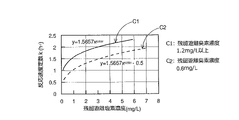
- FIG. 3 shows the relationship between the residual chlorine concentration and the residual free bromine concentration obtained in the preliminary test and the reaction rate constant.
- the reaction rate constant is constant when the residual free bromine concentration is 1.2 mg / L or more. That is, it does not affect the decomposition rate of urea. Therefore, the minimum value of 1.2 mg / L can be set as the target residual free bromine concentration. Further, in the process of this preliminary test, the concentration of NaBr added to the water to be treated is multiplied by a predetermined value in the range of 0.5 to 0.7 (0.64 to 0.90 in the case of Br - converted). It was confirmed that the above value can be used as the residual bromine concentration in the treated water.
- the reaction rate constant is constant (that is, it does not affect the decomposition rate of urea) when the residual free bromine concentration is 1.2 mg / L or more, which is the minimum value 1.
- the urea is decomposed so that the urea concentration changes from 100 ⁇ g / L to 1 ⁇ g / L in 3 hours.
- the residual free chlorine concentration is 3.3 mg / L. Therefore, since the free bromine concentration in the treated water is 0.6 mg / L and the free chlorine concentration is 0.2 mg / L, the urea is decomposed so that the urea concentration changes from 100 ⁇ g / L to 1 ⁇ g / L in 3 hours.
- the residual free bromine concentration and the residual free chlorine concentration of the treated water obtained above are increased by 0.6 mg / L and 0.7 mg / L.
- the amount of NaBr and NaClO added was increased.
- the addition amounts of NaBr and NaClO were increased so that the residual free bromine concentration and the residual free chlorine concentration of the treated water obtained above were increased by 0.4 mg / L and the residual free chlorine concentration was increased by 4.8 mg / L.
- Example 2 Similar to Example 1, urea was added to tap water in Sagamihara City so that the urea concentration was 100 ⁇ g / L to make the water to be treated, and the water to be treated (urea concentration 100 ⁇ g / L, 0.6 L) contained in the water tank. ), 6 mg / L of NaBr and 6 mg / L of NaClO were added, and the mixture was stirred for 3 minutes.
- a residual chlorine meter trade name: portable digital residual chlorine meter HI96711C, manufactured by Hannah Instruments Japan Co., Ltd.
- the indicated value of the residual chlorine meter was 4.8 mg / L.
- glycine manufactured by Kanto Chemical Co., Ltd.
- the treated water was measured with a residual chlorine meter.
- the reaction rate constant k is 1. It is necessary to be 84h -1 .
- the reaction rate constant is constant (that is, it does not affect the decomposition rate of urea) when the residual free bromine concentration is 1.2 mg / L or more, which is the minimum value 1.
- the urea concentration in the treated water is 3.6 mg / L and the residual free chlorine concentration is 1.2 mg / L, the urea concentration is changed from 100 ⁇ g / L to 1 ⁇ g / L in 2.5 hours.
- Example 3 Similar to Example 1, urea was added to tap water in Sagamihara City so that the urea concentration was 100 ⁇ g / L to make the water to be treated, and the water to be treated (urea concentration 100 ⁇ g / L, 0.6 L) contained in the water tank. ), 1 mg / L of NaBr and 1 mg / L of NaClO were added, and the mixture was stirred for 3 minutes.
- a residual chlorine meter trade name: portable digital residual chlorine meter HI96711C, manufactured by Hannah Instruments Japan Co., Ltd.
- the indicated value of the residual chlorine meter was 0.8 mg / L.
- a value obtained by multiplying the concentration of NaBr added to the water to be treated by a predetermined value in the range of 0.5 to 0.7 (Br - converted to 0.64 to 0.90) is applied to the treated water.
- the residual free bromine concentration of, for example, when the value obtained by multiplying the addition concentration of NaBr to the water to be treated by 0.6 is used as the residual free bromine concentration in the treated water, the residual free bromine concentration in the treated water is used.
- the bromine concentration is 0.6 mg / L
- the reaction rate constant is constant (that is, it does not affect the decomposition rate of urea) when the residual free bromine concentration is 1.2 mg / L or more, which is the minimum value 1.
- the urea is decomposed so that the urea concentration changes from 100 ⁇ g / L to 1 ⁇ g / L in 3 hours.
- the chlorine required for the decomposition of urea is sufficiently present in the indicated value of the residual chlorine meter of the treated water, but in reality, the indicated value of the residual chlorine meter is free bromine. Since it was expressed as the total value of the concentration of 1.8 mg / L and the free chlorine concentration of 0 mg / L, it is considered that the amount of NaClO was insufficient and it took time to decompose urea.
Landscapes
- Life Sciences & Earth Sciences (AREA)
- Hydrology & Water Resources (AREA)
- Engineering & Computer Science (AREA)
- Environmental & Geological Engineering (AREA)
- Water Supply & Treatment (AREA)
- Chemical & Material Sciences (AREA)
- Organic Chemistry (AREA)
- Treatment Of Water By Oxidation Or Reduction (AREA)
- Investigating Or Analyzing Non-Biological Materials By The Use Of Chemical Means (AREA)
Abstract
Description
a)前記処理水中の残留遊離臭素濃度及び残留遊離塩素濃度をそれぞれ求める工程と、
b)前記残留遊離臭素濃度及び前記残留遊離塩素濃度に基づいて前記臭化物塩と前記塩素系酸化剤の添加量を制御する工程と
を含む、尿素処理方法が提供される。
前記処理水から得られる試料を前記残留塩素計で測定した第1の測定値と、前記試料にグリシンを添加した後に、前記残留塩素計で測定した第2の測定値とから、前記試料中の残留遊離塩素濃度を算出し、前記第1の測定値、前記第2の測定値、及び前記残留遊離塩素濃度に基づいて、前記臭化物塩添加手段による前記臭化物塩の添加量及び前記塩素系酸化剤添加手段による前記塩素系酸化剤の添加量の少なくとも一方を制御する制御装置を有する、尿素処理装置が提供される。
尿素処理装置1は、尿素を含む被処理水に臭化物塩を添加する臭化物塩添加手段11と、前記被処理水に塩素系酸化剤を添加する塩素系酸化剤添加手段12と、前記臭化物塩および前記塩素系酸化剤が添加された被処理水を貯留して被処理水中の尿素と前記臭化物塩及び前記塩素系酸化剤とを反応させて処理水を得る尿素分解槽2と、前記反応により得られた処理水の残留塩素濃度を測定する残留塩素計3と、残留塩素計3による測定値に基づいて臭化物塩及び塩素系酸化剤の添加量を制御する制御手段4と、を備えている。図1では、ラインL1中の尿素を含む被処理水は、臭化物塩添加手段11により臭化物塩、塩素系酸化剤添加手段12により塩素系酸化剤が添加され、尿素分解槽2に供給されている。尿素分解槽2内の被処理水は、前記臭化物塩及び前記塩素系酸化剤と反応して尿素が分解され、処理水としてラインL4から排出される。ラインL4には処理水中の塩素濃度(残留塩素濃度)を測定する残留塩素計3が接続されている。制御手段4は、残留塩素計3の測定値から算出される残留遊離臭素濃度及び残留遊離塩素濃度に基づき臭化物塩添加手段11による臭化物塩の添加量及び塩素系酸化剤添加手段12による塩素系酸化剤の添加量を制御する。
NaBrとNaClOとの反応から次亜臭素酸イオンが生じ、次亜臭素酸イオンにより尿素が分解される。
NaBrとNaClOから次亜臭素酸イオン(BrO-)が生じる反応は次式に従うと考えられる。
NaBr + NaClO → 2Na+ + BrO-+ Cl- (式1)
次亜臭素酸イオンによる尿素分解反応は次式に従うと考えられる。
(NH2)2CO + 3BrO- → N2 + CO2+ 2H2O + 3Br- (式2)
式1および式2から、次式が導かれる。
(NH2)2CO + 3NaClO → N2 + CO2 + 2H2O + 3Na+ + 3Cl- (式3)
尿素分解反応の前後でBrO-濃度は変化せず、実質的に一定であると考えられる。
C=C0 e-kt (式4)
ここで、
t:尿素分解反応の反応時間
C:反応時間tにおける被処理水(反応液)中の尿素濃度
C0:被処理水の初期尿素濃度(反応時間t=0における尿素濃度)
k:尿素分解反応の反応速度定数
である。
ただし、被処理水へのNaBrとNaClOの添加量が変われば、反応速度定数kも変わる。換言すれば、NaBrとNaClOの添加量に応じて、反応速度定数kが決まる。
式4より算出した反応速度定数、並びに、上述した方法により求めた遊離臭素濃度及び遊離塩素濃度の関係(例えばグラフや数式として)を求めておく。
したがって、処理水中の残留遊離臭素濃度及び残留遊離塩素濃度が、それぞれ目標残留遊離臭素濃度及び目標残留遊離塩素濃度となるようにNaBr及びNaClOを添加すればよい。
これにより、処理水中の正確な残留遊離臭素濃度及び残留遊離塩素濃度が把握でき、尿素分解に適切な量のNaBr(臭化物塩)及びNaClO(塩素系酸化剤)を添加することができる。
尿素分解反応は、常温(例えば20℃程度)、常圧(例えば1気圧程度)で行うことができる。
〔実施例1〕
日本の神奈川県相模原市の水道水に尿素濃度が100μg/Lとなるように尿素を添加し、被処理水として使用した。なお、以下において、特に断りのない限り、尿素分解反応の際、温度は20℃であり、圧力はほぼ大気圧であり、pHは6とした。pH調整剤としては塩酸を適宜添加した。
予備試験として、被処理水にNaBr添加量およびNaClO添加量をパラメータとして変えつつ、複数回の反応試験を行った。
各反応試験において、被処理水中の尿素濃度Cの経時変化を調べ、反応速度定数kを算出した。なお、経時変化の初期時点は、NaBrとNaClOを添加した時点(反応時間t=0)である。尿素濃度の測定には、尿素計(LC:GL Science製 LC800、MSMS:AB SCIEX製 3200 Q TRAP) を用いた。また、反応後の処理水の残留遊離塩素濃度は残留塩素計(商品名:ポータブルデジタル残留塩素計HI96711C、ハンナ インスツルメンツ・ジャパン株式会社製)を用いた。また、処理水の残留遊離臭素濃度を測定する際には、被測定水に、グリシン濃度が1g/Lとなるようにグリシン(グリシン10gを水100mLに溶解した水溶液)を加え、1分間攪拌した。
予備試験で得られた残留塩素濃度および残留遊離臭素濃度と反応速度定数の関係を図3に示す。
水槽に収容された被処理水(尿素濃度100μg/L、0.6L)に、NaBr及びNaClOを被処理水中の濃度がそれぞれ1mg/Lになるように添加して、3分間撹拌した。反応後の処理水を残留塩素計(商品名:ポータブルデジタル残留塩素計HI96711C、ハンナ インスツルメンツ・ジャパン株式会社製)で測定したところ、残留塩素計の指示値は0.8mg/Lであった。
次に、処理水にグリシン(関東化学株式会社製)1g/Lを加えて、1分間攪拌した後、残留塩素計で処理水を測定したところ、残留塩素計の指示値は0.6mg/Lであった。よって、処理水中の残留遊離臭素濃度は0.6mg/Lである。処理水中の残留遊離臭素濃度と残留遊離塩素濃度の合計値は0.8mg/Lであるから、処理水中の残留遊離塩素濃度は0.8-0.6=0.2mg/Lである。
実施例1と同様に、相模原市の水道水に尿素濃度100μg/Lとなるように尿素を添加して被処理水とし、水槽に収容された被処理水(尿素濃度100μg/L、0.6L)に、NaBrを6mg/L及びNaClOを6mg/L添加して、3分間撹拌した。反応後の処理水を残留塩素計(商品名:ポータブルデジタル残留塩素計HI96711C、ハンナ インスツルメンツ・ジャパン株式会社製)で測定したところ、残留塩素計の指示値は4.8mg/Lであった。
次に、処理水にグリシン濃度が1g/Lとなるようにグリシン(関東化学株式会社製)を加えて、1分間攪拌した後、残留塩素計で処理水を測定したところ、残留塩素計の指示値は3.6mg/Lであった。よって、処理水中の残留遊離臭素濃度は3.6mg/Lである。処理水中の残留遊離臭素濃度と残留遊離塩素濃度の合計値は4.8mg/Lであるから、処理水中の残留遊離塩素濃度は4.8-3.6=1.2mg/Lである。
次に、最初に添加したNaBr 6mg/L及びNaClO 6mg/Lに、上記で求めた処理水の残留遊離臭素濃度が2.4mg/L減少するように、また、残留遊離塩素濃度が0.9mg/Lだけ増加するようにNaBrおよびNaClOの添加量を増減させた。その結果、被処理水中の尿素濃度100μg/Lが1μg/Lまで分解されるのに2.4時間であった。
実施例1と同様に、相模原市の水道水に尿素濃度100μg/Lとなるように尿素を添加して被処理水とし、水槽に収容された被処理水(尿素濃度100μg/L、0.6L)に、NaBrを1mg/L及びNaClOを1mg/L添加して、3分間撹拌した。反応後の処理水を残留塩素計(商品名:ポータブルデジタル残留塩素計HI96711C、ハンナ インスツルメンツ・ジャパン株式会社製)で測定したところ、残留塩素計の指示値は0.8mg/Lであった。
水槽に収容された被処理水(尿素濃度100μg/L、0.6L)に、NaBrを9mg/L及びNaClOを3mg/L添加して、3分間撹拌した。反応後の処理水を残留塩素計(商品名:ポータブルデジタル残留塩素計HI96711C、ハンナ インスツルメンツ・ジャパン株式会社製)で測定したところ、残留塩素計の指示値は1.8mg/Lであった。このとき、被処理水中の尿素を100μg/Lから1μg/Lまで分解するのに4.5時間を要した。これによると、処理水の残留塩素計の指示値では、尿素の分解に必要な塩素が十分存在していると判断されることになるが、実際には残留塩素計の指示値は、遊離臭素濃度1.8mg/L、遊離塩素濃度0mg/Lの合計値として表されていたため、NaClOの量が足りず、尿素分解に時間がかかったものと思われる。
2 尿素分解槽
3 残留塩素計
4 制御手段
11 臭化物塩添加手段
12 塩素系酸化剤添加手段
Claims (9)
- 尿素を含む被処理水に臭化物塩と塩素系酸化剤を添加することにより次亜臭素酸イオンを生成させて被処理水中の尿素を分解して処理水を得る尿素処理方法であって、
a)前記処理水中の残留遊離臭素濃度及び残留遊離塩素濃度をそれぞれ求める工程と、
b)前記残留遊離臭素濃度及び前記残留遊離塩素濃度に基づいて前記臭化物塩と前記塩素系酸化剤の添加量を制御する工程と
を含む、尿素処理方法。 - 前記工程aが、
a1)前記処理水から採取した試料を残留塩素計で測定する工程と、
a2)前記処理水から採取した試料にアミノ基を有する化合物を添加して、得られた試料を残留塩素計で測定することで、前記得られた試料中の残留遊離臭素濃度を得る工程と、
a3)前記工程a1で得た残留塩素計の測定値と、前記工程a2で得た残留遊離臭素濃度との差から、残留遊離塩素濃度を算出する工程と、
を含む、請求項1に記載の尿素処理方法。 - 前記アミノ基を有する化合物は、グリシンであることを特徴とする、請求項2に記載の尿素処理方法。
- 前記工程aが、
a1)前記処理水から採取した試料を残留塩素計で測定する工程と、
a2’)臭化物塩の被処理水への添加量に0.5~0.7の範囲内の所定の値を乗じた値を前記試料中の残留遊離臭素濃度として算出する工程と、
a3)前記工程a1で得た残留塩素計の測定値と、前記工程a2’で算出した残留遊離臭素濃度との差から、残留遊離塩素濃度を算出する工程と、
を含む、請求項1に記載の尿素処理方法。 - 前記工程bが、
b1)あらかじめ設定した目標尿素濃度と目標反応時間とを達成するために必要な処理水の必要残留遊離臭素濃度と必要残留遊離塩素濃度を求める工程と、
b2)前記工程a2またはa2’で求めた残留遊離臭素濃度と前記工程b1で求めた必要残留遊離臭素濃度との差の分だけ臭化物塩の添加量を増減させる工程と、
b3)前記工程a3で求めた残留遊離塩素濃度と前記工程b1で求めた必要残留遊離塩素濃度との差の分だけ塩素系酸化剤の添加量を増減させる工程と、
を含む、請求項2から請求項4のいずれかに記載の尿素処理方法。 - 前記工程aより前に、被処理水への臭化物塩の添加量と塩素系酸化剤の添加量をパラメータとして変化させて尿素を分解する複数の予備試験により、尿素分解反応の反応速度定数を算出することで、被処理水中の残留遊離塩素濃度、残留遊離臭素濃度、および尿素分解反応の反応速度定数との間の相関を求めておき、
前記工程b1が、
b1-1)臭化物塩と塩素系酸化剤を添加する前の被処理水の尿素濃度と、前記目標尿素濃度と前記目標反応時間とに基づいて、これら目標尿素濃度と目標反応時間とを達成するために必要な反応速度定数を求める工程と、
b1-2)前記工程b1-1で求めた反応速度定数と、前記工程aで求めた残留遊離臭素濃度とから、前記相関を用いて、前記必要な処理水の残留遊離塩素濃度を求める工程とを含む請求項5に記載の尿素処理方法。 - 前記工程aより前に、被処理水への臭化物塩の添加量を一定とし、塩素系酸化剤の添加量をパラメータとして変化させて尿素を分解する複数の予備試験により、尿素分解反応の反応速度定数を算出することで、被処理水中の残留遊離塩素濃度、残留遊離臭素濃度、および尿素分解反応の反応速度定数との間の相関を求めておき、
前記工程b1が、
b1-1)臭化物塩と塩素系酸化剤を添加する前の被処理水の尿素濃度と、前記目標尿素濃度と前記目標反応時間とに基づいて、これら目標尿素濃度と目標反応時間とを達成するために必要な反応速度定数を求める工程と、
b1-2)前記工程b1-1で求めた反応速度定数と、前記工程aで求めた残留遊離臭素濃度とから、前記相関を用いて、前記必要な処理水の残留遊離塩素濃度を求める工程とを含む請求項5に記載の尿素処理方法。 - 尿素を含む被処理水に臭化物塩を添加する臭化物塩添加手段と、
前記被処理水に塩素系酸化剤を添加する塩素系酸化剤添加手段と、
前記被処理水が前記臭化物塩及び前記塩素系酸化剤と反応させて処理水を得る尿素分解槽と、
前記処理水の残留塩素を測定する残留塩素計と、
を有し、
前記処理水から得られる試料を前記残留塩素計で測定した第1の測定値と、前記試料にグリシンを添加した後に、前記残留塩素計で測定した第2の測定値とから、前記試料中の残留遊離塩素濃度を算出し、前記第1の測定値、前記第2の測定値、及び前記残留遊離塩素濃度に基づいて、前記臭化物塩添加手段による前記臭化物塩の添加量及び前記塩素系酸化剤添加手段による前記塩素系酸化剤の添加量の少なくとも一方を制御する制御装置を有する、尿素処理装置。 - 前記制御装置は、あらかじめ設定した目標尿素濃度と目標反応時間とを達成するために必要な処理水の必要残留遊離臭素濃度と必要残留遊離塩素濃度を求め、前記第2の測定値と前記必要残留臭素濃度との差の分だけ臭化物塩の添加量を増減させ、前記残留遊離塩素濃度と前記必要残留遊離塩素濃度との差の分だけ塩素系酸化剤の添加量を増減させる、請求項8に記載の尿素処理装置。
Priority Applications (2)
| Application Number | Priority Date | Filing Date | Title |
|---|---|---|---|
| US18/037,886 US12606470B2 (en) | 2020-11-20 | 2021-09-27 | Urea treatment method and device |
| CN202180078138.1A CN116472253B (zh) | 2020-11-20 | 2021-09-27 | 尿素处理方法及装置 |
Applications Claiming Priority (2)
| Application Number | Priority Date | Filing Date | Title |
|---|---|---|---|
| JP2020-193011 | 2020-11-20 | ||
| JP2020193011A JP7550033B2 (ja) | 2020-11-20 | 2020-11-20 | 尿素処理方法及び装置 |
Publications (1)
| Publication Number | Publication Date |
|---|---|
| WO2022107451A1 true WO2022107451A1 (ja) | 2022-05-27 |
Family
ID=81708877
Family Applications (1)
| Application Number | Title | Priority Date | Filing Date |
|---|---|---|---|
| PCT/JP2021/035323 Ceased WO2022107451A1 (ja) | 2020-11-20 | 2021-09-27 | 尿素処理方法及び装置 |
Country Status (5)
| Country | Link |
|---|---|
| US (1) | US12606470B2 (ja) |
| JP (1) | JP7550033B2 (ja) |
| CN (1) | CN116472253B (ja) |
| TW (1) | TWI885226B (ja) |
| WO (1) | WO2022107451A1 (ja) |
Cited By (1)
| Publication number | Priority date | Publication date | Assignee | Title |
|---|---|---|---|---|
| WO2024228310A1 (ja) * | 2023-05-02 | 2024-11-07 | オルガノ株式会社 | 水処理装置および水処理方法 |
Families Citing this family (1)
| Publication number | Priority date | Publication date | Assignee | Title |
|---|---|---|---|---|
| JP7351362B2 (ja) * | 2022-02-28 | 2023-09-27 | 栗田工業株式会社 | 水処理装置及び水処理方法 |
Citations (4)
| Publication number | Priority date | Publication date | Assignee | Title |
|---|---|---|---|---|
| JPH0994585A (ja) * | 1995-07-24 | 1997-04-08 | Japan Organo Co Ltd | 超純水の製造方法及び製造装置 |
| US20110318237A1 (en) * | 2010-06-26 | 2011-12-29 | Richard Woodling | Ultraviolet reactor baffle design for advanced oxidation process and ultraviolet disinfection |
| JP2019063768A (ja) * | 2017-10-04 | 2019-04-25 | 栗田工業株式会社 | 水処理方法及び水処理装置 |
| JP2019100781A (ja) * | 2017-11-30 | 2019-06-24 | オルガノ株式会社 | 次亜臭素酸またはその塩および安定化次亜臭素酸組成物の濃度測定方法 |
Family Cites Families (4)
| Publication number | Priority date | Publication date | Assignee | Title |
|---|---|---|---|---|
| KR100486381B1 (ko) | 2002-03-05 | 2005-04-29 | 애큐랩주식회사 | 차아염소산염과 브로마이드이온 공급원으로 구성되어 있는미생물 살균제의 제조방법 및 이를 이용한 미생물 제어방법 |
| DE102007031113A1 (de) * | 2007-06-29 | 2009-01-02 | Christ Water Technology Ag | Aufbereitung von Wasser mit Hypobromitlösung |
| US20130048558A1 (en) | 2010-03-05 | 2013-02-28 | Kurita Water Industries Ltd. | Water treatment method and ultrapure water producing method |
| CN111252955A (zh) | 2020-03-18 | 2020-06-09 | 中国电子系统工程第二建设有限公司 | 一种高度去除再生水中尿素的系统及方法 |
-
2020
- 2020-11-20 JP JP2020193011A patent/JP7550033B2/ja active Active
-
2021
- 2021-09-27 US US18/037,886 patent/US12606470B2/en active Active
- 2021-09-27 CN CN202180078138.1A patent/CN116472253B/zh active Active
- 2021-09-27 WO PCT/JP2021/035323 patent/WO2022107451A1/ja not_active Ceased
- 2021-11-15 TW TW110142328A patent/TWI885226B/zh active
Patent Citations (4)
| Publication number | Priority date | Publication date | Assignee | Title |
|---|---|---|---|---|
| JPH0994585A (ja) * | 1995-07-24 | 1997-04-08 | Japan Organo Co Ltd | 超純水の製造方法及び製造装置 |
| US20110318237A1 (en) * | 2010-06-26 | 2011-12-29 | Richard Woodling | Ultraviolet reactor baffle design for advanced oxidation process and ultraviolet disinfection |
| JP2019063768A (ja) * | 2017-10-04 | 2019-04-25 | 栗田工業株式会社 | 水処理方法及び水処理装置 |
| JP2019100781A (ja) * | 2017-11-30 | 2019-06-24 | オルガノ株式会社 | 次亜臭素酸またはその塩および安定化次亜臭素酸組成物の濃度測定方法 |
Cited By (1)
| Publication number | Priority date | Publication date | Assignee | Title |
|---|---|---|---|---|
| WO2024228310A1 (ja) * | 2023-05-02 | 2024-11-07 | オルガノ株式会社 | 水処理装置および水処理方法 |
Also Published As
| Publication number | Publication date |
|---|---|
| TW202225106A (zh) | 2022-07-01 |
| TWI885226B (zh) | 2025-06-01 |
| US12606470B2 (en) | 2026-04-21 |
| CN116472253A (zh) | 2023-07-21 |
| CN116472253B (zh) | 2025-08-01 |
| US20240010531A1 (en) | 2024-01-11 |
| JP2022081825A (ja) | 2022-06-01 |
| JP7550033B2 (ja) | 2024-09-12 |
Similar Documents
| Publication | Publication Date | Title |
|---|---|---|
| TWI597235B (zh) | Production method of hypobromous acid stabilized composition, hypobromous acid stabilized composition, and slime inhibition method of separation membrane | |
| JP6325658B2 (ja) | ろ過処理方法 | |
| JP6622424B2 (ja) | 逆浸透膜処理方法および逆浸透膜処理システム | |
| JP6107985B2 (ja) | 逆浸透膜装置の前処理方法及び水処理装置 | |
| JP2016120466A (ja) | ろ過処理システムおよびろ過処理方法 | |
| WO2022107451A1 (ja) | 尿素処理方法及び装置 | |
| WO2016104356A1 (ja) | 分離膜のスライム抑制方法 | |
| CN109863122B (zh) | 使用反渗透膜的水处理方法和水处理装置 | |
| JP6706702B1 (ja) | 逆浸透膜を用いる水処理方法および水処理装置 | |
| JP2019063768A (ja) | 水処理方法及び水処理装置 | |
| JP2018008182A (ja) | 逆浸透膜を用いる水処理方法、および逆浸透膜におけるシリカの阻止率向上剤 | |
| JP6823401B2 (ja) | 低分子有機物含有水の処理方法および逆浸透膜の改質方法 | |
| JP6682401B2 (ja) | 逆浸透膜を用いる水処理方法 | |
| JP6630562B2 (ja) | 分離膜のスライム抑制方法 | |
| JP2018069124A (ja) | 逆浸透膜を用いる水処理装置および水処理方法 | |
| JP6565966B2 (ja) | 水処理方法 | |
| WO2023162593A1 (ja) | 水処理装置及び水処理方法 | |
| WO2018142904A1 (ja) | 逆浸透膜の改質方法、逆浸透膜、および、非荷電物質含有水の処理方法、逆浸透膜の運転方法および逆浸透膜装置 | |
| JP7492876B2 (ja) | 水処理方法および水処理装置 | |
| JP2020075219A (ja) | 逆浸透膜処理方法、逆浸透膜処理システム、水処理方法、および水処理システム | |
| WO2016194443A1 (ja) | 逆浸透膜装置の前処理方法及び水処理装置 | |
| WO2024048154A1 (ja) | 逆浸透膜用スライム抑制助剤の製造方法、逆浸透膜用スライム抑制助剤、および水処理方法 | |
| JP2026006760A (ja) | 水処理方法及び水処理システム |
Legal Events
| Date | Code | Title | Description |
|---|---|---|---|
| 121 | Ep: the epo has been informed by wipo that ep was designated in this application |
Ref document number: 21894326 Country of ref document: EP Kind code of ref document: A1 |
|
| WWE | Wipo information: entry into national phase |
Ref document number: 18037886 Country of ref document: US Ref document number: 202180078138.1 Country of ref document: CN |
|
| NENP | Non-entry into the national phase |
Ref country code: DE |
|
| 122 | Ep: pct application non-entry in european phase |
Ref document number: 21894326 Country of ref document: EP Kind code of ref document: A1 |
|
| WWG | Wipo information: grant in national office |
Ref document number: 202180078138.1 Country of ref document: CN |