WO2022080171A1 - 充電口構造 - Google Patents
充電口構造 Download PDFInfo
- Publication number
- WO2022080171A1 WO2022080171A1 PCT/JP2021/036706 JP2021036706W WO2022080171A1 WO 2022080171 A1 WO2022080171 A1 WO 2022080171A1 JP 2021036706 W JP2021036706 W JP 2021036706W WO 2022080171 A1 WO2022080171 A1 WO 2022080171A1
- Authority
- WO
- WIPO (PCT)
- Prior art keywords
- lid
- rib
- charging port
- guide
- receiving portion
- Prior art date
- Legal status (The legal status is an assumption and is not a legal conclusion. Google has not performed a legal analysis and makes no representation as to the accuracy of the status listed.)
- Ceased
Links
Images

Classifications
-
- B—PERFORMING OPERATIONS; TRANSPORTING
- B60—VEHICLES IN GENERAL
- B60K—ARRANGEMENT OR MOUNTING OF PROPULSION UNITS OR OF TRANSMISSIONS IN VEHICLES; ARRANGEMENT OR MOUNTING OF PLURAL DIVERSE PRIME-MOVERS IN VEHICLES; AUXILIARY DRIVES FOR VEHICLES; INSTRUMENTATION OR DASHBOARDS FOR VEHICLES; ARRANGEMENTS IN CONNECTION WITH COOLING, AIR INTAKE, GAS EXHAUST OR FUEL SUPPLY OF PROPULSION UNITS IN VEHICLES
- B60K1/00—Arrangement or mounting of electrical propulsion units
- B60K1/04—Arrangement or mounting of electrical propulsion units of the electric storage means for propulsion
-
- B—PERFORMING OPERATIONS; TRANSPORTING
- B60—VEHICLES IN GENERAL
- B60K—ARRANGEMENT OR MOUNTING OF PROPULSION UNITS OR OF TRANSMISSIONS IN VEHICLES; ARRANGEMENT OR MOUNTING OF PLURAL DIVERSE PRIME-MOVERS IN VEHICLES; AUXILIARY DRIVES FOR VEHICLES; INSTRUMENTATION OR DASHBOARDS FOR VEHICLES; ARRANGEMENTS IN CONNECTION WITH COOLING, AIR INTAKE, GAS EXHAUST OR FUEL SUPPLY OF PROPULSION UNITS IN VEHICLES
- B60K15/00—Arrangement in connection with fuel supply of combustion engines or other fuel consuming energy converters, e.g. fuel cells; Mounting or construction of fuel tanks
- B60K15/03—Fuel tanks
- B60K15/04—Tank inlets
- B60K15/05—Inlet covers
-
- B—PERFORMING OPERATIONS; TRANSPORTING
- B62—LAND VEHICLES FOR TRAVELLING OTHERWISE THAN ON RAILS
- B62D—MOTOR VEHICLES; TRAILERS
- B62D25/00—Superstructure or monocoque structure sub-units; Parts or details thereof not otherwise provided for
- B62D25/08—Front or rear portions
-
- B—PERFORMING OPERATIONS; TRANSPORTING
- B62—LAND VEHICLES FOR TRAVELLING OTHERWISE THAN ON RAILS
- B62J—CYCLE SADDLES OR SEATS; AUXILIARY DEVICES OR ACCESSORIES SPECIALLY ADAPTED TO CYCLES AND NOT OTHERWISE PROVIDED FOR, e.g. ARTICLE CARRIERS OR CYCLE PROTECTORS
- B62J35/00—Fuel tanks specially adapted for motorcycles or engine-assisted cycles; Arrangements thereof
-
- Y—GENERAL TAGGING OF NEW TECHNOLOGICAL DEVELOPMENTS; GENERAL TAGGING OF CROSS-SECTIONAL TECHNOLOGIES SPANNING OVER SEVERAL SECTIONS OF THE IPC; TECHNICAL SUBJECTS COVERED BY FORMER USPC CROSS-REFERENCE ART COLLECTIONS [XRACs] AND DIGESTS
- Y02—TECHNOLOGIES OR APPLICATIONS FOR MITIGATION OR ADAPTATION AGAINST CLIMATE CHANGE
- Y02T—CLIMATE CHANGE MITIGATION TECHNOLOGIES RELATED TO TRANSPORTATION
- Y02T10/00—Road transport of goods or passengers
- Y02T10/60—Other road transportation technologies with climate change mitigation effect
- Y02T10/70—Energy storage systems for electromobility, e.g. batteries
-
- Y—GENERAL TAGGING OF NEW TECHNOLOGICAL DEVELOPMENTS; GENERAL TAGGING OF CROSS-SECTIONAL TECHNOLOGIES SPANNING OVER SEVERAL SECTIONS OF THE IPC; TECHNICAL SUBJECTS COVERED BY FORMER USPC CROSS-REFERENCE ART COLLECTIONS [XRACs] AND DIGESTS
- Y02—TECHNOLOGIES OR APPLICATIONS FOR MITIGATION OR ADAPTATION AGAINST CLIMATE CHANGE
- Y02T—CLIMATE CHANGE MITIGATION TECHNOLOGIES RELATED TO TRANSPORTATION
- Y02T10/00—Road transport of goods or passengers
- Y02T10/60—Other road transportation technologies with climate change mitigation effect
- Y02T10/7072—Electromobility specific charging systems or methods for batteries, ultracapacitors, supercapacitors or double-layer capacitors
-
- Y—GENERAL TAGGING OF NEW TECHNOLOGICAL DEVELOPMENTS; GENERAL TAGGING OF CROSS-SECTIONAL TECHNOLOGIES SPANNING OVER SEVERAL SECTIONS OF THE IPC; TECHNICAL SUBJECTS COVERED BY FORMER USPC CROSS-REFERENCE ART COLLECTIONS [XRACs] AND DIGESTS
- Y02—TECHNOLOGIES OR APPLICATIONS FOR MITIGATION OR ADAPTATION AGAINST CLIMATE CHANGE
- Y02T—CLIMATE CHANGE MITIGATION TECHNOLOGIES RELATED TO TRANSPORTATION
- Y02T90/00—Enabling technologies or technologies with a potential or indirect contribution to GHG emissions mitigation
- Y02T90/10—Technologies relating to charging of electric vehicles
- Y02T90/14—Plug-in electric vehicles
Definitions
- the present invention relates to a vehicle charging port structure.
- a charging port structure in which a flat plate-shaped guide member is arranged around a charging port of a vehicle is known.
- the guide member is configured to be deformed so as to cover the charging port when it receives an impact from the outside.
- the lid of the charging port may be deformed even if it is not subjected to external force or impact load.
- the resin portion of the lid tends to soften during external charging under the scorching sun, and the lid may be deformed by thermal creep.
- the lid does not close properly, and if it is forcibly closed, the lid and the structure around the charging port may be damaged.
- the hinge arm or hinge of the lid is made of resin, there is a problem that such a defect due to thermal creep is likely to become apparent.
- One of the purposes of this case is to provide a charging port structure that can correct the position of the lid with a simple configuration, which was created in light of the above-mentioned problems. Not limited to this purpose, it is also an action and effect derived from each configuration shown in the "form for carrying out the invention" described later, and it is also another purpose of the present invention to exert an action and effect that cannot be obtained by the conventional technique. Can be positioned as.
- the disclosed charging port structure is a charging port structure including a side-opening lid that operably closes the opening of the charging port of the vehicle, which is formed on the hinge arm of the lid and is formed along the extending direction of the hinge arm.
- the rib is provided inside the opening and is formed to face the hinge arm, and when the relative position of the lid with respect to the opening is lowered when the lid is opened, the rib is closed in the process of closing the lid. It is provided with a rib receiving portion that pushes the lid upward in cooperation with the rib by abutting with the rib.
- the position of the lid can be corrected with a simple configuration.
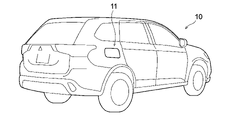
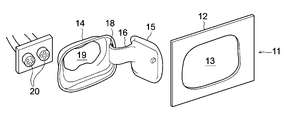
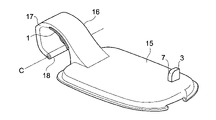
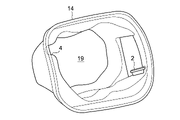
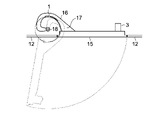
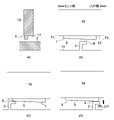
- FIG. 1 It is a perspective view of the vehicle to which the charging port structure as an Example is applied. It is an exploded perspective view for demonstrating the charge port structure of the vehicle shown in FIG. It is a perspective view of the lid shown in FIG. It is a perspective view of the bracket shown in FIG. It is a bottom view of the lid shown in FIG. (A) is a cross-sectional view of a rib and a rib receiving portion, and (B) to (D) are side views thereof. (A) to (C) are side views of the guide and the guide receiving portion.
- FIG. 1 is a perspective view of a vehicle 10 to which a charging port structure as an embodiment is applied.
- the vehicle 10 is provided with a charging port 11 having a built-in connection terminal 20 (charging connector) for external charging.
- the charging port 11 is arranged behind the side surface portion of the vehicle 10, for example, as shown in FIG. Alternatively, the charging port 11 is arranged on the front side surface portion (fender portion), the rear surface (rear hatch portion), the front surface (hood portion), or the like of the vehicle 10.
- the in-vehicle battery is a secondary battery that stores electric power supplied to a traveling motor and various accessories mounted on the vehicle 10.
- FIG. 2 is a perspective view showing the structure of the charging port 11 in an exploded manner.
- the charging port 11 is a side-opening type that closes the opening 13 formed in the outer panel 12, the bracket 14 constituting the accommodating portion accommodating the connection terminal 20 inside the opening 13, and the opening 13 so as to be openable and closable. It is equipped with a lid 15.
- the bracket 14 is a resin member extending inward in the vehicle width direction from the edge of the opening 13, and is fixed to the outer panel 12.
- the bracket 14 is erected in a cylindrical shape from the outer panel 12 toward the inside of the vehicle 10 so as to surround the periphery of the connection terminal 20 to form an accommodating portion.
- the outer end portion of the bracket 14 in the vehicle width direction is formed as an insertion hole having a shape corresponding to the opening 13 (for example, a square shape with rounded corners).
- the cross-sectional shape of the end 19 on the inner side in the vehicle width direction is formed to surround the connection terminal 20 (for example, a gourd shape).
- the lid 15 is a lid-shaped member that is rotatably supported by the bracket 14 and rotatably closes the opening 13 of the charging port 11.
- the lid 15 is composed of a sheet metal outer member formed in a planar shape covering the opening 13 and a resin inner member covering the back surface of the outer member.
- the inner member is attached to a bracket 14.
- a hinge arm 16 rotatably supported via the hinge 18 is provided.
- the hinge arm 16 is an arm-shaped member extending from one side (upper left end in FIG. 3) on the back surface side of the lid 15 toward the inside of the opening 13 (inside the accommodating portion).
- a hinge 18 is provided at the end of the hinge arm 16 on the side far from the lid 15.
- the overall shape of the hinge arm 16 is a shape that connects the lid 15 and the hinge 18 while gently bending. Further, the position of the hinge 18 is located inside the vehicle 10 with respect to the opening 13 and away from the edge of the opening 13 (for example, a position not visible from the outside of the vehicle 10 when the lid 15 is opened). Be placed.
- the curved shape of the hinge arm 16 prevents interference between the hinge arm 16 and the edge of the opening 13 when the lid 15 is opened and closed.
- reinforcing structures such as ridges and grooves may be formed on the surfaces thereof.
- a streak-shaped rib 1 is projected on the surface of the hinge arm 16.
- the position of the rib 1 is set, for example, at the lower part of the hinge arm 16.
- the rib 1 is formed so as to project downward from the lower end surface 17 (lower surface portion) of the hinge arm 16 in a streak-like manner and to project along the extending direction of the hinge arm 16.
- a rib receiving portion 2 is formed on the bracket 14 so as to correspond to this.
- the rib receiving portion 2 is projected from the bracket 14 at a position below the hinge arm 16 supported by the hinge 18.
- the rib receiving portion 2 cooperates with the rib 1 to push up the lid 15 upward when, for example, the relative position of the lid 15 with respect to the opening 13 (bracket 14) is lowered due to thermal deformation of the hinge arm 16. It is a part.
- the rib receiving portion 2 is provided at a position below the rib 1 in the process of closing the lid 15 inside the opening 13, and is provided so as to face the lower end surface 17 of the hinge arm 16. As a result, the rib 1 on the lowered lid 15 side and the rib receiving portion 2 come into contact with each other.
- the rib receiving portion 2 is arranged so as to have a predetermined distance from the rib 1. As a result, for example, when the hinge arm 16 is not thermally deformed, the rib 1 and the rib receiving portion 2 are not in contact with each other as shown in FIG. 6A.
- the overall shape of the rib 1 is formed so as to be arcuate when the lid 15 is viewed in a direction parallel to the rotation axis C (rotation center). That is, the rib 1 is extended in an arc shape substantially coaxial with the rotation shaft C of the lid 15.
- the two-dot chain line in FIG. 5 represents an arc corresponding to the extending direction of the rib 1.
- the shape of the rib 1 of this embodiment is set to a shape in which the amount of upward movement of the lid 15 increases as the lid 15 is closed in contact with the rib receiving portion 2.
- the protruding dimension of the rib 1 with respect to the lower end surface 17 of the hinge arm 16 is set to be larger on the lid 15 side than on the hinge 18 side.
- the protrusion dimension H1 on the hinge 18 side is set to be the smallest, and the protrusion dimension H2 on the lid 15 side is set to be the largest. Further, the protrusion dimension gradually increases from the hinge 18 side to the lid 15 side.
- the rib lower surface 5 (lower end surface of the rib 1) becomes a surface shape that is inclined with respect to the lower end surface 17 of the hinge arm 16.
- the rib 1 has a rib lower surface 5 as an inclined portion formed so as to gradually increase toward the lid 15 side in the extending direction of the hinge arm 16.
- a rib support surface 6 is formed at the upper end of the rib receiving portion 2.
- the rib support surface 6 is a surface-like portion that abuts on the rib lower surface 5 when the relative position of the lid 15 with respect to the bracket 14 is lowered, and is arranged so as to face the rib lower surface 5.
- the rib support surface 6 is arranged so as to be orthogonal to the wall-shaped rib receiving portion 2 erected from the bracket 14 in the cross section along the extending direction of the rib 1.
- the rib receiving portion 2 and the rib supporting surface 6 are connected so as to form an L-shaped cross section as a whole.
- the rib support surface 6 is formed in a smooth surface shape that can slide with respect to the rib lower surface 5.
- FIG. 6C shows the rib lower surface 5 and the rib receiving portion 2 of the rib 1 when the lid 15 is closed in a state where the relative position of the lid 15 with respect to the bracket 14 is lowered due to the thermal deformation of the hinge arm 16. It shows a state in which the rib support surface 6 is in contact with the rib support surface 6. At this time, the position of the lower end surface 17 of the hinge arm 16 is a position moved upward by the protrusion dimension H 1 minute from the rib support surface 6. Then, as the lid 15 is gradually closed, the lid 15 gradually moves upward. Finally, as shown in FIG. 6D, the position of the lower end surface 17 of the hinge arm 16 is the position moved upward from the rib support surface 6 by the protrusion dimension H 2 minutes at the maximum.
- a guide 3 is provided on the back surface side (inside) of the lid 15 so as to project toward the accommodating portion in the closing direction of the lid 15.
- the outline shape of the guide 3 is formed into a flat columnar shape having a cross-sectional shape of a quarter circle. Alternatively, it is formed into a flat columnar cross section having a quadrangle (for example, a rectangle or trapezoid with one or more rounded corners).
- the lower surface side of the guide 3 is formed into a smooth curved surface.
- this curved surface-shaped portion is referred to as a guide lower surface 7.
- the guide 3 is arranged on the other side (lower right end in FIG. 3) opposite to one side of the lid 15 to which the hinge arm 16 is connected. Further, a guide receiving portion 4 is formed on the bracket 14 so as to correspond to this. In the example shown in FIG. 4, the guide receiving portion 4 is recessed in the position of the bracket 14 opposite to the side on which the hinge 18 is arranged (the side far from the hinge 18). The guide receiving portion 4 is arranged at a position where it comes into contact with the guide 3 in the process of closing the lid 15, and is formed in a shape in which the lid 15 engages with the guide 3 in a state where the charging port 11 is closed. This restricts the lowering of the relative position of the lid 15 with respect to the opening 13.
- the shape of the guide 3 of this embodiment is set to a shape in which the amount of upward movement of the lid 15 increases as the lid 15 is closed in a state of being in contact with the guide receiving portion 4.
- the shape of the guide lower surface 7 (lower end surface of the guide 3) is formed into a curved shape that bulges downward, and the guide support surface is formed with respect to the guide lower surface 7. 8 can be contacted.
- the thickness dimension which is the vertical dimension of the guide 3 shown in FIG. 7A, is set so as to increase from the inside to the outside of the vehicle 10.
- the shape of the guide lower surface 7 is a curved surface shape that is smoothly inclined.
- the guide support surface 8 is a surface-like portion that abuts on the guide lower surface 7 when the relative position of the lid 15 with respect to the bracket 14 is lowered, and is arranged so as to face the guide lower surface 7.
- the guide support surface 8 is formed in a smooth surface shape that can slide with respect to the guide lower surface 7.
- the positional relationship between the guide support surface 8 and the guide lower surface 7 is such that the guide support surface 8 comes into contact with the guide lower surface 7 when the lid 15 is closed while the rib support surface 6 is in contact with the rib lower surface 5. Is set to.
- FIG. 7B shows the guide lower surface 7 and the guide receiving portion 4 of the guide 3 when the lid 15 is closed in a state where the relative position of the lid 15 with respect to the bracket 14 is lowered due to the thermal deformation of the hinge arm 16. It shows a state in which the guide support surface 8 is in contact with the guide support surface 8. That is, as a result of the lid 15 being lifted upward by the rib 1 and the rib receiving portion 2, the guide lower surface 7 and the guide support surface 8 come into contact with each other. Then, as the lid 15 is gradually closed, the lid 15 gradually moves upward. Eventually, as shown in FIG. 7C, the entire guide 3 is inserted into the inside of the guide receiving portion 4 and engaged with the guide 3.
- the above charging port structure is provided with a rib 1 and a rib receiving portion 2.
- the rib 1 is projected along the extending direction of the hinge arm 16 of the lid 15 (in a streak from the hinge arm 16), and the rib receiving portion 2 supports the inside of the opening 13 (in this embodiment, the hinge arm 16 is supported). It is formed on the bracket 14). Further, when the relative position of the lid 15 with respect to the opening 13 (bracket 14) is lowered, the rib receiving portion 2 comes into contact with the rib 1 in the process of closing the lid 15 and cooperates with the rib 1 to move the lid 15. It works to push it upwards.
- the rib 1 is extended in an arc shape substantially coaxial with the rotation center of the lid 15.
- the contact position between the rib 1 and the rib receiving portion 2 when closing the lid 15 can be set to a substantially constant position, and the lifting function of the lid 15 by the rib receiving portion 2 can be stabilized.
- the contact position of the rib 1 with respect to the rib receiving portion 2 hardly changes, the size of the rib receiving portion 2 can be reduced, the formability of the bracket 14 and the degree of freedom in design can be improved, and the manufacturing can be performed. The cost can be reduced.
- the rib 1 is formed in a shape in which the amount of upward movement of the lid 15 increases as the lid 15 is closed.
- the lid 15 can be gradually lifted in the process of closing the lid 15, and the position of the lid 15 can be corrected without difficulty. Further, since the load for correction is distributed over a relatively wide range of the hinge arm 16, damage to the lid 15 and the hinge arm 16 can be prevented.
- the rib support surface 6 is formed on the rib receiving portion 2.
- the rib support surface 6 is formed in a surface shape that abuts on the lower end of the rib 1 (rib lower surface 5).
- the above charging port structure is provided with a guide 3 and a guide receiving portion 4.
- the guide 3 projects from the lid 15 toward the closing direction of the lid 15.
- the guide receiving portion 4 is arranged at a position where it comes into contact with the guide 3 in the process of closing the lid 15, and regulates the relative position of the lid 15 in a state where the lid 15 closes the charging port 11 (for example, engages with the guide 3). Is formed.
- the rib 1 and the rib receiving portion 2 have a "first lid lifting structure”
- the lid 15 can be brought closer to the correct position more reliably, and the position correction effect of the lid 15 can be enhanced. Since the load for correction by the second lid lifting structure is distributed over the entire lid 15, it is possible to prevent the lid 15 and the hinge arm 16 from being damaged.
- the guide 3 is formed in a shape in which the amount of upward movement of the lid 15 increases as the lid 15 is closed.
- the lid 15 can be gradually lifted in the process of closing the lid 15, and the position of the lid 15 can be corrected reasonably. Therefore, it is possible to provide a charging port structure capable of correcting the position of the lid 15 with a simple configuration, and it is possible to prevent damage around the lid 15 and the charging port 11.
- the rib 1 is formed on the lower end surface 17 of the hinge arm 16, but the position where the rib 1 is formed is not limited to the lower end surface 17 of the hinge arm 16.
- the structure in which the rib receiving portion 2 and the guide receiving portion 4 are formed on the bracket 14 is exemplified, but the bracket 14 may be omitted.
- the bracket 14 may be omitted.
- the guide 3 and the guide receiving portion 4 can also be omitted.
- the lid 15 is pushed upward in the process of closing the lid 15. The position of the lid 15 can be properly corrected with a simple structure.
- the rib 1 is formed in a shape in which the amount of upward movement of the lid 15 increases as the lid 15 is closed in a state of being in contact with the rib receiving portion 2 (Fig.).
- the rib receiving portion 2 may be formed in a shape in which the amount of upward movement of the lid 15 increases as the lid 15 is closed in a state of being in contact with the rib 1. not.
- the rib support surface 6 of the rib receiving portion 2 is an inclined portion formed so as to gradually increase toward the lid 15 side in the extending direction of the hinge arm 16.
- the guide 3 is formed in a shape in which the amount of upward movement of the lid 15 increases as the lid 15 is closed in contact with the guide receiving portion 4 (FIG. 7).
- the guide receiving portion 4 may be formed in a shape in which the amount of upward movement of the lid 15 increases as the lid 15 is closed in contact with the guide 3.
- the guide support surface 8 of the guide receiving portion 4 is an inclined portion formed so as to extend upward toward the inside in the vehicle width direction.
Landscapes
- Engineering & Computer Science (AREA)
- Mechanical Engineering (AREA)
- Chemical & Material Sciences (AREA)
- Combustion & Propulsion (AREA)
- Transportation (AREA)
- Life Sciences & Earth Sciences (AREA)
- Sustainable Development (AREA)
- Sustainable Energy (AREA)
- Electric Propulsion And Braking For Vehicles (AREA)
- Cooling, Air Intake And Gas Exhaust, And Fuel Tank Arrangements In Propulsion Units (AREA)
- Arrangement Or Mounting Of Propulsion Units For Vehicles (AREA)
- Charge And Discharge Circuits For Batteries Or The Like (AREA)
Priority Applications (2)
| Application Number | Priority Date | Filing Date | Title |
|---|---|---|---|
| JP2022557373A JP7435816B2 (ja) | 2020-10-14 | 2021-10-04 | 充電口構造 |
| CN202180063520.5A CN116157321B (zh) | 2020-10-14 | 2021-10-04 | 充电口构造 |
Applications Claiming Priority (2)
| Application Number | Priority Date | Filing Date | Title |
|---|---|---|---|
| JP2020173575 | 2020-10-14 | ||
| JP2020-173575 | 2020-10-14 |
Publications (1)
| Publication Number | Publication Date |
|---|---|
| WO2022080171A1 true WO2022080171A1 (ja) | 2022-04-21 |
Family
ID=81208275
Family Applications (1)
| Application Number | Title | Priority Date | Filing Date |
|---|---|---|---|
| PCT/JP2021/036706 Ceased WO2022080171A1 (ja) | 2020-10-14 | 2021-10-04 | 充電口構造 |
Country Status (3)
| Country | Link |
|---|---|
| JP (1) | JP7435816B2 (https=) |
| CN (1) | CN116157321B (https=) |
| WO (1) | WO2022080171A1 (https=) |
Citations (4)
| Publication number | Priority date | Publication date | Assignee | Title |
|---|---|---|---|---|
| JPS61163019A (ja) * | 1985-01-11 | 1986-07-23 | Nissan Motor Co Ltd | フユエルフィラリッドヒンジ装置 |
| JP2015096354A (ja) * | 2013-11-15 | 2015-05-21 | 本田技研工業株式会社 | フューエルリッドの取付構造 |
| JP2016088251A (ja) * | 2014-11-04 | 2016-05-23 | 三菱自動車工業株式会社 | 車両のエネルギー補給部構造 |
| JP2019018671A (ja) * | 2017-07-14 | 2019-02-07 | 株式会社ニフコ | 車両のリッド装置 |
Family Cites Families (7)
| Publication number | Priority date | Publication date | Assignee | Title |
|---|---|---|---|---|
| JP2008174296A (ja) * | 2007-01-22 | 2008-07-31 | Fujifilm Corp | ヒンジ式蓋構造 |
| DE112011103303B8 (de) * | 2010-09-29 | 2020-01-30 | Suzuki Motor Corporation | Ladeanschluss |
| JP5472532B2 (ja) * | 2011-05-12 | 2014-04-16 | トヨタ自動車株式会社 | 車両 |
| CN204212576U (zh) * | 2014-09-28 | 2015-03-18 | 广州汽车集团股份有限公司 | 加油口铰链组件、加油口小门总成及加油口总成 |
| JP6682364B2 (ja) * | 2016-02-29 | 2020-04-15 | 株式会社パイオラックス | ハウジングユニット及び開閉体のロック装置 |
| KR101824411B1 (ko) * | 2017-11-29 | 2018-02-01 | 쌍용자동차 주식회사 | 자동차용 연료 필러도어 하우징 어셈블리의 도어 잠김 유지 장치 |
| CN210852671U (zh) * | 2019-08-23 | 2020-06-26 | 北京汽车股份有限公司 | 充电口盖板的翻转安装结构及汽车 |
-
2021
- 2021-10-04 CN CN202180063520.5A patent/CN116157321B/zh active Active
- 2021-10-04 JP JP2022557373A patent/JP7435816B2/ja active Active
- 2021-10-04 WO PCT/JP2021/036706 patent/WO2022080171A1/ja not_active Ceased
Patent Citations (4)
| Publication number | Priority date | Publication date | Assignee | Title |
|---|---|---|---|---|
| JPS61163019A (ja) * | 1985-01-11 | 1986-07-23 | Nissan Motor Co Ltd | フユエルフィラリッドヒンジ装置 |
| JP2015096354A (ja) * | 2013-11-15 | 2015-05-21 | 本田技研工業株式会社 | フューエルリッドの取付構造 |
| JP2016088251A (ja) * | 2014-11-04 | 2016-05-23 | 三菱自動車工業株式会社 | 車両のエネルギー補給部構造 |
| JP2019018671A (ja) * | 2017-07-14 | 2019-02-07 | 株式会社ニフコ | 車両のリッド装置 |
Also Published As
| Publication number | Publication date |
|---|---|
| JP7435816B2 (ja) | 2024-02-21 |
| CN116157321B (zh) | 2025-09-05 |
| JPWO2022080171A1 (https=) | 2022-04-21 |
| CN116157321A (zh) | 2023-05-23 |
Similar Documents
| Publication | Publication Date | Title |
|---|---|---|
| CN102892638B (zh) | 车辆用边框安装结构 | |
| JP5617506B2 (ja) | 充電ポート用カバー | |
| JP5585362B2 (ja) | 充電ポート用カバーの配設構造 | |
| CN103081246B (zh) | 充电连接器 | |
| JP5585363B2 (ja) | 充電ポート用カバーの配設構造 | |
| CN101353059B (zh) | 行李箱盖骨架结构 | |
| JP6754807B2 (ja) | 車体前部構造 | |
| JP5342500B2 (ja) | リアパーセルシェルフのヒンジ構造 | |
| US20170125750A1 (en) | Battery terminal cover and battery provided therewith | |
| CN101152879A (zh) | 车辆的后部结构 | |
| JP5530889B2 (ja) | 充電ポート用カバーの配設構造 | |
| JP5545158B2 (ja) | 充電ポート用カバーの配設構造 | |
| WO2022080171A1 (ja) | 充電口構造 | |
| US20190135106A1 (en) | Lid mounting structure and method of mounting lid | |
| JP5545157B2 (ja) | 充電ポート用カバー | |
| JP2011222181A (ja) | コネクタ | |
| JP2013119276A (ja) | 車両用サイドミラー | |
| WO2020196544A1 (ja) | ヒンジ装置および車両 | |
| JP7258934B2 (ja) | 車両の開閉体構造 | |
| JP2024089728A (ja) | 充電インレット | |
| JP7222742B2 (ja) | 自動車用リッド装置の外蓋及びその製造方法 | |
| JP6831822B2 (ja) | プロテクタ | |
| CN116209616B (zh) | 车辆的盖装置 | |
| JP2020045084A (ja) | スライドドア構造 | |
| JP2025116995A (ja) | 車両用リッド開閉装置 |
Legal Events
| Date | Code | Title | Description |
|---|---|---|---|
| 121 | Ep: the epo has been informed by wipo that ep was designated in this application |
Ref document number: 21879911 Country of ref document: EP Kind code of ref document: A1 |
|
| ENP | Entry into the national phase |
Ref document number: 2022557373 Country of ref document: JP Kind code of ref document: A |
|
| NENP | Non-entry into the national phase |
Ref country code: DE |
|
| 122 | Ep: pct application non-entry in european phase |
Ref document number: 21879911 Country of ref document: EP Kind code of ref document: A1 |
|
| WWG | Wipo information: grant in national office |
Ref document number: 202180063520.5 Country of ref document: CN |