WO2022065370A1 - 非晶質合金リボンの熱処理方法、及び非晶質合金リボンの熱処理装置 - Google Patents
非晶質合金リボンの熱処理方法、及び非晶質合金リボンの熱処理装置 Download PDFInfo
- Publication number
- WO2022065370A1 WO2022065370A1 PCT/JP2021/034822 JP2021034822W WO2022065370A1 WO 2022065370 A1 WO2022065370 A1 WO 2022065370A1 JP 2021034822 W JP2021034822 W JP 2021034822W WO 2022065370 A1 WO2022065370 A1 WO 2022065370A1
- Authority
- WO
- WIPO (PCT)
- Prior art keywords
- amorphous alloy
- ribbon
- alloy ribbon
- heat treatment
- heating
- Prior art date
- Legal status (The legal status is an assumption and is not a legal conclusion. Google has not performed a legal analysis and makes no representation as to the accuracy of the status listed.)
- Ceased
Links
Images



Classifications
-
- C—CHEMISTRY; METALLURGY
- C21—METALLURGY OF IRON
- C21D—MODIFYING THE PHYSICAL STRUCTURE OF FERROUS METALS; GENERAL DEVICES FOR HEAT TREATMENT OF FERROUS OR NON-FERROUS METALS OR ALLOYS; MAKING METAL MALLEABLE, e.g. BY DECARBURISATION OR TEMPERING
- C21D9/00—Heat treatment, e.g. annealing, hardening, quenching or tempering, adapted for particular articles; Furnaces therefor
- C21D9/0068—Heat treatment, e.g. annealing, hardening, quenching or tempering, adapted for particular articles; Furnaces therefor for particular articles not mentioned below
-
- H—ELECTRICITY
- H01—ELECTRIC ELEMENTS
- H01F—MAGNETS; INDUCTANCES; TRANSFORMERS; SELECTION OF MATERIALS FOR THEIR MAGNETIC PROPERTIES
- H01F1/00—Magnets or magnetic bodies characterised by the magnetic materials therefor; Selection of materials for their magnetic properties
- H01F1/01—Magnets or magnetic bodies characterised by the magnetic materials therefor; Selection of materials for their magnetic properties of inorganic materials
- H01F1/03—Magnets or magnetic bodies characterised by the magnetic materials therefor; Selection of materials for their magnetic properties of inorganic materials characterised by their coercivity
- H01F1/12—Magnets or magnetic bodies characterised by the magnetic materials therefor; Selection of materials for their magnetic properties of inorganic materials characterised by their coercivity of soft-magnetic materials
- H01F1/14—Magnets or magnetic bodies characterised by the magnetic materials therefor; Selection of materials for their magnetic properties of inorganic materials characterised by their coercivity of soft-magnetic materials metals or alloys
- H01F1/147—Alloys characterised by their composition
- H01F1/153—Amorphous metallic alloys, e.g. glassy metals
-
- C—CHEMISTRY; METALLURGY
- C21—METALLURGY OF IRON
- C21D—MODIFYING THE PHYSICAL STRUCTURE OF FERROUS METALS; GENERAL DEVICES FOR HEAT TREATMENT OF FERROUS OR NON-FERROUS METALS OR ALLOYS; MAKING METAL MALLEABLE, e.g. BY DECARBURISATION OR TEMPERING
- C21D1/00—General methods or devices for heat treatment, e.g. annealing, hardening, quenching or tempering
- C21D1/26—Methods of annealing
-
- C—CHEMISTRY; METALLURGY
- C21—METALLURGY OF IRON
- C21D—MODIFYING THE PHYSICAL STRUCTURE OF FERROUS METALS; GENERAL DEVICES FOR HEAT TREATMENT OF FERROUS OR NON-FERROUS METALS OR ALLOYS; MAKING METAL MALLEABLE, e.g. BY DECARBURISATION OR TEMPERING
- C21D1/00—General methods or devices for heat treatment, e.g. annealing, hardening, quenching or tempering
- C21D1/34—Methods of heating
-
- C—CHEMISTRY; METALLURGY
- C21—METALLURGY OF IRON
- C21D—MODIFYING THE PHYSICAL STRUCTURE OF FERROUS METALS; GENERAL DEVICES FOR HEAT TREATMENT OF FERROUS OR NON-FERROUS METALS OR ALLOYS; MAKING METAL MALLEABLE, e.g. BY DECARBURISATION OR TEMPERING
- C21D9/00—Heat treatment, e.g. annealing, hardening, quenching or tempering, adapted for particular articles; Furnaces therefor
- C21D9/0006—Details, accessories not peculiar to any of the following furnaces
- C21D9/0012—Rolls; Roll arrangements
-
- C—CHEMISTRY; METALLURGY
- C21—METALLURGY OF IRON
- C21D—MODIFYING THE PHYSICAL STRUCTURE OF FERROUS METALS; GENERAL DEVICES FOR HEAT TREATMENT OF FERROUS OR NON-FERROUS METALS OR ALLOYS; MAKING METAL MALLEABLE, e.g. BY DECARBURISATION OR TEMPERING
- C21D9/00—Heat treatment, e.g. annealing, hardening, quenching or tempering, adapted for particular articles; Furnaces therefor
- C21D9/52—Heat treatment, e.g. annealing, hardening, quenching or tempering, adapted for particular articles; Furnaces therefor for wires; for strips ; for rods of unlimited length
- C21D9/54—Furnaces for treating strips or wire
- C21D9/56—Continuous furnaces for strip or wire
- C21D9/562—Details
- C21D9/563—Rolls; Drums; Roll arrangements
-
- C—CHEMISTRY; METALLURGY
- C21—METALLURGY OF IRON
- C21D—MODIFYING THE PHYSICAL STRUCTURE OF FERROUS METALS; GENERAL DEVICES FOR HEAT TREATMENT OF FERROUS OR NON-FERROUS METALS OR ALLOYS; MAKING METAL MALLEABLE, e.g. BY DECARBURISATION OR TEMPERING
- C21D9/00—Heat treatment, e.g. annealing, hardening, quenching or tempering, adapted for particular articles; Furnaces therefor
- C21D9/52—Heat treatment, e.g. annealing, hardening, quenching or tempering, adapted for particular articles; Furnaces therefor for wires; for strips ; for rods of unlimited length
- C21D9/54—Furnaces for treating strips or wire
- C21D9/56—Continuous furnaces for strip or wire
- C21D9/562—Details
- C21D9/564—Tension control
-
- C—CHEMISTRY; METALLURGY
- C22—METALLURGY; FERROUS OR NON-FERROUS ALLOYS; TREATMENT OF ALLOYS OR NON-FERROUS METALS
- C22C—ALLOYS
- C22C1/00—Making non-ferrous alloys
- C22C1/11—Making amorphous alloys
-
- C—CHEMISTRY; METALLURGY
- C22—METALLURGY; FERROUS OR NON-FERROUS ALLOYS; TREATMENT OF ALLOYS OR NON-FERROUS METALS
- C22C—ALLOYS
- C22C45/00—Amorphous alloys
- C22C45/008—Amorphous alloys with Fe, Co or Ni as the major constituent
-
- H—ELECTRICITY
- H01—ELECTRIC ELEMENTS
- H01F—MAGNETS; INDUCTANCES; TRANSFORMERS; SELECTION OF MATERIALS FOR THEIR MAGNETIC PROPERTIES
- H01F1/00—Magnets or magnetic bodies characterised by the magnetic materials therefor; Selection of materials for their magnetic properties
- H01F1/01—Magnets or magnetic bodies characterised by the magnetic materials therefor; Selection of materials for their magnetic properties of inorganic materials
- H01F1/03—Magnets or magnetic bodies characterised by the magnetic materials therefor; Selection of materials for their magnetic properties of inorganic materials characterised by their coercivity
- H01F1/12—Magnets or magnetic bodies characterised by the magnetic materials therefor; Selection of materials for their magnetic properties of inorganic materials characterised by their coercivity of soft-magnetic materials
- H01F1/14—Magnets or magnetic bodies characterised by the magnetic materials therefor; Selection of materials for their magnetic properties of inorganic materials characterised by their coercivity of soft-magnetic materials metals or alloys
- H01F1/147—Alloys characterised by their composition
- H01F1/153—Amorphous metallic alloys, e.g. glassy metals
- H01F1/15341—Preparation processes therefor
-
- C—CHEMISTRY; METALLURGY
- C21—METALLURGY OF IRON
- C21D—MODIFYING THE PHYSICAL STRUCTURE OF FERROUS METALS; GENERAL DEVICES FOR HEAT TREATMENT OF FERROUS OR NON-FERROUS METALS OR ALLOYS; MAKING METAL MALLEABLE, e.g. BY DECARBURISATION OR TEMPERING
- C21D2201/00—Treatment for obtaining particular effects
- C21D2201/03—Amorphous or microcrystalline structure
-
- C—CHEMISTRY; METALLURGY
- C22—METALLURGY; FERROUS OR NON-FERROUS ALLOYS; TREATMENT OF ALLOYS OR NON-FERROUS METALS
- C22C—ALLOYS
- C22C2200/00—Crystalline structure
- C22C2200/04—Nanocrystalline
-
- C—CHEMISTRY; METALLURGY
- C22—METALLURGY; FERROUS OR NON-FERROUS ALLOYS; TREATMENT OF ALLOYS OR NON-FERROUS METALS
- C22C—ALLOYS
- C22C2202/00—Physical properties
- C22C2202/02—Magnetic
-
- C—CHEMISTRY; METALLURGY
- C22—METALLURGY; FERROUS OR NON-FERROUS ALLOYS; TREATMENT OF ALLOYS OR NON-FERROUS METALS
- C22C—ALLOYS
- C22C45/00—Amorphous alloys
- C22C45/02—Amorphous alloys with iron as the major constituent
Definitions
- the present invention relates to a heat treatment method for an amorphous alloy ribbon and a heat treatment apparatus for an amorphous alloy ribbon.
- a process of moving the amorphous alloy ribbon while contacting it with the heated convex surface to apply heat is known. Specifically, there is known a method in which an amorphous alloy ribbon is brought into contact with a heated roll surface and moved while being mechanically restrained, and heat-treated by rapid temperature rise and cooling (for example, Patent Document 1). ).
- the present invention provides a heat treatment method for an amorphous alloy ribbon and a heat treatment apparatus capable of uniformly heat-treating the amorphous alloy ribbon while suppressing the occurrence of anisotropy in magnetic properties.
- the present invention is a heat treatment method for an amorphous alloy ribbon, in which the amorphous alloy ribbon is moved while being in contact with the heated convex surface, and the portion of the amorphous alloy ribbon that is in contact with the convex surface is moved. It has a step of moving while pressing against the convex surface from the opposite side of the surface in contact with the convex surface.
- step a plurality of times by changing the surface of the amorphous alloy ribbon with which the convex surface abuts.
- the flexible member is a metal member.
- the amorphous alloy ribbon is a nanocrystalline soft magnetic material.
- the present invention is a heat treatment apparatus for an amorphous alloy ribbon, in which a heating portion having a convex surface for contacting and heating the amorphous alloy ribbon and a contact portion of the amorphous alloy ribbon are formed on the convex surface. It has a combination with a pressing portion that presses from the opposite side of the contact surface.
- the heating portion and the pressing portion with respect to the amorphous alloy ribbon has a plurality of the combinations in the traveling direction of the amorphous alloy ribbon.
- the positional relationship between the heating portion and the pressing portion with respect to the amorphous alloy ribbon is opposite.
- the pressing portion is a flexible member.
- the pressing portion is a band member that can be moved via a roller.
- the band member is a metal member.
- the roller has a heating mechanism for heating the band member.
- the amorphous alloy ribbon can be heat-treated while ensuring sufficient thermal contact without applying a large tension, and the generation of anisotropy of magnetic properties is suppressed. It becomes possible to manufacture a crystalline alloy ribbon.
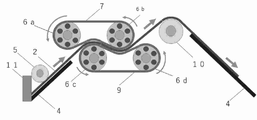
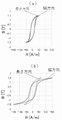
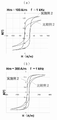
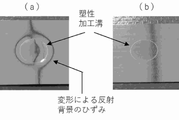
- FIG. 1 It is a perspective conceptual diagram of the heat treatment machine of the amorphous alloy ribbon which is 1st Embodiment of this invention. It is a schematic diagram which showed the procedure ((a)-(f)) of the heat treatment method of the amorphous alloy ribbon in 1st Embodiment of this invention in order. It is an enlarged schematic diagram of a pressing part and a heating part in the 2nd Embodiment of this invention. It is a graph which shows the magnetic property in Example 1 and Comparative Example 1 in the 1st Embodiment of this invention. It is a figure which shows the amorphous alloy ribbon in Example 2 and the comparative example 2 in the 1st Embodiment of this invention. It is a graph which shows the magnetic property in Example 2 and the comparative example 2 in the 2nd Embodiment of this invention. It is a figure which shows the deformation state of the amorphous alloy ribbon before and after the heat treatment in an embodiment of this invention.
- the amorphous alloy ribbon is moved while being in contact with the heated convex surface.
- One of the features of such a heat treatment apparatus is that it has a pressing portion that presses the contact portion of the amorphous alloy ribbon against the convex surface from the opposite side of the contact surface.
- the form of pressing the amorphous alloy ribbon is not particularly limited, but it is preferable to press it via a flexible member that follows the shape of the heated convex surface.
- the "contact surface” means that the amorphous alloy ribbon and the convex surface are in contact with each other on the surface.
- the heat treatment device 1 includes a ribbon guide slope 4 installed on the base 3, a ribbon tension brake roller 5, a ribbon width direction control mechanism 11, heating rollers 6a, 6b, 6c, a ribbon pressing metal belt 7, and the like. It is provided with thermocouples 8a, 8b, 8c (not shown in FIG. 1) so that the amorphous alloy ribbon 2 can be arranged between the heating roller 6c and the ribbon holding metal belt 7.
- the ribbon retainer metal belt 7 is an example of a flexible member, and is a band member that can be moved via a roller.
- the flexible member (band member) is preferably a metal member from the viewpoint of flexibility, strength, and heat resistance.
- the heating roller 6c is a roller for directly contacting and heating the amorphous alloy ribbon.
- the amorphous alloy ribbon 2 abuts (contacts) a part (partial region in the circumferential direction) of the outer peripheral surface of the cylindrical heating roller 6c and is heated.
- the roller 6c itself does not have a drive source and is driven by the ribbon presser metal belt 7, so that synchronous operation can be performed without a complicated mechanism.
- the roller for driving the ribbon retainer metal belt 7 may be either the heating roller 6a or the heating roller 6b, or either one of them.
- the heating roller 6b is provided with a driving force, and the heating roller 6a is mechanically subordinated.
- the ribbon retainer metal belt 7 presses the amorphous alloy ribbon 2 against the heating roller 6c. That is, the ribbon pressing metal belt 7 presses the amorphous alloy ribbon 2 against the convex surface (curved surface of the outer periphery) of the heating roller 6c from the opposite side of the contact surface. That is, the heating roller 6a, the heating roller 6b, and the ribbon pressing metal belt 7 form a pressing portion in the heat treatment apparatus 1.
- the heating roller 6c is an example of a heating portion having a convex surface for abutting and heating an amorphous alloy ribbon.
- the "convex surface” means a surface that is raised toward the amorphous ribbon side, and is like a curved surface of a cylindrical (cylindrical) side surface as well as a curved surface of a kamaboko-shaped member like the roller shown in FIG. Any shape, such as a curved surface formed on a part of a member, may be used as long as the amorphous ribbon follows and secures sufficient contact.
- the material of the amorphous alloy ribbon 2 is not particularly limited.
- Fe-based amorphous alloys such as Fe—Si—B system and Fe—Si—B—C system, Fe—Si—B—Nb—Cu system and Fe—Si—B—Nb which are nanocrystalline soft magnetic materials.
- the Fe-based nanocrystal alloy has a composition for crystallizing nanocrystals by heat-treating an amorphous alloy ribbon.
- the roller constituting the pressing portion in the heat treatment apparatus 1 drives the ribbon pressing metal belt 7, and the ribbon pressing metal belt 7 does not necessarily have a function of pressing the amorphous alloy ribbon 2 against the heating roller 6c. It does not have to be heated.
- the heat treatment of the amorphous alloy ribbon it is necessary to raise the amorphous alloy ribbon to, for example, 500 ° C., so that the heat loss due to radiation becomes large at a high temperature.
- the ribbon presser metal belt 7 having a small volume has a small amount of heat accumulation, so that the temperature drops immediately. Therefore, by using a heating roller provided with a heating mechanism as the roller constituting the pressing portion, heat can be continuously supplied, and the temperature stability of the ribbon holding metal belt is improved.
- the heat supply speed to the ribbon is improved, the ribbon can be rapidly heated, and the heat treatment temperature can be expected to be stable.
- the heating temperature of the heating rollers 6a, 6b, 6c is preferably 350 ° C. or higher and 400 ° C. or lower when the amorphous alloy ribbon 2 is an Fe-based amorphous alloy or the like, and is preferably 350 ° C. or higher and 400 ° C. or lower, respectively. In each case, 500 ° C. or higher is preferable.
- the material of the ribbon retainer metal belt 7 is not particularly limited. For example, it is more preferable to use a material having excellent heat resistance, such as heat-resistant stainless steel or a nickel-based super heat-resistant alloy.
- the tension roller 5 and the ribbon width direction control mechanism 11 are used as a set to prevent meandering of the ribbon.
- the ribbon width direction control mechanism 11 acts so that the ribbon in front of the tension roller 5 does not shift laterally, the ribbon enters the center of the tension roller 5, and the position where the ribbon is sandwiched between the heating roller 6c and the belt is located. When it shifts to the side (meaning), the tension generated by the tension roller 5 generates a force to return it to the center, and the meandering is suppressed.
- the heat treatment method of the present embodiment will be described in order with reference to FIGS. 2 ((a) to (f)) showing a cross section of the heat treatment apparatus 1.
- the amorphous alloy ribbon is moved while being in contact with the heated convex surface.
- the contact portion of the amorphous alloy ribbon is moved while being pressed against the convex surface from the opposite side of the contact surface.
- the ribbon presser metal belt 7 is erected on the heating roller 6a and the heating roller 6b, and the heating roller 6c is arranged so as to be in contact with the ribbon presser metal belt 7 from the outside to apply tension (FIG. 2A).
- the ribbon retainer metal belt 7 is configured to be movable via a heating roller 6a and a heating roller 6b.
- the heating rollers 6a, 6b, 6c While rotating the heating rollers 6a, 6b, 6c in the directions of the arrows shown by the dotted lines, the heating rollers 6a, 6b are heated to, for example, 550 ° C, and the heating rollers 6c are heated to, for example, 500 ° C. At this time, the temperatures of the heating rollers 6a, 6b, 6c and the ribbon retainer metal belt 7 are measured and controlled by the thermocouples 8a, 8b, 8c (FIG. 2B).
- the amorphous alloy ribbon 2 from the ribbon unwinder (not shown) is drawn along the ribbon guide slope 4 with the black arrow in the figure. (Fig. 2 (c)).
- a ribbon tension roller 5 for suppressing meandering of the ribbon and a ribbon width direction regulating mechanism 11 are installed.
- a small tension is applied to the ribbon tension roller 5 to prevent meandering, but when the ribbon is sandwiched between the metal belt 7 and the heating roller 6c for heat treatment, friction due to the clamp near the entrance thereof is applied. Since the force cancels the tension, no tension is applied to the ribbon in the subsequent heat treatment section.
- the amorphous alloy ribbon 2 can be discharged by simultaneously contacting the ribbon pressing metal belt 7 and the heating roller 6C. That is, by adjusting the tilt angle of the ribbon guide slope 4 and setting the supply / discharge angle of the amorphous alloy ribbon 2, it is possible to heat and cool the front and back of the amorphous alloy ribbon 2 at the same time. Become. It is more preferable to arrange the heating roller 6c so that the tangents of the heating rollers 6c coincide with each other on the extension of the ribbon guide slope.
- the amorphous alloy ribbon 2 moves while abutting on the convex surface of the heating roller 6c, and the contact portion of the amorphous alloy ribbon is brought into contact with the convex surface of the heating roller 6c by the ribbon pressing metal belt 7. It will move while being pressed down from the opposite side (FIG. 2 (e)).
- the speed of the ribbon presser metal belt 7 and the speed of the amorphous alloy ribbon 2 are different, and slippage may occur, but it is preferable that the ribbon presser metal belt 7 and the amorphous alloy ribbon 2 move together. ..
- the amorphous alloy ribbon 2 that has passed between the pressing portion composed of the ribbon pressing metal belt 7 and the heating rollers 6a and 6b and the heating roller 6c is discharged along the ribbon guide slope 4 in the direction of the white arrow in the figure. (Fig. 2 (f)).
- the discharged amorphous alloy ribbon 2 is wound by a ribbon winder (not shown).
- the heat treatment apparatus for the amorphous alloy ribbon of the present embodiment and the heat treatment apparatus for the amorphous alloy ribbon of the first embodiment are a pressing portion and a heating portion composed of a heating roller and a ribbon pressing metal belt. Only the difference is made, so an enlarged schematic diagram of that part will be used for explanation. Further, since the same configuration as that of the first embodiment has the same action and effect, the same symbols are added and the description thereof will be omitted.
- FIG. 3 is an enlarged schematic view of a pressing portion and a heating portion in the heat treatment apparatus for the amorphous alloy ribbon according to the second embodiment.
- the heat-treated portion includes heating rollers-6a, 6b, 6c, 6d, ribbon presser metal belts 7 and 9, and guide rollers 10, and is between the ribbon presser metal belts 7 and 9.
- the amorphous alloy ribbon 2 can be arranged.
- a plurality of heating rollers 6a, 6b, 6c, and 6d are arranged so as to be staggered and partially overlap when viewed from the traveling direction of the amorphous alloy ribbon 2.
- the heating rollers 6a and 6b for heating one surface of the amorphous alloy ribbon 2 and the heating rollers 6c and 6d for heating the other surface are alternately arranged, and the heating rollers 6a and 6d for heating one surface are arranged alternately.
- a first band member ribbon presser metal belt 7 is hung around 6b, a roller 6c for heating the other surface is hung, and a second band member (ribbon presser metal belt 9) is hung around 6d. ing.
- the first band member becomes a part of the heating portion for one surface of the amorphous alloy ribbon 2.
- the second band member serves as a pressing portion.
- the second band member is a part of the heating portion with respect to the other surface of the amorphous alloy ribbon 2.
- the first band member (ribbon presser metal belt 7) serves as a pressing portion.
- the ribbon presser metal belt 9 is an example of a flexible member, and is a band member that can be moved via a roller.
- the flexible member (band member) is preferably a metal member from the viewpoint of flexibility, strength, and heat resistance.
- the ribbon presser metal belt 7 presses the amorphous alloy ribbon 2 against the ribbon presser metal belt 9 that follows the convex surface (curved surface of the outer periphery) of the heating roller 6c. That is, the ribbon pressing metal belt 7 presses the amorphous alloy ribbon 2 against the ribbon pressing metal belt 9 following the convex surface (curved surface of the outer periphery) of the heating roller 6c from the opposite side of the contact surface.
- each of the heating roller 6a, the heating roller 6b, and the ribbon pressing metal belt 7, the heating roller 6c, the heating roller 6d, and the ribbon pressing metal belt 9 is a pressing portion in the heat treatment apparatus 1. At the same time, it constitutes a heating unit in the heat treatment apparatus 1.
- the heating rollers 6a, 6b, 6c, and 6d are driven, and the other rollers are driven via the ribbon presser metal belts 7 and 9, so that synchronous operation can be performed without a complicated mechanism. ..
- the heating rollers 6b are provided with a driving force, and the heating rollers 6a, 6c, and 6d are mechanically subordinated via the ribbon pressing metal belts 7, 9.
- complicated control such as electrically synchronous operation for the heating rollers 6a, 6b, 6c, 6d, and further correct the synchronization deviation due to the thermal expansion difference of the heating rollers 6a, 6b, 6c, 6d. You don't even have to.
- FIG. 3 is an enlarged schematic view of the heat treatment portion in the heat treatment apparatus of the amorphous alloy ribbon according to the second embodiment.
- the amorphous alloy ribbon 2 moves while abutting on the ribbon presser metal belt 9 that follows the convex surface (curved surface of the outer periphery) of the heating roller 6c, and is a portion of the abutment of the amorphous alloy ribbon by the ribbon presser metal belt 7. However, it moves while being pressed from the opposite side of the contact surface with respect to the ribbon pressing metal belt 9 following the convex surface (curved surface of the outer periphery) of the heating roller 6c.
- the amorphous alloy ribbon 2 moves while abutting against the ribbon pressing metal belt 7 following the convex surface (curved surface of the outer periphery) of the heating roller 6b, and the ribbon pressing metal belt 9 causes the amorphous alloy ribbon to move.
- the abutting portion moves while being pressed from the opposite side of the abutting surface to the ribbon pressing metal belt 7 following the convex surface (curved surface of the outer periphery) of the heating roller 6b.
- the speeds of the ribbon presser metal belt 7 and the ribbon presser metal belt 9 and the speed of the amorphous alloy ribbon 2 are different, and slippage may occur, but the ribbon presser metal belt 7, the ribbon presser metal belt 9, and the amorphous material may occur. It is preferable that the quality alloy ribbon 2 moves together.
- the amorphous alloy ribbon 2 that has passed between the ribbon retainer metal belts 7 and 9 is discharged along the guide roller 10 in the direction of the white arrow in the figure.
- the discharged amorphous alloy ribbon 2 moves along the ribbon guide slope 4 and is wound by a ribbon winder (not shown).
- amorphous alloy ribbon for example, for a motor stator core
- the amorphous alloy ribbon is sequentially brought into contact with the convex surfaces facing different directions, the bending generated in the curvature direction of the convex surface can be corrected without exchanging the front and back sides of the ribbon. It is possible to efficiently obtain a heat-treated ribbon with less bending.
- Example 1 First, using the first embodiment, both sides of the ribbon are heat-treated at 520 ° C. while moving the amorphous alloy ribbon 2 at a speed of 200 mm / s without applying tension to the amorphous alloy ribbon 2. The first embodiment was manufactured. Then, the magnetization curve (BH curve) of the heat-treated amorphous alloy ribbon 2 was measured. A single plate tester connected to a BH analyzer (SY-8218 manufactured by Iwatsu Electric Co., Ltd.) was used for the measurement.
- BH curve magnetization curve
- the single plate tester used for the measurement has a bobbin width of 25 mm for inserting the sample and a yoke length of 25 mm, if the sample is a square sample with a side of 25 mm, the sample insertion direction is changed by 90 °.
- the magnetic anisotropy of the sample can be evaluated. Therefore, a square sample having a side of 25 mm was cut out from the heat-treated amorphous alloy ribbon 2, and the BH curves in the length direction and the width direction of the ribbon were measured, respectively.
- FIG. 4 (b) When the heat treatment is performed using the conventional method, as can be seen from FIG. 4 (b), there is a difference in the BH curve in the length direction and the width direction, and magnetic anisotropy occurs.
- FIG. 4A there is no difference in the BH curve in the length direction and the width direction, and magnetic anisotropy does not occur.
- the BH curves in FIG. 4 are all measured under the conditions of a frequency of 1 kHz and a maximum magnetic flux density of 1.5 T, but the BH curves are measured by changing the frequency (including direct current) and the maximum magnetic flux density. Even when this was done, there was no change in the result shown in FIG. 4 (that is, the presence or absence of magnetic anisotropy).
- Example 2 Next, using the second embodiment, both sides of the ribbon are moved at a speed of 17 mm / s at 480 ° C. without applying tension to the amorphous alloy ribbon 2.
- Example 2 was produced by heat treatment.
- Comparative Example 2 The amorphous alloy ribbon 2 heat-treated by the conventional method was manufactured as Comparative Example 2.
- the convex curved surface heated to 490 ° C. was subjected to heat treatment by moving while being in contact with the convex curved surface while applying a tension of 2 [kgf].
- Example 5 (a), (b), and (c) are diagrams showing Example 1, Example 2, and Comparative Example 2, respectively.
- Example 1 of FIG. 5A since the ribbon is bent by the convex heat treatment, both ends of the ribbon are raised by about 6 mm, but in Example 2 of FIG. 5B, the bending of the ribbon is corrected. It can be seen that there is no uplift.
- Comparative Example 2 of FIG. 5C since the heat treatment is performed while applying tension to the ribbon, it can be seen that the ribbon is not warped as in Example 2.
- FIG. 6A is a BH curve when a magnetic field strength of 100 A / m is applied
- FIG. 6B is a BH curve when a magnetic field strength of 300 A / m is applied at both frequencies of 1 kHz.
- Example 2 has a better rise of the BH loop than Comparative Example 2 and is superior in magnetic characteristics.
- heat can be transferred to the amorphous alloy ribbon without applying an unnecessarily high tension, and anisotropy of magnetic properties and ribbon breakage do not occur.
- Amorphous alloy ribbons can be manufactured.
- the amorphous alloy ribbon is an Fe-based nanocrystal alloy, it is easy for the temperature to rise excessively due to self-heating during crystallization to crystallize the nanocrystals, so it is necessary to dissipate heat to a heating roll or a convex curved surface.
- the ribbon is strongly pressed against the heating roll or convex curved surface by applying strong tension to the ribbon, and by reducing the contact thermal resistance, the heat dissipation efficiency to the heating roll or convex curved surface is increased and excessive temperature rise is suppressed.
- the embodiment of the present invention since the ribbon is pressed by the band, it is possible to reduce the contact thermal resistance without applying excessive tension to the ribbon.
- the ribbon waviness (hereinafter referred to as side wave) due to the difference in cooling rate during casting often exists at both ends of the amorphous alloy ribbon in the width direction, and the same portion is in contact with the heater.
- side wave the ribbon waviness due to the difference in cooling rate during casting often exists at both ends of the amorphous alloy ribbon in the width direction, and the same portion is in contact with the heater.
- the embodiment of the present invention is used, the entire ribbon is pressed by the heated band, so that sufficient heat treatment is possible even in the presence of side waves.
- FIG. 7 shows an example showing the deformed state of the amorphous alloy ribbon before and after the heat treatment in the embodiment of the present invention. Specifically, it shows the changes before and after the heat treatment of the plastic working groove formed by pressing an annular engraved punch having a diameter of 9.3 mm on the surface of the amorphous alloy ribbon with a predetermined load.
- 7 (a) shows before the heat treatment
- FIG. 7 (b) shows after the heat treatment
- FIG. 7 (a) shows reflections and background distortion due to deformation caused by processing. It can be seen that the reflection and distortion are eliminated through the heat treatment mechanism according to the embodiment of the present invention.
Landscapes
- Chemical & Material Sciences (AREA)
- Engineering & Computer Science (AREA)
- Materials Engineering (AREA)
- Mechanical Engineering (AREA)
- Physics & Mathematics (AREA)
- Metallurgy (AREA)
- Organic Chemistry (AREA)
- Thermal Sciences (AREA)
- Crystallography & Structural Chemistry (AREA)
- Electromagnetism (AREA)
- Dispersion Chemistry (AREA)
- Power Engineering (AREA)
- Manufacturing Cores, Coils, And Magnets (AREA)
- Soft Magnetic Materials (AREA)
Priority Applications (4)
| Application Number | Priority Date | Filing Date | Title |
|---|---|---|---|
| EP21872499.5A EP4219774A4 (en) | 2020-09-25 | 2021-09-22 | HEAT TREATMENT METHOD FOR AMORPHOUS ALLOY RIBBON AND HEAT TREATMENT APPARATUS FOR AMORPHOUS ALLOY RIBBON |
| CN202180065276.6A CN116261758B (en) | 2020-09-25 | 2021-09-22 | Method and apparatus for heat treatment of amorphous alloy ribbon |
| US18/027,924 US20230366054A1 (en) | 2020-09-25 | 2021-09-22 | Heat treatment method for amorphous alloy ribbon and heat treatment apparatus for amorphous alloy ribbon |
| JP2022552035A JP7447381B2 (ja) | 2020-09-25 | 2021-09-22 | 非晶質合金リボンの熱処理方法、及び非晶質合金リボンの熱処理装置 |
Applications Claiming Priority (2)
| Application Number | Priority Date | Filing Date | Title |
|---|---|---|---|
| JP2020160807 | 2020-09-25 | ||
| JP2020-160807 | 2020-09-25 |
Publications (1)
| Publication Number | Publication Date |
|---|---|
| WO2022065370A1 true WO2022065370A1 (ja) | 2022-03-31 |
Family
ID=80846521
Family Applications (1)
| Application Number | Title | Priority Date | Filing Date |
|---|---|---|---|
| PCT/JP2021/034822 Ceased WO2022065370A1 (ja) | 2020-09-25 | 2021-09-22 | 非晶質合金リボンの熱処理方法、及び非晶質合金リボンの熱処理装置 |
Country Status (4)
| Country | Link |
|---|---|
| US (1) | US20230366054A1 (https=) |
| EP (1) | EP4219774A4 (https=) |
| JP (1) | JP7447381B2 (https=) |
| WO (1) | WO2022065370A1 (https=) |
Cited By (3)
| Publication number | Priority date | Publication date | Assignee | Title |
|---|---|---|---|---|
| JPWO2022264999A1 (https=) * | 2021-06-16 | 2022-12-22 | ||
| JPWO2022264998A1 (https=) * | 2021-06-16 | 2022-12-22 | ||
| WO2023190770A1 (ja) * | 2022-03-30 | 2023-10-05 | 株式会社プロテリアル | 磁性シートの製造方法 |
Citations (5)
| Publication number | Priority date | Publication date | Assignee | Title |
|---|---|---|---|---|
| JPS5483622A (en) * | 1977-12-16 | 1979-07-03 | Matsushita Electric Ind Co Ltd | Heat treatment method for amorphous magnetic alloy sheet |
| US5069428A (en) * | 1989-07-12 | 1991-12-03 | James C. M. Li | Method and apparatus of continuous dynamic joule heating to improve magnetic properties and to avoid annealing embrittlement of ferro-magnetic amorphous alloys |
| JP2013511617A (ja) * | 2009-11-19 | 2013-04-04 | イドロ−ケベック | アモルファス合金リボンを処理するためのシステム及び方法 |
| KR20140059487A (ko) * | 2012-11-08 | 2014-05-16 | 이상민 | 연자성체 스트립 가공장치 |
| WO2017150440A1 (ja) * | 2016-02-29 | 2017-09-08 | 日立金属株式会社 | ナノ結晶合金リボンの製造方法 |
Family Cites Families (2)
| Publication number | Priority date | Publication date | Assignee | Title |
|---|---|---|---|---|
| GB737424A (en) * | 1953-05-12 | 1955-09-28 | Vickers Electrical Co Ltd | Improvements relating to heat treatment of strip material by dielectric heating |
| EP1045402B1 (en) * | 1999-04-15 | 2011-08-31 | Hitachi Metals, Ltd. | Soft magnetic alloy strip, manufacturing method and use thereof |
-
2021
- 2021-09-22 WO PCT/JP2021/034822 patent/WO2022065370A1/ja not_active Ceased
- 2021-09-22 EP EP21872499.5A patent/EP4219774A4/en active Pending
- 2021-09-22 JP JP2022552035A patent/JP7447381B2/ja active Active
- 2021-09-22 US US18/027,924 patent/US20230366054A1/en active Pending
Patent Citations (5)
| Publication number | Priority date | Publication date | Assignee | Title |
|---|---|---|---|---|
| JPS5483622A (en) * | 1977-12-16 | 1979-07-03 | Matsushita Electric Ind Co Ltd | Heat treatment method for amorphous magnetic alloy sheet |
| US5069428A (en) * | 1989-07-12 | 1991-12-03 | James C. M. Li | Method and apparatus of continuous dynamic joule heating to improve magnetic properties and to avoid annealing embrittlement of ferro-magnetic amorphous alloys |
| JP2013511617A (ja) * | 2009-11-19 | 2013-04-04 | イドロ−ケベック | アモルファス合金リボンを処理するためのシステム及び方法 |
| KR20140059487A (ko) * | 2012-11-08 | 2014-05-16 | 이상민 | 연자성체 스트립 가공장치 |
| WO2017150440A1 (ja) * | 2016-02-29 | 2017-09-08 | 日立金属株式会社 | ナノ結晶合金リボンの製造方法 |
Non-Patent Citations (1)
| Title |
|---|
| See also references of EP4219774A4 * |
Cited By (3)
| Publication number | Priority date | Publication date | Assignee | Title |
|---|---|---|---|---|
| JPWO2022264999A1 (https=) * | 2021-06-16 | 2022-12-22 | ||
| JPWO2022264998A1 (https=) * | 2021-06-16 | 2022-12-22 | ||
| WO2023190770A1 (ja) * | 2022-03-30 | 2023-10-05 | 株式会社プロテリアル | 磁性シートの製造方法 |
Also Published As
| Publication number | Publication date |
|---|---|
| US20230366054A1 (en) | 2023-11-16 |
| JP7447381B2 (ja) | 2024-03-12 |
| JPWO2022065370A1 (https=) | 2022-03-31 |
| EP4219774A1 (en) | 2023-08-02 |
| CN116261758A (zh) | 2023-06-13 |
| EP4219774A4 (en) | 2024-10-16 |
Similar Documents
| Publication | Publication Date | Title |
|---|---|---|
| WO2022065370A1 (ja) | 非晶質合金リボンの熱処理方法、及び非晶質合金リボンの熱処理装置 | |
| CN113748473B (zh) | 带有树脂膜的纳米结晶合金薄带的制造方法 | |
| US4288260A (en) | Method of heat treatments of amorphous alloy ribbons | |
| CN109863253B (zh) | 合金带用退火装置以及退火合金带的制造方法 | |
| US12227818B2 (en) | Amorphous alloy ribbon, production method therefor, and amorphous alloy ribbon piece | |
| CN108136466B (zh) | 金属带的分切装置以及分切方法 | |
| WO2022264999A1 (ja) | ナノ結晶合金薄帯の製造方法、およびナノ結晶合金薄帯 | |
| TW201105475A (en) | Cutting method for workpiece | |
| US20200149126A1 (en) | Conveyance system for tensioning in order to post-treat a rapidly-solidified metal strip, and post-treatment method | |
| JPWO2019009310A1 (ja) | アモルファス合金リボン及びその製造方法 | |
| CN102548679B (zh) | 热轧的冷却装置及冷却方法 | |
| CN116261758B (en) | Method and apparatus for heat treatment of amorphous alloy ribbon | |
| JP2002263870A (ja) | 突き合わせ溶接された鋼板または鋼帯の製造装置及び製造方法 | |
| US20250232913A1 (en) | Method for producing magnetic sheet | |
| US20210257159A1 (en) | Method for producing workpiece | |
| JP4775679B2 (ja) | 積層薄帯の製造方法および製造装置 | |
| JP2001137943A (ja) | 金属板の平坦度制御方法及び装置 | |
| JPH0525554A (ja) | 金属体の連続熱処理装置 | |
| JPS60114412A (ja) | ステンレス鋼帯のスリツト方法 | |
| JP4101610B2 (ja) | 曲げ加工方法および曲げ加工装置 | |
| US20250129447A1 (en) | Methodfor manufacturing nanocrystal alloy ribbon, and method for manufacturing magnetic sheet | |
| JPS59150083A (ja) | 真空蒸着装置 | |
| JPH11251048A (ja) | 帯状金属材料の誘導加熱装置および誘導加熱方法 | |
| CN117393296A (zh) | 磁性片的制造方法以及磁性片制造装置 | |
| JP6537848B2 (ja) | 非晶質軟磁性合金の熱処理方法および非晶質軟磁性合金の熱処理装置 |
Legal Events
| Date | Code | Title | Description |
|---|---|---|---|
| 121 | Ep: the epo has been informed by wipo that ep was designated in this application |
Ref document number: 21872499 Country of ref document: EP Kind code of ref document: A1 |
|
| ENP | Entry into the national phase |
Ref document number: 2022552035 Country of ref document: JP Kind code of ref document: A |
|
| NENP | Non-entry into the national phase |
Ref country code: DE |
|
| ENP | Entry into the national phase |
Ref document number: 2021872499 Country of ref document: EP Effective date: 20230425 |