WO2022054823A1 - 水中油型乳化組成物 - Google Patents
水中油型乳化組成物 Download PDFInfo
- Publication number
- WO2022054823A1 WO2022054823A1 PCT/JP2021/032954 JP2021032954W WO2022054823A1 WO 2022054823 A1 WO2022054823 A1 WO 2022054823A1 JP 2021032954 W JP2021032954 W JP 2021032954W WO 2022054823 A1 WO2022054823 A1 WO 2022054823A1
- Authority
- WO
- WIPO (PCT)
- Prior art keywords
- oil
- mass
- meth
- acrylic acid
- water emulsified
- Prior art date
- Legal status (The legal status is an assumption and is not a legal conclusion. Google has not performed a legal analysis and makes no representation as to the accuracy of the status listed.)
- Ceased
Links
Classifications
-
- A—HUMAN NECESSITIES
- A61—MEDICAL OR VETERINARY SCIENCE; HYGIENE
- A61K—PREPARATIONS FOR MEDICAL, DENTAL OR TOILETRY PURPOSES
- A61K8/00—Cosmetics or similar toiletry preparations
- A61K8/18—Cosmetics or similar toiletry preparations characterised by the composition
- A61K8/72—Cosmetics or similar toiletry preparations characterised by the composition containing organic macromolecular compounds
- A61K8/81—Cosmetics or similar toiletry preparations characterised by the composition containing organic macromolecular compounds obtained by reactions involving only carbon-to-carbon unsaturated bonds
- A61K8/8141—Compositions of homopolymers or copolymers of compounds having one or more unsaturated aliphatic radicals, each having only one carbon-to-carbon double bond, and at least one being terminated by only one carboxyl radical, or of salts, anhydrides, esters, amides, imides or nitriles thereof; Compositions of derivatives of such polymers
- A61K8/8152—Homopolymers or copolymers of esters, e.g. (meth)acrylic acid esters; Compositions of derivatives of such polymers
-
- A—HUMAN NECESSITIES
- A61—MEDICAL OR VETERINARY SCIENCE; HYGIENE
- A61K—PREPARATIONS FOR MEDICAL, DENTAL OR TOILETRY PURPOSES
- A61K8/00—Cosmetics or similar toiletry preparations
- A61K8/02—Cosmetics or similar toiletry preparations characterised by special physical form
- A61K8/04—Dispersions; Emulsions
- A61K8/06—Emulsions
- A61K8/062—Oil-in-water emulsions
-
- A—HUMAN NECESSITIES
- A61—MEDICAL OR VETERINARY SCIENCE; HYGIENE
- A61K—PREPARATIONS FOR MEDICAL, DENTAL OR TOILETRY PURPOSES
- A61K8/00—Cosmetics or similar toiletry preparations
- A61K8/18—Cosmetics or similar toiletry preparations characterised by the composition
- A61K8/30—Cosmetics or similar toiletry preparations characterised by the composition containing organic compounds
- A61K8/33—Cosmetics or similar toiletry preparations characterised by the composition containing organic compounds containing oxygen
- A61K8/34—Alcohols
- A61K8/342—Alcohols having more than seven atoms in an unbroken chain
-
- A—HUMAN NECESSITIES
- A61—MEDICAL OR VETERINARY SCIENCE; HYGIENE
- A61K—PREPARATIONS FOR MEDICAL, DENTAL OR TOILETRY PURPOSES
- A61K8/00—Cosmetics or similar toiletry preparations
- A61K8/18—Cosmetics or similar toiletry preparations characterised by the composition
- A61K8/30—Cosmetics or similar toiletry preparations characterised by the composition containing organic compounds
- A61K8/33—Cosmetics or similar toiletry preparations characterised by the composition containing organic compounds containing oxygen
- A61K8/34—Alcohols
- A61K8/345—Alcohols containing more than one hydroxy group
-
- A—HUMAN NECESSITIES
- A61—MEDICAL OR VETERINARY SCIENCE; HYGIENE
- A61K—PREPARATIONS FOR MEDICAL, DENTAL OR TOILETRY PURPOSES
- A61K8/00—Cosmetics or similar toiletry preparations
- A61K8/18—Cosmetics or similar toiletry preparations characterised by the composition
- A61K8/72—Cosmetics or similar toiletry preparations characterised by the composition containing organic macromolecular compounds
- A61K8/84—Cosmetics or similar toiletry preparations characterised by the composition containing organic macromolecular compounds obtained by reactions otherwise than those involving only carbon-carbon unsaturated bonds
- A61K8/86—Polyethers
-
- A—HUMAN NECESSITIES
- A61—MEDICAL OR VETERINARY SCIENCE; HYGIENE
- A61Q—SPECIFIC USE OF COSMETICS OR SIMILAR TOILETRY PREPARATIONS
- A61Q17/00—Barrier preparations; Preparations brought into direct contact with the skin for affording protection against external influences, e.g. sunlight, X-rays or other harmful rays, corrosive materials, bacteria or insect stings
- A61Q17/04—Topical preparations for affording protection against sunlight or other radiation; Topical sun tanning preparations
Definitions
- the present invention relates to an oil-in-water emulsified composition.
- water-in-oil emulsified cosmetics have a high sunscreen effect and excellent stability because an ultraviolet absorber is mixed in the oil phase.
- many of the water-in-oil emulsified cosmetics are difficult to wash off easily with ordinary cleaning agents or soap, and because they contain a large amount of ultraviolet absorbers, there is a problem with usability such as a dry feeling. In some cases.
- the oil-in-water emulsified cosmetic has the advantages that it can be washed off relatively easily and the feeling of dryness is small.
- Patent Document 1 an oil-in-water type that provides a unique and firm feeling of use by blending (meth) acrylic acid / alkyl (meth) acrylic acid / POE monoalkyl ether ester copolymer of (meth) acrylic acid.
- Emulsified cosmetics are listed.
- the present invention has been made in view of the above circumstances, and an object of the present invention is to provide an oil-in-water emulsified composition which is excellent in emulsification stability even in polymer emulsification and has a fresher feeling of use.
- the oil-in-water emulsified composition of the present invention (A) (meth) acrylic acid / (meth) acrylic acid alkyl / (meth) acrylic acid POE monoalkyl ether ester copolymer and (B) Bacil alcohol and (C) Contains 10% by mass or more of polar oil with respect to the total amount of the composition.
- the oil-in-water emulsified composition of the present invention preferably further contains (D) a higher alcohol.
- the oil-in-water emulsified composition of the present invention preferably further contains (E) an alkyl-modified carboxyvinyl polymer.
- the polar oil is preferably an ultraviolet absorber.
- the mass ratio of (B) batyl alcohol to (D) higher alcohol is preferably 1: 1 to 1: 3.
- the surfactant is preferably a nonionic surfactant having an (F) HLB of 10 to 20, and the blending amount thereof is relative to the total amount of the composition. It is preferably 0.6% by mass or less.
- the oil-in-water emulsified composition of the present invention comprises (A) (meth) acrylic acid / (meth) acrylic acid alkyl / (meth) acrylic acid POE monoalkyl ether ester copolymer, (B) batyl alcohol, and (B). C) Since it contains 10% by mass or more of polar oil with respect to the total amount of the composition, it can be excellent in emulsification stability and have a fresher feeling of use.
- the oil-in-water emulsified composition of the present invention (A) (meth) acrylic acid / (meth) acrylic acid alkyl / (meth) acrylic acid POE monoalkyl ether ester copolymer and (B) Bacil alcohol and (C) Contains 10% by mass or more of polar oil with respect to the total amount of the composition.
- POE is an abbreviation for polyoxyethylene
- POP is an abbreviation for polyoxypropylene
- PEG is an abbreviation for polyethylene glycol
- DPG is an abbreviation for dipropylene glycol.
- (A) (meth) acrylic acid / (meth) acrylic acid alkyl / (meth) acrylic acid POE monoalkyl ether ester copolymer (A) (meth) acrylic acid / (meth) acrylic acid alkyl / (meth) acrylic acid
- the POE monoalkyl ether ester copolymer (hereinafter, also simply referred to as the component (A)) is (A1) Acrylic acid or methacrylic acid, (A2) Alkyl acrylate or Alkyl methacrylate, (A3) Ester of acrylic acid or methacrylic acid and polyoxyethylene alkyl ether, It is a copolymer of.
- ICID International Cosmetic Ingredient Dictionary
- Acrylate / Ceteth-20 methacrylate copolymer Acrylate / Staires-20 methacrylate copolymer, Acrylate / Steareth-25 methacrylate copolymer, Acrylate / Steareth-50 methacrylate copolymer, Acrylate / Examples thereof include Behenes-25 methacrylate copolymer, Acrylate / Steares-20 methacrylate crosspolymer, acryloyldimethyltaurine ammonium / Behenes-25 methacrylate crosspolymer and the like, which are commercially available as an aqueous dispersion (polymer emulsion).
- the components (A) used in the oil-in-water emulsified composition of the present invention include acryloyl / steares-20 methacrylate copolymer (Accurin 22; ROHM & Haas) and acryloyl / steares-25 methacrylate copolymer (Accurin 28; ROHM. And Haas), Acryloyl / Steares-20 Methacrylate Cross Polymer (Accurin 88; ROHM & Haas), and Acryloyldimethyltaurine Ammonium / Behenes-25 Methacrylate Cross Polymer (Aristoflex HMB; Clariant Production UK Ltd.) It is preferable to select from (manufactured). Of these, Acrylate / Steareth-20 methacrylate copolymer or Acrylate / Steareth-20 methacrylate crosspolymer is particularly preferable.
- the aqueous dispersion of the acrylic acid-based polymer is diluted with water or the like, if necessary, and neutralized by adding an alkaline agent to increase the viscosity.
- the alkaline agent for neutralizing the copolymer is not particularly limited, and an inorganic base such as sodium hydroxide or potassium hydroxide, or an organic base such as triethanolamine, isopropanolamine or a basic amino acid can be used.
- the blending amount of the component (A) is preferably 0.01 to 3.0% by mass, more preferably 0.05 to 2.0% by mass, still more preferably the polymer content, based on the total amount of the composition. Is 0.1 to 1.4% by mass, and even more preferably 0.2 to 1.0% by mass.
- the blending amount is 0.01% by mass or more, more emulsification stability can be obtained, and when the blending amount is 3.0% by mass or less, the usability that the product is freshly crumbled at the time of application can be further enhanced.
- (B) Batyl alcohol Bacil alcohol (C 21 H 44 O 3 ) is also referred to as octadecyl glyceryl ether, glyceryl monostearyl ether, etc., and a long-chain aliphatic alcohol having 18 carbon atoms is ether-bonded to the sn-1 position of glycerol. It is a kind of glyceryl monoalkyl ether.
- Batyl alcohol can improve the stability of polymer emulsification of the component (A).
- the blending amount of (B) batyl alcohol is preferably 0.02 to 3% by mass, more preferably 0.1 to 1.0% by mass, based on the total amount of the composition.
- the blending amount is 0.02% by mass or more, the emulsification stability can be further improved. Further, when it is 3% by mass or less, it is not sticky and a fresh feeling of use can be obtained.
- the oil-in-water emulsified composition of the present invention contains (C) polar oil in an amount of 10% by mass or more based on the total amount of the composition.
- the polar oil is not particularly limited as long as it is usually used in cosmetics, pharmaceuticals and foods.
- the IOB value is not particularly limited, but is preferably 0.05 to 0.80.
- the "organic value” is 20 for one carbon atom in the molecule, and the “inorganic value” is 100 for one hydroxyl group.
- “inorganic value” and “organic value” are set according to various atoms or functional groups, and “inorganic value” and “organic value” of all atoms and functional groups in the organic compound are set.
- the IOB value of the organic compound can be calculated by integrating the above (see, for example, Fujita, "Chemical Area", Vol. 11, No. 10, pp. 719-725, 1957).
- the blending amount of the (C) polar oil is more preferably 12 to 40% by mass, more preferably 15 to 30% by mass, based on the total amount of the composition.
- polar oil tends to deteriorate the stability of the oil-in-water emulsified composition, but the oil-in-water emulsified composition of the present invention contains (C) polar oil in an amount of 10% by mass or more based on the total amount of the composition.
- polar oil can be stably blended.
- polar oils include ester oils and UV absorbers.
- ester oil include tripropylene glycol dineopentanoate, isononyl isononanoate, isopropyl myristate, cetyl octanoate, octyldodecyl myristate, isopropyl palmitate, butyl stearate, hexyl laurate, myristyl myristate, and decyl oleate.
- the ultraviolet absorber is not particularly limited, but an ultraviolet absorber generally used for cosmetics can be widely mentioned.
- benzoic acid derivative salicylic acid derivative, silicic acid derivative, dibenzoylmethane derivative, ⁇ , ⁇ -diphenyl acrylate derivative, benzophenone derivative, benzilidenshonow derivative, phenylbenzoimidazole derivative, triazine derivative, phenylbenzotriazole derivative, anthranil derivative, imidazoline.
- Derivatives, benzalmaronate derivatives, 4,4-diarylbutadiene derivatives and the like are exemplified. Specific examples and product names are listed below, but the present invention is not limited thereto.
- benzoic acid derivative examples include para-aminobenzoic acid (PABA) ethyl, ethyl-dihydroxypropyl PABA, ethylhexyl-dimethyl PABA (for example, "Escalol 507"; ISP), glyceryl PABA, and PEG-25-PABA (for example, "ubinal”).
- PABA para-aminobenzoic acid
- ethyl ethyl
- ethyl-dihydroxypropyl PABA for example, "Escalol 507"; ISP
- glyceryl PABA for example, "ubinal”
- PEG-25-PABA for example, "ubinal”
- salicylic acid derivative examples include homosalate (“Eusolex HMS”; Lona / EM Industries), ethylhexyl salicylate (octyl salicylate, for example, “NeoHeliopan OS”; Herman and Reimer), Examples thereof include dipropylene glycol salicylate (eg, "Dipsal”; Skele), TEA salicylate (eg, "Neo Heliopan TS”; Herman and Reimer).
- homosalate (“Eusolex HMS”; Lona / EM Industries)
- ethylhexyl salicylate octyl salicylate, for example, “NeoHeliopan OS”; Herman and Reimer
- dipropylene glycol salicylate eg, "Dipsal”; Skele
- TEA salicylate eg, "Neo Heliopan TS”; Herman and Reimer
- Examples of the silicic acid derivative include octylmethoxycinnamate or ethylhexyl methoxycinnamate (eg, "Pulsole MCX”; Hoffmann-La Roche), isopropyl methoxycinnamate, isoamyl methoxycinnamate (eg, "Neo Heliopan E1000”; Herman. And Reimer), cinnoxate, DEA methoxycinnamate, diisopropyl methylsilicate, glyceryl-ethylhexanoate-dimethoxycinnamate, di- (2-ethylhexyl) -4'-methoxybenzalmaronate and the like.
- octylmethoxycinnamate or ethylhexyl methoxycinnamate eg, "Pulsole MCX”; Hoffmann-La Roche
- isopropyl methoxycinnamate iso
- dibenzoylmethane derivative examples include 4-tert-butyl-4'-methoxydibenzoylmethane (for example, "Pulsole 1789").
- ⁇ , ⁇ -diphenylacrylate derivative examples include octocrylene (for example, “Ubinal N539T”; BASF).
- benzophenone derivative examples include benzophenone-1 (eg, "Ubinal 400"; BASF), benzophenone-2 (eg, “Ubinal D50”; BASF), benzophenone-3 or oxybenzone (eg, "Ubinal M40"; BASF), benzophenone.
- benzylidene camphor derivative examples include 3-benziliden camphor (for example, "Mexoryl SD”; Simex), 4-methylbenzylene camphor, benzylidene camphor sulfonic acid (for example, “Megisolyl SL”; Simex), and methosulfate camphor.
- 3-benziliden camphor for example, "Mexoryl SD”; Simex
- 4-methylbenzylene camphor for example, "Megisolyl SL”; Simex
- methosulfate camphor examples include nium (eg, "Megizolyl SO”; Simex), terephthalilidene camphor sulfonic acid (eg, "Megizolyl SX”; Simex), polyacrylamide methylbenzylidene camphor (eg, "Megizolyl SW”; Simex), and the like. ..
- phenylbenzimidazole derivative examples include phenylbenzoimidazole sulfonic acid (for example, “Usolex 232"; Merck), phenyldibenzoimidazole disodium tetrasulfonate (for example, "Neo Heliopan AP”; Herman and Reimer). Illustrated.
- triazine derivative examples include bisethylhexyloxyphenol methoxyphenyltriazine (for example, “Tinosorb S”; Ciba Specialty Chemicals), ethylhexyltriazone (for example, “Ubinal T150”; BASF), and dietihexylbutamide.
- Triazone eg, "Uvasorb HEB”; Sigma 3V
- 2,4,6-tris diisobutyl-4'-aminobenzalmaronate
- -s-triazine 2,4,6-tris [ 4- (2-Ethylhexyloxycarbonyl) anilino] -1,3,5-triazine and the like are exemplified.
- Phenylbenzotriazole derivatives include drometrizoletrisiloxane (eg, "Silatrizole”; Rhodia shimmy), methylenebis (benzotriazolyltetramethylbutylphenol) (eg, "Tinosorb M” (Ciba Specialty.). Chemicals)), etc. are exemplified.
- anthranil derivative examples include menthyl anthranilate (for example, “Neo Heliopan MA”; Harman and Reimer).
- imidazoline derivative examples include ethylhexyldimethoxybenzylidene dioxoimidazolin propionate.
- benzalmalonate derivative examples include polyorganosiloxane having a benzalmalonate functional group (for example, polysilicone-15; "Pulsole SLX”; DSM Nutrition Japan Co., Ltd.).
- 4,4-diarylbutadiene derivative examples include 1,1-dicarboxy (2,2'-dimethylpropyl) -4,4-diphenylbutadiene.
- the polar oil preferably contains an ultraviolet absorber, and all of them may be ultraviolet absorbers. Further, the ultraviolet absorber may be used alone or in combination of two or more.
- the oil-in-water emulsified composition of the present invention preferably contains a higher alcohol.
- the higher alcohol is not particularly limited as long as it is a higher alcohol having 6 or more carbon atoms that can be used in the fields of cosmetics, pharmaceuticals, quasi-drugs, etc., and examples thereof include saturated linear monohydric alcohols and unsaturated monohydric alcohols. ..
- Saturated linear monohydric alcohols include dodecanol (lauryl alcohol), tridodecanol, tetradodecanol (myristyl alcohol), pentadecanol, hexadecanol (cetyl alcohol), heptadecanol, octadecanol (stearyl alcohol). , Nonadecanol, Icosanol (Arakil alcohol), Henicosanol, Docosanol (Behenyl alcohol), Tricosanol, Tetracosanol (Carnervir alcohol), Pentacosanol, Hexacosanol (Ceryl alcohol) and the like.
- Examples of unsaturated monohydric alcohols include erizyl alcohols.
- a saturated linear monohydric alcohol is preferable from the viewpoint of stability over time.
- the higher alcohol in the present invention one or a combination of two or more of the above can be used.
- a mixture having a melting point of 60 ° C. or higher is particularly preferable in terms of stability.
- the blending amount of the higher alcohol is preferably 0.02 to 9% by mass, more preferably 0.05 to 5.0% by mass, still more preferably 0.1 to 3.0, based on the total amount of the composition. It is by mass, particularly preferably 0.2 to 1% by mass.
- the blending amount is 0.02% by mass or more, the emulsification stability can be further improved. Further, when it is 9% by mass or less, it is not sticky and a fresh feeling of use can be obtained.
- the mass ratio of (B) batyl alcohol to (D) higher alcohol is preferably 1: 1 to 1: 3.
- (B) batyl alcohol and (D) higher alcohol form an ⁇ -type hydrated crystal structure.
- a cross polymer (Acrylate / alkyl acrylate (C10-C30)) is preferably mentioned from the viewpoint of having good emulsion stability and a fresh feeling of use. Can be done.
- (Acrylate / alkyl acrylate (C10-C30)) A commercially available product may be used as the cross polymer, and PemmulenTR-2 Polymeric Emulsifier (manufactured by Lubrizol Advanced Materials, Inc.) can be mentioned.
- the blending amount of the alkyl-modified carboxyvinyl polymer (E) is preferably in the range of 0.01 to 1% by mass, more preferably 0.03 to 0.5% by mass, and further 0, based on the total amount of the composition.
- the range of 0.03 to 0.2% by mass is preferable. When it is 0.01% by mass or more, the stability can be improved. Further, by setting the content to 1% by mass or less, a fresher and lighter feeling of use can be obtained.
- the blending amount of the surfactant is preferably 1% by mass or less based on the total amount of the composition.
- the oil-in-water emulsified composition of the present invention has high emulsification stability and may not be contained.
- the HLB Hydrophilic-Hydrophilic Balance
- the HLB is a nonionic surfactant having a value of 10 to 20.
- the blending amount of the nonionic surfactant is preferably 0.01 to 1% by mass, more preferably 0.05 to 0.8% by mass, and further 0.1 to 0 by mass with respect to the total amount of the composition. It is preferably 6.6% by mass. When it is 0.01% by mass or more, it can contribute to the formation of ⁇ -gel, and when it is 1% by mass or less, it is possible to further enhance the usability without stickiness at the time of use.
- Nonionic surfactants include glycerin or polyglycerin fatty acid esters, propylene glycol fatty acid esters, POE sorbitan fatty acid esters, POE sorbit fatty acid esters, POE glycerin fatty acid esters, POE fatty acid esters, POE alkyl ethers, POE. Select from alkylphenyl ethers, POE / POP alkyl ethers, POE castor oil or hardened castor oil derivative, POE beeswax / lanolin derivative, alkanolamides, POEpropylene glycol fatty acid esters, POE alkylamines, POE fatty acid amides, etc. be able to.
- hydrogenated castor oil such as PEG-40 hydrogenated castor oil, PEG-50 hydrogenated castor oil, PEG-60 hydrogenated castor oil, PEG-60 glyceryl isostearate, and PEG-50 hydrogenated castor oil succinate. Includes oil derivatives, setes-25 and the like.
- the oil-in-water emulsified composition of the present invention contains oils other than (C) polar oil and (D) higher alcohol, which are generally used in cosmetics. Can be selected within the range that does not impair stability. Desirable oils include liquid oils, solid oils, waxes, hydrocarbon oils, higher fatty acids, silicone oils and the like.
- Liquid fats and oils include, for example, avocado oil, camellia oil, macadamia nut oil, corn oil, olive oil, rapeseed oil, sesame oil, persic oil, wheat germ oil, southern ka oil, sunflower oil, flaxseed oil, safflower oil, cottonseed oil, and eno oil. , Soybean oil, peanut oil, tea seed oil, kaya oil, rice bran oil, cinnamon oil, Japanese millet oil, jojoba oil, germ oil, triglycerin and the like.
- solid fats and oils examples include coconut oil, palm oil, hardened palm oil, palm oil, palm kernel oil, mokuro kernel oil, hydrogenated oil, mokuro, and hardened castor oil.
- waxes examples include beeswax, candelilla wax, cotton wax, carnauba wax, bayberry wax, Ibotaro, Montan wax, nukarou, capoc wax, sugar cane wax, hoho barose, cellac wax, POE cholesterol ether and the like.
- hydrocarbon oil examples include liquid paraffin, zokerite, squalane, pristan, paraffin, selecin, squalene, petrolatum, microcrystalline wax, hydrogenated polydecene and the like.
- higher fatty acids examples include lauric acid, myristic acid, palmitic acid, stearic acid, behenic acid, oleic acid, undecylenic acid, tortic acid, isostearic acid, linoleic acid, linoleic acid, eicosapentaenoic acid (EPA), and docosahexaenoic acid ( DHA) and the like.
- silicone oil examples include chain polysiloxane (eg, dimethylpolysiloxane, methylphenylpolysiloxane, diphenylpolysiloxane, etc.); cyclic polysiloxane (eg, octamethylcyclotetrasiloxane, decamethylcyclopentasiloxane, dodecamethylcyclohexane).
- chain polysiloxane eg, dimethylpolysiloxane, methylphenylpolysiloxane, diphenylpolysiloxane, etc.
- cyclic polysiloxane eg, octamethylcyclotetrasiloxane, decamethylcyclopentasiloxane, dodecamethylcyclohexane.
- Silicone resin Silicone resin, silicone rubber, various modified polysiloxanes (amino-modified polysiloxane, polyether-modified polysiloxane, alkyl-modified polysiloxane, fluorine-modified polysiloxane, etc.) forming a three-dimensional network structure, etc. Be done.
- various modified polysiloxanes amino-modified polysiloxane, polyether-modified polysiloxane, alkyl-modified polysiloxane, fluorine-modified polysiloxane, etc.
- the blending amount is preferably 1.0 to 20% by mass, more preferably 5. It is 0 to 15% by mass.
- the blending amount is 1.0% by mass or more, the precipitation of the ultraviolet absorber can be suppressed and the compatibility of the oil content can be ensured, and when the blending amount is 20% by mass or less, the emulsion stability and usability are improved. Can be.
- the oil-in-water emulsified composition of the present invention can contain other optional ingredients that can be blended in ordinary cosmetics and quasi-drugs as long as the effects of the present invention are not impaired.
- Other optional components include, but are not limited to, powder components, coloring agents, moisturizers, aqueous thickeners, dispersants, preservatives, fragrances, various agents and the like.
- the powder component examples include ultraviolet scattering agents such as zinc oxide and titanium oxide, extender pigments such as talc, mica and kaolin, and polymer powders such as polyethylene powder, polymethyl methacrylate powder and nylon powder.
- ultraviolet scattering agents such as zinc oxide and titanium oxide
- extender pigments such as talc, mica and kaolin
- polymer powders such as polyethylene powder, polymethyl methacrylate powder and nylon powder.
- moisturizer examples include polyhydric alcohols such as glycerin, 1,3-butylene glycol, dipropylene glycol and propylene glycol, and water-soluble polymers such as trehalose, hyaluronic acid and chondroitin sulfate.
- polyhydric alcohols such as glycerin, 1,3-butylene glycol, dipropylene glycol and propylene glycol
- water-soluble polymers such as trehalose, hyaluronic acid and chondroitin sulfate.
- aqueous thickener examples include succinoglycan, (dimethylacrylamide / acryloyldimethyltaurine Na) crosspolymer, cellulose gum, carboxyvinyl polymer, xanthan gum, (hydroxyethyl acrylate / acryloyldimethyltaurine Na) copolymer and the like. ..
- the oil-in-water emulsification composition of the present invention is, for example, an oil-in-water emulsification in which a component constituting the oil phase and a component constituting the aqueous phase are separately mixed and the oil phase is added to the aqueous phase for emulsification. It can be produced according to a conventional method of composition (cosmetics).
- the oil-in-water emulsified composition of the present invention can be provided as cosmetics in various dosage forms such as liquid, milky, creamy, gelled, and bavarois. Further, the oil-in-water emulsified composition of the present invention can be provided as a skin care cosmetic, a sunscreen cosmetic, a cosmetic containing a coloring agent, a foundation, a makeup base, and a BB cream.
- the oil-in-water emulsified composition of the present invention is uniquely fresh by polymer emulsification using (A) (meth) acrylic acid / (meth) alkyl acrylate / (meth) acrylic acid POE monoalkyl ether ester copolymer. Since the feeling of use is obtained and the emulsion stability is enhanced by the combined use of (B) batyl alcohol, it is possible to add 10% or more of (C) polar oil represented by an ultraviolet absorber. Therefore, if an ultraviolet absorber is added as the (C) polar oil, it is possible to obtain a cosmetic having a fresh feel and high ultraviolet protection ability and having excellent emulsion stability.
- Example 1 An oil-in-water emulsified composition was prepared according to the formulation shown in Table 1 below, and the prepared composition was evaluated according to the following criteria.
Landscapes
- Health & Medical Sciences (AREA)
- Life Sciences & Earth Sciences (AREA)
- Public Health (AREA)
- Animal Behavior & Ethology (AREA)
- General Health & Medical Sciences (AREA)
- Veterinary Medicine (AREA)
- Birds (AREA)
- Epidemiology (AREA)
- Chemical & Material Sciences (AREA)
- Emergency Medicine (AREA)
- Dispersion Chemistry (AREA)
- Oil, Petroleum & Natural Gas (AREA)
- Dermatology (AREA)
- Cosmetics (AREA)
Abstract
【課題】水中油型乳化組成物を、高分子乳化であっても乳化安定性に優れ、よりみずみずしい使用感を有するものとする。 【解決手段】水中油型乳化組成物を、(A)(メタ)アクリル酸/(メタ)アクリル酸アルキル/(メタ)アクリル酸POEモノアルキルエーテルエステル共重合体と、(B)バチルアルコールと、(C)組成物全量に対して10質量%以上の極性油とを含むものとする。
Description
本発明は、水中油型乳化組成物に関するものである。
一般に、油中水型乳化化粧料は、油相に紫外線吸収剤が配合されるため、日焼け止め効果が高く、安定性に優れている。しかし、油中水型乳化化粧料は通常の洗浄料や石鹸で簡単に洗い流すことが困難なものが多いことに加え、紫外線吸収剤を多く含むので乾燥感が生じるといった、使用感に問題がある場合がある。一方、水中油型乳化化粧料は比較的容易に洗い流すことができ、乾燥感も少ないという利点がある。
例えば、特許文献1には(メタ)アクリル酸/(メタ)アクリル酸アルキル/(メタ)アクリル酸POEモノアルキルエーテルエステル共重合体の配合により独特のもっちりとした使用感触が得られる水中油型乳化化粧料が記載されている。
一般に、高分子を乳化剤として配合した、いわゆる高分子乳化系は紫外線防御剤を安定に配合させることが難しい。特許文献1に記載の化粧料は、配合されている高級アルコールが、非イオン性界面活性剤および水とともにラメラ液晶構造を有する会合体(「αゲル」ともいう)を形成することによって、紫外線防御剤が安定に配合されているが、さらなる乳化安定性の向上とともに、よりみずみずしい使用感が望まれる。
本発明は上記事情に鑑みなされたものであり、高分子乳化であっても乳化安定性に優れ、よりみずみずしい使用感を有する水中油型乳化組成物を提供することを目的とするものである。
本発明の水中油型乳化組成物は、
(A)(メタ)アクリル酸/(メタ)アクリル酸アルキル/(メタ)アクリル酸POEモノアルキルエーテルエステル共重合体と、
(B)バチルアルコールと、
(C)組成物全量に対して10質量%以上の極性油と
を含むものである。
(A)(メタ)アクリル酸/(メタ)アクリル酸アルキル/(メタ)アクリル酸POEモノアルキルエーテルエステル共重合体と、
(B)バチルアルコールと、
(C)組成物全量に対して10質量%以上の極性油と
を含むものである。
本発明の水中油型乳化組成物は、さらに(D)高級アルコールを含むことが好ましい。
本発明の水中油型乳化組成物は、さらに(E)アルキル変性カルボキシビニルポリマーを含むことが好ましい。
(C)極性油は紫外線吸収剤であることが好ましい。
(B)バチルアルコールと(D)高級アルコールの質量比は1:1~1:3であることが好ましい。
本発明の水中油型乳化組成物が界面活性剤を含む場合、界面活性剤は(F)HLBが10~20のノニオン界面活性剤であることが好ましく、その配合量は組成物全量に対して0.6質量%以下であることが好ましい。
本発明の水中油型乳化組成物は、(A)(メタ)アクリル酸/(メタ)アクリル酸アルキル/(メタ)アクリル酸POEモノアルキルエーテルエステル共重合体と、(B)バチルアルコールと、(C)組成物全量に対して10質量%以上の極性油とを含むので、乳化安定性に優れ、よりみずみずしい使用感を有するものとすることができる。
以下、本発明を詳細に説明する。
本発明の水中油型乳化組成物は、
(A)(メタ)アクリル酸/(メタ)アクリル酸アルキル/(メタ)アクリル酸POEモノアルキルエーテルエステル共重合体と、
(B)バチルアルコールと、
(C)組成物全量に対して10質量%以上の極性油と
を含むものである。以下、各成分について詳細に説明する。
なお、本明細書において、POEはポリオキシエチレン、POPはポリオキシプロピレン、PEGはポリエチレングリコール、DPGはジプロピレングリコールの略である。
本発明の水中油型乳化組成物は、
(A)(メタ)アクリル酸/(メタ)アクリル酸アルキル/(メタ)アクリル酸POEモノアルキルエーテルエステル共重合体と、
(B)バチルアルコールと、
(C)組成物全量に対して10質量%以上の極性油と
を含むものである。以下、各成分について詳細に説明する。
なお、本明細書において、POEはポリオキシエチレン、POPはポリオキシプロピレン、PEGはポリエチレングリコール、DPGはジプロピレングリコールの略である。
(A)(メタ)アクリル酸/(メタ)アクリル酸アルキル/(メタ)アクリル酸POEモノアルキルエーテルエステル共重合体
(A)(メタ)アクリル酸/(メタ)アクリル酸アルキル/(メタ)アクリル酸POEモノアルキルエーテルエステル共重合体(以下、単に(A)成分とも称する)とは、
(a1)アクリル酸またはメタクリル酸、
(a2)アクリル酸アルキルまたはメタクリル酸アルキル、
(a3)アクリル酸またはメタクリル酸と、ポリオキシエチレンアルキルエーテルとのエステル、
の共重合体である。
(A)(メタ)アクリル酸/(メタ)アクリル酸アルキル/(メタ)アクリル酸POEモノアルキルエーテルエステル共重合体(以下、単に(A)成分とも称する)とは、
(a1)アクリル酸またはメタクリル酸、
(a2)アクリル酸アルキルまたはメタクリル酸アルキル、
(a3)アクリル酸またはメタクリル酸と、ポリオキシエチレンアルキルエーテルとのエステル、
の共重合体である。
これらは、例えば、ICID(International Cosmetic Ingredient Dictionary)収載名で、アクリレーツ/セテス-20メタクリレートコポリマー、アクリレーツ/ステアレス-20メタクリレートコポリマー、アクリレーツ/ステアレス-25メタクリレートコポリマー、アクリレーツ/ステアレス-50メタクリレートコポリマー、アクリレーツ/ベヘネス-25メタクリレートコポリマー、アクリレーツ/ステアレス-20メタクリレートクロスポリマー、アクリロイルジメチルタウリンアンモニウム/ベヘネス-25メタクリレートクロスポリマー等が挙げられ、水分散液(ポリマーエマルジョン)として市販されている。
本発明の水中油型乳化組成物に用いる(A)成分としては、アクリレーツ/ステアレス-20メタクリレートコポリマー(アキュリン22;ローム・アンド・ハース社)、アクリレーツ/ステアレス-25メタクリレートコポリマー(アキュリン28;ローム・アンド・ハース社)、アクリレーツ/ステアレス-20メタクリレートクロスポリマー(アキュリン88;ローム・アンド・ハース社)、および、アクリロイルジメチルタウリンアンモニウム/べへネス-25メタクリレートクロスポリマー(アリストフレックスHMB;クラリアントプロダクションUK Ltd製)から選択されるのが好ましい。なかでも、アクリレーツ/ステアレス-20メタクリレートコポリマーまたはアクリレーツ/ステアレス-20メタクリレートクロスポリマーであることが特に好ましい。
上記アクリル酸系ポリマーの水分散液は、必要に応じて水等で希釈し、アルカリ剤を添加して中和することにより増粘する。共重合体中和用のアルカリ剤としては、特に限定されず、水酸化ナトリウムや水酸化カリウム等の無機塩基、トリエタノールアミンやイソプロパノールアミン、塩基性アミノ酸等の有機塩基を用いることができる。
(A)成分の配合量は、組成物全量に対して、ポリマー実分として0.01~3.0質量%であることが好ましく、より好ましくは0.05~2.0質量%、さらに好ましくは0.1~1.4質量%、さらにより好ましくは0.2~1.0質量%である。配合量を0.01質量%以上とすることでより乳化安定性が得られ、3.0質量%以下とすることで、塗布時のみずみずしく崩れるような使用性をより高めることができる。
(B)バチルアルコール
バチルアルコールは(C21H44O3)は、オクタデシルグリセリルエーテル、グリセリルモノステアリルエーテル等ともいい、炭素原子数18の長鎖脂肪族アルコールがグリセロールのsn-1位にエーテル結合した、一種のグリセリルモノアルキルエーテルである。(B)バチルアルコールによって、(A)成分の高分子乳化の安定性の向上をはかることができる。
バチルアルコールは(C21H44O3)は、オクタデシルグリセリルエーテル、グリセリルモノステアリルエーテル等ともいい、炭素原子数18の長鎖脂肪族アルコールがグリセロールのsn-1位にエーテル結合した、一種のグリセリルモノアルキルエーテルである。(B)バチルアルコールによって、(A)成分の高分子乳化の安定性の向上をはかることができる。
(B)バチルアルコールの配合量は、組成物全量に対して、0.02~3質量%であることが好ましく、さらには0.1~1.0質量%であることが好ましい。配合量が0.02質量%以上であることで、より乳化安定性を高めることができる。また、3質量%以下であることで、べたつきがなく、みずみずしい使用感を得ることができる。
(C)極性油
本発明の水中油型乳化組成物は組成物全量に対して10質量%以上の(C)極性油を含む。(C)極性油は通常、化粧品、医薬品、食品で用いられるものであれば特に限定されるものでない。IOB値は、特に限定されるものではないが、0.05~0.80であることが好ましい。
なお、IOB値とは、Inorganic/Organic Balance(無機性/有機性比)の略であって、無機性値の有機性値に対する比率を表す値であり、有機化合物の極性の度合いを示す指標となるものである。IOB値は、具体的には、
IOB値=無機性値/有機性値
として表される。ここで、「無機性値」、「有機性値」のそれぞれについては、例えば、分子中の炭素原子1個について「有機性値」が20、同水酸基1個について「無機性値」が100といったように、各種原子または官能基に応じた「無機性値」、「有機性値」が設定されており、有機化合物中の全ての原子および官能基の「無機性値」、「有機性値」を積算することによって、当該有機化合物のIOB値を算出することができる(例えば、藤田著、「化学の領域」第11巻、第10号、第719頁~第725頁、1957年参照)。
(C)極性油の配合量は、組成物全量に対してより好ましくは12~40質量%、さらには15~30質量%であることが好ましい。一般に極性油は水中油型乳化組成物の安定性を悪くする傾向にあるが、本発明の水中油型乳化組成物は(C)極性油を組成物全量に対して10質量%以上含んでいても、極性油を安定に配合することができる。
極性油の代表例としては、エステル油および紫外線吸収剤が挙げられる。
エステル油の具体例としては、ジネオペンタン酸トリプロピレングリコール、イソノナン酸イソノニル、ミリスチン酸イソプロピル、オクタン酸セチル、ミリスチン酸オクチルドデシル、パルミチン酸イソプロピル、ステアリン酸ブチル、ラウリン酸ヘキシル、ミリスチン酸ミリスチル、オレイン酸デシル、ジメチルオクタン酸ヘキシルデシル、乳酸セチル、乳酸ミリスチル、酢酸ラノリン、ステアリン酸イソセチル、イソステアリン酸イソセチル、12-ヒドロキシステアリン酸コレステリル、エチルヘキサン酸セチル、ジ-2-エチルヘキサン酸エチレングリコール、ジペンタエリスリトール脂肪酸エステル、モノイソステアリン酸N-アルキルグリコール、ジカプリン酸ネオペンチルグリコール、リンゴ酸ジイソステアリル、ジ-2-ヘプチルウンデカン酸グリセリン、トリ-2-エチルヘキサン酸トリメチロールプロパン、トリイソステアリン酸トリメチロールプロパン、テトラ-2-エチルヘキサン酸ペンタエリスリチル、トリエチルヘキサノイン(トリ-2-エチルヘキサン酸グリセリン)、トリオクタン酸グリセリン、トリイソパルミチン酸グリセリン、トリイソステアリン酸トリメチロールプロパン、セチル2-エチルヘキサノエート、2-エチルヘキシルパルミテート、トリミリスチン酸グリセリン、トリ-2-ヘプチルウンデカン酸グリセライド、ヒマシ油脂肪酸メチルエステル、オレイン酸オレイル、アセトグリセライド、パルミチン酸2-ヘプチルウンデシル、アジピン酸ジイソブチル、N-ラウロイル-L-グルタミン酸-2-オクチルドデシルエステル、アジピン酸ジ-2-ヘプチルウンデシル、エチルラウレート、セバシン酸ジ-2-エチルヘキシル、ミリスチン酸2-ヘキシルデシル、パルミチン酸2-ヘキシルデシル、アジピン酸2-ヘキシルデシル、セバシン酸ジイソプロピル、コハク酸2-エチルヘキシル、クエン酸トリエチル等が挙げられる。
エステル油の具体例としては、ジネオペンタン酸トリプロピレングリコール、イソノナン酸イソノニル、ミリスチン酸イソプロピル、オクタン酸セチル、ミリスチン酸オクチルドデシル、パルミチン酸イソプロピル、ステアリン酸ブチル、ラウリン酸ヘキシル、ミリスチン酸ミリスチル、オレイン酸デシル、ジメチルオクタン酸ヘキシルデシル、乳酸セチル、乳酸ミリスチル、酢酸ラノリン、ステアリン酸イソセチル、イソステアリン酸イソセチル、12-ヒドロキシステアリン酸コレステリル、エチルヘキサン酸セチル、ジ-2-エチルヘキサン酸エチレングリコール、ジペンタエリスリトール脂肪酸エステル、モノイソステアリン酸N-アルキルグリコール、ジカプリン酸ネオペンチルグリコール、リンゴ酸ジイソステアリル、ジ-2-ヘプチルウンデカン酸グリセリン、トリ-2-エチルヘキサン酸トリメチロールプロパン、トリイソステアリン酸トリメチロールプロパン、テトラ-2-エチルヘキサン酸ペンタエリスリチル、トリエチルヘキサノイン(トリ-2-エチルヘキサン酸グリセリン)、トリオクタン酸グリセリン、トリイソパルミチン酸グリセリン、トリイソステアリン酸トリメチロールプロパン、セチル2-エチルヘキサノエート、2-エチルヘキシルパルミテート、トリミリスチン酸グリセリン、トリ-2-ヘプチルウンデカン酸グリセライド、ヒマシ油脂肪酸メチルエステル、オレイン酸オレイル、アセトグリセライド、パルミチン酸2-ヘプチルウンデシル、アジピン酸ジイソブチル、N-ラウロイル-L-グルタミン酸-2-オクチルドデシルエステル、アジピン酸ジ-2-ヘプチルウンデシル、エチルラウレート、セバシン酸ジ-2-エチルヘキシル、ミリスチン酸2-ヘキシルデシル、パルミチン酸2-ヘキシルデシル、アジピン酸2-ヘキシルデシル、セバシン酸ジイソプロピル、コハク酸2-エチルヘキシル、クエン酸トリエチル等が挙げられる。
紫外線吸収剤としては、特に限定されないが、一般に化粧料に用いられる紫外線吸収剤を広く挙げることができる。例えば、安息香酸誘導体、サリチル酸誘導体、ケイヒ酸誘導体、ジベンゾイルメタン誘導体、β,β-ジフェニルアクリレート誘導体、ベンゾフェノン誘導体、ベンジリデンショウノウ誘導体、フェニルベンゾイミダゾール誘導体、トリアジン誘導体、フェニルベンゾトリアゾール誘導体、アントラニル誘導体、イミダゾリン誘導体、ベンザルマロナート誘導体、4,4-ジアリールブタジエン誘導体等が例示される。以下に具体例および商品名などを列挙するが、これらに限定されるものではない。
安息香酸誘導体としては、パラ-アミノ安息香酸(PABA)エチル、エチル-ジヒドロキシプロピルPABA、エチルヘキシル-ジメチルPABA(例えば「エスカロール507」;ISP社)、グリセリルPABA、PEG-25-PABA(例えば「ユビナールP25」;BASF社)、ジエチルアミノヒドロキシベンゾイル安息香酸ヘキシル(例えば「ユビナールAプラス」)などが例示される。
サリチル酸誘導体としては、ホモサレート(「ユーソレックス(Eusolex)HMS」;ロナ/EMインダストリーズ社)、エチルヘキシルサリチレート(サリチル酸オクチル、例えば「ネオ・ヘリオパン(NeoHeliopan)OS」;ハーマン・アンド・レイマー社)、ジプロピレングリコールサリチレート(例えば「ディピサル(Dipsal)」;スケル社)、TEAサリチラート(例えば「ネオ・ヘリオパンTS」;ハーマン・アンド・レイマー社)などが例示される。
ケイヒ酸誘導体としては、オクチルメトキシシンナメートまたはメトキシケイヒ酸エチルヘキシル(例えば「パルソールMCX」;ホフマン-ラ・ロシュ社)、メトキシケイヒ酸イソプロピル、メトキシケイヒ酸イソアミル(例えば「ネオ・ヘリオパンE1000」;ハーマン・アンド・レイマー社)、シンノキセート、DEAメトキシシンナメート、メチルケイヒ酸ジイソプロピル、グリセリル-エチルヘキサノエート-ジメトキシシンナメート、ジ-(2-エチルヘキシル)-4’-メトキシベンザルマロネートなどが例示される。
ジベンゾイルメタン誘導体としては、4-tert-ブチル-4’-メトキシジベンゾイルメタン(例えば「パルソール1789」)などが例示される。
β,β-ジフェニルアクリレート誘導体としては、オクトクリレン(例えば「ユビナールN539T」;BASF社)などが例示される。
ベンゾフェノン誘導体としては、ベンゾフェノン-1(例えば「ユビナール400」;BASF社)、ベンゾフェノン-2(例えば「ユビナールD50」;BASF社)、ベンゾフェノン-3またはオキシベンゾン(例えば「ユビナールM40」;BASF社)、ベンゾフェノン-4(例えば「ユビナールMS40」;BASF社)、ベンゾフェノン-5、ベンゾフェノン-6(例えば「ヘリソーブ(Helisorb)11」;ノルクアイ社)、ベンゾフェノン-8(例えば「スペクトラ-ソーブ(Spectra-Sorb)UV-24」;アメリカン・シアナミド社)、ベンゾフェノン-9(例えば「ユビナールDS-49」;BASF社)、ベンゾフェノン-12などが例示される。
ベンジリデンショウノウ誘導体としては、3-ベンジリデンショウノウ(例えば「メギゾリル(Mexoryl)SD」;シメックス社)、4-メチルベンジリデンショウノウ、ベンジリデンショウノウスルホン酸(例えば「メギゾリルSL」;シメックス社)、メト硫酸ショウノウベンザルコニウム(例えば「メギゾリルSO」;シメックス社)、テレフタリリデンジショウノウスルホン酸(例えば「メギゾリルSX」;シメックス社)、ポリアクリルアミドメチルベンジリデンショウノウ(例えば「メギゾリルSW」;シメックス社)などが例示される。
フェニルベンゾイミダゾール誘導体としては、フェニルベンゾイミダゾールスルホン酸(例えば「ユーソレックス232」;メルク社)、フェニルジベンゾイミダゾールテトラスルホン酸二ナトリウム(例えば「ネオ・ヘリオパンAP」;ハーマン・アンド・レイマー社)などが例示される。
トリアジン誘導体としては、ビスエチルヘキシルオキシフェノールメトキシフェニルトリアジン(例えば「チノソーブ(Tinosorb)S」;チバ・スペシャリティー・ケミカルズ社)、エチルヘキシルトリアゾン(例えば「ユビナールT150」;BASF社)、ジエチヘキシルブタミドトリアゾン(例えば「ユバソーブ(Uvasorb)HEB」;シグマ3 V社)、2,4,6-トリス(ジイソブチル-4’-アミノベンザルマロナート)-s-トリアジン、2,4,6-トリス[4-(2-エチルヘキシルオキシカルボニル)アニリノ]-1,3,5-トリアジンなどが例示される。
フェニルベンゾトリアゾール誘導体としては、ドロメトリゾールトリシロキサン(例えば「シラトリゾール(Silatrizole)」;ローディア・シミー社)、メチレンビス(ベンゾトリアゾリルテトラメチルブチルフェノール)(例えば「チノソーブM」(チバ・スペシャリティー・ケミカルズ社))などが例示される。
アントラニル誘導体としては、アントラニル酸メンチル(例えば「ネオ・ヘリオパンMA」;ハーマン・アンド・レイマー社)などが例示される。
イミダゾリン誘導体としては、エチルヘキシルジメトキシベンジリデンジオキソイミダゾリンプロピオナートなどが例示される。
ベンザルマロナート誘導体としては、ベンザルマロナート官能基を有するポリオルガノシロキサン(例えば、ポリシリコーン-15;「パルソールSLX」;DSMニュートリション ジャパン社)などが例示される。
4,4-ジアリールブタジエン誘導体としては、1,1-ジカルボキシ(2,2’-ジメチルプロピル)-4,4-ジフェニルブタジエンなどが例示される。
極性油は紫外線吸収剤を含むことが好ましく、そのすべてが紫外線吸収剤であってもよい。また、紫外線吸収剤は1種でも2種以上を組み合わせて配合してもよい。
(D)高級アルコール
本発明の水中油型乳化組成物は、高級アルコールを含むことが好ましい。高級アルコールとしては、化粧品、医薬品、医薬部外品等の分野において使用できる炭素数6以上の高級アルコールであれば特に限定されず、飽和直鎖一価アルコール、不飽和一価アルコール等が挙げられる。
本発明の水中油型乳化組成物は、高級アルコールを含むことが好ましい。高級アルコールとしては、化粧品、医薬品、医薬部外品等の分野において使用できる炭素数6以上の高級アルコールであれば特に限定されず、飽和直鎖一価アルコール、不飽和一価アルコール等が挙げられる。
飽和直鎖一価アルコールとしては、ドデカノール(ラウリルアルコール)、トリドデカノール、テトラドデカノール(ミリスチルアルコール)、ペンタデカノール、ヘキサデカノール(セチルアルコール)、ヘプタデカノール、オクタデカノール(ステアリルアルコール)、ノナデカノール、イコサノール(アラキルアルコール)、ヘンイコサノール、ドコサノール(ベヘニルアルコール)、トリコサノール、テトラコサノール(カルナービルアルコール)、ペンタコサノール、ヘキサコサノール(セリルアルコール)等が挙げられる。
不飽和一価アルコールとしては、エライジルアルコール等が挙げられる。本発明では経時安定性の点から飽和直鎖一価アルコールが好ましい。
本発明における高級アルコールは、上記の1種または2種以上の組み合わせを用いることができる。本発明では炭素数16~22の一価脂肪族アルコールを用いることが好ましい。なお、本発明においては、複数の高級アルコールを用いる場合にはその混合物の融点が60℃以上となるような組み合わせの混合物が安定性の点で特に好ましい。
(D)高級アルコールの配合量は、組成物全量に対して、0.02~9質量%が好ましく、より好ましくは0.05~5.0質量%、さらに好ましくは0.1~3.0質量%、特に好ましくは0.2~1質量%である。配合量が0.02質量%以上であることで、より乳化安定性を高めることができる。また9質量%以下であることで、べたつきがなく、みずみずしい使用感を得ることができる。
本発明の水中油型乳化組成物が(D)高級アルコールを含む場合、(B)バチルアルコールと(D)高級アルコールの質量比は1:1~1:3であることが好ましい。(D)高級アルコールを含む場合、(B)バチルアルコールと(D)高級アルコールはα型の水和結晶構造を形成する。これによって安定性が弱い高分子乳化の乳化安定性をさらに向上させることができるとともに、みずみずしく、使用時にべとつきのない使用性をより高めることができる。
(E)アルキル変性カルボキシビニルポリマー
アルキル変性カルボキシビニルポリマーとしては、良好な乳化安定性とみずみずしい使用感を有するという観点から、(アクリレーツ/アクリル酸アルキル(C10-C30))クロスポリマーを好適に挙げることができる。(アクリレーツ/アクリル酸アルキル(C10-C30))クロスポリマーは市販品を用いてもよく、PemulenTR-2 Polymeric Emulsifier(Lubrizol Advanced Materials,Inc.製)を挙げることができる。
アルキル変性カルボキシビニルポリマーとしては、良好な乳化安定性とみずみずしい使用感を有するという観点から、(アクリレーツ/アクリル酸アルキル(C10-C30))クロスポリマーを好適に挙げることができる。(アクリレーツ/アクリル酸アルキル(C10-C30))クロスポリマーは市販品を用いてもよく、PemulenTR-2 Polymeric Emulsifier(Lubrizol Advanced Materials,Inc.製)を挙げることができる。
(E)アルキル変性カルボキシビニルポリマーの配合量は組成物全量に対して、0.01~1質量%の範囲であることが好ましく、より好ましくは0.03~0.5質量%、さらには0.03~0.2質量%の範囲が好ましい。0.01質量%以上であることで、安定性をより良好なものとすることができる。また、1質量%以下とすることで、よりみずみずしく軽い使用感とすることができる。
(F)HLBが10~20のノニオン界面活性剤
本発明の水中油型乳化組成物においては、界面活性剤の配合量が組成物全量に対して1質量%以下であることが好ましい。界面活性剤の配合量が1質量%以下であることにより、みずみずしく、使用時にべたつきのない使用性をより高めることができる。特に、本発明の水中油型乳化組成物は乳化安定性が高いため、含んでいなくてもよい。組成物の形態等により配合する場合には、HLB(Hydrophilic-Lypophilic Balance)が10~20のノニオン界面活性剤であることが好ましい。より好ましくはHLBが12~20のノニオン界面活性剤であることが好ましい。(F)ノニオン界面活性剤の配合量は組成物全量に対して0.01~1質量%であることが好ましく、より好ましくは0.05~0.8質量%、さらには0.1~0.6質量%であることが好ましい。0.01質量%以上であることでαゲルの形成に寄与させることができ、1質量%以下であることで使用時にべたつきのない使用性をより高めることができる。
本発明の水中油型乳化組成物においては、界面活性剤の配合量が組成物全量に対して1質量%以下であることが好ましい。界面活性剤の配合量が1質量%以下であることにより、みずみずしく、使用時にべたつきのない使用性をより高めることができる。特に、本発明の水中油型乳化組成物は乳化安定性が高いため、含んでいなくてもよい。組成物の形態等により配合する場合には、HLB(Hydrophilic-Lypophilic Balance)が10~20のノニオン界面活性剤であることが好ましい。より好ましくはHLBが12~20のノニオン界面活性剤であることが好ましい。(F)ノニオン界面活性剤の配合量は組成物全量に対して0.01~1質量%であることが好ましく、より好ましくは0.05~0.8質量%、さらには0.1~0.6質量%であることが好ましい。0.01質量%以上であることでαゲルの形成に寄与させることができ、1質量%以下であることで使用時にべたつきのない使用性をより高めることができる。
ノニオン界面活性剤としては、グリセリンまたはポリグリセリン脂肪酸エステル類、プロピレングリコール脂肪酸エステル類、POEソルビタン脂肪酸エステル類、POEソルビット脂肪酸エステル類、POEグリセリン脂肪酸エステル類、POE脂肪酸エステル類、POEアルキルエーテル類、POEアルキルフェニルエーテル類、POE・POPアルキルエーテル類、POEヒマシ油または硬化ヒマシ油誘導体、POE蜜ロウ・ラノリン誘導体、アルカノールアミド類、POEプロピレングリコール脂肪酸エステル類、POEアルキルアミン、POE脂肪酸アミド等から選択することができる。具体例には、PEG-40水添ヒマシ油、PEG-50水添ヒマシ油、PEG-60水添ヒマシ油、イソステアリン酸PEG-60グリセリル、コハク酸PEG-50水添ヒマシ油等の水添ヒマシ油誘導体、セテス-25等が含まれる。
本発明の水中油型乳化組成物は、上記(A)~(F)に加えて、(C)極性油や(D)高級アルコール以外の油分であって、一般に化粧品に用いられているものの中から安定性を損なわない範囲で選ぶことができる。望ましい油分としては、液体油脂、固体油脂、ロウ類、炭化水素油、高級脂肪酸、シリコーン油などが挙げられる。
液体油脂としては、例えば、アボカド油、ツバキ油、マカデミアナッツ油、トウモロコシ油、オリーブ油、ナタネ油、ゴマ油、パーシック油、小麦胚芽油、サザンカ油、ヒマシ油、アマニ油、サフラワー油、綿実油、エノ油、大豆油、落花生油、茶実油、カヤ油、コメヌカ油、シナギリ油、日本キリ油、ホホバ油、胚芽油、トリグリセリン等が挙げられる。
固体油脂としては、例えば、カカオ脂、ヤシ油、硬化ヤシ油、パーム油、パーム核油、モクロウ核油、硬化油、モクロウ、硬化ヒマシ油等が挙げられる。
ロウ類としては、例えば、ミツロウ、カンデリラロウ、綿ロウ、カルナウバロウ、ベイベリーロウ、イボタロウ、モンタンロウ、ヌカロウ、カポックロウ、サトウキビロウ、ホホバロウ、セラックロウ、POEコレステロールエーテル等が挙げられる。
炭化水素油としては、例えば、流動パラフィン、オゾケライト、スクワラン、プリスタン、パラフィン、セレシン、スクワレン、ワセリン、マイクロクリスタリンワックス、水添ポリデセン等が挙げられる。
高級脂肪酸としては、例えば、ラウリン酸、ミリスチン酸、パルミチン酸、ステアリン酸、ベヘン酸、オレイン酸、ウンデシレン酸、トール酸、イソステアリン酸、リノール酸、リノレイン酸、エイコサペンタエン酸(EPA)、ドコサヘキサエン酸(DHA)等が挙げられる。
シリコーン油としては、例えば、鎖状ポリシロキサン(例えば、ジメチルポリシロキサン、メチルフェニルポリシロキサン、ジフェニルポリシロキサン等);環状ポリシロキサン(例えば、オクタメチルシクロテトラシロキサン、デカメチルシクロペンタシロキサン、ドデカメチルシクロヘキサシロキサン等)、3次元網目構造を形成しているシリコーン樹脂、シリコーンゴム、各種変性ポリシロキサン(アミノ変性ポリシロキサン、ポリエーテル変性ポリシロキサン、アルキル変性ポリシロキサン、フッ素変性ポリシロキサン等)等が挙げられる。
上記の各油分は、1種または2種以上を適宜組み合わせて用いることができる。
上記の各油分は、1種または2種以上を適宜組み合わせて用いることができる。
(C)極性油や(D)高級アルコール以外の上記油分が配合される場合には、その配合量は、組成物全量に対して、1.0~20質量%が好ましく、より好ましくは5.0~15質量%である。配合量を1.0質量%以上とすることで紫外線吸収剤の析出抑制や油分の相溶性を確保することができ、20質量%以下とすることで乳化安定性および使用性をより良好なものとすることができる。
本発明の水中油型乳化組成物は、通常の化粧料や医薬部外品に配合可能な他の任意成分を、本発明の効果を阻害しない範囲で配合することができる。他の任意成分としては、限定するものではないが、例えば、粉末成分、色剤、保湿剤、水性増粘剤、分散剤、防腐剤、香料、各種薬剤等が挙げられる。
粉末成分としては、酸化亜鉛、酸化チタン等の紫外線散乱剤、タルク、マイカ、カオリン等の体質顔料、ポリエチレン粉末、ポリメタクリル酸メチル粉末、ナイロン粉末等のポリマー粉末等が挙げられる。
保湿剤としては、例えば、グリセリン、1,3-ブチレングリコール、ジプロピレングリコール、プロピレングリコール等の多価アルコール、トレハロース、ヒアルロン酸、コンドロイチン硫酸等の水溶性高分子等が挙げられる。
水性増粘剤としては、例えば、サクシノグリカン、(ジメチルアクリルアミド/アクリロイルジメチルタウリンNa)クロスポリマー、セルロースガム、カルボキシビニルポリマー、キサンタンガム、(アクリル酸ヒドロキシエチル/アクリロイルジメチルタウリンNa)コポリマー等が挙げられる。
本発明の水中油型乳化組成物は、例えば、油相を構成する成分と水相を構成する成分とを別々に混合し、水相に油相を加えて乳化するなどといった、水中油型乳化組成物(化粧料)の常法に従って製造することができる。
本発明の水中油型乳化組成物は、液状、乳液状、クリーム状、ジェル状、ババロア状等のさまざまな剤型の化粧料として提供され得る。
また、本発明の水中油型乳化組成物は、スキンケア化粧料、日焼け止め化粧料、色剤を配合した化粧料、ファンデーション、化粧下地、BBクリームとして提供することができる。
また、本発明の水中油型乳化組成物は、スキンケア化粧料、日焼け止め化粧料、色剤を配合した化粧料、ファンデーション、化粧下地、BBクリームとして提供することができる。
本発明の水中油型乳化組成物は、(A)(メタ)アクリル酸/(メタ)アクリル酸アルキル/(メタ)アクリル酸POEモノアルキルエーテルエステル共重合体を使用した高分子乳化による特有のみずみずしい使用感触が得られ、加えて(B)バチルアルコールの併用によって乳化安定性が高まるため、紫外線吸収剤に代表される(C)極性油を10%以上配合することが可能である。そのため、(C)極性油として紫外線吸収剤を配合すれば、みずみずしい使用感触と高い紫外線防御能を有する、乳化安定性に優れた化粧料を得ることができる。
以下に実施例を挙げて本発明をさらに具体的に説明するが、本発明はこれによってなんら限定されるものではない。配合量は特記しない限りすべて質量%である。
(実施例1~6および比較例1)
下記表1に示す処方で水中油型乳化組成物を作製し、作製した組成物について、以下の基準で評価した。
下記表1に示す処方で水中油型乳化組成物を作製し、作製した組成物について、以下の基準で評価した。
(ローリング試験)
円筒形の容器に調製した水中油型乳化組成物を半量充填し、ローリングテスター(濁川理化工業(株)社製)により室温にて試料に45rpmで4時間回転運動を与え、組成物の状態変化について観察し、以下の基準で評価した。
A:変化が見られない
B:わずかに粘度変化または乳化粒子増大が見られるが使用に関しては問題ない
C:かなり粘度変化または乳化粒子増大が見られ使用に支障がある
D:油の離しょうが見られる
円筒形の容器に調製した水中油型乳化組成物を半量充填し、ローリングテスター(濁川理化工業(株)社製)により室温にて試料に45rpmで4時間回転運動を与え、組成物の状態変化について観察し、以下の基準で評価した。
A:変化が見られない
B:わずかに粘度変化または乳化粒子増大が見られるが使用に関しては問題ない
C:かなり粘度変化または乳化粒子増大が見られ使用に支障がある
D:油の離しょうが見られる
(使用性)
調製した水中油型乳化組成物を専門パネラー10名により使用してもらい、塗布後のぬるつきについて、評価してもらった。評価基準は以下の通りである。
<評価点>
5点:非常に良好
4点:良好
3点:普通
2点:不良
1点:非常に不良
<評価基準>
A:平均点が4.5点以上
B:平均点が3.5点以上4.5点未満
C:平均点が2.5点以上3.5点未満
D:平均点が2.5点未満
調製した水中油型乳化組成物を専門パネラー10名により使用してもらい、塗布後のぬるつきについて、評価してもらった。評価基準は以下の通りである。
<評価点>
5点:非常に良好
4点:良好
3点:普通
2点:不良
1点:非常に不良
<評価基準>
A:平均点が4.5点以上
B:平均点が3.5点以上4.5点未満
C:平均点が2.5点以上3.5点未満
D:平均点が2.5点未満
処方および評価結果を表1に示す。なお、表に示す成分のうち、主だったものの市販品名を以下に示す。
・(アクリレーツ/アクリル酸アルキル(C10-C30))クロスポリマー:PEMULEN TR-2(Lubrizol Advanced Materials,Inc.製)・(アクリロイルジメチルタウリンアンモニウム/メタクリル酸ベヘネス-25)クロスポリマー:ARISTOFLEX HMB(クラリアントGMBH社製)
・イソステアリン酸PEG-60グリセリル:エマレックス GWIS-160(日本エマルジョン社)
・PEG-60水添ヒマシ油:ニッコール HCO-60(日本サーファクタント工業社製)
・ラウリルベタイン:アノンBL-SF(日油株式会社製)
・ビスブチルジメチコンポリグリセリル-3:シリコーンKF-6109(信越シリコーン社製)
・ポリシリコーン-11:Gransil DMG-3(GRANT INDUSTRIES社製)
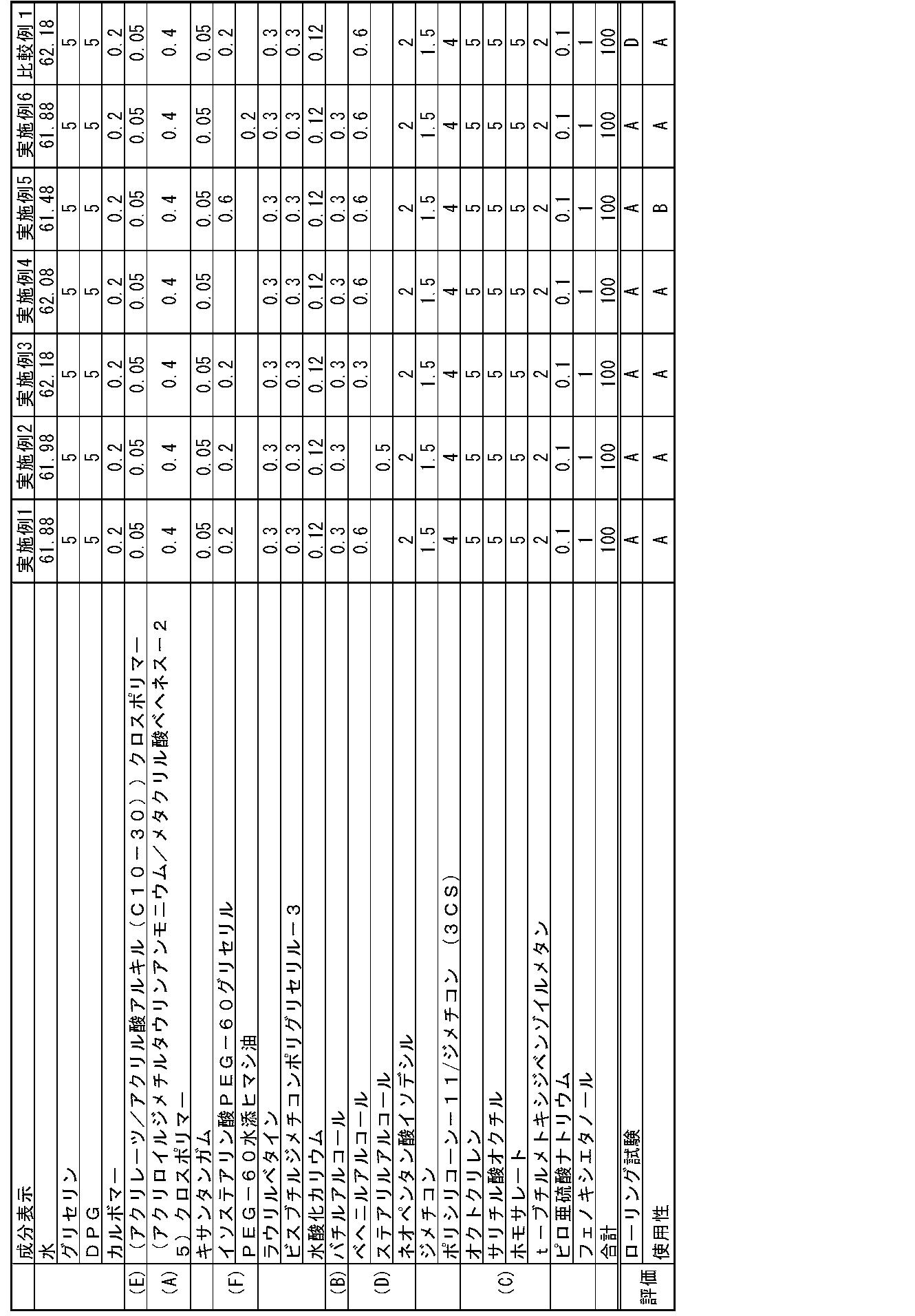
表1に示すように(A)(メタ)アクリル酸/(メタ)アクリル酸アルキル/(メタ)アクリル酸POEモノアルキルエーテルエステル共重合体と、(B)バチルアルコールと(C)組成物全量に対して10質量%以上の極性油とを含む実施例1~6は、高分子乳化であっても乳化安定性に優れ、塗布後ぬるつきのないみずみずしい使用感が得られた。一方、(B)バチルアルコールを含まない比較例1では高級アルコールを含んでいても乳化安定性が得られなかった。
Claims (6)
- (A)(メタ)アクリル酸/(メタ)アクリル酸アルキル/(メタ)アクリル酸POEモノアルキルエーテルエステル共重合体と、
(B)バチルアルコールと、
(C)組成物全量に対して10質量%以上の極性油と
を含む水中油型乳化組成物。 - さらに(D)高級アルコールを含む請求項1記載の水中油型乳化組成物。
- さらに(E)アルキル変性カルボキシビニルポリマーを含む請求項1または2記載の水中油型乳化組成物。
- 前記(C)極性油が紫外線吸収剤である請求項3記載の水中油型乳化組成物。
- 前記(B)バチルアルコールと前記(D)高級アルコールの質量比が1:1~1:3である請求項2、3または4記載の水中油型乳化組成物。
- (F)HLBが10~20のノニオン界面活性剤が組成物全量に対して0.6質量%以下である請求項1~5いずれか1項記載の水中油型乳化組成物。
Priority Applications (2)
| Application Number | Priority Date | Filing Date | Title |
|---|---|---|---|
| US18/020,464 US20230301879A1 (en) | 2020-09-09 | 2021-09-08 | Oil-in-water emulsion composition |
| CN202180056315.6A CN116033942B (zh) | 2020-09-09 | 2021-09-08 | 水包油型乳化组合物 |
Applications Claiming Priority (2)
| Application Number | Priority Date | Filing Date | Title |
|---|---|---|---|
| JP2020-151108 | 2020-09-09 | ||
| JP2020151108A JP7579658B2 (ja) | 2020-09-09 | 2020-09-09 | 水中油型乳化組成物 |
Publications (1)
| Publication Number | Publication Date |
|---|---|
| WO2022054823A1 true WO2022054823A1 (ja) | 2022-03-17 |
Family
ID=80631591
Family Applications (1)
| Application Number | Title | Priority Date | Filing Date |
|---|---|---|---|
| PCT/JP2021/032954 Ceased WO2022054823A1 (ja) | 2020-09-09 | 2021-09-08 | 水中油型乳化組成物 |
Country Status (4)
| Country | Link |
|---|---|
| US (1) | US20230301879A1 (ja) |
| JP (1) | JP7579658B2 (ja) |
| CN (1) | CN116033942B (ja) |
| WO (1) | WO2022054823A1 (ja) |
Families Citing this family (1)
| Publication number | Priority date | Publication date | Assignee | Title |
|---|---|---|---|---|
| JPWO2025094783A1 (ja) * | 2023-11-01 | 2025-05-08 |
Citations (10)
| Publication number | Priority date | Publication date | Assignee | Title |
|---|---|---|---|---|
| JP2005139094A (ja) * | 2003-11-05 | 2005-06-02 | Shiseido Co Ltd | 水中油型皮膚外用剤組成物 |
| JP2010229068A (ja) * | 2009-03-26 | 2010-10-14 | Shiseido Co Ltd | 皮膚外用剤 |
| JP2012140342A (ja) * | 2010-12-28 | 2012-07-26 | Shiseido Co Ltd | 水中油型乳化日焼け止め化粧料 |
| JP2014227372A (ja) * | 2013-05-22 | 2014-12-08 | 株式会社Adeka | 毛髪化粧料 |
| JP2015027953A (ja) * | 2013-07-30 | 2015-02-12 | 株式会社Adeka | 皮膚用化粧料 |
| JP2016520132A (ja) * | 2013-05-30 | 2016-07-11 | ザ プロクター アンド ギャンブル カンパニー | イソパラフィン基油、シリコーンエラストマー、及びその可溶化剤を含む、非水性ヘアオイル組成物 |
| WO2018079717A1 (ja) * | 2016-10-31 | 2018-05-03 | 株式会社 資生堂 | 水中油型皮膚外用組成物 |
| JP2018193324A (ja) * | 2017-05-17 | 2018-12-06 | 花王株式会社 | 乳化化粧料 |
| WO2018221606A1 (ja) * | 2017-05-31 | 2018-12-06 | 株式会社 資生堂 | 化粧料 |
| JP2020111542A (ja) * | 2019-01-15 | 2020-07-27 | 株式会社 資生堂 | 日焼け止め化粧料 |
Family Cites Families (2)
| Publication number | Priority date | Publication date | Assignee | Title |
|---|---|---|---|---|
| JP5602456B2 (ja) * | 2010-02-24 | 2014-10-08 | 日本精化株式会社 | アスコルビン酸誘導体 |
| CA2938992A1 (en) * | 2014-02-11 | 2015-08-20 | Elc Management Llc | Method, compositions, and kit for modulating the appearance of volume on keratin surfaces |
-
2020
- 2020-09-09 JP JP2020151108A patent/JP7579658B2/ja active Active
-
2021
- 2021-09-08 WO PCT/JP2021/032954 patent/WO2022054823A1/ja not_active Ceased
- 2021-09-08 CN CN202180056315.6A patent/CN116033942B/zh active Active
- 2021-09-08 US US18/020,464 patent/US20230301879A1/en not_active Abandoned
Patent Citations (10)
| Publication number | Priority date | Publication date | Assignee | Title |
|---|---|---|---|---|
| JP2005139094A (ja) * | 2003-11-05 | 2005-06-02 | Shiseido Co Ltd | 水中油型皮膚外用剤組成物 |
| JP2010229068A (ja) * | 2009-03-26 | 2010-10-14 | Shiseido Co Ltd | 皮膚外用剤 |
| JP2012140342A (ja) * | 2010-12-28 | 2012-07-26 | Shiseido Co Ltd | 水中油型乳化日焼け止め化粧料 |
| JP2014227372A (ja) * | 2013-05-22 | 2014-12-08 | 株式会社Adeka | 毛髪化粧料 |
| JP2016520132A (ja) * | 2013-05-30 | 2016-07-11 | ザ プロクター アンド ギャンブル カンパニー | イソパラフィン基油、シリコーンエラストマー、及びその可溶化剤を含む、非水性ヘアオイル組成物 |
| JP2015027953A (ja) * | 2013-07-30 | 2015-02-12 | 株式会社Adeka | 皮膚用化粧料 |
| WO2018079717A1 (ja) * | 2016-10-31 | 2018-05-03 | 株式会社 資生堂 | 水中油型皮膚外用組成物 |
| JP2018193324A (ja) * | 2017-05-17 | 2018-12-06 | 花王株式会社 | 乳化化粧料 |
| WO2018221606A1 (ja) * | 2017-05-31 | 2018-12-06 | 株式会社 資生堂 | 化粧料 |
| JP2020111542A (ja) * | 2019-01-15 | 2020-07-27 | 株式会社 資生堂 | 日焼け止め化粧料 |
Also Published As
| Publication number | Publication date |
|---|---|
| JP7579658B2 (ja) | 2024-11-08 |
| JP2022045491A (ja) | 2022-03-22 |
| US20230301879A1 (en) | 2023-09-28 |
| CN116033942A (zh) | 2023-04-28 |
| CN116033942B (zh) | 2025-07-08 |
Similar Documents
| Publication | Publication Date | Title |
|---|---|---|
| JP6053922B2 (ja) | 水中油型化粧料 | |
| KR102707888B1 (ko) | 화장료 | |
| CN102791249B (zh) | 油包水型乳化防晒化妆品 | |
| JP6878462B2 (ja) | 水中油型乳化化粧料 | |
| US11992545B2 (en) | Aqueous cosmetic compositions containing pelargonic acid esters | |
| JPWO2020032241A1 (ja) | 乳化化粧料 | |
| JP7525286B2 (ja) | 水中油型組成物 | |
| JP7493978B2 (ja) | 水中油型組成物 | |
| JP7579658B2 (ja) | 水中油型乳化組成物 | |
| JP2021107365A (ja) | 油性組成物 | |
| JP2021095349A (ja) | 化粧料 | |
| JP2022102419A (ja) | 水中油滴型乳化物 | |
| WO2022163812A1 (ja) | 水中油型乳化化粧料 | |
| WO2025105505A1 (en) | Non-sticky stable composition with texture transformation property | |
| JP2025090036A (ja) | テクスチャ変換特性を有する非粘着性且つ非油状性の安定組成物 | |
| JP2022045492A (ja) | 水中油型乳化組成物 | |
| HK1178080B (en) | Water-in-oil emulsion sunscreen cosmetic composition |
Legal Events
| Date | Code | Title | Description |
|---|---|---|---|
| 121 | Ep: the epo has been informed by wipo that ep was designated in this application |
Ref document number: 21866782 Country of ref document: EP Kind code of ref document: A1 |
|
| NENP | Non-entry into the national phase |
Ref country code: DE |
|
| 122 | Ep: pct application non-entry in european phase |
Ref document number: 21866782 Country of ref document: EP Kind code of ref document: A1 |
|
| WWG | Wipo information: grant in national office |
Ref document number: 202180056315.6 Country of ref document: CN |