WO2022044922A1 - カバーテープ及び電子部品包装体 - Google Patents
カバーテープ及び電子部品包装体 Download PDFInfo
- Publication number
- WO2022044922A1 WO2022044922A1 PCT/JP2021/030216 JP2021030216W WO2022044922A1 WO 2022044922 A1 WO2022044922 A1 WO 2022044922A1 JP 2021030216 W JP2021030216 W JP 2021030216W WO 2022044922 A1 WO2022044922 A1 WO 2022044922A1
- Authority
- WO
- WIPO (PCT)
- Prior art keywords
- layer
- cover tape
- mass
- heat seal
- heat
- Prior art date
- Legal status (The legal status is an assumption and is not a legal conclusion. Google has not performed a legal analysis and makes no representation as to the accuracy of the status listed.)
- Ceased
Links
Images


Classifications
-
- C—CHEMISTRY; METALLURGY
- C09—DYES; PAINTS; POLISHES; NATURAL RESINS; ADHESIVES; COMPOSITIONS NOT OTHERWISE PROVIDED FOR; APPLICATIONS OF MATERIALS NOT OTHERWISE PROVIDED FOR
- C09D—COATING COMPOSITIONS, e.g. PAINTS, VARNISHES OR LACQUERS; FILLING PASTES; CHEMICAL PAINT OR INK REMOVERS; INKS; CORRECTING FLUIDS; WOODSTAINS; PASTES OR SOLIDS FOR COLOURING OR PRINTING; USE OF MATERIALS THEREFOR
- C09D109/00—Coating compositions based on homopolymers or copolymers of conjugated diene hydrocarbons
- C09D109/06—Copolymers with styrene
-
- C—CHEMISTRY; METALLURGY
- C08—ORGANIC MACROMOLECULAR COMPOUNDS; THEIR PREPARATION OR CHEMICAL WORKING-UP; COMPOSITIONS BASED THEREON
- C08L—COMPOSITIONS OF MACROMOLECULAR COMPOUNDS
- C08L9/00—Compositions of homopolymers or copolymers of conjugated diene hydrocarbons
- C08L9/06—Copolymers with styrene
-
- B—PERFORMING OPERATIONS; TRANSPORTING
- B65—CONVEYING; PACKING; STORING; HANDLING THIN OR FILAMENTARY MATERIAL
- B65D—CONTAINERS FOR STORAGE OR TRANSPORT OF ARTICLES OR MATERIALS, e.g. BAGS, BARRELS, BOTTLES, BOXES, CANS, CARTONS, CRATES, DRUMS, JARS, TANKS, HOPPERS, FORWARDING CONTAINERS; ACCESSORIES, CLOSURES, OR FITTINGS THEREFOR; PACKAGING ELEMENTS; PACKAGES
- B65D65/00—Wrappers or flexible covers; Packaging materials of special type or form
- B65D65/38—Packaging materials of special type or form
- B65D65/40—Applications of laminates for particular packaging purposes
-
- B—PERFORMING OPERATIONS; TRANSPORTING
- B32—LAYERED PRODUCTS
- B32B—LAYERED PRODUCTS, i.e. PRODUCTS BUILT-UP OF STRATA OF FLAT OR NON-FLAT, e.g. CELLULAR OR HONEYCOMB, FORM
- B32B27/00—Layered products comprising a layer of synthetic resin
- B32B27/06—Layered products comprising a layer of synthetic resin as the main or only constituent of a layer, which is next to another layer of the same or of a different material
- B32B27/08—Layered products comprising a layer of synthetic resin as the main or only constituent of a layer, which is next to another layer of the same or of a different material of synthetic resin
-
- B—PERFORMING OPERATIONS; TRANSPORTING
- B32—LAYERED PRODUCTS
- B32B—LAYERED PRODUCTS, i.e. PRODUCTS BUILT-UP OF STRATA OF FLAT OR NON-FLAT, e.g. CELLULAR OR HONEYCOMB, FORM
- B32B27/00—Layered products comprising a layer of synthetic resin
- B32B27/30—Layered products comprising a layer of synthetic resin comprising vinyl (co)polymers; comprising acrylic (co)polymers
- B32B27/302—Layered products comprising a layer of synthetic resin comprising vinyl (co)polymers; comprising acrylic (co)polymers comprising aromatic vinyl (co)polymers, e.g. styrenic (co)polymers
-
- B—PERFORMING OPERATIONS; TRANSPORTING
- B32—LAYERED PRODUCTS
- B32B—LAYERED PRODUCTS, i.e. PRODUCTS BUILT-UP OF STRATA OF FLAT OR NON-FLAT, e.g. CELLULAR OR HONEYCOMB, FORM
- B32B27/00—Layered products comprising a layer of synthetic resin
- B32B27/30—Layered products comprising a layer of synthetic resin comprising vinyl (co)polymers; comprising acrylic (co)polymers
- B32B27/308—Layered products comprising a layer of synthetic resin comprising vinyl (co)polymers; comprising acrylic (co)polymers comprising acrylic (co)polymers
-
- B—PERFORMING OPERATIONS; TRANSPORTING
- B32—LAYERED PRODUCTS
- B32B—LAYERED PRODUCTS, i.e. PRODUCTS BUILT-UP OF STRATA OF FLAT OR NON-FLAT, e.g. CELLULAR OR HONEYCOMB, FORM
- B32B27/00—Layered products comprising a layer of synthetic resin
- B32B27/32—Layered products comprising a layer of synthetic resin comprising polyolefins
-
- B—PERFORMING OPERATIONS; TRANSPORTING
- B32—LAYERED PRODUCTS
- B32B—LAYERED PRODUCTS, i.e. PRODUCTS BUILT-UP OF STRATA OF FLAT OR NON-FLAT, e.g. CELLULAR OR HONEYCOMB, FORM
- B32B27/00—Layered products comprising a layer of synthetic resin
- B32B27/34—Layered products comprising a layer of synthetic resin comprising polyamides
-
- B—PERFORMING OPERATIONS; TRANSPORTING
- B32—LAYERED PRODUCTS
- B32B—LAYERED PRODUCTS, i.e. PRODUCTS BUILT-UP OF STRATA OF FLAT OR NON-FLAT, e.g. CELLULAR OR HONEYCOMB, FORM
- B32B27/00—Layered products comprising a layer of synthetic resin
- B32B27/36—Layered products comprising a layer of synthetic resin comprising polyesters
-
- B—PERFORMING OPERATIONS; TRANSPORTING
- B32—LAYERED PRODUCTS
- B32B—LAYERED PRODUCTS, i.e. PRODUCTS BUILT-UP OF STRATA OF FLAT OR NON-FLAT, e.g. CELLULAR OR HONEYCOMB, FORM
- B32B27/00—Layered products comprising a layer of synthetic resin
- B32B27/36—Layered products comprising a layer of synthetic resin comprising polyesters
- B32B27/365—Layered products comprising a layer of synthetic resin comprising polyesters comprising polycarbonates
-
- B—PERFORMING OPERATIONS; TRANSPORTING
- B32—LAYERED PRODUCTS
- B32B—LAYERED PRODUCTS, i.e. PRODUCTS BUILT-UP OF STRATA OF FLAT OR NON-FLAT, e.g. CELLULAR OR HONEYCOMB, FORM
- B32B7/00—Layered products characterised by the relation between layers; Layered products characterised by the relative orientation of features between layers, or by the relative values of a measurable parameter between layers, i.e. products comprising layers having different physical, chemical or physicochemical properties; Layered products characterised by the interconnection of layers
- B32B7/02—Physical, chemical or physicochemical properties
- B32B7/022—Mechanical properties
-
- B—PERFORMING OPERATIONS; TRANSPORTING
- B32—LAYERED PRODUCTS
- B32B—LAYERED PRODUCTS, i.e. PRODUCTS BUILT-UP OF STRATA OF FLAT OR NON-FLAT, e.g. CELLULAR OR HONEYCOMB, FORM
- B32B7/00—Layered products characterised by the relation between layers; Layered products characterised by the relative orientation of features between layers, or by the relative values of a measurable parameter between layers, i.e. products comprising layers having different physical, chemical or physicochemical properties; Layered products characterised by the interconnection of layers
- B32B7/02—Physical, chemical or physicochemical properties
- B32B7/027—Thermal properties
-
- B—PERFORMING OPERATIONS; TRANSPORTING
- B65—CONVEYING; PACKING; STORING; HANDLING THIN OR FILAMENTARY MATERIAL
- B65D—CONTAINERS FOR STORAGE OR TRANSPORT OF ARTICLES OR MATERIALS, e.g. BAGS, BARRELS, BOTTLES, BOXES, CANS, CARTONS, CRATES, DRUMS, JARS, TANKS, HOPPERS, FORWARDING CONTAINERS; ACCESSORIES, CLOSURES, OR FITTINGS THEREFOR; PACKAGING ELEMENTS; PACKAGES
- B65D65/00—Wrappers or flexible covers; Packaging materials of special type or form
- B65D65/02—Wrappers or flexible covers
-
- B—PERFORMING OPERATIONS; TRANSPORTING
- B65—CONVEYING; PACKING; STORING; HANDLING THIN OR FILAMENTARY MATERIAL
- B65D—CONTAINERS FOR STORAGE OR TRANSPORT OF ARTICLES OR MATERIALS, e.g. BAGS, BARRELS, BOTTLES, BOXES, CANS, CARTONS, CRATES, DRUMS, JARS, TANKS, HOPPERS, FORWARDING CONTAINERS; ACCESSORIES, CLOSURES, OR FITTINGS THEREFOR; PACKAGING ELEMENTS; PACKAGES
- B65D75/00—Packages comprising articles or materials partially or wholly enclosed in strips, sheets, blanks, tubes or webs of flexible sheet material, e.g. in folded wrappers
- B65D75/28—Articles or materials wholly enclosed in composite wrappers, i.e. wrappers formed by associating or interconnecting two or more sheets or blanks
- B65D75/30—Articles or materials enclosed between two opposed sheets or blanks having their margins united, e.g. by pressure-sensitive adhesive, crimping, heat-sealing, or welding
- B65D75/32—Articles or materials enclosed between two opposed sheets or blanks having their margins united, e.g. by pressure-sensitive adhesive, crimping, heat-sealing, or welding one or both sheets or blanks being recessed to accommodate contents
- B65D75/34—Articles or materials enclosed between two opposed sheets or blanks having their margins united, e.g. by pressure-sensitive adhesive, crimping, heat-sealing, or welding one or both sheets or blanks being recessed to accommodate contents and having several recesses to accommodate a series of articles or quantities of material
-
- H—ELECTRICITY
- H10—SEMICONDUCTOR DEVICES; ELECTRIC SOLID-STATE DEVICES NOT OTHERWISE PROVIDED FOR
- H10P—GENERIC PROCESSES OR APPARATUS FOR THE MANUFACTURE OR TREATMENT OF DEVICES COVERED BY CLASS H10
- H10P95/00—Generic processes or apparatus for manufacture or treatments not covered by the other groups of this subclass
-
- B—PERFORMING OPERATIONS; TRANSPORTING
- B32—LAYERED PRODUCTS
- B32B—LAYERED PRODUCTS, i.e. PRODUCTS BUILT-UP OF STRATA OF FLAT OR NON-FLAT, e.g. CELLULAR OR HONEYCOMB, FORM
- B32B2250/00—Layers arrangement
- B32B2250/24—All layers being polymeric
-
- B—PERFORMING OPERATIONS; TRANSPORTING
- B32—LAYERED PRODUCTS
- B32B—LAYERED PRODUCTS, i.e. PRODUCTS BUILT-UP OF STRATA OF FLAT OR NON-FLAT, e.g. CELLULAR OR HONEYCOMB, FORM
- B32B2307/00—Properties of the layers or laminate
- B32B2307/30—Properties of the layers or laminate having particular thermal properties
- B32B2307/31—Heat sealable
-
- B—PERFORMING OPERATIONS; TRANSPORTING
- B32—LAYERED PRODUCTS
- B32B—LAYERED PRODUCTS, i.e. PRODUCTS BUILT-UP OF STRATA OF FLAT OR NON-FLAT, e.g. CELLULAR OR HONEYCOMB, FORM
- B32B2307/00—Properties of the layers or laminate
- B32B2307/50—Properties of the layers or laminate having particular mechanical properties
- B32B2307/514—Oriented
- B32B2307/518—Oriented bi-axially
-
- B—PERFORMING OPERATIONS; TRANSPORTING
- B32—LAYERED PRODUCTS
- B32B—LAYERED PRODUCTS, i.e. PRODUCTS BUILT-UP OF STRATA OF FLAT OR NON-FLAT, e.g. CELLULAR OR HONEYCOMB, FORM
- B32B2307/00—Properties of the layers or laminate
- B32B2307/50—Properties of the layers or laminate having particular mechanical properties
- B32B2307/54—Yield strength; Tensile strength
-
- B—PERFORMING OPERATIONS; TRANSPORTING
- B32—LAYERED PRODUCTS
- B32B—LAYERED PRODUCTS, i.e. PRODUCTS BUILT-UP OF STRATA OF FLAT OR NON-FLAT, e.g. CELLULAR OR HONEYCOMB, FORM
- B32B2307/00—Properties of the layers or laminate
- B32B2307/70—Other properties
- B32B2307/732—Dimensional properties
- B32B2307/737—Dimensions, e.g. volume or area
- B32B2307/7375—Linear, e.g. length, distance or width
- B32B2307/7376—Thickness
-
- B—PERFORMING OPERATIONS; TRANSPORTING
- B32—LAYERED PRODUCTS
- B32B—LAYERED PRODUCTS, i.e. PRODUCTS BUILT-UP OF STRATA OF FLAT OR NON-FLAT, e.g. CELLULAR OR HONEYCOMB, FORM
- B32B2307/00—Properties of the layers or laminate
- B32B2307/70—Other properties
- B32B2307/748—Releasability
-
- B—PERFORMING OPERATIONS; TRANSPORTING
- B32—LAYERED PRODUCTS
- B32B—LAYERED PRODUCTS, i.e. PRODUCTS BUILT-UP OF STRATA OF FLAT OR NON-FLAT, e.g. CELLULAR OR HONEYCOMB, FORM
- B32B2405/00—Adhesive articles, e.g. adhesive tapes
-
- C—CHEMISTRY; METALLURGY
- C08—ORGANIC MACROMOLECULAR COMPOUNDS; THEIR PREPARATION OR CHEMICAL WORKING-UP; COMPOSITIONS BASED THEREON
- C08L—COMPOSITIONS OF MACROMOLECULAR COMPOUNDS
- C08L2205/00—Polymer mixtures characterised by other features
- C08L2205/02—Polymer mixtures characterised by other features containing two or more polymers of the same C08L -group
- C08L2205/025—Polymer mixtures characterised by other features containing two or more polymers of the same C08L -group containing two or more polymers of the same hierarchy C08L, and differing only in parameters such as density, comonomer content, molecular weight, structure
-
- C—CHEMISTRY; METALLURGY
- C08—ORGANIC MACROMOLECULAR COMPOUNDS; THEIR PREPARATION OR CHEMICAL WORKING-UP; COMPOSITIONS BASED THEREON
- C08L—COMPOSITIONS OF MACROMOLECULAR COMPOUNDS
- C08L2205/00—Polymer mixtures characterised by other features
- C08L2205/03—Polymer mixtures characterised by other features containing three or more polymers in a blend
- C08L2205/035—Polymer mixtures characterised by other features containing three or more polymers in a blend containing four or more polymers in a blend
Definitions
- the present invention relates to a cover tape and an electronic component package.
- the electronic components used are also becoming smaller and higher in performance.
- components are automatically mounted on a printed circuit board.
- the electronic components are housed in a carrier tape in which pockets are continuously thermally formed according to the shape of the electronic components so that the electronic components can be continuously supplied. Parts packaging is used.
- a cover tape having a heat seal layer as a lid material is layered on the upper surface of the carrier tape, and both ends of the cover tape are continuous in the length direction with a heated seal bar. It is manufactured by heat-sealing (see, for example, Patent Document 1).
- the cover tape When using an electronic component package, the cover tape is peeled off from the carrier tape, and the electronic component is automatically taken out and surface-mounted on the electronic circuit board.
- peel strength range the difference between the carrier tape and electronic components
- the present inventors focused on the heat-sealing layer of the cover tape and examined the design of the heat-sealing layer for reducing the peel strength range.
- the present invention has been made in view of the above circumstances, and an object of the present invention is to provide a cover tape capable of reducing the peel strength range and an electronic component package using the cover tape.
- one aspect of the present invention includes at least a base material layer and a heat seal layer, and the heat seal layer has a temperature of 150 ° C. or lower in a dynamic viscoelastic measurement at a measurement frequency of 1 Hz.
- a cover tape having a loss tangent tan ⁇ in the temperature region of less than 1.
- the above cover tape can be heat-sealed to the carrier tape as a lid material, and the peel strength range can be reduced when the cover tape is peeled off after the heat seal.
- the heat seal layer can contain a polystyrene resin and one or more resins selected from the group consisting of a polyethylene resin and an acrylic resin from the viewpoint of ensuring the seal strength.
- the heat-sealed layer has a storage elastic modulus G'(30) at 30 ° C. and a storage elastic modulus G'(at 150 ° C.) in a dynamic viscoelastic measurement at a measurement frequency of 1 Hz from the viewpoint of reducing the peel strength range.
- the ratio [G'(30) / G'(150)] to 150) may be 800 or less.
- the heat-sealed layer has a storage elastic modulus G'(30) at 30 ° C. of 1.0 ⁇ 106 in the dynamic viscoelasticity measurement at a measurement frequency of 1 Hz. It may be Pa or more and less than 1.0 ⁇ 10 8 Pa.
- Another aspect of the present invention is an electronic component packaging comprising a carrier tape having an accommodating portion, electronic components accommodated in the accommodating portion of the carrier tape, and the above-mentioned cover tape heat-sealed on the carrier tape as a lid material. Provide the body.
- the above-mentioned electronic component package can have a small peel strength range when the cover tape is peeled off. As a result, in the manufacture of electronic devices, it is possible to significantly reduce the mounting defect rate of electronic components.
- the cover tape of the present embodiment includes at least a base material layer and a heat seal layer.
- FIG. 1 is a schematic cross-sectional view showing an embodiment of a cover tape.
- the cover tape 50 shown in FIG. 1A is between the base material layer 1, the heat seal layer 2 provided on one side of the base material layer 1, and the base material layer 1 and the heat seal layer 2.
- the intermediate layer 3 provided in the above is provided.
- two intermediate layers 3a and 3b are provided between the base material layer 1 and the heat seal layer 2.
- the cover tape of the present embodiment may have a two-layer structure in which an intermediate layer is not provided, and further includes, for example, a layer such as an antistatic layer on the side of the base material layer 1 opposite to the heat seal layer 2. It may have a structure.
- the cover tape of the present embodiment has a structure in which a layer such as an antistatic layer is further provided on the side opposite to the base material layer 1 of the heat seal layer 2 as long as the heat seal property of the heat seal layer is not impaired. You may be doing it.
- the base material layer is made of polyester resin such as polyethylene terephthalate and polyethylene naphthalate, polyolefin resin other than polyethylene resin such as polyethylene resin and polypropylene, polyamide resin such as nylon, polystyrene resin, and polycarbonate resin. It may be a film formed by forming a resin composition containing one kind or two or more kinds of thermoplastic resins. As these films, a biaxially stretched film is preferable from the viewpoint of mechanical strength, and a biaxially stretched polyethylene terephthalate film is more preferable from the viewpoint of transparency and toughness.
- Polystyrene-based resins include polystyrene, high-impact polystyrene (HIPS: impact-resistant polystyrene), styrene-butadiene copolymer or its hydrogenated product, styrene-isoprene copolymer or its hydrogenated product, and styrene and ethylene.
- HIPS high-impact polystyrene
- styrene-butadiene copolymer or its hydrogenated product styrene-isoprene copolymer or its hydrogenated product
- styrene and ethylene examples thereof include polymers having a styrene unit in the molecular chain in a molar ratio of 1/2 or more, such as a graft copolymer, a styrene-butene-butadiene copolymer, and a copolymer of methacrylic acid and styrene. These can be used
- polyethylene-based resins examples include low-density polyethylene, linear low-density polyethylene, ultra-low-density polyethylene, ethylene- ⁇ olefin, ethylene-vinyl acetate copolymer, ethylene- (meth) acrylic acid copolymer, and ethylene- (meth). ) Methyl acrylate copolymer, ethylene-ethyl ethyl acrylate copolymer, ethylene-propylene rubber, etc., which have an ethylene unit in the molecular chain in a molar ratio of 1/2 or more. These can be used alone or in combination of two or more (as a mixture).
- additives such as antioxidants and lubricants that are usually used may be added to the base material layer.
- the base material layer may be a single layer or may have a multi-layer structure.
- the thickness of the base material layer may be 5 to 100 ⁇ m, 10 to 80 ⁇ m, or 12 to 30 ⁇ m from the viewpoint of mechanical strength and heat transfer property at the time of heat sealing.
- the intermediate layer can be provided for the purpose of strengthening the adhesive strength between the base material layer and the heat seal layer, and can include a thermoplastic resin.
- a thermoplastic resin such as low-density polyethylene, linear low-density polyethylene, and ultra-low-density polyethylene
- ii Ethylene-1-butene, copolymer of ethylene and unsaturated carboxylic acid, ethylene- (meth) acrylic Acid ester copolymers, ethylene-vinyl acetate copolymers, and ternary copolymers with acid anhydrides, and mixtures thereof
- styrene-ethylene graft copolymers, styrene-propylene graft copolymers examples thereof include a block copolymer of styrene-ethylene-butadiene, and a mixture thereof.
- thermoplastic resin a polyethylene-based resin is preferable, and a low-density polyethylene resin and a linear low-density polyethylene resin are more preferable because of the above-mentioned purpose and easy layer formation.
- the intermediate layer may have a structure of two or more layers.
- the extrusion stability of the heat-sealed layer is improved, and at the same time, the adhesion between the co-extruded film and the base material layer is improved by another intermediate layer.
- the side in contact with the heat seal layer is the first intermediate layer containing one or more of the resins shown in (i), (ii) and (iii) above.
- the side in contact with the base material layer may be a second intermediate layer containing one or more of the resins shown in (i) and (ii) above.
- additives such as antioxidants and lubricants that are usually used may be added to the intermediate layer.
- the thickness of the intermediate layer may be 3 to 70 ⁇ m, 5 to 60 ⁇ m, or 10 to 60 ⁇ m from the viewpoint of ensuring the adhesive strength between the base material layer and the heat seal layer and the peel strength of the cover tape. It may be 50 ⁇ m.
- the cover tape of this embodiment may have two or more base material layers and / or intermediate layers.
- the base material layer and the intermediate layer may have a three-layer structure of a base material layer / intermediate layer / base material layer, and the base material layer / base material layer / intermediate layer / base may be used. It may have a four-layer structure of a material layer.
- the cover tape of the present embodiment has two or more base material layers and / or intermediate layers
- a known adhesive can be used in order to strengthen the adhesive force between the layers.
- the adhesive include an isocyanate-based adhesive and an ethyleneimine-based adhesive.
- the thickness of the adhesive layer is preferably 5 ⁇ m or less from the viewpoint of preventing a large variation in the peel strength of the cover tape.
- the heat seal layer can be formed from a resin composition containing a resin such as a polystyrene-based resin, a polyethylene-based resin, or an acrylic-based resin.
- the heat seal layer can be provided so that the loss tangent tan ⁇ in the temperature region of 150 ° C. or lower is less than 1 in the dynamic viscoelasticity measurement at the measurement frequency of 1 Hz from the viewpoint of reducing the peel strength range. Further, in the heat seal layer, the peak temperature of the loss tangent tan ⁇ may be 150 ° C. or less in the dynamic viscoelasticity measurement having a measurement frequency of 1 Hz.
- the loss tangent tan ⁇ in the dynamic viscoelasticity measurement of the heat seal layer is obtained as follows.
- the resin composition constituting the heat seal layer is formed into a sheet having a thickness of about 1 to 2 mm to prepare a sample for measurement.
- Measuring device Leometer DHR-2 (manufactured by TA Instruments Co., Ltd.) Measurement mode: Shear mode Measurement jig: Parallel plate ⁇ 8 mm Frequency: 1Hz Distortion: 0.05% Temperature rise rate: 5 ° C / min Measurement temperature: 25-200 ° C
- the present inventors infer the reason why the peel strength range can be reduced by satisfying the above-mentioned condition of the loss tangent tan ⁇ of the heat seal layer as follows. First, it was found that the cover tape having a large peel strength range tends to have a wider adhesive region than the width of the seal iron when heat-sealed with a seal iron set under normal temperature conditions (for example, about 140 ° C.). ing. In such an adhesive region, the adhesive strength of the portion protruding from the portion pressed by the seal iron tends to vary, which is considered to be a factor for increasing the peel strength range.
- the loss tangent tan ⁇ is defined by G'' / G'by the storage elastic modulus G'and the loss elastic modulus G'' obtained by the dynamic viscoelasticity measurement.
- tan ⁇ defined by G'' / G' is less than 1 in the temperature range of 150 ° C. or lower means that the elastic property is superior to the viscosity and the adhesive region during heat sealing is difficult to expand. .. It is considered that by providing the cover tape with a heat-sealing layer exhibiting such behavior, it is possible to reduce the area of the above-mentioneding portion when heat-sealing with a sealing iron, and the peel strength range is reduced.
- the heat seal layer has a storage elastic modulus G'(30) at 30 ° C. and a storage elastic modulus G'(150) at a measurement frequency of 1 Hz in dynamic viscoelasticity measurement.
- the ratio [G'(30) / G'(150)] may be 800 or less, or 100 to 600.
- the heat-sealed layer has a storage elastic modulus G'(30) at 30 ° C. of 1.0 ⁇ 10 6 Pa in the dynamic viscoelastic measurement at a measurement frequency of 1 Hz. It may be more than 1.0 ⁇ 10 8 Pa, may be 5.0 ⁇ 10 6 Pa or more and less than 1.0 ⁇ 10 8 Pa, and may be 5.0 ⁇ 10 6 Pa or more and 5.0 ⁇ 10 It may be 7 Pa or less.
- the heat-sealing layer includes a polystyrene-based resin (hereinafter, may be referred to as (A) component), a polyethylene-based resin (hereinafter, may be referred to as (B) component), and an acrylic-based resin. It can contain one or more resins selected from the group consisting of resins (hereinafter, may be referred to as component (C)). Further, the cover tape having such a heat-sealing layer makes it easy to secure the sealing property against the carrier tape of various materials such as the polystyrene carrier tape and the polycarbonate carrier tape.
- the heat-sealed layer can contain a copolymer of a styrene-based hydrocarbon and a conjugated diene-based hydrocarbon and impact-resistant polystyrene as the component (A), and may contain a mixture thereof.
- styrene-based hydrocarbons examples include styrene, ⁇ -methylstyrene, and various alkyl-substituted styrenes.
- conjugated diene-based hydrocarbon examples include butadiene and isoprene.
- the component (A) is a block copolymer (A-1) containing 10% by mass or more and less than 50% by mass of a styrene-based hydrocarbon and 50% by mass or more and 90% by mass or less of a conjugated diene-based hydrocarbon (hereinafter, (A-1). ), And a block copolymer (A-2) of styrene-based hydrocarbons of 50% by mass or more and 95% by mass or less and conjugated diene-based hydrocarbons of 5% by mass or more and 50% by mass or less (hereinafter, (A-2) It may be referred to as a component.) And.
- the components (A-1) include styrene-butadiene copolymer, styrene-butylene-butylene-styrene copolymer, styrene-ethylene-butylene-styrene copolymer, styrene-ethylene-propylene-styrene copolymer, and styrene.
- -Isoprene-styrene copolymer can be mentioned.
- As the component (A-1) one type can be used alone, or two or more types can be used in combination.
- the mass ratio of the styrene-based hydrocarbon and the conjugated diene-based hydrocarbon in the component (A-1) is 10/90 to 45/55 from the viewpoint of facilitating the adjustment of the peel strength and the film forming property of the film. It may be, 30/70 to 45/55, or 35/75 to 45/55.
- the content of the component (A-1) can be 20 to 65% by mass and 35 to 60% by mass based on the total amount of the heat seal layer. It may be 40 to 55% by mass, or 40 to 50% by mass.
- the components (A-2) include styrene-butadiene copolymer, styrene-butylene-butylene-styrene copolymer, styrene-ethylene-butylene-styrene copolymer, styrene-ethylene-propylene-styrene copolymer, and styrene.
- -Isoprene-styrene copolymer can be mentioned.
- As the component (A-2) one type can be used alone, or two or more types can be used in combination.
- the mass ratio of the styrene-based hydrocarbon to the conjugated diene-based hydrocarbon in the component (A-2) may be 50/50 to 95/5, 70/30 to 90/10, or 80. It may be / 20 to 85/15.
- the mass ratio of the component (A-2) to the component (A-1) can be 0.3 to 2.0, and 0.30 to 1.0. It can be 0.50 to 0.90, or 0.65 to 0.85.
- the total content of the component (A-1) and the component (A-2) in the heat seal layer is 50 to 100% by mass based on the total amount of the heat seal layer from the viewpoint of film formation property and blocking resistance of the film. It may be 50 to 95% by mass, 50 to 90% by mass, 60 to 100% by mass, or 60 to 95% by mass. It may be 60 to 90% by mass, or 70 to 90% by mass.
- the heat seal layer contains (A-1) component, (A-2) component, and impact-resistant polystyrene (hereinafter, may be referred to as (A-3) component)
- the respective content ratios are (.
- A-1) component, (A-2) component and (A-3) component are 100 parts by mass in total, (A-1) component is 30 to 60 parts by mass, (A-2) component is 20 to 20 parts. 60 parts by mass and (A-3) component may be 1 to 20 parts by mass, (A-1) component is 35 to 60 parts by mass, (A-2) component is 20 to 40 parts by mass, and (A-3)
- the component may be 5 to 15 parts by mass.
- the content of the component (A) in the heat seal layer may be 50 to 100% by mass, 50 to 95% by mass, or 60 to 100% by mass based on the total amount of the heat seal layer. It may be 60 to 95% by mass, or 70 to 95% by mass.
- the heat seal layer may contain a polystyrene resin other than the component (A).
- polystyrene-based resins include impact-resistant polystyrene, general-purpose polystyrene, acrylonitrile-butadiene-styrene copolymer, and styrene-ethylene-propylene-styrene copolymer.
- the content of the polystyrene resin other than the component (A) may be more than 0% by mass and 25% by mass or less based on the total amount of the heat seal layer, and may be 5 to 20% by mass. It may be 5 to 10% by mass.
- component (B) examples include those exemplified in the description of the base material layer.
- (meth) acrylic acid or an alkyl thereof is used as a copolymerization component such as an ethylene- (meth) acrylic acid copolymer, an ethylene- (meth) methyl acrylic acid copolymer, or an ethylene- (meth) ethyl acrylic acid copolymer.
- the copolymer containing an ester is included in the component (C).
- the component (B) can be used alone or in combination of two or more (as a mixture).
- the content of the component (B) in the heat seal layer may be 0 to 20% by mass or 0 to 10% by mass based on the total amount of the heat seal layer from the viewpoint of reducing the peel strength range. It may be 0 to 5% by mass.
- component (C) examples include ethylene- (meth) acrylic acid-based copolymers.
- the ethylene- (meth) acrylic acid-based copolymer includes an ethylene-acrylic acid copolymer (EAA), an ethylene-methacrylic acid copolymer (EMAA), an ethylene-methylmethacrylate copolymer (EMMA), and an ethylene-ethyl acrylate.
- EAA ethylene-acrylic acid copolymer
- EMMA ethylene-methylmethacrylate copolymer
- EAA ethylene-ethyl acrylate
- EAA ethylene-acrylic acid copolymer
- EMMA ethylene-methylmethacrylate copolymer
- EMMA ethylene-ethyl acrylate
- EAA ethylene-ethyl acrylate copolymer
- EAA ethylene-acrylic acid copolymer
- EMMA ethylene-methylmethacrylate copolymer
- EGMA-MA ethylene-glycidyl methacrylate-methyl acrylate copolymer
- the heat seal layer may be referred to as an ethylene-methyl acrylate copolymer (C-1) (hereinafter referred to as (C-1) component) as the component (C) from the viewpoint of ensuring the seal strength at a low temperature. .) Can be included.
- C-1 the above-mentioned EMMA, EMA and EGMA-MA can be used.
- the content of the component (C) in the heat seal layer may be 0 to 30% by mass or 0 to 20% by mass based on the total amount of the heat seal layer from the viewpoint of reducing the peel strength range. It may be 0 to 10% by mass.
- the total content of the components (B) and (C) reduces the peel strength range. From the viewpoint, it may be more than 0% by mass and 30% by mass or less, may be more than 0% by mass and 20% by mass or less, or may be 5 to 15% by mass, based on the total amount of the heat seal layer.
- the total content of the component (A), the component (B) and the component (C) in the heat seal layer is 70 to 100% by mass based on the total amount of the heat seal layer. It may be 90 to 100% by mass.
- antioxidants and lubricants that are usually used may be added to the heat seal layer.
- the thickness of the heat seal layer may be 2 to 50 ⁇ m, 2 to 40 ⁇ m, or 3 to 30 ⁇ m from the viewpoint of ensuring the seal strength.
- Each layer described above can be made into a film by, for example, an inflation method, a T-die method, a casting method, or a calendar method.
- each component constituting each layer is blended using a mixer such as a Henschel mixer, a tumbler mixer, or a magella, and this is directly made into a film by an extruder, or the blended product is once uniaxially or biaxially formed.
- the pellets can be further extruded with an extruder to form a film.
- the heat seal layer is formed into a film by extrusion molding such as inflation molding or T-die extrusion, and the above-mentioned component (A), component (B) and / or component (C), and other components are added to the film of the base material layer. It may be formed by a method of dissolving the components of the above in a solvent and applying the mixture, or by applying the components as an aqueous emulsion.
- the resin constituting the intermediate layer and the resin constituting the heat seal layer are melt-kneaded using different single-screw or twin-screw extruders, and both are laminated and integrated via a feed block or a multi-manifold die. Then, by extruding from the T-die, a two-layer film in which an intermediate layer and a heat seal layer are laminated can be obtained.
- the film for the heat seal layer obtained by extrusion molding may be laminated with the base material layer by a general method such as dry laminating or extrusion laminating to form a cover tape.
- the total thickness of the cover tape can be 30 to 100 ⁇ m, 35 to 80 ⁇ m, or 40 to 70 ⁇ m. Within such a range, it becomes easy to secure the strength and sealing property of the tape.
- the cover tape of this embodiment is suitable for packaging electronic parts.
- electronic components include ICs, LEDs (light emitting diodes), resistors, liquid crystals, capacitors, transistors, piezoelectric element registers, filters, crystal oscillators, crystal oscillators, diodes, connectors, switches, volumes, relays, inductors, etc. Can be mentioned.
- the electronic component may be an intermediate product using the above component or a final product.
- antistatic performance it is preferable to impart antistatic performance to the base material layer and the heat seal layer in order to prevent dust adhesion and dissipate the charge of the cover tape itself.
- a surfactant type, conductive metal oxide fine particles, and an electron conductive polymer can be used as the commonly used antistatic agent.
- These antistatic agents can be kneaded into the resin depending on the performance to be developed, but from the viewpoint of efficiently exhibiting the effect, it is possible to coat both surface layers of the cover tape with a gravure coater or the like. can.
- the cover tape for packaging electronic components can be heat-sealed to, for example, a carrier tape.
- the carrier tape may be provided with a pocket for storing electronic parts by a method such as a compressed air molding method or a vacuum forming method.
- a method such as a compressed air molding method or a vacuum forming method.
- the material of the carrier tape polyvinyl chloride (PVC), polystyrene (PS), polyester (A-PET, PEN, PET-G, PCTA), polypropylene (PP), polycarbonate (PC), polyacrylonitrile (PAN), A material that can be easily formed into a sheet, such as acrylonitrile-butadiene-styrene copolymer (ABS), can be applied. These resins can be used alone or in combination of two or more.
- the carrier tape may be a laminated body composed of a plurality of layers.
- the cover tape of this embodiment can be used in combination with a carrier tape such as a polystyrene carrier tape or a polycarbonate carrier tape.
- the electronic component package of the present embodiment includes a carrier tape having an accommodating portion capable of accommodating electronic components, electronic components accommodated in the accommodating portion of the carrier tape, and heat-sealed on the carrier tape as a cover material. It is equipped with a cover tape.
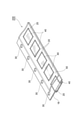
- FIG. 2 is a partially cutaway perspective view showing an embodiment of an electronic component package.
- the electronic component package 200 shown in FIG. 2 includes an embossed carrier tape 16 provided with an accommodating portion 20, an electronic component 40 accommodated in the accommodating portion 20, and a cover film 50 heat-sealed on the embossed carrier tape 16. Be prepared.
- the embossed carrier tape 16 is provided with a feed hole 30 that can be used for transporting various electronic components such as ICs in an encapsulation process or the like. Further, a hole (not shown) for inspecting electronic components is provided at the bottom of the accommodating portion 20.
- the electronic component package of the present embodiment can be used for storing and transporting electronic components as a carrier tape body wound in a reel shape.
- the electronic component package of the present embodiment can be manufactured by a method including a step of heat-sealing the cover tape of the present embodiment to the carrier tape in which the electronic component is accommodated in the accommodating portion. Since the cover tape of the present embodiment has sufficient blocking resistance, blocking is unlikely to occur even when the wound body is used, and it is possible to suppress poor feeding from the wound body and heat seal. The process can be performed efficiently.
- a member called a seal iron that can apply a predetermined amount of heat to the heat seal layer and apply a predetermined pressure can be used.
- the cover tape can be heat-sealed on the surface of the carrier tape by pressing such a sealing iron against the carrier tape from above the cover tape.
- a repetitive sealing method in which the seal iron is pressed multiple times while transporting the embossed carrier tape, or a continuous sealing method in which the seal iron is continuously applied to the cover tape side and heat-sealed can be applied.
- the sealing temperature may be 100 to 240 ° C. or 120 to 220 ° C.
- the electronic component package of the present embodiment may have a small peel strength range when the cover tape is peeled off. As a result, in the manufacture of electronic devices, it is possible to significantly reduce the mounting defect rate of electronic components.
- FIG. 3 is a diagram showing an example of a peel strength chart obtained when the cover tape is peeled in the longitudinal direction.
- FIG. 3A shows peeling when an example of a cover tape provided with a heat seal layer having a loss tangent tan ⁇ of 1 or more in a temperature region of 150 ° C. or lower is used in a dynamic viscoelasticity measurement at a measurement frequency of 1 Hz.
- a strength chart is shown
- FIG. 3 (b) shows a peel strength chart when an example of a cover tape provided with a heat seal layer having a loss tangent tan ⁇ of less than 1 is used.
- the peel strength changes significantly in the longitudinal direction of the tape, and the peel strength range R1 exceeds 0.15N.
- the peel strength range R 2 is less than 0.15 N, and such a cover tape vibrates during peeling as compared with the cover tape of (a). As a result, problems such as popping out of electronic components are unlikely to occur.
- a two-layer film (total thickness 30 ⁇ m) having a layer (thickness 20 ⁇ m) / heat-sealed layer (thickness 10 ⁇ m) was obtained.
- This two-layer film is subjected to a biaxially stretched polyethylene terephthalate film (manufactured by Toyobo Co., Ltd., product name "ester film E5100", thickness) via a second intermediate layer (thickness 13 ⁇ m) made of low-density polyethylene resin by an extrusion laminating method.
- the cover tape of Example 1 was obtained by laminating with (16 ⁇ m).
- Example 2 Cover in the same manner as in Example 1 except that 20 parts by mass of linear low-density polyethylene (manufactured by Ube-Maruzen Polyethylene, product name "Umerit 0540F") was used instead of the ethylene-1-butene random copolymer. I got the tape.
- linear low-density polyethylene manufactured by Ube-Maruzen Polyethylene, product name "Umerit 0540F”
- Example 3 As an acrylic resin instead of the ethylene-1-butene random copolymer, an ethylene-methyl methacrylate copolymer (manufactured by Sumitomo Chemical Co., Ltd., product name "Aklift WH303-F", methyl methacrylate content: 18 mass) %, Ethylene content: 82% by mass) Using 15 parts by mass, a cover tape was obtained in the same manner as in Example 1 except that the polystyrene-based resin had the composition shown in Table 1.
- Example 5 As an acrylic resin instead of the ethylene-1-butene random copolymer, an ethylene-methyl methacrylate copolymer (manufactured by Sumitomo Chemical Co., Ltd., product name "Aklift WH303-F", methyl methacrylate content: 18 mass) %, Ethylene content: 82% by mass) Using 10 parts by mass, cover tapes were obtained in the same manner as in Example 1 except that the polystyrene-based resin had the composition shown in Table 1.
- Example 6 Instead of ethylene-1-butene random copolymer, as an acrylic resin, ethylene-methyl acrylate copolymer (manufactured by Nippon Polyethylene Co., Ltd., product name "LEXPARE EB240H", methyl acrylate content: 20% by mass, ethylene A cover tape was obtained in the same manner as in Example 1 except that the composition of the polystyrene-based resin was shown in Table 1 using 10 parts by mass (content: 80% by mass).
- Example 7 As an acrylic resin instead of the ethylene-1-butene random copolymer, an ethylene-methyl methacrylate copolymer (manufactured by Sumitomo Chemical Co., Ltd., product name "Aklift WH303-F", methyl methacrylate content: 18 mass) %, Ethylene content: 82% by mass) Using 25 parts by mass, a cover tape was obtained in the same manner as in Example 1 except that the polystyrene-based resin had the composition shown in Table 1.
- HIPS High Impact Polystyrene (manufactured by Toyo Styrene Co., Ltd., product name "HIPS H870")
- EB Ethylene-1-butene random copolymer (manufactured by Mitsui Chemicals, Inc., product name "Toughmer A-4085S”)
- LLDPE Linear low-density polyethylene (manufactured by Ube-Maruzen Polyethylene, product name "Umerit 0540
- the cover tape was peeled in the longitudinal direction at a peeling angle of 170 ° to 180 ° at a peeling rate of 300 mm / min in an atmosphere of a temperature of 23 ° C. and a relative humidity of 50%.
- the peel strength chart obtained when peeling 100 mm at this time the difference between the maximum value and the minimum value of the peel strength was calculated, and the peel strength range was evaluated according to the following criteria.
- B The difference between the maximum and minimum peel strength is 0.15N or more
- the cover tapes of Examples 1 to 7 provided with the heat seal layer having a loss tangent tan ⁇ of less than 1 in a temperature region of 150 ° C. or lower have an average peel strength of 0.4 N. It was confirmed that the peel strength range can be suppressed to 0.15 N or less even when heat-sealed.
Landscapes
- Engineering & Computer Science (AREA)
- Mechanical Engineering (AREA)
- Chemical & Material Sciences (AREA)
- Organic Chemistry (AREA)
- Composite Materials (AREA)
- Physics & Mathematics (AREA)
- Health & Medical Sciences (AREA)
- Thermal Sciences (AREA)
- Chemical Kinetics & Catalysis (AREA)
- Medicinal Chemistry (AREA)
- Polymers & Plastics (AREA)
- Materials Engineering (AREA)
- Wood Science & Technology (AREA)
- Life Sciences & Earth Sciences (AREA)
- Laminated Bodies (AREA)
- Packages (AREA)
- Condensed Matter Physics & Semiconductors (AREA)
- General Physics & Mathematics (AREA)
- Manufacturing & Machinery (AREA)
- Packaging Frangible Articles (AREA)
- Wrappers (AREA)
- Adhesive Tapes (AREA)
- Adhesives Or Adhesive Processes (AREA)
Priority Applications (5)
| Application Number | Priority Date | Filing Date | Title |
|---|---|---|---|
| JP2022544499A JPWO2022044922A1 (https=) | 2020-08-24 | 2021-08-18 | |
| KR1020227041828A KR20230056626A (ko) | 2020-08-24 | 2021-08-18 | 커버 테이프 및 전자 부품 포장체 |
| US18/006,898 US20230272192A1 (en) | 2020-08-24 | 2021-08-18 | Cover tape and electronic component package |
| CN202180046288.4A CN115768697A (zh) | 2020-08-24 | 2021-08-18 | 盖带及电子部件包装体 |
| JP2024209571A JP2025023183A (ja) | 2020-08-24 | 2024-12-02 | カバーテープ及び電子部品包装体 |
Applications Claiming Priority (6)
| Application Number | Priority Date | Filing Date | Title |
|---|---|---|---|
| JP2020140976 | 2020-08-24 | ||
| JP2020-140976 | 2020-08-24 | ||
| JP2020-212246 | 2020-12-22 | ||
| JP2020212246 | 2020-12-22 | ||
| JP2021121394 | 2021-07-26 | ||
| JP2021-121394 | 2021-07-26 |
Publications (1)
| Publication Number | Publication Date |
|---|---|
| WO2022044922A1 true WO2022044922A1 (ja) | 2022-03-03 |
Family
ID=80354213
Family Applications (1)
| Application Number | Title | Priority Date | Filing Date |
|---|---|---|---|
| PCT/JP2021/030216 Ceased WO2022044922A1 (ja) | 2020-08-24 | 2021-08-18 | カバーテープ及び電子部品包装体 |
Country Status (6)
| Country | Link |
|---|---|
| US (1) | US20230272192A1 (https=) |
| JP (2) | JPWO2022044922A1 (https=) |
| KR (1) | KR20230056626A (https=) |
| CN (1) | CN115768697A (https=) |
| TW (1) | TW202222580A (https=) |
| WO (1) | WO2022044922A1 (https=) |
Families Citing this family (1)
| Publication number | Priority date | Publication date | Assignee | Title |
|---|---|---|---|---|
| CN119058056B (zh) * | 2024-09-06 | 2025-03-07 | 江苏新骥源电子材料有限公司 | 一种防水抗静电复合盖带热熔挤出机及其工艺 |
Citations (4)
| Publication number | Priority date | Publication date | Assignee | Title |
|---|---|---|---|---|
| JP2004244115A (ja) * | 1999-08-31 | 2004-09-02 | Denki Kagaku Kogyo Kk | 電子部品のキャリアテープ用カバーフィルム及びその製造方法 |
| WO2007123241A1 (ja) * | 2006-04-25 | 2007-11-01 | Denki Kagaku Kogyo Kabushiki Kaisha | カバーフィルム |
| WO2018235835A1 (ja) * | 2017-06-20 | 2018-12-27 | 旭化成株式会社 | プレススルーパック包装体用蓋材 |
| WO2019074013A1 (ja) * | 2017-10-11 | 2019-04-18 | デンカ株式会社 | 樹脂組成物、熱収縮性フィルムおよび容器 |
Family Cites Families (8)
| Publication number | Priority date | Publication date | Assignee | Title |
|---|---|---|---|---|
| JP2002264273A (ja) * | 2001-03-12 | 2002-09-18 | Denki Kagaku Kogyo Kk | 多層フィルム |
| US20070172649A1 (en) * | 2004-03-19 | 2007-07-26 | Mitsui Chemicals, Inc. | Adhesive material, pressure sensitive adhesive film and method of use thereof |
| US8272511B2 (en) * | 2004-10-22 | 2012-09-25 | The Procter & Gamble Company | Packaging and disposable article disposed therein |
| JP5296564B2 (ja) | 2009-01-28 | 2013-09-25 | 電気化学工業株式会社 | カバーフィルム |
| CN105377713A (zh) * | 2013-07-09 | 2016-03-02 | 住友电木株式会社 | 电子部件包装用盖带 |
| CN106604878B (zh) * | 2014-11-12 | 2018-03-20 | 住友电木株式会社 | 电子部件包装用盖带、电子部件包装用包材和电子部件包装体 |
| JP7251153B2 (ja) * | 2018-04-26 | 2023-04-04 | 三菱ケミカル株式会社 | ストレッチ包装用フィルム |
| CN116056896B (zh) * | 2020-09-11 | 2025-12-02 | 东洋制罐集团控股株式会社 | 包装袋以及用于制作该包装袋的包装用多层膜 |
-
2021
- 2021-08-18 JP JP2022544499A patent/JPWO2022044922A1/ja active Pending
- 2021-08-18 KR KR1020227041828A patent/KR20230056626A/ko not_active Ceased
- 2021-08-18 CN CN202180046288.4A patent/CN115768697A/zh active Pending
- 2021-08-18 US US18/006,898 patent/US20230272192A1/en not_active Abandoned
- 2021-08-18 WO PCT/JP2021/030216 patent/WO2022044922A1/ja not_active Ceased
- 2021-08-20 TW TW110130814A patent/TW202222580A/zh unknown
-
2024
- 2024-12-02 JP JP2024209571A patent/JP2025023183A/ja active Pending
Patent Citations (4)
| Publication number | Priority date | Publication date | Assignee | Title |
|---|---|---|---|---|
| JP2004244115A (ja) * | 1999-08-31 | 2004-09-02 | Denki Kagaku Kogyo Kk | 電子部品のキャリアテープ用カバーフィルム及びその製造方法 |
| WO2007123241A1 (ja) * | 2006-04-25 | 2007-11-01 | Denki Kagaku Kogyo Kabushiki Kaisha | カバーフィルム |
| WO2018235835A1 (ja) * | 2017-06-20 | 2018-12-27 | 旭化成株式会社 | プレススルーパック包装体用蓋材 |
| WO2019074013A1 (ja) * | 2017-10-11 | 2019-04-18 | デンカ株式会社 | 樹脂組成物、熱収縮性フィルムおよび容器 |
Also Published As
| Publication number | Publication date |
|---|---|
| US20230272192A1 (en) | 2023-08-31 |
| JPWO2022044922A1 (https=) | 2022-03-03 |
| JP2025023183A (ja) | 2025-02-14 |
| CN115768697A (zh) | 2023-03-07 |
| TW202222580A (zh) | 2022-06-16 |
| KR20230056626A (ko) | 2023-04-27 |
Similar Documents
| Publication | Publication Date | Title |
|---|---|---|
| KR101954467B1 (ko) | 커버 필름 | |
| JP3585038B2 (ja) | 電子部品のキャリアテープ用カバーフィルムの製造方法 | |
| JP5993850B2 (ja) | カバーフィルム | |
| CN103492289B (zh) | 覆盖膜 | |
| JP7289816B2 (ja) | カバーテープおよび電子部品包装体 | |
| WO2011158550A1 (ja) | カバーテープ | |
| JP2025023183A (ja) | カバーテープ及び電子部品包装体 | |
| JP4307302B2 (ja) | カバーテープ及びキャリアテープシステム | |
| WO2022044921A1 (ja) | カバーテープ及び電子部品包装体 | |
| JP4828094B2 (ja) | 電子部品のキャリアテープ用カバーフィルム及びその製造方法 | |
| WO2022044919A1 (ja) | カバーテープ及び電子部品包装体 | |
| JP4444814B2 (ja) | カバーテープおよび電子部品包装体 | |
| JP2001030430A (ja) | カバーフィルム | |
| JP4805612B2 (ja) | カバーフィルム | |
| TWI917425B (zh) | 蓋帶及電子零件包裝體 | |
| JP2002367437A (ja) | スリット性に優れた導電性のシート | |
| JP4657842B2 (ja) | カバーフィルム | |
| JP3830391B2 (ja) | ヒートシールフィルム | |
| JP4141570B2 (ja) | 表面導電性ポリオレフィン系シート | |
| JP4932244B2 (ja) | ヒートシールフィルム | |
| WO2025089367A1 (ja) | カバーテープ及びそれを含む電子部品包装体 | |
| WO2024157775A1 (ja) | 電子部品包装用カバーテープおよび電子部品包装体 | |
| JP2007090725A (ja) | カバーフィルム | |
| JP2007182236A (ja) | カバーフィルム | |
| JP2000015753A (ja) | 導電性スチレン系樹脂シート |
Legal Events
| Date | Code | Title | Description |
|---|---|---|---|
| 121 | Ep: the epo has been informed by wipo that ep was designated in this application |
Ref document number: 21861350 Country of ref document: EP Kind code of ref document: A1 |
|
| ENP | Entry into the national phase |
Ref document number: 2022544499 Country of ref document: JP Kind code of ref document: A |
|
| NENP | Non-entry into the national phase |
Ref country code: DE |
|
| 122 | Ep: pct application non-entry in european phase |
Ref document number: 21861350 Country of ref document: EP Kind code of ref document: A1 |