WO2022044579A1 - 吸収性物品 - Google Patents
吸収性物品 Download PDFInfo
- Publication number
- WO2022044579A1 WO2022044579A1 PCT/JP2021/026125 JP2021026125W WO2022044579A1 WO 2022044579 A1 WO2022044579 A1 WO 2022044579A1 JP 2021026125 W JP2021026125 W JP 2021026125W WO 2022044579 A1 WO2022044579 A1 WO 2022044579A1
- Authority
- WO
- WIPO (PCT)
- Prior art keywords
- layer
- inseam
- absorbent article
- water
- vertical direction
- Prior art date
- Legal status (The legal status is an assumption and is not a legal conclusion. Google has not performed a legal analysis and makes no representation as to the accuracy of the status listed.)
- Ceased
Links
Images



Classifications
-
- A—HUMAN NECESSITIES
- A61—MEDICAL OR VETERINARY SCIENCE; HYGIENE
- A61F—FILTERS IMPLANTABLE INTO BLOOD VESSELS; PROSTHESES; DEVICES PROVIDING PATENCY TO, OR PREVENTING COLLAPSING OF, TUBULAR STRUCTURES OF THE BODY, e.g. STENTS; ORTHOPAEDIC, NURSING OR CONTRACEPTIVE DEVICES; FOMENTATION; TREATMENT OR PROTECTION OF EYES OR EARS; BANDAGES, DRESSINGS OR ABSORBENT PADS; FIRST-AID KITS
- A61F13/00—Bandages or dressings; Absorbent pads
- A61F13/15—Absorbent pads, e.g. sanitary towels, swabs or tampons for external or internal application to the body; Supporting or fastening means therefor; Tampon applicators
- A61F13/53—Absorbent pads, e.g. sanitary towels, swabs or tampons for external or internal application to the body; Supporting or fastening means therefor; Tampon applicators characterised by the absorbing medium
- A61F13/534—Absorbent pads, e.g. sanitary towels, swabs or tampons for external or internal application to the body; Supporting or fastening means therefor; Tampon applicators characterised by the absorbing medium having an inhomogeneous composition through the thickness of the pad
-
- A—HUMAN NECESSITIES
- A61—MEDICAL OR VETERINARY SCIENCE; HYGIENE
- A61F—FILTERS IMPLANTABLE INTO BLOOD VESSELS; PROSTHESES; DEVICES PROVIDING PATENCY TO, OR PREVENTING COLLAPSING OF, TUBULAR STRUCTURES OF THE BODY, e.g. STENTS; ORTHOPAEDIC, NURSING OR CONTRACEPTIVE DEVICES; FOMENTATION; TREATMENT OR PROTECTION OF EYES OR EARS; BANDAGES, DRESSINGS OR ABSORBENT PADS; FIRST-AID KITS
- A61F13/00—Bandages or dressings; Absorbent pads
- A61F13/15—Absorbent pads, e.g. sanitary towels, swabs or tampons for external or internal application to the body; Supporting or fastening means therefor; Tampon applicators
- A61F13/53—Absorbent pads, e.g. sanitary towels, swabs or tampons for external or internal application to the body; Supporting or fastening means therefor; Tampon applicators characterised by the absorbing medium
- A61F13/534—Absorbent pads, e.g. sanitary towels, swabs or tampons for external or internal application to the body; Supporting or fastening means therefor; Tampon applicators characterised by the absorbing medium having an inhomogeneous composition through the thickness of the pad
- A61F13/535—Absorbent pads, e.g. sanitary towels, swabs or tampons for external or internal application to the body; Supporting or fastening means therefor; Tampon applicators characterised by the absorbing medium having an inhomogeneous composition through the thickness of the pad inhomogeneous in the plane of the pad, e.g. core absorbent layers being of different sizes
-
- A—HUMAN NECESSITIES
- A61—MEDICAL OR VETERINARY SCIENCE; HYGIENE
- A61F—FILTERS IMPLANTABLE INTO BLOOD VESSELS; PROSTHESES; DEVICES PROVIDING PATENCY TO, OR PREVENTING COLLAPSING OF, TUBULAR STRUCTURES OF THE BODY, e.g. STENTS; ORTHOPAEDIC, NURSING OR CONTRACEPTIVE DEVICES; FOMENTATION; TREATMENT OR PROTECTION OF EYES OR EARS; BANDAGES, DRESSINGS OR ABSORBENT PADS; FIRST-AID KITS
- A61F13/00—Bandages or dressings; Absorbent pads
- A61F13/15—Absorbent pads, e.g. sanitary towels, swabs or tampons for external or internal application to the body; Supporting or fastening means therefor; Tampon applicators
- A61F13/53—Absorbent pads, e.g. sanitary towels, swabs or tampons for external or internal application to the body; Supporting or fastening means therefor; Tampon applicators characterised by the absorbing medium
- A61F13/534—Absorbent pads, e.g. sanitary towels, swabs or tampons for external or internal application to the body; Supporting or fastening means therefor; Tampon applicators characterised by the absorbing medium having an inhomogeneous composition through the thickness of the pad
- A61F2013/53445—Absorbent pads, e.g. sanitary towels, swabs or tampons for external or internal application to the body; Supporting or fastening means therefor; Tampon applicators characterised by the absorbing medium having an inhomogeneous composition through the thickness of the pad from several sheets
Definitions
- the present invention relates to an absorbent article that can be used to absorb and retain excrement such as urine.
- Absorbent articles such as disposable diapers and menstrual napkins generally include a front sheet that is placed relatively close to the wearer's skin and a back sheet that is placed relatively far from the wearer's skin.
- a liquid-retaining absorber disposed between the two sheets.
- the absorber is a fiber material such as wood pulp, or a fiber material in which a particulate water-absorbing polymer is supported (hereinafter, these are collectively referred to as a "fiber-type absorber”. .) Is widely used.
- the laminated fiber type absorber is relatively bulky and thick, it is excellent in cushioning property, but on the other hand, it is bulky, so that the appearance of the absorbent article is not refreshed and the appearance is deteriorated.
- a absorbent polymer layer mainly composed of a water-absorbent polymer and not containing a fiber material (hereinafter, also referred to as "sheet-type absorber”. ) has been proposed.
- sheet-type absorber one in which a particulate water-absorbing polymer is arranged between two sheets arranged so as to face each other in the thickness direction is known.
- Patent Document 1 describes a central absorber having a two-layer structure of an upper absorber and a lower absorber, and lateral edges (widths) of the lower absorber along the vertical direction (longitudinal direction) of the upper absorber.
- An absorbent article comprising a pair of side absorbers comprising outward extensions (directions) is described.
- An elastic member is arranged on the side edge of the side absorber along the vertical direction, and the side absorber can stand up on the skin side of the wearer by the action of the elastic member when the absorbent article is worn. ..
- Both the upper absorber and the lower absorber are made of a fiber-stacked absorber, whereby the rigidity of the central absorber is made higher than the rigidity of the side absorber, and the side absorber is erected well. At the same time, it is said that the central absorber can sufficiently absorb excrement (Patent Document 1 [0014]).
- Patent Documents 2 and 3 in an absorbent article provided with an absorber having a two-layer structure, the upper layer of the absorber, which is relatively close to the wearer's skin, is composed of a fiber-type absorber, and the relative in the absorber. The lower layer far from the wearer's skin is described as having a sheet-type absorber.
- the upper layer and the lower layer have the same lateral length (width), whereas in Patent Document 3, the lower layer is wider than the upper layer, and the lower sheet type absorber is the upper layer. It has an extension portion extending laterally outward from both side edges along the vertical direction of the fiber stack type absorber.
- the present invention has a vertical direction extending from the ventral side of the wearer to the dorsal side via the crotch portion and a lateral direction orthogonal to the vertical direction, and the crotch portion arranged in the crotch portion and the crotch portion. It is divided into a ventral part arranged on the ventral side of the wearer and a dorsal part arranged on the dorsal side of the wearer rather than the inseam. It is an absorbent article provided with a surface sheet arranged on the side facing the skin.
- the absorber has a laminated structure in which a first layer and a second layer are laminated in the thickness direction.
- the water-absorbent polymer is supported on the fiber stack of the fiber material in the first layer.
- a water-absorbent polymer in the second layer, is arranged between two base sheets arranged so as to face each other in the thickness direction.
- the second layer is at least in the inseam, from the side edge of the first layer constituting the laminated structure along the vertical direction to the outer side in the lateral direction. It has an inseam extension that extends.
- the inseam when the inseam is sandwiched between the wearer's legs and compressed laterally while wearing the absorbent article, the compression is affected.
- the inseam extension is bendable along the side edge of the first layer.
- the region in which the inseam extension is located at the same position in the vertical direction is such that the first layer is a water-absorbing polymer as compared with the second layer.
- the basis weight of the water-absorbent polymer is large, and the density of the water-absorbent polymer in the second layer is higher than that in the first layer.
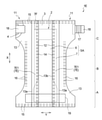
- FIG. 1 is a developed plan view schematically showing a skin-facing surface side (surface sheet side) in an unfolded and stretched state of a deployable disposable diaper according to an embodiment of the absorbent article of the present invention.
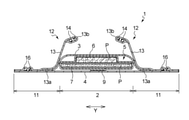
- FIG. 2 is a cross-sectional view schematically showing an I-I line cross section (cross section along the thickness direction of the inseam) of FIG. 1.
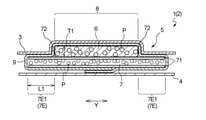
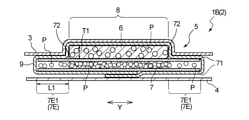
- FIG. 3 is an enlarged cross-sectional view showing the absorbent body of FIG. 2.
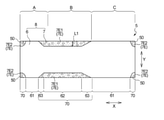
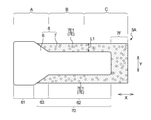
- FIG. 4 is a plan view schematically showing the skin facing surface side of the laminated structure of the absorber in the diaper of FIG. 1.
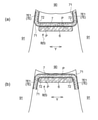
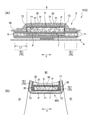
- 5 (a) and 5 (b) are schematic cross-sectional views of the laminated structure of the absorber in the inseam when the diaper of FIG. 1 is worn, respectively.
- FIG. 1 is a developed plan view schematically showing a skin-facing surface side (surface sheet side) in an unfolded and stretched state of a deployable disposable diaper according to an embodiment of the absorbent article of the present invention.
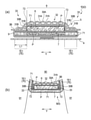
- FIG. 6 is a view corresponding to FIG. 3 of the absorbent body in another embodiment of the absorbent article of the present invention (a schematic cross-sectional view along the thickness direction of the crotch portion of the absorbent body).
- 7 (a) and 7 (b) are schematic cross-sectional views of the laminated structure of the absorber in the inseam when the absorbent article of FIG. 6 is worn, respectively.
- FIG. 8 is a view corresponding to FIG. 3 of the absorbent body in still another embodiment of the absorbent article of the present invention.
- 9 (a) is a view corresponding to FIG. 3 of the absorbent body in still another embodiment of the absorbent article of the present invention
- FIG. 9 (b) is a diagram of FIG. 9 (b) when the absorbent article of FIG.
- FIG. 9 (a) is worn. It is a schematic cross-sectional view of the laminated structure of the absorber of the lower part of the crotch in the above.
- FIG. 10A is a view corresponding to FIG. 3 of the absorbent body in still another embodiment of the absorbent article of the present invention (schematic cross-sectional view along the thickness direction of the crotch portion of the absorbent body).
- 10 (b) is a schematic cross-sectional view of the laminated structure of the absorber in the inseam when the absorbent article of FIG. 10 (a) is worn.
- FIG. 11 is a view corresponding to FIG. 1 of a deployable disposable diaper, which is still another embodiment of the absorbent article of the present invention.
- FIG. 12 is a view corresponding to FIG. 4 of the laminated structure of the absorber in the diaper of FIG.
- the conventional absorbent article has a problem that the fit to the crotch part of the wearer is lowered after the liquid is absorbed.
- a technique capable of solving the above-mentioned problems there is known a technique in which a fiber stack type absorber has a shape having a constricted portion in a central region in the vertical direction, such as an hourglass shape.
- a technique of providing a portion, which is also called a slit portion in which a forming material such as a fiber material does not exist, in a part of the fiber stack type absorber.
- the present invention relates to an absorbent article having excellent liquid absorption performance, reduced load pressure on the wearer's legs, and excellent wearing feeling.
- the diaper 1 has a vertical direction X corresponding to the front-back direction of the wearer, that is, a direction extending from the ventral side to the dorsal side through the crotch portion, and a horizontal direction Y orthogonal to the vertical direction X. Further, the diaper 1 is arranged in the crotch portion of the wearer, and includes the inseam B including the excretion portion facing portion (not shown) facing the excretion portion such as the penis, and the wearer's ventral side (not shown). It is divided into three parts: a ventral part A arranged on the front side) and a dorsal part C arranged on the back side (rear side) of the wearer from the inseam B.
- the ventral portion A and the dorsal portion C each typically include a waist circumference portion that is arranged around the wearer's waist circumference when the diaper 1 is worn.
- the ventral part A is a part of the front body of the diaper 1
- the dorsal part C is a part of the back body of the diaper 1.
- the inseam B typically includes at least a portion of the central portion of the diaper 1 in the longitudinal direction X and extends from the front to the back of the diaper 1.
- the ventral portion A, the inseam B, and the dorsal portion C can be each region when the unfolded and extended diaper 1 is divided into three equal parts in the vertical direction X.
- the "expanded and stretched state" as used herein means that the diaper is in the unfolded state as shown in FIG. It means the state of being expanded until it becomes the same as the dimensions when it is expanded in a plane.
- the diaper 1 includes an absorber 5 that absorbs and holds body fluid such as urine, and a surface sheet 3 arranged on the skin-facing surface side of the absorber 5.
- the diaper 1 includes an absorbent main body 2, and the absorbent main body 2 includes a front surface sheet 3 and an absorbent body 5, and further includes a back surface sheet 4 arranged on the non-skin facing surface side of the absorbent body 5. do.
- the absorbent body 2 extends in the vertical direction X from the ventral side A to the dorsal side C, and its longitudinal direction coincides with the vertical direction X.
- the front surface sheet 3 forms a skin-facing surface (inner surface) of the diaper 1 together with the leak-proof cuff forming sheet 13, which will be described later, and the back surface sheet 4 forms a non-skin-facing surface (outer surface) of the diaper 1.
- the constituent members of the absorbent main body 2 are joined to each other by a known joining means such as an adhesive.
- those normally used in this type of absorbent article are particularly limited on the premise that the explanation can be applied to the member if the explanation is given later. Can be used without.
- various sheets having liquid permeability can be used, and examples thereof include non-woven fabrics, woven fabrics, and papers.
- the back surface sheet 4 is a leak-proof sheet, specifically, a liquid impermeable (property that does not allow liquid to pass through) or a liquid impervious property (property that is not liquid impermeable but difficult to pass through). ) Can be used, and examples thereof include a moisture-permeable resin film and a laminate of the resin film and a non-woven fabric.
- the "skin facing surface” is a surface of the absorbent article or a component thereof (for example, an absorbent body) that is directed toward the wearer's skin side when the absorbent article is worn, that is, the wearer's skin relatively.
- the “non-skin facing surface” is the surface of the absorbent article or its constituents that faces the opposite side of the skin when the absorbent article is worn, that is, relatively far from the wearer's skin. On the side.
- the term "when worn” as used herein means a state in which the normal proper wearing position, that is, the correct wearing position of the absorbent article is maintained.
- the diaper 1 includes a flap portion 11 extending outward from the peripheral edge of the absorbent body 2, that is, the peripheral edge of the absorbent body 5.
- the flap portion 11 is composed of a member extending outward from the peripheral edge of the absorbent main body 2.
- the front surface sheet 3 covers the entire area of the skin-facing surface of the absorber 5, and the back surface sheet 4 covers the entire non-skin-facing surface of the absorber 5, both sheets.
- 3 and 4 extend outward in the lateral direction Y from both side edges along the vertical direction X of the absorber 5, and together with the leakage-proof cuff forming sheet 13 described later, form a side flap portion which is a part of the flap portion 11. Is forming.
- the side flap portion is a portion of the flap portion 11 located outside the side edges of the absorber 5 along the vertical direction X and the virtual extension lines of the both side edges in the lateral direction Y.
- a plurality of members constituting the flap portion 11 are joined to each other by known joining means such as an adhesive, a heat seal, and an ultrasonic seal.
- Each leak-proof cuff 12 includes a liquid-resistant or water-repellent and breathable leak-proof cuff forming sheet 13, wherein one end side in the lateral direction Y is another member (surface sheet 3 in the illustrated form). And the fixed end portion 13a fixed to the back surface sheet 4), and the other end side in the lateral direction Y is a free end portion 13b which is not fixed to other members.
- An elastic member 14 for forming a leak-proof cuff is fixed to the free end portion 13b of the sheet 13 in an extended state in the vertical direction X so as to be expandable and contractible in the same direction.
- the contraction force of the elastic member 14 causes the free end 13b side of the sheet 13 to stand up to the wearer side at least in the inseam B with the fixed end 13a with other members as the standing base end. This causes the pair of leak-proof cuffs 12, 12 to stand up, thereby preventing the outflow of excrement such as urine to the outside in the lateral direction Y.
- a plurality of waist gather forming elastic members 15 are arranged so as to be expandable and contractible in the lateral direction Y at the flap portion 11 at the end portion (waist end portion) of each of the ventral side portion A and the dorsal side portion C in the vertical direction X.
- the plurality of elastic members 15 are intermittently arranged at predetermined intervals in the vertical direction X. As described above, since the elastic member 15 is arranged in a state in which its elasticity is exhibited, in the natural state or the wearing state of the diaper 1, the waists of the ventral side portion A and the dorsal side portion C, which are the arrangement portions, are arranged.
- the waist end Due to the contraction of the elastic member 15, a plurality of folds (gathers) extending in a direction intersecting the contraction direction of the elastic member 15 are formed on the sheet (sheets 3 and 4 in this embodiment) constituting the waist end. This forms a waist gather in which the folds are substantially continuous over the entire circumference of the waist end. Further, in the flap portion 11, the leg portion arranged around the wearer's leg when the diaper 1 is worn has an elastic member 16 for forming leg gathers that can extend in the vertical direction X at least in the vertical direction X of the inseam B.
- the elastic member 16 extends in the vertical direction X over the entire length of the diaper, and when the diaper 1 is worn, the elastic member 16 contracts to the sheets (sheets 4 and 13 in the present embodiment) constituting the leg portion.
- a plurality of folds (gathers) extending in a direction intersecting with the wearer are formed, thereby forming leg gathers in which the folds are substantially continuous over the entire circumference of the wearer's legs.
- These gather-forming elastic members 15 and 16 are all of a plurality of sheets constituting the flap portion 11 (in this embodiment, two of the front surface sheet 3, the back surface sheet 4 and the leakage-proof cuff forming sheet 13). It is sandwiched and fixed in an extended state by a joining means such as an adhesive.
- each of the elastic members 14, 15 and 16 described above is not particularly limited, and for example, a thread-like or string-like (flat rubber or the like) having a rectangular, square, circular or polygonal cross section, or a multifilament type thread-like Etc. can be used.
- the diaper 1 is a so-called deployable disposable diaper, and as shown in FIG. 1, the diaper 1 is provided with a fastening member 18 having a fastening portion 17 on both side edges of the dorsal portion C of the diaper 1 along the vertical direction X.
- the non-skin facing surface of the back surface sheet 4 forming the non-skin facing surface of the ventral side A is provided with a fastening region 19 to which the fastening portion 17 can be fastened.
- the absorber 5 has a rectangular shape in a plan view as shown in FIG. 4, extends in the vertical direction X from the ventral side portion A to the dorsal side portion C, and the longitudinal direction thereof coincides with the vertical direction X.
- the plan-view rectangular absorber 5 has two corners (four in total) on each of the ventral side A and the dorsal side C.
- the absorber 5 has a laminated structure 8 in which the first layer 6 and the second layer 7 are laminated in the thickness direction of the absorber 5 (vertical direction in FIG. 3).
- the laminated structure 8 is composed of a two-layer structure consisting of a first layer 6 and a second layer 7.
- the laminated structure 8 extends over the entire length of the absorber 5 in the vertical direction X, and extends in the vertical direction X from the ventral side portion A to the dorsal side portion C, and the longitudinal direction thereof coincides with the vertical direction X. ..
- the absorber 5 includes a core wrap sheet 9 that covers the outer surface of the laminated structure 8, and the skin facing surface and the non-skin facing surface of the laminated structure 8 are covered with one core wrap sheet 9.
- the core wrap sheet 9 a sheet having liquid permeability can be used, and for example, paper, non-woven fabric, or woven fabric can be used.
- the absorber 5 may not be provided with the core wrap sheet 9, or may be provided with a plurality of core wrap sheets 9. In the latter case, for example, the absorber 5 includes one skin-side core wrap sheet that covers the skin-facing surface of the laminated structure 8 and one non-skin-side core wrap sheet that covers the non-skin-facing surface of the laminated structure 8. And may be provided.
- the second layer 7 is arranged on the non-skin facing surface side of the first layer 6, and is located farther from the skin of the wearer of the diaper 1 than the first layer 6. Is located in. Therefore, in the present embodiment, the body fluid such as urine excreted by the wearer of the diaper 1 normally permeates the laminated structure 8 in the order of the first layer 6 and the second layer 7.
- the water-absorbent polymer is supported on the fiber stack (fiber aggregate) of the fiber material.
- Reference numeral P in the figure is a water-absorbent polymer.
- the first layer 6 typically consists of a mixed layer of a fibrous material and a water-absorbent polymer.
- the first layer 6 is a so-called product fiber type absorber.
- the water-absorbent polymer may be uniformly distributed or unevenly distributed throughout the first layer 6. Typically the former.
- a form in which the water-absorbent polymer is unevenly distributed on the skin-facing surface side or the non-skin facing surface side of the first layer 6, that is, either the skin facing surface side or the non-skin facing surface side is the other. It is possible to exemplify a form in which the content of the water-absorbent polymer is higher than that of the above.
- the skin-facing surface side of the first layer 6 and the non-skin-facing surface side of the first layer 6 are separated by a virtual straight line (not shown) that bisects the first layer 6 in the thickness direction.
- the fiber material constituting the first layer 6 those that can be used for this kind of absorber can be used without particular limitation, and one kind can be used alone or two or more kinds can be used in combination.
- a water-absorbent fiber material is preferable.
- the water-absorbent fiber material include wood pulp such as coniferous tree pulp and broadleaf tree pulp, natural fiber such as non-wood pulp such as cotton pulp and hemp pulp; and modified pulp such as cationized pulp and marcelled pulp (above, cellulose-based). Fiber); Examples include hydrophilic synthetic fiber.
- water-absorbent polymer constituting the first layer 6 those that can be used for this kind of absorber can be used without particular limitation, and typically, a hydrogel material capable of absorbing and retaining water is used.
- a polymer or copolymer of acrylic acid or an alkali metal salt of acrylic acid can be used. Examples thereof include polyacrylic acid and salts thereof, and polymethacrylic acid and salts thereof, and specific examples thereof include partial sodium salts of acrylic acid polymers.
- the shape of the water-absorbent polymer is not particularly limited, and may be, for example, spherical, tufted, lumpy, bale-shaped, fibrous, amorphous, or a combination of these particles.
- the basis weight of the first layer 6 and the content of the forming material are not particularly limited, but it is preferable to set as follows from the viewpoint of ensuring that the predetermined effect of the first layer 6 is exhibited.
- the basis weight of the first layer 6 is preferably 10 g / m 2 or more, more preferably 50 g / m 2 or more, and preferably 600 g / m 2 or less, more preferably 500 g / m 2 or less.
- the content of the fiber material in the first layer 6 is preferably 5% by mass or more, more preferably 10% by mass or more, and preferably 70% by mass or less, more preferably 70% by mass or less, based on the total mass of the first layer 6. It is 65% by mass or less.
- the content of the water-absorbent polymer in the first layer 6 is preferably 30% by mass or more, more preferably 35% by mass or more, and preferably 95% by mass or less, more preferably, based on the total mass of the first layer 6. Is 90% by mass or less.
- the first layer 6 can be manufactured according to a conventional method using a known fiber stacking device equipped with a rotating drum.
- the fiber stacking device is typically a rotary drum having an accumulation recess formed on the outer peripheral surface, and a duct having a flow path inside the forming material (fiber material, water-absorbent polymer) in the accumulation recess.
- the forming material is carried on the air flow generated in the flow path by suction from the inside of the rotating drum while rotating the rotating drum around the rotation axis along the circumferential direction of the rotating drum. ,
- the fiber is made to be stacked in the accumulation recess.
- the fiber stack formed in the accumulation recess by the fiber stacking step is the first layer 6.
- the water-absorbent polymer P is arranged between the two base sheets 71 and 71 arranged to face each other in the thickness direction of the second layer 7 (absorbent 5).
- the second layer 7 is a so-called sheet type absorber.
- the arrangement layer of the water-absorbent polymer in the second layer 7 typically contains only the water-absorbent polymer as the water-absorbent material, and is a cellulosic fiber or the like.
- the water-absorbent fiber material is not contained, or even if the water-absorbent fiber material is contained, the content is smaller than the content of the water-absorbent fiber material in the first layer 6 (for example, with respect to the total mass of the superabsorbent polymer arrangement layer). 10% by mass or less, preferably 3% by mass or less).
- the water-absorbent polymer constituting the second layer 7 the same water-absorbent polymer as the water-absorbent polymer constituting the first layer 6 can be used.
- the two base sheets 71, 71 are bonded to each other, or the base sheet 71 and the water-absorbent polymer are bonded to each other, and the two base sheets 71, 71 have a layer for arranging the water-absorbent polymer in at least one of the two sheets 71, 71.
- An adhesive such as a hot melt adhesive may be applied to the facing surface (inner surface).
- the base material sheet 71 constituting the second layer 7 a sheet having liquid permeability or liquid absorption can be used.
- the base material sheet 71 is typically a fiber sheet mainly composed of fibers, that is, a fiber sheet having a fiber content of more than 50% by mass.
- the constituent fibers of the base sheet 71 include, for example, wood pulp such as coniferous tree pulp and broadleaf tree pulp, natural fibers such as non-wood pulp such as cotton pulp and hemp pulp; and modified pulp such as cationized pulp and marcelified pulp (above). , Cellulous fiber); Synthetic fibers composed of resins such as polyethylene and polypropylene can be mentioned, and one of these can be used alone or in combination of two or more.
- Examples of the form of the base material sheet 71 include paper, woven fabric, and non-woven fabric.
- Examples of the non-woven fabric include air-through non-woven fabric, heat roll non-woven fabric, spunlace non-woven fabric, spunbond non-woven fabric, meltblown non-woven fabric, and spunbond-meltblown-. Spunbond (SMS) non-woven fabric can be mentioned.
- the base sheet 71 is typically a single-layer structure composed of one of these types, but may be a laminated structure in which two or more types are laminated and integrated.
- the basis weight of the base sheet 71 is not particularly limited, but is preferably 5 g / m 2 or more, more preferably 8 g / m 2 or more, and from the viewpoint of ensuring that the predetermined effect of the second layer 7 is exhibited. It is preferably 50 g / m 2 or less, and more preferably 30 g / m 2 or less.
- the two base sheet 71, 71 constituting the second layer 7 may be the same as each other, or may differ in one or more characteristics such as composition, material, and physical properties.
- the second layer 7 extends to at least the inseam B from the side edge of the first layer 6 constituting the laminated structure 8 along the vertical direction X to the outside in the horizontal direction Y. It has an inseam extension 7E1.
- the second layer 7 has a lateral extending portion 7E extending outward in the lateral direction Y from the side edge of the first layer 6 along the vertical direction X, and the lateral extending portion 7E.
- the diaper 1 is formed symmetrically on one side and the other side with a virtual center line (not shown) extending in the vertical direction X by bisecting the diaper 1 in the horizontal direction Y.
- the absorber 5 has a rectangular shape in a plan view as shown in FIG. 4, the inseam extending portion 7E1 is formed in pairs at least on the crotch portion B with the virtual center line interposed therebetween, and the corner extending portion is extended.
- the portions 7E2 are formed in pairs at the two corners 50 of the absorbers 5 of the ventral portion A and the dorsal portion C with the virtual center line interposed therebetween.
- the description of the lateral extension 7E applies to both the inseam extension 7E1 and the corner extension 7E2, and the inseam extension 7E1 and the corner extension 7E1 and the corner extension 7E2.
- the description of one of the exits 7E2 also applies to the other.
- both ends of the first layer 6 in the vertical direction X and both ends of the second layer 7 in the vertical direction X coincide with each other, and the second layer 7 is the first layer 6. It does not extend outward in the vertical direction X from the virtual extension line of the end of the vertical direction X and the end of the vertical direction X (it does not have the vertical extension portion 7F described later). Further, the second layer 7 has a rectangular shape in a plan view, and the length (width) in the horizontal direction Y is constant over the entire length of the vertical direction X of the second layer 7, whereas the first layer 6 has a constant shape.
- the width is not constant, and the first layer 6 has a maximum width portion 61 having a maximum width and a minimum width portion 62 having a minimum width. More specifically, in the first layer 6, the ventral side A side and the dorsal side C side are separated from the end of the first layer 6 in the vertical direction X by a predetermined distance inward in the vertical direction X. There is one maximum width portion 61 at the position, and one minimum width portion 62 is present between the maximum width portion 61 on the ventral side A side and the maximum width portion 61 on the dorsal side C side. Between each of these two maximum width portions 61 and 61 and one minimum width portion 62, there is a width changing portion 63 whose width gradually increases from the inside to the outside in the vertical direction X.
- the pair of inseam extending portions 7E1 and 7E1 of the second layer 7 have two width changing portions 63, which are connected to both ends of the minimum width portion 62 of the first layer 6 and the vertical X of the minimum width portion 62, respectively. It extends outward in the lateral direction from each of the 63, and has a substantially trapezoidal shape in a plan view.
- the inseam extension 7E1 is located at least in the inseam B and may extend further to the ventral side A and / or the dorsal side C.
- the inseam extending portion 7E1 affected by the compression is the first.
- the layer 6 can be bent along the side edge along the vertical direction X.
- the diaper 1 of the present embodiment has the inseam extending portion 7E1 located at the inseam B and the end portion (corner) of the ventral side A and the dorsal side C in the vertical direction X as the lateral extending portion 7E.
- both extending portions 7E1 and 7E2 are made to be bendable when compressed in the lateral direction Y, but are worn by the inseam B.
- the corner extension 7E2 is located away from the inseam B and is not connected to the inseam extension 7E1 (the first layer 6 (maximum width 61) between the two extension 7E1 and 7E2).
- the inseam B When the inseam B is sandwiched between the wearer's legs and compressed laterally Y, it does not bend depending on the effect of the compression, or even if it bends, the degree of bending. May be smaller than the inseam extension 7E1.
- the corner extending portion 7E2 does not bend while wearing the diaper 1, provided that the magnitude relationship (particularly the second magnitude relationship) regarding the water-absorbent polymer with the first layer 6 described later is established. Only the presence of the corner extending portion 7E2 has the effect of improving the cushioning property of the absorber 5 and enhancing the wearing feeling of the diaper 1.
- the boundary between the lateral extending portion 7E and the first layer 6 (laminated structure 8).
- a portion of the second layer 7 that overlaps the side edge of the first layer 6 along the vertical direction X in a plan view) serves as a buckling induction portion 72, and the laterally extending portion 7E bends in the lateral direction Y.
- the buckling induction portion 72 is typically generated naturally due to the difference in rigidity between the laterally extending portion 7E and the first layer 6 (laminated structure 8).
- the lateral extension portion 7E and more typically the inseam extension portion 7E1 has lower rigidity than the first layer 6 (laminated structure 8), "during wearing the diaper 1".
- the lateral extension portion 7E (inseam extension portion 7E1) affected by the compression is the vertical portion of the first layer 6. It can be bent along the side edge along the direction X.
- the laterally extending portion 7E has lower rigidity than the first layer 6 (laminated structure 8)
- the former has a lower density than the latter, and the former has a thinner thickness than the latter.
- the buckling inducing portion 72 As a means for forming the buckling inducing portion 72 other than imparting a rigidity difference between the laterally extending portion 7E and the first layer 6 (laminated structure 8), for example, the buckling inducing portion 72 in the second layer 7
- a linear buckling induction portion 72 such as a crease or a perforation is formed at a site to be formed (for example, a portion of the second layer 7 that overlaps with a side edge of the first layer 6 along the vertical direction X in a plan view). Can be mentioned.
- the direction in which the inseam extending portion 7E1 is bent when compressed in the lateral direction Y is the skin side of the wearer of the diaper 1 or the side opposite to the skin side (non-skin side).
- the inseam extension portion 7E1 is the wearer's crotch portion. It bends so as to stand up toward 90 (see FIG. 5 (a)), or bends so as to stand up toward the side opposite to the crotch portion 90 (see FIG. 5 (b)).
- the upright inseam extension 7E1 comes into contact with the inside of the wearer's leg 91 on the surface and acts as a cushion, so that the liquid is used.
- the load pressure on the leg 91 by the absorber 5 in a state of being tightly tightened by absorption can be reduced.
- the inseam extension in which the side edge portion of the first layer 6 along the vertical direction X, which can be the main cause of the load pressure on the wearer's leg 91 stands up on the crotch portion 90 side.
- FIG. 5 (a) is superior to the form of FIG. 5 (b).
- Controlling the bending direction when the lateral extension portion 7E is compressed in the lateral direction Y is, for example, a linear buckling induction portion such as a crease or a perforation at a site where the buckling induction portion 72 is to be formed. It can be carried out by forming 72. Specifically, for example, when the inseam extending portion 7E1 is to stand up toward the crotch portion 90 as in the form of FIG. 5A, the inseam extending portion 7E1 is formed in advance to form a desired buckling guiding portion 72.
- the planned formation site (for example, a portion of the second layer 7 that overlaps with the side edge of the first layer 6 along the vertical direction X in a plan view) is bent toward the skin facing surface of the second layer 7.
- a crease may be formed in.
- the inseam extending portion 7E1 is to stand up toward the side opposite to the crotch portion 90 as in the form of FIG. 5B, the inseam extending portion 7E1 is bent toward the non-skin facing surface side of the second layer 7. May be the same as the case of adopting the form of FIG. 5A described above.
- the inseam extending portion 7E1 of the second layer 7 being able to bend along the side edge along the vertical direction X of the first layer 6, as described above, the inseam extending portion 7E1 is further combined with the inseam extending portion 7E1.
- the first layer 6 has a larger basis weight of the water-absorbent polymer (total mass of the water-absorbent polymer per unit area of the layer) than the second layer 7, and the second layer 6 has a larger basis weight.
- the layer 7 is characterized in that the density of the water-absorbent polymer (total mass of the water-absorbent polymer per unit volume of the layer) is higher than that of the first layer 6.
- the lateral extending portion 7E inseam extending portion 7E1 and corner extending portion 7E2 can be bent along the side edge of the first layer 6 along the vertical direction X, and is laterally extended.
- the above-mentioned magnitude relationship that is, the basis weight of the water-absorbent polymer is the “first layer”.
- the magnitude relationship of "2nd layer 7" (hereinafter, also referred to as “first magnitude relationship"), and the density of the water-absorbent polymer is the magnitude relationship of "1st layer 6 ⁇ 2nd layer 7" (hereinafter, “1st layer 7").
- the second magnitude relationship is also called “).
- the magnitude relationship between the first layer 6 and the second layer 7 regarding the basis weight and density of the water-absorbent polymer may be established at least in the inseam B, and the ventral portion A and / or the dorsal portion may be established. It is more preferable that it is also established in the side portion C, and it is further preferable that it is established in the entire lateral extending portion existing region 70.
- the lateral extension portion existing region 70 1) the region at the same position in the inseam extension portion 7E1 and the vertical direction X, and 2) the corner extension of the ventral side portion A.
- the basis weight and density of the water-absorbent polymer of the second layer 7 are uniform.
- a form in which the basis weight and density of the water-absorbent polymer of the layer 7 are partially different is included.
- the basis weight of the water-absorbent polymer in the second layer 7 is partially different with respect to the first magnitude relationship, "the basis weight of the water-absorbent polymer in the first layer 6> the basis weight of the water-absorbent polymer in the second layer 7". If the magnitude relation of "the maximum value of" is established, it is said that the first magnitude relation is established. For example, as in the diaper 1B (see FIG.
- the portion constituting the laminated structure 8 in the second layer 7 (the portion overlapping the first layer 6 in a plan view) is located outside the lateral direction Y of the portion.
- the basis weight of the water-absorbent polymer is larger than that of the laterally extending portion 7E located, the basis weight of the water-absorbent polymer in the portion may be smaller than the basis weight of the water-absorbent polymer of the first layer 6.
- the density of the water-absorbent polymer in the second layer 7 is partially different with respect to the second magnitude relationship, "the density of the water-absorbent polymer in the first layer 6 ⁇ the minimum value of the density of the water-absorbent polymer in the second layer 7". If the magnitude relationship of "" is established, it can be said that the second magnitude relationship is established.
- the first layer 6 One of the main roles of the first layer 6 is to secure the absorption capacity of the absorber 5.
- the first magnitude relationship is established, and the first layer 6 has a larger basis weight of the water-absorbent polymer than the second layer 7, so that the absorption capacity of the first layer 6 is improved, and the diaper 1 is extended. Liquid absorption performance can be improved.
- the second magnitude relationship is established and the density of the water-absorbent polymer in the second layer 7 is higher than that in the first layer 6, the second layer 7 tends to swell due to liquid absorption, and the cushion after liquid absorption. Since the property is excellent, the cushioning effect described above is improved by the laterally extending portion 7E which is a part of the second layer 7, which leads to the improvement of the wearing feeling of the diaper 1.
- the inseam extending portion 7E1 is located at the inseam lower portion B, and therefore contributes greatly to the effect of reducing the load pressure on the wearer's legs.
- the second magnitude relationship is established, and the density of the water-absorbent polymer of the inseam extending portion 7E1 is higher than the density of the water-absorbing polymer of the first layer 6 which is located at the same position in the vertical direction X as the inseam extending portion 7E1.
- the load pressure on the wearer's legs can be effectively reduced.
- the diaper 1 satisfying the first and second magnitude relations is excellent in liquid absorption performance and wearing feeling.
- the corner extending portion 7E2 is present in the corner portion 50 of the absorber 5 of each of the ventral side portion A and the dorsal side portion C, the cushioning property of each corner portion 50 is improved. As a result, the wearing feeling of the diaper 1 is further improved.
- the ratio of the basis weight of the water-absorbent polymer of the first layer 6 to the basis weight of the water-absorbent polymer of the second layer 7 is as follows, assuming the former> the latter, as the former / the latter. It is preferably 1.1 or more, more preferably 1.2 or more, and preferably 3.0 or less, more preferably 2.5 or less.
- the basis weight of the water-absorbent polymer of the first layer 6 is preferably 55 g / m 2 or more on the premise that the basis weight of the water-absorbent polymer of the second layer 7 is larger than the basis weight of the water-absorbent polymer of the second layer 7.
- the basis weight of the water-absorbent polymer of the second layer 7 is preferably 50 g / m 2 or more on the premise that the basis weight of the water-absorbent polymer of the first layer 6 is smaller than the basis weight of the water-absorbent polymer of the first layer 6. , More preferably 60 g / m 2 or more, preferably 150 g / m 2 or less, and more preferably 120 g / m 2 or less.
- the ratio of the density of the water-absorbent polymer of the first layer 6 to the density of the water-absorbent polymer of the second layer 7 (particularly the laterally extending portion 7E) in the region 70 where the laterally extending portion exists is premised on the former ⁇ the latter.
- the former / the latter it is preferably 0.05 or more, more preferably 0.07 or more, and preferably 0.5 or less, more preferably 0.4 or less.
- the density of the water-absorbent polymer of the first layer 6 in the region 70 where the lateral extension portion exists is lower than the density of the water-absorbent polymer of the second layer 7 (particularly the lateral extension portion 7E).
- the density of the water-absorbent polymer of the second layer 7 (particularly the lateral extension portion 7E) is higher than the density of the water-absorbent polymer of the first layer 6 in the region 70 where the lateral extension portion exists. It is preferably 1.0 g / cm 3 or more, more preferably 1.2 g / cm 3 or more, and preferably 2.0 g / cm 3 or less, more preferably 1.8 g / cm 3 or less.
- the density of the water-absorbent polymer of each layer (first layer 6, second layer 7) constituting the laminated structure 8 of the absorber 5 can be measured by the following method.
- the thickness of the object to be measured can be measured by using, for example, a laser displacement meter (LK-080) manufactured by KEYENCE CORPORATION.
- LK-080 laser displacement meter
- a square plate 50 x 50 mm, thickness of about 5 mm
- the thickness of the object to be measured is measured using the laser displacement meter.
- the thickness of the object to be measured is measured at any five points in the plane direction by the above method, and the average value thereof is taken as the thickness of the object to be measured (first layer 6, second layer 7). Then, by dividing the basis weight of the water-absorbent polymer of each layer 6 and 7 by the thickness of each layer 6 and 7, the density of the target water-absorbent polymer of the first layer 6 and the second layer 7 is calculated.
- the lateral length L1 of the inseam extending portion 7E1 is compared with the thickness T1 of the portion of the first layer 6 at the same position in the vertical direction X as the inseam extending portion 7E1. Long is preferred.
- the lateral length L1 is the length of the lateral Y at the portion of the inseam extending portion 7E1 where the extending length of the lateral Y from the first layer 6 is the largest, and in the present embodiment, the inseam.
- the length of the inseam extending portion 7E1 corresponding to the minimum width portion 62 of the first layer 6 is the length in the lateral direction Y.
- the inseam extending portion 7E1 is sandwiched between both legs of the wearer while wearing the diaper 1.
- the contact area between the upright inseam extension 7E1 and the wearer's leg increases, so that the cushioning effect of the inseam extension 7E1 is further enhanced.
- the magnitude relationship of the above-mentioned "lateral length L1 of the inseam extending portion 7E1> thickness T1 of the first layer 6" is particularly related to the form of FIG.
- the inseam extending portion 7E1 is attached to the wearer's crotch portion 90.
- the vertical direction X of the first layer 6 is established. It is effective because the side edge portion along the line is easily covered by the inseam extending portion 7E1 standing on the crotch portion 90 side.
- the region where the magnitude relationship of the above-mentioned "lateral length L1 of the inseam extending portion 7E1> thickness T1 of the first layer 6" is established may be present at least in the inseam B, preferably in the inseam B. It exists over 50% or more of the total length of the crotch B in the vertical direction X, and more preferably extends over the total length of the crotch B in the vertical direction X.
- the lateral length of the corner extending portion 7E2 is preferably longer than the thickness T1 of the portion of the first layer 6 at the same position in the vertical direction X as the corner extending portion 7E2. That is, it is preferable that the magnitude relationship of "horizontal length of corner extending portion 7E2> thickness T1 of first layer 6" is established.
- the ratio of the lateral length of the lateral extending portion 7E (lateral length L1 in the inseam extending portion 7E1) to the thickness T1 of the first layer 6 is preferably the former / the latter on the premise of the former> the latter. Is 1.1 or more, more preferably 1.5 or more, and preferably 25.0 or less, more preferably 15.0 or less.
- the lateral length of the lateral extending portion 7E (lateral length L1 in the inseam extending portion 7E1) is preferably 7.0 mm or more, assuming that it is longer than the thickness T1 of the first layer 6. It is preferably 10.0 mm or more, preferably 35.0 mm or less, and more preferably 30.0 mm or less.
- the thickness T1 of the first layer 6 is preferably 1.5 mm on the premise that it is shorter (thinner) than the lateral length of the laterally extending portion 7E (the lateral length L1 in the inseam extending portion 7E1). As mentioned above, it is more preferably 2.0 mm or more, preferably 6.0 mm or less, and more preferably 5.5 mm or less.
- FIG. 6 to 12 show other embodiments of the absorbent article of the present invention.
- components different from the above-mentioned diaper 1 will be mainly described, and similar components will be designated by the same reference numerals and description thereof will be omitted.
- the above-mentioned description of the diaper 1 is appropriately applied to the configurations not particularly described in the other embodiments described later.
- the second layer 7 is arranged on the skin facing surface side of the first layer 6, and is arranged closer to the skin of the wearer of the diaper 1A than the first layer 6. There is. Therefore, in the diaper 1A, the body fluid such as urine excreted by the wearer usually permeates the laminated structure 8 in the order of the second layer 7 and the first layer 6.
- the inseam extension 7E1 When the inseam B is sandwiched between the wearer's legs 91 and 91 and compressed laterally while wearing the diaper 1A, the inseam extension 7E1 is formed in the wearer's crotch as shown in FIG. 7 (a). It bends so as to stand up toward the portion 90, or as shown in FIG. 7 (b), it bends so as to stand up toward the side opposite to the crotch portion 90. In either form of FIGS. 7 (a) and 7 (b), the upright inseam extension 7E1 comes into contact with the inside of the wearer's leg 91 on the surface and acts as a cushion, so that the liquid is used.
- the load pressure on the leg 91 by the absorber 5 in a state of being tightly tightened by absorption can be reduced.
- the side edge portion of the first layer 6 along the vertical direction X which can be the main cause of the load pressure on the wearer's leg 91, stands up on the side opposite to the crotch portion 90 side. Since it is covered with the inseam extending portion 7E1 and does not come into contact with the leg 91, even if the side edge portion is tightly tightened by liquid absorption, the inseam that stands up between the side edge portion and the leg 91 is interposed. Due to the cushioning effect of the extending portion 7E1, the load pressure on the leg 91 can be effectively reduced. Therefore, in terms of the effect of reducing the load pressure on the wearer's legs, the form of FIG. 7 (b) is superior to the form of FIG. 7 (a).
- FIG. 5A a particularly preferable form is the form of FIG. 5A, that is, the second layer 7 is arranged on the non-skin facing surface side of the first layer 6 and absorbs.
- the lateral extending portion 7E (at least the inseam extending portion 7E1) affected by the compression is a side edge along the vertical direction X of the first layer 6. It is a form that can be bent so as to stand up toward the wearer's crotch portion 90 along the line.
- the portion constituting the laminated structure 8 in the second layer 7 (the portion overlapping the first layer 6 in the second layer 7 in a plan view) is an inseam.
- the basis weight of the water-absorbent polymer P is larger than that of the extending portion 7E1.
- such a magnitude relationship is established not only for the inseam extending portion 7E1 but also for the corner extending portion 7E2, that is, the portion constituting the laminated structure 8 in the second layer 7 extends in the lateral direction.
- the basis weight of the water-absorbent polymer P is larger than that of the portion 7E (inseam extending portion 7E1 and corner extending portion 7E2).
- the ratio of the basis weight of the water-absorbent polymer in the portion constituting the laminated structure 8 in the second layer 7 to the basis weight of the water-absorbent polymer in the laterally extending portion 7E is as follows, assuming the former> the latter. It is preferably 1.1 or more, more preferably 1.2 or more, and preferably 3.0 or less, more preferably 2.5 or less.
- the basis weight of the water-absorbent polymer in the portion constituting the laminated structure 8 in the second layer 7 is preferably 55 g / m 2 or more on the premise that the basis weight of the water-absorbent polymer in the laterally extending portion 7E is larger than the basis weight of the water-absorbent polymer.
- the basis weight of the water-absorbent polymer of the laterally extending portion 7E is preferably 50 g / m 2 or more on the premise that the basis weight of the water-absorbent polymer of the portion constituting the laminated structure 8 in the second layer 7 is smaller than the basis weight of the water-absorbent polymer. , More preferably 60 g / m 2 or more, preferably 120 g / m 2 or less, and more preferably 150 g / m 2 or less.
- the surface sheet 3A extends laterally Y from the laminated structure 8 over the laterally extending portion 7E (inseam extending portion 7E1 and corner extending portion 7E2), and the skin of the surface sheet 3A.
- An uneven region including a plurality of convex portions 30 protruding toward the skin side of the wearer and concave portions 31 located around the convex portions 30 is formed on the facing surface (see FIG. 9A).
- the uneven region of the surface sheet 3A may be present at least in the inseam B, and may also be present in the ventral portion A and / or the dorsal portion C.
- the uneven region extends in the vertical direction X over the entire length of the diaper 1C in the vertical direction X.
- the plurality of convex portions 30 have the same shape and the same dimensions. Then, when the lateral extension portion 7E, particularly the inseam extension portion 7E1, is bent so as to stand up toward the wearer's crotch portion 90 while wearing the diaper 1C, the standing inseam extension portion 7E1 and the first The convex portion 30 of the surface sheet 3A is configured to be present between the side edge portion of the first layer 6 along the vertical direction X (see FIG. 9B).
- the diaper 1C is the inseam extension portion. Due to the cushioning effect of both the protruding portion 7E1 and the convex portion 30, the effect of reducing the load pressure on the wearer's leg 91 is particularly excellent.
- the surface sheet 3B extends laterally from the laminated structure 8 over the laterally extending portion 7E, and protrudes toward the skin side of the surface sheet 3B on the skin-facing surface of the surface sheet 3B.
- An uneven region including a plurality of convex portions 30A and 30B and concave portions 31A and 31B located around the convex portions 30A and 30B is formed.
- the uneven region of the surface sheet 3B includes a first region 32 that overlaps the laminated structure 8 in a plan view, and a second region 33 that overlaps a lateral extension portion 7E, more specifically, an inseam extension portion 7E1 in a plan view.
- the convex portion 30A of the first region 32 has a larger protrusion height or area than the convex portion 30B of the second region 33 (see FIG. 10A).
- the uneven region of the surface sheet 3B exists at least in the inseam B, and may also exist in the ventral side A and / or the dorsal side C. In the diaper 1D, the uneven region extends in the vertical direction X over the entire length of the diaper 1D in the vertical direction X.
- the standing inseam extension portion 7E1 and the first The convex portion 30B of the second region 33 of the surface sheet 3B is configured to be present between the side edge portion of the first layer 6 along the vertical direction X (see FIG. 10B). According to the diaper 1D, the same effect as that of the diaper 1C is obtained.
- the convex portion 30A of the first region 32 that can come into contact with the crotch portion 90 of the wearer when worn is made into a large convex portion having a relatively large protruding height or area, so that the crotch portion 90 touches the skin.
- the convex portion 30B of the second region 33 which exists between the inseam extending portion 7E1 and the first layer 6 and acts as a cushion, has a small convex portion having a relatively small protrusion height or area.
- protruding height of the convex portion 30A of the first region 32 refers to the average value of the protruding heights of the plurality of convex portions 30A existing in the first region 32, and the above-mentioned “convex portion of the first region 32".
- Area of 30A refers to the average value of the areas of the plurality of convex portions 30A existing in the first region 32. The same applies to the protruding height and area of the convex portion 30B of the second region 33.
- the length (width) of the first region 32 of the surface sheet 3B in the lateral direction Y is preferably the width (minimum width) of the diaper 1D. It is 15% or more, more preferably 20% or more, and preferably 50% or less, more preferably 45% or less. From the same viewpoint, the length (width) of the second region 33 of the surface sheet 3B in the lateral direction Y is preferably 10% or more, more preferably 15% or more, with respect to the width (minimum width) of the diaper 1D. And it is preferably 40% or less, more preferably 35% or less.
- the ratio of the protruding height of the convex portion 30A (large convex portion) to the protruding height of the convex portion 30B (small convex portion) is preferably 1.2 or more, more preferably 1.2 or more, assuming the former> the latter. It is 1.5 or more, preferably 10.0 or less, and more preferably 8.0 or less.
- the protrusion height of the convex portion 30A (large convex portion) is preferably 0.5 mm or more, more preferably 1.0 mm or more, assuming that the protrusion height is higher than that of the convex portion 30B (small convex portion).
- the thickness is preferably 5.0 mm or less, more preferably 4.0 mm or less.
- the protruding height of the convex portion 30B (small convex portion) is preferably 0.3 mm or more, more preferably 0.6 mm or more, on the premise that it is lower than the protruding height of the convex portion 30A (large convex portion).
- the thickness is preferably 3.0 mm or less, more preferably 2.5 mm or less.
- the ratio of the area of the convex portion 30A (large convex portion) to the area of the convex portion 30B (small convex portion) is preferably 2.0 or more, more preferably 3. It is 0 or more, preferably 10.0 or less, and more preferably 8.0 or less.
- the area of the convex portion 30A is larger than the area of the convex portion 30B (small convex portion)
- the area is preferably 0.8 mm 2 or more, more preferably 3.0 mm 2 or more, and It is preferably 100.0 mm 2 or less, more preferably 80.0 mm 2 or less.
- the area of the convex portion 30B (small convex portion) is smaller than the area of the convex portion 30A (large convex portion)
- the area is preferably 0.2 mm 2 or more, more preferably 0.5 mm 2 or more, and It is preferably 50.0 mm 2 or less, and more preferably 20.0 mm 2 or less.
- the number of convex portions 30A (large convex portions) in the first region 32 per unit area (1000 mm 2 ) is preferably 50 pieces / 1000 mm 2 or more, more preferably 100 pieces / 1000 mm 2 or more, and preferably 1000 pieces. / 1000 mm 2 or less, more preferably 500 pieces / 1000 mm 2 or less.
- the number of convex portions 30B (small convex portions) in the second region 33 per unit area (1000 mm 2 ) is preferably 65 pieces / 1000 mm 2 or more, more preferably 200 pieces / 1000 mm 2 or more, and preferably 2000 pieces. / 1000 mm 2 or less, more preferably 1000 pieces / 1000 mm 2 or less.
- the convex portion 30 (see FIG.
- the surface sheet 3A included in the above-mentioned diaper 1C may be set in the same manner as the protruding height, area, and number per unit area of the convex portion 30A or the convex portion 30B. can.
- the protruding height, area, and number of protrusions per unit area of the surface sheet are measured by the following methods, respectively.
- ⁇ Measuring method of protruding height of convex part of surface sheet The uneven region of the surface sheet to be measured is cut in the thickness direction using a cutting tool such as a sharp razor, and the cut surface is observed.
- the distance between the convex and the top of the convex that is, the shortest distance between the virtual straight line extending horizontally through the bottom of the recess and the virtual straight line extending horizontally through the top of the convex (both virtual).
- the length between the two virtual straight lines of the vertical line orthogonal to the straight line) is measured under no load and is taken as the protruding height of the convex portion.
- the protruding height of the convex portion corresponds to the apparent thickness of the surface sheet.
- the cut surface When observing the cut surface with the naked eye, for example, the cut surface is observed and measured at a magnification of 20 to 100 times using a microscope (VHX-1000 manufactured by KEYENCE). You may.
- VHX-1000 manufactured by KEYENCE.
- the protrusion height of the convex portion is measured by the above procedure, and the measured values of the five regions are averaged. The value is taken as the protruding height of the convex portion of the target area.
- ⁇ Measuring method of the area of the convex part of the surface sheet> A quadrangular shape in a plan view having a length of 50 mm in the vertical direction and 20 mm in the horizontal direction is cut out from the surface sheet to be measured and used as a test piece. The skin contact surface side of the measurement piece is observed under no load using a microscope (for example, a microscope manufactured by KEYENCE, VHX-1000) at an observation magnification of 10 to 100 times.
- a microscope for example, a microscope manufactured by KEYENCE, VHX-1000
- the center of gravity of each of the plurality of concave portions formed so as to surround one convex portion is connected by a straight line, and the area of the polygonal shape in a plan view surrounded by the straight line is defined as the area of the convex portion, and the image analysis software is used. It is used to measure the area of the convex portion. If the surface sheet has a plurality of types of convex portions having different protrusion heights or areas, the procedure is the same as described above for each convex portion (for example, in the case of the surface sheet 3B of the diaper 1D described above, the convex portions 30A and 30B). Measure the area.
- the area of the convex portion is measured by the above procedure, and the average value of the measured values of the three regions is calculated. , The area of the convex portion of the target area.
- a quadrangular shape in a plan view having a length of 50 mm in the vertical direction and 20 mm in the horizontal direction is cut out from the surface sheet to be measured and used as a test piece.
- the test piece is observed with a microscope (for example, a microscope manufactured by KEYENCE, VHX-1000) at an observation magnification of 20 to 100 times, and the number of convex portions of the test piece is measured.
- the measured value divided by the area of the test piece (1000 mm 2 ) is taken as the number per unit area of the convex portion of the surface sheet to be measured.
- the uneven pattern (shape and arrangement of the convex portion) of the uneven region of the surface facing the skin of the surface sheets 3A and 3B is not particularly limited, and any one can be appropriately selected as long as it does not deviate from the gist of the present invention.
- Examples of the plan view shape of the convex portion include a circle, an ellipse, a triangle, and a polygon having a quadrangle or more.
- the convex portion may have a solid structure in which the constituent fibers of the surface sheet are filled inside, or may be a hollow structure in which the constituent fibers are not filled.
- the concavo-convex pattern of the concavo-convex region there is a form in which a plurality of convex portions are arranged in a scattered pattern (for example, staggered) and the periphery of each convex portion is a concave portion.
- a first concave portion having a plane line of sight extending in the first direction intersecting both the vertical direction and the horizontal direction and a plane extending in the second direction intersecting the first direction.
- a form in which the second concave portion having a line of sight is arranged in a grid pattern and a convex portion is present in each of a plurality of sections surrounded by both concave portions can be mentioned.
- the convex portion as a ridge extending in the vertical direction or the horizontal direction and the concave portion as a groove extending in the same direction are orthogonal to the extending direction thereof. Examples thereof include forms in which they are arranged alternately in the direction in which they are used.
- the non-skin facing surfaces of the surface sheets 3A and 3B are typically flat surfaces having substantially no uneven shape, as shown in FIGS. 9A and 10A.
- the method of forming the uneven region of the surface sheets 3A and 3B is not particularly limited.
- the uneven region is typically formed by partially squeezing the raw material, which is the raw material of the surface sheet, in which case the squeezed portion is the raw sheet.
- the forming material of No. 1 is compacted to form a concave portion, and the portion not subjected to the pressing process protrudes to one side in the thickness direction, specifically to the skin facing surface side, and becomes a convex portion. Further, in this case, the convex portion not subjected to the pressing process becomes a low density portion having a relatively low density, and the concave portion subjected to the pressing process becomes a high density portion having a relatively high density.
- a known method can be used without particular limitation, and examples thereof include embossing process with or without heat, and ultrasonic embossing process.
- the surface sheets 3A and 3B may have a single-layer structure or a laminated structure in which a plurality of layers are laminated in the thickness direction.
- a surface sheet having a laminated structure two sheets are partially joined in a laminated state, and one of the two sheets, which is relatively close to the wearer's skin (skin side sheet), is Examples thereof include a surface sheet having a two-layer structure in which a convex portion is formed by projecting in a portion other than the joint portion in a direction away from the other sheet (non-skin side sheet).
- a non-woven fabric is preferably used as the sheet constituting the surface sheet.
- non-woven fabric examples include air-through non-woven fabric, heat roll non-woven fabric, spunlace non-woven fabric, spunbond non-woven fabric, meltblown non-woven fabric, and spunbond-meltblown-spunbond (SMS) non-woven fabric.
- SMS spunbond-meltblown-spunbond
- FIG. 11 The diaper 1E shown in FIG. 11 has a different absorber configuration from the above-mentioned diaper 1 (see FIG. 1).
- FIG. 12 shows the absorber 5A included in the diaper 1E.
- the absorber 5A has a rectangular shape in a plan view, extends in the vertical direction X from the ventral side portion A to the dorsal side portion C, and its longitudinal direction coincides with the vertical direction X.
- the second layer 7 has a rectangular shape in a plan view and the length (width) in the horizontal direction Y is constant, whereas the width of the first layer 6 is not constant and is in the vertical direction X. It's changing. Specifically, as shown in FIG.
- the first layer 6 has a maximum width portion 61 having the maximum length (width) in the lateral direction Y in the first layer 6 on the ventral side A side.
- the minimum width portion 62 having the minimum width in the first layer 6 is provided, and between the maximum width portion 61 and the minimum width portion 62, from the inside of the vertical direction X. It has a width changing portion 63 whose width gradually increases toward the outside (from the inseam B side to the ventral side A side).
- the minimum width portion 62 is located at least in the inseam B, and has a longer length in the vertical direction X than each of the maximum width portion 61 and the width changing portion 63.
- the length of the first layer 6 in the vertical direction X is shorter than that of the second layer 7, and the ends of the first layer 6 and the second layer 7 on the ventral side A side coincide with each other.
- the end of the first layer 6 on the dorsal side C side in the vertical direction X is located inward of the vertical direction X than the end of the second layer 7 on the dorsal side C side in the vertical direction X.
- the second layer 7 extends outward from a portion other than the maximum width portion 61 (minimum width portion 62 and width changing portion 63) on the peripheral edge of the first layer 6, and the lateral extending portion 7E (inseam extension).
- the extending portion 7E1 It has a protruding portion 7E1) and extends outward in the vertical direction X from the virtual extension line (not shown) of the end of the vertical direction X on the dorsal side C side of the first layer 6 and the end of the vertical direction X. It has a vertical extending portion 7F, and the vertical extending portion 7F of the dorsal side portion C and the lateral extending portion 7E (inseam extending portion 7E1) form the dorsal portion C side of the first layer 6. In the form shown in FIG. 11, the extending portion forms a U-shaped extension portion in a plan view.
- the second layer 7 has the longitudinal extension 7F on the dorsal side C in addition to the lateral extension 7E (inseam extension 7E1), the inseam B Not only is the load pressure on the wearer's legs reduced, but the cushioning property of the dorsal side C is good, and an excellent wearing feeling is achieved.
- the length of the vertically extending portion 7F in the vertical direction X is relative to the length of the absorber 5A in the vertical direction X. It is preferably 2% or more, more preferably 5% or more, and preferably 50% or less, more preferably 40% or less.
- both side edges of the vertical end portion (maximum width portion 61) on the ventral side A side of the first layer 6 along the vertical direction X are the said in the second layer 7.
- the portion located at the same position in the vertical direction X as the vertical end portion (maximum width portion 61) is located outside the horizontal direction Y with respect to both side edges along the vertical direction X. That is, at the vertical end portion on the ventral side A side, the first layer 6 protrudes in the lateral direction Y from the second layer 7.
- the wearer of this type of absorbent article often takes a supine posture while wearing the absorbent article, and therefore, from the viewpoint of improving the wearing feeling of the absorbent article, etc. It is important to enhance the cushioning property of the dorsal side C rather than the ventral side A. Therefore, in the diaper 1E, as described above, the vertically extending portion 7F of the second layer 7 is arranged on the dorsal side portion C to improve the cushioning property of the dorsal side portion C, while the vertically extending portion 7F.
- the decrease in the absorption capacity of the absorber 5A due to the decrease in the area of the dorsal portion C of the first layer 6, that is, the width of the ventral portion A side of the first layer 6 is smaller than the width of the second layer 7. It is covered by expanding it.
- the absorbent article of the present invention is not limited to the embodiment and can be appropriately modified. All the parts of only one embodiment described above can be mutually used as appropriate.
- a liquid permeable sheet made of paper or various non-woven fabrics which is also called a second sheet or a sublayer sheet, is interposed between the surface sheet 3 and the absorber 5. It may have been done.
- the absorbent article of the present invention is not limited to the deployable disposable diaper as in the above embodiment, and broadly includes an article used for absorbing body fluid (urine, menstrual blood, loose stool, sweat, etc.) discharged from the human body. It also includes pants-type disposable diapers, sanitary napkins, sanitary shorts, etc. that do not have a fastening structure such as the fastening member 18 and the fastening region 19.
- ⁇ 1> It has a vertical direction extending from the ventral side of the wearer to the dorsal side through the crotch part and a lateral direction orthogonal to the vertical direction, and the crotch part arranged in the crotch part and the wearer's lower part than the crotch part. It is divided into a ventral part arranged on the ventral side and a dorsal part arranged on the dorsal side of the wearer rather than the inseam.
- An absorbent article comprising a surface sheet arranged in The absorber has a laminated structure in which the first layer and the second layer are laminated in the thickness direction.
- the water-absorbent polymer is supported on the fiber stack of the fiber material.
- the water-absorbent polymer is arranged between the two base sheets arranged so as to face each other in the thickness direction.
- the second layer has an inseam extending portion extending outward in the lateral direction from a side edge of the first layer constituting the laminated structure along the vertical direction at least in the inseam.
- the first layer has a larger basis weight of the water-absorbing polymer than the second layer
- the second layer has a larger basis weight.
- the region in which the lateral length of the inseam extension portion> the thickness relationship between the inseam extension portion and the portion at the same position in the vertical direction in the first layer is established is preferably the region in the inseam lower portion.
- ⁇ 4> The absorbent article according to any one of ⁇ 1> to ⁇ 3>, wherein the portion constituting the laminated structure in the second layer has a larger basis weight of the water-absorbing polymer than the inseam extending portion. .. ⁇ 5>
- ⁇ 6> The inseam extension so as to stand up toward the wearer's crotch when the inseam is sandwiched between the wearer's legs and compressed laterally while wearing the absorbent article.
- the absorbent article according to any one of ⁇ 1> to ⁇ 5>, which is bendable.
- the surface sheet extends laterally from the laminated structure to the inseam extension portion, and the concavo-convex region including a plurality of convex portions projecting toward the skin side of the wearer on the skin facing surface of the surface sheet.
- the absorbent article according to ⁇ 6>, wherein the convex portion of the sheet is present.
- the uneven region of the surface sheet has a first region that overlaps with the laminated structure in a plan view and a second region that overlaps with the inseam extension portion in a plan view.
- the convex portion of the first region has a larger protruding height or area than the convex portion of the second region, and the inseam extending portion stands up toward the wearer's crotch portion while wearing the absorbent article.
- Goods. ⁇ 9> The absorption according to any one of ⁇ 1> to ⁇ 8>, wherein the second layer is located at a corner of the absorber and has a corner extension that is not connected to the inseam extension. Sex goods. ⁇ 10> In the region located at the same position in the vertical direction as the corner extension portion, the first layer has a larger basis weight of the water-absorbing polymer than the second layer, and the second layer becomes the first layer.
- the lateral length of the corner extending portion is longer than the thickness of the portion of the first layer that is at the same position in the vertical direction as the corner extending portion, in the above ⁇ 9> or ⁇ 10>.
- the second layer has a vertical end on the dorsal side of the first layer and a vertical extension extending outward from the virtual extension of the vertical end.
- the longitudinal length of the longitudinal extension is preferably 2% or more, more preferably 5% or more, and preferably 50% or less, more preferably 40, with respect to the longitudinal length of the absorber.
- Both sides of the ventral end of the first layer along the vertical direction are aligned with the vertical end of the second layer in the vertical direction.
- the layer in which the water-absorbent polymer is arranged in the second layer has less water-absorbent fiber material than the first layer, or does not contain any water-absorbent fiber material, any of the above ⁇ 1> to ⁇ 15>.
- the ratio of the layer to the basis weight of the water-absorbent polymer is preferably 1.1 or more, more preferably 1.2 or more, and preferably 3.0 or less, as the former / the latter, assuming the former> the latter.
- the density of the water-absorbent polymer of the first layer and the second layer is preferably 0.05 or more, more preferably 0.07 or more, and preferably 0.07 or more as the former / the latter, assuming the former ⁇ the latter.
- an absorbent article having excellent liquid absorption performance, reduced load pressure on the wearer's legs, and excellent wearing feeling.
Landscapes
- Health & Medical Sciences (AREA)
- Epidemiology (AREA)
- Engineering & Computer Science (AREA)
- Biomedical Technology (AREA)
- Heart & Thoracic Surgery (AREA)
- Vascular Medicine (AREA)
- Life Sciences & Earth Sciences (AREA)
- Animal Behavior & Ethology (AREA)
- General Health & Medical Sciences (AREA)
- Public Health (AREA)
- Veterinary Medicine (AREA)
- Absorbent Articles And Supports Therefor (AREA)
Priority Applications (2)
| Application Number | Priority Date | Filing Date | Title |
|---|---|---|---|
| EP21861009.5A EP4205717A4 (en) | 2020-08-25 | 2021-07-12 | Absorbent article |
| CN202180051238.5A CN115916129B (zh) | 2020-08-25 | 2021-07-12 | 吸收性物品 |
Applications Claiming Priority (2)
| Application Number | Priority Date | Filing Date | Title |
|---|---|---|---|
| JP2020-142059 | 2020-08-25 | ||
| JP2020142059A JP7436326B2 (ja) | 2020-08-25 | 2020-08-25 | 吸収性物品 |
Publications (1)
| Publication Number | Publication Date |
|---|---|
| WO2022044579A1 true WO2022044579A1 (ja) | 2022-03-03 |
Family
ID=80353136
Family Applications (1)
| Application Number | Title | Priority Date | Filing Date |
|---|---|---|---|
| PCT/JP2021/026125 Ceased WO2022044579A1 (ja) | 2020-08-25 | 2021-07-12 | 吸収性物品 |
Country Status (4)
| Country | Link |
|---|---|
| EP (1) | EP4205717A4 (OSRAM) |
| JP (1) | JP7436326B2 (OSRAM) |
| CN (1) | CN115916129B (OSRAM) |
| WO (1) | WO2022044579A1 (OSRAM) |
Citations (7)
| Publication number | Priority date | Publication date | Assignee | Title |
|---|---|---|---|---|
| JP3117119U (ja) * | 2005-09-28 | 2006-01-05 | 株式会社光洋 | おむつ |
| JP2008237252A (ja) | 2007-03-23 | 2008-10-09 | Kao Corp | 使い捨ておむつ |
| US20080312621A1 (en) | 2007-06-18 | 2008-12-18 | Harald Hermann Hundorf | Disposable Absorbent Article With Improved Acquisition System With Substantially Continuously Distributed Absorbent Particulate Polymer Material |
| JP2015518773A (ja) * | 2012-06-08 | 2015-07-06 | ザ プロクター アンド ギャンブルカンパニー | 吸収性物品に使用される吸収性コア |
| JP2016022282A (ja) * | 2014-07-23 | 2016-02-08 | 花王株式会社 | パンツ型使い捨ておむつ |
| JP2017042379A (ja) * | 2015-08-27 | 2017-03-02 | 大王製紙株式会社 | 吸収性物品 |
| US20200179187A1 (en) | 2016-11-29 | 2020-06-11 | Daio Paper Corporation | Absorbent article |
Family Cites Families (6)
| Publication number | Priority date | Publication date | Assignee | Title |
|---|---|---|---|---|
| WO2003026545A2 (en) * | 2001-09-21 | 2003-04-03 | Kao Corporation | Disposable diaper |
| RU2636371C2 (ru) * | 2012-10-23 | 2017-11-22 | Као Корпорейшн | Абсорбирующее изделие |
| JP6189143B2 (ja) * | 2012-10-31 | 2017-08-30 | 花王株式会社 | 吸収性物品 |
| US9566198B2 (en) * | 2013-03-15 | 2017-02-14 | Dsg Technology Holdings Ltd. | Method of making an absorbent composite and absorbent articles employing the same |
| EP2901992B1 (en) * | 2014-01-31 | 2016-12-28 | Ontex BVBA | Multi-layer absorbent material |
| US10398610B2 (en) * | 2014-05-13 | 2019-09-03 | The Procter & Gamble Company | Absorbent article with dual core |
-
2020
- 2020-08-25 JP JP2020142059A patent/JP7436326B2/ja active Active
-
2021
- 2021-07-12 WO PCT/JP2021/026125 patent/WO2022044579A1/ja not_active Ceased
- 2021-07-12 EP EP21861009.5A patent/EP4205717A4/en active Pending
- 2021-07-12 CN CN202180051238.5A patent/CN115916129B/zh active Active
Patent Citations (7)
| Publication number | Priority date | Publication date | Assignee | Title |
|---|---|---|---|---|
| JP3117119U (ja) * | 2005-09-28 | 2006-01-05 | 株式会社光洋 | おむつ |
| JP2008237252A (ja) | 2007-03-23 | 2008-10-09 | Kao Corp | 使い捨ておむつ |
| US20080312621A1 (en) | 2007-06-18 | 2008-12-18 | Harald Hermann Hundorf | Disposable Absorbent Article With Improved Acquisition System With Substantially Continuously Distributed Absorbent Particulate Polymer Material |
| JP2015518773A (ja) * | 2012-06-08 | 2015-07-06 | ザ プロクター アンド ギャンブルカンパニー | 吸収性物品に使用される吸収性コア |
| JP2016022282A (ja) * | 2014-07-23 | 2016-02-08 | 花王株式会社 | パンツ型使い捨ておむつ |
| JP2017042379A (ja) * | 2015-08-27 | 2017-03-02 | 大王製紙株式会社 | 吸収性物品 |
| US20200179187A1 (en) | 2016-11-29 | 2020-06-11 | Daio Paper Corporation | Absorbent article |
Non-Patent Citations (1)
| Title |
|---|
| See also references of EP4205717A4 |
Also Published As
| Publication number | Publication date |
|---|---|
| JP2022037758A (ja) | 2022-03-09 |
| EP4205717A4 (en) | 2024-08-28 |
| JP7436326B2 (ja) | 2024-02-21 |
| CN115916129B (zh) | 2023-11-14 |
| CN115916129A (zh) | 2023-04-04 |
| EP4205717A1 (en) | 2023-07-05 |
Similar Documents
| Publication | Publication Date | Title |
|---|---|---|
| JP7388868B2 (ja) | 吸収性物品 | |
| JP7452976B2 (ja) | 吸収性物品 | |
| JP7126430B2 (ja) | 吸収性物品 | |
| JP2016022282A (ja) | パンツ型使い捨ておむつ | |
| JP7174534B2 (ja) | 吸収パッド | |
| JP3892260B2 (ja) | パンツ型紙おむつ | |
| JP2020054500A (ja) | 吸収性物品 | |
| JP2016010516A (ja) | 使い捨て着用物品 | |
| JP7289242B2 (ja) | 吸収性物品 | |
| JP2013099372A (ja) | 吸収性物品 | |
| JP7409996B2 (ja) | 吸収性物品 | |
| JP7436326B2 (ja) | 吸収性物品 | |
| JP2020075044A (ja) | 吸収性物品 | |
| JP2019141118A (ja) | 吸収パッド | |
| JP7424943B2 (ja) | 吸収性物品 | |
| WO2021132294A1 (ja) | 吸収体及び吸収性物品 | |
| RU2802180C1 (ru) | Впитывающее изделие | |
| RU2797356C1 (ru) | Впитывающее изделие | |
| JP3211463U (ja) | 使い捨て着用物品 | |
| WO2021130802A1 (ja) | 吸収体及び吸収性物品 | |
| JP6419454B2 (ja) | 吸収性物品 | |
| JP7534971B2 (ja) | 吸収性物品 | |
| JP7724707B2 (ja) | 吸収性物品 | |
| JP7560493B2 (ja) | 吸収性物品 | |
| JP3240909U (ja) | 使い捨ておむつ |
Legal Events
| Date | Code | Title | Description |
|---|---|---|---|
| 121 | Ep: the epo has been informed by wipo that ep was designated in this application |
Ref document number: 21861009 Country of ref document: EP Kind code of ref document: A1 |
|
| NENP | Non-entry into the national phase |
Ref country code: DE |
|
| ENP | Entry into the national phase |
Ref document number: 2021861009 Country of ref document: EP Effective date: 20230327 |