WO2022044428A1 - 高分子固体電解質およびその製造方法、ならびに電気化学デバイス - Google Patents
高分子固体電解質およびその製造方法、ならびに電気化学デバイス Download PDFInfo
- Publication number
- WO2022044428A1 WO2022044428A1 PCT/JP2021/016794 JP2021016794W WO2022044428A1 WO 2022044428 A1 WO2022044428 A1 WO 2022044428A1 JP 2021016794 W JP2021016794 W JP 2021016794W WO 2022044428 A1 WO2022044428 A1 WO 2022044428A1
- Authority
- WO
- WIPO (PCT)
- Prior art keywords
- solid electrolyte
- polymer
- general formula
- functional group
- indicates
- Prior art date
- Legal status (The legal status is an assumption and is not a legal conclusion. Google has not performed a legal analysis and makes no representation as to the accuracy of the status listed.)
- Ceased
Links
Images


Classifications
-
- H—ELECTRICITY
- H01—ELECTRIC ELEMENTS
- H01M—PROCESSES OR MEANS, e.g. BATTERIES, FOR THE DIRECT CONVERSION OF CHEMICAL ENERGY INTO ELECTRICAL ENERGY
- H01M10/00—Secondary cells; Manufacture thereof
- H01M10/05—Accumulators with non-aqueous electrolyte
- H01M10/056—Accumulators with non-aqueous electrolyte characterised by the materials used as electrolytes, e.g. mixed inorganic/organic electrolytes
- H01M10/0564—Accumulators with non-aqueous electrolyte characterised by the materials used as electrolytes, e.g. mixed inorganic/organic electrolytes the electrolyte being constituted of organic materials only
- H01M10/0565—Polymeric materials, e.g. gel-type or solid-type
-
- C—CHEMISTRY; METALLURGY
- C08—ORGANIC MACROMOLECULAR COMPOUNDS; THEIR PREPARATION OR CHEMICAL WORKING-UP; COMPOSITIONS BASED THEREON
- C08F—MACROMOLECULAR COMPOUNDS OBTAINED BY REACTIONS ONLY INVOLVING CARBON-TO-CARBON UNSATURATED BONDS
- C08F20/00—Homopolymers and copolymers of compounds having one or more unsaturated aliphatic radicals, each having only one carbon-to-carbon double bond, and only one being terminated by only one carboxyl radical or a salt, anhydride, ester, amide, imide or nitrile thereof
- C08F20/02—Monocarboxylic acids having less than ten carbon atoms, Derivatives thereof
- C08F20/10—Esters
- C08F20/38—Esters containing sulfur
-
- C—CHEMISTRY; METALLURGY
- C08—ORGANIC MACROMOLECULAR COMPOUNDS; THEIR PREPARATION OR CHEMICAL WORKING-UP; COMPOSITIONS BASED THEREON
- C08G—MACROMOLECULAR COMPOUNDS OBTAINED OTHERWISE THAN BY REACTIONS ONLY INVOLVING UNSATURATED CARBON-TO-CARBON BONDS
- C08G65/00—Macromolecular compounds obtained by reactions forming an ether link in the main chain of the macromolecule
- C08G65/02—Macromolecular compounds obtained by reactions forming an ether link in the main chain of the macromolecule from cyclic ethers by opening of the heterocyclic ring
- C08G65/32—Polymers modified by chemical after-treatment
- C08G65/329—Polymers modified by chemical after-treatment with organic compounds
- C08G65/334—Polymers modified by chemical after-treatment with organic compounds containing sulfur
-
- H—ELECTRICITY
- H01—ELECTRIC ELEMENTS
- H01B—CABLES; CONDUCTORS; INSULATORS; SELECTION OF MATERIALS FOR THEIR CONDUCTIVE, INSULATING OR DIELECTRIC PROPERTIES
- H01B1/00—Conductors or conductive bodies characterised by the conductive materials; Selection of materials as conductors
- H01B1/06—Conductors or conductive bodies characterised by the conductive materials; Selection of materials as conductors mainly consisting of other non-metallic substances
-
- H—ELECTRICITY
- H01—ELECTRIC ELEMENTS
- H01B—CABLES; CONDUCTORS; INSULATORS; SELECTION OF MATERIALS FOR THEIR CONDUCTIVE, INSULATING OR DIELECTRIC PROPERTIES
- H01B13/00—Apparatus or processes specially adapted for manufacturing conductors or cables
-
- H—ELECTRICITY
- H01—ELECTRIC ELEMENTS
- H01M—PROCESSES OR MEANS, e.g. BATTERIES, FOR THE DIRECT CONVERSION OF CHEMICAL ENERGY INTO ELECTRICAL ENERGY
- H01M10/00—Secondary cells; Manufacture thereof
- H01M10/05—Accumulators with non-aqueous electrolyte
- H01M10/054—Accumulators with insertion or intercalation of metals other than lithium, e.g. with magnesium or aluminium
-
- H—ELECTRICITY
- H01—ELECTRIC ELEMENTS
- H01M—PROCESSES OR MEANS, e.g. BATTERIES, FOR THE DIRECT CONVERSION OF CHEMICAL ENERGY INTO ELECTRICAL ENERGY
- H01M4/00—Electrodes
- H01M4/02—Electrodes composed of, or comprising, active material
- H01M4/36—Selection of substances as active materials, active masses, active liquids
- H01M4/38—Selection of substances as active materials, active masses, active liquids of elements or alloys
- H01M4/381—Alkaline or alkaline earth metals elements
-
- H—ELECTRICITY
- H01—ELECTRIC ELEMENTS
- H01M—PROCESSES OR MEANS, e.g. BATTERIES, FOR THE DIRECT CONVERSION OF CHEMICAL ENERGY INTO ELECTRICAL ENERGY
- H01M4/00—Electrodes
- H01M4/02—Electrodes composed of, or comprising, active material
- H01M2004/026—Electrodes composed of, or comprising, active material characterised by the polarity
- H01M2004/027—Negative electrodes
-
- H—ELECTRICITY
- H01—ELECTRIC ELEMENTS
- H01M—PROCESSES OR MEANS, e.g. BATTERIES, FOR THE DIRECT CONVERSION OF CHEMICAL ENERGY INTO ELECTRICAL ENERGY
- H01M4/00—Electrodes
- H01M4/02—Electrodes composed of, or comprising, active material
- H01M2004/026—Electrodes composed of, or comprising, active material characterised by the polarity
- H01M2004/028—Positive electrodes
-
- H—ELECTRICITY
- H01—ELECTRIC ELEMENTS
- H01M—PROCESSES OR MEANS, e.g. BATTERIES, FOR THE DIRECT CONVERSION OF CHEMICAL ENERGY INTO ELECTRICAL ENERGY
- H01M2300/00—Electrolytes
- H01M2300/0017—Non-aqueous electrolytes
- H01M2300/0065—Solid electrolytes
- H01M2300/0082—Organic polymers
-
- Y—GENERAL TAGGING OF NEW TECHNOLOGICAL DEVELOPMENTS; GENERAL TAGGING OF CROSS-SECTIONAL TECHNOLOGIES SPANNING OVER SEVERAL SECTIONS OF THE IPC; TECHNICAL SUBJECTS COVERED BY FORMER USPC CROSS-REFERENCE ART COLLECTIONS [XRACs] AND DIGESTS
- Y02—TECHNOLOGIES OR APPLICATIONS FOR MITIGATION OR ADAPTATION AGAINST CLIMATE CHANGE
- Y02E—REDUCTION OF GREENHOUSE GAS [GHG] EMISSIONS, RELATED TO ENERGY GENERATION, TRANSMISSION OR DISTRIBUTION
- Y02E60/00—Enabling technologies; Technologies with a potential or indirect contribution to GHG emissions mitigation
- Y02E60/10—Energy storage using batteries
Definitions
- the present invention relates to a polymer solid electrolyte, a method for producing the same, and an electrochemical device.
- Electrochemical devices include capacitors, air batteries, fuel cells, secondary batteries, etc., and are used for various purposes.
- the electrochemical device comprises a positive electrode and a negative electrode, and has a solid electrolyte responsible for ion transport between the positive electrode and the negative electrode.
- an electrode of an electrochemical device represented by a magnesium battery an electrode made of magnesium or an electrode containing at least magnesium is provided (hereinafter, such an electrode is also simply referred to as a “magnesium electrode” and is a magnesium electrode.
- the electrochemical device in which is used is also referred to as "magnesium electrode-based electrochemical device”).
- Magnesium is resource-rich and much cheaper than lithium.
- magnesium generally has a large amount of electricity per unit volume that can be extracted by a redox reaction, and is highly safe when used in an electrochemical device. Therefore, magnesium batteries are attracting attention as next-generation secondary batteries to replace lithium-ion batteries.
- Patent Document 1 the general formula Mg x My SiO z (wherein, in the general formula, M is at least one selected from the group consisting of Ti, Zr, Hf, Ca, Sr, and Ba. Inorganic substances having the composition represented by 0 ⁇ x ⁇ 2, 0 ⁇ y ⁇ 2, and 3 ⁇ z ⁇ 6) are used. Further, in Patent Document 2, an inorganic substance having a composition represented by the general formula Mg x SiO y N z (however, in the general formula, 1 ⁇ x ⁇ 2, 3 ⁇ y ⁇ 5, and 0 ⁇ z ⁇ 1). Is used.
- inorganic substances have low flexibility, when inorganic substances are used as solid electrolytes, they have the disadvantage of being brittle and difficult to return to their original shape when stress is applied to the solid electrolytes or when stress is generated in the solid electrolytes. .. Further, the ionic conductivity of the solid electrolyte composed of an inorganic substance is extremely low on the order of 10-9 to 10-7 S / cm at 500 ° C.
- a main object of the present invention is to provide a solid electrolyte which has excellent structure sustainability and contributes to the realization of an electrochemical device having higher ion conductivity than the conventional one.
- it is a polymer solid electrolyte for an electrochemical device provided with a magnesium electrode as a negative electrode. It comprises an Mg polymer salt containing Mg 2+ and an anionic polymer having an anionic and coordinating functional groups. A polymer solid electrolyte having Mg ion conductivity is provided.
- Af indicates an anionic functional group
- T indicates a terminal group
- m indicates an integer of 3 to 40
- n indicates an integer of 150 to 850
- p and q indicate 1 to 1. Indicates an integer of 10, where p and q may be the same or different from each other
- a method for producing a polymer solid electrolyte which comprises a step of precipitating the Mg polymer salt represented by.
- the polymer solid electrolyte of the present invention provides an electrochemical device having excellent structure retention and high ionic conductivity. That is, in the magnesium electrode-based electrochemical device in which the polymer solid electrolyte of the present invention is used, the polymer solid electrolyte contains Mg 2+ and an anionic polymer having an anionic functional group and a coordinating functional group. It contains a polymer salt. Due to such a configuration of the polymer solid electrolyte, it has high ionic conductivity (Mg ionic conductivity).
- the electrolyte of the magnesium electrode-based electrochemical device of the present invention is composed of Mg polymer salt. Therefore, even when stress is applied to the solid electrolyte or when stress is generated in the solid electrolyte, the Mg polymer salt can be restored to its original shape due to its high flexibility. Due to such a structure of the polymer solid electrolyte, the structure sustainability is excellent.
- a polymer solid electrolyte that provides an electrochemical device having excellent structure retention and high ionic conductivity is produced.
- the method for producing a polymer solid electrolyte is to dissolve the Li polymer salt in a linear ether solution of the Mg salt and add the linear ether to precipitate the Mg polymer salt, that is, the L + of the Li polymer salt is subjected to an ion exchange reaction. Substitute with Mg 2+ and precipitate to obtain Mg polymer salt. Therefore, the obtained Mg polymer salt has a relatively high Mg ion concentration.
- the anionic polymer has the structure represented by the general formula (5) and forms an ionic bond having an appropriate strength with Mg 2+ in particular, the Mg polymer salt can contribute to high ionic conductivity. .. It should be noted that the effects described in the present specification are merely exemplary and not limited, and may have additional effects.
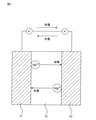
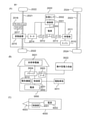
- FIG. 1 is a conceptual diagram of a magnesium electrode-based electrochemical device (particularly a battery) according to an embodiment of the present invention.
- FIG. 2 is a schematic cross-sectional view of a magnesium secondary battery (cylindrical magnesium secondary battery) provided as an embodiment of the present invention.
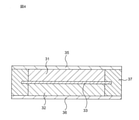
- FIG. 3 is a schematic perspective view of a magnesium secondary battery (flat plate type laminated film type magnesium secondary battery) provided as an embodiment of the present invention.
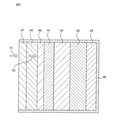
- FIG. 4 is a schematic cross-sectional view of an electrochemical device provided as a capacitor in one embodiment of the present invention.
- FIG. 5 is a schematic cross-sectional view of an electrochemical device provided as an air battery in one embodiment of the present invention.
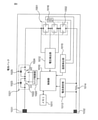
- FIG. 6 is a block diagram showing an example of a circuit configuration when a magnesium secondary battery provided as an embodiment of the present invention is applied to a battery pack.
- 7A, 7B and 7C are block diagrams showing the configurations of an electric vehicle, an energy storage system and a power tool to which a magnesium secondary battery is applied as an embodiment of the present invention, respectively.
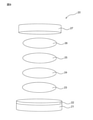
- FIG. 8 is a development view schematically showing the battery produced in [Example] of the present specification.
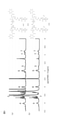
- FIG. 9 is a graph (NMR spectrum) showing the result of "evaluation of identification” in [Example] of the present specification.
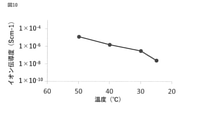
- FIG. 10 is a graph showing the result of “evaluation of ionic conductivity” in [Example] of the present specification (particularly, a graph showing the relationship between ionic conductivity and temperature).
- the polymer solid electrolyte for an electrochemical device (hereinafter, the polymer solid electrolyte is also referred to as a solid electrolyte) and a method for producing the same" and the “electrochemical device” of the present invention will be described in detail.
- the various numerical ranges referred to herein are intended to include the lower and upper limits themselves. That is, taking a numerical range such as 1 to 10 as an example, it is interpreted as including the lower limit value "1" and the upper limit value "10" unless a special explanation is given.
- the "electrochemical device” means a device capable of extracting energy by utilizing an electrochemical reaction in a broad sense.
- electrochemical device means a device that comprises a pair of electrodes and electrolytes, and in particular is charged and discharged with the movement of ions.
- examples of the electrochemical device include a capacitor, an air battery, a fuel cell, and the like, in addition to a secondary battery.
- Solid electrolytes for electrochemical devices The solid electrolyte of the present invention is used in electrochemical devices. That is, the solid electrolytes described herein correspond to electrolytes for devices that can utilize electrochemical reactions to extract energy.
- the solid electrolyte of the present invention is, as a major premise, a solid electrolyte used in an electrochemical device provided with a magnesium electrode.
- it is a solid electrolyte for an electrochemical device having a magnesium electrode as a negative electrode. Therefore, the solid electrolyte of the present invention can be said to be a solid electrolyte for a magnesium electrode-based electrochemical device (hereinafter, also simply referred to as “magnesium electrode-based solid electrolyte”).
- the negative electrode of such an electrochemical device is a magnesium electrode
- the positive electrode is a sulfur electrode
- the solid electrolyte of the present invention is a solid electrolyte for magnesium (Mg) -sulfur (S) electrodes.
- magnesium electrode used in the present specification broadly refers to an electrode having magnesium (Mg) as an active ingredient (that is, an active material).
- Mg magnesium
- magnesium electrode refers to an electrode containing magnesium, for example, an electrode containing a magnesium metal or a magnesium alloy, particularly a negative electrode of such magnesium.
- the magnesium electrode may contain a component other than a magnesium metal or a magnesium alloy, in one preferred embodiment, an electrode made of a metal body of magnesium (for example, a purity of 90% or more, preferably a purity of 95% or more, More preferably, it is an electrode made of a single magnesium metal having a purity of 98% or more).
- sulfur electrode used in the present specification broadly refers to an electrode having sulfur (S) as an active ingredient (that is, an active material).
- sulfur electrode refers to an electrode that contains at least sulfur, eg, an electrode that contains sulfur (S), such as S8 and / or polymeric sulfur, especially such. It refers to the positive electrode of sulfur.
- the sulfur electrode may contain a component other than sulfur, and may contain, for example, a conductive auxiliary agent and a binder.
- the sulfur content in the sulfur electrode may be 5% by mass or more and 95% by mass or less, and may be, for example, 70% by mass or more and 90% by mass or less (also, there is).
- the sulfur content in the sulfur electrode may be 5% by weight to 20% by weight, 5% by weight to 15% by weight, or the like).
- the magnesium electrode-based solid electrolyte according to the present invention has Mg ion conductivity.
- the ionic conductivity of the solid electrolyte is, for example, a value on the order of 10-5 S / cm at 50 ° C.
- the method for measuring the ionic conductivity will be described in detail in Examples.
- the Mg ion conductivity is on the order of 10-9 to 10-7 S / cm at a considerably high temperature.
- it is 1.1 ⁇ 10 -9 to about 3.6 ⁇ 10 -7 S / cm at 500 ° C.
- the solid electrolyte comprises an Mg polymer salt. Since the solid electrolyte contains the Mg polymer salt, the Mg polymer salt returns to its original shape due to its high flexibility even when stress is applied to the solid electrolyte or when stress is generated in the solid electrolyte. You can go back. Therefore, the solid electrolyte is excellent in structure sustainability. Further, the solid electrolyte is a solid, not a liquid (electrolyte). Since the solid electrolyte does not contain an organic solvent, there is no risk of the electrolytic solution leaking from the electric device, and the solid electrolyte is excellent in safety and workability. Further, since the solid electrolyte does not contain an organic solvent, it is excellent in thermal stability. The reason why the solid electrolyte does not contain an organic solvent as a dispersion medium is that the coordinating functional group of the anionic polymer disperses Mg 2+ in the solid electrolyte, as will be described later.
- the Mg polymer salt contains Mg 2+ and an anionic polymer having an anionic functional group and a coordinating functional group. Due to this configuration of the solid electrolyte, it has high ionic conductivity. It is not bound by a specific theory, but the reason is presumed as follows.
- the coordinating functional group disperses Mg 2+ in the solid electrolyte.
- the anionic polymer has a certain degree of intramolecular motility in the solid electrolyte, for example, the molecular chain of the anionic polymer having an anionic functional group moves.
- the anionic functional group for example, a monovalent negatively charged functional group
- Mg 2+ is present in the solid electrolyte along with the movement of the anionic functional group. Can be transported.
- the anionic polymer efficiently transports Mg 2+ as a carrier in the solid electrolyte, the ion transport number of Mg 2+ is improved and the Mg ion conductivity of the solid electrolyte is high.
- the Mg polymer salt is, for example, the general formula (1) :.
- (A) indicates a block having an anionic functional group
- (B) indicates a block having a coordinating functional group
- the two (A) are different even if they are the same as each other. May
- It may be a triblock copolymer represented by (ABA type triblock copolymer).
- (A) is the general formula (2): [In the general formula (2), Af indicates an anionic functional group, m indicates an integer of 3 to 40, and p indicates an integer of 1 to 10.] It may be a block represented by.
- p preferably indicates 3 and m indicates 20 to 40.
- alkylene group ⁇ (CH 2 ) p ⁇ in the general formula (2) examples include a methylene group, an ethylene group, an n-propylene group, an n-butylene group, an n-pentylene group, an n-hexylene group and n.
- -Heptylene group, n-octylene group, n-nonylene group and n-decylene group can be mentioned.
- the m alkylene groups in the m repeating units represented by the general formula (2) may be the same or different from each other.
- an n-propylene group is preferable from the viewpoint of improving Mg ion conductivity.
- the valence of the anionic functional group may be monovalent or multivalent (eg, divalent, etc.).
- the anionic functional group is preferably a monovalent anionic functional group.
- the Mg ion conductivity is further improved. It is not bound by a specific theory, but the reason is presumed as follows.
- the anionic functional group exerts an electrostatic attraction with Mg 2+ , which is a counter ion, in the solid electrolyte to form an ionic bond.
- the monovalent anionic functional group since the monovalent anionic functional group has a smaller valence than the divalent or higher polyvalent anionic functional group, it forms a relatively weak ionic bond with Mg 2+ .
- the monovalent anionic functional group forms an ionic bond having an appropriate strength with Mg 2+ , and the binding of Mg 2+ as a carrier is suppressed. Therefore, it is considered that the ion transport number of Mg 2+ is improved and the Mg ion conductivity is further improved.
- the anionic functional group is more preferably a perfluoroalkylsulfonylamide group (C k F 2k + 1 -SO 2 - N --SO 2- group; where k represents an integer of 1-10) and -SO 3 .
- -Groups are mentioned, more preferably a perfluoroalkylsulfonylamide group, and particularly preferably a trifluoromethylsulfonylamide group (CF 3 -SO 2 -N --SO 2- group ).
- the m anionic functional groups in the m repeating units represented by the general formula (2) may be the same or different from each other.
- the perfluoroalkylsulfonylamide group and the -SO 3- group have a relatively large spatial spread of negative charges. Therefore, when the anionic functional group is a perfluoroalkylsulfonylamide group or -SO 3- group , the anionic functional group forms an ionic bond with Mg 2+ with an appropriate strength, and Mg 2+ and an anion are formed.
- the electrostatic attraction with the sex functional group acts moderately to the extent that Mg 2+ is not strongly bound to the anionic functional group. As described above, since the binding of Mg 2+ by the anionic functional group is suppressed, it is considered that the ion transport number of Mg 2+ is improved and the Mg ion conductivity is further improved.
- the anionic polymer preferably has an anionic functional group in the side chain, for example, as represented by the general formula (2).
- the Mg ion conductivity of the solid electrolyte is further increased. It is not bound by a specific theory, but the reason is presumed as follows.
- the side chains of anionic polymers have a higher degree of freedom of motion than the main chains, for example, they move in a solid electrolyte by rocking the side chains. Since an electrostatic attraction acts between the anionic functional group and Mg 2+ , Mg 2+ can also move with the movement of the side chain of the anionic polymer. Therefore, it is considered that when the anionic polymer has an anionic functional group in the side chain, the ion transport number of Mg 2+ is further improved and the Mg ion conductivity of the solid electrolyte is further enhanced.
- (B) is the general formula (3) :. [In the general formula (3), n indicates an integer of 150 to 850, and q indicates an integer of 1 to 10]. It may be a block represented by.
- q is preferably 2 from the viewpoint of further improving Mg ion conductivity.
- the block represented by the general formula (3) is a poly (alkylene oxide) in which a plurality of alkyleneoxy structural units are linearly bonded.
- the "alkylene oxy structural unit” is a molecular structural unit in which an alkylene group and an oxygen atom are bonded (-(CH 2 ) q -O-) (q in the molecular structural unit is in the general formula (3). It is synonymous with q).
- the poly (alkylene oxide) represented by the general formula (3) is, for example, a poly (alkylene oxide) having 1 to 10 carbon atoms.
- poly (alkylene oxide) include poly (methylene oxide), poly (ethylene oxide), poly (n-propylene oxide), poly (n-butylene oxide), poly (n-pentylene oxide), and poly (n).
- -Hexylene oxide poly (n-heptylene oxide), poly (n-octylene oxide), poly (n-nonylene oxide) and poly (n-decylene oxide).
- poly (ethylene oxide) is preferable from the viewpoint of further improving Mg ion conductivity.
- the plurality of alkylene oxide structural units contained in the block represented by the general formula (3) are, for example, a plurality of alkylene oxide structural units having 1 to 10 carbon atoms.
- Specific examples of alkyleneoxy in this structural unit include methyleneoxy, ethyleneoxy, n-propyleneoxy, n-butyleneoxy, n-pentyleneoxy, n-hexyleneoxy, n-heptyleneoxy, and n-octyleneoxy. , N-nonyleneoxy and n-decyleneoxy.
- ethylene oxy is preferable from the viewpoint of further improving Mg ion conductivity.
- the anionic polymer preferably has a coordinating functional group in the main chain, for example, as represented by the general formula (3).
- the Mg ion conductivity is further improved. It is not bound by a specific theory, but the reason is presumed as follows. Since the coordinating functional group has a relatively flexible structure, when the anionic polymer has a coordinating functional group in the main chain, the degree of freedom of movement of the anionic polymer is increased. Since an electrostatic attraction acts between the anionic functional group and Mg 2+ , Mg 2+ can also move with the movement of the main chain of the anionic polymer. Therefore, when the anionic polymer has a coordinating functional group in the main chain, it is considered that the ion transport number of Mg 2+ is improved and the Mg ion conductivity is further improved.
- the coordinating functional group is preferably poly (alkylene oxide), for example, as represented by the general formula (3), and more preferably poly (ethylene oxide) (in the general formula (3), q is 2). Polyalkylene oxide).
- poly (ethylene oxide) has a relatively flexible structure
- the anionic polymer has poly (ethylene oxide) as a coordinating functional group
- the degree of freedom of movement of the anionic polymer is increased.
- the unshared electron pair of the oxygen atom of the polyalkylene oxide is easily coordinated to Mg 2+ , the dispersibility of Mg 2+ in the solid electrolyte is further improved.
- the ion transport number of Mg 2+ is improved and the Mg ion conductivity is further improved.
- the Mg polymer salt represented by the general formula (1) is, for example, the general formula (5) :.
- Af indicates an anionic functional group
- T indicates a terminal group
- m indicates an integer of 3 to 40
- n indicates an integer of 150 to 850
- p and q indicate 1 to 1. Indicates an integer of 10, where p and q may be the same or different from each other
- It may be an Mg polymer salt represented by (hereinafter, the Mg polymer salt represented by the general formula (5) is also referred to as "Mg polymer salt (5)").
- m, p and Af, and n and q in the general formula (5) are synonymous with m, p and Af in the general formula (2), and n and q in the general formula (3), respectively. ..
- Af in the general formula (5) represents a monovalent anionic functional group.
- the number average molecular weight Mn of the Mg polymer salt is, for example, 12,000 to 60,000.
- the method for measuring the number average molecular weight of the Mg polymer salt will be described in detail in Examples.
- Mg polymer salt (5-2) for example, the general formula (5-2): [In the general formula (5-2), m indicates an integer of 3 to 40, and n indicates an integer of 150 to 850].
- Mg polymer salt (5-2) The Mg polymer salt represented by (hereinafter, also referred to as “Mg polymer salt (5-2)”) can be mentioned.
- the solid electrolyte may consist of Mg polymer salt.
- the magnesium electrode-based solid electrolyte according to the present invention is suitable for an electrochemical device having a magnesium electrode as a negative electrode, but more preferably when the device has a sulfur electrode as a positive electrode. That is, the solid electrolyte of the present invention is a solid electrolyte for an electrochemical device provided with a magnesium electrode as a negative electrode, and it is preferable that the positive electrode of the electrochemical device is a sulfur electrode.
- An electrochemical device having such a magnesium electrode-sulfur electrode pair is also hereinafter referred to as a "magnesium-sulfur electrode system electrochemical device".
- the method for synthesizing the Mg polymer salt (5) includes a Li polymer salt synthesis step and an ion exchange step. That is, the Mg polymer salt (5) is synthesized according to or according to the reactions (R-1) to (R-2) as shown in the reaction scheme below.
- Li polymer salt synthesis step reaction (R-1)
- the PAO macro chain transfer agent represented by the general formula (6) hereinafter, also referred to as PAO macro chain transfer agent (6)
- the Li salt of the methacrylic acid derivative represented by (hereinafter, also referred to as Li salt (7)) is subjected to a reversible addition cleavage chain polymerization reaction (RAFT reaction: reaction (R-1)), and is represented by the general formula (4).
- RAFT reaction reaction (R-1))
- the Li polymer salt (hereinafter, also referred to as Li polymer salt (4)) to be obtained is synthesized.
- reaction (R-1) q and n in the general formula (6) and p and Af in the general formula (7) are synonymous with q, n, p and Af in the general formula (5), respectively.
- Is. M, n, p, q and Af in the general formula (4) are synonymous with m, n, p, q and Af in the general formula (5), respectively.
- Af in the general formula (5) in the above reaction scheme shows a monovalent anionic functional group.
- polymerization initiator examples include azo-based polymerization initiators (more specifically, 2,2'-azobis (2-aminopropane) hydrochloride (AIBA)).
- AIBA 2,2'-azobis (2-aminopropane) hydrochloride
- the polymerization initiator can be added, for example, 0.1 to 0.4 mol to 1 mol of PAO macrochain transfer agent.
- reaction (R-1) for example, 1 mol of PAO macrochain transfer agent is reacted with m mol of Li salt (7) to obtain 1 mol of Li polymer salt (4).
- the reaction temperature is preferably 40 ° C. or higher and 80 ° C. or lower.
- the reaction time is preferably 8 hours or more and 15 hours or less.
- the PAO macrochain transfer agent (6) and the Li salt (7), which are the starting compounds in the reaction (R-1) may be synthesized and prepared.
- the Li polymer salt (4) is subjected to an ion exchange reaction to obtain the Mg polymer salt (5).
- the Li polymer salt (4) is dissolved in a linear ether solution (Mg electrolytic solution) of Mg salt.
- Mg salt include magnesium chloride (MgCl 2 ) and an Mg salt of perfluoroalkylsulfonylimide (more specifically, an Mg salt of trifluoromethylsulfonylimide (magnesium bistrifluoromethanesulfonylimide: Mg (TFSI) 2 ). ))
- Mg electrolytic solution Mg electrolytic solution
- the concentration of the Mg salt is, for example, 0.5 to 3 M (moL / L).
- the volume of the Mg solution is sufficient to replace Li + with Mg 2+ from the viewpoint of improving the yield of the Mg polymer salt (5), and is necessary for dissolving the Li polymer salt (4).
- the smallest possible volume is preferred, and the minimum volume required to dissolve the Li polymer salt (4) is more preferred.
- a linear ether is added to the obtained Li polymer salt (4) solution to precipitate the Mg polymer salt (5).
- the reaction (R-2) can be carried out in an atmosphere of an inert gas (for example, argon).
- the linear ether as a solvent is, for example, the general formula (8) :.
- the linear ether represented by the general formula (8) has an ethyleneoxy structural unit.
- R'and R " may be independently 1 or more and 10 or less aliphatic hydrocarbon groups, respectively, and such ethylene may be used.
- n'in the general formula (8) may be an integer of 2 or more and 4 or less, and therefore, the linear ether has an ethylene oxy structural unit of 2 or more and 4 or less.
- R'and R " may be the same alkyl group as each other in the above general formula.
- the linear ether having "ethylene oxy structural unit” is ethylene glycol dimethyl ether (dimethoxyethane), diethylene glycol dimethyl ether, triethylene glycol dimethyl ether, tetraethylene glycol dimethyl ether, pentaethylene glycol dimethyl ether, hexaethylene. It may be at least one selected from the group consisting of glycol dimethyl ether and polyethylene glycol dimethyl ether. Of these, dimethoxyethane is preferable.
- the Mg polymer salt (5) cannot be efficiently obtained.
- the present inventors have found that the solubility of the Li polymer salt (4) in an electrolytic solution containing a glyme solvent greatly varies depending on the electrolyte concentration.
- the present inventors can relatively easily adjust the solubility of the Li polymer salt (4) in the electrolytic solution containing the glyme solvent by the electrolyte concentration in the electrolytic solution (solubility electrolyte). Concentration dependence) was derived. At the same time, the inventors predicted that the target Mg polymer salt (5) also exhibits solubility dependence on the electrolyte concentration. Further, the present inventors have focused on the fact that Mg 2+ selectively ion-exchanges and coordinates with L + based on the electrostatic interaction between the metal ion and the anionic polymer and the solvation. It was derived to use Mg salt as the electrolyte.
- the present inventors have found that the Mg polymer salt (5) can be efficiently precipitated by adding a glyme solvent in a state where Mg 2+ is coordinated to the anionic polymer in the Mg salt solution.
- the Li polymer salt (4) was obtained by "dissolving the Li polymer salt (4) in a glyme solution of Mg salt and then adding a glyme solvent". We came up with the idea of efficiently obtaining the Mg polymer salt (5) by satisfying both the dissolution of the Mg polymer salt and the precipitation of the Mg polymer salt (5).
- the obtained polymer salt (5) is processed into a predetermined shape, for example, the obtained polymer salt (5) is heat-pressed to form a sheet and cut.
- the purification step include known methods (more specifically, filtration, chromatography, dialysis or crystallization).
- Such an electrochemical device includes a negative electrode and a positive electrode, and the negative electrode is provided with a magnesium electrode.
- Such electrochemical devices are characterized in that the solid electrolyte comprises at least the solid electrolyte described above.
- the solid electrolyte of the electrochemical device of the present invention comprises at least an Mg polymer salt, which comprises Mg 2+ and an anionic polymer having anionic and coordinating functional groups. ..
- the Mg polymer salt is, for example, the general formula (1) :.
- (A) indicates a block having an anionic functional group
- (B) indicates a block having a coordinating functional group
- the two (A) are different even if they are the same as each other. May
- It may be a triblock copolymer represented by (ABA type triblock copolymer).
- (A) is the general formula (2): [In the general formula (2), Af indicates an anionic functional group, m indicates an integer of 3 to 40, and p indicates an integer of 1 to 10.] It may be a block represented by.
- p preferably indicates 3 and m indicates 20 to 40.
- alkylene group ⁇ (CH 2 ) p ⁇ in the general formula (2) examples include a methylene group, an ethylene group, an n-propylene group, an n-butylene group, an n-pentylene group, an n-hexylene group and n.
- -Heptylene group, n-octylene group, n-nonylene group and n-decylene group can be mentioned.
- the m alkylene groups in the m repeating units represented by the general formula (2) may be the same or different from each other.
- an n-propylene group is preferable from the viewpoint of improving Mg ion conductivity.
- the valence of the anionic functional group may be monovalent or multivalent (eg, divalent, etc.).
- the anionic functional group is preferably a monovalent anionic functional group.
- the Mg ion conductivity is further improved. It is not bound by a specific theory, but the reason is presumed as follows.
- the anionic functional group exerts an electrostatic attraction with Mg 2+ , which is a counter ion, in the solid electrolyte to form an ionic bond.
- the monovalent anionic functional group since the monovalent anionic functional group has a smaller valence than the divalent or higher polyvalent anionic functional group, it forms a relatively weak ionic bond with Mg 2+ .
- the monovalent anionic functional group forms an ionic bond having an appropriate strength with Mg 2+ , and the binding of Mg 2+ as a carrier is suppressed. Therefore, it is considered that the ion transport number of Mg 2+ is improved and the Mg ion conductivity is further improved.
- the anionic functional group is more preferably a perfluoroalkylsulfonylamide group (C k F 2k + 1 -SO 2 - N --SO 2- group; where k represents an integer of 1-10) and -SO 3 .
- -Groups are mentioned, more preferably a perfluoroalkylsulfonylamide group, and particularly preferably a trifluoromethylsulfonylamide group (CF 3 -SO 2 -N --SO 2- group ).
- the m anionic functional groups in the m repeating units represented by the general formula (2) may be the same or different from each other.
- the perfluoroalkylsulfonylamide group and the -SO 3- group have a relatively large spatial spread of negative charges. Therefore, when the anionic functional group is a perfluoroalkylsulfonylamide group or -SO 3- group , the anionic functional group forms an ionic bond with Mg 2+ with an appropriate strength, and Mg 2+ and an anion are formed.
- the electrostatic attraction with the sex functional group acts moderately to the extent that Mg 2+ is not strongly bound to the anionic functional group. As described above, since the binding of Mg 2+ by the anionic functional group is suppressed, it is considered that the ion transport number of Mg 2+ is improved and the Mg ion conductivity is further improved.
- the anionic polymer preferably has an anionic functional group in the side chain, for example, as represented by the general formula (2).
- the Mg ion conductivity of the solid electrolyte is further increased. It is not bound by a specific theory, but the reason is presumed as follows.
- the side chains of anionic polymers have a higher degree of freedom of motion than the main chains, for example, they move in a solid electrolyte by rocking the side chains. Since an electrostatic attraction acts between the anionic functional group and Mg 2+ , Mg 2+ can also move with the movement of the side chain of the anionic polymer. Therefore, it is considered that when the anionic polymer has an anionic functional group in the side chain, the ion transport number of Mg 2+ is further improved and the Mg ion conductivity of the solid electrolyte is further enhanced.
- (B) is the general formula (3) :. [In the general formula (3), n indicates an integer of 150 to 850, and q indicates an integer of 1 to 10]. It may be a block represented by.
- q is preferably 2 from the viewpoint of further improving Mg ion conductivity.
- the block represented by the general formula (3) is a poly (alkylene oxide) in which a plurality of alkyleneoxy structural units are linearly bonded.
- the "alkylene oxy structural unit” is a molecular structural unit in which an alkylene group and an oxygen atom are bonded (-(CH 2 ) q -O-) (q in the molecular structural unit is in the general formula (3). It is synonymous with q).
- the poly (alkylene oxide) represented by the general formula (3) is, for example, a poly (alkylene oxide) having 1 to 10 carbon atoms.
- poly (alkylene oxide) include poly (methylene oxide), poly (ethylene oxide), poly (n-propylene oxide), poly (n-butylene oxide), poly (n-pentylene oxide), and poly (n).
- -Hexylene oxide poly (n-heptylene oxide), poly (n-octylene oxide), poly (n-nonylene oxide) and poly (n-decylene oxide).
- poly (ethylene oxide) is preferable from the viewpoint of further improving Mg ion conductivity.
- the plurality of alkylene oxide structural units contained in the block represented by the general formula (3) are, for example, a plurality of alkylene oxide structural units having 1 to 10 carbon atoms.
- Specific examples of alkyleneoxy in this structural unit include methyleneoxy, ethyleneoxy, n-propyleneoxy, n-butyleneoxy, n-pentyleneoxy, n-hexyleneoxy, n-heptyleneoxy, and n-octyleneoxy. , N-nonyleneoxy and n-decyleneoxy.
- ethylene oxy is preferable from the viewpoint of further improving Mg ion conductivity.
- the anionic polymer preferably has a coordinating functional group in the main chain, for example, as represented by the general formula (3).
- the Mg ion conductivity is further improved. It is not bound by a specific theory, but the reason is presumed as follows. Since the coordinating functional group has a relatively flexible structure, when the anionic polymer has a coordinating functional group in the main chain, the degree of freedom of movement of the anionic polymer is increased. Since an electrostatic attraction acts between the anionic functional group and Mg 2+ , Mg 2+ can also move with the movement of the main chain of the anionic polymer. Therefore, when the anionic polymer has a coordinating functional group in the main chain, it is considered that the ion transport number of Mg 2+ is improved and the Mg ion conductivity is further improved.
- the coordinating functional group is preferably poly (alkylene oxide), for example, as represented by the general formula (3), and more preferably poly (ethylene oxide) (in the general formula (3), q is 2). Polyalkylene oxide).
- poly (ethylene oxide) has a relatively flexible structure
- the anionic polymer has poly (ethylene oxide) as a coordinating functional group
- the degree of freedom of movement of the anionic polymer is increased.
- the unshared electron pair of the oxygen atom of the polyalkylene oxide is easily coordinated to Mg 2+ , the dispersibility of Mg 2+ in the solid electrolyte is further improved.
- the ion transport number of Mg 2+ is improved and the Mg ion conductivity is further improved.
- the Mg polymer salt represented by the general formula (1) is, for example, the general formula (5) :.
- Af indicates an anionic functional group
- T indicates a terminal group
- m indicates an integer of 3 to 40
- n indicates an integer of 150 to 850
- p and q indicate 1 to 1. Indicates an integer of 10, where p and q may be the same or different from each other
- It may be an Mg polymer salt represented by (hereinafter, the Mg polymer salt represented by the general formula (5) is also referred to as "Mg polymer salt (5)").
- m, p and Af, and n and q in the general formula (5) are synonymous with m, p and Af in the general formula (2), and n and q in the general formula (3), respectively. ..
- Af in the general formula (5) represents a monovalent anionic functional group.
- the number average molecular weight Mn of the Mg polymer salt is, for example, 12,000 to 60,000.
- the method for measuring the number average molecular weight of the Mg polymer salt will be described in detail in Examples.
- Mg polymer salt (5-2) for example, the general formula (5-2): [In the general formula (5-2), m indicates an integer of 3 to 40, and n indicates an integer of 150 to 850].
- Mg polymer salt (5-2) The Mg polymer salt represented by (hereinafter, also referred to as “Mg polymer salt (5-2)”) can be mentioned.
- the solid electrolyte may consist of Mg polymer salt.
- the positive electrode is a sulfur electrode containing at least sulfur. That is, the sulfur electrode of the electrochemical device of the present invention is preferably configured as a positive electrode of sulfur (S) such as S 8 and / or polymerized sulfur. Since the negative electrode is a magnesium electrode, the electrochemical device of the present invention is an electrochemical device with a magnesium electrode-sulfur electrode pair and has a suitable solid electrolyte for it, while providing the positive electrode with the desired cycle characteristics. It is possible to improve the Coulomb efficiency of the negative electrode.
- S sulfur
- the electrochemical device of the present invention is an electrochemical device with a magnesium electrode-sulfur electrode pair and has a suitable solid electrolyte for it, while providing the positive electrode with the desired cycle characteristics. It is possible to improve the Coulomb efficiency of the negative electrode.
- the sulfur electrode is an electrode containing at least sulfur, and may also contain a conductive auxiliary agent and / or a binder.
- the sulfur content in the sulfur electrode may be 5% by mass or more and 95% by mass or less, preferably 70% by mass or more and 90% by mass or less based on the overall standard of the electrode.
- examples of the conductive auxiliary agent contained in the sulfur electrode used as a positive electrode include carbon materials such as graphite, carbon fiber, carbon black, and carbon nanotubes, and one type or two or more of these may be mixed.
- carbon materials such as graphite, carbon fiber, carbon black, and carbon nanotubes, and one type or two or more of these may be mixed.
- the carbon fiber for example, vapor-growth carbon fiber (Vapor Growth Carbon Fiber: VGCF (registered trademark)) or the like can be used.
- the carbon black for example, acetylene black and / or Ketjen black can be used.
- As the carbon nanotubes for example, multi-wall carbon nanotubes (MWCNTs) such as single-wall carbon nanotubes (SWCNTs) and / or double-wall carbon nanotubes (DWCNTs) can be used.
- MWCNTs multi-wall carbon nanotubes
- SWCNTs single-wall carbon nanotubes
- DWCNTs double-wall
- a material other than the carbon material can be used, and for example, a metal material such as Ni powder and / or a conductive polymer material can be used.
- the binder contained in the sulfur electrode used as the positive electrode include a fluororesin such as polyvinylidene fluoride (PVdF) and / or polytetrafluoroethylene (PTFE), a polyvinyl alcohol (PVA) -based resin, and a polyvinylidene (PVA) -based resin.
- a polymer resin such as a styrene-butadiene copolymer rubber (SBR) resin can be mentioned.
- a conductive polymer may be used as the binder.
- the conductive polymer for example, substituted or unsubstituted polyaniline, polypyrrole, polythiophene, and a (co) polymer composed of one or two selected from these can be used.
- the material constituting the negative electrode is a "magnesium electrode” and therefore is made of a magnesium metal alone, a magnesium alloy or a magnesium compound.
- the negative electrode is made of a simple substance of magnesium (for example, a magnesium plate)
- the Mg purity of the single metal is 90% or more, preferably 95% or more, and more preferably 98% or more.
- the negative electrode can be made of, for example, a plate-like material or a foil-like material, but the present invention is not limited to this, and the negative electrode can also be formed (formed) using powder.
- the negative electrode may have a structure in which a negative electrode active material layer is formed in the vicinity of the surface thereof.
- the negative electrode active material layer may have a layer having magnesium ion conductivity, which contains magnesium (Mg) and further contains at least one of carbon (C), oxygen (O), sulfur (S) and halogen. It may be a negative electrode.
- Such a negative electrode active material layer is merely an exemplary category, but may have a single peak derived from magnesium in the range of 40 eV or more and 60 eV or less.
- the halogen for example, at least one selected from the group consisting of fluorine (F), chlorine (Cl), bromine (Br) and iodine (I) can be mentioned.
- the negative electrode active material layer may have a single peak derived from magnesium in the range of 40 eV or more and 60 eV or less over a depth of 2 ⁇ 10 -7 m from the surface of the negative electrode active material layer.
- the negative electrode active material layer extends from the surface to the inside and exhibits good electrochemical activity.
- the oxidation state of magnesium may be substantially constant over 2 ⁇ 10 -7 nm in the depth direction from the surface of the negative electrode active material layer.
- the surface of the negative electrode active material layer means the surface of both sides of the negative electrode active material layer on the side constituting the surface of the electrode, and the back surface is the surface opposite to this surface, that is, the collection.
- the negative electrode active material layer contains the above elements can be confirmed based on the XPS (X-ray Photoelectron Spectroscopy) method. Further, it can be similarly confirmed based on the XPS method that the negative electrode active material layer has the above peak and that it has an oxidized state of magnesium.
- XPS X-ray Photoelectron Spectroscopy
- the positive electrode and the negative electrode are separated by an inorganic separator or an organic separator through which magnesium ions pass while preventing a short circuit due to contact between the two electrodes.
- the inorganic separator include a glass filter and glass fiber.
- the organic separator include a porous membrane made of a synthetic resin made of polytetrafluoroethylene, polypropylene and / or polyethylene, and a structure in which two or more of these porous membranes are laminated may be used. can.
- the porous film made of polyolefin is preferable because it has an excellent short-circuit prevention effect and can improve the safety of the battery by the shutdown effect.
- the magnesium electrode-based electrochemical device described above can be configured as a secondary battery, and a conceptual diagram in that case is shown in FIG. As shown in the figure, during charging, magnesium ions (Mg 2+ ) move from the positive electrode 10 to the negative electrode 11 through the electrolyte layer 12 to convert electrical energy into chemical energy and store it. At the time of discharge, electric energy is generated by returning magnesium ions from the negative electrode 11 to the positive electrode 10 through the electrolyte layer 12.
- magnesium ions Mg 2+
- the electrochemical device is a battery (primary battery or secondary battery) composed of the above-mentioned solid electrolyte of the present invention (hereinafter, also simply referred to as “electrolyte”)
- the battery may be, for example, a notebook personal computer.
- PDA mobile information terminal
- mobile phone smartphone
- cordless phone master / slave video movie
- digital still camera electronic book
- electronic dictionary portable music player
- radio headphones
- game machine navigation system
- memory card a Heart pacemaker, hearing aid, power tool, electric shaver
- refrigerator air conditioner
- television receiver stereo
- water heater microwave oven
- dishwasher washing machine
- dryer lighting equipment
- toys medical equipment, robot
- It can be used as a drive power source or an auxiliary power source for a road conditioner, a traffic light, a railroad vehicle, a golf cart, an electric cart, and / or an electric vehicle (including a hybrid vehicle).
- a conversion device that converts electric power into driving force by supplying electric power is generally a motor.
- the control device (control unit) that processes information related to vehicle control includes a control device that displays the remaining battery level based on information on the remaining battery level. Batteries can also be used in storage devices in so-called smart grids. Such a power storage device can not only supply power but also store power by receiving power from another power source.
- power sources for example, thermal power generation, nuclear power generation, hydroelectric power generation, solar cells, wind power generation, geothermal power generation, and / or fuel cells (including biofuel cells) can be used.
- the electrochemical device of the present invention that is, a secondary battery
- a control means for controlling the secondary battery
- a battery pack having an exterior containing the secondary battery.
- the control means controls, for example, charge / discharge, overdischarge, or overcharge of the secondary battery.
- the electrochemical device of the present invention (that is, a secondary battery) can also be applied to an electronic device that receives power from a secondary battery.
- This book is for electric vehicles having a converter that receives electric power from the secondary battery and converts it into the driving force of the vehicle, and a control device (or control unit) that processes information related to vehicle control based on information about the secondary battery.
- the electrochemical device of the present invention that is, a secondary battery
- the converter typically receives power from a secondary battery to drive the motor and generate driving force. Regenerative energy can also be used to drive the motor.
- the control device (or control unit) performs information processing related to vehicle control based on, for example, the remaining battery level of the secondary battery.
- Such electric vehicles include, for example, electric vehicles, electric motorcycles, electric bicycles, railway vehicles, and the like, as well as so-called hybrid vehicles.
- the electrochemical device of the present invention can be applied to a secondary battery in a power system configured to receive power from a secondary battery and / or supply power from a power source to the secondary battery.
- a power system may be any electric power system as long as it uses approximately electric power, and includes a simple electric power device.
- Such power systems include, for example, smart grids, household energy management systems (HEMS), and / or vehicles, and can also store electricity.
- HEMS household energy management systems
- the electrochemical device of the present invention (that is, a secondary battery) can be applied to a power storage power source having a secondary battery and configured to be connected to an electronic device to which power is supplied. It can be used for basically any electric power system or electric power device regardless of the use of the electric power storage power source, and can be used for, for example, a smart grid.
- magnesium secondary battery such a secondary battery is also referred to as a “magnesium secondary battery”.
- the magnesium secondary battery as an electrochemical device of the present invention is a machine, device, appliance, device, system (multiple devices, etc.) that can be used as a power source for driving / operation or a power storage source for power storage. It can be applied to an aggregate) without particular limitation.
- the magnesium secondary battery used as a power source (for example, a magnesium-sulfur secondary battery) may be a main power source (a power source used preferentially), an auxiliary power source (instead of the main power source, or). It may be a power supply used by switching from the main power supply).
- the main power source is not limited to the magnesium secondary battery.
- magnesium secondary batteries particularly magnesium-sulfur secondary batteries
- video cameras camcoders, digital still cameras, mobile phones, personal computers, television receivers, various display devices, cordless phones, etc.
- electronic devices such as headphone stereos, music players, portable radios, electronic books, and / or electronic papers such as electronic newspapers, portable information terminals including PDA, electrical devices (including portable electronic devices); toys; electric shavers, etc.
- Portable living appliances Lighting appliances such as interior lights; Medical electronic devices such as pacemakers and / or hearing aids; Storage devices such as memory cards; Battery packs used for personal computers as removable power sources; Electric drills and / Or electric tools such as electric saws; power storage systems such as household battery systems that store power in case of emergency, home energy servers (household power storage devices), power supply systems; power storage units and / or Backup power source; electric vehicle such as electric vehicle, electric bike, electric bicycle, and / or Segway (registered trademark); drive of electric power conversion device (specifically, for example, a power motor) of an aircraft and / or a ship.
- the present invention is not limited to these uses.
- magnesium secondary batteries shall be applied to battery packs, electric vehicles, power storage systems, power supply systems, power tools, electronic devices, and / or electrical devices.
- the battery pack is a power source using a magnesium secondary battery, and is a so-called assembled battery or the like.
- the electric vehicle is a vehicle that operates (for example, travels) using a magnesium secondary battery as a driving power source, and may be a vehicle (for example, a hybrid vehicle) that also includes a drive source other than the secondary battery.
- a power storage system (for example, a power supply system) is a system that uses a magnesium secondary battery as a power storage source.
- a power tool is a tool in which a movable part (for example, a drill or the like) can be moved by using a magnesium secondary battery as a power source for driving.
- Electronic devices and electrical devices are devices that exhibit various functions using a magnesium secondary battery as a power source for operation (that is, a power supply source).
- FIG. 2 shows a schematic cross-sectional view of the cylindrical magnesium secondary battery 100.
- the electrode structure 121 and a pair of insulating plates 112 and 113 are housed inside the electrode structure storage member 111 having a substantially hollow columnar shape.
- the electrode structure 121 can be manufactured, for example, by laminating a positive electrode 122 and a negative electrode 124 via a separator 126 to obtain an electrode structure, and then winding the electrode structure.
- the electrode structure storage member (for example, a battery can) 111 has a hollow structure in which one end is closed and the other end is open, and is made of iron (Fe) and / or aluminum (Al) or the like. There is.
- the pair of insulating plates 112 and 113 sandwich the electrode structure 121 and are arranged so as to extend perpendicularly to the winding peripheral surface of the electrode structure 121.
- a battery lid 114, a safety valve mechanism 115, and a heat-sensitive resistance element (for example, a PTC element, a Positive Temperature Coefficient element) 116 are crimped to the open end of the electrode structure storage member 111 via a gasket 117.
- the electrode structure storage member 111 is hermetically sealed.
- the battery lid 114 is made of, for example, the same material as the electrode structure accommodating member 111.
- the safety valve mechanism 115 and the heat-sensitive resistance element 116 are provided inside the battery lid 114, and the safety valve mechanism 115 is electrically connected to the battery lid 114 via the heat-sensitive resistance element 116.
- the disk plate 115A reverses when the internal pressure exceeds a certain level due to an internal short circuit and / or heating from the outside. As a result, the electrical connection between the battery lid 114 and the electrode structure 121 is cut off.
- the resistance of the heat-sensitive resistance element 116 increases as the temperature rises.
- the gasket 117 is made of, for example, an insulating material. Asphalt or the like may be applied to the surface of the gasket 117.
- a center pin 118 is inserted in the winding center of the electrode structure 121. However, the center pin 118 does not have to be inserted at the center of winding.
- a positive electrode lead portion 123 made of a conductive material such as aluminum is connected to the positive electrode 122. Specifically, the positive electrode lead portion 123 is attached to the positive electrode current collector.
- a negative electrode lead portion 125 made of a conductive material such as copper is connected to the negative electrode 124. Specifically, the negative electrode lead portion 125 is attached to the negative electrode current collector.
- the negative electrode lead portion 125 is welded to the electrode structure storage member 111 and is electrically connected to the electrode structure storage member 111.
- the positive electrode lead portion 123 is welded to the safety valve mechanism 115 and is electrically connected to the battery lid 114.
- the negative electrode lead portion 125 has one location (the outermost peripheral portion of the wound electrode structure), but two locations (the outermost peripheral portion and the outermost portion of the wound electrode structure). It may be provided on the inner circumference).
- the electrode structure 121 has a positive electrode 122 having a positive electrode active material layer formed on the positive electrode current collector (more specifically, both sides of the positive electrode current collector) and a negative electrode structure 121 on the negative electrode current collector (more specifically). Is formed by laminating the negative electrode 124 on which the negative electrode active material layer is formed (on both sides of the negative electrode current collector) via the separator 126.
- the positive electrode active material layer is not formed in the region of the positive electrode current collector to which the positive electrode lead portion 123 is attached, and the negative electrode active material layer is not formed in the region of the negative electrode current collector to which the negative electrode lead portion 125 is attached.
- the magnesium secondary battery 100 can be manufactured, for example, based on the following procedure.
- the positive electrode active material layer is formed on both sides of the positive electrode current collector, and the negative electrode active material layer is formed on both sides of the negative electrode current collector.
- the positive electrode lead portion 123 is attached to the positive electrode current collector by using a welding method or the like.
- the negative electrode lead portion 125 is attached to the negative electrode current collector by using a welding method or the like.
- the positive electrode 122 and the negative electrode 124 are laminated and wound via a separator 126 made of a microporous polyethylene film (more specifically, the electrode structure of the positive electrode 122 / separator 126 / negative electrode 124 / separator 126).
- a protective tape (not shown) is attached to the outermost peripheral portion.
- the center pin 118 is inserted into the center of the electrode structure 121.
- the electrode structure 121 is housed inside the electrode structure storage member 111 while sandwiching the electrode structure 121 between the pair of insulating plates 112 and 113.
- the tip of the positive electrode lead portion 123 is attached to the safety valve mechanism 115 and the tip of the negative electrode lead portion 125 is attached to the electrode structure storage member 111 by using a welding method or the like.
- the electrolyte is injected based on the reduced pressure method to impregnate the separator 126 with the electrolyte.
- the battery lid 114, the safety valve mechanism 115, and the heat-sensitive resistance element 116 are crimped to the open end of the electrode structure storage member 111 via the gasket 117.
- FIG. 3 shows a schematic exploded perspective view of the secondary battery.
- the electrode structure 221 basically the same as described above is housed inside the exterior member 200 made of a laminated film.
- the electrode structure 221 can be manufactured by laminating a positive electrode and a negative electrode via a separator and an electrolyte layer, and then winding the laminated structure.
- a positive electrode lead portion 223 is attached to the positive electrode, and a negative electrode lead portion 225 is attached to the negative electrode.
- the outermost peripheral portion of the electrode structure 221 is protected by a protective tape.
- the positive electrode lead portion 223 and the negative electrode lead portion 225 project in the same direction from the inside to the outside of the exterior member 200.
- the positive electrode lead portion 223 is formed of a conductive material such as aluminum.
- the negative electrode lead portion 225 is formed of a conductive material such as copper, nickel, and / or stainless steel.
- the exterior member 200 is a single film that can be folded in the direction of the arrow R shown in FIG. 3, and a portion of the exterior member 200 is provided with a recess (for example, embossing) for accommodating the electrode structure 221. ing.
- the exterior member 200 is, for example, a laminated film in which a fused layer, a metal layer, and a surface protective layer are laminated in this order. In the manufacturing process of the secondary battery, the exterior member 200 is folded so that the fused layers face each other via the electrode structure 221, and then the outer peripheral edges of the fused layers are fused.
- the exterior member 200 may be one in which two separate laminated films are bonded together via an adhesive or the like.
- the fused layer consists of, for example, a film such as polyethylene and / or polypropylene.
- the metal layer is made of, for example, aluminum foil or the like.
- the surface protective layer is made of, for example, nylon and / or polyethylene terephthalate.
- the exterior member 200 is preferably an aluminum laminated film in which a polyethylene film, an aluminum foil, and a nylon film are laminated in this order.
- the exterior member 200 may be a laminated film having another laminated structure, a polymer film such as polypropylene, or a metal film.
- it may be made of a moisture-resistant aluminum laminated film in which a nylon film, an aluminum foil, and a non-stretched polypropylene film are laminated in this order from the outside.
- a close contact film 201 is inserted between the exterior member 200 and the positive electrode lead portion 223, and between the exterior member 200 and the negative electrode lead portion 225.
- the adhesive film 201 may be made of a material having adhesion to the positive electrode lead portion 223 and the negative electrode lead portion 225, for example, a polyolefin resin, and more specifically, polyethylene, polypropylene, modified polyethylene, modified polypropylene, or the like. It may be made of the polyolefin resin of.
- the electrochemical device of the present invention can be provided as a capacitor as shown in FIG. 4 in a schematic cross-sectional view.
- the positive electrode 31 and the negative electrode 32 are arranged so as to face each other via the separator 33 containing the electrolyte.
- Reference numbers 35 and 36 indicate current collectors, and reference numbers 37 indicate gaskets.
- the electrochemical device of the present invention can also be provided as an air battery as shown in the conceptual diagram of FIG.
- Such an air cell includes, for example, an oxygen-selective permeable film 47 that is difficult to permeate water vapor and selectively permeates oxygen, an air electrode side current collector 44 made of a conductive porous material, and the air electrode side current collector 44.
- a porous diffusion layer 46 made of a conductive material arranged between the and a porous positive electrode 41, a porous positive electrode 41 containing a conductive material and a catalyst material, a separator and a solid electrolyte (or a solid electrolyte) that are difficult to pass through steam. It is composed of a solid electrolyte (containing 43) 43, a negative electrode 42 that emits magnesium ions, a current collector 45 on the negative electrode side, and an exterior body 48 that houses each of these layers.
- the oxygen 52 in the air (for example, the atmosphere) 51 is selectively permeated by the oxygen selective permeation membrane 47, passes through the air electrode side current collector 44 made of a porous material, is diffused by the diffusion layer 46, and is a porous positive electrode. It is supplied to 41.
- the progress of oxygen that has permeated the oxygen selective permeation membrane 47 is partially blocked by the air electrode side current collector 44, but the oxygen that has passed through the air electrode side current collector 44 is diffused and spread by the diffusion layer 46.
- the porous positive electrode 41 can be efficiently spread over the entire surface, and the supply of oxygen to the entire surface of the porous positive electrode 41 is not hindered by the air electrode side current collector 44.
- an Mg metal plate can be used, and the negative electrode can also be manufactured by the following method.
- an Mg solid electrolyte (Mg-EnPS) containing MgCl 2 and EnPS (ethyl-n-propyl sulfone) is prepared, and the Mg metal is deposited on the Cu foil based on the electrolytic plating method using this Mg solid electrolyte. Then, the Mg plating layer may be formed on the Cu foil as the negative electrode active material layer.
- the electrochemical device of the present invention can be particularly used as a magnesium secondary battery as described with reference to FIGS. 1 to 3, but some application examples of such a magnesium secondary battery will be described in more detail. I will do it.
- the configuration of each application example described below is only an example, and the configuration can be changed as appropriate.
- Magnesium secondary batteries can be used in the form of battery packs.
- a battery pack is a simple battery pack (so-called soft pack) using a magnesium secondary battery, and is mounted on, for example, an electronic device represented by a smartphone.
- it may include an assembled battery composed of six magnesium secondary batteries connected in two parallels and three series.
- the connection type of the magnesium secondary battery may be serial, parallel, or a mixed type of both.
- FIG. 6 shows a block diagram showing an example of a circuit configuration when the magnesium secondary battery of the present invention is applied to a battery pack.
- the battery pack includes a cell (for example, an assembled battery) 1001, an exterior member, a switch unit 1021, a current detection resistor 1014, a temperature detection element 1016, and a control unit 1010.
- the switch unit 1021 includes a charge control switch 1022 and a discharge control switch 1024.
- the battery pack includes a positive electrode terminal 1031 and a negative electrode terminal 1032, and at the time of charging, the positive electrode terminal 1031 and the negative electrode terminal 1032 are connected to the positive electrode terminal and the negative electrode terminal of the charger, respectively, to perform charging.
- the positive electrode terminal 1031 and the negative electrode terminal 1032 are connected to the positive electrode terminal and the negative electrode terminal of the electronic device, respectively, and discharge is performed.
- the cell 1001 is configured by connecting a plurality of magnesium secondary batteries 1002 in the present disclosure in series and / or in parallel. Note that FIG. 6 shows a case where six magnesium secondary batteries 1002 are connected in two parallels and three series (2P3S), but in addition, it seems to be p parallel q series (where p and q are integers). In addition, any connection method may be used.
- the switch unit 1021 includes a charge control switch 1022 and a diode 1023, and a discharge control switch 1024 and a diode 1025, and is controlled by the control unit 1010.
- the diode 1023 has a polarity opposite to the charge current flowing from the positive electrode terminal 1031 toward the cell 1001 and a forward polarity to the discharge current flowing from the negative electrode terminal 1032 toward the cell 1001.
- the diode 1025 has polarities in the forward direction with respect to the charge current and in the reverse direction with respect to the discharge current.
- the switch portion is provided on the plus (+) side, but it may be provided on the minus ( ⁇ ) side.
- the charge control switch 1022 is closed when the battery voltage reaches the overcharge detection voltage, and is controlled by the control unit 1010 so that the charge current does not flow in the current path of the cell 1001. After the charge control switch 1022 is closed, only discharge is possible via the diode 1023. Further, it is controlled by the control unit 1010 so as to be closed when a large current flows during charging and to cut off the charging current flowing in the current path of the cell 1001.
- the discharge control switch 1024 is closed when the battery voltage reaches the over-discharge detection voltage, and is controlled by the control unit 1010 so that the discharge current does not flow in the current path of the cell 1001. After the discharge control switch 1024 is closed, only charging is possible via the diode 1025. Further, it is controlled by the control unit 1010 so as to be closed when a large current flows during discharging and to cut off the discharging current flowing in the current path of the cell 1001.
- the temperature detection element 1016 is composed of, for example, a thermistor, is provided in the vicinity of the cell 1001, and the temperature measurement unit 1015 measures the temperature of the cell 1001 using the temperature detection element 1016 and sends the measurement result to the control unit 1010.
- the voltage measuring unit 1012 measures the voltage of the cell 1001 and the voltage of each magnesium secondary battery 1002 constituting the cell 1001, converts the measurement result into A / D, and sends it to the control unit 1010.
- the current measuring unit 1013 measures the current using the current detection resistor 1014, and sends the measurement result to the control unit 1010.
- the switch control unit 1020 controls the charge control switch 1022 and the discharge control switch 1024 of the switch unit 1021 based on the voltage and current sent from the voltage measurement unit 1012 and the current measurement unit 1013.
- the switch control unit 1020 sends the switch unit 1021 to the switch unit 1021 when the voltage of any of the magnesium secondary batteries 1002 becomes equal to or lower than the overcharge detection voltage or the overdischarge detection voltage, and / or when a large current suddenly flows. By sending a control signal, overcharging, overdischarging, and overcurrent charging / discharging are prevented.
- the charge control switch 1022 and the discharge control switch 1024 can be configured from a semiconductor switch such as a MOSFET.
- the diode 1023, 1025 is configured by the parasitic diode of the MOSFET.
- the switch control unit 1020 supplies a control signal DO and a control signal CO to the respective gate units of the charge control switch 1022 and the discharge control switch 1024.
- the charge control switch 1022 and the discharge control switch 1024 are conducted by a gate potential lower than the source potential by a predetermined value or more. That is, in normal charging and discharging operations, the control signal CO and the control signal DO are set to the low level, and the charging control switch 1022 and the discharge control switch 1024 are set to the conduction state. Then, for example, in the case of overcharging or overdischarging, the control signal CO and the control signal DO are set to a high level, and the charge control switch 1022 and the discharge control switch 1024 are closed.
- the memory 1011 is composed of, for example, an EPROM (ErasableProgrammableReadOnlyMemory) which is a non-volatile memory.
- the memory 1011 stores in advance the numerical value calculated by the control unit 1010 and / or the internal resistance value of the magnesium secondary battery in the initial state of each magnesium secondary battery 1002 measured at the stage of the manufacturing process. In addition, it can be rewritten as appropriate. Further, by storing the fully charged capacity of the magnesium secondary battery 1002, for example, the remaining capacity can be calculated together with the control unit 1010.
- EPROM ErasableProgrammableReadOnlyMemory
- the temperature measuring unit 1015 measures the temperature using the temperature detection element 1016, performs charge / discharge control at the time of abnormal heat generation, and corrects in the calculation of the remaining capacity.
- FIG. 7A shows a block diagram showing the configuration of an electric vehicle such as a hybrid vehicle which is an example of an electric vehicle.
- the electric vehicle is, for example, inside a metal housing 2000, a control unit 2001, various sensors 2002, a power supply 2003, an engine 2010, a generator 2011, an inverter 2012, 2013, a driving motor 2014, a differential device 2015, and the like. It is equipped with a transmission 2016 and a clutch 2017.
- the electric vehicle includes, for example, a front wheel drive shaft 2021, a front wheel 2022, a rear wheel drive shaft 2023, and a rear wheel 2024 connected to a differential device 2015 and / or a transmission 2016.
- the electric vehicle can run, for example, using either the engine 2010 or the motor 2014 as a drive source.
- the engine 2010 is a main power source, for example, a gasoline engine or the like.
- the driving force for example, rotational force
- the generator 2011 uses the rotational force to generate AC power
- the AC power is converted to DC power via the inverter 2013 and stored in the power supply 2003. ..
- the motor 2014 which is a conversion unit
- the electric power supplied from the power source 2003 for example, DC power
- the AC power is used to drive the motor 2014. ..
- the driving force for example, rotational force
- the electric power by the motor 2014 is transmitted to the front wheels 2022 or the rear wheels 2020 via, for example, the differential device 2015, the transmission 2016, and the clutch 2017, which are the driving units.
- the resistance force during deceleration is transmitted to the motor 2014 as a rotational force, and the motor 2014 uses the rotational force to generate AC power. good.
- the AC power is converted into DC power via the inverter 2012, and the DC regenerative power is stored in the power supply 2003.
- the control unit 2001 controls the operation of the entire electric vehicle, and includes, for example, a CPU and the like.
- the power supply 2003 can include one or more magnesium secondary batteries (not shown) according to the present invention.
- the power supply 2003 may be configured to be connected to an external power source and to store electric power by receiving power supply from the external power source.
- Various sensors 2002 are used, for example, to control the rotation speed of the engine 2010 and to control the opening degree (throttle opening degree) of the throttle valve (not shown).
- the various sensors 2002 include, for example, a speed sensor, an acceleration sensor, and / or an engine speed sensor.
- the electric vehicle may be a vehicle (for example, an electric vehicle) that operates using only the power supply 2003 and the motor 2014 without using the engine 2010.
- the power storage system includes, for example, a control unit 3001, a power supply 3002, a smart meter 3003, and a power hub 3004 inside a house 3000 such as a general house and a commercial building.
- the power supply 3002 is connected to, for example, an electric device (for example, an electronic device) 3010 installed inside the house 3000, and can also be connected to an electric vehicle 3011 parked outside the house 3000. Further, the power supply 3002 can be connected to, for example, a private power generator 3021 installed in the house 3000 via a power hub 3004, and can be connected to an external centralized power system 3022 via a smart meter 3003 and a power hub 3004. be.
- the electrical device (eg, electronic device) 3010 includes, for example, one or more home appliances. Examples of home appliances include refrigerators, air conditioners, television receivers and / or water heaters.
- the private power generator 3021 is composed of, for example, a solar power generator and / or a wind power generator.
- Centralized power grids 3022 can include commercial power sources, power generators, transmission networks, and / or smart grids (eg, next-generation transmission networks) and, for example, thermal power plants, nuclear power plants, hydropower plants. , And / or a wind power plant, etc., and as power generation devices provided in the centralized power system 3022, various solar cells, fuel cells, wind power generation devices, and / or micro-hydraulic power generation devices, geothermal power generation. Devices and the like can be exemplified, but the present invention is not limited to these.
- the control unit 3001 controls the operation of the entire power storage system (including the usage state of the power supply 3002), and includes, for example, a CPU and the like.
- the power supply 3002 can include one or more magnesium secondary batteries (not shown) according to the present invention.
- the smart meter 3003 is, for example, a network-compatible power meter installed in a house 3000 on the power demand side, and can communicate with the power supply side.
- the smart meter 3003 can, for example, control the balance between supply and demand in the house 3000 while communicating with the outside, thereby enabling efficient and stable energy supply.
- power is stored in the power supply 3002 from the centralized power system 3022, which is an external power source, via the smart meter 3003 and the power hub 3004, and from the private power generator 3021, which is an independent power source, via the power hub 3004.
- Power is stored in the power supply 3002. Since the electric power stored in the power source 3002 is supplied to the electric device (for example, electronic device) 3010 and the electric vehicle 3011 in response to the instruction of the control unit 3001, the electric device (for example, electronic device) 3010 can be operated. , The electric vehicle 3011 becomes rechargeable. That is, the power storage system is a system that enables the storage and supply of power in the house 3000 by using the power supply 3002.
- the electric power stored in the power source 3002 can be used arbitrarily. Therefore, for example, electric power can be stored in the power supply 3002 from the centralized power system 3022 at midnight when the electricity charge is low, and the electric power stored in the power supply 3002 can be used during the daytime when the electricity charge is high.
- the power storage system described above may be installed in each household (for example, one household) or in each of a plurality of households (for example, multiple households).
- the power tool is, for example, an electric drill, and includes a control unit 4001 and a power supply 4002 inside a tool body 4000 made of a plastic material or the like.
- a drill portion 4003 which is a movable portion, is rotatably attached to the tool body 4000.
- the control unit 4001 controls the operation of the entire power tool (including the usage state of the power supply 4002), and includes, for example, a CPU and the like.
- the power supply 4002 can include one or more magnesium secondary batteries (not shown) according to the present invention.
- the control unit 4001 supplies electric power from the power supply 4002 to the drill unit 4003 in response to the operation of the operation switch (not shown).
- composition of the solid electrolyte described above the raw materials used for the production, the production method, the production conditions, the characteristics of the solid electrolyte, the electrochemical device, and the structure or structure of the battery are examples, and the present invention is not limited thereto. It can be changed as appropriate.
- Mg polymer salt The following reagents were used in the synthesis of the Mg polymer salt (5-2).
- the Mg polymer salt (5-2) was synthesized according to the reactions (r-1) to (r-2) as shown in the reaction scheme below.
- the PEO macrochain transfer agent (6-2) and the Li salt (7-2) of the sulfoneimide derivative are subjected to a reversible addition cleavage chain polymerization reaction in the presence of the polymerization initiator AIBA.
- a Li polymer salt (4-2) was synthesized.
- the Mg polymer salt (5-2) was synthesized by the ion exchange reaction of the Li polymer salt (4-2).
- m and n in the chemical formulas (4-2) and (5-2) indicate the degree of polymerization of the repeating unit represented by the chemical formulas (4-2) and (5-2), respectively.
- m is about 33 to 34 and n is about 794 to 795.
- n in the chemical formula (6-2) is synonymous with n in the chemical formula (5-2).
- the synthesis of the Mg polymer salt (5-2) will be described in detail.
- reaction (r-3) Synthesis of 3- (chlorosulfonyl) propylmethacrylate (sulfuryl chloride (b))
- the sulfonate (a) was chlorinated to obtain a sulfonyl chloride (b).
- 15.00 g (0.06 mol) of 3- (methacryloyloxy) propan-1-sulfonate potassium was dried under reduced pressure and added to 25 mL of anhydrous THF under an argon atmosphere to prepare a suspension.
- reaction (r-4) Triethylammonium-1- [3- (methacryloyloxy) propylsulfonyl] -1- (trifluoromethane-sulfonyl) imide) (tertiary ammonium salt (c) of sulfoneimide derivative) )
- the tertiary ammonium salt (c) of the sulfonimide derivative was obtained by the addition-elimination reaction of sulfonyl chloride (b) with trifluoromethanesulfonamide as a nucleophile.
- Reaction (r-5) Synthesis of lithium 1- [3- (methacryloyloxy) propylsulfonyl] -1- (trifluoromethane-sulfonyl) imide) (Li salt (7-2) of sulfoneimide derivative)
- Li salt (7-2) of the sulfoneimide derivative was obtained by the ion exchange reaction of the tertiary ammonium salt (c) of the sulfoneimide derivative.
- a DCM solution of DMAP was further added dropwise to the DCM solution of PEO, and the mixture was stirred with Stirr at 0 ° C. for 48 hours.
- the solid was then filtered off and washed with 50 mL of DCM.
- 500 mL of ice-cooled diethyl ether was added to the filtrate to precipitate the polymer, and the mixture was centrifuged.
- the operation of adding 30 mL of DCM to the separated polymer to dissolve the polymer and centrifuging with 100 mL of ice-cold diethyl ether was repeated twice.
- the product was dried under reduced pressure at room temperature for 3 hours to obtain a PEO macro chain transfer agent (macro-CTA) (6-2).
- Li polymer salt (4-2) According to the reaction (r-1), the PEO macrochain transfer agent (6-2) and the Li salt (d) of the sulfoneimide derivative were subjected to a reversible addition cleavage chain polymerization reaction to obtain a Li polymer salt (4-2). Specifically, 0.70 g (20 ⁇ moL) of the PEO macrochain transfer agent (6-2) and 0.47 g (1.35 mmoL) of the sulfoneimide derivative Li salt (d) are dissolved in 4.7 mL of ion-exchanged water. A solution was prepared. To the obtained solution, 1.09 mg (4.02 ⁇ moL) of AIBA as a polymerization initiator was added and dissolved.
- the Mg polymer salt (5-2) was synthesized.
- the supernatant was removed and the solid was washed twice with 20 mL of DME. Then, it was naturally dried under an argon atmosphere. After that, it was dried under reduced pressure (room temperature, 1 hour) and heated and pressed into a sheet.
- each peak of 1 NMR spectrum was similarly assigned to the hydrogen atom of the Mg polymer salt (5-2). Further, since the 1 NMR spectrum of FIG. 9 (a) has almost the same shape as the 1 NMR spectrum of FIG. 9 (b), even if Li + is replaced with Mg 2+ by an ion exchange reaction, a counter anion ( It was confirmed that there was no structural change in the anionic polymer).
- the number average molecular weight Mn of the Mg polymer salt (5-2) was measured by gel permeation chromatography.
- the flow rate of the eluent was 0.5 mL / min at 35 ° C.
- the Pullulan standard was used for calibration.
- FIG. 8 shows a schematic development view of the manufactured battery.
- the positive electrode 23 was mixed with 10% by mass of sulfur (S 8 ), 60% by mass of Ketjen black as a conductive auxiliary agent, and 30% by mass of polytetrafluoroethylene (PTFE) as a binder using an agate mortar. Then, it was rolled and molded about 10 times using a roller compactor while being acclimatized with acetone. Then, it was dried by vacuum drying at 70 ° C. for 12 hours. In this way, the positive electrode 23 could be obtained.
- S 8 sulfur
- Ketjen black as a conductive auxiliary agent
- PTFE polytetrafluoroethylene
- a gasket 22 is placed on the coin battery can 21, a positive electrode 23 made of sulfur, a separator 24 made of glass fiber, a negative electrode 25 made of an Mg plate having a diameter of 15 mm and a thickness of 200 ⁇ m, and a spacer 26 made of a stainless steel plate having a thickness of 0.5 mm.
- Electrochemical measurement (Impedance measurement) The battery produced above was used as an evaluation cell. The evaluation cell was placed in a constant temperature bath, and the impedance was measured under the following measurement conditions. The measurement was carried out using a potentiostat (VMP3 manufactured by Bio-Logic) 3 hours after the constant temperature bath reached each set temperature. Measurement conditions / frequency: 1MHz to 1Hz ⁇ Amplitude: 10 mV -Temperature range: 25 ° C, 30 ° C to 50 ° C (in 10 ° C increments)
- the electrical resistance (unit: ⁇ ) and ionic conductivity (Mg ionic conductivity) obtained at each temperature are shown in Table 1 and FIG.
- the polymer solid electrolyte containing the Mg polymer salt (5-2) had an Mg ion conductivity of 1.3 ⁇ 10-5 S / cm at 50 ° C. It was also confirmed that the Mg ion conductivity increases with increasing temperature (temperature dependence).
- the ionic conductivity is 1.1 ⁇ 10 -9 to about 3.6 ⁇ 10 -6 S / cm at 500 ° C. rice field. Since the inorganic solid electrolyte also has a temperature dependence of ionic conductivity like the above-mentioned polymer solid charge, it is expected that the ionic conductivity at 50 ° C.
- the polymer solid electrolyte of the example had an ionic conductivity at least 1 to 3 orders of magnitude higher than that of the inorganic solid electrolyte of the comparative example.
- the polymer solid electrolyte of the example contains Mg polymer salt (5-2). Since the Mg polymer salt (5-2) is an Mg polymer salt containing Mg 2+ and an anionic polymer having an anionic functional group and a coordinating functional group, the Mg polymer having such a composition and structure The inclusion of salts can contribute to high Mg ion conductivity. -Since the Mg polymer salt (5-2) contained in the solid polymer electrolyte of the example has a coordinating substituent in the main chain, when the Mg polymer salt having such a structure is contained, high Mg ions are generated. Can contribute to conductivity.
- the Mg polymer salt (5-2) contained in the solid polymer electrolyte of the example has poly (alkylene oxide) (more specifically, poly (ethylene oxide)) in the main chain as a coordinating substituent. Therefore, the inclusion of Mg polymer salt having such a structure can contribute to high Mg ion conductivity.
- the Mg polymer salt (5-2) contained in the solid polymer electrolyte of the example has an anionic functional group (particularly, a trifluoromethylsulfonylamide group) in the side chain, Mg having such a structure
- the inclusion of polymer salts can contribute to high Mg ion conductivity.
- the polymer solid electrolyte of the example contains the Mg polymer salt, it has flexibility and can contribute to the structure sustainability.
- the polymer solid electrolyte of the present invention can be used in various fields for extracting energy by utilizing an electrochemical reaction. Although only an example, the polymer solid electrolyte of the present invention is used not only for secondary batteries but also for various electrochemical devices such as capacitors, air batteries and fuel cells.
- Positive electrode solid electrolyte storage container 71 ... Negative electrode, 72 ... Negative electrode solid electrolyte, 73 ... Negative electrode solid electrolyte transport pump, 74 ... Fuel flow path, 75 ... Negative electrode solid electrolyte storage container, 66 ... Ion exchange membrane, 100 ... Magnesium secondary battery, 111 ... Electrode structure Storage member (battery can), 112, 113 ... Insulation plate, 114 ... Battery lid, 115 ... Safety valve mechanism, 115A ... Disc plate, 116 ... Heat-sensitive resistance element (PTC element), 117 ... Gasket, 118 ... Center pin, 121 ... Electrode structure, 122 ... Positive electrode, 123 ... Positive electrode lead part, 124 ...
- PTC element Heat-sensitive resistance element
Landscapes
- Chemical & Material Sciences (AREA)
- Chemical Kinetics & Catalysis (AREA)
- Engineering & Computer Science (AREA)
- General Chemical & Material Sciences (AREA)
- Electrochemistry (AREA)
- Manufacturing & Machinery (AREA)
- Materials Engineering (AREA)
- Inorganic Chemistry (AREA)
- General Physics & Mathematics (AREA)
- Physics & Mathematics (AREA)
- Condensed Matter Physics & Semiconductors (AREA)
- Dispersion Chemistry (AREA)
- Polymers & Plastics (AREA)
- Organic Chemistry (AREA)
- Medicinal Chemistry (AREA)
- Health & Medical Sciences (AREA)
- Secondary Cells (AREA)
- Conductive Materials (AREA)
- Electric Double-Layer Capacitors Or The Like (AREA)
- Battery Electrode And Active Subsutance (AREA)
Priority Applications (3)
| Application Number | Priority Date | Filing Date | Title |
|---|---|---|---|
| JP2022545302A JP7517436B2 (ja) | 2020-08-28 | 2021-04-27 | 高分子固体電解質およびその製造方法、ならびに電気化学デバイス |
| CN202180053332.4A CN116018360B (zh) | 2020-08-28 | 2021-04-27 | 高分子固体电解质及其制造方法以及电化学器件 |
| US18/176,006 US20230291009A1 (en) | 2020-08-28 | 2023-02-28 | Polymer solid electrolyte, method for producing same, and electrochemical device |
Applications Claiming Priority (2)
| Application Number | Priority Date | Filing Date | Title |
|---|---|---|---|
| JP2020144622 | 2020-08-28 | ||
| JP2020-144622 | 2020-08-28 |
Related Child Applications (1)
| Application Number | Title | Priority Date | Filing Date |
|---|---|---|---|
| US18/176,006 Continuation US20230291009A1 (en) | 2020-08-28 | 2023-02-28 | Polymer solid electrolyte, method for producing same, and electrochemical device |
Publications (1)
| Publication Number | Publication Date |
|---|---|
| WO2022044428A1 true WO2022044428A1 (ja) | 2022-03-03 |
Family
ID=80352987
Family Applications (1)
| Application Number | Title | Priority Date | Filing Date |
|---|---|---|---|
| PCT/JP2021/016794 Ceased WO2022044428A1 (ja) | 2020-08-28 | 2021-04-27 | 高分子固体電解質およびその製造方法、ならびに電気化学デバイス |
Country Status (4)
| Country | Link |
|---|---|
| US (1) | US20230291009A1 (https=) |
| JP (1) | JP7517436B2 (https=) |
| CN (1) | CN116018360B (https=) |
| WO (1) | WO2022044428A1 (https=) |
Citations (4)
| Publication number | Priority date | Publication date | Assignee | Title |
|---|---|---|---|---|
| JP2000003619A (ja) * | 1998-06-12 | 2000-01-07 | Univ Osaka | マグネシウムイオン伝導性固体電解質及び固体電解質電池 |
| US20160197375A1 (en) * | 2013-08-05 | 2016-07-07 | Empire Technology Development Llc | Gel electrolyte composition for rechargeable batteries |
| JP2018030959A (ja) * | 2016-08-25 | 2018-03-01 | 国立大学法人東京農工大学 | ポリマー、架橋ポリマー、ポリマーゲル電解質、ポリマーゲル電解質の製造方法、及びマグネシウム電池 |
| JP2019157008A (ja) * | 2018-03-14 | 2019-09-19 | セントラル硝子株式会社 | 二置換ハロゲン化ポリエーテルおよびそれを含むポリマー電解質 |
Family Cites Families (3)
| Publication number | Priority date | Publication date | Assignee | Title |
|---|---|---|---|---|
| FR2899235B1 (fr) * | 2006-03-31 | 2012-10-05 | Arkema | Electrolytes polymeres solides a base de copolymeres triblocs notamment polystyrene-poly(oxyethylene)-polystyrene |
| CN110828892B (zh) * | 2019-11-18 | 2023-02-03 | 中国科学院青岛生物能源与过程研究所 | 一种固态镁硫电池、制备方法及在深海中应用 |
| EP3854835A1 (en) * | 2020-01-24 | 2021-07-28 | Hydro-Quebec | Polymer compositions comprising at least one polymer based on ionic monomers, methods of making same and their use in electrochemical applications |
-
2021
- 2021-04-27 WO PCT/JP2021/016794 patent/WO2022044428A1/ja not_active Ceased
- 2021-04-27 JP JP2022545302A patent/JP7517436B2/ja active Active
- 2021-04-27 CN CN202180053332.4A patent/CN116018360B/zh active Active
-
2023
- 2023-02-28 US US18/176,006 patent/US20230291009A1/en active Pending
Patent Citations (4)
| Publication number | Priority date | Publication date | Assignee | Title |
|---|---|---|---|---|
| JP2000003619A (ja) * | 1998-06-12 | 2000-01-07 | Univ Osaka | マグネシウムイオン伝導性固体電解質及び固体電解質電池 |
| US20160197375A1 (en) * | 2013-08-05 | 2016-07-07 | Empire Technology Development Llc | Gel electrolyte composition for rechargeable batteries |
| JP2018030959A (ja) * | 2016-08-25 | 2018-03-01 | 国立大学法人東京農工大学 | ポリマー、架橋ポリマー、ポリマーゲル電解質、ポリマーゲル電解質の製造方法、及びマグネシウム電池 |
| JP2019157008A (ja) * | 2018-03-14 | 2019-09-19 | セントラル硝子株式会社 | 二置換ハロゲン化ポリエーテルおよびそれを含むポリマー電解質 |
Also Published As
| Publication number | Publication date |
|---|---|
| JP7517436B2 (ja) | 2024-07-17 |
| US20230291009A1 (en) | 2023-09-14 |
| JPWO2022044428A1 (https=) | 2022-03-03 |
| CN116018360B (zh) | 2024-10-29 |
| CN116018360A (zh) | 2023-04-25 |
Similar Documents
| Publication | Publication Date | Title |
|---|---|---|
| JP7115557B2 (ja) | 電解液および電気化学デバイス | |
| US11901509B2 (en) | Electrolyte solution and electrochemical device | |
| CN109075326B (zh) | 镁二次电池用负极及其制造方法以及镁二次电池 | |
| US12034120B2 (en) | Electrolytic solution and electrochemical device | |
| US20240014378A1 (en) | Positive electrode and electrochemical device | |
| JP7517436B2 (ja) | 高分子固体電解質およびその製造方法、ならびに電気化学デバイス | |
| US12230785B2 (en) | Magnesium-containing electrode, method for fabricating the same, and electrochemical device | |
| JP7107372B2 (ja) | 電気化学デバイス | |
| JP7533597B2 (ja) | 電解液および電気化学デバイス | |
| JP7601103B2 (ja) | 電気化学デバイス | |
| JP2021193638A (ja) | 電気化学デバイス |
Legal Events
| Date | Code | Title | Description |
|---|---|---|---|
| 121 | Ep: the epo has been informed by wipo that ep was designated in this application |
Ref document number: 21860860 Country of ref document: EP Kind code of ref document: A1 |
|
| ENP | Entry into the national phase |
Ref document number: 2022545302 Country of ref document: JP Kind code of ref document: A |
|
| NENP | Non-entry into the national phase |
Ref country code: DE |
|
| 122 | Ep: pct application non-entry in european phase |
Ref document number: 21860860 Country of ref document: EP Kind code of ref document: A1 |