WO2022024771A1 - 固体電解コンデンサ素子および固体電解コンデンサ - Google Patents
固体電解コンデンサ素子および固体電解コンデンサ Download PDFInfo
- Publication number
- WO2022024771A1 WO2022024771A1 PCT/JP2021/026539 JP2021026539W WO2022024771A1 WO 2022024771 A1 WO2022024771 A1 WO 2022024771A1 JP 2021026539 W JP2021026539 W JP 2021026539W WO 2022024771 A1 WO2022024771 A1 WO 2022024771A1
- Authority
- WO
- WIPO (PCT)
- Prior art keywords
- solid electrolyte
- electrolyte layer
- electrolytic capacitor
- polymer component
- layer
- Prior art date
- Legal status (The legal status is an assumption and is not a legal conclusion. Google has not performed a legal analysis and makes no representation as to the accuracy of the status listed.)
- Ceased
Links
Images



Classifications
-
- H—ELECTRICITY
- H01—ELECTRIC ELEMENTS
- H01G—CAPACITORS; CAPACITORS, RECTIFIERS, DETECTORS, SWITCHING DEVICES, LIGHT-SENSITIVE OR TEMPERATURE-SENSITIVE DEVICES OF THE ELECTROLYTIC TYPE
- H01G9/00—Electrolytic capacitors, rectifiers, detectors, switching devices, light-sensitive or temperature-sensitive devices; Processes of their manufacture
- H01G9/0029—Processes of manufacture
- H01G9/0036—Formation of the solid electrolyte layer
-
- H—ELECTRICITY
- H01—ELECTRIC ELEMENTS
- H01G—CAPACITORS; CAPACITORS, RECTIFIERS, DETECTORS, SWITCHING DEVICES, LIGHT-SENSITIVE OR TEMPERATURE-SENSITIVE DEVICES OF THE ELECTROLYTIC TYPE
- H01G9/00—Electrolytic capacitors, rectifiers, detectors, switching devices, light-sensitive or temperature-sensitive devices; Processes of their manufacture
- H01G9/004—Details
- H01G9/022—Electrolytes; Absorbents
- H01G9/025—Solid electrolytes
-
- H—ELECTRICITY
- H01—ELECTRIC ELEMENTS
- H01G—CAPACITORS; CAPACITORS, RECTIFIERS, DETECTORS, SWITCHING DEVICES, LIGHT-SENSITIVE OR TEMPERATURE-SENSITIVE DEVICES OF THE ELECTROLYTIC TYPE
- H01G9/00—Electrolytic capacitors, rectifiers, detectors, switching devices, light-sensitive or temperature-sensitive devices; Processes of their manufacture
- H01G9/004—Details
- H01G9/022—Electrolytes; Absorbents
- H01G9/025—Solid electrolytes
- H01G9/028—Organic semiconducting electrolytes, e.g. TCNQ
-
- H—ELECTRICITY
- H01—ELECTRIC ELEMENTS
- H01G—CAPACITORS; CAPACITORS, RECTIFIERS, DETECTORS, SWITCHING DEVICES, LIGHT-SENSITIVE OR TEMPERATURE-SENSITIVE DEVICES OF THE ELECTROLYTIC TYPE
- H01G9/00—Electrolytic capacitors, rectifiers, detectors, switching devices, light-sensitive or temperature-sensitive devices; Processes of their manufacture
- H01G9/15—Solid electrolytic capacitors
Definitions
- This disclosure relates to a solid electrolytic capacitor element and a solid electrolytic capacitor.
- the solid electrolytic capacitor includes a solid electrolytic capacitor element, a resin exterior or a case for sealing the solid electrolytic capacitor element, and an external electrode electrically connected to the solid electrolytic capacitor element.
- the solid electrolytic capacitor element includes an anode, a dielectric layer formed on the surface of the anode, and a cathode portion that covers at least a part of the dielectric layer.
- the cathode portion comprises a solid electrolyte layer containing a conductive polymer and a dopant covering at least a portion of the dielectric layer.
- the solid electrolytic capacitor element includes an anode, a dielectric layer formed on the surface of the anode, and a cathode portion covering at least a part of the dielectric layer, and the cathode portion.
- a peak peculiar to the first polymer component is observed.
- the solid electrolytic capacitor of the other aspect of the present disclosure includes at least one of the above solid electrolytic capacitor elements.
- the increase in the initial ESR of the solid electrolytic capacitor can be suppressed to a low level.
- FIG. 1 is a schematic cross-sectional view of a solid electrolytic capacitor according to an embodiment of the present disclosure.
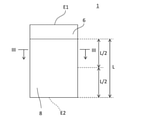
- FIG. 2 is a schematic front view of the solid electrolytic capacitor element when viewed from one main surface side.
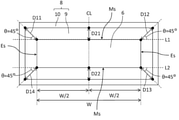
- FIG. 3 is a schematic cross-sectional view of the solid electrolytic capacitor element of FIG. 2 when the cross section taken along the line III-III is viewed in the direction of the arrow.
- FIG. 4 is a Raman spectrum of the solid electrolyte layer of the solid electrolytic capacitor A1.
- FIG. 5 is a Raman spectrum of the solid electrolyte layer of the solid electrolytic capacitor B1.
- a porous portion is formed at least on the surface layer of the anode body.
- the dielectric layer is formed along the inner wall surface of the pores and recesses (sometimes referred to as pits) on the surface of the anode body, including the inner wall surface of the pores of the porous portion. Therefore, fine irregularities are formed on the surface of the dielectric layer according to the shape of the surface of the anode body.
- the dispersion contains a conductive polymer component having a relatively high molecular weight (conjugated polymer such as polythiophene polymer, dopant, etc.). Therefore, when a dispersion is used, it is difficult to highly fill the fine recesses on the surface of the dielectric layer with the conductive polymer component. When the conductive polymer component cannot be highly filled in the fine recesses of the dielectric layer, the conductivity of the solid electrolyte layer becomes low. Further, since the orientation of the conjugated polymer is random in the dispersion, it is difficult to increase the orientation of the conjugated polymer in the formed solid electrolyte layer. For this reason as well, the conductivity of the solid electrolyte layer tends to be low. A decrease in the conductivity of the solid electrolyte layer leads to a decrease in the performance of the solid electrolytic capacitor, such as an increase in ESR, a decrease in capacitance, or an increase in tan ⁇ of the solid electrolytic capacitor.
- conjugated polymer such as
- polymer anion As the dopant, it is preferable to use a polymer anion as the dopant.
- polymer anions can easily ensure high conductivity of the solid electrolyte layer.
- Polymer anions are typically added to the dispersion and used to form the solid electrolyte layer.
- the polymer anion segregates on the surface of the solid electrolyte layer and its vicinity. Since the polymer anion itself is insulating, segregation of the polymer anion increases the resistance of the solid electrolyte layer.
- a cathode extraction layer is formed on the surface of the solid electrolyte layer so as to cover the surface.
- the presence of segregated polymer anions on the surface reduces the physical and electrical bondability between the solid electrolyte layer and the cathode extraction layer.
- the contact resistance between the solid electrolyte layer and the cathode extraction layer becomes high, the initial ESR increases, and the initial capacitor performance deteriorates.
- a first solid electrolyte layer is formed on the surface of the dielectric layer by chemical polymerization, and then an outer second solid electrolyte layer is formed using a dispersion.
- the outer second solid electrolyte layer formed by using the dispersion the polymer anion segregates on the surface layer and the orientation of the conjugated polymer is low, so that the conductivity is low.
- the types of raw material monomers and dopants are limited.
- a solid electrolytic capacitor when air enters the inside, the conjugated polymer is oxidatively deteriorated by the action of water or oxygen contained in the air, and the dopant contained in the solid electrolyte layer is dedoped by decomposition. As a result, the solid electrolyte layer may deteriorate and the conductivity of the solid electrolyte layer may decrease.
- a solid electrolyte layer is formed using a dispersion, as described above, segregation of the polymer anion weakens the physical bond between the solid electrolyte layer and the cathode extraction layer, so that air can penetrate more. It will be easier.
- Solid electrolytic capacitors may be used in high temperature environments depending on the application. Further, the solid electrolytic capacitor is generally solder-bonded to the substrate through a reflow process exposed to a high temperature. When the solid electrolytic capacitor is exposed to a high temperature or used for a long period of time, the deterioration of the solid electrolyte layer as described above becomes more remarkable, and the decrease in conductivity becomes remarkable, so that the deterioration of the capacitor performance tends to become apparent. ..
- the solid electrolyte layer comprises a first polymer component containing a monomer unit corresponding to a thiophene compound and a second polymer component containing a polymer anion.
- a peak peculiar to the first polymer component is observed.
- segregation of the polymer anion in the solid electrolyte layer is suppressed, and the polymer anion is more uniformly dispersed in the solid electrolyte layer.
- Such a solid electrolyte layer can be formed by electrolytically polymerizing the precursor of the first polymer component in the presence of the second polymer component.
- the first polymer component and the polymer anion can be dispersed in the solid electrolyte layer with high dispersibility.
- the fine recesses on the surface of the dielectric layer can be highly filled with the conductive polymer component, and the orientation of the conjugated polymer in the solid electrolyte layer is also high. Therefore, the increase in the resistance of the entire solid electrolyte layer is suppressed, and the high conductivity of the solid electrolyte layer can be ensured.
- the initial ESR of the solid electrolytic capacitor can be kept low.
- the initial high capacitance can be secured, and the initial tan ⁇ can be suppressed to a low level, so that the initial excellent capacitor performance can be ensured.
- a tough solid electrolyte layer having excellent film quality is formed due to the high orientation of the conjugated polymer even though it contains a polymer anion. Therefore, even when the solid electrolytic capacitor is exposed to a high temperature or used for a long period of time, it is possible to suppress the occurrence of cracks in the solid electrolyte layer.
- the recesses on the surface of the dielectric layer are highly filled with the conductive polymer component, and the solid electrolyte layer and the cathode extraction layer have high adhesion, so that the solid electrolytic capacitor can be used.
- the solid electrolytic capacitor element and the solid electrolytic capacitor of the present disclosure it is possible to reduce the variation in the thickness of the solid electrolyte layer even though the concave portions on the surface of the dielectric layer can be highly filled with the conductive polymer component. As a result, high conductivity of the solid electrolyte layer can be ensured, occurrence of a short circuit or an increase in leakage current can be suppressed, and stable capacitor performance can be ensured.
- the Raman spectrum of the surface layer of the solid electrolyte layer formed by using the dispersion the Raman spectrum of the surface layer of the solid electrolyte layer formed by using the dispersion, the peak peculiar to the first polymer component cannot be observed.
- the Raman spectrum on the surface layer of the solid electrolyte layer is measured with respect to the surface layer of the solid electrolyte layer under the following conditions.
- the surface layer of the solid electrolyte layer is defined as a portion from the surface of the solid electrolyte layer to a depth of 100 nm.
- Raman spectroscope NanoPhotoon RamanFORCE PAV Irradiation laser light wavelength: 532 nm Laser output density: 870 W / cm 2 Diffraction grating: 300 / cm Exposure time: 10s Wavenumber range: 0 cm -1 or more and 4700 cm -1 or less Temperature: 25 ° C
- a sample collected by the following procedure can be used.
- the solid electrolytic capacitor is embedded in the curable resin to cure the curable resin.
- a cross section parallel to the thickness direction of the solid electrolyte layer (for example, a cross section G described later) is exposed.
- sample A a sample for measurement
- the Raman spectrum may be measured for the surface layer of the cross section of the exposed solid electrolyte layer of the sample A.
- the solid electrolytic capacitor and the solid electrolytic capacitor element (hereinafter, may be simply referred to as a capacitor element) of the present disclosure will be described more specifically with reference to the drawings as necessary.
- Solid electrolytic capacitors include one or more capacitor elements. At least one of the capacitor elements included in the solid electrolytic capacitor shall include a solid electrolyte layer containing a first polymer component and a second polymer component, in which a peak peculiar to the first polymer component is observed in the Raman spectrum of the surface layer. Just do it. It is preferable that 50% or more (more preferably 75% or more) of the number of capacitor elements contained in the solid electrolytic capacitor is provided with the solid electrolyte layer as described above, and all the capacitor elements are solid as described above. It is more preferable to have an electrolyte layer.
- the anode body can include a valve acting metal, an alloy containing a valve acting metal, a compound containing a valve acting metal, and the like. These materials can be used alone or in combination of two or more.
- the valve acting metal for example, aluminum, tantalum, niobium, and titanium are preferably used.
- the anode body having a porous surface can be obtained by roughening the surface of a base material containing a valve acting metal (for example, a sheet-shaped (for example, foil-shaped, plate-shaped) base material) by etching or the like. .. The roughening can be performed by, for example, an etching process.
- the anode body may be a molded body of particles containing a valve acting metal or a sintered body thereof.
- Each of the molded body and the sintered body has a porous structure.
- Each of the molded body and the sintered body may have a sheet-like shape, a rectangular parallelepiped, a cube, or a shape similar thereto.
- the anode body usually has an anode extraction portion including a first end portion and a cathode forming portion including a second end portion.
- the cathode portion is usually formed in the cathode forming portion of the anode body via the dielectric layer.
- An anode terminal is connected to the anode lead-out portion.
- the dielectric layer is an insulating layer that functions as a dielectric formed so as to cover the surface of at least a part of the anode.
- the dielectric layer is formed by anodizing the valve acting metal on the surface of the anode body by chemical conversion treatment or the like.
- the dielectric layer may be formed so as to cover at least a part of the anode body.
- the dielectric layer is usually formed on the surface of the anode. Since the dielectric layer is formed on the porous surface of the anode body, the surface of the dielectric layer has a fine uneven shape as described above.
- the dielectric layer contains an oxide of the valve acting metal.
- the dielectric layer when tantalum is used as the valve acting metal contains Ta 2 O 5
- the dielectric layer when aluminum is used as the valve acting metal contains Al 2 O 3 .
- the dielectric layer is not limited to this, and may be any one that functions as a dielectric.
- the cathode portion includes a solid electrolyte layer that covers at least a part of the dielectric layer. Further, the cathode portion may further include a cathode extraction layer that covers at least a part of the solid electrolyte layer. The cathode portion is usually formed on the surface of at least a part of the anode body via a dielectric layer.
- the solid electrolyte layer and the cathode extraction layer will be described.
- the solid electrolyte layer is formed on the surface of the anode body so as to cover the dielectric layer via the dielectric layer.
- the solid electrolyte layer does not necessarily have to cover the entire dielectric layer (entire surface), and may be formed so as to cover at least a part of the dielectric layer.
- the solid electrolyte layer constitutes at least a part of the cathode portion of the solid electrolytic capacitor.
- the solid electrolyte layer contains a first polymer component containing a monomer unit corresponding to the thiophene compound and a second polymer component containing a polymer anion.
- the monomer unit corresponding to the thiophene compound may be hereinafter referred to as a first monomer unit.
- the first polymer component is a ⁇ -conjugated polymer, and the second polymer component acts as a dopant to function as a conductive polymer.
- Examples of the thiophene compound corresponding to the first monomer unit include compounds having a thiophene ring and capable of forming a repeating structure of the first monomer unit.
- the thiophene compound can be linked at the 2nd and 5th positions of the thiophene ring to form a repeating structure of the first monomer unit, whereby a polymer in which the ⁇ electron cloud spreads throughout the molecule can be formed.
- Thiophene compounds also include those having a substituent. Substituents may be present, for example, at at least one of the 3- and 4-positions of the thiophene ring.
- the substituent at the 3-position and the substituent at the 4-position may be linked to form a ring that condenses with the thiophene ring.
- the thiophene compound include thiophene which may have a substituent at at least one of the 3-position and 4-position, an alkylenedioxythiophene compound (C 2-4 alkylenedioxythiophene compound such as an ethylenedioxythiophene compound, and the like).
- the alkylenedioxythiophene compound also includes those having a substituent in the portion of the alkylene group.
- Substituents contained in the thiophene compound include an alkyl group (C 1-4 alkyl group such as methyl group and ethyl group), an alkoxy group (C 1-4 alkoxy group such as methoxy group and ethoxy group), a hydroxy group, and the like.
- a hydroxyalkyl group (such as a hydroxy C 1-4 alkyl group such as a hydroxymethyl group) is preferable, but the present invention is not limited thereto.
- the respective substituents may be the same or different.
- the first polymer component containing at least the first monomer unit corresponding to the 3,4-ethylenedioxythiophene compound when used, high heat resistance is easily obtained and higher conductivity of the solid electrolyte layer is ensured. It is preferable because it is easy to do.
- Thiophene compounds generally have a higher polymerization potential than pyrrole compounds and are difficult to polymerize.
- a thiophene compound in which an electron-donating group such as an alkylenedioxythiophene or an alkoxy group is substituted with a thiophene ring is used, the polymerization potential is lowered, so that the polymerization reaction of the thiophene compound is rapidly promoted even in the presence of a polymer anion. be able to. Therefore, despite the use of the polymer anion, the conductive polymer component containing the first polymer component and the second polymer component containing the polymer anion is more uniformly dispersed in the dielectric layer. It can be highly filled in the fine recesses on the surface.
- the first polymer component may contain one kind of first monomer unit, or may contain two or more kinds of first monomer units.
- the solid electrolyte layer may contain one kind of the first polymer component, or may contain two or more kinds of the first polymer component.
- the first polymer component may contain a second monomer unit other than the first monomer unit, if necessary. From the viewpoint of easily securing a higher capacitance, the molar ratio of the first monomer unit in the first polymer component is preferably 90 mol% or more. The molar ratio of the first monomer unit in the first polymer component is 100 mol% or less.
- the first polymer component may be composed only of a repeating structure of the first monomer unit.
- the weight average molecular weight (Mw) of the first polymer component is not particularly limited, but is, for example, 1,000 or more and 1,000,000 or less.
- Examples of the polymer anion contained in the second polymer component include polymers having a plurality of anionic groups. Examples of such a polymer include those containing a monomer unit having an anionic group.
- anionic group examples include a sulfonic acid group and a carboxy group.
- the anionic group may be contained in a free form, an anion form, or a salt form, and may be contained in a form bonded or interacted with the first polymer component. In the present specification, all of these forms are included and may be simply referred to as an "anionic group", a "sulfonic acid group", or a "carboxy group”.
- the second polymer component may contain one kind of polymer anion or may contain two or more kinds of polymer anions.
- the second polymer component shall contain only the polymer anion.
- polymer anion having a carboxy group examples include, but are not limited to, a copolymer using at least one of polyacrylic acid, polymethacrylic acid, acrylic acid and methacrylic acid.
- the second polymer component preferably contains at least a polymer anion having a sulfonic acid group.
- Examples of the polymer anion having a sulfonic acid group include those containing the monomer unit M 1 corresponding to the organic sulfonic acid compound.
- the organic sulfonic acid compound may be any of an aliphatic, alicyclic, aromatic and heterocyclic formula.
- the polymer anion may be a homopolymer containing only the monomer unit M 1 or a copolymer containing the monomer unit M 1 and other monomer units.
- polymer anion having a sulfonic acid group examples include polyvinyl sulfonic acid, polystyrene sulfonic acid, polyallyl sulfonic acid, polyacrylic sulfonic acid, polymethacrylic sulfonic acid, and poly (2-acrylamide-2-methylpropanesulfonic acid). ), Polyisoprene sulfonic acid, polyester sulfonic acid, phenol sulfonic acid novolak resin, but is not limited thereto.
- the polymer anion has an aromatic ring
- high heat resistance can be obtained, so that dedoping is suppressed even when the solid electrolytic capacitor is exposed to a high temperature, and the high conductivity of the solid electrolyte layer is maintained. Can be done.
- the polymer anion aggregates, it tends to emit strong fluorescence. Therefore, when the polymer anion segregates on the surface layer of the solid electrolyte layer, the peaks of the first polymer component and the second polymer component cannot be observed in the Raman spectrum on the surface layer of the solid electrolyte layer.
- the capacitor element of the present disclosure segregation of the polymer anion on the surface layer of the solid electrolyte layer is suppressed even when a polymer anion having an aromatic ring is used, and the first polymer component and the second polymer component in the solid electrolyte layer are more uniform. It is possible to secure a stable distributed state. Then, such an excellent dispersed state can be confirmed by the Raman spectrum.
- polymer anion having an aromatic ring examples include those having an aromatic ring among polymer anions containing the monomer unit M1 corresponding to the organic sulfonic acid compound.
- a polymer anion those containing at least a monomer unit (sometimes referred to as a monomer unit M 2 ) corresponding to an aromatic sulfonic acid compound as the monomer unit M 1 are preferable.
- polymer anions include polystyrene sulfonic acid (including copolymers and substituents having substituents), aromatic polyester sulfonic acid, and novolak phenol sulfonic acid among the above-mentioned polymer anions. However, it is not limited to these.
- the weight average molecular weight (Mw) of the polymer anion is, for example, 300 or more, preferably 500 or more, and more preferably 1000 or more.
- Mw weight average molecular weight
- the weight average molecular weight (Mw) of the polymer anion is, for example, 300 or more, preferably 500 or more, and more preferably 1000 or more.
- the Mw of the polymer anion is, for example, 250,000 or less, preferably 200,000 or less, and may be 160,000 or less.
- Mw is in such a range, the polymerization of the raw material monomer of the first polymer component is likely to proceed smoothly, and the dispersibility of the first polymer component and the second polymer component in the solid electrolyte layer can be further enhanced.
- These lower limit values and upper limit values can be arbitrarily combined.
- the weight average molecular weight (Mw) of the polymer anion is a polystyrene-equivalent value measured by gel permeation chromatography (GPC). GPC is usually measured using a polystyrene gel column and water / methanol (volume ratio 8/2) as a mobile phase.
- the polymer anion Mw can be obtained for a sample taken from a solid electrolytic capacitor element. More specifically, GPC measurement can be performed using a sample collected by the following procedure. First, the solid electrolyte layer is exposed by polishing or cross-section polishing the cured product obtained by the same procedure as in the case of the measurement sample for Raman spectrum measurement. The solid electrolyte layer is scraped off, and the polymer anion is extracted with hot water at 80 ° C. or higher and 100 ° C. or lower. By concentrating the extract, a sample for measurement (Sample B) is obtained.
- the amount of the second polymer component contained in the solid electrolyte layer is, for example, 10 to 1000 parts by mass and may be 50 to 200 parts by mass with respect to 100 parts by mass of the first polymer component.
- the waveform of the Raman spectrum of the first polymer component cannot be confirmed due to the fluorescence emission. Therefore, if the peak peculiar to the first polymer component is a peak derived from the first polymer component in the Raman spectrum, the wave number of the peak is not particularly limited. In the Raman spectrum of the first polymer component, the highest peak is usually observed in the wavenumber range of 1200 cm -1 or more and 1600 cm -1 or less (preferably less than 1550 cm -1 ). Therefore, it is preferable that the peak peculiar to the first polymer component includes a peak observed in such a wave number range (sometimes referred to as a first peak). The wave number range in which the first peak is observed may be 1300 cm -1 or more and 1600 cm -1 or less (preferably less than 1550 cm -1 ), or 1300 cm -1 or more and 1500 cm -1 or less.
- a peak (sometimes referred to as a second peak) may be observed even in a wavenumber range of 2750 cm -1 or more and 3000 cm -1 or less.
- the height of the second peak is smaller than that of the first peak, it can be clearly observed because it is not inhibited by the fluorescence emission of the segregated polymer anion. Therefore, it can be said that the second peak is also one of the peaks peculiar to the first polymer component.
- the wave number range in which the second peak is observed may be 2800 cm -1 or more and 3000 cm -1 or less, or 2800 cm -1 or more and 2900 cm -1 or less.
- the first peak is observed in the range of 1350 cm -1 or more and 1500 cm -1 or less, and the second peak is 2800 cm. Observed in the range of -1 or more and 2900 cm -1 or less.
- PEDOT poly (3,4-ethylenedioxythiophene)
- the Raman spectrum of the surface layer of the solid electrolyte layer peaks peculiar to the polymer anion can also be observed.
- the Raman spectrum shows a peak based on the polymer anion in the range of 800 cm -1 or more and 1050 cm -1 or less (third). It may be called a peak.) Can be observed.
- the ratio of the intensity I p1 of the first peak to the intensity I p3 of the third peak is, for example, 2 or more, and may be 3 or more or 4 or more, and 5 or more or 6 or more. May be.
- the upper limit of the I p1 / I p3 ratio is not particularly limited, but is, for example, 50 or less.
- the Raman spectrum of the solid electrolyte layer shows a range of more than 1050 cm -1 and less than 1200 cm -1 and 1550 cm -1 . Peaks based on the polymer anion (sometimes referred to as the 4th peak and the 5th peak, respectively) can be observed in a range of more than 1750 cm -1 .
- the average thickness of the solid electrolyte layer is, for example, 5 ⁇ m or more and 20 ⁇ m or less, and may be 10 ⁇ m or more and 15 ⁇ m or less.
- the average thickness of the solid electrolyte layer is an arbitrary plurality of locations (for example, 10 locations) in a cross section perpendicular to the length direction of the capacitor element, which passes through the center of the cathode portion in a direction parallel to the length direction of the capacitor element. It is obtained by measuring the thickness with and averaging it.
- the variation in the thickness of the solid electrolyte layer can be reduced. Therefore, high conductivity of the solid electrolyte layer can be ensured, leakage current and short circuit can be reduced, and stable capacitor performance can be ensured.
- T1 / T2 The ratio of the thickness T1 of the solid electrolyte layer formed at the corners of the anode to the thickness T2 of the solid electrolyte layer formed at the center of the main surface of the anode: T1 / T2 is, for example, 0.8 or more. It may be 0.7 or less, 0.8 or more and 1.5 or less, or 0.9 or more and 1.4 or less.
- T1 / T2 is in such a range, the thickness of the solid electrolyte layer at the corners is suppressed to be small, so that the occurrence of product defects due to short circuit can be suppressed.
- the decrease in capacitance, the increase in ESR, or the increase in dielectric loss tan ⁇ is suppressed, and the quality of the solid electrolytic capacitor is further stabilized.
- the dispersion When the solid electrolyte layer is formed using the dispersion, the dispersion is easily repelled at the corners of the anode, and in the solid electrolyte layer formed using the dispersion, the thickness of the solid electrolyte layer at the corners. Is difficult to increase. Therefore, the T1 / T2 ratio as described above is usually not obtained in the solid electrolyte layer formed by using the dispersion containing the first polymer component and the second polymer component. Further, when the solid electrolyte layer is formed by chemical polymerization, the agglomerates of the first polymer component generated in the treatment liquid are randomly adhered to the surface of the anode, so that the thickness of the solid electrolyte layer varies widely. ..
- the first polymer component is formed on the entire surface of the anode by the electrolytic reaction, so that the variation in the thickness of the solid electrolyte layer can be reduced. This is because the current tends to concentrate at the corners in the electrolytic reaction.
- the polymerization voltage in electrolytic polymerization when forming the solid electrolyte layer is controlled within the range described below, the ratio T1 / T2 can be easily controlled within the above range.
- the thicknesses T1 and T2 are obtained in a cross section perpendicular to the direction from the first end side to the second end side of the capacitor element at an arbitrary position of the portion on the first end side of the cathode portion.
- this cross section may be simply referred to as a cross section G.
- the thickness T1 is obtained by measuring and averaging the thicknesses of the solid electrolyte layers formed at the four corners of the anode in the cross section G. First, in the cross section G, a straight line passing through the corner portion of the anode body is drawn at an angle of 45 ° with respect to the line segment corresponding to the main surface of the anode body extended outward.
- the distance between the point where this straight line intersects with the outer edge of the solid electrolyte layer and the point where it intersects with the corresponding corner portion is defined as the thickness of the solid electrolyte layer formed at each corner portion.
- the thickness T2 is obtained by measuring and averaging the thicknesses of the solid electrolyte layers formed in the central portions of the pair of main surfaces of the anode in the cross section G.
- a center line passing through each of the midpoints of the line segment corresponding to the main surface of the anode body is drawn.
- the distance between the intersection of the center line and the outer edge of the solid electrolyte layer and the corresponding midpoint is defined as the thickness of the solid electrolyte layer formed in the central portion of each main surface.
- the thickness T2 may be an average value of a pair of main surfaces (the main surface) occupying most of the surface of the anode as described above.
- the thickness T2 may be obtained by averaging the thickness of the central portion obtained for each surface.
- the direction from the first end side to the second end side is a direction parallel to the linear direction connecting the center of the end face of the first end and the center of the end face of the second end.
- This direction may be referred to as the length direction of the anode or the capacitor element.
- the cross section G includes a position of half the length of the cathode portion in a direction parallel to the length direction of the condenser element and an end portion on the first end side of the cathode portion in the portion where the cathode portion of the condenser element is formed. It is a cross section perpendicular to the length direction of the capacitor element at an arbitrary position between. The cross section of the capacitor element can be observed with an optical microscope, for example.
- the solid electrolyte layer may be a single layer or may be composed of a plurality of layers.
- the solid electrolyte layer is configured to include a first solid electrolyte layer that covers at least a part of the dielectric layer and a second solid electrolyte layer that covers at least a part of the first solid electrolyte layer. May be good.
- the solid electrolyte layer is composed of a plurality of layers, it is preferable that all the layers contain a first polymer component and a second polymer component.
- the types, compositions, contents, etc. of the first polymer component and the second polymer component contained in each layer may be different or the same in each layer.
- the layer covering at least the dielectric layer contains the first polymer component and the second polymer component
- the dielectric is contained even though the second polymer component is contained.
- the fine recesses on the surface of the body layer can be highly filled with the conductive polymer component.
- the outer layer contains the first polymer component and the second polymer component, such as the second solid electrolyte layer
- the Raman spectrum as described above can be obtained, so that segregation of the first polymer component in the surface layer can be suppressed.
- the effect of reducing the variation in the thickness of the solid electrolyte layer can be enhanced. Therefore, stable capacitor performance can be obtained, and leakage current and short circuit can be reduced.
- the solid electrolyte layer is selected from the group consisting of other dopants, additives (known additives, etc.), and known conductive materials other than the first polymer component, in addition to the first polymer component and the second polymer component, at least. It may contain one kind.
- Examples of other dopants include anions other than polymer anions.
- Examples of the anion include sulfate ion, nitrate ion, phosphate ion, borate ion, organic sulfonic acid ion, carboxylic acid ion and the like, but are not particularly limited.
- Examples of dopants that generate sulfonic acid ions include paratoluenesulfonic acid and naphthalenesulfonic acid.
- Examples of the above-mentioned conductive material include at least one selected from the group consisting of a conductive inorganic material such as manganese dioxide and a TCNQ complex salt.
- a layer or the like for enhancing adhesion may be interposed between the dielectric layer and the solid electrolyte layer.
- the solid electrolyte layer can be formed by electrolytically polymerizing the precursor of the first polymer component in the presence of the second polymer component on the surface of the dielectric layer.
- electrolytic polymerization is carried out in a state where the cathode forming portion of the anode having the dielectric layer formed on the surface is immersed in the liquid mixture containing the precursor of the first polymer component and the second polymer component.
- the first polymer component and the second polymer component can be dispersed in the solid electrolyte with high dispersibility. Since the precursor of the first polymer component is a relatively small molecule, it is easy for the liquid component to adhere not only to the central part of the anode but also to the corners, and the polymerization can proceed even at the corners, so that the thickness Variation can be reduced.
- Examples of the precursor of the first polymer component include a raw material monomer of the first polymer component, an oligomer in which a plurality of molecular chains of the raw material monomer are connected, and a prepolymer.
- One type of precursor may be used, or two or more types may be used in combination.
- the precursor is selected from the group consisting of monomers and oligomers from the viewpoint of easily adhering to the corners of the anode, allowing the polymerization to proceed smoothly even at the corners, and increasing the thickness of the solid electrolyte layer at the corners. It is preferable to use at least one kind (particularly, a monomer).
- the liquid mixture usually contains a solvent.
- the solvent include water, an organic solvent, and a mixed solvent of water and an organic solvent (such as a water-soluble organic solvent).
- the temperature at which electrolytic polymerization is performed is, for example, 5 ° C. or higher and 60 ° C. or lower, and may be 15 ° C. or higher and 35 ° C. or lower.
- the liquid component may contain an oxidizing agent, if necessary. Further, the oxidizing agent may be applied to the anode body before or after the liquid mixture is brought into contact with the anode body on which the dielectric layer is formed.
- an oxidizing agent include sulfates, sulfonic acids, and salts thereof. Oxidizing agents may be used alone or in combination of two or more. Examples of the sulfate include a salt of sulfuric acid such as ferric sulfate and sodium persulfate, and a salt of sulfuric acid such as persulfuric acid and a metal.
- the metal constituting the salt examples include alkali metals (sodium, potassium, etc.), iron, copper, chromium, zinc, and the like.
- Sulfonic acid or a salt thereof has a function as a dopant in addition to a function as an oxidizing agent.
- As the sulfonic acid or a salt thereof low-molecular-weight sulfonic acid or a salt thereof exemplified for other dopants may be used.
- the voltage applied to the anode is, for example, 0.8 V or more and 2.0 V or less, and may be 1.0 V or more and 1.5 V or less.
- the polymerization voltage is a polymerization potential with respect to the silver reference electrode (silver / silver chloride electrode (Ag / Ag + )).
- the cathode extraction layer may include at least a first layer that comes into contact with the solid electrolyte layer and covers at least a part of the solid electrolyte layer, and may include a first layer and a second layer that covers the first layer. good.
- the first layer include a layer containing conductive particles, a metal foil, and the like.
- the conductive particles include at least one selected from conductive carbon and metal powder.
- the cathode drawer layer may be formed by a layer containing conductive carbon as the first layer (also referred to as a carbon layer) and a layer containing metal powder or a metal foil as the second layer. When a metal foil is used as the first layer, the cathode drawer layer may be formed of this metal foil.
- Examples of the conductive carbon include graphite (artificial graphite, natural graphite, etc.).
- the layer containing the metal powder as the second layer can be formed, for example, by laminating a composition containing the metal powder on the surface of the first layer.
- a second layer include a metal paste layer formed by using a composition containing a metal powder such as silver particles and a resin (binder resin).
- a resin binder resin
- a thermoplastic resin can be used, but it is preferable to use a thermosetting resin such as an imide resin or an epoxy resin.
- the type of metal is not particularly limited, but it is preferable to use a valve acting metal such as aluminum, tantalum, niobium, or an alloy containing a valve acting metal. If necessary, the surface of the metal foil may be roughened.
- the surface of the metal foil may be provided with a chemical conversion film, or may be provided with a metal (dissimilar metal) or non-metal film different from the metal constituting the metal foil. Examples of the dissimilar metal and the non-metal include a metal such as titanium and a non-metal such as carbon (conductive carbon and the like).
- the coating film of the above-mentioned dissimilar metal or non-metal may be used as the first layer, and the above-mentioned metal foil may be used as the second layer.
- a separator When the metal foil is used for the cathode drawer layer, a separator may be arranged between the metal foil and the anode foil.
- the separator is not particularly limited, and for example, a non-woven fabric containing fibers of cellulose, polyethylene terephthalate, vinylon, polyamide (for example, aromatic polyamide such as aliphatic polyamide and aramid) may be used.
- the solid electrolytic capacitor may be a wound type and may be a chip type or a laminated type.
- a solid electrolytic capacitor may include a laminate of two or more capacitor elements. The configuration of the capacitor element may be selected according to the type of the solid electrolytic capacitor.
- one end of the cathode terminal is electrically connected to the cathode extraction layer.
- the cathode terminal is, for example, coated with a conductive adhesive on the cathode drawer layer and bonded to the cathode drawer layer via the conductive adhesive.
- One end of the anode terminal is electrically connected to the anode body.
- the other end of the anode terminal and the other end of the cathode terminal are drawn out from the resin exterior or the case, respectively.
- the other end of each terminal exposed from the resin exterior or the case is used for solder connection with a substrate on which a solid electrolytic capacitor should be mounted.
- the capacitor element is sealed using a resin exterior or a case.
- the material resin of the capacitor element and the exterior body for example, uncured thermosetting resin and filler
- the capacitor element is sealed with the resin exterior body by a transfer molding method, a compression molding method, or the like. You may.
- the portions on the other end side of the anode terminal and the cathode terminal connected to the anode lead drawn out from the capacitor element are exposed from the mold, respectively.
- the capacitor element is housed in the bottomed case so that the other end side of the anode terminal and the cathode terminal is located on the opening side of the bottomed case, and the opening of the bottomed case is sealed with a sealant. May form a solid electrolytic capacitor.
- FIG. 1 is a cross-sectional view schematically showing the structure of a solid electrolytic capacitor according to an embodiment of the present disclosure.
- the solid electrolytic capacitor 1 includes a capacitor element 2, a resin exterior body 3 that seals the capacitor element 2, an anode terminal 4 in which at least a part thereof is exposed to the outside of the resin exterior body 3, and the like. It is provided with a cathode terminal 5.
- the anode terminal 4 and the cathode terminal 5 can be made of a metal such as copper or a copper alloy.
- the resin exterior body 3 has a substantially rectangular parallelepiped outer shape, and the solid electrolytic capacitor 1 also has a substantially rectangular parallelepiped outer shape.
- the capacitor element 2 includes an anode body 6, a dielectric layer 7 covering the anode body 6, and a cathode portion 8 covering the dielectric layer 7.
- the cathode portion 8 includes a solid electrolyte layer 9 that covers the dielectric layer 7, and a cathode extraction layer 10 that covers the solid electrolyte layer 9.
- the solid electrolyte layer 9 contains the first polymer component and the second polymer component, and shows a peak peculiar to the first polymer component in the Raman spectrum of the surface layer.
- the initial ESR can be suppressed to a low level.
- the anode body 6 includes a region facing the cathode portion 8 and a region not facing the cathode portion 8.
- an insulating separation layer 13 is formed so as to cover the surface of the anode body 6 in a band shape, and the cathode portion 8 and the anode portion 8 and the anode. Contact with body 6 is restricted.
- the other part of the region of the anode body 6 that does not face the cathode portion 8 is electrically connected to the anode terminal 4 by welding.
- the cathode terminal 5 is electrically connected to the cathode portion 8 via an adhesive layer 14 formed of a conductive adhesive.
- FIG. 2 is a schematic front view of the capacitor element 2 when viewed from one main surface side.
- FIG. 3 is a schematic cross-sectional view of the capacitor element 2 of FIG. 2 in the line III-III when the cross section (cross section G) is viewed in the direction of the arrow.
- the thicknesses T1 and T2 of the solid electrolyte layer 9 are obtained, for example, by the following procedure.
- the ratio T1 / T2 is a cross section of the cathode portion 8 perpendicular to the direction from the first end portion E1 of the capacitor element 2 to the second end portion E2 (sometimes referred to as the length direction of the anode body 6 or the capacitor element 2).
- the cross section G is formed at an arbitrary position on the portion of the cathode portion 8 on the first end portion E1 side.
- the portion of the cathode portion 8 on the first end E1 side is the length from the end of the cathode portion 8 on the first end E1 side, where L is the length of the cathode portion 8 in the length direction of the capacitor element 2. It is a part up to the position of L / 2.
- the portion of the cathode portion 8 on the first end portion E1 side corresponds to the portion of the upper half of the cathode portion 8.
- FIG. 3 shows a cross section G of the capacitor element 2 on the line III-III of the portion on the first end E1 side of the cathode portion 8 perpendicular to the length direction of the capacitor element 2.
- Lines III-III correspond to arbitrarily selected positions in the portion of the cathode portion 8 on the first end E1 side. Note that in FIG. 3, hatching indicating that the cross section is used is omitted.
- the distances D11, D12, D13 and D14 between the point where this straight line intersects the outer edge of the solid electrolyte layer 9 and the point where it intersects the corresponding corner portion are defined as the thickness of the solid electrolyte layer 9 at each corner portion. Then, T1 is obtained by averaging the values of these four distances.
- the center line CL is drawn from each end surface Es at the position of W / 2.
- the center line CL passes through the midpoint of the line segment corresponding to each main surface Ms of the anode body 6.
- the distances D21 and D22 between the intersection of the center line CL and the outer edge of the solid electrolyte layer 9 and the midpoint of the line segment are defined as the thickness of the solid electrolyte layer 9 at the center of the main surface Ms, respectively.
- T2 is obtained by averaging the values of these two distances.
- Solid Electrolytic Capacitor A1 The solid electrolytic capacitor 1 (solid electrolytic capacitor A1) shown in FIG. 1 was manufactured in the following manner, and its characteristics were evaluated.
- the anode body 6 was prepared by roughening the surfaces of both aluminum foils (thickness: 100 ⁇ m) as a base material by etching.
- a mixed solution is prepared by dissolving 3,4-ethylenedioxythiophene monomer and polystyrene sulfonic acid (PSS, Mw: 160 ⁇ 10 3 ), which is a polymer anion, in ion-exchanged water. did.
- a polymer solution was prepared by adding iron (III) sulfate (oxidizing agent) dissolved in ion-exchanged water while stirring the mixed solution.
- the anode body 6 on which the dielectric layer 7 was formed in the above (2) and the counter electrode are immersed in the obtained polymerization solution at 25 ° C. and a polymerization voltage of 1.0 V (polymerization potential with respect to the silver reference electrode).
- the solid electrolyte layer 9 was formed by performing electrolytic polymerization.
- a silver paste containing silver particles and a binder resin (epoxy resin) is applied to the surface of the carbon layer 11 and heated at 150 to 200 ° C. for 10 to 60 minutes to cure the binder resin, and the metal paste layer 12 Formed.
- the cathode extraction layer 10 composed of the carbon layer 11 and the metal paste layer 12 was formed, and the cathode portion 8 composed of the solid electrolyte layer 9 and the cathode extraction layer 10 was formed.
- the capacitor element 2 was manufactured as described above.
- a resin exterior body 3 made of an insulating resin was formed around the capacitor element 2 by molding. At this time, the other end of the anode terminal 4 and the other end of the cathode terminal 5 are in a state of being pulled out from the resin exterior body 3.
- an acceleration test was performed on the solid electrolytic capacitor by applying a rated voltage to the solid electrolytic capacitor for 1000 hours in an environment of 145 ° C. Then, in the same procedure as for the initial capacitance, tan ⁇ and ESR, the capacitance after the acceleration test, tan ⁇ and ESR are measured in a 20 ° C environment, and the average value of 20 solid electrolytic capacitors is calculated. I asked.
- the Raman spectrum of the solid electrolyte layer of the solid electrolytic capacitor A1 is shown in FIG.
- the wave numbers 1423 cm -1 and 2800 cm -1 are the peaks characteristic of PEDOT of the first polymer component (first peak and first peak, respectively). 2 peaks) were observed.
- a peak (third peak) based on PSS of the second polymer component was observed at a wave number of 990 cm -1 .
- Solid Electrolytic Capacitor B1 A liquid dispersion containing poly 3,4-ethylenedioxythiophene (PEDOT) and PSS as a dopant was prepared by the following procedure.
- a 3,4-ethylenedioxythiophene monomer is added to an aqueous solution of PSS (Mw: 150 ⁇ 10 3 ), and then an oxidizing agent (iron (III) sulfate and sodium persulfate) is added. Then, chemical oxidative polymerization was performed. The obtained polymerization solution was filtered through an ion exchange device to remove impurities to obtain a solution containing PEDOT and PSS. Pure water was added to the obtained solution, homogenized with a high-pressure homogenizer, and further filtered with a filter to prepare a liquid dispersion.
- PSS aqueous solution of PSS
- an oxidizing agent iron (III) sulfate and sodium persulfate
- the anode body 6 on which the dielectric layer 7 obtained in (2) of the solid electrolytic capacitor A1 was formed was immersed in a liquid dispersion, taken out, and further dried at 120 ° C. for 10 to 30 minutes. By repeating the immersion in the first treatment liquid and the drying four times each, a solid electrolyte layer 9 containing PEDOT and PSS was formed so as to cover the surface of the dielectric layer 7.
- a solid electrolytic capacitor B1 was produced and evaluated in the same manner as in the case of the solid electrolytic capacitor A1 except that the anode body 6 provided with the solid electrolyte layer 9 thus formed was used.
- Tables 1 and 2 show the evaluation results after the initial and accelerated tests, respectively.
- the evaluation result of the solid electrolytic capacitor A1 is a relative value when the measured value of the solid electrolytic capacitor B1 after the acceleration test is 100%.
- FIG. 5 the Raman spectrum measured by the above-mentioned procedure for the surface layer of the solid electrolyte layer of the solid electrolytic capacitor B1 is shown in FIG.
- FIG. 5 no characteristic peak was observed in the Raman spectrum of the surface layer of the solid electrolyte layer of the solid electrolytic capacitor B1.
- the Raman spectrum of the surface layer of the solid electrolyte layer of the solid electrolytic capacitor A1 the first peak and the second peak peculiar to PEDOT are observed, respectively, and the third to fifth peaks peculiar to PSS are also observed. (Fig. 4). Since no peak is observed in FIG. 5, it is considered that the observation of Raman scattered light is hindered by the fluorescence emission. On the other hand, in FIG.
- the initial ESR, tan ⁇ , and leakage current of A1 are suppressed to be lower than those of B1 in correspondence with the difference in Raman spectra of FIGS. 4 and 5, and the capacitance is electrostatic. The capacity is also high.
- the increase in ESR, tan ⁇ , and leakage current after the accelerated test is suppressed as compared with B1, and the decrease in capacitance is also suppressed.
- the solid electrolytic capacitor B1 is formed on the surface layer of the solid electrolyte layer. A Raman spectrum similar to the case of is obtained.
- the initial ESR of the solid electrolytic capacitor can be suppressed to a low level. Further, even if the solid electrolytic capacitor is used for a long period of time or the solid electrolytic capacitor is exposed to a high temperature, the increase in ESR can be suppressed to a low level. Therefore, the solid electrolytic capacitor element and the solid electrolytic capacitor can be used in various applications where high reliability is required.
- Solid electrolytic capacitor 2 Condenser element 3: Resin exterior body 4: Anode terminal 5: Cathode terminal, 6: Anode body, 7: Dielectric layer, 8: Cathode part, 9: Solid electrolyte layer, 10 : Cathode lead-out layer, 11: Carbon layer, 12: Metal paste layer, 13: Separation layer, 14: Adhesive layer, E1: First end of anode, E2: Second end of anode, Ms: Anode Main surface, Es: End face of anode, L1, L2: Straight line extending the line corresponding to the pair of main faces of the anode, CL: Center line of each main surface of the anode
Landscapes
- Engineering & Computer Science (AREA)
- Power Engineering (AREA)
- Chemical & Material Sciences (AREA)
- Chemical Kinetics & Catalysis (AREA)
- Electrochemistry (AREA)
- Microelectronics & Electronic Packaging (AREA)
- Manufacturing & Machinery (AREA)
- Polyoxymethylene Polymers And Polymers With Carbon-To-Carbon Bonds (AREA)
- Conductive Materials (AREA)
Priority Applications (3)
| Application Number | Priority Date | Filing Date | Title |
|---|---|---|---|
| CN202180060153.3A CN116134566B (zh) | 2020-07-31 | 2021-07-15 | 固体电解电容器元件及固体电解电容器 |
| US18/004,612 US12354811B2 (en) | 2020-07-31 | 2021-07-15 | Solid electrolytic capacitor element and solid electrolytic capacitor |
| JP2022540162A JP7742564B2 (ja) | 2020-07-31 | 2021-07-15 | 固体電解コンデンサ素子および固体電解コンデンサ |
Applications Claiming Priority (2)
| Application Number | Priority Date | Filing Date | Title |
|---|---|---|---|
| JP2020130168 | 2020-07-31 | ||
| JP2020-130168 | 2020-07-31 |
Publications (1)
| Publication Number | Publication Date |
|---|---|
| WO2022024771A1 true WO2022024771A1 (ja) | 2022-02-03 |
Family
ID=80036373
Family Applications (1)
| Application Number | Title | Priority Date | Filing Date |
|---|---|---|---|
| PCT/JP2021/026539 Ceased WO2022024771A1 (ja) | 2020-07-31 | 2021-07-15 | 固体電解コンデンサ素子および固体電解コンデンサ |
Country Status (4)
| Country | Link |
|---|---|
| US (1) | US12354811B2 (https=) |
| JP (1) | JP7742564B2 (https=) |
| CN (1) | CN116134566B (https=) |
| WO (1) | WO2022024771A1 (https=) |
Cited By (1)
| Publication number | Priority date | Publication date | Assignee | Title |
|---|---|---|---|---|
| WO2024111506A1 (ja) * | 2022-11-25 | 2024-05-30 | パナソニックIpマネジメント株式会社 | 固体電解コンデンサ |
Families Citing this family (2)
| Publication number | Priority date | Publication date | Assignee | Title |
|---|---|---|---|---|
| US12354812B2 (en) * | 2021-01-22 | 2025-07-08 | Panasonic Intellectual Property Management Co., Ltd. | Solid electrolytic capacitor element and solid electrolytic capacitor |
| CN115621048A (zh) * | 2021-07-14 | 2023-01-17 | 株式会社东金 | 固体电解电容器及制造固体电解电容器的方法 |
Citations (6)
| Publication number | Priority date | Publication date | Assignee | Title |
|---|---|---|---|---|
| JPH0266921A (ja) * | 1988-09-01 | 1990-03-07 | Matsushita Electric Ind Co Ltd | 固体電解コンデンサの製造方法 |
| US20130242465A1 (en) * | 2012-03-16 | 2013-09-19 | Avx Corporation | Wet Capacitor Cathode Containing a Conductive Coating Formed Anodic Electrochemical Polymerization of a Colloidal Suspension |
| CN103578773A (zh) * | 2013-11-07 | 2014-02-12 | 深圳新宙邦科技股份有限公司 | 一种电容器阴极箔和电容器及其制备方法 |
| WO2014038440A1 (ja) * | 2012-09-05 | 2014-03-13 | 日本ケミコン株式会社 | 重合液、この重合液から得られた導電性ポリマーフィルム及び固体電解コンデンサ |
| JP2016171111A (ja) * | 2015-03-11 | 2016-09-23 | Necトーキン株式会社 | 固体電解コンデンサ及びその製造方法 |
| JP2018117123A (ja) * | 2017-01-13 | 2018-07-26 | 日本ケミコン株式会社 | 電解コンデンサ用重合液、この重合液を用いた電解コンデンサ用陰極及び電解コンデンサの製造方法 |
Family Cites Families (6)
| Publication number | Priority date | Publication date | Assignee | Title |
|---|---|---|---|---|
| JP4762587B2 (ja) * | 2005-03-30 | 2011-08-31 | 信越ポリマー株式会社 | 固体電解コンデンサの製造方法 |
| JP4762004B2 (ja) * | 2006-02-28 | 2011-08-31 | 三洋電機株式会社 | 固体電解コンデンサの製造方法 |
| JP4854009B2 (ja) | 2006-04-28 | 2012-01-11 | Necトーキン株式会社 | 固体電解コンデンサ |
| US9373448B2 (en) | 2011-03-25 | 2016-06-21 | Panasonic Intellectual Property Management Co., Ltd. | Method of manufacturing electrolytic capacitor |
| CN104254568B (zh) | 2013-03-29 | 2015-11-18 | 松下知识产权经营株式会社 | 导电性高分子微粒分散体的制造方法及使用了该导电性高分子微粒分散体的电解电容器的制造方法 |
| JP7257636B2 (ja) * | 2018-10-12 | 2023-04-14 | パナソニックIpマネジメント株式会社 | 固体電解コンデンサおよびその製造方法 |
-
2021
- 2021-07-15 CN CN202180060153.3A patent/CN116134566B/zh active Active
- 2021-07-15 US US18/004,612 patent/US12354811B2/en active Active
- 2021-07-15 WO PCT/JP2021/026539 patent/WO2022024771A1/ja not_active Ceased
- 2021-07-15 JP JP2022540162A patent/JP7742564B2/ja active Active
Patent Citations (6)
| Publication number | Priority date | Publication date | Assignee | Title |
|---|---|---|---|---|
| JPH0266921A (ja) * | 1988-09-01 | 1990-03-07 | Matsushita Electric Ind Co Ltd | 固体電解コンデンサの製造方法 |
| US20130242465A1 (en) * | 2012-03-16 | 2013-09-19 | Avx Corporation | Wet Capacitor Cathode Containing a Conductive Coating Formed Anodic Electrochemical Polymerization of a Colloidal Suspension |
| WO2014038440A1 (ja) * | 2012-09-05 | 2014-03-13 | 日本ケミコン株式会社 | 重合液、この重合液から得られた導電性ポリマーフィルム及び固体電解コンデンサ |
| CN103578773A (zh) * | 2013-11-07 | 2014-02-12 | 深圳新宙邦科技股份有限公司 | 一种电容器阴极箔和电容器及其制备方法 |
| JP2016171111A (ja) * | 2015-03-11 | 2016-09-23 | Necトーキン株式会社 | 固体電解コンデンサ及びその製造方法 |
| JP2018117123A (ja) * | 2017-01-13 | 2018-07-26 | 日本ケミコン株式会社 | 電解コンデンサ用重合液、この重合液を用いた電解コンデンサ用陰極及び電解コンデンサの製造方法 |
Non-Patent Citations (1)
| Title |
|---|
| TAMBURRI, E. ; ORLANDUCCI, S. ; TOSCHI, F. ; TERRANOVA, M.L. ; PASSERI, D.: "Growth mechanisms, morphology, and electroactivity of PEDOT layers produced by electrochemical routes in aqueous medium", SYNTHETIC METALS, vol. 159, no. 5-6, 1 March 2009 (2009-03-01), CH , pages 406 - 414, XP026067623, ISSN: 0379-6779, DOI: 10.1016/j.synthmet.2008.10.014 * |
Cited By (2)
| Publication number | Priority date | Publication date | Assignee | Title |
|---|---|---|---|---|
| WO2024111506A1 (ja) * | 2022-11-25 | 2024-05-30 | パナソニックIpマネジメント株式会社 | 固体電解コンデンサ |
| JPWO2024111506A1 (https=) * | 2022-11-25 | 2024-05-30 |
Also Published As
| Publication number | Publication date |
|---|---|
| JP7742564B2 (ja) | 2025-09-22 |
| US20230245836A1 (en) | 2023-08-03 |
| JPWO2022024771A1 (https=) | 2022-02-03 |
| CN116134566B (zh) | 2026-03-06 |
| CN116134566A (zh) | 2023-05-16 |
| US12354811B2 (en) | 2025-07-08 |
Similar Documents
| Publication | Publication Date | Title |
|---|---|---|
| JP7672061B2 (ja) | 電解コンデンサおよび電解コンデンサの製造方法 | |
| JP7607224B2 (ja) | 電解コンデンサ | |
| US12131872B2 (en) | Electrolytic capacitor and method for producing same | |
| JP6803519B2 (ja) | 電解コンデンサの製造方法 | |
| US12354811B2 (en) | Solid electrolytic capacitor element and solid electrolytic capacitor | |
| JP7752360B2 (ja) | 固体電解コンデンサ素子および固体電解コンデンサ | |
| JP7734327B2 (ja) | 固体電解コンデンサ素子および固体電解コンデンサ | |
| JP6970873B2 (ja) | 電解コンデンサおよびその製造方法 | |
| JP7108811B2 (ja) | 電解コンデンサおよびその製造方法 | |
| JP6767630B2 (ja) | 電解コンデンサ | |
| JP7796330B2 (ja) | 固体電解コンデンサ素子およびその製造方法、ならびに固体電解コンデンサおよびその製造方法 | |
| WO2024203051A1 (ja) | 固体電解コンデンサ素子および固体電解コンデンサ | |
| WO2023189924A1 (ja) | 固体電解コンデンサ素子および固体電解コンデンサ、ならびに固体電解コンデンサ素子の製造方法 | |
| WO2021193330A1 (ja) | 電解コンデンサおよびコンデンサ素子 | |
| JP6760272B2 (ja) | 電解コンデンサ | |
| US20250259799A1 (en) | Solid electrolytic capacitor | |
| JP7706082B2 (ja) | 固体電解コンデンサ | |
| US20250104928A1 (en) | Electrolytic capacitor and method of manufacturing same | |
| JP7738246B2 (ja) | 固体電解コンデンサ素子および固体電解コンデンサ | |
| WO2025177956A1 (ja) | 固体電解コンデンサ素子および固体電解コンデンサ | |
| WO2024203133A1 (ja) | 固体電解コンデンサ素子およびその製造方法、ならびに固体電解コンデンサ | |
| WO2026034395A1 (ja) | 有機導電体および電解コンデンサ | |
| WO2016157768A1 (ja) | 電解コンデンサおよび導電性高分子分散体 |
Legal Events
| Date | Code | Title | Description |
|---|---|---|---|
| 121 | Ep: the epo has been informed by wipo that ep was designated in this application |
Ref document number: 21848879 Country of ref document: EP Kind code of ref document: A1 |
|
| ENP | Entry into the national phase |
Ref document number: 2022540162 Country of ref document: JP Kind code of ref document: A |
|
| NENP | Non-entry into the national phase |
Ref country code: DE |
|
| 122 | Ep: pct application non-entry in european phase |
Ref document number: 21848879 Country of ref document: EP Kind code of ref document: A1 |
|
| WWG | Wipo information: grant in national office |
Ref document number: 18004612 Country of ref document: US |