WO2022014287A1 - 半導体基板用洗浄液 - Google Patents
半導体基板用洗浄液 Download PDFInfo
- Publication number
- WO2022014287A1 WO2022014287A1 PCT/JP2021/023811 JP2021023811W WO2022014287A1 WO 2022014287 A1 WO2022014287 A1 WO 2022014287A1 JP 2021023811 W JP2021023811 W JP 2021023811W WO 2022014287 A1 WO2022014287 A1 WO 2022014287A1
- Authority
- WO
- WIPO (PCT)
- Prior art keywords
- group
- semiconductor substrate
- cleaning liquid
- acid
- content
- Prior art date
- Legal status (The legal status is an assumption and is not a legal conclusion. Google has not performed a legal analysis and makes no representation as to the accuracy of the status listed.)
- Ceased
Links
Classifications
-
- C—CHEMISTRY; METALLURGY
- C11—ANIMAL OR VEGETABLE OILS, FATS, FATTY SUBSTANCES OR WAXES; FATTY ACIDS THEREFROM; DETERGENTS; CANDLES
- C11D—DETERGENT COMPOSITIONS; USE OF SINGLE SUBSTANCES AS DETERGENTS; SOAP OR SOAP-MAKING; RESIN SOAPS; RECOVERY OF GLYCEROL
- C11D1/00—Detergent compositions based essentially on surface-active compounds; Use of these compounds as a detergent
- C11D1/38—Cationic compounds
- C11D1/62—Quaternary ammonium compounds
-
- C—CHEMISTRY; METALLURGY
- C11—ANIMAL OR VEGETABLE OILS, FATS, FATTY SUBSTANCES OR WAXES; FATTY ACIDS THEREFROM; DETERGENTS; CANDLES
- C11D—DETERGENT COMPOSITIONS; USE OF SINGLE SUBSTANCES AS DETERGENTS; SOAP OR SOAP-MAKING; RESIN SOAPS; RECOVERY OF GLYCEROL
- C11D3/00—Other compounding ingredients of detergent compositions covered in group C11D1/00
- C11D3/16—Organic compounds
- C11D3/26—Organic compounds containing nitrogen
- C11D3/30—Amines; Substituted amines ; Quaternized amines
-
- C—CHEMISTRY; METALLURGY
- C11—ANIMAL OR VEGETABLE OILS, FATS, FATTY SUBSTANCES OR WAXES; FATTY ACIDS THEREFROM; DETERGENTS; CANDLES
- C11D—DETERGENT COMPOSITIONS; USE OF SINGLE SUBSTANCES AS DETERGENTS; SOAP OR SOAP-MAKING; RESIN SOAPS; RECOVERY OF GLYCEROL
- C11D1/00—Detergent compositions based essentially on surface-active compounds; Use of these compounds as a detergent
- C11D1/38—Cationic compounds
- C11D1/42—Amino alcohols or amino ethers
-
- C—CHEMISTRY; METALLURGY
- C11—ANIMAL OR VEGETABLE OILS, FATS, FATTY SUBSTANCES OR WAXES; FATTY ACIDS THEREFROM; DETERGENTS; CANDLES
- C11D—DETERGENT COMPOSITIONS; USE OF SINGLE SUBSTANCES AS DETERGENTS; SOAP OR SOAP-MAKING; RESIN SOAPS; RECOVERY OF GLYCEROL
- C11D3/00—Other compounding ingredients of detergent compositions covered in group C11D1/00
- C11D3/16—Organic compounds
- C11D3/20—Organic compounds containing oxygen
- C11D3/2003—Alcohols; Phenols
-
- C—CHEMISTRY; METALLURGY
- C11—ANIMAL OR VEGETABLE OILS, FATS, FATTY SUBSTANCES OR WAXES; FATTY ACIDS THEREFROM; DETERGENTS; CANDLES
- C11D—DETERGENT COMPOSITIONS; USE OF SINGLE SUBSTANCES AS DETERGENTS; SOAP OR SOAP-MAKING; RESIN SOAPS; RECOVERY OF GLYCEROL
- C11D3/00—Other compounding ingredients of detergent compositions covered in group C11D1/00
- C11D3/16—Organic compounds
- C11D3/20—Organic compounds containing oxygen
- C11D3/2075—Carboxylic acids-salts thereof
- C11D3/2086—Hydroxy carboxylic acids-salts thereof
-
- C—CHEMISTRY; METALLURGY
- C11—ANIMAL OR VEGETABLE OILS, FATS, FATTY SUBSTANCES OR WAXES; FATTY ACIDS THEREFROM; DETERGENTS; CANDLES
- C11D—DETERGENT COMPOSITIONS; USE OF SINGLE SUBSTANCES AS DETERGENTS; SOAP OR SOAP-MAKING; RESIN SOAPS; RECOVERY OF GLYCEROL
- C11D3/00—Other compounding ingredients of detergent compositions covered in group C11D1/00
- C11D3/43—Solvents
-
- C—CHEMISTRY; METALLURGY
- C11—ANIMAL OR VEGETABLE OILS, FATS, FATTY SUBSTANCES OR WAXES; FATTY ACIDS THEREFROM; DETERGENTS; CANDLES
- C11D—DETERGENT COMPOSITIONS; USE OF SINGLE SUBSTANCES AS DETERGENTS; SOAP OR SOAP-MAKING; RESIN SOAPS; RECOVERY OF GLYCEROL
- C11D7/00—Compositions of detergents based essentially on non-surface-active compounds
- C11D7/22—Organic compounds
- C11D7/26—Organic compounds containing oxygen
- C11D7/265—Carboxylic acids or salts thereof
-
- C—CHEMISTRY; METALLURGY
- C11—ANIMAL OR VEGETABLE OILS, FATS, FATTY SUBSTANCES OR WAXES; FATTY ACIDS THEREFROM; DETERGENTS; CANDLES
- C11D—DETERGENT COMPOSITIONS; USE OF SINGLE SUBSTANCES AS DETERGENTS; SOAP OR SOAP-MAKING; RESIN SOAPS; RECOVERY OF GLYCEROL
- C11D7/00—Compositions of detergents based essentially on non-surface-active compounds
- C11D7/22—Organic compounds
- C11D7/26—Organic compounds containing oxygen
- C11D7/266—Esters or carbonates
-
- C—CHEMISTRY; METALLURGY
- C11—ANIMAL OR VEGETABLE OILS, FATS, FATTY SUBSTANCES OR WAXES; FATTY ACIDS THEREFROM; DETERGENTS; CANDLES
- C11D—DETERGENT COMPOSITIONS; USE OF SINGLE SUBSTANCES AS DETERGENTS; SOAP OR SOAP-MAKING; RESIN SOAPS; RECOVERY OF GLYCEROL
- C11D7/00—Compositions of detergents based essentially on non-surface-active compounds
- C11D7/22—Organic compounds
- C11D7/32—Organic compounds containing nitrogen
- C11D7/3209—Amines or imines with one to four nitrogen atoms; Quaternized amines
-
- C—CHEMISTRY; METALLURGY
- C11—ANIMAL OR VEGETABLE OILS, FATS, FATTY SUBSTANCES OR WAXES; FATTY ACIDS THEREFROM; DETERGENTS; CANDLES
- C11D—DETERGENT COMPOSITIONS; USE OF SINGLE SUBSTANCES AS DETERGENTS; SOAP OR SOAP-MAKING; RESIN SOAPS; RECOVERY OF GLYCEROL
- C11D7/00—Compositions of detergents based essentially on non-surface-active compounds
- C11D7/22—Organic compounds
- C11D7/32—Organic compounds containing nitrogen
- C11D7/3218—Alkanolamines or alkanolimines
-
- H—ELECTRICITY
- H10—SEMICONDUCTOR DEVICES; ELECTRIC SOLID-STATE DEVICES NOT OTHERWISE PROVIDED FOR
- H10P—GENERIC PROCESSES OR APPARATUS FOR THE MANUFACTURE OR TREATMENT OF DEVICES COVERED BY CLASS H10
- H10P52/00—Grinding, lapping or polishing of wafers, substrates or parts of devices
-
- C—CHEMISTRY; METALLURGY
- C11—ANIMAL OR VEGETABLE OILS, FATS, FATTY SUBSTANCES OR WAXES; FATTY ACIDS THEREFROM; DETERGENTS; CANDLES
- C11D—DETERGENT COMPOSITIONS; USE OF SINGLE SUBSTANCES AS DETERGENTS; SOAP OR SOAP-MAKING; RESIN SOAPS; RECOVERY OF GLYCEROL
- C11D2111/00—Cleaning compositions characterised by the objects to be cleaned; Cleaning compositions characterised by non-standard cleaning or washing processes
- C11D2111/10—Objects to be cleaned
- C11D2111/14—Hard surfaces
- C11D2111/22—Electronic devices, e.g. PCBs or semiconductors
Definitions
- the present invention relates to a cleaning liquid for a semiconductor substrate.
- Semiconductor elements such as CCD (Charge-Coupled Device) and memory are manufactured by forming fine electronic circuit patterns on a substrate using photolithography technology. Specifically, a resist film is formed on a laminate having a metal film as a wiring material, an etching stop layer, and an interlayer insulating layer on a substrate, and a photolithography step and a dry etching step (for example, plasma etching treatment). By carrying out the above, a semiconductor element is manufactured.
- CCD Charge-Coupled Device
- memory are manufactured by forming fine electronic circuit patterns on a substrate using photolithography technology. Specifically, a resist film is formed on a laminate having a metal film as a wiring material, an etching stop layer, and an interlayer insulating layer on a substrate, and a photolithography step and a dry etching step (for example, plasma etching treatment).
- CMP chemical mechanical polishing
- a polishing slurry containing polishing fine particles for example, silica, alumina, etc.
- Chemical Mechanical Polishing processing may be performed.
- metal components derived from the polished fine particles used in the CMP treatment, the polished wiring metal film, and / or the barrier metal and the like tend to remain on the surface of the semiconductor substrate after the CMP treatment. Since these residues can short-circuit the wiring and affect the electrical characteristics of the semiconductor, a cleaning step of removing these residues from the surface of the semiconductor substrate is generally performed.
- Patent Document 1 describes a cleaning liquid for copper wiring semiconductors containing a quaternary ammonium hydroxide, an amine, and water.
- the present inventor examined a conventional cleaning liquid for a semiconductor substrate, and found that it showed excellent cleaning performance for a semiconductor substrate including a metal film after CMP, and that the surface roughness of the metal film after cleaning was small. It was found that it is difficult to achieve both.
- An object of the present invention is to provide a cleaning liquid for a semiconductor substrate, which has excellent cleaning performance for a semiconductor substrate including a metal film after CMP and has a small surface roughness of the metal film after cleaning.
- the present inventor has found that the above problem can be solved by the following configuration.
- a cleaning liquid for a semiconductor substrate used for cleaning a semiconductor substrate contains a compound represented by the formula (1) described later, a compound represented by the formula (2), a primary amino alcohol having a primary amino group or a secondary amino group, a tertiary amine, and a solvent.
- Cleaning liquid for semiconductor substrates [2] The cleaning liquid for a semiconductor substrate according to [1], wherein at least one of R 1 to R 4 in the formula (1) is a hydroxyalkyl group. [3] The cleaning liquid for a semiconductor substrate according to [1] or [2], wherein at least two of R 1 to R 4 in the formula (1) are hydroxyalkyl groups.
- the cleaning liquid for a semiconductor substrate according to any one of [1] to [12], wherein the ratio of the carbon number of the first aminoalcohol to the nitrogen number of the first aminoalcohol is 2 to 5.
- the primary amino alcohol comprises at least two selected from the group consisting of an amino alcohol having a primary amino group and an amino alcohol having a secondary amino group.
- the cleaning solution for semiconductor substrates according to one.
- the first amino alcohol comprises at least one selected from the group consisting of 2-aminoethanol and 2- (2-aminoethylamino) ethanol.
- a cleaning liquid for a semiconductor substrate which has excellent cleaning performance for a semiconductor substrate including a metal film after CMP and has a small surface roughness of the metal film after cleaning.
- the numerical range represented by using "-" means a range including the numerical values before and after "-" as the lower limit value and the upper limit value.
- the “content” of the component means the total content of the two or more kinds of components.
- “ppm” means “parts-per-million ( 10-6 )” and “ppb” means “parts-per-billion ( 10-9 )”.
- the described compounds may contain isomers (compounds having the same number of atoms but different structures), optical isomers, and isotopes, unless otherwise specified. Further, only one kind of isomer and isotope may be contained, or a plurality of kinds may be contained.
- the cleaning liquid for a semiconductor substrate (hereinafter, also referred to as “cleaning liquid”) of the present invention is a cleaning liquid used for cleaning a semiconductor substrate, and is a compound represented by the formula (1) described later (hereinafter, “compound (1)). ”), A compound represented by the formula (2) (hereinafter, also referred to as“ compound (2) ”), a primary amino alcohol having a primary amino group or a secondary amino group (hereinafter, simply“ Also referred to as "primary amino alcohol”), tertiary amines, and solvents.
- the mechanism by which the problem of the present invention is solved is that the coexistence of the compound (1), the compound (2), the primary amino alcohol, and the tertiary amine causes each component to act cooperatively to obtain a desired effect. Is believed to be obtained.
- the effect of the present invention is further improved by obtaining at least one of the effects that the cleaning performance for the semiconductor substrate including the metal film after CMP is more excellent and the surface roughness of the metal film after cleaning is smaller. It is also said to be excellent.
- each component contained in the cleaning liquid will be described.
- the cleaning liquid contains a compound represented by the formula (1) (compound (1)).
- R 1 to R 4 each independently represent a hydrocarbon group which may have a substituent. However, this does not apply when all of R 1 to R 4 represent a methyl group.
- the hydrocarbon group represented by R 1 to R 4 may be linear, branched or cyclic.
- the number of carbon atoms of the hydrocarbon group represented by R 1 to R 4 is preferably 1 to 20, more preferably 1 to 10, and even more preferably 1 to 8.
- Examples of the hydrocarbon group represented by R 1 to R 4 include an aliphatic hydrocarbon group and an aromatic hydrocarbon group.
- Examples of the hydrocarbon group represented by R 1 to R 4 include an alkyl group, an alkenyl group, an alkynyl group, an aryl group, and a group combining these, which may have a substituent. Among them, as the hydrocarbon group, an alkyl group which may have a substituent is preferable.
- Examples of the substituent having the above-mentioned hydrocarbon group include halogen atoms such as fluorine atom, chlorine atom and bromine atom; alkoxy groups such as methoxy, ethoxy, propoxy, isopropyloxy, butoxy, isobutyloxy and t-butyloxy group.
- R 1 ⁇ R 4 is preferably a hydrocarbon group which may number two or more carbon atoms have a substituent, at least two of R 1 ⁇ R 4, a substituent It is more preferable that the hydrocarbon group has 2 or more carbon atoms which may have a substituent, and at least 3 of R 1 to R 4 are hydrocarbon groups having 2 or more carbon atoms which may have a substituent.
- R 1 to R 4 are hydrocarbon groups having 2 or more carbon atoms which may have a substituent.
- the upper limit of the number of carbon atoms is not particularly limited, but is preferably 20 or less, and more preferably 10 or less.
- the compound (1) does not include the case where all of R 1 to R 4 represent a methyl group. That is, compound (1) does not contain, for example, a tetramethylammonium salt.
- the alkyl group, alkenyl group, and alkynyl group represented by R 1 to R 4 may be linear, branched, or cyclic.
- the ring may be monocyclic or polycyclic.
- the alkyl group, the alkenyl group, and the alkynyl group preferably have 1 to 10 carbon atoms, more preferably 1 to 8 carbon atoms, still more preferably 1 to 5 carbon atoms, and particularly preferably 1 to 3 carbon atoms.
- Examples of the substituent contained in the above-mentioned alkyl group, the above-mentioned alkenyl group, and the above-mentioned alkynyl include the above-mentioned substituents contained in the hydrocarbon groups represented by R 1 to R 4.
- R 1 ⁇ R 4 preferably an alkyl group which may have a substituent, an unsubstituted alkyl group or a hydroxyalkyl group, more preferably a methyl group, an ethyl group, a propyl group, a butyl group, Alternatively, a 2-hydroxyethyl group is more preferable, and a methyl group, an ethyl group, or a 2-hydroxyethyl group is particularly preferable.
- R 1 ⁇ R 4 alkyl having preferably an alkyl group which may have a substituent
- at least one of R 1 ⁇ R 4, a hydroxyalkyl group are more preferred
- at least two of R 1 to R 4 are more preferably hydroxyalkyl groups
- at least three of R 1 to R 4 are particularly preferably hydroxyalkyl groups.
- R 1 to R 4 are most preferably hydroxyalkyl groups.
- the aryl group represented by R 1 to R 4 may be monocyclic or polycyclic.
- the aryl group preferably has 5 to 20 carbon atoms, more preferably 6 to 15 carbon atoms, and even more preferably 6 to 10 carbon atoms.
- the number of rings of the aryl group is preferably 1 to 5, more preferably 1 to 3, and even more preferably 1.
- Examples of the substituent contained in the aryl group include the substituents contained in the hydrocarbon groups represented by R 1 to R 4 described above.
- examples of the aryl group represented by R 1 to R 4 include a benzyl group, a phenyl group, a naphthyl group, an anthryl group, a phenanthryl group, an indenyl group, an acenabutenyl group, a fluorenyl group, a pyrenyl group and the like.
- a benzyl group, a phenyl group, or a naphthyl group is preferable, a benzyl group or a phenyl group is more preferable, and a benzyl group is further preferable.
- R 1 ⁇ R 4 is preferably an aryl group which may have a substituent, among the R 1 ⁇ R 4 1 ⁇ 2 one, but have a substituent It is more preferably a good aryl group, more preferably one of R 1 to R 4 is an aryl group which may have a substituent, and one of R 1 to R 4 is benzyl. It is particularly preferable that it is a group.
- X - represents an anion.
- the type of anion is not particularly limited, and for example, various acid anions such as carboxylic acid ion, phosphate ion, sulfate ion, phosphonate ion, and nitrate ion, hydroxide ion, and halide ion (for example,). Chloride ion, fluoride ion, bromide ion, etc.) and the like.
- Examples of the compound (1) include trimethylethylammonium hydroxide (TMEAH), dimethyldiethylammonium hydroxide (DMDEAH), methyltriethylammonium hydroxide (MTEAH), tetraethylammonium hydroxide (TEAH), and tetrapropylammonium hydroxide (TEAH).
- TAEAH trimethylethylammonium hydroxide
- DMDEAH dimethyldiethylammonium hydroxide
- MTEAH methyltriethylammonium hydroxide
- TEAH tetraethylammonium hydroxide
- TEAH tetrapropylammonium hydroxide
- TPAH Tetrabutylammonium Hydroxide
- TBAH Tetrabutylammonium Hydroxide
- Colin 2-Hydroxyethyltrimethylammonium Hydroxide
- Tris (2-Hydroxyethyl) Methylammonium Hydroxide
- Tetra 2-Hydroxyethyl
- Ammonium Hydroxide benzyltrimethylammonium Hydroxide
- BTMAH benzyltrimethylammonium Hydroxide
- Cetyltrimethylammonium Hydroxide Cetyltrimethylammonium Hydroxide.
- the compound (1) includes tris (2-hydroxyethyl) methylammonium hydroxide, TEAH, choline, bis (2-hydroxyethyl) dimethylammonium hydroxide, TMEAH, and the like.
- BTMAH is preferred
- tris (2-hydroxyethyl) methylammonium hydroxide, choline, or bis (2-hydroxyethyl) dimethylammonium hydroxide is more preferred
- tris (2-hydroxyethyl) methylammonium hydroxide is even more preferred.
- the compound (1) may be used alone or in combination of two or more.
- the content of the compound (1) is preferably 20.0 to 80.0% by mass, more preferably 30.0 to 80.0% by mass, based on the total mass of the components excluding the solvent from the washing liquid. It is more preferably 0 to 75.0% by mass.
- the cleaning liquid contains a compound represented by the formula (2) (compound (2)).
- the compound (2) is a compound different from the organic acid described later.
- L represents a single bond or a divalent linking group.
- the divalent linking group represented by L include an ether group, a carbonyl group, an ester group, a thioether group, -SO 2- , and -NT- (T is a substituent such as a hydrogen atom or an alkyl group. ), A divalent hydrocarbon group (for example, an alkylene group, an alkenylene group, an alkynylene group, and an arylene group), and a group combining these groups can be mentioned. Further, the divalent linking group represented by L may further have a substituent.
- substituents examples include an alkyl group, an aryl group, a hydroxy group, a carboxy group, an amino group, and a halogen atom.
- divalent linking group a single bond or a divalent hydrocarbon group is preferable, an alkylene group is more preferable, and a linear alkylene group is further preferable.
- the number of carbon atoms of the divalent linking group is preferably 1 to 15, more preferably 1 to 10, and even more preferably 1 to 5.
- the compound (2) examples include oxalic acid, malonic acid, succinic acid, glutaric acid, adipic acid, pimelic acid, sebacic acid, maleic acid, malonic acid, citric acid, and tartrate acid.
- the compound (2) is at least one selected from the group consisting of oxalic acid, succinic acid, malonic acid, glutaric acid, adipic acid, citric acid, and tartrate acid in that the effect of the present invention is more excellent. It is preferably contained, more preferably at least one selected from the group consisting of succinic acid, malonic acid, glutaric acid, and adipic acid, and even more preferably containing succinic acid.
- the molecular weight of compound (2) is preferably 600 or less, more preferably 400 or less, still more preferably 200 or less.
- the lower limit of the molecular weight is preferably 50 or more, more preferably 100 or more.
- the carbon number of the compound (2) is preferably 20 or less, more preferably 15 or less, further preferably 10 or less, and particularly preferably 5 or less.
- the lower limit of the number of carbon atoms is preferably 2 or more.
- the compound (2) may be used alone or in combination of two or more.
- the content of the compound (2) is preferably 1.0 to 50.0% by mass, more preferably 1.0 to 45.0% by mass, based on the total mass of the components excluding the solvent from the washing liquid. It is more preferably 0 to 35.0% by mass.
- the mass ratio of the content of compound (1) to the content of compound (2) [content of compound (1) / content of compound (2)] is preferably 0.10 to 50.00, preferably 0.60. It is more preferably from 37.50 to 1.00 to 30.00.
- the cleaning solution contains a primary amino alcohol (primary amino alcohol) having a primary amino group or a secondary amino group.
- the primary amino alcohol is a compound having a primary amino group or a secondary amino group and at least one hydroxy group (preferably a hydroxyalkyl group).
- the primary amino alcohol is a compound different from the above-mentioned compound (1) and the tertiary amine described later.
- the primary amino alcohol is not particularly limited as long as it is an amino alcohol having a primary amino group or a secondary amino group, and may have a plurality of primary amino groups or secondary amino groups.
- the total number of primary amino groups and secondary amino groups contained in the primary amino alcohol is preferably 1 to 5, more preferably 1 to 3, and even more preferably 1 to 2.
- the primary amino alcohol does not have a tertiary amino group.
- 2- (2-aminoethylamino) ethanol corresponds to a secondary amino alcohol.
- the primary amino alcohol may contain at least one selected from the group consisting of an amino alcohol having a primary amino group and an amino alcohol having a secondary amino group, and the amino having a primary amino group may be contained. It preferably contains at least two selected from the group consisting of alcohols and amino alcohols having a secondary amino group, and may include an amino alcohol having a primary amino group and an amino alcohol having a secondary amino group. More preferred.
- the number of hydroxy groups contained in the first amino alcohol is preferably 1 to 5, more preferably 1 to 3, and even more preferably 1 to 2.
- the number of carbon atoms of the first amino alcohol is preferably 1 to 10, more preferably 2 to 8, and even more preferably 2 to 5.
- the nitrogen number of the first amino alcohol is preferably 1 to 5, more preferably 1 to 3, and even more preferably 1 to 2.
- the ratio of the number of carbon atoms of the first amino alcohol to the number of nitrogens of the first amino alcohol [the number of carbon atoms of the first amino alcohol / the number of nitrogens of the first amino alcohol] is preferably 2 to 5, more preferably 2 to 4. 2-3 is more preferable.
- the carbon number is 2 and the nitrogen number is 1, and the ratio of the carbon number to the nitrogen number is 2.
- the cleaning liquid of the present invention contains two or more kinds of primary amino alcohols
- the carbon number and the nitrogen number are the sum of the numbers of the primary amino alcohols contained in the cleaning liquid.
- Equation (X) R x1- L-OH
- R x1 represents -NH 2 or -NHR x 2 .
- R x2 represents an alkyl group which may have a primary amino group (-NH 2).
- the alkyl group preferably has 1 to 5 carbon atoms, more preferably 1 to 3 carbon atoms.
- L represents an alkylene group.
- the alkylene group preferably has 1 to 5 carbon atoms.
- the alkyl group represented by R x 2 and the alkylene group represented by L may be linear or branched.
- Examples of the first amino alcohol include 2-aminoethanol (MEA), 2-amino-2-methyl-1-propanol (AMP), diethylene glycolamine (DEGA), trishydroxymethylaminomethane, and 2- (methylamino).
- Amino alcohols with primary amino groups such as -2-methyl-1-propanol (N-MAMP) and 2- (aminoethoxy) ethanol; diethanolamine (DEA) and 2- (2-aminoethylamino) ethanol.
- Examples thereof include amino alcohols having a secondary amino group such as (AAE).
- the primary amino alcohol is 2-aminoethanol, 2-amino-2-methyl-1-propanol, trishydroxymethylaminomethane, 2- (aminoethoxy) ethanol, in that the effect of the present invention is more excellent.
- the primary amino alcohol is 2-aminoethanol, 2-amino-2-methyl-1-propanol, trishydroxymethylaminomethane, 2- (aminoethoxy) ethanol, in that the effect of the present invention is more excellent.
- the primary amino alcohol comprises trishydroxymethylaminomethane and contains 2-aminoethanol or 2-amino-2-methyl-1-propanol. It is preferably contained, or 2- (2-aminoethylamino) ethanol, and preferably 2-aminoethanol, 2-amino-2-methyl-1-propanol, or trishydroxymethylaminomethane. -It is more preferable to contain aminoethanol and 2- (2-aminoethylamino) ethanol.
- the first amino alcohol may be used alone or in combination of two or more.
- the content of the first amino alcohol is preferably 1.0 to 50.0% by mass, more preferably 10.0 to 40.0% by mass, based on the total mass of the components excluding the solvent from the cleaning liquid for semiconductor substrates. ..
- the content of 2-aminoethanol is higher than the content of 2- (2-aminoethylamino) ethanol.
- the mass ratio [content of 2-aminoethanol / content of 2- (2-aminoethylamino) ethanol] is preferably 0.10 to 2000.00, more preferably 0.50 to 900.00. 00 to 100.00 is more preferable.
- the mass ratio of the content of the compound (1) to the content of the first amino alcohol [content of the compound (1) / content of the first amino alcohol] is preferably 1.00 to 30.00. 00 to 10.00 is more preferable, and 1.50 to 7.00 is even more preferable.
- the cleaning solution contains a tertiary amine.
- the tertiary amine is a compound different from the above-mentioned compound (1), the primary amino alcohol, and the azole compound described later.
- the tertiary amine is a compound having at least a tertiary amino group (> N-) in the molecule.
- Examples of the tertiary amine include a tertiary aliphatic amine, a tertiary aromatic amine, and a secondary amino alcohol having a tertiary amino group (hereinafter, also simply referred to as “second amino alcohol”). Can be mentioned.
- tertiary aliphatic amine examples include a tertiary amine having a tertiary amino group in the molecule and having no aromatic ring.
- tertiary aliphatic amine examples include alkylamines such as trimethylamine and triethylamine.
- examples of the tertiary aliphatic amine include a tertiary alicyclic amine and a tertiary aliphatic amine.
- the tertiary alicyclic amine is not particularly limited as long as it is a tertiary amine having a non-aromatic heterocycle in which at least one of the atoms constituting the ring is a nitrogen atom.
- Examples of the tertiary alicyclic amine include cyclic amidine compounds and piperazine compounds.
- the number of ring members of the above heterocycle contained in the cyclic amidine compound is not particularly limited, but is preferably 5 or 6, and more preferably 6.
- Examples of the cyclic amidine compound include diazabicycloundecene (1,8-diazabicyclo [5.4.0] undec-7-en: DBU) and diazabicyclononene (1,5-diazabicyclo [4.3.
- Nona-5-en DBN
- 3,4,6,7,8,9,10,11-octahydro-2H-pyrimid [1.2-a] azocin
- 3,4,6,7,8 9-Hexahydro-2H-pyrido [1.2-a] pyrimidine
- 2,5,6,7-tetrahydro-3H-pyrrolo [1.2-a] imidazole 3-ethyl-2,3,4,6 , 7,8,9,10-octahydropyrimid [1.2-a] azepine, and creatinine.
- DBU or DBN is preferable as the cyclic amidine compound.
- the piperazine compound is a compound having a hetero 6-membered ring (piperazine ring) in which the opposite -CH- group of the cyclohexane ring is replaced with a tertiary amino group (> N-).
- Examples of the piperazine compound include 1-methylpiperazine, 1-ethylpiperazine, 1-propylpiperazine, 1-butylpiperazine, 1,4-dimethylpiperazine, 1-phenylpiperazine, 1- (2-hydroxyethyl) piperazine (HEP). ), N- (2-Aminoethyl) piperazine (AEP), 1,4-bis (2-hydroxyethyl) piperazine (BHEP), 1,4-bis (2-aminoethyl) piperazine (BAEP), and 1, Examples include 4-bis (3-aminopropyl) piperazine (BAPP). Among them, as the piperazine compound, 1-methylpiperazine, HEP, AEP, BHEP, BAEP, or BAPP is preferable.
- the tertiary alicyclic amine includes, for example, a compound having a hetero 5-membered ring having no aromaticity such as 1,3-dimethyl-2-imidazolidinone, and a nitrogen 7-membered ring. Examples thereof include compounds having.
- tertiary aliphatic amine examples include alkylenediamines such as 1,3-bis (dimethylamino) butane and polyalkylpolyamines such as N, N, N', N'', N''-pentamethyldiethylenetriamine. Can be mentioned.
- the tertiary aliphatic amine preferably has one or more hydrophilic groups in addition to one tertiary amino group.
- the hydrophilic group include a carboxy group and a phosphoric acid group.
- the upper limit of the total number of hydrophilic groups contained in the tertiary aliphatic amine is not particularly limited, but is preferably 4 or less, and more preferably 3 or less.
- the lower limit is not particularly limited, but 1 or more is preferable.
- the number of tertiary amino groups contained in the tertiary aliphatic amine is not particularly limited, but 1 to 4 is preferable, and 1 to 3 is more preferable.
- the molecular weight of the tertiary aliphatic amine is not particularly limited, but is preferably 200 or less, more preferably 150 or less.
- the lower limit is not particularly limited, but 60 or more is preferable.
- a secondary amino alcohol As the tertiary amine, a secondary amino alcohol is also preferable.
- the secondary amino alcohol is a compound having a tertiary amino group and further having at least one hydroxy group in the molecule.
- a compound represented by the formula (Y) is preferable.
- Formula (Y) R Y1 -L Y -OH RY1 represents ⁇ N ( RY2 ) 2 .
- RY2 represents an alkyl group.
- the alkyl group preferably has 1 to 5 carbon atoms, more preferably 1 to 3 carbon atoms.
- L Y represents an alkylene group.
- the alkylene group preferably has 1 to 5 carbon atoms.
- Alkylene group represented by the alkyl group and the L Y represented by R Y2 may be linear or branched.
- Examples of the second amino alcohol include triethanolamine (TEA), 2- (dimethylamino) ethanol, and 2- (dimethylamino) -2-methyl-1-propanol.
- TEA triethanolamine
- 2- (dimethylamino) ethanol or 2- (dimethylamino) -2-methyl-1-propanol is preferable, and 2- (dimethylamino) ethanol is more preferable.
- tertiary amine trimethylamine, 2- (dimethylamino) ethanol, or 2- (dimethylamino) -2-methyl-1-propanol is preferable, and 2- (dimethylamino) ethanol or 2- (dimethylamino)-.
- 2-Methyl-1-propanol is more preferable, and 2- (dimethylamino) ethanol is even more preferable.
- the tertiary amine may be used alone or in combination of two or more.
- the content of the tertiary amine is preferably 1.0 to 50.0% by mass, more preferably 3.0 to 45.0% by mass, based on the total mass of the components excluding the solvent from the washing liquid. It is more preferably 0 to 35.0% by mass.
- the mass ratio of the content of the compound (1) to the content of the tertiary amine [content of the compound (1) / content of the tertiary amine] is preferably 0.10 to 50.00, and 0. 50 to 38.00 is more preferable, and 1.00 to 30.00 is even more preferable.
- the mass ratio of the content of the tertiary amine to the content of the primary amino alcohol is preferably 0.01 to 10.00, and is 0. 05 to 5.00 is more preferable, and 0.30 to 4.00 is even more preferable.
- the mass ratio of the content of the tertiary amine to the content of the compound (2) [content of the tertiary amine / content of the compound (2)] is preferably 0.01 to 50.00, and 0. 50 to 15.00 is more preferable.
- the cleaning solution contains a solvent.
- the solvent include water and organic solvents, and water is preferable.
- the type of water used for the cleaning liquid is not particularly limited as long as it does not adversely affect the semiconductor substrate, and distilled water, deionized water, and pure water (ultrapure water) can be used. Pure water is preferable because it contains almost no impurities and has less influence on the semiconductor substrate in the manufacturing process of the semiconductor substrate.
- the organic solvent any known organic solvent can be used, and hydrophilic organic solvents such as alcohols and ketones are preferable.
- the solvent may be used alone or in combination of two or more.
- the content of the solvent in the cleaning liquid is preferably 1.0% by mass or more, more preferably 30.0% by mass or more, still more preferably 60.0% by mass or more, based on the total mass of the cleaning liquid.
- the upper limit is not particularly limited, but is preferably 99.0% by mass or less, more preferably 97.0% by mass or less, based on the total mass of the cleaning liquid.
- the cleaning liquid may contain an organic acid.
- the organic acid is a compound different from the above-mentioned compound (1), compound (2), primary amino alcohol, and tertiary amine. Further, the organic acid is preferably a compound different from the components described below (surfactant, azole compound, polyhydroxy compound having a molecular weight of 500 or more, etc.).
- the acid group contained in the organic acid examples include a carboxy group, a phosphonic acid group, a sulfo group, and a phenolic hydroxy group.
- the organic acid used in the washing liquid preferably has at least one acid group selected from the group consisting of a carboxy group and a phosphonic acid group.
- the organic acid preferably has a low molecular weight.
- the molecular weight of the organic acid is preferably 600 or less, more preferably 450 or less.
- the lower limit of the molecular weight is not particularly limited, but 60 or more is preferable.
- the carbon number of the organic acid is preferably 15 or less.
- the lower limit of the number of carbon atoms is not particularly limited, but 2 or more is preferable.
- the carboxylic acid-based organic acid is an organic acid having at least one (for example, 1 to 8) carboxy groups in the molecule.
- the carboxylic acid-based organic acid is an organic acid having a carboxy group as a coordinating group in the molecule, and examples thereof include aminopolycarboxylic acid-based organic acids, amino acid-based organic acids, and aliphatic carboxylic acid-based organic acids.
- aminopolycarboxylic acid-based organic acid examples include butylenediaminetetraacetic acid, diethylenetriaminetetraacetic acid (DTPA), ethylenediaminetetrapropionic acid, triethylenediaminetetraminehexacetic acid, 1,3-diamino-2-hydroxypropane-N, N, N', N'-tetraacetic acid, propylenediaminetetraacetic acid, ethylenediaminetetraacetic acid (EDTA), trans-1,2-diaminocyclohexanetetraacetic acid, ethylenediaminediaminetetraacetic acid, ethylenediaminediaminepropionic acid, 1,6-hexamethylene-diamine- N, N, N', N'-tetraacetic acid, N, N-bis (2-hydroxybenzyl) ethylenediamine-N, N-diacetate, diaminopropanetetraacetic acid, 1,4,7,10-
- amino acid-based organic acids examples include glycine, serine, ⁇ -alanine (2-aminopropionic acid), ⁇ -alanine (3-aminopropionic acid), lysine, leucine, isoleucine, cystine, cysteine, ethionine, treonine, and tryptophan.
- the histidine derivative the compounds described in JP-A-2015-165561, JP-A-2015-165562 and the like can be incorporated, and the contents thereof are incorporated in the present specification.
- the salt include alkali metal salts such as sodium salt and potassium salt, ammonium salt, carbonate, and acetate.
- a phosphonic acid-based organic acid is an organic acid having at least one phosphonic acid group in the molecule. When the organic acid has a phosphonic acid group and a carboxy group, it is classified as a carboxylic acid-based organic acid.
- the phosphonic acid-based organic acid include an aliphatic phosphonic acid-based organic acid and an aminophosphonic acid-based acid.
- the aliphatic phosphonic acid-based organic acid may further have a hydroxy group in addition to the phosphonic acid group and the aliphatic group.
- Examples of the phosphonic acid-based organic acid include ethylidene diphosphonic acid, 1-hydroxyethylidene-1,1'-diphosphonic acid (HEDPO), 1-hydroxypropyriden-1,1'-diphosphonic acid, and 1-hydroxybutylidene.
- the number of phosphonic acid groups contained in the phosphonic acid-based organic acid is preferably 2 to 5, more preferably 2 to 4, and even more preferably 2 to 3.
- the carbon number of the phosphonic acid-based organic acid is preferably 12 or less, more preferably 10 or less, and even more preferably 8 or less.
- the lower limit is not particularly limited, but 1 or more is preferable.
- the phosphonic acid-based organic acid used in the cleaning solution includes not only the above compounds, but also the compounds described in paragraphs [0026] to [0036] of International Publication No. 2018/020878, and International Publication No. 2018/030006.
- the compounds ((co) polymers) described in paragraphs [0031]-[0046] of the specification can be incorporated, and the contents thereof are incorporated in the present specification.
- the phosphonic acid-based organic acid one type may be used alone, or two or more types may be used in combination. Further, the commercially available phosphonic acid-based organic acid may be a phosphonic acid-based organic acid containing water such as distilled water, deionized water, and ultrapure water in addition to the phosphonic acid-based organic acid.
- the cleaning liquid contains a phosphonic acid-based organic acid
- another acid preferably a carboxylic acid-based organic acid as described above.
- the mass ratio of the content of the carboxylic acid-based organic acid to the content of the phosphonic acid-based organic acid [content of the carboxylic acid-based organic acid / content of the phosphonic acid-based organic acid] is 0.1 to. 10 is preferable, 0.2 to 5 is more preferable, and 0.6 to 1.3 is further preferable.
- the organic acid is preferably at least one selected from the group consisting of aliphatic carboxylic acids and aliphatic phosphonic acids.
- the organic acid may be one or more selected from the group consisting of DTPA, EDTA, trans-1,2-diaminocyclohexanetetraacetic acid, IDA, arginine, glycine, ⁇ -alanine, HEDPO, NTPO, EDTAPO, and DEPPO.
- one or more selected from the group consisting of DTPA and HEDPO is more preferable.
- the organic acid may be used alone or in combination of two or more.
- the content of the organic acid in the cleaning liquid is preferably 0.0005 to 25.0% by mass, preferably 0.003 to 5 to 5% by mass, based on the total mass of the components excluding the solvent from the cleaning liquid, because the performance of the cleaning liquid is well-balanced and excellent. 0.0% by mass is more preferable, and 0.01 to 3.0% by mass is further preferable.
- the mass ratio of the content of the organic acid to the content of the second amino alcohol [content of the organic acid / content of the second amino alcohol] is preferably 0.0001 to 10.0, and 0.0010 to 1. 5 is more preferable, 0.0050 to 1.0 is further preferable, and 0.010 to 1.0 is particularly preferable.
- the cleaning liquid may contain a surfactant.
- the surfactant is a component different from the components other than those contained in the cleaning liquid described above (compound (1), compound (2), primary amino alcohol, tertiary amine, etc.).
- As the surfactant a compound having a hydrophilic group and a hydrophobic group (lipophilic group) in one molecule is preferable.
- Examples of the surfactant include nonionic surfactants, anionic surfactants, cationic surfactants, and amphoteric surfactants. Among them, as the surfactant, a nonionic surfactant is preferable.
- Surfactants often have hydrophobic groups selected from the group consisting of aliphatic hydrocarbon groups, aromatic hydrocarbon groups, and groups in which they are combined.
- the hydrophobic group of the surfactant is not particularly limited, but when the hydrophobic group contains an aromatic hydrocarbon group, the number of carbon atoms of the hydrophobic group is preferably 6 or more, and more preferably 10 or more. ..
- the upper limit of the number of carbon atoms of the hydrophobic group is not particularly limited, but is preferably 20 or less, and more preferably 18 or less.
- the hydrophobic group does not contain an aromatic hydrocarbon group and is composed only of an aliphatic hydrocarbon group, the number of carbon atoms of the hydrophobic group is preferably 9 or more, more preferably 13 or more. It is more preferably 16 or more.
- the upper limit of the number of carbon atoms of the hydrophobic group is not particularly limited, but is preferably 20 or less, and more preferably 18 or less.
- Nonionic surfactant examples include an ester-type nonionic surfactant, an ether-type nonionic surfactant, an ester ether-type nonionic surfactant, and an alkanolamine-type nonionic surfactant. Of these, ether-type nonionic surfactants are preferable.
- the nonionic surfactant preferably contains a group represented by the formula (A1). Equation (A1)-(LO) n-
- L represents an alkylene group.
- the alkylene group may be linear or branched.
- the alkylene group preferably has 1 to 10 carbon atoms, more preferably 2 to 3 carbon atoms, and even more preferably 2.
- n represents 3 to 60, preferably 3 to 30, more preferably 6 to 20, and even more preferably 7 to 15. Note that n represents an integer value.
- the group represented by the formula (A1) is a polyoxyalkylene group having a number of repetitions n (for example, a polyoxyethylene group, a polyoxypropylene group, and a polyoxyethylene polyoxypropylene group).
- the group represented by the formula (A1) is preferably a polyoxyethylene group having n of 3 to 30, more preferably a polyoxyethylene group having n of 6 to 20, and n of 7. It is more preferably to have ⁇ 15 polyoxyethylene groups.
- the group that binds to the O-side terminal of the group represented by the formula (A1) is "* 1-LO- * 2". Other than is preferable.
- L in "* 1-L-O- * 2" is the same as L in the formula (A1), and * 1 is a bonding position with O existing at the end of the group represented by the formula (A1).
- * 2 is the coupling position on the opposite side of * 1.
- the group bonded to the O-side terminal of the group represented by the formula (A1) is a hydrogen atom, an alkyl group, or a substituent.
- the aromatic ring group which may have is preferable, and the hydrogen atom is more preferable.
- the alkyl group may be linear or branched.
- the alkyl group preferably has 1 to 30 carbon atoms.
- the aromatic ring group preferably has 1 to 30 carbon atoms.
- Examples of the substituent having the aromatic ring group include a hydrocarbon group (preferably 1 to 30 carbon atoms) such as an alkyl group.
- the group bonded to the L-side terminal of the group represented by the formula (A1) is preferably a group other than "* 3-OL-O- * 3".
- L in "* 3-OL-O- * 3" is the same as L in the formula (A1), and * 3 is a coupling position.
- the group bonded to the L-side terminal of the group represented by the formula (A1) is preferably a hydroxyl group, an alkoxy group, or a group represented by an aromatic ring —O— which may have a substituent and is substituted.
- a group represented by an aromatic ring —O—, which may have a group, is more preferable.
- the alkoxy group may be linear or branched.
- the alkoxy group preferably has 1 to 30 carbon atoms, and more preferably 1 to 20 carbon atoms.
- the aromatic ring group preferably has 1 to 30 carbon atoms, more preferably 1 to 10 carbon atoms, and even more preferably 3 to 6 carbon atoms.
- Examples of the substituent of the aromatic ring group include a hydrocarbon group (preferably 1 to 30 carbon atoms) such as an alkyl group.
- the nonionic surfactant contains a group represented by the formula (A2). Equation (A2) -Ph-O- (LO) n- In the formula (A2), "(LO) n " is the same as the group represented by the formula (A1).
- Ph represents a phenylene group.
- the group bonded at the terminal on the Ph side of the group represented by the formula (A2) is preferably a hydrogen atom or an alkyl group, and more preferably an alkyl group.
- the alkyl group may be linear or branched.
- the number of carbon atoms of the alkyl group is preferably 1 to 30, more preferably 1 to 20, and even more preferably 5 to 10.
- nonionic surfactant examples include a compound represented by the formula (A). Equation (A) R NA- L NA1- (LO) n- L NA2- H In the formula (A), "(LO) n “ is the same as the group represented by the formula (A1).
- the R NA may have a substituent, an alkyl group, an aryl group, or a group consisting of a combination thereof (alkylaryl group (aryl group substituted with an alkyl group), etc.). Represents.
- the substituent include a halogen atom such as a fluorine atom and a hydroxyl group.
- the alkyl group may be linear or branched.
- the alkyl group preferably has 1 to 30 carbon atoms, and more preferably 7 to 15 carbon atoms.
- the aryl group preferably has 6 to 12 carbon atoms.
- One or more of the ethylene groups in the alkyl group may be replaced with a vinylene group.
- L NA1 and L NA2 each independently represent a single bond or a divalent linking group.
- the divalent linking group -O -, - CO -, - NR 11 -, - S -, - SO 2 -, - PO (OR 12) -, alkylene group which may have a substituent (Preferably, the number of carbon atoms is 1 to 6), an arylene group which may have a substituent, or a group formed by combining these is preferable.
- R 11 represents a hydrogen atom, an alkyl group, an aryl group, or an aralkyl group.
- the above R 12 represents an alkyl group, an aryl group, or an aralkyl group. Of these, -O- is preferable for L NA1.
- L NA2 is preferably a single bond.
- nonionic surfactant examples include polyoxyalkylene alkyl ether (for example, polyoxyethylene stearyl ether and the like), polyoxyalkylene alkenyl ether (for example, polyoxyethylene oleyl ether and the like), and polyoxyethylene alkyl phenyl ether (for example).
- Polyoxyethylene nonylphenyl ether, etc. Polyoxyethylene nonylphenyl ether, etc.
- Polyoxyalkylene glycol eg, polyoxypropylene polyoxyethylene glycol, etc.
- Polyoxyalkylene monoalkhet monoalkyl fatty acid ester polyoxyalkylene
- polyoxyethylene monosteer Rates
- polyoxyethylene monoalchelates such as polyoxyethylene monoolates
- polyoxyalkylene dialchelates dialkyl fatty acid ester polyoxyalkylenes
- polys such as polyoxyethylene diolates.
- Oxyethylene dial chelate bispolyoxyalkylene alkylamide (eg, bispolyoxyethylene stearylamide, etc.), sorbitan fatty acid ester, polyoxyethylene sorbitan fatty acid ester, polyoxyethylene alkylamine, glycerin fatty acid ester, oxyethylene oxypropylene block
- examples thereof include copolymers, acetylene glycol-based surfactants, and acetylene-based polyoxyethylene oxides.
- polyoxyethylene alkyl phenyl ether is preferable as the nonionic surfactant.
- anionic surfactant examples include, as a hydrophilic group (acid group), a phosphate ester-based surfactant having a phosphate ester group, a phosphonic acid-based surfactant having a phosphonic acid group, and the like.
- examples thereof include a sulfonic acid-based surfactant having a sulfo group, a carboxylic acid-based surfactant having a carboxy group, and a sulfate ester-based surfactant having a sulfate ester group.
- phosphoric acid ester-based surfactant examples include an alkyl phosphate ester, a polyoxyalkylene alkyl ether phosphoric acid ester, and salts thereof.
- the phosphate ester and the polyoxyalkylene alkyl ether phosphoric acid ester usually contain both a monoester and a diester, but the monoester or the diester can be used alone.
- the salt of the phosphoric acid ester-based surfactant include a sodium salt, a potassium salt, an ammonium salt, and an organic amine salt.
- the alkyl group contained in the alkyl phosphate ester and the polyoxyalkylene alkyl ether phosphoric acid ester is not particularly limited, but an alkyl group having 2 to 24 carbon atoms is preferable, an alkyl group having 6 to 18 carbon atoms is more preferable, and an alkyl group having 6 to 18 carbon atoms is more preferable. 12-18 alkyl groups are even more preferred.
- the alkylene group contained in the polyoxyalkylene alkyl ether phosphoric acid ester is not particularly limited, but an alkylene group having 2 to 6 carbon atoms is preferable, and an ethylene group or a 1,2-propanediyl group is more preferable.
- the number of repetitions of the oxyalkylene group in the polyoxyalkylene ether phosphoric acid ester is preferably 1 to 12, more preferably 1 to 6.
- Examples of the phosphoric acid ester-based surfactant include octyl phosphate, lauryl phosphate, tridecyl phosphate, myristyl phosphate, cetyl phosphate, stearyl phosphate, polyoxyethylene octyl ether phosphate, and polyoxyethylene.
- Lauryl ether phosphate ester, polyoxyethylene tridecyl ether phosphate ester, or polyoxyethylene myristyl ether phosphate ester is preferable, and lauryl phosphate ester, tridecyl phosphate ester, myristyl phosphate ester, cetyl phosphate ester, stearyl phosphate ester are preferable.
- polyoxyethylene myristyl ether phosphate is more preferred, and lauryl phosphate ester, cetyl phosphate ester, stearyl phosphate ester, or polyoxyethylene myristyl ether phosphate ester is even more preferred.
- phosphonic acid-based surfactant examples include alkylphosphonic acid, polyvinylphosphonic acid, and aminomethylphosphonic acid described in JP-A-2012-057108.
- sulfonic acid-based surfactant examples include alkyl sulfonic acid, alkyl benzene sulfonic acid, alkyl naphthalene sulfonic acid, alkyl diphenyl ether disulfonic acid, alkyl methyl taurine, sulfosuccinic acid diester, polyoxyalkylene alkyl ether sulfonic acid, and salts thereof. Can be mentioned.
- the alkyl group contained in the above-mentioned sulfonic acid-based surfactant is not particularly limited, but an alkyl group having 2 to 24 carbon atoms is preferable, and an alkyl group having 6 to 18 carbon atoms is more preferable.
- the alkylene group contained in the polyoxyalkylene alkyl ether sulfonic acid is not particularly limited, but an ethylene group or a 1,2-propanediyl group is preferable.
- the number of repetitions of the oxyalkylene group in the polyoxyalkylene alkyl ether sulfonic acid is preferably 1 to 12, more preferably 1 to 6.
- sulfonic acid-based surfactant examples include hexanesulfonic acid, octanesulfonic acid, decanesulfonic acid, dodecanesulfonic acid, toluenesulfonic acid, cumenesulfonic acid, octylbenzenesulfonic acid, dodecylbenzenesulfonic acid (DBSA), and dinitrobenzenesulfonic acid. (DNBSA), and laurildodecylphenyl ether disulfonic acid (LDPEDSA).
- dodecane sulfonic acid, DBSA, DNBSA, or LDPEDSA is preferable, and DBSA, DNBSA, or LDPEDSA is more preferable.
- carboxylic acid-based surfactant examples include alkylcarboxylic acids, alkylbenzenecarboxylic acids, polyoxyalkylene alkyl ether carboxylic acids, and salts thereof.
- the alkyl group contained in the above-mentioned carboxylic acid-based surfactant is not particularly limited, but an alkyl group having 7 to 25 carbon atoms is preferable, and an alkyl group having 11 to 17 carbon atoms is more preferable.
- the alkylene group contained in the polyoxyalkylene alkyl ether carboxylic acid is not particularly limited, but an ethylene group or a 1,2-propanediyl group is preferable.
- the number of repetitions of the oxyalkylene group in the polyoxyalkylene alkyl ether carboxylic acid is preferably 1 to 12, more preferably 1 to 6.
- carboxylic acid-based surfactant examples include lauric acid, myristic acid, palmitic acid, stearic acid, polyoxyethylene lauryl ether acetic acid, and polyoxyethylene tridecyl ether acetic acid.
- sulfate ester-based surfactant examples include an alkyl sulfate ester, a polyoxyalkylene alkyl ether sulfuric acid ester, and salts thereof.
- the alkyl group contained in the alkyl sulfate ester and the polyoxyalkylene alkyl ether sulfuric acid ester is not particularly limited, but an alkyl group having 2 to 24 carbon atoms is preferable, and an alkyl group having 6 to 18 carbon atoms is more preferable.
- the alkylene group contained in the polyoxyalkylene alkyl ether sulfuric acid ester is not particularly limited, but an ethylene group or a 1,2-propanediyl group is more preferable.
- the number of repetitions of the oxyalkylene group in the polyoxyalkylene alkyl ether sulfuric acid ester is preferably 1 to 12, more preferably 1 to 6.
- Specific examples of the sulfate ester-based surfactant include lauryl sulfate ester, myristyl sulfate ester, and polyoxyethylene lauryl ether sulfate ester.
- surfactant examples include paragraphs [0092] to [0090] of JP-A-2015-158662, paragraphs [0045]-[0046] of JP-A-2012-151273, and paragraphs of JP-A-2009-147389.
- the compounds described in [0014] to [0020] can also be incorporated, and the contents thereof are incorporated in the present specification.
- the surfactant may be used alone or in combination of two or more.
- the content of the surfactant is 0.001 to 3.0% by mass with respect to the total mass of the components excluding the solvent from the cleaning liquid because the performance of the cleaning liquid is well-balanced and excellent. Is preferable, 0.01 to 1.0% by mass is more preferable, and 0.05 to 0.5% by mass is further preferable.
- the cleaning solution may contain an azole compound.
- the azole compound is a compound different from the components contained in the cleaning solution described above.
- the azole compound is a compound having at least one nitrogen atom and having an aromatic 5-membered ring.
- the azole compound can improve the corrosion prevention effect of the cleaning liquid. That is, the azole compound can act as an anticorrosive agent.
- the number of nitrogen atoms contained in the hetero 5-membered ring of the azole compound is not particularly limited, and is preferably 1 to 4, more preferably 1 to 3.
- the azole compound may have a substituent on the hetero 5-membered ring. Examples of the substituent include a hydroxy group, a carboxy group, a mercapto group, an amino group, an alkyl group having 1 to 4 carbon atoms which may have an amino group, and a 2-imidazolyl group.
- Examples of the azole compound include an imidazole compound in which one of the atoms constituting the azole ring is a nitrogen atom, a pyrazole compound in which two of the atoms constituting the azole ring are nitrogen atoms, and one of the atoms constituting the azole ring.
- One is a nitrogen atom
- the other is a thiazole compound which is a sulfur atom
- three of the atoms constituting the azole ring are triazole compounds which are nitrogen atoms
- four of the atoms constituting the azole ring are tetrazole which are nitrogen atoms. Examples include compounds.
- imidazole compound examples include imidazole, 1-methylimidazole, 2-methylimidazole, 5-methylimidazole, 1,2-dimethylimidazole, 2-mercaptoimidazole, 4,5-dimethyl-2-mercaptoimidazole and 4-hydroxy.
- pyrazole compound examples include pyrazole, 4-pyrazole carboxylic acid, 1-methylpyrazole, 3-methylpyrazole, 3-amino-5-methylpyrazole, 3-amino-5-hydroxypyrazole, 3-aminopyrazole, and 4 -Aminopyrazole can be mentioned.
- thiazole compound examples include 2,4-dimethylthiazole, benzothiazole, and 2-mercaptobenzothiazole.
- triazole compound examples include 1,2,4-triazol, 3-methyl-1,2,4-triazole, 3-amino-1,2,4-triazole and 1,2,3-triazol.
- -L 1-methyl-1,2,3-triazole, benzotriazole, 1-hydroxybenzotriazole, 1-dihydroxypropylbenzotriazole, 2,3-dicarboxypropylbenzotriazole, 4-hydroxybenzotriazole, 4 -Carboxybenzotriazole, 5-methylbenzotriazole, and 2,2'- ⁇ [(5-methyl-1H-benzotriazole-1-yl) methyl] imino ⁇ diethanol.
- tetrazole compound examples include 1H-tetrazole (1,2,3,4-tetrazole), 5-methyl-1,2,3,4-tetrazole and 5-amino-1,2,3.
- examples thereof include 4-tetrazole, 1,5-pentamethylenetetrazole, 1-phenyl-5-mercaptotetrazole, and 1- (2-dimethylaminoethyl) -5-mercaptotetrazole.
- an imidazole compound or a triazole compound is preferable, and 1,2,4-triazole is more preferable.
- the azole compound may be used alone or in combination of two or more.
- the content of the azole compound is preferably 0.01 to 10.0% by mass, preferably 0.1 to 5.0% by mass, based on the total mass of the components excluding the solvent from the cleaning solution. Is more preferable, and 0.3 to 3.0% by mass is further preferable.
- the cleaning liquid may contain a polyhydroxy compound having a molecular weight of 500 or more.
- the polyhydroxy compound is a component different from each of the above components.
- the polyhydroxy compound is an organic compound having two or more (for example, 2 to 200) alcoholic hydroxyl groups in one molecule.
- the molecular weight (weight average molecular weight when having a molecular weight distribution) of the polyhydroxy compound is 500 or more, preferably 500 to 3000.
- polyhydroxy compound examples include polyoxyalkylene glycols such as polyethylene glycol, polypropylene glycol, and polyoxyethylene polyoxypropylene glycol; manninotriose, cellotriose, gentianose, raffinose, meletitos, cellotetholose, and stachyose. Oligosaccharides; polysaccharides such as starch, glycogen, cellulose, chitin, and chitosan and their hydrolyzates.
- polyoxyalkylene glycols such as polyethylene glycol, polypropylene glycol, and polyoxyethylene polyoxypropylene glycol
- manninotriose cellotriose, gentianose, raffinose, meletitos, cellotetholose, and stachyose.
- Oligosaccharides polysaccharides such as starch, glycogen, cellulose, chitin, and chitosan and their hydrolyzates.
- Cyclodextrin is a kind of cyclic oligosaccharide having a cyclic structure in which a plurality of D-glucoses are bound by a glucosidic bond. Compounds to which 5 or more (for example, 6 to 8) glucose are bound are known. Examples of the cyclodextrin include ⁇ -cyclodextrin, ⁇ -cyclodextrin, and ⁇ -cyclodextrin. Of these, ⁇ -cyclodextrin is preferable.
- the polyhydroxy compound may be used alone or in combination of two or more.
- the content of the polyhydroxy compound is preferably 0.01 to 10.0% by mass, preferably 0.05 to 5% by mass, based on the total mass of the components excluding the solvent from the cleaning liquid. 0.0% by mass is more preferable, and 0.1 to 3.0% by mass is further preferable.
- the cleaning liquid may contain a reducing sulfur compound.
- the reducing sulfur compound is a component different from each of the above-mentioned components.
- the reducing sulfur compound can improve the corrosion prevention effect of the cleaning liquid. That is, the reducing sulfur compound can act as an anticorrosive agent.
- the reducing sulfur compound is a compound having reducing property and containing a sulfur atom. Examples of the reducing sulfur compound include mercaptosuccinic acid, dithiodiglycerol, bis (2,3-dihydroxypropylthio) ethylene, 3- (2,3-dihydroxypropylthio) -2-methyl-propylsulfonate sodium, and the like.
- Examples thereof include 1-thioglycerol, 3-mercapto-1-sodium propanesulfonate, 2-mercaptoethanol, thioglycolic acid, and 3-mercapto-1-propanol.
- a compound having an SH group (mercapto compound) is preferable, and 1-thioglycerol, 3-mercapto-1-propanesulfonate sodium, 2-mercaptoethanol, 3-mercapto-1-propanol, or thioglycolic acid is preferable. More preferred.
- the reducing sulfur compound may be used alone or in combination of two or more.
- the content of the reducing sulfur compound is preferably 0.01 to 10.0% by mass, preferably 0.05 to 5% by mass, based on the total mass of the components excluding the solvent from the cleaning liquid. 0.0% by mass is more preferable, and 0.1 to 3.0% by mass is further preferable.
- the cleaning liquid may contain a polymer.
- the polymer is a component different from each of the above components.
- the molecular weight of the polymer (weight average molecular weight when having a molecular weight distribution) is preferably more than 600, more preferably 1000 or more, further preferably more than 1000, and particularly preferably more than 3000.
- the upper limit of the molecular weight is not particularly limited, but is preferably 1500,000 or less, and more preferably 100,000 or less.
- the weight average molecular weight of the water-soluble polymer is preferably 1000 or more, more preferably 1500 or more, still more preferably 3000 or more.
- the upper limit of the weight average molecular weight of the water-soluble polymer is not particularly limited, and is preferably 1500,000 or less, more preferably 120,000 or less, further preferably 1,000,000 or less, and particularly preferably 10,000 or less.
- the "weight average molecular weight” refers to the weight average molecular weight in terms of polyethylene glycol measured by GPC (gel permeation chromatography).
- the polymer preferably has a repeating unit having a carboxy group (such as a repeating unit derived from (meth) acrylic acid).
- the content of the repeating unit having a carboxy group is preferably 30 to 100% by mass, more preferably 70 to 100% by mass, still more preferably 85 to 100% by mass, based on the total mass of the polymer.
- the polymer is also preferably a water-soluble polymer.
- the "water-soluble polymer” is a compound in which two or more repeating units are linearly or reticulated via covalent bonds, and the mass dissolved in 100 g of water at 20 ° C. is 0.1 g or more. Intended for a compound.
- water-soluble polymer examples include polyacrylic acid, polymethacrylic acid, polymaleic acid, polyvinylsulfonic acid, polyallylsulfonic acid, polystyrenesulfonic acid, and salts thereof; styrene, ⁇ -methylstyrene, and / or 4-.
- a copolymer of a monomer such as methylstyrene and an acid monomer such as (meth) acrylic acid and / or maleic acid, and salts thereof; benzenesulfonic acid and / or naphthalenesulfonic acid and the like were condensed with formarin.
- Polymers with repeating units with aromatic hydrocarbon groups and salts thereof polyvinyl alcohol, polyoxyethylene, polyvinylpyrrolidone, polyvinylpyridine, polyacrylamide, polyvinylformamide, polyethyleneimine, polyvinyloxazoline, polyvinylimidazole, and polyallylamine.
- Vinyl-based synthetic polymers such as hydroxyethyl cellulose, carboxymethyl cellulose, and modified natural polysaccharides such as processed starch.
- the water-soluble polymer may be a homopolymer or a copolymer obtained by copolymerizing two or more kinds of monomers.
- the monomer include a monomer having a carboxy group, a monomer having a sulfonic acid group, a monomer having a hydroxy group, a monomer having a polyethylene oxide chain, and a monomer having an amino group.
- a monomer selected from the group consisting of monomers having a heterocycle It is also preferable that the water-soluble polymer is substantially composed of only structural units derived from the monomers selected from the above group.
- the fact that the polymer is substantially only a structural unit derived from the monomer selected from the above group means, for example, a structure derived from the monomer selected from the above group with respect to the total mass of the polymer.
- the content of the unit is preferably 95 to 100% by mass, more preferably 99 to 100% by mass.
- examples of the polymer include the water-soluble polymers described in paragraphs [0043] to [0047] of JP-A-2016-171294, the contents of which are incorporated in the present specification.
- the polymer may be used alone or in combination of two or more.
- the content of the polymer is preferably 0.01 to 10.0% by mass, preferably 0.05 to 5.0% by mass, based on the total mass of the components excluding the solvent from the cleaning liquid. Is more preferable, and 0.1 to 3.0% by mass is further preferable.
- the content of the polymer is within the above range, the polymer is appropriately adsorbed on the surface of the substrate and can contribute to the improvement of the corrosion prevention performance of the cleaning liquid, and the viscosity and / or the cleaning performance of the cleaning liquid is well balanced. Can be done.
- the cleaning liquid may contain an oxidizing agent.
- the oxidizing agent is a component different from each of the above-mentioned components.
- Oxidizing agents include, for example, peroxides, persulfides (eg, monopersulfides and dipersulfides), percarbonates, their acids, and salts thereof.
- Examples of the oxidizing agent include oxidized halide (periodic acid such as iodic acid, metaperiodic acid and orthoperiodic acid, salts thereof, etc.), periodic acid, periodate, cerium compound, and ferricyanide. (Potassium ferricyanide, etc.) can be mentioned.
- the content of the oxidizing agent is preferably 0.01 to 10.0% by mass, preferably 0.05 to 5.0% by mass, based on the total mass of the components excluding the solvent from the cleaning liquid. Is more preferable, and 0.1 to 3.0% by mass is further preferable.
- the cleaning solution may contain a pH regulator to adjust and maintain the pH of the cleaning solution.
- the pH adjuster include basic compounds and acidic compounds other than the above components.
- the pH regulator is intended to be a component different from each of the above components. However, it is permissible to adjust the pH of the cleaning solution by adjusting the amount of each of the above-mentioned components added.
- Examples of the basic compound include a basic organic compound and a basic inorganic compound.
- the basic organic compound is a basic organic compound different from the components contained in the above-mentioned cleaning liquid.
- Examples of the basic organic compound include amine oxides, nitros, nitroso, oximes, ketooximes, aldoximes, lactams, isocyanides, and ureas.
- Examples of the basic inorganic compound include alkali metal hydroxides, alkaline earth metal hydroxides, and ammonia.
- Examples of the alkali metal hydroxide include lithium hydroxide, sodium hydroxide, potassium hydroxide, and cesium hydroxide.
- Examples of the alkaline earth metal hydroxide include calcium hydroxide, strontium hydroxide, and barium hydroxide.
- Examples of the acidic compound include inorganic acids.
- Examples of the inorganic acid include hydrochloric acid, sulfuric acid, sulfite, nitric acid, nitrite, phosphoric acid, boric acid, and hexafluorophosphate.
- salts of inorganic acids may be used, and examples thereof include ammonium salts of inorganic acids, and more specifically, ammonium chloride, ammonium sulfate, ammonium sulfite, ammonium nitrate, ammonium nitrite, ammonium phosphate, and ammonium borate. , And ammonium hexafluoride phosphate.
- a salt of the acidic compound may be used as long as it becomes an acid or an acid ion (anion) in an aqueous solution.
- the pH adjuster one type may be used alone, or two or more types may be used in combination.
- the content of the pH adjuster is selected according to the type and amount of other components and the pH of the desired cleaning solution, but the total mass of the components excluding the solvent from the cleaning solution. On the other hand, 0.01 to 3.0% by mass is preferable, and 0.05 to 1.0% by mass is more preferable.
- the cleaning liquid may contain a fluorine compound and / or an organic solvent as a compound other than the above-mentioned compound.
- fluorine compound examples include the compounds described in paragraphs [0013] to [0015] of JP-A-2005-150236, the contents of which are incorporated in the present specification.
- the amount of the fluorine compound and the organic solvent used is not particularly limited and can be appropriately set as long as the effect of the present invention is not impaired.
- the content of each of the above components in the washing solution is determined by a gas chromatography-mass spectrometry (GC-MS) method or a liquid chromatography-mass spectrometry (LC-MS) method. , And a known method such as an ion-exchange chromatography (IC) method.
- GC-MS gas chromatography-mass spectrometry
- LC-MS liquid chromatography-mass spectrometry
- IC ion-exchange chromatography
- the pH of the cleaning solution is preferably 8.0 to 14.0, more preferably 8.0 to 13.5, still more preferably 8.0 to 13.0, and even more preferably 8.5, in that the performance of the cleaning solution is well-balanced. ⁇ 13.0 is particularly preferable, and 9.0 to 12.5 is most preferable.
- the pH of the cleaning liquid means the pH at the time of using the cleaning liquid, and when the cleaning liquid is diluted and used, it means the pH of the diluted cleaning liquid.
- the pH of the washing liquid can be measured by a method based on JIS Z8802-1984 using a known pH meter. The pH measurement temperature is 25 ° C.
- the cleaning liquid contains the metal (metal elements of Fe, Co, Na, Cu, Mg, Mn, Li, Al, Cr, Ni, Zn, Sn, and Ag) contained as impurities in the liquid (measured as an ion concentration). ) Is preferably 5 mass ppm or less, and more preferably 1 mass ppm or less. Since it is assumed that a cleaning liquid having higher purity is required in the manufacture of the most advanced semiconductor element, the metal content thereof should be lower than 1 mass ppm, that is, the mass ppb order or less. It is particularly preferably 100 mass ppb or less, and most preferably less than 10 mass ppb. The lower limit is not particularly limited, but 0 is preferable.
- a method for reducing the metal content for example, purification treatment such as distillation and filtration using an ion exchange resin or a filter is performed at the stage of the raw material used in the production of the cleaning liquid or the stage after the production of the cleaning liquid.
- purification treatment such as distillation and filtration using an ion exchange resin or a filter is performed at the stage of the raw material used in the production of the cleaning liquid or the stage after the production of the cleaning liquid.
- a container for accommodating the raw material or the manufactured cleaning liquid a container with less elution of impurities, which will be described later, may be used.
- the cleaning liquid may contain coarse particles, but the content thereof is preferably low.
- the coarse particles mean particles having a diameter (particle size) of 0.4 ⁇ m or more when the shape of the particles is regarded as a sphere.
- the content of coarse particles in the cleaning liquid is preferably 1000 or less per 1 mL of the cleaning liquid, and more preferably 500 or less.
- the lower limit is not particularly limited, but 0 may be mentioned. Further, it is more preferable that the content of particles having a particle size of 0.4 ⁇ m or more measured by the above measuring method is not more than the detection limit.
- the coarse particles contained in the cleaning liquid include particles such as dust, dust, organic solids, and inorganic solids contained as impurities in the raw materials, and dust, dust, organic solids, and dust, dust, organic solids, which are brought in as contaminants during the preparation of the cleaning liquid. Particles such as inorganic solids that finally exist as particles without being dissolved in the cleaning solution fall under this category.
- the content of coarse particles present in the cleaning liquid can be measured in the liquid phase by using a commercially available measuring device in a light scattering type liquid particle measuring method using a laser as a light source. Examples of the method for removing coarse particles include purification treatment such as filtering described later.
- the cleaning liquid may be a kit in which the raw material is divided into a plurality of parts.
- the cleaning liquid can be produced by a known method. Hereinafter, the method for producing the cleaning liquid will be described in detail.
- the method for preparing the cleaning liquid is not particularly limited, and for example, the cleaning liquid can be produced by mixing the above-mentioned components.
- the order and / or timing of mixing each of the above-mentioned components is not particularly limited, and for example, the compound (1), the compound (2), the first amino alcohol, and the third grade are placed in a container containing purified pure water. Examples thereof include a method of preparing by sequentially adding amines, stirring and mixing, and adding a pH adjuster to adjust the pH of the mixed solution. Further, when water and each component are added to the container, they may be added all at once or divided into a plurality of times.
- the stirring device and stirring method used for preparing the cleaning liquid are not particularly limited, and a known device as a stirring machine or a disperser may be used.
- the stirrer include an industrial mixer, a portable stirrer, a mechanical stirrer, and a magnetic stirrer.
- Dispersers include, for example, industrial dispersers, homogenizers, ultrasonic dispersers, and bead mills.
- the mixing of each component in the preparation step of the cleaning liquid, the purification treatment described later, and the storage temperature of the produced cleaning liquid are preferably performed at 40 ° C. or lower, more preferably 30 ° C. or lower.
- the lower limit of the storage temperature is not particularly limited, but is preferably 5 ° C. or higher, and more preferably 10 ° C. or higher.
- the purification treatment is not particularly limited, and examples thereof include known methods such as distillation, ion exchange, and filtration.
- the degree of purification is not particularly limited, but it is preferable to purify until the purity of the raw material is 99% by mass or more, and it is more preferable to purify until the purity of the stock solution is 99.9% by mass or more.
- Specific methods of the purification treatment include, for example, a method of passing a raw material through an ion exchange resin or an RO membrane (Reverse Osmosis Membrane), distillation of the raw material, and filtering described later.
- a plurality of the above-mentioned purification methods may be combined and carried out.
- the raw material is subjected to primary purification by passing it through an RO membrane, and then passed through a purification device made of a cation exchange resin, an anion exchange resin, or a mixed bed type ion exchange resin. May be.
- the purification treatment may be carried out a plurality of times.
- the filter used for filtering is not particularly limited as long as it is conventionally used for filtering purposes and the like.
- fluororesins such as polytetrafluoroethylene (PTFE) and tetrafluoroethylene perfluoroalkyl vinyl ether copolymer (PFA), polyamide resins such as nylon, and polyolefin resins such as polyethylene and polypropylene (PP) (high density).
- a filter consisting of including ultrahigh molecular weight) is mentioned.
- a material selected from the group consisting of polyethylene, polypropylene (including high-density polypropylene), fluororesin (including PTFE and PFA), and polyamide-based resin (including nylon) is preferable, and a fluororesin filter is preferable. Is more preferable.
- the critical surface tension of the filter is preferably 70 to 95 mN / m, more preferably 75 to 85 mN / m.
- the value of the critical surface tension of the filter is the nominal value of the manufacturer.
- the pore diameter of the filter is preferably 2 to 20 nm, more preferably 2 to 15 nm. Within this range, it is possible to reliably remove fine foreign substances such as impurities and agglomerates contained in the raw material while suppressing filtration clogging.
- the nominal value of the filter manufacturer can be referred to.
- Filtering may be performed only once or twice or more. When filtering is performed twice or more, the filters used may be the same or different.
- filtering is preferably performed at room temperature (25 ° C.) or lower, more preferably 23 ° C. or lower, and even more preferably 20 ° C. or lower. Further, 0 ° C. or higher is preferable, 5 ° C. or higher is more preferable, and 10 ° C. or higher is even more preferable.
- the cleaning liquid (including the form of the kit or the diluted cleaning liquid described later) can be filled in any container and stored, transported, and used as long as corrosiveness is not a problem.
- a container having a high degree of cleanliness inside the container and suppressing elution of impurities from the inner wall of the container's accommodating portion into each liquid is preferable for semiconductor applications.
- examples of such containers include various containers commercially available as containers for semiconductor cleaning liquids, such as the "Clean Bottle” series manufactured by Aicello Chemical Corporation and the “Pure Bottle” manufactured by Kodama Resin Industry. However, it is not limited to these.
- the wetted portion with each liquid such as the inner wall of the accommodating portion is formed of a fluororesin (perfluoro resin) or a metal subjected to rust prevention and metal elution prevention treatment. The container is preferred.
- the inner wall of the container is made of one or more resins selected from the group consisting of polyethylene resin, polypropylene resin, and polyethylene-polypropylene resin, or a resin different from this, or stainless steel, hasteloy, inconel, monel, etc., for rust prevention and It is preferably formed from a metal that has been subjected to a metal elution prevention treatment.
- a fluororesin (perfluororesin) is preferable.
- a container whose inner wall is a fluororesin by using a container whose inner wall is a fluororesin, a problem of elution of ethylene or propylene oligomer occurs as compared with a container whose inner wall is polyethylene resin, polypropylene resin, or polyethylene-polypropylene resin. Can be suppressed.
- Specific examples of such a container whose inner wall is a fluororesin include a FluoroPure PFA composite drum manufactured by Entegris.
- quartz and an electropolished metal material are also preferably used for the inner wall of the container.
- the metal material used in the production of the electropolished metal material contains at least one selected from the group consisting of chromium and nickel, and the total content of chromium and nickel is 25 mass with respect to the total mass of the metal material.
- the metal material is preferably more than%, and examples thereof include stainless steel and nickel-chromium alloys.
- the total content of chromium and nickel in the metal material is more preferably 30% by mass or more with respect to the total mass of the metal material.
- the upper limit of the total content of chromium and nickel in the metal material is not particularly limited, but is preferably 90% by mass or less.
- the method for electrolytically polishing a metal material is not particularly limited, and a known method can be used.
- a known method can be used.
- the methods described in paragraphs [0011] to [0014] of JP 2015-227501 and paragraphs [0036] to [0042] of JP 2008-264929 can be used.
- the inside of these containers is cleaned before filling with the cleaning liquid.
- the liquid used for cleaning preferably has a reduced amount of metal impurities in the liquid.
- the cleaning liquid may be bottling, transported and stored in a container such as a gallon bottle or a coated bottle after production.
- the inside of the container may be replaced with an inert gas (nitrogen, argon, etc.) having a purity of 99.99995% by volume or more for the purpose of preventing changes in the components in the cleaning liquid during storage.
- an inert gas nitrogen, argon, etc.
- a gas having a low water content is preferable.
- the temperature may be normal temperature, but in order to prevent deterioration, the temperature may be controlled in the range of ⁇ 20 ° C. to 20 ° C.
- the clean room preferably meets the 14644-1 clean room standard. It is preferable to satisfy any one of ISO (International Organization for Standardization) class 1, ISO class 2, ISO class 3, and ISO class 4, more preferably to satisfy ISO class 1 or ISO class 2, and to satisfy ISO class 1. Is more preferable.
- ISO International Organization for Standardization
- ⁇ Dilution step> It is preferable that the above-mentioned cleaning liquid is used for cleaning the semiconductor substrate after undergoing a dilution step of diluting with a diluent such as water.
- the dilution ratio of the cleaning liquid in the dilution step may be appropriately adjusted according to the type and content of each component, the semiconductor substrate to be cleaned, etc., but the ratio of the diluted cleaning liquid to the cleaning liquid before dilution (dilution ratio) is ,
- the mass ratio or the volume ratio (volume ratio at 23 ° C.) is preferably 10 to 10000 times, more preferably 20 to 3000 times, still more preferably 50 to 1000 times.
- the cleaning liquid is preferably diluted with water because it is more excellent in defect suppression performance.
- a cleaning solution (diluted cleaning solution) containing each component in an amount obtained by dividing the suitable content of each component (excluding water) that can be contained in the above-mentioned cleaning solution by a dilution ratio (for example, 100) in the above range can also be suitably put into practical use. ..
- the change in pH (difference between the pH of the cleaning solution before dilution and the pH of the diluted cleaning solution) before and after dilution is preferably 1.0 or less, more preferably 0.8 or less, still more preferably 0.5 or less.
- the specific method of the dilution step of diluting the cleaning liquid is not particularly limited, and may be performed according to the above-mentioned liquid preparation step of the cleaning liquid.
- the stirring device and the stirring method used in the dilution step are also not particularly limited, and the known stirring device mentioned in the above-mentioned cleaning liquid preparation step may be used.
- the purification treatment is not particularly limited, and examples thereof include an ion component reduction treatment using an ion exchange resin or an RO membrane and foreign matter removal using filtering described as the purification treatment for the cleaning liquid described above. It is preferable to perform the above processing.
- the cleaning liquid is preferably used in a cleaning step for cleaning a semiconductor substrate that has been subjected to chemical mechanical polishing (CMP) treatment.
- CMP chemical mechanical polishing
- the cleaning liquid can also be used for cleaning the semiconductor substrate in the semiconductor substrate manufacturing process. Further, the cleaning liquid can also be used for buffing treatment as described later.
- a diluted cleaning solution obtained by diluting the cleaning solution may be used for cleaning the semiconductor substrate.
- Examples of the object to be cleaned by the cleaning liquid include a semiconductor substrate having a metal film.
- the term "on the semiconductor substrate” as used herein includes, for example, any of the front and back surfaces, the side surfaces, the inside of the groove, and the like of the semiconductor substrate.
- the metal film on the semiconductor substrate includes not only the case where the metal film is directly on the surface of the semiconductor substrate but also the case where the metal film is present on the semiconductor substrate via another layer.
- the metals contained in the metal film include, for example, Cu (copper), Co (cobalt), W (tungsten), Ti (titalum), Ta (tantalum), Ru (ruthenium), Cr (chromium), Hf (hafnium), and the like. From the group consisting of Os (osmium), Pt (platinum), Ni (nickel), Mn (manganese), Cu (copper), Zr (zirconium), Mo (molybdenum), La (lanthanum), and Ir (iridium). At least one metal M selected may be mentioned.
- the semiconductor substrate preferably has a metal film containing a metal M, and more preferably has a metal film containing at least one metal selected from the group consisting of W, Co, Cu, Ti, Ta, and Ru. It is more preferable to have a metal film containing at least one metal selected from the group consisting of Cu, W, and Co, and it is particularly preferable to have a metal film having Cu.
- the semiconductor substrate to be cleaned by the cleaning liquid is not particularly limited, and examples thereof include a substrate having a metal wiring film, a barrier metal, and an insulating film on the surface of a wafer constituting the semiconductor substrate.
- wafers constituting a semiconductor substrate include silicon (Si) wafers, silicon carbide (SiC) wafers, wafers made of silicon-based materials such as resin-based wafers containing silicon (glass epoxy wafers), and gallium phosphorus (GaP).
- silicon wafers include wafers, gallium arsenic (GaAs) wafers, and indium phosphorus (InP) wafers.
- the silicon wafer include an n-type silicon wafer in which a silicon wafer is doped with a pentavalent atom (for example, phosphorus (P), arsenic (As), antimony (Sb), etc.), and a silicon wafer having a trivalent atom (for example,).
- the silicon of the silicon wafer may be, for example, amorphous silicon, single crystal silicon, polycrystalline silicon, or polysilicon.
- the cleaning liquid is useful for wafers made of silicon-based materials such as silicon wafers, silicon carbide wafers, and resin-based wafers (glass epoxy wafers) containing silicon.
- the semiconductor substrate may have an insulating film on the above-mentioned wafer.
- the insulating film include a silicon oxide film (for example, a silicon dioxide (SiO 2 ) film, a tetraethyl orthosilicate (Si (OC 2 H 5 ) 4 ) film (TEOS film), etc.), and a silicon nitride film (for example, a silicon nitride film).
- low-k low dielectric constant
- low-k low-k film
- the metal film contained in the semiconductor substrate includes a metal film containing at least one metal selected from the group consisting of copper (Cu), tungsten (W), and cobalt (Co), for example, a film containing copper as a main component (for example, a film containing copper as a main component). Copper-containing film), tungsten-based film (tungsten-containing film), cobalt-based film (cobalt-containing film), and alloys containing one or more selected from the group consisting of W and Co.
- the metal film is preferable.
- the semiconductor substrate preferably has a film containing copper as a main component (copper-containing film).
- the copper-containing film examples include a wiring film made of only metallic copper (copper wiring film) and a wiring film made of an alloy of metallic copper and another metal (copper alloy wiring film).
- Specific examples of the copper alloy wiring film include one or more metals selected from aluminum (Al), titanium (Ti), chromium (Cr), manganese (Mn), tantalum (Ta), and tungsten (W) and copper.
- a wiring film made of an alloy composed of tantalum can be mentioned. More specifically, copper-aluminum alloy wiring film (CuAl alloy wiring film), copper-titanium alloy wiring film (CuTi alloy wiring film), copper-chrome alloy wiring film (CuCr alloy wiring film), copper-manganese alloy wiring. Examples thereof include a film (CuMn alloy wiring film), a copper-tantal alloy wiring film (CuTa alloy wiring film), and a copper-tungsten alloy wiring film (CuW alloy wiring film).
- the tungsten-containing film examples include a metal film made of only tungsten (tungsten metal film) and a metal film made of an alloy of tungsten and other metals (tungsten alloy metal film). Can be mentioned. Specific examples of the tungsten alloy metal film include a tungsten-titanium alloy metal film (WTi alloy metal film), a tungsten-cobalt alloy metal film (WCo alloy metal film), and the like.
- the tungsten-containing film is used, for example, as a barrier metal or a connection portion between a via and a wiring.
- cobalt-containing film examples include a metal film made of only metallic cobalt (cobalt metal film) and a metal film made of an alloy of metallic cobalt and other metals (cobalt alloy metal).
- cobalt alloy metal examples include titanium (Ti), chromium (Cr), iron (Fe), nickel (Ni), molybdenum (Mo), palladium (Pd), tantalum (Ta), and tungsten (W).
- cobalt alloy metal film examples include titanium (Ti), chromium (Cr), iron (Fe), nickel (Ni), molybdenum (Mo), palladium (Pd), tantalum (Ta), and tungsten (W).
- Examples thereof include a metal film made of an alloy composed of one or more metals selected from the above and cobalt.
- cobalt-titanium alloy metal film (CoTi alloy metal film), cobalt-chromium alloy metal film (CoCr alloy metal film), cobalt-iron alloy metal film (CoFe alloy metal film), cobalt-nickel alloy metal.
- Film CoNi alloy metal film
- cobalt-molybdenum alloy metal film (CoMo alloy metal film)
- cobalt-palladium alloy metal film (CoPd alloy metal film)
- cobalt-tantal alloy metal film CoTa alloy metal film
- cobalt- Examples thereof include a tungsten alloy metal film (CoW alloy metal film).
- the cleaning solution is useful for substrates having a cobalt-containing film.
- cobalt metal films are often used as wiring films, and cobalt alloy metal films are often used as barrier metals.
- the cleaning liquid has at least a copper-containing wiring film and a metal film (cobalt barrier metal) which is composed of only metal cobalt and is a barrier metal of the copper-containing wiring film on the upper part of the wafer constituting the semiconductor substrate. It may be preferable to use it for cleaning the substrate in which the copper-containing wiring film and the cobalt barrier metal are in contact with each other on the surface of the substrate.
- a metal film cobalt barrier metal
- the method for forming the insulating film, the tungsten-containing film and the cobalt-containing film on the wafer constituting the semiconductor substrate is not particularly limited as long as it is a method usually performed in this field.
- a method for forming the insulating film for example, a silicon oxide film is formed by heat-treating a wafer constituting a semiconductor substrate in the presence of oxygen gas, and then silane and ammonia gas are introduced to form a chemical vapor deposition. Examples thereof include a method of forming a silicon nitride film by a vapor deposition (CVD) method.
- a method for forming the tungsten-containing film and the cobalt-containing film for example, a circuit is formed on a wafer having the above-mentioned insulating film by a known method such as a resist, and then the tungsten is contained by a method such as plating and a CVD method. Examples thereof include a method for forming a film and a cobalt-containing film.
- the CMP treatment is, for example, a treatment for flattening the surface of a substrate having a metal wiring film, a barrier metal, and an insulating film by a combined action of chemical action using a polishing slurry containing polishing fine particles (abrasive grains) and mechanical polishing.
- abrasive grains for example, silica and alumina
- metal impurities metal residue
- organic residues derived from the CMP treatment liquid used in the CMP treatment may remain.
- the semiconductor substrate subjected to the CMP treatment is used for cleaning treatment for removing these impurities from the surface. Served.
- Specific examples of the semiconductor substrate subjected to the CMP treatment include the Journal of Precision Engineering Vol. 84, No. 3.
- the substrate subjected to the CMP treatment according to 2018 is mentioned, but is not limited thereto.
- the surface of the semiconductor substrate which is the object to be cleaned by the cleaning liquid, may be subjected to a CMP treatment and then a buffing treatment.
- the buffing process is a process of reducing impurities on the surface of a semiconductor substrate by using a polishing pad. Specifically, the surface of the semiconductor substrate subjected to the CMP treatment is brought into contact with the polishing pad, and the semiconductor substrate and the polishing pad are relatively slid while supplying the buffing composition to the contact portion. As a result, impurities on the surface of the semiconductor substrate are removed by the frictional force of the polishing pad and the chemical action of the buffing composition.
- a known buffing composition can be appropriately used depending on the type of the semiconductor substrate and the type and amount of impurities to be removed.
- the components contained in the buffing composition are not particularly limited, and examples thereof include water-soluble polymers such as polyvinyl alcohol, water as a dispersion medium, and acids such as nitric acid.
- the polishing device and polishing conditions used in the buffing process can be appropriately selected from known devices and conditions according to the type of semiconductor substrate, the object to be removed, and the like. Examples of the buffing process include the processes described in paragraphs [805] to [0088] of International Publication No. 2017/169539, the contents of which are incorporated in the present specification.
- the method for cleaning the semiconductor substrate is not particularly limited as long as it includes a cleaning step of cleaning the semiconductor substrate subjected to the CMP treatment using the above-mentioned cleaning liquid. It is preferable that the method for cleaning the semiconductor substrate includes a step of applying the diluted cleaning liquid obtained in the above dilution step to the semiconductor substrate subjected to the CMP treatment for cleaning.
- the cleaning step of cleaning the semiconductor substrate with the cleaning liquid is not particularly limited as long as it is a known method performed on the semiconductor substrate treated with CMP, and the cleaning member such as a brush is used as a semiconductor while supplying the cleaning liquid to the semiconductor substrate. Scrub cleaning that physically contacts the surface of the substrate to remove residues, immersion type that immerses the semiconductor substrate in the cleaning liquid, spin (drop) type that drops the cleaning liquid while rotating the semiconductor substrate, and spraying the cleaning liquid. A mode usually used in this field, such as a spray method, may be adopted as appropriate. In the immersion type cleaning, it is preferable to perform ultrasonic treatment on the cleaning liquid in which the semiconductor substrate is immersed because impurities remaining on the surface of the semiconductor substrate can be further reduced.
- the cleaning step may be performed only once or twice or more. When washing twice or more, the same method may be repeated or different methods may be combined.
- the single-wafer method is generally a method of processing semiconductor substrates one by one
- the batch method is a method of processing a plurality of semiconductor substrates at the same time.
- the temperature of the cleaning liquid used for cleaning the semiconductor substrate is not particularly limited as long as it is a temperature usually used in this field. Generally, cleaning is performed at room temperature (about 25 ° C.), but the temperature can be arbitrarily selected in order to improve the cleaning property and suppress the damage resistance to the member.
- the temperature of the cleaning liquid is preferably 10 to 60 ° C, more preferably 15 to 50 ° C.
- the cleaning time in cleaning the semiconductor substrate is not particularly limited, but from a practical point of view, it is preferably 10 seconds to 2 minutes, more preferably 20 seconds to 1 minute 30 seconds, and even more preferably 30 seconds to 1 minute.
- the supply amount (supply rate) of the cleaning liquid in the semiconductor substrate cleaning step is not particularly limited, but is preferably 50 to 5000 mL / min, more preferably 500 to 2000 mL / min.
- a mechanical stirring method may be used in order to further enhance the cleaning ability of the cleaning liquid.
- the mechanical stirring method include a method of circulating the cleaning liquid on the semiconductor substrate, a method of flowing or spraying the cleaning liquid on the semiconductor substrate, a method of stirring the cleaning liquid by ultrasonic waves or megasonic, and the like.
- a step of rinsing the semiconductor substrate with a solvent to clean it (hereinafter referred to as “rinse step”) may be performed.
- the rinsing step is preferably performed continuously after the cleaning step of the semiconductor substrate, and is preferably a rinsing step using a rinsing solvent (rinsing solution) for 5 seconds to 5 minutes.
- the rinsing step may be performed using the above-mentioned mechanical stirring method.
- rinsing solution examples include water (preferably De Ionize water), methanol, ethanol, isopropyl alcohol, N-methylpyrrolidinone, ⁇ -butyrolactone, dimethyl sulfoxide, ethyl lactate, and propylene glycol monomethyl ether acetate. Can be mentioned. Further, an aqueous rinsing solution having a pH of more than 8.0 (diluted aqueous ammonium hydroxide or the like) may be used. As a method of contacting the rinsing liquid with the semiconductor substrate, the above-mentioned method of contacting the cleaning liquid with the semiconductor substrate can be similarly applied.
- a drying step of drying the semiconductor substrate may be performed.
- the drying method is not particularly limited, and is not particularly limited, for example, a spin drying method, a method of flowing a dry gas over a semiconductor substrate, a method of heating a substrate by a heating means such as a hot plate or an infrared lamp, a malangoni drying method, and rotagoni. Drying methods, IPA (isopropyl alcohol) drying methods, and any combination thereof can be mentioned.
- the pH of the cleaning solution was measured at 25 ° C. using a pH meter (manufactured by HORIBA, Ltd., model “F-74”) in accordance with JIS Z8802-1984.
- the production of the cleaning liquids of Examples and Comparative Examples, the handling of containers, the preparation, filling, storage, and analytical measurement of the cleaning liquids were all measured in a clean room at a level satisfying ISO class 2 or less.
- Example 1 a method for producing a cleaning liquid will be described by taking Example 1 as an example. After adding Tris, DMMEA, succinic acid, and MEA to ultrapure water in the amounts of the final cleaning solution shown in Table 1, the pH of the cleaning solution is 13.5. The pH adjuster was added as described above. The cleaning liquid of Example 1 was obtained by sufficiently stirring the obtained mixed liquid.
- Example 1 According to the production method of Example 1, a cleaning solution of each Example or Comparative Example having the composition shown in Table 1 was produced.
- the pH of the cleaning liquids of each Example or Comparative Example was 13.5.
- BSL8180C (trade name, manufactured by FUJIFILM Electronics Materials Co., Ltd.) was used as a polishing liquid for polishing a wafer having a metal film made of copper. Then, it was scrubbed and dried for 60 minutes using a sample of each diluted washing solution adjusted to room temperature (23 ° C.). Using a defect detection device, the number of defects on the polished surface of the obtained wafer was detected, each defect was observed with an SEM (scanning electron microscope), and defect classification was performed. If necessary, the constituent elements were analyzed by EDAX (energy dispersive X-ray analyzer) to identify the components. As a result, the number of defects based on the residue on the polished surface of the wafer was determined.
- EDAX energy dispersive X-ray analyzer
- evaluation criteria A: The number of target defects is 200 or less B: The number of target defects is more than 200, 300 or less C: The number of target defects is more than 300, 400 or less D: The number of target defects is more than 400, 500 or less E: The number of target defects exceeds 500
- Ra at the time of untreatment was 2.0 to 3.0 nm. Evaluation was made according to the following evaluation criteria. (Evaluation criteria) A: Ra is 3.0 nm or less B: Ra is more than 3.0 nm, 3.5 nm or less C: Ra is more than 3.5 nm, 4.0 nm or less D: Ra is more than 4.0 nm, 4.5 nm or less E: Ra Is over 4.5 nm
- the test results are shown in Table 1 below.
- the “content” column indicates the content (unit: mass%) of each component with respect to the total mass of the cleaning liquid.
- the “concentration in solid content” column represents the content (unit: mass%) of the component excluding the solvent from the washing liquid with respect to the total mass.
- the “(D) content” column represents the content of the first amino alcohol (the total content of D1 to D3 in the table).
- the “(D1)” column represents the MEA of the first amino alcohol.
- the “(D2)” column represents the AEE of the primary amino alcohol.
- the “(D3)” column represents a primary amino alcohol other than MEA and AEE (other than D1 and D2).
- the column “(A) / (B)” represents the mass ratio of the content of the compound (1) to the content of the tertiary amine [content of compound (1) / content of tertiary amine].
- the “(A) / (C)” column represents the mass ratio of the content of the compound (1) to the content of the compound (2) [content of compound (1) / content of compound (2)].
- the “(B) / (C)” column represents the mass ratio of the content of the tertiary amine to the content of the compound (2) [content of the tertiary amine / content of the compound (2)].
- the column “(A) / (D)” represents the mass ratio of the content of the compound (1) to the content of the first amino alcohol [content of compound (1) / content of first amino alcohol].
- the column “(B) / (D)” represents the mass ratio of the content of the tertiary amine to the content of the primary amino alcohol [content of the tertiary amine / content of the primary amino alcohol].
- the "(D1) / (D2)” column represents the mass ratio of the MEA content to the AEE content [MEEA content / AEE content].
- the remaining component (remaining portion) that is neither a component specified as a component of the cleaning solution in the table nor the pH adjuster is water.
- the buffed wafer was washed over 30 seconds using a sample of each diluted washing solution adjusted to room temperature (23 ° C.), and then dried.
- the cleaning performance of the cleaning liquid was evaluated on the polished surface of the obtained wafer according to the evaluation test method of [Evaluation of cleaning performance] described above, it was confirmed that the same evaluation results as the cleaning liquid of each of the above-mentioned Examples were shown. Was done.
Landscapes
- Chemical & Material Sciences (AREA)
- Life Sciences & Earth Sciences (AREA)
- Engineering & Computer Science (AREA)
- Chemical Kinetics & Catalysis (AREA)
- Oil, Petroleum & Natural Gas (AREA)
- Wood Science & Technology (AREA)
- Organic Chemistry (AREA)
- Health & Medical Sciences (AREA)
- Emergency Medicine (AREA)
- Detergent Compositions (AREA)
- Cleaning Or Drying Semiconductors (AREA)
Abstract
Description
これらの残渣物は、配線間を短絡し、半導体の電気的な特性に影響を及ぼし得ることから、半導体基板の表面からこれらの残渣物を除去する洗浄工程が一般的に行われている。
また、金属膜を洗浄した際に、得られた金属膜の表面粗さが小さいことが求められている。
後述する式(1)で表される化合物、式(2)で表される化合物、第1級アミノ基又は第2級アミノ基を有する第1アミノアルコール、第3級アミン、及び溶媒を含む、半導体基板用洗浄液。
〔2〕 式(1)中、R1~R4のうち少なくとも1つが、ヒドロキシアルキル基である、〔1〕に記載の半導体基板用洗浄液。
〔3〕 式(1)中、R1~R4のうち少なくとも2つが、ヒドロキシアルキル基である、〔1〕又は〔2〕に記載の半導体基板用洗浄液。
〔4〕 式(1)で表される化合物が、トリス(2-ヒドロキシエチル)メチルアンモニウムヒドロキシドを含む、〔1〕~〔3〕のいずれか1つに記載の半導体基板用洗浄液。
〔5〕 式(1)で表される化合物の含有量が、半導体基板用洗浄液から溶媒を除いた成分の全質量に対して、20.0~80.0質量%である、〔1〕~〔4〕のいずれか1つに記載の半導体基板用洗浄液。
〔6〕 第3級アミンが、第3級アミノ基を有する第2アミノアルコールである、〔1〕~〔5〕のいずれか1つに記載の半導体基板用洗浄液。
〔7〕 第3級アミンが、2-(ジメチルアミノ)エタノールを含む、〔1〕~〔6〕のいずれか1つに記載の半導体基板用洗浄液。
〔8〕 第3級アミンの含有量が、半導体基板用洗浄液から溶媒を除いた成分の全質量に対して、3.0~35.0質量%である、〔1〕~〔7〕のいずれか1つに記載の半導体基板用洗浄液。
〔9〕 式(2)で表される化合物の含有量が、半導体基板用洗浄液から溶媒を除いた成分の全質量に対して、2.0~50.0質量%である、〔1〕~〔8〕のいずれか1つに記載の半導体基板用洗浄液。
〔10〕 第3級アミンの含有量に対する、式(1)で表される化合物の含有量の質量比が、1.00~30.00である、〔1〕~〔9〕のいずれか1つに記載の半導体基板用洗浄液。
〔11〕 第1アミノアルコールの含有量に対する、式(1)で表される化合物の含有量の質量比が、1.50~7.00である、〔1〕~〔10〕のいずれか1つに記載の半導体基板用洗浄液。
〔12〕 第1アミノアルコールの含有量に対する、第3級アミンの含有量の質量比が、0.30~4.00である、〔1〕~〔11〕のいずれか1つに記載の半導体基板用洗浄液。
〔13〕 第1アミノアルコールの窒素数に対する、第1アミノアルコールの炭素数の比が、2~5である、〔1〕~〔12〕のいずれか1つに記載の半導体基板用洗浄液。
〔14〕 第1アミノアルコールが、第1級アミノ基を有するアミノアルコール及び第2級アミノ基を有するアミノアルコールからなる群から選択される少なくとも2つを含む、〔1〕~〔13〕のいずれか1つに記載の半導体基板用洗浄液。
〔15〕 第1アミノアルコールが、2-アミノエタノール及び2-(2-アミノエチルアミノ)エタノールからなる群から選択される少なくとも1つを含む、〔1〕~〔13〕のいずれか1つに記載の半導体基板用洗浄液。
〔16〕 第1アミノアルコールが、2-アミノエタノール及び2-(2-アミノエチルアミノ)エタノールを含む、〔1〕~〔15〕のいずれか1つに記載の半導体基板用洗浄液。
〔17〕 第1アミノアルコールが、2-アミノエタノール及び2-(2-アミノエチルアミノ)エタノールを含み、
2-(2-アミノエチルアミノ)エタノールの含有量に対する、2-アミノエタノールの含有量の質量比が、0.50~900.00である、〔1〕~〔16〕のいずれか1つに記載の半導体基板用洗浄液。
〔18〕 溶媒が水を含む、〔1〕~〔17〕のいずれか1つに記載の半導体基板用洗浄液。
〔19〕 半導体基板用洗浄液のpHが、8.0~13.0である、〔1〕~〔18〕のいずれか1つに記載の半導体基板用洗浄液。
〔20〕 化学機械研磨処理が施された半導体基板に適用して洗浄するために用いられる、〔1〕~〔19〕のいずれか1つに記載の半導体基板用洗浄液。
本明細書において、「~」を用いて表される数値範囲は、「~」の前後に記載される数値を下限値及び上限値として含む範囲を意味する。
本明細書において、「ppm」は「parts-per-million(10-6)」を意味し、「ppb」は「parts-per-billion(10-9)」を意味する。
本明細書において、記載の化合物は、特に限定がない場合、異性体(原子数が同じであるが構造が異なる化合物)、光学異性体、及び同位体が含まれていてもよい。また、異性体及び同位体は、1種のみが含まれていてもよいし、複数種含まれていてもよい。
本発明の半導体基板用洗浄液(以下「洗浄液」ともいう。)は、半導体基板を洗浄するために用いられる洗浄液であって、後述する式(1)で表される化合物(以下「化合物(1)」ともいう。)、式(2)で表される化合物(以下「化合物(2)」ともいう。)、第1級アミノ基又は第2級アミノ基を有する第1アミノアルコール(以下、単に「第1アミノアルコール」ともいう。)、第3級アミン、及び溶媒を含む。
以下、CMP後の金属膜を含む半導体基板に対する洗浄性能がより優れること、及び、洗浄後の金属膜の表面粗さがより小さいことの少なくとも一方の効果が得られることを本発明の効果がより優れるともいう。
以下、洗浄液に含まれる各成分について説明する。
洗浄液は、式(1)で表される化合物(化合物(1))を含む。
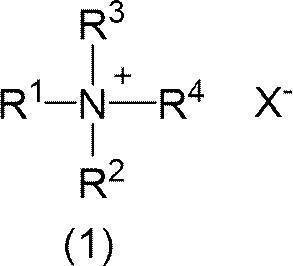
R1~R4で表される炭化水素基は、直鎖状、分岐鎖状、又は環状であってもよい。
R1~R4で表される炭化水素基の炭素数は、1~20が好ましく、1~10がより好ましく、1~8が更に好ましい。
R1~R4で表される炭化水素基としては、脂肪族炭化水素基及び芳香族炭化水素基が挙げられる。
R1~R4で表される炭化水素基として、例えば、置換基を有していてもよい、アルキル基、アルケニル基、アルキニル基、アリール基、及びこれらを組み合わせた基が挙げられる。なかでも、上記炭化水素基としては、置換基を有していてもよいアルキル基が好ましい。
上記炭化水素基が有する置換基としては、例えば、フッ素原子、塩素原子、及び臭素原子等のハロゲン原子;メトキシ、エトキシ、プロポキシ、イソプロピルオキシ、ブトキシ、イソブチルオキシ、及びt-ブチルオキシ基等のアルコキシ基;ヒドロキシ基;メトキシカルボニル及びエトキシカルボニル基等のアルコキシカルボニル基;アセチル、プロピオニル、及びベンゾイル基等のアシル基;シアノ基;ニトロ基等が挙げられる。
なかでも、上記置換基としては、ヒドロキシ基が好ましい。
また、R1~R4のうち少なくとも1つが、置換基を有していてもよい炭素数2以上の炭化水素基であることが好ましく、R1~R4のうち少なくとも2つが、置換基を有していてもよい炭素数2以上の炭化水素基であることがより好ましく、R1~R4のうち少なくとも3つが、置換基を有していてもよい炭素数2以上の炭化水素基であることが更に好ましく、R1~R4のうち3つが、置換基を有していてもよい炭素数2以上の炭化水素基であることが特に好ましい。上記炭素数の上限は特に制限されないが、20以下が好ましく、10以下がより好ましい。
なお、化合物(1)は、R1~R4の全てがメチル基を表す場合を含まない。つまり、化合物(1)は、例えば、テトラメチルアンモニウム塩を含まない。
上記アルキル基、上記アルケニル基、及び上記アルキニル基の炭素数は、1~10が好ましく、1~8がより好ましく、1~5が更に好ましく、1~3が特に好ましい。
上記アルキル基、上記アルケニル基、及び上記アルキニルが有する置換基としては、上述したR1~R4で表される炭化水素基が有する置換基が挙げられる。
なかでも、R1~R4としては、置換基を有していてもよいアルキル基が好ましく、無置換のアルキル基又はヒドロキシアルキル基がより好ましく、メチル基、エチル基、プロピル基、ブチル基、又は2-ヒドロキシエチル基が更に好ましく、メチル基、エチル基、又は2-ヒドロキシエチル基が特に好ましい。
また、R1~R4のうち少なくとも1つが、置換基を有していてもよいアルキル基であることが好ましく、R1~R4のうち少なくとも1つが、ヒドロキシアルキル基(ヒドロキシ基を有するアルキル基)であることがより好ましく、R1~R4のうち少なくとも2つが、ヒドロキシアルキル基であることが更に好ましく、R1~R4のうち少なくとも3つが、ヒドロキシアルキル基であることが特に好ましく、R1~R4のうち3つが、ヒドロキシアルキル基であることが最も好ましい。
上記アリール基の炭素数は、5~20が好ましく、6~15がより好ましく、6~10が更に好ましい。
上記アリール基が有する環の数は、1~5が好ましく、1~3がより好ましく、1が更に好ましい。
上記アリール基が有する置換基としては、例えば、上述したR1~R4で表される炭化水素基が有する置換基が挙げられる。
なかでも、R1~R4で表されるアリール基としては、ベンジル基、フェニル基、ナフチル基、アントリル基、フェナントリル基、インデニル基、アセナブテニル基、フルオレニル基、及びピレニル基等が挙げられる。なかでも、上記アリール基としては、ベンジル基、フェニル基、又はナフチル基が好ましく、ベンジル基又はフェニル基がより好ましく、ベンジル基が更に好ましい。
また、R1~R4のうち1~3つが、置換基を有していてもよいアリール基であることが好ましく、R1~R4のうち1~2つが、置換基を有していてもよいアリール基であることがより好ましく、R1~R4のうち1つが、置換基を有していてもよいアリール基であることが更に好ましく、R1~R4のうち1つが、ベンジル基であることが特に好ましい。
なかでも、本発明の効果がより優れる点で、化合物(1)としては、トリス(2-ヒドロキシエチル)メチルアンモニウムヒドロキシド、TEAH、コリン、ビス(2-ヒドロキシエチル)ジメチルアンモニウムヒドロキシド、TMEAH、又はBTMAHが好ましく、トリス(2-ヒドロキシエチル)メチルアンモニウムヒドロキシド、コリン、又はビス(2-ヒドロキシエチル)ジメチルアンモニウムヒドロキシドがより好ましく、トリス(2-ヒドロキシエチル)メチルアンモニウムヒドロキシドが更に好ましい。
化合物(1)の含有量は、洗浄液から溶媒を除いた成分の全質量に対して、20.0~80.0質量%が好ましく、30.0~80.0質量%がより好ましい、40.0~75.0質量%が更に好ましい。
洗浄液は、式(2)で表される化合物(化合物(2))を含む。
化合物(2)は、後述する有機酸とは異なる化合物である。
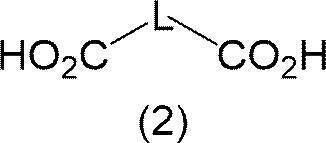
Lで表される2価の連結基としては、例えば、エーテル基、カルボニル基、エステル基、チオエーテル基、-SO2-、-NT-(Tは、例えば、水素原子又はアルキル基等の置換基)、2価の炭化水素基(例えば、アルキレン基、アルケニレン基、アルキニレン基、及びアリーレン基)、及びこれらを組み合わせた基が挙げられる。
また、Lで表される2価の連結基は、更に置換基を有していてもよい。上記置換基としては、例えば、アルキル基、アリール基、ヒドロキシ基、カルボキシ基、アミノ基、及びハロゲン原子が挙げられる。
なかでも、上記2価の連結基としては、単結合又は2価の炭化水素基が好ましく、アルキレン基がより好ましく、直鎖状アルキレン基が更に好ましい。
上記2価の連結基の炭素数は、1~15が好ましく、1~10がより好ましく、1~5が更に好ましい。
なかでも、本発明の効果がより優れる点で、化合物(2)は、シュウ酸、コハク酸、マロン酸、グルタル酸、アジピン酸、クエン酸、及び酒石酸からなる群から選択される少なくとも1つを含むことが好ましく、コハク酸、マロン酸、グルタル酸、及びアジピン酸からなる群から選択される少なくとも1つを含むことがより好ましく、コハク酸を含むことが更に好ましい。
化合物(2)の炭素数は、20以下が好ましく、15以下がより好ましく、10以下が更に好ましく、5以下が特に好ましい。上記炭素数の下限は、2以上が好ましい。
化合物(2)の含有量は、洗浄液から溶媒を除いた成分の全質量に対して、1.0~50.0質量%が好ましく、1.0~45.0質量%がより好ましく、3.0~35.0質量%が更に好ましい。
化合物(2)の含有量に対する化合物(1)の含有量の質量比〔化合物(1)の含有量/化合物(2)の含有量〕が、0.10~50.00が好ましく、0.60~37.50がより好ましく、1.00~30.00が更に好ましい。
洗浄液は、第1級アミノ基又は第2級アミノ基を有する第1アミノアルコール(第1アミノアルコール)を含む。
第1アミノアルコールとは、第1級アミノ基又は第2級アミノ基と、少なくとも1つのヒドロキシ基(好ましくはヒドロキシアルキル基)とを有する化合物である。
第1アミノアルコールは、上述した化合物(1)及び後述する第3級アミンとは異なる化合物である。
第1アミノアルコールは、第1級アミノ基又は第2級アミノ基を有するアミノアルコールであれば特に制限されず、第1級アミノ基又は第2級アミノ基を複数有していてもよい。
第1アミノアルコールが有する第1級アミノ基及び第2級アミノ基の合計の数は、1~5が好ましく、1~3がより好ましく、1~2が更に好ましい。
なお、第1アミノアルコールは、第3級アミノ基を有さない。また、第1アミノアルコールが第1級アミノ基及び第2級アミノ基の両方を有する場合は、第2級アミノアルコールに該当する。具体的には、2-(2-アミノエチルアミノ)エタノールは、第2級アミノアルコールに該当する。
第1アミノアルコールは、第1級アミノ基を有するアミノアルコール及び第2級アミノ基を有するアミノアルコールからなる群から選択される少なくとも1つを含んでいればよく、第1級アミノ基を有するアミノアルコール及び第2級アミノ基を有するアミノアルコールからなる群から選択される少なくとも2つを含むことが好ましく、第1級アミノ基を有するアミノアルコール及び第2級アミノ基を有するアミノアルコールを含むことがより好ましい。
第1アミノアルコールの炭素数は、1~10が好ましく、2~8がより好ましく、2~5が更に好ましい。
第1アミノアルコールの窒素数は、1~5が好ましく、1~3がより好ましく、1~2が更に好ましい。
第1アミノアルコールの窒素数に対する、第1アミノアルコールの炭素数の比〔第1アミノアルコールの炭素数/第1アミノアルコールの窒素数〕は、2~5が好ましく、2~4がより好ましく、2~3が更に好ましい。例えば、第1アミノアルコールが2-アミノエタノールを含む場合、炭素数が2、かつ、窒素数が1であり、窒素数に対する炭素数の比は、2となる。また、本発明の洗浄液が2種以上の第1アミノアルコールを含む場合、上記炭素数及び窒素数は、洗浄液に含まれる第1アミノアルコールが有するそれぞれの数を合計した数を用いる。
式(X) Rx1-L-OH
Rx1は、-NH2、又は、-NHRx2を表す。Rx2は、第1級アミノ基(-NH2)を有していてもよいアルキル基を表す。
上記アルキル基の炭素数は、1~5が好ましく、1~3がより好ましい。
Lは、アルキレン基を表す。アルキレン基の炭素数は、1~5が好ましい。
上記Rx2で表されるアルキル基及び上記Lで表されるアルキレン基は、直鎖状又は分岐鎖状であってもよい。
なかでも、本発明の効果がより優れる点で、第1アミノアルコールは、2-アミノエタノール、2-アミノ-2-メチル-1-プロパノール、トリスヒドロキシメチルアミノメタン、2-(アミノエトキシ)エタノール、及び2-(2-アミノエチルアミノ)エタノールからなる群から選択される少なくとも1つを含むことが好ましく、2-アミノエタノール、2-アミノ-2-メチル-1-プロパノール、及び2-(2-アミノエチルアミノ)エタノールからなる群から選択される少なくとも1つを含むことがより好ましく、2-アミノエタノール及び2-(2-アミノエチルアミノ)エタノールからなる群から選択される少なくとも1つを含むことが更に好ましい。
第1アミノアルコールの含有量は、半導体基板用洗浄液から溶媒を除いた成分の全質量に対して、1.0~50.0質量%が好ましく、10.0~40.0質量%がより好ましい。
また、第1アミノアルコールが、2-アミノエタノール及び2-(2-アミノエチルアミノ)エタノールを含む場合、2-(2-アミノエチルアミノ)エタノールの含有量に対する、2-アミノエタノールの含有量の質量比〔2-アミノエタノールの含有量/2-(2-アミノエチルアミノ)エタノールの含有量〕は、0.10~2000.00が好ましく、0.50~900.00がより好ましく、1.00~100.00が更に好ましい。
第1アミノアルコールの含有量に対する、化合物(1)の含有量の質量比〔化合物(1)の含有量/第1アミノアルコールの含有量〕が、1.00~30.00が好ましく、1.00~10.00がより好ましく、1.50~7.00が更に好ましい。
洗浄液は、第3級アミンを含む。
第3級アミンは、上述した化合物(1)、第1アミノアルコール、及び後述するアゾール化合物とは異なる化合物である。第3級アミンとは、分子内に少なくとも第3級アミノ基(>N-)を有する化合物である。
第3級アミンとしては、例えば、第3級脂肪族アミン、第3級芳香族アミン、及び第3級アミノ基を有する第2アミノアルコール(以下、単に「第2アミノアルコール」ともいう。)が挙げられる。
第3級脂肪族アミンとしては、分子内に第3級アミノ基を有し、芳香環を有さない第3級アミンが挙げられる。
また、第3級脂肪族アミンとしては、例えば、第3級脂環式アミン、及び第3級脂肪族アミンが挙げられる。
第3級脂環式アミンは、環を構成する原子の少なくとも1つが窒素原子である非芳香性のヘテロ環を有する第3級アミンであれば、特に制限されない。
第3級脂環式アミンとしては、例えば、環状アミジン化合物及びピペラジン化合物が挙げられる。
環状アミジン化合物は、環内にアミジン構造(>N-C=N-)を含むヘテロ環を有する化合物である。
環状アミジン化合物が有する上記のヘテロ環の環員数は、特に制限されないが、5又は6個が好ましく、6個がより好ましい。
環状アミジン化合物としては、例えば、ジアザビシクロウンデセン(1,8-ジアザビシクロ[5.4.0]ウンデカ-7-エン:DBU)、ジアザビシクロノネン(1,5-ジアザビシクロ[4.3.0]ノナ-5-エン:DBN)、3,4,6,7,8,9,10,11-オクタヒドロ-2H-ピリミド[1.2-a]アゾシン、3,4,6,7,8,9-ヘキサヒドロ-2H-ピリド[1.2-a]ピリミジン、2,5,6,7-テトラヒドロ-3H-ピロロ[1.2-a]イミダゾール、3-エチル-2,3,4,6,7,8,9,10-オクタヒドロピリミド[1.2-a]アゼピン、及びクレアチニンが挙げられる。なかでも、環状アミジン化合物としては、DBU又はDBNが好ましい。
ピペラジン化合物は、シクロヘキサン環の対向する-CH-基が第3級アミノ基(>N-)に置き換わったヘテロ6員環(ピペラジン環)を有する化合物である。
なかでも、ピペラジン化合物としては、1-メチルピペラジン、HEP、AEP、BHEP、BAEP、又はBAPPが好ましい。
第3級脂肪族アミンとしては、例えば、1,3-ビス(ジメチルアミノ)ブタン等のアルキレンジアミン、及びN,N,N’,N’’,N’’-ペンタメチルジエチレントリアミン等のポリアルキルポリアミンが挙げられる。
第3級脂肪族アミンが有する親水性基の総数の上限は特に制限されないが、4以下が好ましく、3以下がより好ましい。下限は特に制限されないが、1以上が好ましい。
また、第3級脂肪族アミンの分子量は、特に制限されないが、200以下が好ましく、150以下がより好ましい。下限は特に制限されないが、60以上が好ましい。
第3級アミンとしては、第2アミノアルコールも好ましい。第2アミノアルコールは、第3級アミノ基を有し、かつ、分子内に少なくとも1つのヒドロキシ基を更に有する化合物である。
式(Y) RY1-LY-OH
RY1は、-N(RY2)2を表す。RY2は、アルキル基を表す。
上記アルキル基の炭素数は、1~5が好ましく、1~3がより好ましい。
LYは、アルキレン基を表す。アルキレン基の炭素数は、1~5が好ましい。
上記RY2で表されるアルキル基及び上記LYで表されるアルキレン基は、直鎖状又は分岐鎖状であってもよい。
なかでも、2-(ジメチルアミノ)エタノール又は2-(ジメチルアミノ)-2-メチル-1-プロパノールが好ましく、2-(ジメチルアミノ)エタノールがより好ましい。
第3級アミンの含有量は、洗浄液から溶媒を除いた成分の全質量に対して、1.0~50.0質量%が好ましく、3.0~45.0質量%がより好ましく、3.0~35.0質量%が更に好ましい。
第3級アミンの含有量に対する、化合物(1)の含有量の質量比〔化合物(1)の含有量/第3級アミンの含有量〕は、0.10~50.00が好ましく、0.50~38.00がより好ましく、1.00~30.00が更に好ましい。
第1アミノアルコールの含有量に対する、第3級アミンの含有量の質量比〔第3級アミンの含有量/第1アミノアルコールの含有量〕は、0.01~10.00が好ましく、0.05~5.00がより好ましく、0.30~4.00更に好ましい。
化合物(2)の含有量に対する、第3級アミンの含有量の質量比〔第3級アミンの含有量/化合物(2)の含有量〕は、0.01~50.00が好ましく、0.50~15.00がより好ましい。
洗浄液は、溶媒を含む。
溶媒としては、水及び有機溶媒が挙げられ、水が好ましい。
洗浄液に使用される水の種類は、半導体基板に悪影響を及ぼさないものであれば特に制限はなく、蒸留水、脱イオン水、及び純水(超純水)を使用できる。不純物をほとんど含まず、半導体基板の製造工程における半導体基板への影響がより少ない点で、純水が好ましい。
有機溶媒としては、公知の有機溶媒をいずれも使用でき、アルコール及びケトン等の親水性有機溶媒が好ましい。
洗浄液における溶媒の含有量は、洗浄液の全質量に対して、1.0質量%以上が好ましく、30.0質量%以上がより好ましく、60.0質量%以上が更に好ましい。上限値は特に制限されないが、洗浄液の全質量に対して、99.0質量%以下が好ましく、97.0質量%以下がより好ましい。
洗浄液は、有機酸を含んでいてもよい。
有機酸は、上述した化合物(1)、化合物(2)、第1アミノアルコール、及び第3級アミンとは異なる化合物である。
また、有機酸は、後述の成分(界面活性剤、アゾール化合物、分子量500以上のポリヒドロキシ化合物等)とも異なる化合物であることが好ましい。
洗浄液に用いる有機酸は、カルボキシ基、及びホスホン酸基からなる群から選択される少なくとも1つの酸基を有することが好ましい。
また、有機酸の炭素数は、15以下が好ましい。上記炭素数の下限は特に制限されないが、2以上が好ましい。
カルボン酸系有機酸は、分子内に少なくとも1つ(例えば1~8つ)のカルボキシ基を有する有機酸である。
カルボン酸系有機酸は、分子内に配位基としてカルボキシ基を有する有機酸であり、例えば、アミノポリカルボン酸系有機酸、アミノ酸系有機酸、及び脂肪族カルボン酸系有機酸が挙げられる。
なかでも、アミノポリカルボン酸系有機酸としては、ジエチレントリアミン五酢酸(DTPA)が好ましい。
ホスホン酸系有機酸は、分子内に少なくとも1つホスホン酸基を有する有機酸である。なお、有機酸が、ホスホン酸基及びカルボキシ基を有する場合は、カルボン酸系有機酸に分類する。
ホスホン酸系有機酸は、例えば、脂肪族ホスホン酸系有機酸、及びアミノホスホン酸系が挙げられる。
なお、脂肪族ホスホン酸系有機酸は、ホスホン酸基と脂肪族基と以外に、ヒドロキシ基を更に有していてもよい。
ホスホン酸系有機酸としては、例えば、エチリデンジホスホン酸、1-ヒドロキシエチリデン-1,1’-ジホスホン酸(HEDPO)、1-ヒドロキシプロピリデン-1,1’-ジホスホン酸、1-ヒドロキシブチリデン-1,1’-ジホスホン酸、エチルアミノビス(メチレンホスホン酸)、ドデシルアミノビス(メチレンホスホン酸)、ニトリロトリス(メチレンホスホン酸)(NTPO)、エチレンジアミンビス(メチレンホスホン酸)(EDDPO)、1,3-プロピレンジアミンビス(メチレンホスホン酸)、エチレンジアミンテトラ(メチレンホスホン酸)(EDTPO)、エチレンジアミンテトラ(エチレンホスホン酸)、1,3-プロピレンジアミンテトラ(メチレンホスホン酸)(PDTMP)、1,2-ジアミノプロパンテトラ(メチレンホスホン酸)、1,6-ヘキサメチレンジアミンテトラ(メチレンホスホン酸)、ジエチレントリアミンペンタ(メチレンホスホン酸)(DEPPO)、ジエチレントリアミンペンタ(エチレンホスホン酸)、トリエチレンテトラミンヘキサ(メチレンホスホン酸)、及びトリエチレンテトラミンヘキサ(エチレンホスホン酸)が挙げられる。なかでも、ホスホン酸系有機酸としては、HEDPOが好ましい。
また、ホスホン酸系有機酸の炭素数は、12以下が好ましく、10以下がより好ましく、8以下が更に好ましい。下限は特に制限されないが、1以上が好ましい。
また、市販のホスホン酸系有機酸には、ホスホン酸系有機酸以外に、蒸留水、脱イオン水、及び超純水等の水を含むホスホン酸系有機酸であってもよい。
また、有機酸は、DTPA、EDTA、トランス-1,2-ジアミノシクロヘキサン四酢酸、IDA、アルギニン、グリシン、β-アラニン、HEDPO、NTPO、EDTPO、及びDEPPOからなる群から選択される1種以上が好ましく、DTPA及びHEDPOからなる群から選択される1種以上がより好ましい。
洗浄液における有機酸の含有量は、洗浄液の性能がバランスよく優れる点から、洗浄液から溶媒を除いた成分の全質量に対して、0.0005~25.0質量%が好ましく、0.003~5.0質量%がより好ましく、0.01~3.0質量%が更に好ましい。
第2アミノアルコールの含有量に対する、有機酸の含有量の質量比〔有機酸の含有量/第2アミノアルコールの含有量〕は、0.0001~10.0が好ましく、0.0010~1.5がより好ましく、0.0050~1.0が更に好ましく、0.010~1.0が特に好ましい。
洗浄液は、界面活性剤を含んでいてもよい。
界面活性剤は、上述した洗浄液に含まれる成分以外(化合物(1)、化合物(2)、第1アミノアルコール、及び第3級アミン等)とは異なる成分である。
界面活性剤としては、1分子中に親水基と疎水基(親油基)とを有する化合物が好ましい。界面活性剤としては、例えば、ノニオン性界面活性剤、アニオン性界面活性剤、カチオン性界面活性剤、及び両性界面活性剤が挙げられる。
なかでも、界面活性剤としては、ノニオン性界面活性剤が好ましい。
また、疎水基が芳香族炭化水素基を含まず、脂肪族炭化水素基のみから構成される場合、疎水基の炭素数は、9以上であることが好ましく、13以上であることがより好ましく、16以上であることが更に好ましい。疎水基の炭素数の上限は特に制限されないが、20以下が好ましく、18以下がより好ましい。
ノニオン性界面活性剤としては、例えば、エステル型ノニオン性界面活性剤、エーテル型ノニオン性界面活性剤、エステルエーテル型ノニオン性界面活性剤、及び、アルカノールアミン型ノニオン性界面活性剤が挙げられる。
なかでも、エーテル型ノニオン性界面活性剤が好ましい。
式(A1) -(LO)n-
式(A1)中、Lは、アルキレン基を表す。
上記アルキレン基は、直鎖状でも分岐鎖状でもよい。上記アルキレン基の炭素数は、1~10が好ましく、2~3がより好ましく、2が更に好ましい。
nは、3~60を表し、3~30が好ましく、6~20がより好ましく、7~15が更に好ましい。なお、nは整数の値を表す。
言い換えると、式(A1)で表される基は、繰り返し数nのポリオキシアルキレン基(例えば、ポリオキシエチレン基、ポリオキシプロピレン基、及び、ポリオキシエチレンポリオキシプロピレン基)である。
なかでも、式(A1)で表される基は、nが3~30のポリオキシエチレン基であることが好ましく、nが6~20のポリオキシエチレン基であることがより好ましく、nが7~15のポリオキシエチレン基であることが更に好ましい。
式(A1)で表される基のO側の末端と結合する基(つまり、式(A1)で表される基の左側に結合する基)は、水素原子、アルキル基、又は、置換基を有していてもよい芳香環基が好ましく、水素原子がより好ましい。
上記アルキル基は直鎖状でも分岐鎖状でもよい。上記アルキル基の炭素数は1~30が好ましい。
上記芳香環基の炭素数は、1~30が好ましい。
上記芳香族環基が有する置換基としては、例えば、アルキル基等の炭化水素基(好ましくは炭素数1~30)が挙げられる。
式(A1)で表される基のL側の末端と結合する基は、水酸基、アルコキシ基、又は、置換基を有していてもよい芳香環-O-で表される基が好ましく、置換基を有していてもよい芳香環-O-で表される基がより好ましい。
上記アルコキシ基は直鎖状でも分岐鎖状でもよい。上記アルコキシ基の炭素数は1~30が好ましく、1~20がより好ましい。
上記芳香環基の炭素数は、1~30が好ましく、1~10がより好ましく、3~6が更に好ましい。
また、上記芳香族環基が有する置換基としては、例えば、アルキル基等の炭化水素基(好ましくは炭素数1~30)が挙げられる。
式(A2) -Ph-O-(LO)n-
式(A2)中、「(LO)n」は、式(A1)で表される基と同様である。
式(A2)中、Phは、フェニレン基を表す。
式(A2)で表される基におけるPh側の末端で結合する基は、水素原子又はアルキル基が好ましく、アルキル基がより好ましい。
上記アルキル基は直鎖状でも分岐鎖状でもよい。上記アルキル基の炭素数は、1~30が好ましく、1~20がより好ましく、5~10が更に好ましい。
式(A) RNA-LNA1-(LO)n-LNA2-H
式(A)中、「(LO)n」は、式(A1)で表される基と同様である。
式(A)中、RNAは、置換基を有していてもよい、アルキル基、アリール基、又は、これらの組み合わせからなる基(アルキルアリール基(アルキル基が置換されたアリール基)等)を表す。
上記置換基としては、例えば、フッ素原子等のハロゲン原子及び水酸基が挙げられる。 上記アルキル基は、直鎖状でも分岐鎖状でもよい。上記アルキル基は炭素数1~30が好ましく、炭素数7~15がより好ましい。
上記アリール基は、炭素数6~12が好ましい。上記アルキル基中のエチレン基の1以上がビニレン基で置き換わっていてもよい。
なかでも、LNA1は-O-が好ましい。LNA2は単結合が好ましい。
なかでも、ノニオン性界面活性剤としては、ポリオキシエチレンアルキルフェニルエーテルが好ましい。
洗浄液に使用できるアニオン性界面活性剤としては、例えば、それぞれが親水基(酸基)として、リン酸エステル基を有するリン酸エステル系界面活性剤、ホスホン酸基を有するホスホン酸系界面活性剤、スルホ基を有するスルホン酸系界面活性剤、カルボキシ基を有するカルボン酸系界面活性剤、及び硫酸エステル基を有する硫酸エステル系界面活性剤が挙げられる。
リン酸エステル系界面活性剤としては、例えば、アルキルリン酸エステル、及びポリオキシアルキレンアルキルエーテルリン酸エステル、並びにこれらの塩が挙げられる。リン酸エステル及びポリオキシアルキレンアルキルエーテルリン酸エステルは、通常モノエステル及びジエステルの両者を含むが、モノエステル又はジエステルを単独で使用できる。
リン酸エステル系界面活性剤の塩としては、例えば、ナトリウム塩、カリウム塩、アンモニウム塩、及び有機アミン塩が挙げられる。
アルキルリン酸エステル及びポリオキシアルキレンアルキルエーテルリン酸エステルが有するアルキル基としては、特に制限されないが、炭素数2~24のアルキル基が好ましく、炭素数6~18のアルキル基がより好ましく、炭素数12~18のアルキル基が更に好ましい。
ポリオキシアルキレンアルキルエーテルリン酸エステルが有するアルキレン基としては、特に制限されないが、炭素数2~6のアルキレン基が好ましく、エチレン基、又は1,2-プロパンジイル基がより好ましい。また、ポリオキシアルキレンエーテルリン酸エステルにおけるオキシアルキレン基の繰り返し数は、1~12が好ましく、1~6がより好ましい。
ホスホン酸系界面活性剤としては、例えば、アルキルホスホン酸、ポリビニルホスホン酸、及び特開2012-057108号公報等に記載のアミノメチルホスホン酸等が挙げられる。
スルホン酸系界面活性剤としては、例えば、アルキルスルホン酸、アルキルベンゼンスルホン酸、アルキルナフタレンスルホン酸、アルキルジフェニルエーテルジスルホン酸、アルキルメチルタウリン、スルホコハク酸ジエステル、ポリオキシアルキレンアルキルエーテルスルホン酸、及びこれらの塩が挙げられる。
また、ポリオキシアルキレンアルキルエーテルスルホン酸が有するアルキレン基としては、特に制限されないが、エチレン基、又は1,2-プロパンジイル基が好ましい。また、ポリオキシアルキレンアルキルエーテルスルホン酸におけるオキシアルキレン基の繰り返し数は、1~12が好ましく、1~6がより好ましい。
カルボン酸系界面活性剤としては、例えば、アルキルカルボン酸、アルキルベンゼンカルボン酸、及びポリオキシアルキレンアルキルエーテルカルボン酸、並びにこれらの塩が挙げられる。
上記のカルボン酸系界面活性剤が有するアルキル基としては、特に制限されないが、炭素数7~25のアルキル基が好ましく、炭素数11~17のアルキル基がより好ましい。
また、ポリオキシアルキレンアルキルエーテルカルボン酸が有するアルキレン基としては、特に制限されないが、エチレン基又は1,2-プロパンジイル基が好ましい。また、ポリオキシアルキレンアルキルエーテルカルボン酸におけるオキシアルキレン基の繰り返し数は、1~12が好ましく、1~6がより好ましい。
硫酸エステル系界面活性剤としては、例えば、アルキル硫酸エステル、及びポリオキシアルキレンアルキルエーテル硫酸エステル、並びにこれらの塩が挙げられる。
アルキル硫酸エステル及びポリオキシアルキレンアルキルエーテル硫酸エステルが有するアルキル基としては、特に制限されないが、炭素数2~24のアルキル基が好ましく、炭素数6~18のアルキル基がより好ましい。
ポリオキシアルキレンアルキルエーテル硫酸エステルが有するアルキレン基としては、特に制限されないが、エチレン基、又は1,2-プロパンジイル基がより好ましい。また、ポリオキシアルキレンアルキルエーテル硫酸エステルにおけるオキシアルキレン基の繰り返し数は、1~12が好ましく、1~6がより好ましい。
硫酸エステル系界面活性剤の具体例としては、ラウリル硫酸エステル、ミリスチル硫酸エステル、及びポリオキシエチレンラウリルエーテル硫酸エステルが挙げられる。
洗浄液が界面活性剤を含む場合、界面活性剤の含有量は、洗浄液の性能がバランスよく優れる点から、洗浄液から溶媒を除いた成分の全質量に対して、0.001~3.0質量%が好ましく、0.01~1.0質量%がより好ましく、0.05~0.5質量%が更に好ましい。
洗浄液は、アゾール化合物を含んでいてもよい。
上記アゾール化合物は、上述した洗浄液に含まれる成分とは異なる化合物である。
アゾール化合物は、窒素原子を少なくとも1つ含み、芳香族性を有するヘテロ5員環を有する化合物である。
アゾール化合物は、洗浄液の腐食防止作用を向上させ得る。つまり、アゾール化合物は防食剤として作用し得る。
アゾール化合物が有するヘテロ5員環に含まれる窒素原子の個数は、特に制限されず、1~4個が好ましく、1~3個がより好ましい。
また、アゾール化合物は、ヘテロ5員環上に置換基を有してもよい。上記置換基としては、例えば、ヒドロキシ基、カルボキシ基、メルカプト基、アミノ基、又はアミノ基を有していてもよい炭素数1~4のアルキル基、及び2-イミダゾリル基が挙げられる。
洗浄液がアゾール化合物を含む場合、アゾール化合物の含有量は、洗浄液から溶媒を除いた成分の全質量に対して、0.01~10.0質量%が好ましく、0.1~5.0質量%がより好ましく、0.3~3.0質量%が更に好ましい。
洗浄液は、分子量500以上のポリヒドロキシ化合物を含んでいてもよい。
上記ポリヒドロキシ化合物は、上述の各成分とは異なる成分である。
上記ポリヒドロキシ化合物は、1分子中に2個以上(例えば2~200個)のアルコール性水酸基を有する有機化合物である。
上記ポリヒドロキシ化合物の分子量(分子量分布を有する場合は重量平均分子量)は、500以上であり、500~3000が好ましい。
シクロデキストリンとしては、例えば、α-シクロデキストリン、β-シクロデキストリン、及びγ-シクロデキストリンが挙げられる。なかでも、γ-シクロデキストリンが好ましい。
洗浄液が上記ポリヒドロキシ化合物を含む場合、上記ポリヒドロキシ化合物の含有量は、洗浄液から溶媒を除いた成分の全質量に対して、0.01~10.0質量%が好ましく、0.05~5.0質量%がより好ましく、0.1~3.0質量%が更に好ましい。
洗浄液は、還元性硫黄化合物を含んでいてもよい。
上記還元性硫黄化合物は、上述の各成分とは異なる成分である。
還元性硫黄化合物は、洗浄液の腐食防止作用を向上させ得る。つまり、還元性硫黄化合物は防食剤として作用し得る。
還元性硫黄化合物は、還元性を有し、硫黄原子を含む化合物である。還元性硫黄化合物としては、例えば、メルカプトコハク酸、ジチオジグリセロール、ビス(2,3-ジヒドロキシプロピルチオ)エチレン、3-(2,3-ジヒドロキシプロピルチオ)-2-メチル-プロピルスルホン酸ナトリウム、1-チオグリセロール、3-メルカプト-1-プロパンスルホン酸ナトリウム、2-メルカプトエタノール、チオグリコール酸、及び3-メルカプト-1-プロパノールが挙げられる。
なかでも、SH基を有する化合物(メルカプト化合物)が好ましく、1-チオグリセロール、3-メルカプト-1-プロパンスルホン酸ナトリウム、2-メルカプトエタノール、3-メルカプト-1-プロパノール、又は、チオグリコール酸がより好ましい。
上記還元性硫黄化合物は、1種単独で使用してもよく、2種以上を使用してもよい。
洗浄液が還元性硫黄化合物を含む場合、還元性硫黄化合物の含有量は、洗浄液から溶媒を除いた成分の全質量に対して、0.01~10.0質量%が好ましく、0.05~5.0質量%がより好ましく、0.1~3.0質量%が更に好ましい。
洗浄液は、重合体を含んでいてもよい。
上記重合体は、上述の各成分とは異なる成分である。
重合体の分子量(分子量分布を有する場合は重量平均分子量)は、600超が好ましく、1000以上がより好ましく、1000超が更に好ましく、3000超が特に好ましい。上記分子量の上限は特に制限されないが、1500000以下が好ましく、100000以下がより好ましい。
なかでも、重合体が後述の水溶性重合体である場合、水溶性重合体の重量平均分子量は、1000以上が好ましく、1500以上がより好ましく、3000以上が更に好ましい。水溶性重合体の重量平均分子量の上限は特に制限されず、1500000以下が好ましく、1200000以下がより好ましく、1000000以下が更に好ましく、10000以下が特に好ましい。
なお、本明細書において、「重量平均分子量」とは、GPC(ゲルパーミエーションクロマトグラフィー)によって測定されたポリエチレングリコール換算の重量平均分子量のことを指す。
重合体は、カルボキシ基を有する繰り返し単位((メタ)アクリル酸に由来する繰り返し単位など)を有することが好ましい。カルボキシ基を有する繰り返し単位の含有量は、重合体の全質量に対して、30~100質量%が好ましく、70~100質量%がより好ましく、85~100質量%が更に好ましい。
なお、「水溶性重合体」とは、2以上の繰り返し単位が線状又は網目状に共有結合を介して連なった化合物であって、20℃の水100gに溶解する質量が0.1g以上である化合物を意図する。
水溶性重合体は、実質的に、上記群から選択される単量体に由来する構造単位のみからなる重合体であることも好ましい。重合体が実質的に上記群から選択される単量体に由来する構造単位のみであるとは、例えば、重合体の全質量に対して、上記群から選択される単量体に由来する構造単位の含有量は、95~100質量%が好ましく、99~100質量%がより好ましい。
洗浄液が重合体を含む場合、重合体の含有量は、洗浄液から溶媒を除いた成分の全質量に対して、0.01~10.0質量%が好ましく、0.05~5.0質量%がより好ましく、0.1~3.0質量%が更に好ましい。
重合体の含有量が上記範囲内であると、基板の表面に重合体が適度に吸着して洗浄液の腐食防止性能の向上に寄与でき、かつ、洗浄液の粘度及び/又は洗浄性能のバランスも良好にできる。
洗浄液は、酸化剤を含んでいてもよい。
酸化剤は、上述の各成分とは異なる成分である。
酸化剤としては、例えば、過酸化物、過硫化物(例えば、モノ過硫化物及びジ過硫化物)、過炭酸塩、それらの酸、及びそれらの塩が挙げられる。
酸化剤としては、例えば、酸化ハライド(ヨウ素酸、メタ過ヨウ素酸及びオルト過ヨウ素酸等の過ヨウ素酸、それらの塩等)、過ホウ酸、過ホウ酸塩、セリウム化合物、及びフェリシアン化物(フェリシアン化カリウム等)が挙げられる。
洗浄液が酸化剤を含む場合、酸化剤の含有量は、洗浄液から溶媒を除いた成分の全質量に対して、0.01~10.0質量%が好ましく、0.05~5.0質量%がより好ましく、0.1~3.0質量%が更に好ましい。
洗浄液は、洗浄液のpHを調整及び維持するためにpH調整剤を含んでいてもよい。
pH調整剤としては、上記成分以外の塩基性化合物及び酸性化合物が挙げられる。
pH調整剤は、上述の各成分とは異なる成分を意図する。ただし、上述の各成分の添加量を調整することで、洗浄液のpHを調整させることは許容される。
塩基性有機化合物は、上述の洗浄液に含まれる成分とは異なる塩基性の有機化合物である。塩基性有機化合物としては、例えば、アミンオキシド、ニトロ、ニトロソ、オキシム、ケトオキシム、アルドオキシム、ラクタム、イソシアニド類、及び尿素が挙げられる。
塩基性無機化合物としては、例えば、アルカリ金属水酸化物、アルカリ土類金属水酸化物、及びアンモニアが挙げられる。
アルカリ金属水酸化物としては、例えば、水酸化リチウム、水酸化ナトリウム、水酸化カリウム、及び水酸化セシウムが挙げられる。アルカリ土類金属水酸化物としては、例えば、水酸化カルシウム、水酸化ストロンチウム、及び水酸化バリウムが挙げられる。
無機酸としては、例えば、塩酸、硫酸、亜硫酸、硝酸、亜硝酸、リン酸、ホウ酸、及び六フッ化リン酸が挙げられる。また、無機酸の塩を使用してもよく、例えば、無機酸のアンモニウム塩が挙げられ、より具体的には、塩化アンモニウム、硫酸アンモニウム、亜硫酸アンモニウム、硝酸アンモニウム、亜硝酸アンモニウム、リン酸アンモニウム、ホウ酸アンモニウム、及び六フッ化リン酸アンモニウムが挙げられる。
洗浄液がpH調整剤を含む場合、pH調整剤の含有量は、他の成分の種類及び量、並びに目的とする洗浄液のpHに応じて選択されるが、洗浄液から溶媒を除いた成分の全質量に対して、0.01~3.0質量%が好ましく、0.05~1.0質量%がより好ましい。
フッ素化合物としては、特開2005-150236号公報の段落[0013]~[0015]に記載の化合物が挙げられ、この内容は本明細書に組み込まれる。
フッ素化合物及び有機溶媒の使用量は特に制限されず、本発明の効果を妨げない範囲で適宜設定できる。
<pH>
洗浄液のpHは、洗浄液の性能がバランスよく優れる点で、8.0~14.0が好ましく、8.0~13.5がより好ましく、8.0~13.0が更に好ましく、8.5~13.0が特に好ましく、9.0~12.5が最も好ましい。
上記洗浄液のpHは、洗浄液の使用時のpHを意味し、洗浄液が希釈して使用される場合には、希釈された洗浄液のpHを意味する。
なお、洗浄液のpHは、公知のpHメーターを用いて、JIS Z8802-1984に準拠した方法により測定できる。pHの測定温度は25℃とする。
洗浄液は、液中に不純物として含まれる金属(Fe、Co、Na、Cu、Mg、Mn、Li、Al、Cr、Ni、Zn、Sn、及びAgの金属元素)の含有量(イオン濃度として測定される)がいずれも5質量ppm以下であることが好ましく、1質量ppm以下であることがより好ましい。最先端の半導体素子の製造においては、更に高純度の洗浄液が求められることが想定されることから、その金属含有量が1質量ppmよりも低い値、すなわち、質量ppbオーダー以下であることが更に好ましく、100質量ppb以下であることが特に好ましく、10質量ppb未満であることが最も好ましい。下限は特に制限されないが、0が好ましい。
他の金属含有量の低減方法としては、原材料又は製造された洗浄液を収容する容器として、後述する不純物の溶出が少ない容器を用いることが挙げられる。また、洗浄液の製造時に配管等から金属成分が溶出しないように、配管内壁にフッ素系樹脂のライニングを施すことも挙げられる。
洗浄液は、粗大粒子を含んでいてもよいが、その含有量が低いことが好ましい。ここで、粗大粒子とは、粒子の形状を球体とみなした場合における直径(粒径)が0.4μm以上である粒子を意味する。
洗浄液における粗大粒子の含有量としては、粒径0.4μm以上の粒子の含有量が、洗浄液1mLあたり1000個以下であることが好ましく、500個以下であることがより好ましい。下限は特に制限されないが、0が挙げられる。また、上記の測定方法で測定された粒径0.4μm以上の粒子の含有量が検出限界以下であることがより好ましい。
洗浄液に含まれる粗大粒子は、原料に不純物として含まれる塵、埃、有機固形物、及び無機固形物等の粒子、並びに洗浄液の調製中に汚染物として持ち込まれる塵、埃、有機固形物、及び無機固形物等の粒子であって、最終的に洗浄液中で溶解せずに粒子として存在するものが該当する。
洗浄液中に存在する粗大粒子の含有量は、レーザを光源とした光散乱式液中粒子測定方式における市販の測定装置を利用して液相で測定できる。
粗大粒子の除去方法としては、例えば、後述するフィルタリング等の精製処理が挙げられる。
洗浄液は、公知の方法により製造できる。以下、洗浄液の製造方法について詳述する。
洗浄液の調液方法は特に制限されず、例えば、上述した各成分を混合することにより洗浄液を製造できる。上述した各成分を混合する順序、及び/又はタイミングは特に制限されず、例えば、精製した純水を入れた容器に、化合物(1)、化合物(2)、第1アミノアルコール、及び第3級アミンを順次添加した後、撹拌して混合するとともに、pH調整剤を添加して混合液のpHを調整することにより、調製する方法が挙げられる。また、水及び各成分を容器に添加する場合、一括して添加してもよいし、複数回にわたって分割して添加してもよい。
洗浄液を調製するための原料のいずれか1種以上に対して、事前に精製処理を行うことが好ましい。精製処理としては、特に制限されず、蒸留、イオン交換、及びろ過等の公知の方法が挙げられる。
精製の程度としては、特に制限されないが、原料の純度が99質量%以上となるまで精製することが好ましく、原液の純度が99.9質量%以上となるまで精製することがより好ましい。
精製処理として、上述した精製方法を複数組み合わせて実施してもよい。例えば、原料に対して、RO膜に通液する1次精製を行った後、カチオン交換樹脂、アニオン交換樹脂、又は混床型イオン交換樹脂からなる精製装置に通液する2次精製を実施してもよい。
また、精製処理は、複数回実施してもよい。
フィルタリングに用いるフィルタとしては、従来からろ過用途等に用いられているものであれば特に制限されない。例えば、ポリテトラフルオロエチレン(PTFE)、及びテトラフルオロエチレンパーフルオロアルキルビニルエーテル共重合体(PFA)等のフッ素樹脂、ナイロン等のポリアミド系樹脂、並びにポリエチレン及びポリプロピレン(PP)等のポリオレフィン樹脂(高密度又は超高分子量を含む)からなるフィルタが挙げられる。これらの材料の中でもポリエチレン、ポリプロピレン(高密度ポリプロピレンを含む)、フッ素樹脂(PTFE及びPFAを含む)、及びポリアミド系樹脂(ナイロンを含む)からなる群から選択される材料が好ましく、フッ素樹脂のフィルタがより好ましい。これらの材料により形成されたフィルタを使用して原料のろ過を行うことで、欠陥の原因となり易い極性の高い異物を効果的に除去できる。
洗浄液(キット又は後述する希釈洗浄液の態様を含む)は、腐食性等が問題とならない限り、任意の容器に充填して保管、運搬、及び使用できる。
また、洗浄液を収容する容器としては、その収容部の内壁等の各液との接液部が、フッ素系樹脂(パーフルオロ樹脂)、又は防錆及び金属溶出防止処理が施された金属で形成された容器が好ましい。
容器の内壁は、ポリエチレン樹脂、ポリプロピレン樹脂、及びポリエチレン-ポリプロピレン樹脂からなる群から選択される1種以上の樹脂、若しくはこれとは異なる樹脂、又はステンレス、ハステロイ、インコネル、及びモネル等、防錆及び金属溶出防止処理が施された金属から形成されることが好ましい。
このような内壁がフッ素系樹脂である容器の具体例としては、例えば、Entegris社製 FluoroPurePFA複合ドラム等が挙げられる。また、特表平3-502677号公報の第4頁、国際公開第2004/016526号明細書の第3頁、並びに国際公開第99/46309号明細書の第9頁及び16頁等に記載の容器も使用できる。
上記電解研磨された金属材料の製造に用いられる金属材料は、クロム及びニッケルからなる群から選択される少なくとも1つを含み、クロム及びニッケルの含有量の合計が金属材料全質量に対して25質量%超である金属材料であることが好ましく、例えば、ステンレス鋼、及び、ニッケル-クロム合金等が挙げられる。
金属材料におけるクロム及びニッケルの含有量の合計は、金属材料の全質量に対して30質量%以上がより好ましい。
なお、金属材料におけるクロム及びニッケルの含有量の合計の上限値としては特に制限されないが、90質量%以下が好ましい。
洗浄液の製造、容器の開封及び洗浄、洗浄液の充填等を含めた取り扱い、処理分析、並びに測定は、全てクリーンルームで行うことが好ましい。クリーンルームは、14644-1クリーンルーム基準を満たすことが好ましい。ISO(国際標準化機構)クラス1、ISOクラス2、ISOクラス3、及びISOクラス4のいずれかを満たすことが好ましく、ISOクラス1又はISOクラス2を満たすことがより好ましく、ISOクラス1を満たすことが更に好ましい。
上述した洗浄液は、水等の希釈剤を用いて希釈する希釈工程を経た後、半導体基板の洗浄に供されることが好ましい。
また、欠陥抑制性能により優れる点で、洗浄液は水で希釈されることが好ましい。
つまり、上述した洗浄液に含まれ得る各成分(水は除く)の好適含有量を、上記範囲の希釈倍率(例えば100)で除した量で各成分を含む洗浄液(希釈洗浄液)も好適に実用できる。
精製処理としては、特に制限されず、上述した洗浄液に対する精製処理として記載した、イオン交換樹脂又はRO膜等を用いたイオン成分低減処理、及びフィルタリングを用いた異物除去が挙げられ、これらのうちいずれかの処理を行うことが好ましい。
洗浄液は、化学機械研磨(CMP)処理が施された半導体基板を洗浄する洗浄工程に使用することが好ましい。また、洗浄液は、半導体基板の製造プロセスにおける半導体基板の洗浄に使用することもできる。更には、洗浄液は、後述するようにバフ研磨処理にも使用できる。
上述のとおり、半導体基板の洗浄には、洗浄液を希釈して得られる希釈洗浄液を使用してもよい。
洗浄液の洗浄対象物としては、例えば、金属膜を有する半導体基板が挙げられる。
なお、本明細書における「半導体基板上」とは、例えば、半導体基板の表裏、側面、及び、溝内等のいずれも含む。また、半導体基板上の金属膜とは、半導体基板の表面上に直接金属膜がある場合のみならず、半導体基板上に他の層を介して金属膜がある場合も含む。
シリコンウエハとしては、シリコンウエハに5価の原子(例えば、リン(P)、ヒ素(As)、及びアンチモン(Sb)等)をドープしたn型シリコンウエハ、並びにシリコンウエハに3価の原子(例えば、ホウ素(B)、及びガリウム(Ga)等)をドープしたp型シリコンウエハであってもよい。シリコンウエハのシリコンとしては、例えば、アモルファスシリコン、単結晶シリコン、多結晶シリコン、及びポリシリコンのいずれであってもよい。
なかでも、洗浄液は、シリコンウエハ、シリコンカーバイドウエハ、及びシリコンを含む樹脂系ウエハ(ガラスエポキシウエハ)等のシリコン系材料からなるウエハに有用である。
絶縁膜の具体例としては、シリコン酸化膜(例えば、二酸化ケイ素(SiO2)膜、及びオルトケイ酸テトラエチル(Si(OC2H5)4)膜(TEOS膜)等)、シリコン窒化膜(例えば、窒化シリコン(Si3N4)、及び窒化炭化シリコン(SiNC)等)、並びに、低誘電率(Low-k)膜(例えば、炭素ドープ酸化ケイ素(SiOC)膜、及びシリコンカーバイド(SiC)膜等)が挙げられる。
なかでも、半導体基板は、銅を主成分とする膜(銅含有膜)を有することが好ましい。
銅合金配線膜の具体例としては、アルミニウム(Al)、チタン(Ti)、クロム(Cr)、マンガン(Mn)、タンタル(Ta)、及びタングステン(W)から選ばれる1種以上の金属と銅とからなる合金製の配線膜が挙げられる。より具体的には、銅-アルミニウム合金配線膜(CuAl合金配線膜)、銅-チタン合金配線膜(CuTi合金配線膜)、銅-クロム合金配線膜(CuCr合金配線膜)、銅-マンガン合金配線膜(CuMn合金配線膜)、銅-タンタル合金配線膜(CuTa合金配線膜)、及び銅-タングステン合金配線膜(CuW合金配線膜)等が挙げられる。
タングステン合金金属膜の具体例としては、例えば、タングステン-チタン合金金属膜(WTi合金金属膜)、及びタングステン-コバルト合金金属膜(WCo合金金属膜)等が挙げられる。
タングステン含有膜は、例えば、バリアメタル、又は、ビアと配線の接続部に使用される。
コバルト合金金属膜の具体例としては、チタン(Ti)、クロム(Cr)、鉄(Fe)、ニッケル(Ni)、モリブデン(Mo)、パラジウム(Pd)、タンタル(Ta)、及びタングステン(W)から選ばれる1種以上の金属とコバルトとからなる合金製の金属膜が挙げられる。より具体的には、コバルト-チタン合金金属膜(CoTi合金金属膜)、コバルト-クロム合金金属膜(CoCr合金金属膜)、コバルト-鉄合金金属膜(CoFe合金金属膜)、コバルト-ニッケル合金金属膜(CoNi合金金属膜)、コバルト-モリブデン合金金属膜(CoMo合金金属膜)、コバルト-パラジウム合金金属膜(CoPd合金金属膜)、コバルト-タンタル合金金属膜(CoTa合金金属膜)、及びコバルト-タングステン合金金属膜(CoW合金金属膜)等が挙げられる。
洗浄液は、コバルト含有膜を有する基板に有用である。コバルト含有膜のうち、コバルト金属膜は配線膜として使用されることが多く、コバルト合金金属膜はバリアメタルとして使用されることが多い。
絶縁膜の形成方法としては、例えば、半導体基板を構成するウエハに対して、酸素ガス存在下で熱処理を行うことによりシリコン酸化膜を形成し、次いで、シラン及びアンモニアのガスを流入して、化学気相蒸着(CVD:Chemical Vapor Deposition)法によりシリコン窒化膜を形成する方法が挙げられる。
タングステン含有膜及びコバルト含有膜の形成方法としては、例えば、上記の絶縁膜を有するウエハ上に、レジスト等の公知の方法で回路を形成し、次いで、鍍金及びCVD法等の方法により、タングステン含有膜及びコバルト含有膜を形成する方法が挙げられる。
CMP処理は、例えば、金属配線膜、バリアメタル、及び絶縁膜を有する基板の表面を、研磨微粒子(砥粒)を含む研磨スラリーを用いる化学作用と機械的研磨の複合作用で平坦化する処理である。
CMP処理が施された半導体基板の表面には、CMP処理で使用した砥粒(例えば、シリカ及びアルミナ等)、研磨された金属配線膜、及びバリアメタルに由来する金属不純物(金属残渣)等の不純物が残存することがある。また、CMP処理の際に用いたCMP処理液に由来する有機残渣物が残存する場合もある。これらの不純物は、例えば、配線間を短絡させ、半導体基板の電気的特性を劣化させるおそれがあるため、CMP処理が施された半導体基板は、これらの不純物を表面から除去するための洗浄処理に供される。
CMP処理が施された半導体基板の具体例としては、精密工学会誌 Vol.84、No.3、2018に記載のCMP処理が施された基板が挙げられるが、これに制限されるものではない。
洗浄液の洗浄対象物である半導体基板の表面は、CMP処理が施された後、バフ研磨処理が施されていてもよい。
バフ研磨処理は、研磨パッドを用いて半導体基板の表面における不純物を低減する処理である。具体的には、CMP処理が施された半導体基板の表面と研磨パッドとを接触させて、その接触部分にバフ研磨用組成物を供給しながら半導体基板と研磨パッドとを相対摺動させる。その結果、半導体基板の表面の不純物が、研磨パッドによる摩擦力及びバフ研磨用組成物による化学的作用によって除去される。
また、バフ研磨処理の一実施形態としては、バフ研磨用組成物として、上記の洗浄液を用いて半導体基板にバフ研磨処理を施すことが好ましい。
バフ研磨処理において使用する研磨装置及び研磨条件等については、半導体基板の種類及び除去対象物等に応じて、公知の装置及び条件から適宜選択できる。バフ研磨処理としては、例えば、国際公開第2017/169539号の段落[0085]~[0088]に記載の処理が挙げられ、この内容は本明細書に組み込まれる。
半導体基板の洗浄方法は、上記の洗浄液を用いて、CMP処理が施された半導体基板を洗浄する洗浄工程を含むものであれば特に制限されない。半導体基板の洗浄方法は、上記の希釈工程で得られる希釈洗浄液をCMP処理が施された半導体基板に適用して洗浄する工程を含むことが、好ましい。
上記洗浄工程は、1回のみ実施してもよく、2回以上実施してもよい。2回以上洗浄する場合には同じ方法を繰り返してもよいし、異なる方法を組み合わせてもよい。
機械的撹拌方法としては、例えば、半導体基板上で洗浄液を循環させる方法、半導体基板上で洗浄液を流過又は噴霧させる方法、及び超音波又はメガソニックにて洗浄液を撹拌する方法等が挙げられる。
リンス工程は、半導体基板の洗浄工程の後に連続して行われ、リンス溶媒(リンス液)を用いて5秒間~5分間にわたってすすぐ工程であることが好ましい。リンス工程は、上述の機械的撹拌方法を用いて行ってもよい。
リンス液を半導体基板に接触させる方法としては、上述した洗浄液を半導体基板に接触させる方法を同様に適用できる。
乾燥方法としては、特に制限されず、例えば、スピン乾燥法、半導体基板上に乾性ガスを流過させる方法、ホットプレート若しくは赤外線ランプのような加熱手段によって基板を加熱する方法、マランゴニ乾燥法、ロタゴニ乾燥法、IPA(イソプロピルアルコール)乾燥法、及びそれらの任意の組み合わせが挙げられる。
また、実施例及び比較例の洗浄液の製造、容器の取り扱い、洗浄液の調液、充填、保管、並びに分析測定は、全てISOクラス2以下を満たすレベルのクリーンルーム内において、測定した。
洗浄液の原料として、以下に示す洗浄液に含まれる成分を使用した。
なお、実施例で使用した各成分はいずれも、半導体グレードに分類されるもの、又はそれに準ずる高純度グレードに分類されるものを使用した。
・Tris:トリス(2-ヒドロキシエチル)メチルアンモニウムヒドロキシド
・TEAH:テトラエチルアンモニウムヒドロキシド
・Choline:2-ヒドロキシエチルトリメチルアンモニウムヒドロキシド(コリン)
・Bis:ビス(2-ヒドロキシエチル)ジメチルアンモニウムヒドロキシド
〔比較用化合物〕
・TMAH:テトラメチルアンモニウムヒドロキシド
〔第3級アミン〕
・DMMEA:2-(ジメチルアミノ)エタノール
・DMAMP:2-(ジメチルアミノ)-2-メチル-1-プロパノール
・Trimethyl amine
〔化合物(2)〕
・コハク酸
・シュウ酸
・マロン酸
・グルタル酸
・アジピン酸
・酒石酸
〔第1アミノアルコール〕
・MEA(D1):モノエタノールアミン
・AEE(D2):2-(2-アミノエチルアミノ)エタノール
・AMP(D3):2-アミノ-2-メチル-1-プロパノール
〔pH調整剤、水〕
実施例及び比較例における洗浄液の製造工程では、pH調整剤として、水酸化カリウム(KOH)及び硫酸(H2SO4)のいずれか一方、並びに、市販の超純水(富士フイルム和光純薬(株)製)を用いた。
なお、pH調整剤(水酸化カリウム又は硫酸)の含有量は、いずれの実施例又は比較例の洗浄液においても、洗浄液の全質量に対して2質量%以下であった。
〔その他成分〕
・ノニオン系X:下記に示す化合物

次に、洗浄液の製造方法について、実施例1を例に説明する。
超純水に、Tris、DMMEA、コハク酸、及びMEAを、最終的に得られる洗浄液が表1に記載の配合となる量でそれぞれ添加した後、調製される洗浄液のpHが13.5となるようにpH調整剤を添加した。得られた混合液を十分に攪拌することにより、実施例1の洗浄液を得た。
〔洗浄性能の評価〕
CMP後の金属膜を洗浄した際の洗浄性能(残渣物除去性能)を評価した。
各実施例及び各比較例の洗浄液1mLを分取し、超純水により体積比で100倍に希釈して、希釈洗浄液のサンプルを調製した。
FREX300S-II(研磨装置、荏原製作所社製)を用いて、研磨圧力を2.0psi、研磨液供給速度を0.28ml/(min・cm2)、研磨時間を60秒間とした条件で、表面に銅からなる金属膜を有するウエハ(直径12インチ)を研磨した。
銅からなる金属膜を有するウエハの研磨には、研磨液としてBSL8180C(商品名、富士フイルムエレクトロニクスマテリアルズ社製)を使用した。
その後、室温(23℃)に調整した各希釈洗浄液のサンプルを用いて60分間スクラブ洗浄し、乾燥処理した。欠陥検出装置を用いて、得られたウエハの研磨面における欠陥数を検出し、各欠陥をSEM(走査電子顕微鏡)にて観測し、欠陥分類を行った。必要に応じ、構成元素をEDAX(エネルギー分散型X線分析装置)により分析し成分の特定を行った。これにより、ウエハの研磨面における、残渣物に基づく欠陥の数をそれぞれ求めた。以下の評価基準に従って評価した。
(評価基準)
A:対象欠陥数が200個以下
B:対象欠陥数が200個超、300個以下
C:対象欠陥数が300個超、400個以下
D:対象欠陥数が400個超、500個以下
E:対象欠陥数が500個超
各実施例及び各比較例の洗浄液2mLを分取し、超純水により体積比で100倍に希釈して、希釈洗浄液のサンプルを調製した。
表面に銅からなる金属膜を有するウエハ(直径12インチ)をカットし、2cmのウエハクーポンをそれぞれ準備した。各金属膜の厚さは500nmとした。上記の方法で製造した希釈洗浄液のサンプル中にウエハを浸漬し、室温下(23℃)、攪拌回転数250rpmにて、各金属膜の30分後の表面粗さ(Ra)を求めた。測定領域は4.0μmにて評価し、AFM測定器を用いて評価を行った。未処理時のRaは2.0~3.0nmであった。以下の評価基準に従って評価した。
(評価基準)
A:Raが3.0nm以下
B:Raが3.0nm超、3.5nm以下
C:Raが3.5nm超、4.0nm以下
D:Raが4.0nm超、4.5nm以下
E:Raが4.5nm超
以下の表1に試験結果を示す。
表中、「含有量」欄は、各成分の、洗浄液の全質量に対する含有量(単位:質量%)を示す。
「固形分中濃度」欄は、洗浄液から溶媒を除いた成分の全質量に対する含有量(単位:質量%)を表す。
「(D)含有量」欄は、第1アミノアルコールの含有量(表中のD1~D3の合計の含有量)を表す。
「(D1)」欄は、第1アミノアルコールのMEAを表す。
「(D2)」欄は、第1アミノアルコールのAEEを表す。
「(D3)」欄は、MEA及びAEE以外(D1及びD2以外)の第1アミノアルコールを表す。
「(A)/(B)」欄は、第3級アミンの含有量に対する化合物(1)の含有量の質量比〔化合物(1)の含有量/第3級アミンの含有量〕を表す。
「(A)/(C)」欄は、化合物(2)の含有量に対する化合物(1)の含有量の質量比〔化合物(1)の含有量/化合物(2)の含有量〕を表す。
「(B)/(C)」欄は、化合物(2)の含有量に対する第3級アミンの含有量の質量比〔第3級アミンの含有量/化合物(2)の含有量〕を表す。
「(A)/(D)」欄は、第1アミノアルコールの含有量に対する化合物(1)の含有量の質量比〔化合物(1)の含有量/第1アミノアルコールの含有量〕を表す。
「(B)/(D)」欄は、第1アミノアルコールの含有量に対する第3級アミンの含有量の質量比〔第3級アミンの含有量/第1アミノアルコールの含有量〕を表す。
「(D1)/(D2)」欄は、AEEの含有量に対するMEAの含有量の質量比〔MEEAの含有量/AEEの含有量〕を表す。
洗浄液において、表中に洗浄液の成分として明示された成分でもなく、上記pH調整剤でもない、残りの成分(残部)は、水である。

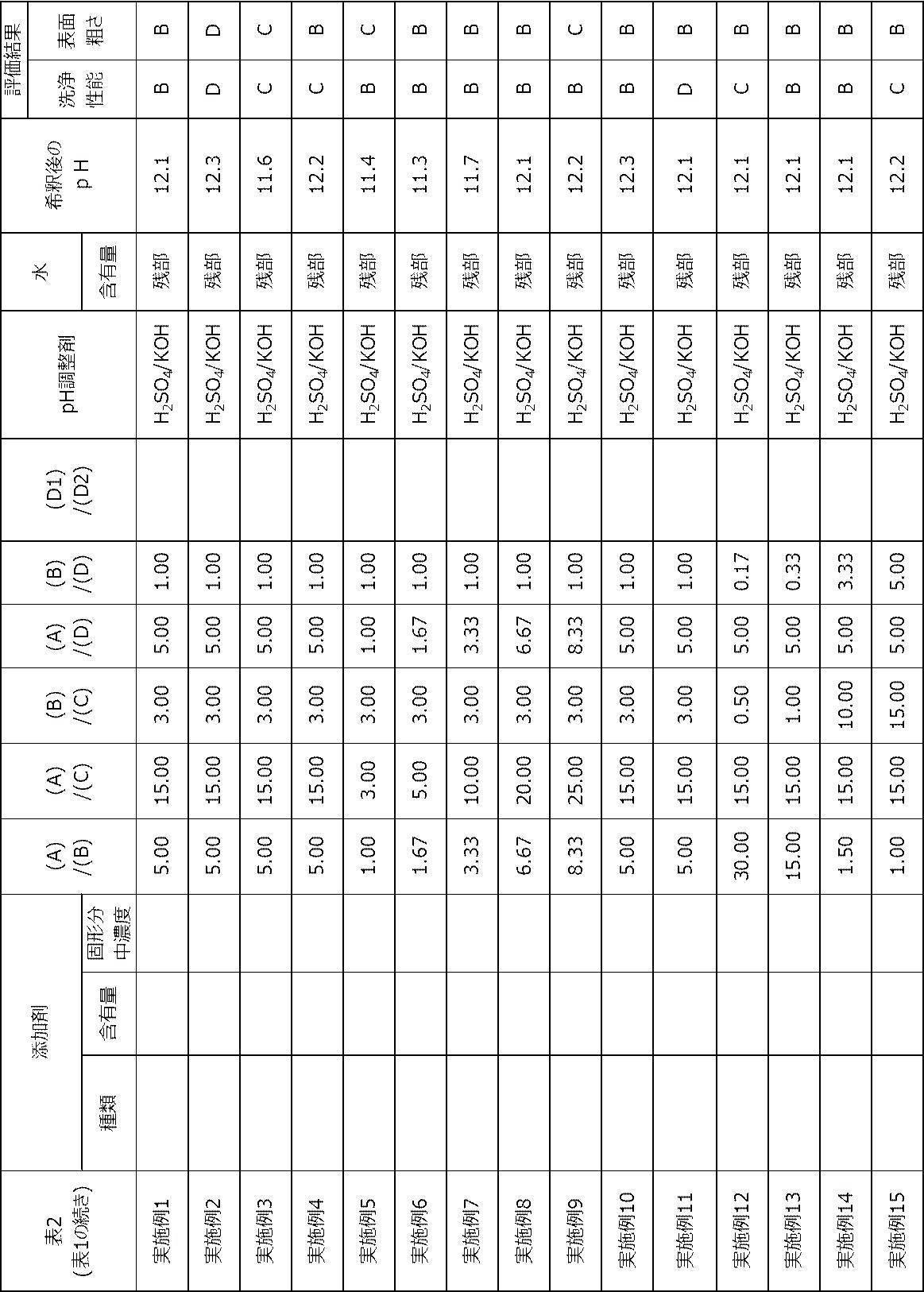

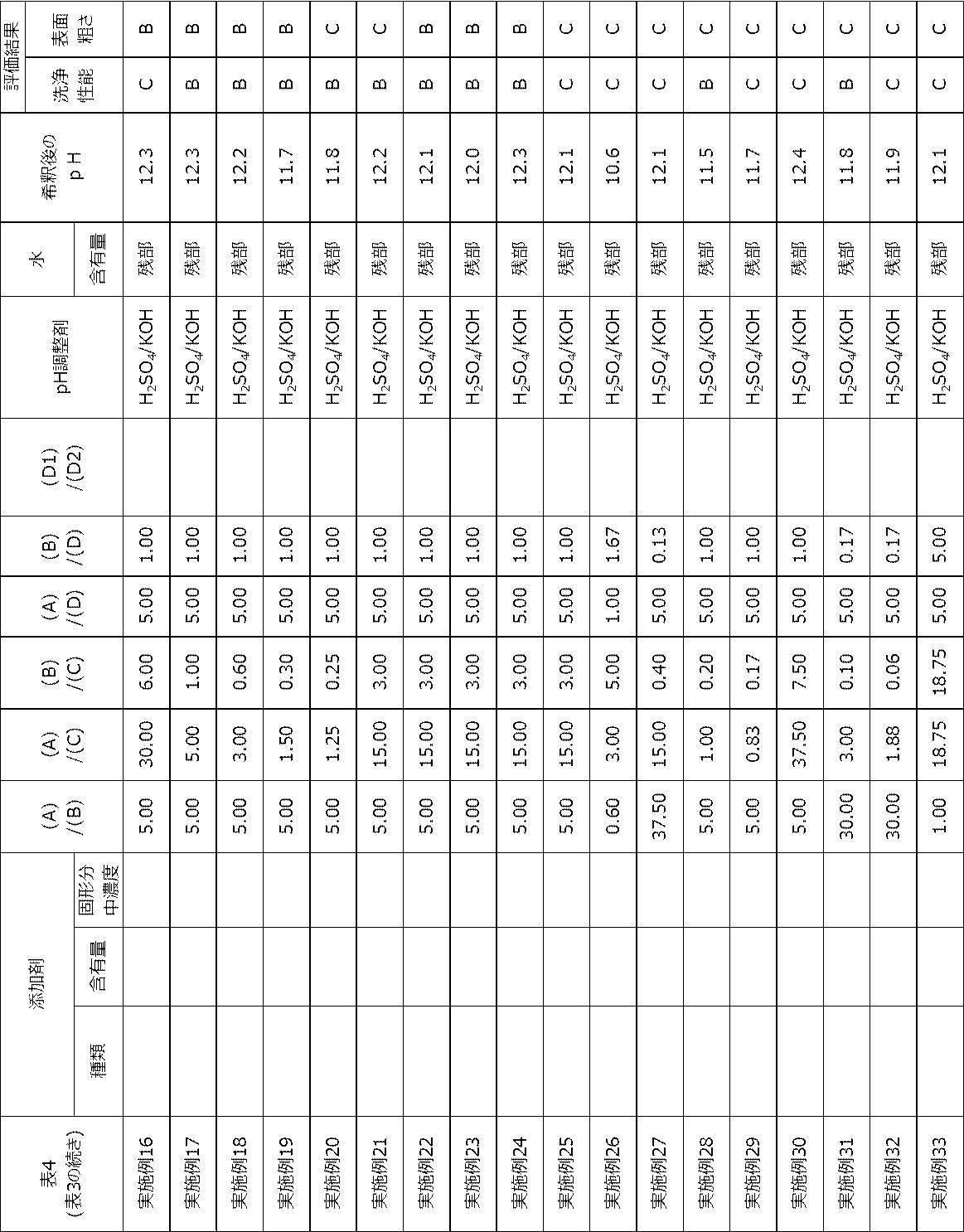
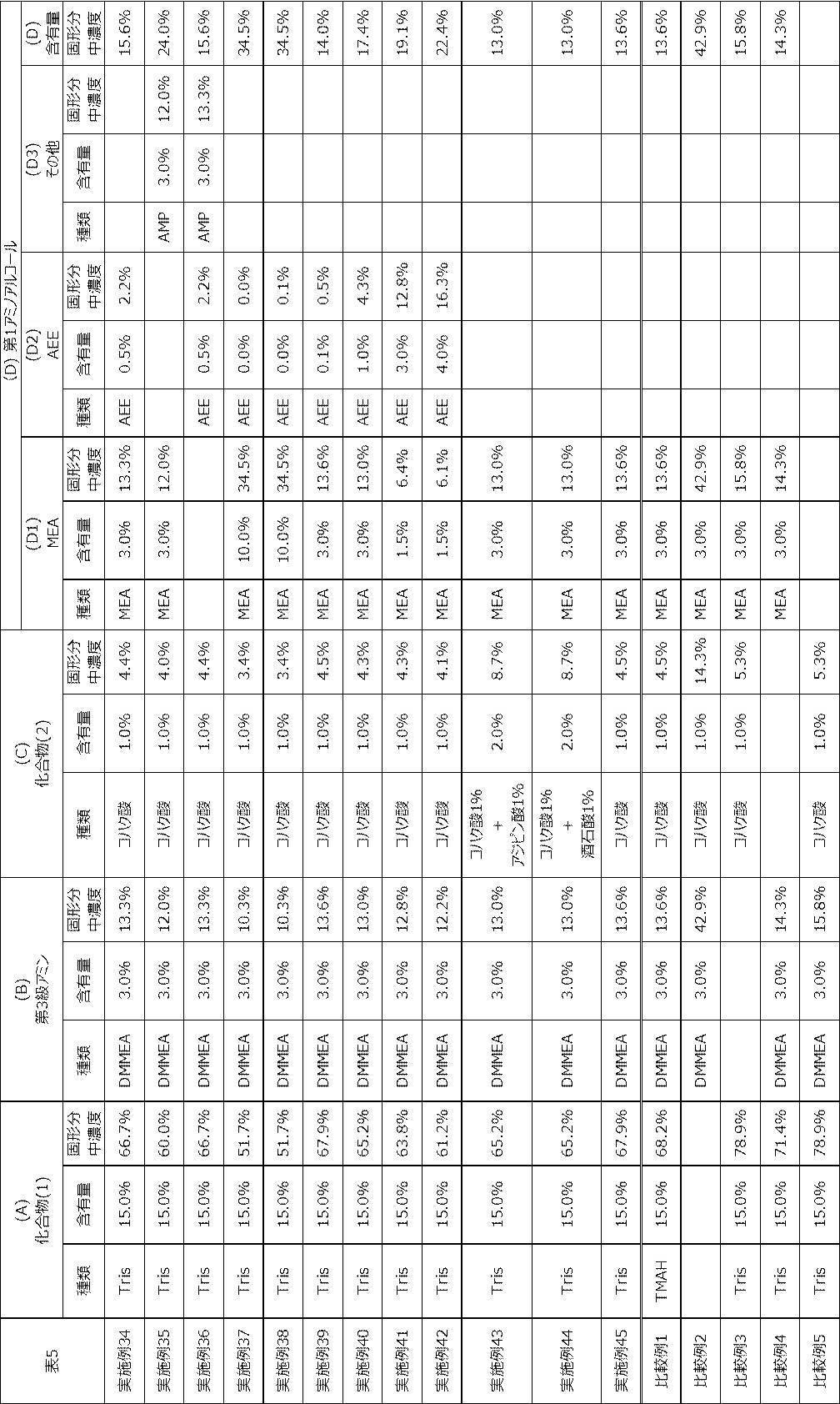
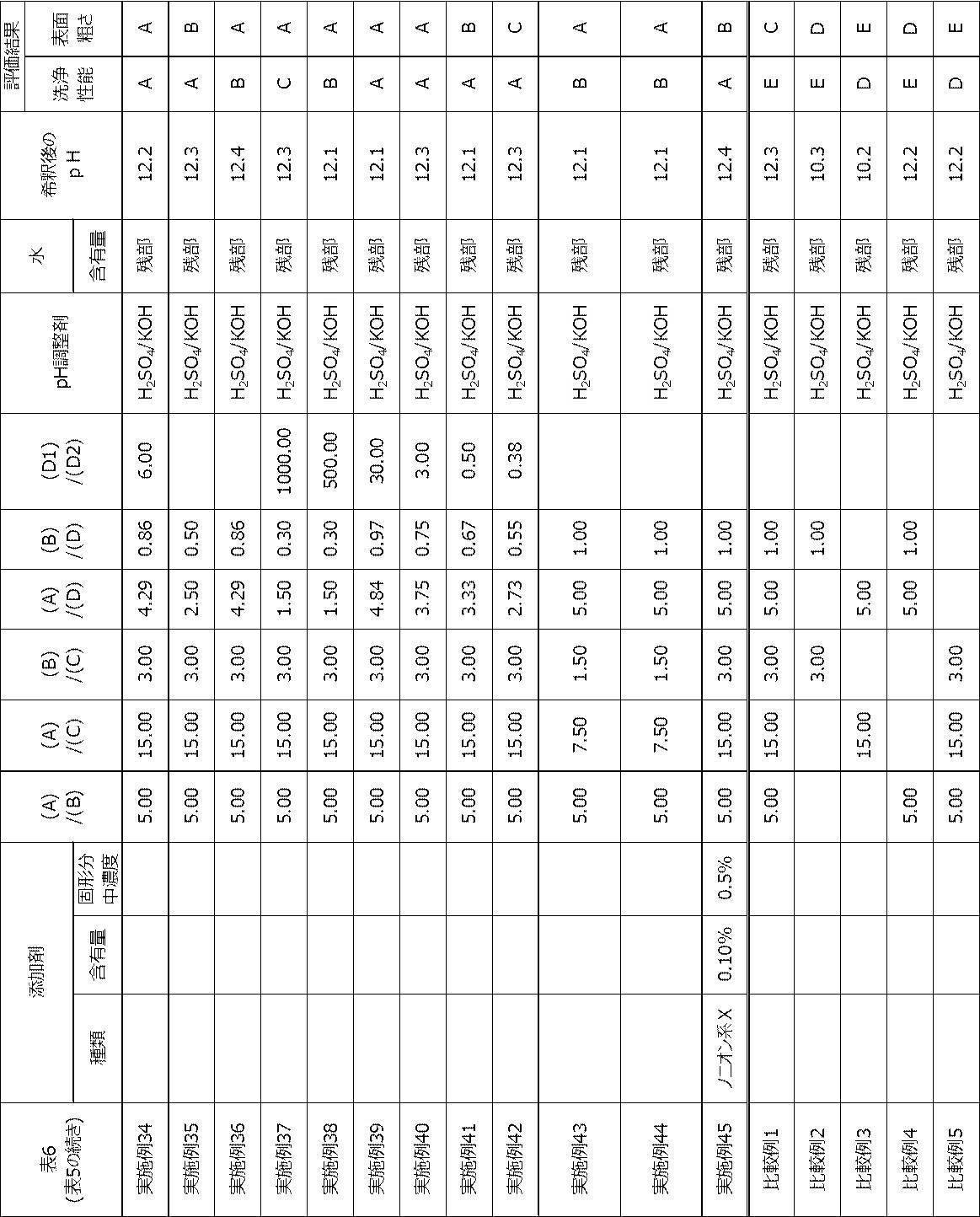
実施例1、3、及び4と、実施例2との比較から、式(1)中、R1~R4のうち少なくとも1つが、ヒドロキシアルキル基である場合、より効果が優れることが確認された。
実施例1及び4と、実施例2及び3との比較から、式(1)中、R1~R4のうち少なくとも2つが、ヒドロキシアルキル基である場合、より効果が優れることが確認された。
実施例1と、実施例2~4との比較から、式(1)で表される化合物が、トリス(2-ヒドロキシエチル)メチルアンモニウムヒドロキシドを含む場合、より効果が優れることが確認された。
実施例1及び10と、実施例11との比較から、第3級アミンが、第2アミノアルコールである場合、より効果が優れることが確認された。
実施例1と、実施例11との比較から、第3級アミンが、2-(ジメチルアミノ)エタノールを含む場合、より効果が優れることが確認された。
実施例5~9及び12~15と、実施例26及び27との比較から、第3級アミンの含有量に対する、式(1)で表される化合物の含有量の質量比((A)/(B))が、1.00~30.00である場合、より効果が優れることが確認された。
実施例1及び6~8と、実施例5及び9との比較から、第1アミノアルコールの含有量に対する、式(1)で表される化合物の含有量の質量比((A)/(D))が、1.50~7.00である場合、より効果が優れることが確認された。
実施例1及び13~14と、実施例12及び15との比較から、第1アミノアルコールの含有量に対する、第3級アミンの含有量の質量比((B)/(D))が、0.30~4.00である場合、より効果が優れることが確認された。
実施例34~36と、実施例1との比較から、第1アミノアルコールが、第1級アミノ基を有するアミノアルコール及び第2級アミノ基を有するアミノアルコールからなる群から選択される少なくとも2つを含む場合、より効果が優れることが確認された。
実施例34と、実施例35~36との比較から、第1アミノアルコールが、2-アミノエタノール及び2-(2-アミノエチルアミノ)エタノールを含む場合、より効果が優れることが確認された。
実施例34及び38~41と、実施例38及び41との比較から、第1アミノアルコールが、2-アミノエタノール及び2-(2-アミノエチルアミノ)エタノールを含み、2-(2-アミノエチルアミノ)エタノールの含有量に対する、2-アミノエタノールの含有量の質量比が、0.50~900.00である場合、より効果が優れることが確認された。
その後、室温(23℃)に調整した各希釈洗浄液のサンプルを用いて、バフ研磨処理が施されたウエハを30秒間かけて洗浄し、次いで、乾燥処理した。
得られたウエハの研磨面に対して、上述した〔洗浄性能の評価〕の評価試験方法に従って洗浄液の洗浄性能を評価したところ、上記の各実施例の洗浄液と同様の評価結果を示すことが確認された。
Claims (20)
- 半導体基板を洗浄するために用いられる半導体基板用洗浄液であって、
式(1)で表される化合物、式(2)で表される化合物、第1級アミノ基又は第2級アミノ基を有する第1アミノアルコール、第3級アミン、及び溶媒を含む、半導体基板用洗浄液。

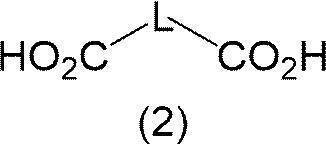
- 前記式(1)中、R1~R4のうち少なくとも1つが、ヒドロキシアルキル基である、請求項1に記載の半導体基板用洗浄液。
- 前記式(1)中、R1~R4のうち少なくとも2つが、ヒドロキシアルキル基である、請求項1又は2に記載の半導体基板用洗浄液。
- 前記式(1)で表される化合物が、トリス(2-ヒドロキシエチル)メチルアンモニウムヒドロキシドを含む、請求項1~3のいずれか1項に記載の半導体基板用洗浄液。
- 前記式(1)で表される化合物の含有量が、前記半導体基板用洗浄液から溶媒を除いた成分の全質量に対して、20.0~80.0質量%である、請求項1~4のいずれか1項に記載の半導体基板用洗浄液。
- 前記第3級アミンが、第3級アミノ基を有する第2アミノアルコールである、請求項1~5のいずれか1項に記載の半導体基板用洗浄液。
- 前記第3級アミンが、2-(ジメチルアミノ)エタノールを含む、請求項1~6のいずれか1項に記載の半導体基板用洗浄液。
- 前記第3級アミンの含有量が、前記半導体基板用洗浄液から溶媒を除いた成分の全質量に対して、3.0~35.0質量%である、請求項1~7のいずれか1項に記載の半導体基板用洗浄液。
- 前記式(2)で表される化合物の含有量が、前記半導体基板用洗浄液から溶媒を除いた成分の全質量に対して、2.0~50.0質量%である、請求項1~8のいずれか1項に記載の半導体基板用洗浄液。
- 前記第3級アミンの含有量に対する、前記式(1)で表される化合物の含有量の質量比が、1.00~30.00である、請求項1~9のいずれか1項に記載の半導体基板用洗浄液。
- 前記第1アミノアルコールの含有量に対する、前記式(1)で表される化合物の含有量の質量比が、1.50~7.00である、請求項1~10のいずれか1項に記載の半導体基板用洗浄液。
- 前記第1アミノアルコールの含有量に対する、前記第3級アミンの含有量の質量比が、0.30~4.00である、請求項1~11のいずれか1項に記載の半導体基板用洗浄液。
- 前記第1アミノアルコールの窒素数に対する、前記第1アミノアルコールの炭素数の比が、2~5である、請求項1~12のいずれか1項に記載の半導体基板用洗浄液。
- 前記第1アミノアルコールが、第1級アミノ基を有するアミノアルコール及び第2級アミノ基を有するアミノアルコールからなる群から選択される少なくとも2つを含む、請求項1~13のいずれか1項に記載の半導体基板用洗浄液。
- 前記第1アミノアルコールが、2-アミノエタノール及び2-(2-アミノエチルアミノ)エタノールからなる群から選択される少なくとも1つを含む、請求項1~13のいずれか1項に記載の半導体基板用洗浄液。
- 前記第1アミノアルコールが、2-アミノエタノール及び2-(2-アミノエチルアミノ)エタノールを含む、請求項1~15のいずれか1項に記載の半導体基板用洗浄液。
- 前記第1アミノアルコールが、2-アミノエタノール及び2-(2-アミノエチルアミノ)エタノールを含み、
前記2-(2-アミノエチルアミノ)エタノールの含有量に対する、前記2-アミノエタノールの含有量の質量比が、0.50~900.00である、請求項1~16のいずれか1項に記載の半導体基板用洗浄液。 - 前記溶媒が水を含む、請求項1~17のいずれか1項に記載の半導体基板用洗浄液。
- 前記半導体基板用洗浄液のpHが、8.0~13.0である、請求項1~18のいずれか1項に記載の半導体基板用洗浄液。
- 化学機械研磨処理が施された半導体基板に適用して洗浄するために用いられる、請求項1~19のいずれか1項に記載の半導体基板用洗浄液。
Priority Applications (3)
| Application Number | Priority Date | Filing Date | Title |
|---|---|---|---|
| JP2022536213A JP7509883B2 (ja) | 2020-07-14 | 2021-06-23 | 半導体基板用洗浄液 |
| KR1020237000488A KR102888184B1 (ko) | 2020-07-14 | 2021-06-23 | 반도체 기판용 세정액 |
| US18/152,889 US20230145012A1 (en) | 2020-07-14 | 2023-01-11 | Cleaning liquid for semiconductor substrate |
Applications Claiming Priority (2)
| Application Number | Priority Date | Filing Date | Title |
|---|---|---|---|
| JP2020-120677 | 2020-07-14 | ||
| JP2020120677 | 2020-07-14 |
Related Child Applications (1)
| Application Number | Title | Priority Date | Filing Date |
|---|---|---|---|
| US18/152,889 Continuation US20230145012A1 (en) | 2020-07-14 | 2023-01-11 | Cleaning liquid for semiconductor substrate |
Publications (1)
| Publication Number | Publication Date |
|---|---|
| WO2022014287A1 true WO2022014287A1 (ja) | 2022-01-20 |
Family
ID=79555297
Family Applications (1)
| Application Number | Title | Priority Date | Filing Date |
|---|---|---|---|
| PCT/JP2021/023811 Ceased WO2022014287A1 (ja) | 2020-07-14 | 2021-06-23 | 半導体基板用洗浄液 |
Country Status (5)
| Country | Link |
|---|---|
| US (1) | US20230145012A1 (ja) |
| JP (1) | JP7509883B2 (ja) |
| KR (1) | KR102888184B1 (ja) |
| TW (1) | TWI899276B (ja) |
| WO (1) | WO2022014287A1 (ja) |
Cited By (3)
| Publication number | Priority date | Publication date | Assignee | Title |
|---|---|---|---|---|
| WO2023189432A1 (ja) * | 2022-03-28 | 2023-10-05 | 富士フイルム株式会社 | 洗浄組成物、半導体基板の製造方法 |
| WO2024185373A1 (ja) * | 2023-03-08 | 2024-09-12 | 富士フイルム株式会社 | 組成物、半導体基板の洗浄方法、電子デバイスの製造方法 |
| WO2025005092A1 (ja) * | 2023-06-28 | 2025-01-02 | 富士フイルム株式会社 | 処理液、被対象物の処理方法、半導体デバイスの製造方法 |
Citations (2)
| Publication number | Priority date | Publication date | Assignee | Title |
|---|---|---|---|---|
| JP2006261432A (ja) * | 2005-03-17 | 2006-09-28 | Nissan Chem Ind Ltd | ヒドラジンを含む半導体用洗浄液組成物及び洗浄方法 |
| JP2018503723A (ja) * | 2015-01-05 | 2018-02-08 | インテグリス・インコーポレーテッド | 化学機械研磨後製剤および使用方法 |
Family Cites Families (2)
| Publication number | Priority date | Publication date | Assignee | Title |
|---|---|---|---|---|
| WO2005076332A1 (ja) * | 2004-02-09 | 2005-08-18 | Mitsubishi Chemical Corporation | 半導体デバイス用基板洗浄液及び洗浄方法 |
| JP2010174074A (ja) | 2009-01-27 | 2010-08-12 | Sanyo Chem Ind Ltd | 銅配線半導体用洗浄剤 |
-
2021
- 2021-06-23 JP JP2022536213A patent/JP7509883B2/ja active Active
- 2021-06-23 KR KR1020237000488A patent/KR102888184B1/ko active Active
- 2021-06-23 WO PCT/JP2021/023811 patent/WO2022014287A1/ja not_active Ceased
- 2021-07-07 TW TW110124880A patent/TWI899276B/zh active
-
2023
- 2023-01-11 US US18/152,889 patent/US20230145012A1/en active Pending
Patent Citations (2)
| Publication number | Priority date | Publication date | Assignee | Title |
|---|---|---|---|---|
| JP2006261432A (ja) * | 2005-03-17 | 2006-09-28 | Nissan Chem Ind Ltd | ヒドラジンを含む半導体用洗浄液組成物及び洗浄方法 |
| JP2018503723A (ja) * | 2015-01-05 | 2018-02-08 | インテグリス・インコーポレーテッド | 化学機械研磨後製剤および使用方法 |
Cited By (3)
| Publication number | Priority date | Publication date | Assignee | Title |
|---|---|---|---|---|
| WO2023189432A1 (ja) * | 2022-03-28 | 2023-10-05 | 富士フイルム株式会社 | 洗浄組成物、半導体基板の製造方法 |
| WO2024185373A1 (ja) * | 2023-03-08 | 2024-09-12 | 富士フイルム株式会社 | 組成物、半導体基板の洗浄方法、電子デバイスの製造方法 |
| WO2025005092A1 (ja) * | 2023-06-28 | 2025-01-02 | 富士フイルム株式会社 | 処理液、被対象物の処理方法、半導体デバイスの製造方法 |
Also Published As
| Publication number | Publication date |
|---|---|
| KR20230021714A (ko) | 2023-02-14 |
| JPWO2022014287A1 (ja) | 2022-01-20 |
| KR102888184B1 (ko) | 2025-11-19 |
| JP7509883B2 (ja) | 2024-07-02 |
| TWI899276B (zh) | 2025-10-01 |
| TW202202609A (zh) | 2022-01-16 |
| US20230145012A1 (en) | 2023-05-11 |
Similar Documents
| Publication | Publication Date | Title |
|---|---|---|
| JP7530969B2 (ja) | 処理液、化学的機械的研磨方法、半導体基板の処理方法 | |
| US12588450B2 (en) | Post-CMP cleaning liquid comprising a substituted benzene anticorrosive agent, chelant, and amine compound | |
| JP7850226B2 (ja) | 洗浄液、半導体基板の洗浄方法 | |
| JP7286806B2 (ja) | 洗浄液、洗浄方法 | |
| WO2020195343A1 (ja) | 洗浄液 | |
| JP7340614B2 (ja) | 洗浄方法 | |
| WO2022024714A1 (ja) | 半導体基板用洗浄液 | |
| JP7433418B2 (ja) | 半導体基板用洗浄液 | |
| US20230145012A1 (en) | Cleaning liquid for semiconductor substrate | |
| WO2021054010A1 (ja) | 洗浄液、洗浄方法 | |
| JP7220808B2 (ja) | 洗浄液、洗浄方法 | |
| JP7220809B2 (ja) | 洗浄液、洗浄方法 | |
| WO2021230127A1 (ja) | 洗浄液、半導体基板の洗浄方法 | |
| US12480072B2 (en) | Cleaning fluid and cleaning method | |
| JP2024018964A (ja) | 処理液、被対象物の処理方法、及び、半導体デバイスの製造方法 | |
| WO2022004217A1 (ja) | 処理液の製造方法 | |
| WO2025182542A1 (ja) | 半導体処理液、半導体デバイスの製造方法 |
Legal Events
| Date | Code | Title | Description |
|---|---|---|---|
| 121 | Ep: the epo has been informed by wipo that ep was designated in this application |
Ref document number: 21841721 Country of ref document: EP Kind code of ref document: A1 |
|
| ENP | Entry into the national phase |
Ref document number: 20237000488 Country of ref document: KR Kind code of ref document: A |
|
| ENP | Entry into the national phase |
Ref document number: 2022536213 Country of ref document: JP Kind code of ref document: A |
|
| NENP | Non-entry into the national phase |
Ref country code: DE |
|
| 122 | Ep: pct application non-entry in european phase |
Ref document number: 21841721 Country of ref document: EP Kind code of ref document: A1 |