WO2021256508A1 - 高分子水溶液凍結体の製造方法及び高分子多孔質体の製造方法 - Google Patents
高分子水溶液凍結体の製造方法及び高分子多孔質体の製造方法 Download PDFInfo
- Publication number
- WO2021256508A1 WO2021256508A1 PCT/JP2021/022867 JP2021022867W WO2021256508A1 WO 2021256508 A1 WO2021256508 A1 WO 2021256508A1 JP 2021022867 W JP2021022867 W JP 2021022867W WO 2021256508 A1 WO2021256508 A1 WO 2021256508A1
- Authority
- WO
- WIPO (PCT)
- Prior art keywords
- polymer
- gelatin
- freeze
- solution
- aqueous solution
- Prior art date
- Legal status (The legal status is an assumption and is not a legal conclusion. Google has not performed a legal analysis and makes no representation as to the accuracy of the status listed.)
- Ceased
Links
Images


Classifications
-
- A—HUMAN NECESSITIES
- A61—MEDICAL OR VETERINARY SCIENCE; HYGIENE
- A61L—METHODS OR APPARATUS FOR STERILISING MATERIALS OR OBJECTS IN GENERAL; DISINFECTION, STERILISATION OR DEODORISATION OF AIR; CHEMICAL ASPECTS OF BANDAGES, DRESSINGS, ABSORBENT PADS OR SURGICAL ARTICLES; MATERIALS FOR BANDAGES, DRESSINGS, ABSORBENT PADS OR SURGICAL ARTICLES
- A61L27/00—Materials for grafts or prostheses or for coating grafts or prostheses
- A61L27/14—Macromolecular materials
- A61L27/22—Polypeptides or derivatives thereof, e.g. degradation products
-
- C—CHEMISTRY; METALLURGY
- C07—ORGANIC CHEMISTRY
- C07K—PEPTIDES
- C07K14/00—Peptides having more than 20 amino acids; Gastrins; Somatostatins; Melanotropins; Derivatives thereof
- C07K14/435—Peptides having more than 20 amino acids; Gastrins; Somatostatins; Melanotropins; Derivatives thereof from animals; from humans
-
- C—CHEMISTRY; METALLURGY
- C07—ORGANIC CHEMISTRY
- C07K—PEPTIDES
- C07K14/00—Peptides having more than 20 amino acids; Gastrins; Somatostatins; Melanotropins; Derivatives thereof
- C07K14/435—Peptides having more than 20 amino acids; Gastrins; Somatostatins; Melanotropins; Derivatives thereof from animals; from humans
- C07K14/78—Connective tissue peptides, e.g. collagen, elastin, laminin, fibronectin, vitronectin or cold insoluble globulin [CIG]
-
- C—CHEMISTRY; METALLURGY
- C08—ORGANIC MACROMOLECULAR COMPOUNDS; THEIR PREPARATION OR CHEMICAL WORKING-UP; COMPOSITIONS BASED THEREON
- C08J—WORKING-UP; GENERAL PROCESSES OF COMPOUNDING; AFTER-TREATMENT NOT COVERED BY SUBCLASSES C08B, C08C, C08F, C08G or C08H
- C08J9/00—Working-up of macromolecular substances to porous or cellular articles or materials; After-treatment thereof
- C08J9/28—Working-up of macromolecular substances to porous or cellular articles or materials; After-treatment thereof by elimination of a liquid phase from a macromolecular composition or article, e.g. drying of coagulum
-
- C—CHEMISTRY; METALLURGY
- C12—BIOCHEMISTRY; BEER; SPIRITS; WINE; VINEGAR; MICROBIOLOGY; ENZYMOLOGY; MUTATION OR GENETIC ENGINEERING
- C12M—APPARATUS FOR ENZYMOLOGY OR MICROBIOLOGY; APPARATUS FOR CULTURING MICROORGANISMS FOR PRODUCING BIOMASS, FOR GROWING CELLS OR FOR OBTAINING FERMENTATION OR METABOLIC PRODUCTS, i.e. BIOREACTORS OR FERMENTERS
- C12M1/00—Apparatus for enzymology or microbiology
-
- C—CHEMISTRY; METALLURGY
- C09—DYES; PAINTS; POLISHES; NATURAL RESINS; ADHESIVES; COMPOSITIONS NOT OTHERWISE PROVIDED FOR; APPLICATIONS OF MATERIALS NOT OTHERWISE PROVIDED FOR
- C09D—COATING COMPOSITIONS, e.g. PAINTS, VARNISHES OR LACQUERS; FILLING PASTES; CHEMICAL PAINT OR INK REMOVERS; INKS; CORRECTING FLUIDS; WOODSTAINS; PASTES OR SOLIDS FOR COLOURING OR PRINTING; USE OF MATERIALS THEREFOR
- C09D127/00—Coating compositions based on homopolymers or copolymers of compounds having one or more unsaturated aliphatic radicals, each having only one carbon-to-carbon double bond, and at least one being terminated by a halogen; Coating compositions based on derivatives of such polymers
- C09D127/02—Coating compositions based on homopolymers or copolymers of compounds having one or more unsaturated aliphatic radicals, each having only one carbon-to-carbon double bond, and at least one being terminated by a halogen; Coating compositions based on derivatives of such polymers not modified by chemical after-treatment
- C09D127/12—Coating compositions based on homopolymers or copolymers of compounds having one or more unsaturated aliphatic radicals, each having only one carbon-to-carbon double bond, and at least one being terminated by a halogen; Coating compositions based on derivatives of such polymers not modified by chemical after-treatment containing fluorine atoms
- C09D127/18—Homopolymers or copolymers of tetrafluoroethene
-
- C—CHEMISTRY; METALLURGY
- C09—DYES; PAINTS; POLISHES; NATURAL RESINS; ADHESIVES; COMPOSITIONS NOT OTHERWISE PROVIDED FOR; APPLICATIONS OF MATERIALS NOT OTHERWISE PROVIDED FOR
- C09D—COATING COMPOSITIONS, e.g. PAINTS, VARNISHES OR LACQUERS; FILLING PASTES; CHEMICAL PAINT OR INK REMOVERS; INKS; CORRECTING FLUIDS; WOODSTAINS; PASTES OR SOLIDS FOR COLOURING OR PRINTING; USE OF MATERIALS THEREFOR
- C09D127/00—Coating compositions based on homopolymers or copolymers of compounds having one or more unsaturated aliphatic radicals, each having only one carbon-to-carbon double bond, and at least one being terminated by a halogen; Coating compositions based on derivatives of such polymers
- C09D127/02—Coating compositions based on homopolymers or copolymers of compounds having one or more unsaturated aliphatic radicals, each having only one carbon-to-carbon double bond, and at least one being terminated by a halogen; Coating compositions based on derivatives of such polymers not modified by chemical after-treatment
- C09D127/12—Coating compositions based on homopolymers or copolymers of compounds having one or more unsaturated aliphatic radicals, each having only one carbon-to-carbon double bond, and at least one being terminated by a halogen; Coating compositions based on derivatives of such polymers not modified by chemical after-treatment containing fluorine atoms
- C09D127/20—Homopolymers or copolymers of hexafluoropropene
Definitions
- the present invention relates to a method for producing a frozen polymer aqueous solution, and particularly to a method for producing a frozen product having low anisotropy at a high yield.
- Porous bodies made of biocompatible polymers such as collagen and gelatin are useful as materials for cell scaffolds, transplant members, tissue repair materials, etc.
- Patent Document 1 describes a method for producing a recombinant gelatin porous body. Has been described. Specifically, a method for producing a recombinant gelatin porous body by freeze-drying a recombinant gelatin aqueous solution poured into a cylindrical cup-shaped container is disclosed.
- the freeze-drying step for obtaining a polymer porous body from a polymer aqueous solution is simply a step of (1) freezing a polymer aqueous solution to obtain a polymer aqueous solution frozen body, and (2) a polymer. It consists of a step of sublimating water from a frozen aqueous solution.
- the polymer aqueous solution frozen body obtained in the step (1) above can be said to be an intermediate of the polymer porous body, and by controlling the manufacturing process of the polymer aqueous solution frozen body, the structural of the polymer porous body is controlled. It may be possible to improve uniformity.
- Patent Document 2 describes, as a part of the method for producing a polymer porous body, a method for producing a polymer aqueous solution frozen body in which the temperature difference in the polymer aqueous solution at the time of freezing is set to a constant value or less. It is also disclosed that the polymer porous body thus obtained has high structural uniformity. There is a need for a new method for producing a frozen polymer aqueous solution that can be used in place of or in combination with such a method.
- An object of the present invention is a production method for obtaining a polymer aqueous solution frozen body having high structural uniformity (low anisotropy) at a high yield, and production of a polymer porous body using the polymer aqueous solution frozen body. Is to provide a method.
- the present inventors have made the surface of the liquid container used at the time of freezing in contact with the solution a tetrafluoroethylene / hexafluoropropylene copolymer (FEP), which is anisotropic.
- FEP tetrafluoroethylene / hexafluoropropylene copolymer
- a method for producing a frozen polymer-containing aqueous solution which comprises a step of freezing the aqueous polymer solution in a liquid container whose surface in contact with the solution is FEP [2].
- the production method according to [1], wherein the polymer aqueous solution is not freeze-dried until the frozen polymer-containing aqueous solution is produced.
- a method for producing a polymer porous body which comprises a step of further removing water from the polymer aqueous solution frozen body obtained by the production method according to any one of [1] to [8].
- a manufacturing method for obtaining a frozen polymer aqueous solution having low anisotropy at a high yield there is provided a manufacturing method for obtaining a frozen polymer aqueous solution having low anisotropy at a high yield.
- process is included in this term not only as an independent process but also as long as the desired effect of this process is achieved even if it cannot be clearly distinguished from other processes. ..
- the amount of each component in the composition is the total amount of the plurality of substances present in the composition, unless otherwise specified, when a plurality of substances corresponding to each component are present in the composition. Means.
- amino acid sequence of a polypeptide is expressed in one-letter notation (eg, "G” for glycine residues) or three-letter notation (eg, "Gly” for glycine residues) well known in the art. May be expressed.
- % regarding the amino acid sequence of a polypeptide is based on the number of amino acid (or imino acid) residues unless otherwise specified.
- identity regarding the amino acid sequences of the two polypeptides to be contrasted refers to a value calculated by the following formula.
- the contrast (alignment) of a plurality of polypeptides shall be carried out according to a conventional method so that the number of identical amino acid residues is the largest.
- Identity (%) [(number of amino acid residues that are the same) / (alignment length) ⁇ ⁇ 100
- the polymer is a molecule having a large molecular weight, and refers to a molecule having a structure composed of a large number of repetitions of a unit obtained substantially or conceptually from a molecule having a small molecular weight.
- polyamines, celluloses, amylose, starches, chitins, polypeptides, proteins, DNA, RNA and the like can be mentioned.
- the macromolecules are preferably water soluble, more preferably polypeptides and proteins. Of the polypeptides and proteins, collagen and gelatin are particularly preferred.
- the hydrophilic repeating unit ratio in the polymer is preferably 50% or less, more preferably 30% or less. If the hydrophilic unit ratio is higher than this, the free water around the polymer is reduced and freezing is hindered.
- the hydrophilic repeating unit ratio means the ratio of the repeating unit having an ionic group and / or a hydroxyl group in the polymer.
- the above gelatin means a polypeptide containing 6 or more consecutive sequences represented by Gly-XY, and has 1 or more other amino acid residues in the polypeptide in addition to the sequence represented by Gly-XY. You may be doing it.
- the sequence represented by Gly-XY is a sequence corresponding to the amino acid sequence derived from the partial amino acid sequence of collagen, and the repetition of this sequence means a sequence characteristic of collagen.
- the plurality of Gly-XY may be the same or different from each other. Further, X and Y in the Gly-XY sequence are independent for each repetition unit, and may be the same or different.
- Gly-XY Gly represents a glycine residue
- X and Y represent any amino acid residue other than the glycine residue. It is preferable that X and Y contain a large amount of imino acid residues, that is, proline residues or oxyproline residues.
- the content of such imino acid residues is preferably 10% to 45% of the total gelatin.
- the content of Gly-XY in the gelatin is preferably 80% or more, more preferably 95% or more, and most preferably 99% or more.
- the gelatin may be a natural type or a mutant type in which at least one amino acid residue is different from the natural type.
- the natural gelatin means a gelatin made from naturally occurring collagen or a polypeptide having the same amino acid sequence as gelatin made from naturally occurring collagen. Unless otherwise specified, mutant or recombinant gelatin is generically referred to as recombinant gelatin in the present specification.
- Examples of the natural gelatin or its recombinant gelatin include those derived from animals such as fish and mammals, and the natural gelatin of mammals or its recombinant gelatin is preferable. Examples of the mammalian animal include humans, horses, pigs, mice, rats and the like, and humans or pigs are more preferable.
- the natural gelatin is preferably derived from pig or human, and the recombinant gelatin is preferably derived from human.
- the gelatin has one or more bases or amino acid residues with respect to the base sequence or amino acid sequence of the gene encoding the collagen having 6 or more consecutive sequences represented by Gly-XY. It is preferable that the recombinant gelatin is obtained by introducing the modified base sequence or amino acid sequence into an appropriate host by a conventional method and expressing it.
- the ability to repair (bone) tissue can be enhanced, and various properties can be exhibited as compared with the case of using natural gelatin. For example, inconveniences such as rejection by a living body can be exhibited. It has advantages such as avoiding various influences.
- the recombinant gelatin examples include EP1014176A2, US6992172, WO2004 / 85473, WO2008 / 103041, Special Table 2010-591293, Special Table 2010-591952, Special Table 2010-518833, Special Table 2010-519251, WO2010 / 128672 and WO2010. Those disclosed in / 147109 and the like can be particularly preferably used. Further, the recombinant gelatin preferably has a molecular weight of 2 kDa or more and 100 kDa or less, more preferably 5 kDa or more and 90 kDa or less, and more preferably 10 kDa or more and 90 kDa or less.
- the recombinant gelatin preferably further contains a cell adhesion signal, and the recombinant gelatin may have two or more cell adhesion signals in one molecule.
- cell adhesion signals include RGD sequence, LDV sequence, REDV sequence, YIGSR sequence, PDSGR sequence, RYVVLPR sequence, LGTIPG sequence, RNIAEIIKDI sequence, IKVAV sequence, LRE sequence, DGEA sequence, and HAV sequence.
- the RGD sequence, the YIGSR sequence, the PDSGR sequence, the LGTIPG sequence, the IKVAV sequence and the HAV sequence can be mentioned, and the RGD sequence is particularly preferable.
- the ERGD sequence is more preferable.
- the number of amino acid residues between RGDs is preferably 0 to 100, more preferably 25 to 60. Further, it is preferable that the RGD sequence is non-uniformly arranged within the range of the number of amino acid residues.
- the ratio of the RGD sequence to the total number of amino acid residues in the recombinant gelatin is preferably at least 0.4%, and when the recombinant gelatin contains 350 or more amino acid residues, each of the 350 amino acid residues. It is preferred that the stretch comprises at least one RGD sequence.
- the recombinant gelatin preferably contains at least 2 RGD sequences per 250 amino acid residues, more preferably contains at least 3 RGD sequences, and even more preferably contains at least 4 RGD sequences.
- the sequence of the recombinant gelatin is preferably in the following embodiments: (1) contains no serine residue and threonine residue, (2) serine residue, threonine residue, asparagine residue, tyrosine residue. It does not contain a group and a cysteine residue, and (3) does not contain the amino acid sequence represented by Asp-Arg-Gly-Asp.
- the recombinant gelatin may be provided alone with the embodiments (1) to (3) of this preferred sequence, or may be provided with a combination of two or more embodiments. Further, the recombinant gelatin may be partially hydrolyzed.
- the recombinant gelatin preferably has a repeating structure of A-[(Gly-XY) n] m-B.
- m represents 2 to 10 and preferably represents 3 to 5.
- a and B represent any amino acid or amino acid sequence.
- n represents 3 to 100, preferably 15 to 70, and more preferably 50 to 60.
- the recombinant gelatin has the formula: Gly-Ala-Pro-[(Gly-XY) 63] 3-Gly (in the formula, 63 Xs each independently represent one of the amino acid residues. Each of the 63 Ys independently indicates one of the amino acid residues. The three (Gly-XY) 63s may be the same or different from each other).
- the naturally occurring collagen referred to here preferably includes type I, type II, type III, type IV and type V. More preferably, it can be type I, type II or type III.
- the origin of collagen humans, horses, pigs, mice and rats can be preferably mentioned, and humans are more preferable.
- the isoelectric point of the recombinant gelatin is preferably 5 to 10, more preferably 6 to 10, and even more preferably 7 to 9.5.
- Preferred embodiments of the recombinant gelatin include: (1) the carbamoyl group is not hydrolyzed, (2) it does not have procollagen, (3) it does not have telopeptide. (4) A substantially pure collagen material prepared from a nucleic acid encoding natural collagen.
- the recombinant gelatin may be provided alone with the preferred embodiments (1) to (4), or may be provided with a combination of two or more embodiments.
- the recombinant gelatin can be preferably any of the following (A) to (C) because of its high (bone) tissue repair ability.
- A The polypeptide represented by SEQ ID NO: 1 below, GAP (GAPGLQGAPGLQGMPGERGAAGLPGPKGERGDAGPKGADGAPGAPGLQGMPGERGAAGLPGPKGERGDAGPKGADGAPGKDGVRGLAGPIGPPGERGAAGLPGPKGERGDAGPKGADGAPGKDGVRGLAGPIGPPGPAGAPGAPGLQGMPGERGAAGLPKGER (B)
- GAP GAPGLQGAPGLQGMPGERGAAGLPGPKGERGDAGPKGADGAPGAPGLQGMPGERGAAGLPGPKGERGDAGPKGADGAPGKDGVRGLAGPIGPPGERGAAGLPGPKGERGDAGPKGADGAPGKDGVRGLAGPIGPPGPAGAPGAPGLQGMPGERGAAGLPKGER
- B Among the amino acid sequences of (A) above, it has
- sequence identity in (B) above can be more preferably 90% or more, still more preferably 95% or more, from the viewpoint of the (bone) tissue repair ability of recombinant gelatin.
- the partial amino acid sequence in the sequence (B) is a partial amino acid sequence corresponding to the repeating unit of the sequence shown in SEQ ID NO: 1.
- the polypeptide of (B) has a plurality of partial amino acid sequences corresponding to the repeating units, the polypeptide contains one repeating unit, preferably two or more, having a sequence identity of 80% or more. be able to.
- the total number of amino acid residues is the total number of amino acid residues, with the partial sequence having 80% or more sequence identity with the partial amino acid sequence corresponding to the repeating unit. It is preferable to contain 80% or more of the above.
- the length of the polypeptide defined in (B) above can be 151 to 2260 amino acid residues, and from the viewpoint of degradability after cross-linking, 193 or more, from the viewpoint of stability.
- the number of amino acid residues is preferably 944 or less, and more preferably 380 to 756 amino acid residues.
- polypeptide defined by the above (C) consists of an amino acid sequence in which one or several amino acid residues are deleted, substituted or added to the amino acid sequence of the above (A), and has a tissue repairing ability. It may be a polypeptide having.
- the number of amino acid residues deleted, substituted or added in the polypeptide defined in (C) above may be one or several, and varies depending on the total number of amino acid residues of the recombinant gelatin, for example. It can be 2, 15 pieces, preferably 2 to 5 pieces.
- the recombinant gelatin can be produced by a gene recombination technique known to those skilled in the art, and can be produced according to the method described in, for example, EP1014176A2, US6992172, WO2004 / 85473, WO2008 / 103041 and the like. Specifically, a gene encoding a predetermined recombinant gelatin amino acid sequence is obtained, this is incorporated into an expression vector to prepare a recombinant expression vector, and this is introduced into an appropriate host to prepare a transformant. do. Recombinant gelatin is produced by culturing the obtained transformant in an appropriate medium. Therefore, the recombinant gelatin used in the present invention is prepared by recovering the recombinant gelatin produced from the culture. be able to.
- the polymer aqueous solution is an aqueous solution containing one or more kinds of polymers.
- the polymer concentration in the water-soluble polymer is preferably 0.1 wt% or more, more preferably 1 wt% or more, and particularly preferably 5 wt% or more. If the concentration is lower than 0.1 wt%, it is difficult to maintain the structure of the polymer porous body after removing water.
- the aqueous polymer solution is preferably gelled at a freezing temperature or higher.
- the upper limit of the polymer concentration in the aqueous polymer solution is not particularly limited as long as the polymer can be dissolved, but is generally 40 wt% or less, and may be 30 wt% or less, or 20 wt% or less.
- the polymer aqueous solution is prepared by purifying and concentrating the solution containing the polymer, or by dissolving the dried polymer in an aqueous medium.
- (1) Business adjustments may be made, or (2) pre-adjusted ones may be prepared and used.
- (3) The polymer aqueous solution may be prepared by freeze-drying the polymer aqueous solution obtained by purification and concentration, and adding an aqueous medium to the obtained freeze-dried body to redissolve.
- the polymer aqueous solution obtained by purification and concentration may be frozen, and the obtained frozen product may be thawed to prepare the polymer aqueous solution.
- the frozen body is preferably thawed at 30 to 40 ° C.
- the method (4) above is preferable from the viewpoint of reducing the labor of adjusting errands, convenience of transportation and storage, and reduction of air bubbles and insoluble matter in the aqueous polymer solution.
- air bubbles and insoluble matter dispersed in the aqueous polymer solution by filtration, centrifugation, decompression, defoaming, etc. before the freezing step. This improves the yield of the frozen polymer aqueous solution with low anisotropy.
- the removal of air bubbles and insoluble matter can be evaluated by turbidity measurement. Alternatively, it can be evaluated by visual inspection with an optical microscope. For example, the number of bubbles and unnecessary substances reflected in the field of view of an optical microscope can be calculated and evaluated by the number of bubbles and insoluble substances in 1 ⁇ L of the polymer aqueous solution.
- the number of bubbles and insoluble matter in the aqueous polymer solution is preferably 0.5 cells / ⁇ L or less, more preferably 0.3 cells / ⁇ L or less, and further preferably 0.1 cells / ⁇ L or less. It is preferably 0 pieces / ⁇ L, and particularly preferably 0 pieces / ⁇ L.
- a component other than the polymer may be added to the aqueous polymer solution for the purpose of adding predetermined characteristics.
- examples of such other components include components related to bone regeneration or bone renewal such as bone-inducing agents.
- the bone-inducing agent include BMP (bone morphogenetic factor) and bFGF (basic fibroblast growth factor), but are not particularly limited.
- Other examples include cross-linking agents for polypeptides or proteins.
- the aqueous medium of the aqueous polymer solution is not particularly limited as long as it can dissolve the polymer and can be used for living tissues.
- aqueous medium of the aqueous polymer solution is not particularly limited as long as it can dissolve the polymer and can be used for living tissues.
- water, physiological saline, phosphate buffer, etc. The ones that can be normally used can be mentioned in.
- the gelatin concentration in the gelatin solution may be any concentration as long as the gelatin can be dissolved, and there is no particular limitation.
- the gelatin concentration in the gelatin solution is, for example, preferably 0.5% by mass to 20% by mass, more preferably 2% by mass to 16% by mass, and 4% by mass to 12% by mass. More preferred.
- the gelatin solution may be defoamed before the freezing step. This makes it possible to facilitate uniform formation of ice crystals.
- the defoaming method is not particularly limited, but for example, vacuum centrifugal defoaming can be performed at a pressure of 2 to 10 kPa.
- the gelatin solution may be filtered to remove undissolved particles.
- the filtration method is not particularly limited, but for example, pressure filtration is performed using a filter having a pore size of 0.22 to 0.45 ⁇ m.
- the material of the filter is not particularly limited, and polytetrafluoroethylene, polyether sulfone, cellulose acetate, polyvinylidene fluoride, etc. can be used, but cellulose acetate is used from the viewpoint of low gelatin adsorption and low elution. Is preferable.
- the temperature at which the gelatin solution is prepared is not particularly limited, and may be a commonly used temperature, for example, 0 ° C to 60 ° C, preferably about 3 ° C to 40 ° C.
- the liquid container means a container for containing a polymer aqueous solution and cooling / freezing.
- the shape of the container include a dish shape, a cylindrical cup shape, and a substantially rectangular parallelepiped shape.
- a cylindrical cup shape or a substantially rectangular parallelepiped shape is preferable.
- the substantially rectangular parallelepiped container is a container having one bottom surface having a substantially rectangular plane shape and four side surfaces having a substantially rectangular parallelepiped shape, one in the front-rear direction and one in the left-right direction.
- the substantially rectangular parallelepiped container may be integrally formed, or the side surface and the bottom surface, and the corner portion connecting the side surfaces may be chamfered.
- the inside of the container does not have a high curvature. Specifically, it is preferably R1 mm or more, and more preferably R2 mm or more (R means a radius of curvature).
- the size of the container is not particularly limited, but in the case of a cylindrical cup-shaped container, the inner diameter is preferably 200 mm or less, and more preferably 150 mm or less. In the case of a substantially rectangular parallelepiped container, the internal dimensions are preferably 200 mm (length) x 200 mm (width) x 60 mm (depth) or less, and 150 mm (length) x 150 mm (width) x 45 mm (depth) or less. It is more preferable to have.
- the liquid container can contain a heat transfer body.
- the heat transfer body is an object provided integrally with the container on the bottom surface or the inner side surface of the container, and is preferably provided perpendicular to the bottom surface of the container.
- Examples of the shape of the heat transfer body include a plate shape and a rod shape, and a plate shape is preferable.
- the material of the heat transfer body is not particularly limited as long as the thermal conductivity at 0 ° C. is 5 W / m ⁇ K or more, and for example, aluminum, gold, silver, copper, iron, and alloys thereof (for example, an aluminum alloy (for example, an aluminum alloy (for example)).
- A5052) stainless steel and the like aluminum or an alloy thereof is preferable.
- the liquid container may be coated with the same or different member (coating member) as the member constituting the liquid container on the inner surface of the liquid container. Further, a cover member made of the same or different member as the member constituting the liquid container may be spread on the inner surface of the liquid container, or a cylindrical cover member may be installed.
- the member constituting the liquid container is also referred to as the main member of the liquid container.
- the heat transfer element is also the main member of the liquid container. The combination of the main member, the coat member, and the cover member of the liquid container does not matter.
- the liquid container includes (1) only the main member of the liquid container, (2) the main member and the coat member of the liquid container, (3) the main member and the cover member of the liquid container, and (4) the main member and the coat of the liquid container. Any combination of the member and the cover member may be used.
- the inner surface of the liquid container is a tetrafluoroethylene / hexafluoropropylene copolymer (also referred to as perfluoroethylene propene copolymer) (FEP).
- FEP perfluoroethylene propene copolymer
- the material of the main member of the liquid container is not particularly limited, and examples thereof include aluminum or an alloy thereof.
- the main member of the liquid container is FEP.
- the material of the main member of the liquid container preferably has a coefficient of linear expansion (also referred to as a coefficient of thermal expansion) of 10 ⁇ 10 -5 / K or less, more preferably 50 ⁇ 10 -6 / K or less, 25. It is particularly preferable that it is ⁇ 10 -6 / K or less.
- the cover member may be uniformly spread on the inner surface of the container, and there is no limitation on the shape and thickness of the cover member.
- the cover member When the cover member is in contact with the aqueous polymer solution, the cover member is FEP.
- the coating member may be uniformly coated on the inner surface of the container, and the thickness of the coating film is not limited.
- the coating film is preferably 20 ⁇ m or more, and more preferably 50 ⁇ m or more. When the coated member is in contact with the aqueous polymer solution, the coated member is FEP.
- the freezing step refers to a step of freezing a polymer aqueous solution contained in a liquid container.
- the freezing means is not particularly limited, and for example, it may be frozen in a device such as a refrigerator or a freeze-dryer. When freezing with a freeze-dryer, it is possible to continuously remove water from the frozen polymer aqueous solution (freeze-drying) with the same device.
- the temperature of the freezing process varies depending on the type of polymer and the concentration of the aqueous polymer solution, but it is the temperature of the hottest part of the solution immediately before the heat of solidification and the temperature of the coldest part of the solution.
- the difference is preferably 2.5 ° C. or less.
- the "temperature difference immediately before the heat of solidification” means the temperature difference when the temperature difference becomes the largest between 1 second and 10 seconds before the heat of solidification.
- the temperature of the portion having the lowest liquid temperature in the solution is preferably ⁇ 8 ° C. or lower, more preferably ⁇ 10 ° C. or lower, and particularly preferably ⁇ 15 ° C. or higher.
- the frozen polymer aqueous solution means a frozen polymer obtained by freezing the aqueous polymer solution.
- the "anisotropic" of the frozen polymer aqueous solution in the present invention means the physical properties measured as follows. After the frozen polymer aqueous solution is freeze-dried, the vicinity of the center of the freeze-dried polymer (porous polymer) is cut horizontally and vertically. Next, each cross section is stained, and a constant (2.0 mm ⁇ 2.0 mm or 2.5 mm ⁇ 2.5 mm) region is observed with an optical microscope. Among the rectangles circumscribing the area surrounded by the dyed material in the observation area, the circumscribed rectangle that maximizes the distance between the two opposite sides of the rectangle is selected.
- the length of the long side of the circumscribing rectangle that maximizes the distance between the two opposite sides is measured by 50 pieces in each observation area in each of the horizontal cross section and the vertical cross section, and the average thereof is the frozen body.
- the yield of the frozen polymer aqueous solution with low anisotropy is preferably 90% or more from the viewpoint of production efficiency.
- the water removal step refers to a step of removing water from a frozen polymer aqueous solution.
- the means for removing water is not particularly limited, and there are a method of melting ice in a frozen polymer aqueous solution, a method of sublimating (freeze-drying), and the like, and freeze-drying is preferable.
- the freeze-drying period can be, for example, 0.5 hours to 300 hours. There are no particular restrictions on the lyophilizer that can be used.
- the polymer porous body means a porous block made of a polymer.
- a polymer porous body can be obtained by removing water from the frozen polymer aqueous solution.
- the polymer porous body can be further processed into granules of various sizes by further crushing, cross-linking, etc., and used as a cell scaffold, a member for transplantation, a tissue repair material, or the like.
- the polymer porous body obtained from the polymer aqueous solution frozen body produced by the production method of the present invention has high structural uniformity and is suitable as a material for cell scaffolds, transplant members, tissue repair materials and the like.
- the polymer porous body is pulverized to obtain a pulverized product.
- a crusher such as a hammer mill or a screen mill can be applied, and since it is recovered from crushed to a certain size at any time, the variation in the particle size distribution between tests is small.
- a quadro-manufactured combil is preferable.
- a cutting method is preferable to a crushing method in order to maintain the structure of the surface of the crushed material. Further, in order to maintain the structure inside the granules, it is preferable to use a method in which strong compression is not applied during pulverization.
- the pulverized product obtained by pulverizing the polymer porous body can be contained in the tissue repair material as polymer granules.
- a classification step can be included for the purpose of sizing. Thereby, a polymer pulverized product having a uniform particle size can be obtained. For example, it is preferable to use a sieve having an opening of 300 ⁇ m to 1400 ⁇ m for classifying the pulverized gelatin product.
- the pulverization step can be followed by a step of filling the vial with the pulverized material.
- the filling method of the pulverized gelatin product is not particularly limited, but a mass feedback type table feeder can be used.
- the vial filled with the pulverized gelatin is not particularly limited, and for example, a glass vial whose inner surface is silicone-processed can be used.
- Crosslinking process After the pulverization step, it is preferable to include a crosslinking step of crosslinking the polymer in the obtained pulverized product.
- a crosslinking method known methods such as thermal cross-linking, cross-linking with an enzyme, cross-linking using various chemical cross-linking agents, and UV cross-linking can be used.
- the cross-linking method is preferably cross-linking using a chemical cross-linking agent or thermal cross-linking.
- cross-linking covalent bond
- those having a higher-order structure by at least one of hydrophobic interaction, hydrogen bond, and ionic interaction are also preferable.
- the enzyme When cross-linking with an enzyme, the enzyme is not particularly limited as long as it has a cross-linking action between biodegradable materials, but cross-linking is preferably performed using transglutaminase and laccase, and most preferably transglutaminase. can.
- the mixing temperature with gelatin when treated with a cross-linking agent such as an aldehyde or a condensing agent is not particularly limited as long as the solution can be uniformly stirred, but is preferably 0 ° C. It is ⁇ 40 ° C., more preferably 0 ° C. to 30 ° C., more preferably 3 ° C. to 25 ° C., more preferably 3 ° C. to 15 ° C., still more preferably 3 ° C. to 10 ° C. Particularly preferably, it is 3 ° C to 7 ° C.
- the temperature can be raised.
- the reaction temperature is not particularly limited as long as cross-linking proceeds, but is substantially 0 ° C. to 60 ° C., more preferably in consideration of denaturation and decomposition of gelatin. It is 0 ° C. to 40 ° C., more preferably 3 ° C. to 25 ° C., more preferably 3 ° C. to 15 ° C., further preferably 3 ° C. to 10 ° C., and particularly preferably 3 ° C. to 7 ° C. be.
- the chemical cross-linking agent may be added to the aqueous polymer solution to carry out the cross-linking before the drying step.
- the crosslinking temperature applied to the thermal crosslinking method is preferably 100 ° C. to 200 ° C., more preferably 120 ° C. to 170 ° C., and even more preferably 130 ° C. to 160 ° C.
- the treatment time for thermal cross-linking varies depending on the cross-linking temperature, the type of polymer, and the degree of degradability to be maintained.
- the thermal cross-linking conditions when CBE3 used in the examples described later as human-derived recombinant gelatin is used are as follows.
- the actual temperature is about 135 ° C., it is preferably 2 hours to 20 hours, more preferably 3 hours to 18 hours, and even more preferably 4 hours to 8 hours.
- the thermal cross-linking treatment is preferably carried out under reduced pressure or vacuum or under an inert gas atmosphere from the viewpoint of preventing oxidation.
- the degree of decompression is preferably 4 hPa or less.
- Nitrogen or argon is preferable as the inert gas, and cross-linking under an inert gas atmosphere is preferable from the viewpoint of uniform heating.
- the heating means is not particularly limited, and examples thereof include a vacuum oven such as DP-43 manufactured by Yamato Scientific Co., Ltd.
- the pulverized product after thermal cross-linking may be stored in a container.
- the container is not particularly limited, and for example, a glass vial sealed with a rubber stopper and an aluminum cap can be used.
- the size of the glass vial is not particularly limited.
- the glass vial may be coated with a silicone resin using dimethylpolysiloxane or the like, a fluororesin coating, a silica coating, a dealkali treatment, or the like. These various coatings or dealkali treatments can provide effects such as antistatic, adhesion prevention, and water repellency.
- the above-mentioned container may be further packaged.
- the packaging is not particularly limited, but for example, an aluminum pouch can be used.
- the tissue restoration material is a composition containing polymer granules.
- tissue repair material containing gelatin granules
- the tissue to which the tissue repair material is applied is not particularly limited, and examples thereof include bone tissue.
- the (bone) tissue repair material has a certain degree of biocompatibility and biodegradability, so that the strength is guaranteed for a desired period and the volume of the defect is maintained, and the (bone) tissue is replaced with the regenerated (bone) tissue. It can be a place.
- the regeneration of tissues such as bone progresses satisfactorily by arranging the (bone) tissue repair material in the defect portion.
- the present invention is not bound by this theory.
- the present invention can provide a tissue repair material having a good tissue regeneration ability
- the present invention also includes a method for repairing tissue and a method for treating diseases associated with tissue damage.
- the method for repairing a tissue in the present invention includes applying a tissue repair material to a site where the target tissue is defective or damaged, and includes other steps as necessary.
- the tissue that can be restored by the tissue restoration material of the present invention is preferably a hard tissue such as a tooth or a bone.
- the tissue repair material is suitable as a base material for bone regeneration.
- the tissue repair material of the present invention can be used alone as a therapeutic agent for bone regeneration.
- the disease to which this therapeutic agent is applied is not particularly limited as long as it is a disease that requires bone regeneration or bone renewal.
- the method for treating or repairing damaged tissue in the present invention includes applying a tissue repair material to a site of a defective or damaged target tissue, and includes other steps as necessary. Other steps include, for example, applying the transplanted cells and / or the bone inducer to the site to which the tissue repair material is applied before, after, or at the same time as the application of the tissue repair material.
- a spatula, a syringe, a dappendish or the like can be used.
- the treatment method or repair method is periodontal defect, implant defect, etc. in the maxillofacial region; GBR method (Guided Bone Regeneration) as a preliminary treatment at the time of implant placement. , Ridge Augmentation method, sinus lift method, socket reservation method; etc. can be preferably applied.
- the tissue repair material preferably has a water absorption rate of a certain level or higher.
- a tissue repair material containing gelatin granules it is preferable to exhibit a water absorption rate of 300% or more on a mass basis. If the water absorption rate is less than 300%, good (bone) tissue regeneration ability cannot be obtained.
- the water absorption rate of the (bone) tissue repair material is preferably 400% or more, more preferably 500% or more, from the viewpoint of retaining blood clots during (bone) tissue repair.
- the upper limit of the water absorption rate of the (bone) tissue repair material is not particularly limited, but is preferably 4000% or less, more preferably 3000% or less, and further preferably 2000% or less.
- the water absorption rate of the (bone) tissue repair material shall be the water absorption rate of the gelatin granules when the (bone) tissue repair material contains only gelatin granules.
- the blank test is carried out three times, and the value obtained by subtracting the tare mass from the total mass after water absorption when the test substance is not contained is defined as the residual water amount.
- the average value of the residual water amount of three times is used as the residual water amount of the blank test, and the water absorption rate is corrected.
- the mass of the test substance after water absorption is divided by the mass of the test substance before water absorption to obtain the water absorption rate (%).
- the water absorption rate of the (bone) tissue repair material varies depending on the components contained in the (bone) tissue repair material, particularly the type of the polymer granules and the morphology of the individual polymer granules, and is, for example, the temperature of the freezing step or the crosslinking step. , Processing time, etc. can be adjusted. In general, when the temperature of the freezing step is increased, the temperature of the crosslinking step is lowered, or the crosslinking time is shortened, the water absorption rate tends to increase.
- the tissue repair material preferably exhibits an acid residual ratio of a certain level or less.
- an acid residual ratio of 66% or less on a mass basis by decomposition treatment for 3 hours using 1 mol / L (liter) hydrochloric acid. If the residual rate on a mass basis after 3 hours of decomposition treatment with 1 mol / L hydrochloric acid is higher than 66%, it cannot be said that the (bone) tissue regeneration ability is sufficient.
- the acid residual ratio of the (bone) tissue repair material is preferably 5% by mass or more, preferably 20% by mass or more, from the viewpoint of maintaining the volume of the pharmaceutical layer at the defect site and replacing it with the regenerated tissue. Is more preferable, and 34% by mass or more is further preferable.
- the acid residual rate of the (bone) tissue repair material shall be the acid residual rate of the gelatin granules when the (bone) tissue repair material contains only gelatin granules.
- the "acid residual ratio" of the (bone) tissue repair material in the present invention refers to a physical property value measured as follows.
- the mass of a microtube for measurement (trade name: Mini Super Tube, manufactured by Ibis Co., Ltd., capacity 2 ml, hereinafter referred to as tube) is measured (A).
- A The mass of a microtube for measurement
- a 1 mm cylindrical sample is prepared, the mass is measured (B), and the sample is filled in a measuring tube.
- a tube containing a tissue repair material 1.7 ml of 1 mol / L HCl is added, and the mixture is allowed to stand at a constant temperature of 37 ⁇ 0.5 ° C. for 3 hours. After the specified time, stand the tube on ice to stop the reaction, and centrifuge 10,000 ⁇ g for 1 minute in a centrifuge set at 4 ° C. in advance. After confirming that the tissue repair material has settled, suck up the supernatant, add ultrapure water that has been cooled on ice in advance, and centrifuge again under the same conditions as above. The supernatant is sucked up, ultrapure water is added again, and centrifugation is performed again under the same conditions as above, and this is repeated two more times.
- the acid residual ratio of the tissue restoration material varies depending on the components contained in the tissue restoration material, particularly the type and morphology of the polymer granules, but can be adjusted, for example, by the temperature of the crosslinking step, the treatment time, and the like. Generally, when the treatment time of the crosslinking step is shortened, the acid residual ratio tends to decrease.
- Example 1 Using the recombinant peptide CBE3 as the recombinant gelatin, the base material for bone regeneration according to Example 1 was produced. As CBE3, the one described below was used (described in WO2008 / 103041A1).
- the amino acid sequence of CBE3 does not contain serine residues, threonine residues, asparagine residues, tyrosine residues and cysteine residues.
- CBE3 has an ERGD sequence.
- Isoelectric point The hydrophilic repeating unit ratio in the 9.34 polymer is 26.1%.
- Amino acid sequence SEQ ID NO: 1)
- the solution containing the recombinant gelatin was purified and then concentrated by ultrafiltration to 4.0% by mass at 30 ° C. After the obtained gelatin aqueous solution was freeze-dried, water for injection was added to the freeze-dried body, the temperature was raised to 37 ° C. over 30 minutes and redissolved to obtain a 7.5% by mass gelatin aqueous solution again. This gelatin aqueous solution was filtered through a 0.22 ⁇ m cellulose acetate membrane filter, and vacuum centrifugal defoamed at 4.0 kPa for 180 seconds using a vacuum defoaming machine (Kurabo Industries, KK-V300SS-I).
- the gelatin aqueous solution was sampled in a transparent polystyrene container so as to have a liquid thickness of 2.5 mm, and observed with an optical microscope in a field of view of 2.5 mm ⁇ 2.5 mm in 100 ⁇ m increments from the lower surface of the liquid to the upper surface of the liquid. After observing 10 fields of view and calculating the average number of bubbles and insoluble matter, the number of bubbles was 0.42 / ⁇ L and the number of insoluble matter was 0 / ⁇ L.
- the coefficient of linear expansion of the material (aluminum alloy (A5056)) of the main member of the cylindrical cup-shaped container used is 24.3 ⁇ 10 -6 / K.
- This gelatin frozen body is freeze-dried using a freeze-dryer (Albac, DFR-5N-B) to remove water to prepare a freeze-dried body (polymer porous body) and evaluate anisotropy.
- a freeze-dryer Albac, DFR-5N-B
- Specimens for anisotropy evaluation were prepared as follows. First, the freeze-dried product was cut into a size of 1 cm ⁇ 1 cm and treated at 135 ° C. for 5 hours in a nitrogen atmosphere for thermal cross-linking.
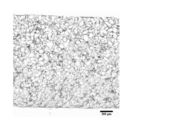
- FIG. 1 shows a photograph of a 2.5 mm ⁇ 2.5 mm region observed with an optical microscope.
- Example 2 Among the freeze-dried bodies (polymer porous bodies) described in Example 1, those having low anisotrophic properties are crushed by a screen crusher (Quadro, Komil U10) using a 0.079 inch screen and then a 0.040 inch screen. (1 inch is about 2.45 cm). Fractions under a sieve with an opening of 1400 ⁇ m and on a sieve with an opening of 300 ⁇ m were collected and filled in a 10 mL glass vial using a filling machine (Aisin Nano Technologies, TF-70AD) at about 0.09 g. The vial was placed in a clean oven (Nitto Rika Kogyo, NCO-500A600L-WS) and treated at 135 ° C.
- Sample 1 as a tissue restoration material.
- a rubber stopper was plugged into a vial in a sterile isolator (Aerex), wrapped with an aluminum cap, placed in an aluminum pouch and heat-sealed, and stored, and the water absorption rate and acid residual rate were evaluated. As a result, it was 580% and 46%, respectively.
- Example 3 A solution containing recombinant gelatin similar to that in Example 1 was purified and then concentrated by ultrafiltration to 7.5% by mass at 30 ° C. to obtain an aqueous gelatin solution. After freezing the obtained aqueous gelatin solution, the frozen product was thawed at 37 ° C. for 18 hours to obtain a 7.5% by mass gelatin aqueous solution again (unlike Example 1, "freeze-drying->redissolution”. , "Frozen ⁇ thawed").
- the gelatin aqueous solution was sampled in a transparent polystyrene container so as to have a liquid thickness of 2.5 mm, and observed with an optical microscope in a field of view of 2.5 mm ⁇ 2.5 mm in 100 ⁇ m increments from the lower surface of the liquid to the upper surface of the liquid.
- the average number of bubbles and insoluble matter was calculated by observing 10 fields of view, the number of bubbles and insoluble matter was 0 / ⁇ L.
- a freeze-dried body (polymer porous body) was prepared by the same method as in Example 1. When the anisotropy was evaluated, the yield rate of the freeze-dried product having low anisotropy was 98%.
- the obtained freeze-dried product having low anisotropy had a uniform structure up to the bottom surface side of the container.
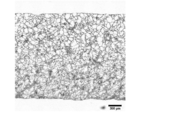
- anisotropy a sample was prepared in the same manner as in Example 1, and a photograph of a 2.5 mm ⁇ 2.5 mm region observed with an optical microscope is shown in FIG.
- Example 4 A solution containing recombinant gelatin similar to that in Example 1 was purified and then concentrated by ultrafiltration to 4.0% by mass at 30 ° C. to obtain an aqueous gelatin solution. After the obtained gelatin aqueous solution was freeze-dried, water for injection was added to the freeze-dried body, the temperature was raised to 37 ° C. over 30 minutes and redissolved to obtain a 7.5% by mass gelatin aqueous solution again.
- the gelatin aqueous solution was sampled in a transparent polystyrene container so as to have a liquid thickness of 2.5 mm, and observed with an optical microscope in a field of view of 2.5 mm ⁇ 2.5 mm in 100 ⁇ m increments from the lower surface of the liquid to the upper surface of the liquid. After observing 10 fields of view and calculating the average number of bubbles and insoluble matter, the number of bubbles in the gelatin aqueous solution was 11.05 / ⁇ L, and the number of insoluble matter was 0.92 / ⁇ L.
- a freeze-dried body (polymer porous body) was prepared by the same method as in Example 1.
- the yield of the freeze-dried product having low anisotropy was 40%.
- the obtained freeze-dried product having low anisotropy had non-uniform pores on the bottom surface side of the container. It was speculated that the cause was heterogeneous nucleation due to bubbles.
- anisotropy a sample was prepared in the same manner as in Example 1, and a photograph of a 2.5 mm ⁇ 2.5 mm region observed with an optical microscope is shown in FIG.
- Example 5 A solution containing recombinant gelatin similar to that in Example 1 was purified and then concentrated by ultrafiltration to 4.0% by mass at 30 ° C. to obtain an aqueous gelatin solution. After the obtained gelatin aqueous solution was freeze-dried, water for injection was added to the freeze-dried body, the temperature was raised to 37 ° C. over 30 minutes and redissolved to obtain a 7.5% by mass gelatin aqueous solution again. This aqueous gelatin solution was filtered through a 0.22 ⁇ m cellulose acetate membrane filter.
- the gelatin aqueous solution was sampled in a transparent polystyrene container so as to have a liquid thickness of 2.5 mm, and observed with an optical microscope in a field of view of 2.5 mm ⁇ 2.5 mm in 100 ⁇ m increments from the lower surface of the liquid to the upper surface of the liquid. After observing 10 fields of view and calculating the average number of bubbles and insoluble matter, the number of bubbles was 0.69 / ⁇ L and the number of insoluble matter was 0 / ⁇ L.
- a freeze-dried body (polymer porous body) was prepared by the same method as in Example 1.
- the yield rate of the freeze-dried product having low anisotropy was 67%.
- the obtained freeze-dried product having low anisotropy had non-uniform pores on the bottom surface side of the container. It was speculated that the cause was heterogeneous nucleation due to bubbles.
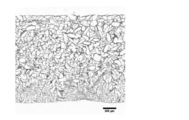
- anisotropy a sample was prepared in the same manner as in Example 1, and a photograph of a 2.5 mm ⁇ 2.5 mm region observed with an optical microscope is shown in FIG.
- Table 1 shows a summary of the results of Example 1, Example 3, and Comparative Examples 1 to 5.
- the judgment of the profit rate was set to "good". It can be seen that a freeze-dried product having low anisotropy can be produced with a high yield by freeze-drying a gelatin aqueous solution having few bubbles and insoluble matter using a container whose inner surface is coated with FEP.
- Example 4 ⁇ Container for freeze-drying> Using an aluminum alloy (A5052) with an outer dimension of 100 mm (vertical) x 106 mm (horizontal) x 31 mm (height), a container body with an inner dimension of 90 mm (vertical) x 96 mm (horizontal) x 28 mm (depth) (depth) Wall thickness: 5 mm, bottom thickness: 3 mm) and four plate-shaped heat transfer bodies (90 mm (length) x 3 mm (thickness) x 23 mm (height)) perpendicular to the bottom surface of the container body, abbreviated.
- Six rectangular parallelepiped freeze-drying containers were prepared.
- the walls of the container body and the heat transfer body are arranged at equal intervals (16.8 mm) in the lateral direction, and the freeze-drying container is provided with five accommodating portions that do not communicate with each other.
- the container body was integrated with the heat transfer body.
- the wetted surface of the container was coated with FEP with "NF-004A" to a thickness of 80 ⁇ m by Nippon Fluorine Co., Ltd.
- a 11.5 g aqueous gelatin solution was poured into each of the five compartments of each of the six freeze-drying containers.
- the volume of 11.5 g of the gelatin aqueous solution at 23 ° C. was 11.3 mL, and the gelatin aqueous solution was placed in a measuring cylinder and measured by comparing the mass and the volume.
- Place 6 freeze-drying containers in a freeze-dryer (DFR-5N-B, manufactured by ULVAC, Inc.), allow to stand at 7 ° C for 2 hours, cool to -10 ° C, then cool at -30 ° C for 14 hours, and then.
- a freeze-dried product (polymer porous body) was prepared by vacuum drying at ⁇ 10 ° C.
- Example 1 For the evaluation of anisotropy, a sample was prepared in the same manner as in Example 1, and a photograph of a 2.5 mm ⁇ 10.0 mm region observed with an optical microscope is shown in FIG. The obtained freeze-dried product was easily peeled off from the freeze-dried container simply by turning the freeze-dried container upside down.
- Example 5 ⁇ Container for freeze-drying> Six substantially rectangular parallelepiped freeze-drying containers as in Example 4 were prepared.
- a 11.5 g aqueous gelatin solution was poured into each of the five compartments of each of the six freeze-drying containers.
- the volume of 11.5 g of the gelatin aqueous solution at 23 ° C. was 11.3 mL, and the gelatin aqueous solution was placed in a measuring cylinder and measured by comparing the mass and the volume.
- Place 6 freeze-drying containers in a freeze-dryer (DFR-5N-B, manufactured by ULVAC, Inc.), allow to stand at 7 ° C for 2 hours, cool to -10 ° C, then cool at -30 ° C for 14 hours, and then.
- a freeze-dried product (polymer porous body) was prepared by vacuum drying at ⁇ 10 ° C.
- a 11.5 g aqueous gelatin solution was poured into each of the five compartments of each of the six freeze-drying containers.
- the volume of 11.5 g of the gelatin aqueous solution at 23 ° C. was 11.3 mL, and the gelatin aqueous solution was placed in a measuring cylinder and measured by comparing the mass and the volume.
- Place 6 freeze-drying containers in a freeze-dryer (DFR-5N-B, manufactured by ULVAC, Inc.), allow to stand at 7 ° C for 2 hours, cool to -10 ° C, then cool at -30 ° C for 14 hours, and then.
- a freeze-dried product (polymer porous body) was prepared by vacuum drying at ⁇ 10 ° C.
- Table 2 shows a summary of the results of Example 4, Example 5, and Comparative Example 6.
- the judgment of the profit rate was set to "good". Even if an aluminum freeze-drying container containing a heat transfer material coated with FEP is used, a freeze-dried body with low anisotropy is produced with a high yield, as in the case of using an aluminum cup coated with FEP. It turns out that it is possible. Further, it can be seen that the freeze-dried product can be easily peeled off from the container by coating with FEP.
Landscapes
- Health & Medical Sciences (AREA)
- Chemical & Material Sciences (AREA)
- Life Sciences & Earth Sciences (AREA)
- Organic Chemistry (AREA)
- Medicinal Chemistry (AREA)
- Engineering & Computer Science (AREA)
- Zoology (AREA)
- General Health & Medical Sciences (AREA)
- Biochemistry (AREA)
- Bioinformatics & Cheminformatics (AREA)
- Genetics & Genomics (AREA)
- Gastroenterology & Hepatology (AREA)
- Proteomics, Peptides & Aminoacids (AREA)
- Molecular Biology (AREA)
- Wood Science & Technology (AREA)
- Biotechnology (AREA)
- Biophysics (AREA)
- Toxicology (AREA)
- Animal Behavior & Ethology (AREA)
- Public Health (AREA)
- Veterinary Medicine (AREA)
- Epidemiology (AREA)
- Materials Engineering (AREA)
- Chemical Kinetics & Catalysis (AREA)
- Polymers & Plastics (AREA)
- Transplantation (AREA)
- Oral & Maxillofacial Surgery (AREA)
- Biomedical Technology (AREA)
- Microbiology (AREA)
- Sustainable Development (AREA)
- Dermatology (AREA)
- General Engineering & Computer Science (AREA)
- Materials For Medical Uses (AREA)
- Manufacture Of Porous Articles, And Recovery And Treatment Of Waste Products (AREA)
- Peptides Or Proteins (AREA)
- Apparatus Associated With Microorganisms And Enzymes (AREA)
Abstract
本発明の課題は、構造的均一性が高い(異方性が低い)高分子水溶液凍結体を高い得率で得る製造方法、及び上記高分子水溶液凍結体を用いた高分子多孔質体の製造方法を提供することである。本発明においては、凍結時に用いる液体容器について、溶液に接する面をテトラフルオロエチレン・ヘキサフルオロプロピレン共重合体(FEP)とする。
Description
本発明は、高分子水溶液凍結体の製造方法に関し、特に異方性の低い凍結物を高得率で製造する方法に関する。
コラーゲンやゼラチン等の生体親和性高分子からなる多孔質体は、細胞足場、移植用部材、組織修復材等の材料として有用であり、特許文献1には、リコンビナントゼラチン多孔質体の製造方法が記載されている。具体的には、円筒カップ状容器に流し込んだリコンビナントゼラチン水溶液を凍結乾燥して、リコンビナントゼラチン多孔質体を製造する方法が開示されている。
ところで、製品として一定品質の高分子多孔質体を提供する等の観点からは、高分子多孔質体における孔(ポア)の大きさのバラつきが小さいこと、即ち、多孔質体の構造的均一性が高いことが望ましい。ここで、高分子水溶液から高分子多孔質体を得るための凍結乾燥工程は、平易に言えば、(1)高分子水溶液を凍結して高分子水溶液凍結体を得る工程、(2)高分子水溶液凍結体から水分を昇華させる工程からなる。
上記(1)の工程で得られる高分子水溶液凍結体は、高分子多孔質体の中間体と言え、この高分子水溶液凍結体の製造工程を制御することで、高分子多孔質体の構造的均一性を向上できる可能性がある。例えば、特許文献2には、高分子多孔質体の製造方法の一部として、凍結時における高分子水溶液内の温度差を一定以下の値とする高分子水溶液凍結体の製造方法が記載されており、そうして得られた高分子多孔質体の構造的均一性が高いことも開示されている。こうした方法に代わるか、こうした方法と組み合わせて使用可能な、新たな高分子水溶液凍結体の製造方法が求められている。
本発明の目的は、構造的均一性が高い(異方性が低い)高分子水溶液凍結体を高い得率で得る製造方法、及び上記高分子水溶液凍結体を用いた高分子多孔質体の製造方法を提供することである。
本発明者らは、上記課題を解決するため鋭意検討した結果、凍結時に用いる液体容器について、溶液に接する面をテトラフルオロエチレン・ヘキサフルオロプロピレン共重合体(FEP)とすることで、異方性が低い高分子水溶液凍結体が得られる確率(得率)が高くなることを見出し、本発明を完成した。
すなわち、本発明は下記を提供する。
[1]
高分子水溶液を、溶液に接する面がFEPである液体容器中で凍結する工程を含む、含高分子水溶液凍結体の製造方法
[2]
液体容器の主たる部材の線膨張係数が10×10-5/K未満である、[1]に記載の製造方法
[3]
液体容器の主たる部材の内面のコート部材がFEPである、[1]に記載の製造方法
[4]
高分子水溶液の高分子濃度が0.1wt%以上である、[1]に記載の製造方法
[5]
高分子水溶液が組換えゼラチンの水溶液である、[1]に記載の製造方法
[6]
高分子中の親水性繰り返し単位比率が50%以下である、[1]に記載の製造方法
[7]
高分子水溶液中の不溶物及び気泡が、0.5個/μL以下である、[1]に記載の製造方法。
[8]
含高分子水溶液凍結体の製造に供するまで、高分子水溶液を凍結乾燥しない、[1]に記載の製造方法。
[9]
[1]~[8]のいずれか一に記載の製造法で得られた高分子水溶液凍結体から、さらに水分を除去する工程を含む、高分子多孔質体の製造方法
[1]
高分子水溶液を、溶液に接する面がFEPである液体容器中で凍結する工程を含む、含高分子水溶液凍結体の製造方法
[2]
液体容器の主たる部材の線膨張係数が10×10-5/K未満である、[1]に記載の製造方法
[3]
液体容器の主たる部材の内面のコート部材がFEPである、[1]に記載の製造方法
[4]
高分子水溶液の高分子濃度が0.1wt%以上である、[1]に記載の製造方法
[5]
高分子水溶液が組換えゼラチンの水溶液である、[1]に記載の製造方法
[6]
高分子中の親水性繰り返し単位比率が50%以下である、[1]に記載の製造方法
[7]
高分子水溶液中の不溶物及び気泡が、0.5個/μL以下である、[1]に記載の製造方法。
[8]
含高分子水溶液凍結体の製造に供するまで、高分子水溶液を凍結乾燥しない、[1]に記載の製造方法。
[9]
[1]~[8]のいずれか一に記載の製造法で得られた高分子水溶液凍結体から、さらに水分を除去する工程を含む、高分子多孔質体の製造方法
本発明によれば、異方性が低い高分子水溶液凍結体を高い得率で得るための製造方法が提供される。
本明細書において「工程」との語は、独立した工程だけでなく、他の工程と明確に区別できない場合であっても本工程の所期の効果が達成されれば、本用語に含まれる。
本明細書において「~」を用いて示された数値範囲は、「~」の前後に記載される数値をそれぞれ下限値及び上限値として含む範囲を示す。
本発明において、組成物中の各成分の量は、組成物中に各成分に該当する物質が複数存在する場合には、特に断らない限り、組成物中に存在する当該複数の物質の合計量を意味する。
本発明において、ポリペプチドのアミノ酸配列を、当業界で周知の一文字表記(例えば、グリシン残基の場合は「G」)又は三文字表記(例えば、グリシン残基の場合は「Gly」)を用いて表現する場合がある。
本発明において、ポリペプチドのアミノ酸配列に関する「%」は、特に断らない限り、アミノ酸(又はイミノ酸)残基の個数を基準とする。本発明において、対比される2種のポリペプチドのアミノ酸配列に関する「同一性」とは、以下の式で計算される値を指す。
なお、複数のポリペプチドの対比(アライメント)は、同一となるアミノ酸残基の数が最も多くなるように常法に従って行うものとする。
同一性(%)=[(同一となるアミノ酸残基の数)/(アラインメント長)}×100
なお、複数のポリペプチドの対比(アライメント)は、同一となるアミノ酸残基の数が最も多くなるように常法に従って行うものとする。
同一性(%)=[(同一となるアミノ酸残基の数)/(アラインメント長)}×100
以下、本発明について説明する。
[高分子]
本発明において高分子とは、分子量が大きい分子で、分子量が小さい分子から実質的又は概念的に得られる単位の多数回の繰り返しで構成した構造を有する分子を言う。例えば、ポリアミン、セルロース、アミロース、デンプン、キチン、ポリペプチド、タンパク質、DNA及びRNA等が挙げられる。高分子は水溶性であることが好ましく、ポリペプチド及びタンパク質がさらに好ましい。ポリペプチド及びタンパク質の中では、コラーゲン及びゼラチンが特に好ましい。
本発明において高分子とは、分子量が大きい分子で、分子量が小さい分子から実質的又は概念的に得られる単位の多数回の繰り返しで構成した構造を有する分子を言う。例えば、ポリアミン、セルロース、アミロース、デンプン、キチン、ポリペプチド、タンパク質、DNA及びRNA等が挙げられる。高分子は水溶性であることが好ましく、ポリペプチド及びタンパク質がさらに好ましい。ポリペプチド及びタンパク質の中では、コラーゲン及びゼラチンが特に好ましい。
高分子中の親水性繰り返し単位比率は、50%以下であることが好ましく、30%以下であることがさらに好ましい。これよりも親水性単位比率が高いと、高分子周囲の自由水が減少し凍結が阻害される。ここで、親水性繰り返し単位比率とは、高分子中に占めるイオン性基、及び/又は水酸基を有する繰り返し単位の比率をいう。
上記ゼラチンは、Gly-X-Yで示される配列を連続して6以上含むポリペプチドを意味し、ポリペプチド中にGly-X-Yで示される配列以外に他のアミノ酸残基を1以上有していてもよい。Gly-X-Yで示される配列は、コラーゲンの部分アミノ酸配列に由来するアミノ酸配列に相当する配列であり、この配列の繰り返しはコラーゲンに特徴的な配列を意味する。
複数個のGly-X-Yは、それぞれ同一であってもよく、異なってもよい。また、Gly-X-Y配列中X及びYは繰返し単位ごとに独立であり、同一でも異なっていてもよい。Gly-X-YにおいてGlyはグリシン残基、X及びYは、グリシン残基以外の任意のアミノ酸残基を表す。X及びYとしては、イミノ酸残基、即ちプロリン残基又はオキシプロリン残基が多く含まれることが好ましい。このようなイミノ酸残基の含有率は、上記ゼラチン全体の10%~45%を占めることが好ましい。上記ゼラチン中のGly-X-Yの含有率としては、全体の80%以上であることが好ましく、95%以上であることが更に好ましく、99%以上であることが最も好ましい。
上記ゼラチンとしては、天然型であっても、天然型とは少なくとも1つのアミノ酸残基が異なる変異型であってもよい。天然型のゼラチンとは、天然で生じたコラーゲンを原料とするゼラチン、又は天然で生じたコラーゲンを原料とするゼラチンと同一のアミノ酸配列を有するポリペプチドを意味する。特に断らない限り、本明細書では変異型又は組換え体のゼラチンを総称して、組換えゼラチンと称する。天然型のゼラチン又はその組換えゼラチンは、例えば、魚類、哺乳類等の動物に由来するものが挙げられるが、 哺乳類の動物の天然型ゼラチン又はその組換えゼラチンであることが好ましい。哺乳類の動物としては、例えば、ヒト、ウマ、ブタ、マウス、ラット等が挙げられ、ヒト又はブタであることがより好ましい。天然型ゼラチンとしてはブタ又はヒトに由来するものであることが好ましく、組換えゼラチンとしてはヒト由来組換えゼラチンであることが好ましい。
また、上記ゼラチンとしては、上記Gly-X-Yで示される配列を連続して6以上有する上記コラーゲンをコードする遺伝子の塩基配列又はアミノ酸配列に対して、1つ以上の塩基又はアミノ酸残基の変更を加えた塩基配列又はアミノ酸配列を、常法により、適当な宿主に導入し発現させて得られた組換えゼラチンであることが好ましい。このような組換えゼラチンを用いることにより、(骨)組織修復能を高めると共に、天然のゼラチンを用いる場合と比較して種々の特性を発現させることができ、例えば、生体による拒絶反応などの不都合な影響を回避することができるなどの利点を有する。
上記組換えゼラチンとしては、例えば、EP1014176A2、US6992172、WO2004/85473、WO2008/103041、特表2010-519293、特表2010-519252、特表2010-518833、特表2010-519251、WO2010/128672及びWO2010/147109等に開示されているものを特に好ましく用いることができる。 また、上記組換えゼラチンは、2kDa以上100kDa以下の分子量であることが好ましく、5kDa以上90kDa以下であることがより好ましく、10kDa以上90kDa以下であることがより好ましい。
上記組換えゼラチンは、生体親和性の点で、細胞接着シグナルを更に含むものであることが好ましく、上記組換えゼラチン中に存在する細胞接着シグナルが一分子中に2つ以上有することものであることが、より好ましい。このような細胞接着シグナルとしては、RGD配列、LDV配列、REDV配列、YIGSR配列、PDSGR配列、RYVVLPR配列、LGTIPG配列、RNIAEIIKDI配列、IKVAV配列、LRE配列、DGEA配列、及びHAV配列の各配列を挙げることができ、好ましくは、RGD配列、YIGSR配列、PDSGR配列、LGTIPG配列、IKVAV配列及びHAV配列を挙げることができ、RGD配列であることが特に好ましい。RGD配列のうち、ERGD配列であることが更に好ましい。
上記組換えゼラチンにおけるRGD配列の配置としては、RGD間のアミノ酸残基数が0~100であることが好ましく、25~60であることが更に好ましい。また、RGD配列は、このようなアミノ酸残基数の範囲内で不均一に配置されていることが好ましい。
また、上記組換えゼラチンにおけるアミノ酸残基の総数に対するRGD配列の割合は、少なくとも0.4%であることが好ましく、組換えゼラチンが350以上のアミノ酸残基を含む場合、350アミノ酸残基の各ストレッチが少なくとも1つのRGD配列を含むことが好ましい。
また、上記組換えゼラチンにおけるアミノ酸残基の総数に対するRGD配列の割合は、少なくとも0.4%であることが好ましく、組換えゼラチンが350以上のアミノ酸残基を含む場合、350アミノ酸残基の各ストレッチが少なくとも1つのRGD配列を含むことが好ましい。
上記組換えゼラチンは、250のアミノ酸残基あたり少なくとも2つのRGD配列を含むことが好ましく、少なくとも3つRGD配列を含むことがより好ましく、少なくとも4つのRGD配列を含むことが更に好ましい。ただし、上記組換えゼラチンの配列は、以下の態様であることが好ましい:(1)セリン残基及びスレオニン残基を含まない、(2)セリン残基、スレオニン残基、アスパラギン残基、チロシン残基、及びシステイン残基を含まない、(3)Asp-Arg-Gly-Aspで示されるアミノ酸配列を含まない。上記組換えゼラチンは、この好ましい配列の態様(1)~(3)を単独で備えたものであってよく、2つ以上の態様を組み合わせて備えたものものであってもよい。また、上記組換えゼラチンは部分的に加水分解されていてもよい。
上記組換えゼラチンは、A-[(Gly-X-Y)n]m-Bの繰り返し構造を有することが好ましい。mは、2~10を表し、3~5を表すことが好ましい。A及びBは、任意のアミノ酸又はアミノ酸配列を表す。nは3~100を表し、15~70を表すことが好ましく、50~60を表すことがより好ましい。
好ましくは、組換えゼラチンは、式:Gly-Ala-Pro-[(Gly-X-Y)63]3-Gly(式中、63個のXはそれぞれ独立にアミノ酸残基の何れかを示し、63個のYはそれぞれ独立にアミノ酸残基の何れかを示す。なお、3個の(Gly-X-Y)63はそれぞれ同一でも異なっていてもよい。)で示される。
上記組換えゼラチンの繰り返し単位には、天然に存在するコラーゲンの配列単位を複数結合することが好ましい。ここで言う天然に存在するコラーゲンとしては、好ましくはI型、II型、III型、IV型及びV型が挙げられる。より好ましくは、I型、II型又はIII型とすることができる。コラーゲンの由来としては、好ましくは、ヒト、ウマ、ブタ、マウス、ラットを挙げることができ、ヒトであることがより好ましい。
上記組換えゼラチンの等電点は、好ましくは5~10であり、より好ましくは6~10であり、更に好ましくは7~9.5とすることができる。
上記組換えゼラチンの等電点は、好ましくは5~10であり、より好ましくは6~10であり、更に好ましくは7~9.5とすることができる。
上記組換えゼラチンの好ましい態様としては以下のものを挙げることができる:(1)カルバモイル基が加水分解されていない、(2)プロコラーゲンを有さない、(3)テロペプタイドを有さない、(4)天然コラーゲンをコードする核酸により調製された実質的に純粋なコラーゲン用材料である。上記組換えゼラチンは、この好ましい態様(1)~(4)を単独で備えたものであってよく、2つ以上の態様を組み合わせて備えたものものであってもよい。
上記組換えゼラチンは、(骨)組織修復能の高さから、好ましくは、以下(A)~(C)のいずれかとすることができる。
(A) 下記配列番号1で示されるポリペプチド、
GAP(GAPGLQGAPGLQGMPGERGAAGLPGPKGERGDAGPKGADGAPGAPGLQGMPGERGAAGLPGPKGERGDAGPKGADGAPGKDGVRGLAGPIGPPGERGAAGLPGPKGERGDAGPKGADGAPGKDGVRGLAGPIGPPGPAGAPGAPGLQGMPGERGAAGLPGPKGERGDAGPKGADGAPGKDGVRGLAGPP)3G(配列番号1)
(B) 上記(A)のアミノ酸配列中、第4番目~第192番目のアミノ酸残基からなる部分アミノ酸配列と80%以上の配列同一性を有する部分配列を有すると共に、(骨)組織修復能を有するポリペプチド、
(C) 上記(A)のアミノ酸配列に対して1個若しくは数個のアミノ酸残基が欠失、置換若しくは付加されたアミノ酸配列からなり、(骨)組織修復能を有するポリペプチド。
(A) 下記配列番号1で示されるポリペプチド、
GAP(GAPGLQGAPGLQGMPGERGAAGLPGPKGERGDAGPKGADGAPGAPGLQGMPGERGAAGLPGPKGERGDAGPKGADGAPGKDGVRGLAGPIGPPGERGAAGLPGPKGERGDAGPKGADGAPGKDGVRGLAGPIGPPGPAGAPGAPGLQGMPGERGAAGLPGPKGERGDAGPKGADGAPGKDGVRGLAGPP)3G(配列番号1)
(B) 上記(A)のアミノ酸配列中、第4番目~第192番目のアミノ酸残基からなる部分アミノ酸配列と80%以上の配列同一性を有する部分配列を有すると共に、(骨)組織修復能を有するポリペプチド、
(C) 上記(A)のアミノ酸配列に対して1個若しくは数個のアミノ酸残基が欠失、置換若しくは付加されたアミノ酸配列からなり、(骨)組織修復能を有するポリペプチド。
上記(B)における配列同一性としては、組換えゼラチンの(骨)組織修復能の観点から、より好ましくは90%以上とすることができ、更に好ましくは95%以上とすることができる。
上記(B)の配列における上記部分アミノ酸配列は、配列番号1で示される配列の繰り返し単位に相当する部分アミノ酸配列である。上記(B)のポリペプチドに上記繰り返し単位に相当する部分アミノ酸配列が複数存在する場合には、配列同一性が80%以上となる繰り返し単位を1つ、好ましくは2つ以上含むポリペプチドとすることができる。
また、上記(B)で規定されるポリペプチドは、上記繰り返し単位に相当する部分アミノ酸配列と80%以上の配列同一性を有する部分配列を、合計のアミノ酸残基数として、全アミノ酸残基数の80%以上含むことが好ましい。
上記(B)で規定されるポリペプチドの長さとしては、151個~2260個のアミノ酸残基数とすることができ、架橋後の分解性の観点から、193個以上、安定性の観点から、944個以下のアミノ酸残基数であることが好ましく、380個~756個のアミノ酸残基数であることがより好ましい。
また、上記(C)で規定されるポリペプチドは、上記(A)のアミノ酸配列に対して1個若しくは数個のアミノ酸残基が欠失、置換若しくは付加されたアミノ酸配列からなり、組織修復能を有するポリペプチドであってもよい。
上記(C)で規定されるポリペプチドにおいて欠失、置換若しくは付加されるアミノ酸残基数としては、1個又は数個であればよく、組換えゼラチンの総アミノ酸残基数によって異なるが、例えば、2個~15個、好ましくは2個~5個とすることができる。
上記組換えゼラチンは、当業者に公知の遺伝子組換え技術によって製造することができ、例えばEP1014176A2、US6992172、WO2004/85473、WO2008/103041等に記載の方法に準じて製造することができる。具体的には、所定の組換えゼラチンのアミノ酸配列をコードする遺伝子を取得し、これを発現ベクターに組み込んで、組み換え発現ベクターを作製し、これを適当な宿主に導入して形質転換体を作製する。得られた形質転換体を適当な培地で培養することにより、組換えゼラチンが産生されるので、培養物から産生された組換えゼラチンを回収することにより、本発明で用いる組換えゼラチンを調製することができる。
[高分子水溶液]
本発明において高分子水溶液とは、一種以上の高分子が含まれる水溶液である。高分子水溶における高分子濃度は、0.1wt%以上であることが好ましく、1wt%以上であることがさらに好ましく、5wt%以上であることが特に好ましい。0.1wt%よりも濃度が低いと、水分を除去したのちに高分子多孔質体の構造を維持することが困難である。高分子水溶液は、凍結温度以上でゲル化することが好ましい。高分子水溶液における高分子濃度の上限は、高分子が溶解できる限り特に限定されないが、一般的には40wt%以下であり、30wt%以下、又は20wt%以下でもよい。
本発明において高分子水溶液とは、一種以上の高分子が含まれる水溶液である。高分子水溶における高分子濃度は、0.1wt%以上であることが好ましく、1wt%以上であることがさらに好ましく、5wt%以上であることが特に好ましい。0.1wt%よりも濃度が低いと、水分を除去したのちに高分子多孔質体の構造を維持することが困難である。高分子水溶液は、凍結温度以上でゲル化することが好ましい。高分子水溶液における高分子濃度の上限は、高分子が溶解できる限り特に限定されないが、一般的には40wt%以下であり、30wt%以下、又は20wt%以下でもよい。
高分子水溶液は、高分子を含む溶液を精製及び濃縮すること、又は乾燥状態の高分子を水性媒体に溶解することにより調製する。(1)用事調整してもよいし、(2)予め調整済みのものを準備して用いてもよい。(3)精製及び濃縮により得られた高分子水溶液を凍結乾燥し、得られた凍結乾燥体に水性媒体を加えて再溶解することで高分子水溶液を調整してもよい。または、(4)精製及び濃縮により得られた高分子水溶液を凍結し、得られた凍結体を解凍することで高分子水溶液を調整してもよい。凍結体の解凍は、気泡や不溶物(凍結体の溶け残り)の発生を低減する観点から、30~40℃で15~20時間かけて解凍することが好ましい。用事調整の手間削減、輸送や保管の便宜、高分子水溶液中の気泡や不溶物を低減する観点から、上記(4)の方法が好ましい。
高分子水溶液中に分散した気泡や不溶物は、濾過、遠心、減圧、脱泡等の操作により、凍結工程前に除去することが好ましい。これにより、異方性が低い高分子水溶液凍結体の得率が向上する。気泡や不溶物が除かれていることは、濁度測定により評価できる。又は、光学顕微鏡による目視検査によっても評価できる。例えば、光学顕微鏡の視野に映る気泡及び不要物の個数を計算し、高分子水溶液1μL中の気泡及び不溶物の個数で評価できる。高分子水溶液中の気泡や不溶物は、0.5個/μL以下であることが好ましく、0.3個/μL以下であることがより好ましく、0.1個/μL以下であることがさらに好ましく、0個/μLであることが特に好ましい。
高分子水溶液には、所定の特性を付加する目的で、高分子以外の成分を添加してよい。
このような他の成分としては、例えば、骨誘導薬剤等の骨再生又は骨新生に関する成分を挙げることができる。骨誘導薬剤としては、例えばBMP(骨形成因子)やbFGF(塩基性線維芽細胞増殖因子)が挙げられるが、特に限定はされない。他に例えば、ポリペプチド又はタンパク質の架橋剤を挙げることができる。
このような他の成分としては、例えば、骨誘導薬剤等の骨再生又は骨新生に関する成分を挙げることができる。骨誘導薬剤としては、例えばBMP(骨形成因子)やbFGF(塩基性線維芽細胞増殖因子)が挙げられるが、特に限定はされない。他に例えば、ポリペプチド又はタンパク質の架橋剤を挙げることができる。
高分子水溶液の水性媒体としては、高分子を溶解可能であり、生体組織に対して使用可能なものであれば特に制限はなく、例えば、水、生理食塩水、リン酸緩衝液等、当分野で通常使用可能なものを挙げることができる。
高分子としてゼラチンを用いる場合、ゼラチン溶液におけるゼラチン濃度については、ゼラチンが溶解可能な濃度であればよく、特に制限はない。ゼラチン溶液中のゼラチン濃度は、例えば、0.5質量%~20質量%とすることが好ましく、2質量%~16質量%であることがより好ましく 、4質量%~12質量%であることが更に好ましい。また、ゼラチン溶液は、凍結工程の前に脱泡処理してもよい。これにより、氷晶形成を均一に生じやすくさせることができる。脱泡方法については特に制限はないが、例えば、2~10kPaの圧力で真空遠心脱泡することができる。
ゼラチン溶液は、溶解していない粒子を除くためにろ過をしてもよい。ろ過方法は特に制限されないが、例えば、孔径0.22~0.45μmのフィルターを用いて加圧ろ過する。フィルターの材質についても特に制限はなく、ポリテトラフルオロエチレン、ポリエーテルスルホン、セルロースアセテート、ポリビニリデンフルオライドなどを用いることができるが、ゼラチンの吸着性が低く溶出物が少ないという観点から、セルロースアセテートが好ましい。ゼラチン溶液を調製する際の温度については、特に制限はなく、通常用いられる温度、 例えば、0℃~60℃、好ましくは、3℃~40℃程度であればよい。
[液体容器]
本発明において液体容器とは、高分子水溶液を入れて、冷却・凍結するための容器を言う。容器の形状は例えば、皿状、円筒カップ状、略直方体状が挙げられる。円筒カップ状または略直方体状が好ましい。略直方体状の容器とは、平面形状が略矩形の底面を1つと、平面形状が略矩形の側面を、前後一対、左右一対の合計4つ有する形状の容器である。略直方体状の容器は、一体的に形成されていてもよく、側面と底面、側面同士を繋ぐ角部分が面取りされていてもよい。
容器内部は高い曲率を持たないことが好ましい。具体的にはR1mm以上であることが好ましく、R2mm以上であることがさらに好ましい(Rは曲率半径を意味する)。容器の大きさは特に限定されないが、円筒カップ状容器の場合、内径200mm以下であることが好ましく、150mm以下であることがさらに好ましい。略直方体状の容器の場合、内寸が200mm(縦)×200mm(横)×60mm(深さ)以下であることが好ましく、150mm(縦)×150mm(横)×45mm(深さ)以下であることがさらに好ましい。
本発明において液体容器とは、高分子水溶液を入れて、冷却・凍結するための容器を言う。容器の形状は例えば、皿状、円筒カップ状、略直方体状が挙げられる。円筒カップ状または略直方体状が好ましい。略直方体状の容器とは、平面形状が略矩形の底面を1つと、平面形状が略矩形の側面を、前後一対、左右一対の合計4つ有する形状の容器である。略直方体状の容器は、一体的に形成されていてもよく、側面と底面、側面同士を繋ぐ角部分が面取りされていてもよい。
容器内部は高い曲率を持たないことが好ましい。具体的にはR1mm以上であることが好ましく、R2mm以上であることがさらに好ましい(Rは曲率半径を意味する)。容器の大きさは特に限定されないが、円筒カップ状容器の場合、内径200mm以下であることが好ましく、150mm以下であることがさらに好ましい。略直方体状の容器の場合、内寸が200mm(縦)×200mm(横)×60mm(深さ)以下であることが好ましく、150mm(縦)×150mm(横)×45mm(深さ)以下であることがさらに好ましい。
液体容器は、伝熱体を含むことができる。伝熱体とは、容器底面または内側面に容器と一体で設けられる物体であり、容器底面に垂直で設けられることが好ましい。伝熱体の形状は例えば、板状、棒状が挙げられ、板状が好ましい。伝熱体の材質は、0℃における熱伝導率が5W/m・K以上である限りは特に限定されず、例えば、アルミニウム、金、銀、銅、鉄、これらの合金(例えば、アルミニウム合金(例えば、A5052)ステンレス等)が挙げられ、アルミニウム又はその合金であることが好ましい。伝熱体を設けることで、高分子水溶液の単位体積当たりの容器本体又は伝熱体への接触面積を増加させることができる。
液体容器は、液体容器を構成する部材と同一又は別の部材(コート部材)で、液体容器の内面をコートしてもよい。また、液体容器を構成する部材と同一又は別の部材からなるカバー部材を液体容器の内面に敷き詰めたり、円筒状のカバー部材を設置したりしてもよい。コート部材やカバー部材と区別して、液体容器を構成する部材を液体容器の主たる部材とも称する。液体容器が伝熱体を含む場合、伝熱体も液体容器の主たる部材である。液体容器の主たる部材、コート部材、カバー部材の組み合わせは問わない。即ち、液体容器は、(1)液体容器の主たる部材のみ、(2)液体容器の主たる部材及びコート部材、(3)液体容器の主たる部材及びカバー部材、(4)液体容器の主たる部材、コート部材及びカバー部材、のいずれの組み合わせでもよい。
液体容器の内面、即ち、高分子水溶液を液体容器に入れた時に高分子水溶液の接する面は、テトラフルオロエチレン・ヘキサフルオロプロピレン共重合体(パーフルオロエチレンプロペンコポリマーとも言う)(FEP)である。例えば、上記(1)~(4)に即して言えば、(1)液体容器の主たる部材がFEP、(2)少なくとも、コート部材がFEP、(3)少なくとも、カバー部材がFEP、(4)少なくとも、カバー部材がFEP、である。
液体容器の主たる部材の材質に特に制限はなく、例えば、アルミニウム又はその合金が挙げられる。
液体容器の主たる部材が高分子水溶液と接する場合、液体容器の主たる部材はFEPである。液体容器の主たる部材の材質は、線膨張係数(熱膨張係数とも言う)が10×10-5/K以下であることが好ましく、50×10-6/K以下であることがさらに好ましく、25×10-6/K以下であることが特に好ましい。
液体容器の主たる部材が高分子水溶液と接する場合、液体容器の主たる部材はFEPである。液体容器の主たる部材の材質は、線膨張係数(熱膨張係数とも言う)が10×10-5/K以下であることが好ましく、50×10-6/K以下であることがさらに好ましく、25×10-6/K以下であることが特に好ましい。
カバー部材は、容器内面に一様に敷き詰められていればよく、カバー部材の形状、厚さに制限はない。カバー部材が高分子水溶液と接する場合、カバー部材はFEPである。コート部材は、容器内面に一様にコートしていればよく、塗膜の厚さに制限はない。塗膜は20μm以上であることが好ましく、50μm以上であることがさらに好ましい。コート部材が高分子水溶液と接する場合、コート部材はFEPである。
[凍結工程]
本発明において凍結工程とは、液体容器に入れた高分子水溶液を凍結する工程を言う。
凍結手段に特に制限はなく、例えば、冷凍機、凍結乾燥機等の装置で凍結すればよい。凍結乾燥機で凍結する場合、同一の装置で連続的に、高分子水溶液凍結体からの水分除去(凍結乾燥)が可能である。
本発明において凍結工程とは、液体容器に入れた高分子水溶液を凍結する工程を言う。
凍結手段に特に制限はなく、例えば、冷凍機、凍結乾燥機等の装置で凍結すればよい。凍結乾燥機で凍結する場合、同一の装置で連続的に、高分子水溶液凍結体からの水分除去(凍結乾燥)が可能である。
凍結工程の温度は、高分子の種類、高分子水溶液の濃度によって異なるが、凝固熱発生直前の溶液内で最も液温の高い部分の温度と溶液内で最も液温の低い部分の温度との差が2.5℃以下であることが好ましい。ここで「凝固熱発生直前の温度差」とは、凝固熱発生時の1秒前~10秒前の間で最も温度差が大きくなるときの温度差を意味する。また、溶液内で最も液温の低い部分の温度は-8℃以下であることが好ましく、さらに好ましくは-10℃以下であり、なかでも-15℃以上であることが好ましい。
[高分子水溶液凍結体]
本発明において高分子水溶液凍結体とは、高分子水溶液を凍結することで得られる凍結体を意味する。本発明の製造方法で高分子水溶液凍結体を製造することで、異方性が低い高分子水溶液凍結体が得られる確率を向上させることができる。
本発明において高分子水溶液凍結体とは、高分子水溶液を凍結することで得られる凍結体を意味する。本発明の製造方法で高分子水溶液凍結体を製造することで、異方性が低い高分子水溶液凍結体が得られる確率を向上させることができる。
本発明における高分子水溶液凍結体の「異方性」とは、以下のようにして測定される物理的特性を意味する。高分子水溶液凍結体を凍結乾燥後、凍結乾燥体(高分子多孔質体)の中央付近を水平及び鉛直方向に切断する。次いで各断面を染色し、一定(2.0mm×2.0mmや2.5mm×2.5mm)の領域を光学顕微鏡で観察する。観察領域内における、染色された材料で囲まれた領域に外接する長方形のうち、長方形の対向する二辺の距離が最大となる外接長方形を選択する。この対向する二辺の距離が最大となる外接長方形の長辺の長さを、水平方向の断面及び鉛直方向の断面のそれぞれにおける観察領域内において、50個ずつ計測し、その平均を当該凍結体の網目の長径の平均値とする。
このときの個々の網目について、水平方向の断面の長径(平均値)と鉛直方向の断面の長径(平均値)のうち小さい方をd1、他方をd2として得られた比率d2/d1を「異方性」と定義する。この異方性が3以下のものを「異方性が低い」と定義する。
このときの個々の網目について、水平方向の断面の長径(平均値)と鉛直方向の断面の長径(平均値)のうち小さい方をd1、他方をd2として得られた比率d2/d1を「異方性」と定義する。この異方性が3以下のものを「異方性が低い」と定義する。
異方性が低い高分子水溶液凍結体の得率は、製造効率の観点から、90%以上となることが好ましい。
[水分除去工程]
本発明において水分除去工程とは、高分子水溶液凍結体から水分を除去する工程を言う。水分を除去する手段に特に制限はなく、高分子水溶液凍結体中の氷を融解させる方法、昇華させる方法(凍結乾燥)等があり、凍結乾燥が好ましい。凍結乾燥の期間としては、例えば、0.5時間~300時間とすることができる。使用可能な凍結乾燥器について特に制限はない。
本発明において水分除去工程とは、高分子水溶液凍結体から水分を除去する工程を言う。水分を除去する手段に特に制限はなく、高分子水溶液凍結体中の氷を融解させる方法、昇華させる方法(凍結乾燥)等があり、凍結乾燥が好ましい。凍結乾燥の期間としては、例えば、0.5時間~300時間とすることができる。使用可能な凍結乾燥器について特に制限はない。
[高分子多孔質体]
本発明において高分子多孔質体とは、高分子からなる多孔質ブロックを言う。高分子水溶液凍結体から水分を除去することで、高分子多孔質体が得られる。高分子多孔質体は、さらに粉砕、架橋等の処理をすることで、種々の大きさの顆粒に加工し、細胞足場、移植用部材、組織修復材等として用いることができる。本発明の製造方法で製造した高分子水溶液凍結体から得られた高分子多孔質体は構造的均一性が高く、細胞足場、移植用部材、組織修復材等の材料として好適である。
本発明において高分子多孔質体とは、高分子からなる多孔質ブロックを言う。高分子水溶液凍結体から水分を除去することで、高分子多孔質体が得られる。高分子多孔質体は、さらに粉砕、架橋等の処理をすることで、種々の大きさの顆粒に加工し、細胞足場、移植用部材、組織修復材等として用いることができる。本発明の製造方法で製造した高分子水溶液凍結体から得られた高分子多孔質体は構造的均一性が高く、細胞足場、移植用部材、組織修復材等の材料として好適である。
[粉砕工程]
粉砕工程では、高分子多孔質体を粉砕して粉砕物を得る。粉砕は、ハンマーミルやスクリーンミル等の粉砕機を適用可能であり、一定の大きさに粉砕されたものから随時回収されるため試験ごとの粒径分布のばらつきが小さいという観点から、スクリーンミル(例えばクアドロ社製コーミル)が好ましい。粉砕の条件としては、粉砕物表面の構造を維持するため、破砕する方式より切断する方式のほうが好ましい。また、顆粒内部の構造を維持するため、粉砕中に強い圧縮がかからない方式とすることが好ましい。高分子多孔質体を粉砕して得られた粉砕物は、高分子顆粒として組織修復材に含有されうる。
粉砕工程では、高分子多孔質体を粉砕して粉砕物を得る。粉砕は、ハンマーミルやスクリーンミル等の粉砕機を適用可能であり、一定の大きさに粉砕されたものから随時回収されるため試験ごとの粒径分布のばらつきが小さいという観点から、スクリーンミル(例えばクアドロ社製コーミル)が好ましい。粉砕の条件としては、粉砕物表面の構造を維持するため、破砕する方式より切断する方式のほうが好ましい。また、顆粒内部の構造を維持するため、粉砕中に強い圧縮がかからない方式とすることが好ましい。高分子多孔質体を粉砕して得られた粉砕物は、高分子顆粒として組織修復材に含有されうる。
[分級工程]
粉砕工程の後には、整粒を目的として分級工程を含むことができる。これにより、均一な粒子径を有する高分子粉砕物を得ることができる。例えば、ゼラチン粉砕物の分級には、目開き300μm~1400μmのふるいを用いることが好ましい。
粉砕工程の後には、整粒を目的として分級工程を含むことができる。これにより、均一な粒子径を有する高分子粉砕物を得ることができる。例えば、ゼラチン粉砕物の分級には、目開き300μm~1400μmのふるいを用いることが好ましい。
[充填工程]
粉砕工程の後には、粉砕物をバイアルに充填する工程を含むことができる。例えば、ゼラチン粉砕物の充填方法は特に制限されないが、質量フィードバック方式のテーブルフィーダーを用いることができる。ゼラチン粉砕物を充填するバイアルについても特に制限されないが、例えば、内面をシリコーン加工されたガラスバイアルを用いることができる。
粉砕工程の後には、粉砕物をバイアルに充填する工程を含むことができる。例えば、ゼラチン粉砕物の充填方法は特に制限されないが、質量フィードバック方式のテーブルフィーダーを用いることができる。ゼラチン粉砕物を充填するバイアルについても特に制限されないが、例えば、内面をシリコーン加工されたガラスバイアルを用いることができる。
[架橋工程]
粉砕工程の後には、得られた粉砕物中の高分子を架橋する架橋工程を含むことが好ましい。架橋の方法としては、例えば、熱架橋、酵素による架橋、各種の化学架橋剤を用いた架橋、UV架橋など公知の方法を用いることができる。架橋の方法としては、化学架橋剤を用いた架橋又は熱架橋であることが好ましい。架橋(共有結合)のほかに、疎水性相互作用、水素結合、及びイオン性相互作用の少なくともいずれかにより、更に高次構造化されているものも好ましい。
粉砕工程の後には、得られた粉砕物中の高分子を架橋する架橋工程を含むことが好ましい。架橋の方法としては、例えば、熱架橋、酵素による架橋、各種の化学架橋剤を用いた架橋、UV架橋など公知の方法を用いることができる。架橋の方法としては、化学架橋剤を用いた架橋又は熱架橋であることが好ましい。架橋(共有結合)のほかに、疎水性相互作用、水素結合、及びイオン性相互作用の少なくともいずれかにより、更に高次構造化されているものも好ましい。
酵素による架橋を行う場合、酵素としては、生分解性材料間の架橋作用を有するものであれば特に限定されないが、好ましくはトランスグルタミナーゼ及びラッカーゼ、最も好ましくはトランスグルタミナーゼを用いて架橋を行うことができる。
本発明において、粉砕物がゼラチン粉砕物の場合、アルデヒド類又は縮合剤などの架橋剤で処理する際のゼラチンとの混合温度は、溶液を均一に攪拌できる限り特に限定されないが、好ましくは0℃~40℃であり、より好ましくは0℃~30℃であり、より好ましくは3℃~25℃であり、より好ましくは3℃~15℃であり、さらに好ましくは3℃~10℃であり、特に好ましくは3℃~7℃である。
架橋剤を混合して攪拌した後は、温度を上昇させることができる。例えば、粉砕物がゼラチン粉砕物の場合、反応温度としては架橋が進行する限りは特に限定はないが、ゼラチンの変性や分解を考慮すると実質的には0℃~60℃であり、より好ましくは0℃~40℃であり、より好ましくは3℃~25℃であり、より好ましくは3℃~15℃であり、さらに好ましくは3℃~10℃であり、特に好ましくは3℃~7℃である。
化学架橋剤を用いた架橋法の場合には、グルタルアルデヒドを化学架橋剤として用いた架橋であることがより好ましい。化学架橋剤を用いた架橋法を採用する場合には、化学架橋剤は、高分子水溶液に添加して、乾燥工程の前に架橋を行ってもよい。
熱架橋法に適用される架橋温度は、100℃~200℃であることが好ましく、120℃~170℃であることがより好ましく、130℃~160℃であることがさらに好ましい。熱架橋法を採用することにより、架橋剤の使用を回避することができる。熱架橋の処理時間としては、架橋温度、高分子の種類やどの程度の分解性を保持させるかによって異なる。
例えば、ヒト由来組換えゼラチンとして後述する実施例で使用のCBE3を用いた場合の熱架橋条件は、次のとおりである。実温約135℃のとき、2時間 ~20時間であることが好ましく、3時間~18時間であることがより好ましく、4時間 ~8時間であることが更に好ましい。熱架橋の処理は、酸化防止の点で減圧又は真空下又は不活性ガス雰囲気下で行うことが好ましい。例えば、130℃~150℃で窒素雰囲気下3時間~7時間の熱架橋を行うことが好ましい。減圧度としては、4hPa以下とすることが好ましい。不活性ガスとして窒素又はアルゴンが好ましく、均一な加熱の観点より真空下より不活性ガス雰囲気下での架橋が好ましい。加熱手段としては特に制限はなく、例えばヤマト科学製DP-43のような真空オーブン等を挙げることができる。
熱架橋後の粉砕物は、容器に保存してもよい。例えば、ゼラチンからなる粉砕物の場合、容器については特に制限されないが、例えば、ガラスバイアルにゴム栓とアルミキャップで密封したものを用いることができる。ガラスバイアルのサイズは特に制限されない。
ガラスバイアルにはジメチルポリシロキサンなどを用いたシリコーン樹脂コーティングや、フッ素樹脂コーティング、シリカコーティング、脱アルカリ処理などを施しても良い。
これら各種コーティング又は脱アルカリ処理により、帯電防止、付着防止、撥水などの効果を与えることができる。また、上記の容器を更に包装してもよい。包装についても特に制限はないが、例えば、アルミパウチを用いることができる。
ガラスバイアルにはジメチルポリシロキサンなどを用いたシリコーン樹脂コーティングや、フッ素樹脂コーティング、シリカコーティング、脱アルカリ処理などを施しても良い。
これら各種コーティング又は脱アルカリ処理により、帯電防止、付着防止、撥水などの効果を与えることができる。また、上記の容器を更に包装してもよい。包装についても特に制限はないが、例えば、アルミパウチを用いることができる。
[組織修復材]
本発明において組織修復材とは、高分子顆粒を含む組成物である。例えば、ゼラチン顆粒を含む組織修復材とすることにより、良好な組織修復能を示す組織修復材となる。組織修復材を適用する組織は特に限定されないが、例えば骨組織が挙げられる。これを更に説明すれば、以下のように考えることができる。即ち、(骨)組織修復材は、一定の生体親和性、生分解性を有することで、所望の期間、強度が担保され欠損部の容積を保持しつつ、再生した(骨)組織との置換場所となりうる。この結果、欠損部に(骨)組織修復材を配置することにより骨等の組織の再生が良好に進行すると推定される。ただし、本発明はこの理論に拘束されない。
本発明において組織修復材とは、高分子顆粒を含む組成物である。例えば、ゼラチン顆粒を含む組織修復材とすることにより、良好な組織修復能を示す組織修復材となる。組織修復材を適用する組織は特に限定されないが、例えば骨組織が挙げられる。これを更に説明すれば、以下のように考えることができる。即ち、(骨)組織修復材は、一定の生体親和性、生分解性を有することで、所望の期間、強度が担保され欠損部の容積を保持しつつ、再生した(骨)組織との置換場所となりうる。この結果、欠損部に(骨)組織修復材を配置することにより骨等の組織の再生が良好に進行すると推定される。ただし、本発明はこの理論に拘束されない。
本発明は、組織再生能が良好な組織修復材を提供することができるので、組織の修復方法や、組織の損傷を伴う疾患等の治療方法も本発明に包含される。具体的には、本発明における組織の修復方法は、対象組織が欠損又は損傷した部位に、組織修復材を適用することを含み、必要に応じて他の工程を含む。
本発明の組織修復材により修復可能な組織としては、歯、骨等の硬組織であることが好ましい。特に、組織修復材は、骨再生用基材として好適である。本発明の組織修復材は単独で骨再生用の治療剤として用いることができる。本治療剤が適用される疾患としては、骨再生又は骨新生が必要な治療となる疾患である限り、特に限定されるものではない。
本発明における損傷組織の治療方法又は修復方法は、欠損又は損傷した対象組織の部位に、組織修復材を適用することを含み、必要に応じて他の工程、を含む。他の工程としては、例えば、移植細胞及び/又は骨誘導剤を組織修復材の適用の前後、又は同時に組織修復材を適用する部位へ適用することが挙げられる。組織修復材を適用する際は、スパチュラ、シリンジ、又はダッペンディッシュなどを使用することができる。治療方法又は修復方法は、顎顔面領域における歯周組織欠損(periodontal defect)、インプラント欠損(implant defect)等;インプラント埋入時の予備的処置としてのGBR法(Guided Bone Regeneration:骨誘導再生法)、歯肉増大術(Ridge Augmentation)法、サイナスリフト法、又はソケットリザベーション法;などに好ましく適用することができる。
[組織修復材の吸水率]
組織修復材は、一定以上の吸水率を備えることが好ましい。例えば、ゼラチン顆粒を含む組織修復材の場合、質量基準で300%以上の吸水率を示すことが好ましい。吸水率が300%未満では、 良好な(骨)組織再生能が得られない。(骨)組織修復材の吸水率は、(骨)組織修復時の血餅保持の観点で400%以上であることが好ましく、500%以上であることがより好ましい。(骨)組織修復材の吸水率の上限値は、特に制限はないが、好ましくは4000%以下、より好ましく3000%以下、更に好ましくは2000%以下である。(骨)組織修復材の吸水率は、(骨)組織修復材がゼラチン顆粒のみを含む場合、ゼラチン顆粒の吸水率とする。
組織修復材は、一定以上の吸水率を備えることが好ましい。例えば、ゼラチン顆粒を含む組織修復材の場合、質量基準で300%以上の吸水率を示すことが好ましい。吸水率が300%未満では、 良好な(骨)組織再生能が得られない。(骨)組織修復材の吸水率は、(骨)組織修復時の血餅保持の観点で400%以上であることが好ましく、500%以上であることがより好ましい。(骨)組織修復材の吸水率の上限値は、特に制限はないが、好ましくは4000%以下、より好ましく3000%以下、更に好ましくは2000%以下である。(骨)組織修復材の吸水率は、(骨)組織修復材がゼラチン顆粒のみを含む場合、ゼラチン顆粒の吸水率とする。
本発明における(骨)組織修復材の「吸水率」とは、以下のようにして測定される物理的特性を意味する。風袋質量を予め測定した3本のフィルターカップ(底面に孔径0.22μmのフィルターを備えた容積500μLのもの。以下、容器という)に、それぞれ被験物質10.0±0.2mgを採取する(n=3)。これに十分な量の水を加え、被験物質による吸水が飽和するまで混和する (ローテート、2時間、環境温度)。次に遠心(6000×g、1分、25℃)して余剰の水を除き、吸水後の被験物質を含む容器の質量を量る(吸水後の総質量)。別に、空試験を3回実施し、被験物質を含まない場合の吸水後の総質量から風袋質量を差し引いた値を残水量とする。3回の残水量の平均値を空試験の残水量とし、吸水率を補正する。吸水後の被験物質の質量を吸水前の被験物質の質量で除して吸水率(%)とする。
(骨)組織修復材の吸水率は、(骨)組織修復材に含まれる成分、特に高分子顆粒の種類や個々の高分子顆粒の形態によって異なるが、例えば、凍結工程、又は架橋工程の温度、処理時間等によって調整することができる。一般に、凍結工程の温度を高くする、又は架橋工程の温度を低くする、又は架橋時間を短くすると、吸水率が高まる傾向がある。
[組織修復材の酸残存率]
組織修復材は、一定以下の酸残存率を示すことが好ましい。例えば、ゼラチン顆粒を含む組織修復材の場合、1モル/L(リットル)の塩酸を用いた3時間の分解処理による質量基準で66%以下の残存率を示すことが好ましい。1モル/Lの塩酸を用いた3時間の分解処理による質量基準での残存率が66%より高い場合は、(骨)組織再生能が充分とは言えない。(骨)組織修復材の酸残存率は、欠損部位での製剤層の体積の維持、再生する組織との置換の観点から、5質量%以上であることが好ましく、20質量%以上であることがより好ましく、34質量%以上であることが更に好ましい。(骨)組織修復材の酸残存率は、(骨)組織修復材がゼラチン顆粒のみを含む場合、ゼラチン顆粒の酸残存率とする。
組織修復材は、一定以下の酸残存率を示すことが好ましい。例えば、ゼラチン顆粒を含む組織修復材の場合、1モル/L(リットル)の塩酸を用いた3時間の分解処理による質量基準で66%以下の残存率を示すことが好ましい。1モル/Lの塩酸を用いた3時間の分解処理による質量基準での残存率が66%より高い場合は、(骨)組織再生能が充分とは言えない。(骨)組織修復材の酸残存率は、欠損部位での製剤層の体積の維持、再生する組織との置換の観点から、5質量%以上であることが好ましく、20質量%以上であることがより好ましく、34質量%以上であることが更に好ましい。(骨)組織修復材の酸残存率は、(骨)組織修復材がゼラチン顆粒のみを含む場合、ゼラチン顆粒の酸残存率とする。
本発明における(骨)組織修復材の「酸残存率」とは、以下のようにして測定される物理的特性値のことを称する。測定用のマイクロチューブ(商品名ミニスーパーチューブ、アイビス社製、容量2ml、以下チューブと称する)の質量を測定する(A)。顆粒状の修復材 については組織欠損部に配置させる形態のまま加工せず15.0(±0.2)mgを秤量(n=3)、 ブロック状の修復材については、直径6mm×厚み約1mmの円柱の検体を作製し、質量を測定し(B)、測定用チューブに充填する。組織修復材入りのチューブに、1モル/LのHClを1.7ml添加し、37±0.5℃にて、3時間恒温静置させる。規定時間後、チューブを氷上に立て反応を止め、あらかじめ4℃に設定した遠心器で10,000×g、1分間遠心する。組織修復材が沈殿していることを確認し、上清を吸い取り、あらかじめ氷上で冷やしておいた超純水を添加して、上記と同一の条件で再度、遠心する。上清を吸い取り、再度超純水を加え、上記と同一の条件で再度遠心することを、あと2回繰り返す。上清を吸い取ったのち、凍結乾燥する。凍結乾燥機から取り出した後、空気中の水分を組織修復材が吸い取るのを防ぐためすばやくチューブのキャップを閉める。チューブごと質量を測定し(C)、下記計算式(3)を用いて酸残存率を算出する。
酸残存率=(C-A)/B×100(%)・・・・(3)
酸残存率=(C-A)/B×100(%)・・・・(3)
組織修復材の酸残存率は、組織修復材に含まれる成分、特に高分子顆粒の種類や形態によって異なるが、例えば、架橋工程の温度、処理時間等によって調整することができる。
一般に、架橋工程の処理時間を短くすると、酸残存率が低くなる傾向がある。
一般に、架橋工程の処理時間を短くすると、酸残存率が低くなる傾向がある。
以下の実施例にて本発明を詳細に説明するが、本発明はそれらに何ら限定されるものではない。
[実施例1]
組換えゼラチンとしてリコンビナントペプチドCBE3を用いて、実施例1にかかる骨再生用基材を製造した。CBE3としては、以下記載のものを用いた(WO2008/103041A1に記載)。
CBE3分子量:51.6kD構造:GAP[(GXY)63]3G
アミノ酸数:571個
RGD配列:12個
イミノ酸含量:33%
ほぼ100%のアミノ酸がGXYの繰り返し構造である。CBE3のアミノ酸配列には、セリン残基、スレオニン残基、アスパラギン残基、チロシン残基及びシステイン残基は含まれていない。CBE3はERGD配列を有している。
等電点:9.34高分子中の親水性繰り返し単位比率は26.1%である。
アミノ酸配列(配列番号1)
組換えゼラチンとしてリコンビナントペプチドCBE3を用いて、実施例1にかかる骨再生用基材を製造した。CBE3としては、以下記載のものを用いた(WO2008/103041A1に記載)。
CBE3分子量:51.6kD構造:GAP[(GXY)63]3G
アミノ酸数:571個
RGD配列:12個
イミノ酸含量:33%
ほぼ100%のアミノ酸がGXYの繰り返し構造である。CBE3のアミノ酸配列には、セリン残基、スレオニン残基、アスパラギン残基、チロシン残基及びシステイン残基は含まれていない。CBE3はERGD配列を有している。
等電点:9.34高分子中の親水性繰り返し単位比率は26.1%である。
アミノ酸配列(配列番号1)
上記組換えゼラチンを含む溶液を精製後、30℃にて4.0質量%まで限外ろ過により濃縮した。得られたゼラチン水溶液を凍結乾燥した後、凍結乾燥体に注射用水を加えて30分かけて37℃まで昇温して再溶解し、7.5質量%のゼラチン水溶液を改めて得た。このゼラチン水溶液を、0.22μmのセルロースアセテート膜フィルターでろ過し、真空脱泡機(倉敷紡績、KK-V300SS-I)を用いて4.0kPaにおいて180秒間真空遠心脱泡した。ゼラチン水溶液を、液厚2.5mmとなるようポリスチレン製透明容器にサンプリングし、光学顕微鏡を用いて2.5mm×2.5mmの視野で、液下面から液上面まで100μm刻みで観察した。10視野観察し、平均の気泡および不溶物の個数を算出したところ、気泡は0.42個/μL、不溶物は0個/μLだった。このゼラチン水溶液を、内径104mm、底厚5mm、底面内周をR2mmで面取りし、内面がFEP(日本フッ素、NF-004A)でコートされたアルミ合金(A5056)製円筒カップ状容器に約20g流し込んだ後、約-35℃に予冷した350×634×20mmアルミ板上に1mm厚のガラス板を介して14個設置し、蓋をして1時間静置することによって凍結したゼラチン凍結体を得た。なお、用いた円筒カップ状容器の主たる部材の材質(アルミ合金(A5056))の線膨張係数は24.3×10-6/Kである。このゼラチン凍結体を、凍結乾燥機(アルバック、DFR-5N-B)を用いて凍結乾燥して水分を除去することにより、凍結乾燥体(高分子多孔質体)を作成し異方性を評価したところ13個が異方性の低い凍結乾燥体であった(得率=93%)。異方性評価のための標本作成は以下の通り行った。まず凍結乾燥体を1cm×1cmの大きさに切り出し、窒素雰囲気下135℃で5時間処理することにより、熱架橋した。次に、得られた架橋体を生理食塩水に12時間浸漬した後、凍結組織切片作製用包埋剤に包埋し、-20℃で凍結した。得られた凍結ブロックを、クリオスタットにより約5μm厚に薄切することで、切片を得た。切片をスライドグラスに貼付し、5分間ドライヤーの冷風で風乾させた後、エオジン染色液に1分間浸漬し、染色した。水洗の後、エタノール浸漬による脱水、キシレン浸漬による透徹の上、マリノールとカバーグラスにより封入し、2時間室温で乾燥させることで標本を得た。2.5mm×2.5mmの領域を光学顕微鏡で観察した時の写真を図1に示す。
[実施例2]
実施例1に記載の凍結乾燥体(高分子多孔質体)のうち異方性の低いものをスクリーン粉砕機(クワドロ、コーミルU10)により、0.079inch、ついで0.040inchのスクリーンを用いて粉砕した(1inchは約2.45cm)。目開き1400μmのふるい下、且つ、目開き300μmのふるい上の画分を回収し、充填機(アイシンナノテクノロジーズ、TF-70AD)を用いて10mLのガラスバイアルに約0.09g充填した。同バイアルをクリーンオーブン(日東理科工業、NCO-500A600L-WS)に設置し、窒素雰囲気下135℃で5時間処理し、組織修復材として試料1を得た。試料1は、無菌アイソレータ(エアレックス)内でバイアルにゴム栓を打栓して、アルミキャップで巻締し、アルミパウチに入れてヒートシールしたものを保管し、吸水率、酸残存率を評価したところ、それぞれ580%、46%であった。
実施例1に記載の凍結乾燥体(高分子多孔質体)のうち異方性の低いものをスクリーン粉砕機(クワドロ、コーミルU10)により、0.079inch、ついで0.040inchのスクリーンを用いて粉砕した(1inchは約2.45cm)。目開き1400μmのふるい下、且つ、目開き300μmのふるい上の画分を回収し、充填機(アイシンナノテクノロジーズ、TF-70AD)を用いて10mLのガラスバイアルに約0.09g充填した。同バイアルをクリーンオーブン(日東理科工業、NCO-500A600L-WS)に設置し、窒素雰囲気下135℃で5時間処理し、組織修復材として試料1を得た。試料1は、無菌アイソレータ(エアレックス)内でバイアルにゴム栓を打栓して、アルミキャップで巻締し、アルミパウチに入れてヒートシールしたものを保管し、吸水率、酸残存率を評価したところ、それぞれ580%、46%であった。
[実施例3]
実施例1と同様の組換えゼラチンを含む溶液を精製後、30℃にて7.5質量%まで限外ろ過により濃縮し、ゼラチン水溶液を得た。得られたゼラチン水溶液を凍結した後、凍結体を37℃で18時間かけて解凍し7.5質量%のゼラチン水溶液を改めて得た(実施例1と異なり、「凍結乾燥→再溶解」ではなく、「凍結→解凍」した)。ゼラチン水溶液を、液厚2.5mmとなるようポリスチレン製透明容器にサンプリングし、光学顕微鏡を用いて2.5mm×2.5mmの視野で、液下面から液上面まで100μm刻みで観察した。10視野観察し、平均の気泡および不溶物の個数を算出したところ、気泡、不溶物ともに0個/μLだった。このゼラチン水溶液を用いて、実施例1と同様の方法により凍結乾燥体(高分子多孔質体)を作成した。異方性を評価したところ、異方性の低い凍結乾燥体の得率は98%だった。なお、得られた異方性の低い凍結乾燥体は、容器底面側まで均一な構造だった。異方性評価のため、実施例1と同様に標本を作製し、2.5mm×2.5mmの領域を光学顕微鏡で観察した時の写真を図2に示す。
実施例1と同様の組換えゼラチンを含む溶液を精製後、30℃にて7.5質量%まで限外ろ過により濃縮し、ゼラチン水溶液を得た。得られたゼラチン水溶液を凍結した後、凍結体を37℃で18時間かけて解凍し7.5質量%のゼラチン水溶液を改めて得た(実施例1と異なり、「凍結乾燥→再溶解」ではなく、「凍結→解凍」した)。ゼラチン水溶液を、液厚2.5mmとなるようポリスチレン製透明容器にサンプリングし、光学顕微鏡を用いて2.5mm×2.5mmの視野で、液下面から液上面まで100μm刻みで観察した。10視野観察し、平均の気泡および不溶物の個数を算出したところ、気泡、不溶物ともに0個/μLだった。このゼラチン水溶液を用いて、実施例1と同様の方法により凍結乾燥体(高分子多孔質体)を作成した。異方性を評価したところ、異方性の低い凍結乾燥体の得率は98%だった。なお、得られた異方性の低い凍結乾燥体は、容器底面側まで均一な構造だった。異方性評価のため、実施例1と同様に標本を作製し、2.5mm×2.5mmの領域を光学顕微鏡で観察した時の写真を図2に示す。
[比較例1]
実施例1のアルミ合金製円筒カップ状容器の内壁に接するように肉厚3mmのPTFE製円筒状部材を設置し、約17.8gのゼラチン水溶液を用いたほかは実施例1と同様にして凍結乾燥体を作成し、異方性を評価したところ11個が異方性の低い凍結乾燥体であった(得率=79%)。
実施例1のアルミ合金製円筒カップ状容器の内壁に接するように肉厚3mmのPTFE製円筒状部材を設置し、約17.8gのゼラチン水溶液を用いたほかは実施例1と同様にして凍結乾燥体を作成し、異方性を評価したところ11個が異方性の低い凍結乾燥体であった(得率=79%)。
[比較例2]
実施例1のアルミ合金製円筒カップ状容器の内面をコートしないほかは実施例1と同様にして凍結乾燥体を作成し、異方性を評価したところ5個が異方性の低い凍結乾燥体であった(得率=36%)。
実施例1のアルミ合金製円筒カップ状容器の内面をコートしないほかは実施例1と同様にして凍結乾燥体を作成し、異方性を評価したところ5個が異方性の低い凍結乾燥体であった(得率=36%)。
[比較例3]
実施例1の円筒カップ状容器の材質としてPTFEを用い、内面をコートしないほかは実施例1と同様にして凍結乾燥体を作成し、異方性を評価したところ10個が異方性の低い凍結乾燥体であった(得率=71%)。
実施例1の円筒カップ状容器の材質としてPTFEを用い、内面をコートしないほかは実施例1と同様にして凍結乾燥体を作成し、異方性を評価したところ10個が異方性の低い凍結乾燥体であった(得率=71%)。
[比較例4]
実施例1と同様の組換えゼラチンを含む溶液を精製後、30℃にて4.0質量%まで限外ろ過により濃縮し、ゼラチン水溶液を得た。得られたゼラチン水溶液を凍結乾燥した後、凍結乾燥体に注射用水を加え30分かけて37℃まで昇温して再溶解し、7.5質量%のゼラチン水溶液を改めて得た。ゼラチン水溶液を、液厚2.5mmとなるようポリスチレン製透明容器にサンプリングし、光学顕微鏡を用いて2.5mm×2.5mmの視野で、液下面から液上面まで100μm刻みで観察した。10視野観察し、平均の気泡および不溶物の個数を算出したところ、ゼラチン水溶液中の気泡は11.05個/μL、不溶物は0.92個/μLだった。このゼラチン水溶液を用いて、実施例1と同様の方法により凍結乾燥体(高分子多孔質体)を作成した。異方性を評価したところ、異方性の低い凍結乾燥体の得率は40%だった。なお、得られた異方性の低い凍結乾燥体には、容器底面側に不均一なポアが存在した。気泡による不均質核生成が原因であると推測した。異方性評価のため、実施例1と同様に標本を作製し、2.5mm×2.5mmの領域を光学顕微鏡で観察した時の写真を図3に示す。
実施例1と同様の組換えゼラチンを含む溶液を精製後、30℃にて4.0質量%まで限外ろ過により濃縮し、ゼラチン水溶液を得た。得られたゼラチン水溶液を凍結乾燥した後、凍結乾燥体に注射用水を加え30分かけて37℃まで昇温して再溶解し、7.5質量%のゼラチン水溶液を改めて得た。ゼラチン水溶液を、液厚2.5mmとなるようポリスチレン製透明容器にサンプリングし、光学顕微鏡を用いて2.5mm×2.5mmの視野で、液下面から液上面まで100μm刻みで観察した。10視野観察し、平均の気泡および不溶物の個数を算出したところ、ゼラチン水溶液中の気泡は11.05個/μL、不溶物は0.92個/μLだった。このゼラチン水溶液を用いて、実施例1と同様の方法により凍結乾燥体(高分子多孔質体)を作成した。異方性を評価したところ、異方性の低い凍結乾燥体の得率は40%だった。なお、得られた異方性の低い凍結乾燥体には、容器底面側に不均一なポアが存在した。気泡による不均質核生成が原因であると推測した。異方性評価のため、実施例1と同様に標本を作製し、2.5mm×2.5mmの領域を光学顕微鏡で観察した時の写真を図3に示す。
[比較例5]
実施例1と同様の組換えゼラチンを含む溶液を精製後、30℃にて4.0質量%まで限外ろ過により濃縮し、ゼラチン水溶液を得た。得られたゼラチン水溶液を凍結乾燥した後、凍結乾燥体に注射用水を加え30分かけて37℃まで昇温して再溶解し、7.5質量%のゼラチン水溶液を改めて得た。このゼラチン水溶液を、0.22μmのセルロースアセテート膜フィルターでろ過した。ゼラチン水溶液を、液厚2.5mmとなるようポリスチレン製透明容器にサンプリングし、光学顕微鏡を用いて2.5mm×2.5mmの視野で、液下面から液上面まで100μm刻みで観察した。10視野観察し、平均の気泡および不溶物の個数を算出したところ、気泡は、0.69個/μL、不溶物は0個/μLだった。このゼラチン水溶液を用いて、実施例1と同様の方法により凍結乾燥体(高分子多孔質体)を作成した。異方性を評価したところ、異方性の低い凍結乾燥体の得率は67%だった。
なお、得られた異方性の低い凍結乾燥体には、容器底面側に不均一なポアが存在した。気泡による不均質核生成が原因であると推測した。異方性評価のため、実施例1と同様に標本を作製し、2.5mm×2.5mmの領域を光学顕微鏡で観察した時の写真を図4に示す。
実施例1と同様の組換えゼラチンを含む溶液を精製後、30℃にて4.0質量%まで限外ろ過により濃縮し、ゼラチン水溶液を得た。得られたゼラチン水溶液を凍結乾燥した後、凍結乾燥体に注射用水を加え30分かけて37℃まで昇温して再溶解し、7.5質量%のゼラチン水溶液を改めて得た。このゼラチン水溶液を、0.22μmのセルロースアセテート膜フィルターでろ過した。ゼラチン水溶液を、液厚2.5mmとなるようポリスチレン製透明容器にサンプリングし、光学顕微鏡を用いて2.5mm×2.5mmの視野で、液下面から液上面まで100μm刻みで観察した。10視野観察し、平均の気泡および不溶物の個数を算出したところ、気泡は、0.69個/μL、不溶物は0個/μLだった。このゼラチン水溶液を用いて、実施例1と同様の方法により凍結乾燥体(高分子多孔質体)を作成した。異方性を評価したところ、異方性の低い凍結乾燥体の得率は67%だった。
なお、得られた異方性の低い凍結乾燥体には、容器底面側に不均一なポアが存在した。気泡による不均質核生成が原因であると推測した。異方性評価のため、実施例1と同様に標本を作製し、2.5mm×2.5mmの領域を光学顕微鏡で観察した時の写真を図4に示す。
実施例1、実施例3、比較例1~5の結果をまとめたものを表1に示す。90%以上の得率の場合、得率の判定を「良好」とした。気泡及び不溶物が少ないゼラチン水溶液を、内面をFEPでコートした容器を用いて凍結乾燥することで、異方性の低い凍結乾燥体を高い得率で作成可能なことが分かる。なお、気泡及び不溶物を少なくするには、ろ過処理と脱泡処理を共に行うか(実施例1)、凍結体の製造に供するまでゼラチン水溶液を一度も凍結乾燥しないこと(実施例3)が有効である。

[実施例4]
〈凍結乾燥用容器〉
外寸が100mm(縦)×106mm(横)×31mm(高さ)のアルミニウム合金(A5052)を用いて、内寸が90mm(縦)×96mm(横)×28mm(深さ)の容器本体(壁厚:5mm、底厚:3mm)と、容器本体の底面に垂直な4つの板状の伝熱体(90mm(縦)×3mm(厚さ)×23mm(高さ))とを含む、略直方体状の凍結乾燥用容器を6個作製した。容器本体の壁及び伝熱体は、横方向に等間隔(16.8mm)に配置されており、凍結乾燥用容器には、互いに連通していない5つの収容部が設けられており、更に、容器本体は伝熱体と一体であった。容器の接液面は日本フッ素社で「NF-004A」によりFEPを80μm厚みでコーティングした。
〈凍結乾燥用容器〉
外寸が100mm(縦)×106mm(横)×31mm(高さ)のアルミニウム合金(A5052)を用いて、内寸が90mm(縦)×96mm(横)×28mm(深さ)の容器本体(壁厚:5mm、底厚:3mm)と、容器本体の底面に垂直な4つの板状の伝熱体(90mm(縦)×3mm(厚さ)×23mm(高さ))とを含む、略直方体状の凍結乾燥用容器を6個作製した。容器本体の壁及び伝熱体は、横方向に等間隔(16.8mm)に配置されており、凍結乾燥用容器には、互いに連通していない5つの収容部が設けられており、更に、容器本体は伝熱体と一体であった。容器の接液面は日本フッ素社で「NF-004A」によりFEPを80μm厚みでコーティングした。
〈被凍結乾燥液体〉
被凍結乾燥液体として、実施例1と同様に、ゼラチン水溶液を準備した。
被凍結乾燥液体として、実施例1と同様に、ゼラチン水溶液を準備した。
〈凍結乾燥工程〉
凍結乾燥用容器6個のそれぞれ5つの収容部にそれぞれ、11.5gのゼラチン水溶液を流し込んだ。23℃における11.5gのゼラチン水溶液の体積は、11.3mLであり、メスシリンダー中にゼラチン水溶液を収容し、質量と体積とを比較することにより測定した。凍結乾燥用容器6個を凍結乾燥機(アルバック社製、DFR-5N-B)内に入れ、7℃で2時間静置後、-10℃まで冷却し、その後-30℃で14時間、次いで-10℃で44時間、次いで20℃で2時間真空乾燥して水分を除去することにより、凍結乾燥体(高分子多孔質体)を作製した。異方性を評価したところ、異方性の低い凍結乾燥体は28個得られ、得率は93%であった。なお、得られた異方性の低い凍結乾燥体は容器底面側まで均一な構造だった。異方性評価のため、実施例1と同様に標本を作製し、2.5mm×10.0mmの領域を光学顕微鏡で観察した時の写真を図5示す。なお、得られた凍結乾燥体は凍結乾燥容器から凍結乾燥容器を逆さにするだけで容易に剥離した。
凍結乾燥用容器6個のそれぞれ5つの収容部にそれぞれ、11.5gのゼラチン水溶液を流し込んだ。23℃における11.5gのゼラチン水溶液の体積は、11.3mLであり、メスシリンダー中にゼラチン水溶液を収容し、質量と体積とを比較することにより測定した。凍結乾燥用容器6個を凍結乾燥機(アルバック社製、DFR-5N-B)内に入れ、7℃で2時間静置後、-10℃まで冷却し、その後-30℃で14時間、次いで-10℃で44時間、次いで20℃で2時間真空乾燥して水分を除去することにより、凍結乾燥体(高分子多孔質体)を作製した。異方性を評価したところ、異方性の低い凍結乾燥体は28個得られ、得率は93%であった。なお、得られた異方性の低い凍結乾燥体は容器底面側まで均一な構造だった。異方性評価のため、実施例1と同様に標本を作製し、2.5mm×10.0mmの領域を光学顕微鏡で観察した時の写真を図5示す。なお、得られた凍結乾燥体は凍結乾燥容器から凍結乾燥容器を逆さにするだけで容易に剥離した。
[実施例5]
〈凍結乾燥用容器〉
実施例4と同じ、略直方体状の凍結乾燥用容器を6個用意した。
〈凍結乾燥用容器〉
実施例4と同じ、略直方体状の凍結乾燥用容器を6個用意した。
〈被凍結乾燥液体〉
被凍結乾燥液体として、実施例3と同様に、ゼラチン水溶液を準備した。
被凍結乾燥液体として、実施例3と同様に、ゼラチン水溶液を準備した。
〈凍結乾燥工程〉
凍結乾燥用容器6個のそれぞれ5つの収容部にそれぞれ、11.5gのゼラチン水溶液を流し込んだ。23℃における11.5gのゼラチン水溶液の体積は、11.3mLであり、メスシリンダー中にゼラチン水溶液を収容し、質量と体積とを比較することにより測定した。凍結乾燥用容器6個を凍結乾燥機(アルバック社製、DFR-5N-B)内に入れ、7℃で2時間静置後、-10℃まで冷却し、その後-30℃で14時間、次いで-10℃で44時間、次いで20℃で2時間真空乾燥して水分を除去することにより、凍結乾燥体(高分子多孔質体)を作製した。異方性を評価したところ、異方性の低い凍結乾燥体は29個得られ、得率は97%であった。なお、得られた異方性の低い凍結乾燥体は容器底面側まで均一な構造だった。異方性評価のため、実施例1と同様に標本を作製し、2.5mm×10.0mmの領域を光学顕微鏡で観察した時の写真を図6に示す。なお、得られた凍結乾燥体は凍結乾燥容器から凍結乾燥容器を逆さにするだけで容易に剥離した。
凍結乾燥用容器6個のそれぞれ5つの収容部にそれぞれ、11.5gのゼラチン水溶液を流し込んだ。23℃における11.5gのゼラチン水溶液の体積は、11.3mLであり、メスシリンダー中にゼラチン水溶液を収容し、質量と体積とを比較することにより測定した。凍結乾燥用容器6個を凍結乾燥機(アルバック社製、DFR-5N-B)内に入れ、7℃で2時間静置後、-10℃まで冷却し、その後-30℃で14時間、次いで-10℃で44時間、次いで20℃で2時間真空乾燥して水分を除去することにより、凍結乾燥体(高分子多孔質体)を作製した。異方性を評価したところ、異方性の低い凍結乾燥体は29個得られ、得率は97%であった。なお、得られた異方性の低い凍結乾燥体は容器底面側まで均一な構造だった。異方性評価のため、実施例1と同様に標本を作製し、2.5mm×10.0mmの領域を光学顕微鏡で観察した時の写真を図6に示す。なお、得られた凍結乾燥体は凍結乾燥容器から凍結乾燥容器を逆さにするだけで容易に剥離した。
[比較例6]
〈凍結乾燥用容器〉
外寸が100mm(縦)×106mm(横)×31mm(高さ)のアルミニウム合金(A5052)を用いて、内寸が90mm(縦)×96mm(横)×28mm(深さ)の容器本体(壁厚:5mm、底厚:3mm)と、容器本体の底面に垂直な4つの板状の伝熱体(90mm(縦)×3mm(厚さ)×23mm(高さ))とを含む、略直方体状の凍結乾燥用容器を6個作製した。容器本体の壁及び伝熱体は、横方向に等間隔(16.8mm)に配置されており、凍結乾燥用容器には、互いに連通していない5つの収容部が設けられており、更に、容器本体は伝熱体と一体であった。
〈凍結乾燥用容器〉
外寸が100mm(縦)×106mm(横)×31mm(高さ)のアルミニウム合金(A5052)を用いて、内寸が90mm(縦)×96mm(横)×28mm(深さ)の容器本体(壁厚:5mm、底厚:3mm)と、容器本体の底面に垂直な4つの板状の伝熱体(90mm(縦)×3mm(厚さ)×23mm(高さ))とを含む、略直方体状の凍結乾燥用容器を6個作製した。容器本体の壁及び伝熱体は、横方向に等間隔(16.8mm)に配置されており、凍結乾燥用容器には、互いに連通していない5つの収容部が設けられており、更に、容器本体は伝熱体と一体であった。
〈被凍結乾燥液体〉
被凍結乾燥液体として、実施例3と同様に、ゼラチン水溶液を準備した。
被凍結乾燥液体として、実施例3と同様に、ゼラチン水溶液を準備した。
〈凍結乾燥工程〉
凍結乾燥用容器6個のそれぞれ5つの収容部にそれぞれ、11.5gのゼラチン水溶液を流し込んだ。23℃における11.5gのゼラチン水溶液の体積は、11.3mLであり、メスシリンダー中にゼラチン水溶液を収容し、質量と体積とを比較することにより測定した。凍結乾燥用容器6個を凍結乾燥機(アルバック社製、DFR-5N-B)内に入れ、7℃で2時間静置後、-10℃まで冷却し、その後-30℃で14時間、次いで-10℃で44時間、次いで20℃で2時間真空乾燥して水分を除去することにより、凍結乾燥体(高分子多孔質体)を作製した。異方性を評価したところ、異方性の低い凍結乾燥体は10個得られ、得率は33%であった。また得られた凍結乾燥体は容器から剥離せず、ナイフで切り出した。
凍結乾燥用容器6個のそれぞれ5つの収容部にそれぞれ、11.5gのゼラチン水溶液を流し込んだ。23℃における11.5gのゼラチン水溶液の体積は、11.3mLであり、メスシリンダー中にゼラチン水溶液を収容し、質量と体積とを比較することにより測定した。凍結乾燥用容器6個を凍結乾燥機(アルバック社製、DFR-5N-B)内に入れ、7℃で2時間静置後、-10℃まで冷却し、その後-30℃で14時間、次いで-10℃で44時間、次いで20℃で2時間真空乾燥して水分を除去することにより、凍結乾燥体(高分子多孔質体)を作製した。異方性を評価したところ、異方性の低い凍結乾燥体は10個得られ、得率は33%であった。また得られた凍結乾燥体は容器から剥離せず、ナイフで切り出した。
実施例4、実施例5、比較例6の結果をまとめたものを表2に示す。90%以上の得率の場合、得率の判定を「良好」とした。FEPでコートした、伝熱体を含むアルミ製の凍結乾燥容器を用いても、FEPでコートしたアルミ製カップを用いた時と同様に、異方性の低い凍結乾燥体を高い得率で作成可能なことが分かる。また、FEPでコートすることで、凍結乾燥体が容器から容易に剥離することが分かる。
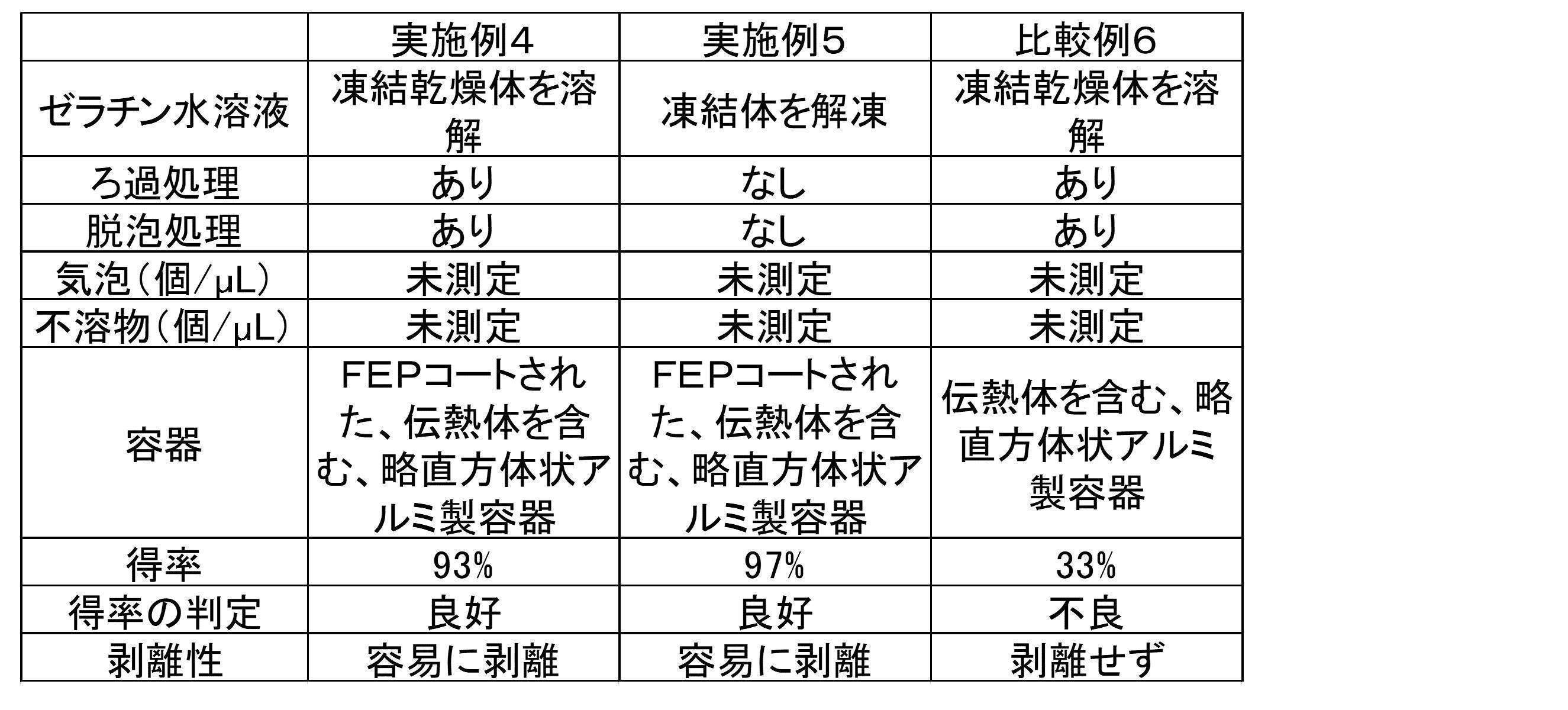
Claims (9)
- 高分子水溶液を、溶液に接する面がテトラフルオロエチレン・ヘキサフルオロプロピレン共重合体である液体容器中で凍結する工程を含む、含高分子水溶液凍結体の製造方法。
- 液体容器の主たる部材の線膨張係数が10×10-5/K未満である、請求項1に記載の製造方法。
- 液体容器の主たる部材の内面のコート部材がテトラフルオロエチレン・ヘキサフルオロプロピレン共重合体である、請求項1に記載の製造方法。
- 高分子水溶液の高分子濃度が0.1wt%以上である、請求項1に記載の製造方法。
- 高分子水溶液が組換えゼラチンの水溶液である、請求項1に記載の製造方法。
- 高分子中の親水性繰り返し単位比率が50%以下である、請求項1に記載の製造方法。
- 高分子水溶液中の不溶物及び気泡が、0.5個/μL以下である、請求項1に記載の製造方法。
- 含高分子水溶液凍結体の製造に供するまで、高分子水溶液を凍結乾燥しない、請求項1に記載の製造方法。
- 請求項1~8のいずれか一項に記載の製造法で得られた高分子水溶液凍結体から、さらに水分を除去する工程を含む、高分子多孔質体の製造方法。
Priority Applications (1)
| Application Number | Priority Date | Filing Date | Title |
|---|---|---|---|
| JP2022531877A JP7426484B2 (ja) | 2020-06-16 | 2021-06-16 | 高分子水溶液凍結体の製造方法及び高分子多孔質体の製造方法 |
Applications Claiming Priority (4)
| Application Number | Priority Date | Filing Date | Title |
|---|---|---|---|
| JP2020-103536 | 2020-06-16 | ||
| JP2020103536 | 2020-06-16 | ||
| JP2020-211597 | 2020-12-21 | ||
| JP2020211597 | 2020-12-21 |
Publications (1)
| Publication Number | Publication Date |
|---|---|
| WO2021256508A1 true WO2021256508A1 (ja) | 2021-12-23 |
Family
ID=79268003
Family Applications (1)
| Application Number | Title | Priority Date | Filing Date |
|---|---|---|---|
| PCT/JP2021/022867 Ceased WO2021256508A1 (ja) | 2020-06-16 | 2021-06-16 | 高分子水溶液凍結体の製造方法及び高分子多孔質体の製造方法 |
Country Status (2)
| Country | Link |
|---|---|
| JP (1) | JP7426484B2 (ja) |
| WO (1) | WO2021256508A1 (ja) |
Cited By (1)
| Publication number | Priority date | Publication date | Assignee | Title |
|---|---|---|---|---|
| JP2023118002A (ja) * | 2022-02-14 | 2023-08-24 | 富士フイルム株式会社 | 組織修復材およびその製造方法 |
Citations (3)
| Publication number | Priority date | Publication date | Assignee | Title |
|---|---|---|---|---|
| WO2014133081A1 (ja) * | 2013-02-27 | 2014-09-04 | 富士フイルム株式会社 | 細胞移植用細胞構造体、生体親和性高分子ブロック及びそれらの製造方法 |
| WO2015046216A1 (ja) * | 2013-09-25 | 2015-04-02 | 富士フイルム株式会社 | 生体親和性高分子多孔質体の製造方法、生体親和性高分子多孔質体、生体親和性高分子ブロック並びに細胞構造体 |
| WO2019044990A1 (ja) * | 2017-08-30 | 2019-03-07 | 富士フイルム株式会社 | 細胞移植用デバイスおよびその製造方法 |
-
2021
- 2021-06-16 JP JP2022531877A patent/JP7426484B2/ja active Active
- 2021-06-16 WO PCT/JP2021/022867 patent/WO2021256508A1/ja not_active Ceased
Patent Citations (3)
| Publication number | Priority date | Publication date | Assignee | Title |
|---|---|---|---|---|
| WO2014133081A1 (ja) * | 2013-02-27 | 2014-09-04 | 富士フイルム株式会社 | 細胞移植用細胞構造体、生体親和性高分子ブロック及びそれらの製造方法 |
| WO2015046216A1 (ja) * | 2013-09-25 | 2015-04-02 | 富士フイルム株式会社 | 生体親和性高分子多孔質体の製造方法、生体親和性高分子多孔質体、生体親和性高分子ブロック並びに細胞構造体 |
| WO2019044990A1 (ja) * | 2017-08-30 | 2019-03-07 | 富士フイルム株式会社 | 細胞移植用デバイスおよびその製造方法 |
Non-Patent Citations (1)
| Title |
|---|
| ANONYMOUS: "Characteristics of Fluororesin", TOEI KAISHA, LTD., 1 January 2011 (2011-01-01), pages 1 - 2, XP055894140, Retrieved from the Internet <URL:https://www.labinox.co.jp/savillex/cat02-03.html> [retrieved on 20220222] * |
Cited By (2)
| Publication number | Priority date | Publication date | Assignee | Title |
|---|---|---|---|---|
| JP2023118002A (ja) * | 2022-02-14 | 2023-08-24 | 富士フイルム株式会社 | 組織修復材およびその製造方法 |
| JP7847444B2 (ja) | 2022-02-14 | 2026-04-17 | 富士フイルム株式会社 | 組織修復材およびその製造方法 |
Also Published As
| Publication number | Publication date |
|---|---|
| JPWO2021256508A1 (ja) | 2021-12-23 |
| JP7426484B2 (ja) | 2024-02-01 |
Similar Documents
| Publication | Publication Date | Title |
|---|---|---|
| CN111032099B (zh) | 细胞移植用设备及其制造方法 | |
| WO2012070680A1 (ja) | コラーゲン非線維化成形体及びその製造方法 | |
| CN104244999B (zh) | 组织修复材料的制造方法 | |
| US10960106B2 (en) | Tissue repair material | |
| JP7426484B2 (ja) | 高分子水溶液凍結体の製造方法及び高分子多孔質体の製造方法 | |
| US11471564B2 (en) | Angiogenic agent and method of manufacturing the same | |
| US20240053099A1 (en) | Freeze-drying container | |
| JP7847444B2 (ja) | 組織修復材およびその製造方法 | |
| CN107427609A (zh) | 软骨再生材料 | |
| JP7036839B2 (ja) | フィブリン組成物、再生医療用基材、フィブリン組成物の製造方法およびキット | |
| US20240009897A1 (en) | Heating treatment apparatus and manufacturing method of heating treatment object | |
| ALBU et al. | Preparation and characterization of collagen matrices obtained at different freezing temperatures | |
| JP2023130851A (ja) | 組織修復材の製造方法 | |
| Michurov et al. | Cryostructuring of Polymeric Systems. 71. Poly (vinyl alcohol) Cryogels Formed by Freezing–Defrosting of Concentrated Polymer Solutions in a Dimethyl Sulfoxide–Dimethylformamide Mixture | |
| CN118804770A (zh) | 组织修复材料及组织修复材料的制造方法 | |
| WO2024038721A1 (ja) | 歯槽骨及び歯根膜の再生材、並びに歯槽骨及び歯根膜の再生材の製造方法 | |
| WO2023188492A1 (ja) | 組織修復材及び組織修復材の製造方法 | |
| RO127487A2 (ro) | Compoziţii vitrigelifiabile şi procedeu pentru obţinerea vitrigelurilor cu aplicaţii biomedicale |
Legal Events
| Date | Code | Title | Description |
|---|---|---|---|
| 121 | Ep: the epo has been informed by wipo that ep was designated in this application |
Ref document number: 21827054 Country of ref document: EP Kind code of ref document: A1 |
|
| ENP | Entry into the national phase |
Ref document number: 2022531877 Country of ref document: JP Kind code of ref document: A |
|
| NENP | Non-entry into the national phase |
Ref country code: DE |
|
| 122 | Ep: pct application non-entry in european phase |
Ref document number: 21827054 Country of ref document: EP Kind code of ref document: A1 |