WO2021256472A1 - 水電解用複極式ゼロギャップ電解槽 - Google Patents
水電解用複極式ゼロギャップ電解槽 Download PDFInfo
- Publication number
- WO2021256472A1 WO2021256472A1 PCT/JP2021/022740 JP2021022740W WO2021256472A1 WO 2021256472 A1 WO2021256472 A1 WO 2021256472A1 JP 2021022740 W JP2021022740 W JP 2021022740W WO 2021256472 A1 WO2021256472 A1 WO 2021256472A1
- Authority
- WO
- WIPO (PCT)
- Prior art keywords
- cathode
- partition wall
- anode
- conductive
- elastic body
- Prior art date
- Legal status (The legal status is an assumption and is not a legal conclusion. Google has not performed a legal analysis and makes no representation as to the accuracy of the status listed.)
- Ceased
Links
Images


Classifications
-
- C—CHEMISTRY; METALLURGY
- C25—ELECTROLYTIC OR ELECTROPHORETIC PROCESSES; APPARATUS THEREFOR
- C25B—ELECTROLYTIC OR ELECTROPHORETIC PROCESSES FOR THE PRODUCTION OF COMPOUNDS OR NON-METALS; APPARATUS THEREFOR
- C25B1/00—Electrolytic production of inorganic compounds or non-metals
- C25B1/01—Products
- C25B1/02—Hydrogen or oxygen
- C25B1/04—Hydrogen or oxygen by electrolysis of water
-
- C—CHEMISTRY; METALLURGY
- C25—ELECTROLYTIC OR ELECTROPHORETIC PROCESSES; APPARATUS THEREFOR
- C25B—ELECTROLYTIC OR ELECTROPHORETIC PROCESSES FOR THE PRODUCTION OF COMPOUNDS OR NON-METALS; APPARATUS THEREFOR
- C25B11/00—Electrodes; Manufacture thereof not otherwise provided for
- C25B11/02—Electrodes; Manufacture thereof not otherwise provided for characterised by shape or form
- C25B11/03—Electrodes; Manufacture thereof not otherwise provided for characterised by shape or form perforated or foraminous
- C25B11/031—Porous electrodes
-
- C—CHEMISTRY; METALLURGY
- C25—ELECTROLYTIC OR ELECTROPHORETIC PROCESSES; APPARATUS THEREFOR
- C25B—ELECTROLYTIC OR ELECTROPHORETIC PROCESSES FOR THE PRODUCTION OF COMPOUNDS OR NON-METALS; APPARATUS THEREFOR
- C25B11/00—Electrodes; Manufacture thereof not otherwise provided for
- C25B11/02—Electrodes; Manufacture thereof not otherwise provided for characterised by shape or form
- C25B11/036—Bipolar electrodes
-
- C—CHEMISTRY; METALLURGY
- C25—ELECTROLYTIC OR ELECTROPHORETIC PROCESSES; APPARATUS THEREFOR
- C25B—ELECTROLYTIC OR ELECTROPHORETIC PROCESSES FOR THE PRODUCTION OF COMPOUNDS OR NON-METALS; APPARATUS THEREFOR
- C25B11/00—Electrodes; Manufacture thereof not otherwise provided for
- C25B11/04—Electrodes; Manufacture thereof not otherwise provided for characterised by the material
- C25B11/051—Electrodes formed of electrocatalysts on a substrate or carrier
-
- C—CHEMISTRY; METALLURGY
- C25—ELECTROLYTIC OR ELECTROPHORETIC PROCESSES; APPARATUS THEREFOR
- C25B—ELECTROLYTIC OR ELECTROPHORETIC PROCESSES FOR THE PRODUCTION OF COMPOUNDS OR NON-METALS; APPARATUS THEREFOR
- C25B11/00—Electrodes; Manufacture thereof not otherwise provided for
- C25B11/04—Electrodes; Manufacture thereof not otherwise provided for characterised by the material
- C25B11/051—Electrodes formed of electrocatalysts on a substrate or carrier
- C25B11/055—Electrodes formed of electrocatalysts on a substrate or carrier characterised by the substrate or carrier material
- C25B11/056—Electrodes formed of electrocatalysts on a substrate or carrier characterised by the substrate or carrier material consisting of textile or non-woven fabric
-
- C—CHEMISTRY; METALLURGY
- C25—ELECTROLYTIC OR ELECTROPHORETIC PROCESSES; APPARATUS THEREFOR
- C25B—ELECTROLYTIC OR ELECTROPHORETIC PROCESSES FOR THE PRODUCTION OF COMPOUNDS OR NON-METALS; APPARATUS THEREFOR
- C25B11/00—Electrodes; Manufacture thereof not otherwise provided for
- C25B11/04—Electrodes; Manufacture thereof not otherwise provided for characterised by the material
- C25B11/051—Electrodes formed of electrocatalysts on a substrate or carrier
- C25B11/055—Electrodes formed of electrocatalysts on a substrate or carrier characterised by the substrate or carrier material
- C25B11/057—Electrodes formed of electrocatalysts on a substrate or carrier characterised by the substrate or carrier material consisting of a single element or compound
- C25B11/061—Metal or alloy
-
- C—CHEMISTRY; METALLURGY
- C25—ELECTROLYTIC OR ELECTROPHORETIC PROCESSES; APPARATUS THEREFOR
- C25B—ELECTROLYTIC OR ELECTROPHORETIC PROCESSES FOR THE PRODUCTION OF COMPOUNDS OR NON-METALS; APPARATUS THEREFOR
- C25B11/00—Electrodes; Manufacture thereof not otherwise provided for
- C25B11/04—Electrodes; Manufacture thereof not otherwise provided for characterised by the material
- C25B11/051—Electrodes formed of electrocatalysts on a substrate or carrier
- C25B11/073—Electrodes formed of electrocatalysts on a substrate or carrier characterised by the electrocatalyst material
- C25B11/075—Electrodes formed of electrocatalysts on a substrate or carrier characterised by the electrocatalyst material consisting of a single catalytic element or catalytic compound
-
- C—CHEMISTRY; METALLURGY
- C25—ELECTROLYTIC OR ELECTROPHORETIC PROCESSES; APPARATUS THEREFOR
- C25B—ELECTROLYTIC OR ELECTROPHORETIC PROCESSES FOR THE PRODUCTION OF COMPOUNDS OR NON-METALS; APPARATUS THEREFOR
- C25B11/00—Electrodes; Manufacture thereof not otherwise provided for
- C25B11/04—Electrodes; Manufacture thereof not otherwise provided for characterised by the material
- C25B11/051—Electrodes formed of electrocatalysts on a substrate or carrier
- C25B11/073—Electrodes formed of electrocatalysts on a substrate or carrier characterised by the electrocatalyst material
- C25B11/075—Electrodes formed of electrocatalysts on a substrate or carrier characterised by the electrocatalyst material consisting of a single catalytic element or catalytic compound
- C25B11/077—Electrodes formed of electrocatalysts on a substrate or carrier characterised by the electrocatalyst material consisting of a single catalytic element or catalytic compound the compound being a non-noble metal oxide
-
- C—CHEMISTRY; METALLURGY
- C25—ELECTROLYTIC OR ELECTROPHORETIC PROCESSES; APPARATUS THEREFOR
- C25B—ELECTROLYTIC OR ELECTROPHORETIC PROCESSES FOR THE PRODUCTION OF COMPOUNDS OR NON-METALS; APPARATUS THEREFOR
- C25B11/00—Electrodes; Manufacture thereof not otherwise provided for
- C25B11/04—Electrodes; Manufacture thereof not otherwise provided for characterised by the material
- C25B11/051—Electrodes formed of electrocatalysts on a substrate or carrier
- C25B11/073—Electrodes formed of electrocatalysts on a substrate or carrier characterised by the electrocatalyst material
- C25B11/075—Electrodes formed of electrocatalysts on a substrate or carrier characterised by the electrocatalyst material consisting of a single catalytic element or catalytic compound
- C25B11/081—Electrodes formed of electrocatalysts on a substrate or carrier characterised by the electrocatalyst material consisting of a single catalytic element or catalytic compound the element being a noble metal
-
- C—CHEMISTRY; METALLURGY
- C25—ELECTROLYTIC OR ELECTROPHORETIC PROCESSES; APPARATUS THEREFOR
- C25B—ELECTROLYTIC OR ELECTROPHORETIC PROCESSES FOR THE PRODUCTION OF COMPOUNDS OR NON-METALS; APPARATUS THEREFOR
- C25B13/00—Diaphragms; Spacing elements
- C25B13/02—Diaphragms; Spacing elements characterised by shape or form
-
- C—CHEMISTRY; METALLURGY
- C25—ELECTROLYTIC OR ELECTROPHORETIC PROCESSES; APPARATUS THEREFOR
- C25B—ELECTROLYTIC OR ELECTROPHORETIC PROCESSES FOR THE PRODUCTION OF COMPOUNDS OR NON-METALS; APPARATUS THEREFOR
- C25B15/00—Operating or servicing cells
- C25B15/02—Process control or regulation
-
- C—CHEMISTRY; METALLURGY
- C25—ELECTROLYTIC OR ELECTROPHORETIC PROCESSES; APPARATUS THEREFOR
- C25B—ELECTROLYTIC OR ELECTROPHORETIC PROCESSES FOR THE PRODUCTION OF COMPOUNDS OR NON-METALS; APPARATUS THEREFOR
- C25B9/00—Cells or assemblies of cells; Constructional parts of cells; Assemblies of constructional parts, e.g. electrode-diaphragm assemblies; Process-related cell features
- C25B9/17—Cells comprising dimensionally-stable non-movable electrodes; Assemblies of constructional parts thereof
- C25B9/19—Cells comprising dimensionally-stable non-movable electrodes; Assemblies of constructional parts thereof with diaphragms
-
- C—CHEMISTRY; METALLURGY
- C25—ELECTROLYTIC OR ELECTROPHORETIC PROCESSES; APPARATUS THEREFOR
- C25B—ELECTROLYTIC OR ELECTROPHORETIC PROCESSES FOR THE PRODUCTION OF COMPOUNDS OR NON-METALS; APPARATUS THEREFOR
- C25B9/00—Cells or assemblies of cells; Constructional parts of cells; Assemblies of constructional parts, e.g. electrode-diaphragm assemblies; Process-related cell features
- C25B9/17—Cells comprising dimensionally-stable non-movable electrodes; Assemblies of constructional parts thereof
- C25B9/19—Cells comprising dimensionally-stable non-movable electrodes; Assemblies of constructional parts thereof with diaphragms
- C25B9/23—Cells comprising dimensionally-stable non-movable electrodes; Assemblies of constructional parts thereof with diaphragms comprising ion-exchange membranes in or on which electrode material is embedded
-
- C—CHEMISTRY; METALLURGY
- C25—ELECTROLYTIC OR ELECTROPHORETIC PROCESSES; APPARATUS THEREFOR
- C25B—ELECTROLYTIC OR ELECTROPHORETIC PROCESSES FOR THE PRODUCTION OF COMPOUNDS OR NON-METALS; APPARATUS THEREFOR
- C25B9/00—Cells or assemblies of cells; Constructional parts of cells; Assemblies of constructional parts, e.g. electrode-diaphragm assemblies; Process-related cell features
- C25B9/60—Constructional parts of cells
- C25B9/63—Holders for electrodes; Positioning of the electrodes
-
- C—CHEMISTRY; METALLURGY
- C25—ELECTROLYTIC OR ELECTROPHORETIC PROCESSES; APPARATUS THEREFOR
- C25B—ELECTROLYTIC OR ELECTROPHORETIC PROCESSES FOR THE PRODUCTION OF COMPOUNDS OR NON-METALS; APPARATUS THEREFOR
- C25B9/00—Cells or assemblies of cells; Constructional parts of cells; Assemblies of constructional parts, e.g. electrode-diaphragm assemblies; Process-related cell features
- C25B9/60—Constructional parts of cells
- C25B9/65—Means for supplying current; Electrode connections; Electric inter-cell connections
-
- C—CHEMISTRY; METALLURGY
- C25—ELECTROLYTIC OR ELECTROPHORETIC PROCESSES; APPARATUS THEREFOR
- C25B—ELECTROLYTIC OR ELECTROPHORETIC PROCESSES FOR THE PRODUCTION OF COMPOUNDS OR NON-METALS; APPARATUS THEREFOR
- C25B9/00—Cells or assemblies of cells; Constructional parts of cells; Assemblies of constructional parts, e.g. electrode-diaphragm assemblies; Process-related cell features
- C25B9/70—Assemblies comprising two or more cells
- C25B9/73—Assemblies comprising two or more cells of the filter-press type
- C25B9/75—Assemblies comprising two or more cells of the filter-press type having bipolar electrodes
-
- C—CHEMISTRY; METALLURGY
- C25—ELECTROLYTIC OR ELECTROPHORETIC PROCESSES; APPARATUS THEREFOR
- C25B—ELECTROLYTIC OR ELECTROPHORETIC PROCESSES FOR THE PRODUCTION OF COMPOUNDS OR NON-METALS; APPARATUS THEREFOR
- C25B9/00—Cells or assemblies of cells; Constructional parts of cells; Assemblies of constructional parts, e.g. electrode-diaphragm assemblies; Process-related cell features
- C25B9/70—Assemblies comprising two or more cells
- C25B9/73—Assemblies comprising two or more cells of the filter-press type
- C25B9/77—Assemblies comprising two or more cells of the filter-press type having diaphragms
-
- C—CHEMISTRY; METALLURGY
- C25—ELECTROLYTIC OR ELECTROPHORETIC PROCESSES; APPARATUS THEREFOR
- C25B—ELECTROLYTIC OR ELECTROPHORETIC PROCESSES FOR THE PRODUCTION OF COMPOUNDS OR NON-METALS; APPARATUS THEREFOR
- C25B9/00—Cells or assemblies of cells; Constructional parts of cells; Assemblies of constructional parts, e.g. electrode-diaphragm assemblies; Process-related cell features
- C25B9/05—Pressure cells
-
- Y—GENERAL TAGGING OF NEW TECHNOLOGICAL DEVELOPMENTS; GENERAL TAGGING OF CROSS-SECTIONAL TECHNOLOGIES SPANNING OVER SEVERAL SECTIONS OF THE IPC; TECHNICAL SUBJECTS COVERED BY FORMER USPC CROSS-REFERENCE ART COLLECTIONS [XRACs] AND DIGESTS
- Y02—TECHNOLOGIES OR APPLICATIONS FOR MITIGATION OR ADAPTATION AGAINST CLIMATE CHANGE
- Y02E—REDUCTION OF GREENHOUSE GAS [GHG] EMISSIONS, RELATED TO ENERGY GENERATION, TRANSMISSION OR DISTRIBUTION
- Y02E60/00—Enabling technologies; Technologies with a potential or indirect contribution to GHG emissions mitigation
- Y02E60/30—Hydrogen technology
- Y02E60/36—Hydrogen production from non-carbon containing sources, e.g. by water electrolysis
-
- Y—GENERAL TAGGING OF NEW TECHNOLOGICAL DEVELOPMENTS; GENERAL TAGGING OF CROSS-SECTIONAL TECHNOLOGIES SPANNING OVER SEVERAL SECTIONS OF THE IPC; TECHNICAL SUBJECTS COVERED BY FORMER USPC CROSS-REFERENCE ART COLLECTIONS [XRACs] AND DIGESTS
- Y02—TECHNOLOGIES OR APPLICATIONS FOR MITIGATION OR ADAPTATION AGAINST CLIMATE CHANGE
- Y02P—CLIMATE CHANGE MITIGATION TECHNOLOGIES IN THE PRODUCTION OR PROCESSING OF GOODS
- Y02P20/00—Technologies relating to chemical industry
- Y02P20/10—Process efficiency
- Y02P20/133—Renewable energy sources, e.g. sunlight
Definitions
- the present invention relates to a bipolar zero gap electrolytic cell for water electrolysis.
- renewable energy has the property that its output is extremely variable because its output depends on climatic conditions. Therefore, it is not always possible to transport the electric power obtained from power generation by renewable energy (hereinafter, also referred to as "variable power source") to the general electric power system, resulting in imbalance between power supply and demand and destabilization of the electric power system. There are concerns about social impacts such as. It is also well known that the imbalance between the electric power obtained from renewable energy and the electric power demand occurs not only during the day but also depending on the season.
- Hydrogen is widely used industrially in the fields of petroleum refining, chemical synthesis, metal refining, etc., and in recent years, it can be used in hydrogen stations for fuel cell vehicles (FCVs), smart communities, hydrogen power plants, etc.
- FCVs fuel cell vehicles
- the sex is also spreading. Therefore, there are high expectations for the development of technology for obtaining high-purity hydrogen from renewable energy.
- alkaline water electrolysis is one of the most promising ones because it has been industrialized for more than several decades, it can be carried out on a large scale, and it is cheaper than other water electrolyzers. Has been done.
- the structure of the electrolytic cell especially the structure in which the gap between the diaphragm and the electrode is substantially eliminated.
- a zero gap structure is effective (see Patent Documents 1 and 2).
- the generated gas is quickly released through the pores of the electrode to the side opposite to the diaphragm side of the electrode, thereby reducing the distance between the electrodes and suppressing the generation of gas pools in the vicinity of the electrodes as much as possible for electrolysis.
- the voltage is suppressed low. Therefore, the zero gap structure is extremely effective in suppressing the electrolytic voltage, and is adopted in various electrolytic devices.
- the electrolytic efficiency deteriorates. Further, the differential pressure fluctuation between the anode chamber and the cathode chamber may damage the diaphragm and cause a mixture of oxygen gas and hydrogen gas. When the differential pressure fluctuates, the contact portion may be damaged by friction even in the contact portion between other members. In particular, when a protective layer such as nickel plating is formed on the electrolytic frame forming the electrolytic cell, the protective layer may be damaged and cause corrosion.
- an object of the present invention is to provide an electrolytic cell that can efficiently produce hydrogen in a wide range of current densities and can cope with a variable power source.
- the gist of the present invention is as follows. [1] A plurality of anode chambers having an anode, a cathode chamber having a cathode, a conductive partition wall provided between the anode chamber and the cathode chamber, and an outer frame edging the conductive partition wall.
- the multi-pole element is stacked with the gasket and the anode in between, and applies surface pressure between the gasket and the anode and between the gasket and the outer frame, and water electrolysis realizes the sealing of the electrolytic solution.
- the conductive partition wall has protrusions on at least one surface and has protrusions.
- a conductive elastic body is arranged between the electrode and the surface on the opposite side of the one surface of the conductive partition wall.
- One electrode forms conduction with the conductive partition wall at least through the protrusion and the other electrode via at least the conductive elastic body.
- the diaphragm is sandwiched between the cathode and the anode of adjacent bipolar elements by the elastic stress of the conductive elastic body.
- the conductive partition wall has protrusions, dents, and flat portions on its surface.
- the protrusions are arranged on only one surface, and the flat portion is arranged between at least a set of adjacent protrusions.
- Zero gap electrolytic cell [4]
- a conductive elastic body is arranged between the one surface of the conductive partition wall and the electrode provided in the electrode chamber on the one surface side.
- the bipolar zero gap electrolytic cell for water electrolysis according to any one of [1] to [3].
- the diameter of the protrusion is 1 mm or more and 70 mm or less.
- the height of the protrusion is 0.1 mm or more and 20 mm or less.
- a current collector is arranged between the conductive elastic body and the conductive partition wall, and the current collector is arranged.
- the conductive elastic body has a conductive cushion mat
- the conductive cushion mat has a wire diameter of 0.05 mm or more and 1 mm or less, a thickness at compression of 1 mm or more and 20 mm or less, and an elastic stress at 50% compression deformation of 1 kPa or more and 1000 kPa or less.
- the anode and / or the cathode is made of nickel and has at least one porous body selected from the group consisting of a metal foam, a plain woven mesh type porous body, a punching type porous body, and an expanded type porous body. It ’s a body, The multipolar zero-gap electrolytic cell for water electrolysis according to any one of [1] to [14], wherein the porous body is arranged on the conductive elastic body. [16] The multipolar zero-gap electrolytic cell for water electrolysis according to any one of [1] to [15], wherein the stack pressure is 0.5 MPa or more and 100 MPa or less.
- a method for producing hydrogen which comprises using the bipolar zero-gap electrolytic cell for water electrolysis according to any one of [1] to [16]. [18] The method for producing hydrogen according to [17], wherein the electrolytic operation pressure is 3 to 4000 kPa.
- the present invention it is possible to provide a multipolar electrolytic cell and a hydrogen production method capable of efficiently producing hydrogen in a wide range of current densities and corresponding to a variable power source.
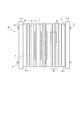
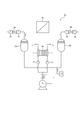
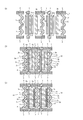
- FIG. 1 It is a side view which shows the whole of the example of the multi-pole type zero gap electrolytic cell for water electrolysis of this embodiment. It is a figure which shows the outline of the alkaline water electrolysis apparatus which comprises an example of the bipolar zero gap electrolytic cell for water electrolysis of this embodiment. It is a figure which shows the outline of an example of the zero gap structure of the bipolar zero gap electrolytic cell for water electrolysis of this embodiment.
- (A) is a cross-sectional view before a stack in which two multipolar elements are arranged side by side.
- (B) and (C) are cross-sectional views of an example of a multi-pole type zero-gap electrolytic cell for water electrolysis in which a multi-pole type element is stacked to form a zero gap structure.
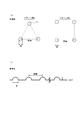
- FIG. 2 is a plan view (a) and a cross-sectional view (b) of the conductive partition wall showing an example of the arrangement of protrusions provided on the surface of the conductive partition wall.
- a plan view showing a mesh portion of an expanded base material of an example of a porous electrode of a multipolar zero-gap electrolytic cell for water electrolysis of the present embodiment and a plane along lines AA of the plan view.
- It is a cross-sectional view of.
- It is a top view which shows the mesh part of the plain weave mesh type base material of an example of the porous body electrode of the bipolar zero gap electrolytic cell for water electrolysis of this embodiment.
- the present embodiment a mode for carrying out the present invention (hereinafter referred to as “the present embodiment”) will be described in detail.
- the present invention is not limited to the following embodiments, and can be variously modified and implemented within the scope of the gist thereof.
- the multipolar zero-gap electrolytic cell for water electrolysis of the present embodiment a plurality of multipolar elements having an anode on one side and a cathode on one side are arranged in the same direction with a diaphragm in between and connected in series, and only both ends are powered. It is a multi-pole electrolytic cell connected to.
- the bipolar zero-gap electrolytic cell for water electrolysis of the present embodiment has a combination of an anode, a cathode, and a diaphragm arranged between the anode and the cathode (also referred to as an "electrolysis cell").
- This is a multi-pole electrolytic cell equipped with a plurality of electrodes.
- the bipolar zero-gap electrolysis tank for water electrolysis of the present embodiment includes an anode chamber provided with an anode, a cathode chamber provided with a cathode, and a conductive partition wall provided between the anode chamber and the cathode chamber.
- Multipolar elements comprising are stacked across a gasket and a diaphragm, having protrusions on at least one surface of the conductive bulkhead, the opposite surface of the conductive bulkhead to the electrode. It is preferable that a conductive elastic body is arranged between them, and one electrode is connected to the conductive partition wall through at least the protrusion and the other electrode is connected to the conductive partition wall through at least the conductive elastic body.
- the bipolar zero-gap electrolytic tank for water electrolysis of the present embodiment is provided with an anode chamber provided with an anode, a cathode chamber provided with a cathode, and conductivity between the anode chamber and the cathode chamber.
- a plurality of bipolar elements having a partition wall and an outer frame edging the conductive partition wall are stacked so as to sandwich the gasket and the diaphragm, and between the gasket and the diaphragm, and between the gasket and the outer frame. It is a multi-pole electrolytic tank for water electrolysis that applies surface pressure between the two and realizes sealing of the electrolytic solution.
- the conductive bulkhead has protrusions on at least one surface, and a conductive elastic body is arranged between the electrode and the opposite surface of the one surface of the conductive bulkhead, and the one electrode is The other electrode forms conduction with the conductive partition wall at least through the protrusion and at least through the conductive elastic body, and the cathode and the anode of the adjacent bipolar element due to the elastic stress of the conductive elastic body. It is preferable that the diaphragm is sandwiched between the and.
- the multi-pole zero-gap electrolytic cell for water electrolysis of the present embodiment can efficiently produce hydrogen in a wide current density range and can cope with a variable power source.
- the thickness or width of the electrode chamber it is possible to reduce the cost of structural materials in a compact manner, and by reducing the pressure loss in the electrolytic cell, it is possible to increase the linear velocity of the electrolytic solution in the electrolytic cell. As a result, it is possible to prevent an abnormal temperature rise in the tank and improve the defoaming property. Further, even if the differential pressure fluctuates due to the power fluctuation, the zero gap structure can be maintained, and damage to the diaphragm, the electrolytic frame, the electrode, and other members can be prevented.
- the conductive partition wall, the conductive elastic body, the anode, the cathode, the current collector, and the diaphragm which are important components that characterize the bipolar zero-gap electrolytic cell for water electrolysis of the present embodiment, will be described in detail.
- alkaline water electrolysis reaction in an electrolytic cell equipped with a pair of electrodes (that is, an anode and a cathode) connected to a power source, alkaline water is electrolyzed to generate oxygen gas at the anode and hydrogen gas at the cathode. ..
- electrode when the term "electrode" is used, it means either one or both of the anode and the cathode. Further, one electrode means either an anode or a cathode, and the other electrode means an electrode different from the one electrode. Further, “conduction" means to be electrically connected.
- the conductive partition wall is provided between the anode chamber and the cathode chamber (FIG. 3).
- the conductive partition wall may have a shape having two surfaces, a surface in contact with the anode chamber and a surface in contact with the cathode chamber. Further, the conductive partition wall may have a structure that does not allow the electrolytic solution to permeate.
- the one surface of the conductive partition wall means the surface on the anode chamber side or the cathode chamber side, and the opposite surface means the surface on the electrode chamber side different from the one surface.
- the multipolar zero-gap electrolytic cell for water electrolysis of the present embodiment has protrusions on at least one surface of the conductive partition wall.
- the protrusions support the electrodes and form a conduction path between the electrodes and the conductive bulkheads. Further, the presence of the protrusion between the electrode and the partition wall makes it possible to form a suitable flow path having a small pressure loss for the electrolytic solution and the fluid of the generated gas. Further, the protrusions promote the stirring of the electrolytic solution by the generated gas, so that the temperature distribution due to the heat generated locally in the electrolytic cell is made uniform. This makes it possible to prevent damage to members such as the diaphragm due to a local temperature rise inside the electrolytic cell.
- the protrusions herein do not include ribs.
- the protrusions eliminate the need to weld ribs to the conductive bulkhead, leading to cost reduction. Furthermore, when a protective layer such as nickel plating is formed on the electrolytic cell that forms the electrolytic cell, there is no place to weld the ribs to the conductive partition wall, so it is possible to suppress nickel plating defects, and low cost and high durability. It is possible to realize an electrolytic cell that has both properties.
- the protrusion is on only one surface and the recess corresponding to the protrusion is only on the surface opposite to one surface (FIG. 3).
- the recess is preferably located on the opposite side of the conductive partition wall of the protrusion in the thickness direction (FIG. 3).
- the protrusion may be on both surfaces of the conductive partition wall. If there are protrusions on both surfaces, the surface opposite the surface with the protrusions may have a recess corresponding to the opposite position of each protrusion. That is, there may be protrusions and dents on the surface.
- the protrusion is provided only on the surface of the conductive partition wall parallel to the surface of the electrode (the surface of the surface of the conductive partition wall (FIG. 3B) in contact with the anode 2a and the elastic body 2e). It is preferable that the surface is perpendicular to the electrode surface and is not provided on the surface in contact with the electrode chamber.
- the protrusion is present only on one surface of the conductive partition wall, and the other surface has a recess corresponding to the protrusion (FIG. 4).
- the location of the dent is not particularly specified, but by installing it on the electrode chamber side where the amount of gas generated is large, the pressure fluctuation leveling effect due to the buffering effect can be obtained, the differential pressure fluctuation can be suppressed, and the diaphragm can be installed. , It is possible to prevent damage to the electrolytic frame, electrodes, and other members.
- the shape of the protrusion can be any geometric shape such as a corrugated shape, a hemispherical shape, a spherical shape, a circular shape, an elliptical shape, a trapezoidal shape, and a cone.
- a hemispherical shape (FIG. 4) or a spherical shape is preferable because the electrode is less damaged.
- the protrusions can be arranged at certain intervals.
- the arrangement of the protrusions can be any arrangement such as 60 ° staggered, 45 ° staggered, and parallel.
- 60 ° zigzag means that there are protrusions at the vertices of an equilateral triangle, and the angles of the lines connecting the centers of the protrusions are arranged at 60 ° (Fig. 4 (a) Pattern example a).
- Parallel means that there are protrusions at the four corners of the square, and the quadrangles connecting the centers of the protrusions are arranged at 90 ° (Fig. 4 (a) Pattern example b).
- 45 ° zigzag means that there are protrusions at the intersections of the four corners of the square and their diagonal lines, and the angles of the lines connecting the centers of the protrusions are arranged in the directions of 45 ° and 90 °.
- the shape of the protrusions when the surface of the conductive partition wall is viewed in a plan view may be a circular shape, a polygonal shape, or the like.
- the distance between the protrusions is preferably 10 mm or more and 100 mm or less. From the viewpoint of suppressing pressure loss, the interval is more preferably 20 mm or more, further preferably 30 mm or more. Further, from the viewpoint of suppressing the bending of the electrodes, the interval is more preferably 70 mm or less, and further preferably 50 mm or less.
- the distance between the protrusions may be the distance between the centers of the two adjacent protrusions (FIG. 4). Further, the distance between protrusions means the distance between a certain protrusion and another protrusion existing closest to the protrusion. The distance between the protrusions may be, for example, the average value of the distance between the protrusions of any 10 protrusions existing on the conductive partition wall.
- the protrusion diameter is preferably 1 mm or more and 70 mm or less. From the viewpoint of lowering the contact resistance, the diameter is more preferably 3 mm or more, further preferably 5 mm or more. Further, from the viewpoint of suppressing pressure loss, the diameter is more preferably 50 mm or less, and further preferably 30 mm or less.
- the diameter of the protrusion is the length of a line segment connecting two points at the outer ends of the protrusion shape in a plan view, and refers to the maximum length (FIG. 4). For example, if it is a circle, it is the diameter, and if it is a quadrangle, it is the length of the diagonal line.
- the diameter of the protrusion may be, for example, the diameter of the protrusion of any 10 protrusions existing on the conductive partition wall, and may be used as an average value thereof.
- the protrusion height is preferably 0.1 mm or more and 20 mm or less. From the viewpoint of pressure loss, the height is more preferably 1 mm or more, further preferably 2 mm or more. From the viewpoint of workability, the height is more preferably 10 mm or less, and further preferably 6 mm or less.
- FIG. 4 shows a cross-sectional view of an example of the protrusion.
- the height of the protrusion may be the distance from the surface of the conductive partition wall on the side where the protrusion is provided (for example, the surface of the flat portion) to the highest point of the protrusion in the cross section in the thickness direction of the conductive partition wall.
- the height of the protrusions may be, for example, the height of any 10 protrusions existing on the conductive partition wall, and may be used as an average value thereof.
- the conductive partition wall preferably has a flat portion between at least one set of adjacent protrusions among adjacent protrusions on the same surface, and more preferably has a flat portion between all the adjacent protrusions (Fig.). 4). Further, the conductive partition wall preferably has a flat portion between at least one set of adjacent recesses, and more preferably has a flat portion between all the adjacent recesses (FIG. 4).
- the conductive partition wall may have the protrusions, the recesses, and the flat portion on the surface, the protrusions may be arranged on only one surface, and the recesses may be arranged only on the opposite surface of one surface. preferable.
- a conductive elastic body is arranged adjacent to the surface of the conductive partition wall on the side having a recess, one electrode forms conduction with the conductive partition wall through at least the protrusion, and the other electrode is at least the said.
- conduction is formed with the flat portion of the surface of the conductive partition wall on the side having the recess, and the diaphragm is sandwiched between both electrodes by the elastic stress of the conductive elastic body. It is preferable from the viewpoint of preventing damage to the diaphragm, electrolytic frame, electrodes, and other members by reducing the contact resistance and suppressing the differential pressure fluctuation.
- the flat portion of the conductive partition wall refers to a flat portion having neither a convex portion nor a concave portion.
- the protrusion refers to a convex portion from the flat portion of the surface having the protrusion of the conductive partition wall toward the electrode on the surface side.
- the dent refers to a dent from the flat portion of the surface having the dent of the conductive partition wall toward the surface opposite to the surface. The dent does not include the through hole or the header part.
- the protrusions are arranged on one surface, the recesses are arranged on the opposite surface of one surface, and the positions of the protrusions and recesses on the surface can be arbitrarily set.
- the conductive elastic body is arranged between the surface of the conductive partition wall and an electrode (for example, an anode or a cathode) provided in the electrode chamber on the surface side (FIG. 3). It is preferable that the conductive elastic body and the conductive partition wall form conduction, and the conductive elastic body and the surface of the conductive partition wall may be adjacent to each other, or another member (for example, a current collector). It may be arranged via a member having conductivity such as. For example, another conductive member may be interposed between the surface of the conductive partition wall on the side having the recess and the conductive elastic body (FIG.
- the multipolar element has a structure in which protrusions are provided only on one surface of the conductive partition wall and electrodes are arranged on the other surface via a conductive elastic body (FIG. 3), and both surfaces of the conductive partition wall. There are protrusions on one surface, and electrodes are placed via the conductive elastic body on only one surface. There are protrusions on both surfaces of the conductive partition wall, and electrodes are placed on both surfaces via the conductive elastic body. Structure, which is included.
- the contact area becomes wider and the contact resistance can be reduced as compared with the case of forming conduction with the protrusion, and a suitable electron conduction path can be obtained.
- the buffering effect of the dent can level the pressure fluctuation, and as a result, the differential pressure fluctuation between the anode chamber and the cathode chamber is suppressed, and damage to the diaphragm, the electrolytic frame, the electrode, and other members is prevented. Can be done.
- a conductive elastic body is arranged between at least one surface of the conductive partition wall and an electrode provided in the electrode chamber on the surface side (FIG. 3). Above all, it is preferable that the conductive elastic body is arranged adjacent to at least one surface of the conductive partition wall (FIGS. 3A and 3B).
- the conductive elastic body is preferably disposed at least on the surface opposite to the surface on which the protrusions are provided.
- the conductive elastic body may be at least in the cathode chamber, or may be only in the cathode chamber.
- the conductive elastic body supports the electrode and forms a conduction between the electrode and the conductive partition wall.
- the conductive elastic body also serves as a flow path through which the electrolytic solution and the generated gas flow.
- a diaphragm is placed between adjacent alkaline water electrolytic elements to form an electrolytic tank, and the diaphragm is sandwiched between the cathode of one alkaline water electrolytic element and the anode of the other alkaline water electrolytic element,
- the conductive elastic body that movably supports the cathode or the anode with respect to the conductive partition wall, the cathode, the diaphragm, and the anode can be uniformly adhered to each other, and a zero gap structure can be realized.
- the generated gas can be extracted from the back surface of the cathode or anode (that is, the surface opposite to the surface in contact with the diaphragm) without resistance, as well as the retention of air bubbles and vibration when the generated gas is discharged. This can be prevented, and stable electrolysis can be performed for a long period of time when the electrolytic voltage is very low.
- the conductive elastic body may be arranged on both sides of the conductive partition wall.
- a conductive elastic body is provided between one surface of the conductive partition wall and one electrode (for example, a cathode), and between the other surface of the conductive partition wall and the other electrode (for example, an anode). It may have been.
- the conductive elastic body may be arranged adjacent to the surfaces on both sides of the conductive partition wall. When the elastic bodies are arranged on both sides of the conductive partition wall, the same conductive elastic body may be used, or different elastic bodies may be used.
- Electrodes may be provided adjacent to each other in this order. As long as one electrode and the other electrode can form conduction, another conductive member may be provided between the conductive partition wall, the conductive elastic body, and the electrodes.
- the most important role of the conductive elastic body is to apply a uniform and appropriate pressure to the electrode in contact with the diaphragm so as not to damage the diaphragm, so that the diaphragm and the electrode are brought into close contact with each other.
- a spring, a spring, a wire woven fabric, a cushion mat, or the like can be used as the conductive elastic body.
- a cushion mat (preferably a conductive cushion mat) obtained by corrugating a woven nickel wire can be used. From the viewpoint of processability, the cushion mat preferably has a wire diameter of 0.05 mm or more, more preferably 0.1 mm or more, and further preferably 0.15 mm or more.
- the elastic stress at the time of 50% compressive deformation is preferably 1 kPa or more, more preferably 5 kPa or more, and further preferably 10 kPa or more. From the viewpoint of film damage, it is preferably 1000 kPa or less, more preferably 500 kPa or less, and even more preferably 100 kPa or less.
- the elastic stress at the time of 50% compression deformation can be measured by the method described in Examples described later.
- the porous electrode has a surface located opposite to the surface in contact with the septum penetrating (for example, a hole to penetrate). To do) is preferable.
- the porous electrode is not particularly limited, and examples thereof include an electrode having a mesh-like structure such as a plain weave mesh type, a punching type, and an expanded type, and a metal foam from the viewpoint of controlling the average pore size.
- Nickel is preferable as the material of the porous electrode.
- the anode and / or cathode is at least one porous body made of nickel and selected from the group consisting of a metal foam, a plain woven mesh type porous body, a punching type porous body, and an expanded type porous body. It is preferable that the porous body is arranged on the conductive elastic body.
- the material of the base material is not particularly limited, and is a conductive base material consisting of at least one selected from the group from nickel, iron, mild steel, stainless steel, vanadium, molybdenum, copper, silver, manganese, platinum group, graphite, chromium and the like. Can be mentioned. An alloy made of two or more kinds of metals or a conductive base material made of a mixture of two or more kinds of conductive substances may be used. Of these, nickel and nickel-based alloys are preferable from the viewpoint of the conductivity of the base material and the resistance to the usage environment.
- the catalyst layer of the anode is preferably one having a high oxygen-evolving ability, and nickel, cobalt, iron, a platinum group element, or the like can be used. These can form a catalyst layer as a simple substance of a metal, a compound such as an oxide, a composite oxide or an alloy composed of a plurality of metal elements, or a mixture thereof in order to realize desired activity and durability.
- An organic substance such as a polymer may be contained in order to improve durability and adhesiveness to a base material.
- the contact resistance of the current collector is preferably 1Emuomegacm 2 or more, more preferably 10Emuomegacm 2 or more, 15Emuomegacm 2 or more is more preferable. Specifically, the contact resistance of the current collector is calculated by the method described later. From the viewpoint of forming an electron conduction path and assembling property, it is preferable that the conductive elastic body and the current collector are integrated by spot welding or the like.
- the material of the current collector is preferably a conductive porous body from the viewpoint of defoaming property of the generated gas.
- the alkaline water electrolysis diaphragm is a porous film from the viewpoints of gas barrier property, maintenance of hydrophilicity, prevention of deterioration of ion permeability due to adhesion of bubbles, and long-term stable electrolysis performance (low voltage loss, etc.). It is preferable to control the pore ratio of. From the viewpoint of achieving both gas breaking property and low voltage loss at a high level, the lower limit of the porosity of the porous membrane is preferably 30% or more, more preferably 35% or more, and more preferably 40% or more. Is even more preferable. The upper limit of the porosity is preferably 70% or less, more preferably 65% or less, and further preferably 55% or less. When the porosity of the porous membrane is not more than the above upper limit value, ions easily permeate through the membrane, and the voltage loss of the membrane can be suppressed.
- a porous membrane washed with pure water is cut into three pieces having a size of 3 cm x 3 cm and used as a measurement sample.
- W2 and W3 of the sample are measured.
- the porous membrane is allowed to stand for 12 hours or more in a dryer set at 50 ° C. to dry, and W1 is measured.
- the porosity is obtained from the values of W1, W2, and W3.
- the porosity is obtained for three samples, and the arithmetic mean value thereof is defined as the porosity P.
- the form of the hydrophilic inorganic particles is preferably a fine particle shape.
- the thickness of the ion exchange membrane is not particularly limited, but the range of 5 to 300 ⁇ m is preferable from the viewpoint of ion permeability and strength.
- Surface treatment may be applied for the purpose of improving the hydrophilicity of the surface of the ion exchange membrane.
- Specific examples thereof include a method of coating hydrophilic inorganic particles such as zirconium oxide and a method of imparting fine irregularities on the surface.
- the ion exchange membrane is preferably used together with the reinforcing material from the viewpoint of film strength.
- the reinforcing material is not particularly limited, and examples thereof include general non-woven fabrics, woven fabrics, and porous membranes made of various materials.
- the porous membrane in this case is not particularly limited, but a stretched and porous PTFE membrane is preferable.
- the diaphragm is preferably a porous membrane.
- the multipolar zero-gap electrolytic cell for water electrolysis of the present embodiment is not limited to that described below.
- the members other than the anode, cathode and diaphragm included in the multipolar zero-gap electrolytic cell for water electrolysis are not limited to those listed below, and known members may be appropriately selected, designed and used. can.
- FIG. 1 shows a side view of an entire example of a bipolar zero-gap electrolytic cell for water electrolysis according to the present embodiment.
- the bipolar zero-gap electrolytic cell for water electrolysis of the present embodiment has an anode, a cathode, and a conductive partition wall that separates an anode chamber having an anode and a cathode chamber having a cathode.
- the outer frame 3 may be provided so as to surround the partition wall 1 along the outer edge of the partition wall 1.
- Adjacent multipolar elements are preferably isolated from each other.
- adjacent multi-pole elements are preferably electrically insulated by being adjacent to each other or via a gasket.
- the conductive partition wall may also serve as the outer frame.
- the outer frame and the gasket may be insulating.
- the multi-pole element 60 is arranged between the anode terminal element 51a and the cathode terminal element 51c, and the diaphragm 4 is the anode terminal element 51a and the multi-pole type. It is arranged between the elements 60, between the adjacent multi-pole elements 60, and between the multi-pole elements 60 and the cathode terminal element 51c.
- the partition wall 1, the outer frame, the diaphragm 4, and the gasket 7 define an electrode chamber through which the electrolytic solution passes.
- the portion partitioned by the conductive partition wall 1, the outer frame 3 provided at the edge of the partition wall (omitted in FIG. 1), the gasket 7, and the diaphragm 4 is used as an electrode chamber, and the electrode chamber having the cathode 2c is the cathode chamber 5c and the anode.
- the electrode chamber in which 2a is located may be the anode chamber 5a (FIG. 3).
- the elastic stress may be 1 to 1000 kPa at the time of 50% compressive deformation.
- the elastic stress at the time of 50% compressive deformation is preferably 1 kPa or more, more preferably 5 kPa or more, and further preferably 10 kPa or more. From the viewpoint of film damage, it is preferably 1000 kPa or less, more preferably 500 kPa or less, and even more preferably 100 kPa or less.
- the elastic stress at the time of 50% compression deformation can be measured by the method described in Examples described later.
- the elastic stress can be adjusted, for example, by adjusting the type, number, thickness, etc. of the conductive elastic body provided in the electrolytic cell.
- a gasket and a diaphragm are provided between the anode chamber and the cathode chamber of the adjacent bipolar elements, and the plurality of bipolar elements sandwich the gasket and the diaphragm. It is preferable to stack them in.
- An anode chamber, a gasket, a diaphragm, a gasket, and a cathode chamber may be laminated in this order between adjacent multipolar elements (FIG. 1).
- the electrolytic solution is sealed.
- the partition wall, the anode 2a, and the cathodes 2c and 2r all have a plate-like shape having a predetermined thickness, but the present invention is not limited to this, and all or one in the cross section.
- the portion may have a zigzag shape or a wavy shape, or the end portion may have a rounded shape.
- the generated gas is quickly released to the side opposite to the diaphragm side of the electrode through the pores of the electrode, thereby reducing the distance between the anode and the cathode (hereinafter, also referred to as “polar distance”). While reducing the voltage, the voltage loss due to the electrolytic solution and the generation of gas pools in the vicinity of the electrodes can be suppressed as much as possible, and the electrolytic voltage can be suppressed to a low level.
- an elastic body for example, a conductive elastic body
- the elastic body is arranged between the electrode and the partition wall as a means for reducing the distance between the electrodes, and the elastic body is used. It can take the form of supporting the electrodes.
- the strength of the elastic body, the number of elastic bodies, the shape, etc. are appropriately adjusted as necessary so that the pressure at which the electrode contacts the diaphragm is not non-uniform. do.
- the electrode supported via the elastic body by making it a flexible structure that deforms when the diaphragm is pressed, it absorbs the tolerance in the manufacturing accuracy of the electrolytic cell and the unevenness due to the deformation of the electrode, etc. and has a zero gap. The structure can be maintained.
- the pressure of the cathode chamber as compared with that of the anode chamber, it is possible to suppress cross-leakage of oxygen to the cathode chamber side and maintain high hydrogen purity.
- FIG. 3 shows an outline of an example of a bipolar zero-gap electrolytic cell for water electrolysis of the present embodiment.
- a conductive elastic body 2e is arranged between the electrode (for example, the anode 2a, the cathode 2c, 2r) and the conductive partition wall 1, and the conductive elastic body supports the electrode 2. (FIG. 3 (B)).
- FIG. 3 shows an outline of an example of a bipolar zero-gap electrolytic cell for water electrolysis of the present embodiment.
- FIG. 3B shows an example in which the conductive elastic body 2e is inserted in the cathode chamber 5c, and the conductive elastic body 2e is adjacent to the conductive partition wall 1 having the recess 12 corresponding to the protrusion 11. Be placed. Further, in FIG. 3C, a current collector 2x, a conductive elastic body 2e, and a cathode 2c are arranged adjacent to each other in the cathode chamber 5c. As the electrode to be arranged on the conductive elastic body 2e, it is preferable to arrange at least one of a metal foam made of nickel, a plain weave mesh type, a punching type, and an expanded type porous body.
- the electrode two or more types of porous bodies having different thicknesses, pore diameters, and structures may be used.
- the cathode two types of a porous body (first cathode) 2c having a small pore diameter and a thin thickness and a second cathode 2r having a large pore diameter and a large pore diameter may be used in combination.
- the first cathode 2c may have a catalyst layer. 2r is preferably placed on the conductive elastic body 2e.
- the rigidity of the other electrode (for example, the anode 2a) paired with the electrodes supported via the conductive elastic body 2e (for example, the cathode 2c and 2r) is increased (the rigidity of the anode is higher than the rigidity of the cathode). By making it stronger), it has a structure with little deformation even when pressed.
- the electrodes supported via the conductive elastic body (for example, cathodes 2c and 2r) have a flexible structure that deforms when the diaphragm 4 is pressed, so that the tolerance in the manufacturing accuracy of the electrolytic cell 50 can be increased. It is possible to maintain the zero gap structure by absorbing the unevenness caused by the deformation of the electrodes.
- the anode 2a forms conduction with the conductive partition wall via the protrusion 11 on the partition wall.
- the conductive elastic body 2e may be arranged adjacent to both surfaces of the conductive partition wall 1.
- the conductive partition wall 1 may have protrusions 11 on both surfaces, and the conductive elastic body 2e may be arranged adjacent to the surfaces on both sides of the conductive partition wall.
- the conductive partition wall 1 has protrusions 11 and recesses 12 corresponding to the protrusions on both surfaces, and the conductive elastic body 2e is arranged adjacent to the surfaces on both sides of the partition wall. It may have been done.
- the bipolar electrolysis tank for water electrolysis of the present embodiment when there are a plurality of electrodes (for example, when there is a first cathode and a second cathode), at least one electrode is at least a protrusion and / or at least conductive. It is preferable to form conduction with the conductive partition wall via the conductive elastic body, and it is more preferable that all the electrodes form conduction with at least the protrusion and / or at least the conductive partition wall via the conductive elastic body.
- the second cathode 2r may be conductive via the conductive elastic body 2e, or the first cathode 2c may be conductive via the conductive elastic body 2e and the second cathode 2r. You may be doing it.
- FIG. 2 shows an example of an alkaline water electrolyzer that can use the multipolar zero-gap electrolytic cell for water electrolysis of the present embodiment.
- the alkaline water electrolyzer 70 includes a rectifier 74 and an oxygen concentration in addition to the liquid feed pump 71, the gas-liquid separation tank 72, and the water replenisher 73, in addition to the multipolar zero-gap electrolyzer tank 50 for water electrolysis of the present embodiment.
- a total of 75, a hydrogen concentration meter 76, a flow meter 77, a pressure gauge 78, a heat exchanger 79, a pressure control valve 80, and the like may be provided.
- the electrolytic solution that can be used for the alkaline water electrolysis of the present embodiment may be an alkaline aqueous solution in which an alkaline salt is dissolved, and examples thereof include a NaOH aqueous solution and a KOH aqueous solution.
- the concentration of the alkaline salt is not particularly limited, but is preferably 20% by mass to 50% by mass, more preferably 25% by mass to 40% by mass. Of these, a 25% by mass to 40% by mass KOH aqueous solution is particularly preferable from the viewpoints of ionic conductivity, kinematic viscosity, and freezing by cooling.
- the temperature of the electrolytic solution in the electrolytic cell is not particularly limited, but is preferably 60 ° C to 130 ° C. Within the above temperature range, it is possible to effectively suppress deterioration of members of the electrolytic apparatus such as gaskets and diaphragms due to heat while maintaining high electrolytic efficiency.
- the temperature of the electrolytic solution is more preferably 85 ° C to 125 ° C, and particularly preferably 90 ° C to 115 ° C.
- the flow rate of the electrolytic solution per electrode chamber and other conditions may be appropriately controlled according to each configuration of the multipolar zero-gap electrolytic cell for water electrolysis.
- Hydrogen production method As the method for producing hydrogen of the present embodiment, the method of using the above-mentioned multipolar zero-gap electrolytic cell for water electrolysis of the present embodiment is preferable.
- water containing an alkali is electrolyzed by a bipolar electrolyzer to produce hydrogen. It may be carried out by using the water electrolysis method of this embodiment.
- the details of the electrolytic cell of the present embodiment, the details of the electrolyzer of the present embodiment, and the details of the water electrolysis method of the present embodiment in the hydrogen production method of the present embodiment are as described above.
- the elastic modulus of the electrode was determined as follows using a tensile compression tester (Autograph AG-Xplus manufactured by Shimadzu Corporation). Using an electrode with a size of 2.5 cm x 8 cm as a sample, the displacement at 0.1 N was set to 0, the electrode was installed, and a 3-point bending test was performed with a test force of 0.1 N and a distance between fulcrums of 5 cm. The modulus of the strain-stress curve between 01% and 0.05% or between 0.1% and 0.5% was defined as the elastic modulus.
- the contact resistance of the current collector was determined as follows using a tensile compression tester (Autograph AG-Xplus manufactured by Shimadzu Corporation) and an ohmmeter (HIOKI, RM3544-01). Using a current collector with a size of 10 cm x 10 cm as a sample, prepare two copper plates (flat plates with a thickness of 10 cm x 10 cm and a thickness of 3 mm), install the current collector between the two copper plates, and test force 200 N at room temperature. The current collector's contact resistance (m ⁇ cm 2 ) was calculated by multiplying the resistance value (m ⁇ ) of the current collector sandwiched between the two copper plates by the sample area (100 cm 2). did.
- Example 1 (Septum) As the partition wall of Example 1, hemispherical protrusions having a diameter of 20 mm and a height of 4 mm are arranged in a 60 ° staggered manner at intervals of 25 mm on one surface of a nickel plate having a thickness of 3 mm, and hemispherical recesses are provided on the opposite surface. A conductive partition wall was used, which was arranged at a position corresponding to the hemispherical protrusion, and was installed so that the protrusion was on the anode chamber side and the recess was corresponding to the cathode chamber side. The partition wall also served as the outer frame.
- partition wall 1 The partition wall is referred to as "partition wall 1" in the following and in Table 1.
- a diaphragm was provided between the anode chamber including the anode described later and the cathode chamber including the cathode described below in the adjacent bipolar elements, and the anode chamber and the cathode chamber were partitioned.
- the spaces between the adjacent protrusions and the adjacent dents on the partition wall surface were all flat portions.
- a nickel-expanded porous electrode (catalyst layer nickel) was used as the anode of Example 1.
- the cathode is referred to as "cathode 1" below and in Table 1.
- foamed nickel (cathode 1') having an average pore diameter of 0.5 mm and a thickness of 1 mm was used, and the cathode 1 was placed near the diaphragm and the cathode 1'was placed on the elastic body.
- the elastic modulus of the cathode 1' was 0.4 GPa, and the bending rigidity was 1 kN ⁇ mm 2 .
- Elastic body As the elastic body of Example 1, a conductive cushion mat having a thickness of 8 mm, which was made into a woven fabric using 0.25 mm nickel wire and further processed into a corrugated shape, was used, and a partition wall was used between the partition wall of the cathode chamber and the cathode. It was installed adjacent to the surface and compressed to 4 mm.
- the elastic body is referred to as "elastic body 1" in the following and in Table 1.
- the elastic stress of the elastic body 1 at the time of 50% compressive deformation was 40 kPa. In each multipolar element, the anode and the partition wall were conducting through the protrusion of the partition wall.
- Example 2 (Septum) The partition wall 1 was used as the partition wall of the second embodiment, and was installed so as to have a protrusion on the anode chamber side and a dent corresponding to the cathode chamber side. A diaphragm was provided between the anode chamber containing the anode described below and the cathode chamber containing the cathode described below, and the anode chamber and the cathode chamber were partitioned.
- anode As the anode of Example 2, a nickel punching type porous electrode (catalyst layer nickel) having a hole diameter of 4 mm, a hole pitch of 6 mm, and a base material thickness of 1 mm was used.
- the anode is referred to as "anode 2" in the following and in Table 1.
- the elastic modulus of the anode 2 was 49 GPa, and the bending rigidity was 100 kN ⁇ mm 2 .
- (cathode) As the cathode of Example 2, the cathode 1 was used as the first cathode, the cathode 1'was used as the second cathode, the cathode 1 was placed near the diaphragm, and the cathode 1'was placed on the elastic body.
- diaphragm As the diaphragm of Example 2, the diaphragm 1 was used.
- the elastic body 1 As the elastic body of Example 2, the elastic body 1 was used, was installed between the partition wall of the cathode chamber and the cathode adjacent to the surface of the partition wall, and compressed to 4 mm. In each multipolar element, the anode and the partition wall were conducting through the protrusion of the partition wall. Further, the cathode adjacent to the elastic body and the partition wall were electrically connected to each other via the elastic body adjacent to the partition wall. Further, due to the elastic stress of the elastic body, a diaphragm was sandwiched between the cathode and the anode of the adjacent bipolar elements.
- Example 3 (Septum) As the partition wall of Example 3, hemispherical protrusions having a diameter of 15 mm and a height of 3 mm are arranged in parallel on one surface of a nickel plate having a thickness of 3 mm at intervals of 40 mm, and hemispherical recesses are formed on the opposite surface.
- a conductive partition wall was used, which was arranged at a position corresponding to the protrusion, and was installed so that there was a protrusion on the anode chamber side and a dent corresponding to the cathode chamber side.
- the partition wall also served as the outer frame.
- the partition wall is referred to as "partition wall 2" in the following and in Table 1.
- a diaphragm was provided between the anode chamber containing the anode described below and the cathode chamber containing the cathode described below, and the anode chamber and the cathode chamber were partitioned.
- anode As the anode of Example 3, a foamed nickel porous electrode (catalyst layer nickel) having an average pore diameter of 0.9 mm and a base material thickness of 2 mm was used. The anode is referred to as "anode 3" in Table 1.
- the elastic modulus of the anode 3 was 0.7 GPa, and the bending rigidity was 10 kN ⁇ mm 2 .
- the cathode 1 As the cathode of Example 3, the cathode 1 was used as the first cathode, the cathode 1'was used as the second cathode, the cathode 1 was placed near the diaphragm, and the cathode 1'was placed on the elastic body.
- the diaphragm As the diaphragm of Example 3, the diaphragm 1 was used.
- Elastic body As the elastic body of Example 3, a conductive cushion mat having a thickness of 8 mm, which was made into a woven fabric using 0.17 mm nickel wire and further processed into a corrugated shape, was used by folding back, and a partition wall was used between the partition wall of the cathode chamber and the cathode.
- Example 4 (Septum) The partition wall 1 was used as the partition wall of the fourth embodiment, and was installed so as to have a protrusion on the anode chamber side and a dent corresponding to the cathode chamber side. A diaphragm was provided between the anode chamber containing the anode described below and the cathode chamber containing the cathode described below, and the anode chamber and the cathode chamber were partitioned. (anode) As the anode of Example 4, the anode 2 was used.
- the cathode 1 As the cathode of Example 4, the cathode 1 was used as the first cathode, the cathode 1'was used as the second cathode, the cathode 1 was placed near the diaphragm, and the cathode 1'was placed on the elastic body.
- diaphragm As the diaphragm of Example 4, the diaphragm 1 was used.
- Elastic body As the elastic body of Example 4, the elastic body 2 was used, and was installed between the partition wall of the cathode chamber and the cathode so as to be adjacent to the surface having the dent of the partition wall, and compressed to 6 mm.
- Example 5 (Septum) As the partition wall of Example 5, hemispherical protrusions having a diameter of 10 mm and a height of 3 mm are arranged in a 60 ° staggered manner with an interval of 50 mm on one side of a nickel plate having a thickness of 3 mm, and hemispherical protrusions having a diameter of 10 mm and a height of 3 mm are arranged on the opposite surface.
- a conductive partition wall arranged in a 60 ° staggered manner at an interval of 50 mm, with the protrusions on both sides arranged at the position of the center of gravity of an equilateral triangle consisting of three protrusions on one side, with the protrusions on the opposite side located.
- the partition wall has protrusions and dents on the surfaces on both sides, and hemispherical dents at corresponding positions on the opposite surfaces of the hemispherical protrusions.
- the partition wall also served as the outer frame.
- the partition wall is referred to as "partition wall 3" in the following and in Table 1.
- the hemispherical protrusions having a diameter of 10 mm and a height of 3 mm on one surface were installed on the anode chamber side, and the hemispherical protrusions having a diameter of 10 mm and a height of 3 mm on the other surface were installed on the cathode chamber side.
- a diaphragm was provided between the anode chamber containing the anode described below and the cathode chamber containing the cathode described below, and the anode chamber and the cathode chamber were partitioned.
- anode As the anode of Example 5, the anode 1 was used.
- cathode As the cathode of Example 5, the cathode 1 was used as the first cathode, the cathode 1'was used as the second cathode, the cathode 1 was placed near the diaphragm, and the cathode 1'was placed on the elastic body.
- diaphragm As the diaphragm of Example 5, the diaphragm 1 was used.
- the elastic body 2 As the elastic body of Example 5, the elastic body 2 was used, was installed between the partition wall of the cathode chamber and the cathode adjacent to the surface of the partition wall, and compressed to 6 mm. Further, the elastic body 3 was installed between the partition wall of the anode chamber and the anode so as to be adjacent to the partition wall, and compressed to 3 mm. In each multipolar element, the anode and the partition wall were conducting with each other via the protrusion of the partition wall and the elastic body. In addition, the cathode and the partition wall were electrically connected to each other through the protrusions and the elastic body of the partition wall. Further, due to the elastic stress of the elastic body, a diaphragm was sandwiched between the cathode and the anode of the adjacent bipolar elements.
- the partition wall 1 was used as the partition wall of the sixth embodiment, and was installed so as to have a protrusion on the anode chamber side and a dent corresponding to the cathode chamber side.
- a diaphragm was provided between the anode chamber containing the anode described below and the cathode chamber containing the cathode described below, and the anode chamber and the cathode chamber were partitioned.
- anode As the anode of Example 6, a nickel-expanded porous electrode (without a catalyst layer) having an LW of 4.5 mm, a SW of 3 mm, and a thickness of 1.0 mm was used.
- the anode is referred to as "anode 4" in the following and in Table 1.
- the elastic modulus of the anode 4 was 12 GPa, and the bending rigidity was 32 kN ⁇ mm 2 .
- (cathode) As the cathode of Example 6, a plain weave mesh type porous electrode (without a catalyst layer) in which a fine nickel wire having a diameter of 0.15 mm was knitted into 40 mesh was used as the first cathode.
- the cathode is referred to as "cathode 2" below and in Table 1.
- a cathode 1' was used as the second cathode, the cathode 2 was placed near the diaphragm, and the cathode 1'was placed on an elastic body.
- the diaphragm 1 As the diaphragm of Example 6, the diaphragm 1 was used.
- Example 7 (Septum) As the partition wall of Example 7, hemispherical protrusions having a diameter of 20 mm and a height of 4 mm are arranged in a 60 ° staggered manner at intervals of 25 mm on one surface of a nickel plate having a thickness of 3 mm, and there are no protrusions or recesses on the opposite surface. A flat, conductive partition wall was used, and it was installed so that there were protrusions on the anode chamber side and there were no protrusions or dents on the cathode chamber side. The partition wall also served as the outer frame. The partition wall is referred to as "partition wall 4" in the following and in Table 1.
- a diaphragm was provided between the anode chamber including the anode described later and the cathode chamber including the cathode described below in the adjacent bipolar elements, and the anode chamber and the cathode chamber were partitioned.
- anode As the anode of Example 7, the anode 1 was used.
- cathode As the cathode of Example 7, the cathode 1 was used as the first cathode, the cathode 1'was used as the second cathode, the cathode 1 was placed near the diaphragm, and the cathode 1'was placed on the elastic body (septum).
- the diaphragm of Example 7 the diaphragm 1 was used.
- the elastic body 1 As the elastic body of Example 7, the elastic body 1 was used, was installed between the partition wall of the cathode chamber and the cathode adjacent to the surface of the partition wall, and compressed to 4 mm. In each multipolar element, the anode and the partition wall were conducting through the protrusion of the partition wall. Further, the cathode adjacent to the elastic body and the partition wall were electrically connected to each other via the elastic body adjacent to the partition wall. Further, due to the elastic stress of the elastic body, a diaphragm was sandwiched between the cathode and the anode of the adjacent bipolar elements.
- Example 8 (Septum) As the partition wall of Example 8, hemispherical protrusions having a diameter of 20 mm and a height of 4 mm are arranged in a 60 ° staggered manner at intervals of 25 mm on one surface of a plate having a nickel-plated layer on the surface of an SPCC having a thickness of 3 mm. Using a conductive partition wall in which hemispherical recesses are arranged on the surface at positions corresponding to the hemispherical protrusions, the protrusions are on the anode chamber side and the recesses are on the cathode chamber side. .. The partition wall also served as the outer frame.
- the partition wall is referred to as "partition wall 5" in the following and in Table 1.
- a diaphragm was provided between the anode chamber containing the anode described below and the cathode chamber containing the cathode described below, and the anode chamber and the cathode chamber were partitioned.
- (anode) As the anode of Example 8, the anode 1 was used.
- (cathode) As the cathode of Example 8, the cathode 1 was used as the first cathode, the cathode 1'was used as the second cathode, the cathode 1 was placed near the diaphragm, and the cathode 1'was placed on the elastic body (septum).
- the diaphragm 1 As the diaphragm of Example 8, the diaphragm 1 was used. (Elastic body) As the elastic body of Example 8, the elastic body 1 was used, was installed between the partition wall of the cathode chamber and the cathode adjacent to the surface of the partition wall, and compressed to 4 mm. In each multipolar element, the anode and the partition wall were conducting through the protrusion of the partition wall. Further, the cathode adjacent to the elastic body and the partition wall were electrically connected to each other via the elastic body adjacent to the partition wall. Further, due to the elastic stress of the elastic body, a diaphragm was sandwiched between the cathode and the anode of the adjacent bipolar elements.
- Example 9 (Septum) The partition wall 1 was used as the partition wall of the ninth embodiment, and was installed so as to have a protrusion on the anode chamber side and a dent corresponding to the cathode chamber side. A diaphragm was provided between the anode chamber containing the anode described below and the cathode chamber containing the cathode described below, and the anode chamber and the cathode chamber were partitioned. (anode) As the anode of Example 9, the anode 1 was used. (cathode) As the cathode of Example 9, the cathode 1 was used. The second cathode was not used.
- the diaphragm 1 As the diaphragm of Example 9, the diaphragm 1 was used.
- (Elastic body, current collector) As the current collector of Example 9, a nickel expand having an LW of 4.5 mm, a SW of 3 mm, and a thickness of 1.0 mm was used. The current collector is referred to as "current collector 1" below.
- the contact resistance of the current collector 1 was 20 m ⁇ cm 2
- the elastic modulus was 12 GPa
- the bending rigidity was 32 kN ⁇ mm 2 .
- the elastic body As the elastic body, the elastic body 1 was used.
- the current collector 1 was placed in contact with the surface of the partition wall of the cathode chamber, and the elastic body 1 was placed in contact with the current collector 1 and compressed to 4 mm.
- the anode and the partition wall were conducting through the protrusion of the partition wall.
- the cathode adjacent to the elastic body and the partition wall were electrically connected to each other via the elastic body adjacent to the partition wall.
- a diaphragm was sandwiched between the cathode and the anode of the adjacent bipolar elements.
- Example 10 (Septum) As the partition wall of Example 10, hemispherical protrusions having a diameter of 50 mm and a height of 9 mm are arranged in a 60 ° staggered manner at intervals of 70 mm on one surface of a nickel plate having a thickness of 3 mm, and hemispherical recesses are provided on the opposite surface. A conductive partition wall was used, which was arranged at a position corresponding to the hemispherical protrusion, and was installed so that the protrusion was on the anode chamber side and the recess was corresponding to the cathode chamber side. The partition wall also served as the outer frame.
- the partition wall is referred to as "partition wall 6" in the following and in Table 1.
- a diaphragm was provided between the anode chamber containing the anode described below and the cathode chamber containing the cathode described below, and the anode chamber and the cathode chamber were partitioned.
- (anode) As the anode of Example 10, the anode 1 was used.
- (cathode) As the cathode of Example 10, cathode 1 is used as the first cathode, and nickel foam (cathode 2') having an average pore diameter of 0.9 mm and a substrate thickness of 2 mm is used as the second cathode, and the position is close to the diaphragm.
- a cathode 1 was placed on the surface, and a cathode 2'was placed on the elastic body.
- the elastic modulus of the cathode 2' was 0.7 GPa, and the bending rigidity was 10 kN ⁇ mm 2 .
- (diaphragm) As the diaphragm of Example 10, the diaphragm 1 was used.
- (Elastic body, current collector) As the current collector of Example 10, the current collector 1 was used. The current collector 1 was placed in contact with the surface of the partition wall of the cathode chamber, and the elastic body was further placed in contact with the current collector 1.
- the elastic body As the elastic body, a 0.25 mm nickel wire was used as a woven fabric, and a corrugated conductive cushion mat having a thickness of 8 mm was folded and used, and compressed to 10 mm.
- the elastic body is referred to as "elastic body 4" below and in Table 1.
- the elastic stress of the elastic body 4 at the time of 50% compressive deformation was 40 kPa.
- the anode and the partition wall were conducting through the protrusion of the partition wall.
- the cathode adjacent to the elastic body and the partition wall were electrically connected to each other via the elastic body adjacent to the partition wall.
- a diaphragm was sandwiched between the cathode and the anode of the adjacent bipolar elements.
- Example 11 (Septum) As the partition wall of Example 11, hemispherical protrusions having a diameter of 55 mm and a height of 12 mm are arranged in a 60 ° staggered manner at intervals of 105 mm on one surface of a nickel plate having a thickness of 3 mm, and hemispherical recesses are provided on the opposite surface.
- a conductive partition wall was used, which was arranged at a position corresponding to the hemispherical protrusion, and was installed so that the protrusion was on the anode chamber side and the recess was corresponding to the cathode chamber side.
- the partition wall also served as the outer frame.
- the partition wall is referred to as "partition wall 7" in the following and in Table 1.
- a diaphragm was provided between the anode chamber containing the anode described below and the cathode chamber containing the cathode described below, and the anode chamber and the cathode chamber were partitioned.
- (anode) As the anode of Example 11, the anode 1 was used.
- (cathode) As the cathode of Example 11, cathode 1 is used as the first cathode, and nickel foam (cathode 2') having an average pore diameter of 0.9 mm and a substrate thickness of 2 mm is used as the second cathode, and the position is close to the diaphragm.
- a cathode 1 was placed on the surface, and a cathode 2'was placed on the elastic body.
- the elastic modulus of the cathode 2' was 0.7 GPa, and the bending rigidity was 10 kN ⁇ mm 2 .
- (diaphragm) As the diaphragm of Example 11, the diaphragm 1 was used.
- (Elastic body, current collector) As the current collector of Example 11, the current collector 1 was used.
- the current collector 1 was placed in contact with the surface of the partition wall of the cathode chamber, and the elastic body was further placed in contact with the current collector 1.
- the elastic body As the elastic body, a 0.25 mm nickel wire was used as a woven fabric, and a corrugated conductive cushion mat having a thickness of 8 mm was folded and used, and compressed to 10 mm.
- the elastic body is referred to as "elastic body 4" below and in Table 1.
- the elastic stress of the elastic body 4 at the time of 50% compressive deformation was 40 kPa.
- the anode and the partition wall were conducting through the protrusion of the partition wall.
- the cathode adjacent to the elastic body and the partition wall were electrically connected to each other via the elastic body adjacent to the partition wall.
- a diaphragm was sandwiched between the cathode and the anode of the adjacent bipolar elements.
- the diaphragm 1 As the diaphragm of Comparative Example 1, the diaphragm 1 was used. (Elastic body) In Comparative Example 1, no elastic body was used. In each multipolar element, the anode and the partition wall were conducting through the protrusion of the partition wall. Further, the partition wall and the cathode were adjacent to each other, and the cathode and the partition wall were conducting.
- Multi-pole electrolytic cell An electrolytic cell having a multi-pole zero-gap structure as shown in FIG. 1, which is composed of an anode terminal element, a cathode terminal element, and four multi-pole elements, was produced.
- the anode, cathode, and diaphragm of the respective examples and comparative examples are similarly incorporated in each electrolytic cell.
- Members other than the anode, cathode, and diaphragm used were those commonly used in the art.
- the stack pressure of the electrolytic cell was 0.8 MPa, and the surface pressure between the gasket and the diaphragm and between the gasket and the outer frame was 2.5 MPa.
- the multipolar element was a rectangle of 1200 mm ⁇ 200 mm, and the area of the anode and cathode was 1150 mm ⁇ 180 mm.
- a zero-gap structure was formed in which the cathode and anode were pressed against the diaphragm.
- the flow rate of the electrolytic solution was measured with a flow meter 77 and adjusted so that the linear velocity in the electrolytic cell had an average of 3 mm / s.
- the temperature was adjusted by the heat exchanger 79 so that the temperature on the outlet side of the electrolytic cell was 90 ° C.
- the cathode and anode of each electrolytic cell were energized from the rectifier 74 at a predetermined electrode density.
- the pressure inside the cell after the start of energization was measured with a pressure gauge 78, and adjusted so that the pressure on the cathode side was 500 kPa and the pressure on the oxygen side was 499 kPa.
- the pressure adjustment was performed by installing a pressure control valve 80 downstream of the pressure gauge 78.
- Example 1-5 Since the electrolytic cell of Example 1-5 showed a low cell voltage in the range of 1 to 10 kA / m 2 , it was shown that hydrogen can be efficiently produced in the range of a wide current density. In addition, the temperature rise in the tank was small, the cell voltage rise after the fluctuation test was small, and no member damage was observed, indicating that it can handle variable power supplies. From Example 6, it was shown that this effect can be obtained without a catalyst. Since Example 7 showed a low cell voltage in the range of 1 to 10 kA / m 2 , it was shown that hydrogen can be efficiently produced in a wide current density range.
- Example 11 it was shown that hydrogen can be efficiently produced in a wide current density range because a low cell voltage was shown in the range of 1 to 10 kA / m 2 even when the current collector was provided. .. In addition, the temperature rise in the tank was small, and a slight rise in the cell voltage was observed after the fluctuation test, but since there was almost no damage to the members, it was possible to handle the fluctuation power supply even with a current collector. Shown. In Example 11, it was shown that hydrogen can be efficiently produced in a wide range of current densities, although it showed a slightly higher cell voltage in the range of 1 to 10 kA / m 2.
- hydrogen can be efficiently produced in a wide current density range, and it is possible to cope with a variable power source.
- it can be used as an electrolytic cell for electrolysis of alkaline water.
- Electrode 1 Conductive partition 11 Protrusion 12 Recess 13 Flat part 2 Electrode 2a Anode 2c First cathode 2e Elastic body 2r Second cathode 2x Collector 3 Outer frame 4 Diaphragm 5a Anode chamber 5b Cathode chamber 7 Gasket 50 Multipolar electrolysis Tank 51g Fast head, loose head 51i Insulation plate 51a Anode terminal element 51c Cathode terminal element 51r Tie rod 60 Multipolar element 65 Electrolytic cell 70 Electrolyzer 71 Liquid feed pump 72 Gas-liquid separation tank 72h Hydrogen separation tank 72o Oxygen separation tank 73 Water Replenisher 74 Rector 75 Oxygen concentration meter 76 Hydrogen concentration meter 77 Flow meter 78 Pressure gauge 79 Heat exchanger 80 Pressure control valve SW Mesh short-center center distance LW mesh long-center center distance C mesh stitch Open TE mesh thickness B Mesh bond length T Plate thickness W Feed width (step width) A Plain weave mesh type opening d Plain weave mesh type wire diameter D Punching type hole diameter P Punch
Landscapes
- Chemical & Material Sciences (AREA)
- Engineering & Computer Science (AREA)
- Chemical Kinetics & Catalysis (AREA)
- Electrochemistry (AREA)
- Materials Engineering (AREA)
- Metallurgy (AREA)
- Organic Chemistry (AREA)
- Inorganic Chemistry (AREA)
- Automation & Control Theory (AREA)
- Electrolytic Production Of Non-Metals, Compounds, Apparatuses Therefor (AREA)
- Water Treatment By Electricity Or Magnetism (AREA)
Priority Applications (5)
| Application Number | Priority Date | Filing Date | Title |
|---|---|---|---|
| EP21826718.5A EP4166693A4 (en) | 2020-06-15 | 2021-06-15 | ZERO-GAP BIPOLAR ELECTROLYTIC CELL FOR WATER ELECTROLYSIS |
| US18/001,713 US20230304176A1 (en) | 2020-06-15 | 2021-06-15 | Bipolar zero-gap electrolyzer for water electrolysis |
| CA3182552A CA3182552A1 (en) | 2020-06-15 | 2021-06-15 | Bipolar zero-gap electrolyzer for water electrolysis |
| AU2021293626A AU2021293626B2 (en) | 2020-06-15 | 2021-06-15 | Bipolar zero gap electrolytic cell for water electrolysis |
| JP2022531843A JP7353494B2 (ja) | 2020-06-15 | 2021-06-15 | 水電解用複極式ゼロギャップ電解槽 |
Applications Claiming Priority (2)
| Application Number | Priority Date | Filing Date | Title |
|---|---|---|---|
| JP2020-103302 | 2020-06-15 | ||
| JP2020103302 | 2020-06-15 |
Publications (1)
| Publication Number | Publication Date |
|---|---|
| WO2021256472A1 true WO2021256472A1 (ja) | 2021-12-23 |
Family
ID=79267984
Family Applications (1)
| Application Number | Title | Priority Date | Filing Date |
|---|---|---|---|
| PCT/JP2021/022740 Ceased WO2021256472A1 (ja) | 2020-06-15 | 2021-06-15 | 水電解用複極式ゼロギャップ電解槽 |
Country Status (6)
| Country | Link |
|---|---|
| US (1) | US20230304176A1 (https=) |
| EP (1) | EP4166693A4 (https=) |
| JP (1) | JP7353494B2 (https=) |
| AU (1) | AU2021293626B2 (https=) |
| CA (1) | CA3182552A1 (https=) |
| WO (1) | WO2021256472A1 (https=) |
Cited By (2)
| Publication number | Priority date | Publication date | Assignee | Title |
|---|---|---|---|---|
| EP4567154A1 (en) | 2023-12-04 | 2025-06-11 | thyssenkrupp nucera AG & Co. KGaA | Electrolyzer, and method for manufacturing an electrolyzer |
| WO2026034402A1 (ja) * | 2024-08-07 | 2026-02-12 | 旭化成株式会社 | 電解セル、電解槽及び水素の製造方法 |
Families Citing this family (7)
| Publication number | Priority date | Publication date | Assignee | Title |
|---|---|---|---|---|
| EP4405302A4 (en) * | 2021-09-24 | 2026-01-21 | Aluminum Technlogies Llc | SELECTIVE CHLORINATION PROCESS OF ALUMINUM ORE FOR THE PREPARATION OF ALUMINUM |
| BE1031574B1 (fr) * | 2023-04-28 | 2024-12-10 | John Cockerill Hydrogen Belgium | Plaque bipolaire multifonction, cellule électrolytique et électrolyseur en comportant |
| US12297547B2 (en) * | 2023-08-31 | 2025-05-13 | Dioxycle | Compressible flow distribution system for electrolyzer plates |
| KR102871339B1 (ko) * | 2023-12-15 | 2025-10-15 | 주식회사 라이트브릿지 | 수소 환원 플라즈마를 활용한 스택 전극 제조방법 및 이에 의해 제조되는 전극 |
| WO2025179085A1 (en) * | 2024-02-23 | 2025-08-28 | Board Of Supervisors Of Louisiana State University And Agricultural And Mechanical College | Electrolyzer dynamic seal |
| CN117883974B (zh) * | 2024-03-15 | 2024-06-18 | 中南大学 | 模块化膜隔离碳解吸装置、碳捕集系统、方法及应用 |
| CN118422236A (zh) * | 2024-05-06 | 2024-08-02 | 东南大学 | 基于本征安全的无膜化学链循环电解水制氢装置及方法 |
Citations (4)
| Publication number | Priority date | Publication date | Assignee | Title |
|---|---|---|---|---|
| JPS62502125A (ja) * | 1985-03-07 | 1987-08-20 | オロンジオ・ド・ノラ・イムピアンチ・エレットロキミシ・ソシエタ・ペル・アジオニ | 単極式および複極式電解槽およびこれらの電極構造体 |
| JPH03249189A (ja) * | 1990-02-28 | 1991-11-07 | Chlorine Eng Corp Ltd | 電解槽およびその製造方法 |
| JPH0649675A (ja) * | 1992-06-03 | 1994-02-22 | Tosoh Corp | 複極式電解槽 |
| WO2019111832A1 (ja) * | 2017-12-05 | 2019-06-13 | 株式会社トクヤマ | アルカリ水電解用膜-電極-ガスケット複合体 |
Family Cites Families (5)
| Publication number | Priority date | Publication date | Assignee | Title |
|---|---|---|---|---|
| US5314591A (en) * | 1991-06-26 | 1994-05-24 | Chlorine Engineers Corp., Ltd | Electrolyzer and method of production |
| US6761808B1 (en) * | 1999-05-10 | 2004-07-13 | Ineos Chlor Limited | Electrode structure |
| JP5670600B2 (ja) * | 2012-03-19 | 2015-02-18 | 旭化成ケミカルズ株式会社 | 電解セル及び電解槽 |
| EP3575439B1 (en) * | 2017-01-26 | 2023-10-25 | Asahi Kasei Kabushiki Kaisha | Electrolytic bath, electrolysis device, electrolysis method, and method for producing hydrogen |
| JP6963978B2 (ja) * | 2017-11-29 | 2021-11-10 | 株式会社トクヤマ | 電解槽 |
-
2021
- 2021-06-15 EP EP21826718.5A patent/EP4166693A4/en active Pending
- 2021-06-15 WO PCT/JP2021/022740 patent/WO2021256472A1/ja not_active Ceased
- 2021-06-15 AU AU2021293626A patent/AU2021293626B2/en active Active
- 2021-06-15 CA CA3182552A patent/CA3182552A1/en active Pending
- 2021-06-15 US US18/001,713 patent/US20230304176A1/en active Pending
- 2021-06-15 JP JP2022531843A patent/JP7353494B2/ja active Active
Patent Citations (4)
| Publication number | Priority date | Publication date | Assignee | Title |
|---|---|---|---|---|
| JPS62502125A (ja) * | 1985-03-07 | 1987-08-20 | オロンジオ・ド・ノラ・イムピアンチ・エレットロキミシ・ソシエタ・ペル・アジオニ | 単極式および複極式電解槽およびこれらの電極構造体 |
| JPH03249189A (ja) * | 1990-02-28 | 1991-11-07 | Chlorine Eng Corp Ltd | 電解槽およびその製造方法 |
| JPH0649675A (ja) * | 1992-06-03 | 1994-02-22 | Tosoh Corp | 複極式電解槽 |
| WO2019111832A1 (ja) * | 2017-12-05 | 2019-06-13 | 株式会社トクヤマ | アルカリ水電解用膜-電極-ガスケット複合体 |
Non-Patent Citations (1)
| Title |
|---|
| See also references of EP4166693A4 * |
Cited By (3)
| Publication number | Priority date | Publication date | Assignee | Title |
|---|---|---|---|---|
| EP4567154A1 (en) | 2023-12-04 | 2025-06-11 | thyssenkrupp nucera AG & Co. KGaA | Electrolyzer, and method for manufacturing an electrolyzer |
| WO2025119897A1 (en) | 2023-12-04 | 2025-06-12 | thyssenkrupp nucera AG & Co. KGaA | Electrolyzer, and method for manufacturing an electrolyzer |
| WO2026034402A1 (ja) * | 2024-08-07 | 2026-02-12 | 旭化成株式会社 | 電解セル、電解槽及び水素の製造方法 |
Also Published As
| Publication number | Publication date |
|---|---|
| AU2021293626A1 (en) | 2023-02-02 |
| JP7353494B2 (ja) | 2023-09-29 |
| JPWO2021256472A1 (https=) | 2021-12-23 |
| US20230304176A1 (en) | 2023-09-28 |
| EP4166693A1 (en) | 2023-04-19 |
| EP4166693A4 (en) | 2024-10-23 |
| AU2021293626B2 (en) | 2024-06-13 |
| CA3182552A1 (en) | 2021-12-23 |
Similar Documents
| Publication | Publication Date | Title |
|---|---|---|
| JP7353494B2 (ja) | 水電解用複極式ゼロギャップ電解槽 | |
| JP6797940B2 (ja) | 電解槽、電解装置、電解方法、水素製造方法 | |
| JP7543001B2 (ja) | アルカリ水電解槽 | |
| JP6788039B2 (ja) | 複極式エレメント、複極式電解槽、水素製造方法 | |
| JPWO2018174281A1 (ja) | 水電解システム、水電解方法、水素の製造方法 | |
| JP7136580B2 (ja) | 隔膜、隔膜の製造方法、電解槽及び水素製造方法 | |
| JP7454428B2 (ja) | 電解槽、電解装置、電解方法 | |
| WO2020241129A1 (ja) | 電解装置の運転方法 | |
| WO2018139609A1 (ja) | 複極式電解セル、複極式電解槽、水素製造方法 | |
| JP6858841B2 (ja) | 外部ヘッダー型複極式エレメント、外部ヘッダー型複極式電解槽、及び水素製造方法 | |
| JP2020196920A (ja) | 電解装置の運転方法及び電解装置 | |
| JP7170144B2 (ja) | アルカリ水電解槽 | |
| JP6826243B1 (ja) | アルカリ水電解槽 | |
| WO2021019986A1 (ja) | アルカリ水電解槽 | |
| JP7542334B2 (ja) | 内部マニホールド型複極式水電解エレメント | |
| JP7784802B2 (ja) | 水電解用複極式電解槽 | |
| JP7579086B2 (ja) | 電解装置の運転方法、および電解システム | |
| WO2026034402A1 (ja) | 電解セル、電解槽及び水素の製造方法 | |
| JP7765497B2 (ja) | 内部マニホールド型複極式電解エレメント、電解槽、及び水素の製造方法 | |
| JP2020196919A (ja) | 電解装置の運転方法及び電解装置 |
Legal Events
| Date | Code | Title | Description |
|---|---|---|---|
| 121 | Ep: the epo has been informed by wipo that ep was designated in this application |
Ref document number: 21826718 Country of ref document: EP Kind code of ref document: A1 |
|
| ENP | Entry into the national phase |
Ref document number: 2022531843 Country of ref document: JP Kind code of ref document: A |
|
| ENP | Entry into the national phase |
Ref document number: 3182552 Country of ref document: CA |
|
| NENP | Non-entry into the national phase |
Ref country code: DE |
|
| ENP | Entry into the national phase |
Ref document number: 2021826718 Country of ref document: EP Effective date: 20230116 |
|
| ENP | Entry into the national phase |
Ref document number: 2021293626 Country of ref document: AU Date of ref document: 20210615 Kind code of ref document: A |