WO2021221077A1 - セル、セルスタック装置、モジュールおよびモジュール収容装置 - Google Patents
セル、セルスタック装置、モジュールおよびモジュール収容装置 Download PDFInfo
- Publication number
- WO2021221077A1 WO2021221077A1 PCT/JP2021/016861 JP2021016861W WO2021221077A1 WO 2021221077 A1 WO2021221077 A1 WO 2021221077A1 JP 2021016861 W JP2021016861 W JP 2021016861W WO 2021221077 A1 WO2021221077 A1 WO 2021221077A1
- Authority
- WO
- WIPO (PCT)
- Prior art keywords
- portions
- cell
- flow path
- support portions
- module
- Prior art date
- Legal status (The legal status is an assumption and is not a legal conclusion. Google has not performed a legal analysis and makes no representation as to the accuracy of the status listed.)
- Ceased
Links
Images







Classifications
-
- H—ELECTRICITY
- H01—ELECTRIC ELEMENTS
- H01M—PROCESSES OR MEANS, e.g. BATTERIES, FOR THE DIRECT CONVERSION OF CHEMICAL ENERGY INTO ELECTRICAL ENERGY
- H01M8/00—Fuel cells; Manufacture thereof
- H01M8/02—Details
- H01M8/0202—Collectors; Separators, e.g. bipolar separators; Interconnectors
- H01M8/0204—Non-porous and characterised by the material
- H01M8/0206—Metals or alloys
-
- H—ELECTRICITY
- H01—ELECTRIC ELEMENTS
- H01M—PROCESSES OR MEANS, e.g. BATTERIES, FOR THE DIRECT CONVERSION OF CHEMICAL ENERGY INTO ELECTRICAL ENERGY
- H01M8/00—Fuel cells; Manufacture thereof
- H01M8/02—Details
- H01M8/0202—Collectors; Separators, e.g. bipolar separators; Interconnectors
- H01M8/0258—Collectors; Separators, e.g. bipolar separators; Interconnectors characterised by the configuration of channels, e.g. by the flow field of the reactant or coolant
-
- H—ELECTRICITY
- H01—ELECTRIC ELEMENTS
- H01M—PROCESSES OR MEANS, e.g. BATTERIES, FOR THE DIRECT CONVERSION OF CHEMICAL ENERGY INTO ELECTRICAL ENERGY
- H01M8/00—Fuel cells; Manufacture thereof
- H01M8/04—Auxiliary arrangements, e.g. for control of pressure or for circulation of fluids
-
- H—ELECTRICITY
- H01—ELECTRIC ELEMENTS
- H01M—PROCESSES OR MEANS, e.g. BATTERIES, FOR THE DIRECT CONVERSION OF CHEMICAL ENERGY INTO ELECTRICAL ENERGY
- H01M8/00—Fuel cells; Manufacture thereof
- H01M8/10—Fuel cells with solid electrolytes
- H01M8/12—Fuel cells with solid electrolytes operating at high temperature, e.g. with stabilised ZrO2 electrolyte
-
- H—ELECTRICITY
- H01—ELECTRIC ELEMENTS
- H01M—PROCESSES OR MEANS, e.g. BATTERIES, FOR THE DIRECT CONVERSION OF CHEMICAL ENERGY INTO ELECTRICAL ENERGY
- H01M8/00—Fuel cells; Manufacture thereof
- H01M8/10—Fuel cells with solid electrolytes
- H01M8/12—Fuel cells with solid electrolytes operating at high temperature, e.g. with stabilised ZrO2 electrolyte
- H01M8/1213—Fuel cells with solid electrolytes operating at high temperature, e.g. with stabilised ZrO2 electrolyte characterised by the electrode/electrolyte combination or the supporting material
- H01M8/1226—Fuel cells with solid electrolytes operating at high temperature, e.g. with stabilised ZrO2 electrolyte characterised by the electrode/electrolyte combination or the supporting material characterised by the supporting layer
-
- H—ELECTRICITY
- H01—ELECTRIC ELEMENTS
- H01M—PROCESSES OR MEANS, e.g. BATTERIES, FOR THE DIRECT CONVERSION OF CHEMICAL ENERGY INTO ELECTRICAL ENERGY
- H01M8/00—Fuel cells; Manufacture thereof
- H01M8/24—Grouping of fuel cells, e.g. stacking of fuel cells
- H01M8/241—Grouping of fuel cells, e.g. stacking of fuel cells with solid or matrix-supported electrolytes
- H01M8/2425—High-temperature cells with solid electrolytes
- H01M8/2428—Grouping by arranging unit cells on a surface of any form, e.g. planar or tubular
-
- H—ELECTRICITY
- H01—ELECTRIC ELEMENTS
- H01M—PROCESSES OR MEANS, e.g. BATTERIES, FOR THE DIRECT CONVERSION OF CHEMICAL ENERGY INTO ELECTRICAL ENERGY
- H01M8/00—Fuel cells; Manufacture thereof
- H01M8/24—Grouping of fuel cells, e.g. stacking of fuel cells
- H01M8/2465—Details of groupings of fuel cells
- H01M8/247—Arrangements for tightening a stack, for accommodation of a stack in a tank or for assembling different tanks
- H01M8/2475—Enclosures, casings or containers of fuel cell stacks
-
- Y—GENERAL TAGGING OF NEW TECHNOLOGICAL DEVELOPMENTS; GENERAL TAGGING OF CROSS-SECTIONAL TECHNOLOGIES SPANNING OVER SEVERAL SECTIONS OF THE IPC; TECHNICAL SUBJECTS COVERED BY FORMER USPC CROSS-REFERENCE ART COLLECTIONS [XRACs] AND DIGESTS
- Y02—TECHNOLOGIES OR APPLICATIONS FOR MITIGATION OR ADAPTATION AGAINST CLIMATE CHANGE
- Y02E—REDUCTION OF GREENHOUSE GAS [GHG] EMISSIONS, RELATED TO ENERGY GENERATION, TRANSMISSION OR DISTRIBUTION
- Y02E60/00—Enabling technologies; Technologies with a potential or indirect contribution to GHG emissions mitigation
- Y02E60/30—Hydrogen technology
- Y02E60/50—Fuel cells
Definitions
- the present disclosure relates to cells, cell stack devices, modules and module accommodating devices.
- the cell according to one aspect of the embodiment includes a first element and a second element, and a metal member.
- the first element and the second element are arranged in the first direction and are electrically connected.
- the metal member has a first element and a support portion that supports the second element.
- the cell stack device of the present disclosure has a cell stack including a plurality of the cells described above.
- the module of the present disclosure includes the cell stack device described above and a storage container for accommodating the cell stack device.
- the module accommodating device of the present disclosure includes the module described above, an auxiliary machine for operating the module, and an outer case for accommodating the module and the auxiliary equipment.
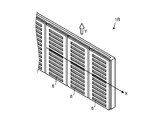
- FIG. 1A is a perspective view showing an example of a cell according to the first embodiment.
- FIG. 1B is a diagram showing an outline of cells according to the first embodiment.
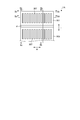
- FIG. 1C is a plan view of an example of the cell according to the first embodiment as viewed from the air electrode side.
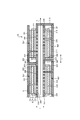
- FIG. 1D is a cross-sectional view of the Id-Id line shown in FIG. 1C.
- FIG. 1E is a cross-sectional view taken along the line Ie-Ie shown in FIG. 1C.
- FIG. 1F is a cross-sectional view taken along the line If-If shown in FIG. 1C.
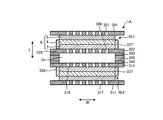
- FIG. 2A is a plan view of an example of the cell according to the second embodiment as viewed from the air electrode side.
- FIG. 2B is a cross-sectional view taken along the line IIb-IIb shown in FIG. 2A.
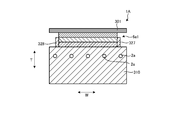
- FIG. 2C is a cross-sectional view taken along the line IIc-IIc shown in FIG. 2A.
- FIG. 2D is a cross-sectional view of the line IId-IId shown in FIG. 2A.
- FIG. 2E is a cross-sectional view taken along the line IIe-IIe shown in FIG. 2A.
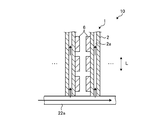
- FIG. 3A is a cross-sectional view showing an example of the cell stack device according to the first embodiment.
- FIG. 3B is a cross-sectional view showing an example of the cell stack device according to the second embodiment.
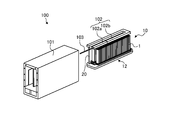
- FIG. 4 is an external perspective view showing an example of the module according to the embodiment.
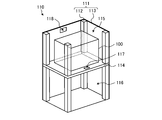
- FIG. 5 is an exploded perspective view schematically showing an example of the module accommodating device according to the embodiment.
- FIG. 6A is a perspective view showing an example of the cell according to the third embodiment.
- FIG. 6B is a plan view of an example of the cell according to the third embodiment as viewed from the air electrode side.
- FIG. 6C is a cross-sectional view taken along the line VIc-VIc shown in FIG. 6B.
- FIG. 6D is a cross-sectional view taken along the line Vid-VId shown in FIG. 6B.
- FIG. 6E is a cross-sectional view of the VIe-VIe line shown in FIG. 6B.
- FIG. 7A is a plan view of an example of the cell according to the fourth embodiment as viewed from the air electrode side.
- FIG. 7A is a plan view of an example of the cell according to the fourth embodiment as viewed from the air electrode side.
- FIG. 7B is a cross-sectional view taken along the line VIIb-VIIb shown in FIG. 7A.
- FIG. 7C is a cross-sectional view of the VIIc-VIIc line shown in FIG. 7A.
- FIG. 7D is a cross-sectional view taken along the line VIId-VIId shown in FIG. 7A.
- FIG. 1A is a perspective view showing an example of a cell according to the first embodiment.
- the cell 1 has a plurality of element portions 6 supported by the metal member 2.
- the plurality of element units 6 are located side by side in the length direction L (see FIG. 1C) of the cell 1.
- the plurality of element portions 6 are connected in series, and the current generated in the cell 1 flows through the metal member 2 and the element portion 6 along the length direction L of the cell 1, as shown by the arrow X.
- the metal member 2 has a gas flow path 2a in which gas flows along the length direction L of the cell 1.
- the gas flowing through the gas flow path 2a is a reaction gas used for the reaction in the plurality of element units 6.
- the reaction gas is, for example, a fuel gas such as a hydrogen-containing gas.
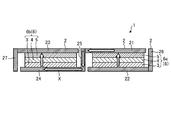
- FIG. 1B is a diagram showing an outline of cells according to the first embodiment.
- the cell 1 includes element portions 6a and 6b arranged in the first direction and a metal member 2.
- the element units 6a and 6b are examples of the first element and the second element arranged in the first direction.
- the element portions 6a and 6b each have a fuel electrode 3 which is a first electrode layer, a solid electrolyte layer 4 which is an electrolyte layer, and an air electrode 5 which is a second electrode layer.
- the fuel electrode 3, the solid electrolyte layer 4, and the air electrode 5 are laminated in the thickness direction of the cell 1 as the second direction intersecting the first direction.
- the metal member 2 has support portions 21 to 24 for supporting the element portion 6 and connection portions 25 to 27.
- the support portions 21 and 22 are positioned so as to sandwich the element portion 6a.
- the support portions 23 and 24 are positioned so as to sandwich the element portion 6b.
- the support portions 21 and 23 support the air pole 5, and the support portions 22 and 24 support the fuel pole 3, respectively.
- the connecting portion 25 is located between the element portions 6a and 6b and extends in the thickness direction of the cell 1.
- the connecting portion 25 electrically connects the supporting portions 21 and 24.
- the element portions 6a and 6b become conductive, and a current flows, for example, as shown by an arrow X.
- the connecting portions 26 and 27 are connected to the supporting portions 22 and 23, respectively.
- the connecting portions 26 and 27 extend in the thickness direction of the cell 1 and also serve as a housing for accommodating the element portions 6a and 6b together with the connecting portion 25.
- the metal members 2 are located apart from each other along the first direction in which the element portions 6a and 6b are lined up.
- the support portions 21, 24 and the connection portion 25 are located apart from the support portion 23 and the connection portion 27.
- the support portions 21, 24 and the connection portion 25 are located apart from the support portion 22 and the connection portion 26. This makes it difficult for a short circuit to occur via the metal member 2.
- each portion constituting the metal member 2, such as the support portions 21, 24 and the connecting portion 25, can be joined via a conductive adhesive or by welding. Further, the support portions 21, 24 and the connection portion 25 may be an integral metal member.
- the material of the fuel electrode 3 generally known materials can be used.
- porous conductive ceramics for example, ZrO 2 in which a rare earth element oxide is solid-dissolved, and ceramics containing Ni and / or NiO may be used.
- the rare earth element oxide such as Y 2 O 3 is used.
- Calcium oxide, magnesium oxide or a rare earth element oxide it may be referred to as stabilized zirconia ZrO 2 being dissolved.
- Stabilized zirconia also includes partially stabilized zirconia.
- the solid electrolyte layer 4 is an electrolyte and bridges ions between the fuel electrode 3 and the air electrode 5. At the same time, the solid electrolyte layer 4 has a gas blocking property and makes it difficult for a leak between the fuel gas and the oxygen-containing gas to occur.
- Material of the solid electrolyte layer 4 for example, 3 mol% to 15 mol% of the rare earth oxide may be a ZrO 2 solid-solved.
- the rare earth element oxide such as Y 2 O 3 is used.
- other materials may be used as the material of the solid electrolyte layer 4.
- the material of the air electrode 5 may be, for example, a composite oxide in which Sr and La coexist at the A site.
- a composite oxide La x Sr 1-x Co y Fe 1-y O 3, La x Sr 1-x MnO 3, La x Sr 1-x FeO 3, La x Sr 1-x CoO 3 and the like can be mentioned. Note that x is 0 ⁇ x ⁇ 1 and y is 0 ⁇ y ⁇ 1.
- the air electrode 5 has gas permeability.
- the open porosity of the air electrode 5 may be, for example, 20% or more, particularly in the range of 30% to 50%.
- the metal member 2 is made of metal and has conductivity.
- the metal member 2 is, for example, stainless steel. Further, the metal member 2 is dense and makes it difficult for the reaction gas flowing inside and outside the gas flow path 2a (see FIG. 1A) to leak.
- cell 1 will be further described with reference to FIGS. 1C to 1F.
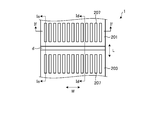
- FIG. 1C is a plan view of an example of the cell according to the first embodiment as viewed from the air electrode side.
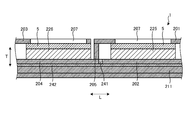
- FIG. 1D is a cross-sectional view of the Id-Id line shown in FIG. 1C.
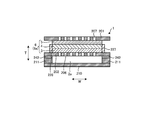
- FIG. 1E is a cross-sectional view taken along the line Ie-Ie shown in FIG. 1C.
- FIG. 1F is a cross-sectional view taken along the line If-If shown in FIG. 1C.
- the cell 1 has a metal member, an element portion 6, a sealing material 221 to 228, and an insulating portion 241,242.
- the element portion 6 has element portions 6a and 6b arranged along the length direction L.
- the metal member is an example of the metal member 2 shown in FIG. 1A.
- the metal member has support portions 201 to 204, connection portions 205, and flow path members 210 and 211.
- the support portions 201 and 203 are located side by side in the length direction L. As shown in FIG. 1C, a gap d is located between the support portions 201 and 203, and the support portions 201 and 203 are not directly conductive.
- One surface of the support portions 201 and 203 supports the air poles 5 of the element portions 6a and 6b, respectively, and the other surface on the opposite side to the one surface is exposed to an oxygen-containing gas such as air.
- the support portions 201 and 203 each have an opening 207 that penetrates one surface and the other surface.
- Oxygen-containing gas such as air located outside the cell 1 is supplied to the air electrode 5 through the openings 207 of the support portions 201 and 203, respectively.
- the opening 207 is shown as a rectangular shape that is long in the length direction L in a plan view, the opening 207 is not limited to this, and may be, for example, long in the width direction W, and may be square or circular.
- the support portions 202 and 204 are arranged side by side in the length direction L so as to face the support portions 201 and 203 with the element portions 6a and 6b interposed therebetween.
- One side of the support portions 202 and 204 supports the fuel poles 3 of the element portions 6a and 6b, respectively, and the other side opposite to the one side faces the gas flow path 2a.
- the support portions 202 and 204 have openings 206 penetrating one side and the other side, respectively.
- the fuel gas such as hydrogen-containing gas flowing in the gas flow path 2a along the length direction L is supplied to the fuel pole 3 through the openings 206 of the support portions 202 and 204, respectively.
- the opening 206 may have the same shape as the opening 207, or may have a different shape.
- the connecting portion 205 is located between the element portions 6a and 6b and extends in the thickness direction T of the cell 1.
- the connecting portion 205 electrically connects the supporting portions 201 and 204.
- the element portions 6a and 6b become conductive, and as shown by, for example, arrow X (see FIG. 1D), the support portion 202 ⁇ the element portion 6a ⁇ the support portion 201 ⁇ the connection portion 205 ⁇ the support portion 204 ⁇ the element portion 6b ⁇ the support portion.
- the flow path members 210 and 211 are located around the gas flow path 2a and extend along the length direction L. Specifically, the flow path member 210 is located so that one surface faces the support portions 202 and 204 with the gas flow path 2a sandwiched in the thickness direction T of the cell 1, and the other surface on the opposite side to the one surface. Is exposed to the outside. Further, the flow path members 211 are located so as to face each other with the gas flow path 2a in the width direction W of the cell 1.
- the gas flow path 2a is a space located between the support portions 202 and 204 and the flow path members 210 and 211.
- the metal members (support portions 201 to 204, connection portions 205, flow path members 210, 211) may be made of the same material as the metal member 2 described with reference to, for example, FIGS. 1A and 1B. Further, a coating layer that covers the surface may be provided depending on the environment (reducing atmosphere, oxidizing atmosphere) in which the metal member is located.
- the sealing materials 221 to 228 are located around the element portions 6a and 6b.
- the sealing materials 221 to 228 are positioned so as to be in contact with both ends of the element portions 6a and 6b in the length direction L and the width direction W.
- the sealing materials 221 to 228 have a gas blocking property, and seal the fuel poles 3 and the ends of the solid electrolyte layer 4 of the element portions 6a and 6b, and the fuel gas and the oxygen-containing gas. It makes it difficult for leaks to occur.
- the sealing material 223 is in contact with the connecting portion 205, but the sealing material 223 may be separated from the connecting portion 205.
- sealing materials 221-228 glass or other oxides having low conductivity can be used.
- a specific material for example, amorphous glass or the like may be used, and in particular, crystallized glass or the like may be used.
- the material of the encapsulant 221-228 may be the same as or similar to that of the solid electrolyte layer 4.
- the crystallized glass for example, SiO 2 -CaO-based, MgO-B 2 O 3 based, La 2 O 3 -B 2 O 3 -MgO based, La 2 O 3 -B 2 O 3 -ZnO system, SiO 2 it may be used any of materials such as -CaO-ZnO-based, may be especially a material of SiO 2 -MgO system.
- the insulating portion 241 is located between the supporting portions 202 and 204.
- the insulating portion 241 prevents a short circuit due to conduction of the supporting portions 202 and 204.
- the insulating portion 241 has a gas blocking property, and makes it difficult for a leak between the fuel gas and the oxygen-containing gas to occur.
- the insulating portion 242 is located between the support portions 202 and 204 and the flow path member 211.
- the insulating portion 242 prevents electric leakage due to conduction between the support portions 202 and 204 and the flow path member 211.
- the insulating portion 242 has a gas blocking property, and makes it difficult for the fuel gas flowing through the gas flow path 2a to leak.
- an oxide having low conductivity such as glass or mica can be used.
- a specific material for example, amorphous glass or the like may be used, and in particular, crystallized glass may be used.
- the material of the insulating portions 241,242 may be the same as, for example, the sealing materials 221 to 228, or may be different.
- the cell 1 includes the first element and the second element, and a metal member.
- the first element and the second element are arranged in the first direction and are electrically connected.
- the metal member has a support portion that supports the first element and the second element. Thereby, the durability of the cell 1 can be enhanced.
- FIG. 2A is a plan view of an example of the cell according to the second embodiment as viewed from the air electrode side.
- FIG. 2B is a cross-sectional view taken along the line IIb-IIb shown in FIG. 2A.
- FIG. 2C is a cross-sectional view taken along the line IIc-IIc shown in FIG. 2A.
- FIG. 2D is a cross-sectional view of the line IId-IId shown in FIG. 2A.
- FIG. 2E is a cross-sectional view taken along the line IIe-IIe shown in FIG. 2A.
- the cell 1A has a metal member, an element portion 6, a sealing material 321 to 328, 331 to 338, and an insulating portion 341 to 345.
- the cell 1A is different from the cell 1 in that a plurality of element portions 6 (element portions 6a1, 6b1, element portions 6a2, 6b2) are located with the gas flow path 2a extending in the length direction L sandwiched in the thickness direction T. do.
- the element units 6a1 and 6b1 are examples of the first element and the second element arranged in the first direction.
- the element portions 6a2 and 6b2 are examples of the third element and the fourth element arranged in the first direction.
- the metal member has support portions 301 to 304, 311 to 314, connection portions 305, 315, end connection portions 310, and a flow path member 309.
- the support portions 301 and 303 are located on one end side in the thickness direction T, and the support portions 302 and 304 are located on the other end side in the thickness direction T with respect to the element portions 6a1 and 6b1.
- the support portions 301 and 303 are located side by side in the length direction L.
- the support portions 302 and 304 are arranged side by side in the length direction L so as to face the support portions 301 and 303.
- a gap d (see FIG. 2A) is located between the support portions 301 and 303 and between the support portions 302 and 304, respectively, and the support portions 301 and 303 and the support portions 302 and 304 are not directly conductive to each other.
- the support portions 311, 313 are located on one end side in the thickness direction T, and the support portions 312 and 314 are located on the other end side in the thickness direction T, respectively.
- the support portions 311, 313 are located side by side in the length direction L.
- the support portions 312 and 314 are arranged side by side in the length direction L so as to face the support portions 311, 313.
- a gap corresponding to the gap d shown in FIG. 1C is located between the support portions 311, 313 and between the support portions 312 and 314, and the support portions 311, 313 and the support portions 312 and 314 are directly conductive, respectively. Not.
- One side of the support portions 301, 303, 311, 313 supports the air poles 5 of the element portions 6a1, 6b1, 6a2, 6b2, respectively, and the other side opposite to one side is an oxygen-containing gas such as air. Is exposed to. Further, the support portions 301 and 303 each have an opening 307 that penetrates one surface and the other surface, and the support portions 311, 313 have an opening 317 that penetrates the one surface and the other surface, respectively. There is. Oxygen-containing gas such as air located outside the cell 1A is supplied to the air electrode 5 through the openings 307 and 317, respectively.
- the openings 307 and 317 are shown as rectangular shapes that are long in the length direction L in a plan view, but are not limited to this, and may be, for example, long in the width direction W, and may be square or circular.
- the support portions 302 and 304 are arranged side by side in the length direction L so as to face the support portions 301 and 303 with the element portions 6a1 and 6b1 interposed therebetween.
- the support portions 312 and 314 are arranged side by side in the length direction L so as to face the support portions 311, 313 with the element portions 6a2 and 6b2 interposed therebetween.
- the support portions 312 and 314 are located so as to face the support portions 302 and 304 with the gas flow path 2a interposed therebetween.
- One side of the support portions 302, 304, 312, 314 supports the fuel poles 3 of the element portions 6a1, 6b1, 6a2, 6b2, respectively, and the other side opposite to one side faces the gas flow path 2a. doing.
- the support portions 302 and 304 each have an opening 306 penetrating one surface and the other surface
- the support portions 312 and 314 each have an opening 316 penetrating the one surface and the other surface.
- the fuel gas such as hydrogen-containing gas flowing in the gas flow path 2a along the length direction L reaches the fuel pole 3 of each element portion 6 through the openings 306 and 316, respectively.
- the openings 306 and 316 may have the same shape as the openings 307 and 317, or may have different shapes.
- the connecting portions 305 and 315 are located between the element portions 6a1 and 6b1 and between the element portions 6a2 and 6b2, respectively, and extend in the thickness direction T of the cell 1A.
- the connecting portion 305 electrically connects the support portions 301 and 304
- the connecting portion 315 electrically connects the support portions 311, 314.
- the element portions 6a1, 6b1 and the element portions 6a2, 6b2 become conductive, respectively.
- the end connection portion 310 is located on one end side of the cell 1A in the length direction L and extends in the thickness direction T of the cell 1A.
- the end connection portion 310 electrically connects the support portions 302 and 311.
- the support portion 314 ⁇ the element portion 6b2 ⁇ the support portion 313 ⁇ the connection portion 315 ⁇ the support portion 312 ⁇ the element portion 6a2 ⁇ the support portion 311 ⁇ the end connection portion 310 ⁇ the support.
- the flow path member 309 is located around the gas flow path 2a. Specifically, the flow path member 309 is located so as to face each other with the gas flow path 2a sandwiched in the width direction W of the cell 1A, and extends along the length direction L.
- the gas flow path 2a is a space located between the support portions 302, 304, 312, 314 and the flow path member 309.
- the support portions 302, 304, 312, 314 and the flow path member 309 are examples of the flow path portions.
- the metal members (support portions 301 to 304, 311 to 314, connection portions 305, 315, flow path member 309, end connection portion 310) are made of the same material as the metal member 2 described with reference to, for example, FIGS. 1C to 1F. There may be. Further, a coating layer that covers the surface may be provided depending on the environment (reducing atmosphere, oxidizing atmosphere) in which the metal member is located.
- sealing materials 321 to 328 are located around the element portions 6a1, 6b1, and the sealing materials 331 to 338 are located around the element portions 6a2, 6b2.
- the sealing materials 321 to 328 are positioned so as to be in contact with both ends of the element portions 6a1 and 6b1 in the length direction L and the width direction W.
- the sealing materials 331 to 338 are positioned so as to be in contact with both ends of the element portions 6a2 and 6b2 in the length direction L and the width direction W.
- the sealing materials 321 to 328 and 331 to 338 have a gas blocking property, and seal the fuel poles 3 of the element portions 6a1, 6b1, 6a2, 6b2 and the ends of the solid electrolyte layer 4.
- leakage between the fuel gas and the oxygen-containing gas is less likely to occur.
- the sealing materials 323 and 332 are in contact with the connecting portions 305 and 315, respectively, but the sealing materials 323 and 332 may be separated from the connecting portions 305 and 315, respectively.
- sealing materials 321 to 328 and 331 to 338 glass or other oxides having low conductivity can be used.
- a specific material for example, amorphous glass or the like may be used, and in particular, crystallized glass or the like may be used.
- the material of the sealing materials 321 to 328 and 331 to 338 may be the same as or similar to that of the solid electrolyte layer 4.
- the crystallized glass for example, SiO 2 -CaO-based, MgO-B 2 O 3 based, La 2 O 3 -B 2 O 3 -MgO based, La 2 O 3 -B 2 O 3 -ZnO system, SiO 2 it may be used any of materials such as -CaO-ZnO-based, may be especially a material of SiO 2 -MgO system.
- the insulating portions 341 and 342 are located between the support portions 302 and 304 and between the support portions 312 and 314, respectively.
- the insulating portions 341 and 342 prevent short circuits due to conduction between the support portions 302 and 304 and the support portions 312 and 314, respectively.
- the insulating portions 341 and 342 have a gas blocking property, and make it difficult for a leak between the fuel gas and the oxygen-containing gas to occur.
- the insulating portion 343 is located between the support portions 302 and 304 and the flow path member 309.
- the insulating portion 343 makes it difficult for electric leakage to occur due to conduction between the support portions 302 and 304 and the flow path member 309.
- the insulating portion 343 has a gas blocking property, and makes it difficult for the fuel gas flowing through the gas flow path 2a to leak.
- the insulating portion 344 is located between the supporting portions 312 and 314 and the flow path member 309.
- the insulating portion 344 makes it difficult for electric leakage to occur due to conduction between the support portions 312 and 314 and the flow path member 309.
- the insulating portion 344 has a gas blocking property, and makes it difficult for the fuel gas flowing through the gas flow path 2a to leak.
- the insulating portion 345 is located between the support portion 312, the flow path member 309, and the end connection portion 310.
- the insulating portion 345 makes it difficult for electric leakage or short circuit to occur due to conduction between the support portion 312 and the flow path member 309 and the end connection portion 310.
- the insulating portion 345 has a gas blocking property, and makes it difficult for the fuel gas flowing through the gas flow path 2a to leak.
- an oxide having low conductivity such as glass or mica can be used.
- a specific material for example, amorphous glass or the like may be used, and in particular, crystallized glass or the like may be used.
- the material of the insulating portions 341 to 345 may be the same as, for example, the sealing materials 321 to 328 and 331 to 338, or may be different.
- the cells 1A according to the second embodiment are arranged in the first direction and electrically connected to the first element and the second element, and the metal member supporting the first element and the second element. Be prepared. Further, the cell 1A further includes a third element located at a distance from the first element with the gas flow path 2a through which the reaction gas flows flowing. Thereby, the durability of the cell 1A can be increased.
- FIG. 3A is a cross-sectional view showing an example of the cell stack device according to the first embodiment
- FIG. 3B is a cross-sectional view showing an example of the cell stack device according to the second embodiment.
- the arrangement of the gas flow path 2a, the element portion 6 and the cell 1 or 1A is schematically shown.
- the support member and the element portion 6 located outside the element portion 6 are shown.
- the cell stack device 10 includes a plurality of cells 1. As shown in FIG. 3A, in each cell 1, a plurality of metal members 2 each supporting the plurality of element portions 6 extend in the length direction L from the pipe 22a through which the fuel gas flows. Inside the metal member 2 each cell 1 has, a gas flow path 2a through which the gas from the pipe 22a flows is provided. Each cell 1 is connected in series via a conductive member (not shown).
- a plurality of element portions 6 possessed by adjacent cells 1 are located in different directions with respect to each metal member 2, so that the plurality of element portions 6 are positioned so as to face each other. doing.
- the arrangement of the cells 1 is not limited to this, and for example, a plurality of element portions 6 may be located in the same direction with respect to each metal member 2.
- the cell stack device 10A includes a plurality of cells 1A.
- a plurality of metal members 2 each supporting the plurality of element portions 6 extend from the pipe 22a in the length direction L. Inside the metal member 2 each cell 1A has, a gas flow path 2a through which the gas from the pipe 22a flows is provided.
- Each cell 1A is connected in series via a conductive member (not shown).
- the connection of the cells 1A is not limited to this, and for example, adjacent cells 1A may be electrically connected to each other via each metal member 2.
- FIG. 4 is an external perspective view showing the module according to the first embodiment, in which the front surface and the rear surface, which are a part of the storage container 101, are removed, and the cell stack device 10 of the fuel cell stored inside is taken out to the rear. Shows the state.
- the module 100 includes a storage container 101 and a cell stack device 10 housed in the storage container 101. Further, the reformer 102 is located above the cell stack device 10.
- the reformer 102 reforms raw fuels such as natural gas and kerosene to generate fuel gas, which is supplied to cell 1.
- the raw fuel is supplied to the reformer 102 through the raw fuel supply pipe 103.
- the reformer 102 may include a vaporizing unit 102a for vaporizing water and a reforming unit 102b.
- the reforming unit 102b includes a reforming catalyst (not shown), and reforms the raw material fuel into a fuel gas.
- Such a reformer 102 can perform steam reforming, which is a highly efficient reforming reaction.
- the fuel gas generated by the reformer 102 is supplied to the gas flow path 2a (see FIG. 3A) of the cell 1 through the gas flow pipe 20, the gas tank 16, and the support member 14.
- the temperature inside the module 100 at the time of normal power generation becomes about 500 ° C. to 1000 ° C. due to the combustion of gas and the power generation of the cell 1.
- the durability of the module 100 can be enhanced by accommodating the cell stack device 10 for enhancing the durability.
- FIG. 5 is an exploded perspective view showing an example of the module accommodating device according to the first embodiment.
- the module accommodating device 110 according to the first embodiment includes an outer case 111, a module 100 shown in FIG. 4, and an auxiliary machine (not shown).
- the auxiliary device operates the module 100.
- the module 100 and auxiliary equipment are housed in the outer case 111. In FIG. 5, a part of the configuration is omitted.
- the exterior case 111 of the module accommodating device 110 shown in FIG. 5 has a support column 112 and an exterior plate 113.
- the partition plate 114 vertically partitions the inside of the outer case 111.
- the space above the partition plate 114 in the outer case 111 is the module storage chamber 115 for accommodating the module 100, and the space below the partition plate 114 in the outer case 111 accommodates the auxiliary equipment for operating the module 100.
- the auxiliary machine accommodated in the auxiliary machine accommodating chamber 116 is omitted.
- the partition plate 114 has an air flow port 117 for flowing the air of the auxiliary machine accommodating chamber 116 to the module accommodating chamber 115 side.
- the exterior plate 113 constituting the module accommodating chamber 115 has an exhaust port 118 for exhausting the air in the module accommodating chamber 115.
- module accommodating device 110 as described above, by providing the module accommodating chamber 115 with a highly durable module 100, the durability of the module accommodating device 110 can be enhanced.
- the module 100 and the module accommodating device 110 using the cell stack device 10A according to the second embodiment also have the module 100 and the module accommodating device 110 shown in FIGS. 4 and 5. It can be configured as follows.
- FIG. 6A is a perspective view showing an example of the cell according to the third embodiment.
- so-called fuel depletion in which the amount of fuel gas supplied to the element unit 6 is less than the required amount is less likely to occur. Therefore, the durability of the cell 1B is further increased.
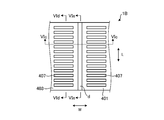
- FIG. 6B is a plan view of an example of the cell according to the third embodiment as viewed from the air electrode side.
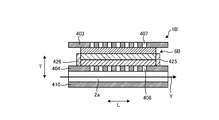
- FIG. 6C is a cross-sectional view taken along the line VIc-VIc shown in FIG. 6B.
- FIG. 6D is a cross-sectional view taken along the line Vid-VId shown in FIG. 6B.
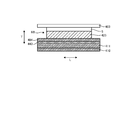
- FIG. 6E is a cross-sectional view of the VIe-VIe line shown in FIG. 6B.
- the cell 1B has a metal member, an element portion 6, a sealing material 421 to 426, and an insulating portion 441 to 444.
- the element portion 6 has element portions 6a and 6b arranged along the width direction W.
- the metal member is an example of the metal member 2 shown in FIG. 1A.
- the metal member has support portions 401 to 404, connection portions 405, and flow path members 410 to 413.
- the support portions 401 and 403 are located side by side in the length direction L.
- a gap is located between the support portions 401 and 403, and the support portions 401 and 403 are not directly conductive.
- One side of the support parts 401 and 403 supports the air poles 5 of the element parts 6a and 6b, respectively, and the other side opposite to the one side is exposed to oxygen-containing gas such as air. Further, the support portions 401 and 403 have openings 407 that penetrate one surface and the other surface, respectively. Oxygen-containing gas such as air located outside the cell 1B is supplied to the air pole 5 through the openings 407 of the support portions 401 and 403, respectively.
- the opening 407 is shown as a rectangular shape that is long in the width direction W in a plan view, but is not limited to this, and may be, for example, long in the length direction L, or may be square or circular.
- the support portions 402 and 404 are arranged side by side in the width direction W so as to face the support portions 401 and 403 with the element portions 6a and 6b interposed therebetween.
- One side of the support portions 402 and 404 supports the fuel poles 3 of the element portions 6a and 6b, respectively, and the other side opposite to the one side faces the gas flow path 2a.
- the support portions 402 and 404 have openings 406 penetrating one side and the other side, respectively.
- the fuel gas such as hydrogen-containing gas flowing in the gas flow path 2a along the length direction L is supplied to the fuel pole 3 through the openings 406 of the support portions 402 and 404, respectively.
- the opening 406 may have the same shape as the opening 407, or may have a different shape.
- the connecting portion 405 is located between the element portions 6a and 6b and extends in the thickness direction T of the cell 1.
- the connecting portion 405 electrically connects the supporting portions 401 and 404.
- the element portions 6a and 6b become conductive, and as shown by, for example, arrow X (see FIG. 6C), the support portion 402 ⁇ the element portion 6a ⁇ the support portion 401 ⁇ the connection portion 405 ⁇ the support portion 404 ⁇ the element portion 6b ⁇ the support portion.
- the flow path members 410 to 413 are located around the gas flow path 2a.
- the flow path member 410 extends along the length direction L and the width direction, and the flow path members 411 to 413 extend along the length direction L, respectively.
- one surface of the flow path member 410 is positioned so as to face the support portions 402 and 404 with the gas flow path 2a sandwiched in the thickness direction T of the cell 1B, and the other surface on the opposite side to the one surface. Is exposed to the outside.
- the flow path members 411 to 413 are arranged side by side so as to face each other with the gas flow path 2a in the width direction W of the cell 1B.
- the gas flow path 2a is a space located between the support portion 402 and the flow path members 410 to 412, and between the support portion 404 and the flow path members 410, 421 and 413, respectively.
- the metal members (support portions 401 to 404, connection portions 405, flow path members 410 to 413) may be made of the same material as the metal member 2 described with reference to, for example, FIGS. 1A and 1B. Further, a coating layer that covers the surface may be provided depending on the environment (reducing atmosphere, oxidizing atmosphere) in which the metal member is located.
- the sealing materials 421 to 426 are located around the element portions 6a and 6b.
- the sealing materials 421 to 426 are positioned so as to be in contact with both ends of the element portions 6a and 6b in the length direction L and the width direction W.
- the sealing materials 421 to 426 have a gas blocking property, and seal the fuel poles 3 and the ends of the solid electrolyte layer 4 of the element portions 6a and 6b, so that the fuel gas and the oxygen-containing gas are contained. It makes it difficult for leaks to occur.
- the sealing material 423 is in contact with the connecting portion 405, but the sealing material 423 may be separated from the connecting portion 405.
- sealing materials 421 to 426 glass or other oxides having low conductivity can be used.
- a specific material for example, amorphous glass or the like may be used, and in particular, crystallized glass or the like may be used.
- the material of the sealing materials 421 to 426 may be the same as or similar to that of the solid electrolyte layer 4.
- the crystallized glass for example, SiO 2 -CaO-based, MgO-B 2 O 3 based, La 2 O 3 -B 2 O 3 -MgO based, La 2 O 3 -B 2 O 3 -ZnO system, SiO 2 it may be used any of materials such as -CaO-ZnO-based, may be especially a material of SiO 2 -MgO system.
- the insulating portion 441 is located between the supporting portions 402 and 404.
- the insulating portion 441 makes it difficult for a short circuit due to conduction of the supporting portions 402 and 404 to occur.
- the insulating portion 441 has a gas blocking property, and makes it difficult for a leak between the fuel gas and the oxygen-containing gas to occur.
- the insulating portions 442 to 444 are located between the support portion 402 and the flow path member 411, between the support portions 402 and 404 and the flow path member 412, and between the support portion 404 and the flow path member 413, respectively. ing.
- the insulating portions 442 to 444 make it difficult for electric leakage to occur due to the conduction between the support portions 402 and 404 and the flow path members 411 to 413.
- the insulating portions 442 to 444 have a gas blocking property, and make it difficult for the fuel gas flowing through the gas flow path 2a to leak.
- an oxide having low conductivity such as glass or mica can be used.
- a specific material for example, amorphous glass or the like may be used, and in particular, crystallized glass or the like may be used.
- the material of the insulating portions 441 to 444 may be the same as, for example, the sealing materials 421 to 426, or may be different.
- the cells 1B according to the third embodiment are arranged in the first direction and electrically connected to the first element and the second element, and the metal member supporting the first element and the second element. Be prepared. Thereby, the durability of the cell 1B can be increased.
- the first direction in which the plurality of element portions 6 are arranged intersects with the third direction in which the reaction gas such as fuel gas flows. Thereby, the durability of the cell 1B can be increased.
- FIG. 7A is a plan view of an example of the cell according to the fourth embodiment as viewed from the air electrode side.
- FIG. 7B is a cross-sectional view taken along the line VIIb-VIIb shown in FIG. 7A.
- FIG. 7C is a cross-sectional view of the VIIc-VIIc line shown in FIG. 7A.
- FIG. 7D is a cross-sectional view taken along the line VIId-VIId shown in FIG. 7A.
- the cell 1C has a metal member, an element portion 6, a sealing material 521 to 526, 531 to 536, and an insulating portion 541 to 544,551 to 554.
- the cell 1C is different from the cell 1B in that a plurality of element portions 6 (element portions 6a1, 6b1, element portions 6a2, 6b2) are located with the gas flow path 2a extending in the length direction L sandwiched in the thickness direction T. do.
- the metal member has support portions 501 to 504, 511 to 514, connection portions 505 and 515, end connection portions 510, and a flow path member 509.
- the support portions 501 and 503 are located on one end side in the thickness direction T, and the support portions 502 and 504 are located on the other end side in the thickness direction T with respect to the element portions 6a1 and 6b1.
- the support portions 501 and 503 are located side by side in the width direction W.
- the support portions 502 and 504 are arranged side by side in the width direction W so as to face the support portions 501 and 503. Spaces are located between the support portions 501 and 503 and between the support portions 502 and 504, respectively, and the support portions 501 and 503 and the support portions 502 and 504 are not directly connected to each other.
- the support portions 511 and 513 are located on one end side in the thickness direction T, and the support portions 521 and 514 are located on the other end side in the thickness direction T.
- the support portions 511 and 513 are located side by side in the width direction W.
- the support portions 512 and 514 are arranged side by side in the width direction W so as to face the support portions 511 and 513.
- a gap is located between the support portions 511,513 and between the support portions 512 and 514, and the support portions 511 and 513 and the support portions 512 and 514 are not directly connected to each other.
- One side of the support portion 501, 503, 511, 513 supports the air poles 5 of the element portions 6a1, 6b1, 6a2, 6b2, respectively, and the other side opposite to one side is an oxygen-containing gas such as air. Is exposed to. Further, the support portions 501 and 503 have openings 507 penetrating one surface and the other surface, respectively, and the support portions 511, 513 have openings 517 penetrating the one surface and the other surface, respectively. There is. Oxygen-containing gas such as air located outside the cell 1C is supplied to the air pole 5 through the openings 507 and 517, respectively.
- the openings 507 and 517 are shown as a rectangular shape that is long in the width direction W in a plan view, but are not limited to this, and may be, for example, long in the length direction L, and may be square or circular.
- the support portions 502 and 504 are located side by side in the width direction W so as to face the support portions 501 and 503 with the element portions 6a1 and 6b1 interposed therebetween.
- the support portions 512 and 514 are arranged side by side in the width direction W so as to face the support portions 511 and 513 with the element portions 6a2 and 6b2 interposed therebetween.
- the support portions 512 and 514 are located so as to face the support portions 502 and 504 with the gas flow path 2a interposed therebetween.
- One side of the support portions 502, 504, 512, 514 supports the fuel poles 3 of the element portions 6a1, 6b1, 6a2, 6b2, respectively, and the other side opposite to one side faces the gas flow path 2a. doing.
- the support portions 502 and 504 each have an opening 506 that penetrates one surface and the other surface
- the support portions 521 and 514 have an opening 516 that penetrates the one surface and the other surface, respectively.
- the fuel gas such as hydrogen-containing gas flowing in the gas flow path 2a along the length direction L reaches the fuel pole 3 of each element portion 6 through the openings 506 and 516, respectively. Be supplied.
- the openings 506 and 516 may have the same shape as the openings 507 and 517, or may have different shapes.
- the connecting portions 505 and 515 are located between the element portions 6a1 and 6b1 and between the element portions 6a2 and 6b2, respectively, and extend in the thickness direction T of the cell 1C.
- the connecting portion 505 electrically connects the support portions 501 and 504, and the connecting portion 515 electrically connects the support portions 511 and 514.
- the element portions 6a1, 6b1 and the element portions 6a2, 6b2 become conductive, respectively.
- the end connection portion 510 is located on one end side of the cell 1C in the width direction W and extends in the thickness direction T of the cell 1C.
- the end connection portion 510 electrically connects the support portions 502 and 511.
- the support portion 514 ⁇ the element portion 6b2 ⁇ the support portion 513 ⁇ the connection portion 515 ⁇ the support portion 512 ⁇ the element portion 6a2 ⁇ the support portion 511 ⁇ the end connection portion 510 ⁇ the support.
- the flow path member 509 is located around the gas flow path 2a. Specifically, the flow path member 509 is located so as to face each other with the gas flow path 2a sandwiched in the width direction W of the cell 1C, and extends along the length direction L.
- the gas flow path 2a is a space located between the support portions 502 and 512 and the flow path member 509, and between the support portions 504 and 514 and the flow path member 509, respectively.
- the support portions 502, 504, 512, 514 and the flow path member 509 are examples of the flow path portions.
- the metal members (support portions 501 to 504, 511 to 514, connection portions 505, 515, flow path member 509, end connection portion 510) are made of the same material as the metal member 2 described with reference to, for example, FIGS. 1C to 1F. There may be. Further, a coating layer that covers the surface may be provided depending on the environment (reducing atmosphere, oxidizing atmosphere) in which the metal member is located.
- the sealing materials 521 to 526 are located around the element portions 6a1, 6b1, and the sealing materials 531 to 536 are located around the element portions 6a2, 6b2.
- the sealing materials 521 to 526 are positioned so as to be in contact with both ends of the element portions 6a1 and 6b1 in the length direction L and the width direction W.
- the sealing materials 531 to 536 are positioned so as to be in contact with both ends of the element portions 6a2 and 6b2 in the length direction L and the width direction W.
- the sealing materials 521 to 526, 531 to 536 have a gas blocking property, and seal the fuel poles 3 of the element portions 6a1, 6b1, 6a2, 6b2 and the ends of the solid electrolyte layer 4.
- the sealing materials 523 and 532 are in contact with the connecting portions 505 and 515, respectively, but the sealing materials 523 and 532 may be separated from the connecting portions 505 and 515, respectively.
- sealing materials 521 to 526, 531 to 536 glass or other oxides having low conductivity can be used.
- a specific material for example, amorphous glass or the like may be used, and in particular, crystallized glass or the like may be used.
- the material of the sealing materials 521 to 526, 531 to 536 may be the same as or similar to that of the solid electrolyte layer 4.
- the crystallized glass for example, SiO 2 -CaO-based, MgO-B 2 O 3 based, La 2 O 3 -B 2 O 3 -MgO based, La 2 O 3 -B 2 O 3 -ZnO system, SiO 2 it may be used any of materials such as -CaO-ZnO-based, may be especially a material of SiO 2 -MgO system.
- the insulating portions 541 and 551 are located between the support portions 502 and 504 and between the support portions 512 and 514, respectively.
- the insulating portions 541 and 551 make it difficult for short circuits due to conduction between the support portions 502 and 504 and the support portions 512 and 514 to occur, respectively.
- the insulating portions 541 and 551 have a gas blocking property, so that leakage between the fuel gas and the oxygen-containing gas is less likely to occur.
- the insulating portions 542 to 544 are located between the support portions 502 and 504 and the flow path member 509.
- the insulating portions 542 to 544 make it difficult for electric leakage to occur due to conduction between the support portions 502 and 504 and the flow path member 509. Further, the insulating portions 542 to 544 have a gas blocking property, and make it difficult for the fuel gas flowing through the gas flow path 2a to leak.
- the insulating portions 552 to 554 are located between the support portions 512 and 514 and the flow path member 509.
- the insulating portions 552 to 554 make it difficult for electric leakage to occur due to conduction between the support portions 512 and 514 and the flow path member 509. Further, the insulating portions 552 to 554 have a gas blocking property, and make it difficult for the fuel gas flowing through the gas flow path 2a to leak.
- an oxide having low conductivity such as glass or mica can be used.
- a specific material for example, amorphous glass or the like may be used, and in particular, crystallized glass or the like may be used.
- the material of the insulating portions 541 to 544, 551 to 554 may be the same as, for example, the sealing materials 521 to 526, 531 to 536, or may be different.
- the cells 1C according to the fourth embodiment are arranged in the first direction and electrically connected to the first element and the second element, and the metal member supporting the first element and the second element. Be prepared. Further, the cell 1C further includes a third element located at a distance from the first element with the gas flow path 2a through which the reaction gas flows flowing. Thereby, the durability of the cell 1C can be enhanced.
- the first direction in which the first element and the second element are arranged intersects with the third direction in which the reaction gas such as fuel gas flows. Thereby, the durability of the cell 1C can be enhanced.
- the fuel electrode faces the gas flow path 2a located inside the cell and the air electrode is located on the surface side of the cell, but the arrangement is opposite to this, that is, the air electrode is located. It can also be applied to a cell stack device facing the gas flow path 2a and having a fuel electrode located on the surface side of the cell.
- the fuel cell, the fuel cell stack device, the fuel cell module, and the fuel cell device are shown as examples of the “cell”, the “cell stack device”, the “module”, and the “module accommodating device”.
- Other examples may be an electrolytic cell, an electrolytic cell stacking device, an electrolytic module and an electrolytic device, respectively.
- the cell 1 includes the first element and the second element (element portions 6a and 6b), and a metal member.
- the first element and the second element are arranged in the first direction and are electrically connected.
- the metal member has a support portion that supports the first element and the second element. Thereby, the durability of the cell 1 can be enhanced.
- the cell stack device 10 has a cell stack 11 including a plurality of cells 1 described above. Thereby, the durability of the cell stack device 10 can be improved.
- the module 100 includes the cell stack device 10 described above and a storage container 101 for accommodating the cell stack device 10. This makes it possible to increase the durability of the module 100.
- the module accommodating device 110 includes the module 100 described above, an auxiliary machine for operating the module 100, and an outer case for accommodating the module 100 and the auxiliary equipment. Thereby, the durability of the module accommodating device 110 can be improved.
Landscapes
- Life Sciences & Earth Sciences (AREA)
- Engineering & Computer Science (AREA)
- Manufacturing & Machinery (AREA)
- Sustainable Development (AREA)
- Sustainable Energy (AREA)
- Chemical & Material Sciences (AREA)
- Chemical Kinetics & Catalysis (AREA)
- Electrochemistry (AREA)
- General Chemical & Material Sciences (AREA)
- Fuel Cell (AREA)
Priority Applications (1)
| Application Number | Priority Date | Filing Date | Title |
|---|---|---|---|
| JP2022518099A JPWO2021221077A1 (https=) | 2020-04-30 | 2021-04-27 |
Applications Claiming Priority (2)
| Application Number | Priority Date | Filing Date | Title |
|---|---|---|---|
| JP2020080854 | 2020-04-30 | ||
| JP2020-080854 | 2020-04-30 |
Publications (1)
| Publication Number | Publication Date |
|---|---|
| WO2021221077A1 true WO2021221077A1 (ja) | 2021-11-04 |
Family
ID=78331971
Family Applications (1)
| Application Number | Title | Priority Date | Filing Date |
|---|---|---|---|
| PCT/JP2021/016861 Ceased WO2021221077A1 (ja) | 2020-04-30 | 2021-04-27 | セル、セルスタック装置、モジュールおよびモジュール収容装置 |
Country Status (2)
| Country | Link |
|---|---|
| JP (1) | JPWO2021221077A1 (https=) |
| WO (1) | WO2021221077A1 (https=) |
Citations (6)
| Publication number | Priority date | Publication date | Assignee | Title |
|---|---|---|---|---|
| JP2005050817A (ja) * | 2003-07-29 | 2005-02-24 | Ind Technol Res Inst | 平面燃料電池アセンブリとその製造方法 |
| JP2005353571A (ja) * | 2004-05-10 | 2005-12-22 | Shinko Electric Ind Co Ltd | 固体電解質燃料電池 |
| JP2008210714A (ja) * | 2007-02-27 | 2008-09-11 | Sanyo Electric Co Ltd | 燃料電池および燃料電池用集電体の接続方法 |
| JP2009245660A (ja) * | 2008-03-28 | 2009-10-22 | Dainippon Printing Co Ltd | 固体酸化物形燃料電池及びその製造方法 |
| JP2013012399A (ja) * | 2011-06-29 | 2013-01-17 | Kyocera Corp | 燃料電池セル装置 |
| KR20150010156A (ko) * | 2013-07-18 | 2015-01-28 | 주식회사 엘지화학 | 멀티셀 구조를 가지는 평판형 고체산화물 연료전지 및 이의 제조방법 |
-
2021
- 2021-04-27 JP JP2022518099A patent/JPWO2021221077A1/ja active Pending
- 2021-04-27 WO PCT/JP2021/016861 patent/WO2021221077A1/ja not_active Ceased
Patent Citations (6)
| Publication number | Priority date | Publication date | Assignee | Title |
|---|---|---|---|---|
| JP2005050817A (ja) * | 2003-07-29 | 2005-02-24 | Ind Technol Res Inst | 平面燃料電池アセンブリとその製造方法 |
| JP2005353571A (ja) * | 2004-05-10 | 2005-12-22 | Shinko Electric Ind Co Ltd | 固体電解質燃料電池 |
| JP2008210714A (ja) * | 2007-02-27 | 2008-09-11 | Sanyo Electric Co Ltd | 燃料電池および燃料電池用集電体の接続方法 |
| JP2009245660A (ja) * | 2008-03-28 | 2009-10-22 | Dainippon Printing Co Ltd | 固体酸化物形燃料電池及びその製造方法 |
| JP2013012399A (ja) * | 2011-06-29 | 2013-01-17 | Kyocera Corp | 燃料電池セル装置 |
| KR20150010156A (ko) * | 2013-07-18 | 2015-01-28 | 주식회사 엘지화학 | 멀티셀 구조를 가지는 평판형 고체산화물 연료전지 및 이의 제조방법 |
Also Published As
| Publication number | Publication date |
|---|---|
| JPWO2021221077A1 (https=) | 2021-11-04 |
Similar Documents
| Publication | Publication Date | Title |
|---|---|---|
| TWI729087B (zh) | 電化學元件、電化學模組、電化學裝置及能量系統 | |
| EP4145570A1 (en) | Cell, cell stack device, module, and module housing device | |
| JP3841148B2 (ja) | 固体電解質型燃料電池用セル板及びスタック | |
| WO2023054494A1 (ja) | 電気化学セル、電気化学セル装置、モジュールおよびモジュール収容装置 | |
| WO2023176979A1 (ja) | 電気化学セル、電気化学セル装置、モジュールおよびモジュール収容装置 | |
| JP7672999B2 (ja) | 電気化学セル、電気化学セル装置、モジュールおよびモジュール収容装置 | |
| JP7197747B2 (ja) | セル、セルスタック装置、モジュールおよびモジュール収容装置 | |
| JP7027621B1 (ja) | セル、セルスタック装置、モジュールおよびモジュール収容装置 | |
| JP7433450B2 (ja) | セル、セルスタック装置、モジュールおよびモジュール収容装置 | |
| JP2024038153A (ja) | セルスタック装置、モジュール、モジュール収容装置および導電部材 | |
| JP7685413B2 (ja) | セルスタック装置、モジュールおよびモジュール収容装置 | |
| WO2021221077A1 (ja) | セル、セルスタック装置、モジュールおよびモジュール収容装置 | |
| WO2021221071A1 (ja) | セル、セルスタック装置、モジュールおよびモジュール収容装置 | |
| JP7657386B1 (ja) | 固体電解質層、電気化学セル、電気化学セル装置、モジュールおよびモジュール収容装置 | |
| JP7736801B2 (ja) | 電気化学セル、電気化学セル装置、モジュールおよびモジュール収容装置 | |
| JP7525759B1 (ja) | 固体電解質層、電気化学セル、電気化学セル装置、モジュールおよびモジュール収容装置 | |
| WO2024247989A1 (ja) | 電気化学セル、電気化学セル装置、モジュールおよびモジュール収容装置 | |
| WO2024150829A1 (ja) | 電気化学セル、電気化学セル装置、モジュールおよびモジュール収容装置 | |
| WO2023195520A1 (ja) | 電気化学セル、電気化学セル装置、モジュールおよびモジュール収容装置 | |
| JP2024048859A (ja) | 電気化学セル装置、モジュールおよびモジュール収容装置 | |
| JP2022131905A (ja) | セル、セルスタック装置、モジュールおよびモジュール収容装置 | |
| WO2024004361A1 (ja) | 導電部材、電気化学セル、電気化学セル装置、モジュールおよびモジュール収容装置 | |
| WO2026029158A1 (ja) | 電気化学セル、電気化学セル装置、モジュールおよびモジュール収容装置 | |
| WO2024143355A1 (ja) | 電気化学セル、電気化学セル装置、モジュールおよびモジュール収容装置 | |
| WO2024117052A1 (ja) | 複合部材、電気化学セル、電気化学セル装置、モジュールおよびモジュール収容装置 |
Legal Events
| Date | Code | Title | Description |
|---|---|---|---|
| 121 | Ep: the epo has been informed by wipo that ep was designated in this application |
Ref document number: 21796236 Country of ref document: EP Kind code of ref document: A1 |
|
| ENP | Entry into the national phase |
Ref document number: 2022518099 Country of ref document: JP Kind code of ref document: A |
|
| NENP | Non-entry into the national phase |
Ref country code: DE |
|
| 122 | Ep: pct application non-entry in european phase |
Ref document number: 21796236 Country of ref document: EP Kind code of ref document: A1 |