WO2021215465A1 - タバコ植物体とその製造方法 - Google Patents
タバコ植物体とその製造方法 Download PDFInfo
- Publication number
- WO2021215465A1 WO2021215465A1 PCT/JP2021/016145 JP2021016145W WO2021215465A1 WO 2021215465 A1 WO2021215465 A1 WO 2021215465A1 JP 2021016145 W JP2021016145 W JP 2021016145W WO 2021215465 A1 WO2021215465 A1 WO 2021215465A1
- Authority
- WO
- WIPO (PCT)
- Prior art keywords
- tobacco
- ccd4
- plant
- polynucleotide
- endogenous gene
- Prior art date
- Legal status (The legal status is an assumption and is not a legal conclusion. Google has not performed a legal analysis and makes no representation as to the accuracy of the status listed.)
- Ceased
Links
Images


Classifications
-
- A—HUMAN NECESSITIES
- A01—AGRICULTURE; FORESTRY; ANIMAL HUSBANDRY; HUNTING; TRAPPING; FISHING
- A01H—NEW PLANTS OR NON-TRANSGENIC PROCESSES FOR OBTAINING THEM; PLANT REPRODUCTION BY TISSUE CULTURE TECHNIQUES
- A01H6/00—Angiosperms, i.e. flowering plants, characterised by their botanic taxonomy
- A01H6/82—Solanaceae, e.g. pepper, tobacco, potato, tomato or eggplant
-
- C—CHEMISTRY; METALLURGY
- C12—BIOCHEMISTRY; BEER; SPIRITS; WINE; VINEGAR; MICROBIOLOGY; ENZYMOLOGY; MUTATION OR GENETIC ENGINEERING
- C12Y—ENZYMES
- C12Y113/00—Oxidoreductases acting on single donors with incorporation of molecular oxygen (oxygenases) (1.13)
- C12Y113/11—Oxidoreductases acting on single donors with incorporation of molecular oxygen (oxygenases) (1.13) with incorporation of two atoms of oxygen (1.13.11)
-
- A—HUMAN NECESSITIES
- A01—AGRICULTURE; FORESTRY; ANIMAL HUSBANDRY; HUNTING; TRAPPING; FISHING
- A01H—NEW PLANTS OR NON-TRANSGENIC PROCESSES FOR OBTAINING THEM; PLANT REPRODUCTION BY TISSUE CULTURE TECHNIQUES
- A01H1/00—Processes for modifying genotypes ; Plants characterised by associated natural traits
- A01H1/10—Processes for modifying non-agronomic quality output traits, e.g. for industrial processing; Value added, non-agronomic traits
- A01H1/101—Processes for modifying non-agronomic quality output traits, e.g. for industrial processing; Value added, non-agronomic traits involving biosynthetic or metabolic pathways, i.e. metabolic engineering, e.g. nicotine or caffeine
- A01H1/107—Processes for modifying non-agronomic quality output traits, e.g. for industrial processing; Value added, non-agronomic traits involving biosynthetic or metabolic pathways, i.e. metabolic engineering, e.g. nicotine or caffeine involving pigment biosynthesis
-
- A—HUMAN NECESSITIES
- A01—AGRICULTURE; FORESTRY; ANIMAL HUSBANDRY; HUNTING; TRAPPING; FISHING
- A01H—NEW PLANTS OR NON-TRANSGENIC PROCESSES FOR OBTAINING THEM; PLANT REPRODUCTION BY TISSUE CULTURE TECHNIQUES
- A01H5/00—Angiosperms, i.e. flowering plants, characterised by their plant parts; Angiosperms characterised otherwise than by their botanic taxonomy
-
- A—HUMAN NECESSITIES
- A01—AGRICULTURE; FORESTRY; ANIMAL HUSBANDRY; HUNTING; TRAPPING; FISHING
- A01H—NEW PLANTS OR NON-TRANSGENIC PROCESSES FOR OBTAINING THEM; PLANT REPRODUCTION BY TISSUE CULTURE TECHNIQUES
- A01H5/00—Angiosperms, i.e. flowering plants, characterised by their plant parts; Angiosperms characterised otherwise than by their botanic taxonomy
- A01H5/12—Leaves
-
- A—HUMAN NECESSITIES
- A01—AGRICULTURE; FORESTRY; ANIMAL HUSBANDRY; HUNTING; TRAPPING; FISHING
- A01H—NEW PLANTS OR NON-TRANSGENIC PROCESSES FOR OBTAINING THEM; PLANT REPRODUCTION BY TISSUE CULTURE TECHNIQUES
- A01H6/00—Angiosperms, i.e. flowering plants, characterised by their botanic taxonomy
- A01H6/82—Solanaceae, e.g. pepper, tobacco, potato, tomato or eggplant
- A01H6/823—Nicotiana, e.g. tobacco
-
- A—HUMAN NECESSITIES
- A24—TOBACCO; CIGARS; CIGARETTES; SIMULATED SMOKING DEVICES; SMOKERS' REQUISITES
- A24B—MANUFACTURE OR PREPARATION OF TOBACCO FOR SMOKING OR CHEWING; TOBACCO; SNUFF
- A24B13/00—Tobacco for pipes, for cigars, e.g. cigar inserts, or for cigarettes; Chewing tobacco; Snuff
-
- A—HUMAN NECESSITIES
- A24—TOBACCO; CIGARS; CIGARETTES; SIMULATED SMOKING DEVICES; SMOKERS' REQUISITES
- A24B—MANUFACTURE OR PREPARATION OF TOBACCO FOR SMOKING OR CHEWING; TOBACCO; SNUFF
- A24B15/00—Chemical features or treatment of tobacco; Tobacco substitutes, e.g. in liquid form
-
- C—CHEMISTRY; METALLURGY
- C07—ORGANIC CHEMISTRY
- C07K—PEPTIDES
- C07K14/00—Peptides having more than 20 amino acids; Gastrins; Somatostatins; Melanotropins; Derivatives thereof
- C07K14/415—Peptides having more than 20 amino acids; Gastrins; Somatostatins; Melanotropins; Derivatives thereof from plants
-
- C—CHEMISTRY; METALLURGY
- C12—BIOCHEMISTRY; BEER; SPIRITS; WINE; VINEGAR; MICROBIOLOGY; ENZYMOLOGY; MUTATION OR GENETIC ENGINEERING
- C12N—MICROORGANISMS OR ENZYMES; COMPOSITIONS THEREOF; PROPAGATING, PRESERVING, OR MAINTAINING MICROORGANISMS; MUTATION OR GENETIC ENGINEERING; CULTURE MEDIA
- C12N15/00—Mutation or genetic engineering; DNA or RNA concerning genetic engineering, vectors, e.g. plasmids, or their isolation, preparation or purification; Use of hosts therefor
- C12N15/09—Recombinant DNA-technology
- C12N15/11—DNA or RNA fragments; Modified forms thereof; Non-coding nucleic acids having a biological activity
- C12N15/113—Non-coding nucleic acids modulating the expression of genes, e.g. antisense oligonucleotides; Antisense DNA or RNA; Triplex- forming oligonucleotides; Catalytic nucleic acids, e.g. ribozymes; Nucleic acids used in co-suppression or gene silencing
-
- C—CHEMISTRY; METALLURGY
- C12—BIOCHEMISTRY; BEER; SPIRITS; WINE; VINEGAR; MICROBIOLOGY; ENZYMOLOGY; MUTATION OR GENETIC ENGINEERING
- C12N—MICROORGANISMS OR ENZYMES; COMPOSITIONS THEREOF; PROPAGATING, PRESERVING, OR MAINTAINING MICROORGANISMS; MUTATION OR GENETIC ENGINEERING; CULTURE MEDIA
- C12N15/00—Mutation or genetic engineering; DNA or RNA concerning genetic engineering, vectors, e.g. plasmids, or their isolation, preparation or purification; Use of hosts therefor
- C12N15/09—Recombinant DNA-technology
- C12N15/63—Introduction of foreign genetic material using vectors; Vectors; Use of hosts therefor; Regulation of expression
-
- C—CHEMISTRY; METALLURGY
- C12—BIOCHEMISTRY; BEER; SPIRITS; WINE; VINEGAR; MICROBIOLOGY; ENZYMOLOGY; MUTATION OR GENETIC ENGINEERING
- C12N—MICROORGANISMS OR ENZYMES; COMPOSITIONS THEREOF; PROPAGATING, PRESERVING, OR MAINTAINING MICROORGANISMS; MUTATION OR GENETIC ENGINEERING; CULTURE MEDIA
- C12N15/00—Mutation or genetic engineering; DNA or RNA concerning genetic engineering, vectors, e.g. plasmids, or their isolation, preparation or purification; Use of hosts therefor
- C12N15/09—Recombinant DNA-technology
- C12N15/63—Introduction of foreign genetic material using vectors; Vectors; Use of hosts therefor; Regulation of expression
- C12N15/79—Vectors or expression systems specially adapted for eukaryotic hosts
- C12N15/82—Vectors or expression systems specially adapted for eukaryotic hosts for plant cells, e.g. plant artificial chromosomes (PACs)
- C12N15/8216—Methods for controlling, regulating or enhancing expression of transgenes in plant cells
- C12N15/8218—Antisense, co-suppression, viral induced gene silencing [VIGS], post-transcriptional induced gene silencing [PTGS]
-
- C—CHEMISTRY; METALLURGY
- C12—BIOCHEMISTRY; BEER; SPIRITS; WINE; VINEGAR; MICROBIOLOGY; ENZYMOLOGY; MUTATION OR GENETIC ENGINEERING
- C12N—MICROORGANISMS OR ENZYMES; COMPOSITIONS THEREOF; PROPAGATING, PRESERVING, OR MAINTAINING MICROORGANISMS; MUTATION OR GENETIC ENGINEERING; CULTURE MEDIA
- C12N15/00—Mutation or genetic engineering; DNA or RNA concerning genetic engineering, vectors, e.g. plasmids, or their isolation, preparation or purification; Use of hosts therefor
- C12N15/09—Recombinant DNA-technology
- C12N15/63—Introduction of foreign genetic material using vectors; Vectors; Use of hosts therefor; Regulation of expression
- C12N15/79—Vectors or expression systems specially adapted for eukaryotic hosts
- C12N15/82—Vectors or expression systems specially adapted for eukaryotic hosts for plant cells, e.g. plant artificial chromosomes (PACs)
- C12N15/8241—Phenotypically and genetically modified plants via recombinant DNA technology
- C12N15/8242—Phenotypically and genetically modified plants via recombinant DNA technology with non-agronomic quality (output) traits, e.g. for industrial processing; Value added, non-agronomic traits
- C12N15/8243—Phenotypically and genetically modified plants via recombinant DNA technology with non-agronomic quality (output) traits, e.g. for industrial processing; Value added, non-agronomic traits involving biosynthetic or metabolic pathways, i.e. metabolic engineering, e.g. nicotine, caffeine
- C12N15/825—Phenotypically and genetically modified plants via recombinant DNA technology with non-agronomic quality (output) traits, e.g. for industrial processing; Value added, non-agronomic traits involving biosynthetic or metabolic pathways, i.e. metabolic engineering, e.g. nicotine, caffeine involving pigment biosynthesis
-
- C—CHEMISTRY; METALLURGY
- C12—BIOCHEMISTRY; BEER; SPIRITS; WINE; VINEGAR; MICROBIOLOGY; ENZYMOLOGY; MUTATION OR GENETIC ENGINEERING
- C12N—MICROORGANISMS OR ENZYMES; COMPOSITIONS THEREOF; PROPAGATING, PRESERVING, OR MAINTAINING MICROORGANISMS; MUTATION OR GENETIC ENGINEERING; CULTURE MEDIA
- C12N9/00—Enzymes; Proenzymes; Compositions thereof; Processes for preparing, activating, inhibiting, separating or purifying enzymes
- C12N9/0004—Oxidoreductases (1.)
- C12N9/0069—Oxidoreductases (1.) acting on single donors with incorporation of molecular oxygen, i.e. oxygenases (1.13)
Definitions
- the present invention relates to a tobacco plant that improves the quality of leaf tobacco, a method for producing the tobacco plant, and a harvested product from the tobacco plant and a processed product of the harvested product.
- Carotenoid is a general term for biological pigments that exhibit red, yellow, or orange, and plant carotenoids include ⁇ -carotene and lutein. Degradation products of carotenoids are collectively called apocarotenoids. Apocarotenoids, which are degradation products of carotenoids, contain aroma components such as ⁇ -damascenone, ⁇ -ionone and megastigma trienone.
- Carotenoids are attracting attention as beneficial substances (vitamin A precursors as nutrients and antioxidants) that maintain normal biological functions. For this reason, various crops in which the amount of carotenoid accumulated has been increased by gene recombination technology (GM technology) have been produced for the purpose of commercial use and improvement of stress tolerance of plants.
- GM technology gene recombination technology
- Patent Document 1 As an example of increasing the accumulation amount of carotenoid in Bemisia tabaci, it is known that a gene involved in drug administration to a plant and carotenoid biosynthesis or metabolism is overexpressed by GM technology (Patent Document 1). However, the elimination of drugs from plants and products is a problem for drug administration. Also, when GM technology is used to introduce an extrinsic gene into a plant, the position at which it is inserted into the genome cannot be controlled.
- Carotenoid oxidative cleavage enzyme CCD is an oxidase that cleaves carotenoids as a substrate to produce apocarotenoids. Based on their sequence homology, it is known that nine types of CCD genes (some of which are referred to as NCED by numbering) are widely conserved in higher plants. Of these, CCD1 and CCD4 have been reported to be involved in the regulation of carotenoid levels and / or the production of apocarotenoids in multiple plant species.
- Non-Patent Document 1 reports on the existence of three CCD4 genes in tobacco and the expression of the three CCD4 genes in tobacco plants.
- the flavor and taste of tobacco products is a complex quality that appeals to human senses, and it is thought that it is based on the balance of various components contained in the leaf tobacco, which is the material. Since there are multiple genes having similar functions in plants, it is very difficult to control various components as intended.
- One aspect of the present invention is to realize a tobacco plant that can improve the quality of tobacco products.
- the present inventors complete the present invention as a result of detailed analysis of the components in a tobacco plant in which a specific endogenous gene is suppressed and actually confirming the quality of a tobacco product. It came to.
- the tobacco plant according to one aspect of the present invention is a poly encoding a polypeptide having 80% or more sequence identity with respect to the amino acid sequence shown in SEQ ID NO: 1.
- An endogenous gene containing a nucleotide as a coding region, and a polynucleotide encoding a polypeptide having 80% or more sequence identity with respect to the amino acid sequence shown in SEQ ID NO: 2 are included as a coding region.
- a mutation that causes the suppression of the function has been introduced into the genome.
- the method for producing a tobacco plant encodes a polynucleotide encoding a polypeptide having 80% or more sequence identity with respect to the amino acid sequence shown in SEQ ID NO: 1.
- An endogenous gene containing as a region, a polynucleotide encoding a polypeptide having 80% or more sequence identity with respect to the amino acid sequence shown in SEQ ID NO: 2 as a coding region.
- And inhibition of the function of at least one of the endogenous genes comprising a polynucleotide encoding a polypeptide having 80% or more sequence identity to the amino acid sequence shown in SEQ ID NO: 3 as a coding region.
- the quality of leaf tobacco harvested from Bemisia tabacum can be improved.
- One embodiment of the present invention comprises an endogenous gene, which comprises, as a coding region, a polynucleotide encoding a polynucleotide having 80% or more sequence identity with respect to the amino acid sequence shown in SEQ ID NO: 1.
- a mutation that causes suppression of the function of at least one of the endogenous genes containing a polynucleotide encoding a polynucleotide having 80% or more sequence identity to the sequence as a coding region has been introduced into the genome. Providing tobacco plants.
- the above-mentioned tobacco plant has a change (increase and decrease) in the content of carotenoid and / or apocarotenoid as compared with the wild-type plant.
- the tobacco plant has a change (increase and decrease) in the content of carotenoids and / or apocarotenoids in its leaves (raw leaves and dry leaves). Therefore, the balance of various components contained in the tobacco plant has changed as compared with the conventional tobacco plant, and the balance is the flavor (quality) of the tobacco product obtained from the tobacco plant.
- the tobacco product with improved flavor (quality) may be any of cigarettes, cigars, heat-not-burn tobacco (non-combustible tobacco flavor aspirator), and smokeless tobacco.
- the processed leaf tobacco product obtained from the tobacco plant can also be used as a flavor source for electronic cigarettes and the like.
- the content of individual carotenoids and apocarotenoids in the tobacco plant may be increased or decreased.
- the tobacco plant capable of producing an improved flavored tobacco product, the tobacco plant has an increased total carotenoid content as compared to a wild-type tobacco plant.
- total carotenoid content refers to the content of all carotenoids in a plant of the genus Tobacco, as quantified using absorptiometry.
- the total carotenoid content of the tobacco plant is, for example, 1.2 times or more, 1.5 times or more, 1.7 times or more, 1.8 times or more of the total carotenoid content of the wild-type plant of the genus Nicotiana. It is 1.9 times or more, preferably 2 times or more, 2.5 times or more, and more preferably 3 times or more.
- the tobacco plant preferably has an increased content of at least one of lutein, ⁇ -carotene and zeaxanthin as compared to the wild-type tobacco plant.
- the content of these carotenoids in the above-mentioned tobacco plant is, for example, 1.2 times or more, 1.5 times or more, 1.7 times or more, 1.8 times or more of the corresponding carotenoid content in the wild-type plant of the genus Nicotiana. It is fold or more, 1.9 times or more, preferably 2 times or more, 2.5 times or more, and more preferably 3 times or more.
- the amount of these carotenoids can be quantified by using a known method such as high performance liquid chromatography.
- the tobacco plant preferably has an increased content of at least one of ⁇ -ionone and dihydroactinidiolide (both apocarotenoids) as compared to the wild-type tobacco plant.
- ⁇ -ionone and dihydroactinidiolide both apocarotenoids
- these apocarotenoids are known as floral aroma components.
- Apocarotenoids whose content is partially tolerated include, for example, apocarotenoids known as aroma components ( ⁇ -damascenone, megastigmatrienone (structural isomers) and 3-hydroxy- ⁇ -damascenone).
- the apocarotenoid can be ⁇ -damascenone, megastigma trienone (structural isomer) and 3-hydroxy- ⁇ -damascenone.
- the leaf tobacco or its processed product obtained from the tobacco plant has a different color from the leaf tobacco or its processed product obtained from the tobacco plant in which at least one of the endogenous genes is not suppressed in function depending on the carotenoid content. Can exhibit (especially yellow or orange). In particular, smokeless tobacco has many opportunities for the user to directly see the leaf tobacco or its processed product. Therefore, the leaf tobacco or a processed product thereof having the above-mentioned different colors can give the user a visually different impression without being colored.
- the tobacco plant having an increased content of lutein, ⁇ -carotene or zeaxanthin as compared to wild-type plants can be a source of leaf tobacco and tobacco products with reduced TSNA production.
- Lutein, ⁇ -carotene and zeaxanthin are known as antioxidants.
- Antioxidants suppress the production of tobacco-specific nitrosamines (TSNAs).
- TSNA tobacco-specific nitrosamines
- NNN N'-nitrosonornicotine
- NAT N'-nitrosonatabine
- NAB N'-nitrosonabasine
- the non-enzymatic reaction nitrogenation of nornicotine, anatabine, anabasin or nicotine with nitrite and the like.
- the reaction can be inhibited by carotenoids, a type of antioxidant. That is, lutein, ⁇ -carotene or zeaxanthin can reduce the amount of TSNA produced from leaf tobacco and tobacco products.
- the tobacco product with a reduced TSNA content may be any of cigarettes, cigars, heat-not-burn tobacco (non-combustible tobacco flavor aspirator), and smokeless tobacco.
- tobacco plant and “tobacco” are whole individuals (eg, adults, seedlings and seeds), tissues (eg, leaves, stems, flowers, roots, reproductive organs, embryos and these. (Some of them, etc.), and these dried products are included.
- sequence identity of amino acid sequence
- mismatched portion of the sequence is the portion where substitutions, additions, deletions or insertions (of amino acid residues) are present.
- polypeptide having 80% or more sequence identity with respect to the amino acid sequence shown in for specifying the polypeptide using the amino acid sequence described in the sequence listing means a wild-type polypeptide. do.
- the wild-type polypeptide means a polypeptide normally present in the plants of the genus Nicotiana described below.
- the wild-type polypeptide is, for example, a protein having the amino acid sequence set forth in SEQ ID NO: 1, 2 or 3, or a homologous molecular species of the protein in a plant of the genus Tobacco.
- polypeptide and “protein” have substantially the same meaning and can be used interchangeably.
- endogenous gene means a gene that is inherently present on the genome of a plant belonging to the genus Nicotiana. That is, the endogenous gene is not a foreign gene present in plants other than the genus Nicotiana.
- the polypeptide whose abundance is reduced in the tobacco plant may be a polypeptide having 80% or more sequence identity with each amino acid sequence shown in the sequence listing, and the sequence identity is sufficient.
- sequence identity is sufficient.
- higher proportions eg, 81%, 82%, 83%, 84%, 85%, 86%, 87%, 88%, 89%, 90%, 91%, 92%, 93%, 94%, 95%, 96%, 97%, 98%, or 99% or more.
- each gene corresponding to the endogenous gene whose function is suppressed by the mutation has high sequence identity and is highly conserved. That is, the polypeptide encoded by each of the above genes (orthologue of the polypeptide encoded by the above endogenous gene in a plant of the genus Nicotiana has the above-mentioned sequence identity. Examples of sequence identity of genes in homologous molecular species in plants of the genus Nicotiana and other plants are summarized in Table 1.
- Table 1 shows tobacco CCD4-S protein (SEQ ID NO: 1), tobacco CCD4-.
- the sequence identity of the homologous molecular species possessed by each plant is shown.
- the "wild-type tobacco plant” does not have a factor that suppresses the expression of the tobacco CCD4-S gene, the tobacco CCD4-T1 gene, and the tobacco CCD4-T2 gene, and has mutations in these genes. It may be a plant that has not.
- the "decrease in abundance" of a polypeptide is 70% or less, 60% or less, 50% or less, 40% or less, 30% or less, 20% or less, 10% or less based on the abundance of wild-type polypeptide. It means the presence of 5% or less, or 1% or less of the polypeptide.
- the abundance of the polypeptide based on the abundance of the wild-type polypeptide can be appropriately selected from the above-mentioned values that change the content of at least one or more carotenoids or apocarotenoids in tobacco plants.
- the decrease in the abundance of the above-mentioned polypeptide in the above-mentioned tobacco plant is genetically stable and inherited in the cultured cells, callus, protoplasts, seeds, and progeny obtained from the tobacco plant.
- the tobacco plant can be an individual generated from cultured cells, callus, protoplasts, seeds or offspring generated through artificial manipulation, and these materials for obtaining the individual can be obtained from the present invention. Included in the range.
- the tobacco plant can further include the breeding progeny obtained by mating.
- Many plant species, including rice, wheat, barley, and soybean, are bred using mutants.
- a mutant isolated from a mutant population treated with a mutagen has a large number of mutations in addition to the gene of interest. Therefore, backcrossing is generally performed to remove extra mutations.
- the desired trait possessed by the mutant can be introduced into existing cultivars.
- the breeding progeny thus obtained can be a variety that gives high added value to an existing cultivar.
- the desired trait of the above mutant is derived from a mutation introduced into a plurality of positions (for example, a plurality of genes) on the genome. Therefore, it is essential for efficient backcrossing to select individuals with the mutation in advance. For individual selection, it is advantageous if the presence or absence of the above-mentioned mutation in an individual and whether the mutation is homozygous or heterozygous can be easily detected.
- the detection can be performed according to the method described below for detecting a mutation in a gene. Apart from the above viewpoints, it is preferable to obtain a line having a high return rate to the cultivar (the ratio of the genome region derived from the cultivar to the entire genome region) with a smaller number of crosses.
- MAS Marker Assisted Selection
- a background marker showing a polymorphism between the above-mentioned mutant and existing cultivars can be mentioned.
- SNP or SSR Simple Sequence Repeat
- Nicotiana tabacum (N. tabacum), which is the reference in the following description, is a diploid and has both a genome derived from the ancestral species Nicotiana sylvestris (S genome) and a genome derived from Nicotiana tomentosiformis (T genome). ..
- S genome the ancestral species Nicotiana sylvestris
- T genome Nicotiana tomentosiformis
- CCD4-S gene The three endogenous genes subject to the above-mentioned functional suppression are described as one in the S genome (hereinafter referred to as CCD4-S gene) and two in the T genome (hereinafter referred to as CCD4-T1 gene and CCD4-T2 gene, respectively). Is known to exist.
- nucleotide sequence in the coding region of some (but not all) genes encoding polypeptides that perform substantially the same function between species is 1 to several% between cultivars. There can be up to about 10% difference between varieties and closely related wild species.
- the polypeptide having the amino acid sequence shown in SEQ ID NO: 1 is encoded by, for example, a polynucleotide having the nucleotide sequence shown in SEQ ID NO: 4 (coding region (CDS) of the CCD4-S gene). Has been done.
- the polypeptide having the amino acid sequence shown in SEQ ID NO: 2 is encoded by, for example, a polynucleotide having the nucleotide sequence shown in SEQ ID NO: 5 (coding region (CDS) of the CCD4-T1 gene). Has been done.
- polypeptide having the amino acid sequence shown in SEQ ID NO: 3 is encoded by, for example, a polynucleotide having the nucleotide sequence shown in SEQ ID NO: 6 (coding region (CDS) of the CCD4-T2 gene). Has been done.
- CCD4-S homologous genes can be easily isolated from various plants.
- a person skilled in the art who has come into contact with the above description can easily isolate the homologous gene of the CCD4-T1 gene based on (a part of) the nucleotide sequence of SEQ ID NO: 5, and the homologous gene of the CCD4-T2 gene. Can be easily isolated based on (part of) SEQ ID NO: 6.
- the stringent condition refers to a condition in which a double-stranded polynucleotide specific to a so-called nucleotide sequence is formed, but the formation of a non-specific double-stranded polynucleotide is significantly suppressed.
- Tm value melting temperature
- a condition for hybridization in a general hybridization buffer solution at 68 ° C. for 20 hours can be mentioned.
- the temperature is 60 to 68 ° C., preferably 65 ° C., more preferably 68 ° C. in a buffer solution consisting of 0.25M Na2HPO4, pH7.2,7% SDS, 1 mM EDTA, 1 ⁇ Denhardt solution.
- the condition that the washing for 15 minutes is performed twice can be mentioned.
- Other examples include 25% formamide, under more severe conditions 50% formamide, 4 ⁇ SSC (sodium chloride / sodium citrate), 50 mM Hepes pH 7.0, 10 ⁇ Denhardt solution, 20 ⁇ g / ml denatured salmon sperm DNA. After prehybridization in a hybridization solution at 42 ° C. overnight, a labeled probe is added and the mixture is kept warm at 42 ° C. overnight for hybridization.
- the cleaning liquid and temperature conditions in the subsequent cleaning are about "1 x SSC, 0.1% SDS, 37 ° C.”, and the stricter conditions are about "0.5 x SSC, 0.1% SDS, 42 ° C.”.
- At least one of the endogenous genes means any of the following 1 to 7.
- one or more of the following 1 to 3 are functionally suppressed, and in the preferred embodiment, at least one of the following 4 to 6 is functionally suppressed.
- the following 7 functions are suppressed.
- suppression of (intrinsic) gene function means a state in which a gene that is inherent in the genome does not exert its original function. Therefore, “suppression of (intrinsic) gene function” means “disruption of (intrinsic) gene", “mutation of (intrinsic) gene” and the said by other than the (endogenous) gene (including foreign genes). It is a term that includes “suppression of (endogenous) gene expression”.
- Destruction of (intrinsic) gene means that the original gene does not exist on the genome or that a transcript is not produced from the gene on the genome.
- “Mutation of (intrinsic) gene” is a mutation (decreased or deleted) of a gene in which the original functional polypeptide is not produced, or a functional polypeptide is produced, but the amount produced is reduced. It means a mutation in a gene, or a mutation in a gene in which a functional polypeptide is produced but the stability of the polypeptide is reduced.
- “Suppression of (endogenous) gene expression” does not cause any change in the base of the (endogenous) gene, but the transcription or translation function of the gene (from transcription to mRNA to subsequent translation into polypeptide).
- mutant has the meaning commonly understood in the art to which this application belongs, eg, in a base on the wild-type genome, or in a wild-type polypeptide. It means any change in an amino acid residue (eg, substitution, deletion, insertion, addition, duplication, inversion or translocation, etc.). Therefore, “mutation of (intrinsic) gene” means mutation of a gene that does not produce the original functional polypeptide (including mutation that produces a polypeptide with reduced or defective function), and a polypeptide is produced.
- genes genes that produce less, but mutations in genes that produce polypeptides but reduce the stability of the polypeptide, genes (genome DNA sequences containing coding or untranslated regions) It means a loss of a gene, or a mutation in which transcription from a gene is suppressed (such as a deletion of a transcription control region or a transcription initiation region).
- the promoter sequence (including the sequence upstream (5'side) with respect to the coding region) and the downstream (3'side) sequence), 5'untranslated.
- the substitution may be present in the region and the 3'untranslated region, the conserved sequences at both ends of the intron (GT at the 5'end and the AG at the 3'end), and at least one of the coding regions.
- substitutions in the promoter sequence of a gene, the nucleotide sequences important for gene expression regulation in the 5'untranslated region and the 3'untranslated region reduce the transcriptional activity of the gene or stabilize the transcript from the gene. causess a decrease in sex. Any of these reductions can result in a reduction in translation products with a reduction in transcripts from the above genes.
- Substitutions (splice mutations) in the above conserved sequences of introns cause abnormal splicing of mRNA, resulting in abnormal mRNA with unwanted introns added or inserted. Abnormal mRNAs either give rise to abnormal translation products or do not terminate translation, for example by frameshifting.
- the substitution in the coding region is a missense mutation
- the substitution produces an amino acid different from the original amino acid, which may result in a polypeptide having a reduced or deleted original function.
- substitutions in the code area can result in incomplete length translations or translations that do not maintain their original function. Incomplete-length translations result from the conversion of amino acid-encoding codons to stop codons (nonsense mutations) by the substitution.
- the incomplete length translation product lacks one or more consecutive amino acid residues containing the C-terminal amino acid residue as compared to the original translation product.
- the nonsense mutation occurs at an arbitrary codon upstream of the original stop codon, and is preferably upstream of one or more codons. Therefore, translation products from genes with nonsense mutations are incompletely long. Translation products that impair their original function are produced by amino acid substitutions. In this case, the amount of transcript may be comparable to that of wild-type plants.
- the translation product has a change in three-dimensional structure or a decrease in function as a functional domain.
- One preferred embodiment of the mutation of the present invention is an amino acid substitution that results in a translation product that impairs such original function.
- the amino acid substitutions are preferably non-conservative substitutions that have a high potential to alter the function of the translation product.
- Non-conservative substitutions are substitutions with amino acids of different charge or hydrophobicity (eg, basic amino acids to acidic amino acids, basic or acidic amino acids to neutral amino acids, neutral amino acids to basic or acidic amino acids, polar amino acids to non-polar amino acids. Substitution with polar amino acids) and substitution with amino acids having side chains with different bulks (three-dimensional size).
- nonsense-mediated mRNA decay (Brogna and Wen (2009) Nat. Structural Mol. Biol. 16: 107- 113) can occur.
- Nonsense-mediated mRNA decay causes transcription degradation, so nonsense mutations can result in reduced transcript volume.
- the target gene consists of a plurality of exons, it is preferable that at least one exon having a nonsense mutation is present in order to generate a nonsense-mediated mRNA decay, and the exon having the nonsense mutation is the target. It is more preferable that it is not the most downstream (3'side) exon constituting the gene.
- the wild-type Bemisia tabacum CCD4 gene has two exons and one intron.
- a preferred embodiment of a nonsense mutation that results in a nonsense-mediated mRNA decay is that at least one nonsense mutation is present in the first exon.
- mutations other than substitutions occur within the promoter sequence, the 5'untranslated region and / or the 3'untranslated region, transcription due to reduced transcriptional activity or stability, similar to substitution. A reduction in product volume and a reduction in the amount of polypeptide can occur as a result. Mutations other than substitutions of introns on conserved sequences can also result in translation of polypeptides having a different amino acid sequence than the original, as well as substitutions. Mutations other than substitutions in the coding region also have different amino acid sequences due to deletions or insertions of amino acid residues (caused by deletions or insertions of successive bases in multiples of 3), or frameshifts. It can result in a translation of the polypeptide that is present. Also, a large deletion containing the entire gene or insertion of a large fragment into the gene can result in loss of expression of the gene itself.
- the mutation for deleting the function may have one type of mutation in one gene, or may have a plurality of mutations, and the type of mutation does not matter.
- the above mutant is preferably in any of the states (i) to (iii).
- at least one endogenous gene is substantially impaired in function, as demonstrated in the Examples described below, and the mutation or disruption described above. (Production of tobacco plants with changes (increases and decreases) in carotenoid and / or apocarotenoid content compared to wild-type plants) can be adequately and reliably achieved.
- Suppression of the expression of the endogenous gene includes suppression of transcription from the endogenous gene to mRNA, suppression of translation of the endogenous gene into mRNA via mRNA (eg, degradation of the mRNA), and translation. It includes suppression of the function of the polypeptide. Degradation of mRNA can occur due to the nonsense-mediated mRNA decay described above. Suppression of transcription can be realized by inhibition of a transcription factor that promotes transcription from the endogenous gene, inhibition of access of the transcription initiation factor to the endogenous gene, and the like. Translational repression can be achieved using antisense RNA molecules, RNAi molecules, or co-suppressive molecules. Suppression of the function of a polypeptide can be achieved by molecules that inhibit the function of the polypeptide by binding to a functional polypeptide (eg, decoy nucleic acids, ribozymes, antibodies and inhibitory peptides).
- a functional polypeptide eg, decoy nucleic acids, ribozy
- the above-mentioned inhibition is, for example, the direct introduction of a molecule for achieving the inhibition into a plant, or the introduction of a nucleic acid molecule encoding the molecule into a plant. It can be realized by (transformation of plant body).
- the nucleic acid molecule is integrated into one or more arbitrary regions in the plant's genome. As long as the suppression is achieved, the nucleic acid molecule need not be integrated into both the S and T genomes as a result of plant transformation.
- the functional suppression is preferably a decrease in the abundance of the polypeptide which is an expression product of the endogenous gene as compared with the wild-type plant. Specifically, the abundance is reduced through mutations that cause suppression of the function of the endogenous gene encoding the wild-type polypeptide.
- a polypeptide having 80% or more sequence identity with respect to the amino acid sequence shown in SEQ ID NO: 1, 2 or 3 is a polypeptide (or a variant thereof) present in a wild-type plant. Therefore, the tobacco plant is inferior to the function possessed by the wild-type plant because the abundance of the polypeptide is reduced as compared with the wild-type plant.
- the function is, for example, a function of decomposing one or more carotenoids.
- the functional suppression is preferably a decrease in the translation amount of the polypeptide which is an expression product of the endogenous gene as compared with the wild-type plant.
- Translation of a polypeptide is due to a decrease in mRNA (due to the instability of the mRNA itself, the abundance of mRNA such as accelerated degradation of mRNA or suppression of mRNA transcription) or a decrease in the amount of translation from mRNA (translation component (translation component)). It is caused by deficiency of tRNA and ribosome), inhibition of recruitment, functional deficiency, etc.).
- the functional suppression is preferably a decrease in the abundance of mRNA transcribed from the endogenous gene as compared with the wild-type plant.
- the decrease in mRNA abundance is caused, for example, by suppression of transcription from genes into mRNA. Suppression of transcription can be realized by inhibition of access of the transcription initiation factor to the endogenous gene, which occurs as a result of introduction of a mutation into the endogenous gene.
- the suppression of function preferably promotes the degradation of mRNA transcribed from the endogenous gene.
- Degradation of mRNA is the presence of nonsense mutations that result in nonsense-mediated mRNA decay in endogenous genes, the presence of foreign factors that degrade mRNA, activation of endogenous components that degrade mRNA, or degradation-promoting sequences in mRNA. Can be caused by the presence of.
- the degradation of mRNA transcribed from the endogenous gene is promoted in the plant of the genus Nicotiana, the amount of the mRNA in the plant of the genus Nicotiana is reduced.
- the suppression of function may be a decrease in the amount of mRNA transcribed from the endogenous gene as compared with the wild-type plant.
- “decrease in the abundance of mRNA transcribed from an endogenous gene” is 70% or less, 60% or less, 50% or less, based on the abundance of a transcript of the endogenous gene in a wild-type plant. It means the presence of 40% or less, 30% or less, 20% or less, 10% or less, 5% or less, or 1% or less of the transcript.
- the mutation may be the insertion of a polynucleotide expressing a factor that promotes the degradation of mRNA transcribed from the endogenous gene outside the region where the endogenous gene is present.
- the above factors are preferably antisense RNA molecules, RNAi molecules or co-suppression molecules.
- mutation or disruption of the endogenous gene occurs as a result of, for example, spontaneous mutation, mutagen treatment, gene recombination, genome editing or gene knockout.
- Spontaneous mutations of the endogenous genes are commonly caused by replication errors and gene damage.
- the cause of the damage is exposure to naturally occurring known mutagens (eg, radiation, ultraviolet rays, etc.).
- the mutagen treatment of the endogenous gene can be carried out by artificially acting the mutagen on a tobacco plant (and optionally in combination with suppression of gene repair function).
- mutagen for example, chemical agents such as ethylmethanesulfonic acid (EMS), sodium azide, ethidium bromide, and nitrite can be used, but chemical agents that cause mutations in the genomic DNA of plants of the genus Tobacco. If so, it is not limited to these.
- mutagens include, for example, ⁇ -rays, heavy ion beams, X-rays, neutron rays, UVs, etc., but are not limited to these as long as they are radiations that cause mutations in the genomic DNA of plants of the genus Tobacco. ..
- the mutagen is preferably EMS.
- the recombination of the endogenous gene can be carried out by homologously recombining a part or all of the target gene with a recombination sequence according to a known gene recombination method.
- Genome editing of the above genes can be performed by known techniques (eg, zinc-finger nucleases: ZFN, transcription activator-like effector nucleases: TALEN, and CRISPR / Cas9 system).
- the above gene knockout can be performed by inserting a known transposon (mobility genetic factor), T-DNA, or the like.
- SEQ ID NO: 18 indicates the nucleotide sequence of the CCD4-S gene on the genome of Nicotiana tabacum (Tsukuba No. 1).
- SEQ ID NO: 19 shows the nucleotide sequence of the CCD4-T1 gene on the genome of Nicotiana tabacum (Tsukuba No. 1).
- SEQ ID NO: 20 shows the nucleotide sequence of the CCD4-T2 gene on the genome of Nicotiana tabacum (Tsukuba No. 1).
- SEQ ID NO: 21 shows the nucleotide sequence of the CCD4 gene on the Nicotiana sylvestris genome.
- SEQ ID NOs: 18-21 include a 5'untranslated region and a 3'untranslated region (about 1 kb each).
- the above-mentioned tobacco plant is not particularly limited as long as it is a plant of the genus Tobacco, and the genus of tobacco is not particularly limited as long as it is a plant belonging to the genus Tobacco (Nicotiana). ⁇ Akaminata (Nicotiana acuminata), Nicotiana acuminata variation multzjlora (Nicotiana acuminata var. ⁇ Arentsii, Nicotiana attenuata, Nicotiana benavidesii, Nicotiana benthamiana, Nicotiana benthamiana, Nicotiana bigerobii, Nicotiana bigerobii, Nicotiana bigerobii (Nicotiana cavicola), Nicotiana clevelandii, Nicotiana cordifolia, Nicotiana cordifolia, Nicotiana corymbosa, Nicotiana debneyi, Nicotiana excelsior ⁇ Fogetiana forgetiana, Nicotiana fragrans, Nicotiana glauca, Nicotiana glutinosa
- Difolia Naturalfolia (Nicotiana rotundifolia), Nicotiana rustica (Marva Tobacco), Nicotiana setchellii, Nicotiana simulans, Nicotiana solanifoli a), Nicotiana spegauinii, Nicotiana stocktonii, Nicotiana suaveolens, Nicotiana sylvestris, Nicotiana sylvestris, Nicotiana tabacum, Nicotiana tabacum thyrsiflora), Nicotiana tomentosa, Nicotiana tomentosifomis, Nicotiana trigonophylla, Nicotiana umbratica, Nicotiana umbratica, Nicotiana umbratica, Nicotiana umbratica Nicotiana velutina), Nicotiana wigandioides, and hybrids of the genus Tobacco.
- Nicotiana benthamiana, Nicotiana rustica and Nicotiana tabacum are more preferable, and Nicotiana rustica and Nicotiana tabacum used
- One embodiment of the present invention comprises an endogenous gene, which comprises, as a coding region, a polynucleotide encoding a polypeptide having 80% or more sequence identity to the amino acid sequence shown in SEQ ID NO: 1.
- a mutation in a tobacco plant that causes suppression of the function of at least one of the endogenous genes containing a polynucleotide encoding a polypeptide having 80% or more sequence identity to the sequence as a coding region.
- a method for producing a tobacco plant which comprises a step of introducing into the genome.
- the introduction step changes the content of carotenoids and / or apocarotenoids in the tobacco plant through suppression of the function of the endogenous gene.
- An overview of varying the content of carotenoids and / or apocarotenoids is as described above. Therefore, as a specific example for carrying out the above step, introduction of a mutation into the above-mentioned endogenous gene using genome editing technology will be described below.
- Available genome editing techniques include CRISPR / Cas9 system, TALEN and ZFN.
- the guide RNA and Cas9 protein can be edited, and in TALEN and ZFN, the fusion protein (where the DNA binding domain and nuclease are fused) is present in the target cell, and the genome can be edited. Therefore, the guide RNA and Cas9 protein, as well as the fusion protein, can all be introduced directly into the target cell. Examples of methods for directly introducing these into target cells include a PEG method, an electroporation method, and a particle bombardment method.
- a vector into which a construct (including a polynucleotide encoding a guide RNA and Cas9 protein, and an arbitrary promoter and / or terminator) is inserted is introduced into target cells and tissues via Agrobacterium or the like. May be good.
- the complementary sequence of the nucleotide sequence immediately upstream of XGG on the genome forms a base pair with a part of the guide RNA, and the double-stranded genomic DNA is generated by Cas9 in the nucleotide sequence. Get disconnected.
- the nucleotide sequence may be, for example, a polynucleotide encoding a polypeptide having the amino acid sequence set forth in SEQ ID NO: 1, 2 or 3 (which may have a 0.1-1% substitution), or SEQ ID NO: 4.
- polynucleotides having 5, or 6 which can have 0.1-1% substitution
- 10 or more consecutive bases eg, 15 or more bases, preferably 15 or more immediately upstream of XGG. Is 17 bases or more, more preferably 18 bases or more, even more preferably 19 bases or more, and most preferably 20 bases or more).
- each of the pair of DNA-binding domains of the artificial nuclease that forms a dimer binds to a nucleotide sequence that exists at both ends of the FokI cleavage domain via a spacer of 5 to 20 bases.
- the nucleotide sequence resides on one strand and the other strand of double-stranded genomic DNA, so that one of the pair of DNA-binding domains binds to that one strand and the other to that other strand.
- the DNA binding domain is composed of a number of modules corresponding to the number of bases to be bound, with 33 to 34 amino acid residues as a repeating unit (module).
- the nucleotide sequence bound by the DNA binding domain is a polynucleotide encoding a polypeptide having the amino acid sequence set forth in SEQ ID NO: 1, 2 or 3 (which may have a 0.1-1% substitution).
- the FokI cleavage domain it is 10 or more consecutive, preferably 14 or more bases, and more preferably 18 or more bases, each of which is present at both ends of the above via a spacer of 5 to 20 bases.
- each of the pair of DNA-binding domains of artificial nucleases that form dimers binds to nucleotide sequences that are present at both ends of the FokI cleavage domain via spacers of 5 to 20 bases.
- the DNA binding domain is composed of a plurality of zinc finger modules.
- the nucleotide sequence is a polynucleotide encoding a polypeptide having the amino acid sequence set forth in SEQ ID NO: 1, 2 or 3 (possibly having a substitution of 0.1 to 1%), or SEQ ID NOs: 4, 5 Alternatively, among the polynucleotide having 6 (which may have a substitution of 0.1 to 1%) and a part of the polynucleotide forming a complementary strand with the polynucleotide, 5 to 5 to both ends of the FokI cleavage domain. It is 9 or more consecutive consecutive bases, preferably 12 or more bases, and more preferably 18 or more bases, which are present via a spacer of 20 bases.
- CRISPR / Cas9 system TALEN and ZFN, and RNAi described later is a polypeptide having the amino acid sequence shown in SEQ ID NO: 1, 2 or 3 according to the description of all items. It can be read as a polypeptide of a homologous molecular species present in other species contained in the genus Tobacco, which has 80% or more sequence identity with the peptide.
- the description in the preceding paragraph includes a polynucleotide having SEQ ID NO: 4, 5 or 6 in the genus Tobacco, which has 80% or more sequence identity with the polynucleotide. It can be read as a polynucleotide of a homologous gene present in other species.
- the mutation introduced into the tobacco plant which causes the suppression of the function of the endogenous gene, is inherited genetically.
- exogenous polynucleotides introduced into a tobacco plant for genome editing are preferably eliminated from the tobacco plant after confirming that the desired mutation has been introduced into the tobacco plant.
- the desired trait change in carotenoid and / or apocarotenoid content
- the desired trait is lost due to the introduction (continuation) of unwanted mutations. Is.
- the introduction of a mutation into the above-mentioned endogenous gene of a tobacco plant, or the disruption of the endogenous gene can be carried out by another bioengineering method (for example, a method using a transposon or Agrobacterium).
- a specific example of this method is the method of introducing the retrotransposon tnt1 of tobacco or the transposon in other plants, or T-DNA in Ti plasmid of Agrobacterium into a tobacco plant.
- the above introduction or destruction can be carried out by another method (mutagen treatment of Bemisia tabaci).
- sources of mutation are small molecule compounds (eg, ethyl methanesulfonic acid (EMS), N-ethyl-N-nitrosourea (ENU), sodium azide, etc.), and radiation (eg, ⁇ -rays, heavy ions). Beams, X-rays, neutrons, ultraviolet rays, etc.).
- the mutation can be introduced into any renewable tobacco plant.
- tobacco plants are seeds, roots, leaves, flowers, reproductive organs or embryos, preferably seeds.
- What can be obtained by the above method can be a mutant population of plants having (or not having) various mutations. Therefore, individuals exhibiting the desired phenotype can be further selected from the mutant population.
- selecting individuals a procedure for selecting a desired individual from a mutant population (panel) obtained when treated with a mutagen will be described.
- a functionally deficient tobacco mutant having mutations in a total of four alleles of both the T genome and the S genome can be obtained by the following method.
- tobacco is treated with a mutagen to prepare a mutant population (panel) of tobacco in which the entire tobacco genome is mutated, and genomic DNA is extracted.
- the target gene polynucleotide
- the target gene is amplified from the genomic DNA of the panel, the nucleotide sequence of the product is determined, and strains with homozygous mutations are selected. do.
- a strain (M2) having a homozygous mutation in each of the S genome and the T genome is obtained, and F1 is produced by crossing them.
- the self-fertilized progeny (F2) is bred, and a strain having homozygous mutations in both the S and T genomes is obtained from the progeny (obtained with a probability of 1/16 due to two-factor recessiveness).
- a functionally deficient tobacco mutant having mutations in a total of 6 alleles at two loci on the T genome and one locus on the S genome can be obtained by, for example, the following method.
- F1 is prepared by crossing a line having a homozygous mutation in both the S and T genomes obtained as described above with a line having a homozygous mutation in another allele on the T genome.
- the self-fertilized progeny (F2) is bred, and a strain having a homozygous mutation in S, T, and another T is obtained from the strain (obtained with a probability of 1/64 due to three-factor recessive). ..
- any vector capable of expressing the polynucleotide inserted in the vector in plant cells can be used.
- the vector for example, pBI-based, pPZP-based, and pSMA-based vectors capable of introducing the desired polynucleotide into plant cells via Agrobacterium are preferably used.
- plasmids of binary vector systems pBIG, pBIN19, pBI101, pBI121, pBI221, pPZP202, etc. are preferred.
- the trigger sequence used to suppress the expression of the target gene by RNAi is inserted into the above vector.
- the trigger sequence may be, for example, part of a polynucleotide (which may have a 0.1-1% substitution) encoding a polynucleotide having the amino acid sequence set forth in SEQ ID NO: 1, 2 or 3. Consecutive at least 21-30 bases (eg, 21 or more bases, 22 bases) that are part of a polynucleotide having SEQ ID NO: 4, 5 or 6 (which may have a 0.1-1% substitution).
- the suppression of the expression of the endogenous gene in the tobacco plant is preferably inherited genetically. Therefore, it is preferable that the trigger sequence is integrated into the genome of the tobacco plant.
- Mutation or disruption of the endogenous gene can be determined by detection of the presence or absence of mutation in the endogenous gene.
- a method for detecting a mutation in an endogenous gene (1) a commercially available DNA sequence containing the mutation is amplified by PCR or the like, and then the DNA nucleotide sequence is directly decoded using a sequencer or the like, and (2) SCSP.
- Method of determining the presence or absence of mutation by detecting whether or not it has been soyed (PCR method using TaqMan probe, MassARRAY analysis method), (8) Difference in mobility of electrophoresis in the case of deletion or insertion
- PCR method using TaqMan probe, MassARRAY analysis method (8) Difference in mobility of electrophoresis in the case of deletion or insertion
- gene mutations can be determined by comparing the size and expression of polypeptides resulting from genetic modification with those of wild-type proteins. Specifically, such a comparison can be made, for example, by performing Western blotting.
- Another aspect of the invention provides a method for regulating the content of apocarotenoids in tobacco plants.
- the method includes the following steps (a) to (c).
- a step of regulating the expression or activity of the carotenoid oxidative cleavage enzyme in the tobacco plant which comprises the following (i) to (iii): (I) Consisting of, or essentially consisting of, a sequence having at least 80% sequence identity with the polynucleotide represented by SEQ ID NO: 4, 5 or 6 encoding the carotenoid oxidative cleavage enzyme (consisting of). essentially consisting of) polynucleotide, (Ii) The polypeptide encoded by the polynucleotide represented by (i), or (iii) SEQ ID NO: 1, 2 or 3 with at least 80% sequence identity or SEQ ID NO: 7 with at least 80% sequence identity. Carotenoid oxidative cleavage enzyme containing a polypeptide having.
- step (B) A step of measuring the apocarotenoid content in the mutant, non-natural or transgenic plant obtained in step (a) or at least a part thereof or in an aerosol generated during combustion or heating thereof.
- the apocarotenoid can be ⁇ -ionone and dihydroactinidiolide, and the adjustment of the content can be an increase in the content.
- the apocarotenoids can be ⁇ -damascenone, megastigma trienone (structural isomer) and 3-hydroxy- ⁇ -damascenone, and the adjustment of the content can be a reduction of the content.
- One embodiment of the present invention provides leaf tobacco of the plant of the genus Nicotiana, and dried leaves (dried tobacco) obtained from the leaf tobacco. Dried leaves are obtained by drying leaf tobacco. Any method can be used as the drying method, and examples thereof include, but are not limited to, natural drying, hot air drying, and hot air drying.
- the dried leaf includes a cut filler, a powder, a sheet, a middle bone, a granule, and an extract obtained from the dried leaf.
- Tobacco products can be in any form, such as chopped tobacco, cigarettes, pipe tobacco, cigarettes, electronic tobacco, water tobacco, snuff (including snooze and snuff), and aerosol generated by heating tobacco. Examples include, but are not limited to, non-combustion-heated tobacco products used as a source, non-heated tobacco products that suck the flavor of tobacco without heating it, and the like.
- An endogenous gene containing a polynucleotide encoding a polynucleotide having 80% or more sequence identity with respect to the amino acid sequence shown in SEQ ID NO: 1 as a coding region An endogenous gene containing a polynucleotide encoding a polynucleotide having 80% or more sequence identity with respect to the amino acid sequence shown in SEQ ID NO: 2 as a coding region, and an amino acid shown in SEQ ID NO: 3. Mutations that cause suppression of the function of at least one of the endogenous genes containing a polynucleotide encoding a polypeptide having 80% or more sequence identity to the sequence as a coding region have been introduced into the genome. There is a tobacco plant.
- a method for producing a tobacco plant An endogenous gene containing a polynucleotide encoding a polynucleotide having 80% or more sequence identity with respect to the amino acid sequence shown in SEQ ID NO: 1 as a coding region.
- a method for producing a tobacco plant which comprises the steps of introducing into the genome.
- the introduction step comprises inserting a polynucleotide expressing a factor that promotes the degradation of mRNA transcribed from the endogenous gene outside the region where the endogenous gene is present. 12) The production method according to any one of (15).
- An endogenous gene containing a polynucleotide encoding a polynucleotide having 80% or more sequence identity with respect to the amino acid sequence shown in SEQ ID NO: 1 as a coding region An endogenous gene containing a polynucleotide encoding a polynucleotide having 80% or more sequence identity with respect to the amino acid sequence shown in SEQ ID NO: 2 as a coding region, and an amino acid shown in SEQ ID NO: 3. Mutations that cause suppression of the function of at least one of the endogenous genes containing a polynucleotide encoding a polypeptide having 80% or more sequence identity to the sequence as a coding region have been introduced into the genome. There is a tobacco genus plant.
- a method for producing a tobacco plant which comprises the steps of introducing into the genome.
- the introduction step comprises inserting a polynucleotide expressing a factor that promotes the degradation of mRNA transcribed from the endogenous gene outside the region where the endogenous gene is present, (12) to The production method according to any one of (15).
- a mutation that causes suppression of the function of at least one of the endogenous genes containing a polynucleotide encoding a polynucleotide having 80% or more sequence identity to the sequence as a coding region has been introduced into the genome.
- Nicotiana tabacum leaf tobacco which has a higher total carotenoid content than wild-type Nicotiana tabacum leaf tobacco.
- a mutation that causes suppression of the function of at least one of the endogenous genes containing a polynucleotide encoding a polynucleotide having 80% or more sequence identity to the sequence as a coding region has been introduced into the genome. Ori, Dried leaves of the genus Tobacco, which have a higher total carotenoid content than the dried leaves of the wild-type genus Tobacco.
- a recombinant in which the expression of the CCD4 gene was suppressed (hereinafter, simply referred to as a recombinant) was prepared, and changes appearing in tobacco plants due to the suppression of the expression of the CCD4 gene were identified.
- RNAi trigger sequence for suppressing the expression of all three CCD4 genes (CCD4-S gene, CCD4-T1 gene and CCD4-T2 gene) in Nicotiana tabacum, regions with high identity in SEQ ID NOs: 4 to 6 (CCD4-6) 323bp) was selected.
- the region was amplified by PCR using the cDNA of the CCD4-T2 gene as a template and PrimeSTAR (registered trademark) Max DNA Polymerase (Takara Bio).
- the PCR conditions and primers are as follows. A CACC that does not match SEQ ID NOs: 4 to 6 is added to the 5'end of SEQ ID NO: 9.
- the obtained PCR product was cloned into a pENTR TM / D-TOPO TM vector (Thermo Fisher Scientific Inc.), and after confirming the nucleotide sequence of the RNAi trigger sequence (SEQ ID NO: 11), Gateway TM
- the RNAi trigger sequence was introduced into the pSP231 vector using LR Cloning TM II Enzyme Mix (Thermo Fisher Scientific Inc.).
- the RNAi trigger sequence introduced into the pSP231 vector was individually amplified by PCR for each of the sense strand and the antisense strand, and each nucleotide sequence was confirmed.
- the pSP231 vector has a GFP (Green fluorescent protein gene) expression cassette inserted at the SacI site of (i) pHellsgate12 (see: Wesley et al., 2001, Plant J., 27, 581-590), and (ii). )
- the inverted repeat sequence of the trigger sequence is arranged between pdk / cat introns
- (iii) RNAi trigger sequence is a binary vector capable of expressing the RNAi trigger sequence with the cauliflower mosaic virus 35SRNA gene promoter.
- Agrobacterium tumefaciens LBA4404 was transformed by electroporation using a pSP231 vector containing an RNAi trigger sequence. In the obtained transformed Agrobacterium, the presence of the RNAi trigger sequence was confirmed by PCR, and then the Agrobacterium was used for transformation of tobacco.
- Tobacco transformation was carried out by the following general methods using four varieties of Nicotiana tabacum (Petit Havana SR-1, Tsukuba No. 1, K326 and Coker319).
- Redifferentiated individuals resistant to kanamycin were obtained from callus obtained by infecting a section of tobacco leaf with the transformed Agrobacterium and culturing in Linsmaier and Skoog medium containing kanamycin (50 ⁇ g / ml). From these redifferentiated individuals, individuals in which GFP fluorescence was confirmed in the entire leaf were selected.
- the selected individuals (T0 individuals) were transplanted to No. 3 pot and cultivated under certain conditions in a closed greenhouse at 23 to 25 ° C.
- the expression of the CCD4 gene is reduced to about 20% compared to the non-transformant (original cultivar Petit Havana SR-1, Tsukuba 1, K326 or Coker319).
- the strain was selected as a recombinant.
- the recombinants prepared from each of the above four varieties showed a phenotype different from that of the original varieties (lower leaves were clearly yellowed).
- the amount of lutein contained per dry weight was calculated by the calibration curve method using the peak area value of the absorption spectrum detected at the optical wavelength of 455 nm.
- Calibration curve prepared based on the results of analysis of 1, 5, 10 and 20 ⁇ g / mL lutein standard solutions by liquid chromatograph (shows linearity in the range of 1 to 20 ⁇ g / mL with a correlation coefficient of 0.9999). )It was used. The results are shown in Table 2. As shown in Table 2, the above three strains (RNAi-1-3, 1-8, 1-15) have about three times as much lutein (major carotenoids) as the original varieties of the two individuals (controls 1 and 2). ) was included.
- Strains with mutations in the CCD4-S gene or CCD4-T1 gene were selected from the EMS mutant population (M2 generation, about 2000 strains) of tobacco cultivars (Tsukuba No. 1) according to sequencing by amplicon sequence. ..
- M2 generation about 2000 strains
- tobacco cultivars Tsukuba No. 1
- one nonsense mutation the codon encoding the 72nd glutamine (Q) of the CCD4-S protein is changed to a stop codon by nucleotide substitution
- CCD4-s-1 (0844 strain) occurring in the homo was obtained.
- CCD4-t1-1 As strains having mutations in the CCD4-T1 gene, two strains (CCD4-t1-1: 0283 strains and CCD4-t1-2: 0135 strains) in which one nonsense mutation is homozygous to the CCD4-T1 gene were obtained.
- rice field In CCD4-t1-1, the codon encoding the 46th glutamine (Q) of the CCD4T1 protein is changed to a stop codon by nucleotide substitution.
- CCD4-t1-2 the codon encoding arginine (R) at position 187 of the CCD4T1 protein is changed to a stop codon by nucleotide substitution.
- a tobacco plant (double mutant) having mutations in two CCD4 genes was prepared as follows. F1 plants obtained by crossing CCD4-s-1 and CCD4-t1-1 through artificial pollination were self-fertilized to obtain an F2 generation population. From the F2 generation population, strains with homozygous mutations in each of the two CCD4 genes (CCD4-st1-1) and strains in which the two CCD4 genes are homozygous according to sequencing by amplicon sequence. (WT1) was selected. F1 plants obtained by crossing CCD4-s-1 and CCD4-t1-2 via artificial pollination were self-fertilized to obtain an F2 generation population.
- a isolate (CCD4-st1-2) homozygous for each of the two CCD4 genes and two CCD4 genes are homozygous and wild-type according to sequencing by amplicon sequence.
- the strain (WT2) was selected.
- the strains (WT1 and WT2) in which the two CCD4 genes, which are controls for the double mutant, are homo wild type are hereinafter referred to as "homo wild type”.
- Strains having a mutation in the CCD4 gene were selected from the EMS mutant population (M2 generation, about 4000 strains) of wild tobacco species (Nicotiana sylvestris) according to sequencing by amplicon sequence. Nicotiana sylvestris has only one CCD4 gene on its genome. As strains having mutations in the CCD4 gene, two strains (08N-465 strain and 06N-7039 strain) in which one nonsense mutation was homozygously generated in the CCD4 gene were obtained. In the 08N-465 strain, the codon encoding the 72nd glutamine (Q) of the CCD4 protein has been changed to a stop codon by nucleotide substitution. In the 06N-7039 strain, the codon encoding the 150th arginine (R) of the CCD4 protein is changed to a stop codon by nucleotide substitution.
- Tobacco CCD4-S Forward Primer TCATCTTCTCCTTCTCTTAAA (SEQ ID NO: 12)
- Tobacco CCD4-S Reverse Primer CGGAGAATACATTTGGCAA (SEQ ID NO: 13)
- Tobacco CCD4-T1 Forward Primer TCATCTTCTCTTGCTCTTAAG (SEQ ID NO: 14)
- Tobacco CCD4-T1 Reverse Primer CAGAGAATACATTTGGGAT (SEQ ID NO: 15) Nicotiana sylvestris CCD4 forward primer: CCTTTCTACATTATCACAACACCCTA (SEQ ID NO: 16) Nicotiana sylvestris CCD4 reverse primer: TCACCATCTGGGGCTAATTT (SEQ ID NO: 17).
- CCD4-st1-1 and CCD4-st1-2 grown in the greenhouse have phenotypes not found in CCD4-s-1, CCD4-t1-1, CCD4-t1-2, WT1 and WT2 (lower ranks). Leaf yellowing) was shown.
- the phenotype was very similar to the phenotype exhibited by the recombinant of Example 1.
- the 08N-465 and 06N-7039 strains showed the above phenotype (yellowing of lower leaves) not found in the wild-type Nicotiana sylvestris.
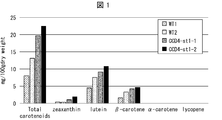
- FIG. 1 summarizes the results received from the Japan Food Research Laboratories.
- E 1% 1 cm 2550, absorption wavelength: 455 nm, solvent: ethanol
- CCD4-st1-1 and CCD4-st1-2 are 1.4 to 2.1 times more lutein, 1.4 to 2.7 times more ⁇ -carotene, and 2.5 to 4.0 times more zeaxanthin than the homo wild type. Also contained a major carotenoid). In addition, CCD4-st1-1 and CCD4-st1-2 showed 1.7 to 2.5 times the total carotenoid amount as compared with the homo wild type. No ⁇ -carotene or lycopene was detected.
- 08N-465 contained 1.4 times more lutein, 1.3 times more ⁇ -carotene, and 3.3 times more zeaxanthin than WT. In addition, 08N-465 showed 1.7 to 1.8 times the total carotenoid amount as compared with WT. No ⁇ -carotene or lycopene was detected.
- the extract solution was filtered through a PTFE filter (pore size 0.45 ⁇ m) and subjected to liquid chromatograph tandem mass spectrometer (LC-MS / MS) analysis with a photodiode array detector (PDA).
- LC-MS / MS liquid chromatograph tandem mass spectrometer
- PDA photodiode array detector
- the combination of precursor ion and product ion (SRM transition) of each carotenoid analyzed in SRM was set as shown in Table 3.
- the residence time of each compound is 42 msec, and the cell acceleration voltage is 3 V.
- Each carotenoid component was identified by comparing the retention time of the peak detected by PDA and SRM analysis with the standard substance.
- the content of each carotenoid is semi-quantified relative to the area value of the absorption spectrum detected at the light wavelength of 325 nm of trans-retinol, which is an internal standard substance, with respect to the area value of the absorption spectrum detected at the light wavelength of 450 nm of each carotenoid. Calculated as a value.
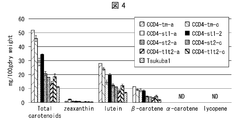
- the amount of each carotenoid contained in each strain is summarized in FIG. In FIG. 3, the amount of one carotenoid in one line is shown as an average value representing the content of carotenoid in three samples obtained from three plots of the field. As shown in FIG.
- CCD4-st1-1 and CCD4-st1-2 have 2.0 times or more lutein and 2.1 times or more ⁇ -carotene, as compared with the control 3 strains (WT1, WT2, and Tsukuba No. 1). It contained 3.8 times more zeaxanthin.
- TIC was analyzed in the range of m / z: 30-500.
- the combination of semi-quantitative ion and qualitative ion (SIM parameter) of each apocarotenoid analyzed in SIM was set as shown in Table 4.
- SIM parameter semi-quantitative ion and qualitative ion
- Each apocarotenoid component was identified by collating the full mass spectrum obtained in TIC mode with the literature information and the information in the database at the retention time when semi-quantitative ions and qualitative ions were detected in SIM mode.
- the content of each apocarotenoid is the relative value of the area value of the chromatogram of the semi-quantitative ion of each apocarotenoid to the area value of the chromatogram of the semi-quantitative ion of 1,3-dimethoxybenzene, which is an internal standard substance.
- Table 5 summarizes the amount of each carotenoid contained in each strain.
- (4b) Sensory evaluation test on a finely pulverized sample
- the dry leaves obtained in (4a) were pulverized, further pulverized, and then dispersed in polyethylene glycol (three times the mass of the pulverized dry leaves). It was made into a finely ground sample.
- Sensory evaluation (comparison of test specimens with controls) was performed by three skilled panelists (trained and more experienced than the panelists mentioned above).
- the control product is an unscented product of Mevius TM
- the test product is a sample obtained by spreading each finely ground sample on an unscented product of Mevius TM. Panelists were asked to smoke the controls and the test and respond to differences in the flavor and taste of the test compared to the controls.
- Table 7 shows the results of scoring each test sample, with 1 point being the answer from the experienced subjects that "improvement in floral flavor” was observed and 0 points being the answer that "improvement in floral flavor was not observed”. Summarize. As shown in Table 7, CCD4-st1-1 showed improvement in floral flavor in all panelists, and CCD4-st1-2 showed improvement in floral flavor in 2 out of 3 people. rice field. The above results indicate that the dried true leaves harvested from the double mutant can add a good flavor to conventional tobacco products.
- CCD4-t2-1 had a nonsense mutation (nucleotide substitution in which the codon encoding the 190th arginine (R) is changed to the stop codon) in the CCD4-T2 gene.
- CCD4-t2-2 had a splice mutation (the base G at the 5'end in the first intron was replaced with A) in the CCD4-T2 gene.
- CCD4-t2-3 had a splice mutation (CCD4-t2-3 had the base G at the 3'end of the first intron replaced with A) in the CCD4-T2 gene.
- Stage 1 Preparation of CCD4-st1-2 (having homozygous mutations in each of the CCD4-S and CCD4-T1 genes) by mating CCD4-s-1 and CCD4-t1-2 (Example 2)
- Stage 2 Preparation of preliminary mutant strains by mating CCD4-st1-2 and CCD4-t2-3 (having heterozygous mutations in each of the CCD4-S, CCD4-T1 and CCD4-T2 genes)
- Self-propagation Preparation of CCD4-058 (confirmed genotype will be described later) by self-fertilization of the above mutant strain.
- CCD4-st1, CCD4-st2 and CCD4-t1t2 were grown in a greenhouse, and the color of the matured (aged) lower leaves was visually observed. bottom.
- CCD4-st2 and CCD4-tm the color was orange to yellow, but the color intensity was different between strains according to the CCD4 genotype.
- the colors were stronger in the order of (i) CCD4-tm, (ii) CCD4-st1, and (iii) CCD4-st2 and CCD4-t1t2 (similar).
- the numerical values shown in Table 8 are the average of the measured values output for 18 measurement points per line (3 fresh leaves).
- the breakdown of the measurement points is 6 points on the surface of one fresh leaf (upper, middle and lower parts of each leaf when the leaf is divided into left and right with the main vein as the axis of symmetry) x 3 sheets.
- Negative values in a * represent the strength of green, and positive values represent the strength of red / magenta.
- b * a negative value represents the intensity of blue and a positive value represents the intensity of yellow.
- the value at L * represents (height of) lightness.
- the triple mutant showed stronger yellowing (orange to yellow coloration) than the double mutant.
- the strongest yellowing was observed in the strain (CCD4-st1) having a mutation in the CCD4-S and CCD4-T1 genes.
- CCD4-st1 the strain having a mutation in the CCD4-S and CCD4-T1 genes.
- slightly weak yellowing stronger than the target Tsukuba No. 1 was observed.
- the seedlings for transplantation of each line used in (6a) were grown in a greenhouse. General leaf tobacco cultivation conditions were adopted for field transplantation, growth and management up to harvest. On the 16th day after the heartbeat, 5 leaves per plant were harvested and subjected to normal yellow drying treatment using a hot air dryer. In the visual observation, the same tendency as the observation of the fresh leaves in Example 5 was observed in the dry leaves.
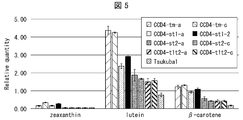
- the double mutant and the triple mutant showed a higher carotenoid content than Tsukuba No. 1.
- the degree of increase in carotenoid content varied according to genotype (with or without mutations in the CCD4-S, -T1 and T2 genes).
- the tendency for genotypic differences was similar for each component (total carotenoids, lutein, zeaxanthin and ⁇ -carotene).
- the lutein content is in the order of CCD4-tm (3.4-4.0 times), CCD4-st1 (2.1-2.8 times), CCD4-st2 (1.6-1.8 times), CCD4-t1t2 (1.2-1.7 times). it was high.
- the magnification in parentheses is the magnification when the component content of Tsukuba No. 1 is 1.
- the result of the semi-quantitative analysis was consistent with the result of FIG.
- the lutein content was higher in the order of CCD4-tm (5.5 to 5.7 times), CCD4-st1 (3.1 to 3.8 times), CCD4-st2 (2.2 to 2.4 times), and CCD4-t1t2 (2.0 times).
- the magnification in parentheses is the magnification when the component content of Tsukuba No. 1 is 1.
- the triple mutant produced the most remarkable change in the amount of apocarotenoid based on Tsukuba No. 1.
- ⁇ -ionone and dihydroactinidiolide showed an increase in common with the mutants as in Example 3.
- the amount of ⁇ -ionone magnification in parentheses is 1 for Tsukuba No. 1 is 3.5 to 3.6 times for CCD4-tm, 2.3 to 2.9 times for CCD4-st1, and 1.2 times for CCD4-st2.
- CCD4-t1t2 was 1.2 to 1.9 times higher.
- the amount of dihydroactinidiolide was 4.8 to 5.4 times for CCD4-tm, 2.5 to 2.7 times for CCD4-st1, 1.4 to 1.6 times for CCD4-st2, and 1.4 to 1.9 times for CCD4-t1t2.
- many apocarotenoids were reduced to about 1/3 to 1/10 as compared with Tsukuba No. 1.
- the present invention can be used to improve the quality of tobacco products.
Landscapes
- Life Sciences & Earth Sciences (AREA)
- Health & Medical Sciences (AREA)
- Genetics & Genomics (AREA)
- Engineering & Computer Science (AREA)
- Chemical & Material Sciences (AREA)
- Organic Chemistry (AREA)
- Wood Science & Technology (AREA)
- Biotechnology (AREA)
- Zoology (AREA)
- Bioinformatics & Cheminformatics (AREA)
- Biomedical Technology (AREA)
- General Engineering & Computer Science (AREA)
- Molecular Biology (AREA)
- General Health & Medical Sciences (AREA)
- Biochemistry (AREA)
- Botany (AREA)
- Environmental Sciences (AREA)
- Biophysics (AREA)
- Developmental Biology & Embryology (AREA)
- Microbiology (AREA)
- Physiology (AREA)
- Physics & Mathematics (AREA)
- Plant Pathology (AREA)
- Medicinal Chemistry (AREA)
- Natural Medicines & Medicinal Plants (AREA)
- Cell Biology (AREA)
- Chemical Kinetics & Catalysis (AREA)
- Proteomics, Peptides & Aminoacids (AREA)
- General Chemical & Material Sciences (AREA)
- Gastroenterology & Hepatology (AREA)
- Nutrition Science (AREA)
- Virology (AREA)
- Breeding Of Plants And Reproduction By Means Of Culturing (AREA)
Priority Applications (5)
| Application Number | Priority Date | Filing Date | Title |
|---|---|---|---|
| JP2022517067A JPWO2021215465A1 (https=) | 2020-04-21 | 2021-04-21 | |
| EP21791966.1A EP4140293A1 (en) | 2020-04-21 | 2021-04-21 | Tobacco plant body and method for producing same |
| BR112022021375A BR112022021375A2 (pt) | 2020-04-21 | 2021-04-21 | Corpo da planta de tabaco e método para produzir o mesmo |
| CN202180029970.2A CN115426874A (zh) | 2020-04-21 | 2021-04-21 | 烟草植物体及其制备方法 |
| US17/968,908 US20230071752A1 (en) | 2020-04-21 | 2022-10-19 | Tobacco plant body and method for producing same |
Applications Claiming Priority (2)
| Application Number | Priority Date | Filing Date | Title |
|---|---|---|---|
| JP2020-075565 | 2020-04-21 | ||
| JP2020075565 | 2020-04-21 |
Related Child Applications (1)
| Application Number | Title | Priority Date | Filing Date |
|---|---|---|---|
| US17/968,908 Continuation US20230071752A1 (en) | 2020-04-21 | 2022-10-19 | Tobacco plant body and method for producing same |
Publications (1)
| Publication Number | Publication Date |
|---|---|
| WO2021215465A1 true WO2021215465A1 (ja) | 2021-10-28 |
Family
ID=78269135
Family Applications (1)
| Application Number | Title | Priority Date | Filing Date |
|---|---|---|---|
| PCT/JP2021/016145 Ceased WO2021215465A1 (ja) | 2020-04-21 | 2021-04-21 | タバコ植物体とその製造方法 |
Country Status (6)
| Country | Link |
|---|---|
| US (1) | US20230071752A1 (https=) |
| EP (1) | EP4140293A1 (https=) |
| JP (1) | JPWO2021215465A1 (https=) |
| CN (1) | CN115426874A (https=) |
| BR (1) | BR112022021375A2 (https=) |
| WO (1) | WO2021215465A1 (https=) |
Cited By (4)
| Publication number | Priority date | Publication date | Assignee | Title |
|---|---|---|---|---|
| CN115426874A (zh) * | 2020-04-21 | 2022-12-02 | 日本烟草产业株式会社 | 烟草植物体及其制备方法 |
| JPWO2023127723A1 (https=) * | 2021-12-27 | 2023-07-06 | ||
| JPWO2023162949A1 (https=) * | 2022-02-22 | 2023-08-31 | ||
| US20240125743A1 (en) * | 2023-04-18 | 2024-04-18 | Yunnan Academy Of Tobacco Agricultural Sciences | METHOD FOR DETERMINING TOBACCO-SPECIFIC NITROSAMINES (TSNAs) IN CIGARETTE SMOKE USING ONE-STEP CLEAN-UP COUPLED WITH LIQUID CHROMATOGRAPHY-TANDEM MASS SPECTROMETRY (LC-MS/MS) |
Citations (4)
| Publication number | Priority date | Publication date | Assignee | Title |
|---|---|---|---|---|
| US20140289901A1 (en) | 2011-10-31 | 2014-09-25 | Philip Morris Products S.A. | Modulating beta-damascenone in plants |
| CN104152475A (zh) * | 2014-08-18 | 2014-11-19 | 中国烟草总公司郑州烟草研究院 | 烟草ε-番茄红素环化酶基因及其应用 |
| CN107502614A (zh) * | 2017-03-22 | 2017-12-22 | 中国医学科学院药用植物研究所 | 一种参与栀子西红花苷合成的类胡萝卜素裂解双加氧酶编码基因的筛选及功能验证 |
| KR20200057244A (ko) * | 2018-11-16 | 2020-05-26 | 경희대학교 산학협력단 | 카로티노이드 함량이 증진된 기능성 식물체 및 이의 제조 방법 |
Family Cites Families (9)
| Publication number | Priority date | Publication date | Assignee | Title |
|---|---|---|---|---|
| WO2007028115A2 (en) * | 2005-09-02 | 2007-03-08 | Cornell University | Polynucleotides encoding carotenoid and apocarotenoid biosynthetic pathway |
| CN103205405B (zh) * | 2013-04-11 | 2014-06-11 | 中国农业大学 | 蛋白IbGGPS及编码基因与在调控植物类胡萝卜素含量中的应用 |
| CN104152473B (zh) * | 2014-08-18 | 2019-07-12 | 中国烟草总公司郑州烟草研究院 | 烟草类胡萝卜素异构酶基因及其应用 |
| CN105154411A (zh) * | 2015-07-31 | 2015-12-16 | 郑州轻工业学院 | 微生物双加氧酶粗酶液及β-紫罗兰酮的制备方法 |
| CN105368850A (zh) * | 2015-11-25 | 2016-03-02 | 天津大学 | 产生β-紫罗酮香气物质的枸杞类胡萝卜素裂解双加氧酶基因及应用 |
| CN116058286A (zh) * | 2016-03-30 | 2023-05-05 | 日本烟草产业株式会社 | 烟草植物体及其制备方法 |
| SG11201907812TA (en) * | 2017-02-24 | 2019-09-27 | Agency Science Tech & Res | Production of carotenoids and apocarotenoids |
| JP7210806B2 (ja) * | 2020-04-17 | 2023-01-23 | 日本たばこ産業株式会社 | 低アルカロイド含量のタバコ属植物体およびその製造方法 |
| BR112022021375A2 (pt) * | 2020-04-21 | 2022-12-06 | Japan Tobacco Inc | Corpo da planta de tabaco e método para produzir o mesmo |
-
2021
- 2021-04-21 BR BR112022021375A patent/BR112022021375A2/pt not_active IP Right Cessation
- 2021-04-21 EP EP21791966.1A patent/EP4140293A1/en not_active Withdrawn
- 2021-04-21 JP JP2022517067A patent/JPWO2021215465A1/ja active Pending
- 2021-04-21 CN CN202180029970.2A patent/CN115426874A/zh active Pending
- 2021-04-21 WO PCT/JP2021/016145 patent/WO2021215465A1/ja not_active Ceased
-
2022
- 2022-10-19 US US17/968,908 patent/US20230071752A1/en not_active Abandoned
Patent Citations (5)
| Publication number | Priority date | Publication date | Assignee | Title |
|---|---|---|---|---|
| US20140289901A1 (en) | 2011-10-31 | 2014-09-25 | Philip Morris Products S.A. | Modulating beta-damascenone in plants |
| JP2015505666A (ja) * | 2011-10-31 | 2015-02-26 | フィリップ・モーリス・プロダクツ・ソシエテ・アノニム | 植物におけるβ−ダマセノンの調節 |
| CN104152475A (zh) * | 2014-08-18 | 2014-11-19 | 中国烟草总公司郑州烟草研究院 | 烟草ε-番茄红素环化酶基因及其应用 |
| CN107502614A (zh) * | 2017-03-22 | 2017-12-22 | 中国医学科学院药用植物研究所 | 一种参与栀子西红花苷合成的类胡萝卜素裂解双加氧酶编码基因的筛选及功能验证 |
| KR20200057244A (ko) * | 2018-11-16 | 2020-05-26 | 경희대학교 산학협력단 | 카로티노이드 함량이 증진된 기능성 식물체 및 이의 제조 방법 |
Non-Patent Citations (11)
| Title |
|---|
| BROGNAWEN, NAT. STRUCTURAL MOL. BIOL., vol. 16, 2009, pages 107 - 113 |
| CAMPBELL ET AL., PLANT PHYSIOLOGY, vol. 154, 2010, pages 656 - 664 |
| DATABASE Nucleotide 27 June 2011 (2011-06-27), GAO, J. P . ET AL., XP055868228, retrieved from ncbi Database accession no. JF947192.1 * |
| SAIKI, R. K. ET AL., SCIENCE, vol. 230, 1985, pages 1350 - 1354 |
| SAIKI, R. K. ET AL., SCIENCE, vol. 239, 1988, pages 487 - 491 |
| SAMBROOK, J. ET AL.: "Molecular Cloning: a Laboratory Manual", 1989, COLD SPRING HARBOR LABORATORY PRESS |
| SOUTHERN, E. M., JOURNAL OF MOLECULAR BIOLOGY, vol. 98, no. 503, pages 1975 |
| WATANABE K. ET AL.: "Alteration of flower colour in Ipomoea nil through CRISPR/Cas9-mediated mutagenesis of carotenoid cleavage dioxygenase 4", TRANSGENIC RES, vol. 27, 2018, pages 25 - 38, XP036439449, DOI: 10.1007/s11248-017-0051-0 * |
| WESLEY ET AL., PLANT J., vol. 27, 2001, pages 581 - 590 |
| ZHOU ET AL.: "Carotenoid Cleavage Dioxygenases: Identification, Expression, and Evolutionary Analysis of This Gene Family in Tobacco", INTERNATIONAL JOURNAL OF MOLECULAR SCIENCES, vol. 20, no. 22, 2019 |
| ZHOU QINQIAN, QINGCHANG LI 2 , PENG LI 1 , SONGTAO ZHANG 1 , CHE LIU 1 , JINGJING JIN 2 , PEIJIAN CAO 2 AND YONGXIA YANG: "Carotenoid cleavage dioxygenases: identification, expression, and evolutionary analysis of this gene family in tobacco", INTERNATIONAL JOURNAL OF MOLECULAR SCIENCES, 1 January 2019 (2019-01-01), XP055868230, Retrieved from the Internet <URL:https://www.ncbi.nlm.nih.gov/pmc/articles/PMC6888377/pdf/ijms-20-05796.pdf> [retrieved on 20211201] * |
Cited By (5)
| Publication number | Priority date | Publication date | Assignee | Title |
|---|---|---|---|---|
| CN115426874A (zh) * | 2020-04-21 | 2022-12-02 | 日本烟草产业株式会社 | 烟草植物体及其制备方法 |
| JPWO2023127723A1 (https=) * | 2021-12-27 | 2023-07-06 | ||
| JP7756726B2 (ja) | 2021-12-27 | 2025-10-20 | 日本たばこ産業株式会社 | タバコ植物 |
| JPWO2023162949A1 (https=) * | 2022-02-22 | 2023-08-31 | ||
| US20240125743A1 (en) * | 2023-04-18 | 2024-04-18 | Yunnan Academy Of Tobacco Agricultural Sciences | METHOD FOR DETERMINING TOBACCO-SPECIFIC NITROSAMINES (TSNAs) IN CIGARETTE SMOKE USING ONE-STEP CLEAN-UP COUPLED WITH LIQUID CHROMATOGRAPHY-TANDEM MASS SPECTROMETRY (LC-MS/MS) |
Also Published As
| Publication number | Publication date |
|---|---|
| CN115426874A (zh) | 2022-12-02 |
| BR112022021375A2 (pt) | 2022-12-06 |
| JPWO2021215465A1 (https=) | 2021-10-28 |
| US20230071752A1 (en) | 2023-03-09 |
| EP4140293A1 (en) | 2023-03-01 |
Similar Documents
| Publication | Publication Date | Title |
|---|---|---|
| JP7000265B2 (ja) | ニコチアナ・タバカムからのイソプロピルリンゴ酸シンターゼならびにその方法および使用 | |
| JP6871158B2 (ja) | 植物体におけるニコチンからノルニコチンへの変換の低減 | |
| WO2021215465A1 (ja) | タバコ植物体とその製造方法 | |
| JP2021045130A (ja) | たばこプロテアーゼ遺伝子 | |
| JP2016508032A (ja) | 植物体中のたばこ特異的ニトロソアミンの低減 | |
| KR20210109578A (ko) | 니트레이트 환원효소의 돌연변이를 통한 식물 내 니트레이트 수준 조절 | |
| US12239090B2 (en) | Plant body of genus Nicotiana with low alkaloid content and production method thereof | |
| US12419264B2 (en) | Modulating sugar and amino acid content in a plant (SULTR3) | |
| US12291714B2 (en) | Modulating reducing sugar content in a plant (INV) | |
| EP3597744A1 (en) | Tobacco plant and production method thereof | |
| JP7308870B2 (ja) | 乾燥たばこ材料の生産方法 | |
| US20240032498A1 (en) | Plant body of genus nicotiana and production method therefor | |
| US20240397898A1 (en) | Nicotiana plant body and method for producing same | |
| WO2025249533A1 (ja) | タバコ属植物体の乾燥材料、たばこ製品、ナス科植物体およびその製造方法 | |
| WO2026004868A1 (ja) | タバコ属植物体由来のたばこ材料、たばこ製品、タバコ属植物体、およびたばこ製品に冷涼感を付与する方法 | |
| JP2026506774A (ja) | 糖トランスポーターの調節 | |
| WO2024160860A1 (en) | Modulation of genes coding for lysine ketoglutarate reductase | |
| EP4734754A1 (en) | Modulation of genes coding for glutamate dehydrogenase |
Legal Events
| Date | Code | Title | Description |
|---|---|---|---|
| 121 | Ep: the epo has been informed by wipo that ep was designated in this application |
Ref document number: 21791966 Country of ref document: EP Kind code of ref document: A1 |
|
| ENP | Entry into the national phase |
Ref document number: 2022517067 Country of ref document: JP Kind code of ref document: A |
|
| REG | Reference to national code |
Ref country code: BR Ref legal event code: B01A Ref document number: 112022021375 Country of ref document: BR |
|
| NENP | Non-entry into the national phase |
Ref country code: DE |
|
| ENP | Entry into the national phase |
Ref document number: 2021791966 Country of ref document: EP Effective date: 20221121 |
|
| ENP | Entry into the national phase |
Ref document number: 112022021375 Country of ref document: BR Kind code of ref document: A2 Effective date: 20221020 |