WO2021214980A1 - 電動機駆動装置、冷凍サイクル装置、空気調和機、給湯機、及び冷蔵庫 - Google Patents
電動機駆動装置、冷凍サイクル装置、空気調和機、給湯機、及び冷蔵庫 Download PDFInfo
- Publication number
- WO2021214980A1 WO2021214980A1 PCT/JP2020/017705 JP2020017705W WO2021214980A1 WO 2021214980 A1 WO2021214980 A1 WO 2021214980A1 JP 2020017705 W JP2020017705 W JP 2020017705W WO 2021214980 A1 WO2021214980 A1 WO 2021214980A1
- Authority
- WO
- WIPO (PCT)
- Prior art keywords
- switching
- connection
- motor
- switches
- motor drive
- Prior art date
- Legal status (The legal status is an assumption and is not a legal conclusion. Google has not performed a legal analysis and makes no representation as to the accuracy of the status listed.)
- Ceased
Links
Images









Classifications
-
- H—ELECTRICITY
- H02—GENERATION; CONVERSION OR DISTRIBUTION OF ELECTRIC POWER
- H02P—CONTROL OR REGULATION OF ELECTRIC MOTORS, ELECTRIC GENERATORS OR DYNAMO-ELECTRIC CONVERTERS; CONTROLLING TRANSFORMERS, REACTORS OR CHOKE COILS
- H02P25/00—Arrangements or methods for the control of AC motors characterised by the kind of AC motor or by structural details
- H02P25/16—Arrangements or methods for the control of AC motors characterised by the kind of AC motor or by structural details characterised by the circuit arrangement or by the kind of wiring
- H02P25/18—Arrangements or methods for the control of AC motors characterised by the kind of AC motor or by structural details characterised by the circuit arrangement or by the kind of wiring with arrangements for switching the windings, e.g. with mechanical switches or relays
-
- H—ELECTRICITY
- H02—GENERATION; CONVERSION OR DISTRIBUTION OF ELECTRIC POWER
- H02P—CONTROL OR REGULATION OF ELECTRIC MOTORS, ELECTRIC GENERATORS OR DYNAMO-ELECTRIC CONVERTERS; CONTROLLING TRANSFORMERS, REACTORS OR CHOKE COILS
- H02P27/00—Arrangements or methods for the control of AC motors characterised by the kind of supply voltage
- H02P27/04—Arrangements or methods for the control of AC motors characterised by the kind of supply voltage using variable-frequency supply voltage, e.g. inverter or converter supply voltage
- H02P27/06—Arrangements or methods for the control of AC motors characterised by the kind of supply voltage using variable-frequency supply voltage, e.g. inverter or converter supply voltage using DC to AC converters or inverters
Definitions
- the present disclosure relates to a motor drive device, a refrigeration cycle device equipped with the motor drive device, and an air conditioner, a water heater, and a refrigerator equipped with the refrigeration cycle device.
- a motor drive device has been proposed in which a switch (for example, a mechanical relay) of a connection switching device switches a connection state of a winding of a motor without stopping the rotation operation of the motor (for example, Patent Document). 1).
- This motor drive device performs a switching operation of the switch within a period in which the output voltage of the inverter is controlled so that the effective value of the alternating current (that is, the motor current) flowing in the winding of the motor approaches zero.
- the present disclosure provides a motor drive device and a device including the motor drive device, which is less likely to cause a failure due to the switching operation of the switch for switching the connection state of the windings of the motor without stopping the rotation operation of the motor. With the goal.
- the motor drive device has a plurality of switching devices, and the connection switching device for switching the connection state of the windings of the motor by performing the switching operation of the plurality of switching devices, and the plurality of switching devices are used.
- the motor By controlling the inverter and the inverter in which an AC voltage is applied to the winding and a countercurrent voltage is applied from the winding of the motor in rotation operation via the plurality of switches, the motor
- the connection switching device has a control device that controls the rotation operation of the motor and causes the connection switching device to switch the connection state, and the connection switching device executes the switching of the connection state during the rotation operation of the motor.
- the switching operation of each of the plurality of switching devices is sequentially performed with a time interval.
- failure of the motor drive device due to the switching operation of the switch for switching the connection state of the windings of the motor without stopping the rotation operation of the motor is less likely to occur, and the motor drive device The life can be extended.
- FIG. 1 It is the schematic which shows the structural example of the air conditioner (including a refrigerating cycle apparatus) of embodiment. It is a schematic diagram which shows the structural example of the water heater (including a refrigerating cycle apparatus) of embodiment. It is the schematic which shows the structural example of the refrigerator (including a refrigerating cycle apparatus) of embodiment. It is a figure which shows the structure of the electric motor drive device of Embodiment 1. FIG. It is a figure which shows the other structure of the electric motor drive device of Embodiment 1. FIG. It is a figure which shows the structure of the inverter of FIG. It is a circuit diagram which shows the structural example of the winding and connection switching device of the electric motor of FIG. 4 in detail.
- FIG. 4 It is a circuit diagram which shows the structural example of the connection switching device of FIG. 4 in detail.
- (A) and (b) are diagrams conceptually showing windings in different connection states of a motor. It is a functional block diagram which shows an example of the control apparatus used in Embodiment 1.
- FIG. It is a figure which shows an example of the structure of the voltage command calculation unit of FIG.
- (A) and (b) are diagrams showing an example of a signal of a switch at the time of connection switching.
- (A) and (b) are diagrams showing a connection state when a plurality of switches are sequentially switched at different times.
- FIG. 1 A) to (C) are diagrams showing a connection state when a plurality of switches are sequentially switched at different times. An example of the current waveform before and after the connection switching is shown. It is a circuit diagram which shows the winding of the electric motor and the connection switching device in Embodiment 2.
- FIG. It is a circuit diagram which shows the configuration example which used the MOS transistor for the switch of the connection switching device of FIG. It is a figure which shows the example of the ON and OFF states of the MOS transistor of the switch of FIG. 18 in a table format. It is a circuit diagram which shows the winding of the electric motor and the connection switching device in Embodiment 3.
- an electric motor drive device including the refrigeration cycle applicable device, and an air conditioner, a water heater, and a refrigerator equipped with the refrigeration cycle device.
- a refrigeration cycle device including the refrigeration cycle applicable device, and an air conditioner, a water heater, and a refrigerator equipped with the refrigeration cycle device.
- the embodiments shown below are merely examples, and various changes can be made to the motor drive device and each device provided with the motor drive device.
- the components with the same reference numerals have the same or similar functions.
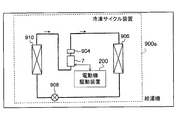
- FIG. 1 is a schematic view showing a configuration example of an air conditioner (including a refrigeration cycle device 900) of the embodiment.
- the refrigeration cycle device 900 can perform a heating operation or a cooling operation by the switching operation of the four-way valve 902.
- the refrigerant is pressurized by the compressor 904 and sent out, and the four-way valve 902, the indoor heat exchanger 906, the expansion valve 908, the outdoor heat exchanger 910 and the four-way valve 902. It returns to the compressor 904 through.
- the refrigerant is pressurized by the compressor 904 and sent out, and the four-way valve 902, the outdoor heat exchanger 910, the expansion valve 908, the indoor heat exchanger 906 and the four-way valve 902. It returns to the compressor 904 through.
- the heat exchanger 906 acts as a condenser to release heat (that is, heats the room), and the heat exchanger 910 acts as an evaporator to absorb heat.
- the heat exchanger 910 acts as a condenser to release heat, and the heat exchanger 906 acts as an evaporator to absorb heat (that is, cool the room).
- the compressor 904 is driven by a motor 7 controlled at a variable speed by the motor drive device 200.
- FIG. 2 is a schematic view showing a configuration example of the heat pump type water heater (including the refrigeration cycle device 900a) of the embodiment.
- the heat exchanger 906 acts as a condenser to release heat (that is, warms water), and the heat exchanger 910 acts as an evaporator to absorb heat. I do.
- the compressor 904 is driven by a motor 7 controlled at a variable speed by the motor drive device 200.
- FIG. 3 is a schematic view showing a configuration example of the refrigerator (including the refrigerating cycle device 900b) of the embodiment.
- the heat exchanger 910 acts as a condenser to release heat
- the heat exchanger 906 acts as an evaporator to absorb heat (that is, in the refrigerator). To cool).
- the compressor 904 is driven by a motor 7 controlled at a variable speed by the motor drive device 200.
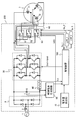
- FIG. 4 is a diagram showing a configuration example of the motor drive device 200 of the first embodiment together with the motor 7 and the AC power supply 1.
- FIG. 5 is a diagram showing another configuration example of the motor drive device 200.
- the motor drive device 200 is a circuit for driving the motor 7. As shown in FIG. 4, the motor drive device 200 includes an inverter 30, a connection switching device 60, and a control device 100. Further, the motor drive device 200 includes an AC power input terminal, a reactor 2, a rectifier circuit 3, a capacitor 10, a control power generation circuit 50, a bus current detection unit 40, and an electric amount detection unit 70. May be good.
- the connection switching device 60 has switches 61, 62, 63 as a plurality of switch circuits.
- the connection switching device 60 performs the switching operation of the switching devices 61, 62, 63 during the rotating operation of the motor 7, that is, without stopping the rotation of the motor 7, thereby performing the switching operation of the windings 71, 72 of the motor 7.
- the connection state (that is, the connection state) of 73 is switched.
- the inverter 30 applies an AC voltage to the windings 71, 72, 73 via the switches 61, 62, 63, and the winding 71 of the motor 7 rotating via the switches 61, 62, 63.
- a counter electromotive voltage is applied from 72 and 73.
- the control device 100 controls the rotational operation of the electric motor 7 by controlling the inverter 30. Further, the control device 100 causes the connection switching device 60 to switch the connection state of the windings.
- the control device 100 is a switch within the current control period Pc (shown in FIG. 16 described later) in which the value of the alternating current flowing through the windings 71, 72, and 73 is approaching zero. The switching operation of 61, 62, 63 is executed.
- the current control period Pc is also referred to as a "zero current control period".
- the connection state of the winding includes both the connection state of the winding (for example, Y connection and ⁇ connection) and the number of turns of the winding.
- the switching of the number of turns of the winding will be described in the third embodiment.
- the current control period Pc can be set to several hundred milliseconds or less.
- the current control period Pc can be set to several milliseconds or less.
- the motor 7 is used as a compressor of a refrigerating cycle device such as an air conditioner, a heat pump type water heater, or a refrigerator, the current control period Pc can be set within a range of several msec to 1 second.
- the control device 100 includes, for example, a memory as a storage device for storing control information as a software program, and a CPU (Central Processing Unit) as an information processing device for executing this program. It is composed of a microcomputer (microcomputer) equipped with a device, a DSP (Digital Signal Processor), or the like. Further, the control device 100 may be composed of dedicated hardware (for example, a processing circuit). Hereinafter, a case where the control device 100 is composed of a microcomputer will be described.
- An AC voltage is applied to the motor drive device 200 from an external AC power supply 1 via an AC power supply input terminal.
- the applied voltage is, for example, an effective value of amplitude of 100 V or 200 V, a frequency of 50 Hz or 60 Hz, or the like.
- the rectifier circuit 3 receives an AC voltage from the AC power supply 1 via the AC power supply input terminal and the reactor 2, and rectifies this to generate a DC voltage.
- the rectifier circuit 3 is a full-wave rectifier circuit formed by bridging a rectifier element such as a diode.
- the capacitor 10 smoothes the DC voltage generated by the rectifier circuit 3 and outputs the DC voltage (V20 shown in FIG. 6).
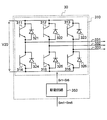
- FIG. 6 is a diagram showing the configuration of the inverter 30 of FIG.
- the inverter 30 has an inverter main circuit 310 and a drive circuit 350.
- the input terminal of the inverter main circuit 310 is connected to the electrode of the capacitor 10.
- the line connecting the output of the rectifier circuit 3, the electrode of the capacitor 10, and the input terminal of the inverter main circuit 310 is called a DC bus.
- the inverter 30 is controlled by the control device 100, and the switching elements 311 to 316 of the six arms of the inverter main circuit 310 operate on and off. By this on / off operation, the inverter 30 generates a three-phase alternating current having a variable frequency and a variable voltage, and supplies the three-phase alternating current to the motor 7. Rectifying elements 321 to 326 for reflux are connected in parallel to the switching elements 311 to 316, respectively.
- the motor 7 is a three-phase permanent magnet synchronous motor, and the end of the stator winding (also simply referred to as “winding") is pulled out to the outside of the motor 7, and star connection (Y connection) and delta connection (Y connection) and delta connection ( It is possible to switch to any of ( ⁇ connection).
- This switching is performed by the connection switching device 60.
- the connection switching device 60 When the Y connection is referred to as the first connection, the ⁇ connection is the second connection, and when the ⁇ connection is referred to as the first connection, the Y connection is the second connection.
- the connection state of the winding may be three or more types.
- FIG. 7 is a circuit diagram showing in detail a configuration example of the windings 71, 72, 73 of the motor 7 and the connection switching device 60.
- the first ends 71a, 72a, 73a of the three-phase windings 71, 72, 73 of the motor 7 composed of the U phase, the V phase, and the W phase are the external terminals 71c. It is connected to 72c and 73c, respectively.
- the second ends 71b, 72b, 73b of the U-phase, V-phase, and W-phase windings 71, 72, and 73 of the motor 7 are connected to the external terminals 71d, 72d, and 73d, respectively.
- the electric motor 7 is connected to the connection switching device 60.
- the U-phase, V-phase, and W-phase output lines 331, 332, and 333 of the inverter 30 are connected to the external terminals 71c, 72c, and 73c.
- connection switching device 60 is composed of switching devices 61, 62, and 63.
- an electromagnetic contactor whose contacts are opened and closed electromagnetically is used.
- Such magnetic contactors include what are called relays, contactors and the like.
- FIG. 8 is a circuit diagram showing in detail a configuration example of the connection switching device 60 of FIG.
- the switches 61, 62, and 63 of the connection switching device 60 are configured as shown in FIG. 8, for example.
- the connection state is different depending on whether a current is flowing through the exciting coils 611, 621, or 631 or when no current is flowing.
- the exciting coils 611, 621 and 631 are connected via semiconductor switches 604, 605 and 606 so as to receive the switching power supply voltage V60.
- the opening and closing of the semiconductor switches 604, 605, and 606 is controlled by the switching control signals S61, S62, and S63 output from the control device 100. Further, in the examples shown in FIGS.
- the opening and closing of the semiconductor switches 604, 605, and 606 are performed by Sc_1, which is a switching control signal Sc output from the control device 100, and Sc_2, which is a signal that delays the signal Sc. It is controlled by Sc_3, which is a signal obtained by further delaying the signal Sc.
- Sc_1 is a switching control signal Sc output from the control device 100
- Sc_2 which is a signal that delays the signal Sc. It is controlled by Sc_3, which is a signal obtained by further delaying the signal Sc.
- the common contact 61c of the switch 61 is connected to the external terminal 71d via the lead wire 61e.
- the normally closed contact 61b is connected to the neutral point node 64, and the normally open contact 61a is connected to the V-phase output line 332 of the inverter 30.
- the common contact 62c of the switch 62 is connected to the external terminal 72d via the lead wire 62e.
- the normally closed contact 62b is connected to the neutral point node 64, and the normally open contact 62a is connected to the W phase output line 333 of the inverter 30.
- the common contact 63c of the switch 63 is connected to the external terminal 73d via the lead wire 63e.
- the normally closed contact 63b is connected to the neutral point node 64, and the normally open contact 63a is connected to the U-phase output line 331 of the inverter 30.
- the switches 61, 62, 63 are switched to the normally closed contact side, that is, the common contacts 61c, 62c, as shown in FIG. , 63c are in a state of being connected to the normally closed contacts 61b, 62b, 63b (that is, a conductive state), and are not connected to the normally open contacts 61a, 62a, 63a (that is, a non-conducting state). In this state, the motor 7 is in the Y connection state.
- the switches 61, 62, 63 are switched to the normally open contact side, that is, the common contacts 61c, 62c, 63c are in the opposite direction to the drawing. It is in a state of being connected to the normally open contacts 61a, 62a, 63a and not connected to the normally closed contacts 61b, 62b, 63b (that is, a non-conducting state). In this state, the motor 7 is in the ⁇ connection state.
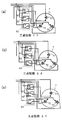
- FIG. 9A conceptually shows the connection state of the winding when the Y connection is made
- FIG. 9B conceptually shows the connection state of the winding when the ⁇ connection is made.
- the electric power is connected at the time of Y connection and the time of ⁇ connection.
- the power supplied to is equal to each other. That is, when the electric power supplied to the motors is equal to each other, the current is larger in the ⁇ connection and the voltage required for driving is lower.
- connection state when the load is low, the Y connection may be used for low-speed operation, and when the load is high, the ⁇ connection may be used for high-speed operation. By doing so, the efficiency at low load can be improved, and the output at high load can be increased.
- connection state it is conceivable to switch the connection state according to the number of rotations. For example, when high-speed operation is required, the ⁇ connection state is set. By doing so, the voltage required for driving can be reduced to 1 / ⁇ 3 (compared to the voltage required for Y connection). Therefore, it is not necessary to reduce the number of turns of the winding, and it is not necessary to use the weakening magnetic flux control.
- the current value can be reduced to 1 / ⁇ 3 compared to the ⁇ connection by setting the Y connection state.
- the winding can be designed to be suitable for driving at a low speed in the Y connection state, and the current value can be reduced as compared with the case where the Y connection is used over the entire speed range. ..
- the loss of the inverter 30 can be reduced and the efficiency can be improved.
- connection switching device 60 is provided in order to enable such switching.
- the bus current detection unit 40 shown in FIGS. 4 and 5 detects the bus current, that is, the DC current Idc input to the inverter 30.
- the bus current detection unit 40 includes a shunt resistor inserted in the DC bus and supplies an analog signal indicating the detection result to the control device 100.
- This analog signal (that is, the detection signal) is converted into a digital signal by an A / D (Analog to Digital) converter (not shown) in the control device 100 and used for processing inside the control device 100.
- control device 100 controls the switching of the connection state by the connection switching device 60 and also controls the operation of the inverter 30.
- the control device 100 generates PWM (Pulse Width Modulation) signals Sm1 to Sm6 and supplies them to the inverter 30.
- the inverter 30 includes a drive circuit 350 in addition to the inverter main circuit 310, and the drive circuit 350 generates drive signals Sr1 to Sr6 based on the PWM signals Sm1 to Sm6.
- the drive circuit 350 controls the switching elements 311 to 316 to be turned on and off by the drive signals Sr1 to Sr6, whereby a frequency-variable and voltage-variable three-phase AC voltage is applied to the motor 7.
- the drive signals Sr1 to Sr6 are voltage levels required to control the switching elements 311 to 316, for example. , A signal having a magnitude from + 15V to -15V. Further, the PWM signals Sm1 to Sm6 use the ground potential of the control device 100 as a reference potential, whereas the drive signals Sr1 to Sr6 are the potentials of the emitter terminals which are the negative terminals of the corresponding switching elements. Is the reference potential.
- FIG. 10 is a functional block diagram showing an example of the control device 100 of FIG. As shown in FIG. 10, the control device 100 includes an operation control unit 102 and an inverter control unit 110.
- the operation control unit 102 outputs an instruction signal based on the command signal Qe provided by the electric energy detection unit 70.
- the electric amount detection unit 70 is a command signal based on the electric amount of an electric signal indicating a room temperature (for example, the temperature of an air-conditioned space) detected by a temperature sensor (not shown), and an operation unit (for example, a remote controller) (not shown). It receives a command signal indicating instruction information and controls the operation of each part of the air conditioner.
- the instructions from the operation unit include information indicating the set temperature, selection of the operation mode, instructions for starting and ending the operation, and the like.
- the operation control unit 102 determines whether the winding of the motor 7 is Y-connected or ⁇ -connected, and determines the target rotation speed. Based on this determination, the switching control signal Sc and the frequency command value ⁇ * Is output. For example, when the difference between the room temperature and the set temperature is large, the operation control unit 102 decides to make a ⁇ connection, sets the target rotation speed to a relatively high value, and corresponds to the above target rotation speed after startup. Outputs the frequency command value ⁇ * that gradually increases the frequency to the frequency.
- the operation control unit 102 When the frequency reaches the frequency corresponding to the target rotation speed, the operation control unit 102 maintains the state until the room temperature approaches the set temperature, and once the room temperature approaches the set temperature, the electric motor is temporarily stopped and the Y connection is made. And outputs the frequency command value ⁇ * that gradually rises to the frequency corresponding to the relatively low target rotation speed. When the frequency reaches the frequency corresponding to the target rotation speed, the operation control unit 102 controls to maintain the room temperature close to the set temperature. This control includes adjusting the frequency, stopping and restarting the motor.
- the inverter control unit 110 includes a current restoration unit 111, a three-phase two-phase conversion unit 112, a frequency compensation unit 113, a primary frequency calculation unit 114, a voltage command calculation unit 115, and a two-phase three-phase conversion unit. It has 116, a PWM generation unit 117, an electric angle phase calculation unit 118, and an exciting current command control unit 119.
- the current restoration unit 111 restores the phase currents i u , iv , i w flowing through the motor 7 based on the value of the direct current Idc detected by the bus current detection unit 40 (shown in FIGS. 4 and 5). do.
- the current restoration unit 111 samples the direct current Idc detected by the bus current detection unit 40 at a timing determined based on the PWM signal provided by the PWM generation unit 117, thereby causing the phase currents i u , iv , and so on. Restore i w.
- the three-phase two-phase conversion unit 112 excites the current values i u , iv , and i w restored by the current restoration unit 111 by using the electric angle phase ⁇ generated by the electric angle phase calculation unit 118 described later. Converts to the current value of the ⁇ - ⁇ axis represented by the component (also referred to as “ ⁇ -axis current”) i ⁇ and the torque current component (also referred to as “ ⁇ -axis current”) i ⁇ .
- the exciting current command control unit 119 obtains the optimum exciting current command value i ⁇ * that is most efficient for driving the motor 7 based on the torque current component ( ⁇ -axis current) i ⁇ .
- the torque current component i [delta] seeking the exciting current command value i gamma *
- exciting current component i gamma exciting current command value i gamma based on the frequency command value omega *
- the same effect can be obtained by obtaining *.
- the output current is equal to or higher than a predetermined value (or maximum) based on the torque current component i ⁇ (or the exciting current component i ⁇ , the frequency command value ⁇ *), that is, the current value is set.
- the exciting current command value i ⁇ * is output so that the current phase angle ⁇ m (not shown) is equal to or less than (or the minimum) a predetermined value.
- FIG. 11 is a diagram showing an example of the voltage command calculation unit 115 of FIG.
- the voltage command calculation unit 115 includes the ⁇ -axis current i ⁇ and the ⁇ -axis current i ⁇ obtained from the three-phase two-phase conversion unit 112, the frequency command value ⁇ *, and the excitation current command control. Based on the exciting current command value i ⁇ * obtained from the unit 119, the voltage command values V ⁇ * and V ⁇ * are output.
- the controller 1152 is, for example, a proportional integration (PI) controller, and frequency estimation is performed based on the difference ( ⁇ * - ⁇ est) between the frequency command value ⁇ * and the frequency estimation value ⁇ est generated by the frequency estimation unit 1151.
- the ⁇ -axis current command value i ⁇ * is output so that the value ⁇ est matches the frequency command value ⁇ *.
- the frequency estimation unit 1151 estimates the frequency of the motor 7 based on the ⁇ -axis currents i ⁇ and the ⁇ -axis currents i ⁇ and the voltage command values V ⁇ * and V ⁇ *, and generates a frequency estimation value ⁇ est.
- the switching unit 1155 selects the value of the ⁇ -axis current command value i ⁇ ** from either the ⁇ -axis current command value i ⁇ * or 0.
- the controller 1156 such as the PI controller sets the ⁇ -axis current. i [delta] and outputs a * a [delta] -axis voltage value V [delta] as to coincide with the [delta] -axis current value i [delta] **.
- the switching unit 1153 selects the value of the ⁇ -axis current command value i ⁇ ** from either the ⁇ -axis current command value i ⁇ * or 0.
- the controller 1154 such as the PI controller sets the ⁇ -axis current.
- i gamma outputs a * a gamma-axis voltage command value V gamma to match the gamma-axis current value i gamma **.
- the two-phase three-phase conversion unit 116 shown in FIG. 10 has a ⁇ -axis voltage command value V ⁇ * and a ⁇ -axis voltage command value V ⁇ * (voltage command value in a two-phase coordinate system) obtained by the voltage command calculation unit 115. Is converted into output voltage command values (three-phase voltage command values) V u * , V v * , and V w * of the three-phase coordinate system using the electric angle phase ⁇ obtained by the electric angle phase calculation unit 118 and output. do.
- the PWM generation unit 117 generates and outputs PWM signals Sm1 to Sm6 based on the three-phase voltage command values V u * , V v * , and V w * obtained from the two-phase three-phase conversion unit 116.
- the stop signal St provided by the operation control unit 102 is given to, for example, the PWM generation unit 117, and the PWM generation unit 117 immediately stops the output of the PWM signals Sm1 to Sm6 when the stop signal St is received.
- the configuration for restoring the phase currents i u , iv , and i w from the DC current Idc on the input side of the inverter 30 is described, but the output lines 331, 332, and 333 of the inverter 30 are used.
- a current detector may be provided, and the current detector may be used to detect the phase current. In this case, the current detected by the current detector may be used instead of the current restored by the current restoration unit 111.
- phase currents i u, i v, and i w or DC current Idc is supplied to the control unit 100, when an excessive current flows to the motor 7, to the motor 7 by stopping the PWM signal Sm1 ⁇ Sm6 By stopping the energization, it is possible to prevent irreversible demagnetization.
- the current value at which irreversible demagnetization occurs in the Y connection and ⁇ connection (I Y and I ⁇ in FIG. 9). ) Is approximately ⁇ 3 times different, and this current value is ⁇ 3 times higher for the ⁇ connection than for the Y connection. Therefore, if the protection level (that is, the overcurrent protection level) for preventing irreversible demagnetization is set according to the Y connection, the protection of I ⁇ will be applied quickly, and it will be difficult to expand the operating range.
- the protection level that is, the overcurrent protection level
- the protection level at the time of ⁇ connection is made higher than the protection level at the time of Y connection
- the protection level at each winding is surely irreversibly reduced. It is possible to protect the electric motor 7 from magnetism, and it is possible to obtain an electric motor driving device with improved reliability.
- the magnetic force in the initial state of the motor 7 is set to 100%, and the current value (for example, the magnetic force is reduced to 97%) within a range that does not affect the performance when irreversible demagnetization occurs.
- the current value can be set. However, there is no problem even if the set current value of the protection level is changed according to the equipment to be used.
- ⁇ 1-3 Operation of Embodiment 1
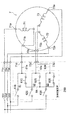
- FIG. 12 is a circuit diagram showing a path of a short-circuit current that can occur in the motor drive device 200a of the comparative example.
- the switching control signals S61, S62, and S63 are sent as synchronized signals to connect the wires.
- connection destination contacts of the common contacts 61c, 62c, 63c are simultaneously switched to the normally closed contacts 61b, 62b, 63b or the normally open contacts 61a, 62a, 63a.
- an arc discharge occurs between the contacts of the switches 61, 62, and 63. I have something to do. That is, in the comparative example, since the switches 61, 62, 63 try to switch at the same timing, in at least two of the three switches 61, 62, 63, between the ab contacts (that is, that is).
- 61a and 61b, 62a and 62b, 63a and 63b) are short-circuited by an arc short circuit, and a short-circuit path is generated that does not pass through the windings 71, 72, 73 of the motor 7 as shown in FIG.
- a failure such as contact welding of the flow switches 61, 62, 63 or destruction of the semiconductor element constituting the inverter 30 may occur.
- the path indicated by the thick dashed arrow shown in FIG. 12 is an example of a short-circuit path that does not pass through the windings 71, 72, and 73 of the motor 7.
- the control device 100 shown in FIG. 4 has a control device 100.
- the switching control signals S61, S62, and S63 of the switching devices 61, 62, and 63 whose timings are shifted are output, respectively.
- the switching timings of the switches 61, 62, and 63 are shifted to generate a short-circuit current during energization. It is possible to switch without any.
- connection switching device 60 is a plurality of switches 61, 62, 63).
- the connection switching device 60 is controlled so that each switching operation is sequentially performed at intervals of time.
- the time intervals t1 and t2 of the switching operations of the plurality of switches 61, 62, and 63 are 50 ms or less. Further, it is desirable that the time intervals t1 and t2 are 2 ms or more. Further, the switches 61, 62, 63 have a mechanical relay, and the time interval when switching the exciting coil of the relay from the non-excited state to the excited state is 5 ms or more, and the exciting coil is changed from the excited state. It is desirable that the time interval when switching to the non-excitation state is 2 ms or more.
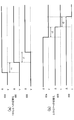
- FIG. 13 (a) and 13 (b) are diagrams showing an example of on / off operation of the semiconductor switches 604, 605, and 606 that give a drive signal to the exciting coils of the switches 61, 62, and 63 at the time of connection switching.
- FIG. 13A shows an operation of switching the semiconductor switches 604, 605, and 606 from off to on in the operation of switching from the Y connection to the ⁇ connection.
- FIG. 13B shows an on-to-off switching operation of the semiconductor switches 604, 605, and 606 in the switching operation from the ⁇ connection to the Y connection.
- the timing of the switching operation of the semiconductor switches 604, 605, and 606 and the timing of the switching operation of the mechanical relays of the switches 61, 62, and 63 are assumed to be the same, and the following description will be given.
- the time interval t1 for shifting the switching timing of the switches 61, 62, 63 is a signal for turning on the semiconductor switch (for example, the semiconductor switch 604 of FIG. 8) (FIG. 4 or FIG.
- a current flows through the exciting coil (for example, the exciting coil 611 in FIG. 8), and the connection destination of the common contact 61c of the switching device (for example, the switching device 61 in FIG. 8). Is the time until switching from the normally closed contact 61b to the normally open contact 61a (this time is a value in consideration of individual variation).
- the signal provided by the semiconductor switch 605 is turned on after the time interval t1 has elapsed since the signal provided by the semiconductor switch 604 was turned on, and from that point onward. Further, after the lapse of the time interval t1, the signal provided by the semiconductor switch 606 is turned on.
- the time interval t2 for shifting the switching timing of the switches 61, 62, 63 is a signal for turning on the semiconductor switch (for example, the semiconductor switch 604 in FIG. 8) (switching in FIG. 4).
- the control signal S61 or Sc_1 is sent, no current flows through the exciting coil (for example, the exciting coil 611 in FIG. 8), and the connection destination of the common contact 61c of the switch (for example, the switch 61 in FIG. 8) is always connected.
- the time until switching from the open contact 61a to the normally closed contact 61b (this time is a value in consideration of individual variation).
- the signal provided by the semiconductor switch 605 is turned off after the time interval t2 has elapsed since the signal provided by the semiconductor switch 604 was turned off, and from that point onward. Further, after the lapse of the time interval t2, the signal provided by the semiconductor switch 606 is turned off.
- the preferable range of the time intervals t1 and t2 considered based on the operating time of the mechanical relay is, for example, 2 ms to 50 ms.
- FIGS. 14 (a) and 14 (b) are diagrams showing a connection state when a plurality of switches 61, 62, and 63 are sequentially switched at different times.
- FIG. 14A shows a case where the switch 61 is in the state of ⁇ connection and the switches 62 and 63 are in the state of Y connection.
- FIG. 14B shows a case where the switches 61 and 62 are in the state of ⁇ connection and the switch 63 is in the state of Y connection.
- each of the switches 61, 62, 63 is separated by a time interval. Since the switching is performed in order, a short-circuit path that does not pass through the winding as shown in FIG. 12 is not formed.
- 15 (a) to 15 (c) are diagrams showing another example of the connection state when the plurality of switches 61, 62, and 63 are sequentially switched at different times.
- FIG. 15A all of the switches 61, 62, and 63 are in a Y-connected state, and an arc discharge (indicated by a double wire) is performed between the normally closed terminal and the normally open terminal of the switch 61. Is generated, and the switch 61 is in a state of being short-circuited at three points (that is, a state in which the three terminals are electrically connected to each other).
- FIG. 15A all of the switches 61, 62, and 63 are in a Y-connected state, and an arc discharge (indicated by a double wire) is performed between the normally closed terminal and the normally open terminal of the switch 61. Is generated, and the switch 61 is in a state of being short-circuited at three points (that is, a state in which the three terminals are electrically connected to each
- the switch 61 is in the Y-connected state, the switches 62 and 63 are in the ⁇ -connected state, and an arc discharge (2) is performed between the normally closed terminal and the normally open terminal of the switch 61.
- the switch 61 is in a state of being short-circuited at three points (that is, a state in which the three terminals are electrically connected to each other).
- the switches 61 and 63 are in the Y connection state, the switch 62 is in the ⁇ connection state, and an arc discharge (2) is performed between the normally closed terminal and the normally open terminal of the switch 61.
- the switch 61 is in a state of being short-circuited at three points (that is, a state in which the three terminals are electrically connected to each other).
- each of the switches 61, 62, 63 is separated by a time interval. Since the switching is performed in order, a short-circuit path that does not pass through any of the windings 71, 72, and 73 as shown in FIG. 12 is not formed.
- each of the switches 61, 62, 63 is set at a time interval. Since the switches are opened and switched in order, any of the windings 71, 72, and 73 can be connected to one of the switches 61, 62, and 63, even if an arc discharge occurs, as shown in FIG. A short-circuit path that does not pass through is not formed.
- the switching operations of the switches 61, 62, and 63 are performed at different times.
- the occurrence of the short-circuit path shown in FIG. 12, which is formed by the simultaneous occurrence of short-circuits in the two switches, is avoided. Therefore, in the first embodiment, it is possible to avoid the occurrence of failure of the switches 61, 62, 63 or the inverter 30 due to the short circuit current.
- a method of switching the relay in a state where the rotation speed Nm of the motor 7 is set to zero and the power is not supplied can be considered.
- the rotation speed Nm of the motor 7 when the load applied to the motor 7 when the motor 7 is restarted is, for example, the compressor 904 (FIG. 1), the state of the refrigerant is not stable. Therefore, the torque required for restarting increases, the current at startup increases, and in the worst case, restarting may not be possible. Therefore, it is necessary to restart after a lapse of time until the state of the refrigerant is sufficiently stabilized without operating the motor 7. Therefore, the compressor 904 cannot pressurize the refrigerant, which may lead to an increase or decrease in the room temperature due to a decrease in the cooling or heating capacity, and the room temperature may not be kept constant.
- the value (effective value) of the current flowing through the winding of the electric motor 7 or the connection switching device 60 during the rotational operation (during operation) of the electric motor 7 is controlled so as to approach zero (current).
- the plurality of switches of the connection switching device 60 are operated one by one at intervals of time, so that an arc discharge and an excessive current are generated between the contacts of the switching devices 61, 62, and 63. It is desirable to complete the switching without causing it.
- the current control period Pc is controlled so that the value (effective value) of the current flowing through the winding or the connection switching device 60 of the motor 7 approaches zero, that is, the first effective value of the alternating current flowing through the winding is the first effective value. , It is a period closer to zero than the second effective value of the alternating current flowing in the winding before the switching operation of the plurality of switches.
- the current control period Pc is a period in which the inverter applies an AC voltage to the motor so as to cancel the counter electromotive voltage generated by the rotational operation of the motor 7. In this way, the value (effective value) of the current flowing through the winding of the motor 7 can be brought close to zero without making the rotation speed Nm of the motor 7 zero, that is, without stopping the rotation operation.
- a short-circuit current does not flow, and it is possible to switch the connection state of the windings 71, 72, and 73 with improved reliability. ..
- the voltage command calculation unit 115 is operated by the switching unit 1155 to select 0 for the ⁇ -axis current command value i ⁇ ** , so that the ⁇ -axis current i ⁇ becomes the ⁇ -axis current command value i ⁇ * .
- the voltage command calculation unit 115 is operated by the switching unit 1153 to select 0 for the ⁇ -axis current command value i ⁇ ** , so that the ⁇ -axis current i ⁇ matches the ⁇ -axis current command value i ⁇ *. That is, the ⁇ -axis voltage command value V ⁇ * is output so that the ⁇ -axis current command value i ⁇ ** matches 0.
- ⁇ 1-4 Effect of the first embodiment
- the value (effective value) of the current flowing through the windings 71, 72, 73 of the motor 7, that is, the current flowing through the switches 61, 62, 63 is changed.
- control to approach zero preferably control to make it zero
- zero current control referred to as “zero current control”
- the switching operation of the switches 61, 62, 63 can be performed in a state where no current is flowing through the switches 61, 62, 63, and a large short-circuit current flows between the contacts of the switches 61, 62, 63. There is no.
- control to make zero does not mean that the value (effective value) of the current flowing through the switches 61, 62, 63 is made exactly zero, but can be regarded as substantially zero. It means that it is close to zero.
- the arc discharge at that time is slight, but when it comes into contact with the normally open contact 61a in a state where the arc discharge occurs, the normally open contact 61a, the normally closed contact 61b, and the common contact 61c are connected with low impedance.
- a voltage is supplied by the inverter 30 in order to cancel the induced voltage of the motor 7, and in that state, the normally open contacts 61a, 62a, 63a, the normally closed contacts 61b, 62b, 63b, the common contacts 61c,
- a short-circuit current is generated, and as shown in FIG. 12, an excessive current may flow to the switches 61, 62, 63.
- the control device 100 of the first embodiment makes the value (for example, effective value) of the current flowing through the motor 7 or the connection switching device 60 approach zero when the motor 7 is rotating at high speed (desirably). Controls (so that it becomes approximately 0), and after confirming that the current is sufficiently zero, the switching operations of the plurality of switches 61, 62, and 63 of the connection switching device 60 are separated by a time interval one by one. Control to do. By doing so, it is possible to prevent failures such as contact welding when a mechanical relay is used for the connection switching device 60, and a highly reliable motor drive device can be obtained.
- the motor drive device 200 of the first embodiment is a product because the failure occurrence rate can be reduced and the life of the device can be extended even when the connection switching device 60 is configured with inexpensive parts. The cost can be reduced.
- connection state of the winding is switched during the current control period in which the rotational operation of the motor 7 is not stopped. Therefore, it is not necessary to suspend the rotational operation of the motor and then restart the motor 7 in order to switch the connection state of the windings.
- the Y connection and ⁇ are set when the connection is switched. It is possible to protect from irreversible demagnetization in any state of wiring. Since the current is controlled to be zero when the connection is switched, there is no effect on the operation of the motor 7.
- the magnetic force in the initial state of the motor 7 is set to 100%, and the current value (for example, the magnetic force) is within a range that does not affect the performance when irreversible demagnetization occurs. (Current value that drops to 97%) can be set, and by setting the current value in ⁇ connection to ⁇ 3 times the value of Y connection, it is surely protected from irreversible demagnetization regardless of the connection state. It becomes possible to do.
- the current value of I ⁇ ⁇ ⁇ 3 (the current value of the protection level in the Y connection). Equivalent to) should be set as the protection level.
- the set current value of the protection level may be changed according to the device to be used.
- a diode or the like is generally used as the rectifying element of the rectifying circuit 3.
- the configuration of the rectifier circuit 3 is not limited to the example of FIG.
- a transistor element such as a MOSFET (Metal-Oxide-Semiconductor Field-Effective-Transistor) is used, and the voltage (input AC) supplied from the AC power supply 1 is used. It may be configured to perform rectification by turning it on according to the polarity of the voltage).
- IGBTs Insulated Gate Bipolar Transistors
- MOSFETs Insulated Gate Bipolar Transistors
- the switching elements 311 to 316 are used as the switching elements 311 to 316 of the inverter main circuit 310, but the switching elements are not limited to these.
- any elements that can perform switching may be used.
- MOSFETs are used as the switching elements 311 to 316, it is not necessary to connect the rectifying elements 321 to 326 for circulation shown in FIG. 6 in parallel because the MOSFET has a parasitic diode due to its structure.
- the materials constituting the rectifying element and the switching elements 311 to 316 are not only silicon (Si) but also silicon carbide (SiC), gallium nitride (GaN), diamond, etc., which are wide bandgap semiconductors. This makes it possible to reduce the loss.
- the electric motor drive device of the second embodiment is different from the electric motor drive device 200 of the first embodiment in that the connection switching device 260 is used instead of the connection switching device 60.
- the switches 61, 62, and 63 of the connection switching device 60 use selection switches.
- each switch of the connection switching device 260 is composed of a combination of a normally closed switch and a normally opened switch, that is, a combination of an on / off type switch.
- FIG. 17 is a circuit diagram showing windings 71, 72, 73 of the electric motor 7 and the connection switching device 260 according to the second embodiment.
- the changeover device 61 is composed of a combination of the normally closed switch 615 and the normally open switch 616
- the changeover 62 is composed of the combination of the normally closed switch 625 and the normally open switch 626. It is composed of a combination of a normally closed switch 635 and a normally opened switch 636.
- an electromagnetic contactor can be used as each switch. can.
- An electromagnetic contactor is suitable because it has a small conduction loss when it is turned on.
- each switch may be configured by using a semiconductor switch.
- FIG. 18 is a circuit diagram showing a configuration example in which a MOS transistor is used for the switch 61 (62, 63) of the connection switching device 260.
- FIG. 18 shows one of the switches 61, 62, 63.
- the switches 61, 62, and 63 have the same configuration as each other and operate in the same manner.
- FIG. 19 is a diagram showing an example of an on / off state of the MOS transistor of the switch of FIG. 18 in a table format.
- the switch 61 is a MOS transistor 616a (626a, 626a, which is connected in series between the lead wire 61e (62e, 63e) and the output wire 332 (333, 331). MOS transistors 616b (626b, 636b) and diodes 616d (636a, 636b) and diodes 616b (626b, 636b) and diodes 616b (626b, 636b) and diodes 616b (626c, 636c) connected in series between the lead wires 61e (62e, 63e) and the output lines 332 (333, 331). 626d, 636d) and.
- the switch 61 (62, 63) includes a MOS transistor 615a (625a, 635a) and a diode 615c (625c, 635c) connected in series between the lead wire 61e (62e, 63e) and the neutral point node 64.
- a MOS transistor 615b (625b, 635b) and a diode 615d (625d, 635d) connected in series between the lead wire 61e (62e, 63e) and the neutral point node 64.
- Each MOS transistor 616a (626a, 636a), 616b (626b, 636b), 615a (625a, 635a), 615b (625b, 635b) has an anode connected to a diode and a cathode connected to a lead wire (or neutral point node or). It has a parasitic diode connected to the output line).
- MOS transistors 616a, 626a, 636a are turned on
- MOS transistors 616b, 626b, 636b are turned on
- MOS transistors 615a, 625a, 635a are turned off by inputting a control signal to the control terminal.
- MOS transistors 616a, 626a, 636a are turned off
- MOS transistors 616b, 626b, 636b are turned off
- MOS transistors 615a, 625a, 635a are turned on
- MOS transistors 615b, 625b, 635b are turned on.
- the MOS transistor as a semiconductor switch is composed of a wide bandgap (WBG) semiconductor.
- the WBG semiconductor is, for example, a semiconductor containing silicon carbide (SiC), gallium nitride (GaN), gallium oxide (Ga 2 O 3 ), and diamond as constituent materials.
- SiC silicon carbide
- GaN gallium nitride
- Ga 2 O 3 gallium oxide
- diamond diamond
- the MOS transistors 616a and 615a may be erroneously turned on or off at the same time due to the influence of noise or the like, and not only the phases of the MOS transistors 616a and 615a but also the MOS of at least two phases.
- the transistors 616a and 615a and the MOS transistors 616b and 615b are erroneously turned on or off at the same time, a short-circuit path that does not pass through the winding of the electric motor may occur, and a failure may occur.
- connection switching device 260 made of a semiconductor as described in FIGS. 4 and 5, it is possible to prevent the generation of a short-circuit current that does not go through the winding by shifting the timing of the switching operation of the switching device. Therefore, a highly reliable motor drive device can be obtained.
- the motor drive device of the second embodiment can reduce the failure occurrence rate and extend the life of the device even when the connection switching device 260 is configured with inexpensive parts, and thus the product cost. Can be reduced.
- the motor drive device of the second embodiment is the same as the motor drive device 200 of the first embodiment.
- Embodiments 1 and 2 describe an electric motor drive device 200 in which windings 71, 72, and 73 are connected to an electric motor 7 capable of switching between Y connection and delta connection.
- an electric motor drive device connected to an electric motor 7a capable of switching the number of turns of each of the windings 71, 72, and 73 will be described.
- the windings 71, 72, and 73 of each phase are composed of two winding portions 711 and 712, two winding portions 721 and 722, and two winding portions 731 and 732.
- a configuration is shown in which both ends of the winding portion can be connected to the outside of the motor 7a and the connection state is switched by the connection switching device 360.
- the windings 71, 72, 73 of each phase may have three or more winding portions.
- the windings 71, 72, 73 of each phase have two winding portions.
- both ends of the two winding portions constituting the windings 71, 72, 73 of each phase can be connected to the outside of the motor 7a, and the connection switching device 360 connects the windings 71, 72, 73.
- the connection state (in the third embodiment, the number of turns of the winding) is switched.
- the connection switching device 360 can also be applied to an electric motor capable of switching the winding portion to either parallel connection or series connection.
- the U-phase winding 71 is composed of two winding portions 711 and 712
- the V-phase winding 72 is composed of two winding portions 721 and 722
- the W-phase winding 73 is composed of two. It is composed of two winding portions 731 and 732.
- the first ends of the winding portions 711, 721, and 731 are connected to the output lines 331, 332, and 333 of the inverter 30 via external terminals 71c, 72c, and 73c, respectively.
- the second ends of the winding portions 711, 721 and 731 are connected to the common contacts of the changeover switches 617, 627 and 627 via external terminals 71 g, 72 g and 73 g, respectively.
- the first ends of the winding portions 712, 722 and 732 are connected to the common contacts of the changeover switches 618, 628 and 638 via the external terminals 71h, 72h and 73h, respectively.
- the second ends of the winding portions 712, 722 and 732 are connected to the neutral node 64 via external terminals 71d, 72d and 73d, respectively.
- the normally closed contacts of the changeover switches 617, 627 and 637 are connected to the normally closed contacts of the changeover switches 618, 628 and 638, respectively.
- the normally open contacts of the changeover switches 617, 627, and 637 are connected to the neutral point node 64.
- the normally open contacts of the changeover switches 618, 628, and 638 are connected to the output lines 331, 332, and 333 of the inverter 30.
- connection changeover device 360 is configured by the changeover switches 617, 627, 637, 618, 628, and 638.
- connection switching device 360 Even when such a connection switching device 360 is used, the switching operation of the switching device of the connection switching device 360 is performed during the current control period Pc in the same manner as that shown in the first and second embodiments. It can protect mechanical relays or semiconductor switches. Further, similarly to those shown in the first and second embodiments, the connection state of the windings of the motor 7a is changed by sequentially performing the switching operation of each of the plurality of changeover switches of the connection changeover device 360 at time intervals. Failure of the motor drive device due to the switching operation of the switch to be switched without stopping the rotation operation of the motor is less likely to occur.
- a combination of the normally closed switch and the normally opened switch can be used instead of the changeover switch. Further, the normally closed switch and the normally opened switch can be used as a semiconductor switch.
- connection switching device 360 The same configuration as that of the connection switching device 360 can be applied to the above.
- the motor drive device of the motor having a configuration in which the voltage required for driving is changed by providing an intermediate tap on the winding in the state of Y connection or ⁇ connection and short-circuiting a part of the winding by a switching means.
- the motor drive device of the present embodiment can be applied.
- the configuration of the third embodiment can be applied as long as the motor can switch the connection state of the windings and the counter electromotive voltage can be switched by switching the connection state.
- the motor drive device of the third embodiment is the same as the motor drive device of the first or second embodiment.
Landscapes
- Engineering & Computer Science (AREA)
- Power Engineering (AREA)
- Control Of Ac Motors In General (AREA)
Priority Applications (3)
| Application Number | Priority Date | Filing Date | Title |
|---|---|---|---|
| CN202080099927.9A CN115485967A (zh) | 2020-04-24 | 2020-04-24 | 电动机驱动装置、制冷循环装置、空调机、热水器以及冰箱 |
| JP2022516797A JP7515574B2 (ja) | 2020-04-24 | 2020-04-24 | 電動機駆動装置、冷凍サイクル装置、空気調和機、給湯機、及び冷蔵庫 |
| PCT/JP2020/017705 WO2021214980A1 (ja) | 2020-04-24 | 2020-04-24 | 電動機駆動装置、冷凍サイクル装置、空気調和機、給湯機、及び冷蔵庫 |
Applications Claiming Priority (1)
| Application Number | Priority Date | Filing Date | Title |
|---|---|---|---|
| PCT/JP2020/017705 WO2021214980A1 (ja) | 2020-04-24 | 2020-04-24 | 電動機駆動装置、冷凍サイクル装置、空気調和機、給湯機、及び冷蔵庫 |
Publications (1)
| Publication Number | Publication Date |
|---|---|
| WO2021214980A1 true WO2021214980A1 (ja) | 2021-10-28 |
Family
ID=78270687
Family Applications (1)
| Application Number | Title | Priority Date | Filing Date |
|---|---|---|---|
| PCT/JP2020/017705 Ceased WO2021214980A1 (ja) | 2020-04-24 | 2020-04-24 | 電動機駆動装置、冷凍サイクル装置、空気調和機、給湯機、及び冷蔵庫 |
Country Status (3)
| Country | Link |
|---|---|
| JP (1) | JP7515574B2 (https=) |
| CN (1) | CN115485967A (https=) |
| WO (1) | WO2021214980A1 (https=) |
Cited By (1)
| Publication number | Priority date | Publication date | Assignee | Title |
|---|---|---|---|---|
| WO2024185274A1 (ja) * | 2023-03-03 | 2024-09-12 | 住友電気工業株式会社 | 制御装置、巻線切替システム、制御方法、及び制御プログラム |
Citations (2)
| Publication number | Priority date | Publication date | Assignee | Title |
|---|---|---|---|---|
| WO2019026282A1 (ja) * | 2017-08-04 | 2019-02-07 | 三菱電機株式会社 | 電動機駆動装置および空気調和機 |
| WO2019087243A1 (ja) * | 2017-10-30 | 2019-05-09 | 三菱電機株式会社 | 電動機駆動装置、冷凍サイクル装置、空気調和機、給湯機、及び冷蔵庫 |
Family Cites Families (3)
| Publication number | Priority date | Publication date | Assignee | Title |
|---|---|---|---|---|
| JP6704466B2 (ja) * | 2016-10-31 | 2020-06-03 | 三菱電機株式会社 | 電動機駆動装置 |
| CN111727557B (zh) * | 2018-02-26 | 2023-04-21 | 三菱电机株式会社 | 电动机驱动装置以及制冷环路应用设备 |
| WO2020016972A1 (ja) * | 2018-07-18 | 2020-01-23 | 三菱電機株式会社 | 回転機制御装置、冷媒圧縮装置、冷凍サイクル装置及び空気調和機 |
-
2020
- 2020-04-24 WO PCT/JP2020/017705 patent/WO2021214980A1/ja not_active Ceased
- 2020-04-24 CN CN202080099927.9A patent/CN115485967A/zh active Pending
- 2020-04-24 JP JP2022516797A patent/JP7515574B2/ja active Active
Patent Citations (2)
| Publication number | Priority date | Publication date | Assignee | Title |
|---|---|---|---|---|
| WO2019026282A1 (ja) * | 2017-08-04 | 2019-02-07 | 三菱電機株式会社 | 電動機駆動装置および空気調和機 |
| WO2019087243A1 (ja) * | 2017-10-30 | 2019-05-09 | 三菱電機株式会社 | 電動機駆動装置、冷凍サイクル装置、空気調和機、給湯機、及び冷蔵庫 |
Cited By (1)
| Publication number | Priority date | Publication date | Assignee | Title |
|---|---|---|---|---|
| WO2024185274A1 (ja) * | 2023-03-03 | 2024-09-12 | 住友電気工業株式会社 | 制御装置、巻線切替システム、制御方法、及び制御プログラム |
Also Published As
| Publication number | Publication date |
|---|---|
| JPWO2021214980A1 (https=) | 2021-10-28 |
| JP7515574B2 (ja) | 2024-07-12 |
| CN115485967A (zh) | 2022-12-16 |
Similar Documents
| Publication | Publication Date | Title |
|---|---|---|
| JP6921221B2 (ja) | 電動機駆動装置、冷凍サイクル装置、空気調和機、給湯機、及び冷蔵庫 | |
| JP6991336B2 (ja) | 電動機駆動装置及び冷凍サイクル適用機器 | |
| JP6689465B2 (ja) | 電動機駆動装置及び冷凍サイクル適用機器 | |
| US11070161B2 (en) | Electric-motor driving device and refrigeration-cycle application apparatus including electric-motor driving device | |
| US11424698B2 (en) | Motor control device and air-conditioning device | |
| JP7072714B2 (ja) | 電動機駆動装置及び冷凍サイクル適用機器 | |
| JP6929434B2 (ja) | 電動機駆動装置及び冷凍サイクル適用機器 | |
| JP7325526B2 (ja) | 電動機駆動装置、冷凍サイクル装置、空気調和機、給湯機、及び冷蔵庫 | |
| JP6991364B2 (ja) | モータ駆動装置、冷凍サイクル装置、空気調和機、給湯機及び冷蔵庫 | |
| JP7515574B2 (ja) | 電動機駆動装置、冷凍サイクル装置、空気調和機、給湯機、及び冷蔵庫 | |
| EP4300810B1 (en) | Electric motor drive device and refrigeration cycle application device | |
| JP7486656B2 (ja) | 電動機駆動装置、冷凍サイクル装置、空気調和機、給湯器および冷蔵庫 |
Legal Events
| Date | Code | Title | Description |
|---|---|---|---|
| 121 | Ep: the epo has been informed by wipo that ep was designated in this application |
Ref document number: 20932532 Country of ref document: EP Kind code of ref document: A1 |
|
| ENP | Entry into the national phase |
Ref document number: 2022516797 Country of ref document: JP Kind code of ref document: A |
|
| NENP | Non-entry into the national phase |
Ref country code: DE |
|
| 122 | Ep: pct application non-entry in european phase |
Ref document number: 20932532 Country of ref document: EP Kind code of ref document: A1 |