WO2021200996A1 - 骨強度低下の予防又は改善用組成物 - Google Patents
骨強度低下の予防又は改善用組成物 Download PDFInfo
- Publication number
- WO2021200996A1 WO2021200996A1 PCT/JP2021/013624 JP2021013624W WO2021200996A1 WO 2021200996 A1 WO2021200996 A1 WO 2021200996A1 JP 2021013624 W JP2021013624 W JP 2021013624W WO 2021200996 A1 WO2021200996 A1 WO 2021200996A1
- Authority
- WO
- WIPO (PCT)
- Prior art keywords
- ornithine
- decrease
- composition
- bone
- expression
- Prior art date
- Legal status (The legal status is an assumption and is not a legal conclusion. Google has not performed a legal analysis and makes no representation as to the accuracy of the status listed.)
- Ceased
Links
Images






Classifications
-
- A—HUMAN NECESSITIES
- A61—MEDICAL OR VETERINARY SCIENCE; HYGIENE
- A61P—SPECIFIC THERAPEUTIC ACTIVITY OF CHEMICAL COMPOUNDS OR MEDICINAL PREPARATIONS
- A61P19/00—Drugs for skeletal disorders
-
- A—HUMAN NECESSITIES
- A61—MEDICAL OR VETERINARY SCIENCE; HYGIENE
- A61K—PREPARATIONS FOR MEDICAL, DENTAL OR TOILETRY PURPOSES
- A61K31/00—Medicinal preparations containing organic active ingredients
- A61K31/185—Acids; Anhydrides, halides or salts thereof, e.g. sulfur acids, imidic, hydrazonic or hydroximic acids
- A61K31/19—Carboxylic acids, e.g. valproic acid
- A61K31/195—Carboxylic acids, e.g. valproic acid having an amino group
- A61K31/197—Carboxylic acids, e.g. valproic acid having an amino group the amino and the carboxyl groups being attached to the same acyclic carbon chain, e.g. gamma-aminobutyric acid [GABA], beta-alanine, epsilon-aminocaproic acid or pantothenic acid
- A61K31/198—Alpha-amino acids, e.g. alanine or edetic acid [EDTA]
-
- A—HUMAN NECESSITIES
- A23—FOODS OR FOODSTUFFS; TREATMENT THEREOF, NOT COVERED BY OTHER CLASSES
- A23L—FOODS, FOODSTUFFS OR NON-ALCOHOLIC BEVERAGES, NOT OTHERWISE PROVIDED FOR; PREPARATION OR TREATMENT THEREOF
- A23L33/00—Modifying nutritive qualities of foods; Dietetic products; Preparation or treatment thereof
- A23L33/10—Modifying nutritive qualities of foods; Dietetic products; Preparation or treatment thereof using additives
- A23L33/17—Amino acids, peptides or proteins
- A23L33/175—Amino acids
-
- A—HUMAN NECESSITIES
- A61—MEDICAL OR VETERINARY SCIENCE; HYGIENE
- A61P—SPECIFIC THERAPEUTIC ACTIVITY OF CHEMICAL COMPOUNDS OR MEDICINAL PREPARATIONS
- A61P19/00—Drugs for skeletal disorders
- A61P19/08—Drugs for skeletal disorders for bone diseases, e.g. rachitism, Paget's disease
- A61P19/10—Drugs for skeletal disorders for bone diseases, e.g. rachitism, Paget's disease for osteoporosis
Definitions
- the present invention relates to a composition for preventing or improving a decrease in bone strength.
- Bone strength is defined as a disease characterized by decreased bone strength and an increased risk of fracture, and this definition is commonly used.
- Bone strength is defined by two factors: bone density and bone quality.
- Bone density is defined by the amount of minerals (bone mass) such as calcium that make up bone
- bone quality is the material characteristics that are the quality of bone materials and the structural characteristics created based on those materials. Specified by (microstructure).
- Bone strength is defined by bone density and bone quality, so even if either of them decreases, bone strength decreases and the risk of fracture increases.
- Non-Patent Document 6 It is known that as one of the factors for reducing bone strength, estrogen deficiency (menopause) and aging cause increased bone resorption and decreased bone formation, which in turn causes a decrease in bone density and deterioration of bone quality.
- Ornithine has been reported to be effective in improving liver function (Non-Patent Documents 1 and 2), reducing mental stress (Non-Patent Document 3), and recovering from fatigue (Non-Patent Documents 4 and 5). However, the effect of ornithine on bone strength has not been reported so far.
- An object of the present invention is to provide a composition effective for preventing or ameliorating a decrease in bone strength.
- ornithine has an osteoblast differentiation promoting action, and that ornithine has an osteoblast differentiation promoting action of low BMP-, as shown in Test Examples 1 to 4 described later. It was found that it is exhibited even under 2 concentrations, and that ornithine has an osteoblast differentiation inhibitory effect. Based on these new findings (osteoblast differentiation promoting action and osteoclast differentiation inhibitory action of ornithine), the present inventors have found that ornithine reduces bone formation and enhances bone resorption, which are known to reduce bone strength.
- Non-Patent Document 6 It has been found that (see Non-Patent Document 6 above) can be suppressed, the balance of bone metabolism can be adjusted, and it can be effectively used for prevention or improvement of bone strength decrease.
- ornithine can be used in elderly people with decreased BMP-2 signals and osteoporosis patients. It was found that it can be effectively used for prevention or improvement of bone strength decrease even in postmenopausal women.
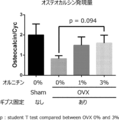
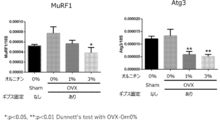
- ornithine has an effect of suppressing bone density reduction in a living body and enhances the expression of osteocalcin in the living body as shown in Test Examples 5 to 8 described later. It suppresses muscle atrophy that co-occurs with osteoporosis, suppresses the expression of muscle atrophy marker genes MuRF1 and Atg3, and suppresses the increase in liver weight, which is an index of fatty liver induced by OVX (ovariectomy). It was found that it suppresses the expression of SREBP1c, MTP and PPAR ⁇ in the liver. The present inventors have completed the present invention by further studying based on these new findings.
- the present invention is as follows.
- [1] A composition for preventing or improving bone strength decrease, which contains ornithine as an active ingredient.
- [4] The composition according to the above [3], wherein the decrease in bone quality is due to a decrease in bone metabolism.
- the composition according to the above [7], wherein the subject to which the BMP-2 signal is lowered is a postmenopausal woman, an osteoporosis patient or an elderly person.
- the display of the function is selected from the group consisting of "maintaining a body that can move forever”, “maintaining walking function”, “maintaining motor function”, and “walking for a long time”, the above [16].
- [18] A composition for suppressing the expression of SREBP1c and / or MTP and / or PPAR ⁇ containing ornithine as an active ingredient.
- the composition according to the above [18] which is labeled with a function exerted by suppressing the expression of SREBP1c and / or MTP and / or PPAR ⁇ .
- [20] A method for preventing or improving bone strength loss in a subject in need of prevention or improvement of bone strength reduction, which comprises administering a composition containing an effective amount of ornithine to the subject.
- the method according to the above [20] wherein the decrease in bone strength is due to a decrease in bone density or a decrease in bone quality.
- the method according to the above [22] wherein the decrease in bone quality is due to a decrease in bone metabolism.
- a method for inducing osteocalcin expression in a subject which comprises administering a composition containing an effective amount of ornithine to the subject in need of inducing osteocalcin expression.
- Postmenopausal hormones in a subject in need of prevention or amelioration of changes in physical condition associated with postmenopausal hormonal balance changes including administration of a composition containing an effective amount of ornithine. How to prevent or improve physical condition changes associated with changes in balance.
- a method for suppressing the expression of MuRF1 and / or Atg3 in a subject which comprises administering a composition containing an effective amount of ornithine to a subject who needs to suppress the expression of MuRF1 and / or Atg3.
- SREBP1c and / or MTP and / or PPAR ⁇ in a subject in need of suppression of SREBP1c and / or MTP and / or PPAR ⁇ expression which comprises administering a composition containing an effective amount of ornithine.
- a composition containing ornithine for use in the prevention or improvement of bone strength loss is due to at least one selected from menopause, immobility osteoporosis, disuse osteoporosis and aging.
- the composition according to the above [34] wherein the decrease in bone strength is due to a decrease in bone density or a decrease in bone quality.
- the composition according to the above [36], wherein the decrease in bone quality is due to a decrease in bone metabolism.
- the composition according to the above [40], wherein the subject to which the BMP-2 signal is reduced is a postmenopausal woman, an osteoporosis patient or an elderly person.
- [48] Use of ornithine to produce compositions for the prevention or improvement of bone loss.
- the composition of the present invention containing ornithine can be effectively used for prevention or improvement of bone strength decrease due to the osteoblast differentiation promoting action and / or the osteoclast differentiation suppressing action of ornithine.
- the composition of the present invention containing ornithine can be used for elderly people with decreased BMP-2 signal, osteoporosis patients, and postmenopausal women. Also, it is advantageous in that it can be effectively used for prevention or improvement of bone strength decrease.
- composition of the present invention containing ornithine can be effectively used for prevention or improvement of locomotor function decline such as disuse musculoskeletal atrophy in a subject having reduced bone strength such as osteoporosis.
- the composition of the present invention containing ornithine prevents changes in physical condition (poor physical condition) associated with changes in hormonal balance after menopause, particularly changes in physical condition caused by decreased bone strength and / or increased liver weight (poor physical condition). Alternatively, it can be effectively used for improvement.
- FIG. 1 shows the results of Test Example 1.
- FIG. 2 shows the results of Test Example 2.
- FIG. 3 shows the results of Test Example 3.
- the abbreviation Orn in FIG. 3 indicates ornithine.
- FIG. 4 shows the results of Test Example 4.
- FIG. 5 shows the experimental schedule of the OVX (ornithine administration) group in Test Example 5.
- FIG. 6 shows the results of Test Example 5.
- FIG. 7 shows the experimental schedule of the OVX (with ornithine 1% mixed feed and cast fixed) group and the OVX (with ornithine 3% mixed feed and cast fixed) group in Test Example 6.
- FIG. 8 shows the results of Test Example 6.
- FIG. 9 shows the results of Test Example 7.
- FIG. 11 shows the results of Example 8 (osteocalcin expression level).
- FIG. 10 shows the results of Example 8 (MuRF1 and Atg3 expression levels).
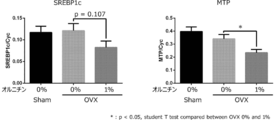
- FIG. 12-1 shows the results of Example 8 (SREBP1c and MTP expression levels).
- composition for preventing or improving bone strength reduction of the present invention contains ornithine as an active ingredient.
- “decreased bone strength” includes decreased bone density (bone mass) and decreased bone quality (for example, decreased bone metabolism).
- improved bone strength decrease means returning the decreased bone strength to a healthy state or bringing it closer to a healthy state
- prevention of bone strength decrease means a healthy state. It means maintaining bone strength or preventing further deterioration of decreased bone strength.
- the factors for reducing bone strength are not particularly limited, but for example, menopause, immobility osteoporosis, disuse osteoporosis, aging, undernutrition (for example, undernutrition of young women), and young age (for example, growth period). ), Bone strength decrease due to lack of exercise.
- the compositions of the present invention are particularly useful for menopause, immobility osteoporosis, disuse osteoporosis, and age-related loss of bone strength.
- the compositions of the present invention are particularly useful in that they can also be used in subjects with reduced BMP-2 signals (eg, postmenopausal women, osteoporosis patients, the elderly).
- an osteoblast differentiation promoting agent and / or It can be used as an osteoclast differentiation inhibitor.
- the composition of the present invention can be a composition with an indication of function.
- the indications of the function include, for example, "preventing osteoporosis”, “strengthening bone”, “promoting bone regeneration”, “power to make bone”, “suppressing fracture”, and “recovery from fracture”. "Hurry up” is displayed.
- the composition for preventing or improving a decrease in bone strength of the present invention can be further used for preventing or ameliorating a decrease in locomotor function.
- the "exercise device function” includes a function of moving limbs and a body, and examples thereof include a walking function.
- loose musculoskeletal function includes a decrease in musculoskeletal function due to disuse musculoskeletal atrophy.
- improved of musculoskeletal function deterioration means returning the decreased musculoskeletal function to a healthy state or bringing it closer to a healthy state, and "prevention of musculoskeletal function deterioration” means health.
- the composition of the present invention prevents or ameliorate the decrease in bone strength and the function of the locomotor organ by administering it to a subject who simultaneously develops a decrease in bone strength such as osteoporosis and a decrease in locomotor function such as disuse musculoskeletal atrophy. It is useful in that it can be expected to have both effects of preventing or improving atrophy.
- the composition of the present invention can be a composition with an indication of function. Examples of the display of the function include "maintaining a body that can move forever", “maintaining a walking function", “maintaining a motor function", and "walking for a long time”.
- the ornithine which is the active ingredient of the present invention may be any of L-form, D-form and DL-form, but L-form is preferable.
- ornithine may be in the form of a salt.
- the salt include salts that are acceptable for food or medicine, and examples thereof include alkali metal salts such as sodium salt and potassium salt; alkaline earth metal salts such as calcium salt, magnesium salt and barium salt; aluminum salt; ethylenediamine.
- Salts with organic bases such as propylenediamine, ethanolamine, monoalkylethanolamine, dialkylethanolamine, diethanolamine, triethanolamine; salts with inorganic acids such as hydrochloric acid, hydrobromic acid, nitrate, sulfuric acid, phosphoric acid; With organic acids such as formic acid, acetic acid, trifluoroacetic acid, phthalic acid, fumaric acid, oxalic acid, tartaric acid, maleic acid, citric acid, succinic acid, malic acid, methanesulfonic acid, benzenesulfonic acid, p-toluenesulfonic acid, etc. Salt is mentioned.
- organic bases such as propylenediamine, ethanolamine, monoalkylethanolamine, dialkylethanolamine, diethanolamine, triethanolamine
- salts with inorganic acids such as hydrochloric acid, hydrobromic acid, nitrate, sulfuric acid, phosphoric acid
- organic acids such as formic acid
- the content of ornithine contained in the composition of the present invention is, for example, 0.01 to 100% by weight, preferably 0.1 to 95% by weight, more preferably 1 to 90% by weight, still more preferably 5 to 80% by weight. Is.
- composition of the present invention can be used as a food, a medicine, etc., it is preferably a food.
- food is a concept that broadly includes foods that can be taken orally (excluding pharmaceuticals), and is not only so-called “food” but also beverages, dietary supplements, and foods with health claims (for example, foods for specified health use). , Foods with functional claims), supplements, etc.
- the composition of the present invention may be in any form, for example, powders, granules (including fine granules), tablets, hard capsules, soft capsules, liquids (eg, solutions, suspensions, emulsions), beverages, jellies, etc.
- examples include pudding, yogurt, candy, and chewing gum.
- the composition of the present invention is mixed with a carrier (for example, an excipient, a binder, a disintegrant, a lubricant, a solvent), and a powder, a granule, or a tablet is prepared by a method known in the field of food preparation or pharmaceutical preparation.
- a carrier for example, an excipient, a binder, a disintegrant, a lubricant, a solvent
- a powder, a granule, or a tablet is prepared by a method known in the field of food preparation or pharmaceutical preparation.
- Capsules, liquids and the like can be produced.
- the composition of the present invention can
- the intake (dose) of ornithine in the composition of the present invention is, for example, 1 mg to 24 g, preferably 50 mg to 24 g, more preferably 100 mg to 12 g, still more preferably 200 mg to 4. It is 8 g.
- composition of the present invention can be safely ingested (administered) by humans and animals other than humans (for example, mammals and birds such as livestock, poultry, and laboratory animals). As a form to be ingested (administered) to animals other than humans, it may be added to feed.
- the present invention relates to a composition for inducing osteocalcin expression, which contains ornithine as an active ingredient.
- the definition of ornithine, the content of ornithine, the availability to foods / pharmaceuticals, the form, the amount of intake, the target of intake / administration, etc. are the above-mentioned reduction of bone strength of the present invention. It is the same as the definition of ornithine, the content of ornithine, the availability to foods / pharmaceuticals, the form, the amount of intake, the target of intake / administration, etc. in the composition for prevention or improvement of.
- the induction of osteocalcin expression can be confirmed, for example, by a method according to Test Example 8 described later.
- the active ingredient ornithine since the active ingredient ornithine has an osteocalcin expression-inducing action, it "prevents osteoporosis”, “strengthens bone”, “promotes bone regeneration”, and “makes bone”. Effects such as “force”, “suppression of fracture”, and "accelerating recovery from fracture” can be expected.
- the composition for inducing osteocalcin expression of the present invention can be a composition with an indication of the function exerted by inducing osteocalcin expression.
- the indications of the function include, for example, "preventing osteoporosis", “strengthening bone”, “promoting bone regeneration”, “power to make bone”, “suppressing fracture", and “recovery from fracture”. "Hurry up” is displayed.
- the present invention relates to a composition for suppressing the expression of MuRF1 and / or Atg3, which contains ornithine as an active ingredient.
- the definition of ornithine, the content of ornithine, the availability to foods / pharmaceuticals, the form, the amount of intake, the target of intake / administration, etc. are described in the above-mentioned book. It is the same as the definition of ornithine, the content of ornithine, the availability to foods / pharmaceuticals, the form, the amount of intake, the target of intake / administration, etc. in the composition for preventing or improving the decrease in bone strength of the present invention.
- the suppression of the expression of MuRF1 and Atg3 can be confirmed, for example, by a method according to Test Example 8 described later.
- ornithine which is an active ingredient, has an action of suppressing the expression of MuRF1 and Atg3, "maintains a body that can move forever”, “maintains walking function”, and “maintains motor function”. , "You can walk for a long time” and other effects can be expected.
- the composition for suppressing the expression of MuRF1 and / or Atg3 of the present invention can be a composition with an indication of the function exerted by suppressing the expression of MuRF1 and / or Atg3. Examples of the display of the function include “maintaining a body that can move forever", “maintaining a walking function”, “maintaining a motor function", and "walking for a long time”.
- the present invention relates to a composition for suppressing the expression of SREBP1c and / or MTP and / or PPAR ⁇ containing ornithine as an active ingredient.
- the definition of ornithine, the content of ornithine, the availability to foods / pharmaceuticals, the form, the amount of intake, the target of intake / administration, etc. The same as the definition of ornithine, the content of ornithine, the availability to foods / pharmaceuticals, the form, the amount of intake, the target of intake / administration, etc.
- composition for suppressing the expression of SREBP1c and / or MTP and / or PPAR ⁇ of the present invention can be a composition with an indication of the function exerted by suppressing the expression of SREBP1c and / or MTP and / or PPAR ⁇ .
- the present invention relates to a composition containing ornithine as an active ingredient for preventing or improving physical condition changes associated with changes in hormonal balance after menopause.
- Changes in physical condition associated with changes in hormonal balance after menopause include changes in physical condition caused by decreased bone strength and / or increased liver weight.
- Specific examples of the physical condition change include fracture, decreased exercise, muscle atrophy associated with decreased exercise and decreased bone density, fatty liver, and hyperlipidemia.
- composition for preventing or improving physical condition changes associated with changes in hormone balance after menopause of the present invention the definition of ornithine, the content of ornithine, the availability to foods / pharmaceuticals, the form, the amount of intake, the amount of intake / administration
- the subjects are the definition of ornithine, the content of ornithine, the availability to foods / pharmaceuticals, the form, the amount of intake, the target of intake / administration, etc. in the above-mentioned composition for preventing or improving bone strength reduction of the present invention.
- the composition of the present invention can be a composition with an indication of function. Examples of the display of the function include the display of "supporting a change in the physical condition of a woman" and "improving the poor physical condition of a postmenopausal woman".
- Cell MC3T3-E1 (RIKEN Cell Bank, RCB1126) (2) Medium ⁇ -MEM medium, 10% FBS, antibiotics added (3) Test reagents, etc.
- ⁇ -MEM medium phenol red-free
- Penicillin-streptomycin solution (nacalai tesque, Cat. No. 26253-84) 0.25% trypsin-EDTA solution (nacalai tesque, Cat. No. 32777-44)
- Dulbecco's PBS (Nissui Pharmaceutical Co., Ltd., Code No. 05913) Live cell count reagent SF (nacalai tesque, Cat. No.
- BMP-2 Human Recombinant (R & D Systems, Cat. No. 355-BEC-010) Micro BCA Protein Assay Reagent Kit (PIERCE, Cat. No. 23235) Cell-LyEX1 (Wako, Cat. No. 300-34761) LabAssay ALP (Wako, Cat. No. 291-58601) Mouse Osteocalcin EIA kit (Biomedical Technologies, Cat. No. BT-470) L-Ornithine Monohydrochloride (Nacalai, Cat. No. 25718-92)
- Method (1) Pre-cultured cells The cells were put to sleep in a T-75 flask using a medium and cultured in a CO 2 incubator (5% CO 2 , 37 ° C.). Medium exchange was performed every other day, and when 80% confluence was reached, cells were collected and used in the test.
- ALP alkaline phosphatase
- the cells were washed with PBS and then lysed with a 60 ⁇ L / well cell lysate (Cell-LyEX1 containing 2 mM PMSF. The plate was stirred at room temperature for 30 minutes, and the supernatant was 5-fold. The diluted solution was used as a measurement sample.
- the ALP activity in the cells was measured by LabAssay ALP.
- the ALP activity was measured from the amount of p-nitrophenol per unit protein produced within a certain period of time.
- the amount of protein in the cell was measured with the Micro BCA Protein Assay Reagent Kit.
- Significance test The two-sided test was performed by Student's t-test, and those with P ⁇ 0.05 (null hypothesis less than 5%) were judged to have significant difference.
- the graph data is shown as mean ⁇ standard error.
- Method (1) Pre-cultured cells The cells were put to sleep in a 10 cm petri dish using a medium and cultured in a CO 2 incubator (5% CO 2 , 37 ° C.). Medium exchange was performed every other day, and when 80% confluence was reached, cells were collected and used in the test.
- ALP activity of the above cytolytic solution was measured by LabAssay ALP. In this kit, ALP activity was measured from the amount of p-nitrophenol per unit protein produced within a certain period of time. The amount of protein in the solution was measured with the Micro BCA Protein Assay Reagent Kit. (4) Significance test The two-sided test was performed by Student's t-test, and those with P ⁇ 0.05 (null hypothesis less than 5%) were judged to have significant difference. The graph data is shown as mean ⁇ standard error.
- BMP-2 was compared with ornithine-free at concentrations of 50 ng / mL, 100 ng / mL, and 200 ng / mL by adding 5 mg / mL of ornithine, regardless of the concentration of BMP-2 added. Alkaline phosphatase activity was significantly increased. From this result, MC3T3-E1 cells differentiate into osteoblasts in a BMP-2 (differentiation factor) concentration-dependent manner, but ornithine has a low BMP-2 concentration (for example, BMP-2 concentration of 50 ng / mL). Below, it was also shown to promote osteoblast differentiation to levels comparable to higher concentrations of BMP-2.
- Osteoclast count measurement test after addition of ornithine using osteoclast progenitor cell RAW264 Osteoclast progenitor cells are cultured and cultured in a medium with or without addition of ornithine by the following materials and methods. The number of osteoclasts differentiated later was measured to examine the inhibitory effect of ornithine on osteoclast number differentiation.
- Method (1) Pre-cultured cells The cells were put to sleep in a T-75 flask using a medium and cultured in a CO 2 incubator (5% CO 2 , 37 ° C.). Medium exchange was performed every other day, and when 80% confluence was reached, cells were collected and used in the test.
- Osteoclast differentiation test cells were prepared in a test medium so as to have 3 ⁇ 10 3 cells / 0.1 mL / well, and seeded on a 96-well plate.
- RANKL RANK ligand
- ornithine 0.02 mg / mL, 0.1 mg / mL or 0.5 mg / mL-added medium, no-addition medium, 100 ⁇ g / mL heparin-added medium as a positive control , And RANKL-free medium.
- Significance test The two-sided test was performed by Student's t-test, and those with P ⁇ 0.05 (null hypothesis less than 5%) were judged to have significant difference.
- the graph data is shown as mean ⁇ standard error.
- the number of osteoclasts was significantly increased with the addition of ornithine 0.1 mg / mL and 0.5 mg / mL as compared with the case where ornithine was not added (the fifth bar graph from the right in FIG. 4). It decreased, and the addition of 0.02 mg / mL of ornithine decreased the number of osteoclasts. From this result, it was shown that ornithine suppresses the differentiation of osteoclasts.
- mice with successful ovariectomy began to gain weight about 1 week after surgery and significantly gained weight at autopsy one month later, so body weight was monitored after surgery.
- the success or failure of OVX was determined by measuring the weight of the uterus at the time of autopsy.
- the group of mice that have undergone ovariectomy is referred to as the OVX group.
- the group of mice in which ovariectomy was not performed and only shaving, skin and peritoneal incision, and suturing were performed as sham surgery is referred to as the Sham group.
- BV / TV Bone density was measured using the femur removed at autopsy. The removed femur was stored at ⁇ 20 ° C. until measurement. A micro CT device (Bruker, SKYSCAN) was used to measure the bone density. The lower part of the femur was photographed and image reconstruction (Bruker / NRecon) was performed. After adjusting the bone angle, 50 images were cut off from the reference cross section of the growth plate, and then 101 images were analyzed (Bruker, DataViewer / CTAn). .. The range of cancellous bone was set and BV / TV was calculated. The results are shown in FIG.
- Test Example 6 Verification of the muscular atrophy inhibitory effect of ornithine using a mouse model of osteoporosis-disuse muscular atrophy co-occurrence
- the muscular atrophy-suppressing effect of ornithine was evaluated using a model in which mice developed osteoporosis due to OVX and disuse muscular atrophy due to fixation of the lower limbs with a cast at the same time by the experimental method shown.
- the ornithine-blended feed preparation and OVX surgical method are the same as in Test Example 5.
- An autopsy was performed with a cast fixation for 9 days followed by a recovery period of approximately 24 hours.
- the OVX (ornithine 1% formulation feed and cast fixation) group and OVX (ornithine 3) group were ingested instead of the ornithine combination diet.
- the experiment was carried out in the same manner as in the group (with% compound feed administration and cast fixation).
- Sham (non-ornithine and no cast) group OVX (ornithine) was given instead of ornithine 0% diet, sham surgery was performed instead of OVX, and no cast was cast.
- Experiments were performed in the same manner as in the 1% compound feed administration and cast fixation group and the OVX (ornithine 3% combination diet administration and cast fixation) group.
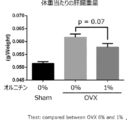
- Test Example 7 Verification of liver weight-suppressing effect of ornithine using a mouse model of osteoporosis
- Sham non-administration of ornithine
- OVX non-ornithine
- the weight of the liver removed at autopsy was measured in the administration) group and the OVX (ornithine administration) group, and the liver weight per body weight was compared. The results are shown in FIG.
- the OVX (ornithine-administered) group As shown in the left and right figures of FIG. 12-1, and the OVX (ornithine-administered) group (third bar graph from the left), the OVX (ornithine-non-administered) group (from the left), respectively.
- the expression levels of SREBP1c, MTP, and PPAR ⁇ decreased with respect to the second bar graph). From this result, it was shown that ornithine has an action of suppressing the expression of SREBP1c, MTP and PPAR ⁇ in the liver.
Landscapes
- Health & Medical Sciences (AREA)
- Life Sciences & Earth Sciences (AREA)
- Physical Education & Sports Medicine (AREA)
- Chemical & Material Sciences (AREA)
- Medicinal Chemistry (AREA)
- Veterinary Medicine (AREA)
- Public Health (AREA)
- General Health & Medical Sciences (AREA)
- Animal Behavior & Ethology (AREA)
- Pharmacology & Pharmacy (AREA)
- Orthopedic Medicine & Surgery (AREA)
- Rheumatology (AREA)
- Engineering & Computer Science (AREA)
- Chemical Kinetics & Catalysis (AREA)
- General Chemical & Material Sciences (AREA)
- Bioinformatics & Cheminformatics (AREA)
- Nuclear Medicine, Radiotherapy & Molecular Imaging (AREA)
- Organic Chemistry (AREA)
- Epidemiology (AREA)
- Food Science & Technology (AREA)
- Nutrition Science (AREA)
- Mycology (AREA)
- Proteomics, Peptides & Aminoacids (AREA)
- Polymers & Plastics (AREA)
- Acyclic And Carbocyclic Compounds In Medicinal Compositions (AREA)
- Coloring Foods And Improving Nutritive Qualities (AREA)
Priority Applications (3)
| Application Number | Priority Date | Filing Date | Title |
|---|---|---|---|
| EP21779174.8A EP4144413A4 (en) | 2020-03-30 | 2021-03-30 | COMPOSITION FOR IMPROVING OR PREVENTING DECLINES IN BONE STRENGTH |
| JP2022512569A JPWO2021200996A1 (https=) | 2020-03-30 | 2021-03-30 | |
| US17/956,357 US20230140522A1 (en) | 2020-03-30 | 2022-09-29 | Composition for ameliorating or preventing decreases in bone strength |
Applications Claiming Priority (2)
| Application Number | Priority Date | Filing Date | Title |
|---|---|---|---|
| JP2020060915 | 2020-03-30 | ||
| JP2020-060915 | 2020-03-30 |
Related Child Applications (1)
| Application Number | Title | Priority Date | Filing Date |
|---|---|---|---|
| US17/956,357 Continuation US20230140522A1 (en) | 2020-03-30 | 2022-09-29 | Composition for ameliorating or preventing decreases in bone strength |
Publications (1)
| Publication Number | Publication Date |
|---|---|
| WO2021200996A1 true WO2021200996A1 (ja) | 2021-10-07 |
Family
ID=77928495
Family Applications (1)
| Application Number | Title | Priority Date | Filing Date |
|---|---|---|---|
| PCT/JP2021/013624 Ceased WO2021200996A1 (ja) | 2020-03-30 | 2021-03-30 | 骨強度低下の予防又は改善用組成物 |
Country Status (4)
| Country | Link |
|---|---|
| US (1) | US20230140522A1 (https=) |
| EP (1) | EP4144413A4 (https=) |
| JP (1) | JPWO2021200996A1 (https=) |
| WO (1) | WO2021200996A1 (https=) |
Cited By (1)
| Publication number | Priority date | Publication date | Assignee | Title |
|---|---|---|---|---|
| JPWO2022191184A1 (https=) * | 2021-03-08 | 2022-09-15 |
Citations (4)
| Publication number | Priority date | Publication date | Assignee | Title |
|---|---|---|---|---|
| JP2003246728A (ja) * | 2001-12-21 | 2003-09-02 | Kyowa Hakko Kogyo Co Ltd | クロソ蛋白質発現量の減少により引きおこされる疾患の治療または予防剤 |
| JP2008237070A (ja) * | 2007-03-27 | 2008-10-09 | Unitec Foods Co Ltd | 高齢者向け骨・筋肉増強促進組成物 |
| JP2018090504A (ja) * | 2016-11-30 | 2018-06-14 | 株式会社東洋新薬 | 筋肉増強用組成物 |
| JP2020060915A (ja) | 2018-10-09 | 2020-04-16 | 株式会社リコー | 電子表示端末及び電子筆記システム |
Family Cites Families (1)
| Publication number | Priority date | Publication date | Assignee | Title |
|---|---|---|---|---|
| EP1327443A1 (en) * | 2001-12-21 | 2003-07-16 | Kyowa Hakko Kogyo Co., Ltd. | Therapeutic or preventing agent for the diseases caused by a decrease in the expression level of the klotho protein |
-
2021
- 2021-03-30 EP EP21779174.8A patent/EP4144413A4/en active Pending
- 2021-03-30 JP JP2022512569A patent/JPWO2021200996A1/ja active Pending
- 2021-03-30 WO PCT/JP2021/013624 patent/WO2021200996A1/ja not_active Ceased
-
2022
- 2022-09-29 US US17/956,357 patent/US20230140522A1/en active Pending
Patent Citations (4)
| Publication number | Priority date | Publication date | Assignee | Title |
|---|---|---|---|---|
| JP2003246728A (ja) * | 2001-12-21 | 2003-09-02 | Kyowa Hakko Kogyo Co Ltd | クロソ蛋白質発現量の減少により引きおこされる疾患の治療または予防剤 |
| JP2008237070A (ja) * | 2007-03-27 | 2008-10-09 | Unitec Foods Co Ltd | 高齢者向け骨・筋肉増強促進組成物 |
| JP2018090504A (ja) * | 2016-11-30 | 2018-06-14 | 株式会社東洋新薬 | 筋肉増強用組成物 |
| JP2020060915A (ja) | 2018-10-09 | 2020-04-16 | 株式会社リコー | 電子表示端末及び電子筆記システム |
Non-Patent Citations (11)
| Title |
|---|
| "Guideline for prevention and treatment of osteoporosis", 2015, LIFE SCIENCE PUBLISHING CO., LTD |
| ANONYMOUS: "Ornithine | Ingredient Information ", THE SECRET OF WAKASA, 5 February 2015 (2015-02-05), XP055924939, Retrieved from the Internet <URL:https://himitsu.wakasa.jp/contents/ornithine/> [retrieved on 20220525] * |
| FLEET ET AL., ENDOCRINOLOGY, vol. 137, no. 11, 1996, pages 4605 |
| HISHIDA, FOOD STYLE 21, vol. 16, no. 11, 2012, pages 87 - 9 |
| KOKUBO ET AL., BIOPSYCHOSOCIAL MEDICINE, vol. 7, 2013, pages 6 |
| MEHRUNNISA M. RAJE ET AL., MOLECULAR BIOLOGY REPORTS, vol. 46, 2019, pages 1667 - 1674 |
| MIYAKE ET AL., NUTRITION JOURNAL, vol. 13, 2014, pages 53 |
| See also references of EP4144413A4 |
| SUGINO ET AL., NUTRITION RESEARCH, vol. 28, no. 11, 2008, pages 738 - 743 |
| TAMAI ET AL., AMINO ACIDS, vol. 45, no. 6, 2013, pages 1343 - 51 |
| ZHANG ET AL., EXP THER MED., vol. 18, no. 5, 2019, pages 3659 - 3666 |
Cited By (2)
| Publication number | Priority date | Publication date | Assignee | Title |
|---|---|---|---|---|
| JPWO2022191184A1 (https=) * | 2021-03-08 | 2022-09-15 | ||
| WO2022191184A1 (ja) * | 2021-03-08 | 2022-09-15 | 国立大学法人九州大学 | グレリン受容体感受性増強剤、グレリン受容体感受性増強用組成物及びグレリン受容体の活性化方法 |
Also Published As
| Publication number | Publication date |
|---|---|
| JPWO2021200996A1 (https=) | 2021-10-07 |
| EP4144413A4 (en) | 2024-04-24 |
| US20230140522A1 (en) | 2023-05-04 |
| EP4144413A1 (en) | 2023-03-08 |
Similar Documents
| Publication | Publication Date | Title |
|---|---|---|
| Baraghithy et al. | Magel2 modulates bone remodeling and mass in Prader‐Willi syndrome by affecting oleoyl Serine levels and activity | |
| CA2902248A1 (en) | Activated soy pod fiber | |
| Weng et al. | Study of insulin resistance in cybrid cells harboring diabetes-susceptible and diabetes-protective mitochondrial haplogroups | |
| Ge et al. | Zinc-α2-glycoprotein expression in adipose tissue of obese postmenopausal women before and after weight loss and exercise+ weight loss | |
| KR20240088908A (ko) | Ampk 활성화제, 운동 기능 향상제, 근지구력 향상제 및 근위축 억제제 | |
| Stanko et al. | Plasma lipid concentrations in hyperlipidemic patients consuming a high-fat diet supplemented with pyruvate for 6 wk | |
| KR20040071724A (ko) | 비만의 치료 또는 예방을 위한 물질 및 방법 | |
| JP2011026314A (ja) | 糖代謝改善剤及び糖代謝改善組成物 | |
| US20120116069A1 (en) | Glucose metabolism-improving agent and glucose metabolism-improving composition | |
| Kim et al. | Preventive effects of chrysanthemum coronarium l. Extract on bone metabolism in vitro and in vivo | |
| WO2021200996A1 (ja) | 骨強度低下の予防又は改善用組成物 | |
| JP6272646B2 (ja) | axial−equatorial aryl配向のfurofuran型リグナンを含有する骨形成促進用医薬組成物、その組成物を含有する医薬製剤、その組成物を含む機能性食品及び健康食品 | |
| Payuhakrit et al. | Enhancing chronic wound healing with Thai indigenous rice variety, Kaab Dum: Exploring ER stress and senescence inhibition in HaCaT keratinocyte cell line | |
| KR20200038411A (ko) | IF1 (ATPase inhibitory factor 1)을 유효성분으로 함유하는 골질환의 예방 또는 치료용 약학 조성물 | |
| TWI850233B (zh) | 脂肪蓄積抑制劑及血中脂質改善劑 | |
| CN119562769A (zh) | 肝保护组合物和方法 | |
| Sacco et al. | Interaction of sesame seed and tamoxifen on tumor growth and bone health in athymic mice | |
| JPWO2008136173A1 (ja) | スチルベン誘導体を有効成分とする脂肪細胞分化抑制剤 | |
| TW202515530A (zh) | 對脂肪分解及/或體重減少之內用組成物、判斷有效性之方法以及植物萃取物之品質指標 | |
| JPWO2019208627A1 (ja) | 筋肉量減少抑制用、筋力低下抑制用、筋肉量増加用又は筋力増加用の組成物 | |
| Otsubo et al. | Effects of low-dose medium-chain triglycerides on bowel habit outcomes in Japanese adults prone to constipation: a randomized, double-blind, LCT-controlled crossover trial | |
| JP6192141B1 (ja) | 骨量減少抑制剤、及びそれを有効成分とする骨粗鬆症の予防又は改善剤 | |
| Smithson | The effect of supplemental grape seed extract on pig growth performance and body composition during heat stress | |
| WO2024071138A1 (ja) | ミトコンドリア機能向上用組成物 | |
| ABDUL | ROLE OF PLASMA MEMBRANE TRANSPORTERS (N+/H+ AND HCO3-) IN MEDIATING MAMMALIAN LONGITUDINAL BONE GROWTH AND FRACTURE HEALING |
Legal Events
| Date | Code | Title | Description |
|---|---|---|---|
| 121 | Ep: the epo has been informed by wipo that ep was designated in this application |
Ref document number: 21779174 Country of ref document: EP Kind code of ref document: A1 |
|
| ENP | Entry into the national phase |
Ref document number: 2022512569 Country of ref document: JP Kind code of ref document: A |
|
| NENP | Non-entry into the national phase |
Ref country code: DE |
|
| ENP | Entry into the national phase |
Ref document number: 2021779174 Country of ref document: EP Effective date: 20221031 |