WO2021200924A1 - リチウムイオン電池 - Google Patents
リチウムイオン電池 Download PDFInfo
- Publication number
- WO2021200924A1 WO2021200924A1 PCT/JP2021/013499 JP2021013499W WO2021200924A1 WO 2021200924 A1 WO2021200924 A1 WO 2021200924A1 JP 2021013499 W JP2021013499 W JP 2021013499W WO 2021200924 A1 WO2021200924 A1 WO 2021200924A1
- Authority
- WO
- WIPO (PCT)
- Prior art keywords
- negative electrode
- active material
- positive electrode
- mixture layer
- electrode active
- Prior art date
- Legal status (The legal status is an assumption and is not a legal conclusion. Google has not performed a legal analysis and makes no representation as to the accuracy of the status listed.)
- Ceased
Links
Images



Classifications
-
- H—ELECTRICITY
- H01—ELECTRIC ELEMENTS
- H01M—PROCESSES OR MEANS, e.g. BATTERIES, FOR THE DIRECT CONVERSION OF CHEMICAL ENERGY INTO ELECTRICAL ENERGY
- H01M4/00—Electrodes
- H01M4/02—Electrodes composed of, or comprising, active material
- H01M4/36—Selection of substances as active materials, active masses, active liquids
- H01M4/38—Selection of substances as active materials, active masses, active liquids of elements or alloys
- H01M4/387—Tin or alloys based on tin
-
- H—ELECTRICITY
- H01—ELECTRIC ELEMENTS
- H01M—PROCESSES OR MEANS, e.g. BATTERIES, FOR THE DIRECT CONVERSION OF CHEMICAL ENERGY INTO ELECTRICAL ENERGY
- H01M10/00—Secondary cells; Manufacture thereof
- H01M10/05—Accumulators with non-aqueous electrolyte
- H01M10/052—Li-accumulators
- H01M10/0525—Rocking-chair batteries, i.e. batteries with lithium insertion or intercalation in both electrodes; Lithium-ion batteries
-
- H—ELECTRICITY
- H01—ELECTRIC ELEMENTS
- H01M—PROCESSES OR MEANS, e.g. BATTERIES, FOR THE DIRECT CONVERSION OF CHEMICAL ENERGY INTO ELECTRICAL ENERGY
- H01M4/00—Electrodes
- H01M4/02—Electrodes composed of, or comprising, active material
- H01M4/13—Electrodes for accumulators with non-aqueous electrolyte, e.g. for lithium-accumulators; Processes of manufacture thereof
- H01M4/134—Electrodes based on metals, Si or alloys
-
- H—ELECTRICITY
- H01—ELECTRIC ELEMENTS
- H01M—PROCESSES OR MEANS, e.g. BATTERIES, FOR THE DIRECT CONVERSION OF CHEMICAL ENERGY INTO ELECTRICAL ENERGY
- H01M4/00—Electrodes
- H01M4/02—Electrodes composed of, or comprising, active material
- H01M4/62—Selection of inactive substances as ingredients for active masses, e.g. binders, fillers
- H01M4/621—Binders
- H01M4/622—Binders being polymers
-
- H—ELECTRICITY
- H01—ELECTRIC ELEMENTS
- H01M—PROCESSES OR MEANS, e.g. BATTERIES, FOR THE DIRECT CONVERSION OF CHEMICAL ENERGY INTO ELECTRICAL ENERGY
- H01M4/00—Electrodes
- H01M4/02—Electrodes composed of, or comprising, active material
- H01M2004/021—Physical characteristics, e.g. porosity, surface area
-
- H—ELECTRICITY
- H01—ELECTRIC ELEMENTS
- H01M—PROCESSES OR MEANS, e.g. BATTERIES, FOR THE DIRECT CONVERSION OF CHEMICAL ENERGY INTO ELECTRICAL ENERGY
- H01M4/00—Electrodes
- H01M4/02—Electrodes composed of, or comprising, active material
- H01M2004/026—Electrodes composed of, or comprising, active material characterised by the polarity
- H01M2004/027—Negative electrodes
-
- Y—GENERAL TAGGING OF NEW TECHNOLOGICAL DEVELOPMENTS; GENERAL TAGGING OF CROSS-SECTIONAL TECHNOLOGIES SPANNING OVER SEVERAL SECTIONS OF THE IPC; TECHNICAL SUBJECTS COVERED BY FORMER USPC CROSS-REFERENCE ART COLLECTIONS [XRACs] AND DIGESTS
- Y02—TECHNOLOGIES OR APPLICATIONS FOR MITIGATION OR ADAPTATION AGAINST CLIMATE CHANGE
- Y02E—REDUCTION OF GREENHOUSE GAS [GHG] EMISSIONS, RELATED TO ENERGY GENERATION, TRANSMISSION OR DISTRIBUTION
- Y02E60/00—Enabling technologies; Technologies with a potential or indirect contribution to GHG emissions mitigation
- Y02E60/10—Energy storage using batteries
Definitions
- a positive electrode having a positive electrode mixture layer containing a positive electrode active material, a negative electrode having a negative electrode mixture layer containing a negative electrode active material, and charging / discharging are performed by moving lithium ions between the positive electrode and the negative electrode.
- a positive electrode having a positive electrode mixture layer containing a positive electrode active material, a negative electrode having a negative electrode mixture layer containing a negative electrode active material, and charging / discharging are performed by moving lithium ions between the positive electrode and the negative electrode.
- lithium-ion batteries Regarding lithium-ion batteries.
- Lithium-ion batteries in which charging and discharging are performed by moving lithium ions (Li ions) between the negative electrode and the positive electrode, are widely used.
- a graphite-based material is often used as the negative electrode active material of the negative electrode mixture layer in this lithium ion battery.
- the graphite-based negative electrode active material may be used together with Si, in which case the volume change during charging and discharging is large, the capacity retention characteristics are likely to deteriorate, and the cost is relatively high.
- Patent Document 1 describes that an alloy having a La 3 Co 2 Sn 7 type crystal structure is used as the negative electrode active material.
- Patent Document 2 describes that the content of the binder is 0.5% by mass or more and 5.0% by mass.
- Patent Document 1 polyvinylidene fluoride (PVdF) is used as a binder, but as a result of experiments, an alloy having a La 3 Co 2 Sn 7 type crystal structure is used as a negative electrode active material, and PVdF is used as a binder. It was found that the reaction between the two causes gelation of the mixture slurry used to form the negative electrode mixture layer, which makes coating difficult. In order to reduce the reactivity of La 3 Ni 2 Sn 7 and PVdF and enable coating, it is necessary to increase the particle size of the negative electrode active material. However, when the particle size of the negative electrode active material is increased, the reactivity between the negative electrode active material and Li decreases, and the capacity tends to decrease.
- PVdF polyvinylidene fluoride
- an alloy having a La 3 Co 2 Sn 7 type crystal structure may undergo an alloying reaction to form an impurity alloy, and in this case, the cycle characteristics are deteriorated.
- the lithium ion battery according to the present disclosure includes a positive electrode having a positive electrode mixture layer containing a positive electrode active material and a negative electrode having a negative electrode mixture layer containing a negative electrode active material, and lithium ions are formed between the positive electrode and the negative electrode. It is a lithium ion battery that is charged and discharged by moving, and the negative electrode mixture layer is a general formula M 3 Me 2 X 7 (in the formula, M is La, Ce, Ba, Sr, Zr, Ca, Mg).
- Me contains at least one selected from the group consisting of Ti, V, Cr, Nb, Mn, Ni, Fe, Co and Cu
- X is Ge, Si, Sn, Al, P
- a negative electrode active material represented by containing one less is selected from the group consisting of Sb and B)
- a binder comprising ammonium carboxymethyl cellulose (NH 4-CMC) including.
- the lithium ion battery according to the present disclosure includes a positive electrode having a positive electrode mixture layer containing a positive electrode active material and a negative electrode having a negative electrode mixture layer containing a negative electrode active material, and lithium is formed between the positive electrode and the negative electrode.
- a lithium ion battery that is charged and discharged by the movement of ions, and the negative electrode mixture layer is composed of the general formula M 3 Me 2 X 7 (in the formula, M is La, Sr, Ca, Mg and Y). Containing at least one selected from the group, Me contains at least one selected from the group consisting of Mn, Ni, Fe, Co and Cu, and X is the group consisting of Ge, Si, Sn, Al and B. comprising a negative electrode active material represented by including) one less is more selective, and a binder comprising ammonium carboxymethyl cellulose (NH 4-CMC), the.
- the negative electrode active material is from the group consisting of the general formula M 3 Me 2 X 7 (in the formula, M is La, Ce, Ba, Sr, Zr, Ca, Mg and Y) such as La 3 Ni 2 Sn 7. Containing at least one selected, Me contains at least one selected from the group consisting of Ti, V, Cr, Nb, Mn, Ni, Fe, Co and Cu, and X is Ge, Si, Sn,
- a substance represented by including at least one selected from the group consisting of Al, P, Sb and B
- the negative electrode mixture layer can be coated, and the capacity and cycle characteristics can be reduced. Suppress. Further, by using a water-based binder, coating can be performed at low cost.
- FIG. 1 is a vertical sectional view of a cylindrical secondary battery 10 which is an example of an embodiment.
- FIG. 2 is a diagram showing X-ray diffraction patterns of electrodes according to Examples and Comparative Examples.
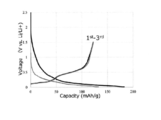
- FIG. 3A is a graph showing charge / discharge characteristics in the examples, and is a diagram showing the relationship between capacitance and electrode potential.
- FIG. 3B is a graph showing charge / discharge characteristics in the examples, and is a diagram showing the relationship between the number of cycles and the capacitance.
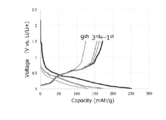
- FIG. 4 is a diagram showing charge / discharge characteristics of Comparative Example 1 using SBR / Na-CMC as a negative electrode binder.
- the negative electrode mixture slurry gels, which makes it difficult to coat the negative electrode mixture layer. Further, if gelation is suppressed by increasing the particle size of the binder, the battery reaction may be inhibited.
- PAN polyacrylonitrile
- FIG. 1 is a vertical sectional view of a cylindrical secondary battery 10 which is an example of an embodiment.
- the electrode body 14 and the non-aqueous electrolyte are housed in the exterior body 15.
- the electrode body 14 has a winding structure in which the positive electrode 11 and the negative electrode 12 are wound around the separator 13.
- the non-aqueous solvent (organic solvent) of the non-aqueous electrolyte carbonates, lactones, ethers, ketones, esters and the like can be used, and two or more of these solvents can be mixed and used. ..
- a mixed solvent containing a cyclic carbonate and a chain carbonate For example, ethylene carbonate (EC), propylene carbonate (PC), butylene carbonate (BC) and the like can be used as the cyclic carbonate, and dimethyl carbonate (DMC), ethyl methyl carbonate (EMC), and diethyl carbonate (diethyl carbonate) (as the chain carbonate). DEC) and the like can be used.
- DEC dimethyl carbonate
- EMC ethyl methyl carbonate
- diethyl carbonate diethyl carbonate
- electrolyte salt of the non-aqueous electrolyte LiPF 6 , LiBF 4 , LiCF 3 SO 3, etc. and a mixture thereof can be used.
- the amount of the electrolyte salt dissolved in the non-aqueous solvent can be, for example, 0.5 to 2.0 mol / L.
- the sealing body 16 side will be referred to as “top” and the bottom side of the exterior body 15 will be referred to as “bottom”.
- the inside of the secondary battery 10 is sealed by closing the opening end of the exterior body 15 with the sealing body 16.
- Insulating plates 17 and 18 are provided above and below the electrode body 14, respectively.
- the positive electrode lead 19 extends upward through the through hole of the insulating plate 17 and is welded to the lower surface of the filter 22 which is the bottom plate of the sealing body 16.
- the cap 26, which is the top plate of the sealing body 16 electrically connected to the filter 22, serves as the positive electrode terminal.
- the negative electrode lead 20 extends to the bottom side of the exterior body 15 through the through hole of the insulating plate 18 and is welded to the inner surface of the bottom portion of the exterior body 15.
- the exterior body 15 serves as a negative electrode terminal.
- the negative electrode lead 20 passes through the outside of the insulating plate 18 and extends to the bottom side of the exterior body 15 and is welded to the inner surface of the bottom portion of the exterior body 15.
- the exterior body 15 is, for example, a bottomed cylindrical metal exterior can.
- a gasket 27 is provided between the exterior body 15 and the sealing body 16 to ensure the internal airtightness of the secondary battery 10.
- the exterior body 15 has a grooved portion 21 that supports the sealing body 16 and is formed by pressing, for example, a side surface portion from the outside.
- the grooved portion 21 is preferably formed in an annular shape along the circumferential direction of the exterior body 15, and the sealing body 16 is supported on the upper surface thereof via the gasket 27.
- the sealing body 16 has a filter 22, a lower valve body 23, an insulating member 24, an upper valve body 25, and a cap 26, which are laminated in order from the electrode body 14 side.
- Each member constituting the sealing body 16 has, for example, a disk shape or a ring shape, and each member except the insulating member 24 is electrically connected to each other.
- the lower valve body 23 and the upper valve body 25 are connected to each other at their central portions, and an insulating member 24 is interposed between the peripheral portions thereof.
- the positive electrode 11, the negative electrode 12, and the separator 13 constituting the electrode body 14 will be described, and in particular, the negative electrode active material constituting the negative electrode 12 will be described.
- the positive electrode 11 has a positive electrode core body and a positive electrode mixture layer provided on the surface of the positive electrode core body.
- a metal foil stable in the potential range of the positive electrode 11 such as aluminum, a film in which the metal is arranged on the surface layer, or the like can be used.
- the thickness of the positive electrode core is, for example, 10 ⁇ m to 30 ⁇ m.
- the positive electrode mixture layer contains a positive electrode active material, a binder, and a conductive material, and is preferably provided on both sides of the positive electrode core body excluding the portion to which the positive electrode lead 19 is connected.
- a positive electrode mixture slurry containing a positive electrode active material, a binder, a conductive material, and the like is applied to the surface of a positive electrode core, the coating film is dried, and then compressed to form a positive electrode mixture layer. It can be manufactured by forming it on both sides of the core body.
- the positive electrode active material contains lithium transition metal oxide as a main component.
- the positive electrode active material may be substantially composed of only lithium transition metal oxide, and is one in which inorganic compound particles such as aluminum oxide and lanthanoid-containing compound are adhered to the particle surface of the lithium transition metal oxide. May be good.
- One type of lithium transition metal oxide may be used, or two or more types may be used in combination.
- Metal elements contained in the lithium transition metal oxide include nickel (Ni), cobalt (Co), manganese (Mn), aluminum (Al), boron (B), gallium (Mg), titanium (Ti), and vanadium. (V), Chromium (Cr), Iron (Fe), Copper (Cu), Zinc (Zn), Gallium (Ga), Strontium (Sr), Zirconium (Zr), Niob (Nb), Indium (In), Tin (Sn), tantalum (Ta), tungsten (W) and the like can be mentioned.
- lithium transition metal oxide is the general formula: Li ⁇ Ni x M (1-x) O 2 (0.1 ⁇ ⁇ ⁇ 1.2, 0.3 ⁇ x ⁇ 1, where M is Co, Mn. , Containing at least one of Al).
- M is Co, Mn. , Containing at least one of Al.
- NCA in which a part of nickel is replaced with cobalt and aluminum is added is used.
- Examples of the conductive material contained in the positive electrode mixture layer include carbon materials such as carbon black, acetylene black, ketjen black, carbon nanotubes, carbon nanofibers, and graphite.
- Examples of the binder contained in the positive electrode mixture layer include fluororesins such as polytetrafluoroethylene (PTFE) and polyvinylidene fluoride (PVdF), polyacrylonitrile (PAN), polyimide resins, acrylic resins, and polyolefin resins. .. These resins may be used in combination with cellulose derivatives such as carboxymethyl cellulose (CMC) or salts thereof, polyethylene oxide (PEO) and the like.
- the negative electrode 12 has a negative electrode core body and a negative electrode mixture layer provided on the surface of the negative electrode core body.
- a metal foil stable in the potential range of the negative electrode 12 such as copper, a film in which the metal is arranged on the surface layer, or the like can be used.
- the thickness of the negative electrode core is, for example, 5 ⁇ m to 15 ⁇ m.
- the negative electrode mixture layer contains a negative electrode active material and a binder, and is preferably provided on both sides of the negative electrode core body excluding the portion to which the negative electrode lead 20 is connected, for example.
- a negative electrode mixture slurry containing a negative electrode active material and a binder is applied to the surface of the negative electrode core, the coating film is dried, and then compressed to form a negative electrode mixture layer on both sides of the negative electrode core. It can be produced by forming in. Further, a conductive material may be added to the negative electrode mixture slurry. The conductive material can make the conductive path uniform. Further, the negative electrode mixture layer may contain a conductive material such as acetylene black, similarly to the positive electrode mixture layer.
- the negative electrode mixture layer contains at least one of the general formula M 3 Me 2 X 7 (in the formula, M is La and Ca, and Me is at least one of Mn, Ni, Fe and Co) as the negative electrode active material.
- X includes an intermetallic compound (alloy of M 3 Me 2 X 7 type crystal) represented by Ge, Si, Sn, Al).
- suitable negative electrode active materials include La 3 Co 2 Sn 7 , La 3 Mn 2 Sn 7 , and La 3 Ni 2 Sn 7 . Among them, from the viewpoint of increasing the capacity, La 3 Co 2 Sn 7 or La 3 Ni 2 Sn 7 is preferable, and La 3 Ni 2 Sn 7 is particularly preferable.
- the particle size of the negative electrode active material M 3 Me 2 X 7 is preferably 1 to 30 ⁇ m, more preferably 2 to 20 ⁇ m, and particularly preferably 2 to 10 ⁇ m. If the particle size of M 3 Me 2 X 7 becomes too large, the reactivity with Li decreases, the contact area between particles becomes small, and the resistance increases. On the other hand, if the particle size becomes too small, it is assumed that the packing density of the negative electrode active material decreases and the capacity decreases.
- the average particle size of M 3 Me 2 X 7 is, for example, 3 to 15 ⁇ m, or 5 to 10 ⁇ m.
- the particle size of the M 3 Me 2 X 7 is measured as the diameter of the circumscribed circle of the M 3 Me 2 X 7 particles in the cross-sectional image of the negative electrode mixture layer observed by a scanning electron microscope (SEM).
- the average particle size is calculated by averaging the particle sizes of 100 arbitrary particles.
- the intermetallic compound represented by M 3 Me 2 X 7 can be formed by arc melting, and it is preferable to anneal after arc melting. Further, M may be replaced with La in an amount of up to about 50%. For example, in the case of La in which about 40% is replaced with Ca, a large charge / discharge capacity (initial charge capacity 301 mAh / g, initial discharge capacity 223 mAh / g (1718 mAh / cc)) and a small volume change rate (0.5). % Or less) was obtained.
- the negative electrode active material may contain M 3 Me 2 X 7 as a main component (the component having the highest mass ratio) and may be substantially composed of only M 3 Me 2 X 7.
- the negative electrode active material may be used in combination with other active materials such as an intermetallic compound other than M 3 Me 2 X 7 , a carbon-based active material such as graphite, or a Si-based active material containing Si.
- the content of graphite may be 50 to 90% by mass with respect to the mass of the negative electrode active material.
- the binder contained in the negative electrode mixture layer which contains an aqueous ammonium carboxymethyl cellulose (NH 4-CMC) is employed. Further, it is preferable to further contain styrene-butadiene rubber (SBR). Water-based binders such as water-based urethane and water-based lyl polymer can also be used.
- the mass ratio of the binder to the negative electrode active material is preferably 0.3 wt% or more and 5.0 wt% or less.
- the ratio of NH 4- CMC to SBR is preferably about 2: 0.5 to 2.
- a porous sheet having ion permeability and insulating property is used as the separator 13.
- the porous sheet include a microporous membrane, a woven fabric, a non-woven fabric and the like.
- olefin resin such as polyethylene and polypropylene, cellulose and the like are suitable.
- the separator 13 may have either a single-layer structure or a laminated structure.
- a heat-resistant layer containing a heat-resistant material may be formed on the surface of the separator 13. Examples of the heat-resistant material include polyamide resins such as aliphatic polyamides and aromatic polyamides (aramid), and polyimide resins such as polyamideimide and polyimide.
- La 3 Ni 2 Sn 7 having a particle size of 2 to 20 ⁇ m was used as the negative electrode active material, SBR / CMC was used as the binder, and artificial graphite SP5030 was used as the conductive material.
- La 3 Ni 2 Sn 7 / NH 4- CMC / SBR / SP5030 was mixed at a mass ratio of 85.5 / 3 / 1.5 / 10 to prepare a negative electrode mixture slurry.
- a negative electrode mixture slurry was applied onto a negative electrode core made of copper foil, the coating film was dried and compressed, and then cut to a predetermined electrode size to obtain a negative electrode.
- As the copper foil a copper foil having a roughened surface and a thickness of about 18 ⁇ m may be used.
- the negative electrode and the positive electrode made of lithium metal foil were arranged to face each other via a separator to form an electrode body, and the electrode body was housed in an outer can. After injecting a predetermined non-aqueous electrolyte solution into the outer can, the outer can was sealed to obtain a bipolar cell (non-aqueous electrolyte secondary battery).
- the electrolytic solution was an EC / EMC solvent to which 1.0 M LiPF 6 was added as an electrolyte.
- FIG. 2 shows an example using styrene butadiene rubber / ammonium carboxymethyl cellulose (SBR / NH 4 -CMC) as a binder, and a comparison using styrene butadiene rubber / sodium carboxymethyl cellulose (SBR / Na-CMC).
- SBR / NH 4 -CMC ammonium carboxymethyl cellulose
- SBR / Na-CMC sodium carboxymethyl cellulose
- FIG. 3A and 3B are graphs showing charge / discharge characteristics in the examples, FIG. 3A is a graph showing the relationship between capacitance and electrode potential, and FIG. 3B is a graph showing the relationship between the number of cycles and capacitance.
- FIG. 4 is a diagram showing the charge / discharge characteristics of Comparative Example 1 using SBR / Na-CMC as the negative electrode binder. As described above, in Comparative Example 1, it was found that the capacity was reduced by repeating charging and discharging, and the cycle characteristics were poor. It is considered that this is because the alloying reaction shown in FIG. 2 occurred.
- Table 1 is a table showing the evaluation of the binder for various negative electrode active materials of La 3 Ni 2 Sn 7 and La 1.8 Ca 1.2 Ni 2 Sn 7.
- the result was the same regardless of whether the negative electrode mixture layer contained La 3 Ni 2 Sn 7 or La 1.8 Ca 1.2 Ni 2 Sn 7. That, PVdF, because gelation tends to proceed during coating, it is necessary to devise the use ( ⁇ 1). Gelation during coating can be suppressed by adding maleic anhydride. Since the PAN must use an organic solvent, the manufacturing cost becomes high ( ⁇ 2 ). Furthermore, PI and SBR / Na-CMC, the alloy cycle characteristics is generated is reduced during coating ( ⁇ 3). Further, SBR / NH 4- CMC, which is an example, is an aqueous system, does not require an organic solvent, does not form an alloy, has good cycle characteristics, and is suitable as a binder ( ⁇ ).
- the negative electrode mixture layer contains at least one selected from the group consisting of the general formula M 3 Me 2 X 7 (in the formula, M is La, Sr, Ca, Mg and Y, and Me is Mn, Ni, Fe. , Co and Cu containing at least one selected from the group, and X containing a negative electrode active material represented by (including at least one selected from the group consisting of Ge, Si, Sn, Al and B). for things, it has been confirmed that a binder comprising ammonium carboxymethyl cellulose (NH 4-CMC) is preferred.
- NH 4-CMC ammonium carboxymethyl cellulose
- the general formula M 3 Me 2 X 7 (in the formula, M contains at least one selected from the group consisting of La, Ce, Ba, Sr, Zr, Ca, Mg and Y, and Me is Ti. , V, Cr, Nb, Mn, Ni, Fe, Co and Cu, including at least one selected from the group consisting of Ge, Si, Sn, Al, P, Sb and B. for those negative electrode active material represented by represent less including one), it is found to be suitable as a binder comprising ammonium carboxymethyl cellulose (NH 4-CMC).
- NH 4-CMC ammonium carboxymethyl cellulose
Landscapes
- Chemical & Material Sciences (AREA)
- Chemical Kinetics & Catalysis (AREA)
- Electrochemistry (AREA)
- General Chemical & Material Sciences (AREA)
- Engineering & Computer Science (AREA)
- Materials Engineering (AREA)
- Manufacturing & Machinery (AREA)
- Battery Electrode And Active Subsutance (AREA)
Priority Applications (4)
| Application Number | Priority Date | Filing Date | Title |
|---|---|---|---|
| EP21778801.7A EP4131478A4 (en) | 2020-04-02 | 2021-03-30 | Lithium ion battery |
| CN202180025296.0A CN115362574B (zh) | 2020-04-02 | 2021-03-30 | 锂离子电池 |
| JP2022512280A JP7599138B2 (ja) | 2020-04-02 | 2021-03-30 | リチウムイオン電池 |
| US17/915,055 US12580187B2 (en) | 2020-04-02 | 2021-03-30 | Lithium ion battery |
Applications Claiming Priority (2)
| Application Number | Priority Date | Filing Date | Title |
|---|---|---|---|
| JP2020-066991 | 2020-04-02 | ||
| JP2020066991 | 2020-04-02 |
Publications (1)
| Publication Number | Publication Date |
|---|---|
| WO2021200924A1 true WO2021200924A1 (ja) | 2021-10-07 |
Family
ID=77928948
Family Applications (1)
| Application Number | Title | Priority Date | Filing Date |
|---|---|---|---|
| PCT/JP2021/013499 Ceased WO2021200924A1 (ja) | 2020-04-02 | 2021-03-30 | リチウムイオン電池 |
Country Status (5)
| Country | Link |
|---|---|
| US (1) | US12580187B2 (https=) |
| EP (1) | EP4131478A4 (https=) |
| JP (1) | JP7599138B2 (https=) |
| CN (1) | CN115362574B (https=) |
| WO (1) | WO2021200924A1 (https=) |
Citations (5)
| Publication number | Priority date | Publication date | Assignee | Title |
|---|---|---|---|---|
| JP2005310739A (ja) * | 2004-03-23 | 2005-11-04 | Toshiba Corp | 非水電解質二次電池 |
| JP2007073215A (ja) * | 2005-09-05 | 2007-03-22 | Toshiba Corp | 非水電解質電池 |
| JP2007258127A (ja) | 2006-03-27 | 2007-10-04 | Sony Corp | 負極および電池 |
| JP2010218855A (ja) * | 2009-03-17 | 2010-09-30 | Sanyo Electric Co Ltd | 非水電解質二次電池用負極及び非水電解質二次電池 |
| JP2016081922A (ja) * | 2014-10-15 | 2016-05-16 | 株式会社半導体エネルギー研究所 | 電極、蓄電装置、及び電子機器、並びに電極の作製方法 |
Family Cites Families (2)
| Publication number | Priority date | Publication date | Assignee | Title |
|---|---|---|---|---|
| JP4346395B2 (ja) * | 2003-09-24 | 2009-10-21 | 株式会社東芝 | 非水電解質二次電池 |
| US20230100030A1 (en) | 2020-02-28 | 2023-03-30 | Panasonic Intellectual Property Management Co., Ltd. | Lithium ion battery |
-
2021
- 2021-03-30 US US17/915,055 patent/US12580187B2/en active Active
- 2021-03-30 WO PCT/JP2021/013499 patent/WO2021200924A1/ja not_active Ceased
- 2021-03-30 JP JP2022512280A patent/JP7599138B2/ja active Active
- 2021-03-30 CN CN202180025296.0A patent/CN115362574B/zh active Active
- 2021-03-30 EP EP21778801.7A patent/EP4131478A4/en active Pending
Patent Citations (6)
| Publication number | Priority date | Publication date | Assignee | Title |
|---|---|---|---|---|
| JP2005310739A (ja) * | 2004-03-23 | 2005-11-04 | Toshiba Corp | 非水電解質二次電池 |
| JP4127692B2 (ja) | 2004-03-23 | 2008-07-30 | 株式会社東芝 | 非水電解質二次電池 |
| JP2007073215A (ja) * | 2005-09-05 | 2007-03-22 | Toshiba Corp | 非水電解質電池 |
| JP2007258127A (ja) | 2006-03-27 | 2007-10-04 | Sony Corp | 負極および電池 |
| JP2010218855A (ja) * | 2009-03-17 | 2010-09-30 | Sanyo Electric Co Ltd | 非水電解質二次電池用負極及び非水電解質二次電池 |
| JP2016081922A (ja) * | 2014-10-15 | 2016-05-16 | 株式会社半導体エネルギー研究所 | 電極、蓄電装置、及び電子機器、並びに電極の作製方法 |
Non-Patent Citations (1)
| Title |
|---|
| See also references of EP4131478A4 |
Also Published As
| Publication number | Publication date |
|---|---|
| CN115362574B (zh) | 2025-08-29 |
| EP4131478A1 (en) | 2023-02-08 |
| JPWO2021200924A1 (https=) | 2021-10-07 |
| US12580187B2 (en) | 2026-03-17 |
| JP7599138B2 (ja) | 2024-12-13 |
| EP4131478A4 (en) | 2023-09-27 |
| CN115362574A (zh) | 2022-11-18 |
| US20230163285A1 (en) | 2023-05-25 |
Similar Documents
| Publication | Publication Date | Title |
|---|---|---|
| CN114467199B (zh) | 非水电解质二次电池 | |
| CN112204768B (zh) | 非水电解质二次电池 | |
| CN113474911A (zh) | 卷绕型非水电解质二次电池 | |
| CN112204767B (zh) | 非水电解质二次电池 | |
| JP7324120B2 (ja) | 非水電解質二次電池用正極活物質、及び非水電解質二次電池 | |
| US12347855B2 (en) | Negative electrode active material for nonaqueous electrolyte secondary batteries, and nonaqueous electrolyte secondary battery | |
| US12166207B2 (en) | Positive electrode active material for nonaqueous electrolyte secondary batteries, and nonaqueous electrolyte secondary battery | |
| US20220278323A1 (en) | Non-aqueous electrolyte secondary battery | |
| CN115023824B (zh) | 锂离子电池 | |
| JP7720569B2 (ja) | リチウムイオン電池 | |
| EP4398332B1 (en) | Negative electrode for secondary battery, and secondary battery | |
| US12237506B2 (en) | Non-aqueous electrolyte secondary battery | |
| US12308423B2 (en) | Secondary cell | |
| JP7599138B2 (ja) | リチウムイオン電池 | |
| US20220320490A1 (en) | Positive electrode active material for nonaqueous electrolyte secondary battery, and nonaqueous electrolyte secondary battery | |
| WO2021241027A1 (ja) | 非水電解質二次電池用正極活物質および非水電解質二次電池 | |
| US20250015267A1 (en) | Nonaqueous electrolyte secondary battery positive electrode and nonaqueous electrolyte secondary battery | |
| EP4475214A1 (en) | Lithium ion battery | |
| US12300815B2 (en) | Positive electrode active material for nonaqueous electrolyte secondary batteries, and nonaqueous electrolyte secondary battery |
Legal Events
| Date | Code | Title | Description |
|---|---|---|---|
| 121 | Ep: the epo has been informed by wipo that ep was designated in this application |
Ref document number: 21778801 Country of ref document: EP Kind code of ref document: A1 |
|
| ENP | Entry into the national phase |
Ref document number: 2022512280 Country of ref document: JP Kind code of ref document: A |
|
| NENP | Non-entry into the national phase |
Ref country code: DE |
|
| ENP | Entry into the national phase |
Ref document number: 2021778801 Country of ref document: EP Effective date: 20221102 |
|
| WWG | Wipo information: grant in national office |
Ref document number: 202180025296.0 Country of ref document: CN |
|
| WWG | Wipo information: grant in national office |
Ref document number: 17915055 Country of ref document: US |