WO2021200673A1 - 多重特異性抗体及びその製造方法 - Google Patents
多重特異性抗体及びその製造方法 Download PDFInfo
- Publication number
- WO2021200673A1 WO2021200673A1 PCT/JP2021/012911 JP2021012911W WO2021200673A1 WO 2021200673 A1 WO2021200673 A1 WO 2021200673A1 JP 2021012911 W JP2021012911 W JP 2021012911W WO 2021200673 A1 WO2021200673 A1 WO 2021200673A1
- Authority
- WO
- WIPO (PCT)
- Prior art keywords
- polypeptide
- constant region
- chain
- variable region
- antibody
- Prior art date
- Legal status (The legal status is an assumption and is not a legal conclusion. Google has not performed a legal analysis and makes no representation as to the accuracy of the status listed.)
- Ceased
Links
Images


















Classifications
-
- C—CHEMISTRY; METALLURGY
- C07—ORGANIC CHEMISTRY
- C07K—PEPTIDES
- C07K16/00—Immunoglobulins [IG], e.g. monoclonal or polyclonal antibodies
- C07K16/18—Immunoglobulins [IG], e.g. monoclonal or polyclonal antibodies against material from animals or humans
- C07K16/32—Immunoglobulins [IG], e.g. monoclonal or polyclonal antibodies against material from animals or humans against translation products of oncogenes
-
- C—CHEMISTRY; METALLURGY
- C07—ORGANIC CHEMISTRY
- C07K—PEPTIDES
- C07K16/00—Immunoglobulins [IG], e.g. monoclonal or polyclonal antibodies
- C07K16/18—Immunoglobulins [IG], e.g. monoclonal or polyclonal antibodies against material from animals or humans
- C07K16/28—Immunoglobulins [IG], e.g. monoclonal or polyclonal antibodies against material from animals or humans against receptors, cell surface antigens or cell surface determinants
- C07K16/2803—Immunoglobulins [IG], e.g. monoclonal or polyclonal antibodies against material from animals or humans against receptors, cell surface antigens or cell surface determinants against the immunoglobulin superfamily
- C07K16/2809—Immunoglobulins [IG], e.g. monoclonal or polyclonal antibodies against material from animals or humans against receptors, cell surface antigens or cell surface determinants against the immunoglobulin superfamily against the T-cell receptor (TcR)-CD3 complex
-
- C—CHEMISTRY; METALLURGY
- C07—ORGANIC CHEMISTRY
- C07K—PEPTIDES
- C07K16/00—Immunoglobulins [IG], e.g. monoclonal or polyclonal antibodies
- C07K16/18—Immunoglobulins [IG], e.g. monoclonal or polyclonal antibodies against material from animals or humans
- C07K16/28—Immunoglobulins [IG], e.g. monoclonal or polyclonal antibodies against material from animals or humans against receptors, cell surface antigens or cell surface determinants
- C07K16/2878—Immunoglobulins [IG], e.g. monoclonal or polyclonal antibodies against material from animals or humans against receptors, cell surface antigens or cell surface determinants against the NGF-receptor/TNF-receptor superfamily, e.g. CD27, CD30, CD40, CD95
-
- C—CHEMISTRY; METALLURGY
- C07—ORGANIC CHEMISTRY
- C07K—PEPTIDES
- C07K16/00—Immunoglobulins [IG], e.g. monoclonal or polyclonal antibodies
- C07K16/18—Immunoglobulins [IG], e.g. monoclonal or polyclonal antibodies against material from animals or humans
- C07K16/28—Immunoglobulins [IG], e.g. monoclonal or polyclonal antibodies against material from animals or humans against receptors, cell surface antigens or cell surface determinants
- C07K16/2887—Immunoglobulins [IG], e.g. monoclonal or polyclonal antibodies against material from animals or humans against receptors, cell surface antigens or cell surface determinants against CD20
-
- C—CHEMISTRY; METALLURGY
- C12—BIOCHEMISTRY; BEER; SPIRITS; WINE; VINEGAR; MICROBIOLOGY; ENZYMOLOGY; MUTATION OR GENETIC ENGINEERING
- C12N—MICROORGANISMS OR ENZYMES; COMPOSITIONS THEREOF; PROPAGATING, PRESERVING, OR MAINTAINING MICROORGANISMS; MUTATION OR GENETIC ENGINEERING; CULTURE MEDIA
- C12N15/00—Mutation or genetic engineering; DNA or RNA concerning genetic engineering, vectors, e.g. plasmids, or their isolation, preparation or purification; Use of hosts therefor
- C12N15/09—Recombinant DNA-technology
- C12N15/63—Introduction of foreign genetic material using vectors; Vectors; Use of hosts therefor; Regulation of expression
- C12N15/74—Vectors or expression systems specially adapted for prokaryotic hosts other than E. coli, e.g. Lactobacillus, Micromonospora
-
- C—CHEMISTRY; METALLURGY
- C12—BIOCHEMISTRY; BEER; SPIRITS; WINE; VINEGAR; MICROBIOLOGY; ENZYMOLOGY; MUTATION OR GENETIC ENGINEERING
- C12N—MICROORGANISMS OR ENZYMES; COMPOSITIONS THEREOF; PROPAGATING, PRESERVING, OR MAINTAINING MICROORGANISMS; MUTATION OR GENETIC ENGINEERING; CULTURE MEDIA
- C12N15/00—Mutation or genetic engineering; DNA or RNA concerning genetic engineering, vectors, e.g. plasmids, or their isolation, preparation or purification; Use of hosts therefor
- C12N15/09—Recombinant DNA-technology
- C12N15/63—Introduction of foreign genetic material using vectors; Vectors; Use of hosts therefor; Regulation of expression
- C12N15/79—Vectors or expression systems specially adapted for eukaryotic hosts
- C12N15/80—Vectors or expression systems specially adapted for eukaryotic hosts for fungi
-
- C—CHEMISTRY; METALLURGY
- C12—BIOCHEMISTRY; BEER; SPIRITS; WINE; VINEGAR; MICROBIOLOGY; ENZYMOLOGY; MUTATION OR GENETIC ENGINEERING
- C12N—MICROORGANISMS OR ENZYMES; COMPOSITIONS THEREOF; PROPAGATING, PRESERVING, OR MAINTAINING MICROORGANISMS; MUTATION OR GENETIC ENGINEERING; CULTURE MEDIA
- C12N15/00—Mutation or genetic engineering; DNA or RNA concerning genetic engineering, vectors, e.g. plasmids, or their isolation, preparation or purification; Use of hosts therefor
- C12N15/09—Recombinant DNA-technology
- C12N15/63—Introduction of foreign genetic material using vectors; Vectors; Use of hosts therefor; Regulation of expression
- C12N15/79—Vectors or expression systems specially adapted for eukaryotic hosts
- C12N15/80—Vectors or expression systems specially adapted for eukaryotic hosts for fungi
- C12N15/81—Vectors or expression systems specially adapted for eukaryotic hosts for fungi for yeasts
-
- C—CHEMISTRY; METALLURGY
- C12—BIOCHEMISTRY; BEER; SPIRITS; WINE; VINEGAR; MICROBIOLOGY; ENZYMOLOGY; MUTATION OR GENETIC ENGINEERING
- C12N—MICROORGANISMS OR ENZYMES; COMPOSITIONS THEREOF; PROPAGATING, PRESERVING, OR MAINTAINING MICROORGANISMS; MUTATION OR GENETIC ENGINEERING; CULTURE MEDIA
- C12N5/00—Undifferentiated human, animal or plant cells, e.g. cell lines; Tissues; Cultivation or maintenance thereof; Culture media therefor
- C12N5/10—Cells modified by introduction of foreign genetic material
-
- C—CHEMISTRY; METALLURGY
- C07—ORGANIC CHEMISTRY
- C07K—PEPTIDES
- C07K2317/00—Immunoglobulins specific features
- C07K2317/30—Immunoglobulins specific features characterized by aspects of specificity or valency
- C07K2317/31—Immunoglobulins specific features characterized by aspects of specificity or valency multispecific
-
- C—CHEMISTRY; METALLURGY
- C07—ORGANIC CHEMISTRY
- C07K—PEPTIDES
- C07K2317/00—Immunoglobulins specific features
- C07K2317/30—Immunoglobulins specific features characterized by aspects of specificity or valency
- C07K2317/35—Valency
-
- C—CHEMISTRY; METALLURGY
- C07—ORGANIC CHEMISTRY
- C07K—PEPTIDES
- C07K2317/00—Immunoglobulins specific features
- C07K2317/50—Immunoglobulins specific features characterized by immunoglobulin fragments
- C07K2317/52—Constant or Fc region; Isotype
-
- C—CHEMISTRY; METALLURGY
- C07—ORGANIC CHEMISTRY
- C07K—PEPTIDES
- C07K2317/00—Immunoglobulins specific features
- C07K2317/50—Immunoglobulins specific features characterized by immunoglobulin fragments
- C07K2317/52—Constant or Fc region; Isotype
- C07K2317/522—CH1 domain
-
- C—CHEMISTRY; METALLURGY
- C07—ORGANIC CHEMISTRY
- C07K—PEPTIDES
- C07K2317/00—Immunoglobulins specific features
- C07K2317/50—Immunoglobulins specific features characterized by immunoglobulin fragments
- C07K2317/52—Constant or Fc region; Isotype
- C07K2317/524—CH2 domain
-
- C—CHEMISTRY; METALLURGY
- C07—ORGANIC CHEMISTRY
- C07K—PEPTIDES
- C07K2317/00—Immunoglobulins specific features
- C07K2317/50—Immunoglobulins specific features characterized by immunoglobulin fragments
- C07K2317/52—Constant or Fc region; Isotype
- C07K2317/526—CH3 domain
-
- C—CHEMISTRY; METALLURGY
- C07—ORGANIC CHEMISTRY
- C07K—PEPTIDES
- C07K2317/00—Immunoglobulins specific features
- C07K2317/50—Immunoglobulins specific features characterized by immunoglobulin fragments
- C07K2317/55—Fab or Fab'
-
- C—CHEMISTRY; METALLURGY
- C07—ORGANIC CHEMISTRY
- C07K—PEPTIDES
- C07K2317/00—Immunoglobulins specific features
- C07K2317/50—Immunoglobulins specific features characterized by immunoglobulin fragments
- C07K2317/56—Immunoglobulins specific features characterized by immunoglobulin fragments variable (Fv) region, i.e. VH and/or VL
-
- C—CHEMISTRY; METALLURGY
- C07—ORGANIC CHEMISTRY
- C07K—PEPTIDES
- C07K2317/00—Immunoglobulins specific features
- C07K2317/60—Immunoglobulins specific features characterized by non-natural combinations of immunoglobulin fragments
- C07K2317/62—Immunoglobulins specific features characterized by non-natural combinations of immunoglobulin fragments comprising only variable region components
- C07K2317/622—Single chain antibody (scFv)
-
- C—CHEMISTRY; METALLURGY
- C07—ORGANIC CHEMISTRY
- C07K—PEPTIDES
- C07K2317/00—Immunoglobulins specific features
- C07K2317/60—Immunoglobulins specific features characterized by non-natural combinations of immunoglobulin fragments
- C07K2317/64—Immunoglobulins specific features characterized by non-natural combinations of immunoglobulin fragments comprising a combination of variable region and constant region components
-
- C—CHEMISTRY; METALLURGY
- C07—ORGANIC CHEMISTRY
- C07K—PEPTIDES
- C07K2317/00—Immunoglobulins specific features
- C07K2317/70—Immunoglobulins specific features characterized by effect upon binding to a cell or to an antigen
- C07K2317/73—Inducing cell death, e.g. apoptosis, necrosis or inhibition of cell proliferation
-
- C—CHEMISTRY; METALLURGY
- C07—ORGANIC CHEMISTRY
- C07K—PEPTIDES
- C07K2317/00—Immunoglobulins specific features
- C07K2317/90—Immunoglobulins specific features characterized by (pharmaco)kinetic aspects or by stability of the immunoglobulin
- C07K2317/92—Affinity (KD), association rate (Ka), dissociation rate (Kd) or EC50 value
Definitions
- the present invention relates to a multispecific antibody and a method for producing the same.
- Bispecific antibodies are artificial antibodies that have been enhanced to target two different antigens by combining two types of antibodies.
- the high functionality of bispecific antibodies results in characteristic mechanisms of action such as recruiting immune cells, inhibiting receptor-mediated signal transduction, and mediating associations between proteins (Non-Patent Document 1). ).
- Non-Patent Document 2 Due to such a characteristic mechanism of action, bispecific antibodies are expected to be the driving force behind next-generation antibody drugs. For this reason, many studies have been conducted on bispecific antibodies, and more than 60 antibody formats have been reported at present (Non-Patent Document 2).
- Bispecific antibodies are basically made by introducing two heavy chain genes and two light chain genes into animal cells, expressing four polypeptide chains and naturally associating them. .. However, when the four expressed polypeptide chains are associated to form an antibody, each polypeptide chain is randomly selected, so that an undesired antibody containing a homolinked antibody is inevitably produced as a by-product. .. In this case, the yield of the antibody of interest is theoretically 12.5%.
- Patent Document 5 It has been pointed out that by-products produced in the manufacturing process of bispecific antibodies may cause unexpected activation of immune cells and increase the risk of side effects when used as antibody drugs (non-).
- the heteroassociation technology which has been repeatedly improved in the production of bispecific antibodies, can be said to be a sophisticated technology in view of the fact that it greatly contributed to the improvement of yield.
- homoassociation antibodies are inevitable as by-products.
- Homo-associated antibody induces an undesired immune response even if it is only a few percent, and affects an increased risk of side effects and the like.
- a special and complicated separation and purification step is indispensable. Considering these problems, it must be said that the method for producing a bispecific antibody based on heteroassociation is inherently limited.
- the present inventor changed the conventional paradigm based on heteroassociation technology in the preparation of bispecific antibodies, and focused on an approach that theoretically does not involve by-products exhibiting immune activity.
- an object of the present invention is to provide a new antibody format that theoretically does not involve by-products exhibiting immune activity without using the heteroassociation technique.
- the present inventor has obtained a polypeptide in which the variable regions of both arms are the same by linking the bispecific antibody between the constant region in one arm and the variable region in the other arm with a peptide linker. It has been found that by designing to be present in the chain, there are only two types of polypeptide chains constituting the bispecific antibody, and the by-products exhibiting immune activity are theoretically eliminated. The present invention has been completed based on this finding. That is, the present invention provides the inventions of the following aspects.
- Item 1 A multispecific antibody having a Fab region containing one of the following polypeptide a chains and two of the following polypeptide b chains: A polypeptide a chain containing a polypeptide in which the variable region Va1, the constant region Ca1, the peptide linker LL, the variable region Va2, and the constant region Ca2 are linked in this order; and the variable region Vb and the constant region Ca1 or the constant region. A polypeptide b chain containing a polypeptide in which a constant region Cb that binds to Ca2 is linked.
- Item 2. The multispecific antibody according to Item 1, wherein the peptide linker LL has a length of 70 to 280 ⁇ .
- Item 4. Item 3. The multispecific antibody according to Item 3, wherein the peptide linker LL contains a protease recognition sequence Lr1 on the constant region Ca1 side and a protease recognition sequence Lr2 on the variable region Va2 side.
- Item 5. Item 4. The multispecific antibody according to any one of Items 1 to 4, which is IgD, IgE, IgG, or F (ab') 2.
- polypeptide a chain comprises a polypeptide in which a heavy chain variable region VHa1, a heavy chain constant region CHa1, a peptide linker LL, a heavy chain variable region VHa2, and a heavy chain constant region CHa2 are linked in this order.
- the multispecific antibody according to any one of 5 to 5.
- Item 7. Item 1 in which the polypeptide a chain comprises a polypeptide in which a heavy chain variable region VHa1, a light chain constant region CLa1, a peptide linker LL, a heavy chain variable region VHa2, and a light chain constant region CLa2 are linked in this order.
- the multispecific antibody according to any one of 5 to 5.
- Item 8 The multispecific antibody according to any one of Items 1 to 7, wherein a single-chain antibody is further bound to the variable region Va1 and / or the constant region Ca2.
- Item 9 A multispecific antibody having a Fab region containing one of the following polypeptide a'chains, one of the following polypeptide a'' chains, and two of the following polypeptide b chains: A polypeptide a'chain containing a polypeptide in which a cleavage fragment Lr1'of the variable region Va1, the constant region Ca1 and the protease recognition sequence Lr1 is linked in this order; A polypeptide a'' chain containing a polypeptide in which a cleavage fragment Lr2'of the protease recognition sequence Lr2, a variable region Va2, and a constant region Ca2 are linked in this order; and a variable region Vb, and the constant region Ca1 or the constant region Ca1 or the constant region Ca2.
- Item 10 A DNA encoding a polypeptide a chain containing a polypeptide in which the variable region Va1, the constant region Ca1, the peptide linker LL, the variable region Va2, and the constant region Ca2 are linked in this order, and any one of Items 1 to 9. DNA used in the production of the multispecific antibody according to. Item 11.
- a method for producing a multispecific antibody which comprises an antibody production step of culturing a transformant obtained by transforming a host with. Item 13.
- the peptide linker LL contains a protease recognition sequence Lr1 on the constant region Ca1 side and a protease recognition sequence Lr2 on the variable region Va2 side.
- the item 12 further comprises a linker cleavage step of cleaving the peptide linker LL in the produced antibody using the protease corresponding to the protease recognition sequence Lr1 and the protease recognition sequence Lr2 after the antibody production step.
- a method for producing a multispecific antibody Item 14. Cloning site CS1 for incorporating variable region Va1, DNA encoding constant region Ca1, DNA encoding peptide linker LL, cloning site CS2 for incorporating variable region Va2, and DNA encoding constant region Ca2 in this order.
- Multispecific antibody production kit containing.
- Item 15. A diagnostic agent containing the multispecific antibody according to any one of Items 1 to 9.
- Item 16. A pharmaceutical composition comprising the multispecific antibody according to any one of Items 1 to 9.
- a new antibody format is provided that does not use heteroassociation technology and is theoretically free of by-products exhibiting immune activity.
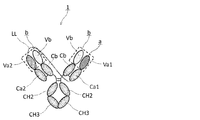
- multispecific antibodies of the present invention examples of IgD, E, and G type bispecific antibodies are schematically shown.
- the polypeptide chains constituting the multispecific antibody of FIG. 1 are schematically shown.
- Specific examples of the multispecific antibody of FIG. 1 are schematically shown.
- examples of F (ab') type bispecific antibodies are schematically shown.
- Another specific example of the multispecific antibody of FIG. 1 is schematically shown.
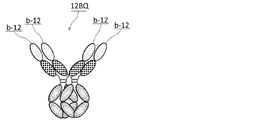
- the by-products produced in the production of the multispecific antibody of FIG. 5 are schematically shown.
- Another specific example of the multispecific antibody of FIG. 1 is schematically shown.
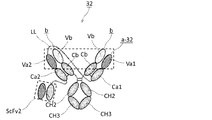
- examples of trispecific antibodies are schematically shown.
- multispecific antibodies of the present invention another example of the trispecific antibody is schematically shown.
- examples of tetraspecific antibodies are schematically shown.
- examples of bispecific antibodies having increased binding valences to any epitope are schematically shown.
- examples of bispecific antibody having an increased binding valence to any epitope is schematically shown.
- an example of a trispecific antibody having an increased binding valence to an epitope is schematically shown.
- another example of IgD, E, G type bispecific antibody is schematically shown.
- the recombinant vector of the present invention is schematically shown.
- Another example of the multispecific antibody obtained by the method for producing a multispecific antibody of the present invention is schematically shown.
- the expression vector included in the kit of the present invention is schematically shown.
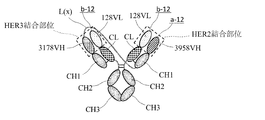
- the anti-HER2 ⁇ HER3 bispecific antibody designed and prepared in Test Example 1 is schematically shown.
- the recombinant vector used in Test Example 1 for expressing the desired anti-HER2 ⁇ HER3 bispecific antibody is schematically shown.
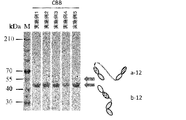
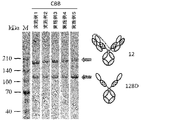
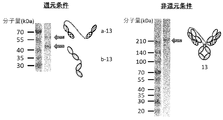
- the electrophoretogram of the protein A affinity purified product of the anti-HER2 ⁇ HER3 bispecific antibody (Examples 1 to 5) obtained in Test Example 1 under the reducing conditions is shown.
- the electrophoretogram of the protein A affinity purified product of the anti-HER2 ⁇ HER3 bispecific antibody (Examples 1 to 5) obtained in Test Example 1 under non-reducing conditions is shown.
- the gel filtration chromatogram for the protein A affinity purified product of the anti-HER2 ⁇ HER3 bispecific antibody (Example 1) product obtained in Test Example 1 is shown.
- the electrophoretogram of the protein A affinity purified product of the anti-HER2 ⁇ HER3 bispecific antibody (Example 1) obtained in Test Example 1 under non-reducing conditions is shown.
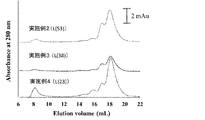
- the gel filtration chromatogram for the protein A affinity purified product of the anti-HER2 ⁇ HER3 bispecific antibody (Examples 2-4) product obtained in Test Example 1 is shown.
- the gel filtration chromatogram for the protein A affinity purified product of the anti-HER2 ⁇ HER3 bispecific antibody (Example 5) product obtained in Test Example 1 is shown.
- the cation exchange chromatogram for the protein A affinity purified product of the anti-HER2 ⁇ HER3 bispecific antibody (Example 1) product obtained in Test Example 1 is shown.
- the results of flow cytometric binding activity evaluation of anti-HER2 ⁇ HER3 bispecific antibodies (Examples 1 to 4) to MCF-7 obtained in Test Example 2 are shown.
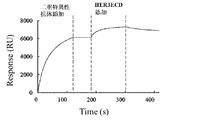
- the evaluation result of the bispecificity of the anti-HER2 ⁇ HER3 bispecific antibody (Example 1) obtained in Test Example 2 by the SPR method is shown.
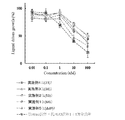
- the bispecificity of the anti-HER2 ⁇ HER3 bispecific antibody (Examples 1 to 5) obtained in Test Example 2 to MCF-7 is shown by the result of evaluation of cell proliferation inhibitory ability.
- the anti-HER2 ⁇ HER3 bispecific antibody designed and prepared in Test Example 4 is schematically shown.
- the recombinant vector used in Test Example 4 for expressing the desired anti-HER2 ⁇ HER3 bispecific antibody is schematically shown.
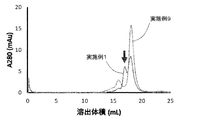
- the electrophoretogram of the protein A affinity purified product of the anti-HER2 ⁇ HER3 bispecific antibody (Example 9) obtained in Test Example 4 is shown.
- the gel filtration chromatogram for the protein A affinity purified product of the anti-HER2 ⁇ HER3 bispecific antibody (Example 9) product obtained in Test Example 4 is shown.
- the anti-CD20 ⁇ CD3 bispecific antibody (Examples 10 and 11) designed and prepared in Test Example 5 is schematically shown.
- the anti-BCMA ⁇ CD3 bispecific antibody (Examples 12 and 13) designed and prepared in Test Example 5 is schematically shown.
- the recombinant vector for expressing the desired anti-CD20 ⁇ CD3 bispecific antibody (Examples 10 and 11) used in Test Example 5 is schematically shown.
- the recombinant vector for expressing the desired anti-BCMA ⁇ CD3 bispecific antibody (Examples 12 and 13) used in Test Example 5 is schematically shown.
- a cation exchange chromatogram for an object is shown.
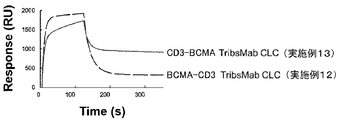
- the results of surface plasmon resonance method analysis for evaluating the binding activity of anti-BCMA ⁇ CD3 bispecific antibody (Examples 12 and 13) to BCMA obtained in Test Example 6 are shown.
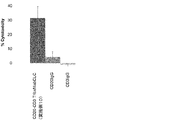
- the results of an injury test using CD20-positive cells and CD3-positive cells for evaluating the bispecificity of the anti-BCMA ⁇ CD3 bispecific antibody (Example 10) obtained in Test Example 6 are shown.
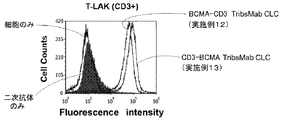
- the results of flow cytometry analysis on BCMA and CD3 positive cells for evaluating the bispecificity of the anti-BCMA ⁇ CD3 bispecific antibody (Examples 12 and 13) obtained in Test Example 6 are shown.
- Example 14 The electrophoretogram of the linker cleavage product of the anti-HER2 ⁇ HER3 bispecific antibody of Example 1 obtained in Test Example 7 (Example 14) is shown.
- the results of flow cytometric analysis for evaluating the binding activity of the linker cleavage product of the anti-HER2 ⁇ HER3 bispecific antibody of Example 1 (Example 14) obtained in Test Example 7 to HER2 and HER3 positivity are shown.
- the multispecific antibody of the present invention is characterized by having a Fab region containing one predetermined polypeptide a chain and two predetermined polypeptide b chains.
- the predetermined polypeptide a chain contains a polypeptide in which the variable region Va1, the constant region Ca1, the peptide linker LL, the variable region Va2, and the constant region Ca2 are linked in this order.
- the predetermined polypeptide b chain contains a polypeptide in which the variable region Vb is linked to the constant region Ca1 or the constant region Cb that binds to the constant region Ca2.
- FIG. 1 schematically shows an example of IgD, E, G type bispecific antibody (multispecific antibody 1) on behalf of the multispecific antibody of the present invention.
- the variable region Va1, the constant region Ca1, the peptide linker LL, the variable region Va2, and the constant region Ca2 are linked in this order.
- Each of the polypeptide b chains contains a variable region Vb and a constant region Cb, and in this example, further contains a constant region CH2 and a constant region CH3.
- FIG. 2 schematically shows the polypeptide chains constituting the multispecific antibody 1 of FIG.
- the Fab region of an antibody is composed of four polypeptide chains
- two polys out of the four polypeptide chains constituting the normal Fab region are used.
- the peptide chains are linked by the peptide linker LL to be unified into the polypeptide a chain, and the remaining two polypeptide chains are shared as the polypeptide b chain.
- the multiplicity antibody 1 of the present invention is an association of the polypeptide a chain and the polypeptide b chain. It is in a format that theoretically does not produce immunoactive by-products in any combination of times.
- a multispecific antibody is an antibody having specificity for two or more different epitopes, in other words, a variable region (so-called Fv) composed of a heavy chain variable region (so-called VH) and a light chain variable region (so-called VL). It is defined as an antibody containing two or more types.
- Fv variable region
- VH heavy chain variable region
- VL light chain variable region
- the variable region Va1 and the variable region Vb and the variable region Va2 and the variable region Vb have two types of Fv having specificity for different epitopes (Fig. The middle and the part surrounded by the broken line) are composed.
- variable regions Va1 and the variable regions Va2 may be selected as the sequences of the variable regions Va1 and the variable regions Va2, and the variable regions Va1 and the variable regions Va2 and the specific sequences of the variable regions have different Fvs. It is appropriately selected to constitute complementarity determining regions (so-called CDRs). Furthermore, the specific sequence of the CDR is also selected without limitation depending on the epitope targeted by the multispecific antibody 1.
- the Fc region is a region cleaved by papain enzyme and is known as a region associated with complement activation, C1q binding and C3 activation, and Fc reporter binding.
- the specific sequence of the Fc region is selected without limitation depending on the antibody isotype (IgD, IgE, IgG).
- the bond between peptide b chains is usually a disulfide bond.
- the length of the peptide linker LL connecting the constant region Ca1 and the variable region Va2 is not particularly limited, and examples thereof include 70 to 280 ⁇ or 20 to 80 amino acid residues.
- the lower limit of the length range of the peptide linker LL is preferably 122 ⁇ or more, more preferably 140 ⁇ or more, still more preferably 175 ⁇ or more, still more preferably 210 ⁇ or more, even more preferably. Is 227 ⁇ or more, particularly preferably 234 ⁇ or more.
- the lower limit of the length range of the peptide linker LL is preferably 35 amino acid residues or more, more preferably 40 amino acid residues or more, still more preferably 50 amino acid residues. As described above, more preferably 60 amino acid residues or more, further preferably 65 amino acid residues or more, and particularly preferably 67 amino acid residues or more.
- the upper limit of the length range of the peptide linker LL is preferably 26 ⁇ or less, more preferably 252 ⁇ or less, and further preferably 245 ⁇ or less. Further, when a multispecific antibody is used at a low concentration and / or when a plurality of epitopes targeted by the multispecific antibody are in close proximity, the length of the peptide linker LL is increased from the viewpoint of enhancing the binding activity.
- the upper limit of the range is preferably 210 ⁇ or less, more preferably 192 ⁇ or less, still more preferably 140 ⁇ or less, still more preferably 122 ⁇ or less, still more preferably 105 ⁇ or less, and particularly preferably 87 ⁇ or less.
- the upper limit of the length range of the peptide linker LL is preferably 75 amino acid residues or less, more preferably 72 amino acid residues or less, still more preferably 70 amino acid residues or less. Furthermore, when a multispecific antibody is used at a low concentration and / or when a plurality of epitopes targeted by the multispecific antibody are in close proximity, the length of the peptide linker LL is increased from the viewpoint of enhancing the binding activity.
- the upper limit of the range is preferably 60 amino acid residues or less, more preferably 55 amino acid residues or less, still more preferably 40 amino acid residues or less, still more preferably 35 amino acid residues or less, still more preferably 30 amino acid residues or less.
- the low concentration include, for example, 2 to 50 nM, preferably 4 to 30 nM, more preferably 6 to 20 nM, and further preferably 8 to 15 nM.
- a plurality of antigens for example, two antigens
- heteromultimer for example, a heterodimer
- Specific sequences of the peptide linker LL include undesired binding at the time of expression of the polypeptide a chain or association between the polypeptide a chain and the polypeptide b chain, or the molecular recognition of the multispecific antibody 1 itself. Sequences that do not affect are selected as appropriate.
- the peptide linker LL has a basic sequence that contributes to ligation as a main component.
- Amino acid residues constituting the basic sequence of the peptide linker LL preferably include amino acid residues having no bulky side chain or no side chain itself. Examples of such amino acid residues preferably include glycine residues, alanine residues, serine residues, threonine residues, aspartic acid residues, glutamic acid residues and the like, and preferably glycine residues and serine residues. Can be mentioned.
- the basic sequence of the peptide linker LL contains a hydrophilic amino acid residue.
- hydrophilic amino acid residues include serine residues, threonine residues, aspartic acid residues, glutamic acid residues and the like, and serine residues are preferable.
- examples of the hydrophobic amino acid residue other than the hydrophilic amino acid residue constituting the basic sequence of the peptide linker LL include a glycine residue and an alanine residue, and preferably a glycine residue.
- the ratio of the number of hydrophilic amino acid residues to the total number of amino acid residues constituting the peptide linker LL is preferably 10 to 30%, more preferably 15 to 25%, and even more preferably 18 to 22%. Can be mentioned.
- a preferred sequence of the basic sequence of the peptide linker LL is a sequence in which hydrophobic amino acid residues and hydrophilic amino acid residues are alternately repeated, and a more preferable sequence is a glycine residue (G) and a serine residue ( Examples thereof include sequences in which S) and S) alternate with each other, and particularly preferably, a repeating sequence of GGGGS.
- the peptide linker LL may be composed of only the basic sequence (does not contain the protease recognition sequence), or may further contain a protease recognition sequence in addition to the basic sequence. It may be included. From the viewpoint of suppressing the production of by-products in the production of the multispecific antibody of the present invention, the peptide linker LL preferably does not contain a protease recognition sequence. On the other hand, from the viewpoint of processing to cleave the peptide linker LL after producing the antibody, a peptide linker LL containing a protease recognition sequence is used.
- the number of protease recognition sequences per peptide linker LL is not particularly limited, and examples thereof include one or two or more, preferably one or two. More preferably, two are mentioned. Further, when two or more protease recognition sequences are contained in the peptide linker LL, each of the two or more protease recognition sequences may be the same sequence or different sequences from each other. Further, the protease recognition sequence is not particularly limited as long as it is a sequence that is specifically recognized and cleaved by a specific protease.
- FIG. show Another example of IgD, E, G type bispecific antibody (multispecific antibody 11) in the case where the peptide linker LL contains a protease recognition sequence in the multispecific antibody of the present invention is schematically shown in FIG. show.
- the peptide linker L in the multiplex antibody of FIG. 1 replaces the peptide linker LL-11 containing two protease recognition sequences Lr1 and Lr2, and the polypeptide a chain in the multiplex antibody of FIG. 1 is used.
- the peptide linker LL-11 in the multispecific antibody 11 contains a protease recognition sequence Lr1 on the constant region Ca1 side and a protease recognition sequence Lr2 on the variable region Va2 side.
- the protease recognition sequence Lr1 is preferably arranged as close as possible to the constant region Ca1, and more preferably adjacent to the constant region Ca1.
- the protease recognition sequence Lr2 is preferably arranged at a position as close as possible to the variable region Va2, and more preferably adjacent to the variable region Va2.
- Multispecific antibody 1 In the present invention, the multispecific antibody is particularly limited in shape as long as it has a Fab region containing one predetermined polypeptide a chain and two predetermined polypeptide b chains. It's not a thing. For example, the Fc region of an antibody is not always required.
- FIG. 4 schematically shows an example of an F (ab') type bispecific antibody (multispecific antibody 1') among the multiple antibodies of the present invention.
- the multispecific antibody 1'shown in FIG. 4 is similar to the multispecific antibody 1 shown in FIG. 1 except that the polypeptide b chain does not have CH2 and CH3 in the constant region.
- Multispecific antibody 12 In the multispecific antibody 1,11,1'described above, the variable region Va1 of the polypeptide a, a-11 chain, the constant region Ca1, the variable region Va2, and the constant region Ca2, and the variable region Vb of the polypeptide b chain
- the specific sequence of each region of the constant region Cb and the constant region Cb may be independently a sequence in either a heavy chain or a light chain.
- FIG. 5 schematically shows a specific example (multispecific antibody 12) of IgD, E, G type bispecific antibody in the multispecific antibody of the present invention.
- the multispecific antibody 12 in FIG. 5 is an example of the multispecific antibody 1 in FIG. 1, and specifically, the polypeptide a chain and the polypeptide b chain in the multispecific antibody 1 in FIG. 1 are polypoly. The case of peptide a-12 chain and polypeptide b-12 chain is illustrated.
- variable region Va1, constant region Ca1, variable region Va2, and constant region Ca2 of the polypeptide a chain in the multispecific antibody 1 of FIG. 1 all have a heavy chain sequence. That is, as shown in FIG. 5, the heavy chain variable region VHa1, the heavy chain constant region CHa1, the peptide linker LL, the heavy chain variable region VHa2, and the heavy chain constant region CHa2 are connected in this order. ..
- variable region Vb and the constant region Cb of the polypeptide b chain in the multispecific antibody 1 of FIG. 1 both have a light chain sequence, that is, As shown in FIG. 5, the light chain variable region VLb and the light chain constant region CLb are linked.
- the polypeptide b-12 chain has an unnatural domain-linked form in which the light chain constant region CLb is further linked to the constant region CH2 and the constant region CH3.
- a method for determining the amino acid sequence of such a non-natural domain linking site is known, and those skilled in the art can appropriately determine the amino acid sequence of the linking site in the design of the multispecific antibody 12.
- the multispecific antibody of the present invention theoretically does not produce by-products exhibiting immune activity.
- a product exhibiting immunoreactivity that occurs in any combination of these polypeptide chains is theoretically Above, only the multispecific antibody 12.
- the tetramer 12BQ of the polypeptide b-12 chain shown in FIG. 6 can be mentioned. .. Although this by-product occurs with the multispecific antibody 12, it does not exhibit immune activity.
- a special and complicated separation step is not required, and a small amount of residual by-products after the separation step are used. It is also possible to avoid the resulting undesired immune response.
- the peptide linker LL may be replaced with the peptide linker LL-11 containing a protease recognition sequence, or the F (ab') type lacking an Fc region may be used. good.
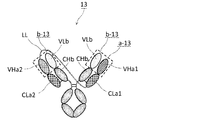
- FIG. 7 schematically shows another specific example (multispecific antibody 13) of IgD, E, G type bispecific antibody in the multispecific antibody of the present invention.
- the multispecific antibody 13 of FIG. 7 is another example of the multispecific antibody 1 of FIG. 1, and specifically, the polypeptide a chain and the polypeptide b chain of the multispecific antibody 1 of FIG. 1 are The case where it is a polypeptide a-13 chain and a polypeptide b-13 chain, respectively, is illustrated.
- variable region Va1 and the variable region Va2 of the polypeptide a chain in the multispecific antibody 1 of FIG. 1 have a heavy chain sequence
- constant region Ca1 and the constant region Ca2 are light chains. It has a sequence, that is, as shown in FIG. 7, the heavy chain variable region VHa1, the light chain constant region CLa1, the peptide linker LL, the heavy chain variable region VHa2, and the light chain constant region CLa2 are in this order. It is connected.
- variable region Vb of the polypeptide b chain in the multispecific antibody 1 of FIG. 1 has a light chain sequence
- the constant region Cb has a heavy chain sequence. That is, as shown in FIG. 7, the light chain variable region VLb and the light chain constant region CHb are linked.
- the polypeptide a-13 chain and the polypeptide b-13 chain have an unnatural domain-linked form in which the light chain-derived region and the heavy chain-derived region are linked.
- a method for determining the amino acid sequence of such a non-natural domain linking site is known, and those skilled in the art can appropriately determine the amino acid sequence of the linking site in the design of the multispecific antibody 13.
- the product exhibiting immunoreactivity that occurs in any combination of the polypeptide chains when the polypeptide a-13 chain and the polypeptide b-13 chain are associated is theoretically a product.
- the multispecific antibody 13 Only the multispecific antibody 13.
- the tetramer corresponding to the tetramer 12BQ of FIG. 6 is not produced. Therefore, the format of the multispecific antibody 13 is even more preferable in that the production of by-products is further suppressed and the yield can be increased.
- the peptide linker LL may be replaced with the peptide linker LL-11 containing a protease recognition sequence, or the F (ab') type lacking the Fc region may be used. good.
- Multispecific antibody 21, 22, 23 The multispecific antibody of the present invention can be designed so that a single chain antibody further binds to the variable region Va1 and / or the constant region Ca2.
- a single-chain antibody comprises a heavy chain variable region (so-called VH), a light chain variable region (so-called VL), and a peptide linker linking them, and is well known to constitute a variable region composed of VH and VL (so-called Fv). It is a structure of.
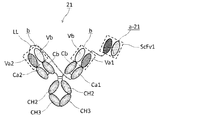
- FIGS. 8 to 10 show specific examples of the trispecific antibody (multispecific antibody 21 and 22) and the quadruple specific antibody (specific examples).
- the multispecific antibody 23) is schematically shown.
- the multispecific antibody 21 shown in FIG. 8 is shown in FIG. 1 except that the polypeptide a chain in the multiplex antibody of FIG. 1 replaces the polypeptide a-21 chain in which the single chain antibody ScFv1 is bound to the variable region Va1. It is the same as the multispecific antibody 1 of.
- the polypeptide a chain in the multiplex antibody of FIG. 1 is replaced with the polypeptide a-22 chain in which the single chain antibody ScFv2 is bound to the constant region Ca2. It is the same as the multispecific antibody 1 of FIG.
- the multispecific antibody 23 of FIG. 10 the polypeptide a chain in the multiplex antibody of FIG.
- the Fv composed of VH and VL is shown by a broken line, and all of these Fvs are configured to have specificity for different epitopes. Therefore, in the multispecific antibodies 21 and 22, the specific sequences of VH and VL of the single-chain antibodies ScFv1, 2 are such that the complementarity determining regions (so-called CDRs) of Fv that they constitute are variable regions Va1 and It is appropriately selected so as to be different from the CDR of the Fv formed by the variable region Vb and the CDR of the Fv formed by the variable region Va2 and the variable region Vb. Further, in the multispecific antibody 23, the VH and VL of the single-chain antibody ScFv1 and the VH and VL of the single-chain antibody ScFv2 are further selected so as to constitute different CDRs from each other.
- VH or VL of the single chain antibody ScFv1 may be linked to the variable region Va1.
- VH or VL of the single-chain antibody ScFv2 may be linked to the constant region Ca2.
- VH or VL of the single-chain antibody ScFv1 may be linked to the variable region Va1, and one independent region Ca2, respectively.
- Either VH or VL of the chain antibody ScFv2 may be linked.
- the stability, three-dimensional structure formation, antigen recognition, etc. of the single-chain antibody ScFv were taken into consideration. It is appropriately selected by the vendor.
- Specific constituent amino acids and sequences are the same as those described in the peptide linker LL, and more specific examples include GGGGS or a repeating sequence thereof.
- GGGGS GGGGS or a repeating sequence thereof.
- a specific length about 15 amino acid residues can be mentioned.
- the mode of linking the single-chain antibodies ScFv1, 2 and the variable region Va1 or the constant region Ca2 is not particularly limited, but is preferably linked by a peptide linker.
- sequence and length of the peptide linker linking the single-chain antibodies ScFv1, 2 and the variable region Va1 or the constant region Ca2 a person skilled in the art may consider the size and shape of the antigen, the positional relationship between different epitopes, and the like. It is selected as appropriate.
- Specific constituent amino acids and sequences are the same as those described in the peptide linker LL, and more specific examples include GGGGS or a repeating sequence thereof.
- the specific length includes, for example, 5 to 20 amino acid residues, preferably 8 to 15 amino acid residues, and more preferably about 10 to 12 amino acid residues.
- the specific sequences of Ca2 and the variable region Vb and the constant region Cb of the polypeptide b chain may be independently sequences in either the heavy chain or the light chain.
- variable region in the polypeptide a-21 chain, the polypeptide a-22 chain, and the polypeptide a-23 chain is similar to the multispecific antibody 12 in FIG. Va1, constant region Ca1, variable region Va2, and constant region Ca2 all have a heavy chain sequence, and the variable region Vb and constant region Cb of the polypeptide b chain are all light chains. It may have a sequence.
- the multispecific antibody 21 to 23 similarly to the multispecific antibody 13 of FIG. 7, in the polypeptide a-21 chain, the polypeptide a-22 chain, and the polypeptide a-23 chain.
- variable region Va1 and the variable region Va2 have a heavy chain sequence
- the constant region Ca1 and the constant region Ca2 have a light chain sequence
- the polypeptide b chain has a variable region Vb of a light chain. It may have a sequence and the constant region Cb may have a heavy chain sequence.
- the peptide linker LL may be replaced with the peptide linker LL-11 containing a protease recognition sequence, or the Fc region may be absent.
- Multispecific antibody 31, 32, 33 The multispecific antibody of the present invention is designed so that a single-chain antibody further binds to the variable region Va1 and / or the constant region Ca2, whereby the above-mentioned "1-6.
- Multispecific antibody 21, 22, 23" In addition to the above, it can also be designed as a multi-characteristic antibody having an increased valence for at least one epitope.
- FIG. 11 and 12 show specific examples of the (2 + 1) type bispecific antibody in the multispecific antibody of the present invention (multispecific antibodies 31, 32), and FIG. 13 shows the multispecific antibody of the present invention.
- a specific example of the (2 + 1 + 1) type trispecific antibody (multispecific antibody 33) is schematically shown.
- the multispecific antibody 31 shown in FIG. 11 is the same as the multispecific antibody 1 of FIG. 1 except that the polypeptide a chain in the multiplex antibody of FIG. 1 replaces the polypeptide a-31 chain.
- the single-chain antibody ScFv1 binds to the variable region Va1
- the CDR of the Fv composed of the variable region Va2 and the variable region Vb is the CDR of the Fv composed of the variable region Va1 and the variable region Vb. It is commonly designed to be different from the CDR of the single chain antibody ScFv1.
- the multispecific antibody 32 shown in FIG. 12 is the same as the multispecific antibody 1 of FIG. 1 except that the polypeptide a chain in the multiplex antibody of FIG. 1 replaces the polypeptide a-32 chain.
- the single-chain antibody ScFv2 binds to the constant region Ca2
- the CDR of Fv composed of the variable region Va2 and the variable region Vb is the CDR of the Fv composed of the variable region Va1 and the variable region Vb. It is commonly designed to be different from the CDR of the single chain antibody ScFv2.
- the multispecific antibody 33 shown in FIG. 13 is the same as the multispecific antibody 1 of FIG. 1 except that the polypeptide a chain in the multiplex antibody of FIG. 1 replaces the polypeptide a-33 chain.
- the single-chain antibody ScFv1 is bound to the variable region Va1
- the single-chain antibody ScFv2 having a CDR different from that of the single-chain antibody ScFv1 is bound to the constant region Ca2, and the variable region Va2 and the variable region Vb are bound.
- the CDR of the Fv composed of the same is common with the CDR of the Fv composed of the variable region Va1 and the variable region Vb, and is designed to be different from both the CDRs of the single-chain antibody ScFv1 and the single-chain antibody ScFv2.
- each Fv having specificity for a specific epitope is surrounded by a broken line.
- the multispecific antibodies 31 and 32 out of a total of three Fvs, two Fvs in both arms of the antibody are shared, and an Fv corresponding to an epitope different from this Fv is a single-chain antibody ScFv1 or a single-chain antibody. It is carried by ScFv2. That is, the multispecific antibodies 31 and 32 are designed to be bispecific antibodies but have a high valency to one of the target epitopes.
- the multispecific antibody 33 out of a total of four Fvs, two Fvs in both arms of the antibody are shared, and Fvs corresponding to two types of epitopes different from these Fvs are the single-chain antibody ScFv1 and one, respectively. It is carried by the main chain antibody ScFv2. That is, the multispecific antibody 33 is designed to have a high valency to one of the target epitopes, even though it is a trispecific antibody.
- the two Fvs in both arms of the antibody are configured to be specific for cancer cells, with the single chain antibody ScFv1 and / or one.
- the chain antibody ScFv2 can be configured to be immune cell specific, and such antibodies have the purpose of suppressing cancer cell-independent immune cell activation and enhancing damage to cancer cells. Can be used in.
- VH or VL of the single chain antibody ScFv1 may be linked to the variable region Va1.
- VH or VL of the single chain antibody ScFv2 may be linked to the constant region Ca2.
- VH or VL of the single-chain antibody ScFv1 may be linked to the variable region Va1, and one independent region Ca2, respectively. Either VH or VL of the chain antibody ScFv2 may be linked.
- the sequence and length of the peptide linker linking the antibodies ScFv1, 2 and the variable region Va1 or the constant region Ca2 are as described in "1-6. Multispecific antibody 21, 22, 23" above.
- the specific sequences of Ca2 and the variable region Vb and the constant region Cb of the polypeptide b chain may be independently sequences in either the heavy chain or the light chain.
- variable region in the polypeptide a-31 chain, the polypeptide a-32 chain, and the polypeptide a-33 chain is similar to the multispecific antibody 12 in FIG. Va1, constant region Ca1, variable region Va2, and constant region Ca2 all have a heavy chain sequence, and the variable region Vb and constant region Cb of the polypeptide b chain are all light chains. It may have a sequence.
- the multispecific antibody 31 to 33 similarly to the multispecific antibody 13 of FIG. 7, in the polypeptide a-31 chain, the polypeptide a-32 chain, and the polypeptide a-33 chain.
- variable region Va1 and the variable region Va2 have a heavy chain sequence
- the constant region Ca1 and the constant region Ca2 have a light chain sequence
- the polypeptide b chain has a variable region Vb of a light chain. It may have a sequence and the constant region Cb may have a heavy chain sequence.
- the peptide linker LL may be replaced with the peptide linker LL-11 containing a protease recognition sequence, or the Fc region may be absent.
- the multispecific antibody of the present invention may be one in which the peptide linker LL, which contributes to the formation of its characteristic format, is cleaved.
- the cleavage mode of the peptide linker LL is not particularly limited, but preferably, an embodiment in which the protease sequence introduced into the peptide linker LL is specifically cleaved by the corresponding protease can be mentioned.
- Examples of the multispecific antibody of the present invention having such a cleavage mode include one predetermined polypeptide a'chain, one predetermined polypeptide a''chain, and two predetermined polypeptide b chains. Examples thereof include multispecific antibodies having a Fab region containing and.
- the predetermined polypeptide a'chain comprises a polypeptide in which the variable region Va1, the constant region Ca1 and the cleavage fragment Lr1'of the protease recognition sequence Lr1 are linked in this order.
- the predetermined polypeptide a ′′ chain comprises a polypeptide in which a cleavage fragment Lr2 ′ of the protease recognition sequence Lr2, a variable region Va2, and a constant region Ca2 are linked in this order.
- the predetermined polypeptide b chain includes a polypeptide in which the variable region Vb is linked to the constant region Ca1 or the constant region Cb that binds to the constant region Ca2.
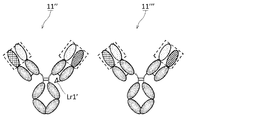
- FIG. 14 schematically shows an example of an IgD, E, G type bispecific antibody (multispecific antibody 11') including a cleavage mode of a peptide linker. Shown in.
- the multispecific antibody 11' is a polypeptide a chain in which the protease recognition sequences Lr1 and Lr2 introduced into the peptide linker LL are specifically cleaved by the corresponding protease in the multispecific antibody 11 of FIG.
- variable region Va1 and the constant region Ca1 of the polypeptide a'chain and the polypeptide a'' chain constituting the multispecific antibody 11'.
- the variable region Va2 and the constant region Ca2, and the specific sequences of the variable region Vb and the constant region Cb of the polypeptide b chain may be independently sequences in either the heavy chain or the light chain, respectively.
- the Fc region may be absent.
- DNA is a DNA encoding a polypeptide a chain containing a polypeptide in which the variable region Va1, the constant region Ca1, the peptide linker LL, the variable region Va2, and the constant region Ca2 are linked in this order.
- the DNA of the present invention is used for producing the above-mentioned "1. Multispecific antibody”. Therefore, the DNA of the present invention is used together with a DNA encoding a polypeptide b chain containing a polypeptide in which a variable region Vb and a constant region Cb bound to the constant region Ca1 or the constant region Ca2 are linked.
- polypeptide a chain and the polypeptide b chain are as described in detail in "1. Multispecific antibody" above.
- Polypeptide a-11 chain (aspect containing a protease recognition sequence), polypeptide a-12 chain (aspect in which heavy chain / light chain origin of each region is identified), and a polypeptide, which are specific embodiments of the polypeptide a chain.
- a-13 chain (a mode in which the heavy chain / light chain origin of each region is identified), a polypeptide a-21 chain (a mode containing a single chain antibody), and a polypeptide a-22 chain (a mode containing a single chain antibody).
- Embodiment and polypeptide a-23 chain (aspect containing a single chain antibody); and polypeptide b-12 chain, which is a specific embodiment of polypeptide b chain (heavy chain / light chain origin of each region is specified).
- polypeptide b-12 chain which is a specific embodiment of polypeptide b chain (heavy chain / light chain origin of each region is specified).
- Multispecific antibody is also described in detail in the above-mentioned "1. Multispecific antibody”.
- a person skilled in the art can appropriately design the base sequences of the DNA encoding the polypeptide a chain and the DNA encoding the polypeptide b chain based on the designs of the polypeptide a chain and the polypeptide b chain. Further, the DNA encoding the polypeptide a chain and the DNA encoding the polypeptide b chain can be obtained by artificially synthesizing them by genetic engineering.
- These DNAs are preferably those in which the codon utilization frequency is optimized for the host.
- DNA whose codon utilization frequency is optimized for human cells is suitable.
- FIG. 15 A schematic diagram of the recombinant vector va and the recombinant vector vb is shown in FIG.
- the recombinant vector va and the recombinant vector vb shown in FIG. 15 are examples of producing the multispecific antibody 1 of FIG.
- "S” is a signal sequence
- "Va1” is a DNA encoding the above variable region Va1
- "Ca1” is a DNA encoding the above constant region Ca1
- LL is a DNA encoding the above peptide linker LL.
- Va2 is the DNA encoding the above variable region Va2
- Ca2 is the DNA encoding the above constant region Ca2
- Vb is the DNA encoding the above variable region Vb
- Cb is the above.
- H represents the DNA encoding the hinge region
- CH2 represents the DNA encoding the DNA encoding the above-mentioned constant region CH2
- CH3 represents the DNA encoding the above-mentioned constant region CH3.
- the recombinant vector va contains a regulator such as a promoter operably linked to the DNA encoding the polypeptide a chain.
- the recombinant vector vb contains a regulator such as a promoter operably linked to the DNA DNA encoding the polypeptide b chain.
- a promoter is typically used as a regulator, but if necessary, a transcription element such as an enhancer, a CCAAT box, a TATA box, or an SPI site may be included.
- operably linked means that various regulators such as promoters and enhancers that regulate the DNA encoding the polypeptide a chain or the polypeptide b chain and the DNA of the present invention can operate in the host cell. It means to be connected.
- the expression vector a vector constructed from phages, plasmids, or viruses that can grow autonomously in the host for gene recombination is preferable.
- Such expression vectors are known and include, for example, pUC vector, pBluescript vector, pET vector, pGEX vector, pEX vector, pCAGGS vector and the like.
- the expression vector may be used by selecting an appropriate combination with the host cell.
- Transformant The transformant of the present invention is described in the above-mentioned "2.
- DNA the DNA encoding the polypeptide a chain and the DNA encoding the polypeptide b chain, or the above-mentioned "3.
- Recombinant vector It is obtained by transforming the host with the recombinant vector va and the recombinant vector vb.
- the host used for the production of the transformant is not particularly limited from prokaryotic cells and eukaryotic cells as long as the gene can be introduced, autonomously proliferates, and the multispecific antibody of the present invention can be expressed.
- Specific host cells include CHO cells, N50 cells, SP2 / 0 cells, Expi293 cells, HEK293 cells, COS cells, PER. Mammal-derived cells such as C6 cells; fungi such as yeast; bacteria such as E. coli can be mentioned.
- the transformant of the present invention can be produced by introducing the above DNA or recombinant vector into a host.
- the method for introducing these nucleic acid species is not particularly limited as long as the gene of interest can be introduced into the host. Further, the place where the above DNA is introduced is not particularly limited as long as the gene of interest can be expressed, and may be on a plasmid or on the genome. Specific methods for introducing the above-mentioned DNA or recombinant vector include, for example, a recombinant vector method and a genome editing method.
- the conditions for introducing the above DNA or recombinant vector into the host may be appropriately set according to the introduction method, the type of host, and the like.
- the host is an animal cell, for example, a polyethyleneimine method, an electroporation method, a calcium phosphate method, a lipofection method and the like can be mentioned.
- the host is a fungus, for example, an electroporation method, a spheroplast method, a lithium acetate method and the like can be mentioned.
- the host is a bacterium, for example, a method using competent cells treated with calcium ions, an electroporation method, and the like can be mentioned.
- DNA encoding the polypeptide a chain or the recombinant vector va may be used as the ratio of the DNA encoding the polypeptide b chain or the recombinant vector vb to 1 mol.
- 0.4 mol or more or 0.5 mol or more is mentioned, preferably 0.7 mol or more, more preferably 0.9 mol or more or 1 mol or more, and even more preferably 1.2 mol.
- the ratios of 1.25 mol or more, 1.35 mol or more, 1.4 mol or more, and 1.5 mol or more can be mentioned.
- the upper limit of the range of the molar ratio of the recombinant vector va to 1 mol of the recombinant vector vb is not particularly limited, and examples thereof include 3 mol or less, 2.5 mol or less, 2 mol or less, or 1.8 mol or less. It is preferable to use in such an amount from the viewpoint of reducing the amount of tetramer 12BQ produced when the tetramer 12BQ of the polypeptide b-12 chain shown in FIG. 6 is produced as a by-product.
- the method for producing a multispecific antibody of the present invention includes an antibody production step of culturing the transformant of the present invention.
- the culture conditions in the antibody production step may be appropriately set in consideration of the nutritional and physiological properties of the host, but liquid culture is preferable. Further, in view of industrial production, it is preferable to culture under aeration and stirring conditions.
- the polypeptide a chain and the polypeptide b chain are expressed, and these naturally associate to form the multispecific antibody of the present invention.
- the polypeptide a chain and the polypeptide b chain shown in FIG. 2 are expressed, and these naturally associate with each other to cause the multispecific antibody 1 To configure.
- a by-product may be produced as shown in FIG. 6, but the by-product does not exhibit immunoreactivity.
- the multispecific antibody produced in the antibody production step contains a protease recognition sequence in the peptide linker LL
- the multispecific antibody is used in the linker cleavage step of cleaving the peptide linker LL using the protease corresponding to the protease.
- the peptide linker LL in the multispecific antibody produced in the antibody production step contains a protease recognition sequence Lr1 on the constant region Ca1 side and a protease recognition sequence Lr2 on the variable region Va2 side, as shown in FIG.
- the peptide linker LL is cleaved using the protease corresponding to each of the protease recognition sequence Lr1 and the protease recognition sequence Lr2.
- the protease recognition sequence Lr1 and the protease recognition sequence Lr2 are designed so that the cleavage fragment Lr1'and the cleavage fragment Lr2' remain on the multi-characteristic antibody side by cleavage with the corresponding protease
- the peptide linker is used. Cleavage of LL gives the multispecific antibody 11'shown in FIG.
- the protease recognition sequence Lr1 and the protease recognition sequence Lr2 are designed so that the cleavage fragment Lr1'and / or the cleavage fragment Lr2'do not remain on the multi-characteristic antibody side by cleavage with the corresponding protease, respectively, when used.
- the multispecific antibody 11 ′′ (not shown, but Lr1 ′ may be absent and Lr2 ′ remains) or the multispecific antibody 11 ′′'' shown in FIG. Is obtained.
- the multispecific antibody of the present invention obtained by the antibody production step or the linker-cleaving antibody can be further produced by subjecting it to a purification step.
- a known antibody purification method can be used, for example, centrifugation, affinity chromatography (protein A affinity chromatography, protein G affinity chromatography, etc.), size exclusion chromatography, ion exchange.
- Chromatography cation exchange chromatography, anion exchange chromatography
- hydrophobic interaction chromatography gel electrophoresis, dialysis and the like can be mentioned, preferably protein A affinity chromatography and ion exchange chromatography (preferably positive). It can be used in combination with ion exchange chromatography).
- the purification step does not require a special and complicated separation step used in the purification of a normal multispecific antibody. It becomes. That is, the method for producing a multispecific antibody of the present invention can be simplified, which is extremely advantageous in industrial production.
- Multispecific antibody production kit The present invention also provides a multispecific antibody production kit for producing the above-mentioned "1. Multispecific antibody”.
- the multispecific antibody production kit of the present invention is used to produce the above-mentioned "3. recombinant vector” or the above “4. transformant”, or the above-mentioned "5. Method for producing a multispecific antibody”. Can be used for
- the multispecific antibody production kit of the present invention includes cloning site CS1 for incorporating variable region Va1, DNA encoding constant region Ca1, DNA encoding peptide linker LL, cloning site CS2 for incorporating variable region Va2, and An expression vector va'containing DNA encoding the constant region Ca2 in this order; a cloning site CS for incorporating the variable region Vb, and a DNA encoding the constant region Ca1 or the constant region Cb that binds to the constant region Ca2. Includes the expression vector vb'including.
- FIG. 17 schematically shows an expression vector included in the multispecific antibody production kit of the present invention.
- the restriction enzyme sites included in the cloning site CS1 and the cloning site CS2 are designed to be specific to different restriction sequences so that the variable region Va1 and the variable region Va2 can be incorporated, respectively.
- the cloning sites CS1, CS2, and CS may each contain one restriction enzyme site, or may be a multi-cloning site containing two or more restriction enzyme sites.
- known restriction enzyme sites are appropriately selected.
- the multi-cloning site a known cloning vector, a multi-cloning site provided in an expression vector, or the like may be used as it is, or a known multi-cloning site may be appropriately modified.
- variable regions Va1, Va2, Vb into the cloning sites CS1, CS2, CS may be appropriately determined by a person skilled in the art based on a known cloning method using restriction enzymes corresponding to the cloning sites CS1, CS2, CS. can.
- the multispecific antibodies of the invention can be used in any application that takes advantage of their ability to specifically bind to two or more different epitopes.
- Examples of utilizing the specific binding ability of the multispecific antibody of the present invention include a mode in which a plurality of antigens (cytokines and tumor markers) are targeted, and a mode in which the same tumor or different epitopes of the same viral antigen are targeted. Examples thereof include an embodiment in which two target cells are crosslinked (for example, an embodiment in which an immunoeffector cell is brought close to a specific tumor-related antigen in order to promote cell death). Therefore, the multispecific antibody of the present invention is useful for diagnostic applications and pharmaceutical (so-called antibody pharmaceutical) applications.
- the multispecific antibody of the present invention can be used as a diagnostic agent (sensing component) or an active ingredient of a pharmaceutical composition. That is, the present invention is a pharmaceutical composition containing the diagnostic agent containing the multispecific antibody described in the above "1. Multispecific antibody” and the multispecific antibody described in the above “1. Multispecific antibody”. I will provide a.
- a multispecific antibody is used together with other components (eg, buffer, suspending agent, stabilizer, preservative, preservative, etc.) used in a general diagnostic agent composition.
- components eg, buffer, suspending agent, stabilizer, preservative, preservative, etc.
- examples thereof include those constituting the composition and those in which the multispecific antibody is immobilized on the surface of an insoluble carrier (particle or substrate).
- a multispecific antibody may be used in other components (eg, excipients, buffers, suspensions, stabilizers, preservatives, preservatives) used in common pharmaceutical compositions. Agents, physiological saline, etc.) that make up the composition.
- the multispecific antibody of the present invention that is, one polypeptide a chain (variable region Va1, constant region Ca1, peptide linker LL, variable region Va2, and constant region Ca2) was linked in this order. It has a Fab region containing a polypeptide (including a polypeptide) and two polypeptide b chains (including a polypeptide in which a variable region Vb is linked to the constant region Ca1 or a constant region Cb that binds to the constant region Ca2). Monoclonal antibodies of multispecific antibodies are also described as TribsMab CLC (Trimeric Bi-specific Monoclonal Antibody Common Light Chain).
- the sequences of the heavy chain variable region 3958VH (HER2 specific) and the heavy chain variable region 3178VH (HER3 specific) of MCLA-128 and the light chain variable region 128VL of MCLA-128 were adopted.
- a sequence derived from the human IgG1 class was adopted as the constant region.
- peptide linkers having different lengths were designed with GGGGS as the basic sequence and containing or not containing the HRV3C protease recognition sequence (LEVLFQGP).
- each domain of the multispecific antibody 12 of FIG. 5 and the bispecific antibody designed in this test example is shown in Tables 1 and 2 below, and a schematic diagram of the bispecific antibody designed in this test example. Is shown in FIG.
- the approximate length ( ⁇ ) of peptide linkers of different lengths and the specific sequences are as shown in Table 1.
- Each peptide linker is represented by L (x), and the "x" in parentheses indicates the total number of amino acid residues constituting the peptide linker in the case of containing a protease recognition sequence (for example, protease recognition).
- a peptide linker containing a sequence and having a total number of amino acid residues constituting the peptide linker of 68 is indicated as "L (68)"
- a peptide linker not containing a protease recognition sequence is provided with delP.
- a solution of 6 ⁇ g of expression vector va and 12 ⁇ g of expression vector vb (expression vector introduction ratio va: vb is about 0.5: 1 on a molar basis ) added to 900 ⁇ L of Opti-MEM (R) (Thermo), and Opti.
- R Opti-MEM
- Opti-MEM Opti-MEM
- Host cells were cultured in a triangular flask containing 30 mL of HE200 medium (Gmep), and when the number of cells was 3-5 ⁇ 10 6 cells / mL and the viability was 95% or more, the number of cells was 45 ⁇ 10 6 cells.
- the cell culture medium was dispensed into a 50 mL sample tube so as to be. After centrifuging the sample tube at 1,500 rpm for 5 minutes, the culture was removed and suspended in transfection solution. The cell suspension was seeded in 3 mL each on a 6-well plate and cultured for 20 hours.
- bispecific antibody 7.5 ⁇ L of 0.5 M aqueous sodium valproate solution and 12 ⁇ L of 1 M aqueous sodium propionate solution were added to each well, and the cells were further cultured for 6 days.
- the culture conditions are as described in (3) above.
- the expression of the bispecific antibody was confirmed by performing Western blotting on the supernatant after culturing using polyacrylamide gel electrophoresis (SDS-PAGE) and an anti-human Fc antibody.
- Each eluted fraction was subjected to SDS-PAGE development under reducing and non-reducing conditions and subjected to CBB staining.
- the result under the reducing condition is shown in FIG. 20, and the result under the non-reducing condition is shown in FIG.
- the molecular weight was calculated from the mobility of the band recognized in FIG. 20 (reduction conditions), and the molecular weights based on the amino acid sequences of the polypeptide a-12 chain and the polypeptide b-12 chain were compared. The results are shown in Table 3. From the results in Table 3, the polypeptide a-12 chain and the polypeptide b-12 chain constituting the target bispecific antibody (multispecific antibody 12) could be confirmed.
- the dimer 12BD of the polypeptide b-12 chain is the main by-product. It turned out to exist as.
- FIG. 23 shows the results of SDS-PAGE development (non-reducing conditions) of the eluted fractions of 16 mL to 18.5 mL in the same manner as in 5-1 above.
- each peak area in FIG. 22 was calculated using PrimeView Evaluation (GE Healthcare). As a result, the peak area ratio of the multispecific antibody 12 was about 67%, and the peak area ratio of the tetramer 12BQ was about 32%.
- the peptide linker having the protease recognition sequence has the longest production ratio of the by-product in the preparation of the multispecific antibody 12 of Example 1 and the length of the peptide linker having the protease recognition sequence. As the length became shorter (Examples 2 to 4), the production ratio of by-products tended to increase. That is, it was found that when a peptide linker having a protease recognition sequence is used, the amount of by-products produced tends to decrease as the length of the peptide linker increases.
- lane 1 is after protein A affinity purification and before IgG-CH1 binding carrier is formed
- lane 2 is a pass-through fraction
- lane 3 is a wash fraction
- lane 4 is an elution fraction 1
- lane 5 is an elution fraction 2. Is shown.
- Test Example 2 Evaluation of activity of multispecific antibody (anti-HER2 x HER3 bispecific antibody-1)] (1) Evaluation of binding activity-1
- the multispecific antibodies 12 of Examples 1 to 5 prepared in Test Example 1 were evaluated for their binding activity to HER2 and HER3-positive human breast cancer cells MCF-7 by flow cytometry as follows.
- Example 4 (L (23)) and Example 3 (L (38)) were almost the same, but their fluorescence intensities were the same in Example 2 (L (53)). ) was 1.5 times, and the fluorescence intensity of Example 1 (L (68)) was twice.
- the reason why the binding activity was different due to the difference in the length of the peptide linker is considered to be the difference in the binding mode.
- HER2 and HER3 existing on the surface of MCF-7 have a mode in which they exist independently and a mode in which they exist as a heterodimer, and the expression levels of HER2 and HER3 are the same as in MCF-7. It is considered that the proportion of HER2 and HER3 present as heterodimers is particularly high on the cell surface.
- the shorter the length of the peptide linker the more limited the range of motion of the Fab arm of the multispecific antibody. It is considered that the binding property to cells was improved as compared with the case. It is considered that the influence of the binding form by divalent binding was largely exhibited under the condition where the antibody concentration was low.
- the Fc fusion HER2 extracellular domain was fixed on the surface of the Biacore sensor chip CM5 using an amine coupling kit (GE Healthcare).
- the multispecific antibody 12 (1 ⁇ M) of Example 1 and the Fc-fused HER3ECD (1 ⁇ M) were added to the Fc-fused HER2ECD fixed sensor chip in this order at a flow rate of 20 ⁇ L / min.
- SPR analysis was performed using Biacore3000 (GE Healthcare).
- PBS (PBST) containing 0.005% Tween-20 was used as the running buffer. The results are shown in FIG.
- Example 1 As shown in FIG. 29, when the bispecific antibody (multispecific antibody 12) of Example 1 was added to the Fc fusion HER2ECD fixed sensor chip, the response indicating the mass increase on the sensor chip increased. , Fc fusion HER3ECD also increased the response. That is, it was confirmed that the bispecific antibody of Example 1 (multispecific antibody 12) has bispecificity to the antigens HER2 and HER3.
- MCF-7 Cell proliferation inhibitory ability was cultured using D-MEM (Dulbecco-modified Eagle's medium, Sigma Aldrich) containing 10% FBS. Cells were harvested from the dish using trypsin / EDTA (0.25 w / v% trypsin-1 mmol / l EDTA ⁇ 4Na solution, containing phenol red, Gibco) and RPMI1640 containing 1% FBS (Roswell Park Memorial Laboratory Medium, It was suspended in Sigma Aldrich) to 6.25 ⁇ 10 3 cells / mL, and 80 ⁇ L each was seeded in the wells of a 96-well flat bottom culture plate.
- D-MEM Dulbecco-modified Eagle's medium, Sigma Aldrich
- Test Example 3 Examination of production conditions for multispecific antibody
- a multispecific antibody was prepared in the same manner as in Example 1 except that the introduction ratios of the recombinant vector va and the recombinant vector vb prepared in Test Example 1 were changed, and Test Example 1 (5-2) was prepared.
- the amount of tetramer 12BQ produced was confirmed by gel filtration chromatogram.
- the introduction ratio (weight basis) of the recombinant vector va and the recombinant vector vb adopted in this test example is shown in the table below.
- the introduction ratio (weight basis) of the recombinant vector va and the recombinant vector vb shown in the table below is almost the same as the introduction ratio based on the molar basis.
- the introduction ratio in Example 1 prepared in Test Example 1 is also shown.
- Example 1 the amount of tetramer 12BQ produced decreased in the order of Example 1, Example 6, and Example 7, and was almost the same in Example 7 and Example 8. That is, the larger the amount of the recombinant vector va introduced in the theoretical recombinant vector va and the amount of the recombinant vector vb introduced (Example 1), the more the tetramer 12BQ, which is a by-product, It was found that the amount of production tends to decrease.
- FIG. 33 shows the results of SDS-PAGE development of the purified fraction under reducing and non-reducing conditions in the same manner as in Test Example 1.
- Example 9 As shown in the comparison between FIG. 33 (Example 9) and FIG. 21 (Example 1), according to Example 9, no by-product of dimer (tetramer dissociation) was observed, and the purpose was almost the same. Only the bispecific antibody (multispecific antibody 13) of the above was confirmed.
- FIG. 34 shows the result of Example 9 together with the result of Example 1.
- the by-product tetramer peak indicated by the arrow in the figure
- variable region identical sequence ie, REGN1979 heavy chain variable region 1979VH-CD20 (specific to CD20) and heavy chain variable region 1979VH-CD3 (specific to CD3) and REGN1979.
- the sequence of light chain variable region 1979VL was adopted.
- the light chain class of REGN1979 is ⁇ .
- a sequence derived from the human IgG1 class was adopted as the constant region.
- a sequence corresponding to the peptide linker LL in FIG. 5 a peptide linker having GGGGS as a basic sequence was designed.
- the sequences of the heavy chain variable region 372VH-BCMA (specific to BCMA), the heavy chain variable region 372VH-CD3 (specific to CD3) and the light chain variable region 372VL of pSCHLI372 were adopted.
- the light chain class of pSCHLI372 is ⁇ .
- a sequence derived from the human IgG1 class was adopted as the constant region.
- a sequence corresponding to the peptide linker LL in FIG. 5 a peptide linker having GGGGS as a basic sequence was designed.
- a recombinant vector va (pCAGGS-Fd1979CD20-FdCD3, pCAGGS-Fd1979CD3-FdCD20, pCAGGS-Fd372BCMA-FdCD3, pCAGGS-372FdCD3-FdBCMA) for a-12 chain expression was prepared.
- Completely synthesized pEX-A2J2-1979VH-CD20, pEX-A2J2-1979VH-CD3, pEX-A2J2-372VH-BCMA, pEX-A2J2-372VH-CD3 are digested with restriction enzymes Afl II and Nhe I, and the same enzyme is used in advance.
- digested pCAGGS-Fd3958-Fd3178 By linking to digested pCAGGS-Fd3958-Fd3178, four types of a-chain expression vector intermediates (pCAGGS-Fd1979CD20-Fd3178, pCAGGS-Fd1979CD3-Fd3178, pCAGGS-Fd372BCMA-Fd3178, pCAGGS-Fd372CD3-Fd3178) were prepared.
- PCR products EcoRV-1979VH-CD20-SacI, EcoRV-1979VH-CD3-SacI, EcoRV-372VH-BCMA-SacI, EcoRV-372VH-CD3-SacI were obtained.
- recombinant vectors vb (pCAGGS-1979L-Fc, pCAGGS-372L-Fc) for b-12 chain expression were prepared.
- PEX-A2J2-1979VH-CD3-1979VL was digested with restriction enzymes Afl II and Nhe I, and linked to pCAGGS-128L-Fc previously digested with the same enzyme to prepare pCAGGS-1979L-FC.
- PCR products EcoRI-372VL, CL ( ⁇ ), H-Fc-NotI
- Amplified by PCR these three PCR products were ligated by overlapping elongation to amplify EcoRI-372VL-CL ( ⁇ ) -H-Fc-Not I.
- the final PCR product was digested with restriction enzymes Eco RI and Not I, and then ligated with pCAGGS-128L-Fc digested with the same enzyme to prepare pCAGGS-372L-Fc.
- the cells were cultured in an Erlenmeyer flask containing 30 mL of HE200 medium (Gmep), and transfection was performed when the number of cells was 3-5 ⁇ 10 6 cells / mL and the survival rate was 95% or more.
- the two solutions were mixed, allowed to stand for 20 minutes, and then added to 54 mL of HE400 (Gmep), which was used as a transfection solution.
- the cell culture solution was dispensed into a 50 mL sample tube so that the number of cells was 150 ⁇ 10 6 cells, centrifuged at 1,500 rpm for 5 minutes, the culture solution was removed, and the cells were suspended in a transfection solution and cultured for 20 hours.
- CD20 ⁇ CD3 TribsMab CLC and CD3 ⁇ CD20 TribsMab CLC of Examples 10 and 11 After reacting CD20 ⁇ CD3 TribsMab CLC and CD3 ⁇ CD20 TribsMab CLC of Examples 10 and 11 with Raji cells or T-LAK cells, anti-human IgG (Fc-specific) -FITC antibody (Sigma Aldrich) was used as a secondary antibody. 1 ⁇ L of the above and 499 ⁇ L of 0.1% NaN 3 / PBS were added and reacted. Analysis was performed using BD Accuri TM C6 (BD Biosciences).
- FIG. 40A As shown in FIG. 40A, in BCMA ⁇ CD3 TribsMab CLC of Examples 12 and 13, peak shift could be confirmed in T-LAK cells (CD3 positive cells), so that binding activity to CD3 was confirmed.
- the bispecificity of CD20 ⁇ CD3 TribsMab CLC is as follows: CD20-positive Razi cells (target cells) and CD3-positive T-LAK cells (effector cells). ) was evaluated by the LDH test. The experiment was carried out under the condition of E (effector cell) T (target cell) ratio of 20: 1.
- T-LAK cells cultured in the same manner as in (1) of this test example were suspended at 4.0 ⁇ 10 6 cells / mL, and then 25 ⁇ L was added per 1 well.
- Raji cells were suspended at 1% FBS / RPMI1640 to 2.0 ⁇ 10 5 cells / mL, and then 50 ⁇ L was added per well.
- the antibody was diluted to a concentration of 40 nM, 25 ⁇ L was added per well, and the cells were cultured for 3 hours. The operation after the completion of the culture was performed according to the manual of Cytotoxicity LDH Assay Kit-WST (Dojindo Molecular Technologies). The absorbance of each well was measured using an iMark TM Microplate Reader (BioRad). At that time, as a background, the absorbance at 630 nm was subtracted, and the cytotoxicity rate was calculated from the following formula.
- FIG. 41A The results are shown in FIG. 41A. As is clear from FIG. 41A, since the CD20-CD3 TribsMab CLC of Example 10 significantly induces cytotoxicity as compared with the monospecific antibody, the CD20-positive Raji cells and the CD3-positive T-LAK cells are used. Probably bridged.
- the bispecificity of BCMA ⁇ CD3 TribsMab CLC is flow cytometry using CD3-positive T-LAK cells and BCMA-ECD-Fc-FITC. Evaluated by analysis. To T-LAK cells cultured in the same manner as in (1) of this test example, 500 nM BCMA ⁇ CD3 TribsMab CLC was added as a primary antibody. Then BCMA-ECD-Fc-FITC was added to a final concentration of 250 nM.
- Example 14 Using MCF-7 cells cultured in 10% FBS / DMEM medium, the linker-cleaving HER2 ⁇ HER3 TribsMabCLC (500 nM) of Example 14 was reacted with MCF-7 cells for 30 minutes as a primary antibody, and then 0.1%. It was washed twice with NaN3 / PBS. Subsequently, 1 ⁇ L of anti-human IgG (Fc-specific) -FITC antibody (Sigma Aldrich) and 0.1% NaN3 / PBS 499 ⁇ L were added as secondary antibodies and reacted for 30 minutes, followed by 2 with 0.1% NaN3 / PBS. Washed twice. Then, the cells were subjected to flow cytometric analysis using BD AccuriTM C6 (BD Biosciences).
- BD AccuriTM C6 BD Biosciences
- Multispecific antibodies a, a-11, a-12, a -13, a-21, a-22, a-23, a-31, a-2, a-33 ...
- Polypeptide a chain Va1 ... Variable region Va1 VHa1 ... Heavy chain variable region VHa1 Ca1 ... Constant region Ca1 CHa1 ... Heavy chain constant region CHa1 LL, LL-11 ... Peptide linker LL Lr1 ... Protease recognition sequence Lr1 Lr2 ... Protease recognition sequence Lr2 Va2 ... Variable area Va2 VHa2 ...
- Heavy chain variable region VHa2 Ca2 ... Constant region Ca2 CHa2 ... Heavy chain constant region CHa2 b, b-1', b-12, b-13 ... Polypeptide b chain Vb ... Variable region Vb VLb ... Light chain variable region VLb Cb ... Constant region Cb CLb ... Light chain constant region CLb ScFv1, ScFv2 ... Single-chain antibody a'... Polypeptide a'chain a'' ... Polypeptide a'chain Lr1'... Cleavage fragment Lr1'of protease recognition sequence Lr1 Lr2'... Cleavage fragment Lr2'of protease recognition sequence Lr2 va ... recombinant vector va vb ... recombinant vector vb va'... expression vector va' vb'... expression vector vb'... expression vector vb'... expression vector vb'... expression vector vb'... expression vector vb'... expression vector vb
Landscapes
- Health & Medical Sciences (AREA)
- Chemical & Material Sciences (AREA)
- Organic Chemistry (AREA)
- Genetics & Genomics (AREA)
- Life Sciences & Earth Sciences (AREA)
- Immunology (AREA)
- General Health & Medical Sciences (AREA)
- Biochemistry (AREA)
- Molecular Biology (AREA)
- Engineering & Computer Science (AREA)
- Biophysics (AREA)
- Proteomics, Peptides & Aminoacids (AREA)
- Medicinal Chemistry (AREA)
- Biomedical Technology (AREA)
- Zoology (AREA)
- Bioinformatics & Cheminformatics (AREA)
- Wood Science & Technology (AREA)
- Biotechnology (AREA)
- General Engineering & Computer Science (AREA)
- Microbiology (AREA)
- Plant Pathology (AREA)
- Mycology (AREA)
- Physics & Mathematics (AREA)
- Oncology (AREA)
- Cell Biology (AREA)
- Peptides Or Proteins (AREA)
- Preparation Of Compounds By Using Micro-Organisms (AREA)
Priority Applications (2)
| Application Number | Priority Date | Filing Date | Title |
|---|---|---|---|
| US17/907,659 US20230151115A1 (en) | 2020-03-31 | 2021-03-26 | Multispecific antibody and method for producing same |
| JP2022512125A JP7784039B2 (ja) | 2020-03-31 | 2021-03-26 | 多重特異性抗体及びその製造方法 |
Applications Claiming Priority (2)
| Application Number | Priority Date | Filing Date | Title |
|---|---|---|---|
| JP2020063869 | 2020-03-31 | ||
| JP2020-063869 | 2020-03-31 |
Publications (1)
| Publication Number | Publication Date |
|---|---|
| WO2021200673A1 true WO2021200673A1 (ja) | 2021-10-07 |
Family
ID=77927925
Family Applications (1)
| Application Number | Title | Priority Date | Filing Date |
|---|---|---|---|
| PCT/JP2021/012911 Ceased WO2021200673A1 (ja) | 2020-03-31 | 2021-03-26 | 多重特異性抗体及びその製造方法 |
Country Status (3)
| Country | Link |
|---|---|
| US (1) | US20230151115A1 (https=) |
| JP (1) | JP7784039B2 (https=) |
| WO (1) | WO2021200673A1 (https=) |
Citations (3)
| Publication number | Priority date | Publication date | Assignee | Title |
|---|---|---|---|---|
| JP2014090721A (ja) * | 2012-10-31 | 2014-05-19 | Samsung Electronics Co Ltd | 二重特異性(bispecific)抗原結合蛋白質複合体及び二重特異性抗体の製造方法 |
| WO2016207091A1 (en) * | 2015-06-24 | 2016-12-29 | F. Hoffmann-La Roche Ag | Trispecific antibodies specific for her2 and a blood brain barrier receptor and methods of use |
| WO2018234575A1 (en) * | 2017-06-22 | 2018-12-27 | Kymab Limited | Bispecific antibodies for factor ix and factor x |
Family Cites Families (10)
| Publication number | Priority date | Publication date | Assignee | Title |
|---|---|---|---|---|
| WO2010112194A1 (en) | 2009-04-02 | 2010-10-07 | F. Hoffmann-La Roche Ag | Antigen-binding polypeptides and multispecific antibodies comprising them |
| CN103068847B (zh) * | 2010-08-24 | 2019-05-07 | 罗切格利卡特公司 | 可活化的双特异性抗体 |
| US20140155581A1 (en) * | 2011-07-06 | 2014-06-05 | Medimmune, Llc | Methods For Making Multimeric Polypeptides |
| US9062120B2 (en) | 2012-05-02 | 2015-06-23 | Janssen Biotech, Inc. | Binding proteins having tethered light chains |
| EP3222637A4 (en) | 2014-11-21 | 2018-10-31 | Astellas Pharma Inc. | Novel bispecific antibody format |
| CA2973720A1 (en) * | 2015-01-14 | 2016-07-21 | Compass Therapeutics Llc | Multispecific immunomodulatory antigen-binding constructs |
| KR20180002653A (ko) * | 2015-04-07 | 2018-01-08 | 제넨테크, 인크. | 효능작용 활성을 갖는 항원 결합 복합체 및 사용 방법 |
| WO2017165464A1 (en) * | 2016-03-21 | 2017-09-28 | Elstar Therapeutics, Inc. | Multispecific and multifunctional molecules and uses thereof |
| WO2018045110A1 (en) * | 2016-08-30 | 2018-03-08 | Xencor, Inc. | Bispecific immunomodulatory antibodies that bind costimulatory and checkpoint receptors |
| MA52212A (fr) * | 2018-03-30 | 2021-02-17 | Merus Nv | Anticorps multivalent |
-
2021
- 2021-03-26 WO PCT/JP2021/012911 patent/WO2021200673A1/ja not_active Ceased
- 2021-03-26 US US17/907,659 patent/US20230151115A1/en active Pending
- 2021-03-26 JP JP2022512125A patent/JP7784039B2/ja active Active
Patent Citations (3)
| Publication number | Priority date | Publication date | Assignee | Title |
|---|---|---|---|---|
| JP2014090721A (ja) * | 2012-10-31 | 2014-05-19 | Samsung Electronics Co Ltd | 二重特異性(bispecific)抗原結合蛋白質複合体及び二重特異性抗体の製造方法 |
| WO2016207091A1 (en) * | 2015-06-24 | 2016-12-29 | F. Hoffmann-La Roche Ag | Trispecific antibodies specific for her2 and a blood brain barrier receptor and methods of use |
| WO2018234575A1 (en) * | 2017-06-22 | 2018-12-27 | Kymab Limited | Bispecific antibodies for factor ix and factor x |
Non-Patent Citations (1)
| Title |
|---|
| AYATO KATO, MASAYA KITAMURA TAKESHI NAKANISHI : "[3P-0390] Design of a novel IgG bispecific antibody format that does not require Fc heterodimerization techniques", ABSTRACT OF THE 43RD ANNUAL MEETING OF MOLECULAR BIOLOGY SOCIETY OF JAPAN; DECEMBER 2, 2020-DECEMBER 4, 2020, vol. 43, 19 November 2020 (2020-11-19) - 4 December 2020 (2020-12-04), JP, pages 2157, XP009536505 * |
Also Published As
| Publication number | Publication date |
|---|---|
| US20230151115A1 (en) | 2023-05-18 |
| JP7784039B2 (ja) | 2025-12-11 |
| JPWO2021200673A1 (https=) | 2021-10-07 |
Similar Documents
| Publication | Publication Date | Title |
|---|---|---|
| JP7140861B2 (ja) | ヘテロ二量体多重特異性抗体フォーマット | |
| EP3652215B1 (en) | Improved dual specificity polypeptide molecule | |
| JP6904902B2 (ja) | ドメイン交換抗体 | |
| CN108350048B (zh) | 具有SIRP-α结构域或其变体的构建体 | |
| JP6328087B2 (ja) | 静電的ステアリング(electrostaticsteering)効果を用いた抗体Fcヘテロ二量体分子を作製するための方法 | |
| JP7264383B2 (ja) | 血中半減期の向上のための抗体Fc変異体 | |
| Yazaki et al. | Mammalian expression and hollow fiber bioreactor production of recombinant anti-CEA diabody and minibody for clinical applications | |
| US20210054049A1 (en) | Variant domains for multimerizing proteins and separation thereof | |
| US20170274072A1 (en) | Bispecific antibody targeting human epidermal growth factor receptor | |
| JP2020510407A (ja) | 抗pd−1/抗her2天然抗体構造形態のヘテロダイマー系二重特異性抗体及びその製造方法 | |
| JP2022546002A (ja) | 4価の対称型二重特異性抗体 | |
| CN116964084A (zh) | 双特异性抗体 | |
| KR20240134257A (ko) | 조건부로 활성화된 항원 결합 폴리펩티드 복합체 및 이의 사용 방법 | |
| WO2021200673A1 (ja) | 多重特異性抗体及びその製造方法 | |
| WO2025098100A1 (en) | Modified polypeptides for heteromultimer | |
| HK40071054A (en) | Improved dual specificity polypeptide molecule | |
| CN119998329A (zh) | 多特异性多肽复合物 | |
| WO2024152962A1 (zh) | 抗tt3的人源化抗体及其应用 | |
| HK40003407A (en) | Improved dual specificity polypeptide molecule | |
| HK40003407B (en) | Improved dual specificity polypeptide molecule | |
| HK40029654A (en) | Improved dual specificity polypeptide molecule | |
| HK40029654B (en) | Improved dual specificity polypeptide molecule | |
| IL272045B1 (en) | Improved dual specificity polypeptide molecule |
Legal Events
| Date | Code | Title | Description |
|---|---|---|---|
| 121 | Ep: the epo has been informed by wipo that ep was designated in this application |
Ref document number: 21781068 Country of ref document: EP Kind code of ref document: A1 |
|
| DPE1 | Request for preliminary examination filed after expiration of 19th month from priority date (pct application filed from 20040101) | ||
| ENP | Entry into the national phase |
Ref document number: 2022512125 Country of ref document: JP Kind code of ref document: A |
|
| NENP | Non-entry into the national phase |
Ref country code: DE |
|
| 122 | Ep: pct application non-entry in european phase |
Ref document number: 21781068 Country of ref document: EP Kind code of ref document: A1 |