WO2021192701A1 - 車両位置特定システム及び車両位置特定装置 - Google Patents
車両位置特定システム及び車両位置特定装置 Download PDFInfo
- Publication number
- WO2021192701A1 WO2021192701A1 PCT/JP2021/005123 JP2021005123W WO2021192701A1 WO 2021192701 A1 WO2021192701 A1 WO 2021192701A1 JP 2021005123 W JP2021005123 W JP 2021005123W WO 2021192701 A1 WO2021192701 A1 WO 2021192701A1
- Authority
- WO
- WIPO (PCT)
- Prior art keywords
- vehicle
- detected
- unit
- detection
- information
- Prior art date
- Legal status (The legal status is an assumption and is not a legal conclusion. Google has not performed a legal analysis and makes no representation as to the accuracy of the status listed.)
- Ceased
Links
Images





Classifications
-
- G—PHYSICS
- G01—MEASURING; TESTING
- G01C—MEASURING DISTANCES, LEVELS OR BEARINGS; SURVEYING; NAVIGATION; GYROSCOPIC INSTRUMENTS; PHOTOGRAMMETRY OR VIDEOGRAMMETRY
- G01C21/00—Navigation; Navigational instruments not provided for in groups G01C1/00 - G01C19/00
- G01C21/26—Navigation; Navigational instruments not provided for in groups G01C1/00 - G01C19/00 specially adapted for navigation in a road network
- G01C21/28—Navigation; Navigational instruments not provided for in groups G01C1/00 - G01C19/00 specially adapted for navigation in a road network with correlation of data from several navigational instruments
-
- G—PHYSICS
- G01—MEASURING; TESTING
- G01C—MEASURING DISTANCES, LEVELS OR BEARINGS; SURVEYING; NAVIGATION; GYROSCOPIC INSTRUMENTS; PHOTOGRAMMETRY OR VIDEOGRAMMETRY
- G01C21/00—Navigation; Navigational instruments not provided for in groups G01C1/00 - G01C19/00
- G01C21/26—Navigation; Navigational instruments not provided for in groups G01C1/00 - G01C19/00 specially adapted for navigation in a road network
- G01C21/28—Navigation; Navigational instruments not provided for in groups G01C1/00 - G01C19/00 specially adapted for navigation in a road network with correlation of data from several navigational instruments
- G01C21/30—Map- or contour-matching
-
- B—PERFORMING OPERATIONS; TRANSPORTING
- B62—LAND VEHICLES FOR TRAVELLING OTHERWISE THAN ON RAILS
- B62D—MOTOR VEHICLES; TRAILERS
- B62D15/00—Steering not otherwise provided for
- B62D15/02—Steering position indicators ; Steering position determination; Steering aids
- B62D15/027—Parking aids, e.g. instruction means
- B62D15/0285—Parking performed automatically
-
- G—PHYSICS
- G01—MEASURING; TESTING
- G01S—RADIO DIRECTION-FINDING; RADIO NAVIGATION; DETERMINING DISTANCE OR VELOCITY BY USE OF RADIO WAVES; LOCATING OR PRESENCE-DETECTING BY USE OF THE REFLECTION OR RERADIATION OF RADIO WAVES; ANALOGOUS ARRANGEMENTS USING OTHER WAVES
- G01S17/00—Systems using the reflection or reradiation of electromagnetic waves other than radio waves, e.g. lidar systems
- G01S17/88—Lidar systems specially adapted for specific applications
-
- G—PHYSICS
- G01—MEASURING; TESTING
- G01C—MEASURING DISTANCES, LEVELS OR BEARINGS; SURVEYING; NAVIGATION; GYROSCOPIC INSTRUMENTS; PHOTOGRAMMETRY OR VIDEOGRAMMETRY
- G01C15/00—Surveying instruments or accessories not provided for in groups G01C1/00 - G01C13/00
- G01C15/02—Means for marking measuring points
- G01C15/06—Surveyors' staffs; Movable markers
-
- G—PHYSICS
- G08—SIGNALLING
- G08G—TRAFFIC CONTROL SYSTEMS
- G08G1/00—Traffic control systems for road vehicles
- G08G1/01—Detecting movement of traffic to be counted or controlled
- G08G1/04—Detecting movement of traffic to be counted or controlled using optical or ultrasonic detectors
Definitions
- the present invention relates to a vehicle position identification system and a vehicle position identification device.
- Patent Document 1 describes a step of specifying a locus in a parking lot from a start position to a target position outside the automobile, and a step of transmitting at least one partial section of the locus to the automobile via a communication network.
- a guidance method is disclosed in which the trajectory is specified depending on the attributes of the vehicle, including a step of monitoring the deviation of the vehicle by a monitoring system outside the vehicle when the vehicle is traveling independently following the section.
- the technique described in Patent Document 1 is applied to, for example, an automatic parking system.
- the present invention has been made in view of the above problems, and when the position of the vehicle is specified by using a device external to the vehicle, the vehicle to be detected is behind another vehicle or an obstacle as viewed from the detection device. It is an object of the present invention to provide a vehicle position identification system and a vehicle position identification device capable of reducing the possibility that vehicle detection becomes impossible due to overlapping.
- the detected portion extending upward to at least a height exceeding the rooftop, the detection device for detecting the detected portion, and the detection information of the detected detected portion.
- a vehicle position identification system including a vehicle position identification device for identifying a vehicle position on map data based on the map data is provided.
- detection that identifies the position of the vehicle on the map data based on the detection information that detects the detected portion provided in the vehicle that extends upward to at least a height exceeding the rooftop.
- a vehicle positioning device equipped with an information processing unit is provided.
- the vehicle to be detected overlaps behind another vehicle or an obstacle when viewed from the detection device. It is possible to reduce the possibility that the detection of is impossible.
- FIG. 1 is a schematic view showing an example of the basic configuration of the vehicle guidance system 1.
- the vehicle guidance system 1 includes a detection device 5, a vehicle position identification device 50, a detected unit 21, and a vehicle control device 30.
- the detected unit 21 and the vehicle control device 30 are provided in the vehicle 20, and the detection device 5 and the vehicle position identification device 50 are installed outside the vehicle 20.
- the vehicle position specifying device 50 installed outside the vehicle 20 determines the position of the vehicle 20 based on the detection information detected by one or more detection devices 5 installed in the specific area. It is a system that identifies and guides the vehicle 20 to a predetermined target position.
- the specific area may be an area that is arbitrarily set, but at least the vehicle position specifying device 50 and the vehicle 20 are set within a range in which they can communicate with each other via the wireless communication network. Further, when the detection device 5 and the vehicle position identification device 50 communicate with each other by wireless communication means, the specific area is set within a range in which the detection device 5 and the vehicle position identification device 50 can communicate with each other.
- the vehicle 20 to be guided is, for example, a vehicle capable of executing independent operation control.
- the vehicle 20 capable of performing self-sustaining operation control includes one or a plurality of control systems that automatically control driving force, braking force, steering angle, gear ratio, forward / backward switching, and the like. Further, the vehicle 20 is equipped with various sensor devices that detect the environment around the vehicle 20 in order to avoid contact with other vehicles 18, obstacles, and people.
- self-sustaining operation means an operating state in which a part or all of the start or stop operation of the vehicle 20 and the operation of adjusting the speed and the traveling direction are performed without human hands. .. Since a vehicle capable of performing self-sustaining operation control can be configured by using a known technique, detailed description here will be omitted.
- the vehicle 20 to be detected includes a detected unit 21.
- the detected portion 21 is provided so as to extend upward to a height exceeding at least the rooftop.
- the height of the detected unit 21 is set so that the detected unit 21 does not become undetectable in the shadow of another vehicle 18 or an obstacle when viewed from the detection device 5. If the height of the detected portion 21 is too low, it may be hidden behind another vehicle 18, an obstacle, or a person when viewed from the detection device 5. On the other hand, if the height of the detected portion 21 is too high, it may come into contact with the ceiling of the area or the like, or it may be difficult to attach the detected portion 21 to the vehicle 20. Therefore, the height of the detected portion 21 is set so as to exceed at least the rooftop and become an appropriate height according to the usage environment.
- the detected unit 21 may be made removable with respect to the vehicle 20 to be detected. For example, when the user's vehicle 20 is automatically guided to an appropriate parking position in a motor pool or the like, the detected unit 21 is attached to the vehicle 20 at the start of use and is removed from the vehicle 20 after use. Alternatively, the detected unit 21 may be fixed to the vehicle 20 to be detected. For example, when guiding a specific vehicle 20 used in a warehouse, a factory, or the like to an appropriate target position, the detected unit 21 may be always installed in the vehicle 20.
- the height of the detected unit 21 may be adjustable. If the height of the detected unit 21 can be adjusted, the height of the detected unit 21 can be changed according to the usage environment of the vehicle position identification system, and the detected unit 21 can be made versatile. .. The height of the detected unit 21 may be adjusted manually, or may be controlled by using power such as electric power or pressure.
- the detected unit 21 is used not only for specifying the position of the vehicle 20 on the map data, but also for specifying the direction of the vehicle 20. Therefore, the detected unit 21 is configured to have a different form depending on the viewing direction. A specific configuration example of the detected unit 21 will be described in detail later.
- the detection device 5 is a device for detecting the detected unit 21 provided in the vehicle 20.
- the detection device 5 includes, for example, one or more sensor elements of a radar sensor, an imaging camera, an ultrasonic sensor, or a LiDAR device.
- Each detection device 5 is not particularly limited as long as it can detect at least the detected unit 21 existing within the detection range.
- the detection device 5 is also installed at a height position where the detected portion 21 provided in the vehicle 20 can be detected without being obstructed by other vehicles 18 or obstacles.
- the detection device 5 is preferably a device capable of measuring the distance from the detection device 5 to the detected unit 21.
- the detection device 5 is any of a radar sensor, a stereo camera, an ultrasonic sensor, or a LiDAR device, the distance to the detected unit 21 can be measured based on the detection information.
- each detection device 5 may be used. Even when the distance cannot be measured, the position of the detected unit 21 can be specified based on the detection information of the plurality of detection devices 5.
- the number of detection devices 5 installed in the specific area may be one or a plurality. However, since the detectable range of each detection device 5 is determined, a plurality of detection devices 5 are installed so that the detection device 5 can detect the detected unit 21 in the entire range within the specific area. Is preferable.
- the detection information detected by the detection device 5 is transmitted to the vehicle position identification device 50.
- the detection device 5 transmits a signal to the vehicle positioning device 50 by a wired or wireless communication means.
- the vehicle position specifying device 50 identifies the position of the vehicle 20 on the map data based on the detection information of the detection device 5. Further, the vehicle position specifying device 50 according to the present embodiment identifies the direction of the vehicle 20 based on the detection information of the detection device 5. The vehicle positioning device 50 may further specify at least one of the vehicle speed or the traveling direction of the vehicle 20. Further, the vehicle position specifying device 50 according to the present embodiment sets the target position of the vehicle 20 after a predetermined time based on the information on the position of the vehicle 20 on the specified map data. The vehicle position specifying device 50 transmits information on the position of the vehicle 20 and the target position after a predetermined time to the vehicle 20 via the communication network. The vehicle positioning device 50 is connected to the communication network via, for example, the base station 9.
- the communication network may be, for example, a mobile network using a communication method such as Wi-Fi or LTE (Long Term Evolution).
- a target position for guiding the vehicle 20 is set in a specific area, and a basic route for guiding the vehicle 20 to the target position is set.
- the vehicle control device 30 provided in the vehicle 20 controls the traveling of the vehicle 20 along the basic route, and by using the information transmitted from the vehicle position specifying device 50, the vehicle 20 can be accurately moved on the basic route. Can be run.
- the vehicle control device 30 specifies the vehicle position. By using the information transmitted from the device 50, the vehicle 20 can be returned to the basic route.
- the vehicle control device 30 controls the running of the vehicle 20 based on the information transmitted from the vehicle position specifying device 50. That is, the vehicle control device 30 sets the driving force, braking force, steering angle, gear ratio, forward / backward switching, etc. of the vehicle 20 based on the information of the position of the vehicle 20 and the target position after a predetermined time, and each of them is set. A drive signal is output to the actuator that controls the element. At this time, the vehicle control device 30 controls the traveling of the vehicle 20 so that the vehicle 20 does not come into contact with another vehicle 18, an obstacle, or the like, based on the information on the surrounding environment of the vehicle 20 detected by the sensor device. ..
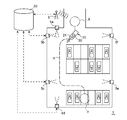
- FIG. 2 is an explanatory diagram showing an example of a specific configuration of the vehicle guidance system 1.
- the vehicle guidance system 1 shown in FIG. 2 guides the vehicle 20 from the control start position X to the target position Y.
- the vehicle guidance system 1 can be used, for example, as a system for moving the vehicle 20 to an appropriate target position in a motor pool, a vehicle production factory, a warehouse, or the like.
- a plurality of (six in the example of FIG. 2) detection devices 5a to 5f are used to cover the entire range of the area in which the vehicle 20 can travel as a detection range.
- detection device 5" When no distinction is required, it is collectively referred to as "detection device 5").
- the plurality of detection devices 5 acquire information capable of determining whether or not an object exists within the detection range, and output the detection information to the vehicle position identification device 50.
- Each detection device 5 outputs a signal to the vehicle positioning device 50 via a wired or wireless communication means.
- the vehicle position specifying device 50 determines whether or not the detected unit 21 is detected based on the detection information transmitted from the plurality of detection devices 5. When the detected unit 21 is detected, the vehicle position specifying device 50 identifies the position of the vehicle 20 on the map data based on the information of the detected unit 21. For example, the vehicle positioning device 50 calculates the distance from one or more detection devices 5 to the detected unit 21 based on the detection information transmitted from the detection device 5.
- the vehicle position identification device 50 stores information on the installation position and detection range on the map data of the respective detection devices 5a to 5f, and the vehicle position identification device 50 is transmitted from the respective detection devices 5. Based on the detection information, the relative position of the detected unit 21 with respect to a predetermined reference position on the map data is calculated. For example, the vehicle position specifying device 50 specifies the relative position of the detected unit 21 with the installation positions of the respective detection devices 5a to 5f as reference positions, and specifies the position of the detected unit 21 on the map data. The identified position of the detected unit 21 corresponds to the position of the vehicle 20 on the map data.
- the vehicle position specifying device 50 determines that the detected unit 21 is detected by the two detection devices 5b and 5f based on the detection information transmitted from the respective detection devices 5a to 5f.
- the vehicle position specifying device 50 identifies the position of the detected unit 21 on the map data while comparing it with the information on the installation positions of the detection devices 5b and 5f stored in advance. Instead of the vehicle positioning device 50 acquiring the detection information of all the detection devices 5a to 5f, the detection information is transmitted from only one of the detection devices 5 that detected the detected unit 21 to the vehicle positioning device 50. May be good.
- the vehicle position specifying device 50 may specify at least one of the direction, the vehicle speed, and the traveling direction of the vehicle 20 based on the detection information transmitted from the detection device 5. In the present embodiment, the vehicle position specifying device 50 identifies the direction of the vehicle 20 based on the information of the form of the detected unit 21 detected by the detection device 5. Further, the vehicle position specifying device 50 can specify the vehicle speed and the traveling direction of the vehicle 20 based on the change in the position of the detected unit 21 detected by the detection device 5.
- the vehicle position specifying device 50 sets the target position of the vehicle 20 after a predetermined time based on the information on the position, direction, vehicle speed, and traveling direction of the vehicle 20 on the map data.
- the vehicle position specifying device 50 transmits information on the position of the vehicle 20 on the map data and the target position of the vehicle 20 after a predetermined time to the vehicle 20 via the base station 9 and the communication network at predetermined time intervals. ..
- the vehicle position specifying device 50 receives detection information from the detection device 5 at predetermined time intervals, and determines the position of the vehicle 20 and the target position information after the predetermined time obtained by executing the predetermined arithmetic processing. It is transmitted to the vehicle 20 every hour.
- the predetermined time may be appropriately set based on the processing speed of the vehicle position specifying device 50 and the like.
- the vehicle control device 30 mounted on the vehicle 20 receives the information transmitted from the vehicle position specifying device 50, and controls the traveling of the vehicle 20 based on the information. As a result, the steering angle, speed, or acceleration of the vehicle 20 is adjusted at predetermined time intervals, and the vehicle 20 is guided to the target position Y along the basic route R while preventing contact between the vehicle 20 and other vehicles. Can be done.
- the detected portion 21 is provided so as to extend upward to a height exceeding at least the rooftop of the vehicle 20.
- the detection device 5 can detect the detected unit 21 without being obstructed by other vehicles, obstacles, or the like, and the certainty of specifying the position of the vehicle 20 is enhanced.
- the detected unit 21 is configured so that at least the orientation of the vehicle 20 can be specified.
- some configuration examples of the detected unit 21 applicable to the vehicle guidance system 1 according to the present embodiment will be described.
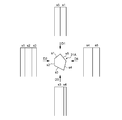
- FIG. 3 is an explanatory diagram showing a first configuration example of the detected unit 21.
- FIG. 3 is an explanatory view showing a planar shape when the detected portion 21A according to the first configuration example is viewed from above and how the detected portion 21A looks when viewed from the four directions indicated by arrows. be.
- the detected unit 21A according to the first configuration example is suitable when the detection device 5 is an imaging camera or a LiDAR device.
- the planar shape of the detected portion 21A when viewed from above is a pentagon that is not a regular pentagon.
- the shape of the detected portion 21A differs depending on the viewing direction from the horizontal direction. "Different shapes" here does not mean that the contours of the outer shape are different, but that the appearance of surfaces, ridges, etc. is different even if the contours of the outer shape are the same.
- the fifth surface s5 and the first surface s1 appear to be arranged at equal intervals in order from the left side. Further, when the detected portion 21A is viewed from the direction of the arrow D2, the first surface s1, the second surface s2, and the third surface s3 can be seen side by side in order from the left side. In this case, the width of the central second surface s2 looks large. Further, when the detected portion 21A is viewed from the direction of the arrow D3, the third surface s3 and the fourth surface s4 can be seen side by side in order from the left side.
- the width of the third surface s3 on the left side looks larger than the width of the fourth surface s4.
- the fourth surface s4 and the fifth surface s5 can be seen side by side in order from the left side.
- the width of the fourth surface s4 on the left side looks slightly larger than the width of the fifth surface s5.
- the width of the entire contour appears to be larger than that when viewed from the arrows D1 and D3.
- the vehicle positioning device 50 determines how the detected unit 21A looks based on the detection information transmitted from the detecting device 5, and how the detected unit 21A is arranged with respect to the detecting device 5. It is possible to identify whether or not it is. Then, the vehicle position specifying device 50 can specify the direction of the vehicle 20 in light of the information on the arrangement state of the detected unit 21A in the vehicle 20 stored in advance.
- the plane shape of the detected portion 21A according to the first configuration example is a pentagon when viewed from above, but the plane shape is not limited to the pentagon.
- the planar shape of the detected portion 21A may be any shape other than the perfect circular shape and the regular polygonal shape, which looks different depending on the viewing direction.
- the detection device 5 is an imaging camera
- the surfaces s1 to s5 of the detected portion 21A according to the first configuration example may be colored in different colors. Thereby, the direction in which the detected portion 21A is viewed can be more easily specified.
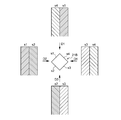
- FIG. 4 is an explanatory diagram showing a second configuration example of the detected unit 21.
- FIG. 4 is an explanatory view showing a planar shape when the detected portion 21B according to the second configuration example is viewed from above and a view when the detected portion 21B is viewed from the four directions indicated by arrows. be.
- the detected unit 21B according to the second configuration example is suitable when the detection device 5 is an imaging camera.
- the detected portion 21B has a square shape when viewed from above.
- the four side surfaces s1 to s4 of the detected portion 21B are arranged in different colors. Therefore, the color scheme of the detected unit 21B differs depending on the viewing direction from the horizontal direction.
- the fourth surface s4 and the first surface s1 can be seen side by side in order from the left side. Further, when the detected portion 21B is viewed from the direction of the arrow D2, the first surface s1 and the second surface s2 appear side by side in order from the left side. Further, when the detected portion 21B is viewed from the direction of the arrow D3, the second surface s2 and the third surface s3 can be seen side by side in order from the left side. Further, when the detected portion 21B is viewed from the direction of the arrow D4, the third surface s3 and the fourth surface s4 can be seen side by side in order from the left side. When viewed from the four directions shown in FIG. 4, the outline of the outer shape of the detected portion 21B and the composition ratio of the width of each surface look the same, but the color scheme is different. , The direction in which the detected unit 21B is viewed can be specified.
- the reflectance may be different instead of different the color scheme of each surface s1 to s4.
- the configuration in which the reflectances of the surfaces s1 to s4 are different is suitable when the detection device 5 is a radar sensor or a LiDAR device.
- the direction in which the detected unit 21B is viewed can be specified by the difference in the density distribution of the reflected waves detected by the detection device 5.
- the reflectance can be varied, for example by adjusting the surface roughness.
- the vehicle position identification device 50 determines the color scheme of the detected unit 21B and the distribution of the density of the reflected wave based on the detection information transmitted from the detection device 5, so that the detected unit 21B refers to the detection device 5. It is possible to identify how they are arranged. Then, the vehicle position specifying device 50 can specify the direction of the vehicle 20 in light of the information on the arrangement state of the detected unit 21B in the vehicle 20 stored in advance.
- the detected portion 21B according to the second configuration example had a square plane shape when viewed from above, but the plane shape is not limited to a square shape.
- the planar shape of the detected portion 21B is not particularly limited, and the color scheme may differ depending on the viewing direction.
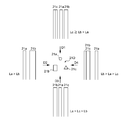
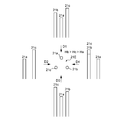
- FIG. 5 is an explanatory diagram showing a third configuration example of the detected unit 21.
- FIG. 5 shows the arrangement positions of the detected portions 21a to 21c when the detected portions 21C according to the third configuration example are viewed from above, and the detected portions 21C viewed from the four directions indicated by the arrows. It is explanatory drawing which shows the appearance of the case.
- the detected unit 21C according to the third configuration example is suitable when the detection device 5 is an imaging camera, a radar sensor, an ultrasonic sensor, or a LiDAR device.
- the detected unit 21C according to the third configuration example is composed of a plurality of detected units 21a to 21c having the same shape, and the arrangement position seen from above shown in FIG. 5 forms a triangle that is not an equilateral triangle. ing.
- the appearance of the detected portion 21C differs depending on the viewing direction from the horizontal direction.
- the term "different in appearance" as used herein means that the overall width of the plurality of detected portions 21a to 21c and the spacing between the plurality of detected portions 21a to 21c are different.
- the third detected unit 21c, the first detected unit 21a, and the second detected unit 21b can be seen side by side in this order from the left side.
- the first detected portion 21a appears closer to the second detected portion 21b side (right side) than the third detected portion 21c.
- the first detected unit 21a, the third detected unit 21c, and the second detected unit 21b can be seen side by side in this order from the left side.
- the third detected portion 21c appears closer to the second detected portion 21b side (right side) than the first detected portion 21a.
- the second detected unit 21b, the first detected unit 21a, and the third detected unit 21c can be seen side by side in this order from the left side.
- the first detected portion 21a appears closer to the second detected portion 21b side (left side) than the third detected portion 21c.
- the second detected portion 21b, the third detected portion 21c, and the first detected portion 21a can be seen side by side in this order from the left side.
- the third detected portion 21c is seen closer to the second detected portion 21b side (left side) than the first detected portion 21a.
- the width of the entire contour appears to be larger than that when viewed from the arrows D1 and D3.
- the vehicle position specifying device 50 determines how the detected unit 21C looks based on the detection information transmitted from the detecting device 5, so that the detected unit 21C is arranged with respect to the detecting device 5. It is possible to identify whether or not it is. Then, the vehicle position specifying device 50 can specify the direction of the vehicle 20 in light of the information on the arrangement state of the detected unit 21C in the vehicle 20 stored in advance.
- the detected portion 21C according to the third configuration example is composed of three detected portions 21a to 21c, and the planar shape viewed from above is arranged in a triangle, but the number and arrangement of the plurality of detected portions are arranged.
- the planar shape of is not limited to this example. It suffices that the width of the plurality of detected parts and the distance between the detected parts are different depending on the viewing direction.
- the detected units 21a to 21c constituting the detected unit 21C according to the third configuration example may be colored in different colors.
- each of the detected units 21a to 21c constituting the detected unit 21C according to the third configuration example may be configured with different reflectances. Thereby, the direction in which the detected unit 21C is viewed can be more easily specified.
- the detection device 5 can measure the distance to each of the detected units 21a to 21c constituting the detected unit 21C according to the third configuration example
- the detected unit 21C can be detected by using the information of the distance. You can specify the direction you are looking at.
- FIG. 5 shows the magnitude relationship of the distances La, Lb, and Lc from the detection device 5 to the respective detected portions 21a to 21c. In this way, the distances La, Lb, and Lc from the detection device 5 to the respective detected units 21a to 21c differ depending on the direction in which the detected unit 21C is viewed. You can specify the direction you are looking at.
- FIG. 6 is an explanatory diagram showing a fourth configuration example of the detected unit 21.
- FIG. 6 shows the arrangement positions of the detected portions 21a to 21c when the detected portion 21D according to the fourth configuration example is viewed from above, and the detected portion 21D viewed from the four directions indicated by the arrows. It is explanatory drawing which shows the appearance of the case.
- the detected unit 21D according to the fourth configuration example is suitable when the detection device 5 is an imaging camera, a radar sensor, an ultrasonic sensor, or a LiDAR device.
- the detected unit 21D according to the fourth configuration example includes a plurality of detected units 21a to 21c having different forms.
- the first detected portion 21a has a perfect circular planar shape
- the second detected portion 21b has a rectangular planar shape
- the third detected portion 21c has a triangular planar shape.
- the arrangement position of the detected portion 21D as seen from above shown in FIG. 6 forms an equilateral triangle, the appearance of the detected portion 21D differs depending on the viewing direction from the horizontal direction.
- the term "different in appearance" as used herein means that the overall width of the plurality of detected portions 21a to 21c, the distance between the detected portions 21a to 21c, and the appearance of the ridgeline are different.
- the third detected unit 21c, the first detected unit 21a, and the second detected unit 21b can be seen side by side in this order from the left side.
- the width and the ridge line corresponding to the plane shape of each of the detected portions 21a to 21c are visible.
- the first detected unit 21a and the second detected unit 21b can be seen side by side in order from the left side.
- the third detected portion 21c overlaps and hides the second detected portion 21b.
- the second detected unit 21b, the first detected unit 21a, and the third detected unit 21c can be seen side by side in this order from the left side.
- the width and the ridge line corresponding to the plane shape of each of the detected portions 21a to 21c are visible.
- the second detected unit 21b, the third detected unit 21c, and the first detected unit 21a can be seen side by side in this order from the left side.
- the second detected portion 21b and the third detected portion 21c overlap each other, and the second detected portion 21b is visible behind the third detected portion 21c.
- the width of the entire contour looks slightly smaller than that when viewed from the arrows D1 and D3.
- the vehicle position specifying device 50 determines how the detected unit 21D looks based on the detection information transmitted from the detection device 5, so that the detected unit 21D is arranged with respect to the detection device 5. It is possible to identify whether or not it is. Then, the vehicle position specifying device 50 can specify the direction of the vehicle 20 in light of the information on the arrangement state of the detected unit 21D in the vehicle 20 stored in advance.
- the detected unit 21D according to the fourth configuration example is composed of three detected units 21a to 21c, and the planar shape viewed from above is arranged in an equilateral triangle.
- the planar shape of the arrangement is not limited to this example. Further, all the planar shapes of the plurality of detected portions 21D may not be different, and the planar shapes of some of the detected portions may be different. It suffices that the width of the plurality of detected parts and the distance between the detected parts are different depending on the viewing direction.
- the detected units 21a to 21c constituting the detected unit 21D according to the fourth configuration example may be arranged in different colors. Further, when the detection device 5 is a radar sensor or RiDAR, each of the detected units 21a to 21c constituting the detected unit 21D according to the fourth configuration example may be configured with different reflectances. Thereby, the direction in which the detected unit 21D is viewed can be more easily specified. Further, when the detection device 5 can measure the distances La, Lb, and Lc from the detected units 21a to 21c constituting the detected unit 21D according to the fourth configuration example, the information of the distance is used. , The direction in which the detected unit 21D is viewed can be specified.
- FIG. 7 is an explanatory diagram showing a fifth configuration example of the detected unit 21.
- FIG. 7 shows the arrangement positions of the detected portions 21a to 21c when the detected portions 21E according to the fifth configuration example are viewed from above, and the detected portions 21E viewed from the four directions indicated by the arrows. It is explanatory drawing which shows the appearance of the case.
- the detected unit 21E according to the fifth configuration example is suitable when the detection device 5 is an imaging camera, a radar sensor, an ultrasonic sensor, or a LiDAR device.
- the detected portion 21E according to the fifth configuration example is composed of a plurality of detected portions 21a to 21c having different heights. The height is increased in the order of the first detected portion 21a, the second detected portion 21b, and the third detected portion 21c.
- the arrangement position of the detected portion 21D as seen from above shown in FIG. 7 forms an equilateral triangle, the appearance of the detected portion 21D differs depending on the viewing direction from the horizontal direction.
- the term "different in appearance" as used herein means that the overall width of the plurality of detected portions 21a to 21c, the spacing between the detected portions 21a to 21c, and the arrangement position are different.
- the second detected unit 21b, the first detected unit 21a, and the third detected unit 21c can be seen side by side in this order from the left side.
- the first detected portion 21a and the third detected portion 21c can be seen side by side in order from the left side.
- the second detected portion 21b overlaps and hides the third detected portion 21c.
- the second detected unit 21b, the third detected unit 21c, and the first detected unit 21a can be seen side by side in this order from the left side.
- the second detected portion 21b and the third detected portion 21c overlap each other, and the third detected portion 21c is visible behind the second detected portion 21b.
- the width of the entire contour appears to be slightly smaller than that when viewed from the arrows D1 and D3.
- the detected portion 21E according to the fifth configuration example has a different width of the entire contour, an interval between the detected portions 21a to 21c, and an arrangement position depending on the viewing direction. Therefore, the vehicle position specifying device 50 determines how the detected unit 21E looks based on the detection information transmitted from the detection device 5, so that the detected unit 21E is arranged with respect to the detection device 5. It is possible to identify whether or not it is. Then, the vehicle position specifying device 50 can specify the direction of the vehicle 20 in light of the information on the arrangement state of the detected unit 21E in the vehicle 20 stored in advance.
- the detected unit 21E according to the fifth configuration example is composed of three detected units 21a to 21c, and the planar shape viewed from above is arranged in an equilateral triangle.
- the planar shape of the arrangement is not limited to this example. Further, all the planar shapes of the plurality of detected portions 21E may not be different, and the planar shapes of some of the detected portions may be different. It suffices that the width of the plurality of detected parts and the distance between the detected parts are different depending on the viewing direction.
- the detected units 21a to 21c constituting the detected unit 21E according to the fifth configuration example may be arranged in different colors.
- the detection device 5 is a radar sensor or RiDAR
- the detected units 21a to 21c constituting the detected unit 21E according to the fifth configuration example may be configured with different reflectances. Thereby, the direction in which the detected unit 21E is viewed can be more easily specified.
- the detection device 5 can measure the distances La, Lb, and Lc from the detected units 21a to 21c constituting the detected unit 21D according to the fourth configuration example, the information of the distance is used. , The direction in which the detected unit 21D is viewed can be specified.
- FIG. 8 is a block diagram showing a configuration example of the vehicle position specifying device 50 and the vehicle control device 30.
- the vehicle position specifying device 50 calculates the current position of the vehicle 20 and the target position after a predetermined time, and transmits the vehicle control information including the information to the vehicle control device 30.
- the vehicle control device 30 sets target control amounts of various control systems based on the received information, and transmits the information of the target control amounts to each control system.
- the vehicle position specifying device 50 includes a first communication unit 51, a second communication unit 52, a detection information processing unit 53, a vehicle control information setting unit 54, and a storage unit 55.
- a part or all of the vehicle positioning device 50 may be composed of, for example, a microcomputer, a microprocessor unit, or the like, or may be composed of an updatable device such as firmware. Further, a part or all of the vehicle position specifying device 50 may be a program module or the like executed by a command from a CPU (Central Processing Unit) or the like.
- CPU Central Processing Unit
- the storage unit 55 is a storage element such as a RAM (Random Access Memory) or a ROM (Read Only Memory), or an HDD (Hard Disk Drive), a CD (Compact Disc), a DVD (Digital Versatile Disc), or an SSD (Solid State Drive). ), USB (Universal Serial Bus) flash, including at least one storage medium such as a storage device.
- the storage unit 55 stores programs executed by a microcomputer or the like, parameters used for various arithmetic processes, arithmetic results, detection information of various sensors, and the like.
- the storage unit 55 stores information on the installation position of one or more detection devices 5 installed in the specific area on the map data.
- the storage unit 55 of the vehicle position specifying device 50 contains information on the target position for guiding the vehicle 20 and information on the basic route for guiding the vehicle 20 to the target position. Is remembered.
- the target position information may be set by the user inputting it to the vehicle position specifying device 50, or may be set by a computer determining an empty space or the like in the specific area, and is transmitted from the vehicle control device 30. It may be set by.
- the basic route information may be set by the user inputting the information to the vehicle position specifying device 50, or may be set by being transmitted from the vehicle control device 30.
- the storage unit 55 stores information on the form of the detected unit 21 provided in the vehicle 20 and information on how the detected unit 21 is installed in the vehicle 20.
- the first communication unit 51 is an interface for communicating between the detection device 5 and the vehicle position identification device 50.
- the vehicle position specifying device 50 receives a signal output from the detection device 5 via the first communication unit 51.
- the second communication unit 52 is an interface for communicating between the vehicle control device 30 and the vehicle position identification device 50.
- the vehicle positioning device 50 transmits a signal to the vehicle control device 30 via the base station 9 and the communication network by the second communication unit 52.
- the detection information processing unit 53 performs various arithmetic processes using the detection information of the detection device 5.
- the detection information processing unit 53 may be a function realized by executing a program by a microcomputer or the like.
- the detection information processing unit 53 identifies the position and orientation of the vehicle 20 based on the detection information transmitted from the detection device 5. Specifically, the detection information processing unit 53 detects the map data stored in the storage unit 55, the installation position of each detection device 5 on the map data, and the detection device 5 detected by each detection device 5 with respect to a predetermined reference position. The position of the detected unit 21 on the map data is calculated based on the information on the relative position of the unit 21.
- the detection information processing unit 53 specifies the position of the detected unit 21 as the position of the vehicle 20.
- the detection information processing unit 53 describes the form (appearance) of the detected unit 21 detected by the detection device 5 with the information on the form of the detected unit 21 stored in the storage unit 55 and the detection of the vehicle 20.
- the orientation of the vehicle 20 is specified in light of the information on how the unit 21 is installed.
- the detection information processing unit 53 may specify the vehicle speed and the traveling direction of the vehicle 20 based on the detection information of the detection device 5.
- the vehicle control information setting unit 54 sets the target position of the vehicle 20 after a predetermined time.
- the vehicle control information setting unit 54 may be a function realized by executing a program by a microcomputer or the like.
- the vehicle control information setting unit 54 sets the target position of the vehicle 20 after a predetermined time based on the specified position, orientation, and basic route information of the vehicle 20.
- the vehicle control information setting unit 54 transmits the set target position information to the vehicle control device 30 mounted on the vehicle 20 via the second communication unit 52.
- the vehicle position specifying device 50 identifies the position of the vehicle 20 based on the detection information transmitted from the detection device 5, sets the target position of the vehicle 20 after a predetermined time, and provides information on the position and the target position of the vehicle 20. Is executed at predetermined time intervals.
- the vehicle control device 30 includes a communication unit 31 and a control information calculation unit 33.
- a part or all of the vehicle control device 30 may be composed of, for example, a microcomputer, a microprocessor unit, or the like, or may be composed of an updatable one such as firmware. Further, a part or all of the vehicle control device 30 may be a program module or the like executed by a command from a CPU or the like.
- the vehicle control device 30 includes a storage unit (not shown) such as a RAM or a ROM. Map data including at least information on a specific area is stored in the storage unit. Further, the storage unit stores information on the target position for guiding the vehicle 20 and information on the basic route for guiding the vehicle 20 to the target position. The information of the target position may be set by the input of the user, or may be set based on the information transmitted from the external device for determining the empty space or the like in the specific area. Further, the basic route information may be set by the input of the user, or may be set by a computer or the like.
- the vehicle control device 30 has a function as an integrated control device that outputs control commands to the control devices 41, 43, and 45 that control a plurality of control systems.
- the vehicle control device 30 may be composed of one electronic control unit, or may be composed of a plurality of electronic control units capable of communicating with each other.
- the control devices 41, 43, and 45 are, for example, a power control device that controls an internal combustion engine, an electric motor, etc., which are the power sources of the vehicle 20, and a transmission that shifts the rotational torque output from the power source and transmits it to the drive wheels. It includes at least one of a transmission control device for controlling a power transmission mechanism including the above, a brake control device for controlling a hydraulic or electric brake system, a steering control device for controlling a rotation angle of a steering wheel, and the like.
- the communication unit 31 is an interface for communicating between the vehicle control device 30 and the vehicle position identification device 50. At least, the vehicle control device 30 receives the signal transmitted from the vehicle control device 30 via the communication network by the communication unit 31.
- the control information calculation unit 33 sets a target control amount of each control system based on the information transmitted from the vehicle position specifying device 50, and transmits the set target control amount information to the respective control devices 41, 43, 45. do.
- the control information calculation unit 33 may be a function realized by executing a program by a microcomputer or the like.
- the control information calculation unit 33 sets the target steering angle and target acceleration of the vehicle 20 based on the current position, orientation, and target position information of the vehicle 20 after a predetermined time transmitted from the vehicle position specifying device 50. do. Further, the control information calculation unit 33 sets the target control amount of each control system based on the set target steering angle and target acceleration information of the vehicle 20. At this time, an upper limit may be set for the amount of change (change speed) of the operation amount of each control system so that sudden steering or sudden acceleration of the vehicle 20 does not occur.
- control information calculation unit 33 detects other vehicles, obstacles, etc. around the vehicle 20 based on the sensor signals of the sensor device provided in the vehicle 20, and controls each so as not to come into contact with these other vehicles.
- the target control amount set for the purpose of avoiding contact with other vehicles or the like is prioritized over the target control amount set based on the information transmitted from the vehicle position specifying device 50.
- the vehicle 20 may deviate from the basic route to the target position, but the vehicle 20 is controlled according to the target control amount set based on the information transmitted from the vehicle position specifying device 50 thereafter. Therefore, the vehicle 20 can be returned to the basic route.
- the vehicle 20 is controlled based on the information of the position of the vehicle 20 transmitted from the vehicle position specifying device 50 and the target position of the vehicle 20 after a predetermined time. Therefore, the vehicle 20 can be guided from the control start position X to the target position Y while ensuring the safety of the vehicle 20.
- FIG. 9 is a flowchart showing an operation example of the vehicle position specifying device 50.
- the detection information processing unit 53 of the vehicle position specifying device 50 acquires the detection information transmitted from the detection devices 5a to 5f via the first communication unit 51 (step S11).
- the detection information processing unit 53 identifies the detection device 5 that is detecting the detected unit 21 based on the acquired detection information of the detection devices 5a to 5f (step S13).
- the detection device 5 does not detect an object other than the detected unit 21.
- the detected unit 21 extends upward to a height exceeding the rooftop of the vehicle 20 and is provided on the vehicle 20, and the vehicle body and obstacles other than the detected unit 21 are provided in the detection range of the detection device 5. Is designed to not exist. Therefore, the detection information processing unit 53 can identify the detection device 5 that is detecting the detected unit 21 based on the detection information of the detection device 5.
- the detection information processing unit 53 may specify the detection device 5 that detects the detected unit 21 in light of the information in the form of the detected unit 21 stored in advance.
- the detection information processing unit 53 identifies the position and orientation of the vehicle 20 based on the information of the detected unit 21 detected by the detection device 5 (step S15). As described above, the detection information processing unit 53 detects the map data stored in the storage unit 55, the installation position of each detection device 5 on the map data, and the detection detected by each detection device 5 with respect to a predetermined reference position. The position of the detected unit 21 on the map data is calculated based on the information on the relative position of the unit 21. The detection information processing unit 53 specifies the position of the detected unit 21 as the position of the vehicle 20.
- the detection information processing unit 53 describes the form (appearance) of the detected unit 21 detected by the detection device 5 with the information on the form of the detected unit 21 stored in the storage unit 55 and the detection of the vehicle 20.
- the orientation of the vehicle 20 is specified in light of the information on how the unit 21 is installed.
- the detection information processing unit 53 specifies the vehicle speed and the traveling direction of the vehicle 20 based on the detection information of the detection device 5. For example, the detection information processing unit 53 can obtain the vehicle speed and the traveling direction of the vehicle 20 based on the change in the position of the detected unit 21 detected by the detection device 5.
- the vehicle control information setting unit 54 determines the target position of the vehicle 20 after a predetermined time based on the stored basic route information and the information on the position, direction, vehicle speed, and traveling direction of the vehicle 20.
- the vehicle control information setting unit 54 transmits the set target position information of the vehicle 20 and the current position information of the vehicle 20 to the vehicle control device 30 via the second communication unit 52 and the communication network. (Step S19).
- the vehicle position specifying device 50 repeatedly executes each process from step S11 to step S19 at predetermined time intervals set in advance.
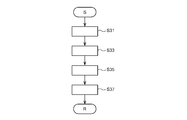
- FIG. 10 is a flowchart showing an operation example of the vehicle control device 30.
- the control information calculation unit 33 of the vehicle control device 30 obtains information on the target position of the vehicle 20 after a predetermined time and information on the current position of the vehicle 20 transmitted from the vehicle position identification device 50 via the communication unit 31. Acquire (step S31).
- control information calculation unit 33 sets the target steering angle and the target acceleration of the vehicle 20 based on the received target position of the vehicle 20 after a predetermined time and the information of the current position of the vehicle 20 (step S33). ..
- the control information calculation unit 33 sets the target control amount of each control system based on the set target steering angle and target acceleration information (step S35). Specifically, the control information calculation unit 33 sets the target control amount of the steering control system based on the information of the target steering angle.
- the target control amount is, for example, a target value of the rotation angle.
- control information calculation unit 33 sets the target control amount of the power transmission mechanism including the power source such as the internal combustion engine and the drive motor, the transmission and the like, and the brake control device based on the information of the target acceleration.
- the target control amount of the power source is the target value of the output torque
- the target control amount of the power transmission mechanism is the target value of the gear ratio
- the target control amount of the brake control device is the target value of the braking force.
- the control information calculation unit 33 sets a target control amount of each control system so as to avoid the contact.
- This target control amount may be a command for executing emergency braking control, or may be a command for making a sharp turn of the vehicle 20.
- control information calculation unit 33 transmits the information of the target control amount of each set control system to the control devices 41, 43, 45 (step S37).
- the control devices 41, 43, and 45 that have received the target control amount information control each control system based on the target control amount.
- the vehicle control device 30 repeatedly executes each process from step S31 to step S37 at predetermined time intervals set in advance. As a result, the vehicle 20 is guided to the target position Y along the basic route based on the highly accurate position information transmitted from the vehicle position specifying device 50.
- the detection device 5 installed outside the vehicle 20 does not interfere with other vehicles or obstacles.
- the detected portion 21 provided in the vehicle 20 can be detected. Therefore, the vehicle position specifying device 50 that receives the detection information transmitted from the detection device 5 can accurately identify the position of the vehicle 20 based on the detection information of the detected unit 21.
- the vehicle position specifying device 50 can specify the direction of the vehicle 20 based on the detection information of the detected unit 21 detected by the detection device 5. .. Further, the vehicle position specifying device 50 can calculate the speed and the traveling direction of the vehicle 20 based on the change in the position of the detected unit 21 detected by the detection device 5. Therefore, the vehicle position specifying device 50 can set the target position of the vehicle 20 after a predetermined time based on the information of the current position of the vehicle 20 specified with high accuracy, and can transmit it to the vehicle control device 30.
- the vehicle control device 30 can safely drive the vehicle 20 along the basic route from the control start position X to the target position Y.
- the vehicle 20 is provided with the three detected portions 21a to 21c, but the present invention is not limited to such an example.
- the number of detected portions may be two or four or more.
- the second detected part 21b and the third detected part 21c overlap each other, and if the distances to the three detected parts 21a to 21c cannot be detected, the vehicle 20 Cannot specify the direction of.
- at least three detectors appear to be arranged differently regardless of the viewing direction. Therefore, the orientation of the vehicle 20 can be specified. Even when the number of detected portions is other than 3, the form of at least one detected portion may be different.
- the vehicle position specifying device 50 installed outside the vehicle 20 calculates the target position of the vehicle 20 after a predetermined time and transmits the information of the target position to the vehicle control device 30.
- the present invention is not limited to such an example.
- the vehicle position specifying device 50 may specify only the position of the vehicle 20 on the map data and transmit only the information on the position of the vehicle 20 to the vehicle control device 30.
- the vehicle control device 30 controls the traveling of the vehicle 20 so that the vehicle 20 can reach the target position Y along the basic route by using the position information of the vehicle 20 specified with high accuracy. be able to.
- the vehicle position specifying device 50 obtains the relative position of the detected unit 21 with the installation position of the detection device 5 as a reference position, but the present invention is not limited to such an example. For example, based on the information on the relative position of the detection device 5 with respect to the appropriate reference position and the information on the relative position of the detected unit 21 with respect to the installation position of the detection device 5, the relative position of the detected unit 21 with respect to the appropriate reference position. May be sought.
- the position of the detected unit 21 on the map data can also be specified by the information on the relative position of the detected unit 21 obtained in this way.
- the above embodiment is an example of guiding the vehicle 20 along the basic route from the control start position X to the target position Y
- the vehicle position specifying device 50 is an example of the vehicle 20 based on the detection information of the detection device 5.
- control was performed, the present invention is not limited to such an example.
- the vehicle position specifying device 50 when the vehicle guidance system 1 is applied to the on-site distribution system, the vehicle position specifying device 50 further sets the target position Y of the vehicle 20 based on information on the operating status such as the production speed, the shipping speed, and the shipping status of the production line.
- the target arrival time to the target and the target position after a predetermined time may be set.
- the vehicle position specifying device 50 may specify the positions of a plurality of vehicles 20 at the same time.
- the form of the detected unit 21 is different for each vehicle 20, and the vehicle control device 30 transmits the information on the form of the detected unit 21 to the vehicle position specifying device 50 together with the information such as the identification code of the own vehicle 20. do.
- the vehicle position specifying device 50 identifies the target vehicle based on the form of the detected unit 21 detected by the detection device 5, and transmits information on the position corresponding to each vehicle 20 and the target position after a predetermined time. Can be done.
- the vehicle guidance system 1 can be applied to, for example, a human transportation system at an airport or an event venue, or an automatic vehicle driving system for moving a vehicle or other transportation object to a predetermined target position.
- the vehicle guidance system 1 may also be applied to an automatic valet parking (AVP) system.
- AVP automatic valet parking
- the vehicle position specifying device 50 controls to guide the vehicle 20 along the basic route set from the delivery position of the vehicle 20 to the parking position (target position) set in the specific parking area. ..
- the vehicle positioning device 50 may include a plurality of devices, and the functions of the vehicle positioning device 50 described above may be distributed and provided in the plurality of devices.
- the server (first device) of the host system specifies a parking position according to various conditions and a basic route to the parking position.
- the server (second device) of the lower system has a function to set and transmit the control information of the vehicle 20 based on the detection information of the detection device 5 according to the basic route received from the upper system. You may.
Landscapes
- Engineering & Computer Science (AREA)
- Radar, Positioning & Navigation (AREA)
- Remote Sensing (AREA)
- Physics & Mathematics (AREA)
- General Physics & Mathematics (AREA)
- Automation & Control Theory (AREA)
- Computer Networks & Wireless Communication (AREA)
- Electromagnetism (AREA)
- Chemical & Material Sciences (AREA)
- Combustion & Propulsion (AREA)
- Transportation (AREA)
- Mechanical Engineering (AREA)
- Traffic Control Systems (AREA)
Priority Applications (4)
| Application Number | Priority Date | Filing Date | Title |
|---|---|---|---|
| EP21774618.9A EP4131206A4 (en) | 2020-03-25 | 2021-02-11 | SYSTEM FOR IDENTIFYING A VEHICLE POSITION AND DEVICE FOR IDENTIFYING A VEHICLE POSITION |
| CN202180023847.XA CN115315737A (zh) | 2020-03-25 | 2021-02-11 | 车辆位置确定系统及车辆位置确定装置 |
| JP2022509386A JPWO2021192701A1 (https=) | 2020-03-25 | 2021-02-11 | |
| US17/913,960 US20230160700A1 (en) | 2020-03-25 | 2021-02-11 | Vehicle locating system and vehicle locating device |
Applications Claiming Priority (2)
| Application Number | Priority Date | Filing Date | Title |
|---|---|---|---|
| JP2020-054412 | 2020-03-25 | ||
| JP2020054412 | 2020-03-25 |
Publications (1)
| Publication Number | Publication Date |
|---|---|
| WO2021192701A1 true WO2021192701A1 (ja) | 2021-09-30 |
Family
ID=77891437
Family Applications (1)
| Application Number | Title | Priority Date | Filing Date |
|---|---|---|---|
| PCT/JP2021/005123 Ceased WO2021192701A1 (ja) | 2020-03-25 | 2021-02-11 | 車両位置特定システム及び車両位置特定装置 |
Country Status (5)
| Country | Link |
|---|---|
| US (1) | US20230160700A1 (https=) |
| EP (1) | EP4131206A4 (https=) |
| JP (1) | JPWO2021192701A1 (https=) |
| CN (1) | CN115315737A (https=) |
| WO (1) | WO2021192701A1 (https=) |
Citations (2)
| Publication number | Priority date | Publication date | Assignee | Title |
|---|---|---|---|---|
| US6023218A (en) * | 1998-08-06 | 2000-02-08 | Tremblay; Steven | Locating and alarm system for a motor vehicle |
| US20040105010A1 (en) * | 2000-06-30 | 2004-06-03 | Karl Osen | Computer aided capturing system |
Family Cites Families (15)
| Publication number | Priority date | Publication date | Assignee | Title |
|---|---|---|---|---|
| JP4536614B2 (ja) * | 2005-07-19 | 2010-09-01 | 本田技研工業株式会社 | 電子キーの位置情報表示装置 |
| US7385526B1 (en) * | 2006-04-07 | 2008-06-10 | Joseph Bullard | Vehicle locating device |
| US9085236B2 (en) * | 2013-05-09 | 2015-07-21 | Robert Bosch Gmbh | Adaptive cruise control with stationary object recognition |
| EP3246776B1 (en) * | 2014-05-30 | 2020-11-18 | SZ DJI Technology Co., Ltd. | Systems and methods for uav docking |
| JP6635428B2 (ja) * | 2015-05-20 | 2020-01-22 | 修一 田山 | 自動車周辺情報表示システム |
| DE102015217923A1 (de) * | 2015-09-18 | 2017-03-23 | Robert Bosch Gmbh | Sicherung eines Kraftfahrzeugs |
| KR101755311B1 (ko) * | 2016-02-19 | 2017-07-07 | 현대자동차주식회사 | 위치 인식 장치, 그를 가지는 차량 및 그 제어 방법 |
| DE112016006745T5 (de) * | 2016-04-15 | 2018-12-27 | Honda Motor Co., Ltd. | Fahrzeugsteuersystem, Fahrzeugsteuerverfahren und Fahrzeugsteuerprogramm |
| JP6834685B2 (ja) * | 2017-03-29 | 2021-02-24 | アイシン精機株式会社 | 車両誘導装置、方法及びプログラム |
| CN110770106B (zh) * | 2017-06-23 | 2023-05-05 | 日产自动车株式会社 | 驻车控制方法及驻车控制装置 |
| KR102014261B1 (ko) * | 2017-12-12 | 2019-08-26 | 엘지전자 주식회사 | 차량에 구비된 차량 제어 장치 및 차량의 제어방법 |
| JP6554568B2 (ja) * | 2018-01-24 | 2019-07-31 | 本田技研工業株式会社 | 車両制御装置 |
| JP7021983B2 (ja) * | 2018-03-07 | 2022-02-17 | 本田技研工業株式会社 | 車両制御装置、車両制御方法、およびプログラム |
| US11199413B2 (en) * | 2018-07-19 | 2021-12-14 | Qualcomm Incorporated | Navigation techniques for autonomous and semi-autonomous vehicles |
| MX2021003177A (es) * | 2018-09-21 | 2021-05-27 | Nissan Motor | Metodo de control de vehiculo reservado, dispositivo de control de vehiculo reservado, y sistema de control de vehiculo reservado. |
-
2021
- 2021-02-11 JP JP2022509386A patent/JPWO2021192701A1/ja active Pending
- 2021-02-11 EP EP21774618.9A patent/EP4131206A4/en not_active Withdrawn
- 2021-02-11 US US17/913,960 patent/US20230160700A1/en not_active Abandoned
- 2021-02-11 WO PCT/JP2021/005123 patent/WO2021192701A1/ja not_active Ceased
- 2021-02-11 CN CN202180023847.XA patent/CN115315737A/zh active Pending
Patent Citations (2)
| Publication number | Priority date | Publication date | Assignee | Title |
|---|---|---|---|---|
| US6023218A (en) * | 1998-08-06 | 2000-02-08 | Tremblay; Steven | Locating and alarm system for a motor vehicle |
| US20040105010A1 (en) * | 2000-06-30 | 2004-06-03 | Karl Osen | Computer aided capturing system |
Non-Patent Citations (1)
| Title |
|---|
| See also references of EP4131206A4 * |
Also Published As
| Publication number | Publication date |
|---|---|
| CN115315737A (zh) | 2022-11-08 |
| US20230160700A1 (en) | 2023-05-25 |
| EP4131206A1 (en) | 2023-02-08 |
| EP4131206A4 (en) | 2024-04-24 |
| JPWO2021192701A1 (https=) | 2021-09-30 |
Similar Documents
| Publication | Publication Date | Title |
|---|---|---|
| US11913807B2 (en) | Methods and systems for calibrating sensors using road map data | |
| JP6898394B2 (ja) | 車両の自動運転制御補助方法、車両の自動運転制御補助装置、機器、コンピュータ読み取り可能な記憶媒体及び車路連携システム | |
| US10549780B2 (en) | Driving assistance device for a vehicle | |
| US9880558B2 (en) | Travel control device | |
| CN106080744B (zh) | 自动驾驶车辆系统 | |
| CN110103953B (zh) | 用于辅助车辆的驾驶控制的方法、设备、介质和系统 | |
| US5208750A (en) | Control system for unmanned automotive vehicle | |
| US9081383B1 (en) | Enhancing basic roadway-intersection models using high intensity image data | |
| US9026303B1 (en) | Object detection based on known structures of an environment of an autonomous vehicle | |
| US20200111358A1 (en) | Vehicle path planning | |
| US20190259282A1 (en) | Vehicle and control method thereof | |
| CN110928286B (zh) | 用于控制车辆的自动驾驶的方法、设备、介质和系统 | |
| US10955857B2 (en) | Stationary camera localization | |
| US20200209886A1 (en) | Method for guiding path of unmanned autonomous vehicle and assistant system for unmanned autonomous vehicle therfor | |
| WO2021128028A1 (zh) | 一种自动驾驶车辆的控制方法及装置 | |
| CN108928343A (zh) | 一种全景融合自动泊车系统及方法 | |
| US11787395B2 (en) | Automated valet parking system | |
| JP2021149968A (ja) | 車両の自動運転のための方法およびシステム | |
| JP7188372B2 (ja) | 自動駐車システム | |
| US11840215B2 (en) | Automated valet parking system | |
| US11281224B2 (en) | Vehicle control device | |
| US20180362024A1 (en) | Method For Assisting A Maneuvering Procedure Of A Motor Vehicle, And System For Assisting A Maneuvering Procedure Of A Motor Vehicle | |
| US11119491B2 (en) | Vehicle steering control | |
| US12030483B2 (en) | Automated valet parking system, control method of automated valet parking system, and autonomous driving vehicle | |
| US20210004983A1 (en) | Vehicle pose determination |
Legal Events
| Date | Code | Title | Description |
|---|---|---|---|
| 121 | Ep: the epo has been informed by wipo that ep was designated in this application |
Ref document number: 21774618 Country of ref document: EP Kind code of ref document: A1 |
|
| ENP | Entry into the national phase |
Ref document number: 2022509386 Country of ref document: JP Kind code of ref document: A |
|
| NENP | Non-entry into the national phase |
Ref country code: DE |
|
| ENP | Entry into the national phase |
Ref document number: 2021774618 Country of ref document: EP Effective date: 20221025 |