WO2021192197A1 - 営業支援システム、営業支援方法およびプログラム記録媒体 - Google Patents
営業支援システム、営業支援方法およびプログラム記録媒体 Download PDFInfo
- Publication number
- WO2021192197A1 WO2021192197A1 PCT/JP2020/013914 JP2020013914W WO2021192197A1 WO 2021192197 A1 WO2021192197 A1 WO 2021192197A1 JP 2020013914 W JP2020013914 W JP 2020013914W WO 2021192197 A1 WO2021192197 A1 WO 2021192197A1
- Authority
- WO
- WIPO (PCT)
- Prior art keywords
- sales
- customer
- time point
- prediction
- target customer
- Prior art date
- Legal status (The legal status is an assumption and is not a legal conclusion. Google has not performed a legal analysis and makes no representation as to the accuracy of the status listed.)
- Ceased
Links
Images




Classifications
-
- G—PHYSICS
- G06—COMPUTING OR CALCULATING; COUNTING
- G06Q—INFORMATION AND COMMUNICATION TECHNOLOGY [ICT] SPECIALLY ADAPTED FOR ADMINISTRATIVE, COMMERCIAL, FINANCIAL, MANAGERIAL OR SUPERVISORY PURPOSES; SYSTEMS OR METHODS SPECIALLY ADAPTED FOR ADMINISTRATIVE, COMMERCIAL, FINANCIAL, MANAGERIAL OR SUPERVISORY PURPOSES, NOT OTHERWISE PROVIDED FOR
- G06Q30/00—Commerce
- G06Q30/02—Marketing; Price estimation or determination; Fundraising
- G06Q30/0201—Market modelling; Market analysis; Collecting market data
- G06Q30/0202—Market predictions or forecasting for commercial activities
-
- G—PHYSICS
- G06—COMPUTING OR CALCULATING; COUNTING
- G06Q—INFORMATION AND COMMUNICATION TECHNOLOGY [ICT] SPECIALLY ADAPTED FOR ADMINISTRATIVE, COMMERCIAL, FINANCIAL, MANAGERIAL OR SUPERVISORY PURPOSES; SYSTEMS OR METHODS SPECIALLY ADAPTED FOR ADMINISTRATIVE, COMMERCIAL, FINANCIAL, MANAGERIAL OR SUPERVISORY PURPOSES, NOT OTHERWISE PROVIDED FOR
- G06Q10/00—Administration; Management
Definitions
- the present invention relates to a technique for predicting actions recommended in sales activities, and more particularly to a technique for predicting actions that increase the possibility of receiving an order.
- a sales support system that supports marketing activities and sales activities is widely used. As one of the functions of the sales support system, it may be provided with a function of presenting a proposal of an approach method to a customer. As a technique for presenting a proposal for such a method of approaching a customer, for example, a technique such as Patent Document 1 is disclosed.
- Patent Document 1 relates to a technique for presenting a new customer and a sales method based on a learned model generated based on past achievements.
- the trained model generator of Patent Document 1 estimates the segment to which a new customer belongs based on the trained model, and presents an approach method according to the segment.
- Patent Document 2 discloses a sales activity support system that calculates the success probability from the operation results of the maintenance target
- Patent Document 3 discloses a sales activity support system that predicts the success probability according to the attributes of the partner candidate. Has been done.
- Patent Document 1 Patent Document 2
- Patent Document 3 cannot present to customers who have already started sales activities what kind of sales activities should be carried out after the present time. ..
- the present invention achieves the success probability of sales activities, improvement of sales, efficiency of sales activities, etc. by predicting actions after the present time necessary to increase the possibility of receiving orders in order to solve the above problems.
- the purpose is to provide a sales support system, a sales support method, and a program recording medium that can support the above.
- the sales support system of the present invention includes an acquisition unit and a prediction unit.
- the data acquisition unit acquires sales process time-series data indicating the time-series order of a plurality of actions included in the sales activity for the target customer at the first time point, and customer attribute data regarding the attributes of the target customer.
- the forecasting unit uses the forecasting model and the sales process time series data and customer attribute data acquired by the acquisition unit to take actions after the first time point in sales activities for the target customer and actions after the first time point.
- the forecast model is a plurality of customer attribute data and a plurality of customers regarding the attributes of a plurality of customers who have performed sales activities related to a plurality of sales process time series data and a plurality of sales process time series data at a time point earlier than the first time point. It is generated by machine learning using the success or failure of sales activities for each.
- the sales support method of the present invention acquires sales process time-series data indicating the time-series order of a plurality of actions included in sales activities for the target customer at the first time point, and customer attribute data regarding the attributes of the target customer. ..
- the sales support method of the present invention uses a prediction model, sales process time series data, and customer attribute data to perform actions after the first time point in sales activities for a target customer and actions after the first time point. Predict the success rate of sales activities for the target customer in the case of.
- the forecast model is a plurality of customer attribute data and a plurality of customers regarding the attributes of a plurality of customers who have performed sales activities related to a plurality of sales process time series data and a plurality of sales process time series data at a time point earlier than the first time point. It is generated by machine learning using the success or failure of sales activities for each.
- the program recording medium of the present invention records a sales support program.
- the sales support program is a computer that acquires sales process time-series data showing the time-series order of multiple actions included in sales activities for the target customer at the first time, and customer attribute data related to the attributes of the target customer.
- the sales support program uses a forecast model, sales process time-series data, and customer attribute data to perform actions after the first time point in sales activities for the target customer and actions after the first time point.
- the forecast model is a plurality of customer attribute data and a plurality of customers regarding the attributes of a plurality of customers who have performed sales activities related to a plurality of sales process time series data and a plurality of sales process time series data at a time point earlier than the first time point. It is generated by machine learning using the success or failure of sales activities for each.
- the present invention by predicting actions after the present time necessary to increase the possibility of receiving an order, it is possible to suitably support sales activities such as success probability of sales activities, improvement of sales, and efficiency of sales activities. Can be done.
- FIG. 1 is a diagram showing an outline of the configuration of the sales support system of the present embodiment.
- the sales support system of this embodiment includes a prediction system 100 and a sales data management server 300.
- the prediction system 100 and the sales data management server 300 are connected via a network.
- the sales support system of the present embodiment is a system that predicts the sales process after the forecast time when there is a high possibility of receiving an order from the activity history of the sales activities already executed by the current time, that is, the forecast time, using the forecast model.
- a sales process is a chronological sequence of actions taken from the first action on a customer in a sales activity to the result of an order or loss of orders.
- the sales process may also include customer approaches and actions during the marketing phase.
- an action is an individual sales action performed by a sales person with respect to a customer.
- actions include holding a seminar for a customer, calling a customer, sending an e-mail newsletter to a customer, hearing a customer, visiting a customer, discussing with a customer, negotiating with a customer / negotiation (including price negotiation and product proposal).
- Product and system demonstrations to customers, exhibition invitations, factory tours, customer get-togethers, but not limited to any actions taken as part of general sales activities.
- the sales support system in this embodiment is not limited to the sales process with a high possibility of receiving an order, but can predict the sales process including the action to be taken after the present time.
- the sales support system in the present embodiment can predict a sales process including an action with a low possibility of receiving an order.
- "sales process having a high possibility of receiving an order” also means "a sales process including an action to be taken after the present time” or "a sales process including an action having a low possibility of receiving an order”. use.
- the prediction system 100 includes a prediction model generation device 10 and a prediction device 20.
- the prediction model generation device 10 and the prediction device 20 are connected via a network. Further, the prediction model generation device 10 and the prediction device 20 may be formed as an integrated device. Further, the functions of the respective parts constituting the prediction model generation device 10 and the prediction device 20 may be realized by devices different from each other.
- FIG. 2 is a diagram showing a configuration of the prediction model generation device 10.
- the prediction model generation device 10 includes an acquisition unit 11, a storage unit 12, a graph data generation unit 13, a prediction model generation unit 14, a prediction model storage unit 15, and a prediction model output unit 16.
- the prediction model generation device 10 is a device that generates a prediction model used when predicting a sales process after a prediction time point at which there is a high possibility of receiving an order from the activity history of sales activities that have already been performed.
- the acquisition unit 11 acquires the data used to generate the prediction model.
- the acquisition unit 11 acquires the identification information of the customer who has been the target of the sales activity in the past, the attribute of the customer, and the data of the success or failure of the order as the data used for generating the prediction model. For example, the acquisition unit 11 acquires the data of the customer's company name as the customer's identification information, and acquires the data of the customer's industry as the customer's attribute.
- the acquisition unit 11 acquires the activity history data for each case from the first approach to the customer to the determination of the success / failure result of the order from the sales data management server 300 for the past sales activities.
- the activity history data includes information on the actions performed in the sales activities for each case and the date and time when each action was executed. That is, the activity history data is data showing the time-series order of a plurality of actions performed in the sales activity.
- activity history data is also referred to as “sales process time series data”.
- the storage unit 12 stores each data input from the acquisition unit 11.
- the graph data generation unit 13 generates a graph showing the sales process related to the sales process time series data as graph structure data from the sales process time series data.
- the graph generated by the graph data generation unit 13 is composed of a node showing each action in the sales activity and an edge showing the order relationship between each action in the sales activity.
- the graph structure data shows the time series order of each action in the sales activity.
- the graph structure data can indicate the order and time interval between actions represented by the nodes at both ends of the edge, depending on the length of the edge that constitutes the graph structure data. If there are no edges between the nodes in the graph, it indicates that there is no order relationship between the actions represented by the nodes. That is, the edges that make up the graph structure are not stretched between nodes that represent unordered actions. Therefore, the graph structure data shows the sales process. Actions in sales activities may include actions in the marketing stage that have not started sales activities such as sales of specific products.
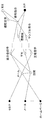
- FIG. 3 schematically shows an example of a graph generated by the graph data generation unit 13.
- FIG. 3 shows a graph generated from the activity history of a plurality of projects as one graph.
- the white circles in FIG. 3 indicate each action in the sales process set as a node.
- the black circle in FIG. 3 indicates the first action for each case, that is, the action for first contacting the customer in the sales activity of the target case.
- the action when first contacting the customer is also called an entry point.
- the prediction model generation unit 14 generates a prediction model for predicting a sales process with a high possibility of receiving an order based on graph structure data, attribute data related to nodes constituting the graph, and a label indicating the success or failure of sales activities.
- the prediction model generation unit 14 generates a prediction model by machine learning using the graph structure data generated from the activity history, the learning data of the customer's industry, and the success or failure of the order as a result of the sales activity as a label.
- the prediction model generation unit 14 generates a prediction model by calculating the feature amount of the graph by machine learning using NN (Neural Network) or deep learning (deep learning).
- the predictive model may be generated using any machine learning technique, such as supervised learning, unsupervised learning, semi-supervised learning or reinforcement learning.
- the prediction model generation unit 14 generates a prediction model by calculating the feature amount of the graph by, for example, the STAR method.
- a prediction model is generated by calculating the feature amount of the graph by inputting the graph structure data at a plurality of time points.
- Dongkuan Xu et al. "Spatio-Temporal Attentive RNN for Node Classification in Temporal Attributed Graphs", Proceedings of the Twenty-Eighth International Joint Conference on Artificial Intelligence Search on 27th] Internet ⁇ URL: https://www.ijcai.org/Proceedings/2019/0548.pdf>.
- the prediction model generation unit 14 may generate a prediction model by calculating the feature amount of the graph by the TGNet method.
- TGNet method machine learning is performed by inputting dynamic data, static data, and label data, and a trained model is generated. Details of the TGNet method are described in Qi Song, et al., "TGNet: Learning to Rank Nodes in Temporal Graphs", Proceedings of the 27th ACM International Conference on Information and Knowledge Management, p.97-106.
- the prediction model generation unit 14 may generate a prediction model by extracting the feature amount using, for example, a method for extracting the feature amount such as the Netwalk method, and combining a method for analyzing the feature amount such as the InerHAT method. good. Details of the Network method are described in Wenchow Yu, et al., "NetWalk: A Flexible Deep Embedding Approach for Anomaly Detection in Dynamic Networks", KDD 2018, p.2672-2681. The details of the InerHAT method are described in Zeyu Li, et al., “Interpretable Click-Through Rate Prediction through Hierarchical Attention", WSDM 2020: The Thirteenth ACM International Conference on Web Search and Data Mining.
- the prediction model generation unit 14 may generate a prediction model by using another method as long as it is a method of analyzing graph data and extracting a feature pattern.
- the prediction model storage unit 15 stores the prediction model generated by the prediction model generation unit 14.
- the prediction model output unit 16 outputs the prediction model stored in the prediction model storage unit 15 to the prediction device 20.
- Each process in the acquisition unit 11, the graph data generation unit 13, the prediction model generation unit 14, and the prediction model output unit 16 is performed by executing a computer program on the CPU (Central Processing Unit). Further, a GPU (Graphics Processing Unit) may be combined with the CPU.
- CPU Central Processing Unit
- GPU Graphics Processing Unit
- the storage unit 12 and the prediction model storage unit 15 are configured by using, for example, a hard disk drive.
- the storage unit 12 and the prediction model storage unit 15 may be composed of a non-volatile semiconductor storage device or a combination of a plurality of types of storage devices.
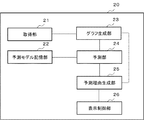
- FIG. 4 is a diagram showing the configuration of the prediction device 20.
- the prediction device 20 includes an acquisition unit 21, a prediction model storage unit 22, a graph generation unit 23, a prediction unit 24, a prediction reason generation unit 25, and a display control unit 26.
- the acquisition unit 21 acquires input data when predicting a sales process with a high possibility of receiving an order using a prediction model.
- the acquisition unit 21 acquires activity history data of the current time, that is, the action executed until the forecast is made, among the forecasted sales activities. ..
- the acquisition unit 21 acquires the type of business of the customer to be sold as customer attribute data.
- the customer attribute data is data related to the attributes of the customer to be sold, and is not limited to the type of business of the customer to be sold.
- customer attribute data includes, but is not limited to, customer industry, sales, annual profit, number of employees, purchase record, location of sales office or factory, information about members, place of residence, and so on.
- Any data related to customer attributes may be used.
- the customer attribute data may be data including at least one of the above-mentioned information.
- the prediction model storage unit 22 stores the prediction model generated by the prediction model generation device 10.
- the graph generation unit 23 generates graph structure data from the activity history data up to the present time.
- the graph structure data generated from the activity history is composed of a node showing each action in the sales process and an edge showing the time series order of each action in the sales process by connecting between two consecutive actions.
- the forecasting unit 24 predicts a sales process with a high possibility of receiving an order from the input data based on the forecasting model stored in the forecasting model storage unit 22.
- the forecasting unit 24 inputs the graph structure data based on the activity history of the sales activities performed so far for the sales target customer and the industry of the sales target customer of the attribute data corresponding to the node of the graph structure data.
- a sales process with a high probability of receiving an order is information indicating the actions after the present time and the order of each action that can increase the possibility of receiving an order.
- the prediction reason generation unit 25 generates the reason for the prediction by the prediction unit 24.
- the display control unit 26 controls the display unit (not shown) included in the prediction device 20 or the display device outside the prediction device 20 so as to display the prediction result to which the reason for the prediction is added. Further, the display control unit 26 may control the display on the display device by transmitting the prediction result with the reason for the prediction added to the terminal of the user who uses the prediction result, but the display control method is based on this. Not limited. Thereby, the present invention can more preferably support the sales activity by presenting the reason to the sales person in addition to the action after the present time.
- the display control unit 26 may control the display device so that only the prediction result is displayed on the display device. Even by displaying the forecast result, it is possible to appropriately support the sales activity by presenting the reason to the sales person in addition to the action after the present time.
- Each process in the acquisition unit 21, the graph generation unit 23, the prediction unit 24, the prediction reason generation unit 25, and the display control unit 26 is performed by executing a computer program on the CPU.
- the prediction model storage unit 22 is configured by using, for example, a hard disk drive.
- the prediction model storage unit 22 may be composed of a non-volatile semiconductor storage device or a combination of a plurality of types of storage devices.
- the sales data management server 300 manages activity history data for each sales activity.
- the activity history data for example, data input by a sales person via a terminal device is used.
- the activity history data may be data extracted from the business diary.
- the sales data management server 300 has a sales activity of "March 2", which is the date and time, from the business diary in which the sales person describes "Introduce product A to company X by e-mail on March 2".
- “Company X" which is the target of the above, and "email” indicating the action in the sales activity may be extracted as activity history data.
- the business data management server 300 transmits the activity history data to the prediction model generation device 10.
- FIG. 5 is a diagram showing an operation flow when the prediction model generation device 10 generates a prediction model for predicting a sales process with a high possibility of receiving an order.
- the acquisition unit 11 acquires the customer's industry that was the target of the plurality of sales activities performed in the past as attribute data, and the success / failure data of the order for each sales activity (step S11).
- the success / failure data of the order is information indicating whether the order for each sales activity is successful or unsuccessful.
- Each data acquired by the acquisition unit 11 may be input by an operator, or may be acquired from another server having each data.
- the acquisition unit 11 may acquire information indicating the actual result of whether or not an order has been received for each sales activity from the sales data management server 300. When each data is acquired, the acquisition unit 11 stores each acquired data in the storage unit 12.
- FIG. 6 is a diagram showing an example of customer information used as attribute data.
- the attribute data includes the customer's company name and industry.
- FIG. 7 is a diagram showing an example of order success / failure data used as a label.
- the order success / failure data includes the activity history number which is the identification information of the activity history, the company name of the customer, the product which has been operated, and the result of the order success / failure.
- the acquisition unit 11 acquires activity history data for each sales activity from the sales data management server 300 as sales process time-series data (step S12). When the sales process time series data is acquired, the acquisition unit 11 stores the acquired sales process time series data in the storage unit 12.
- FIG. 8 is a diagram showing an example of sales process time series data.
- the activity history number which is the identification information of the activity history, and the date when each action is performed in the sales activity are linked.
- the activity history number in FIG. 8 corresponds to the activity history number in FIG. 7.
- the graph data generation unit 13 When the sales process time series data is stored in the storage unit 12, the graph data generation unit 13 generates graph structure data based on the sales process time series data (step S13). When the graph structure data is generated, the graph data generation unit 13 sends the generated graph structure data to the prediction model generation unit 14.
- the prediction model generation unit 14 reads out each data used for generating the prediction model from the storage unit 12.
- machine learning that uses graph structure data based on multiple activity histories and the industry of each of multiple customers, which is customer attribute data, as input data, and uses the success or failure of orders for each sales activity as labels.
- the prediction model generation unit 14 stores the generated prediction model as a learned model in the prediction model storage unit 15.
- the prediction model output unit 16 outputs the prediction model to the prediction device 20 (step S15).
- the prediction model input to the prediction device 20 is stored in the prediction model storage unit 22.
- the prediction model generated by the prediction model generation device 10 may be updated by re-learning.
- the prediction model generation unit 14 relearns the graph data generated from the activity history performed based on the prediction result, the customer's industry as input data, and the presence or absence of order acquisition as the label of the input data.
- the prediction model of the prediction model storage unit 15 is updated. By performing re-learning based on the prediction result in this way, the prediction accuracy by the trained model is improved.
- the prediction model generation unit 14 may newly generate a prediction model using the input data and the label.
- FIG. 9 is a diagram showing an operation flow when predicting a sales process with a high possibility of receiving an order by using a prediction model in the prediction device 20.
- the acquisition unit 21 acquires the sales process time-series data showing the activity history of the sales activity to be predicted up to the present time and the customer attribute data including the type of business of the customer who is performing the sales activity (step S21). ).
- the graph generation unit 23 generates graph structure data from the sales process time series data up to the present time (step S22).
- the graph generation unit 23 sends the generated graph structure data and the data of the industry of the customer to be predicted to the prediction unit 24.
- the prediction unit 24 Upon receiving the graph structure data of the activity history, the prediction unit 24 inputs the graph structure data of the activity history and the industry of the target customer, which is the attribute data, using the prediction model stored in the prediction model storage unit 22. As a result, the sales process with a high possibility of receiving an order and the success probability of the order are predicted (step S23). When the sales process with a high possibility of receiving an order is predicted, the prediction unit 24 sends the data of the sales process with a high possibility of receiving an order and the success probability of the order as a prediction result to the prediction reason generation unit 25. The success probability is calculated based on the degree of similarity between the actions taken so far and each candidate, and the order record of each candidate. The forecast results include data on sales processes that are likely to receive orders, information on edges that contribute more to order acquisition than other edges, and information on success probabilities.
- the prediction reason generation unit 25 Upon receiving the prediction result, the prediction reason generation unit 25 extracts the reason for the prediction (step S24).
- the reason for the prediction is information for presenting the reason for the prediction by the prediction unit 24 to the user. For example, the prediction reason generation unit 25 extracts an edge having a high contribution to the success of an order from the sales process data included in the prediction result, and the action corresponding to the nodes at both ends of the extracted edge is an important action for the order. If so, the inclusion of it is presented as the reason for the prediction.
- the reason for prediction generation unit 25 When the reason for prediction is extracted, the reason for prediction generation unit 25 outputs the reason for prediction to the display control unit 26.
- the display control unit 26 controls the display device and displays the prediction result and the reason for the prediction on the display device (step S25).
- the display control unit 26 controls transmission of data of the prediction result and the reason for the prediction to the user's terminal so that the prediction result and the reason for the prediction are displayed on the display device of the user's terminal using the prediction result. You may.
- FIG. 10 is a diagram showing an example of display data of the prediction result.
- the display data of the prediction result in FIG. 10 shows the executed actions showing the activity history up to the prediction time, the recommended process candidates showing the actions to be performed in the future and their order, the success probability, and the reason why each recommended process candidate was selected. It is composed of.
- the success probability is an index that is calculated based on the degree of similarity between the actions taken so far and each candidate and the order record of each candidate, and indicates the possibility of winning an order.
- FIG. 10 shows an example in which a plurality of candidates for a sales process having a high possibility of receiving an order are shown as a prediction result.
- the reasons for predicting that there is a high possibility of receiving an order are that the order record is high in the same industry and that the order from the exhibition to the social gathering contributes greatly to the success of the order. It is shown.
- the user of the prediction result predicts the sales process to be applied to the customer to be sold. You can select by referring to the reason.
- a plurality of candidates are shown as sales processes having a high possibility of receiving an order. For example, if the sales process shown in the uppermost row is the first forecast result, the second forecast result is the sales process having the next highest probability of success of the order after the first forecast result.
- the name of the attribute data used for prediction may be used as it is.
- the prediction reason generation unit 25 may extract, for example, that the customer's industry is the manufacturing industry as the reason for the prediction. good. Further, the prediction reason generation unit 25 may present the prediction reason based on the template defined in advance.
- the prediction reason generation unit 25 holds a template for prediction reasons such as "because it is a sales process suitable for XX customers", and the success probability of receiving an order is high when the industry is "manufacturing”. Sometimes the reason for the prediction "because it is a sales process suitable for manufacturing customers" may be generated from the template.
- the action indicated by the node may be displayed (pop-up display) only when the mouse cursor is placed on the node on the display screen (when the mouse cursor is placed). Further, when the part of the node on the display screen is clicked or tapped, the action indicated by the node may be displayed. Further, the sales process having a high possibility of receiving an order or the action part having a high contribution to the success of an order may be highlighted on the screen. The highlighting is done by, for example, bold bold, color, flash or magnitude of movement in the animated display. As a result, visibility to the user can be improved.
- the edges of the graph structure data used when generating the prediction model show only the order of actions, but the edges may include the length of time between actions. That is, the graph generation unit 23 can generate graph structure data including information on the length of time between actions at the edge. In this way, by making a prediction using a prediction model generated using graph structure data that includes information on the length of time between actions at the edge, it is possible to predict the appropriate timing for each action. become. Further, when the prediction result is displayed as shown in FIG. 10, when the cursor is placed on the edge on the display screen, the time interval indicated by the edge, that is, the time interval between each action may be displayed. Further, on the display screen, when the edge portion is clicked or tapped, the time interval indicated by the edge may be displayed. As a result, it is possible to improve the success probability and efficiency of sales activities by presenting an appropriate timing for performing each predicted action to a user such as a sales person.
- the prediction model when the prediction model is generated, the information of the industry of the customer who conducts the sales activity is input as the attribute data, but the attribute data of the customer does not have to be used as the input data. If the customer's industry, which is the customer's attribute data, is not used as an input when generating the forecast model, the forecast of the sales process with a high possibility of receiving an order is based on the activity history up to the time of the forecast and the order received in the past sales activities. It is done only by similarity with the sales process that has a high probability of success.
- the customer attribute data when generating and forecasting the forecast model includes the customer's industry, sales, annual profit, number of employees, purchase record, location of sales office or factory, instead of information on the customer's industry. Information on one or more attributes of family structure and place of residence may be used as input data. Further, the above customer attribute data may be used in addition to the customer attribute data indicating the customer's industry.
- the attribute data when generating and forecasting the forecast model includes the classification of the product or service to be sold, the product or service to be sold, the sales of the customer to be sold, and the sales person, instead of the attribute data of the customer.
- the position of the sales person, or the information of one or more attributes of the company or the sales person who is the target of the sales activity such as the class of the sales person may be used as the input data.
- the above attribute data may be used in addition to the customer attribute data. Further, when the attribute data of the customer or the sales person who is the target of these sales activities is used for generating the prediction model, it can be used for input as the attribute data even in the prediction stage.
- the reason for the forecast is that instead of the order of the two actions included in the sales process, the customer's industry, sales, annual profit, number of employees, purchase record, classification of products or services to be sold, products to be sold or At least one item may be included among the service, the sales of the customer to be sold, the sales person, and the position of the sales person.
- the sales support system of the present embodiment generates graph structure data based on the activity history data in the prediction model generation device 10, and inputs the graph structure data which is time series data and the customer's industry which is attribute data. Predictive models are generated by machine learning. In addition, the sales support system of the present embodiment predicts a sales process with a high possibility of receiving an order from the activity history of the currently executing sales activity in the prediction device 20 based on the generated prediction model. .. The sales support system of the present embodiment makes a prediction using a prediction model generated based on the graph structure data of the activity history, and the possibility of receiving an order from the degree of similarity with the history of the sales activity currently being performed. Can predict high sales processes.
- the sales support system of this embodiment can be used for future actions to be taken for the order from the present time onward. Candidates can be presented. Therefore, the sales support system of the present embodiment can predict the actions after the present time necessary to increase the possibility of receiving an order in the sales activity. As a result, the sales support system of the present embodiment can suitably support sales activities such as success probability of sales activities, improvement of sales, and efficiency of sales activities.
- FIG. 11 is a diagram showing an outline of the configuration of the sales support system of the present embodiment.
- the sales support system of this embodiment includes an acquisition unit 31 and a prediction unit 32.
- the acquisition unit 31 and the prediction unit 32 may be provided in a single device, or may be provided in different devices.
- the acquisition unit 31 acquires sales process time-series data indicating the time-series order of a plurality of actions included in the sales activity for the target customer at the first time point, and customer attribute data regarding the attributes of the target customer.
- the first time point refers to an action in sales activities and a time point for predicting the probability of success. That is, the acquisition unit 31 acquires data indicating in time series the actions included in the sales activities performed on the target customer up to the time of prediction as the sales process time series data.
- the acquisition unit 31 is an example of acquisition means.
- An example of the acquisition unit 31 is the acquisition unit 21 of the prediction device 20 of the first embodiment.
- the forecasting unit 32 uses the forecasting model and the sales process time series data and customer attribute data acquired by the acquisition unit 31 to perform actions after the first time point in sales activities for the target customer and after the first time point. Predict the success rate of sales activities for the target customer when an action is taken.
- the forecast model is a plurality of customer attribute data and a plurality of customers regarding the attributes of a plurality of customers who have performed sales activities related to a plurality of sales process time series data and a plurality of sales process time series data at a time point earlier than the first time point. It is generated by machine learning using the success or failure of sales activities for each.
- the prediction unit 32 is an example of a prediction means.
- An example of the prediction unit 32 is the prediction unit 24 of the prediction device 20 of the first embodiment.
- FIG. 12 is a diagram showing an operation flow of the sales support system of the present embodiment.
- the acquisition unit 31 acquires the sales process time-series data indicating the time-series order of a plurality of actions included in the sales activity for the target customer at the first time point and the customer attribute data regarding the attributes of the target customer (step). S31). Specifically, the acquisition unit 31 acquires sales process time-series data showing the order of actions already executed up to the first time point in the sales activity in chronological order, and customer attribute data of the target customer of sales. ..
- the prediction unit 32 uses the prediction model, the sales process time series data, and the customer attribute data to perform actions after the first time point in the sales activity for the target customer. Predict the success rate of sales activities for the target customer when the action after the first time point is performed (step S32). Specifically, the forecasting unit 32 inputs the sales process time series data and the customer attribute data, and uses the forecasting model to perform actions with a high probability of successful order for sales activities after the first time point, which is the forecasting time point. Predict.
- the sales support system of the present embodiment inputs the activity history up to the first time point, which is the prediction time point, and the customer's attributes into the prediction model, so that the action in the sales activity after the prediction time point of the possibility of successful order can be taken. I'm predicting.
- the forecast model is generated based on the sales process time series data, which is the activity history of the sales activity past the first time when the forecast is performed, and the attributes of the target customer. Therefore, the sales support system of the present embodiment can predict actions with a high probability of success in sales activities after the time of prediction. Therefore, the sales support system of the present embodiment can predict the actions after the present time necessary to increase the possibility of receiving an order.
- FIG. 13 shows an example of the configuration of a computer 40 that executes a computer program that performs each process in the prediction model generation device 10 and the prediction device 20.
- the computer 40 includes a CPU 41, a memory 42, a storage device 43, an input / output I / F (Interface) 44, and a communication I / F 45.
- each process in the sales data management server 300 of the first embodiment and the sales support system of the second embodiment can also be performed by executing a computer program on a computer such as the computer 70.
- the CPU 41 reads a computer program that performs each process from the storage device 43 and executes it.
- the arithmetic processing unit that executes the computer program may be configured by a combination of a CPU and a GPU instead of the CPU 41.
- the memory 42 is configured by a DRAM (Dynamic Random Access Memory) or the like, and a computer program executed by the CPU 41 and data being processed are temporarily stored.
- the storage device 43 stores a computer program executed by the CPU 41.
- the storage device 43 is composed of, for example, a non-volatile semiconductor storage device. Other storage devices such as a hard disk drive may be used as the storage device 43.
- the input / output I / F 44 is an interface for receiving input from an operator and outputting display data and the like.
- the communication I / F 45 is an interface for transmitting and receiving data between each device in the sales support system and the terminal of the user.
- the computer program used to execute each process can be stored in a recording medium and distributed.
- a recording medium for example, a magnetic tape for data recording or a magnetic disk such as a hard disk can be used.
- an optical disk such as a CD-ROM (Compact Disc Read Only Memory) can also be used.
- a non-volatile semiconductor storage device may be used as the recording medium.
- the prediction model generated by machine learning using the success or failure of the sales activity for the target customer, the sales process time series data acquired by the acquisition means, and the customer attribute data are used.
- Appendix 2 The action after the first time point in the sales activity for the target customer predicted by the prediction means and the success probability of the sales activity for the target customer when the action after the first time point is performed are determined.
- the prediction means is different from the first prediction result, and is different from the first prediction result, and the action for the target customer after the first time point in the sales activity for the target customer and the sales for the target customer when the action after the first time point is performed. Predict the success rate of the activity and
- the display control means is different from the first prediction result, and the sales to the target customer when the action after the first time point in the sales activity for the target customer and the action after the first time point are performed are performed.
- the sales support system according to Appendix 2, which controls the display device to display the second prediction result including the success probability of the activity and the first prediction result.
- Appendix 4 Generates graph structure data relating to a graph consisting of a node showing each of a plurality of actions included in sales activities for the target customer and an edge showing the order relationship between the plurality of actions related to the node, corresponding to the first prediction result. Further equipped with graph generation means to The sales support system according to Appendix 2 or 3, wherein the display control means controls the display device so as to further display a prediction result including graph structure data generated by the graph generation means.
- the edge further indicates the time interval between the plurality of actions.
- the display control means receives the selection of the node in the graph structure data displayed on the display device
- the display control means controls the display device so as to display the action indicated by the node according to the graph structure data.
- the sales support system according to Appendix 4, wherein when the display control means receives the selection of an edge in the graph structure data displayed on the display device, the display control means controls the display device so as to display the time interval indicated by the edge.
- Appendix 6 A plurality of sales process time series data at a time point earlier than the first time point, a plurality of customer attribute data regarding attributes of a plurality of customers who have performed sales activities related to the plurality of sales process time series data, and the plurality of customer attribute data.
- the sales support system according to any one of Appendix 1 to 5, further comprising a prediction model generation means for generating the prediction model by machine learning using the success or failure of sales activities for each customer.
- Appendix 7 The sales support system according to Appendix 6, wherein the prediction model generation means relearns the prediction model based on the first prediction result.
- [Appendix 8] Acquire the sales process time series data showing the time series order of a plurality of actions included in the sales activity for the target customer at the first time point, and the customer attribute data related to the attribute of the target customer.
- the prediction model generated by machine learning using the success or failure of the sales activity for the target customer, the sales process time series data, and the customer attribute data, after the first time point in the sales activity for the target customer.
- a sales support method for predicting an action and a success probability of a sales activity for the target customer when the action after the first time point is performed.
- Appendix 10 The action after the first time point in the sales activity for the target customer, which is different from the first prediction result, and the success probability of the sales activity for the target customer when the action after the first time point is performed. Predict, The action after the first time point in the sales activity for the target customer, which is different from the first prediction result, and the success probability of the sales activity for the target customer when the action after the first time point is performed. 9. The sales support method according to Appendix 9, which controls the display device to display the second prediction result and the first prediction result including the above.
- Appendix 11 Generates graph structure data relating to a graph consisting of a node showing each of a plurality of actions included in sales activities for the target customer and an edge showing the order relationship between the plurality of actions related to the node, corresponding to the first prediction result. death, The sales support method according to Appendix 9 or 10, wherein the display device is controlled so as to further display the generated graph structure data.
- the edge includes a time interval between the plurality of actions.
- the display device is controlled to display the action indicated by the node.
- the sales support method according to Appendix 11 which controls the display device so as to display the time interval indicated by the edge when the selection of the edge in the graph structure data displayed on the display device is accepted.
- Appendix 13 A plurality of sales process time series data at a time point earlier than the first time point, a plurality of customer attribute data regarding attributes of a plurality of customers who have performed sales activities related to the plurality of sales process time series data, and the plurality of customer attribute data.
- the sales support method according to any one of Appendix 8 to 12, which generates the prediction model by machine learning using the success or failure of sales activities for each customer.
- Appendix 14 The sales support method according to Appendix 13, which relearns the prediction model based on the first prediction result.
- [Appendix 15] A process of acquiring sales process time-series data indicating the time-series order of a plurality of actions included in sales activities for the target customer at the first time point, and customer attribute data regarding the attributes of the target customer.
- the prediction model generated by machine learning using the success or failure of the sales activity for the target customer, the sales process time series data, and the customer attribute data, after the first time point in the sales activity for the target customer.
- a program recording medium that records a sales support program that causes a computer to execute.
- Prediction model generator 11 Acquisition unit 12 Storage unit 13 Graph data generation unit 14 Prediction model generation unit 15 Prediction model storage unit 16 Prediction model output unit 20 Prediction device 21 Acquisition unit 22 Prediction model storage unit 23 Graph generation unit 24 Prediction unit 25 Prediction reason generation unit 26 Display control unit 31 Acquisition unit 32 Prediction unit 40 Computer 41 CPU 42 Memory 43 Storage device 44 I / O I / F 45 Communication I / F 100 Forecasting system 300 Sales data management server
Landscapes
- Business, Economics & Management (AREA)
- Engineering & Computer Science (AREA)
- Strategic Management (AREA)
- Accounting & Taxation (AREA)
- Development Economics (AREA)
- Finance (AREA)
- Entrepreneurship & Innovation (AREA)
- Marketing (AREA)
- Economics (AREA)
- Physics & Mathematics (AREA)
- General Business, Economics & Management (AREA)
- General Physics & Mathematics (AREA)
- Theoretical Computer Science (AREA)
- Game Theory and Decision Science (AREA)
- Data Mining & Analysis (AREA)
- Human Resources & Organizations (AREA)
- Operations Research (AREA)
- Quality & Reliability (AREA)
- Tourism & Hospitality (AREA)
- Management, Administration, Business Operations System, And Electronic Commerce (AREA)
Priority Applications (4)
| Application Number | Priority Date | Filing Date | Title |
|---|---|---|---|
| PCT/JP2020/013914 WO2021192197A1 (ja) | 2020-03-27 | 2020-03-27 | 営業支援システム、営業支援方法およびプログラム記録媒体 |
| US17/802,999 US20230099749A1 (en) | 2020-03-27 | 2020-03-27 | Sales assistance system, sales assistance method, and program recording medium |
| JP2022510305A JP7491367B2 (ja) | 2020-03-27 | 2020-03-27 | 営業支援システム、営業支援方法および営業支援プログラム |
| JP2024079816A JP2024105572A (ja) | 2020-03-27 | 2024-05-16 | 営業支援システム、営業支援方法および営業支援プログラム |
Applications Claiming Priority (1)
| Application Number | Priority Date | Filing Date | Title |
|---|---|---|---|
| PCT/JP2020/013914 WO2021192197A1 (ja) | 2020-03-27 | 2020-03-27 | 営業支援システム、営業支援方法およびプログラム記録媒体 |
Publications (1)
| Publication Number | Publication Date |
|---|---|
| WO2021192197A1 true WO2021192197A1 (ja) | 2021-09-30 |
Family
ID=77891024
Family Applications (1)
| Application Number | Title | Priority Date | Filing Date |
|---|---|---|---|
| PCT/JP2020/013914 Ceased WO2021192197A1 (ja) | 2020-03-27 | 2020-03-27 | 営業支援システム、営業支援方法およびプログラム記録媒体 |
Country Status (3)
| Country | Link |
|---|---|
| US (1) | US20230099749A1 (https=) |
| JP (2) | JP7491367B2 (https=) |
| WO (1) | WO2021192197A1 (https=) |
Cited By (2)
| Publication number | Priority date | Publication date | Assignee | Title |
|---|---|---|---|---|
| JP2023141668A (ja) * | 2022-03-24 | 2023-10-05 | 株式会社日立製作所 | 業務支援システム、及び業務支援方法 |
| JP2024016411A (ja) * | 2022-07-26 | 2024-02-07 | 株式会社日立ソリューションズ | 営業支援装置、及び営業支援方法 |
Families Citing this family (1)
| Publication number | Priority date | Publication date | Assignee | Title |
|---|---|---|---|---|
| US12499262B2 (en) * | 2024-04-03 | 2025-12-16 | Capital One Services, Llc | Real-time data evaluation for model training and execution |
Citations (2)
| Publication number | Priority date | Publication date | Assignee | Title |
|---|---|---|---|---|
| JP2005322094A (ja) * | 2004-05-11 | 2005-11-17 | Hitachi Ltd | 営業支援方法および営業支援システム |
| JP2019079302A (ja) * | 2017-10-25 | 2019-05-23 | 日本電気株式会社 | 営業活動支援システム、営業活動支援方法および営業活動支援プログラム |
Family Cites Families (4)
| Publication number | Priority date | Publication date | Assignee | Title |
|---|---|---|---|---|
| JP2005149489A (ja) * | 2003-10-24 | 2005-06-09 | Toshiba Solutions Corp | プログラム及び営業活動支援システム並びに方法 |
| US7672865B2 (en) * | 2005-10-21 | 2010-03-02 | Fair Isaac Corporation | Method and apparatus for retail data mining using pair-wise co-occurrence consistency |
| WO2013071372A2 (en) * | 2011-11-17 | 2013-05-23 | Elkhatib Alan Abraham | A computing device and computer readable storage medium for calculating sales activity target data in accordance with historical sales statistic parameter data |
| US11922440B2 (en) * | 2017-10-31 | 2024-03-05 | Oracle International Corporation | Demand forecasting using weighted mixed machine learning models |
-
2020
- 2020-03-27 JP JP2022510305A patent/JP7491367B2/ja active Active
- 2020-03-27 WO PCT/JP2020/013914 patent/WO2021192197A1/ja not_active Ceased
- 2020-03-27 US US17/802,999 patent/US20230099749A1/en not_active Abandoned
-
2024
- 2024-05-16 JP JP2024079816A patent/JP2024105572A/ja active Pending
Patent Citations (2)
| Publication number | Priority date | Publication date | Assignee | Title |
|---|---|---|---|---|
| JP2005322094A (ja) * | 2004-05-11 | 2005-11-17 | Hitachi Ltd | 営業支援方法および営業支援システム |
| JP2019079302A (ja) * | 2017-10-25 | 2019-05-23 | 日本電気株式会社 | 営業活動支援システム、営業活動支援方法および営業活動支援プログラム |
Cited By (4)
| Publication number | Priority date | Publication date | Assignee | Title |
|---|---|---|---|---|
| JP2023141668A (ja) * | 2022-03-24 | 2023-10-05 | 株式会社日立製作所 | 業務支援システム、及び業務支援方法 |
| JP7611184B2 (ja) | 2022-03-24 | 2025-01-09 | 株式会社日立製作所 | 業務支援システム、及び業務支援方法 |
| JP2024016411A (ja) * | 2022-07-26 | 2024-02-07 | 株式会社日立ソリューションズ | 営業支援装置、及び営業支援方法 |
| JP7791788B2 (ja) | 2022-07-26 | 2025-12-24 | 株式会社日立ソリューションズ | 営業支援装置、及び営業支援方法 |
Also Published As
| Publication number | Publication date |
|---|---|
| JPWO2021192197A1 (https=) | 2021-09-30 |
| US20230099749A1 (en) | 2023-03-30 |
| JP2024105572A (ja) | 2024-08-06 |
| JP7491367B2 (ja) | 2024-05-28 |
Similar Documents
| Publication | Publication Date | Title |
|---|---|---|
| JP7556385B2 (ja) | 営業支援システム、営業支援方法および営業支援プログラム | |
| Zaman | Transformation of marketing decisions through artificial intelligence and digital marketing | |
| US20190378074A1 (en) | Method, apparatus, and system for data analytics model selection for real-time data visualization | |
| JP2024105572A (ja) | 営業支援システム、営業支援方法および営業支援プログラム | |
| Sajawal et al. | A predictive analysis of retail sales forecasting using machine learning techniques | |
| JP2020087023A (ja) | 受注予測モデルの生成方法、受注予測モデル、受注予測装置、受注予測方法および受注予測プログラム | |
| US20230112675A1 (en) | Person flow prediction system, person flow prediction method, and programrecording medium | |
| US20250077581A1 (en) | System and method for dynamically recommending a set of potential courses of actions for a user within a search query | |
| Harsoor et al. | Forecast of sales of Walmart store using big data applications | |
| US11138536B1 (en) | Intelligent implementation project management | |
| Quayson et al. | Machine learning and supply chain management | |
| Chashmi et al. | Predicting customer turnover using recursive neural networks | |
| Aruva | A systematic evaluation of regressions and loss functions for the prediction of monetary value in RFM analysis | |
| Mesir | The role of artificial intelligence in decision making in small businesses | |
| US11436633B2 (en) | Machine learning predictive deviation and remediation | |
| Jaiwant et al. | Demand forecasting methods: using machine learning to predict future sales | |
| Goswami et al. | A Theoretical analysis of Recent development in Statistical kind of Machine Learning | |
| Saha | Role of AI-Powered CRM in Business | |
| Uddin et al. | Adaptive Training Program Optimization in Human Resource Development Using Reinforcement Learning and Multilayer Perceptron Models | |
| KR102937954B1 (ko) | 인공지능에 기반한 사업 분석을 통한 사업개발 로드맵 생성 장치 및 방법 | |
| Mahalle et al. | Introduction to Predictive Analytics | |
| Madhumanchi | The PARIS Method: A Structured Framework for Merchant Root Cause Analysis in Modern Retail | |
| Stoychev | The potential benefits of implementing machine learning in supply chain management | |
| TWM675367U (zh) | 跨平台商品推薦系統 | |
| Shaw | All-Stage Machine Learning-Driven B2B Sales Predictor |
Legal Events
| Date | Code | Title | Description |
|---|---|---|---|
| 121 | Ep: the epo has been informed by wipo that ep was designated in this application |
Ref document number: 20926640 Country of ref document: EP Kind code of ref document: A1 |
|
| ENP | Entry into the national phase |
Ref document number: 2022510305 Country of ref document: JP Kind code of ref document: A |
|
| NENP | Non-entry into the national phase |
Ref country code: DE |
|
| 122 | Ep: pct application non-entry in european phase |
Ref document number: 20926640 Country of ref document: EP Kind code of ref document: A1 |