WO2021182464A1 - 光硬化性組成物 - Google Patents
光硬化性組成物 Download PDFInfo
- Publication number
- WO2021182464A1 WO2021182464A1 PCT/JP2021/009263 JP2021009263W WO2021182464A1 WO 2021182464 A1 WO2021182464 A1 WO 2021182464A1 JP 2021009263 W JP2021009263 W JP 2021009263W WO 2021182464 A1 WO2021182464 A1 WO 2021182464A1
- Authority
- WO
- WIPO (PCT)
- Prior art keywords
- photocurable composition
- composition according
- weight
- hydroxyl value
- acrylic monomer
- Prior art date
- Legal status (The legal status is an assumption and is not a legal conclusion. Google has not performed a legal analysis and makes no representation as to the accuracy of the status listed.)
- Ceased
Links
Classifications
-
- C—CHEMISTRY; METALLURGY
- C08—ORGANIC MACROMOLECULAR COMPOUNDS; THEIR PREPARATION OR CHEMICAL WORKING-UP; COMPOSITIONS BASED THEREON
- C08F—MACROMOLECULAR COMPOUNDS OBTAINED BY REACTIONS ONLY INVOLVING CARBON-TO-CARBON UNSATURATED BONDS
- C08F265/00—Macromolecular compounds obtained by polymerising monomers on to polymers of unsaturated monocarboxylic acids or derivatives thereof as defined in group C08F20/00
- C08F265/04—Macromolecular compounds obtained by polymerising monomers on to polymers of unsaturated monocarboxylic acids or derivatives thereof as defined in group C08F20/00 on to polymers of esters
- C08F265/06—Polymerisation of acrylate or methacrylate esters on to polymers thereof
-
- B—PERFORMING OPERATIONS; TRANSPORTING
- B41—PRINTING; LINING MACHINES; TYPEWRITERS; STAMPS
- B41J—TYPEWRITERS; SELECTIVE PRINTING MECHANISMS, i.e. MECHANISMS PRINTING OTHERWISE THAN FROM A FORME; CORRECTION OF TYPOGRAPHICAL ERRORS
- B41J2/00—Typewriters or selective printing mechanisms characterised by the printing or marking process for which they are designed
- B41J2/005—Typewriters or selective printing mechanisms characterised by the printing or marking process for which they are designed characterised by bringing liquid or particles selectively into contact with a printing material
- B41J2/01—Ink jet
-
- B—PERFORMING OPERATIONS; TRANSPORTING
- B41—PRINTING; LINING MACHINES; TYPEWRITERS; STAMPS
- B41J—TYPEWRITERS; SELECTIVE PRINTING MECHANISMS, i.e. MECHANISMS PRINTING OTHERWISE THAN FROM A FORME; CORRECTION OF TYPOGRAPHICAL ERRORS
- B41J2/00—Typewriters or selective printing mechanisms characterised by the printing or marking process for which they are designed
- B41J2/005—Typewriters or selective printing mechanisms characterised by the printing or marking process for which they are designed characterised by bringing liquid or particles selectively into contact with a printing material
- B41J2/01—Ink jet
- B41J2/21—Ink jet for multi-colour printing
- B41J2/2107—Ink jet for multi-colour printing characterised by the ink properties
-
- C—CHEMISTRY; METALLURGY
- C08—ORGANIC MACROMOLECULAR COMPOUNDS; THEIR PREPARATION OR CHEMICAL WORKING-UP; COMPOSITIONS BASED THEREON
- C08F—MACROMOLECULAR COMPOUNDS OBTAINED BY REACTIONS ONLY INVOLVING CARBON-TO-CARBON UNSATURATED BONDS
- C08F2/00—Processes of polymerisation
- C08F2/44—Polymerisation in the presence of compounding ingredients, e.g. plasticisers, dyestuffs, fillers
-
- C—CHEMISTRY; METALLURGY
- C08—ORGANIC MACROMOLECULAR COMPOUNDS; THEIR PREPARATION OR CHEMICAL WORKING-UP; COMPOSITIONS BASED THEREON
- C08F—MACROMOLECULAR COMPOUNDS OBTAINED BY REACTIONS ONLY INVOLVING CARBON-TO-CARBON UNSATURATED BONDS
- C08F220/00—Copolymers of compounds having one or more unsaturated aliphatic radicals, each having only one carbon-to-carbon double bond, and only one being terminated by only one carboxyl radical or a salt, anhydride ester, amide, imide or nitrile thereof
- C08F220/02—Monocarboxylic acids having less than ten carbon atoms; Derivatives thereof
- C08F220/10—Esters
-
- C—CHEMISTRY; METALLURGY
- C08—ORGANIC MACROMOLECULAR COMPOUNDS; THEIR PREPARATION OR CHEMICAL WORKING-UP; COMPOSITIONS BASED THEREON
- C08F—MACROMOLECULAR COMPOUNDS OBTAINED BY REACTIONS ONLY INVOLVING CARBON-TO-CARBON UNSATURATED BONDS
- C08F220/00—Copolymers of compounds having one or more unsaturated aliphatic radicals, each having only one carbon-to-carbon double bond, and only one being terminated by only one carboxyl radical or a salt, anhydride ester, amide, imide or nitrile thereof
- C08F220/02—Monocarboxylic acids having less than ten carbon atoms; Derivatives thereof
- C08F220/10—Esters
- C08F220/26—Esters containing oxygen in addition to the carboxy oxygen
- C08F220/28—Esters containing oxygen in addition to the carboxy oxygen containing no aromatic rings in the alcohol moiety
- C08F220/285—Esters containing oxygen in addition to the carboxy oxygen containing no aromatic rings in the alcohol moiety and containing a polyether chain in the alcohol moiety
- C08F220/286—Esters containing oxygen in addition to the carboxy oxygen containing no aromatic rings in the alcohol moiety and containing a polyether chain in the alcohol moiety and containing polyethylene oxide in the alcohol moiety, e.g. methoxy polyethylene glycol (meth)acrylate
-
- C—CHEMISTRY; METALLURGY
- C08—ORGANIC MACROMOLECULAR COMPOUNDS; THEIR PREPARATION OR CHEMICAL WORKING-UP; COMPOSITIONS BASED THEREON
- C08F—MACROMOLECULAR COMPOUNDS OBTAINED BY REACTIONS ONLY INVOLVING CARBON-TO-CARBON UNSATURATED BONDS
- C08F222/00—Copolymers of compounds having one or more unsaturated aliphatic radicals, each having only one carbon-to-carbon double bond, and at least one being terminated by a carboxyl radical and containing at least one other carboxyl radical in the molecule; Salts, anhydrides, esters, amides, imides, or nitriles thereof
- C08F222/10—Esters
-
- C—CHEMISTRY; METALLURGY
- C09—DYES; PAINTS; POLISHES; NATURAL RESINS; ADHESIVES; COMPOSITIONS NOT OTHERWISE PROVIDED FOR; APPLICATIONS OF MATERIALS NOT OTHERWISE PROVIDED FOR
- C09D—COATING COMPOSITIONS, e.g. PAINTS, VARNISHES OR LACQUERS; FILLING PASTES; CHEMICAL PAINT OR INK REMOVERS; INKS; CORRECTING FLUIDS; WOODSTAINS; PASTES OR SOLIDS FOR COLOURING OR PRINTING; USE OF MATERIALS THEREFOR
- C09D11/00—Inks
- C09D11/02—Printing inks
- C09D11/10—Printing inks based on artificial resins
- C09D11/101—Inks specially adapted for printing processes involving curing by wave energy or particle radiation, e.g. with UV-curing following the printing
-
- C—CHEMISTRY; METALLURGY
- C09—DYES; PAINTS; POLISHES; NATURAL RESINS; ADHESIVES; COMPOSITIONS NOT OTHERWISE PROVIDED FOR; APPLICATIONS OF MATERIALS NOT OTHERWISE PROVIDED FOR
- C09D—COATING COMPOSITIONS, e.g. PAINTS, VARNISHES OR LACQUERS; FILLING PASTES; CHEMICAL PAINT OR INK REMOVERS; INKS; CORRECTING FLUIDS; WOODSTAINS; PASTES OR SOLIDS FOR COLOURING OR PRINTING; USE OF MATERIALS THEREFOR
- C09D11/00—Inks
- C09D11/30—Inkjet printing inks
-
- C—CHEMISTRY; METALLURGY
- C09—DYES; PAINTS; POLISHES; NATURAL RESINS; ADHESIVES; COMPOSITIONS NOT OTHERWISE PROVIDED FOR; APPLICATIONS OF MATERIALS NOT OTHERWISE PROVIDED FOR
- C09D—COATING COMPOSITIONS, e.g. PAINTS, VARNISHES OR LACQUERS; FILLING PASTES; CHEMICAL PAINT OR INK REMOVERS; INKS; CORRECTING FLUIDS; WOODSTAINS; PASTES OR SOLIDS FOR COLOURING OR PRINTING; USE OF MATERIALS THEREFOR
- C09D11/00—Inks
- C09D11/30—Inkjet printing inks
- C09D11/38—Inkjet printing inks characterised by non-macromolecular additives other than solvents, pigments or dyes
-
- C—CHEMISTRY; METALLURGY
- C09—DYES; PAINTS; POLISHES; NATURAL RESINS; ADHESIVES; COMPOSITIONS NOT OTHERWISE PROVIDED FOR; APPLICATIONS OF MATERIALS NOT OTHERWISE PROVIDED FOR
- C09D—COATING COMPOSITIONS, e.g. PAINTS, VARNISHES OR LACQUERS; FILLING PASTES; CHEMICAL PAINT OR INK REMOVERS; INKS; CORRECTING FLUIDS; WOODSTAINS; PASTES OR SOLIDS FOR COLOURING OR PRINTING; USE OF MATERIALS THEREFOR
- C09D133/00—Coating compositions based on homopolymers or copolymers of compounds having one or more unsaturated aliphatic radicals, each having only one carbon-to-carbon double bond, and at least one being terminated by only one carboxyl radical, or of salts, anhydrides, esters, amides, imides, or nitriles thereof; Coating compositions based on derivatives of such polymers
- C09D133/02—Homopolymers or copolymers of acids; Metal or ammonium salts thereof
-
- C—CHEMISTRY; METALLURGY
- C09—DYES; PAINTS; POLISHES; NATURAL RESINS; ADHESIVES; COMPOSITIONS NOT OTHERWISE PROVIDED FOR; APPLICATIONS OF MATERIALS NOT OTHERWISE PROVIDED FOR
- C09D—COATING COMPOSITIONS, e.g. PAINTS, VARNISHES OR LACQUERS; FILLING PASTES; CHEMICAL PAINT OR INK REMOVERS; INKS; CORRECTING FLUIDS; WOODSTAINS; PASTES OR SOLIDS FOR COLOURING OR PRINTING; USE OF MATERIALS THEREFOR
- C09D133/00—Coating compositions based on homopolymers or copolymers of compounds having one or more unsaturated aliphatic radicals, each having only one carbon-to-carbon double bond, and at least one being terminated by only one carboxyl radical, or of salts, anhydrides, esters, amides, imides, or nitriles thereof; Coating compositions based on derivatives of such polymers
- C09D133/04—Homopolymers or copolymers of esters
- C09D133/06—Homopolymers or copolymers of esters of esters containing only carbon, hydrogen and oxygen, the oxygen atom being present only as part of the carboxyl radical
- C09D133/10—Homopolymers or copolymers of methacrylic acid esters
-
- C—CHEMISTRY; METALLURGY
- C09—DYES; PAINTS; POLISHES; NATURAL RESINS; ADHESIVES; COMPOSITIONS NOT OTHERWISE PROVIDED FOR; APPLICATIONS OF MATERIALS NOT OTHERWISE PROVIDED FOR
- C09D—COATING COMPOSITIONS, e.g. PAINTS, VARNISHES OR LACQUERS; FILLING PASTES; CHEMICAL PAINT OR INK REMOVERS; INKS; CORRECTING FLUIDS; WOODSTAINS; PASTES OR SOLIDS FOR COLOURING OR PRINTING; USE OF MATERIALS THEREFOR
- C09D133/00—Coating compositions based on homopolymers or copolymers of compounds having one or more unsaturated aliphatic radicals, each having only one carbon-to-carbon double bond, and at least one being terminated by only one carboxyl radical, or of salts, anhydrides, esters, amides, imides, or nitriles thereof; Coating compositions based on derivatives of such polymers
- C09D133/04—Homopolymers or copolymers of esters
- C09D133/06—Homopolymers or copolymers of esters of esters containing only carbon, hydrogen and oxygen, the oxygen atom being present only as part of the carboxyl radical
- C09D133/10—Homopolymers or copolymers of methacrylic acid esters
- C09D133/12—Homopolymers or copolymers of methyl methacrylate
-
- Y—GENERAL TAGGING OF NEW TECHNOLOGICAL DEVELOPMENTS; GENERAL TAGGING OF CROSS-SECTIONAL TECHNOLOGIES SPANNING OVER SEVERAL SECTIONS OF THE IPC; TECHNICAL SUBJECTS COVERED BY FORMER USPC CROSS-REFERENCE ART COLLECTIONS [XRACs] AND DIGESTS
- Y02—TECHNOLOGIES OR APPLICATIONS FOR MITIGATION OR ADAPTATION AGAINST CLIMATE CHANGE
- Y02E—REDUCTION OF GREENHOUSE GAS [GHG] EMISSIONS, RELATED TO ENERGY GENERATION, TRANSMISSION OR DISTRIBUTION
- Y02E10/00—Energy generation through renewable energy sources
- Y02E10/50—Photovoltaic [PV] energy
Definitions
- the present invention relates to a photocurable composition suitably used for manufacturing electronic circuit boards such as display elements, printed wiring boards, flexible wiring boards, semiconductor package substrates and solar cell substrates.
- a coating agent that forms a film on the surface of base materials such as various resin plates, glass plates, and metal plates used in the fields of building materials and electrical and electronic fields, and protects the base material from scratches and contamination.
- base materials such as various resin plates, glass plates, and metal plates used in the fields of building materials and electrical and electronic fields, and protects the base material from scratches and contamination.
- Thermosetting resins and photocurable resins are used as coating agents, but when photocurable resins are used, cured products with high surface hardness are often obtained, and they are instantly cured by light irradiation. Due to its high productivity, photocurable resins are often used to protect the surface of organic substrates.
- a cured product using a photocurable resin generally does not have sufficient adhesion to an inorganic substrate. Therefore, various studies have been made to improve the adhesion to the inorganic base material.
- Patent Document 1 contains a specific monofunctional polymerizable monomer component (A), a polyfunctional polymerizable monomer (B), and a polymerization initiator (C) in predetermined amounts, respectively.
- Inkjet inks are listed. By using the photocurable inkjet ink, it is possible to form a cured product having good adhesion to an inorganic substrate.
- An object of the present invention is to provide a photocurable composition which has good adhesion to an inorganic substrate and can form a cured product having good ion migration resistance.
- the present inventors have found that a composition capable of forming a cured product having good adhesion to an inorganic substrate and good ion migration resistance by combining specific components. I found it.
- the present invention is based on this finding and has the following configurations.
- composition of 40 to 80% by weight of a monofunctional acrylic monomer (A) with respect to 100% by weight of the composition and 10 to 50% by weight of a polyfunctional acrylic monomer (B) with respect to 100% by weight of the composition.
- a photocurable composition containing 0.1 to 30% by weight of a hydroxyl value adjusting agent (C) with respect to 100% by weight of the product, wherein the hydroxyl value of the composition is 1 to 100 mgKOH / g. Photocurable composition.
- the monofunctional acrylic monomer (A) contains a (meth) acrylate having one or more of a group consisting of a fused cyclic hydrocarbon group, a polycyclic hydrocarbon group and a monocyclic hydrocarbon group.
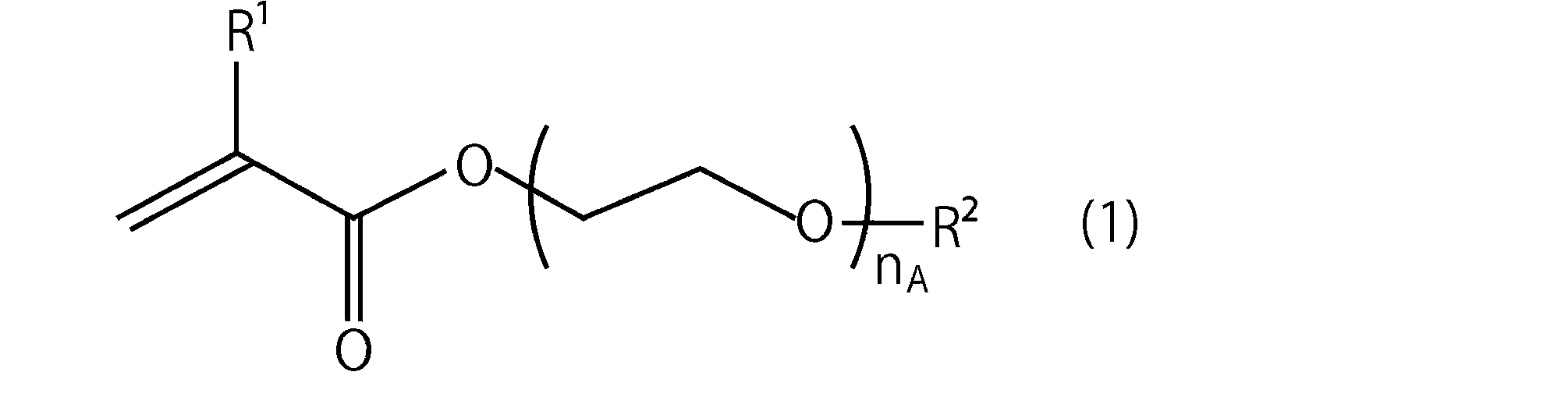
- R 1 is hydrogen or methyl
- R 2 is a monovalent with 4 to 30 carbon atoms having a fused cyclic hydrocarbon group, a polycyclic hydrocarbon group or a monocyclic hydrocarbon group. It is an organic group
- n A is an integer from 0 to 10.
- the hydroxyl value of a composition containing a monofunctional acrylic monomer (A) and a polyfunctional acrylic monomer (B) is adjusted to 1 to 100 mgKOH using a hydroxyl value adjusting agent (C). It is set to / g. Therefore, the cured product formed by the photocurable composition has good ion migration resistance.
- composition contains a monofunctional acrylic monomer (A), a polyfunctional acrylic monomer (B), and a hydroxyl value adjuster (C).
- A monofunctional acrylic monomer
- B polyfunctional acrylic monomer
- C hydroxyl value adjuster
- the hydroxyl value adjusting agent (C) is used to set the hydroxyl value of the composition containing the component (A) and the component (B) to 1 to 100 mgKOH / g. It has excellent ejection properties and photocurability, and also has excellent heat resistance, adhesion to substrates, especially silicon substrates, glass substrates, and substrates on which conductors such as metal wiring and electrodes are formed, and ion migration resistance.
- a cured product can be formed.
- the hydroxyl value of the composition is more preferably 2 to 40 mgKOH / g, further preferably 5 to 40 mgKOH / g.
- the numerical range "A to B" is "A or more and B or less".
- both the component (A) and the component (B) have a hydroxyl value of 100 mgKOH /. It is preferably g or less, more preferably 10 mgKOH / g or less, and even more preferably 0 mgKOH / g.
- the composition of the present invention contains 40 to 80% by weight of the monofunctional acrylic monomer (A) with respect to 100% by weight of the total weight of the components of the composition.
- the content of the component (A) is 100% by weight of the composition from the viewpoint of improving the ejection property when used as an ink and forming a cured product having an excellent balance of heat resistance, adhesion to a substrate, ion migration resistance and the like. It is preferably 40 to 80% by weight, more preferably 50 to 75% by weight, based on%.
- a monofunctional acrylic monomer (A) from the viewpoint of heat resistance and good adhesion to substrates, especially glass substrates, silicon substrates, and substrates on which conductors such as metal wiring and electrodes are formed, and ion migration resistance.
- (meth) acrylate is used to indicate both or one of acrylate and methacrylate
- (meth) acryloyl is used to indicate both or one of acryloyl and methacryloyl.
- the monofunctional acrylic monomer (a-1) having a fused cyclic hydrocarbon group or a polycyclic hydrocarbon group is not particularly limited, but has 7 carbon atoms having a fused ring hydrocarbon group or a polycyclic hydrocarbon group. It is preferably a monofunctional acrylic monomer containing up to 50 organic groups, and preferably a monofunctional acrylic monomer containing a fused ring hydrocarbon group or a polycyclic hydrocarbon group having 7 to 30 carbon atoms. More preferred.
- the "monofunctional acrylic monomer” refers to a monomer having one (meth) acryloyl group in one molecule.
- the "condensed ring hydrocarbon group” is a hydrocarbon (consisting of a carbon atom and a hydrogen atom) group having two or more rings, and is a carbon that constitutes a certain ring and at the same time constitutes another ring.
- a hydrocarbon group having at least one atom a “polycyclic hydrocarbon group” is a hydrocarbon group having two or more rings, and one ring and another ring have a single bond or the number of carbon atoms. It refers to a hydrocarbon group bonded with 1 to 10 alkylenes.
- the "organic group having 7 to 50 carbon atoms having the fused cyclic hydrocarbon group or the polycyclic hydrocarbon group” is, for example, the (meth) acryloyl group in the compound represented by the formula (1).
- the monomer (a-1) it is preferable to use the compound represented by the formula (1) from the viewpoint of obtaining a cured product having excellent heat resistance, adhesion to a substrate, and ion migration resistance.
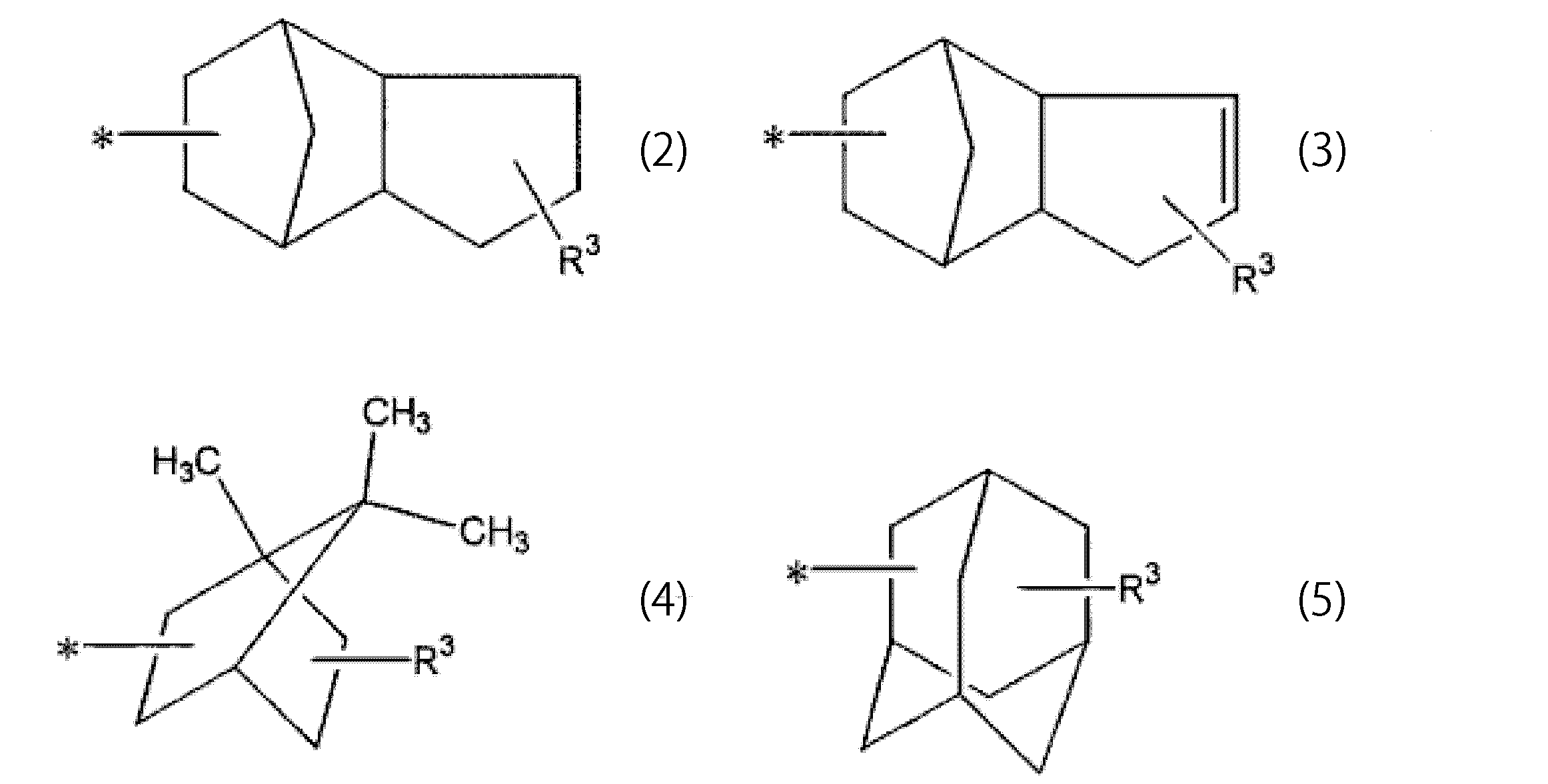
- R 2 is a monovalent organic group having 4 to 30 carbon atoms and having a fused ring hydrocarbon group or a polycyclic hydrocarbon group, and is preferably non-polar and has a fused ring. It is a monovalent organic group having 4 to 30 carbon atoms and having a formula hydrocarbon group or a polycyclic hydrocarbon group, and more preferably a group represented by any one of the above formulas (2) to (5). Is. Further, 0 or 1 is preferable as n A.
- the monomer (a-1) at least one compound selected from the following compound group (I) is preferable.
- the following compounds (11) to (20) are more preferable, and the compounds (11) and (17) are further preferable in consideration of the adhesion, heat resistance and ion migration resistance of the obtained cured product to the substrate.
- the monomer (a-1) may be a kind of compound selected from the above-mentioned compounds and the like, or may be a mixture of two or more kinds thereof.
- a mixture of compounds (11) and (17) is preferable, and when both are used in combination, the weight ratio of compound (11): compound (17) is preferably 5:10 to 10: 5, and 7:10 to 10: 7. Is more preferable, and 9:10 to 10: 9 is even more preferable.
- a compound produced by a known method may be used, or dicyclopentanyl acrylate (trade name; Funkryl FA-513AS: Hitachi Kasei Kogyo Co., Ltd.), di. Cyclopentanyl methacrylate (trade name; funcryl FA-513M: Hitachi Kasei Kogyo Co., Ltd.), dicyclopentenyl acrylate (trade name: funcryl FA-511AS: Hitachi Kasei Kogyo Co., Ltd.), dicyclopentenyl methacrylate (trade name; Name: Funkrill FA-511M: Hitachi Kasei Kogyo Co., Ltd., Dicyclopentenyloxyethyl acrylate (trade name; Funkrill FA-512AS: Hitachi Kasei Kogyo Co., Ltd.), Dicyclopentenyloxyethyl methacrylate (trade name; Funkrill FA-512M: Hitachi Kasei Kogyo Co., Ltd., I
- the "monocyclic hydrocarbon group” refers to a hydrocarbon group having one ring (including an aromatic ring).
- a compound produced by a known method may be used, or benzyl acrylate, cyclohexyl acrylate (trade name; V # 155: Osaka Organic Chemical Industry Co., Ltd.), cyclohexyl methacrylate.
- Commercially available products such as (trade name; light ester CH: Kyoeisha Chemical Co., Ltd.) may be used.
- composition of the present invention contains 10 to 30% by weight of the polyfunctional acrylic monomer (B) with respect to 100% by weight of the composition.
- the "polyfunctional acrylic monomer” refers to a monomer having two or more (meth) acryloyl groups in one molecule.
- the monomer (B) examples include tricyclodecanedimethanol di (meth) acrylate, bisphenol F ethylene oxide-modified di (meth) acrylate, bisphenol A ethylene oxide-modified di (meth) acrylate, and isocyanurate ethylene oxide-modified di (meth).
- Acrylate polyethylene glycol di (meth) acrylate, polypropylene glycol di (meth) acrylate, pentaerythritol di (meth) acrylate, dipentaerythritol di (meth) acrylate, pentaerythritol di (meth) acrylate monostearate, trimethylolpropane di (Meta) acrylate, 1,4-butanediol di (meth) acrylate, 1,6-hexanediol di (meth) acrylate, 1,9-nonanediol di (meth) acrylate, 1,4-cyclohexanedimethanol di (meth) Meta) acrylate, 2-n-butyl-2-ethyl-1,3-propanediol di (meth) acrylate, pentaerythritol trimethylolpropane (meth) acrylate, pentaerythritol t
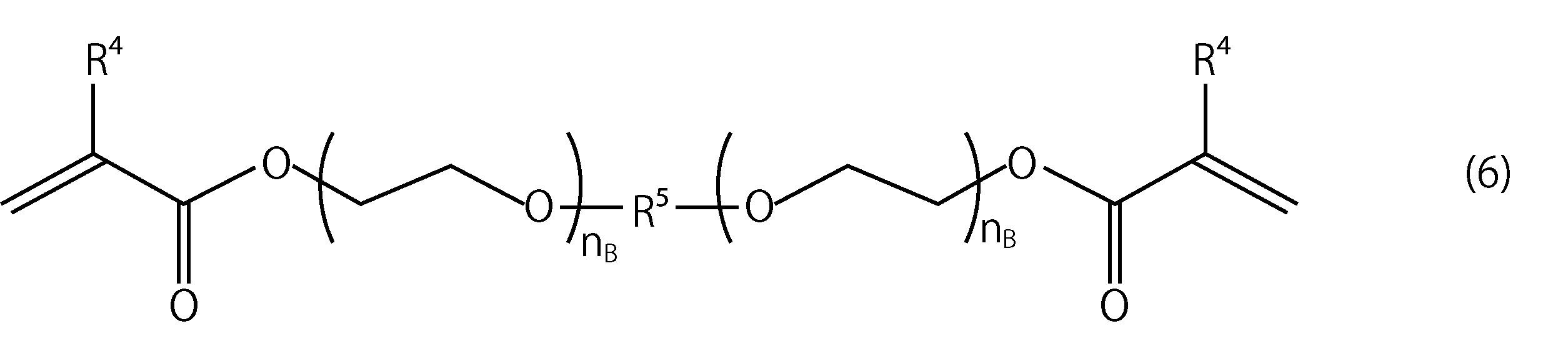
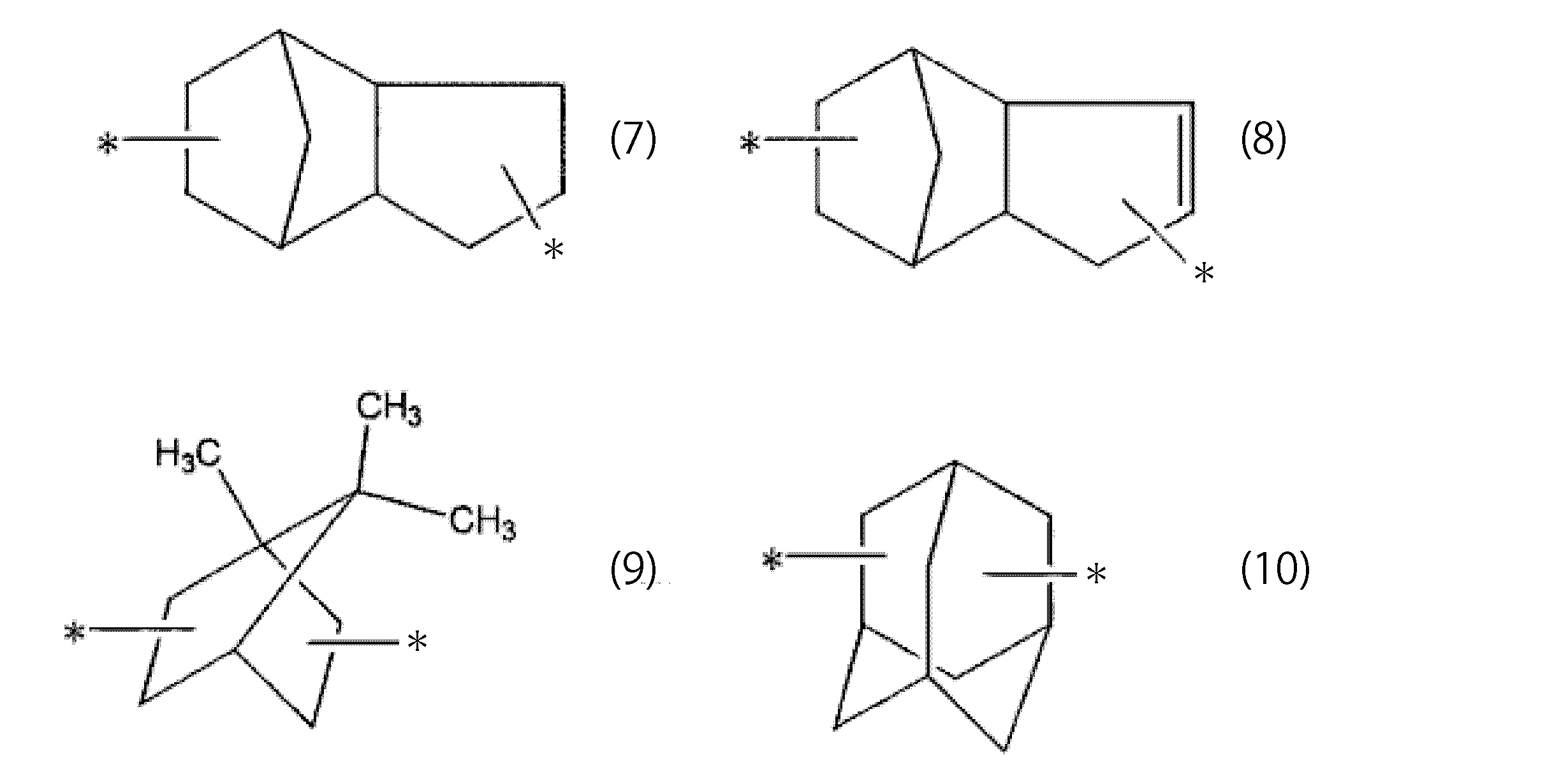
- R 5 in the formula (6) is a group represented by any one of the formulas (7) to (10).
- the compound is preferable, and the group represented by the above formula (7) is more preferable. Further, 0 or 1 is preferable as n B.
- the monomer (B) may be one kind of compound selected from the above-mentioned compounds and the like, or may be a mixture of two or more kinds thereof.
- the content of the monomer (B) in the composition of the present invention is such that a composition having excellent photocurability can be obtained, and a cured product having excellent heat resistance, adhesion to a substrate, and ion migration resistance can be obtained in a well-balanced manner.
- the composition of the present invention contains a hydroxyl value adjusting agent (C).
- the hydroxyl value adjusting agent (C) is a compound having a hydroxyl value different from that of the components (A) and (B), and a compound having a hydroxyl value higher than that of the components (A) and (B) is preferable.
- the difference between the hydroxyl value of the component (C) and the hydroxyl value of the component (A) is preferably 100 to 300 mgKOH / g or less, more preferably 150 to 250 mgKOH / g or less, and even more preferably 160 to 200 mgKOH / g or less.
- the difference between the hydroxyl value of the component (C) and the hydroxyl value of the component (B) is preferably 100 to 300 mgKOH / g or less, more preferably 150 to 250 mgKOH / g or less, and even more preferably 160 to 200 mgKOH / g or less.
- the hydroxyl value adjusting agent (C) may be used as one kind or a mixture of two or more kinds.
- a hydroxyl group value adjusting agent (C) having a hydroxyl group is blended with a monofunctional acrylic monomer (A) having no hydroxyl group and a polyfunctional acrylic monomer (B) having no hydroxyl group.
- the content of the hydroxyl value adjusting agent (C) is preferably 0.1 to 30% by weight, preferably 0.3% by weight, based on 100% by weight of the composition, from the viewpoint of forming a cured product having good ion migration resistance. It is more preferably from 25% by weight, still more preferably from 0.5 to 20% by weight.
- the hydroxyl value of the hydroxyl value adjusting agent (C) is preferably 100 to 300 mgKOH / g, preferably 150 to 250 mgKOH / g. g is more preferable, and 160 to 200 mgKOH / g is even more preferable.
- the hydroxyl value adjusting agent (C) contains an acrylic oligomer or a (meth) acrylic monomer having a hydroxyl group.
- the hydroxyl value adjusting agent (C) may contain only one of these, or may contain two or more of them.
- the weight average molecular weight of the hydroxyl value adjusting agent (C) is preferably 100 to 5000, more preferably 450 to 3000, and even more preferably 700 to 1500.
- the glass transition point (Tg) of the hydroxyl value adjusting agent (C) is preferably 85 ° C. or higher, more preferably 90 ° C. or higher.
- Examples of the (meth) acrylic monomer having a hydroxyl group include 2-hydroxyethyl (meth) acrylate, 2-hydroxypropyl (meth) acrylate, 4-hydroxybutyl (meth) acrylate, and divalent alcohol having 2 to 8 carbon atoms.
- CHDMMA 1,4-cyclohexanedimethanol monoacrylate
- a compound obtained by adding (meth) acrylic acid to the oxylan ring or the oxetane ring of the epoxy compound having the oxylan ring or the oxetane ring and esterifying it may also be used as the acrylic monomer having a hydroxyl group.
- examples of these are epoxy ester M-600A, epoxy ester 40EM, epoxy ester 70PA, epoxy ester 200PA, epoxy ester 80MFA, epoxy ester 3002M (N), epoxy ester 3002A (N), epoxy ester 3000MK, epoxy ester 3000A ( Examples thereof include (manufactured by Kyoeisha Chemical Co., Ltd.) and (meth) acrylic acid adducts of the following epoxy compounds.
- Epoxy compound "jER807" (epoxy equivalent 160-175 g / eq), "jER815", “jER825" (epoxy equivalent 170-180 g / eq), “jER827” (epoxy equivalent 180-190 g / eq), “jER828” (epoxy) Equivalent 184-194 g / eq), “jER190P”, “jER191P”, “jER1001” (epoxy equivalent 450-500 g / eq), “jER1002” (epoxy equivalent 600-700 g / eq), “jER1004" (epoxy equivalent 875-) 975g / eq), “jER1004AF” (epoxy equivalent 875-975g / eq), "jER1007” (epoxy equivalent 1750-2200g / eq), “jER1010” (epoxy equivalent 3000-5000g / eq), “jER157S70” (
- TEP-G epoxy equivalent 160-180 g / eq
- MA-DGIC epoxy equivalent 140 g / eq
- DA-MGIC Epoxy equivalent 265 g / eq
- TG-G epoxy equivalent 92 g / eq
- TEPIC-VL epoxy equivalent 125-145 g / eq
- product Name manufactured by Nissan Chemical Industry Co., Ltd., "NANOPOX C620” (trade name, manufactured by EVONIK, epoxy equivalent about 220 g / eq)
- Adecaledin EP-4088S (trade name, manufactured by ADEKA, epoxy equivalent 170 g / eq), N, N, N', N'-tetraglycidyl-m-xylene diamine
- the composition of the present invention may further contain a photopolymerization initiator (D).
- the photopolymerization initiator may be any compound that can initiate polymerization of the monomer component contained in the composition of the present invention and that generates radicals by irradiation with ultraviolet rays, visible light, electromagnetic waves, or the like, and generally used ones can be used. ..
- photopolymerization initiator examples include benzophenone, Michler's ketone, 4,4'-bis (diethylamino) benzophenone, xanthone, thioxanthone, isopropylxanthone, 2,4-diethylthioxanthone, 2-ethylanthraquinone, acetophenone, 2-hydroxy-.
- the photopolymerization initiator (D) is preferably 5 to 15% by weight, more preferably 7 to 12% by weight, based on 100% by weight of the composition, from the viewpoint of forming a cured product having good ion migration resistance.
- the photopolymerization initiator (D) may be one kind of compound or a mixture of two or more kinds of compounds.
- the viscosity at 25 ° C. is preferably 1 to 100 mPa ⁇ s, more preferably 3 to 70 mPa ⁇ s, from the viewpoint of improving ejection properties. ..
- the present invention can also be implemented as an inkjet ink composition containing the composition of the present invention and an active energy ray-curable ink composition containing the inkjet ink composition.
- the active energy ray refers to an energy ray capable of decomposing a compound that generates an active species to generate an active species. Examples of such active energy rays include light energy rays such as visible light, ultraviolet rays, infrared rays, X-rays, ⁇ -rays, ⁇ -rays, ⁇ -rays, and electron rays.
- the composition of the present invention contains a flame retardant, a resin containing a phenolic hydroxyl group, a melamine resin, an epoxy compound, an oxetane compound, a curing agent, a surfactant, a colorant, a polymerization inhibitor and a solvent.
- a flame retardant a resin containing a phenolic hydroxyl group, a melamine resin, an epoxy compound, an oxetane compound, a curing agent, a surfactant, a colorant, a polymerization inhibitor and a solvent.
- the cured product of the present invention can be obtained by photo-curing the composition of the present invention.
- a cured product can be produced by a method including the following steps 1 and 2.
- Step 1 A step of applying the composition of the present invention onto a substrate by an inkjet method to form a coating film
- Step 2 The coating film obtained in Step 1 is irradiated with light to cure the coating film, and the substrate is cured. The process of forming a cured product on top
- the inkjet method is not particularly limited, and a known inkjet method can be used.
- the substrate is not particularly limited as long as it can be applied with the ink of the present invention, and its shape is not limited to a flat plate shape, and may be a curved surface shape or the like.
- the substrate is not particularly limited, but for example, a polyester resin substrate made of polyethylene terephthalate (PET), polybutylene terephthalate (PBT), or the like; a polyolefin resin substrate made of polyethylene, polypropylene, or the like; a polyvinyl chloride, a fluororesin.
- Organic polymer film composed of acrylic resin, polyamide, polycarbonate, polyimide, etc .; cellophane; metal foil; laminated film of polyimide and metal foil; glassin paper, parchment paper, polyethylene, clay binder, polyvinyl alcohol having a sealing effect , Paper sealed with starch or carboxymethyl cellulose (CMC), etc .; silicon substrate; and glass substrate.
- the ink of the present invention can be easily applied in a predetermined pattern, and a uniform pattern can be formed on a large substrate.
- the temperature at the time of ejection with the inkjet coating device is preferably 10 to 120 ° C.
- the viscosity of the ink of the present invention at the temperature is preferably 1 to 30 mPa ⁇ s, more preferably 2 to 25 mPa ⁇ s, and even more preferably 3 to 20 mPa ⁇ s.
- heating the inkjet head to lower the viscosity of the ink at the time of ejection enables more stable ejection.
- the heating temperature is preferably 40 to 120 ° C.
- the thickness of the obtained coating film may be appropriately selected according to the desired application, but is preferably 1 to 20 ⁇ m, and more preferably 5 to 15 ⁇ m.
- the amount of exposure to be irradiated may be appropriately adjusted according to the composition of the composition of the present invention, but a UV monitor manufactured by Opsystec (“UV-Pad”, wavelength: UV-A). when measured using a (315-400nm)), preferably about 100 ⁇ 10,000mJ / cm 2, more preferably about 150 ⁇ 5000mJ / cm 2, more preferably about 180 ⁇ 3000mJ / cm 2, 200 ⁇ 2000mJ About / cm 2 is particularly preferable.
- the wavelength of ultraviolet rays, visible rays, etc. to be irradiated is preferably 200 to 500 nm, more preferably 300 to 450 nm.
- An exposure machine may be used when irradiating light, and the exposure machine is equipped with a UV-LED lamp, a high-pressure mercury lamp, an ultra-high-pressure mercury lamp, a metal halide lamp, a halogen lamp, a black light lamp, or the like.
- a device that irradiates ultraviolet rays, visible light, or the like in the range of 200 to 500 nm is preferable.
- the cured product cured by irradiation with light may be further heated and fired.
- a stronger cured product can be obtained by heating and firing at 80 to 250 ° C. for 10 to 60 minutes.
- the thickness of the cured product of the present invention may be appropriately selected according to the desired application, but is preferably 1 to 20 ⁇ m, more preferably 5 to 15 ⁇ m.
- the cured product of the present invention has a glass transition temperature of preferably 85 ° C. or higher measured using DMS6000 (Hitachi High-Technologies Corporation) from the viewpoint of producing a highly reliable electronic circuit substrate or the like. More preferably, it is 90 to 150 ° C.
- a voltage application insulation resistance test (hereinafter referred to as an ion migration resistance test) under a constant temperature and humidity constant environment may be carried out.
- ion migration resistance test a specific voltage is applied for a specific time under a specific constant temperature and humidity constant environment, and the presence or absence of an abnormality in the resistance value at that time is confirmed.
- evaluation is often performed at a high temperature of 85 to 130 ° C. Therefore, in order to obtain a highly reliable electronic circuit substrate or the like, it is desirable that the glass transition temperature of the cured product is within the above range. ..
- the cured product of the present invention is a cured product having excellent heat resistance, adhesion to a substrate, and ion migration resistance, display elements such as liquid crystal display elements or EL display elements, printed wiring boards, flexible wiring boards, and semiconductor packages It is suitably used as a protective film and an insulating film in an electronic circuit board such as a substrate and a solar cell substrate. Further, the cured product of the present invention is suitably used for metal wiring forming a predetermined circuit pattern, a coverlay film for protecting conductors such as electrodes, solder resist, and the like.
- the electronic component of the present invention contains the cured product of the present invention and is produced by a method including the steps 1 and 2. Since the cured product of the present invention is excellent in heat resistance, adhesion to a substrate, ion migration resistance, etc., the electronic component of the present invention is an electronic component excellent in electrical characteristics, long-term reliability, and the like.
- Example 1 ⁇ Preparation of photocurable composition> As the monofunctional acrylic monomer (A), 35 g of FA-513AS and 35 g of IB-XA, as the polyfunctional (bifunctional) acrylic monomer (B), 20 g of IRR214-K, and as the hydroxyl value adjuster (C). , OT-2503 and 10 g of Irg379 as a photopolymerization initiator (D) were mixed to obtain a solution, and then a membrane filter made of ultra-high molecular weight polyethylene (hydrophobic) having a pore size of 0.2 ⁇ m (Japan). The mixture was filtered through Integris Co., Ltd.
- Inkjet ink 1 is injected into an inkjet cartridge DMC-11610 (manufactured by FUJIFILM), mounted on an inkjet device (DMP-2831 manufactured by FUJIFILM), and has a discharge voltage (piezo voltage) of 17 to 25 V and a head temperature of 32 to 70 ° C.
- a discharge voltage piezo voltage
- a square pattern with a piece of 3 cm on a flexible copper-clad laminate manufactured by Connectec Japan Co., Ltd., hereinafter referred to as a Cu substrate
- a pattern was drawn on the substrate (manufactured by Connectec Japan Co., Ltd.) to cover the overlap margin of the comb-shaped electrodes.
- a UV-LED lamp "ASM1503NM-UV-LED” (manufactured by Asumi Giken Co., Ltd., lamp wavelength: 365 nm) is used on a Cu substrate on which a pattern is formed and a substrate with an opposed comb-shaped electrode pattern, and ultraviolet rays having a wavelength of 365 nm are emitted at 5000 mJ /
- the pattern is photocured by irradiating with a cm 2 UV exposure (measured with an Opsysc UV monitor (“UV-Pad”), wavelength: UV-A (315-400 nm)), and the clean oven DT-610 (clean oven DT-610).
- UV-Pad Opsysc UV monitor
- the film thickness of the cured product is the film thickness of the cured product on Cu in the Cu substrate 1 on which the cured product is formed, and the facing comb electrode in the substrate 1 with the opposed comb electrode pattern on which the cured product is formed.
- the film thickness of the above cured product was determined by measuring with a laser microscope VK-X100 (manufactured by KEYENCE CORPORATION).
- Electromagnetic wave shield film SF-PC5900-C (manufactured by Tatsuta Densen Co., Ltd.) is hot-pressed (3 MPa x 175 ° C. x 3 minutes) and pasted on the predetermined position of the substrate 1 with the opposed comb-shaped electrode pattern on which the cured product is placed. Together, IMG sample 1 was prepared.
- Examples 2 to 14 Comparative Examples 1 to 5> Each component of Example 1 was changed to the components shown in Tables 1 to 3, and inkjet inks 2 to 19 were prepared by the same method as in Example 1. For inks 2 to 18 excluding ink 19, IMG samples 2 to 18 and Cu substrates 2 to 18 were prepared.
- ⁇ Evaluation method> ⁇ Evaluation of inkjet ink and patterned cured product> The ejection properties and photocurability of the inkjet inks 1 to 19 obtained above, the ion migration resistance, and the adhesion and heat resistance (glass transition temperature) of the cured product to the substrate were evaluated. Each test method and evaluation criteria are as follows, and the evaluation results are shown in Tables 1 to 3. The numerical values representing the contents of the components (A), (B), (C) and (D) in the table are all% by weight.
- the ion migration resistance of the IMG samples (1 to 18) obtained above was evaluated by the following method.
- the obtained IMG sample and the ion migration tester MIG-87 (manufactured by IMV Co., Ltd.) are connected by wiring, installed in the small environmental tester SH-641 (manufactured by ESPEC Co., Ltd.), and then 85 ° C. ⁇ 85. Under the environment of%, a DC voltage of 100 V was applied for 100 hours.
- the wettability of the ink was evaluated by visually observing the disorder of the pattern formed on the Cu substrate and the blurring of printing obtained in each Example and Comparative Example.
- the evaluation criteria are as follows. ⁇ : The print can be printed on the predetermined pattern and the print streaks cannot be seen. ⁇ : The print can be printed on the predetermined pattern, but the print streaks can be seen. ⁇ : There is a part that cannot be printed on the predetermined pattern.
- the cured product has ion migration resistance (hereinafter, “IMG resistance” as appropriate). ”), Wetability and adhesion were improved. From this result, it can be said that it is effective to set the hydroxyl value of the composition to 1 to 100 mgKOH / g for the formation of a cured product having excellent adhesion and IMG resistance.
- hydroxyl value of the composition affects the IMG resistance
- the hydroxyl value adjuster (C) exerts some surface-active action, and the balance between hydrophilicity and hydrophobicity is adjusted in order to improve the wettability of the composition.
- Comparative Example 1 in which the hydroxyl value of the composition was higher than 100 mgKOH / g had low IMG resistance. This can be said to be due in part to the fact that if the hydroxyl value of the composition is too high, the amount of water taken up by the cured product becomes too large.
- a cured product having high IMG resistance could be stably formed.
- the acrylic oligomer was used, a cured product having high IMG resistance was obtained by setting the content in the composition to 1% by weight or more.
- the hydroxyl value adjusting agent (C) is preferably 25% by weight or less when used as an ink for inkjet.
- a (meth) acrylic monomer having a hydroxyl group was also used, a cured product having high IMG resistance could be formed as in the case of the acrylic oligomer.
- the monofunctional acrylic monomer (A) and the polyfunctional acrylic monomer (B) having a condensed ring hydrocarbon group or a polycyclic hydrocarbon group were preferred. This result is considered to be due to the fact that the adhesion of the cured product to inorganic substances such as Cu was improved by the cycloring skeleton.
- the monofunctional acrylic monomer (A) was preferably a homopolymer having a glass transition point (Tg) of 90 ° C. or higher.
- Tg glass transition point
- the bifunctional acrylic monomer is preferably 50% by weight or less of the composition.
- the photocurable composition of the present invention forms a cured product having excellent adhesion and ion migration resistance to a silicon substrate, a glass substrate, a polyimide substrate, or a substrate on which conductors such as metal wiring and electrodes are formed. Can be used for.
Landscapes
- Chemical & Material Sciences (AREA)
- Organic Chemistry (AREA)
- Life Sciences & Earth Sciences (AREA)
- Engineering & Computer Science (AREA)
- Materials Engineering (AREA)
- Wood Science & Technology (AREA)
- Health & Medical Sciences (AREA)
- Chemical Kinetics & Catalysis (AREA)
- Medicinal Chemistry (AREA)
- Polymers & Plastics (AREA)
- Addition Polymer Or Copolymer, Post-Treatments, Or Chemical Modifications (AREA)
- Polymerisation Methods In General (AREA)
Abstract
Description
本発明の課題は、無機基材に対する密着性が良く、イオンマイグレーション耐性の良好な硬化物を形成可能な光硬化性組成物を提供することにある。
[3]前記水酸基価調整剤(C)は、水酸基価が150~250mgKOH/gであり、重量平均分子量が100~5000である、[1]に記載の光硬化性組成物。
[4]前記水酸基価調整剤(C)がアクリルオリゴマーまたは、水酸基を有する(メタ)アクリルモノマーを含む、[2]または[3]に記載の光硬化性組成物。
[6]前記単官能アクリルモノマー(A)が、下記式(1)で表される単官能アクリルモノマーである、[5]に記載の光硬化性組成物。
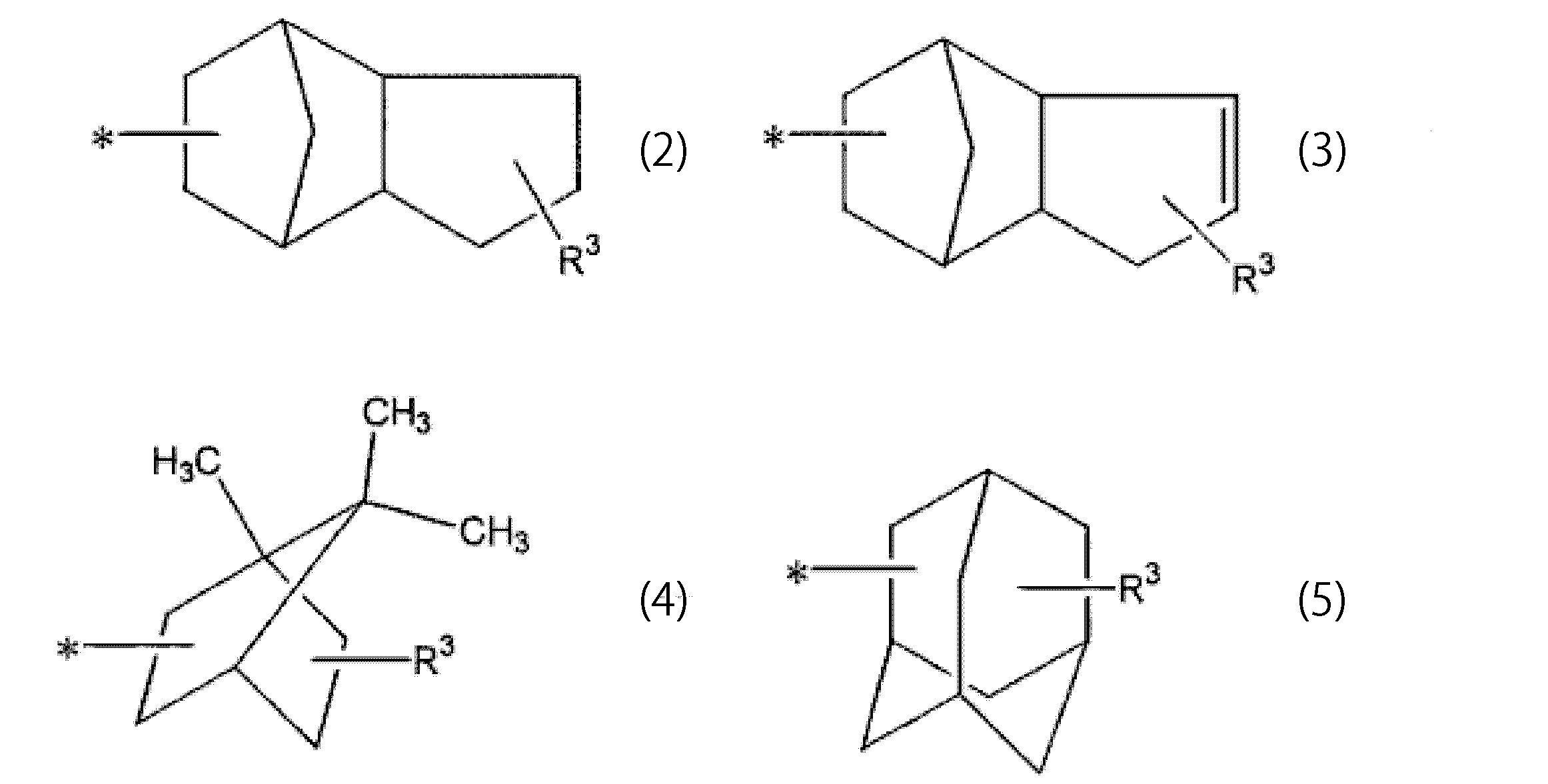

[9]前記式(6)中のR5が下記式(7)~(10)のいずれか1つで表される基である、[8]に記載の光硬化性組成物。
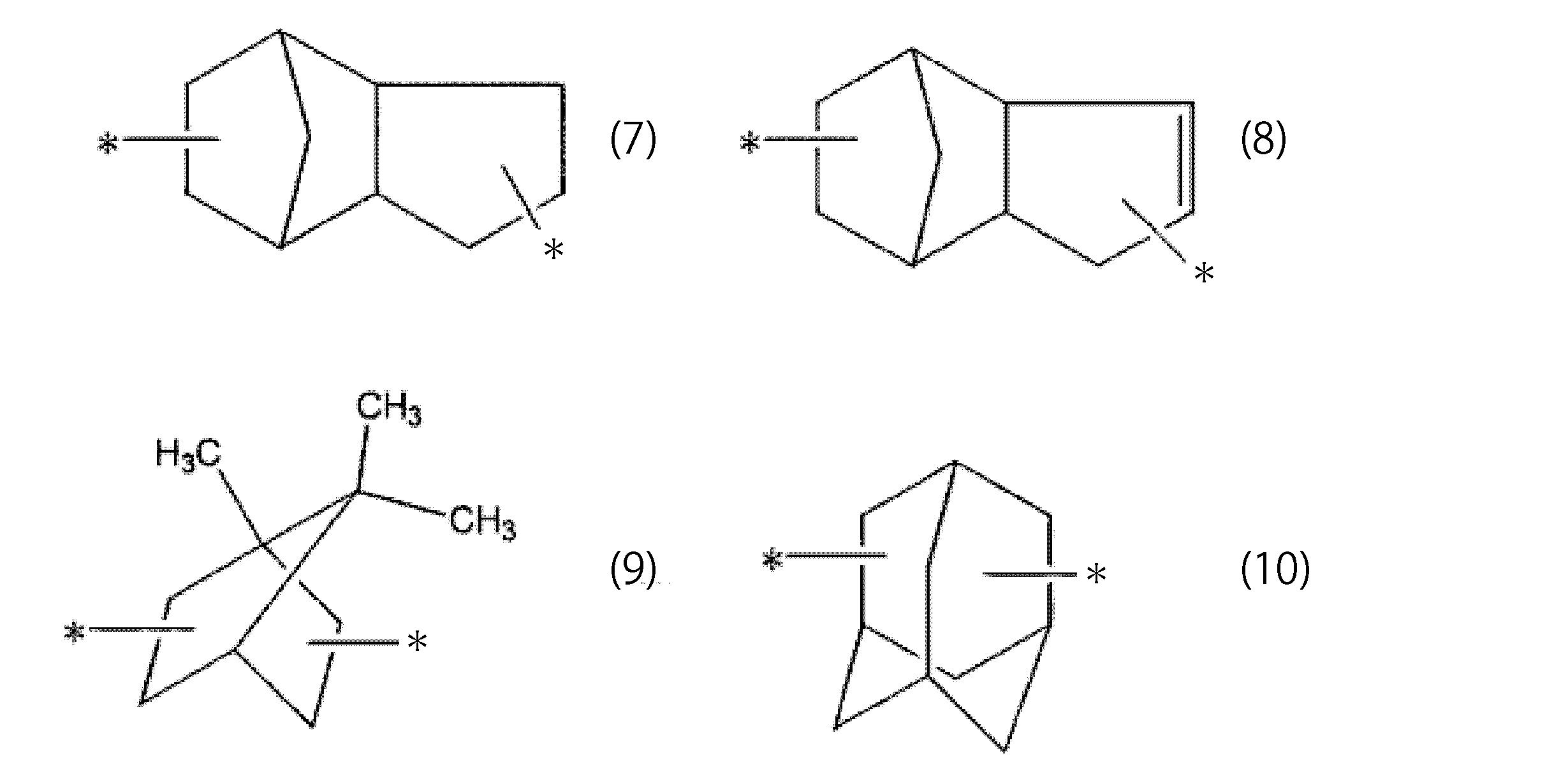
[11]25℃における粘度が1~100mPa・sである請求項[1]~[10]のいずれか一項に記載の光硬化性組成物。
[12]組成物の水酸基価が5~40mgKOH/gである請求項[1]~[11]のいずれか一項に記載の光硬化性組成物。
[14][13]に記載のインクジェット用インク組成物を含有する、活性エネルギー線硬化型インク組成物。
[15][1]~[12]のいずれか一項に記載の光硬化性組成物を光硬化することで得られる硬化物。
[16][1]~[12]のいずれか一項に記載の光硬化性組成物を光硬化した後、さらに熱硬化することで得られる硬化物。
[17][15]または[16]に記載の硬化物を含む電子部品。
本発明の組成物は、組成物の成分の重量の和100重量%に対して40~80重量%の単官能アクリルモノマー(A)を含有している。
縮合環式炭化水素基または多環式炭化水素基を有する単官能アクリルモノマー(a-1)としては、特に制限されないが、縮合環式炭化水素基または多環式炭化水素基を有する炭素数7~50の有機基を含む単官能アクリルモノマーであることが好ましく、縮合環式炭化水素基または多環式炭化水素基を有する炭素数7~30の有機基を含む単官能アクリルモノマーであることがさらに好ましい。
なお、「単官能アクリルモノマー」とは、1分子中に1つの(メタ)アクリロイル基を有するモノマーのことをいう。

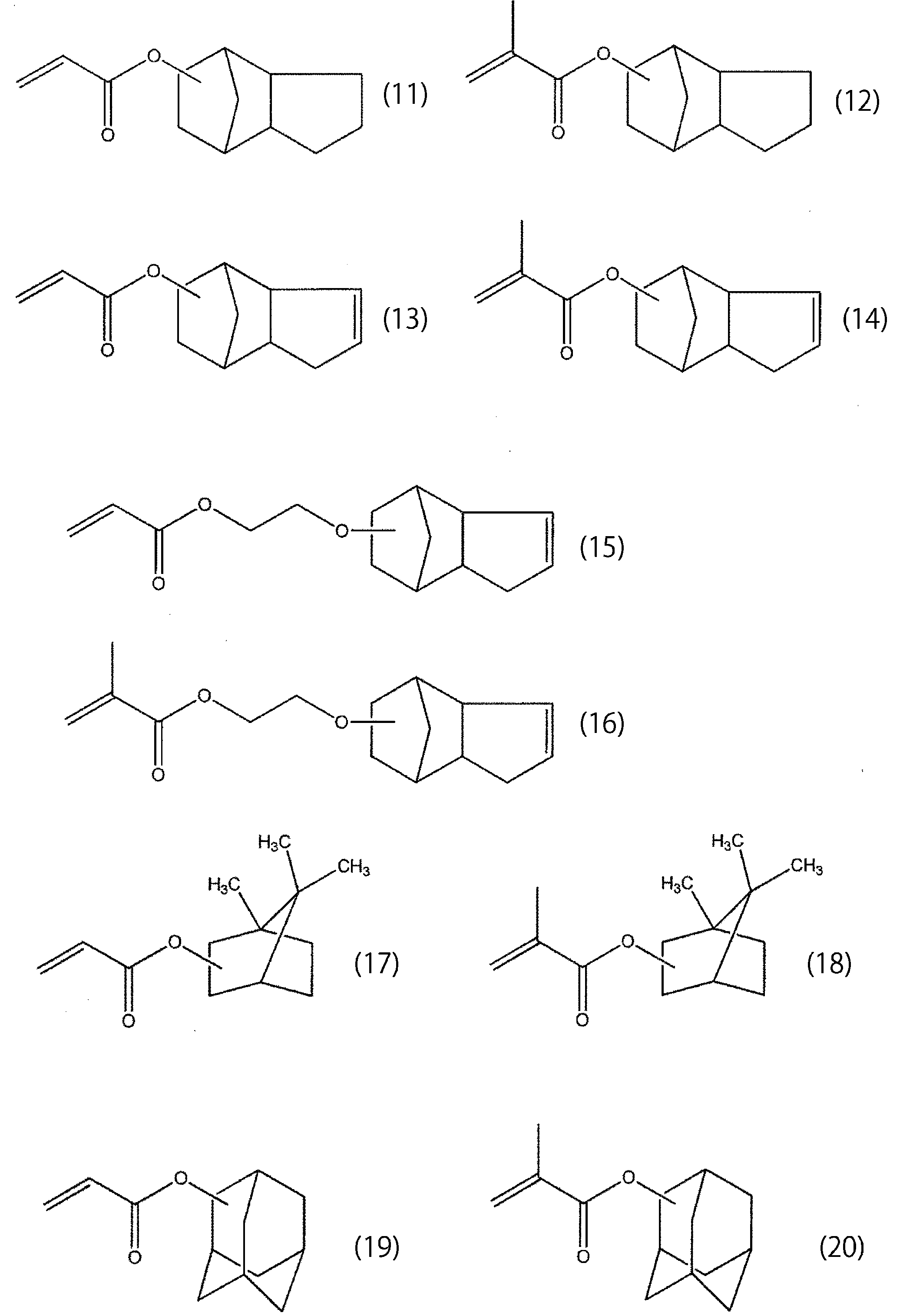
「単環式炭化水素基」とは、環(芳香環を含む)を1つ有する炭化水素基のことをいう。
前記モノマー(a-2)としては、公知の方法で製造した化合物を用いてもよいし、また、ベンジルアクリレート、シクロヘキシルアクリレート(商品名;V#155:大阪有機化学工業(株))、シクロヘキシルメタクリレート(商品名;ライトエステルCH:共栄社化学(株))等の市販品を用いてもよい。
本発明の組成物は、組成物100重量%に対し10~30重量%の多官能アクリルモノマー(B)を含有している。「多官能アクリルモノマー」とは、1分子中に2つ以上の(メタ)アクリロイル基を有するモノマーのことをいう。
前記モノマー(B)は上述した化合物等から選ばれる一種の化合物であってもよく、またこれらの二種以上の混合物であってもよい。
本発明の組成物は、水酸基価調整剤(C)を含有している。ここで、水酸基価調整剤(C)は、前記成分(A)、(B)と、水酸基価が異なる化合物であり、前記成分(A)、(B)よりも水酸基価が高い化合物が好ましい。成分(C)の水酸基価と、成分(A)の水酸基価との差は、100~300mgKOH/g以下が好ましく、150~250mgKOH/g以下がより好ましく、160~200mgKOH/g以下がさらに好ましい。成分(C)の水酸基価と、成分(B)の水酸基価との差は、100~300mgKOH/g以下が好ましく、150~250mgKOH/g以下がより好ましく、160~200mgKOH/g以下がさらに好ましい。水酸基価調整剤(C)は、一種または二種以上の混合物として用いてもよい。
エポキシ化合物「jER807」(エポキシ当量160~175g/eq)、「jER815」、「jER825」(エポキシ当量170~180g/eq)、「jER827」(エポキシ当量180~190g/eq)、「jER828」(エポキシ当量184~194g/eq)、「jER190P」、「jER191P」、「jER1001」(エポキシ当量450~500g/eq)、「jER1002」(エポキシ当量600~700g/eq)、「jER1004」(エポキシ当量875~975g/eq)、「jER1004AF」(エポキシ当量875~975g/eq)、「jER1007」(エポキシ当量1750~2200g/eq)、「jER1010」(エポキシ当量3000~5000g/eq)、「jER157S70」(エポキシ当量200~220g/eq)、「jER1032H60」(エポキシ当量163~175g/eq)、「jER1256」(エポキシ当量7500~8500g/eq)(以上、三菱化学(株)製)、「セロキサイド2021P」(エポキシ当量128~145g/eq)、「セロキサイド3000」、「EHPE-3150」(エポキシ当量170~190g/eq)、「EHPE-3150CE」(エポキシ当量147~157g/eq)(以上商品名、(株)ダイセル製)、「TECHMORE VG3101L」(商品名、(株)プリンテック製、エポキシ当量210g/eq)、「HP7200」(エポキシ当量254~264g/eq)、「HP7200H」(エポキシ当量272~284g/eq)、「HP7200HH」(エポキシ当量274~286g/eq)(以上商品名、DIC(株)製)、「NC―3000」(エポキシ当量265~285g/eq)、「NC―3000H」(エポキシ当量280~300g/eq)、「EOCN―102S」(エポキシ当量205~217g/eq)、「EOCN―103S」(エポキシ当量209~219g/eq)、「EOCN-104S」(エポキシ当量213~223g/eq)、「EPPN-501H」(エポキシ当量162~172g/eq)、「EPPN-501HY」(エポキシ当量163~175g/eq)、「EPPN-502H」(エポキシ当量158~178g/eq)、「EPPN-201」(エポキシ当量180~200g/eq)(以上商品名、日本化薬(株)製)、「TEP-G」(エポキシ当量160~180g/eq)(以上商品名、旭有機材(株)製)、「MA-DGIC(エポキシ当量140g/eq)」、「DA-MGIC」(エポキシ当量265g/eq)、「TG-G」(エポキシ当量92g/eq)(以上商品名、四国化成工業(株)製)、「TEPIC-VL」(エポキシ当量125~145g/eq)(商品名、日産化学工業(株)製)、「NANOPOX C620」(商品名、EVONIK製、エポキシ当量約220g/eq)、「アデカレジン EP-4088S」(商品名、(株)ADEKA製、エポキシ当量170g/eq)、N,N,N’,N’-テトラグリシジル-m-キシレンジアミン、1,3-ビス(N,N-ジグリシジルアミノメチル)シクロヘキサン、N,N,N’,N’-テトラグリシジル-4,4’-ジアミノジフェニルメタン、γ-グリシドキシプロピルトリメトキシシラン(エポキシ当量194g/eq)、γ-グリシドキシプロピルメチルジメトキシシラン、γ-グリシドキシプロピルメチルジエトキシシラン、γ-グリシドキシプロピルトリエトキシシラン。
下記式(21)で表されるエポキシ化合物の(メタ)アクリル酸付加物。式(21)中のR6は前記式(7)~(10)のいずれか1つで表される基であり、nCはそれぞれ独立に0~10の整数である。

本発明の組成物は、さらに、光重合開始剤(D)を含有していてもよい。
光重合開始剤は、本発明の組成物が含有するモノマー成分の重合を開始し得る、紫外線、可視光線、電磁波等の照射によってラジカルを発生する化合物であればよく、一般に用いられるものを使用できる。光重合開始剤の具体例としては、ベンゾフェノン、ミヒラーズケトン、4,4′-ビス(ジエチルアミノ)ベンゾフェノン、キサントン、チオキサントン、イソプロピルキサントン、2,4-ジエチルチオキサントン、2-エチルアントラキノン、アセトフェノン、2-ヒドロキシ-2-メチルプロピオフェノン、2-ヒドロキシ-2-メチル-4′-イソプロピルプロピオフェノン、1-ヒドロキシシクロヘキシルフェニルケトン、イソプロピルベンゾインエーテル、イソブチルベンゾインエーテル、2,2-ジエトキシアセトフェノン、2,2-ジメトキシ-2-フェニルアセトフェノン、1,1′-(メチレン-ジ-4,1-フェニレン)ビス(2-ヒドロキシ-2-メチル-1-プロパノン)、カンファーキノン、ベンズアントロン、2-メチル-1-[4-(メチルチオ)フェニル]-2-モルホリノプロパン-1-オン、2-(4-メチルベンジル)-2-(ジメチルアミノ)-1-(4-モルホリノフェニル)ブタン-1-オン、2-ベンジル-2-ジメチルアミノ-1-(4-モルホリノフェニル)-ブタノン-1,4-ジメチルアミノ安息香酸エチル、4-ジメチルアミノ安息香酸イソアミル、4,4′-ジ(tert-ブチルペルオキシカルボニル)ベンゾフェノン、3,4,4′-トリ(tert-ブチルペルオキシカルボニル)ベンゾフェノン、2,4,6-トリメチルベンゾイルジフェニルフォスフィンオキサイド、2-(4′-メトキシスチリル)-4,6-ビス(トリクロロメチル)-s-トリアジン、2-(3′,4′-ジメトキシスチリル)-4,6-ビス(トリクロロメチル)-s-トリアジン、2-(2′,4′-ジメトキシスチリル)-4,6-ビス(トリクロロメチル)-s-トリアジン、2-(2′-メトキシスチリル)-4,6-ビス(トリクロロメチル)-s-トリアジン、2-(4′-ペンチルオキシスチリル)-4,6-ビス(トリクロロメチル)-s-トリアジン、4-[p-N,N-ジ(エトキシカルボニルメチル)]-2,6-ジ(トリクロロメチル)-s-トリアジン、1,3-ビス(トリクロロメチル)-5-(2′-クロロフェニル)-s-トリアジン、1,3-ビス(トリクロロメチル)-5-(4′-メトキシフェニル)-s-トリアジン、2-(p-ジメチルアミノスチリル)ベンズオキサゾール、2-(p-ジメチルアミノスチリル)ベンズチアゾール、2-メルカプトベンゾチアゾール、3,3′-カルボニルビス(7-ジエチルアミノクマリン)、2-(o-クロロフェニル)-4,4′,5,5′-テトラフェニル-1,2′-ビイミダゾール、2,2′-ビス(2-クロロフェニル)-4,4′,5,5′-テトラキス(4-エトキシカルボニルフェニル)-1,2′-ビイミダゾール、2,2′-ビス(2,4-ジクロロフェニル)-4,4′,5,5′-テトラフェニル-1,2′-ビイミダゾール、2,2′-ビス(2,4-ジブロモフェニル)-4,4′,5,5′-テトラフェニル-1,2′-ビイミダゾール、2,2′-ビス(2,4,6-トリクロロフェニル)-4,4′,5,5′-テトラフェニル-1,2′-ビイミダゾール、3-(2-メチル-2-ジメチルアミノプロピオニル)カルバゾール、3,6-ビス(2-メチル-2-モルホリノプロピオニル)-9-n-ドデシルカルバゾール、ビス(η5-2,4-シクロペンタジエン-1-イル)-ビス(2,6-ジフルオロ-3-(1H-ピロール-1-イル)-フェニル)チタニウム、3,3′,4,4′-テトラ(tert-ブチルペルオキシカルボニル)ベンゾフェノン、3,3′,4,4′-テトラ(tert-ヘキシルペルオキシカルボニル)ベンゾフェノン、3,3′-ジ(メトキシカルボニル)-4,4′-ジ(tert-ブチルペルオキシカルボニル)ベンゾフェノン、3,4′-ジ(メトキシカルボニル)-4,3′-ジ(tert-ブチルペルオキシカルボニル)ベンゾフェノン、4,4′-ジ(メトキシカルボニル)-3,3′-ジ(tert-ブチルペルオキシカルボニル)ベンゾフェノンなどである。市販品として、例えば、BASF製、製品名:Irgacure379EG、Irgacure127、Irgacure184、IGMResinsB.V.製、製品名:Omnirad379EG、Omnirad127、Omnirad184などが挙げられる。これらの中でも、2-(4-メチルベンジル)-2-(ジメチルアミノ)-1-(4-モルホリノフェニル)ブタン-1-オンが好ましい。
本発明の組成物をインクジェット用組成物として用いる場合、吐出性を良好にする観点から、25℃における粘度が1~100mPa・sであることが好ましく、3~70mPa・sであることがより好ましい。
本発明の硬化物は、本発明の組成物を光硬化させることで得られる。
本発明の組成物をインクジェット用インクとして用いる場合、以下の工程1および2を含む方法により硬化物を製造することができる。
(工程1)インクジェット法により本発明の組成物を基板上に塗布して塗膜を形成する工程
(工程2)工程1で得られた塗膜に光を照射して塗膜を硬化し、基板上に硬化物を形成する工程
本発明の電子部品は、前記本発明の硬化物を含み、前記工程1および工程2を含む方法で製造されることが好ましい。本発明の硬化物は耐熱性および基板との密着性、イオンマイグレーション耐性等に優れるため、本発明の電子部品は、電気特性および長期信頼性等に優れる電子部品となる。
[単官能アクリルモノマー(A)]
FA-513AS;ジシクロペンタニルアクリレート、(商品名;ファンクリルFA-513AS、日立化成工業(株)、水酸基価0mgKOH/g、ホモポリマーのガラス転移点(Tg)120℃)
IB-XA;イソボルニルアクリレート(商品名;IB-XA;共栄社化学(株)、水酸基価0mgKOH/g、Tg97℃)
THFA;テトラヒドロフルフリルアクリレート(水酸基価0mgKOH/g、Tg-10℃)
FX-AO-MA;メチル2-アリロキシメチルアクリレート(商品名;FX-AO-MA、(株)日本触媒、水酸基価0mgKOH/g、Tg84℃)
FA-BZA;ベンジルアクリレート(水酸基価0mgKOH/g、Tg6℃)
IRR214-K;トリシクロデカンジメタノールジアクリレート(水酸基価0mgKOH/g、Tg190℃)
M208;ビスフェノールF エチレンオキサイド変性(n≒2)ジアクリレート(水酸基価0mgKOH/g、Tg75℃)
OT-2503;アクリルオリゴマー(アロニックスOT-2503;商品名、東亜合成(株)、重量平均分子量1000、水酸基価172mgKOH/g、Tg94℃)
2官能モノマーA;ジシクロペンタニルジグリシジルエーテルアクリル酸付加物(重量平均分子量452.54、水酸基価247.98mgKOH/g)
3000A;ビスフェノールAジグリシジルエーテルアクリル酸付加物(エポキシエステル3000A、共栄社化学(株)、重量平均分子量484.55、水酸基価231.60mgKOH/g)
4HBA;4-ヒドロキシブチルアクリレート(水酸基価389mgKOH/g、Tg-32℃)
M305;ペンタエリスリトールトリアクリレートおよびペンタエリスリトールテトラアクリレート(アロニックスM305;商品名、東亜合成(株)、重量平均分子量323、水酸基価116mgKOH/g、Tg107℃)
Irg379;2-(4-メチルベンジル)-2-(ジメチルアミノ)-1-(4-モルホリノフェニル)ブタン-1-オン(IRGACURE379;商品名、BASFジャパン(株))
<光硬化性組成物の調製>
単官能アクリルモノマー(A)として、FA-513ASを35gおよびIB-XAを35gと、多官能(二官能)アクリルモノマー(B)として、IRR214-Kを20gと、水酸基価調整剤(C)として、OT-2503を10gと、光重合開始剤(D)として、Irg379を10gとを混合し、溶液を得た後、孔径0.2μmの超高分子量ポリエチレン(疎水性)製のメンブレンフィルター(日本インテグリス(株))でろ過し、ろ液(光硬化性組成物、「インクジェットインク1」として使用する)を得た。E型粘度計(東機産業(株)TV-22、以下同じ)を用い、25℃における光硬化性組成物の粘度を測定した結果、36.2mPa・sであった。
インクジェットインク1をインクジェットカートリッジDMC-11610(FUJIFILM社製)に注入し、これをインクジェット装置(FUJIFILM社のDMP-2831)に装着し、吐出電圧(ピエゾ電圧)17~25V、ヘッド温度32~70℃、駆動周波数5kHz、塗布回数1回の吐出条件で、フレキシブル銅張積層板(コネクテックジャパン(株)製、以後Cu基板と呼ぶ)上に一片が3cmの正方形のパターン、対向くし型電極パターン付基板(コネクテックジャパン(株)製)にくし型電極の重ね代を覆うパターンを描画した。
硬化物を乗せた対向くし型電極パターン付基板1の所定の位置に、電磁波シールドフィルムSF-PC5900-C(タツタ電線(株)製)をホットプレス(3MPa×175℃×3分)して貼り合わせ、IMG試料1を作製した。
実施例1の各成分を表1~表3に示す成分に変更し、実施例1と同様の方法により、インクジェットインク2~19を作製した。インク19を除くインク2~18について、IMG試料2~18およびCu基板2~18を作製した。
<インクジェットインクおよびパターン状硬化物の評価>
上記で得られたインクジェットインク1~19の吐出性および光硬化性、イオンマイグレーション耐性、ならびに硬化物の基板に対する密着性および耐熱性(ガラス転移温度)を評価した。
各試験方法および評価基準は以下のとおりであり、評価結果を表1~表3に示す。なお、表中の(A)、(B)、(C)および(D)成分の含有量を表す数値は、すべて重量%である。
上記で得られたIMG試料(1~18)について、イオンマイグレーション耐性を以下の方法により評価した。
得られたIMG試料とイオンマイグレーションテスターMIG-87(IMV(株)製)を配線にて接続し、小型環境試験機SH-641(エスペック(株)製)内に設置した後、85℃×85%の環境下、100Vの直流電圧を100時間印加した。
IMG試料4個または2個について上記試験を行い、100時間の印加終了時、抵抗値が1×10⁶以上を示した試料をパスした試料とした。試験をパスした試料の個数によりイオンマイグレーション耐性を評価した。
X/4:IMG試料4個のうち、試験をパスしたものがX個
X/2:IMG試料2個のうち、試験をパスしたものがX個
各実施例および比較例で得られたインク(1~19)の吐出性を評価した。評価基準は以下のとおりである。
〇:連続した12以上のノズルの吐出が良好
△:連続した4~11のノズルの吐出が良好
×:連続した4以下のノズルの吐出が良好
各実施例および比較例で得られたCu基板に形成されたパターンの乱れ、印刷のカスレを目視で観察して、インクの濡れ性を評価した。評価基準は以下のとおりである。
〇:所定のパターンに印刷できており、印刷の筋が見えない
△:所定のパターンに印刷できているが、印刷の筋が見える
×:所定のパターンに印刷できていない部分がある
Cu基板(1~18)上に得られた硬化物を1mm×1mmの正方形状(碁盤目)状にクロスカットして、切り目に囲まれた100個の領域を作製した。その領域の上から粘着性のある剥離用のテープを貼り付けて、剥がした時の剥がれた領域の数により評価を行った。その結果を下記評価基準にのっとり評価した。剥離用のテープは、Scotch#610(製品名、スリーエム社製)、402N/100mm(縦方向)を使用した。
(評価基準)
◎:100個の領域のうち1個も剥がれない
〇:欠損エリア(剥がれた領域)が5%以下
△:欠損エリアが5%を超えて50%以下
×:欠損エリアが51%を超える

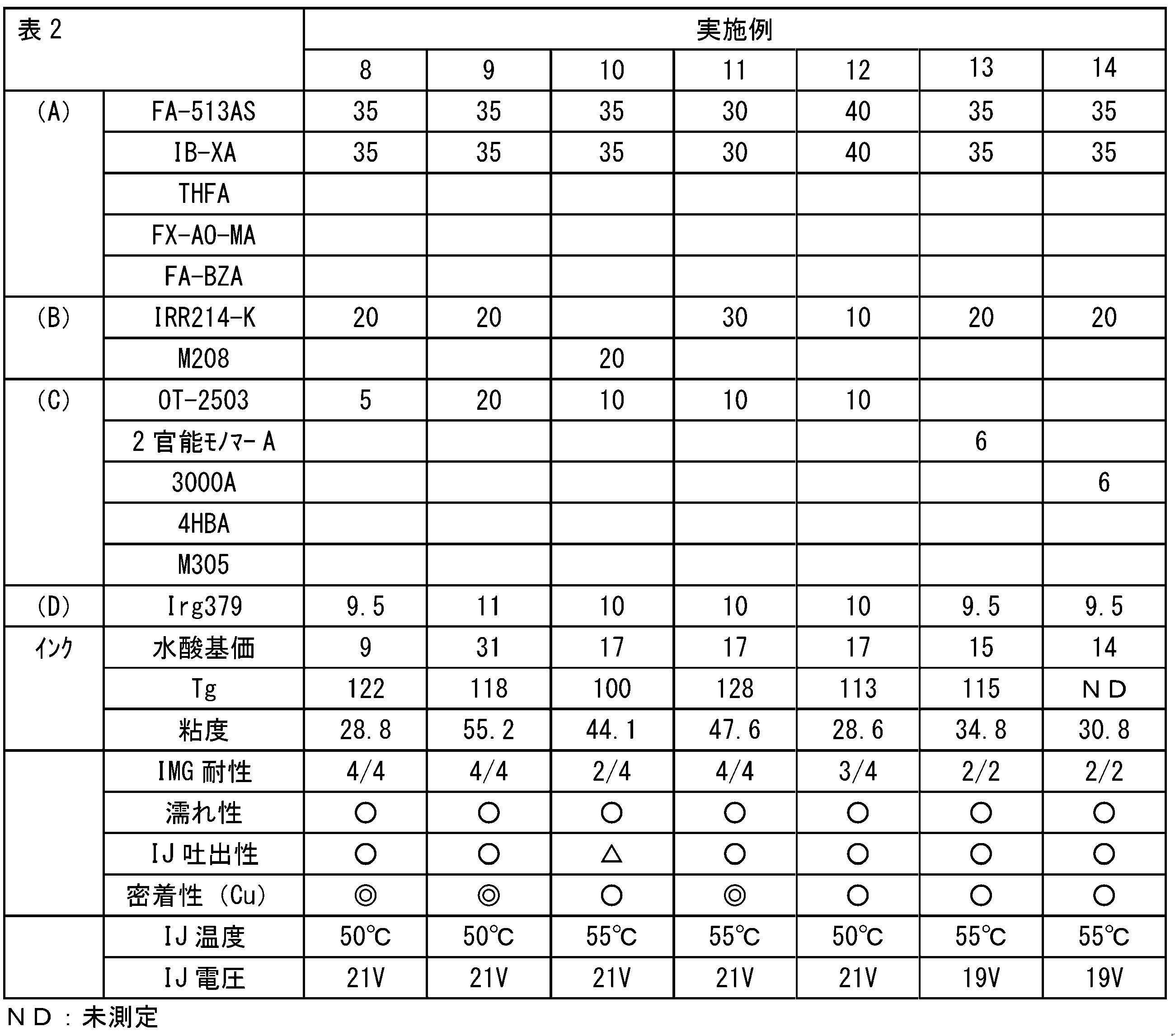
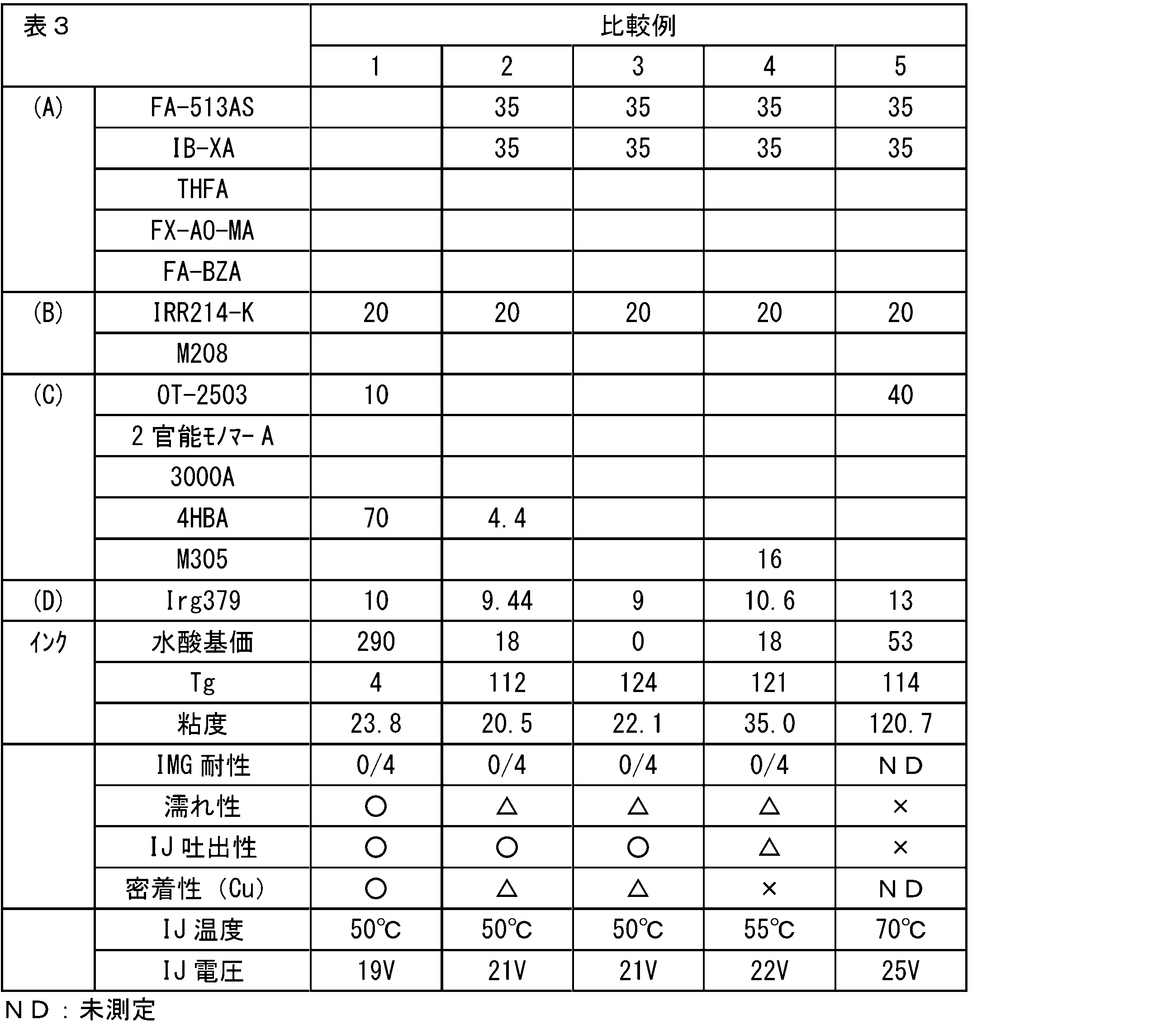
また、組成物の水酸基価が100mgKOH/gよりも高い比較例1は、IMG耐性が低かった。このことは、組成物の水酸基価が高すぎると、硬化物が取り込む水の量が多くなりすぎることが一因であること示すといえる。
Claims (17)
- 組成物100重量%に対して40~80重量%の単官能アクリルモノマー(A)と、
組成物100重量%に対して10~50重量%の多官能アクリルモノマー(B)と、
組成物100重量%に対して0.1~30重量%の水酸基価調整剤(C)と、を含有する光硬化性組成物であって、
組成物の水酸基価が1~100mgKOH/gである、光硬化性組成物。 - 前記水酸基価調整剤(C)は、
水酸基価が100~300mgKOH/gであり、
重量平均分子量が100~5000である、請求項1に記載の光硬化性組成物。 - 前記水酸基価調整剤(C)は、
水酸基価が150~250mgKOH/gであり、
重量平均分子量が100~5000である、請求項1に記載の光硬化性組成物。 - 前記水酸基価調整剤(C)がアクリルオリゴマーまたは、水酸基を有する(メタ)アクリルモノマーを含む、請求項2または3に記載の光硬化性組成物。
- 前記単官能アクリルモノマー(A)が、縮合環式炭化水素基、多環式炭化水素基および単環式炭化水素基からなる群のうち一または複数を有する(メタ)アクリレートを含有している、請求項1に記載の光硬化性組成物。
- 前記単官能アクリルモノマー(A)が、下記式(1)で表される単官能アクリルモノマーである、請求項5に記載の光硬化性組成物。

- 前記式(1)中のR2が下記式(2)~(5)のいずれか1つで表される基である、請求項6に記載の光硬化性組成物。
- 前記多官能アクリルモノマー(B)が、下記式(6)で表される二官能アクリルモノマーである、請求項7に記載の光硬化性組成物。
- 前記式(6)中のR5が下記式(7)~(10)のいずれか1つで表される基である、請求項8に記載の光硬化性組成物。
- さらに、光重合開始剤(D)を組成物100重量%に対し5~15重量%含有する請求項1~9のいずれか一項に記載の光硬化性組成物。
- 25℃における粘度が1~100mPa・sである請求項1~10のいずれか一項に記載の光硬化性組成物。
- 組成物の水酸基価が5~40mgKOH/gである請求項1~11のいずれか一項に記載の光硬化性組成物。
- 請求項1~12のいずれか一項に記載の光硬化性組成物を含有する、インクジェット用インク組成物。
- 請求項13に記載のインクジェット用インク組成物を含有する、活性エネルギー線硬化型インク組成物。
- 請求項1~12のいずれか一項に記載の光硬化性組成物を光硬化することで得られる硬化物。
- 請求項1~12のいずれか一項に記載の光硬化性組成物を光硬化した後、さらに熱硬化することで得られる硬化物。
- 請求項15または16に記載の硬化物を含む電子部品。
Priority Applications (4)
| Application Number | Priority Date | Filing Date | Title |
|---|---|---|---|
| US17/797,106 US12281235B2 (en) | 2020-03-10 | 2021-03-09 | Photocurable composition, inkjet ink composition, active energy ray-curable ink composition, cured product, and electronic component |
| KR1020227013663A KR20220152187A (ko) | 2020-03-10 | 2021-03-09 | 광경화성 조성물 |
| JP2022507215A JP7647739B2 (ja) | 2020-03-10 | 2021-03-09 | 光硬化性組成物 |
| CN202180009139.0A CN115038728B (zh) | 2020-03-10 | 2021-03-09 | 光硬化性组合物、喷墨用油墨组合物、活性能量线硬化型油墨组合物、硬化物及电子零件 |
Applications Claiming Priority (2)
| Application Number | Priority Date | Filing Date | Title |
|---|---|---|---|
| JP2020-041106 | 2020-03-10 | ||
| JP2020041106 | 2020-03-10 |
Publications (1)
| Publication Number | Publication Date |
|---|---|
| WO2021182464A1 true WO2021182464A1 (ja) | 2021-09-16 |
Family
ID=77671602
Family Applications (1)
| Application Number | Title | Priority Date | Filing Date |
|---|---|---|---|
| PCT/JP2021/009263 Ceased WO2021182464A1 (ja) | 2020-03-10 | 2021-03-09 | 光硬化性組成物 |
Country Status (6)
| Country | Link |
|---|---|
| US (1) | US12281235B2 (ja) |
| JP (1) | JP7647739B2 (ja) |
| KR (1) | KR20220152187A (ja) |
| CN (1) | CN115038728B (ja) |
| TW (1) | TWI869560B (ja) |
| WO (1) | WO2021182464A1 (ja) |
Families Citing this family (1)
| Publication number | Priority date | Publication date | Assignee | Title |
|---|---|---|---|---|
| WO2025149599A1 (en) * | 2024-01-11 | 2025-07-17 | Agfa-Gevaert Nv | A curable inkjet composition for the manufacturing of printed circuit boards |
Citations (3)
| Publication number | Priority date | Publication date | Assignee | Title |
|---|---|---|---|---|
| WO2015080155A1 (ja) * | 2013-11-27 | 2015-06-04 | Jnc株式会社 | 光硬化性インクジェットインク |
| JP2017019989A (ja) * | 2015-07-08 | 2017-01-26 | 株式会社リコー | 活性エネルギー線硬化型組成物、組成物収容容器、2次元又は3次元の像の形成装置及び形成方法、並びに硬化物 |
| JP2017122199A (ja) * | 2016-01-08 | 2017-07-13 | 株式会社リコー | 活性エネルギー線硬化型組成物、活性エネルギー線硬化型インク、組成物収容容器、2次元又は3次元の像の形成方法及び形成装置、並びに構造体 |
Family Cites Families (6)
| Publication number | Priority date | Publication date | Assignee | Title |
|---|---|---|---|---|
| US6127462A (en) * | 1995-04-12 | 2000-10-03 | Osi Specialities, Inc. | Compositions of epoxysilane and reactive polymer with cure catalyst and methods of preparation |
| JP5276264B2 (ja) * | 2006-07-03 | 2013-08-28 | 富士フイルム株式会社 | インク組成物、インクジェット記録方法、印刷物、及び、平版印刷版の製造方法 |
| JP5498729B2 (ja) * | 2008-07-10 | 2014-05-21 | 富士フイルム株式会社 | インプリント用硬化性組成物、パターン形成方法およびパターン |
| KR102011084B1 (ko) | 2011-07-26 | 2019-08-14 | 제이엔씨 주식회사 | 광경화성 잉크젯 잉크, 경화막, 전자 회로 기판 및 그 제조 방법 |
| US10414150B2 (en) * | 2015-07-08 | 2019-09-17 | Ricoh Company, Ltd. | Active-energy-ray-curable composition, composition stored container, two-dimensional or three-dimensional image forming apparatus, method for forming two-dimensional or three-dimensional image, and cured product |
| KR20190142350A (ko) | 2017-04-27 | 2019-12-26 | 제이엔씨 주식회사 | 광경화성 잉크젯용 잉크 |
-
2021
- 2021-03-02 TW TW110107201A patent/TWI869560B/zh active
- 2021-03-09 CN CN202180009139.0A patent/CN115038728B/zh active Active
- 2021-03-09 JP JP2022507215A patent/JP7647739B2/ja active Active
- 2021-03-09 KR KR1020227013663A patent/KR20220152187A/ko active Pending
- 2021-03-09 WO PCT/JP2021/009263 patent/WO2021182464A1/ja not_active Ceased
- 2021-03-09 US US17/797,106 patent/US12281235B2/en active Active
Patent Citations (3)
| Publication number | Priority date | Publication date | Assignee | Title |
|---|---|---|---|---|
| WO2015080155A1 (ja) * | 2013-11-27 | 2015-06-04 | Jnc株式会社 | 光硬化性インクジェットインク |
| JP2017019989A (ja) * | 2015-07-08 | 2017-01-26 | 株式会社リコー | 活性エネルギー線硬化型組成物、組成物収容容器、2次元又は3次元の像の形成装置及び形成方法、並びに硬化物 |
| JP2017122199A (ja) * | 2016-01-08 | 2017-07-13 | 株式会社リコー | 活性エネルギー線硬化型組成物、活性エネルギー線硬化型インク、組成物収容容器、2次元又は3次元の像の形成方法及び形成装置、並びに構造体 |
Also Published As
| Publication number | Publication date |
|---|---|
| TW202134290A (zh) | 2021-09-16 |
| TWI869560B (zh) | 2025-01-11 |
| JPWO2021182464A1 (ja) | 2021-09-16 |
| CN115038728A (zh) | 2022-09-09 |
| KR20220152187A (ko) | 2022-11-15 |
| US20230108173A1 (en) | 2023-04-06 |
| US12281235B2 (en) | 2025-04-22 |
| CN115038728B (zh) | 2024-09-03 |
| JP7647739B2 (ja) | 2025-03-18 |
Similar Documents
| Publication | Publication Date | Title |
|---|---|---|
| EP2738226B1 (en) | Photocurable ink jet ink and electronic circuit board | |
| JP5860096B2 (ja) | インクジェット用硬化性組成物及び電子部品の製造方法 | |
| JP5617201B2 (ja) | 光硬化性インクジェット用インク | |
| JP2011256271A (ja) | 硬化性組成物およびその用途、ならびに新規化合物 | |
| JP2012087298A (ja) | インクジェット用硬化性組成物及び電子部品の製造方法 | |
| JP6729684B2 (ja) | 熱硬化性樹脂組成物、硬化膜、硬化膜付き基板および電子部品 | |
| WO2022009640A1 (ja) | 光硬化性組成物 | |
| JPWO2018159675A1 (ja) | 熱硬化性樹脂組成物、硬化膜、硬化膜付き基板、電子部品およびインクジェット用インク組成物 | |
| JP5862901B2 (ja) | 光硬化性インクジェット用インク | |
| JP2016160420A (ja) | 熱硬化性組成物、硬化膜、硬化膜付基板、電子部品および表示装置 | |
| JP7647739B2 (ja) | 光硬化性組成物 | |
| WO2015012381A1 (ja) | 熱硬化性樹脂組成物、硬化膜、硬化膜付き基板および電子部品 | |
| JP7725835B2 (ja) | 光硬化性組成物 | |
| JP6996548B2 (ja) | インクジェット用インク組成物、硬化膜、硬化膜付き基板および電子部品 | |
| JP2009223127A (ja) | カラーフィルター用着色組成物およびその製造方法 | |
| JP6066559B2 (ja) | インクジェット用硬化性組成物及び電子部品の製造方法 | |
| JPWO2018190347A1 (ja) | 熱硬化性樹脂組成物、硬化膜、硬化膜付き基板、電子部品およびインクジェット用インク | |
| JP6224188B1 (ja) | 半導体封止材 | |
| JP2021123635A (ja) | 組成物、硬化物、硬化物の製造方法 | |
| KR20160044937A (ko) | 다관능성 화합물, 광경화성 및 열경화성을 갖는 수지 조성물 및 드라이 필름 솔더 레지스트 | |
| JP2015014008A (ja) | インクジェット用硬化性組成物及びプリント配線板の製造方法 |
Legal Events
| Date | Code | Title | Description |
|---|---|---|---|
| 121 | Ep: the epo has been informed by wipo that ep was designated in this application |
Ref document number: 21768253 Country of ref document: EP Kind code of ref document: A1 |
|
| ENP | Entry into the national phase |
Ref document number: 2022507215 Country of ref document: JP Kind code of ref document: A |
|
| NENP | Non-entry into the national phase |
Ref country code: DE |
|
| 122 | Ep: pct application non-entry in european phase |
Ref document number: 21768253 Country of ref document: EP Kind code of ref document: A1 |
|
| WWG | Wipo information: grant in national office |
Ref document number: 17797106 Country of ref document: US |