WO2021182399A1 - 除去液、キット及び半導体デバイス - Google Patents
除去液、キット及び半導体デバイス Download PDFInfo
- Publication number
- WO2021182399A1 WO2021182399A1 PCT/JP2021/009000 JP2021009000W WO2021182399A1 WO 2021182399 A1 WO2021182399 A1 WO 2021182399A1 JP 2021009000 W JP2021009000 W JP 2021009000W WO 2021182399 A1 WO2021182399 A1 WO 2021182399A1
- Authority
- WO
- WIPO (PCT)
- Prior art keywords
- group
- preferable
- protective layer
- surfactant
- carbon atoms
- Prior art date
- Legal status (The legal status is an assumption and is not a legal conclusion. Google has not performed a legal analysis and makes no representation as to the accuracy of the status listed.)
- Ceased
Links
Images

Classifications
-
- G—PHYSICS
- G03—PHOTOGRAPHY; CINEMATOGRAPHY; ANALOGOUS TECHNIQUES USING WAVES OTHER THAN OPTICAL WAVES; ELECTROGRAPHY; HOLOGRAPHY
- G03F—PHOTOMECHANICAL PRODUCTION OF TEXTURED OR PATTERNED SURFACES, e.g. FOR PRINTING, FOR PROCESSING OF SEMICONDUCTOR DEVICES; MATERIALS THEREFOR; ORIGINALS THEREFOR; APPARATUS SPECIALLY ADAPTED THEREFOR
- G03F7/00—Photomechanical, e.g. photolithographic, production of textured or patterned surfaces, e.g. printing surfaces; Materials therefor, e.g. comprising photoresists; Apparatus specially adapted therefor
- G03F7/004—Photosensitive materials
- G03F7/09—Photosensitive materials characterised by structural details, e.g. supports, auxiliary layers
- G03F7/11—Photosensitive materials characterised by structural details, e.g. supports, auxiliary layers having cover layers or intermediate layers, e.g. subbing layers
-
- G—PHYSICS
- G03—PHOTOGRAPHY; CINEMATOGRAPHY; ANALOGOUS TECHNIQUES USING WAVES OTHER THAN OPTICAL WAVES; ELECTROGRAPHY; HOLOGRAPHY
- G03F—PHOTOMECHANICAL PRODUCTION OF TEXTURED OR PATTERNED SURFACES, e.g. FOR PRINTING, FOR PROCESSING OF SEMICONDUCTOR DEVICES; MATERIALS THEREFOR; ORIGINALS THEREFOR; APPARATUS SPECIALLY ADAPTED THEREFOR
- G03F7/00—Photomechanical, e.g. photolithographic, production of textured or patterned surfaces, e.g. printing surfaces; Materials therefor, e.g. comprising photoresists; Apparatus specially adapted therefor
- G03F7/26—Processing photosensitive materials; Apparatus therefor
- G03F7/42—Stripping or agents therefor
-
- H—ELECTRICITY
- H10—SEMICONDUCTOR DEVICES; ELECTRIC SOLID-STATE DEVICES NOT OTHERWISE PROVIDED FOR
- H10P—GENERIC PROCESSES OR APPARATUS FOR THE MANUFACTURE OR TREATMENT OF DEVICES COVERED BY CLASS H10
- H10P52/00—Grinding, lapping or polishing of wafers, substrates or parts of devices
-
- Y—GENERAL TAGGING OF NEW TECHNOLOGICAL DEVELOPMENTS; GENERAL TAGGING OF CROSS-SECTIONAL TECHNOLOGIES SPANNING OVER SEVERAL SECTIONS OF THE IPC; TECHNICAL SUBJECTS COVERED BY FORMER USPC CROSS-REFERENCE ART COLLECTIONS [XRACs] AND DIGESTS
- Y02—TECHNOLOGIES OR APPLICATIONS FOR MITIGATION OR ADAPTATION AGAINST CLIMATE CHANGE
- Y02E—REDUCTION OF GREENHOUSE GAS [GHG] EMISSIONS, RELATED TO ENERGY GENERATION, TRANSMISSION OR DISTRIBUTION
- Y02E10/00—Energy generation through renewable energy sources
- Y02E10/50—Photovoltaic [PV] energy
- Y02E10/549—Organic PV cells
Definitions
- the present invention relates to a remover, a kit and a semiconductor device.
- an organic semiconductor device has an advantage that it can be manufactured by a simple process as compared with a conventional electronic device using an inorganic semiconductor such as silicon. Further, the material properties of an organic semiconductor can be easily changed by changing its molecular structure. In addition, there are a wide variety of materials, and it is thought that it will be possible to realize functions and elements that could not be achieved with inorganic semiconductors.
- Organic semiconductors can be applied to electronic devices such as organic solar cells, organic electroluminescence displays, organic optical detectors, organic field effect transistors, organic field light emitting devices, gas sensors, organic rectifying elements, organic inverters, and information recording elements. There is sex. It is known that such patterning of an organic layer such as an organic semiconductor is performed using a laminate containing an organic layer and a layer such as a photosensitive layer (for example, a resist layer).
- Patent Document 1 has an organic semiconductor film, a protective film on the organic semiconductor film, and a resist film on the protective film, and the resist film is an organic acid having a pKa of a generated acid of -1 or less.
- a photosensitive resin composition containing a photoacid generator (A) that generates The body is listed.
- the present invention is used for removing a protective layer contained in a pattern formed by etching a laminate containing a base material, an organic layer, a protective layer, and a photosensitive layer in this order, and the residue of the protective layer when the protective layer is removed.
- ⁇ 1> Contains a surfactant, A removing liquid used for removing a protective layer contained in a pattern formed by etching a laminate containing a base material, an organic layer, a protective layer, and a photosensitive layer in this order.
- ⁇ 2> The removing solution according to ⁇ 1>, wherein the HLB value of the above-mentioned surfactant calculated by the following Griffin method is 16.0 or less.
- HLB value calculated by the Griffin method 20 ⁇ (formula amount of hydrophilic part in surfactant) / (molecular weight of surfactant)
- ⁇ 4> The removing solution according to any one of ⁇ 1> to ⁇ 3>, wherein the surfactant contains a polyalkylene glycol structure.
- ⁇ 5> The removing solution according to any one of ⁇ 1> to ⁇ 4>, wherein the surfactant contains a polyethylene glycol structure and an aliphatic hydrocarbon group having 8 or more carbon atoms.
- ⁇ 6> The removing solution according to any one of ⁇ 1> to ⁇ 5>, wherein the surfactant contains a polyethylene glycol structure and an alkyl group having 8 or more carbon atoms.
- ⁇ 7> The removing liquid according to any one of ⁇ 1> to ⁇ 6>, which contains water.
- ⁇ 8> The removing solution according to any one of ⁇ 1> to ⁇ 7>, wherein the protective layer contains a surfactant containing an acetylene group.
- ⁇ 9> The removing liquid according to any one of ⁇ 1> to ⁇ 8>, wherein the protective layer contains a water-soluble resin.
- the composition used for forming the protective layer contains a water-soluble resin and a surfactant.
- ⁇ 12> The kit according to ⁇ 10> or ⁇ 11>, wherein the surfactant contained in the composition used for forming the protective layer is a surfactant containing an acetylene group.
- a semiconductor device including a pattern in which the protective layer is removed from the above pattern by the removing liquid according to any one of ⁇ 1> to ⁇ 9>.
- the present invention is used for removing a protective layer contained in a pattern formed by etching a laminate containing a base material, an organic layer, a protective layer, and a photosensitive layer in this order, and the protective layer at the time of removing the protective layer.
- the numerical range represented by the symbol "-" means a range including the numerical values before and after "-" as the lower limit value and the upper limit value, respectively.
- the term "process” means not only an independent process but also a process that cannot be clearly distinguished from other processes as long as the desired action of the process can be achieved.
- the notation that does not describe substitution or non-substitution means to include those having a substituent as well as those having no substituent. For example, when simply described as "alkyl group”, this includes both an alkyl group having no substituent (unsubstituted alkyl group) and an alkyl group having a substituent (substituted alkyl group).
- alkyl group when simply described as “alkyl group”, this means that it may be chain-like or cyclic, and in the case of chain-like, it may be linear or branched. These are also synonymous with other groups such as “alkenyl group”, “alkylene group” and “alkenylene group”.
- exposure means not only drawing using light but also drawing using particle beams such as an electron beam and an ion beam, unless otherwise specified. Examples of energy rays used for drawing include emission line spectra of mercury lamps, far ultraviolet rays typified by excimer lasers, active rays such as extreme ultraviolet rays (EUV light) and X-rays, and particle beams such as electron beams and ion beams. Be done.
- light includes not only light having wavelengths in the ultraviolet, near-ultraviolet, far-ultraviolet, visible, and infrared regions, electromagnetic waves, but also radiation, unless otherwise specified. Radiation includes, for example, microwaves, electron beams, extreme ultraviolet rays (EUV), and X-rays. Further, laser light such as a 248 nm excimer laser, a 193 nm excimer laser, and a 172 nm excimer laser can also be used. As these lights, monochrome light (single wavelength light) that has passed through an optical filter may be used, or light containing a plurality of wavelengths (composite light) may be used.
- (meth) acrylate means both “acrylate” and “methacrylate”, or either
- (meth) acrylic means both “acrylic” and “methacryl”, or
- (meth) acryloyl means both “acryloyl” and “methacryloyl”, or either.
- the solid content in the composition means other components other than the solvent, and the content (concentration) of the solid content in the composition is, unless otherwise specified, based on the total mass of the composition. It is represented by the mass percentage of other components excluding the solvent.
- the temperature is 23 ° C.
- the atmospheric pressure is 101325 Pa (1 atm)
- the relative humidity is 50% RH.
- the weight average molecular weight (Mw) and the number average molecular weight (Mn) are shown as polystyrene-equivalent values according to gel permeation chromatography (GPC measurement) unless otherwise specified.
- GPC measurement gel permeation chromatography
- Mw and Mn are shown as polystyrene-equivalent values according to gel permeation chromatography (GPC measurement) unless otherwise specified.
- Mw and Mn for example, HLC-8220 (manufactured by Tosoh Corporation) is used, and guard columns HZ-L, TSKgel Super HZM-M, TSKgel Super HZ4000, TSKgel are used as columns. It can be obtained by using Super HZ3000 and TSKgel Super HZ2000 (manufactured by Tosoh Corporation).
- the measurement is carried out using THF (tetrahydrofuran) as the eluent.
- a UV ray (ultraviolet) wavelength 254 nm detector is used for detection in GPC measurement.
- the positional relationship of each layer constituting the laminated body is described as "upper” or “lower”
- the other layer is on the upper side or the lower side of the reference layer among the plurality of layers of interest. All you need is. That is, a third layer or element may be further interposed between the reference layer and the other layer, and the reference layer and the other layer need not be in contact with each other.
- the direction in which the layers are stacked on the base material is referred to as "upper", or if there is a photosensitive layer, the direction from the base material to the photosensitive layer is referred to as “upper”.
- the opposite direction is referred to as "down”. It should be noted that such a vertical setting is for convenience in the present specification, and in an actual embodiment, the "upward" direction in the present specification may be different from the vertical upward direction.
- the removing liquid of the present invention contains a surfactant (hereinafter, also referred to as "surfactant for removing liquid”), and the laminate containing the base material, the organic layer, the protective layer, and the photosensitive layer in this order is etched. It is used to remove the protective layer contained in the pattern.
- the etched pattern is a pattern obtained by etching the organic layer and the protective layer.
- the etched pattern is preferably a pattern obtained by etching the pattern made of the photosensitive layer as an etching resist.
- the pattern composed of the photosensitive layer is formed by, for example, exposure and development.
- the etched pattern is a pattern including a base material, an organic layer and a protective layer in this order, and the pattern composed of the photosensitive layer may be further contained on the side of the protective layer opposite to the organic layer. It is not necessary to include the pattern composed of the photosensitive layer. That is, the pattern made of the photosensitive layer may be completely removed by the etching, or the pattern made of the photosensitive layer may remain. The details of the laminate and the method of forming the etched pattern will be described later.
- the removing liquid of the present invention it is effective in removing the residue of the protective layer at the time of removing the protective layer.
- the mechanism by which the above effect is obtained is unknown, protection by the removing liquid is used as the removing liquid used for removing the protective layer by using the removing liquid of the present invention which is a removing liquid containing a surfactant for the removing liquid. It is presumed that the solubility of the layer is improved and the residue after removal of the protective layer is suppressed.
- Patent Document 1 does not describe the use of a removing liquid containing a surfactant as the removing liquid used for removing the protective layer.
- the surfactant contained in the removing liquid refers to a component contained in the removing liquid, which lowers the surface tension of the removing liquid as compared with the removing liquid containing no such component.
- the surfactant for the removing liquid may be either an ionic surfactant or a nonionic surfactant, but from the viewpoint of the influence on the organic layer, the nonionic surfactant is preferable.
- the HLB value of the surfactant for the removing liquid calculated by the following Griffin method is preferably 16.0 or less.
- HLB value calculated by the Griffin method 20 ⁇ (formula amount of hydrophilic part in surfactant) / (molecular weight of surfactant)
- the HLB value is preferably 15.0 or less, more preferably 14.0 or less, and further preferably 13.0 or less.
- the lower limit of the HLB value is preferably 8.0 or more, more preferably 8.5 or more, and further preferably 9.0 or more.
- the polyalkylene glycol structure is not particularly limited, and examples thereof include a structure represented by the following formula (P-1). Wherein (P-1), are each R P independently represents an alkylene group, n represents an integer of 2 or more, two * each independently represent a bonding site with the other structures.
- R P represents an alkylene group, preferably an alkylene group having 2 to 20 carbon atoms, more preferably an alkylene group having 2 to 6 carbon atoms, more preferably an alkylene group having 2 to 4 carbon atoms, an ethylene group or a propylene group is particularly
- an ethylene group is most preferred. That is, as the polyalkylene glycol structure, an ethylene glycol structure or a propylene glycol structure is preferable, and an ethylene glycol structure is more preferable.
- n pieces of R P may be different even respectively identical.
- n represents an integer of 2 or more, preferably an integer of 10 to 2,000, and more preferably an integer of 50 to 1,000.
- the surfactant for the removing liquid preferably contains an aliphatic hydrocarbon group having 8 or more carbon atoms (hereinafter, also referred to as "aliphatic group R").
- the number of carbon atoms in the aliphatic group R is preferably 8 to 50, more preferably 8 to 40, and even more preferably 10 to 30.
- the aliphatic group R is preferably a saturated aliphatic hydrocarbon group having 8 or more carbon atoms, and more preferably an alkyl group having 8 or more carbon atoms. The preferred carbon numbers of these groups are as described above.
- the aliphatic group R may have a substituent as long as the effect of the present invention can be obtained. Further, an embodiment in which an aliphatic hydrocarbon group having 8 or more carbon atoms is unsubstituted is also one of the preferred embodiments of the present invention.
- the surfactant for the removing liquid preferably contains a polyethylene glycol structure and an aliphatic hydrocarbon group having 8 or more carbon atoms.
- the number of repetitions of the ethylene glycol structure in the polyethylene glycol structure may be 2 or more, preferably 10 to 2,000, and more preferably 50 to 1,000.
- the preferred embodiment of the aliphatic hydrocarbon group having 8 or more carbon atoms is the same as the preferred embodiment of the aliphatic group R described above.
- the surfactant for the removing liquid preferably contains a polyethylene glycol structure and an alkyl group having 8 or more carbon atoms.
- the surfactant for the removing liquid is preferably a compound represented by any of the following formulas (Z-1) to (Z-4).
- (Z-1) ⁇ formula (Z-4) are each R P independently represents an alkylene group, n represents an integer of 2 or more, R Z each independently having 8 or more aliphatic carbon Represents a hydrocarbon group.
- (Z-1) ⁇ formula (Z-4), each R P and n have the same meanings as R P and n in the formula (P-1), a preferable embodiment thereof is also the same.
- the preferred embodiment of R Z is the same as the preferred embodiment of the above-mentioned aliphatic group R.
- the surfactant for the removing liquid does not contain a fluorine atom, a silicon atom, and a phosphoric acid ester structure.
- the molecular weight (weight average molecular weight when having a molecular weight distribution) of the surfactant for the removing liquid is preferably 200 to 1,000, and more preferably 250 to 500.
- a commercially available product may be used as the surfactant for the removing liquid.
- Commercially available products include EMALEX 710 (manufactured by Nippon Emulsion Co., Ltd.), Pionin D-1007, Pionin D-1105, Pionin D-1110, Pionin D-1420, Pionin D-2104-D (above, Takemoto Oil & Fat Co., Ltd.). (Manufactured by), Emargen 220 (manufactured by Kao Chemical Co., Ltd.), etc., but the present invention is not limited thereto.
- the content of the surfactant for the removing liquid is preferably 0.05 to 20% by mass, more preferably 0.1 to 10% by mass, and 0.4% by mass, based on the total mass of the removing liquid. It is more preferably about 8% by mass, and even more preferably 1.2 to 4% by mass.
- the surfactant for the removing liquid one type may be used alone, or two or more types may be used in combination. When two or more types are used in combination, the total amount is preferably in the above range. By using two or more kinds of surfactants for the removing liquid in combination, for example, the storage stability of the removing liquid itself is improved.
- the removing liquid preferably further contains a solvent.
- the solvent include water, an organic solvent or a mixture thereof, and it is preferable that the solvent contains water.
- the content of water with respect to the total mass of the removing liquid is preferably 70% by mass or more, more preferably 80% by mass or more, and further preferably 90% by mass or more. preferable.
- the upper limit of the content is not particularly limited, but may be 99.95% by mass or less.
- the content of water with respect to the total mass of the solvent is preferably 70% by mass or more, more preferably 80% by mass or more, and more preferably 90% by mass or more. More preferred.
- the upper limit of the content is not particularly limited, but may be 100% by mass or less.
- the removing liquid may further contain a water-soluble solvent.
- the removal liquid may further contain a water-soluble solvent.
- water, a mixture of water and a water-soluble solvent, and a water-soluble solvent may be collectively referred to as an aqueous solvent.
- the water-soluble solvent an organic solvent having a solubility in water at 23 ° C. of 1 g or more is preferable, an organic solvent having a solubility of 10 g or more is more preferable, and an organic solvent having a solubility of 30 g or more is further preferable.
- the water-soluble solvent include alcohol solvents such as methanol, ethanol, propanol, ethylene glycol and glycerin; ketone solvents such as acetone; and amide solvents such as formamide.
- the removing liquid may be in a form that substantially does not contain components other than the solvent and the surfactant for the removing liquid.
- the total content of the solvent and the surfactant for the removing liquid is preferably 98% by mass or more, more preferably 99% by mass or more, and 99.9% by mass, based on the total mass of the removing liquid. It is more preferably mass% or more.
- the upper limit of the content is not particularly limited, and may be 100% by mass. Further, in the embodiment in which the removing liquid contains water, it is also possible to make the embodiment substantially free of components other than water and the surfactant for the removing liquid.
- the total content of water and the surfactant for the removing liquid is preferably 98% by mass or more, more preferably 99% by mass or more, and 99.9% by mass, based on the total mass of the removing liquid. It is more preferably mass% or more.
- the upper limit of the content is not particularly limited, and may be 100% by mass.
- the removing liquid preferably has a viscosity of 1.0 mPa ⁇ s or less, more preferably 0.8 mPa ⁇ s or less, further preferably 0.75 mPa ⁇ s or less, and has a viscosity of 0.75 mPa ⁇ s or less. It is particularly preferably 0.72 mPa ⁇ s or less.
- the lower limit of the viscosity is not particularly limited, and can be, for example, 0.10 mPa ⁇ s or more.
- the viscosity can be measured by a known method, and is measured by, for example, a RE-80L type rotational viscometer manufactured by Toki Sangyo Co., Ltd.
- the rotation speed may be set as appropriate, but can be set to, for example, 100 rpm.
- the viscosity of the removal liquid is adjusted, for example, by the structure of the compound contained in the removal liquid, the temperature of the removal liquid, the mixing ratio of the solvent contained in the removal liquid, and the like.
- the temperature of the removal liquid may be adjusted for the purpose of keeping the viscosity of the removal liquid in the above range.
- the temperature of the removing liquid is preferably 20 ° C. or higher, more preferably 30 ° C. or higher, further preferably 40 ° C. or higher, and particularly preferably 50 ° C. or higher.
- the upper limit of the temperature can be, for example, 100 ° C. or lower, preferably 90 ° C. or lower, and more preferably 80 ° C. or lower.
- the laminate used in the present invention will be described in detail.
- the laminate used in the present invention includes a base material, an organic layer, a protective layer and a photosensitive layer in this order.
- the photosensitive layer is preferably subjected to development using a developing solution.
- the protective layer is used for removal using the removal liquid of the present invention.
- FIG. 1 is a schematic cross-sectional view schematically showing an example of a processing process of a laminated body according to a preferred embodiment of the present invention.
- the organic layer 3 (for example, an organic semiconductor layer) is arranged on the base material 4 as in the example shown in FIG. 1 (a).
- the protective layer 2 that protects the organic layer 3 is arranged on the surface of the protective layer 2 in contact with the protective layer 2.
- Another layer may be provided between the organic layer 3 and the protective layer 2, but from the viewpoint that the effect of the present invention can be more easily obtained, the organic layer 3 and the protective layer 2 are in direct contact with each other.
- an example of a preferred embodiment is given.
- the photosensitive layer 1 is arranged on the protective layer.
- the photosensitive layer 1 and the protective layer 2 may be in direct contact with each other, or another layer may be provided between the photosensitive layer 1 and the protective layer 2.
- FIG. 1B shows an example of a state in which a part of the photosensitive layer 1 is exposed and developed.
- the photosensitive layer 1 is partially exposed by a method such as using a predetermined mask, and after the exposure, the photosensitive layer 1 is removed and exposed by developing with a developing solution such as an organic solvent.
- the photosensitive layer 1a after development is formed.
- the protective layer 2 remains because it is difficult to be removed by the developer, and the organic layer 3 is protected from damage by the developer by the remaining protective layer 2.
- FIG. 1C shows an example of a state in which a part of the protective layer 2 and the organic layer 3 is removed.
- the removing portion 5a is formed in the protective layer 2 and the organic layer 3. Will be done. In this way, the organic layer 3 can be removed in the removing portion 5a. That is, the organic layer 3 can be patterned.
- FIG. 1C is an example of a pattern formed by etching a laminate containing a base material, an organic layer, a protective layer, and a photosensitive layer in this order, and the removing liquid of the present invention is, for example, In the state shown in FIG. 1 (c), it is used for removing the protective layer.
- FIG. 1C shows a state in which the photosensitive layer 1a remains after development, but the photosensitive layer 1a after development may be removed by, for example, a dry etching process or the like.
- FIG. 1D shows an example in which the photosensitive layer 1a and the protective layer 2 are removed after the patterning.
- the photosensitive layer 1a and the protective layer 2 on the processed organic layer 3a are removed by washing the photosensitive layer 1a and the protective layer 2 in the laminated body in the state shown in FIG. 1C with the removing liquid of the present invention. Will be done.
- the cleaning with the removal liquid of the present invention may be performed a plurality of times.
- further rinsing may be performed with pure water or the like.
- the surfactant for the removing liquid is removed from the surface of the laminate after cleaning.
- the laminate used in the present invention includes a base material.
- the base material that may be contained in the laminate is formed of, for example, various materials such as silicon, quartz, ceramic, glass, polyester film such as polyethylene naphthalate (PEN) and polyethylene terephthalate (PET), and polyimide film. Any base material may be selected depending on the intended use.
- PEN polyethylene naphthalate
- PET polyethylene terephthalate
- Any base material may be selected depending on the intended use.
- a base material formed of a flexible material can be used.
- the base material may be a composite base material formed of a plurality of materials or a laminated base material in which a plurality of materials are laminated.
- the shape of the base material is not particularly limited and may be selected according to the intended use, and examples thereof include a plate-shaped base material (board).
- the thickness of the substrate is also not particularly limited.
- the laminate in the present invention contains an organic layer.
- the organic layer is a layer containing an organic material.
- the specific organic material is appropriately selected according to the use and function of the organic layer. Assumed functions of the organic layer include, for example, semiconductor characteristics, light emission characteristics, photoelectric conversion characteristics, light absorption characteristics, electrical insulation, ferroelectricity, transparency, and insulation.
- the organic layer may be contained above the base material, the base material may be in contact with the organic layer, or another layer may be further contained between the organic layer and the base material. May be.
- the thickness of the organic layer is not particularly limited and varies depending on the type of electronic device used and the like, but is preferably 1 nm to 50 ⁇ m, more preferably 1 nm to 5 ⁇ m, and further preferably 1 nm to 500 nm.
- the organic layer is an organic semiconductor layer
- the organic semiconductor layer is a layer containing an organic material exhibiting the characteristics of a semiconductor.
- the organic semiconductor layer is an organic layer containing an organic semiconductor, and the organic semiconductor is an organic compound exhibiting the characteristics of a semiconductor. Similar to the case of semiconductors made of inorganic compounds, organic semiconductors include p-type semiconductors that conduct holes as carriers and n-type semiconductors that conduct electrons as carriers.
- the ease of carrier flow in the organic semiconductor layer is represented by the carrier mobility ⁇ . Although it depends on the application, in general, the carrier mobility is preferably high, preferably 10-7 cm 2 / Vs or more, more preferably 10-6 cm 2 / Vs or more, and 10-5 cm 2 or more. It is more preferably / Vs or more.
- the carrier mobility can be determined based on the characteristics when the field effect transistor (FET) element is manufactured and the measured value by the flight time measurement (TOF) method.
- the p-type organic semiconductor that can be used for the organic semiconductor layer, any material may be used as long as it has hole transportability.
- the p-type organic semiconductor is preferably any one of a p-type ⁇ -conjugated polymer, a condensed polycyclic compound, a triarylamine compound, a hetero 5-membered ring compound, a phthalocyanine compound, a porphyrin compound, carbon nanotubes, and graphene. Further, as the p-type organic semiconductor, a plurality of kinds of compounds among these compounds may be used in combination.
- the p-type organic semiconductor is more preferably at least one of a p-type ⁇ -conjugated polymer, a condensed polycyclic compound, a triarylamine compound, a hetero 5-membered ring compound, a phthalocyanine compound, and a porphyrin compound, and more preferably. It is at least one of a p-type ⁇ -conjugated polymer and a condensed polycyclic compound.
- the p-type ⁇ -conjugated polymer is, for example, substituted or unsubstituted polythiophene (for example, poly (3-hexylthiophene) (P3HT, manufactured by Sigma Aldrich Japan LLC)), polyselenophene, polypyrrole, polyparaphenylene, poly. Paraphenylene vinylene, polythiophene vinylene, polyaniline, etc.
- Condensed polycyclic compounds include, for example, substituted or unsubstituted anthracene, tetracene, pentacene, anthradithiophene, hexabenzocoronene and the like.
- Triarylamine compounds include, for example, m-MTDATA (4,4', 4''-Tris [(3-methylphenyl) biphenyllamine), 2-TNATA (4,4', 4''-Tris [2- naphthyl (phenyl) amine), NPD (N, N'-Di (1-naphthyl) -N, N'-diphenyl- (1,1'-biphenyl) -4,4'-diamine), TPD (N) , N'-Diphenyl-N, N'-di (m-tool) benzine), mCP (1,3-bis (9-carbazolyl) benzene), CBP (4,4'-bis (9-carbazolyl) -2 , 2'-biphenyl) and the like.
- the hetero 5-membered ring compound is, for example, a substituted or unsubstituted oligothiophene, TTF (Tetrathiafulvalene), or the like.
- the phthalocyanine compound is a substituted or unsubstituted phthalocyanine having various central metals, naphthalocyanine, anthracyanine, tetrapyrazinoporphyrazine and the like.
- Porphyrin compounds are substituted or unsubstituted porphyrins having various central metals.
- the carbon nanotube may be a carbon nanotube whose surface is modified with a semiconductor polymer.
- n-type organic semiconductor that can be used for the organic semiconductor layer, any material may be used as long as it has electron transportability.
- the n-type organic semiconductor is preferably a fullerene compound, an electron-deficient phthalocyanine compound, a fused polycyclic compound (naphthalene tetracarbonyl compound, perylene tetracarbonyl compound, etc.), a TCNQ compound (tetracyanoquinodimethane compound), and a polythiophene compound.
- n-type organic semiconductor a plurality of kinds of compounds among these compounds may be used in combination.
- the n-type organic semiconductor is more preferably at least one of a fullerene compound, an electron-deficient phthalocyanine compound, a fused polycyclic compound, and an n-type ⁇ -conjugated polymer, and particularly preferably a fullerene compound and a condensed polycyclic ring. It is at least one of a compound and an n-type ⁇ -conjugated polymer.
- the fullerene compound means a substituted or unsubstituted fullerene, and the fullerenes are C 60 , C 70 , C 76 , C 78 , C 80 , C 82 , C 84 , C 86 , C 88 , C 90 , C 96. , C 116 , C 180 , C 240 , C 540 and the like.
- the fullerene compound is preferably substituted or unsubstituted C 60 , C 70 , C 86 fullerene, and particularly preferably PCBM ([6,6] -phenyl-C61-butyric acid methyl ester, manufactured by Sigma Aldrich Japan GK.
- the electron-deficient phthalocyanine compound is a substituted or unsubstituted phthalocyanine, naphthalocyanine, anthracyanine, tetrapyrazinoporphyrazine and the like having four or more electron-attracting groups bonded and having various central metals.
- Electron-deficient phthalocyanine compounds include, for example, fluorinated phthalocyanine (F 16 MPc) and chlorinated phthalocyanine (Cl 16 MPc).
- F 16 MPc fluorinated phthalocyanine
- Cl 16 MPc chlorinated phthalocyanine
- M represents a central metal
- Pc represents a phthalocyanine.
- naphthalene tetracarbonyl compound Any naphthalene tetracarbonyl compound may be used, but naphthalene tetracarboxylic acid anhydride (NTCDA), naphthalene bisimide compound (NTCDI), perinone pigment (Pigment Orange 43, Pigment Red 194, etc.) are preferable.
- NTCDA naphthalene tetracarboxylic acid anhydride
- NTCDI naphthalene bisimide compound
- perinone pigment Pigment Orange 43, Pigment Red 194, etc.
- perylenetetracarbonyl compound Any perylenetetracarbonyl compound may be used, but perylenetetracarboxylic dianhydride (PTCDA), perylenebisimide compound (PTCDI), and benzoimidazole fused ring (PV) are preferable.
- PTCDA perylenetetracarboxylic dianhydride
- PTCDI perylenebisimide compound
- PV benzoimidazole fused ring
- the TCNQ compound is a substituted or unsubstituted TCNQ and a compound in which the benzene ring portion of TCNQ is replaced with another aromatic ring or heterocycle.
- the TCNQ compounds include, for example, TCNQ, TCNAQ (tetracyanoquinodimethane), TCN3T (2,2'-((2E, 2''E) -3', 4'-Alkyl subscribed-5H, 5''H. -[2,2': 5', 2''-terthiophene] -5,5''-diylidene) dimalononirile derivatives) and the like.
- the polythiophene-based compound is a compound having a polythiophene structure such as poly (3,4-ethylenedioxythiophene).
- the polythiophene-based compound is, for example, PEDOT: PSS (complex composed of poly (3,4-ethylenedioxythiophene) (PEDOT) and polystyrene sulfonic acid (PSS)).
- a benzidine-based compound is a compound having a benzidine structure in the molecule.
- Benzidine compounds include, for example, N, N'-bis (3-methylphenyl) -N, N'-diphenylbenzidine (TPD), N, N'-di-[(1-naphthyl) -N, N'-. Diphenyl] -1,1'-biphenyl) -4,4'-diamine (NPD) and the like.
- a carbazole-based compound is a compound having a carbazole ring structure in the molecule.
- Carbazole compounds include, for example, 4,4'-bis (N-carbazolyl) -1,1'-biphenyl (CBP).
- the phenanthroline-based compound is a compound having a phenanthroline ring structure in the molecule, and is, for example, 2,9-dimethyl-4,7-diphenyl-1,10-phenanthroline (BCP).
- the pyridinephenyl ligand iridium-based compound is a compound having an iridium complex structure having a phenylpyridine structure as a ligand.
- Pyridinephenyl ligands The iridium-based compounds include, for example, bis (3,5-difluoro-2- (2-pyridylphenyl- (2-carboxypyridyl) iridium (III) (FIrpic)) and tris (2-phenylpyridinato). ) Iridium (III) (Ir (ppy) 3 ) and the like.
- the quinolinol ligand alumnium-based compound is a compound having an aluminum complex structure having a quinolinol structure as a ligand, and is, for example, tris (8-quinolinolato) aluminum.
- the R in the formula may be any, but is hydrogen atom, substituted or unsubstituted, branched or linear alkyl group (preferably 1 to 18 carbon atoms, more preferably 1 to 12 carbon atoms, still more preferably 1 to 12 carbon atoms). 1 to 8), substituted or unsubstituted aryl groups (preferably those having 6 to 30, more preferably 6 to 20, still more preferably 6 to 14).
- Me represents a methyl group and M represents a metal atom.
- the organic semiconductor contained in the organic semiconductor layer may be one type or two or more types. Further, the organic semiconductor layer may be a laminated or mixed layer of a p-type layer and an n-type layer.
- the organic layer may be formed by either a vapor phase method or a liquid phase method.
- a physical vapor deposition (PVD) method such as a vapor deposition method (vacuum vapor deposition method, molecular beam epitaxy method, etc.), a sputtering method, an ion plating method, or a chemical vapor deposition method such as a plasma polymerization method is used.
- PVD physical vapor deposition
- a growth (CVD) method can be used, with a vapor deposition method being particularly preferred.
- the organic material is blended in a solvent to form a composition for forming an organic layer (composition for forming an organic layer). Then, this composition is supplied onto a substrate and dried to form an organic layer.
- coating is preferable. Examples of supply methods include slit coating method, casting method, blade coating method, wire bar coating method, spray coating method, dipping (immersion) coating method, bead coating method, air knife coating method, curtain coating method, inkjet method, etc. Examples thereof include a spin coat method, a Langmuir-Blodgett (LB) method, and an edge cast method (for details, see Patent No. 6179930). It is more preferable to use the casting method, the spin coating method, and the inkjet method. Such a process makes it possible to produce an organic layer having a smooth surface and a large area at low cost.
- LB Langmuir-Blodgett
- an organic solvent is preferable.
- the organic solvent include hydrocarbon solvents such as hexane, octane, decane, toluene, xylene, ethylbenzene, 1-methylnaphthalene and 1,2-dichlorobenzene; for example, acetone, methyl ethyl ketone, methyl isobutyl ketone, cyclohexanone and the like.
- Ketone solvents for example, halogenated hydrocarbon solvents such as dichloromethane, chloroform, tetrachloromethane, dichloroethane, trichloroethane, tetrachloroethane, chlorobenzene, dichlorobenzene, chlorotoluene; and esters such as ethyl acetate, butyl acetate, amyl acetate, etc.
- halogenated hydrocarbon solvents such as dichloromethane, chloroform, tetrachloromethane, dichloroethane, trichloroethane, tetrachloroethane, chlorobenzene, dichlorobenzene, chlorotoluene
- esters such as ethyl acetate, butyl acetate, amyl acetate, etc.
- Solvents such as, for example, methanol, propanol, butanol, pentanol, hexanol, cyclohexanol, methyl cellosolve, ethyl cellosolve, ethylene glycol; and ether solvents such as dibutyl ether, tetrahydrofuran, dioxane, anisole; for example. , N, N-dimethylformamide, N, N-dimethylacetamide, 1-methyl-2-pyrrolidone, 1-methyl-2-imidazolidinone, dimethylsulfoxide and other polar solvents. Only one kind of these solvents may be used, or two or more kinds may be used.
- the proportion of the organic material in the composition for forming an organic layer is preferably 1 to 95% by mass, more preferably 5 to 90% by mass, whereby a film having an arbitrary thickness can be formed.
- a resin binder may be blended in the composition for forming an organic layer.
- the material forming the film and the binder resin can be dissolved or dispersed in the above-mentioned suitable solvent to prepare a coating liquid, and a thin film can be formed by various coating methods.
- Resin binders include insulating polymers such as polystyrene, polycarbonate, polyarylate, polyester, polyamide, polyimide, polyurethane, polysiloxane, polysulphon, polymethylmethacrylate, polymethylacrylate, cellulose, polyethylene, and polypropylene, and their co-weights.
- Examples thereof include photoconductive polymers such as coalescing, polyvinylcarbazole and polysilane, and conductive polymers such as polythiophene, polypyrrole, polyaniline and polyparaphenylene vinylene.
- the resin binder may be used alone or in combination of two or more. Considering the mechanical strength of the thin film, a resin binder having a high glass transition temperature is preferable, and considering charge mobility, a resin binder having a structure containing no polar group or a conductive polymer is preferable.
- the blending amount is preferably 0.1 to 30% by mass in the organic layer.
- the resin binder may be used alone or in combination of a plurality of types. In the case of a combination of a plurality of types, it is preferable that the total amount thereof is within the above range.
- the organic layer may be a blended film composed of a plurality of material types, using a single solution or a mixed solution to which various organic materials and additives are added.
- a mixed solution using a plurality of types of semiconductor materials can be used.
- the base material may be heated or cooled at the time of film formation, and it is possible to control the film quality and the packing of molecules in the film by changing the temperature of the base material.
- the temperature of the base material is not particularly limited, but is preferably ⁇ 200 ° C. to 400 ° C., more preferably ⁇ 100 ° C. to 300 ° C., and even more preferably 0 ° C. to 200 ° C.
- the characteristics of the formed organic layer can be adjusted by post-treatment. For example, it is possible to improve the properties by changing the morphology of the membrane and the packing of molecules in the membrane by heat treatment or exposure to a vaporized solvent. Further, by exposing to an oxidizing or reducing gas, solvent, substance or the like, or by using these methods in combination, an oxidation or reduction reaction can occur, and the carrier density in the membrane can be adjusted.
- the protective layer in the present invention is used for removal using the removal liquid of the present invention.
- Examples of the removing method include the methods described as a step of removing the protective layer using a removing liquid in the method for producing a laminate and the method for patterning an organic layer, which will be described later.
- the protective layer used in the present invention preferably has a dissolution rate in the removing liquid of the present invention of 100 nm / s or more, more preferably 120 nm / s or more, and further preferably 150 nm / s or more. preferable.
- the upper limit of the dissolution rate is not particularly limited, and can be, for example, 1,000 nm / s or less.
- the dissolution rate is measured, for example, by the following method.
- the photosensitive layer is removed from the laminate to prepare a laminate from which the photosensitive layer has been removed.
- the photosensitive layer can be removed, for example, by removing the photosensitive layer with a developing solution without performing either exposure or heating.
- the film thickness (film thickness A) of the laminate from which the photosensitive layer has been removed is measured.
- the laminate from which the photosensitive layer has been removed is immersed in the removing liquid for 5 seconds and then taken out, and the film thickness (film thickness B) of the laminate is measured again. By dividing the difference between the film thickness A and the film thickness B by the immersion time (5 seconds), the dissolution rate (nm / s) of the protective layer in the removal liquid is calculated.
- the thickness of the protective layer is preferably 0.1 ⁇ m or more, more preferably 0.5 ⁇ m or more, further preferably 1.0 ⁇ m or more, and even more preferably 2.0 ⁇ m or more.
- the upper limit of the thickness of the protective layer is preferably 10 ⁇ m or less, more preferably 5.0 ⁇ m or less, and even more preferably 3.0 ⁇ m or less.
- the protective layer in the present invention is preferably a layer having a dissolution rate in a developing solution of 10 nm / s or less at 23 ° C., and more preferably 1 nm / s or less.
- the lower limit of the dissolution rate is not particularly limited, and may be more than 0 nm / s.
- the protective layer in the present invention preferably contains a polymer compound.
- the protective layer preferably contains a water-soluble polymer compound, and more preferably contains a water-soluble resin.
- the water-soluble resin refers to a resin that dissolves 1 g or more in 100 g of water at 23 ° C.
- the water-soluble resin is preferably a resin that dissolves 5 g or more with respect to 100 g of water at 23 ° C., more preferably a resin that dissolves 10 g or more, and further preferably a resin that dissolves 30 g or more. There is no particular upper limit on the amount of dissolution, but it is practically about 100 g.
- the water-soluble resin is preferably a resin containing a hydrophilic group, and examples of the hydrophilic group include a hydroxy group, a carboxy group, a sulfonic acid group, a phosphoric acid group, an amide group, and an imide group.
- water-soluble resin examples include polyvinylpyrrolidone (PVP), polyvinyl alcohol (PVA), and water-soluble polysaccharides (water-soluble cellulose (methyl cellulose, carboxymethyl cellulose, hydroxyethyl cellulose, hydroxypropyl cellulose, hydroxyethyl methyl cellulose, hydroxy).
- PVP polyvinylpyrrolidone
- PVA polyvinyl alcohol
- water-soluble polysaccharides water-soluble cellulose (methyl cellulose, carboxymethyl cellulose, hydroxyethyl cellulose, hydroxypropyl cellulose, hydroxyethyl methyl cellulose, hydroxy).
- PVP polyvinylpyrrolidone
- PVA polyvinyl alcohol
- water-soluble polysaccharides water-soluble cellulose (methyl cellulose, carboxymethyl cellulose, hydroxyethyl cellulose, hydroxypropyl cellulose, hydroxyethyl methyl cellulose, hydroxy).
- purulan or purulan derivatives
- the protective layer preferably contains at least one selected from the group consisting of polyvinylpyrrolidone, polyvinyl alcohol, water-soluble polysaccharides, pullulan and pullulan derivatives among these resins, and polyvinylpyrrolidone and polyvinyl alcohol. And at least one selected from the group consisting of water-soluble polysaccharides.
- the water-soluble polysaccharide is particularly preferably cellulose, more preferably hydroxyethyl cellulose.
- the water-soluble resin contained in the protective layer is a resin containing a repeating unit represented by any of the formulas (P1-1) to (P4-1).
- R P1 is hydrogen or methyl
- R P2 represents a hydrogen atom or a methyl group
- R p31 ⁇ R p33 independently, substituents or hydrogen Representing an atom
- R p41 to R p49 independently represent a substituent or a hydrogen atom.
- R P1 is preferably a hydrogen atom.
- the resin containing the repeating unit represented by the formula (P1-1) may further contain a repeating unit different from the repeating unit represented by the formula (P1-1).
- the resin containing the repeating unit represented by the formula (P1-1) preferably contains the repeating unit represented by the formula (P1-1) in an amount of 10 mol% to 100 mol% with respect to all the repeating units of the resin. , 30 mol% to 70 mol% is more preferable.
- Examples of the resin containing the repeating unit represented by the formula (P1-1) include a resin containing two repeating units represented by the following formula (P1-2).
- R P11 each independently represent a hydrogen atom or a methyl group
- R P12 represents a substituent
- np1 and np2 represent composition ratio in the molecule in mass.
- R P11 has the same meaning as R P1 in formula (P1-1), preferable embodiments thereof are also the same.
- (P1-2) include groups represented by -L P -T P as R P12.
- L P is a linking group L to a single bond or later.
- T P is a substituent, and examples of the substituent T described later can be mentioned.
- an alkyl group (preferably 1 to 12 carbon atoms, more preferably 1 to 6 carbon atoms, further preferably 1 to 3 carbon atoms) and an alkenyl group (preferably 2 to 12 carbon atoms, 2 to 6 carbon atoms are more preferable).
- an alkynyl group (preferably 2 to 12 carbon atoms, more preferably 2 to 6 carbon atoms, more preferably 2 to 3 carbon atoms), an aryl group (preferably 6 to 22 carbon atoms, 6 to 18 carbon atoms).
- np1 and np2 represent the composition ratio in the molecule on a mass basis, and are independently 10% by mass or more and less than 100% by mass. However, np1 + np2 does not exceed 100% by mass. When np1 + np2 is less than 100% by mass, it means that the copolymer contains other repeating units.
- Resin containing a repeating unit represented by the formula (P2-1) is preferably a hydrogen atom.
- the resin containing the repeating unit represented by the formula (P2-1) may further contain a repeating unit different from the repeating unit represented by the formula (P2-1).
- the resin containing the repeating unit represented by the formula (P2-1) preferably contains the repeating unit represented by the formula (P2-1) in an amount of 10% by mass to 100% by mass based on the total mass of the resin. It is more preferable to contain 30% by mass to 70% by mass.
- Examples of the resin containing the repeating unit represented by the formula (P2-1) include a resin containing two repeating units represented by the following formula (P2-2).
- R P21 each independently represent a hydrogen atom or a methyl group
- R P22 represents a substituent
- mp1 and mp2 represent composition ratio in the molecule in mass.
- R P21 has the same meaning as R P2 in formula (P2-1), preferable embodiments thereof are also the same.
- P2-2 include groups represented by -L P -T P as R P22.
- L P is a linking group L to a single bond or later.
- T P is a substituent, and examples of the substituent T described later can be mentioned.
- an alkyl group (preferably 1 to 12 carbon atoms, more preferably 1 to 6 carbon atoms, further preferably 1 to 3 carbon atoms) and an alkenyl group (preferably 2 to 12 carbon atoms, 2 to 6 carbon atoms are more preferable).
- an alkynyl group (preferably 2 to 12 carbon atoms, more preferably 2 to 6 carbon atoms, more preferably 2 to 3 carbon atoms), an aryl group (preferably 6 to 22 carbon atoms, 6 to 18 carbon atoms).
- mp1 and mp2 represent the composition ratio in the molecule on a mass basis, and are independently 10% by mass or more and less than 100% by mass. However, mp1 + mp2 does not exceed 100% by mass. When mp1 + mp2 is less than 100% by mass, it means that the copolymer contains other repeating units.
- R p31 to R p33 are each independently a hydrocarbon group, an acyl group, which may have a substituent,-(CH 2 CH 2 O) ma H, -CH 2 COONa or hydrogen. It preferably represents an atom, more preferably a hydrocarbon group, a hydrocarbon group having a hydroxy group as a substituent, an acyl group or a hydrogen atom, and even more preferably a hydrogen atom.
- ma is or 2.
- the number of carbon atoms of the hydrocarbon group which may have the above-mentioned substituent is preferably 1 to 10, and more preferably 1 to 4.
- hydrocarbon group having a hydroxy group as a substituent a hydrocarbon group having one hydroxy group and having 1 to 10 carbon atoms is preferable, and a hydrocarbon group having one hydroxy group and having 1 to 4 carbon atoms is more preferable.
- -CH 2 (OH), -CH 2 CH 2 (OH) or -CH 2 CH (OH) CH 3 are more preferred.
- acyl group an alkylcarbonyl group having 1 to 4 carbon atoms of the alkyl group is preferable, and an acetyl group is more preferable.
- the resin containing the repeating unit represented by the formula (P3-1) may further contain a repeating unit different from the repeating unit represented by the formula (P3-1).
- the resin containing the repeating unit represented by the formula (P3-1) preferably contains the repeating unit represented by the formula (P3-1) in an amount of 10% by mass to 100% by mass based on the total mass of the resin. It is more preferable to contain 30% by mass to 70% by mass.
- the hydroxy group described in the formula (P3-1) may be appropriately substituted with a substituent T or a group combining the substituent L with the substituent L. When there are a plurality of substituents T, they may be bonded to each other, or may be bonded to the ring in the formula with or without the linking group L to form a ring.
- RP41 to RP49 are independent hydrocarbon groups, acyl groups,-(CH 2 CH 2 O) ma H, -CH 2 COONa or hydrogen, which may have substituents, respectively. It preferably represents an atom, more preferably a hydrocarbon group, a hydrocarbon group having a hydroxy group as a substituent, an acyl group or a hydrogen atom, and even more preferably a hydrogen atom.
- ma is 1 or 2.
- the number of carbon atoms of the hydrocarbon group which may have the above-mentioned substituent is preferably 1 to 10, and more preferably 1 to 4.
- the resin containing the repeating unit represented by the formula (P4-1) may further contain a repeating unit different from the repeating unit represented by the formula (P4-1).
- the resin containing the repeating unit represented by the formula (P4-1) preferably contains the repeating unit represented by the formula (P4-1) in an amount of 10% by mass to 100% by mass based on the total mass of the resin.
- the hydroxy group described in the formula (P4-1) may be appropriately substituted with a substituent T or a group combining the substituent L with the substituent L.
- substituents T When there are a plurality of substituents T, they may be bonded to each other, or may be bonded to the ring in the formula with or without the linking group L to form a ring.
- an alkyl group preferably 1 to 24 carbon atoms, more preferably 1 to 12 carbon atoms, further preferably 1 to 6 carbon atoms
- an arylalkyl group preferably 7 to 21 carbon atoms, more preferably 7 to 15 carbon atoms. , 7 to 11 is more preferable
- an alkenyl group (2 to 24 carbon atoms are preferable, 2 to 12 is more preferable, 2 to 6 is more preferable
- an alkynyl group (2 to 12 carbon atoms is preferable and 2 to 6 are preferable).
- 2 to 3 are more preferable), hydroxy group, amino group (preferably 0 to 24 carbon atoms, more preferably 0 to 12 and even more preferably 0 to 6), thiol group, carboxy group, aryl group (carbon).
- the number 6 to 22 is preferable, 6 to 18 is more preferable, 6 to 10 is more preferable), an alkoxyl group (1 to 12 carbon atoms is preferable, 1 to 6 is more preferable, 1 to 3 is more preferable), and aryloxy.
- Group preferably 6 to 22 carbon atoms, more preferably 6 to 18 carbon atoms, further preferably 6 to 10 carbon atoms
- acyl group preferably 2 to 12 carbon atoms, more preferably 2 to 6 carbon atoms, further preferably 2 to 3 carbon atoms
- Acyloxy group preferably 2 to 12 carbon atoms, more preferably 2 to 6 carbon atoms, further preferably 2 to 3 carbon atoms
- allylloyl group preferably 7 to 23 carbon atoms, more preferably 7 to 19 carbon atoms, further preferably 7 to 11 carbon atoms).
- allyloyloxy group (preferably 7 to 23 carbon atoms, more preferably 7 to 19 carbon atoms, further preferably 7 to 11), carbamoyl group (preferably 1 to 12 carbon atoms, more preferably 1 to 6 carbon atoms, 1).
- carbamoyl group preferably 1 to 12 carbon atoms, more preferably 1 to 6 carbon atoms, 1).
- ⁇ 3 is more preferable
- sulfamoyl group preferably 0 to 12 carbon atoms, more preferably 0 to 6 and even more preferably 0 to 3
- sulfo group alkylsulfonyl group (preferably 1 to 12 carbon atoms, 1 to 3).
- 6 is more preferable, 1 to 3 is more preferable), an arylsulfonyl group (6 to 22 carbon atoms is preferable, 6 to 18 is more preferable, 6 to 10 is more preferable), and a heteroaryl group (1 to 12 carbon atoms is more preferable).
- 1 to 8 is more preferable, 2 to 5 is even more preferable, and a 5-membered ring or a 6-membered ring is preferably contained), a (meth) acryloyl group, a (meth) acryloyloxy group, a halogen atom (for example, a fluorine atom).
- RN is a hydrogen atom or an alkyl group (preferably 1 to 12 carbon atoms, more preferably 1 to 6 carbon atoms, still more preferably 1 to 3 carbon atoms), and a hydrogen atom, a methyl group, an ethyl group, or a propyl group is preferable.
- the alkyl moiety, alkenyl moiety, and alkynyl moiety contained in each substituent may be chain or cyclic, and may be linear or branched.
- the substituent T When the substituent T is a group capable of taking a substituent, it may further have a substituent T.
- the alkyl group may be an alkyl halide group, a (meth) acryloyloxyalkyl group, an aminoalkyl group or a carboxyalkyl group.
- the substituent is a group capable of forming a salt such as a carboxy group or an amino group, the group may form a salt.
- an alkylene group (preferably 1 to 24 carbon atoms, more preferably 1 to 12 carbon atoms, further preferably 1 to 6 carbon atoms) and an alkenylene group (preferably 2 to 12 carbon atoms, 2 to 6 carbon atoms are more preferable. 2-3 are more preferred), alkynylene groups (2-12 carbon atoms are preferred, 2-6 are more preferred, 2-3 are more preferred), (oligo) alkyleneoxy groups (alkylene groups in one repeating unit.
- the number of carbon atoms is preferably 1 to 12, more preferably 1 to 6, further preferably 1 to 3, and the number of repetitions is preferably 1 to 50, more preferably 1 to 40), an arylene group (more preferably 1 to 30).
- (oligo) alkyleneoxy group means a divalent linking group having one or more "alkyleneoxy” which is a constituent unit.
- the carbon number of the alkylene chain in the structural unit may be the same or different for each structural unit.
- the alkylene group may have a substituent T.
- the alkylene group may have a hydroxy group.
- the number of atoms contained in the linking group L is preferably 1 to 50, more preferably 1 to 40, and even more preferably 1 to 30, excluding hydrogen atoms.
- the number of connected atoms is preferably 1 to 24, more preferably 1 to 12, and even more preferably 1 to 6.
- the alkylene group, alkenylene group, alkynylene group, and (oligo) alkyleneoxy group may be chain-like or cyclic, and may be linear or branched.
- the linking group is a group capable of forming a salt such as ⁇ NR N ⁇ , the group may form a salt.
- water-soluble resin examples include polyethylene oxide, hydroxyethyl cellulose, carboxymethyl cellulose, water-soluble methylol melamine, polyacrylamide, phenol resin, styrene / maleic acid semi-ester, poly-N-vinylacetamide and the like.
- a commercially available product may be used as the water-soluble resin, and the commercially available products include the Pittscol series (K-30, K-50, K-90, etc.) manufactured by Dai-ichi Kogyo Seiyaku Co., Ltd. and UVITEC manufactured by BASF. Series (VA64P, VA6535P, etc.), Japan Vam & Poval Co., Ltd.
- the resin described in International Publication No. 2016/175220 is cited and incorporated in the present specification.
- the weight average molecular weight of the water-soluble resin is appropriately selected according to the type of the water-soluble resin.
- the weight average molecular weight (Mw) and the number average molecular weight (Mn) of the water-soluble resin are the values converted to polyether oxide by GPC measurement.
- the weight average molecular weight is 10,000 to 100,000. Is preferable.
- the upper limit of this numerical range is preferably 80,000 or less, and more preferably 60,000 or less. Further, the lower limit of this numerical range is preferably 13,000 or more, and more preferably 15,000 or more.
- the weight average molecular weight is preferably 20,000 to 2,000,000.
- the upper limit of this numerical range is preferably 1,800,000 or less, and more preferably 1,500,000 or less. Further, the lower limit of this numerical range is preferably 30,000 or more, and more preferably 40,000 or more.
- the water-soluble resin is a resin containing a repeating unit represented by the formula (P3-1) or the formula (p4-1) (for example, a water-soluble polysaccharide)
- the weight average molecular weight is 50,000 to 2 , 000,000 is preferable.
- the upper limit of this numerical range is preferably 1,500,000 or less, and more preferably 1,300,000 or less.
- the lower limit of this numerical range is preferably 70,000 or more, and more preferably 90,000 or more.
- the molecular weight dispersion of the water-soluble resin is preferably 1.0 to 5.0, more preferably 2.0 to 4.0.
- the protective layer is a water-soluble resin having a high molecular weight resin (for example, a water-soluble resin having a weight average molecular weight of 10,000 or more) and a weight average molecular weight smaller than the weight average molecular weight of the high molecular weight resin. It is also preferable that the weight average molecular weight of the low molecular weight resin is half or less of the weight average molecular weight of the high molecular weight resin. As a result, the low molecular weight resin is rapidly eluted in the removing liquid (particularly water), and the high molecular weight resin is easily removed starting from the portion where the low molecular weight resin is eluted. The effect of further reduction can be obtained. Further, when the protective layer is formed by using the protective layer, it is possible to suppress the occurrence of cracks in the protective layer.
- a water-soluble resin having a weight average molecular weight of 10,000 or more for example, a water-soluble resin having a weight average molecular weight of 10,000 or more
- the protective layer contains the high molecular weight resin and the low molecular weight resin has two peak tops (maximum values) when, for example, the molecular weight distribution of the protective layer or the entire water-soluble resin is measured. Judgment can be made based on whether or not the above can be confirmed.
- the weight average molecular weight of the high molecular weight resin is preferably 20,000 or more, and preferably 45,000 or more.
- the weight average molecular weight of the high molecular weight resin is preferably 2,000,000 or less, and may be 1,500,000 or less.
- the upper limit of the molecular weight ratio is more preferably 0.3 or less, and further preferably 0.2 or less.
- the lower limit of the molecular weight ratio is not particularly limited, but is preferably 0.001 or more, and may be 0.01 or more.
- the molecular weight corresponding to one peak top is the other one. It is also preferable that the molecular weight is less than half of the molecular weight corresponding to the peak top. As a result, the same effect as when the weight average molecular weight of the low molecular weight resin is half or less of the weight average molecular weight of the high molecular weight resin can be obtained.
- the water-soluble resin having the above molecular weight distribution can be obtained, for example, by mixing the above high molecular weight resin and the above low molecular weight resin.
- two sets of peak tops are selected from those peak tops, and for at least one set of peak tops, the molecular weight corresponding to one peak top is determined. It may be less than half the molecular weight corresponding to the other peak top.
- the larger of the molecular weights corresponding to the peak top is preferably 20,000 or more, and preferably 45,000 or more. Further, the one having the larger peak top molecular weight is preferably 2,000,000 or less, and may be 1,500,000 or less.
- the upper limit of the molecular weight ratio is more preferably 0.3 or less, and further preferably 0.2 or less.
- the lower limit of the molecular weight ratio is not particularly limited, but is preferably 0.001 or more, and may be 0.01 or more.
- the difference between the weight average molecular weight of the high molecular weight resin and the weight average molecular weight of the low molecular weight resin is when PVA is included as the high molecular weight resin. It is preferably 10,000 to 80,000, more preferably 20,000 to 60,000.
- PVP is contained as the high molecular weight resin
- the above difference is preferably 50,000 to 1,500,000, more preferably 100,000 to 1,200,000.
- the high molecular weight resin contains a water-soluble polysaccharide
- the above difference is preferably 50,000 to 1,500,000, more preferably 100,000 to 1,200,000.
- the water-soluble resin preferably contains PVA having a weight average molecular weight of 20,000 or more as the high molecular weight resin.
- the weight average molecular weight is more preferably 30,000 or more, and further preferably 40,000 or more.
- the water-soluble resin preferably contains PVP having a weight average molecular weight of 300,000 or more as the high molecular weight resin.
- the weight average molecular weight is more preferably 400,000 or more, and further preferably 500,000 or more.
- the water-soluble resin preferably contains a water-soluble polysaccharide having a weight average molecular weight of 300,000 or more as the high molecular weight resin. In this case, the weight average molecular weight is more preferably 400,000 or more, and further preferably 500,000 or more.
- Preferred combinations of high molecular weight resin and low molecular weight resin are as follows, for example.
- the water-soluble resin may satisfy only one requirement of the following combination, but may also satisfy the requirements of two or more combinations at the same time.
- PVP high molecular weight resin
- PVP low molecular weight resin having an Mw of 30,000 to 600,000.
- the content of the high molecular weight resin is preferably 50% by mass or less with respect to the total water-soluble resin.
- the upper limit of this numerical range is more preferably 40% by mass or less, and further preferably 30% by mass or less. Further, the lower limit of this numerical value range is more preferably 5% by mass or more, and further preferably 10% by mass or more.
- the water-soluble resin may be in a form that does not substantially contain the low molecular weight resin.
- substantially free of low molecular weight resin means that the content of the low molecular weight resin is 3% by mass or less with respect to the total water-soluble resin. In this embodiment, the content of the low molecular weight resin is preferably 1% by mass or less based on the total water-soluble resin.
- the content of the polymer compound in the protective layer may be appropriately adjusted as necessary, but is preferably 20% by mass or more, more preferably 50% by mass or more, based on the total mass of the protective layer. , 70% by mass or more is more preferable.
- the upper limit of the content is preferably 100% by mass or less, more preferably 99% by mass or less, and further preferably 98% by mass or less.
- the protective layer may contain only one type of polymer compound, or may contain two or more types. When two or more kinds are included, the total amount is preferably in the above range.
- the protective layer preferably contains a surfactant containing an acetylene group. It is considered that the inclusion of the surfactant containing an acetylene group in the protective layer suppresses the adsorption of the polymer compound to the organic layer and is effective in removing the residue of the protective layer after removal with the removing liquid. Further, the protective layer contains a surfactant containing an acetylene group, and the removing liquid contains a surfactant for a removing liquid having an HLB value of 16.0 or less (more preferable range is as described above). This is further effective in removing the residue of the protective layer.
- the number of acetylene groups in the molecule in the surfactant containing an acetylene group is not particularly limited, but is preferably 1 to 10, more preferably 1 to 5, further preferably 1 to 3, and 1 to 2. Is more preferable.
- the molecular weight of the surfactant containing an acetylene group is preferably relatively small, preferably 2,000 or less, more preferably 1,500 or less, and even more preferably 1,000 or less. There is no particular lower limit, but it is preferably 200 or more.
- the surfactant containing an acetylene group is preferably a compound represented by the following formula (9).
- R 91 and R 92 are independently an alkyl group having 3 to 15 carbon atoms, an aromatic hydrocarbon group having 6 to 15 carbon atoms, or an aromatic heterocyclic group having 4 to 15 carbon atoms. ..
- the number of carbon atoms of the aromatic heterocyclic group is preferably 1 to 12, more preferably 2 to 6, and even more preferably 2 to 4.
- the aromatic heterocycle is preferably a 5-membered ring or a 6-membered ring.
- the hetero atom contained in the aromatic heterocycle is preferably a nitrogen atom, an oxygen atom, or a sulfur atom.
- R 91 and R 92 may each independently have a substituent, and examples of the substituent include the above-mentioned substituent T.
- R 93 to R 96 are each independently a hydrocarbon group having 1 to 24 carbon atoms, n9 is an integer of 1 to 6, m9 is an integer twice n9, and n10 is an integer of 1 to 6. It is an integer, m10 is an integer twice n10, and l9 and l10 are independently numbers of 0 or more and 12 or less.
- R 93 to R 96 are hydrocarbon groups, among which alkyl groups (preferably 1 to 12 carbon atoms, more preferably 1 to 6 carbon atoms, further preferably 1 to 3 carbon atoms) and alkenyl groups (2 to 12 carbon atoms are preferable).
- 2 to 6 is more preferable, 2 to 3 is more preferable), an alkynyl group (2 to 12 carbon atoms is preferable, 2 to 6 is more preferable, 2 to 3 is more preferable), and an aryl group (6 to 6 carbon atoms is more preferable).
- 22 is preferable, 6 to 18 is more preferable, 6 to 10 is more preferable), and an arylalkyl group (7 to 23 carbon atoms is preferable, 7 to 19 is more preferable, and 7 to 11 is further preferable).
- the alkyl group, alkenyl group, and alkynyl group may be linear or cyclic, and may be linear or branched.
- R 93 to R 96 may have a substituent T as long as the effects of the present invention are exhibited. Further, R 93 to R 96 may be bonded to each other or form a ring via the above-mentioned connecting group L. When there are a plurality of substituents T, they may be bonded to each other, or may be bonded to the hydrocarbon group in the formula with or without the linking group L below to form a ring.
- R 93 and R 94 are preferably alkyl groups (preferably 1 to 12 carbon atoms, more preferably 1 to 6 carbon atoms, still more preferably 1 to 3 carbon atoms). Of these, a methyl group is preferable.
- R 95 and R 96 are preferably alkyl groups (preferably 1 to 12 carbon atoms, more preferably 2 to 6 carbon atoms, still more preferably 3 to 6 carbon atoms). Of these, ⁇ (C n11 R 98 m11 ) -R 97 is preferable. R 95 and R 96 are particularly preferably isobutyl groups. n11 is an integer of 1 to 6, and an integer of 1 to 3 is preferable. m11 is twice the number of n11. R 97 and R 98 are each independently preferably a hydrogen atom or an alkyl group (preferably having 1 to 12 carbon atoms, more preferably 1 to 6 carbon atoms, still more preferably 1 to 3 carbon atoms).
- n9 is an integer of 1 to 6, and an integer of 1 to 3 is preferable.
- m9 is an integer that is twice n9.
- n10 is an integer of 1 to 6, and an integer of 1 to 3 is preferable.
- m10 is an integer that is twice n10.
- l9 and l10 are independently numbers from 0 to 12. However, l9 + l10 is preferably a number of 0 to 12, more preferably a number of 0 to 8, more preferably a number of 0 to 6, further preferably a number of more than 0 and less than 6, and more than 0. A number of 3 or less is even more preferable.
- the compound of the formula (91) may be a mixture of compounds having different numbers, and in that case, the numbers of l9 and l10, or l9 + l10 are the numbers including the decimal point. You may.
- R 93 , R 94 , and R 97 to R 100 are each independently a hydrocarbon group having 1 to 24 carbon atoms, and l11 and l12 are independently numbers of 0 or more and 12 or less.
- R 93 , R 94 , and R 97 to R 100 are alkyl groups (preferably 1 to 12 carbon atoms, more preferably 1 to 6 carbon atoms, further preferably 1 to 3 carbon atoms) and alkenyl groups (preferably 2 to 12 carbon atoms).
- alkyl group, alkenyl group, and alkynyl group may be chain or cyclic, and may be linear or branched.
- R 93 , R 94 , and R 97 to R 100 may have a substituent T as long as the effects of the present invention are exhibited. Further, R 93 , R 94 , and R 97 to R 100 may be bonded to each other or form a ring via a connecting group L. When there are a plurality of substituents T, they may be bonded to each other, or may be bonded to the hydrocarbon group in the formula with or without the linking group L to form a ring.
- R 93 , R 94 , and R 97 to R 100 are each independently preferably an alkyl group (preferably having 1 to 12 carbon atoms, more preferably 1 to 6 carbon atoms, and even more preferably 1 to 3 carbon atoms).
- a methyl group is preferable.
- the number of l11 + l12 is preferably 0 to 12, more preferably 0 to 8, more preferably 0 to 6, more preferably more than 0 and less than 6, more preferably more than 0 and 5 or less.
- the number of is even more preferable, the number of more than 0 and less than 4 is even more preferable, the number of more than 0 and less than 3 or more than 0 and less than or equal to 1.
- l11 and l12 may be a mixture of compounds having different numbers in the compound of the formula (92), and in that case, the numbers of l11 and l12, or l11 + l12 are the numbers including the decimal point. May be good.
- Surfactants containing an acetylene group include Surfynol 104 series (trade name, Nisshin Kagaku Kogyo Co., Ltd.), Acetyrenol E00, E40, E13T, and 60 (all trade names, rivers). (Manufactured by Ken Fineke Chemical Co., Ltd.), among which Surfinol 104 series, acetylenol E00, E40 and E13T are preferable, and acetylenol E40 and E13T are more preferable.
- the Surfinol 104 series and acetylenol E00 are surfactants having the same structure.
- the protective layer may contain other surfactants other than the above-mentioned surfactant containing an acetylene group for the purpose of improving the coatability of the protective layer forming composition described later.
- the other surfactant may be any other surfactant, such as nonionic surfactant, anionic surfactant, and amphoteric fluorine surfactant, as long as it lowers the surface tension.
- examples of other surfactants include polyoxyethylene alkyl ethers such as polyoxyethylene lauryl ether, polyoxyethylene cetyl ether, and polyoxyethylene stearyl ether, polyoxyethylene octylphenyl ether, and polyoxyethylene nonylphenyl ether.
- Polyoxyethylene alkylaryl ethers such as polyoxyethylene stearate, sorbitan monolaurate, sorbitan monostearate, sorbitan distearate, sorbitan monooleate, sorbitan sesquioleate, sorbitan triole
- Nonionic surfactants such as sorbitan alkyl esters such as ate, monoglyceride alkyl esters such as glycerol monostearate and glycerol monooleate, oligomers containing fluorine or silicon; alkylbenzene sulfonates such as sodium dodecylbenzene sulfonate.
- Alkylnaphthalene sulfonates such as sodium butylnaphthalene sulfonate, sodium pentylnaphthalene sulfonate, sodium hexylnaphthalene sulfonate, sodium octylnaphthalene sulfonate, alkyl sulfates such as sodium lauryl sulfate, alkyl sulfonic acid such as sodium dodecyl sulfonate
- Anionic surfactants such as salts and sulfosuccinate salts such as sodium dilauryl sulfosuccinate; and amphoteric surfactants such as alkyl betaines such as lauryl betaine and stearyl betaine, and amino acids can be used.
- the total amount of the surfactant containing the acetylene group and the other surfactant is the total amount of the surfactant added. It is preferably 0.05 to 20% by mass, more preferably 0.07 to 15% by mass, and further preferably 0.1 to 10% by mass with respect to the total mass of the protective layer.
- These surfactants may be used alone or in combination of two or more. When a plurality of items are used, the total amount is within the above range. Further, in the present invention, the structure may be substantially free of other surfactants.
- substantially free means that the content of the other surfactant is 5% by mass or less of the content of the surfactant containing an acetylene group, preferably 3% by mass or less, and 1% by mass or less. Is more preferable.
- the surface tension of the 0.1% by mass aqueous solution of another surfactant at 23 ° C. is preferably 45 mN / m or less, more preferably 40 mN / m or less, and more preferably 35 mN / m or less. More preferred. As the lower limit, it is preferably 5 mN / m or more, more preferably 10 mN / m or more, and further preferably 15 mN / m or more.
- the surface tension of the surfactant may be appropriately selected depending on the type of other surfactant to be selected.
- the protective layer contains an antiseptic or antifungal agent.
- the preservative and antifungal agent (hereinafter, preservative and the like) preferably contain at least one additive having an antibacterial or antifungal action and selected from water-soluble or water-dispersible organic compounds. ..
- the additive having an antibacterial or antifungal action such as an antiseptic include an organic antibacterial agent or an antifungal agent, an inorganic antibacterial agent or an antifungal agent, a natural antibacterial agent or an antifungal agent and the like.
- antibacterial or antifungal agent those described in "Antibacterial / Antifungal Technology" published by Toray Research Center Co., Ltd. can be used.
- the effect of suppressing the increase of coating defects due to the growth of bacteria inside the solution after long-term storage at room temperature is more effectively exhibited.
- preservatives include phenol ether compounds, imidazole compounds, sulfone compounds, N. haloalkylthio compounds, anilide compounds, pyrrol compounds, quaternary ammonium salts, alcine compounds, pyridine compounds, and triazine compounds. , Benzoisothiazolin-based compounds, isothiazoline-based compounds and the like. Specifically, for example, 2 (4 thiocyanomethyl) benzimidazolone, 1,2 benzothiazolone, 1,2-benzisothiazolin-3-one, N-fluorodichloromethylthio-phthalimide, 2,3,5,6-tetrachloro.
- chitosan a basic polysaccharide obtained by hydrolyzing chitin contained in the crustacean of crab or shrimp.
- the content of the preservative or the like in the protective layer is preferably 0.005 to 5% by mass, more preferably 0.01 to 3% by mass, and 0.05 to 0.05 to the total mass of the protective layer. It is more preferably 2% by mass, and even more preferably 0.1 to 1% by mass.
- the preservative or the like one kind or a plurality of preservatives may be used. When a plurality of items are used, the total amount is within the above range.
- the antibacterial effect of preservatives and the like can be evaluated in accordance with JIS Z 2801 (antibacterial processed product-antibacterial test method / antibacterial effect). In addition, the antifungal effect can be evaluated in accordance with JIS Z 2911 (mold resistance test).
- the protective layer may contain a light shielding agent.
- a light-shielding agent By blending a light-shielding agent, the influence of light damage to the organic layer and the like can be further suppressed.
- the light-shielding agent for example, a known colorant or the like can be used, and examples thereof include organic or inorganic pigments or dyes, preferably inorganic pigments, and more preferably carbon black, titanium oxide, titanium nitride and the like. ..
- the content of the light-shielding agent is preferably 1 to 50% by mass, more preferably 3 to 40% by mass, and further preferably 5 to 25% by mass with respect to the total mass of the protective layer.
- the light-shielding agent one type or a plurality of types may be used. When a plurality of items are used, the total amount is within the above range.
- composition for forming a protective layer is a composition used for forming a protective layer contained in the laminate used in the present invention.
- the composition for forming a protective layer preferably contains a polymer compound.
- the composition for forming a protective layer may contain the above-mentioned surfactant containing an acetylene group, other surfactants, preservatives, antifungal agents and light-shielding agents.
- the composition for forming a protective layer preferably contains a water-soluble resin and a surfactant.
- the surfactant may be the above-mentioned surfactant containing an acetylene group or the above-mentioned other surfactant, but a surfactant containing an acetylene group is preferable.
- the content of the components contained in the protective layer forming composition the content of each component with respect to the total mass of the protective layer may be read as the content with respect to the solid content of the protective layer forming composition. preferable.
- the composition for forming a protective layer preferably contains a solvent described later.
- the protective layer can be formed, for example, by applying the protective layer forming composition onto the organic layer and drying it.
- a method of applying the composition for forming a protective layer coating is preferable.
- application methods include slit coating method, casting method, blade coating method, wire bar coating method, spray coating method, dipping coating method, bead coating method, air knife coating method, curtain coating method, inkjet method, etc.
- spin coat method and the Langmuir-Blodgett (LB) method. It is more preferable to use the casting method, the spin coating method, and the inkjet method.
- LB Langmuir-Blodgett
- the protective layer forming composition can also be formed by a method of transferring a coating film previously formed on a temporary support by the above-mentioned applying method or the like onto an application target (for example, an organic layer).
- an application target for example, an organic layer.
- the description of paragraphs 0023, 0036 to 0051 of JP-A-2006-023696, paragraphs 096 to 0108 of JP-A-2006-047592, and the like can be referred to.
- the solvent contained in the composition for forming a protective layer examples include the above-mentioned aqueous solvent, and water or a mixture of water and a water-soluble solvent is preferable, and water is more preferable.
- the aqueous solvent is a mixed solvent, it is preferably a mixed solvent of an organic solvent having a solubility in water at 23 ° C. of 1 g or more and water.
- the solubility of the organic solvent in water at 23 ° C. is more preferably 10 g or more, further preferably 30 g or more.
- a fluorine-based solvent can also be used as the solvent.
- the fluorine-based solvent is an organic solvent containing a fluorine atom.
- the fluorine atom content in the fluorine-based solvent used in the present invention is preferably 10 to 80%, more preferably 15 to 75%, and even more preferably 20 to 70%.
- the fluorine atom content here is represented by (the number of fluorine atoms constituting the fluorine-based solvent / the number of all atoms constituting the fluorine solvent) ⁇ 100 (%).
- the boiling point of the fluorine-based solvent used in the present invention is 101325 Pa, preferably 40 to 250 ° C., more preferably 50 to 200 ° C., and even more preferably 55 to 180 ° C.
- the fluorine-based solvent is preferably an alcohol, and more preferably an alcohol composed of an alkyl group and an OH group substituted with at least one fluorine atom.
- alcohol a resin having polarity and not containing a fluorine atom such as resin A1 can be easily dissolved.
- the number of carbon atoms of the alkyl group substituted with at least one fluorine atom is preferably 1 to 18, more preferably 1 to 12, and even more preferably 1 to 10.
- the number of fluorine atoms in the alkyl group substituted with at least one fluorine atom is preferably 1 to 30, more preferably 3 to 20, and even more preferably 4 to 12.
- fluorine-based solvent examples include 2,2,3,3-tetrafluoro-1-propanol, 2,2,3,3,4,5,5-octafluoro-1-pentanol, 2, 2,3,3,3-pentafluoro-1-propanol, 1,1,1,3,3,3-hexafluoro-2-propanol, 2,2,3,3,4,5,4-heptafluoro- Examples thereof include 1-butanol, 1H, 1H, 7H-dodecafluoro-1-heptanol, nonafluorobutyl ethyl ether, perfluorotributylamine and the like.
- the solid content concentration of the protective layer forming composition is preferably 0.5 to 30% by mass from the viewpoint of being more uniform in thickness when the protective layer forming composition is applied and being easy to apply. It is more preferably 0 to 20% by mass, and even more preferably 2.0 to 14% by mass.
- the laminate used in the present invention includes a photosensitive layer.
- the photosensitive layer is a layer used for development using a developing solution.
- the development is preferably a negative type development.
- a known photosensitive layer for example, a photoresist layer
- the photosensitive layer may be a negative type photosensitive layer or a positive type photosensitive layer.
- the exposed portion of the photosensitive layer is sparingly soluble in a developing solution containing an organic solvent.
- the poorly soluble means that the exposed portion is difficult to dissolve in the developing solution.
- the dissolution rate of the photosensitive layer in the exposed portion in the developing solution is smaller (difficult to dissolve) than the dissolution rate of the photosensitive layer in the developing solution in the unexposed portion.
- the polarity is changed by exposing light having at least one wavelength having a wavelength of 365 nm (i line), a wavelength of 248 nm (KrF line) and a wavelength of 193 nm (ArF line) at an irradiation amount of 50 mJ / cm 2 or more.
- Sp value is preferably less than 19.0 (MPa) 1/2, and less than 18.5 (MPa) 1/2 or less. It is more preferable that the solvent is poorly soluble in a solvent of 18.0 (MPa) 1/2 or less.
- the solubility parameter (sp value) is a value [unit: (MPa) 1/2 ] obtained by the Okitsu method.
- the Okitsu method is one of the well-known methods for calculating the sp value. For example, Vol. 29, No. 6 (1993) The method described in detail on pages 249-259.
- the polarity can be changed as described above. It is more preferable to change.
- the photosensitive layer preferably has a photosensitivity to i-ray irradiation.
- the photosensitivity means that the dissolution rate in an organic solvent (preferably butyl acetate) is changed by irradiation with at least one of active rays and radiation (irradiation with i-rays if the photosensitivity is with respect to i-ray irradiation). To do.
- the photosensitive layer examples include a photosensitive layer containing a resin whose dissolution rate in a developing solution changes due to the action of an acid (hereinafter, also referred to as "specific resin for a photosensitive layer").
- the change in the dissolution rate in the specific resin for the photosensitive layer is preferably a decrease in the dissolution rate.
- the dissolution rate of the specific resin for the photosensitive layer in an organic solvent having an sp value of 18.0 (MPa) 1/2 or less before the dissolution rate changes is more preferably 40 nm / sec or more.
- the dissolution rate of the specific resin for the photosensitive layer in an organic solvent having an sp value of 18.0 (MPa) 1/2 or less after the dissolution rate is changed is more preferably less than 1 nm / sec.
- the specific resin for the photosensitive layer is also soluble in an organic solvent having an sp value (solubility parameter) of 18.0 (MPa) 1/2 or less and the dissolution rate changes before the dissolution rate changes. After that, it is preferable that the resin is sparingly soluble in an organic solvent having an sp value of 18.0 (MPa) 1/2 or less.
- "soluble in an organic solvent having an sp value (solubility parameter) of 18.0 (MPa) 1/2 or less” means that a solution of a compound (resin) is applied onto a substrate and at 100 ° C. for 1 minute.
- the dissolution rate of a coating film (thickness 1 ⁇ m) of a compound (resin) formed by heating when immersed in a developing solution at 23 ° C. is 20 nm / sec or more, which means that the “sp value”. Is sparingly soluble in an organic solvent of 18.0 (MPa) 1/2 or less "means a compound (resin) formed by applying a solution of a compound (resin) on a substrate and heating at 100 ° C. for 1 minute. ), The dissolution rate of the coating film (thickness 1 ⁇ m) in the developing solution at 23 ° C. is less than 10 nm / sec.
- the photosensitive layer examples include a photosensitive layer containing a specific resin for a photosensitive layer and a photoacid generator, a photosensitive layer containing a polymerizable compound, a photopolymerization initiator, and the like. Further, the photosensitive layer is preferably a chemically amplified photosensitive layer from the viewpoint of achieving both high storage stability and fine pattern formation.
- the photosensitive layer containing the specific resin for the photosensitive layer and the photoacid generator will be described.
- the photosensitive layer in the present invention preferably contains a specific resin for the photosensitive layer.
- the specific resin for the photosensitive layer is preferably an acrylic polymer.
- the "acrylic polymer” is an addition polymerization type resin, a polymer containing a repeating unit derived from (meth) acrylic acid or an ester thereof, and other than the repeating unit derived from (meth) acrylic acid or an ester thereof.
- the repeating unit of the above for example, a repeating unit derived from styrenes, a repeating unit derived from a vinyl compound, and the like may be included.
- the acrylic polymer preferably contains 50 mol% or more, more preferably 80 mol% or more, of repeating units derived from (meth) acrylic acid or an ester thereof, based on all the repeating units in the polymer. It is particularly preferable that the polymer consists only of repeating units derived from (meth) acrylic acid or an ester thereof.
- a resin having a repeating unit having a structure in which an acid group is protected by an acid-decomposable group is preferably mentioned.
- the structure in which the acid group is protected by the acid-degradable group include a structure in which the carboxy group is protected by the acid-degradable group, a structure in which the phenolic hydroxy group is protected by the acid-degradable group, and the like.
- the repeating unit having a structure in which the acid group is protected by an acid-degradable group a repeating unit having a structure in which the carboxy group in the monomer unit derived from (meth) acrylic acid is protected by an acid-degradable group, p.
- Examples thereof include a repeating unit having a structure in which a phenolic hydroxy group in a monomer unit derived from hydroxystyrenes such as -hydroxystyrene and ⁇ -methyl-p-hydroxystyrene is protected by an acid-degradable group.
- Examples of the repeating unit having a structure in which the acid group is protected by an acid-degradable group include a repeating unit containing an acetal structure, and a repeating unit containing a cyclic ether ester structure in the side chain is preferable.
- the cyclic ether ester structure it is preferable that the oxygen atom in the cyclic ether structure and the oxygen atom in the ester bond are bonded to the same carbon atom to form an acetal structure.
- the repeating unit represented by the following formula (1) is preferable.
- the “repetition unit represented by the equation (1)” and the like are also referred to as the “repetition unit (1)” and the like.
- R 8 represents a hydrogen atom or an alkyl group (preferably 1 to 12 carbon atoms, more preferably 1 to 6 carbon atoms, further preferably 1 to 3 carbon atoms)
- L 1 represents a carbonyl group or a phenylene group.
- R 1 to R 7 independently represent a hydrogen atom or an alkyl group.
- R 8 is preferably a hydrogen atom or a methyl group, and more preferably a methyl group.
- L 1 represents a carbonyl group or a phenylene group, and is preferably a carbonyl group.
- R 1 to R 7 independently represent a hydrogen atom or an alkyl group. The alkyl groups in R 1 to R 7 are synonymous with R 8 and the preferred embodiments are the same. Further, among the R 1 ⁇ R 7, preferably more than one is a hydrogen atom, it is more preferable that all of R 1 ⁇ R 7 are hydrogen atoms.
- repeating unit (1) a repeating unit represented by the following formula (1-A) or a repeating unit represented by the following formula (1-B) is preferable.
- the radically polymerizable monomer used for forming the repeating unit (1) a commercially available one may be used, or one synthesized by a known method may be used. For example, it can be synthesized by reacting (meth) acrylic acid with a dihydrofuran compound in the presence of an acid catalyst. Alternatively, it can also be formed by reacting a carboxy group or a phenolic hydroxy group with a dihydrofuran compound after polymerization with a precursor monomer.
- a repeating unit represented by the following formula (2) is also preferably mentioned.
- A represents a group eliminated by the action of a hydrogen atom or an acid.
- Examples of the group desorbed by the action of the acid include an alkyl group (preferably 1 to 12 carbon atoms, more preferably 1 to 6 carbon atoms, further preferably 1 to 3 carbon atoms) and an alkoxyalkyl group (preferably 2 to 12 carbon atoms).
- R 10 represents a substituent, and an example of the substituent T can be given.
- R 9 represents a group synonymous with R 8 in the formula (1).
- nx represents an integer of 0 to 3.
- repeating unit (2) Specific examples of the repeating unit (2) are shown below, but the present invention is not construed as being limited thereto.
- the content of the repeating unit (preferably the repeating unit (1) or the repeating unit (2)) having a structure in which the acid group is protected by the acid-degradable group contained in the specific resin for the photosensitive layer is 5 to 80 mol. % Is preferred, 10-70 mol% is more preferred, and 10-60 mol% is even more preferred.
- the acrylic polymer may contain only one type of repeating unit (1) or repeating unit (2), or may contain two or more types. When two or more types are used, the total amount is preferably in the above range.
- the specific resin for the photosensitive layer may contain a repeating unit containing a crosslinkable group.
- the specific resin for the photosensitive layer preferably contains a repeating unit (repeating unit (3)) containing a crosslinkable group, but preferably has a configuration that does not substantially contain the repeating unit (3) containing a crosslinkable group. .. With such a configuration, the photosensitive layer can be removed more effectively after patterning.
- substantially not contained means, for example, 3 mol% or less, preferably 1 mol% or less, of all the repeating units of the specific resin for the photosensitive layer.
- the specific resin for the photosensitive layer may contain other repeating units (repeating units (4)).
- the radically polymerizable monomer used for forming the repeating unit (4) include the compounds described in paragraphs 0021 to 0024 of JP2004-246623A.
- a preferred example of the repeating unit (4) is a repeating derived from at least one selected from the group consisting of a hydroxy group-containing unsaturated carboxylic acid ester, an alicyclic structure-containing unsaturated carboxylic acid ester, styrene, and an N-substituted maleimide. The unit is mentioned.
- benzyl (meth) acrylate, tricyclo (meth) acrylate [5.2.1.0 2,6 ] decane-8-yl, tricyclo (meth) acrylate [5.2.1.0 2,] 6 ] (Meta) acrylic acid esters containing alicyclic structure such as decane-8-yloxyethyl, isobornyl (meth) acrylate, cyclohexyl (meth) acrylate, 2-methylcyclohexyl (meth) acrylate, or Hydrophobic monomers such as styrene are preferred.
- the repeating unit (4) may be used alone or in combination of two or more.
- the content of the monomer unit forming the repeating unit (4) when the repeating unit (4) is contained is preferably 1 to 60 mol%, preferably 5 to 50 mol%. % Is more preferred, and 5-40 mol% is even more preferred. When two or more types are used, the total amount is preferably in the above range.
- a radically polymerizable unit used to form at least a repeating unit (1), a repeating unit (2), or the like. It can be synthesized by polymerizing a radically polymerizable monomer mixture containing a body in an organic solvent using a radical polymerization initiator.
- a specific resin for the photosensitive layer 2,3-dihydrofuran is added to an acid anhydride group in a precursor copolymer copolymerized with unsaturated polyvalent carboxylic acid anhydrides at room temperature in the absence of an acid catalyst.
- a copolymer obtained by addition at a temperature of about (25 ° C.) to 100 ° C. is also preferable.
- BzMA / THFMA / t-BuMA (molar ratio: 20-60: 35-65: 5-30)
- BzMA / THFAA / t-BuMA (molar ratio: 20-60: 35-65: 5-30)
- BzMA / THPMA / t-BuMA (molar ratio: 20-60: 35-65: 5-30)
- BzMA / PEES / t-BuMA (molar ratio: 20-60: 35-65: 5-30)
- BzMA is benzyl methacrylate
- THFMA is tetrahydrofuran-2-yl methacrylate
- t-BuMA is t-butyl methacrylate
- THFAA is tetrahydrofuran-2-yl acrylate
- THPMA is tetrahydro-2H.
- PEES is p-ethoxyethoxysty
- the content of the specific resin for the photosensitive layer is preferably 20 to 99% by mass and 40 to 99% by mass with respect to the total mass of the photosensitive layer. Is more preferable, and 70 to 99% by mass is further preferable.
- the specific resin for the photosensitive layer may contain only one type, or may contain two or more types. When two or more types are used, the total amount is preferably in the above range.
- the content of the specific resin for the photosensitive layer is preferably 10% by mass or more, more preferably 50% by mass or more, and 90% by mass or more, based on the total mass of the resin components contained in the photosensitive layer. Is more preferable.
- the weight average molecular weight of the specific resin for the photosensitive layer is preferably 10,000 or more, more preferably 20,000 or more, and even more preferably 35,000 or more.
- the upper limit value is not particularly specified, but is preferably 100,000 or less, and may be 70,000 or less, or 50,000 or less.
- the amount of the component having a weight average molecular weight of 1,000 or less contained in the specific resin for the photosensitive layer is preferably 10% by mass or less, preferably 5% by mass or less, based on the total mass of the specific resin for the photosensitive layer. Is more preferable.
- the molecular weight dispersion (weight average molecular weight / number average molecular weight) of the specific resin for the photosensitive layer is preferably 1.0 to 4.0, more preferably 1.1 to 2.5.
- the photosensitive layer preferably further contains a photoacid generator.
- the photoacid generator is preferably a photoacid generator that decomposes by 80 mol% or more when the photosensitive layer is exposed to an exposure amount of 100 mJ / cm 2 at a wavelength of 365 nm.
- the degree of decomposition of the photoacid generator can be determined by the following method. Details of the following composition for forming a photosensitive layer will be described later.
- a photosensitive layer is formed on a silicon wafer substrate using a composition for forming a photosensitive layer, heated at 100 ° C. for 1 minute, and after heating, the photosensitive layer is exposed to 100 mJ / cm 2 using light having a wavelength of 365 nm. To expose.
- the thickness of the photosensitive layer after heating is 700 nm.
- THF methanol / tetrahydrofuran
- the extract extracted into the solution is analyzed by HPLC (high performance liquid chromatography) to calculate the decomposition rate of the photoacid generator from the following formula.
- Decomposition rate (%) decomposition product amount (mol) / amount of photoacid generator contained in the photosensitive layer before exposure (mol) x 100
- the photoacid generator preferably decomposes by 85 mol% or more when the photosensitive layer is exposed to an exposure amount of 100 mJ / cm 2 at a wavelength of 365 nm.
- the photoacid generator is preferably a compound containing an oxime sulfonate group (hereinafter, also simply referred to as “oxime sulfonate compound”).
- the oxime sulfonate compound is not particularly limited as long as it has an oxime sulfonate group, but the following formula (OS-1), the formula (OS-103) described later, the formula (OS-104), or the formula (OS-) It is preferably an oxime sulfonate compound represented by 105).
- OS-1 X 3 is an alkyl group, an alkoxyl group, or a halogen atom.
- Alkyl group and an alkoxyl group represented by X 3 may have a substituent.
- the halogen atom in the X 3, a chlorine atom or a fluorine atom is preferable.
- m3 represents an integer of 0 to 3, and 0 or 1 is preferable. When m3 is 2 or 3, a plurality of X 3 may be the same or different.
- R 34 represents an alkyl group or an aryl group, which is an alkyl group having 1 to 10 carbon atoms, an alkoxyl group having 1 to 10 carbon atoms, an alkyl halide group having 1 to 5 carbon atoms, and carbon. It is preferably an alkoxyl group of numbers 1 to 5, a phenyl group optionally substituted with W, a naphthyl group optionally substituted with W or an anthranyl group optionally substituted with W.
- W is a halogen atom, a cyano group, a nitro group, an alkyl group having 1 to 10 carbon atoms, an alkoxyl group having 1 to 10 carbon atoms, an alkyl halide group having 1 to 5 carbon atoms or an alkoxyl halide having 1 to 5 carbon atoms. It represents a group, an aryl group having 6 to 20 carbon atoms, and an aryl halide group having 6 to 20 carbon atoms.
- m3 is a 3
- X 3 is a methyl group
- the substitution position of X 3 is ortho
- R thirty-four a linear alkyl group having 1 to 10 carbon atoms
- a compound having a 7-dimethyl-2-oxonorbornylmethyl group or a p-tolyl group is particularly preferable.
- R s1 represents an alkyl group, an aryl group, or a heteroaryl group
- ns represents 1 or 2
- ms represents an integer from 0 to 6.
- an alkyl group represented by R s1 preferably having 1 to 30 carbon atoms
- an aryl group preferably having 6 to 30 carbon atoms
- a heteroaryl group may have a substituent T.
- R s2 is preferably a hydrogen atom, an alkyl group (preferably having 1 to 12 carbon atoms) or an aryl group (preferably having 6 to 30 carbon atoms). , Hydrogen atom or alkyl group is more preferable.
- R s2 that may be present in two or more in the compound, one or two are preferably an alkyl group, an aryl group or a halogen atom, and one is more preferably an alkyl group, an aryl group or a halogen atom. It is particularly preferable that one is an alkyl group and the rest is a hydrogen atom.
- the alkyl group or aryl group represented by R s2 may have a substituent T.
- Xs represents O or S, and is preferably O.
- the ring containing Xs as a ring member is a 5-membered ring or a 6-membered ring.
- ns represents 1 or 2, and when Xs is O, ns is preferably 1, and when Xs is S, ns is. It is preferably 2.
- the alkyl group represented by R s6 preferably having 1 to 30 carbon atoms
- the alkyloxy group preferably having 1 to 30 carbon atoms
- ms represents an integer of 0 to 6, preferably an integer of 0 to 2, more preferably 0 or 1, and 0. Is particularly preferable.
- the compound represented by the above formula (OS-103) is particularly preferably a compound represented by the following formula (OS-106), formula (OS-110) or formula (OS-111).
- the compound represented by the formula (OS-104) is particularly preferably a compound represented by the following formula (OS-107), and the compound represented by the above formula (OS-105) is a compound represented by the following formula (OS-105). -108) or a compound represented by the formula (OS-109) is particularly preferable.
- R t1 represents an alkyl group, an aryl group or a heteroaryl group
- R t7 represents a hydrogen atom or a bromine atom
- R t8 represents a hydrogen atom and the number of carbon atoms.
- R t7 represents a hydrogen atom or a bromine atom, and is preferably a hydrogen atom.
- R t8 is a hydrogen atom, an alkyl group having 1 to 8 carbon atoms, a halogen atom, a chloromethyl group, a bromomethyl group, a bromoethyl group, a methoxymethyl group, or a phenyl group.
- it represents a chlorophenyl group, preferably an alkyl group having 1 to 8 carbon atoms, a halogen atom or a phenyl group, more preferably an alkyl group having 1 to 8 carbon atoms, and an alkyl group having 1 to 6 carbon atoms.
- R t9 represents a hydrogen atom, a halogen atom, a methyl group or a methoxy group, and is preferably a hydrogen atom.
- R t2 represents a hydrogen atom or a methyl group, and is preferably a hydrogen atom.
- the three-dimensional structure (E, Z) of the oxime may be either one or a mixture.
- oxime sulfonate compounds represented by the above formulas (OS-103) to (OS-105) include paragraph numbers 008 to 0995 of JP2011-209692A and paragraphs of JP2015-194674A.
- the compounds of Nos. 0168 to 0194 are exemplified and their contents are incorporated herein.
- oxime sulfonate compound containing at least one oxime sulfonate group include compounds represented by the following formulas (OS-101) and (OS-102).
- Ru9 is a hydrogen atom, an alkyl group, an alkenyl group, an alkoxyl group, an alkoxycarbonyl group, an acyl group, a carbamoyl group, a sulfamoyl group, a sulfo group, a cyano group, Represents an aryl group or a heteroaryl group.
- R u9 is a cyano group or an aryl group
- Ru2a represents an alkyl or aryl group
- Xu is -O-, -S-, -NH- , -NR u5-, -CH 2- , -CR u6 H- or CR u6 R u7. Represents ⁇ , and R u5 to R u7 independently represent an alkyl group or an aryl group.
- Ru1 to Ru4 are independently hydrogen atom, halogen atom, alkyl group, alkenyl group, alkoxyl group, amino group, alkoxycarbonyl group and alkylcarbonyl group, respectively. , Arylcarbonyl group, amide group, sulfo group, cyano group or aryl group. 2 in turn, each may be bonded to each other to form a ring of the R u1 ⁇ R u4. At this time, the ring may be condensed to form a fused ring together with the benzene ring.
- All of Ru1 to Ru4 are hydrogen atoms.
- Any of the above-mentioned substituents may further have a substituent.
- the compound represented by the above formula (OS-101) is more preferably a compound represented by the formula (OS-102).
- the three-dimensional structure (E, Z, etc.) of the oxime and the benzothiazole ring may be either one or a mixture.
- Specific examples of the compound represented by the formula (OS-101) include the compounds described in paragraph numbers 0102 to 0106 of JP2011-209692 and paragraph numbers 0195 to 0207 of JP2015-194674. These contents are incorporated herein by reference. Among the above compounds, b-9, b-16, b-31, and b-33 are preferable. Examples of commercially available products include WPAG-336 (manufactured by Fujifilm Wako Pure Chemical Industries, Ltd.), WPAG-443 (manufactured by Fujifilm Wako Pure Chemical Industries, Ltd.), MBZ-101 (manufactured by Midori Chemical Co., Ltd.), and the like. Can be done.
- the photoacid generator that is sensitive to active light
- those that do not contain 1,2-quinonediazide compounds are preferable.
- the 1,2-quinonediazide compound produces a carboxy group by a sequential photochemical reaction, but its quantum yield is 1 or less, which is lower in sensitivity than the oxime sulfonate compound.
- the oxime sulfonate compound acts as a catalyst for the deprotection of the protected acid group by the acid generated in response to the active light, so that a large number of acids are produced by the action of one photon.
- the quantum yield exceeds 1, and becomes a large value such as a power of 10, and it is presumed that high sensitivity can be obtained as a result of so-called chemical amplification.
- the oxime sulfonate compound has a broad ⁇ -conjugated system, it has absorption even on the long wavelength side, and not only far ultraviolet rays (DUV), ArF rays, KrF rays, and i rays, but also It also shows very high sensitivity in the g-line.
- the acid-decomposable group By using a tetrahydrofuranyl group as the acid-decomposable group in the photosensitive layer, it is possible to obtain acid-decomposability equal to or higher than that of acetal or ketal. As a result, the acid-degradable group can be reliably consumed by post-baking in a shorter time. Further, by using the oxime sulfonate compound which is a photoacid generator in combination, the sulfonic acid generation rate is increased, so that the acid production is promoted and the decomposition of the acid-degradable group of the resin is promoted. Further, since the acid obtained by decomposing the oxime sulfonate compound is a sulfonic acid having a small molecule, it has high diffusibility in the cured membrane and can be made more sensitive.
- the photoacid generator is preferably used in an amount of 0.1 to 20% by mass, more preferably 0.5 to 18% by mass, and 0.5 to 10% by mass with respect to the total mass of the photosensitive layer. It is more preferable to use 0.5 to 3% by mass, and even more preferably 0.5 to 1.2% by mass.
- the photoacid generator one type may be used alone, or two or more types may be used in combination. When two or more types are used, the total amount is preferably in the above range.
- the photosensitive layer preferably contains a basic compound from the viewpoint of liquid storage stability of the composition for forming a photosensitive layer, which will be described later.
- a basic compound from the viewpoint of liquid storage stability of the composition for forming a photosensitive layer, which will be described later.
- the basic compound it can be arbitrarily selected and used from those used in known chemically amplified resists. Examples thereof include aliphatic amines, aromatic amines, heterocyclic amines, quaternary ammonium hydroxides, and quaternary ammonium salts of carboxylic acids.
- Examples of the aliphatic amine include trimethylamine, diethylamine, triethylamine, di-n-propylamine, tri-n-propylamine, di-n-pentylamine, tri-n-pentylamine, diethanolamine, triethanolamine and dicyclohexylamine. , Dicyclohexylmethylamine and the like.
- Examples of the aromatic amine include aniline, benzylamine, N, N-dimethylaniline, diphenylamine and the like.
- heterocyclic amine examples include pyridine, 2-methylpyridine, 4-methylpyridine, 2-ethylpyridine, 4-ethylpyridine, 2-phenylpyridine, 4-phenylpyridine, N-methyl-4-phenylpyridine, and the like.
- Examples of the quaternary ammonium hydroxide include tetramethylammonium hydroxide, tetraethylammonium hydroxide, tetra-n-butylammonium hydroxide, and tetra-n-hexylammonium hydroxide.
- Examples of the quaternary ammonium salt of the carboxylic acid include tetramethylammonium acetate, tetramethylammonium benzoate, tetra-n-butylammonium acetate, and tetra-n-butylammonium benzoate.
- the content of the basic compound is preferably 0.001 to 1 part by mass with respect to 100 parts by mass of the specific resin for the photosensitive layer, and 0.002 to 0. More preferably, it is 5 parts by mass.
- the basic compound one type may be used alone or two or more types may be used in combination, but it is preferable to use two or more types in combination, more preferably two types in combination, and a heterocyclic amine. It is more preferable to use two kinds in combination. When two or more types are used, the total amount is preferably in the above range.
- the photosensitive layer preferably contains a surfactant from the viewpoint of improving the coatability of the composition for forming a photosensitive layer, which will be described later.
- a surfactant any of anionic, cationic, nonionic, or amphoteric surfactants can be used, but the preferred surfactant is a nonionic surfactant.
- nonionic surfactants include polyoxyethylene higher alkyl ethers, polyoxyethylene higher alkylphenyl ethers, polyoxyethylene glycol higher fatty acid diesters, fluorine-based and silicone-based surfactants. .. It is more preferable that the surfactant contains a fluorine-based surfactant or a silicone-based surfactant.
- fluorine-based surfactants or silicone-based surfactants examples include JP-A-62-0366663, JP-A-61-226746, JP-A-61-226745, and JP-A-62-170950. , JP-A-63-034540, JP-A-07-230165, JP-A-08-062834, JP-A09-054432, JP-A09-005988, JP-A-2001-330953. Activators can be mentioned, and commercially available surfactants can also be used.
- surfactants that can be used, for example, Ftop EF301, EF303 (above, manufactured by Shin-Akita Kasei Co., Ltd.), Florard FC430, 431 (above, manufactured by Sumitomo 3M Co., Ltd.), Megafuck F171, F173, F176. , F189, R08 (above, manufactured by DIC Co., Ltd.), Surfron S-382, SC101, 102, 103, 104, 105, 106 (above, manufactured by AGC Seimi Chemical Co., Ltd.), PolyFox series such as PF-6320 ( Fluorine-based surfactants such as OMNOVA) or silicone-based surfactants can be mentioned. Further, the polysiloxane polymer KP-341 (manufactured by Shin-Etsu Chemical Co., Ltd.) can also be used as a silicone-based surfactant.
- a surfactant a polystyrene-equivalent weight average molecular weight measured by gel permeation chromatography when a repeating unit A and a repeating unit B represented by the following formula (41) is contained and tetrahydrofuran (THF) is used as a solvent.
- a copolymer having (Mw) of 1,000 or more and 10,000 or less can be mentioned as a preferable example.
- R 41 and R 43 independently represent a hydrogen atom or a methyl group
- R 42 represents a linear alkylene group having 1 to 4 carbon atoms
- R 44 represents a hydrogen atom or 1 carbon atom.
- L 4 represents an alkyl group
- L 4 represents an alkylene group having 3 to 6 carbon atoms
- p4 and q4 is the mass percentage representing the polymerization ratio
- p4 is a number from 10% by weight to 80% by weight Represented
- q4 represents a numerical value of 20% by mass or more and 90% by mass or less
- r4 represents an integer of 1 or more and 18 or less
- n4 represents an integer of 1 or more and 10 or less.
- L 4 is preferably a branched alkylene group represented by the following formula (42).
- R 45 in the formula (42) represents an alkyl group having 1 to 4 carbon atoms, and an alkyl group having 1 to 3 carbon atoms is preferable, and an alkyl having 2 or 3 carbon atoms is preferable in terms of wettability to the surface to be coated. Groups are more preferred.
- -CH 2- CH (R 45 )-(42) The weight average molecular weight of the copolymer is more preferably 1,500 or more and 5,000 or less.
- the amount of the surfactant added is preferably 10 parts by mass or less, preferably 0.01 to 10 parts by mass, based on 100 parts by mass of the specific resin for the photosensitive layer. Is more preferable, and 0.01 to 1 part by mass is further preferable.
- the surfactant one type may be used alone, or two or more types may be mixed and used. When two or more types are used, the total amount is preferably in the above range.
- the photosensitive layer contains an antioxidant, a plasticizer, a thermal radical generator, a thermoacid generator, an acid growth agent, an ultraviolet absorber, a thickener, and an organic or inorganic precipitation inhibitor.
- an antioxidant e.g., a plasticizer, a thermal radical generator, a thermoacid generator, an acid growth agent, an ultraviolet absorber, a thickener, and an organic or inorganic precipitation inhibitor.
- the thickness (thickness) of the photosensitive layer in the present invention is preferably 0.1 ⁇ m or more, more preferably 0.5 ⁇ m or more, further preferably 0.75 ⁇ m or more, and particularly preferably 0.8 ⁇ m or more. ..
- the upper limit of the thickness of the photosensitive layer is preferably 10 ⁇ m or less, more preferably 5.0 ⁇ m or less, and even more preferably 2.0 ⁇ m or less.
- the total thickness of the photosensitive layer and the protective layer is preferably 0.2 ⁇ m or more, more preferably 1.0 ⁇ m or more, and further preferably 2.0 ⁇ m or more.
- the upper limit value is preferably 20.0 ⁇ m or less, more preferably 10.0 ⁇ m or less, and further preferably 5.0 ⁇ m or less.
- the photosensitive layer in the present invention is subjected to development using a developing solution.
- a developing solution containing an organic solvent is preferable.
- the content of the organic solvent with respect to the total mass of the developing solution is preferably 90 to 100% by mass, more preferably 95 to 100% by mass.
- the developing solution may be a developing solution containing only an organic solvent. The method for developing the photosensitive layer using a developing solution will be described later.
- -Organic solvent- Sp value of the organic solvent contained in the developer is preferably less than 19 MPa 1/2, and more preferably 18 MPa 1/2 or less.
- the organic solvent contained in the developing solution include polar solvents such as ketone solvents, ester solvents and amide solvents, and hydrocarbon solvents.
- the ketone solvent include 1-octanone, 2-octanone, 1-nonanone, 2-nonanone, 2-heptanone (methylamyl ketone), 4-heptanone, 1-hexanone, 2-hexanone, diisobutyl ketone, cyclohexanone, and the like.
- Examples thereof include methylcyclohexanone, phenylacetone, methylethylketone, methylisobutylketone, acetylacetone, acetonylacetone, ionone, diacetonyl alcohol, acetylcarbinol, acetophenone, methylnaphthylketone, isophorone, and propylene carbonate.
- ester solvent examples include methyl acetate, butyl acetate, ethyl acetate, isopropyl acetate, pentyl acetate, isopentyl acetate, amyl acetate, propylene glycol monomethyl ether acetate, ethylene glycol monoethyl ether acetate, diethylene glycol monobutyl ether acetate, and diethylene glycol monoethyl.
- the amide solvent include N-methyl-2-pyrrolidone, N, N-dimethylacetamide, N, N-dimethylformamide, hexamethylphosphoric triamide, 1,3-dimethyl-2-imidazolidinone and the like. Can be used.
- hydrocarbon solvent examples include aromatic hydrocarbon solvents such as toluene and xylene, and aliphatic hydrocarbon solvents such as pentane, hexane, octane and decane.
- the organic solvent may be used alone or in combination of two or more. Further, it may be used by mixing with an organic solvent other than the above.
- the content of water with respect to the total mass of the developing solution is preferably less than 10% by mass, and more preferably substantially no water.
- substantially free of water as used herein means that, for example, the content of water with respect to the total mass of the developing solution is 3% by mass or less, more preferably not more than the measurement limit.
- the amount of the organic solvent used with respect to the organic developer is preferably 90% by mass or more and 100% by mass or less, and more preferably 95% by mass or more and 100% by mass or less with respect to the total amount of the developing solution.
- the organic developer preferably contains at least one organic solvent selected from the group consisting of a ketone solvent, an ester solvent and an amide solvent.
- the organic developer may contain an appropriate amount of a basic compound, if necessary. Examples of the basic compound include those described in the above section of the basic compound.
- the vapor pressure of the organic developer is preferably 5 kPa or less, more preferably 3 kPa or less, and even more preferably 2 kPa or less at 23 ° C.
- solvents having a vapor pressure of 5 kPa or less include 1-octanone, 2-octanone, 1-nonanonone, 2-nonanonone, 2-heptanone (methylamylketone), 4-heptanone, 2-hexanone, and diisobutyl.
- Ketone solvents such as ketone, cyclohexanone, methylcyclohexanone, phenylacetone, methylisobutylketone, butyl acetate, pentyl acetate, isopentyl acetate, amyl acetate, propylene glycol monomethyl ether acetate, ethylene glycol monoethyl ether acetate, diethylene glycol monobutyl ether acetate, diethylene glycol Ester solvents such as monoethyl ether acetate, ethyl-3-ethoxypropionate, 3-methoxybutyl acetate, 3-methyl-3-methoxybutyl acetate, butyl nitate, propyl silicate, ethyl lactate, butyl lactate, propyl lactate, etc.
- Amido-based solvents such as N-methyl-2-pyrrolidone, N, N-dimethylacetamide, N, N-dimethylformamide, aromatic hydrocarbon solvents such as toluene and xylene, and aliphatic hydrocarbon solvents such as octane and decane.
- aromatic hydrocarbon solvents such as toluene and xylene
- aliphatic hydrocarbon solvents such as octane and decane.
- Specific examples of the solvent having a vapor pressure of 2 kPa or less, which is a particularly preferable range, include 1-octanone, 2-octanone, 1-nonanonone, 2-nonanonone, 4-heptanone, 2-hexanone, diisobutylketone, cyclohexanone, and the like.
- Ketone solvents such as methylcyclohexanone and phenylacetone, butyl acetate, amyl acetate, propylene glycol monomethyl ether acetate, ethylene glycol monoethyl ether acetate, diethylene glycol monobutyl ether acetate, diethylene glycol monoethyl ether acetate, ethyl-3-ethoxypropionate, Ester solvents such as 3-methoxybutyl acetate, 3-methyl-3-methoxybutyl acetate, ethyl lactate, butyl lactate, propyl lactate, N-methyl-2-pyrrolidone, N, N-dimethylacetamide, N, N-dimethyl Examples thereof include amide-based solvents such as formamide, aromatic hydrocarbon-based solvents such as xylene, and aliphatic hydrocarbon-based solvents such as octane and decane.
- amide-based solvents such as formamide, aromatic hydrocarbon
- the developer may contain a surfactant.
- the surfactant is not particularly limited, but for example, the surfactant described in the above section of the protective layer is preferably used.
- the blending amount is usually 0.001 to 5% by mass, preferably 0.005 to 2% by mass, and more preferably 0, based on the total amount of the developing solution. It is 0.01 to 0.5% by mass.
- composition for forming a photosensitive layer of the present invention is a composition used for forming a photosensitive layer contained in the laminate used in the present invention.
- the photosensitive layer can be formed, for example, by applying a composition for forming a photosensitive layer onto a protective layer and drying it.
- the application method for example, the description of the application method of the composition for forming a protective layer in the protective layer described above can be taken into consideration.
- the composition for forming a photosensitive layer includes the above-mentioned components contained in the photosensitive layer (for example, a specific resin for a photosensitive layer, a photoacid generator, a basic compound, a surfactant, and other components), a solvent, and the like. Is preferably included.
- the components contained in these photosensitive layers are preferably dissolved or dispersed in a solvent, and more preferably dissolved.
- the content of the components contained in the composition for forming a photosensitive layer the content of each component with respect to the total mass of the photosensitive layer may be read as the content with respect to the solid content of the composition for forming a photosensitive layer. preferable.
- organic solvent used in the composition for forming a photosensitive layer a known organic solvent can be used, and ethylene glycol monoalkyl ethers, ethylene glycol dialkyl ethers, ethylene glycol monoalkyl ether acetates, and propylene glycol monoalkyl.
- Ethers propylene glycol dialkyl ethers, propylene glycol monoalkyl ether acetates, diethylene glycol dialkyl ethers, diethylene glycol monoalkyl ether acetates, dipropylene glycol monoalkyl ethers, dipropylene glycol dialkyl ethers, dipropylene glycol monoalkyl ethers Examples thereof include acetates, esters, ketones, amides, lactones and the like.
- Ethylene glycol monoalkyl ethers such as ethylene glycol monomethyl ether, ethylene glycol monoethyl ether, ethylene glycol monopropyl ether, and ethylene glycol monobutyl ether;
- Ethylene glycol dialkyl ethers such as ethylene glycol dimethyl ether, ethylene glycol diethyl ether, and ethylene glycol dipropyl ether;
- Ethylene glycol monoalkyl ether acetates such as ethylene glycol monomethyl ether acetate, ethylene glycol monoethyl ether acetate, ethylene glycol monopropyl ether acetate, and ethylene glycol monobutyl ether acetate;
- Propylene glycol monoalkyl ethers such as propylene glycol monomethyl ether, propylene glycol monoethyl ether, propylene glycol monopropyl ether, and propylene glycol monobutyl ether;
- the composition for forming the photosensitive layer contains an organic solvent
- the content of the organic solvent is preferably 1 to 3,000 parts by mass per 100 parts by mass of the specific resin for the photosensitive layer, and is preferably 5 to 2,000 parts by mass. It is more preferably 10 to 1,500 parts by mass.
- These organic solvents may be used alone or in admixture of two or more. When two or more types are used, the total amount is preferably in the above range.
- the following steps (1) to (6) are a series of work steps related to patterning of the organic layer.
- the method for producing the laminate includes at least the following step (1).
- the method for patterning the organic layer includes at least the following step (5).
- (6) A step of removing the protective layer using a removing liquid.
- the method for patterning an organic layer of the present embodiment includes a step of forming a protective layer on the organic layer. Usually, this step is performed after forming an organic layer on the base material.
- the protective layer is formed on the surface of the organic layer opposite to the surface on the substrate side.
- the protective layer is preferably formed so as to be in direct contact with the organic layer, but other layers may be provided between the protective layers as long as the gist of the present invention is not deviated. Examples of the other layer include a fluorine-based undercoat layer and the like. Further, only one protective layer may be provided, or two or more protective layers may be provided.
- the protective layer is preferably formed by using the composition for forming the protective layer. For details of the forming method, refer to the method of applying the protective layer forming composition in the above-mentioned laminate.
- a photosensitive layer is formed on the surface of the protective layer opposite to the organic layer side (preferably on the surface).
- the photosensitive layer is preferably formed by using the composition for forming the photosensitive layer.
- the forming method refer to the method of applying the composition for forming a photosensitive layer in the above-mentioned laminate.
- the photosensitive layer is exposed. Specifically, for example, at least a part of the photosensitive layer is irradiated (exposed) with active light rays. It is preferable that the exposure is performed so as to have a predetermined pattern. Further, the exposure may be performed through a photomask, or a predetermined pattern may be drawn directly.
- the wavelength of the active ray at the time of exposure an active ray having a wavelength of 180 nm or more and 450 nm or less, more preferably 365 nm (i line), 248 nm (KrF line) or 193 nm (ArF line) can be used. can.
- a low-pressure mercury lamp As the light source of the active light, a low-pressure mercury lamp, a high-pressure mercury lamp, an ultra-high-pressure mercury lamp, a chemical lamp, a laser generator, a light emitting diode (LED) light source, or the like can be used.
- a mercury lamp When a mercury lamp is used as a light source, active rays having wavelengths such as g-ray (436 nm), i-line (365 nm), and h-line (405 nm) can be preferably used, and i-ray is more preferable.
- an active light having a wavelength of 343 nm and 355 nm is preferably used for a solid-state (YAG) laser, and 193 nm (ArF line), 248 nm (KrF line), and 351 nm (KrF line) for an excimer laser.
- An active ray having a wavelength of (Xe line) is preferably used, and further, an active ray having a wavelength of 375 nm or 405 nm is preferably used in a semiconductor laser.
- active rays having a wavelength of 355 nm or 405 nm are more preferable from the viewpoint of stability, cost and the like.
- the laser can irradiate the photosensitive layer once or in a plurality of times.
- the exposure amount is preferably 40 to 120 mJ, more preferably 60 to 100 mJ.
- the energy density per pulse of the laser is preferably 0.1 mJ / cm 2 or more and 10,000 mJ / cm 2 or less.
- 0.3 mJ / cm 2 or more is more preferable, and 0.5 mJ / cm 2 or more is further preferable.
- the exposure amount is preferably set to 1,000 mJ / cm 2 or less, 100 mJ / cm 2 or less being more preferred.
- the pulse width is preferably 0.1 nanosecond (hereinafter referred to as “ns”) or more and 30,000 ns or less.
- ns 0.1 nanosecond
- 0.5 ns or more is more preferable, and 1 ns or more is more preferable.
- 1,000 ns or less is more preferable, and 50 ns or less is further preferable.
- the frequency of the laser is preferably 1 Hz or more and 50,000 Hz or less, and more preferably 10 Hz or more and 1,000 Hz or less. Further, in order to shorten the exposure processing time, the laser frequency is more preferably 10 Hz or higher, further preferably 100 Hz or higher, and further preferably 10,000 Hz or lower in order to improve the matching accuracy during scan exposure. 000 Hz or less is more preferable.
- the laser is preferable in that it is easier to focus than the mercury lamp, and the use of a photomask can be omitted in pattern formation in the exposure process.
- the exposure apparatus is not particularly limited, but commercially available ones include Callisto (manufactured by V Technology Co., Ltd.), AEGIS (manufactured by V Technology Co., Ltd.), and DF2200G (Dainippon Screen Mfg. Co., Ltd.). It is possible to use (manufactured by). In addition, devices other than the above are also preferably used. Further, if necessary, the amount of irradiation light can be adjusted through a spectroscopic filter such as a long wavelength cut filter, a short wavelength cut filter, and a bandpass filter. Further, after the above exposure, a post-exposure heating step (PEB) may be performed if necessary.
- PEB post-exposure heating step
- Step (3) After exposing the photosensitive layer through a photomask, the photosensitive layer is developed using a developing solution. Negative type is preferable for development.
- the details of the developer are as described in the above description of the photosensitive layer.
- Examples of the developing method include a method of immersing the base material in a tank filled with a developing solution for a certain period of time (dip method), and a method of developing by raising the developing solution on the surface of the base material by surface tension and allowing it to stand still for a certain period of time.
- the discharge pressure of the discharged developer (flow velocity per unit area of the discharged developer) is determined. It is preferably 2 mL / sec / mm 2 or less, more preferably 1.5 mL / sec / mm 2 or less, and further preferably 1 mL / sec / mm 2 or less. There is no particular lower limit on the discharge pressure, but 0.2 mL / sec / mm 2 or more is preferable in consideration of throughput.
- the details of this mechanism are not clear, but probably, by setting the discharge pressure within the above range, the pressure applied to the photosensitive layer by the developer becomes small, and the resist pattern on the photosensitive layer is inadvertently scraped or broken. It is thought that this is because it is suppressed.
- the discharge pressure of the developer (mL / sec / mm 2 ) is a value at the outlet of the developing nozzle in the developing apparatus. Examples of the method of adjusting the discharge pressure of the developing solution include a method of adjusting the discharge pressure with a pump and the like, a method of adjusting the pressure by supplying from a pressure tank, and the like.
- a step of stopping the development while substituting with another organic solvent may be carried out.
- Step of removing the protective layer and the organic layer of the non-masked portion After developing the photosensitive layer to prepare a mask pattern, at least the protective layer and the organic layer in the non-masked portion are removed by an etching process.
- the non-masked portion refers to a region not masked by a mask pattern formed by developing the photosensitive layer (a region in which the photosensitive layer has been removed by development).
- the etching process may be performed in a plurality of stages.
- the protective layer and the organic layer may be removed by a single etching treatment, or after at least a part of the protective layer is removed by the etching treatment, the organic layer (and, if necessary, the protective layer) The balance) may be removed by etching.
- the etching process may be a dry etching process or a wet etching process, and the etching may be divided into a plurality of times to perform the dry etching process and the wet etching process.
- the removal of the protective layer may be by dry etching or wet etching.
- Examples of the method for removing the protective layer and the organic layer include a method A in which the protective layer and the organic layer are removed by a single dry etching treatment, and at least a part of the protective layer is removed by a wet etching treatment. After that, a method such as method B for removing the organic layer (and, if necessary, the rest of the protective layer) by dry etching can be mentioned.
- the dry etching treatment in the above method A, the wet etching treatment and the dry etching treatment in the above method B can be performed according to a known etching treatment method.
- JP-A-2014-098889 can be referred to.
- the protective layer and the organic layer of the non-masked portion can be removed by performing dry etching using the resist pattern as an etching mask (mask pattern).
- Typical examples of dry etching are JP-A-59-126506, JP-A-59-046628, JP-A-58-009108, JP-A-58-002809, and JP-A57.
- JP-A-59-126506, JP-A-59-046628, JP-A-58-009108, JP-A-58-002809, and JP-A57 There is a method described in Japanese Patent Application Laid-Open No. 148706 and Japanese Patent Application Laid-Open No. 61-041102.
- the dry etching is preferably performed in the following form from the viewpoint of forming the cross section of the pattern of the organic layer to be formed closer to a rectangle and further reducing the damage to the organic layer.
- a mixed gas of fluorine-based gas and oxygen gas (O 2 ) etching is performed to the region (depth) where the organic layer is not exposed, and after this first-stage etching, nitrogen gas ()
- a second-stage etching that uses a mixed gas of N 2 ) and oxygen gas (O 2 ), preferably etching to the vicinity of the region (depth) where the organic layer is exposed, and over-etching that is performed after the organic layer is exposed.
- a specific method of dry etching, as well as first-stage etching, second-stage etching, and over-etching will be described.
- the etching conditions in dry etching are preferably performed while calculating the etching time by the following method.
- A The etching rate (nm / min) in the first-stage etching and the etching rate (nm / min) in the second-stage etching are calculated, respectively.
- B The time for etching the desired thickness in the first-stage etching and the time for etching the desired thickness in the second-stage etching are calculated, respectively.
- C The first-stage etching is performed according to the etching time calculated in (B) above.
- D The second stage etching is performed according to the etching time calculated in (B) above.
- the etching time may be determined by endpoint detection, and the second-stage etching may be performed according to the determined etching time.
- the overetching time is calculated with respect to the total time of the above (C) and (D), and the overetching is performed.
- the mixed gas used in the first-stage etching preferably contains a fluorine-based gas and an oxygen gas (O 2 ) from the viewpoint of processing the organic material to be etched into a rectangular shape. Further, in the first-stage etching, the laminated body is etched to a region where the organic layer is not exposed. Therefore, it is considered that the organic layer is not damaged or the damage is slight at this stage.
- the etching process using a mixed gas of nitrogen gas and oxygen gas from the viewpoint of avoiding damage to the organic layer.
- the ratio of the etching amount in the second stage etching to the total etching amount is greater than 0% and 50% or less. Is preferable, and 10 to 20% is more preferable.
- the etching amount refers to an amount calculated from the difference between the remaining film thickness of the film to be etched and the film thickness before etching.
- the etching includes an over-etching process.
- the over-etching treatment is preferably performed by setting the over-etching ratio.
- the over-etching ratio can be set arbitrarily, but in terms of the etching resistance of the photoresist and the maintenance of the rectangularity of the pattern to be etched (organic layer), it is preferably 30% or less of the total etching treatment time in the etching process, and 5 to 5 to It is more preferably 25%, and particularly preferably 10 to 15%.
- Examples of the method of removing the protective layer with the removing liquid include a method of spraying the removing liquid from a spray-type or shower-type injection nozzle onto the resist pattern to remove the protective layer.
- examples of the injection nozzle include an injection nozzle in which the entire base material is included in the injection range, and a movable injection nozzle in which the movable range includes the entire base material.
- Another embodiment is to mechanically remove the protective layer and then dissolve and remove the residue of the protective layer remaining on the organic layer.
- the resist pattern is removed more effectively by injecting the removal liquid by moving from the center of the base material to the end of the base material twice or more during the process of removing the protective layer. be able to. It is also preferable to perform a step such as drying after removing the protective layer.
- the drying temperature is preferably 80 to 120 ° C.
- the kit of the present invention preferably contains the removing liquid of the present invention and the composition used for forming the protective layer.
- the kit of the present invention is preferably a kit used for patterning an organic layer using a laminate.
- the removing liquid contained in the kit of the present invention and the composition used for forming the protective layer composition for forming the protective layer
- the kit of the present invention may further contain at least one of the above-mentioned composition for forming a photosensitive layer and the composition for forming an organic layer.
- the semiconductor device of the present invention preferably contains a pattern in which the protective layer is removed from the above pattern by the removing liquid of the present invention.
- the steps (3) to (5) described above are used as a method for forming a pattern formed by etching a laminate containing a base material, an organic layer, a protective layer, and a photosensitive layer in this order in the semiconductor device of the present invention. Examples include methods including. Further, a method including the steps described in (1) to (5) above may be used. Further, as a method for removing the protective layer from the above pattern by the removing liquid of the present invention, a method including the step described in (6) above can be mentioned.
- the protective layer may be removed by the removing liquid of the present invention, and the protective layer and the removing liquid of the present invention may not remain in the semiconductor device.
- the semiconductor device is a device containing a semiconductor and having two or more electrodes, and controlling the current flowing between the electrodes and the generated voltage by electricity, light, magnetism, chemical substances, or the like, or It is a device that generates light, electric field, magnetic field, etc. by the applied voltage and current. Examples include organic photoelectric conversion elements, organic field effect transistors, organic electroluminescent elements, gas sensors, organic rectifying elements, organic inverters, information recording elements, and the like.
- the organic photoelectric conversion element can be used for both optical sensor applications and energy conversion applications (solar cells).
- an organic field-effect transistor, an organic photoelectric conversion element, and an organic field-emitting element are preferable, an organic field-effect transistor and an organic photoelectric conversion element are more preferable, and an organic field-effect transistor is particularly preferable.
- the removing liquid of the present invention is preferably used for manufacturing the above-mentioned semiconductor device.
- composition for forming protective layer Each raw material was mixed so as to have the compounding ratio (part by mass) shown in the table below. After mixing, each of the protective layer forming compositions was stirred using a stirrer (hot magnet stirrer, C-MAG HS4, manufactured by IKA) under the following stirring conditions. After stirring is completed, a PVDF (polyvinylidene fluoride) membrane filter (Durapore, manufactured by Merck) with a pore size of 5 ⁇ m is installed in a stainless steel pressure filter holder (manufactured by Sartorius), and the pressure is applied at 2 MPa using this. While filtering each composition. [Stirring conditions] ⁇ Atmosphere: Atmosphere ⁇ Stirring time: 240 minutes ⁇ Stirring temperature: 50 ° C -Rotation speed of stirring member: 500 rpm (revolutions per minutes)
- E-1 EMALEX 710 (manufactured by Nippon Emulsion Co., Ltd.)
- E-2 Pionin D-1007 (manufactured by Takemoto Oil & Fat Co., Ltd.)
- E-3 Pionin D-1105 (manufactured by Takemoto Oil & Fat Co., Ltd.)
- E-4 Pionin D-1110 (manufactured by Takemoto Oil & Fats Co., Ltd.)
- E-5 Pionin D-1420 (manufactured by Takemoto Oil & Fats Co., Ltd.)
- E-6 Pionin D-2104-D (manufactured by Takemoto Oil & Fats Co., Ltd.)
- E-7 Emargen 220 (manufactured by Kao Chemical Co., Ltd.)
- E-8 Unilube MS-70K (manufactured by NOF)
- E-9 Unigri MK-230 (manufactured
- composition for forming photosensitive layer ⁇ Preparation of composition for forming photosensitive layer>
- -Resin A-1 30.09 parts by mass-Photoacid generator (Compound X (structure below), R 11 represents a tolyl group, R 18 represents a methyl group.
- Daito Chemix Co., Ltd. 0.26 parts by mass -Basic compound (Compound Y (structure below), manufactured by DSP Gokyo Food & Chemical Co., Ltd.): 0.08 parts by mass -Surfactant (manufactured by OMNOVA, PF-6320): 0.08 parts by mass-PGMEA (propylene glycol monomethyl ether acetate): 69.5 parts by mass
- Resin A-1 was obtained by recovering the white powder produced by re-precipitating the reaction solution in heptane by filtration.
- the weight average molecular weight (Mw) was 45,000.
- an organic semiconductor coating liquid (composition for forming an organic semiconductor) having the following composition is spin-coated on a 5 cm square glass substrate and dried at 130 ° C. for 10 minutes to be organic. A semiconductor film was formed. The film thickness was 150 nm.
- TOF-SIMS Time-of-Flight Secondary Ion Mass Spectrometry
- ⁇ Composition of organic semiconductor coating liquid >> ⁇ P3HT (manufactured by Sigma-Aldrich Japan GK): 10% by mass ⁇ PCBM (manufactured by Sigma-Aldrich Japan GK): 10% by mass -Chloroform (manufactured by Fujifilm Wako Pure Chemical Industries, Ltd.): 80% by mass
- the protective layer forming composition was spin-coated on the surface of the organic semiconductor film and dried at 100 ° C. for 1 minute to obtain the “film thickness ( ⁇ m)” in Table 1.
- a protective layer having the thickness described in the column of is formed.
- a 1: 1 line-and-space pattern having a line width of 2.0 ⁇ m and a line width of 20.0 ⁇ m was used as a photomask on the photosensitive layer in the produced laminate using an i-line exposure machine. It was exposed by i-line through a binary mask formed in 0.5 ⁇ m width increments. The exposure amount was set so that a line width of 2 ⁇ m could be obtained in a 1: 1 line-and-space pattern with a line width of 2 ⁇ m.
- the exposed laminate was heated at 70 ° C. for 120 seconds, then developed with butyl acetate (nBA) as a developer for 60 seconds, and spin-dried to obtain a resist pattern. Further, it was developed with water for 20 seconds and spin-dried to obtain a pattern of a photosensitive layer and a protective layer.
- nBA butyl acetate
- the substrate was dry-etched under the following conditions to remove the organic layer in the non-mask pattern portion.
- the temperature of the removing liquid was the temperature described in "Temperature (° C.)" of "Removing liquid” in the table.
- Signal intensity ratio (%) [I / I 0 ] x 100 -Evaluation criteria- A: The signal intensity ratio (%) was 75% or more. B: The signal intensity ratio (%) was 50% or more and less than 75%. C: The signal intensity ratio (%) was 25% or more and less than 50%. D: The signal intensity ratio (%) was less than 25%.
- Example 34 In Example 11, "the removal liquid is placed on the etched substrate prepared above, and after paddle cleaning for 60 seconds, the removal liquid is rotated at 2,000 rpm for 30 seconds to remove the removal liquid, and then the removal liquid is placed again for 60 seconds. After cleaning the paddle, the removal liquid was removed by rotating at 2,000 rpm for 30 seconds. "The removal liquid was placed on the etched substrate prepared above, and after paddle cleaning for 60 seconds, the removal liquid was removed at 2,000 rpm for 30 seconds. The residue was evaluated by the same method as in Example 11 except that the operation was changed to "rotate to remove the removing liquid” and the paddle washing using the removing liquid was changed from 2 times to 1 time.
- the evaluation results are the evaluation in the part using the binary mask in which the 1: 1 line-and-space pattern with the line width of 2.0 ⁇ m is formed as the photomask, and the 1: 1 line-and-space pattern with the line width of 20.0 ⁇ m is formed. All of the evaluation results in the part using the obtained binary mask were C.
- the removal liquid of the present invention is effective in removing the residue when the protective layer is removed.
- the removal liquid used in Comparative Example 1 does not contain a surfactant for the removal liquid. It can be seen that when such a removing liquid is used, the suppression of the residue when the protective layer is removed is inferior.
- a base material on which a gate electrode, a gate insulating film, a source electrode, and a drain electrode were formed was prepared by the same method as in Example 1 of International Publication No. 2018/061821.
- An organic semiconductor layer, a protective layer, and a photosensitive layer were formed on the base material by the same method as shown in the residue evaluation in Examples 1 to 36 of the present invention, respectively.
- the photosensitive layer is developed, the protective layer and the organic semiconductor layer are etched by the same method as the method shown in the residue evaluation, and the organic semiconductor layer is formed so as to be in contact with the source electrode and the drain electrode.
- the organic field effect transistor operated normally.
Landscapes
- Physics & Mathematics (AREA)
- General Physics & Mathematics (AREA)
- Engineering & Computer Science (AREA)
- Architecture (AREA)
- Structural Engineering (AREA)
- Photosensitive Polymer And Photoresist Processing (AREA)
Abstract
界面活性剤を含み、基材、有機層、保護層、及び感光層をこの順に含む積層体をエッチングしてなるパターンに含まれる保護層の除去に用いられる除去液、上記除去液と、上記保護層の形成に用いられる組成物とを含むキット、並びに、上記除去液により、上記パターンから保護層が除去されたパターンを含む半導体デバイス。
Description
本発明は、除去液、キット及び半導体デバイスに関する。
近年、有機半導体を用いた半導体デバイスなど、パターニングされた有機層を利用したデバイスが広く用いられている。
例えば有機半導体デバイスは、従来のシリコンなどの無機半導体を用いた電子デバイスと比べて簡単なプロセスにより製造できるというメリットがある。更に、有機半導体は、その分子構造を変化させることで容易に材料特性を変化させることが可能である。また、材料のバリエーションが豊富であり、無機半導体では成し得なかったような機能や素子を実現することが可能になると考えられている。有機半導体は、例えば、有機太陽電池、有機エレクトロルミネッセンスディスプレイ、有機光ディテクター、有機電界効果トランジスタ、有機電界発光素子、ガスセンサ、有機整流素子、有機インバータ、情報記録素子等の電子機器に応用される可能性がある。
このような有機半導体等の有機層のパターニングを、有機層と、感光層(例えば、レジスト層)等の層と、を含む積層体を用いて行うことが知られている。
例えば有機半導体デバイスは、従来のシリコンなどの無機半導体を用いた電子デバイスと比べて簡単なプロセスにより製造できるというメリットがある。更に、有機半導体は、その分子構造を変化させることで容易に材料特性を変化させることが可能である。また、材料のバリエーションが豊富であり、無機半導体では成し得なかったような機能や素子を実現することが可能になると考えられている。有機半導体は、例えば、有機太陽電池、有機エレクトロルミネッセンスディスプレイ、有機光ディテクター、有機電界効果トランジスタ、有機電界発光素子、ガスセンサ、有機整流素子、有機インバータ、情報記録素子等の電子機器に応用される可能性がある。
このような有機半導体等の有機層のパターニングを、有機層と、感光層(例えば、レジスト層)等の層と、を含む積層体を用いて行うことが知られている。
例えば、特許文献1には、有機半導体膜と、上記有機半導体膜上の保護膜と、上記保護膜上のレジスト膜を有し、上記レジスト膜が、発生酸のpKaが-1以下の有機酸を発生する光酸発生剤(A)と、上記光酸発生剤から生じる酸に反応して有機溶剤を含む現像液に対する溶解速度が減少する樹脂(B)を含む感光性樹脂組成物からなる積層体が記載されている。
本発明は、基材、有機層、保護層、及び感光層をこの順に含む積層体をエッチングしてなるパターンに含まれる保護層の除去に用いられ、上記保護層の除去時における保護層の残渣の除去に有効な除去液、上記除去液と上記保護層の形成に用いられる組成物とを含むキット、並びに、上記除去液により上記パターンから保護層が除去されたパターンを含む半導体デバイスを提供することを目的とする。
本発明の代表的な実施態様を以下に示す。
<1> 界面活性剤を含み、
基材、有機層、保護層、及び感光層をこの順に含む積層体をエッチングしてなるパターンに含まれる保護層の除去に用いられる
除去液。
<2> 上記界面活性剤の下記グリフィン法により算出されるHLB値が、16.0以下である、<1>に記載の除去液。
グリフィン法により算出されるHLB値=20×(界面活性剤における親水部の式量)/(界面活性剤の分子量)
<3> 上記HLB値が、13.0以下である、<2>に記載の除去液。
<4> 上記界面活性剤が、ポリアルキレングリコール構造を含む、<1>~<3>のいずれか1つに記載の除去液。
<5> 上記界面活性剤が、ポリエチレングリコール構造、及び、炭素数8以上の脂肪族炭化水素基を含む、<1>~<4>のいずれか1つに記載の除去液。
<6> 上記界面活性剤が、ポリエチレングリコール構造、及び、炭素数8以上のアルキル基を含む、<1>~<5>のいずれか1つに記載の除去液。
<7> 水を含む、<1>~<6>のいずれか1つに記載の除去液。
<8> 上記保護層が、アセチレン基を含む界面活性剤を含む、<1>~<7>のいずれか1つに記載の除去液。
<9> 上記保護層が、水溶性樹脂を含む、<1>~<8>のいずれか1つに記載の除去液。
<10> <1>~<9>のいずれか1つに記載の除去液と、
上記保護層の形成に用いられる組成物と、を含む
キット。
<11> 上記保護層の形成に用いられる組成物が、水溶性樹脂、及び、界面活性剤を含む、<10>に記載のキット。
<12> 上記保護層の形成に用いられる組成物に含まれる上記界面活性剤が、アセチレン基を含む界面活性剤である、<10>又は<11>に記載のキット。
<13> <1>~<9>のいずれか1つに記載の除去液により上記パターンから保護層が除去されたパターンを含む
半導体デバイス。
<1> 界面活性剤を含み、
基材、有機層、保護層、及び感光層をこの順に含む積層体をエッチングしてなるパターンに含まれる保護層の除去に用いられる
除去液。
<2> 上記界面活性剤の下記グリフィン法により算出されるHLB値が、16.0以下である、<1>に記載の除去液。
グリフィン法により算出されるHLB値=20×(界面活性剤における親水部の式量)/(界面活性剤の分子量)
<3> 上記HLB値が、13.0以下である、<2>に記載の除去液。
<4> 上記界面活性剤が、ポリアルキレングリコール構造を含む、<1>~<3>のいずれか1つに記載の除去液。
<5> 上記界面活性剤が、ポリエチレングリコール構造、及び、炭素数8以上の脂肪族炭化水素基を含む、<1>~<4>のいずれか1つに記載の除去液。
<6> 上記界面活性剤が、ポリエチレングリコール構造、及び、炭素数8以上のアルキル基を含む、<1>~<5>のいずれか1つに記載の除去液。
<7> 水を含む、<1>~<6>のいずれか1つに記載の除去液。
<8> 上記保護層が、アセチレン基を含む界面活性剤を含む、<1>~<7>のいずれか1つに記載の除去液。
<9> 上記保護層が、水溶性樹脂を含む、<1>~<8>のいずれか1つに記載の除去液。
<10> <1>~<9>のいずれか1つに記載の除去液と、
上記保護層の形成に用いられる組成物と、を含む
キット。
<11> 上記保護層の形成に用いられる組成物が、水溶性樹脂、及び、界面活性剤を含む、<10>に記載のキット。
<12> 上記保護層の形成に用いられる組成物に含まれる上記界面活性剤が、アセチレン基を含む界面活性剤である、<10>又は<11>に記載のキット。
<13> <1>~<9>のいずれか1つに記載の除去液により上記パターンから保護層が除去されたパターンを含む
半導体デバイス。
本発明によれば、基材、有機層、保護層、及び感光層をこの順に含む積層体をエッチングしてなるパターンに含まれる保護層の除去に用いられ、上記保護層の除去時における保護層の残渣の除去に有効な除去液、上記除去液と上記保護層の形成に用いられる組成物とを含むキット、並びに、上記除去液により上記パターンから保護層が除去されたパターンを含む半導体デバイスが提供される。
以下、本発明の代表的な実施形態について説明する。各構成要素は、便宜上、この代表的な実施形態に基づいて説明されるが、本発明は、そのような実施形態に限定されるものではない。
本明細書において「~」という記号を用いて表される数値範囲は、「~」の前後に記載される数値をそれぞれ下限値及び上限値として含む範囲を意味する。
本明細書において「工程」との語は、独立した工程だけではなく、その工程の所期の作用が達成できる限りにおいて、他の工程と明確に区別できない工程も含む意味である。
本明細書における基(原子団)の表記について、置換及び無置換を記していない表記は、置換基を有さないものと共に、置換基を有するものをも包含する意味である。例えば、単に「アルキル基」と記載した場合には、これは、置換基を有さないアルキル基(無置換アルキル基)、及び、置換基を有するアルキル基(置換アルキル基)の両方を包含する意味である。また、単に「アルキル基」と記載した場合には、これは、鎖状でも環状でもよく、鎖状の場合には、直鎖でも分岐でもよい意味である。これらのことは、「アルケニル基」、「アルキレン基」及び「アルケニレン基」等の他の基についても同義とする。
本明細書において「露光」とは、特に断らない限り、光を用いた描画のみならず、電子線、イオンビーム等の粒子線を用いた描画も含む意味である。描画に用いられるエネルギー線としては、水銀灯の輝線スペクトル、エキシマレーザーに代表される遠紫外線、極紫外線(EUV光)及びX線などの活性光線、ならびに、電子線及びイオン線などの粒子線が挙げられる。
本明細書において、「光」には、特に断らない限り、紫外、近紫外、遠紫外、可視、赤外等の領域の波長の光や、電磁波だけでなく、放射線も含まれる。放射線には、例えばマイクロ波、電子線、極端紫外線(EUV)、X線が含まれる。また248nmエキシマレーザー、193nmエキシマレーザー、172nmエキシマレーザーなどのレーザー光も用いることができる。これらの光は、光学フィルターを通したモノクロ光(単一波長光)を用いてもよいし、複数の波長を含む光(複合光)でもよい。
本明細書において、「(メタ)アクリレート」は、「アクリレート」及び「メタクリレート」の両方、又は、いずれかを意味し、「(メタ)アクリル」は、「アクリル」及び「メタクリル」の両方、又は、いずれかを意味し、「(メタ)アクリロイル」は、「アクリロイル」及び「メタクリロイル」の両方、又は、いずれかを意味する。
本明細書において、組成物中の固形分は、溶剤を除く他の成分を意味し、組成物中の固形分の含有量(濃度)は、特に述べない限り、その組成物の総質量に対する、溶剤を除く他の成分の質量百分率によって表される。
本明細書において、特に述べない限り、温度は23℃、気圧は101325Pa(1気圧)、相対湿度は50%RHである。
本明細書において、重量平均分子量(Mw)及び数平均分子量(Mn)は、特に述べない限り、ゲル浸透クロマトグラフィ(GPC測定)に従い、ポリスチレン換算値として示される。この重量平均分子量(Mw)及び数平均分子量(Mn)は、例えば、HLC-8220(東ソー(株)製)を用い、カラムとしてガードカラムHZ-L、TSKgel Super HZM-M、TSKgel Super HZ4000、TSKgel Super HZ3000及びTSKgel Super HZ2000(東ソー(株)製)を用いることによって求めることができる。また、特に述べない限り、溶離液としてTHF(テトラヒドロフラン)を用いて測定したものとする。また、特に述べない限り、GPC測定における検出には、UV線(紫外線)の波長254nm検出器を使用したものとする。
本明細書において、積層体を構成する各層の位置関係について、「上」又は「下」と記載したときには、注目している複数の層のうち基準となる層の上側又は下側に他の層があればよい。すなわち、基準となる層と上記他の層の間に、更に第3の層や要素が介在していてもよく、基準となる層と上記他の層は接している必要はない。また、特に断らない限り、基材に対し層が積み重なっていく方向を「上」と称し、又は、感光層がある場合には、基材から感光層へ向かう方向を「上」と称し、その反対方向を「下」と称する。なお、このような上下方向の設定は、本明細書中における便宜のためであり、実際の態様においては、本明細書における「上」方向は、鉛直上向きと異なることもありうる。
本明細書において「工程」との語は、独立した工程だけではなく、その工程の所期の作用が達成できる限りにおいて、他の工程と明確に区別できない工程も含む意味である。
本明細書における基(原子団)の表記について、置換及び無置換を記していない表記は、置換基を有さないものと共に、置換基を有するものをも包含する意味である。例えば、単に「アルキル基」と記載した場合には、これは、置換基を有さないアルキル基(無置換アルキル基)、及び、置換基を有するアルキル基(置換アルキル基)の両方を包含する意味である。また、単に「アルキル基」と記載した場合には、これは、鎖状でも環状でもよく、鎖状の場合には、直鎖でも分岐でもよい意味である。これらのことは、「アルケニル基」、「アルキレン基」及び「アルケニレン基」等の他の基についても同義とする。
本明細書において「露光」とは、特に断らない限り、光を用いた描画のみならず、電子線、イオンビーム等の粒子線を用いた描画も含む意味である。描画に用いられるエネルギー線としては、水銀灯の輝線スペクトル、エキシマレーザーに代表される遠紫外線、極紫外線(EUV光)及びX線などの活性光線、ならびに、電子線及びイオン線などの粒子線が挙げられる。
本明細書において、「光」には、特に断らない限り、紫外、近紫外、遠紫外、可視、赤外等の領域の波長の光や、電磁波だけでなく、放射線も含まれる。放射線には、例えばマイクロ波、電子線、極端紫外線(EUV)、X線が含まれる。また248nmエキシマレーザー、193nmエキシマレーザー、172nmエキシマレーザーなどのレーザー光も用いることができる。これらの光は、光学フィルターを通したモノクロ光(単一波長光)を用いてもよいし、複数の波長を含む光(複合光)でもよい。
本明細書において、「(メタ)アクリレート」は、「アクリレート」及び「メタクリレート」の両方、又は、いずれかを意味し、「(メタ)アクリル」は、「アクリル」及び「メタクリル」の両方、又は、いずれかを意味し、「(メタ)アクリロイル」は、「アクリロイル」及び「メタクリロイル」の両方、又は、いずれかを意味する。
本明細書において、組成物中の固形分は、溶剤を除く他の成分を意味し、組成物中の固形分の含有量(濃度)は、特に述べない限り、その組成物の総質量に対する、溶剤を除く他の成分の質量百分率によって表される。
本明細書において、特に述べない限り、温度は23℃、気圧は101325Pa(1気圧)、相対湿度は50%RHである。
本明細書において、重量平均分子量(Mw)及び数平均分子量(Mn)は、特に述べない限り、ゲル浸透クロマトグラフィ(GPC測定)に従い、ポリスチレン換算値として示される。この重量平均分子量(Mw)及び数平均分子量(Mn)は、例えば、HLC-8220(東ソー(株)製)を用い、カラムとしてガードカラムHZ-L、TSKgel Super HZM-M、TSKgel Super HZ4000、TSKgel Super HZ3000及びTSKgel Super HZ2000(東ソー(株)製)を用いることによって求めることができる。また、特に述べない限り、溶離液としてTHF(テトラヒドロフラン)を用いて測定したものとする。また、特に述べない限り、GPC測定における検出には、UV線(紫外線)の波長254nm検出器を使用したものとする。
本明細書において、積層体を構成する各層の位置関係について、「上」又は「下」と記載したときには、注目している複数の層のうち基準となる層の上側又は下側に他の層があればよい。すなわち、基準となる層と上記他の層の間に、更に第3の層や要素が介在していてもよく、基準となる層と上記他の層は接している必要はない。また、特に断らない限り、基材に対し層が積み重なっていく方向を「上」と称し、又は、感光層がある場合には、基材から感光層へ向かう方向を「上」と称し、その反対方向を「下」と称する。なお、このような上下方向の設定は、本明細書中における便宜のためであり、実際の態様においては、本明細書における「上」方向は、鉛直上向きと異なることもありうる。
(除去液)
本発明の除去液は、界面活性剤(以下、「除去液用界面活性剤」ともいう。)を含み、基材、有機層、保護層、及び感光層をこの順に含む積層体をエッチングしてなるパターンに含まれる保護層の除去に用いられる。
上記エッチングしてなるパターンは、上記有機層及び上記保護層をエッチングすることにより得られるパターンである。
上記エッチングしてなるパターンは、上記感光層からなるパターンをエッチングレジストとしてエッチングしてなるパターンであることが好ましい。
上記感光層からなるパターンは、例えば、露光、現像により形成される。
上記エッチングしてなるパターンは、基材、有機層及び保護層をこの順に含むパターンであり、上記感光層からなるパターンを上記保護層の上記有機層とは反対の側に更に含んでもよいが、上記感光層からなるパターンを含まなくともよい。すなわち、上記エッチングにより上記感光層からなるパターンが完全に除去されていてもよいし、上記感光層からなるパターンが残存していてもよい。
積層体の詳細、及び、エッチングしてなるパターンの形成方法については後述する。
本発明の除去液は、界面活性剤(以下、「除去液用界面活性剤」ともいう。)を含み、基材、有機層、保護層、及び感光層をこの順に含む積層体をエッチングしてなるパターンに含まれる保護層の除去に用いられる。
上記エッチングしてなるパターンは、上記有機層及び上記保護層をエッチングすることにより得られるパターンである。
上記エッチングしてなるパターンは、上記感光層からなるパターンをエッチングレジストとしてエッチングしてなるパターンであることが好ましい。
上記感光層からなるパターンは、例えば、露光、現像により形成される。
上記エッチングしてなるパターンは、基材、有機層及び保護層をこの順に含むパターンであり、上記感光層からなるパターンを上記保護層の上記有機層とは反対の側に更に含んでもよいが、上記感光層からなるパターンを含まなくともよい。すなわち、上記エッチングにより上記感光層からなるパターンが完全に除去されていてもよいし、上記感光層からなるパターンが残存していてもよい。
積層体の詳細、及び、エッチングしてなるパターンの形成方法については後述する。
本発明の除去液によれば、上記保護層の除去時における保護層の残渣の除去に有効である。
上記効果が得られるメカニズムは不明であるが、保護層の除去に用いられる除去液として、除去液用界面活性剤を含有する除去液である本発明の除去液を用いることにより、除去液による保護層の溶解性が向上し、保護層除去後の残渣が抑制されると推測される。
ここで、特許文献1には、保護層の除去に用いられる除去液として、界面活性剤を含む除去液を用いることについては、記載されていない。
上記効果が得られるメカニズムは不明であるが、保護層の除去に用いられる除去液として、除去液用界面活性剤を含有する除去液である本発明の除去液を用いることにより、除去液による保護層の溶解性が向上し、保護層除去後の残渣が抑制されると推測される。
ここで、特許文献1には、保護層の除去に用いられる除去液として、界面活性剤を含む除去液を用いることについては、記載されていない。
<界面活性剤>
本発明において、除去液に含まれる界面活性剤とは、除去液に含まれる成分であって、その成分を含まない除去液よりも除去液の表面張力を低下させるものをいう。
除去液用界面活性剤としては、イオン系界面活性剤、ノニオン系界面活性剤のいずれであってもよいが、有機層への影響の観点からは、ノニオン系界面活性剤であることが好ましい。
本発明において、除去液に含まれる界面活性剤とは、除去液に含まれる成分であって、その成分を含まない除去液よりも除去液の表面張力を低下させるものをいう。
除去液用界面活性剤としては、イオン系界面活性剤、ノニオン系界面活性剤のいずれであってもよいが、有機層への影響の観点からは、ノニオン系界面活性剤であることが好ましい。
〔HLB値〕
除去液用界面活性剤の下記グリフィン法により算出されるHLB値は、16.0以下であることが好ましい。
グリフィン法により算出されるHLB値=20×(界面活性剤における親水部の式量)/(界面活性剤の分子量)
上記HLB値は、残渣の抑制の観点からは、15.0以下であることが好ましく、14.0以下であることがより好ましく、13.0以下であることが更に好ましい。
また、上記HLB値の下限は、8.0以上であることが好ましく、8.5以上であることがより好ましく、9.0以上であることが更に好ましい。
除去液用界面活性剤の下記グリフィン法により算出されるHLB値は、16.0以下であることが好ましい。
グリフィン法により算出されるHLB値=20×(界面活性剤における親水部の式量)/(界面活性剤の分子量)
上記HLB値は、残渣の抑制の観点からは、15.0以下であることが好ましく、14.0以下であることがより好ましく、13.0以下であることが更に好ましい。
また、上記HLB値の下限は、8.0以上であることが好ましく、8.5以上であることがより好ましく、9.0以上であることが更に好ましい。
〔除去液用界面活性剤の構造〕
除去液用界面活性剤は、洗浄後の洗浄物の表面(例えば、有機層の表面、又は、有機層がエッチングされた部分の基材の表面など)に除去液用界面活性剤自体が残存しにくい観点から、ポリアルキレングリコール構造を含むことが好ましい。
ポリアルキレングリコール構造としては、特に限定されず、例えば下記式(P-1)で表される構造が挙げられる。
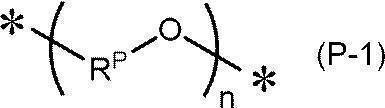
式(P-1)中、RPはそれぞれ独立に、アルキレン基を表し、nは2以上の整数を表し、2つの*はそれぞれ独立に、他の構造との結合部位を表す。
RPはアルキレン基を表し、炭素数2~20のアルキレン基が好ましく、炭素数2~6のアルキレン基がより好ましく、炭素数2~4のアルキレン基が更に好ましく、エチレン基又はプロピレン基が特に好ましく、エチレン基が最も好ましい。
すなわち、ポリアルキレングリコール構造としてはエチレングリコール構造又はプロピレングリコール構造が好ましく、エチレングリコール構造がより好ましい。
n個のRPはそれぞれ同一であっても異なっていてもよい。また、例えば式(P-1)で表される構造が複数種のRPを含む場合、式(P-1)で表される構造におけるRPの構造が異なる構造はランダムに結合していてもよいし、ブロックを形成していてもよい。
nは2以上の整数を表し、10~2,000の整数であることが好ましく、50~1,000の整数であることがより好ましい。
除去液用界面活性剤は、洗浄後の洗浄物の表面(例えば、有機層の表面、又は、有機層がエッチングされた部分の基材の表面など)に除去液用界面活性剤自体が残存しにくい観点から、ポリアルキレングリコール構造を含むことが好ましい。
ポリアルキレングリコール構造としては、特に限定されず、例えば下記式(P-1)で表される構造が挙げられる。
RPはアルキレン基を表し、炭素数2~20のアルキレン基が好ましく、炭素数2~6のアルキレン基がより好ましく、炭素数2~4のアルキレン基が更に好ましく、エチレン基又はプロピレン基が特に好ましく、エチレン基が最も好ましい。
すなわち、ポリアルキレングリコール構造としてはエチレングリコール構造又はプロピレングリコール構造が好ましく、エチレングリコール構造がより好ましい。
n個のRPはそれぞれ同一であっても異なっていてもよい。また、例えば式(P-1)で表される構造が複数種のRPを含む場合、式(P-1)で表される構造におけるRPの構造が異なる構造はランダムに結合していてもよいし、ブロックを形成していてもよい。
nは2以上の整数を表し、10~2,000の整数であることが好ましく、50~1,000の整数であることがより好ましい。
また、除去液用界面活性剤は、炭素数8以上の脂肪族炭化水素基(以下、「脂肪族基R」ともいう。)を含むことが好ましい。
脂肪族基Rにおける炭素数は、8~50が好ましく、8~40がより好ましく、10~30が更に好ましい。
また、脂肪族基Rは、炭素数8以上の飽和脂肪族炭化水素基であることが好ましく、炭素数8以上のアルキル基であることが更に好ましい。これらの基の好ましい炭素数は上記の通りである。
脂肪族基Rは、本発明の効果が得られる範囲内において、置換基を有してもよい。また、炭素数8以上の脂肪族炭化水素基が無置換である態様も、本発明の好ましい態様の一つである。
脂肪族基Rにおける炭素数は、8~50が好ましく、8~40がより好ましく、10~30が更に好ましい。
また、脂肪族基Rは、炭素数8以上の飽和脂肪族炭化水素基であることが好ましく、炭素数8以上のアルキル基であることが更に好ましい。これらの基の好ましい炭素数は上記の通りである。
脂肪族基Rは、本発明の効果が得られる範囲内において、置換基を有してもよい。また、炭素数8以上の脂肪族炭化水素基が無置換である態様も、本発明の好ましい態様の一つである。
除去液用界面活性剤は、ポリエチレングリコール構造、及び、炭素数8以上の脂肪族炭化水素基を含むことが好ましい。
上記ポリエチレングリコール構造におけるエチレングリコール構造の繰返し数は、2以上であればよいが、10~2,000であることが好ましく、50~1,000であることがより好ましい。
上記炭素数8以上の脂肪族炭化水素基の好ましい態様は、上述の脂肪族基Rの好ましい態様と同様である。
これらの中でも、除去液用界面活性剤は、ポリエチレングリコール構造、及び、炭素数8以上のアルキル基を含むことが好ましい。
上記ポリエチレングリコール構造におけるエチレングリコール構造の繰返し数は、2以上であればよいが、10~2,000であることが好ましく、50~1,000であることがより好ましい。
上記炭素数8以上の脂肪族炭化水素基の好ましい態様は、上述の脂肪族基Rの好ましい態様と同様である。
これらの中でも、除去液用界面活性剤は、ポリエチレングリコール構造、及び、炭素数8以上のアルキル基を含むことが好ましい。
これらの中でも、除去液用界面活性剤は、下記式(Z-1)~式(Z-4)のいずれかで表される化合物であることが好ましい。
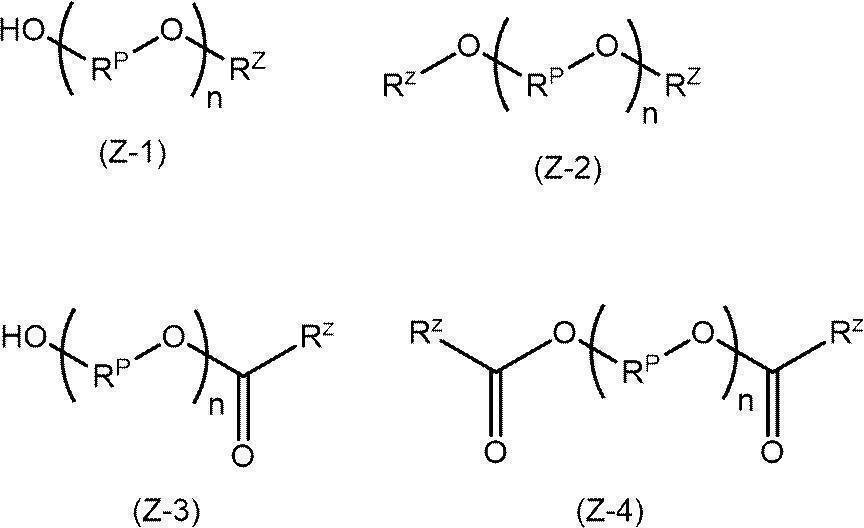
式(Z-1)~式(Z-4)中、RPはそれぞれ独立に、アルキレン基を表し、nは2以上の整数を表し、RZはそれぞれ独立に、炭素数8以上の脂肪族炭化水素基を表す。
式(Z-1)~式(Z-4)中、RP及びnはそれぞれ、式(P-1)中のRP及びnと同義であり、好ましい態様も同様である。
式(Z-1)~式(Z-4)中、RZの好ましい態様は、上述の脂肪族基Rの好ましい態様と同様である。
式(Z-1)~式(Z-4)中、RP及びnはそれぞれ、式(P-1)中のRP及びnと同義であり、好ましい態様も同様である。
式(Z-1)~式(Z-4)中、RZの好ましい態様は、上述の脂肪族基Rの好ましい態様と同様である。
除去液用界面活性剤としては、フッ素原子、ケイ素原子、及び、リン酸エステル構造を含まないことが好ましい。
除去液用界面活性剤の分子量(分子量分布を有する場合は、重量平均分子量)は、200~1,000であることが好ましく、250~500であることがより好ましい。
除去液用界面活性剤としては、市販品を用いてもよい。市販品としては、EMALEX 710(日本エマルジョン(株)製)、パイオニンD-1007、パイオニンD-1105、パイオニンD-1110、パイオニンD-1420、パイオニンD-2104-D(以上、竹本油脂(株)製)、エマルゲン220(花王ケミカル(株)製)等が挙げられるが、これに限定されるものではない。
除去液用界面活性剤の含有量は、除去液の全質量に対して、0.05~20質量%であることが好ましく、0.1~10質量%であることがより好ましく、0.4~8質量%であることが更に好ましく、1.2~4質量%であることが更に好ましい。
除去液用界面活性剤は、1種を単独で使用しても、2種以上を併用してもよい。2種以上を併用する場合、合計量が上記範囲となることが好ましい。
除去液用界面活性剤を2種以上併用することにより、例えば、除去液自体の保存安定性が向上する。
除去液用界面活性剤は、1種を単独で使用しても、2種以上を併用してもよい。2種以上を併用する場合、合計量が上記範囲となることが好ましい。
除去液用界面活性剤を2種以上併用することにより、例えば、除去液自体の保存安定性が向上する。
<溶剤>
除去液は、溶剤を更に含むことが好ましい。
溶剤としては、水、有機溶剤又はこれらの混合物が挙げられ、水を含むことが好ましい。
除去液が水を含む場合、除去液の全質量に対する水の含有量は、70質量%以上であることが好ましく、80質量%以上であることがより好ましく、90質量%以上であることが更に好ましい。上記含有量の上限は特に限定されないが、99.95質量%以下とすることができる。
また、除去液が水を含む場合、溶剤の全質量に対する水の含有量は、70質量%以上であることが好ましく、80質量%以上であることがより好ましく、90質量%以上であることが更に好ましい。上記含有量の上限は特に限定されないが、100質量%以下とすることができる。
除去液は、溶剤を更に含むことが好ましい。
溶剤としては、水、有機溶剤又はこれらの混合物が挙げられ、水を含むことが好ましい。
除去液が水を含む場合、除去液の全質量に対する水の含有量は、70質量%以上であることが好ましく、80質量%以上であることがより好ましく、90質量%以上であることが更に好ましい。上記含有量の上限は特に限定されないが、99.95質量%以下とすることができる。
また、除去液が水を含む場合、溶剤の全質量に対する水の含有量は、70質量%以上であることが好ましく、80質量%以上であることがより好ましく、90質量%以上であることが更に好ましい。上記含有量の上限は特に限定されないが、100質量%以下とすることができる。
また、除去液は、水溶性溶剤を更に含んでもよい。
特に、上記除去液が水を含む態様において、除去液は水溶性溶剤を更に含んでもよい。
本明細書において、水、水と水溶性溶剤との混合物、及び、水溶性溶剤をあわせて、水系溶剤と呼ぶことがある。
水溶性溶剤としては、23℃における水への溶解度が1g以上の有機溶剤が好ましく、上記溶解度が10g以上の有機溶剤がより好ましく、上記溶解度が30g以上の有機溶剤が更に好ましい。
水溶性溶剤としては、例えば、メタノール、エタノール、プロパノール、エチレングリコール、グリセリン等のアルコール系溶剤;アセトン等のケトン系溶剤;ホルムアミド等のアミド系溶剤、等が挙げられる。
特に、上記除去液が水を含む態様において、除去液は水溶性溶剤を更に含んでもよい。
本明細書において、水、水と水溶性溶剤との混合物、及び、水溶性溶剤をあわせて、水系溶剤と呼ぶことがある。
水溶性溶剤としては、23℃における水への溶解度が1g以上の有機溶剤が好ましく、上記溶解度が10g以上の有機溶剤がより好ましく、上記溶解度が30g以上の有機溶剤が更に好ましい。
水溶性溶剤としては、例えば、メタノール、エタノール、プロパノール、エチレングリコール、グリセリン等のアルコール系溶剤;アセトン等のケトン系溶剤;ホルムアミド等のアミド系溶剤、等が挙げられる。
除去液は、溶剤及び除去液用界面活性剤以外の成分を実質的に含まない態様とすることもできる。上記態様において、溶剤及び除去液用界面活性剤の合計含有量は、除去液の全質量に対し、98質量%以上であることが好ましく、99質量%以上であることがより好ましく、99.9質量%以上であることが更に好ましい。上記含有量の上限は特に限定されず、100質量%とすることもできる。
また除去液が水を含む態様において、水及び除去液用界面活性剤以外の成分を実質的に含まない態様とすることもできる。上記態様において、水及び除去液用界面活性剤の合計含有量は、除去液の全質量に対し、98質量%以上であることが好ましく、99質量%以上であることがより好ましく、99.9質量%以上であることが更に好ましい。上記含有量の上限は特に限定されず、100質量%とすることもできる。
また除去液が水を含む態様において、水及び除去液用界面活性剤以外の成分を実質的に含まない態様とすることもできる。上記態様において、水及び除去液用界面活性剤の合計含有量は、除去液の全質量に対し、98質量%以上であることが好ましく、99質量%以上であることがより好ましく、99.9質量%以上であることが更に好ましい。上記含有量の上限は特に限定されず、100質量%とすることもできる。
本発明において、除去液は、粘度が1.0mPa・s以下であることが好ましく、0.8mPa・s以下であることがより好ましく、0.75mPa・s以下であることが更に好ましく、粘度が0.72mPa・s以下であることが特に好ましい。上記粘度の下限は、特に限定されず、例えば0.10mPa・s以上とすることができる。
上記粘度は、公知の方法で測定することができるが、例えば、東機産業(株)製のRE-80L型回転粘度計により測定される。回転数は適宜設定すればよいが、例えば100rpmとすることができる。
除去液の粘度は、例えば、除去液に含まれる化合物の構造、除去液の温度、除去液に含まれる溶剤の混合比等により調整される。
除去液の粘度を上述の範囲とする等の目的で、除去液の温度を調節してもよい。例えば、除去液の温度を20℃以上とすることが好ましく、30℃以上とすることがより好ましく、40℃以上とすることが更に好ましく、50℃以上とすることが特に好ましい。上記温度の上限は、例えば100℃以下とすることができ、90℃以下が好ましく、80℃以下がより好ましい。
以下、本発明で用いられる積層体について詳細を説明する。
上記粘度は、公知の方法で測定することができるが、例えば、東機産業(株)製のRE-80L型回転粘度計により測定される。回転数は適宜設定すればよいが、例えば100rpmとすることができる。
除去液の粘度は、例えば、除去液に含まれる化合物の構造、除去液の温度、除去液に含まれる溶剤の混合比等により調整される。
除去液の粘度を上述の範囲とする等の目的で、除去液の温度を調節してもよい。例えば、除去液の温度を20℃以上とすることが好ましく、30℃以上とすることがより好ましく、40℃以上とすることが更に好ましく、50℃以上とすることが特に好ましい。上記温度の上限は、例えば100℃以下とすることができ、90℃以下が好ましく、80℃以下がより好ましい。
以下、本発明で用いられる積層体について詳細を説明する。
<積層体>
本発明において用いられる積層体は、基材、有機層、保護層及び感光層をこの順に含む。
上記感光層は現像液を用いた現像に供されることが好ましい。
また、上記保護層は本発明の除去液を用いた除去に供される。
本発明において用いられる積層体は、基材、有機層、保護層及び感光層をこの順に含む。
上記感光層は現像液を用いた現像に供されることが好ましい。
また、上記保護層は本発明の除去液を用いた除去に供される。
積層体は、積層体に含まれる有機層のパターニングに用いることができる。
図1は、本発明の好ましい実施形態に係る積層体の加工過程の一例を模式的に示す概略断面図である。本発明の一実施形態においては、図1(a)に示した例のように、基材4の上に有機層3(例えば、有機半導体層)が配設されている。更に、有機層3を保護する保護層2が接する形でその表面に配設されている。有機層3と保護層2の間には他の層が設けられていてもよいが、本発明の効果がより得られやすい観点からは、有機層3と保護層2とが直接接している態様が、好ましい態様の一例として挙げられる。また、この保護層の上に感光層1が配置されている。感光層1と保護層2とは直接接していてもよいし、感光層1と保護層2との間に他の層が設けられていてもよい。
図1(b)には、感光層1の一部を露光現像した状態の一例が示されている。例えば、所定のマスク等を用いる等の方法により感光層1を部分的に露光し、露光後に有機溶剤等の現像液を用いて現像することにより、除去部5における感光層1が除去され、露光現像後の感光層1aが形成される。このとき、保護層2は現像液により除去されにくいため残存し、有機層3は残存した上記保護層2によって現像液によるダメージから保護される。また、上記現像後に感光層1aに対して加熱又は露光を更に行ってもよい。
図1(c)には、保護層2と有機層3の一部を除去した状態の一例が示されている。例えば、ドライエッチング処理等により、現像後の感光層(レジスト)1aのない除去部5における保護層2と有機層3とを除去することにより、保護層2及び有機層3に除去部5aが形成される。このようにして、除去部5aにおいて有機層3を取り除くことができる。すなわち、有機層3のパターニングを行うことができる。
図1(c)に示された状態が、基材、有機層、保護層、及び感光層をこの順に含む積層体をエッチングしてなるパターンの一例であり、本発明の除去液は、例えば、この図1(c)に示された状態において、保護層の除去に用いられる。
図1(c)には現像後の感光層1aが残存した状態が記載されているが、例えば、ドライエッチング処理等により、現像後の感光層1aは除去されていてもよい。
図1(d)には、上記パターニング後に、感光層1a及び保護層2を除去した状態の一例が示されている。上記図1(c)に示した状態の積層体における感光層1a及び保護層2を本発明の除去液で洗浄する等により、加工後の有機層3a上の感光層1a及び保護層2が除去される。
上記本発明の除去液での洗浄は複数回行われてもよい。また、上記本発明の除去液での洗浄後に、更に、純水等によりリンスを行ってもよい。上記リンスにより、例えば、洗浄後の積層体表面から除去液用界面活性剤が除去される。
以上のとおり、本発明の好ましい実施形態によれば、有機層3に所望のパターンを形成し、かつレジストとなる感光層1と保護膜となる保護層2を除去することができる。これらの工程の詳細は後述する。
図1は、本発明の好ましい実施形態に係る積層体の加工過程の一例を模式的に示す概略断面図である。本発明の一実施形態においては、図1(a)に示した例のように、基材4の上に有機層3(例えば、有機半導体層)が配設されている。更に、有機層3を保護する保護層2が接する形でその表面に配設されている。有機層3と保護層2の間には他の層が設けられていてもよいが、本発明の効果がより得られやすい観点からは、有機層3と保護層2とが直接接している態様が、好ましい態様の一例として挙げられる。また、この保護層の上に感光層1が配置されている。感光層1と保護層2とは直接接していてもよいし、感光層1と保護層2との間に他の層が設けられていてもよい。
図1(b)には、感光層1の一部を露光現像した状態の一例が示されている。例えば、所定のマスク等を用いる等の方法により感光層1を部分的に露光し、露光後に有機溶剤等の現像液を用いて現像することにより、除去部5における感光層1が除去され、露光現像後の感光層1aが形成される。このとき、保護層2は現像液により除去されにくいため残存し、有機層3は残存した上記保護層2によって現像液によるダメージから保護される。また、上記現像後に感光層1aに対して加熱又は露光を更に行ってもよい。
図1(c)には、保護層2と有機層3の一部を除去した状態の一例が示されている。例えば、ドライエッチング処理等により、現像後の感光層(レジスト)1aのない除去部5における保護層2と有機層3とを除去することにより、保護層2及び有機層3に除去部5aが形成される。このようにして、除去部5aにおいて有機層3を取り除くことができる。すなわち、有機層3のパターニングを行うことができる。
図1(c)に示された状態が、基材、有機層、保護層、及び感光層をこの順に含む積層体をエッチングしてなるパターンの一例であり、本発明の除去液は、例えば、この図1(c)に示された状態において、保護層の除去に用いられる。
図1(c)には現像後の感光層1aが残存した状態が記載されているが、例えば、ドライエッチング処理等により、現像後の感光層1aは除去されていてもよい。
図1(d)には、上記パターニング後に、感光層1a及び保護層2を除去した状態の一例が示されている。上記図1(c)に示した状態の積層体における感光層1a及び保護層2を本発明の除去液で洗浄する等により、加工後の有機層3a上の感光層1a及び保護層2が除去される。
上記本発明の除去液での洗浄は複数回行われてもよい。また、上記本発明の除去液での洗浄後に、更に、純水等によりリンスを行ってもよい。上記リンスにより、例えば、洗浄後の積層体表面から除去液用界面活性剤が除去される。
以上のとおり、本発明の好ましい実施形態によれば、有機層3に所望のパターンを形成し、かつレジストとなる感光層1と保護膜となる保護層2を除去することができる。これらの工程の詳細は後述する。
<基材>
本発明において用いられる積層体は基材を含む。
積層体に含まれてもよい基材としては、例えば、シリコン、石英、セラミック、ガラス、ポリエチレンナフタレート(PEN)、ポリエチレンテレフタレート(PET)などのポリエステルフィルム、ポリイミドフィルムなどの種々の材料により形成された基材が挙げられ、用途に応じていかなる基材を選択してもよい。例えば、フレキシブルな素子に用いる場合にはフレキシブルな材料により形成された基材を用いることができる。また、基材は複数の材料により形成された複合基材や、複数の材料が積層された積層基材であってもよい。また、基材の形状も特に限定されず、用途に応じて選択すればよく、例えば、板状の基材(基板)が挙げられる。基板の厚さ等についても、特に限定されない。
本発明において用いられる積層体は基材を含む。
積層体に含まれてもよい基材としては、例えば、シリコン、石英、セラミック、ガラス、ポリエチレンナフタレート(PEN)、ポリエチレンテレフタレート(PET)などのポリエステルフィルム、ポリイミドフィルムなどの種々の材料により形成された基材が挙げられ、用途に応じていかなる基材を選択してもよい。例えば、フレキシブルな素子に用いる場合にはフレキシブルな材料により形成された基材を用いることができる。また、基材は複数の材料により形成された複合基材や、複数の材料が積層された積層基材であってもよい。また、基材の形状も特に限定されず、用途に応じて選択すればよく、例えば、板状の基材(基板)が挙げられる。基板の厚さ等についても、特に限定されない。
<有機層>
本発明における積層体は、有機層を含む。
有機層は、有機材料を含む層である。具体的な有機材料は、有機層の用途や機能に応じて、適宜選択される。有機層の想定される機能としては、例えば、半導体特性、発光特性、光電変換特性、光吸収特性、電気絶縁性、強誘電性、透明性、絶縁性などが挙げられる。積層体において、有機層は基材よりも上に含まれていればよく、基材と有機層とが接していてもよいし、有機層と基材との間に別の層が更に含まれていてもよい。
本発明における積層体は、有機層を含む。
有機層は、有機材料を含む層である。具体的な有機材料は、有機層の用途や機能に応じて、適宜選択される。有機層の想定される機能としては、例えば、半導体特性、発光特性、光電変換特性、光吸収特性、電気絶縁性、強誘電性、透明性、絶縁性などが挙げられる。積層体において、有機層は基材よりも上に含まれていればよく、基材と有機層とが接していてもよいし、有機層と基材との間に別の層が更に含まれていてもよい。
有機層の厚さは、特に制限されず、用いられる電子デバイスの種類などにより異なるが、好ましくは1nm~50μm、より好ましくは1nm~5μm、更に好ましくは1nm~500nmである。
以下では、特に、有機層が有機半導体層である例について詳しく説明する。有機半導体層は、半導体の特性を示す有機材料を含む層である。
以下では、特に、有機層が有機半導体層である例について詳しく説明する。有機半導体層は、半導体の特性を示す有機材料を含む層である。
有機半導体層は、有機半導体を含む有機層であり、有機半導体は、半導体の特性を示す有機化合物である。有機半導体には、無機化合物からなる半導体の場合と同様に、ホール(正孔)をキャリアとして伝導するp型半導体と、電子をキャリアとして伝導するn型半導体がある。有機半導体層中のキャリアの流れやすさはキャリア移動度μで表される。用途にもよるが、一般にキャリア移動度は高い方がよく、10-7cm2/Vs以上であることが好ましく、10-6cm2/Vs以上であることがより好ましく、10-5cm2/Vs以上であることが更に好ましい。キャリア移動度は、電界効果トランジスタ(FET)素子を作製したときの特性や飛行時間計測(TOF)法の測定値に基づいて求めることができる。
有機半導体層に使用し得るp型有機半導体としては、ホール輸送性を有する材料であれば、いかなる材料を用いてもよい。p型有機半導体は、好ましくは、p型π共役高分子、縮合多環化合物、トリアリールアミン化合物、ヘテロ5員環化合物、フタロシアニン化合物、ポルフィリン化合物、カーボンナノチューブ、及びグラフェンのいずれかである。また、p型有機半導体として、これらの化合物のうち複数種の化合物を組み合わせて使用してもよい。p型有機半導体は、より好ましくは、p型π共役高分子、縮合多環化合物、トリアリールアミン化合物、ヘテロ5員環化合物、フタロシアニン化合物、及びポルフィリン化合物の少なくとも1種であり、更に好ましくは、p型π共役高分子及び縮合多環化合物の少なくとも1種である。
p型π共役高分子は、例えば、置換又は無置換のポリチオフェン(例えば、ポリ(3-ヘキシルチオフェン)(P3HT、シグマ アルドリッチ ジャパン合同会社製)など)、ポリセレノフェン、ポリピロール、ポリパラフェニレン、ポリパラフェニレンビニレン、ポリチオフェンビニレン、ポリアニリンなどである。縮合多環化合物は、例えば、置換又は無置換のアントラセン、テトラセン、ペンタセン、アントラジチオフェン、ヘキサベンゾコロネンなどである。
トリアリールアミン化合物は、例えば、m-MTDATA(4,4’,4’’-Tris[(3-methylphenyl)phenylamino]triphenylamine)、2-TNATA(4,4’,4’’-Tris[2-naphthyl(phenyl)amino]triphenylamine)、NPD(N,N’-Di(1-naphthyl)-N,N’-diphenyl-(1,1’-biphenyl)-4,4’-diamine)、TPD(N,N’-Diphenyl-N,N’-di(m-tolyl)benzidine)、mCP(1,3-bis(9-carbazolyl)benzene)、CBP(4,4’-bis(9-carbazolyl)-2,2’-biphenyl)などである。
ヘテロ5員環化合物は、例えば、置換又は無置換のオリゴチオフェン、TTF(Tetrathiafulvalene)などである。
フタロシアニン化合物は、各種中心金属を有する置換又は無置換のフタロシアニン、ナフタロシアニン、アントラシアニン、テトラピラジノポルフィラジンなどである。ポルフィリン化合物は、各種中心金属を有する置換又は無置換のポルフィリンである。また、カーボンナノチューブは、半導体ポリマーが表面に修飾されたカーボンナノチューブでもよい。
有機半導体層に使用し得るn型有機半導体としては、電子輸送性を有する材料であれば、いかなる材料を用いてもよい。n型有機半導体は、好ましくは、フラーレン化合物、電子欠乏性フタロシアニン化合物、縮環多環化合物(ナフタレンテトラカルボニル化合物、ペリレンテトラカルボニル化合物など)、TCNQ化合物(テトラシアノキノジメタン化合物)、ポリチオフェン系化合物、ベンジジン系化合物、カルバゾール系化合物、フェナントロリン系化合物、ピリジンフェニル配位子イリジウム系化合物、キノリノール配位子アルムニウム系化合物、n型π共役高分子、及びグラフェンのいずれかである。また、n型有機半導体として、これらの化合物のうち複数種の化合物を組み合わせて使用してもよい。n型有機半導体は、より好ましくは、フラーレン化合物、電子欠乏性フタロシアニン化合物、縮環多環化合物、及びn型π共役高分子の少なくとも1種であり、特に好ましくは、フラーレン化合物、縮環多環化合物及びn型π共役高分子の少なくとも1種である。
フラーレン化合物とは、置換又は無置換のフラーレンを意味し、フラーレンとしてはC60、C70、C76、C78、C80、C82、C84、C86、C88、C90、C96、C116、C180、C240、C540などで表されるフラーレンのいずれでもよい。フラーレン化合物は、好ましくは、置換又は無置換のC60、C70、C86フラーレンであり、特に好ましくは、PCBM([6,6]-フェニル-C61-酪酸メチルエステル、シグマ アルドリッチ ジャパン合同会社製など)及びその類縁体(例えば、C60部分をC70、C86等に置換したもの、置換基のベンゼン環を他の芳香環又はヘテロ環に置換したもの、メチルエステルをn-ブチルエステル、i-ブチルエステル等に置換したもの)である。
電子欠乏性フタロシアニン化合物とは、電子求引性基が4つ以上結合しかつ各種中心金属を有する置換又は無置換のフタロシアニン、ナフタロシアニン、アントラシアニン、テトラピラジノポルフィラジンなどである。電子欠乏性フタロシアニン化合物は、例えば、フッ素化フタロシアニン(F16MPc)、及び塩素化フタロシアニン(Cl16MPc)などである。ここで、Mは中心金属を、Pcはフタロシアニンを表す。
ナフタレンテトラカルボニル化合物としてはいかなるものでもよいが、好ましくはナフタレンテトラカルボン酸無水物(NTCDA)、ナフタレンビスイミド化合物(NTCDI)、ペリノン顔料(Pigment Orange 43、Pigment Red 194など)である。
ペリレンテトラカルボニル化合物としてはいかなるものでもよいが、好ましくはペリレンテトラカルボン酸無水物(PTCDA)、ペリレンビスイミド化合物(PTCDI)、ベンゾイミダゾール縮環体(PV)である。
TCNQ化合物とは、置換又は無置換のTCNQ及び、TCNQのベンゼン環部分を別の芳香環やヘテロ環に置き換えたものである。TCNQ化合物は、例えば、TCNQ、TCNAQ(テトラシアノアントラキノジメタン)、TCN3T(2,2’-((2E,2’’E)-3’,4’-Alkyl substituted-5H,5’’H-[2,2’:5’,2’’-terthiophene]-5,5’’-diylidene)dimalononitrile derivatives)などである。
ポリチオフェン系化合物とは、ポリ(3,4-エチレンジオキシチオフェン)等のポリチオフェン構造を有する化合物である。ポリチオフェン系化合物は、例えば、PEDOT:PSS(ポリ(3,4-エチレンジオキシチオフェン)(PEDOT)及びポリスチレンスルホン酸(PSS)からなる複合物)などである。
ベンジジン系化合物とは、分子内にベンジジン構造を有する化合物である。ベンジジン系化合物は、例えば、N,N’-ビス(3-メチルフェニル)-N,N’-ジフェニルベンジジン(TPD)、N,N’-ジ-[(1-ナフチル)-N,N’-ジフェニル]-1,1’-ビフェニル)-4,4’-ジアミン(NPD)などである。
カルバゾール系化合物とは、分子内にカルバゾール環構造を有する化合物である。カルバゾール系化合物は、例えば、4,4’-ビス(N-カルバゾリル)-1,1’-ビフェニル(CBP)などである。
フェナントロリン系化合物とは、分子内にフェナントロリン環構造を有する化合物であり、例えば、2,9-ジメチル-4,7-ジフェニル-1,10-フェナントロリン(BCP)などである。
ピリジンフェニル配位子イリジウム系化合物とは、フェニルピリジン構造を配位子とするイリジウム錯体構造を有する化合物である。ピリジンフェニル配位子イリジウム系化合物は、例えば、ビス(3,5-ジフルオロ-2-(2-ピリジルフェニル-(2-カルボキシピリジル)イリジウム(III)(FIrpic)、トリス(2-フェニルピリジナト)イリジウム(III)(Ir(ppy)3)などである。
キノリノール配位子アルムニウム系化合物とは、キノリノール構造を配位子とするアルミニウム錯体構造を有する化合物であり、例えば、トリス(8-キノリノラト)アルミニウムなどである。
n型有機半導体材料の特に好ましい例を以下に示す。なお、式中のRとしては、いかなるものでも構わないが、水素原子、置換又は無置換で分岐又は直鎖のアルキル基(好ましくは炭素数1~18、より好ましくは1~12、更に好ましくは1~8のもの)、置換又は無置換のアリール基(好ましくは炭素数6~30、より好ましくは6~20、更に好ましくは6~14のもの)のいずれかであることが好ましい。構造式中のMeはメチル基を表し、Mは金属原子を表す。

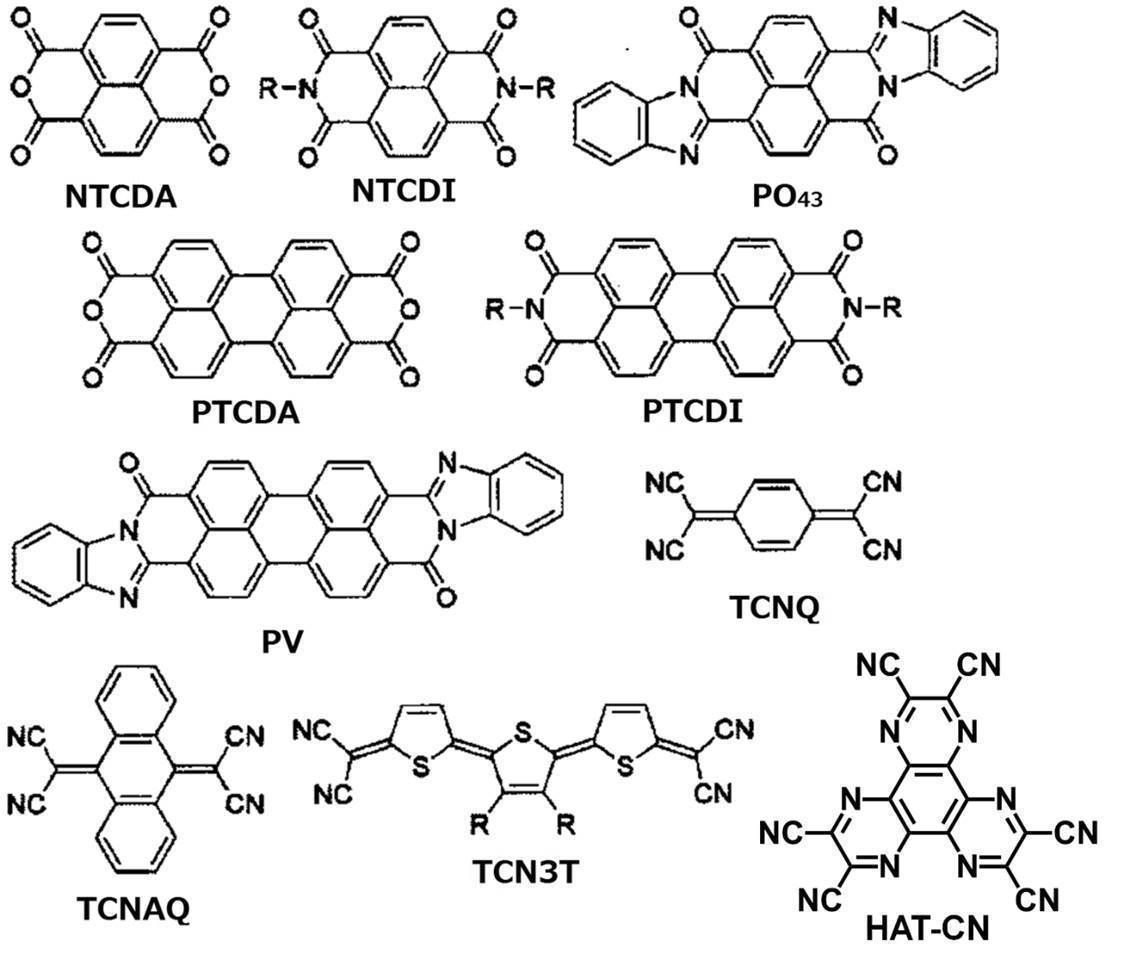
有機半導体層に含まれる有機半導体は、1種でもよいし、2種以上であってもよい。また、有機半導体層は、p型の層とn型の層の積層又は混合層でもよい。
有機層の形成方法は、気相法でも液相法でもよい。気相法の場合には、蒸着法(真空蒸着法、分子線エピタキシー法など)、スパッタリング法、及びイオンプレーティング法などの物理気相成長(PVD)法や、プラズマ重合法などの化学気相成長(CVD)法が使用でき、特に蒸着法が好ましい。
一方、液相法の場合には、例えば、有機材料は溶剤中に配合され、有機層を形成する組成物(有機層形成用組成物)とされる。そして、この組成物を基材上に供給し乾燥して、有機層が形成される。供給方法としては、塗布が好ましい。供給方法の例としては、スリットコート法、キャスト法、ブレードコーティング法、ワイヤーバーコーティング法、スプレーコーティング法、ディッピング(浸漬)コーティング法、ビードコーティング法、エアーナイフコーティング法、カーテンコーティング法、インクジェット法、スピンコート法、ラングミュア-ブロジェット(Langmuir-Blodgett)(LB)法、エッジキャスト法(詳細は、特許第6179930号公報)などを挙げることができる。キャスト法、スピンコート法、及びインクジェット法を用いることが更に好ましい。このようなプロセスにより、表面が平滑で大面積の有機層を低コストで生産することが可能となる。
また、有機層形成用組成物に使用する溶剤としては、有機溶剤が好ましい。有機溶剤としては、例えば、ヘキサン、オクタン、デカン、トルエン、キシレン、エチルベンゼン、1-メチルナフタレン、1,2-ジクロロベンゼン等の炭化水素系溶剤;例えば、アセトン、メチルエチルケトン、メチルイソブチルケトン、シクロヘキサノン等のケトン系溶剤;例えば、ジクロロメタン、クロロホルム、テトラクロロメタン、ジクロロエタン、トリクロロエタン、テトラクロロエタン、クロロベンゼン、ジクロロベンゼン、クロロトルエン等のハロゲン化炭化水素系溶剤;例えば、酢酸エチル、酢酸ブチル、酢酸アミル等のエステル系溶剤;例えば、メタノール、プロパノール、ブタノール、ペンタノール、ヘキサノール、シクロヘキサノール、メチルセロソルブ、エチルセロソルブ、エチレングリコール等のアルコール系溶剤;例えば、ジブチルエーテル、テトラヒドロフラン、ジオキサン、アニソール等のエーテル系溶剤;例えば、N,N-ジメチルホルムアミド、N,N-ジメチルアセトアミド、1-メチル-2-ピロリドン、1-メチル-2-イミダゾリジノン、ジメチルスルフォキサイド等の極性溶剤などが挙げられる。これらの溶剤は1種のみを用いてもよいし、2種以上を用いてもよい。有機層形成用組成物における有機材料の割合は、好ましくは1~95質量%、より好ましくは5~90質量%であり、これにより任意の厚さの膜を形成できる。
また、有機層形成用組成物には、樹脂バインダーを配合してもよい。この場合、膜を形成する材料とバインダー樹脂とを前述の適当な溶剤に溶解させ、又は分散させて塗布液とし、各種の塗布法により薄膜を形成することができる。樹脂バインダーとしては、ポリスチレン、ポリカーボネート、ポリアリレート、ポリエステル、ポリアミド、ポリイミド、ポリウレタン、ポリシロキサン、ポリスルフォン、ポリメチルメタクリレート、ポリメチルアクリレート、セルロース、ポリエチレン、ポリプロピレン等の絶縁性ポリマー、及びこれらの共重合体、ポリビニルカルバゾール、ポリシラン等の光伝導性ポリマー、ポリチオフェン、ポリピロール、ポリアニリン、ポリパラフェニレンビニレン等の導電性ポリマーなどを挙げることができる。樹脂バインダーは、単独で使用してもよく、あるいは複数併用してもよい。薄膜の機械的強度を考慮するとガラス転移温度の高い樹脂バインダーが好ましく、電荷移動度を考慮すると極性基を含まない構造の光伝導性ポリマー又は導電性ポリマーよりなる樹脂バインダーが好ましい。
樹脂バインダーを配合する場合、その配合量は、有機層中、好ましくは0.1~30質量%で用いられる。樹脂バインダーは、1種単独で使用されても、複数種の組み合わせで使用されてもよい。複数種の組み合わせの場合には、それらの合計量が上記範囲にあることが好ましい。
有機層は、用途によっては単独及び種々の有機材料や添加剤を添加した混合溶液を用いた、複数の材料種からなるブレンド膜でもよい。例えば、光電変換層を作製する場合、複数種の半導体材料を使用した混合溶液を用いることなどができる。
また、成膜の際、基材を加熱又は冷却してもよく、基材の温度を変化させることで膜質や膜中での分子のパッキングを制御することが可能である。基材の温度としては特に制限はないが、好ましくは-200℃~400℃、より好ましくは-100℃~300℃、更に好ましくは0℃~200℃である。
形成された有機層は、後処理により特性を調整することができる。例えば、加熱処理や蒸気化した溶剤に暴露することにより膜のモルホロジーや膜中での分子のパッキングを変化させることで特性を向上させることが可能である。また、酸化性又は還元性のガスや溶剤、物質などに曝す、あるいはこれらの手法を併用することで酸化あるいは還元反応を起こし、膜中でのキャリア密度などを調整することができる。
<保護層>
本発明における保護層は、本発明の除去液を用いた除去に供される。
除去方法としては、後述する積層体の製造方法と有機層のパターニング方法における除去液を用いて保護層を除去する工程として説明した方法が挙げられる。
本発明における保護層は、本発明の除去液を用いた除去に供される。
除去方法としては、後述する積層体の製造方法と有機層のパターニング方法における除去液を用いて保護層を除去する工程として説明した方法が挙げられる。
また、本発明において用いられる保護層は、本発明の除去液に対する溶解速度が100nm/s以上であることが好ましく、120nm/s以上であることがより好ましく、150nm/s以上であることが更に好ましい。上記溶解速度の上限は特に限定されず、例えば、1,000nm/s以下とすることができる。
上記溶解速度は、例えば下記の方法により測定される。
積層体から感光層を除去し、感光層が除去された積層体を作製する。
上記感光層の除去は、例えば、露光及び加熱のいずれをも行わずに感光層を現像液により除去することにより行うことができる。
上記感光層が除去された積層体の膜厚(膜厚A)を測定する。
上記感光層が除去された積層体を除去液に5秒間浸漬した後取り出し、再度積層体の膜厚(膜厚B)を測定する。
上記膜厚Aと上記膜厚Bの差を浸漬時間(5秒間)で除することにより、保護層の除去液に対する溶解速度(nm/s)を算出する。
積層体から感光層を除去し、感光層が除去された積層体を作製する。
上記感光層の除去は、例えば、露光及び加熱のいずれをも行わずに感光層を現像液により除去することにより行うことができる。
上記感光層が除去された積層体の膜厚(膜厚A)を測定する。
上記感光層が除去された積層体を除去液に5秒間浸漬した後取り出し、再度積層体の膜厚(膜厚B)を測定する。
上記膜厚Aと上記膜厚Bの差を浸漬時間(5秒間)で除することにより、保護層の除去液に対する溶解速度(nm/s)を算出する。
保護層の厚さは、0.1μm以上であることが好ましく、0.5μm以上であることがより好ましく、1.0μm以上であることが更に好ましく、2.0μm以上が一層好ましい。保護層の厚さの上限値としては、10μm以下が好ましく、5.0μm以下がより好ましく、3.0μm以下が更に好ましい。
また、本発明における保護層は、現像液に対する溶解速度が23℃において10nm/s以下の層であることが好ましく、1nm/s以下の層であることがより好ましい。上記溶解速度の下限は特に限定されず、0nm/s超であればよい。
〔高分子化合物〕
本発明における保護層は、高分子化合物を含むことが好ましい。
保護層は、水溶性高分子化合物を含むことが好ましく、水溶性樹脂を含むことがより好ましい。
本発明における保護層は、高分子化合物を含むことが好ましい。
保護層は、水溶性高分子化合物を含むことが好ましく、水溶性樹脂を含むことがより好ましい。
-水溶性樹脂-
水溶性樹脂とは、23℃における水100gに対して1g以上溶解する樹脂をいう。水溶性樹脂は、23℃における水100gに対して5g以上溶解する樹脂であることが好ましく、10g以上溶解する樹脂であることがより好ましく、30g以上溶解する樹脂であることが更に好ましい。溶解量の上限は特にないが、100g程度であることが実際的である。
水溶性樹脂とは、23℃における水100gに対して1g以上溶解する樹脂をいう。水溶性樹脂は、23℃における水100gに対して5g以上溶解する樹脂であることが好ましく、10g以上溶解する樹脂であることがより好ましく、30g以上溶解する樹脂であることが更に好ましい。溶解量の上限は特にないが、100g程度であることが実際的である。
水溶性樹脂は、親水性基を含む樹脂が好ましく、親水性基としては、ヒドロキシ基、カルボキシ基、スルホン酸基、リン酸基、アミド基、イミド基などが例示される。
水溶性樹脂としては、具体的には、ポリビニルピロリドン(PVP)、ポリビニルアルコール(PVA)、水溶性多糖類(水溶性のセルロース(メチルセルロース、カルボキシメチルセルロース、ヒドロキシエチルセルロース、ヒドロキシプロピルセルロース、ヒドロキシエチルメチルセルロース、ヒドロキシプロピルメチルセルロース、プロピルメチルセルロース等)、プルラン又はプルラン誘導体、デンプン(ヒドロキシプロピルデンプン、カルボキシメチルデンプン等)、キトサン、シクロデキストリン)、ポリエチレンオキシド、ポリエチルオキサゾリン、メチロールメラミン、ポリアクリルアミド、フェノール樹脂、スチレン/マレイン酸半エステル等を挙げることができる。また、これらの中から、2種以上を選択して使用してもよく、共重合体として使用してもよい。本発明において、保護層は、これらの樹脂の中でも、ポリビニルピロリドン、ポリビニルアルコール、水溶性多糖類、プルラン及びプルラン誘導体からなる群から選択された少なくとも1種を含むことが好ましく、ポリビニルピロリドン、ポリビニルアルコール及び水溶性多糖類からなる群から選択された少なくとも1種を含むことが好ましい。水溶性多糖類は、特にセルロースであることが好ましく、ヒドロキシエチルセルロースであることがより好ましい。
具体的には、本発明では、保護層に含まれる水溶性樹脂が、式(P1-1)~式(P4-1)のいずれかで表される繰返し単位を含む樹脂であることが好ましい。
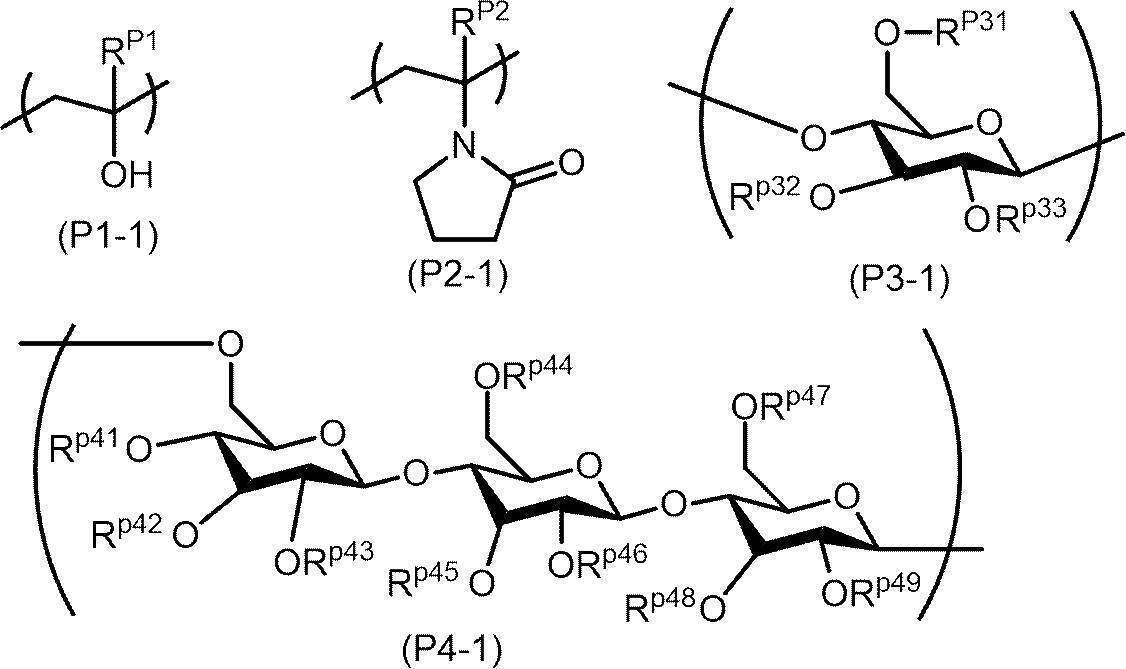
式(P1-1)~(P4-1)中、RP1は水素原子又はメチル基を表し、RP2は水素原子又はメチル基を表し、Rp31~Rp33はそれぞれ独立に、置換基又は水素原子を表し、Rp41~Rp49はそれぞれ独立に、置換基又は水素原子を表す。
<<式(P1-1)で表される繰返し単位を含む樹脂>>
式(P1-1)中、RP1は水素原子が好ましい。
式(P1-1)で表される繰返し単位を含む樹脂は、式(P1-1)で表される繰返し単位とは異なる繰返し単位を更に含んでもよい。
式(P1-1)で表される繰返し単位を含む樹脂は、式(P1-1)で表される繰返し単位を、樹脂の全繰り返し単位に対して10モル%~100モル%含むことが好ましく、30モル%~70モル%含むことがより好ましい。
式(P1-1)で表される繰返し単位を含む樹脂としては、下記式(P1-2)で表される2つの繰返し単位を含む樹脂が挙げられる。
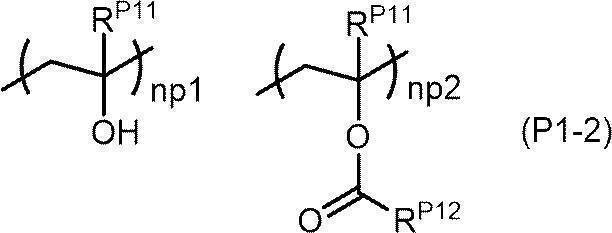
式(P1-2)中、RP11はそれぞれ独立に、水素原子又はメチル基を表し、RP12は置換基を表し、np1及びnp2は質量基準での分子中の構成比率を表す。
式(P1-2)中、RP11は式(P1-1)におけるRP1と同義であり、好ましい態様も同様である。
式(P1-2)中、RP12としては-LP-TPで表される基が挙げられる。LPは単結合又は後述する連結基Lである。TPは置換基であり、後述する置換基Tの例が挙げられる。なかでも、RP12としては、アルキル基(炭素数1~12が好ましく、1~6がより好ましく、1~3が更に好ましい)、アルケニル基(炭素数2~12が好ましく、2~6がより好ましく、2~3が更に好ましい)、アルキニル基(炭素数2~12が好ましく、2~6がより好ましく、2~3が更に好ましい)、アリール基(炭素数6~22が好ましく、6~18がより好ましく、6~10が更に好ましい)、又はアリールアルキル基(炭素数7~23が好ましく、7~19がより好ましく、7~11が更に好ましい)等の炭化水素基が好ましい。これらのアルキル基、アルケニル基、アルキニル基、アリール基、アリールアルキル基は本発明の効果を奏する範囲で更に置換基Tで規定される基を有していてもよい。
式(P1-2)中、np1及びnp2は質量基準での分子中の構成比率を表し、それぞれ独立に、10質量%以上100質量%未満である。ただしnp1+np2が100質量%を超えることはない。np1+np2が100質量%未満の場合、その他の繰返し単位を含むコポリマーであることを意味する。
式(P1-1)中、RP1は水素原子が好ましい。
式(P1-1)で表される繰返し単位を含む樹脂は、式(P1-1)で表される繰返し単位とは異なる繰返し単位を更に含んでもよい。
式(P1-1)で表される繰返し単位を含む樹脂は、式(P1-1)で表される繰返し単位を、樹脂の全繰り返し単位に対して10モル%~100モル%含むことが好ましく、30モル%~70モル%含むことがより好ましい。
式(P1-1)で表される繰返し単位を含む樹脂としては、下記式(P1-2)で表される2つの繰返し単位を含む樹脂が挙げられる。
式(P1-2)中、RP11は式(P1-1)におけるRP1と同義であり、好ましい態様も同様である。
式(P1-2)中、RP12としては-LP-TPで表される基が挙げられる。LPは単結合又は後述する連結基Lである。TPは置換基であり、後述する置換基Tの例が挙げられる。なかでも、RP12としては、アルキル基(炭素数1~12が好ましく、1~6がより好ましく、1~3が更に好ましい)、アルケニル基(炭素数2~12が好ましく、2~6がより好ましく、2~3が更に好ましい)、アルキニル基(炭素数2~12が好ましく、2~6がより好ましく、2~3が更に好ましい)、アリール基(炭素数6~22が好ましく、6~18がより好ましく、6~10が更に好ましい)、又はアリールアルキル基(炭素数7~23が好ましく、7~19がより好ましく、7~11が更に好ましい)等の炭化水素基が好ましい。これらのアルキル基、アルケニル基、アルキニル基、アリール基、アリールアルキル基は本発明の効果を奏する範囲で更に置換基Tで規定される基を有していてもよい。
式(P1-2)中、np1及びnp2は質量基準での分子中の構成比率を表し、それぞれ独立に、10質量%以上100質量%未満である。ただしnp1+np2が100質量%を超えることはない。np1+np2が100質量%未満の場合、その他の繰返し単位を含むコポリマーであることを意味する。
<<式(P2-1)で表される繰返し単位を含む樹脂>>
式(P2-1)中、RP2は水素原子が好ましい。
式(P2-1)で表される繰返し単位を含む樹脂は、式(P2-1)で表される繰返し単位とは異なる繰返し単位を更に含んでもよい。
式(P2-1)で表される繰返し単位を含む樹脂は、式(P2-1)で表される繰返し単位を、樹脂の全質量に対して10質量%~100質量%含むことが好ましく、30質量%~70質量%含むことがより好ましい。
式(P2-1)で表される繰返し単位を含む樹脂としては、下記式(P2-2)で表される2つの繰返し単位を含む樹脂が挙げられる。

式(P2-2)中、RP21はそれぞれ独立に、水素原子又はメチル基を表し、RP22は置換基を表し、mp1及びmp2は質量基準での分子中の構成比率を表す。
式(P2-2)中、RP21は式(P2-1)におけるRP2と同義であり、好ましい態様も同様である。
式(P2-2)中、RP22としては-LP-TPで表される基が挙げられる。LPは単結合又は後述する連結基Lである。TPは置換基であり、後述する置換基Tの例が挙げられる。なかでも、RP22としては、アルキル基(炭素数1~12が好ましく、1~6がより好ましく、1~3が更に好ましい)、アルケニル基(炭素数2~12が好ましく、2~6がより好ましく、2~3が更に好ましい)、アルキニル基(炭素数2~12が好ましく、2~6がより好ましく、2~3が更に好ましい)、アリール基(炭素数6~22が好ましく、6~18がより好ましく、6~10が更に好ましい)、又はアリールアルキル基(炭素数7~23が好ましく、7~19がより好ましく、7~11が更に好ましい)等の炭化水素基が好ましい。これらのアルキル基、アルケニル基、アルキニル基、アリール基、アリールアルキル基は本発明の効果を奏する範囲で更に置換基Tで規定される基を有していてもよい。
式(P2-2)中、mp1及びmp2は質量基準での分子中の構成比率を表し、それぞれ独立に、10質量%以上100質量%未満である。ただしmp1+mp2が100質量%を超えることはない。mp1+mp2が100質量%未満の場合、その他の繰返し単位を含むコポリマーであることを意味する。
式(P2-1)中、RP2は水素原子が好ましい。
式(P2-1)で表される繰返し単位を含む樹脂は、式(P2-1)で表される繰返し単位とは異なる繰返し単位を更に含んでもよい。
式(P2-1)で表される繰返し単位を含む樹脂は、式(P2-1)で表される繰返し単位を、樹脂の全質量に対して10質量%~100質量%含むことが好ましく、30質量%~70質量%含むことがより好ましい。
式(P2-1)で表される繰返し単位を含む樹脂としては、下記式(P2-2)で表される2つの繰返し単位を含む樹脂が挙げられる。
式(P2-2)中、RP21は式(P2-1)におけるRP2と同義であり、好ましい態様も同様である。
式(P2-2)中、RP22としては-LP-TPで表される基が挙げられる。LPは単結合又は後述する連結基Lである。TPは置換基であり、後述する置換基Tの例が挙げられる。なかでも、RP22としては、アルキル基(炭素数1~12が好ましく、1~6がより好ましく、1~3が更に好ましい)、アルケニル基(炭素数2~12が好ましく、2~6がより好ましく、2~3が更に好ましい)、アルキニル基(炭素数2~12が好ましく、2~6がより好ましく、2~3が更に好ましい)、アリール基(炭素数6~22が好ましく、6~18がより好ましく、6~10が更に好ましい)、又はアリールアルキル基(炭素数7~23が好ましく、7~19がより好ましく、7~11が更に好ましい)等の炭化水素基が好ましい。これらのアルキル基、アルケニル基、アルキニル基、アリール基、アリールアルキル基は本発明の効果を奏する範囲で更に置換基Tで規定される基を有していてもよい。
式(P2-2)中、mp1及びmp2は質量基準での分子中の構成比率を表し、それぞれ独立に、10質量%以上100質量%未満である。ただしmp1+mp2が100質量%を超えることはない。mp1+mp2が100質量%未満の場合、その他の繰返し単位を含むコポリマーであることを意味する。
<<式(P3-1)で表される繰返し単位を含む樹脂>>
式(P3-1)中、Rp31~Rp33はそれぞれ独立に、置換基を有してもよい炭化水素基、アシル基、-(CH2CH2O)maH、-CH2COONa又は水素原子を表すことが好ましく、炭化水素基、ヒドロキシ基を置換基として有する炭化水素基、アシル基又は水素原子がより好ましく、水素原子が更に好ましい。maは又は2である。
上記置換基を有してもよい炭化水素基の炭素数は、1~10が好ましく、1~4がより好ましい。
ヒドロキシ基を置換基として有する炭化水素基としては、ヒドロキシ基を1つ有する炭素数1~10の炭化水素基が好ましく、ヒドロキシ基を1つ有する炭素数1~4の炭化水素基がより好ましく、-CH2(OH)、-CH2CH2(OH)又は-CH2CH(OH)CH3が更に好ましい。
アシル基としては、アルキル基の炭素数が1~4であるアルキルカルボニル基が好ましく、アセチル基が更に好ましい。
式(P3-1)で表される繰返し単位を含む樹脂は、式(P3-1)で表される繰返し単位とは異なる繰返し単位を更に含んでもよい。
式(P3-1)で表される繰返し単位を含む樹脂は、式(P3-1)で表される繰返し単位を、樹脂の全質量に対して10質量%~100質量%含むことが好ましく、30質量%~70質量%含むことがより好ましい。
また、式(P3-1)に記載されたヒドロキシ基は適宜置換基T又はそれと連結基Lを組み合わせた基で置換されていてもよい。置換基Tは複数あるとき互いに結合して、あるいは連結基Lを介して又は介さずに式中の環と結合して環を形成していてもよい。
式(P3-1)中、Rp31~Rp33はそれぞれ独立に、置換基を有してもよい炭化水素基、アシル基、-(CH2CH2O)maH、-CH2COONa又は水素原子を表すことが好ましく、炭化水素基、ヒドロキシ基を置換基として有する炭化水素基、アシル基又は水素原子がより好ましく、水素原子が更に好ましい。maは又は2である。
上記置換基を有してもよい炭化水素基の炭素数は、1~10が好ましく、1~4がより好ましい。
ヒドロキシ基を置換基として有する炭化水素基としては、ヒドロキシ基を1つ有する炭素数1~10の炭化水素基が好ましく、ヒドロキシ基を1つ有する炭素数1~4の炭化水素基がより好ましく、-CH2(OH)、-CH2CH2(OH)又は-CH2CH(OH)CH3が更に好ましい。
アシル基としては、アルキル基の炭素数が1~4であるアルキルカルボニル基が好ましく、アセチル基が更に好ましい。
式(P3-1)で表される繰返し単位を含む樹脂は、式(P3-1)で表される繰返し単位とは異なる繰返し単位を更に含んでもよい。
式(P3-1)で表される繰返し単位を含む樹脂は、式(P3-1)で表される繰返し単位を、樹脂の全質量に対して10質量%~100質量%含むことが好ましく、30質量%~70質量%含むことがより好ましい。
また、式(P3-1)に記載されたヒドロキシ基は適宜置換基T又はそれと連結基Lを組み合わせた基で置換されていてもよい。置換基Tは複数あるとき互いに結合して、あるいは連結基Lを介して又は介さずに式中の環と結合して環を形成していてもよい。
<<式(P4-1)で表される繰返し単位を含む樹脂>>
式(P4-1)中、RP41~RP49はそれぞれ独立に、置換基を有してもよい炭化水素基、アシル基、-(CH2CH2O)maH、-CH2COONa又は水素原子を表すことが好ましく、炭化水素基、ヒドロキシ基を置換基として有する炭化水素基、アシル基又は水素原子がより好ましく、水素原子が更に好ましい。maは1又は2である。
上記置換基を有してもよい炭化水素基の炭素数は、1~10が好ましく、1~4がより好ましい。
上記ヒドロキシ基を置換基として有する炭化水素基としては、ヒドロキシ基を1つ有する炭素数1~10の炭化水素基が好ましく、ヒドロキシ基を1つ有する炭素数1~4の炭化水素基がより好ましく、-CH2(OH)、-CH2CH2(OH)又は-CH2CH(OH)CH3が更に好ましい。
式(P4-1)で表される繰返し単位を含む樹脂は、式(P4-1)で表される繰返し単位とは異なる繰返し単位を更に含んでもよい。
式(P4-1)で表される繰返し単位を含む樹脂は、式(P4-1)で表される繰返し単位を、樹脂の全質量に対して10質量%~100質量%含むことが好ましく、30質量%~70質量%含むことがより好ましい。
また、式(P4-1)に記載されたヒドロキシ基は適宜置換基T又はそれと連結基Lを組み合わせた基で置換されていてもよい。置換基Tは複数あるとき互いに結合して、あるいは連結基Lを介して又は介さずに式中の環と結合して環を形成していてもよい。
式(P4-1)中、RP41~RP49はそれぞれ独立に、置換基を有してもよい炭化水素基、アシル基、-(CH2CH2O)maH、-CH2COONa又は水素原子を表すことが好ましく、炭化水素基、ヒドロキシ基を置換基として有する炭化水素基、アシル基又は水素原子がより好ましく、水素原子が更に好ましい。maは1又は2である。
上記置換基を有してもよい炭化水素基の炭素数は、1~10が好ましく、1~4がより好ましい。
上記ヒドロキシ基を置換基として有する炭化水素基としては、ヒドロキシ基を1つ有する炭素数1~10の炭化水素基が好ましく、ヒドロキシ基を1つ有する炭素数1~4の炭化水素基がより好ましく、-CH2(OH)、-CH2CH2(OH)又は-CH2CH(OH)CH3が更に好ましい。
式(P4-1)で表される繰返し単位を含む樹脂は、式(P4-1)で表される繰返し単位とは異なる繰返し単位を更に含んでもよい。
式(P4-1)で表される繰返し単位を含む樹脂は、式(P4-1)で表される繰返し単位を、樹脂の全質量に対して10質量%~100質量%含むことが好ましく、30質量%~70質量%含むことがより好ましい。
また、式(P4-1)に記載されたヒドロキシ基は適宜置換基T又はそれと連結基Lを組み合わせた基で置換されていてもよい。置換基Tは複数あるとき互いに結合して、あるいは連結基Lを介して又は介さずに式中の環と結合して環を形成していてもよい。
置換基Tとしては、アルキル基(炭素数1~24が好ましく、1~12がより好ましく、1~6が更に好ましい)、アリールアルキル基(炭素数7~21が好ましく、7~15がより好ましく、7~11が更に好ましい)、アルケニル基(炭素数2~24が好ましく、2~12がより好ましく、2~6が更に好ましい)、アルキニル基(炭素数2~12が好ましく、2~6がより好ましく、2~3が更に好ましい)、ヒドロキシ基、アミノ基(炭素数0~24が好ましく、0~12がより好ましく、0~6が更に好ましい)、チオール基、カルボキシ基、アリール基(炭素数6~22が好ましく、6~18がより好ましく、6~10が更に好ましい)、アルコキシル基(炭素数1~12が好ましく、1~6がより好ましく、1~3が更に好ましい)、アリールオキシ基(炭素数6~22が好ましく、6~18がより好ましく、6~10が更に好ましい)、アシル基(炭素数2~12が好ましく、2~6がより好ましく、2~3が更に好ましい)、アシルオキシ基(炭素数2~12が好ましく、2~6がより好ましく、2~3が更に好ましい)、アリーロイル基(炭素数7~23が好ましく、7~19がより好ましく、7~11が更に好ましい)、アリーロイルオキシ基(炭素数7~23が好ましく、7~19がより好ましく、7~11が更に好ましい)、カルバモイル基(炭素数1~12が好ましく、1~6がより好ましく、1~3が更に好ましい)、スルファモイル基(炭素数0~12が好ましく、0~6がより好ましく、0~3が更に好ましい)、スルホ基、アルキルスルホニル基(炭素数1~12が好ましく、1~6がより好ましく、1~3が更に好ましい)、アリールスルホニル基(炭素数6~22が好ましく、6~18がより好ましく、6~10が更に好ましい)、ヘテロアリール基(炭素数1~12が好ましく、1~8がより好ましく、2~5が更に好ましく、5員環又は6員環を含むことが好ましい)、(メタ)アクリロイル基、(メタ)アクリロイルオキシ基、ハロゲン原子(例えば、フッ素原子、塩素原子、臭素原子、ヨウ素原子)、オキソ基(=O)、イミノ基(=NRN)、アルキリデン基(=C(RN)2)などが挙げられる。RNは水素原子又はアルキル基(炭素数1~12が好ましく、1~6がより好ましく、1~3が更に好ましい)であり、水素原子、メチル基、エチル基、又はプロピル基が好ましい。各置換基に含まれるアルキル部位、アルケニル部位、及びアルキニル部位は鎖状でも環状でもよく、直鎖でも分岐でもよい。上記置換基Tが置換基を取りうる基である場合には更に置換基Tを有してもよい。例えば、アルキル基はハロゲン化アルキル基となってもよいし、(メタ)アクリロイルオキシアルキル基、アミノアルキル基やカルボキシアルキル基になっていてもよい。置換基がカルボキシ基やアミノ基などの塩を形成しうる基の場合、その基が塩を形成していてもよい。
連結基Lとしては、アルキレン基(炭素数1~24が好ましく、1~12がより好ましく、1~6が更に好ましい)、アルケニレン基(炭素数2~12が好ましく、2~6がより好ましく、2~3が更に好ましい)、アルキニレン基(炭素数2~12が好ましく、2~6がより好ましく、2~3が更に好ましい)、(オリゴ)アルキレンオキシ基(1つの繰返し単位中のアルキレン基の炭素数は1~12が好ましく、1~6がより好ましく、1~3が更に好ましい;繰返し数は1~50が好ましく、1~40がより好ましく、1~30が更に好ましい)、アリーレン基(炭素数6~22が好ましく、6~18がより好ましく、6~10が更に好ましい)、酸素原子、硫黄原子、スルホニル基、カルボニル基、チオカルボニル基、-NRN-、及びそれらの組み合わせにかかる連結基が挙げられる。本明細書において、「(オリゴ)アルキレンオキシ基」は、構成単位である「アルキレンオキシ」を1以上有する2価の連結基を意味する。構成単位中のアルキレン鎖の炭素数は、構成単位ごとに同一であっても異なっていてもよい。アルキレン基は置換基Tを有していてもよい。例えば、アルキレン基がヒドロキシ基を有していてもよい。連結基Lに含まれる原子数は水素原子を除いて1~50が好ましく、1~40がより好ましく、1~30が更に好ましい。連結原子数は連結に関与する原子団のうち最短の道程に位置する原子数を意味する。例えば、-CH2-(C=O)-O-だと、連結に関与する原子は6個であり、水素原子を除いても4個である。一方連結に関与する最短の原子は-C-C-O-であり、3つとなる。この連結原子数として、1~24が好ましく、1~12がより好ましく、1~6が更に好ましい。なお、上記アルキレン基、アルケニレン基、アルキニレン基、(オリゴ)アルキレンオキシ基は、鎖状でも環状でもよく、直鎖でも分岐でもよい。連結基が-NRN-などの塩を形成しうる基の場合、その基が塩を形成していてもよい。
その他、水溶性樹脂としては、ポリエチレンオキシド、ヒドロキシエチルセルロース、カルボキシメチルセルロース、水溶性メチロールメラミン、ポリアクリルアミド、フェノール樹脂、スチレン/マレイン酸半エステル、ポリ-N-ビニルアセトアミド等が挙げられる。
また、水溶性樹脂としては市販品を用いてもよく、市販品としては、第一工業製薬(株)製 ピッツコールシリーズ(K-30、K-50、K-90など)、BASF社製LUVITECシリーズ(VA64P、VA6535Pなど)、日本酢ビ・ポバール(株)製PXP-05、JL-05E、JP-03、JP-04、AMPS(2-アクリルアミド-2-メチルプロパンスルホン酸共重合体)、アルドリッチ社製Nanoclay等が挙げられる。
これらの中でも、ピッツコールK-90、又は、PXP-05を用いることが好ましい。
また、水溶性樹脂としては市販品を用いてもよく、市販品としては、第一工業製薬(株)製 ピッツコールシリーズ(K-30、K-50、K-90など)、BASF社製LUVITECシリーズ(VA64P、VA6535Pなど)、日本酢ビ・ポバール(株)製PXP-05、JL-05E、JP-03、JP-04、AMPS(2-アクリルアミド-2-メチルプロパンスルホン酸共重合体)、アルドリッチ社製Nanoclay等が挙げられる。
これらの中でも、ピッツコールK-90、又は、PXP-05を用いることが好ましい。
水溶性樹脂については、国際公開第2016/175220号に記載の樹脂を引用し、本明細書に組み込まれる。
水溶性樹脂の重量平均分子量は、水溶性樹脂の種類に応じて適宜選択される。本明細書において、水溶性樹脂の重量平均分子量(Mw)及び数平均分子量(Mn)は、GPC測定によるポリエーテルオキサイド換算値とする。特に、水溶性樹脂が式(p1-1)で表される繰返し単位を含む樹脂(例えば、ポリビニルアルコール(PVA))である場合には、重量平均分子量は、10,000~100,000であることが好ましい。この数値範囲の上限は、80,000以下であることが好ましく、60,000以下であることがより好ましい。また、この数値範囲の下限は、13,000以上であることが好ましく、15,000以上であることがより好ましい。水溶性樹脂が式(p2-2)で表される樹脂(例えば、ポリビニルピロリドン(PVP))である場合には、重量平均分子量は、20,000~2,000,000であることが好ましい。この数値範囲の上限は、1,800,000以下であることが好ましく、1,500,000以下であることがより好ましい。また、この数値範囲の下限は、30,000以上であることが好ましく、40,000以上であることがより好ましい。水溶性樹脂が式(P3-1)又は式(p4-1)で表される繰返し単位を含む樹脂(例えば、水溶性多糖類)である場合には、重量平均分子量は、50,000~2,000,000であることが好ましい。この数値範囲の上限は、1,500,000以下であることが好ましく、1,300,000以下であることがより好ましい。また、この数値範囲の下限は、70,000以上であることが好ましく、90,000以上であることがより好ましい。
水溶性樹脂の分子量分散度(重量平均分子量/数平均分子量、単に「分散度」ともいう。)は、1.0~5.0が好ましく、2.0~4.0がより好ましい。
更に、本発明において、保護層は、水溶性樹脂として、高分子量樹脂(例えば、重量平均分子量が10,000以上の水溶性樹脂)と、この高分子量樹脂の重量平均分子量よりも小さい重量平均分子量を有する低分子量樹脂とを含み、かつ、低分子量樹脂の重量平均分子量が、高分子量樹脂の重量平均分子量の半分以下であることも好ましい。これにより、低分子量樹脂が除去液(特に水)に速やかに溶出し、低分子量樹脂が溶出した部分を起点にして高分子量樹脂も除去されやすくなるため、保護層除去後の保護層の残渣がより低減する効果が得られる。また、保護層を使用して保護層を形成する際に、保護層にクラックが発生することを抑制できる。
本発明において、保護層が上記高分子量樹脂及び上記低分子量樹脂を含むか否かは、例えば、保護層又は水溶性樹脂全体の分子量分布を測定した際に、ピークトップ(極大値)が2つ以上確認できるか否かに基づいて判断できる。
上記高分子量樹脂の重量平均分子量は、20,000以上であることが好ましく、45,000以上であることが好ましい。また、上記高分子量樹脂の重量平均分子量は、2,000,000以下であることが好ましく、1,500,000以下でもよい。上記高分子量樹脂に対する上記低分子量樹脂の分子量比(=低分子量樹脂の重量平均分子量/高分子量樹脂の重量平均分子量)は、0.4以下であることが好ましい。この分子量比の上限は、0.3以下であることがより好ましく、0.2以下であることが更に好ましい。また、上記分子量比の下限は、特に制限されないが、0.001以上であることが好ましく、0.01以上であってもよい。
また、本発明で使用する水溶性樹脂全体の分子量分布において、2つ以上のピークトップが存在し、この2つ以上のピークトップのうち、1つのピークトップに対応する分子量が、他の1つのピークトップに対応する分子量の半分以下であることも好ましい。これにより、低分子量樹脂の重量平均分子量が高分子量樹脂の重量平均分子量の半分以下である場合と同様の効果が得られる。上記のような分子量分布を有する水溶性樹脂は、例えば、上記高分子量樹脂及び上記低分子量樹脂を混合することにより得られる。分子量分布中に複数のピークが確認される場合には、それらピークトップの中から2つ1組のピークトップを選択し、少なくとも1組のピークトップについて、一方のピークトップに対応する分子量が、他方のピークトップに対応する分子量の半分以下であればよい。
上記ピークトップが対応する分子量(ピークトップ分子量)のうち大きい方は、20,000以上であることが好ましく、45,000以上であることが好ましい。また、上記ピークトップ分子量の大きい方は、2,000,000以下であることが好ましく、1,500,000以下でもよい。上記ピークトップ分子量の大きい方に対する小さい方の分子量比(=ピークトップ分子量の小さい方/ピークトップ分子量の大きい方)は、0.4以下であることが好ましい。この分子量比の上限は、0.3以下であることがより好ましく、0.2以下であることが更に好ましい。また、上記分子量比の下限は、特に制限されないが、0.001以上であることが好ましく、0.01以上であってもよい。
高分子量樹脂の重量平均分子量と低分子量樹脂の重量平均分子量の差(水溶性樹脂全体の分子量分布をとった場合には、ピーク間の分子量距離)は、高分子量樹脂としてPVAを含む場合には、10,000~80,000であることが好ましく、20,000~60,000であることがより好ましい。高分子量樹脂としてPVPを含む場合には、上記差は、50,000~1,500,000であることが好ましく、100,000~1,200,000であることがより好ましい。高分子量樹脂として水溶性多糖類を含む場合には、上記差は、50,000~1,500,000であることが好ましく、100,000~1,200,000であることがより好ましい。
特に、本発明において、水溶性樹脂は、高分子量樹脂として、重量平均分子量が20,000以上であるPVAを含むことが好ましい。この場合、重量平均分子量は、30,000以上であることがより好ましく、40,000以上であることが更に好ましい。また、本発明において、水溶性樹脂は、高分子量樹脂として、重量平均分子量が300,000以上であるPVPを含むことも好ましい。この場合、重量平均分子量は、400,000以上であることがより好ましく、500,000以上であることが更に好ましい。更に、本発明において、水溶性樹脂は、高分子量樹脂として、重量平均分子量が300,000以上である水溶性多糖類を含むことも好ましい。この場合、重量平均分子量は、400,000以上であることがより好ましく、500,000以上であることが更に好ましい。
高分子量樹脂と低分子量樹脂の好ましい組み合わせは、例えば下記のとおりである。水溶性樹脂は、下記の組み合わせの1つの要件を満たすのみでもよいが、2つ以上の組み合わせの要件を同時に満たす態様でもよい。
・重量平均分子量Mwが30,000~100,000のPVA(高分子量樹脂)と、Mwが10,000~40,000のPVA(低分子量樹脂)の組み合わせ。
・Mwが500,000~1,500,000のPVP(高分子量樹脂)と、Mwが30,000~600,000のPVP(低分子量樹脂)の組み合わせ。
・Mwが500,000~1,500,000の水溶性多糖類(高分子量樹脂)と、Mwが50,000~600,000の水溶性多糖類(低分子量樹脂)の組み合わせ。
・Mwが500,000~1,500,000のPVP(高分子量樹脂)と、Mwが10,000~100,000のPVA(低分子量樹脂)の組み合わせ。
・Mwが500,000~1,500,000の水溶性多糖類(高分子量樹脂)と、Mwが10,000~100,000のPVA(低分子量樹脂)の組み合わせ。
・Mwが500,000~1,500,000のPVP(高分子量樹脂)と、Mwが50,000~600,000の水溶性多糖類(低分子量樹脂)の組み合わせ。
・Mwが500,000~1,500,000の水溶性多糖類(高分子量樹脂)と、Mwが30,000~600,000のPVP(低分子量樹脂)の組み合わせ。
・重量平均分子量Mwが30,000~100,000のPVA(高分子量樹脂)と、Mwが10,000~40,000のPVA(低分子量樹脂)の組み合わせ。
・Mwが500,000~1,500,000のPVP(高分子量樹脂)と、Mwが30,000~600,000のPVP(低分子量樹脂)の組み合わせ。
・Mwが500,000~1,500,000の水溶性多糖類(高分子量樹脂)と、Mwが50,000~600,000の水溶性多糖類(低分子量樹脂)の組み合わせ。
・Mwが500,000~1,500,000のPVP(高分子量樹脂)と、Mwが10,000~100,000のPVA(低分子量樹脂)の組み合わせ。
・Mwが500,000~1,500,000の水溶性多糖類(高分子量樹脂)と、Mwが10,000~100,000のPVA(低分子量樹脂)の組み合わせ。
・Mwが500,000~1,500,000のPVP(高分子量樹脂)と、Mwが50,000~600,000の水溶性多糖類(低分子量樹脂)の組み合わせ。
・Mwが500,000~1,500,000の水溶性多糖類(高分子量樹脂)と、Mwが30,000~600,000のPVP(低分子量樹脂)の組み合わせ。
高分子量樹脂の含有量は、全水溶性樹脂に対し50質量%以下であることが好ましい。この数値範囲の上限は、40質量%以下であることがより好ましく、30質量%以下であることが更に好ましい。また、この数値範囲の下限は、5質量%以上であることがより好ましく、10質量%以上であることが更に好ましい。
一方、水溶性樹脂は、低分子量樹脂を実質的に含まない態様でもよい。本発明において、「低分子量樹脂を実質的に含まない」とは、低分子量樹脂の含有量が、全水溶性樹脂に対し3質量%以下であることを意味する。この態様において、低分子量樹脂の含有量は、全水溶性樹脂に対し1質量%以下であることが好ましい。
-含有量-
保護層における高分子化合物の含有量は、必要に応じて適宜調節すればよいが、保護層の全質量に対し、20質量%以上であることが好ましく、50質量%以上であることがより好ましく、70質量%以上であることが更に好ましい。上記含有量の上限としては、100質量%以下であることが好ましく、99質量%以下であることがより好ましく、98質量%以下であることが更に好ましい。
保護層は、高分子化合物を1種のみ含んでいてもよく、2種以上含んでいてもよい。2種以上含む場合、合計量が上記範囲となることが好ましい。
保護層における高分子化合物の含有量は、必要に応じて適宜調節すればよいが、保護層の全質量に対し、20質量%以上であることが好ましく、50質量%以上であることがより好ましく、70質量%以上であることが更に好ましい。上記含有量の上限としては、100質量%以下であることが好ましく、99質量%以下であることがより好ましく、98質量%以下であることが更に好ましい。
保護層は、高分子化合物を1種のみ含んでいてもよく、2種以上含んでいてもよい。2種以上含む場合、合計量が上記範囲となることが好ましい。
〔アセチレン基を含む界面活性剤〕
残渣の除去に有効である観点から、保護層は、アセチレン基を含む界面活性剤を含むことが好ましい。
保護層がアセチレン基を含む界面活性剤を含むことにより、高分子化合物が有機層へと吸着することが抑制され、除去液による除去後における保護層の残渣除去に有効であると考えられる。
また、保護層がアセチレン基を含む界面活性剤を含み、かつ、除去液が、HLB値が16.0以下(更に好ましい範囲は上述の通りである)である除去液用界面活性剤を含むことにより、更に保護層の残渣の除去に有効となる。
アセチレン基を含む界面活性剤における、分子内のアセチレン基の数は、特に制限されないが、1~10個が好ましく、1~5個がより好ましく、1~3個が更に好ましく、1~2個が一層好ましい。
残渣の除去に有効である観点から、保護層は、アセチレン基を含む界面活性剤を含むことが好ましい。
保護層がアセチレン基を含む界面活性剤を含むことにより、高分子化合物が有機層へと吸着することが抑制され、除去液による除去後における保護層の残渣除去に有効であると考えられる。
また、保護層がアセチレン基を含む界面活性剤を含み、かつ、除去液が、HLB値が16.0以下(更に好ましい範囲は上述の通りである)である除去液用界面活性剤を含むことにより、更に保護層の残渣の除去に有効となる。
アセチレン基を含む界面活性剤における、分子内のアセチレン基の数は、特に制限されないが、1~10個が好ましく、1~5個がより好ましく、1~3個が更に好ましく、1~2個が一層好ましい。
アセチレン基を含む界面活性剤の分子量は比較的小さいことが好ましく、2,000以下であることが好ましく、1,500以下であることがより好ましく、1,000以下であることが更に好ましい。下限値は特にないが、200以上であることが好ましい。
-式(9)で表される化合物-
アセチレン基を含む界面活性剤は下記式(9)で表される化合物であることが好ましい。

式中、R91及びR92は、それぞれ独立に、炭素数3~15のアルキル基、炭素数6~15の芳香族炭化水素基、又は、炭素数4~15の芳香族複素環基である。芳香族複素環基の炭素数は、1~12が好ましく、2~6がより好ましく、2~4が更に好ましい。芳香族複素環は5員環又は6員環が好ましい。芳香族複素環が含むヘテロ原子は窒素原子、酸素原子、又は硫黄原子が好ましい。
R91及びR92は、それぞれ独立に、置換基を有していてもよく、置換基としては上述の置換基Tが挙げられる。
アセチレン基を含む界面活性剤は下記式(9)で表される化合物であることが好ましい。
R91及びR92は、それぞれ独立に、置換基を有していてもよく、置換基としては上述の置換基Tが挙げられる。
-式(91)で表される化合物-
式(9)で表される化合物としては、下記式(91)で表される化合物であることが好ましい。
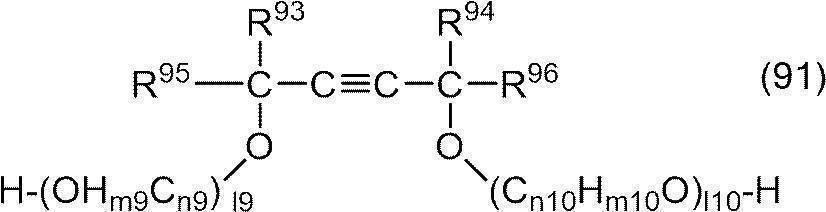
式(9)で表される化合物としては、下記式(91)で表される化合物であることが好ましい。
R93~R96は、それぞれ独立に、炭素数1~24の炭化水素基であり、n9は1~6の整数であり、m9はn9の2倍の整数であり、n10は1~6の整数であり、m10はn10の2倍の整数であり、l9及びl10は、それぞれ独立に、0以上12以下の数である。
R93~R96は炭化水素基であるが、なかでもアルキル基(炭素数1~12が好ましく、1~6がより好ましく、1~3が更に好ましい)、アルケニル基(炭素数2~12が好ましく、2~6がより好ましく、2~3が更に好ましい)、アルキニル基(炭素数2~12が好ましく、2~6がより好ましく、2~3が更に好ましい)、アリール基(炭素数6~22が好ましく、6~18がより好ましく、6~10が更に好ましい)、アリールアルキル基(炭素数7~23が好ましく、7~19がより好ましく、7~11が更に好ましい)であることが好ましい。アルキル基、アルケニル基、アルキニル基は直鎖状でも環状でもよく、直鎖でも分岐でもよい。R93~R96は本発明の効果を奏する範囲で置換基Tを有していてもよい。また、R93~R96は互いに結合して、又は上述の連結基Lを介して環を形成していてもよい。置換基Tは、複数あるときは互いに結合して、あるいは下記連結基Lを介して又は介さずに式中の炭化水素基と結合して環を形成していてもよい。
R93及びR94はアルキル基(炭素数1~12が好ましく、1~6がより好ましく、1~3が更に好ましい)であることが好ましい。なかでもメチル基が好ましい。
R95及びR96はアルキル基(炭素数1~12が好ましく、2~6がより好ましく、3~6が更に好ましい)であることが好ましい。なかでも、-(Cn11R98 m11)-R97が好ましい。R95、R96はとくにイソブチル基であることが好ましい。
n11は1~6の整数であり、1~3の整数が好ましい。m11はn11の2倍の数である。
R97及びR98は、それぞれ独立に、水素原子又はアルキル基(炭素数1~12が好ましく、1~6がより好ましく、1~3が更に好ましい)であることが好ましい。
n9は1~6の整数であり、1~3の整数が好ましい。m9はn9の2倍の整数である。
n10は1~6の整数であり、1~3の整数が好ましい。m10はn10の2倍の整数である。
l9及びl10は、それぞれ独立に、0~12の数である。ただし、l9+l10は0~12の数であることが好ましく、0~8の数であることがより好ましく、0~6の数が更に好ましく、0を超え6未満の数が一層好ましく、0を超え3以下の数がより一層好ましい。なお、l9、l10については、式(91)の化合物がその数において異なる化合物の混合物となる場合があり、そのときはl9及びl10の数、あるいはl9+l10が、小数点以下が含まれた数であってもよい。
R93~R96は炭化水素基であるが、なかでもアルキル基(炭素数1~12が好ましく、1~6がより好ましく、1~3が更に好ましい)、アルケニル基(炭素数2~12が好ましく、2~6がより好ましく、2~3が更に好ましい)、アルキニル基(炭素数2~12が好ましく、2~6がより好ましく、2~3が更に好ましい)、アリール基(炭素数6~22が好ましく、6~18がより好ましく、6~10が更に好ましい)、アリールアルキル基(炭素数7~23が好ましく、7~19がより好ましく、7~11が更に好ましい)であることが好ましい。アルキル基、アルケニル基、アルキニル基は直鎖状でも環状でもよく、直鎖でも分岐でもよい。R93~R96は本発明の効果を奏する範囲で置換基Tを有していてもよい。また、R93~R96は互いに結合して、又は上述の連結基Lを介して環を形成していてもよい。置換基Tは、複数あるときは互いに結合して、あるいは下記連結基Lを介して又は介さずに式中の炭化水素基と結合して環を形成していてもよい。
R93及びR94はアルキル基(炭素数1~12が好ましく、1~6がより好ましく、1~3が更に好ましい)であることが好ましい。なかでもメチル基が好ましい。
R95及びR96はアルキル基(炭素数1~12が好ましく、2~6がより好ましく、3~6が更に好ましい)であることが好ましい。なかでも、-(Cn11R98 m11)-R97が好ましい。R95、R96はとくにイソブチル基であることが好ましい。
n11は1~6の整数であり、1~3の整数が好ましい。m11はn11の2倍の数である。
R97及びR98は、それぞれ独立に、水素原子又はアルキル基(炭素数1~12が好ましく、1~6がより好ましく、1~3が更に好ましい)であることが好ましい。
n9は1~6の整数であり、1~3の整数が好ましい。m9はn9の2倍の整数である。
n10は1~6の整数であり、1~3の整数が好ましい。m10はn10の2倍の整数である。
l9及びl10は、それぞれ独立に、0~12の数である。ただし、l9+l10は0~12の数であることが好ましく、0~8の数であることがより好ましく、0~6の数が更に好ましく、0を超え6未満の数が一層好ましく、0を超え3以下の数がより一層好ましい。なお、l9、l10については、式(91)の化合物がその数において異なる化合物の混合物となる場合があり、そのときはl9及びl10の数、あるいはl9+l10が、小数点以下が含まれた数であってもよい。
-式(92)で表される化合物-
式(91)で表される化合物は、下記式(92)で表される化合物であることが好ましい。
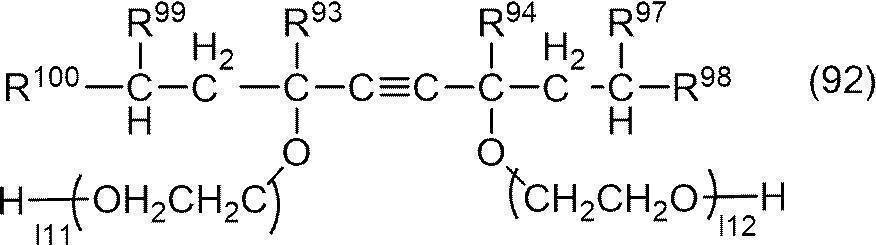
R93、R94、R97~R100は、それぞれ独立に、炭素数1~24の炭化水素基であり、l11及びl12は、それぞれ独立に、0以上12以下の数である。
R93、R94、R97~R100はなかでもアルキル基(炭素数1~12が好ましく、1~6がより好ましく、1~3が更に好ましい)、アルケニル基(炭素数2~12が好ましく、2~6がより好ましく、2~3が更に好ましい)、アルキニル基(炭素数2~12が好ましく、2~6がより好ましく、2~3が更に好ましい)、アリール基(炭素数6~22が好ましく、6~18がより好ましく、6~10が更に好ましい)、アリールアルキル基(炭素数7~23が好ましく、7~19がより好ましく、7~11が更に好ましい)であることが好ましい。アルキル基、アルケニル基、アルキニル基は鎖状でも環状でもよく、直鎖でも分岐でもよい。R93、R94、R97~R100は本発明の効果を奏する範囲で置換基Tを有していてもよい。また、R93、R94、R97~R100は互いに結合して、又は連結基Lを介して環を形成していてもよい。置換基Tは、複数あるときは互いに結合して、あるいは連結基Lを介して又は介さずに式中の炭化水素基と結合して環を形成していてもよい。
R93、R94、R97~R100は、それぞれ独立に、アルキル基(炭素数1~12が好ましく、1~6がより好ましく、1~3が更に好ましい)であることが好ましい。なかでもメチル基が好ましい。
l11+l12は0~12の数であることが好ましく、0~8の数であることがより好ましく、0~6の数が更に好ましく、0を超え6未満の数が一層好ましく、0を超え5以下の数がより一層好ましく、0を超え4以下の数が更に一層好ましく、0を超え3以下の数であってもよく、0を超え1以下の数であってもよい。なお、l11、l12は、式(92)の化合物がその数において異なる化合物の混合物となる場合があり、そのときはl11及びl12の数、あるいはl11+l12が、小数点以下が含まれた数であってもよい。
式(91)で表される化合物は、下記式(92)で表される化合物であることが好ましい。
R93、R94、R97~R100はなかでもアルキル基(炭素数1~12が好ましく、1~6がより好ましく、1~3が更に好ましい)、アルケニル基(炭素数2~12が好ましく、2~6がより好ましく、2~3が更に好ましい)、アルキニル基(炭素数2~12が好ましく、2~6がより好ましく、2~3が更に好ましい)、アリール基(炭素数6~22が好ましく、6~18がより好ましく、6~10が更に好ましい)、アリールアルキル基(炭素数7~23が好ましく、7~19がより好ましく、7~11が更に好ましい)であることが好ましい。アルキル基、アルケニル基、アルキニル基は鎖状でも環状でもよく、直鎖でも分岐でもよい。R93、R94、R97~R100は本発明の効果を奏する範囲で置換基Tを有していてもよい。また、R93、R94、R97~R100は互いに結合して、又は連結基Lを介して環を形成していてもよい。置換基Tは、複数あるときは互いに結合して、あるいは連結基Lを介して又は介さずに式中の炭化水素基と結合して環を形成していてもよい。
R93、R94、R97~R100は、それぞれ独立に、アルキル基(炭素数1~12が好ましく、1~6がより好ましく、1~3が更に好ましい)であることが好ましい。なかでもメチル基が好ましい。
l11+l12は0~12の数であることが好ましく、0~8の数であることがより好ましく、0~6の数が更に好ましく、0を超え6未満の数が一層好ましく、0を超え5以下の数がより一層好ましく、0を超え4以下の数が更に一層好ましく、0を超え3以下の数であってもよく、0を超え1以下の数であってもよい。なお、l11、l12は、式(92)の化合物がその数において異なる化合物の混合物となる場合があり、そのときはl11及びl12の数、あるいはl11+l12が、小数点以下が含まれた数であってもよい。
アセチレン基を含む界面活性剤としては、サーフィノール(Surfynol)104シリーズ(商品名、日信化学工業株式会社)、アセチレノール(Acetyrenol)E00、同E40、同E13T、同60(いずれも商品名、川研ファインケケミカル社製)が挙げられ、中でも、サーフィノール104シリーズ、アセチレノールE00、同E40、同E13Tが好ましく、アセチレノールE40、同E13Tがより好ましい。なお、サーフィノール104シリーズとアセチレノールE00とは同一構造の界面活性剤である。
〔他の界面活性剤〕
保護層は、後述する保護層形成用組成物の塗布性を向上させる等の目的のため、上記アセチレン基を含む界面活性剤以外の、他の界面活性剤を含んでいてもよい。
他の界面活性剤としては、表面張力を低下させるものであれば、ノニオン系、アニオン系、両性フッ素系など、どのようなものでもかまわない。
他の界面活性剤としては、例えば、ポリオキシエチレンラウリルエーテル、ポリオキシエチレンセチルエーテル、ポリオキシエチレンステアリルエーテル等のポリオキシエチレンアルキルエーテル類、ポリオキシエチレンオクチルフェニルエーテル、ポリオキシエチレンノニルフェニルエーテル等のポリオキシエチレンアルキルアリールエーテル類、ポリオキシエチレンステアレート等のポリオキシエチレンアルキルエステル類、ソルビタンモノラウレート、ソルビタンモノステアレート、ソルビタンジステアレート、ソルビタンモノオレエート、ソルビタンセスキオレエート、ソルビタントリオレエート等のソルビタンアルキルエステル類、グリセロールモノステアレート、グリセロールモノオレエート等のモノグリセリドアルキルエステル類等、フッ素あるいはケイ素を含むオリゴマー等のノニオン系界面活性剤;ドデシルベンゼンスルホン酸ナトリウム等のアルキルベンゼンスルホン酸塩類、ブチルナフタレンスルホン酸ナトリウム、ペンチルナフタレンスルホン酸ナトリウム、ヘキシルナフタレンスルホン酸ナトリウム、オクチルナフタレンスルホン酸ナトリウム等のアルキルナフタレンスルホン酸塩類、ラウリル硫酸ナトリウム等のアルキル硫酸塩類、ドデシルスルホン酸ナトリウム等のアルキルスルホン酸塩類、ジラウリルスルホコハク酸ナトリウム等のスルホコハク酸エステル塩類等の、アニオン系界面活性剤;ラウリルベタイン、ステアリルベタイン等のアルキルベタイン類、アミノ酸類等の、両性界面活性剤が使用可能である。
保護層は、後述する保護層形成用組成物の塗布性を向上させる等の目的のため、上記アセチレン基を含む界面活性剤以外の、他の界面活性剤を含んでいてもよい。
他の界面活性剤としては、表面張力を低下させるものであれば、ノニオン系、アニオン系、両性フッ素系など、どのようなものでもかまわない。
他の界面活性剤としては、例えば、ポリオキシエチレンラウリルエーテル、ポリオキシエチレンセチルエーテル、ポリオキシエチレンステアリルエーテル等のポリオキシエチレンアルキルエーテル類、ポリオキシエチレンオクチルフェニルエーテル、ポリオキシエチレンノニルフェニルエーテル等のポリオキシエチレンアルキルアリールエーテル類、ポリオキシエチレンステアレート等のポリオキシエチレンアルキルエステル類、ソルビタンモノラウレート、ソルビタンモノステアレート、ソルビタンジステアレート、ソルビタンモノオレエート、ソルビタンセスキオレエート、ソルビタントリオレエート等のソルビタンアルキルエステル類、グリセロールモノステアレート、グリセロールモノオレエート等のモノグリセリドアルキルエステル類等、フッ素あるいはケイ素を含むオリゴマー等のノニオン系界面活性剤;ドデシルベンゼンスルホン酸ナトリウム等のアルキルベンゼンスルホン酸塩類、ブチルナフタレンスルホン酸ナトリウム、ペンチルナフタレンスルホン酸ナトリウム、ヘキシルナフタレンスルホン酸ナトリウム、オクチルナフタレンスルホン酸ナトリウム等のアルキルナフタレンスルホン酸塩類、ラウリル硫酸ナトリウム等のアルキル硫酸塩類、ドデシルスルホン酸ナトリウム等のアルキルスルホン酸塩類、ジラウリルスルホコハク酸ナトリウム等のスルホコハク酸エステル塩類等の、アニオン系界面活性剤;ラウリルベタイン、ステアリルベタイン等のアルキルベタイン類、アミノ酸類等の、両性界面活性剤が使用可能である。
保護層がアセチレン基を含む界面活性剤、及び、他の界面活性剤の少なくとも一方を含む場合、アセチレン基を含む界面活性剤と他の界面活性剤との総量で、界面活性剤の添加量は、保護層の全質量に対し、好ましくは0.05~20質量%、より好ましくは0.07~15質量%、更に好ましくは0.1~10質量%である。これらの界面活性剤は、1種を用いても複数のものを用いてもよい。複数のものを用いる場合はその合計量が上記の範囲となる。
また、本発明では他の界面活性剤を実質的に含まない構成とすることもできる。実質的に含まないとは、他の界面活性剤の含有量が、アセチレン基を含む界面活性剤の含有量の5質量%以下であることをいい、3質量%以下が好ましく、1質量%以下が更に好ましい。
また、本発明では他の界面活性剤を実質的に含まない構成とすることもできる。実質的に含まないとは、他の界面活性剤の含有量が、アセチレン基を含む界面活性剤の含有量の5質量%以下であることをいい、3質量%以下が好ましく、1質量%以下が更に好ましい。
他の界面活性剤の、23℃における、0.1質量%水溶液の表面張力は45mN/m以下であることが好ましく、40mN/m以下であることがより好ましく、35mN/m以下であることが更に好ましい。下限としては、5mN/m以上であることが好ましく、10mN/m以上であることがより好ましく、15mN/m以上であることが更に好ましい。界面活性剤の表面張力は選択される他の界面活性剤の種類により適宜選択されればよい。
〔防腐剤、防カビ剤(防腐剤等)〕
保護層が防腐剤又は防カビ剤を含有することも好ましい態様である。
防腐剤、防カビ剤(以下、防腐剤等)としては、抗菌又は防カビ作用を含む添加剤であって、水溶性又は水分散性である有機化合物から選ばれる少なくとも1つを含むことが好ましい。防腐剤等抗菌又は防カビ作用を含む添加剤としては有機系の抗菌剤又は防カビ剤、無機系の抗菌剤又は防カビ剤、天然系の抗菌剤又は防カビ剤等を挙げることができる。例えば抗菌又は防カビ剤は(株)東レリサーチセンター発刊の「抗菌・防カビ技術」に記載されているものを用いることができる。
本発明において、保護層に防腐剤等を配合することにより、長期室温保管後の溶液内部の菌増殖による、塗布欠陥増加を抑止するという効果がより効果的に発揮される。
保護層が防腐剤又は防カビ剤を含有することも好ましい態様である。
防腐剤、防カビ剤(以下、防腐剤等)としては、抗菌又は防カビ作用を含む添加剤であって、水溶性又は水分散性である有機化合物から選ばれる少なくとも1つを含むことが好ましい。防腐剤等抗菌又は防カビ作用を含む添加剤としては有機系の抗菌剤又は防カビ剤、無機系の抗菌剤又は防カビ剤、天然系の抗菌剤又は防カビ剤等を挙げることができる。例えば抗菌又は防カビ剤は(株)東レリサーチセンター発刊の「抗菌・防カビ技術」に記載されているものを用いることができる。
本発明において、保護層に防腐剤等を配合することにより、長期室温保管後の溶液内部の菌増殖による、塗布欠陥増加を抑止するという効果がより効果的に発揮される。
防腐剤等としては、フェノールエーテル系化合物、イミダゾール系化合物、スルホン系化合物、N・ハロアルキルチオ化合物、アニリド系化合物、ピロール系化合物、第四級アンモニウム塩、アルシン系化合物、ピリジン系化合物、トリアジン系化合物、ベンゾイソチアゾリン系化合物、イソチアゾリン系化合物などが挙げられる。具体的には、例えば2(4チオシアノメチル)ベンズイミダゾール、1,2ベンゾチアゾロン、1,2-ベンズイソチアゾリン-3-オン、N-フルオロジクロロメチルチオ-フタルイミド、2,3,5,6-テトラクロロイソフタロニトリル、N-トリクロロメチルチオ-4-シクロヘキセン-1,2-ジカルボキシイミド、8-キノリン酸銅、ビス(トリブチル錫)オキシド、2-(4-チアゾリル)ベンズイミダゾール、2-ベンズイミダゾールカルバミン酸メチル、10,10'-オキシビスフェノキシアルシン、2,3,5,6-テトラクロロ-4-(メチルスルフォン)ピリジン、ビス(2-ピリジルチオ-1-オキシド)亜鉛、N,N-ジメチル-N'-(フルオロジクロロメチルチオ)-N’-フェニルスルファミド、ポリ-(ヘキサメチレンビグアニド)ハイドロクロライド、ジチオ-2-2'-ビス、2-メチル-4,5-トリメチレン-4-イソチアゾリン-3-オン、2-ブロモ-2-ニトロ-1,3-プロパンジオール、ヘキサヒドロ-1,3-トリス-(2-ヒドロキシエチル)-S-トリアジン、p-クロロ-m-キシレノール、1,2-ベンズイソチアゾリン-3-オン、メチルフェノール等が挙げられる。
天然系抗菌剤又は防カビ剤としては、カニやエビの甲殻等に含まれるキチンを加水分解して得られる塩基性多糖類のキトサンがある。アミノ酸の両側に金属を複合させたアミノメタルから成る日鉱の「商品名ホロンキラービースセラ」が好ましい。
保護層における防腐剤等の含有量は、保護層の全質量に対し、0.005~5質量%であることが好ましく、0.01~3質量%であることがより好ましく、0.05~2質量%であることが更に好ましく、0.1~1質量%であることが一層好ましい。防腐剤等とは1種を用いても複数のものを用いてもよい。複数のものを用いる場合はその合計量が上記の範囲となる。
防腐剤等の抗菌効果の評価は、JIS Z 2801(抗菌加工製品-抗菌性試験方法・抗菌効果)に準拠して行うことができる。また、防カビ効果の評価は、JIS Z 2911(カビ抵抗性試験)に準拠して行うことができる。
防腐剤等の抗菌効果の評価は、JIS Z 2801(抗菌加工製品-抗菌性試験方法・抗菌効果)に準拠して行うことができる。また、防カビ効果の評価は、JIS Z 2911(カビ抵抗性試験)に準拠して行うことができる。
〔遮光剤〕
保護層は遮光剤を含んでもよい。遮光剤を配合することにより、有機層などへの光によるダメージ等の影響がより抑制される。
遮光剤としては、例えば公知の着色剤等を用いることができ、有機又は無機の顔料又は染料が挙げられ、無機顔料が好ましく挙げられ、中でもカーボンブラック、酸化チタン、窒化チタン等がより好ましく挙げられる。
遮光剤の含有量は、保護層の全質量に対し、好ましくは1~50質量%、より好ましくは3~40質量%、更に好ましくは5~25質量%である。遮光剤は、1種を用いても複数のものを用いてもよい。複数のものを用いる場合はその合計量が上記の範囲となる。
保護層は遮光剤を含んでもよい。遮光剤を配合することにより、有機層などへの光によるダメージ等の影響がより抑制される。
遮光剤としては、例えば公知の着色剤等を用いることができ、有機又は無機の顔料又は染料が挙げられ、無機顔料が好ましく挙げられ、中でもカーボンブラック、酸化チタン、窒化チタン等がより好ましく挙げられる。
遮光剤の含有量は、保護層の全質量に対し、好ましくは1~50質量%、より好ましくは3~40質量%、更に好ましくは5~25質量%である。遮光剤は、1種を用いても複数のものを用いてもよい。複数のものを用いる場合はその合計量が上記の範囲となる。
〔保護層形成用組成物〕
保護層形成用組成物は、本発明において用いられる積層体に含まれる保護層の形成に用いられる組成物である。
保護層形成用組成物は、高分子化合物を含むことが好ましい。また、保護層形成用組成物は、上述のアセチレン基を含む界面活性剤、他の界面活性剤、防腐剤、防カビ剤遮光剤等を含んでもよい。
これらの中でも、保護層形成用組成物は、水溶性樹脂、及び、界面活性剤を含むことが好ましい。また、上記界面活性剤は、上述のアセチレン基を含む界面活性剤でもよいし、上述の他の界面活性剤であってもよいが、アセチレン基を含む界面活性剤であることが好ましい。
保護層形成用組成物に含まれる成分の含有量は、上述した各成分の保護層の全質量に対する含有量を、保護層形成用組成物の固形分量に対する含有量に読み替えたものとすることが好ましい。
また、保護層形成用組成物は、後述する溶剤を含むことが好ましい。
保護層形成用組成物は、本発明において用いられる積層体に含まれる保護層の形成に用いられる組成物である。
保護層形成用組成物は、高分子化合物を含むことが好ましい。また、保護層形成用組成物は、上述のアセチレン基を含む界面活性剤、他の界面活性剤、防腐剤、防カビ剤遮光剤等を含んでもよい。
これらの中でも、保護層形成用組成物は、水溶性樹脂、及び、界面活性剤を含むことが好ましい。また、上記界面活性剤は、上述のアセチレン基を含む界面活性剤でもよいし、上述の他の界面活性剤であってもよいが、アセチレン基を含む界面活性剤であることが好ましい。
保護層形成用組成物に含まれる成分の含有量は、上述した各成分の保護層の全質量に対する含有量を、保護層形成用組成物の固形分量に対する含有量に読み替えたものとすることが好ましい。
また、保護層形成用組成物は、後述する溶剤を含むことが好ましい。
本発明において用いられる積層体において、保護層は、例えば、保護層形成用組成物を有機層の上に適用し、乾燥させることよって形成することができる。
保護層形成用組成物の適用方法としては、塗布が好ましい。適用方法の例としては、スリットコート法、キャスト法、ブレードコーティング法、ワイヤーバーコーティング法、スプレーコーティング法、ディッピング(浸漬)コーティング法、ビードコーティング法、エアーナイフコーティング法、カーテンコーティング法、インクジェット法、スピンコート法、ラングミュア-ブロジェット(Langmuir-Blodgett)(LB)法などを挙げることができる。キャスト法、スピンコート法、及びインクジェット法を用いることが更に好ましい。このようなプロセスにより、表面が平滑で大面積の保護層を低コストで生産することが可能となる。
また、保護層形成用組成物は、あらかじめ仮支持体上に上記付与方法等によって付与して形成した塗膜を、適用対象(例えば、有機層)上に転写する方法により形成することもできる。
転写方法に関しては、特開2006-023696号公報の段落0023、0036~0051、特開2006-047592号公報の段落0096~0108等の記載を参酌することができる。
保護層形成用組成物の適用方法としては、塗布が好ましい。適用方法の例としては、スリットコート法、キャスト法、ブレードコーティング法、ワイヤーバーコーティング法、スプレーコーティング法、ディッピング(浸漬)コーティング法、ビードコーティング法、エアーナイフコーティング法、カーテンコーティング法、インクジェット法、スピンコート法、ラングミュア-ブロジェット(Langmuir-Blodgett)(LB)法などを挙げることができる。キャスト法、スピンコート法、及びインクジェット法を用いることが更に好ましい。このようなプロセスにより、表面が平滑で大面積の保護層を低コストで生産することが可能となる。
また、保護層形成用組成物は、あらかじめ仮支持体上に上記付与方法等によって付与して形成した塗膜を、適用対象(例えば、有機層)上に転写する方法により形成することもできる。
転写方法に関しては、特開2006-023696号公報の段落0023、0036~0051、特開2006-047592号公報の段落0096~0108等の記載を参酌することができる。
保護層形成用組成物に含まれる溶剤としては、上述の水系溶剤が挙げられ、水又は水と水溶性溶剤との混合物が好ましく、水がより好ましい。
水系溶剤が混合溶剤である場合は、23℃における水への溶解度が1g以上の有機溶剤と水との混合溶剤であることが好ましい。有機溶剤の23℃における水への溶解度は10g以上がより好ましく、30g以上が更に好ましい。
また、保護層形成用組成物に含まれる高分子化合物が、上述のフッ素原子を含む樹脂、又は、上述のフッ素原子を含む高分子化合物である場合、溶剤としてフッ素系溶剤を用いることもできる。
フッ素系溶剤とは、フッ素原子を含む有機溶剤である。
本発明で用いるフッ素系溶剤におけるフッ素原子含有率は、10~80%であることが好ましく、15~75%であることがより好ましく、20~70%であることがさらに好ましい。ここでのフッ素原子含有率とは、(フッ素系溶剤を構成するフッ素原子の数/フッ素溶媒構成する全原子の数)×100(%)で示される。
本発明で用いるフッ素系溶剤の沸点は、101325Paで、40~250℃であることが好ましく、50~200℃であることがより好ましく、55~180℃であることがさらに好ましい。
水系溶剤が混合溶剤である場合は、23℃における水への溶解度が1g以上の有機溶剤と水との混合溶剤であることが好ましい。有機溶剤の23℃における水への溶解度は10g以上がより好ましく、30g以上が更に好ましい。
また、保護層形成用組成物に含まれる高分子化合物が、上述のフッ素原子を含む樹脂、又は、上述のフッ素原子を含む高分子化合物である場合、溶剤としてフッ素系溶剤を用いることもできる。
フッ素系溶剤とは、フッ素原子を含む有機溶剤である。
本発明で用いるフッ素系溶剤におけるフッ素原子含有率は、10~80%であることが好ましく、15~75%であることがより好ましく、20~70%であることがさらに好ましい。ここでのフッ素原子含有率とは、(フッ素系溶剤を構成するフッ素原子の数/フッ素溶媒構成する全原子の数)×100(%)で示される。
本発明で用いるフッ素系溶剤の沸点は、101325Paで、40~250℃であることが好ましく、50~200℃であることがより好ましく、55~180℃であることがさらに好ましい。
フッ素系溶剤はアルコールであることが好ましく、少なくとも1つのフッ素原子で置換されたアルキル基とOH基からなるアルコールであることがより好ましい。アルコールを用いることにより、極性を有し、樹脂A1のようなフッ素原子を含まない樹脂も容易に溶解させることができる。上記少なくとも1つのフッ素原子で置換されたアルキル基の炭素原子数は、1~18であることが好ましく、1~12であることがより好ましく、1~10であることがさらに好ましい。上記少なくとも1つのフッ素原子で置換されたアルキル基におけるフッ素原子数は、1~30であることが好ましく、3~20であることがより好ましく、4~12であることがさらに好ましい。
上記フッ素系溶剤の具体例としては、2,2,3,3-テトラフロロ-1-プロパノール、2,2,3,3,4,4,5,5-オクタフルオロ-1-ペンタノール、2,2,3,3,3-ペンタフロロ-1-プロパノール、1,1,1,3,3,3-ヘキサフルオロ-2-プロパノール、2,2,3,3,4,4,4-ヘプタフルオロ-1-ブタノール、1H,1H,7H-ドデカフルオロ-1-ヘプタノール、ノナフルオロブチルエチルエーテル、パーフルオロトリブチルアミン等が挙げられる。
上記フッ素系溶剤の具体例としては、2,2,3,3-テトラフロロ-1-プロパノール、2,2,3,3,4,4,5,5-オクタフルオロ-1-ペンタノール、2,2,3,3,3-ペンタフロロ-1-プロパノール、1,1,1,3,3,3-ヘキサフルオロ-2-プロパノール、2,2,3,3,4,4,4-ヘプタフルオロ-1-ブタノール、1H,1H,7H-ドデカフルオロ-1-ヘプタノール、ノナフルオロブチルエチルエーテル、パーフルオロトリブチルアミン等が挙げられる。
保護層形成用組成物の固形分濃度は、保護層形成用組成物の適用時により均一に近い厚さで適用しやすい観点からは、0.5~30質量%であることが好ましく、1.0~20質量%であることがより好ましく、2.0~14質量%であることが更に好ましい。
<感光層>
本発明において用いられる積層体は感光層を含む。
本発明において、感光層は現像液を用いた現像に供される層である。
上記現像は、ネガ型現像であることが好ましい。
感光層としては、本技術分野で使用される公知の感光層(例えば、フォトレジスト層)を適宜利用することができる。
本発明において用いられる積層体において、感光層は、ネガ型感光層であっても、ポジ型感光層であってもよい。
本発明において用いられる積層体は感光層を含む。
本発明において、感光層は現像液を用いた現像に供される層である。
上記現像は、ネガ型現像であることが好ましい。
感光層としては、本技術分野で使用される公知の感光層(例えば、フォトレジスト層)を適宜利用することができる。
本発明において用いられる積層体において、感光層は、ネガ型感光層であっても、ポジ型感光層であってもよい。
感光層は、その露光部が有機溶剤を含む現像液に対して難溶であることが好ましい。難溶とは、露光部が現像液に溶けにくいことをいう。
露光部における感光層の現像液に対する溶解速度は、未露光部における感光層の現像液に対する溶解速度よりも小さくなる(難溶となる)ことが好ましい。
具体的には、波長365nm(i線)、波長248nm(KrF線)及び波長193nm(ArF線)の少なくとも1つの波長の光を50mJ/cm2以上の照射量で露光することによって極性が変化し、sp値(溶解度パラメータ)が19.0(MPa)1/2未満の溶剤に対して難溶となることが好ましく、18.5(MPa)1/2以下の溶剤に対して難溶となることがより好ましく、18.0(MPa)1/2以下の溶剤に対して難溶となることが更に好ましい。
本発明において、溶解度パラメーター(sp値)は、沖津法によって求められる値〔単位:(MPa)1/2〕である。沖津法は、従来周知のsp値の算出方法の一つであり、例えば、日本接着学会誌Vol.29、No.6(1993年)249~259頁に詳述されている方法である。
更に、波長365nm(i線)、波長248nm(KrF線)及び波長193nm(ArF線)の少なくとも1つの波長の光を50~250mJ/cm2の照射量で露光することによって、上記のとおり極性が変化することがより好ましい。
露光部における感光層の現像液に対する溶解速度は、未露光部における感光層の現像液に対する溶解速度よりも小さくなる(難溶となる)ことが好ましい。
具体的には、波長365nm(i線)、波長248nm(KrF線)及び波長193nm(ArF線)の少なくとも1つの波長の光を50mJ/cm2以上の照射量で露光することによって極性が変化し、sp値(溶解度パラメータ)が19.0(MPa)1/2未満の溶剤に対して難溶となることが好ましく、18.5(MPa)1/2以下の溶剤に対して難溶となることがより好ましく、18.0(MPa)1/2以下の溶剤に対して難溶となることが更に好ましい。
本発明において、溶解度パラメーター(sp値)は、沖津法によって求められる値〔単位:(MPa)1/2〕である。沖津法は、従来周知のsp値の算出方法の一つであり、例えば、日本接着学会誌Vol.29、No.6(1993年)249~259頁に詳述されている方法である。
更に、波長365nm(i線)、波長248nm(KrF線)及び波長193nm(ArF線)の少なくとも1つの波長の光を50~250mJ/cm2の照射量で露光することによって、上記のとおり極性が変化することがより好ましい。
感光層は、i線の照射に対して感光能を有することが好ましい。
感光能とは、活性光線及び放射線の少なくとも一方の照射(i線の照射に対して感光能を有する場合は、i線の照射)により、有機溶剤(好ましくは、酢酸ブチル)に対する溶解速度が変化することをいう。
感光能とは、活性光線及び放射線の少なくとも一方の照射(i線の照射に対して感光能を有する場合は、i線の照射)により、有機溶剤(好ましくは、酢酸ブチル)に対する溶解速度が変化することをいう。
感光層としては、酸の作用により現像液に対する溶解速度が変化する樹脂(以下、「感光層用特定樹脂」ともいう。)を含む感光層が挙げられる。
感光層用特定樹脂における溶解速度の変化は、溶解速度の低下であることが好ましい。
感光層用特定樹脂の、溶解速度が変化する前の、sp値が18.0(MPa)1/2以下の有機溶剤への溶解速度は、40nm/秒以上であることがより好ましい。
感光層用特定樹脂の、溶解速度が変化した後の、sp値が18.0(MPa)1/2以下の有機溶剤への溶解速度は、1nm/秒未満であることがより好ましい。
感光層用特定樹脂は、また、溶解速度が変化する前には、sp値(溶解度パラメータ)が18.0(MPa)1/2以下の有機溶剤に可溶であり、かつ、溶解速度が変化した後には、sp値が18.0(MPa)1/2以下の有機溶剤に難溶である樹脂であることが好ましい。
ここで、「sp値(溶解度パラメータ)が18.0(MPa)1/2以下の有機溶剤に可溶」とは、化合物(樹脂)の溶液を基材上に塗布し、100℃で1分間加熱することによって形成される化合物(樹脂)の塗膜(厚さ1μm)の、23℃における現像液に対して浸漬した際の溶解速度が、20nm/秒以上であることをいい、「sp値が18.0(MPa)1/2以下の有機溶剤に難溶」とは、化合物(樹脂)の溶液を基材上に塗布し、100℃で1分間加熱することによって形成される化合物(樹脂)の塗膜(厚さ1μm)の、23℃における現像液に対する溶解速度が、10nm/秒未満であることをいう。
感光層用特定樹脂における溶解速度の変化は、溶解速度の低下であることが好ましい。
感光層用特定樹脂の、溶解速度が変化する前の、sp値が18.0(MPa)1/2以下の有機溶剤への溶解速度は、40nm/秒以上であることがより好ましい。
感光層用特定樹脂の、溶解速度が変化した後の、sp値が18.0(MPa)1/2以下の有機溶剤への溶解速度は、1nm/秒未満であることがより好ましい。
感光層用特定樹脂は、また、溶解速度が変化する前には、sp値(溶解度パラメータ)が18.0(MPa)1/2以下の有機溶剤に可溶であり、かつ、溶解速度が変化した後には、sp値が18.0(MPa)1/2以下の有機溶剤に難溶である樹脂であることが好ましい。
ここで、「sp値(溶解度パラメータ)が18.0(MPa)1/2以下の有機溶剤に可溶」とは、化合物(樹脂)の溶液を基材上に塗布し、100℃で1分間加熱することによって形成される化合物(樹脂)の塗膜(厚さ1μm)の、23℃における現像液に対して浸漬した際の溶解速度が、20nm/秒以上であることをいい、「sp値が18.0(MPa)1/2以下の有機溶剤に難溶」とは、化合物(樹脂)の溶液を基材上に塗布し、100℃で1分間加熱することによって形成される化合物(樹脂)の塗膜(厚さ1μm)の、23℃における現像液に対する溶解速度が、10nm/秒未満であることをいう。
感光層としては、例えば、感光層用特定樹脂及び光酸発生剤を含む感光層、重合性化合物及び光重合開始剤等を含む感光層等が挙げられる。
また、感光層は、高い保存安定性と微細なパターン形成性を両立する観点からは、化学増幅型感光層であることが好ましい。
以下、感光層用特定樹脂及び光酸発生剤を含む感光層の例について説明する。
また、感光層は、高い保存安定性と微細なパターン形成性を両立する観点からは、化学増幅型感光層であることが好ましい。
以下、感光層用特定樹脂及び光酸発生剤を含む感光層の例について説明する。
〔感光層用特定樹脂〕
本発明における感光層は、感光層用特定樹脂を含むことが好ましい。
感光層用特定樹脂は、アクリル系重合体であることが好ましい。
「アクリル系重合体」は、付加重合型の樹脂であり、(メタ)アクリル酸又はそのエステルに由来する繰返し単位を含む重合体であり、(メタ)アクリル酸又はそのエステルに由来する繰返し単位以外の繰返し単位、例えば、スチレン類に由来する繰返し単位やビニル化合物に由来する繰返し単位等を含んでいてもよい。アクリル系重合体は、(メタ)アクリル酸又はそのエステルに由来する繰返し単位を、重合体における全繰返し単位に対し、50モル%以上含むことが好ましく、80モル%以上含むことがより好ましく、(メタ)アクリル酸又はそのエステルに由来する繰返し単位のみからなる重合体であることが特に好ましい。
本発明における感光層は、感光層用特定樹脂を含むことが好ましい。
感光層用特定樹脂は、アクリル系重合体であることが好ましい。
「アクリル系重合体」は、付加重合型の樹脂であり、(メタ)アクリル酸又はそのエステルに由来する繰返し単位を含む重合体であり、(メタ)アクリル酸又はそのエステルに由来する繰返し単位以外の繰返し単位、例えば、スチレン類に由来する繰返し単位やビニル化合物に由来する繰返し単位等を含んでいてもよい。アクリル系重合体は、(メタ)アクリル酸又はそのエステルに由来する繰返し単位を、重合体における全繰返し単位に対し、50モル%以上含むことが好ましく、80モル%以上含むことがより好ましく、(メタ)アクリル酸又はそのエステルに由来する繰返し単位のみからなる重合体であることが特に好ましい。
感光層用特定樹脂としては、酸基が酸分解性基により保護された構造を有する繰返し単位を有する樹脂が好ましく挙げられる。
上記酸基が酸分解性基により保護された構造としては、カルボキシ基が酸分解性基により保護された構造、フェノール性ヒドロキシ基が酸分解性基により保護された構造等が挙げられる。
また、酸基が酸分解性基により保護された構造を有する繰返し単位としては、(メタ)アクリル酸に由来するモノマー単位におけるカルボキシ基が酸分解性基により保護された構造を有する繰返し単位、p-ヒドロキシスチレン、α-メチル-p-ヒドロキシスチレン等のヒドロキシスチレン類に由来するモノマー単位におけるフェノール性ヒドロキシ基が酸分解性基により保護された構造を有する繰返し単位等が挙げられる。
上記酸基が酸分解性基により保護された構造としては、カルボキシ基が酸分解性基により保護された構造、フェノール性ヒドロキシ基が酸分解性基により保護された構造等が挙げられる。
また、酸基が酸分解性基により保護された構造を有する繰返し単位としては、(メタ)アクリル酸に由来するモノマー単位におけるカルボキシ基が酸分解性基により保護された構造を有する繰返し単位、p-ヒドロキシスチレン、α-メチル-p-ヒドロキシスチレン等のヒドロキシスチレン類に由来するモノマー単位におけるフェノール性ヒドロキシ基が酸分解性基により保護された構造を有する繰返し単位等が挙げられる。
酸基が酸分解性基により保護された構造を有する繰返し単位としては、アセタール構造を含む繰返し単位等が挙げられ、側鎖に環状エーテルエステル構造を含む繰返し単位が好ましい。環状エーテルエステル構造としては、環状エーテル構造における酸素原子とエステル結合における酸素原子とが同一の炭素原子に結合し、アセタール構造を形成していることが好ましい。
また、酸基が酸分解性基により保護された構造を有する繰返し単位としては、下記式(1)で表される繰返し単位が好ましい。
以下、「式(1)で表される繰返し単位」等を、「繰返し単位(1)」等ともいう。
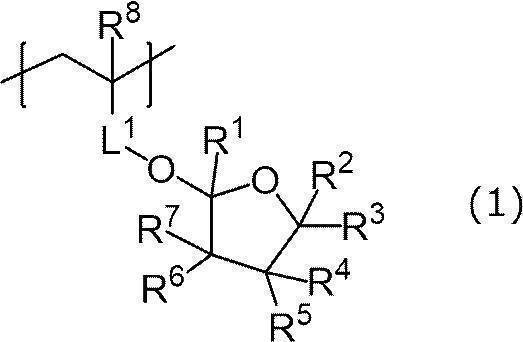
式(1)中、R8は水素原子又はアルキル基(炭素数1~12が好ましく、1~6がより好ましく、1~3が更に好ましい)を表し、L1はカルボニル基又はフェニレン基を表し、R1~R7はそれぞれ独立に、水素原子又はアルキル基を表す。
式(1)中、R8は、水素原子又はメチル基であることが好ましく、メチル基であることがより好ましい。
式(1)中、L1は、カルボニル基又はフェニレン基を表し、カルボニル基であることが好ましい。
式(1)中、R1~R7はそれぞれ独立に、水素原子又はアルキル基を表す。R1~R7におけるアルキル基は、R8と同義であり、好ましい態様も同様である。また、R1~R7のうち、1つ以上が水素原子であることが好ましく、R1~R7の全てが水素原子であることがより好ましい。
以下、「式(1)で表される繰返し単位」等を、「繰返し単位(1)」等ともいう。
式(1)中、R8は、水素原子又はメチル基であることが好ましく、メチル基であることがより好ましい。
式(1)中、L1は、カルボニル基又はフェニレン基を表し、カルボニル基であることが好ましい。
式(1)中、R1~R7はそれぞれ独立に、水素原子又はアルキル基を表す。R1~R7におけるアルキル基は、R8と同義であり、好ましい態様も同様である。また、R1~R7のうち、1つ以上が水素原子であることが好ましく、R1~R7の全てが水素原子であることがより好ましい。
繰返し単位(1)としては、下記式(1-A)で表される繰返し単位、又は、下記式(1-B)で表される繰返し単位が好ましい。
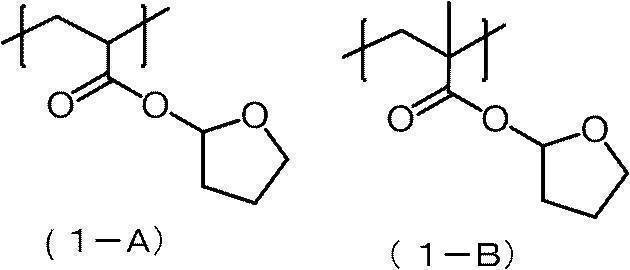
繰返し単位(1)を形成するために用いられるラジカル重合性単量体は、市販のものを用いてもよいし、公知の方法で合成したものを用いることもできる。例えば、(メタ)アクリル酸を酸触媒の存在下でジヒドロフラン化合物と反応させることにより合成することができる。あるいは、前駆体モノマーと重合した後に、カルボキシ基又はフェノール性ヒドロキシ基をジヒドロフラン化合物と反応させることによっても形成することができる。
また、酸基が酸分解性基により保護された構造を有する繰返し単位としては、下記式(2)で表される繰返し単位も好ましく挙げられる。

式(2)中、Aは、水素原子又は酸の作用により脱離する基を表す。酸の作用により脱離する基としては、アルキル基(炭素数1~12が好ましく、1~6がより好ましく、1~3が更に好ましい)、アルコキシアルキル基(炭素数2~12が好ましく、2~6がより好ましく、2~3が更に好ましい)、アリールオキシアルキル基(総炭素数7~40が好ましく、7~30がより好ましく、7~20が更に好ましい)、アルコキシカルボニル基(炭素数2~12が好ましく、2~6がより好ましく、2~3が更に好ましい)、アリールオキシカルボニル基(炭素数7~23が好ましく、7~19がより好ましく、7~11が更に好ましい)が好ましい。Aは更に置換基を有していてもよく、置換基として上記置換基Tの例が挙げられる。
式(2)中、R10は置換基を表し、置換基Tの例が挙げられる。R9は式(1)におけるR8と同義の基を表す。
式(2)中、nxは、0~3の整数を表す。
式(2)中、R10は置換基を表し、置換基Tの例が挙げられる。R9は式(1)におけるR8と同義の基を表す。
式(2)中、nxは、0~3の整数を表す。
酸の作用によって脱離する基としては、特開2008-197480号公報の段落番号0039~0049に記載の化合物のうち、酸によって脱離する基を含む繰返し単位も好ましく、また、特開2012-159830号公報(特許第5191567号)の段落番号0052~0056に記載の化合物も好ましく、これらの内容は本明細書に組み込まれる。
繰返し単位(2)の具体的な例を以下に示すが、本発明がこれにより限定して解釈されるものではない。

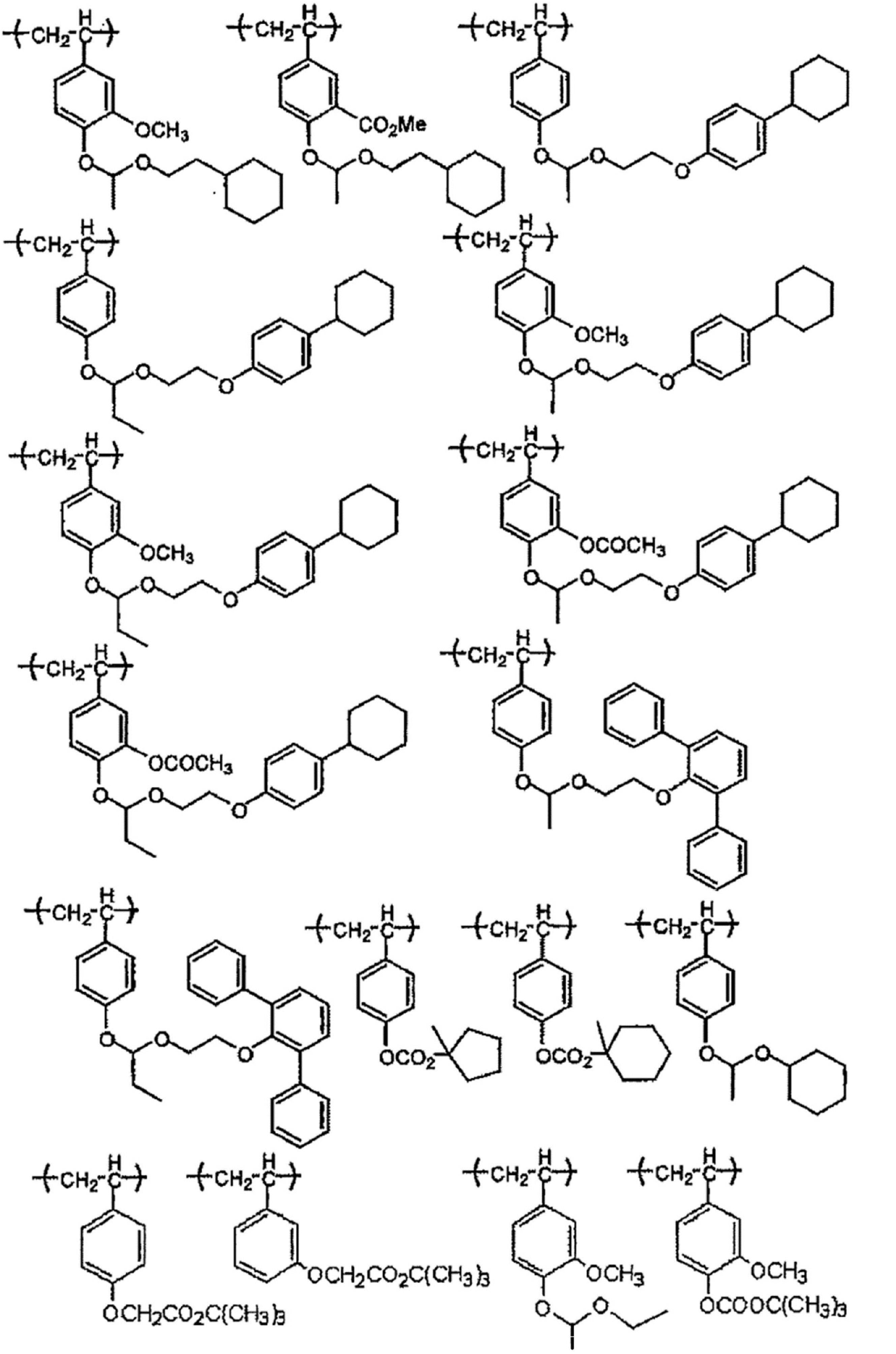
感光層用特定樹脂に含まれる、酸基が酸分解性基により保護された構造を有する繰返し単位(好ましくは、繰返し単位(1)又は繰返し単位(2))の含有量は、5~80モル%が好ましく、10~70モル%がより好ましく、10~60モル%が更に好ましい。アクリル系重合体は、繰返し単位(1)又は繰返し単位(2)を1種のみ含んでいてもよいし、2種以上含んでいてもよい。2種以上用いる場合、合計量が上記範囲となることが好ましい。
感光層用特定樹脂は、架橋性基を含む繰返し単位を含有してもよい。架橋性基の詳細については、特開2011-209692号公報の段落番号0032~0046の記載を参酌でき、これらの内容は本明細書に組み込まれる。
感光層用特定樹脂は、架橋性基を含む繰返し単位(繰返し単位(3))を含む態様も好ましいが、架橋性基を含む繰返し単位(3)を実質的に含まない構成とすることが好ましい。このような構成とすることにより、パターニング後に、感光層をより効果的に除去することが可能になる。ここで、実質的に含まないとは、例えば、感光層用特定樹脂の全繰返し単位の3モル%以下をいい、好ましくは1モル%以下をいう。
感光層用特定樹脂は、架橋性基を含む繰返し単位(繰返し単位(3))を含む態様も好ましいが、架橋性基を含む繰返し単位(3)を実質的に含まない構成とすることが好ましい。このような構成とすることにより、パターニング後に、感光層をより効果的に除去することが可能になる。ここで、実質的に含まないとは、例えば、感光層用特定樹脂の全繰返し単位の3モル%以下をいい、好ましくは1モル%以下をいう。
感光層用特定樹脂は、その他の繰返し単位(繰返し単位(4))を含有してもよい。繰返し単位(4)を形成するために用いられるラジカル重合性単量体としては、例えば、特開2004-264623号公報の段落番号0021~0024に記載の化合物を挙げることができる。繰返し単位(4)の好ましい例としては、ヒドロキシ基含有不飽和カルボン酸エステル、脂環構造含有不飽和カルボン酸エステル、スチレン、及び、N置換マレイミドからなる群から選ばれる少なくとも1種に由来する繰返し単位が挙げられる。これらの中でも、ベンジル(メタ)アクリレート、(メタ)アクリル酸トリシクロ[5.2.1.02,6]デカン-8-イル、(メタ)アクリル酸トリシクロ[5.2.1.02,6]デカン-8-イルオキシエチル、(メタ)アクリル酸イソボルニル、(メタ)アクリル酸シクロヘキシル、(メタ)アクリル酸2-メチルシクロヘキシルのよう脂環構造含有の(メタ)アクリル酸エステル類、又は、スチレンのような疎水性のモノマーが好ましい。
繰返し単位(4)は、1種又は2種以上を組み合わせて使用することができる。感光層用特定樹脂を構成する全モノマー単位中、繰返し単位(4)を含有させる場合における繰返し単位(4)を形成するモノマー単位の含有率は、1~60モル%が好ましく、5~50モル%がより好ましく、5~40モル%が更に好ましい。2種以上用いる場合、合計量が上記範囲となることが好ましい。
繰返し単位(4)は、1種又は2種以上を組み合わせて使用することができる。感光層用特定樹脂を構成する全モノマー単位中、繰返し単位(4)を含有させる場合における繰返し単位(4)を形成するモノマー単位の含有率は、1~60モル%が好ましく、5~50モル%がより好ましく、5~40モル%が更に好ましい。2種以上用いる場合、合計量が上記範囲となることが好ましい。
感光層用特定樹脂の合成法については様々な方法が知られているが、一例を挙げると、少なくとも繰返し単位(1)、繰返し単位(2)等を形成するために用いられるラジカル重合性単量体を含むラジカル重合性単量体混合物を、有機溶剤中、ラジカル重合開始剤を用いて重合することにより合成することができる。
感光層用特定樹脂としては、不飽和多価カルボン酸無水物類を共重合させた前駆共重合体中の酸無水物基に、2,3-ジヒドロフランを、酸触媒の不存在下、室温(25℃)~100℃程度の温度で付加させることにより得られる共重合体も好ましい。
以下の樹脂も感光層用特定樹脂の好ましい例として挙げられる。
BzMA/THFMA/t-BuMA(モル比:20~60:35~65:5~30)
BzMA/THFAA/t-BuMA(モル比:20~60:35~65:5~30)
BzMA/THPMA/t-BuMA(モル比:20~60:35~65:5~30)
BzMA/PEES/t-BuMA(モル比:20~60:35~65:5~30)
BzMAは、ベンジルメタクリレートであり、THFMAは、テトラヒドロフラン-2-イル メタクリレートであり、t-BuMAは、t-ブチルメタクリレートであり、THFAAは、テトラヒドロフラン-2-イル アクリレートであり、THPMAは、テトラヒドロ-2H-ピラン-2-イル メタクリレートであり、PEESは、p-エトキシエトキシスチレンである。
感光層用特定樹脂としては、不飽和多価カルボン酸無水物類を共重合させた前駆共重合体中の酸無水物基に、2,3-ジヒドロフランを、酸触媒の不存在下、室温(25℃)~100℃程度の温度で付加させることにより得られる共重合体も好ましい。
以下の樹脂も感光層用特定樹脂の好ましい例として挙げられる。
BzMA/THFMA/t-BuMA(モル比:20~60:35~65:5~30)
BzMA/THFAA/t-BuMA(モル比:20~60:35~65:5~30)
BzMA/THPMA/t-BuMA(モル比:20~60:35~65:5~30)
BzMA/PEES/t-BuMA(モル比:20~60:35~65:5~30)
BzMAは、ベンジルメタクリレートであり、THFMAは、テトラヒドロフラン-2-イル メタクリレートであり、t-BuMAは、t-ブチルメタクリレートであり、THFAAは、テトラヒドロフラン-2-イル アクリレートであり、THPMAは、テトラヒドロ-2H-ピラン-2-イル メタクリレートであり、PEESは、p-エトキシエトキシスチレンである。
また、ポジ型現像に用いられる感光層用特定樹脂としては、特開2013-011678号公報に記載のものが例示され、これらの内容は本明細書に組み込まれる。
現像時のパターン形成性を良好とする観点から、感光層用特定樹脂の含有量は、感光層の全質量に対し、20~99質量%であることが好ましく、40~99質量%であることがより好ましく、70~99質量%であることが更に好ましい。感光層用特定樹脂は1種のみ含んでいてもよいし、2種以上含んでいてもよい。2種以上用いる場合、合計量が上記範囲となることが好ましい。
また、感光層用特定樹脂の含有量は、感光層に含まれる樹脂成分の全質量に対し、10質量%以上であることが好ましく、50質量%以上であることがより好ましく、90質量%以上であることが更に好ましい。
また、感光層用特定樹脂の含有量は、感光層に含まれる樹脂成分の全質量に対し、10質量%以上であることが好ましく、50質量%以上であることがより好ましく、90質量%以上であることが更に好ましい。
感光層用特定樹脂の重量平均分子量は、10,000以上であることが好ましく、20,000以上がより好ましく、35,000以上が更に好ましい。上限値としては、特に定めるものでは無いが、100,000以下であることが好ましく、70,000以下としてもよく、50,000以下としてもよい。
また、感光層用特定樹脂に含まれる重量平均分子量1,000以下の成分の量が、感光層用特定樹脂の全質量に対し、10質量%以下であることが好ましく、5質量%以下であることがより好ましい。
感光層用特定樹脂の分子量分散度(重量平均分子量/数平均分子量)は、1.0~4.0が好ましく、1.1~2.5がより好ましい。
また、感光層用特定樹脂に含まれる重量平均分子量1,000以下の成分の量が、感光層用特定樹脂の全質量に対し、10質量%以下であることが好ましく、5質量%以下であることがより好ましい。
感光層用特定樹脂の分子量分散度(重量平均分子量/数平均分子量)は、1.0~4.0が好ましく、1.1~2.5がより好ましい。
〔光酸発生剤〕
感光層は、光酸発生剤を更に含むことが好ましい。
光酸発生剤は、波長365nmにおいて100mJ/cm2の露光量で感光層が露光されると80モル%以上分解する光酸発生剤であることが好ましい。
光酸発生剤の分解度は、以下の方法によって求めることができる。下記感光層形成用組成物の詳細については後述する。
感光層形成用組成物を用い、シリコンウエハ基板上に感光層を製膜し、100℃で1分間加熱し、加熱後に上記感光層を波長365nmの光を用いて100mJ/cm2の露光量で露光する。加熱後の感光層の厚さは700nmとする。その後、上記感光層が形成された上記シリコンウエハ基板を、メタノール/テトラヒドロフラン(THF)=50/50(質量比)溶液に超音波を当てながら10分浸漬させる。上記浸漬後に、上記溶液に抽出された抽出物をHPLC(高速液体クロマトグラフィ)を用いて分析することで光酸発生剤の分解率を以下の式より算出する。
分解率(%)=分解物量(モル)/露光前の感光層に含まれる光酸発生剤量(モル)×100
光酸発生剤としては、波長365nmにおいて、100mJ/cm2の露光量で感光層を露光したときに、85モル%以上分解するものであることが好ましい。
感光層は、光酸発生剤を更に含むことが好ましい。
光酸発生剤は、波長365nmにおいて100mJ/cm2の露光量で感光層が露光されると80モル%以上分解する光酸発生剤であることが好ましい。
光酸発生剤の分解度は、以下の方法によって求めることができる。下記感光層形成用組成物の詳細については後述する。
感光層形成用組成物を用い、シリコンウエハ基板上に感光層を製膜し、100℃で1分間加熱し、加熱後に上記感光層を波長365nmの光を用いて100mJ/cm2の露光量で露光する。加熱後の感光層の厚さは700nmとする。その後、上記感光層が形成された上記シリコンウエハ基板を、メタノール/テトラヒドロフラン(THF)=50/50(質量比)溶液に超音波を当てながら10分浸漬させる。上記浸漬後に、上記溶液に抽出された抽出物をHPLC(高速液体クロマトグラフィ)を用いて分析することで光酸発生剤の分解率を以下の式より算出する。
分解率(%)=分解物量(モル)/露光前の感光層に含まれる光酸発生剤量(モル)×100
光酸発生剤としては、波長365nmにおいて、100mJ/cm2の露光量で感光層を露光したときに、85モル%以上分解するものであることが好ましい。
-オキシムスルホネート化合物-
光酸発生剤は、オキシムスルホネート基を含む化合物(以下、単に「オキシムスルホネート化合物」ともいう)であることが好ましい。
オキシムスルホネート化合物は、オキシムスルホネート基を有していれば特に制限はないが、下記式(OS-1)、後述する式(OS-103)、式(OS-104)、又は、式(OS-105)で表されるオキシムスルホネート化合物であることが好ましい。
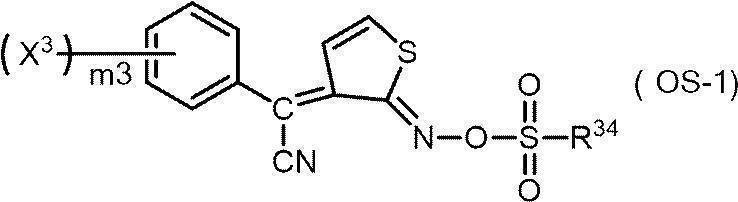
式(OS-1)中、X3は、アルキル基、アルコキシル基、又は、ハロゲン原子を表す。X3が複数存在する場合は、それぞれ同一であってもよいし、異なっていてもよい。上記X3におけるアルキル基及びアルコキシル基は、置換基を有していてもよい。上記X3におけるアルキル基としては、炭素数1~4の、直鎖状又は分岐状アルキル基が好ましい。上記X3におけるアルコキシル基としては、炭素数1~4の直鎖状又は分岐状アルコキシル基が好ましい。上記X3におけるハロゲン原子としては、塩素原子又はフッ素原子が好ましい。
式(OS-1)中、m3は、0~3の整数を表し、0又は1が好ましい。m3が2又は3であるとき、複数のX3は同一でも異なっていてもよい。
式(OS-1)中、R34は、アルキル基又はアリール基を表し、炭素数1~10のアルキル基、炭素数1~10のアルコキシル基、炭素数1~5のハロゲン化アルキル基、炭素数1~5のハロゲン化アルコキシル基、Wで置換されていてもよいフェニル基、Wで置換されていてもよいナフチル基又はWで置換されていてもよいアントラニル基であることが好ましい。Wは、ハロゲン原子、シアノ基、ニトロ基、炭素数1~10のアルキル基、炭素数1~10のアルコキシル基、炭素数1~5のハロゲン化アルキル基又は炭素数1~5のハロゲン化アルコキシル基、炭素数6~20のアリール基、炭素数6~20のハロゲン化アリール基を表す。
光酸発生剤は、オキシムスルホネート基を含む化合物(以下、単に「オキシムスルホネート化合物」ともいう)であることが好ましい。
オキシムスルホネート化合物は、オキシムスルホネート基を有していれば特に制限はないが、下記式(OS-1)、後述する式(OS-103)、式(OS-104)、又は、式(OS-105)で表されるオキシムスルホネート化合物であることが好ましい。
式(OS-1)中、m3は、0~3の整数を表し、0又は1が好ましい。m3が2又は3であるとき、複数のX3は同一でも異なっていてもよい。
式(OS-1)中、R34は、アルキル基又はアリール基を表し、炭素数1~10のアルキル基、炭素数1~10のアルコキシル基、炭素数1~5のハロゲン化アルキル基、炭素数1~5のハロゲン化アルコキシル基、Wで置換されていてもよいフェニル基、Wで置換されていてもよいナフチル基又はWで置換されていてもよいアントラニル基であることが好ましい。Wは、ハロゲン原子、シアノ基、ニトロ基、炭素数1~10のアルキル基、炭素数1~10のアルコキシル基、炭素数1~5のハロゲン化アルキル基又は炭素数1~5のハロゲン化アルコキシル基、炭素数6~20のアリール基、炭素数6~20のハロゲン化アリール基を表す。
式(OS-1)中、m3が3であり、X3がメチル基であり、X3の置換位置がオルト位であり、R34が炭素数1~10の直鎖状アルキル基、7,7-ジメチル-2-オキソノルボルニルメチル基、又は、p-トリル基である化合物が特に好ましい。
式(OS-1)で表されるオキシムスルホネート化合物の具体例としては、特開2011-209692号公報の段落番号0064~0068、特開2015-194674号公報の段落番号0158~0167に記載された以下の化合物が例示され、これらの内容は本明細書に組み込まれる。
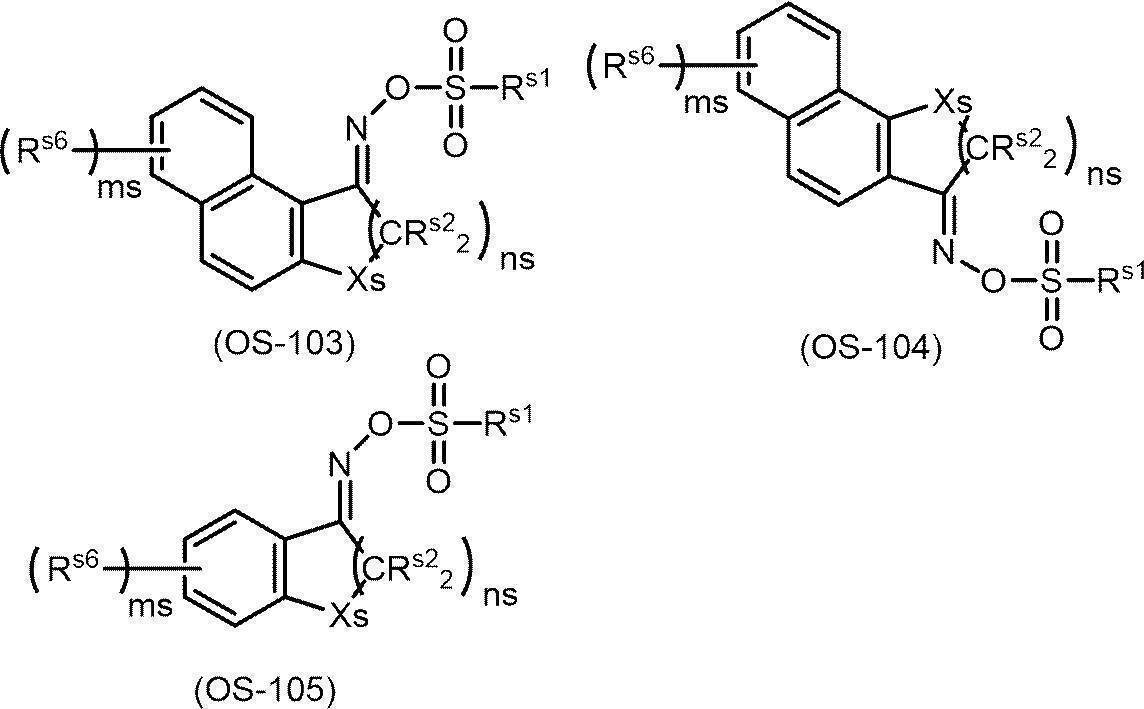
式(OS-103)~式(OS-105)中、Rs1はアルキル基、アリール基又はヘテロアリール基を表し、複数存在する場合のあるRs2はそれぞれ独立に、水素原子、アルキル基、アリール基又はハロゲン原子を表し、複数存在する場合のあるRs6はそれぞれ独立に、ハロゲン原子、アルキル基、アルキルオキシ基、スルホン酸基、アミノスルホニル基又はアルコキシスルホニル基を表し、XsはO又はSを表し、nsは1又は2を表し、msは0~6の整数を表す。
式(OS-103)~式(OS-105)中、Rs1で表されるアルキル基(炭素数1~30が好ましい)、アリール基(炭素数6~30が好ましい)又はヘテロアリール基(炭素数4~30が好ましい)は、置換基Tを有していてもよい。
式(OS-103)~式(OS-105)中、Rs1で表されるアルキル基(炭素数1~30が好ましい)、アリール基(炭素数6~30が好ましい)又はヘテロアリール基(炭素数4~30が好ましい)は、置換基Tを有していてもよい。
式(OS-103)~式(OS-105)中、Rs2は、水素原子、アルキル基(炭素数1~12が好ましい)又はアリール基(炭素数6~30が好ましい)であることが好ましく、水素原子又はアルキル基であることがより好ましい。化合物中に2以上存在する場合のあるRs2のうち、1つ又は2つがアルキル基、アリール基又はハロゲン原子であることが好ましく、1つがアルキル基、アリール基又はハロゲン原子であることがより好ましく、1つがアルキル基であり、かつ残りが水素原子であることが特に好ましい。Rs2で表されるアルキル基又はアリール基は、置換基Tを有していてもよい。
式(OS-103)、式(OS-104)、又は、式(OS-105)中、XsはO又はSを表し、Oであることが好ましい。上記式(OS-103)~(OS-105)において、Xsを環員として含む環は、5員環又は6員環である。
式(OS-103)、式(OS-104)、又は、式(OS-105)中、XsはO又はSを表し、Oであることが好ましい。上記式(OS-103)~(OS-105)において、Xsを環員として含む環は、5員環又は6員環である。
式(OS-103)~式(OS-105)中、nsは1又は2を表し、XsがOである場合、nsは1であることが好ましく、また、XsがSである場合、nsは2であることが好ましい。
式(OS-103)~式(OS-105)中、Rs6で表されるアルキル基(炭素数1~30が好ましい)及びアルキルオキシ基(炭素数1~30が好ましい)は、置換基を有していてもよい。
式(OS-103)~式(OS-105)中、msは0~6の整数を表し、0~2の整数であることが好ましく、0又は1であることがより好ましく、0であることが特に好ましい。
式(OS-103)~式(OS-105)中、Rs6で表されるアルキル基(炭素数1~30が好ましい)及びアルキルオキシ基(炭素数1~30が好ましい)は、置換基を有していてもよい。
式(OS-103)~式(OS-105)中、msは0~6の整数を表し、0~2の整数であることが好ましく、0又は1であることがより好ましく、0であることが特に好ましい。
また、上記式(OS-103)で表される化合物は、下記式(OS-106)、式(OS-110)又は式(OS-111)で表される化合物であることが特に好ましく、上記式(OS-104)で表される化合物は、下記式(OS-107)で表される化合物であることが特に好ましく、上記式(OS-105)で表される化合物は、下記式(OS-108)又は式(OS-109)で表される化合物であることが特に好ましい。
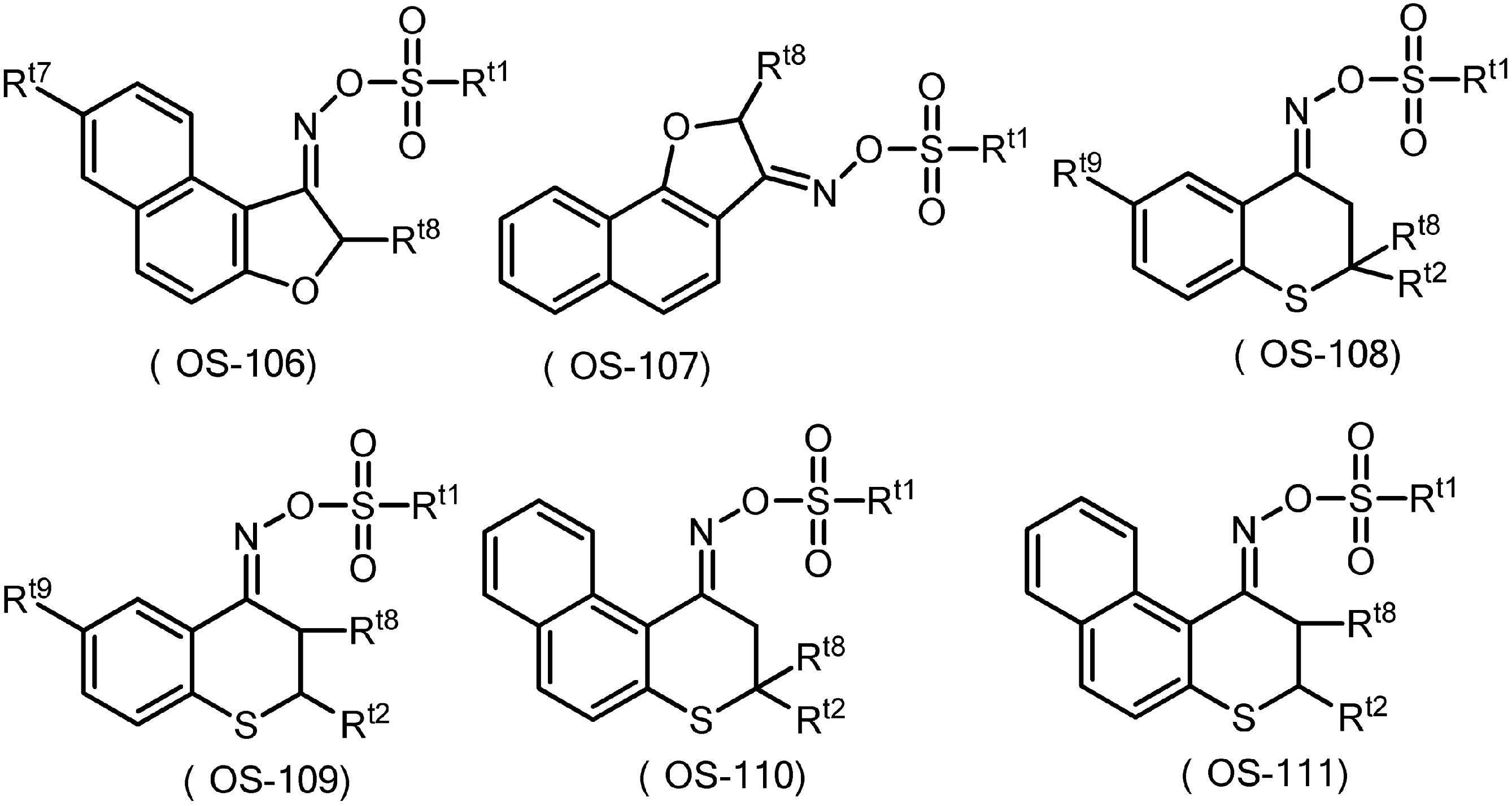
式(OS-106)~式(OS-111)中、Rt1はアルキル基、アリール基又はヘテロアリール基を表し、Rt7は、水素原子又は臭素原子を表し、Rt8は水素原子、炭素数1~8のアルキル基、ハロゲン原子、クロロメチル基、ブロモメチル基、ブロモエチル基、メトキシメチル基、フェニル基又はクロロフェニル基を表し、Rt9は水素原子、ハロゲン原子、メチル基又はメトキシ基を表し、Rt2は水素原子又はメチル基を表す。
式(OS-106)~式(OS-111)中、Rt7は、水素原子又は臭素原子を表し、水素原子であることが好ましい。
式(OS-106)~式(OS-111)中、Rt8は、水素原子、炭素数1~8のアルキル基、ハロゲン原子、クロロメチル基、ブロモメチル基、ブロモエチル基、メトキシメチル基、フェニル基又はクロロフェニル基を表し、炭素数1~8のアルキル基、ハロゲン原子又はフェニル基であることが好ましく、炭素数1~8のアルキル基であることがより好ましく、炭素数1~6のアルキル基であることが更に好ましく、メチル基であることが特に好ましい。
式(OS-106)~式(OS-111)中、Rt9は、水素原子、ハロゲン原子、メチル基又はメトキシ基を表し、水素原子であることが好ましい。
Rt2は、水素原子又はメチル基を表し、水素原子であることが好ましい。
また、上記オキシムスルホネート化合物において、オキシムの立体構造(E,Z)については、いずれか一方であっても、混合物であってもよい。
上記式(OS-103)~式(OS-105)で表されるオキシムスルホネート化合物の具体例としては、特開2011-209692号公報の段落番号0088~0095、特開2015-194674号公報の段落番号0168~0194に記載の化合物が例示され、これらの内容は本明細書に組み込まれる。
式(OS-106)~式(OS-111)中、Rt7は、水素原子又は臭素原子を表し、水素原子であることが好ましい。
式(OS-106)~式(OS-111)中、Rt8は、水素原子、炭素数1~8のアルキル基、ハロゲン原子、クロロメチル基、ブロモメチル基、ブロモエチル基、メトキシメチル基、フェニル基又はクロロフェニル基を表し、炭素数1~8のアルキル基、ハロゲン原子又はフェニル基であることが好ましく、炭素数1~8のアルキル基であることがより好ましく、炭素数1~6のアルキル基であることが更に好ましく、メチル基であることが特に好ましい。
式(OS-106)~式(OS-111)中、Rt9は、水素原子、ハロゲン原子、メチル基又はメトキシ基を表し、水素原子であることが好ましい。
Rt2は、水素原子又はメチル基を表し、水素原子であることが好ましい。
また、上記オキシムスルホネート化合物において、オキシムの立体構造(E,Z)については、いずれか一方であっても、混合物であってもよい。
上記式(OS-103)~式(OS-105)で表されるオキシムスルホネート化合物の具体例としては、特開2011-209692号公報の段落番号0088~0095、特開2015-194674号公報の段落番号0168~0194に記載の化合物が例示され、これらの内容は本明細書に組み込まれる。
オキシムスルホネート基を少なくとも1つを含むオキシムスルホネート化合物の好適な他の態様としては、下記式(OS-101)、式(OS-102)で表される化合物が挙げられる。

式(OS-101)又は式(OS-102)中、Ru9は、水素原子、アルキル基、アルケニル基、アルコキシル基、アルコキシカルボニル基、アシル基、カルバモイル基、スルファモイル基、スルホ基、シアノ基、アリール基又はヘテロアリール基を表す。Ru9がシアノ基又はアリール基である態様がより好ましく、Ru9がシアノ基、フェニル基又はナフチル基である態様が更に好ましい。
式(OS-101)又は式(OS-102)中、Ru2aは、アルキル基又はアリール基を表す。
式(OS-101)又は式(OS-102)中、Xuは、-O-、-S-、-NH-、-NRu5-、-CH2-、-CRu6H-又はCRu6Ru7-を表し、Ru5~Ru7はそれぞれ独立に、アルキル基又はアリール基を表す。
式(OS-101)又は式(OS-102)中、Ru1~Ru4はそれぞれ独立に、水素原子、ハロゲン原子、アルキル基、アルケニル基、アルコキシル基、アミノ基、アルコキシカルボニル基、アルキルカルボニル基、アリールカルボニル基、アミド基、スルホ基、シアノ基又はアリール基を表す。Ru1~Ru4のうちの2つがそれぞれ互いに結合して環を形成してもよい。このとき、環が縮環してベンゼン環ともに縮合環を形成していてもよい。Ru1~Ru4としては、水素原子、ハロゲン原子又はアルキル基が好ましく、また、Ru1~Ru4のうちの少なくとも2つが互いに結合してアリール基を形成する態様も好ましい。中でも、Ru1~Ru4がいずれも水素原子である態様が好ましい。上記した置換基は、いずれも、更に置換基を有していてもよい。
上記式(OS-101)で表される化合物は、式(OS-102)で表される化合物であることがより好ましい。
また、上記オキシムスルホネート化合物において、オキシムやベンゾチアゾール環の立体構造(E,Z等)についてはそれぞれ、いずれか一方であっても、混合物であってもよい。
式(OS-101)で表される化合物の具体例としては、特開2011-209692号公報の段落番号0102~0106、特開2015-194674号公報の段落番号0195~0207に記載の化合物が例示され、これらの内容は本明細書に組み込まれる。
上記化合物の中でも、b-9、b-16、b-31、b-33が好ましい。
市販品としては、WPAG-336(富士フイルム和光純薬(株)製)、WPAG-443(富士フイルム和光純薬(株)製)、MBZ-101(みどり化学(株)製)等を挙げることができる。
式(OS-101)又は式(OS-102)中、Ru2aは、アルキル基又はアリール基を表す。
式(OS-101)又は式(OS-102)中、Xuは、-O-、-S-、-NH-、-NRu5-、-CH2-、-CRu6H-又はCRu6Ru7-を表し、Ru5~Ru7はそれぞれ独立に、アルキル基又はアリール基を表す。
式(OS-101)又は式(OS-102)中、Ru1~Ru4はそれぞれ独立に、水素原子、ハロゲン原子、アルキル基、アルケニル基、アルコキシル基、アミノ基、アルコキシカルボニル基、アルキルカルボニル基、アリールカルボニル基、アミド基、スルホ基、シアノ基又はアリール基を表す。Ru1~Ru4のうちの2つがそれぞれ互いに結合して環を形成してもよい。このとき、環が縮環してベンゼン環ともに縮合環を形成していてもよい。Ru1~Ru4としては、水素原子、ハロゲン原子又はアルキル基が好ましく、また、Ru1~Ru4のうちの少なくとも2つが互いに結合してアリール基を形成する態様も好ましい。中でも、Ru1~Ru4がいずれも水素原子である態様が好ましい。上記した置換基は、いずれも、更に置換基を有していてもよい。
上記式(OS-101)で表される化合物は、式(OS-102)で表される化合物であることがより好ましい。
また、上記オキシムスルホネート化合物において、オキシムやベンゾチアゾール環の立体構造(E,Z等)についてはそれぞれ、いずれか一方であっても、混合物であってもよい。
式(OS-101)で表される化合物の具体例としては、特開2011-209692号公報の段落番号0102~0106、特開2015-194674号公報の段落番号0195~0207に記載の化合物が例示され、これらの内容は本明細書に組み込まれる。
上記化合物の中でも、b-9、b-16、b-31、b-33が好ましい。
市販品としては、WPAG-336(富士フイルム和光純薬(株)製)、WPAG-443(富士フイルム和光純薬(株)製)、MBZ-101(みどり化学(株)製)等を挙げることができる。
活性光線に感応する光酸発生剤として1,2-キノンジアジド化合物を含まないものが好ましい。その理由は、1,2-キノンジアジド化合物は、逐次型光化学反応によりカルボキシ基を生成するが、その量子収率は1以下であり、オキシムスルホネート化合物に比べて感度が低いためである。
これに対して、オキシムスルホネート化合物は、活性光線に感応して生成する酸が保護された酸基の脱保護に対して触媒として作用するので、1個の光量子の作用で生成した酸が、多数の脱保護反応に寄与し、量子収率は1を超え、例えば、10の数乗のような大きい値となり、いわゆる化学増幅の結果として、高感度が得られると推測される。
また、オキシムスルホネート化合物は、広がりのあるπ共役系を有しているため、長波長側にまで吸収を有しており、遠紫外線(DUV)、ArF線、KrF線、i線のみならず、g線においても非常に高い感度を示す。
感光層における酸分解性基としてテトラヒドロフラニル基を用いることにより、アセタール又はケタールに比べ同等又はそれ以上の酸分解性を得ることができる。これにより、より短時間のポストベークで確実に酸分解性基を消費することができる。更に、光酸発生剤であるオキシムスルホネート化合物を組み合わせて用いることで、スルホン酸発生速度が上がるため、酸の生成が促進され、樹脂の酸分解性基の分解が促進される。また、オキシムスルホネート化合物が分解することで得られる酸は、分子の小さいスルホン酸であることから、硬化膜中での拡散性も高く、より高感度化することができる。
これに対して、オキシムスルホネート化合物は、活性光線に感応して生成する酸が保護された酸基の脱保護に対して触媒として作用するので、1個の光量子の作用で生成した酸が、多数の脱保護反応に寄与し、量子収率は1を超え、例えば、10の数乗のような大きい値となり、いわゆる化学増幅の結果として、高感度が得られると推測される。
また、オキシムスルホネート化合物は、広がりのあるπ共役系を有しているため、長波長側にまで吸収を有しており、遠紫外線(DUV)、ArF線、KrF線、i線のみならず、g線においても非常に高い感度を示す。
感光層における酸分解性基としてテトラヒドロフラニル基を用いることにより、アセタール又はケタールに比べ同等又はそれ以上の酸分解性を得ることができる。これにより、より短時間のポストベークで確実に酸分解性基を消費することができる。更に、光酸発生剤であるオキシムスルホネート化合物を組み合わせて用いることで、スルホン酸発生速度が上がるため、酸の生成が促進され、樹脂の酸分解性基の分解が促進される。また、オキシムスルホネート化合物が分解することで得られる酸は、分子の小さいスルホン酸であることから、硬化膜中での拡散性も高く、より高感度化することができる。
光酸発生剤は、感光層の全質量に対して、0.1~20質量%使用することが好ましく、0.5~18質量%使用することがより好ましく、0.5~10質量%使用することが更に好ましく、0.5~3質量%使用することが一層好ましく、0.5~1.2質量%使用することがより一層好ましい。
光酸発生剤は、1種を単独で使用しても、2種以上を併用してもよい。2種以上用いる場合、合計量が上記範囲となることが好ましい。
光酸発生剤は、1種を単独で使用しても、2種以上を併用してもよい。2種以上用いる場合、合計量が上記範囲となることが好ましい。
〔塩基性化合物〕
感光層は、後述する感光層形成用組成物の液保存安定性の観点から、塩基性化合物を含むことが好ましい。
塩基性化合物としては、公知の化学増幅レジストで用いられるものの中から任意に選択して使用することができる。例えば、脂肪族アミン、芳香族アミン、複素環式アミン、第四級アンモニウムヒドロキシド、及び、カルボン酸の第四級アンモニウム塩等が挙げられる。
脂肪族アミンとしては、例えば、トリメチルアミン、ジエチルアミン、トリエチルアミン、ジ-n-プロピルアミン、トリ-n-プロピルアミン、ジ-n-ペンチルアミン、トリ-n-ペンチルアミン、ジエタノールアミン、トリエタノールアミン、ジシクロヘキシルアミン、ジシクロヘキシルメチルアミンなどが挙げられる。
芳香族アミンとしては、例えば、アニリン、ベンジルアミン、N,N-ジメチルアニリン、ジフェニルアミンなどが挙げられる。
複素環式アミンとしては、例えば、ピリジン、2-メチルピリジン、4-メチルピリジン、2-エチルピリジン、4-エチルピリジン、2-フェニルピリジン、4-フェニルピリジン、N-メチル-4-フェニルピリジン、4-ジメチルアミノピリジン、イミダゾール、ベンズイミダゾール、4-メチルイミダゾール、2-フェニルベンズイミダゾール、2,4,5-トリフェニルイミダゾール、ニコチン、ニコチン酸、ニコチン酸アミド、キノリン、8-オキシキノリン、ピラジン、ピラゾール、ピリダジン、プリン、ピロリジン、ピペリジン、シクロヘキシルモルホリノエチルチオウレア、ピペラジン、モルホリン、4-メチルモルホリン、1,5-ジアザビシクロ[4.3.0]-5-ノネン、1,8-ジアザビシクロ[5.3.0]-7-ウンデセンなどが挙げられる。
第四級アンモニウムヒドロキシドとしては、例えば、テトラメチルアンモニウムヒドロキシド、テトラエチルアンモニウムヒドロキシド、テトラ-n-ブチルアンモニウムヒドロキシド、テトラ-n-ヘキシルアンモニウムヒドロキシドなどが挙げられる。
カルボン酸の第四級アンモニウム塩としては、例えば、テトラメチルアンモニウムアセテート、テトラメチルアンモニウムベンゾエート、テトラ-n-ブチルアンモニウムアセテート、テトラ-n-ブチルアンモニウムベンゾエートなどが挙げられる。
感光層が、塩基性化合物を含む場合、塩基性化合物の含有量は、感光層用特定樹脂100質量部に対して、0.001~1質量部であることが好ましく、0.002~0.5質量部であることがより好ましい。
塩基性化合物は、1種を単独で使用しても、2種以上を併用してもよいが、2種以上を併用することが好ましく、2種を併用することがより好ましく、複素環式アミンを2種併用することが更に好ましい。2種以上用いる場合、合計量が上記範囲となることが好ましい。
感光層は、後述する感光層形成用組成物の液保存安定性の観点から、塩基性化合物を含むことが好ましい。
塩基性化合物としては、公知の化学増幅レジストで用いられるものの中から任意に選択して使用することができる。例えば、脂肪族アミン、芳香族アミン、複素環式アミン、第四級アンモニウムヒドロキシド、及び、カルボン酸の第四級アンモニウム塩等が挙げられる。
脂肪族アミンとしては、例えば、トリメチルアミン、ジエチルアミン、トリエチルアミン、ジ-n-プロピルアミン、トリ-n-プロピルアミン、ジ-n-ペンチルアミン、トリ-n-ペンチルアミン、ジエタノールアミン、トリエタノールアミン、ジシクロヘキシルアミン、ジシクロヘキシルメチルアミンなどが挙げられる。
芳香族アミンとしては、例えば、アニリン、ベンジルアミン、N,N-ジメチルアニリン、ジフェニルアミンなどが挙げられる。
複素環式アミンとしては、例えば、ピリジン、2-メチルピリジン、4-メチルピリジン、2-エチルピリジン、4-エチルピリジン、2-フェニルピリジン、4-フェニルピリジン、N-メチル-4-フェニルピリジン、4-ジメチルアミノピリジン、イミダゾール、ベンズイミダゾール、4-メチルイミダゾール、2-フェニルベンズイミダゾール、2,4,5-トリフェニルイミダゾール、ニコチン、ニコチン酸、ニコチン酸アミド、キノリン、8-オキシキノリン、ピラジン、ピラゾール、ピリダジン、プリン、ピロリジン、ピペリジン、シクロヘキシルモルホリノエチルチオウレア、ピペラジン、モルホリン、4-メチルモルホリン、1,5-ジアザビシクロ[4.3.0]-5-ノネン、1,8-ジアザビシクロ[5.3.0]-7-ウンデセンなどが挙げられる。
第四級アンモニウムヒドロキシドとしては、例えば、テトラメチルアンモニウムヒドロキシド、テトラエチルアンモニウムヒドロキシド、テトラ-n-ブチルアンモニウムヒドロキシド、テトラ-n-ヘキシルアンモニウムヒドロキシドなどが挙げられる。
カルボン酸の第四級アンモニウム塩としては、例えば、テトラメチルアンモニウムアセテート、テトラメチルアンモニウムベンゾエート、テトラ-n-ブチルアンモニウムアセテート、テトラ-n-ブチルアンモニウムベンゾエートなどが挙げられる。
感光層が、塩基性化合物を含む場合、塩基性化合物の含有量は、感光層用特定樹脂100質量部に対して、0.001~1質量部であることが好ましく、0.002~0.5質量部であることがより好ましい。
塩基性化合物は、1種を単独で使用しても、2種以上を併用してもよいが、2種以上を併用することが好ましく、2種を併用することがより好ましく、複素環式アミンを2種併用することが更に好ましい。2種以上用いる場合、合計量が上記範囲となることが好ましい。
〔界面活性剤〕
感光層は、後述する感光層形成用組成物の塗布性を向上する観点から、界面活性剤を含むことが好ましい。
界面活性剤としては、アニオン系、カチオン系、ノニオン系、又は、両性のいずれでも使用することができるが、好ましい界面活性剤はノニオン系界面活性剤である。
ノニオン系界面活性剤の例としては、ポリオキシエチレン高級アルキルエーテル類、ポリオキシエチレン高級アルキルフェニルエーテル類、ポリオキシエチレングリコールの高級脂肪酸ジエステル類、フッ素系、シリコーン系界面活性剤を挙げることができる。
界面活性剤として、フッ素系界面活性剤、又はシリコーン系界面活性剤を含むことがより好ましい。
これらのフッ素系界面活性剤、又は、シリコーン系界面活性剤として、例えば、特開昭62-036663号、特開昭61-226746号、特開昭61-226745号、特開昭62-170950号、特開昭63-034540号、特開平07-230165号、特開平08-062834号、特開平09-054432号、特開平09-005988号、特開2001-330953号の各公報に記載の界面活性剤を挙げることができ、市販の界面活性剤を用いることもできる。
使用できる市販の界面活性剤として、例えば、エフトップEF301、EF303(以上、新秋田化成(株)製)、フロラードFC430、431(以上、住友スリーエム(株)製)、メガファックF171、F173、F176、F189、R08(以上、DIC(株)製)、サーフロンS-382、SC101、102、103、104、105、106(以上、AGCセイミケミカル(株)製)、PF-6320等のPolyFoxシリーズ(OMNOVA社製)などのフッ素系界面活性剤又はシリコーン系界面活性剤を挙げることができる。また、ポリシロキサンポリマーKP-341(信越化学工業(株)製)も、シリコーン系界面活性剤として用いることができる。
感光層は、後述する感光層形成用組成物の塗布性を向上する観点から、界面活性剤を含むことが好ましい。
界面活性剤としては、アニオン系、カチオン系、ノニオン系、又は、両性のいずれでも使用することができるが、好ましい界面活性剤はノニオン系界面活性剤である。
ノニオン系界面活性剤の例としては、ポリオキシエチレン高級アルキルエーテル類、ポリオキシエチレン高級アルキルフェニルエーテル類、ポリオキシエチレングリコールの高級脂肪酸ジエステル類、フッ素系、シリコーン系界面活性剤を挙げることができる。
界面活性剤として、フッ素系界面活性剤、又はシリコーン系界面活性剤を含むことがより好ましい。
これらのフッ素系界面活性剤、又は、シリコーン系界面活性剤として、例えば、特開昭62-036663号、特開昭61-226746号、特開昭61-226745号、特開昭62-170950号、特開昭63-034540号、特開平07-230165号、特開平08-062834号、特開平09-054432号、特開平09-005988号、特開2001-330953号の各公報に記載の界面活性剤を挙げることができ、市販の界面活性剤を用いることもできる。
使用できる市販の界面活性剤として、例えば、エフトップEF301、EF303(以上、新秋田化成(株)製)、フロラードFC430、431(以上、住友スリーエム(株)製)、メガファックF171、F173、F176、F189、R08(以上、DIC(株)製)、サーフロンS-382、SC101、102、103、104、105、106(以上、AGCセイミケミカル(株)製)、PF-6320等のPolyFoxシリーズ(OMNOVA社製)などのフッ素系界面活性剤又はシリコーン系界面活性剤を挙げることができる。また、ポリシロキサンポリマーKP-341(信越化学工業(株)製)も、シリコーン系界面活性剤として用いることができる。
また、界面活性剤として、下記式(41)で表される繰返し単位A及び繰返し単位Bを含み、テトラヒドロフラン(THF)を溶剤とした場合のゲルパーミエーションクロマトグラフィで測定されるポリスチレン換算の重量平均分子量(Mw)が1,000以上10,000以下である共重合体を好ましい例として挙げることができる。

式(41)中、R41及びR43はそれぞれ独立に、水素原子又はメチル基を表し、R42は炭素数1以上4以下の直鎖アルキレン基を表し、R44は水素原子又は炭素数1以上4以下のアルキル基を表し、L4は炭素数3以上6以下のアルキレン基を表し、p4及びq4は重合比を表す質量百分率であり、p4は10質量%以上80質量%以下の数値を表し、q4は20質量%以上90質量%以下の数値を表し、r4は1以上18以下の整数を表し、n4は1以上10以下の整数を表す。
式(41)中、L4は、下記式(42)で表される分岐アルキレン基であることが好ましい。式(42)におけるR45は、炭素数1以上4以下のアルキル基を表し、被塗布面に対する濡れ性の点で、炭素数1以上3以下のアルキル基が好ましく、炭素数2又は3のアルキル基がより好ましい。
-CH2-CH(R45)- (42)
上記共重合体の重量平均分子量は、1,500以上5,000以下であることがより好ましい。
感光層が界面活性剤を含む場合、界面活性剤の添加量は、感光層用特定樹脂100質量部に対して、10質量部以下であることが好ましく、0.01~10質量部であることがより好ましく、0.01~1質量部であることが更に好ましい。
界面活性剤は、1種を単独で、又は2種以上を混合して使用することができる。2種以上用いる場合、合計量が上記範囲となることが好ましい。
式(41)中、L4は、下記式(42)で表される分岐アルキレン基であることが好ましい。式(42)におけるR45は、炭素数1以上4以下のアルキル基を表し、被塗布面に対する濡れ性の点で、炭素数1以上3以下のアルキル基が好ましく、炭素数2又は3のアルキル基がより好ましい。
-CH2-CH(R45)- (42)
上記共重合体の重量平均分子量は、1,500以上5,000以下であることがより好ましい。
感光層が界面活性剤を含む場合、界面活性剤の添加量は、感光層用特定樹脂100質量部に対して、10質量部以下であることが好ましく、0.01~10質量部であることがより好ましく、0.01~1質量部であることが更に好ましい。
界面活性剤は、1種を単独で、又は2種以上を混合して使用することができる。2種以上用いる場合、合計量が上記範囲となることが好ましい。
〔その他の成分〕
感光層には、更に、必要に応じて、酸化防止剤、可塑剤、熱ラジカル発生剤、熱酸発生剤、酸増殖剤、紫外線吸収剤、増粘剤、及び、有機又は無機の沈殿防止剤などの公知の添加剤を、それぞれ、1種又は2種以上加えることができる。これらの詳細は、特開2011-209692号公報の段落番号0143~0148の記載を参酌でき、これらの内容は本明細書に組み込まれる。
感光層には、更に、必要に応じて、酸化防止剤、可塑剤、熱ラジカル発生剤、熱酸発生剤、酸増殖剤、紫外線吸収剤、増粘剤、及び、有機又は無機の沈殿防止剤などの公知の添加剤を、それぞれ、1種又は2種以上加えることができる。これらの詳細は、特開2011-209692号公報の段落番号0143~0148の記載を参酌でき、これらの内容は本明細書に組み込まれる。
〔厚さ〕
本発明における感光層の厚さ(膜厚)は、解像力向上の観点から、0.1μm以上が好ましく、0.5μm以上がより好ましく、0.75μm以上が更に好ましく、0.8μm以上が特に好ましい。感光層の厚さの上限値としては、10μm以下が好ましく、5.0μm以下がより好ましく、2.0μm以下が更に好ましい。
感光層と保護層との厚さの合計は、0.2μm以上であることが好ましく、1.0μm以上であることがより好ましく、2.0μm以上であることが更に好ましい。上限値としては、20.0μm以下であることが好ましく、10.0μm以下であることがより好ましく、5.0μm以下であることが更に好ましい。
本発明における感光層の厚さ(膜厚)は、解像力向上の観点から、0.1μm以上が好ましく、0.5μm以上がより好ましく、0.75μm以上が更に好ましく、0.8μm以上が特に好ましい。感光層の厚さの上限値としては、10μm以下が好ましく、5.0μm以下がより好ましく、2.0μm以下が更に好ましい。
感光層と保護層との厚さの合計は、0.2μm以上であることが好ましく、1.0μm以上であることがより好ましく、2.0μm以上であることが更に好ましい。上限値としては、20.0μm以下であることが好ましく、10.0μm以下であることがより好ましく、5.0μm以下であることが更に好ましい。
〔現像液〕
本発明における感光層は、現像液を用いた現像に供される。
現像液としては、有機溶剤を含む現像液が好ましい。
現像液の全質量に対する有機溶剤の含有量は、90~100質量%であることが好ましく、95~100質量%であることがより好ましい。また、現像液は有機溶剤のみからなる現像液であってもよい。
現像液を用いた感光層の現像方法については後述する。
本発明における感光層は、現像液を用いた現像に供される。
現像液としては、有機溶剤を含む現像液が好ましい。
現像液の全質量に対する有機溶剤の含有量は、90~100質量%であることが好ましく、95~100質量%であることがより好ましい。また、現像液は有機溶剤のみからなる現像液であってもよい。
現像液を用いた感光層の現像方法については後述する。
-有機溶剤-
現像液に含まれる有機溶剤のsp値は、19MPa1/2未満であることが好ましく、18MPa1/2以下であることがより好ましい。
現像液に含まれる有機溶剤としては、ケトン系溶剤、エステル系溶剤、アミド系溶剤等の極性溶剤、及び炭化水素系溶剤が挙げられる。
ケトン系溶剤としては、例えば、1-オクタノン、2-オクタノン、1-ノナノン、2-ノナノン、2-ヘプタノン(メチルアミルケトン)、4-ヘプタノン、1-ヘキサノン、2-ヘキサノン、ジイソブチルケトン、シクロヘキサノン、メチルシクロヘキサノン、フェニルアセトン、メチルエチルケトン、メチルイソブチルケトン、アセチルアセトン、アセトニルアセトン、イオノン、ジアセトニルアルコール、アセチルカービノール、アセトフェノン、メチルナフチルケトン、イソホロン、プロピレンカーボネート等を挙げることができる。
エステル系溶剤としては、例えば、酢酸メチル、酢酸ブチル、酢酸エチル、酢酸イソプロピル、酢酸ペンチル、酢酸イソペンチル、酢酸アミル、プロピレングリコールモノメチルエーテルアセテート、エチレングリコールモノエチルエーテルアセテート、ジエチレングリコールモノブチルエーテルアセテート、ジエチレングリコールモノエチルエーテルアセテート、エチル-3-エトキシプロピオネート、3-メトキシブチルアセテート、3-メチル-3-メトキシブチルアセテート、蟻酸メチル、蟻酸エチル、蟻酸ブチル、蟻酸プロピル、乳酸エチル、乳酸ブチル、乳酸プロピル等を挙げることができる。
アミド系溶剤としては、例えば、N-メチル-2-ピロリドン、N,N-ジメチルアセトアミド、N,N-ジメチルホルムアミド、ヘキサメチルホスホリックトリアミド、1,3-ジメチル-2-イミダゾリジノン等を使用することができる。
炭化水素系溶剤としては、例えば、トルエン、キシレン等の芳香族炭化水素系溶剤、ペンタン、ヘキサン、オクタン、デカン等の脂肪族炭化水素系溶剤が挙げられる。
上記有機溶剤は、1種のみでも、2種以上用いてもよい。また、上記以外の有機溶剤と混合して使用してもよい。但し、現像液の全質量に対する水の含有量が10質量%未満であることが好ましく、実質的に水を含有しないことがより好ましい。ここでの実質的に水を含有しないとは、例えば、現像液の全質量に対する水の含有量が3質量%以下であることをいい、より好ましくは測定限界以下であることをいう。
すなわち、有機現像液に対する有機溶剤の使用量は、現像液の全量に対して、90質量%以上100質量%以下であることが好ましく、95質量%以上100質量%以下であることがより好ましい。
特に、有機現像液は、ケトン系溶剤、エステル系溶剤及びアミド系溶剤からなる群より選択される少なくとも1種の有機溶剤を含むことが好ましい。
また、有機現像液は、必要に応じて塩基性化合物を適当量含有していてもよい。塩基性化合物の例としては、上記の塩基性化合物の項で述べたものを挙げることができる。
有機現像液の蒸気圧は、23℃において、5kPa以下であることが好ましく、3kPa以下がより好ましく、2kPa以下が更に好ましい。有機現像液の蒸気圧を5kPa以下にすることにより、現像液の感光層上あるいは現像カップ内での蒸発が抑制され、感光層の面内における温度均一性が向上し、結果として現像後の感光層の寸法均一性が改善する。
5kPa以下の蒸気圧を有する溶剤の具体的な例としては、1-オクタノン、2-オクタノン、1-ノナノン、2-ノナノン、2-ヘプタノン(メチルアミルケトン)、4-ヘプタノン、2-ヘキサノン、ジイソブチルケトン、シクロヘキサノン、メチルシクロヘキサノン、フェニルアセトン、メチルイソブチルケトン等のケトン系溶剤、酢酸ブチル、酢酸ペンチル、酢酸イソペンチル、酢酸アミル、プロピレングリコールモノメチルエーテルアセテート、エチレングリコールモノエチルエーテルアセテート、ジエチレングリコールモノブチルエーテルアセテート、ジエチレングリコールモノエチルエーテルアセテート、エチル-3-エトキシプロピオネート、3-メトキシブチルアセテート、3-メチル-3-メトキシブチルアセテート、蟻酸ブチル、蟻酸プロピル、乳酸エチル、乳酸ブチル、乳酸プロピル等のエステル系溶剤、N-メチル-2-ピロリドン、N,N-ジメチルアセトアミド、N,N-ジメチルホルムアミド等のアミド系溶剤、トルエン、キシレン等の芳香族炭化水素系溶剤、オクタン、デカン等の脂肪族炭化水素系溶剤が挙げられる。
特に好ましい範囲である2kPa以下の蒸気圧を有する溶剤の具体的な例としては、1-オクタノン、2-オクタノン、1-ノナノン、2-ノナノン、4-ヘプタノン、2-ヘキサノン、ジイソブチルケトン、シクロヘキサノン、メチルシクロヘキサノン、フェニルアセトン等のケトン系溶剤、酢酸ブチル、酢酸アミル、プロピレングリコールモノメチルエーテルアセテート、エチレングリコールモノエチルエーテルアセテート、ジエチレングリコールモノブチルエーテルアセテート、ジエチレングリコールモノエチルエーテルアセテート、エチル-3-エトキシプロピオネート、3-メトキシブチルアセテート、3-メチル-3-メトキシブチルアセテート、乳酸エチル、乳酸ブチル、乳酸プロピル等のエステル系溶剤、N-メチル-2-ピロリドン、N,N-ジメチルアセトアミド、N,N-ジメチルホルムアミド等のアミド系溶剤、キシレン等の芳香族炭化水素系溶剤、オクタン、デカン等の脂肪族炭化水素系溶剤が挙げられる。
現像液に含まれる有機溶剤のsp値は、19MPa1/2未満であることが好ましく、18MPa1/2以下であることがより好ましい。
現像液に含まれる有機溶剤としては、ケトン系溶剤、エステル系溶剤、アミド系溶剤等の極性溶剤、及び炭化水素系溶剤が挙げられる。
ケトン系溶剤としては、例えば、1-オクタノン、2-オクタノン、1-ノナノン、2-ノナノン、2-ヘプタノン(メチルアミルケトン)、4-ヘプタノン、1-ヘキサノン、2-ヘキサノン、ジイソブチルケトン、シクロヘキサノン、メチルシクロヘキサノン、フェニルアセトン、メチルエチルケトン、メチルイソブチルケトン、アセチルアセトン、アセトニルアセトン、イオノン、ジアセトニルアルコール、アセチルカービノール、アセトフェノン、メチルナフチルケトン、イソホロン、プロピレンカーボネート等を挙げることができる。
エステル系溶剤としては、例えば、酢酸メチル、酢酸ブチル、酢酸エチル、酢酸イソプロピル、酢酸ペンチル、酢酸イソペンチル、酢酸アミル、プロピレングリコールモノメチルエーテルアセテート、エチレングリコールモノエチルエーテルアセテート、ジエチレングリコールモノブチルエーテルアセテート、ジエチレングリコールモノエチルエーテルアセテート、エチル-3-エトキシプロピオネート、3-メトキシブチルアセテート、3-メチル-3-メトキシブチルアセテート、蟻酸メチル、蟻酸エチル、蟻酸ブチル、蟻酸プロピル、乳酸エチル、乳酸ブチル、乳酸プロピル等を挙げることができる。
アミド系溶剤としては、例えば、N-メチル-2-ピロリドン、N,N-ジメチルアセトアミド、N,N-ジメチルホルムアミド、ヘキサメチルホスホリックトリアミド、1,3-ジメチル-2-イミダゾリジノン等を使用することができる。
炭化水素系溶剤としては、例えば、トルエン、キシレン等の芳香族炭化水素系溶剤、ペンタン、ヘキサン、オクタン、デカン等の脂肪族炭化水素系溶剤が挙げられる。
上記有機溶剤は、1種のみでも、2種以上用いてもよい。また、上記以外の有機溶剤と混合して使用してもよい。但し、現像液の全質量に対する水の含有量が10質量%未満であることが好ましく、実質的に水を含有しないことがより好ましい。ここでの実質的に水を含有しないとは、例えば、現像液の全質量に対する水の含有量が3質量%以下であることをいい、より好ましくは測定限界以下であることをいう。
すなわち、有機現像液に対する有機溶剤の使用量は、現像液の全量に対して、90質量%以上100質量%以下であることが好ましく、95質量%以上100質量%以下であることがより好ましい。
特に、有機現像液は、ケトン系溶剤、エステル系溶剤及びアミド系溶剤からなる群より選択される少なくとも1種の有機溶剤を含むことが好ましい。
また、有機現像液は、必要に応じて塩基性化合物を適当量含有していてもよい。塩基性化合物の例としては、上記の塩基性化合物の項で述べたものを挙げることができる。
有機現像液の蒸気圧は、23℃において、5kPa以下であることが好ましく、3kPa以下がより好ましく、2kPa以下が更に好ましい。有機現像液の蒸気圧を5kPa以下にすることにより、現像液の感光層上あるいは現像カップ内での蒸発が抑制され、感光層の面内における温度均一性が向上し、結果として現像後の感光層の寸法均一性が改善する。
5kPa以下の蒸気圧を有する溶剤の具体的な例としては、1-オクタノン、2-オクタノン、1-ノナノン、2-ノナノン、2-ヘプタノン(メチルアミルケトン)、4-ヘプタノン、2-ヘキサノン、ジイソブチルケトン、シクロヘキサノン、メチルシクロヘキサノン、フェニルアセトン、メチルイソブチルケトン等のケトン系溶剤、酢酸ブチル、酢酸ペンチル、酢酸イソペンチル、酢酸アミル、プロピレングリコールモノメチルエーテルアセテート、エチレングリコールモノエチルエーテルアセテート、ジエチレングリコールモノブチルエーテルアセテート、ジエチレングリコールモノエチルエーテルアセテート、エチル-3-エトキシプロピオネート、3-メトキシブチルアセテート、3-メチル-3-メトキシブチルアセテート、蟻酸ブチル、蟻酸プロピル、乳酸エチル、乳酸ブチル、乳酸プロピル等のエステル系溶剤、N-メチル-2-ピロリドン、N,N-ジメチルアセトアミド、N,N-ジメチルホルムアミド等のアミド系溶剤、トルエン、キシレン等の芳香族炭化水素系溶剤、オクタン、デカン等の脂肪族炭化水素系溶剤が挙げられる。
特に好ましい範囲である2kPa以下の蒸気圧を有する溶剤の具体的な例としては、1-オクタノン、2-オクタノン、1-ノナノン、2-ノナノン、4-ヘプタノン、2-ヘキサノン、ジイソブチルケトン、シクロヘキサノン、メチルシクロヘキサノン、フェニルアセトン等のケトン系溶剤、酢酸ブチル、酢酸アミル、プロピレングリコールモノメチルエーテルアセテート、エチレングリコールモノエチルエーテルアセテート、ジエチレングリコールモノブチルエーテルアセテート、ジエチレングリコールモノエチルエーテルアセテート、エチル-3-エトキシプロピオネート、3-メトキシブチルアセテート、3-メチル-3-メトキシブチルアセテート、乳酸エチル、乳酸ブチル、乳酸プロピル等のエステル系溶剤、N-メチル-2-ピロリドン、N,N-ジメチルアセトアミド、N,N-ジメチルホルムアミド等のアミド系溶剤、キシレン等の芳香族炭化水素系溶剤、オクタン、デカン等の脂肪族炭化水素系溶剤が挙げられる。
-界面活性剤-
現像液は、界面活性剤を含有してもよい。
界面活性剤としては特に限定されないが、例えば、上記の保護層の項で述べた界面活性剤が好ましく用いられる。
現像液に界面活性剤を配合する場合、その配合量は現像液の全量に対して、通常0.001~5質量%であり、好ましくは0.005~2質量%であり、より好ましくは0.01~0.5質量%である。
現像液は、界面活性剤を含有してもよい。
界面活性剤としては特に限定されないが、例えば、上記の保護層の項で述べた界面活性剤が好ましく用いられる。
現像液に界面活性剤を配合する場合、その配合量は現像液の全量に対して、通常0.001~5質量%であり、好ましくは0.005~2質量%であり、より好ましくは0.01~0.5質量%である。
〔感光層形成用組成物〕
本発明の感光層形成用組成物は、本発明において用いられる積層体に含まれる感光層の形成に用いられる組成物である。
本発明において用いられる積層体において、感光層は、例えば、感光層形成用組成物を保護層の上に適用し、乾燥させることによって形成することができる。適用方法としては、例えば、上述した保護層における保護層形成用組成物の適用方法についての記載を参酌できる。
本発明の感光層形成用組成物は、本発明において用いられる積層体に含まれる感光層の形成に用いられる組成物である。
本発明において用いられる積層体において、感光層は、例えば、感光層形成用組成物を保護層の上に適用し、乾燥させることによって形成することができる。適用方法としては、例えば、上述した保護層における保護層形成用組成物の適用方法についての記載を参酌できる。
感光層形成用組成物は、上述の感光層に含まれる成分(例えば、感光層用特定樹脂、光酸発生剤、塩基性化合物、界面活性剤、及び、その他の成分等)と、溶剤と、を含むことが好ましい。これらの感光層に含まれる成分は、溶剤に溶解又は分散していることが好ましく、溶解していることがより好ましい。
感光層形成用組成物に含まれる成分の含有量は、上述した各成分の感光層の全質量に対する含有量を、感光層形成用組成物の固形分量に対する含有量に読み替えたものとすることが好ましい。
感光層形成用組成物に含まれる成分の含有量は、上述した各成分の感光層の全質量に対する含有量を、感光層形成用組成物の固形分量に対する含有量に読み替えたものとすることが好ましい。
-有機溶剤-
感光層形成用組成物に使用される有機溶剤としては、公知の有機溶剤を用いることができ、エチレングリコールモノアルキルエーテル類、エチレングリコールジアルキルエーテル類、エチレングリコールモノアルキルエーテルアセテート類、プロピレングリコールモノアルキルエーテル類、プロピレングリコールジアルキルエーテル類、プロピレングリコールモノアルキルエーテルアセテート類、ジエチレングリコールジアルキルエーテル類、ジエチレングリコールモノアルキルエーテルアセテート類、ジプロピレングリコールモノアルキルエーテル類、ジプロピレングリコールジアルキルエーテル類、ジプロピレングリコールモノアルキルエーテルアセテート類、エステル類、ケトン類、アミド類、ラクトン類等が例示できる。
有機溶剤としては、例えば、
(1)エチレングリコールモノメチルエーテル、エチレングリコールモノエチルエーテル、エチレングリコールモノプロピルエーテル、エチレングリコールモノブチルエーテル等のエチレングリコールモノアルキルエーテル類;
(2)エチレングリコールジメチルエーテル、エチレングリコールジエチルエーテル、エチレングリコールジプロピルエーテル等のエチレングリコールジアルキルエーテル類;
(3)エチレングリコールモノメチルエーテルアセテート、エチレングリコールモノエチルエーテルアセテート、エチレングリコールモノプロピルエーテルアセテート、エチレングリコールモノブチルエーテルアセテート等のエチレングリコールモノアルキルエーテルアセテート類;
(4)プロピレングリコールモノメチルエーテル、プロピレングリコールモノエチルエーテル、プロピレングリコールモノプロピルエーテル、プロピレングリコールモノブチルエーテル等のプロピレングリコールモノアルキルエーテル類;
(5)プロピレングリコールジメチルエーテル、プロピレングリコールジエチルエーテル等のプロピレングリコールジアルキルエーテル類;
(6)プロピレングリコールモノメチルエーテルアセテート、プロピレングリコールモノエチルエーテルアセテート、プロピレングリコールモノプロピルエーテルアセテート、プロピレングリコールモノブチルエーテルアセテート等のプロピレングリコールモノアルキルエーテルアセテート類;
(7)ジエチレングリコールジメチルエーテル、ジエチレングリコールジエチルエーテル、ジエチレングリコールエチルメチルエーテル等のジエチレングリコールジアルキルエーテル類;
(8)ジエチレングリコールモノメチルエーテルアセテート、ジエチレングリコールモノエチルエーテルアセテート、ジエチレングリコールモノプロピルエーテルアセテート、ジエチレングリコールモノブチルエーテルアセテート等のジエチレングリコールモノアルキルエーテルアセテート類;
(9)ジプロピレングリコールモノメチルエーテル、ジプロピレングリコールモノエチルエーテル、ジプロピレングリコールモノプロピルエーテル、ジプロピレングリコールモノブチルエーテル等のジプロピレングリコールモノアルキルエーテル類;
(10)ジプロピレングリコールジメチルエーテル、ジプロピレングリコールジエチルエーテル、ジプロピレングリコールエチルメチルエーテル等のジプロピレングリコールジアルキルエーテル類;
(11)ジプロピレングリコールモノメチルエーテルアセテート、ジプロピレングリコールモノエチルエーテルアセテート、ジプロピレングリコールモノプロピルエーテルアセテート、ジプロピレングリコールモノブチルエーテルアセテート等のジプロピレングリコールモノアルキルエーテルアセテート類;
(12)乳酸メチル、乳酸エチル、乳酸n-プロピル、乳酸イソプロピル、乳酸n-ブチル、乳酸イソブチル、乳酸n-アミル、乳酸イソアミル等の乳酸エステル類;
(13)酢酸n-ブチル、酢酸イソブチル、酢酸n-アミル、酢酸イソアミル、酢酸n-ヘキシル、酢酸2-エチルヘキシル、プロピオン酸エチル、プロピオン酸n-プロピル、プロピオン酸イソプロピル、プロピオン酸n-ブチル、プロピオン酸イソブチル、酪酸メチル、酪酸エチル、酪酸n-プロピル、酪酸イソプロピル、酪酸n-ブチル、酪酸イソブチル等の脂肪族カルボン酸エステル類;
(14)ヒドロキシ酢酸エチル、2-ヒドロキシ-2-メチルプロピオン酸エチル、2-ヒドロキシ-3-メチル酪酸エチル、メトキシ酢酸エチル、エトキシ酢酸エチル、3-メトキシプロピオン酸メチル、3-メトキシプロピオン酸エチル、3-エトキシプロピオン酸メチル、3-エトキシプロピオン酸エチル、3-メトキシブチルアセテート、3-メチル-3-メトキシブチルアセテート、3-メチル-3-メトキシブチルプロピオネート、3-メチル-3-メトキシブチルブチレート、アセト酢酸メチル、アセト酢酸エチル、ピルビン酸メチル、ピルビン酸エチル等の他のエステル類;
(15)メチルエチルケトン、メチルプロピルケトン、メチル-n-ブチルケトン、メチルイソブチルケトン、2-ヘプタノン、3-ヘプタノン、4-ヘプタノン、シクロヘキサノン等のケトン類;
(16)N-メチルホルムアミド、N,N-ジメチルホルムアミド、N-メチルアセトアミド、N,N-ジメチルアセトアミド、N-メチルピロリドン等のアミド類;
(17)γ-ブチロラクトン等のラクトン類等を挙げることができる。
また、これらの有機溶剤に更に必要に応じて、ベンジルエチルエーテル、ジヘキシルエーテル、エチレングリコールモノフェニルエーテルアセテート、ジエチレングリコールモノメチルエーテル、ジエチレングリコールモノエチルエーテル、イソホロン、カプロン酸、カプリル酸、1-オクタノール、1-ノナノール、ベンジルアルコール、アニソール、酢酸ベンジル、安息香酸エチル、シュウ酸ジエチル、マレイン酸ジエチル、炭酸エチレン、炭酸プロピレン等の有機溶剤を添加することもできる。
上記した有機溶剤のうち、プロピレングリコールモノアルキルエーテルアセテート類、又は、ジエチレングリコールジアルキルエーテル類が好ましく、ジエチレングリコールエチルメチルエーテル、又は、プロピレングリコールモノメチルエーテルアセテートが特に好ましい。
感光層形成用組成物が、有機溶剤を含む場合、有機溶剤の含有量は、感光層用特定樹脂100質量部当たり、1~3,000質量部であることが好ましく、5~2,000質量部であることがより好ましく、10~1,500質量部であることが更に好ましい。
これら有機溶剤は、1種を単独で、又は2種以上を混合して使用することができる。
2種以上用いる場合、合計量が上記範囲となることが好ましい。
感光層形成用組成物に使用される有機溶剤としては、公知の有機溶剤を用いることができ、エチレングリコールモノアルキルエーテル類、エチレングリコールジアルキルエーテル類、エチレングリコールモノアルキルエーテルアセテート類、プロピレングリコールモノアルキルエーテル類、プロピレングリコールジアルキルエーテル類、プロピレングリコールモノアルキルエーテルアセテート類、ジエチレングリコールジアルキルエーテル類、ジエチレングリコールモノアルキルエーテルアセテート類、ジプロピレングリコールモノアルキルエーテル類、ジプロピレングリコールジアルキルエーテル類、ジプロピレングリコールモノアルキルエーテルアセテート類、エステル類、ケトン類、アミド類、ラクトン類等が例示できる。
有機溶剤としては、例えば、
(1)エチレングリコールモノメチルエーテル、エチレングリコールモノエチルエーテル、エチレングリコールモノプロピルエーテル、エチレングリコールモノブチルエーテル等のエチレングリコールモノアルキルエーテル類;
(2)エチレングリコールジメチルエーテル、エチレングリコールジエチルエーテル、エチレングリコールジプロピルエーテル等のエチレングリコールジアルキルエーテル類;
(3)エチレングリコールモノメチルエーテルアセテート、エチレングリコールモノエチルエーテルアセテート、エチレングリコールモノプロピルエーテルアセテート、エチレングリコールモノブチルエーテルアセテート等のエチレングリコールモノアルキルエーテルアセテート類;
(4)プロピレングリコールモノメチルエーテル、プロピレングリコールモノエチルエーテル、プロピレングリコールモノプロピルエーテル、プロピレングリコールモノブチルエーテル等のプロピレングリコールモノアルキルエーテル類;
(5)プロピレングリコールジメチルエーテル、プロピレングリコールジエチルエーテル等のプロピレングリコールジアルキルエーテル類;
(6)プロピレングリコールモノメチルエーテルアセテート、プロピレングリコールモノエチルエーテルアセテート、プロピレングリコールモノプロピルエーテルアセテート、プロピレングリコールモノブチルエーテルアセテート等のプロピレングリコールモノアルキルエーテルアセテート類;
(7)ジエチレングリコールジメチルエーテル、ジエチレングリコールジエチルエーテル、ジエチレングリコールエチルメチルエーテル等のジエチレングリコールジアルキルエーテル類;
(8)ジエチレングリコールモノメチルエーテルアセテート、ジエチレングリコールモノエチルエーテルアセテート、ジエチレングリコールモノプロピルエーテルアセテート、ジエチレングリコールモノブチルエーテルアセテート等のジエチレングリコールモノアルキルエーテルアセテート類;
(9)ジプロピレングリコールモノメチルエーテル、ジプロピレングリコールモノエチルエーテル、ジプロピレングリコールモノプロピルエーテル、ジプロピレングリコールモノブチルエーテル等のジプロピレングリコールモノアルキルエーテル類;
(10)ジプロピレングリコールジメチルエーテル、ジプロピレングリコールジエチルエーテル、ジプロピレングリコールエチルメチルエーテル等のジプロピレングリコールジアルキルエーテル類;
(11)ジプロピレングリコールモノメチルエーテルアセテート、ジプロピレングリコールモノエチルエーテルアセテート、ジプロピレングリコールモノプロピルエーテルアセテート、ジプロピレングリコールモノブチルエーテルアセテート等のジプロピレングリコールモノアルキルエーテルアセテート類;
(12)乳酸メチル、乳酸エチル、乳酸n-プロピル、乳酸イソプロピル、乳酸n-ブチル、乳酸イソブチル、乳酸n-アミル、乳酸イソアミル等の乳酸エステル類;
(13)酢酸n-ブチル、酢酸イソブチル、酢酸n-アミル、酢酸イソアミル、酢酸n-ヘキシル、酢酸2-エチルヘキシル、プロピオン酸エチル、プロピオン酸n-プロピル、プロピオン酸イソプロピル、プロピオン酸n-ブチル、プロピオン酸イソブチル、酪酸メチル、酪酸エチル、酪酸n-プロピル、酪酸イソプロピル、酪酸n-ブチル、酪酸イソブチル等の脂肪族カルボン酸エステル類;
(14)ヒドロキシ酢酸エチル、2-ヒドロキシ-2-メチルプロピオン酸エチル、2-ヒドロキシ-3-メチル酪酸エチル、メトキシ酢酸エチル、エトキシ酢酸エチル、3-メトキシプロピオン酸メチル、3-メトキシプロピオン酸エチル、3-エトキシプロピオン酸メチル、3-エトキシプロピオン酸エチル、3-メトキシブチルアセテート、3-メチル-3-メトキシブチルアセテート、3-メチル-3-メトキシブチルプロピオネート、3-メチル-3-メトキシブチルブチレート、アセト酢酸メチル、アセト酢酸エチル、ピルビン酸メチル、ピルビン酸エチル等の他のエステル類;
(15)メチルエチルケトン、メチルプロピルケトン、メチル-n-ブチルケトン、メチルイソブチルケトン、2-ヘプタノン、3-ヘプタノン、4-ヘプタノン、シクロヘキサノン等のケトン類;
(16)N-メチルホルムアミド、N,N-ジメチルホルムアミド、N-メチルアセトアミド、N,N-ジメチルアセトアミド、N-メチルピロリドン等のアミド類;
(17)γ-ブチロラクトン等のラクトン類等を挙げることができる。
また、これらの有機溶剤に更に必要に応じて、ベンジルエチルエーテル、ジヘキシルエーテル、エチレングリコールモノフェニルエーテルアセテート、ジエチレングリコールモノメチルエーテル、ジエチレングリコールモノエチルエーテル、イソホロン、カプロン酸、カプリル酸、1-オクタノール、1-ノナノール、ベンジルアルコール、アニソール、酢酸ベンジル、安息香酸エチル、シュウ酸ジエチル、マレイン酸ジエチル、炭酸エチレン、炭酸プロピレン等の有機溶剤を添加することもできる。
上記した有機溶剤のうち、プロピレングリコールモノアルキルエーテルアセテート類、又は、ジエチレングリコールジアルキルエーテル類が好ましく、ジエチレングリコールエチルメチルエーテル、又は、プロピレングリコールモノメチルエーテルアセテートが特に好ましい。
感光層形成用組成物が、有機溶剤を含む場合、有機溶剤の含有量は、感光層用特定樹脂100質量部当たり、1~3,000質量部であることが好ましく、5~2,000質量部であることがより好ましく、10~1,500質量部であることが更に好ましい。
これら有機溶剤は、1種を単独で、又は2種以上を混合して使用することができる。
2種以上用いる場合、合計量が上記範囲となることが好ましい。
<積層体の製造方法と有機層のパターニング方法>
下記の(1)~(6)の工程は、有機層のパターニングに関する一連の作業工程である。積層体の製造方法は、下記工程(1)を少なくとも含む。また、有機層のパターニング方法は、下記工程(5)を少なくとも含む。
(1)基板上の有機層の上に保護層を形成する工程。
(2)保護層の上に感光層を形成する工程。
(3)感光層を露光する工程。
(4)有機溶剤を含む現像液を用いて感光層を現像しマスクパターンを作製する工程。
(5)非マスク部の保護層及び有機層を除去する工程。
(6)除去液を用いて保護層を除去する工程。
下記の(1)~(6)の工程は、有機層のパターニングに関する一連の作業工程である。積層体の製造方法は、下記工程(1)を少なくとも含む。また、有機層のパターニング方法は、下記工程(5)を少なくとも含む。
(1)基板上の有機層の上に保護層を形成する工程。
(2)保護層の上に感光層を形成する工程。
(3)感光層を露光する工程。
(4)有機溶剤を含む現像液を用いて感光層を現像しマスクパターンを作製する工程。
(5)非マスク部の保護層及び有機層を除去する工程。
(6)除去液を用いて保護層を除去する工程。
〔(1)有機層の上に保護層を形成する工程〕
本実施形態の有機層のパターニング方法は、有機層の上に保護層を形成する工程を含む。通常は、基材の上に有機層を形成した後に、本工程を行う。この場合、保護層は、有機層の基材側の面と反対側の面に形成する。保護層は、有機層と直接接するように形成されることが好ましいが、本発明の趣旨を逸脱しない範囲で他の層が間に設けられてもよい。他の層としては、フッ素系の下塗り層等が挙げられる。また、保護層は1層のみ設けられてもよいし、2層以上設けられてもよい。保護層は、上述のとおり、好ましくは、保護層形成用組成物を用いて形成される。
形成方法の詳細は、上述の積層体における保護層形成用組成物の適用方法を参照できる。
本実施形態の有機層のパターニング方法は、有機層の上に保護層を形成する工程を含む。通常は、基材の上に有機層を形成した後に、本工程を行う。この場合、保護層は、有機層の基材側の面と反対側の面に形成する。保護層は、有機層と直接接するように形成されることが好ましいが、本発明の趣旨を逸脱しない範囲で他の層が間に設けられてもよい。他の層としては、フッ素系の下塗り層等が挙げられる。また、保護層は1層のみ設けられてもよいし、2層以上設けられてもよい。保護層は、上述のとおり、好ましくは、保護層形成用組成物を用いて形成される。
形成方法の詳細は、上述の積層体における保護層形成用組成物の適用方法を参照できる。
〔(2)保護層の上に感光層を形成する工程〕
上記(1)の工程後、保護層の有機層側の面と反対側の上(好ましくは表面上)に、感光層を形成する。感光層は、上述のとおり、好ましくは、感光層形成用組成物を用いて形成される。形成方法の詳細は、上述の積層体における感光層形成用組成物の適用方法を参照できる。
上記(1)の工程後、保護層の有機層側の面と反対側の上(好ましくは表面上)に、感光層を形成する。感光層は、上述のとおり、好ましくは、感光層形成用組成物を用いて形成される。形成方法の詳細は、上述の積層体における感光層形成用組成物の適用方法を参照できる。
〔(3)感光層を露光する工程〕
(2)の工程で感光層を形成後、上記感光層を露光する。具体的には、例えば、感光層の少なくとも一部に活性光線を照射(露光)する。
上記露光は所定のパターンとなるように行うことが好ましい。また、露光はフォトマスクを介して行ってもよいし、所定のパターンを直接描画してもよい。
露光時の活性光線の波長としては、好ましくは180nm以上450nm以下の波長、より好ましくは365nm(i線)、248nm(KrF線)又は193nm(ArF線)の波長を有する活性光線を使用することができる。
(2)の工程で感光層を形成後、上記感光層を露光する。具体的には、例えば、感光層の少なくとも一部に活性光線を照射(露光)する。
上記露光は所定のパターンとなるように行うことが好ましい。また、露光はフォトマスクを介して行ってもよいし、所定のパターンを直接描画してもよい。
露光時の活性光線の波長としては、好ましくは180nm以上450nm以下の波長、より好ましくは365nm(i線)、248nm(KrF線)又は193nm(ArF線)の波長を有する活性光線を使用することができる。
活性光線の光源としては、低圧水銀灯、高圧水銀灯、超高圧水銀灯、ケミカルランプ、レーザ発生装置、発光ダイオード(LED)光源などを用いることができる。
光源として水銀灯を用いる場合には、g線(436nm)、i線(365nm)、h線(405nm)などの波長を有する活性光線を好ましく使用することができ、i線を用いることがより好ましい。
光源として水銀灯を用いる場合には、g線(436nm)、i線(365nm)、h線(405nm)などの波長を有する活性光線を好ましく使用することができ、i線を用いることがより好ましい。
光源としてレーザ発生装置を用いる場合には、固体(YAG)レーザでは343nm、355nmの波長を有する活性光線が好適に用いられ、エキシマレーザでは、193nm(ArF線)、248nm(KrF線)、351nm(Xe線)の波長を有する活性光線が好適に用いられ、更に半導体レーザでは375nm、405nmの波長を有する活性光線が好適に用いられる。この中でも、安定性、コスト等の点から355nm、又は、405nmの波長を有する活性光線がより好ましい。レーザは、1回あるいは複数回に分けて、感光層に照射することができる。
露光量は、40~120mJが好ましく、60~100mJがより好ましい。
レーザの1パルス当たりのエネルギー密度は、0.1mJ/cm2以上10,000mJ/cm2以下であることが好ましい。塗膜を十分に硬化させるには、0.3mJ/cm2以上がより好ましく、0.5mJ/cm2以上が更に好ましい。アブレーション現象による感光層等の分解を抑制する観点からは、露光量を1,000mJ/cm2以下とすることが好ましく、100mJ/cm2以下がより好ましい。
レーザの1パルス当たりのエネルギー密度は、0.1mJ/cm2以上10,000mJ/cm2以下であることが好ましい。塗膜を十分に硬化させるには、0.3mJ/cm2以上がより好ましく、0.5mJ/cm2以上が更に好ましい。アブレーション現象による感光層等の分解を抑制する観点からは、露光量を1,000mJ/cm2以下とすることが好ましく、100mJ/cm2以下がより好ましい。
また、パルス幅は、0.1ナノ秒(以下、「ns」と称する)以上30,000ns以下であることが好ましい。アブレーション現象により色塗膜を分解させないようにするには、0.5ns以上がより好ましく、1ns以上が一層好ましい。スキャン露光の際に合わせ精度を向上させるには、1,000ns以下がより好ましく、50ns以下が更に好ましい。
光源としてレーザ発生装置を用いる場合、レーザの周波数は、1Hz以上50,000Hz以下が好ましく、10Hz以上1,000Hz以下がより好ましい。
更に、露光処理時間を短くするには、レーザの周波数は、10Hz以上がより好ましく、100Hz以上が更に好ましく、スキャン露光の際に合わせ精度を向上させるには、10,000Hz以下がより好ましく、1,000Hz以下が更に好ましい。
レーザは、水銀灯と比べると焦点を絞ることが容易であり、また、露光工程でのパターン形成においてフォトマスクの使用を省略することができるという点でも好ましい。
更に、露光処理時間を短くするには、レーザの周波数は、10Hz以上がより好ましく、100Hz以上が更に好ましく、スキャン露光の際に合わせ精度を向上させるには、10,000Hz以下がより好ましく、1,000Hz以下が更に好ましい。
レーザは、水銀灯と比べると焦点を絞ることが容易であり、また、露光工程でのパターン形成においてフォトマスクの使用を省略することができるという点でも好ましい。
露光装置としては、特に制限はないが、市販されているものとしては、Callisto((株)ブイ・テクノロジー製)、AEGIS((株)ブイ・テクノロジー製)、DF2200G(大日本スクリーン製造(株)製)などを使用することが可能である。また上記以外の装置も好適に用いられる。
また、必要に応じて、長波長カットフィルタ、短波長カットフィルタ、バンドパスフィルタのような分光フィルタを通して、照射光量を調整することもできる。
また、上記露光の後、必要に応じて露光後加熱工程(PEB)を行ってもよい。
また、必要に応じて、長波長カットフィルタ、短波長カットフィルタ、バンドパスフィルタのような分光フィルタを通して、照射光量を調整することもできる。
また、上記露光の後、必要に応じて露光後加熱工程(PEB)を行ってもよい。
〔(4)有機溶剤を含む現像液を用いて感光層を現像しマスクパターンを作製する工程〕
(3)の工程で、フォトマスクを介して感光層を露光した後、現像液を用いて感光層を現像する。
現像はネガ型が好ましい。現像液の詳細は、上述の感光層の説明において記載した通りである。
現像方法としては、例えば、現像液が満たされた槽中に基材を一定時間浸漬する方法(ディップ法)、基材表面に現像液を表面張力によって盛り上げて一定時間静止することで現像する方法(パドル法)、基材表面に現像液を噴霧する方法(スプレー法)、一定速度で回転している基材上に一定速度で現像液吐出ノズルをスキャンしながら現像液を吐出し続ける方法(ダイナミックディスペンス法)などを適用することができる。
(3)の工程で、フォトマスクを介して感光層を露光した後、現像液を用いて感光層を現像する。
現像はネガ型が好ましい。現像液の詳細は、上述の感光層の説明において記載した通りである。
現像方法としては、例えば、現像液が満たされた槽中に基材を一定時間浸漬する方法(ディップ法)、基材表面に現像液を表面張力によって盛り上げて一定時間静止することで現像する方法(パドル法)、基材表面に現像液を噴霧する方法(スプレー法)、一定速度で回転している基材上に一定速度で現像液吐出ノズルをスキャンしながら現像液を吐出し続ける方法(ダイナミックディスペンス法)などを適用することができる。
上記各種の現像方法が、現像装置の現像ノズルから現像液を感光層に向けて吐出する工程を含む場合、吐出される現像液の吐出圧(吐出される現像液の単位面積あたりの流速)は、好ましくは2mL/秒/mm2以下、より好ましくは1.5mL/秒/mm2以下、更に好ましくは1mL/秒/mm2以下である。吐出圧の下限は特に無いが、スループットを考慮すると0.2mL/秒/mm2以上が好ましい。吐出される現像液の吐出圧を上記の範囲とすることにより、現像後のレジスト残渣に由来するパターンの欠陥を著しく低減することができる。
このメカニズムの詳細は定かではないが、恐らくは、吐出圧を上記範囲とすることで、現像液が感光層に与える圧力が小さくなり、感光層上のレジストパターンが不用意に削られたり崩れたりすることが抑制されるためと考えられる。なお、現像液の吐出圧(mL/秒/mm2)は、現像装置中の現像ノズル出口における値である。
現像液の吐出圧を調整する方法としては、例えば、ポンプなどで吐出圧を調整する方法や、加圧タンクからの供給で圧力を調整することで変える方法などを挙げることができる。
現像液の吐出圧を調整する方法としては、例えば、ポンプなどで吐出圧を調整する方法や、加圧タンクからの供給で圧力を調整することで変える方法などを挙げることができる。
また、有機溶剤を含む現像液を用いて現像する工程の後に、他の有機溶剤に置換しながら、現像を停止する工程を実施してもよい。
〔(5)非マスク部の保護層及び有機層を除去する工程〕
感光層を現像してマスクパターンを作製した後、エッチング処理にて少なくとも非マスク部の上記保護層及び上記有機層を除去する。非マスク部とは、感光層を現像して形成されたマスクパターンによりマスクされていない領域(感光層が現像により取り除かれた領域)をいう。
感光層を現像してマスクパターンを作製した後、エッチング処理にて少なくとも非マスク部の上記保護層及び上記有機層を除去する。非マスク部とは、感光層を現像して形成されたマスクパターンによりマスクされていない領域(感光層が現像により取り除かれた領域)をいう。
上記エッチング処理は複数の段階に分けて行われてもよい。例えば、上記保護層及び上記有機層は、一度のエッチング処理により除去されてもよいし、保護層の少なくとも一部がエッチング処理により除去された後に、有機層(及び、必要に応じて保護層の残部)がエッチング処理により除去されてもよい。
また、上記エッチング処理はドライエッチング処理であってもウェットエッチング処理であってもよく、エッチングを複数回に分けてドライエッチング処理とウェットエッチング処理とを行う態様であってもよい。例えば、保護層の除去はドライエッチングによるものであってもウェットエッチングによるものであってもよい。
上記保護層及び上記有機層を除去する方法としては、例えば、上記保護層及び上記有機層を一度のドライエッチング処理により除去する方法A、上記保護層の少なくとも一部をウェットエッチング処理により除去し、その後に上記有機層(及び、必要に応じて上記保護層の残部)をドライエッチングにより除去する方法B等の方法が挙げられる。
上記方法Aにおけるドライエッチング処理、上記方法Bにおけるウェットエッチング処理及びドライエッチング処理等は、公知のエッチング処理方法に従い行うことが可能である。
以下、上記方法Aの一態様の詳細について説明する。上記方法Bの具体例としては、特開2014-098889号公報の記載等を参酌することができる。
上記方法Aにおいて、具体的には、レジストパターンをエッチングマスク(マスクパターン)として、ドライエッチングを行うことにより、非マスク部の保護層及び有機層を除去することができる。ドライエッチングの代表的な例としては、特開昭59-126506号公報、特開昭59-046628号公報、特開昭58-009108号公報、特開昭58-002809号公報、特開昭57-148706号公報、特開昭61-041102号公報に記載の方法がある。
ドライエッチングとしては、形成される有機層のパターンの断面をより矩形に近く形成する観点や有機層へのダメージをより低減する観点から、以下の形態で行なうのが好ましい。
フッ素系ガスと酸素ガス(O2)との混合ガスを用い、有機層が露出しない領域(深さ)までエッチングを行なう第1段階のエッチングと、この第1段階のエッチングの後に、窒素ガス(N2)と酸素ガス(O2)との混合ガスを用い、好ましくは有機層が露出する領域(深さ)付近までエッチングを行う第2段階のエッチングと、有機層が露出した後に行うオーバーエッチングとを含む形態が好ましい。以下、ドライエッチングの具体的手法、並びに第1段階のエッチング、第2段階のエッチング、及びオーバーエッチングについて説明する。
フッ素系ガスと酸素ガス(O2)との混合ガスを用い、有機層が露出しない領域(深さ)までエッチングを行なう第1段階のエッチングと、この第1段階のエッチングの後に、窒素ガス(N2)と酸素ガス(O2)との混合ガスを用い、好ましくは有機層が露出する領域(深さ)付近までエッチングを行う第2段階のエッチングと、有機層が露出した後に行うオーバーエッチングとを含む形態が好ましい。以下、ドライエッチングの具体的手法、並びに第1段階のエッチング、第2段階のエッチング、及びオーバーエッチングについて説明する。
ドライエッチングにおけるエッチング条件は、下記手法により、エッチング時間を算出しながら行うことが好ましい。
(A)第1段階のエッチングにおけるエッチングレート(nm/分)と、第2段階のエッチングにおけるエッチングレート(nm/分)とをそれぞれ算出する。
(B)第1段階のエッチングで所望の厚さをエッチングする時間と、第2段階のエッチングで所望の厚さをエッチングする時間とをそれぞれ算出する。
(C)上記(B)で算出したエッチング時間に従って第1段階のエッチングを実施する。
(D)上記(B)で算出したエッチング時間に従って第2段階のエッチングを実施する。あるいはエンドポイント検出でエッチング時間を決定し、決定したエッチング時間に従って第2段階のエッチングを実施してもよい。
(E)上記(C)、(D)の合計時間に対してオーバーエッチング時間を算出し、オーバーエッチングを実施する。
(A)第1段階のエッチングにおけるエッチングレート(nm/分)と、第2段階のエッチングにおけるエッチングレート(nm/分)とをそれぞれ算出する。
(B)第1段階のエッチングで所望の厚さをエッチングする時間と、第2段階のエッチングで所望の厚さをエッチングする時間とをそれぞれ算出する。
(C)上記(B)で算出したエッチング時間に従って第1段階のエッチングを実施する。
(D)上記(B)で算出したエッチング時間に従って第2段階のエッチングを実施する。あるいはエンドポイント検出でエッチング時間を決定し、決定したエッチング時間に従って第2段階のエッチングを実施してもよい。
(E)上記(C)、(D)の合計時間に対してオーバーエッチング時間を算出し、オーバーエッチングを実施する。
上記第1段階のエッチングにおいて用いる混合ガスとしては、被エッチング膜である有機材料を矩形に加工する観点から、フッ素系ガス及び酸素ガス(O2)を含むことが好ましい。また、第1段階のエッチングにおいては、積層体が有機層が露出しない領域までエッチングされる。そのため、この段階では有機層はダメージを受けていないか、ダメージは軽微であると考えられる。
また、上記第2段階のエッチング及び上記オーバーエッチングにおいては、有機層のダメージ回避の観点から、窒素ガス及び酸素ガスの混合ガスを用いてエッチング処理を行うことが好ましい。
第1段階のエッチングにおけるエッチング量と、第2段階のエッチングにおけるエッチング量との比率は、第1段階のエッチングにおける有機層のパターンの断面における矩形性に優れるように決定することが重要である。
全エッチング量(第1段階のエッチングにおけるエッチング量と第2段階のエッチングにおけるエッチング量との総和)中における、第2段階のエッチングにおけるエッチング量の比率は、0%より大きく50%以下であることが好ましく、10~20%がより好ましい。エッチング量とは、被エッチング膜の残存する膜厚とエッチング前の膜厚との差から算出される量のことをいう。
また、エッチングは、オーバーエッチング処理を含むことが好ましい。オーバーエッチング処理は、オーバーエッチング比率を設定して行なうことが好ましい。オーバーエッチング比率は任意に設定できるが、フォトレジストのエッチング耐性と被エッチングパターン(有機層)の矩形性維持の点で、エッチング工程におけるエッチング処理時間全体の30%以下であることが好ましく、5~25%であることがより好ましく、10~15%であることが特に好ましい。
〔(6)除去液を用いて保護層を除去する工程〕
エッチング後、本発明の除去液を用いて保護層を除去する。
エッチング後、本発明の除去液を用いて保護層を除去する。
保護層を除去液で除去する方法としては、例えば、スプレー式又はシャワー式の噴射ノズルからレジストパターンに除去液を噴射して、保護層を除去する方法を挙げることができる。また、噴射ノズルとしては、その噴射範囲内に基材全体が包含される噴射ノズルや、可動式の噴射ノズルであってその可動範囲が基材全体を包含する噴射ノズルを挙げることができる。また別の態様として、機械的に保護層を除去した後に、有機層上に残存する保護層の残渣を溶解除去する態様が挙げられる。
噴射ノズルが可動式の場合、保護層を除去する工程中に基材中心部から基材端部までを2回以上移動して除去液を噴射することで、より効果的にレジストパターンを除去することができる。
保護層を除去した後、乾燥等の工程を行うことも好ましい。乾燥温度としては、80~120℃とすることが好ましい。
噴射ノズルが可動式の場合、保護層を除去する工程中に基材中心部から基材端部までを2回以上移動して除去液を噴射することで、より効果的にレジストパターンを除去することができる。
保護層を除去した後、乾燥等の工程を行うことも好ましい。乾燥温度としては、80~120℃とすることが好ましい。
(キット)
本発明のキットは、本発明の除去液と、保護層の形成に用いられる組成物と、を含むことが好ましい。
本発明のキットは、積層体を用いた有機層のパターニングに用いられるキットであることが好ましい。
本発明のキットに含まれる除去液、及び、保護層の形成に用いられる組成物(保護層形成用組成物)としては上述の本発明の除去液、及び、積層体の説明において示した保護層形成用組成物がそれぞれ挙げられる。
また、本発明のキットは、上述した感光層形成用組成物及び有機層形成用組成物の少なくとも一方を更に含んでもよい。
本発明のキットは、本発明の除去液と、保護層の形成に用いられる組成物と、を含むことが好ましい。
本発明のキットは、積層体を用いた有機層のパターニングに用いられるキットであることが好ましい。
本発明のキットに含まれる除去液、及び、保護層の形成に用いられる組成物(保護層形成用組成物)としては上述の本発明の除去液、及び、積層体の説明において示した保護層形成用組成物がそれぞれ挙げられる。
また、本発明のキットは、上述した感光層形成用組成物及び有機層形成用組成物の少なくとも一方を更に含んでもよい。
(半導体デバイス)
本発明の半導体デバイスは、本発明の除去液により上記パターンから保護層が除去されたパターンを含むことが好ましい。
本発明の半導体デバイスにおける、基材、有機層、保護層、及び感光層をこの順に含む積層体をエッチングしてなるパターンの形成方法としては、上述の(3)~(5)に記載の工程を含む方法が挙げられる。また、上述の(1)~(5)に記載の工程を含む方法であってもよい。
また、本発明の除去液による上記パターンからの保護層の除去方法としては、上述の(6)に記載の工程を含む方法が挙げられる。
すなわち、本発明の半導体デバイスにおいて、本発明の除去液により保護層は除去され、保護層及び本発明の除去液は、半導体デバイスには残存していない場合がある。
ここで、半導体デバイスとは、半導体を含有し、かつ2つ以上の電極を有し、その電極間に流れる電流や生じる電圧を、電気、光、磁気、化学物質などにより制御するデバイス、あるいは、印加した電圧や電流により、光や電場、磁場などを発生させるデバイスである。
例としては、有機光電変換素子、有機電界効果トランジスタ、有機電界発光素子、ガスセンサ、有機整流素子、有機インバータ、情報記録素子などが挙げられる。有機光電変換素子は光センサ用途、エネルギー変換用途(太陽電池)のいずれにも用いることができる。これらの中で、好ましくは有機電界効果トランジスタ、有機光電変換素子、有機電界発光素子であり、より好ましくは有機電界効果トランジスタ、有機光電変換素子であり、特に好ましくは有機電界効果トランジスタである。
また、本発明の除去液は、上記半導体デバイスの製造に用いることが好ましい。
本発明の半導体デバイスは、本発明の除去液により上記パターンから保護層が除去されたパターンを含むことが好ましい。
本発明の半導体デバイスにおける、基材、有機層、保護層、及び感光層をこの順に含む積層体をエッチングしてなるパターンの形成方法としては、上述の(3)~(5)に記載の工程を含む方法が挙げられる。また、上述の(1)~(5)に記載の工程を含む方法であってもよい。
また、本発明の除去液による上記パターンからの保護層の除去方法としては、上述の(6)に記載の工程を含む方法が挙げられる。
すなわち、本発明の半導体デバイスにおいて、本発明の除去液により保護層は除去され、保護層及び本発明の除去液は、半導体デバイスには残存していない場合がある。
ここで、半導体デバイスとは、半導体を含有し、かつ2つ以上の電極を有し、その電極間に流れる電流や生じる電圧を、電気、光、磁気、化学物質などにより制御するデバイス、あるいは、印加した電圧や電流により、光や電場、磁場などを発生させるデバイスである。
例としては、有機光電変換素子、有機電界効果トランジスタ、有機電界発光素子、ガスセンサ、有機整流素子、有機インバータ、情報記録素子などが挙げられる。有機光電変換素子は光センサ用途、エネルギー変換用途(太陽電池)のいずれにも用いることができる。これらの中で、好ましくは有機電界効果トランジスタ、有機光電変換素子、有機電界発光素子であり、より好ましくは有機電界効果トランジスタ、有機光電変換素子であり、特に好ましくは有機電界効果トランジスタである。
また、本発明の除去液は、上記半導体デバイスの製造に用いることが好ましい。
以下に、実施例を挙げて本発明を更に具体的に説明する。実施例に示す材料、使用量、割合、処理内容、処理手順等は、本発明の趣旨を逸脱しない限り、適宜、変更することができる。したがって、本発明の範囲は、以下に示す具体例に限定されるものではない。実施例において、特に述べない限り、「部」及び「%」は質量基準であり、各工程の環境温度(室温)は23℃である。
感光層形成用樹脂組成物中の樹脂の重量平均分子量(Mw)は、GPC測定によるポリスチレン換算値として算出した。HLC-8220(東ソー(株)製)を用い、カラムとしてTSKgel Super AWM―H(東ソー(株)製、6.0mmID×15.0cm)を用いた。
感光層形成用樹脂組成物中の樹脂の重量平均分子量(Mw)は、GPC測定によるポリスチレン換算値として算出した。HLC-8220(東ソー(株)製)を用い、カラムとしてTSKgel Super AWM―H(東ソー(株)製、6.0mmID×15.0cm)を用いた。
<保護層形成用組成物の調製>
下記表に示した配合比(質量部)となるように各原料を混合した。
混合後、撹拌機(ホットマグネットスターラー、C-MAG HS4、IKA社製)を使用して、下記の撹拌条件の下、保護層形成用組成物をそれぞれ撹拌した。撹拌が終了した後、ステンレス プレッシャー フィルターホルダー(sartorius社製)に、孔径5μmのPVDF(ポリフッ化ビニリデン)メンブレンフィルター(デュラポア(Durapore)、Merck社製)を設置し、これを用いて2MPaで加圧しながら各組成物を濾過した。
〔撹拌条件〕
・雰囲気:大気
・撹拌時間:240分
・撹拌温度:50℃
・撹拌部材の回転速度:500rpm(1分間当たりの回転数、revolutions per minutes)
下記表に示した配合比(質量部)となるように各原料を混合した。
混合後、撹拌機(ホットマグネットスターラー、C-MAG HS4、IKA社製)を使用して、下記の撹拌条件の下、保護層形成用組成物をそれぞれ撹拌した。撹拌が終了した後、ステンレス プレッシャー フィルターホルダー(sartorius社製)に、孔径5μmのPVDF(ポリフッ化ビニリデン)メンブレンフィルター(デュラポア(Durapore)、Merck社製)を設置し、これを用いて2MPaで加圧しながら各組成物を濾過した。
〔撹拌条件〕
・雰囲気:大気
・撹拌時間:240分
・撹拌温度:50℃
・撹拌部材の回転速度:500rpm(1分間当たりの回転数、revolutions per minutes)
<除去液の調製>
下記表に示した配合比(質量部)となるように各原料を混合した。
混合後、スターラーを用いて1,000rpmで撹拌した後、0.45μmナイロンフィルタを用いて濾過した。
下記表に示した配合比(質量部)となるように各原料を混合した。
混合後、スターラーを用いて1,000rpmで撹拌した後、0.45μmナイロンフィルタを用いて濾過した。
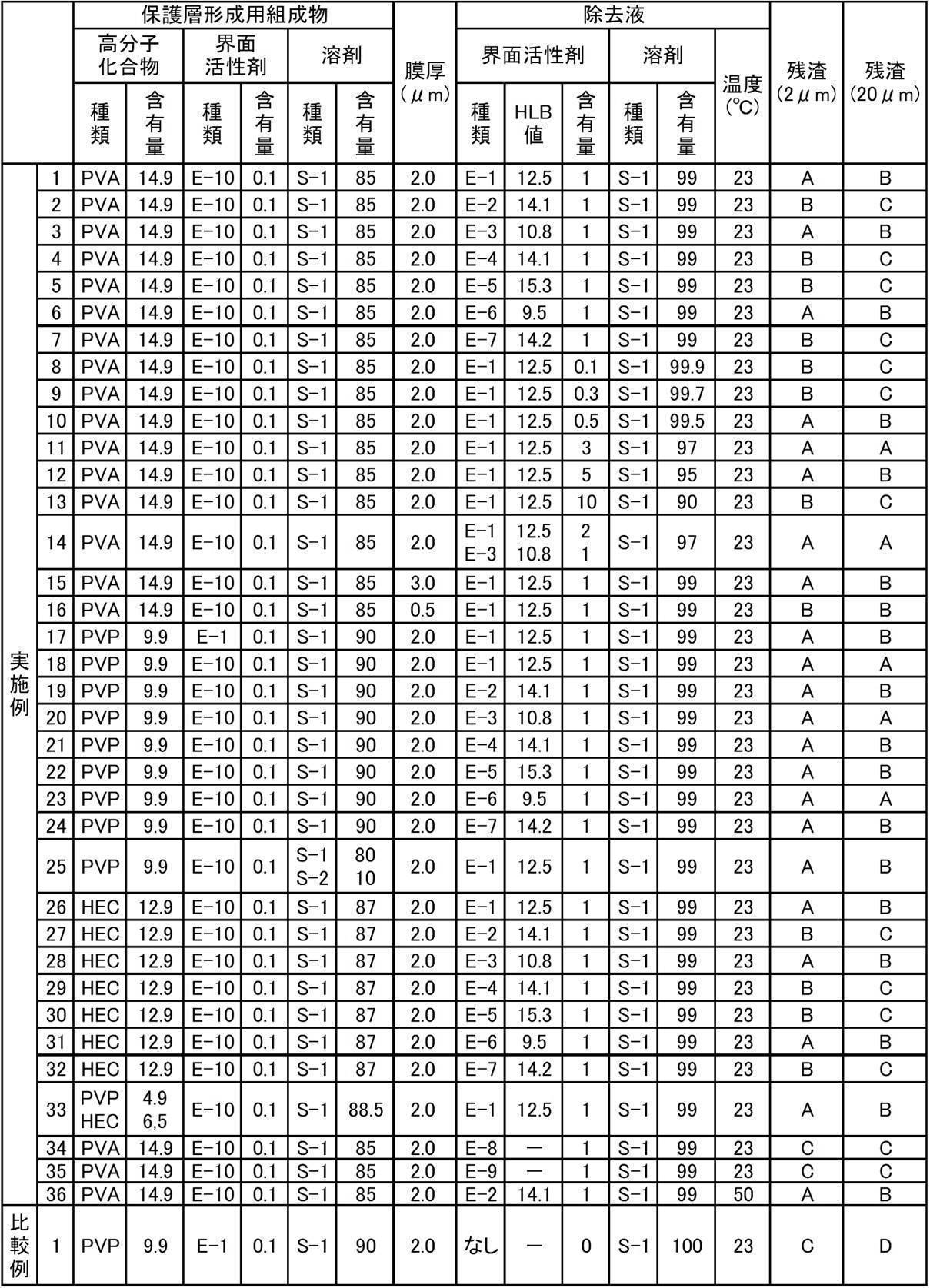
表1中に記載した略語の詳細は、下記の通りである。
〔高分子化合物〕
・PVA:クラレ社製PVA-205、Mw=24,000。
・PVP:第一工業製薬社製ピッツコールK-90、Mw=1,200,000。
・HEC:富士フイルム和光純薬社製2-ヒドロキシエチルセルロース、Mw=720,000。
・PVA:クラレ社製PVA-205、Mw=24,000。
・PVP:第一工業製薬社製ピッツコールK-90、Mw=1,200,000。
・HEC:富士フイルム和光純薬社製2-ヒドロキシエチルセルロース、Mw=720,000。
〔界面活性剤〕
・E-1:EMALEX 710(日本エマルジョン(株)製)
・E-2:パイオニンD-1007(竹本油脂(株)製)
・E-3:パイオニンD-1105(竹本油脂(株)製)
・E-4:パイオニンD-1110(竹本油脂(株)製)
・E-5:パイオニンD-1420(竹本油脂(株)製)
・E-6:パイオニンD-2104-D(竹本油脂(株)製)
・E-7:エマルゲン220(花王ケミカル(株)製)
・E-8:ユニルーブMS-70K(日油製)
・E-9:ユニグリMK-230(日油製)
・E-10:アセチレノールE00(川研ファインケミカル(株)製)
・E-1:EMALEX 710(日本エマルジョン(株)製)
・E-2:パイオニンD-1007(竹本油脂(株)製)
・E-3:パイオニンD-1105(竹本油脂(株)製)
・E-4:パイオニンD-1110(竹本油脂(株)製)
・E-5:パイオニンD-1420(竹本油脂(株)製)
・E-6:パイオニンD-2104-D(竹本油脂(株)製)
・E-7:エマルゲン220(花王ケミカル(株)製)
・E-8:ユニルーブMS-70K(日油製)
・E-9:ユニグリMK-230(日油製)
・E-10:アセチレノールE00(川研ファインケミカル(株)製)
〔溶剤〕
・S-1:純水
・S-2:エタノール
・S-1:純水
・S-2:エタノール
<感光層形成用組成物の調製>
各実施例及び比較例において、それぞれ、下記成分を混合し、感光層形成用組成物を調製した。
・樹脂A-1:30.09質量部
・光酸発生剤(化合物X(下記構造)、R11はトリル基、R18はメチル基を表す。ダイトーケミックス(株)製):0.26質量部

・塩基性化合物(化合物Y(下記構造)、DSP五協フード&ケミカル(株)製):0.08質量部

・界面活性剤(OMNOVA社製、PF-6320):0.08質量部
・PGMEA(プロピレングリコールモノメチルエーテルアセテート):69.5質量部
各実施例及び比較例において、それぞれ、下記成分を混合し、感光層形成用組成物を調製した。
・樹脂A-1:30.09質量部
・光酸発生剤(化合物X(下記構造)、R11はトリル基、R18はメチル基を表す。ダイトーケミックス(株)製):0.26質量部
・PGMEA(プロピレングリコールモノメチルエーテルアセテート):69.5質量部
〔樹脂A-1の合成〕
窒素導入管及び冷却管を取り付けた三口フラスコにPGMEA(32.62g)を入れ、86℃に昇温した。ここに、BzMA(ベンジルメタクリレート、16.65g)、THFMA(メタクリル酸テトラヒドロフルフリル、21.08g)、t-BuMA(t-ブチルメタクリレート、5.76g)、及びV-601(0.4663g、富士フイルム和光純薬(株)製)をPGMEA(32.62g)に溶解したものを2時間かけて滴下し、反応液とした。その後、上記反応液を2時間撹拌し、反応を終了させた。反応液をヘプタン中に再沈することで生じた白色粉体をろ過により回収することで、樹脂A-1を得た。重量平均分子量(Mw)は45,000であった。
窒素導入管及び冷却管を取り付けた三口フラスコにPGMEA(32.62g)を入れ、86℃に昇温した。ここに、BzMA(ベンジルメタクリレート、16.65g)、THFMA(メタクリル酸テトラヒドロフルフリル、21.08g)、t-BuMA(t-ブチルメタクリレート、5.76g)、及びV-601(0.4663g、富士フイルム和光純薬(株)製)をPGMEA(32.62g)に溶解したものを2時間かけて滴下し、反応液とした。その後、上記反応液を2時間撹拌し、反応を終了させた。反応液をヘプタン中に再沈することで生じた白色粉体をろ過により回収することで、樹脂A-1を得た。重量平均分子量(Mw)は45,000であった。
<評価>
〔残渣評価〕
-有機半導体膜(有機層)の形成-
各実施例及び比較例において、それぞれ、5cm角のガラス基板上に、以下の組成からなる有機半導体塗布液(有機半導体形成用組成物)をスピンコートし、130℃で10分乾燥させることで有機半導体膜を形成した。膜厚は150nmであった。
ここで、有機半導体膜の表面に対し、TOF-SIMS(Time-of-Flight Secondary Ion Mass Spectrometry)装置(ION-TOF社製TOF.SIMS5)を用いて、m/z=910のシグナル強度I0を測定した。
<<有機半導体塗布液の組成>>
・P3HT(シグマ アルドリッチ ジャパン合同会社製):10質量%
・PCBM(シグマ アルドリッチ ジャパン合同会社製):10質量%
・クロロホルム(富士フイルム和光純薬(株)製):80質量%
〔残渣評価〕
-有機半導体膜(有機層)の形成-
各実施例及び比較例において、それぞれ、5cm角のガラス基板上に、以下の組成からなる有機半導体塗布液(有機半導体形成用組成物)をスピンコートし、130℃で10分乾燥させることで有機半導体膜を形成した。膜厚は150nmであった。
ここで、有機半導体膜の表面に対し、TOF-SIMS(Time-of-Flight Secondary Ion Mass Spectrometry)装置(ION-TOF社製TOF.SIMS5)を用いて、m/z=910のシグナル強度I0を測定した。
<<有機半導体塗布液の組成>>
・P3HT(シグマ アルドリッチ ジャパン合同会社製):10質量%
・PCBM(シグマ アルドリッチ ジャパン合同会社製):10質量%
・クロロホルム(富士フイルム和光純薬(株)製):80質量%
-保護層の形成-
各実施例及び比較例において、それぞれ、上記有機半導体膜の表面に、上記保護層形成用組成物をスピンコートし、100℃で1分乾燥させることで、表1の「膜厚(μm)」の欄に記載の厚さの保護層を形成した。
各実施例及び比較例において、それぞれ、上記有機半導体膜の表面に、上記保護層形成用組成物をスピンコートし、100℃で1分乾燥させることで、表1の「膜厚(μm)」の欄に記載の厚さの保護層を形成した。
-感光性樹脂層(感光層)の形成-
各実施例及び比較例において、それぞれ、製膜した保護層の表面に、上記感光層形成用組成物をスピンコートし、100℃で1分間乾燥し、厚さ3μmの感光性樹脂層(感光層)を形成し、積層体とした。
各実施例及び比較例において、それぞれ、製膜した保護層の表面に、上記感光層形成用組成物をスピンコートし、100℃で1分間乾燥し、厚さ3μmの感光性樹脂層(感光層)を形成し、積層体とした。
-露光-
各実施例及び比較例において、それぞれ、作製された積層体における感光層に対し、i線露光機を用い、フォトマスクとして線幅2.0μmと20.0μmの1:1ラインアンドスペースパターンが線幅0.5μm刻みで形成されたバイナリーマスクを介して、i線により露光した。露光量は線幅2μmの1:1のラインアンドスペースパターンにおいて、2μmのライン線幅が得られる露光量とした。
各実施例及び比較例において、それぞれ、作製された積層体における感光層に対し、i線露光機を用い、フォトマスクとして線幅2.0μmと20.0μmの1:1ラインアンドスペースパターンが線幅0.5μm刻みで形成されたバイナリーマスクを介して、i線により露光した。露光量は線幅2μmの1:1のラインアンドスペースパターンにおいて、2μmのライン線幅が得られる露光量とした。
-現像-
露光後の積層体を70℃で120秒間加熱した後、酢酸ブチル(nBA)を現像液として用いて60秒間現像し、スピン乾燥してレジストパターンを得た。
更に水で20秒間現像し、スピン乾燥して感光層及び保護層のパターンを得た。
露光後の積層体を70℃で120秒間加熱した後、酢酸ブチル(nBA)を現像液として用いて60秒間現像し、スピン乾燥してレジストパターンを得た。
更に水で20秒間現像し、スピン乾燥して感光層及び保護層のパターンを得た。
-エッチング-
上記感光層及び保護層のパターンをマスクパターンとして、以下の条件で基板のドライエッチングを行い、非マスクパターン部の有機層を除去した。
条件:ソースパワー500W、ガス:酸素流量100ml/min、時間3分
上記で作成したエッチング後の基板に除去液を乗せ、60秒間のパドル洗浄後に2,000rpmで30秒間回転して除去液を除去し、さらにもう一度除去液を乗せ、60秒間のパドル洗浄後に2,000rpmで30秒間回転して除去液を除去した。続いて水を乗せ、60秒間パドル洗浄後に2,000rpmで30秒間回転して水を除去し、保護層を除去した基板を得た。
上記操作のいずれにおいても、除去液の温度は表中の「除去液」の「温度(℃)」に記載の温度とした。
上記感光層及び保護層のパターンをマスクパターンとして、以下の条件で基板のドライエッチングを行い、非マスクパターン部の有機層を除去した。
条件:ソースパワー500W、ガス:酸素流量100ml/min、時間3分
上記で作成したエッチング後の基板に除去液を乗せ、60秒間のパドル洗浄後に2,000rpmで30秒間回転して除去液を除去し、さらにもう一度除去液を乗せ、60秒間のパドル洗浄後に2,000rpmで30秒間回転して除去液を除去した。続いて水を乗せ、60秒間パドル洗浄後に2,000rpmで30秒間回転して水を除去し、保護層を除去した基板を得た。
上記操作のいずれにおいても、除去液の温度は表中の「除去液」の「温度(℃)」に記載の温度とした。
真空乾燥後、上記基板における、有機層のパターン表面に対してTOF-SIMS測定を再度実施し、有機半導体材料由来のシグナルIを測定した。
下記式によりシグナル強度比を算出し、下記評価基準に従って評価した。
フォトマスクとして線幅2.0μmの1:1ラインアンドスペースパターンが形成されたバイナリーマスクを用いた部分における評価結果を表1の「残渣(2μm)」の欄に、線幅20.0μmの1:1ラインアンドスペースパターンが形成されたバイナリーマスクを用いた部分における評価結果を表1の「残渣(20μm)」の欄に、それぞれ記載した。
シグナル強度比が大きいほど、保護層を除去した場合の残渣の除去に有効であるといえる。
シグナル強度比(%)=[I/I0]×100
-評価基準-
A:シグナル強度比(%)が75%以上であった。
B:シグナル強度比(%)が50%以上75%未満であった。
C:シグナル強度比(%)が25%以上50%未満であった。
D:シグナル強度比(%)が25%未満であった。
下記式によりシグナル強度比を算出し、下記評価基準に従って評価した。
フォトマスクとして線幅2.0μmの1:1ラインアンドスペースパターンが形成されたバイナリーマスクを用いた部分における評価結果を表1の「残渣(2μm)」の欄に、線幅20.0μmの1:1ラインアンドスペースパターンが形成されたバイナリーマスクを用いた部分における評価結果を表1の「残渣(20μm)」の欄に、それぞれ記載した。
シグナル強度比が大きいほど、保護層を除去した場合の残渣の除去に有効であるといえる。
シグナル強度比(%)=[I/I0]×100
-評価基準-
A:シグナル強度比(%)が75%以上であった。
B:シグナル強度比(%)が50%以上75%未満であった。
C:シグナル強度比(%)が25%以上50%未満であった。
D:シグナル強度比(%)が25%未満であった。
(実施例34)
実施例11において、「上記で作成したエッチング後の基板に除去液を乗せ、60秒間のパドル洗浄後に2,000rpmで30秒間回転して除去液を除去し、さらにもう一度除去液を乗せ、60秒間のパドル洗浄後に2,000rpmで30秒間回転して除去液を除去した。」という操作を「上記で作成したエッチング後の基板に除去液を乗せ、60秒間のパドル洗浄後に2,000rpmで30秒間回転して除去液を除去した」という操作に変更し、除去液を用いたパドル洗浄を2回から1回に変更した以外は、実施例11と同様の方法により残渣の評価を行った。
評価結果は、フォトマスクとして線幅2.0μmの1:1ラインアンドスペースパターンが形成されたバイナリーマスクを用いた部分における評価、及び、線幅20.0μmの1:1ラインアンドスペースパターンが形成されたバイナリーマスクを用いた部分における評価結果のいずれもCであった。
実施例11において、「上記で作成したエッチング後の基板に除去液を乗せ、60秒間のパドル洗浄後に2,000rpmで30秒間回転して除去液を除去し、さらにもう一度除去液を乗せ、60秒間のパドル洗浄後に2,000rpmで30秒間回転して除去液を除去した。」という操作を「上記で作成したエッチング後の基板に除去液を乗せ、60秒間のパドル洗浄後に2,000rpmで30秒間回転して除去液を除去した」という操作に変更し、除去液を用いたパドル洗浄を2回から1回に変更した以外は、実施例11と同様の方法により残渣の評価を行った。
評価結果は、フォトマスクとして線幅2.0μmの1:1ラインアンドスペースパターンが形成されたバイナリーマスクを用いた部分における評価、及び、線幅20.0μmの1:1ラインアンドスペースパターンが形成されたバイナリーマスクを用いた部分における評価結果のいずれもCであった。
表1に記載した結果から、本発明の除去液によれば、保護層を除去した場合の残渣の除去に有効であることがわかる。
比較例1において使用された除去液は、除去液用界面活性剤を含まない。このような除去液を用いた場合には、保護層を除去した場合の残渣の抑制に劣ることがわかる。
比較例1において使用された除去液は、除去液用界面活性剤を含まない。このような除去液を用いた場合には、保護層を除去した場合の残渣の抑制に劣ることがわかる。
国際公開第2018/061821号の実施例1と同様の方法により、ゲート電極、ゲート絶縁膜、ソース電極及びドレイン電極が形成された基材を作製した。
上記基材上に、本発明の実施例1~実施例36における残渣評価において示した方法と同様の方法により、それぞれ、有機半導体層、保護層及び感光層を形成した。その後、上記残渣評価において示した方法と同様の方法により、感光層の現像、保護層及び有機半導体層のエッチングを行い、ソース電極及びドレイン電極に接するように有機半導体層を形成し、有機電界効果トランジスタを製造した。
上記有機電界効果トランジスタは正常に動作した。
上記基材上に、本発明の実施例1~実施例36における残渣評価において示した方法と同様の方法により、それぞれ、有機半導体層、保護層及び感光層を形成した。その後、上記残渣評価において示した方法と同様の方法により、感光層の現像、保護層及び有機半導体層のエッチングを行い、ソース電極及びドレイン電極に接するように有機半導体層を形成し、有機電界効果トランジスタを製造した。
上記有機電界効果トランジスタは正常に動作した。
1 感光層
1a 露光現像後の感光層
2 保護層
3 有機層
3a 加工後の有機層
4 基材
5 現像後の感光層の除去部
5a エッチング後の積層体の除去部
1a 露光現像後の感光層
2 保護層
3 有機層
3a 加工後の有機層
4 基材
5 現像後の感光層の除去部
5a エッチング後の積層体の除去部
Claims (13)
- 界面活性剤を含み、
基材、有機層、保護層、及び感光層をこの順に含む積層体をエッチングしてなるパターンに含まれる保護層の除去に用いられる
除去液。 - 前記界面活性剤の下記グリフィン法により算出されるHLB値が、16.0以下である、請求項1に記載の除去液。
グリフィン法により算出されるHLB値=20×(界面活性剤における親水部の式量)/(界面活性剤の分子量) - 前記HLB値が、13.0以下である、請求項2に記載の除去液。
- 前記界面活性剤が、ポリアルキレングリコール構造を含む、請求項1~3のいずれか1項に記載の除去液。
- 前記界面活性剤が、ポリエチレングリコール構造、及び、炭素数8以上の脂肪族炭化水素基を含む、請求項1~4のいずれか1項に記載の除去液。
- 前記界面活性剤が、ポリエチレングリコール構造、及び、炭素数8以上のアルキル基を含む、請求項1~5のいずれか1項に記載の除去液。
- 水を含む、請求項1~6のいずれか1項に記載の除去液。
- 前記保護層が、アセチレン基を含む界面活性剤を含む、請求項1~7のいずれか1項に記載の除去液。
- 前記保護層が、水溶性樹脂を含む、請求項1~8のいずれか1項に記載の除去液。
- 請求項1~9のいずれか1項に記載の除去液と、
前記保護層の形成に用いられる組成物と、を含む
キット。 - 前記保護層の形成に用いられる組成物が、水溶性樹脂、及び、界面活性剤を含む、請求項10に記載のキット。
- 前記保護層の形成に用いられる組成物に含まれる前記界面活性剤が、アセチレン基を含む界面活性剤である、請求項10又は11に記載のキット。
- 請求項1~9のいずれか1項に記載の除去液により前記パターンから保護層が除去されたパターンを含む
半導体デバイス。
Priority Applications (2)
| Application Number | Priority Date | Filing Date | Title |
|---|---|---|---|
| CN202180019423.6A CN115244470A (zh) | 2020-03-10 | 2021-03-08 | 去除液、套组及半导体器件 |
| JP2022507180A JPWO2021182399A1 (ja) | 2020-03-10 | 2021-03-08 |
Applications Claiming Priority (2)
| Application Number | Priority Date | Filing Date | Title |
|---|---|---|---|
| JP2020-040526 | 2020-03-10 | ||
| JP2020040526 | 2020-03-10 |
Publications (1)
| Publication Number | Publication Date |
|---|---|
| WO2021182399A1 true WO2021182399A1 (ja) | 2021-09-16 |
Family
ID=77672378
Family Applications (1)
| Application Number | Title | Priority Date | Filing Date |
|---|---|---|---|
| PCT/JP2021/009000 Ceased WO2021182399A1 (ja) | 2020-03-10 | 2021-03-08 | 除去液、キット及び半導体デバイス |
Country Status (4)
| Country | Link |
|---|---|
| JP (1) | JPWO2021182399A1 (ja) |
| CN (1) | CN115244470A (ja) |
| TW (1) | TW202200770A (ja) |
| WO (1) | WO2021182399A1 (ja) |
Cited By (1)
| Publication number | Priority date | Publication date | Assignee | Title |
|---|---|---|---|---|
| WO2024070946A1 (ja) * | 2022-09-30 | 2024-04-04 | 富士フイルム株式会社 | 組成物、基板の処理方法、半導体デバイスの製造方法、化合物 |
Families Citing this family (1)
| Publication number | Priority date | Publication date | Assignee | Title |
|---|---|---|---|---|
| CN117363088A (zh) * | 2023-11-10 | 2024-01-09 | 中国美术学院 | 一种涂鸦及喷漆广告清除剂及其制备方法 |
Citations (5)
| Publication number | Priority date | Publication date | Assignee | Title |
|---|---|---|---|---|
| JP2007119783A (ja) * | 2005-10-27 | 2007-05-17 | Mitsubishi Gas Chem Co Inc | 洗浄液及び洗浄方法 |
| JP2011222212A (ja) * | 2010-04-07 | 2011-11-04 | Konica Minolta Holdings Inc | 有機電子デバイスの製造方法、有機電子デバイスおよびガスバリアフィルム前駆体 |
| WO2015064605A1 (ja) * | 2013-10-31 | 2015-05-07 | 富士フイルム株式会社 | 積層体、有機半導体製造用キットおよび有機半導体製造用レジスト組成物 |
| WO2016017782A1 (ja) * | 2014-08-01 | 2016-02-04 | 三菱化学株式会社 | 光学素子の製造方法、その方法を用いて得られる光学素子及びその光学素子を備えた画像表示装置 |
| JP2017063008A (ja) * | 2015-09-26 | 2017-03-30 | キヤノン株式会社 | 有機電子素子の製造方法 |
Family Cites Families (2)
| Publication number | Priority date | Publication date | Assignee | Title |
|---|---|---|---|---|
| JP6306621B2 (ja) * | 2015-02-17 | 2018-04-04 | 富士フイルム株式会社 | 薄膜トランジスタ基板の製造方法、表示装置の製造方法及び表示装置 |
| TW201936768A (zh) * | 2018-03-01 | 2019-09-16 | 日商富士軟片股份有限公司 | 積層體、水溶性樹脂組成物、試劑盒 |
-
2021
- 2021-03-08 CN CN202180019423.6A patent/CN115244470A/zh active Pending
- 2021-03-08 JP JP2022507180A patent/JPWO2021182399A1/ja active Pending
- 2021-03-08 TW TW110108039A patent/TW202200770A/zh unknown
- 2021-03-08 WO PCT/JP2021/009000 patent/WO2021182399A1/ja not_active Ceased
Patent Citations (5)
| Publication number | Priority date | Publication date | Assignee | Title |
|---|---|---|---|---|
| JP2007119783A (ja) * | 2005-10-27 | 2007-05-17 | Mitsubishi Gas Chem Co Inc | 洗浄液及び洗浄方法 |
| JP2011222212A (ja) * | 2010-04-07 | 2011-11-04 | Konica Minolta Holdings Inc | 有機電子デバイスの製造方法、有機電子デバイスおよびガスバリアフィルム前駆体 |
| WO2015064605A1 (ja) * | 2013-10-31 | 2015-05-07 | 富士フイルム株式会社 | 積層体、有機半導体製造用キットおよび有機半導体製造用レジスト組成物 |
| WO2016017782A1 (ja) * | 2014-08-01 | 2016-02-04 | 三菱化学株式会社 | 光学素子の製造方法、その方法を用いて得られる光学素子及びその光学素子を備えた画像表示装置 |
| JP2017063008A (ja) * | 2015-09-26 | 2017-03-30 | キヤノン株式会社 | 有機電子素子の製造方法 |
Cited By (1)
| Publication number | Priority date | Publication date | Assignee | Title |
|---|---|---|---|---|
| WO2024070946A1 (ja) * | 2022-09-30 | 2024-04-04 | 富士フイルム株式会社 | 組成物、基板の処理方法、半導体デバイスの製造方法、化合物 |
Also Published As
| Publication number | Publication date |
|---|---|
| JPWO2021182399A1 (ja) | 2021-09-16 |
| CN115244470A (zh) | 2022-10-25 |
| TW202200770A (zh) | 2022-01-01 |
Similar Documents
| Publication | Publication Date | Title |
|---|---|---|
| JP6514770B2 (ja) | 積層体およびキット | |
| WO2021182399A1 (ja) | 除去液、キット及び半導体デバイス | |
| WO2022050313A1 (ja) | 有機層パターンの製造方法、及び、半導体デバイスの製造方法 | |
| JP7170123B2 (ja) | 積層体、組成物、及び、積層体形成用キット | |
| JPWO2019167914A1 (ja) | 積層体、水溶性樹脂組成物、キット | |
| US20220075265A1 (en) | Laminate, composition, and, laminate forming kit | |
| JP2021107473A (ja) | 保護層形成用組成物、層状膜、保護層、積層体、キット及び半導体デバイス | |
| JP7182007B2 (ja) | 保護層形成用組成物、層状膜、保護層、積層体および半導体デバイスの製造方法 | |
| JP7149418B2 (ja) | 保護層形成用組成物の製造方法、保護層形成用組成物の保存方法およびこの保存方法の応用 | |
| JP2021110796A (ja) | 感光性樹脂組成物、層状膜、感光層、積層体、キット及び半導体デバイス | |
| JP2021110839A (ja) | 積層体、保護層形成用組成物、キット及び半導体デバイス | |
| CN111758074A (zh) | 感光层、层叠体、感光性树脂组合物、试剂盒及感光性树脂组合物的制造方法 | |
| JPWO2020184406A1 (ja) | 積層体、組成物、及び、積層体形成用キット |
Legal Events
| Date | Code | Title | Description |
|---|---|---|---|
| 121 | Ep: the epo has been informed by wipo that ep was designated in this application |
Ref document number: 21768569 Country of ref document: EP Kind code of ref document: A1 |
|
| ENP | Entry into the national phase |
Ref document number: 2022507180 Country of ref document: JP Kind code of ref document: A |
|
| NENP | Non-entry into the national phase |
Ref country code: DE |
|
| 122 | Ep: pct application non-entry in european phase |
Ref document number: 21768569 Country of ref document: EP Kind code of ref document: A1 |