WO2021166977A1 - 細胞移植前処理方法、細胞移植前処理装置、および細胞移植前処理ユニット - Google Patents
細胞移植前処理方法、細胞移植前処理装置、および細胞移植前処理ユニット Download PDFInfo
- Publication number
- WO2021166977A1 WO2021166977A1 PCT/JP2021/006002 JP2021006002W WO2021166977A1 WO 2021166977 A1 WO2021166977 A1 WO 2021166977A1 JP 2021006002 W JP2021006002 W JP 2021006002W WO 2021166977 A1 WO2021166977 A1 WO 2021166977A1
- Authority
- WO
- WIPO (PCT)
- Prior art keywords
- pretreatment
- needle
- recess
- culture
- recesses
- Prior art date
- Legal status (The legal status is an assumption and is not a legal conclusion. Google has not performed a legal analysis and makes no representation as to the accuracy of the status listed.)
- Ceased
Links
Images





Classifications
-
- C—CHEMISTRY; METALLURGY
- C12—BIOCHEMISTRY; BEER; SPIRITS; WINE; VINEGAR; MICROBIOLOGY; ENZYMOLOGY; MUTATION OR GENETIC ENGINEERING
- C12M—APPARATUS FOR ENZYMOLOGY OR MICROBIOLOGY; APPARATUS FOR CULTURING MICROORGANISMS FOR PRODUCING BIOMASS, FOR GROWING CELLS OR FOR OBTAINING FERMENTATION OR METABOLIC PRODUCTS, i.e. BIOREACTORS OR FERMENTERS
- C12M23/00—Constructional details, e.g. recesses, hinges
- C12M23/02—Form or structure of the vessel
- C12M23/12—Well or multiwell plates
-
- C—CHEMISTRY; METALLURGY
- C12—BIOCHEMISTRY; BEER; SPIRITS; WINE; VINEGAR; MICROBIOLOGY; ENZYMOLOGY; MUTATION OR GENETIC ENGINEERING
- C12M—APPARATUS FOR ENZYMOLOGY OR MICROBIOLOGY; APPARATUS FOR CULTURING MICROORGANISMS FOR PRODUCING BIOMASS, FOR GROWING CELLS OR FOR OBTAINING FERMENTATION OR METABOLIC PRODUCTS, i.e. BIOREACTORS OR FERMENTERS
- C12M33/00—Means for introduction, transport, positioning, extraction, harvesting, peeling or sampling of biological material in or from the apparatus
-
- A—HUMAN NECESSITIES
- A61—MEDICAL OR VETERINARY SCIENCE; HYGIENE
- A61L—METHODS OR APPARATUS FOR STERILISING MATERIALS OR OBJECTS IN GENERAL; DISINFECTION, STERILISATION OR DEODORISATION OF AIR; CHEMICAL ASPECTS OF BANDAGES, DRESSINGS, ABSORBENT PADS OR SURGICAL ARTICLES; MATERIALS FOR BANDAGES, DRESSINGS, ABSORBENT PADS OR SURGICAL ARTICLES
- A61L27/00—Materials for grafts or prostheses or for coating grafts or prostheses
- A61L27/36—Materials for grafts or prostheses or for coating grafts or prostheses containing ingredients of undetermined constitution or reaction products thereof, e.g. transplant tissue, natural bone, extracellular matrix
- A61L27/3604—Materials for grafts or prostheses or for coating grafts or prostheses containing ingredients of undetermined constitution or reaction products thereof, e.g. transplant tissue, natural bone, extracellular matrix characterised by the human or animal origin of the biological material, e.g. hair, fascia, fish scales, silk, shellac, pericardium, pleura, renal tissue, amniotic membrane, parenchymal tissue, fetal tissue, muscle tissue, fat tissue, enamel
-
- A—HUMAN NECESSITIES
- A61—MEDICAL OR VETERINARY SCIENCE; HYGIENE
- A61L—METHODS OR APPARATUS FOR STERILISING MATERIALS OR OBJECTS IN GENERAL; DISINFECTION, STERILISATION OR DEODORISATION OF AIR; CHEMICAL ASPECTS OF BANDAGES, DRESSINGS, ABSORBENT PADS OR SURGICAL ARTICLES; MATERIALS FOR BANDAGES, DRESSINGS, ABSORBENT PADS OR SURGICAL ARTICLES
- A61L27/00—Materials for grafts or prostheses or for coating grafts or prostheses
- A61L27/36—Materials for grafts or prostheses or for coating grafts or prostheses containing ingredients of undetermined constitution or reaction products thereof, e.g. transplant tissue, natural bone, extracellular matrix
- A61L27/3641—Materials for grafts or prostheses or for coating grafts or prostheses containing ingredients of undetermined constitution or reaction products thereof, e.g. transplant tissue, natural bone, extracellular matrix characterised by the site of application in the body
- A61L27/3666—Epithelial tissues other than skin
-
- A—HUMAN NECESSITIES
- A61—MEDICAL OR VETERINARY SCIENCE; HYGIENE
- A61L—METHODS OR APPARATUS FOR STERILISING MATERIALS OR OBJECTS IN GENERAL; DISINFECTION, STERILISATION OR DEODORISATION OF AIR; CHEMICAL ASPECTS OF BANDAGES, DRESSINGS, ABSORBENT PADS OR SURGICAL ARTICLES; MATERIALS FOR BANDAGES, DRESSINGS, ABSORBENT PADS OR SURGICAL ARTICLES
- A61L27/00—Materials for grafts or prostheses or for coating grafts or prostheses
- A61L27/36—Materials for grafts or prostheses or for coating grafts or prostheses containing ingredients of undetermined constitution or reaction products thereof, e.g. transplant tissue, natural bone, extracellular matrix
- A61L27/3683—Materials for grafts or prostheses or for coating grafts or prostheses containing ingredients of undetermined constitution or reaction products thereof, e.g. transplant tissue, natural bone, extracellular matrix subjected to a specific treatment prior to implantation, e.g. decellularising, demineralising, grinding, cellular disruption/non-collagenous protein removal, anti-calcification, crosslinking, supercritical fluid extraction, enzyme treatment
-
- C—CHEMISTRY; METALLURGY
- C12—BIOCHEMISTRY; BEER; SPIRITS; WINE; VINEGAR; MICROBIOLOGY; ENZYMOLOGY; MUTATION OR GENETIC ENGINEERING
- C12M—APPARATUS FOR ENZYMOLOGY OR MICROBIOLOGY; APPARATUS FOR CULTURING MICROORGANISMS FOR PRODUCING BIOMASS, FOR GROWING CELLS OR FOR OBTAINING FERMENTATION OR METABOLIC PRODUCTS, i.e. BIOREACTORS OR FERMENTERS
- C12M23/00—Constructional details, e.g. recesses, hinges
- C12M23/22—Transparent or translucent parts
-
- C—CHEMISTRY; METALLURGY
- C12—BIOCHEMISTRY; BEER; SPIRITS; WINE; VINEGAR; MICROBIOLOGY; ENZYMOLOGY; MUTATION OR GENETIC ENGINEERING
- C12M—APPARATUS FOR ENZYMOLOGY OR MICROBIOLOGY; APPARATUS FOR CULTURING MICROORGANISMS FOR PRODUCING BIOMASS, FOR GROWING CELLS OR FOR OBTAINING FERMENTATION OR METABOLIC PRODUCTS, i.e. BIOREACTORS OR FERMENTERS
- C12M33/00—Means for introduction, transport, positioning, extraction, harvesting, peeling or sampling of biological material in or from the apparatus
- C12M33/04—Means for introduction, transport, positioning, extraction, harvesting, peeling or sampling of biological material in or from the apparatus by injection or suction, e.g. using pipettes, syringes, needles
- C12M33/06—Means for introduction, transport, positioning, extraction, harvesting, peeling or sampling of biological material in or from the apparatus by injection or suction, e.g. using pipettes, syringes, needles for multiple inoculation or multiple collection of samples
-
- A—HUMAN NECESSITIES
- A61—MEDICAL OR VETERINARY SCIENCE; HYGIENE
- A61L—METHODS OR APPARATUS FOR STERILISING MATERIALS OR OBJECTS IN GENERAL; DISINFECTION, STERILISATION OR DEODORISATION OF AIR; CHEMICAL ASPECTS OF BANDAGES, DRESSINGS, ABSORBENT PADS OR SURGICAL ARTICLES; MATERIALS FOR BANDAGES, DRESSINGS, ABSORBENT PADS OR SURGICAL ARTICLES
- A61L2430/00—Materials or treatment for tissue regeneration
- A61L2430/18—Materials or treatment for tissue regeneration for hair reconstruction
-
- A—HUMAN NECESSITIES
- A61—MEDICAL OR VETERINARY SCIENCE; HYGIENE
- A61M—DEVICES FOR INTRODUCING MEDIA INTO, OR ONTO, THE BODY; DEVICES FOR TRANSDUCING BODY MEDIA OR FOR TAKING MEDIA FROM THE BODY; DEVICES FOR PRODUCING OR ENDING SLEEP OR STUPOR
- A61M37/00—Other apparatus for introducing media into the body; Percutany, i.e. introducing medicines into the body by diffusion through the skin
- A61M37/0015—Other apparatus for introducing media into the body; Percutany, i.e. introducing medicines into the body by diffusion through the skin by using microneedles
- A61M2037/0061—Methods for using microneedles
-
- A—HUMAN NECESSITIES
- A61—MEDICAL OR VETERINARY SCIENCE; HYGIENE
- A61M—DEVICES FOR INTRODUCING MEDIA INTO, OR ONTO, THE BODY; DEVICES FOR TRANSDUCING BODY MEDIA OR FOR TAKING MEDIA FROM THE BODY; DEVICES FOR PRODUCING OR ENDING SLEEP OR STUPOR
- A61M37/00—Other apparatus for introducing media into the body; Percutany, i.e. introducing medicines into the body by diffusion through the skin
- A61M37/0015—Other apparatus for introducing media into the body; Percutany, i.e. introducing medicines into the body by diffusion through the skin by using microneedles
Definitions
- the present disclosure relates to a cell transplant pretreatment method, a cell transplant pretreatment device, and a cell transplant pretreatment unit.
- Hair follicles are formed by the interaction between epithelial cells and mesenchymal cells. For good hair regeneration, it is desirable that the transplanted cell population yields hair follicles with normal tissue structure and the ability to form periodic hair. Therefore, various researches and developments have been carried out on methods for producing and transplanting cell groups capable of forming such hair follicles (see, for example, Patent Documents 1 to 3). In addition, cell transplantation performed by surgery has a heavy load on the body and requires a great deal of labor, so there is a high need for a transplantation method that improves safety and convenience, and in order to meet these needs. , Various cell transplantation methods have been developed (see, for example, Patent Document 4).
- a transplantation containing a group of cells that contributes to hair follicle regeneration is filled in a needle-shaped portion provided in the transplantation device and injected into a living body. It has been transplanted in.
- the needle-shaped portion is provided on the transplantation device so as to correspond to the planned transplantation site of the cell group. This allows the transplant device to transplant the cell population to the planned transplant site.
- the position and spacing of cell groups transplanted into the skin are important.
- the planned transplantation site of the cell group may be set to an irregular arrangement or a regular arrangement according to the purpose of the transplant destination.
- the culture recesses are arranged in a regular matrix according to the application in which the culture recesses for culturing the cell group are used one by one in order.
- the arrangement of the needle-shaped portion and the arrangement of the culture recesses do not match, and it is difficult to fill the needle-shaped portion with the implant from a plurality of culture recesses at one time. It takes time and effort.
- An object of the present disclosure is to provide a cell transplant pretreatment method, a cell transplant pretreatment device, and a cell transplant pretreatment unit that can improve the work efficiency of filling a transplant device with a transplant.
- the cell transplantation pretreatment method includes a culture tray having a plurality of culture recesses arranged according to the first sequence, a pretreatment tray having a plurality of pretreatment recesses arranged according to the second sequence, and the like.
- the cell transplantation pretreatment apparatus for solving the above problems includes a culture tray having a plurality of culture recesses arranged according to the first sequence and a pretreatment tray having a plurality of pretreatment recesses arranged according to the second sequence.
- a transport unit that transports a group of cells cultured in the plurality of culture recesses to the plurality of pretreatment recesses, and a plurality of needle-shaped portions arranged according to the second sequence and containing the cell group are used.
- the transplantation device having the plurality of needle-shaped portions having a tubular shape configured to be able to enter and exit and the pretreatment tray, the plurality of needle-shaped portions are simultaneously filled with the cell group from the plurality of pretreatment recesses. It is provided with a filling part.
- the cell transplantation pretreatment unit for solving the above problems is a culture tray having a plurality of culture recesses arranged according to the first sequence and a pretreatment tray having a plurality of pretreatment recesses arranged according to the second sequence.
- the pretreatment tray in which the cell group cultured in the plurality of culture recesses is transported to the plurality of pretreatment recesses, and the plurality of needle-shaped portions arranged according to the second arrangement include the cell group. 2. To be equipped.
- the ability to fill multiple needles of a transplant device at once makes it possible to simultaneously perform cell transplantation at many planned transplantation sites, greatly improving work efficiency from cell culture to cell transplantation.
- the plurality of needles in the transplant device are set to an irregular arrangement or a regular arrangement according to the application of the transplant destination
- the plurality of culture recesses in the culture tray are arranged in an arrangement of needles. It has a sequence unrelated to.
- Such a difference in arrangement between the culture recess and the needle-shaped portion makes it difficult to fill the implant in the plurality of needle-shaped portions at one time, and a plurality of needles are filled in each culture recess. It requires a great deal of time and effort to fill the implants one by one while moving the shaped parts together.
- the pretreatment tray is provided with the pretreatment recess according to the arrangement of the needle-shaped portion in the transplant device. Therefore, it becomes easy to insert the needle-shaped portion into the pretreatment recess, and it is possible to reduce the number of steps for filling the transplant device from the pretreatment tray with the implant. This makes it possible to improve the work efficiency of filling the transplant device with the transplant.
- the inner diameter of the pretreatment recess may be smaller than the inner diameter of the culture recess.
- the cell group contained in the implant is less likely to be aspirated than a liquid such as a protective solution contained in the implant.
- the inner diameter of the pretreatment recess is smaller than the inner diameter of the culture recess, the gap between the pretreatment recess and the needle-shaped portion when the transplant is sucked from the pretreatment recess into the needle-shaped portion. Can be made smaller.
- the needle-shaped portion may be filled with the cell group in a state where the insertion of the needle-shaped portion is locked to the locking portion.
- the shape of the bottom surface of the pretreatment recess and the shape of the bottom surface of the culture recess may be different from each other.
- the bottom surface of the culture recess can be shaped to be suitable for culturing cells, and the bottom surface of the pretreatment recess can be shaped to be suitable for filling the implant into the transplant device.
- the bottom surface of the culture recess can be made flat so that the cell groups can easily adhere to each other, and the bottom surface of the pretreatment recess can be made hemispherical with a recessed center so that the cell groups can be easily sucked. It is possible. This makes it possible to improve the efficiency of cell culture and the efficiency of filling work.
- the first sequence and the second sequence may satisfy at least one of the following conditions 1 to 3.
- Condition 1 The arrangement direction of the culture recesses arranged according to the first arrangement and the arrangement direction of the pretreatment recesses arranged according to the second arrangement are different from each other.
- Condition 2 The distance between the culture recesses adjacent to each other and the distance between the pretreatment recesses adjacent to each other are different from each other.
- Condition 3 The number of the culture recesses in the arrangement direction of the culture recesses arranged according to the first arrangement and the number of the pretreatment recesses in the arrangement direction of the pretreatment recesses arranged according to the second arrangement. Different from each other.
- the depth of the culture recess and the depth of the pretreatment recess may be different from each other.
- the depth of the culture recess and the depth of the pretreatment recess can be set separately, it is possible to set a size suitable for culture as the depth of the culture recess.
- As the depth of the pretreatment recess it is possible to set a size suitable for filling the needle-shaped portion with the implant.
- the implant is moved from the plurality of culture recesses to a single pretreatment recess, and the amount of the implant filled in the needle-shaped portion is increased. It is possible to do.
- the amount of the implant can be adjusted to the amount that can be filled in the needle-shaped portion.
- the pretreatment recess has a shape in which the outer peripheral surface of the needle-shaped portion is fitted, and filling the needle-shaped portion with a cell group means that the pretreatment recess is filled with the needle-shaped portion.
- the needle-shaped portion may be filled with a group of cells with the outer peripheral surface of the portion fitted.
- the pretreatment tray and the transplant device have a structure for positioning the transplant device with respect to the pretreatment tray in a direction orthogonal to the depth direction of the pretreatment recess. May be good.
- the transplant device can be accurately positioned with respect to the pretreatment tray.
- the pretreatment tray may be transparent.
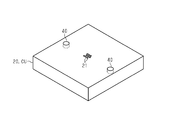
- FIG. 5 is a cross-sectional view illustrating a state before the implant is filled from the pretreatment tray to the needle-shaped portion.
- the cross-sectional view which shows the modification example of the pretreatment tray Sectional drawing which shows the other modification example of the pretreatment tray. Sectional drawing which shows the other modification example of the pretreatment tray. Sectional drawing which shows the other modification example of the pretreatment tray. Sectional drawing which shows the other modification example of the pretreatment tray. Sectional drawing which shows the other modification example of the pretreatment tray.
- the cell transplant unit is used to transplant the transplant.
- the transplant contains a cell group Cg to be transplanted into a living body and a protective solution Pl for protecting the cell group Cg.
- the target site TC into which the implant is transplanted is, for example, at least one of intradermal and subcutaneous, or a tissue such as an organ.
- the cell group Cg may be an aggregate of a plurality of aggregated cells, an aggregate of a plurality of cells bound by cell-cell binding, or may be composed of a plurality of dispersed cells.
- the cells constituting the cell group Cg may be undifferentiated cells, cells that have been completely differentiated, or may contain both undifferentiated cells and differentiated cells.
- the cell group Cg is, for example, a cell mass that is a spheroid, a primordium, a tissue, an organ, an organoid, a mini-organ, or the like.
- the cell group Cg has the ability to act on tissue formation in the living body by being placed at the target site TC.
- An example of the cell group Cg is a cell aggregate containing cells having stem cell properties.
- the cell group Cg contributes to hair growth or hair growth by being placed, for example, intradermally or subcutaneously.
- These cell groups Cg have the ability to function as hair follicle organs, differentiate into hair follicle organs, induce or promote the formation of hair follicle organs, and induce or promote the formation of hair in hair follicles.
- Such a cell group Cg may include cells that contribute to the control of hair color, such as pigment cells or stem cells that differentiate into pigment cells, or may include vasculature cells.
- the cell group Cg in this embodiment is a primitive organ primordium.
- Organ primordia include mesenchymal cells and epithelial cells.
- Organ primordiums include hair follicle primordiums that differentiate into hair follicle organs, liver primordiums, kidney primordia and pancreatic primordiums, nervous system primordia, and vascular primordia.
- the hair follicle primordium is a mixture of mesenchymal cells derived from mesenchymal tissue such as the hair papilla and epithelial cells derived from epithelial tissue located in the bulge region or the base of the hair bulb under predetermined conditions.
- the method for producing the hair follicle primordium is not limited to the above-mentioned example.
- the origin of the mesenchymal cells and epithelial cells used to produce the hair follicle primordia is also not limited, and these cells may be derived from the hair follicle organ or are different from the hair follicle organ. It may be an organ-derived cell or a cell derived from a pluripotent stem cell.
- the cell group Cg does not have to be a cell group that contributes to hair growth or hair growth, and exerts a desired effect by being arranged in at least one of the skin and subcutaneously, or in a tissue such as an organ.
- Cell group Cg may be used.
- the cell group transplanted to the skin region may be a cell group Cg that exerts an effect in cosmetic applications such as elimination of wrinkles in the skin and improvement of a moisturizing state.
- the protective liquid Pl may be any liquid that does not easily inhibit the survival of cells, and is preferably a liquid that has little effect on the living body when injected into the living body.
- the protective liquid Pl is a liquid that protects the skin such as physiological saline, petrolatum or a lotion, or a mixture of these liquids.
- the protective liquid Pl may be a medium for cell culture or a liquid exchanged from the medium.
- the protective liquid Pl may contain an additive component such as a nutritional component.
- the liquid material containing the cell group Cg and the protective solution Pl may be a low-viscosity fluid or a high-viscosity fluid.
- FIG. 1 is a process diagram showing a transport step constituting the cell transplant pretreatment method
- FIG. 2 is a process diagram showing a pretreatment step constituting the cell transplant pretreatment method.
- the cell transplantation pretreatment apparatus uses the cell transplantation pretreatment unit CU.
- the cell transplant pretreatment device includes a transport unit CT.
- the cell transplantation pretreatment unit CU includes a culture tray 10 and a pretreatment tray 20.
- the cell transplantation pretreatment unit CU includes a transplantation device 30.
- the cell transplant pretreatment apparatus includes a filling part CF.
- the culture tray 10 is a tray for culturing the cell group Cg to be transplanted into a living body.
- the pretreatment tray 20 is a tray for filling the transplant device 30 with the transplant carried from the culture tray 10.
- the transplant device 30 is a device for transplanting a transplant into a living body from a pretreatment tray 20.
- the transport unit CT transports the transplant from the culture tray 10 to the pretreatment tray 20.
- the transport unit CT includes, for example, a suction device CTP such as a single pipette or a dropper, and a control device CTU that controls the operation of the suction device CTP.
- the suction device CTP sucks the transplant from the culture recess 11 included in the culture tray 10 and discharges the transplant to the pretreatment recess 21 of the pretreatment tray 20.
- the control device CTU stores, for example, the position of the culture recess 11 in the culture tray 10 and the position of the pretreatment recess 21 in the pretreatment tray 20, determines the destination of the suction device CTP, and implants the suction device CTP into the suction device CTP. Suction and discharge.
- the process performed by the transport unit CT may be performed by the user of the cell transplant pretreatment device.
- the transport section CT causes the dropper or pipette to hold the cell group Cg from the culture recess 11, moves to the pretreatment recess 21, and then injects the cell group Cg into the pretreatment recess 21.
- the transport unit CT may be a robot that automates these series of operations. Further, the transport unit CT may be a group of robots that automate a series of operations by performing each process by a separate robot. Further, some or all of the processes executed by the transport unit CT may not be automated.
- the filling section CF fills the transplant device 30 with the transplant from the pretreatment tray 20.
- the filling portion CF sucks the implant from the pretreatment recess 21 included in the pretreatment tray 20 into the needle-shaped portion 31 included in the transplant device 30, thereby filling the transplant device 30 with the implant.
- the filling portion CF targets the plurality of pretreatment recesses provided in the pretreatment tray 20 and the plurality of needle-shaped portions 31 included in the transplant device 30, and the plurality of pretreatment recesses 21 are transformed into the plurality of needle-shaped portions 31.
- the filling portion CF is, for example, a suction device such as a suction pump.
- the process executed by the filling unit CF that is, the process of aligning the position of the pretreatment tray 20 with the position of the transplant device 30, and the process of filling the transplant device with the transplant carried to the pretreatment tray 20 are performed. , May be done by the user of the cell transplant pretreatment apparatus.
- the filling portion CF aligns the position of each pretreatment recess 21 with the position of each needle-shaped portion 31, and then fills the needle-shaped portion 31 from the pretreatment recess 21 with the implant.
- the filling unit CF may be a robot that automates these series of operations. Further, the filling unit CF may be a group of robots that automate a series of operations by performing each process by a separate robot. Further, some or all of the processes performed by the filling unit CF may not be automated.
- the culture tray 10 includes a plurality of culture recesses 11 which are recesses for culturing cells collected from the collection target.
- the cell group Cg is cultured until the cell group Cg is in a state suitable for transplantation.
- the material of the culture tray 10 and the shape of the culture recess 11 are appropriately selected according to the characteristics of the cell group Cg to be cultured.
- the culture recesses 11 are arranged in the culture tray 10 according to the first sequence.
- the first arrangement is an arrangement of all the culture recesses 11 or an arrangement of a plurality of culture recesses 11 repeated in a predetermined direction in all the culture recesses 11.
- the culture recesses 11 may be arranged irregularly.
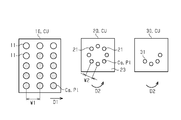
- the culture recesses 11 are arranged in the first arrangement direction D1.
- the culture recesses 11 adjacent to each other are arranged with a culture interval W1.
- the three culture recesses 11 arranged in the first arrangement direction D1 are one row of culture recesses 11.
- the culture recesses 11 for five rows are arranged in a matrix in the directions orthogonal to the first arrangement direction D1 and the first arrangement direction D1.
- the inner diameter of each culture recess 11 is a size that allows cell group Cg to be cultured.
- the inner diameter of each culture recess 11 is preferably large from the viewpoint that it is easy to put in and take out a drug, a medium, or the like into the culture recess 11.
- the culture interval W1 may be different in the culture recess 11 in one row, or may be different in the first sequence. Further, the inner diameter of each culture recess 11 may be different from the inner diameter of the other culture recess 11.
- the pretreatment tray 20 includes a plurality of pretreatment recesses 21 which are recesses for receiving the cell group Cg cultured in the culture tray 10.
- the pretreatment recess 21 which are recesses for receiving the cell group Cg cultured in the culture tray 10.
- the cell group Cg transported from the culture recess 11 is received, and the transplant unit of the cell group Cg is filled.
- the shape of the pretreatment recess 21 and the like are appropriately selected according to the filling of the cell group Cg.
- the pretreatment recess 21 makes it possible to hold the protective liquid Pl together with the cell group Cg for a certain period of time.
- the protective liquid Pl evaporates as compared with the configuration in which the pretreatment tray 20 does not have the pretreatment recess 21, for example, when the pretreatment tray 20 is flat. It is possible to prevent the protective liquid Pl from getting wet and spreading on the surface of the pretreatment tray 20. This makes it possible to prevent the cell group Cg from drying out, suppress the change in the component ratio of the protective solution Pl, and increase the probability that the cell group Cg will engraft.
- the pretreatment recess 21 also makes it possible for the pretreatment tray 20 to change the protection conditions of the protective liquid Pl to other conditions.
- the protective conditions of the protective liquid Pl can be changed, for example, by moving the cell group Cg to the pretreatment recess 21 and then filling the pretreatment recess 21 with another protective liquid Pl, or by filling the pretreatment recess 21 with another protective liquid Pl.
- the cell group Cg is transferred to the pretreatment recess 21.
- Such changes in the protective conditions of the protective solution Pl are more efficient than changing the protective conditions of the protective solution Pl without moving the cell group Cg, such as replacement or addition of the protective solution Pl. Is possible. This also makes it easy to change to a protection condition with high safety or a protection condition with a long expiration date.
- the pretreatment recesses 21 are arranged in the pretreatment tray 20 according to the second arrangement.
- the second arrangement is an arrangement of all the pretreatment recesses 21 or an arrangement of the pretreatment recesses 21 repeated in a predetermined direction among all the pretreatment recesses 21.
- the pretreatment recesses 21 may be arranged irregularly.
- three pretreatment recesses 21 are arranged in the second arrangement direction D2.
- the pretreatment recesses 21 adjacent to each other are arranged with a pretreatment interval W2.
- the three pretreatment recesses 21 arranged in the second arrangement direction D2 are one row of pretreatment recesses 21.
- three rows of pretreatment recesses 21 are arranged in a matrix in a direction orthogonal to the second arrangement direction D2 and the second arrangement direction D2.
- the first sequence and the second sequence satisfy at least one of the following conditions 1 to 3.
- (Condition 1) The first arrangement direction D1 of the culture recess 11 arranged according to the first arrangement and the second arrangement direction D2 of the pretreatment recess 21 arranged according to the second arrangement are different from each other.
- the pretreatment recess 21 for one row provided in the pretreatment tray 20 corresponds to the needle-shaped portion 31 for one row provided in the transplant device 30.
- the number of pretreatment recesses 21 into which the needle-shaped portion 31 is inserted at one time may be all or a part of the transplant device 30.
- the pretreatment recesses 21 arranged according to the first arrangement may be configured so that all of the needle-shaped portions 31 arranged according to the second arrangement can be inserted, or the needle-shaped portions 31 included in the plurality of transplanting devices 30. May be designed to be insertable at one time.
- the pretreatment tray 20 includes an outer peripheral portion where the pretreatment recess 21 is not arranged.
- the pretreatment recess 21 may be unevenly distributed in the central portion of the pretreatment tray 20 as compared with the culture recess 11.
- the outer peripheral portion of the pretreatment tray 20 tends to be biased in culture conditions such as illuminance, temperature, and carbon dioxide amount as compared with the central portion of the pretreatment tray 20. If the pretreatment recesses 21 arranged according to the second sequence are biased toward the central portion of the pretreatment tray 20, the state of the cell group Cg is suppressed from fluctuating. Further, in the pretreatment tray 20, since the pretreatment recesses 21 are unevenly distributed in the central portion, it is possible to provide a grip portion 23 suitable for handling on the outer peripheral portion of the pretreatment tray 20. This makes it easy to move the pretreatment tray 20.
- the inner diameter R2 (see FIG. 3) of the pretreatment recess 21 may accommodate the cultured cell group Cg.
- the inner diameter R2 of the pretreatment recess 21 is larger than the inner diameter of the culture recess 11, it is easy to insert the suction device CTP or the needle-shaped portion 31 into the pretreatment recess 21, so that the implant is injected into the pretreatment recess 21. And easy suction.
- the inner diameter R2 of the pretreatment recess 21 is smaller than the inner diameter of the culture recess 11, the gap between the pretreatment recess 21 and the needle-shaped portion 31 can be reduced.
- the inner diameter of the pretreatment recess 21 is larger than the inner diameter of the culture recess 11, it is possible to match the size of the pretreatment recess 21 with the number of cell group Cg required for transplantation. For example, by setting the inner diameter of the pretreatment recess 21 so that one cell group Cg can be easily sucked at a time, it is possible to prevent the cell group Cg from staying in the pretreatment recess 21, and the cell group Cg from the pretreatment recess 21. Make it easy to aspirate.
- the position of the transplant to the pretreatment recess 21 suitable for the inspection process, it is possible to smoothly carry out an inspection or the like that is not suitable for the culture recess 11.
- an inspection or the like that is not suitable for the culture recess 11.
- it is necessary to observe the implant at a high magnification for inspection it is necessary to observe under the condition that the focal length is shorter, so that the culture recess 11 having a small inner diameter is suitable for observation. Even if it is not present, observation can be performed in the pretreatment recess 21 having a large inner diameter.
- the pretreatment interval W2 in the pretreatment tray 20 may be constant, or the pretreatment tray 20 may have two or more types of pretreatment intervals W2.
- the culture interval W1 and the pretreatment interval W2 may be equal, or the culture interval W1 and the pretreatment interval W2 may be equal to each other.
- the culture interval W1 and the pretreatment interval W2 are equal to each other, it is possible to carry the transplant from the two culture recesses 11 adjacent to each other to the two pretreatment recesses 21 adjacent to each other. It is possible to reduce the number of steps required to transport the cell group Cg to the treatment recess 21.
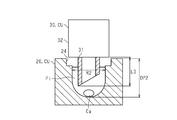
- the depth DP2 of the pretreatment recess 21 may be longer or shorter than the length L3 of the needle-shaped portion 31, but the tip of the needle-shaped portion 31 is the pretreatment recess 21. It is desirable that the depth does not touch the bottom surface of the.
- the amount of implant that can be accommodated in the pretreatment recess 21 may be greater or less than the amount of implant that can be filled in the needle-shaped portion 31. When the amount of the implant that can be accommodated in the pretreatment recess 21 is larger than the amount that can be filled in the needle-shaped portion 31, it is possible to fill the needle-shaped portion 31 from the pretreatment recess 21 multiple times. ..
- the amount of the implant that can be accommodated in the pretreatment recess 21 is smaller than the amount that can be filled in the needle-shaped portion 31, it is optimized according to the type of cell group Cg and the conditions related to cell transplantation. It can be adapted to the amount of implant.
- the needle-shaped portion 31 included in the transplant device 30 is a tubular body extending from the base end to the tip end.
- the opening of the needle-shaped portion 31 is formed, for example, by cutting the cylindrical body diagonally with respect to the axial direction.
- the opening of the needle-shaped portion 31 has a diameter at which the cell group Cg can be discharged, and allows the cell group Cg to enter and exit.
- the tip opening of the needle-shaped portion 31 may have a sharp shape and can enter a transplant destination such as a living body.
- the needle-shaped portion 31 sucks the transplant containing the cell group Cg from the pretreatment recess 21.
- the needle-shaped portion 31 holds the cell group Cg inside the needle-shaped portion 31, and discharges the cell group Cg in a state where the needle-shaped portion 31 is punctured inside the living body T.
- the needle-shaped portion 31 is arranged according to the above second sequence in the transplant device 30. That is, in the transplant device 30, three needle-shaped portions 31 are arranged in the second arrangement direction D2 with a pretreatment interval W2, as in the pretreatment recess 21.
- the three needle-shaped portions 31 arranged in the second arrangement direction D2 are one row of needle-shaped portions 31.
- the needle-shaped portions 31 for three rows are arranged in a matrix in the directions orthogonal to the second arrangement direction D2 and the second arrangement direction D2.
- the number of needle-shaped portions 31 included in the transplant device 30 is the same as the number of pretreatment recesses 21 included in the pretreatment tray 20, or less than the number of pretreatment recesses 21.
- the pretreatment interval W2, which is the interval between the needle-shaped portions 31 adjacent to each other, and the distribution of the needle-shaped portions 31 are the intervals and distributions at which the cell group Cg is arranged in the living body T.
- the distance between the needle-shaped portions 31 adjacent to each other and the distribution of the needle-shaped portions 31 are appropriately selected so that the cell group Cg is likely to have activity in the living body T.
- Each needle-shaped portion 31 suppresses the drying of cells while the transplanted cell group Cg is transported to the living body T by holding the protective solution Pl, and the state of the cells varies in the living body T. Suppress.
- the length L3 of the needle-shaped portion 31 is preferably, for example, 200 ⁇ m or more and 6 mm or less.
- the fact that the length L3 of the needle-shaped portion 31 is 200 ⁇ m or more enables the implant to be stably transplanted into the skin.
- the fact that the length L3 of the needle-shaped portion 31 is 6 mm or less makes it possible to transplant the cell group Cg into the skin.
- the transplant device 30 includes a locking portion 32 connected to the base end of the needle-shaped portion 31.
- the locking portion 32 may have a size and shape that cannot be inserted into the pretreatment recess 21, and by engaging with a part of the pretreatment tray 20, the locking portion 32 is engaged in inserting the needle-shaped portion 31 into each pretreatment recess 21. Stop. That is, the insertion of the needle-shaped portion 31 into the pretreatment recess 21 is stopped by the locking portion 32.
- the locking portion 32 locks the insertion of the needle-shaped portion 31, for example, at a position where the tip of the needle-shaped portion 31 does not contact the cell group Cg.
- the locking portion 32 preferably collectively supports a plurality of needle-shaped portions 31. Since the plurality of needle-shaped portions 31 are supported by one locking portion 32, the variation in the degree of insertion between the needle-shaped portions 31 and the variation in the filling degree of the implant can be shared by one locking portion 32. Suppresses.
- the arrangement of the cell group Cg is determined according to the arrangement of the plurality of needle-shaped portions 31. That is, the arrangement of hair that grows from the cell group Cg is determined.
- the density of the needle-shaped portion 31 is appropriately selected according to the properties of the cell group Cg to be transplanted. For example, when transplanting an aggregate of cells that contributes to hair growth or hair growth, such as a hair follicle primordium, the density of needle-shaped portions 31 per unit area is 1 piece / cm 2 or more and 400 pieces / cm 2 or less. It is preferable that the number is 20 pieces / cm 2 or more and 100 pieces / cm 2 or less.
- the density of the needle-shaped portion 31 When the density of the needle-shaped portion 31 is equal to or higher than the above lower limit value, the density of hair grown based on the transplanted cell group becomes a sufficient density for hair.
- the density of the needle-shaped portion 31 is equal to or less than the above upper limit value, nutrients are easily distributed to the cell group Cg arranged inside the skin at a density similar to the density of the needle-shaped portion 31, and the hair follicles and hair The formation proceeds favorably.
- the transplantation device 30 may be equipped with a system that electrically or mechanically detects whether or not the cell group Cg is present inside the needle-shaped portion 31.
- the transplantation device 30 equipped with a system for detecting the presence or absence of the cell group Cg when the needle-shaped portion 31 is filled with the implant, the cell group Cg is not filled in the needle-shaped portion 31 and the pretreatment recess is formed. Suppress staying at 21.
- the outer diameter R3 of the needle-shaped portion 31 is sufficiently smaller than the inner diameter R2 of the pretreatment recess 21, and is appropriately selected according to the size of the cell group Cg to be transplanted.
- the outer diameter R3 of the needle-shaped portion 31 may be designed so that, for example, two or more cell group Cg are not aspirated and a single cell group Cg is aspirated.
- the pressure loss at the needle-shaped portion 31 is suppressed from becoming excessive when the cell group Cg is aspirated. .. Suppressing the excessive pressure loss in the needle-shaped portion 31 increases the probability that the cell group Cg is sucked from the tip opening of the needle-shaped portion 31.
- the outer diameter R3 of the needle-shaped portion 31 may be substantially equal to the inner diameter R2 of the pretreatment recess 21.
- the outer diameter R3 of the needle-shaped portion 31 and the inner diameter R2 of the pretreatment recess 21 are substantially equal, the portion in close contact between the outer peripheral surface of the needle-shaped portion 31 and the inner peripheral surface of the pretreatment recess 21 expands, and the pretreatment Since the gap between the recess 21 and the needle-shaped portion 31 can be reduced, it is possible to increase the force for sucking the implant from the pretreatment recess 21 to the needle-shaped portion 31. Then, it becomes easy to fill the needle-shaped portion 31 with the cell group Cg.
- the cell transplantation pretreatment method includes a transport step of transporting the cell group Cg cultured in the culture tray 10 to the pretreatment recess 21 of the pretreatment tray 20, and a transport step of transporting the transplant containing the cell group Cg from the pretreatment recess 21. It includes a filling step of filling the transplant device 30 to be transplanted into a living body.
- the pretreatment recess 21 may be filled with the protective liquid Pl after moving only the cell group Cg to the pretreatment recess 21 by the transport unit CT, or the pretreatment recess 21 pre-filled with the protective liquid Pl may be filled.
- Cell group Cg may be moved from the culture tray 10. Retaining the cell group Cg together with the protective liquid Pl in the pretreatment recess 21 makes it possible to suppress the drying of the cell group Cg and the change in the component ratio of the protective liquid Pl. As a result, the cell group Cg can be retained in the pretreatment recess 21 while maintaining the activity of the cell group Cg, and it is possible to increase the probability that the cell group Cg will engraft.
- the transport step does not affect the state of the cell group Cg.
- the effects on the state of the cell group Cg include deformation of the shape of the cell group Cg, cell death, differentiation induction, dormancy, cytokine production, specific gene expression and the like.
- the transport step may be performed a plurality of times for a single culture recess 11, or may be performed a plurality of times for a single pretreatment recess 21, and may be performed a plurality of times from a plurality of culture trays 10 to a plurality of pretreatment trays. It may be done at 20. Thereby, the transplanted product can be held in the culture tray 10 or the pretreatment tray 20 having a shape and color suitable for the purpose as appropriate, so that the culture, inspection, and filling efficiency can be improved.
- the filling step is a step of filling the implant from the pretreatment recess 21 into the needle-shaped portion 31.
- the needle-shaped portion 31 fills by sucking the transplant from the pretreatment recess 21. That is, the transplant is filled from the tip opening of the needle-shaped portion 31, and the needle-shaped portion 31 holds the cell group Cg at a position close to the opening. Thereby, it is possible to suppress the contact between the cell group Cg and the inner peripheral surface of the needle-shaped portion 31. Further, since the inner peripheral surface of the needle-shaped portion 31 is smooth, it is possible to keep the contact area when the cell group Cg and the inner peripheral surface come into contact with each other small. Then, it is possible to suppress the influence on the cell group Cg given by the filling step such as cell deformation.
- the cell transplantation pretreatment method includes an inspection step of inspecting that the cell condition is suitable for cell transplantation, and making the cell condition in each pretreatment recess 21 suitable for cell transplantation based on the result of the inspection. It may be. This also makes it possible to obtain a cell state suitable for cell transplantation in all needle-shaped portions 31.
- the inspection process is, for example, an inspection using a microscope or an optical inspection, which is an inspection for the purpose of removing cells unsuitable for cell transplantation, or an inspection for confirming the state of cells for cell transplantation.
- Different tests may be performed on the culture tray 10 and the pretreatment tray 20.
- the culture tray 10 and the pretreatment tray 20 may have suitable colors and shapes according to the inspections performed in each. For example, cells may be sorted using a microscope in the culture tray 10 and an optical examination may be performed in the pretreatment tray 20. At this time, the culture tray 10 may be transparent in order to improve visibility under a microscope. Further, the pretreatment tray 20 may be black or white according to the irradiation light used for the optical inspection.
- the culture tray 10 may be black or white, and the pretreatment tray 20 may be transparent.
- the transport step and the filling step can be performed while observing the inside of the pretreatment recess 21, so that the cell group Cg is arranged in the pretreatment recess 21 and the needle-shaped portion 31 is provided. It is possible to accurately contain the cell group Cg. Further, after the filling step, it is possible to confirm whether the filling step is properly performed by checking whether there is any residue in the pretreatment recess 21.
- the material of the transparent pretreatment tray 20 is, for example, a resin such as acrylic, polycarbonate, or cycloolefin polymer, or glass.
- the culture recess 11 or the pretreatment recess 21 preferably has a thin and small structure having few shielding portions that block the light guide.
- the cell transplant pretreatment method includes a step of holding the transplant in the pretreatment tray 20 while filling the transplant device 30 with the transplant from the culture tray 10. Injecting the implant from the culture recess 11 into the pretreatment recess 21 reconstructs the interface. Reconstructing the interface suppresses the mixing of air bubbles in the pretreatment tray 20. Thereby, it is possible to improve the visibility of the cell group Cg, and it is possible to improve the efficiency of the inspection in the pretreatment recess 21.
- the transplant device 30 in which the needle-shaped portion 31 is filled with the transplant injects the transplant into the living body.
- the transplant device 30 is inserted into the surface of the living body through the opening at the tip of the needle-shaped portion 31 to allow the needle-shaped portion 31 to enter the living body.
- the implant is released into the living body from the tip opening of the needle-shaped portion 31.
- the transplant is placed at the target site TC of the transplant destination, and the cell transplantation is completed.
- the needle-shaped portion 31 of the transplantation device 30 for which transplantation has been completed is withdrawn from the living body.
- the pretreatment recess 21 and the needle-shaped portion 31 are arranged according to the second arrangement, it is possible to insert the plurality of needle-shaped portions 31 into the plurality of pretreatment recesses 21 at the same time, and the plurality of needle-shaped portions 31 can be inserted at the same time. It is possible to fill the portion 31 with the implant at the same time. Therefore, the efficiency of filling the transplant device 30 with the transplant can be improved.
- the gap between the pretreatment recess 21 and the needle-shaped portion 31 can be reduced, and the implant can be placed in the needle-shaped portion 31. It is possible to increase the suction force. Therefore, it is possible to increase the accuracy and efficiency of sucking the cell group Cg into the needle-shaped portion 31.
- the arrangement elements are concentrated in the central portion of the pretreatment tray 20 as compared with the first arrangement followed by the culture recess 11. As a result, it is possible to suppress the variation in the state of the cell group Cg while the transplant is held in the pretreatment recess 21, so that the state of the cell group Cg in each needle-shaped portion 31 is uniformly filled at the time of filling. It becomes possible to do.
- a locking portion 32 for locking the movement of the needle-shaped portion 31 so as to form a gap between the tip of the needle-shaped portion 31 inserted into the pretreatment recess 21 and the bottom surface of the pretreatment recess 21 is provided. Therefore, when the transplantation device is filled with the transplanted product, it becomes easy to fill the transplantation device with the cell group Cg while maintaining the state of the needle-shaped portion 31 suitable for transplantation.
- the pretreatment tray 20 has a grip portion 23 as an outer peripheral portion of the pretreatment tray 20 that allows the user to hold the pretreatment tray 20 at a position where the pretreatment recess 21 is not arranged.
- the pretreatment tray 20 holds the cell group Cg from the culture tray 10 in the culture chamber and is moved to the place where it is transplanted. At this time, if the pretreatment tray 20 is provided with the grip portion 23, the pretreatment tray 20 can be held by hand, and the transport efficiency of the pretreatment tray 20 can be improved. As a result, it is possible to suppress the prolongation of the time required for the pretreatment of transplantation.
- the transplant is moved from the plurality of culture recesses 11 to a single pretreatment recess 21 and is filled in the needle-shaped portion. It is possible to increase the amount of things. Further, when the depth of the pretreatment recess 21 is shallower than the depth of the culture recess 11, the amount of the implant can be adjusted to the amount that can be filled in the needle-shaped portion 31.
- the culture recesses 11 may be arranged in a matrix, while the pretreatment recesses 21 and the needle-shaped portions 31 may be arranged in an annular shape.
- the pretreatment recess 21 and the needle-shaped portion 31 may be arranged so that all of the above conditions 1 to 3 are satisfied. That is, the culture interval W1 and the pretreatment interval W2 may be different from each other, and the number of culture recesses 11 in the first arrangement direction D1 and the number of pretreatment recesses 21 in the second arrangement direction D2 may be different from each other.
- the number of the pretreatment recess 21 and the needle-shaped portion 31 in the second arrangement direction D2 may be different from the number of the culture recess 11 in the first arrangement direction D1. That is, the pretreatment recess 21 and the needle-shaped portion 31 may be arranged so that the above conditions 1 and 2 are satisfied.
- the number of culture recesses 11 in the first arrangement direction D1 may be three
- the number of pretreatment recesses 21 and needle-shaped portions 31 in the second arrangement direction D2 may be five.
- the number of the needle-shaped portions 31 in the second arrangement direction D2 may be different from the number of the pretreatment recesses 21 in the second arrangement direction D2.
- the number of needle-shaped portions 31 in the second arrangement direction D2 is four, and the second arrangement may be composed of four arrangement elements arranged according to the second arrangement direction D2.
- the pretreatment recess 21 and the needle-shaped portion 31 may be arranged along a concentric ring, an elliptical ring, a polygonal ring, a concentric polygonal ring, a radial shape, or an irregular shape.
- the shape of the bottom surface of the culture recess 11 and the shape of the bottom surface of the pretreatment recess 21 may be different from each other.
- the culture recess 11 has a bottom shape suitable for culturing the cell group Cg, and has, for example, a flat shape.
- the cell group Cg is an adhesive cell
- the cell group Cg can be uniformly adhered to the bottom surface of the culture recess 11, so that the cells can easily proliferate.
- the pretreatment recess 21 has a bottom surface shape suitable for filling the needle-shaped portion 31 with the implant, and has, for example, a deep hemispherical shape at the center of the bottom surface.
- the bottom surface of the pretreatment recess 21 is hemispherical, so that the cell group Cg gathers in the center of the bottom surface. Therefore, it becomes easy to fill the needle-shaped portion 31 with the cell group Cg.
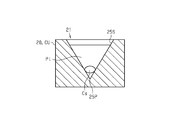
- the pretreatment recess 21 may have a shape in which the cell group Cg gathers in the center, and may have, for example, a spindle shape or a V-shaped cross section in which the apex is located at the center of the bottom surface.
- FIG. 8 shows an example of the pretreatment recess 21 having the V-shaped cross section.
- the pretreatment recess 21 may have a shape in which the apex 25P is located at the bottom and the inner peripheral surface 25S is tapered toward the apex 25P.
- the pretreatment recess 21 has a shape of a pyramid or a cone. If the pretreatment recess 21 has such a shape, the cell group Cg sunk in the pretreatment recess 21 is held at a position away from the bottom.
- the contact area between the pretreatment recess 21 and the cell group Cg is reduced as compared with the case where the bottom is a flat surface or a curved surface and the cell group Cg and the bottom of the pretreatment recess 21 are in contact with each other in a planar region. can do. Therefore, the load applied to the cell group Cg is reduced.
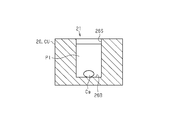
- the pretreatment recess 21 may have a shape including a flat bottom surface 26B and an inner peripheral surface 26S extending vertically from the bottom surface 26B.
- the pretreatment recess 21 has a shape of a columnar or prismatic recess. If the pretreatment recess 21 has such a shape, the cell group Cg is suppressed from adhering to the inner peripheral surface 26S, and the cell group Cg sunk in the pretreatment recess 21 is on the bottom surface 26B, that is, pretreated. It is arranged at the deepest position of the recess 21.
- the position of the cell group Cg in the pretreatment recess 21 in the depth direction is specified, the positional relationship between the needle-shaped portion 31 and the cell group Cg is further determined when the cell group Cg is accommodated in the needle-shaped portion 31. Can be specified accurately. Therefore, since the cell group Cg can be sucked with an appropriate force, even the cell group Cg having a low cohesive force and easily collapsing can be accurately taken into the needle-shaped portion 31.
- the pretreatment recess 21 may further include an engaging portion 24 that engages with the locking portion 32.
- the engaging portion 24 is, for example, a recess in which the opening of the pretreatment recess 21 is enlarged in diameter, and is configured to lock, that is, stop the lowering of the locking portion 32. This makes it possible to position the transplant device 30 so that the tip of the needle-shaped portion 31 does not come into contact with the cell group Cg. Then, by engaging the locking portion 32 and the engaging portion 24, a gap is formed between the tip of the needle-shaped portion 31 and the bottom surface of the pretreatment recess 21.
- the transplantation device 30 positioned so as not to be in contact with the cell group Cg can fill the needle-shaped portion 31 with the cell group Cg while maintaining the state before filling.
- a plurality of engaging portions 24 may be provided in one pretreatment recess 21, or may have a multi-stage structure.
- the pretreatment recess 21 having the multi-stage engaging portion 24 may, for example, separately engage two types of transplant devices 30 having locking portions 32 of different sizes. Further, the pretreatment recess 21 having the engaging portion 24 of the multi-stage structure can be engaged with, for example, the transplant device 30 having the engaging portion 32 of the multi-stage structure.
- the engagement portion 24 having the one-stage structure and the locking portion 32 having the one-stage structure are engaged with each other. It is also possible to increase the coupling force between the pretreatment tray 20 and the transplant device 30.
- the inner peripheral surface 24S of the pretreatment recess 21 may function as an engaging portion.
- the inner peripheral surface 24S of the pretreatment recess 21 has a weight base tubular surface shape that tapers toward the bottom surface, the inner peripheral surface of the pretreatment recess 21 and the locking portion 32 are in charge of lowering the needle-shaped portion 31. Stop.
- the pretreatment tray 20 and the transplant device 30 may have a structure for positioning the transplant device 30 with respect to the pretreatment tray 20 in a direction orthogonal to the depth direction of the pretreatment recess 21.
- the positioning structure of the pretreatment tray 20 is a three-dimensional structure that is recessed or protrudes from the upper surface of the pretreatment tray 20 in the depth direction of the pretreatment recess 21.
- the structure for positioning of the transplant device 30 is a three-dimensional structure that fits into the three-dimensional structure of the pretreatment tray 20.
- the structure for positioning of the pretreatment tray 20 is a hole or a protrusion located on the outer peripheral portion of the pretreatment tray 20.
- FIG. 12 shows an example of the reference structure unit 40 having such a positioning structure.
- FIG. 12 shows an example in which the reference structure portion 40 is a hole.
- the implant device 30 has a protrusion that fits into the hole.
- the implant device 30 has a hole that fits into the protrusion.
- the corresponding structural portion, which is the protrusion or the hole of the transplant device 30, is located, for example, on the tip surface of the locking portion 32 or on the outer periphery of the locking portion 32.
- the pretreatment tray 20 has two or more reference structure portions 40.
- the pretreatment tray 20 and the transplant device 30 are engaged with each other at two or more points, so that the position of the transplant device 30 with respect to the pretreatment tray 20 is accurately determined.
- the reference structure portion 40 is arranged in the area surrounding the area where the plurality of pretreatment recesses 21 are formed in the pretreatment tray 20, the position of the reference structure portion 40 is not limited.
- the two reference structure portions 40 are arranged at positions sandwiching a region in which a plurality of pretreatment recesses 21 are formed.
- the size of the reference structure portion 40 in the direction orthogonal to the depth direction is slightly larger than the corresponding structure portion of the transplant device 30 corresponding to the reference structure portion 40. You may.
- the difference in size between the corresponding structure portion and the reference structure portion 40 is such that even if the corresponding structure portion moves in the reference structure portion 40, each needle-shaped portion 31 is arranged at a position where it enters each pretreatment recess 21. Is set to. Since the reference structure portion 40 is larger than the corresponding structure portion, it becomes easy to engage the reference structure portion 40 with the corresponding structure portion. In particular, the effect is great when the transplant device 30 is manually aligned with the pretreatment tray 20.
- the reference structural portion 40 may be a cylindrical hole having a diameter larger than that of the corresponding structural portion. Further, the reference structure portion 40 may be an elliptical tubular hole having a minor diameter larger than the diameter of the corresponding structure portion. If the reference structure portion 40 has an elliptical tubular shape, a gap is likely to occur between the reference structure portion 40 and the corresponding structure portion, so that it is easy to engage the reference structure portion 40 with the corresponding structure portion.
- the two reference structure portions 40 include the first reference structure portion 40 and the second reference structure portion 40, and the first reference structure portion 40 has the same diameter as the first corresponding structure portion, and the second reference structure portion 40 has the same diameter as the first corresponding structure portion.
- the reference structure portion 40 may have a diameter larger than that of the second corresponding structure portion.
- the diameters of the two corresponding structural portions are the same as each other, and the diameters of the two reference structural portions 40 are different from each other. According to such a configuration, first, the first reference structure portion 40 and the first corresponding structure portion are engaged with each other, and then the second reference structure portion 40 and the second corresponding structure portion are engaged with each other.
- the second correspondence that can be engaged with the second reference structure portion 40 is possible. Since there is a margin in the position of the structural portion, it is easy to engage the second reference structural portion 40 with the second corresponding structural portion. Therefore, the alignment of the transplant device 30 with respect to the pretreatment tray 20 can be performed accurately and easily.
- the structure for positioning of the pretreatment tray 20 may be a structure having a linear portion which is a portion extending linearly when viewed from a direction along the depth direction.
- FIG. 13 shows an example of the reference structure portion 41 having such a positioning structure.
- the reference structure portion 41 is a step having a substantially rectangular frame shape surrounding the plurality of pretreatment recesses 21.
- the reference structure portion 41 has a linear portion 45L at a portion corresponding to two sides connected at one vertex of the rectangle.
- the two linear portions 45L are located on two straight lines that intersect each other, and the intersection of these straight lines is the reference point 45R. If the reference structure portion 41 has at least two linear portions 45L, the position of the needle-shaped portion 31 with respect to the reference point 45R can be accurately determined by arranging the transplant device 30 along the linear portion 45L. It is decided. Therefore, the accuracy of alignment between the pretreatment recess 21 and the needle-shaped portion 31 is improved.
- the portion of the transplant device 30 along the linear portion 45L may be, for example, the side surface of the locking portion 32.
- the linear portion 45L is not limited to a rectangle, and may correspond to two sides of a polygon.
- a gap is formed between the portion corresponding to the other side and the transplant device 30. May be done.
- the transplant device 30 can be engaged with the reference structure portion 41. It is easy and the porting device 30 can be easily aligned with the pretreatment tray 20.
- the reference structure 41 can be formed by, for example, counterbore processing.
- the reference structure portion 41 has a convex portion that protrudes on the upper surface of the pretreatment tray 20 and has a pretreatment concave portion 21 on the top surface, and a ridge structure that surrounds the pretreatment concave portion 21. It may be formed.
- the two linear portions 45L may be connected at the ends of each other, or if the two linear portions 45L intersect on an extension line thereof, the two linear portions 45L may be connected to each other. It does not have to be connected.
- the length L3 of the needle-shaped portions 31 adjacent to each other may be different according to the shape of the living body surface.
- the second arrangement is a symmetric arrangement, there is a possibility that the needle-shaped portion 31 having a long length L3 is inserted into the pretreatment recess 21 having a shallow depth DP2. Therefore, it is preferable that at least one of the pretreatment tray 20 and the transplant device 30 is provided with a positioning portion for matching the depth DP2 of the pretreatment recess 21 and the length L3 of the needle-shaped portion 31.
- It has a culture tray having a plurality of culture recesses arranged according to the first sequence, and a tubular shape having a plurality of needle-shaped portions arranged according to the second sequence and configured so that a transplant containing a cell group can enter and exit.
- the pretreatment tray A plurality of pretreatment recesses arranged according to the second sequence are provided, and a group of cells cultured in the plurality of culture recesses is configured to be transported to the plurality of pretreatment recesses, and the plurality of pretreatment recesses are carried.
- a pretreatment tray configured so that a group of cells is simultaneously filled into the plurality of needle-shaped portions from a recess.
Landscapes
- Health & Medical Sciences (AREA)
- Life Sciences & Earth Sciences (AREA)
- Chemical & Material Sciences (AREA)
- Engineering & Computer Science (AREA)
- Biomedical Technology (AREA)
- Zoology (AREA)
- Bioinformatics & Cheminformatics (AREA)
- Organic Chemistry (AREA)
- Wood Science & Technology (AREA)
- General Health & Medical Sciences (AREA)
- Molecular Biology (AREA)
- Sustainable Development (AREA)
- Biochemistry (AREA)
- General Engineering & Computer Science (AREA)
- Microbiology (AREA)
- Genetics & Genomics (AREA)
- Biotechnology (AREA)
- Transplantation (AREA)
- Animal Behavior & Ethology (AREA)
- Dermatology (AREA)
- Medicinal Chemistry (AREA)
- Oral & Maxillofacial Surgery (AREA)
- Botany (AREA)
- Epidemiology (AREA)
- Chemical Kinetics & Catalysis (AREA)
- Public Health (AREA)
- Veterinary Medicine (AREA)
- Clinical Laboratory Science (AREA)
- Vascular Medicine (AREA)
- Urology & Nephrology (AREA)
- Apparatus Associated With Microorganisms And Enzymes (AREA)
- Materials For Medical Uses (AREA)
Priority Applications (4)
| Application Number | Priority Date | Filing Date | Title |
|---|---|---|---|
| EP21757413.6A EP4108760A4 (en) | 2020-02-19 | 2021-02-17 | Method for pretreatment of cell transplantation, device for pretreatment of cell transplantation, and unit for pretreatment of cell transplantation |
| CN202180009494.8A CN114981401A (zh) | 2020-02-19 | 2021-02-17 | 细胞移植前处理方法、细胞移植前处理装置以及细胞移植前处理单元 |
| JP2022501948A JPWO2021166977A1 (https=) | 2020-02-19 | 2021-02-17 | |
| US17/888,635 US20220396755A1 (en) | 2020-02-19 | 2022-08-16 | Cell transplantation pretreatment method, cell transplantation pretreatment device, and cell transplantation pretreatment unit |
Applications Claiming Priority (2)
| Application Number | Priority Date | Filing Date | Title |
|---|---|---|---|
| JP2020026243 | 2020-02-19 | ||
| JP2020-026243 | 2020-02-19 |
Related Child Applications (1)
| Application Number | Title | Priority Date | Filing Date |
|---|---|---|---|
| US17/888,635 Continuation US20220396755A1 (en) | 2020-02-19 | 2022-08-16 | Cell transplantation pretreatment method, cell transplantation pretreatment device, and cell transplantation pretreatment unit |
Publications (1)
| Publication Number | Publication Date |
|---|---|
| WO2021166977A1 true WO2021166977A1 (ja) | 2021-08-26 |
Family
ID=77392153
Family Applications (1)
| Application Number | Title | Priority Date | Filing Date |
|---|---|---|---|
| PCT/JP2021/006002 Ceased WO2021166977A1 (ja) | 2020-02-19 | 2021-02-17 | 細胞移植前処理方法、細胞移植前処理装置、および細胞移植前処理ユニット |
Country Status (5)
| Country | Link |
|---|---|
| US (1) | US20220396755A1 (https=) |
| EP (1) | EP4108760A4 (https=) |
| JP (1) | JPWO2021166977A1 (https=) |
| CN (1) | CN114981401A (https=) |
| WO (1) | WO2021166977A1 (https=) |
Families Citing this family (1)
| Publication number | Priority date | Publication date | Assignee | Title |
|---|---|---|---|---|
| WO2023049932A1 (en) * | 2021-09-27 | 2023-03-30 | Massachusetts Institute Of Technology | Fabrication-free microfluidic device for scalable, high-volume bacterial electroporation |
Citations (4)
| Publication number | Priority date | Publication date | Assignee | Title |
|---|---|---|---|---|
| JP2010200748A (ja) * | 2009-02-09 | 2010-09-16 | Dainippon Printing Co Ltd | 細胞培養容器 |
| WO2014196204A1 (ja) * | 2013-06-07 | 2014-12-11 | 株式会社クラレ | 培養容器及び培養方法 |
| JP2017216967A (ja) * | 2016-06-09 | 2017-12-14 | 大日本印刷株式会社 | 細胞培養容器 |
| WO2019064653A1 (ja) * | 2017-09-29 | 2019-04-04 | 凸版印刷株式会社 | 細胞移植装置、および、細胞移植用ユニット |
Family Cites Families (19)
| Publication number | Priority date | Publication date | Assignee | Title |
|---|---|---|---|---|
| US3568735A (en) * | 1968-06-26 | 1971-03-09 | Cooke Eng Co | Laboratory microtitration dispensing apparatus |
| JPS62155079A (ja) * | 1985-12-27 | 1987-07-10 | Hitachi Electronics Eng Co Ltd | コロニ−自動移植装置 |
| JPS63296685A (ja) * | 1987-05-29 | 1988-12-02 | Sumitomo Electric Ind Ltd | 細胞移植装置 |
| JPH01171473A (ja) * | 1987-12-28 | 1989-07-06 | Japan Tobacco Inc | コロニートランスファー装置 |
| GB9100623D0 (en) * | 1991-01-11 | 1991-02-27 | Medical Res Council | Transfer of biological samples |
| WO2003036265A2 (en) * | 2001-10-26 | 2003-05-01 | Virtual Arrays, Inc. | Assay systems with adjustable fluid communication |
| CH701163B1 (de) * | 2004-06-24 | 2010-12-15 | Tecan Trading Ag | System zum Manipulieren von Flüssigkeitsproben sowie Vorrichtung und Verfahren zum Anordnen von Pipetten- oder Dispenserspitzen in einem solchen System. |
| JP4981374B2 (ja) * | 2006-07-10 | 2012-07-18 | パーパス株式会社 | 細胞又は組織の培養装置及び培養方法 |
| WO2009148507A1 (en) * | 2008-05-30 | 2009-12-10 | Corning Incorporated | Cell culture apparatus having variable topography |
| GB2475656B (en) * | 2008-08-22 | 2013-04-24 | Univ Tokyo | Organ regeneration method utilizing ips cell and blastocyst complementation |
| US9295417B2 (en) * | 2011-04-29 | 2016-03-29 | Seventh Sense Biosystems, Inc. | Systems and methods for collecting fluid from a subject |
| CN103305419A (zh) * | 2012-03-07 | 2013-09-18 | 上海安集协康生物技术有限公司 | 一种间充质干细胞提取灌流培养系统 |
| US10208279B2 (en) * | 2013-03-01 | 2019-02-19 | Genea Ip Holdings Pty Limited | Apparatus, method, and system for cultured sample development monitoring |
| US10202568B2 (en) * | 2013-08-12 | 2019-02-12 | Invivosciences Inc. | Automated cell culture system and method |
| GB2525884A (en) * | 2014-05-07 | 2015-11-11 | Unisense Fertilitech As | Culture dish |
| US20170342363A1 (en) * | 2014-10-29 | 2017-11-30 | Corning Incorporated | Devices and methods for generation and culture of 3d cell aggregates |
| SG11201811781XA (en) * | 2016-06-30 | 2019-01-30 | General Automation Lab Technologies Inc | High resolution systems, kits, apparatus, and methods using magnetic beads for high throughput microbiology applications |
| US12123887B2 (en) * | 2017-07-14 | 2024-10-22 | Horiba Advanced Techno, Co., Ltd. | Sample analyzing device |
| CA3074162A1 (en) * | 2017-08-31 | 2019-03-07 | Philip Morris Products S.A. | Cell culture plate, devices and methods for in vitro exposure |
-
2021
- 2021-02-17 JP JP2022501948A patent/JPWO2021166977A1/ja active Pending
- 2021-02-17 WO PCT/JP2021/006002 patent/WO2021166977A1/ja not_active Ceased
- 2021-02-17 CN CN202180009494.8A patent/CN114981401A/zh active Pending
- 2021-02-17 EP EP21757413.6A patent/EP4108760A4/en not_active Withdrawn
-
2022
- 2022-08-16 US US17/888,635 patent/US20220396755A1/en active Pending
Patent Citations (4)
| Publication number | Priority date | Publication date | Assignee | Title |
|---|---|---|---|---|
| JP2010200748A (ja) * | 2009-02-09 | 2010-09-16 | Dainippon Printing Co Ltd | 細胞培養容器 |
| WO2014196204A1 (ja) * | 2013-06-07 | 2014-12-11 | 株式会社クラレ | 培養容器及び培養方法 |
| JP2017216967A (ja) * | 2016-06-09 | 2017-12-14 | 大日本印刷株式会社 | 細胞培養容器 |
| WO2019064653A1 (ja) * | 2017-09-29 | 2019-04-04 | 凸版印刷株式会社 | 細胞移植装置、および、細胞移植用ユニット |
Also Published As
| Publication number | Publication date |
|---|---|
| US20220396755A1 (en) | 2022-12-15 |
| JPWO2021166977A1 (https=) | 2021-08-26 |
| CN114981401A (zh) | 2022-08-30 |
| EP4108760A1 (en) | 2022-12-28 |
| EP4108760A4 (en) | 2023-11-01 |
Similar Documents
| Publication | Publication Date | Title |
|---|---|---|
| Cheers et al. | Rapid microinjection of fertilized eggs | |
| JP5950055B2 (ja) | 細胞塊用培養容器 | |
| US11717659B2 (en) | Cell transplantation device and cell transplantation unit | |
| US12252677B2 (en) | Fluidic device, fluidic system, and method for developing three-dimensional cellular constructions | |
| US20210401460A1 (en) | Cell transplantation device and cell transplantation system | |
| WO2021166977A1 (ja) | 細胞移植前処理方法、細胞移植前処理装置、および細胞移植前処理ユニット | |
| ES2942844T3 (es) | Pieza guía de trasplante y herramienta de trasplante | |
| KR102524249B1 (ko) | 세포 배양 마이크로 디바이스 | |
| US20130071873A1 (en) | Array microinjection apparatuses and methods | |
| DE19808055A1 (de) | Verfahren und Apparatur zur Herstellung von dreidimensionalen Gewebezellkulturen | |
| US20210346607A1 (en) | Transfer device for living organisms | |
| KR102873471B1 (ko) | 세포 배양 장치 | |
| DE102023109953B3 (de) | Scaffold-Halter | |
| JP7484209B2 (ja) | 生体用移送装置 | |
| JP3235939U (ja) | 細胞播種装置および細胞培養装置 | |
| EP4608961A1 (en) | Single cell handling device | |
| US20230210557A1 (en) | Cell transplanting kit, cell transplanting device, and method for taking in transplant | |
| Musial | The Cytoseeder™–A Novel Seeding Device for Tissue Engineered Scaffolds | |
| JP2023177484A (ja) | 生体用移送装置 | |
| CN114606185A (zh) | 一种利用器官芯片进行间充质干细胞疗法实验的方法 | |
| JP2020162980A (ja) | 生体用移送装置、生体用移送装置用部材、生体用移送ユニット、および、生体用移送キット | |
| JP2022096765A (ja) | 細胞移植装置、および、細胞移植装置の使用方法 | |
| BG66943B1 (bg) | Вана за интрацитоплазмено инжектиране | |
| Garrow | Microneedle Pipette Tip for Cell Delivery into Tissue Scaffolds | |
| El-Badry | Working with Living Cells and Tissues |
Legal Events
| Date | Code | Title | Description |
|---|---|---|---|
| 121 | Ep: the epo has been informed by wipo that ep was designated in this application |
Ref document number: 21757413 Country of ref document: EP Kind code of ref document: A1 |
|
| ENP | Entry into the national phase |
Ref document number: 2022501948 Country of ref document: JP Kind code of ref document: A |
|
| NENP | Non-entry into the national phase |
Ref country code: DE |
|
| ENP | Entry into the national phase |
Ref document number: 2021757413 Country of ref document: EP Effective date: 20220919 |
|
| WWW | Wipo information: withdrawn in national office |
Ref document number: 2021757413 Country of ref document: EP |