WO2021153215A1 - アンテナ装置及び電子機器 - Google Patents
アンテナ装置及び電子機器 Download PDFInfo
- Publication number
- WO2021153215A1 WO2021153215A1 PCT/JP2021/000676 JP2021000676W WO2021153215A1 WO 2021153215 A1 WO2021153215 A1 WO 2021153215A1 JP 2021000676 W JP2021000676 W JP 2021000676W WO 2021153215 A1 WO2021153215 A1 WO 2021153215A1
- Authority
- WO
- WIPO (PCT)
- Prior art keywords
- antenna
- radiating element
- antenna device
- circuit
- band
- Prior art date
- Legal status (The legal status is an assumption and is not a legal conclusion. Google has not performed a legal analysis and makes no representation as to the accuracy of the status listed.)
- Ceased
Links
Images















Classifications
-
- H—ELECTRICITY
- H01—ELECTRIC ELEMENTS
- H01Q—ANTENNAS, i.e. RADIO AERIALS
- H01Q9/00—Electrically-short antennas having dimensions not more than twice the operating wavelength and consisting of conductive active radiating elements
- H01Q9/04—Resonant antennas
- H01Q9/0407—Substantially flat resonant element parallel to ground plane, e.g. patch antenna
- H01Q9/0414—Substantially flat resonant element parallel to ground plane, e.g. patch antenna in a stacked or folded configuration
-
- H—ELECTRICITY
- H01—ELECTRIC ELEMENTS
- H01Q—ANTENNAS, i.e. RADIO AERIALS
- H01Q5/00—Arrangements for simultaneous operation of antennas on two or more different wavebands, e.g. dual-band or multi-band arrangements
- H01Q5/40—Imbricated or interleaved structures; Combined or electromagnetically coupled arrangements, e.g. comprising two or more non-connected fed radiating elements
-
- H—ELECTRICITY
- H01—ELECTRIC ELEMENTS
- H01Q—ANTENNAS, i.e. RADIO AERIALS
- H01Q1/00—Details of, or arrangements associated with, antennas
- H01Q1/12—Supports; Mounting means
- H01Q1/22—Supports; Mounting means by structural association with other equipment or articles
- H01Q1/24—Supports; Mounting means by structural association with other equipment or articles with receiving set
- H01Q1/241—Supports; Mounting means by structural association with other equipment or articles with receiving set used in mobile communications, e.g. GSM
- H01Q1/242—Supports; Mounting means by structural association with other equipment or articles with receiving set used in mobile communications, e.g. GSM specially adapted for hand-held use
- H01Q1/243—Supports; Mounting means by structural association with other equipment or articles with receiving set used in mobile communications, e.g. GSM specially adapted for hand-held use with built-in antennas
-
- H—ELECTRICITY
- H01—ELECTRIC ELEMENTS
- H01Q—ANTENNAS, i.e. RADIO AERIALS
- H01Q1/00—Details of, or arrangements associated with, antennas
- H01Q1/52—Means for reducing coupling between antennas; Means for reducing coupling between an antenna and another structure
- H01Q1/521—Means for reducing coupling between antennas; Means for reducing coupling between an antenna and another structure reducing the coupling between adjacent antennas
-
- H—ELECTRICITY
- H01—ELECTRIC ELEMENTS
- H01Q—ANTENNAS, i.e. RADIO AERIALS
- H01Q21/00—Antenna arrays or systems
- H01Q21/28—Combinations of substantially independent non-interacting antenna units or systems
-
- H—ELECTRICITY
- H01—ELECTRIC ELEMENTS
- H01Q—ANTENNAS, i.e. RADIO AERIALS
- H01Q5/00—Arrangements for simultaneous operation of antennas on two or more different wavebands, e.g. dual-band or multi-band arrangements
- H01Q5/30—Arrangements for providing operation on different wavebands
- H01Q5/378—Combination of fed elements with parasitic elements
-
- H—ELECTRICITY
- H01—ELECTRIC ELEMENTS
- H01Q—ANTENNAS, i.e. RADIO AERIALS
- H01Q9/00—Electrically-short antennas having dimensions not more than twice the operating wavelength and consisting of conductive active radiating elements
- H01Q9/04—Resonant antennas
- H01Q9/30—Resonant antennas with feed to end of elongated active element, e.g. unipole
- H01Q9/42—Resonant antennas with feed to end of elongated active element, e.g. unipole with folded element, the folded parts being spaced apart a small fraction of the operating wavelength
Definitions
- the present invention relates to an electronic device having a communication function and an antenna device provided in the electronic device, and more particularly to an antenna device and an electronic device used in a wide band.
- a feeding radiating element connected to the feeding circuit and a non-feeding radiating element physically separated from the feeding circuit are provided, and the non-feeding radiating element is used as the feeding radiating element.
- Patent Document 1 a method of imparting the characteristics of a non-feeding radiating element to the characteristics of a feeding radiating element by coupling with an electromagnetic field has been used (Patent Document 1).
- the frequency band of 3 GHz to 6 GHz is regarded as important, and an antenna device applied to the frequency band is added to the terminal.
- the wireless LAN standard Wi-Fi antenna is also used in a wide band of 5 GHz band.
- the 5th generation mobile communication system is a wireless access technology standardized by 3GPP (Third Generation Partnership Project), but since the band n79 is 4.4 GHz to 5.0 GHz in the designated frequency band of 3GPP, it is possible to use wireless LAN. Adjacent to the 5 GHz band used. Therefore, antenna isolation is required between the wideband antenna applied to the band n79 and the antenna used in the wireless LAN.
- the wideband antenna device including the fed radiation element and the non-feeding radiation element exhibits excellent wideband characteristics, but it is difficult to secure isolation from other antennas having adjacent frequency bands due to the wideband characteristics.
- an object of the present invention is to provide an antenna device that secures isolation between a wideband antenna and an antenna for a frequency band adjacent to the frequency band used in the wideband antenna, and an electronic device including the antenna device. There is.
- the antenna device as an example of the present disclosure is An antenna device including a first antenna and a second antenna.
- the first antenna includes a coupling element composed of a primary coil and a secondary coil, a first radiation element connected to the primary coil, a second radiation element connected to the secondary coil, and the second radiation element. Equipped with a phase adjuster connected to the radiating element,
- the second antenna includes a third radiating element.
- the first power supply circuit is connected to the primary coil side
- a second feeding circuit is connected to the third radiating element
- the phase adjuster is provided so that the phase difference between the signals of the first radiating element and the second radiating element in the communication band of the second antenna is within the range of 180 ° ⁇ 45 °. It is characterized by that.
- An electronic device as an example of the present disclosure is An electronic device having an antenna device and a first power supply circuit and a second power supply circuit connected to the antenna device.
- the antenna device includes a first antenna and a second antenna.
- the first antenna includes a coupling element composed of a primary coil and a secondary coil, a first radiation element connected to the primary coil, a second radiation element connected to the secondary coil, and the second radiation element. Equipped with a phase adjuster connected to the radiating element,
- the second antenna includes a third radiating element.
- the first power supply circuit is connected to the primary coil side, A second feeding circuit is connected to the third radiating element, The phase adjuster is provided so that the phase difference between the signals of the first radiating element and the second radiating element in the communication band of the second antenna is within the range of 180 ° ⁇ 45 °. It is characterized by that.
- an antenna device having wideband characteristics but ensuring isolation between two antennas used in frequency bands adjacent to each other, and an electronic device including the antenna device.
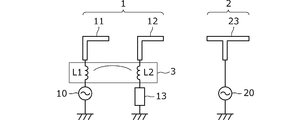
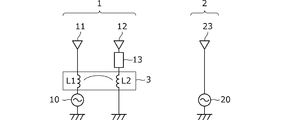
- FIG. 1 is a circuit diagram of the antenna device 101 according to the first embodiment.
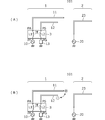
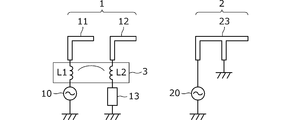
- 2 (A) and 2 (B) are circuit diagrams of the antenna device 101 including the schematic shape of each radiating element.
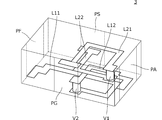
- FIG. 3 is a perspective view showing the internal structure of the coupling element 3.
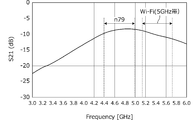
- FIG. 4 is a diagram showing the frequency characteristics of the gain of the first antenna 1 in the first embodiment.
- 5 (A) and 5 (B) are diagrams showing the frequency characteristics of the gain of the first antenna 1 depending on the presence or absence of the mutual inductance M of the coupling element 3 included in the antenna device 101.
- FIG. 6 is a diagram showing the frequency characteristics of the radiation efficiency of the first antenna 1 in the antenna device of the first embodiment and the first antenna in the antenna as a comparative example.
- FIG. 1 is a circuit diagram of the antenna device 101 according to the first embodiment.
- 2 (A) and 2 (B) are circuit diagrams of the antenna device 101 including the schematic shape of each radiating element.
- FIG. 3 is a perspective view showing the
- FIG. 7 is a diagram showing the frequency characteristics of the feeding phase difference between the first radiating element 11 and the second radiating element 12.
- FIG. 8 is a circuit diagram of the antenna device according to the second embodiment.
- FIG. 9 is a circuit diagram of the antenna device according to the third embodiment.
- FIG. 10 is a circuit diagram of the antenna device according to the third embodiment.
- FIG. 11 is a circuit diagram of the antenna device according to the third embodiment.
- FIG. 12 is a circuit diagram of the antenna device according to the third embodiment.
- FIG. 13 is a circuit diagram of the antenna device according to the fourth embodiment.
- FIG. 14 is a circuit diagram of the antenna device according to the fourth embodiment.
- FIG. 15 is a circuit diagram of the antenna device according to the fourth embodiment.
- FIG. 16 is a circuit diagram of the antenna device according to the fourth embodiment.
- FIG. 17 is a circuit diagram of the antenna device according to the fifth embodiment.
- FIG. 18 is a circuit diagram of the antenna device according to the fifth embodiment.
- FIG. 19 is a circuit diagram of the antenna device according to the fifth embodiment.
- FIG. 20 is a circuit diagram of the antenna device according to the fifth embodiment.
- FIG. 21 is a circuit diagram of the antenna device according to the sixth embodiment.
- FIG. 22 is a circuit diagram of another antenna device according to the sixth embodiment.
- FIG. 23 is a circuit diagram of the antenna device according to the seventh embodiment.
- FIG. 24 is a circuit diagram of the antenna device according to the seventh embodiment, which is expressed including the schematic shape of each radiating element.
- 25 (A) and 25 (B) are circuit diagrams of the antenna device according to the eighth embodiment.
- FIG. 26 (A), 26 (B), and 26 (C) are diagrams showing configuration examples of matching circuits 91 to 99.
- FIG. 27 is a circuit diagram of the antenna device according to the ninth embodiment.
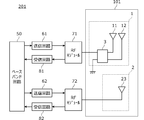
- FIG. 28 is a block diagram of the electronic device 201 according to the tenth embodiment.
- FIG. 29 is a circuit diagram of a wideband antenna as a comparative example.
- FIG. 30 is a diagram showing the frequency characteristics of the gain of the wideband antenna shown in FIG. 29.
- FIG. 1 is a circuit diagram of the antenna device 101 according to the first embodiment.
- 2 (A) and 2 (B) are circuit diagrams of the antenna device 101 including the schematic shape of each radiating element.
- the antenna device 101 includes a first antenna 1 and a second antenna 2.
- the antenna device 101 is used by connecting the first feeding circuit 10 to the feeding portion of the first antenna 1 and connecting the second feeding circuit 20 to the feeding portion of the second antenna 2.
- the first antenna 1 includes a coupling element 3, a phase adjuster 13, a first radiating element 11, and a second radiating element 12.
- the coupling element 3 is composed of a primary coil L1 and a secondary coil L2 that magnetically couple with each other.
- the coupling element 3 includes a power feeding terminal PF, a first radiation element connection terminal PA, a second radiation element connection terminal PS, and a ground terminal PG.
- the primary coil L1 is connected in series between the first power feeding circuit 10 and the first radiating element 11.
- the first feeding circuit 10 is connected between the ground which is the reference potential end and the primary coil L1.
- the secondary coil L2 is connected in series between the phase adjuster 13 and the second radiating element 12. Further, the phase adjuster 13 is connected between the secondary coil L2 and the ground.
- the phase adjuster 13 is a circuit that adjusts the difference in the feeding phase of the second radiating element 12 with respect to the first radiating element 11 by adjusting the phase difference between the ground and the secondary coil L2.
- the second antenna 2 includes a third radiating element 23.
- the second feeding circuit 20 is connected between the third radiating element 23 and the ground.
- the first radiating element 11, the second radiating element 12, and the third radiating element 23 are all 1/4 wavelength monopole antennas or a monopole antenna thereof. It is an inverted L-shaped antenna bent in the middle.
- the first antenna 1 is, for example, an antenna used in the band n79 of the designated frequency band of 3GPP
- the second antenna 2 is, for example, a Wi-Fi antenna used in the 5 GHz band of the IEEE 802.11 standard.
- FIG. 3 is a perspective view showing the internal structure of the coupling element 3.
- the primary coil L1 and the secondary coil L2 are configured in a single element.
- the coupling element 3 is a laminate of a plurality of insulating base materials on which a predetermined conductor pattern is formed.
- a primary coil L1 for one turn or more is configured by conductor patterns L11 and L12 and a via conductor V1 that interconnects the conductor patterns L11 and L12.
- the secondary coils L2 for one turn or more are configured by the conductor patterns L21 and L22 and the via conductor V2 connecting between the conductor patterns L21 and L22.
- the primary coil L1 and the secondary coil L2 have their respective coil openings in a coaxial relationship and are magnetically coupled.
- the resonance frequency determined by the self-inductance of the first radiation element 11, the primary coil L1 and the mutual inductance of the coupling element 3 is represented by the first resonance frequency f1, and of the second radiation element 12 and the secondary coil L2.
- the resonance frequency determined by the self-inductance, the mutual inductance of the coupling element 3, and the phase adjuster 13 is represented by the second resonance frequency f2.
- the resonance frequency determined by the second antenna 2 is represented by the third resonance frequency f3.
- These three resonance frequencies have a relationship of f1 ⁇ f2 ⁇ f3, and the second resonance frequency f2 is located at the high frequency end of the communication band of the first antenna 1. That is, the first antenna 1 exhibits an antenna characteristic having a gain in a wide band extending from the first resonance frequency f1 to the second resonance frequency f2.
- the second antenna 2 exhibits antenna characteristics having a gain in the frequency band including the third resonance frequency f3.
- the phase difference between the signals of the first radiating element 11 and the second radiating element 12 in the communication band of the second antenna 2 is within the range of 180 ° ⁇ 45 °.
- This wideband antenna includes a coupling element 3, a first radiating element 11, and a second radiating element 12.
- the coupling element 3 is composed of a primary coil L1 and a secondary coil L2 that magnetically couple with each other.
- FIG. 30 shows the frequency characteristics of the isolation between the wideband antenna including the first radiation element 11 and the second radiation element 12 shown in FIG. 29 and the second antenna 2 for Wi-Fi including the third radiation element 23. It is a figure which shows.
- the wideband antenna is an antenna used in the band n79, and has a high gain over a wide band of 4.4 GHz to 5.0 GHz, but is an IEEE 802.11 standard 5 GHz band (5.15 GHz to 5.725 GHz) Wi-Fi antenna. Isolation is poor because it extends to the frequency band of.
- the isolation between the antenna for the band n79 and the Wi-Fi antenna cannot be secured.
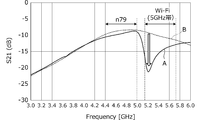
- FIG. 4 is a diagram showing the frequency characteristics of the isolation between the antennas of the first antenna 1 and the second antenna 2 in the present embodiment.
- the characteristic curve A is the frequency characteristic of the isolation between the antennas of the first antenna 1 and the second antenna 2 according to the present embodiment
- the vertical axis is S21 of the S parameter
- the horizontal axis is the frequency.
- the characteristic curve B is the frequency characteristic of the isolation between the antennas of the wideband antenna device and the second antenna 2 as a comparative example shown in FIG.
- the first antenna 1 in the present embodiment is an antenna used in the band n79, and isolation of -11 dB or more is obtained over a wide band of 4.4 GHz to 5.0 GHz. On the other hand, the gain is suppressed to -21 dB or less at the low frequency end of the 5 GHz band Wi-Fi. As a result, isolation between the first antenna 1 and the second antenna 2 is ensured.
- FIG. 2B shows the potential difference that occurs between the open ends of the first radiating element 11 and the second radiating element 12, especially in the communication band of the second antenna 2.
- the phase difference between the first radiating element 11 and the second radiating element 12 is within a range of at most less than ⁇ 135 °, preferably less than ⁇ 120 °, and more preferably 90. A range of less than ° and close to 0 ° is preferable. Therefore, in the band n79, the energy is not transferred between the first radiating element 11 and the second radiating element 12 as compared with the characteristic curve B, and the first antenna 1 acts as a broadband antenna.
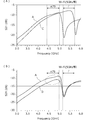
- FIG. 5A and 5 (B) are diagrams showing the frequency characteristics of the isolation between the antennas of the first antenna 1 and the second antenna 2 depending on the presence or absence of the mutual inductance M of the coupling element 3 included in the antenna device 101.
- the characteristic curve A is the characteristic of the first antenna 1 in the present embodiment
- the characteristic curve C is the characteristic of the first antenna 1 as a comparative example.
- the mutual inductance M between the primary coil L1 and the secondary coil L2 of the coupling element 3 is 0.
- the second resonance frequency f2 which rises when the mutual inductance M becomes 0, is adjusted by another element (second radiation element 12 or secondary coil L2) and isolated. It represents a state in which the frequencies that reduce the resonance are matched.
- the characteristic curve A is the characteristic of the first antenna 1 in the present embodiment
- the characteristic curve D is the characteristic of the first antenna of the comparative example after the adjustment.
- FIG. 6 is a diagram showing the frequency characteristics of the radiation efficiency of the first antenna 1 in the antenna device of the first embodiment and the first antenna in the antenna as a comparative example.
- the vertical axis of FIG. 6 is the radiation efficiency, and the horizontal axis is the frequency.
- the characteristic curve A is the characteristic of the first antenna 1 in the present embodiment
- the characteristic curve D is the characteristic of the first antenna of the comparative example after the adjustment.
- FIG. 7 is a diagram showing the frequency characteristics of the feeding phase difference between the first radiating element 11 and the second radiating element 12.
- the characteristic curve A is the characteristic of the first antenna 1 in the present embodiment
- the characteristic curve D is the characteristic of the first antenna of the comparative example after the adjustment.
- the feeding phase difference between the first radiating element 11 and the second radiating element 12 is less than 135 ° in the frequency range of 4.4 GHz to 5.0 GHz, whereas the comparison is made.
- the feeding phase difference between the first radiating element 11 and the second radiating element 12 is within the range of 135 ° to 180 °, and the first radiating element 11 and the second radiating element 12 It can be seen that the potential difference between them is large and the radiant energy into the air is suppressed.
- the phase difference between the signals of the first radiating element 11 and the second radiating element 12 is ⁇ 135 ° due to the mutual inductance of the phase adjuster 13 and the coupling element 3. Since it is less than, the radiation efficiency of the first antenna 1 is high.
- the specific bandwidths of the band communicating with the first antenna 1 and the band communicating with the second antenna 2 are both 10% or more, and the first antenna 1 and the second antenna 2
- the specific bandwidth between is 5% or less.
- the specific bandwidths of the band communicating with the first antenna 1 and the band communicating with the second antenna 2 are both 10% or more, and the communication band of the first antenna 1 and the communication band of the second antenna 2 are combined. Isolation between antennas can be ensured even when the two communication bands have a wide band and the two communication bands have a narrow band, such that the specific bandwidth between them is 5% or less.
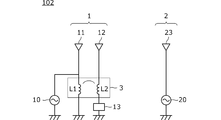
- Second Embodiment an antenna device in which the connection structure of the first power feeding circuit to the first radiating element 11 is different from the example shown in the first embodiment is shown.
- FIG. 8 is a circuit diagram of the antenna device according to the second embodiment.
- the antenna device 102 includes a first antenna 1 and a second antenna 2.
- the antenna device 102 is used by connecting the first feeding circuit 10 to the feeding portion of the first antenna 1 and connecting the second feeding circuit 20 to the feeding portion of the second antenna 2.
- the first antenna 1 includes a coupling element 3, a phase adjuster 13, a first radiating element 11, and a second radiating element 12.
- the coupling element 3 is composed of a primary coil L1 and a secondary coil L2 that magnetically couple with each other.
- the primary coil L1 is connected between the first radiating element 11 and the ground.
- One end of the first power feeding circuit 10 is connected to the connection portion of the primary coil L1 to the first radiating element 11, and the other end is connected to the ground.
- the secondary coil L2 is connected in series between the phase adjuster 13 and the second radiating element 12. Further, the phase adjuster 13 is connected between the secondary coil L2 and the ground.
- the first power feeding circuit 10 may be connected so that power is supplied to the connection point (connection range) between the primary coil L1 and the first radiating element 11.
- FIG. 2A shows an example in which the first radiating element 11 is composed of a monopole antenna or an inverted L-shaped antenna, but the first radiating element 11 is not limited to this.
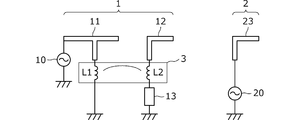
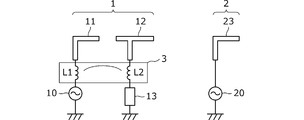
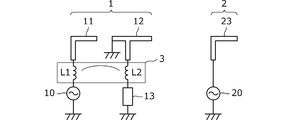
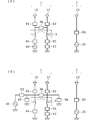
- 9, 10, 11, and 12 are circuit diagrams of the antenna device according to the third embodiment.
- Both antenna devices include a first antenna 1 and a second antenna 2.
- the first antenna 1 includes a coupling element 3, a phase adjuster 13, a first radiating element 11, and a second radiating element 12.
- the second antenna 2 includes a third radiating element 23.
- the configurations other than the first radiating element 11 are as shown in the first embodiment.
- the first radiating element 11 is a branch antenna. With this configuration, two or more resonance frequencies of the first radiating element 11 can be provided.
- the first radiating element 11 is a loop type antenna. That is, the first radiating element 11, the primary coil L1, and the first feeding circuit 10 form one loop.
- the first radiating element 11 is an inverted F type antenna.
- an inverted-F antenna is composed of a main body extending in the lateral direction, a feeding line connected to one end thereof, and a short-circuit line connected in the middle of the main body.
- power is supplied from the short-circuit line. That is, the feed line is grounded, and the first feed circuit 10 is connected to the short-circuit line via the primary coil L1.
- the first radiating element 11 is an inverted F type antenna.
- the first feeding circuit 10 is connected to the feeding line, and the primary coil L1 is connected between the short-circuit line and the ground.
- the antenna device shown in FIG. 12 can also be said to be an example of the antenna device 102 shown in FIG.
- FIG. 2A shows an example in which the second radiating element 12 is composed of a monopole antenna or an inverted L-shaped antenna, but the second radiating element 12 is not limited to this.
- 13, FIG. 14, FIG. 15, and FIG. 16 are circuit diagrams of the antenna device according to the fourth embodiment.
- Both antenna devices include a first antenna 1 and a second antenna 2.
- the first antenna 1 includes a coupling element 3, a phase adjuster 13, a first radiating element 11, and a second radiating element 12.
- the second antenna 2 includes a third radiating element 23.
- the configurations other than the second radiating element 12 are as shown in the first embodiment.
- the second radiating element 12 is a branch antenna. With this configuration, two or more resonance frequencies of the second radiating element 12 can be provided.
- the second radiating element 12 is a loop type antenna. That is, the second radiating element 12, the secondary coil L2, and the phase adjuster 13 form one loop.
- the second radiating element 12 is an inverted F type antenna.
- power is supplied from the short circuit line. That is, the feeder line is connected to the ground, and the secondary coil L2 and the phase adjuster 13 are connected between the short-circuit line and the ground.
- the second radiating element 12 is an inverted F type antenna.
- the secondary coil L2 is connected between the feeder line and the ground, and the phase adjuster 13 is connected between the short-circuit line and the ground.
- FIG. 2A shows an example in which the third radiating element 23 is composed of a monopole antenna or an inverted L-shaped antenna, but the third radiating element 23 is not limited to this.
- 17, FIG. 18, FIG. 19, and FIG. 20 are circuit diagrams of the antenna device according to the fifth embodiment.
- Both antenna devices include a first antenna 1 and a second antenna 2.
- the first antenna 1 includes a coupling element 3, a phase adjuster 13, a first radiating element 11, and a second radiating element 12.
- the second antenna 2 includes a third radiating element 23.
- the configurations other than the third radiating element 23 are as shown in the first embodiment.
- the third radiating element 23 is a branch antenna. With this configuration, two or more resonance frequencies of the third radiating element 23 can be provided.
- the third radiating element 23 is a loop type antenna. That is, the third radiating element 23 and the second feeding circuit 20 form one loop.
- the third radiating element 23 is an inverted F type antenna.
- power is supplied from the short circuit line. That is, the feeding line is grounded, and the second feeding circuit 20 is connected between the short-circuit line and the ground.
- the third radiating element 23 is also an inverted F type antenna.
- the second feeding circuit 20 is connected between the feeding line and the ground.
- FIG. 21 is a circuit diagram of the antenna device according to the sixth embodiment.
- This antenna device includes a first antenna 1 and a second antenna 2.
- the first antenna 1 includes a coupling element 3, a phase adjuster 13, a first radiating element 11, a second radiating element 12, and a non-feeding radiating element 14.
- the second antenna 2 includes a third radiating element 23.
- the configurations other than the non-feeding radiation element 14 are as shown in FIG.
- the non-feeding radiation element 14 is electrically coupled with the first radiation element 11 and acts as a part of the first antenna 1.
- the first antenna 1 includes a ground-ground type non-feeding radiating element 14 that resonates at 1/2 wavelength, but the present invention is not limited to this, and the non-feeding radiating element 14 has one wavelength. It may be a ground non-grounded type radiating element that resonates. Further, in the ground-grounded non-feeding element, the resonance frequency of the non-feeding radiating element 14 may be adjusted by providing a reactance element between the non-feeding radiating element 14 and the ground. The resonance frequency of the non-feeding radiation element 14 is different from the resonance frequency of the first radiation element 11 (f1) and the resonance frequency of the second radiation element 12 (f2), and contributes to widening the bandwidth of the first antenna 1.
- FIG. 22 is a circuit diagram of another antenna device according to the sixth embodiment.
- This antenna device also includes a first antenna 1 and a second antenna 2.
- the first antenna 1 includes a coupling element 3, a phase adjuster 13, a first radiating element 11, and a second radiating element 12.
- the second antenna 2 includes a third radiating element 23 and a non-feeding radiating element 24.
- the configurations other than the non-feeding radiation element 24 are as shown in the first embodiment.
- the non-feeding radiation element 24 is electrically coupled with the third radiation element 23 and acts as a part of the second antenna 2.
- the resonance frequency of the non-feeding radiation element 24 is different from the resonance frequency of the third radiation element 23 (f3), and contributes to widening the bandwidth of the second antenna 2.
- FIG. 23 is a circuit diagram of the antenna device according to the seventh embodiment.
- FIG. 24 is a circuit diagram of the antenna device according to the seventh embodiment, which is expressed including the schematic shape of each radiating element.
- This antenna device includes a first antenna 1 and a second antenna 2.
- the first antenna 1 includes a coupling element 3, a phase adjuster 13, a first radiating element 11, and a second radiating element 12.
- the second antenna 2 includes a third radiating element 23.
- the phase adjuster 13 is connected between the second radiating element 12 and the secondary coil L2, and the secondary coil L2 is connected between the phase adjuster 13 and the ground. Other configurations are as shown in the first embodiment.
- the phase adjuster 13 is composed of a reactance element, but the phase adjustment action is higher when the phase adjuster 13 is provided at a position where the current intensity is high. Generally, in a radiating element with an open tip, the ground end has the maximum current intensity. Therefore, it is preferable to provide a phase adjuster 13 between the secondary coil L2 and the ground as in the examples shown so far.
- the phase adjuster 13 may be provided on the second radiation element 12 side of the secondary coil L2.
- the second radiating element 12 is a loop antenna
- the current intensity is high even between the second radiating element 12 and the secondary coil L2, so that the phase adjuster 13 has a phase adjuster 13. It works effectively.
- FIG. 25 (A) and 25 (B) are circuit diagrams of the antenna device according to the eighth embodiment.
- the antenna device shown in FIG. 25 (A) includes a first antenna 1 and a second antenna 2, the first antenna 1 includes matching circuits 91, 92, 94, 95, 96, and the second antenna 2 is matched.
- the circuit 99 is provided.
- the antenna device shown in FIG. 25B includes a first antenna 1 and a second antenna 2, the first antenna 1 includes matching circuits 91 to 98, and the second antenna 2 includes a matching circuit 99.
- 26 (A), 26 (B), and 26 (C) are configuration examples of the matching circuits 91 to 99. That is, when connected to the series, it is either the capacitor C, the inductor L or the short circuit, as shown in FIG. 26 (A), and when connected to the ground to the shunt, it is shown in FIG. 26 (B). As shown, it is shunted to ground via capacitor C or inductor L, or there is no shunt connection to ground. Moreover, you may combine these. For example, as shown in FIG. 26C, the inductor L is connected to the series and the capacitor C is connected to the shunt.
- the matching circuit 91 is connected between the primary coil L1 and the first radiating element 11, and the matching circuit 92 is connected between the secondary coil L2 and the second radiating element 12.
- the matching circuit 94 is connected between the primary coil L1 and the first feeding circuit 10, and the matching circuit 95 is connected between the secondary coil L2 and the phase adjuster 13.
- the matching circuit 96 is connected between the primary coil L1 and the secondary coil L2.
- the matching circuit 91 measures matching between the primary coil L1 and the first radiating element 11.
- the matching circuit 92 measures matching between the secondary coil L2 and the second radiating element 12.
- the matching circuit 94 seeks matching between the primary coil L1 and the first feeding circuit 10.
- the matching circuit 95 measures matching between the secondary coil L2 and the phase adjuster 13.
- the matching circuit 96 matches the primary coil L1 and the secondary coil L2.
- the matching circuit 99 of the second antenna tries to match the third radiating element 23 with the second feeding circuit 20.
- the matching circuit 91 measures matching between the primary coil L1 and the first radiating element 11.
- the matching circuit 92 measures matching between the secondary coil L2 and the second radiating element 12.
- the matching circuit 95 measures matching between the secondary coil L2 and the phase adjuster 13.
- the matching circuit 96 matches the primary coil L1 and the secondary coil L2.
- the matching circuit 97 together with the matching circuits 91, 93, 94, tries to match between the first feeding circuit 10 and the primary coil L1.
- the matching circuit 98 together with the matching circuits 92 and 95, measures the matching between the secondary coil L2 and the second radiating element 12.
- the matching circuit 99 of the second antenna tries to match the third radiating element 23 with the second feeding circuit 20.
- FIG. 27 is a circuit diagram of the antenna device according to the ninth embodiment.
- This antenna device includes a first antenna 1 and a second antenna 2, and a matching circuit 90 is connected between the connection portion between the primary coil L1 and the first radiating element 11 and the ground.
- the configurations other than the matching circuit 90 are as shown in the first embodiment and the like.
- the matching circuit 90 is composed of a plurality of reactance elements X1, X2, X3 and a switch SW for selecting them. In this way, if the matching circuit 90 is configured by a plurality of reactance elements and a switch that selects those reactance elements, the connection portion between the primary coil L1 and the first radiating element 11 and the shunt to the ground can be shunted by selecting the switch SW. The reactance to be connected can be switched, and more optimum impedance matching can be obtained according to a predetermined frequency band.
- the matching circuit 90 connected to the connection portion between the primary coil L1 and the first radiating element 11 is illustrated, but other than that shown in FIGS. 25 (A) and 25 (B). The same can be applied to the matching circuit connected to the above location.
- FIG. 28 is a block diagram of the electronic device 201 according to the tenth embodiment.
- the electronic device 201 is, for example, a mobile phone terminal, and includes an antenna device 101, RF modules 71, 72, transmission circuits 61, 62, reception circuits 81, 82, and a baseband circuit 50.
- the antenna device 101 includes a coupling element 3, a first radiating element 11, a second radiating element 12, and a third radiating element 23.
- the RF module 71 is a circuit that switches between a transmission signal and a reception signal of a communication signal for a mobile phone.
- the transmission circuit 61 is a transmission circuit for a mobile phone
- the reception circuit 81 is a reception circuit for a mobile phone.
- the RF module 72 is a circuit for switching between a transmission signal and a reception signal of a wireless LAN signal.
- the transmission circuit 62 is a wireless LAN transmission circuit
- the reception circuit 82 is a wireless LAN reception circuit.
- the primary coil L1 and the secondary coil L2 are not limited to the coils formed in a single element, and may be individual elements that act as coils, respectively.
- the non-feeding radiating element is a ground-grounded radiating element that resonates at 1/2 wavelength, but the present invention is not limited to this, and the non-feeding radiating element has one wavelength. It may be a ground non-grounded type radiating element that resonates. Further, an adjustment circuit composed of at least one reactance element may be added to each radiation element in order to adjust impedance, resonance frequency, and the like.
- connection of the "phase adjuster connected to the second radiating element” described in [Means for Solving the Problem] means that the phase adjuster 13 is directly connected to the second radiating element 12.
- the expression includes not only the “connection” but also an indirect “connection” such that the secondary coil L2 is connected between the second radiating element 12 and the phase adjuster 13.
- connection of the "first radiation element connected to the primary coil” is not limited to the “connection” in which the primary coil L1 is directly connected to the first radiation element 11, but the first radiation element 11 It is an expression including an indirect “connection” such that another element or circuit such as a matching circuit is connected between the primary coil L1 and the primary coil L1. The same applies to the "second radiation element connected to the secondary coil”.
- this "connection” is not limited to the “connection” in which the secondary coil L2 is directly connected to the second radiation element 12, and the phase adjuster 13 is between the second radiation element 12 and the secondary coil L2.
- Includes indirect “connections” such as connecting other elements or circuits such as or matching circuits.
Landscapes
- Engineering & Computer Science (AREA)
- Computer Networks & Wireless Communication (AREA)
- Physics & Mathematics (AREA)
- Electromagnetism (AREA)
- Variable-Direction Aerials And Aerial Arrays (AREA)
- Details Of Aerials (AREA)
Priority Applications (3)
| Application Number | Priority Date | Filing Date | Title |
|---|---|---|---|
| CN202190000071.5U CN215989212U (zh) | 2020-01-28 | 2021-01-12 | 天线装置及电子设备 |
| JP2021517498A JP6950852B1 (ja) | 2020-01-28 | 2021-01-12 | アンテナ装置及び電子機器 |
| US17/356,569 US11923624B2 (en) | 2020-01-28 | 2021-06-24 | Antenna device and electronic apparatus |
Applications Claiming Priority (2)
| Application Number | Priority Date | Filing Date | Title |
|---|---|---|---|
| JP2020011521 | 2020-01-28 | ||
| JP2020-011521 | 2020-01-28 |
Related Child Applications (1)
| Application Number | Title | Priority Date | Filing Date |
|---|---|---|---|
| US17/356,569 Continuation US11923624B2 (en) | 2020-01-28 | 2021-06-24 | Antenna device and electronic apparatus |
Publications (1)
| Publication Number | Publication Date |
|---|---|
| WO2021153215A1 true WO2021153215A1 (ja) | 2021-08-05 |
Family
ID=77078805
Family Applications (1)
| Application Number | Title | Priority Date | Filing Date |
|---|---|---|---|
| PCT/JP2021/000676 Ceased WO2021153215A1 (ja) | 2020-01-28 | 2021-01-12 | アンテナ装置及び電子機器 |
Country Status (4)
| Country | Link |
|---|---|
| US (1) | US11923624B2 (https=) |
| JP (1) | JP6950852B1 (https=) |
| CN (1) | CN215989212U (https=) |
| WO (1) | WO2021153215A1 (https=) |
Cited By (4)
| Publication number | Priority date | Publication date | Assignee | Title |
|---|---|---|---|---|
| WO2023015979A1 (zh) * | 2021-08-09 | 2023-02-16 | 荣耀终端有限公司 | 天线组合系统及终端设备 |
| JP2023036073A (ja) * | 2021-08-30 | 2023-03-13 | 株式会社村田製作所 | コイル素子、アンテナ装置、および電子機器 |
| WO2023120074A1 (ja) * | 2021-12-22 | 2023-06-29 | 株式会社村田製作所 | アンテナ装置、および通信端末装置 |
| WO2024224723A1 (ja) * | 2023-04-24 | 2024-10-31 | 株式会社村田製作所 | アンテナ装置、および通信端末装置 |
Families Citing this family (2)
| Publication number | Priority date | Publication date | Assignee | Title |
|---|---|---|---|---|
| WO2019208253A1 (ja) * | 2018-04-25 | 2019-10-31 | 株式会社村田製作所 | アンテナ装置及び通信端末装置 |
| JP6897900B1 (ja) * | 2019-08-27 | 2021-07-07 | 株式会社村田製作所 | アンテナ装置及び電子機器 |
Citations (4)
| Publication number | Priority date | Publication date | Assignee | Title |
|---|---|---|---|---|
| JP2013026962A (ja) * | 2011-07-25 | 2013-02-04 | Nippon Soken Inc | アンテナ装置および無線通信システム |
| WO2019208253A1 (ja) * | 2018-04-25 | 2019-10-31 | 株式会社村田製作所 | アンテナ装置及び通信端末装置 |
| WO2020012885A1 (ja) * | 2018-07-09 | 2020-01-16 | 株式会社村田製作所 | アンテナ装置及び電子機器 |
| WO2020137375A1 (ja) * | 2018-12-28 | 2020-07-02 | 株式会社村田製作所 | アンテナ装置 |
Family Cites Families (8)
| Publication number | Priority date | Publication date | Assignee | Title |
|---|---|---|---|---|
| US6870503B2 (en) * | 2002-11-19 | 2005-03-22 | Farrokh Mohamadi | Beam-forming antenna system |
| JP2004336250A (ja) * | 2003-05-02 | 2004-11-25 | Taiyo Yuden Co Ltd | アンテナ整合回路、アンテナ整合回路を有する移動体通信装置、アンテナ整合回路を有する誘電体アンテナ |
| WO2004107498A2 (en) * | 2003-05-22 | 2004-12-09 | The Regents Of The University Of Michigan | A phased array antenna with extended resonance power divider/phase shifter circuit |
| JP5505561B2 (ja) | 2011-05-09 | 2014-05-28 | 株式会社村田製作所 | 結合度調整回路、アンテナ装置および通信端末装置 |
| US9001004B2 (en) * | 2011-07-05 | 2015-04-07 | Broadcom Corporation | Wireless communication device with multiple interwoven spiral antenna assembly |
| JP6168243B2 (ja) * | 2015-03-25 | 2017-07-26 | 株式会社村田製作所 | 移相器、インピーダンス整合回路、合分波器および通信端末装置 |
| WO2019066587A1 (en) * | 2017-09-28 | 2019-04-04 | Intel IP Corporation | COMMUNICATION NETWORK APPARATUS FOR UPLINK PLANNING |
| JP6881593B2 (ja) * | 2017-10-30 | 2021-06-02 | 株式会社村田製作所 | アンテナ装置および通信装置 |
-
2021
- 2021-01-12 CN CN202190000071.5U patent/CN215989212U/zh active Active
- 2021-01-12 WO PCT/JP2021/000676 patent/WO2021153215A1/ja not_active Ceased
- 2021-01-12 JP JP2021517498A patent/JP6950852B1/ja active Active
- 2021-06-24 US US17/356,569 patent/US11923624B2/en active Active
Patent Citations (4)
| Publication number | Priority date | Publication date | Assignee | Title |
|---|---|---|---|---|
| JP2013026962A (ja) * | 2011-07-25 | 2013-02-04 | Nippon Soken Inc | アンテナ装置および無線通信システム |
| WO2019208253A1 (ja) * | 2018-04-25 | 2019-10-31 | 株式会社村田製作所 | アンテナ装置及び通信端末装置 |
| WO2020012885A1 (ja) * | 2018-07-09 | 2020-01-16 | 株式会社村田製作所 | アンテナ装置及び電子機器 |
| WO2020137375A1 (ja) * | 2018-12-28 | 2020-07-02 | 株式会社村田製作所 | アンテナ装置 |
Cited By (5)
| Publication number | Priority date | Publication date | Assignee | Title |
|---|---|---|---|---|
| WO2023015979A1 (zh) * | 2021-08-09 | 2023-02-16 | 荣耀终端有限公司 | 天线组合系统及终端设备 |
| US12573749B2 (en) | 2021-08-09 | 2026-03-10 | Honor Device Co., Ltd. | Antenna combination system and terminal device |
| JP2023036073A (ja) * | 2021-08-30 | 2023-03-13 | 株式会社村田製作所 | コイル素子、アンテナ装置、および電子機器 |
| WO2023120074A1 (ja) * | 2021-12-22 | 2023-06-29 | 株式会社村田製作所 | アンテナ装置、および通信端末装置 |
| WO2024224723A1 (ja) * | 2023-04-24 | 2024-10-31 | 株式会社村田製作所 | アンテナ装置、および通信端末装置 |
Also Published As
| Publication number | Publication date |
|---|---|
| JPWO2021153215A1 (https=) | 2021-08-05 |
| CN215989212U (zh) | 2022-03-08 |
| US20210320418A1 (en) | 2021-10-14 |
| JP6950852B1 (ja) | 2021-10-13 |
| US11923624B2 (en) | 2024-03-05 |
Similar Documents
| Publication | Publication Date | Title |
|---|---|---|
| JP6950852B1 (ja) | アンテナ装置及び電子機器 | |
| US10819031B2 (en) | Printed circuit board antenna and terminal | |
| US7760150B2 (en) | Antenna assembly and wireless unit employing it | |
| US9680514B2 (en) | Methods for reducing near-field radiation and specific absorption rate (SAR) values in communications devices | |
| EP1368855B1 (en) | Antenna arrangement | |
| JP5178970B2 (ja) | アンテナ装置及び無線通信装置 | |
| US8525731B2 (en) | Small antenna using SRR structure in wireless communication system and method for manufacturing the same | |
| EP2942834B1 (en) | Antenna apparatus and terminal device | |
| EP3057177B1 (en) | Adjustable antenna and terminal | |
| JP5527011B2 (ja) | アンテナ装置及び通信装置 | |
| EP2290746B1 (en) | Planar antenna with isotropic radiation pattern | |
| JPH1075192A (ja) | アンテナ装置 | |
| WO2006049382A1 (en) | Multi-band internal antenna of symmetry structure having stub | |
| KR101727303B1 (ko) | 통신 장치에서 근거리 방사 및 전자파 흡수율값을 감소시키는 방법 | |
| US12555914B2 (en) | Antenna module | |
| WO2014125832A1 (ja) | デュアルバンドアンテナ装置 | |
| CN213816426U (zh) | 天线装置及电子设备 | |
| CN206301949U (zh) | 方向图可重构天线及通讯设备 | |
| CN105870597A (zh) | 共用金属背盖的双天线方案 | |
| US9054426B2 (en) | Radio apparatus and antenna device | |
| CN107706506A (zh) | 一种可重构天线及智能通信终端 | |
| US10320057B2 (en) | Antenna device, wireless communication device, and band adjustment method | |
| US8421695B2 (en) | Multi-frequency, noise optimized active antenna | |
| CN118801098A (zh) | 多频共口径的收发复用圆极化天线结构单元及其阵列 | |
| WO2010138453A2 (en) | Methods for reducing near-field radiation and specific absorption rate (sar) values in communications devices |
Legal Events
| Date | Code | Title | Description |
|---|---|---|---|
| ENP | Entry into the national phase |
Ref document number: 2021517498 Country of ref document: JP Kind code of ref document: A |
|
| 121 | Ep: the epo has been informed by wipo that ep was designated in this application |
Ref document number: 21747708 Country of ref document: EP Kind code of ref document: A1 |
|
| NENP | Non-entry into the national phase |
Ref country code: DE |
|
| 122 | Ep: pct application non-entry in european phase |
Ref document number: 21747708 Country of ref document: EP Kind code of ref document: A1 |