WO2021149293A1 - 電池パック、非接触式充電システム、及び、電動工具 - Google Patents
電池パック、非接触式充電システム、及び、電動工具 Download PDFInfo
- Publication number
- WO2021149293A1 WO2021149293A1 PCT/JP2020/031925 JP2020031925W WO2021149293A1 WO 2021149293 A1 WO2021149293 A1 WO 2021149293A1 JP 2020031925 W JP2020031925 W JP 2020031925W WO 2021149293 A1 WO2021149293 A1 WO 2021149293A1
- Authority
- WO
- WIPO (PCT)
- Prior art keywords
- battery pack
- power
- receiving coil
- power receiving
- coil
- Prior art date
- Legal status (The legal status is an assumption and is not a legal conclusion. Google has not performed a legal analysis and makes no representation as to the accuracy of the status listed.)
- Ceased
Links
Images


Classifications
-
- H—ELECTRICITY
- H02—GENERATION; CONVERSION OR DISTRIBUTION OF ELECTRIC POWER
- H02J—ELECTRIC POWER NETWORKS; CIRCUIT ARRANGEMENTS OR SYSTEMS FOR SUPPLYING OR DISTRIBUTING ELECTRIC POWER; SYSTEMS FOR STORING ELECTRIC ENERGY
- H02J50/00—Circuit arrangements or systems for wireless supply or distribution of electric power
- H02J50/005—Mechanical details of housing or structure aiming to accommodate the power transfer means, e.g. mechanical integration of coils, antennas or transducers into emitting or receiving devices
-
- H—ELECTRICITY
- H01—ELECTRIC ELEMENTS
- H01M—PROCESSES OR MEANS, e.g. BATTERIES, FOR THE DIRECT CONVERSION OF CHEMICAL ENERGY INTO ELECTRICAL ENERGY
- H01M10/00—Secondary cells; Manufacture thereof
- H01M10/42—Methods or arrangements for servicing or maintenance of secondary cells or secondary half-cells
- H01M10/44—Methods for charging or discharging
-
- H—ELECTRICITY
- H01—ELECTRIC ELEMENTS
- H01M—PROCESSES OR MEANS, e.g. BATTERIES, FOR THE DIRECT CONVERSION OF CHEMICAL ENERGY INTO ELECTRICAL ENERGY
- H01M50/00—Constructional details or processes of manufacture of the non-active parts of electrochemical cells other than fuel cells, e.g. hybrid cells
- H01M50/20—Mountings; Secondary casings or frames; Racks, modules or packs; Suspension devices; Shock absorbers; Transport or carrying devices; Holders
- H01M50/247—Mountings; Secondary casings or frames; Racks, modules or packs; Suspension devices; Shock absorbers; Transport or carrying devices; Holders specially adapted for portable devices, e.g. mobile phones, computers, hand tools or pacemakers
-
- H—ELECTRICITY
- H02—GENERATION; CONVERSION OR DISTRIBUTION OF ELECTRIC POWER
- H02J—ELECTRIC POWER NETWORKS; CIRCUIT ARRANGEMENTS OR SYSTEMS FOR SUPPLYING OR DISTRIBUTING ELECTRIC POWER; SYSTEMS FOR STORING ELECTRIC ENERGY
- H02J50/00—Circuit arrangements or systems for wireless supply or distribution of electric power
- H02J50/10—Circuit arrangements or systems for wireless supply or distribution of electric power using inductive coupling
- H02J50/12—Circuit arrangements or systems for wireless supply or distribution of electric power using inductive coupling of the resonant type
-
- H—ELECTRICITY
- H01—ELECTRIC ELEMENTS
- H01M—PROCESSES OR MEANS, e.g. BATTERIES, FOR THE DIRECT CONVERSION OF CHEMICAL ENERGY INTO ELECTRICAL ENERGY
- H01M2220/00—Batteries for particular applications
- H01M2220/30—Batteries in portable systems, e.g. mobile phone, laptop
-
- Y—GENERAL TAGGING OF NEW TECHNOLOGICAL DEVELOPMENTS; GENERAL TAGGING OF CROSS-SECTIONAL TECHNOLOGIES SPANNING OVER SEVERAL SECTIONS OF THE IPC; TECHNICAL SUBJECTS COVERED BY FORMER USPC CROSS-REFERENCE ART COLLECTIONS [XRACs] AND DIGESTS
- Y02—TECHNOLOGIES OR APPLICATIONS FOR MITIGATION OR ADAPTATION AGAINST CLIMATE CHANGE
- Y02E—REDUCTION OF GREENHOUSE GAS [GHG] EMISSIONS, RELATED TO ENERGY GENERATION, TRANSMISSION OR DISTRIBUTION
- Y02E60/00—Enabling technologies; Technologies with a potential or indirect contribution to GHG emissions mitigation
- Y02E60/10—Energy storage using batteries
Definitions
- This disclosure relates to battery packs, non-contact charging systems, and power tools.
- Some power tools are equipped with a battery pack.
- the battery pack is charged, for example, using a charging system.
- Some charging systems charge the battery pack by transmitting power from the power supply device to the battery pack in a non-contact manner.
- Such a battery pack corresponding to non-contact charging is disclosed in Patent Document 1, for example.
- the battery pack disclosed in Patent Document 1 has a power receiving coil.
- the power supply device has a power feeding coil.
- the power feeding coil and the power receiving coil have similar figures. When the power feeding coil and the power receiving coil face each other within a predetermined distance, most of the magnetic flux generated by the power feeding coil penetrates the power receiving coil.
- the battery pack disclosed in Patent Document 1 is charged by placing the battery pack on the power supply device so that the power feeding coil and the power receiving coil face each other.
- the present disclosure has been made to solve the above-mentioned problems, and an object of the present invention is to provide a battery pack capable of non-contact charging even if the power supply device is laterally displaced or lifted. And.
- the battery pack according to the present disclosure is provided over a plurality of inner surfaces of a housing for accommodating a battery cell and a plurality of inner surfaces of the housing, and magnetically resonates between the feeding coils of the power supply device to cause non-contact of electric power from the feeding coils. It is provided with a power receiving coil received by the battery and a charging circuit housed in the housing and supplying the power received by the power receiving coil to the battery cell.
- non-contact charging can be performed even if the power supply device is laterally displaced or lifted.
- FIG. 1 is a schematic view showing a configuration of a non-contact charging system 20 and a power tool 10 to which the battery pack 40A according to the first embodiment is applied.
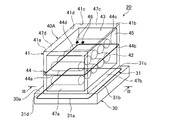
- FIG. 2 is a perspective view showing a configuration of a non-contact charging system 20 to which the battery pack 40A according to the first embodiment is applied.
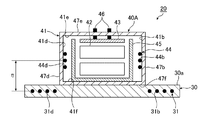
- FIG. 3 is a cross-sectional view taken along the line III-III of FIG.
- FIG. 4 is a diagram showing the relationship between the coil-to-coil distance and the coil-to-coil coupling efficiency.
- the power tool 10 includes a tool body 11 and a battery pack 40A.
- the power tool 10 is, for example, an electric drill or the like.
- the non-contact charging system 20 includes a power supply device 30 and a battery pack 40A.
- the battery pack 40A supplies electric power to the tool body 11 by electrically connecting to the tool body 11.
- the tool body 11 is driven by using the electric power supplied from the battery pack 40A. Further, the battery pack 40A can be non-contact charged by using the power supply device 30.
- the non-contact charging system shown in FIGS. 2 and 3 is a system that performs non-contact charging using 20, for example, a magnetic field resonance method.
- the non-contact charging system 20 transmits power from the power supply device 30 to the battery pack 40A in a non-contact manner to charge the battery pack 40A.
- the battery pack 40A has a housing 41, a battery cell 42, a charging circuit 43, a power receiving coil 44, a magnetic sheet 45, and an electrode 46.
- the housing 41 forms the outer shell of the battery pack 40A.
- the housing 41 has a hollow structure, and houses a battery cell 42, a charging circuit 43, a power receiving coil 44, and a magnetic sheet 45 inside.
- the housing 41 is made of, for example, a resin material.
- the housing 41 has inner side surfaces 41a, 41b, 41c, 41d, a ceiling surface 41e, and a bottom surface 41f.
- the inner side surfaces 41a, 41b, 41c, 41d, the ceiling surface 41e, and the bottom surface 41f constitute the inner surface of the housing 41.
- At least one battery cell 42 is housed in the housing 41.
- the battery cell 42 is attached to the bottom surface 41f of the housing 41 via a magnetic sheet 45 described later.
- FIGS. 2 and 3 show an example in which a plurality of (10) battery cells 42 are housed in the housing 41.
- the battery cell 42 stores electric power for driving the power tool 10. Further, the battery cell 42 supplies the stored electric power to the tool body 11 via the electrode 46 described later.
- the charging circuit 43 is arranged above the battery cell 42.
- the charging circuit 43 rectifies the electric power generated by the power receiving coil 44, which will be described later, and supplies the electric power to the battery cell 42.
- the power receiving coil 44 is provided so as to circulate over the inner side surfaces 41a to 41d of the housing 41.
- the power receiving coil 44 orbits around the battery cell 42.
- Such a power receiving coil 44 resonates with the power feeding coil 31 of the power supply device 30 described later in a magnetic field, and receives power from the power feeding coil 31.
- the power receiving coil 44 has a rectangular shape because it is provided over the inner side surfaces 41a to 41d of the housing 41. Therefore, the power receiving coil 44 is divided into linear portions 44a, 44b, 44c, 44d.
- the straight portion 44a faces the inner side surface 41a.
- the straight portion 44b faces the inner side surface 41b.
- the straight portion 44c faces the inner side surface 41c.
- the straight portion 44d faces the inner side surface 41d.
- the magnetic sheet 45 is provided so as to cover the battery cell 42 and the charging circuit 43 from below them. Further, the magnetic sheet 45 is attached to the bottom surface 41f of the housing 41.
- the magnetic sheet 45 is made of, for example, a soft magnetic material and blocks magnetic flux.
- the battery cell 42 and the charging circuit 43 are mainly made of a metal material.
- the battery cell 42 and the charging circuit 43 which are metal members, are present in the vicinity of the power receiving coil 44, an eddy current is generated in the battery cell 42 and the charging circuit 43 due to the magnetic flux generated in the power feeding coil 31 described later. It will occur. This eddy current may heat or thermally deteriorate the battery cell 42 and the charging circuit 43.
- the battery pack 40A covers the periphery of the battery cell 42 and the charging circuit 43 with the magnetic sheet 45, so that the magnetic flux generated by the power feeding coil 31 passes through the external space of the magnetic sheet 45 and the inside of the magnetic sheet 45, and the magnetic flux is passed. Is prevented from entering the battery cell 42 and the charging circuit 43. Therefore, the battery pack 40A can suppress heating or thermal deterioration of the battery cell 42 and the charging circuit 43 based on the eddy current.
- the electrode 46 is provided on the upper surface of the housing 41 and is electrically connected to the charging circuit 43.
- the upper surface of the housing 41 is a surface facing the ceiling surface 41e, which is the upper surface 47e of the battery pack 40A. Further, when the electrode pack 40A is attached to the tool body 11, the electrode 46 is electrically connected to the electrode (not shown) of the tool body 11. Therefore, the charging circuit 43 supplies the electric power stored in the battery cell 42 to the tool body 11 via the electrode 46.
- the power supply device 30 has a power supply coil 31.
- the power feeding coil 31 resonates with the power receiving coil 44 in a magnetic field to supply electric power to the power receiving coil 44 in a non-contact manner.
- the power feeding coil 31 is built in the power supply device 30, and is widely arranged below the upper surface 30a of the power supply device 30.
- the upper surface 30a of the power supply device 30 is a surface on which the lower surface 47f of the battery pack 40A is placed when the battery pack 40A is charged.
- the lower surface 47f of the battery pack 40A is the lower surface of the housing 41 and is a surface facing the bottom surface 41f.
- the power feeding coil 31 has a rectangular shape when viewed from above. Therefore, the feeding coil 31 has linear portions 31a, 31b, 31c, and 31d.
- the straight portion 31a corresponds to the straight portion 44a of the power receiving coil 44.
- the straight portion 31b corresponds to the straight portion 44b of the power receiving coil 44.
- the straight portion 31c corresponds to the straight portion 44c of the power receiving coil 44.
- the straight portion 31d corresponds to the straight portion 44d of the power receiving coil 44.
- the non-contact charging system 20 when power is supplied to the power supply coil 31 of the power supply device 30, a strong magnetic field is generated in the power supply coil 31.
- the power receiving coil 44 is exposed to the magnetic field generated in the power feeding coil 31, and the power feeding coil 31 and the power receiving coil 44 resonate with the magnetic field. Therefore, the electric power supplied to the power feeding coil 31 of the power supply device 30 is sent to the power receiving coil 44 in a non-contact manner due to the resonance of the magnetic field. Then, when power is supplied to the power receiving coil 44, the power is sent to the battery cell 42 via the charging circuit 43, and the battery cell 42 is charged.
- the non-contact charging system 20 employs a magnetic field resonance method for the coupling between the power feeding coil 31 and the power receiving coil 44, it is compared with the case where the electromagnetic induction method is adopted for the coupling between them. Even if the distance between the power feeding coil 31 and the power receiving coil 44 is relatively long, the coupling efficiency between them can be improved. Therefore, even if the lower surface 47f of the battery pack 40A is placed laterally offset from the upper surface 30a of the power supply device 30 in the horizontal direction, the set of the straight portions 31a and 44a, the set of the straight portions 31b and 44b, and the straight portion At least one of the set of 31c and 44c and the set of straight portions 31d and 44d resonates with the magnetic field.
- the solid line shown in FIG. 4 shows the distance ⁇ (see FIG. 3) between the power feeding coil 31 and the power receiving coil 44 in the non-contact charging system 20 using the magnetic field resonance method, and the coupling efficiency ⁇ between them. It shows the relationship.
- the broken line shown in FIG. 4 shows the relationship between the distance ⁇ between the power feeding coil and the power receiving coil in the non-contact charging system using the electromagnetic induction method and the coupling efficiency ⁇ between them. be.
- the non-contact charging system using the electromagnetic induction method is, for example, the non-contact charging system disclosed in Patent Document 1.
- the shorter the distance ⁇ the larger the coupling efficiency ⁇ .
- the coupling efficiency ⁇ sharply decreases. Therefore, in a non-contact charging system using an electromagnetic induction method, when the lower surface of the battery pack is placed on the upper surface of the power supply device, if the power supply coil and the power receiving coil face each other correctly in the vertical direction, the battery pack Is properly charged.
- the non-contact charging system using the electromagnetic induction method for example, when the lower surface of the battery pack is placed laterally with respect to the upper surface of the power supply device, or when the lower surface of the battery pack and the power supply device are placed.
- the power feeding coil and the power receiving coil do not face each other correctly in the vertical direction, so that the battery pack is not charged.
- the inclusions are, for example, rainwater, soil, stones, dust, and the like.
- the output impedance of the power supply device 30 and the input impedance of the battery pack 40 match at a predetermined distance ⁇ ( ⁇ > 0). Therefore, the value of the coupling efficiency ⁇ is the maximum. Further, before and after the maximum value of the coupling efficiency ⁇ , the coupling efficiency ⁇ gradually decreases.
- the effective range of the distance ⁇ is within the range where the coupling efficiency ⁇ does not suddenly decrease, so that the lower surface 47f of the battery pack 40A is the power supply device 30.
- the battery pack 40A is properly charged even when the battery pack 40A is placed laterally with respect to the upper surface 30a of the battery pack 40A or when the lower surface 47f of the battery pack 40A is lifted with respect to the upper surface 30a of the power supply device 30. That is, the non-contact charging system 20 appropriately matches the impedance between the power feeding coil 31 and the power receiving coil 44 even when the mutual inductance between the power feeding coil 31 and the power receiving coil 44 becomes relatively small, and the coupling efficiency. ⁇ can be increased.
- the battery pack 40A is provided over the housing 41 for accommodating the battery cell 42 and the plurality of inner surfaces of the housing 41, and resonates with the magnetic field between the power feeding coil 31 of the power supply device 30.
- a power receiving coil 44 that receives electric power from the power feeding coil 31 in a non-contact manner and a charging circuit 43 that is housed in the housing 41 and supplies the electric power received by the power receiving coil 44 to the battery cell 42 are provided. Therefore, the battery pack 40A can perform non-contact charging even if the power supply device 30 is laterally displaced or lifted.
- the power receiving coil 44 is provided over a plurality of inner side surfaces 41a to 41d that do not face the upper surface 30a of the power supply device 30 in the housing 41. Therefore, in the battery pack 40A, the distance between the power feeding coil 31 and the power receiving coil 44 can be appropriately set, and the magnetic field resonance method can be easily adopted for the coupling between them.
- the non-contact charging system 20 includes the battery pack 40A and the power supply device 30 having the power supply coil 31, so that the battery pack 40A is laterally displaced or lifted with respect to the power supply device 30. Even if it occurs, the battery pack 40A can be non-contact charged.
- the power tool 10 includes a battery pack 40A and a tool body 11 to which the battery pack 40A is electrically attached. Therefore, the battery pack 40A of the power tool 10 can perform non-contact charging even if the power supply device 30 is laterally displaced or lifted.
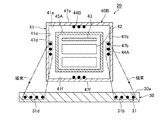
- FIG. 5 is a cross-sectional view showing the configuration of the non-contact charging system 20 to which the battery pack 40B according to the second embodiment is applied.
- the battery pack 40B according to the second embodiment has the power receiving coils 44A and 44B and the magnetic sheet 45A instead of the power receiving coil 44 and the magnetic sheet 45 of the battery pack 40A according to the first embodiment.
- the magnetic sheet 45A is provided so as to cover the battery cell 42 and the charging circuit 43 from the outside thereof.
- the power receiving coil 44A has a rectangular shape because it is provided over the inner side surfaces 41a to 41d (see FIG. 2) of the housing 41. Therefore, the power receiving coil 44A is divided into straight portions facing the inner side surfaces 41a to 41d.
- the power receiving coil 44B is provided over the inner side surface 41a, the bottom surface 41f, the inner side surface 41c, and the ceiling surface 41e (see FIGS. 2 and 3) of the housing 41. Therefore, the power receiving coil 44B is divided into a straight portion facing the inner side surface 41a, the bottom surface 41f, the inner side surface 41c, and the ceiling surface 41e.
- the power receiving coils 44A and 44B orbit around the inner side surfaces 41a and 41c at right angles to each other.
- the straight portion 31a (see FIG. 2) of the power feeding coil 31 corresponds to a straight portion facing the inner side surface 41a of the power receiving coil 44A and a straight portion facing the inner side surface 41a of the power receiving coil 44B.
- the straight portion 31c (see FIG. 2) of the power feeding coil 31 corresponds to a straight portion facing the inner side surface 41c of the power receiving coil 44A and a straight portion facing the inner side surface 41c of the power receiving coil 44B.
- the straight portions 31b and 31d of the power feeding coil 31 correspond to the straight portions of the power receiving coil 44A facing the inner side surfaces 41b and 41d. Further, the straight portions 31b and 31d of the power feeding coil 31 correspond to the straight portions of the power receiving coil 44B facing the ceiling surface 41e and the bottom surface 41f.
- the battery pack 40B has side surfaces 47a to 47d, an upper surface 47e, and a lower surface facing the inner side surfaces 41a to 41d, the ceiling surface 41e, and the bottom surface 41f of the housing 41. It has 47f.
- the battery pack 40B has the power receiving coils 44A and 44B, any one of the side surfaces 47b, 47d, the upper surface 47e, and the lower surface 47f (see FIG. 3) is the upper surface of the power supply device 30. When placed in 30a, it is properly charged. In other words, the battery pack 40B can be appropriately charged by any of vertical placement, upside down placement, and horizontal placement. That is, the battery pack 40B can increase the degree of freedom of placement during non-contact charging.
- the vertical placement of the battery pack 40B is a method in which the lower surface 47f is placed on the upper surface 30a of the power supply device 30.
- the upside down placement of the battery pack 40B is a method in which the upper surface 47e of the battery pack 40B is placed on the upper surface 30a of the power supply device 30.
- the horizontal placement of the battery pack 40B is a method in which the side surfaces 47b and 47d are placed on the upper surface 30a of the power supply device 30.
- the side surfaces 47b, 47d, the upper surface 47e, and the lower surface 47f of the battery pack 40B are placed laterally with respect to the upper surface 30a of the power supply device 30. In this case, or even when the side surfaces 47b, 47d, the upper surface 47e, and the lower surface 47f of the battery pack 40B are raised with respect to the upper surface 30a of the power supply device 30, the battery pack 40B is appropriately charged.
- the battery pack 40B according to the second embodiment has two power receiving coils 44A and 44B that circulate orthogonally to each other. Therefore, the battery pack 40B can be appropriately charged not only vertically but also upside down and horizontally.
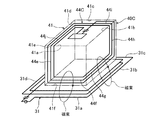
- FIG. 6 is a schematic view showing the configuration of the non-contact charging system 20 to which the battery pack 40C according to the third embodiment is applied.
- the battery pack 40C according to the third embodiment has a power receiving coil 44C instead of the power receiving coil 44 of the battery pack 40A according to the first embodiment.
- the power receiving coil 44C is provided over three inner surfaces of the housing 41 adjacent to each other. Note that FIG. 6 shows an example in which the power receiving coil 44C is provided over the inner side surfaces 41a and 41b and the ceiling surface 41e of the housing 41 adjacent to each other. Therefore, the power receiving coil 44C is divided into linear portions 44e, 44f, 44g, 44h, 44i, 44j.
- the straight portions 44e and 44f face the inner side surface 41a.
- the straight portions 44e and 44f are orthogonal to each other. Further, the straight portions 44e and 44f correspond to the straight portions 31a and 31c of the feeding coil 31.
- the straight portions 44g and 44h face the inner side surface 41b.
- the straight portions 44g and 44h are orthogonal to each other. Further, the straight portion 44g corresponds to the straight portions 31b and 31d of the feeding coil 31.
- the straight portion 44h corresponds to the straight portions 31a and 31c of the feeding coil 31.
- the straight portions 44i and 44j face the ceiling surface 41e.
- the straight portions 44i and 44j face each other.
- the straight portion 44i corresponds to the straight portions 31a and 31c of the feeding coil 31.
- the straight portion 44j faces the straight portions 31b and 31d of the feeding coil 31.
- the battery pack 40C has the power receiving coil 44C, any one of the side surfaces 47b, 47d, the upper surface 47e, and the lower surface 47f (see FIG. 3) is on the upper surface 30a of the power supply device 30. When placed, it will be charged properly. In other words, the battery pack 40C can be appropriately charged by any of vertical placement, upside down placement, and horizontal placement. That is, the battery pack 40B can increase the degree of freedom of placement during non-contact charging.
- the straight portion 44g when the side surface 47b is placed on the upper surface 30a, the straight portion 44g resonates with the straight portion 31b in a magnetic field, and the straight portion 44h resonates with the straight portion 31a.
- the straight portion 44g resonates with the straight portion 31d in a magnetic field
- the straight portion 44h resonates with the straight portion 31c in a magnetic field.
- the straight portion 44e When the side surface 47d is placed on the upper surface 30a, the straight portion 44e resonates with the straight portion 31a in a magnetic field, and the straight portion 44j resonates with the straight portion 31d in a magnetic field.
- the linear portion 44e resonates with the linear portion 31c in a magnetic field
- the linear portion 44j resonates with the linear portion 31b in a magnetic field.
- the straight portion 44i When the upper surface 47e is placed on the upper surface 30a, the straight portion 44i resonates with the straight portion 31a in a magnetic field, and the straight portion 44j resonates with the linear portion 31d in a magnetic field.
- the straight portion 44i resonates with the straight portion 31c in a magnetic field
- the straight portion 44j resonates with the straight portion 31b in a magnetic field.
- the straight portion 44f When the lower surface 47f is placed on the upper surface 30a, the straight portion 44f resonates with the straight portion 31a in a magnetic field, and the straight portion 44g resonates with the straight portion 31b (see FIG. 6).
- the linear portion 44f resonates with the linear portion 31c in a magnetic field
- the linear portion 44g resonates with the linear portion 31d in a magnetic field.
- the power receiving coil 44C in the battery pack 40C according to the third embodiment is provided over the inner side surfaces 41a and 41b and the ceiling surface 41e of the housing 41 adjacent to each other. Therefore, the battery pack 40C can be appropriately charged not only vertically but also upside down and horizontally.
- any combination of the embodiments, modification of any component in each embodiment, or omission of any component in each embodiment can be omitted. It is possible.
- the battery pack according to the present disclosure is provided over a plurality of inner surfaces of the housing, includes a power receiving coil that resonates with a power feeding coil of the power supply device, and laterally shifts or floats with respect to the power supply device. Also, it can perform non-contact charging and is suitable for use in battery packs and the like.
Landscapes
- Engineering & Computer Science (AREA)
- Computer Networks & Wireless Communication (AREA)
- Power Engineering (AREA)
- Electrochemistry (AREA)
- Chemical & Material Sciences (AREA)
- Chemical Kinetics & Catalysis (AREA)
- General Chemical & Material Sciences (AREA)
- Manufacturing & Machinery (AREA)
- Life Sciences & Earth Sciences (AREA)
- Computer Hardware Design (AREA)
- Biophysics (AREA)
- Charge And Discharge Circuits For Batteries Or The Like (AREA)
- Secondary Cells (AREA)
Priority Applications (3)
| Application Number | Priority Date | Filing Date | Title |
|---|---|---|---|
| PCT/JP2020/031925 WO2021149293A1 (ja) | 2020-08-25 | 2020-08-25 | 電池パック、非接触式充電システム、及び、電動工具 |
| US17/426,659 US20220109329A1 (en) | 2020-08-25 | 2020-08-25 | Battery pack, non-contact charging system, and power tool |
| JP2021512594A JPWO2021149293A1 (https=) | 2020-08-25 | 2020-08-25 |
Applications Claiming Priority (1)
| Application Number | Priority Date | Filing Date | Title |
|---|---|---|---|
| PCT/JP2020/031925 WO2021149293A1 (ja) | 2020-08-25 | 2020-08-25 | 電池パック、非接触式充電システム、及び、電動工具 |
Publications (1)
| Publication Number | Publication Date |
|---|---|
| WO2021149293A1 true WO2021149293A1 (ja) | 2021-07-29 |
Family
ID=76991821
Family Applications (1)
| Application Number | Title | Priority Date | Filing Date |
|---|---|---|---|
| PCT/JP2020/031925 Ceased WO2021149293A1 (ja) | 2020-08-25 | 2020-08-25 | 電池パック、非接触式充電システム、及び、電動工具 |
Country Status (3)
| Country | Link |
|---|---|
| US (1) | US20220109329A1 (https=) |
| JP (1) | JPWO2021149293A1 (https=) |
| WO (1) | WO2021149293A1 (https=) |
Families Citing this family (1)
| Publication number | Priority date | Publication date | Assignee | Title |
|---|---|---|---|---|
| GB2628591B (en) * | 2023-03-29 | 2025-06-11 | Gaussion Ltd | Apparatus for use with electrochemical cells |
Citations (3)
| Publication number | Priority date | Publication date | Assignee | Title |
|---|---|---|---|---|
| JP2013115876A (ja) * | 2011-11-25 | 2013-06-10 | Ihi Corp | 二次電池モジュール |
| JP2013223283A (ja) * | 2012-04-13 | 2013-10-28 | Sumida Corporation | 非接触給電システム |
| JP2017147784A (ja) * | 2016-02-15 | 2017-08-24 | 株式会社ダイヘン | 非接触充電システム |
Family Cites Families (5)
| Publication number | Priority date | Publication date | Assignee | Title |
|---|---|---|---|---|
| JP2005316742A (ja) * | 2004-04-28 | 2005-11-10 | Fuji Xerox Co Ltd | Icタグ |
| JP2006222582A (ja) * | 2005-02-08 | 2006-08-24 | Nippon Signal Co Ltd:The | 三軸タグアンテナ及び物品管理システム |
| US20150061581A1 (en) * | 2012-03-16 | 2015-03-05 | Powermat Technologies Ltd. | Inductively chargeable batteries |
| JP2014017920A (ja) * | 2012-07-06 | 2014-01-30 | Sharp Corp | 電池パック |
| JP6323054B2 (ja) * | 2013-03-08 | 2018-05-16 | Tdk株式会社 | 給電装置、受電装置、及び、ワイヤレス電力伝送装置 |
-
2020
- 2020-08-25 WO PCT/JP2020/031925 patent/WO2021149293A1/ja not_active Ceased
- 2020-08-25 US US17/426,659 patent/US20220109329A1/en not_active Abandoned
- 2020-08-25 JP JP2021512594A patent/JPWO2021149293A1/ja active Pending
Patent Citations (3)
| Publication number | Priority date | Publication date | Assignee | Title |
|---|---|---|---|---|
| JP2013115876A (ja) * | 2011-11-25 | 2013-06-10 | Ihi Corp | 二次電池モジュール |
| JP2013223283A (ja) * | 2012-04-13 | 2013-10-28 | Sumida Corporation | 非接触給電システム |
| JP2017147784A (ja) * | 2016-02-15 | 2017-08-24 | 株式会社ダイヘン | 非接触充電システム |
Also Published As
| Publication number | Publication date |
|---|---|
| US20220109329A1 (en) | 2022-04-07 |
| JPWO2021149293A1 (https=) | 2021-07-29 |
Similar Documents
| Publication | Publication Date | Title |
|---|---|---|
| KR101134625B1 (ko) | 무선 전력 통신용 코어 어셈블리와 그를 구비하는 무선 전력 통신용 전력 공급 장치, 그리고 무선 전력 통신용 코어 어셈블리 제조 방법 | |
| KR101213090B1 (ko) | 무선전력 전송장치용 코어 어셈블리 및 그를 구비하는 무선전력 전송장치 | |
| JP5622518B2 (ja) | 電池パックを備えた電動機械および電源システム | |
| CN103858307B (zh) | 非接触式充电电池、非接触式充电器 | |
| US6351098B1 (en) | Charging receptacle | |
| EP2546999B1 (en) | Wireless power transmitting device for wireless power communication system | |
| KR100888465B1 (ko) | 1차 권선과 2차 권선 사이의 상호 자기 인덕턴스의 용량성 병렬 보상을 가지는 유도성 커플링 시스템, 및 재충전가능한 전기 제품과 스탠드의 결합 | |
| CN103038089B (zh) | 线圈单元、非接触电力传输设备、非接触电力接收设备、车辆以及非接触供电系统 | |
| US20110148351A1 (en) | Noncontact electric power receiving device, noncontact electric power transmitting device, noncontact electric power feeding system, and electrically powered vehicle | |
| US20150318733A1 (en) | Hand-held power tool rechargeable battery | |
| US10090717B2 (en) | Power receiving device and power feeding device | |
| JP2010193701A (ja) | 非接触式充電器 | |
| JP2001167954A (ja) | 充電用受電側カプラ及び電磁誘導式受電側充電装置 | |
| JP4737109B2 (ja) | 非接触充電式電子機器 | |
| CN103534771A (zh) | 受电装置、送电装置以及电力传送系统 | |
| CN102684318A (zh) | 利用磁共振的非接触电力传输装置 | |
| JP2011034793A (ja) | 電池パック、該電池パックを充電する充電システム、および該電池パックを備えた電動工具 | |
| CN104426247A (zh) | 电力接收设备、电力发送设备和电力传输系统 | |
| US20160352153A1 (en) | Coil unit and power supply system including the same | |
| CN103887846A (zh) | 具有蓄电装置、尤其手持式工具机蓄电装置的系统 | |
| WO2021149293A1 (ja) | 電池パック、非接触式充電システム、及び、電動工具 | |
| JPH11195545A (ja) | 無接点電磁誘導式充電機構、これに用いられる二次コイル及びこの二次コイルのコア | |
| JP2014017920A (ja) | 電池パック | |
| JP2000341885A (ja) | 非接触電力伝達装置、及びその製造方法 | |
| KR20120133573A (ko) | 무선전력통신용 코어 어셈블리와 그를 구비하는 무선전력통신용 전력공급장치, 그리고 무선전력통신용 코어 어셈블리 제조 방법 |
Legal Events
| Date | Code | Title | Description |
|---|---|---|---|
| ENP | Entry into the national phase |
Ref document number: 2021512594 Country of ref document: JP Kind code of ref document: A |
|
| 121 | Ep: the epo has been informed by wipo that ep was designated in this application |
Ref document number: 20915369 Country of ref document: EP Kind code of ref document: A1 |
|
| NENP | Non-entry into the national phase |
Ref country code: DE |
|
| 122 | Ep: pct application non-entry in european phase |
Ref document number: 20915369 Country of ref document: EP Kind code of ref document: A1 |