WO2021112232A1 - 光学用樹脂組成物の製造方法及び光学用樹脂組成物 - Google Patents
光学用樹脂組成物の製造方法及び光学用樹脂組成物 Download PDFInfo
- Publication number
- WO2021112232A1 WO2021112232A1 PCT/JP2020/045276 JP2020045276W WO2021112232A1 WO 2021112232 A1 WO2021112232 A1 WO 2021112232A1 JP 2020045276 W JP2020045276 W JP 2020045276W WO 2021112232 A1 WO2021112232 A1 WO 2021112232A1
- Authority
- WO
- WIPO (PCT)
- Prior art keywords
- fluorine
- resin composition
- optical resin
- group
- containing polymer
- Prior art date
- Legal status (The legal status is an assumption and is not a legal conclusion. Google has not performed a legal analysis and makes no representation as to the accuracy of the status listed.)
- Ceased
Links
- 0 CC(OC(*)=O)(F)F Chemical compound CC(OC(*)=O)(F)F 0.000 description 1
Classifications
-
- C—CHEMISTRY; METALLURGY
- C08—ORGANIC MACROMOLECULAR COMPOUNDS; THEIR PREPARATION OR CHEMICAL WORKING-UP; COMPOSITIONS BASED THEREON
- C08F—MACROMOLECULAR COMPOUNDS OBTAINED BY REACTIONS ONLY INVOLVING CARBON-TO-CARBON UNSATURATED BONDS
- C08F214/00—Copolymers of compounds having one or more unsaturated aliphatic radicals, each having only one carbon-to-carbon double bond, and at least one being terminated by a halogen
- C08F214/18—Monomers containing fluorine
- C08F214/182—Monomers containing fluorine not covered by the groups C08F214/20 - C08F214/28
-
- C—CHEMISTRY; METALLURGY
- C08—ORGANIC MACROMOLECULAR COMPOUNDS; THEIR PREPARATION OR CHEMICAL WORKING-UP; COMPOSITIONS BASED THEREON
- C08F—MACROMOLECULAR COMPOUNDS OBTAINED BY REACTIONS ONLY INVOLVING CARBON-TO-CARBON UNSATURATED BONDS
- C08F116/00—Homopolymers of compounds having one or more unsaturated aliphatic radicals, each having only one carbon-to-carbon double bond, and at least one being terminated by an alcohol, ether, aldehydo, ketonic, acetal or ketal radical
- C08F116/38—Homopolymers of compounds having one or more unsaturated aliphatic radicals, each having only one carbon-to-carbon double bond, and at least one being terminated by an alcohol, ether, aldehydo, ketonic, acetal or ketal radical by a acetal or ketal radical
-
- C—CHEMISTRY; METALLURGY
- C08—ORGANIC MACROMOLECULAR COMPOUNDS; THEIR PREPARATION OR CHEMICAL WORKING-UP; COMPOSITIONS BASED THEREON
- C08F—MACROMOLECULAR COMPOUNDS OBTAINED BY REACTIONS ONLY INVOLVING CARBON-TO-CARBON UNSATURATED BONDS
- C08F8/00—Chemical modification by after-treatment
-
- C—CHEMISTRY; METALLURGY
- C08—ORGANIC MACROMOLECULAR COMPOUNDS; THEIR PREPARATION OR CHEMICAL WORKING-UP; COMPOSITIONS BASED THEREON
- C08F—MACROMOLECULAR COMPOUNDS OBTAINED BY REACTIONS ONLY INVOLVING CARBON-TO-CARBON UNSATURATED BONDS
- C08F16/00—Homopolymers and copolymers of compounds having one or more unsaturated aliphatic radicals, each having only one carbon-to-carbon double bond, and at least one being terminated by an alcohol, ether, aldehydo, ketonic, acetal or ketal radical
- C08F16/12—Homopolymers and copolymers of compounds having one or more unsaturated aliphatic radicals, each having only one carbon-to-carbon double bond, and at least one being terminated by an alcohol, ether, aldehydo, ketonic, acetal or ketal radical by an ether radical
- C08F16/14—Monomers containing only one unsaturated aliphatic radical
- C08F16/24—Monomers containing halogen
-
- C—CHEMISTRY; METALLURGY
- C08—ORGANIC MACROMOLECULAR COMPOUNDS; THEIR PREPARATION OR CHEMICAL WORKING-UP; COMPOSITIONS BASED THEREON
- C08F—MACROMOLECULAR COMPOUNDS OBTAINED BY REACTIONS ONLY INVOLVING CARBON-TO-CARBON UNSATURATED BONDS
- C08F124/00—Homopolymers of compounds having one or more unsaturated aliphatic radicals, each having only one carbon-to-carbon double bond, and at least one being terminated by a heterocyclic ring containing oxygen
-
- C—CHEMISTRY; METALLURGY
- C08—ORGANIC MACROMOLECULAR COMPOUNDS; THEIR PREPARATION OR CHEMICAL WORKING-UP; COMPOSITIONS BASED THEREON
- C08F—MACROMOLECULAR COMPOUNDS OBTAINED BY REACTIONS ONLY INVOLVING CARBON-TO-CARBON UNSATURATED BONDS
- C08F4/00—Polymerisation catalysts
- C08F4/28—Oxygen or compounds releasing free oxygen
- C08F4/32—Organic compounds
- C08F4/34—Per-compounds with one peroxy-radical
-
- C—CHEMISTRY; METALLURGY
- C08—ORGANIC MACROMOLECULAR COMPOUNDS; THEIR PREPARATION OR CHEMICAL WORKING-UP; COMPOSITIONS BASED THEREON
- C08F—MACROMOLECULAR COMPOUNDS OBTAINED BY REACTIONS ONLY INVOLVING CARBON-TO-CARBON UNSATURATED BONDS
- C08F8/00—Chemical modification by after-treatment
- C08F8/18—Introducing halogen atoms or halogen-containing groups
- C08F8/20—Halogenation
-
- C—CHEMISTRY; METALLURGY
- C08—ORGANIC MACROMOLECULAR COMPOUNDS; THEIR PREPARATION OR CHEMICAL WORKING-UP; COMPOSITIONS BASED THEREON
- C08F—MACROMOLECULAR COMPOUNDS OBTAINED BY REACTIONS ONLY INVOLVING CARBON-TO-CARBON UNSATURATED BONDS
- C08F8/00—Chemical modification by after-treatment
- C08F8/26—Removing halogen atoms or halogen-containing groups from the molecule
-
- C—CHEMISTRY; METALLURGY
- C08—ORGANIC MACROMOLECULAR COMPOUNDS; THEIR PREPARATION OR CHEMICAL WORKING-UP; COMPOSITIONS BASED THEREON
- C08L—COMPOSITIONS OF MACROMOLECULAR COMPOUNDS
- C08L37/00—Compositions of homopolymers or copolymers of compounds having one or more unsaturated aliphatic radicals, each having only one carbon-to-carbon double bond, and at least one being terminated by a heterocyclic ring containing oxygen; Compositions of derivatives of such polymers
-
- C—CHEMISTRY; METALLURGY
- C08—ORGANIC MACROMOLECULAR COMPOUNDS; THEIR PREPARATION OR CHEMICAL WORKING-UP; COMPOSITIONS BASED THEREON
- C08F—MACROMOLECULAR COMPOUNDS OBTAINED BY REACTIONS ONLY INVOLVING CARBON-TO-CARBON UNSATURATED BONDS
- C08F2810/00—Chemical modification of a polymer
- C08F2810/40—Chemical modification of a polymer taking place solely at one end or both ends of the polymer backbone, i.e. not in the side or lateral chains
Definitions
- the present invention relates to a method for producing an optical resin composition and an optical resin composition.
- Resin compositions containing a fluorine-containing polymer are used in a wide range of fields as materials for optical members such as plastic optical fibers (hereinafter referred to as "POF") and exposure members.
- optical resin composition used as a material for an optical member is referred to as an "optical resin composition”.
- the fluorine-containing polymer can be produced, for example, by polymerizing a monomer group containing a fluorine-containing compound having a carbon-carbon double bond with a polymerization initiator.
- An organic peroxide is generally used as a polymerization initiator for polymerizing a group of monomers containing a fluorine-containing compound.
- the optical resin composition When manufacturing an optical member, the optical resin composition is, for example, heat-melted and molded, but coloring may occur during this heat molding. This coloring becomes particularly remarkable when the bulk optical resin composition is heated and melted. According to the study by the present inventor, it was found that the cause of coloring of the optical resin composition is the terminal group of the fluorine-containing polymer derived from the polymerization initiator.
- the present inventor can suppress the coloring of the optical resin composition by decomposing the terminal group of the fluorine-containing polymer in advance, while the optical resin composition. It has been found that water absorption is increased. In the field of optical members, it is known that water increases light absorption loss (for example, Patent Document 1).
- an object of the present invention is to provide a method for producing an optical resin composition in which coloring is suppressed and water absorption is sufficiently low.
- the present invention The fluorine-containing polymer obtained by polymerizing a group of monomers containing a fluorine-containing compound having a carbon-carbon double bond with an organic peroxide is heat-treated in an atmosphere where the concentration of water vapor is 100 volppm or less.
- a method for producing an optical resin composition including the above.
- the method for producing an optical resin composition of the present embodiment is for a fluorine-containing polymer obtained by polymerizing a monomer group containing a fluorine-containing compound having a carbon-carbon double bond with an organic peroxide. It includes performing the heat treatment in an atmosphere where the concentration of water vapor is 100 volppm or less.
- fluorine-containing polymer (A) the fluorinated polymer before the heat treatment
- fluorine-containing polymer (B) the fluorinated polymer after the heat treatment
- the optical resin composition obtained by the production method of the present embodiment contains a fluorine-containing polymer (B).
- the fluorine-containing polymer (A) before the heat treatment has a terminal group derived from the polymerization initiator (organic peroxide).
- This terminal group is, for example, an ester group.
- the fluorine-containing compound has, for example, a carbon-carbon double bond located at the terminal, and all hydrogen atoms bonded to the carbon atoms constituting the double bond are replaced with fluorine atoms.
- the terminal group of the fluorine-containing polymer (A) formed from this fluorine-containing compound is represented by, for example, the following formula (4).
- Ri is determined according to the structure of the organic peroxide, and is, for example, a hydrocarbon group having 1 to 12 carbon atoms. Hydrogen atoms contained in the hydrocarbon group R i can be substituted by fluorine atoms. Hydrocarbon group R i may include an aromatic ring. For example, when a perfluoro benzoyl peroxide as an organic peroxide, R i is perfluorophenyl group. In addition, "perfluoro" means that all hydrogen atoms bonded to carbon atoms are replaced with fluorine atoms.
- the terminal groups of the fluorine-containing polymer (A) are thermally decomposed.
- the decomposition reaction represented by the following formula (5a) occurs with respect to the terminal group represented by the formula (4).
- the terminal group of the fluorine-containing polymer (A) can be changed to the functional group represented by the following formula (1) by the heat treatment.
- the fluorine-containing polymer (B) after the heat treatment has a terminal group represented by the following formula (1). It may be confirmed by carbon-13 nuclear magnetic resonance spectroscopy (13 C-NMR) that the fluorine-containing polymer (B) has a terminal group represented by the following formula (1).
- the concentration of water vapor may be 100 volppm or less, preferably 50 volppm or less.
- the atmosphere during the heat treatment is preferably substantially free of water vapor, but the concentration of water vapor may be 0.1 volppm or more.
- the component contained in the atmosphere during the heat treatment is not particularly limited, but it is preferably contained as the main component of the inert gas, and more preferably it is substantially composed of the inert gas.
- containing an inert gas as a main component means that the inert gas is contained in the largest amount on a weight basis in the atmosphere.
- substantially composed of an inert gas means that the content of the inert gas in the atmosphere is 95 wt% or more, preferably 99 wt% or more.
- the inert gas include nitrogen gas and argon gas, and nitrogen gas is preferable. It is preferable that the atmosphere during the heat treatment is substantially composed of nitrogen gas.
- the heat treatment may be performed in a reduced pressure atmosphere or a vacuum atmosphere.
- the temperature of the heat treatment is not particularly limited as long as the thermal decomposition of the terminal group of the fluorine-containing polymer (A) proceeds, and is, for example, 100 ° C. or higher and 400 ° C. or lower, preferably 200 ° C. or higher and 350 ° C. or lower.
- the heat treatment time is also not particularly limited, and may be, for example, 50 minutes or more, or 250 minutes or more.
- the heat treatment time may be 1500 minutes or less.
- the fluorine-containing polymer (A) may or may not be melted by heat treatment. Before the heat treatment is performed, the shape of the fluorine-containing polymer (A) is not particularly limited, and is, for example, a powder.
- the method for removing the low molecular weight compound from the optical resin composition is not particularly limited.
- the low molecular weight compound may be removed from the optical resin composition by appropriately setting the above heat treatment conditions (temperature, time, etc.) and volatilizing the low molecular weight compound.
- the terminal group of the fluorine-containing polymer (A) may be thermally decomposed by the above heat treatment, and the low molecular weight compound generated by the thermal decomposition may be volatilized.
- the fluorine-containing polymer (A) is melted by the above heat treatment, if the height of the liquid surface of the melted fluorine-containing polymer (A) is 1 mm or less, the low molecular weight compound generated by thermal decomposition is likely to volatilize. ..
- the weight concentration of the low molecular weight compound produced by the thermal decomposition of the terminal group of the fluorine-containing polymer (A) is, for example, 1% or less.
- the terminal group derived from the organic peroxide of the fluorine-containing polymer (A) is thermally decomposed by the heat treatment. That is, the fluorine-containing polymer (B) contained in the optical resin composition has almost no terminal group derived from an organic peroxide. Therefore, at the stage of heat-molding the optical resin composition into an optical member, a low molecular weight compound is hardly generated by thermal decomposition of a terminal group derived from an organic peroxide. According to the study of the present inventor, when a low molecular weight compound is generated at the stage of heat-molding the optical resin composition into an optical member, the optical resin composition tends to be colored. According to the production method of the present embodiment, the above-mentioned low-molecular-weight compound can be removed in advance, whereby an optical resin composition in which coloring is suppressed can be obtained.
- the heat treatment is carried out in an atmosphere where the concentration of water vapor is 100 volppm or less. Therefore, it is possible to prevent the terminal group of the fluorine-containing polymer (B) from being further hydrolyzed during the heat treatment.
- a carboxyl group is formed by the reaction represented by the following formula (5b). Functional groups containing OH groups such as carboxyl groups tend to increase the water absorption of the optical resin composition.
- the hydrolysis of the terminal group of the fluorine-containing polymer (B) is suppressed, so that the increase in water absorption of the optical resin composition can be suppressed, and the water absorption is sufficient. Can be kept low.
- the density fluctuation in the molecule increases in the fluorine-containing polymer. Intramolecular density fluctuations can cause light scattering.
- the hydrolysis of the terminal group of the fluorine-containing polymer (B) is suppressed, so that the increase in the density fluctuation in the molecule is suppressed, whereby light scattering by the optical resin composition is suppressed. Can be suppressed from increasing.
- the fluorine-containing compound contained in the monomer group is not particularly limited as long as it contains a carbon-carbon double bond and a fluorine atom. From the viewpoint of suppressing light absorption due to the expansion and contraction energy of the CH bond, the fluorine-containing compound preferably contains substantially no hydrogen atom, and all hydrogen atoms bonded to the carbon atom are replaced with fluorine atoms. It is particularly preferable that it is. In the present specification, the fact that the fluorine-containing compound does not substantially contain hydrogen atoms means that the content of hydrogen atoms in the total amount of the fluorine-containing compounds contained in the monomer group is 1 mol% or less. ..
- the carbon-carbon double bond contained in the fluorine-containing compound is preferably located at the end of the fluorine-containing compound. Further, it is preferable that all the hydrogen atoms bonded to the carbon atoms constituting the double bond are replaced with fluorine atoms.
- the fluorine-containing compound preferably has a fluorine-containing aliphatic ring structure.
- the fluorine-containing compound may have a polymerizable double bond between the carbon atom constituting the ring and the carbon atom not forming the ring, and the polymerizable double bond is provided between the two carbon atoms constituting the ring. It may have a bond.
- Examples of the fluorine-containing compound having a polymerizable double bond between the carbon atom constituting the ring and the carbon atom not forming the ring include perfluoro-2-methylene-4-methyl-1,3-dioxolane. Fluorine-containing compounds having a 1,3-dioxolane structure can be mentioned.
- fluorine-containing compound having a polymerizable double bond between the two carbon atoms constituting the ring examples include perfluoro-4-methyl-1,3-dioxol and perfluoro-4-methyl-1,3-.
- Fluorine-containing compounds having a 1,3-dioxol structure such as dioxol can be mentioned.
- the fluorine-containing compound can be obtained by a production method already known, for example, the production method disclosed in JP-A-2007-504125.
- Examples of the fluorine-containing compound having a fluorine-containing aliphatic ring structure include a compound represented by the following formula (2).
- R ff 1 to R ff 4 independently represent a fluorine atom, a perfluoroalkyl group having 1 to 7 carbon atoms, or a perfluoroalkyl ether group having 1 to 7 carbon atoms.
- R ff 1 and R ff 2 may be connected to form a ring.
- the number of carbon atoms of the perfluoroalkyl group is preferably 1 to 5, more preferably 1 to 3, and even more preferably 1.
- the perfluoroalkyl group may be linear or branched. Examples of the perfluoroalkyl group include a trifluoromethyl group, a pentafluoroethyl group, a heptafluoropropyl group and the like.
- the number of carbon atoms of the perfluoroalkyl ether group is preferably 1 to 5, and more preferably 1 to 3.
- the perfluoroalkyl ether group may be linear or branched. Examples of the perfluoroalkyl ether group include a perfluoromethoxymethyl group.
- the ring When R ff 1 and R ff 2 are connected to form a ring, the ring may be a 5-membered ring or a 6-membered ring. Examples of this ring include a perfluorotetrahydrofuran ring, a perfluorocyclopentane ring, and a perfluorocyclohexane ring.
- Specific examples of the compound represented by the above formula (2) include compounds represented by the following formulas (M1) to (M8).
- the compound represented by the formula (2) is a compound represented by the formula (M2) among the compounds represented by the above formulas (M1) to (M8), that is, a compound represented by the following formula (3). It is preferable to have.
- the fluorine-containing compound contained in the monomer group may be one kind or two or more kinds. That is, the fluorinated polymer (A) may be a fluorinated polymer obtained by homopolymerizing one kind of fluorinated compound, or may be obtained by copolymerizing two or more kinds of fluorinated compounds. It may be a fluorine-containing copolymer.
- the fluorine-containing copolymer (A) is, for example, a fluorine-containing compound having the above-mentioned fluorine-containing aliphatic ring structure (hereinafter referred to as a fluorine-containing compound (a)) and a fluorine-containing compound other than the fluorine-containing compound (a). It may be a fluorine-containing copolymer obtained by copolymerizing with a compound. Examples of the fluorine-containing compound other than the fluorine-containing compound (a) include the following fluorine-containing compounds (b) to (d).
- the fluorine-containing compound (b) is a fluorine-containing vinyl ether such as perfluorovinyl ether.
- the fluorine-containing vinyl ether is represented by, for example, the following formula (6).
- R 1 to R 3 independently represent a fluorine atom or a perfluoroalkyl group having 1 to 7 carbon atoms.
- R 4 represents a perfluoroalkyl group having 1 to 7 carbon atoms.
- the perfluoroalkyl group may have a ring structure. A part of the fluorine atom may be replaced with a halogen atom other than the fluorine atom. A part of the fluorine atom in the perfluoroalkyl group may be substituted with a halogen atom other than the fluorine atom.
- the fluorine-containing compound (c) is a fluorine-containing olefin such as tetrafluoroethylene and chlorotrifluoroethylene.
- the fluorine-containing olefin is represented by, for example, the following formula (7).
- R 5 to R 8 independently represent a fluorine atom or a perfluoroalkyl group having 1 to 7 carbon atoms.
- the perfluoroalkyl group may have a ring structure.
- a part of the fluorine atom may be replaced with a halogen atom other than the fluorine atom.
- a part of the fluorine atom in the perfluoroalkyl group may be substituted with a halogen atom other than the fluorine atom.
- the fluorine-containing compound (d) is a fluorine-containing compound having two or more polymerizable double bonds and capable of cyclization polymerization.
- the fluorine-containing compound (d) is represented by, for example, the following formula (8).
- Z represents an oxygen atom, a single bond, or -OC (R 19 R 20 ) O-
- R 9 to R 20 are independently fluorine atoms and perfluoro having 1 to 5 carbon atoms.
- a part of the fluorine atom may be replaced with a halogen atom other than the fluorine atom.
- a part of the fluorine atom in the perfluoroalkyl group may be substituted with a halogen atom other than the fluorine atom.
- a part of the fluorine atom in the perfluoroalkoxy group may be substituted with a halogen atom other than the fluorine atom.
- s and t independently represent integers of 0 to 5 and s + t of 1 to 6 (where Z is -OC (R 19 R 20 ) O-, s + t may be 0).
- a fluorine-containing compound represented by the following formula (9) may be used as the fluorine-containing compound (d).
- the fluorine-containing compound represented by the following formula (9) is a case where Z is an oxygen atom, s is 0, and t is 2 in the above formula (8).
- R 141 , R 142 , R 151 , and R 152 each independently represent a fluorine atom, a perfluoroalkyl group having 1 to 5 carbon atoms, or a perfluoroalkoxy group having 1 to 5 carbon atoms. ..
- a part of the fluorine atom may be replaced with a halogen atom other than the fluorine atom.
- a part of the fluorine atom in the perfluoroalkyl group may be substituted with a halogen atom other than the fluorine atom.
- a part of the fluorine atom in the perfluoroalkoxy group may be substituted with a halogen atom other than the fluorine atom.
- fluorine-containing compound (d) include the following compounds.
- the monomer group preferably contains the above-mentioned fluorine-containing compound as a main component, and more preferably substantially consists of a fluorine-containing compound.
- the monomer group may further contain a polymerizable compound other than the fluorine-containing compound.
- the organic peroxide functions as a polymerization initiator of the monomer group.
- the organic peroxide preferably contains a diacyl peroxide or an ester peroxide, and more preferably contains a diacyl peroxide.
- the organic peroxide is preferably fluorinated. It is more preferable that the organic peroxide is substantially free of hydrogen atoms and is totally fluorinated.
- the fact that the organic peroxide substantially does not contain a hydrogen atom means that the content ratio of the hydrogen atom is 1 mol% or less with respect to the total amount of the organic peroxide used.
- a preferred example of an organic peroxide is benzoyl peroxide, a perfluoro peroxide.
- the fluorine-containing polymer (A) can be produced by polymerizing the above-mentioned monomer group with the above-mentioned organic peroxide.
- the polymerization method a known polymerization method can be used.
- the above-mentioned monomer group can be radically polymerized by a conventional method to produce a fluorine-containing polymer (A).
- fluorine-containing polymer As described above, the fluorine-containing polymers (A) and (B) have different terminal groups from each other. Except for the terminal group, the structure of the fluorinated polymer (A) may be the same as that of the fluorinated polymer (B). Hereinafter, the structural units commonly possessed by the fluorine-containing polymers (A) and (B) will be described.
- the fluorine-containing polymer contains, for example, a structural unit (a) represented by the following formula (10).
- the structural unit (a) is derived from the above-mentioned fluorine-containing compound (a).
- R ff 1 to R ff 4 are the same as in equation (2).
- structural unit (a) include the structural units represented by the following formulas (a1) to (a8).
- the structural unit (a) is preferably the structural unit (a2), that is, the structural unit represented by the following formula (11), among the structural units represented by the above formulas (a1) to (a8).
- the fluorine-containing polymer may contain one or more constituent units (a).
- the content of the structural unit (a) is preferably 20 mol% or more, more preferably 40 mol% or more, based on the total of all the structural units.
- the structural unit (a) is contained in an amount of 20 mol% or more, the fluorine-containing polymer tends to have higher heat resistance.
- the structural unit (a) is contained in an amount of 40 mol% or more, the fluorine-containing polymer tends to have higher transparency and higher mechanical strength in addition to high heat resistance.
- the content of the structural unit (a) is preferably 95 mol% or less, more preferably 70 mol% or less, based on the total of all the structural units.
- the fluorine-containing polymer may further contain other structural units in addition to the structural unit (a).
- other structural units include the following structural units (b) to (d).
- the structural unit (b) is represented by the following formula (12).
- the structural unit (b) is derived from the above-mentioned fluorine-containing compound (b).
- R 1 to R 4 are the same as in equation (6).
- the fluorine-containing polymer may contain one or more constituent units (b).
- the content of the structural unit (b) is preferably 5 to 10 mol% with respect to the total of all the structural units.
- the content of the structural unit (b) may be 9 mol% or less, or 8 mol% or less.
- the structural unit (c) is represented by the following formula (13).
- the structural unit (c) is derived from the above-mentioned fluorine-containing compound (c).
- R 5 to R 8 are the same as in equation (7).
- the fluorine-containing polymer may contain one or more constituent units (c).
- the content of the structural unit (c) is preferably 5 to 10 mol% with respect to the total of all the structural units.
- the content of the structural unit (c) may be 9 mol% or less, or 8 mol% or less.
- the structural unit (d) is represented by the following formula (14).
- the structural unit (d) is derived from the above-mentioned fluorine-containing compound (d).
- Z, R 9 to R 18 , s and t are the same as in formula (8).
- the structural unit (d) is preferably represented by the following formula (15).
- the structural unit (d) represented by the following formula (15) is derived from the fluorine-containing compound represented by the formula (9).
- R 141 , R 142 , R 151 , and R 152 are the same as in equation (9).
- the fluorine-containing polymer may contain one or more constituent units (d).
- the content of the structural unit (d) is preferably 30 to 67 mol% with respect to the total of all the structural units.
- the content of the structural unit (d) is, for example, 35 mol% or more, 60 mol% or less, or 55 mol% or less.
- the fluorine-containing polymer may further contain other structural units other than the structural units (a) to (d), but substantially includes other structural units other than the structural units (a) to (d). It is preferable that there is no such thing. It should be noted that the fact that the fluorine-containing polymer does not substantially contain other structural units other than the structural units (a) to (d) means that the structural units (a) to (a) to the total of all the structural units in the fluorine-containing polymer. It means that the total of (d) is 95 mol% or more, preferably 98 mol% or more.
- the glass transition temperature (Tg) of the fluorine-containing polymer is not particularly limited, and may be, for example, 100 ° C. to 140 ° C., 105 ° C. or higher, or 120 ° C. or higher.
- Tg means the intermediate point glass transition temperature (T mg ) obtained in accordance with the provisions of Japanese Industrial Standards (JIS) K7121: 1987.
- optical resin composition obtained by the production method of the present embodiment preferably contains the fluorinated polymer (B) and is substantially composed of the fluorinated polymer (B).
- the optical resin composition may further contain additives such as a refractive index adjuster.
- the hydrolysis of the terminal group of the fluorine-containing polymer (B) is suppressed, so that the water absorption of the optical resin composition is sufficiently low.
- the water absorption rate of the optical resin composition is, for example, 0.1% or less, preferably 0.05% or less.
- the water absorption rate of the optical resin composition can be specified by the following method. First, the optical resin composition is set as a measurement sample in a commercially available moisture absorption / desorption measuring device. Next, the measurement sample is held at 85 ° C. and 0% RH for 600 minutes, and further held at 85 ° C. and 85% RH for 600 minutes.
- the weight of the measurement sample increases.
- the ratio of the increase in the weight of the measurement sample due to the moisture absorption treatment to the weight of the measurement sample after the moisture absorption treatment is specified as the water absorption rate.
- the water content (water content) in the optical resin composition is also maintained in a low state.
- the water content of the optical resin composition is, for example, 0.1 wt% or less, preferably 0.07 wt% or less, and more preferably 0.05 wt% or less.
- the lower limit of the water content of the optical resin composition is not particularly limited, and is, for example, 0.01 wt%.
- the optical resin composition obtained by the production method of the present embodiment coloring is unlikely to occur when the optical member is heat-molded. Further, since the water content of the optical resin composition is low, the light absorption loss due to water contained in the optical resin composition is low. Therefore, when a molded product is produced from the optical resin composition, the internal transmittance of the molded product is sufficiently low.
- the internal transmittance of a plate-shaped molded product having a thickness of 10 mm produced from an optical resin composition with respect to light having a wavelength of 850 nm is, for example, 98% or more, preferably 99% or more.
- the internal transmittance means a transmittance that does not include a reflection loss due to light reflection (Fresnel reflection) on the surface of the molded body.
- the internal transmittance of the molded product can be specified in accordance with the provisions of the Japan Optical Glass Industry Association Standard (JOGIS) 17-2012.
- the solution was heated to 40 ° C. with stirring and reacted for 72 hours.
- the resulting reaction mixture was added to 300 mL of chloroform.
- the precipitate produced by this operation was collected by filtration.
- the obtained filter medium was a polymer of perfluoro-2-methylene-4-methyl-1,3-dioxolane (fluorine-containing polymer (A)).
- the yield of the fluorine-containing polymer (A) was 19.2 g, and the yield was 81.0%.
- Example 1 First, the aluminum foil was placed on the aluminum vat, and the powdery fluorine-containing polymer (A) was further placed on the glossy surface of the aluminum foil.
- the vat was placed inside the oven, and the fluorine-containing polymer (A) was heat-treated at 270 ° C. for 5 hours in a nitrogen atmosphere.
- the nitrogen atmosphere was adjusted by feeding nitrogen into the oven at a flow rate of 1 L / min.
- the concentration of water vapor in the nitrogen atmosphere was 40 volppm.
- the fluorine-containing polymer (A) was melted by the heat treatment.
- the height of the liquid surface of the molten fluorine-containing polymer (A) was 1 mm or less.
- the terminal group of the fluorine-containing polymer (A) was thermally decomposed, and the low molecular weight compound generated by the thermal decomposition was volatilized.
- the optical resin composition of Sample 1 was obtained.
- the optical resin composition of Sample 1 cooled to room temperature was in the form of a plate having a thickness of 1 mm or less.
- Example 2 The optical resin composition of Sample 2 was obtained by the same method as that of Sample 1, except that the heat treatment time was changed to 24 hours.
- Sample 3 The optical resin composition of Sample 3 was obtained by the same method as that of Sample 1 except that the heat treatment was performed in the air.
- the concentration of water vapor in the atmosphere was 1.4 vol%.
- Example 4 The optical resin composition of Sample 4 was obtained by the same method as that of Sample 3, except that the heat treatment time was changed to 24 hours.
- a disk D1 having a thickness of 5 mm and a disk D2 having a thickness of 12 mm were cut out from the produced rod.
- the disk D1 was placed inside the sample cup.
- a carbon tape was attached to the bottom surface of the disk D1, and the disk D1 was fixed to the sample cup by the carbon tape.
- the inside of the sample cup was filled with a resin composition (EPOFIX manufactured by Struers), and the resin composition was cured.
- a measurement sample S1 was obtained.
- the measurement sample S1 had a cylindrical shape having a bottom surface diameter of 25 mm and a thickness of about 5 mm.
- Step 1 Polish with "SiC Paper # 1000" to remove the carbon tape.
- Step 2 Polish for 5 minutes with "MD Sat 9 ⁇ m” manufactured by Sturers.
- Step 3 Polish for 5 minutes with “MD Sat 6 ⁇ m” manufactured by Sturers.
- Step 4 Polish for 10 minutes with "MD Dur 3 ⁇ m” manufactured by Sturers.
- Step 5 Polish for 5 minutes with "MD Nap 1 ⁇ m” manufactured by Struers.
- Step 6 Polish for 5 minutes with "MD Chem OP-S” manufactured by Sturers.
- the bottom surface polished by steps 1 to 6 was protected with filter paper.
- the measurement sample S1 was set on a flat surface polishing jig, and the surface (upper surface) facing the bottom surface of the measurement sample S1 was polished. This polishing was performed using "SiC Paper # 220" until the thickness of the measurement sample S1 became about 4 mm. At this time, the thickness of the measurement sample S1 was confirmed by a digital micrometer. Further, using "SiC Paper # 1000", the upper surface of the measurement sample S1 was polished until the thickness of the measurement sample S1 became about 3.5 mm. Further, by performing the above steps 2 to 6 on the upper surface of the measurement sample S1, a measurement sample S1 having a thickness of about 3.5 mm was obtained.
- a measurement sample S2 having a thickness of 10 mm was obtained from the disk D2 by the same method as the measurement sample S1.
- the measurement sample S2 before polishing had a cylindrical shape with a bottom surface diameter of 25 mm and a thickness of about 12 mm. Polishing of the upper surface of the measurement sample S2 using "SiC Paper # 220" was performed until the thickness of the measurement sample S2 became about 11 mm. Polishing of the upper surface of the measurement sample S2 using "SiC Paper # 1000" was performed until the thickness of the measurement sample S2 became about 10.5 mm.
- the spectral transmittance including the reflection loss due to Fresnel reflection was measured in accordance with the provisions of JIS Z8722: 2009.
- the spectral transmittance was measured using an ultraviolet-visible near-infrared spectrophotometer UH4150 manufactured by Hitachi High-Tech Science Co., Ltd. under the conditions of a measurement wavelength of 200 nm to 1300 nm, a sampling interval of 1 nm, and a scan speed of 600 nm / min.
- ⁇ means the internal transmittance of a plate-shaped molded product having a thickness of L mm (10 mm).
- a is a value calculated by the following mathematical formula (2).
- d 1 means the thickness (mm) of the measurement sample S1
- d 2 means the thickness (mm) of the measurement sample S2.
- T 1 means the transmittance of the measurement sample S1 with respect to light having a wavelength of 850 nm
- T 2 means the transmittance of the measurement sample S2 with respect to light having a wavelength of 850 nm.
- T 1 and T 2 each contain a return loss due to Fresnel reflection.
- ⁇ means that the internal transmittance specified by the above method is 98% or more.
- X means that the internal transmittance specified by the above method is less than 98%.
- the optical resin compositions of Samples 1 and 2 obtained by heat-treating the fluorine-containing polymer (A) in an atmosphere where the water vapor concentration is 100 volppm or less have a water vapor concentration.
- the water absorption rate was lower than that of the optical resin compositions of Samples 3 and 4 obtained by performing the heat treatment in an atmosphere exceeding 100 volppm. Since the optical resin compositions of Samples 1 and 2 have low water absorption and contain almost no water, the inside of a plate-shaped molded product having a thickness of 10 mm produced from the optical resin composition with respect to light having a wavelength of 850 nm. The transmittance became a high value.
- the optical resin composition obtained by the production method of the present embodiment is suitable for materials for optical members such as plastic optical fibers, materials for optical waveguides, optical lenses, prisms, and photomasks, and in particular, plastic optical fibers and optical waveguides. Suitable as a material for materials and materials for optical lenses.
Landscapes
- Chemical & Material Sciences (AREA)
- Health & Medical Sciences (AREA)
- Chemical Kinetics & Catalysis (AREA)
- Medicinal Chemistry (AREA)
- Polymers & Plastics (AREA)
- Organic Chemistry (AREA)
- General Chemical & Material Sciences (AREA)
- Engineering & Computer Science (AREA)
- Materials Engineering (AREA)
- Addition Polymer Or Copolymer, Post-Treatments, Or Chemical Modifications (AREA)
- Compositions Of Macromolecular Compounds (AREA)
Abstract
本発明は、着色が抑制されるとともに、吸水性が十分に低い光学用樹脂組成物の製造方法を提供する。本発明の光学用樹脂組成物の製造方法は、炭素-炭素二重結合を有する含フッ素化合物を含む単量体群を有機過酸化物により重合させることによって得られた含フッ素重合体について、水蒸気の濃度が100volppm以下である雰囲気下で熱処理を行うことを含む。例えば、光学用樹脂組成物の製造方法では、熱処理によって、含フッ素重合体の末端基を熱分解するとともに、当該熱分解により生じた低分子化合物を揮発させる。
Description
本発明は、光学用樹脂組成物の製造方法及び光学用樹脂組成物に関する。
含フッ素重合体を含む樹脂組成物は、プラスチック光ファイバー(以下、「POF」と記載する。)や露光部材などの光学部材の材料として、幅広い分野で利用されている。本明細書では、光学部材の材料として用いられる樹脂組成物を「光学用樹脂組成物」と呼ぶ。
含フッ素重合体は、例えば、炭素-炭素二重結合を有する含フッ素化合物を含む単量体群を重合開始剤により重合させることによって作製することができる。含フッ素化合物を含む単量体群を重合させるための重合開始剤としては、一般的には、有機過酸化物が用いられる。
光学部材を作製する際に、光学用樹脂組成物は、例えば、加熱溶融されて成形されるが、この加熱成形時に着色が生じることがある。この着色は、バルク状の光学用樹脂組成物を加熱溶融した場合に特に顕著になる。本発明者の検討によると、光学用樹脂組成物の着色の原因は、重合開始剤に由来する含フッ素重合体の末端基にあることが分かった。
本発明者は、この知見に基づいてさらに検討を進めたところ、含フッ素重合体の末端基を予め分解しておけば、光学用樹脂組成物の着色を抑制できる一方、光学用樹脂組成物の吸水性が増加することを見出した。なお、光学部材の分野においては、水が光の吸収損失を増加させることが知られている(例えば、特許文献1)。
そこで本発明は、着色が抑制されるとともに、吸水性が十分に低い光学用樹脂組成物の製造方法を提供することを目的とする。
本発明は、
炭素-炭素二重結合を有する含フッ素化合物を含む単量体群を有機過酸化物により重合させることによって得られた含フッ素重合体について、水蒸気の濃度が100volppm以下である雰囲気下で熱処理を行うことを含む、光学用樹脂組成物の製造方法を提供する。
炭素-炭素二重結合を有する含フッ素化合物を含む単量体群を有機過酸化物により重合させることによって得られた含フッ素重合体について、水蒸気の濃度が100volppm以下である雰囲気下で熱処理を行うことを含む、光学用樹脂組成物の製造方法を提供する。
本発明によれば、着色が抑制されるとともに、吸水性が十分に低い光学用樹脂組成物の製造方法を提供できる。
以下、本発明の実施形態を説明するが、以下の説明は、本発明を特定の実施形態に制限する趣旨ではない。
本実施形態の光学用樹脂組成物の製造方法は、炭素-炭素二重結合を有する含フッ素化合物を含む単量体群を有機過酸化物により重合させることによって得られた含フッ素重合体について、水蒸気の濃度が100volppm以下である雰囲気下で熱処理を行うことを含む。本明細書では、熱処理が実施される前の含フッ素重合体を「含フッ素重合体(A)」と呼び、熱処理が実施された後の含フッ素重合体を「含フッ素重合体(B)」と呼ぶことがある。本実施形態の製造方法によって得られた光学用樹脂組成物は、含フッ素重合体(B)を含んでいる。
熱処理が実施される前の含フッ素重合体(A)は、重合開始剤(有機過酸化物)に由来する末端基を有する。この末端基は、例えば、エステル基である。後述のとおり、含フッ素化合物は、例えば、末端に位置する炭素-炭素二重結合を有し、当該二重結合を構成する炭素原子に結合している全ての水素原子がフッ素原子に置換されている。この含フッ素化合物から形成された含フッ素重合体(A)の末端基は、例えば、下記式(4)によって表される。

式(4)中、Riは、有機過酸化物の構造に応じて定まり、例えば、炭素数1~12の炭化水素基である。Riの炭化水素基に含まれる水素原子は、フッ素原子によって置換されていてもよい。Riの炭化水素基は、芳香族環を含んでいてもよい。例えば、有機過酸化物としてパーフルオロ過酸化ベンゾイルを用いた場合、Riは、パーフルオロフェニル基である。なお、「パーフルオロ」は、炭素原子に結合している全ての水素原子がフッ素原子に置換されていることを意味する。
含フッ素重合体(A)について熱処理を行った場合、含フッ素重合体(A)の末端基が熱分解する。一例として、式(4)で表された末端基について、下記式(5a)で表される分解反応が生じる。

このように、本実施形態の製造方法では、熱処理によって、含フッ素重合体(A)の末端基を下記式(1)で表される官能基に変化させることができる。言い換えると、熱処理が実施された後の含フッ素重合体(B)は、下記式(1)で表される末端基を有する。なお、含フッ素重合体(B)が下記式(1)で表される末端基を有することは、炭素13核磁気共鳴分光法(13C-NMR)によって確認してもよい。

熱処理中の雰囲気において、水蒸気の濃度は、100volppm以下であればよく、50volppm以下であることが好ましい。熱処理中の雰囲気は、水蒸気を実質的に含まないことが好ましいが、水蒸気の濃度が0.1volppm以上であってもよい。
熱処理中の雰囲気に含まれる成分は、特に限定されないが、不活性ガスを主成分として含むことが好ましく、実質的に不活性ガスからなることがより好ましい。本明細書において、「不活性ガスを主成分として含む」は、雰囲気中において、不活性ガスが重量基準で最も多く含まれることを意味する。「実質的に不活性ガスからなる」は、雰囲気中における不活性ガスの含有率が95wt%以上、好ましくは99wt%以上、であることを意味する。不活性ガスとしては、例えば、窒素ガス及びアルゴンガスが挙げられ、好ましくは窒素ガスである。熱処理中の雰囲気は、実質的に窒素ガスからなることが好ましい。熱処理は、減圧雰囲気又は真空雰囲気で行われてもよい。
熱処理の温度は、含フッ素重合体(A)の末端基の熱分解が進行する限り、特に限定されず、例えば100℃以上400℃以下であり、好ましくは200℃以上350℃以下である。熱処理の時間も特に限定されず、例えば50分以上であり、250分以上であってもよい。熱処理の時間は、1500分以下であってもよい。含フッ素重合体(A)は、熱処理によって溶融してもよく、溶融しなくてもよい。熱処理が実施される前において、含フッ素重合体(A)の形状は、特に限定されず、例えば粉末状である。
本実施形態の製造方法は、例えば、含フッ素重合体(A)の末端基の熱分解によって生じた低分子化合物(例えば、Ri-C(=O)-F)を光学用樹脂組成物から除去することをさらに含む。光学用樹脂組成物から低分子化合物を除去する方法は、特に限定されない。例えば、上記の熱処理の条件(温度、時間など)を適切に設定し、低分子化合物を揮発させることによって、光学用樹脂組成物から低分子化合物を除去してもよい。言い換えると、本実施形態の製造方法では、上記の熱処理によって、含フッ素重合体(A)の末端基を熱分解するとともに、当該熱分解により生じた低分子化合物を揮発させてもよい。上記の熱処理によって含フッ素重合体(A)が溶融する場合、溶融した含フッ素重合体(A)の液面の高さが1mm以下であれば、熱分解により生じた低分子化合物が揮発しやすい。光学用樹脂組成物において、含フッ素重合体(A)の末端基の熱分解によって生じた低分子化合物の重量濃度は、例えば1%以下である。
上述のとおり、本実施形態の製造方法では、熱処理によって、含フッ素重合体(A)の有機過酸化物に由来する末端基が熱分解する。すなわち、光学用樹脂組成物に含まれる含フッ素重合体(B)は、有機過酸化物に由来する末端基をほとんど有していない。そのため、光学用樹脂組成物を光学部材に加熱成形する段階で、有機過酸化物に由来する末端基の熱分解によって低分子化合物が生じることがほとんどない。本発明者の検討によると、光学用樹脂組成物を光学部材に加熱成形する段階で低分子化合物が生じると、光学用樹脂組成物が着色する傾向がある。本実施形態の製造方法によれば、上記の低分子化合物を予め除去することができ、これにより、着色が抑制された光学用樹脂組成物を得ることができる。
さらに、本実施形態の製造方法では、水蒸気の濃度が100volppm以下である雰囲気下で熱処理が実施される。そのため、含フッ素重合体(B)の末端基が、熱処理中にさらに加水分解することを抑制することができる。仮に、式(1)で表される末端基が加水分解した場合には、下記式(5b)で表される反応により、カルボキシル基が形成される。カルボキシル基などのOH基を含む官能基は、光学用樹脂組成物の吸水性を増加させる傾向がある。本実施形態の製造方法によれば、含フッ素重合体(B)の末端基の加水分解が抑制されるため、光学用樹脂組成物の吸水性の増加を抑制することができ、吸水性を十分に低い状態に維持できる。

なお、カルボキシル基などのOH基を含む官能基が形成されると、含フッ素重合体において、分子内での密度ゆらぎが増加する。分子内での密度ゆらぎは、光の散乱の原因になりうる。本実施形態の製造方法では、含フッ素重合体(B)の末端基の加水分解が抑制されることで分子内の密度ゆらぎの増加が抑制され、これにより、光学用樹脂組成物による光の散乱の増加を抑制することができる。
[含フッ素化合物]
単量体群に含まれる含フッ素化合物は、炭素-炭素二重結合及びフッ素原子を含む限り、特に限定されない。C-H結合の伸縮エネルギーによる光吸収を抑制する観点から、含フッ素化合物は、実質的に水素原子を含んでいないことが好ましく、炭素原子に結合している全ての水素原子がフッ素原子に置換されていることが特に好ましい。本明細書において、含フッ素化合物が実質的に水素原子を含んでいないとは、単量体群に含まれる含フッ素化合物の全量における水素原子の含有率が1モル%以下であることを意味する。
単量体群に含まれる含フッ素化合物は、炭素-炭素二重結合及びフッ素原子を含む限り、特に限定されない。C-H結合の伸縮エネルギーによる光吸収を抑制する観点から、含フッ素化合物は、実質的に水素原子を含んでいないことが好ましく、炭素原子に結合している全ての水素原子がフッ素原子に置換されていることが特に好ましい。本明細書において、含フッ素化合物が実質的に水素原子を含んでいないとは、単量体群に含まれる含フッ素化合物の全量における水素原子の含有率が1モル%以下であることを意味する。
含フッ素化合物に含まれる炭素-炭素二重結合は、含フッ素化合物の末端に位置していることが好ましい。さらに、当該二重結合を構成する炭素原子に結合している全ての水素原子がフッ素原子に置換されていることが好ましい。
含フッ素化合物は、含フッ素脂肪族環構造を有することが好ましい。含フッ素化合物は、環を構成する炭素原子と環を構成しない炭素原子との間に重合性二重結合を有していてもよく、環を構成する2つの炭素原子の間に重合性二重結合を有していてもよい。環を構成する炭素原子と環を構成しない炭素原子との間に重合性二重結合を有する含フッ素化合物としては、例えば、パーフルオロ-2-メチレン-4-メチル-1,3-ジオキソランなどの1,3-ジオキソラン構造を有する含フッ素化合物が挙げられる。環を構成する2つの炭素原子の間に重合性二重結合を有する含フッ素化合物としては、例えば、パーフルオロ-4-メチル-1,3-ジオキソール、パーフルオロ-4-メチル-1,3-ジオキソールなどの1,3-ジオキソール構造を有する含フッ素化合物が挙げられる。
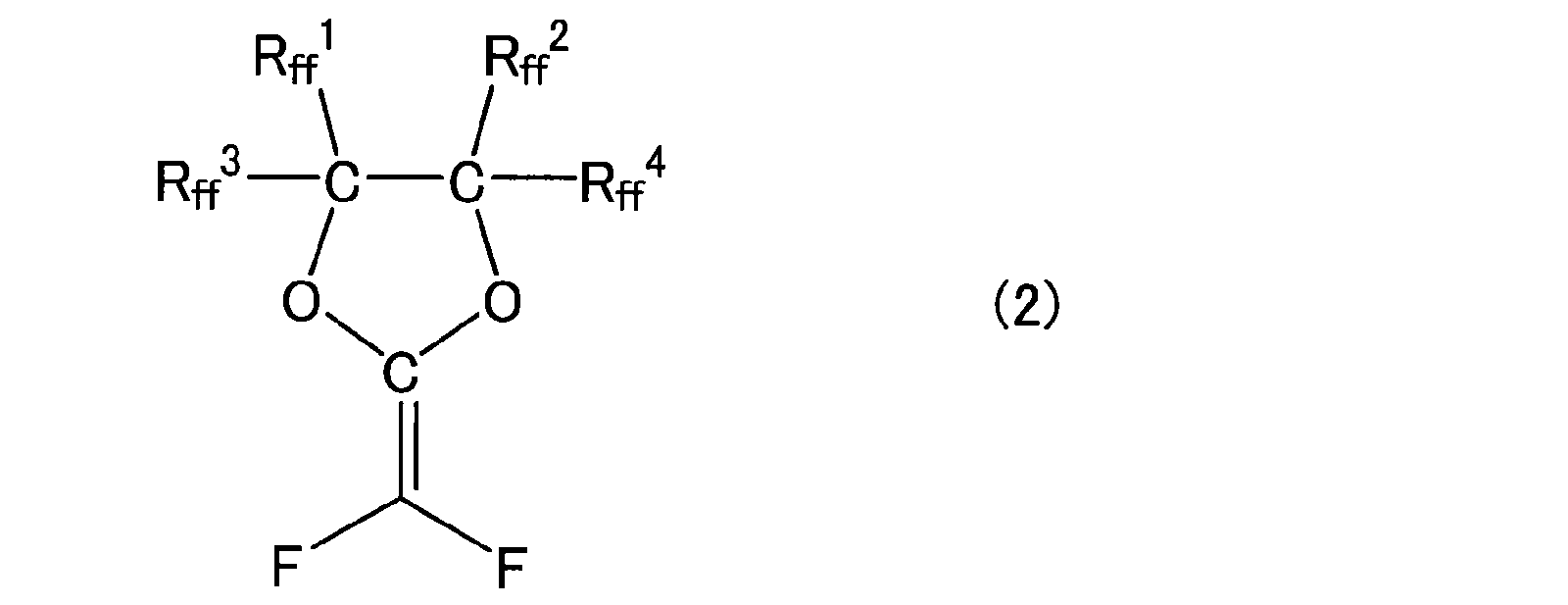
含フッ素化合物は、例えば特表2007-504125号公報に開示された製造方法をはじめ、すでに公知である製造方法によって得ることができる。含フッ素脂肪族環構造を有する含フッ素化合物としては、例えば下記式(2)で表される化合物が挙げられる。
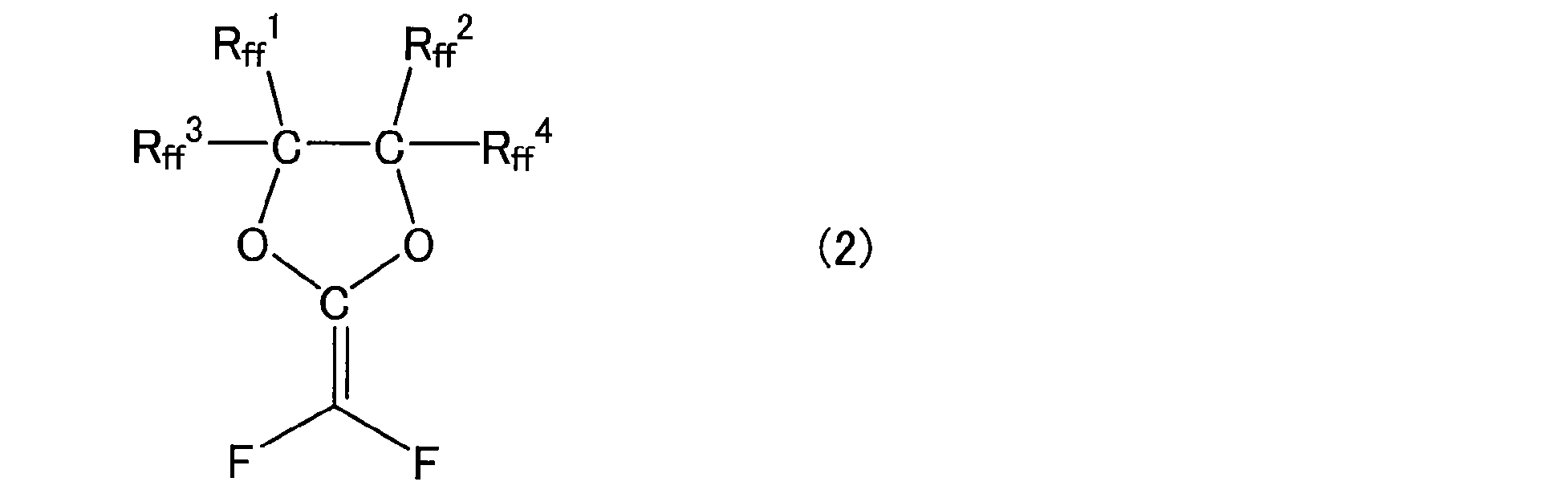
式(2)中、Rff
1~Rff
4は各々独立に、フッ素原子、炭素数1~7のパーフルオロアルキル基、又は炭素数1~7のパーフルオロアルキルエーテル基を表す。Rff
1及びRff
2は、連結して環を形成してもよい。式(2)において、パーフルオロアルキル基の炭素数は、1~5が好ましく、1~3がより好ましく、1であることがさらに好ましい。パーフルオロアルキル基は、直鎖状であってもよく、分岐鎖状であってもよい。パーフルオロアルキル基としては、トリフルオロメチル基、ペンタフルオロエチル基、ヘプタフルオロプロピル基などが挙げられる。
式(2)において、パーフルオロアルキルエーテル基の炭素数は、1~5が好ましく、1~3がより好ましい。パーフルオロアルキルエーテル基は、直鎖状であってもよく、分岐鎖状であってもよい。パーフルオロアルキルエーテル基としては、パーフルオロメトキシメチル基などが挙げられる。
Rff
1及びRff
2が連結して環を形成している場合、当該環は、5員環であってもよく、6員環であってもよい。この環としては、パーフルオロテトラヒドロフラン環、パーフルオロシクロペンタン環、パーフルオロシクロヘキサン環などが挙げられる。
上記式(2)で表される化合物の具体例として、例えば下記式(M1)~(M8)で表される化合物が挙げられる。

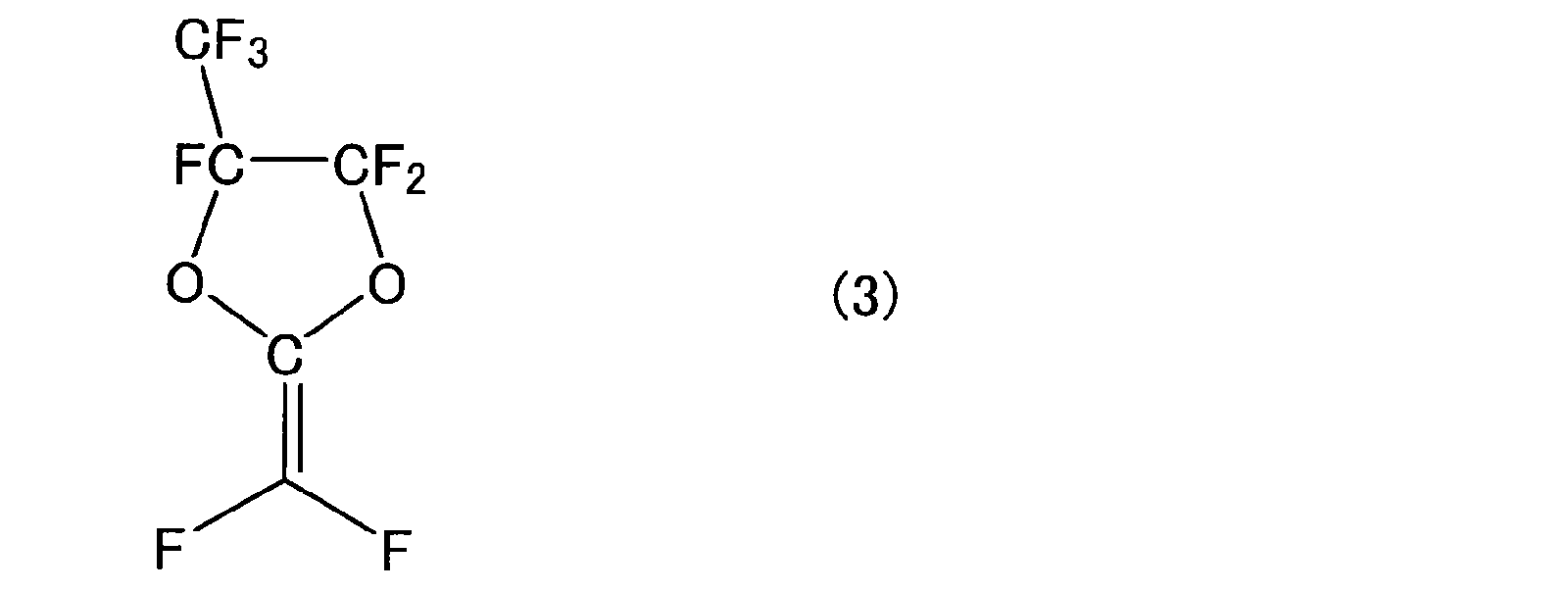
式(2)で表される化合物は、上記式(M1)~(M8)で表される化合物のうち、式(M2)で表される化合物、すなわち下記式(3)で表される化合物であることが好ましい。

単量体群に含まれる含フッ素化合物は、1種類であってもよいし、2種類以上であってもよい。すなわち、含フッ素重合体(A)は、1種の含フッ素化合物を単独重合させることによって得られる含フッ素重合体であってもよいし、2種以上の含フッ素化合物を共重合させることによって得られる含フッ素共重合体であってもよい。
含フッ素重合体(A)は、例えば上述の含フッ素脂肪族環構造を有する含フッ素化合物(以下、含フッ素化合物(a)と記載する)と、含フッ素化合物(a)以外の他の含フッ素化合物とを共重合させることによって得られる含フッ素共重合体であってもよい。含フッ素化合物(a)以外の他の含フッ素化合物として、例えば、以下の含フッ素化合物(b)~(d)が挙げられる。
含フッ素化合物(b)は、パーフルオロビニルエーテル等の含フッ素ビニルエーテルである。含フッ素ビニルエーテルは、例えば下記式(6)で表される。

式(6)中、R1~R3は各々独立に、フッ素原子、又は炭素数1~7のパーフルオロアルキル基を表す。R4は、炭素数1~7のパーフルオロアルキル基を表す。パーフルオロアルキル基は、環構造を有していてもよい。フッ素原子の一部は、フッ素原子以外のハロゲン原子で置換されていてもよい。パーフルオロアルキル基におけるフッ素原子の一部は、フッ素原子以外のハロゲン原子で置換されていてもよい。
含フッ素化合物(c)は、テトラフルオロエチレン及びクロロトリフルオロエチレン等の含フッ素オレフィンである。含フッ素オレフィンは、例えば下記式(7)で表される。

式(7)中、R5~R8は各々独立に、フッ素原子、又は炭素数1~7のパーフルオロアルキル基を表す。パーフルオロアルキル基は、環構造を有していてもよい。フッ素原子の一部は、フッ素原子以外のハロゲン原子で置換されていてもよい。パーフルオロアルキル基におけるフッ素原子の一部は、フッ素原子以外のハロゲン原子で置換されていてもよい。
含フッ素化合物(d)は、2個以上の重合性二重結合を有し、かつ環化重合し得る含フッ素化合物である。含フッ素化合物(d)は、例えば下記式(8)で表される。

式(8)中、Zは、酸素原子、単結合、又は-OC(R19R20)O-を表し、R9~R20は各々独立に、フッ素原子、炭素数1~5のパーフルオロアルキル基、又は炭素数1~5のパーフルオロアルコキシ基を表す。フッ素原子の一部は、フッ素原子以外のハロゲン原子で置換されていてもよい。パーフルオロアルキル基におけるフッ素原子の一部は、フッ素原子以外のハロゲン原子で置換されていてもよい。パーフルオロアルコキシ基におけるフッ素原子の一部は、フッ素原子以外のハロゲン原子で置換されていてもよい。s及びtはそれぞれ独立に0~5でかつs+tが1~6の整数(ただし、Zが-OC(R19R20)O-の場合、s+tは0であってもよい)を表す。
含フッ素化合物(d)として、下記式(9)で表される含フッ素化合物が用いられてもよい。なお、下記式(9)で表される含フッ素化合物は、上記式(8)においてZが酸素原子、sが0、かつtが2の場合である。

式(9)中、R141、R142、R151、及びR152は各々独立に、フッ素原子、炭素数1~5のパーフルオロアルキル基、又は炭素数1~5のパーフルオロアルコキシ基を表す。フッ素原子の一部は、フッ素原子以外のハロゲン原子で置換されていてもよい。パーフルオロアルキル基におけるフッ素原子の一部は、フッ素原子以外のハロゲン原子で置換されていてもよい。パーフルオロアルコキシ基におけるフッ素原子の一部は、フッ素原子以外のハロゲン原子で置換されていてもよい。
含フッ素化合物(d)の具体例として、例えば下記の化合物が挙げられる。
CF2=CFOCF2CF=CF2
CF2=CFOCF(CF3)CF=CF2
CF2=CFOCF2CF2CF=CF2
CF2=CFOCF2CF(CF3)CF=CF2
CF2=CFOCF(CF3)CF2CF=CF2
CF2=CFOCFClCF2CF=CF2
CF2=CFOCCl2CF2CF=CF2
CF2=CFOCF2OCF=CF2
CF2=CFOC(CF3)2OCF=CF2
CF2=CFOCF2CF(OCF3)CF=CF2
CF2=CFCF2CF=CF2
CF2=CFCF2CF2CF=CF2
CF2=CFCF2OCF2CF=CF2
CF2=CFOCF2CFClCF=CF2
CF2=CFOCF2CF2CCl=CF2
CF2=CFOCF2CF2CF=CFCl
CF2=CFOCF2CF(CF3)CCl=CF2
CF2=CFOCF2OCF=CF2
CF2=CFOCCl2OCF=CF2
CF2=CClOCF2OCCl=CF2
CF2=CFOCF2CF=CF2
CF2=CFOCF(CF3)CF=CF2
CF2=CFOCF2CF2CF=CF2
CF2=CFOCF2CF(CF3)CF=CF2
CF2=CFOCF(CF3)CF2CF=CF2
CF2=CFOCFClCF2CF=CF2
CF2=CFOCCl2CF2CF=CF2
CF2=CFOCF2OCF=CF2
CF2=CFOC(CF3)2OCF=CF2
CF2=CFOCF2CF(OCF3)CF=CF2
CF2=CFCF2CF=CF2
CF2=CFCF2CF2CF=CF2
CF2=CFCF2OCF2CF=CF2
CF2=CFOCF2CFClCF=CF2
CF2=CFOCF2CF2CCl=CF2
CF2=CFOCF2CF2CF=CFCl
CF2=CFOCF2CF(CF3)CCl=CF2
CF2=CFOCF2OCF=CF2
CF2=CFOCCl2OCF=CF2
CF2=CClOCF2OCCl=CF2
[単量体群]
単量体群は、上述した含フッ素化合物を主成分として含むことが好ましく、実質的に含フッ素化合物からなることがより好ましい。単量体群は、含フッ素化合物以外の他の重合性化合物をさらに含んでいてもよい。
単量体群は、上述した含フッ素化合物を主成分として含むことが好ましく、実質的に含フッ素化合物からなることがより好ましい。単量体群は、含フッ素化合物以外の他の重合性化合物をさらに含んでいてもよい。
[有機過酸化物]
本実施形態の製造方法において、有機過酸化物は、単量体群の重合開始剤として機能する。有機過酸化物は、過酸化ジアシル又は過酸化エステルを含むことが好ましく、過酸化ジアシルを含むことがより好ましい。有機過酸化物は、フッ素化されていることが好ましい。有機過酸化物は、実質的に水素原子を含まず、かつ全フッ素化されていることがより好ましい。ここで、有機過酸化物が実質的に水素原子を含んでいないとは、用いられる有機過酸化物の全量に対して、水素原子の含有割合が1モル%以下であることを意味する。有機過酸化物の好ましい一例は、パーフルオロ過酸化ベンゾイルである。
本実施形態の製造方法において、有機過酸化物は、単量体群の重合開始剤として機能する。有機過酸化物は、過酸化ジアシル又は過酸化エステルを含むことが好ましく、過酸化ジアシルを含むことがより好ましい。有機過酸化物は、フッ素化されていることが好ましい。有機過酸化物は、実質的に水素原子を含まず、かつ全フッ素化されていることがより好ましい。ここで、有機過酸化物が実質的に水素原子を含んでいないとは、用いられる有機過酸化物の全量に対して、水素原子の含有割合が1モル%以下であることを意味する。有機過酸化物の好ましい一例は、パーフルオロ過酸化ベンゾイルである。
[含フッ素重合体(A)の製造方法]
含フッ素重合体(A)は、上記の単量体群を上記の有機過酸化物を用いて重合させることによって製造できる。重合方法としては、公知の重合方法を用いることができる。例えば、上記の単量体群を常法によってラジカル重合し、含フッ素重合体(A)を製造できる。
含フッ素重合体(A)は、上記の単量体群を上記の有機過酸化物を用いて重合させることによって製造できる。重合方法としては、公知の重合方法を用いることができる。例えば、上記の単量体群を常法によってラジカル重合し、含フッ素重合体(A)を製造できる。
[含フッ素重合体]
上述のとおり、含フッ素重合体(A)及び(B)は、互いに異なる末端基を有する。末端基を除き、含フッ素重合体(A)の構造は、含フッ素重合体(B)と同じであってもよい。以下では、含フッ素重合体(A)及び(B)が共通して有する構成単位について説明する。
上述のとおり、含フッ素重合体(A)及び(B)は、互いに異なる末端基を有する。末端基を除き、含フッ素重合体(A)の構造は、含フッ素重合体(B)と同じであってもよい。以下では、含フッ素重合体(A)及び(B)が共通して有する構成単位について説明する。
含フッ素重合体は、例えば、下記式(10)で表される構成単位(a)を含む。構成単位(a)は、上述した含フッ素化合物(a)に由来する。式(10)において、Rff
1~Rff
4は、式(2)と同じである。

構成単位(a)の具体例としては、例えば、下記式(a1)~(a8)で表される構成単位が挙げられる。
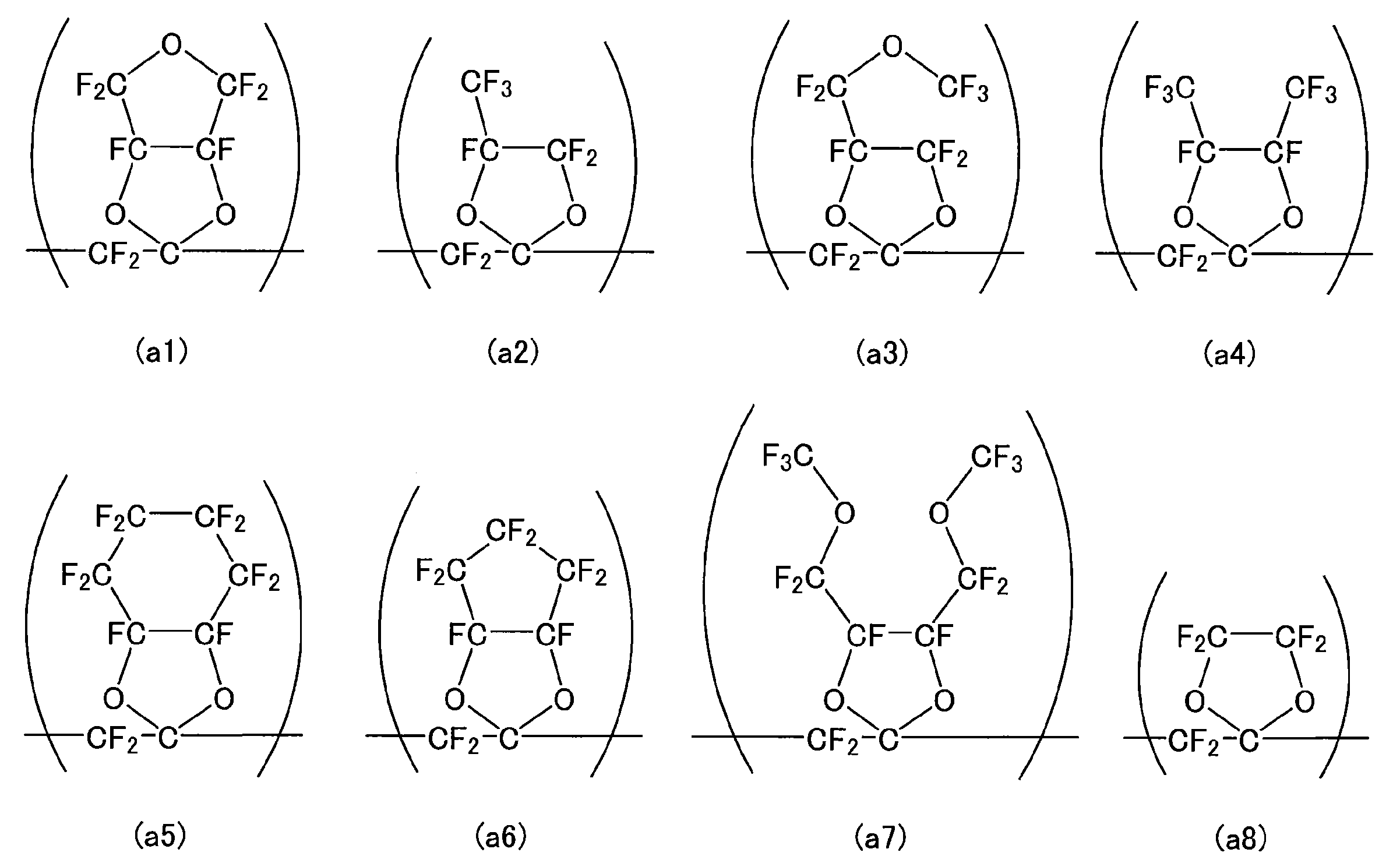
構成単位(a)は、上記式(a1)~(a8)で表される構成単位のうち、構成単位(a2)、すなわち下記式(11)で表される構成単位であることが好ましい。
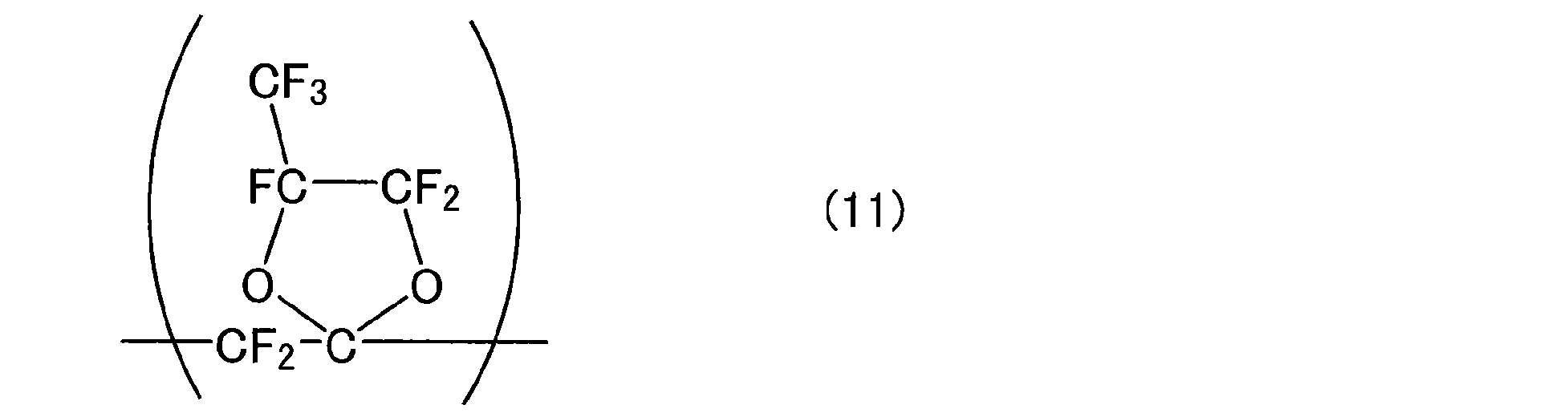
含フッ素重合体は、構成単位(a)を1種又は2種以上含んでいてもよい。含フッ素重合体において、構成単位(a)の含有量は、全構成単位の合計に対し、20モル%以上であることが好ましく、40モル%以上であることがより好ましい。構成単位(a)が20モル%以上含まれることにより、含フッ素重合体は、より高い耐熱性を有する傾向がある。構成単位(a)が40モル%以上含まれる場合、含フッ素重合体は、高い耐熱性に加えて、より高い透明性及び高い機械的強度も有する傾向がある。含フッ素重合体において、構成単位(a)の含有量は、全構成単位の合計に対し、95モル%以下であることが好ましく、70モル%以下であることがより好ましい。
含フッ素重合体は、構成単位(a)以外に、他の構成単位をさらに含んでいてもよい。他の構成単位としては、以下の構成単位(b)~(d)が挙げられる。
構成単位(b)は、下記式(12)で表される。構成単位(b)は、上述した含フッ素化合物(b)に由来する。式(12)において、R1~R4は、式(6)と同じである。

含フッ素重合体は、構成単位(b)を1種又は2種以上含んでいてもよい。含フッ素重合体において、構成単位(b)の含有量は、全構成単位の合計に対し、5~10モル%が好ましい。構成単位(b)の含有量は、9モル%以下であってもよく、8モル%以下であってもよい。
構成単位(c)は、下記式(13)で表される。構成単位(c)は、上述した含フッ素化合物(c)に由来する。式(13)において、R5~R8は、式(7)と同じである。

含フッ素重合体は、構成単位(c)を1種又は2種以上含んでいてもよい。含フッ素重合体において、構成単位(c)の含有量は、全構成単位の合計に対し、5~10モル%が好ましい。構成単位(c)の含有量は、9モル%以下であってもよく、8モル%以下であってもよい。
構成単位(d)は、下記式(14)で表される。構成単位(d)は、上述した含フッ素化合物(d)に由来する。式(14)において、Z、R9~R18、s及びtは、式(8)と同じである。
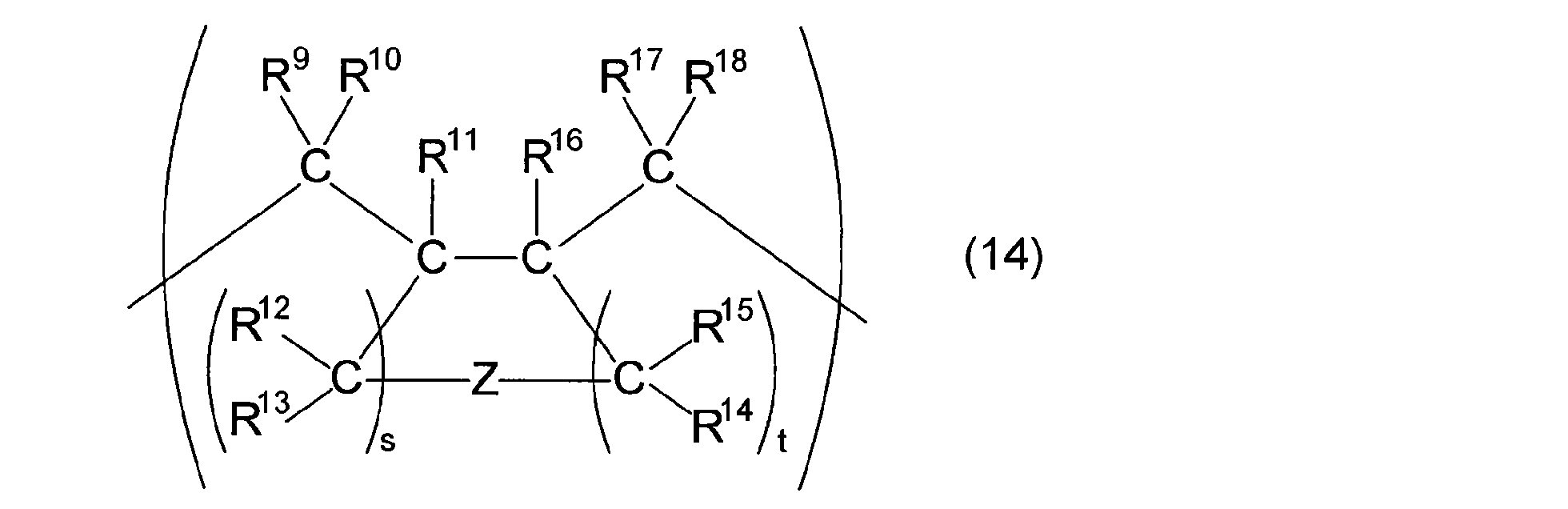
構成単位(d)は、好ましくは下記式(15)で表される。下記式(15)で表される構成単位(d)は、式(9)で表される含フッ素化合物に由来する。式(15)において、R141、R142、R151、及びR152は、式(9)と同じである。
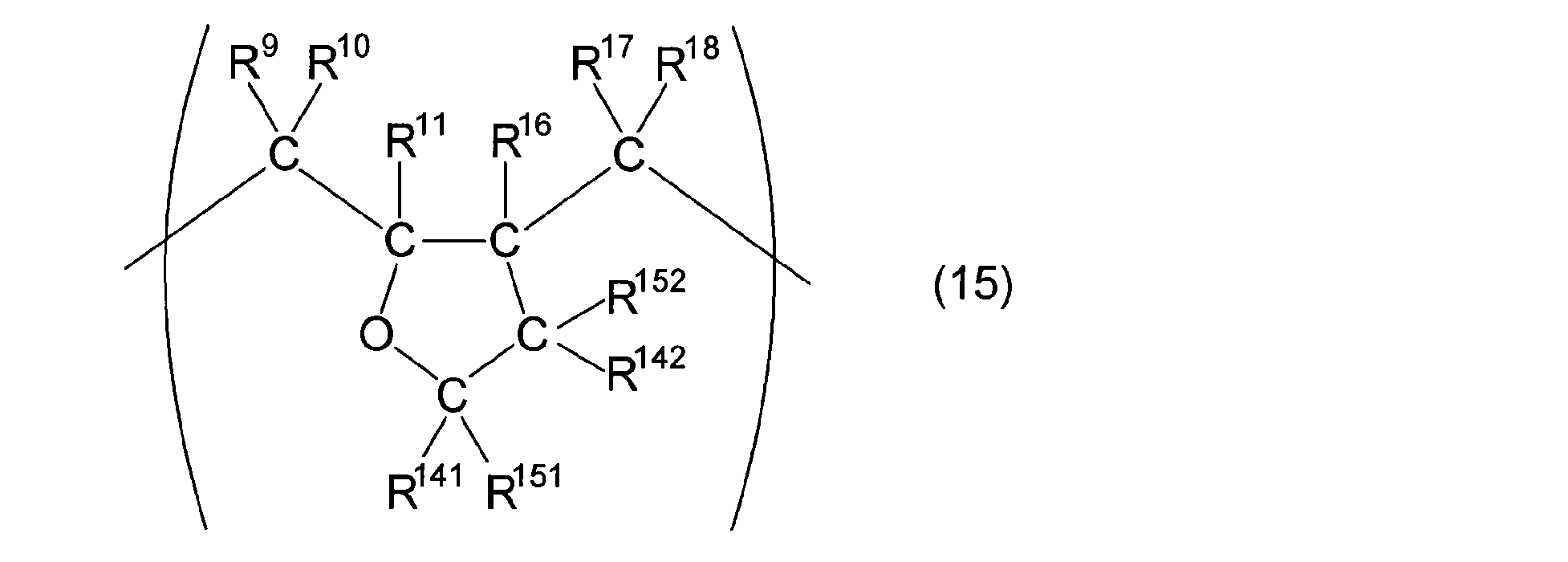
含フッ素重合体は、構成単位(d)を1種又は2種以上含んでいてもよい。含フッ素重合体において、構成単位(d)の含有量は、全構成単位の合計に対し、30~67モル%が好ましい。構成単位(d)の含有量は、例えば35モル%以上であり、60モル%以下であってもよく、55モル%以下であってもよい。
含フッ素重合体は、構成単位(a)~(d)以外の他の構成単位をさらに含んでいてもよいが、実質的に構成単位(a)~(d)以外の他の構成単位を含まないことが好ましい。なお、含フッ素重合体が実質的に構成単位(a)~(d)以外の他の構成単位を含まないとは、含フッ素重合体における全構成単位の合計に対し、構成単位(a)~(d)の合計が95モル%以上、好ましくは98モル%以上であることを意味する。
含フッ素重合体のガラス転移温度(Tg)は、特に限定されず、例えば100℃~140℃であり、105℃以上であってもよく、120℃以上であってもよい。本明細書において、Tgは、日本産業規格(JIS) K7121:1987の規定に準拠して求められる中間点ガラス転移温度 (Tmg)を意味する。
[光学用樹脂組成物]
本実施形態の製造方法によって得られた光学用樹脂組成物は、含フッ素重合体(B)を含み、実質的に含フッ素重合体(B)からなることが好ましい。光学用樹脂組成物は、屈折率調整剤などの添加剤をさらに含んでいてもよい。
本実施形態の製造方法によって得られた光学用樹脂組成物は、含フッ素重合体(B)を含み、実質的に含フッ素重合体(B)からなることが好ましい。光学用樹脂組成物は、屈折率調整剤などの添加剤をさらに含んでいてもよい。
上述のとおり、本実施形態の製造方法によれば、含フッ素重合体(B)の末端基の加水分解が抑制されるため、光学用樹脂組成物の吸水性が十分に低い。光学用樹脂組成物の吸水率は、例えば0.1%以下であり、好ましくは0.05%以下である。光学用樹脂組成物の吸水率は、次の方法によって特定することができる。まず、市販の水分吸脱着測定装置に光学用樹脂組成物を測定用サンプルとしてセットする。次に、測定用サンプルを85℃0%RHの条件で600分保持し、さらに85℃85%RHの条件で600分保持する。このとき、測定用サンプルが装置内の水蒸気を吸水(吸湿)すると、測定用サンプルの重量が増加する。吸湿処理後の測定用サンプルの重量に対する吸湿処理による測定用サンプルの重量の増加量の比率を吸水率として特定する。
さらに、光学用樹脂組成物の吸水性が十分に低いため、光学用樹脂組成物における水の含有率(含水率)も低い状態で維持される。光学用樹脂組成物の含水率は、例えば0.1wt%以下であり、好ましくは0.07wt%以下であり、より好ましくは0.05wt%以下である。光学用樹脂組成物の含水率の下限値は、特に限定されず、例えば0.01wt%である。
本実施形態の製造方法によって得られた光学用樹脂組成物によれば、光学部材に加熱成形されるときに着色が生じにくい。さらに、光学用樹脂組成物の含水率が低いため、光学用樹脂組成物に含まれる水による光の吸収損失が低い。そのため、光学用樹脂組成物から成形体を作製した場合、当該成形体の内部透過率が十分に低い。一例として、光学用樹脂組成物から作製された厚さ10mmの板状の成形体の波長850nmの光に対する内部透過率は、例えば98%以上であり、好ましくは99%以上である。本明細書において、内部透過率は、成形体の表面での光の反射(フレネル反射)による反射損失を含まない透過率を意味する。成形体の内部透過率は、日本光学硝子工業会規格(JOGIS)17-2012の規定に準拠して特定することができる。
以下に、実施例及び比較例により本発明をさらに詳細に説明するが、本発明はこれに限定されるものではない。
[含フッ素重合体(A)]
まず、室温(20℃±15℃)のアルゴン雰囲気下で、パーフルオロ-2-メチレン-4-メチル-1,3-ジオキソラン(式(M2)で表される化合物)22.6gを50mLの1,1,1,2,2,3,4,5,5,5-デカフルオロペンタン(三井・ケマーズフロロプロダクツ社製バートレルXF)に溶解させた。アルゴン雰囲気下を維持しながら、得られた溶液にパーフルオロ過酸化ベンゾイルを0.155g加え、撹拌混合した。次に、凍結脱気法により溶液から溶存酸素を除去した。溶液について、撹拌しながら、40℃に加熱し、72時間反応を行った。得られた反応混合物をクロロホルム300mLに添加した。この操作によって生じた沈殿物をろ過により回収した。得られた濾物は、パーフルオロ-2-メチレン-4-メチル-1,3-ジオキソランの重合体(含フッ素重合体(A))であった。含フッ素重合体(A)の収量は19.2gであり、収率は81.0%であった。
まず、室温(20℃±15℃)のアルゴン雰囲気下で、パーフルオロ-2-メチレン-4-メチル-1,3-ジオキソラン(式(M2)で表される化合物)22.6gを50mLの1,1,1,2,2,3,4,5,5,5-デカフルオロペンタン(三井・ケマーズフロロプロダクツ社製バートレルXF)に溶解させた。アルゴン雰囲気下を維持しながら、得られた溶液にパーフルオロ過酸化ベンゾイルを0.155g加え、撹拌混合した。次に、凍結脱気法により溶液から溶存酸素を除去した。溶液について、撹拌しながら、40℃に加熱し、72時間反応を行った。得られた反応混合物をクロロホルム300mLに添加した。この操作によって生じた沈殿物をろ過により回収した。得られた濾物は、パーフルオロ-2-メチレン-4-メチル-1,3-ジオキソランの重合体(含フッ素重合体(A))であった。含フッ素重合体(A)の収量は19.2gであり、収率は81.0%であった。
(サンプル1)
まず、アルミニウム製のバットの上にアルミ箔を配置し、さらに、アルミ箔の光沢面の上に粉末状の含フッ素重合体(A)を配置した。バットをオーブンの内部に配置し、窒素雰囲気下270℃で5時間、含フッ素重合体(A)を熱処理した。窒素雰囲気は、オーブン内に窒素を1L/minの流量で送り込むことによって調整した。窒素雰囲気における水蒸気の濃度は、40volppmであった。熱処理によって含フッ素重合体(A)は溶融した。溶融した含フッ素重合体(A)の液面の高さは1mm以下であった。さらに、熱処理により、含フッ素重合体(A)の末端基が熱分解するとともに、当該熱分解によって生じた低分子化合物が揮発した。これにより、サンプル1の光学用樹脂組成物を得た。室温まで冷却されたサンプル1の光学用樹脂組成物は、厚さ1mm以下の板状であった。
まず、アルミニウム製のバットの上にアルミ箔を配置し、さらに、アルミ箔の光沢面の上に粉末状の含フッ素重合体(A)を配置した。バットをオーブンの内部に配置し、窒素雰囲気下270℃で5時間、含フッ素重合体(A)を熱処理した。窒素雰囲気は、オーブン内に窒素を1L/minの流量で送り込むことによって調整した。窒素雰囲気における水蒸気の濃度は、40volppmであった。熱処理によって含フッ素重合体(A)は溶融した。溶融した含フッ素重合体(A)の液面の高さは1mm以下であった。さらに、熱処理により、含フッ素重合体(A)の末端基が熱分解するとともに、当該熱分解によって生じた低分子化合物が揮発した。これにより、サンプル1の光学用樹脂組成物を得た。室温まで冷却されたサンプル1の光学用樹脂組成物は、厚さ1mm以下の板状であった。
(サンプル2)
熱処理の時間を24時間に変更したことを除き、サンプル1と同じ方法によってサンプル2の光学用樹脂組成物を得た。
熱処理の時間を24時間に変更したことを除き、サンプル1と同じ方法によってサンプル2の光学用樹脂組成物を得た。
(サンプル3)
熱処理を大気中で行ったことを除き、サンプル1と同じ方法によってサンプル3の光学用樹脂組成物を得た。大気中の水蒸気の濃度は、1.4vol%であった。
熱処理を大気中で行ったことを除き、サンプル1と同じ方法によってサンプル3の光学用樹脂組成物を得た。大気中の水蒸気の濃度は、1.4vol%であった。
(サンプル4)
熱処理の時間を24時間に変更したことを除き、サンプル3と同じ方法によってサンプル4の光学用樹脂組成物を得た。
熱処理の時間を24時間に変更したことを除き、サンプル3と同じ方法によってサンプル4の光学用樹脂組成物を得た。
[吸水率]
サンプル1~4の光学用樹脂組成物について吸水率を測定した。まず、光学用樹脂組成物から1cm角の測定用サンプルを切り出した。この測定用サンプルを水分吸脱着測定装置(Hiden社製のIGA-SORP)にセットした。次に、測定用サンプルを85℃0%RHの条件で600分保持し、さらに、85℃85%RHの条件で600分保持した。吸湿処理後の測定用サンプルの重量に対する吸湿処理による測定用サンプルの重量の増加量の比率を吸水率として特定した。結果を表1に示す。なお、表1において、〇は、吸水率が0.05%以下であることを意味する。×は、吸水率が0.05%より大きいことを意味する。
サンプル1~4の光学用樹脂組成物について吸水率を測定した。まず、光学用樹脂組成物から1cm角の測定用サンプルを切り出した。この測定用サンプルを水分吸脱着測定装置(Hiden社製のIGA-SORP)にセットした。次に、測定用サンプルを85℃0%RHの条件で600分保持し、さらに、85℃85%RHの条件で600分保持した。吸湿処理後の測定用サンプルの重量に対する吸湿処理による測定用サンプルの重量の増加量の比率を吸水率として特定した。結果を表1に示す。なお、表1において、〇は、吸水率が0.05%以下であることを意味する。×は、吸水率が0.05%より大きいことを意味する。
[内部透過率]
サンプル1~4の光学用樹脂組成物について、JOGIS 17-2012の規定に準拠した以下の方法によって、光学用樹脂組成物から作製された厚さ10mmの板状の成形体の波長850nmの光に対する内部透過率を特定した。まず、アルミ箔で円筒を作製し、円筒の底面をポリイミドテープで塞いだ。この円筒の内部に光学用樹脂組成物を充填した。次に、この円筒をハステロイ製のロッド作製用容器にセットした。容器の内部を真空雰囲気にし、約2時間かけて容器の温度を270℃まで上昇させた。容器の温度が270℃に到達してから3時間、容器を270℃で加熱した。次に、容器を室温までゆっくりと冷却することによって、光学用樹脂組成物からロッドを成形した。ロッドは、底面の直径が20mmであり、厚さが20mmである円柱形状であった。
サンプル1~4の光学用樹脂組成物について、JOGIS 17-2012の規定に準拠した以下の方法によって、光学用樹脂組成物から作製された厚さ10mmの板状の成形体の波長850nmの光に対する内部透過率を特定した。まず、アルミ箔で円筒を作製し、円筒の底面をポリイミドテープで塞いだ。この円筒の内部に光学用樹脂組成物を充填した。次に、この円筒をハステロイ製のロッド作製用容器にセットした。容器の内部を真空雰囲気にし、約2時間かけて容器の温度を270℃まで上昇させた。容器の温度が270℃に到達してから3時間、容器を270℃で加熱した。次に、容器を室温までゆっくりと冷却することによって、光学用樹脂組成物からロッドを成形した。ロッドは、底面の直径が20mmであり、厚さが20mmである円柱形状であった。
次に、ダイヤモンドホイールソーを用いて、作製したロッドから厚さ5mmの円板D1と厚さ12mmの円板D2とを切り出した。次に、円板D1をサンプルカップの内部に配置した。このとき、円板D1の底面にカーボンテープを貼り付け、このカーボンテープによって円板D1をサンプルカップに固定した。次に、サンプルカップの内部に樹脂組成物(Struers社製のEPOFIX)を充填させ、当該樹脂組成物を硬化させた。これにより、測定用サンプルS1を得た。測定用サンプルS1は、底面の直径が25mmであり、厚さが約5mmである円柱形状であった。
次に、測定用サンプルS1を自動卓上研磨機のサンプルホルダーにセットし、カーボンテープが貼り付けられた側の測定用サンプルS1の底面に対して、以下の工程1~6を行った。
工程1 「SiC Paper ♯1000」で研磨し、カーボンテープを除去する。
工程2 Struers社製の「MD Sat 9μm」で5分間研磨する。
工程3 Struers社製の「MD Sat 6μm」で5分間研磨する。
工程4 Struers社製の「MD Dur 3μm」で10分間研磨する。
工程5 Struers社製の「MD Nap 1μm」で5分間研磨する。
工程6 Struers社製の「MD Chem OP-S」で5分間研磨する。
工程1 「SiC Paper ♯1000」で研磨し、カーボンテープを除去する。
工程2 Struers社製の「MD Sat 9μm」で5分間研磨する。
工程3 Struers社製の「MD Sat 6μm」で5分間研磨する。
工程4 Struers社製の「MD Dur 3μm」で10分間研磨する。
工程5 Struers社製の「MD Nap 1μm」で5分間研磨する。
工程6 Struers社製の「MD Chem OP-S」で5分間研磨する。
工程1~6によって研磨された底面をろ紙で保護した。次に、測定用サンプルS1を平面研磨用治具にセットし、測定用サンプルS1の底面に対向する面(上面)を研磨した。この研磨は、「SiC Paper ♯220」を用いて、測定用サンプルS1の厚さが約4mmになるまで行った。このとき、測定用サンプルS1の厚さは、デジタルマイクロメータによって確認した。さらに、「SiC Paper ♯1000」を用いて、測定用サンプルS1の厚さが約3.5mmになるまで、測定用サンプルS1の上面を研磨した。さらに、測定用サンプルS1の上面に対して、上記の工程2~6を行うことによって、厚さ約3.5mmの測定用サンプルS1を得た。
次に、測定用サンプルS1と同じ方法によって、円板D2から厚さ10mmの測定用サンプルS2を得た。なお、研磨前の測定用サンプルS2は、底面の直径が25mmであり、厚さが約12mmである円柱形状であった。「SiC Paper ♯220」を用いた測定用サンプルS2の上面の研磨は、測定用サンプルS2の厚さが約11mmになるまで行った。「SiC Paper ♯1000」を用いた測定用サンプルS2の上面の研磨は、測定用サンプルS2の厚さが約10.5mmになるまで行った。
次に、測定用サンプルS1及びS2のそれぞれについて、JIS Z8722:2009の規定に準拠して、フレネル反射による反射損失を含む分光透過率を測定した。分光透過率の測定は、日立ハイテクサイエンス社製の紫外可視近赤外分光光度計UH4150を用いて、測定波長200nm~1300nm、サンプリング間隔1nm、スキャンスピード600nm/minの条件で行った。得られた分光透過率から、以下の数式(1)に基づいて、光学用樹脂組成物から作製された厚さ10mmの板状の成形体の波長850nmの光に対する内部透過率を特定した。結果を表1に示す。

上記の数式(1)において、τは、厚さLmm(10mm)の板状の成形体の内部透過率を意味する。aは、以下の数式(2)によって算出される値である。なお、数式(2)において、d1は、測定用サンプルS1の厚さ(mm)を意味し、d2は、測定用サンプルS2の厚さ(mm)を意味する。T1は、測定用サンプルS1の波長850nmの光に対する透過率を意味し、T2は、測定用サンプルS2の波長850nmの光に対する透過率を意味する。T1及びT2は、それぞれ、フレネル反射による反射損失を含んでいる。

表1において、〇は、上記の方法で特定した内部透過率が98%以上であることを意味する。×は、上記の方法で特定した内部透過率が98%未満であることを意味する。
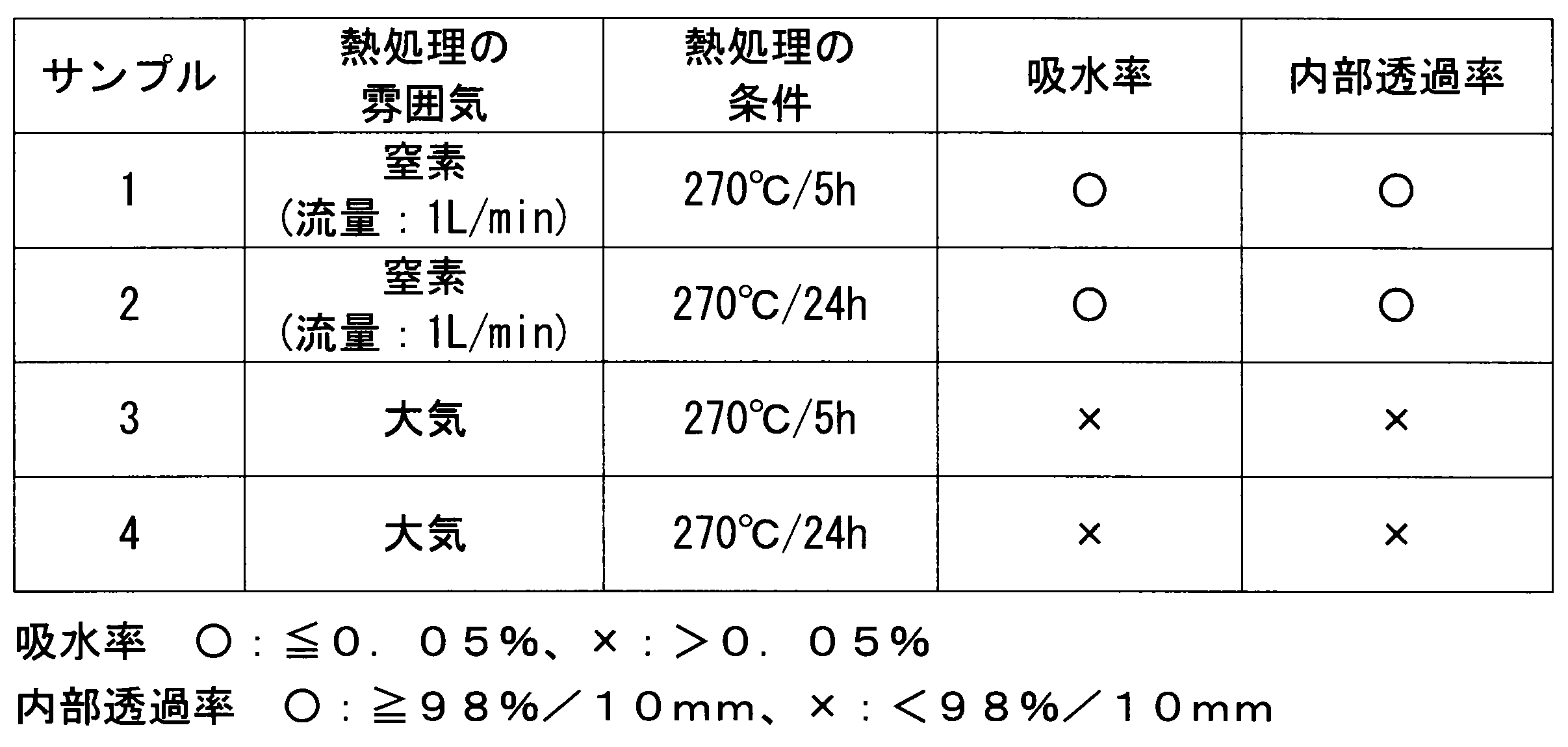
表1からわかるとおり、含フッ素重合体(A)について、水蒸気の濃度が100volppm以下である雰囲気下で熱処理を行うことによって得られたサンプル1及び2の光学用樹脂組成物は、水蒸気の濃度が100volppmを上回る雰囲気下で熱処理を行うことによって得られたサンプル3及び4の光学用樹脂組成物に比べて吸水率が低かった。サンプル1及び2の光学用樹脂組成物は、吸水率が低く、水をほとんど含まないため、当該光学用樹脂組成物から作製された厚さ10mmの板状の成形体の波長850nmの光に対する内部透過率が高い値になった。
本実施形態の製造方法によって得られた光学用樹脂組成物は、プラスチック光ファイバー、光導波路用材料、光学レンズ、プリズム、フォトマスクなどの光学部材の材料に適しており、特に、プラスチック光ファイバー、光導波路用材料、及び光学レンズの材料に好適である。
Claims (9)
- 炭素-炭素二重結合を有する含フッ素化合物を含む単量体群を有機過酸化物により重合させることによって得られた含フッ素重合体について、水蒸気の濃度が100volppm以下である雰囲気下で熱処理を行うことを含む、光学用樹脂組成物の製造方法。
- 前記熱処理によって、前記含フッ素重合体の末端基を熱分解するとともに、当該熱分解により生じた低分子化合物を揮発させる、請求項1に記載の製造方法。
- 前記熱処理によって前記含フッ素重合体の末端基を下記式(1)で表される官能基に変化させる、請求項1又は2に記載の製造方法。

- 前記有機過酸化物が過酸化ジアシル又は過酸化エステルを含む、請求項1~3のいずれか1項に記載の製造方法。
- 前記雰囲気が実質的に窒素ガスからなる、請求項1~4のいずれか1項に記載の製造方法。
- 前記熱処理の温度が100℃以上400℃以下である、請求項1~5のいずれか1項に記載の製造方法。
- 前記炭素-炭素二重結合が前記含フッ素化合物の末端に位置し、当該二重結合を構成する炭素原子に結合している全ての水素原子がフッ素原子に置換されている、請求項1~6のいずれか1項に記載の製造方法。
- 前記含フッ素化合物が下記式(2)で表される、請求項1~7のいずれか1項に記載の製造方法。
- 前記含フッ素化合物が下記式(3)で表される、請求項8に記載の製造方法。
Priority Applications (4)
| Application Number | Priority Date | Filing Date | Title |
|---|---|---|---|
| KR1020227017730A KR20220111260A (ko) | 2019-12-04 | 2020-12-04 | 광학용 수지 조성물의 제조 방법 및 광학용 수지 조성물 |
| US17/782,337 US12351662B2 (en) | 2019-12-04 | 2020-12-04 | Optical resin composition manufacturing method and optical resin composition |
| CN202080083361.0A CN114746454B (zh) | 2019-12-04 | 2020-12-04 | 光学用树脂组合物的制造方法和光学用树脂组合物 |
| CN202411671650.9A CN119505040A (zh) | 2019-12-04 | 2020-12-04 | 光学用树脂组合物的制造方法和光学用树脂组合物 |
Applications Claiming Priority (2)
| Application Number | Priority Date | Filing Date | Title |
|---|---|---|---|
| JP2019-219758 | 2019-12-04 | ||
| JP2019219758A JP7395338B2 (ja) | 2019-12-04 | 2019-12-04 | 光学用樹脂組成物の製造方法及び光学用樹脂組成物 |
Publications (1)
| Publication Number | Publication Date |
|---|---|
| WO2021112232A1 true WO2021112232A1 (ja) | 2021-06-10 |
Family
ID=76219735
Family Applications (1)
| Application Number | Title | Priority Date | Filing Date |
|---|---|---|---|
| PCT/JP2020/045276 Ceased WO2021112232A1 (ja) | 2019-12-04 | 2020-12-04 | 光学用樹脂組成物の製造方法及び光学用樹脂組成物 |
Country Status (6)
| Country | Link |
|---|---|
| US (1) | US12351662B2 (ja) |
| JP (2) | JP7395338B2 (ja) |
| KR (1) | KR20220111260A (ja) |
| CN (2) | CN114746454B (ja) |
| TW (1) | TW202130665A (ja) |
| WO (1) | WO2021112232A1 (ja) |
Families Citing this family (1)
| Publication number | Priority date | Publication date | Assignee | Title |
|---|---|---|---|---|
| JP7395338B2 (ja) | 2019-12-04 | 2023-12-11 | 日東電工株式会社 | 光学用樹脂組成物の製造方法及び光学用樹脂組成物 |
Citations (7)
| Publication number | Priority date | Publication date | Assignee | Title |
|---|---|---|---|---|
| JPS6198709A (ja) * | 1984-10-18 | 1986-05-17 | イー・アイ・デユポン・デ・ニモアス・アンド・カンパニー | 熱安定性テトラフルオロエチレン/パーフルオロ(アルキルビニルエーテル)コポリマー |
| JPS62104822A (ja) * | 1985-10-21 | 1987-05-15 | イー・アイ・デユポン・ドウ・ヌムール・アンド・カンパニー | 安定なテトラフルオルエチレン共重合体 |
| WO1999046307A1 (en) * | 1998-03-09 | 1999-09-16 | Daikin Industries Ltd. | Stabilized fluorine-containing polymer and method for stabilizing fluorine-containing polymer |
| JP2006143702A (ja) * | 2004-11-22 | 2006-06-08 | Japan Science & Technology Agency | 含フッ素化合物の製造方法、含フッ素化合物、含フッ素ポリマー、及び含フッ素ポリマーを用いた光学材料若しくは電気材料 |
| JP2007504125A (ja) * | 2003-08-29 | 2007-03-01 | 独立行政法人科学技術振興機構 | 含フッ素1,3−ジオキソラン化合物の製造方法、含フッ素1,3−ジオキソラン化合物、含フッ素1,3−ジオキソラン化合物の含フッ素ポリマー、及び該ポリマーを用いた光学材料又は電気材料 |
| WO2013129503A1 (ja) * | 2012-02-28 | 2013-09-06 | 旭硝子株式会社 | エレクトロウェッティング装置、表示装置、レンズ |
| WO2013129501A1 (ja) * | 2012-02-28 | 2013-09-06 | 旭硝子株式会社 | エレクトロウェッティング装置、表示装置、レンズ |
Family Cites Families (12)
| Publication number | Priority date | Publication date | Assignee | Title |
|---|---|---|---|---|
| JPS465642Y1 (ja) | 1966-12-24 | 1971-02-27 | ||
| US3706723A (en) | 1970-04-29 | 1972-12-19 | Allied Chem | Copolymer of 3,3,3 - trifluoro-2-trifluoromethyl propene and vinylidene fluoride |
| JP3837175B2 (ja) | 1994-04-27 | 2006-10-25 | 旭化成株式会社 | 含フッ素環状エーテルおよびその製法 |
| JP4160918B2 (ja) | 2004-03-12 | 2008-10-08 | 富士フイルム株式会社 | 光通信方法 |
| CN101434670B (zh) * | 2008-12-12 | 2010-09-08 | 山东东岳神舟新材料有限公司 | 一种高链规整度聚偏氟乙烯的制备方法 |
| EP2400515B1 (en) | 2009-02-20 | 2018-01-24 | Asahi Glass Company, Limited | Process for manufacturing electret, and electrostatic induction-type conversion element |
| FR3043084B1 (fr) | 2015-10-29 | 2017-10-27 | Arkema France | Copolymeres fluores fonctionnalises |
| RU2750032C2 (ru) | 2016-09-28 | 2021-06-21 | ЭйДжиСи Инк. | Мономерная композиция и способы получения фторированного полимера |
| US12036714B2 (en) | 2018-03-27 | 2024-07-16 | Daikin Industries, Ltd. | Molding material and tube |
| JP7478370B2 (ja) | 2019-02-28 | 2024-05-07 | 東ソー株式会社 | フッ素樹脂 |
| JP7395338B2 (ja) | 2019-12-04 | 2023-12-11 | 日東電工株式会社 | 光学用樹脂組成物の製造方法及び光学用樹脂組成物 |
| JP2025104822A (ja) | 2023-12-28 | 2025-07-10 | トヨタ自動車株式会社 | ハイブリッド車両 |
-
2019
- 2019-12-04 JP JP2019219758A patent/JP7395338B2/ja active Active
-
2020
- 2020-12-04 WO PCT/JP2020/045276 patent/WO2021112232A1/ja not_active Ceased
- 2020-12-04 TW TW109142892A patent/TW202130665A/zh unknown
- 2020-12-04 US US17/782,337 patent/US12351662B2/en active Active
- 2020-12-04 KR KR1020227017730A patent/KR20220111260A/ko active Pending
- 2020-12-04 CN CN202080083361.0A patent/CN114746454B/zh active Active
- 2020-12-04 CN CN202411671650.9A patent/CN119505040A/zh active Pending
-
2023
- 2023-11-29 JP JP2023201174A patent/JP7571264B2/ja active Active
Patent Citations (7)
| Publication number | Priority date | Publication date | Assignee | Title |
|---|---|---|---|---|
| JPS6198709A (ja) * | 1984-10-18 | 1986-05-17 | イー・アイ・デユポン・デ・ニモアス・アンド・カンパニー | 熱安定性テトラフルオロエチレン/パーフルオロ(アルキルビニルエーテル)コポリマー |
| JPS62104822A (ja) * | 1985-10-21 | 1987-05-15 | イー・アイ・デユポン・ドウ・ヌムール・アンド・カンパニー | 安定なテトラフルオルエチレン共重合体 |
| WO1999046307A1 (en) * | 1998-03-09 | 1999-09-16 | Daikin Industries Ltd. | Stabilized fluorine-containing polymer and method for stabilizing fluorine-containing polymer |
| JP2007504125A (ja) * | 2003-08-29 | 2007-03-01 | 独立行政法人科学技術振興機構 | 含フッ素1,3−ジオキソラン化合物の製造方法、含フッ素1,3−ジオキソラン化合物、含フッ素1,3−ジオキソラン化合物の含フッ素ポリマー、及び該ポリマーを用いた光学材料又は電気材料 |
| JP2006143702A (ja) * | 2004-11-22 | 2006-06-08 | Japan Science & Technology Agency | 含フッ素化合物の製造方法、含フッ素化合物、含フッ素ポリマー、及び含フッ素ポリマーを用いた光学材料若しくは電気材料 |
| WO2013129503A1 (ja) * | 2012-02-28 | 2013-09-06 | 旭硝子株式会社 | エレクトロウェッティング装置、表示装置、レンズ |
| WO2013129501A1 (ja) * | 2012-02-28 | 2013-09-06 | 旭硝子株式会社 | エレクトロウェッティング装置、表示装置、レンズ |
Non-Patent Citations (1)
| Title |
|---|
| MIKES, FRANTISEK ET AL.: "Synthesis and Characterization of an Amorphous Perfluoropolymer: Poly(perfluoro-2-methylene-4-methyl-1, 3- dioxolane", MACROLLLOLECULES, vol. 38, 21 April 2005 (2005-04-21), pages 4237 - 4245, XP055702867, DOI: 10.1021/ma050085u * |
Also Published As
| Publication number | Publication date |
|---|---|
| US12351662B2 (en) | 2025-07-08 |
| US20230060316A1 (en) | 2023-03-02 |
| JP7571264B2 (ja) | 2024-10-22 |
| JP7395338B2 (ja) | 2023-12-11 |
| TW202130665A (zh) | 2021-08-16 |
| CN114746454A (zh) | 2022-07-12 |
| JP2024009301A (ja) | 2024-01-19 |
| KR20220111260A (ko) | 2022-08-09 |
| JP2021088661A (ja) | 2021-06-10 |
| CN119505040A (zh) | 2025-02-25 |
| CN114746454B (zh) | 2024-12-03 |
Similar Documents
| Publication | Publication Date | Title |
|---|---|---|
| KR930007505B1 (ko) | 신규 함불소 환상 중합체 | |
| US12319763B2 (en) | Fluorine-containing copolymer, optical resin composition, and optical resin formed body | |
| JP4399144B2 (ja) | 非晶質ペルフルオロ化コポリマー | |
| JP7571264B2 (ja) | 光学用樹脂組成物の製造方法 | |
| WO2020067421A1 (ja) | フッ素樹脂、フッ素樹脂粒子およびそれらの製造方法 | |
| JP7740319B2 (ja) | フッ素樹脂 | |
| US7582704B2 (en) | Biomedical devices | |
| EP3733636A1 (en) | Fluorine-containing diene compound, fluorine-containing polymer, and methods for producing same | |
| KR101020776B1 (ko) | 비정질 퍼플루오르화 중합체들 | |
| JP2024167694A (ja) | 含フッ素ポリマーを含有する紫外光発光素子用レンズ、含フッ素ポリマーを含有する樹脂組成物、及び当該樹脂組成物の製造方法 | |
| WO2023136244A1 (ja) | フッ素樹脂の精製方法、精製されたフッ素樹脂の製造方法、フッ素樹脂、光学材料、電子材料及びプラスチック光ファイバ | |
| JP7704187B2 (ja) | フッ素樹脂 | |
| JP4453300B2 (ja) | 2,2,3,3,4,5−ヘキサフルオロ−2,3−ジヒドロフランおよび該モノマーを含む重合体 | |
| JP7521528B2 (ja) | 液状組成物、及び、膨潤体 | |
| WO2007005348A1 (en) | Polymerization products and biomedical devices containing same | |
| JP4562451B2 (ja) | フッ素含有化合物 | |
| TW202340332A (zh) | 氟樹脂之純化方法、經純化之氟樹脂之製造方法、氟樹脂、光學材料、電子材料及塑膠光纖 | |
| US20240141080A1 (en) | Optical resin composition and optical resin formed body | |
| JP2024167693A (ja) | 含フッ素ポリマーを含有する紫外光発光素子用レンズ | |
| CN118496406A (zh) | 一种非晶氟聚合物及其制备方法和应用 | |
| US20030181616A1 (en) | Halogenated monomers and polymers and process for making same | |
| JP2025023256A (ja) | 含フッ素ポリマーを含有する組成物、含フッ素ポリマーの製造方法、及び含フッ素ポリマーを含有する紫外光発光素子用レンズ |
Legal Events
| Date | Code | Title | Description |
|---|---|---|---|
| 121 | Ep: the epo has been informed by wipo that ep was designated in this application |
Ref document number: 20897336 Country of ref document: EP Kind code of ref document: A1 |
|
| NENP | Non-entry into the national phase |
Ref country code: DE |
|
| 122 | Ep: pct application non-entry in european phase |
Ref document number: 20897336 Country of ref document: EP Kind code of ref document: A1 |
|
| WWG | Wipo information: grant in national office |
Ref document number: 17782337 Country of ref document: US |