WO2021112188A1 - 接続体の製造方法及び接着剤フィルム - Google Patents
接続体の製造方法及び接着剤フィルム Download PDFInfo
- Publication number
- WO2021112188A1 WO2021112188A1 PCT/JP2020/045075 JP2020045075W WO2021112188A1 WO 2021112188 A1 WO2021112188 A1 WO 2021112188A1 JP 2020045075 W JP2020045075 W JP 2020045075W WO 2021112188 A1 WO2021112188 A1 WO 2021112188A1
- Authority
- WO
- WIPO (PCT)
- Prior art keywords
- electrode
- adhesive film
- conductive
- conductive particles
- electronic member
- Prior art date
- Legal status (The legal status is an assumption and is not a legal conclusion. Google has not performed a legal analysis and makes no representation as to the accuracy of the status listed.)
- Ceased
Links
Images

Classifications
-
- H—ELECTRICITY
- H01—ELECTRIC ELEMENTS
- H01R—ELECTRICALLY-CONDUCTIVE CONNECTIONS; STRUCTURAL ASSOCIATIONS OF A PLURALITY OF MUTUALLY-INSULATED ELECTRICAL CONNECTING ELEMENTS; COUPLING DEVICES; CURRENT COLLECTORS
- H01R43/00—Apparatus or processes specially adapted for manufacturing, assembling, maintaining, or repairing of line connectors or current collectors or for joining electric conductors
- H01R43/04—Apparatus or processes specially adapted for manufacturing, assembling, maintaining, or repairing of line connectors or current collectors or for joining electric conductors for forming connections by deformation, e.g. crimping tool
- H01R43/048—Crimping apparatus or processes
-
- C—CHEMISTRY; METALLURGY
- C09—DYES; PAINTS; POLISHES; NATURAL RESINS; ADHESIVES; COMPOSITIONS NOT OTHERWISE PROVIDED FOR; APPLICATIONS OF MATERIALS NOT OTHERWISE PROVIDED FOR
- C09J—ADHESIVES; NON-MECHANICAL ASPECTS OF ADHESIVE PROCESSES IN GENERAL; ADHESIVE PROCESSES NOT PROVIDED FOR ELSEWHERE; USE OF MATERIALS AS ADHESIVES
- C09J7/00—Adhesives in the form of films or foils
- C09J7/30—Adhesives in the form of films or foils characterised by the adhesive composition
- C09J7/38—Pressure-sensitive adhesives [PSA]
-
- C—CHEMISTRY; METALLURGY
- C09—DYES; PAINTS; POLISHES; NATURAL RESINS; ADHESIVES; COMPOSITIONS NOT OTHERWISE PROVIDED FOR; APPLICATIONS OF MATERIALS NOT OTHERWISE PROVIDED FOR
- C09J—ADHESIVES; NON-MECHANICAL ASPECTS OF ADHESIVE PROCESSES IN GENERAL; ADHESIVE PROCESSES NOT PROVIDED FOR ELSEWHERE; USE OF MATERIALS AS ADHESIVES
- C09J11/00—Features of adhesives not provided for in group C09J9/00, e.g. additives
- C09J11/02—Non-macromolecular additives
- C09J11/04—Non-macromolecular additives inorganic
-
- C—CHEMISTRY; METALLURGY
- C09—DYES; PAINTS; POLISHES; NATURAL RESINS; ADHESIVES; COMPOSITIONS NOT OTHERWISE PROVIDED FOR; APPLICATIONS OF MATERIALS NOT OTHERWISE PROVIDED FOR
- C09J—ADHESIVES; NON-MECHANICAL ASPECTS OF ADHESIVE PROCESSES IN GENERAL; ADHESIVE PROCESSES NOT PROVIDED FOR ELSEWHERE; USE OF MATERIALS AS ADHESIVES
- C09J201/00—Adhesives based on unspecified macromolecular compounds
-
- C—CHEMISTRY; METALLURGY
- C09—DYES; PAINTS; POLISHES; NATURAL RESINS; ADHESIVES; COMPOSITIONS NOT OTHERWISE PROVIDED FOR; APPLICATIONS OF MATERIALS NOT OTHERWISE PROVIDED FOR
- C09J—ADHESIVES; NON-MECHANICAL ASPECTS OF ADHESIVE PROCESSES IN GENERAL; ADHESIVE PROCESSES NOT PROVIDED FOR ELSEWHERE; USE OF MATERIALS AS ADHESIVES
- C09J5/00—Adhesive processes in general; Adhesive processes not provided for elsewhere, e.g. relating to primers
-
- C—CHEMISTRY; METALLURGY
- C09—DYES; PAINTS; POLISHES; NATURAL RESINS; ADHESIVES; COMPOSITIONS NOT OTHERWISE PROVIDED FOR; APPLICATIONS OF MATERIALS NOT OTHERWISE PROVIDED FOR
- C09J—ADHESIVES; NON-MECHANICAL ASPECTS OF ADHESIVE PROCESSES IN GENERAL; ADHESIVE PROCESSES NOT PROVIDED FOR ELSEWHERE; USE OF MATERIALS AS ADHESIVES
- C09J7/00—Adhesives in the form of films or foils
- C09J7/10—Adhesives in the form of films or foils without carriers
-
- C—CHEMISTRY; METALLURGY
- C09—DYES; PAINTS; POLISHES; NATURAL RESINS; ADHESIVES; COMPOSITIONS NOT OTHERWISE PROVIDED FOR; APPLICATIONS OF MATERIALS NOT OTHERWISE PROVIDED FOR
- C09J—ADHESIVES; NON-MECHANICAL ASPECTS OF ADHESIVE PROCESSES IN GENERAL; ADHESIVE PROCESSES NOT PROVIDED FOR ELSEWHERE; USE OF MATERIALS AS ADHESIVES
- C09J7/00—Adhesives in the form of films or foils
- C09J7/30—Adhesives in the form of films or foils characterised by the adhesive composition
-
- C—CHEMISTRY; METALLURGY
- C09—DYES; PAINTS; POLISHES; NATURAL RESINS; ADHESIVES; COMPOSITIONS NOT OTHERWISE PROVIDED FOR; APPLICATIONS OF MATERIALS NOT OTHERWISE PROVIDED FOR
- C09J—ADHESIVES; NON-MECHANICAL ASPECTS OF ADHESIVE PROCESSES IN GENERAL; ADHESIVE PROCESSES NOT PROVIDED FOR ELSEWHERE; USE OF MATERIALS AS ADHESIVES
- C09J9/00—Adhesives characterised by their physical nature or the effects produced, e.g. glue sticks
- C09J9/02—Electrically-conducting adhesives
-
- H—ELECTRICITY
- H01—ELECTRIC ELEMENTS
- H01R—ELECTRICALLY-CONDUCTIVE CONNECTIONS; STRUCTURAL ASSOCIATIONS OF A PLURALITY OF MUTUALLY-INSULATED ELECTRICAL CONNECTING ELEMENTS; COUPLING DEVICES; CURRENT COLLECTORS
- H01R11/00—Individual connecting elements providing two or more spaced connecting locations for conductive members which are, or may be, thereby interconnected, e.g. end pieces for wires or cables supported by the wire or cable and having means for facilitating electrical connection to some other wire, terminal, or conductive member, blocks of binding posts
- H01R11/01—Individual connecting elements providing two or more spaced connecting locations for conductive members which are, or may be, thereby interconnected, e.g. end pieces for wires or cables supported by the wire or cable and having means for facilitating electrical connection to some other wire, terminal, or conductive member, blocks of binding posts characterised by the form or arrangement of the conductive interconnection between the connecting locations
-
- C—CHEMISTRY; METALLURGY
- C08—ORGANIC MACROMOLECULAR COMPOUNDS; THEIR PREPARATION OR CHEMICAL WORKING-UP; COMPOSITIONS BASED THEREON
- C08K—Use of inorganic or non-macromolecular organic substances as compounding ingredients
- C08K3/00—Use of inorganic substances as compounding ingredients
- C08K3/02—Elements
- C08K3/08—Metals
- C08K2003/0806—Silver
-
- C—CHEMISTRY; METALLURGY
- C08—ORGANIC MACROMOLECULAR COMPOUNDS; THEIR PREPARATION OR CHEMICAL WORKING-UP; COMPOSITIONS BASED THEREON
- C08K—Use of inorganic or non-macromolecular organic substances as compounding ingredients
- C08K3/00—Use of inorganic substances as compounding ingredients
- C08K3/02—Elements
- C08K3/08—Metals
- C08K2003/085—Copper
-
- C—CHEMISTRY; METALLURGY
- C08—ORGANIC MACROMOLECULAR COMPOUNDS; THEIR PREPARATION OR CHEMICAL WORKING-UP; COMPOSITIONS BASED THEREON
- C08K—Use of inorganic or non-macromolecular organic substances as compounding ingredients
- C08K2201/00—Specific properties of additives
- C08K2201/001—Conductive additives
-
- C—CHEMISTRY; METALLURGY
- C08—ORGANIC MACROMOLECULAR COMPOUNDS; THEIR PREPARATION OR CHEMICAL WORKING-UP; COMPOSITIONS BASED THEREON
- C08K—Use of inorganic or non-macromolecular organic substances as compounding ingredients
- C08K2201/00—Specific properties of additives
- C08K2201/002—Physical properties
- C08K2201/003—Additives being defined by their diameter
-
- C—CHEMISTRY; METALLURGY
- C08—ORGANIC MACROMOLECULAR COMPOUNDS; THEIR PREPARATION OR CHEMICAL WORKING-UP; COMPOSITIONS BASED THEREON
- C08K—Use of inorganic or non-macromolecular organic substances as compounding ingredients
- C08K9/00—Use of pretreated ingredients
- C08K9/02—Ingredients treated with inorganic substances
-
- C—CHEMISTRY; METALLURGY
- C09—DYES; PAINTS; POLISHES; NATURAL RESINS; ADHESIVES; COMPOSITIONS NOT OTHERWISE PROVIDED FOR; APPLICATIONS OF MATERIALS NOT OTHERWISE PROVIDED FOR
- C09J—ADHESIVES; NON-MECHANICAL ASPECTS OF ADHESIVE PROCESSES IN GENERAL; ADHESIVE PROCESSES NOT PROVIDED FOR ELSEWHERE; USE OF MATERIALS AS ADHESIVES
- C09J2203/00—Applications of adhesives in processes or use of adhesives in the form of films or foils
- C09J2203/326—Applications of adhesives in processes or use of adhesives in the form of films or foils for bonding electronic components such as wafers, chips or semiconductors
-
- C—CHEMISTRY; METALLURGY
- C09—DYES; PAINTS; POLISHES; NATURAL RESINS; ADHESIVES; COMPOSITIONS NOT OTHERWISE PROVIDED FOR; APPLICATIONS OF MATERIALS NOT OTHERWISE PROVIDED FOR
- C09J—ADHESIVES; NON-MECHANICAL ASPECTS OF ADHESIVE PROCESSES IN GENERAL; ADHESIVE PROCESSES NOT PROVIDED FOR ELSEWHERE; USE OF MATERIALS AS ADHESIVES
- C09J2301/00—Additional features of adhesives in the form of films or foils
- C09J2301/30—Additional features of adhesives in the form of films or foils characterized by the chemical, physicochemical or physical properties of the adhesive or the carrier
- C09J2301/302—Additional features of adhesives in the form of films or foils characterized by the chemical, physicochemical or physical properties of the adhesive or the carrier the adhesive being pressure-sensitive, i.e. tacky at temperatures inferior to 30°C
-
- C—CHEMISTRY; METALLURGY
- C09—DYES; PAINTS; POLISHES; NATURAL RESINS; ADHESIVES; COMPOSITIONS NOT OTHERWISE PROVIDED FOR; APPLICATIONS OF MATERIALS NOT OTHERWISE PROVIDED FOR
- C09J—ADHESIVES; NON-MECHANICAL ASPECTS OF ADHESIVE PROCESSES IN GENERAL; ADHESIVE PROCESSES NOT PROVIDED FOR ELSEWHERE; USE OF MATERIALS AS ADHESIVES
- C09J2301/00—Additional features of adhesives in the form of films or foils
- C09J2301/30—Additional features of adhesives in the form of films or foils characterized by the chemical, physicochemical or physical properties of the adhesive or the carrier
- C09J2301/314—Additional features of adhesives in the form of films or foils characterized by the chemical, physicochemical or physical properties of the adhesive or the carrier the adhesive layer and/or the carrier being conductive
-
- C—CHEMISTRY; METALLURGY
- C09—DYES; PAINTS; POLISHES; NATURAL RESINS; ADHESIVES; COMPOSITIONS NOT OTHERWISE PROVIDED FOR; APPLICATIONS OF MATERIALS NOT OTHERWISE PROVIDED FOR
- C09J—ADHESIVES; NON-MECHANICAL ASPECTS OF ADHESIVE PROCESSES IN GENERAL; ADHESIVE PROCESSES NOT PROVIDED FOR ELSEWHERE; USE OF MATERIALS AS ADHESIVES
- C09J2301/00—Additional features of adhesives in the form of films or foils
- C09J2301/40—Additional features of adhesives in the form of films or foils characterized by the presence of essential components
- C09J2301/408—Additional features of adhesives in the form of films or foils characterized by the presence of essential components additives as essential feature of the adhesive layer
Definitions
- the present invention relates to a method for manufacturing a connector and an adhesive film.
- Patent Document 1 describes the manufacture of a connector using an anisotropic conductive adhesive that ensures conductivity even for an electrode terminal having an oxide film formed on its surface and also has insulation between adjacent wirings.
- a first conductive adhesive layer having a binder resin and first conductive particles dispersed in the binder resin, and a first conductive layer, for the purpose of providing a method and an anisotropic conductive adhesive.
- a second conductive adhesive layer laminated on one surface of the conductive adhesive layer and in which second conductive particles having a particle size smaller than the particle size of the first conductive particles are dispersed in the binder resin.
- the present invention is excellent in appearance when an electronic member having a flat electrode is connected to an electronic member having irregularities on the surface and having electrodes provided in the concave portions of the irregularities. Moreover, the purpose is to obtain a low resistance connector.
- One aspect of the present invention comprises a step of electrically connecting a second electronic member having a second electrode to a first electronic member having a first electrode via an adhesive film.
- the first electronic member has a concavo-convex surface
- the first electrode is provided in a recess on the concavo-convex surface
- the second electrode is of the first electrode. It is an electrode having a substantially flat surface having an area larger than the area
- the adhesive film is a first conductive particle which is a dendrite-like conductive particle and a conductive particle other than the first conductive particle, which is non-conductive.
- the nuclei and the second conductive particles which are conductive particles having a conductive layer provided on the nuclei are contained, and the average particle size of the second conductive particles is equal to or greater than the depth of the recess.
- an adhesive film is placed between the first electronic member and the second electronic member so that the substantially flat surface of the second electrode is electrically connected to the first electrode.
- Another aspect of the present invention is a first conductive particle which is a dendrite-like conductive particle, and a conductive particle other than the first conductive particle, which is provided on a non-conductive nucleus and the nucleus.
- the first electronic member has a concavo-convex surface
- the first electrode is provided in a recess on the concavo-convex surface, and the average grain of the second conductive particles.
- the diameter is equal to or greater than the depth of the recess
- the second electrode is an electrode having a substantially flat surface having an area larger than the area of the first electrode.
- the thickness of the adhesive film may be 15 ⁇ m or more.
- the thickness of the adhesive film may be greater than or equal to the depth of the recess.
- the average particle size of the second conductive particles may be 2.5 times or less the depth of the recess.
- the thickness of the adhesive film may be 1.2 times or more and 2.0 times or less the average particle size of the second conductive particles.
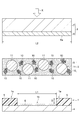
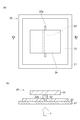
- connection body It is a schematic cross-sectional view which shows one Embodiment of the manufacturing method of the connection body. It is a figure for demonstrating the evaluation method of appearance in an Example. It is a figure for demonstrating the measurement method of resistance in an Example.
- each component in the composition means the total amount of the plurality of substances present in the composition when a plurality of substances corresponding to each component are present in the composition, unless otherwise specified.
- the numerical range indicated by using "-" indicates a range including the numerical values before and after "-" as the minimum value and the maximum value, respectively.
- the upper limit value or the lower limit value of the numerical range of one step may be replaced with the upper limit value or the lower limit value of the numerical range of another step.
- the upper limit value or the lower limit value of the numerical range may be replaced with the value shown in the examples.
- the upper limit value and the lower limit value described individually can be arbitrarily combined.
- “A or B” may include either A or B, and may include both.
- FIG. 1 is a schematic cross-sectional view showing an embodiment of a method for manufacturing a connector. As shown in FIG. 1, in this manufacturing method, first, a first electronic member 1, a second electronic member 2, and an adhesive film 3 are prepared.
- the first electronic member 1 includes a first substrate 4, an insulating layer 5 provided on one surface of the first substrate 4, and a first electrode 6.
- the surface of the first electronic member 1 (the surface on the side connected to the second electronic member 2) is uneven due to the insulating layer 5. That is, in the first electronic member 1, a plurality of insulating layers 5 provided in a convex shape on the first substrate 4 form the convex portion 1a, and the plurality of insulating layers 5 are provided apart from each other. As a result, the gaps between the plurality of insulating layers 5 form the recess 1b.
- the first electrode 6 is provided in the recess 1b on the first substrate 4.
- the length L1 of the recess 1b (the length in the direction parallel to the surface of the first substrate 4 where the insulating layer 5 and the first electrode 6 are provided) may be, for example, 25 ⁇ m or more and 3 mm or less. It may be there.
- the depth D of the recess 1b (distance from the surface of the first electrode 6 to the upper surface of the insulating layer 5) may be, for example, 5 ⁇ m or more, 10 ⁇ m or more, 15 ⁇ m or more, 20 ⁇ m or more, or 25 ⁇ m or more, and 40 ⁇ m or less. It may be.
- the first substrate 4 may be, for example, a substrate made of glass, ceramic, polyimide, polycarbonate, polyester, polyether sulfone, or the like.
- the insulating layer 5 may be, for example, a layer formed of a solder resist or a coverlay.
- the first electrode 6 may be, for example, an electrode formed of gold, silver, copper, tin, aluminum, ruthenium, rhodium, palladium, osmium, iridium, platinum, indium tin oxide (ITO) or the like.
- the thickness of the first electrode 6 may be, for example, 5 ⁇ m or more, 10 ⁇ m or more, or 20 ⁇ m or more, and may be 200 ⁇ m or less, 100 ⁇ m or less, or 50 ⁇ m or less.
- the second electronic member 2 includes a second substrate 7 and a second electrode 8 provided on one surface of the second substrate 7.
- the second substrate 7 may be, for example, a substrate made of polyimide, polycarbonate, polyester, polyether sulfone, or the like.
- the second electrode 8 may be an electrode formed of gold, silver, copper, tin, aluminum, ruthenium, rhodium, palladium, osmium, iridium, platinum, indium tin oxide (ITO) or the like.
- the thickness of the second electrode 8 may be, for example, 5 ⁇ m or more, 10 ⁇ m or more, or 20 ⁇ m or more, and may be 200 ⁇ m or less, 100 ⁇ m or less, or 50 ⁇ m or less.
- the second electrode 8 has a substantially flat surface 8a.
- the area of the substantially flat surface 8a of the second electrode 8 is larger than the area of the first electrode 6. That is, the length L2 of the substantially flat surface 8a of the second electrode 8 (the length in the direction parallel to the surface of the second substrate 7 where the second electrode 8 is provided) is the length of the first electrode 6. It is longer than the length L1.
- the adhesive film 3 is composed of an adhesive layer containing an adhesive component 9, and first conductive particles 10 and second conductive particles 11 dispersed in the adhesive component 9. There is.
- the adhesive component 9 is composed of, for example, a material that is curable by heat or light, and is an epoxy adhesive, a radical curable adhesive, a thermoplastic adhesive containing polyurethane, a polyvinyl ester, or the like. Good. Since the adhesive component 9 is excellent in heat resistance and moisture resistance after adhesion, it may be composed of a crosslinkable material.
- the epoxy adhesive contains an epoxy resin, which is a thermosetting resin, as a main component.
- the adhesive component 9 may be an epoxy-based adhesive in that it can be cured in a short time, has good connection workability, and has excellent adhesiveness.
- the radical-curable adhesive has characteristics such as being superior to the epoxy-based adhesive in curability at a low temperature in a short time, and is therefore appropriately used depending on the application.
- the epoxy adhesive contains, for example, an epoxy resin (thermosetting material) and a curing agent, and may further contain a thermoplastic resin, a coupling agent, a filler, and the like, if necessary.
- the epoxy resin examples include bisphenol A type epoxy resin, bisphenol F type epoxy resin, bisphenol S type epoxy resin, phenol novolac type epoxy resin, cresol novolac type epoxy resin, bisphenol A novolac type epoxy resin, and bisphenol F novolac type epoxy resin. , Alicyclic epoxy resin, glycidyl ester type epoxy resin, glycidylamine type epoxy resin, hydrantin type epoxy resin, isocyanurate type epoxy resin, aliphatic chain epoxy resin and the like. These epoxy resins may be halogenated, hydrogenated, or have a structure in which an acryloyl group or a methacryloyl group is added to the side chain. These epoxy resins are used alone or in combination of two or more.
- the curing agent is not particularly limited as long as it can cure the epoxy resin.
- an anionic polymerizable catalytic curing agent, a cationically polymerizable catalytic curing agent, a heavy addition type curing agent and the like can be used. Can be mentioned. Of these, an anionic or cationically polymerizable catalytic curing agent may be used because it is excellent in quick curing property and does not require consideration of chemical equivalents.
- anionic or cationically polymerizable catalytic curing agents include imidazole, hydrazide, boron trifluoride-amine complex, onium salt (aromatic sulfonium salt, aromatic diazonium salt, aliphatic sulfonium salt, etc.), amineimide, and diamino. Examples thereof include maleonitrile, melamine and its derivatives, salts of polyamines, dicyandiamide and the like, and modified products thereof can also be used. Examples of the heavy addition type curing agent include polyamines, polymercaptans, polyphenols, acid anhydrides and the like.
- these curing agents are microencapsulated by being coated with a polymer substance such as polyurethane or polyester, a metal thin film such as nickel or copper, or an inorganic substance such as calcium silicate. It may be a latent curing agent.
- the curing agent may be used alone or in combination of two or more.
- the content of the curing agent may be 0.05 to 20 parts by mass with respect to 100 parts by mass of the total amount of the thermosetting material and the thermoplastic resin to be blended if necessary.
- the radical-curable adhesive contains, for example, a radical-polymerizable material and a radical polymerization initiator (also called a curing agent), and further contains a thermoplastic resin, a coupling agent, a filler, and the like, if necessary. It's okay.
- any substance having a functional group polymerized by radicals can be used without particular limitation.
- a radically polymerizable material such as an acrylate compound (including the corresponding methacrylate; the same applies hereinafter), an acryloxy compound (including the corresponding metaacryloxy; the same applies hereinafter), a maleimide compound, a citraconimide resin, and a nadiimide resin.
- radically polymerizable materials may be in the state of a monomer or an oligomer, or may be in the state of a mixture of a monomer and an oligomer.
- acrylate compound examples include methyl acrylate, ethyl acrylate, isopropyl acrylate, isobutyl acrylate, ethylene glycol diacrylate, diethylene glycol diacrylate, trimethyl propantriacrylate, tetramethylol methanetetraacrylate, 2-hydroxy-1,3-diacrylate.
- a radically polymerizable material such as an acrylate compound may be used together with a polymerization inhibitor such as hydroquinone or methyl ether hydroquinone, if necessary.
- the radically polymerizable material such as an acrylate compound may have at least one substituent such as a dicyclopentenyl group, a tricyclodecanyl group, or a triazine ring from the viewpoint of improving heat resistance.
- the radically polymerizable material other than the acrylate compound may be, for example, the compound described in International Publication No. 2009/0638227.
- the radically polymerizable material may be used alone or in combination of two or more.
- radical polymerization initiator for example, any compound that decomposes by heating or irradiation with light to generate free radicals can be used without particular limitation.
- Specific examples thereof include peroxide compounds and azo compounds. These compounds are appropriately selected according to the target connection temperature, connection time, pot life, and the like.
- radical polymerization initiator examples include diacyl peroxide, peroxydicarbonate, peroxyester, peroxyketal, dialkyl peroxide, hydroperoxide, silyl peroxide and the like.
- the radical polymerization initiator may be a peroxy ester, a dialkyl peroxide, a hydroperoxide, a silyl peroxide or the like, or may be a peroxy ester in terms of obtaining high reactivity.
- These radical polymerization initiators may be, for example, the compounds described in WO 2009/063827.
- the radical polymerization initiator may be used alone or in combination of two or more.
- the content of the radical polymerization initiator may be 0.1 part by mass or more and 10 parts by mass or less with respect to 100 parts by mass of the total amount of the radically polymerizable material and the thermoplastic resin to be blended if necessary. It's okay.
- thermoplastic resin blended as necessary in the epoxy adhesive and the radical curable adhesive makes it easy to form the adhesive into a film, for example.
- thermoplastic resin include phenoxy resin, polyvinyl formal resin, polystyrene resin, polyvinyl butyral resin, polyester resin, polyamide resin, xylene resin, polyurethane resin, polyester urethane resin, phenol resin, terpenphenol resin and the like.
- the thermoplastic resin may be, for example, the compound described in International Publication No. 2009/0638227.
- the thermoplastic resin may be a phenoxy resin because it is excellent in adhesiveness, compatibility, heat resistance, mechanical strength, and the like.
- the thermoplastic resin is used alone or in combination of two or more.
- the content of the thermoplastic resin When blended in an epoxy adhesive, the content of the thermoplastic resin may be 5 parts by mass or more and 80 parts by mass or less with respect to 100 parts by mass of the total amount of the thermoplastic resin and the thermosetting material. It's okay.
- the content of the thermoplastic resin When blended in a radical curable adhesive, the content of the thermoplastic resin may be 5 parts by mass or more and 80 parts by mass or less with respect to 100 parts by mass of the total amount of the thermoplastic resin and the radically polymerizable material. May be.
- thermoradical curable adhesive containing a thermoplastic resin, a radically polymerizable material liquid at 30 ° C., and a radical polymerization initiator.
- the thermal radical curable adhesive has a lower viscosity than the above-mentioned adhesive.
- the content of the radically polymerizable material in the thermally radical curable adhesive is 20 parts by mass or more, 30 parts by mass or more, or 40 parts by mass or more with respect to 100 parts by mass of the total amount of the thermoplastic resin and the radically polymerizable material. It may be 80 parts by mass or less.
- the adhesive component 9 may be an epoxy-based adhesive containing a thermoplastic resin, a thermosetting material containing an epoxy resin liquid at 30 ° C., and a curing agent.
- the content of the epoxy resin in the epoxy adhesive is 20 parts by mass or more, 30 parts by mass or more, or 40 parts by mass or more with respect to 100 parts by mass of the total amount of the thermoplastic resin and the thermosetting material. It may be 80 parts by mass or less.
- the content of the adhesive component 9 in the adhesive film 3 (volume ratio of the adhesive component 9 to the adhesive film 3) is, for example, 55% by volume or more or 65% by volume or more based on the total volume of the adhesive film 3. It may be 95% by volume or less or 85% by volume or less.
- the first conductive particle 10 has a dendrite-like shape (also called a dendritic shape), and includes one main shaft and a plurality of branches that branch two-dimensionally or three-dimensionally from the main shaft.
- the first conductive particle 10 may be formed of a metal such as copper or silver, and may be, for example, silver-coated copper particles in which the copper particles are coated with silver.
- the first conductive particles 10 may be known, and specifically, for example, ACBY-2 (Mitsui Mining & Smelting Co., Ltd.), CE-1110 (Fukuda Metal Leaf Powder Industry Co., Ltd.), #FSP (JX). Metal Co., Ltd.), # 51-R (JX Nippon Mining & Metal Co., Ltd.), etc.
- the first conductive particle 10 can be produced by a known method (for example, the method described in International Publication No. 2014/021037).
- the content of the first conductive particles 10 in the adhesive film 3 may be 5% by volume or more, or 6% by volume, based on the total volume of the adhesive film 3 from the viewpoint of further reducing the resistance of the connector. It may be more than, 7% by volume or more, 8% by volume or more, 9% by volume or more, 10% by volume or more, and an adhesive film. From the viewpoint of improving the adhesive strength of the material, it may be 30% by volume or less, 25% by volume or less, 22% by volume or less, 20% by volume or less, 18% or less. It may be 5% by volume or less, and may be 15% by volume or less.
- the second conductive particle 11 has a non-conductive nuclei and a conductive layer provided on the nuclei.
- the nucleolus is made of a non-conductive material such as glass, ceramic, or resin, and may be made of resin. Examples of the resin include acrylic resin, styrene resin, silicone resin, polybutadiene resin, and copolymers of monomers constituting these resins.
- the average particle size of the nucleus is appropriately selected so that the average particle size of the second conductive particles 11 is in the range described later.
- the conductive layer is formed of, for example, gold, silver, copper, nickel, palladium or an alloy thereof. From the viewpoint of excellent conductivity, the conductive layer may contain at least one selected from gold, nickel and palladium, may contain gold or palladium, or may contain gold.
- the conductive layer is formed, for example, by plating the core with the metal.
- the thickness of the conductive layer may be, for example, 10 nm or more and 400 nm or less.
- the average particle size of the second conductive particles 11 may be 10 ⁇ m or more or 20 ⁇ m or more, a conductive path can be suitably formed in the recess 1b of the first electronic member 1, and the connector is placed at a high temperature or a low temperature. Even in this case, from the viewpoint of suppressing deterioration of the appearance and resistance value, it may be 25 ⁇ m or more, 27 ⁇ m or more, or 30 ⁇ m or more.
- the average particle size of the second conductive particles 11 may be 50 ⁇ m or less, 40 ⁇ m or less, or 30 ⁇ m or less from the viewpoint that the adhesive film 3 can be suitably thinned.
- the average particle size of the second conductive particle 11 and the nuclei constituting the second conductive particle 11 is measured by a particle size distribution measuring device (Microtrack (product name, Nikkiso Co., Ltd.)) using a laser diffraction / scattering method.
- a particle size distribution measuring device Microtrack (product name, Nikkiso Co., Ltd.)
- the average particle size of the second conductive particles 11 is equal to or greater than the depth D of the recess 1b from the viewpoint of obtaining a connector having excellent appearance and low resistance, and from the viewpoint that the effect can be more easily obtained. It may be 1.1 times or more or 1.2 times or more the depth D of the recess 1b.
- the average particle size of the second conductive particles 11 may be 5 ⁇ m or more, 10 ⁇ m or more, or 20 ⁇ m or more.
- the average particle size of the second conductive particles 11 may be 100 ⁇ m or less, 60 ⁇ m or less, or 60 ⁇ m or less.
- the content of the second conductive particles 11 in the adhesive film 3 (volume ratio of the second conductive particles 11 to the adhesive film 3) is 1% by volume or more based on the total volume of the adhesive film 3. It may be 2% by volume or more, 3% by volume or more, 5% by volume or more, 20% by volume or less, or 10% by volume or less. It may be 8% by volume or less, or 5% by volume or less.
- the thickness of the adhesive film 3 is such that the recess 1b in the first electronic member 1 can be suitably filled with the adhesive component 9 or the like, and the appearance and resistance value of the adhesive film 3 can be adjusted even when the connector is placed at a high temperature or a low temperature. From the viewpoint of suppressing deterioration, it may be 15 ⁇ m or more, 20 ⁇ m or more, 25 ⁇ m or more, 30 ⁇ m or more, 35 ⁇ m or more, or 40 ⁇ m or more. There may be. From the same viewpoint, the thickness of the adhesive film 3 may be 1.1 times or more or 1.2 times or more the depth D of the recess 1b or more. ..
- the thickness of the adhesive film 3 may be, for example, 70 ⁇ m or less, 60 ⁇ m or less, or 50 ⁇ m or less.
- the thickness of the adhesive film 3 may be, for example, 2.5 times or less, 2.0 times or less, 1.7 times or less, or 1.5 times or less the depth D of the recess 1b.
- the thickness of the adhesive film 3 is excellent in appearance, and it becomes easier to obtain a low resistance connecting body, and deterioration of the appearance and resistance value can be suppressed even when the connecting body is placed at a high temperature or a low temperature.
- the adhesive film 3 is arranged between the first electronic member 1 and the second electronic member 2, and the second electronic member 2 is crimped to the first electronic member 1.
- the electronic member 1, the adhesive film 3 and the second electronic member 2 (1) are pressurized and heated.
- the heating temperature may be, for example, 50 ° C. or higher and 190 ° C. or lower.
- the pressure may be, for example, 0.1 MPa or 30 MPa.
- the time for performing these heating and pressurizing may be, for example, 0.5 seconds or more and 120 seconds or less.
- a second electronic member having a second electrode is electrically attached to a first electronic member having the first electrode via an adhesive film.
- the second electrode is an electrode having a substantially flat surface having an area larger than the area of the first electrode, and the adhesive film is other than the first conductive particles which are dendrite-like conductive particles and the first conductive particles.
- It contains a non-conductive nucleus and a second conductive particle which is a conductive particle having a conductive layer provided on the nucleus, and the average particle size of the second conductive particle is It is equal to or greater than the depth of the recess, and in the process, an adhesive film is arranged between the first electronic member and the second electronic member, and the substantially flat surface of the second electrode is electrically formed on the first electrode. It is a manufacturing method in which a second electronic member is crimped to a first electronic member so as to be connected to the first electronic member.
- the adhesive film according to one embodiment is a first conductive particle which is a dendrite-like conductive particle and a conductive particle other than the first conductive particle, which is a non-conductive nuclei and on the nuclei.
- the first electronic member has a concavo-convex surface
- the first electrode is provided in a recess on the concavo-convex surface
- the second conductive particle is used for electrical connection with the electronic member of the above.
- the average particle size of is equal to or greater than the depth of the recess, and the second electrode is an electrode having a substantially flat surface having an area larger than the area of the first electrode.
- a connector can be obtained by the above manufacturing method.
- the connection body includes a first substrate 4, a first electronic member 1 having an insulating layer 5 and a first electrode 6 provided on the first substrate 4, a second substrate 7, and a second.
- a second electronic member 2 having a second electrode 8 provided on the substrate 7 and a connecting member for electrically connecting the first electrode 6 and the second electrode 8 to each other are provided.
- the connecting member includes a cured product of the adhesive component 9 and the first conductive particles 10 and the second conductive particles 11 dispersed in the cured product. That is, the connecting member is formed by curing the above-mentioned adhesive film 3.
- first conductive particle As the first conductive particles, dendrite-like conductive particles (silver-coated copper particles, manufactured by Mitsui Mining & Smelting Co., Ltd., product name: ACBY-2) were used.
- a palladium catalyst (manufactured by Muromachi Technos Co., Ltd., product name: MK-2605) is supported on the surface of the core body, and an accelerator (manufactured by Muromachi Technos Co., Ltd., product name: MK-370) is used.
- the activated nuclei were put into a mixed solution of a nickel sulfate aqueous solution, a sodium hypochlorite aqueous solution and a sodium tartrate aqueous solution heated to 60 ° C., and an electroless plating pre-step was performed. The mixture was stirred for 20 minutes and it was confirmed that hydrogen foaming stopped.
- nickel sulfate, sodium hypophosphite, sodium citrate and a plating stabilizer was added, stirred until the pH became stable, and a post-step of electroless plating was performed until hydrogen foaming stopped. Subsequently, the plating solution was filtered, the filtrate was washed with water, and then dried in a vacuum dryer at 80 ° C. to prepare nickel-plated second conductive particles a.
- the average particle size of the second conductive particles a was 30 ⁇ m, and the thickness of the conductive layer was 150 nm.
- the second conductive particles b were obtained in the same manner as the second conductive particles a except that the particle size of the nucleus was changed.
- the average particle size of the second conductive particles b was 20 ⁇ m, and the thickness of the conductive layer was 100 nm.
- the second conductive particle c was obtained in the same manner as the second conductive particle a except that the particle size of the nucleus was changed.
- the average particle size of the second conductive particles c was 10 ⁇ m, and the thickness of the conductive layer was 100 nm.
- the second conductive particles d were obtained in the same manner as the second conductive particles a except that the particle size of the nucleus was changed.
- the average particle size of the second conductive particles d was 40 ⁇ m, and the thickness of the conductive layer was 100 nm.
- the second conductive particles e were obtained in the same manner as the second conductive particles a except that the particle size of the nucleus was changed.
- the average particle size of the second conductive particles e was 60 ⁇ m, and the thickness of the conductive layer was 100 nm.
- the first conductive particles and the second conductive particles were added to the amounts of the first conductive particles and the second conductive particles in the obtained adhesive film as shown in Table 1.
- the mixture was dispersed so as to obtain a mixed solution.
- the obtained mixed solution was applied onto a fluororesin film having a thickness of 80 ⁇ m, and the solvent was removed by hot air drying at 70 ° C. for 10 minutes to form a fluororesin film having the thickness shown in Table 1.
- Each adhesive film of was obtained.
- FIG. 2A is a top view of the appearance evaluation sample 20
- FIG. 2B is a cross-sectional view taken along the line IIb-IIb of FIG. 2A.
- polyimide films 22 (size: 25 mm ⁇ 25 mm, thickness: 10 ⁇ m, 20 ⁇ m, 25 ⁇ m) having different thicknesses are placed. , 35 ⁇ m, or 50 ⁇ m).
- a slit (recess) 22a (size: 20 mm ⁇ 0.5 mm, depth: 10 ⁇ m, 20 ⁇ m, 25 ⁇ m, 35 ⁇ m, or 50 ⁇ m) is formed in a substantially central portion of the polyimide film 22.
- the aluminum foil 24 (size: 15 mm ⁇ 20 mm, thickness: 25 ⁇ m) is connected to the polyimide film 22 via each of the adhesive films 23 (size: 15 mm ⁇ 3 mm) obtained above. did.
- the inside of the slit 22a of the polyimide film 22 (in the direction of the arrow Y in FIG. 2B) from the slide glass 21 side is observed with an optical microscope (in a field of view where the entire slit 22a can be observed). ) Observed and confirmed the presence or absence of air bubbles in the slit 22a.
- the appearance was evaluated as follows according to the presence (number) of bubbles of 50 ⁇ m or more. If the evaluation is A or B, it can be said that the appearance is excellent.
- C 3 or more bubbles of ⁇ 50 ⁇ m or more
- FIG. 3 (a) is a top view of the resistance measurement sample 30, and FIG. 3 (b) is a cross-sectional view taken along the line IIIb-IIIb of FIG. 3 (a).
- polyimide films 22 (size: 25 mm ⁇ 25 mm, thickness: 10 ⁇ m, 20 ⁇ m, 25 ⁇ m) having different thicknesses are placed. , 35 ⁇ m, or 50 ⁇ m).
- a slit 32a (size: 20 mm ⁇ 0.5 mm, depth: 10 ⁇ m, 20 ⁇ m, 25 ⁇ m, 35 ⁇ m, or 50 ⁇ m) is formed in the substantially central portion of the polyimide film 32.
- the aluminum foil 34 (size: 15 mm ⁇ 20 mm, thickness: 25 ⁇ m) is connected to the polyimide film 32 via each of the adhesive films 33 (size: 15 mm ⁇ 3 mm) obtained above. did.
- the current and voltage between the copper foil 31 and the aluminum foil 34 were measured with an ammeter A and a voltmeter V, respectively, and the resistance value was calculated.
- Aluminum foil (size: 15 mm x 3 mm) is placed on a copper foil (size: 40 mm x 15 mm, thickness: 25 ⁇ m) via each of the adhesive films (size: 15 mm x 3 mm) obtained above. 20 mm, thickness: 25 ⁇ m) was connected.
- Tencilon UTM-4 manufactured by Toyo Baldwin Co., Ltd.
- the adhesive strength of the connector was measured by the 90 degree peeling method under the conditions of a peeling speed of 50 mm / min and 25 ° C. according to JIS Z0237.
Landscapes
- Chemical & Material Sciences (AREA)
- Organic Chemistry (AREA)
- Inorganic Chemistry (AREA)
- Engineering & Computer Science (AREA)
- Manufacturing & Machinery (AREA)
- Adhesives Or Adhesive Processes (AREA)
Priority Applications (4)
| Application Number | Priority Date | Filing Date | Title |
|---|---|---|---|
| US17/781,729 US12227683B2 (en) | 2019-12-06 | 2020-12-03 | Connector production method and adhesive film |
| JP2021562723A JP7715046B2 (ja) | 2019-12-06 | 2020-12-03 | 接続体の製造方法及び接着剤フィルム |
| KR1020227021203A KR102784593B1 (ko) | 2019-12-06 | 2020-12-03 | 접속체의 제조 방법 및 접착제 필름 |
| CN202080083968.9A CN114746524B (zh) | 2019-12-06 | 2020-12-03 | 连接体的制造方法及黏合剂膜 |
Applications Claiming Priority (2)
| Application Number | Priority Date | Filing Date | Title |
|---|---|---|---|
| JP2019-221309 | 2019-12-06 | ||
| JP2019221309 | 2019-12-06 |
Publications (1)
| Publication Number | Publication Date |
|---|---|
| WO2021112188A1 true WO2021112188A1 (ja) | 2021-06-10 |
Family
ID=76221638
Family Applications (1)
| Application Number | Title | Priority Date | Filing Date |
|---|---|---|---|
| PCT/JP2020/045075 Ceased WO2021112188A1 (ja) | 2019-12-06 | 2020-12-03 | 接続体の製造方法及び接着剤フィルム |
Country Status (6)
| Country | Link |
|---|---|
| US (1) | US12227683B2 (https=) |
| JP (1) | JP7715046B2 (https=) |
| KR (1) | KR102784593B1 (https=) |
| CN (1) | CN114746524B (https=) |
| TW (1) | TWI874513B (https=) |
| WO (1) | WO2021112188A1 (https=) |
Citations (2)
| Publication number | Priority date | Publication date | Assignee | Title |
|---|---|---|---|---|
| JP2000036515A (ja) * | 1998-07-16 | 2000-02-02 | Sony Chem Corp | ベアチップ実装構造 |
| WO2018043505A1 (ja) * | 2016-08-30 | 2018-03-08 | 日立化成株式会社 | 接着剤組成物 |
Family Cites Families (2)
| Publication number | Priority date | Publication date | Assignee | Title |
|---|---|---|---|---|
| JP2013182823A (ja) | 2012-03-02 | 2013-09-12 | Dexerials Corp | 接続体の製造方法、及び異方性導電接着剤 |
| KR102501133B1 (ko) * | 2017-02-17 | 2023-02-17 | 레조낙 가부시끼가이샤 | 접착제 필름 |
-
2020
- 2020-12-03 CN CN202080083968.9A patent/CN114746524B/zh active Active
- 2020-12-03 TW TW109142598A patent/TWI874513B/zh active
- 2020-12-03 KR KR1020227021203A patent/KR102784593B1/ko active Active
- 2020-12-03 JP JP2021562723A patent/JP7715046B2/ja active Active
- 2020-12-03 WO PCT/JP2020/045075 patent/WO2021112188A1/ja not_active Ceased
- 2020-12-03 US US17/781,729 patent/US12227683B2/en active Active
Patent Citations (2)
| Publication number | Priority date | Publication date | Assignee | Title |
|---|---|---|---|---|
| JP2000036515A (ja) * | 1998-07-16 | 2000-02-02 | Sony Chem Corp | ベアチップ実装構造 |
| WO2018043505A1 (ja) * | 2016-08-30 | 2018-03-08 | 日立化成株式会社 | 接着剤組成物 |
Also Published As
| Publication number | Publication date |
|---|---|
| JP7715046B2 (ja) | 2025-07-30 |
| CN114746524A (zh) | 2022-07-12 |
| TWI874513B (zh) | 2025-03-01 |
| KR20220110772A (ko) | 2022-08-09 |
| US12227683B2 (en) | 2025-02-18 |
| US20230002644A1 (en) | 2023-01-05 |
| TW202138508A (zh) | 2021-10-16 |
| JPWO2021112188A1 (https=) | 2021-06-10 |
| CN114746524B (zh) | 2024-12-24 |
| KR102784593B1 (ko) | 2025-03-19 |
Similar Documents
| Publication | Publication Date | Title |
|---|---|---|
| KR102467618B1 (ko) | 접착제 조성물 | |
| JP7347576B2 (ja) | 接着剤フィルム | |
| CN111512502B (zh) | 连接结构体及其制造方法 | |
| JP2024160304A (ja) | 接着剤フィルム | |
| WO2021112188A1 (ja) | 接続体の製造方法及び接着剤フィルム | |
| TWI814761B (zh) | 接著劑膜 | |
| WO2021177375A1 (ja) | 接着剤フィルム、及びリール体 |
Legal Events
| Date | Code | Title | Description |
|---|---|---|---|
| 121 | Ep: the epo has been informed by wipo that ep was designated in this application |
Ref document number: 20897107 Country of ref document: EP Kind code of ref document: A1 |
|
| ENP | Entry into the national phase |
Ref document number: 2021562723 Country of ref document: JP Kind code of ref document: A |
|
| ENP | Entry into the national phase |
Ref document number: 20227021203 Country of ref document: KR Kind code of ref document: A |
|
| NENP | Non-entry into the national phase |
Ref country code: DE |
|
| 32PN | Ep: public notification in the ep bulletin as address of the adressee cannot be established |
Free format text: NOTING OF LOSS OF RIGHTS PURSUANT TO RULE 112(1) EPC (EPO FORM 1205A DATED 02/09/2022) |
|
| 122 | Ep: pct application non-entry in european phase |
Ref document number: 20897107 Country of ref document: EP Kind code of ref document: A1 |