WO2021090501A1 - エレベータの懸架体およびエレベータ - Google Patents
エレベータの懸架体およびエレベータ Download PDFInfo
- Publication number
- WO2021090501A1 WO2021090501A1 PCT/JP2019/043991 JP2019043991W WO2021090501A1 WO 2021090501 A1 WO2021090501 A1 WO 2021090501A1 JP 2019043991 W JP2019043991 W JP 2019043991W WO 2021090501 A1 WO2021090501 A1 WO 2021090501A1
- Authority
- WO
- WIPO (PCT)
- Prior art keywords
- epoxy resin
- resin
- polyoxy
- elevator
- impregnated
- Prior art date
- Legal status (The legal status is an assumption and is not a legal conclusion. Google has not performed a legal analysis and makes no representation as to the accuracy of the status listed.)
- Ceased
Links
Images



Classifications
-
- B—PERFORMING OPERATIONS; TRANSPORTING
- B66—HOISTING; LIFTING; HAULING
- B66B—ELEVATORS; ESCALATORS OR MOVING WALKWAYS
- B66B7/00—Other common features of elevators
- B66B7/06—Arrangements of ropes or cables
- B66B7/062—Belts
-
- B—PERFORMING OPERATIONS; TRANSPORTING
- B32—LAYERED PRODUCTS
- B32B—LAYERED PRODUCTS, i.e. PRODUCTS BUILT-UP OF STRATA OF FLAT OR NON-FLAT, e.g. CELLULAR OR HONEYCOMB, FORM
- B32B25/00—Layered products comprising a layer of natural or synthetic rubber
- B32B25/10—Layered products comprising a layer of natural or synthetic rubber next to a fibrous or filamentary layer
-
- B—PERFORMING OPERATIONS; TRANSPORTING
- B32—LAYERED PRODUCTS
- B32B—LAYERED PRODUCTS, i.e. PRODUCTS BUILT-UP OF STRATA OF FLAT OR NON-FLAT, e.g. CELLULAR OR HONEYCOMB, FORM
- B32B25/00—Layered products comprising a layer of natural or synthetic rubber
- B32B25/18—Layered products comprising a layer of natural or synthetic rubber comprising butyl or halobutyl rubber
-
- B—PERFORMING OPERATIONS; TRANSPORTING
- B32—LAYERED PRODUCTS
- B32B—LAYERED PRODUCTS, i.e. PRODUCTS BUILT-UP OF STRATA OF FLAT OR NON-FLAT, e.g. CELLULAR OR HONEYCOMB, FORM
- B32B25/00—Layered products comprising a layer of natural or synthetic rubber
- B32B25/20—Layered products comprising a layer of natural or synthetic rubber comprising silicone rubber
-
- B—PERFORMING OPERATIONS; TRANSPORTING
- B32—LAYERED PRODUCTS
- B32B—LAYERED PRODUCTS, i.e. PRODUCTS BUILT-UP OF STRATA OF FLAT OR NON-FLAT, e.g. CELLULAR OR HONEYCOMB, FORM
- B32B27/00—Layered products comprising a layer of synthetic resin
- B32B27/12—Layered products comprising a layer of synthetic resin next to a fibrous or filamentary layer
-
- B—PERFORMING OPERATIONS; TRANSPORTING
- B32—LAYERED PRODUCTS
- B32B—LAYERED PRODUCTS, i.e. PRODUCTS BUILT-UP OF STRATA OF FLAT OR NON-FLAT, e.g. CELLULAR OR HONEYCOMB, FORM
- B32B27/00—Layered products comprising a layer of synthetic resin
- B32B27/28—Layered products comprising a layer of synthetic resin comprising synthetic resins not wholly covered by any one of the sub-groups B32B27/30 - B32B27/42
- B32B27/286—Layered products comprising a layer of synthetic resin comprising synthetic resins not wholly covered by any one of the sub-groups B32B27/30 - B32B27/42 comprising polysulphones; polysulfides
-
- B—PERFORMING OPERATIONS; TRANSPORTING
- B32—LAYERED PRODUCTS
- B32B—LAYERED PRODUCTS, i.e. PRODUCTS BUILT-UP OF STRATA OF FLAT OR NON-FLAT, e.g. CELLULAR OR HONEYCOMB, FORM
- B32B27/00—Layered products comprising a layer of synthetic resin
- B32B27/30—Layered products comprising a layer of synthetic resin comprising vinyl (co)polymers; comprising acrylic (co)polymers
- B32B27/302—Layered products comprising a layer of synthetic resin comprising vinyl (co)polymers; comprising acrylic (co)polymers comprising aromatic vinyl (co)polymers, e.g. styrenic (co)polymers
-
- B—PERFORMING OPERATIONS; TRANSPORTING
- B32—LAYERED PRODUCTS
- B32B—LAYERED PRODUCTS, i.e. PRODUCTS BUILT-UP OF STRATA OF FLAT OR NON-FLAT, e.g. CELLULAR OR HONEYCOMB, FORM
- B32B27/00—Layered products comprising a layer of synthetic resin
- B32B27/30—Layered products comprising a layer of synthetic resin comprising vinyl (co)polymers; comprising acrylic (co)polymers
- B32B27/304—Layered products comprising a layer of synthetic resin comprising vinyl (co)polymers; comprising acrylic (co)polymers comprising vinyl halide (co)polymers, e.g. PVC, PVDC, PVF, PVDF
-
- B—PERFORMING OPERATIONS; TRANSPORTING
- B32—LAYERED PRODUCTS
- B32B—LAYERED PRODUCTS, i.e. PRODUCTS BUILT-UP OF STRATA OF FLAT OR NON-FLAT, e.g. CELLULAR OR HONEYCOMB, FORM
- B32B27/00—Layered products comprising a layer of synthetic resin
- B32B27/32—Layered products comprising a layer of synthetic resin comprising polyolefins
-
- B—PERFORMING OPERATIONS; TRANSPORTING
- B32—LAYERED PRODUCTS
- B32B—LAYERED PRODUCTS, i.e. PRODUCTS BUILT-UP OF STRATA OF FLAT OR NON-FLAT, e.g. CELLULAR OR HONEYCOMB, FORM
- B32B27/00—Layered products comprising a layer of synthetic resin
- B32B27/34—Layered products comprising a layer of synthetic resin comprising polyamides
-
- B—PERFORMING OPERATIONS; TRANSPORTING
- B32—LAYERED PRODUCTS
- B32B—LAYERED PRODUCTS, i.e. PRODUCTS BUILT-UP OF STRATA OF FLAT OR NON-FLAT, e.g. CELLULAR OR HONEYCOMB, FORM
- B32B27/00—Layered products comprising a layer of synthetic resin
- B32B27/36—Layered products comprising a layer of synthetic resin comprising polyesters
-
- B—PERFORMING OPERATIONS; TRANSPORTING
- B32—LAYERED PRODUCTS
- B32B—LAYERED PRODUCTS, i.e. PRODUCTS BUILT-UP OF STRATA OF FLAT OR NON-FLAT, e.g. CELLULAR OR HONEYCOMB, FORM
- B32B27/00—Layered products comprising a layer of synthetic resin
- B32B27/36—Layered products comprising a layer of synthetic resin comprising polyesters
- B32B27/365—Layered products comprising a layer of synthetic resin comprising polyesters comprising polycarbonates
-
- B—PERFORMING OPERATIONS; TRANSPORTING
- B32—LAYERED PRODUCTS
- B32B—LAYERED PRODUCTS, i.e. PRODUCTS BUILT-UP OF STRATA OF FLAT OR NON-FLAT, e.g. CELLULAR OR HONEYCOMB, FORM
- B32B27/00—Layered products comprising a layer of synthetic resin
- B32B27/40—Layered products comprising a layer of synthetic resin comprising polyurethanes
-
- B—PERFORMING OPERATIONS; TRANSPORTING
- B32—LAYERED PRODUCTS
- B32B—LAYERED PRODUCTS, i.e. PRODUCTS BUILT-UP OF STRATA OF FLAT OR NON-FLAT, e.g. CELLULAR OR HONEYCOMB, FORM
- B32B3/00—Layered products comprising a layer with external or internal discontinuities or unevennesses, or a layer of non-planar shape; Layered products comprising a layer having particular features of form
- B32B3/02—Layered products comprising a layer with external or internal discontinuities or unevennesses, or a layer of non-planar shape; Layered products comprising a layer having particular features of form characterised by features of form at particular places, e.g. in edge regions
- B32B3/04—Layered products comprising a layer with external or internal discontinuities or unevennesses, or a layer of non-planar shape; Layered products comprising a layer having particular features of form characterised by features of form at particular places, e.g. in edge regions characterised by at least one layer folded at the edge, e.g. over another layer ; characterised by at least one layer enveloping or enclosing a material
-
- B—PERFORMING OPERATIONS; TRANSPORTING
- B32—LAYERED PRODUCTS
- B32B—LAYERED PRODUCTS, i.e. PRODUCTS BUILT-UP OF STRATA OF FLAT OR NON-FLAT, e.g. CELLULAR OR HONEYCOMB, FORM
- B32B5/00—Layered products characterised by the non- homogeneity or physical structure, i.e. comprising a fibrous, filamentary, particulate or foam layer; Layered products characterised by having a layer differing constitutionally or physically in different parts
- B32B5/02—Layered products characterised by the non- homogeneity or physical structure, i.e. comprising a fibrous, filamentary, particulate or foam layer; Layered products characterised by having a layer differing constitutionally or physically in different parts characterised by structural features of a fibrous or filamentary layer
-
- B—PERFORMING OPERATIONS; TRANSPORTING
- B32—LAYERED PRODUCTS
- B32B—LAYERED PRODUCTS, i.e. PRODUCTS BUILT-UP OF STRATA OF FLAT OR NON-FLAT, e.g. CELLULAR OR HONEYCOMB, FORM
- B32B2250/00—Layers arrangement
- B32B2250/40—Symmetrical or sandwich layers, e.g. ABA, ABCBA, ABCCBA
-
- B—PERFORMING OPERATIONS; TRANSPORTING
- B32—LAYERED PRODUCTS
- B32B—LAYERED PRODUCTS, i.e. PRODUCTS BUILT-UP OF STRATA OF FLAT OR NON-FLAT, e.g. CELLULAR OR HONEYCOMB, FORM
- B32B2260/00—Layered product comprising an impregnated, embedded, or bonded layer wherein the layer comprises an impregnation, embedding, or binder material
- B32B2260/02—Composition of the impregnated, bonded or embedded layer
- B32B2260/021—Fibrous or filamentary layer
-
- B—PERFORMING OPERATIONS; TRANSPORTING
- B32—LAYERED PRODUCTS
- B32B—LAYERED PRODUCTS, i.e. PRODUCTS BUILT-UP OF STRATA OF FLAT OR NON-FLAT, e.g. CELLULAR OR HONEYCOMB, FORM
- B32B2260/00—Layered product comprising an impregnated, embedded, or bonded layer wherein the layer comprises an impregnation, embedding, or binder material
- B32B2260/04—Impregnation, embedding, or binder material
- B32B2260/046—Synthetic resin
-
- B—PERFORMING OPERATIONS; TRANSPORTING
- B32—LAYERED PRODUCTS
- B32B—LAYERED PRODUCTS, i.e. PRODUCTS BUILT-UP OF STRATA OF FLAT OR NON-FLAT, e.g. CELLULAR OR HONEYCOMB, FORM
- B32B2262/00—Composition or structural features of fibres which form a fibrous or filamentary layer or are present as additives
- B32B2262/02—Synthetic macromolecular fibres
- B32B2262/0261—Polyamide fibres
- B32B2262/0269—Aromatic polyamide fibres
-
- B—PERFORMING OPERATIONS; TRANSPORTING
- B32—LAYERED PRODUCTS
- B32B—LAYERED PRODUCTS, i.e. PRODUCTS BUILT-UP OF STRATA OF FLAT OR NON-FLAT, e.g. CELLULAR OR HONEYCOMB, FORM
- B32B2262/00—Composition or structural features of fibres which form a fibrous or filamentary layer or are present as additives
- B32B2262/10—Inorganic fibres
- B32B2262/101—Glass fibres
-
- B—PERFORMING OPERATIONS; TRANSPORTING
- B32—LAYERED PRODUCTS
- B32B—LAYERED PRODUCTS, i.e. PRODUCTS BUILT-UP OF STRATA OF FLAT OR NON-FLAT, e.g. CELLULAR OR HONEYCOMB, FORM
- B32B2262/00—Composition or structural features of fibres which form a fibrous or filamentary layer or are present as additives
- B32B2262/10—Inorganic fibres
- B32B2262/106—Carbon fibres, e.g. graphite fibres
-
- D—TEXTILES; PAPER
- D07—ROPES; CABLES OTHER THAN ELECTRIC
- D07B—ROPES OR CABLES IN GENERAL
- D07B1/00—Constructional features of ropes or cables
- D07B1/22—Flat or flat-sided ropes; Sets of ropes consisting of a series of parallel ropes
-
- D—TEXTILES; PAPER
- D07—ROPES; CABLES OTHER THAN ELECTRIC
- D07B—ROPES OR CABLES IN GENERAL
- D07B2201/00—Ropes or cables
- D07B2201/20—Rope or cable components
- D07B2201/2075—Fillers
- D07B2201/2082—Fillers characterised by the materials used
-
- D—TEXTILES; PAPER
- D07—ROPES; CABLES OTHER THAN ELECTRIC
- D07B—ROPES OR CABLES IN GENERAL
- D07B2201/00—Ropes or cables
- D07B2201/20—Rope or cable components
- D07B2201/2083—Jackets or coverings
- D07B2201/2087—Jackets or coverings being of the coated type
-
- D—TEXTILES; PAPER
- D07—ROPES; CABLES OTHER THAN ELECTRIC
- D07B—ROPES OR CABLES IN GENERAL
- D07B2205/00—Rope or cable materials
- D07B2205/20—Organic high polymers
- D07B2205/206—Epoxy resins
-
- D—TEXTILES; PAPER
- D07—ROPES; CABLES OTHER THAN ELECTRIC
- D07B—ROPES OR CABLES IN GENERAL
- D07B2501/00—Application field
- D07B2501/20—Application field related to ropes or cables
- D07B2501/2007—Elevators
Definitions
- the present invention relates to an elevator suspension and an elevator that suspends a car.
- a rope using a reinforcing fiber having a load-bearing portion in which reinforcing fibers oriented in the longitudinal direction of a rope as a suspension body are included in a matrix which is a coating layer is known.
- Carbon fiber or glass fiber is used as the reinforcing fiber
- epoxy resin is used as the matrix.
- Rope using reinforcing fiber has higher breaking strength per weight than wire rope in which steel wire is twisted. Therefore, especially in a high-rise elevator that requires a long rope, a rope using a reinforcing fiber that can reduce the weight of the entire rope and reduce the driving load of the hoisting machine is attracting attention.
- ropes using reinforcing fibers have poor flexibility because the elastic modulus of the reinforcing fibers is high.
- the rope using reinforcing fibers is made into a thin and wide belt-shaped cross section.
- a convex surface called a crown is formed on the surface of the drive sheave in order to prevent the rope from moving in the width direction and coming off the drive sheave.
- the belt-shaped rope will be bent in the width direction along the crown.
- bending stress in the width direction due to the crown acts on the load supporting portion of the belt type rope.
- this bending stress is referred to as a crown bending stress.
- the magnitude of the crown bending stress is determined by the elastic modulus of the matrix.
- the reinforcing fibers are not oriented in the width direction, so the strength in the width direction of the rope is significantly lower than that in the longitudinal direction, and if the elastic modulus of the matrix is too high, the crown bending stress causes the rope to stretch in the width direction. May be torn and destroyed.
- Patent Document 1 discloses a rope in which a matrix is composed of a material containing an elastomer which is a low elastic coefficient component. Since the elastic modulus of the matrix is lower than that of the matrix made of epoxy resin, the crown bending stress of the rope using the reinforcing fiber is reduced, and the durability of the rope using the reinforcing fiber is improved.
- the reinforcing fibers are only adhered to the matrix by the surface material.
- the surface material is made of a material containing polyurethane, a thermoplastic elastomer, polyester, rubber or a rubber derivative.
- a surface material made of such a material has sufficient interfacial strength between the reinforcing fiber and the matrix to suppress peel fracture at the interface between the reinforcing fiber and the matrix when subjected to crown bending stress. Absent.
- the present invention has been made in view of the above, and is an elevator suspension capable of improving the interfacial strength between the reinforcing fiber and the coating layer while reducing the crown bending stress in the width direction of the suspension body.
- the purpose is to get a body.
- the suspension body of the elevator of the present invention has a load bearing layer having a width larger than a thickness in a cross section perpendicular to the length direction, and an outer circumference of the load bearing layer.
- a coating layer that covers at least a part of the above is provided.
- the load-bearing layer has a plurality of fibers oriented in the length direction and a cured impregnated resin that fills the space between the plurality of fibers.
- the impregnated resin is an epoxy resin containing a polyoxy-based epoxy resin containing a polyoxyalkylene bond represented by the general formula (1) and a bisphenol A type epoxy resin in the resin skeleton.
- the present invention it is possible to improve the interfacial strength between the reinforcing fiber and the coating layer while reducing the crown bending stress in the width direction of the suspended body.
- the figure which shows an example of the change of the elastic modulus of the impregnated resin by the presence or absence of a reactive diluent with respect to the compounding ratio of a polyoxy epoxy resin The figure which shows an example of the relationship between the crown bending stress and the fiber resin interfacial strength with respect to the compounding ratio of the polyoxy epoxy resin of the rope according to Embodiment 2.
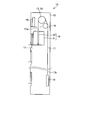
- FIG. 1 is a diagram schematically showing an example of the overall configuration of the elevator according to the first embodiment.
- the elevator 10 is provided in a building such as a building, and includes a hoistway 11 extending in the vertical direction and a machine room 12 provided in the upper part of the hoistway 11.
- the elevator 10 has a hoisting machine 13, a deflecting wheel 14, and an elevator control device 15 in the machine room 12.
- the hoisting machine 13 includes a drive sheave 16, a hoisting machine motor (not shown) for rotating the drive sheave 16, and a hoisting machine brake (not shown) for braking the rotation of the drive sheave 16.
- the elevator 10 includes a plurality of ropes 17 which are suspension bodies, a car 18 as a first elevating body for ascending / descending in the hoistway 11, and a balancing weight 19 as a second elevating body for ascending / descending in the hoistway 11.
- FIG. 1 shows only one rope 17.
- the plurality of ropes 17 are wound around the drive sheave 16 and the deflecting wheel 14.
- Each rope 17 has a first end 17a connected to the car 18 and a second end 17b connected to the counterweight 19.
- the car 18 and the counterweight 19 are suspended by a rope 17 in a 1: 1 roping system. Further, the car 18 and the counterweight 19 move up and down in the hoistway 11 by rotating the drive sheave 16.
- the elevator control device 15 controls the operation of the car 18 by controlling the hoisting machine 13.
- the elevator 10 has a pair of car guide rails (not shown) and a pair of balanced weight guide rails (not shown) in the hoistway 11.
- the car guide rail guides the car 18 to move up and down in the hoistway 11.
- the balancing weight guide rail guides the raising and lowering of the balancing weight 19 in the hoistway 11.
- the car 18 has a car frame 20 to which the rope 17 is connected and a car room 21 supported by the car frame 20. A person or an object is accommodated in the car room 21.
- FIG. 2 is a cross-sectional view schematically showing an example of the configuration in the direction perpendicular to the length direction of the rope according to the first embodiment.
- the length direction of the rope 17 is the Z direction.
- the width direction of the rope 17 is the X direction
- the thickness direction of the rope 17 perpendicular to the X direction is the Y direction.
- the rope 17 is a so-called flat belt in which the thickness, that is, the dimension in the Y direction is smaller than the width, that is, the dimension in the X direction.
- the rope 17 has a sheave contact surface 17c which is one end surface in the thickness direction.
- the sheave contact surface 17c comes into contact with the outer peripheral surface of the drive sheave 16 when the rope 17 is wound around the drive sheave 16. That is, when the rope 17 passes through the drive sheave 16, it is bent along the outer peripheral surface of the drive sheave 16 so that the sheave contact surface 17c is on the inside.
- the rope 17 has a belt-shaped load support layer 31 and a coating layer 32 that covers at least a part of the outer periphery of the load support layer 31.
- the load support layer 31 is a layer that mainly supports the load acting on the rope 17.
- the coating layer 32 has a function of protecting the load supporting layer 31.
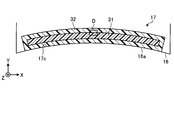
- FIG. 3 is a cross-sectional view schematically showing an example of a configuration in a direction perpendicular to the length direction of the rope in a state of being wound around the drive sheave.
- the crown 16a is formed on the surface of the drive sheave 16 in order to prevent the rope 17 from moving in the width direction, that is, in the X direction and coming off the drive sheave 16.
- a convex surface called is formed.
- the rope 17 wound around the drive sheave 16 is bent in the width direction of the rope 17 along the crown 16a.
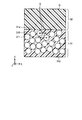
- FIG. 4 is a partial cross-sectional view schematically showing an example of the configuration in the direction perpendicular to the length of the rope of the load bearing layer, and is an enlarged cross-sectional view of the region D of FIG.
- the load-bearing layer 31 includes a plurality of high-strength fibers 311 and an impregnated resin 312 filled and cured between the plurality of high-strength fibers 311.
- the high-strength fibers 311 are arranged so as to be oriented in the length direction of the load bearing layer 31, that is, in the Z direction.
- a fiber resin interface 315 exists between the high-strength fiber 311 and the impregnated resin 312.
- High-strength fiber 311 is a fiber that is lighter and has higher strength than steel wire.
- Examples of high-strength fibers 311 are carbon fibers, glass fibers, aramid fibers, PBO (poly-paraphenylene benzobisoxazole) fibers or genbu rock fibers.
- an example of high-strength fiber 311 is a composite fiber that combines two or more fibers selected from the group of carbon fiber, glass fiber, aramid fiber, PBO fiber and genbuiwa fiber.
- the crown bending stress S in the width direction of the rope 17 is formed at the fiber resin interface 315 as shown in FIG. Works.
- the crown bending stress S is a tensile stress on the upper surface 31a of the load bearing layer. That is, on the upper surface 31a side of the load bearing layer, stress acts in the direction of peeling off the fiber resin interface 315.
- the magnitude of the crown bending stress S is determined by the elastic modulus of the impregnated resin 312. Further, since the high-strength fibers 311 are not oriented in the width direction of the rope 17, the strength in the width direction of the rope 17 is determined by the interface strength at the fiber resin interface 315. When the elastic modulus of the impregnated resin 312 is too high, the interface strength at the fiber resin interface 315 is significantly lower than the strength in the length direction of the load bearing layer 31. Therefore, the fiber resin interface 315 may be peeled off by the crown bending stress S, and the load supporting layer 31 may be torn in the width direction and broken.
- a polyoxy-based epoxy resin containing a polyoxyalkylene bond represented by the following general formula (2) in the resin skeleton and an epoxy resin containing a bisphenol A type epoxy resin are used as the impregnated resin 312. Will be done.
- the elastic modulus of the impregnated resin 312 is preferably in the range of 0.01 GPa or more and less than 2 GPa. This is because when the elastic modulus of the impregnated resin 312 is in this range, the crown bending stress S can be sufficiently reduced. As a result, it is possible to prevent the load supporting layer 31 of the rope 17 from being destroyed.
- the substituent R in the general formula (2) represents a hydrogen atom H or a methyl group CH 3 , and the substituent R'represents C 2 H 4 , C 3 H 6 or bisphenol A.
- the polyoxy-based epoxy resin having a polyoxyalkylene bond represented by the general formula (2) has flexibility due to an ether group, and therefore has flexibility as compared with a general-purpose bisphenol A type epoxy resin. Further, since the polyoxy-based epoxy resin having the polyoxyalkylene bond represented by the general formula (2) has a relatively low viscosity, it is also excellent in impregnation property between high-strength fibers 311.
- the polyoxy-based epoxy resin alone has poor reactivity with the surface of the high-strength fiber 311 and may have a lower interface strength at the fiber-resin interface 315 than the crown bending stress S. If the interface strength of the fiber resin interface 315 is too low, the fiber resin interface 315 may peel off due to the crown bending stress S, and the load bearing layer 31 may be destroyed. Therefore, by blending a bisphenol A type epoxy resin having excellent adhesiveness with high-strength fibers 311 into a polyoxy epoxy resin, the fiber resin interface 315 has flexibility and can suppress breakage due to crown bending stress S. An impregnated resin 312 having the interfacial strength of is obtained.
- the impregnated resin 312 contains a curing agent in addition to the polyoxy-based epoxy resin and the bisphenol A type epoxy resin.
- a curing agent general curing agents such as amine-based curing agents, acid anhydrides, and imidazoles can be used, and the curing agent is not particularly limited.
- the impregnating resin 312 may contain a curing accelerator, an internal mold release agent, a filler and the like in addition to the curing agent.
- the polyoxy epoxy resin and the bisphenol A type epoxy resin are continuously bonded.
- “continuously bonded” means that the polyoxy-based epoxy resin and the bisphenol A type epoxy resin are not phase-separated from each other and are integrated with each other.
- the heat resistance of the impregnated resin 312 is dominated by one of the resins having a lower gelling temperature.
- the heat resistance of the polyoxy epoxy resin is lower than that of the bisphenol A type epoxy resin, so that the heat resistance of the impregnated resin 312 is governed by the heat resistance of the polyoxy epoxy resin.
- the gelling temperature of the impregnated resin 312 is a value between the gelling temperatures of the respective resins, so that the phases are separated.
- the heat resistance can be improved as compared with the case.
- Whether or not the polyoxy-based epoxy resin and the bisphenol A type epoxy resin are phase-separated is determined by evaluating the gelation temperature of the impregnated resin 312, which is a cured product.
- the gelation temperatures of the polyoxy-based epoxy resin and the bisphenol A-type epoxy resin are detected separately. For example, when the gelation temperature is evaluated by dynamic viscoelasticity measurement, two temperatures at which the dynamic viscoelasticity drops sharply are observed.
- the polyoxy epoxy resin and the bisphenol A type epoxy resin are continuously bonded without phase separation, only one gelling temperature is detected.
- the gelation temperature of the impregnated resin 312, which is a cured product, is detected at only one point means that the polyoxy-based epoxy resin and the bisphenol A-type epoxy resin are "continuously bonded". It is defined as that.
- the coating layer 32 is preferably a material having heat resistance and abrasion resistance. By changing the material of the coating layer 32, the coefficient of friction between the rope 17 and the drive sheave 16 can be adjusted. Therefore, the material of the coating layer 32 is selected so as to have a coefficient of friction between the desired rope 17 and the driving sheave 16.
- thermoplastic resin such as polyethylene, polypropylene, polyamide 6 (PA6), polyamide 12 (PA12), polyamide 66 (PA66), polycarbonate, polyetheretherketone, or polyphenylene sulfide can be used.
- an olefin-based, styrene-based, polyvinyl chloride-based, urethane-based, polyester-based, polyamide-based, fluorine-based or butadiene-based thermoplastic elastomer can also be used.
- rubber which is a thermosetting elastomer such as butadiene rubber, styrene-butadiene rubber, chloroprene rubber, acrylic rubber, urethane rubber, and silicone rubber can also be used.
- the covering layer 32 covers the entire side surface parallel to the length direction of the load support layer 31, but at least a part of the side surface parallel to the length direction of the load support layer 31. It suffices to cover.
- the portion to be covered may be a portion where the rope 17 comes into contact with the drive sheave 16.
- the covering layer 32 may be provided only on the lower surface of the load supporting layer 31 in the Y direction, and the covering layer 32 may not be provided on the other surfaces.
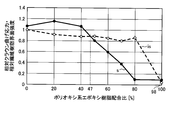
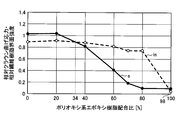
- FIG. 5 is a diagram showing an example of the relationship between the crown bending stress and the fiber resin interface strength with respect to the compounding ratio of the polyoxy epoxy resin of the rope according to the first embodiment.
- the horizontal axis shows the weight compounding ratio of the polyoxy epoxy resin when the total weight of the polyoxy epoxy resin and the bisphenol A type epoxy resin is 100.
- the weight-blending ratio of the polyoxy-based epoxy resin is referred to as a polyoxy-based epoxy resin blending ratio.
- the vertical axis shows the relative crown bending stress and the relative fiber resin interface strength at each compounding ratio.
- the relative crown bending stress is standardized by setting the interface strength of the fiber resin interface 315 to 1 when the polyoxy epoxy resin compounding ratio is 0%.
- the relative fiber resin interface strength is standardized by setting the interface strength at the fiber resin interface 315 to 1 when the polyoxy epoxy resin blending ratio is 0%. Further, the graph s in the figure shows the relative crown bending stress, and the graph is shows the relative fiber resin interface strength.
- the relative crown bending stress s is higher than the relative fiber resin interface strength is in the region where the polyoxy epoxy resin compounding ratio is lower than 47% and in the region where the polyoxy epoxy resin compounding ratio is higher than 98%.
- the polyoxy-based epoxy resin compounding ratio is lower than 47%, the elastic modulus of the impregnated resin 312 is considered to be high, and as a result, the crown bending stress S is considered to be high.
- the crown bending stress S is lowered due to the low elasticity of the impregnated resin 312, but the interface strength of the fiber resin interface 315 is also lowered, and the crown bending is performed. It is considered that the stress S is higher.
- the range is in the range where the polyoxy-based epoxy resin compounding ratio is 47% or more and 98% or less. is there.
- the relative fiber resin interface strength is also varies due to variations in the production of the rope 17. If the polyoxy-based epoxy resin compounding ratio varies to the lower side, the manufactured rope 17 may be damaged. Therefore, the polyoxy-based epoxy resin compounding ratio is preferably in the range of 55% or more and 90% or less, and more preferably in the range of 60% or more and 85% or less.
- the crown bending stress S is reduced by lowering the elasticity of the impregnated resin 312, and the interfacial strength of the fiber resin interface 315 is reduced. Can be improved at the same time. As a result, it is possible to prevent the rope 17 from being destroyed by the crown 16a of the drive sheave 16.
- the rope 17 includes a load support layer 31 including a plurality of high-strength fibers 311 oriented in the length direction of the rope 17 and an impregnated resin 312 filled between the plurality of high-strength fibers 311.
- the impregnated resin 312 is an epoxy resin containing a polyoxy-based epoxy resin containing a polyoxyalkylene bond represented by the general formula (2) and a bisphenol A type epoxy resin. This has the effect of reducing the crown bending stress in the width direction of the rope 17 and improving the interfacial strength at the fibrous resin interface 315 between the high-strength fiber 311 and the impregnated resin 312. Further, in the elevator 10 using the rope 17, there is an effect that the destruction of the rope 17 by the crown 16a of the drive sheave 16 can be suppressed.
- Embodiment 2 In the second embodiment, first, a general method for manufacturing the load-bearing support layer will be described, and the polyoxy-based epoxy resin containing the polyoxyalkylene bond represented by the general formula (2) described in the first embodiment and the polyoxy-based epoxy resin Problems when an impregnated resin containing a bisphenol A type epoxy resin is used will be described. After that, the second embodiment for solving this problem will be described.
- FIG. 6 is a diagram schematically showing an example of the configuration of a load bearing layer manufacturing apparatus.
- the load-bearing layer 31 of the rope 17 according to the first embodiment is manufactured by a pultrusion method, for example.
- the manufacturing apparatus 100 for the load-bearing layer 31 includes a bobbin 101, a resin impregnated mold 102, a heat-molded portion 103, a drawing portion 104, and a winding portion 105.
- the high-strength fiber bundle 110 in which a plurality of high-strength fibers 311 are bundled is pulled out from the bobbin 101 and drawn into the resin impregnated mold 102 by the drawing portion 104.
- FIG. 6 only three high-strength fiber bundles 110 are shown for simplification of description.
- the impregnated resin 312 is impregnated into the aligned high-strength fiber bundles 110.
- the impregnated resin 312 before curing is impregnated into the high-strength fiber bundle 110.
- the high-strength fiber bundle 110 impregnated with the impregnated resin 312 is drawn into the heat-molded portion 103 by the drawing portion 104.
- the heat molding unit 103 heats the high-strength fiber bundle 110 impregnated with the impregnated resin 312.
- the impregnated resin 312 is cured by being heated.
- the high-strength fiber 311 and the impregnated resin 312 are integrated to form the load support layer 31.
- the formed load support layer 31 is wound around the winding portion 105.
- the viscosity of the impregnated resin 312 is low.
- the impregnated resin 312 containing the polyoxy epoxy resin has a relatively low viscosity, but the impregnation property of the impregnated resin 312 may not be sufficient depending on the viscosity or the compounding ratio of the bisphenol A type epoxy resin.
- the impregnated resin 312 further contains a reactive diluent.
- the reactive diluent is a diluent having low viscosity and reactive with the polyoxy-based epoxy resin and the bisphenol A type epoxy resin, which are the main components, and the impregnated resin 312 contains the reactive diluent to lower the impregnated resin 312. It is a component that can be thickened and the impregnation property can be improved.
- the reactive diluent may be reactive with the polyoxy epoxy resin and the bisphenol A type epoxy resin.
- a polyoxy-based epoxy resin having a polyoxyalkylene bond represented by the general formula (2) is suitable as the reactive diluent.
- the elastic modulus of the impregnated resin 312 is lower when the reactive diluent is added than when the reactive diluent is not added.
- FIG. 7 is a diagram showing an example of a change in the elastic modulus of the impregnated resin depending on the presence or absence of the reactive diluent with respect to the compounding ratio of the polyoxy epoxy resin.
- the horizontal axis represents the polyoxy-based epoxy resin blending ratio
- the vertical axis represents the elastic modulus of the impregnated resin 312.
- graph C0 shows the elastic modulus of the impregnated resin 312 when no reactive diluent is added
- graph C1 shows reactive dilution when the total weight of the polyoxy-based epoxy resin and the bisphenol A type epoxy resin is 100.
- the elastic modulus of the impregnated resin 312 when the agent is added by a weight of 20% is shown.
- the elastic modulus of the impregnated resin 312 at the same polyoxy epoxy resin compounding ratio is lower when the reactive diluent is added than when the reactive diluent is not added. It is considered that this is because the proportion of the flexible polyoxy-based epoxy resin is relatively increased by adding the reactive diluent, and the impregnated resin 312 is lowered in elasticity.
- FIG. 8 is a diagram showing an example of the relationship between the crown bending stress and the fiber resin interface strength with respect to the compounding ratio of the polyoxy epoxy resin of the rope according to the second embodiment.
- the horizontal axis represents the polyoxy-based epoxy resin blending ratio
- the vertical axis represents the relative crown bending stress and the relative fiber resin interface strength at each blending ratio. Since the relative crown bending stress and the relative fiber resin interface strength are the same as those in FIG. 5, the description thereof will be omitted.
- the graph s in the figure shows the relative crown bending stress, and the graph is shows the relative fiber resin interface strength.
- the range in which the relative fiber resin interface strength is exceeds the relative crown bending stress s shifts to the one in which the polyoxy epoxy resin compounding ratio is lower in FIG. Therefore, there is an appropriate range in the polyoxy-based epoxy resin blending ratio when the reactive diluent is added, and the range is the range in which the polyoxy-based epoxy resin blending ratio is 34% or more and 98% or less.
- the relative fiber resin interface strength is also varies due to variations in the production of the rope 17. If the polyoxy-based epoxy resin compounding ratio varies to the lower side, the manufactured rope 17 may be damaged. Therefore, the polyoxy-based epoxy resin compounding ratio is preferably 40% or more and 90% or less, and more preferably 50% or more and 85% or less.
- the weight-blending ratio of the reactive diluent is preferably in the range of 0% or more and 20% or less.
- the weight compounding ratio of the reactive diluent compounding ratio is referred to as the reactive diluent compounding ratio. If the compounding ratio of the reactive diluent is more than 20%, the heat resistance of the impregnated resin 312 is lowered, which is not desirable.
- the case where the reactive diluent is 0% is the case described in the first embodiment. From the above, by setting the compounding ratio of the reactive diluent to 20% or less, it is possible to reduce the viscosity of the impregnated resin 312 while suppressing the decrease in the heat resistance of the impregnated resin 312.
- a resin having a polyoxy epoxy resin compounding ratio of 34% or more and 98% or less and a reactive diluent compounding ratio of 0% or more and 20% or less is used as the impregnating resin 312.
- the viscosity of the impregnated resin 312 is reduced.
- the configuration shown in the above-described embodiment shows an example of the content of the present invention, can be combined with another known technique, and is one of the configurations without departing from the gist of the present invention. It is also possible to omit or change the part.
Landscapes
- Lift-Guide Devices, And Elevator Ropes And Cables (AREA)
- Ropes Or Cables (AREA)
- Cage And Drive Apparatuses For Elevators (AREA)
- Laminated Bodies (AREA)
Priority Applications (4)
| Application Number | Priority Date | Filing Date | Title |
|---|---|---|---|
| CN201980100183.5A CN114599508B (zh) | 2019-11-08 | 2019-11-08 | 电梯的悬挂体和电梯 |
| PCT/JP2019/043991 WO2021090501A1 (ja) | 2019-11-08 | 2019-11-08 | エレベータの懸架体およびエレベータ |
| JP2021554555A JP7170901B2 (ja) | 2019-11-08 | 2019-11-08 | エレベータの懸架体およびエレベータ |
| DE112019007880.1T DE112019007880B4 (de) | 2019-11-08 | 2019-11-08 | Aufzugaufhängungskörper und aufzug |
Applications Claiming Priority (1)
| Application Number | Priority Date | Filing Date | Title |
|---|---|---|---|
| PCT/JP2019/043991 WO2021090501A1 (ja) | 2019-11-08 | 2019-11-08 | エレベータの懸架体およびエレベータ |
Publications (1)
| Publication Number | Publication Date |
|---|---|
| WO2021090501A1 true WO2021090501A1 (ja) | 2021-05-14 |
Family
ID=75848325
Family Applications (1)
| Application Number | Title | Priority Date | Filing Date |
|---|---|---|---|
| PCT/JP2019/043991 Ceased WO2021090501A1 (ja) | 2019-11-08 | 2019-11-08 | エレベータの懸架体およびエレベータ |
Country Status (4)
| Country | Link |
|---|---|
| JP (1) | JP7170901B2 (https=) |
| CN (1) | CN114599508B (https=) |
| DE (1) | DE112019007880B4 (https=) |
| WO (1) | WO2021090501A1 (https=) |
Citations (6)
| Publication number | Priority date | Publication date | Assignee | Title |
|---|---|---|---|---|
| JP2003002989A (ja) * | 2001-06-19 | 2003-01-08 | Toray Ind Inc | プリプレグ |
| JP2012515126A (ja) * | 2009-01-15 | 2012-07-05 | コネ コーポレイション | エレベータ |
| JP2015048178A (ja) * | 2013-08-30 | 2015-03-16 | 東芝エレベータ株式会社 | エレベータ装置 |
| JP2015175065A (ja) * | 2014-03-13 | 2015-10-05 | Dic株式会社 | 繊維集束剤 |
| JP2018104489A (ja) * | 2016-12-22 | 2018-07-05 | Dic株式会社 | 水性エポキシ樹脂組成物、繊維集束剤、繊維材料、成形材料、及びコーティング剤 |
| WO2019082672A1 (ja) * | 2017-10-26 | 2019-05-02 | Dic株式会社 | 繊維強化複合材およびこれを用いてなる硬化物 |
Family Cites Families (6)
| Publication number | Priority date | Publication date | Assignee | Title |
|---|---|---|---|---|
| DE4342722A1 (de) * | 1993-12-15 | 1995-06-22 | Hoechst Ag | Elastisches Epoxidharz-Härter-System |
| JP2006265458A (ja) * | 2005-03-25 | 2006-10-05 | Yokohama Rubber Co Ltd:The | プリプレグ用樹脂組成物およびプリプレグ |
| GB2458001B (en) * | 2008-01-18 | 2010-12-08 | Kone Corp | An elevator hoist rope, an elevator and method |
| DE102009040964A1 (de) | 2009-09-11 | 2011-03-24 | Sgl Carbon Se | Seil |
| CN105778051B (zh) * | 2015-01-08 | 2021-03-12 | 索马龙株式会社 | 树脂组成物、传感器用浇注品以及温度传感器 |
| ES2750306T3 (es) * | 2015-12-11 | 2020-03-25 | Univ California | Formulaciones de resina epoxídica latentes para procesos de impregnación de líquido para la producción de materiales compuestos fibrosos |
-
2019
- 2019-11-08 WO PCT/JP2019/043991 patent/WO2021090501A1/ja not_active Ceased
- 2019-11-08 CN CN201980100183.5A patent/CN114599508B/zh active Active
- 2019-11-08 JP JP2021554555A patent/JP7170901B2/ja active Active
- 2019-11-08 DE DE112019007880.1T patent/DE112019007880B4/de active Active
Patent Citations (6)
| Publication number | Priority date | Publication date | Assignee | Title |
|---|---|---|---|---|
| JP2003002989A (ja) * | 2001-06-19 | 2003-01-08 | Toray Ind Inc | プリプレグ |
| JP2012515126A (ja) * | 2009-01-15 | 2012-07-05 | コネ コーポレイション | エレベータ |
| JP2015048178A (ja) * | 2013-08-30 | 2015-03-16 | 東芝エレベータ株式会社 | エレベータ装置 |
| JP2015175065A (ja) * | 2014-03-13 | 2015-10-05 | Dic株式会社 | 繊維集束剤 |
| JP2018104489A (ja) * | 2016-12-22 | 2018-07-05 | Dic株式会社 | 水性エポキシ樹脂組成物、繊維集束剤、繊維材料、成形材料、及びコーティング剤 |
| WO2019082672A1 (ja) * | 2017-10-26 | 2019-05-02 | Dic株式会社 | 繊維強化複合材およびこれを用いてなる硬化物 |
Also Published As
| Publication number | Publication date |
|---|---|
| JP7170901B2 (ja) | 2022-11-14 |
| CN114599508B (zh) | 2023-07-25 |
| DE112019007880B4 (de) | 2025-05-28 |
| CN114599508A (zh) | 2022-06-07 |
| JPWO2021090501A1 (https=) | 2021-05-14 |
| DE112019007880T5 (de) | 2022-09-01 |
Similar Documents
| Publication | Publication Date | Title |
|---|---|---|
| JP7576658B2 (ja) | エレベータシステムのベルト | |
| KR102558438B1 (ko) | 엘리베이터 시스템 벨트를 위한 하이브리드 섬유 인장 부재 | |
| JP7187167B2 (ja) | エレベータシステム用のベルト、およびエレベータシステム | |
| KR102574201B1 (ko) | 엘리베이터 시스템 벨트의 인장 부재 | |
| KR102561066B1 (ko) | 과편조 비금속 인장 부재 | |
| EP3492417B1 (en) | Light weight load bearing member for elevator system | |
| JP2018177534A (ja) | エレベータシステムのベルトのためのテンション部材 | |
| US20200346896A1 (en) | Elevator system suspension member termination | |
| JP7170901B2 (ja) | エレベータの懸架体およびエレベータ | |
| KR102928051B1 (ko) | 고강도 섬유 집합체, 로프, 로프 구조체 | |
| JP2015048179A (ja) | エレベータ装置 | |
| WO2022162946A1 (ja) | エレベーターの設計方法およびエレベーター | |
| HK1201244B (en) | Elevator | |
| HK1201244A1 (en) | Elevator |
Legal Events
| Date | Code | Title | Description |
|---|---|---|---|
| 121 | Ep: the epo has been informed by wipo that ep was designated in this application |
Ref document number: 19951247 Country of ref document: EP Kind code of ref document: A1 |
|
| ENP | Entry into the national phase |
Ref document number: 2021554555 Country of ref document: JP Kind code of ref document: A |
|
| 122 | Ep: pct application non-entry in european phase |
Ref document number: 19951247 Country of ref document: EP Kind code of ref document: A1 |
|
| WWG | Wipo information: grant in national office |
Ref document number: 112019007880 Country of ref document: DE |