WO2021079903A1 - アルコール組成物 - Google Patents
アルコール組成物 Download PDFInfo
- Publication number
- WO2021079903A1 WO2021079903A1 PCT/JP2020/039548 JP2020039548W WO2021079903A1 WO 2021079903 A1 WO2021079903 A1 WO 2021079903A1 JP 2020039548 W JP2020039548 W JP 2020039548W WO 2021079903 A1 WO2021079903 A1 WO 2021079903A1
- Authority
- WO
- WIPO (PCT)
- Prior art keywords
- alcohol
- alcohol composition
- surfactant
- aliphatic higher
- carbon atoms
- Prior art date
- Legal status (The legal status is an assumption and is not a legal conclusion. Google has not performed a legal analysis and makes no representation as to the accuracy of the status listed.)
- Ceased
Links
Images





Classifications
-
- A—HUMAN NECESSITIES
- A01—AGRICULTURE; FORESTRY; ANIMAL HUSBANDRY; HUNTING; TRAPPING; FISHING
- A01N—PRESERVATION OF BODIES OF HUMANS OR ANIMALS OR PLANTS OR PARTS THEREOF; BIOCIDES, e.g. AS DISINFECTANTS, AS PESTICIDES OR AS HERBICIDES; PEST REPELLANTS OR ATTRACTANTS; PLANT GROWTH REGULATORS
- A01N25/00—Biocides, pest repellants or attractants, or plant growth regulators, characterised by their forms, or by their non-active ingredients or by their methods of application, e.g. seed treatment or sequential application; Substances for reducing the noxious effect of the active ingredients to organisms other than pests
- A01N25/02—Biocides, pest repellants or attractants, or plant growth regulators, characterised by their forms, or by their non-active ingredients or by their methods of application, e.g. seed treatment or sequential application; Substances for reducing the noxious effect of the active ingredients to organisms other than pests containing liquids as carriers, diluents or solvents
-
- A—HUMAN NECESSITIES
- A01—AGRICULTURE; FORESTRY; ANIMAL HUSBANDRY; HUNTING; TRAPPING; FISHING
- A01N—PRESERVATION OF BODIES OF HUMANS OR ANIMALS OR PLANTS OR PARTS THEREOF; BIOCIDES, e.g. AS DISINFECTANTS, AS PESTICIDES OR AS HERBICIDES; PEST REPELLANTS OR ATTRACTANTS; PLANT GROWTH REGULATORS
- A01N25/00—Biocides, pest repellants or attractants, or plant growth regulators, characterised by their forms, or by their non-active ingredients or by their methods of application, e.g. seed treatment or sequential application; Substances for reducing the noxious effect of the active ingredients to organisms other than pests
- A01N25/30—Biocides, pest repellants or attractants, or plant growth regulators, characterised by their forms, or by their non-active ingredients or by their methods of application, e.g. seed treatment or sequential application; Substances for reducing the noxious effect of the active ingredients to organisms other than pests characterised by the surfactants
-
- A—HUMAN NECESSITIES
- A01—AGRICULTURE; FORESTRY; ANIMAL HUSBANDRY; HUNTING; TRAPPING; FISHING
- A01N—PRESERVATION OF BODIES OF HUMANS OR ANIMALS OR PLANTS OR PARTS THEREOF; BIOCIDES, e.g. AS DISINFECTANTS, AS PESTICIDES OR AS HERBICIDES; PEST REPELLANTS OR ATTRACTANTS; PLANT GROWTH REGULATORS
- A01N31/00—Biocides, pest repellants or attractants, or plant growth regulators containing organic oxygen or sulfur compounds
- A01N31/02—Acyclic compounds
Definitions
- the present invention relates to an alcohol composition.
- Alcohol disinfectant compositions containing lower alcohols such as ethanol are used mainly in the medical field for the purpose of disinfecting fingers.
- Examples of the general usage mode include a mode of spraying the liquid agent from the spray container; a mode of discharging the gel agent from the pump container; a mode of discharging the liquid agent in the form of foam using the pump container; and the like. Be done.
- the mode in which the liquid agent is sprayed from the spray container may cause dripping when sprayed on the fingers and easily stain the floor or the like, and may scatter and enter the eyes or mouth. Further, in the mode of discharging the gel agent from the pump container, the gel agent may be solidified and the nozzle portion may be clogged, or the gel agent may be partially solidified at the tip of the nozzle portion and the discharge direction may deviate from a predetermined direction. is there.
- the mode in which the liquid agent is discharged from the pump container in the form of foam is used because it is difficult for the liquid to drip when discharged to the fingers and the foamy disinfectant can be retained in the entire fingers for a long time. Excellent in sex.
- Patent Document 1 discloses a foam-type high-concentration alcohol preparation containing a high concentration of alcohol.
- Patent Document 1 describes that a fluorine-based anionic surfactant and a cationic compound are blended in order to form a liquid agent into a foam and maintain the formed foam in a stable manner.
- Patent Document 2 discloses an effervescent alcohol composition which contains alcohol in a high concentration and foams when mixed with air at a low pressure. Patent Document 2 describes that a specific silicone-based surfactant is blended in order to make the liquid agent foamy.
- An object of the present invention is to provide a novel alcohol composition having foaming property and excellent foam stability.
- a lower alcohol having 1 to 4 carbon atoms, water, an aliphatic higher alcohol having 12 to 20 carbon atoms, and a surfactant other than the aliphatic higher alcohol are contained, and the content of the lower alcohol is contained.
- ⁇ 4> The item according to any one of ⁇ 1> to ⁇ 3>, wherein the surfactant is at least one selected from an anionic surfactant, a cationic surfactant, and an amphoteric surfactant.
- Alcohol composition. ⁇ 5> The alcohol composition according to any one of ⁇ 1> to ⁇ 4>, wherein the molar ratio of the aliphatic higher alcohol to the surfactant is 1: 3 to 3: 1.
- the alcohol composition according to the present embodiment contains a lower alcohol having 1 to 4 carbon atoms, water, an aliphatic higher alcohol having 12 to 20 carbon atoms, and a surfactant other than the above aliphatic higher alcohol.
- the content of the lower alcohol is 20% by volume or more.
- This alcohol composition has a foaming property, is excellent in foam stability, and can maintain the formed foam stably.
- the reason why the alcohol composition according to the present embodiment is excellent in foam stability is not necessarily clear, but the gas-liquid interface is caused by arranging the molecules of the aliphatic higher alcohol together with the molecules of the surfactant on the gas-liquid interface membrane of the foam. It is presumed that this is because the strength of the film is improved.
- the alcohol composition according to this embodiment contains a lower alcohol having 1 to 4 carbon atoms.
- the lower alcohol having 1 to 4 carbon atoms include methanol, ethanol, n-propanol, isopropanol, n-butanol, isobutanol, sec-butanol, tert-butanol and the like. Among these, ethanol, n-propanol, and isopropanol are preferable, and ethanol is more preferable.
- the content of the lower alcohol (25 ° C.) is 20% by volume or more, preferably 20 to 90% by volume, more preferably 20 to 80% by volume, based on the total amount of the alcohol composition. It is more preferably 30 to 70% by volume, and particularly preferably 40 to 70% by volume.
- the alcohol composition according to this embodiment contains water.
- the water content is preferably, for example, 5 to 84% by mass, more preferably 10 to 80% by mass, and further preferably 20 to 70% by mass with respect to the total amount of the alcohol composition. It is preferably 30 to 60% by mass, and particularly preferably 30 to 60% by mass.
- the alcohol composition according to this embodiment contains an aliphatic higher alcohol having 12 to 20 carbon atoms.
- the aliphatic higher alcohol may be linear or branched chain, and may be saturated or unsaturated.
- aliphatic higher alcohols include 1-dodecanol, 1-tridecanol, 1-tetradecanol, 1-pentadecanol, 1-hexadecanol, paremitoyl alcohol, 1-heptadecanol, 1-.
- examples thereof include octadecanol (stearyl alcohol), isostearyl alcohol, oleyl alcohol, 1-nonadecanol, 1-eicosanol and the like.
- a linear saturated aliphatic alcohol is preferable from the viewpoint of enhancing the foam stability of the alcohol composition.
- the aliphatic higher alcohol preferably has 12 to 18 carbon atoms and 12 to 16 carbon atoms from the viewpoint of enhancing the solubility in water and enhancing the foam stability of the alcohol composition. Is more preferable, and the number of carbon atoms is even more preferably 14 to 16.
- the content of the aliphatic higher alcohol is preferably, for example, 0.01 to 10% by mass, more preferably 0.1 to 7% by mass, and 0. It is more preferably 1 to 5% by mass, and particularly preferably 0.1 to 3% by mass.
- the alcohol composition according to the present embodiment contains a surfactant other than the above aliphatic higher alcohol.
- the surfactant is not particularly limited as long as it has a foaming property (foaming surfactant), and is an anionic surfactant, a cationic surfactant, an amphoteric surfactant, and a nonionic surfactant. , Fluorine-based surfactant, silicone-based surfactant and the like.
- anionic surfactants, cationic surfactants, amphoteric surfactants, and nonionic surfactants from the viewpoint of reducing stickiness and the like of the alcohol composition and enhancing usability.
- Species are preferred, and at least one selected from anionic surfactants, cationic surfactants, and amphoteric surfactants is more preferred.
- Anionic surfactants are surfactants having anionic groups such as carboxy group, sulfonic acid group, sulfate group and phosphoric acid group, and are higher fatty acids, N-acyl amino acids, N-acyl-N-methyl taurine, etc.
- Examples thereof include alkyl ether carboxylic acid, alkyl phosphoric acid, polyoxyethylene alkyl ether phosphoric acid, alkyl sulfuric acid, polyoxyethylene alkyl ether sulfuric acid, sulfonic acid compounds having an alkyl group, and salts thereof.
- R 1 and N- acylamino acid and N- acyl-acyl moiety of the methyl taurine in higher fatty acid (R 1 -COOH) (R 2 -C ( O) -) R 2 in the linear or branched It is preferably a saturated or unsaturated hydrocarbon group, and more preferably a linear or branched alkyl group.
- R 1 and R 2 preferably have 6 to 30 carbon atoms, more preferably 7 to 26 carbon atoms, and even more preferably 8 to 22 carbon atoms.
- Alkyl groups in alkyl ether carboxylic acid, alkyl phosphoric acid, polyoxyethylene alkyl ether phosphoric acid, alkyl sulfuric acid, polyoxyethylene alkyl ether sulfuric acid, and sulfonic acid compounds having an alkyl group are linear or branched. It may be.
- the alkyl group preferably has 6 to 30 carbon atoms, more preferably 7 to 26 carbon atoms, and even more preferably 8 to 22 carbon atoms.
- Examples of the salt include sodium salt, potassium salt, triethanolamine salt, ammonium salt and the like.
- the cationic surfactant is a surfactant having a cationic group such as an ammonium group and a primary to tertiary amino group, and examples thereof include a quaternary ammonium salt.
- R 3 , R 4 , R 5 , and R 6 in the quaternary ammonium are preferably alkyl groups or hydroxyalkyl groups.
- R 3 preferably has 6 to 30 carbon atoms, more preferably 7 to 26 carbon atoms, and even more preferably 8 to 22 carbon atoms.
- R 4 , R 5 and R 6 preferably have 1 to 3 carbon atoms.
- the salt include halides such as bromide and chloride.
- the amphoteric tenside is an amphoteric tenside having an anionic group and a cationic group, and is an amidobetaine amphoteric tenside agent, a betaine acetate amphoteric tenside agent, a sulfobetaine amphoteric tenside agent, and an imidazoline amphoteric tenside. Agents and the like can be mentioned.
- These amphoteric surfactants have linear or branched alkyl groups.
- the alkyl group preferably has 6 to 30 carbon atoms, more preferably 7 to 26 carbon atoms, and even more preferably 8 to 22 carbon atoms.
- R 7 represents a linear or branched alkyl group.
- the betaine acetate amphoteric tenside is a betaine having an acetic acid moiety and a linear or branched chain alkyl.
- a sulfobetaine amphoteric tenside is a betaine having a sulfonic acid moiety and a linear or branched alkyl group.
- the imidazoline-type amphoteric tenside is a betaine having an imidazolinium moiety and a linear or branched alkyl group.
- Nonionic surfactants are surfactants that do not have anionic and cationic groups, and examples thereof include alkylpolyglucosides in which sugars and aliphatic higher alcohols are glycosidic bonded.
- the aliphatic higher alcohol preferably has 6 to 30 carbon atoms, more preferably 7 to 26 carbon atoms, and even more preferably 8 to 22 carbon atoms.
- N-acylamino acid N-acyl-N-methyltaurine
- these salts are particularly preferred.
- the N-acyl amino acid include N-acylglutamic acid such as N-lauroylglutamic acid, N-myristoylglutamic acid, N-stearoylglutamic acid, and N-cocoylglutamic acid; , N-acylaspartic acid such as N-cocoyl aspartic acid; N-acylalanine such as N-lauroylalanine, N-myristylalanine, N-cocoylalanine; N-lauroyl-N-methylalanine, N-myristoyl-N- N-acyl-N-methylalanine such as methylalanine and N-cocoyl-N-methylalanine; N-acylglycine such as N-cocoylglycine;
- N-acyl-N-methyl taurine examples include N-lauroyl-N-methyl taurine, N-myristoyl-N-methyl taurine, N-palmitoyle-N-methyl taurine, N-stearoyl-N-methyl taurine, and N-cocoyl.
- N-Methyltaurine and the like can be mentioned.
- the content of the surfactant is, for example, preferably 0.01 to 10% by mass, more preferably 0.1 to 7% by mass, and 0.1 to 0.1% by mass, based on the total amount of the alcohol composition. It is more preferably to 5% by mass, and particularly preferably 0.1 to 3% by mass.
- the molar ratio of the aliphatic higher alcohol to the surfactant is preferably 1: 3 to 3: 1, more preferably 1: 2 to 3: 1, and 1: 2 to 2. It is more preferably 1: 1.
- the alcohol composition according to the present embodiment may further contain components other than the above.
- other components include moisturizers, preservatives, antibacterial agents, thickeners, oils, solvents, fragrances, pH adjusters and the like.
- the method for preparing the alcohol composition according to the present embodiment is not particularly limited.
- the preparation method include a method in which the lower alcohol, the aliphatic higher alcohol, the surfactant, and water are mixed and stirred. Further, as another example of the preparation method, there is a method in which the above aliphatic higher alcohol, the above surfactant, and water are mixed and stirred, and then an aqueous solution of the above lower alcohol is added and further stirred.
- the alcohol composition according to the present embodiment is, for example, filled in a pump container (pump former) capable of foaming the liquid agent and discharging it, and is used as an alcohol disinfectant composition.
- pump former capable of foaming the liquid agent and discharging it
- the alcohol composition according to the present embodiment since foam having excellent foam stability is formed, the foam-like disinfectant can be retained in the entire finger for a long time, and the usability is excellent.
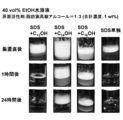
- Sodium dodecyl sulfate (SDS) was prepared as the above-mentioned surfactant. Further, as the above aliphatic higher alcohol, 1-dodecanol (C 12 OH), 1-tetradecanol (C 14 OH), and 1-hexadecanol (C 16 OH) were prepared. Ethanol, water, surfactant, and aliphatic higher alcohol are mixed in a beaker, the ethanol concentration is 20% by volume, the molar ratio of SDS to aliphatic higher alcohol is 1: 3, the total of SDS and aliphatic higher alcohol. An alcohol composition (25 ° C.) having a concentration of 0.1% by mass was prepared. In addition, for comparison, an alcohol composition was prepared without blending an aliphatic higher alcohol.
- SDS sodium dodecyl sulfate
- the obtained alcohol composition was shaken vigorously and then allowed to stand for 24 hours.
- the state of foam immediately after shaking, 1 hour, and 24 hours is shown in FIG.
- FIG. 1 when 1-dodecanol, 1-tetradecanol, or 1-hexadecanol was blended with SDS, a large amount of bubbles remained even 24 hours after shaking, resulting in foam stability. It was extremely good.
- the obtained alcohol composition was shaken vigorously and then allowed to stand for 24 hours.
- the state of the foam immediately after shaking, 1 hour, and 24 hours is shown in FIG.
- FIG. 2 when 1-dodecanol was blended with SDS, bubbles remained even after 1 hour from shaking, and the foam stability was superior to that when the aliphatic higher alcohol was not blended. .. Further, when 1-tetradecanol or 1-hexadecanol was blended together with SDS, a large amount of bubbles remained even after 24 hours had passed from shaking, and the foam stability was extremely excellent.
- the obtained alcohol composition was shaken vigorously and then allowed to stand for 24 hours.
- the state of the foam immediately after shaking, 1 hour, and 24 hours is shown in FIG.
- FIG. 3 when 1-dodecanol was blended with SDS, bubbles remained even after 1 hour from shaking, and the foam stability was superior as compared with the case where the aliphatic higher alcohol was not blended. .. Further, when 1-tetradecanol or 1-hexadecanol was blended together with SDS, a large amount of bubbles remained even after 24 hours had passed from shaking, and the foam stability was extremely excellent.
- the obtained alcohol composition was shaken vigorously and then allowed to stand for 24 hours.
- the state of the foam immediately after shaking, 1 hour, and 24 hours is shown in FIG.
- FIG. 4 when 1-dodecanol, 1-tetradecanol, or 1-hexadecanol was blended with SDS, bubbles remained even after 1 hour from shaking, and an aliphatic higher alcohol was added.
- the foam stability was excellent as compared with the case where it was not blended.
- ⁇ Test Example 5> The ethanol concentration was changed to 60% by volume, and 1-tetradecanol (C 14 OH), 1-hexadecanol (C 16 OH), and 1-octadecanol (C 18 OH) were added as the above aliphatic higher alcohols.
- the alcohol composition (25 ° C.) was prepared in the same manner as in Test Example 3. In addition, for comparison, an alcohol composition was prepared without blending an aliphatic higher alcohol.
- the obtained alcohol composition was shaken vigorously and then allowed to stand for 30 seconds.
- the state of the foam immediately after shaking, 10 seconds, and 30 seconds is shown in FIG.
- FIG. 5 when 1-tetradecanol, 1-hexadecanol, or 1-octadecanol was blended with SDS, bubbles remained even after 30 seconds from shaking, and the aliphatic higher grade.
- the foam stability was excellent as compared with the case where no alcohol was added.
- Test Example 7 The surfactant was changed to cetyltrimethylammonium bromide (CTAB), sodium N-lauroyl glutamate (C 12 GluNa), or disodium N-lauroyl glutamate (C 12 GluNa 2 ), and 1-tetra as the aliphatic higher alcohol.
- CTAB cetyltrimethylammonium bromide
- An alcohol composition 25 ° C. was prepared using decanol (C 14 OH) in the same manner as in Test Example 3.
- the obtained alcohol composition was shaken vigorously and then allowed to stand for 24 hours.
- the state of the foam immediately after shaking, 1 hour, and 24 hours is shown in FIG.
- FIG. 7 when 1-tetradecanol was blended with CTAB, C 12 GluNa, or C 12 GluNa 2 , many bubbles remained even after 24 hours from shaking, and the foam stability was extremely high. It was excellent.
- ⁇ Test Example 8> The surfactant was changed to N-stearoyl-N-methyltaurine sodium (SMT), 1-tetradecanol (C 14 OH) was used as the aliphatic higher alcohol, and the alcohol composition was the same as in Test Example 3. A product (25 ° C.) was prepared.
- SMT N-stearoyl-N-methyltaurine sodium
- C 14 OH 1-tetradecanol
- the obtained alcohol composition was shaken vigorously and then allowed to stand for 1 hour.
- the state of foam immediately after shaking and 1 hour later is shown in FIG.
- FIG. 8 when 1-tetradecanol was blended together with SMT, a large amount of bubbles remained even after 1 hour from shaking, and the foam stability was extremely excellent.
- Test example 9 Test example using sodium dodecyl sulfate (SDS) or sodium N-stearoyl-N-methyltaurine (SMT) as the surfactant and 1-tetradecanol (C 14 OH) as the aliphatic higher alcohol.
- SDS sodium dodecyl sulfate
- SMT sodium N-stearoyl-N-methyltaurine
- C 14 OH 1-tetradecanol
- the dynamic friction coefficient at room temperature was measured.
- a stainless steel R contact and a chemically oxidized silicon wafer were used for the measurement, and the measurement was performed under the conditions of a load of 100 g, a sliding speed of 10 mm / s, and a sliding distance of 10 cm, with a liquid volume or a foam volume of 3 mL.
- the dynamic friction coefficient was also measured for a commercially available high-concentration ethanol-containing gel disinfectant, a low-concentration ethanol-containing foam disinfectant, and a 40% by volume ethanol aqueous solution.
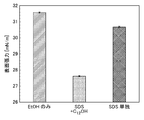
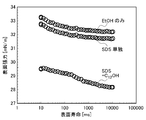
- the measurement result of the dynamic friction coefficient is shown in FIG. As shown in FIG. 9, all alcohol compositions showed a low coefficient of dynamic friction.
- the foamy alcohol composition containing 1-tetradecanol together with SMT had good frictional properties comparable to those of commercially available low-concentration ethanol-containing foamy disinfectants.
- FIG. 11 shows the state of foam immediately after shaking, after 30 seconds, and after 24 hours.
- 1-tetradecanol was blended with SMT and / or betaine, a large amount of bubbles remained even 24 hours after shaking, and the foam stability was extremely excellent.
Landscapes
- Life Sciences & Earth Sciences (AREA)
- General Health & Medical Sciences (AREA)
- Health & Medical Sciences (AREA)
- Wood Science & Technology (AREA)
- Pest Control & Pesticides (AREA)
- Plant Pathology (AREA)
- Engineering & Computer Science (AREA)
- Dentistry (AREA)
- Agronomy & Crop Science (AREA)
- Zoology (AREA)
- Environmental Sciences (AREA)
- Toxicology (AREA)
- Agricultural Chemicals And Associated Chemicals (AREA)
- Detergent Compositions (AREA)
- Cosmetics (AREA)
Priority Applications (1)
| Application Number | Priority Date | Filing Date | Title |
|---|---|---|---|
| JP2021553491A JP7239222B2 (ja) | 2019-10-24 | 2020-10-21 | アルコール組成物 |
Applications Claiming Priority (2)
| Application Number | Priority Date | Filing Date | Title |
|---|---|---|---|
| JP2019-193319 | 2019-10-24 | ||
| JP2019193319 | 2019-10-24 |
Publications (1)
| Publication Number | Publication Date |
|---|---|
| WO2021079903A1 true WO2021079903A1 (ja) | 2021-04-29 |
Family
ID=75620074
Family Applications (1)
| Application Number | Title | Priority Date | Filing Date |
|---|---|---|---|
| PCT/JP2020/039548 Ceased WO2021079903A1 (ja) | 2019-10-24 | 2020-10-21 | アルコール組成物 |
Country Status (2)
| Country | Link |
|---|---|
| JP (1) | JP7239222B2 (https=) |
| WO (1) | WO2021079903A1 (https=) |
Citations (3)
| Publication number | Priority date | Publication date | Assignee | Title |
|---|---|---|---|---|
| JP2002265335A (ja) * | 2001-03-13 | 2002-09-18 | Kanebo Ltd | 頭髪用泡沫状化粧料 |
| JP2011136946A (ja) * | 2009-12-28 | 2011-07-14 | Nakajima Kagaku Sangyo Kk | 洗浄料 |
| JP2015137268A (ja) * | 2014-01-24 | 2015-07-30 | 英昌化学工業株式会社 | 除菌性・保湿性に優れた泡状ハンドクリーム |
-
2020
- 2020-10-21 JP JP2021553491A patent/JP7239222B2/ja active Active
- 2020-10-21 WO PCT/JP2020/039548 patent/WO2021079903A1/ja not_active Ceased
Patent Citations (3)
| Publication number | Priority date | Publication date | Assignee | Title |
|---|---|---|---|---|
| JP2002265335A (ja) * | 2001-03-13 | 2002-09-18 | Kanebo Ltd | 頭髪用泡沫状化粧料 |
| JP2011136946A (ja) * | 2009-12-28 | 2011-07-14 | Nakajima Kagaku Sangyo Kk | 洗浄料 |
| JP2015137268A (ja) * | 2014-01-24 | 2015-07-30 | 英昌化学工業株式会社 | 除菌性・保湿性に優れた泡状ハンドクリーム |
Also Published As
| Publication number | Publication date |
|---|---|
| JP7239222B2 (ja) | 2023-03-14 |
| JPWO2021079903A1 (https=) | 2021-04-29 |
Similar Documents
| Publication | Publication Date | Title |
|---|---|---|
| JP5587984B2 (ja) | ハンドサニタイザー | |
| JP5071687B2 (ja) | フォーマー容器用液体洗浄剤組成物 | |
| JP2024026422A (ja) | シリコーン・ベースの界面活性剤を含むアルコール含有量の高い発泡性組成物 | |
| US20070232508A1 (en) | Cream-type skin cleansing composition | |
| JP5343857B2 (ja) | 殺菌清浄剤組成物 | |
| US12195700B2 (en) | Liquid detergent having low viscosity | |
| JP2007506684A (ja) | アルコール含有量の高いゲル様組成物及びフォーミング組成物 | |
| EP3563828B1 (en) | Article for skin cleansing agent | |
| WO2018221420A1 (ja) | フォーム状皮膚洗浄料 | |
| JP5554007B2 (ja) | 泡沫状皮膚塗布剤 | |
| US6617293B2 (en) | Thickening on dilution liquid soap | |
| JP4915720B2 (ja) | 界面活性剤組成物 | |
| JP3035033B2 (ja) | 液体洗浄剤組成物 | |
| JP5838816B2 (ja) | 液体皮膚洗浄剤製品 | |
| US8097265B2 (en) | Foam disinfectant | |
| JP5669522B2 (ja) | フォーマー容器入り液体洗浄剤組成物 | |
| WO2021079903A1 (ja) | アルコール組成物 | |
| JPH02248498A (ja) | 高められた粘度の水性洗浄剤組成物 | |
| JP2021183591A (ja) | 液状皮膚洗浄用組成物 | |
| CN1891195B (zh) | 表面活性剂组合物 | |
| JP5616818B2 (ja) | 洗浄剤組成物 | |
| JP2003055690A (ja) | 洗浄剤組成物 | |
| JP4448373B2 (ja) | 洗浄剤組成物 | |
| JP4181767B2 (ja) | 液体洗浄剤組成物 | |
| JP2014074114A (ja) | 増粘剤組成物及び液体洗浄剤組成物 |
Legal Events
| Date | Code | Title | Description |
|---|---|---|---|
| 121 | Ep: the epo has been informed by wipo that ep was designated in this application |
Ref document number: 20879878 Country of ref document: EP Kind code of ref document: A1 |
|
| DPE1 | Request for preliminary examination filed after expiration of 19th month from priority date (pct application filed from 20040101) | ||
| ENP | Entry into the national phase |
Ref document number: 2021553491 Country of ref document: JP Kind code of ref document: A |
|
| NENP | Non-entry into the national phase |
Ref country code: DE |
|
| 122 | Ep: pct application non-entry in european phase |
Ref document number: 20879878 Country of ref document: EP Kind code of ref document: A1 |