WO2021079895A1 - キャストドライフィルム及びその製造方法、pvaゲルの製造方法、並びに、pva多層ゲル及びその製造方法 - Google Patents
キャストドライフィルム及びその製造方法、pvaゲルの製造方法、並びに、pva多層ゲル及びその製造方法 Download PDFInfo
- Publication number
- WO2021079895A1 WO2021079895A1 PCT/JP2020/039484 JP2020039484W WO2021079895A1 WO 2021079895 A1 WO2021079895 A1 WO 2021079895A1 JP 2020039484 W JP2020039484 W JP 2020039484W WO 2021079895 A1 WO2021079895 A1 WO 2021079895A1
- Authority
- WO
- WIPO (PCT)
- Prior art keywords
- gel
- pva
- film
- multilayer
- precursor
- Prior art date
- Legal status (The legal status is an assumption and is not a legal conclusion. Google has not performed a legal analysis and makes no representation as to the accuracy of the status listed.)
- Ceased
Links
Images









Classifications
-
- B—PERFORMING OPERATIONS; TRANSPORTING
- B32—LAYERED PRODUCTS
- B32B—LAYERED PRODUCTS, i.e. PRODUCTS BUILT-UP OF STRATA OF FLAT OR NON-FLAT, e.g. CELLULAR OR HONEYCOMB, FORM
- B32B27/00—Layered products comprising a layer of synthetic resin
- B32B27/30—Layered products comprising a layer of synthetic resin comprising vinyl (co)polymers; comprising acrylic (co)polymers
-
- C—CHEMISTRY; METALLURGY
- C08—ORGANIC MACROMOLECULAR COMPOUNDS; THEIR PREPARATION OR CHEMICAL WORKING-UP; COMPOSITIONS BASED THEREON
- C08J—WORKING-UP; GENERAL PROCESSES OF COMPOUNDING; AFTER-TREATMENT NOT COVERED BY SUBCLASSES C08B, C08C, C08F, C08G or C08H
- C08J5/00—Manufacture of articles or shaped materials containing macromolecular substances
- C08J5/18—Manufacture of films or sheets
Definitions
- the present invention relates to a cast dry film and a method for producing the same, a method for producing a PVA gel, and a PVA multilayer gel and a method for producing the same.
- the present application claims priority based on Japanese Patent Application No. 2019-192377 filed in Japan on October 23, 2019, the contents of which are incorporated herein by reference.
- Patent Document 1 discloses the following manufacturing methods 1) to 3).
- a method for producing a PVA gel (freeze-thawed gel is sometimes abbreviated as FT gel) in which PVA is physically crosslinked by repeatedly freezing and thawing a polyvinyl alcohol (PVA) solution.
- PVA polyvinyl alcohol
- Freeze-Thawing Method 2) A PVA solution in which PVA is physically crosslinked by casting it on a support, drying it, and then swelling it with water (Cast-Dried Gel may be abbreviated as CD gel).
- Cast-Drying Method 3 A method for producing a hybrid gel in which a cast dry gel is laminated on a freeze-thaw gel by casting a PVA solution on the freeze-thaw gel, drying it, and then swelling it with water.
- Patent Document 2 discloses a method for producing a physically crosslinked PVA gel in which a fiber structure in which a plurality of submicron-sized fibers are bundled is formed by controlling the freezing direction of the PVA solution. Further, when forming a laminate of a plurality of PVA gels, a method of applying a PVA solution between the first PVA gel and the second PVA gel and drying the PVA gels to adhere the PVA gels to each other. It is disclosed.
- the method of adhering PVA gels described in Patent Document 2 has a problem that sufficient adhesive force cannot be obtained and the PVA gels are easily peeled off.
- the cause of this is that the PVA solution applied to the adhesive surface of the PVA gel is pushed out from the contact surface between the PVA gels and flows out, resulting in a very small amount of PVA solution remaining on the contact surface, and the surface of the PVA gel. It was considered that there were many fine irregularities composed of small lumps of PVA polymer, and the PVA gels were not sufficiently in contact with each other when viewed at the micro level.
- CD film a transparent film obtained by casting and drying a PVA solution, which is physically crosslinked with PVA (hereinafter, "Cast-Dried Film is abbreviated as CD film”. ) ”), but it was found that it exhibits an excellent function as an adhesive for adhering PVA gels to each other.
- the present invention has been made in view of the above circumstances, and an object of the present invention is to provide a cast dry film and a method for producing the same, a method for producing a PVA gel, and a PVA multilayer gel and a method for producing the same.
- a cast dry film having a thickness of 250 ⁇ m or less which is a transparent film in a dry state in which only PVA is physically crosslinked.
- the cast dry film according to [1] which contains a chemical cross-linking agent capable of chemically cross-linking PVAs or a catalyst for promoting the chemical cross-linking by the chemical cross-linking agent.
- a chemical cross-linking agent capable of chemically cross-linking PVAs or a catalyst for promoting the chemical cross-linking by the chemical cross-linking agent for the purpose of adhering the first gel and the second gel, which are arranged between a first gel formed by cross-linking PVAs and a second gel formed by cross-linking PVAs.
- a method for producing a PVA gel in which a first gel formed by cross-linking PVAs and a second gel formed by cross-linking PVAs adhere to each other.
- the cast dry film according to any one of [1] to [3] is attached to at least a part of the adhesive surface to which the second gel is adhered, and the cast dry film is further interposed on the adhesive surface.
- a PVA gel precursor in which the first gel and the second gel are in contact with each other via the cast dry film can be obtained, and the PVA gel can be obtained.
- a method for producing a PVA gel which comprises adhering the first gel and the second gel of the precursor to obtain a PVA gel.
- the water contained in the first gel and the second gel permeates the cast dry film, and a part or all of the PVA constituting the cast dry film is formed.
- the dissolved PVA diffuses into the first gel and the second gel, and is free in the vicinity of the bonding surface and the bonding interface in the first gel and the second gel.
- the method for producing a PVA gel according to [4] which produces PVA.
- the PVA gel precursor is frozen and then thawed to physically crosslink the free PVA in the vicinity of the bonding surface and the bonding interface in the first gel and the second gel, and the PVA
- the method for producing a PVA gel according to [5] which comprises obtaining a gel.
- the free PVA is physically crosslinked on the bonding surface and in the vicinity of the bonding interface in the first gel and the second gel to obtain the PVA gel.
- the PVA gel precursor is immersed in a water-soluble organic solvent, the water-soluble organic solvent is absorbed by the PVA gel precursor, and then the PVA gel precursor is placed at an unfrozen low temperature.
- the free PVA is provided by supplying at least the chemical cross-linking agent among the chemical cross-linking agent for chemically cross-linking PVAs and the catalyst for promoting the chemical cross-linking to the adhesive surface of the PVA gel precursor.
- the method for producing a PVA gel according to [5] which comprises chemically cross-linking the bonding surface and the vicinity of the bonding interface in the first gel and the second gel to obtain the PVA gel.
- the first gel and the second gel are freeze-thaw gels obtained by independently freezing and thawing the PVA aqueous solution once or multiple times, or the PVA aqueous solution is cast.
- a method for producing a PVA multi-layer gel which comprises adhering each gel sheet of the PVA multi-layer gel precursor to each other to obtain a PVA multi-layer gel.
- the water contained in each gel sheet permeates each cast dry film, and a part or all of the PVA constituting each cast dry film is dissolved in the water.
- the PVA multilayer gel precursor is frozen and then thawed to physically crosslink the free PVA in the vicinity of the adhesive surface and the adhesive interface in each gel sheet to obtain the PVA multilayer gel.
- the method for producing a PVA multilayer gel according to [13]. [15] The method for producing a PVA multilayer gel according to [14], which comprises repeating the cycle of thawing once or more after refreezing the PVA multilayer gel obtained after thawing.
- the PVA multilayer gel precursor is dried to physically crosslink the free PVA in the vicinity of the adhesive surface and the adhesive interface in each gel sheet to obtain the PVA multilayer gel, according to [13].
- the PVA multilayer gel precursor is immersed in a water-soluble organic solvent, the water-soluble organic solvent is absorbed by the PVA multilayer gel precursor, and then the PVA multilayer gel precursor is placed at an unfrozen low temperature.
- the chemical cross-linking agent that chemically cross-links PVAs and the catalyst that promotes the chemical cross-linking at least the chemical cross-linking agent is applied to the bonding surface of the PVA multilayer gel precursor and the vicinity of the bonding interface in each gel sheet.
- the plurality of gel sheets are freeze-thaw gels obtained by independently freezing and thawing the PVA aqueous solution once or multiple times, or the PVA aqueous solution is cast and dried, and then with water.
- a PVA multilayer gel in which a plurality of gel sheets made of gels in which PVAs are crosslinked are laminated, and adjacent gel sheets are bonded to each other by physical or chemical crosslinks between PVAs, and four or more of the gel sheets are laminated.
- PVA multi-layer gel made of.
- a PVA multilayer gel in which two or more gel sheets made of gels in which PVAs are crosslinked are laminated, and adjacent gel sheets are bonded to each other by physical or chemical crosslinking of PVAs, which is optional from the PVA multilayer gel.
- PVA multilayer gel in which the average value of the peel strength measured in the following peel test between the first gel sheet selected in 1 and the second gel sheet adjacent to the first gel sheet is 20 N / m or more.
- the method for producing PVA gel of the present invention by using a cast dry film as an adhesive between PVA gels, free PVA that functions as an adhesive can be sufficiently supplied to the adhesive surface between PVA gels, and , It is possible to prevent the free PVA from flowing out from the adhesive surface.
- This outflow suppressing effect is due to the absence of excess water (excess solvent for becoming an outflowable PVA aqueous solution) around the free PVA.
- the adhesive strength between PVA gels can be improved.
- the cast dry film as an adhesive it is possible to easily produce a PVA multilayer gel in which a plurality of PVA gel sheets are laminated and strongly adhered.
- the peel strength (adhesive strength) between the PVA gels of each layer is improved as compared with the conventional case.
- the result of measuring the peeling strength of the adhesive surface and a CD film having a thickness of 10 ⁇ m or 20 ⁇ m were interposed.
- the thickness of the CD film used to prepare each PVA gel was changed.
- the thickness of the CD film used to prepare each PVA gel was changed.
- the thickness of the CD film used to prepare each PVA gel was changed. The average value of the peel strength of each PVA gel shown in FIGS.
- the first aspect of the present invention is a dry transparent film in which only PVA is physically crosslinked, and a cast dry film (CD film) having a thickness of 250 ⁇ m or less.
- the expression "only PVA is physically cross-linked” means that in a network structure in which PVAs form a network by physical cross-linking, the main body responsible for the physical cross-linking is only PVA.
- Compounds and additives other than PVA may be contained in the network structure. In this case, compounds and additives other than PVA are supported on the network structure without participating in physical cross-linking between PVAs.
- the CD film of this embodiment is obtained by casting a PVA solution on the surface of a support and drying it.
- the thickness of the CD film can be, for example, 200 ⁇ m or less, 100 ⁇ m or less, 50 ⁇ m or less, or 30 ⁇ m or less. As will be described later, the CD film exhibits an excellent function as an adhesive for adhering PVA gels to each other. From the viewpoint of fully exerting this function, the thickness of the CD film is preferably 4 ⁇ m or more and 30 ⁇ m or less, more preferably 4 ⁇ m or more and 20 ⁇ m or less, further preferably 5 ⁇ m or more and 18 ⁇ m or less, further preferably 6 ⁇ m or more and 16 ⁇ m or less, and 7 ⁇ m or more. 14 ⁇ m or less is particularly preferable, and 8 ⁇ m or more and 12 ⁇ m or less is most preferable.
- the thickness of the CD film is a value obtained as an average value of five or more measured values randomly selected using a constant pressure thickness measuring device. Specifically, for example, it is preferable to apply a pressure of 1.25 ⁇ 0.15 N to a stylus having a diameter of 5 mm for measurement.
- the measuring instrument include a constant pressure thickness measuring instrument (model number: PEACOCK FFA-1) manufactured by Ozaki Manufacturing Co., Ltd.
- the shape other than the thickness of the CD film is not particularly limited, and can be a shape such as a quadrangle, a polygon other than a quadrangle, a circle, or an ellipse in a plan view.
- the size of the vertical ⁇ weft can be, for example, 0.5 cm ⁇ 0.5 cm to 500 cm ⁇ 500 cm. Further, a minute size of 0.5 cm ⁇ 0.5 cm or less is possible by using precision processing technology.
- the main constituent material that accounts for the majority of the dry mass of CD film is physically crosslinked PVA.
- the CD film may contain a chemical cross-linking agent that chemically cross-links PVAs with each other, or a catalyst that promotes cross-linking by the chemical cross-linking agent.
- the content of the chemical cross-linking agent or catalyst with respect to the dry mass of the CD film can be, for example, 0.1 to 10% by mass.
- the water content with respect to the total mass of the dried CD film is usually 8% by mass or less, preferably 6% by mass or less, more preferably 4% by mass or less, still more preferably 3% by mass or less.
- the water content of the CD film is a value calculated by the difference between the mass at 20 ° C. and the mass when heated to 110 ° C. and dried.
- the CD film is obtained by casting an aqueous PVA solution on the surface of the support (Cast) and drying (Dry).
- a desired CD film can be obtained by thinly spreading a PVA aqueous solution in a container having a flat-bottomed bottom, evaporating water, and drying the film.
- the CD film contains a chemical cross-linking agent or the catalyst
- a CD film containing the chemical cross-linking agent or the catalyst can be obtained by the same method as described above except that the PVA aqueous solution contains the chemical cross-linking agent or the catalyst in advance.
- the PVA aqueous solution is an aqueous solution in which polyvinyl alcohol (PVA) is dissolved.
- PVA which is a material for an aqueous PVA solution, preferably has a saponification degree of 95% or more and an average degree of polymerization of 1000 or more, more preferably 1500 or more, further preferably 2000 or more, and particularly preferably 2400 or more.
- the upper limit of the saponification degree of PVA is 100%, but the saponification degree is preferably less than 100% from the viewpoint of increasing the solubility of PVA.
- the saponification degree and the average degree of polymerization of PVA are values measured according to the method described in "Polyvinyl alcohol test method" of JIS K 6726: 1994.
- the average degree of polymerization of PVA is 1000 or more, a network of microcrystals of PVA is formed, so that a structurally strong CD film can be obtained. As a result, the peel strength between PVA gels by the CD film can be further increased.
- the average degree of polymerization is low, microcrystals are formed to the same extent, but only a weak network can be formed.
- the upper limit of the average degree of polymerization is not particularly limited, but is preferably 3000 or less from the viewpoint of increasing the solubility. Generally, the higher the average degree of polymerization of PVA used, the stronger the resulting CD film tends to be structurally.
- PVA having the physical characteristics exemplified here can be purchased as a commercial product.
- the concentration of the PVA aqueous solution is not particularly limited, but is preferably 5 to 25% by mass, more preferably 8 to 20% by mass, and further preferably 10 to 15% by mass with respect to the total mass of the PVA aqueous solution.
- concentration is within the above range, the viscosity is such that it can be easily cast uniformly on the surface of the support, the density of the physically crosslinked formed is sufficiently increased, and sufficient strength can be imparted to the CD film.
- the depth (thickness) of the PVA aqueous solution when casting on the surface of the support and shifting to the drying process depends on the thickness of the produced CD film at the time of drying. The deeper the PVA aqueous solution, the thicker the CD film is formed. Further, the higher the PVA concentration of the PVA aqueous solution, the thicker the CD film is formed. For example, when a 10% by mass PVA aqueous solution is used to form a CD film having a thickness of 10 to 30 ⁇ m, the depth of the cast PVA aqueous solution is preferably about 100 ⁇ m to 250 ⁇ m. Similarly, when a 20% by mass PVA aqueous solution is used to form a CD film having a thickness of 10 to 30 ⁇ m, the depth of the cast PVA aqueous solution is preferably about 50 ⁇ m to 150 ⁇ m.
- the temperature for drying the PVA aqueous solution cast on the surface of the support is preferably 20 to 90 ° C, more preferably 30 to 85 ° C, further preferably 40 to 75 ° C, and particularly preferably 50 to 65 ° C.
- the temperature for drying the PVA aqueous solution cast on the surface of the support is preferably 20 to 90 ° C, more preferably 30 to 85 ° C, further preferably 40 to 75 ° C, and particularly preferably 50 to 65 ° C.
- a CD film having a shape along the bottom surface can be formed.
- the shape of the formed CD film in a plan view is substantially in line with the shape of the bottom surface of the container viewed in a plan view from above.
- the temperature at which the PVA aqueous solution cast on the surface of the support is dried, the average degree of polymerization of PVA, and the thickness of the CD film to be formed are used.
- the temperature for drying the PVA aqueous solution is preferably 20 to 90 ° C., preferably 30 to 85 ° C. Is more preferable, 40 to 75 ° C. is further preferable, and 50 to 65 ° C. is particularly preferable.
- the temperature for drying the PVA aqueous solution is preferably 20 to 90 ° C., preferably 20 to 60 ° C. °C is more preferable, 20 to 40 ° C is further preferable, and 20 to 30 ° C is particularly preferable.
- the temperature for drying the PVA aqueous solution is preferably 20 to 90 ° C., preferably 20 to 60 ° C. Is more preferable, 20 to 40 ° C. is further preferable, and 20 to 30 ° C. is particularly preferable.
- the relative humidity of the drying atmosphere is preferably, for example, 40 to 90% RH, and more preferably 50 to 80% RH.
- the temperature and relative humidity are controlled and dried in this way, the growth of microcrystals of PVA constituting the CD film is promoted, and a CD film having excellent mechanical strength can be obtained.
- a second aspect of the present invention is a method for producing a PVA gel in which a first gel formed by cross-linking PVAs and a second gel formed by cross-linking PVAs adhere to each other.
- the "gel formed by cross-linking PVAs” may be a gel obtained by physically cross-linking only PVA (physically cross-linked gel), or a gel obtained by chemically cross-linking PVAs with a chemical cross-linking agent (chemical). It may be a crosslinked gel).
- a physically crosslinked gel dissolves in boiling water, whereas a chemically crosslinked gel hardly dissolves even when immersed in boiling water.
- Compounds and additives other than PVA may be contained in the network structure of the "gel formed by cross-linking PVAs".
- the cast dry film (CD film) of the first aspect described above is attached to at least a part of the adhesive surface to which the second gel is adhered in the first gel, and the cast dry film is further interposed.
- the second gel is attached to the adhesive surface.
- the first gel and the second gel are in contact with each other via the CD film, they have not yet reached a perfect adhesive state.
- the first gel and the second gel contain water.
- this water permeates (that is, is absorbed) into the CD film sandwiched between the first gel and the second gel, at least a part of the physically crosslinked PVA constituting the CD film is dissolved.
- This dissolved PVA becomes a free PVA that contributes to the adhesion between the first gel and the second gel on the adhesive surface. Since there is no excess water around the free PVA, PVA hardly flows out from between the first gel and the second gel. As a result, almost all of the free PVA derived from the CD film becomes an adhesive that contributes to the adhesion between the first gel and the second gel.
- the free PVA at the interface between the first gel and the second gel diffuses into the region (surface layer) near the bonding interface in the first gel and the second gel, and undergoes the bonding treatment described later to PVA. Form a cross-linking point where they are cross-linked.
- This situation is schematically shown in FIGS. 1 and 13.
- free PVA eluted from the CD film diffuses inside the first gel (Gel) and the second gel (Gel), and new cross-linking points (indicated by an ellipse). It shows how to form.
- free PVA gradually elutes and diffuses from the CD film (soluble film), diffuses inside the first gel and the second gel, and new cross-linking points (indicated by spheres). ) Is formed.
- the suitable thickness of the CD film used in this embodiment is as described above. If the thickness of the CD film is too thick, the dissolution of the film due to water absorption may be reduced, and it may be difficult to firmly adhere the first gel to the second gel. Further, if the thickness of the CD film is too thin, PVA derived from the CD film that contributes to the adhesion between the first gel and the second gel is not sufficiently present, and the strength between the first gel and the second gel is strong. Adhesion may be difficult.
- the first gel and the second gel are not particularly limited as long as the PVA is physically or chemically crosslinked and contains water (hydrogel).
- a freeze-thaw gel obtained by freezing and thawing the PVA aqueous solution once or multiple times, or a PVA aqueous solution is cast.
- FT gel freeze-thaw gel
- PVA aqueous solution is cast.
- examples thereof include cast dry gel (CD gel) that has been dried and then swollen with water.
- the first gel and the second gel may be the same type of gel or different types of gels from each other. Further, in principle, the first gel and the second gel may be chemically crosslinked gels of PVA.
- Known methods can be applied to the method for producing an FT gel and the method for producing a CD gel, and the method disclosed in Patent Document 1 is preferable.
- Examples of the chemically cross-linked gel include known gels in which PVAs are crosslinked with each other by a chemical cross-linking agent as described later.
- a known method can also be applied to the method for producing the chemically crosslinked gel.
- the FT gel may be a freeze-thaw dry gel (FTD gel).
- FTD gel is a gel obtained by freezing and thawing the PVA aqueous solution, drying it, and then swelling it with water. After obtaining the FT gel, the FTD gel is additionally dried and swollen. By drying the obtained gel, excessive microcrystals are formed and the strength is increased. That is, the FTD gel can be said to be a form of the FT gel.
- a known method can be applied to the method for producing an FTD gel, and the method described in Patent Document 1 is preferable.
- the shape of the FT gel can take various forms.
- the FT gel can be prepared by pouring an aqueous PVA solution into a container having an arbitrary shape, freezing and thawing in a closed state. After thawing, the FT gel is usually sufficiently swollen with water.
- the shape of the container is not particularly limited, and examples thereof include a container having a plate shape, a rod shape, a box shape, a spheroid shape, and the like.
- the shape of the container means the shape of the space into which the PVA aqueous solution is poured.
- the shapes of the PVA aqueous solution and the FT gel to be produced in the container follow the shape of the container.
- the shape of the CD gel can be subject to some restrictions on the manufacturing method.
- the CD gel is obtained by casting an aqueous PVA solution on the surface of the support, drying it, and then swelling it with water.
- a sheet-shaped CD gel can be obtained by casting an aqueous PVA solution onto a support having a flat surface.
- the thickness thereof is not particularly limited as long as it is thicker than the CD film, and the thickness is more than 250 ⁇ m, for example, more than 250 ⁇ m (greater than). ) It can be 2 mm or less.
- the thickness of the first gel and the thickness of the second gel may be the same or different.
- the plan view shape of the first gel and the plan view shape of the second gel may be the same or different.
- the area of the CD film interposed in the contact surface is preferably 50 to 100%, more preferably 70 to 100%, with respect to the total area of the contact surface in which the first gel and the second gel are opposed to each other and adhere to each other. , 90-100% is more preferred.
- the surfaces in which both gels are in close contact with each other are not limited to the main surfaces (widest surfaces) of both gels.
- the side surface (cross section) along the thickness direction of the sheet-shaped or plate-shaped gel may be used as the contact surface. That is, the side surface of the first gel and the main surface of the second gel may be brought into close contact with each other, or the side surface of the first gel and the side surface of the second gel may be brought into close contact with each other.
- adhesion by physical cross-linking By subjecting the PVA gel precursor to any one or more of the first to third adhesion treatments described below, a PVA gel in which the first gel and the second gel are adhered by physical cross-linking is obtained. Be done.
- the first adhesion treatment is a treatment in which the PVA gel precursor is frozen and then thawed.
- the free PVA derived from the CD film interposed between the first gel and the second gel is physically crosslinked to function as an adhesive. It is considered that this physical cross-linking newly forms an FT gel derived from the free PVA between the first gel and the second gel (at least the adhesive surface and the surface layer around it).
- FT gel derived from the free PVA between the first gel and the second gel (at least the adhesive surface and the surface layer around it).
- the thickness of the newly formed FT gel changes depending on the amount of free PVA present on the adhesive surface.
- the adhesive layer consisting of the newly formed FT gel between the first gel and the second gel has a thickness that can be easily recognized. If there are not so many free PVA, the thickness of the adhesive layer becomes thin and it may be difficult to recognize.
- the thickness of the adhesive layer is, for example, 1 ⁇ m to 100 ⁇ m, and is preferably 3 ⁇ m to 50 ⁇ m, more preferably 6 ⁇ m to 30 ⁇ m, and even more preferably 9 ⁇ m to 15 ⁇ m from the viewpoint of obtaining sufficient peel strength.
- the temperature at which the PVA gel precursor is frozen can be set in the same manner as the temperature at which the PVA aqueous solution in the container can be frozen. Specifically, for example, it can be -80 ° C or higher and -15.5 ° C or lower, -60 ° C or higher and -20 ° C or lower, and -40 ° C or higher and -25 ° C or lower.
- the freezing point of the 15 mass% PVA aqueous solution is about -15.5 ° C.
- the freezing treatment time at the freezing temperature is not particularly limited. For example, when a 15% by mass PVA aqueous solution is poured into a container with a thickness of about 1 to 5 mm, it can usually be frozen in about 1 to 24 hours.
- the temperature at which the frozen PVA gel precursor is thawed can be set in the same manner as the temperature at which the frozen PVA aqueous solution can be thawed in the container.
- the temperature is not set so high that the physically crosslinked PVA can be redissolved.
- it is preferably 0 ° C to 50 ° C, more preferably 4 to 30 ° C, and even more preferably 4 to 15 ° C.
- a 15% by mass PVA aqueous solution is poured into a container to a thickness of about 1 to 5 mm and frozen, it is usually thawed in about 1 to 24 hours to obtain a wet FT gel.
- the FT gel formed on the adhesive surface forms a wet adhesive layer that adheres the first gel and the second gel.
- the freezing and thawing treatment a plurality of times. That is, it is preferable to perform the operation of freezing the adhesive layer containing the wet FT gel (FT1 gel) obtained by the first freezing and thawing again and thawing the adhesive layer a plurality of times.
- FT1 gel wet FT gel
- PVA gel because it is adhered in the first freezing and thawing
- the FT gel obtained by performing the freezing and thawing cycle once is referred to as FT1 gel
- the FT gel obtained by performing the cycle twice is referred to as FT2 gel
- the cycle after 3 times The same applies to the FT gel obtained in. That is, the FT gel obtained by performing the cycle n times is called an FTn gel.
- the FTn gel constituting the adhesive layer is preferably FT2 gel to FT10 gel having n of 2 to 10, more preferably FT2 gel to FT8 gel having n of 2 to 9, and FT2 gel to FT6 gel having n of 2 to 6. Is even more preferable.
- the number of freeze-thaw cycles n is not particularly limited, but within the above range, an FT gel having high structural strength can be obtained. By forming the adhesive layer with such a high-strength FT gel, the peel strength between the first gel and the second gel can be increased.
- the PVA gel obtained through the above first bonding treatment is placed in pure water for equilibrium swelling.
- the PVA gel contains a sufficient amount of water, the excellent physical properties of the PVA gel can be fully exhibited.
- the PVA gel obtained in the first adhesive treatment may be dried.
- the drying method in the second adhesive treatment described later can be applied. In this way, by performing the second adhesive treatment (drying method) after the first adhesive treatment (freeze-thaw method), the FT gel constituting the adhesive can be changed into an FTD gel.
- the second bonding treatment is a treatment for drying the PVA gel precursor.
- the free PVA derived from the CD film interposed between the first gel and the second gel (adhesive surface) is physically crosslinked to function as an adhesive. It is considered that this physical cross-linking causes a new CD gel derived from the free PVA to be newly formed in the adhesive layer between the first gel and the second gel (at least the adhesive surface and the surface layer around it).
- the CD film in the PVA gel precursor is relatively thick, a part of the CD film may remain on the adhesive surface to form a gel fused with the newly formed CD gel.
- the thickness of the newly formed CD gel changes depending on the amount of free PVA present on the adhesive surface.
- the adhesive layer consisting of the newly formed CD gel becomes a thickness that can be easily recognized between the first gel and the second gel. If there are not so many free PVA, the thickness of the adhesive layer becomes thin and it may be difficult to recognize.
- the thickness of the adhesive layer is, for example, 1 ⁇ m to 100 ⁇ m, and is preferably 3 ⁇ m to 50 ⁇ m, more preferably 6 ⁇ m to 30 ⁇ m, and even more preferably 9 ⁇ m to 15 ⁇ m from the viewpoint of obtaining sufficient peel strength.
- Examples of the method for drying the PVA gel precursor include a method of placing the PVA gel precursor in an environment of about 0 to 30 ° C. in the air or a reduced pressure atmosphere.
- the drying temperature is preferably 2 to 20 ° C, more preferably 3 to 16 ° C, and even more preferably 4 to 12 ° C.
- the CD gel constituting the adhesive layer becomes tougher due to the growth of microcrystals, and sufficient peel strength can be obtained even when bending stress or the like is applied from the outside.
- the relative humidity when dried at 4 to 25 ° C, the relative humidity is preferably 50 to 90% RH, and when dried at 4 to 15 ° C, the relative humidity is preferably 50 to 90% RH, 70 to 70. 90% RH is more preferred, and 80-90% RH is even more preferred.
- the time for drying the PVA gel precursor depends on the size and shape of the PVA gel precursor, and examples thereof include 1 hour to 240 hours. The time is not particularly limited as long as the free PVA present on the adhesive surface is sufficiently dried to form a physical crosslink of PVA.
- the dried PVA gel obtained through the above second bonding treatment is placed in pure water for equilibrium swelling.
- the PVA gel contains a sufficient amount of water, the excellent physical properties of the PVA gel can be fully exhibited.
- the third adhesion treatment is a treatment of immersing the PVA gel precursor in a water-soluble organic solvent of PVA.
- the free PVA derived from the CD film interposed between the first gel and the second gel is physically crosslinked to function as an adhesive.
- a physically cross-linked gel derived from the free PVA is newly formed between the first gel and the second gel (at least the adhesive surface and the surface layer around it).
- the physically crosslinked gel may contain microcrystals in which hydrogen bonds between PVAs are aligned.
- the CD film in the PVA gel precursor When the CD film in the PVA gel precursor is relatively thick, a part of the CD film may remain on the adhesive surface to form a gel fused with the newly formed physically crosslinked gel.
- the thickness of the newly formed physically crosslinked gel changes depending on the amount of free PVA present on the adhesive surface. ..
- the adhesive layer consisting of the newly formed physically crosslinked gel between the first gel and the second gel has a thickness that can be easily recognized. If there are not so many free PVA, the thickness of the adhesive layer becomes thin and it may be difficult to recognize.
- the thickness of the adhesive layer is, for example, 1 ⁇ m to 100 ⁇ m, and is preferably 3 ⁇ m to 50 ⁇ m, more preferably 6 ⁇ m to 30 ⁇ m, and even more preferably 9 ⁇ m to 15 ⁇ m from the viewpoint of obtaining sufficient peel strength.
- the water-soluble organic solvent examples include glycerin, ethylene glycol, DMSO (dimethyl sulfoxide), ethanol, 1,3-dimethyl-2-imidazolidinone, and the like.
- DMSO dimethyl sulfoxide
- ethanol 1,3-dimethyl-2-imidazolidinone
- the strength of the formed PVA gel is increased by dissolving PVA in a mixed solvent of DMSO and water, which is a co-poor solvent for PVA, and keeping it at a predetermined temperature (Non-Patent Document 1). reference).
- the co-poor solvent effect means that the polymer to be dissolved dissolves in each of the first solvent and the second solvent, while the mixed solvent is a mixture of the first solvent and the second solvent. Is a phenomenon that does not melt.
- a water-soluble organic solvent other than DMSO is a poor solvent for PVA and gels with a specific composition.
- the water-soluble organic solvent is a co-poor solvent
- Examples of the method of immersing the PVA gel precursor in the co-poor solvent include a method of immersing the PVA gel precursor in a co-poor solvent having a volume of 10 times or more the volume of the PVA gel precursor. By increasing the relative volume of the co-poor solvent, the co-poor solvent can sufficiently permeate the PVA gel precursor, and the composition of the co-poor solvent during immersion can be stably maintained. At the time of immersion, it is preferable to fix the PVA gel precursor so as not to disintegrate in the co-poor solvent.
- Examples of the fixing method include a method in which a PVA gel precursor is sandwiched between two opposing fixing plates.
- the temperature of the co-poor solvent in which the PVA gel precursor is immersed includes, for example, 10 to 40 ° C. From the viewpoint of promoting the penetration of the co-poor solvent into the PVA gel precursor, it may be heated to, for example, about 50 ° C.
- the time for immersing the PVA gel precursor in the co-poor solvent includes, for example, 1 hour to 24 hours, although it depends on the size and shape of the PVA gel precursor. The time is not particularly limited as long as the co-poor solvent permeates around the free PVA existing on the adhesive surface and a physical crosslink of PVA can be formed. After immersion, the formation of microcrystals is promoted by allowing the mixture to stand at a low temperature.
- a PVA gel in which the first gel and the second gel are adhered by PVA derived from a CD film is obtained.
- the PVA gel obtained here contains a co-poor solvent.
- the co-poor solvent can be removed from the PVA gel by immersing the PVA gel in pure water and swelling it in equilibrium.
- the PVA gel contains a sufficient amount of water, the excellent physical properties of the PVA gel can be fully exhibited. At this time, if it is immersed in ethanol instead of pure water, the adhesive strength may be improved.
- the obtained PVA gel may be frozen and thawed.
- the freeze-thaw method in the first adhesive treatment described above can be applied.
- the PVA gel to be subjected to the freezing and thawing treatment may contain a co-poor solvent, or the co-poor solvent may be removed by substituting with water.
- the PVA gel obtained by the above third adhesion treatment and optionally subjected to the freeze-thaw method contains a solvent other than water derived from the co-poor solvent
- the PVA gel is immersed in alcohol. It is preferable that the solvent is replaced with the alcohol, and then the solvent is immersed in pure water to replace the alcohol with water.
- the peel strength can be further improved, although the reason is unknown.
- a method of immersing the PVA gel in ethanol, removing DMSO from the PVA gel, immersing it in pure water, and swelling it with water to obtain the desired PVA gel can be mentioned.
- the peel strength of the adhesive surface of the PVA gel can be improved more than the peel strength of the adhesive surface of the PVA gel that has not undergone the alcohol immersion treatment.
- the PVA gel precursor is subjected to any one or more of the fourth to ninth adhesion treatments described below, and a chemical cross-linking agent for chemically cross-linking (chemically cross-linking) PVAs to each other is supplied to the bonding surface.
- a chemical cross-linking agent for chemically cross-linking (chemically cross-linking) PVAs to each other is supplied to the bonding surface.
- the free PVA existing on the bonding surface is chemically crosslinked, and a PVA gel in which the first gel and the second gel are chemically crosslinked is obtained.
- the catalyst for promoting the chemical cross-linking coexists on the adhesive surface together with the chemical cross-linking agent.
- the fourth adhesion treatment is a treatment in which the PVA gel precursor is immersed in a solution containing at least the chemical cross-linking agent among the chemical cross-linking agent and the catalyst.
- the chemical cross-linking agent and catalyst in the solution gradually diffuse into the PVA gel precursor and reach between the first gel and the second gel (adhesive surface).
- the free PVA derived from the CD film interposed on the adhesive surface reacts with the chemical cross-linking agent and chemically cross-links, thereby functioning as an adhesive. It is considered that this chemical cross-linking newly forms a chemically cross-linked gel derived from the free PVA between the first gel and the second gel (at least the adhesive surface and the surface layer around it).
- the CD film in the PVA gel precursor When the CD film in the PVA gel precursor is relatively thick, a part of the CD film may remain on the adhesive surface to form a gel fused with the newly formed chemically crosslinked gel.
- the thickness of the newly formed chemically crosslinked gel changes depending on the amount of free PVA present on the adhesive surface. ..
- the adhesive layer consisting of the newly formed chemically crosslinked gel between the first gel and the second gel has a thickness that can be easily recognized. If there are not so many free PVA, the thickness of the adhesive layer becomes thin and it may be difficult to recognize.
- the thickness of the adhesive layer is, for example, 1 ⁇ m to 100 ⁇ m, and is preferably 3 ⁇ m to 50 ⁇ m, more preferably 6 ⁇ m to 30 ⁇ m, and even more preferably 9 ⁇ m to 15 ⁇ m from the viewpoint of obtaining sufficient peel strength.
- Examples of the chemical cross-linking agent include compounds having an aldehyde group such as glutaraldehyde and formaldehyde. Among these, glutaraldehyde is preferable because it has high permeability to PVA gel and excellent cross-linking reactivity. Further, if a known photoreactive or heat-reactive chemical cross-linking agent is used, the initiation of the cross-linking reaction can be controlled by light irradiation or heat treatment.
- the type of the chemical cross-linking agent contained in the solution may be one type or two or more types.
- the catalyst is appropriately selected depending on the type of chemical cross-linking agent.
- the chemical cross-linking agent is glutaraldehyde or formaldehyde
- examples of the catalyst thereof include inorganic acids such as hydrochloric acid, sulfuric acid and nitric acid, and organic acids such as citric acid, acetic acid and maleic acid.
- hydrochloric acid or citric acid is preferable because it has high permeability to the PVA gel precursor and has excellent catalytic ability.
- the type of the catalyst contained in the solution may be one type or two or more types.
- the solvent of the solution is not particularly limited as long as it does not damage the PVA gel precursor and can dissolve the chemical cross-linking agent, and an organic solvent such as water or alcohol, a mixed solvent of water and an organic solvent, or the like can be applied. Will be done.
- the concentration of the chemical cross-linking agent with respect to the total mass of the solution can be, for example, 0.001 to 0.08% by mass.
- the concentration is preferably, for example, 0.001 to 0.015% by mass, more preferably 0.002 to 0.01% by mass, and 0.0003 to 0.006% by mass. % Is more preferable.
- the concentration of the catalyst with respect to the total volume of the solution can be, for example, 0.01 to 0.5 mol / L.
- the concentration is preferably, for example, 0.02 to 0.3 mol / L, more preferably 0.03 to 0.2 mol / L, and more preferably 0.05 to 0.15 mol / L. L is more preferred.
- Examples of the method of immersing the PVA gel precursor in the solution containing the chemical cross-linking agent include a method of immersing the PVA gel precursor in the solution having a volume of 10 times or more the volume of the PVA gel precursor. By increasing the relative volume of the solution, the solution can sufficiently permeate the PVA gel precursor and the composition of the solution during immersion can be kept stable. At the time of immersion, it is preferable to fix the PVA gel precursor so as not to disintegrate in the solution.
- Examples of the fixing method include a method in which a PVA gel precursor is sandwiched between two opposing fixing plates. The temperature of the solution in which the PVA gel precursor is immersed includes, for example, 10 to 40 ° C.
- the solution may be heated to, for example, about 50 ° C.
- the time for immersing the PVA gel precursor in the solution includes, for example, 1 hour to 24 hours, although it depends on the size and shape of the PVA gel precursor.
- the time is not particularly limited as long as the chemical cross-linking agent and the catalyst, if necessary, can permeate around the free PVA existing on the adhesive surface to form a chemical cross-link of PVA.
- a PVA gel in which the first gel and the second gel are adhered by PVA derived from a CD film is obtained.
- the PVA gel obtained here contains the above solution.
- the chemical cross-linking agent and the catalyst can be removed from the PVA gel by immersing the PVA gel in pure water and swelling in equilibrium. When the PVA gel contains a sufficient amount of water, the excellent physical properties of the PVA gel can be fully exhibited.
- the first gel and the second gel which are the materials of the PVA gel precursor, are pre-impregnated with the chemical cross-linking agent, and the PVA gel precursor formed by using this material is subjected to the above.
- This is a process of immersing in a solution containing a catalyst.
- the catalyst in the solution gradually diffuses into the PVA gel precursor and reaches between the first gel and the second gel (adhesive surface).
- the first gel and the chemical cross-linking agent contained in the second gel also reach the adhesive surface by diffusion.
- the free PVA derived from the CD film interposed on the adhesive surface reacts with the chemical cross-linking agent and chemically cross-links, thereby functioning as an adhesive. It is considered that this chemical cross-linking newly forms a chemically cross-linked gel derived from the free PVA between the first gel and the second gel (at least the adhesive surface and the surface layer around it).
- the CD film in the PVA gel precursor is relatively thick, a part of the CD film may remain on the adhesive surface to form a gel fused with the newly formed chemically crosslinked gel.
- the thickness of the newly formed chemically crosslinked gel changes depending on the amount of free PVA present on the adhesive surface. ..
- the adhesive layer consisting of the newly formed chemically crosslinked gel between the first gel and the second gel has a thickness that can be easily recognized. If there are not so many free PVA, the thickness of the adhesive layer becomes thin and it may be difficult to recognize.
- the thickness of the adhesive layer is, for example, 1 ⁇ m to 100 ⁇ m, and is preferably 3 ⁇ m to 50 ⁇ m, more preferably 6 ⁇ m to 30 ⁇ m, and even more preferably 9 ⁇ m to 15 ⁇ m from the viewpoint of obtaining sufficient peel strength.
- the type of the chemical cross-linking agent contained in the first gel and the second gel may be independently one type or two or more types.
- the contents of the chemical cross-linking agent contained in the first gel and the second gel are independently set to, for example, 0.0005 to 0.01% by mass with respect to the total mass of each gel. be able to.
- the chemical cross-linking agent is glutaraldehyde
- the content thereof is preferably, for example, 0.0008 to 0.009% by mass, more preferably 0.001 to 0.008% by mass, based on the total mass. , 0.003 to 0.005% by mass is more preferable.
- the solvent of the solution does not impair the PVA gel precursor, and is not particularly limited as long as the catalyst can be dissolved, and an organic solvent such as water or alcohol, a mixed solvent of water and an organic solvent, or the like is applied. ..
- the concentration of the catalyst with respect to the total volume of the solution can be, for example, 0.01 to 0.5 mol / L.
- the concentration is preferably, for example, 0.02 to 0.3 mol / L, more preferably 0.03 to 0.2 mol / L, and more preferably 0.05 to 0.15 mol / L. L is more preferred.
- Examples of the method of immersing the PVA gel precursor in the solution containing the catalyst include a method of immersing the PVA gel precursor in the solution having a volume of 10 times or more the volume of the PVA gel precursor. By increasing the relative volume of the solution, the solution can sufficiently permeate the PVA gel precursor and the composition of the solution during immersion can be kept stable. At the time of immersion, it is preferable to fix the PVA gel precursor so as not to disintegrate in the solution.
- Examples of the fixing method include a method in which a PVA gel precursor is sandwiched between two opposing fixing plates. The temperature of the solution in which the PVA gel precursor is immersed includes, for example, 10 to 40 ° C.
- the solution may be heated to, for example, about 50 ° C.
- the time for immersing the PVA gel precursor in the solution includes, for example, 1 hour to 24 hours, although it depends on the size and shape of the PVA gel precursor.
- the time is not particularly limited as long as the chemical cross-linking agent and the catalyst can permeate around the free PVA existing on the adhesive surface to form a chemical cross-link of PVA.
- a PVA gel in which the first gel and the second gel are adhered by PVA derived from a CD film is obtained.
- the PVA gel obtained here contains the above solution.
- the chemical cross-linking agent and the catalyst can be removed from the PVA gel by immersing the PVA gel in pure water and swelling in equilibrium. When the PVA gel contains a sufficient amount of water, the excellent physical properties of the PVA gel can be fully exhibited.
- the first gel and the second gel which are the materials of the PVA gel precursor, are impregnated with the catalyst in advance, and the PVA gel precursor formed using this material is chemically crosslinked. It is a process of immersing in a solution containing an agent. The chemical cross-linking agent in the solution gradually diffuses into the PVA gel precursor and reaches between the first gel and the second gel (adhesive surface). At the same time, the first gel and the catalyst contained in the second gel also reach the adhesive surface by diffusion.
- the free PVA derived from the CD film interposed on the adhesive surface reacts with the chemical cross-linking agent and chemically cross-links, thereby functioning as an adhesive. It is considered that this chemical cross-linking newly forms a chemically cross-linked gel derived from the free PVA between the first gel and the second gel (at least the adhesive surface and the surface layer around it).
- the CD film in the PVA gel precursor is relatively thick, a part of the CD film may remain on the adhesive surface to form a gel fused with the newly formed chemically crosslinked gel.
- the thickness of the newly formed chemically crosslinked gel changes depending on the amount of free PVA present on the adhesive surface. ..
- the adhesive layer consisting of the newly formed chemically crosslinked gel between the first gel and the second gel has a thickness that can be easily recognized. If there are not so many free PVA, the thickness of the adhesive layer becomes thin and it may be difficult to recognize.
- the thickness of the adhesive layer is, for example, 1 ⁇ m to 100 ⁇ m, and is preferably 3 ⁇ m to 50 ⁇ m, more preferably 6 ⁇ m to 30 ⁇ m, and even more preferably 9 ⁇ m to 15 ⁇ m from the viewpoint of obtaining sufficient peel strength.
- the type of the catalyst contained in the first gel and the second gel may be independently one type or two or more types.
- the content of the catalyst contained in the first gel and the second gel may be independently set to, for example, 0.01 to 0.5 mol / L with respect to the total volume of each gel. it can.
- the catalyst is hydrochloric acid or citric acid
- the content is preferably 0.02 to 0.3 mol / L, more preferably 0.03 to 0.2 mol / L, based on the total volume. , 0.05 to 0.15 mol / L is more preferable.
- the solvent of the solution is not particularly limited as long as it does not damage the PVA gel precursor and can dissolve the chemical cross-linking agent, and an organic solvent such as water or alcohol, a mixed solvent of water and an organic solvent, or the like can be applied. Will be done.
- the concentration of the chemical cross-linking agent with respect to the total mass of the solution can be, for example, 0.0005 to 0.08% by mass.
- the concentration is preferably, for example, 0.001 to 0.015% by mass, more preferably 0.002 to 0.01% by mass, and 0.003 to 0.006. Mass% is more preferred.
- Examples of the method of immersing the PVA gel precursor in the solution containing the chemical cross-linking agent include a method of immersing the PVA gel precursor in the solution having a volume of 10 times or more the volume of the PVA gel precursor. By increasing the relative volume of the solution, the solution can sufficiently permeate the PVA gel precursor and the composition of the solution during immersion can be kept stable. At the time of immersion, it is preferable to fix the PVA gel precursor so as not to disintegrate in the solution.
- Examples of the fixing method include a method in which a PVA gel precursor is sandwiched between two opposing fixing plates. The temperature of the solution in which the PVA gel precursor is immersed includes, for example, 10 to 40 ° C.
- the solution may be heated to, for example, about 50 ° C.
- the time for immersing the PVA gel precursor in the solution includes, for example, 1 hour to 24 hours, although it depends on the size and shape of the PVA gel precursor.
- the time is not particularly limited as long as the chemical cross-linking agent and the catalyst can permeate around the free PVA existing on the adhesive surface to form a chemical cross-link of PVA.
- a PVA gel in which the first gel and the second gel are adhered by PVA derived from a CD film is obtained.
- the PVA gel obtained here contains the above solution.
- the chemical cross-linking agent and the catalyst can be removed from the PVA gel by immersing the PVA gel in pure water and swelling in equilibrium. When the PVA gel contains a sufficient amount of water, the excellent physical properties of the PVA gel can be fully exhibited.
- the first gel and the second gel which are the materials of the PVA gel precursor
- the CD film which is the material of the PVA gel precursor
- the adhesion treatment starts at the same time as the formation of the PVA gel precursor. That is, in the PVA gel precursor, the catalyst diffuses and permeates from the first gel and the second gel toward the CD film (free PVA derived from the CD film).
- the chemical cross-linking agent diffuses and permeates from the CD film toward the first gel and the second gel.
- the free PVA derived from the CD film reacts with the chemical cross-linking agent and chemically cross-links to function as an adhesive. It is considered that this chemical cross-linking newly forms a chemically cross-linked gel derived from the free PVA between the first gel and the second gel (at least the adhesive surface and the surface layer around it).
- the CD film in the PVA gel precursor is relatively thick, a part of the CD film may remain on the adhesive surface to form a gel fused with the newly formed chemically crosslinked gel.
- the thickness of the newly formed chemically crosslinked gel changes depending on the amount of free PVA present on the adhesive surface. ..
- the adhesive layer consisting of the newly formed chemically crosslinked gel between the first gel and the second gel has a thickness that can be easily recognized. If there are not so many free PVA, the thickness of the adhesive layer becomes thin and it may be difficult to recognize.
- the thickness of the adhesive layer is, for example, 1 ⁇ m to 100 ⁇ m, and is preferably 3 ⁇ m to 50 ⁇ m, more preferably 6 ⁇ m to 30 ⁇ m, and even more preferably 9 ⁇ m to 15 ⁇ m from the viewpoint of obtaining sufficient peel strength.
- the type of the chemical cross-linking agent contained in the CD film may be one type or two or more types.
- the content of the chemical cross-linking agent contained in the CD film can be, for example, 0.005 to 0.2% by mass with respect to the total mass of the CD film.
- the chemical cross-linking agent is glutaraldehyde
- the content thereof is preferably, for example, 0.008 to 0.1% by mass, more preferably 0.01 to 0.08% by mass, based on the total mass. , 0.02 to 0.06% by mass is more preferable.
- the type of the catalyst contained in the first gel and the second gel may be independently one type or two or more types.
- the content of the catalyst contained in the first gel and the second gel may be independently set to, for example, 0.01 to 0.5 mol / L with respect to the total volume of each gel. it can.
- the catalyst is hydrochloric acid or citric acid
- the content is preferably 0.02 to 0.3 mol / L, more preferably 0.03 to 0.2 mol / L, based on the total volume. , 0.05 to 0.15 mol / L is more preferable.
- Examples of the temperature for advancing the chemical cross-linking in the PVA gel precursor include 10 to 40 ° C. From the viewpoint of promoting the chemical cross-linking, it may be heated to, for example, about 50 ° C.
- the time required for the chemical cross-linking in the PVA gel precursor to be completed includes, for example, 1 hour to 24 hours, depending on the above temperature.
- a PVA gel in which the first gel and the second gel are adhered by PVA derived from a CD film can be obtained. ..
- the PVA gel obtained here contains the chemical cross-linking agent and the catalyst.
- the chemical cross-linking agent and the catalyst can be removed from the PVA gel by immersing the PVA gel in pure water and swelling in equilibrium. When the PVA gel contains a sufficient amount of water, the excellent physical properties of the PVA gel can be fully exhibited.
- the eighth adhesion treatment the first gel and the second gel, which are the materials of the PVA gel precursor, are impregnated with the chemical cross-linking agent, and the CD film, which is the material of the PVA gel precursor, is further impregnated with the catalyst. It is a method of impregnating and using these materials to form a PVA gel precursor. In this method, the adhesion treatment starts at the same time as the formation of the PVA gel precursor. That is, in the PVA gel precursor, the chemical cross-linking agent diffuses and permeates from the first gel and the second gel toward the CD film (free PVA derived from the CD film).
- the catalyst diffuses and permeates from the CD film toward the first gel and the second gel.
- the free PVA derived from the CD film reacts with the chemical cross-linking agent and chemically cross-links to function as an adhesive. It is considered that this chemical cross-linking newly forms a chemically cross-linked gel derived from the free PVA between the first gel and the second gel (at least the adhesive surface and the surface layer around it).
- the CD film in the PVA gel precursor is relatively thick, a part of the CD film may remain on the adhesive surface to form a gel fused with the newly formed chemically crosslinked gel.
- the thickness of the newly formed chemically crosslinked gel changes depending on the amount of free PVA present on the adhesive surface. ..
- the adhesive layer consisting of the newly formed chemically crosslinked gel between the first gel and the second gel has a thickness that can be easily recognized. If there are not so many free PVA, the thickness of the adhesive layer becomes thin and it may be difficult to recognize.
- the thickness of the adhesive layer is, for example, 1 ⁇ m to 100 ⁇ m, and is preferably 3 ⁇ m to 50 ⁇ m, more preferably 6 ⁇ m to 30 ⁇ m, and even more preferably 9 ⁇ m to 15 ⁇ m from the viewpoint of obtaining sufficient peel strength.
- the type of the chemical cross-linking agent contained in the first gel and the second gel may be independently one type or two or more types.
- the contents of the chemical cross-linking agent contained in the first gel and the second gel are independently set to, for example, 0.0005 to 0.01% by mass with respect to the total mass of each gel. be able to.
- the chemical cross-linking agent is glutaraldehyde
- the content thereof is preferably, for example, 0.0008 to 0.009% by mass, more preferably 0.001 to 0.008% by mass, based on the total mass. , 0.003 to 0.005% by mass is more preferable.
- the type of the catalyst contained in the CD film may be one type or two or more types.
- the content of the catalyst contained in the CD film can be, for example, 0.05 to 0.5% by mass with respect to the total mass of PVA (100% by mass) contained in the CD film.
- the catalyst is hydrochloric acid or citric acid
- the content is preferably 0.07 to 0.4% by mass, for example, 0, based on the total mass of PVA (100% by mass) contained in the CD film. .08 to 0.3% by mass is more preferable, and 0.1 to 0.2% by mass is further preferable.
- Examples of the temperature for advancing the chemical cross-linking in the PVA gel precursor include 10 to 40 ° C. From the viewpoint of promoting the chemical cross-linking, it may be heated to, for example, about 50 ° C.
- the time required for the chemical cross-linking in the PVA gel precursor to be completed includes, for example, 1 hour to 24 hours, depending on the above temperature.
- a PVA gel in which the first gel and the second gel are adhered by PVA derived from a CD film can be obtained. ..
- the PVA gel obtained here contains the chemical cross-linking agent and the catalyst.
- the chemical cross-linking agent and the catalyst can be removed from the PVA gel by immersing the PVA gel in pure water and swelling in equilibrium. When the PVA gel contains a sufficient amount of water, the excellent physical properties of the PVA gel can be fully exhibited.
- the first gel which is the material of the PVA gel precursor
- the chemical cross-linking agent diffuses and permeates from the first gel toward the CD film (free PVA derived from the CD film) and the second gel.
- the catalyst diffuses and permeates from the second gel toward the CD film and the first gel.
- the free PVA derived from the CD film reacts with the chemical cross-linking agent and chemically cross-links to function as an adhesive. It is considered that this chemical cross-linking newly forms a chemically cross-linked gel derived from the free PVA between the first gel and the second gel (at least the adhesive surface and the surface layer around it).
- the CD film in the PVA gel precursor is relatively thick, a part of the CD film may remain on the adhesive surface to form a gel fused with the newly formed chemically crosslinked gel.
- the thickness of the newly formed chemically crosslinked gel changes depending on the amount of free PVA present on the adhesive surface. ..
- the adhesive layer consisting of the newly formed chemically crosslinked gel between the first gel and the second gel has a thickness that can be easily recognized. If there are not so many free PVA, the thickness of the adhesive layer becomes thin and it may be difficult to recognize.
- the thickness of the adhesive layer is, for example, 1 ⁇ m to 100 ⁇ m, and is preferably 3 ⁇ m to 50 ⁇ m, more preferably 6 ⁇ m to 30 ⁇ m, and even more preferably 9 ⁇ m to 15 ⁇ m from the viewpoint of obtaining sufficient peel strength.
- the type of the chemical cross-linking agent contained in the first gel may be independently one type or two or more types.
- the content of the chemical cross-linking agent contained in the first gel can be, for example, 0.0005 to 0.01% by mass with respect to the total mass of the first gel.
- the chemical cross-linking agent is glutaraldehyde
- the content thereof is preferably, for example, 0.0008 to 0.009% by mass, more preferably 0.001 to 0.008% by mass, based on the total mass. , 0.003 to 0.005% by mass is more preferable.
- the type of the catalyst contained in the second gel may be one type or two or more types.
- the content of the catalyst contained in the second gel can be, for example, 0.01 to 0.5 mol / L with respect to the total volume of the second gel.
- the content is preferably 0.02 to 0.3 mol / L, more preferably 0.03 to 0.2 mol / L, based on the total volume. , 0.05 to 0.15 mol / L is more preferable.
- Examples of the temperature for advancing the chemical cross-linking in the PVA gel precursor include 10 to 40 ° C. From the viewpoint of promoting the chemical cross-linking, it may be heated to, for example, about 50 ° C.
- the time required for the chemical cross-linking in the PVA gel precursor to be completed includes, for example, 1 hour to 24 hours, depending on the above temperature.
- a PVA gel in which the first gel and the second gel are adhered by PVA derived from a CD film can be obtained. ..
- the PVA gel obtained here contains the chemical cross-linking agent and the catalyst.
- the chemical cross-linking agent and the catalyst can be removed from the PVA gel by immersing the PVA gel in pure water and swelling in equilibrium. When the PVA gel contains a sufficient amount of water, the excellent physical properties of the PVA gel can be fully exhibited.
- a third aspect of the present invention is a method for producing a PVA multilayer gel in which a plurality of gel sheets made of gels in which PVAs are crosslinked are laminated and adjacent gel sheets are adhered to each other.
- the "gel in which PVAs are crosslinked” may be a gel in which only PVA is physically crosslinked (physical crosslinked gel), or a gel in which PVAs are chemically crosslinked with a chemical crosslinker (chemically crosslinked gel). ) May be.
- the gel sheets overlapping in the stacking direction are in contact with each other via the CD film, they have not yet reached a perfect adhesive state.
- Each gel sheet contains water.
- this water permeates (that is, is absorbed) into the CD film sandwiched between the gel sheets, at least a part of the physically crosslinked PVA constituting the CD film is dissolved.
- This dissolved PVA becomes a free PVA that contributes to the adhesion between the gel sheets on the adhesive surface between the gel sheets. Since there is no excess water around the free PVA, PVA hardly flows out from between the gel sheets. As a result, almost all of the free PVA derived from the CD film becomes an adhesive that contributes to the adhesion between the gel sheets.
- the function of the CD film as an adhesive in the PVA multi-layer gel precursor described here is the same as the function of the CD film as an adhesive in the PVA gel precursor described in the second aspect described above. Therefore, the above-mentioned adhesion treatment that can be applied to the PVA gel precursor can be similarly applied to the PVA multilayer gel precursor in this embodiment.
- first adhesive treatment freeze-thaw method
- an adhesive layer containing an FT gel made of free PVA derived from each CD film is formed on the adhesive surface between the gel sheets.
- Suitable adhesive layer thickness, suitable temperature and time for freezing, suitable temperature and time for thawing, number of times freezing and thawing are repeated, drying treatment is added after freezing and thawing, and the obtained PVA multilayer gel is prepared. Swelling with water and the like are the same as described above.
- an adhesive layer containing a CD gel made of free PVA derived from each CD film is formed on the adhesive surface between the gel sheets. Can be done.
- the suitable thickness of the adhesive layer, the suitable temperature, humidity and time at the time of drying, the swelling of the obtained PVA multilayer gel with water, and the like are the same as described above.
- a physically crosslinked gel composed of free PVA derived from each CD film is contained on the adhesive surface between the gel sheets.
- An adhesive layer can be formed.
- This physically crosslinked gel may contain microcrystals in which PVAs are aligned with each other.
- Suitable adhesive layer thickness, types of co-poor solvent that can be used, method of immersion in co-poor solvent and specific conditions, and the obtained PVA multilayer gel is further treated by a freeze-thaw method to improve peel strength.
- the obtained PVA multilayer gel is further immersed in alcohol to improve the peel strength, and the obtained PVA multilayer gel is swollen with water, and the like is the same as described above.
- Each gel sheet is obtained by applying any one or more of the above-mentioned (fourth to ninth adhesive treatments: simple diffusion (a) to (c) and mutual diffusion (i) to (iii)) to the PVA multilayer gel precursor.
- An adhesive layer containing a chemically crosslinked gel made of free PVA derived from each CD film can be formed on the adhesive surfaces of each other.
- the swelling with is the same as described above.
- each gel sheet constituting the PVA multilayer gel precursor is independently selected from a sheet composed of FT gel, a sheet composed of CD gel, and a chemically crosslinked gel.
- the FT gel may be an FTD gel.
- the thickness of each gel sheet constituting the PVA multilayer gel precursor is independently and arbitrarily set. For example, it can be arbitrarily selected from a thickness of 0.05 mm to 10 mm.
- the shape of each gel sheet constituting the PVA multilayer gel in a plan view is not particularly limited, and may be any shape such as a quadrangle, a polygon other than a quadrangle, a circle, or an ellipse.
- the plan-view size of each gel sheet constituting the PVA multilayer gel precursor is independently and arbitrarily set.
- the number of gel sheets constituting the PVA multilayer gel precursor is not particularly limited, and can be arbitrarily selected from, for example, 2 to 1000 sheets.
- the above size and thickness may change slightly after the adhesive treatment, but can be generally reflected in the size and thickness of the PVA multilayer gel.
- the production method of this embodiment a plurality of gel sheets in which PVAs are crosslinked are laminated, and adjacent gel sheets are bonded to each other by physical or chemical crosslinks of PVAs, which has been difficult to produce in the past.
- the gel can be easily produced.
- the number of gel sheets constituting the PVA multilayer gel precursor is, for example, preferably 2 or more, more preferably 3 or more, further preferably 4 or more, particularly preferably 5 or more, and 6 or 7 sheets. , 8, 9, 10, ..., etc., the preference increases as the number increases one by one.
- the upper limit of the number of stacked sheets is infinite in principle, but about 1000 sheets can be mentioned as a realistic upper limit value.
- a fourth aspect of the present invention is a PVA multilayer gel in which a plurality of gel sheets made of gels in which PVAs are crosslinked are laminated, and adjacent gel sheets are bonded to each other by physical or chemical cross-linking of PVAs.
- the PVA multilayer gel of this aspect can be produced by the production method of the third aspect. Since the specific embodiment of this embodiment is the same as that of the PVA multilayer gel obtained by the production method of the third embodiment, redundant description will be omitted.
- the number of gel sheets constituting the PVA multilayer gel of this embodiment is, for example, preferably 2 or more, more preferably 3 or more, further preferably 4 or more, particularly preferably 5 or more, and 6 or 7 sheets.
- the thickness increases as the number of sheets increases one by one, such as 8, 9, 10, and so on.
- the upper limit of the number of stacked sheets is infinite in principle, but about 1000 sheets can be mentioned as a realistic upper limit value.
- any first gel sheet constituting the PVA multilayer gel of this embodiment and a second gel sheet adjacent to the first gel sheet are adhered by physical or chemical cross-linking, the adhesive strength thereof will be described later. It can be evaluated by a 90 ° peeling test.
- the peeling force (unit: N / m) measured by this peeling test can be higher than that of the conventional PVA gel laminate, for example, 20 or more, 30 or more, 40 or more, 50 or more, 60 or more, 70. It can be 80 or more, 90 or more, 100 or more, 150 or more, 200 or more, or 250 or more. From the results of Examples described later, the upper limit of the peeling force is at least about 300, and about 2000 is sufficiently possible.
- the interface between any first gel sheet constituting the PVA multilayer gel of this embodiment and a second gel sheet adjacent to the first gel sheet is derived from the CD film arranged at the time of producing the PVA multilayer gel.
- a thin layer structure may be formed. This thin layer structure is naturally much thinner than each gel sheet constituting the PVA multilayer gel, but its existence may be confirmed by observing the cross section of the PVA multilayer gel with a magnifying observation means such as a measuring microscope. ..
- FIG. 2 shows a graph showing the relationship between the thickness of each test piece at punching and its weight swelling ratio
- FIG. 3 shows a graph showing the relationship between the polymer elution rate of the test piece.
- plots corresponding to thicknesses of 10 ⁇ m, 20 ⁇ m and 30 ⁇ m are not shown.
- the 30 ⁇ m thick test piece was partially dissolved after equilibrium swelling.
- the 10 ⁇ m and 20 ⁇ m thick test pieces were completely dissolved in ultrapure water during immersion. From the above results, it is understood that the weight swelling ratio and the polymer elution rate increase as the thickness of the CD film becomes thinner.
- the cycle of freezing at -20 ° C for 7 hours and thawing at 4 ° C for 7 hours was repeated 4 times to gel the free PVA existing on the adhesive surface to obtain a PVA gel to which two FT gels were adhered. It was.
- the PVA gel was immersed in ultrapure water for 1 day to elute the uncrosslinked PVA polymer in the PVA gel into water and swell in equilibrium to prepare a sample for the following peeling test.
- peeling test Measurement of peeling strength
- the peeling test of the PVA gel was carried out using a universal testing machine (Instron 5965) manufactured by Instron at a speed of 1.0 mm / sec and a peeling angle of 90 °.
- the peeling direction was the lateral direction (length 40 mm).
- a notch was made at the end 2 mm of the adhesive surface.
- the lower surface of this sample was adhered to a stainless steel plate using a commercially available adhesive, a strong tape was attached to the upper surface of the sample, and the peel strength (adhesive strength) was measured while pulling the tape upward.
- the arithmetic mean (average value) of the peel strength in the measurement section having a length of 40 mm was obtained.
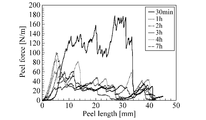
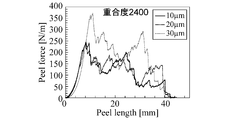
- the results of the peeling test of each sample prepared by changing the thickness of the CD film are shown in FIGS. 4 to 5.
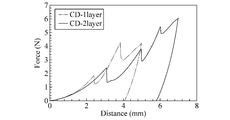
- the horizontal axis of the graph of FIG. 4 represents the peeling length (peeling distance), and the vertical axis represents the force required for peeling (peeling force). That is, the entire graph shows the change in peel strength with time.
- the numbers in the symbols such as "6 ⁇ m" and "10 ⁇ m" attached to FIGS. 4 to 5 represent the thickness of the CD film used when preparing the PVA gel precursor.
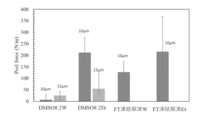
- the graph of FIG. 5 shows the relationship between the thickness of the CD film and the average peel strength (adhesive strength).
- the bar graph shows the average value of the peel strength, and the top and bottom of the whiskers show the maximum and minimum values of the peel strength. From the results of FIGS. 4 to 5, it was found that the peel strength became maximum when the thickness of the CD film interposed on the adhesive surface during the production of the PVA gel was 10 ⁇ m.
- the peel strength tended to decrease as the thickness of the CD film increased. Therefore, the thickness of the CD film was changed to 30 ⁇ m, 40 ⁇ m, 55 ⁇ m, and 70 ⁇ m to prepare a PVA gel in which FT gels were adhered to each other in the same manner as described above. As a result, when the thickness was 30 to 40 ⁇ m, the adhesive was firmly adhered, but when the thickness was 55 ⁇ m or more, a gap was observed in the adhesive layer, and the adhesive layer was easily peeled off by hand, and sufficient peel strength could not be obtained. ..
- the freeze-thaw method or the drying method can be applied to the bonding between FT gels or CD gels by physical cross-linking. There are four types of these combinations.
- the measurement results of the peel strength (adhesive strength) in which the FT gels adhered to each other by the freeze-thaw method shown in FIG. 5 are shown again in FIG. 6 for comparison.
- a peeling test was carried out with each combination of gels to create a peeling curve, and the result of obtaining the average peeling strength is shown in FIG. Error bars indicate data variability.
- FIG. 1 peel strength
- FT freeze-thaw is the result of adhering FT gels to each other by the freeze-thaw method
- FT drying is the result of adhering FT gels to each other by the drying method
- CD freeze-thaw is the result of adhering CD gels to each other. It is the result of adhering the CD gels to each other by the freeze-thaw method
- CD drying is the result of adhering the CD gels to each other by the drying method.
- the numbers such as “6 ⁇ m” and "10 ⁇ m” represent the thickness of the CD film used when preparing the PVA gel precursor.
- the bar graph of FIG. 6 represents the average value of the peel strength, and the top and bottom of the whiskers represent the maximum and minimum values of the peel strength.
- the PVA gel was immersed in ultrapure water for 1 day to elute the uncrosslinked PVA polymer in the PVA gel into water and swell in equilibrium to prepare a sample for the above-mentioned peeling test.
- the result of this peeling test is shown in FIG. 6 as "FT drying". From the results of FIG. 6, it is clear that the peel strength of the adhesive surface between the FT gels adhered by the drying method is sufficiently higher than that in the case of the freeze-thaw method. Further, it can be seen that the peel strength can be controlled by adjusting the thickness of the CD film.
- ⁇ Adhesion between CD gels freeze-drying method>
- the size of the CD film was the same as the adhesive surface.
- the PVA gel precursor is put into a freezer, frozen at -20 ° C for 7 hours, and thawed at 4 ° C for 7 hours.
- the free PVA existing on the adhesive surface was gelled to obtain a PVA gel to which two CD gels were adhered.
- the PVA gel was immersed in ultrapure water for 1 day to elute the uncrosslinked PVA polymer in the PVA gel into water and swell in equilibrium to prepare a sample for the above-mentioned peeling test.
- the results of this peeling test are shown in FIG. 6 as "CD freeze-thaw" with reference numerals of "10 ⁇ m" and "20 ⁇ m".
- the numerical value in the code represents the thickness of the CD film used when preparing the PVA gel precursor. From this result, in the PVA gel in which two CD gels were bonded by the freeze-thaw method, the peel strength of the bonded surface was higher than that in the case where the FT gels were bonded to each other by the freeze-thaw method.
- the PVA gel was immersed in ultrapure water for 1 day to elute the uncrosslinked PVA polymer in the PVA gel into water and swell in equilibrium to prepare a sample for the above-mentioned peeling test.
- the result of this peeling test is shown in FIG. 6 as "CD drying" with reference numerals of "10 ⁇ m” and "20 ⁇ m".
- the numbers in the reference numerals represent the thickness of the CD film used in the preparation of the PVA gel precursor. Since the peel strength has increased by an order of magnitude compared to others, the scale on the vertical axis has been changed. From the results shown in FIG. 6, in the PVA gel in which two CD gels were bonded by the drying method, the peel strength of the bonded surface was higher than that in the case where the FT gels were bonded to each other by the drying method.
- ⁇ Adhesion between FT gels Antifreeze crystallization method>
- the size of the CD film was the same as the adhesive surface.
- the PVA gel precursor sandwiched and fixed between two acrylic plates is immersed in 100 ml (25 ° C.) of a co-poor solvent for 24 hours. did.
- DMSO DMSO
- water 8: 2 (volume ratio).
- the free PVA existing on the adhesive surface was physically crosslinked to obtain a PVA gel to which two FT gels were adhered.
- the PVA gel was taken out from the co-poor solvent, and an attempt was made to manually peel off the adhesive surfaces of the two FT gels, but they were not easily peeled off, and it was confirmed that they were sufficiently adhered.
- a PVA gel (hereinafter referred to as a reinforced PVA gel) was obtained in which the adhesive layer formed by the above method was repeatedly reinforced by a freeze-thaw method.
- the reinforced PVA gel was immersed in ultrapure water for 1 day, and the uncrosslinked PVA polymer and DMSO in the PVA gel were eluted in water and equilibrium swelled to prepare a sample for the above-mentioned peeling test.
- the result of this peeling test is shown in the graph of FIG. 7 as "DMSO8: 2W” with reference numerals of "10 ⁇ m” and "15 ⁇ m".
- the numbers in the reference numerals represent the thickness of the CD film used in the preparation of the PVA gel precursor.
- FT freeze-thaw W in FIG. 7 has the same data as "10 ⁇ m” in FT freeze-thaw in FIGS. 4, 5 and 6, and two FT gels are freeze-dried by interposing a 10 ⁇ m CD film. It is the peeling strength data of the adhered PVA gel.
- “FT freeze-thaw Et” in FIG. 7 is peel strength data of the PVA gel treated as follows. The PVA gel was prepared by immersing the PVA gel prepared in the same manner as in the FT freeze-thaw “10 ⁇ m” of FIG. 4 in ethanol for 1 day, replacing the water in the PVA gel and the uncrosslinked PVA polymer with ethanol, and then replacing the PVA gel with ethanol. It was immersed in ultra-pure water for 1 day, the ethanol in the PVA gel was replaced with water, and equilibrium swelling was performed.
- the fortified PVA gel adhered by the freeze-thaw method following the non-freezing crystallization method is immersed in ethanol, the PVA gel is shrunk, and then the PVA gel is swollen with water to exfoliate the fortified PVA gel. It was found that the strength could be improved.
- the peel strength of this reinforced PVA gel was higher than that of the PVA gel adhered only by the freeze-thaw method without performing the antifreeze crystallization method.
- the peel strength was lower than that of the PVA gel adhered only by the freeze-thaw method.
- the GA-containing CD film interposed on the adhesive surface absorbed water from the FT gel, and free PVA and glutaraldehyde diffused from the GA-containing CD film to the adhesive surface and its surroundings.
- water and hydrochloric acid diffused from the HCl-containing FT gel to the adhesive surface and its surroundings.
- PVA existing on the adhesive surface and its surroundings was chemically crosslinked with glutaraldehyde to obtain a PVA gel in which the above HCl-containing FT gels adhered to each other.
- the thickness of the GA-containing CD film was 10 ⁇ m, a sufficient amount of glutaraldehyde was not present on the adhesive surface, and a thick adhesive layer could not be formed by chemical cross-linking.
- the PVA gel prepared by using the GA-containing CD films having a thickness of 20 ⁇ m and 30 ⁇ m was immersed in boiling water, the adhesive layer having a thickness of about 5 mm remained undissolved.
- a thin cloudy layer was present in the center of the adhesive layer, and transparent layers were observed on both sides of the cloudy layer.
- the cloudy layer is considered to be a layer derived from the GA-containing CD film (see FIG. 8).
- FT gel containing catalyst (i-2) A 15% by mass aqueous solution of PVA was poured into an acrylic pipe having an inner diameter of about 14 mm and sealed. This was put into a freezer, frozen at ⁇ 20 ° C. for 7 hours, and thawed at 4 ° C. for 7 hours, and gelation was repeated four times to obtain a cylindrical wet FT gel (FT4 gel). This FT gel is immersed in 0.1 M hydrochloric acid for 3 days to elute the uncrosslinked PVA polymer in the FT gel into water and impregnate with hydrochloric acid to obtain a cylindrical FT gel having a length of 65 mm and a diameter of 14 mm. It was.
- ⁇ Preparation of PVA gel (i-2)> The cylindrical FT gel obtained above was cut in half in the direction orthogonal to the longitudinal direction. A circular (14 mm in diameter) cut out GA-impregnated CD film having a thickness of 10 ⁇ m was sandwiched between one cut surface and the other cut surface to form an adhesive portion. Further, a GA-containing CD film having a thickness of 10 ⁇ m was wrapped around the side surface of the cylindrical FT gel at the bonded portion in a single layer to obtain a PVA gel precursor. The length of the CD film wound here was 10 mm in the longitudinal direction of the cylinder centered on the bonded portion. The PVA gel precursor obtained above was allowed to stand at room temperature (about 27 ° C.) for 24 hours.
- the GA-containing CD film interposed on the adhesive surface absorbed water from the FT gel, and free PVA and glutaraldehyde diffused from the GA-containing CD film to the adhesive surface and its surroundings.
- water and hydrochloric acid diffused from the FT gel to the adhesive surface and its surroundings.
- a gel precursor was obtained.
- the CD film was allowed to stand for several minutes to several hours until the CD film absorbed water from each gel sheet and diffused sufficiently into the gel, and at the same time, glutaraldehyde was uniformly dispersed between the two gels (adhesive surface).
- the PVA gel precursor was immersed in a solution containing a citric acid or HCl catalyst and allowed to stand at room temperature (about 27 ° C.) for 24 hours.
- the catalyst in the solution gradually diffused into the PVA gel precursor and reached between the two gels (adhesive surface).
- the free PVA derived from the CD film interposed in the surface layer near the adhesive interface between the adhesive surface and the gel reacts with the chemical cross-linking agent and chemically cross-links, thereby functioning as an adhesive.
- the CA-containing CD film interposed on the adhesive surface absorbed water from the FT gel, and free PVA and citric acid diffused from the CA-containing CD film to the surface layer near the adhesive interface between the adhesive surface and the gel.
- water and glutaraldehyde diffused from the GA-containing FT gel to the adhesive surface and its surroundings.
- PVA existing on the adhesive surface and its surroundings was chemically crosslinked with glutaraldehyde to obtain a PVA gel in which the GA-containing FT gels adhered to each other.
- the peel strength of the PVA gel obtained by changing the thickness of the CA-containing CD film used for the chemical cross-linking to 20 ⁇ m was even weaker, and it was easy to peel off the adhesive surface by hand.
- the GA concentration of this mixed solution is 0.05 M. 2 to 3 g of this mixed solution was poured into a polyethylene petri dish having an inner diameter of 85 mm and dried at 60 ° C. for 24 hours to obtain a CD film having a thickness of 20 or 30 ⁇ m (hereinafter referred to as GA-containing CD film).
- CD films (thickness: 10 ⁇ m, 20 ⁇ m, 30 ⁇ m) containing no chemical cross-linking agent and catalyst were prepared as described above.
- the CD film interposed on the adhesive surface absorbed water from each FT gel, and free PVA from the CD film diffused to the adhesive surface and its surroundings.
- water and glutaraldehyde diffused from the GA-containing FT gel to the adhesive surface and its surroundings, and water and hydrochloric acid diffused from the HCl-containing FT gel to the adhesive surface and its surroundings.
- PVA existing on the adhesive surface and its surroundings was chemically crosslinked with glutaraldehyde to obtain a PVA gel in which the FT gels adhered to each other.
- the peel strength due to chemical cross-linking is lower than the peel strength due to physical cross-linking. Further, it was found that when the thickness (10 ⁇ m, 20 ⁇ m or 30 ⁇ m) of the CD film used for the chemical cross-linking was changed, the change in the peel strength was small.
- the PVA multilayer gel precursor After each CD film absorbs water from the CD gel sheet and is allowed to stand for several minutes to several tens of minutes until it is sufficiently diffused into the gel, the PVA multilayer gel precursor is allowed to stand in a refrigerating room at 8 ° C. and 80% RH for 72 hours to dry. As a result, the free PVA existing on each adhesive surface was gelled to obtain a PVA multilayer gel to which 10 CD gel sheets were adhered.
- the PVA multilayer gel was immersed in ultrapure water for 1 day to elute the uncrosslinked PVA polymer in the PVA gel into water and swell in equilibrium. After that, a photograph of the cross section in the stacking direction was taken. The photograph is shown in FIG.
- a sheet of FT4 gel (thickness: 300 ⁇ m) cut into a circle with a diameter of 20 mm and a sheet of CD gel (thickness: 300 ⁇ m) with a diameter of 20 mm were prepared by the methods described above, and immersed in ultrapure water for equilibrium. Inflated. Moreover, a CD film (thickness: 10 ⁇ m) having a diameter of 20 mm was obtained by the above-mentioned method.
- the PVA multilayer gel precursor After each CD film absorbs water from each gel sheet and is allowed to stand for several minutes to several tens of minutes until it is sufficiently diffused into the gel, the PVA multilayer gel precursor is allowed to stand in a refrigerating room at 8 ° C. and 80% RH for 72 hours to dry. As a result, the free PVA existing on each adhesive surface was gelled to obtain a PVA multilayer gel in which the FT4 gel sheet and the CD gel sheet were adhered. The PVA multilayer gel was immersed in ultrapure water for 1 day to elute the uncrosslinked PVA polymer in the PVA gel into water and swell in equilibrium. After that, a photograph of the cross section in the stacking direction was taken. The photograph is shown in FIG.
- FIG. 14 shows a graph showing the relationship between the thickness of each test piece at the time of punching and its weight swelling ratio
- FIG. 15 shows a graph showing the relationship between the thickness at the time of punching and the polymer elution rate.
- "117" is data with an average degree of polymerization of PVA used of 1700
- "110” is data with an average degree of polymerization of PVA used of 1000
- "124” is data with an average degree of polymerization of PVA used.
- the degree is 2400 data.
- a CD film prepared using PVA having an average degree of polymerization of 2400 was dissolved when the thickness was less than 20 ⁇ m, and the film shape was not retained.
- CD films prepared using PVA with an average degree of polymerization of 1000 and 1700 melted when the thickness was less than 30 ⁇ m and did not retain the film shape. These are not plotted on the graph.
- FIG. 16 shows a graph showing the relationship between the thickness of each test piece at the time of punching and the weight swelling ratio
- FIG. 17 shows a graph showing the relationship between the thickness at the time of punching and the polymer elution rate.
- ⁇ Adhesion of PVA gel by physical cross-linking using CD film-Part 2 ⁇ ⁇ Adhesion between FT gels: Freezing and thawing method> Using two FT gels prepared above, the main surfaces of length x width 10 mm x 40 mm face each other, and between them, a CD film (thickness: 10 ⁇ m, PVA average degree of polymerization of material: 1700, drying conditions at the time of preparation) : 60 ° C., 50% RH) to obtain a PVA gel precursor. The size of the CD film was the same as the adhesive surface.
- the CD film interposed on the adhesive surface absorbs water from the FT gel, and the standing time at which at least a part of the dissolved PVA diffuses inside the gel is 30 minutes, 1 hour, 2 hours, 3 hours, 4 hours or 7
- the PVA gel precursor was placed in a temperature-controlled freezer, frozen at -20 ° C for 7 hours, and thawed at 4 ° C for 7 hours, repeating the cycle four times to free PVA present on the adhesive surface.
- the obtained 6 kinds of PVA gels were immersed in ultrapure water for 1 day, and the uncrosslinked PVA polymer in each PVA gel was eluted in water and equilibrium swelled to perform a peeling test.
- the peeling test method is as described above.
- FIGS. 18 to 19 The results of the peeling test of each sample prepared by changing the standing time for diffusing free PVA from the CD film are shown in FIGS. 18 to 19.
- the horizontal axis of the graph of FIG. 18 represents the peeling length (peeling distance), and the vertical axis represents the force required for peeling (peeling force). That is, the entire graph shows the change in peel strength with time.
- the graph of FIG. 19 shows the relationship between the standing time and the average peel strength (adhesive strength).
- the black circles in FIG. 19 represent the average value of the peel strength, and the top and bottom of the whiskers represent the maximum and minimum values of the peel strength. From the results of FIGS.
- the peel strength is further increased. It turned out. It was also understood that when the thickness of the CD film is thicker than 10 ⁇ m, the optimum standing time for increasing the peel strength becomes longer than 30 minutes.
- ⁇ Adhesion of PVA gel by physical cross-linking using CD film-Part 3 ⁇ ⁇ Adhesion between FT gels: Freezing and thawing method> Using two FT gels prepared above, the main surfaces of length x width 10 mm x 40 mm face each other, and various CD films (thickness: 10 ⁇ m, 20 ⁇ m, 30 ⁇ m or 40 ⁇ m, PVA average degree of polymerization of the material) are used between them.
- a PVA gel precursor was obtained by sandwiching any one of 1700, drying conditions at the time of preparation: 50% RH at 60 ° C., 50% RH at 40 ° C., or 50% RH at 20 ° C.).
- the size of the CD film was the same as the adhesive surface.
- the CD film interposed on the adhesive surface absorbs water from the FT gel, waits for a standing time of 30 minutes for at least a part of the dissolved PVA to diffuse inside the gel, and then puts the PVA gel precursor into a temperature-controlled freezer. Then, the cycle of freezing at -20 ° C for 7 hours and thawing at 4 ° C for 7 hours was repeated 4 times to gel the free PVA existing on the adhesive surface to obtain a PVA gel to which two FT gels were adhered. It was.
- the obtained 10 kinds of PVA gels were immersed in ultrapure water for 1 day, and the uncrosslinked PVA polymer in each PVA gel was eluted in water and equilibrium swelled to perform a peeling test.
- the peeling test method is as described above.
- Figures 20 to 23 show the results of the peeling test of each sample prepared by changing the drying conditions at the time of producing the CD film and the thickness of the CD film.
- the graphs of FIGS. 20 to 22 show changes in peel strength over time.
- the graph of FIG. 23 shows the peel strength of the sample using each CD film.
- the black circles in the graph represent the average value of the peel strength, and the top and bottom of the whiskers represent the maximum and minimum values of the peel strength. From these results, it was found that the preferable drying temperature at the time of production changes depending on the thickness of the CD film. That is, when the thickness of a CD film having an average degree of polymerization of 1700 is 20 ⁇ m or more, the lower the drying temperature at the time of producing the CD film, the higher the peel strength tends to be. On the other hand, when the thickness of the CD film having an average degree of polymerization of 1700 is less than 20 ⁇ m, the higher the drying temperature at the time of producing the CD film, the higher the peel strength tends to be.
- ⁇ Adhesion of PVA gel by physical cross-linking using CD film-Part 4 ⁇ ⁇ Adhesion between FT gels: Freezing and thawing method> Using two FT gels prepared above, the main surfaces of length x width 10 mm x 40 mm face each other, and various CD films (thickness: 10 ⁇ m, 20 ⁇ m, 30 ⁇ m or 40 ⁇ m, PVA average degree of polymerization of the material) are used between them.
- a PVA gel precursor was obtained by sandwiching any one of (1000, 1700 or 2400, drying conditions at the time of preparation: 50% RH at 60 ° C.). The size of the CD film was the same as the adhesive surface.
- the CD film interposed on the adhesive surface absorbs water from the FT gel, waits for a standing time of 30 minutes for at least a part of the dissolved PVA to diffuse inside the gel, and then puts the PVA gel precursor into a temperature-controlled freezer. Then, the cycle of freezing at -20 ° C for 7 hours and thawing at 4 ° C for 7 hours was repeated 4 times to gel the free PVA existing on the adhesive surface to obtain a PVA gel to which two FT gels were adhered. It was.
- the obtained 10 kinds of PVA gels were immersed in ultrapure water for 1 day, and the uncrosslinked PVA polymer in each PVA gel was eluted in water and equilibrium swelled to perform a peeling test.
- the peeling test method is as described above.
- FIGS. 24 to 27 The results of the peeling test of each sample prepared by changing the average degree of polymerization of PVA used for producing the CD film and the thickness of the CD film are shown in FIGS. 24 to 27.
- the graphs of FIGS. 24 to 26 show the change over time in the peel strength.
- the graph of FIG. 27 shows the peel strength of the sample using each CD film.
- the black circles in the graph represent the average value of the peel strength, and the top and bottom of the whiskers represent the maximum and minimum values of the peel strength. From these results, it was found that the larger the average degree of polymerization of the PVA that produced the CD film, the higher the peel strength, regardless of the thickness of the CD film.
- ⁇ Adhesion of PVA gel by physical cross-linking using CD film-Part 5 ⁇ ⁇ Adhesion between FT gels: Freezing and thawing method> Using two FT gels prepared above, the main surfaces of length x width 10 mm x 40 mm face each other, and various CD films (thickness: 10 ⁇ m, 20 ⁇ m, 30 ⁇ m or 40 ⁇ m, PVA average degree of polymerization of the material) are used between them.
- a PVA gel precursor was obtained by sandwiching any one of (2400, drying conditions at the time of preparation: 50% RH at 20 ° C.). The size of the CD film was the same as the adhesive surface.
- the CD film interposed on the adhesive surface absorbs water from the FT gel, waits for a standing time of 30 minutes for at least a part of the dissolved PVA to diffuse inside the gel, and then puts the PVA gel precursor into a temperature-controlled freezer. Then, the cycle of freezing at -20 ° C for 7 hours and thawing at 4 ° C for 7 hours was repeated 4 times to gel the free PVA existing on the adhesive surface to obtain a PVA gel to which two FT gels were adhered. It was.
- the obtained four types of PVA gels were immersed in ultrapure water for one day, and the uncrosslinked PVA polymer in each PVA gel was eluted in water and equilibrium swelled to perform a peeling test.
- the peeling test method is as described above.
- Figures 28 to 29 show the results of the peeling test of each sample prepared by changing the drying conditions at the time of producing the CD film and the thickness of the CD film.
- the graph of FIG. 28 shows the change over time in the peel strength.
- the black circles in the graph of FIG. 29 represent the average value of the peel strength, and the top and bottom of the whiskers represent the maximum and minimum values of the peel strength.
- the data of the peel strength of the sample using the CD film having the PVA average degree of polymerization of 2400 (drying condition: 50% RH at 60 ° C.) of FIG. 27 is also shown. From these results, it was found that when a CD film using PVA having an average degree of polymerization of 2400 is produced, the peel strength tends to increase as the film is dried at a low temperature.
- a CD film having the same area as the adhesive surface obtained by the above method (average degree of polymerization of PVA 1700, drying condition: 50% RH at 60 ° C., thickness: 10 ⁇ m) was applied to the adhesive surface between the CD gel sheets. I sandwiched it. As a result, a PVA multilayer gel precursor in which CD gel sheets and CD films were alternately laminated was obtained.
- the PVA multilayer gel precursor After each CD film absorbs water from the CD gel sheet and is allowed to stand for several minutes to several tens of minutes until it is sufficiently diffused into the gel, the PVA multilayer gel precursor is allowed to stand in a refrigerating room at 8 ° C. and 80% RH for 72 hours to dry. As a result, the free PVA existing on each adhesive surface was gelled to obtain a PVA multilayer gel to which 6 CD gel sheets were adhered. The PVA multilayer gel was immersed in ultrapure water for 1 day to elute the uncrosslinked PVA polymer in the PVA gel into water and swell in equilibrium. Using the PVA multilayer gel (stacked with 6 CD gel sheets) obtained here as a sample, a piercing test described later was performed.
- the PVA multilayer gel precursor After each CD film absorbs water from each gel sheet and is allowed to stand for several minutes to several tens of minutes until it is sufficiently diffused into the gel, the PVA multilayer gel precursor is allowed to stand in a refrigerating room at 8 ° C. and 80% RH for 72 hours to dry. As a result, the free PVA existing on each adhesive surface was gelled to obtain a PVA multilayer gel in which the FT4 gel sheet and the CD gel sheet were adhered. The PVA multilayer gel was immersed in ultrapure water for 1 day to elute the uncrosslinked PVA polymer in the PVA gel into water and swell in equilibrium. Using the PVA multilayer gel obtained here (three CD gel sheets and three FT4 gel sheets were alternately laminated) as a sample, a piercing test described later was performed.
- a PVA multilayer gel which is a sample, is placed on a flat plate of PDMS (polydimethylsiloxane rubber), and this is attached to the sample table of a testing machine texture analyzer (model number: TA.XTPlus) manufactured by Eiko Seiki Co., Ltd.
- a needle needle probe, model number: P / 2N was pierced perpendicularly to the CD gel sheet forming the surface of the PVA multilayer gel at a speed of 0.5 mm / s, and the change in piercing strength (unit: N) was measured. ..
- the needle used was a conical needle with a tip angle of 12.80 ° when viewed from the direction perpendicular to the length direction, cut perpendicular to the length direction, and the length of the cross section thereof.
- the (diameter) is 257.12 ⁇ m.
- FIGS. 30 to 32 The results of the piercing test are shown in FIGS. 30 to 32.
- 30 and 31 show the piercing distance from the surface of the needle tip when one or two FT gels or CD gels used as reference samples are simply superposed (without intervening PVA solution or CD film). It is the result of the piercing strength against.
- FIG. 30 in the case of one FT gel, two peaks were shown as the piercing distance increased. This is what appears when it breaks through the top and bottom surfaces of the gel. After that, the piercing force increased sharply, a peak appeared when it pierced the upper surface of the PDMS flat plate, and after pushing the needle a little further, it was pulled back at the same speed in the opposite direction to the piercing direction.
- the measurement was terminated when the piercing force and the pulling force of the needle were balanced and became zero.
- the changes associated with the piercing of the PDMS flat plate after completely breaking through the gel showed the same behavior in FIGS. 31 and 32.
- the CD gel of FIG. 31 showed one peak per sheet. This appeared when the upper surface and the lower surface of the CD gel were pierced at the same time.
- the fact that the number of peaks of the FT gel is larger than that of the CD gel is due to the non-uniform network structure of the FT gel.
- the breakthrough in each layer was observed as a peak.
- the PVA multilayer gel of the present invention can also be used as a material for surgical practice (simulated liver or the like) that imitates the human liver.
Landscapes
- Chemical & Material Sciences (AREA)
- Engineering & Computer Science (AREA)
- Manufacturing & Machinery (AREA)
- Materials Engineering (AREA)
- Health & Medical Sciences (AREA)
- Chemical Kinetics & Catalysis (AREA)
- Medicinal Chemistry (AREA)
- Polymers & Plastics (AREA)
- Organic Chemistry (AREA)
- Moulding By Coating Moulds (AREA)
Priority Applications (1)
| Application Number | Priority Date | Filing Date | Title |
|---|---|---|---|
| JP2021553479A JPWO2021079895A1 (https=) | 2019-10-23 | 2020-10-21 |
Applications Claiming Priority (2)
| Application Number | Priority Date | Filing Date | Title |
|---|---|---|---|
| JP2019-192377 | 2019-10-23 | ||
| JP2019192377 | 2019-10-23 |
Publications (1)
| Publication Number | Publication Date |
|---|---|
| WO2021079895A1 true WO2021079895A1 (ja) | 2021-04-29 |
Family
ID=75620046
Family Applications (1)
| Application Number | Title | Priority Date | Filing Date |
|---|---|---|---|
| PCT/JP2020/039484 Ceased WO2021079895A1 (ja) | 2019-10-23 | 2020-10-21 | キャストドライフィルム及びその製造方法、pvaゲルの製造方法、並びに、pva多層ゲル及びその製造方法 |
Country Status (2)
| Country | Link |
|---|---|
| JP (1) | JPWO2021079895A1 (https=) |
| WO (1) | WO2021079895A1 (https=) |
Cited By (1)
| Publication number | Priority date | Publication date | Assignee | Title |
|---|---|---|---|---|
| JP7653101B2 (ja) | 2021-10-14 | 2025-03-28 | 日本電信電話株式会社 | ゲル-ゲル複合体、アクチュエータ、ゲル-ゲル複合体の製造方法 |
Citations (4)
| Publication number | Priority date | Publication date | Assignee | Title |
|---|---|---|---|---|
| JP2005521809A (ja) * | 2001-10-29 | 2005-07-21 | ナノシステムズ・リサーチ・インコーポレーテッド | 架橋ポリビニルアルコールヒドロゲル構造物としての強化材料、積層材料、含浸材料および複合材料様材料 |
| JP2008531769A (ja) * | 2005-02-23 | 2008-08-14 | ズィマー・テクノロジー・インコーポレーテッド | ブレンドヒドロゲルおよびその製造方法 |
| JP2015004059A (ja) * | 2013-05-24 | 2015-01-08 | 国立大学法人横浜国立大学 | Pvaハイドロゲルの製造方法およびpvaハイドロゲル積層体の製造方法 |
| WO2018062030A1 (ja) * | 2016-09-30 | 2018-04-05 | 積水化成品工業株式会社 | ハイドロゲル |
-
2020
- 2020-10-21 JP JP2021553479A patent/JPWO2021079895A1/ja active Pending
- 2020-10-21 WO PCT/JP2020/039484 patent/WO2021079895A1/ja not_active Ceased
Patent Citations (4)
| Publication number | Priority date | Publication date | Assignee | Title |
|---|---|---|---|---|
| JP2005521809A (ja) * | 2001-10-29 | 2005-07-21 | ナノシステムズ・リサーチ・インコーポレーテッド | 架橋ポリビニルアルコールヒドロゲル構造物としての強化材料、積層材料、含浸材料および複合材料様材料 |
| JP2008531769A (ja) * | 2005-02-23 | 2008-08-14 | ズィマー・テクノロジー・インコーポレーテッド | ブレンドヒドロゲルおよびその製造方法 |
| JP2015004059A (ja) * | 2013-05-24 | 2015-01-08 | 国立大学法人横浜国立大学 | Pvaハイドロゲルの製造方法およびpvaハイドロゲル積層体の製造方法 |
| WO2018062030A1 (ja) * | 2016-09-30 | 2018-04-05 | 積水化成品工業株式会社 | ハイドロゲル |
Cited By (1)
| Publication number | Priority date | Publication date | Assignee | Title |
|---|---|---|---|---|
| JP7653101B2 (ja) | 2021-10-14 | 2025-03-28 | 日本電信電話株式会社 | ゲル-ゲル複合体、アクチュエータ、ゲル-ゲル複合体の製造方法 |
Also Published As
| Publication number | Publication date |
|---|---|
| JPWO2021079895A1 (https=) | 2021-04-29 |
Similar Documents
| Publication | Publication Date | Title |
|---|---|---|
| JP4989843B2 (ja) | 非対称性ゲル充填微多孔質膜 | |
| US5104729A (en) | Process for surface modifying a support membrane and product produced | |
| CN112266502B (zh) | 一种多重响应纳米纤维素复合膜及其制备方法 | |
| TW200923446A (en) | Polarizing plate, optical film and image display device | |
| JP2015004059A (ja) | Pvaハイドロゲルの製造方法およびpvaハイドロゲル積層体の製造方法 | |
| JP2006221140A (ja) | 位相差フィルム及びその製造方法、光学機能フィルム、偏光フィルム、並びに表示装置 | |
| CN103512784B (zh) | 植物组织切片的制作方法、植物组织切片及其应用 | |
| CN107469650B (zh) | 一种疏水大孔聚酰亚胺纳米纤维正渗透膜的制备方法 | |
| US3428584A (en) | Freeze-dried membrane and method of treating same | |
| JP2016124955A (ja) | ゲル、乾燥ゲルおよびその製造方法 | |
| WO2021079895A1 (ja) | キャストドライフィルム及びその製造方法、pvaゲルの製造方法、並びに、pva多層ゲル及びその製造方法 | |
| Pochivalov et al. | Analysis of the thermal behavior of polypropylene–camphor mixtures for understanding the pathways to polymeric membranes via thermally induced phase separation | |
| JP4883049B2 (ja) | 位相差フィルムおよびその製造方法、光学機能フィルム、偏光フィルム、並びに、表示装置 | |
| JP5103630B2 (ja) | 液晶構造を有するゲルの製造方法及びこの方法で製造された液晶構造を有するゲル | |
| JPWO2018038028A1 (ja) | 偏光板 | |
| Huang et al. | Preparation of a composite hydrogel of polyvinyl alcohol/chitosan fiber with anisotropic properties for sustained drug release | |
| Papancea et al. | Diffusion and sorption studies of dyes through PVA cryogel membranes | |
| JP2012016887A (ja) | 平板状pvaハイドロゲル積層体の製造方法、及び平板状pvaハイドロゲル積層体 | |
| JP4604202B2 (ja) | 液晶構造を有するゲル及びその製造方法 | |
| JP2006221134A (ja) | 位相差フィルムおよびその製造方法、光学機能フィルム、偏光フィルム、並びに、表示装置 | |
| JP2021102282A (ja) | Pvaゲルの製造方法 | |
| JP2009270041A (ja) | ポリビニルアルコール水溶液の製造方法 | |
| CN115260531B (zh) | 一种可自卷曲双层水凝胶片的制备方法 | |
| WO2019151272A1 (ja) | 親水性多孔質膜の製造方法 | |
| JP6432860B2 (ja) | ハイブリッドゲルの製造方法 |
Legal Events
| Date | Code | Title | Description |
|---|---|---|---|
| 121 | Ep: the epo has been informed by wipo that ep was designated in this application |
Ref document number: 20880016 Country of ref document: EP Kind code of ref document: A1 |
|
| ENP | Entry into the national phase |
Ref document number: 2021553479 Country of ref document: JP Kind code of ref document: A |
|
| NENP | Non-entry into the national phase |
Ref country code: DE |
|
| 122 | Ep: pct application non-entry in european phase |
Ref document number: 20880016 Country of ref document: EP Kind code of ref document: A1 |