WO2021065682A1 - 捺染用インクセット及び捺染方法 - Google Patents
捺染用インクセット及び捺染方法 Download PDFInfo
- Publication number
- WO2021065682A1 WO2021065682A1 PCT/JP2020/036091 JP2020036091W WO2021065682A1 WO 2021065682 A1 WO2021065682 A1 WO 2021065682A1 JP 2020036091 W JP2020036091 W JP 2020036091W WO 2021065682 A1 WO2021065682 A1 WO 2021065682A1
- Authority
- WO
- WIPO (PCT)
- Prior art keywords
- group
- pretreatment liquid
- mass
- printing
- water
- Prior art date
- Legal status (The legal status is an assumption and is not a legal conclusion. Google has not performed a legal analysis and makes no representation as to the accuracy of the status listed.)
- Ceased
Links
Images

Classifications
-
- C—CHEMISTRY; METALLURGY
- C09—DYES; PAINTS; POLISHES; NATURAL RESINS; ADHESIVES; COMPOSITIONS NOT OTHERWISE PROVIDED FOR; APPLICATIONS OF MATERIALS NOT OTHERWISE PROVIDED FOR
- C09D—COATING COMPOSITIONS, e.g. PAINTS, VARNISHES OR LACQUERS; FILLING PASTES; CHEMICAL PAINT OR INK REMOVERS; INKS; CORRECTING FLUIDS; WOODSTAINS; PASTES OR SOLIDS FOR COLOURING OR PRINTING; USE OF MATERIALS THEREFOR
- C09D11/00—Inks
- C09D11/54—Inks based on two liquids, one liquid being the ink, the other liquid being a reaction solution, a fixer or a treatment solution for the ink
-
- B—PERFORMING OPERATIONS; TRANSPORTING
- B41—PRINTING; LINING MACHINES; TYPEWRITERS; STAMPS
- B41M—PRINTING, DUPLICATING, MARKING, OR COPYING PROCESSES; COLOUR PRINTING
- B41M5/00—Duplicating or marking methods; Sheet materials for use therein
- B41M5/0023—Digital printing methods characterised by the inks used
-
- C—CHEMISTRY; METALLURGY
- C09—DYES; PAINTS; POLISHES; NATURAL RESINS; ADHESIVES; COMPOSITIONS NOT OTHERWISE PROVIDED FOR; APPLICATIONS OF MATERIALS NOT OTHERWISE PROVIDED FOR
- C09D—COATING COMPOSITIONS, e.g. PAINTS, VARNISHES OR LACQUERS; FILLING PASTES; CHEMICAL PAINT OR INK REMOVERS; INKS; CORRECTING FLUIDS; WOODSTAINS; PASTES OR SOLIDS FOR COLOURING OR PRINTING; USE OF MATERIALS THEREFOR
- C09D11/00—Inks
- C09D11/02—Printing inks
- C09D11/03—Printing inks characterised by features other than the chemical nature of the binder
- C09D11/033—Printing inks characterised by features other than the chemical nature of the binder characterised by the solvent
-
- C—CHEMISTRY; METALLURGY
- C09—DYES; PAINTS; POLISHES; NATURAL RESINS; ADHESIVES; COMPOSITIONS NOT OTHERWISE PROVIDED FOR; APPLICATIONS OF MATERIALS NOT OTHERWISE PROVIDED FOR
- C09D—COATING COMPOSITIONS, e.g. PAINTS, VARNISHES OR LACQUERS; FILLING PASTES; CHEMICAL PAINT OR INK REMOVERS; INKS; CORRECTING FLUIDS; WOODSTAINS; PASTES OR SOLIDS FOR COLOURING OR PRINTING; USE OF MATERIALS THEREFOR
- C09D11/00—Inks
- C09D11/02—Printing inks
- C09D11/03—Printing inks characterised by features other than the chemical nature of the binder
- C09D11/037—Printing inks characterised by features other than the chemical nature of the binder characterised by the pigment
-
- C—CHEMISTRY; METALLURGY
- C09—DYES; PAINTS; POLISHES; NATURAL RESINS; ADHESIVES; COMPOSITIONS NOT OTHERWISE PROVIDED FOR; APPLICATIONS OF MATERIALS NOT OTHERWISE PROVIDED FOR
- C09D—COATING COMPOSITIONS, e.g. PAINTS, VARNISHES OR LACQUERS; FILLING PASTES; CHEMICAL PAINT OR INK REMOVERS; INKS; CORRECTING FLUIDS; WOODSTAINS; PASTES OR SOLIDS FOR COLOURING OR PRINTING; USE OF MATERIALS THEREFOR
- C09D11/00—Inks
- C09D11/02—Printing inks
- C09D11/10—Printing inks based on artificial resins
- C09D11/102—Printing inks based on artificial resins containing macromolecular compounds obtained by reactions other than those only involving unsaturated carbon-to-carbon bonds
-
- C—CHEMISTRY; METALLURGY
- C09—DYES; PAINTS; POLISHES; NATURAL RESINS; ADHESIVES; COMPOSITIONS NOT OTHERWISE PROVIDED FOR; APPLICATIONS OF MATERIALS NOT OTHERWISE PROVIDED FOR
- C09D—COATING COMPOSITIONS, e.g. PAINTS, VARNISHES OR LACQUERS; FILLING PASTES; CHEMICAL PAINT OR INK REMOVERS; INKS; CORRECTING FLUIDS; WOODSTAINS; PASTES OR SOLIDS FOR COLOURING OR PRINTING; USE OF MATERIALS THEREFOR
- C09D11/00—Inks
- C09D11/02—Printing inks
- C09D11/10—Printing inks based on artificial resins
- C09D11/106—Printing inks based on artificial resins containing macromolecular compounds obtained by reactions only involving carbon-to-carbon unsaturated bonds
-
- C—CHEMISTRY; METALLURGY
- C09—DYES; PAINTS; POLISHES; NATURAL RESINS; ADHESIVES; COMPOSITIONS NOT OTHERWISE PROVIDED FOR; APPLICATIONS OF MATERIALS NOT OTHERWISE PROVIDED FOR
- C09D—COATING COMPOSITIONS, e.g. PAINTS, VARNISHES OR LACQUERS; FILLING PASTES; CHEMICAL PAINT OR INK REMOVERS; INKS; CORRECTING FLUIDS; WOODSTAINS; PASTES OR SOLIDS FOR COLOURING OR PRINTING; USE OF MATERIALS THEREFOR
- C09D11/00—Inks
- C09D11/30—Inkjet printing inks
- C09D11/32—Inkjet printing inks characterised by colouring agents
- C09D11/328—Inkjet printing inks characterised by colouring agents characterised by dyes
-
- C—CHEMISTRY; METALLURGY
- C09—DYES; PAINTS; POLISHES; NATURAL RESINS; ADHESIVES; COMPOSITIONS NOT OTHERWISE PROVIDED FOR; APPLICATIONS OF MATERIALS NOT OTHERWISE PROVIDED FOR
- C09D—COATING COMPOSITIONS, e.g. PAINTS, VARNISHES OR LACQUERS; FILLING PASTES; CHEMICAL PAINT OR INK REMOVERS; INKS; CORRECTING FLUIDS; WOODSTAINS; PASTES OR SOLIDS FOR COLOURING OR PRINTING; USE OF MATERIALS THEREFOR
- C09D11/00—Inks
- C09D11/30—Inkjet printing inks
- C09D11/40—Ink-sets specially adapted for multi-colour inkjet printing
-
- D—TEXTILES; PAPER
- D06—TREATMENT OF TEXTILES OR THE LIKE; LAUNDERING; FLEXIBLE MATERIALS NOT OTHERWISE PROVIDED FOR
- D06P—DYEING OR PRINTING TEXTILES; DYEING LEATHER, FURS OR SOLID MACROMOLECULAR SUBSTANCES IN ANY FORM
- D06P1/00—General processes of dyeing or printing textiles, or general processes of dyeing leather, furs, or solid macromolecular substances in any form, classified according to the dyes, pigments, or auxiliary substances employed
- D06P1/44—General processes of dyeing or printing textiles, or general processes of dyeing leather, furs, or solid macromolecular substances in any form, classified according to the dyes, pigments, or auxiliary substances employed using insoluble pigments or auxiliary substances, e.g. binders
- D06P1/52—General processes of dyeing or printing textiles, or general processes of dyeing leather, furs, or solid macromolecular substances in any form, classified according to the dyes, pigments, or auxiliary substances employed using insoluble pigments or auxiliary substances, e.g. binders using compositions containing synthetic macromolecular substances
- D06P1/5207—Macromolecular compounds obtained by reactions involving only carbon-to-carbon unsaturated bonds
- D06P1/5214—Polymers of unsaturated compounds containing no COOH groups or functional derivatives thereof
- D06P1/5242—Polymers of unsaturated N-containing compounds
-
- D—TEXTILES; PAPER
- D06—TREATMENT OF TEXTILES OR THE LIKE; LAUNDERING; FLEXIBLE MATERIALS NOT OTHERWISE PROVIDED FOR
- D06P—DYEING OR PRINTING TEXTILES; DYEING LEATHER, FURS OR SOLID MACROMOLECULAR SUBSTANCES IN ANY FORM
- D06P1/00—General processes of dyeing or printing textiles, or general processes of dyeing leather, furs, or solid macromolecular substances in any form, classified according to the dyes, pigments, or auxiliary substances employed
- D06P1/44—General processes of dyeing or printing textiles, or general processes of dyeing leather, furs, or solid macromolecular substances in any form, classified according to the dyes, pigments, or auxiliary substances employed using insoluble pigments or auxiliary substances, e.g. binders
- D06P1/52—General processes of dyeing or printing textiles, or general processes of dyeing leather, furs, or solid macromolecular substances in any form, classified according to the dyes, pigments, or auxiliary substances employed using insoluble pigments or auxiliary substances, e.g. binders using compositions containing synthetic macromolecular substances
- D06P1/5264—Macromolecular compounds obtained otherwise than by reactions involving only unsaturated carbon-to-carbon bonds
- D06P1/5285—Polyurethanes; Polyurea; Polyguanides
-
- D—TEXTILES; PAPER
- D06—TREATMENT OF TEXTILES OR THE LIKE; LAUNDERING; FLEXIBLE MATERIALS NOT OTHERWISE PROVIDED FOR
- D06P—DYEING OR PRINTING TEXTILES; DYEING LEATHER, FURS OR SOLID MACROMOLECULAR SUBSTANCES IN ANY FORM
- D06P1/00—General processes of dyeing or printing textiles, or general processes of dyeing leather, furs, or solid macromolecular substances in any form, classified according to the dyes, pigments, or auxiliary substances employed
- D06P1/44—General processes of dyeing or printing textiles, or general processes of dyeing leather, furs, or solid macromolecular substances in any form, classified according to the dyes, pigments, or auxiliary substances employed using insoluble pigments or auxiliary substances, e.g. binders
- D06P1/52—General processes of dyeing or printing textiles, or general processes of dyeing leather, furs, or solid macromolecular substances in any form, classified according to the dyes, pigments, or auxiliary substances employed using insoluble pigments or auxiliary substances, e.g. binders using compositions containing synthetic macromolecular substances
- D06P1/56—Condensation products or precondensation products prepared with aldehydes
-
- D—TEXTILES; PAPER
- D06—TREATMENT OF TEXTILES OR THE LIKE; LAUNDERING; FLEXIBLE MATERIALS NOT OTHERWISE PROVIDED FOR
- D06P—DYEING OR PRINTING TEXTILES; DYEING LEATHER, FURS OR SOLID MACROMOLECULAR SUBSTANCES IN ANY FORM
- D06P3/00—Special processes of dyeing or printing textiles, or dyeing leather, furs, or solid macromolecular substances in any form, classified according to the material treated
- D06P3/58—Material containing hydroxyl groups
- D06P3/60—Natural or regenerated cellulose
-
- D—TEXTILES; PAPER
- D06—TREATMENT OF TEXTILES OR THE LIKE; LAUNDERING; FLEXIBLE MATERIALS NOT OTHERWISE PROVIDED FOR
- D06P—DYEING OR PRINTING TEXTILES; DYEING LEATHER, FURS OR SOLID MACROMOLECULAR SUBSTANCES IN ANY FORM
- D06P3/00—Special processes of dyeing or printing textiles, or dyeing leather, furs, or solid macromolecular substances in any form, classified according to the material treated
- D06P3/58—Material containing hydroxyl groups
- D06P3/60—Natural or regenerated cellulose
- D06P3/6025—Natural or regenerated cellulose using vat or sulfur dyes
-
- D—TEXTILES; PAPER
- D06—TREATMENT OF TEXTILES OR THE LIKE; LAUNDERING; FLEXIBLE MATERIALS NOT OTHERWISE PROVIDED FOR
- D06P—DYEING OR PRINTING TEXTILES; DYEING LEATHER, FURS OR SOLID MACROMOLECULAR SUBSTANCES IN ANY FORM
- D06P3/00—Special processes of dyeing or printing textiles, or dyeing leather, furs, or solid macromolecular substances in any form, classified according to the material treated
- D06P3/58—Material containing hydroxyl groups
- D06P3/60—Natural or regenerated cellulose
- D06P3/6033—Natural or regenerated cellulose using dispersed dyes
-
- D—TEXTILES; PAPER
- D06—TREATMENT OF TEXTILES OR THE LIKE; LAUNDERING; FLEXIBLE MATERIALS NOT OTHERWISE PROVIDED FOR
- D06P—DYEING OR PRINTING TEXTILES; DYEING LEATHER, FURS OR SOLID MACROMOLECULAR SUBSTANCES IN ANY FORM
- D06P5/00—Other features in dyeing or printing textiles, or dyeing leather, furs, or solid macromolecular substances in any form
- D06P5/002—Locally enhancing dye affinity of a textile material by chemical means
-
- D—TEXTILES; PAPER
- D06—TREATMENT OF TEXTILES OR THE LIKE; LAUNDERING; FLEXIBLE MATERIALS NOT OTHERWISE PROVIDED FOR
- D06P—DYEING OR PRINTING TEXTILES; DYEING LEATHER, FURS OR SOLID MACROMOLECULAR SUBSTANCES IN ANY FORM
- D06P5/00—Other features in dyeing or printing textiles, or dyeing leather, furs, or solid macromolecular substances in any form
- D06P5/22—Effecting variation of dye affinity on textile material by chemical means that react with the fibre
- D06P5/225—Aminalization of cellulose; introducing aminogroups into cellulose
-
- D—TEXTILES; PAPER
- D06—TREATMENT OF TEXTILES OR THE LIKE; LAUNDERING; FLEXIBLE MATERIALS NOT OTHERWISE PROVIDED FOR
- D06P—DYEING OR PRINTING TEXTILES; DYEING LEATHER, FURS OR SOLID MACROMOLECULAR SUBSTANCES IN ANY FORM
- D06P5/00—Other features in dyeing or printing textiles, or dyeing leather, furs, or solid macromolecular substances in any form
- D06P5/30—Ink jet printing
-
- B—PERFORMING OPERATIONS; TRANSPORTING
- B41—PRINTING; LINING MACHINES; TYPEWRITERS; STAMPS
- B41J—TYPEWRITERS; SELECTIVE PRINTING MECHANISMS, i.e. MECHANISMS PRINTING OTHERWISE THAN FROM A FORME; CORRECTION OF TYPOGRAPHICAL ERRORS
- B41J3/00—Typewriters or selective printing or marking mechanisms characterised by the purpose for which they are constructed
- B41J3/407—Typewriters or selective printing or marking mechanisms characterised by the purpose for which they are constructed for marking on special material
- B41J3/4078—Printing on textile
-
- B—PERFORMING OPERATIONS; TRANSPORTING
- B41—PRINTING; LINING MACHINES; TYPEWRITERS; STAMPS
- B41M—PRINTING, DUPLICATING, MARKING, OR COPYING PROCESSES; COLOUR PRINTING
- B41M5/00—Duplicating or marking methods; Sheet materials for use therein
- B41M5/0011—Pre-treatment or treatment during printing of the recording material, e.g. heating, irradiating
- B41M5/0017—Application of ink-fixing material, e.g. mordant, precipitating agent, on the substrate prior to printing, e.g. by ink-jet printing, coating or spraying
-
- B—PERFORMING OPERATIONS; TRANSPORTING
- B41—PRINTING; LINING MACHINES; TYPEWRITERS; STAMPS
- B41M—PRINTING, DUPLICATING, MARKING, OR COPYING PROCESSES; COLOUR PRINTING
- B41M5/00—Duplicating or marking methods; Sheet materials for use therein
- B41M5/0041—Digital printing on surfaces other than ordinary paper
- B41M5/0047—Digital printing on surfaces other than ordinary paper by ink-jet printing
-
- B—PERFORMING OPERATIONS; TRANSPORTING
- B41—PRINTING; LINING MACHINES; TYPEWRITERS; STAMPS
- B41M—PRINTING, DUPLICATING, MARKING, OR COPYING PROCESSES; COLOUR PRINTING
- B41M5/00—Duplicating or marking methods; Sheet materials for use therein
- B41M5/0041—Digital printing on surfaces other than ordinary paper
- B41M5/0064—Digital printing on surfaces other than ordinary paper on plastics, horn, rubber, or other organic polymers
-
- D—TEXTILES; PAPER
- D06—TREATMENT OF TEXTILES OR THE LIKE; LAUNDERING; FLEXIBLE MATERIALS NOT OTHERWISE PROVIDED FOR
- D06P—DYEING OR PRINTING TEXTILES; DYEING LEATHER, FURS OR SOLID MACROMOLECULAR SUBSTANCES IN ANY FORM
- D06P1/00—General processes of dyeing or printing textiles, or general processes of dyeing leather, furs, or solid macromolecular substances in any form, classified according to the dyes, pigments, or auxiliary substances employed
- D06P1/16—General processes of dyeing or printing textiles, or general processes of dyeing leather, furs, or solid macromolecular substances in any form, classified according to the dyes, pigments, or auxiliary substances employed using dispersed, e.g. acetate, dyestuffs
-
- D—TEXTILES; PAPER
- D06—TREATMENT OF TEXTILES OR THE LIKE; LAUNDERING; FLEXIBLE MATERIALS NOT OTHERWISE PROVIDED FOR
- D06P—DYEING OR PRINTING TEXTILES; DYEING LEATHER, FURS OR SOLID MACROMOLECULAR SUBSTANCES IN ANY FORM
- D06P1/00—General processes of dyeing or printing textiles, or general processes of dyeing leather, furs, or solid macromolecular substances in any form, classified according to the dyes, pigments, or auxiliary substances employed
- D06P1/22—General processes of dyeing or printing textiles, or general processes of dyeing leather, furs, or solid macromolecular substances in any form, classified according to the dyes, pigments, or auxiliary substances employed using vat dyestuffs including indigo
Definitions
- This disclosure relates to a printing ink set and a printing method.
- a method of applying the pretreatment liquid to the fabric in advance is disclosed.
- International Publication No. 2019/004327 contains water, an aqueous organic solvent, and colored resin particles, and the colored resin particles are selected from the group consisting of urethane resins, oil-soluble dyes, disperse dyes, and vat dyes.
- a printing inkjet ink containing at least one dye and having an acid value of 5 to 90 mgKOH / g of a urethane resin is disclosed.
- Japanese Patent Application Laid-Open No. 2006-342455, Japanese Patent Application Laid-Open No. 2006-124843, Japanese Patent Application Laid-Open No. 2001-270227, Japanese Patent Application Laid-Open No. 2006-501376, and International Publication No. 2019/004327 all suppress color transfer and cause bleeding. We are not paying attention to making both suppression compatible.
- the present disclosure has been made in view of such circumstances, and according to one embodiment of the present disclosure, it is possible to obtain a printed material in which color transfer to other fabrics is suppressed and bleeding is suppressed. Possible printing ink sets and printing methods are provided.
- An ink set for printing which is at least one selected from the group consisting of resins, urea resins, and urethane urea resins.
- the cationic compound is a condensate of dicyandiamide and alkylamine, a condensate of dicyandiamide and formaldehyde, a polymer containing diallyldimethylammonium chloride as a monomer unit, and a polymer containing methyldiallylamine acetate as a monomer unit.
- ⁇ 4> The printing ink set according to any one of ⁇ 1> to ⁇ 3>, wherein the weight average molecular weight of the cationic compound is 10,000 to 200,000.
- the pretreatment liquid further contains a solvent having a boiling point of 240 ° C. or higher, and the content of the solvent is 14% by mass to 50% by mass with respect to the total amount of the pretreatment liquid.
- the printing ink set described in any one. ⁇ 7> The printing ink set according to any one of ⁇ 1> to ⁇ 6>, wherein the pretreatment liquid further contains a surfactant.
- ⁇ 8> The printing according to any one of ⁇ 1> to ⁇ 7>, wherein the water-insoluble dye is at least one dye selected from the group consisting of oil-soluble dyes, dispersible dyes, and built-in dyes.
- Water-insoluble dyes are C.I. I.
- a printing method comprising an ink applying step of applying the ink composition contained in the ink set according to (1) to a fabric to which a pretreatment liquid has been applied.
- the pretreatment liquid is applied using an inkjet recording method.
- the ink composition is applied using an inkjet recording method in the ink application step.
- the fabric is a cellulose fiber.
- a printing ink set and a printing method capable of obtaining a printed product in which color transfer to another fabric is suppressed and bleeding is suppressed.
- FIG. 1 is a diagram for explaining the evaluation criteria of bleeding in the examples.
- the numerical range indicated by using "-" in the present specification means a range including the numerical values before and after "-" as the minimum value and the maximum value, respectively.
- the upper limit value or the lower limit value described in a certain numerical range may be replaced with the upper limit value or the lower limit value of another numerical range described stepwise.
- the upper limit value or the lower limit value described in a certain numerical range may be replaced with the value shown in the examples.
- the amount of each component in the composition is the total amount of the plurality of substances present in the composition unless otherwise specified, when a plurality of substances corresponding to each component are present in the composition. Means. In the present specification, a combination of two or more preferred embodiments is a more preferred embodiment. In the present specification, the term "process" is included in this term as long as the intended purpose of the process is achieved, not only in an independent process but also in the case where it cannot be clearly distinguished from other processes. Is done.
- the printing ink set of the present disclosure contains a pretreatment liquid containing a cationic compound having a molecular weight per cation of 150 to 220, a water-insoluble dye, a dispersant, and water.
- the dispersant is at least one selected from the group consisting of urethane resin, urea resin and urethane urea resin.
- the ink composition in the ink set according to the embodiment of the present disclosure is applied to the fabric to which the pretreatment liquid is applied. , It is possible to obtain a printed material in which color transfer to other fabrics is suppressed and bleeding is suppressed.
- the pretreatment liquid contains a cationic compound having a molecular weight of 150 to 220 per cation valent, and this cationic compound is an embodiment of the present disclosure.
- This cationic compound Reacts on the fabric with the dispersant contained in the ink composition in the morphological ink set.
- the cationic compound makes the dispersant insoluble in water, and the water-insoluble dye aggregates and fixes on the fabric. Since the fixability to the fabric is high, it is considered that the color transfer to other fabrics is suppressed and the bleeding is suppressed.
- the pretreatment liquid contains a cationic compound having a molecular weight of 150 to 220 per cation valent.
- the cationic compound contained in the pretreatment liquid may be one kind or two or more kinds.
- the cationic compound is not particularly limited as long as it is a compound having a cationic group, and for example, at least one selected from the group consisting of a primary amino group, a secondary amino group, a tertiary amino group and an onium salt.
- onium salts include species-containing compounds.
- onium salts include sulfonium salts, iodonium salts, phosphonium salts and ammonium salts. Above all, the onium salt is preferably an ammonium salt.
- the cationic compound has a molecular weight of 150 to 220, preferably 160 to 210, per cation valent.
- the molecular weight per cation monovalent is 150 or more, the water solubility is lowered, and a printed product in which color transfer to other fabrics is suppressed can be obtained.
- the molecular weight per cation monovalent is 220 or less, the effect of reacting with the dispersant contained in the ink set of the present disclosure to aggregate the water-insoluble dye is high, and it is possible to obtain a printed product in which bleeding is suppressed. it can.
- the molecular weight of the cationic compound per cation valence can be measured by, for example, the following method.
- the pretreatment liquid contains water and an aqueous organic solvent described later, it is removed by heat treatment or the like.
- a cationic compound is extracted from the solid content contained in the pretreatment using a gel permeation chromatograph (GPC).
- the structure of the cationic compound is analyzed using nuclear magnetic resonance (NMR) method, and the molecular weight per cation valence is measured.
- the content of the cationic compound in the pretreatment liquid can be calculated by, for example, the following method. First, when the pretreatment liquid contains water and an aqueous organic solvent described later, it is removed by heat treatment or the like. To do. Next, the cationic compound is extracted from the solid content contained in the pretreatment liquid using GPC. The content of the cationic compound in the pretreatment liquid is calculated based on the amount of the pretreatment liquid and the amount of the cationic compound.
- the molecular weight of the entire compound is not particularly limited as long as the molecular weight per cation valence is 150 to 220, and the cationic compound may be a low molecular weight compound (a compound having a weight average molecular weight of less than 10,000) and is high. It may be a molecular compound (a compound having a weight average molecular weight of 10,000 or more). From the viewpoint of further suppressing color transfer of the obtained printed material to other fabrics and further suppressing bleeding, the weight average molecular weight of the cationic compound is preferably 10,000 to 200,000, more preferably. It is preferably 20,000 to 100,000.
- the weight average molecular weight and the number average molecular weight can be measured by gel permeation chromatography (GPC).
- GPC gel permeation chromatography
- the specific measurement method is as follows. Tosoh's product name "HLC-8020GPC” was used as the GPC, Tosoh's product name "TSKgel, SuperMultipore HZ-H” (4.6 mm ID x 15 cm) was used as the column, and THF was used as the eluent. (Tetrahydrofuran) is used.
- the measurement is performed using an RI (differential refractometer) detector with a sample concentration of 0.45% by mass, a flow rate of 0.35 ml / min, a sample injection amount of 10 ⁇ l, and a measurement temperature of 40 ° C.
- the calibration curve is a product name "TSK standard polystyrene” manufactured by Tosoh Co., Ltd .: “F-40", “F-20”, “F-4”, “F-1", "A-5000”, It is prepared using 8 samples of "A-2500", "A-1000" and "n-propylbenzene".
- the cationic compound having a molecular weight per cation valent of 150 to 220 include a condensate of dicyandiamide and alkylamine, a condensate of dicyandiamide and formaldehyde, and a polymer containing diallyldimethylammonium chloride as a monomer unit. , And at least one selected from the group consisting of polymers containing methyldiallylamine acetate as the monomer unit, and a weight containing a condensate of dicyandiamide and alkylamine and diallyldimethylammonium chloride as the monomer unit. More preferably, it is at least one selected from the group consisting of coalescence.
- Examples of the condensate of dicyandiamide and alkylamine include a dicyandiamide-diethylenetriamine condensate.
- the polymer containing diallyldimethylammonium chloride as a monomer unit may be a homopolymer composed of diallyldimethylammonium chloride alone, or may be a copolymer composed of diallyldimethylammonium chloride and another monomer unit.
- Examples of the copolymer include diallyldimethylammonium chloride / acrylamide copolymer.
- the polymer containing methyldiallylamine acetate as the monomer unit may be a homopolymer composed of only methyldiallylamine acetate, or may be a copolymer composed of methyldiallylamine acetate and another monomer unit.
- Examples of the cationic compound having a molecular weight of 150 to 220 per cation valent include low molecular weight compounds such as trimethylphenylammonium chloride and tetraethylammonium chloride.
- the pH of the cationic compound in a 1% by mass aqueous solution is 4 to 4 from the viewpoint of suppressing corrosion of the members (for example, the inkjet head) of the inkjet recording device used when the pretreatment liquid is applied by the inkjet recording method. It is preferably 8.
- the pH is a value measured at 25 ° C. using a pH meter (for example, product name "WM-50EG” manufactured by DKK-TOA CORPORATION).
- the content of the cationic compound in the pretreatment liquid is preferably 5% by mass to 20% by mass, more preferably 8% by mass to 15% by mass, based on the total amount of the pretreatment liquid.
- the content of the cationic compound is 5% by mass or more, the effect of reacting with the dispersant contained in the ink set of the present disclosure to aggregate the water-insoluble dye is high, and the bleeding of the obtained printed matter is further suppressed. ..
- the content of the cationic compound is 20% by mass or less, the movement of the water-insoluble dye by the cationic compound is suppressed, and the bleeding of the obtained printed matter is further suppressed.
- the pretreatment liquid preferably contains water.
- the content of water in the pretreatment liquid is preferably 40% by mass or more, more preferably 50% by mass or more, still more preferably 60% by mass or more, and particularly preferably 60% by mass or more, based on the total amount of the pretreatment liquid. Is 80% by mass or more.
- the water content is preferably 98% by mass or less, more preferably 95% by mass or less, based on the total amount of the pretreatment liquid.
- the pretreatment liquid may contain at least one solvent.
- the solvent is preferably an aqueous organic solvent.
- Aqueous in an aqueous organic solvent means that the amount dissolved in 100 g of distilled water at 25 ° C. is more than 1 g.
- the dissolved amount in the aqueous organic solvent is preferably 5 g or more, more preferably 10 g or more, and further preferably 20 g or more.
- the solvent is preferably a solvent having a boiling point of 240 ° C. or higher from the viewpoint of ejection property.
- the content of the solvent having a boiling point of 240 ° C. or higher is preferably 14% by mass to 50% by mass, more preferably 15% by mass to 30% by mass, based on the total amount of the pretreatment liquid, from the viewpoint of dischargeability. is there.
- the boiling point of the solvent can be measured with a boiling point measuring device, for example, using the product name "Dosa Therm 300" manufactured by Titan Technologies.
- the boiling point means the boiling point at 1 atm (101325 Pa).
- the solvent examples include an alcohol solvent, an amide solvent, a nitrile solvent, a polyalkylene glycol solvent, and a polyalkylene glycol alkyl ether solvent, and an alcohol solvent or an amide solvent is preferable.
- Examples of the solvent having a boiling point of 240 ° C. or higher include diethylene glycol (boiling point: 244 ° C.), 1,6-hexanediol (boiling point: 250 ° C.), 2-ethyl-1,3-hexanediol (boiling point: 243 ° C.).
- Polyhydric alcohols such as triethylene glycol (boiling point: 287 ° C.), tripropylene glycol (boiling point: 273 ° C.), tetraethylene glycol (boiling point: 314 ° C.), glycerin (boiling point: 290 ° C.); Triethylene glycol methyl ether (boiling point: 249 ° C.), tripropylene glycol methyl ether (boiling point: 243 ° C.), triethylene glycol ethyl ether (boiling point: 256 ° C.), diethylene glycol-n-hexyl ether (boiling point: 259 ° C.), tri Polyhydric alcohol alkyl ethers such as propylene glycol-n-propyl ether (boiling point: 261 ° C.); Polyhydric alcohol aryl ethers such as propylene glycol phenyl ether (boiling point:
- the solvent is preferably glycerin or 2-pyrrolidone from the viewpoint of storage stability and ejection property.
- the solvent contained in the pretreatment liquid and having a boiling point of 240 ° C. or higher may be one kind or two or more kinds.
- Examples of the solvent having a boiling point of less than 240 ° C. include ethylene glycol (boiling point: 198 ° C.), propylene glycol (boiling point: 188 ° C.), 1,2-butanediol (boiling point: 194 ° C.), and 2,3-butanediol (boiling point: 194 ° C.).
- Ethylene glycol monoethyl ether (boiling point: 135 ° C), ethylene glycol-n-propyl ether (boiling point: 150 ° C), ethylene glycol monobutyl ether (boiling point: 171 ° C), propylene glycol monoethyl ether (boiling point: 133 ° C), propylene Glycol-n-butyl ether (boiling point: 171 ° C), propylene glycol-t-butyl ether (boiling point: 153 ° C), tetraethylene glycol monomethyl ether (boiling point: 159 ° C), diethylene glycol methyl ether (boiling point: 194 ° C), diethylene glycol-n -Butyl ether (boiling point: 171 ° C), dipropylene glycol monomethyl ether (boiling point: 188 ° C), diethylene glycol monoethyl
- the content of the solvent in the pretreatment liquid is preferably 1% by mass to 50% by mass, more preferably 5% by mass to 40% by mass, based on the total amount of the pretreatment liquid. %, More preferably 10% by mass to 30% by mass.
- the pretreatment liquid preferably contains a surfactant.
- a surfactant when the pretreatment liquid is applied by an inkjet recording method, if a surfactant is included, the ejection property is excellent.
- the surfactant is not particularly limited, and known surfactants such as silicone-based surfactants, fluorine-based surfactants, and acetylene glycol-based surfactants can be used.
- the content of the surfactant is preferably 0.05% by mass to 2.0% by mass, based on the total amount of the pretreatment liquid. It is more preferably 1% by mass to 2.0% by mass.
- the cationic compound functions as a flocculant that aggregates the water-insoluble dye in the ink composition.
- the pretreatment liquid may contain at least one other flocculant other than the cationic compound.
- Other flocculants include polyvalent metal salts.
- a polyvalent metal salt is a compound composed of a divalent or higher metal ion and an anion.
- the polyvalent metal salts include calcium chloride, calcium nitrate, calcium sulfate, calcium acetate, calcium hydroxide, calcium carbonate, magnesium chloride, magnesium acetate, magnesium sulfate, magnesium carbonate, barium sulfate, barium chloride, and sulfide. Included are zinc, zinc carbonate, and copper sulphate.
- the pretreatment liquid may contain other components other than the above components.
- Other ingredients include, for example, pH regulators, fluorescent whitening agents, surface tension regulators, defoamers, anti-drying agents, lubricants, thickeners, UV absorbers, anti-fading agents, antistatic agents, mats. Examples include agents, antioxidants, specific resistance regulators, rust inhibitors, antioxidants, preservatives, fungicides, and chelating agents.
- the ink composition comprises a water-insoluble dye, a dispersant, and water.
- the ink composition may contain other components, if necessary.
- the ink composition comprises a water-insoluble dye.
- the water-insoluble dye contained in the ink composition may be one kind or two or more kinds.
- Water-insoluble in water-insoluble dyes means the property that the solubility in water at 20 ° C. is 1% by mass or less. That is, in the present disclosure, the water-insoluble dye means a dye having a solubility in water at 20 ° C. of 1% by mass or less.
- the water-insoluble dye is preferably at least one dye selected from the group consisting of oil-soluble dyes, dispersible dyes, and built-in dyes.
- oil-soluble dyes examples include the following dyes.
- CI is an abbreviation for "color index”.
- Disperse is a disperse dye
- Solvent is an oil-soluble dye
- Vat is a built-in dye.
- oil-soluble dyes examples include C. I. Solvent Yellow 2,14,16,21,33,43,44,56,82,85,93,98,114,131,135,157,160,163,167,176,179,185,189; C. I. Solvent Red 8,23,24,25,49,52,109,111,119,122,124,135,146,149,150,168,169,172,179,195,196,197,207,2222 227, 312, 313; C. I. Solvent Blue 3,4,5,35,36,38,44,45,59,63,67,68,70,78,83,97,101,102,104,105,111,122; C. I.
- Dispersible dyes include, for example. C. I. Disperse Yellow 3,7,8,23,39,51,54,60,71,86; C. I. Disperse Red 11,50,53,55,55: 1,59,60,65,70,75,93,146,158,190,190: 1,207,239,240; C. I. Disperse Blue 3,5,19,26,26: 1,35,55,56,58,64,64: 1,72,72: 1,81,81: 1,91,95,108,131,141 145,359,360; C. I. Disperse Orange 1,1: 1,5,7,20,23,25,25: 1,33,56,76; C. I. Disperse Violet 8,11,17,23,26,27,28,29,36,57; and C.I. I. Disperse Brown 2 Can be mentioned.
- Vat dyes include, for example. C. I. Vat Yellow 2, 4, 10, 20, 33; C. I. Vat Orange 1, 2, 3, 5, 7, 9, 13, 15; C. I. Vat Red 1, 2, 10, 13, 15, 16, 41, 61; C. I. Vat Blue 1, 3, 4, 5, 6, 8, 12, 14, 18, 19, 20, 29, 35, 41; and C.I. I. Vat Black 1, 8, 9, 13, 14, 20, 25, 27, 29, 36, 56, 57, 59, 60 Can be mentioned.
- the water-insoluble dye may be an oil-soluble dye obtained by oil-solubilizing a reactive dye or an acid dye.
- oil-soluble dye obtained by oil-solubilizing the reactive dye examples include an oil-soluble dye obtained by modifying the reactive dye with an alkyl group having 4 or more carbon atoms.
- examples of the reactive dye to be oil-solubilized include C.I. I. Reactive Black 5 can be mentioned.
- oil-soluble dye obtained by oil-solubilizing an acid dye examples include an oil-soluble dye obtained by exchanging a cation in an acid dye with a cation having 8 or more carbon atoms.
- acid dye to be oil-solubilized examples include C.I. I. Acid Black 1 can be mentioned.
- One of the preferred embodiments of the oil-soluble dye is an oil-soluble dye represented by the following formula (D1).
- the oil-soluble dye represented by the formula (D1) is a water-soluble reactive dye C.I. I. C.I., which contains the dye skeleton in Reactive Black 5 and is an acid dye. I. Includes the dye skeleton in Acid Black 1.
- the oil-soluble dye represented by the formula (D1) is C.I. I. Reactive Black 5 or C.I. I. It can be obtained by oil-solubilizing Acid Black 1.
- R 1 to R 10 independently contain an oxygen atom, a nitrogen atom, a sulfur atom, or a chlorine atom, and each has a hydrocarbon group having 1 to 60 carbon atoms, a hydrogen atom, a chlorine atom, and a nitro.
- the two X + independently represent an inorganic cation or an organic cation.
- at least one of R 1 to R 10 is a group containing an alkyl group having 4 or more carbon atoms
- at least one of two X + contains an alkyl group having 4 or more carbon atoms. Satisfy at least one of being organic cations.
- the hydrocarbon groups having 1 to 60 carbon atoms which may contain an oxygen atom, a nitrogen atom, a sulfur atom, or a chlorine atom, represented by each of R 1 to R 10, are carbon atom and hydrogen. It means an organic group having a total carbon element number of 1 to 60, which contains an atom and may contain an oxygen atom, a nitrogen atom, a sulfur atom, or a chlorine atom.
- the hydrocarbon group represented by each of R 1 to R 10 which may contain an oxygen atom, a nitrogen atom, a sulfur atom, or a chlorine atom is a hydrocarbon which does not contain an oxygen atom, a nitrogen atom, a sulfur atom, and a chlorine atom. It may be an atom.
- Hydrocarbon groups free of oxygen, nitrogen, sulfur and chlorine atoms include, for example, alkyl, alkenyl, alkynyl, aryl, aralkyl and alkylaryl groups.
- the concept of a hydrocarbon group containing an oxygen atom includes, for example, a hydroxyalkyl group, an alkoxy group, an alkoxyalkyl group, an alkylcarbonyl group, and an alkylcarbonyloxy group.
- the concept of a hydrocarbon group containing a nitrogen atom includes, for example, an alkylamino group (ie, a monoalkylamino group or a dialkylamino group), and an alkylaminoalkyl group.
- the concept of a hydrocarbon group containing a sulfur atom includes, for example, a thiolalkyl group and an alkylthio group.
- the concept of a hydrocarbon group containing an oxygen atom and a sulfur atom includes, for example, an alkylsulfonyl group, an arylsulfonyl group, an alkoxyalkylthio group, an alkylthioalkylsulfonyl group, and an alkoxyalkylsulfonyl group.
- the concept of a hydrocarbon group containing an oxygen atom, a nitrogen atom, and a sulfur atom includes, for example, an alkoxyalkylaminoalkylsulfonyl group and an alkylaminoalkylsulfonyl group.
- the concept of a hydrocarbon group containing a chlorine atom includes a group in which a hydrogen atom in the above-mentioned specific example is replaced with a chlorine atom.
- the number of carbon atoms of the hydrocarbon group having 1 to 60 carbon atoms, which may contain an oxygen atom, a nitrogen atom, a sulfur atom, or a chlorine atom, represented by each of R 1 to R 10, is preferably 1 to 50.
- the hydrocarbon group having 1 to 60 carbon atoms which may contain an oxygen atom, a nitrogen atom, a sulfur atom, or a chlorine atom, represented by each of R 1 to R 10, is preferably an oxygen atom, a nitrogen atom, or sulfur. It is a hydrocarbon group having 1 to 60 carbon atoms (more preferably 1 to 50) which may contain an atom.
- the hydrocarbon group having 1 to 60 carbon atoms which may contain an oxygen atom, a nitrogen atom, a sulfur atom, or a chlorine atom, represented by each of R 1 to R 10, preferably contains a sulfonyl group.
- the hydrocarbon group having 1 to 60 carbon atoms which may contain an oxygen atom, a nitrogen atom, a sulfur atom, or a chlorine atom, represented by each of R 1 to R 10, is particularly preferably an alkylthioalkylsulfonyl group or an alkoxyalkyl group.
- an alkoxyalkylaminoalkylsulfonyl group ie, a mono (alkoxyalkyl) aminoalkylsulfonyl group or a di (alkoxyalkyl) aminoalkylsulfonyl group
- an alkylaminoalkylsulfonyl group ie, a monoalkylaminoalkylsulfonyl group, or , Dial
- Each of R 1 to R 10 may be independently a hydrogen atom, a chlorine atom, a nitro group, an amino group, a sulfo group, or a salt of a sulfo group.
- the salt of the sulfo group is preferably an alkali metal salt.
- the two X + represent inorganic or organic cations.
- the inorganic cation is preferably an alkali metal ion, more preferably K + or Na + .
- the organic cation is preferably an organic ammonium ion.
- At least one (more preferably at least two) of R 1 to R 10 is a group containing an alkyl group having 4 or more carbon atoms, and of two X + . At least one (more preferably two) satisfies at least one of being an organic cation containing an alkyl group having 4 or more carbon atoms.
- the "group containing an alkyl group having 4 or more carbon atoms" in the formula (D1) preferably has 4 to 60 carbon atoms as a whole, more preferably 4 to 50 carbon atoms, and 4 to 30 carbon atoms. More preferably, it is particularly preferably 4 to 25.
- Examples of the group containing an alkyl group having 4 or more carbon atoms include a primary amino group containing an alkyl group having 4 or more carbon atoms, a secondary amino group containing an alkyl group having 4 or more carbon atoms, and an alkoxy group which may be substituted. And thioalkyl groups which may be substituted.
- the group containing an alkyl group having 4 or more carbon atoms is preferably a primary amino group containing an alkyl group having 4 or more carbon atoms or a secondary amino group containing an alkyl group having 4 or more carbon atoms.
- the carbon number of the "organic cation containing an alkyl group having 4 or more carbon atoms" in the formula (D1) is preferably 4 to 60, more preferably 4 to 50, and preferably 4 to 30. More preferably, it is particularly preferably 4 to 25.
- the organic cation containing an alkyl group having 4 or more carbon atoms is preferably an organic ammonium ion containing an alkyl group having 4 or more carbon atoms.
- a preferred embodiment of the formula (D1) is that at least one of R 1 to R 10 is an alkyl having 4 or more carbon atoms. It is a group containing a group, and the two X +s are independently K + or Na + , respectively.
- the oil-soluble dye (D1) is preferably an oil-soluble dye (D2) represented by the following formula (D2). is there.
- R 11 and R 12 each independently represent a hydrocarbon group having 1 to 50 carbon atoms, which may contain an oxygen atom, a nitrogen atom, or a sulfur atom.
- the two X + represent inorganic or organic cations.
- at least one (more preferably two) of R 11 and R 12 is a group containing an alkyl group having 4 or more carbon atoms, and at least one of two X + (more preferably).
- two) satisfy at least one of being an organic cation containing an alkyl group having 4 or more carbon atoms.
- each group and cation in the formula (D2) the preferred embodiment of each group and cation in the formula (D1) can be appropriately referred to.
- a preferred embodiment of the formula (D2) is at least one (more preferably two) of R 11 and R 12. Is a group containing an alkyl group having 4 or more carbon atoms, and the two X +s are independently K + or Na + , respectively.
- the oil-soluble dye (D1) is more preferably the oil-soluble dye (D3) represented by the following formula (D3). Is.
- R 13 to R 16 each independently represent a hydrocarbon group having 1 to 25 carbon atoms or a hydrogen atom which may contain an oxygen atom, a nitrogen atom, or a sulfur atom, and two X +. Represents an inorganic cation or an organic cation. However, at least one (more preferably at least two) of R 13 to R 16 is a group containing an alkyl group having 4 or more carbon atoms, and at least one of two X + (at least two). More preferably, two) satisfy at least one of being an organic cation containing an alkyl group having 4 or more carbon atoms.
- each group and cation in the formula (D3) the preferred embodiment of each group and cation in the formula (D1) can be appropriately referred to.
- a preferred embodiment of the formula (D3) is at least one (more preferably at least two ) of R 13 to R 16. ) Is a group containing an alkyl group having 4 or more carbon atoms, and the two X +s are independently K + or Na + , respectively.
- Water-insoluble dyes are C.I. I. Solvent Black 3 or C.I. I. It is preferably Solvent Black 28.
- C.I. I. It is more preferable that it is Solvent Black 3.
- the content of the water-insoluble dye in the ink composition is preferably 1% by mass to 10% by mass, more preferably 2% by mass, based on the total amount of the ink composition, from the viewpoint of improving the optical density of the printed matter. % To 8% by mass, more preferably 3% to 7% by mass.
- the ink composition contains a dispersant.
- the dispersant is not particularly limited as long as it is a polymer capable of dispersing a water-insoluble dye, but from the viewpoint of dispersion stability, it is preferable to contain at least one hydrophilic group.
- an anionic group or a nonionic group is preferable, and an anionic group is more preferable from the viewpoint of excellent effect of improving dispersion stability.
- the anionic group when comparing an anionic group and a nonionic group having the same molecular weight, the anionic group is more effective in improving the dispersion stability. That is, the anionic group can sufficiently exert the effect of improving the dispersion stability even when its molecular weight is small.
- nonionic group examples include a group having a polyether structure, and a monovalent group containing a polyalkyleneoxy group is preferable.
- the anionic group may or may not be neutralized.
- Examples of the unneutralized anionic group include a carboxy group, a sulfo group, a sulfate group, a phosphonic acid group, and a phosphoric acid group.
- Examples of the neutralized anionic group include a carboxy group salt, a sulfo group salt, a sulfate group salt, a phosphonic acid group salt, and a phosphoric acid group salt.
- the neutralized anionic group means an anionic group in the form of a "salt” (eg, a salt of a carboxy group (eg-COONa)).
- Neutralization can be performed using, for example, an alkali metal hydroxide (for example, sodium hydroxide, potassium hydroxide, etc.) or an organic amine (for example, triethylamine, etc.).
- an alkali metal hydroxide for example, sodium hydroxide, potassium hydroxide, etc.
- an organic amine for example, triethylamine, etc.
- the hydrophilic group in the dispersant is preferably an anionic group from the viewpoint of dispersion stability, and is preferably a carboxy group, a carboxy group salt, a sulfo group, a sulfo group salt, a sulfate group, a sulfate group salt, a phosphonic acid group, or a phosphone. At least one selected from the group consisting of a salt of an acid group, a phosphoric acid group, and a salt of a phosphoric acid group is more preferable, and at least one selected from the group consisting of a carboxy group and a salt of a carboxy group is further preferable.
- an alkali metal salt or an organic amine salt is preferable, and the alkali metal salt. Is more preferable.
- the alkali metal in the alkali metal salt is preferably K or Na.
- the acid value of the dispersant is preferably 15 mgKOH / g to 90 mgKOH, more preferably 20 mgKOH / g to 50 mgKOH.
- the acid value is represented by the number of mg of potassium hydroxide required to neutralize the acidic component contained in 1 g of the dispersant.
- the degree of neutralization of the anionic group in the dispersant is preferably 50% to 100%, more preferably 70% to 90%.
- the degree of neutralization is the sum of "the number of unneutralized anionic groups (for example, carboxy group) and the number of neutralized anionic groups (for example, salt of carboxy group)" in the dispersant.
- the degree of neutralization (%) of the dispersant can be measured by neutralization titration.
- the weight average molecular weight (Mw) of the dispersant is preferably 5,000 to 50,000, more preferably 6,000 to 40,000, still more preferably 8,000 to 30,000, from the viewpoint of further improving the dispersion stability of the water-insoluble dye. , Particularly preferably 10,000 to 30,000.
- the ratio of the weight average molecular weight of the cationic compound to the weight average molecular weight of the dispersant is preferably 1.5 to 15, and more preferably 2 to 12.
- the cation compound reacts with the dispersant to have a high effect of aggregating the water-insoluble dye, the color transfer of the obtained printed matter to other fabrics is further suppressed, and the color transfer to other fabrics is further suppressed. Bleeding is more suppressed.
- polymer P examples include urethane resin, urea resin, urethane urea resin, acrylic resin, polyester resin, polyether resin, polycaprolactone resin, polycarbonate resin, polybutadiene resin, and polyisoprene resin. , And a polyolefin resin.
- Urethane resin means a resin containing at least one selected from the group consisting of urethane bonds and thiourethane bonds.
- the urea resin means a resin containing a urea bond.
- the urethane urea resin means a resin containing at least one selected from the group consisting of urethane bonds, urea bonds, and thiourethane bonds.
- the urethane resin may contain a polyether chain, a polyester chain, a polycaprolactone chain, a polycarbonate chain, a polybutadiene chain, a polyisoprene chain, or a polyolefin chain.
- the polymer P is at least one selected from the group consisting of urethane resin, urea resin and urethane urea resin, and urethane. It is preferably at least one selected from the group consisting of resins and urethane urea resins.
- the polymer P is also referred to as a structural unit represented by the following formula (1) (hereinafter, also referred to as “unit (1)”) and a structural unit represented by the following formula (2) (hereinafter, also referred to as “unit (2)”). ), It is preferable to include.
- the polymer P may contain only one unit (1) or two types. The above may be included.
- L 1 represents a hydrocarbon group
- the two * 1s represent bond positions, respectively.
- the unit (1) is preferably combined with at least a structural unit represented by the formula (2) (hereinafter, also referred to as “unit (2)”).
- the hydrocarbon group represented by L 1 is not particularly limited.
- the hydrocarbon group represented by L 1 may be a linear hydrocarbon group, a branched hydrocarbon group, or a hydrocarbon group containing an aromatic ring. , It may be a hydrocarbon group containing an alicyclic structure.
- Examples of the hydrocarbon group represented by L 1 include, for example.
- the number of carbon atoms of the hydrocarbon group represented by L 1 is preferably 1 to 20, more preferably 3 to 20, and even more preferably 4 to 12.
- a compound for forming the unit (1) examples thereof include diisocyanate compounds having a structure in which each is replaced with an isocyanate group (-NCO group).
- Specific examples of the unit (1) forming compound are shown below. However, the compound for forming the unit (1) is not limited to the following specific examples.
- bifunctional isocyanate compound a bifunctional isocyanate compound derived from the above specific example can also be used.
- examples of the bifunctional isocyanate compound include Duranate (registered trademark) D101, D201, and A101 (manufactured by Asahi Kasei Corporation).
- the polymer P may contain only one unit (2) or two types. The above may be included.
- L 2 is a hydrocarbon group having 2 to 50 carbon atoms which may contain an oxygen atom, a nitrogen atom, or a sulfur atom, or a polyether chain, a polyester chain, a polycaprolactone chain, a polycarbonate chain, a polybutadiene chain, a polyisoprene chain, and the like. Alternatively, it represents a polymer chain consisting of a polyolefin chain and having a number average molecular weight of 500 or more.
- Y 1 and Y 2 independently represent -O-, -S-, or -NRz-, respectively.
- Rz represents a hydrogen atom or a hydrocarbon group having 1 to 20 carbon atoms. The two * 2 represent the bond position, respectively.
- a hydrocarbon group is an organic group having a structure in which at least one carbon atom in a hydrocarbon group consisting only of a carbon atom and a hydrogen atom is replaced with an oxygen atom, a nitrogen atom, or a sulfur atom, and the number of carbon atoms is high. It means a group of 2 to 50.
- an oxygen atom, a nitrogen atom, or a hydrocarbon group having 2 to 50 carbon atoms which may contain a sulfur atom (hereinafter, simply referred to as "hydrocarbon group represented by L 2") is no Substituent or alkylene groups with substituents are preferred.
- substituents in the alkylene group having a substituent include an alkoxy group, an alkylcarbonyloxy group, an alkylthio group, an amino group, a monoalkylamino group, and a dialkylamino group.
- the unit (2) is preferably combined with at least the unit (1).
- the number of carbon atoms of the hydrocarbon group represented by L 2 is preferably 4 to 50 from the viewpoint of suppressing color transfer of the printed material to other fabrics and suppressing bleeding. , More preferably 6-40.
- the hydrocarbon group represented by L 2 may preferably contain an oxygen atom, a nitrogen atom, or a sulfur atom from the viewpoint of suppressing color transfer of the printed material to other fabrics and suppressing bleeding.
- the number of carbon atoms of the alkoxy group in the alkoxylated branched alkylene group having 6 to 25 carbon atoms is preferably 1 to 23, and more preferably 4 to 22.
- the number of carbon atoms of the alkylcarbonyloxy group in the alkylcarbonyloxylated branched alkylene group having 6 to 25 carbon atoms is preferably 2 to 23, and more preferably 6 to 22.
- the chain hydrocarbon group represented by L 2 is an alkylene group having 2 or more carbon atoms substituted by the substituent A from the viewpoint of suppressing color transfer of the printed material to other fabrics and suppressing bleeding. Is also preferable.
- Substituent A is a linear alkyl group having 2 or more carbon atoms, a branched alkyl group having 3 or more carbon atoms, a linear alkoxy group having 2 or more carbon atoms, a branched alkoxy group having 3 or more carbon atoms, and a straight chain having 2 or more carbon atoms. It is preferably at least one selected from the group consisting of an alkoxyalkyl group and a branched alkoxyalkyl group having 3 or more carbon atoms.
- the number average molecular weight (Mn) of the polymer chain represented by L 2 is 500 or more.
- Mn of the polymer chain represented by L 2 is preferably 500 to 50,000, more preferably 1000 to 40000, further preferably from 1,000 to 30,000, more preferably from 1,000 to 10,000 , 1000-5000 is particularly preferable.
- the polymer chain represented by L 2 is composed of a polyether chain, a polyester chain, a polycaprolactone chain, a polycarbonate chain, a polybutadiene chain, a polyisoprene chain, or a polyolefin chain.
- polyether chain examples include a polyethylene glycol chain, a polypropylene glycol chain, and a polybutylene glycol chain.
- the polyether chain is preferably a polyethylene glycol chain or a polypropylene glycol chain.
- polyester chain examples include residues obtained by removing the hydroxy groups at both ends from the compound (2-17) PEs described later.
- polycaprolactone chain examples include residues obtained by removing the hydroxy groups at both ends from the compound (2-19) PCL described later.
- polycarbonate chain examples include residues obtained by removing the hydroxy groups at both ends from the compound (2-18) PC described later.
- the polycarbonate chain preferably contains an alkylene group having 2 to 12 carbon atoms (preferably 3 to 8, more preferably 3 to 6), and the hydroxy groups at both ends are removed from the compound (2-18) PC described later. It is more preferably a residue.
- L 2 a polymer chain consisting of a polycarbonate chain or a polyether chain having a number average molecular weight of 500 or more is preferable from the viewpoint of suppressing color transfer of the printed material to other fabrics and suppressing bleeding.
- Y 1 and Y 2 independently represent -O-, -S-, or -NRz-, and Rz represents a hydrogen atom or a hydrocarbon group having 1 to 20 carbon atoms.
- a hydrogen atom or an alkyl group having 1 to 10 carbon atoms is preferable, a hydrogen atom or an alkyl group having 1 to 6 carbon atoms is more preferable, a hydrogen atom, a methyl group or an ethyl group is more preferable, and a hydrogen atom is further preferable. preferable.
- Y 1 and Y 2 are preferably -O- or -S-, and more preferably -O-.
- unit (2) forming compound also referred to
- unit (2) forming compound also referred to
- the each hydroxy group a compound having a structure obtained by replacing the thiol group, or an amino group (e.g., a diol compound, a dithiol compound, a diamine compound, etc.) are preferable, in the unit (2) "* 2-Y 1 -" and A diol compound having a structure in which "-Y 2- * 2" is replaced with a hydroxy group is more preferable.
- L 2 is a unit (2) forming compound for forming a unit (2) which is a polymer chain and is a diol compound
- the unit (2) forming compound is a polymer diol. More specific examples of the polymer diol include polyether diol, polyester diol, polycaprolactone diol, polycarbonate diol, polybutadiene diol, polyisoprene diol, and polyolefin diol.
- nC 7 H 15 , nC 9 H 19 , nC 11 H 23 , and nC 17 H 35 are normal heptyl groups, normal nonyl groups, and normal undecyl groups, respectively.
- Compound (2-16) PPG is polypropylene glycol, which is an example of a polyether diol, and n is the number of repetitions.
- Compound (2-17) PEs are polyester diols, n is a repeat number, and Ra, Rb 1 , and Rb 2 are independently divalent hydrocarbon groups having 2 to 25 carbon atoms. ..
- n Ras in compound (2-17) PEs may be the same or different.
- Compound (2-17) n-number of Rb 1 in the PEs may be be the same or different.
- Compound (2-18) PC is a polycarbonate diol, n is a repetition number, and Rc 1 and Rc 2 each independently have 2 to 12 carbon atoms (preferably 3 to 8, more preferably 3 to 3 to 3). It is an alkylene group of 6).
- Compound (2-18) n-number of Rc 1 in the PC may be different for the same.
- Compound (2-19) PCL is a polycaprolactone diol, n and m are repetition numbers, respectively, and Rd is an alkylene group having 2 to 25 carbon atoms.
- Compound (2-22) PEG is polyethylene glycol, which is an example of a polyether diol, and n is the number of repetitions.
- Examples of the compound for forming the unit (2) include the following compounds in addition to the above-mentioned compounds.
- Examples of the compound for forming the unit (2) include polybutadiene diol (hereinafter, also referred to as “PBD”), polyisoprene diol (hereinafter, also referred to as “PIP”), polyolefin diol, and the like, in addition to the above-mentioned compounds.
- PBD polybutadiene diol
- PIP polyisoprene diol
- POP polyolefin diol
- a commercially available product may be used as the polymer diol as the unit (2) forming compound.
- Examples of commercially available products include polycarbonate diols (product name "Duranol (registered trademark) T5651", manufactured by Asahi Kasei Chemicals Co., Ltd.). Further, for commercially available products of polymer diols, paragraph 0111 of International Publication No. 2016/152254 may be referred to.
- the total content of the units (1) and (2) in the polymer P is preferable with respect to the total amount of the polymer P. Is 50% by mass or more, more preferably 60% by mass or more, and further preferably 80% by mass or more.
- the molar ratio of the unit (2) to the unit (1) is preferably 0.20 or more and less than 1.00, and more preferably 0. It is 30 or more and 0.90 or less, and more preferably 0.50 or more and 0.90 or less.
- the polymer P preferably contains at least one structural unit having a hydrophilic group. Specific examples and preferred embodiments of the hydrophilic group are as described above.
- the structural unit having a hydrophilic group is preferably formed from a compound for introducing a hydrophilic group, which will be described later, as a raw material.
- the structural unit having a hydrophilic group is preferably a structural unit represented by the following formula (3) (hereinafter, also referred to as “unit (3)”).
- RX1 represents a hydrogen atom or an alkyl group having 1 to 10 carbon atoms
- A represents an anionic group
- two * 3 represent bond positions, respectively.
- the unit (3) is preferably combined with at least the unit (1).
- the example of the anionic group represented by A is the same as the above-mentioned example of the anionic group.
- the anionic group represented by A is preferably a carboxy group or a salt of a carboxy group.
- the polymer P may contain a unit (3) of an embodiment in which A is a carboxy group and a unit (3) of an embodiment in which A is a salt of a carboxy group.
- the content of the structural unit having a hydrophilic group (for example, unit (3)) with respect to the total amount of the polymer P is preferably 3% by mass to 30% by mass, and more preferably 5% by mass to 20% by mass.
- the content of the structural unit having an anionic group with respect to the total amount of the polymer P may be adjusted in consideration of the acid value (mmol / g) of the polymer P.
- the compounds for introducing anionic groups include A compound in which a hydrogen atom is bonded to each of the two * 3 in the unit (3); ⁇ -Amino acids (specifically, lysine, alanine, arginine, asparagine, aspartic acid, cysteine, glutamine, glutamic acid, glycine, histidine, isoleucine, leucine, methionine, phenylalanine, proline, serine, threonine, tryptophan, tyrosine, valine) Amino acids such as.
- ⁇ -Amino acids specifically, lysine, alanine, arginine, asparagine, aspartic acid, cysteine, glutamine, glutamic acid, glycine, histidine, isoleucine, leucine, methionine, phenylalanine, proline, serine, threonine, tryptophan, tyrosine, valine
- Examples of the compound in which a hydrogen atom is bonded to the two * 3 in the unit (3) include 2,2-dimethylolpropionic acid (DMPA) and 2,2-dimethylolbutanoic acid (DMBA).
- DMPA 2,2-dimethylolpropionic acid
- DMBA 2,2-dimethylolbutanoic acid
- an inorganic base such as sodium hydroxide or potassium hydroxide
- an organic base such as triethylamine
- at least a part of the anionic group may be neutralized and used.
- the neutralization of the anionic group may be performed in the process of forming the polymer P (for example, the process of forming the colored resin particles described later).
- the compound for introducing a nonionic group is preferably a compound having a polyether structure, and more preferably a compound having a polyoxyalkylene group.
- the polymer P may contain other structural units other than the structural units described above.
- the total content of the unit (1), the unit (2), and the structural unit having a hydrophilic group is determined from the viewpoint of dispersion stability of the water-insoluble dye. , 80% by mass or more is preferable with respect to the total amount of the polymer P.
- the polymer P preferably contains a urethane bond.
- urethane bonds include a urethane bond formed by bonding a unit (1) and a unit (2) in an embodiment in which each of Y 1 and Y 2 is ⁇ O—, and a unit (1).
- a urethane bond formed by combining the unit (3) with the unit (3) can be mentioned.
- the structure of the terminal of the main chain of the polymer P is not particularly limited, but the terminal group of the main chain of the polymer P preferably has 1 to 20 carbon atoms (more preferably 1 to 10, still more preferably 1 to 6). Alkyl group of.
- the terminal alkyl group having 1 to 20 carbon atoms (more preferably 1 to 10, still more preferably 1 to 6) has, for example, 1 to 20 carbon atoms (more preferably 1 to 10, further preferably 1 to 6) as a terminal encapsulant.
- the polymer P is preferably a chain polymer from the viewpoint of suppressing color transfer of the printed material to other fabrics and suppressing bleeding.
- the chain polymer means a polymer that does not contain a crosslinked structure.
- the chain polymer may contain a cyclic structure.
- the chain polymer may contain a branched structure.
- the ratio of the content of the polymer P to the content of the water-insoluble dye is preferably on a mass basis from the viewpoint of further improving the optical density of the printed matter. It is 0.10 to 4.00, more preferably 0.10 to 2.50, still more preferably 0.20 to 2.50, particularly preferably 0.20 to 1.50, and further. It is preferably 0.25 to 1.00.
- a preferred embodiment of the method for synthesizing the polymer P is an embodiment in which the unit (1) forming compound, the unit (2) forming compound, and the hydrophilic group introducing compound are reacted in the presence of an oily organic solvent described later. is there. Further, by the synthesis method of this embodiment, a polymer of an embodiment in which the anionic group as a hydrophilic group is not neutralized is synthesized, and a colored resin particle dispersion liquid described later is prepared and prepared using this polymer as one of the raw materials.
- the polymer P may be formed by neutralizing the anionic groups of the polymer in steps.
- the ink composition can be produced, for example, by mixing a water-insoluble dye, a dispersant, water, or the like and performing a dispersion treatment.
- a dispersion liquid produced by mixing a water-insoluble dye, a dispersant, water, etc. and performing a dispersion treatment is called a "colored resin particle dispersion liquid".
- the ink composition may be produced by adding other components to the colored resin particle dispersion liquid.
- the colored resin particle dispersion liquid may contain a water-insoluble dye, a dispersant, and other components other than water.
- the total content of water and colored resin particles in the colored resin particle dispersion is relative to the total amount of the colored resin particle dispersion. It is preferably 80% by mass or more.
- Production method A includes a step of preparing an oil phase component containing an oil-based organic solvent, a polymer P or a polymer P before neutralizing an anionic group as a hydrophilic group, and an oil-soluble dye, and water (and, if necessary, medium). It includes a step of preparing an aqueous phase component containing (Japanese agent) and an emulsification step of mixing the oil phase component and the aqueous phase component and emulsifying the obtained mixture to obtain an emulsion.
- Japanese agent Japanese agent
- the emulsification step is performed to form the colored resin particles and disperse the formed colored resin particles in water, whereby a colored resin particle dispersion liquid in which the colored resin particles are dispersed in water can be obtained. ..
- Colored resin particles mean particles in which the surface of a water-insoluble dye is coated with a dispersant.
- the dispersant may cover the entire surface of the water-insoluble dye, or may cover only a part of the surface of the water-insoluble dye.
- the oil-based organic solvent represents an organic solvent having a solubility in water at 20 ° C. of 10% by mass or less.
- the solubility of the oil-based organic solvent in water at 20 ° C. is preferably 5% by mass or less, more preferably 1% by mass or less.
- the oil (organic component) and water are less likely to be mixed during emulsification, and the synthetic suitability and the stability of the colored resin particles are further improved. ..
- the oil-based organic solvent used in the production method A may be only one kind or two or more kinds.
- the oil-based organic solvent may be either a volatile oil-based organic solvent or a non-volatile oil-based organic solvent. Of these, the non-volatile oily organic solvent is more likely to be present in the colored resin particles.
- the volatile oil-based organic solvent means an oil-based organic solvent having a boiling point of less than 100 ° C. Examples of the volatile oil-based organic solvent include an ester solvent such as ethyl acetate and a ketone solvent such as methyl ethyl ketone.
- the non-volatile organic solvent means an oil-based organic solvent having a boiling point of more than 100 ° C.
- an oil-based organic solvent having a boiling point of 180 ° C. or higher is preferable from the viewpoint of exhibiting non-volatility during the reaction and from the viewpoint of storage stability of the ink composition.
- the boiling point in the present disclosure is the value of the boiling point under standard conditions (1 atm, 25 ° C.). One atmosphere is 101.325 kPa.
- non-volatile oil-based organic solvent examples include non-halogen phosphate ester (for example, TCP manufactured by Daihachi Chemical Industry Co., Ltd.), alkyl group-substituted aromatic compound (for example, Alken KS-41 manufactured by JXTG Energy, KMC500 manufactured by Kureha Chemical Co., Ltd.).
- non-halogen phosphate ester for example, TCP manufactured by Daihachi Chemical Industry Co., Ltd.
- alkyl group-substituted aromatic compound for example, Alken KS-41 manufactured by JXTG Energy, KMC500 manufactured by Kureha Chemical Co., Ltd.
- Long-chain alkyl group-substituted ester compound for example, methyl laurate KS-33 manufactured by Nippon Yushi, Fujifilm Wako Pure Chemicals Tris (2-ethylhexanoic acid) glycerol
- dibasic acid ester for example, DBE manufactured by INVISTA
- alkylene glycol derivatives for example, Tokyo Kasei ethylene glycol monobutyl ether acetate, diethylene glycol monobutyl ether acetate, and diethylene glycol dibutyl ether, diethylene glycol dibenzoate.
- the non-volatile oily organic solvent is preferably DBE, dimethyl succinate, dimethyl glutarate, diisopropyl succinate, tris (2-ethylhexanoic acid) glycerol, diethylene glycol monobutyl ether acetate, or diethylene glycol dibutyl ether.
- an oil phase component containing the polymer P before neutralizing the anionic group as a hydrophilic group is used as the oil phase component
- an aqueous phase component containing water and a neutralizing agent is used as the aqueous phase component.
- the polymer containing the neutralized anionic groups for example, -COONa
- a basic compound such as sodium hydroxide, potassium hydroxide, or triethylamine can be used.
- the emulsification method in the emulsification step is not particularly limited, and examples thereof include emulsification by an emulsification device such as a homogenizer (for example, a disperser).
- a homogenizer for example, a disperser
- the rotation speed of the disperser in emulsification is, for example, 5000 rpm to 20000 rpm, preferably 10000 rpm to 15000 rpm.
- rpm is an abbreviation for revolutions per minute.
- the rotation time in emulsification is, for example, 1 minute to 120 minutes, preferably 3 minutes to 60 minutes, more preferably 3 minutes to 30 minutes, and further preferably 5 minutes to 15 minutes.
- the emulsification in the emulsification step may be performed under heating.
- the colored resin particles can be formed more efficiently.
- at least a part of the oily organic solvent in the oil phase component can be easily removed from the mixture.
- the heating temperature is preferably 35 ° C to 70 ° C, more preferably 40 ° C to 60 ° C.
- the production method A may include a heating step of heating the emulsion or a mixture of the emulsion and water to remove at least a part of the oily organic solvent.
- the heating temperature in the heating step is preferably 35 ° C to 70 ° C, more preferably 40 ° C to 60 ° C.
- the ink composition comprises water.
- the content of water in the ink composition is preferably 40% by mass or more, more preferably 50% by mass or more, still more preferably 60% by mass or more, based on the total amount of the ink composition.
- the upper limit of the water content depends on the solid content in the ink composition, but is, for example, 90% by mass with respect to the total amount of the ink composition.
- the ink composition preferably contains a solvent.
- the solvent contained in the ink composition may be one kind or two or more kinds.
- the preferred embodiment of the solvent that can be contained in the ink composition is the same as the preferred embodiment of the solvent that can be contained in the pretreatment liquid.
- the content of the solvent in the ink composition is preferably 5% by mass to 60% by mass, more preferably 10% by mass to 50% by mass, and further preferably 15% by mass with respect to the total amount of the ink composition. ⁇ 40% by mass.
- the content of the solvent is within the above range, the storage stability of the ink composition is excellent, and when the ink composition is ejected by the inkjet recording method, the ejection property is also excellent.
- the ink composition may further contain a cross-linking agent.
- the cross-linking agent is preferably a compound having at least two cross-linking groups.
- As the crosslinkable group contained in the crosslinking agent a carboxy group, a hydroxyl group, a sulfonic acid group or an amide group is preferable.
- the cross-linking agent examples include blocked isocyanate compounds, oxazoline compounds, and carbodiimide compounds.
- the cross-linking agent is a TMP (trimethylolpropane) adduct compound of diisocyanate (for example, HDI (hexamethylene diisocyanate), H6XDI (hydrogenated xylylene diisocyanate), IPDI (isophorone diisocyanate), and H12MDI (dicyclohexylmethane diisocyanate)).
- TMP trimethylolpropane
- diisocyanate for example, HDI (hexamethylene diisocyanate), H6XDI (hydrogenated xylylene diisocyanate), IPDI (isophorone diisocyanate), and H12MDI (dicyclohexylmethane diisocyanate)
- Examples of the blocking agent in the blocked isocyanate compound include DEM (diethyl malonate), DIPA (diisopropylamine), TRIA (1,2,4-triazole), and DMP (3,5-dimethylpyrazole) from the viewpoint of dissociation temperature.
- DEM diethyl malonate
- DIPA diisopropylamine
- TRIA 1,2,4-triazole
- DMP 3,5-dimethylpyrazole
- MEKO butanone oxime
- the blocked isocyanate compound can also be used as an oligomer in which a part of its isocyanate group is reacted with a polyol, polycarbonate, polyester, polyether or the like.
- Examples of the carbodiimide compound include crosslinkers E-02, E-03A, and E-05 (hereinafter referred to as product names) for carbodilite aqueous resins manufactured by Nisshinbo Chemical Co., Ltd., and E-05 is selected from the viewpoint of storage stability and reactivity. preferable.
- the dissociation temperature of the cross-linking agent is preferably as low as possible from the viewpoint of cross-linking efficiency, and as high as it is from the viewpoint of storage stability. From the viewpoint of the balance between the crosslinking efficiency and the storage stability, the dissociation temperature is preferably 90 ° C. to 180 ° C., more preferably 90 ° C. to 120 ° C., and particularly preferably 110 ° C. to 120 ° C.
- the cross-linking agent is preferably contained in the ink composition as a cross-linking agent having a hydrophilic group and having water-soluble or self-emulsifying properties.
- a cross-linking agent having a hydrophilic group and having water-soluble or self-emulsifying properties By including a water-soluble or self-emulsifying cross-linking agent in the ink composition, the viscosity of the ink composition can be lowered and the redispersibility can be improved.
- the cross-linking agent may be cross-linking agent particles.
- the average particle size of the cross-linking agent particles is preferably 200 nm or less from the viewpoint of ejection property when the ink composition is ejected by the inkjet recording method.
- the value of the volume average particle size (MV) measured using a particle size distribution measuring device can be used.
- the cross-linking agent particles are not particularly limited, and are, for example, Elastron BN-77 (blocked isocyanate, particle size 19 nm, dissociation temperature 120 ° C. or higher, manufactured by Daiichi Kogyo Seiyaku Co., Ltd.), Elastron BN-27 (blocked isocyanate, particle size 108 nm).
- the content of the cross-linking agent in the ink composition is preferably 0.1% by mass to 10% by mass, and 0.5% by mass, based on the total amount of the ink composition. It is more preferably% to 8% by mass, and even more preferably 1% to 5% by mass.
- the ink composition may further contain a pigment from the viewpoint of adjusting the hue or improving the color density.
- pigment for example Carbon black, aniline black; C. I. Pigment Yellow 3, 12, 53, 55, 74, 81, 83, 93, 94, 95, 97, 98, 100, 101, 104, 108, 109, 110, 117, 120, 128, 138, 153, 155, 180, 185; C. I. Pigment Red 112, 114, 122, 123, 146, 149, 166, 168, 170, 172, 177, 178, 179, 185, 190, 193, 202, 206, 209, 219; C. I. Pigment Violet 19, 23; C. I. Pigment Orange 36, 43, 64; C. I. Pigment Blue 15, 15: 1, 15: 2, 15: 3, 15: 4, 15: 6, 16, 17: 1, 56, 60, 63; and C.I. I. Pigment Green 36 can be mentioned.
- C. I. Pigment Yellow 3 12, 53, 55, 74, 81, 83, 93, 94, 95, 97,
- the content of the pigment in the ink composition is preferably 0.5% by mass to 10% by mass, preferably 0.5% by mass to 8% by mass, based on the total amount of the ink composition. More preferably, 0.5% by mass to 5% by mass is further preferable.
- an aqueous dispersion of the pigment (also referred to as "pigment aqueous dispersion") in which the pigment is dispersed in water using a dispersant.
- the pigment aqueous dispersion for example, the pigment dispersion described in JP2012-7148 can be used.
- a commercially available product such as Pro-jet Black APD1000 (manufactured by FUJIFILM Imaging Corollants) can also be used.
- the pigment may be a self-dispersing pigment.
- the self-dispersing pigment is a pigment that can be dispersed in water without using a dispersant.
- hydrophilic groups such as a carbonyl group, a hydroxyl group, a carboxyl group, a sulfo group, and a phosphoric acid group and at least one of salts thereof are chemically formed on the surface of the pigment directly or via another group. Examples include those introduced by coupling.
- the self-dispersing pigment is preferably self-dispersing carbon black.
- self-dispersing pigments self-dispersing carbon black CAB-O-JET 200, CAB-O-JET300, CAB-O-JET400 (above, manufactured by Cabot Corporation), BONJET CW-1 (500 ⁇ mol / g as a carboxy group). , BONJET CW-2 (470 ⁇ mol / g as a carboxyl group) (above, manufactured by Orient Chemical Industries Co., Ltd.), Aqua-Black 162 (about 800 ⁇ mol / g as a carboxyl group) of Tokai Carbon Co., Ltd., and the like.
- the ink composition may contain wax.
- the wax is preferably present in the form of particles in the ink composition.
- the wax that exists in the form of particles is hereinafter referred to as "wax particles”.
- wax particles it is preferable to use a dispersion liquid in which wax is dispersed in water.
- wax polyethylene wax, paraffin wax, or carnauba wax is preferable.
- the melting point of the wax is preferably in the range of 60 ° C to 120 ° C, more preferably in the range of 60 ° C to 100 ° C, from the viewpoint of improving stability and friction.
- the melting point of the wax is 60 ° C. or higher, the stability of the ink composition can be improved.
- the melting point of the wax is 120 ° C. or lower, it is effective in improving the frictional property.
- the melting point of wax can be measured with a general melting point measuring machine.
- the volume average particle diameter of the wax particles is preferably 0.3 ⁇ m or less, more preferably 0.2 ⁇ m or less, and 0.1 ⁇ m or less from the viewpoint of ejection property. The following is more preferable.
- the volume average particle size of the wax particles can be measured by the same method as the volume average particle size of the colored resin particles.
- the wax content is preferably 0.1% by mass to 10% by mass, more preferably 0.5% by mass to 8% by mass, based on the total amount of the ink composition. More preferably, it is by mass% to 5% by mass.
- the wax particles may be commercially available products.
- commercially available products include Polylon L-787 (manufactured by Chukyo Oil & Fat Co., Ltd., polyethylene wax, nonion, melting point 102 ° C., volume average particle diameter 0.1 ⁇ m), Hydrin-703 (manufactured by Chukyo Oil & Fat Co., Ltd., paraffin wax, anion, melting point).
- the ink composition may contain at least one surfactant.
- the surfactant is not particularly limited, and known surfactants such as silicone-based surfactants, fluorine-based surfactants, and acetylene glycol-based surfactants can be used.
- the content of the surfactant is preferably 0.05% by mass to 2.0% by mass, preferably 0.1% by mass or more, based on the total amount of the ink composition. More preferably, it is 2.0% by mass.
- the ink composition may contain other components other than the above components.
- Other components include, for example, pH regulators, fluorescent whitening agents, surface tension regulators, antifoaming agents, anti-drying agents, lubricants, thickeners, UV absorbers, anti-fading agents, antistatic agents, mats.
- Examples include agents, antioxidants, specific resistance regulators, rust inhibitors, antioxidants, preservatives, fungicides, and chelating agents.
- the surface tension of the ink composition is preferably 20 mN / m to 70 mN / m, and more preferably 25 mN / m to 60 mN / m.
- Surface tension means a value measured at 25 ° C.
- the surface tension can be measured using a surface tension meter, for example, the product name "Automatic Surface Tensiometer CBVP-Z (manufactured by Kyowa Interface Science Co., Ltd.)".
- the viscosity of the ink composition is preferably 40 mPa ⁇ s or less, and more preferably 30 mPa ⁇ s or less. Viscosity is a value measured at 25 ° C.
- the viscosity can be measured using a viscometer, for example, the product name "VISCOMETER TV-22 type viscometer (manufactured by Toki Sangyo Co., Ltd.)".
- the printing method of the present disclosure includes a pretreatment liquid applying step of applying the pretreatment liquid contained in the ink set to the fabric, and applying the ink composition contained in the ink set to the fabric to which the pretreatment liquid is applied. It is preferable to include an ink applying step.
- the printing method of the present disclosure uses the ink set of the present disclosure, it is possible to obtain a printed product in which color transfer to other fabrics is suppressed and bleeding is suppressed.
- Pretreatment liquid application process In the printing method of the present disclosure, first, the pretreatment liquid contained in the ink set is applied to the fabric.
- Fiber types in the fabric include synthetic fibers such as nylon, polyester and acrylonitrile; semi-synthetic fibers such as acetate and rayon; natural fibers such as cotton, silk and wool; synthetic fibers, semi-synthetic fibers and natural fibers. Examples include mixed fibers consisting of two or more selected types.
- the fiber type in the fabric cellulose fiber is preferable, and cotton is more preferable.
- the fabric include woven fabrics, knitted fabrics, and non-woven fabrics.
- the fabric may be a fabric for a fabric product.
- fabric products include clothing (for example, T-shirts, sweatshirts, jerseys, pants, sweat suits, dresses, blouses, etc.), bedding, and handkerchiefs.
- the method of applying the pretreatment liquid to the fabric is not particularly limited, and examples thereof include a coating method, a padding method, an inkjet method, a spray method, and a screen printing method.
- the method of applying the pretreatment liquid to the fabric is preferably the inkjet method from the viewpoint of suppressing the bleeding of the obtained printed matter. That is, it is preferable to apply the pretreatment liquid by using an inkjet recording method.
- a generally known method can be used. For example, a charge control method that discharges a pretreatment liquid by using an electrostatic attraction force, and a drop-on-demand method (pressure pulse) that uses the vibration pressure of a piezo element. Method), an acoustic inkjet method that converts an electric signal into an acoustic beam, irradiates the pretreatment liquid and discharges the pretreatment liquid using radiation pressure, and heats the pretreatment liquid to form bubbles, and the generated pressure is applied.
- the thermal inkjet method to be used can be mentioned.
- the image recording method using an inkjet recording device includes a shuttle scan method (also referred to as a "serial head method") in which an image is recorded using a short serial head, and a recording element corresponding to the entire width direction of the recording medium.
- a single-pass method also referred to as a "line head method” in which an image is recorded using a line head in which is arranged.
- the shuttle scan method images are recorded while scanning the serial head in the width direction of the recording medium.
- the single-pass method the image can be recorded on the entire surface of the recording medium by scanning the recording medium in the direction orthogonal to the arrangement direction of the recording elements.
- the single-pass method does not require a transport system such as a carriage that scans the serial head. Further, in the single-pass method, the movement of the carriage and complicated scanning control with the recording medium are not required, and only the recording medium moves, so that the recording speed can be increased as compared with the shuttle scan method.
- the pretreatment liquid application step it is preferable to apply the pretreatment liquid by a single pass method.
- the amount of the pretreatment liquid discharged from the inkjet head is preferably 1 pL (picolitre) to 150 pL, more preferably 2 pL to 120 pL, and particularly preferably 20 pL to 60 pL.
- the amount of droplets dropped means the volume of ink ejected from one nozzle at one time by the inkjet recording method.
- Application amount of the pretreatment liquid is preferably 10g / m 2 ⁇ 30g / m 2, more preferably from 15g / m 2 ⁇ 25g / m 2.
- the resolution in discharging the pretreatment liquid is preferably 200 dpi (dot per inch) or more ⁇ 200 dpi or more, and more preferably 400 dpi or more ⁇ 400 dpi or more and 1200 dpi or less ⁇ 1200 dpi or less.
- dpi means the number of dots per 25.4 mm.
- the pretreatment liquid application step it is preferable to apply the pretreatment liquid using an inkjet recording device having a liquid circulation mechanism for circulating the pretreatment liquid between the liquid tank and the inkjet head.
- the inkjet recording apparatus having a liquid circulation mechanism specifically supplies the pretreatment liquid from the liquid tank for storing the pretreatment liquid to the inkjet head, and collects the pretreatment liquid from the inkjet head to the liquid tank.
- This is a device that circulates the pretreatment liquid between the liquid tank and the inkjet head and discharges the pretreatment liquid. If the pretreatment liquid stays in the vicinity of the nozzle, the nozzle is likely to be clogged due to the drying of the pretreatment liquid, which tends to lead to poor discharge.
- the pretreatment liquid When the pretreatment liquid is ejected, if there is an ejection defect in which the amount of the pretreatment liquid is less than the amount that should be ejected, the effect of the pretreatment liquid on agglomerating the ink composition may be insufficient. .. On the other hand, if the ejection property of the pretreatment liquid is good, the effect of agglomerating the ink composition by the pretreatment liquid is sufficiently exhibited, and color transfer to other fabrics of the obtained printed matter is suppressed. If an inkjet recording device having a liquid circulation mechanism is used, the pretreatment liquid in the vicinity of the nozzle is always in a new state, and the pretreatment liquid can be stably discharged, so that the color transfer to other fabrics of the obtained printed matter is transferred. More suppressed.
- the method of applying the ink composition to the fabric to which the pretreatment liquid has been applied is not particularly limited, and examples thereof include a coating method, a padding method, an inkjet method, a spray method, and a screen printing method.
- the method of applying the ink composition is preferably an inkjet method from the viewpoint of suppressing bleeding of the obtained printed matter. That is, it is preferable to apply the ink composition by using an inkjet recording method.
- the inkjet recording method is as described in the column of the pretreatment liquid application step.
- the ink application step it is preferable to apply the ink composition by a single pass method.
- the amount of droplets of the ink composition ejected from the inkjet head is preferably 1 pL (picolitre) to 150 pL, more preferably 2 pL to 120 pL, and particularly preferably 20 pL to 60 pL.
- the amount of droplets dropped means the volume of ink ejected from one nozzle at one time by the inkjet recording method.
- Application amount of the ink composition is preferably 10g / m 2 ⁇ 30g / m 2, more preferably from 15g / m 2 ⁇ 25g / m 2.
- the resolution of the ink composition in ejection is preferably 200 dpi or more ⁇ 200 dpi or more, and more preferably 400 dpi or more ⁇ 400 dpi or more and 1200 dpi or less ⁇ 1200 dpi or less.
- the ink applying step it is preferable to apply the ink composition using an inkjet recording device having a liquid circulation mechanism for circulating the ink composition between the liquid tank and the inkjet head.
- the printing method of the present disclosure may include a heat treatment step of applying a heat treatment to the fabric to which the ink composition is applied after the ink application step.
- the heat treatment apparatus include a heat drum, hot air, an infrared lamp, a hot oven, a heat plate, a heat press and a hot plate.
- the heat treatment temperature is preferably 200 ° C. or lower, more preferably 100 ° C. to 180 ° C., and even more preferably 120 ° C. to 170 ° C.
- the heat treatment time is preferably 5 seconds to 200 seconds, more preferably 30 seconds to 160 seconds.
- the printing method of the present disclosure may include other steps other than the above steps.
- Examples of other steps include a post-treatment step in which the colored cloth after the heat treatment step is post-treated with a post-treatment agent.
- the ink set according to the embodiment of the present disclosure comprises a pretreatment liquid containing a cationic compound having a molecular weight per cation monovalent of 150 to 220, and an ink composition containing a water-insoluble dye, a dispersant and water. Since the dispersant is at least one selected from the group consisting of urethane resin, urea resin and urethane urea resin, the effect of fixing the water-insoluble dye to the cloth is high. Therefore, in the printing method of the present disclosure, it is not necessary to perform the cleaning treatment usually performed after the heat treatment step.
- Example 1 [Preparation of pretreatment liquid] The following components were mixed and stirred for 60 minutes to prepare a pretreatment liquid having a cationic compound content of 10% by mass.
- -Cyogenic compound dicyandiamide / diethylenetriamine condensate (product name "Papiogen P-300", manufactured by Senka Co., Ltd., solid content concentration 50% by mass) ... 10% by mass ⁇
- Solvent 2-pyrrolidone ⁇ ⁇ ⁇ 16.0% by mass -Solvent: 2-methyl-1,3-propanediol: 9.0% by mass -Surfactant: Product name "Orfin E1010", manufactured by Nisshin Kagaku Kogyo Co., Ltd .... 1.0% by mass ⁇ Water ⁇ ⁇ ⁇ Residual amount (mass%) when the total mass of the pretreatment liquid is 100% by mass
- a 30% by mass solution of polyurethane solvent was a mixed solution of ethyl acetate / isopropyl alcohol
- solvent was a mixed solution of ethyl acetate / isopropyl alcohol
- isopropyl alcohol also functions as an end-capping agent for polyurethane.
- the weight average molecular weight of polyurethane was 15,000, and the acid value was 0.69 mmol / g.
- aqueous phase component was prepared by mixing 135.3 g of distilled water and sodium hydroxide as a neutralizing agent and stirring for 15 minutes.
- the amount of sodium hydroxide used as the neutralizing agent was adjusted so that the degree of neutralization of the produced colored resin particles was 90%.
- the specific amount of sodium hydroxide was calculated by the following formula.
- Amount of sodium hydroxide (g) total amount of oil phase component (g) ⁇ (solid content concentration of oil phase component (mass%) / 100) ⁇ (content of polyurethane 1 with respect to solid content of oil phase component (mass%) ) / 100) ⁇ Acid value of polyurethane 1 (mmol / g) ⁇ 0.9 ⁇ Molecular weight of sodium hydroxide (g / mol) / 1000
- ⁇ Preparation of ink composition A mixture of 35.0 g of the dispersion liquid of the colored resin particles (solid content concentration 20% by mass), 30.0 g of tetraethylene glycol, and 1.0 g of a surfactant (product name "Orfin E1010", manufactured by Nisshin Chemical Industry Co., Ltd.). Then, ion-exchanged water was added so that the total amount was 100 g. The mixture was filtered through a 5.0 ⁇ m filter to give an ink composition.
- Examples 2 to 27, Comparative Examples 1 to 5 The cationic compounds, solvents and surfactants used in the preparation of the pretreatment liquid of Example 1 were changed to the types and contents shown in Tables 3 to 6 and used in the preparation of the ink composition of Example 1.
- a pretreatment liquid and an ink composition were prepared in the same manner as in Example 1 except that the water-insoluble dye, dispersant, solvent and surfactant were changed to the types and contents shown in Tables 3 to 6.
- Tables 3 to 6 In the table, for the cationic compound, the type, the molecular weight per cation valence, the weight average molecular weight, and the pH in a 1% by mass aqueous solution are described.
- solvents the boiling point is shown in parentheses.
- "-" is described for the components not contained.
- [Surfactant] -Orphine E1010 acetylene glycol-based surfactant, manufactured by Nisshin Chemical Industry Co., Ltd.
- -Surfinol 440 acetylene glycol-based surfactant, manufactured by Nissin Chemical Industry Co., Ltd.
- the method for synthesizing polyurethane 2, polyurethane 3, and polyurethane urea is as follows.
- a 30% by mass solution of polyurethane 2 (solvent was a mixed solution of ethyl acetate / isopropyl alcohol) was obtained.
- solvent was a mixed solution of ethyl acetate / isopropyl alcohol
- a part of the above isopropyl alcohol also functions as an end-capping agent for polyurethane 2.
- the weight average molecular weight of polyurethane 2 was 10,000, and the acid value was 95 mgKOH / g.
- isopropyl alcohol also functions as an end-capping agent for polyurethane urea.
- the weight average molecular weight of the polyurethane urea was 10,000, and the acid value was 45 mgKOH / g.
- the fabric was pretreated using the pretreatment solutions prepared in Examples and Comparative Examples.
- the ink compositions prepared in Examples and Comparative Examples were applied to the pretreated fabric and heat-treated to obtain a printed product.
- the details are as follows.
- the printing method of immersing the pretreatment liquid in the fabric using the padding method and then applying the ink composition to the pretreated fabric using the inkjet recording method is referred to as "printing method 1", and the pretreatment liquid is used as a printing method.
- the printing method for applying the ink composition by using the inkjet recording method is referred to as "printing method 2".
- Print method 1 (Preparation of fabric) As a cloth, a long (15 cm ⁇ 4 cm) 100% cotton cloth (product name “Cotton D5005”, manufactured by Akahori Sangyo Co., Ltd.) was prepared.
- the pretreatment liquids prepared in Examples and Comparative Examples were impregnated into the fabric by the padding method, squeezed at a drawing ratio of 70%, and dried for 24 hours.
- the drawing ratio (%) represents the residual amount (mass ratio) of the pretreatment liquid with respect to the cloth after the cloth containing the pretreatment liquid is squeezed.
- the inkjet recording device As an inkjet recording device, a device equipped with an inkjet head (product name "StarFire SG-1024SA", manufactured by Fujifilm Dimatix) and an ink circulation pump was prepared. As a recording medium, the pretreated fabric was fixed on the stage. The ink tank connected to the inkjet head was filled with the ink composition. The inkjet heads were arranged in a line so that the nozzles were lined up in a direction orthogonal to the moving direction of the stage. The ejection conditions of the ink composition were such that the amount of droplets dropped was 60 pL, the ejection frequency was 10 kHz, and the resolution was 400 dpi ⁇ 400 dpi. The ink circulation pump was operated so that the ink composition circulates between the ink tank and the inkjet head. The ink composition was ejected onto a recording medium, and an image was recorded to obtain a colored cloth.
- Heat treatment heat press
- the obtained colored cloth was heat-treated at 160 ° C. for 120 seconds using a heat press machine (desktop automatic flat press machine AF-54TEN type, manufactured by Asahi Textile Machinery Co., Ltd.) to obtain a printed material.
- a heat press machine desktop automatic flat press machine AF-54TEN type, manufactured by Asahi Textile Machinery Co., Ltd.
- Print method 2 As a cloth, a long (15 cm ⁇ 4 cm) 100% cotton cloth (product name “Cotton D5005”, manufactured by Akahori Sangyo Co., Ltd.) was prepared.
- As an inkjet recording device a device equipped with an inkjet head (product name “StarFire SG-1024SA", manufactured by Fujifilm Dimatix) and an ink circulation pump was prepared.
- As a recording medium the cloth was fixed on the stage.
- the ink tank connected to the inkjet head was filled with the pretreatment liquid and the ink composition, respectively.
- the inkjet heads were arranged in a line so that the nozzles were lined up in a direction orthogonal to the moving direction of the stage.
- the ejection conditions of the pretreatment liquid and the ink composition were such that the amount of droplets dropped was 60 pL, the ejection frequency was 10 kHz, and the resolution was 400 dpi ⁇ 400 dpi.
- the ink circulation pump was operated so that the pretreatment liquid and the ink composition circulate between the ink tank and the inkjet head.
- the pretreatment liquid was discharged over the entire surface of the recording medium, and a solid image was recorded.
- the ink composition was ejected and an image was recorded to obtain a colored cloth.
- the obtained colored cloth was heat-treated at 160 ° C. for 120 seconds using a heat press machine (desktop automatic flat press machine AF-54TEN type, manufactured by Asahi Textile Machinery Co., Ltd.) to obtain a printed material.
- the notation "1-2" means that it is higher than rank 1 and lower than rank 2.
- the notation "2-3” means higher than rank 2 and lower than rank 3.
- the notation "3-4" means higher than rank 3 and lower than rank 4.
- the notation "4-5" means higher than rank 4 and lower than rank 5.
- MS Mincho characters (unicode: U + 9DF9) were recorded as outline characters at 8 pt (points), 10 pt, 12 pt, and 14 pt, respectively, to obtain a printed product. It was determined whether or not the characters could be clearly read from a position 0.5 m away from the printed material. Specifically, it was determined whether or not it can be confirmed that the horizontal line represented by the reference numeral 111 and the horizontal line represented by the reference numeral 112 shown in FIG. 1 are recorded separately.
- the evaluation criteria are as follows. Rank 4 and rank 5 are levels at which there is no problem in practical use.
- the outline characters refer to characters recorded in white without coloring a part of the area filled with a specific color.
- a pretreatment liquid containing a cationic compound having a molecular weight per cation monovalent of 150 to 220, a water-insoluble dye, a dispersant, and water were used.
- the dispersant is at least one selected from the group consisting of urethane resin, urea resin, and urethane urea resin, and the color transfer to other fabrics is suppressed and bleeding is suppressed. It was found that a printed product with suppressed amount of water was obtained.
- Example 1 since the acid value of the dispersant was 15 mgKOH / g to 90 mgKOH / g, the washing fastness (color transfer) was better than in Examples 4 and 5.
- the pretreatment liquid contains a solvent having a boiling point of 240 ° C. or higher, and the content of the solvent is 14% by mass to 50% by mass with respect to the total amount of the pretreatment liquid. Compared with No. 7, the discharge property of the pretreatment liquid was good.
- Example 11 since the weight average molecular weight of the cationic compound was 10,000 to 200,000, bleeding was suppressed as compared with Example 17. Further, in Example 11, since the ratio of the weight average molecular weight of the cationic compound to the weight average molecular weight of the dispersant was 1.5 to 15, bleeding was suppressed as compared with Example 17.
- Comparative Examples 1 to 3 it was found that the cationic compound contained in the pretreatment liquid had a molecular weight of less than 150 per cation valence, and thus was inferior in washing fastness (color transfer). ..
- the ink set according to the embodiment of the present disclosure has an ink composition containing a pretreatment liquid containing a cationic compound having a molecular weight per cation valence of 150 to 220, a water-insoluble dye, a dispersant, and water.
- the dispersant is at least one selected from the group consisting of urethane resin, urea resin, and urethane urea resin, and color transfer to other fabrics is suppressed and bleeding is suppressed. You can get the printed material.
Landscapes
- Chemical & Material Sciences (AREA)
- Engineering & Computer Science (AREA)
- Textile Engineering (AREA)
- Chemical Kinetics & Catalysis (AREA)
- Organic Chemistry (AREA)
- Wood Science & Technology (AREA)
- Materials Engineering (AREA)
- Life Sciences & Earth Sciences (AREA)
- General Chemical & Material Sciences (AREA)
- Dispersion Chemistry (AREA)
- Ink Jet Recording Methods And Recording Media Thereof (AREA)
- Inks, Pencil-Leads, Or Crayons (AREA)
- Ink Jet (AREA)
- Treatment Of Fiber Materials (AREA)
- Coloring (AREA)
Abstract
カチオン1価当たりの分子量が150~220であるカチオン性化合物を含む前処理液と、水不溶性染料、分散剤、及び水を含むインク組成物と、を有し、分散剤は、ウレタン樹脂、ウレア樹脂、及びウレタンウレア樹脂からなる群より選択される少なくとも1種である捺染用インクセット及び捺染方法。
Description
本開示は、捺染用インクセット及び捺染方法に関する。
近年、布帛への捺染方法についてさまざまな検討がなされている。
例えば、特開2006-342455号公報、特開2006-124843号公報、特開2001-270227号公報、及び特表2006-501376号公報には、鮮明な画像を得るために、布帛へインクを付与する前に、予め布帛に前処理液を付与する方法が開示されている。国際公開第2019/004327号には、水、水性有機溶剤、及び着色樹脂粒子を含み、上記着色樹脂粒子がウレタン樹脂、並びに油溶性染料、分散染料、及び建染染料からなる群より選択される少なくとも1種の染料を含み、ウレタン樹脂の酸価が5~90mgKOH/gである捺染用インクジェットインクが開示されている。
例えば、特開2006-342455号公報、特開2006-124843号公報、特開2001-270227号公報、及び特表2006-501376号公報には、鮮明な画像を得るために、布帛へインクを付与する前に、予め布帛に前処理液を付与する方法が開示されている。国際公開第2019/004327号には、水、水性有機溶剤、及び着色樹脂粒子を含み、上記着色樹脂粒子がウレタン樹脂、並びに油溶性染料、分散染料、及び建染染料からなる群より選択される少なくとも1種の染料を含み、ウレタン樹脂の酸価が5~90mgKOH/gである捺染用インクジェットインクが開示されている。
しかし、布帛への捺染によって得られる捺染物に対し、他の布帛への色移りを抑制し、かつ、滲みを抑制することが求められる場合がある。特開2006-342455号公報、特開2006-124843号公報、特開2001-270227号公報、特表2006-501376号公報、及び国際公開第2019/004327はいずれも、色移りの抑制と滲みの抑制とを両立させることに着目していない。
本開示はこのような事情に鑑みてなされたものであり、本開示の一実施形態によれば、他の布帛への色移りが抑制され、かつ、滲みが抑制された捺染物を得ることが可能な捺染用インクセット及び捺染方法が提供される。
本開示は以下の態様を含む。
<1>カチオン1価当たりの分子量が150~220であるカチオン性化合物を含む前処理液と、水不溶性染料、分散剤、及び水を含むインク組成物と、を有し、分散剤は、ウレタン樹脂、ウレア樹脂、及びウレタンウレア樹脂からなる群より選択される少なくとも1種である捺染用インクセット。
<2>分散剤の酸価は、15mgKOH/g~90mgKOHである<1>に記載の捺染用インクセット。
<3>カチオン性化合物は、ジシアンジアミドとアルキルアミンとの縮合物、ジシアンジアミドとホルムアルデヒドとの縮合物、モノマー単位としてジアリルジメチルアンモニウムクロリドを含む重合体、及び、モノマー単位としてメチルジアリルアミン酢酸塩を含む重合体からなる群より選択される少なくとも1種である<1>又は<2>に記載の捺染用インクセット。
<4>カチオン性化合物の重量平均分子量は、10,000~200,000である<1>~<3>のいずれか1つに記載の捺染用インクセット。
<5>分散剤の重量平均分子量に対する、カチオン性化合物の重量平均分子量の比率は、1.5~15である<1>~<4>のいずれか1つに記載の捺染用インクセット。
<6>前処理液は、沸点が240℃以上の溶剤をさらに含み、溶剤の含有量は、前処理液の全量に対して14質量%~50質量%である<1>~<5>のいずれか1つに記載の捺染用インクセット。
<7>前処理液は、界面活性剤をさらに含む<1>~<6>のいずれか1つに記載の捺染用インクセット。
<8>水不溶性染料は、油溶性染料、分散性染料、及び建て染め染料からなる群より選択される少なくとも1種の染料である<1>~<7>のいずれか1つに記載の捺染用インクセット。
<9>水不溶性染料は、C.I.Solvent Black 3である<1>~<8>のいずれか1つに記載の捺染用インクセット。
<10><1>~<9>のいずれか1つに記載のインクセットに含まれる前処理液を、布帛に付与する前処理液付与工程と、<1>~<9>のいずれか1つに記載のインクセットに含まれるインク組成物を、前処理液が付与された布帛に付与するインク付与工程と、を含む捺染方法。
<11>前処理液付与工程では、前処理液をインクジェット記録方式を用いて付与する<10>に記載の捺染方法。
<12>インク付与工程では、インク組成物をインクジェット記録方式を用いて付与する<10>又は<11>に記載の捺染方法。
<13>布帛は、セルロース繊維である<10>~<12>のいずれか1つに記載の捺染方法。
<1>カチオン1価当たりの分子量が150~220であるカチオン性化合物を含む前処理液と、水不溶性染料、分散剤、及び水を含むインク組成物と、を有し、分散剤は、ウレタン樹脂、ウレア樹脂、及びウレタンウレア樹脂からなる群より選択される少なくとも1種である捺染用インクセット。
<2>分散剤の酸価は、15mgKOH/g~90mgKOHである<1>に記載の捺染用インクセット。
<3>カチオン性化合物は、ジシアンジアミドとアルキルアミンとの縮合物、ジシアンジアミドとホルムアルデヒドとの縮合物、モノマー単位としてジアリルジメチルアンモニウムクロリドを含む重合体、及び、モノマー単位としてメチルジアリルアミン酢酸塩を含む重合体からなる群より選択される少なくとも1種である<1>又は<2>に記載の捺染用インクセット。
<4>カチオン性化合物の重量平均分子量は、10,000~200,000である<1>~<3>のいずれか1つに記載の捺染用インクセット。
<5>分散剤の重量平均分子量に対する、カチオン性化合物の重量平均分子量の比率は、1.5~15である<1>~<4>のいずれか1つに記載の捺染用インクセット。
<6>前処理液は、沸点が240℃以上の溶剤をさらに含み、溶剤の含有量は、前処理液の全量に対して14質量%~50質量%である<1>~<5>のいずれか1つに記載の捺染用インクセット。
<7>前処理液は、界面活性剤をさらに含む<1>~<6>のいずれか1つに記載の捺染用インクセット。
<8>水不溶性染料は、油溶性染料、分散性染料、及び建て染め染料からなる群より選択される少なくとも1種の染料である<1>~<7>のいずれか1つに記載の捺染用インクセット。
<9>水不溶性染料は、C.I.Solvent Black 3である<1>~<8>のいずれか1つに記載の捺染用インクセット。
<10><1>~<9>のいずれか1つに記載のインクセットに含まれる前処理液を、布帛に付与する前処理液付与工程と、<1>~<9>のいずれか1つに記載のインクセットに含まれるインク組成物を、前処理液が付与された布帛に付与するインク付与工程と、を含む捺染方法。
<11>前処理液付与工程では、前処理液をインクジェット記録方式を用いて付与する<10>に記載の捺染方法。
<12>インク付与工程では、インク組成物をインクジェット記録方式を用いて付与する<10>又は<11>に記載の捺染方法。
<13>布帛は、セルロース繊維である<10>~<12>のいずれか1つに記載の捺染方法。
本開示の一実施形態によれば、他の布帛への色移りが抑制され、かつ、滲みが抑制された捺染物を得ることが可能な捺染用インクセット及び捺染方法を提供することができる。
以下、本開示のインクセット、及び、捺染方法について詳細に説明する。
本明細書において「~」を用いて示された数値範囲は、「~」の前後に記載される数値をそれぞれ最小値及び最大値として含む範囲を意味する。
本明細書に段階的に記載されている数値範囲において、ある数値範囲で記載された上限値又は下限値は、他の段階的な記載の数値範囲の上限値又は下限値に置き換えてもよい。また、本明細書に記載されている数値範囲において、ある数値範囲で記載された上限値又は下限値は、実施例に示されている値に置き換えてもよい。
本明細書に段階的に記載されている数値範囲において、ある数値範囲で記載された上限値又は下限値は、他の段階的な記載の数値範囲の上限値又は下限値に置き換えてもよい。また、本明細書に記載されている数値範囲において、ある数値範囲で記載された上限値又は下限値は、実施例に示されている値に置き換えてもよい。
本明細書において、組成物中の各成分の量は、組成物中に各成分に該当する物質が複数存在する場合には、特に断らない限り、組成物中に存在する複数の物質の合計量を意味する。
本明細書において、2以上の好ましい態様の組み合わせは、より好ましい態様である。
本明細書において、「工程」という語は、独立した工程だけでなく、他の工程と明確に区別できない場合であっても、その工程の所期の目的が達成されれば、本用語に含まれる。
本明細書において、2以上の好ましい態様の組み合わせは、より好ましい態様である。
本明細書において、「工程」という語は、独立した工程だけでなく、他の工程と明確に区別できない場合であっても、その工程の所期の目的が達成されれば、本用語に含まれる。
[捺染用インクセット]
本開示の捺染用インクセット(以下、単に「インクセット」という)は、カチオン1価当たりの分子量が150~220であるカチオン性化合物を含む前処理液と、水不溶性染料、分散剤及び水を含むインク組成物と、を有し、分散剤は、ウレタン樹脂、ウレア樹脂及びウレタンウレア樹脂からなる群より選択される少なくとも1種である。
本開示の捺染用インクセット(以下、単に「インクセット」という)は、カチオン1価当たりの分子量が150~220であるカチオン性化合物を含む前処理液と、水不溶性染料、分散剤及び水を含むインク組成物と、を有し、分散剤は、ウレタン樹脂、ウレア樹脂及びウレタンウレア樹脂からなる群より選択される少なくとも1種である。
本開示の一実施形態に係るインクセットにおける前処理液を布帛に付与した後、前処理液が付与された布帛に対して、本開示の一実施形態に係るインクセットにおけるインク組成物を付与すると、他の布帛への色移りが抑制され、かつ、滲みが抑制された捺染物を得ることができる。
従来、染料と分散剤とを含有するインクを用いて捺染を行うと、洗濯時に他の布帛、特にナイロンへ色移りするといった現象が生じる場合があった。色移りを抑制する方法として、大量のカチオンポリマーを含む前処理液をあらかじめ布帛に付与する方法が知られている。しかし、大量のカチオンポリマーを含む前処理液を布帛に付与すると、カチオンポリマーによって水不溶性染料が移動し、滲みが発生するといった現象が生じる場合があった。特に、白抜き文字で、インクの打滴量が多い領域において、滲みが顕著であった。したがって、他の布帛への色移りが抑制され、かつ、滲みが抑制された捺染物を得ることは難しかった。
これに対して、本開示の一実施形態に係るインクセットは、前処理液がカチオン1価当たりの分子量が150~220であるカチオン性化合物を含み、このカチオン性化合物が、本開示の一実施形態に係るインクセットにおけるインク組成物に含まれる分散剤と布帛上で反応する。カチオン性化合物によって分散剤が水に不溶化し、水不溶性染料が布帛上で凝集して、定着する。布帛への定着性が高いため、他の布帛への色移りが抑制され、かつ、滲みが抑制されると考えられる。
以下、本開示のインクセットに含まれる各成分について説明する。
<前処理液>
本開示において、前処理液は、カチオン1価当たりの分子量が150~220であるカチオン性化合物を含む。前処理液に含まれるカチオン性化合物は1種であってもよく、2種以上であってもよい。
本開示において、前処理液は、カチオン1価当たりの分子量が150~220であるカチオン性化合物を含む。前処理液に含まれるカチオン性化合物は1種であってもよく、2種以上であってもよい。
(カチオン性化合物)
カチオン性化合物は、カチオン性基を有する化合物であれば特に限定されず、例えば、第1級アミノ基、第2級アミノ基、第3級アミノ基及びオニウム塩からなる群より選択される少なくとも1種を含む化合物が挙げられる。オニウム塩としては、例えば、スルホニウム塩、ヨードニウム塩、ホスホニウム塩及びアンモニウム塩が挙げられる。中でも、オニウム塩は、アンモニウム塩であることが好ましい。
カチオン性化合物は、カチオン性基を有する化合物であれば特に限定されず、例えば、第1級アミノ基、第2級アミノ基、第3級アミノ基及びオニウム塩からなる群より選択される少なくとも1種を含む化合物が挙げられる。オニウム塩としては、例えば、スルホニウム塩、ヨードニウム塩、ホスホニウム塩及びアンモニウム塩が挙げられる。中でも、オニウム塩は、アンモニウム塩であることが好ましい。
カチオン性化合物は、カチオン1価当たりの分子量が150~220であり、好ましくは160~210である。カチオン1価当たりの分子量が150以上であると、水溶性が低下し、他の布帛への色移りが抑制された捺染物を得ることができる。また、カチオン1価当たりの分子量が220以下であると、本開示のインクセットに含まれる分散剤と反応して水不溶性染料を凝集させる効果が高く、滲みが抑制された捺染物を得ることができる。
前処理液において、カチオン性化合物の、カチオン1価当たりの分子量は、例えば、以下の方法で測定することができる。
まず、前処理液に、後述する水及び水性有機溶剤が含まれる場合には、熱処理等によって除去する。次に、前処理に含まれる固形分の中から、ゲル浸透クロマトグラフ(GPC)を用いてカチオン性化合物を抽出する。核磁気共鳴(NMR)法を用いてカチオン性化合物の構造を解析し、カチオン1価当たりの分子量を測定する。
また、前処理液におけるカチオン性化合物の含有量は、例えば、以下の方法で算出することができる
まず、前処理液に、後述する水及び水性有機溶剤が含まれる場合には、熱処理等によって除去する。次に、前処理液に含まれる固形分の中から、GPCを用いてカチオン性化合物を抽出する。前処理液の量と、カチオン性化合物の量に基づいて、前処理液におけるカチオン性化合物の含有量を算出する。
まず、前処理液に、後述する水及び水性有機溶剤が含まれる場合には、熱処理等によって除去する。次に、前処理液に含まれる固形分の中から、GPCを用いてカチオン性化合物を抽出する。前処理液の量と、カチオン性化合物の量に基づいて、前処理液におけるカチオン性化合物の含有量を算出する。
カチオン性化合物は、カチオン1価当たりの分子量が150~220であれば、化合物全体の分子量は特に限定されず、低分子化合物(重量平均分子量10,000未満の化合物)であってもよく、高分子化合物(重量平均分子量10,000以上の化合物)であってもよい。得られる捺染物の他の布帛への色移りをより抑制し、かつ、滲みをより抑制する観点から、カチオン性化合物の重量平均分子量は、10,000~200,000であることが好ましく、より好ましくは20,000~100,000である。
本開示において、重量平均分子量及び数平均分子量は、ゲル浸透クロマトグラフ(GPC)により測定することができる。具体的な測定方法は以下のとおりである。GPCとして、東ソー社製の製品名「HLC-8020GPC」を用い、カラムとして、東ソー社製の製品名「TSKgel、SuperMultipore HZ-H」(4.6mmID×15cm)を3本用い、溶離液としてTHF(テトラヒドロフラン)を用いる。測定は、試料濃度を0.45質量%、流速を0.35ml/min、サンプル注入量を10μl、測定温度を40℃とし、RI(示差屈折)検出器を用いて行う。検量線は、標準試料として、東ソー社製の製品名「TSK標準ポリスチレン」:「F-40」、「F-20」、「F-4」、「F-1」、「A-5000」、「A-2500」、「A-1000」及び「n-プロピルベンゼン」の8サンプルを用いて作製する。
カチオン1価当たりの分子量が150~220であるカチオン性化合物としては、具体的に、ジシアンジアミドとアルキルアミンとの縮合物、ジシアンジアミドとホルムアルデヒドとの縮合物、モノマー単位としてジアリルジメチルアンモニウムクロリドを含む重合体、及び、モノマー単位としてメチルジアリルアミン酢酸塩を含む重合体からなる群より選択される少なくとも1種であることが好ましく、ジシアンジアミドとアルキルアミンとの縮合物、及びモノマー単位としてジアリルジメチルアンモニウムクロリドを含む重合体からなる群より選択される少なくとも1種であることがより好ましい。
ジシアンジアミドとアルキルアミンとの縮合物としては、例えば、ジシアンジアミド・ジエチレントリアミン縮合物が挙げられる。
モノマー単位としてジアリルジメチルアンモニウムクロリドを含む重合体は、ジアリルジメチルアンモニウムクロリドのみからなる単独重合体であってもよく、ジアリルジメチルアンモニウムクロリドと他のモノマー単位とからなる共重合体であってもよい。共重合体としては、例えば、ジアリルジメチルアンモニウムクロリド・アクリルアミド共重合体が挙げられる。
モノマー単位としてメチルジアリルアミン酢酸塩を含む重合体は、メチルジアリルアミン酢酸塩のみからなる単独重合体であってもよく、メチルジアリルアミン酢酸塩と他のモノマー単位とからなる共重合体であってもよい。
また、カチオン1価当たりの分子量が150~220であるカチオン性化合物としては、トリメチルフェニルアンモニウムクロリド、テトラエチルアンモニウムクロリド等の低分子化合物が挙げられる。
カチオン性化合物の1質量%水溶液におけるpHは、前処理液をインクジェット記録方式で付与する場合に、用いられるインクジェット記録装置の部材(例えば、インクジェットヘッド)が腐食するのを抑制する観点から、4~8であることが好ましい。
pHは、pH計(例えば、東亜ディーケーケー社製の製品名「WM-50EG」)を用いて25℃で測定される値である。
前処理液におけるカチオン性化合物の含有量は、前処理液の全量に対し、5質量%~20質量%であることが好ましく、より好ましくは8質量%~15質量%である。カチオン性化合物の含有量が5質量%以上であると、本開示のインクセットに含まれる分散剤と反応して水不溶性染料を凝集させる効果が高く、得られる捺染物の滲みがより抑制される。また、カチオン性化合物の含有量が20質量%以下であると、カチオン性化合物による水不溶性染料の移動が抑制され、得られる捺染物の滲みがより抑制される。
(水)
前処理液は、水を含むことが好ましい。前処理液における水の含有量は、前処理液の全量に対し、40質量%以上であることが好ましく、より好ましくは50質量%以上であり、さらに好ましくは60質量%以上であり、特に好ましくは80質量%以上である。また、水の含有量は、前処理液の全量に対し、98質量%以下であることが好ましく、より好ましくは95質量%以下である。
前処理液は、水を含むことが好ましい。前処理液における水の含有量は、前処理液の全量に対し、40質量%以上であることが好ましく、より好ましくは50質量%以上であり、さらに好ましくは60質量%以上であり、特に好ましくは80質量%以上である。また、水の含有量は、前処理液の全量に対し、98質量%以下であることが好ましく、より好ましくは95質量%以下である。
(溶剤)
前処理液は、溶剤を少なくとも1種含んでいてもよい。溶剤は、水性有機溶剤であることが好ましい。
前処理液は、溶剤を少なくとも1種含んでいてもよい。溶剤は、水性有機溶剤であることが好ましい。
水性有機溶剤における「水性」とは、25℃の蒸留水100g対する溶解量が1g超であることを意味する。水性有機溶剤における上記溶解量は、好ましくは5g以上であり、より好ましくは10g以上であり、さらに好ましくは20g以上である。
また、前処理液をインクジェット記録方式で付与する場合に、吐出性の観点から、溶剤は、沸点が240℃以上の溶剤であることが好ましい。沸点が240℃以上の溶剤の含有量は、吐出性の観点から、前処理液の全量に対して14質量%~50質量%であることが好ましく、より好ましくは15質量%~30質量%である。
溶剤の沸点は、沸点測定器で測定することができ、例えば、タイタンテクノロジーズ社製の製品名「Dosa Therm 300」を用いて測定することができる。なお、沸点とは、1気圧(101325Pa)下における沸点を意味する。
溶剤としては、アルコール系溶剤、アミド系溶剤、ニトリル系溶剤、ポリアルキレングリコール系溶剤、及びポリアルキレングリコールアルキルエーテル系溶剤が挙げられ、アルコール系溶剤又はアミド系溶剤が好ましい。
沸点が240℃以上の溶剤としては、例えば、ジエチレングリコール(沸点:244℃)、1,6-ヘキサンジオール(沸点:250℃)、2-エチル-1,3-ヘキサンジオール(沸点:243℃)、トリエチレングリコール(沸点:287℃)、トリプロピレングリコール(沸点:273℃)、テトラエチレングリコール(沸点:314℃)、グリセリン(沸点:290℃)等の多価アルコール;
トリエチレングリコールメチルエーテル(沸点:249℃)、トリプロピレングリコールメチルエーテル(沸点:243℃)、トリエチレングリコールエチルエーテル(沸点:256℃)、ジエチレングリコール-n-ヘキシルエーテル(沸点:259℃)、トリプロピレングリコール-n-プロピルエーテル(沸点:261℃)等の多価アルコールアルキルエーテル;
プロピレングリコールフェニルエーテル(沸点:243℃)、エチレングリコールモノベンジルエーテル(沸点:256℃)等の多価アルコールアリールエーテル;
2-ピロリドン(沸点:245℃)等の含窒素化合物が挙げられる。中でも、保存安定性及び吐出性の観点から、溶剤は、グリセリン又は2-ピロリドンが好ましい。前処理液に含まれる、沸点が240℃以上の溶剤は、1種であってもよく、2種以上であってもよい。
トリエチレングリコールメチルエーテル(沸点:249℃)、トリプロピレングリコールメチルエーテル(沸点:243℃)、トリエチレングリコールエチルエーテル(沸点:256℃)、ジエチレングリコール-n-ヘキシルエーテル(沸点:259℃)、トリプロピレングリコール-n-プロピルエーテル(沸点:261℃)等の多価アルコールアルキルエーテル;
プロピレングリコールフェニルエーテル(沸点:243℃)、エチレングリコールモノベンジルエーテル(沸点:256℃)等の多価アルコールアリールエーテル;
2-ピロリドン(沸点:245℃)等の含窒素化合物が挙げられる。中でも、保存安定性及び吐出性の観点から、溶剤は、グリセリン又は2-ピロリドンが好ましい。前処理液に含まれる、沸点が240℃以上の溶剤は、1種であってもよく、2種以上であってもよい。
沸点が240℃未満の溶剤としては、例えば、エチレングリコール(沸点:198℃)、プロピレングリコール(沸点:188℃)、1,2-ブタンジオール(沸点:194℃)、2,3-ブタンジオール(沸点:183℃)、2-メチル-1,3-プロパンジオール(沸点:214℃)、2-メチル-2,4-ペンタンジオール(沸点:198℃)、1,2,6-ヘキサントリオール(沸点:178℃)、1,2,3-ブタントリオール(沸点:175℃)、1,2,4-ブタントリオール(沸点:170℃)、ジプロピレングリコール(沸点:231℃)、1,3-プロパンジオール(沸点:214℃)、1,3-ブタンジオール(沸点:208℃)、1,4-ブタンジオール(沸点:230℃)、1,2-ペンタンジオール(沸点:206℃)、2,4-ペンタンジオール(沸点:201℃)、2-メチル-1,3-ブタンジオール(沸点:203℃)、3-メチル-1,3-ブタンジオール(沸点:203℃)、1,5-ペンタンジオール(沸点:242℃)、2,2-ジメチル-1,3-プロパンジオール(沸点:208℃)、1,2-ヘキサンジオール(沸点:223℃)、2,5-ヘキサンジオール(沸点:217℃)等の多価アルコール;
エチレングリコールモノエチルエーテル(沸点:135℃)、エチレングリコール-n-プロピルエーテル(沸点:150℃)、エチレングリコールモノブチルエーテル(沸点:171℃)、プロピレングリコールモノエチルエーテル(沸点:133℃)、プロピレングリコール-n-ブチルエーテル(沸点:171℃)、プロピレングリコール-t-ブチルエーテル(沸点:153℃)、テトラエチレングリコールモノメチルエーテル(沸点:159℃)、ジエチレングリコールメチルエーテル(沸点:194℃)、ジエチレングリコール-n-ブチルエーテル(沸点:171℃)、ジプロピレングリコールモノメチルエーテル(沸点:188℃)、ジエチレングリコールモノエチルエーテル(沸点:202℃)、ジエチレングリコールモノブチルエーテル(沸点:230℃)、トリエチレングリコールメチルエーテル(沸点:249℃)、ジプロピレングリコール-n-プロピルエーテル(沸点:213℃)等の多価アルコールアルキルエーテル;
エチレングリコールフェニルエーテル(沸点:237℃)等の多価アルコールアリールエーテル;及び、
ε-カプロラクタム(沸点:137℃)、N-メチルホルムアミド(沸点:199℃)、N,N-ジメチルホルムアミド(沸点:153℃)、N-メチル-2-ピロリドン(沸点:204℃)、1,3-ジメチルイミダゾリジノン(沸点:220℃)、N-メチルピロリジノン(沸点:202℃)等の含窒素化合物が挙げられる。
エチレングリコールモノエチルエーテル(沸点:135℃)、エチレングリコール-n-プロピルエーテル(沸点:150℃)、エチレングリコールモノブチルエーテル(沸点:171℃)、プロピレングリコールモノエチルエーテル(沸点:133℃)、プロピレングリコール-n-ブチルエーテル(沸点:171℃)、プロピレングリコール-t-ブチルエーテル(沸点:153℃)、テトラエチレングリコールモノメチルエーテル(沸点:159℃)、ジエチレングリコールメチルエーテル(沸点:194℃)、ジエチレングリコール-n-ブチルエーテル(沸点:171℃)、ジプロピレングリコールモノメチルエーテル(沸点:188℃)、ジエチレングリコールモノエチルエーテル(沸点:202℃)、ジエチレングリコールモノブチルエーテル(沸点:230℃)、トリエチレングリコールメチルエーテル(沸点:249℃)、ジプロピレングリコール-n-プロピルエーテル(沸点:213℃)等の多価アルコールアルキルエーテル;
エチレングリコールフェニルエーテル(沸点:237℃)等の多価アルコールアリールエーテル;及び、
ε-カプロラクタム(沸点:137℃)、N-メチルホルムアミド(沸点:199℃)、N,N-ジメチルホルムアミド(沸点:153℃)、N-メチル-2-ピロリドン(沸点:204℃)、1,3-ジメチルイミダゾリジノン(沸点:220℃)、N-メチルピロリジノン(沸点:202℃)等の含窒素化合物が挙げられる。
前処理液が溶剤を含有する場合、前処理液中の溶剤の含有量は、前処理液の全量に対し、好ましくは1質量%~50質量%であり、より好ましくは5質量%~40質量%であり、さらに好ましくは10質量%~30質量%である。
(界面活性剤)
前処理液は、界面活性剤を含むことが好ましい。特に、前処理液をインクジェット記録方式で付与する場合には、界面活性剤を含むと、吐出性に優れる。
前処理液は、界面活性剤を含むことが好ましい。特に、前処理液をインクジェット記録方式で付与する場合には、界面活性剤を含むと、吐出性に優れる。
界面活性剤としては、特に制限はなく、シリコーン系界面活性剤、フッ素系界面活性剤、アセチレングリコール系界面活性剤等の公知の界面活性剤を用いることができる。
本開示の前処理液が界面活性剤を含有する場合、界面活性剤の含有量は、前処理液の全量に対し、0.05質量%~2.0質量%であることが好ましく、0.1質量%~2.0質量%であることがより好ましい。
本開示の前処理液が界面活性剤を含有する場合、界面活性剤の含有量は、前処理液の全量に対し、0.05質量%~2.0質量%であることが好ましく、0.1質量%~2.0質量%であることがより好ましい。
(その他の凝集剤)
カチオン性化合物は、インク組成物中の水不溶性染料を凝集させる凝集剤として機能する。前処理液は、カチオン性化合物以外のその他の凝集剤を少なくとも1種含んでいてもよい。その他の凝集剤としては、多価金属塩が挙げられる。
カチオン性化合物は、インク組成物中の水不溶性染料を凝集させる凝集剤として機能する。前処理液は、カチオン性化合物以外のその他の凝集剤を少なくとも1種含んでいてもよい。その他の凝集剤としては、多価金属塩が挙げられる。
多価金属塩は、2価以上の金属イオンと、アニオンと、から構成される化合物である。具体的には、多価金属塩としては、塩化カルシウム、硝酸カルシウム、硫酸カルシウム、酢酸カルシウム、水酸化カルシウム、炭酸カルシウム、塩化マグネシウム、酢酸マグネシウム、硫酸マグネシウム、炭酸マグネシウム、硫酸バリウム、塩化バリウム、硫化亜鉛、炭酸亜鉛、及び硝酸銅が挙げられる。
(その他の成分)
前処理液は、上記成分以外のその他の成分を含んでいてもよい。その他の成分としては、例えば、pH調整剤、蛍光増白剤、表面張力調整剤、消泡剤、乾燥防止剤、潤滑剤、増粘剤、紫外線吸収剤、退色防止剤、帯電防止剤、マット剤、酸化防止剤、比抵抗調整剤、防錆剤、還元防止剤、防腐剤、防黴剤、及びキレート剤が挙げられる。
前処理液は、上記成分以外のその他の成分を含んでいてもよい。その他の成分としては、例えば、pH調整剤、蛍光増白剤、表面張力調整剤、消泡剤、乾燥防止剤、潤滑剤、増粘剤、紫外線吸収剤、退色防止剤、帯電防止剤、マット剤、酸化防止剤、比抵抗調整剤、防錆剤、還元防止剤、防腐剤、防黴剤、及びキレート剤が挙げられる。
<インク組成物>
本開示において、インク組成物は、水不溶性染料、分散剤、及び水を含む。インク組成物は、必要に応じて他の成分を含んでいてもよい。
本開示において、インク組成物は、水不溶性染料、分散剤、及び水を含む。インク組成物は、必要に応じて他の成分を含んでいてもよい。
(水不溶性染料)
インク組成物は、水不溶性染料を含む。インク組成物に含まれる水不溶性染料は1種であってもよく、2種以上であってもよい。
インク組成物は、水不溶性染料を含む。インク組成物に含まれる水不溶性染料は1種であってもよく、2種以上であってもよい。
水不溶性染料における「水不溶性」とは、20℃における水に対する溶解度が1質量%以下である性質を意味する。すなわち、本開示において、水不溶性染料とは、20℃における水に対する溶解度が1質量%以下である染料を意味する。
水不溶性染料は、油溶性染料、分散性染料、及び建て染め染料からなる群より選択される少なくとも1種の染料であることが好ましい。油溶性染料、分散性染料、及び建て染め染料としては、例えば、以下の染料が挙げられる。なお、「C.I.」は「カラーインデックス」の略である。また、「Disperse」と記載されているものは分散染料であり、「Solvent」と記載されているものは油溶性染料であり、「Vat」と記載されているものは建て染め染料である。
油溶性染料としては、例えば、
C.I.Solvent Yellow 2,14,16,21,33,43,44,56,82,85,93,98,114,131,135,157,160,163,167,176,179,185,189;
C.I.Solvent Red 8,23,24,25,49,52,109,111,119,122,124,135,146,149,150,168,169,172,179,195,196,197,207,222,227,312,313;
C.I.Solvent Blue 3,4,5,35,36,38,44,45,59,63,67,68,70,78,83,97,101,102,104,105,111,122;
C.I.Solvent Orange 3,14,54,60,62,63,67,86,107;
C.I.Solvent Violet 8,9,11,13,14,26,28,31,36,59;
C.I.Solvent Green 3,5,7,28;
C.I.Solvent Brown 53;及び
C.I.Solvent Black 3,5,7,27,28,29,34
が挙げられる。
C.I.Solvent Yellow 2,14,16,21,33,43,44,56,82,85,93,98,114,131,135,157,160,163,167,176,179,185,189;
C.I.Solvent Red 8,23,24,25,49,52,109,111,119,122,124,135,146,149,150,168,169,172,179,195,196,197,207,222,227,312,313;
C.I.Solvent Blue 3,4,5,35,36,38,44,45,59,63,67,68,70,78,83,97,101,102,104,105,111,122;
C.I.Solvent Orange 3,14,54,60,62,63,67,86,107;
C.I.Solvent Violet 8,9,11,13,14,26,28,31,36,59;
C.I.Solvent Green 3,5,7,28;
C.I.Solvent Brown 53;及び
C.I.Solvent Black 3,5,7,27,28,29,34
が挙げられる。
分散性染料としては、例えば、
C.I.Disperse Yellow 3,7,8,23,39,51,54,60,71,86;
C.I.Disperse Red 11,50,53,55,55:1,59,60,65,70,75,93,146,158,190,190:1,207,239,240;
C.I.Disperse Blue 3,5,19,26,26:1,35,55,56,58,64,64:1,72,72:1,81,81:1,91,95,108,131,141,145,359,360;
C.I.Disperse Orange 1,1:1,5,7,20,23,25,25:1,33,56,76;
C.I.Disperse Violet 8,11,17,23,26,27,28,29,36,57;及び
C.I.Disperse Brown 2
が挙げられる。
C.I.Disperse Yellow 3,7,8,23,39,51,54,60,71,86;
C.I.Disperse Red 11,50,53,55,55:1,59,60,65,70,75,93,146,158,190,190:1,207,239,240;
C.I.Disperse Blue 3,5,19,26,26:1,35,55,56,58,64,64:1,72,72:1,81,81:1,91,95,108,131,141,145,359,360;
C.I.Disperse Orange 1,1:1,5,7,20,23,25,25:1,33,56,76;
C.I.Disperse Violet 8,11,17,23,26,27,28,29,36,57;及び
C.I.Disperse Brown 2
が挙げられる。
建染染料としては、例えば、
C.I.Vat Yellow 2、4、10、20、33;
C.I.Vat Orange 1、2、3、5、7、9、13、15;
C.I.Vat Red 1、2、10、13、15、16、41、61;
C.I.Vat Blue 1、3、4、5、6、8、12、14、18、19、20、29、35、41;及び
C.I.Vat Black 1、8、9、13、14、20、25、27、29、36、56、57、59、60
が挙げられる。
C.I.Vat Yellow 2、4、10、20、33;
C.I.Vat Orange 1、2、3、5、7、9、13、15;
C.I.Vat Red 1、2、10、13、15、16、41、61;
C.I.Vat Blue 1、3、4、5、6、8、12、14、18、19、20、29、35、41;及び
C.I.Vat Black 1、8、9、13、14、20、25、27、29、36、56、57、59、60
が挙げられる。
また、水不溶性染料は、反応性染料又は酸性染料を油溶化して得られる油溶性染料であってもよい。
反応性染料を油溶化して得られる油溶性染料としては、例えば、反応性染料を炭素数4以上のアルキル基によって修飾することにより得られる油溶性染料が挙げられる。油溶化の対象となる反応性染料としては、例えば、C.I.Reactive Black 5が挙げられる。
酸性染料を油溶化して得られる油溶性染料としては、例えば、酸性染料におけるカチオンを、炭素数8以上のカチオンによって対カチオン交換させることにより得られる油溶性染料が挙げられる。油溶化の対象となる酸性染料としては、例えば、C.I.Acid Black 1が挙げられる。
油溶性染料の好ましい態様の一つとして、下記式(D1)で表される油溶性染料が挙げられる。
式(D1)で表される油溶性染料は、水溶性の反応性染料であるC.I.Reactive Black 5中の染料骨格を含み、かつ、酸性染料であるC.I.Acid Black 1中の染料骨格を含む。式(D1)で表される油溶性染料は、C.I.Reactive Black 5又はC.I.Acid Black 1を油溶化して得ることができる。

式(D1)中、R1~R10は、それぞれ独立に、酸素原子、窒素原子、硫黄原子、若しくは塩素原子を含んでもよい炭素数1~60の炭化水素基、水素原子、塩素原子、ニトロ基、アミノ基、スルホ基、又はスルホ基の塩を表し、
2つのX+は、それぞれ独立に、無機カチオン又は有機カチオンを表す。
但し、R1~R10のうちの少なくとも1つが、炭素数4以上のアルキル基を含む基であること、及び、2つのX+のうちの少なくとも1つが、炭素数4以上のアルキル基を含む有機カチオンであることの少なくとも一方を満足する。
2つのX+は、それぞれ独立に、無機カチオン又は有機カチオンを表す。
但し、R1~R10のうちの少なくとも1つが、炭素数4以上のアルキル基を含む基であること、及び、2つのX+のうちの少なくとも1つが、炭素数4以上のアルキル基を含む有機カチオンであることの少なくとも一方を満足する。
式(D1)中、R1~R10の各々で表される、酸素原子、窒素原子、硫黄原子、又は塩素原子を含んでもよい炭素数1~60の炭化水素基とは、炭素原子及び水素原子を含み、かつ、酸素原子、窒素原子、硫黄原子、又は塩素原子を含んでもよい、総炭素素数1~60の有機基を意味する。
R1~R10の各々で表される、酸素原子、窒素原子、硫黄原子、又は塩素原子を含んでもよい炭化水素基は、酸素原子、窒素原子、硫黄原子、及び塩素原子を含まない炭化水素基であってもよい。
酸素原子、窒素原子、硫黄原子、及び塩素原子を含まない炭化水素基としては、例えば、アルキル基、アルケニル基、アルキニル基、アリール基、アラルキル基、及びアルキルアリール基が挙げられる。
酸素原子を含む炭化水素基の概念には、例えば、ヒドロキシアルキル基、アルコキシ基、アルコキシアルキル基、アルキルカルボニル基、及びアルキルカルボニルオキシ基が包含される。
窒素原子を含む炭化水素基の概念には、例えば、アルキルアミノ基(即ち、モノアルキルアミノ基又はジアルキルアミノ基)、及びアルキルアミノアルキル基が包含される。
硫黄原子を含む炭化水素基の概念には、例えば、チオールアルキル基、及びアルキルチオ基が包含される。
酸素原子及び硫黄原子を含む炭化水素基の概念には、例えば、アルキルスルホニル基、アリールスルホニル基、アルコキシアルキルチオ基、アルキルチオアルキルスルホニル基、及びアルコキシアルキルスルホニル基が包含される。
酸素原子、窒素原子、及び硫黄原子を含む炭化水素基の概念には、例えば、アルコキシアルキルアミノアルキルスルホニル基、及びアルキルアミノアルキルスルホニル基が包含される。
塩素原子を含む炭化水素基の概念には、上述した具体例中の水素原子を、塩素原子に置き換えた基が包含される。
酸素原子、窒素原子、硫黄原子、及び塩素原子を含まない炭化水素基としては、例えば、アルキル基、アルケニル基、アルキニル基、アリール基、アラルキル基、及びアルキルアリール基が挙げられる。
酸素原子を含む炭化水素基の概念には、例えば、ヒドロキシアルキル基、アルコキシ基、アルコキシアルキル基、アルキルカルボニル基、及びアルキルカルボニルオキシ基が包含される。
窒素原子を含む炭化水素基の概念には、例えば、アルキルアミノ基(即ち、モノアルキルアミノ基又はジアルキルアミノ基)、及びアルキルアミノアルキル基が包含される。
硫黄原子を含む炭化水素基の概念には、例えば、チオールアルキル基、及びアルキルチオ基が包含される。
酸素原子及び硫黄原子を含む炭化水素基の概念には、例えば、アルキルスルホニル基、アリールスルホニル基、アルコキシアルキルチオ基、アルキルチオアルキルスルホニル基、及びアルコキシアルキルスルホニル基が包含される。
酸素原子、窒素原子、及び硫黄原子を含む炭化水素基の概念には、例えば、アルコキシアルキルアミノアルキルスルホニル基、及びアルキルアミノアルキルスルホニル基が包含される。
塩素原子を含む炭化水素基の概念には、上述した具体例中の水素原子を、塩素原子に置き換えた基が包含される。
R1~R10の各々で表される、酸素原子、窒素原子、硫黄原子、又は塩素原子を含んでもよい炭素数1~60の炭化水素基の炭素数は、好ましくは1~50である。
R1~R10の各々で表される、酸素原子、窒素原子、硫黄原子、又は塩素原子を含んでもよい炭素数1~60の炭化水素基は、好ましくは、酸素原子、窒素原子、又は硫黄原子を含んでもよい炭素数1~60(より好ましくは1~50)の炭化水素基である。
R1~R10の各々で表される、酸素原子、窒素原子、硫黄原子、又は塩素原子を含んでもよい炭素数1~60の炭化水素基は、スルホニル基を含むことが好ましい。
R1~R10の各々で表される、酸素原子、窒素原子、硫黄原子、又は塩素原子を含んでもよい炭素数1~60の炭化水素基として、特に好ましくは、アルキルチオアルキルスルホニル基、アルコキシアルキルスルホニル基、アルコキシアルキルアミノアルキルスルホニル基(即ち、モノ(アルコキシアルキル)アミノアルキルスルホニル基若しくはジ(アルコキシアルキル)アミノアルキルスルホニル基)、又はアルキルアミノアルキルスルホニル基(即ち、モノアルキルアミノアルキルスルホニル基、若しくは、ジアルキルアミノアルキルスルホニル基)である。
R1~R10は、それぞれ独立に、水素原子、塩素原子、ニトロ基、アミノ基、スルホ基、又はスルホ基の塩であってもよい。
スルホ基の塩として、好ましくはアルカリ金属塩である。
スルホ基の塩として、好ましくはアルカリ金属塩である。
2つのX+は、無機カチオン又は有機カチオンを表す。
無機カチオンとして、好ましくは、アルカリ金属イオンであり、より好ましくは、K+又はNa+である。
有機カチオンとして、好ましくは、有機アンモニウムイオンである。
無機カチオンとして、好ましくは、アルカリ金属イオンであり、より好ましくは、K+又はNa+である。
有機カチオンとして、好ましくは、有機アンモニウムイオンである。
式(D1)は、R1~R10のうちの少なくとも1つ(より好ましくは少なくとも2つ)が、炭素数4以上のアルキル基を含む基であること、及び、2つのX+のうちの少なくとも1つ(より好ましくは2つ)が、炭素数4以上のアルキル基を含む有機カチオンであることの少なくとも一方を満足する。
式(D1)中における「炭素数4以上のアルキル基を含む基」は、基全体の炭素数が4~60であることが好ましく、4~50であることがより好ましく、4~30であることがさらに好ましく、4~25であることが特に好ましい。
式(D1)中における「炭素数4以上のアルキル基を含む基」は、基全体の炭素数が4~60であることが好ましく、4~50であることがより好ましく、4~30であることがさらに好ましく、4~25であることが特に好ましい。
炭素数4以上のアルキル基を含む基としては、炭素数4以上のアルキル基を含む1級アミノ基、炭素数4以上のアルキル基を含む2級アミノ基、置換されていてもよいアルコキシ基、及び、置換されていてもよいチオアルキル基が挙げられる。中でも、炭素数4以上のアルキル基を含む基は、炭素数4以上のアルキル基を含む1級アミノ基、又は炭素数4以上のアルキル基を含む2級アミノ基であることが好ましい。
式(D1)中における「炭素数4以上のアルキル基を含む有機カチオン」の炭素数は、4~60であることが好ましく、4~50であることがより好ましく、4~30であることがさらに好ましく、4~25であることが特に好ましい。
炭素数4以上のアルキル基を含む有機カチオンは、炭素数4以上のアルキル基を含む有機アンモニウムイオンであることが好ましい
捺染物の他の布帛への色移りを抑制し、かつ、滲みを抑制する観点から、式(D1)の好ましい態様は、R1~R10のうちの少なくとも1つが、炭素数4以上のアルキル基を含む基であり、2つのX+が、それぞれ独立に、K+又はNa+である態様である。
捺染物の他の布帛への色移りを抑制し、かつ、滲みを抑制する観点から、油溶性染料(D1)として、好ましくは、下記式(D2)で表される油溶性染料(D2)である。
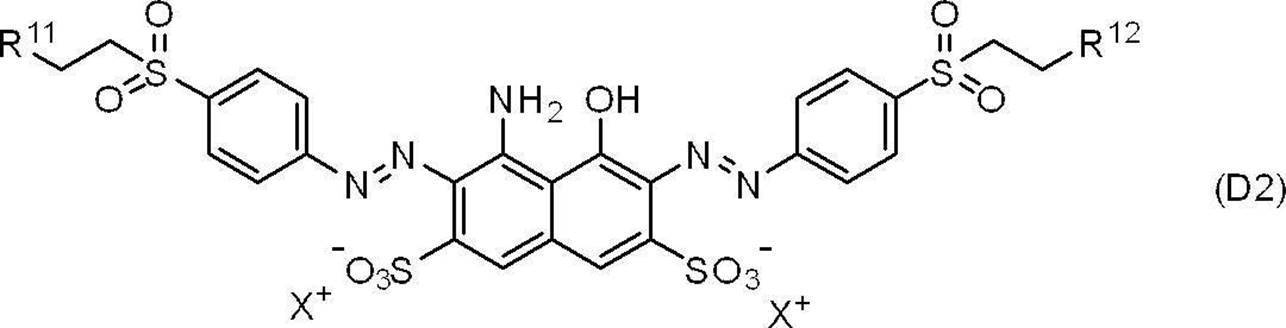
式(D2)中、
R11及びR12は、それぞれ独立に、酸素原子、窒素原子、又は硫黄原子を含んでもよい炭素数1~50の炭化水素基を表し、
2つのX+は、無機カチオン又は有機カチオンを表す。
但し、R11及びR12のうちの少なくとも1つ(より好ましくは2つ)が、炭素数4以上のアルキル基を含む基であること、及び、2つのX+のうちの少なくとも1つ(より好ましくは2つ)が、炭素数4以上のアルキル基を含む有機カチオンであることの少なくとも一方を満足する。
R11及びR12は、それぞれ独立に、酸素原子、窒素原子、又は硫黄原子を含んでもよい炭素数1~50の炭化水素基を表し、
2つのX+は、無機カチオン又は有機カチオンを表す。
但し、R11及びR12のうちの少なくとも1つ(より好ましくは2つ)が、炭素数4以上のアルキル基を含む基であること、及び、2つのX+のうちの少なくとも1つ(より好ましくは2つ)が、炭素数4以上のアルキル基を含む有機カチオンであることの少なくとも一方を満足する。
式(D2)中における各基及びカチオンの好ましい態様としては、式(D1)中における各基及びカチオンの好ましい態様を適宜参照できる。
捺染物の他の布帛への色移りを抑制し、かつ、滲みを抑制する観点から、式(D2)の好ましい態様は、R11及びR12のうちの少なくとも1つ(より好ましくは2つ)が、炭素数4以上のアルキル基を含む基であり、2つのX+が、それぞれ独立に、K+又はNa+である態様である。
捺染物の他の布帛への色移りを抑制し、かつ、滲みを抑制する観点から、油溶性染料(D1)として、さらに好ましくは、下記式(D3)で表される油溶性染料(D3)である。
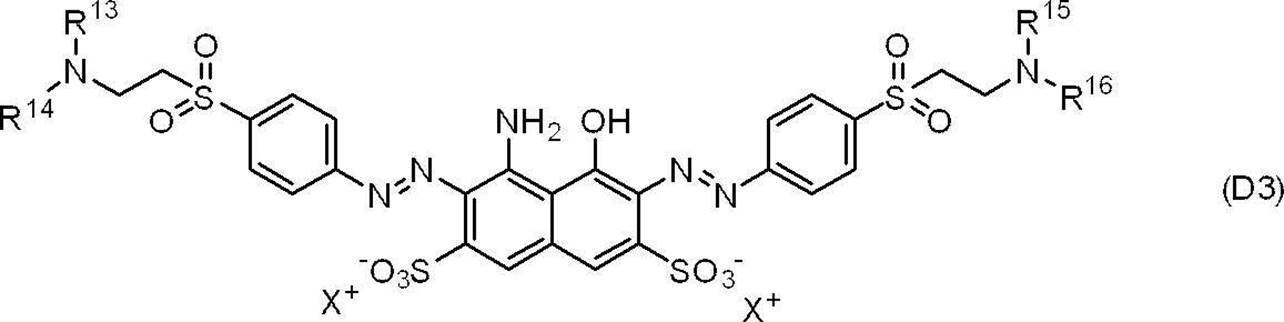
式(D3)中、R13~R16は、それぞれ独立に、酸素原子、窒素原子、若しくは硫黄原子を含んでもよい炭素数1~25の炭化水素基、又は水素原子を表し、2つのX+は、無機カチオン又は有機カチオンを表す。
但し、R13~R16のうちの少なくとも1つ(より好ましくは少なくとも2つ)が、炭素数4以上のアルキル基を含む基であること、及び、2つのX+のうちの少なくとも1つ(より好ましくは2つ)が、炭素数4以上のアルキル基を含む有機カチオンであることの少なくとも一方を満足する。
但し、R13~R16のうちの少なくとも1つ(より好ましくは少なくとも2つ)が、炭素数4以上のアルキル基を含む基であること、及び、2つのX+のうちの少なくとも1つ(より好ましくは2つ)が、炭素数4以上のアルキル基を含む有機カチオンであることの少なくとも一方を満足する。
式(D3)中における各基及びカチオンの好ましい態様としては、式(D1)中における各基及びカチオンの好ましい態様を適宜参照できる。
捺染物の他の布帛への色移りを抑制し、かつ、滲みを抑制する観点から、式(D3)の好ましい態様は、R13~R16のうちの少なくとも1つ(より好ましくは少なくとも2つ)が、炭素数4以上のアルキル基を含む基であり、2つのX+が、それぞれ独立に、K+又はNa+である態様である。
水不溶性染料は、C.I.Solvent Black 3又はC.I.Solvent Black 28であることが好ましい。特に、得られる捺染物の光学濃度、及びインク組成物の経時安定性の観点から、C.I.Solvent Black 3であることがより好ましい。
インク組成物中における水不溶性染料の含有量は、捺染物の光学濃度を向上させる観点から、インク組成物の全量に対して1質量%~10質量%であることが好ましく、より好ましくは2質量%~8質量%であり、さらに好ましくは3質量%~7質量%である。
(分散剤)
インク組成物は、分散剤を含む。分散剤は、水不溶性染料を分散可能なポリマーであれば特に限定されないが、分散安定性の観点から、親水性基を少なくとも1種含むことが好ましい。
インク組成物は、分散剤を含む。分散剤は、水不溶性染料を分散可能なポリマーであれば特に限定されないが、分散安定性の観点から、親水性基を少なくとも1種含むことが好ましい。
親水性基は、アニオン性基又はノニオン性基が好ましく、分散安定性向上の効果に優れる点から、アニオン性基がより好ましい。
例えば、同じ分子量のアニオン性基とノニオン性基とを比較した場合、アニオン性基の方が、分散安定性向上の効果に優れる。すなわち、アニオン性基は、その分子量が小さい場合においても、分散安定性向上の効果を十分に発揮し得る。
ノニオン性基としては、ポリエーテル構造を有する基が挙げられ、ポリアルキレンオキシ基を含む1価の基が好ましい。
アニオン性基は、中和されていてもよいし、中和されていなくてもよい。
中和されていないアニオン性基としては、カルボキシ基、スルホ基、硫酸基、ホスホン酸基、及びリン酸基が挙げられる。
中和されているアニオン性基としては、カルボキシ基の塩、スルホ基の塩、硫酸基の塩、ホスホン酸基の塩、及びリン酸基の塩が挙げられる。
本開示において、中和されているアニオン性基とは、「塩」の形態(例えば、カルボキシ基の塩(例えば-COONa))のアニオン性基を意味する。
中和は、例えば、アルカリ金属水酸化物(例えば、水酸化ナトリウム、水酸化カリウム等)、有機アミン(例えば、トリエチルアミン等)を用いて行うことができる。
分散剤における親水性基は、分散安定性の観点から、アニオン性基が好ましく、カルボキシ基、カルボキシ基の塩、スルホ基、スルホ基の塩、硫酸基、硫酸基の塩、ホスホン酸基、ホスホン酸基の塩、リン酸基、及びリン酸基の塩からなる群から選択される少なくとも1種がより好ましく、カルボキシ基及びカルボキシ基の塩からなる群から選択される少なくとも1種がさらに好ましい。
上述した、カルボキシ基の塩、スルホ基の塩、硫酸基の塩、ホスホン酸基の塩、及びリン酸基の塩における「塩」としては、アルカリ金属塩又は有機アミン塩が好ましく、アルカリ金属塩がより好ましい。アルカリ金属塩におけるアルカリ金属は、K又はNaであることが好ましい。
また、分散剤の酸価は、15mgKOH/g~90mgKOHであることが好ましく、より好ましくは20mgKOH/g~50mgKOHである。酸価は、分散剤1g中に含まれる酸性成分を中和するのに要する水酸化カリウムのmg数で表される。酸価が15mgKOH/g~90mgKOHであると、得られる捺染物の他の布帛への色移りがより抑制される。
また、分散剤が親水性基としてアニオン性基を有する場合、分散剤におけるアニオン性基の中和度は、50%~100%が好ましく、70%~90%がより好ましい。ここで、中和度とは、分散剤における、「中和されていないアニオン性基(例えばカルボキシ基)の数と中和されているアニオン性基(例えばカルボキシ基の塩)の数との合計」に対する「中和されているアニオン性基の数」の比(すなわち、中和されているアニオン性基の数/(中和されていないアニオン性基の数+中和されているアニオン性基の数))を指す。分散剤の中和度(%)は、中和滴定によって測定できる。
-重量平均分子量(Mw)-
分散剤の重量平均分子量(Mw)は、水不溶性染料の分散安定性をより向上させる観点から、好ましくは5000~50000であり、より好ましくは6000~40000であり、さらに好ましくは8000~30000であり、特に好ましくは10000~30000である。
分散剤の重量平均分子量(Mw)は、水不溶性染料の分散安定性をより向上させる観点から、好ましくは5000~50000であり、より好ましくは6000~40000であり、さらに好ましくは8000~30000であり、特に好ましくは10000~30000である。
分散剤の重量平均分子量に対する、カチオン性化合物の重量平均分子量の比率は、1.5~15であることが好ましく、より好ましくは2~12である。比率が1.5~15であると、カチオン化合物と分散剤が反応して、水不溶性染料を凝集させる効果が高く、得られる捺染物の他の布帛への色移りがより抑制され、かつ、滲みがより抑制される。
-分散剤の種類-
分散剤として用いるポリマー(以下、ポリマーPという)としては、例えば、ウレタン樹脂、ウレア樹脂、ウレタンウレア樹脂、アクリル樹脂、ポリエステル樹脂、ポリエーテル樹脂、ポリカプロラクトン樹脂、ポリカーボネート樹脂、ポリブタジエン樹脂、ポリイソプレン樹脂、及びポリオレフィン樹脂が挙げられる。
分散剤として用いるポリマー(以下、ポリマーPという)としては、例えば、ウレタン樹脂、ウレア樹脂、ウレタンウレア樹脂、アクリル樹脂、ポリエステル樹脂、ポリエーテル樹脂、ポリカプロラクトン樹脂、ポリカーボネート樹脂、ポリブタジエン樹脂、ポリイソプレン樹脂、及びポリオレフィン樹脂が挙げられる。
ウレタン樹脂(ポリウレタン)とは、ウレタン結合及びチオウレタン結合からなる群から選択される少なくとも1種を含む樹脂を意味する。ウレア樹脂(ポリウレア)とは、ウレア結合を含む樹脂を意味する。ウレタンウレア樹脂(ポリウレタンウレア)とは、ウレタン結合、ウレア結合、及びチオウレタン結合からなる群から選択される少なくとも1種を含む樹脂を意味する。
ウレタン樹脂には、上記結合に加えて、ポリエーテル鎖、ポリエステル鎖、ポリカプロラクトン鎖、ポリカーボネート鎖、ポリブタジエン鎖、ポリイソプレン鎖、又はポリオレフィン鎖が含まれていてもよい。
捺染物の他の布帛への色移りを抑制し、かつ、滲みを抑制する観点から、ポリマーPは、ウレタン樹脂、ウレア樹脂及びウレタンウレア樹脂からなる群より選択される少なくとも1種であり、ウレタン樹脂及びウレタンウレア樹脂からなる群より選択される少なくとも1種であることが好ましい。ポリマーPは、下記式(1)で表される構造単位(以下、「単位(1)」ともいう)と、下記式(2)で表される構造単位(以下、「単位(2)」ともいう)と、を含むことが好ましい。
-式(1)で表される構造単位(単位(1))-
ポリマーPが下記式(1)で表される構造単位(以下、「単位(1)」ともいう)含む場合、ポリマーPは、単位(1)を1種のみ含んでいてもよいし、2種以上含んでいてもよい。
ポリマーPが下記式(1)で表される構造単位(以下、「単位(1)」ともいう)含む場合、ポリマーPは、単位(1)を1種のみ含んでいてもよいし、2種以上含んでいてもよい。
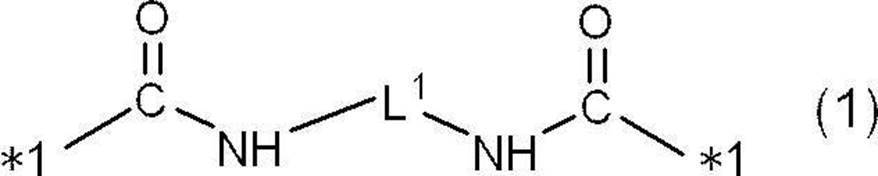
式(1)中、L1は、炭化水素基を表し、2つの*1は、それぞれ、結合位置を表す。
単位(1)は、少なくとも式(2)で表される構造単位(以下、「単位(2)」ともいう)と結合していることが好ましい。
単位(1)は、少なくとも式(2)で表される構造単位(以下、「単位(2)」ともいう)と結合していることが好ましい。
L1で表される炭化水素基としては特に制限はない。
L1で表される炭化水素基は、直鎖の炭化水素基であってもよいし、分岐を有する炭化水素基であってもよいし、芳香環を含む炭化水素基であってもよいし、脂環式構造を含む炭化水素基であってもよい。
L1で表される炭化水素基としては、例えば、
分岐構造及び/又は脂環式構造を含んでもよいアルキレン基、分岐構造及び/又は脂環式構造を含んでもよいアルケニレン基、並びに、アリール基からなる群P1から選択される1種である2価の炭化水素基;並びに
上記群P1から選択される2種以上が結合してなる2価の炭化水素基;
が挙げられる。
L1で表される炭化水素基は、直鎖の炭化水素基であってもよいし、分岐を有する炭化水素基であってもよいし、芳香環を含む炭化水素基であってもよいし、脂環式構造を含む炭化水素基であってもよい。
L1で表される炭化水素基としては、例えば、
分岐構造及び/又は脂環式構造を含んでもよいアルキレン基、分岐構造及び/又は脂環式構造を含んでもよいアルケニレン基、並びに、アリール基からなる群P1から選択される1種である2価の炭化水素基;並びに
上記群P1から選択される2種以上が結合してなる2価の炭化水素基;
が挙げられる。
L1で表される炭化水素基の炭素数は、好ましくは1~20であり、より好ましくは3~20であり、さらに好ましくは4~12である。
単位(1)を形成するための化合物(以下、「単位(1)形成用化合物」ともいう)としては、単位(1)における2つの「-NH(C=O)-*1」の部位の各々を、イソシアネート基(-NCO基)に置き換えた構造を有するジイソシアネート化合物が挙げられる。
単位(1)形成用化合物の具体例を以下に示す。
但し、単位(1)形成用化合物は、以下の具体例には限定されない。
単位(1)形成用化合物の具体例を以下に示す。
但し、単位(1)形成用化合物は、以下の具体例には限定されない。

また、2官能のイソシアネート化合物としては、上記具体例から誘導される2官能のイソシアネート化合物も使用することができる。2官能のイソシアネート化合物としては、例えば、デュラネート(登録商標)D101、D201、及びA101(旭化成株式会社製)が挙げられる。
-式(2)で表される構造単位-
ポリマーPが下記式(2)で表される構造単位(以下、「単位(2)」ともいう)含む場合、ポリマーPは、単位(2)を1種のみ含んでいてもよいし、2種以上含んでいてもよい。
ポリマーPが下記式(2)で表される構造単位(以下、「単位(2)」ともいう)含む場合、ポリマーPは、単位(2)を1種のみ含んでいてもよいし、2種以上含んでいてもよい。

式(2)中、
L2は、酸素原子、窒素原子、若しくは硫黄原子を含んでもよい炭素数2~50の炭化水素基、又は、ポリエーテル鎖、ポリエステル鎖、ポリカプロラクトン鎖、ポリカーボネート鎖、ポリブタジエン鎖、ポリイソプレン鎖、若しくはポリオレフィン鎖からなる数平均分子量500以上のポリマー鎖を表し、
Y1及びY2は、それぞれ独立に、-O-、-S-、又は-NRz-を表し、
Rzは、水素原子又は炭素数1~20の炭化水素基を表し、
2つの*2は、それぞれ、結合位置を表す。
L2は、酸素原子、窒素原子、若しくは硫黄原子を含んでもよい炭素数2~50の炭化水素基、又は、ポリエーテル鎖、ポリエステル鎖、ポリカプロラクトン鎖、ポリカーボネート鎖、ポリブタジエン鎖、ポリイソプレン鎖、若しくはポリオレフィン鎖からなる数平均分子量500以上のポリマー鎖を表し、
Y1及びY2は、それぞれ独立に、-O-、-S-、又は-NRz-を表し、
Rzは、水素原子又は炭素数1~20の炭化水素基を表し、
2つの*2は、それぞれ、結合位置を表す。
ここで、「酸素原子、窒素原子、若しくは硫黄原子を含んでもよい炭素数2~50の炭化水素基」の概念に含まれる、酸素原子、窒素原子、又は硫黄原子を含む炭素数2~50の炭化水素基とは、炭素原子及び水素原子のみからなる炭化水素基中の少なくとも1つの炭素原子を、酸素原子、窒素原子、又は硫黄原子で置き換えた構造を有する有機基であって、炭素数が2~50である基を意味する。
L2で表される、酸素原子、窒素原子、又は硫黄原子を含んでもよい炭素数2~50の炭化水素基(以下、単に「L2で表される炭化水素基」ともいう)は、無置換の又は置換基を有するアルキレン基が好ましい。
置換基を有するアルキレン基における置換基としては、アルコキシ基、アルキルカルボニルオキシ基、アルキルチオ基、アミノ基、モノアルキルアミノ基、及びジアルキルアミノ基が挙げられる。
L2で表される、酸素原子、窒素原子、又は硫黄原子を含んでもよい炭素数2~50の炭化水素基(以下、単に「L2で表される炭化水素基」ともいう)は、無置換の又は置換基を有するアルキレン基が好ましい。
置換基を有するアルキレン基における置換基としては、アルコキシ基、アルキルカルボニルオキシ基、アルキルチオ基、アミノ基、モノアルキルアミノ基、及びジアルキルアミノ基が挙げられる。
単位(2)は、少なくとも単位(1)と結合していることが好ましい。
式(2)中、L2で表される炭化水素基の炭素数は、捺染物の他の布帛への色移りを抑制し、かつ、滲みを抑制する観点から、好ましくは4~50であり、より好ましくは6~40である。
L2で表される炭化水素基は、捺染物の他の布帛への色移りを抑制し、かつ、滲みを抑制する観点から、好ましくは、酸素原子、窒素原子、又は硫黄原子を含んでもよい、分岐構造を有する炭素数4~25の鎖状炭化水素基であり、より好ましくは、炭素数6~25の無置換の分岐アルキレン基、炭素数6~25のアルコキシ化分岐アルキレン基(すなわち、アルコキシ基によって置換された分岐アルキレン基)、又は、炭素数6~25のアルキルカルボニルオキシ化分岐アルキレン基(すなわち、アルキルカルボニルオキシ基によって置換された分岐アルキレン基)である。
炭素数6~25のアルコキシ化分岐アルキレン基におけるアルコキシ基の炭素数は、好ましくは1~23であり、より好ましくは4~22である。
炭素数6~25のアルキルカルボニルオキシ化分岐アルキレン基におけるアルキルカルボニルオキシ基の炭素数は、好ましくは2~23であり、より好ましくは6~22である。
炭素数6~25のアルコキシ化分岐アルキレン基におけるアルコキシ基の炭素数は、好ましくは1~23であり、より好ましくは4~22である。
炭素数6~25のアルキルカルボニルオキシ化分岐アルキレン基におけるアルキルカルボニルオキシ基の炭素数は、好ましくは2~23であり、より好ましくは6~22である。
L2で表される鎖状炭化水素基は、捺染物の他の布帛への色移りを抑制し、かつ、滲みを抑制する観点から、置換基Aによって置換された炭素数2以上のアルキレン基であることも好ましい。
置換基Aは、炭素数2以上の直鎖アルキル基、炭素数3以上の分岐アルキル基、炭素数2以上の直鎖アルコキシ基、炭素数3以上の分岐アルコキシ基、炭素数2以上の直鎖アルコキシアルキル基、及び炭素数3以上の分岐アルコキシアルキル基からなる群から選択される少なくとも1種であることが好ましい。
置換基Aは、炭素数2以上の直鎖アルキル基、炭素数3以上の分岐アルキル基、炭素数2以上の直鎖アルコキシ基、炭素数3以上の分岐アルコキシ基、炭素数2以上の直鎖アルコキシアルキル基、及び炭素数3以上の分岐アルコキシアルキル基からなる群から選択される少なくとも1種であることが好ましい。
L2で表されるポリマー鎖の数平均分子量(Mn)は、500以上である。
L2で表されるポリマー鎖のMnは、500~50000であることが好ましく、1000~40000であることがより好ましく、1000~30000であることがさらに好ましく、1000~10000であることがさらに好ましく、1000~5000であることが特に好ましい。
L2で表されるポリマー鎖のMnは、500~50000であることが好ましく、1000~40000であることがより好ましく、1000~30000であることがさらに好ましく、1000~10000であることがさらに好ましく、1000~5000であることが特に好ましい。
L2で表されるポリマー鎖は、ポリエーテル鎖、ポリエステル鎖、ポリカプロラクトン鎖、ポリカーボネート鎖、ポリブタジエン鎖、ポリイソプレン鎖、又はポリオレフィン鎖からなる。
ポリエーテル鎖としては、ポリエチレングリコール鎖、ポリプロピレングリコール鎖、及びポリブチレングリコール鎖が挙げられる。ポリエーテル鎖は、ポリエチレングリコール鎖又はポリプロピレングリコール鎖であることが好ましい。
ポリエステル鎖としては、後述する化合物(2-17)PEsから両末端のヒドロキシ基を除いた残基が挙げられる。
ポリカプロラクトン鎖としては、後述する化合物(2-19)PCLから両末端のヒドロキシ基を除いた残基が挙げられる。
ポリカーボネート鎖としては、後述する化合物(2-18)PCから両末端のヒドロキシ基を除いた残基が挙げられる。ポリカーボネート鎖は、炭素数2~12(好ましくは3~8、より好ましくは3~6)のアルキレン基を含むことが好ましく、後述する化合物(2-18)PCから両末端のヒドロキシ基を除いた残基であることがさらに好ましい。
L2としては、捺染物の他の布帛への色移りを抑制し、かつ、滲みを抑制する観点から、ポリカーボネート鎖又はポリエーテル鎖からなる数平均分子量500以上のポリマー鎖が好ましい。
式(2)中、Y1及びY2は、それぞれ独立に、-O-、-S-、又は-NRz-を表し、Rzは、水素原子又は炭素数1~20の炭化水素基を表す。
Rzとしては、水素原子又は炭素数1~10のアルキル基が好ましく、水素原子又は炭素数1~6のアルキル基がより好ましく、水素原子、メチル基、又はエチル基がさらに好ましく、水素原子がさらに好ましい。
Y1及びY2は、それぞれ独立に、-O-又は-S-が好ましく、-O-がより好ましい。
単位(2)を形成するための化合物(以下、「単位(2)形成用化合物」ともいう)としては、単位(2)における「*2-Y1-」及び「-Y2-*2」を、それぞれ、ヒドロキシ基、チオール基、又はアミノ基に置き換えた構造を有する化合物(例えば、ジオール化合物、ジチオール化合物、ジアミン化合物等)が好ましく、単位(2)における「*2-Y1-」及び「-Y2-*2」を、それぞれ、ヒドロキシ基に置き換えた構造を有するジオール化合物がさらに好ましい。
L2がポリマー鎖である単位(2)を形成するための単位(2)形成用化合物であって、ジオール化合物である場合の単位(2)形成用化合物は、ポリマージオールである。
ポリマージオールとして、より具体的には、ポリエーテルジオール、ポリエステルジオール、ポリカプロラクトンジオール、ポリカーボネートジオール、ポリブタジエンジオール、ポリイソプレンジオール、及びポリオレフィンジオールが挙げられる。
ポリマージオールとして、より具体的には、ポリエーテルジオール、ポリエステルジオール、ポリカプロラクトンジオール、ポリカーボネートジオール、ポリブタジエンジオール、ポリイソプレンジオール、及びポリオレフィンジオールが挙げられる。
以下、単位(2)形成用化合物の具体例を以下に示す。ただし、単位(2)形成用化合物は、以下の具体例には限定されない。
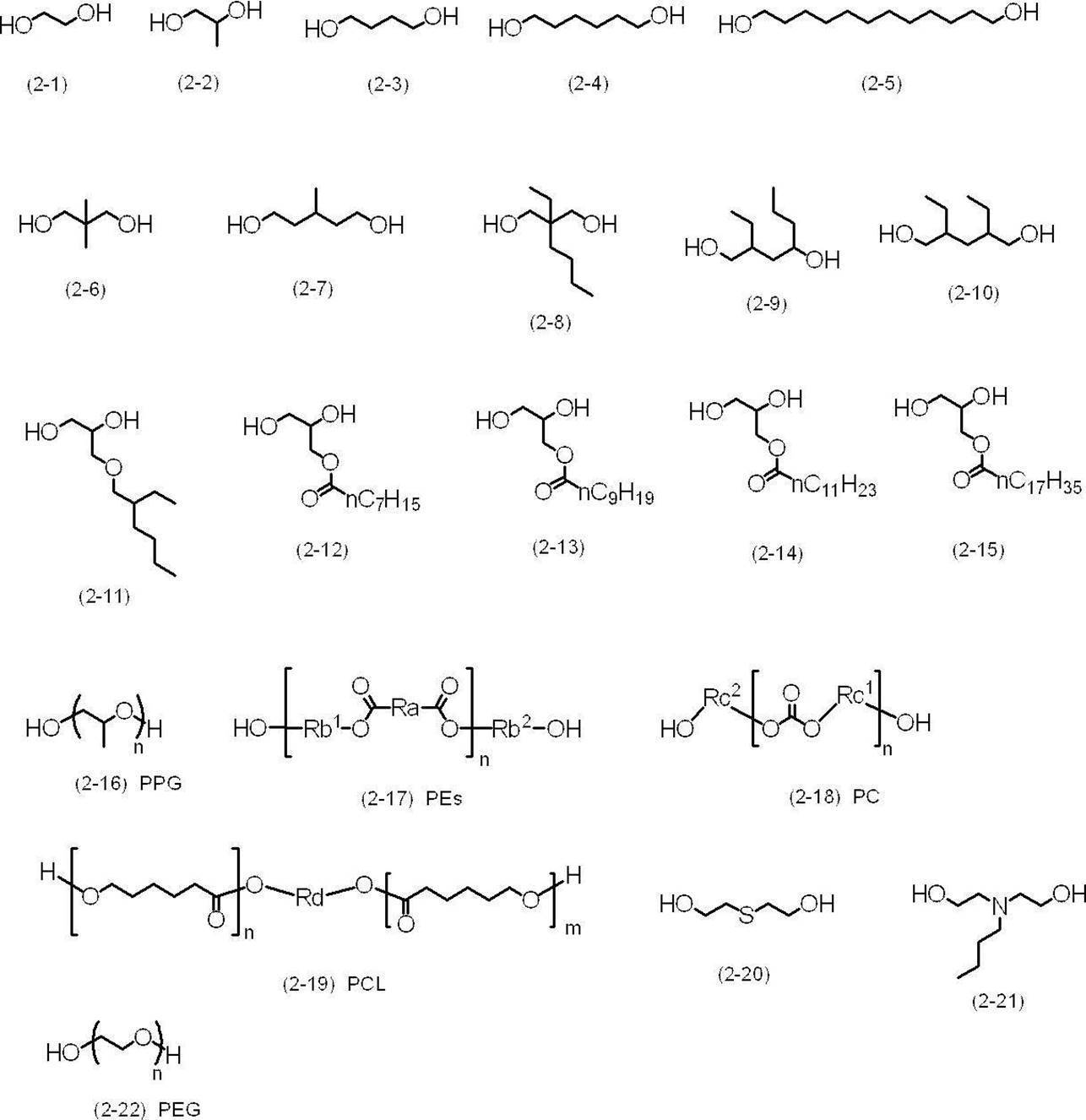
化合物(2-12)~(2-15)中、nC7H15、nC9H19、nC11H23、及びnC17H35は、それぞれ、ノルマルヘプチル基、ノルマルノニル基、ノルマルウンデシル基、ノルマルヘプタデシル基を表す。
化合物(2-16)PPGは、ポリエーテルジオールの一例であるポリプロピレングリコールであり、nは、繰り返し数である。
化合物(2-17)PEsは、ポリエステルジオールであり、nは、繰り返し数であり、Ra、Rb1、及びRb2は、それぞれ独立に、炭素数2~25の2価の炭化水素基である。化合物(2-17)PEs中のn個のRaは、同一であっても異なっていてもよい。化合物(2-17)PEs中のn個のRb1は、同一であっても異なっていてもよい。
化合物(2-18)PCは、ポリカーボネートジオールであり、nは、繰り返し数であり、Rc1及びRc2は、それぞれ独立に、炭素数2~12(好ましくは3~8、より好ましくは3~6)のアルキレン基である。化合物(2-18)PC中のn個のRc1は、同一であっての異なっていてもよい。
化合物(2-19)PCLは、ポリカプロラクトンジオールであり、n及びmは、それぞれ繰り返し数であり、Rdは、炭素数2~25のアルキレン基である。
化合物(2-22)PEGは、ポリエーテルジオールの一例であるポリエチレングリコールであり、nは、繰り返し数である。
化合物(2-16)PPGは、ポリエーテルジオールの一例であるポリプロピレングリコールであり、nは、繰り返し数である。
化合物(2-17)PEsは、ポリエステルジオールであり、nは、繰り返し数であり、Ra、Rb1、及びRb2は、それぞれ独立に、炭素数2~25の2価の炭化水素基である。化合物(2-17)PEs中のn個のRaは、同一であっても異なっていてもよい。化合物(2-17)PEs中のn個のRb1は、同一であっても異なっていてもよい。
化合物(2-18)PCは、ポリカーボネートジオールであり、nは、繰り返し数であり、Rc1及びRc2は、それぞれ独立に、炭素数2~12(好ましくは3~8、より好ましくは3~6)のアルキレン基である。化合物(2-18)PC中のn個のRc1は、同一であっての異なっていてもよい。
化合物(2-19)PCLは、ポリカプロラクトンジオールであり、n及びmは、それぞれ繰り返し数であり、Rdは、炭素数2~25のアルキレン基である。
化合物(2-22)PEGは、ポリエーテルジオールの一例であるポリエチレングリコールであり、nは、繰り返し数である。
単位(2)形成用化合物としては、上述した化合物以外にも、以下の化合物も挙げられる。


単位(2)形成用化合物としては、上述した化合物以外にも、ポリブタジエンジオール(以下、「PBD」ともいう)、ポリイソプレンジオール(以下、「PIP」ともいう)、ポリオレフィンジオール等も挙げられる。
単位(2)形成用化合物としてのポリマージオールとしては、市販品を用いてもよい。市販品としては、例えば、ポリカーボネートジオール(製品名「デュラノール(登録商標)T5651」、旭化成ケミカルズ社製)が挙げられる。また、ポリマージオールの市販品については、国際公開第2016/152254号の段落0111を参照してもよい。
捺染物の他の布帛への色移りを抑制し、かつ、滲みを抑制する観点から、ポリマーP中における単位(1)及び単位(2)の総含有量は、ポリマーPの全量に対し、好ましくは50質量%以上であり、より好ましくは60質量%以上であり、さらに好ましくは80質量%以上である。
ポリマーP中において、単位(1)に対する単位(2)のモル比(すなわち、単位(2)/単位(1))は、好ましくは0.20以上1.00未満であり、より好ましくは0.30以上0.90以下であり、さらに好ましくは0.50以上0.90以下である。
-親水性基を有する構造単位-
ポリマーPは、親水性基を有する構造単位を少なくとも1種含むことが好ましい。
親水性基の具体例及び好ましい態様は前述のとおりである。
親水性基を有する構造単位は、好ましくは、後述する親水性基導入用化合物を原料として形成される。
ポリマーPは、親水性基を有する構造単位を少なくとも1種含むことが好ましい。
親水性基の具体例及び好ましい態様は前述のとおりである。
親水性基を有する構造単位は、好ましくは、後述する親水性基導入用化合物を原料として形成される。
親水性基を有する構造単位は、下記式(3)で表される構造単位(以下、「単位(3)」ともいう)であることが好ましい。
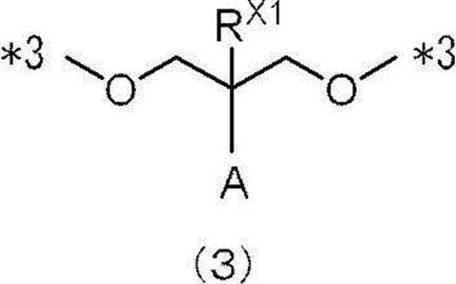
式(3)中、RX1は、水素原子又は炭素数1~10のアルキル基を表し、Aは、アニオン性基を表し、2つの*3は、それぞれ、結合位置を表す。
単位(3)は、少なくとも単位(1)と結合することが好ましい。
Aで表されるアニオン性基の例は、前述のアニオン性基の例と同様である。
Aで表されるアニオン性基は、カルボキシ基又はカルボキシ基の塩が好ましい。ポリマーPは、Aがカルボキシ基である態様の単位(3)と、Aがカルボキシ基の塩である態様の単位(3)と、を含んでいてもよい。
Aで表されるアニオン性基は、カルボキシ基又はカルボキシ基の塩が好ましい。ポリマーPは、Aがカルボキシ基である態様の単位(3)と、Aがカルボキシ基の塩である態様の単位(3)と、を含んでいてもよい。
ポリマーPの全量に対する親水性基を有する構造単位(例えば単位(3))の含有量は、好ましくは3質量%~30質量%であり、より好ましくは5質量%~20質量%である。
ポリマーPの全量に対するアニオン性基を有する構造単位の含有量は、ポリマーPの酸価(mmol/g)を考慮して調整してもよい。
-親水性基導入用化合物-
親水性基を有する構造単位のポリマーPへの導入は、親水性基導入用化合物を用いて行うことができる。
親水性基を有する構造単位のポリマーPへの導入は、親水性基導入用化合物を用いて行うことができる。
親水性基導入用化合物のうち、アニオン性基導入用化合物としては、
単位(3)における2つの*3に、それぞれ、水素原子が結合した化合物;
α-アミノ酸(具体的には、リシン、アラニン、アルギニン、アスパラギン、アスパラギン酸、システイン、グルタミン、グルタミン酸、グリシン、ヒスチジン、イソロイシン、ロイシン、メチオニン、フェニルアラニン、プロリン、セリン、トレオニン、トリプトファン、チロシン、バリン)等のアミノ酸が挙げられる。
単位(3)における2つの*3に、それぞれ、水素原子が結合した化合物;
α-アミノ酸(具体的には、リシン、アラニン、アルギニン、アスパラギン、アスパラギン酸、システイン、グルタミン、グルタミン酸、グリシン、ヒスチジン、イソロイシン、ロイシン、メチオニン、フェニルアラニン、プロリン、セリン、トレオニン、トリプトファン、チロシン、バリン)等のアミノ酸が挙げられる。
単位(3)における2つの*3に、それぞれ、水素原子が結合した化合物としては、2,2-ジメチロールプロピオン酸(DMPA)、及び2,2-ジメチロールブタン酸(DMBA)が挙げられる。
アニオン性基導入用化合物は、水酸化ナトリウム、水酸化カリウムなどの無機塩基;トリエチルアミンなどの有機塩基を用い、アニオン性基の少なくとも一部を中和して用いてもよい。
また、アニオン性基の中和は、ポリマーPの形成過程(例えば、後述する着色樹脂粒子の形成過程)で行ってもよい。
親水性基導入用化合物のうち、ノニオン性基導入用化合物は、ポリエーテル構造を有する化合物であることが好ましく、ポリオキシアルキレン基を有する化合物であることがより好ましい。
ポリマーPは、上述した構造単位以外のその他の構造単位を含んでいてもよい。ただし、ポリマーPが親水性基を有する構造単位を含む場合、水不溶性染料の分散安定性の観点から、単位(1)、単位(2)、及び親水性基を有する構造単位の総含有量は、ポリマーPの全量に対し、80質量%以上であることが好ましい。
-ポリマーPの好ましい態様-
ポリマーPは、単位(1)形成用化合物(好ましくは、単位(1)における2つの「-NH(C=O)-*1」の部位の各々を、イソシアネート基(-NCO基)に置き換えた構造を有するジイソシアネート化合物)と、単位(2)形成用化合物(好ましくは、単位(2)における「*2-Y1-」及び「-Y2-*2」を、それぞれ、ヒドロキシ基、チオール基、又はアミノ基に置き換えた構造を有する化合物)と、親水性基導入用化合物(好ましくは、単位(3)における2つの*3に、それぞれ、水素原子が結合した化合物)と、の反応生成物の構造を含むことが好ましい。
ポリマーPは、単位(1)形成用化合物(好ましくは、単位(1)における2つの「-NH(C=O)-*1」の部位の各々を、イソシアネート基(-NCO基)に置き換えた構造を有するジイソシアネート化合物)と、単位(2)形成用化合物(好ましくは、単位(2)における「*2-Y1-」及び「-Y2-*2」を、それぞれ、ヒドロキシ基、チオール基、又はアミノ基に置き換えた構造を有する化合物)と、親水性基導入用化合物(好ましくは、単位(3)における2つの*3に、それぞれ、水素原子が結合した化合物)と、の反応生成物の構造を含むことが好ましい。
また、ポリマーPは、ウレタン結合を含むことが好ましい。ウレタン結合の例としては、単位(1)と、Y1及びY2の各々が-O-である態様の単位(2)とが結合することによって形成されたウレタン結合、及び、単位(1)と単位(3)とが結合することによって形成されたウレタン結合が挙げられる。
ポリマーPの主鎖の末端の構造には特に制限はないが、ポリマーPの主鎖の末端基は、好ましくは、炭素数1~20(より好ましくは1~10、さらに好ましくは1~6)のアルキル基である。
末端である炭素数1~20(より好ましくは1~10、さらに好ましくは1~6)のアルキル基は、例えば、末端封止剤として、炭素数1~20(より好ましくは1~10、さらに好ましくは1~6)のアルコール、炭素数1~20(より好ましくは1~10、さらに好ましくは1~6)のチオアルコール、炭素数1~20(より好ましくは1~10、さらに好ましくは1~6)のモノアルキルアミン、等を用いて形成できる。
また、ポリマーPは、捺染物の他の布帛への色移りを抑制し、かつ、滲みを抑制する観点から、鎖状ポリマーであることが好ましい。鎖状ポリマーとは、架橋構造を含まないポリマーを意味する。
鎖状ポリマーには、環状構造が含まれていてもよい。鎖状ポリマーには、分岐構造が含まれていてもよい。
水不溶性染料の含有量に対するポリマーPの含有量の比率(すなわち、ポリマーPの含油量/水不溶性染料の含有量)は、捺染物の光学濃度をより向上させる観点から、質量基準で、好ましくは0.10~4.00であり、より好ましくは0.10~2.50であり、さらに好ましくは0.20~2.50であり、特に好ましくは0.20~1.50であり、さらに好ましくは0.25~1.00である。
ポリマーPの合成方法の好ましい態様は、後述する油性有機溶剤の存在下、単位(1)形成用化合物と、単位(2)形成用化合物と、親水性基導入用化合物と、を反応させる態様である。
また、この態様の合成方法により、親水性基としてのアニオン性基が中和されていない態様のポリマーを合成し、このポリマーを原料の一つとして後述する着色樹脂粒子分散液を調製し、調製段階でポリマーのアニオン性基を中和することにより、ポリマーPを形成してもよい。
また、この態様の合成方法により、親水性基としてのアニオン性基が中和されていない態様のポリマーを合成し、このポリマーを原料の一つとして後述する着色樹脂粒子分散液を調製し、調製段階でポリマーのアニオン性基を中和することにより、ポリマーPを形成してもよい。
(着色樹脂粒子分散液)
インク組成物は、例えば、水不溶性染料、分散剤、水等を混合して分散処理を行うことによって製造することができる。水不溶性染料、分散剤、水等を混合して分散処理を行うことによって製造される分散液を「着色樹脂粒子分散液」という。また、インク組成物は、着色樹脂粒子分散液に、他の成分を添加することによって製造してもよい。
インク組成物は、例えば、水不溶性染料、分散剤、水等を混合して分散処理を行うことによって製造することができる。水不溶性染料、分散剤、水等を混合して分散処理を行うことによって製造される分散液を「着色樹脂粒子分散液」という。また、インク組成物は、着色樹脂粒子分散液に、他の成分を添加することによって製造してもよい。
着色樹脂粒子分散液は、水不溶性染料、分散剤及び水以外の他の成分を含んでいてもよい。
捺染物の他の布帛への色移りを抑制し、かつ、滲みを抑制する観点から、着色樹脂粒子分散液における水及び着色樹脂粒子の総含有量は、着色樹脂粒子分散液の全量に対し、80質量%以上であることが好ましい。
(着色樹脂粒子分散液の製造方法の一例)
着色樹脂粒子分散液を製造するための製造方法には特に制限はない。
以下、着色樹脂粒子分散液の製造方法の一例(以下、「製法A」ともいう)を示す。
着色樹脂粒子分散液を製造するための製造方法には特に制限はない。
以下、着色樹脂粒子分散液の製造方法の一例(以下、「製法A」ともいう)を示す。
製法Aは、油性有機溶剤、ポリマーP又は親水性基としてのアニオン性基を中和する前のポリマーP、及び油溶性染料を含む油相成分を準備する工程と、水(及び必要に応じ中和剤)を含む水相成分を準備する工程と、油相成分と水相成分とを混合し、得られた混合物を乳化させて乳化物を得る乳化工程と、を含む。
製法Aでは、乳化工程により、着色樹脂粒子の形成及び形成された着色樹脂粒子の水中への分散が行われ、これにより、着色樹脂粒子が水中に分散されている着色樹脂粒子分散液が得られる。
着色樹脂粒子とは、水不溶性染料の表面に分散剤が被覆された粒子状のものを意味する。なお、分散剤が水不溶性染料の表面全体を被覆していてもよく、水不溶性染料の表面の一部のみを被覆していてもよい。
油性有機溶剤とは、20℃における水に対する溶解度が10質量%以下である有機溶剤を表す。油性有機溶剤の20℃における水に対する溶解度は、5質量%以下が好ましく、1質量%以下がさらに好ましい。油性有機溶剤の20℃における水に対する溶解度が5質量%以下である場合には、乳化時に油(有機成分)と水とがより混ざりにくくなり、合成適性及び着色樹脂粒子の安定性がより向上する。製法Aにおいて使用される油性有機溶剤は、1種のみであってもよいし、2種以上であってもよい。
油性有機溶剤は、揮発性を有する油性有機溶剤及び不揮発性を有する油性有機溶剤のいずれであってもよい。これらのうち、不揮発性を有する油性有機溶剤が、着色樹脂粒子中により存在しやすい。揮発性を有する油性有機溶剤とは、沸点100℃未満の油性有機溶剤を意味する。揮発性を有する油性有機溶剤としては、例えば、酢酸エチル等のエステル系溶剤、及び、メチルエチルケトン等のケトン系溶剤が挙げられる。
不揮発性を有する有機溶剤とは、沸点100℃超の油性有機溶剤を意味する。不揮発性を有する油性有機溶剤としては、反応時に不揮発性を示す観点、及び、インク組成物の保存安定性の観点から、沸点180℃以上の油性有機溶剤が好ましい。なお、本開示における沸点は、標準条件(1気圧、25℃)での沸点の値である。1気圧は101.325kPaである。
不揮発性を有する油性有機溶剤の具体例としては、非ハロゲンリン酸エステル(例えば、大八化学工業製TCP)、アルキル基置換芳香族化合物(例えば、JXTGエネルギー製アルケンKS-41、呉羽化学製KMC500)、長鎖アルキル基置換エステル化合物(例えば、日本油脂製ラウリン酸メチルKS-33、富士フイルム和光純薬製トリス(2-エチルヘキサン酸)グリセロール)、二塩基酸エステル(例えば、INVISTA製DBE、東京化成製コハク酸ジメチル、グルタル酸ジメチル、コハク酸ジイソプロピル)、アルキレングリコール誘導体(例えば、東京化成製エチレングリコールモノブチルエーテルアセテート、ジエチレングリコールモノブチルエーテルアセテート、及びジエチレングリコールジブチルエーテル、ジエチレングリコールジベンゾエート)が挙げられる。
中でも、不揮発性を有する油性有機溶剤は、DBE、コハク酸ジメチル、グルタル酸ジメチル、コハク酸ジイソプロピル、トリス(2-エチルヘキサン酸)グリセロール、ジエチレングリコールモノブチルエーテルアセテート、又はジエチレングリコールジブチルエーテルが好ましい。
油相成分として、親水性基としてのアニオン性基を中和する前のポリマーPを含む油相成分を用い、かつ、水相成分として、水及び中和剤を含む水相成分を用いた場合には、乳化工程において、アニオン性基を中和する前のポリマーP中のアニオン性基の少なくとも一部が中和され、これにより、中和されたアニオン性基(例えば-COONa)を含むポリマーPを含有する着色樹脂粒子が形成される。
中和剤としては、水酸化ナトリウム、水酸化カリウム、トリエチルアミン等の塩基性化合物を用いることができる。
乳化工程における乳化の方法には特に限定はないが、例えば、ホモジナイザー等の乳化装置(例えば、分散機等)による乳化が挙げられる。
乳化における分散機の回転数は、例えば、5000rpm~20000rpmであり、好ましくは10000rpm~15000rpmである。ここで、rpmは、revolutions per minuteの略である。
乳化における回転時間は、例えば、1分間~120分間であり、好ましくは3分間~60分間であり、より好ましくは3分間~30分間であり、さらに好ましくは5分間~15分間である。
乳化工程における乳化は、加熱下で行ってもよい。乳化を加熱下で行うことにより、着色樹脂粒子をより効率よく形成できる。また、乳化を加熱下で行うことにより、油相成分中の油性有機溶剤の少なくとも一部を、混合物中から除去し易い。
乳化を加熱下で行う場合の加熱温度としては、35℃~70℃が好ましく、40℃~60℃がより好ましい。
また、製法Aは、上記乳化物又は上記乳化物と水との混合物を加熱して油性有機溶剤の少なくとも一部を除去する加熱工程を含んでいてもよい。
加熱工程における加熱温度としては、35℃~70℃が好ましく、40℃~60℃がより好ましい。
(水)
インク組成物は、水を含む。インク組成物中における水の含有量は、インク組成物の全量に対し、40質量%以上であることが好ましく、より好ましくは50質量%以上であり、さらに好ましくは60質量%以上である。水の含有量の上限値は、インク組成物中の固形分量にもよるが、インク組成物の全量に対し、例えば90質量%である。
インク組成物は、水を含む。インク組成物中における水の含有量は、インク組成物の全量に対し、40質量%以上であることが好ましく、より好ましくは50質量%以上であり、さらに好ましくは60質量%以上である。水の含有量の上限値は、インク組成物中の固形分量にもよるが、インク組成物の全量に対し、例えば90質量%である。
(溶剤)
インク組成物は、溶剤を含むことが好ましい。インク組成物に含まれる溶剤は、1種であってもよく、2種以上であってもよい。
インク組成物は、溶剤を含むことが好ましい。インク組成物に含まれる溶剤は、1種であってもよく、2種以上であってもよい。
インク組成物に含有され得る溶剤の好ましい態様は、前処理液に含有され得る溶剤の好ましい態様と同様である。
インク組成物中の溶剤の含有量は、インク組成物の全量に対し、好ましくは5質量%~60質量%であり、より好ましくは10質量%~50質量%であり、さらに好ましくは15質量%~40質量%である。溶剤の含有量が上記範囲内であると、インク組成物の保存安定性に優れ、かつ、インクジェット記録方式で吐出する場合には、吐出性にも優れる。
(架橋剤)
インク組成物は、さらに架橋剤を含んでいてもよい。架橋剤は、架橋性基を少なくとも2つ有する化合物であることが好ましい。架橋剤が有する架橋性基としては、カルボキシ基、ヒドロキシル基、スルホン酸基又はアミド基が好ましい。
インク組成物は、さらに架橋剤を含んでいてもよい。架橋剤は、架橋性基を少なくとも2つ有する化合物であることが好ましい。架橋剤が有する架橋性基としては、カルボキシ基、ヒドロキシル基、スルホン酸基又はアミド基が好ましい。
架橋剤としては、例えば、ブロック化イソシアネート系化合物、オキサゾリン系化合物、及びカルボジイミド化合物が挙げられる。中でも、架橋剤は、ジイソシアネート(例えば、HDI(ヘキサメチレンジイソシアネート)、H6XDI(水添キシリレンジイソシアネート)、IPDI(イソホロンジイソシアネート)、及びH12MDI(ジシクロヘキシルメタンジイソシアネート))のTMP(トリメチロールプロパン)アダクト体若しくはイソシアヌレート体を、ブロック剤によりブロックしたブロック化イソシアネート系化合物、又はカルボジイミド化合物が好ましい。
ブロック化イソシアネート系化合物におけるブロック剤としては、解離温度の観点から、DEM(マロン酸ジエチル)、DIPA(ジイソプロピルアミン)、TRIA(1,2,4-トリアゾール)、DMP(3,5-ジメチルピラゾール)、またはMEKO(ブタノンオキシム)が好ましい。
ブロック化イソシアネート系化合物は、そのイソシアネート基の一部を、ポリオール、ポリカーボネート、ポリエステル、ポリエーテルなどと反応させたオリゴマーとして用いることもできる。
カルボジイミド化合物としては、日清紡ケミカル株式会社製のカルボジライト水性樹脂用架橋剤E-02、E-03A、E-05(以上製品名)が挙げられ、保存安定性と反応性の観点からE-05が好ましい。
架橋剤の解離温度は、架橋効率の観点からは、低いほど好ましく、保存安定性の観点からは、高いほど好ましい。架橋効率と保存安定性のバランスの観点から、解離温度は、90℃~180℃が好ましく、90℃~120℃がより好ましく、110℃~120℃が特に好ましい。
また、架橋剤は、親水基を有し、水溶性又は自己乳化性を有する架橋剤としてインク組成物に含有させることが好ましい。水溶性又は自己乳化性を有する架橋剤をインク組成物に含有させることにより、インク組成物の粘度を低くし、再分散性を向上させることができる。
架橋剤は、架橋剤粒子であってもよい。架橋剤粒子の平均粒子径は、インク組成物をインクジェット記録方式で吐出する場合には、吐出性の観点から、200nm以下であることが好ましい。平均粒子径は、粒度分布測定装置(製品名「ナノトラックUPA EX150」、日機装株式会社製)を用いて測定した体積平均粒子径(MV)の値を用いることができる。
架橋剤粒子としては、特に限定されないが、例えば、エラストロンBN-77(ブロックイソシアネート、粒径19nm、解離温度120℃以上、第一工業製薬社製)、エラストロンBN-27(ブロックイソシアネート、粒径108nm、解離温度180℃以上、第一工業製薬社製)、デュラネートWM44-70G(ブロックイソシアネート、粒径42nm、解離温度約90℃、旭化成社製)、及びTRIXENE AQUA BI200(ブロックイソシアネート、粒径94nm、解離温度110-120℃、BAXENDEN製)が挙げられる。
インク組成物が架橋剤を含有する場合、インク組成物中の架橋剤の含有量は、インク組成物の全量に対し、0.1質量%~10質量%であることが好ましく、0.5質量%~8質量%であることがより好ましく、1質量%~5質量%であることがさらに好ましい。
(顔料)
インク組成物は、色相調整又は色濃度向上の観点から、さらに、顔料を含んでいてもよい。
インク組成物は、色相調整又は色濃度向上の観点から、さらに、顔料を含んでいてもよい。
顔料としては、例えば、
カーボンブラック、アニリンブラック;
C.I.ピグメントイエロー3、12、53、55、74、81、83、93、94、95、97、98、100、101、104、108、109、110、117、120、128、138、153、155、180、185;
C.I.ピグメントレッド112、114、122、123、146、149、166、168、170、172、177、178、179、185、190、193、202、206、209、219;
C.I.ピグメントバイオレット19、23;
C.I.ピグメントオレンジ36、43、64;
C.I.ピグメントブルー15、15:1、15:2、15:3、15:4、15:6、16、17:1、56、60、63;及び
C.I.ピグメントグリーン36が挙げられる。
カーボンブラック、アニリンブラック;
C.I.ピグメントイエロー3、12、53、55、74、81、83、93、94、95、97、98、100、101、104、108、109、110、117、120、128、138、153、155、180、185;
C.I.ピグメントレッド112、114、122、123、146、149、166、168、170、172、177、178、179、185、190、193、202、206、209、219;
C.I.ピグメントバイオレット19、23;
C.I.ピグメントオレンジ36、43、64;
C.I.ピグメントブルー15、15:1、15:2、15:3、15:4、15:6、16、17:1、56、60、63;及び
C.I.ピグメントグリーン36が挙げられる。
インク組成物が顔料を含む場合、インク組成物中の顔料の含有量は、インク組成物の全量に対し、0.5質量%~10質量%が好ましく、0.5質量%~8質量%がより好ましく、0.5質量%~5質量%がさらに好ましい。
インク組成物を調製する際には、分散剤を用いて顔料を水中に分散させた顔料の水分散液(「顔料水分散液」とも呼ぶ。)を用いることもできる。顔料水分散液としては、例えば、特開2012-7148号公報に記載された顔料分散液を用いることができる。また、顔料水分散液としては、Pro-jet Black APD1000(Fujifilm Imaging Colorants社製)などの市販品を用いることもできる。
顔料は、自己分散型顔料であってもよい。自己分散型顔料とは、分散剤を使用しなくても水に分散可能な顔料である。自己分散型顔料は、例えば、顔料の表面にカルボニル基、ヒドロキシル基、カルボキシル基、スルホ基、リン酸基等の親水性基及びそれらの塩の少なくとも一種が、直接又は他の基を介して化学結合により導入されているものが挙げられる。
自己分散型顔料は、好ましくは、自己分散型カーボンブラックである。自己分散型顔料としては、自己分散型カーボンブラックCAB-O-JET 200、CAB-O-JET300、CAB-O-JET400(以上、キャボット社製)、BONJET CW-1(カルボキシ基として500μmol/g)、BONJET CW-2(カルボキシ基として470μmol/g)(以上、オリヱント化学工業株式会社製)、東海カーボン株式会社のAqua-Black 162(カルボキシル基として約800μmol/g)等の市販品が挙げられる。
(ワックス)
インク組成物は、ワックスを含んでいてもよい。ワックスは、インク組成物中で粒子の形態で存在することが好ましい。粒子の形態で存在するワックスを、以下、「ワックス粒子」という。
インク組成物は、ワックスを含んでいてもよい。ワックスは、インク組成物中で粒子の形態で存在することが好ましい。粒子の形態で存在するワックスを、以下、「ワックス粒子」という。
ワックス粒子としては、ワックスが水中で分散された分散液を使用することが好ましい。
ワックスとしては、ポリエチレンワックス、パラフィンワックス、又はカルナバワックスが好ましい。
ワックスの融点は、安定性と摩擦性向上の観点で、60℃~120℃の範囲にあることが好ましく、60℃~100℃の範囲がより好ましい。ワックスの融点が60℃以上であると、インク組成物の安定性を向上させることができる。一方、ワックスの融点が120℃以下であると、摩擦性向上に効果的である。ワックスの融点は、一般的な融点測定機にて測定することができる。
ワックス粒子の体積平均粒子径は、インク組成物をインクジェット記録方式で吐出する場合には、吐出性の観点から、0.3μm以下であることが好ましく、0.2μm以下がより好ましく、0.1μm以下がさらに好ましい。ワックス粒子の体積平均粒子径は、着色樹脂粒子の体積平均粒子径と同様の方法で測定できる。
インク組成物がワックスを含む場合、ワックスの含有量としては、インク組成物の全量に対し、0.1質量%~10質量%が好ましく、0.5質量%~8質量%がより好ましく、1質量%~5質量%がさらに好ましい。
ワックス粒子は、市販品であってもよい。市販品としては、例えば、ポリロンL-787(中京油脂社製、ポリエチレンワックス、ノニオン、融点102℃、体積平均粒子径0.1μm)、ハイドリン-703(中京油脂社製、パラフィンワックス、アニオン、融点75℃、体積平均粒子径0.1μm)、R108(中京油脂社製、パラフィンワックス、ノニオン、融点66℃、体積平均粒子径0.2μm)、及びセロゾール524(中京油脂社製、カルナバワックス、ノニオン、融点83℃、体積平均粒子径0.07μm)が挙げられる。
(界面活性剤)
インク組成物は、界面活性剤を少なくとも1種含んでいてもよい。
界面活性剤としては、特に制限はなく、シリコーン系界面活性剤、フッ素系界面活性剤、アセチレングリコール系界面活性剤等の公知の界面活性剤を用いることができる。
インク組成物が界面活性剤を含む場合、界面活性剤の含有量は、インク組成物の全量に対し、0.05質量%~2.0質量%であることが好ましく、0.1質量%~2.0質量%であることがより好ましい。
インク組成物は、界面活性剤を少なくとも1種含んでいてもよい。
界面活性剤としては、特に制限はなく、シリコーン系界面活性剤、フッ素系界面活性剤、アセチレングリコール系界面活性剤等の公知の界面活性剤を用いることができる。
インク組成物が界面活性剤を含む場合、界面活性剤の含有量は、インク組成物の全量に対し、0.05質量%~2.0質量%であることが好ましく、0.1質量%~2.0質量%であることがより好ましい。
(その他の成分)
インク組成物は、上記成分以外のその他の成分を含んでいてもよい。
インク組成物は、上記成分以外のその他の成分を含んでいてもよい。
その他の成分としては、例えば、pH調整剤、蛍光増白剤、表面張力調整剤、消泡剤、乾燥防止剤、潤滑剤、増粘剤、紫外線吸収剤、退色防止剤、帯電防止剤、マット剤、酸化防止剤、比抵抗調整剤、防錆剤、還元防止剤、防腐剤、防黴剤、及びキレート剤が挙げられる。
その他の成分については、国際公開第2017/131107号の記載を参照してもよい。
(インク組成物の物性)
インク組成物の表面張力は、好ましくは20mN/m~70mN/mであり、より好ましくは25mN/m~60mN/mである。表面張力は、25℃で測定される値を意味する。
インク組成物の表面張力は、好ましくは20mN/m~70mN/mであり、より好ましくは25mN/m~60mN/mである。表面張力は、25℃で測定される値を意味する。
表面張力は、表面張力計、例えば、製品名「Automatic Surface Tentiometer CBVP-Z(共和界面科学社製)」を用いて測定することができる。
インク組成物の粘度は、好ましくは40mPa・s以下であり、より好ましくは30mPa・s以下である。粘度は、25℃で測定される値である。
粘度は、粘度計、例えば、製品名「VISCOMETER TV-22型粘度計(東機産業社製)」を用いて測定することができる。
[捺染方法]
本開示の捺染方法は、上記インクセットに含まれる前処理液を、布帛に付与する前処理液付与工程と、上記インクセットに含まれるインク組成物を、前処理液が付与された布帛に付与するインク付与工程と、を含むことが好ましい。
本開示の捺染方法は、上記インクセットに含まれる前処理液を、布帛に付与する前処理液付与工程と、上記インクセットに含まれるインク組成物を、前処理液が付与された布帛に付与するインク付与工程と、を含むことが好ましい。
本開示の捺染方法では、本開示のインクセットを用いるため、他の布帛への色移りが抑制され、かつ、滲みが抑制された捺染物を得ることができる。
(前処理液付与工程)
本開示の捺染方法では、まず、上記インクセットに含まれる前処理液を、布帛に付与する。
本開示の捺染方法では、まず、上記インクセットに含まれる前処理液を、布帛に付与する。
<布帛>
布帛における繊維種としては、ナイロン、ポリエステル、アクリロニトリル等の合成繊維;アセテート、レーヨン等の半合成繊維;綿、絹、毛等の天然繊維;合成繊維、半合成繊維、及び天然繊維からなる群から選択される2種以上からなる混合繊維が挙げられる。
布帛における繊維種としては、ナイロン、ポリエステル、アクリロニトリル等の合成繊維;アセテート、レーヨン等の半合成繊維;綿、絹、毛等の天然繊維;合成繊維、半合成繊維、及び天然繊維からなる群から選択される2種以上からなる混合繊維が挙げられる。
布帛における繊維種としては、セルロース繊維が好ましく、より好ましくは綿である。布帛の態様としては、織物、編み物、及び不織布が挙げられる。布帛は、布帛製品用の布帛であってもよい。
布帛製品としては、衣料品(例えば、Tシャツ、トレーナー、ジャージ、パンツ、スウェットスーツ、ワンピース、ブラウス等)、寝具、及びハンカチが挙げられる。
<前処理液の付与>
前処理液を布帛に付与する方法は特に限定されず、例えば、コーティング法、パディング法、インクジェット法、スプレー法及びスクリーン印刷法が挙げられる。中でも、前処理液を布帛に付与する方法は得られる捺染物の滲みを抑制する観点から、インクジェット法が好ましい。すなわち、前処理液を、インクジェット記録方式を用いて付与することが好ましい。
前処理液を布帛に付与する方法は特に限定されず、例えば、コーティング法、パディング法、インクジェット法、スプレー法及びスクリーン印刷法が挙げられる。中でも、前処理液を布帛に付与する方法は得られる捺染物の滲みを抑制する観点から、インクジェット法が好ましい。すなわち、前処理液を、インクジェット記録方式を用いて付与することが好ましい。
インクジェット記録方式は、通常公知の方式を用いることができ、例えば、静電誘引力を利用して前処理液を吐出させる電荷制御方式、ピエゾ素子の振動圧力を利用するドロップオンデマンド方式(圧力パルス方式)、電気信号を音響ビームに変え前処理液に照射して放射圧を利用して前処理液を吐出させる音響インクジェット方式、及び前処理液を加熱して気泡を形成し、生じた圧力を利用するサーマルインクジェット方式が挙げられる。
一般に、インクジェット記録装置による画像記録方式には、短尺のシリアルヘッドを用いて画像記録を行うシャトルスキャン方式(「シリアルヘッド方式」ともいう)と、記録媒体の幅方向の全域に対応して記録素子が配列されているラインヘッドを用いて画像記録を行うシングルパス方式(「ラインヘッド方式」ともいう)とがある。シャトルスキャン方式では、シリアルヘッドを記録媒体の幅方向に走査させながら画像記録を行う。これに対して、シングルパス方式では、記録素子の配列方向と直交する方向に記録媒体を走査させることで記録媒体の全面に画像記録を行うことができる。そのため、シングルパス方式では、シャトルスキャン方式と異なり、シリアルヘッドを走査するキャリッジ等の搬送系が不要となる。また、シングルパス方式では、キャリッジの移動と記録媒体との複雑な走査制御が不要となり、記録媒体のみが移動するので、シャトルスキャン方式と比較して記録速度を上げることができる。
前処理液付与工程では、前処理液をシングルパス方式で付与することが好ましい。
インクジェットヘッドから吐出される前処理液の打滴量は、1pL(ピコリットル)~150pLが好ましく、より好ましくは2pL~120pL、特に好ましくは20pL~60pLである。なお、打滴量とは、インクジェット記録方式により1個のノズルから1回に吐出されるインクの体積を意味する。
前処理液の付与量は、滲み抑制の観点から、10g/m2~30g/m2であることが好ましく、より好ましくは、15g/m2~25g/m2である。
前処理液の吐出における解像度は、200dpi(dot per inch)以上×200dpi以上であることが好ましく、より好ましくは、400dpi以上×400dpi以上、1200dpi以下×1200dpi以下である。なお、「dpi」とは、25.4mmあたりのドット数を意味する。
また、前処理液付与工程では、前処理液を、液タンクとインクジェットヘッドとの間で前処理液を循環させる液循環機構を有するインクジェット記録装置を用いて付与することが好ましい。液循環機構を有するインクジェット記録装置は、具体的に、前処理液を貯留する液タンクからインクジェットヘッドへ前処理液を供給し、かつ、インクジェットヘッドから液タンクへ前処理液を回収することで、液タンクとインクジェットヘッドとの間で前処理液を循環させ、前処理液を吐出する装置である。前処理液がノズル近傍に滞留すると、前処理液の乾燥によってノズルが詰まりやすくなり、吐出不良につながる傾向にある。前処理液を吐出させた際に、本来吐出されるべき量よりも少ない量しか吐出されないような吐出不良がある場合、前処理液によるインク組成物を凝集させる効果が不十分となる場合がある。一方、前処理液の吐出性が良好であれば、前処理液によるインク組成物を凝集させる効果が十分に発揮され、得られる捺染物の他の布帛へ色移りが抑制される。液循環機構を有するインクジェット記録装置を用いれば、ノズル近傍の前処理液が常に新しい状態となり、前処理液を安定的に吐出することができるため、得られる捺染物の他の布帛へ色移りがより抑制される。
(インク付与工程)
本開示の捺染方法では、前処理液付与工程の後に、インクセットに含まれるインク組成物を、前処理液が付与された布帛に付与する。
本開示の捺染方法では、前処理液付与工程の後に、インクセットに含まれるインク組成物を、前処理液が付与された布帛に付与する。
<インク組成物の付与>
インク組成物を、前処理液が付与された布帛に付与する方法は特に限定されず、例えば、コーティング法、パディング法、インクジェット法、スプレー法及びスクリーン印刷法が挙げられる。中でも、インク組成物を付与する方法は、得られる捺染物の滲みを抑制する観点から、インクジェット法が好ましい。すなわち、インク組成物を、インクジェット記録方式を用いて付与することが好ましい。インクジェット記録方式については、前処理液付与工程の欄で述べたとおりである。
インク組成物を、前処理液が付与された布帛に付与する方法は特に限定されず、例えば、コーティング法、パディング法、インクジェット法、スプレー法及びスクリーン印刷法が挙げられる。中でも、インク組成物を付与する方法は、得られる捺染物の滲みを抑制する観点から、インクジェット法が好ましい。すなわち、インク組成物を、インクジェット記録方式を用いて付与することが好ましい。インクジェット記録方式については、前処理液付与工程の欄で述べたとおりである。
インク付与工程では、インク組成物をシングルパス方式で付与することが好ましい。
インクジェットヘッドから吐出されるインク組成物の打滴量は、1pL(ピコリットル)~150pLが好ましく、より好ましくは2pL~120pL、特に好ましくは20pL~60pLである。なお、打滴量とは、インクジェット記録方式により1個のノズルから1回に吐出されるインクの体積を意味する。
インク組成物の付与量は、滲み抑制の観点から、10g/m2~30g/m2であることが好ましく、より好ましくは、15g/m2~25g/m2である。
インク組成物の吐出における解像度は、200dpi以上×200dpi以上であることが好ましく、より好ましくは、400dpi以上×400dpi以上、1200dpi以下×1200dpi以下である。
また、インク付与工程では、インク組成物を、液タンクとインクジェットヘッドとの間でインク組成物を循環させる液循環機構を有するインクジェット記録装置を用いて付与することが好ましい。
(熱処理工程)
本開示の捺染方法は、インク付与工程の後に、インク組成物が付与された布帛に対して熱処理を施す熱処理工程を有していてもよい。熱処理装置としては、例えば、ヒートドラム、温風、赤外線ランプ、熱オーブン、ヒート板、ヒートプレス及びホットプレートが挙げられる。熱処理の温度は、200℃以下が好ましく、100℃~180℃がより好ましく、120℃~170℃がさらに好ましい。熱処理の時間は、5秒~200秒が好ましく、30秒~160秒がより好ましい。
本開示の捺染方法は、インク付与工程の後に、インク組成物が付与された布帛に対して熱処理を施す熱処理工程を有していてもよい。熱処理装置としては、例えば、ヒートドラム、温風、赤外線ランプ、熱オーブン、ヒート板、ヒートプレス及びホットプレートが挙げられる。熱処理の温度は、200℃以下が好ましく、100℃~180℃がより好ましく、120℃~170℃がさらに好ましい。熱処理の時間は、5秒~200秒が好ましく、30秒~160秒がより好ましい。
本開示の捺染方法は、上記工程以外のその他の工程を含んでいてもよい。その他の工程としては、例えば、熱処理工程後の着色布に対し、後処理剤を用いて後処理を施す後処理工程が挙げられる。
本開示の一実施形態に係るインクセットは、カチオン1価当たりの分子量が150~220であるカチオン性化合物を含む前処理液と、水不溶性染料、分散剤及び水を含むインク組成物と、を有し、分散剤は、ウレタン樹脂、ウレア樹脂及びウレタンウレア樹脂からなる群より選択される少なくとも1種であるため、水不溶性染料を布帛に定着させる効果が高い。そのため、本開示の捺染方法では、熱処理工程の後に通常行われる洗浄処理を行う必要がない。
以下、本開示を実施例によりさらに具体的に説明するが、本開示はその主旨を超えない限り、以下の実施例に限定されるものではない。
(実施例1)
[前処理液の調製]
下記成分を混合し、60分間撹拌することにより、カチオン性化合物の含有量が10質量%である前処理液を調製した。
・カチオン性化合物:ジシアンジアミド・ジエチレントリアミン縮合物(製品名「パピオゲンP-300」、センカ株式会社製、固形分濃度50質量%) ・・・10質量%
・溶剤:2-ピロリドン ・・・16.0質量%
・溶剤:2-メチル-1,3-プロパンジオール ・・・9.0質量%
・界面活性剤:製品名「オルフィンE1010」、日信化学工業社製
・・・1.0質量%
・水 ・・・前処理液の全質量を100質量%とした場合の残分(質量%)
[前処理液の調製]
下記成分を混合し、60分間撹拌することにより、カチオン性化合物の含有量が10質量%である前処理液を調製した。
・カチオン性化合物:ジシアンジアミド・ジエチレントリアミン縮合物(製品名「パピオゲンP-300」、センカ株式会社製、固形分濃度50質量%) ・・・10質量%
・溶剤:2-ピロリドン ・・・16.0質量%
・溶剤:2-メチル-1,3-プロパンジオール ・・・9.0質量%
・界面活性剤:製品名「オルフィンE1010」、日信化学工業社製
・・・1.0質量%
・水 ・・・前処理液の全質量を100質量%とした場合の残分(質量%)
[インク組成物の調製]
<分散剤(ポリウレタン1)の合成>
三口フラスコに、ヘキサメチレンジイソシアネート(HDI)176.2g、2,2-ジメチロールプロピオン酸(DMPA)68.1g、ポリカーボネートジオール(製品名「デュラノール(登録商標)T5651」、旭化成ケミカルズ社製)491.9g、及び酢酸エチル1202.62gを仕込み、70℃に加熱した。
なお、デュラノール(登録商標)T5651は、上記化合物(2-18)PCにおけるRc1及びRc2がそれぞれ、炭素数5又は6のアルキレン基であり、Mnが1000である。
<分散剤(ポリウレタン1)の合成>
三口フラスコに、ヘキサメチレンジイソシアネート(HDI)176.2g、2,2-ジメチロールプロピオン酸(DMPA)68.1g、ポリカーボネートジオール(製品名「デュラノール(登録商標)T5651」、旭化成ケミカルズ社製)491.9g、及び酢酸エチル1202.62gを仕込み、70℃に加熱した。
なお、デュラノール(登録商標)T5651は、上記化合物(2-18)PCにおけるRc1及びRc2がそれぞれ、炭素数5又は6のアルキレン基であり、Mnが1000である。
次に、上記三口フラスコ中に、無機ビスマス触媒(製品名「ネオスタンU-600」日東化成社製)を2.454g添加し、70℃で5時間撹拌した。さらに、イソプロピルアルコール515.41g及び酢酸エチル711.75gを添加し、70℃で3時間撹拌した。上記撹拌後の反応液を、室温(23℃)まで放冷した。酢酸エチルで濃度調整を行うことにより、ポリウレタンの30質量%溶液(溶媒は、酢酸エチル/イソプロピルアルコールの混合溶液)を得た。
なお、上記イソプロピルアルコールのうちの一部は、ポリウレタンの末端封止剤としても機能している。ポリウレタンの重量平均分子量は15000、酸価は0.69mmol/gであった。
なお、上記イソプロピルアルコールのうちの一部は、ポリウレタンの末端封止剤としても機能している。ポリウレタンの重量平均分子量は15000、酸価は0.69mmol/gであった。
<着色樹脂粒子の分散液の調製>
-油相成分の調製-
酢酸エチルと、上記ポリウレタン1の30質量%溶液と、油溶性染料であるC.I. Solvent Black 3(商品名「Oil Black 860」、オリヱント化学工業製、表中「SB-3」)と、を混合し、15分間撹拌することにより、固形分30質量%の油相成分149.8gを得た。
油相成分の調製において、ポリウレタン1の30質量%溶液及びSB-3の使用量は、油相成分中におけるSB-3の含有量がポリウレタン1の含有量に対して1.5倍となるように調整した。
-油相成分の調製-
酢酸エチルと、上記ポリウレタン1の30質量%溶液と、油溶性染料であるC.I. Solvent Black 3(商品名「Oil Black 860」、オリヱント化学工業製、表中「SB-3」)と、を混合し、15分間撹拌することにより、固形分30質量%の油相成分149.8gを得た。
油相成分の調製において、ポリウレタン1の30質量%溶液及びSB-3の使用量は、油相成分中におけるSB-3の含有量がポリウレタン1の含有量に対して1.5倍となるように調整した。
-水相成分の調製-
蒸留水135.3gと、中和剤としての水酸化ナトリウムと、を混合し、15分間撹拌することにより、水相成分を調製した。
中和剤としての水酸化ナトリウムの使用量は、製造される着色樹脂粒子において、中和度が90%となるように調整した。
水酸化ナトリウムの具体的な量は、以下の算出式によって求めた。
水酸化ナトリウムの量(g)=油相成分の全量(g)×(油相成分の固形分濃度(質量%)/100)×(油相成分の固形分量に対するポリウレタン1の含有量(質量%)/100)×ポリウレタン1の酸価(mmol/g)×0.9×水酸化ナトリウムの分子量(g/mol)/1000
蒸留水135.3gと、中和剤としての水酸化ナトリウムと、を混合し、15分間撹拌することにより、水相成分を調製した。
中和剤としての水酸化ナトリウムの使用量は、製造される着色樹脂粒子において、中和度が90%となるように調整した。
水酸化ナトリウムの具体的な量は、以下の算出式によって求めた。
水酸化ナトリウムの量(g)=油相成分の全量(g)×(油相成分の固形分濃度(質量%)/100)×(油相成分の固形分量に対するポリウレタン1の含有量(質量%)/100)×ポリウレタン1の酸価(mmol/g)×0.9×水酸化ナトリウムの分子量(g/mol)/1000
-分散液の調製-
上記油相成分と上記水相成分とを混合し、得られた混合物を室温でホモジナイザーを用いて18000rpmで10分間乳化させ、乳化物を得た。 得られた乳化物を蒸留水48.0gに添加し、得られた液体を50℃に加熱し、50℃で5時間攪拌することにより、上記液体から酢酸エチル及びイソプロピルアルコールを留去した。
酢酸エチル及びイソプロピルアルコールが留去された液体を、固形分濃度が20質量%となるように蒸留水で希釈することにより、着色樹脂粒子の分散液を得た。
上記油相成分と上記水相成分とを混合し、得られた混合物を室温でホモジナイザーを用いて18000rpmで10分間乳化させ、乳化物を得た。 得られた乳化物を蒸留水48.0gに添加し、得られた液体を50℃に加熱し、50℃で5時間攪拌することにより、上記液体から酢酸エチル及びイソプロピルアルコールを留去した。
酢酸エチル及びイソプロピルアルコールが留去された液体を、固形分濃度が20質量%となるように蒸留水で希釈することにより、着色樹脂粒子の分散液を得た。
<インク組成物の調製>
上記着色樹脂粒子の分散液(固形分濃度20質量%)35.0g、テトラエチレングリコールを30.0g、界面活性剤(製品名「オルフィンE1010」、日信化学工業社製)1.0gを混合し、全量が100gとなるようにイオン交換水を加えた。混合物を5.0μmのフィルターでろ過することにより、インク組成物を得た。
上記着色樹脂粒子の分散液(固形分濃度20質量%)35.0g、テトラエチレングリコールを30.0g、界面活性剤(製品名「オルフィンE1010」、日信化学工業社製)1.0gを混合し、全量が100gとなるようにイオン交換水を加えた。混合物を5.0μmのフィルターでろ過することにより、インク組成物を得た。
(実施例2~実施例27、比較例1~比較例5)
実施例1の前処理液の調製に用いたカチオン性化合物、溶剤及び界面活性剤を、表3~表6に示す種類及び含有量に変更し、実施例1のインク組成物の調製に用いた水不溶性染料、分散剤、溶剤及び界面活性剤を、表3~表6に示す種類及び含有量に変更したこと以外は、実施例1と同様に前処理液及びインク組成物を調製した。表中、カチオン性化合物については、種類、カチオン1価当たりの分子量、重量平均分子量、及び1質量%水溶液におけるpHを記載した。溶剤に関しては、カッコ内に沸点を記載した。また、表中、含有していない成分については「-」を記載した。
実施例1の前処理液の調製に用いたカチオン性化合物、溶剤及び界面活性剤を、表3~表6に示す種類及び含有量に変更し、実施例1のインク組成物の調製に用いた水不溶性染料、分散剤、溶剤及び界面活性剤を、表3~表6に示す種類及び含有量に変更したこと以外は、実施例1と同様に前処理液及びインク組成物を調製した。表中、カチオン性化合物については、種類、カチオン1価当たりの分子量、重量平均分子量、及び1質量%水溶液におけるpHを記載した。溶剤に関しては、カッコ内に沸点を記載した。また、表中、含有していない成分については「-」を記載した。
以下、実施例及び比較例の前処理液の調製に用いた、表3~表6に記載のカチオン性化合物及び界面活性剤について説明する。
〔カチオン性化合物〕
・パピオゲンP-300・・・ジシアンジアミド・ジエチレントリアミン縮合物、センカ社製、固形分濃度55質量%
・PAS-H-5L・・・ジアリルジメチルアンモニウムクロリド重合体の水溶液、ニットーボーメディカル社製、固形分濃度28質量%
・PAS-H-10L・・・ジアリルジメチルアンモニウムクロリド縮合物の水溶液、ニットーボーメディカル社製、固形分濃度28質量%
・PAS-J-81・・・ジアリルジメチルアンモニウムクロリド・アクリルアミド共重合体の水溶液、ニットーボーメディカル社製、固形分濃度25質量%
・PAS-J-41・・・ジアリルジメチルアンモニウムクロリド・アクリルアミド共重合体の水溶液、ニットーボーメディカル社製、固形分濃度25質量%
・ユニセンスKHF10P・・・ジシアンジアミド・ホルムアルデヒド縮合物、センカ社製、固形分濃度100質量%
・PAS-M-1A・・・メチルジアリルアミン酢酸塩重合体の水溶液、ニットーボーメディカル社製、固形分濃度20質量%、
・PAS-21CL・・・ジアリルアミン塩酸塩重合体の水溶液、ニットーボーメディカル社製、固形分濃度25質量%
・PAS-M-1・・・メチルジアリルアミン塩酸塩重合体の水溶液、ニットーボーメディカル社製、固形分濃度50質量%
・PAS-92A・・・ジアリルアミン酢酸塩・二酸化硫黄共重合体の水溶液、ニットーボーメディカル社製、固形分濃度20質量%
・PAS-A-1・・・ジアリルジメチルアンモニウムクロリド・二酸化硫黄共重合体、ニットーボーメディカル社製、固形分濃度24質量%
・パピオゲンP-300・・・ジシアンジアミド・ジエチレントリアミン縮合物、センカ社製、固形分濃度55質量%
・PAS-H-5L・・・ジアリルジメチルアンモニウムクロリド重合体の水溶液、ニットーボーメディカル社製、固形分濃度28質量%
・PAS-H-10L・・・ジアリルジメチルアンモニウムクロリド縮合物の水溶液、ニットーボーメディカル社製、固形分濃度28質量%
・PAS-J-81・・・ジアリルジメチルアンモニウムクロリド・アクリルアミド共重合体の水溶液、ニットーボーメディカル社製、固形分濃度25質量%
・PAS-J-41・・・ジアリルジメチルアンモニウムクロリド・アクリルアミド共重合体の水溶液、ニットーボーメディカル社製、固形分濃度25質量%
・ユニセンスKHF10P・・・ジシアンジアミド・ホルムアルデヒド縮合物、センカ社製、固形分濃度100質量%
・PAS-M-1A・・・メチルジアリルアミン酢酸塩重合体の水溶液、ニットーボーメディカル社製、固形分濃度20質量%、
・PAS-21CL・・・ジアリルアミン塩酸塩重合体の水溶液、ニットーボーメディカル社製、固形分濃度25質量%
・PAS-M-1・・・メチルジアリルアミン塩酸塩重合体の水溶液、ニットーボーメディカル社製、固形分濃度50質量%
・PAS-92A・・・ジアリルアミン酢酸塩・二酸化硫黄共重合体の水溶液、ニットーボーメディカル社製、固形分濃度20質量%
・PAS-A-1・・・ジアリルジメチルアンモニウムクロリド・二酸化硫黄共重合体、ニットーボーメディカル社製、固形分濃度24質量%
〔界面活性剤〕
・オルフィンE1010:アセチレングリコール系界面活性剤、日信化学工業社製
・サーフィノール440:アセチレングリコール系界面活性剤、日信化学工業社製
・Capstone FS-3100:フッ素系界面活性剤、デュポン社製
・オルフィンE1010:アセチレングリコール系界面活性剤、日信化学工業社製
・サーフィノール440:アセチレングリコール系界面活性剤、日信化学工業社製
・Capstone FS-3100:フッ素系界面活性剤、デュポン社製
次に、実施例及び比較例のインク組成物の調製に用いた、表3~表6に記載の水不溶性染料及び分散剤について説明する。
〔水不溶性染料〕
・SB-3:C.I. Solvent Black 3(製品名「Oil Black 860」、オリヱント化学工業製
・SB-27:C.I. Solvent Black 27(製品名「Orasol(登録商標)Black X51」、BASF社製)
・SB-28:C.I. Solvent Black 28(製品名「Orasol(登録商標)Black X45」、BASF社製)
・SB-29:C.I. Solvent Black 29(製品名「Orasol(登録商標)Black X55」、BASF社製)
・SB-3:C.I. Solvent Black 3(製品名「Oil Black 860」、オリヱント化学工業製
・SB-27:C.I. Solvent Black 27(製品名「Orasol(登録商標)Black X51」、BASF社製)
・SB-28:C.I. Solvent Black 28(製品名「Orasol(登録商標)Black X45」、BASF社製)
・SB-29:C.I. Solvent Black 29(製品名「Orasol(登録商標)Black X55」、BASF社製)
「d-1」~「d-10」については、下記のC.I.Reactive Black 5又はC.I.Acid Black 1に対して油溶化処理を行うことにより合成した。「d-1」~「d-10」の具体的な構造を表1及び表2に示す。また、「d-1」~「d-10」の合成方法は、以下のとおりである。
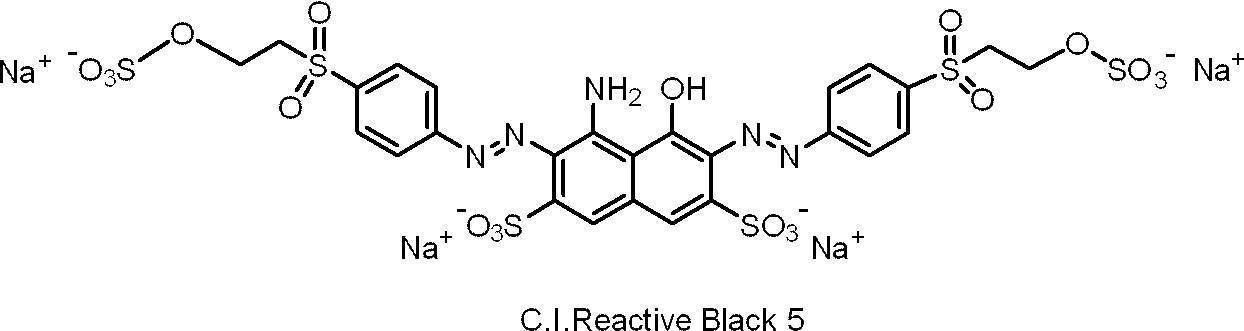
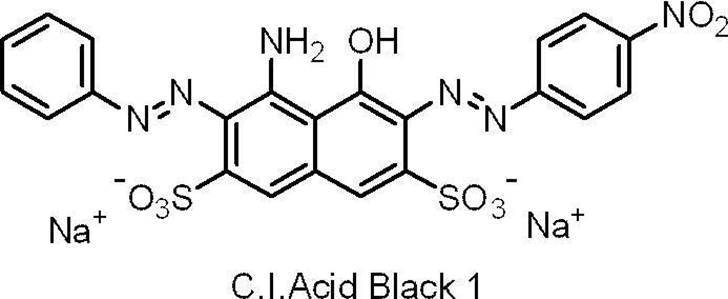
(d-6の合成)
300mLの3口ナスフラスコ中、C.I.Reactive Black 5(Aldrich社製)20g、水11.84gを、30℃下で1時間撹拌した。撹拌後、t-オクチルアミン(富士フイルム和光純薬社製)5.1g、酢酸エチル31.17g、メチルエチルケトン10.39g、及び炭酸ナトリウム5.71gを加えて60℃で2時間攪拌した。さらに、水53.4gを添加して30℃まで冷却した後、2時間攪拌した。得られた析出物をろ過によって集め、乾燥させることにより、d-6を得た。構造同定は、1H-NMR(DMSO)にて行った。d-6のNMRデータを以下に示す。
300mLの3口ナスフラスコ中、C.I.Reactive Black 5(Aldrich社製)20g、水11.84gを、30℃下で1時間撹拌した。撹拌後、t-オクチルアミン(富士フイルム和光純薬社製)5.1g、酢酸エチル31.17g、メチルエチルケトン10.39g、及び炭酸ナトリウム5.71gを加えて60℃で2時間攪拌した。さらに、水53.4gを添加して30℃まで冷却した後、2時間攪拌した。得られた析出物をろ過によって集め、乾燥させることにより、d-6を得た。構造同定は、1H-NMR(DMSO)にて行った。d-6のNMRデータを以下に示す。
-d-6のNMRデータ-
1H-NMR(400MHz, DMSO-d6):15.61-15.15 (s, 1H) , 10.65-10.48(d, 2H), 8.29(d, 2H), 8.18-7.90 (m, 6H), 7.49(s, 1H), 7.41(s, 1H), 3.48-3.44(q, 4H), 2.81-2.72(q, 4H), 1,29(s, 4H), 1.12(s, 12H), 0.93(s, 18H)
1H-NMR(400MHz, DMSO-d6):15.61-15.15 (s, 1H) , 10.65-10.48(d, 2H), 8.29(d, 2H), 8.18-7.90 (m, 6H), 7.49(s, 1H), 7.41(s, 1H), 3.48-3.44(q, 4H), 2.81-2.72(q, 4H), 1,29(s, 4H), 1.12(s, 12H), 0.93(s, 18H)
(d-2~d-5及びd-7~d-9の合成)
t-オクチルアミンを、同モル数の2-エチルヘキサノール、同モル数の1-ドデシルチオール、同モル数の3-(2-エチルヘキシルオキシ)プロピルアミン、同モル数のイソブチルアミン、同モル数のジブチルアミン、同モル数のジヘキシルアミン、又は同モル数のジオクチルアミンに変更したこと以外はd-6の合成と同様の方法で、d-2~d-5及びd-7~d-9をそれぞれ得た。
これらの構造同定も、1H-NMR(DMSO)にて行った。
t-オクチルアミンを、同モル数の2-エチルヘキサノール、同モル数の1-ドデシルチオール、同モル数の3-(2-エチルヘキシルオキシ)プロピルアミン、同モル数のイソブチルアミン、同モル数のジブチルアミン、同モル数のジヘキシルアミン、又は同モル数のジオクチルアミンに変更したこと以外はd-6の合成と同様の方法で、d-2~d-5及びd-7~d-9をそれぞれ得た。
これらの構造同定も、1H-NMR(DMSO)にて行った。
-d-2のNMRデータ-
1H-NMR(400MHz, DMSO-d6):15.61-15.15 (s, 1H) , 10.65-10.48(d, 2H), 8.29(d, 2H), 8.18-7.90 (m, 6H), 7.49(s, 1H), 7.41(s, 1H), 3.48-3.44(q, 4H), 2.81-2.72(q, 4H), 1.57-1.50(m, 6H), 1,31-1.12(m, 16H), 0.89-0.75(m, 12H)
-d-3のNMRデータ-
1H-NMR(400MHz, DMSO-d6):15.61-15.15 (s, 1H) , 10.65-10.48(d, 2H), 8.29(d, 2H), 8.18-7.90 (m, 6H), 7.49(s, 1H), 7.41(s, 1H), 3.15-3.44(m, 8H), 2.81-2.72(q, 4H), 2.41(t, 4H), 1.58-1.41(m, 8H), 1.29-1.25(m, 32H), 0.90-0.76(m, 6H)
-d-4のNMRデータ-
1H-NMR(400MHz, DMSO-d6):15.61-15.15 (s, 1H) , 10.65-10.48(d, 2H), 8.29(d, 2H), 8.18-7.90 (m, 6H), 7.49(s, 1H), 7.41(s, 1H), 3.48-3.44(q, 6H), 2.81-2.72(q, 4H), 2.50-2.41(m, 4H), 1.57-1.50(m, 10H), 1,31-1.12(m, 16H), 0.89-0.75(m, 12H)
-d-5のNMRデータ-
1H-NMR(400MHz, DMSO-d6):15.61-15.15 (s, 1H) , 10.65-10.48(d, 2H), 8.29(d, 2H), 8.18-7.90 (m, 6H), 7.49(s, 1H), 7.41(s, 1H), 3.48-3.44(q, 4H), 2.81-2.72(q, 4H), 2.50-2.41(m, 4H), 1.67(s, 2H), 0.89-0.75(m, 12H)
-d-7のNMRデータ-
1H-NMR(400MHz, DMSO-d6):15.61-15.15 (s, 1H) , 10.65-10.48(d, 2H), 8.29(d, 2H), 8.18-7.90 (m, 6H), 7.49(s, 1H), 7.41(s, 1H), 3.48-3.44(q, 4H), 2.81-2.72(q, 4H), 2,25(q, 8H), 1,29-1.12(m, 16H), 0.89-0.81(m, 12H)
-d-8のNMRデータ-
1H-NMR(400MHz, DMSO-d6):15.61-15.15 (s, 1H) , 10.65-10.48(d, 2H), 8.29(d, 2H), 8.18-7.90 (m, 6H), 7.49(s, 1H), 7.41(s, 1H), 3.48-3.44(q, 4H), 2.81-2.72(q, 4H), 2,25(q, 8H), 1,29-1.12(m, 32H), 0.89-0.81(m, 12H)
-d-9のNMRデータ-
1H-NMR(400MHz, DMSO-d6):15.61-15.15 (s, 1H) , 10.65-10.48(d, 2H), 8.29(d, 2H), 8.18-7.90 (m, 6H), 7.49(s, 1H), 7.41(s, 1H), 3.48-3.44(q, 4H), 2.81-2.72(q, 4H), 2,25(q, 8H), 1,29-1.12(m, 48H), 0.89-0.81(m, 12H)
1H-NMR(400MHz, DMSO-d6):15.61-15.15 (s, 1H) , 10.65-10.48(d, 2H), 8.29(d, 2H), 8.18-7.90 (m, 6H), 7.49(s, 1H), 7.41(s, 1H), 3.48-3.44(q, 4H), 2.81-2.72(q, 4H), 1.57-1.50(m, 6H), 1,31-1.12(m, 16H), 0.89-0.75(m, 12H)
-d-3のNMRデータ-
1H-NMR(400MHz, DMSO-d6):15.61-15.15 (s, 1H) , 10.65-10.48(d, 2H), 8.29(d, 2H), 8.18-7.90 (m, 6H), 7.49(s, 1H), 7.41(s, 1H), 3.15-3.44(m, 8H), 2.81-2.72(q, 4H), 2.41(t, 4H), 1.58-1.41(m, 8H), 1.29-1.25(m, 32H), 0.90-0.76(m, 6H)
-d-4のNMRデータ-
1H-NMR(400MHz, DMSO-d6):15.61-15.15 (s, 1H) , 10.65-10.48(d, 2H), 8.29(d, 2H), 8.18-7.90 (m, 6H), 7.49(s, 1H), 7.41(s, 1H), 3.48-3.44(q, 6H), 2.81-2.72(q, 4H), 2.50-2.41(m, 4H), 1.57-1.50(m, 10H), 1,31-1.12(m, 16H), 0.89-0.75(m, 12H)
-d-5のNMRデータ-
1H-NMR(400MHz, DMSO-d6):15.61-15.15 (s, 1H) , 10.65-10.48(d, 2H), 8.29(d, 2H), 8.18-7.90 (m, 6H), 7.49(s, 1H), 7.41(s, 1H), 3.48-3.44(q, 4H), 2.81-2.72(q, 4H), 2.50-2.41(m, 4H), 1.67(s, 2H), 0.89-0.75(m, 12H)
-d-7のNMRデータ-
1H-NMR(400MHz, DMSO-d6):15.61-15.15 (s, 1H) , 10.65-10.48(d, 2H), 8.29(d, 2H), 8.18-7.90 (m, 6H), 7.49(s, 1H), 7.41(s, 1H), 3.48-3.44(q, 4H), 2.81-2.72(q, 4H), 2,25(q, 8H), 1,29-1.12(m, 16H), 0.89-0.81(m, 12H)
-d-8のNMRデータ-
1H-NMR(400MHz, DMSO-d6):15.61-15.15 (s, 1H) , 10.65-10.48(d, 2H), 8.29(d, 2H), 8.18-7.90 (m, 6H), 7.49(s, 1H), 7.41(s, 1H), 3.48-3.44(q, 4H), 2.81-2.72(q, 4H), 2,25(q, 8H), 1,29-1.12(m, 32H), 0.89-0.81(m, 12H)
-d-9のNMRデータ-
1H-NMR(400MHz, DMSO-d6):15.61-15.15 (s, 1H) , 10.65-10.48(d, 2H), 8.29(d, 2H), 8.18-7.90 (m, 6H), 7.49(s, 1H), 7.41(s, 1H), 3.48-3.44(q, 4H), 2.81-2.72(q, 4H), 2,25(q, 8H), 1,29-1.12(m, 48H), 0.89-0.81(m, 12H)
(d-10の合成)
原料として、Na塩の形態のC.I.Reactive Black 5に代えてK塩の形態のReactive Black 5を用いたこと、及び、炭酸ナトリウムを、同モル数の炭酸カリウムに変更したこと以外はd-9の合成と同様にして、d-10を得た。構造同定は、1H-NMR(DMSO)にて行った。NMRデータはd-9と同等であるため省略する。
原料として、Na塩の形態のC.I.Reactive Black 5に代えてK塩の形態のReactive Black 5を用いたこと、及び、炭酸ナトリウムを、同モル数の炭酸カリウムに変更したこと以外はd-9の合成と同様にして、d-10を得た。構造同定は、1H-NMR(DMSO)にて行った。NMRデータはd-9と同等であるため省略する。
(d-1の合成)
500mLのナスフラスコ中にベンジルジメチルオクチルアンモニウムクロリドの10質量%水溶液141.9gを添加した後、C.I.Acid Black 1の10質量%水溶液154.1gを30分かけて滴下し、2時間攪拌した。得られた析出物をろ布によって集め、乾燥させ、d-1を得た。構造同定は、1H-NMR(DMSO)にて行った。d-1のNMRデータを以下に示す。
500mLのナスフラスコ中にベンジルジメチルオクチルアンモニウムクロリドの10質量%水溶液141.9gを添加した後、C.I.Acid Black 1の10質量%水溶液154.1gを30分かけて滴下し、2時間攪拌した。得られた析出物をろ布によって集め、乾燥させ、d-1を得た。構造同定は、1H-NMR(DMSO)にて行った。d-1のNMRデータを以下に示す。
-d-1のNMRデータ-
1H-NMR(400MHz, DMSO-d6):10.80 (s, 1H), 10.58 (s, 1H), 8.39(d, 2H), 8.23(d,2H), 7.81(q, 2H), 7.61-7.42(m, 13H), 7.40(s, 1H), 7.28(t, 1H), 4.51(s, 4H), 3.19-3.29(m, 4H), 2,91(s, 12H), 1,31-1.20(m, 24H), 0.89-0.80(t, 6H)
1H-NMR(400MHz, DMSO-d6):10.80 (s, 1H), 10.58 (s, 1H), 8.39(d, 2H), 8.23(d,2H), 7.81(q, 2H), 7.61-7.42(m, 13H), 7.40(s, 1H), 7.28(t, 1H), 4.51(s, 4H), 3.19-3.29(m, 4H), 2,91(s, 12H), 1,31-1.20(m, 24H), 0.89-0.80(t, 6H)

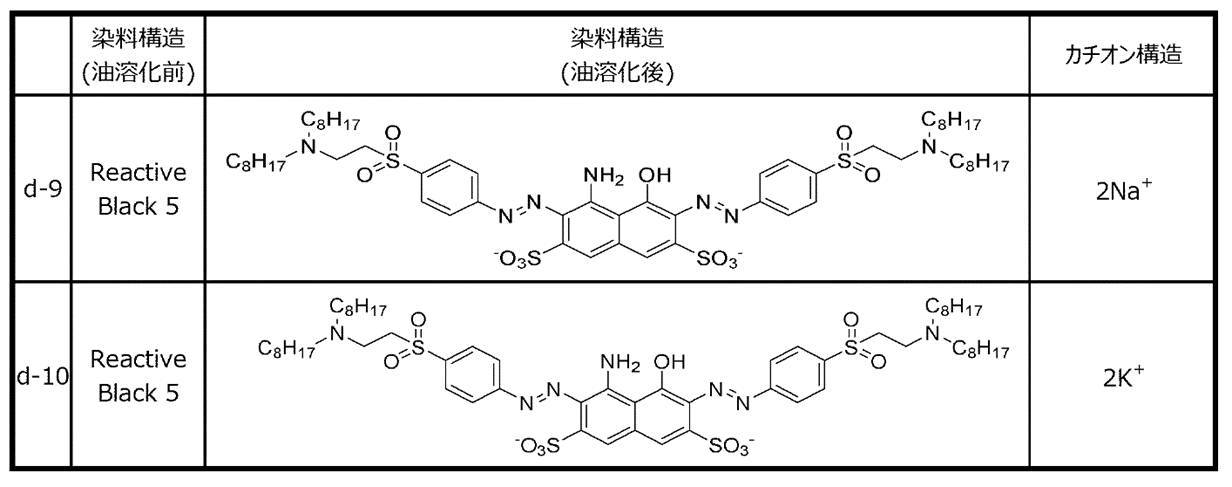
〔分散剤〕
・ポリウレタン1・・・実施例1に記載の方法で合成したポリウレタン
・スチレンアクリル・・・スチレン-アクリル酸共重合体(製品名「ジョンクリル678」、BASF社製)
・ポリウレタン1・・・実施例1に記載の方法で合成したポリウレタン
・スチレンアクリル・・・スチレン-アクリル酸共重合体(製品名「ジョンクリル678」、BASF社製)
ポリウレタン2、ポリウレタン3及びポリウレタンウレアの合成方法は、以下のとおりである。
<分散剤(ポリウレタン2)の合成>
三口フラスコに、4,4’メチレンビス(シクロヘキシルイソシアナート)(HMDI)160.0g、2,2-ジメチロールプロピオン酸(DMPA)70.0g、ポリカーボネートジオール(製品名「デュラノール(登録商標)T5651」、旭化成ケミカルズ社製)85.0g、及び酢酸エチル315.0gを仕込み、70℃に加熱した。
三口フラスコに、4,4’メチレンビス(シクロヘキシルイソシアナート)(HMDI)160.0g、2,2-ジメチロールプロピオン酸(DMPA)70.0g、ポリカーボネートジオール(製品名「デュラノール(登録商標)T5651」、旭化成ケミカルズ社製)85.0g、及び酢酸エチル315.0gを仕込み、70℃に加熱した。
次に、上記三口フラスコ中に、無機ビスマス触媒(製品名「ネオスタンU-600」日東化成社製)を0.2g添加し、70℃で5時間撹拌した。さらに、イソプロピルアルコール220.2g及び酢酸エチル199.0gを添加し、70℃で3時間撹拌した。上記撹拌後の反応液を、室温(23℃)まで放冷した。酢酸エチルで濃度調整を行うことにより、ポリウレタン2の30質量%溶液(溶媒は、酢酸エチル/イソプロピルアルコールの混合溶液)を得た。
なお、上記イソプロピルアルコールのうちの一部は、ポリウレタン2の末端封止剤としても機能している。ポリウレタン2の重量平均分子量は10000、酸価は95mgKOH/gであった。
なお、上記イソプロピルアルコールのうちの一部は、ポリウレタン2の末端封止剤としても機能している。ポリウレタン2の重量平均分子量は10000、酸価は95mgKOH/gであった。
<分散剤(ポリウレタン3)の合成>
三口フラスコに、トリメチルヘキサメチレンジイソシアネート(TMHDI)58.0g、2,2-ジメチロールプロピオン酸(DMPA)13.4g、ポリカーボネートジオール(製品名「デュラノール(登録商標)T5651」、旭化成ケミカルズ社製)130.0g、トリシクロ[5.2.1.0(2,6)]デカンジメタノール8.0g及び酢酸エチル209.4gを仕込み、70℃に加熱した。
三口フラスコに、トリメチルヘキサメチレンジイソシアネート(TMHDI)58.0g、2,2-ジメチロールプロピオン酸(DMPA)13.4g、ポリカーボネートジオール(製品名「デュラノール(登録商標)T5651」、旭化成ケミカルズ社製)130.0g、トリシクロ[5.2.1.0(2,6)]デカンジメタノール8.0g及び酢酸エチル209.4gを仕込み、70℃に加熱した。
次に、上記三口フラスコ中に、無機ビスマス触媒(製品名「ネオスタンU-600」日東化成社製)を0.2g添加し、70℃で5時間撹拌した。さらに、イソプロピルアルコール146.4g及び酢酸エチル132.3gを添加し、70℃で3時間撹拌した。上記撹拌後の反応液を、室温(23℃)まで放冷した。酢酸エチルで濃度調整を行うことにより、ポリウレタン3の30質量%溶液(溶媒は、酢酸エチル/イソプロピルアルコールの混合溶液)を得た。
なお、上記イソプロピルアルコールのうちの一部は、ポリウレタン3の末端封止剤としても機能している。ポリウレタン3の重量平均分子量は15000、酸価は11mgKOH/gであった。
なお、上記イソプロピルアルコールのうちの一部は、ポリウレタン3の末端封止剤としても機能している。ポリウレタン3の重量平均分子量は15000、酸価は11mgKOH/gであった。
<分散剤(ポリウレタンウレア)の合成>
三口フラスコに、トリメチルヘキサメチレンジイソシアネート(TMHDI)69.4g、2,2-ジメチロールプロピオン酸(DMPA)13.4g、イソホロンジアミン38.3g及び酢酸エチル136.9gを仕込み、70℃に加熱した。
三口フラスコに、トリメチルヘキサメチレンジイソシアネート(TMHDI)69.4g、2,2-ジメチロールプロピオン酸(DMPA)13.4g、イソホロンジアミン38.3g及び酢酸エチル136.9gを仕込み、70℃に加熱した。
次に、上記三口フラスコ中に、無機ビスマス触媒(製品名「ネオスタンU-600」日東化成社製)を0.2g添加し、70℃で5時間撹拌した。さらに、イソプロピルアルコール95.7g及び酢酸エチル86.5gを添加し、70℃で3時間撹拌した。上記撹拌後の反応液を、室温(23℃)まで放冷した。酢酸エチルで濃度調整を行うことにより、ポリウレタン3の30質量%溶液(溶媒は、酢酸エチル/イソプロピルアルコールの混合溶液)を得た。
なお、上記イソプロピルアルコールのうちの一部は、ポリウレタンウレアの末端封止剤としても機能している。ポリウレタンウレアの重量平均分子量は10000、酸価は45mgKOH/gであった。
なお、上記イソプロピルアルコールのうちの一部は、ポリウレタンウレアの末端封止剤としても機能している。ポリウレタンウレアの重量平均分子量は10000、酸価は45mgKOH/gであった。
<インクジェット捺染>
実施例及び比較例で調製した前処理液を用いて、布帛に対して前処理を行った。実施例及び比較例で調製したインク組成物を、前処理された布帛に付与し、熱処理を施すことにより捺染物を得た。詳細は以下のとおりである。なお、前処理液をパディング法を用いて布帛に浸漬させた後、前処理された布帛にインクジェット記録方式を用いてインク組成物を付与する捺染方法を「捺染方法1」とし、前処理液とインク組成物共に、インクジェット記録方式を用いて付与する捺染方法を「捺染方法2」とする。
実施例及び比較例で調製した前処理液を用いて、布帛に対して前処理を行った。実施例及び比較例で調製したインク組成物を、前処理された布帛に付与し、熱処理を施すことにより捺染物を得た。詳細は以下のとおりである。なお、前処理液をパディング法を用いて布帛に浸漬させた後、前処理された布帛にインクジェット記録方式を用いてインク組成物を付与する捺染方法を「捺染方法1」とし、前処理液とインク組成物共に、インクジェット記録方式を用いて付与する捺染方法を「捺染方法2」とする。
〔捺染方法1〕
(布帛の前処理)
布帛として、長尺状(15cm×4cm)の綿100%の布(製品名「コットンD5005」、赤堀産業社製)を準備した。
実施例及び比較例で調製した前処理液を、パディング法により布帛に浸透させた後、絞り率70%で絞って24時間乾燥させた。なお、絞り率(%)は、前処理液を含んだ布帛を絞った後の、布帛に対する前処理液の残存量(質量比率)を表す。
(布帛の前処理)
布帛として、長尺状(15cm×4cm)の綿100%の布(製品名「コットンD5005」、赤堀産業社製)を準備した。
実施例及び比較例で調製した前処理液を、パディング法により布帛に浸透させた後、絞り率70%で絞って24時間乾燥させた。なお、絞り率(%)は、前処理液を含んだ布帛を絞った後の、布帛に対する前処理液の残存量(質量比率)を表す。
(インク組成物の付与)
インクジェット記録装置として、インクジェットヘッド(製品名「StarFire SG-1024SA」、Fujifilm Dimatix社製)及びインク循環ポンプを搭載した装置を準備した。記録媒体として、前処理された布帛をステージ上に固定した。インクジェットヘッドに連結するインクタンクにインク組成物を充填した。インクジェットヘッドを、ステージの移動方向と直交する方向に対してノズルが並ぶようライン状に配置した。インク組成物の吐出条件は、打滴量を60pLとし、吐出周波数を10kHzとし、解像度を400dpi×400dpiとした。インク組成物が、インクタンクとインクジェットヘッドの間で循環するよう、インク循環ポンプを作動させた。記録媒体にインク組成物を吐出して、画像を記録し、着色布を得た。
インクジェット記録装置として、インクジェットヘッド(製品名「StarFire SG-1024SA」、Fujifilm Dimatix社製)及びインク循環ポンプを搭載した装置を準備した。記録媒体として、前処理された布帛をステージ上に固定した。インクジェットヘッドに連結するインクタンクにインク組成物を充填した。インクジェットヘッドを、ステージの移動方向と直交する方向に対してノズルが並ぶようライン状に配置した。インク組成物の吐出条件は、打滴量を60pLとし、吐出周波数を10kHzとし、解像度を400dpi×400dpiとした。インク組成物が、インクタンクとインクジェットヘッドの間で循環するよう、インク循環ポンプを作動させた。記録媒体にインク組成物を吐出して、画像を記録し、着色布を得た。
(熱処理(ヒートプレス))
得られた着色布を、ヒートプレス機(卓上自動平プレス機AF-54TEN型、アサヒ繊維機械社製)を用い、160℃、120秒の条件で熱処理し、捺染物を得た。
得られた着色布を、ヒートプレス機(卓上自動平プレス機AF-54TEN型、アサヒ繊維機械社製)を用い、160℃、120秒の条件で熱処理し、捺染物を得た。
〔捺染方法2〕
布帛として、長尺状(15cm×4cm)の綿100%の布(製品名「コットンD5005」、赤堀産業社製)を準備した。
インクジェット記録装置として、インクジェットヘッド(製品名「StarFire SG-1024SA」、Fujifilm Dimatix社製)及びインク循環ポンプを搭載した装置を準備した。記録媒体として、布帛をステージ上に固定した。インクジェットヘッドに連結するインクタンクに前処理液とインク組成物をそれぞれ充填した。インクジェットヘッドを、ステージの移動方向と直交する方向に対してノズルが並ぶようライン状に配置した。前処理液及びインク組成物の吐出条件は、打滴量を60pLとし、吐出周波数を10kHzとし、解像度を400dpi×400dpiとした。前処理液及びインク組成物が、インクタンクとインクジェットヘッドの間で循環するよう、インク循環ポンプを作動させた。
まず、記録媒体の全面に前処理液を吐出し、ベタ画像を記録した。60℃の温風で10秒間乾燥させた後、インク組成物を吐出して、画像を記録し、着色布を得た。
得られた着色布を、ヒートプレス機(卓上自動平プレス機AF-54TEN型、アサヒ繊維機械社製)を用い、160℃、120秒の条件で熱処理し、捺染物を得た。
布帛として、長尺状(15cm×4cm)の綿100%の布(製品名「コットンD5005」、赤堀産業社製)を準備した。
インクジェット記録装置として、インクジェットヘッド(製品名「StarFire SG-1024SA」、Fujifilm Dimatix社製)及びインク循環ポンプを搭載した装置を準備した。記録媒体として、布帛をステージ上に固定した。インクジェットヘッドに連結するインクタンクに前処理液とインク組成物をそれぞれ充填した。インクジェットヘッドを、ステージの移動方向と直交する方向に対してノズルが並ぶようライン状に配置した。前処理液及びインク組成物の吐出条件は、打滴量を60pLとし、吐出周波数を10kHzとし、解像度を400dpi×400dpiとした。前処理液及びインク組成物が、インクタンクとインクジェットヘッドの間で循環するよう、インク循環ポンプを作動させた。
まず、記録媒体の全面に前処理液を吐出し、ベタ画像を記録した。60℃の温風で10秒間乾燥させた後、インク組成物を吐出して、画像を記録し、着色布を得た。
得られた着色布を、ヒートプレス機(卓上自動平プレス機AF-54TEN型、アサヒ繊維機械社製)を用い、160℃、120秒の条件で熱処理し、捺染物を得た。
<評価>
上記捺染物を用い、以下の評価を実施した。評価方法は以下のとおりである。表3~表6に、評価結果を示す。
上記捺染物を用い、以下の評価を実施した。評価方法は以下のとおりである。表3~表6に、評価結果を示す。
(洗濯堅牢性(色移り))
上記捺染方法1において、インク組成物を用いて記録媒体の全面にベタ画像を記録し、捺染物を得た。
捺染物の色移りを、ISO 105-C06:2010のB1Sに基づいて評価した。評価結果において、捺染物の色移りがなく、最も優れるランクは5である。ランク3-4、ランク4、ランク4-5、及びランク5は実用上問題ないレベルである。
上記捺染方法1において、インク組成物を用いて記録媒体の全面にベタ画像を記録し、捺染物を得た。
捺染物の色移りを、ISO 105-C06:2010のB1Sに基づいて評価した。評価結果において、捺染物の色移りがなく、最も優れるランクは5である。ランク3-4、ランク4、ランク4-5、及びランク5は実用上問題ないレベルである。
評価結果において、
「1-2」との表記は、ランク1より高くランク2より低いことを意味する。
「2-3」との表記は、ランク2より高くランク3より低いことを意味する。
「3-4」との表記は、ランク3より高くランク4より低いことを意味する。
「4-5」との表記は、ランク4より高くランク5より低いことを意味する。
「1-2」との表記は、ランク1より高くランク2より低いことを意味する。
「2-3」との表記は、ランク2より高くランク3より低いことを意味する。
「3-4」との表記は、ランク3より高くランク4より低いことを意味する。
「4-5」との表記は、ランク4より高くランク5より低いことを意味する。
(滲み)
上記捺染方法1において、インク組成物を用いて、MS明朝の文字(unicode:U+9DF9)を、白抜き文字として8pt(ポイント)、10pt、12pt、14ptでそれぞれ記録し、捺染物を得た。捺染物から0.5m離れた位置から、文字が明確に読めるか否かを判定した。具体的に、図1に記載の符号111で表される横線と、符号112で表される横線とが、それぞれ分離して記録されていることが確認できるか否かを判定した。評価基準は以下のとおりである。ランク4及びランク5は、実用上問題ないレベルである。
なお、白抜き文字とは、特定の色で塗りつぶされた領域の一部に色を付さずに、白色で記録された文字を指す。
5:8ptの文字に滲みがなく、明確に読める。
4:8ptの文字に滲みがあるが、10ptの文字に滲みがなく、明確に読める。
3:8pt、10ptの文字に滲みがあるが、12ptの文字に滲みがなく、明確に読める。
2:8pt、10pt、12ptの文字に滲みがあるが、14ptの文字に滲みがなく、明確に読める。
1: いずれの文字も滲みがあり、読めない。
上記捺染方法1において、インク組成物を用いて、MS明朝の文字(unicode:U+9DF9)を、白抜き文字として8pt(ポイント)、10pt、12pt、14ptでそれぞれ記録し、捺染物を得た。捺染物から0.5m離れた位置から、文字が明確に読めるか否かを判定した。具体的に、図1に記載の符号111で表される横線と、符号112で表される横線とが、それぞれ分離して記録されていることが確認できるか否かを判定した。評価基準は以下のとおりである。ランク4及びランク5は、実用上問題ないレベルである。
なお、白抜き文字とは、特定の色で塗りつぶされた領域の一部に色を付さずに、白色で記録された文字を指す。
5:8ptの文字に滲みがなく、明確に読める。
4:8ptの文字に滲みがあるが、10ptの文字に滲みがなく、明確に読める。
3:8pt、10ptの文字に滲みがあるが、12ptの文字に滲みがなく、明確に読める。
2:8pt、10pt、12ptの文字に滲みがあるが、14ptの文字に滲みがなく、明確に読める。
1: いずれの文字も滲みがあり、読めない。
(前処理液の吐出性)
上記捺染方法2において、前処理液を30g/m2の付与量でシングルパスで、記録媒体の全面に吐出した後、インク組成物を15g/m2の付与量で3パススキャニングモードでベタ画像を記録し、捺染物を得た。捺染物にスジが見られるか否かを目視で確認した。評価基準は以下のとおりである。ランク4及びランク5は、実用上問題ないレベルである。
5:スジが確認されない
4:薄いスジが1本である。
3:薄いスジが2本~4本である
2:濃いスジが1本である。
1:濃いスジが2本以上である
上記捺染方法2において、前処理液を30g/m2の付与量でシングルパスで、記録媒体の全面に吐出した後、インク組成物を15g/m2の付与量で3パススキャニングモードでベタ画像を記録し、捺染物を得た。捺染物にスジが見られるか否かを目視で確認した。評価基準は以下のとおりである。ランク4及びランク5は、実用上問題ないレベルである。
5:スジが確認されない
4:薄いスジが1本である。
3:薄いスジが2本~4本である
2:濃いスジが1本である。
1:濃いスジが2本以上である
(部材腐食性)
インクジェットヘッド(製品名「StarFire SG-1024SA」、Fujifilm Dimatix社製)の部材であるFlink(Part number 2100032767)を、ポリプロピレン製の容器に入れ、前処理液に浸漬させた。32℃で、1週間後、1か月後、及び3か月後に、部材(金属配線部)の腐食度合いを目視で観察した。ランク4及びランク5は、実用上問題ないレベルである。
5:3か月後、金属配線部の腐食が見られなかった。
4:1か月後、金属配線部の腐食が見られなかったが、3か月後に腐食が確認できた。
3:1週間後、金属配線部の腐食が見られなかったが、1か月後に腐食が確認できた。
2:1週間後、金属配線部にわずかな腐食が確認できた。
1:1週間後、金属配線部に顕著な腐食が確認できた。
インクジェットヘッド(製品名「StarFire SG-1024SA」、Fujifilm Dimatix社製)の部材であるFlink(Part number 2100032767)を、ポリプロピレン製の容器に入れ、前処理液に浸漬させた。32℃で、1週間後、1か月後、及び3か月後に、部材(金属配線部)の腐食度合いを目視で観察した。ランク4及びランク5は、実用上問題ないレベルである。
5:3か月後、金属配線部の腐食が見られなかった。
4:1か月後、金属配線部の腐食が見られなかったが、3か月後に腐食が確認できた。
3:1週間後、金属配線部の腐食が見られなかったが、1か月後に腐食が確認できた。
2:1週間後、金属配線部にわずかな腐食が確認できた。
1:1週間後、金属配線部に顕著な腐食が確認できた。


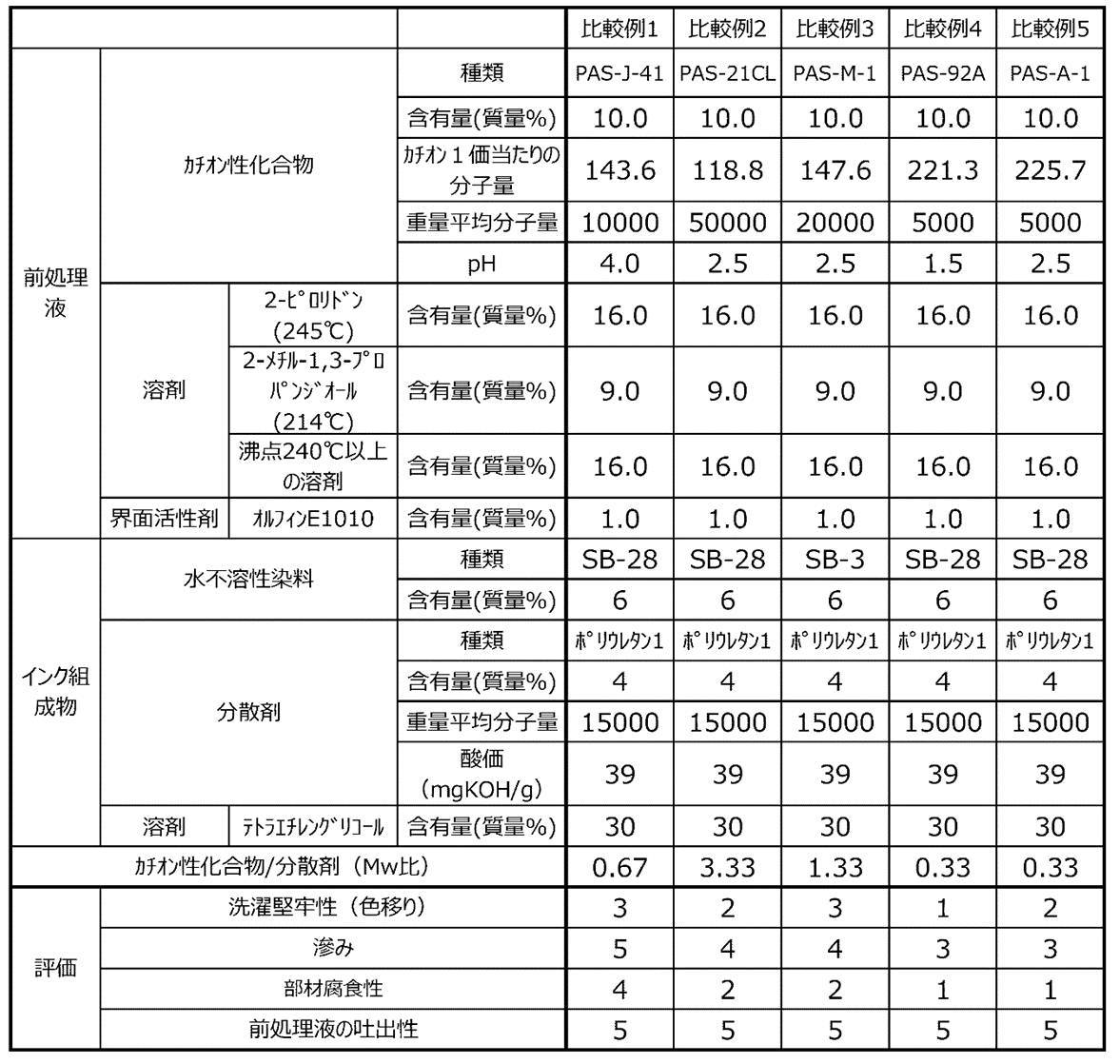
表3~表6に示すように、実施例1~実施例27では、カチオン1価当たりの分子量が150~220であるカチオン性化合物を含む前処理液と、水不溶性染料、分散剤及び水を含むインク組成物と、を有し、分散剤は、ウレタン樹脂、ウレア樹脂及びウレタンウレア樹脂からなる群より選択される少なくとも1種であり、他の布帛への色移りが抑制され、かつ、滲みが抑制された捺染物が得られることが分かった。
実施例1は、分散剤の酸価が15mgKOH/g~90mgKOH/gであるため、実施例4及び実施例5と比較して、洗濯堅牢性(色移り)が良好であった。
実施例5は、前処理液が、沸点が240℃以上の溶剤を含み、溶剤の含有量が前処理液の全量に対して14質量%~50質量%であるため、実施例6及び実施例7と比較して、前処理液の吐出性が良好であった。
実施例11は、カチオン性化合物の重量平均分子量が10,000~200,000であるため、実施例17と比較して、滲みが抑制された。また、実施例11は、分散剤の重量平均分子量に対する、カチオン性化合物の重量平均分子量の比率が1.5~15であるため、実施例17と比較して、滲みが抑制された。
これに対して、比較例1~比較例3では、前処理液に含まれるカチオン性化合物のカチオン1価当たりの分子量が150未満であるため、洗濯堅牢性(色移り)に劣ることが分かった。
また、比較例4及び比較例5では、前処理液に含まれるカチオン性化合物のカチオン1価当たりの分子量が220を超えているため、洗濯堅牢性(色移り)に劣り、かつ、得られる捺染物に滲みが生じることが分かった。
以上より、本開示の一実施形態に係るインクセットは、カチオン1価当たりの分子量が150~220であるカチオン性化合物を含む前処理液と、水不溶性染料、分散剤、及び水を含むインク組成物と、を有し、分散剤は、ウレタン樹脂、ウレア樹脂、及びウレタンウレア樹脂からなる群より選択される少なくとも1種であり、他の布帛への色移りが抑制され、かつ、滲みが抑制された捺染物を得ることができる。
なお、2019年9月30日に出願された日本国特許出願2019-180586号の開示は、その全体が参照により本明細書に取り込まれる。また、本明細書に記載された全ての文献、特許出願および技術規格は、個々の文献、特許出願、および技術規格が参照により取り込まれることが具体的かつ個々に記された場合と同程度に、本明細書中に参照により取り込まれる。
Claims (13)
- カチオン1価当たりの分子量が150~220であるカチオン性化合物を含む前処理液と、
水不溶性染料、分散剤、及び水を含むインク組成物と、
を有し、
前記分散剤は、ウレタン樹脂、ウレア樹脂、及びウレタンウレア樹脂からなる群より選択される少なくとも1種である捺染用インクセット。 - 前記分散剤の酸価は、15mgKOH/g~90mgKOHである請求項1に記載の捺染用インクセット。
- 前記カチオン性化合物は、ジシアンジアミドとアルキルアミンとの縮合物、ジシアンジアミドとホルムアルデヒドとの縮合物、モノマー単位としてジアリルジメチルアンモニウムクロリドを含む重合体、及び、モノマー単位としてメチルジアリルアミン酢酸塩を含む重合体からなる群より選択される少なくとも1種である請求項1又は請求項2に記載の捺染用インクセット。
- 前記カチオン性化合物の重量平均分子量は、10,000~200,000である請求項1~請求項3のいずれか1項に記載の捺染用インクセット。
- 前記分散剤の重量平均分子量に対する、前記カチオン性化合物の重量平均分子量の比率は、1.5~15である請求項1~請求項4のいずれか1項に記載の捺染用インクセット。
- 前記前処理液は、沸点が240℃以上の溶剤をさらに含み、
前記溶剤の含有量は、前記前処理液の全量に対して14質量%~50質量%である請求項1~請求項5のいずれか1項に記載の捺染用インクセット。 - 前記前処理液は、界面活性剤をさらに含む請求項1~請求項6のいずれか1項に記載の捺染用インクセット。
- 前記水不溶性染料は、油溶性染料、分散性染料、及び建て染め染料からなる群より選択される少なくとも1種の染料である請求項1~請求項7のいずれか1項に記載の捺染用インクセット。
- 前記水不溶性染料は、C.I.Solvent Black 3である請求項1~請求項7のいずれか1項に記載の捺染用インクセット。
- 請求項1~請求項9のいずれか1項に記載のインクセットに含まれる前処理液を、布帛に付与する前処理液付与工程と、
請求項1~請求項9のいずれか1項に記載のインクセットに含まれるインク組成物を、前記前処理液が付与された布帛に付与するインク付与工程と、を含む捺染方法。 - 前記前処理液付与工程では、前記前処理液をインクジェット記録方式を用いて付与する請求項10に記載の捺染方法。
- 前記インク付与工程では、前記インク組成物をインクジェット記録方式を用いて付与する請求項10又は請求項11に記載の捺染方法。
- 前記布帛は、セルロース繊維である請求項10~請求項12のいずれか1項に記載の捺染方法。
Priority Applications (2)
| Application Number | Priority Date | Filing Date | Title |
|---|---|---|---|
| JP2021551164A JP7358493B2 (ja) | 2019-09-30 | 2020-09-24 | 捺染用インクセット及び捺染方法 |
| US17/673,733 US11952502B2 (en) | 2019-09-30 | 2022-02-16 | Textile printing ink set and textile printing method |
Applications Claiming Priority (2)
| Application Number | Priority Date | Filing Date | Title |
|---|---|---|---|
| JP2019-180586 | 2019-09-30 | ||
| JP2019180586 | 2019-09-30 |
Related Child Applications (1)
| Application Number | Title | Priority Date | Filing Date |
|---|---|---|---|
| US17/673,733 Continuation US11952502B2 (en) | 2019-09-30 | 2022-02-16 | Textile printing ink set and textile printing method |
Publications (1)
| Publication Number | Publication Date |
|---|---|
| WO2021065682A1 true WO2021065682A1 (ja) | 2021-04-08 |
Family
ID=75337305
Family Applications (1)
| Application Number | Title | Priority Date | Filing Date |
|---|---|---|---|
| PCT/JP2020/036091 Ceased WO2021065682A1 (ja) | 2019-09-30 | 2020-09-24 | 捺染用インクセット及び捺染方法 |
Country Status (3)
| Country | Link |
|---|---|
| US (1) | US11952502B2 (ja) |
| JP (1) | JP7358493B2 (ja) |
| WO (1) | WO2021065682A1 (ja) |
Cited By (2)
| Publication number | Priority date | Publication date | Assignee | Title |
|---|---|---|---|---|
| WO2023105737A1 (ja) * | 2021-12-10 | 2023-06-15 | コニカミノルタ株式会社 | インクジェット記録用インクセット、インクジェット記録方法及びインクジェット記録装置 |
| KR20240107411A (ko) * | 2022-12-30 | 2024-07-09 | 주식회사 홍성씨링인쇄 | 친환경 피그먼트 프린팅 방법 |
Citations (8)
| Publication number | Priority date | Publication date | Assignee | Title |
|---|---|---|---|---|
| JPS5259786A (en) * | 1976-11-22 | 1977-05-17 | Nitto Boseki Co Ltd | Method of dyeing fiber goods |
| JP2003011486A (ja) * | 2001-07-03 | 2003-01-15 | Ricoh Co Ltd | 被記録材の前処理液及びインクジェット記録方法 |
| JP2012511615A (ja) * | 2008-12-12 | 2012-05-24 | イー・アイ・デュポン・ドウ・ヌムール・アンド・カンパニー | 両性分散剤およびインクジェットインクにおけるその使用 |
| JP2012126056A (ja) * | 2010-12-16 | 2012-07-05 | Kao Corp | インクジェット記録方法 |
| JP2015193230A (ja) * | 2014-03-17 | 2015-11-05 | 株式会社リコー | 処理液、インクセット、及びインクジェット記録方法 |
| WO2018043414A1 (ja) * | 2016-08-31 | 2018-03-08 | 富士フイルム株式会社 | インクジェット捺染方法、着色布の製造方法、及び着色布 |
| WO2019004327A1 (ja) * | 2017-06-27 | 2019-01-03 | 富士フイルム株式会社 | 捺染用インクジェットインク、インクカートリッジ、インクセット、及びインクジェット捺染方法 |
| JP2019108423A (ja) * | 2017-12-15 | 2019-07-04 | 大日本塗料株式会社 | インクセット及び印刷方法 |
Family Cites Families (4)
| Publication number | Priority date | Publication date | Assignee | Title |
|---|---|---|---|---|
| JP3552986B2 (ja) | 2000-03-22 | 2004-08-11 | 日華化学株式会社 | インクジェット記録用被記録材及びインクジェット記録用耐水化剤 |
| DE10244998A1 (de) | 2002-09-26 | 2004-04-01 | Basf Ag | Vorbehandlungsflotte zur Vorbereitung von textilen Substraten für den Ink-Jet-Druck |
| JP2006124843A (ja) | 2004-10-26 | 2006-05-18 | Konica Minolta Holdings Inc | インクジェット捺染方法 |
| JP2006342455A (ja) | 2005-06-08 | 2006-12-21 | Canon Electronics Inc | インクジェット捺染方法及びインクジェット捺染物 |
-
2020
- 2020-09-24 WO PCT/JP2020/036091 patent/WO2021065682A1/ja not_active Ceased
- 2020-09-24 JP JP2021551164A patent/JP7358493B2/ja active Active
-
2022
- 2022-02-16 US US17/673,733 patent/US11952502B2/en active Active
Patent Citations (8)
| Publication number | Priority date | Publication date | Assignee | Title |
|---|---|---|---|---|
| JPS5259786A (en) * | 1976-11-22 | 1977-05-17 | Nitto Boseki Co Ltd | Method of dyeing fiber goods |
| JP2003011486A (ja) * | 2001-07-03 | 2003-01-15 | Ricoh Co Ltd | 被記録材の前処理液及びインクジェット記録方法 |
| JP2012511615A (ja) * | 2008-12-12 | 2012-05-24 | イー・アイ・デュポン・ドウ・ヌムール・アンド・カンパニー | 両性分散剤およびインクジェットインクにおけるその使用 |
| JP2012126056A (ja) * | 2010-12-16 | 2012-07-05 | Kao Corp | インクジェット記録方法 |
| JP2015193230A (ja) * | 2014-03-17 | 2015-11-05 | 株式会社リコー | 処理液、インクセット、及びインクジェット記録方法 |
| WO2018043414A1 (ja) * | 2016-08-31 | 2018-03-08 | 富士フイルム株式会社 | インクジェット捺染方法、着色布の製造方法、及び着色布 |
| WO2019004327A1 (ja) * | 2017-06-27 | 2019-01-03 | 富士フイルム株式会社 | 捺染用インクジェットインク、インクカートリッジ、インクセット、及びインクジェット捺染方法 |
| JP2019108423A (ja) * | 2017-12-15 | 2019-07-04 | 大日本塗料株式会社 | インクセット及び印刷方法 |
Cited By (4)
| Publication number | Priority date | Publication date | Assignee | Title |
|---|---|---|---|---|
| WO2023105737A1 (ja) * | 2021-12-10 | 2023-06-15 | コニカミノルタ株式会社 | インクジェット記録用インクセット、インクジェット記録方法及びインクジェット記録装置 |
| JPWO2023105737A1 (ja) * | 2021-12-10 | 2023-06-15 | ||
| KR20240107411A (ko) * | 2022-12-30 | 2024-07-09 | 주식회사 홍성씨링인쇄 | 친환경 피그먼트 프린팅 방법 |
| KR102892132B1 (ko) | 2022-12-30 | 2025-11-27 | 주식회사 홍성씨링인쇄 | 친환경 피그먼트 프린팅 방법 |
Also Published As
| Publication number | Publication date |
|---|---|
| US11952502B2 (en) | 2024-04-09 |
| US20220169881A1 (en) | 2022-06-02 |
| JP7358493B2 (ja) | 2023-10-10 |
| JPWO2021065682A1 (ja) | 2021-04-08 |
Similar Documents
| Publication | Publication Date | Title |
|---|---|---|
| JP5891589B2 (ja) | インクセット、捺染方法 | |
| JPWO2019004327A1 (ja) | 捺染用インクジェットインク、インクカートリッジ、インクセット、及びインクジェット捺染方法 | |
| JP6362525B2 (ja) | インク、インクカートリッジ、及びインクジェット記録方法 | |
| JP5577851B2 (ja) | 前処理液、捺染方法および印捺物 | |
| US12486422B2 (en) | Textile printing ink set and textile printing method | |
| JP2005504156A (ja) | 架橋性ポリウレタンブロック共重合体、及びこれを分散バインダ組成物におけて使用する方法 | |
| US9062228B2 (en) | Aqueous inkjet inks containing polyurethane binders with components to interact with cellulose | |
| WO2012088127A1 (en) | Aqueous ink-jet inks containing alternating polyurethanes as binders | |
| EP4159818B1 (en) | Water-based inkjet ink and method for producing inkjet printed material | |
| US20130144008A1 (en) | Polyurethane dispersants derived from alkoxy aromatic diols | |
| WO2020004228A1 (ja) | インク、インクカートリッジ、インクセット、インクジェットプリンタ及びインクジェット捺染方法 | |
| JP7358493B2 (ja) | 捺染用インクセット及び捺染方法 | |
| JP7154431B2 (ja) | 着色樹脂粒子分散物、インク、インクセット、インクジェット捺染方法、油溶性染料の製造方法、及び捺染物 | |
| JP7307188B2 (ja) | 捺染用前処理液、捺染用インクセット、インクジェット捺染方法、捺染物、及びオニウム塩化合物 | |
| US20130286087A1 (en) | Inkjet inks with polyurethane additive with a limited amount of branching | |
| EP3933001B1 (en) | Colored resin particle dispersion, ink, ink set, and inkjet printing method | |
| JP2020002218A (ja) | インク、インクジェット捺染方法、インクカートリッジ、及びインクジェットプリンタ | |
| US8827417B2 (en) | Inkjet ink with polyurethane additive derived from alkoxy aromatic diols inks | |
| JP2018076400A (ja) | 水性インク、インクカートリッジ、及びインクジェット記録方法 | |
| JP6870889B2 (ja) | 水系インク | |
| JP6980485B2 (ja) | インクジェット記録方法、インクジェット記録装置 | |
| US20200263048A1 (en) | Inkjet ink compositions | |
| JP2025164716A (ja) | 水性インク、インクカートリッジ、及びインクジェット記録方法 |
Legal Events
| Date | Code | Title | Description |
|---|---|---|---|
| 121 | Ep: the epo has been informed by wipo that ep was designated in this application |
Ref document number: 20870706 Country of ref document: EP Kind code of ref document: A1 |
|
| ENP | Entry into the national phase |
Ref document number: 2021551164 Country of ref document: JP Kind code of ref document: A |
|
| NENP | Non-entry into the national phase |
Ref country code: DE |
|
| 122 | Ep: pct application non-entry in european phase |
Ref document number: 20870706 Country of ref document: EP Kind code of ref document: A1 |