WO2021049183A1 - 電気導線、絶縁電線、コイル、並びに電気・電子機器 - Google Patents
電気導線、絶縁電線、コイル、並びに電気・電子機器 Download PDFInfo
- Publication number
- WO2021049183A1 WO2021049183A1 PCT/JP2020/028422 JP2020028422W WO2021049183A1 WO 2021049183 A1 WO2021049183 A1 WO 2021049183A1 JP 2020028422 W JP2020028422 W JP 2020028422W WO 2021049183 A1 WO2021049183 A1 WO 2021049183A1
- Authority
- WO
- WIPO (PCT)
- Prior art keywords
- wire
- mass
- electric
- insulated
- present
- Prior art date
- Legal status (The legal status is an assumption and is not a legal conclusion. Google has not performed a legal analysis and makes no representation as to the accuracy of the status listed.)
- Ceased
Links
Images


Classifications
-
- H—ELECTRICITY
- H01—ELECTRIC ELEMENTS
- H01B—CABLES; CONDUCTORS; INSULATORS; SELECTION OF MATERIALS FOR THEIR CONDUCTIVE, INSULATING OR DIELECTRIC PROPERTIES
- H01B3/00—Insulators or insulating bodies characterised by the insulating materials; Selection of materials for their insulating or dielectric properties
- H01B3/18—Insulators or insulating bodies characterised by the insulating materials; Selection of materials for their insulating or dielectric properties mainly consisting of organic substances
- H01B3/30—Insulators or insulating bodies characterised by the insulating materials; Selection of materials for their insulating or dielectric properties mainly consisting of organic substances plastics; resins; waxes
- H01B3/303—Macromolecular compounds obtained by reactions forming a linkage containing nitrogen with or without oxygen or carbon in the main chain of the macromolecule, not provided for in groups H01B3/38 or H01B3/302
- H01B3/306—Polyimides or polyesterimides
-
- C—CHEMISTRY; METALLURGY
- C22—METALLURGY; FERROUS OR NON-FERROUS ALLOYS; TREATMENT OF ALLOYS OR NON-FERROUS METALS
- C22C—ALLOYS
- C22C21/00—Alloys based on aluminium
-
- C—CHEMISTRY; METALLURGY
- C22—METALLURGY; FERROUS OR NON-FERROUS ALLOYS; TREATMENT OF ALLOYS OR NON-FERROUS METALS
- C22F—CHANGING THE PHYSICAL STRUCTURE OF NON-FERROUS METALS AND NON-FERROUS ALLOYS
- C22F1/00—Changing the physical structure of non-ferrous metals or alloys by heat treatment or by hot or cold working
-
- C—CHEMISTRY; METALLURGY
- C22—METALLURGY; FERROUS OR NON-FERROUS ALLOYS; TREATMENT OF ALLOYS OR NON-FERROUS METALS
- C22F—CHANGING THE PHYSICAL STRUCTURE OF NON-FERROUS METALS AND NON-FERROUS ALLOYS
- C22F1/00—Changing the physical structure of non-ferrous metals or alloys by heat treatment or by hot or cold working
- C22F1/04—Changing the physical structure of non-ferrous metals or alloys by heat treatment or by hot or cold working of aluminium or alloys based thereon
-
- H—ELECTRICITY
- H01—ELECTRIC ELEMENTS
- H01B—CABLES; CONDUCTORS; INSULATORS; SELECTION OF MATERIALS FOR THEIR CONDUCTIVE, INSULATING OR DIELECTRIC PROPERTIES
- H01B1/00—Conductors or conductive bodies characterised by the conductive materials; Selection of materials as conductors
- H01B1/02—Conductors or conductive bodies characterised by the conductive materials; Selection of materials as conductors mainly consisting of metals or alloys
-
- H—ELECTRICITY
- H01—ELECTRIC ELEMENTS
- H01B—CABLES; CONDUCTORS; INSULATORS; SELECTION OF MATERIALS FOR THEIR CONDUCTIVE, INSULATING OR DIELECTRIC PROPERTIES
- H01B3/00—Insulators or insulating bodies characterised by the insulating materials; Selection of materials for their insulating or dielectric properties
- H01B3/18—Insulators or insulating bodies characterised by the insulating materials; Selection of materials for their insulating or dielectric properties mainly consisting of organic substances
- H01B3/30—Insulators or insulating bodies characterised by the insulating materials; Selection of materials for their insulating or dielectric properties mainly consisting of organic substances plastics; resins; waxes
- H01B3/36—Insulators or insulating bodies characterised by the insulating materials; Selection of materials for their insulating or dielectric properties mainly consisting of organic substances plastics; resins; waxes condensation products of phenols with aldehydes or ketones
-
- H—ELECTRICITY
- H01—ELECTRIC ELEMENTS
- H01F—MAGNETS; INDUCTANCES; TRANSFORMERS; SELECTION OF MATERIALS FOR THEIR MAGNETIC PROPERTIES
- H01F27/00—Details of transformers or inductances, in general
- H01F27/34—Special means for preventing or reducing unwanted electric or magnetic effects, e.g. no-load losses, reactive currents, harmonics, oscillations, leakage fields
-
- H—ELECTRICITY
- H01—ELECTRIC ELEMENTS
- H01F—MAGNETS; INDUCTANCES; TRANSFORMERS; SELECTION OF MATERIALS FOR THEIR MAGNETIC PROPERTIES
- H01F5/00—Coils
-
- H—ELECTRICITY
- H01—ELECTRIC ELEMENTS
- H01F—MAGNETS; INDUCTANCES; TRANSFORMERS; SELECTION OF MATERIALS FOR THEIR MAGNETIC PROPERTIES
- H01F5/00—Coils
- H01F5/06—Insulation of windings
-
- H—ELECTRICITY
- H01—ELECTRIC ELEMENTS
- H01B—CABLES; CONDUCTORS; INSULATORS; SELECTION OF MATERIALS FOR THEIR CONDUCTIVE, INSULATING OR DIELECTRIC PROPERTIES
- H01B7/00—Insulated conductors or cables characterised by their form
- H01B7/02—Disposition of insulation
-
- H—ELECTRICITY
- H01—ELECTRIC ELEMENTS
- H01F—MAGNETS; INDUCTANCES; TRANSFORMERS; SELECTION OF MATERIALS FOR THEIR MAGNETIC PROPERTIES
- H01F27/00—Details of transformers or inductances, in general
- H01F27/34—Special means for preventing or reducing unwanted electric or magnetic effects, e.g. no-load losses, reactive currents, harmonics, oscillations, leakage fields
- H01F2027/348—Preventing eddy currents
Definitions
- the present invention relates to an electric wire, an insulated electric wire, a coil, and an electric / electronic device.
- Inverter-related equipment (high-speed switching elements, inverter motors, coils for electrical and electronic equipment such as transformers, etc.) uses insulated wires with an insulating film containing an insulating resin around the conductors as magnet wires. There is.
- eddy current loss can be suppressed by dividing the conductor of an insulated wire into a plurality of strands.
- the wires constituting the divided conductor are electrically connected, the effect of suppressing the eddy current loss cannot be obtained. Therefore, the periphery of each wire constituting the divided conductor is covered with an insulating resin. That is, a plurality of strands having an insulating coating layer are arranged substantially parallel to each other, or a plurality of strands having an insulating coating layer are spirally twisted to form a stranded wire, and the entire circumference of the divided conductor is integrally insulated. Insulated wires are manufactured that are coated and have split conductors.
- Patent Document 1 there is also known a technique of laminating a plurality of metal conductors having an oxide film formed on the surface to form a divided conductor.
- the oxide film on the metal surface can be naturally formed by exposing it to air, and this oxide film functions as an insulating layer.
- the insulating property of the oxide film formed on the surface of the aluminum wire is not always sufficient.
- eddy current loss can be effectively suppressed, mechanical strength is excellent, and conductivity is improved, even though an aluminum wire not coated with an insulating resin is used as the wire constituting the divided conductor.
- the challenge is to provide excellent insulated wires.
- Another object of the present invention is to provide an electric conducting wire suitable as a split conductor constituting the insulated electric wire.
- the present inventors have obtained an insulated wire by applying an aluminum wire having a specific composition not coated with an insulating resin as a wire constituting the divided conductor.
- the same conductivity as when pure aluminum is used as the wire can be imparted, the mechanical strength can be further increased, and the oxide film generated by natural oxidation can be thickened on the surface of the wire, resulting in eddy current loss.
- the present invention has been completed based on these findings.
- An electric conductor composed of a plurality of aluminum wires arranged in parallel with each other or a divided conductor composed of a plurality of aluminum wires twisted in a spiral shape.
- the strand contains 0.01 to 0.4 mass% of Fe, 0.3 to 0.5 mass% of Cu, 0.04 to 0.3 mass% of Mg, and 0.02 to 0.3 mass% of Si. Furthermore, it contains 0.001 to 0.01 mass% of Ti and V in total, and consists of the balance Al and unavoidable impurities.
- An electric wire whose wire is not coated with an insulating resin.
- the electric wire according to [1], wherein the tensile strength of the wire is 100 MPa or more.
- the numerical range represented by using "-" means a range including the numerical values described before and after it as the lower limit value and the upper limit value.
- the insulated wire of the present invention eddy current loss can be effectively suppressed and mechanical strength is increased, even though an aluminum wire not coated with an insulating resin is used as the wire constituting the divided conductor. Excellent and excellent conductivity. Further, the electric conducting wire of the present invention is suitable as a split conductor constituting the insulated wire of the present invention.
- FIG. 1 is a schematic cross-sectional view showing an embodiment of an insulated electric wire of the present invention.
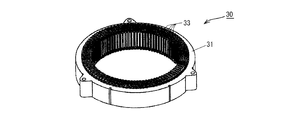
- FIG. 2 is a schematic perspective view showing a preferable form of the stator used in the electric / electronic device of the present invention.
- FIG. 3 is a schematic exploded perspective view showing a preferable form of the stator used in the electric / electronic device of the present invention.
- FIG. 1 shows a preferred form of the insulated wire of the present invention.
- the insulated wire 1 of the present invention has an insulating film 14 around the divided conductor 11.
- another layer such as an adhesion layer may be provided between the insulating film 14 and the divided conductor.
- the split conductor 11 is composed of a plurality of aluminum strands 12.
- the divided conductor 11 is composed of seven strands.
- the periphery of the wire 12 is insulated and coated with an oxide film 13, whereby eddy current loss is suppressed.
- the aluminum wire constituting the split conductor has Fe of 0.01 to 0.4 mass%, Cu of 0.3 to 0.5 mass%, and Mg of 0.04 to 0.3 mass%. It is formed of an aluminum alloy containing 0.02 to 0.3 mass% of Si, 0.001 to 0.01 mass% of Ti and V in total, and the balance Al and unavoidable impurities.
- the aluminum alloy itself is known, and for example, Japanese Patent No. 5228228 can be referred to.
- the Fe content in the aluminum wire is preferably 0.1 to 0.3 mass%, more preferably 0.15 to 0.25 mass%.
- the Cu content in the aluminum wire is preferably 0.35 to 0.5 mass%, more preferably 0.4 to 0.5 mass%.
- the Mg content in the aluminum wire is preferably 0.08 to 0.3 mass%, more preferably 0.1 to 0.28 mass%.
- the Si content in the aluminum wire is preferably 0.04 to 0.25 mass%, more preferably 0.04 to 0.20 mass%.
- the total content of Ti and V in the aluminum wire is preferably 0.002 to 0.008 mass%, more preferably 0.003 to 0.006 mass%.
- the crystal grain size in the vertical cross section of the aluminum wire in the drawing direction is 5 to 25 ⁇ m.
- the crystal grain size is more preferably 5 to 20 ⁇ m.
- the crystal grain size is determined by the method described in paragraph [0050] of Japanese Patent No. 5228118.
- the aluminum wire has a tensile strength of 100 MPa or more, more preferably 110 MPa or more, and even more preferably 120 MPa or more.
- the above tensile strength can be realized by applying, for example, the manufacturing method described later, using the aluminum wire as the above composition.
- the tensile strength of the aluminum alloy is usually 160 MPa or less, practically 150 MPa or less, and may be 140 MPa or less, or 130 MPa.
- the tensile strength can be determined by the method described in Examples described later.
- the aluminum wire preferably has a conductivity of 58% IACS or more, and preferably 58 to 62% IACS.
- the above conductivity can be realized by using the aluminum wire as the above composition and applying, for example, the manufacturing method described later.
- the conductivity (ICAS; International Annealed Copper Standard) can be determined by the method described in Examples described later.
- the method for obtaining the aluminum wire used in the present invention is, for example, Fe in 0.01 to 0.4 mass%, Cu in 0.3 to 0.5 mass%, and Mg in 0.04 to 0.3 mass%.
- the cooling rate is 1 to 20 ° C./sec
- the heat treatment is performed under the condition that the degree of processing is 1 or more and 6 or less
- the heat treatment is performed at a temperature of 300 to 450 ° C. for 10 minutes to 6 hours
- the wire drawing process is performed under the condition that the degree of processing is 1 or more and 6 or less.
- the divided conductor is composed of a plurality of aluminum strands arranged in parallel with each other or a plurality of aluminum strands twisted in a spiral shape.
- the number of strands constituting the divided conductor is not particularly limited, and is appropriately set according to the purpose. For example, the number may be 2 to 100, and the number may be 7 to 37.
- "arranged parallel to each other” means including forms arranged substantially in parallel. In other words, all forms other than the form in which a plurality of strands are twisted are "arranged in parallel with each other". Further, "twisted in a spiral shape" is a form of so-called stranded wire.
- an oxide film 13 is formed around each aluminum wire and functions as an insulating layer. That is, the conduction between the strands by the oxide film 13 is prevented, and the eddy current loss is suppressed. Therefore, in the present invention, the aluminum wire is not coated with an insulating resin.
- the oxide film 13 can be formed by natural oxidation when exposed to air. In the aluminum wire 12 used in the present invention, the oxide film 13 is formed sufficiently thick by this natural oxidation. Therefore, the conduction between the strands 12 can be prevented more reliably, and the eddy current loss is effectively suppressed.
- the thickness of the oxide film 13 is preferably 0.01 to 0.1 ⁇ m, more preferably 0.01 to 0.05 ⁇ m. In the present invention, the oxide film is not limited to the formation by natural oxidation, and the thickness of the oxide film can be adjusted by wire drawing or heating with a steam source.
- FIG. 1 shows the divided conductor 11 as a shape having a rectangular cross section (flat shape).
- the split conductor 11 preferably has a flat shape, but the cross-sectional shape of the split conductor is not particularly limited and may be a desired shape such as a square, a circle, or an ellipse.
- the size of the divided conductor 11 is not particularly limited.
- the width (long side) is preferably 1.0 to 5.0 mm, more preferably 1.4 to 4.0 mm in a rectangular cross-sectional shape.
- the thickness (short side) is preferably 0.4 to 3.0 mm, more preferably 0.5 to 2.5 mm.
- the ratio (thickness: width) of the length of the width (long side) and the thickness (short side) is preferably 1: 1 to 1: 4.
- the diameter is preferably 0.3 to 3.0 mm, more preferably 0.4 to 2.7 mm.
- An insulating film 14 is formed around the divided conductor 11.
- the insulating film 14 may be a single layer or a multi-layer structure composed of two or more insulating layers.
- the insulating film 14 is preferably an enamel layer formed by applying, for example, varnish and baking. Further, the insulating film 14 can be formed by extrusion coating.
- those generally used as the constituent material of this kind of insulating layer can be widely applied.
- the material can be a constituent material of the insulating film.
- a resin material containing at least one type of polyimide as a constituent material of the insulating film.
- the constituent materials of the insulating film include bubble nucleating agents, antioxidants, antistatic agents, ultraviolet antioxidants, light stabilizers, fluorescent whitening agents, pigments, etc.
- Various additives such as dyes, compatibilizers, lubricants, strengthening agents, flame retardants, cross-linking agents, cross-linking aids, plasticizers, thickeners, thickeners, and elastomers may be blended.
- the insulating film 14 preferably has a 1 to 5 layer structure, and more preferably 1 to 3 layers.
- the thickness of the insulating film 14 is preferably 10 to 300 ⁇ m, more preferably 20 to 200 ⁇ m, further preferably 30 to 200 ⁇ m, further preferably 35 to 200 ⁇ m, and particularly preferably 40 to 180 ⁇ m.
- the insulated wire of the present invention may have an adhesion layer between the insulating film 14 and the divided conductor 11.
- This adhesion layer is a layer for improving the adhesion between the divided conductor and the insulating film while smoothing the unevenness around the divided conductor and improving the processing accuracy.
- the adhesion layer preferably contains polyetherimide.
- the insulated wire of the present invention can be obtained by a conventional method except that the aluminum wire specified in the present invention is used as the wire constituting the divided conductor.
- the electric conducting wire of the present invention can be suitably used as a split conductor constituting the above-mentioned insulated wire of the present invention. That is, the electric conducting wire of the present invention is composed of a plurality of aluminum wires arranged in parallel with each other or a divided conductor composed of a plurality of aluminum wires twisted in a spiral shape.
- This aluminum wire contains 0.01 to 0.4 mass% of Fe, 0.3 to 0.5 mass% of Cu, 0.04 to 0.3 mass% of Mg, and 0.02 to 0.3 mass% of Si. Further, it is an aluminum alloy containing 0.001 to 0.01 mass% of Ti and V in total, and composed of the balance Al and unavoidable impurities. Further, each aluminum wire constituting the electric wire of the present invention is not coated with an insulating resin.
- the insulated wire of the present invention can be used as a coil in fields that require electrical characteristics (withstand voltage) and heat resistance, such as various electric and electronic devices.
- the insulated wire of the present invention can be used for a motor, a transformer, or the like to form a high-performance electric / electronic device.
- it is suitably used as a winding for a drive motor of a hybrid vehicle (HV) or an electric vehicle (EV).
- HV hybrid vehicle
- EV electric vehicle
- the coil of the present invention may have a form suitable for various electric and electronic devices, and is formed by coiling the insulated wire of the present invention, or a predetermined portion after bending the insulated wire of the present invention. Examples include those formed by electrically connecting the above.
- the coil formed by coiling the insulated wire of the present invention is not particularly limited, and examples thereof include a coil obtained by spirally winding a long insulated wire. In such a coil, the number of windings of the insulated wire is not particularly limited. Usually, an iron core or the like is used when winding an insulated wire.
- a coil used for a stator of a rotary electric machine or the like can be mentioned as a device formed by electrically connecting a predetermined portion after bending an insulated wire of the present invention.
- a coil for example, as shown in FIG. 3, a plurality of electric wire segments 34 are produced by cutting the insulated electric wire of the present invention to a predetermined length and bending it into a U shape or the like, and each electric wire.
- a coil 33 (see FIG. 2) manufactured by alternately connecting two open ends (ends) 34a such as a U-shape of a segment 34 can be mentioned.
- the electric / electronic device using this coil is not particularly limited.
- a transformer is mentioned as a preferable aspect of such an electric / electronic device.
- a rotary electric machine (particularly an HV and EV drive motor) provided with the stator 30 shown in FIG. 2 can be mentioned.
- the rotary electric machine can have the same configuration as the conventional rotary electric machine except that the rotary electric machine is provided with the stator 30.
- the stator 30 can have the same configuration as the conventional stator except that the electric wire segment 34 is formed of the insulated wire of the present invention. That is, in the stator 30, the stator core 31 and the electric wire segment 34 made of the insulated wire of the present invention, for example, as shown in FIG.
- the open end portion 34a is electrically connected. It has a coil 33.
- the coil 33 is in a state in which adjacent fusion layers or the fusion layer and the slot 32 are fixed and fixed to each other.
- the electric wire segment 34 may be incorporated into the slot 32 as a single wire, but is preferably incorporated as a set of two wires as shown in FIG.
- a coil 33 formed by alternately connecting the open end portions 34a, which are the two ends of the electric wire segment 34 bent as described above, is housed in the slot 32 of the stator core 31.
- the open end 34a of the electric wire segment 34 may be connected and then stored in the slot 32, or the insulated segment 34 may be stored in the slot 32 and then the open end 34a of the electric wire segment 34 is bent. May be connected.
- the conditions for the heat treatment were 3 hours at a temperature of 350 ° C.
- the wire drawing process was performed under the condition that the degree of processing was 1 or more and 6 or less, and the condition of the annealing heat treatment was 2 hours at a temperature of 400 ° C. In this way, each aluminum wire having a circular cross section with a diameter of 1.24 mm was obtained.
- the results of each of the above test examples are shown in the table below.
- the aluminum wire of the comparative product in the table below has a circular cross-sectional diameter of 1.24 mm by the wire drawing process.
- the electric wire of the present invention has the same conductivity as pure aluminum and the mechanical strength is much stronger than that of pure aluminum. Further, it can be seen that the electric wire of the present invention can sufficiently thicken the oxide film, so that the eddy current loss can be prevented more reliably.
- Insulated wire 11 Divided conductor 12 Aluminum wire 13 Oxidized film 14 Insulated film 30 Stator 31 Stator core 32 Slot 33 Coil 34 Wire segment 34a Open end
Landscapes
- Chemical & Material Sciences (AREA)
- Physics & Mathematics (AREA)
- Engineering & Computer Science (AREA)
- Spectroscopy & Molecular Physics (AREA)
- Power Engineering (AREA)
- Mechanical Engineering (AREA)
- Materials Engineering (AREA)
- Metallurgy (AREA)
- Organic Chemistry (AREA)
- Chemical Kinetics & Catalysis (AREA)
- Thermal Sciences (AREA)
- Crystallography & Structural Chemistry (AREA)
- Windings For Motors And Generators (AREA)
Priority Applications (2)
| Application Number | Priority Date | Filing Date | Title |
|---|---|---|---|
| JP2021545152A JPWO2021049183A1 (https=) | 2019-09-13 | 2020-07-22 | |
| US17/669,175 US20220165451A1 (en) | 2019-09-13 | 2022-02-10 | Electrical conducting wire, insulated wire, coil, and electrical or electronic equipment |
Applications Claiming Priority (2)
| Application Number | Priority Date | Filing Date | Title |
|---|---|---|---|
| JP2019167401 | 2019-09-13 | ||
| JP2019-167401 | 2019-09-13 |
Related Child Applications (1)
| Application Number | Title | Priority Date | Filing Date |
|---|---|---|---|
| US17/669,175 Continuation US20220165451A1 (en) | 2019-09-13 | 2022-02-10 | Electrical conducting wire, insulated wire, coil, and electrical or electronic equipment |
Publications (1)
| Publication Number | Publication Date |
|---|---|
| WO2021049183A1 true WO2021049183A1 (ja) | 2021-03-18 |
Family
ID=74866122
Family Applications (1)
| Application Number | Title | Priority Date | Filing Date |
|---|---|---|---|
| PCT/JP2020/028422 Ceased WO2021049183A1 (ja) | 2019-09-13 | 2020-07-22 | 電気導線、絶縁電線、コイル、並びに電気・電子機器 |
Country Status (3)
| Country | Link |
|---|---|
| US (1) | US20220165451A1 (https=) |
| JP (1) | JPWO2021049183A1 (https=) |
| WO (1) | WO2021049183A1 (https=) |
Citations (2)
| Publication number | Priority date | Publication date | Assignee | Title |
|---|---|---|---|---|
| JP2016108612A (ja) * | 2014-12-05 | 2016-06-20 | 古河電気工業株式会社 | アルミニウム合金線材、アルミニウム合金撚線、被覆電線およびワイヤーハーネス、ならびにアルミニウム合金線材の製造方法 |
| JP2017106070A (ja) * | 2015-12-09 | 2017-06-15 | 株式会社フジクラ | アルミニウム合金導電線、これを用いた電線、ワイヤハーネス及びアルミニウム合金導電線の製造方法 |
Family Cites Families (9)
| Publication number | Priority date | Publication date | Assignee | Title |
|---|---|---|---|---|
| US2045877A (en) * | 1931-07-15 | 1936-06-30 | Vocalsevro Company | Musical instrument |
| US2296452A (en) * | 1936-04-24 | 1942-09-22 | Rca Corp | High frequency coil |
| US7145073B2 (en) * | 2003-09-05 | 2006-12-05 | Southwire Company | Electrical wire and method of fabricating the electrical wire |
| WO2010082671A1 (ja) * | 2009-01-19 | 2010-07-22 | 古河電気工業株式会社 | アルミニウム合金線材 |
| KR20130008018A (ko) * | 2010-02-01 | 2013-01-21 | 쓰리엠 이노베이티브 프로퍼티즈 컴파니 | 연선 열가소성 중합체 복합 케이블, 그 제조 및 사용 방법 |
| JP2013033607A (ja) * | 2011-08-01 | 2013-02-14 | Hitachi Cable Ltd | 絶縁電線及びその製造方法 |
| EP3260563B1 (en) * | 2013-03-29 | 2019-04-24 | Furukawa Electric Co. Ltd. | Aluminum alloy conductor, aluminum alloy stranded wire, coated wire, wire harness, and manufacturing method of aluminum alloy conductor |
| JP6699378B2 (ja) * | 2016-06-14 | 2020-05-27 | Tdk株式会社 | コイル部品 |
| JP7129402B2 (ja) * | 2017-03-29 | 2022-09-01 | 古河電気工業株式会社 | 一体形成体、並びに該一体形成体を有する複合材、電気接点用端子及びプリント配線板 |
-
2020
- 2020-07-22 JP JP2021545152A patent/JPWO2021049183A1/ja active Pending
- 2020-07-22 WO PCT/JP2020/028422 patent/WO2021049183A1/ja not_active Ceased
-
2022
- 2022-02-10 US US17/669,175 patent/US20220165451A1/en not_active Abandoned
Patent Citations (2)
| Publication number | Priority date | Publication date | Assignee | Title |
|---|---|---|---|---|
| JP2016108612A (ja) * | 2014-12-05 | 2016-06-20 | 古河電気工業株式会社 | アルミニウム合金線材、アルミニウム合金撚線、被覆電線およびワイヤーハーネス、ならびにアルミニウム合金線材の製造方法 |
| JP2017106070A (ja) * | 2015-12-09 | 2017-06-15 | 株式会社フジクラ | アルミニウム合金導電線、これを用いた電線、ワイヤハーネス及びアルミニウム合金導電線の製造方法 |
Also Published As
| Publication number | Publication date |
|---|---|
| JPWO2021049183A1 (https=) | 2021-03-18 |
| US20220165451A1 (en) | 2022-05-26 |
Similar Documents
| Publication | Publication Date | Title |
|---|---|---|
| EP2843668B1 (en) | Inverter surge-resistant insulated wire and method of producing same | |
| US10510459B2 (en) | Insulated winding wire articles having conformal coatings | |
| US7544886B2 (en) | Extra-fine copper alloy wire, extra-fine copper alloy twisted wire, extra-fine insulated wire, coaxial cable, multicore cable and manufacturing method thereof | |
| KR102799233B1 (ko) | 열가소성 절연체를 갖는 자석 와이어 | |
| CN105580089A (zh) | 扁平电线及其制造方法以及电气设备 | |
| US20180182507A1 (en) | Continuously Transposed Conductors And Assemblies | |
| US20200251243A1 (en) | Magnet Wire With Improved Enamel Adhesion | |
| US10510464B1 (en) | Continuously transposed conductors and assemblies | |
| JP7146449B2 (ja) | 高周波コイル用電線及びコイル | |
| JP2024025963A (ja) | 絶縁電線及びその製造方法、並びに該絶縁電線を用いたコイル、回転電機及び電気・電子機器 | |
| CN116072334A (zh) | 电线和电缆 | |
| WO2021049183A1 (ja) | 電気導線、絶縁電線、コイル、並びに電気・電子機器 | |
| US12283401B2 (en) | Magnet wire with thermoplastic insulation | |
| JP6887967B2 (ja) | 絶縁電線、その製造方法、コイル、電気・電子機器および電気・電子機器の製造方法 | |
| KR20230002294A (ko) | 내열 절연 전선 | |
| US20250253093A1 (en) | Magnet wire with thermoplastic insulation | |
| JP7109938B2 (ja) | 高周波コイル用線材及び絶縁電線並びに高周波コイル用線材の製造方法 | |
| JP7537903B2 (ja) | トランス用多層絶縁電線 | |
| JPH11111067A (ja) | 高周波用積層タイプ平角絶縁電線 | |
| JP7050566B2 (ja) | 高周波用高出力トランス | |
| JP2024088510A (ja) | 絶縁電線、コイル、回転電機および電気・電子機器 | |
| JP5496769B2 (ja) | 電動自転車用電力ケーブル | |
| CN121847620A (zh) | 极细铜合金线的制造方法、极细铜合金线和电缆 | |
| JP2024128628A (ja) | 撚り線、絶縁電線、コイル及びトランス | |
| JPS61138416A (ja) | 低インダクタンスケ−ブル |
Legal Events
| Date | Code | Title | Description |
|---|---|---|---|
| 121 | Ep: the epo has been informed by wipo that ep was designated in this application |
Ref document number: 20864140 Country of ref document: EP Kind code of ref document: A1 |
|
| ENP | Entry into the national phase |
Ref document number: 2021545152 Country of ref document: JP Kind code of ref document: A |
|
| NENP | Non-entry into the national phase |
Ref country code: DE |
|
| 122 | Ep: pct application non-entry in european phase |
Ref document number: 20864140 Country of ref document: EP Kind code of ref document: A1 |