WO2021024797A1 - フルオロポリマーの製造方法 - Google Patents
フルオロポリマーの製造方法 Download PDFInfo
- Publication number
- WO2021024797A1 WO2021024797A1 PCT/JP2020/028267 JP2020028267W WO2021024797A1 WO 2021024797 A1 WO2021024797 A1 WO 2021024797A1 JP 2020028267 W JP2020028267 W JP 2020028267W WO 2021024797 A1 WO2021024797 A1 WO 2021024797A1
- Authority
- WO
- WIPO (PCT)
- Prior art keywords
- cooh
- fluorine
- group
- fluoropolymer
- formula
- Prior art date
- Legal status (The legal status is an assumption and is not a legal conclusion. Google has not performed a legal analysis and makes no representation as to the accuracy of the status listed.)
- Ceased
Links
Classifications
-
- C—CHEMISTRY; METALLURGY
- C08—ORGANIC MACROMOLECULAR COMPOUNDS; THEIR PREPARATION OR CHEMICAL WORKING-UP; COMPOSITIONS BASED THEREON
- C08F—MACROMOLECULAR COMPOUNDS OBTAINED BY REACTIONS ONLY INVOLVING CARBON-TO-CARBON UNSATURATED BONDS
- C08F214/00—Copolymers of compounds having one or more unsaturated aliphatic radicals, each having only one carbon-to-carbon double bond, and at least one being terminated by a halogen
- C08F214/18—Monomers containing fluorine
- C08F214/184—Monomers containing fluorine with fluorinated vinyl ethers
-
- C—CHEMISTRY; METALLURGY
- C08—ORGANIC MACROMOLECULAR COMPOUNDS; THEIR PREPARATION OR CHEMICAL WORKING-UP; COMPOSITIONS BASED THEREON
- C08F—MACROMOLECULAR COMPOUNDS OBTAINED BY REACTIONS ONLY INVOLVING CARBON-TO-CARBON UNSATURATED BONDS
- C08F14/00—Homopolymers and copolymers of compounds having one or more unsaturated aliphatic radicals, each having only one carbon-to-carbon double bond, and at least one being terminated by a halogen
- C08F14/18—Monomers containing fluorine
-
- C—CHEMISTRY; METALLURGY
- C08—ORGANIC MACROMOLECULAR COMPOUNDS; THEIR PREPARATION OR CHEMICAL WORKING-UP; COMPOSITIONS BASED THEREON
- C08F—MACROMOLECULAR COMPOUNDS OBTAINED BY REACTIONS ONLY INVOLVING CARBON-TO-CARBON UNSATURATED BONDS
- C08F2/00—Processes of polymerisation
- C08F2/12—Polymerisation in non-solvents
- C08F2/16—Aqueous medium
- C08F2/18—Suspension polymerisation
-
- C—CHEMISTRY; METALLURGY
- C08—ORGANIC MACROMOLECULAR COMPOUNDS; THEIR PREPARATION OR CHEMICAL WORKING-UP; COMPOSITIONS BASED THEREON
- C08F—MACROMOLECULAR COMPOUNDS OBTAINED BY REACTIONS ONLY INVOLVING CARBON-TO-CARBON UNSATURATED BONDS
- C08F14/00—Homopolymers and copolymers of compounds having one or more unsaturated aliphatic radicals, each having only one carbon-to-carbon double bond, and at least one being terminated by a halogen
- C08F14/18—Monomers containing fluorine
- C08F14/28—Hexafluoropropene
-
- C—CHEMISTRY; METALLURGY
- C08—ORGANIC MACROMOLECULAR COMPOUNDS; THEIR PREPARATION OR CHEMICAL WORKING-UP; COMPOSITIONS BASED THEREON
- C08F—MACROMOLECULAR COMPOUNDS OBTAINED BY REACTIONS ONLY INVOLVING CARBON-TO-CARBON UNSATURATED BONDS
- C08F214/00—Copolymers of compounds having one or more unsaturated aliphatic radicals, each having only one carbon-to-carbon double bond, and at least one being terminated by a halogen
- C08F214/18—Monomers containing fluorine
- C08F214/26—Tetrafluoroethene
-
- C—CHEMISTRY; METALLURGY
- C08—ORGANIC MACROMOLECULAR COMPOUNDS; THEIR PREPARATION OR CHEMICAL WORKING-UP; COMPOSITIONS BASED THEREON
- C08F—MACROMOLECULAR COMPOUNDS OBTAINED BY REACTIONS ONLY INVOLVING CARBON-TO-CARBON UNSATURATED BONDS
- C08F214/00—Copolymers of compounds having one or more unsaturated aliphatic radicals, each having only one carbon-to-carbon double bond, and at least one being terminated by a halogen
- C08F214/18—Monomers containing fluorine
- C08F214/28—Hexyfluoropropene
-
- C—CHEMISTRY; METALLURGY
- C08—ORGANIC MACROMOLECULAR COMPOUNDS; THEIR PREPARATION OR CHEMICAL WORKING-UP; COMPOSITIONS BASED THEREON
- C08F—MACROMOLECULAR COMPOUNDS OBTAINED BY REACTIONS ONLY INVOLVING CARBON-TO-CARBON UNSATURATED BONDS
- C08F214/00—Copolymers of compounds having one or more unsaturated aliphatic radicals, each having only one carbon-to-carbon double bond, and at least one being terminated by a halogen
- C08F214/18—Monomers containing fluorine
- C08F214/28—Hexyfluoropropene
- C08F214/282—Hexyfluoropropene with fluorinated vinyl ethers
-
- C—CHEMISTRY; METALLURGY
- C08—ORGANIC MACROMOLECULAR COMPOUNDS; THEIR PREPARATION OR CHEMICAL WORKING-UP; COMPOSITIONS BASED THEREON
- C08F—MACROMOLECULAR COMPOUNDS OBTAINED BY REACTIONS ONLY INVOLVING CARBON-TO-CARBON UNSATURATED BONDS
- C08F4/00—Polymerisation catalysts
- C08F4/28—Oxygen or compounds releasing free oxygen
- C08F4/32—Organic compounds
- C08F4/34—Per-compounds with one peroxy-radical
-
- C—CHEMISTRY; METALLURGY
- C08—ORGANIC MACROMOLECULAR COMPOUNDS; THEIR PREPARATION OR CHEMICAL WORKING-UP; COMPOSITIONS BASED THEREON
- C08K—Use of inorganic or non-macromolecular organic substances as compounding ingredients
- C08K5/00—Use of organic ingredients
- C08K5/04—Oxygen-containing compounds
- C08K5/09—Carboxylic acids; Metal salts thereof; Anhydrides thereof
- C08K5/095—Carboxylic acids containing halogens
Definitions
- the present disclosure relates to a method for producing a fluoropolymer.
- a method for producing a polymer using a fluorine-based diacyl peroxide as a polymerization initiator is known.
- Patent Document 1 tetrafluoroethylene and hexafluoropropylene were copolymerized in water in the presence of di ( ⁇ -hydrododecafluoroheptanoyl) peroxide (polymerization initiator) and ⁇ -hydroperfluoroheptane acid. It is stated that.
- An object of the present disclosure is to provide a method for producing a fluoropolymer having improved utilization efficiency of a polymerization initiator. It is also an object of the present disclosure to provide a method for producing a fluoropolymer having a reduced environmental load.
- X and Y are independently H or F, and Rf a and Rf b are independently linear or branched, which may have an ether bond having 1 to 6 carbon atoms.
- the present invention relates to a method for producing a fluoropolymer having a pH of less than 2.5 in the aqueous medium.
- the pH of the aqueous medium is preferably 2.2 or less.
- the carbon number of Rf c is preferably 1 to 3
- the carbon number of Rf c is preferably 1 or 2.
- the fluorine-containing carboxylic acid is at least one selected from the group consisting of C 2 F 5 COOH, CF 3 COOH and HC 2 F 4 COOH.
- the pH of the aqueous medium is preferably 2.90 or less.
- the present disclosure is in the presence of at least one fluorine-containing diacyl peroxide selected from the group consisting of (C 5 F 11 COO) 2 , (C 3 F 7 COO) 2 and (C 2 F 5 COO) 2. It also relates to a method for producing a fluoropolymer, which comprises a step of obtaining a fluoropolymer by suspend polymerization of a fluoromonomer in an aqueous medium.
- the pH of the aqueous medium is preferably 2.90 or less.
- the suspension polymerization is carried out by the following formula (3): Z 3 Rf d COOH (3) (In the formula, Z 3 is H or F, and when Z 3 is H, Rf d is a linear or branched perfluoroalkylene group having 1 to 6 carbon atoms and which may have an ether bond. When Z 3 is F, Rf d is a linear or branched perfluoroalkylene group having 1 to 5 carbon atoms and which may have an ether bond). It is preferably carried out in the presence of an acid.
- X and Y are independently H or F, and Rf a and Rf b are independently linear or branched which may have an ether bond having 1 to 6 carbon atoms.
- Fluoro by polymerizing a fluoromonomer in an aqueous medium in the presence of a fluorine-containing diacyl peroxide (hereinafter, also referred to as a fluorine-containing diacyl peroxide (1)) represented by a perfluoroalkylene group).
- the present invention relates to a method for producing a fluoropolymer having a pH of less than 2.5 in the aqueous medium (hereinafter, also referred to as a first production method).
- a first production method when the pH of the aqueous medium is less than 2.5, hydrolysis of the fluorine-containing diacyl peroxide (1), which is a polymerization initiator, can be suppressed.
- the fluoromonomer can be polymerized starting from a larger amount of the fluorine-containing diacyl peroxide (1) at the same amount, and the utilization efficiency of the fluorine-containing diacyl peroxide (1) can be improved.
- X and Y may be the same or different from each other, but are preferably the same.
- X and Y are preferably F.
- Rf a and Rf b may be the same or different from each other, but are preferably the same.
- the perfluoroalkylene group as Rf a and Rf b has 1 to 6 carbon atoms.
- the number of carbon atoms is preferably 5 or less, and preferably 2 or more.
- the perfluoroalkylene group may have an ether bond.
- the perfluoroalkylene group may be linear or branched.
- Examples of the perfluoroalkylene group as Rf a and Rf b include-(CF 2 ) n- (n is an integer of 1 to 6), -CF (CF 3 ) CF 2- , and -CF (. CF 3 ) CF 2 CF 2- , -CF 2 CF (CF 3 ) CF 2- , -CF (CF 3 ) CF 2 CF 2 CF 2- , -CF 2 CF (CF 3 ) CF 2 CF 2 -,- CF (CF 3 ) CF (CF 3 ) CF 2- , -CF (CF 3 ) CF 2 CF 2 CF 2- , -CF 2 CF (CF 3 ) CF 2 CF 2 CF 2- , -CF 2 CF (CF 3 ) CF 2 CF 2 CF 2- , -CF 2 CF (CF 3 ) CF 2 CF 2 CF 2- , -CF 2 CF (CF 3 ) CF 2 CF 2 CF 2-
- l + m is an integer of 2 to 6) and the like.
- the groups represented by -C l F 2 l OC m F 2 m- are- (CF 2 ) l O (CF 2 ) m- (l and m are as described above), -CF (CF 3 ) OCF. (CF 3 ) CF 2- *, -C 2 F 4 OCF (CF 3 ) CF 2- * (* represents the side to be bonded to X or Y) and the like are preferable.
- the perfluoroalkylene group the above- (CF 2 ) n -is preferable.
- a and b may be the same or different from each other, but are preferably the same.
- the upper limit of a and b is preferably 5, and the lower limit is preferably 2.
- fluorine-containing diacyl peroxide (1) As the fluorine-containing diacyl peroxide (1), (HC 6 F 12 COO) 2 , (C 6 F 13 COO) 2 , (HC 5 F 10 COO) 2 , (C 5 F 11 COO) 2 , (HC 4 ) F 8 COO) 2 , (C 4 F 9 COO) 2 , (HC 3 F 6 COO) 2 , (C 3 F 7 COO) 2 , (HC 2 F 4 COO) 2 , (C 2 F 5 COO) 2 , (HCF 2 COO) 2 , (CF 3 COO) 2 , ⁇ (CF 3 ) 2 CFOCF (CF 3 ) COO ⁇ 2 , ⁇ (CF 3 ) 2 CFOC 2 F 4 COO ⁇ 2, etc.
- One type or two or more types can be used. Among them, at least one selected from the group consisting of (HC 6 F 12 COO) 2 , (C 5 F 11 COO) 2 , (C 3 F 7 COO) 2 and (C 2 F 5 COO) 2 is preferable.
- the fluorine-containing diacyl peroxide (1) is also at least one selected from the group consisting of (C 5 F 11 COO) 2 , (C 3 F 7 COO) 2 and (C 2 F 5 COO) 2. It is also preferable that it is at least one selected from the group consisting of (C 5 F 11 COO) 2 and (C 3 F 7 COO) 2 , ⁇ F (CF 2 ) 5 COO ⁇ 2 and ⁇ F. It is also preferable that it is at least one selected from the group consisting of (CF 2 ) 3 COO ⁇ 2 .
- the amount of the fluorine-containing diacyl peroxide (1) used can be determined according to the target fluoropolymer, and may be, for example, 0.01 to 1% by mass with respect to the total amount of fluoromonomers.
- the whole amount of the fluorine-containing diacyl peroxide (1) may be added at one time, or may be added in a plurality of times.
- the fluorine-containing diacyl peroxide (1) may be directly added to an aqueous medium, or may be dissolved in a solvent and added in the form of a solution. From the viewpoint of safety, it is preferable to add the solution in the form of a solution.
- the solvent may be a non-fluorine solvent or a fluorine-containing solvent as long as it can dissolve the fluorine-containing diacyl peroxide (1).
- non-fluorine solvent examples include conventionally known solvents such as fluorine-free organic solvents such as alcohols, ethers and ketones.
- a fluorine-containing solvent is preferable as the solvent.
- the fluorine-containing solvent has a fluorine atom in the molecule and is not particularly limited, but a solvent having a boiling point of 25 to 100 ° C. is preferable.
- the fluorine-containing solvent may be either aromatic or aliphatic.
- the fluorine-containing solvent is not particularly limited, and examples thereof include perfluorocarbon, hydrochlorofluorocarbon, hydrofluorocarbon, fluorine-containing ether, and perfluoroperfluorobenzene.
- At least one selected from the group consisting of perfluorocarbon, hydrochlorofluorocarbon, hydrofluorocarbon and fluorine-containing ether is preferable, and at least one selected from the group consisting of perfluorocarbon, hydrofluorocarbon and fluorine-containing ether is more preferable. At least one selected from the group consisting of hydrofluorocarbons and fluorine-containing ethers is more preferable.
- perfluorocarbon examples include perfluorohexane, perfluoropentane, perfluoroheptane, perfluorooctane and the like.
- the fluorine-containing ether is not limited to the following general formula, but for example, the following general formula (4): Rf-OR (4)
- Rf represents a fluoroalkyl group or an alkyl group having 2 to 6 carbon atoms.
- R represents a fluoroalkyl group or an alkyl group having 1 to 4 carbon atoms.
- the total number of carbon atoms of Rf and R. Is 8 or less
- examples thereof include fluorine-containing ethers represented by.
- the Rf in the general formula (4) is preferably a fluoroalkyl group having 2 to 5 carbon atoms or an alkyl group, more preferably a fluoroalkyl group having 3 to 4 carbon atoms, and a fluoroalkyl group having 4 carbon atoms. It is more preferably an alkyl group. Further, R in the general formula (4) is preferably a fluoroalkyl group or an alkyl group having 1 to 3 carbon atoms, more preferably an alkyl group having 1 or 2 carbon atoms, and an alkyl having 1 carbon atom. It is more preferably a group.
- the total number of carbon atoms of Rf and R in the formula (4) is preferably 3 to 7, more preferably 4 to 6, and even more preferably 5.
- the fluorine-containing ether preferably has a total number of fluorine atoms of 50% or more with respect to the total number of hydrogen atoms and fluorine atoms. It is more preferably 60% or more, and further preferably 70% or more.
- the fluorine-containing ether has the following formula (5-1): F (CF 2 ) p O (CH 2 ) q H (5-1) (In the formula, p is an integer of 2 to 6. q is an integer of 1 to 4.) Fluorine-containing ether represented by the following formula (5-2) :. H (CF 2 ) p O (CF 2 ) q F (5-2) (In the formula, p is an integer of 2 to 6. q is an integer of 1 to 4.) Fluorine-containing ether represented by the following formula (5-3) :. H (CF 2 ) p O (CH 2 ) q H (5-3) (In the formula, p is an integer of 2 to 6.
- Fluorine-containing ether represented by the following formula (5-4) is an integer of 1 to 4.
- X 5 (CF 2 ) p CH 2 O (CF 2 ) q H (5-4) (In the formula, X 5 represents a fluorine atom or a hydrogen atom.
- P is an integer of 1 to 5.
- q is an integer of 1 to 4.
- Fluorine-containing ether represented by (CF 3 ) 2 CHOCH 3 , (CF 3 ) 2 CFOCH 3 , CHF 2 CF 2 CH 2 OCF 2 CHF 2 , CF 3 CHFCF 2 OCH 3 , and CF 3 CHFCF 2 OCF 3 is preferably at least one selected from the group. .. More preferably, it is C 4 F 9 OCH 3 , C 4 F 9 OC 2 H 5 , C 3 F 7 OCH 3 , (CF 3 ) 2 CFOCH 3 , and even more preferably C 4 F
- the fluorine-containing ether preferably has a boiling point of ⁇ 20 to 85 ° C., more preferably 0 to 85 ° C., and even more preferably 4 to 85 ° C.
- the aqueous medium is a reaction medium for polymerizing and means a liquid containing water.
- the aqueous medium is not particularly limited as long as it contains water, and may contain water and optionally an organic solvent.
- the organic solvent include fluorine-free organic solvents such as alcohols, ethers and ketones, and fluorine-containing organic solvents.
- the aqueous medium may contain a solvent for dissolving the above-mentioned fluorine-containing diacyl peroxide (1).
- the pH of the aqueous medium is less than 2.5.
- the pH is preferably 2.2 or less in that the utilization efficiency of the fluorine-containing diacyl peroxide (1) is further improved.
- the pH is preferably 0.5 or more, more preferably 1.0 or more, further preferably 1.2 or more, and 1.4 or more, in that the polymerization tank is less likely to corrode. The above is even more preferable, and 1.5 or more is particularly preferable.
- the pH of an aqueous medium can be measured using a pH meter.
- the initiation of polymerization means the first time point in which both the fluoromonomer and the polymerization initiator are present in the reaction system
- the termination of polymerization means that the pressure of the reaction system is increased by releasing the pressure. It means the time when it became atmospheric pressure.
- Examples of the pH adjusting method include a method of adding an acidic substance to the aqueous medium.
- Examples of the acidic substance include inorganic acids and organic acids, preferably carboxylic acids, and more preferably fluorine-containing carboxylic acids.
- the fluorine-containing carboxylic acid includes the following formula (3): Z 3 Rf d COOH (3) (In the formula, Z 3 is H or F, and when Z 3 is H, Rf d is a linear or branched perfluoroalkylene group having 1 to 6 carbon atoms and which may have an ether bond. When Z 3 is F, Rf d is a linear or branched perfluoroalkylene group having 1 to 5 carbon atoms and which may have an ether bond).
- An acid hereinafter, also referred to as a fluorine-containing carboxylic acid (3)
- Performing the polymerization in the first production method in the presence of the fluorinated carboxylic acid (3) is one of the preferred embodiments.
- Rf d is a linear or branched perfluoroalkylene group having 1 to 6 carbon atoms and which may have an ether bond.
- the carbon number of Rf d is preferably 1 to 5, more preferably 1 to 3, and even more preferably 1 or 2.
- Rf d is a linear or branched perfluoroalkylene group having 1 to 5 carbon atoms and which may have an ether bond.
- the carbon number of Rf d is preferably 1 to 3, and more preferably 1 or 2.
- the perfluoroalkylene group may have an ether bond.
- the perfluoroalkylene group may be linear or branched.
- Examples of the perfluoroalkylene group as Rf d include-(CF 2 ) d- (d is an integer of 1 to 6 when Z 3 is H, and d is 1 to 1 when Z 3 is F. (It is an integer of 5.), -CF (CF 3 ) CF 2- , -CF (CF 3 ) CF 2 CF 2- , -CF 2 CF (CF 3 ) CF 2- , -CF (CF 3 ) CF 2 CF 2 CF 2- , -CF 2 CF (CF 3 ) CF 2 CF 2- , -CF (CF 3 ) CF (CF 3 ) CF 2- , -CF (CF 3 ) CF (CF 3 ) CF 2- , -CF (CF 3 ) CF 2 CF 2 CF 2- , -CF 2 CF (CF 3) CF 2 CF 2 CF 2 -, -CF 2 CF 2 CF (CF 3) CF 2 CF 2 -, - CF 2
- j And k are independently integers of 1 to 4, and j + k is an integer of 2 to 5) and the like.
- the perfluoroalkylene group the above- (CF 2 ) d -is preferable.
- the fluorine-containing carboxylic acid (3) has the following formula (3-1): Z 3 (CF 2 ) d COOH (3-1) (In the equation, Z 3 is H or F, when Z 3 is H, d is an integer of 1 to 6, and when Z 3 is F, d is an integer of 1 to 5). It is preferably a fluorine-containing carboxylic acid.
- d is an integer of 1 to 6, preferably an integer of 1 to 5, more preferably an integer of 1 to 3, and 1 or It is more preferably 2.
- d is an integer of 1 to 5, preferably an integer of 1 to 3, and more preferably 1 or 2.
- fluorine-containing carboxylic acid (3) examples include HC 6 F 12 COOH, HC 5 F 10 COOH, C 5 F 11 COOH, HC 4 F 8 COOH, C 4 F 9 COOH, HC 3 F 6 COOH, C 3 F 7 COOH, HC 2 F 4 COOH, C 2 F 5 COOH, HCF 2 COOH, CF 3 COOH can be mentioned, and one or more of these can be used.
- H (CF 2 ) 6 COOH, H (CF 2 ) 5 COOH, F (CF 2 ) 5 COOH, H (CF 2 ) 4 COOH, F (CF 2 ) 4 COOH, H (CF 2 ) 3 COOH , F (CF 2 ) 3 COOH, H (CF 2 ) 2 COOH, F (CF 2 ) 2 COOH, HCF 2 COOH and CF 3 COOH is preferably at least one selected from the group consisting of, and utilization of a polymerization initiator.
- At least one selected from the group consisting of COOH is more preferable, and H (CF 2 ) 3 COOH, F (CF 2 ) 3 COOH, H (CF 2 ) 2 COOH, F (CF 2 ) 2 COOH, HCF 2 COOH and CF 3 At least one selected from the group consisting of COOH is further added.
- at least one selected from the group consisting of H (CF 2 ) 3 COOH, H (CF 2 ) 2 COOH, F (CF 2 ) 2 COOH, HCF 2 COOH and CF 3 COOH is even more preferred.
- At least one selected from the group consisting of CF 2 ) 2 COOH, F (CF 2 ) 2 COOH and CF 3 COOH is particularly preferable.
- the fluorinated carboxylic acid (3) is also selected from the group consisting of HC 6 F 12 COOH, C 5 F 11 COOH, C 3 F 7 COOH, HC 2 F 4 COOH, C 2 F 5 COOH and CF 3 COOH.
- the amount of the fluorine-containing carboxylic acid (3) used may be any amount as long as the pH of the aqueous medium can be kept within the above range, and for example, 0.06 to 2.0 mass by mass with respect to the aqueous medium. It may be%, and it may be 0.07 to 1.0 mass%.
- the fluoromonomer is not particularly limited, but is, for example, tetrafluoroethylene [TFE], hexafluoropropylene [HFP], vinylidene fluoride [VdF], chlorotrifluoroethylene [CTFE], and perfluoro (methyl vinyl ether).
- TFE tetrafluoroethylene
- HFP hexafluoropropylene
- VdF vinylidene fluoride
- CTFE chlorotrifluoroethylene
- perfluoro (methyl vinyl ether) perfluoro (methyl vinyl ether).
- CF 2 CFO (CF 2 CF (Y 6 ) O) m (CF 2 ) n F (6-1)
- Y 6 represents a fluorine atom or a trifluoromethyl group.
- M is
- n is an integer of 1 to 4.
- the following formula (6-3): CH 2 CH (CF 2 ) n Z 6 (6-3) (In the formula, Z 6 represents a fluorine atom or a hydrogen atom. N is an integer of 1 to 8.)
- a fluorine-containing monomer containing a hydrolyzable functional group can also be used.
- It represents a linear or branched perfluoroalkylene group having 1 to 8 carbon atoms, where a represents an integer of 0 to 6, b represents an integer of 0 or 1, and Z 7 represents water.
- a monomer represented by (representing a degradable functional group) is preferable.
- the fluorine-containing monomer containing a hydrolyzable functional group those having the following structures (7-1) to (7-3) are preferable.
- CF 2 CF- (CF 2 ) c- Z 7 (7-1)
- CF 2 CF- (CF 2 C (CF 3 ) F) d- Z 7 (7-2)
- CF 2 CF (CF 2) e -O- (CF 2 CFX 7 O) f - (CF 2) g -Z 7 (7-3)
- X 7 represents F or -CF 3
- c represents an integer of 0 to 8
- d represents an integer of 1 to 2
- e represents an integer of 0 to 2
- f represents an integer of 0.
- Z 7 represents a hydrolyzable functional group.
- -SO 2 F, -SO 2 Cl, -COOA 1 , -PO 3 A 2 A 3 (in the formula, A 1 represents a fluoroalkyl group, and A 2 and A 3 are the same or Differently, it represents a fluoroalkyl group).
- the fluorine-containing monomer containing the hydrolyzable functional group those represented by the following formulas are more preferable.
- a monomer having a ring structure or a cyclization polymerizable monomer may be used.
- examples of the monomer having a ring structure include perfluoro (2,2-dimethyl-1,3-dioxolane), perfluoro (1,3-dioxol), and perfluoro (2-methylene-4-methyl-1,3).
- -Dioxolane 2,2,4-trifluoro-5-trifluoromethoxy-1,3-dioxolane and the like.
- cyclization polymerizable monomer examples include perfluoro (3-butenyl vinyl ether), perfluoro [(1-methyl-3-butenyl) vinyl ether], perfluoro (allyl vinyl ether), and 1,1-[(difluoromethylene). Bis (oxy)] [1,2,2-trifluoroethane] and the like.
- M in the above formula (6-1) is preferably an integer of 0 or 1, and more preferably 0.
- n is preferably an integer of 1 to 3.
- Z 6 in the above formula (6-2) is preferably a hydrogen atom.
- n is preferably an integer of 1 to 6, and more preferably an integer of 1 to 4.
- Z 6 in the above formula (6-3) is preferably a fluorine atom.
- n is preferably an integer of 1 to 6, and more preferably an integer of 1 to 4.
- the non-fluorinated monomer may be polymerized together with the fluoromonomer.
- the non-fluorinated monomer for example, at least one selected from the group consisting of ethylene [Et], propylene, 1-butene, 2-butene, alkyl vinyl ether, vinyl chloride, vinylidene chloride and unsaturated carboxylic acid is preferable. ..
- the fluoropolymer may be a crystalline polymer or an amorphous polymer.
- the above-mentioned crystalline polymer is a polymer having a melting point due to melting of a crystal
- an amorphous polymer is a polymer having a melting point due to melting of a crystal.
- the fluoropolymer is preferably a fluororesin.
- the fluororesin is not particularly limited as long as it has a polymerization unit based on a fluorine-containing monomer.
- the fluoropolymer may have a melting point of 100 to 347 ° C.
- the lower limit of the melting point may be 150 ° C., 180 ° C., or 200 ° C.
- the upper limit may be 322 ° C. or 320 ° C.
- the melting point can be determined as a temperature corresponding to the maximum value in the heat of fusion curve when the temperature is raised at a rate of 10 ° C./min using a DSC device (manufactured by Seiko Co., Ltd.).
- the fluoropolymers include tetrafluoroethylene [TFE], hexafluoropropylene [HFP], vinylidene fluoride [VdF], chlorotrifluoroethylene [CTFE], (perfluoromethyl) vinyl ether, (perfluoroethyl) vinyl ether, and (perfluoroethyl) vinyl ether.
- TFE tetrafluoroethylene
- HFP hexafluoropropylene
- VdF vinylidene fluoride
- CTFE chlorotrifluoroethylene
- 6-1 Fluoropropyl) vinyl ether, ethylene trifluoroethylene, vinyl fluoride, the following formula (6-1):
- CF 2 CFO (CF 2 CF (Y 6 ) O) m (CF 2 ) n F (6-1)
- Y 6 represents a fluorine atom or a trifluoromethyl group.
- M is an integer of 0 to 2.
- n is an integer of 1 to 4.
- Perfluoro (alkyl vinyl ether) represented by the following formula. (6-2): CH 2 CF (CF 2 ) n Z 6 (6-2) (In the formula, Z 6 represents a fluorine atom or a hydrogen atom. N is an integer of 1 to 8.)
- the following formula (6-3): CH 2 CH (CF 2 ) n Z 6 (6-3) (In the formula, Z 6 represents a fluorine atom or a hydrogen atom. N is an integer of 1 to 8.)
- a polymerization unit based on a monomer (monomer) represents a form in which a carbon-carbon unsaturated double bond in a monomer (monomer) molecule becomes a single bond.
- the fluoropolymer may have a polymerization unit based on a non-fluorinated monomer.
- the fluoropolymer is based on at least one non-fluorinated monomer selected from the group consisting of ethylene [Et], propylene, 1-butene, 2-butene, alkyl vinyl ether, vinyl chloride, vinylidene chloride and unsaturated carboxylic acids. Having a polymerization unit is also one of the preferred forms.
- the fluoropolymer is not particularly limited, but for example, a TFE / HFP-based common weight such as polytetrafluoroethylene [PTFE], TFE / HFP copolymer, TFE / HFP / perfluoro (alkyl vinyl ether), etc.
- a TFE / HFP-based common weight such as polytetrafluoroethylene [PTFE], TFE / HFP copolymer, TFE / HFP / perfluoro (alkyl vinyl ether), etc.
- the fluoropolymer is preferably a melt-processable fluoropolymer.
- the fact that the polymer can be melt-processed means that the polymer can be melted and processed by using conventional processing equipment such as an extruder and an injection molding machine.
- the melt flow rate (MFR) of the melt-processable fluoropolymer is preferably 0.1 to 100 g / 10 minutes, more preferably 0.5 to 50 g / 10 minutes.
- MFR conforms to ASTM D1238 and uses a melt indexer to measure the temperature determined by the type of fluoropolymer (for example, 372 ° C for PFA and FEP, 297 ° C for ETFE).
- the fluoropolymer is preferably at least one selected from the group consisting of ETFE, FEP and PFA, more preferably at least one selected from the group consisting of FEP and PFA, and is FEP. Is more preferable.
- the fluoropolymer is also preferably a perfluoropolymer.
- the ETFE preferably has a molar ratio of Et unit: TFE unit of 20:80 to 80:20. More preferably, the molar ratio of Et unit: TFE unit is 35:65 to 55:45.
- ETFE is a copolymer containing a polymerization unit based on TFE and a polymerization unit based on Et, and may have a polymerization unit based on another fluoromonomer or a non-fluorinated monomer.
- the other fluoromonomer or non-fluorinated monomer is not particularly limited as long as it can be added to both Et and TFE, but a fluorocarbon-containing vinyl monomer having 3 to 10 carbon atoms is easy to use, for example, hexafluoro.
- CH 2 CH-Rf 4
- a fluorine-containing vinyl monomer represented by (in the formula, Rf 4 represents a perfluoroalkyl group having 4 to 8 carbon atoms) is also one of the preferable forms.
- R 4 is not particularly limited in the number of carbon atoms and may contain an aromatic ring, and may contain a carbonyl group, an ester group, an ether group, an amide group, a cyano group, a hydroxyl group or an epoxy group.
- R 4 may be a vinyl monomer represented by (.) Does not contain a fluorine atom.
- ETFE is also one of the preferable forms to be an Et / TFE / HFP copolymer [EFEP], and further, a polymerization unit based on another fluoromonomer (excluding HFP) or a non-fluorinated monomer can be used. It may have.
- the other fluoromonomer and the non-fluorinated monomer are preferably 10 mol% or less of the total polymer, and more preferably 5 mol% or less.
- the FEP has an HFP unit of more than 2% by mass, preferably 20% by mass or less, and more preferably 8 to 15% by mass.
- perfluoro (alkyl vinyl ether) in the PFA those having an alkyl group having 1 to 6 carbon atoms are preferable, and perfluoro (methyl vinyl ether), perfluoro (ethyl vinyl ether) or perfluoro (propyl vinyl ether) is more preferable.
- the PFA has a perfluoro (alkyl vinyl ether) unit of more than 2% by mass, preferably 15% by mass or less, and more preferably 2.5 to 8.0% by mass.
- the FEP or PFA may be obtained by further polymerizing other monomers as long as they have the above-mentioned compositions.
- the other monomer include perfluoro (alkyl vinyl ether) in the case of the FEP, and HFP in the case of the PFA.
- the other monomer one kind or two or more kinds can be used.
- the other monomer to be polymerized with the FEP or PFA varies depending on the type thereof, but is usually preferably 2% by mass or less of the obtained fluoropolymer. A more preferable upper limit is 1.5% by mass.
- each monomer unit of the above-mentioned copolymer can be calculated by appropriately combining NMR, FT-IR, elemental analysis, and fluorescent X-ray analysis according to the type of monomer.
- the above-mentioned polymerization may be any method as long as it can be carried out in an aqueous medium, and may be suspension polymerization, emulsion polymerization or the like, and suspension polymerization is preferable.
- the above-mentioned polymerization for example, the above-mentioned aqueous medium, the above-mentioned fluoromonomer and, if necessary, other additives are charged into the reaction vessel, the contents of the reaction vessel are stirred, and the reaction vessel is kept at a predetermined polymerization temperature.
- it can be carried out by adding a predetermined amount of fluorine-containing diacyl peroxide (1) and initiating the polymerization reaction. It is also possible to charge a surfactant, a suspension stabilizer, a chain transfer agent, a radical scavenger and the like.
- the polymerization may be batch polymerization, semi-batch polymerization or continuous polymerization.
- the reaction raw material used in the polymerization reaction may be added intermittently or continuously after the start of the polymerization reaction.
- the fluorine-containing diacyl peroxide (1) may be dissolved in a solvent and charged into a reaction vessel.
- chain transfer agent examples include hydrocarbons such as isopentane, n-pentane, n-hexane and cyclohexane; alcohols such as methanol and ethanol; halogenated hydrocarbons such as carbon tetrachloride, chloroform, methylene chloride and methyl chloride; Ethanol or the like can be used.
- hydrocarbons such as isopentane, n-pentane, n-hexane and cyclohexane
- alcohols such as methanol and ethanol
- halogenated hydrocarbons such as carbon tetrachloride, chloroform, methylene chloride and methyl chloride
- Ethanol or the like can be used.
- the polymerization temperature in the above polymerization reaction is not particularly limited, but is preferably 0 to 100 ° C., more preferably 10 to 90 ° C.
- the polymerization pressure is also not particularly limited, but is preferably 0.1 to 10 MPa, more preferably 0.3 to 5 MPa.
- the polymerization temperature is the temperature of the aqueous medium in the reaction vessel, and the polymerization pressure is the pressure in the reaction vessel.
- post-treatment such as separation, washing and drying of the fluoropolymer may be carried out if necessary.
- Fluorine-containing diacyl peroxide fluorine-containing diacyl peroxide (1)
- fluoroalkylene group represented by (perfluoroalkylene group)
- Z 2 Rf c COOH (2) In the formula, Z 2 is H or F, and Rf c is a linear or branched perfluoroalkylene group having 1 to 5 carbon atoms and which may have an ether bond).
- a method for producing a fluoropolymer (hereinafter, also referred to as a fluoropolymer), which comprises a step of obtaining a fluoropolymer by polymerizing a fluoromonomer in an aqueous medium in the presence of a fluorine-containing carboxylic acid (hereinafter, also referred to as a fluorine-containing carboxylic acid (2)). , Also referred to as the second manufacturing method).
- the hydrolysis of the fluorine-containing diacyl peroxide (1) which is a polymerization initiator, can be suppressed by coexisting the fluorine-containing carboxylic acid (2).
- the fluoromonomer can be polymerized starting from a larger amount of the fluorine-containing diacyl peroxide (1) at the same amount, and the utilization efficiency of the fluorine-containing diacyl peroxide (1) can be improved. Further, since the fluorine-containing carboxylic acid (2) has a small number of carbon atoms, the environmental load can be reduced.
- the fluorine-containing diacyl peroxide (1), aqueous medium, fluoromonomer and fluoropolymer in the second production method include the fluorine-containing diacyl peroxide (1), aqueous medium, fluoromonomer and fluoropolymer described in the first production method.
- the same as the polymer can be adopted.
- the polymerization in the second production method is carried out in the presence of the fluorine-containing carboxylic acid (2). As a result, it is possible to improve the utilization efficiency of the polymerization initiator and reduce the environmental load at the same time.
- the perfluoroalkylene group as Rf c it is 1 to 5 carbon atoms.
- the number of carbon atoms is preferably 1 to 3.
- the carbon number of Rf c is preferably 1 to 3, and more preferably 1 or 2.
- Z 2 is F, the carbon number of Rf c is preferably 1 or 2.
- the perfluoroalkylene group may have an ether bond.
- the perfluoroalkylene group may be linear or branched.
- Examples of the perfluoroalkylene group as Rf c include-(CF 2 ) c- (c is an integer of 1 to 5), -CF (CF 3 ) CF 2- , and -CF (CF 3 ).
- h and i are independently an integer of 1 ⁇ 4, h + i is an integer of 2-5), and include Be done.
- the perfluoroalkylene group the above- (CF 2 ) c -is preferable.
- the fluorine-containing carboxylic acid (2) has the following formula (2-1): Z 2 (CF 2 ) c COOH (2-1) (In the formula, Z 2 is H or F, and c is an integer of 1 to 5), which is preferably a fluorine-containing carboxylic acid.
- c is an integer of 1 to 5, preferably an integer of 1 to 3. Further, when Z 2 is H, c is preferably an integer of 1 to 3, and more preferably 1 or 2. When Z 2 is F, c is preferably 1 or 2.
- fluorine-containing carboxylic acid (2) examples include HC 5 F 10 COOH, C 5 F 11 COOH, HC 4 F 8 COOH, C 4 F 9 COOH, HC 3 F 6 COOH, C 3 F 7 COOH, and HC 2 F 4 COOH, C 2 F 5 COOH, HCF 2 COOH, CF 3 COOH can be mentioned, and one or more of these can be used.
- At least one selected from the group consisting of 3 COOH, H (CF 2 ) 2 COOH, F (CF 2 ) 2 COOH, HCF 2 COOH and CF 3 COOH is more preferred, and H (CF 2 ) 3 COOH, H ( CF 2 ) At least one selected from the group consisting of 2 COOH, F (CF 2 ) 2 COOH, HCF 2 COOH and CF 3 COOH is more preferable, and H (CF 2 ) 2 COOH, F (CF 2 ) 2 COOH. And at least one selected from the group consisting of CF 3 COOH is particularly preferred.
- the fluorinated carboxylic acid (2) is also at least one selected from the group consisting of C 5 F 11 COOH, C 3 F 7 COOH, HC 2 F 4 COOH, C 2 F 5 COOH and CF 3 COOH. It is also preferable that at least one selected from the group consisting of F (CF 2 ) 5 COOH, F (CF 2 ) 3 COOH, H (CF 2 ) 2 COOH, F (CF 2 ) 2 COOH and CF 3 COOH. It is also preferable to have.
- the amount of the fluorine-containing carboxylic acid (2) used may be, for example, 0.01 to 2.0% by mass, preferably 0.06 to 2.0% by mass, and 0. More preferably, it is 07 to 1.0% by mass.
- the pH of the aqueous medium may be 3.1 or less.
- the above aqueous solution can further suppress the hydrolysis of the fluorine-containing diacyl peroxide (1) and further improve the utilization efficiency of the fluorine-containing diacyl peroxide (1) as a polymerization initiator.
- the pH of the medium is preferably 2.90 or less.
- the pH is more preferably less than 2.5 and even more preferably 2.2 or less in that the utilization efficiency of the fluorine-containing diacyl peroxide (1) is further improved.
- the pH is preferably 0.5 or more, more preferably 1.0 or more, further preferably 1.2 or more, and 1.4 or more, in that the polymerization tank is less likely to corrode.
- the above is even more preferable, and 1.5 or more is particularly preferable.
- Examples of the pH adjusting method include a method of adjusting the amount of the fluorine-containing carboxylic acid (2) used.
- the present disclosure discloses at least one fluorine-containing diacyl peroxide (hereinafter, including) selected from the group consisting of (C 5 F 11 COO) 2 , (C 3 F 7 COO) 2 and (C 2 F 5 COO) 2.
- a method for producing a fluoropolymer (hereinafter, a third production method), which comprises a step of obtaining a fluoropolymer by suspend-polymerizing a fluoromonomer in an aqueous medium in the presence of fluorine diacyl peroxide (10)). Also called.).
- a fluorine-containing diacyl peroxide (10) having a small number of carbon atoms is used, so that the environmental load can be reduced.
- the fluorine-containing diacyl peroxide (10) is at least one selected from the group consisting of ⁇ F (CF 2 ) 5 COO ⁇ 2 , ⁇ F (CF 2 ) 3 COO ⁇ 2 and (C 2 F 5 COO) 2. It is more preferable that it is at least one selected from the group consisting of ⁇ F (CF 2 ) 3 COO ⁇ 2 and (C 2 F 5 COO) 2 in that the environmental load can be further reduced. ..
- the fluorine-containing diacyl peroxide (10) is also preferably at least one selected from the group consisting of (C 5 F 11 COO) 2 and (C 3 F 7 COO) 2 , ⁇ F (CF 2). ) It is also preferable that it is at least one selected from the group consisting of 5 COO ⁇ 2 and ⁇ F (CF 2 ) 3 COO ⁇ 2 .
- the amount of the fluorine-containing diacyl peroxide (10) used can be determined according to the target fluoropolymer, and may be, for example, 0.01 to 1% by mass with respect to the total amount of fluoromonomers.
- the whole amount of the fluorine-containing diacyl peroxide (10) may be added at one time, or may be added in a plurality of times.
- the fluorine-containing diacyl peroxide (10) may be directly added to an aqueous medium, or may be dissolved in a solvent and added in the form of a solution. From the viewpoint of safety, it is preferable to add the solution in the form of a solution.
- solvent those exemplified as the solvent for dissolving the fluorine-containing diacyl peroxide (1) in the first production method can be used.
- aqueous medium fluoromonomer and fluoropolymer in the third production method
- the same ones as the aqueous medium, fluoromonomer and fluoropolymer described in the first production method can be adopted.
- the pH of the aqueous medium may be 3.1 or less.
- the above-mentioned aqueous medium can be used.
- the pH is preferably 2.90 or less.
- the pH is more preferably less than 2.5 and even more preferably 2.2 or less in that the utilization efficiency of the fluorine-containing diacyl peroxide (10) is further improved.
- the pH is preferably 0.5 or more, more preferably 1.0 or more, further preferably 1.2 or more, and 1.4 or more, in that the polymerization tank is less likely to corrode.
- the above is even more preferable, and 1.5 or more is particularly preferable.
- the suspension polymerization in the third production method has the following formula (3): Z 3 Rf d COOH (3) (In the formula, Z 3 is H or F, and when Z 3 is H, Rf d is a linear or branched perfluoroalkylene group having 1 to 6 carbon atoms and which may have an ether bond. When Z 3 is F, Rf d is a linear or branched perfluoroalkylene group having 1 to 5 carbon atoms and which may have an ether bond). It is preferably carried out in the presence of the acid (3). Specific examples and preferable examples of the fluorine-containing carboxylic acid (3) are the same as those described for the first production method.
- the amount of the fluorine-containing carboxylic acid (3) used may be, for example, 0.01 to 2.0% by mass, preferably 0.06 to 2.0% by mass, and 0. More preferably, it is 07 to 1.0% by mass.
- the pH of the aqueous medium may be adjusted within the above range by adjusting the amount of the fluorinated carboxylic acid (3) used.
- MFR mass (g / 10 minutes) of the polymer flowing out from a nozzle having an inner diameter of 2 mm and a length of 8 mm at 372 ° C. and a load of 5 kg was determined using a melt indexer.
- TFE tetrafluoroethylene
- PSH perfluorohexane
- TFE tetrafluoroethylene
- the reaction time was 4.5 hours. After completion of the polymerization, the gas in the system was released until the pressure returned to normal pressure, and after nitrogen substitution, the autoclave was opened, the white fluoropolymer powder was taken out, and dried in an electric furnace at 150 ° C. for 12 hours. The fluoropolymer obtained weighed 193 g. The pH of the aqueous medium and the MFR of the resulting fluoropolymer are shown in Table 1.
- a large MFR (small molecular weight) of the obtained fluoropolymer means that a polymerization reaction starting from a larger amount of the polymerization initiator is occurring, in other words. This means that the polymerization initiator is used more effectively.
Landscapes
- Chemical & Material Sciences (AREA)
- Health & Medical Sciences (AREA)
- Chemical Kinetics & Catalysis (AREA)
- Medicinal Chemistry (AREA)
- Polymers & Plastics (AREA)
- Organic Chemistry (AREA)
- Engineering & Computer Science (AREA)
- Materials Engineering (AREA)
- Addition Polymer Or Copolymer, Post-Treatments, Or Chemical Modifications (AREA)
- Polymerization Catalysts (AREA)
- Polymerisation Methods In General (AREA)
Abstract
重合開始剤の利用効率が向上したフルオロポリマーの製造方法を提供する。式(1):XRfaC(=O)OOC(=O)RfbY (式中、X及びYは、独立に、H又はFであり、Rfa及びRfbは、独立に、炭素数1~6の、エーテル結合を有してもよい直鎖状又は分岐状のパーフルオロアルキレン基である。)で表される含フッ素ジアシルパーオキサイドの存在下に、水性媒体中でフルオロモノマーを重合することにより、フルオロポリマーを得る工程を含み、前記水性媒体のpHが2.5未満であるフルオロポリマーの製造方法である。
Description
本開示は、フルオロポリマーの製造方法に関する。
フッ素系のジアシルパーオキサイドを重合開始剤として用いる重合体の製造方法が知られている。
特許文献1には、ジ(ω-ハイドロドデカフルオロヘプタノイル)パーオキサイド(重合開始剤)及びω-ヒドロパーフルオロヘプタン酸の存在下に水中でテトラフルオロエチレン及びヘキサフルオロプロピレンの共重合を行ったことが記載されている。
本開示は、重合開始剤の利用効率が向上したフルオロポリマーの製造方法を提供することを目的とする。
本開示は、また、環境負荷が低減されたフルオロポリマーの製造方法を提供することも目的とする。
本開示は、また、環境負荷が低減されたフルオロポリマーの製造方法を提供することも目的とする。
本開示は、下記式(1):
XRfaC(=O)OOC(=O)RfbY (1)
(式中、X及びYは、独立に、H又はFであり、Rfa及びRfbは、独立に、炭素数1~6の、エーテル結合を有してもよい直鎖状又は分岐状のパーフルオロアルキレン基である。)で表される含フッ素ジアシルパーオキサイドの存在下に、水性媒体中でフルオロモノマーを重合することにより、フルオロポリマーを得る工程を含み、
上記水性媒体のpHが2.5未満であるフルオロポリマーの製造方法に関する。
上記水性媒体のpHが2.2以下であることが好ましい。
XRfaC(=O)OOC(=O)RfbY (1)
(式中、X及びYは、独立に、H又はFであり、Rfa及びRfbは、独立に、炭素数1~6の、エーテル結合を有してもよい直鎖状又は分岐状のパーフルオロアルキレン基である。)で表される含フッ素ジアシルパーオキサイドの存在下に、水性媒体中でフルオロモノマーを重合することにより、フルオロポリマーを得る工程を含み、
上記水性媒体のpHが2.5未満であるフルオロポリマーの製造方法に関する。
上記水性媒体のpHが2.2以下であることが好ましい。
本開示は、下記式(1):
XRfaC(=O)OOC(=O)RfbY (1)
(式中、X及びYは、独立に、H又はFであり、Rfa及びRfbは、独立に、炭素数1~6の、エーテル結合を有してもよい直鎖状又は分岐状のパーフルオロアルキレン基である。)で表される含フッ素ジアシルパーオキサイド、及び、下記式(2):
Z2RfcCOOH (2)
(式中、Z2はH又はFであり、Rfcは、炭素数1~5の、エーテル結合を有してもよい直鎖状又は分岐状のパーフルオロアルキレン基である。)で表される含フッ素カルボン酸の存在下に、水性媒体中でフルオロモノマーを重合することにより、フルオロポリマーを得る工程を含むフルオロポリマーの製造方法にも関する。
式(2)において、Z2がHのとき、Rfcの炭素数は1~3であり、Z2がFのとき、Rfcの炭素数は1又は2であることが好ましい。
上記含フッ素カルボン酸が、C2F5COOH、CF3COOH及びHC2F4COOHからなる群より選択される少なくとも1種であることが好ましい。
上記水性媒体のpHが2.90以下であることが好ましい。
XRfaC(=O)OOC(=O)RfbY (1)
(式中、X及びYは、独立に、H又はFであり、Rfa及びRfbは、独立に、炭素数1~6の、エーテル結合を有してもよい直鎖状又は分岐状のパーフルオロアルキレン基である。)で表される含フッ素ジアシルパーオキサイド、及び、下記式(2):
Z2RfcCOOH (2)
(式中、Z2はH又はFであり、Rfcは、炭素数1~5の、エーテル結合を有してもよい直鎖状又は分岐状のパーフルオロアルキレン基である。)で表される含フッ素カルボン酸の存在下に、水性媒体中でフルオロモノマーを重合することにより、フルオロポリマーを得る工程を含むフルオロポリマーの製造方法にも関する。
式(2)において、Z2がHのとき、Rfcの炭素数は1~3であり、Z2がFのとき、Rfcの炭素数は1又は2であることが好ましい。
上記含フッ素カルボン酸が、C2F5COOH、CF3COOH及びHC2F4COOHからなる群より選択される少なくとも1種であることが好ましい。
上記水性媒体のpHが2.90以下であることが好ましい。
本開示は、(C5F11COO)2、(C3F7COO)2及び(C2F5COO)2からなる群より選択される少なくとも1種の含フッ素ジアシルパーオキサイドの存在下に、水性媒体中でフルオロモノマーを懸濁重合することにより、フルオロポリマーを得る工程を含むフルオロポリマーの製造方法にも関する。
上記水性媒体のpHが2.90以下であることが好ましい。
上記懸濁重合を、下記式(3):
Z3RfdCOOH (3)
(式中、Z3はH又はFであり、Z3がHのとき、Rfdは、炭素数1~6の、エーテル結合を有してもよい直鎖状又は分岐状のパーフルオロアルキレン基であり、Z3がFのとき、Rfdは、炭素数1~5の、エーテル結合を有してもよい直鎖状又は分岐状のパーフルオロアルキレン基である)で表される含フッ素カルボン酸の存在下に行うことが好ましい。
上記水性媒体のpHが2.90以下であることが好ましい。
上記懸濁重合を、下記式(3):
Z3RfdCOOH (3)
(式中、Z3はH又はFであり、Z3がHのとき、Rfdは、炭素数1~6の、エーテル結合を有してもよい直鎖状又は分岐状のパーフルオロアルキレン基であり、Z3がFのとき、Rfdは、炭素数1~5の、エーテル結合を有してもよい直鎖状又は分岐状のパーフルオロアルキレン基である)で表される含フッ素カルボン酸の存在下に行うことが好ましい。
本開示によれば、重合開始剤の利用効率が向上したフルオロポリマーの製造方法を提供することができる。
本開示によれば、環境負荷が低減されたフルオロポリマーの製造方法を提供することもできる。
本開示によれば、環境負荷が低減されたフルオロポリマーの製造方法を提供することもできる。
以下、本開示を具体的に説明する。
本開示は、下記式(1):
XRfaC(=O)OOC(=O)RfbY (1)
(式中、X及びYは、独立に、H又はFであり、Rfa及びRfbは、独立に、炭素数1~6の、エーテル結合を有してもよい直鎖状又は分岐状のパーフルオロアルキレン基である。)で表される含フッ素ジアシルパーオキサイド(以下、含フッ素ジアシルパーオキサイド(1)ともいう。)の存在下に、水性媒体中でフルオロモノマーを重合することにより、フルオロポリマーを得る工程を含み、
上記水性媒体のpHが2.5未満であるフルオロポリマーの製造方法(以下、第1の製造方法ともいう。)に関する。
第1の製造方法においては、上記水性媒体のpHが2.5未満であることにより、重合開始剤である含フッ素ジアシルパーオキサイド(1)の加水分解を抑制することができる。その結果、同じ使用量で、より多くの含フッ素ジアシルパーオキサイド(1)を起点としてフルオロモノマーを重合させることができ、含フッ素ジアシルパーオキサイド(1)の利用効率を向上させることができる。
XRfaC(=O)OOC(=O)RfbY (1)
(式中、X及びYは、独立に、H又はFであり、Rfa及びRfbは、独立に、炭素数1~6の、エーテル結合を有してもよい直鎖状又は分岐状のパーフルオロアルキレン基である。)で表される含フッ素ジアシルパーオキサイド(以下、含フッ素ジアシルパーオキサイド(1)ともいう。)の存在下に、水性媒体中でフルオロモノマーを重合することにより、フルオロポリマーを得る工程を含み、
上記水性媒体のpHが2.5未満であるフルオロポリマーの製造方法(以下、第1の製造方法ともいう。)に関する。
第1の製造方法においては、上記水性媒体のpHが2.5未満であることにより、重合開始剤である含フッ素ジアシルパーオキサイド(1)の加水分解を抑制することができる。その結果、同じ使用量で、より多くの含フッ素ジアシルパーオキサイド(1)を起点としてフルオロモノマーを重合させることができ、含フッ素ジアシルパーオキサイド(1)の利用効率を向上させることができる。
式(1)において、X及びYは同一であっても、互いに異なってもよいが、同一であることが好ましい。
X及びYは、Fであることが好ましい。
X及びYは、Fであることが好ましい。
式(1)において、Rfa及びRfbは同一であっても、互いに異なってもよいが、同一であることが好ましい。
Rfa及びRfbとしての上記パーフルオロアルキレン基は、炭素数が1~6である。上記炭素数は5以下であることが好ましく、また、2以上であることが好ましい。
上記パーフルオロアルキレン基は、エーテル結合を有してもよい。
上記パーフルオロアルキレン基は、直鎖状であってもよく、分岐状であってもよい。
上記パーフルオロアルキレン基は、直鎖状であってもよく、分岐状であってもよい。
Rfa及びRfbとしての上記パーフルオロアルキレン基としては、例えば、-(CF2)n-(nは1~6の整数である。)、-CF(CF3)CF2-、-CF(CF3)CF2CF2-、-CF2CF(CF3)CF2-、-CF(CF3)CF2CF2CF2-、-CF2CF(CF3)CF2CF2-、-CF(CF3)CF(CF3)CF2-、-CF(CF3)CF2CF2CF2CF2-、-CF2CF(CF3)CF2CF2CF2-、-CF2CF2CF(CF3)CF2CF2-、-CF(CF3)CF2CF(CF3)CF2-、-ClF2lOCmF2m-(l及びmは独立に1~5の整数であり、l+mは2~6の整数である。)等が挙げられる。
上記-ClF2lOCmF2m-で表される基としては、-(CF2)lO(CF2)m-(l及びmは上記のとおり。)、-CF(CF3)OCF(CF3)CF2-*、-C2F4OCF(CF3)CF2-*(*はX又はYと結合する側を表す。)等が好ましい。
上記パーフルオロアルキレン基としては、なかでも、上記-(CF2)n-が好ましい。
上記-ClF2lOCmF2m-で表される基としては、-(CF2)lO(CF2)m-(l及びmは上記のとおり。)、-CF(CF3)OCF(CF3)CF2-*、-C2F4OCF(CF3)CF2-*(*はX又はYと結合する側を表す。)等が好ましい。
上記パーフルオロアルキレン基としては、なかでも、上記-(CF2)n-が好ましい。
含フッ素ジアシルパーオキサイド(1)は、下記式(1-1):
X(CF2)aC(=O)OOC(=O)(CF2)bY (1-1)
(式中、X及びYは、独立に、H又はFであり、a及びbは、独立に、1~6の整数である。)で表される含フッ素ジアシルパーオキサイドであることが好ましい。
X(CF2)aC(=O)OOC(=O)(CF2)bY (1-1)
(式中、X及びYは、独立に、H又はFであり、a及びbは、独立に、1~6の整数である。)で表される含フッ素ジアシルパーオキサイドであることが好ましい。
式(1-1)において、a及びbは、同一であっても、互いに異なってもよいが、同一であることが好ましい。
a及びbの上限は、5であることが好ましく、下限は、2であることが好ましい。
a及びbの上限は、5であることが好ましく、下限は、2であることが好ましい。
含フッ素ジアシルパーオキサイド(1)としては、(HC6F12COO)2、(C6F13COO)2、(HC5F10COO)2、(C5F11COO)2、(HC4F8COO)2、(C4F9COO)2、(HC3F6COO)2、(C3F7COO)2、(HC2F4COO)2、(C2F5COO)2、(HCF2COO)2、(CF3COO)2、{(CF3)2CFOCF(CF3)COO}2、{(CF3)2CFOC2F4COO}2等が挙げられ、これらの1種又は2種以上を用いることができる。
なかでも、(HC6F12COO)2、(C5F11COO)2、(C3F7COO)2及び(C2F5COO)2からなる群より選択される少なくとも1種が好ましく、{H(CF2)6COO}2、{F(CF2)5COO}2、{F(CF2)3COO}2及び{F(CF2)2COO}2からなる群より選択される少なくとも1種がより好ましく、環境負荷を低減できる点で、{F(CF2)5COO}2、{F(CF2)3COO}2及び{F(CF2)2COO}2からなる群より選択される少なくとも1種が更に好ましく、{F(CF2)3COO}2及び{F(CF2)2COO}2からなる群より選択される少なくとも1種が特に好ましい。
含フッ素ジアシルパーオキサイド(1)は、また、(C5F11COO)2、(C3F7COO)2及び(C2F5COO)2からなる群より選択される少なくとも1種であることも好ましく、(C5F11COO)2及び(C3F7COO)2からなる群より選択される少なくとも1種であることも好ましく、{F(CF2)5COO}2及び{F(CF2)3COO}2からなる群より選択される少なくとも1種であることも好ましい。
なかでも、(HC6F12COO)2、(C5F11COO)2、(C3F7COO)2及び(C2F5COO)2からなる群より選択される少なくとも1種が好ましく、{H(CF2)6COO}2、{F(CF2)5COO}2、{F(CF2)3COO}2及び{F(CF2)2COO}2からなる群より選択される少なくとも1種がより好ましく、環境負荷を低減できる点で、{F(CF2)5COO}2、{F(CF2)3COO}2及び{F(CF2)2COO}2からなる群より選択される少なくとも1種が更に好ましく、{F(CF2)3COO}2及び{F(CF2)2COO}2からなる群より選択される少なくとも1種が特に好ましい。
含フッ素ジアシルパーオキサイド(1)は、また、(C5F11COO)2、(C3F7COO)2及び(C2F5COO)2からなる群より選択される少なくとも1種であることも好ましく、(C5F11COO)2及び(C3F7COO)2からなる群より選択される少なくとも1種であることも好ましく、{F(CF2)5COO}2及び{F(CF2)3COO}2からなる群より選択される少なくとも1種であることも好ましい。
含フッ素ジアシルパーオキサイド(1)の使用量は、目的のフルオロポリマーに応じて決定することができるが、例えば、フルオロモノマーの合計量に対し、0.01~1質量%であってよい。
含フッ素ジアシルパーオキサイド(1)は、一度に全量を投入してもよく、複数回に分けて投入してもよい。
含フッ素ジアシルパーオキサイド(1)は、一度に全量を投入してもよく、複数回に分けて投入してもよい。
含フッ素ジアシルパーオキサイド(1)は、水性媒体に直接投入してもよく、溶媒に溶解し、溶液の形態で投入してもよい。安全性の観点からは、溶液の形態で投入することが好ましい。
上記溶媒は、含フッ素ジアシルパーオキサイド(1)を溶解できるものであればよく、非フッ素溶媒でもよいし、含フッ素溶媒でもよい。
非フッ素溶媒としては、従来公知の溶媒、例えば、アルコール、エーテル、ケトン等のフッ素非含有有機溶媒が挙げられる。
連鎖移動による副反応の抑制の観点から、上記溶媒としては含フッ素溶媒が好ましい。
上記含フッ素溶媒としては、分子中にフッ素原子を有し、特に限定されるものではないが、沸点が25~100℃であるものが好ましい。上記含フッ素溶媒は芳香族、脂肪族のいずれであってもよい。
上記含フッ素溶媒としては特に限定されず、例えば、パーフルオロカーボン、ハイドロクロロフルオロカーボン、ハイドロフルオロカーボン、含フッ素エーテル、パーフルオロパーフルオロベンゼン等が挙げられる。特にパーフルオロカーボン、ハイドロクロロフルオロカーボン、ハイドロフルオロカーボン及び含フッ素エーテルからなる群より選択される少なくとも1種が好ましく、パーフルオロカーボン、ハイドロフルオロカーボン及び含フッ素エーテルからなる群より選択される少なくとも1種がより好ましく、ハイドロフルオロカーボン及び含フッ素エーテルからなる群より選択される少なくとも1種が更に好ましい。
上記含フッ素溶媒としては、分子中にフッ素原子を有し、特に限定されるものではないが、沸点が25~100℃であるものが好ましい。上記含フッ素溶媒は芳香族、脂肪族のいずれであってもよい。
上記含フッ素溶媒としては特に限定されず、例えば、パーフルオロカーボン、ハイドロクロロフルオロカーボン、ハイドロフルオロカーボン、含フッ素エーテル、パーフルオロパーフルオロベンゼン等が挙げられる。特にパーフルオロカーボン、ハイドロクロロフルオロカーボン、ハイドロフルオロカーボン及び含フッ素エーテルからなる群より選択される少なくとも1種が好ましく、パーフルオロカーボン、ハイドロフルオロカーボン及び含フッ素エーテルからなる群より選択される少なくとも1種がより好ましく、ハイドロフルオロカーボン及び含フッ素エーテルからなる群より選択される少なくとも1種が更に好ましい。
上記パーフルオロカーボンとしては、パーフルオロヘキサン、パーフルオロペンタン、パーフルオロヘプタン、パーフルオロオクタン等が挙げられる。
上記含フッ素エーテルとしては、下記一般式に限定されるものではないが、例えば、下記一般式(4):
Rf-O-R (4)
(式中、Rfは、炭素数2~6のフルオロアルキル基又はアルキル基を表す。Rは、炭素数1~4のフルオロアルキル基又はアルキル基を表す。ただし、RfとRの炭素数の合計は8以下である。)で示される含フッ素エーテルが挙げられる。
Rf-O-R (4)
(式中、Rfは、炭素数2~6のフルオロアルキル基又はアルキル基を表す。Rは、炭素数1~4のフルオロアルキル基又はアルキル基を表す。ただし、RfとRの炭素数の合計は8以下である。)で示される含フッ素エーテルが挙げられる。
上記一般式(4)中のRfは、炭素数2~5のフルオロアルキル基又はアルキル基であることが好ましく、炭素数3~4のフルオロアルキル基であることがより好ましく、炭素数4のフルオロアルキル基であることが更に好ましい。
また、一般式(4)中のRは、炭素数1~3のフルオロアルキル基又はアルキル基であることが好ましく、炭素数1又は2のアルキル基であることがより好ましく、炭素数1のアルキル基であることが更に好ましい。
そして、式(4)中のRfとRの炭素数の合計は、3~7が好ましく、4~6がより好ましく、5が更に好ましい。
上記含フッ素エーテルは、フッ素原子の合計数が水素原子とフッ素原子の合計数に対して50%以上であることが好ましい。より好ましくは60%以上であり、更に好ましくは70%以上である。
また、一般式(4)中のRは、炭素数1~3のフルオロアルキル基又はアルキル基であることが好ましく、炭素数1又は2のアルキル基であることがより好ましく、炭素数1のアルキル基であることが更に好ましい。
そして、式(4)中のRfとRの炭素数の合計は、3~7が好ましく、4~6がより好ましく、5が更に好ましい。
上記含フッ素エーテルは、フッ素原子の合計数が水素原子とフッ素原子の合計数に対して50%以上であることが好ましい。より好ましくは60%以上であり、更に好ましくは70%以上である。
上記含フッ素エーテルとしては、下記式(5-1):
F(CF2)pO(CH2)qH (5-1)
(式中、pは2~6の整数である。qは1~4の整数である。)で示される含フッ素エーテル、下記式(5-2):
H(CF2)pO(CF2)qF (5-2)
(式中、pは2~6の整数である。qは1~4の整数である。)で示される含フッ素エーテル、下記式(5-3):
H(CF2)pO(CH2)qH (5-3)
(式中、pは2~6の整数である。qは1~4の整数である。)で示される含フッ素エーテル、下記式(5-4):
X5(CF2)pCH2O(CF2)qH (5-4)
(式中、X5はフッ素原子又は水素原子を表す。pは1~5の整数である。qは1~4の整数である。)で示される含フッ素エーテル、(CF3)2CHOCH3、(CF3)2CFOCH3、CHF2CF2CH2OCF2CHF2、CF3CHFCF2OCH3、及び、CF3CHFCF2OCF3からなる群より選択される少なくとも1種であることが好ましい。
より好ましくは、C4F9OCH3、C4F9OC2H5、C3F7OCH3、(CF3)2CFOCH3であり、更に好ましくは、C4F9OCH3である。
F(CF2)pO(CH2)qH (5-1)
(式中、pは2~6の整数である。qは1~4の整数である。)で示される含フッ素エーテル、下記式(5-2):
H(CF2)pO(CF2)qF (5-2)
(式中、pは2~6の整数である。qは1~4の整数である。)で示される含フッ素エーテル、下記式(5-3):
H(CF2)pO(CH2)qH (5-3)
(式中、pは2~6の整数である。qは1~4の整数である。)で示される含フッ素エーテル、下記式(5-4):
X5(CF2)pCH2O(CF2)qH (5-4)
(式中、X5はフッ素原子又は水素原子を表す。pは1~5の整数である。qは1~4の整数である。)で示される含フッ素エーテル、(CF3)2CHOCH3、(CF3)2CFOCH3、CHF2CF2CH2OCF2CHF2、CF3CHFCF2OCH3、及び、CF3CHFCF2OCF3からなる群より選択される少なくとも1種であることが好ましい。
より好ましくは、C4F9OCH3、C4F9OC2H5、C3F7OCH3、(CF3)2CFOCH3であり、更に好ましくは、C4F9OCH3である。
上記含フッ素エーテルは、沸点が-20~85℃であることが好ましく、より好ましくは、0~85℃であり、更に好ましくは4~85℃である。
上記水性媒体は、重合を行わせる反応媒体であって、水を含む液体を意味する。上記水性媒体は、水を含むものであれば特に限定されず、水と、任意で有機溶媒を含むものであってよい。
上記有機溶媒としては、例えば、アルコール、エーテル、ケトン等のフッ素非含有有機溶媒や、フッ素含有有機溶媒が挙げられる。
上記水性媒体は、上述した含フッ素ジアシルパーオキサイド(1)を溶解させるための溶媒を含んでもよい。
上記有機溶媒としては、例えば、アルコール、エーテル、ケトン等のフッ素非含有有機溶媒や、フッ素含有有機溶媒が挙げられる。
上記水性媒体は、上述した含フッ素ジアシルパーオキサイド(1)を溶解させるための溶媒を含んでもよい。
第1の製造方法においては、上記水性媒体のpHが2.5未満である。これにより、含フッ素ジアシルパーオキサイド(1)の加水分解を抑制することができ、含フッ素ジアシルパーオキサイド(1)の重合開始剤としての利用効率を向上させることができる。
含フッ素ジアシルパーオキサイド(1)の利用効率が一層向上する点で、上記pHは、2.2以下であることが好ましい。
また、重合槽が腐食しにくい点で、上記pHは、0.5以上であることが好ましく、1.0以上であることがより好ましく、1.2以上であることが更に好ましく、1.4以上であることが更により好ましく、1.5以上であることが特に好ましい。
本明細書において、水性媒体のpHは、pHメーターを用いて測定することができる。
含フッ素ジアシルパーオキサイド(1)の利用効率が一層向上する点で、上記pHは、2.2以下であることが好ましい。
また、重合槽が腐食しにくい点で、上記pHは、0.5以上であることが好ましく、1.0以上であることがより好ましく、1.2以上であることが更に好ましく、1.4以上であることが更により好ましく、1.5以上であることが特に好ましい。
本明細書において、水性媒体のpHは、pHメーターを用いて測定することができる。
第1の製造方法においては、上記重合の開始から終了までの期間中、pHを上述の範囲内に維持することが好ましい。
本明細書において、重合の開始とは、反応系にフルオロモノマー及び重合開始剤の両方が存在することとなった最初の時点を意味し、重合の終了とは、圧力開放により反応系の圧力が大気圧となった時点を意味する。
本明細書において、重合の開始とは、反応系にフルオロモノマー及び重合開始剤の両方が存在することとなった最初の時点を意味し、重合の終了とは、圧力開放により反応系の圧力が大気圧となった時点を意味する。
上記pHの調整方法としては、例えば、上記水性媒体に酸性物質を添加する方法が挙げられる。上記酸性物質としては、無機酸、有機酸が挙げられ、カルボン酸が好ましく、含フッ素カルボン酸がより好ましい。
上記含フッ素カルボン酸としては、下記式(3):
Z3RfdCOOH (3)
(式中、Z3はH又はFであり、Z3がHのとき、Rfdは、炭素数1~6の、エーテル結合を有してもよい直鎖状又は分岐状のパーフルオロアルキレン基であり、Z3がFのとき、Rfdは、炭素数1~5の、エーテル結合を有してもよい直鎖状又は分岐状のパーフルオロアルキレン基である)で表される含フッ素カルボン酸(以下、含フッ素カルボン酸(3)ともいう。)が好ましい。
第1の製造方法における重合を含フッ素カルボン酸(3)の存在下に行うことは、好適な態様の1つである。
Z3RfdCOOH (3)
(式中、Z3はH又はFであり、Z3がHのとき、Rfdは、炭素数1~6の、エーテル結合を有してもよい直鎖状又は分岐状のパーフルオロアルキレン基であり、Z3がFのとき、Rfdは、炭素数1~5の、エーテル結合を有してもよい直鎖状又は分岐状のパーフルオロアルキレン基である)で表される含フッ素カルボン酸(以下、含フッ素カルボン酸(3)ともいう。)が好ましい。
第1の製造方法における重合を含フッ素カルボン酸(3)の存在下に行うことは、好適な態様の1つである。
式(3)において、Z3がHのとき、Rfdは、炭素数1~6の、エーテル結合を有してもよい直鎖状又は分岐状のパーフルオロアルキレン基である。Z3がHのとき、Rfdの炭素数は、1~5であることが好ましく、1~3であることがより好ましく、1又は2であることが更に好ましい。
式(3)において、Z3がFのとき、Rfdは、炭素数1~5の、エーテル結合を有してもよい直鎖状又は分岐状のパーフルオロアルキレン基である。Z3がFのとき、Rfdの炭素数は、1~3であることが好ましく、1又は2であることがより好ましい。
上記パーフルオロアルキレン基は、エーテル結合を有してもよい。
上記パーフルオロアルキレン基は、直鎖状であってもよく、分岐状であってもよい。
上記パーフルオロアルキレン基は、直鎖状であってもよく、分岐状であってもよい。
Rfdとしての上記パーフルオロアルキレン基としては、例えば、-(CF2)d-(Z3がHのとき、dは1~6の整数であり、Z3がFのとき、dは1~5の整数である。)、-CF(CF3)CF2-、-CF(CF3)CF2CF2-、-CF2CF(CF3)CF2-、-CF(CF3)CF2CF2CF2-、-CF2CF(CF3)CF2CF2-、-CF(CF3)CF(CF3)CF2-、-CF(CF3)CF2CF2CF2CF2-、-CF2CF(CF3)CF2CF2CF2-、-CF2CF2CF(CF3)CF2CF2-、-CF(CF3)CF2CF(CF3)CF2-、-CjF2jOCkF2k-(Z3がHのとき、j及びkは独立に1~5の整数であり、j+kは2~6の整数である。Z3がFのとき、j及びkは独立に1~4の整数であり、j+kは2~5の整数である。)等が挙げられる。
上記パーフルオロアルキレン基としては、なかでも、上記-(CF2)d-が好ましい。
上記パーフルオロアルキレン基としては、なかでも、上記-(CF2)d-が好ましい。
含フッ素カルボン酸(3)は、下記式(3-1):
Z3(CF2)dCOOH (3-1)
(式中、Z3はH又はFであり、Z3がHのとき、dは1~6の整数であり、Z3がFのとき、dは1~5の整数である)で表される含フッ素カルボン酸であることが好ましい。
Z3(CF2)dCOOH (3-1)
(式中、Z3はH又はFであり、Z3がHのとき、dは1~6の整数であり、Z3がFのとき、dは1~5の整数である)で表される含フッ素カルボン酸であることが好ましい。
式(3-1)において、Z3がHのとき、dは1~6の整数であり、1~5の整数であることが好ましく、1~3の整数であることがより好ましく、1又は2であることが更に好ましい。
式(3-1)において、Z3がFのとき、dは1~5の整数であり、1~3の整数であることが好ましく、1又は2であることがより好ましい。
含フッ素カルボン酸(3)としては、HC6F12COOH、HC5F10COOH、C5F11COOH、HC4F8COOH、C4F9COOH、HC3F6COOH、C3F7COOH、HC2F4COOH、C2F5COOH、HCF2COOH、CF3COOHが挙げられ、これらの1種又は2種以上を使用することができる。
なかでも、H(CF2)6COOH、H(CF2)5COOH、F(CF2)5COOH、H(CF2)4COOH、F(CF2)4COOH、H(CF2)3COOH、F(CF2)3COOH、H(CF2)2COOH、F(CF2)2COOH、HCF2COOH及びCF3COOHからなる群より選択される少なくとも1種が好ましく、重合開始剤の利用効率の向上と環境負荷の低減を両立できる点で、H(CF2)5COOH、F(CF2)5COOH、H(CF2)4COOH、F(CF2)4COOH、H(CF2)3COOH、F(CF2)3COOH、H(CF2)2COOH、F(CF2)2COOH、HCF2COOH及びCF3COOHからなる群より選択される少なくとも1種がより好ましく、H(CF2)3COOH、F(CF2)3COOH、H(CF2)2COOH、F(CF2)2COOH、HCF2COOH及びCF3COOHからなる群より選択される少なくとも1種が更に好ましく、H(CF2)3COOH、H(CF2)2COOH、F(CF2)2COOH、HCF2COOH及びCF3COOHからなる群より選択される少なくとも1種が更により好ましく、H(CF2)2COOH、F(CF2)2COOH及びCF3COOHからなる群より選択される少なくとも1種が特に好ましい。
含フッ素カルボン酸(3)は、また、HC6F12COOH、C5F11COOH、C3F7COOH、HC2F4COOH、C2F5COOH及びCF3COOHからなる群より選択される少なくとも1種であることも好ましく、H(CF2)6COOH、F(CF2)5COOH、F(CF2)3COOH、H(CF2)2COOH、F(CF2)2COOH及びCF3COOHからなる群より選択される少なくとも1種であることも好ましく、F(CF2)5COOH、F(CF2)3COOH、H(CF2)2COOH、F(CF2)2COOH及びCF3COOHからなる群より選択される少なくとも1種であることも好ましい。
なかでも、H(CF2)6COOH、H(CF2)5COOH、F(CF2)5COOH、H(CF2)4COOH、F(CF2)4COOH、H(CF2)3COOH、F(CF2)3COOH、H(CF2)2COOH、F(CF2)2COOH、HCF2COOH及びCF3COOHからなる群より選択される少なくとも1種が好ましく、重合開始剤の利用効率の向上と環境負荷の低減を両立できる点で、H(CF2)5COOH、F(CF2)5COOH、H(CF2)4COOH、F(CF2)4COOH、H(CF2)3COOH、F(CF2)3COOH、H(CF2)2COOH、F(CF2)2COOH、HCF2COOH及びCF3COOHからなる群より選択される少なくとも1種がより好ましく、H(CF2)3COOH、F(CF2)3COOH、H(CF2)2COOH、F(CF2)2COOH、HCF2COOH及びCF3COOHからなる群より選択される少なくとも1種が更に好ましく、H(CF2)3COOH、H(CF2)2COOH、F(CF2)2COOH、HCF2COOH及びCF3COOHからなる群より選択される少なくとも1種が更により好ましく、H(CF2)2COOH、F(CF2)2COOH及びCF3COOHからなる群より選択される少なくとも1種が特に好ましい。
含フッ素カルボン酸(3)は、また、HC6F12COOH、C5F11COOH、C3F7COOH、HC2F4COOH、C2F5COOH及びCF3COOHからなる群より選択される少なくとも1種であることも好ましく、H(CF2)6COOH、F(CF2)5COOH、F(CF2)3COOH、H(CF2)2COOH、F(CF2)2COOH及びCF3COOHからなる群より選択される少なくとも1種であることも好ましく、F(CF2)5COOH、F(CF2)3COOH、H(CF2)2COOH、F(CF2)2COOH及びCF3COOHからなる群より選択される少なくとも1種であることも好ましい。
含フッ素カルボン酸(3)の使用量は、上記水性媒体のpHを上述した範囲内にすることが可能な量であればよいが、例えば、水性媒体に対し、0.06~2.0質量%であってよく、0.07~1.0質量%であってもよい。
上記フルオロモノマーは、特に限定されるものではないが、例えば、テトラフルオロエチレン〔TFE〕、ヘキサフルオロプロピレン〔HFP〕、フッ化ビニリデン〔VdF〕、クロロトリフルオロエチレン〔CTFE〕、パーフルオロ(メチルビニルエーテル)、パーフルオロ(エチルビニルエーテル)、パーフルオロ(プロピルビニルエーテル)、三フッ化エチレン、フッ化ビニル、下記式(6-1):
CF2=CFO(CF2CF(Y6)O)m(CF2)nF (6-1)
(式中、Y6はフッ素原子又はトリフルオロメチル基を表す。mは0~2の整数である。nは1~4の整数である。)で示されるパーフルオロ(アルキルビニルエーテル)、下記式(6-2):
CH2=CF(CF2)nZ6 (6-2)
(式中、Z6はフッ素原子又は水素原子を表す。nは1~8の整数である。)で示される単量体、及び、下記式(6-3):
CH2=CH(CF2)nZ6 (6-3)
(式中、Z6はフッ素原子又は水素原子を表す。nは1~8の整数である。)で示される単量体からなる群より選択される少なくとも1種のフルオロモノマーを含有していることが好ましい。
CF2=CFO(CF2CF(Y6)O)m(CF2)nF (6-1)
(式中、Y6はフッ素原子又はトリフルオロメチル基を表す。mは0~2の整数である。nは1~4の整数である。)で示されるパーフルオロ(アルキルビニルエーテル)、下記式(6-2):
CH2=CF(CF2)nZ6 (6-2)
(式中、Z6はフッ素原子又は水素原子を表す。nは1~8の整数である。)で示される単量体、及び、下記式(6-3):
CH2=CH(CF2)nZ6 (6-3)
(式中、Z6はフッ素原子又は水素原子を表す。nは1~8の整数である。)で示される単量体からなる群より選択される少なくとも1種のフルオロモノマーを含有していることが好ましい。
上記フルオロモノマーとしては、加水分解性の官能基を含む含フッ素モノマーを用いることもできる。
上記加水分解性の官能基を含む含フッ素モノマーとしては、下記式(7):
CR11R12=CR13(CR14R15)a-(O)b-R10-Z7 (7)
(式中、R11、R12、R13、R14及びR15は、同一若しくは異なって、F又は炭素数1~3のパーフルオロアルキル基を表し、R10は、主鎖に酸素原子を有していてもよい炭素数1~8の直鎖又は分岐のパーフルオロアルキレン基を表し、aは、0~6の整数を表し、bは、0又は1の整数を表し、Z7は加水分解性の官能基を表す。)で表されるモノマーが好ましい。
上記加水分解性の官能基を含む含フッ素モノマーとしては、更に、下記(7-1)~(7-3)の構造を有するものが好ましい。
CF2=CF-(CF2)c-Z7 (7-1)
CF2=CF-(CF2C(CF3)F)d-Z7 (7-2)
CF2=CF(CF2)e-O-(CF2CFX7O)f-(CF2)g-Z7 (7-3)
(各式中、X7は、F又は-CF3を表し、cは0~8の整数を表し、dは1~2の整数を表し、eは0~2の整数を表し、fは0~3の整数を表し、gは1~8の整数を表し、Z7は加水分解性の官能基を表す。)
上記Z7としては、-SO2F、-SO2Cl、-COOA1、-PO3A2A3(式中、A1は、フルオロアルキル基を表し、A2及びA3は、同一若しくは異なって、フルオロアルキル基を表す。)が好ましい。
上記加水分解性の官能基を含む含フッ素モノマーとしては、下記式で表されるものがより好ましい。
CF2=CF-SO2F
CF2=CFCF2-SO2F
CF2=CFOCF2CF2SO2F
CF2=CFOCF2CF2CF2CF2SO2F
CF2=CFCF2OCF2CF2SO2F
CF2=CFOCF2CF(CF3)OCF2CF2SO2F
CF2=CFOCF2CF2COOCH3
CF2=CFOCF2CF(CF3)OCF2CF2COOCH3
上記加水分解性の官能基を含む含フッ素モノマーとしては、下記式(7):
CR11R12=CR13(CR14R15)a-(O)b-R10-Z7 (7)
(式中、R11、R12、R13、R14及びR15は、同一若しくは異なって、F又は炭素数1~3のパーフルオロアルキル基を表し、R10は、主鎖に酸素原子を有していてもよい炭素数1~8の直鎖又は分岐のパーフルオロアルキレン基を表し、aは、0~6の整数を表し、bは、0又は1の整数を表し、Z7は加水分解性の官能基を表す。)で表されるモノマーが好ましい。
上記加水分解性の官能基を含む含フッ素モノマーとしては、更に、下記(7-1)~(7-3)の構造を有するものが好ましい。
CF2=CF-(CF2)c-Z7 (7-1)
CF2=CF-(CF2C(CF3)F)d-Z7 (7-2)
CF2=CF(CF2)e-O-(CF2CFX7O)f-(CF2)g-Z7 (7-3)
(各式中、X7は、F又は-CF3を表し、cは0~8の整数を表し、dは1~2の整数を表し、eは0~2の整数を表し、fは0~3の整数を表し、gは1~8の整数を表し、Z7は加水分解性の官能基を表す。)
上記Z7としては、-SO2F、-SO2Cl、-COOA1、-PO3A2A3(式中、A1は、フルオロアルキル基を表し、A2及びA3は、同一若しくは異なって、フルオロアルキル基を表す。)が好ましい。
上記加水分解性の官能基を含む含フッ素モノマーとしては、下記式で表されるものがより好ましい。
CF2=CF-SO2F
CF2=CFCF2-SO2F
CF2=CFOCF2CF2SO2F
CF2=CFOCF2CF2CF2CF2SO2F
CF2=CFCF2OCF2CF2SO2F
CF2=CFOCF2CF(CF3)OCF2CF2SO2F
CF2=CFOCF2CF2COOCH3
CF2=CFOCF2CF(CF3)OCF2CF2COOCH3
上記フルオロモノマーとしては、環構造を有するモノマーや環化重合性モノマーを用いてもよい。
例えば、環構造を有するモノマーとしては、パーフルオロ(2,2-ジメチル-1,3-ジオキソール)、パーフルオロ(1,3-ジオキソール)、パーフルオロ(2-メチレン-4-メチル-1,3-ジオキソラン)、2,2,4-トリフルオロ-5-トリフルオロメトキシ-1,3-ジオキソール等が挙げられる。
上記環化重合性モノマーとしては、パーフルオロ(3-ブテニルビニルエーテル)、パーフルオロ[(1-メチル-3-ブテニル)ビニルエーテル]、パーフルオロ(アリルビニルエーテル)、1,1-[(ジフルオロメチレン)ビス(オキシ)][1,2,2-トリフルオロエテン]等が挙げられる。
例えば、環構造を有するモノマーとしては、パーフルオロ(2,2-ジメチル-1,3-ジオキソール)、パーフルオロ(1,3-ジオキソール)、パーフルオロ(2-メチレン-4-メチル-1,3-ジオキソラン)、2,2,4-トリフルオロ-5-トリフルオロメトキシ-1,3-ジオキソール等が挙げられる。
上記環化重合性モノマーとしては、パーフルオロ(3-ブテニルビニルエーテル)、パーフルオロ[(1-メチル-3-ブテニル)ビニルエーテル]、パーフルオロ(アリルビニルエーテル)、1,1-[(ジフルオロメチレン)ビス(オキシ)][1,2,2-トリフルオロエテン]等が挙げられる。
上記式(6-1)におけるmは、0又は1の整数であることが好ましく、より好ましくは0である。また、nは、1~3の整数であることが好ましい。
上記式(6-2)におけるZ6は、水素原子であることが好ましい。また、nは1~6の整数であることが好ましく、1~4の整数であることがより好ましい。
上記式(6-3)におけるZ6は、フッ素原子であることが好ましい。また、nは1~6の整数であることが好ましく、1~4の整数であることがより好ましい。
上記式(6-2)におけるZ6は、水素原子であることが好ましい。また、nは1~6の整数であることが好ましく、1~4の整数であることがより好ましい。
上記式(6-3)におけるZ6は、フッ素原子であることが好ましい。また、nは1~6の整数であることが好ましく、1~4の整数であることがより好ましい。
第1の製造方法においては、上記フルオロモノマーとともに、非フッ素化モノマーを重合してもよい。上記非フッ素化モノマーとしては、例えば、エチレン〔Et〕、プロピレン、1-ブテン、2-ブテン、アルキルビニルエーテル、塩化ビニル、塩化ビニリデン及び不飽和カルボン酸からなる群より選択される少なくとも1種が好ましい。
上記フルオロポリマーは、結晶性高分子であってもよいし、非晶性高分子であってもよい。上記、結晶性高分子は、結晶の融解による融点をもつ高分子であり、非晶性高分子とは、結晶の融解による融点を明確にはもたない高分子である。
上記フルオロポリマーは、フッ素樹脂であることが好ましい。上記フッ素樹脂は含フッ素モノマーに基づく重合単位を有するものであれば特に限定されない。
上記フルオロポリマーは、融点が100~347℃であってよい。上記融点の下限は、150℃であってもよく、180℃であってもよく、200℃であってもよい。上限は、322℃であってもよく、320℃であってもよい。
上記融点は、DSC装置(セイコー社製)を用い、10℃/分の速度で昇温したときの融解熱曲線における極大値に対応する温度として求めることができる。
上記融点は、DSC装置(セイコー社製)を用い、10℃/分の速度で昇温したときの融解熱曲線における極大値に対応する温度として求めることができる。
上記フルオロポリマーは、テトラフルオロエチレン〔TFE〕、ヘキサフルオロプロピレン〔HFP〕、フッ化ビニリデン〔VdF〕、クロロトリフルオロエチレン〔CTFE〕、(パーフルオロメチル)ビニルエーテル、(パーフルオロエチル)ビニルエーテル、(パーフルオロプロピル)ビニルエーテル、三フッ化エチレン、フッ化ビニル、下記式(6-1):
CF2=CFO(CF2CF(Y6)O)m(CF2)nF (6-1)
(式中、Y6はフッ素原子又はトリフルオロメチル基を表す。mは0~2の整数である。nは1~4の整数である。)で示されるパーフルオロ(アルキルビニルエーテル)、下記式(6-2):
CH2=CF(CF2)nZ6 (6-2)
(式中、Z6はフッ素原子又は水素原子を表す。nは1~8の整数である。)で示される単量体、及び、下記式(6-3):
CH2=CH(CF2)nZ6 (6-3)
(式中、Z6はフッ素原子又は水素原子を表す。nは1~8の整数である。)で示される単量体からなる群より選択される少なくとも1種のフルオロモノマーに基づく重合単位を有するフルオロポリマーであることが好ましい。
なお、本明細書において、モノマー(単量体)に基づく重合単位とは、モノマー(単量体)分子中の炭素-炭素不飽和二重結合が単結合になった形態を表している。
CF2=CFO(CF2CF(Y6)O)m(CF2)nF (6-1)
(式中、Y6はフッ素原子又はトリフルオロメチル基を表す。mは0~2の整数である。nは1~4の整数である。)で示されるパーフルオロ(アルキルビニルエーテル)、下記式(6-2):
CH2=CF(CF2)nZ6 (6-2)
(式中、Z6はフッ素原子又は水素原子を表す。nは1~8の整数である。)で示される単量体、及び、下記式(6-3):
CH2=CH(CF2)nZ6 (6-3)
(式中、Z6はフッ素原子又は水素原子を表す。nは1~8の整数である。)で示される単量体からなる群より選択される少なくとも1種のフルオロモノマーに基づく重合単位を有するフルオロポリマーであることが好ましい。
なお、本明細書において、モノマー(単量体)に基づく重合単位とは、モノマー(単量体)分子中の炭素-炭素不飽和二重結合が単結合になった形態を表している。
上記フルオロポリマーは、非フッ素化モノマーに基づく重合単位を有してもよい。上記フルオロポリマーは、エチレン〔Et〕、プロピレン、1-ブテン、2-ブテン、アルキルビニルエーテル、塩化ビニル、塩化ビニリデン及び不飽和カルボン酸からなる群より選択される少なくとも1種の非フッ素化モノマーに基づく重合単位を有することも好ましい形態の一つである。
上記フルオロポリマーは、特に限定されるものではないが、例として、ポリテトラフルオロエチレン〔PTFE〕、TFE/HFP共重合体、TFE/HFP/パーフルオロ(アルキルビニルエーテル)等のTFE/HFP系共重合体〔FEP〕、TFE/パーフルオロ(アルキルビニルエーテル)共重合体〔PFA〕、Et/TFE共重合体〔ETFE〕、TFE/HFP/VdF共重合体〔THV〕、VdF/TFE共重合体〔VT〕、ポリビニリデンフルオライド〔PVdF〕、ポリクロロトリフルオロエチレン〔PCTFE〕、及び、CTFE/パーフルオロ(アルキルビニルエーテル)/TFE共重合体〔CPT〕等が挙げられる。
上記フルオロポリマーは、溶融加工可能なフルオロポリマーであることが好ましい。本明細書において、溶融加工可能であるとは、押出機及び射出成形機等の従来の加工機器を用いて、ポリマーを溶融して加工することが可能であることを意味する。
上記溶融加工可能なフルオロポリマーは、メルトフローレート(MFR)が0.1~100g/10分であることが好ましく、0.5~50g/10分であることがより好ましい。
本明細書において、MFRは、ASTM D1238に準拠し、メルトインデクサーを用いて、フルオロポリマーの種類によって定められた測定温度(例えば、PFAやFEPの場合は372℃、ETFEの場合は297℃)、荷重(例えば、PFA、FEP及びETFEの場合は5kg)において内径2mm、長さ8mmのノズルから10分間あたりに流出するポリマーの質量(g/10分)として得られる値である。
上記溶融加工可能なフルオロポリマーは、メルトフローレート(MFR)が0.1~100g/10分であることが好ましく、0.5~50g/10分であることがより好ましい。
本明細書において、MFRは、ASTM D1238に準拠し、メルトインデクサーを用いて、フルオロポリマーの種類によって定められた測定温度(例えば、PFAやFEPの場合は372℃、ETFEの場合は297℃)、荷重(例えば、PFA、FEP及びETFEの場合は5kg)において内径2mm、長さ8mmのノズルから10分間あたりに流出するポリマーの質量(g/10分)として得られる値である。
上記フルオロポリマーは、ETFE、FEP及びPFAからなる群より選択される少なくとも1種であることが好ましく、FEP及びPFAからなる群より選択される少なくとも1種であることがより好ましく、FEPであることが更に好ましい。
上記フルオロポリマーは、パーフルオロポリマーであることも好ましい。
上記フルオロポリマーは、パーフルオロポリマーであることも好ましい。
上記ETFEは、Et単位:TFE単位のモル比が20:80~80:20であるものが好ましい。より好ましくは、Et単位:TFE単位のモル比が35:65~55:45である。ETFEは、TFEに基づく重合単位と、Etに基づく重合単位とを含む共重合体であり、他のフルオロモノマー又は非フッ素化モノマーに基づく重合単位を有していてもよい。
上記他のフルオロモノマー又は非フッ素化モノマーとしては、Et及びTFEの両方に付加し得るものであれば特に限定されないが、炭素数3~10の含フッ素ビニルモノマーが使用しやすく、例えば、ヘキサフルオロイソブチレン、CH2=CFC3F6H、HFP等が挙げられる。中でも、下記式(8):
CH2=CH-Rf4 (8)
(式中、Rf4は炭素数4~8のパーフルオロアルキル基を表す。)で表される含フッ素ビニルモノマーも好ましい形態の一つである。また、非フッ素化モノマーとしては、下記式(9):
CH2=CH-R4 (9)
(式中、R4は、特に炭素数は限定されず、芳香環を含んでいてもよく、カルボニル基、エステル基、エーテル基、アミド基、シアノ基、水酸基又はエポキシ基を含んでいてもよい。R4はフッ素原子を含まない。)で表されるビニルモノマーであってもよい。
CH2=CH-Rf4 (8)
(式中、Rf4は炭素数4~8のパーフルオロアルキル基を表す。)で表される含フッ素ビニルモノマーも好ましい形態の一つである。また、非フッ素化モノマーとしては、下記式(9):
CH2=CH-R4 (9)
(式中、R4は、特に炭素数は限定されず、芳香環を含んでいてもよく、カルボニル基、エステル基、エーテル基、アミド基、シアノ基、水酸基又はエポキシ基を含んでいてもよい。R4はフッ素原子を含まない。)で表されるビニルモノマーであってもよい。
また、ETFEは、Et/TFE/HFP共重合体〔EFEP〕であることも好ましい形態の一つであり、更に他のフルオロモノマー(HFPを除く)、あるいは、非フッ素化モノマーに基づく重合単位を有するものであってもよい。他のフルオロモノマー及び非フッ素化モノマーは、ポリマー全体の10モル%以下であることが好ましく、5モル%以下であることがより好ましい。Et単位:TFE単位:その他のフルオロモノマー及び非フッ素化モノマーに基づく単量体単位のモル比は、31.5~54.7:40.5~64.7:0.5~10であることが好ましい。
上記FEPは、HFP単位が2質量%を超え、20質量%以下であることが好ましく、8~15質量%であることがより好ましい。
上記PFAにおけるパーフルオロ(アルキルビニルエーテル)としては、炭素数1~6のアルキル基を有するものが好ましく、パーフルオロ(メチルビニルエーテル)、パーフルオロ(エチルビニルエーテル)又はパーフルオロ(プロピルビニルエーテル)がより好ましい。上記PFAは、パーフルオロ(アルキルビニルエーテル)単位が2質量%を超え、15質量%以下であることが好ましく、2.5~8.0質量%であることがより好ましい。
上記FEP又はPFAは、それぞれ上述の組成を有するものであれば、更に、その他の単量体を重合させたものであってよい。上記その他の単量体として、例えば、上記FEPである場合には、パーフルオロ(アルキルビニルエーテル)が挙げられ、上記PFAである場合、HFPが挙げられる。上記その他の単量体は、1種又は2種以上を用いることができる。
上記FEP又はPFAと重合させるその他の単量体は、その種類によって異なるが、通常、得られるフルオロポリマーの2質量%以下であることが好ましい。より好ましい上限は1.5質量%である。
上述した共重合体の各単量体単位の含有量は、NMR、FT-IR、元素分析、蛍光X線分析を単量体の種類によって適宜組み合わせることで算出できる。
上記重合は、水性媒体中で実施可能な方法であればよく、懸濁重合、乳化重合等であってよく、懸濁重合であることが好ましい。
上記重合は、例えば、反応容器に、上記水性媒体、上記フルオロモノマー及び必要に応じて他の添加剤を仕込み、反応容器の内容物を撹拌し、そして反応容器を所定の重合温度に保持し、次に所定量の含フッ素ジアシルパーオキサイド(1)を加え、重合反応を開始することにより行うことができる。界面活性剤、懸濁安定剤、連鎖移動剤、ラジカル捕捉剤等を仕込むことも可能である。重合は、回分式重合、半回分式重合又は連続式重合であってよい。なお、重合反応に用いられる反応原料は重合反応開始後に断続的又は連続的に加えてもよい。
含フッ素ジアシルパーオキサイド(1)は、溶媒に溶解させて反応容器に投入してもよい。
含フッ素ジアシルパーオキサイド(1)は、溶媒に溶解させて反応容器に投入してもよい。
上記連鎖移動剤としては、例えば、イソペンタン、n-ペンタン、n-ヘキサン、シクロヘキサン等の炭化水素;メタノール、エタノール等のアルコール;四塩化炭素、クロロホルム、塩化メチレン、塩化メチル等のハロゲン化炭化水素;アセトン等を用いることができる。
上記重合反応における、重合温度は特に限定されないが、0~100℃であることが好ましく、10~90℃であることがより好ましい。重合圧力も特に限定されないが、0.1~10MPaであることが好ましく、0.3~5MPaであることがより好ましい。
なお、上記重合温度は、反応容器内の水性媒体の温度であり、上記重合圧力は、反応容器内の圧力である。
なお、上記重合温度は、反応容器内の水性媒体の温度であり、上記重合圧力は、反応容器内の圧力である。
上記重合の終了後に、必要に応じてフルオロポリマーの分離、洗浄、乾燥等の後処理を行ってもよい。
本開示は、下記式(1):
XRfaC(=O)OOC(=O)RfbY (1)
(式中、X及びYは、独立に、H又はFであり、Rfa及びRfbは、独立に、炭素数1~6の、エーテル結合を有してもよい直鎖状又は分岐状のパーフルオロアルキレン基である。)で表される含フッ素ジアシルパーオキサイド(含フッ素ジアシルパーオキサイド(1))、及び、下記式(2):
Z2RfcCOOH (2)
(式中、Z2はH又はFであり、Rfcは、炭素数1~5の、エーテル結合を有してもよい直鎖状又は分岐状のパーフルオロアルキレン基である。)で表される含フッ素カルボン酸(以下、含フッ素カルボン酸(2)ともいう。)の存在下に、水性媒体中でフルオロモノマーを重合することにより、フルオロポリマーを得る工程を含むフルオロポリマーの製造方法(以下、第2の製造方法ともいう。)にも関する。
第2の製造方法においては、含フッ素カルボン酸(2)を共存させることにより、重合開始剤である含フッ素ジアシルパーオキサイド(1)の加水分解を抑制することができる。その結果、同じ使用量で、より多くの含フッ素ジアシルパーオキサイド(1)を起点としてフルオロモノマーを重合させることができ、含フッ素ジアシルパーオキサイド(1)の利用効率を向上させることができる。
また、含フッ素カルボン酸(2)の炭素数が少ないので、環境負荷を低減することができる。
XRfaC(=O)OOC(=O)RfbY (1)
(式中、X及びYは、独立に、H又はFであり、Rfa及びRfbは、独立に、炭素数1~6の、エーテル結合を有してもよい直鎖状又は分岐状のパーフルオロアルキレン基である。)で表される含フッ素ジアシルパーオキサイド(含フッ素ジアシルパーオキサイド(1))、及び、下記式(2):
Z2RfcCOOH (2)
(式中、Z2はH又はFであり、Rfcは、炭素数1~5の、エーテル結合を有してもよい直鎖状又は分岐状のパーフルオロアルキレン基である。)で表される含フッ素カルボン酸(以下、含フッ素カルボン酸(2)ともいう。)の存在下に、水性媒体中でフルオロモノマーを重合することにより、フルオロポリマーを得る工程を含むフルオロポリマーの製造方法(以下、第2の製造方法ともいう。)にも関する。
第2の製造方法においては、含フッ素カルボン酸(2)を共存させることにより、重合開始剤である含フッ素ジアシルパーオキサイド(1)の加水分解を抑制することができる。その結果、同じ使用量で、より多くの含フッ素ジアシルパーオキサイド(1)を起点としてフルオロモノマーを重合させることができ、含フッ素ジアシルパーオキサイド(1)の利用効率を向上させることができる。
また、含フッ素カルボン酸(2)の炭素数が少ないので、環境負荷を低減することができる。
第2の製造方法における含フッ素ジアシルパーオキサイド(1)、水性媒体、フルオロモノマー及びフルオロポリマーとしては、第1の製造方法について説明した含フッ素ジアシルパーオキサイド(1)、水性媒体、フルオロモノマー及びフルオロポリマーと同様のものが採用できる。
第2の製造方法における重合は、含フッ素カルボン酸(2)の存在下に実施する。これにより、重合開始剤の利用効率の向上と環境負荷の低減を両立することができる。
式(2)において、Rfcとしての上記パーフルオロアルキレン基は、炭素数が1~5である。上記炭素数は、1~3であることが好ましい。
また、Z2がHのとき、Rfcの炭素数は1~3であることが好ましく、1又は2であることがより好ましい。Z2がFのとき、Rfcの炭素数は1又は2であることが好ましい。
また、Z2がHのとき、Rfcの炭素数は1~3であることが好ましく、1又は2であることがより好ましい。Z2がFのとき、Rfcの炭素数は1又は2であることが好ましい。
上記パーフルオロアルキレン基は、エーテル結合を有してもよい。
上記パーフルオロアルキレン基は、直鎖状であってもよく、分岐状であってもよい。
上記パーフルオロアルキレン基は、直鎖状であってもよく、分岐状であってもよい。
Rfcとしての上記パーフルオロアルキレン基としては、例えば、-(CF2)c-(cは1~5の整数である。)、-CF(CF3)CF2-、-CF(CF3)CF2CF2-、-CF2CF(CF3)CF2-、-CF(CF3)CF2CF2CF2-、-CF2CF(CF3)CF2CF2-、-CF(CF3)CF(CF3)CF2-、-ChF2hOCiF2i-(h及びiは独立に1~4の整数であり、h+iは2~5の整数である。)等が挙げられる。
上記パーフルオロアルキレン基としては、なかでも、上記-(CF2)c-が好ましい。
上記パーフルオロアルキレン基としては、なかでも、上記-(CF2)c-が好ましい。
含フッ素カルボン酸(2)は、下記式(2-1):
Z2(CF2)cCOOH (2-1)
(式中、Z2はH又はFであり、cは1~5の整数である。)で表される含フッ素カルボン酸であることが好ましい。
Z2(CF2)cCOOH (2-1)
(式中、Z2はH又はFであり、cは1~5の整数である。)で表される含フッ素カルボン酸であることが好ましい。
式(2-1)において、cは1~5の整数であり、1~3の整数であることが好ましい。
また、Z2がHのとき、cは1~3の整数であることが好ましく、1又は2であることがより好ましい。Z2がFのとき、cは1又は2であることが好ましい。
また、Z2がHのとき、cは1~3の整数であることが好ましく、1又は2であることがより好ましい。Z2がFのとき、cは1又は2であることが好ましい。
含フッ素カルボン酸(2)としては、HC5F10COOH、C5F11COOH、HC4F8COOH、C4F9COOH、HC3F6COOH、C3F7COOH、HC2F4COOH、C2F5COOH、HCF2COOH、CF3COOHが挙げられ、これらの1種又は2種以上を使用することができる。
なかでも、H(CF2)5COOH、F(CF2)5COOH、H(CF2)4COOH、F(CF2)4COOH、H(CF2)3COOH、F(CF2)3COOH、H(CF2)2COOH、F(CF2)2COOH、HCF2COOH及びCF3COOHからなる群より選択される少なくとも1種が好ましく、H(CF2)3COOH、F(CF2)3COOH、H(CF2)2COOH、F(CF2)2COOH、HCF2COOH及びCF3COOHからなる群より選択される少なくとも1種がより好ましく、H(CF2)3COOH、H(CF2)2COOH、F(CF2)2COOH、HCF2COOH及びCF3COOHからなる群より選択される少なくとも1種が更に好ましく、H(CF2)2COOH、F(CF2)2COOH及びCF3COOHからなる群より選択される少なくとも1種が特に好ましい。
含フッ素カルボン酸(2)は、また、C5F11COOH、C3F7COOH、HC2F4COOH、C2F5COOH及びCF3COOHからなる群より選択される少なくとも1種であることも好ましく、F(CF2)5COOH、F(CF2)3COOH、H(CF2)2COOH、F(CF2)2COOH及びCF3COOHからなる群より選択される少なくとも1種であることも好ましい。
なかでも、H(CF2)5COOH、F(CF2)5COOH、H(CF2)4COOH、F(CF2)4COOH、H(CF2)3COOH、F(CF2)3COOH、H(CF2)2COOH、F(CF2)2COOH、HCF2COOH及びCF3COOHからなる群より選択される少なくとも1種が好ましく、H(CF2)3COOH、F(CF2)3COOH、H(CF2)2COOH、F(CF2)2COOH、HCF2COOH及びCF3COOHからなる群より選択される少なくとも1種がより好ましく、H(CF2)3COOH、H(CF2)2COOH、F(CF2)2COOH、HCF2COOH及びCF3COOHからなる群より選択される少なくとも1種が更に好ましく、H(CF2)2COOH、F(CF2)2COOH及びCF3COOHからなる群より選択される少なくとも1種が特に好ましい。
含フッ素カルボン酸(2)は、また、C5F11COOH、C3F7COOH、HC2F4COOH、C2F5COOH及びCF3COOHからなる群より選択される少なくとも1種であることも好ましく、F(CF2)5COOH、F(CF2)3COOH、H(CF2)2COOH、F(CF2)2COOH及びCF3COOHからなる群より選択される少なくとも1種であることも好ましい。
含フッ素カルボン酸(2)の使用量は、例えば、水性媒体に対し、0.01~2.0質量%であってよく、0.06~2.0質量%であることが好ましく、0.07~1.0質量%であることがより好ましい。
第2の製造方法においては、上記水性媒体のpHが3.1以下であってよい。ただし、含フッ素ジアシルパーオキサイド(1)の加水分解を一層抑制することができ、含フッ素ジアシルパーオキサイド(1)の重合開始剤としての利用効率を一層向上させることができる点からは、上記水性媒体のpHが2.90以下であることが好ましい。
含フッ素ジアシルパーオキサイド(1)の利用効率がより一層向上する点で、上記pHは、2.5未満であることがより好ましく、2.2以下であることが更に好ましい。
また、重合槽が腐食しにくい点で、上記pHは、0.5以上であることが好ましく、1.0以上であることがより好ましく、1.2以上であることが更に好ましく、1.4以上であることが更により好ましく、1.5以上であることが特に好ましい。
含フッ素ジアシルパーオキサイド(1)の利用効率がより一層向上する点で、上記pHは、2.5未満であることがより好ましく、2.2以下であることが更に好ましい。
また、重合槽が腐食しにくい点で、上記pHは、0.5以上であることが好ましく、1.0以上であることがより好ましく、1.2以上であることが更に好ましく、1.4以上であることが更により好ましく、1.5以上であることが特に好ましい。
第2の製造方法においては、上記重合の開始から終了までの期間中、pHを上述の範囲内に維持することが好ましい。
上記pHの調整方法としては、例えば、含フッ素カルボン酸(2)の使用量を調整する方法が挙げられる。
第2の製造方法における重合のその他の条件や、後処理については、第1の製造方法について説明したのと同様の条件や処理が採用できる。
本開示は、(C5F11COO)2、(C3F7COO)2及び(C2F5COO)2からなる群より選択される少なくとも1種の含フッ素ジアシルパーオキサイド(以下、含フッ素ジアシルパーオキサイド(10)ともいう。)の存在下に、水性媒体中でフルオロモノマーを懸濁重合することにより、フルオロポリマーを得る工程を含むフルオロポリマーの製造方法(以下、第3の製造方法ともいう。)にも関する。
第3の製造方法では、炭素数が少ない含フッ素ジアシルパーオキサイド(10)を使用するので、環境負荷を低減することができる。
第3の製造方法では、炭素数が少ない含フッ素ジアシルパーオキサイド(10)を使用するので、環境負荷を低減することができる。
含フッ素ジアシルパーオキサイド(10)は、{F(CF2)5COO}2、{F(CF2)3COO}2及び(C2F5COO)2からなる群より選択される少なくとも1種であることが好ましく、環境負荷を一層低減できる点で、{F(CF2)3COO}2及び(C2F5COO)2からなる群より選択される少なくとも1種であることがより好ましい。
含フッ素ジアシルパーオキサイド(10)は、また、(C5F11COO)2及び(C3F7COO)2からなる群より選択される少なくとも1種であることも好ましく、{F(CF2)5COO}2及び{F(CF2)3COO}2からなる群より選択される少なくとも1種であることも好ましい。
含フッ素ジアシルパーオキサイド(10)は、また、(C5F11COO)2及び(C3F7COO)2からなる群より選択される少なくとも1種であることも好ましく、{F(CF2)5COO}2及び{F(CF2)3COO}2からなる群より選択される少なくとも1種であることも好ましい。
含フッ素ジアシルパーオキサイド(10)の使用量は、目的のフルオロポリマーに応じて決定することができるが、例えば、フルオロモノマーの合計量に対し、0.01~1質量%であってよい。
含フッ素ジアシルパーオキサイド(10)は、一度に全量を投入してもよく、複数回に分けて投入してもよい。
含フッ素ジアシルパーオキサイド(10)は、一度に全量を投入してもよく、複数回に分けて投入してもよい。
含フッ素ジアシルパーオキサイド(10)は、水性媒体に直接投入してもよく、溶媒に溶解し、溶液の形態で投入してもよい。安全性の観点からは、溶液の形態で投入することが好ましい。
上記溶媒としては、第1の製造方法において含フッ素ジアシルパーオキサイド(1)を溶解する溶媒として例示したものが使用できる。
第3の製造方法における水性媒体、フルオロモノマー及びフルオロポリマーとしては、第1の製造方法について説明した水性媒体、フルオロモノマー及びフルオロポリマーと同様のものが採用できる。
第3の製造方法においては、上記水性媒体のpHが3.1以下であってよい。ただし、含フッ素ジアシルパーオキサイド(10)の加水分解を抑制することができ、含フッ素ジアシルパーオキサイド(10)の重合開始剤としての利用効率を向上させることができる点からは、上記水性媒体のpHが2.90以下であることが好ましい。
含フッ素ジアシルパーオキサイド(10)の利用効率が一層向上する点で、上記pHは、2.5未満であることがより好ましく、2.2以下であることが更に好ましい。
また、重合槽が腐食しにくい点で、上記pHは、0.5以上であることが好ましく、1.0以上であることがより好ましく、1.2以上であることが更に好ましく、1.4以上であることが更により好ましく、1.5以上であることが特に好ましい。
含フッ素ジアシルパーオキサイド(10)の利用効率が一層向上する点で、上記pHは、2.5未満であることがより好ましく、2.2以下であることが更に好ましい。
また、重合槽が腐食しにくい点で、上記pHは、0.5以上であることが好ましく、1.0以上であることがより好ましく、1.2以上であることが更に好ましく、1.4以上であることが更により好ましく、1.5以上であることが特に好ましい。
第3の製造方法においては、上記重合の開始から終了までの期間中、pHを上述の範囲内に維持することが好ましい。
第3の製造方法における懸濁重合は、下記式(3):
Z3RfdCOOH (3)
(式中、Z3はH又はFであり、Z3がHのとき、Rfdは、炭素数1~6の、エーテル結合を有してもよい直鎖状又は分岐状のパーフルオロアルキレン基であり、Z3がFのとき、Rfdは、炭素数1~5の、エーテル結合を有してもよい直鎖状又は分岐状のパーフルオロアルキレン基である)で表される含フッ素カルボン酸(3)の存在下に行うことが好ましい。
含フッ素カルボン酸(3)の具体例や好ましい例は、第1の製造方法について説明したのと同様である。
Z3RfdCOOH (3)
(式中、Z3はH又はFであり、Z3がHのとき、Rfdは、炭素数1~6の、エーテル結合を有してもよい直鎖状又は分岐状のパーフルオロアルキレン基であり、Z3がFのとき、Rfdは、炭素数1~5の、エーテル結合を有してもよい直鎖状又は分岐状のパーフルオロアルキレン基である)で表される含フッ素カルボン酸(3)の存在下に行うことが好ましい。
含フッ素カルボン酸(3)の具体例や好ましい例は、第1の製造方法について説明したのと同様である。
含フッ素カルボン酸(3)の使用量は、例えば、水性媒体に対し、0.01~2.0質量%であってよく、0.06~2.0質量%であることが好ましく、0.07~1.0質量%であることがより好ましい。
第3の製造方法においては、含フッ素カルボン酸(3)の使用量を調整することにより、水性媒体のpHを上述の範囲内に調整してよい。
第3の製造方法における懸濁重合のその他の条件や、後処理については、第1の製造方法について説明した条件や処理に準じた条件及び処理が採用できる。
次に本開示を更に詳しく説明するが、本開示はこれらの実施例のみに限定されるものではない。
各数値は以下の方法により測定した。
(pH)
pHメーター(佐藤計量器製作所社製、SK-620PHII 6430-00)を用いて、重合の開始前及び終了後の水性媒体(水層)のpHを測定した。
pHメーター(佐藤計量器製作所社製、SK-620PHII 6430-00)を用いて、重合の開始前及び終了後の水性媒体(水層)のpHを測定した。
(MFR)
ASTM D1238に準拠し、メルトインデクサーを用いて、372℃、荷重5kgにて内径2mm、長さ8mmのノズルから10分間あたりに流出するポリマーの質量(g/10分)として求めた。
ASTM D1238に準拠し、メルトインデクサーを用いて、372℃、荷重5kgにて内径2mm、長さ8mmのノズルから10分間あたりに流出するポリマーの質量(g/10分)として求めた。
実験例1
内容積4.1Lのオートクレーブに蒸留水1095gを投入し、充分に窒素置換を行った後、H(CF2)6COOHで表される含フッ素カルボン酸0.47g、ヘキサフルオロプロピレン(HFP)1133g、パーフルオロ(プロピルビニルエーテル)(PPVE)12.34gを仕込み、系内を32℃、攪拌速度580rpmに保った。その後、テトラフルオロエチレン(TFE)を120g仕込み、その後、{F(CF2)5COO}2で表される重合開始剤のパーフルオロヘキサン(PFH)溶液(10質量%溶液)9.66gを投入して重合を開始し、反応開始から2時間後及び4時間後に同量の開始剤を追加投入した。重合の進行と共に系内圧力が低下するので、テトラフルオロエチレン(TFE)を連続して供給し、系内圧力を1.03MPaに保った。そして、テトラフルオロエチレン(TFE)を合計量172g追加で仕込んだところで反応を終了した。反応時間は4.5時間であった。
重合終了後、常圧に戻るまで系内ガスを放出し、窒素置換をした後に、オートクレーブを開け、白色のフルオロポリマー粉体を取り出し、150℃の電気炉で12時間乾燥させた。得られたフルオロポリマーは、193gであった。
水性媒体のpH及び得られたフルオロポリマーのMFRを表1に示す。
内容積4.1Lのオートクレーブに蒸留水1095gを投入し、充分に窒素置換を行った後、H(CF2)6COOHで表される含フッ素カルボン酸0.47g、ヘキサフルオロプロピレン(HFP)1133g、パーフルオロ(プロピルビニルエーテル)(PPVE)12.34gを仕込み、系内を32℃、攪拌速度580rpmに保った。その後、テトラフルオロエチレン(TFE)を120g仕込み、その後、{F(CF2)5COO}2で表される重合開始剤のパーフルオロヘキサン(PFH)溶液(10質量%溶液)9.66gを投入して重合を開始し、反応開始から2時間後及び4時間後に同量の開始剤を追加投入した。重合の進行と共に系内圧力が低下するので、テトラフルオロエチレン(TFE)を連続して供給し、系内圧力を1.03MPaに保った。そして、テトラフルオロエチレン(TFE)を合計量172g追加で仕込んだところで反応を終了した。反応時間は4.5時間であった。
重合終了後、常圧に戻るまで系内ガスを放出し、窒素置換をした後に、オートクレーブを開け、白色のフルオロポリマー粉体を取り出し、150℃の電気炉で12時間乾燥させた。得られたフルオロポリマーは、193gであった。
水性媒体のpH及び得られたフルオロポリマーのMFRを表1に示す。
実験例2~15
重合開始剤の種類及び量、含フッ素カルボン酸の種類及び量を表1及び2に示すように変更したこと以外は実験例1と同様にして重合を行い、フルオロポリマーを得た。表中のHFE7100は、C4F9OCH3で表されるハイドロフルオロエーテルを指す。
水性媒体のpH及び得られたフルオロポリマーのMFRを表1及び2に示す。
重合開始剤の種類及び量、含フッ素カルボン酸の種類及び量を表1及び2に示すように変更したこと以外は実験例1と同様にして重合を行い、フルオロポリマーを得た。表中のHFE7100は、C4F9OCH3で表されるハイドロフルオロエーテルを指す。
水性媒体のpH及び得られたフルオロポリマーのMFRを表1及び2に示す。
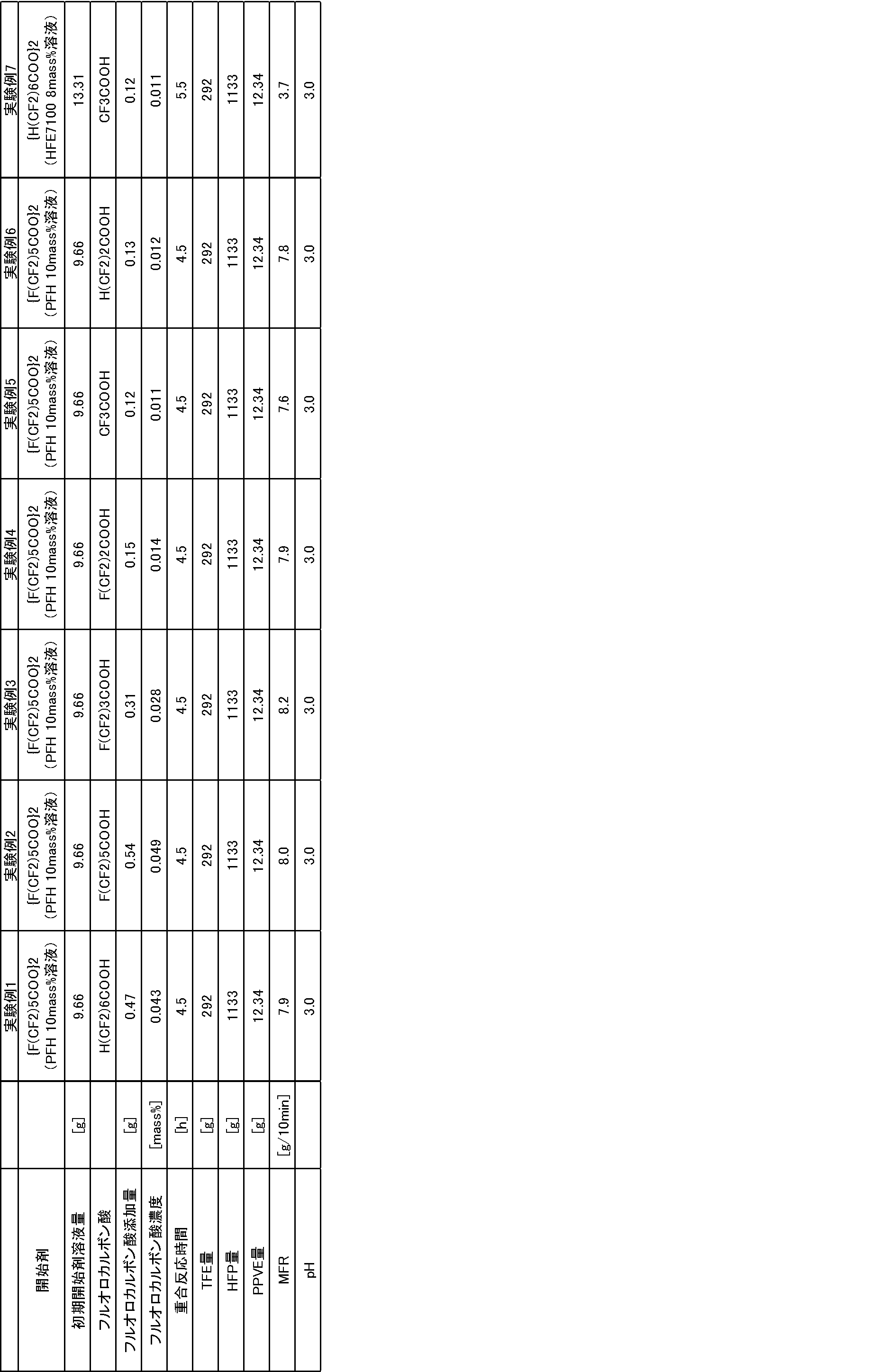
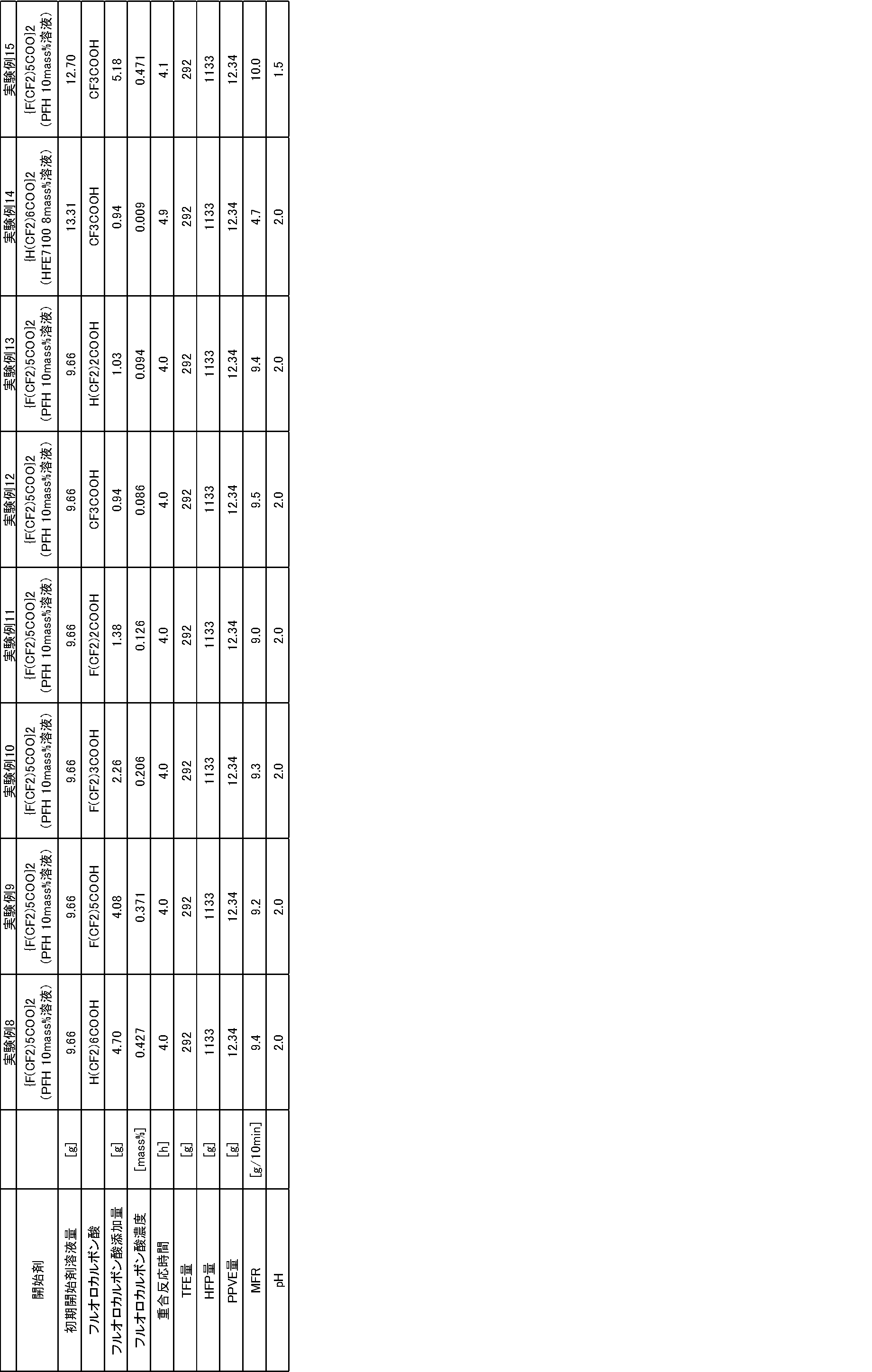
重合開始剤量及びフルオロモノマー量が同程度である場合、得られるフルオロポリマーのMFRが大きい(分子量が小さい)ことは、より多くの重合開始剤を起点とした重合反応が起こっていること、言い換えると、重合開始剤がより有効に利用されていることを意味する。
Claims (9)
- 下記式(1):
XRfaC(=O)OOC(=O)RfbY (1)
(式中、X及びYは、独立に、H又はFであり、Rfa及びRfbは、独立に、炭素数1~6の、エーテル結合を有してもよい直鎖状又は分岐状のパーフルオロアルキレン基である。)で表される含フッ素ジアシルパーオキサイドの存在下に、水性媒体中でフルオロモノマーを重合することにより、フルオロポリマーを得る工程を含み、
前記水性媒体のpHが2.5未満であるフルオロポリマーの製造方法。 - 前記水性媒体のpHが2.2以下である請求項1記載の製造方法。
- 下記式(1):
XRfaC(=O)OOC(=O)RfbY (1)
(式中、X及びYは、独立に、H又はFであり、Rfa及びRfbは、独立に、炭素数1~6の、エーテル結合を有してもよい直鎖状又は分岐状のパーフルオロアルキレン基である。)で表される含フッ素ジアシルパーオキサイド、及び、下記式(2):
Z2RfcCOOH (2)
(式中、Z2はH又はFであり、Rfcは、炭素数1~5の、エーテル結合を有してもよい直鎖状又は分岐状のパーフルオロアルキレン基である。)で表される含フッ素カルボン酸の存在下に、水性媒体中でフルオロモノマーを重合することにより、フルオロポリマーを得る工程を含むフルオロポリマーの製造方法。 - 式(2)において、Z2がHのとき、Rfcの炭素数は1~3であり、Z2がFのとき、Rfcの炭素数は1又は2である請求項3記載の製造方法。
- 前記含フッ素カルボン酸が、C2F5COOH、CF3COOH及びHC2F4COOHからなる群より選択される少なくとも1種である請求項3又は4記載の製造方法。
- 前記水性媒体のpHが2.90以下である請求項3~5のいずれかに記載の製造方法。
- (C5F11COO)2、(C3F7COO)2及び(C2F5COO)2からなる群より選択される少なくとも1種の含フッ素ジアシルパーオキサイドの存在下に、水性媒体中でフルオロモノマーを懸濁重合することにより、フルオロポリマーを得る工程を含むフルオロポリマーの製造方法。
- 前記水性媒体のpHが2.90以下である請求項7記載の製造方法。
- 前記懸濁重合を、下記式(3):
Z3RfdCOOH (3)
(式中、Z3はH又はFであり、Z3がHのとき、Rfdは、炭素数1~6の、エーテル結合を有してもよい直鎖状又は分岐状のパーフルオロアルキレン基であり、Z3がFのとき、Rfdは、炭素数1~5の、エーテル結合を有してもよい直鎖状又は分岐状のパーフルオロアルキレン基である)で表される含フッ素カルボン酸の存在下に行う請求項7又は8記載の製造方法。
Priority Applications (4)
| Application Number | Priority Date | Filing Date | Title |
|---|---|---|---|
| JP2021537686A JP7453559B2 (ja) | 2019-08-07 | 2020-07-21 | フルオロポリマーの製造方法 |
| CN202080054352.9A CN114206953A (zh) | 2019-08-07 | 2020-07-21 | 含氟聚合物的制造方法 |
| US17/592,754 US12528899B2 (en) | 2019-08-07 | 2022-02-04 | Method for producing fluoropolymer |
| JP2023183285A JP2023175026A (ja) | 2019-08-07 | 2023-10-25 | フルオロポリマーの製造方法 |
Applications Claiming Priority (2)
| Application Number | Priority Date | Filing Date | Title |
|---|---|---|---|
| JP2019-145400 | 2019-08-07 | ||
| JP2019145400 | 2019-08-07 |
Related Child Applications (1)
| Application Number | Title | Priority Date | Filing Date |
|---|---|---|---|
| US17/592,754 Continuation US12528899B2 (en) | 2019-08-07 | 2022-02-04 | Method for producing fluoropolymer |
Publications (1)
| Publication Number | Publication Date |
|---|---|
| WO2021024797A1 true WO2021024797A1 (ja) | 2021-02-11 |
Family
ID=74503834
Family Applications (1)
| Application Number | Title | Priority Date | Filing Date |
|---|---|---|---|
| PCT/JP2020/028267 Ceased WO2021024797A1 (ja) | 2019-08-07 | 2020-07-21 | フルオロポリマーの製造方法 |
Country Status (4)
| Country | Link |
|---|---|
| US (1) | US12528899B2 (ja) |
| JP (2) | JP7453559B2 (ja) |
| CN (1) | CN114206953A (ja) |
| WO (1) | WO2021024797A1 (ja) |
Cited By (2)
| Publication number | Priority date | Publication date | Assignee | Title |
|---|---|---|---|---|
| WO2022181822A1 (ja) * | 2021-02-26 | 2022-09-01 | ダイキン工業株式会社 | 含フッ素共重合体 |
| WO2022181823A1 (ja) * | 2021-02-26 | 2022-09-01 | ダイキン工業株式会社 | 含フッ素共重合体 |
Citations (9)
| Publication number | Priority date | Publication date | Assignee | Title |
|---|---|---|---|---|
| US2952669A (en) * | 1954-09-17 | 1960-09-13 | Du Pont | Polymerization of perfluorocarbon polymers |
| JPS4928675B1 (ja) * | 1970-01-30 | 1974-07-29 | ||
| JPS52887A (en) * | 1975-06-23 | 1977-01-06 | Daikin Ind Ltd | Preparation of tetrafluoroethylene-hexafluoropropylene copolymer |
| JPH01129005A (ja) * | 1987-11-12 | 1989-05-22 | Daikin Ind Ltd | フツ化ビニリデンの水性懸濁重合方法 |
| JPH0356512A (ja) * | 1989-07-25 | 1991-03-12 | Shin Etsu Chem Co Ltd | クロロトリフルオロエチレン系重合体の製造方法 |
| JPH0641247A (ja) * | 1992-07-22 | 1994-02-15 | Daikin Ind Ltd | テトラフルオロエチレン/ヘキサフルオロプロピレン共重合体の製造方法 |
| US20030004369A1 (en) * | 2001-06-05 | 2003-01-02 | Krasutsky Pavel A. | Compositions including fluorinated peroxides, methods of making, and the use thereof |
| CN101643523A (zh) * | 2009-08-07 | 2010-02-10 | 常熟市新华化工有限公司 | 聚三氟氯乙烯树脂的制备方法 |
| CN104744622A (zh) * | 2015-03-20 | 2015-07-01 | 巨化集团技术中心 | 一种端基稳定的含氟聚合物的制备方法 |
Family Cites Families (2)
| Publication number | Priority date | Publication date | Assignee | Title |
|---|---|---|---|---|
| US2988542A (en) * | 1958-01-02 | 1961-06-13 | Du Pont | Polymerization of fluorine containing monomers |
| EP0957113B1 (en) * | 1995-03-10 | 2002-11-27 | The University Of North Carolina At Chapel Hill | Nonaqueous polymerization of fluoromonomers |
-
2020
- 2020-07-21 WO PCT/JP2020/028267 patent/WO2021024797A1/ja not_active Ceased
- 2020-07-21 CN CN202080054352.9A patent/CN114206953A/zh active Pending
- 2020-07-21 JP JP2021537686A patent/JP7453559B2/ja active Active
-
2022
- 2022-02-04 US US17/592,754 patent/US12528899B2/en active Active
-
2023
- 2023-10-25 JP JP2023183285A patent/JP2023175026A/ja not_active Withdrawn
Patent Citations (9)
| Publication number | Priority date | Publication date | Assignee | Title |
|---|---|---|---|---|
| US2952669A (en) * | 1954-09-17 | 1960-09-13 | Du Pont | Polymerization of perfluorocarbon polymers |
| JPS4928675B1 (ja) * | 1970-01-30 | 1974-07-29 | ||
| JPS52887A (en) * | 1975-06-23 | 1977-01-06 | Daikin Ind Ltd | Preparation of tetrafluoroethylene-hexafluoropropylene copolymer |
| JPH01129005A (ja) * | 1987-11-12 | 1989-05-22 | Daikin Ind Ltd | フツ化ビニリデンの水性懸濁重合方法 |
| JPH0356512A (ja) * | 1989-07-25 | 1991-03-12 | Shin Etsu Chem Co Ltd | クロロトリフルオロエチレン系重合体の製造方法 |
| JPH0641247A (ja) * | 1992-07-22 | 1994-02-15 | Daikin Ind Ltd | テトラフルオロエチレン/ヘキサフルオロプロピレン共重合体の製造方法 |
| US20030004369A1 (en) * | 2001-06-05 | 2003-01-02 | Krasutsky Pavel A. | Compositions including fluorinated peroxides, methods of making, and the use thereof |
| CN101643523A (zh) * | 2009-08-07 | 2010-02-10 | 常熟市新华化工有限公司 | 聚三氟氯乙烯树脂的制备方法 |
| CN104744622A (zh) * | 2015-03-20 | 2015-07-01 | 巨化集团技术中心 | 一种端基稳定的含氟聚合物的制备方法 |
Cited By (6)
| Publication number | Priority date | Publication date | Assignee | Title |
|---|---|---|---|---|
| WO2022181822A1 (ja) * | 2021-02-26 | 2022-09-01 | ダイキン工業株式会社 | 含フッ素共重合体 |
| WO2022181823A1 (ja) * | 2021-02-26 | 2022-09-01 | ダイキン工業株式会社 | 含フッ素共重合体 |
| JP2022132206A (ja) * | 2021-02-26 | 2022-09-07 | ダイキン工業株式会社 | 含フッ素共重合体 |
| JP2022132207A (ja) * | 2021-02-26 | 2022-09-07 | ダイキン工業株式会社 | 含フッ素共重合体 |
| JP7219410B2 (ja) | 2021-02-26 | 2023-02-08 | ダイキン工業株式会社 | 含フッ素共重合体 |
| JP7219411B2 (ja) | 2021-02-26 | 2023-02-08 | ダイキン工業株式会社 | 含フッ素共重合体 |
Also Published As
| Publication number | Publication date |
|---|---|
| JP2023175026A (ja) | 2023-12-08 |
| JPWO2021024797A1 (ja) | 2021-02-11 |
| US12528899B2 (en) | 2026-01-20 |
| CN114206953A (zh) | 2022-03-18 |
| US20220153889A1 (en) | 2022-05-19 |
| JP7453559B2 (ja) | 2024-03-21 |
Similar Documents
| Publication | Publication Date | Title |
|---|---|---|
| JP7682632B2 (ja) | パーフルオロジアシルパーオキサイド、溶液、重合開始剤、重合体の製造方法、及び、パーフルオロアシルクロリド | |
| US9834631B2 (en) | Fluoropolymer production method | |
| JP5091131B2 (ja) | フッ素化界面活性剤を用いたフッ素化モノマーの水性乳化重合 | |
| US9574020B2 (en) | Production method for fluoropolymer aqueous dispersion | |
| US20080015319A1 (en) | Explosion taming surfactants for the production of perfluoropolymers | |
| US20120190807A1 (en) | Aqueous emulsion polymerization process for producing fluoropolymers | |
| WO2007011631A1 (en) | Aqueous emulsion polymerization of fluorinated monomers using a perfluoropolyether surfactant | |
| CN1351616A (zh) | 氟单体的聚合 | |
| JP2023175026A (ja) | フルオロポリマーの製造方法 | |
| US9475744B2 (en) | Method for recovering fluorine-containing ether | |
| WO2018189092A1 (en) | Method for manufacturing an aqueous latex comprising particles of a fluoropolymer | |
| US20170096504A1 (en) | Method for producing fluoropolymer aqueous dispersion liquid | |
| CN107001509A (zh) | 制备氟聚合物分散体的方法 | |
| JPH1192507A (ja) | 含フッ素重合体の製造方法 | |
| JP4144463B2 (ja) | 含フッ素共重合体及びその造粒物の製造方法 | |
| JP2012241128A (ja) | フルオロポリマーの製造方法 | |
| EP2181128B1 (en) | Method of preparing fluoropolymers by aqueous emulsion polymerization | |
| CN104448099A (zh) | 一种长链氟代烯烃聚合物及其制备方法 | |
| JP2011032363A (ja) | 含フッ素共重合体の製造方法 | |
| WO2023189629A1 (ja) | 含フッ素共重合体の製造方法 | |
| JPWO2006022385A1 (ja) | 含フッ素ポリマー精製方法、含フッ素ポリマー製造方法及び含フッ素エラストマー |
Legal Events
| Date | Code | Title | Description |
|---|---|---|---|
| 121 | Ep: the epo has been informed by wipo that ep was designated in this application |
Ref document number: 20850402 Country of ref document: EP Kind code of ref document: A1 |
|
| WWE | Wipo information: entry into national phase |
Ref document number: 2021537686 Country of ref document: JP |
|
| NENP | Non-entry into the national phase |
Ref country code: DE |
|
| 122 | Ep: pct application non-entry in european phase |
Ref document number: 20850402 Country of ref document: EP Kind code of ref document: A1 |