WO2021024364A1 - 接着剤組成物、熱硬化性接着シート及びプリント配線板 - Google Patents
接着剤組成物、熱硬化性接着シート及びプリント配線板 Download PDFInfo
- Publication number
- WO2021024364A1 WO2021024364A1 PCT/JP2019/030802 JP2019030802W WO2021024364A1 WO 2021024364 A1 WO2021024364 A1 WO 2021024364A1 JP 2019030802 W JP2019030802 W JP 2019030802W WO 2021024364 A1 WO2021024364 A1 WO 2021024364A1
- Authority
- WO
- WIPO (PCT)
- Prior art keywords
- adhesive composition
- styrene
- mass
- parts
- based elastomer
- Prior art date
- Legal status (The legal status is an assumption and is not a legal conclusion. Google has not performed a legal analysis and makes no representation as to the accuracy of the status listed.)
- Ceased
Links
Images



Classifications
-
- C—CHEMISTRY; METALLURGY
- C09—DYES; PAINTS; POLISHES; NATURAL RESINS; ADHESIVES; COMPOSITIONS NOT OTHERWISE PROVIDED FOR; APPLICATIONS OF MATERIALS NOT OTHERWISE PROVIDED FOR
- C09J—ADHESIVES; NON-MECHANICAL ASPECTS OF ADHESIVE PROCESSES IN GENERAL; ADHESIVE PROCESSES NOT PROVIDED FOR ELSEWHERE; USE OF MATERIALS AS ADHESIVES
- C09J153/00—Adhesives based on block copolymers containing at least one sequence of a polymer obtained by reactions only involving carbon-to-carbon unsaturated bonds; Adhesives based on derivatives of such polymers
- C09J153/02—Vinyl aromatic monomers and conjugated dienes
-
- C—CHEMISTRY; METALLURGY
- C09—DYES; PAINTS; POLISHES; NATURAL RESINS; ADHESIVES; COMPOSITIONS NOT OTHERWISE PROVIDED FOR; APPLICATIONS OF MATERIALS NOT OTHERWISE PROVIDED FOR
- C09J—ADHESIVES; NON-MECHANICAL ASPECTS OF ADHESIVE PROCESSES IN GENERAL; ADHESIVE PROCESSES NOT PROVIDED FOR ELSEWHERE; USE OF MATERIALS AS ADHESIVES
- C09J153/00—Adhesives based on block copolymers containing at least one sequence of a polymer obtained by reactions only involving carbon-to-carbon unsaturated bonds; Adhesives based on derivatives of such polymers
- C09J153/02—Vinyl aromatic monomers and conjugated dienes
- C09J153/025—Vinyl aromatic monomers and conjugated dienes modified
-
- B—PERFORMING OPERATIONS; TRANSPORTING
- B32—LAYERED PRODUCTS
- B32B—LAYERED PRODUCTS, i.e. PRODUCTS BUILT-UP OF STRATA OF FLAT OR NON-FLAT, e.g. CELLULAR OR HONEYCOMB, FORM
- B32B25/00—Layered products comprising a layer of natural or synthetic rubber
- B32B25/04—Layered products comprising a layer of natural or synthetic rubber comprising rubber as the main or only constituent of a layer, which is next to another layer of the same or of a different material
- B32B25/08—Layered products comprising a layer of natural or synthetic rubber comprising rubber as the main or only constituent of a layer, which is next to another layer of the same or of a different material of synthetic resin
-
- B—PERFORMING OPERATIONS; TRANSPORTING
- B32—LAYERED PRODUCTS
- B32B—LAYERED PRODUCTS, i.e. PRODUCTS BUILT-UP OF STRATA OF FLAT OR NON-FLAT, e.g. CELLULAR OR HONEYCOMB, FORM
- B32B25/00—Layered products comprising a layer of natural or synthetic rubber
- B32B25/14—Layered products comprising a layer of natural or synthetic rubber comprising synthetic rubber copolymers
-
- B—PERFORMING OPERATIONS; TRANSPORTING
- B32—LAYERED PRODUCTS
- B32B—LAYERED PRODUCTS, i.e. PRODUCTS BUILT-UP OF STRATA OF FLAT OR NON-FLAT, e.g. CELLULAR OR HONEYCOMB, FORM
- B32B27/00—Layered products comprising a layer of synthetic resin
-
- B—PERFORMING OPERATIONS; TRANSPORTING
- B32—LAYERED PRODUCTS
- B32B—LAYERED PRODUCTS, i.e. PRODUCTS BUILT-UP OF STRATA OF FLAT OR NON-FLAT, e.g. CELLULAR OR HONEYCOMB, FORM
- B32B7/00—Layered products characterised by the relation between layers; Layered products characterised by the relative orientation of features between layers, or by the relative values of a measurable parameter between layers, i.e. products comprising layers having different physical, chemical or physicochemical properties; Layered products characterised by the interconnection of layers
- B32B7/04—Interconnection of layers
- B32B7/12—Interconnection of layers using interposed adhesives or interposed materials with bonding properties
-
- C—CHEMISTRY; METALLURGY
- C08—ORGANIC MACROMOLECULAR COMPOUNDS; THEIR PREPARATION OR CHEMICAL WORKING-UP; COMPOSITIONS BASED THEREON
- C08L—COMPOSITIONS OF MACROMOLECULAR COMPOUNDS
- C08L63/00—Compositions of epoxy resins; Compositions of derivatives of epoxy resins
-
- C—CHEMISTRY; METALLURGY
- C08—ORGANIC MACROMOLECULAR COMPOUNDS; THEIR PREPARATION OR CHEMICAL WORKING-UP; COMPOSITIONS BASED THEREON
- C08L—COMPOSITIONS OF MACROMOLECULAR COMPOUNDS
- C08L71/00—Compositions of polyethers obtained by reactions forming an ether link in the main chain; Compositions of derivatives of such polymers
- C08L71/08—Polyethers derived from hydroxy compounds or from their metallic derivatives
- C08L71/10—Polyethers derived from hydroxy compounds or from their metallic derivatives from phenols
- C08L71/12—Polyphenylene oxides
-
- C—CHEMISTRY; METALLURGY
- C09—DYES; PAINTS; POLISHES; NATURAL RESINS; ADHESIVES; COMPOSITIONS NOT OTHERWISE PROVIDED FOR; APPLICATIONS OF MATERIALS NOT OTHERWISE PROVIDED FOR
- C09J—ADHESIVES; NON-MECHANICAL ASPECTS OF ADHESIVE PROCESSES IN GENERAL; ADHESIVE PROCESSES NOT PROVIDED FOR ELSEWHERE; USE OF MATERIALS AS ADHESIVES
- C09J11/00—Features of adhesives not provided for in group C09J9/00, e.g. additives
- C09J11/02—Non-macromolecular additives
- C09J11/06—Non-macromolecular additives organic
-
- C—CHEMISTRY; METALLURGY
- C09—DYES; PAINTS; POLISHES; NATURAL RESINS; ADHESIVES; COMPOSITIONS NOT OTHERWISE PROVIDED FOR; APPLICATIONS OF MATERIALS NOT OTHERWISE PROVIDED FOR
- C09J—ADHESIVES; NON-MECHANICAL ASPECTS OF ADHESIVE PROCESSES IN GENERAL; ADHESIVE PROCESSES NOT PROVIDED FOR ELSEWHERE; USE OF MATERIALS AS ADHESIVES
- C09J163/00—Adhesives based on epoxy resins; Adhesives based on derivatives of epoxy resins
-
- C—CHEMISTRY; METALLURGY
- C09—DYES; PAINTS; POLISHES; NATURAL RESINS; ADHESIVES; COMPOSITIONS NOT OTHERWISE PROVIDED FOR; APPLICATIONS OF MATERIALS NOT OTHERWISE PROVIDED FOR
- C09J—ADHESIVES; NON-MECHANICAL ASPECTS OF ADHESIVE PROCESSES IN GENERAL; ADHESIVE PROCESSES NOT PROVIDED FOR ELSEWHERE; USE OF MATERIALS AS ADHESIVES
- C09J171/00—Adhesives based on polyethers obtained by reactions forming an ether link in the main chain; Adhesives based on derivatives of such polymers
-
- C—CHEMISTRY; METALLURGY
- C09—DYES; PAINTS; POLISHES; NATURAL RESINS; ADHESIVES; COMPOSITIONS NOT OTHERWISE PROVIDED FOR; APPLICATIONS OF MATERIALS NOT OTHERWISE PROVIDED FOR
- C09J—ADHESIVES; NON-MECHANICAL ASPECTS OF ADHESIVE PROCESSES IN GENERAL; ADHESIVE PROCESSES NOT PROVIDED FOR ELSEWHERE; USE OF MATERIALS AS ADHESIVES
- C09J7/00—Adhesives in the form of films or foils
- C09J7/20—Adhesives in the form of films or foils characterised by their carriers
- C09J7/22—Plastics; Metallised plastics
-
- C—CHEMISTRY; METALLURGY
- C09—DYES; PAINTS; POLISHES; NATURAL RESINS; ADHESIVES; COMPOSITIONS NOT OTHERWISE PROVIDED FOR; APPLICATIONS OF MATERIALS NOT OTHERWISE PROVIDED FOR
- C09J—ADHESIVES; NON-MECHANICAL ASPECTS OF ADHESIVE PROCESSES IN GENERAL; ADHESIVE PROCESSES NOT PROVIDED FOR ELSEWHERE; USE OF MATERIALS AS ADHESIVES
- C09J7/00—Adhesives in the form of films or foils
- C09J7/30—Adhesives in the form of films or foils characterised by the adhesive composition
- C09J7/38—Pressure-sensitive adhesives [PSA]
- C09J7/381—Pressure-sensitive adhesives [PSA] based on macromolecular compounds obtained by reactions involving only carbon-to-carbon unsaturated bonds
- C09J7/387—Block-copolymers
-
- H—ELECTRICITY
- H05—ELECTRIC TECHNIQUES NOT OTHERWISE PROVIDED FOR
- H05K—PRINTED CIRCUITS; CASINGS OR CONSTRUCTIONAL DETAILS OF ELECTRIC APPARATUS; MANUFACTURE OF ASSEMBLAGES OF ELECTRICAL COMPONENTS
- H05K1/00—Printed circuits
- H05K1/02—Details
- H05K1/03—Use of materials for the substrate
-
- B—PERFORMING OPERATIONS; TRANSPORTING
- B32—LAYERED PRODUCTS
- B32B—LAYERED PRODUCTS, i.e. PRODUCTS BUILT-UP OF STRATA OF FLAT OR NON-FLAT, e.g. CELLULAR OR HONEYCOMB, FORM
- B32B2457/00—Electrical equipment
- B32B2457/08—PCBs, i.e. printed circuit boards
-
- H—ELECTRICITY
- H05—ELECTRIC TECHNIQUES NOT OTHERWISE PROVIDED FOR
- H05K—PRINTED CIRCUITS; CASINGS OR CONSTRUCTIONAL DETAILS OF ELECTRIC APPARATUS; MANUFACTURE OF ASSEMBLAGES OF ELECTRICAL COMPONENTS
- H05K2201/00—Indexing scheme relating to printed circuits covered by H05K1/00
- H05K2201/01—Dielectrics
- H05K2201/0137—Materials
- H05K2201/0141—Liquid crystal polymer [LCP]
-
- H—ELECTRICITY
- H05—ELECTRIC TECHNIQUES NOT OTHERWISE PROVIDED FOR
- H05K—PRINTED CIRCUITS; CASINGS OR CONSTRUCTIONAL DETAILS OF ELECTRIC APPARATUS; MANUFACTURE OF ASSEMBLAGES OF ELECTRICAL COMPONENTS
- H05K2201/00—Indexing scheme relating to printed circuits covered by H05K1/00
- H05K2201/01—Dielectrics
- H05K2201/0137—Materials
- H05K2201/0154—Polyimide
-
- H—ELECTRICITY
- H05—ELECTRIC TECHNIQUES NOT OTHERWISE PROVIDED FOR
- H05K—PRINTED CIRCUITS; CASINGS OR CONSTRUCTIONAL DETAILS OF ELECTRIC APPARATUS; MANUFACTURE OF ASSEMBLAGES OF ELECTRICAL COMPONENTS
- H05K3/00—Apparatus or processes for manufacturing printed circuits
- H05K3/22—Secondary treatment of printed circuits
- H05K3/28—Applying non-metallic protective coatings
- H05K3/281—Applying non-metallic protective coatings by means of a preformed insulating foil
Definitions
- This technology relates to adhesive compositions, thermosetting adhesive sheets and printed wiring boards.
- the constituent materials (for example, adhesive composition) of a rigid substrate or a flexible printed wiring board (FPC) are required to have low dielectric constants and low dielectric loss tangent characteristics (for example, Patent Document 1, Patent Document 1, 2).
- high heat resistance is required because parts are mounted and connected to another printed wiring board by, for example, a solder reflow process or a hot bar soldering process, as in the conventional one. ing.
- polyphenylene ether has many advantages as a substrate material having low dielectric properties, but it has a drawback that it is inferior in bending resistance because it has a very high melting point (softening point) and is hard at room temperature.
- softening point a melting point
- the bending resistance tends to be inferior.
- This technology has been proposed in view of such conventional circumstances, and is an adhesive composition having a low dielectric constant and dielectric loss tangent, and good bending resistance and heat resistance, a thermosetting adhesive sheet, and a printed wiring. Provide a board.
- the adhesive composition according to the present technology contains 70 to 90 parts by mass of a styrene-based elastomer and 5 to 5 to a modified polyphenylene ether resin having a radically polymerizable group at the terminal with respect to a total of 100 parts by mass of the adhesive composition. It contains 25 parts by mass, an epoxy resin, an epoxy resin curing agent, and a peroxide in total of 10 parts by mass or less, and the styrene ratio of the styrene-based elastomer is 42% or less.
- the adhesive composition according to the present technology contains 70 to 90 parts by mass of a styrene-based elastomer and a modified polyphenylene ether resin having a radically polymerizable group at the terminal with respect to 100 parts by mass of the total of the adhesive composition. It contains 5 to 25 parts by mass and 10 parts by mass or less of epoxy resin and peroxide in total, the styrene ratio of the styrene-based elastomer is 42% or less, and the styrene-based elastomer accelerates the curing reaction of the epoxy resin. It has a functional group.
- thermosetting adhesive sheet In the thermosetting adhesive sheet according to the present technology, a thermosetting adhesive layer made of the above-mentioned adhesive composition is formed on a base material.
- the wiring pattern side of the resin substrate with wiring provided with the base material and the wiring pattern and the coverlay are laminated via the cured product of the adhesive composition described above.
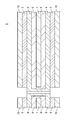
- FIG. 1 is a cross-sectional view showing a configuration example of a printed wiring board.
- FIG. 2 is a cross-sectional view showing a configuration example of a multilayer printed wiring board.
- FIG. 3 is a plan view showing a configuration example of the TEG used in the bending resistance test.
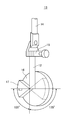
- FIG. 4 is a perspective view showing a measuring device used for the bending resistance test.
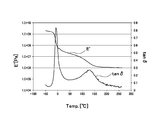
- FIG. 5 is a graph for explaining the glass transition temperature of the thermosetting adhesive sheet using the adhesive composition of Experimental Example 3.
- FIG. 6 is a graph for explaining the glass transition temperature of the thermosetting adhesive sheet using the adhesive composition of Experimental Example 10.
- the first form of the adhesive composition according to the present technology is a thermosetting adhesive composition, and 70 to 70 to 70 parts of a styrene-based elastomer (component A) is added to a total of 100 parts by mass of the adhesive composition. 90 parts by mass and 5 to 25 parts by mass of a modified polyphenylene ether resin (component B; hereinafter, also simply referred to as a modified polyphenylene ether resin) having a radically polymerizable group at the terminal, an epoxy resin (component C) and an epoxy resin curing agent. It contains (component D) and a peroxide (component E) in a total amount of 10 parts by mass or less.
- the styrene-based elastomer in the adhesive composition according to the present technology has a styrene ratio of 42% or less. With such a configuration, the dielectric constant and the dielectric loss tangent can be lowered even after thermosetting.
- the radical polymerizable group at the terminal of the modified polyphenylene ether resin is crosslinked by the peroxide by thermosetting. Thereby, the glass transition temperature of the adhesive composition after curing can be adjusted in the range of, for example, 80 to 170 ° C., and the adhesive composition has good bending resistance and heat resistance (for example, solder heat resistance) even after thermosetting. Can be.
- Such an adhesive composition can be suitably used as, for example, an adhesive (interlayer adhesive) for a flexible printed wiring board.
- the styrene-based elastomer is a copolymer of styrene and an olefin (for example, a conjugated diene such as butadiene or isoprene) and / or a hydrogenated product thereof.
- the styrene-based elastomer is a block copolymer having styrene as a hard segment and conjugated diene as a soft segment.
- styrene-based elastomers examples include styrene / butadiene / styrene block copolymers, styrene / isoprene / styrene block copolymers, styrene / ethylene / butylene / styrene block copolymers, and styrene / ethylene / propylene / styrene block copolymers. Examples include coalescence, styrene / butadiene block copolymers and the like.
- styrene / ethylene / butylene / styrene block copolymers styrene / ethylene / propylene / styrene block copolymers, and styrene / butadiene block copolymers (hydrogenated) in which the double bond of the conjugated diene component is eliminated by hydrogenation.
- styrene-based elastomer Also referred to as a styrene-based elastomer
- the styrene ratio in the styrene-based elastomer is preferably less than 42%, more preferably 5 to 40%, further preferably 10 to 35%, and particularly preferably 12 to 20%. With such a configuration, the bending resistance can be improved, and the peel strength (connection reliability) and heat resistance can be improved.
- styrene-based elastomer examples include Tough Tech H1221 (styrene ratio 12%), Tough Tech MP10 (styrene ratio 30%), Tough Tech H1051 (styrene ratio 42%,) Tough Tech H1043 (styrene ratio 67%, manufactured by Asahi Kasei Corporation). Can be mentioned. Among these, Tough Tech H1221 and Tough Tech MP10 are preferable from the viewpoint of molecular weight and styrene ratio.
- the content of the styrene-based elastomer in the adhesive composition is 70 to 90 parts by mass and 80 to 90 parts by mass with respect to 100 parts by mass in total of component A, component B, component C, component D and component E. It may be. If the content of the styrene-based elastomer is less than 70 parts by mass, the bending resistance tends to be inferior. Further, when the content of the styrene-based elastomer exceeds 90 parts by mass, the content of other components (for example, component B) is relatively small, so that the heat resistance tends to be inferior.
- the styrene-based elastomer may be used alone or in combination of two or more.
- the modified polyphenylene ether resin has a polyphenylene ether chain in the molecule and has a radically polymerizable group at the terminal. As described above, the radically polymerizable group at the end of the modified polyphenylene ether resin is crosslinked by the peroxide in the adhesive composition, so that the glass transition temperature of the adhesive composition after curing is set to, for example, 80 to 170.
- the adhesive composition can be adjusted in the range of ° C. and has good bending resistance and solder heat resistance even after thermosetting.
- the modified polyphenylene ether resin preferably has two or more ethylenically unsaturated bonds as radically polymerizable groups in one molecule.
- the modified polyphenylene ether resin has an ethylenically unsaturated bond (for example, (meth) acryloyl group, vinylbenzyl) at both ends. It is preferable to have at least one of the groups).
- a polyphenylene ether resin other than the modified polyphenylene ether resin having a radically polymerizable group at the terminal for example, a polyphenylene ether resin having a hydroxyl group at the terminal is too polar, and therefore has poor compatibility with the above-mentioned styrene-based elastomer. It is not preferable because the adhesive composition may not be formed into a film.
- the modified polyphenylene ether resin having vinylbenzyl groups at both ends which is an example of the modified polyphenylene ether resin, is, for example, the terminal of the bifunctional phenylene ether oligomer obtained by oxidizing coupling a bifunctional phenol compound and a monofunctional phenol compound. It is obtained by converting a phenolic hydroxyl group into vinylbenzyl ether.
- the weight average molecular weight (or number average molecular weight) of the modified polyphenylene ether resin is the compatibility with the above-mentioned styrene-based elastomer, and the resin substrate with wiring provided with the substrate and the wiring pattern via the cured product of the adhesive composition. From the viewpoint of step followability when the wiring pattern side and the coverlay are heat-cured (pressed), the ratio is preferably 1,000 to 3,000.
- modified polyphenylene ether resin examples include OPE-2St (modified polyphenylene ether resin having vinylbenzyl groups at both ends) and OPE-2EA (modified polyphenylene ether resin having acryloyl groups at both ends, Mitsubishi Gas Chemical Company, Inc.).
- Noryl SA9000 modified polyphenylene ether resin having methacryloyl groups at both ends, manufactured by SABIC
- the content of the modified polyphenylene ether resin in the adhesive composition is 5 to 25 parts by mass and 10 to 25 parts by mass with respect to 100 parts by mass in total of component A, component B, component C, component D and component E. It is preferably parts, and more preferably 10 to 20 parts by mass.
- the content of the modified polyphenylene ether resin exceeds 25 parts by mass, the bending resistance tends to be inferior. Further, by setting the content of the modified polyphenylene ether resin to 5 parts by mass or more, the heat resistance can be further improved.
- the modified polyphenylene ether resin may be used alone or in combination of two or more.
- Peroxide is a catalyst that promotes the radical curing reaction of unsaturated bonds.
- the peroxide crosslinks the radically polymerizable group at the terminal of the polyphenylene ether resin having the radically polymerizable group at the terminal described above by thermosetting.
- a peroxide having a high reaction starting temperature is preferable from the viewpoint of storage stability (life) of the adhesive composition at room temperature.
- an organic peroxide having a decomposition temperature of 170 ° C. or higher for having a half-life of 1 minute is preferable.
- organic peroxides examples include dicumyl peroxide (decomposition temperature for a half-life of 1 minute) and t-butyl cumyl peroxide (decomposition for a half-life of 1 minute). The temperature is 173 ° C.), 2,5-dimethyl-2,5-di (t-butylperoxy) hexane (decomposition temperature for a half-life of 1 minute is 194 ° C.).
- the peroxide may be used alone or in combination of two or more.
- the epoxy resin is, for example, an epoxy resin having a naphthalene skeleton, a bisphenol A type epoxy resin, a bisphenol F type epoxy resin, a phenol novolac type epoxy resin, an alicyclic epoxy resin, a siloxane type epoxy resin, a biphenyl type epoxy resin, or a glycidyl ester type.
- examples thereof include epoxy resins, glycidylamine type epoxy resins, and hidden-in type epoxy resins.
- the epoxy resin is preferably an epoxy resin having a naphthalene skeleton, a bisphenol A type epoxy resin, or a bisphenol F type epoxy resin, which is liquid at room temperature, from the viewpoint of film moldability.
- the epoxy resin may be used alone or in combination of two or more.
- the epoxy resin curing agent is a catalyst that accelerates the curing reaction of the epoxy resin described above.
- the epoxy resin curing agent for example, imidazole-based, phenol-based, amine-based, acid anhydride-based, organic peroxide-based, and the like can be used.
- the epoxy resin curing agent is preferably a curing agent having potential from the viewpoint of storage stability (life) of the adhesive composition at room temperature, and is an encapsulated imidazole-based curing agent having potential. More preferably, it is a curing agent. By improving the storability at room temperature, it is possible to more easily manage the supply and use of the adhesive composition.
- the epoxy resin curing agent a microcapsule type latent curing agent having a latent imidazole modified product as a core and its surface coated with polyurethane can be used.
- a commercially available product for example, Novacure 3941 (manufactured by Asahi Kasei E-Materials Co., Ltd.) can be used.
- the epoxy resin curing agent may be used alone or in combination of two or more.
- a polymer side for example, a styrene-based elastomer
- a functional group that promotes the curing reaction of the epoxy resin such as amine or acid anhydride
- the adhesive composition by forming the adhesive composition into a film, the movement of the polymer chain containing the functional group that promotes the curing reaction of the epoxy resin is restricted, so that the polymer side can be imparted with potential.
- an amine-modified styrene-based elastomer or an acid-modified styrene-based elastomer can be used.
- examples of such a polymer include Tuftec MP10 (amine-modified styrene-based elastomer) and Toughtec M1911 (acid-modified styrene-based elastomer).
- the total content of the epoxy resin, the epoxy resin curing agent, and the peroxide in the adhesive composition is 10 parts by mass with respect to 100 parts by mass of the total of component A, component B, component C, component D, and component E. It is less than or equal to 5 parts by mass or less.
- the lower limit of the contents of the epoxy resin, the epoxy resin curing agent and the peroxide in the adhesive composition is not particularly limited, and for example, the total of component A, component B, component C, component D and component E.
- the styrene-based elastomer incorporating the functional group that promotes the curing reaction of the epoxy resin described above shall be included in the content of the styrene-based elastomer (component A) described above, and shall be included in the content of the epoxy resin curing agent (component D). Is not included.
- the adhesive composition may further contain components other than the above-mentioned components A to E as long as the effects of the present technology are not impaired.
- other components include an organic solvent, an adhesive-imparting agent such as a silane coupling agent, and a filler for adjusting fluidity and imparting flame retardancy.
- the organic solvent is not particularly limited, and examples thereof include an alcohol solvent, a ketone solvent, an ether solvent, an aromatic solvent, and an ester solvent. Among these, aromatic solvents and ester solvents are preferable from the viewpoint of solubility.
- the organic solvent may be used alone or in combination of two or more.
- the adhesive composition according to the present technology contains 70 to 90 parts by mass of a styrene-based elastomer and radicals at the ends with respect to 100 parts by mass of the total of the adhesive composition. It contains 5 to 25 parts by mass of a modified polyphenylene ether resin having a polymerizable group and 10 parts by mass or less of an epoxy resin and a peroxide in total, and the styrene ratio of the styrene-based elastomer is 42% or less, and the styrene-based
- the elastomer may be an adhesive composition having a functional group that accelerates the curing reaction of the epoxy resin.
- the styrene-based elastomer since the styrene-based elastomer has a functional group that promotes the curing reaction of the epoxy resin, it also has the function of the epoxy resin curing agent (component D). Therefore, in other embodiments, it is not necessary to separately use the epoxy resin curing agent (component D), but an epoxy resin curing agent may be separately used in combination as long as the effect of the present technology is not impaired.
- the thermosetting adhesive sheet according to the present technology has a film shape in which a thermosetting adhesive layer made of the above-mentioned adhesive composition is formed on a base material.
- the thermosetting adhesive sheet is prepared, for example, by diluting the above-mentioned adhesive composition with a solvent and using a bar coater, a roll coater, or the like so that the thickness after drying is 10 to 60 ⁇ m, at least one surface of the base material. It is obtained by applying to and drying at a temperature of about 50 to 130 ° C.
- the base material for example, a peeling base material obtained by subjecting a base material such as a polyethylene terephthalate film or a polyimide film to a peeling treatment with silicone or the like can be used, if necessary.
- the thickness of the thermosetting adhesive layer constituting the thermosetting adhesive sheet can be appropriately set according to the purpose, but as an example, it can be 1 to 100 ⁇ m, or 1 to 30 ⁇ m.
- thermosetting adhesive layer constituting the thermosetting adhesive sheet is made of an adhesive composition having a low dielectric constant and dielectric adjacency even after thermosetting and having good bending resistance and heat resistance even after thermosetting. Therefore, for example, it can be applied to an interlayer adhesive for a flexible printed wiring board, or an application for bonding and fixing a terminal portion of a flexible printed wiring board and a connecting base material for lining the terminal portion.
- thermosetting adhesive sheet has good peel strength after heat curing, heat resistance, and storability at room temperature.
- the printed wiring board according to the present technology has a wiring pattern side of a base material with wiring having a base material and a wiring pattern, and a coverlay, via a cured product of the adhesive composition (thermosetting adhesive layer) described above. Are stacked.
- a thermosetting adhesive layer of a thermosetting adhesive sheet is arranged between the wiring pattern side of the base material with wiring and the coverlay, and thermocompression bonding is performed to form the base material with wiring and the coverlay. It is obtained by integrating with.
- the base material with wiring is excellent in electrical characteristics in the high frequency region, for example, it is preferable that the dielectric constant and the dielectric loss tangent are low in the frequency range of 1 to 10 GHz.
- the base material include a base material containing any one of liquid crystal polymer (LCP: Liquid Crystal Polymer), polytetrafluoroethylene, polyimide and polyethylene naphthalate as a main component.
- LCP Liquid Crystal Polymer
- polytetrafluoroethylene polyimide
- polyethylene naphthalate polyethylene naphthalate
- a base material containing a liquid crystal polymer as a main component liquid crystal polymer film
- the liquid crystal polymer has a very low hygroscopicity as compared with polyimide and is not easily affected by the usage environment.
- the printed wiring board 1 shown in FIG. 1 includes a liquid crystal polymer film 2 and a copper foil 3 side of a base material with wiring (copper-clad laminate: CCL) including a copper foil (rolled copper foil) 3, and a liquid crystal polymer film 4. However, they are laminated via a cured product layer 5 made of the above-mentioned adhesive composition (thermosetting adhesive layer).
- the printed wiring board may have a multi-layer structure as shown in FIG. 2, for example.
- the printed wiring board 6 shown in FIG. 2 has a polyimide layer 7 (thickness 25 ⁇ m), a copper foil 8 (thickness 18 ⁇ m), a copper plating layer 9 (thickness 10 ⁇ m), a copper plating layer 9 side of a wiring board, and a coverlay. 10 (thickness 25 ⁇ m) is laminated via a cured product layer 5 (thickness 35 ⁇ m) made of the above-mentioned adhesive composition (thermosetting adhesive layer) (total thickness 201 ⁇ m).
- Tough Tech H1221 Hydrogenated Styrene Thermoplastic Elastomer (Styrene Ratio 12%), Asahi Kasei Tough Tech MP10: Amine-modified Hydrogenated Styrene Thermoplastic Elastomer (Styrene Ratio 30%), Asahi Kasei Tough Tech H1051: Hydrogenated Styrene Styrene-based thermoplastic elastomer (styrene ratio 42%), Tough Tech H1043 manufactured by Asahi Kasei Co., Ltd .: Hydrogenated styrene-based thermoplastic elastomer (styrene ratio 67%), manufactured by Asahi Kasei Co., Ltd.
- thermosetting adhesive composition Each component shown in Table 1 is weighed so as to have the mass shown in Table 1, and is uniformly mixed in an organic solvent containing toluene and ethyl acetate to form a thermosetting adhesive composition (thermosetting adhesive layer formation). Paint) was prepared.
- thermosetting adhesive composition is applied to a polyethylene terephthalate film that has been subjected to a peeling treatment, and dried in a drying furnace at 50 to 130 ° C. to obtain a polyethylene terephthalate film and a thermosetting film having a thickness of 25 ⁇ m.
- a thermosetting adhesive sheet having a sex-adhesive layer was produced.
- thermosetting adhesive composition evaluation of coatability (film condition) of thermosetting adhesive layer forming paint>
- the coatability of the thermosetting adhesive composition was evaluated according to the following criteria. The results are shown in Table 1.
- thermosetting adhesive sheets prepared in Examples and Comparative Examples were laminated to prepare a test piece having a thickness of 1 mm, and then the test piece was heat-cured at 180 ° C. and 1.0 MPa for 1 hour for evaluation.
- a test piece for use was prepared.
- the permittivity at a measurement temperature of 23 ° C. and a measurement frequency of 10 GHz was determined using a dielectric constant measuring device (manufactured by AET). The results are shown in Table 1.
- B Permittivity is 2.3 or more and less than 2.4
- C Permittivity is 2.4 or more and less than 2.6
- D Permittivity is 2.6 or more
- Dissipation factor is less than 0.002
- Dissipation factor is 0.002 or more and less than 0.0035
- Dissipation factor is 0.0035 or more and less than 0.005
- Dissipation factor is 0.005 or more
- thermosetting adhesive sheet was cut into strips (2 cm x 5 cm) of a predetermined size, and the cut thermosetting adhesive layer was set on a liquid crystal polymer film having a thickness of 2 cm x 7 cm x 50 ⁇ m at 100 ° C.
- the base material polyethylene terephthalate film
- a rolled copper foil surface (roughening treatment) of a copper-clad laminate of the same size (CCL composed of a rolled copper foil having a thickness of 12 ⁇ m and a liquid crystal polymer film having a thickness of 50 ⁇ m) is applied to the exposed thermosetting adhesive layer.
- the non-surface was overlapped from above and thermoset at 180 ° C. and 1.0 MPa for 1 hour. As a result, a sample was prepared.
- the obtained sample was subjected to a 90-degree peeling test at a peeling speed of 50 mm / min, and the force required for peeling (initial peeling strength and peeling strength after the reliability test) was measured.
- the results are shown in Table 1.
- thermosetting adhesive sheet is cut into strips (1.5 cm ⁇ 12 cm) of a predetermined size, and the cut thermosetting adhesive layer is formed on a liquid crystal polymer film having a thickness of 1.5 cm ⁇ 12 cm ⁇ 50 ⁇ m at 100 ° C.
- the base material polyethylene terephthalate film
- the exposed thermosetting adhesive layer was superposed on FPC-TEG for MIT bending resistance test and heat-cured at 180 ° C. and 1.0 MPa for 1 hour.
- the configuration of TEG11 for the MIT bending resistance test is shown in FIG.
- copper wiring is formed from CCL composed of a liquid crystal polymer film (thickness 50 ⁇ m) as a base material and rolled copper foil (thickness 12 ⁇ m).
- thermosetting adhesive sheets were laminated to prepare a test piece having a thickness of 600 ⁇ m, and then the test piece was heat-cured at 180 ° C. and 1.0 MPa for 1 hour to prepare a test piece for evaluation. .. Using this test piece, the glass transition temperature that appears when the temperature is raised from -60 ° C to 250 ° C at a rate of 10 ° C / min using a dynamic viscoelasticity measuring device (manufactured by TA Instruments) is measured. I asked.
- FIG. 5 is a graph for explaining the glass transition temperature of the thermosetting adhesive sheet using the adhesive composition of Experimental Example 3.
- tan ⁇ peaks were detected near ⁇ 50 ° C. and 140 ° C. on the horizontal axis, but the temperature of the tan ⁇ peak (140 ° C.) showing a higher value was defined as the glass transition temperature.
- FIG. 5 is a graph for explaining the glass transition temperature of the thermosetting adhesive sheet using the adhesive composition of Experimental Example 3.
- tan ⁇ peaks were detected near ⁇ 50 ° C. and 140 ° C. on the horizontal axis, but the temperature of the tan ⁇ peak (140 ° C.) showing a higher value was defined as the glass transition temperature.
- thermosetting adhesive sheet is a graph for explaining the glass transition temperature of the thermosetting adhesive sheet using the adhesive composition of Experimental Example 10.
- tan ⁇ peaks were detected near ⁇ 10 ° C. and around 120 ° C. on the horizontal axis, but the temperature of the tan ⁇ peak (-10 ° C.) showing a higher value was defined as the glass transition temperature.
- a styrene-based elastomer (component) having a styrene ratio of 42% or less with respect to a total of 100 parts by mass of the adhesive composition 70 to 90 parts by mass of A), 5 to 25 parts by mass of a modified polyphenylene ether resin (component B) having a radically polymerizable group at the terminal, an epoxy resin (component C), an epoxy resin curing agent (component D), and It was found that the adhesive composition containing a total of 10 parts by mass or less of the peroxide (component E) had a low dielectric constant and dielectric tangent even after thermosetting, and had good bending resistance and heat resistance. ..
- the styrene ratio is 42% or less with respect to 100 parts by mass of the total adhesive composition, and the functional group that promotes the curing reaction of the epoxy resin.
- Styrene-based elastomer having 70 to 90 parts by mass
- modified polyphenylene ether resin having a radically polymerizable group at the terminal by 5 to 25 parts by mass
- epoxy resin component C
- peroxide the adhesive composition containing a total of 10 parts by mass or less of the substance (component E) also had a low dielectric constant and dielectric equine tangent even after thermosetting, and had good bending resistance and heat resistance.
Landscapes
- Chemical & Material Sciences (AREA)
- Organic Chemistry (AREA)
- Chemical Kinetics & Catalysis (AREA)
- Health & Medical Sciences (AREA)
- Medicinal Chemistry (AREA)
- Polymers & Plastics (AREA)
- Engineering & Computer Science (AREA)
- Microelectronics & Electronic Packaging (AREA)
- Adhesives Or Adhesive Processes (AREA)
- Laminated Bodies (AREA)
- Adhesive Tapes (AREA)
- Non-Metallic Protective Coatings For Printed Circuits (AREA)
- General Chemical & Material Sciences (AREA)
Priority Applications (5)
| Application Number | Priority Date | Filing Date | Title |
|---|---|---|---|
| CN201980098858.7A CN114174457B (zh) | 2019-08-06 | 2019-08-06 | 粘接剂组合物、热固性粘接片以及印刷线路板 |
| JP2021538577A JP7351912B2 (ja) | 2019-08-06 | 2019-08-06 | 接着剤組成物、熱硬化性接着シート及びプリント配線板 |
| PCT/JP2019/030802 WO2021024364A1 (ja) | 2019-08-06 | 2019-08-06 | 接着剤組成物、熱硬化性接着シート及びプリント配線板 |
| US17/630,070 US12454634B2 (en) | 2019-08-06 | 2019-08-06 | Adhesive composition, thermosetting adhesive sheet, and printed wiring board |
| KR1020227002765A KR102723829B1 (ko) | 2019-08-06 | 2019-08-06 | 접착제 조성물, 열경화성 접착 시트 및 프린트 배선판 |
Applications Claiming Priority (1)
| Application Number | Priority Date | Filing Date | Title |
|---|---|---|---|
| PCT/JP2019/030802 WO2021024364A1 (ja) | 2019-08-06 | 2019-08-06 | 接着剤組成物、熱硬化性接着シート及びプリント配線板 |
Publications (1)
| Publication Number | Publication Date |
|---|---|
| WO2021024364A1 true WO2021024364A1 (ja) | 2021-02-11 |
Family
ID=74502900
Family Applications (1)
| Application Number | Title | Priority Date | Filing Date |
|---|---|---|---|
| PCT/JP2019/030802 Ceased WO2021024364A1 (ja) | 2019-08-06 | 2019-08-06 | 接着剤組成物、熱硬化性接着シート及びプリント配線板 |
Country Status (5)
| Country | Link |
|---|---|
| US (1) | US12454634B2 (https=) |
| JP (1) | JP7351912B2 (https=) |
| KR (1) | KR102723829B1 (https=) |
| CN (1) | CN114174457B (https=) |
| WO (1) | WO2021024364A1 (https=) |
Cited By (9)
| Publication number | Priority date | Publication date | Assignee | Title |
|---|---|---|---|---|
| WO2023053749A1 (ja) * | 2021-09-30 | 2023-04-06 | ナミックス株式会社 | 樹脂組成物、接着フィルム、層間接着用ボンディングシート、アンテナ付き半導体パッケージ用樹脂組成物及びアンテナ付き半導体パッケージ |
| JP2023160867A (ja) * | 2021-07-26 | 2023-11-02 | 東洋インキScホールディングス株式会社 | 接着性樹脂シート、プリント配線板および、電子機器。 |
| WO2024014432A1 (ja) * | 2022-07-12 | 2024-01-18 | 株式会社レゾナック | 硬化性樹脂組成物、硬化性フィルム、及び、積層フィルム |
| WO2024048055A1 (ja) * | 2022-08-31 | 2024-03-07 | ナミックス株式会社 | 樹脂組成物、接着フィルム、層間接着用ボンディングシート、及びアンテナ付き半導体パッケージ用樹脂組成物 |
| WO2024209940A1 (ja) * | 2023-04-06 | 2024-10-10 | Dic株式会社 | 熱硬化型接着シート及びプリント配線板 |
| JP7569954B1 (ja) | 2024-03-29 | 2024-10-18 | デクセリアルズ株式会社 | 熱硬化性接着剤組成物、熱硬化性接着シート及びプリント配線板 |
| WO2025105009A1 (ja) * | 2023-11-17 | 2025-05-22 | ナミックス株式会社 | 接着フィルム、半導体装置および半導体装置の製造方法 |
| WO2025187605A1 (ja) * | 2024-03-07 | 2025-09-12 | 株式会社Adeka | 組成物、硬化物及び接着剤 |
| WO2026079074A1 (ja) * | 2024-10-07 | 2026-04-16 | デクセリアルズ株式会社 | 熱硬化性接着剤組成物、熱硬化性接着シート及びプリント配線板 |
Families Citing this family (3)
| Publication number | Priority date | Publication date | Assignee | Title |
|---|---|---|---|---|
| WO2021024328A1 (ja) * | 2019-08-02 | 2021-02-11 | デクセリアルズ株式会社 | 接着剤組成物、熱硬化性接着シート及びプリント配線板 |
| JP7736567B2 (ja) * | 2019-12-23 | 2025-09-09 | 信越ポリマー株式会社 | 接着剤組成物 |
| CN114080088B (zh) * | 2020-08-10 | 2024-05-31 | 鹏鼎控股(深圳)股份有限公司 | 电路板及其制备方法 |
Citations (7)
| Publication number | Priority date | Publication date | Assignee | Title |
|---|---|---|---|---|
| JP2008248001A (ja) * | 2007-03-29 | 2008-10-16 | Nippon Steel Chem Co Ltd | 硬化性樹脂組成物 |
| WO2014046014A1 (ja) * | 2012-09-20 | 2014-03-27 | 株式会社クラレ | 回路基板およびその製造方法 |
| JP2015131866A (ja) * | 2014-01-09 | 2015-07-23 | ナミックス株式会社 | エラストマー組成物、フィルムおよび半導体装置 |
| WO2016017473A1 (ja) * | 2014-07-31 | 2016-02-04 | 東亞合成株式会社 | 接着剤層付き積層体、並びに、これを用いたフレキシブル銅張積層板及びフレキシブルフラットケーブル |
| JP2016027131A (ja) * | 2014-06-26 | 2016-02-18 | 住友電気工業株式会社 | 接着剤組成物、プリント配線板用カバーレイ、プリント配線板用ボンディングフィルム及びプリント配線板 |
| JP2016079354A (ja) * | 2014-10-22 | 2016-05-16 | ナミックス株式会社 | 樹脂組成物、それを用いた絶縁フィルムおよび半導体装置 |
| WO2019151014A1 (ja) * | 2018-02-05 | 2019-08-08 | デクセリアルズ株式会社 | 接着剤組成物、熱硬化性接着シート及びプリント配線板 |
Family Cites Families (4)
| Publication number | Priority date | Publication date | Assignee | Title |
|---|---|---|---|---|
| JP2007302817A (ja) * | 2006-05-12 | 2007-11-22 | Mitsubishi Engineering Plastics Corp | 自動車外装部品製造用熱可塑性樹脂組成物 |
| JP2013151638A (ja) * | 2011-12-27 | 2013-08-08 | Yamaichi Electronics Co Ltd | カバーレイフィルム、フレキシブル配線板およびその製造方法 |
| JP6896993B2 (ja) | 2015-09-18 | 2021-06-30 | 昭和電工マテリアルズ株式会社 | 樹脂組成物、プリプレグ、積層板及び多層プリント配線板 |
| JP6776577B2 (ja) * | 2016-03-28 | 2020-10-28 | 味の素株式会社 | 樹脂組成物 |
-
2019
- 2019-08-06 KR KR1020227002765A patent/KR102723829B1/ko active Active
- 2019-08-06 US US17/630,070 patent/US12454634B2/en active Active
- 2019-08-06 JP JP2021538577A patent/JP7351912B2/ja active Active
- 2019-08-06 WO PCT/JP2019/030802 patent/WO2021024364A1/ja not_active Ceased
- 2019-08-06 CN CN201980098858.7A patent/CN114174457B/zh active Active
Patent Citations (7)
| Publication number | Priority date | Publication date | Assignee | Title |
|---|---|---|---|---|
| JP2008248001A (ja) * | 2007-03-29 | 2008-10-16 | Nippon Steel Chem Co Ltd | 硬化性樹脂組成物 |
| WO2014046014A1 (ja) * | 2012-09-20 | 2014-03-27 | 株式会社クラレ | 回路基板およびその製造方法 |
| JP2015131866A (ja) * | 2014-01-09 | 2015-07-23 | ナミックス株式会社 | エラストマー組成物、フィルムおよび半導体装置 |
| JP2016027131A (ja) * | 2014-06-26 | 2016-02-18 | 住友電気工業株式会社 | 接着剤組成物、プリント配線板用カバーレイ、プリント配線板用ボンディングフィルム及びプリント配線板 |
| WO2016017473A1 (ja) * | 2014-07-31 | 2016-02-04 | 東亞合成株式会社 | 接着剤層付き積層体、並びに、これを用いたフレキシブル銅張積層板及びフレキシブルフラットケーブル |
| JP2016079354A (ja) * | 2014-10-22 | 2016-05-16 | ナミックス株式会社 | 樹脂組成物、それを用いた絶縁フィルムおよび半導体装置 |
| WO2019151014A1 (ja) * | 2018-02-05 | 2019-08-08 | デクセリアルズ株式会社 | 接着剤組成物、熱硬化性接着シート及びプリント配線板 |
Cited By (14)
| Publication number | Priority date | Publication date | Assignee | Title |
|---|---|---|---|---|
| JP2023160867A (ja) * | 2021-07-26 | 2023-11-02 | 東洋インキScホールディングス株式会社 | 接着性樹脂シート、プリント配線板および、電子機器。 |
| WO2023053749A1 (ja) * | 2021-09-30 | 2023-04-06 | ナミックス株式会社 | 樹脂組成物、接着フィルム、層間接着用ボンディングシート、アンテナ付き半導体パッケージ用樹脂組成物及びアンテナ付き半導体パッケージ |
| WO2024014432A1 (ja) * | 2022-07-12 | 2024-01-18 | 株式会社レゾナック | 硬化性樹脂組成物、硬化性フィルム、及び、積層フィルム |
| WO2024048055A1 (ja) * | 2022-08-31 | 2024-03-07 | ナミックス株式会社 | 樹脂組成物、接着フィルム、層間接着用ボンディングシート、及びアンテナ付き半導体パッケージ用樹脂組成物 |
| KR20250172802A (ko) | 2023-04-06 | 2025-12-09 | 디아이씨 가부시끼가이샤 | 열경화형 접착 시트 및 프린트 배선판 |
| WO2024209940A1 (ja) * | 2023-04-06 | 2024-10-10 | Dic株式会社 | 熱硬化型接着シート及びプリント配線板 |
| JPWO2024209940A1 (https=) * | 2023-04-06 | 2024-10-10 | ||
| JP7794360B2 (ja) | 2023-04-06 | 2026-01-06 | Dic株式会社 | 熱硬化型接着シート及びプリント配線板 |
| WO2025105009A1 (ja) * | 2023-11-17 | 2025-05-22 | ナミックス株式会社 | 接着フィルム、半導体装置および半導体装置の製造方法 |
| WO2025187605A1 (ja) * | 2024-03-07 | 2025-09-12 | 株式会社Adeka | 組成物、硬化物及び接着剤 |
| JP7569954B1 (ja) | 2024-03-29 | 2024-10-18 | デクセリアルズ株式会社 | 熱硬化性接着剤組成物、熱硬化性接着シート及びプリント配線板 |
| JP2025152986A (ja) * | 2024-03-29 | 2025-10-10 | デクセリアルズ株式会社 | 熱硬化性接着剤組成物、熱硬化性接着シート及びプリント配線板 |
| WO2025203966A1 (ja) * | 2024-03-29 | 2025-10-02 | デクセリアルズ株式会社 | 熱硬化性接着剤組成物、熱硬化性接着シート及びプリント配線板 |
| WO2026079074A1 (ja) * | 2024-10-07 | 2026-04-16 | デクセリアルズ株式会社 | 熱硬化性接着剤組成物、熱硬化性接着シート及びプリント配線板 |
Also Published As
| Publication number | Publication date |
|---|---|
| US20220267650A1 (en) | 2022-08-25 |
| KR20220025000A (ko) | 2022-03-03 |
| CN114174457A (zh) | 2022-03-11 |
| JPWO2021024364A1 (https=) | 2021-02-11 |
| CN114174457B (zh) | 2023-08-25 |
| JP7351912B2 (ja) | 2023-09-27 |
| US12454634B2 (en) | 2025-10-28 |
| KR102723829B1 (ko) | 2024-10-30 |
Similar Documents
| Publication | Publication Date | Title |
|---|---|---|
| JP7090428B2 (ja) | 接着剤組成物、熱硬化性接着シート及びプリント配線板 | |
| WO2021024364A1 (ja) | 接着剤組成物、熱硬化性接着シート及びプリント配線板 | |
| JP7322153B2 (ja) | 接着剤組成物、熱硬化性接着シート及びプリント配線板 | |
| TWI682963B (zh) | 樹脂組成物、使用其之絕緣薄膜及半導體裝置 | |
| TWI743251B (zh) | 樹脂組成物、使用該組成物之熱硬化性薄膜、樹脂硬化物、層合板、印刷配線板及半導體裝置 | |
| JP2008144141A (ja) | 接着シート | |
| TWI853123B (zh) | 黏接劑組成物、黏接片、疊層體、以及印刷配線板 | |
| TWI844724B (zh) | 聚烯烴系黏接劑組成物 | |
| CN111393724A (zh) | 一种树脂组合物及使用其的预浸料和电路材料 | |
| JP3419436B2 (ja) | 異方性導電接着フィルム | |
| JP7569954B1 (ja) | 熱硬化性接着剤組成物、熱硬化性接着シート及びプリント配線板 | |
| TW202607107A (zh) | 熱硬化性接著劑組合物、熱硬化性接著片及印刷佈線板 | |
| JP3570159B2 (ja) | エポキシ樹脂組成物、プリプレグ及び積層板 | |
| JPH09227659A (ja) | エポキシ樹脂組成物、この樹脂組成物を用いたプリプレグ 及びこのプリプレグを用いた積層板 | |
| JP7794360B2 (ja) | 熱硬化型接着シート及びプリント配線板 | |
| JP2026066923A (ja) | 熱硬化性接着剤組成物、熱硬化性接着シート及びプリント配線板 | |
| JP3570158B2 (ja) | エポキシ樹脂組成物、プリプレグ及び積層板 | |
| KR102220141B1 (ko) | 열경화성 접착제 조성물, 그의 경화물을 포함하는 적층필름, 및 상기 적층필름을 채용한 프린트 배선판 | |
| JP2008222906A (ja) | フレキシブル配線板用接着剤組成物、ならびに、それを用いたカバーレイ、接着剤フィルム、フレキシブル銅張積層板、フレキシブル配線板および補強板付配線板 |
Legal Events
| Date | Code | Title | Description |
|---|---|---|---|
| 121 | Ep: the epo has been informed by wipo that ep was designated in this application |
Ref document number: 19940177 Country of ref document: EP Kind code of ref document: A1 |
|
| ENP | Entry into the national phase |
Ref document number: 2021538577 Country of ref document: JP Kind code of ref document: A |
|
| ENP | Entry into the national phase |
Ref document number: 20227002765 Country of ref document: KR Kind code of ref document: A |
|
| NENP | Non-entry into the national phase |
Ref country code: DE |
|
| 122 | Ep: pct application non-entry in european phase |
Ref document number: 19940177 Country of ref document: EP Kind code of ref document: A1 |
|
| WWG | Wipo information: grant in national office |
Ref document number: 17630070 Country of ref document: US |