WO2020241749A1 - スルホンアミド化合物と免疫調節剤を用いるがん併用療法 - Google Patents
スルホンアミド化合物と免疫調節剤を用いるがん併用療法 Download PDFInfo
- Publication number
- WO2020241749A1 WO2020241749A1 PCT/JP2020/021108 JP2020021108W WO2020241749A1 WO 2020241749 A1 WO2020241749 A1 WO 2020241749A1 JP 2020021108 W JP2020021108 W JP 2020021108W WO 2020241749 A1 WO2020241749 A1 WO 2020241749A1
- Authority
- WO
- WIPO (PCT)
- Prior art keywords
- group
- atom
- hydrogen atom
- substituents
- carbon atoms
- Prior art date
- Legal status (The legal status is an assumption and is not a legal conclusion. Google has not performed a legal analysis and makes no representation as to the accuracy of the status listed.)
- Ceased
Links
Images


Classifications
-
- A—HUMAN NECESSITIES
- A61—MEDICAL OR VETERINARY SCIENCE; HYGIENE
- A61P—SPECIFIC THERAPEUTIC ACTIVITY OF CHEMICAL COMPOUNDS OR MEDICINAL PREPARATIONS
- A61P43/00—Drugs for specific purposes, not provided for in groups A61P1/00-A61P41/00
-
- A—HUMAN NECESSITIES
- A61—MEDICAL OR VETERINARY SCIENCE; HYGIENE
- A61K—PREPARATIONS FOR MEDICAL, DENTAL OR TOILETRY PURPOSES
- A61K31/00—Medicinal preparations containing organic active ingredients
- A61K31/33—Heterocyclic compounds
- A61K31/395—Heterocyclic compounds having nitrogen as a ring hetero atom, e.g. guanethidine or rifamycins
- A61K31/41—Heterocyclic compounds having nitrogen as a ring hetero atom, e.g. guanethidine or rifamycins having five-membered rings with two or more ring hetero atoms, at least one of which being nitrogen, e.g. tetrazole
- A61K31/4245—Oxadiazoles
-
- A—HUMAN NECESSITIES
- A61—MEDICAL OR VETERINARY SCIENCE; HYGIENE
- A61K—PREPARATIONS FOR MEDICAL, DENTAL OR TOILETRY PURPOSES
- A61K39/00—Medicinal preparations containing antigens or antibodies
- A61K39/395—Antibodies; Immunoglobulins; Immune serum, e.g. antilymphocytic serum
-
- A—HUMAN NECESSITIES
- A61—MEDICAL OR VETERINARY SCIENCE; HYGIENE
- A61K—PREPARATIONS FOR MEDICAL, DENTAL OR TOILETRY PURPOSES
- A61K39/00—Medicinal preparations containing antigens or antibodies
- A61K39/395—Antibodies; Immunoglobulins; Immune serum, e.g. antilymphocytic serum
- A61K39/39533—Antibodies; Immunoglobulins; Immune serum, e.g. antilymphocytic serum against materials from animals
- A61K39/3955—Antibodies; Immunoglobulins; Immune serum, e.g. antilymphocytic serum against materials from animals against proteinaceous materials, e.g. enzymes, hormones, lymphokines
-
- A—HUMAN NECESSITIES
- A61—MEDICAL OR VETERINARY SCIENCE; HYGIENE
- A61K—PREPARATIONS FOR MEDICAL, DENTAL OR TOILETRY PURPOSES
- A61K45/00—Medicinal preparations containing active ingredients not provided for in groups A61K31/00 - A61K41/00
- A61K45/06—Mixtures of active ingredients without chemical characterisation, e.g. antiphlogistics and cardiaca
-
- A—HUMAN NECESSITIES
- A61—MEDICAL OR VETERINARY SCIENCE; HYGIENE
- A61P—SPECIFIC THERAPEUTIC ACTIVITY OF CHEMICAL COMPOUNDS OR MEDICINAL PREPARATIONS
- A61P35/00—Antineoplastic agents
-
- C—CHEMISTRY; METALLURGY
- C07—ORGANIC CHEMISTRY
- C07D—HETEROCYCLIC COMPOUNDS
- C07D271/00—Heterocyclic compounds containing five-membered rings having two nitrogen atoms and one oxygen atom as the only ring hetero atoms
- C07D271/02—Heterocyclic compounds containing five-membered rings having two nitrogen atoms and one oxygen atom as the only ring hetero atoms not condensed with other rings
- C07D271/10—1,3,4-Oxadiazoles; Hydrogenated 1,3,4-oxadiazoles
-
- C—CHEMISTRY; METALLURGY
- C07—ORGANIC CHEMISTRY
- C07K—PEPTIDES
- C07K16/00—Immunoglobulins [IG], e.g. monoclonal or polyclonal antibodies
- C07K16/18—Immunoglobulins [IG], e.g. monoclonal or polyclonal antibodies against material from animals or humans
- C07K16/28—Immunoglobulins [IG], e.g. monoclonal or polyclonal antibodies against material from animals or humans against receptors, cell surface antigens or cell surface determinants
- C07K16/2803—Immunoglobulins [IG], e.g. monoclonal or polyclonal antibodies against material from animals or humans against receptors, cell surface antigens or cell surface determinants against the immunoglobulin superfamily
- C07K16/2818—Immunoglobulins [IG], e.g. monoclonal or polyclonal antibodies against material from animals or humans against receptors, cell surface antigens or cell surface determinants against the immunoglobulin superfamily against CD28 or CD152
-
- A—HUMAN NECESSITIES
- A61—MEDICAL OR VETERINARY SCIENCE; HYGIENE
- A61K—PREPARATIONS FOR MEDICAL, DENTAL OR TOILETRY PURPOSES
- A61K2300/00—Mixtures or combinations of active ingredients, wherein at least one active ingredient is fully defined in groups A61K31/00 - A61K41/00
-
- C—CHEMISTRY; METALLURGY
- C07—ORGANIC CHEMISTRY
- C07K—PEPTIDES
- C07K2317/00—Immunoglobulins specific features
- C07K2317/70—Immunoglobulins specific features characterized by effect upon binding to a cell or to an antigen
- C07K2317/76—Antagonist effect on antigen, e.g. neutralization or inhibition of binding
Definitions
- the present disclosure relates to an antitumor agent, and more particularly to a pharmaceutical composition containing a sulfonamide compound or a salt thereof used in combination with an immune checkpoint molecular regulator.
- Ribonucleotide reductase (hereinafter, also referred to as RNR) is composed of heterooligomers of the large subunit M1 and the small subunit M2, and expression of both is required for enzyme activity.
- RNR recognizes ribonucleoside 5'-diphosphate (hereinafter, also referred to as NDP) as a substrate and catalyzes the reaction of reducing it to 2'-deoxyribonucleoside 5'-diphosphate (hereinafter, also referred to as dNDP). Since RNR is a rate-determining enzyme in the de novo dNTP synthesis pathway, RNR plays an essential role in DNA synthesis and repair (Non-Patent Document 1).
- Non-Patent Document 2 It has been reported that the enzymatic activity of RNR is closely related to cell proliferation, and that the enzymatic activity is particularly high in cancer. In fact, in various types of solid tumors and hematological malignancies, many correlations with overexpression of M2, which is one of the subunits of RNR, and its prognosis have been reported (Non-Patent Documents 3 and 4). In addition, cell growth inhibition by inhibiting RNR and antitumor effect in vivo have been reported in cell lines derived from several cancer types and non-clinical models (Non-Patent Documents 5 and 6). It is strongly suggested that it is one of the important target molecules for cancer treatment.
- hydroxyurea hereinafter, also referred to as HU
- 3-aminopyridine-2-carboxaldehyde thiosemicarbazone hereinafter, also referred to as 3-AP
- HU hydroxyurea
- 3-AP 3-aminopyridine-2-carboxaldehyde thiosemicarbazone
- 3-AP has a structure capable of chelating to a metal ion, and is said to inhibit RNR mainly by chelating to an iron ion (Non-Patent Document 9).
- 3-AP has been suggested to have off-target effects on various other iron ion-requiring proteins, and is clinically known to cause side effects such as hypoxia, dyspnea, and methemoglobinemia. (Non-Patent Document 10). Therefore, it is strongly desired to develop an RNR inhibitor which has more excellent RNR inhibitory activity and a structure which does not chelate to metal ions and is useful for RNR-related diseases such as tumors.
- TCR T cell receptor
- Cancer cells utilize this mechanism to suppress the activation of antigen-specific T cells, thereby escaping from the immune surveillance mechanism and continuing to proliferate. Therefore, it is considered that it is effective for cancer treatment to induce an anti-tumor immune response in the living body of a cancer patient by strengthening costimulation or blocking Coinhibition to control the immune escape of the tumor, and the costimulity molecule (co-stimulatory co-stimulation).
- costimulation or blocking Coinhibition to control the immune escape of the tumor
- costimulity molecule co-stimulatory co-stimulation
- Various cancer immunotherapies targeting (stimulatory molecule) or Coinhibitry molecule (suppressive co-stimulatory molecule) have been proposed (Non-Patent Document 11).
- nivolumab human IgG4 monoclonal antibody against human PD-1 as an immune checkpoint molecular regulator that activates T cells by inhibiting the binding of PD-1 and its ligands (PD-L1 and PD-L2).
- PD-1 and its ligands PD-L1 and PD-L2.
- Is used for the treatment of malignant melanoma and the like Patent Document 1, Non-Patent Document 12
- pembrolizumab is used for the treatment of malignant melanoma and non-small cell lung cancer.
- the sulfonamide compound represented by the general formula (I) described later or a salt thereof is known as an RNR inhibitor (Patent Document 2).
- the RNR inhibitor has not been used in combination with an immune checkpoint molecular regulator.
- the present disclosure is to provide a method for enhancing an antitumor effect by an RNR inhibitory compound.
- X 1 indicates an oxygen atom or a sulfur atom
- X 2 indicates an oxygen atom, or -NH-
- X 3 indicates -NH-, or an oxygen atom
- X 4 represents a hydrogen atom, or a C1-C6 alkyl group
- R 11 and R 12 represent the same or different hydrogen atom, halogen atom, hydroxy group, or C1-C6 alkyl group, or Alternatively, they may be combined with the carbon atoms to which they are bonded to form a saturated hydrocarbon ring with 3 to 8 carbon atoms
- R 2 represents a C6-C14 aromatic hydrocarbon group, or a 9-10 membered fully unsaturated heterocyclic group, wherein the R 2 may have a substituent and is further aromatic.
- R 3 represents a C6-C14 aromatic hydrocarbon group, or a 5- to 10-membered fully unsaturated heterocyclic group, wherein the R 3 may have a substituent and is further aromatic. If there are two substituents on the adjacent carbon atoms of the Group Hydrocarbon Ring, they may have substituents, each of which condenses with the carbon atom to which it is attached and to the ring.
- a ⁇ 8-membered saturated or partially unsaturated hydrocarbon ring or heterocycle may be formed;
- R 4 represents a hydrogen atom, or a C1-C6 alkyl group.
- X 2 is an oxygen atom
- X 3 is -NH-
- X 4 is a hydrogen atom
- R 1 is -CH 2-
- R 2 is a phenyl group
- R 3 is a 4-methyl phenyl group
- R 4 is a hydrogen atom.
- a pharmaceutical composition for treating and / or preventing a tumor which is used in combination with an immune checkpoint molecular regulator, which comprises a sulfonamide compound represented by the above or a salt thereof.
- X 1 is an oxygen atom
- X 2 is an oxygen atom
- X 3 is -NH-
- X 4 is a hydrogen atom
- R 1 is -C (R 11 ) (R 12 )-
- R 11 and R 12 are the same or different, hydrogen atoms, or C1-C6 alkyl groups
- R 2 represents a C6-C14 aromatic hydrocarbon group, wherein the R 2 may have R 21 as a substituent
- R 21 is a halogen atom or a C1-C6 alkyl group (when a plurality of R 21s are present, R 21 may be the same or different)
- R 3 may have R 31 as a substituent or may be condensed with a 4- to 8-membered saturated heterocycle (where the saturated heterocycle has Rc as a substituent.
- R 31 is a halogen atom or an aminocarbonyl group (when a plurality of R 31s are present, R 31 may be the same or different);
- Rc is a halogen atom, a hydroxy group, or a C1-C6 alkyl group (when a plurality of Rc are present, the Rc may be the same or different);
- R 4 is a hydrogen atom, The pharmaceutical composition according to the above [1].
- X 1 is an oxygen atom
- X 2 is an oxygen atom
- X 3 is -NH-
- X 4 is a hydrogen atom
- R 1 is -C (R 11 ) (R 12 )-
- R 11 and R 12 are one hydrogen atom and the other a C1-C6 alkyl group
- R 2 represents a phenyl group, wherein the R 2 may have R 21 as a substituent
- R 21 is a halogen atom or a C1-C6 alkyl group (when a plurality of R 21s are present, R 21 may be the same or different)
- R 3 may have R 31 as a substituent, or may be fused with a 6-membered saturated heterocycle of a monocycle having one oxygen atom (where the saturated heterocycle is substituted).
- Rc is a group
- R 31 is a halogen atom or an aminocarbonyl group (when a plurality of R 31s are present, R 31 may be the same or different)
- Rc is a halogen atom, a hydroxy group, or a C1-C6 alkyl group (when a plurality of Rc are present, the Rc may be the same or different)
- R 4 is a hydrogen atom, The pharmaceutical composition according to the above [1] or [2].
- X 1 is an oxygen atom
- X 2 is an oxygen atom
- X 3 is -NH-
- X 4 is a hydrogen atom
- R 1 is -C (R 11 ) (R 12 )-
- R 11 and R 12 have one hydrogen atom and the other methyl group
- R 2 represents a phenyl group having R 21 as a substituent
- R 21 is a halogen atom or a C1-C6 alkyl group, and when a plurality of R 21s are present, R 21 may be the same or different from each other
- R 3 is a phenyl group having R 31 as a substituent or a chromanyl group having Rc as a substituent
- R 31 is a halogen atom or an aminocarbonyl group (when a plurality of R 31s are present, R 31 may be the same or different)
- Rc is a halogen atom, a hydroxy group, or a C1-C6 alkyl group
- the sulfonamide compound is 5-chloro-2- (N-((1S, 2R) -2- (6-fluoro-2,3-dimethylphenyl) -1- (5-oxo-4,5-).
- the immune checkpoint molecular regulator is at least one selected from a PD-1 pathway antagonist, an ICOS pathway agonist, a CTLA-4 pathway antagonist, and a CD28 pathway agonist.
- the PD-1 pathway antagonist is at least one selected from the group consisting of an anti-PD-1 antibody, an anti-PD-L1 antibody and an anti-PD-L2 antibody.
- R 3 represents a C6-C14 aromatic hydrocarbon group, or a 5- to 10-membered fully unsaturated heterocyclic group, wherein the R 3 may have a substituent and is further aromatic. If there are two substituents on the adjacent carbon atoms of the Group Hydrocarbon Ring, they may have substituents, each of which condenses with the carbon atom to which it is attached and to the ring.
- a ⁇ 8-membered saturated or partially unsaturated hydrocarbon ring or heterocycle may be formed;
- R 4 represents a hydrogen atom, or a C1-C6 alkyl group.
- X 2 is an oxygen atom
- X 3 is -NH-
- X 4 is a hydrogen atom
- R 1 is -CH 2-
- R 2 is a phenyl group
- R 3 is a 4-methyl phenyl group
- R 4 is a hydrogen atom.
- Formula (I): [During the ceremony, X 1 indicates an oxygen atom or a sulfur atom; X 2 indicates an oxygen atom, or -NH-; X 3 indicates -NH-, or an oxygen atom; X 4 represents a hydrogen atom, or a C1-C6 alkyl group; R 1 indicates -C (R 11 ) (R 12 )-or -C ( CH 2 )-; R 11 and R 12 represent the same or different hydrogen atom, halogen atom, hydroxy group, or C1-C6 alkyl group, or Alternatively, they may be combined with the carbon atoms to which they are bonded to form a saturated hydrocarbon ring with 3 to 8 carbon atoms; R 2 represents a C6-C14 aromatic hydrocarbon group, or a 9-10 membered fully unsaturated heterocyclic group, wherein the R 2 may have a substituent and is further aromatic.
- R 3 represents a C6-C14 aromatic hydrocarbon group, or a 5- to 10-membered fully unsaturated heterocyclic group, wherein the R 3 may have a substituent and is further aromatic. If there are two substituents on the adjacent carbon atoms of the Group Hydrocarbon Ring, they may have substituents that condense with the carbon atom to which each bond is attached.
- a ⁇ 8-membered saturated or partially unsaturated hydrocarbon ring or heterocycle may be formed;
- R 4 represents a hydrogen atom, or a C1-C6 alkyl group.
- X 2 is an oxygen atom
- X 3 is -NH-
- X 4 is a hydrogen atom
- R 1 is -CH 2-
- R 2 is a phenyl group
- R 3 is a 4-methyl phenyl group
- R 4 is a hydrogen atom.
- X 1 indicates an oxygen atom or a sulfur atom
- X 2 indicates an oxygen atom, or -NH-
- X 3 indicates -NH-, or an oxygen atom
- X 4 represents a hydrogen atom, or a C1-C6 alkyl group
- R 11 and R 12 represent the same or different hydrogen atom, halogen atom, hydroxy group, or C1-C6 alkyl group, or Alternatively, they may be combined with the carbon atoms to which they are bonded to form a saturated hydrocarbon ring with 3 to 8 carbon atoms
- R 2 represents a C6-C14 aromatic hydrocarbon group, or a 9-10 membered fully unsaturated heterocyclic group, wherein the R 2 may have a substituent and is further aromatic.
- R 3 represents a C6-C14 aromatic hydrocarbon group, or a 5- to 10-membered fully unsaturated heterocyclic group, wherein the R 3 may have a substituent and is further aromatic. If there are two substituents on the adjacent carbon atoms of the Group Hydrocarbon Ring, they may have substituents, each of which condenses with the carbon atom to which it is attached and to the ring.
- a ⁇ 8-membered saturated or partially unsaturated hydrocarbon ring or heterocycle may be formed;
- R 4 represents a hydrogen atom, or a C1-C6 alkyl group.
- X 2 is an oxygen atom
- X 3 is -NH-
- X 4 is a hydrogen atom
- R 1 is -CH 2-
- R 2 is a phenyl group
- R 3 is a 4-methyl phenyl group
- R 4 is a hydrogen atom.
- a method for treating and / or preventing a tumor which comprises administering to a patient an effective amount of a sulfonamide compound represented by.
- An immune checkpoint molecular regulator for use in the treatment and / or prevention of tumors and the following formula (I):
- X 1 indicates an oxygen atom or a sulfur atom
- X 2 indicates an oxygen atom, or -NH-
- X 3 indicates -NH-, or an oxygen atom
- X 4 represents a hydrogen atom, or a C1-C6 alkyl group
- R 11 and R 12 represent the same or different hydrogen atom, halogen atom, hydroxy group, or C1-C6 alkyl group, or Alternatively, they may be combined with the carbon atoms to which they are bonded to form a saturated hydrocarbon ring with 3 to 8 carbon atoms
- R 2 represents a C6-C14 aromatic hydrocarbon group, or a 9-10 membered fully unsaturated heterocyclic group, wherein the R 2 may have a substituent and is further aromatic
- R 3 represents a C6-C14 aromatic hydrocarbon group, or a 5- to 10-membered fully unsaturated heterocyclic group, wherein the R 3 may have a substituent and is further aromatic. If there are two substituents on the adjacent carbon atoms of the Group Hydrocarbon Ring, they may have substituents, each of which condenses with the carbon atom to which it is attached and to the ring.
- a ⁇ 8-membered saturated or partially unsaturated hydrocarbon ring or heterocycle may be formed;
- R 4 represents a hydrogen atom, or a C1-C6 alkyl group.
- X 2 is an oxygen atom
- X 3 is -NH-
- X 4 is a hydrogen atom
- R 1 is -CH 2-
- R 2 is a phenyl group
- R 3 is a 4-methyl phenyl group
- R 4 is a hydrogen atom.
- R 3 represents a C6-C14 aromatic hydrocarbon group, or a 5- to 10-membered fully unsaturated heterocyclic group, wherein the R 3 may have a substituent and is further aromatic. If there are two substituents on the adjacent carbon atoms of the Group Hydrocarbon Ring, they may have substituents that condense with the carbon atom to which each bond is attached.
- a ⁇ 8-membered saturated or partially unsaturated hydrocarbon ring or heterocycle may be formed;
- R 4 represents a hydrogen atom, or a C1-C6 alkyl group.
- X 2 is an oxygen atom
- X 3 is -NH-
- X 4 is a hydrogen atom
- R 1 is -CH 2-
- R 2 is a phenyl group
- R 3 is a 4-methyl phenyl group
- R 4 is a hydrogen atom.
- An agent for enhancing the antitumor effect of an immune checkpoint molecular regulator which comprises a sulfonamide compound represented by (1) or a salt thereof.
- a pharmaceutical composition for preventing and / or treating a tumor which comprises a sulfonamide compound represented by the above formula (I) or a salt thereof, and an immune checkpoint molecular regulator.
- a sulfonamide compound represented by the above formula (I) or a salt thereof for enhancing the antitumor effect of an immune checkpoint molecular regulator.
- Tumor prevention including the step of combining a sulfonamide compound represented by the above formula (I) or a salt thereof with an immune checkpoint molecular regulator to administer a prophylactic and / or therapeutically effective amount to a patient. And / or treatment method.
- Tumor prevention including the step of administering a sulfonamide compound represented by the above formula (I) or a salt thereof in an amount effective for prevention and / or treatment to a cancer patient to whom an immune checkpoint molecular regulator has been administered. And / or treatment method.
- -Anti-tumor effect comprising a step of administering a sulfonamide compound represented by the above formula (I) or a salt thereof in an amount effective for treatment and / or prevention to a cancer patient to whom an immune checkpoint molecular regulator has been administered.
- Augmentation method -Immune check with the sulfonamide compound represented by the above formula (I) or a salt thereof as a combination preparation for use simultaneously, sequentially or at intervals when preventing and / or treating a tumor.
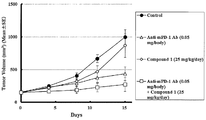
- the effect of the combined administration of Compound 1 (25 mg / kg / day) and anti-mouse PD-1 antibody (0.05 mg / body) on the tumor volume change in the mouse model transplanted with the mouse colorectal cancer strain MC38 is shown.
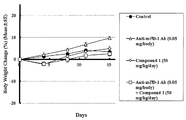
- the effect of the combined administration of Compound 1 (25 mg / kg / day) and anti-mouse PD-1 antibody (0.05 mg / body) on the body weight change in a mouse model transplanted with the mouse colorectal cancer strain MC38 is shown.
- the effect of the combined administration of Compound 1 (50 mg / kg / day) and anti-mouse PD-1 antibody (0.05 mg / body) on the tumor volume change in the mouse model transplanted with the mouse colon cancer strain MC38 is shown.
- the present disclosure is an antitumor agent and an antitumor characterized by co-administering a sulfonamide compound represented by the general formula (I) or a salt thereof and an immune checkpoint molecular regulator (particularly an anti-PD-1 antibody).
- the present invention relates to an effect enhancer, a kit preparation and the use of these agents, a tumor treatment method, and an antitumor effect enhancing method.
- the sulfonamide compound is represented by the following general formula (I).
- X 1 indicates an oxygen atom or a sulfur atom
- X 2 indicates an oxygen atom, or -NH-
- X 3 indicates -NH-, or an oxygen atom
- X 4 represents a hydrogen atom, or a C1-C6 alkyl group
- R 11 and R 12 represent the same or different hydrogen atom, halogen atom, hydroxy group, or C1-C6 alkyl group, or Alternatively, they may be combined with the carbon atoms to which they are bonded to form a saturated hydrocarbon ring with 3 to 8 carbon atoms
- R 2 represents a C6-C14 aromatic hydrocarbon group, or a 9-10 membered fully unsaturated heterocyclic group, wherein the R 2 may have a substituent and is further aromatic.
- R 3 represents a C6-C14 aromatic hydrocarbon group, or a 5- to 10-membered fully unsaturated heterocyclic group, wherein the R 3 may have a substituent and is further aromatic. If there are two substituents on the adjacent carbon atoms of the Group Hydrocarbon Ring, they may have substituents, each of which condenses with the carbon atom to which it is attached and to the ring.
- a ⁇ 8-membered saturated or partially unsaturated hydrocarbon ring or heterocycle may be formed;
- R 4 represents a hydrogen atom, or a C1-C6 alkyl group.
- X 2 is an oxygen atom
- X 3 is -NH-
- X 4 is a hydrogen atom
- R 1 is -CH 2-
- R 2 is a phenyl group
- R 3 is a 4-methyl phenyl group
- R 4 is a hydrogen atom.
- X 1 is an oxygen atom.
- CA-CB means a group having A to B carbon atoms.
- C1-C6 alkyl group indicates an alkyl group having 1 to 6 carbon atoms.
- a to B members indicates that the number of atoms (number of ring members) constituting the ring is A to B.
- “5- to 10-membered unsaturated heterocyclic group” means an unsaturated heterocyclic group having 5 to 10 ring members.
- substituted refers to a halogen atom, a hydroxy group, an amino group, an oxo group, a cyano group, a nitro group, a carboxyl group, an aminocarbonyl group, a thioamide group, a C1-C6 alkyl group, or a C2-C6 alkynyl group.
- C3-C6 cycloalkyl group C1-C6 alkoxy group, C1-C6 alkoxy C1-C6 alkoxy group, halogeno C1-C6 alkyl group, halogeno C1-C6 alkoxy group, C6-C14 aromatic hydrocarbon group, unsaturated complex Cyclic group, saturated heterocyclic group, nitrogen-containing saturated heterocyclic group, nitrogen-containing saturated heterocyclic carbonyl group, C1-C14 acyl group, C1-C14 acylamino group, C2-C7 alkoxycarbonyl group, C1-C14 acyloxy group , C7-C13 aralkyloxy group and the like.
- halogen atom examples include a fluorine atom, a chlorine atom, a bromine atom, and an iodine atom.
- C1-C6 alkyl group is a linear or branched saturated hydrocarbon group having 1 to 6 carbon atoms, and is, for example, a methyl group, an ethyl group, an n-propyl group or an isopropyl group. , N-butyl group, isobutyl group, tert-butyl group, n-pentyl group, isopentyl group, hexyl group and the like.
- C2-C6 alkynyl group is a linear or branched chain-like unsaturated hydrocarbon group having at least one triple bond having 2 to 6 carbon atoms, and is, for example, an ethynyl group, 1 -Or 2-propynyl group, 1-, 2- or 3-butynyl group, 1-methyl-2-propynyl group and the like can be mentioned.
- C3-C6 cycloalkyl group is a cyclic saturated hydrocarbon group having 3 to 6 carbon atoms, and examples thereof include a cyclopropyl group, a cyclobutyl group, a cyclopentyl group, and a cyclohexyl group.
- the "C1-C6 alkoxy group” is an oxy group to which a linear or branched saturated hydrocarbon group having 1 to 6 carbon atoms is bonded, and is, for example, a methoxy group, an ethoxy group, or a propoxy group. , Isopropoxy group, n-butoxy group, isobutoxy group, tert-butoxy group, pentyloxy group, isopentyloxy group, hexyloxy group and the like.
- C1-C6 alkoxy C1-C6 alkoxy group is a group in which the hydrogen atom of the C1-C6 alkoxy group is substituted with a C1-C6 alkoxy group, and is, for example, a methoxymethoxy group, a methoxyethoxy group, or methoxy. Examples thereof include a propoxy group, an ethoxymethoxy group, an ethoxyethoxy group, and a propoxymethoxy group.
- halogeno C1-C6 alkyl group is a group in which one or more hydrogen atoms of the C1-C6 alkyl group are substituted with halogen atoms, for example, a fluoromethyl group, a difluoromethyl group, and the like.
- halogen atoms for example, a fluoromethyl group, a difluoromethyl group, and the like.
- examples thereof include a trifluoromethyl group, a trichloromethyl group, a fluoroethyl group, a 1,1,1-trifluoroethyl group, a monofluoro-n-propyl group, a perfluoro-n-propyl group and a perfluoroisopropyl group.
- C6-C14 aromatic hydrocarbon group is a monocyclic or polycyclic hydrocarbon group having an aromatic property having 6 to 14 carbon atoms, and is, for example, a phenyl group, a naphthyl group, or anthrasenyl. Examples include a group, a phenylyl group, a fluorenyl group and the like.
- the "unsaturated heterocyclic group” has one or more (preferably 1 to 4, more preferably 1 to 3) heteroatoms selected from nitrogen atoms, sulfur atoms and oxygen atoms. It is a monocyclic or polycyclic unsaturated heterocyclic group. Unsaturated heterocyclic groups include completely unsaturated heterocyclic groups (fully unsaturated heterocyclic groups) and partially unsaturated heterocyclic groups (partially unsaturated heterocyclic groups). ).
- Examples of completely unsaturated heterocyclic groups include pyrrolyl group, imidazolyl group, pyrazolyl group, triazolyl group, tetrazolyl group, furanyl group (furyl group), oxazolyl group, isoxazolyl group, oxadiazolyl group, thiophenyl group (thienyl group) and thiazolyl.
- partially unsaturated heterocyclic groups for example, dihydropyranyl group, dihydrotriazolyl group, dihydrofuranyl group, dihydrooxadiazolyl group, dihydroquinolyl group, dihydroquinazolinyl group, indolinyl group, tetrahydroisoquino
- dihydropyranyl group dihydrotriazolyl group, dihydrofuranyl group, dihydrooxadiazolyl group, dihydroquinolyl group, dihydroquinazolinyl group, indolinyl group, tetrahydroisoquino
- examples thereof include a lyl group, a methylenedioxyphenyl group, an ethylenedioxyphenyl group, a dihydrobenzofuranyl group, a dihydrobenzoxazolyl group and a dihydropyridooxadinyl group.
- a "saturated heterocyclic group” is simply a group having one or more (preferably 1 to 4, more preferably 1 to 3) heteroatoms selected from a nitrogen atom, a sulfur atom and an oxygen atom. It is a cyclic or polycyclic fully saturated heterocyclic group, specifically, azetidinyl group, pyrrolidinyl group, piperidinyl group, piperazinyl group, hexamethyleneimino group, morpholino group, thiomorpholino group, homopiperazinyl group, tetrahydrofla. Nyl group, tetrahydropyranyl group, tetrahydrothiophenyl group, thiazolidinyl group, oxazolidinyl group and the like can be mentioned.
- the "nitrogen-containing saturated heterocyclic group” is a saturated heterocyclic group having one or more nitrogen atoms and optionally having a heteroatom other than the nitrogen atom, and examples thereof include a morpholino group. ..
- the "nitrogen-containing saturated heterocyclic carbonyl group” is a carbonyl group to which a nitrogen-containing saturated heterocyclic group is bonded, and examples thereof include a morpholinocarbonyl group.
- C1-C14 acyl group is a carbonyl group to which a hydrogen atom, a C1-C6 alkyl group, a C6-C14 aromatic hydrocarbon group or an unsaturated heterocyclic group is bonded, for example, a formyl group; (C1-C6 alkyl) carbonyl group such as acetyl group, propanoyl group, butanoyl group; (C3-C6 cycloalkyl) carbonyl group such as cyclopropanoyl group, cyclobutanoyl group; benzoyl group, naphthylcarbonyl group, fluorenyl Examples thereof include (C6-C13) arylcarbonyl groups such as carbonyl groups.
- C1-C14 acylamino group is an amino group in which one or two hydrogen atoms are substituted with a C1-C14 acyl group, for example, an acetylamino group, a propanoylamino group, or a butanoylamino group. Examples include a group, a cyclopropanoylamino group and the like.
- the "C2-C7 alkoxycarbonyl group” is a carbonyl group to which a C1-C6 alkoxy group is bonded, and is, for example, a methoxycarbonyl group, an ethoxycarbonyl group, an n-propoxycarbonyl group, an isopropoxycarbonyl group, n-. Examples thereof include a butoxycarbonyl group and a tert-butoxycarbonyl group.
- C1-C14 acyloxy group is, for example, a formyloxy group; a methylcarbonyloxy group, an ethylcarbonyloxy group, an n-propylcarbonyloxy group, an isopropylcarbonyloxy group, an n-butylcarbonyloxy group, an isobutylcarbonyl.
- (C1-C6 alkyl) carbonyloxy groups such as oxy group, tert-butylcarbonyloxy group, n-pentylcarbonyloxy group, isopentylcarbonyloxy group, hexylcarbonyloxy group; cyclopropanoyloxy group, cyclobutanoyloxy group (C3-C6 cycloalkyl) carbonyloxy group, etc .; (C6-C13 aryl) carbonyloxy group such as phenylcarbonyloxy group, naphthylcarbonyloxy group, fluorenylcarbonyloxy group and the like can be mentioned.
- C7-C13 aralkyloxy group is an alkyloxy group in which one hydrogen atom is substituted with an aryl group, for example, a benzyloxy group, a phenethyloxy group, a naphthylmethyloxy group, or fluorenyl. Examples thereof include a methyloxy group.
- the "saturated or partially unsaturated hydrocarbon ring” is a monocyclic or polycyclic saturated or partially unsaturated hydrocarbon ring, for example, cyclopropane ring, cyclobutane ring, cyclopentane. Examples thereof include a ring, a cyclohexane ring, a cycloheptane ring, a cyclooctane ring, a cyclobutene ring, a cyclopentene ring, a cyclohexene ring, a cycloheptane ring, and a cyclooctadiene ring.
- a "saturated or partially unsaturated heterocycle” is a monocyclic or polycyclic saturated or partially unsaturated heterocycle having a heteroatom selected from a nitrogen atom, a sulfur atom and an oxygen atom. It is a ring, for example, an oxylan ring, an azetidine ring, a pyrrolidine ring, an imidazolidine ring, a piperidine ring, a piperazine ring, a morpholin ring, a tetrahydrofuran ring, a tetrahydropyran ring, a dioxane ring, a tetrahydrothiophene ring, a dihydropyran ring, a dihydrofuran ring, etc. Can be mentioned.
- the "spiroheterocyclic group” is a saturated or unsaturated spiroheterocyclic group having a hetero atom selected from a nitrogen atom, a sulfur atom and an oxygen atom and a spiro carbon atom, for example, 2-.
- a hetero atom selected from a nitrogen atom, a sulfur atom and an oxygen atom and a spiro carbon atom, for example, 2-.
- examples thereof include an oxa-6-azaspiro [3.4] octanyl group and a 2-oxa-7-azaspiro [3.5] nonanyl group.
- the "bridged heterocyclic group” is a two or more crossed heterocyclic groups having a hetero atom selected from a nitrogen atom, a sulfur atom and an oxygen atom and two bridgehead carbons, for example. , 3-Oxa-8-azabicyclo [3.2.1] octanyl group, 8-oxa-3-azabicyclo [3.2.1] octanyl group and the like.
- X 1 is an oxygen atom or a sulfur atom.
- X 1 is preferably an oxygen atom.
- X 2 is an oxygen atom or -NH-.
- X 2 is preferably an oxygen atom.
- X 3 is, -NH-, or an oxygen atom.
- X 3 is preferably -NH-.
- X 4 is a hydrogen atom, or a C1-C6 alkyl group.
- C1-C6 alkyl group represented by X 4 is preferably a C1-C3 alkyl group, more preferably a methyl group.
- X 4 is preferably a hydrogen atom, or a methyl group, more preferably a hydrogen atom.
- R 11 and R 12 in -C (R 11 ) (R 12 )- are the same or different, hydrogen atoms, halogen atoms, hydroxy groups, or C1-C6 alkyl groups, or carbon atoms to which they are bonded. Together with, it forms a saturated hydrocarbon ring with 3 to 8 carbon atoms.
- the "halogen atom” represented by R 11 and R 12 is preferably a fluorine atom, a chlorine atom, a bromine atom, and more preferably a fluorine atom.
- the "C1-C6 alkyl group” represented by R 11 and R 12 is preferably a C1-C3 alkyl group, more preferably a methyl group or an ethyl group, and more preferably a methyl group.
- the "saturated hydrocarbon ring having 3 to 8 carbon atoms" formed by R 11 and R 12 together with the carbon atom to which they are bonded is preferably a monocyclic saturated hydrocarbon ring having 3 to 6 carbon atoms. It is more preferably a cyclopropane ring.
- R 11 is a halogen atom, a hydroxy group, or a C1-C6 alkyl group
- R 12 is a hydrogen atom, a halogen atom, a hydroxy group, or a C1-C6 alkyl group, or R 11 and R.
- No. 12 forms a saturated hydrocarbon ring having 3 to 8 carbon atoms together with the carbon atoms to which they are bonded. More preferably, R 11 is a C1-C6 alkyl group and R 12 is a hydrogen atom, and particularly preferably R 11 is a methyl group and R 12 is a hydrogen atom.
- R 1 is preferably ⁇ C (R 11 ) (R 12 ) ⁇
- R 11 is a halogen atom, a hydroxy group, or a C1-C6 alkyl group
- R 12 is a hydrogen atom, a halogen atom, a hydroxy.
- the groups, or C1-C6 alkyl groups, or R 11 and R 12 combine with the carbon atoms to which they are attached to form a saturated hydrocarbon ring with 3 to 8 carbon atoms. More preferably, it is ⁇ C (R 11 ) (R 12 ) ⁇ , where R 11 is a C1-C6 alkyl group and R 12 is a hydrogen atom. Particularly preferably, it is ⁇ CH (CH 3 ) ⁇ .
- R 2 is a C6-C14 aromatic hydrocarbon group or a 9 to 10-membered fully unsaturated heterocyclic group.
- C6-C14 aromatic hydrocarbon group is preferably a C6-C10 aromatic hydrocarbon group, more preferably a phenyl group, or naphthyl group, particularly preferably a phenyl group.
- the "9 to 10-membered completely unsaturated heterocyclic group" represented by R 2 is a dicyclic 9 having 1 to 3 heteroatoms preferably selected from a nitrogen atom, a sulfur atom and an oxygen atom.
- R 2 may be unsubstituted or may have a substituent.
- R 2 has two substituents on the adjacent carbon atoms of the aromatic hydrocarbon ring, they are fused together with the carbon atom to which each bond is attached to the ring. It may form a 4- to 8-membered saturated or partially unsaturated hydrocarbon ring or heterocycle which may have.
- R 2 has a substituent
- the substitution position of the substituent is not particularly limited, but for example, when R 2 is a phenyl group, it is preferably at the 2, 3, 5, or 6 position.
- the number of substituents is not particularly limited, but is preferably 0, that is, unsubstituted or 1 to 4, and more preferably 1 to 4 or 1 to 3. When the number of substituents is two or more, the types of groups may be the same or different.
- R 2 may be substituted by the above-mentioned "substituent", and more preferably R 2 may be substituted by R 21 . Also, preferably, when R 2 has two substituents on the adjacent carbon atoms of the aromatic hydrocarbon ring, they are fused to the ring together with the carbon atom to which each is bonded. It may form a 4- to 8-membered saturated or partially unsaturated hydrocarbon ring or heterocycle which may be substituted with Rz.
- the group R 21 substitutable for R 2 is a halogen atom, an aminocarbonyl group, a cyano group, a C1-C6 alkyl group optionally substituted with Rx, a C3-C6 cycloalkyl group optionally substituted with Rx, A C2-C6 alkynyl group optionally substituted with Rx, a C6-C14 aromatic hydrocarbon group optionally substituted with Ry, or a 5- to 10-membered unsaturated heterocycle optionally substituted with Rz. It is an expression group.
- substitution position of R 21 is not particularly limited, but for example, when R 2 is a phenyl group, it is preferably at the 2, 3, 5, or 6 position. Further, the number of substituents R 21 is not particularly limited, preferably zero, i.e. whether it is unsubstituted, or is 1 to 4, more preferably 1 to 4, or 1 to three. When the number of substituents R 21 is two or more, the types of groups may be the same or different.
- the "halogen atom" represented by R 21 is preferably a fluorine atom, a chlorine atom, or a bromine atom.
- the "C1-C6 alkyl group" in the "C1-C6 alkyl group optionally substituted with Rx” represented by R 21 is preferably a C1-C3 alkyl group, more preferably a methyl group or an ethyl group. is there.
- the substituent Rx in the "C1-C6 alkyl group optionally substituted by Rx" represented by R 21 is a halogen atom or a C6-C14 aromatic hydrocarbon group.
- the substituent Rx is preferably a halogen atom, more preferably a fluorine atom.
- the number of Rx substituted with the C1-C6 alkyl group is not particularly limited, but is preferably 0, that is, unsubstituted or 1 to 3. When the number of substituents Rx is 2 or more, the types of groups may be the same or different.
- the "C3-C6 cycloalkyl group" in the "C3-C6 cycloalkyl group optionally substituted with Rx” represented by R 21 is preferably a cyclopropyl group.
- the substituent Rx in the "C3-C6 cycloalkyl group optionally substituted by Rx" represented by R 21 is a halogen atom or a C6-C14 aromatic hydrocarbon group as described above, preferably a halogen atom. Yes, more preferably a fluorine atom.
- the number of Rx substituted with the C3-C6 cycloalkyl group is not particularly limited, but is preferably 0, that is, unsubstituted or 1, and more preferably 0. When the number of substituents Rx is 2 or more, the types of groups may be the same or different.
- the "C2-C6 alkynyl group" in the "C2-C6 alkynyl group optionally substituted with Rx" represented by R 21 is preferably a C2-C4 alkynyl group, more preferably an ethynyl group.
- the substituent Rx in the "C2-C6 alkynyl group optionally substituted by Rx” represented by R 21 is a halogen atom or a C6-C14 aromatic hydrocarbon group as described above, preferably a C6-C14 aromatic group. It is a group hydrocarbon group, more preferably a C6-C10 aromatic hydrocarbon group, and more preferably a phenyl group.
- the number of Rx substituted with the C2-C6 alkynyl group is not particularly limited, but is preferably 0, that is, unsubstituted or 1, and more preferably 1.
- the types of groups may be the same or different.
- the "C6-C14 aromatic hydrocarbon group" in the "C6-C14 aromatic hydrocarbon group optionally substituted with Ry” represented by R 21 is preferably a C6-C10 aromatic hydrocarbon group, and more. It is preferably a phenyl group.
- the substituent Ry in the "C6-C14 aromatic hydrocarbon group optionally substituted by Ry” represented by R 21 is a halogen atom or a C1-C6 alkoxy group.
- the halogen atom represented by Ry is preferably a fluorine atom or a chlorine atom.
- the C1-C6 alkoxy group represented by Ry is preferably a C1-C3 alkoxy group, more preferably a methoxy group.
- the substituent Ry in the "C6-C14 aromatic hydrocarbon group optionally substituted by Ry" represented by R 21 is preferably a fluorine atom, a chlorine atom, or a C1-C3 alkoxy group, and more preferably fluorine. It is an atom, a chlorine atom, or a methoxy group.
- the number of Ry to be substituted with the C6-C14 aromatic hydrocarbon group is not particularly limited, but is preferably 0, that is, unsubstituted, or 1 or 2. When the number of substituents Ry is 2 or more, the types of groups may be the same or different.
- the "5- to 10-membered unsaturated heterocyclic group" in the "5- to 10-membered unsaturated heterocyclic group which may be substituted by Rz" represented by R 21 is preferably a nitrogen atom, a sulfur atom and a sulfur atom.
- pyrrolyl group imidazolyl group, pyrazolyl group, pyridyl group, pyrimidyl group, oxazolyl group and dihydropyridooxadinyl group, and more preferably pyrazolyl group, pyridyl group, pyrimidyl group, oxazolyl group and dihydropyrido. It is an oxadinyl group, more preferably a pyrazolyl group.
- Rz in the "5- to 10-membered unsaturated heterocyclic group optionally substituted with Rz" represented by R 21 is a halogen atom, a C1-C6 alkyl group, a halogeno C1-C6 alkyl group, C3-. It is a C6 cycloalkyl group, a C1-C6 alkoxy group, a C6-C14 aromatic hydrocarbon group, a nitrogen-containing saturated heterocyclic group, or a nitrogen-containing saturated heterocyclic carbonyl group.
- the "halogen atom” represented by Rz is preferably a fluorine atom or a chlorine atom.
- the "C1-C6 alkyl group” represented by Rz is preferably a C1-C3 alkyl group, more preferably a methyl group or an ethyl group.
- the "halogeno C1-C6 alkyl group” represented by Rz is preferably a halogeno C1-C3 alkyl group, more preferably a difluoromethyl group or a trifluoromethyl group.
- the "C3-C6 cycloalkyl group” represented by Rz is preferably a cyclopropyl group or a cyclobutyl group.
- the "C1-C6 alkoxy group” represented by Rz is preferably a C1-C3 alkoxy group, more preferably a methoxy group.
- the "C6-C14 aromatic hydrocarbon group” represented by Rz is preferably a phenyl group.
- the "nitrogen-containing saturated heterocyclic group” represented by Rz is preferably a morpholino group or a piperidinyl group.
- the "nitrogen-containing saturated heterocyclic carbonyl group” represented by Rz is preferably a morpholinocarbonyl group.
- the substituent Rz in the "5- to 10-membered unsaturated heterocyclic group optionally substituted with Rz" is preferably a halogen atom, a C1-C6 alkyl group, a halogeno C1-C6 alkyl group, a C3-C6 cycloalkyl.
- the number of Rz substituted with a 5- to 10-membered unsaturated heterocyclic group is not particularly limited, but is preferably 0, that is, unsubstituted, or preferably 1 or 2.
- the types of groups may be the same or different.
- the group R 21 substitutable for R 2 is preferably a halogen atom, an aminocarbonyl group, a cyano group, a C1-C6 alkyl group (which may be substituted by a halogen atom), a C3-C6 cycloalkyl group, or a C2-. It is substituted with a C6 alkynyl group (which may be substituted with a C6-C14 aromatic hydrocarbon group), a C6-C14 aromatic hydrocarbon group (which may be substituted with a group selected from the group consisting of halogen atoms and C1-C6 alkoxy groups).
- Monocyclic or bicyclic 5- to 10-membered unsaturated heterocyclic groups (halogen atom, C1-) having 1 to 3 heteroatoms selected from nitrogen, sulfur and oxygen atoms.
- halogen atom is selected from the group consisting of a halogen atom, a cyano group, a C1-C6 alkyl group (which may be substituted by a halogen atom), a C3-C6 cycloalkyl group, and a phenyl group (a halogen atom and a C1-C6 alkoxy group).
- a monocyclic or bicyclic 5- to 10-membered unsaturated heterocyclic expression having 1 to 3 heteroatoms selected from nitrogen, sulfur and oxygen atoms.
- it may be substituted with a monocyclic 5- or 6-membered unsaturated heterocyclic group having 1 to 3 halogen atoms, C1-C6 alkyl groups, or nitrogen atoms (C1-C6 alkyl groups). ). More preferably, it is a halogen atom, a C1-C6 alkyl group.
- substituted on R 2 are at least two, if it has two substituents on adjacent carbon atoms of the aromatic hydrocarbon ring of R 2, they are attached
- a "4- to 8-membered saturated or partially unsaturated hydrocarbon ring or heterocycle which may have a substituent" formed together with a carbon atom is a ring condensed with the ring, for example, a benzene ring. ..
- the "4- to 8-membered saturated or partially unsaturated hydrocarbon ring or heterocycle" in the “4- to 8-membered saturated or partially unsaturated hydrocarbon ring or heterocycle which may have a substituent" is A monocyclic saturated or partially unsaturated hydrocarbon ring preferably having 4 to 8 carbon atoms, or a monocyclic 4 to 8 having 1 to 3 heteroatoms selected from nitrogen, sulfur and oxygen atoms. It is a member saturated or partially unsaturated heterocycle, more preferably a monocyclic saturated or partially unsaturated hydrocarbon ring having 4 to 8 carbon atoms, and more preferably a monocyclic ring having 4 to 6 carbon atoms.
- Saturated or partially unsaturated hydrocarbon ring or a monocyclic 4- to 6-membered saturated or partially unsaturated heteroatom having 1 to 3 heteroatoms selected from nitrogen, sulfur and oxygen atoms. Yes, more preferably a monocyclic saturated or partially unsaturated hydrocarbon ring having 5 or 6 carbon atoms, and more preferably a monocyclic saturated hydrocarbon ring having 5 carbon atoms.
- the substituent Rz in the "4- to 8-membered saturated or partially unsaturated hydrocarbon ring or heterocycle which may be substituted by Rz" is a halogen atom, a C1-C6 alkyl group, or a halogeno C1-C6 alkyl.
- the number of Rz substituted with a saturated or partially unsaturated hydrocarbon ring or heterocycle is not particularly limited, but is preferably 0, that is, unsubstituted or 1 and more preferably 0, that is, none. It is a replacement.
- the number of substituents Rz is two or more, the types of groups may be the same or different.
- the "4-8 member saturated or partially unsaturated hydrocarbon ring or heterocycle which may be substituted with Rz" is preferably monocyclic with 4-8 carbon atoms which may be substituted with Rz.
- R 2 is preferably a C6-C14 aromatic hydrocarbon group or a bicyclic atom having 1 to 3 heteroatoms selected from a nitrogen atom, a sulfur atom and an oxygen atom. 9-10 membered fully unsaturated heterocyclic group, wherein R 2 may be substituted by R 21 and further on two adjacent carbon atoms of the aromatic hydrocarbon ring. If they have substituents, they are monocyclic saturated or partially unsaturated hydrocarbon rings (C1-C6) having 4 to 8 carbon atoms, each of which is fused to the ring together with the carbon atom to which it is attached.
- C1-C6 monocyclic saturated or partially unsaturated hydrocarbon rings
- a monocyclic 4- to 8-membered saturated or partially unsaturated heterocycle having 1 to 3 heteroatoms selected from nitrogen, sulfur and oxygen atoms (which may be substituted with an alkyl group). It may be substituted with a C1-C6 alkyl group);
- R 21 is a halogen atom, an aminocarbonyl group, a cyano group, a C1-C6 alkyl group (which may be substituted with a halogen atom), a C3-C6 cycloalkyl group, a C2-C6 alkynyl group (C6-C14 aromatic carbide). It may be substituted with a hydrogen group), a C6-C14 aromatic hydrocarbon group (may be substituted with a group selected from the group consisting of halogen atoms and C1-C6 alkoxy groups), or nitrogen atoms, sulfur atoms.
- R 2 is more preferably a C6-C14 aromatic hydrocarbon group, where R 2 may be substituted with R 21 and further aromatic. If there are two substituents on the adjacent carbon atoms of the group hydrocarbon ring, they are monocyclic with 4-8 carbon atoms, each of which is fused to the ring together with the carbon atom to which it is attached. Saturated or partially unsaturated hydrocarbon rings (which may be substituted with C1-C6 alkyl groups) may be formed;
- R 21 is selected from the group consisting of a halogen atom, a cyano group, a C1-C6 alkyl group (which may be substituted by a halogen atom), a C3-C6 cycloalkyl group, and a phenyl group (a halogen atom and a C1-C6 alkoxy group). , Or a monocyclic or bicyclic 5- to 10-membered unsaturated heterocycle having 1 to 3 heteroatoms selected from nitrogen, sulfur and oxygen atoms.
- R 2 is more preferably a C6-C10 aromatic hydrocarbon group, where R 2 may be substituted by R 21 .
- the aromatic hydrocarbon ring has two substituents on adjacent carbon atoms, they are single rings with 5 or 6 carbon atoms that are fused to the ring together with the carbon atoms to which they are attached.
- a sex-saturated or partially unsaturated hydrocarbon ring (which may be substituted with a C1-C6 alkyl group) may be formed; R 21 may be substituted with a monocyclic 5- or 6-membered unsaturated heterocyclic group (C1-C6 alkyl group) having 1 to 3 halogen atoms, C1-C6 alkyl groups, or nitrogen atoms. ).
- R 2 is particularly preferably substituted with a phenyl group or a naphthyl group (may be substituted with a group selected from the group consisting of a halogen atom and a C1-C6 alkyl group); Indanyl group (2,3-dihydro-1H-indenyl group); or tetrahydronaphthyl group.
- R 3 is a C6-C14 aromatic hydrocarbon group or a 5- to 10-membered fully unsaturated heterocyclic group.
- C6-C14 aromatic hydrocarbon group represented by R 3 is preferably a C6-C10 aromatic hydrocarbon group, more preferably a phenyl group, or naphthyl group, particularly preferably a phenyl group.
- the "5- to 10-membered fully unsaturated heterocyclic group" represented by R 3 is monocyclic or bicyclic, preferably having 1 to 3 heteroatoms selected from nitrogen, sulfur and oxygen atoms.
- 5 to 10-membered fully unsaturated heterocyclic group more preferably monocyclic or bicyclic 5 to 7 having 1 to 3 heteroatoms selected from nitrogen, sulfur and oxygen atoms.
- it is an imidazolyl group, a pyridyl group, a thiophenyl group, an indolyl group, an indazolyl group, a benzopyranyl group, a benzotriazolyl group, a benzothiasiazolyl group, an isoxazolyl group, a quinolyl group, and more preferably an imidazolyl group, a pyridyl group, It is a thiophenyl group, an indrill group, an indazolyl group, a benzopyranyl group, a benzotriazolyl group, a benzothiadiazolyl group, a quinolyl group, and more preferably a pyridyl group, a thiophenyl group, an indolyl group, an indazolyl group, a benzopyranyl group, a benzotoria. It is a zolyl group, a quinoly
- R 3 may be unsubstituted or may have a substituent.
- R 3 when R 3 has two substituents on the adjacent carbon atoms of the aromatic hydrocarbon ring, they are fused together with the carbon atom to which each bond is attached to the ring. It may form a 4- to 8-membered saturated or partially unsaturated hydrocarbon ring or heterocycle which may have.
- R 3 has a substituent
- the substitution position of the substituent is not particularly limited.
- the number of substituents is not particularly limited, but is preferably 0, that is, unsubstituted, or 1 to 4, more preferably 1 to 4, and even more preferably 1 to 3. is there.
- the number of substituents is two or more, the types of groups may be the same or different.
- R 3 may be substituted by the above-mentioned "substituent", and more preferably R 3 may be substituted by R 31 .
- R 3 when having two substituents on adjacent carbon atoms of the aromatic hydrocarbon ring, they are fused to the ring together with the carbon atom to which each is attached, A 4- to 8-membered saturated or partially unsaturated hydrocarbon ring or heterocycle which may be substituted with Rc may be formed.
- the group R 31 substitutable for R 3 is a halogen atom, a cyano group, a nitro group, a carboxyl group, a thioamide group, a C1-C6 alkyl group which may be substituted by Ra, or an amino group which may be substituted by Ra.
- the number of substituents R 31 is not particularly limited, but is preferably 0, that is, unsubstituted or 1 to 4, more preferably 1 to 4, and even more preferably 1 to 3. is there.
- the types of groups may be the same or different.
- halogen atom represented by R 31 is preferably a fluorine atom, a chlorine atom, or a bromine atom, and more preferably a chlorine atom or a bromine atom.
- the "C1-C6 alkyl group" in the "C1-C6 alkyl group optionally substituted with Ra” represented by R 31 is preferably a C1-C3 alkyl group, more preferably a methyl group.
- the substituent Ra in the "C1-C6 alkyl group optionally substituted by Ra” represented by R 31 is a halogen atom, a hydroxy group, a C1-C14 acyl group, a C1-C14 acyloxy group, a C2-C6 alkylyl group, Alternatively, it is a C1-C6 alkoxy C1-C6 alkoxy group.
- the "halogen atom” represented by Ra is preferably a fluorine atom.
- the "C1-C14 acyl group” represented by Ra is preferably an acetyl group.
- the "C1-C14 acyloxy group” represented by Ra is preferably an acetyloxy group.
- the "C2-C6 alkynyl group” represented by Ra is preferably an ethynyl group or a 1-propynyl group.
- the "C1-C6 alkoxy C1-C6 alkoxy group” represented by Ra is preferably a methoxymethoxy group.
- the substituent Ra in the "C1-C6 alkyl group optionally substituted by Ra" represented by R 31 is preferably a halogen atom, a hydroxy group, a C1-C6 acyloxy group, a C2-C6 alkylyl group, or a C1-C6.
- Alkoxy C1-C6 It is an alkoxy group, more preferably a halogen atom or a hydroxy group.
- the number of Ras substituted with the C1-C6 alkyl group is not particularly limited, but is preferably 0, that is, unsubstituted, or 1 or 2 or more. When the number of substituents Ra is two or more, the types of groups may be the same or different.
- the substituent Ra in the "amino group optionally substituted by Ra" represented by R 31 is a halogen atom, a hydroxy group, a C1-C14 acyl group, a C1-C14 acyloxy group, a C2-C6 alkynyl group, as described above. Alternatively, it is a C1-C6 alkoxy group, preferably a C1-C14 acyl group, and more preferably an acetyl group.
- the number of Ras substituted with the amino group is not particularly limited, but is preferably 0, that is, unsubstituted or 1 and more preferably 0.
- the "C3-C6 cycloalkyl group" in the "C3-C6 cycloalkyl group optionally substituted with Rb" represented by R 31 is preferably a cyclopropyl group.
- the substituent Rb in the "C3-C6 cycloalkyl group optionally substituted by Rb" represented by R 31 is a halogen atom, an amino group, or a C1-C6 alkoxy group.
- the "halogen atom” represented by the Rb is preferably a fluorine atom.
- the "C1-C6 alkoxy group” represented by the Rb is preferably a C1-C3 alkoxy group, more preferably a methoxy group.
- the substituent Rb in the "C3-C6 cycloalkyl group optionally substituted by Rb" represented by R 31 is preferably an amino group.
- the number of Rbs substituted with the C3-C6 cycloalkyl group is not particularly limited, but is preferably 0, that is, unsubstituted or 1. When the number of substituents Rb is two or more, the types of groups may be the same or different.
- the "C1-C6 alkoxy group" in the "C1-C6 alkoxy group optionally substituted with Rb” represented by R 31 is preferably a C1-C3 alkoxy group, more preferably a methoxy group.
- the substituent Rb in the "C1-C6 alkoxy group optionally substituted with Rb” represented by R 31 is a halogen atom, an amino group, or a C1-C6 alkoxy group as described above, and is preferably a halogen atom. , More preferably a fluorine atom.
- the number of Rbs substituted with the C1-C6 alkoxy group is not particularly limited, but is 0, that is, unsubstituted, or 1 or 2. When the number of substituents Rb is two or more, the types of groups may be the same or different.
- the "C2-C7 alkoxycarbonyl group” represented by R 31 is preferably a C2-C4 alkoxycarbonyl group, more preferably a methoxycarbonyl group.
- the "C1-C14 acyl group" in the "C1-C14 acyl group optionally substituted with Rb” represented by R 31 is preferably an acetyl group.
- the substituent Rb in the "C1-C14 acyl group optionally substituted with Rb” represented by R 31 is a halogen atom, an amino group, or a C1-C6 alkoxy group as described above, and is preferably a halogen atom. , More preferably a fluorine atom.
- the number of Rbs substituted with the C1-C14 acyl group is not particularly limited, but is 0, that is, unsubstituted or 1 to 3. When the number of substituents Rb is two or more, the types of groups may be the same or different.
- the "C6-C14 aromatic hydrocarbon group” in the "C6-C14 aromatic hydrocarbon group optionally substituted with Rb” represented by R 31 is preferably a C6-C10 aromatic hydrocarbon group, and more. It is preferably a phenyl group.
- the substituent Rb in the "C6-C14 aromatic hydrocarbon group optionally substituted with Rb" represented by R 31 is a halogen atom, an amino group, or a C1-C6 alkoxy group as described above, preferably a halogen. It is an atom, a C1-C3 alkoxy group, more preferably a halogen atom, and more preferably a fluorine atom.
- the number of Rbs substituted with the C6-C14 aromatic hydrocarbon group is not particularly limited, but is preferably 0, that is, unsubstituted or 1. When the number of substituents Rb is two or more, the types of groups may be the same or different.
- the "5- to 10-membered unsaturated heterocyclic group" in the "5- to 10-membered unsaturated heterocyclic group which may be substituted by Rc" represented by R 31 is preferably a nitrogen atom, a sulfur atom and a sulfur atom.
- the substituent Rc in the "5- to 10-membered unsaturated heterocyclic group optionally substituted with 1 or 2 or more Rc" represented by R 31 is a halogen atom, a hydroxy group, an amino group, an oxo group, or a hydroxy group.
- a C1-C6 alkyl group which may be substituted with a group, a halogeno C1-C6 alkyl group, a C1-C14 acyl group, a C1-C14 acylamino group, a C1-C14 acyloxy group, or a C7-C13 aralkyloxy group.
- the "halogen atom” represented by Rc is preferably a fluorine atom.
- the "C1-C6 alkyl group optionally substituted with a hydroxy group” represented by Rc is preferably a C1-C3 alkyl group optionally substituted with a hydroxy group, and more preferably a methyl group or a hydroxyethyl group. Is.
- the "halogeno C1-C6 alkyl group” represented by Rc is preferably a halogeno C1-C3 alkyl group, more preferably a trifluoromethyl group or a difluoroethyl group.
- the "C1-C14 acyl group” represented by Rc is preferably an acetyl group or a cyclopropanoyl group.
- the "C1-C14 acylamino group” represented by Rc is preferably an acetylamino group.
- the "C1-C14 acyloxy group” represented by Rc is preferably an acetyloxy group.
- the "C7-C13 aralkyloxy group” represented by Rc is preferably a benzyloxy group.
- the substituent Rc in the "5- to 10-membered unsaturated heterocyclic group optionally substituted with Rc" represented by R 31 is preferably a halogen atom, a C1-C6 alkyl group, or an oxo group, and more. It is preferably a C1-C6 alkyl group or an oxo group, and more preferably a C1-C6 alkyl group.
- the number of Rc to be substituted with a 5- to 10-membered unsaturated heterocyclic group is not particularly limited, but is preferably 0, that is, unsubstituted, or 1 or 2 or more, and more preferably 0. is there. When the number of substituents Rc is 2 or more, the types of groups may be the same or different.
- aminocarbonyl group optionally substituted with Rd and Re represented by R 31 is specifically represented by the following group (II).
- the groups Rd and Re are the same or different C1-C6 alkyl groups that may be substituted with hydrogen atoms, hydroxy groups, C7-C13 aralkyloxy groups, or hydroxy groups, or nitrogen atoms adjacent to them. Together with, it forms a 4- to 10-membered saturated or unsaturated heterocyclic group, a spiro heterocyclic group or a bridged heterocyclic group which may be substituted with an amino group.
- the "C7-C13 aralkyloxy group” represented by Rd or Re is preferably a benzyloxy group.
- the "C1-C6 alkyl group optionally substituted with a hydroxy group” represented by Rd or Re is preferably a C1-C3 alkyl group optionally substituted with a hydroxy group, more preferably a methyl group or a hydroxy group. It is an ethyl group.
- the "saturated heterocyclic group" in the "4- to 10-membered saturated heterocyclic group that may be substituted with an amino group” formed by Rd or Re together with adjacent nitrogen atoms is A monocyclic or bicyclic 4- to 10-membered saturated heterocyclic group having 1 to 3 heteroatoms selected from a nitrogen atom, a sulfur atom and an oxygen atom, more preferably a nitrogen atom. It is a monocyclic 5- to 6-membered saturated heterocyclic group having 1 to 3 heteroatoms selected from a sulfur atom and an oxygen atom, and particularly preferably an azetidinyl group, a pyrrolidinyl group, a piperidino group, a piperazinyl group, or a morpholino. It is the basis.
- the "formula” is a monocyclic or bicyclic 5- to 10-membered unsaturated heterocyclic group preferably having 1 to 3 heteroatoms selected from nitrogen, sulfur and oxygen atoms. It is preferably a monocyclic 5- to 6-membered unsaturated heterocyclic group having 1 to 3 heteroatoms selected from a nitrogen atom, a sulfur atom and an oxygen atom, and particularly preferably a pyrrolyl group.
- the "spiroheterocyclic group” formed by Rd or Re together with adjacent nitrogen atoms is preferably a monospiroheterocyclic group, more preferably an oxoazaspironanylcarbamoyl group or an azaspirocta. It is a nylcarbamoyl group.
- the "bridged heterocyclic group” formed by Rd or Re together with adjacent nitrogen atoms is preferably a bicyclic crossed heterocyclic group, more preferably oxoazabicyclooctani. It is a lucarbamoyl group.
- the substituents Rd and Re in the "aminocarbonyl group optionally substituted by Rd and Re" represented by R 31 are preferably the same or different, hydroxy groups, or C1-C6 alkyl groups, or they. Is a monocyclic 5- to 6-membered saturation having 1-3 heteroatoms selected from nitrogen, sulfur and oxygen atoms which may be substituted with an amino group together with adjacent nitrogen atoms. It forms a heterocyclic group, a monospiro heterocyclic group or a bicyclic bridging heterocyclic group.
- aminocarbonyl group optionally substituted with Rd and Re represented by R 31 is preferably a -CONH 2 group, a (mono or di C1-C6 alkyl) aminocarbonyl group, a hydroxyaminocarbonyl group, (C7-).
- the C1-C6 alkyl group represented by Rf is preferably a C1-C3 alkyl group, more preferably a methyl group.
- the 4- to 10-membered saturated heterocyclic group represented by Rf is preferably a monocyclic or bicyclic 4- to 10-membered heteroatom having 1 to 3 heteroatoms selected from nitrogen, sulfur and oxygen atoms.
- Saturated heterocyclic group more preferably a monocyclic 5- to 6-membered saturated heterocyclic group having 1 to 3 heteroatoms selected from nitrogen, sulfur and oxygen atoms.
- Preferred are a pyrrolidinyl group, a piperidino group, and a piperazinyl group.
- the group R 31 substitutable for R 3 is preferably a halogen atom, a cyano group, a nitro group, a carboxyl group, a thioamide group, a C1-C6 alkyl group (halogen atom, a hydroxy group, a C1-C14 acyl group, a C1-C14). It may be substituted with a group selected from the group consisting of an acyloxy group, a C2-C6 alkynyl group and a C1-C6 alkoxy C1-C6 alkoxy group), an amino group (may be substituted with a C1-C14 acyl group).
- C3-C6 cycloalkyl group may be substituted with amino group
- C1-C6 alkoxy group may be substituted with halogen atom
- C2-C7 alkoxycarbonyl group C1-C14 acyl group (halogen) It may be substituted with an atom
- a C6-C14 aromatic hydrocarbon group which may be substituted with a group selected from the group consisting of a halogen atom, an amino group and a C1-C6 alkoxy group
- a nitrogen atom a sulfur.
- a group consisting of a monocyclic or bicyclic 5- to 10-membered unsaturated heterocyclic group having 1 to 4 heteroatoms selected from an atom and an oxygen atom (a group consisting of a halogen atom, an oxo group and a C1-C6 alkyl group). May be substituted with a group selected from), an aminocarbonyl group optionally substituted with Rd and Re (where Rd and Re are the same or different, hydrogen atom, hydroxy group, C7-C13 aralkyl.
- Rd and Re are the same or different, hydrogen atom, hydroxy group, C7-C13 aralkyl.
- monocyclic or bicyclic 4- to 10-membered saturated or unsaturated heterocyclic groups having 1 to 3 heteroatoms selected from oxygen atoms, spiro heterocyclic groups or bridging heterocyclic groups.
- Or —S ( O) 2 Rf (where the Rf is an amino group, a C1-C6 alkyl group, or a 4- to 10-membered saturated heterocyclic group).
- C2-C7 alkoxycarbonyl group (may be substituted by halogen atom), C1-C14 acyl group (may be substituted by halogen atom), C6-C10 aromatic hydrocarbon group (may be substituted by halogen atom), It consists of a monocyclic or bicyclic 5- to 10-membered unsaturated heterocyclic group (C1-C6 alkyl group and oxo group) having 1 to 4 heteroatoms selected from nitrogen atom, sulfur atom and oxygen atom.
- a halogen atom an amino group, a C1-C6 alkyl group (which may be substituted by a group selected from the group consisting of a halogen atom and a hydroxy group), and a C1-C6 alkoxy group (which may be substituted by a halogen atom).
- substituted on R 3 are at least two, if it has two substituents on adjacent carbon atoms of the aromatic hydrocarbon ring of R 3, they are attached
- a "4- to 8-membered saturated or partially unsaturated hydrocarbon ring or heterocycle which may have a substituent" formed together with a carbon atom is a ring condensed with the ring, for example, a benzene ring. ..
- the "4- to 8-membered saturated or partially unsaturated hydrocarbon ring or heterocycle" in the “4- to 8-membered saturated or partially unsaturated hydrocarbon ring or heterocycle which may have a substituent" is It is preferably a monocyclic saturated or partially unsaturated hydrocarbon ring having 4 to 8 carbon atoms, or a monocyclic 4 to 8 having 1 to 4 heteroatoms selected from nitrogen, sulfur and oxygen atoms.
- the substituent Rc in the "4- to 8-membered saturated or partially unsaturated hydrocarbon ring or heterocycle which may be substituted by Rc" is a halogen atom, a hydroxy group, an amino group, an oxo group or a hydroxy group as described above. It is a C1-C6 alkyl group which may be substituted with, a halogeno C1-C6 alkyl group, a C1-C14 acyl group, a C1-C14 acylamino group, a C1-C14 acyloxy group, or a C7-C13 aralkyloxy group, preferably a C7-C13 aralkyloxy group.
- C1-C6 alkyl group which may be substituted with a hydroxy group, an amino group, an oxo group or a hydroxy group, a halogeno C1-C6 alkyl group, a C1-C14 acyl group, a C1-C14 acyloxy group, and more preferably a hydroxy group.
- a C1-C6 alkyl group may be substituted with a saturated or partially unsaturated hydrocarbon ring or heterocycle.
- the types of groups may be the same or different.
- the "4- to 8-membered saturated or partially unsaturated hydrocarbon ring or heterocycle which may be substituted with Rc" is preferably a monocyclic saturated or partially unsaturated hydrocarbon having 4 to 8 carbon atoms.
- Ring (C1-C6 alkyl group optionally substituted with halogen atom, hydroxy group, amino group, oxo group, hydroxy group, halogeno C1-C6 alkyl group, C1-C14 acyl group, C1-C14 acylamino group, C1- It may be substituted with a group selected from the group consisting of C14 acyloxy group and C7-C13 aralkyloxy group), or monocyclic having 1 to 4 heteroatoms selected from nitrogen atom, sulfur atom and oxygen atom.
- C1-C6 alkyl group optionally substituted with halogen atom, hydroxy group, amino group, oxo group, hydroxy group, halogeno C1-C6 alkyl group
- C1-C14 acyl group C1-C14 acylamino group
- C1-C14 acyloxy group and C7-C13 aralkyloxy group may be substituted with a group selected from the group).
- a monocyclic saturated or partially unsaturated hydrocarbon ring having 4 to 8 carbon atoms (a C1-C6 alkyl group which may be substituted with a halogen atom, a hydroxy group, an amino group, an oxo group or a hydroxy group).
- a monocyclic 4- to 6-membered saturated or partially unsaturated heterocycle (hydroxy group, amino group, oxo group) having 1 to 3 heteroatoms selected from nitrogen atom, sulfur atom and oxygen atom.
- C1-C6 alkyl group, halogeno C1-C6 alkyl group, C1-C14 acylamino group and C1-C14 acyloxy group may be substituted with a group selected from the group). More preferably, it may be substituted with a monocyclic 6-membered saturated or partially unsaturated heterocycle having one or two oxygen atoms (a group selected from the group consisting of hydroxy groups and C1-C6 alkyl groups). ).
- condensed ring formed when having two substituents on adjacent carbon atoms of the aromatic hydrocarbon ring of R 3 are, for example, chroman ring, dihydrobenzoxazine ring , Dihydroindene ring, indolin ring, tetrahydroquinoxaline ring, dihydrobenzodioxazine ring, tetrahydronaphthalene ring, tetrahydroquinoline ring, tetrahydroisoquinoline ring, dihydrobenzothiophene ring, isoindoline ring, dihydroisobenzofuran ring, dihydrobenzimidazole ring, etc. Can be mentioned.
- R 3 is monocyclic having 1 to 3 heteroatoms preferably selected from a C6-C14 aromatic hydrocarbon group or a nitrogen atom, a sulfur atom and an oxygen atom. Alternatively, it is a bicyclic 5- to 10-membered fully unsaturated heterocyclic group, wherein R 3 may be substituted with R 31 and further adjacent carbon atoms of the aromatic hydrocarbon ring. If it has two substituents on it, they are monocyclic saturated or partially unsaturated hydrocarbon rings with 4-8 carbon atoms that are fused to the ring together with the carbon atoms to which they are attached.
- C1-C6 alkyl group optionally substituted with halogen atom, hydroxy group, amino group, oxo group, hydroxy group, halogeno C1-C6 alkyl group, C1-C14 acyl group, C1-C14 acylamino group, C1-C14 It may be substituted with a group selected from the group consisting of an acyloxy group and a C7-C13 aralkyloxy group), or a monocyclic monocyclic having 1 to 4 heteroatoms selected from nitrogen, sulfur and oxygen atoms.
- a 4- to 8-membered saturated or partially unsaturated heterocycle (C1-C6 alkyl group optionally substituted with halogen atom, hydroxy group, amino group, oxo group, hydroxy group, halogeno C1-C6 alkyl group, It may be substituted with a group selected from the group consisting of C1-C14 acyl group, C1-C14 acylamino group, C1-C14 acyloxy group and C7-C13 aralkyloxy group);
- R 31 is a halogen atom, a cyano group, a nitro group, a carboxyl group, a thioamide group, a C1-C6 alkyl group (halogen atom, a hydroxy group, a C1-C14 acyl group, a C1-C14 acyloxy group, a C2-C6 alkynyl group and a C1).
- -C6 alkoxy Substituent with a group selected from the group consisting of C1-C6 alkoxy groups), amino groups (may be substituted with C1-C14 acyl groups), C3-C6 cycloalkyl groups (amino groups).
- C1-C6 alkoxy group (which may be substituted by a halogen atom), C2-C7 alkoxycarbonyl group, C1-C14 acyl group (which may be substituted by a halogen atom), Heteroatom selected from C6-C14 aromatic hydrocarbon group (which may be substituted with a group selected from the group consisting of halogen atom, amino group and C1-C6 alkoxy group), nitrogen atom, sulfur atom and oxygen atom. Even if substituted with a group selected from the group consisting of a monocyclic or bicyclic 5- to 10-membered unsaturated heterocyclic group having 1 to 4 groups of halogen atoms, oxo groups and C1-C6 alkyl groups.
- aminocarbonyl groups optionally substituted with Rd and Re (where Rd and Re are identical or differently substituted with a hydrogen atom, a hydroxy group, a C7-C13 aralkyloxy group, or a hydroxy group.
- a monocyclic or bicyclic 4- to 10-membered saturated or unsaturated heterocyclic group having 1 to 3, a spiro heterocyclic group or a bridging heterocyclic group is formed), or -S ( O) 2 Rf (where the Rf is an amino group, a C1-C6 alkyl group, or a 4- to 10-membered saturated heterocyclic group).
- R 3 is more preferably a C6-C10 aromatic hydrocarbon group or a monocycle having 1 to 3 hetero atoms selected from a nitrogen atom, a sulfur atom and an oxygen atom.
- a partially unsaturated heterocycle (C1-C6 alkyl group optionally substituted with halogen atom, hydroxy group, amino group, oxo group, hydroxy group, halogeno C1-C6 alkyl group, C1-C14 acyl group, C1- It may be substituted with a group selected from the group consisting of C14 acylamino group and C1-C14 acyloxy group);
- R 31 is a halogen atom, a cyano group, a nitro group, a carboxyl group, a thioamide group, a C1-C6 alkyl group (halogen atom, a hydroxy group, a C1-C14 acyloxy group, a C2-C6 alkynyl group and a C1-C6 alkoxy C1-C6. It may be substituted with a group selected from the group consisting of alkoxy groups), amino group, C3-C6 cycloalkyl group (may be substituted with amino group), C1-C6 alkoxy group (substituted with halogen atom).
- C2-C7 alkoxycarbonyl group (may be substituted by halogen atom), C1-C14 acyl group (may be substituted by halogen atom), C6-C10 aromatic hydrocarbon group (may be substituted by halogen atom), It consists of a monocyclic or bicyclic 5- to 10-membered unsaturated heterocyclic group (C1-C6 alkyl group and oxo group) having 1 to 4 heteroatoms selected from nitrogen atom, sulfur atom and oxygen atom.
- R 3 is more preferably a C6-C10 aromatic hydrocarbon group (where the C6-C10 aromatic hydrocarbon group may be substituted with R 31) .
- R 31 is a C6-C10 aromatic hydrocarbon group
- substituents on the adjacent carbon atoms of the aromatic hydrocarbon ring they will be fused to the ring together with the carbon atoms to which they are attached, nitrogen atom, sulfur atom and A monocyclic 4- to 6-membered saturated or partially unsaturated heterocycle having 1 to 3 heteroatoms selected from oxygen atoms (hydroxy group, amino group, oxo group, C1-C6 alkyl group, halogeno C1- It may be substituted with a group selected from the group consisting of C6 alkyl group, C1-C14 acylamino group and C1-C14 acyloxy group)), or selected from nitrogen atom, sulfur atom and oxygen atom.
- a monocyclic 5- to 6-membered fully unsaturated heterocyclic group having 1 to 3 heteroatoms (a halogen atom, a C1-C6 alkyl group optionally substituted with a hydroxy group, a C1-C6 alkoxy group, C2-C7 alkoxycarbonyl group, -CONH 2 group, (mono or di C1-C6 alkyl) aminocarbonyl group, pyrrolidine-1-ylcarbonyl group, morpholin-4-ylcarbonyl group, 2-oxa-7-azaspiro [3] .5] Substituent with a group selected from the group consisting of nonanyl group, 3-oxa-8-azabicyclo [3.2.1] octanyl group and 8-oxa-3-azabicyclo [3.2.1] octanyl group. May be);
- R 31 is a halogen atom, an amino group, a C1-C6 alkyl group (which may be substituted by a group selected from the group consisting of a halogen atom and a hydroxy group), and a C1-C6 alkoxy group (which is substituted by a halogen atom).
- R 3 is particularly preferably a phenyl group (where, the phenyl group may be substituted with R 31) , and further, an adjacent carbon atom of the benzene ring. If there are two substituents on top, they are monocyclic 6-membered saturated or partially unsaturated with one or two oxygen atoms, each condensing with the carbon atom to which it is attached to the ring.
- a saturated heterocycle (which may be substituted with a group selected from the group consisting of a hydroxy group and a C1-C6 alkyl group) may be formed), or a pyridyl group (-CONH 2 groups, (mono or di C1).
- -C6 alkyl may be substituted with an aminocarbonyl group or a pyrrolidine-1-ylcarbonyl group);
- R 31 is a halogen atom, an amino group, a C1-C6 alkoxy group, or -CONH 2 groups.
- R 4 is a hydrogen atom, or a C1-C6 alkyl group.
- C1-C6 alkyl group represented by R 4 is preferably C1-C3 alkyl group, more preferably a methyl group.
- R 4 is preferably a hydrogen atom or a methyl group, and more preferably a hydrogen atom.
- suitable compounds include the following.
- X 1 is an oxygen atom or a sulfur atom
- X 2 is the oxygen atom
- X 3 is -NH- X 4 is a hydrogen atom or a methyl group
- R 1 is -C (R 11 ) (R 12 )-(where R 11 and R 12 are the same or different, a hydrogen atom or a C1-C6 alkyl group).
- R 2 is a C6-C14 aromatic hydrocarbon group, where R 2 may be substituted by R 21 and also two substitutions on adjacent carbon atoms of the aromatic hydrocarbon ring.
- R 21 is selected from the group consisting of a halogen atom, a cyano group, a C1-C6 alkyl group (which may be substituted by a halogen atom), a C3-C6 cycloalkyl group, and a phenyl group (a halogen atom and a C1-C6 alkoxy group).
- Saturated heterocyclic groups selected from the group consisting of halogen atom, C1-C6 alkyl group, halogeno C1-C6 alkyl group, C3-C6 cycloalkyl group, C1-C6 alkoxy group, morpholino group, piperidinyl group and morpholinocarbonyl group.
- R 3 is a monocyclic or bicyclic 5- to 10-membered fully unsaturated group having 1 to 3 C6-C10 aromatic hydrocarbon groups or 1 to 3 heteroatoms selected from nitrogen, sulfur and oxygen atoms. It is a heterocyclic group, wherein R 3 may be substituted by R 31 and further if it has two substituents on adjacent carbon atoms of the aromatic hydrocarbon ring, they. Is a monocyclic saturated or partially unsaturated hydrocarbon ring having 4 to 8 carbon atoms (halogen atom, hydroxy group, amino group, oxo group, which is condensed with the carbon atom to which each bond is attached.
- a monocyclic 4- to 8-membered saturated or partially unsaturated heterocycle having 1 to 3 heteroatoms selected from nitrogen, sulfur and oxygen atoms (halogen atom, hydroxy group, Selected from the group consisting of a C1-C6 alkyl group optionally substituted with an amino group, an oxo group, a hydroxy group, a halogeno C1-C6 alkyl group, a C1-C14 acyl group, a C1-C14 acylamino group and a C1-C14 acyloxy group.
- halogen atom, hydroxy group Selected from the group consisting of a C1-C6 alkyl group optionally substituted with an amino group, an oxo group, a hydroxy group, a halogeno C1-C6 alkyl group, a C1-C14 acyl group, a C1-C14 acylamino group and a C1-C14 acyloxy group.
- R 31 is a halogen atom, cyano group, nitro group, carboxyl group, thioamide group, C1-C6 alkyl group (halogen atom, hydroxy group, C1-C14 acyloxy group, C2-C6 alkynyl group and C1-C6 alkoxy C1-C6. It may be substituted with a group selected from the group consisting of alkoxy groups), amino group, C3-C6 cycloalkyl group (may be substituted with amino group), C1-C6 alkoxy group (substituted with halogen atom).
- C2-C7 alkoxycarbonyl group (may be substituted by halogen atom), C1-C14 acyl group (may be substituted by halogen atom), C6-C10 aromatic hydrocarbon group (may be substituted by halogen atom), It consists of a monocyclic or bicyclic 5- to 10-membered unsaturated heterocyclic group (C1-C6 alkyl group and oxo group) having 1 to 4 heteroatoms selected from nitrogen atom, sulfur atom and oxygen atom.
- R 4 is a hydrogen atom, (However, X 2 is an oxygen atom, X 3 is -NH-, X 4 is a hydrogen atom, R 1 is -CH 2- , R 2 is a phenyl group, R 3 is a 4-methyl phenyl group, and R 4 is a hydrogen atom.
- X 1 is an oxygen atom.
- Compound or salt thereof Compound or salt thereof.
- X 1 is an oxygen atom
- X 2 is the oxygen atom
- X 3 is -NH- X 4 is a hydrogen atom
- R 1 is -C (R 11 ) (R 12 )-(where R 11 is a C1-C6 alkyl group and R 12 is a hydrogen atom).
- R 2 is a C6-C10 aromatic hydrocarbon group, where R 2 may be substituted by R 21 and also two substitutions on adjacent carbon atoms of the aromatic hydrocarbon ring.
- R 3 is a C6-C10 aromatic hydrocarbon group (where the C6-C10 aromatic hydrocarbon group may be substituted by R 31 and further on the adjacent carbon atom of the aromatic hydrocarbon ring.
- Monocyclic 4- to 6-membered saturated or partially unsaturated heterocycles (hydroxy group, amino group, oxo group, C1-C6 alkyl group, halogeno C1-C6 alkyl group, C1-C14 acylamino group and C1-C14 acyloxy) It may form (may be substituted with a group selected from the group consisting of groups)) or a monocyclic 5 having 1 to 3 heteroatoms selected from nitrogen, sulfur and oxygen atoms.
- C1-C6 alkyl group which may be substituted with halogen atom or hydroxy group, C1-C6 alkoxy group, C2-C7 alkoxycarbonyl group, -CONH 2 group, (mono Or di-C1-C6 alkyl) aminocarbonyl group, pyrrolidine-1-ylcarbonyl group, morpholin-4-ylcarbonyl group, 2-oxa-7-azaspiro [3.5] nonanyl group, 3-oxa-8-azabicyclo [ 3.2.1] octanyl group and 8-oxa-3-azabicyclo [3.2.1] may be substituted with a group selected from the group consisting of octanyl group).
- R 31 is a halogen atom, an amino group, a C1-C6 alkyl group (which may be substituted by a group selected from the group consisting of a halogen atom and a hydroxy group), a C1-C6 alkoxy group (which is substituted by a halogen atom).
- -C6 alkyl) Aminocarbonyl group or hydroxyaminocarbonyl group, R 4 is a hydrogen atom, A compound or a salt thereof.
- sulfonamide compounds represented by the formula (I) include the following.
- X 1 is an oxygen atom
- X 2 is the oxygen atom
- X 3 is -NH- X 4 is a hydrogen atom
- R 1 is -C (R 11 ) (R 12 )-(where R 11 is a methyl group and R 12 is a hydrogen atom).
- R 2 is a phenyl group or a naphthyl group, wherein the R 2 may be substituted with R 21 and further has two substituents on the adjacent carbon atoms of the aromatic hydrocarbon ring.
- R 21 is a halogen atom or a C1-C6 alkyl group. If R 3 is a phenyl group (where the phenyl group may be substituted by R 31 and further has two substituents on adjacent carbon atoms of the benzene ring, each of them may be substituted.
- a group of monocyclic 6-membered saturated or partially unsaturated heterocycles (hydroxy group and C1-C6 alkyl group) having 1 or 2 oxygen atoms that condense on the ring together with the carbon atom to be bonded. It may form a group selected from)), or a pyridyl group (-CONH 2 groups, (mono or diC1-C6 alkyl) aminocarbonyl group, or pyrrolidine-1-ylcarbonyl group. May be replaced by)
- R 31 is a halogen atom, an amino group, a C1-C6 alkoxy group, or -CONH 2 groups.
- R 4 is a hydrogen atom, A compound or a salt thereof.
- Particularly suitable sulfonamide compounds include the following. 5-Chloro-2- (N-((1S, 2R) -2- (6-fluoro-2,3-dimethylphenyl) -1- (5-oxo-4,5-dihydro-1,3,4-) Oxadiazole-2-yl) propyl) sulfamoyl) benzamide ("Compound 1").
- An immune checkpoint molecular regulator which comprises Compound 1 or a salt thereof.
- -Compound 1 or a salt thereof for use in the treatment and / or prevention of tumors in combination with immune checkpoint molecular regulators.
- the sulfonamide compound represented by the general formula (I) of the present disclosure or a salt thereof can be obtained, for example, according to the method described in International Publication No. 2017/209155.
- the compound represented by the formula (I) of the present disclosure and its intermediate can be isolated and purified by known separation and purification means such as recrystallization, crystallization, distillation, and column chromatography.
- the sulfonamide compounds and synthetic intermediates of formula (I) are usually capable of forming their pharmacologically acceptable salts by known methods and are convertible to each other.
- the sulfonamide compound represented by the formula (I) may be an optical isomer, a steric isomer, a tautomer, or a mixture of isomers if a rotational isomer is present, as well as a mixture of the isomers of the formula (I). It is included in the sulfonamide compound represented by. For example, when an optical isomer is present in the sulfonamide compound represented by the formula (I), the racemate and the optical isomer divided from the racemate are also represented by the formula (I) unless otherwise specified. Included in sulfonamide compounds.
- the sulfonamide compound represented by the formula (I) or a salt thereof may be amorphous or crystalline, and when it is crystalline, it may have a single crystalline form or many. Even if it is a polymorphic mixture, it is included in the sulfonamide compound represented by the formula (I) or a salt thereof. Crystals can be produced by crystallization by applying a crystallization method known per se. The crystals of the sulfonamide compound or a salt thereof also include those forming a co-crystal with other components.
- the sulfonamide compound represented by the formula (I) or a salt thereof may be a solvate (for example, a hydrate or the like) or a non-solvate, and both are of the formula (I). It is included in the sulfonamide compound represented by or a salt thereof. Further isotopes (e.g., deuterium, 3 H, 14 C, 35 S, 125 I etc.) labeled compounds or the like are also encompassed in the sulfonamide compound represented by the formula (I).
- isotopes e.g., deuterium, 3 H, 14 C, 35 S, 125 I etc.
- a prodrug of a sulfonamide compound represented by the formula (I) or a salt thereof is also included in the present disclosure, but the prodrug is represented by the formula (I) by a reaction with an enzyme, gastric acid or the like under physiological conditions in vivo.
- a compound that converts to a sulfonamide compound represented by the formula or a salt thereof that is, a compound that enzymatically undergoes oxidation, reduction, hydrolysis, etc. to change to a sulfonamide compound represented by the formula (I) or a salt thereof, gastric acid, etc.
- the prodrug of the sulfonamide compound represented by the formula (I) or a salt thereof is a physiological condition as described in Hirokawa Shoten, 1990, "Development of Pharmaceuticals", Vol. 7, Molecular Design, pp. 163 to 198. It may be changed to a sulfonamide compound represented by the formula (I) or a salt thereof.
- the salt of the sulfonamide compound represented by the formula (I) means a pharmaceutically acceptable salt.
- the sulfonamide compound represented by the formula (I) or a salt thereof has an inhibitory activity on RNR.
- the sulfonamide compound represented by the formula (I) or a salt thereof has an excellent RNR inhibitory activity and a structure that does not chelate to metal ions, so that RNR does not cause side effects due to off-target action on iron ion-requiring proteins. It is useful as a medicine for the prevention and treatment of diseases associated with.
- the antitumor effect is enhanced by using the sulfonamide compound represented by the formula (I) or a salt thereof in combination with an immune checkpoint molecular regulator.
- the immune checkpoint molecule regulator in the present disclosure has an action of directly acting on an immune checkpoint molecule to induce an antitumor immune response in a cancer patient's body and controlling the immune escape of a tumor.
- Such substances include substances that promote the function of costimetricity molecules (stimulating co-stimulating molecules) and substances that suppress the function of coinhibitry molecules (suppressing co-stimulating molecules).
- immune checkpoint molecules include B7 family (B7-1, B7-2, PD-L1, PD-L2, etc.), CD28 family (CTLA-4, PD-1, etc.), TNF superfamily (4-1BBL, etc.).
- TNF receptor superfamily (4-1BB, OX40) molecules can be mentioned, and immune checkpoint molecule regulators can use substances that target these immune checkpoint molecules.
- immune checkpoint molecule regulators can use substances that target these immune checkpoint molecules.
- PD-1 pathway antagonist, ICOS pathway agonist, CTLA-4 pathway agonist, CD28 pathway agonist, BTLA pathway antagonist, 4-1BB pathway agonist and the like can be mentioned.
- the immune checkpoint molecular regulator is preferably at least one selected from PD-1 pathway antagonists, ICOS pathway antagonists, CTLA-4 pathway antagonists and CD28 pathway antagonists, and more preferably the PD-1 pathway. It is at least one selected from an antagonist and a CTLA-4 pathway antagonist, and is even more preferably a PD-1 pathway antagonist from the viewpoint of suppressing side effects.
- the PD-1 pathway antagonist inhibits the immunosuppressive signal by PD-1 expressed on T cells and its ligands PD-L1 or PD-L2, and is an anti-PD-1 antibody or anti-PD-L1.
- an anti-PD-L2 antibody more preferably an anti-PD-1 antibody, or an anti-PD-L1 antibody. Of these, an anti-PD-1 antibody is particularly preferable.
- the CTLA-4 pathway antagonist inhibits the immunosuppressive signal by CTLA-4 expressed on T cells and its ligands B7-1 (CD80) and B7-2 (CD86), and is preferable.
- an anti-CTLA-4 antibody is particularly preferable.
- the immune checkpoint molecular regulator is preferably at least one selected from anti-PD-1 antibody, anti-PD-L1 antibody and anti-CTLA-4 antibody.
- antibodies include immunoglobulins (IgA, IgD, IgE, IgG, IgM, IgY, etc.), Fab fragments, F (ab') 2 fragments, single-stranded antibody fragments (scFv), single domain antibodies, Diabody, etc. (Nat). Rev. Immunol., 6: 343-357, 2006), and these include monoclonal antibodies such as human antibodies, humanized antibodies, chimeric antibodies, mouse antibodies, llama antibodies, chicken antibodies, or polyclonal antibodies. Preferably, it is a humanized IgG monoclonal antibody or a human IgG monoclonal antibody.
- Examples of the anti-PD-1 antibody in the present disclosure include nivolumab or pembrolizumab, and nivolumab or pembrolizumab is preferable.
- Examples of the anti-PD-L1 antibody in the present disclosure include atezolizumab, durvalumab, avelumab and the like, withezolizumab, durvalumab or avelumab being preferable, and atezolizumab being more preferable.
- Examples of the anti-CTLA-4 antibody in the present disclosure include ipilimumab and tremelimumab, with ipilimumab being preferred.
- Examples of CTLA-4-Ig in the present disclosure include abatacept and the like, and abatacept is preferable. These antibodies can be produced by a commonly known antibody production method.
- the anti-PD-1 antibody is already as nivolumab or pembrolizumab
- the anti-PD-L1 antibody is as atezolizumab
- the anti-CTLA-4 antibody is as ipilimumab or tremelimumab
- CTLA-4-Ig is already as abatacept. It has been sold and will be sold, and it can also be used.
- an anti-PD-1 antibody or an anti-CTLA-4 antibody can be used in combination, or both PD-1 and CTLA-4 can be used.
- Boundable bispecific antibodies can also be used. Examples of the bispecific antibody include XmAb20717 (PD-1 ⁇ CTLA-4).
- the daily dose of the sulfonamide compound represented by the general formula (I) or a salt thereof on the administration day is the administration of the sulfonamide compound represented by the general formula (I) or a salt thereof alone. It can be appropriately selected with reference to the dose and the like in the case of In one aspect, it is 50-200% when administered alone. In one aspect, it is 75% to 150% when administered alone. In one aspect, it is 87.5 to 112.5% when administered alone. In one aspect, it is 100% when administered alone.
- the daily dose of the sulfonamide compound represented by the general formula (I) or a salt thereof to humans on the administration day is 1 mg / m 2 / as a sulfonamide compound in one embodiment.
- the daily dose of the immune checkpoint molecular regulator on the day of administration is preferably 50 to 100%, more preferably 100%, of the recommended dose when the immune checkpoint molecular regulator is administered alone. preferable.
- the recommended dose for administering nivolumab alone is 2 mg / kg (body weight) or 3 mg / kg (body weight), which is the dose approved in Japan.
- the daily dose of nivolumab in the disclosure is preferably 1 to 3 mg / kg (body weight) at a time, more preferably 2 mg / kg (body weight) at a time or 3 mg / kg (body weight) at a time. ..
- the recommended dose when pembrolizumab is administered alone is 2 mg / kg (body weight) per dose or 200 mg per dose, which is the dose approved in Japan, per day of administration of pembrolizumab in the present disclosure.
- the dose is preferably 1 to 2 mg / kg (body weight) at a time or 100 to 200 mg at a time, and more preferably 2 mg / kg (body weight) at a time or 200 mg at a time.
- the daily dose of atezolizumab in the present disclosure is 600 to 600 to 1 dose.
- 1200 mg is preferable, and more preferably 1200 mg at a time.
- the recommended dose for administration of avelumab or durvalumab alone is 10 mg / kg (body weight) per dose, which is the dose approved in the United States, and therefore, per day of administration of avelumab or durvalumab in the present disclosure.
- the dose of is preferably 5 to 10 mg / kg (body weight) at a time, and more preferably 10 mg / kg (body weight) at a time.
- the daily dose of ipilimumab in the present disclosure is It is preferably 1.5 to 3 mg / kg (body weight) at a time, and more preferably 3 mg / kg (body weight) at a time.
- the "recommended dose” is a dose determined by clinical studies or the like that produces the maximum therapeutic effect within a range that can be safely used without causing serious side effects, and specifically.
- PMDA Pharmaceuticals and Medical Devices Agency
- FDA US Food and Drug Administration
- EMA European Pharmaceuticals Agency
- the doses approved, recommended, recommended by the organization and described in the attached documents, interview forms, treatment guidelines, etc. are listed, and the doses approved by any public institution of PMDA, FDA or EMA are preferable.
- the administration schedule of the antitumor agent of the present disclosure can be appropriately selected according to the cancer type, stage, and the like.
- a dosing schedule of administration at 2-week or 3-week intervals is preferred.
- a dosing schedule of administration at 3-week intervals is preferred.
- the number of daily administrations of the antitumor agent of the present disclosure can be appropriately selected according to the type of cancer, the stage of the disease, and the like.
- the sulfonamide compound represented by the general formula (I) or a salt thereof once a day or twice a day is preferable, and once a day is more preferable.
- nivolumab, pembrolizumab, atezolizumab or ipilimumab once daily is preferred.
- the administration order of the sulfonamide compound represented by the general formula (I) of the present disclosure or a salt thereof and the immune checkpoint molecular regulator can be appropriately selected according to the cancer type, stage, etc., but whichever is administered first. Alternatively, they may be administered at the same time. When both agents are not administered at the same time, the administration interval of both agents can be appropriately selected as long as the antitumor effect is enhanced, but is preferably 1 to 14 days, more preferably 1 to 7 days, and 1 to 5 days. More preferably, 1 to 3 days is particularly preferable.
- the combinational formulation of the sulfonamide compound represented by the formula (I) or a salt thereof and the immune checkpoint molecular regulator may be in one formulation form (that is, a combination drug), but in two or more separate formulation forms. It may be a combination administration.
- the antitumor effect can be evaluated as, for example, a decrease in tumor volume, a stagnation of tumor growth, or an extension of survival time.
- an antitumor agent comprising a combination of a sulfonamide compound represented by the formula (I) or a salt thereof and an immune checkpoint molecular regulator is provided. Further, in another embodiment, an antitumor effect enhancer of an immune checkpoint molecular regulator containing a sulfonamide compound represented by the formula (I) or a salt thereof as an active ingredient is provided.
- cancer represents a physiological state of a mammal characterized by disordered cell proliferation.
- Cancers include solid cancers and hematological malignancies. Examples include, but are not limited to, carcinomas, lymphomas, leukemias, blastomas, sarcomas, and borderline malignancies (carcinoids).
- the target tumor in the present disclosure is not particularly limited as long as it exerts an antitumor effect enhancing effect, but is preferably a tumor in which a sulfonamide compound represented by the formula (I) or a salt thereof exerts an antitumor effect. It is more preferably a malignant tumor in which RNR is involved.
- RNR-related malignant tumors include malignant tumors in which the incidence is reduced, symptoms are ameliorated, alleviated, and / or completely cured by deleting, suppressing and / or inhibiting the function of RNR.
- the target malignant tumors are not particularly limited, but head and neck cancer, gastrointestinal cancer (esophageal cancer, gastric cancer, duodenal cancer, liver cancer, biliary tract cancer (bile sac / bile duct cancer, etc.), pancreatic cancer, colorectal cancer (colon).
- Cancer, rectal cancer, etc. lung cancer (non-small cell lung cancer, small cell lung cancer, mesenteric tumor, etc.), breast cancer, genital cancer (ovarian cancer, uterine cancer (cervical cancer, uterine body cancer, etc.), etc.), urinary organs
- lung cancer non-small cell lung cancer, small cell lung cancer, mesenteric tumor, etc.
- breast cancer genital cancer (ovarian cancer, uterine cancer (cervical cancer, uterine body cancer, etc.), etc.
- urinary organs examples include cancer (renal cancer, bladder cancer, prostate cancer, testicular tumor, etc.), hematopoietic tumor (leukemia, malignant lymphoma, multiple myeloma, etc.), bone / soft part tumor, skin cancer, brain tumor, etc.
- the target malignant tumors are not particularly limited, but are adenocarcinoma, cartinoid, undifferentiated cancer, angiosarcoma, adenocarcinoma, gastrointestinal cancer (for example, colonic rectal cancer including colon cancer and rectal cancer) (“CRC””.
- Biliary tract cancer including bile sac cancer and bile duct cancer, anal cancer, esophageal cancer, gastric cancer (stomach) cancer, gastrointestinal carcinoid tumor, gastrointestinal stromal tumor (“GIST”), liver cancer, duodenal cancer and small intestinal cancer), lung cancer (For example, non-small cell lung cancer (“NSCLC”), squamous cell lung cancer, large cell lung cancer, small cell lung cancer, mesenteric tumor, and other lung cancers such as bronchial tumor and pleural lung blastoma), urinary cancer (eg kidney) Cancer, transitional epithelial cancer of the kidney (“TCC”), TCC of the renal pelvis and urinary tract (“PDQ”), bladder cancer, urinary tract cancer and prostate cancer), head and neck cancer (eg, eye cancer, retinoblastoma, Intraocular melanoma, hypopharyngeal cancer, pharyngeal cancer, laryngeal cancer, laryngeal papillomatos
- the target malignancies are not particularly limited, but hematological and plasma cell malignancies such as multiple myeloma, leukemia and lymphoma, myelodystrophy syndrome and myeloproliferative disorders (eg, blood, bone marrow and). / Or cancer that affects the lymph nodes).
- Leukemia includes acute lymphoblastic leukemia (“ALL”), acute myelogenous (myelogenous) leukemia (“AML”), chronic lymphocytic leukemia (“CLL”), chronic myelogenous leukemia (“CML”), Includes, but is not limited to, acute monocytic leukemia (“AMoL”), hair cell leukemia and / or other leukemias.
- Lymphomas include, but are not limited to, Hodgkin's lymphoma and non-Hodgkin's lymphoma (“NHL”).
- NHL is a B-cell lymphoma and / or a T-cell lymphoma.
- NHL includes, but is not limited to, diffuse large B-cell lymphoma (“DLBCL”), small lymphocytic lymphoma (“SLL”), chronic lymphocytic leukemia (“CLL”).
- DLBCL diffuse large B-cell lymphoma
- SLL small lymphocytic lymphoma
- CLL chronic lymphocytic leukemia
- MCL Mantle cell lymphoma
- Berkit lymphoma cutaneous T-cell lymphoma including fungal sarcoma and Cesarly syndrome
- AIDS-related lymphoma follicular lymphoma
- lymphocytic cell lymphoma WM
- CNS primary central nervous system
- the antitumor agent of the present invention is preoperatively performed to surgically remove a tumor even if it is used for postoperative adjuvant chemotherapy performed to prevent recurrence after surgically removing the tumor. It may be adjuvant chemotherapy.
- RNR includes human or non-human RNR, and is preferably human RNR.
- a pharmaceutically acceptable carrier may be blended as necessary, depending on the purpose of prevention or treatment.
- Various administration forms can be adopted, and the form may be, for example, an oral preparation, an injection, a suppository, an ointment, a patch, or the like. Since the sulfonamide compound represented by the formula (I) or a salt thereof has excellent oral absorbability, an oral preparation is preferable.
- Each of these dosage forms can be produced by a conventional formulation method known to those skilled in the art.
- the pharmaceutically acceptable carrier various organic or inorganic carrier substances commonly used as preparation materials are used, and excipients, binders, disintegrants, lubricants, colorants, solvents in liquid preparations, etc. It is blended as a solubilizing agent, a suspending agent, an isotonic agent, a buffering agent, a soothing agent, and the like. Further, if necessary, preparation additives such as preservatives, antioxidants, colorants, sweeteners, flavoring / odorants, and stabilizers can be used.
- Pharmaceutically acceptable carriers and pharmaceutical additives generally include, for example, excipients include lactose, sucrose, sodium chloride, glucose, starch, calcium carbonate, kaolin, microcrystalline cellulose, silicic acid and the like.
- excipients include lactose, sucrose, sodium chloride, glucose, starch, calcium carbonate, kaolin, microcrystalline cellulose, silicic acid and the like.
- binder include water, ethanol, propanol, simple syrup, glucose solution, starch solution, gelatin solution, carboxymethyl cellulose, hydroxypropyl cellulose, hydroxypropyl starch, methyl cellulose, ethyl cellulose, shelac, calcium phosphate, polyvinylpyrrolidone and the like.
- disintegrants include dried starch, sodium alginate, powdered canten, sodium hydrogencarbonate, calcium carbonate, sodium lauryl sulfate, monoglyceride stearate, lactose, etc .; as lubricants, purified talc, stearate, borophyllate, etc.
- examples include sand, polyethylene glycol and the like;
- examples of the colorant include titanium oxide, iron oxide and the like;
- examples of the flavoring / flavoring agent include sucrose, orange peel, citric acid, tartaric acid and the like.
- an excipient is added to the sulfonamide compound represented by the formula (I) or an immune checkpoint molecular regulator, and if necessary, a binder, a disintegrant, a lubricant, and a colorant.
- a binder After adding flavoring / odorant, tablets, coated tablets, granules, powders, capsules and the like can be produced by a conventional method.
- a pH adjuster, a buffer, a stabilizer, an isotonic agent, a local anesthetic, etc. are added to the sulfonamide compound represented by the formula (I) or the immune checkpoint molecular regulator.
- Subcutaneous, intramuscular and intravenous injections can be produced by conventional methods.
- the amount of the sulfonamide compound represented by the formula (I) to be blended in each of the above-mentioned administration unit forms is not constant depending on the patient's symptom to which the compound is applied, or the dosage form thereof, but is generally administered. It is desirable that the unit form is 0.05 to 1000 mg for oral preparations, about 0.01 to 500 mg for injections, and 1 to 1000 mg for suppositories.
- the administration schedule of the sulfonamide compound represented by the general formula (I) or a salt thereof and the immune checkpoint molecular regulator is appropriately selected within the range in which each active ingredient exerts an antitumor effect, and each active ingredient is simultaneously or at intervals. It is administered separately with a gap. When administered separately, either may be administered first.
- the sulfonamide compound represented by the general formula (I) or a salt thereof and the immune checkpoint molecular regulator are prepared by dividing each active ingredient into a plurality of dosage forms based on the administration form and administration schedule of each active ingredient. It may be formulated in one dosage form. In addition, each preparation may be manufactured and sold in one package suitable for combined use, or each preparation may be manufactured and sold in separate packages.
- the present invention also comprises an antitumor agent containing a sulfonamide compound represented by the general formula (I) or a salt thereof, and an immune check with a sulfonamide compound represented by the general formula (I) or a salt thereof for a cancer patient.
- Point A kit formulation that includes instructions for co-administration of molecular regulators.
- the "instruction manual” may be any one in which the above dose is described, regardless of whether or not it is legally binding, but the one in which the above dose is recommended is preferable.
- package inserts, pamphlets and the like are exemplified.
- a kit formulation including an instruction manual means that even if the instruction manual is printed and attached to the package of the kit formulation, the instruction manual is enclosed with the antitumor agent in the package of the kit formulation. It may be a thing.
- MC38 a mouse colorectal cancer cell line
- Dr. Obtained from Yoshihiro Hayakawa Universality of Toyama, Toyama, Japan
- MC38 cell lines were cultured in RPMI 1640 medium containing 10% fetal bovine serum and passaged once or twice weekly in a 5% CO 2 incubator at 37 ° C.
- a 6-week-old C57BL / 6NCrl (Nippon Charles River Co., Ltd.) was subcutaneously transplanted with 1 ⁇ 10 6 cells / 0.1 mL of MC38 cell suspension under the right chest. After transplantation, the tumor was grown until it reached a tumor volume (TV) of 50-300 mm 3 .
- a digital caliper was used to measure the tumor diameter, the major and minor diameters of the tumor were measured, and TV was calculated from the following formula.
- TV (mm 3 ) major axis (mm) x minor axis (mm) x minor axis (mm) / 2
- Ten animals were assigned to each group by a stratified randomization method using TV as an index.
- T / C (mean TV in each drug administration group) / (mean TV in control group) x 100
- the body weight change rate (BWCn) on the nth day was calculated from the body weight (BWn) on the nth day by the following formula.
- BWCn (%) (BWn-BW0) / BW0 ⁇ 100
- Anti-mouse PD-1 antibody (anti-mPD-1 Ab) is diluted with CD279 (PD-1) Monoclonal Antibody (RMP1-14) and eBioscience (Thermo Fisher Scientific) to a predetermined concentration immediately before administration. Prepared. On the first day of administration (Day 1), the anti-mouse PD-1 antibody was intraperitoneally administered at 0.05 mg / body. The results are shown in Table 1 and FIGS. 1 to 4.
- the Compound 1 50 mg / kg / day group, the single drug group of the anti-mouse PD-1 antibody group, and the combined administration group of Compound 1 + anti-mouse PD-1 antibody TV was significantly lower in each group than in the control group, indicating an antitumor effect.
- the combined administration group of Compound 150 mg / kg / day + anti-mouse PD-1 antibody was that of the Compound 150 mg / kg / day group or the anti-mouse PD-1 antibody group.
- the average body weight change rate of the combined administration group was not accompanied by an increase in toxicity as compared with the single drug group of the Compound 1 group or the anti-mouse PD-1 antibody group.
Landscapes
- Health & Medical Sciences (AREA)
- Chemical & Material Sciences (AREA)
- Medicinal Chemistry (AREA)
- Life Sciences & Earth Sciences (AREA)
- General Health & Medical Sciences (AREA)
- Veterinary Medicine (AREA)
- Pharmacology & Pharmacy (AREA)
- Animal Behavior & Ethology (AREA)
- Public Health (AREA)
- Organic Chemistry (AREA)
- Epidemiology (AREA)
- Immunology (AREA)
- Engineering & Computer Science (AREA)
- Nuclear Medicine, Radiotherapy & Molecular Imaging (AREA)
- Bioinformatics & Cheminformatics (AREA)
- General Chemical & Material Sciences (AREA)
- Chemical Kinetics & Catalysis (AREA)
- Microbiology (AREA)
- Mycology (AREA)
- Endocrinology (AREA)
- Biophysics (AREA)
- Biochemistry (AREA)
- Genetics & Genomics (AREA)
- Molecular Biology (AREA)
- Proteomics, Peptides & Aminoacids (AREA)
- Pharmaceuticals Containing Other Organic And Inorganic Compounds (AREA)
- Medicines That Contain Protein Lipid Enzymes And Other Medicines (AREA)
- Medicines Containing Antibodies Or Antigens For Use As Internal Diagnostic Agents (AREA)
- Acyclic And Carbocyclic Compounds In Medicinal Compositions (AREA)
Priority Applications (5)
| Application Number | Priority Date | Filing Date | Title |
|---|---|---|---|
| EP20814485.7A EP3978017A4 (en) | 2019-05-29 | 2020-05-28 | Combination cancer therapy using sulfonamide compound and immunomodulatory |
| US17/614,074 US20220226291A1 (en) | 2019-05-29 | 2020-05-28 | Combination Treatment of Cancer Using Sulfonamide Compound and Immune Regulator |
| KR1020217042364A KR102748684B1 (ko) | 2019-05-29 | 2020-05-28 | 술폰아미드 화합물과 면역 조절제를 사용하는 암 병용 요법 |
| JP2021522856A JP7179174B2 (ja) | 2019-05-29 | 2020-05-28 | スルホンアミド化合物と免疫調節剤を用いるがん併用療法 |
| AU2020283299A AU2020283299B2 (en) | 2019-05-29 | 2020-05-28 | Combination treatment of cancer using sulfonamide compound and immune regulator |
Applications Claiming Priority (2)
| Application Number | Priority Date | Filing Date | Title |
|---|---|---|---|
| JP2019-100136 | 2019-05-29 | ||
| JP2019100136 | 2019-05-29 |
Publications (1)
| Publication Number | Publication Date |
|---|---|
| WO2020241749A1 true WO2020241749A1 (ja) | 2020-12-03 |
Family
ID=73553795
Family Applications (1)
| Application Number | Title | Priority Date | Filing Date |
|---|---|---|---|
| PCT/JP2020/021108 Ceased WO2020241749A1 (ja) | 2019-05-29 | 2020-05-28 | スルホンアミド化合物と免疫調節剤を用いるがん併用療法 |
Country Status (8)
| Country | Link |
|---|---|
| US (1) | US20220226291A1 (https=) |
| EP (1) | EP3978017A4 (https=) |
| JP (1) | JP7179174B2 (https=) |
| KR (1) | KR102748684B1 (https=) |
| AU (1) | AU2020283299B2 (https=) |
| MA (1) | MA56065A (https=) |
| TW (1) | TWI781405B (https=) |
| WO (1) | WO2020241749A1 (https=) |
Families Citing this family (4)
| Publication number | Priority date | Publication date | Assignee | Title |
|---|---|---|---|---|
| WO2022187200A1 (en) * | 2021-03-02 | 2022-09-09 | Boundless Bio, Inc. | Ribonucleotide reductase (rnr) inhibitors and uses thereof |
| WO2023043938A1 (en) * | 2021-09-17 | 2023-03-23 | Boundless Bio, Inc. | Sulfamide ribonucleotide reductase (rnr) inhibitors and uses thereof |
| JP2024534420A (ja) * | 2021-09-17 | 2024-09-20 | バウンドレス バイオ,インク. | 環状スルホンアミドリボヌクレオチドレダクターゼ(rnr)阻害剤およびその使用 |
| US20260085067A1 (en) * | 2022-09-13 | 2026-03-26 | Boundless Bio, Inc. | Cyclic sulfonamide ribonucleotide reductase (rnr) inhibitors and uses thereof |
Citations (3)
| Publication number | Priority date | Publication date | Assignee | Title |
|---|---|---|---|---|
| WO2004004771A1 (ja) | 2002-07-03 | 2004-01-15 | Ono Pharmaceutical Co., Ltd. | 免疫賦活組成物 |
| WO2017209155A1 (ja) | 2016-05-31 | 2017-12-07 | 大鵬薬品工業株式会社 | スルホンアミド化合物又はその塩 |
| JP2019100136A (ja) | 2017-12-06 | 2019-06-24 | 株式会社東芝 | 道路維持管理システム、道路維持管理方法及びコンピュータプログラム |
Family Cites Families (4)
| Publication number | Priority date | Publication date | Assignee | Title |
|---|---|---|---|---|
| AU2015203324B2 (en) * | 2009-07-20 | 2016-07-28 | Bristol-Myers Squibb Company | Combination of anti-ctla4 antibody with diverse therapeutic regimens for the synergistic treatment of proliferative diseases |
| HUE045065T2 (hu) * | 2014-01-31 | 2019-12-30 | Novartis Ag | TIM-3 antitest molekulák és felhasználásaik |
| KR102442436B1 (ko) * | 2014-03-14 | 2022-09-15 | 노파르티스 아게 | Lag-3에 대한 항체 분자 및 그의 용도 |
| WO2017119484A1 (ja) * | 2016-01-08 | 2017-07-13 | 大鵬薬品工業株式会社 | 免疫調節剤を含有する抗腫瘍剤及び抗腫瘍効果増強剤 |
-
2020
- 2020-05-28 US US17/614,074 patent/US20220226291A1/en active Pending
- 2020-05-28 TW TW109117778A patent/TWI781405B/zh active
- 2020-05-28 EP EP20814485.7A patent/EP3978017A4/en active Pending
- 2020-05-28 AU AU2020283299A patent/AU2020283299B2/en active Active
- 2020-05-28 JP JP2021522856A patent/JP7179174B2/ja active Active
- 2020-05-28 WO PCT/JP2020/021108 patent/WO2020241749A1/ja not_active Ceased
- 2020-05-28 MA MA056065A patent/MA56065A/fr unknown
- 2020-05-28 KR KR1020217042364A patent/KR102748684B1/ko active Active
Patent Citations (3)
| Publication number | Priority date | Publication date | Assignee | Title |
|---|---|---|---|---|
| WO2004004771A1 (ja) | 2002-07-03 | 2004-01-15 | Ono Pharmaceutical Co., Ltd. | 免疫賦活組成物 |
| WO2017209155A1 (ja) | 2016-05-31 | 2017-12-07 | 大鵬薬品工業株式会社 | スルホンアミド化合物又はその塩 |
| JP2019100136A (ja) | 2017-12-06 | 2019-06-24 | 株式会社東芝 | 道路維持管理システム、道路維持管理方法及びコンピュータプログラム |
Non-Patent Citations (15)
| Title |
|---|
| ANNU. REV. BIOCHEM., vol. 67, 1998, pages 71 - 98 |
| BIOCHEM. PHARMACOL., vol. 59, 2000, pages 983 - 991 |
| BIOCHEM. PHARMACOL., vol. 78, 2009, pages 1178 - 1185 |
| CANCER RES., vol. 54, 1994, pages 3686 - 3691 |
| CLIN. SCI., vol. 124, 2013, pages 567 - 578 |
| EXPERT. OPIN. THER. TARGETS, vol. 17, 2013, pages 1423 - 1437 |
| FUTURE ONCOL., vol. 8, 2012, pages 145 - 150 |
| HIROKAWA SHOTEN: "Development of Pharmaceuticals", MOLECULAR DESIGN, vol. 7, 1990, pages 163 - 198 |
| J. BIOL. CHEM., vol. 245, 1970, pages 5228 - 5233 |
| N. ENGL. J. MED., vol. 366, no. 26, 2012, pages 2443 - 54 |
| NAT. COMMUN., vol. 5, 2014, pages 3128 |
| NAT. REV. CANCER., vol. 12, no. 4, 2012, pages 252 - 64 |
| NAT. REV. IMMUNOL., vol. 6, 2006, pages 343 - 357 |
| PHARMACOL. REV, vol. 57, 2005, pages 547 - 583 |
| See also references of EP3978017A4 |
Also Published As
| Publication number | Publication date |
|---|---|
| JPWO2020241749A1 (https=) | 2020-12-03 |
| KR20220015430A (ko) | 2022-02-08 |
| TW202110442A (zh) | 2021-03-16 |
| EP3978017A1 (en) | 2022-04-06 |
| KR102748684B1 (ko) | 2025-01-02 |
| JP7179174B2 (ja) | 2022-11-28 |
| TWI781405B (zh) | 2022-10-21 |
| US20220226291A1 (en) | 2022-07-21 |
| AU2020283299A1 (en) | 2022-02-03 |
| AU2020283299B2 (en) | 2024-08-01 |
| MA56065A (fr) | 2022-04-06 |
| EP3978017A4 (en) | 2023-06-28 |
Similar Documents
| Publication | Publication Date | Title |
|---|---|---|
| AU2020283299B2 (en) | Combination treatment of cancer using sulfonamide compound and immune regulator | |
| JP6751212B2 (ja) | 抗腫瘍剤 | |
| WO2017146236A1 (ja) | Axl阻害剤と免疫チェックポイント阻害剤とを組み合わせて投与することを特徴とする癌治療のための医薬 | |
| TW200843740A (en) | Triazole compounds that modulate Hsp90 activity | |
| CN112292128A (zh) | Ep4抑制剂和其用途 | |
| US20250170108A1 (en) | Chemotherapy for cancer using azabicyclo compound | |
| JP2012531456A5 (https=) | ||
| TWI829329B (zh) | 組蛋白去乙醯化酶6和熱休克蛋白90之雙重抑制劑 | |
| JP2021121629A (ja) | Stat3経路阻害薬およびキナーゼ阻害薬を用いて癌を治療するための方法 | |
| CN118201896A (zh) | PI3K-α抑制剂和其使用方法 | |
| TW201815417A (zh) | Pd-1抗體與ido抑制劑聯合在製備抗腫瘤的藥物中的用途 | |
| CN116390757A (zh) | 用于治疗肿瘤的药物组合物 | |
| TW201343169A (zh) | 使用奧諾拉(aurora)激酶抑制劑治療癌症的方法 | |
| RU2820817C2 (ru) | Комбинированное лечение злокачественного новообразования с использованием сульфонамидного соединения и иммунорегулятора | |
| TWI769395B (zh) | 以吡唑并[3,4-d]嘧啶化合物為有效成分之治療劑 | |
| CN114786674A (zh) | Ahr抑制剂和pd1抑制剂抗体的组合及其在癌症治疗中的用途 | |
| CA3212520A1 (en) | Salinomycin derivatives and uses thereof | |
| JP7816164B2 (ja) | Ep4拮抗薬と免疫チェックポイント阻害物質との併用によるがん治療 | |
| AU2018329881B2 (en) | Antitumor agent and antitumor effect potentiator | |
| HK40071759A (en) | Combination of an ahr-inhibitor and an pd1-inhibitor antibody and its use in the treatment of cancer | |
| BR112019028226B1 (pt) | Agente antitumoral que compreende um composto azabiciclo em combinação com um regulador da molécula de checkpoint imunológico, agente potencializador de efeito antitumoral para o dito regulador, imunoestimulante e usos dos ditos composto e regulador para tratar câncer | |
| BR122025010361A2 (pt) | Agente antitumoral compreendendo um composto azabiciclo em combinação com um regulador da molécula de checkpoint imunológico, agente potencializador de efeito antitumoral para o dito regulador, imunoestimulante e usos dos ditos composto e regulador |
Legal Events
| Date | Code | Title | Description |
|---|---|---|---|
| 121 | Ep: the epo has been informed by wipo that ep was designated in this application |
Ref document number: 20814485 Country of ref document: EP Kind code of ref document: A1 |
|
| ENP | Entry into the national phase |
Ref document number: 2021522856 Country of ref document: JP Kind code of ref document: A |
|
| NENP | Non-entry into the national phase |
Ref country code: DE |
|
| ENP | Entry into the national phase |
Ref document number: 20217042364 Country of ref document: KR Kind code of ref document: A |
|
| ENP | Entry into the national phase |
Ref document number: 2020814485 Country of ref document: EP Effective date: 20220103 |
|
| ENP | Entry into the national phase |
Ref document number: 2020283299 Country of ref document: AU Date of ref document: 20200528 Kind code of ref document: A |