WO2020240848A1 - 感光性樹脂組成物、感光性樹脂フィルム、多層プリント配線板及び半導体パッケージ、並びに多層プリント配線板の製造方法 - Google Patents
感光性樹脂組成物、感光性樹脂フィルム、多層プリント配線板及び半導体パッケージ、並びに多層プリント配線板の製造方法 Download PDFInfo
- Publication number
- WO2020240848A1 WO2020240848A1 PCT/JP2019/021804 JP2019021804W WO2020240848A1 WO 2020240848 A1 WO2020240848 A1 WO 2020240848A1 JP 2019021804 W JP2019021804 W JP 2019021804W WO 2020240848 A1 WO2020240848 A1 WO 2020240848A1
- Authority
- WO
- WIPO (PCT)
- Prior art keywords
- photosensitive resin
- resin composition
- group
- ethylenically unsaturated
- component
- Prior art date
- Legal status (The legal status is an assumption and is not a legal conclusion. Google has not performed a legal analysis and makes no representation as to the accuracy of the status listed.)
- Ceased
Links
Images
Classifications
-
- G—PHYSICS
- G03—PHOTOGRAPHY; CINEMATOGRAPHY; ANALOGOUS TECHNIQUES USING WAVES OTHER THAN OPTICAL WAVES; ELECTROGRAPHY; HOLOGRAPHY
- G03F—PHOTOMECHANICAL PRODUCTION OF TEXTURED OR PATTERNED SURFACES, e.g. FOR PRINTING, FOR PROCESSING OF SEMICONDUCTOR DEVICES; MATERIALS THEREFOR; ORIGINALS THEREFOR; APPARATUS SPECIALLY ADAPTED THEREFOR
- G03F7/00—Photomechanical, e.g. photolithographic, production of textured or patterned surfaces, e.g. printing surfaces; Materials therefor, e.g. comprising photoresists; Apparatus specially adapted therefor
- G03F7/004—Photosensitive materials
- G03F7/027—Non-macromolecular photopolymerisable compounds having carbon-to-carbon double bonds, e.g. ethylenic compounds
-
- G—PHYSICS
- G03—PHOTOGRAPHY; CINEMATOGRAPHY; ANALOGOUS TECHNIQUES USING WAVES OTHER THAN OPTICAL WAVES; ELECTROGRAPHY; HOLOGRAPHY
- G03F—PHOTOMECHANICAL PRODUCTION OF TEXTURED OR PATTERNED SURFACES, e.g. FOR PRINTING, FOR PROCESSING OF SEMICONDUCTOR DEVICES; MATERIALS THEREFOR; ORIGINALS THEREFOR; APPARATUS SPECIALLY ADAPTED THEREFOR
- G03F7/00—Photomechanical, e.g. photolithographic, production of textured or patterned surfaces, e.g. printing surfaces; Materials therefor, e.g. comprising photoresists; Apparatus specially adapted therefor
- G03F7/004—Photosensitive materials
-
- C—CHEMISTRY; METALLURGY
- C08—ORGANIC MACROMOLECULAR COMPOUNDS; THEIR PREPARATION OR CHEMICAL WORKING-UP; COMPOSITIONS BASED THEREON
- C08F—MACROMOLECULAR COMPOUNDS OBTAINED BY REACTIONS ONLY INVOLVING CARBON-TO-CARBON UNSATURATED BONDS
- C08F2/00—Processes of polymerisation
- C08F2/44—Polymerisation in the presence of compounding ingredients, e.g. plasticisers, dyestuffs, fillers
-
- C—CHEMISTRY; METALLURGY
- C08—ORGANIC MACROMOLECULAR COMPOUNDS; THEIR PREPARATION OR CHEMICAL WORKING-UP; COMPOSITIONS BASED THEREON
- C08F—MACROMOLECULAR COMPOUNDS OBTAINED BY REACTIONS ONLY INVOLVING CARBON-TO-CARBON UNSATURATED BONDS
- C08F2/00—Processes of polymerisation
- C08F2/46—Polymerisation initiated by wave energy or particle radiation
- C08F2/48—Polymerisation initiated by wave energy or particle radiation by ultraviolet or visible light
- C08F2/50—Polymerisation initiated by wave energy or particle radiation by ultraviolet or visible light with sensitising agents
-
- C—CHEMISTRY; METALLURGY
- C08—ORGANIC MACROMOLECULAR COMPOUNDS; THEIR PREPARATION OR CHEMICAL WORKING-UP; COMPOSITIONS BASED THEREON
- C08F—MACROMOLECULAR COMPOUNDS OBTAINED BY REACTIONS ONLY INVOLVING CARBON-TO-CARBON UNSATURATED BONDS
- C08F212/00—Copolymers of compounds having one or more unsaturated aliphatic radicals, each having only one carbon-to-carbon double bond, and at least one being terminated by an aromatic carbocyclic ring
- C08F212/02—Monomers containing only one unsaturated aliphatic radical
- C08F212/04—Monomers containing only one unsaturated aliphatic radical containing one ring
- C08F212/06—Hydrocarbons
- C08F212/08—Styrene
-
- C—CHEMISTRY; METALLURGY
- C08—ORGANIC MACROMOLECULAR COMPOUNDS; THEIR PREPARATION OR CHEMICAL WORKING-UP; COMPOSITIONS BASED THEREON
- C08F—MACROMOLECULAR COMPOUNDS OBTAINED BY REACTIONS ONLY INVOLVING CARBON-TO-CARBON UNSATURATED BONDS
- C08F290/00—Macromolecular compounds obtained by polymerising monomers on to polymers modified by introduction of aliphatic unsaturated end or side groups
- C08F290/08—Macromolecular compounds obtained by polymerising monomers on to polymers modified by introduction of aliphatic unsaturated end or side groups on to polymers modified by introduction of unsaturated side groups
- C08F290/14—Polymers provided for in subclass C08G
-
- C—CHEMISTRY; METALLURGY
- C08—ORGANIC MACROMOLECULAR COMPOUNDS; THEIR PREPARATION OR CHEMICAL WORKING-UP; COMPOSITIONS BASED THEREON
- C08G—MACROMOLECULAR COMPOUNDS OBTAINED OTHERWISE THAN BY REACTIONS ONLY INVOLVING UNSATURATED CARBON-TO-CARBON BONDS
- C08G59/00—Polycondensates containing more than one epoxy group per molecule; Macromolecules obtained by polymerising compounds containing more than one epoxy group per molecule using curing agents or catalysts which react with the epoxy groups
- C08G59/14—Polycondensates modified by chemical after-treatment
- C08G59/1433—Polycondensates modified by chemical after-treatment with organic low-molecular-weight compounds
- C08G59/1438—Polycondensates modified by chemical after-treatment with organic low-molecular-weight compounds containing oxygen
- C08G59/1455—Monocarboxylic acids, anhydrides, halides, or low-molecular-weight esters thereof
- C08G59/1461—Unsaturated monoacids
- C08G59/1466—Acrylic or methacrylic acids
-
- C—CHEMISTRY; METALLURGY
- C08—ORGANIC MACROMOLECULAR COMPOUNDS; THEIR PREPARATION OR CHEMICAL WORKING-UP; COMPOSITIONS BASED THEREON
- C08G—MACROMOLECULAR COMPOUNDS OBTAINED OTHERWISE THAN BY REACTIONS ONLY INVOLVING UNSATURATED CARBON-TO-CARBON BONDS
- C08G59/00—Polycondensates containing more than one epoxy group per molecule; Macromolecules obtained by polymerising compounds containing more than one epoxy group per molecule using curing agents or catalysts which react with the epoxy groups
- C08G59/18—Macromolecules obtained by polymerising compounds containing more than one epoxy group per molecule using curing agents or catalysts which react with the epoxy groups ; e.g. general methods of curing
- C08G59/68—Macromolecules obtained by polymerising compounds containing more than one epoxy group per molecule using curing agents or catalysts which react with the epoxy groups ; e.g. general methods of curing characterised by the catalysts used
-
- C—CHEMISTRY; METALLURGY
- C08—ORGANIC MACROMOLECULAR COMPOUNDS; THEIR PREPARATION OR CHEMICAL WORKING-UP; COMPOSITIONS BASED THEREON
- C08L—COMPOSITIONS OF MACROMOLECULAR COMPOUNDS
- C08L63/00—Compositions of epoxy resins; Compositions of derivatives of epoxy resins
- C08L63/10—Epoxy resins modified by unsaturated compounds
-
- G—PHYSICS
- G03—PHOTOGRAPHY; CINEMATOGRAPHY; ANALOGOUS TECHNIQUES USING WAVES OTHER THAN OPTICAL WAVES; ELECTROGRAPHY; HOLOGRAPHY
- G03F—PHOTOMECHANICAL PRODUCTION OF TEXTURED OR PATTERNED SURFACES, e.g. FOR PRINTING, FOR PROCESSING OF SEMICONDUCTOR DEVICES; MATERIALS THEREFOR; ORIGINALS THEREFOR; APPARATUS SPECIALLY ADAPTED THEREFOR
- G03F7/00—Photomechanical, e.g. photolithographic, production of textured or patterned surfaces, e.g. printing surfaces; Materials therefor, e.g. comprising photoresists; Apparatus specially adapted therefor
- G03F7/004—Photosensitive materials
- G03F7/0045—Photosensitive materials with organic non-macromolecular light-sensitive compounds not otherwise provided for, e.g. dissolution inhibitors
-
- G—PHYSICS
- G03—PHOTOGRAPHY; CINEMATOGRAPHY; ANALOGOUS TECHNIQUES USING WAVES OTHER THAN OPTICAL WAVES; ELECTROGRAPHY; HOLOGRAPHY
- G03F—PHOTOMECHANICAL PRODUCTION OF TEXTURED OR PATTERNED SURFACES, e.g. FOR PRINTING, FOR PROCESSING OF SEMICONDUCTOR DEVICES; MATERIALS THEREFOR; ORIGINALS THEREFOR; APPARATUS SPECIALLY ADAPTED THEREFOR
- G03F7/00—Photomechanical, e.g. photolithographic, production of textured or patterned surfaces, e.g. printing surfaces; Materials therefor, e.g. comprising photoresists; Apparatus specially adapted therefor
- G03F7/004—Photosensitive materials
- G03F7/027—Non-macromolecular photopolymerisable compounds having carbon-to-carbon double bonds, e.g. ethylenic compounds
- G03F7/028—Non-macromolecular photopolymerisable compounds having carbon-to-carbon double bonds, e.g. ethylenic compounds with photosensitivity-increasing substances, e.g. photoinitiators
-
- G—PHYSICS
- G03—PHOTOGRAPHY; CINEMATOGRAPHY; ANALOGOUS TECHNIQUES USING WAVES OTHER THAN OPTICAL WAVES; ELECTROGRAPHY; HOLOGRAPHY
- G03F—PHOTOMECHANICAL PRODUCTION OF TEXTURED OR PATTERNED SURFACES, e.g. FOR PRINTING, FOR PROCESSING OF SEMICONDUCTOR DEVICES; MATERIALS THEREFOR; ORIGINALS THEREFOR; APPARATUS SPECIALLY ADAPTED THEREFOR
- G03F7/00—Photomechanical, e.g. photolithographic, production of textured or patterned surfaces, e.g. printing surfaces; Materials therefor, e.g. comprising photoresists; Apparatus specially adapted therefor
- G03F7/004—Photosensitive materials
- G03F7/027—Non-macromolecular photopolymerisable compounds having carbon-to-carbon double bonds, e.g. ethylenic compounds
- G03F7/032—Non-macromolecular photopolymerisable compounds having carbon-to-carbon double bonds, e.g. ethylenic compounds with binders
-
- G—PHYSICS
- G03—PHOTOGRAPHY; CINEMATOGRAPHY; ANALOGOUS TECHNIQUES USING WAVES OTHER THAN OPTICAL WAVES; ELECTROGRAPHY; HOLOGRAPHY
- G03F—PHOTOMECHANICAL PRODUCTION OF TEXTURED OR PATTERNED SURFACES, e.g. FOR PRINTING, FOR PROCESSING OF SEMICONDUCTOR DEVICES; MATERIALS THEREFOR; ORIGINALS THEREFOR; APPARATUS SPECIALLY ADAPTED THEREFOR
- G03F7/00—Photomechanical, e.g. photolithographic, production of textured or patterned surfaces, e.g. printing surfaces; Materials therefor, e.g. comprising photoresists; Apparatus specially adapted therefor
- G03F7/004—Photosensitive materials
- G03F7/09—Photosensitive materials characterised by structural details, e.g. supports, auxiliary layers
- G03F7/11—Photosensitive materials characterised by structural details, e.g. supports, auxiliary layers having cover layers or intermediate layers, e.g. subbing layers
-
- H—ELECTRICITY
- H05—ELECTRIC TECHNIQUES NOT OTHERWISE PROVIDED FOR
- H05K—PRINTED CIRCUITS; CASINGS OR CONSTRUCTIONAL DETAILS OF ELECTRIC APPARATUS; MANUFACTURE OF ASSEMBLAGES OF ELECTRICAL COMPONENTS
- H05K3/00—Apparatus or processes for manufacturing printed circuits
- H05K3/22—Secondary treatment of printed circuits
- H05K3/28—Applying non-metallic protective coatings
-
- H—ELECTRICITY
- H05—ELECTRIC TECHNIQUES NOT OTHERWISE PROVIDED FOR
- H05K—PRINTED CIRCUITS; CASINGS OR CONSTRUCTIONAL DETAILS OF ELECTRIC APPARATUS; MANUFACTURE OF ASSEMBLAGES OF ELECTRICAL COMPONENTS
- H05K3/00—Apparatus or processes for manufacturing printed circuits
- H05K3/46—Manufacturing multilayer circuits
-
- H—ELECTRICITY
- H10—SEMICONDUCTOR DEVICES; ELECTRIC SOLID-STATE DEVICES NOT OTHERWISE PROVIDED FOR
- H10W—GENERIC PACKAGES, INTERCONNECTIONS, CONNECTORS OR OTHER CONSTRUCTIONAL DETAILS OF DEVICES COVERED BY CLASS H10
- H10W70/00—Package substrates; Interposers; Redistribution layers [RDL]
- H10W70/60—Insulating or insulated package substrates; Interposers; Redistribution layers
- H10W70/67—Insulating or insulated package substrates; Interposers; Redistribution layers characterised by their insulating layers or insulating parts
- H10W70/69—Insulating materials thereof
-
- G—PHYSICS
- G03—PHOTOGRAPHY; CINEMATOGRAPHY; ANALOGOUS TECHNIQUES USING WAVES OTHER THAN OPTICAL WAVES; ELECTROGRAPHY; HOLOGRAPHY
- G03F—PHOTOMECHANICAL PRODUCTION OF TEXTURED OR PATTERNED SURFACES, e.g. FOR PRINTING, FOR PROCESSING OF SEMICONDUCTOR DEVICES; MATERIALS THEREFOR; ORIGINALS THEREFOR; APPARATUS SPECIALLY ADAPTED THEREFOR
- G03F7/00—Photomechanical, e.g. photolithographic, production of textured or patterned surfaces, e.g. printing surfaces; Materials therefor, e.g. comprising photoresists; Apparatus specially adapted therefor
- G03F7/004—Photosensitive materials
- G03F7/038—Macromolecular compounds which are rendered insoluble or differentially wettable
-
- G—PHYSICS
- G03—PHOTOGRAPHY; CINEMATOGRAPHY; ANALOGOUS TECHNIQUES USING WAVES OTHER THAN OPTICAL WAVES; ELECTROGRAPHY; HOLOGRAPHY
- G03F—PHOTOMECHANICAL PRODUCTION OF TEXTURED OR PATTERNED SURFACES, e.g. FOR PRINTING, FOR PROCESSING OF SEMICONDUCTOR DEVICES; MATERIALS THEREFOR; ORIGINALS THEREFOR; APPARATUS SPECIALLY ADAPTED THEREFOR
- G03F7/00—Photomechanical, e.g. photolithographic, production of textured or patterned surfaces, e.g. printing surfaces; Materials therefor, e.g. comprising photoresists; Apparatus specially adapted therefor
- G03F7/004—Photosensitive materials
- G03F7/038—Macromolecular compounds which are rendered insoluble or differentially wettable
- G03F7/0385—Macromolecular compounds which are rendered insoluble or differentially wettable using epoxidised novolak resin
-
- G—PHYSICS
- G03—PHOTOGRAPHY; CINEMATOGRAPHY; ANALOGOUS TECHNIQUES USING WAVES OTHER THAN OPTICAL WAVES; ELECTROGRAPHY; HOLOGRAPHY
- G03F—PHOTOMECHANICAL PRODUCTION OF TEXTURED OR PATTERNED SURFACES, e.g. FOR PRINTING, FOR PROCESSING OF SEMICONDUCTOR DEVICES; MATERIALS THEREFOR; ORIGINALS THEREFOR; APPARATUS SPECIALLY ADAPTED THEREFOR
- G03F7/00—Photomechanical, e.g. photolithographic, production of textured or patterned surfaces, e.g. printing surfaces; Materials therefor, e.g. comprising photoresists; Apparatus specially adapted therefor
- G03F7/26—Processing photosensitive materials; Apparatus therefor
- G03F7/30—Imagewise removal using liquid means
- G03F7/32—Liquid compositions therefor, e.g. developers
Definitions
- the present disclosure relates to a photosensitive resin composition, a photosensitive resin film, a multilayer printed wiring board and a semiconductor package, and a method for manufacturing a multilayer printed wiring board.
- Examples of the method for manufacturing a printed wiring board include a method for manufacturing a multilayer printed wiring board by a build-up method (see, for example, Patent Document 1) in which an interlayer insulating layer and a conductor circuit layer are sequentially laminated and formed.
- the semi-additive method in which the circuit is formed by plating as the circuit becomes finer, has become the mainstream.
- the conventional semi-additive method for example, (1) a thermosetting resin film is laminated on a conductor circuit, and the thermosetting resin film is cured by heating to form an "interlayer insulating layer".
- vias for interlayer connection are formed by laser processing, and desmear treatment and roughening treatment are performed by alkaline permanganate treatment or the like.
- the substrate is subjected to electroless copper plating treatment, a pattern is formed using a resist, and then electrolytic copper plating is performed to form a copper circuit layer.
- a copper circuit has been formed by stripping the resist and performing flash etching of the electroless layer.
- laser processing is the mainstream method for forming vias in the interlayer insulating layer formed by curing a thermosetting resin film, but the diameter of vias by laser irradiation using a laser processing machine is small. The conversion has reached its limit. Further, in the formation of vias by a laser processing machine, it is necessary to form each via hole one by one, and when it is necessary to provide a large number of vias due to high density, it takes a lot of time to form the vias and the manufacturing is performed. There is a problem of inefficiency.
- Patent Document 2 has a problem of suppressing a decrease in adhesive strength with plated copper due to the use of a photosensitive resin composition instead of a conventional thermosetting resin composition as a material for an interlayer insulating layer or a surface protective layer. Furthermore, it is said that the resolution of vias and the adhesion to the substrate and chip parts of silicon material are also issues, and these have been solved. However, in addition to further miniaturization of wiring, the thickness of the insulating film is becoming thinner and the diameter of the via hole for interlayer connection is becoming smaller, so that there is an increasing demand for improvement in adhesive strength with plated copper and reliability of electrical insulation. It's coming. Therefore, there is room for further improvement in the photosensitive resin composition of Patent Document 2 in terms of adhesive strength with plated copper and electrical insulation reliability.
- the interlayer insulating layer As the material of the interlayer insulating layer, it is conceivable to divert a photosensitive resin composition or the like which is a material of a conventional solder resist, but the interlayer insulating layer has characteristics that are not necessary for the solder resist (for example, Since electrical insulation reliability between layers, adhesive strength with plated copper, high heat resistance that can withstand multiple heatings, high dimensional accuracy of via shape, etc.) are required, whether or not it can withstand practical use as an interlayer insulating layer. Is difficult to predict and cannot be easily diverted. Further, it is difficult to say that the conventional photosensitive resin composition has sufficient crack resistance that can withstand reflow mounting.
- the subject of the present invention is a photosensitive resin composition having excellent via resolution, adhesive strength with plated copper, crack resistance and electrical insulation reliability, a photosensitive resin composition for forming photovia, and an interlayer insulating layer. It is an object of the present invention to provide a photosensitive resin composition. Further, the present invention provides a photosensitive resin film made of the photosensitive resin composition and a photosensitive resin film for an interlayer insulating layer, a multilayer printed wiring board and a semiconductor package, and a method for manufacturing the multilayer printed wiring board. To provide.
- the present inventors have obtained a photosensitive resin composition containing the components (A) and (B) described later, wherein the component (A) is "(A1). It has been found that the above-mentioned problems can be solved by containing "a photopolymerizable compound having an acidic substituent and an alicyclic skeleton together with an ethylenically unsaturated group". That is, the present invention relates to the following [1] to [20].
- a photosensitive resin composition containing (A) a photopolymerizable compound having an ethylenically unsaturated group and (B) a photopolymerization initiator.
- a photosensitive resin composition, wherein the (A) photopolymerizable compound having an ethylenically unsaturated group contains (A1) a photopolymerizable compound having an acidic substituent and an alicyclic skeleton together with an ethylenically unsaturated group.
- the (A) photopolymerizable compound having an ethylenically unsaturated group is further polymerized by (Ai) a monofunctional vinyl monomer having one polymerizable ethylenically unsaturated group and (Aii) two polymerizable compounds. [1] above, which comprises at least one selected from the group consisting of a bifunctional vinyl monomer having an ethylenically unsaturated group and (Aiii) a polyfunctional vinyl monomer having at least three polymerizable ethylenically unsaturated groups.
- the photosensitive resin composition according to the above.
- the alicyclic skeleton is an alicyclic skeleton having 5 to 20 ring-forming carbon atoms.
- the alicyclic skeleton comprises two or more rings, according to the above [1] or [2].
- the alicyclic skeleton comprises three rings, and the above [1], [2] or [ 4]
- the alicyclic skeleton is represented by the following general formula (a). The photosensitive resin composition according to any one of [5].
- RA1 represents an alkyl group having 1 to 12 carbon atoms and may be substituted anywhere in the alicyclic skeleton.
- M 1 is an integer of 0 to 6.
- the photopolymerizable compound having an acidic substituent and an alicyclic skeleton together with the (A1) ethylenically unsaturated group is represented by the following general formula (A-1), according to the above [1] to [6].
- the photosensitive resin composition according to any one.
- R A1 represents an alkyl group having 1 to 12 carbon atoms, optionally .R A2 wherever substituted in the alicyclic skeleton is an alkyl group having 1 to 12 carbon atoms .
- R A3 representing the the organic group having an ethylenically unsaturated group, an organic group or a glycidyl group having an ethylenically unsaturated group and an acid substituent, at least one of R A3 ethylenically unsaturated group and an acid substitutions It is an organic group having a group.
- a photopolymerizable compound having an acidic substituent and an alicyclic skeleton together with the (A1) ethylenically unsaturated group the acidic substituent is selected from the group consisting of a carboxyl group, a sulfonic acid group and a phenolic hydroxyl group.
- the (D) elastomer includes at least one selected from the group consisting of styrene-based elastomers, olefin-based elastomers, polyester-based elastomers, urethane-based elastomers, polyamide-based elastomers, acrylic-based elastomers, and silicone-based elastomers.
- a photosensitive resin composition for forming a photovia which comprises the photosensitive resin composition according to any one of the above [1] to [12].
- a photosensitive resin composition for an interlayer insulating layer which comprises the photosensitive resin composition according to any one of the above [1] to [12].
- a photosensitive resin film comprising the photosensitive resin composition according to any one of the above [1] to [12].
- a photosensitive resin film for an interlayer insulating layer which comprises the photosensitive resin composition according to any one of the above [1] to [12].
- a method for manufacturing a multilayer printed wiring board which comprises the following steps (1) to (4). Step (1): A step of laminating the photosensitive resin film according to the above [15] on one side or both sides of a circuit board. Step (2): A step of forming an interlayer insulating layer having vias by exposing and developing the photosensitive resin film laminated in the step (1). Step (3): A step of roughening the via and the interlayer insulating layer. Step (4): A step of forming a circuit pattern on the interlayer insulating layer.
- a photosensitive resin composition having excellent via resolution, adhesive strength with plated copper, crack resistance and electrical insulation reliability, a photosensitive resin composition for forming photovia, and photosensitive for an interlayer insulating layer.
- a resin composition can be provided. Further, providing a photosensitive resin film made of the photosensitive resin composition and a photosensitive resin film for an interlayer insulating layer, and providing an interlayer insulating layer formed by using the photosensitive resin composition or the photosensitive resin film. It is possible to provide a multilayer printed wiring board and a semiconductor package containing the same.
- the vias contained in the multilayer printed wiring board obtained by the manufacturing method of the present invention can be vias having a smaller diameter than the vias formed by laser processing.
- the upper limit value or the lower limit value of the numerical range may be replaced with the value shown in the examples. Further, the lower limit value and the upper limit value of the numerical range are arbitrarily combined with the lower limit value or the upper limit value of another numerical range.
- the content of each component in the photosensitive resin composition is present in the photosensitive resin composition when a plurality of substances corresponding to each component are present, unless otherwise specified. It means the total content of the plurality of substances.
- the "ring-forming carbon number” is the number of carbon atoms required to form a ring, and does not include the number of carbon atoms of the substituent of the ring. For example, both the cyclohexane skeleton and the methylcyclohexane skeleton have 6 ring-forming carbon atoms.
- the present invention also includes aspects in which the items described in the present specification are arbitrarily combined.
- the photosensitive resin composition according to one embodiment of the present invention (hereinafter, may be simply referred to as the present embodiment) is (A) a photopolymerizable compound having an ethylenically unsaturated group and (B) photopolymerization.
- a photosensitive resin composition containing a photopolymerizable compound is (A) a photopolymerizable compound having an ethylenically unsaturated group and (B) photopolymerization.
- the said component may be referred to as a component (A), a component (B), a component (A1) and the like, respectively, and other components may be abbreviated in the same manner.
- the "resin component” is the component (A), the component (B), or the like, and other components (for example, (C), (D), (for example) that may be contained as needed.
- (E) and (H) components, etc.) are also included, but (F) inorganic filler and (G) pigment which may be contained later as needed are not included.
- the "solid content” is a non-volatile content excluding volatile substances such as water and a solvent contained in the photosensitive resin composition, and does not volatilize when the resin composition is dried. It shows the remaining components, and also includes liquid, candy-like and wax-like substances at room temperature around 25 ° C.
- the present invention also provides a photosensitive resin composition for photo via formation. Further, the photosensitive resin composition of the present embodiment is excellent in via resolution, adhesive strength with plated copper, crack resistance and electrical insulation reliability, and is useful as an interlayer insulating layer of a multilayer printed wiring board.
- the present invention also provides a photosensitive resin composition for an interlayer insulating layer.
- the term "photosensitive resin composition” as used herein also includes a photosensitive resin composition for forming a photovia and a photosensitive resin composition for an interlayer insulating layer.
- the photosensitive resin composition of the present embodiment is useful as a negative photosensitive resin composition.
- each component that can be contained in the photosensitive resin composition will be described in detail.
- the photosensitive resin composition of the present embodiment contains a photopolymerizable compound having an ethylenically unsaturated group as the component (A).
- a photopolymerizable compound having an ethylenically unsaturated group as the component (A).
- the ethylenically unsaturated group contained in the component (A) include a vinyl group, an allyl group, a propargyl group, a butenyl group, an ethynyl group, a phenylethynyl group, a maleimide group, a nadiimide group, and a (meth) acryloyl group. ..
- the component (A) contains a photopolymerizable compound having an acidic substituent and an alicyclic skeleton together with the (A1) ethylenically unsaturated group described later.
- the component (A) contains the component (A1), a photosensitive resin composition having excellent via resolution, adhesive strength with plated copper, crack resistance and electrical insulation reliability is obtained.
- the component (A1) will be described in detail.
- ((A1) A photopolymerizable compound having an acidic substituent and an alicyclic skeleton together with an ethylenically unsaturated group
- the ethylenically unsaturated group contained in the component (A1) include the same ethylenically unsaturated groups as described above, and include vinyl groups, allyl groups, propargyl groups, butenyl groups, ethynyl groups, phenylethynyl groups and maleimide groups.
- At least one selected from the group consisting of a nadiimide group and a (meth) acryloyl group is preferable, a vinyl group, an allyl group, and a (meth) acryloyl group are more preferable, and a (meth) acryloyl group is further preferable.
- the acidic substituent contained in the component (A1) for example, at least one selected from the group consisting of a carboxyl group, a sulfonic acid group, a phenolic hydroxyl group and the like is preferable, and a carboxyl group is more preferable.
- an alicyclic skeleton having 5 to 20 ring-forming carbon atoms is used from the viewpoints of via resolution, adhesion strength with plated copper, crack resistance and electrical insulation reliability.
- an alicyclic skeleton having 5 to 18 ring-forming carbon atoms is more preferable, an alicyclic skeleton having 6 to 18 ring-forming carbon atoms is further preferable, and an alicyclic skeleton having 8 to 14 ring-forming carbon atoms is particularly preferable.
- the alicyclic skeleton having 8 to 12 ring-forming carbon atoms is most preferable.
- the alicyclic skeleton preferably consists of two or more rings, preferably 2 to 4 rings, from the viewpoints of via resolution, adhesive strength with plated copper, crack resistance and electrical insulation reliability. More preferably, it is further preferably composed of three rings.
- the alicyclic skeleton having two or more rings include a norbornane skeleton, a decalin skeleton, a bicycloundecane skeleton, a saturated dicyclopentadiene skeleton, and the like.
- a saturated dicyclopentadiene skeleton is preferable from the viewpoint of via resolution, adhesion strength with plated copper, crack resistance and electrical insulation reliability, and is represented by the following general formula (a).
- RA1 represents an alkyl group having 1 to 12 carbon atoms and may be substituted anywhere in the alicyclic skeleton.
- M 1 is an integer of 0 to 6. * Is an integer of 0 to 6. It is a binding site to other structures.
- the alkyl group having 1 to 12 carbon atoms represented by R A1 for example, a methyl group, an ethyl group, n- propyl group, an isopropyl group, n- butyl group, an isobutyl group, t- butyl group , N-pentyl group and the like.
- R A1 the alkyl group having 1 to 6 carbon atoms is preferable, an alkyl group having 1 to 3 carbon atoms is more preferable, and a methyl group is further preferable.
- m 1 is an integer of 0 to 6, preferably an integer of 0 to 2, and more preferably 0.
- the plurality of RA 1s may be the same or different. Further, the plurality of RA1s may be substituted on the same carbon atom or on different carbon atoms to the extent possible.
- * Is a binding site to another structure and may be bonded by any carbon atom on the alicyclic skeleton, but the carbon atom represented by 1 or 2 in the following general formula (a') and It is preferably bonded at the carbon atom represented by any of 3 to 4. (In the general formula (a '), R A1, m 1 and * are the same as those in the general formula (a).)
- the component (A1) contains (a1) an alicyclic skeleton from the viewpoint of being capable of alkaline development and having excellent via resolution, adhesive strength with plated copper, crack resistance and electrical insulation reliability.
- a compound in which an epoxy resin is modified with (a2) an ethylenically unsaturated group-containing organic acid [hereinafter, may be referred to as a component (A'). ], "(A1-1) Acid-modified ethylenically unsaturated group and alicyclic skeleton-containing epoxy derivative” obtained by reacting (a3) a saturated group or an unsaturated group-containing polybasic acid anhydride is preferable.
- the (a1) alicyclic skeleton-containing epoxy resin is preferably an epoxy resin having two or more epoxy groups.
- Epoxy resins are classified into glycidyl ether type epoxy resins, glycidyl amine type epoxy resins, glycidyl ester type epoxy resins and the like. Among these, a glycidyl ether type epoxy resin is preferable.
- an epoxy resin having an alicyclic skeleton is used as the epoxy resin.
- the alicyclic skeleton is described in the same manner as the alicyclic skeleton contained in the component (A1) described above, and the preferred embodiment is also the same.
- As the alicyclic skeleton-containing epoxy resin (a1) an epoxy resin represented by the following general formula (a1-1) is preferable. Further, an epoxy resin having a structural unit represented by the following general formula (a1-2) is also preferable.
- R A1 represents an alkyl group having 1 to 12 carbon atoms, optionally .R A2 wherever substituted in the alicyclic skeleton is an alkyl group having 1 to 12 carbon atoms M 1 is an integer of 0 to 6, m 2 is an integer of 0 to 3, and n is 0 to 10.)
- R A1 represents an alkyl group having 1 to 12 carbon atoms, where optionally substituted on .m 1 of the alicyclic skeleton is an integer of 0-6.
- R A1 is the same as R A1 of In the formula (a), the same also preferred embodiments.
- Examples of the alkyl group units represented by general formula (a1-1) having 1 to 12 carbon atoms R A2 represents in, for example, a methyl group, an ethyl group, n- propyl group, an isopropyl group, n- butyl group, isobutyl group, t- Examples include a butyl group and an n-pentyl group.
- an alkyl group having 1 to 6 carbon atoms is preferable, an alkyl group having 1 to 3 carbon atoms is more preferable, and a methyl group is further preferable.
- M 1 of units represented by general formula (a1-1) and the formula (a1-2) in is the same as m 1 of In the formula (a), and their preferred embodiments are also the same.
- M 2 in the general formula (a1-1) is an integer of 0 to 3, preferably 0 or 1, and more preferably 0.
- N in the general formula (a1-1) represents the number of repetitions of the structural unit in parentheses, and is 0 to 10. Since the epoxy resin is usually a mixture of structural units having different numbers of repetitions in parentheses, in that case, n is represented by the average value of the mixture. As n, 2 to 10 is preferable.
- (A1) As the alicyclic skeleton-containing epoxy resin, a commercially available product may be used, and examples of the commercially available product include XD-1000 (manufactured by Nippon Kayaku Co., Ltd., trade name), EPICLON HP-7200L, and EPICLON. Examples include HP-7200, EPICLON HP-7200HH, EPICLON HP-7200HHH (manufactured by DIC Corporation, trade name, "EPICLON” is a registered trademark).
- an epoxy resin other than the epoxy resin having the alicyclic skeleton (hereinafter, may be referred to as other epoxy resin) may be used in combination.
- other epoxy resins include bisphenol-based epoxy resins such as bisphenol A-type epoxy resin, bisphenol F-type epoxy resin, and bisphenol S-type epoxy resin; bisphenol-based epoxy resins such as bisphenol A novolak type epoxy resin and bisphenol F novolac type epoxy resin.
- Novolak type epoxy resin Novolak type epoxy resin other than the bisphenol type novolak type epoxy resin such as phenol novolak type epoxy resin, cresol novolak type epoxy resin, biphenyl novolac type epoxy resin; phenol aralkyl type epoxy resin; biphenyl aralkyl type epoxy resin ; Stillben type epoxy resin; Naphthalene type epoxy resin, naphthol novolac type epoxy resin, naphthol type epoxy resin, naphthol aralkyl type epoxy resin, naphthylene ether type epoxy resin and other naphthalene skeleton-containing epoxy resin; biphenyl type epoxy resin; xylylene type Epoxy resin; dihydroanthracene type epoxy resin; aliphatic chain epoxy resin; rubber-modified epoxy resin and the like.
- bisphenol type novolak type epoxy resin such as phenol novolak type epoxy resin, cresol novolak type epoxy resin, biphenyl novolac type epoxy resin; phenol aralkyl type epoxy resin;
- the (a2) ethylenically unsaturated group-containing organic acid is not particularly limited, but an ethylenically unsaturated group-containing monocarboxylic acid is preferable.
- the ethylenically unsaturated group is as described in the description of the ethylenically unsaturated group in the component (A1).
- Examples of the ethylenically unsaturated group-containing monocarboxylic acid include acrylic acid; acrylic acid dimer, methacrylic acid, ⁇ -flufurylacrylic acid, ⁇ -styrylacrylic acid, cinnamic acid, crotonic acid, and ⁇ -cyano.
- Acrylic acid derivatives such as cinnamic acid; semi-ester compounds that are reaction products of hydroxyl group-containing acrylate and dibasic acid anhydride; ethylenically unsaturated group-containing monoglycidyl ether or ethylenically unsaturated group-containing monoglycidyl ester and dibase Semi-ester compounds that are reaction products with acid anhydrides; and the like. Of these, acrylic acid is preferable.
- the component (a2) one type may be used alone, or two or more types may be used in combination.
- the semi-ester compound can be obtained, for example, by reacting a hydroxyl group-containing acrylate, an ethylenically unsaturated group-containing monoglycidyl ether or an ethylenically unsaturated group-containing monoglycidyl ester with a dibasic acid anhydride in an equimolar ratio.
- Examples of the hydroxyl group-containing acrylate, ethylenically unsaturated group-containing monoglycidyl ether, and ethylenically unsaturated group-containing monoglycidyl ester used in the synthesis of the semiester compound which is an example of the component (a2) include hydroxyethyl acrylate and hydroxy.
- the dibasic acid anhydride used in the synthesis of the semiester compound may contain a saturated group or an unsaturated group.
- examples of the dibasic acid anhydride include succinic anhydride, maleic anhydride, tetrahydrophthalic anhydride, phthalic anhydride, methyltetrahydrophthalic anhydride, ethyltetrahydrophthalic anhydride, hexahydrophthalic anhydride, and methylhexahydrophthalic anhydride. , Ethylhexahydrophthalic anhydride, phthalic anhydride and the like.
- the component (a2) is 0.6 to 1.05 with respect to 1 equivalent of the epoxy group of the component (a1).
- the reaction is preferably carried out at an equivalent ratio, and the reaction may be carried out at a ratio of 0.8 to 1.0 equivalent.
- the component (a1) and the component (a2) can be dissolved in an organic solvent and reacted.
- organic solvent include ketones such as methyl ethyl ketone and cyclohexanone; aromatic hydrocarbons such as toluene, xylene and tetramethylbenzene; methyl cellosolve, butyl cellosolve, methyl carbitol, butyl carbitol, propylene glycol monomethyl ether and dipropylene.
- Glycol ethers such as glycol monoethyl ether, dipropylene glycol diethyl ether and triethylene glycol monoethyl ether; esters such as ethyl acetate, butyl acetate, butyl cellosolve acetate and carbitol acetate; aliphatic hydrocarbons such as octane and decane. ; Petroleum-based solvents such as petroleum ether, petroleum naphtha, hydrocarbon petroleum naphtha, and solvent naphtha can be mentioned.
- a catalyst to promote the reaction between the component (a1) and the component (a2).
- the catalyst include amine-based catalysts such as triethylamine and benzylmethylamine; quaternary ammonium salt catalysts such as methyltriethylammonium chloride, benzyltrimethylammonium chloride, benzyltrimethylammonium bromide, and benzyltrimethylammonium iodide; triphenylphosphine.
- Benzyl-based catalysts and the like can be mentioned. Among these, a phosphine-based catalyst is preferable, and triphenylphosphine is more preferable.
- the amount of the catalyst used is preferably 0.01 to 10 parts by mass, more preferably 0.05 to 5 parts by mass, still more preferably, based on 100 parts by mass of the total of the component (a1) and the component (a2). Is 0.1 to 2 parts by mass. With the above amount, the reaction between the component (a1) and the component (a2) tends to be promoted.
- a polymerization inhibitor for the purpose of preventing polymerization during the reaction.
- the polymerization inhibitor include hydroquinone, methylhydroquinone, hydroquinone monomethyl ether, catechol, pyrogallol and the like.
- the amount used is preferably 0 with respect to a total of 100 parts by mass of the component (a1) and the component (a2) from the viewpoint of improving the storage stability of the composition. It is 01 to 1 part by mass, more preferably 0.02 to 0.8 part by mass, and further preferably 0.05 to 0.5 part by mass.
- the reaction temperature of the component (a1) and the component (a2) is preferably 60 to 150 ° C, more preferably 70 to 120 ° C, and even more preferably 80 to 110 ° C.
- the component (A') formed by reacting the component (a1) with the component (a2) is subjected to a cycloaddition reaction between the epoxy group of the component (a1) and the carboxyl group of the component (a2). It is presumed that it has a hydroxyl group to be formed.
- the component (a3) may be one containing a saturated group or one containing an unsaturated group.
- Examples of the component (a3) include succinic anhydride, maleic anhydride, tetrahydrophthalic anhydride, phthalic anhydride, methyltetrahydrophthalic anhydride, ethyltetrahydrophthalic anhydride, hexahydrophthalic anhydride, and methylhexahydrophthalic anhydride. Examples thereof include ethylhexahydrophthalic anhydride and itaconic anhydride. Among these, tetrahydrophthalic anhydride is preferable from the viewpoint of via resolution.
- the hydroxyl group of the (A') component (the hydroxyl group originally present in the (a1) component can also be obtained. It is presumed that the (including) and the acid anhydride group of the component (a3) are semi-esterified to form the (A1-1) acid-modified ethylenically unsaturated group and the alicyclic skeleton-containing epoxy derivative.
- the acid value of the acid-modified ethylenically unsaturated group and the alicyclic skeleton-containing epoxy derivative can be adjusted.
- the acid value of the (A1-1) acid-modified ethylenically unsaturated group and the alicyclic skeleton-containing epoxy derivative is preferably 20 to 150 mgKOH / g, more preferably 30 to 120 mgKOH / g, and further preferably 40 to 100 mgKOH / g. Is.
- the solubility of the photosensitive resin composition in a dilute alkaline solution tends to be excellent, and when the acid value is 150 mgKOH / g or less, the electrical characteristics of the cured film tend to be improved.
- the reaction temperature of the component (A') and the component (a3) is preferably 50 to 150 ° C, more preferably 60 to 120 ° C, and even more preferably 70 to 100 ° C.
- the photopolymerizable compound having an acidic substituent and an alicyclic skeleton together with the (A1) ethylenically unsaturated group is not particularly limited, but is represented by the following general formula (A-1). Is preferable.
- R A1 represents an alkyl group having 1 to 12 carbon atoms, optionally .R A2 wherever substituted in the alicyclic skeleton is an alkyl group having 1 to 12 carbon atoms .
- R A3 representing the the organic group having an ethylenically unsaturated group, an organic group or a glycidyl group having an ethylenically unsaturated group and an acid substituent, at least one of R A3 ethylenically unsaturated group and an acid substitutions It is an organic group having a group.
- M 1 is an integer of 0 to 6
- m 2 is an integer of 0 to 3
- n is 0 to 10.
- R A1, R A2, m 1 , m 2 and n in the general formula (A1) are the same as those in the general formula (a1-1), it is preferable also the same.
- RA3 is as defined above, but corresponds to a portion of the glycidyl group in the general formula (a1-1) formed by reacting with the component (a2) and the component (a3). The definition also takes into consideration that the glycidyl group becomes unreacted.
- R A3 "organic group having an ethylenically unsaturated group” is a group derived from the (a2), “organic group having an ethylenically unsaturated group and an acid substituent", the ( a2) and (a3) a group derived from a component, the (a2) and (a3) if component react with all of the glycidyl groups in the general formula (a1-1)
- R A3 is "ethylenically unsaturated It becomes an "organic group having a group and an acidic substituent", but the site that reacts only with the component (a2) becomes an "organic group having an ethylenically unsaturated group", and the above-mentioned components (a2) and (a3) The site that does not react with any of them becomes a "glycidyl group".
- the weight average molecular weight (Mw) of the component (A1) is preferably 1,000 to 30,000, more preferably 2,000 to 25,000, and even more preferably 3,000 to 18,000. Within this range, the adhesive strength with plated copper, heat resistance, and reliability of electrical insulation are improved.
- the weight average molecular weight (Mw) of the (A1-1) acid-modified ethylenically unsaturated group and the alicyclic skeleton-containing epoxy derivative is preferably in the above range.
- the weight average molecular weight is a value measured by gel permeation chromatography (GPC) (manufactured by Tosoh Corporation) using a standard polystyrene calibration curve, and more details are described below. It is a value measured according to the described method.
- GPC gel permeation chromatography
- ⁇ Measurement method of weight average molecular weight> The weight average molecular weight was measured with the following GPC measuring device and measurement conditions, and the value converted using the standard polystyrene calibration curve was taken as the weight average molecular weight.
- a 5-sample set (“PStQuick MP-H” and “PStQuick B”, manufactured by Tosoh Corporation) was used as the standard polystyrene for preparing the calibration curve.
- GPC measuring device High-speed GPC device "HCL-8320GPC", detector is differential refractometer or UV, manufactured by Tosoh Corporation Column: Column TSKgel SuperMultipore HZ-H (column length: 15 cm, column inner diameter: 4.6 mm), Tosoh stock Made by company (measurement conditions) Solvent: tetrahydrofuran (THF) Measurement temperature: 40 ° C Flow rate: 0.35 mL / min Sample concentration: 10 mg / THF 5 mL Injection volume: 20 ⁇ L
- (a21) an epoxy resin (however, it does not contain an alicyclic skeleton) is further modified with (a22) an ethylenically unsaturated group-containing organic acid.
- (A2-1) Acid-modified ethylenically unsaturated group-containing epoxy derivative containing no alicyclic skeleton obtained by reacting the compound (a23) with a saturated group or unsaturated group-containing polybasic acid anhydride. It may be an aspect including.
- the epoxy resin (a21) is not particularly limited as long as it does not contain an alicyclic skeleton, such as a glycidyl ether type epoxy resin, a glycidyl amine type epoxy resin, and a glycidyl ester type epoxy resin. Can be mentioned. Among these, a glycidyl ether type epoxy resin is preferable. Further, the epoxy resin (a21) is classified into various epoxy resins according to the difference in the main skeleton, and each type of epoxy resin is further classified as follows.
- bisphenol type epoxy resin such as bisphenol A type epoxy resin, bisphenol F type epoxy resin, bisphenol S type epoxy resin; bisphenol type novolak type epoxy resin such as bisphenol A novolak type epoxy resin, bisphenol F novolak type epoxy resin.
- Novolak type epoxy resin other than the bisphenol type novolak type epoxy resin such as phenol novolac type epoxy resin, cresol novolac type epoxy resin, biphenyl novolac type epoxy resin; phenol aralkyl type epoxy resin; stillben type epoxy resin; naphthalene type epoxy resin , Naftol novolac type epoxy resin, naphthol type epoxy resin, naphthol aralkyl type epoxy resin, naphthalene ether type epoxy resin and other naphthalene skeleton-containing epoxy resin; biphenyl type epoxy resin; biphenyl aralkyl type epoxy resin; xylylene type epoxy resin; dihydro It is classified into anthracene type epoxy resin; aliphatic chain epoxy resin; rubber-
- the (a22) ethylenically unsaturated group-containing organic acid and the (a23) saturated group or unsaturated group-containing polybasic acid anhydride include the (a2) ethylenically unsaturated group-containing organic acid and the (a3) saturated. It is described in the same manner as the description of the group or unsaturated group-containing polybasic acid anhydride, and the preferred embodiment is also the same. Further, as a method of reacting the component (a21) with the compound obtained by modifying the component (a22) with the component (a23), the above-mentioned (a1) component is modified with the compound (a2). a3) You can refer to the method of reacting the components.
- a commercially available product may be used, and examples of the commercially available product include CCR-1218H, CCR-1159H, and CCR. -1222H, PCR-1050, TCR-1335H, ZAR-1035, ZAR-2001H, UXE-3024, ZFR-1185, ZCR-1569H, ZXR-1807, ZCR-1807, ZCR-18000 (above, Nippon Kayaku Co., Ltd.) , Product name), UE-9000, UE-EXP-2810PM, UE-EXP-3045 (all manufactured by DIC Corporation, product name) and the like.
- the content ratio of the component (A1-1) and the component (A2-1) [(A1-1) / (A2-1)] is a mass ratio, preferably 20/80 to 99 /. 1, more preferably 50/50 to 99/1, still more preferably 60/40 to 99/1, particularly preferably 60/40 to 85/15, and most preferably 65/35 to 80/20.
- ((A2-2) Styrene-maleic acid resin) As the photopolymerizable compound having an ethylenically unsaturated group (A), "(A2-2) styrene-maleic acid-based resin” such as a hydroxyethyl (meth) acrylate-modified product of a styrene-maleic anhydride copolymer is used. It can also be used together.
- the (A2-2) component does not contain an alicyclic skeleton. As the component (A2-2), one type may be used alone, or two or more types may be used in combination.
- the photopolymerizable compound having an ethylenically unsaturated group includes a compound obtained by modifying the epoxy resin (a21) with an organic acid containing an ethylenically unsaturated group, that is, the component (A').
- An "(A2-3) epoxy-based polyurethane resin” obtained by reacting with an isocyanate compound can also be used in combination.
- the (A2-3) component does not contain an alicyclic skeleton.
- one type may be used alone, or two or more types may be used in combination.
- Component (A) other than the above As the photopolymerizable compound having an ethylenically unsaturated group, from the viewpoint of enhancing the chemical resistance after curing (exposure) and increasing the difference in the development liquid resistance between the exposed portion and the unexposed portion, As (A) a photopolymerizable compound having an ethylenically unsaturated group, (Ai) a monofunctional vinyl monomer having one polymerizable ethylenically unsaturated group, and (Aii) two polymerizable ethylenically unsaturated groups.
- the component (Aiii) contains at least one selected from the group consisting of a bifunctional vinyl monomer having a group and (Aiii) a polyfunctional vinyl monomer having at least three polymerizable ethylenically unsaturated groups.
- the including aspect is more preferable.
- the components (Ai) to (Aiii) preferably have a molecular weight of 1,000 or less. However, in the present invention, the components (Ai) to (Aiii) do not include the component (A1).
- ((Ai) monofunctional vinyl monomer) examples include (meth) acrylic acid and (meth) acrylic acid alkyl esters.
- examples of the (meth) acrylic acid alkyl ester include (meth) acrylic acid methyl ester, (meth) acrylic acid ethyl ester, (meth) acrylic acid butyl ester, (meth) acrylic acid 2-ethylhexyl ester, and (meth).
- Acrylic acid hydroxylethyl ester and the like can be mentioned.
- the component (Ai) one type may be used alone, or two or more types may be used in combination.
- bifunctional vinyl monomer having the two polymerizable ethylenically unsaturated groups examples include polyethylene glycol di (meth) acrylate, trimethylolpropane di (meth) acrylate, polypropylene glycol di (meth) acrylate, and 2,2. -Bis (4- (meth) acryloxypolyethoxypolypropoxyphenyl) propane, bisphenol A diglycidyl ether di (meth) acrylate and the like can be mentioned.
- component (Aii) one type may be used alone, or two or more types may be used in combination.
- polyfunctional vinyl monomer having at least three polymerizable ethylenically unsaturated groups include a (meth) acrylate compound having a skeleton derived from trimethylolpropane such as trimethylolpropane tri (meth) acrylate; tetramethylolmethane.
- Examples thereof include (meth) acrylate compounds having a skeleton derived from ditrimethylolpropane such as acrylate; and (meth) acrylate compounds having a skeleton derived from diglycerin.
- (meth) acrylate compounds having a skeleton derived from dipentaerythritol from the viewpoint of enhancing chemical resistance after curing (exposure) and increasing the difference in developer resistance between exposed and unexposed areas. Is preferable, and dipentaerythritol penta (meth) acrylate is more preferable.
- the component (Aiii) one type may be used alone, or two or more types may be used in combination.
- the above-mentioned "(meth) acrylate compound having a skeleton derived from XXX" means an esterified product of XXX and (meth) acrylic acid, and the esterified product. Also includes compounds modified with alkyleneoxy groups.
- the content of the component (A) is not particularly limited, but is preferably 5 to 60% by mass based on the total solid content of the photosensitive resin composition from the viewpoint of heat resistance, electrical characteristics and chemical resistance. , More preferably 10 to 55% by mass, still more preferably 20 to 50% by mass, particularly preferably 25 to 50% by mass, and most preferably 30 to 45% by mass.
- the component (A) is not particularly limited, but from the viewpoint of photosensitive characteristics, it is preferable to use the component (A1) and the component (Aiii) in combination.
- the content ratio [(A1) / (Aiii)] (mass ratio) of the component (A1) and the component (Aiii) is preferably 2 to 20, more preferably 2 to 15, and even more preferably 2. It is 5 to 10, particularly preferably 3 to 8.
- the content ratio of the component (A1) to the total amount of the component (A) is preferably 20 to 95% by mass, more preferably from the viewpoint of via resolution, adhesive strength with plated copper, crack resistance and electrical insulation reliability. Is 40 to 90% by mass, more preferably 55 to 90% by mass, and particularly preferably 70 to 90% by mass.
- the component (B) used in the present embodiment is not particularly limited as long as the component (A) can be polymerized, and can be appropriately selected from commonly used photopolymerization initiators.
- Examples of the component (B) include benzoins such as benzoin, benzoin methyl ether, and benzoin isopropyl ether; acetophenone, 2,2-dimethoxy-2-phenylacetophenone, 2,2-diethoxy-2-phenylacetophenone, 1,1.
- thioxanthones such as 2,4-dimethylthioxanthone, 2,4-diethylthioxanthone, 2-chlorothioxanthone, 2,4-diisopropylthioxanthone; acetophenone dimethylketal, benzyldimethylketal and other ketals; benzophenone, methylbenzophenone , 4,4'-Dichlorobenzophenone, 4,4'-bis (diethylamino) benzophenone, Michler's ketone, 4-benzoyl-4'-methyldiphenylsulfide and other benzophenones; 9-phenylacrine, 1,7-bis (9, Acrydins such as 9'-acrydinyl) heptane; Acylphosphine oxides such as 2,4,6-trimethylbenzoyldiphenylphosphine oxide; 1,2-octanedione-1- [4-
- acetophenones and thioxanthones are preferable, and 2-methyl-1- [4- (methylthio) phenyl] -2-morpholino-1-propanone and 2,4-diethylthioxanthone are more preferable.
- Acetophenones have the advantage of being less likely to volatilize and are less likely to be generated as outgas, and thioxanthones have the advantage of being photocurable even in the visible light region.
- the component (B) one type may be used alone, or two or more types may be used in combination.
- acetophenone and thioxanthone in combination, 2-methyl-1- [4- (methylthio) phenyl] -2-morpholino-1-propanone and 2,4-diethylthioxanthone. It is more preferable to use in combination with.
- the content of the component (B) is not particularly limited, but is preferably 0.1 to 15% by mass, more preferably 0.15 to 5% by mass, based on the total solid content of the photosensitive resin composition. , More preferably 0.2 to 1.5% by mass, and particularly preferably 0.2 to 0.8% by mass.
- the content of the component (B) is 0.1% by mass or more, there is a tendency to reduce the possibility that the exposed portion is eluted during development in the interlayer insulating layer formed by using the photosensitive resin composition. If it is 15% by mass or less, the heat resistance tends to be improved.
- the photosensitive resin composition of the present embodiment may contain a (B') photopolymerization initiator in addition to the above component (B).
- a (B') photopolymerization initiator examples include N, N-dimethylaminobenzoic acid ethyl ester, N, N-dimethylaminobenzoic acid isoamyl ester, pentyl-4-dimethylaminobenzoate, triethylamine, triethanolamine and the like. Examples of tertiary amines.
- the component (B') one type may be used alone, or two or more types may be used in combination.
- the content thereof is preferably 0.01 to 20% by mass, more preferably 0.01 to 20% by mass, based on the total amount of the resin component of the photosensitive resin composition. It is 0.2 to 5% by mass, more preferably 0.3 to 2% by mass.
- the photosensitive resin composition of the present embodiment does not have to contain the component (B').
- the photosensitive resin composition of the present embodiment may further contain a thermosetting resin as the component (C), and preferably contains the thermosetting resin.
- the component (C) does not include a component corresponding to the component (A), and in that respect, the component (C) can be said to have no ethylenically unsaturated group.
- a substance having an epoxy group after satisfying the above conditions is included in the component (C).
- thermosetting resin examples include epoxy resin, phenol resin, unsaturated imide resin, cyanate resin, isocyanate resin, benzoxazine resin, oxetane resin, amino resin, unsaturated polyester resin, allyl resin, dicyclopentadiene resin, and silicone.
- examples thereof include resins, triazine resins, and melamine resins.
- the present invention is not particularly limited to these, and a known thermosetting resin can be used.
- epoxy resin is preferable.
- the component (C) one type may be used alone, or two or more types may be used in combination.
- the epoxy resin is preferably an epoxy resin having two or more epoxy groups.
- Epoxy resins are classified into glycidyl ether type epoxy resins, glycidyl amine type epoxy resins, glycidyl ester type epoxy resins and the like. Among these, a glycidyl ether type epoxy resin is preferable.
- the epoxy resin is classified into various epoxy resins according to the difference in the main skeleton, and each of the above types of epoxy resin is further classified as follows. Specifically, bisphenol type epoxy resin such as bisphenol A type epoxy resin, bisphenol F type epoxy resin, bisphenol S type epoxy resin; bisphenol type novolac type epoxy resin such as bisphenol A novolac type epoxy resin, bisphenol F novolac type epoxy resin.
- bisphenol type epoxy resin such as bisphenol A type epoxy resin, bisphenol F type epoxy resin, bisphenol S type epoxy resin
- bisphenol type novolac type epoxy resin such as bisphenol A novolac type epoxy resin, bisphenol F novolac type epoxy resin.
- Novolak type epoxy resin other than the bisphenol type novolak type epoxy resin such as phenol novolac type epoxy resin, cresol novolac type epoxy resin, biphenyl novolac type epoxy resin; phenol aralkyl type epoxy resin; stillben type epoxy resin; naphthalene type epoxy resin , Naftol novolac type epoxy resin, naphthol type epoxy resin, naphthol aralkyl type epoxy resin, naphtholene ether type epoxy resin and other naphthalene skeleton-containing epoxy resin; biphenyl type epoxy resin; biphenyl aralkyl type epoxy resin; Anthracene type epoxy resin; Dicyclopentadiene type epoxy resin; Alicyclic epoxy resin; Heterocyclic epoxy resin; Spiroring-containing epoxy resin; Cyclohexanedimethanol type epoxy resin; Trimethylol type epoxy resin; Adipose chain epoxy resin; It is classified into rubber-modified epoxy resin; etc.
- the component (C) one type may be used
- bisphenol epoxy resin bisphenol epoxy resin, naphthol type epoxy resin, naphthalene type epoxy resin, biphenyl type epoxy resin, and naphthylene ether type epoxy resin.
- Cresol novolac type epoxy resin is preferable, bisphenol A type epoxy resin, bisphenol F type epoxy resin, biphenyl type epoxy resin is more preferable, bisphenol F type epoxy resin, biphenyl type epoxy resin is more preferable, and biphenyl type epoxy resin is particularly preferable. ..
- NC3000H "NC3500”
- Mitsubishi Chemical Co., Ltd. "YX4000HK”, “YL6121”
- anthracene type epoxy Resin "YX8800” manufactured by Mitsubishi Chemical Co., Ltd.
- glycerol type epoxy resin (“ZX1542” manufactured by Nittetsu Chemical & Materials Co., Ltd.)
- naphthylene ether type epoxy resin (“EXA7311-G4" manufactured by DIC Co., Ltd.)
- cresol novolac A type epoxy resin (“EPICLON N-680” manufactured by DIC Co., Ltd.) and the like can be mentioned.
- epoxy resin epoxy-modified polybutadiene
- the component (C) it is preferable to use an aromatic epoxy resin that is solid at room temperature and an epoxy resin that is liquid at room temperature in combination from the viewpoint of handleability at the time of manufacturing a printed wiring board. It is preferable to use the epoxy resin exemplified as preferable (aromatic epoxy resin solid at room temperature) and epoxy-modified polybutadiene (epoxy resin liquid at room temperature) in combination.
- the content ratio of both used in combination is preferably 95/5 to 60/40, more preferably 95/5 in terms of mass ratio. It is ⁇ 70/30, more preferably 90/10 ⁇ 75/25.
- the epoxy-modified polybutadiene preferably has a hydroxyl group at the end of the molecule, more preferably has a hydroxyl group at both ends of the molecule, and further preferably has a hydroxyl group only at both ends of the molecule.
- the number of hydroxyl groups contained in the epoxy-modified polybutadiene is not particularly limited as long as it is 1 or more, but is preferably 1 to 5, more preferably 1 or 2, and even more preferably 2.
- the epoxy-modified polybutadiene is preferably an epoxy-modified polybutadiene represented by the following general formula (C-1) from the viewpoint of adhesive strength with plated copper, heat resistance, coefficient of thermal expansion and flexibility.
- Y represents the number of structural units in the square brackets and is an integer of 10 to 250. is there.
- each structural unit in square brackets is random. That is, the structural unit shown on the left, the structural unit shown in the center, and the structural unit shown on the right may be interchanged, and they are referred to as (a), (b), and (c), respectively.
- a is preferably 0.10 to 0.30
- b is preferably 0.10 to 0.30
- c is preferably 0. It is 40 to 0.80.
- y is preferably an integer of 30 to 180.
- the content thereof is not particularly limited, but is preferably 5 to 70 based on the total solid content of the photosensitive resin composition. It is by mass, more preferably 5 to 40% by mass, still more preferably 7 to 30% by mass, and particularly preferably 10 to 20% by mass.
- the content of the component (C) is 5% by mass or more, sufficient cross-linking of the photosensitive resin composition is obtained, and the adhesive strength with the plated copper and the reliability of electrical insulation tend to be improved.
- it is 70% by mass or less, the resolution of the via tends to be good.
- the photosensitive resin composition of the present embodiment may contain an elastomer as the component (D), and preferably contains an elastomer.
- the photosensitive resin composition tends to have excellent via resolution, adhesive strength with plated copper, and electrical insulation reliability. Further, the component (D) also has an effect of suppressing a decrease in flexibility and adhesive strength with plated copper due to strain (internal stress) inside the cured product due to curing shrinkage of the component (A).
- an elastomer that is liquid at 25 ° C. is preferable.
- one type may be used alone, or two or more types may be used in combination.
- elastomer examples include styrene-based elastomer, olefin-based elastomer, polyester-based elastomer, urethane-based elastomer, polyamide-based elastomer, acrylic-based elastomer, and silicone-based elastomer, and at least one selected from these should be used. Is preferable. These elastomers are composed of a hard segment component and a soft segment component, and the former tends to contribute to heat resistance and strength, and the latter tends to contribute to flexibility and toughness.
- the component (D) at least one selected from the group consisting of an olefin-based elastomer, a polyester-based elastomer, and a urethane-based elastomer from the viewpoint of compatibility, solubility, and adhesive strength with plated copper, among the above examples. Is preferable, and it is more preferable to contain a polyester-based elastomer. Further, it is more preferable that the component (D) is at least one selected from the group consisting of an olefin-based elastomer, a polyester-based elastomer and a urethane-based elastomer, and a polyester-based elastomer is particularly preferable.
- styrene elastomer examples include styrene-butadiene-styrene block copolymer, styrene-isoprene-styrene block copolymer, styrene-ethylene-butylene-styrene block copolymer, styrene-ethylene-propylene-styrene block copolymer and the like.
- One type of styrene-based elastomer may be used alone, or two or more types may be used in combination.
- the components constituting the styrene-based elastomer include styrene; styrene derivatives such as ⁇ -methylstyrene, 3-methylstyrene, 4-propylstyrene, and 4-cyclohexylstyrene.
- the styrene-based elastomer preferably has a number average molecular weight of 1,000 to 50,000, and more preferably 3,000 to 20,000. In the present specification, the number average molecular weight is a value obtained in terms of standard polystyrene by a gel permeation chromatography (GPC) method using tetrahydrofuran as a solvent.
- GPC gel permeation chromatography
- Toughprene Commercially available products can be used for styrene-based elastoma, and the commercially available products include Toughprene, Solprene T, Asaplen T, and Toughtech (these are “Toughpren”, “Asaplen” and “Toughtech” manufactured by Asahi Kasei Corporation).
- the olefin-based elastoma is, for example, a polymer or copolymer of ⁇ -olefin having 2 to 20 carbon atoms such as ethylene, propylene, 1-butene, 1-hexene, and 4-methyl-pentene.
- the olefin-based elastomer may have a hydroxyl group at the molecular end, and preferably has a hydroxyl group at the molecular end.
- One type of olefin elastomer may be used alone, or two or more types may be used in combination.
- the olefin-based elastomer examples include polyethylene, polybutadiene, hydroxyl group-containing polybutadiene, hydroxyl group-containing polyisopropylene, ethylene-propylene copolymer (EPR), and ethylene-propylene-diene copolymer (EPDM).
- EPR ethylene-propylene copolymer
- EPDM ethylene-propylene-diene copolymer
- the ⁇ -olefin having 2 to 20 carbon atoms and a non-conjugated diene having 2 to 20 carbon atoms such as dicyclopentadiene, 1,4-hexadiene, cyclooctadiene, methylenenorbornene, ethylidene norbornene, butadiene, and isoprene are used.
- Copolymers and the like can also be mentioned. Further, carboxy-modified NBR obtained by copolymerizing methacrylic acid with a butadiene-acnillonitrile copolymer can also be mentioned.
- the olefin-based elastomer preferably has a number average molecular weight of 1,000 to 5,000, and more preferably 1,500 to 3,500.
- olefin-based elastoma Commercially available products may be used as the olefin-based elastoma, and examples of the commercially available products include Mirastoma (manufactured by Mitsui Chemicals, Inc., trade name), EXACT (manufactured by Exxon Mobile, trade name), and ENGAGE (The Dow Chemical).
- polyester elastomer examples include those obtained by polycondensing a dicarboxylic acid or a derivative thereof and a diol compound or a derivative thereof.
- One type of polyester elastomer may be used alone, or two or more types may be used in combination.
- dicarboxylic acid examples include aromatic dicarboxylic acids such as terephthalic acid, isophthalic acid, and naphthalenedicarboxylic acid; an aromatic in which the hydrogen atom of the aromatic ring of the aromatic dicarboxylic acid is substituted with a methyl group, an ethyl group, a phenyl group, or the like.
- Examples thereof include group dicarboxylic acids; aliphatic dicarboxylic acids having 2 to 20 carbon atoms such as adipic acid, sebacic acid and dodecanedicarboxylic acid; alicyclic dicarboxylic acids such as cyclohexanedicarboxylic acid; and the like.
- the dicarboxylic acid it is also preferable to use a dimer acid derived from a natural product from the viewpoint of adhesion to the base material.
- One type of dicarboxylic acid may be used alone, or two or more types may be used in combination.
- Examples of the derivative of the dicarboxylic acid include an anhydride of the dicarboxylic acid.
- diol compound examples include aliphatic diols such as ethylene glycol, 1,3-propanediol, 1,4-butanediol, 1,6-hexanediol, and 1,10-decanediol; 1,4-cyclohexanediol.
- aliphatic diols such as ethylene glycol, 1,3-propanediol, 1,4-butanediol, 1,6-hexanediol, and 1,10-decanediol
- 1,4-cyclohexanediol Such as an alicyclic diol; an aromatic diol represented by the following general formula (D-1) and the like can be mentioned.
- D-1 aromatic diol represented by the following general formula (D-1) and the like can be mentioned.
- One type of diol compound may be used alone, or two or more types may be used in combination.
- X D1 is an alkylene group having 1 to 10 carbon atoms, an alkylidene group having 2 to 10 carbon atoms, a cycloalkylene group having 4 to 8 carbon atoms, -O-, -S-,-.
- SO 2- R D1 and R D2 independently represent a halogen atom or an alkyl group having 1 to 12 carbon atoms.
- P and q are independently integers of 0 to 4, and r is 0 or It is 1.
- examples of the alkylene group having 1 to 10 carbon atoms represented by X D1 include a methylene group, a 1,2-dimethylene group, a 1,3-trimethylene group, and a 1,4-tetramethylene group. Examples thereof include 1,5-pentamethylene groups.
- an alkylene group having 1 to 3 carbon atoms is preferable, and a methylene group is more preferable, from the viewpoint of the resolution of vias, the adhesive strength with plated copper, and the reliability of electrical insulation.
- Examples of the alkylidene group having 2 to 10 carbon atoms represented by X D1 include an ethylidene group, a propylidene group, an isopropylidene group, a butylidene group, an isobutylidene group, a pentylidene group and an isopentylidene group.
- an isopropylidene group is preferable from the viewpoint of via resolution, adhesive strength with plated copper, and electrical insulation reliability.
- Examples of the cycloalkylene group having 4 to 8 carbon atoms represented by X D1 include a cyclopentylene group, a cyclohexylene group, a cyclooctylene group and the like.
- the X D1 is preferably an alkylene group having 1 to 10 carbon atoms and an alkylidene group having 2 to 10 carbon atoms, and more preferably a methylene group and an isopropylidene group.
- examples of the halogen atom represented by R D1 and R D2 include a fluorine atom, a chlorine atom, a bromine atom, an iodine atom and the like.
- examples of the alkyl group having 1 to 12 carbon atoms represented by RD1 and RD2 include a methyl group, an ethyl group, an n-propyl group, an isopropyl group, an n-butyl group, an isobutyl group, a t-butyl group and an n-pentyl group. Group etc. can be mentioned.
- alkyl group an alkyl group having 1 to 6 carbon atoms is preferable, an alkyl group having 1 to 3 carbon atoms is more preferable, and a methyl group is further preferable.
- p and q are independently integers of 0 to 4, preferably 0 or 1, respectively.
- r is 0 or 1, and may be either, but when r is 0, the structure is represented by the following general formula (D-1'). (In the general formula (D-1'), X D1 , R D1 and p are all the same as those in the general formula (D-1), and the preferred embodiment is also the same.)
- Examples of the aromatic diol represented by the general formula (D-1) include bisphenol A, bis (4-hydroxyphenyl) methane, bis (4-hydroxy-3-methylphenyl) propane, resorcin and the like. ..
- polyester-based elastomer a multi-block copolymer having an aromatic polyester (for example, polybutylene terephthalate) portion as a hard segment component and an aliphatic polyester (for example, polytetramethylene glycol) portion as a soft segment component is used. It is also possible to use the multi-block copolymer.
- aromatic polyester for example, polybutylene terephthalate
- aliphatic polyester for example, polytetramethylene glycol
- the polyester-based elastomer preferably has a number average molecular weight of 900 to 30,000, more preferably 1,000 to 25,000, and even more preferably 5,000 to 20,000.
- polyester elastomers may be used, and as commercial products other than those mentioned above, for example, Tesslac 2505-63 (manufactured by Hitachi Chemical Co., Ltd., "Tesslac” is a registered trademark) and the like are commercially available. is there.
- urethane elastomer for example, those containing a hard segment composed of a short-chain diol and a diisocyanate and a soft segment composed of a polymer (long-chain) diol and a diisocyanate can be preferably mentioned.
- One type of urethane elastomer may be used alone, or two or more types may be used in combination.
- the high molecular weight (long chain) diol include polypropylene glycol, polytetramethylene oxide, poly (1,4-butylene adipate), poly (ethylene-1,4-butylene adipate), polycaprolactone, and poly (1,6-he).
- the number average molecular weight of the polymer (long chain) diol is preferably 500 to 10,000.
- Examples of the short chain diol include ethylene glycol, propylene glycol, 1,4-butanediol, and bisphenol A.
- the number average molecular weight of the short chain diol is preferably 48 to 500.
- the urethane-based elastomer preferably has a number average molecular weight of 1,000 to 25,000, more preferably 1,500 to 20,000, and even more preferably 2,000 to 15,000.
- urethane-based elastoma may be used.
- examples of commercially available products include Nippon 3116 (manufactured by Tosoh Corporation, “Nipporan” is a registered trademark), PANDEX T-2185, and T-2983N (all manufactured by DIC Corporation). ), Miractran series (manufactured by Nippon Miractran Co., Ltd., “Milactran” is a registered trademark), Hitaroid series (manufactured by Hitachi Chemical Co., Ltd., "Hitaroid” is a registered trademark) and the like.
- Polyamide elastomer Polyamide-based elastomas are roughly divided into two types: polyether blockamide type, which uses polyamide for the hard segment and polyether for the soft segment; and polyether ester blockamide type, which uses polyamide for the hard segment and polyester for the soft segment. Will be done.
- Specific examples of the polyamide-based elastoma include polybutadiene, butadiene-acrylonitrile copolymer, styrene-butadiene copolymer, polyisoprene, ethylenepropylene copolymer, polyether, polyester, and polybutadiene using polyamide as a hard segment component.
- polyacrylate, polyacrylate, polymethacrylate, polyurethane, silicone rubber and the like as soft segment components, block copolymers can be mentioned.
- One type of polyamide elastomer may be used alone, or two or more types may be used in combination.
- the polyamide-based elastomer preferably has a number average molecular weight of 1,000 to 50,000, and more preferably 2,000 to 30,000.
- polyamide-based elastoma a commercially available product may be used, and examples of the commercially available product include UBE polyamide elastomer (manufactured by Ube Industries, Ltd.), Daiamide (manufactured by Daicel Evonik Co., Ltd., "Diamide” is a registered trademark), and PEBAX ( Toray Industries, Inc.), Grillon ELY (Mschemy Japan Co., Ltd., "Grillon” is a registered trademark), Novamid (Mitsubishi Chemical Co., Ltd.), Grelax (Toyo Spinning Co., Ltd., "Grelax” is a registered trademark) And so on.
- UBE polyamide elastomer manufactured by Ube Industries, Ltd.
- Daiamide manufactured by Daicel Evonik Co., Ltd., "Diamide” is a registered trademark
- PEBAX Toray Industries, Inc.
- Grillon ELY Grillon ELY (Mschemy Japan Co., Ltd., "Grillon” is
- acrylic elastomer examples include a polymer of a raw material monomer containing an acrylic ester as a main component.
- the acrylate ester include ethyl acrylate, butyl acrylate, methoxyethyl acrylate, and ethoxyethyl acrylate.
- cross-linking point monomer glycidyl methacrylate, allyl glycidyl ether and the like may be copolymerized, and further, acrylonitrile, ethylene and the like may be copolymerized.
- an acrylonitrile-butyl acrylate copolymer an acrylonitrile-butyl acrylate copolymer, an acrylonitrile-butyl acrylate-ethyl acrylate copolymer, and an acrylonitrile-butyl acrylate-glycidyl methacrylate copolymer.
- One type of acrylic elastomer may be used alone, or two or more types may be used in combination.
- the acrylic elastomer preferably has a number average molecular weight of 1,000 to 50,000, and more preferably 2,000 to 30,000.
- the silicone-based elastomer is an elastomer containing an organopolysiloxane as a main component, and is classified into, for example, polydimethylsiloxane-based elastomer, polymethylphenylsiloxane-based elastomer, polydiphenylsiloxane-based elastomer, and the like.
- One type of silicone elastomer may be used alone, or two or more types may be used in combination.
- the silicone-based elastomer preferably has a number average molecular weight of 1,000 to 50,000, and more preferably 2,000 to 30,000.
- silicone-based elastomer examples include KE series (manufactured by Shin-Etsu Chemical Co., Ltd.), SE series, CY series and SH series (all manufactured by Toray Dow Corning Co., Ltd.). Can be mentioned.
- the component (D) includes polyphenylene ether resin, phenoxy resin, polycarbonate resin, polyamideimide resin, polyimide resin, xylene resin, polyphenylene sulfide resin, polyetherimide resin, polyether ether ketone resin, tetrafluoroethylene resin, and poly.
- the embodiment may include at least one selected from the group consisting of acrylonitrile resin, maleic anhydride-modified polybutadiene, phenol-modified polybutadiene, and carboxy-modified polyacrylonitrile.
- the content thereof is preferably 0.5 to 20% by mass, more preferably 1 based on the total solid content of the photosensitive resin composition. It is from 20% by mass, more preferably 1 to 15% by mass, particularly preferably 1 to 10% by mass, and most preferably 1 to 6% by mass.
- the content of the component (D) is 0.5% by mass or more, the effect of improving the adhesive strength with the plated copper is sufficient, and the electrical insulation reliability tends to be further improved.
- the content of the component (D) is 20% by mass or less, the resolution of vias, the adhesive strength with plated copper, and the reliability of electrical insulation tend to be sufficient.
- the photosensitive resin composition of the present embodiment may contain a thermal polymerization initiator as the component (E).
- the thermal polymerization initiator is not particularly limited, but for example, diisopropylbenzene hydroperoxide "Park Mill P" (trade name, manufactured by Nichiyu Co., Ltd. (the same applies hereinafter)), cumene hydroperoxide "Park Mill H”.
- dialkyl peroxides are preferable from the viewpoint of not inhibiting photopolymerizability and having a great effect of improving the physical properties and properties of the photosensitive resin composition, and 2,5-dimethyl-2,5- Bis (t-bitylperoxy) hexin-3 is more preferred.
- One type of thermal polymerization initiator may be used alone, or two or more types may be used in combination.
- the content thereof is not particularly limited, but is preferably 0.01 based on the total amount of the resin component of the photosensitive resin composition. It is ⁇ 5% by mass, more preferably 0.02 to 3% by mass, still more preferably 0.03 to 2% by mass. If it is 0.01% by mass or more, sufficient thermosetting tends to be possible, and if it is 5% by mass or less, the photosensitive characteristics and heat resistance tend to be good.
- the photosensitive resin composition of the present embodiment may contain an inorganic filler as the component (F), and preferably contains an inorganic filler.
- an inorganic filler By containing the inorganic filler, low thermal expansion can be achieved, and the possibility of warpage is reduced.
- the thermosetting resin composition conventionally used as an interlayer insulating layer of a multilayer printed wiring board has been reduced in thermal expansion by containing an inorganic filler, but the photosensitive resin composition contains an inorganic filler. Then, since the inorganic filler causes light scattering and hinders development, it is difficult to add a large amount of the inorganic filler to achieve low thermal expansion.
- the photosensitive resin composition of the present embodiment contains a large amount of the inorganic filler.
- the resolution of vias tends to be high. Therefore, the photosensitive resin composition of the present embodiment can achieve both low thermal expansion and high resolution of vias.
- component (F) examples include silica (SiO 2 ), alumina (Al 2 O 3 ), titania (TIO 2 ), tantalum oxide (Ta 2 O 5 ), zirconia (ZrO 2 ), and silicon nitride (Si 3 N).
- the average particle size of the component (F) is preferably 0.01 to 5 ⁇ m, more preferably 0.1 to 3 ⁇ m, still more preferably 0.1 to 2 ⁇ m, and particularly preferably 0. It is 1 to 1 ⁇ m.
- the average particle size of the component (F) is the volume average particle size of the inorganic filler in a state of being dispersed in the photosensitive resin composition, and is a value obtained by measuring as follows. First, the photosensitive resin composition is diluted (or dissolved) 1,000 times with methyl ethyl ketone, and then, using a submicron particle analyzer (manufactured by Beckman Coulter, Inc., trade name: N5), the international standard ISO13321 is met.
- the particles dispersed in the solvent are measured at a refractive index of 1.38, and the particle size at an integrated value of 50% (volume basis) in the particle size distribution is defined as the average particle size (volume average particle size).
- the component (F) contained in the photosensitive resin film and the interlayer insulating layer provided on the carrier film was also diluted (or dissolved) 1,000 times (volume ratio) with a solvent as described above. Later, it can be measured by using the above-mentioned submicron particle analyzer.
- the component (F) preferably contains silica, and more preferably silica, from the viewpoint of heat resistance and low thermal expansion. Further, the component (F) may be surface-treated with an alumina or an organic silane compound from the viewpoint of improving the dispersibility of the inorganic filler in the photosensitive resin composition by the antiaggregation effect. ..
- the content thereof is not particularly limited, but is preferably 5 to 80 based on the total solid content of the photosensitive resin composition. It is by mass, more preferably 15 to 60% by mass, still more preferably 25 to 55% by mass, and particularly preferably 30 to 50% by mass. When the content of the component (F) is within the above range, mechanical strength, heat resistance, via resolution and the like can be improved.
- the photosensitive resin composition of the present embodiment may contain a pigment as a component (G) according to a desired color for adjusting the photosensitivity.
- a colorant that develops a desired color may be appropriately selected and used.
- phthalocyanine blue, phthalocyanine green, iodin green, diazo yellow, crystal violet, titanium oxide, carbon black, naphthalene black Known colorants such as are preferably used.
- the content thereof is preferably 0.01 based on the total solid content of the photosensitive resin composition from the viewpoint of adjusting the photosensitivity and the like. It is ⁇ 5% by mass, more preferably 0.03 to 3% by mass, still more preferably 0.05 to 2% by mass.
- the photosensitive resin composition of the present embodiment may contain a curing agent from the viewpoint of further improving various properties such as heat resistance, adhesive strength with plated copper, and chemical resistance.
- a curing agent from the viewpoint of further improving various properties such as heat resistance, adhesive strength with plated copper, and chemical resistance.
- the thermosetting resin (C) contains an epoxy resin
- the component (H) include 2-methylimidazole, 2-ethyl-4-methylimidazole, 1-benzyl-2-methylimidazole, 2-phenylimidazole, and 2-phenyl-4-methyl-5-hydroxymethylimidazole.
- guanamines such as acetoguanamine and benzoguanamine
- polyamines such as diaminodiphenylmethane, m-phenylenediamine, m-xylenediamine, diaminodiphenylsulphon, dicyandiamide, urea, urea derivatives, melamine, polybasic hydrazide
- Organic acid salts and / or epoxyadducts Organic acid salts and / or epoxyadducts
- amine complexes of boron trifluoride triazines such as ethyldiamino-S-triazine, 2,4-diamino-S-triazine, 2,4-diamino-6-xysilyl-S-triazine Derivatives; trimethylamine, N, N-dimethyloctylamine, N-benzyldimethylamine, pyridine, N-methylmorpholin, hexa (N-
- the photosensitive resin composition of the present embodiment contains the component (H), the content thereof is preferably 0.01 to 20% by mass, more preferably 0, based on the total amount of the resin component of the photosensitive resin composition. It is 0.02 to 10% by mass, more preferably 0.03 to 3% by mass.
- a diluent can be used in the photosensitive resin composition of the present embodiment, if necessary.
- an organic solvent or the like can be used as the diluent.
- the organic solvent include ketones such as methyl ethyl ketone and cyclohexanone; aromatic hydrocarbons such as toluene, xylene and tetramethylbenzene; methyl cellosolve, butyl cellosolve, methyl carbitol, butyl carbitol, propylene glycol monomethyl ether and dipropylene.
- Glycol ethers such as glycol monoethyl ether, dipropylene glycol diethyl ether, triethylene glycol monoethyl ether; esters such as ethyl acetate, butyl acetate, propylene glycol monoethyl ether acetate, butyl cellosolve acetate, carbitol acetate; octane, decane And other aliphatic hydrocarbons; petroleum-based solvents such as petroleum ether, petroleum naphtha, hydrogenated petroleum naphtha, and solvent naphtha. As the diluent, one type may be used alone, or two or more types may be used in combination.
- the content of the diluent is appropriately adjusted so that the concentration of the total solid content in the photosensitive resin composition is preferably 40 to 90% by mass, more preferably 50 to 80% by mass, and further preferably 55 to 65% by mass. You can select it. By adjusting the amount of the diluent used in this way, the coatability of the photosensitive resin composition is improved, and a higher-definition pattern can be formed.
- the photosensitive resin composition of the present embodiment may contain, if necessary, a polymerization inhibitor such as hydroquinone, methylhydroquinone, hydroquinone monomethyl ether, catechol, pyrogallol; a thickener such as Benton, montmorillonite; a silicone defoamer, Various known and commonly used additives such as a defoaming agent such as a fluorine-based defoaming agent and a vinyl resin-based defoaming agent; a silane coupling agent; can be contained.
- a polymerization inhibitor such as hydroquinone, methylhydroquinone, hydroquinone monomethyl ether, catechol, pyrogallol
- a thickener such as Benton, montmorillonite
- silicone defoamer Various known and commonly used additives
- a defoaming agent such as a fluorine-based defoaming agent and a vinyl resin-based defoaming agent
- a flame retardant such as a brominated epoxy compound, an acid-modified brominated epoxy compound, an antimony compound and a phosphate compound of a phosphorus compound, an aromatic condensed phosphoric acid ester, and a halogen-containing condensed phosphoric acid ester can be contained.
- the photosensitive resin composition of the present embodiment can be obtained by kneading and mixing each component with a roll mill, a bead mill or the like.
- the photosensitive resin composition of the present embodiment may be used as a liquid or as a film.
- the method for applying the photosensitive resin composition of the present embodiment is not particularly limited, and examples thereof include a printing method, a spin coating method, a spray coating method, a jet dispensing method, an inkjet method, and a dip coating method.
- Various coating methods can be mentioned. Among these, from the viewpoint of more easily forming the photosensitive layer, a printing method or a spin coating method may be appropriately selected.
- a film When used as a film, for example, it can be used in the form of a photosensitive resin film described later.
- a photosensitive layer having a desired thickness is formed by laminating it on a carrier film using a laminator or the like. be able to. It is preferable to use it in the form of a film because the manufacturing efficiency of the multilayer printed wiring board is high.
- the photosensitive resin film of the present embodiment is a photosensitive layer that will later become an interlayer insulating layer, and is made of the photosensitive resin composition of the present embodiment.
- the photosensitive resin film of the present embodiment may have a mode in which the photosensitive resin film is provided on the carrier film.
- the thickness (thickness after drying) of the photosensitive resin film (photosensitive layer) is not particularly limited, but is preferably 1 to 100 ⁇ m, more preferably 1 to 50 ⁇ m from the viewpoint of reducing the thickness of the multilayer printed wiring board. , More preferably 5 to 40 ⁇ m.
- the photosensitive resin film of the present embodiment is, for example, a known coating of the photosensitive resin composition of the present embodiment on a carrier film, such as a comma coater, a bar coater, a kiss coater, a roll coater, a gravure coater, and a die coater. It is obtained by forming a photosensitive layer which will later become an interlayer insulating layer by applying and drying with an apparatus.
- a carrier film include polyester films such as polyethylene terephthalate film and polybutylene terephthalate film; and polyolefin films such as polypropylene film and polyethylene film.
- the thickness of the carrier film may be appropriately selected from the range of 5 to 100 ⁇ m, but is preferably 5 to 60 ⁇ m, more preferably 15 to 45 ⁇ m.
- a protective film may be provided on the surface of the photosensitive layer opposite to the surface in contact with the carrier film.
- a protective film for example, a polymer film such as polyethylene or polypropylene can be used. Further, a polymer film similar to the carrier film described above may be used, or a different polymer film may be used.
- a dryer using hot air drying, far infrared rays, or near infrared rays can be used.
- the drying temperature is preferably 60 to 150 ° C., more preferably 70 to 120 ° C., and even more preferably 80 to 100 ° C.
- the drying time is preferably 1 to 60 minutes, more preferably 2 to 30 minutes, and even more preferably 5 to 20 minutes.
- the content of the residual diluent in the photosensitive resin film after drying is preferably 3% by mass or less, more preferably 2% by mass or less, from the viewpoint of avoiding diffusion of the diluent in the manufacturing process of the multilayer printed wiring board. 1, 1% by mass or less is more preferable.
- the photosensitive resin film of the present embodiment is suitable as an interlayer insulating layer of a multilayer printed wiring board because it is excellent in via resolution, adhesive strength with plated copper, crack resistance and electrical insulation reliability. That is, the present invention also provides a photosensitive resin film for an interlayer insulating layer.
- the photosensitive resin film for the interlayer insulating layer can also be referred to as an interlayer insulating photosensitive film.
- the present invention also provides a multilayer printed wiring board including an interlayer insulating layer formed by using the photosensitive resin composition or the photosensitive resin film of the present embodiment.
- the method for producing the multilayer printed wiring board of the present embodiment is not particularly limited as long as it has a step of forming an interlayer insulating layer using the photosensitive resin composition of the present embodiment. It can be easily manufactured by the method for manufacturing a multilayer printed wiring board of the embodiment.
- the multilayer printed wiring board 100A can be manufactured, for example, by a manufacturing method including the following steps (1) to (4).
- Step (1) A step of laminating the photosensitive resin film of the present embodiment on one side or both sides of a circuit board (hereinafter, referred to as "lamination step (1)").
- Step (2) A step of forming an interlayer insulating layer having vias by exposing and developing the photosensitive resin film laminated in the step (1) (hereinafter referred to as “photovia forming step (2)”). ).
- Step (3) A step of roughening the via and the interlayer insulating layer (hereinafter, referred to as “roughening treatment step (3)”).
- Step (4) A step of forming a circuit pattern on the interlayer insulating layer (hereinafter, referred to as "circuit pattern forming step (4)").
- the photosensitive resin film (photosensitive resin film for interlayer insulating layer) of the present embodiment is laminated on one side or both sides of a circuit board (board 101 having a circuit pattern 102) using a vacuum laminator. It is a process.
- Vacuum laminators include vacuum applicators manufactured by Nichigo Morton Co., Ltd., vacuum pressurized laminators manufactured by Meiki Co., Ltd., roll-type dry coaters manufactured by Hitachi, Ltd., and vacuum laminators manufactured by Hitachi Chemical Electronics Co., Ltd. Can be mentioned.
- the photosensitive resin film is pressed and laminated on the circuit board while being pressurized and heated so as to be in contact with the circuit board. can do.
- the photosensitive resin film and the circuit board are preheated as necessary, and then the crimping temperature is 70 to 130 ° C., the crimping pressure is 0.1 to 1.0 MPa, and the air pressure is 20 mmHg (26.7 hPa) or less. It can be carried out under reduced pressure, but is not particularly limited to this condition.
- the laminating method may be a batch method or a continuous method using a roll.
- the photosensitive resin film laminated on the circuit board (hereinafter, may be referred to as a photosensitive layer) is cooled to around room temperature to form an interlayer insulating layer 103.
- the carrier film may be peeled off here, or may be peeled off after exposure as described later.
- Photovia forming step (2) In the photovia forming step (2), at least a part of the photosensitive resin film laminated on the circuit board is exposed and then developed. By exposure, the portion irradiated with the active light is photocured to form a pattern.
- the exposure method is not particularly limited, and for example, a method of irradiating an active ray in an image form through a negative or positive mask pattern called artwork (mask exposure method) may be adopted, or LDI (Laser Direct Imaging) may be adopted.
- a method of irradiating an active light beam in an image form may be adopted by a direct drawing exposure method such as an exposure method or a DLP (Digital Light Processing) exposure method.
- a known light source can be used as the light source of the active light beam.
- the amount of exposure is appropriately selected depending on the light source used, the thickness of the photosensitive layer, and the like. For example, in the case of ultraviolet irradiation from a high-pressure mercury lamp, when the thickness of the photosensitive layer is 1 to 100 ⁇ m, it is usually about 10 to 1,000 mJ / cm 2. Is preferable, and 15 to 500 mJ / cm 2 is more preferable.
- the uncured portion of the photosensitive layer is removed from the substrate, so that an interlayer insulating layer made of a photocured cured product is formed on the substrate. If a carrier film is present on the photosensitive layer, the carrier film is removed, and then the unexposed portion is removed (developed).
- development methods wet development and dry development, and either of them may be adopted. However, wet development is widely used, and wet development can also be adopted in this embodiment. In the case of wet development, development is carried out by a known development method using a developer corresponding to the photosensitive resin composition. Examples of the developing method include a dip method, a battle method, a spray method, brushing, slapping, scraping, rocking immersion and the like.
- the spray method is preferable from the viewpoint of improving the resolution, and the high-pressure spray method is more preferable among the spray methods.
- the development may be carried out by one kind of method, but may be carried out by combining two or more kinds of methods.
- the composition of the developing solution is appropriately selected according to the composition of the photosensitive resin composition. Examples thereof include an alkaline aqueous solution, an aqueous developer and an organic solvent developer, and among these, an alkaline aqueous solution is preferable.
- a post-UV cure having an exposure amount of about 200 to 10,000 mJ / cm 2 (preferably 500 to 5,000 mJ / cm 2 ) and about 60 to 250 ° C.
- the interlayer insulating layer may be further cured by performing post-heat curing at a temperature of (preferably 120 to 200 ° C.) as necessary, and it is preferable to do so. As described above, the interlayer insulating layer having the via 104 is formed.
- the shape of the via is not particularly limited, and the cross-sectional shape includes, for example, a quadrangle, an inverted trapezoid (the upper side is longer than the lower side), and the shape seen from the front (the direction in which the bottom of the via can be seen) is a circle. , Squares and the like.
- vias having an inverted trapezoidal cross-sectional shape can be formed, and in this case, the plating copper has a high tendency to attach to the via wall surface. Is preferable.
- the size (diameter) of the vias formed by this step can be 60 ⁇ m or less, and further can be less than 40 ⁇ m or 30 ⁇ m or less, and the diameter is smaller than the size of the vias produced by laser processing. can do.
- the lower limit of the size (diameter) of the via formed by this step is not particularly limited, but may be 15 ⁇ m or more, or 20 ⁇ m or more.
- the size (diameter) of the via formed by this step is not necessarily limited to 60 ⁇ m or less, and may be, for example, about 200 ⁇ m or less, and can be arbitrarily selected in the range of, for example, 15 to 300 ⁇ m. Is.
- the roughening treatment step (3) the surfaces of the via and the interlayer insulating layer are roughened with a roughening liquid. If smear is generated in the photovia forming step (2), the smear may be removed by the roughening liquid.
- the roughening treatment and the removal of smear can be performed at the same time.
- the roughening solution include chromium / sulfuric acid roughening solution, alkaline permanganate roughening solution (for example, sodium permanganate roughening solution, etc.), sodium fluoride / chromium / sulfuric acid roughening solution, and the like.
- the circuit pattern forming step (4) is a step of forming a circuit pattern on the interlayer insulating layer after the roughening treatment step (3).
- the formation of the circuit pattern is preferably carried out by a semi-additive process from the viewpoint of forming fine wiring.
- the semi-additive process forms the circuit pattern and conducts the vias.
- the via bottom, the via wall surface, and the entire surface of the interlayer insulating layer are subjected to electroless copper plating treatment after using a palladium catalyst or the like to perform the seed layer 105. To form.
- the seed layer is for forming a feeding layer for performing electrolytic copper plating, and is preferably formed with a thickness of about 0.1 to 2.0 ⁇ m. If the thickness of the seed layer is 0.1 ⁇ m or more, it tends to be possible to suppress a decrease in connection reliability during electrolytic copper plating, and if it is 2.0 ⁇ m or less, the seed layer between wirings is flash-etched. It is not necessary to increase the amount of etching at the time, and there is a tendency that damage to the wiring during etching can be suppressed.
- the electroless copper plating treatment is performed by depositing metallic copper on the surfaces of vias and the interlayer insulating layer by the reaction of copper ions and a reducing agent.
- the electroless plating treatment method and the electroplating treatment method may be known methods and are not particularly limited, but the catalyst in the electroless plating treatment step is preferably a palladium-tin mixed catalyst, and the catalyst of the catalyst.
- the primary particle size is preferably 10 nm or less.
- the plating composition of the electroless plating treatment step preferably contains hypophosphorous acid as a reducing agent.
- Commercially available products can be used as the electroless copper plating solution. Examples of commercially available products include "MSK-DK" manufactured by Attec Japan Co., Ltd. and "Sulcup (registered trademark) PEA ver.4" manufactured by C. Uyemura & Co., Ltd. ”Series and the like.
- the dry film resist is thermocompression bonded on the electroless copper plating with a roll laminator.
- the thickness of the dry film resist must be higher than the wiring height after electrolytic copper plating, and from this viewpoint, a dry film resist having a thickness of 5 to 30 ⁇ m is preferable.
- the dry film resist "Fotech” series manufactured by Hitachi Chemical Co., Ltd. or the like is used.
- the dry film resist is exposed through a mask on which a desired wiring pattern is drawn. The exposure can be carried out with the same apparatus and light source as those that can be used for forming vias on the photosensitive resin film.
- the carrier film on the dry film resist is peeled off and developed with an alkaline aqueous solution to remove the unexposed portion to form the resist pattern 106.
- the work of removing the development residue of the dry film resist may be performed using plasma or the like.
- copper circuit layer 107 is formed and via-filled by electrolytic copper plating.
- the dry film resist is peeled off using an alkaline aqueous solution or an amine-based release agent.
- the seed layer between the wirings is removed (flash etching). Flash etching is performed using an acidic solution such as sulfuric acid and hydrogen peroxide and an oxidizing solution. Specific examples thereof include “SAC” manufactured by JCU Co., Ltd. and "CPE-800” manufactured by Mitsubishi Gas Chemical Company.
- flash etching if necessary, remove palladium or the like adhering to the portion between the wirings.
- the removal of palladium can preferably be carried out using an acidic solution such as nitric acid or hydrochloric acid.
- a post-baking treatment is preferably performed.
- the post-baking treatment sufficiently heat-cures the unreacted thermosetting components, thereby improving the electrical insulation reliability, curing properties and adhesive strength with the plated copper.
- the thermosetting conditions vary depending on the type of resin composition and the like, but it is preferable that the curing temperature is 150 to 240 ° C. and the curing time is 15 to 100 minutes.
- the post-baking process completes the manufacturing process of the printed wiring board by the photovia method, and the substrate is manufactured by repeating this process according to the number of interlayer insulating layers required. Then, a solder resist layer 108 is preferably formed on the outermost layer.
- the photosensitive resin composition of the present embodiment is excellent in pattern resolution. Therefore, for example, it is also suitable for forming a cavity for incorporating a chip, a passive element, or the like.
- the cavity is preferably formed by, for example, in the above description of the multilayer printed wiring board, the drawing pattern when the photosensitive resin film is exposed to the pattern is formed so that a desired cavity can be formed. Can be done.
- the photosensitive resin composition of the present embodiment is also useful as a surface protective film for solder resists and the like.
- the present invention also provides a semiconductor package in which a semiconductor element is mounted on a multilayer printed wiring board of the present embodiment.
- the semiconductor package of the present embodiment can be manufactured by mounting a semiconductor element such as a semiconductor chip or a memory at a predetermined position on the multilayer printed wiring board of the present invention and sealing the semiconductor element with a sealing resin or the like.
- a laminating treatment was performed using a press-type vacuum laminator (manufactured by Meiki Co., Ltd., trade name "MVLP-500").
- the laminating conditions were a press hot plate temperature of 70 ° C., a vacuuming time of 20 seconds, a laminating press time of 30 seconds, an atmospheric pressure of 4 kPa or less, and a crimping pressure of 0.4 MPa.
- the mixture was left at room temperature for 1 hour or more to obtain an evaluation laminate in which a photosensitive resin film and a carrier film were laminated in this order on the copper foil surface of the printed wiring board substrate.
- the mixture was left at room temperature for 30 minutes, and then the photosensitive resin composition in the unexposed portion was spray-developed for 60 seconds using a 1% by mass sodium carbonate aqueous solution at 30 ° C.
- the amount of exposure energy at which the number of remaining glossy steps of the 41-step step tablet was 8.0 was defined as the sensitivity (unit: mJ / cm 2 ) of the photosensitive resin film. Using the pattern exposed with this sensitivity, the resolution of vias provided on the photosensitive resin film was evaluated according to the following evaluation criteria.
- the obtained laminate was fully exposed at 500 mJ / cm 2 using a parallel light exposure machine (manufactured by ORC Manufacturing Co., Ltd., trade name "EXM-1201") using an ultra-high pressure mercury lamp as a light source. Next, it was exposed at an exposure amount of 2,000 mJ / cm 2 using an ultraviolet exposure apparatus and heated at 170 ° C. for 1 hour to obtain a cured film on a copper-clad laminated substrate.
- a parallel light exposure machine manufactured by ORC Manufacturing Co., Ltd., trade name "EXM-1201”
- EXM-1201 ultra-high pressure mercury lamp
- an aqueous solution of diethylene glycol monobutyl ether: 200 ml / L and sodium hydroxide: 5 g / L was prepared as a swelling liquid, heated to 70 ° C., and immersed for 10 minutes. ..
- an aqueous solution of potassium permanganate: 60 g / L and sodium hydroxide: 40 g / L was prepared, heated to 70 ° C., and immersed for 15 minutes.
- an aqueous solution of a neutralizing solution (tin (SnCl 2 ) chloride: 30 g / L, hydrogen chloride: 300 ml / L) was prepared, heated to 40 ° C. and immersed for 5 minutes to reduce potassium permanganate. ..
- a neutralizing solution tin (SnCl 2 ) chloride: 30 g / L, hydrogen chloride: 300 ml / L
- an alkaline cleaner cleaning securigant 902
- the desmear-treated cured product was treated with a predip solution (predip neogant B) at 23 ° C. for 1 minute.
- the cured product was treated with an activator solution (activator neogant 834) at 35 ° C. for 5 minutes, and then the cured product was treated with a reducing solution (reducer neogant WA) at 30 ° C. for 5 minutes.
- activator neogant 834 activator neogant 834
- a reducing solution reducter neogant WA
- the laminate thus obtained was placed in a chemical copper solution (Basic Print Gantt MSK-DK, Copper Print Gantt MSK, Stabilizer Print Gantt MSK), and electroless plating was carried out until the plating thickness became about 0.5 ⁇ m.
- annealing was performed at a temperature of 120 ° C. for 30 minutes in order to remove residual hydrogen gas.
- copper sulfate electrolytic plating was performed, and annealing treatment was performed at 180 ° C. for 60 minutes to form a conductor layer having a thickness of 25 ⁇ m.
- the laminate having the conductor layer formed as described above was evaluated by measuring the vertical peeling strength at 23 ° C. according to JIS C6481 (1996) and according to the following evaluation criteria.
- the conductor layer was formed by performing the same operation except that a conductor layer having a thickness of 35 ⁇ m was formed instead of forming a conductor layer having a thickness of 25 ⁇ m. A laminate was obtained. The formed conductor layer was etched so as to be a circular electrode having a diameter of 6 mm.
- a photosensitive solder resist film "FZ-2700GA” manufactured by Hitachi Kasei Co., Ltd., trade name
- a press-type vacuum laminator manufactured by Hitachi Kasei Co., Ltd.
- Product name "MVLP-500” formed at a crimping pressure of 0.4 MPa, a press hot plate temperature of 80 ° C., a vacuuming time of 25 seconds, a laminating press time of 40 seconds, and an atmospheric pressure of 4 kPa or less.
- the entire surface of the evaluation laminate obtained as described above was 500 mJ / cm 2 using a parallel light exposure machine (manufactured by ORC Manufacturing Co., Ltd., trade name "EXM-1201") using an ultra-high pressure mercury lamp as a light source. Exposed. Next, the film was exposed to an exposure amount of 2,000 mJ / cm 2 using an ultraviolet exposure apparatus and heated at 160 ° C. for 1 hour to obtain a cured film.
- the pressure cooker (model name "unsaturated super-accelerated life test device PC-" 422RP ”, manufactured by Hirayama Seisakusho Co., Ltd.), exposed under the conditions of 135 ° C., 85%, and 5.5V for 200 hours.
- the resistance value between the electrodes was measured and evaluated according to the following evaluation criteria.
- C The resistance value after 200 hours was less than 10 ⁇ 10 6 ⁇ .
- Ring-forming carbon number of alicyclic skeleton 10
- 0.5 parts by mass of methylhydroquinone, and 120 parts by mass of carbitol acetate were charged and reacted by heating at 90 ° C. and stirring to dissolve the mixture.
- the obtained solution was cooled to 60 ° C.
- 2 parts by mass of triphenylphosphine was added, and the mixture was heated to 100 ° C. and reacted until the acid value of the solution reached 1 mgKOH / g.
- Ring-forming carbon number of alicyclic skeleton 10 ) 350 parts by mass, 70 parts by mass of acrylic acid (corresponding to component (a2)), 0.5 parts by mass of methylhydroquinone, and 120 parts by mass of carbitol acetate are charged and reacted by heating to 90 ° C. and stirring to make a mixture. Was dissolved. Next, the obtained solution was cooled to 60 ° C., 2 parts by mass of triphenylphosphine was added, and the mixture was heated to 100 ° C. and reacted until the acid value of the solution reached 1 mgKOH / g.
- the components used in each example are as follows.
- the protective film was peeled off from the carrier film and the photosensitive resin film with the protective film produced in each Example and Comparative Example, and the exposed photosensitive resin film was removed from the substrate for the printed wiring board which had been roughened and pretreated.
- a laminating treatment was performed using a press-type vacuum laminator (manufactured by Meiki Co., Ltd., trade name "MVLP-500").
- the laminating conditions were a press hot plate temperature of 70 ° C., a vacuuming time of 20 seconds, a laminating press time of 20 seconds, an atmospheric pressure of 4 kPa or less, and a crimping pressure of 0.4 MPa.
- the mixture was left at room temperature for 1 hour or more to obtain an evaluation laminate in which a photosensitive resin film and a carrier film were laminated in this order on the copper foil surface of the printed wiring board substrate.
- (4-2) Sensitivity measurement of photosensitive resin film
- a 41-step step tablet is placed and a direct imaging exposure device using an ultra-high pressure mercury lamp as a light source. Exposure was performed using "DXP-3512" (manufactured by ORC Manufacturing Co., Ltd.).
- the mixture was left at room temperature for 30 minutes, the polyethylene terephthalate of the support was removed, and the photosensitive resin composition in the unexposed portion was spray-developed for 60 seconds using a 1% by mass sodium carbonate aqueous solution at 30 ° C.
- the amount of exposure energy at which the number of remaining glossy steps of the 41-step step tablet was 10.0 was defined as the sensitivity (unit: mJ / cm 2 ) of the photosensitive resin film.
- the resolution of vias provided on the photosensitive resin film was evaluated according to the following evaluation criteria.
- B The size of the bottom of the via pattern having a side of 60 ⁇ m is 40 ⁇ m or more and less than 50 ⁇ m on a side.
- C The size of the bottom of the via pattern having a side of 60 ⁇ m is 30 ⁇ m or more and less than 40 ⁇ m on a side.
- Carbon number: 10 350 parts by mass, 70 parts by mass of acrylic acid (corresponding to (a2) component), 0.5 parts by mass of methylhydroquinone, 120 parts by mass of carbitol acetate, heated to 90 ° C. and stirred. The reaction was carried out to dissolve the mixture. Next, the obtained solution was cooled to 60 ° C., 2 parts by mass of triphenylphosphine was added, and the mixture was heated to 100 ° C. and reacted until the acid value of the solution reached 1 mgKOH / g. Tetrahydrophthalic anhydride (corresponding to component (a3)) and carbitol acetate were added to the solution after the reaction, and the mixture was heated to 80 ° C. and reacted for about 6 hours.
- the amount of tetrahydrophthalic anhydride used was adjusted so that the acid value of the obtained acid-modified dicyclopentadiene type epoxy acrylate was 60 mgKOH / g and 80 mgKOH / g. Then, it is cooled to room temperature, and the acid value of the solid content is 60 mgKOH / g, which corresponds to the acid-modified dicyclopentadiene type epoxy acrylate ((A1-1) component.
- acid-modified ethylenically unsaturated group and alicyclic skeleton (Refered to be “containing epoxy derivative 4") and an acid-modified dicyclopentadiene-type epoxy acrylate having an acid value of 80 mgKOH / g (corresponding to the component of (A1-1).
- acid-modified ethylenically unsaturated group and It is referred to as an alicyclic skeleton-containing epoxy derivative 5 ”).
- Ring-forming carbon number of alicyclic skeleton 10 350 parts by mass, 70 parts by mass of acrylic acid (corresponding to component (a2)), 0.5 parts by mass of methylhydroquinone, and 120 parts by mass of carbitol acetate are charged and reacted by heating to 90 ° C. and stirring to prepare a mixture. Dissolved. Next, the obtained solution was cooled to 60 ° C., 2 parts by mass of triphenylphosphine was added, and the mixture was heated to 100 ° C. and reacted until the acid value of the solution reached 1 mgKOH / g.
- Tetrahydrophthalic anhydride (corresponding to the component (a3)) and carbitol acetate were added to the solution after the reaction, and the mixture was heated to 80 ° C. and reacted for about 6 hours.
- the amount of tetrahydrophthalic anhydride used was adjusted so that the acid value of the obtained acid-modified dicyclopentadiene type epoxy acrylate was 60 mgKOH / g, 80 mgKOH / g, and 100 mgKOH / g. Then, it is cooled to room temperature, and the acid value of the solid content is 60 mgKOH / g, which corresponds to the acid-modified dicyclopentadiene type epoxy acrylate ((A1-1) component.
- acid-modified ethylenically unsaturated group and alicyclic skeleton (Refered to be “containing epoxy derivative 6") and an acid-modified dicyclopentadiene-type epoxy acrylate having an acid value of 80 mgKOH / g (corresponding to the component of (A1-1).
- acid-modified ethylenically unsaturated group and It is referred to as an alicyclic skeleton-containing epoxy derivative 7
- an acid-modified dicyclopentadiene-type epoxy acrylate ((A1-1) component having an acid value of 100 mgKOH / g as a solid content “acid-modified ethylenic property An unsaturated group and an alicyclic skeleton-containing epoxy derivative 8 ”) were obtained.
- Tetrahydrophthalic anhydride and carbitol acetate are added to the reaction solution, heated to 80 ° C., reacted for about 6 hours, and then cooled to produce an acid-modified ethylenically unsaturated group-containing epoxy having a solid acid value of 80 mgKOH / g.
- An acrylate (corresponding to the component (A2-1); hereinafter referred to as "acid-modified ethylenically unsaturated group-containing epoxy derivative 9" was obtained.
- the components used in each example are as follows.
Landscapes
- Chemical & Material Sciences (AREA)
- Physics & Mathematics (AREA)
- Health & Medical Sciences (AREA)
- General Physics & Mathematics (AREA)
- Chemical Kinetics & Catalysis (AREA)
- Medicinal Chemistry (AREA)
- Organic Chemistry (AREA)
- Polymers & Plastics (AREA)
- Engineering & Computer Science (AREA)
- Spectroscopy & Molecular Physics (AREA)
- Manufacturing & Machinery (AREA)
- Microelectronics & Electronic Packaging (AREA)
- Architecture (AREA)
- Structural Engineering (AREA)
- Emergency Medicine (AREA)
- General Chemical & Material Sciences (AREA)
- Materials For Photolithography (AREA)
- Production Of Multi-Layered Print Wiring Board (AREA)
Abstract
Description
従来のセミアディティブ工法では、例えば、(1)導体回路上に熱硬化性樹脂フィルムをラミネートし、該熱硬化性樹脂フィルムを加熱によって硬化させて「層間絶縁層」を形成する。(2)次に、層間接続用のビアをレーザ加工により形成し、アルカリ過マンガン酸処理等によってデスミア処理及び粗化処理を行う。(3)その後、基板に無電解銅めっき処理を施し、レジストを用いてパターン形成後、電解銅めっきを行うことにより、銅の回路層を形成する。(4)次いで、レジスト剥離をし、無電解層のフラッシュエッチングを行うことにより、銅の回路が形成されてきた。
同様に、層間絶縁層の材料として、従来のソルダーレジストの材料である感光性樹脂組成物等を転用することも考えられるが、層間絶縁層にはソルダーレジストには不要であった特性(例えば、層間の電気絶縁信頼性、めっき銅との接着強度、複数回の加熱に耐え得る高い耐熱性、ビア形状の高い寸法精度等)が求められるため、層間絶縁層としての実用に耐えられるか否かは予測が困難であり、安易に転用できるものではない。
また、従来の感光性樹脂組成物では、リフロー実装に耐え得る十分なクラック耐性を有しているとは言い難かった。
すなわち、本発明は、下記の[1]~[20]に関する。
前記(A)エチレン性不飽和基を有する光重合性化合物が、(A1)エチレン性不飽和基と共に酸性置換基及び脂環式骨格を有する光重合性化合物を含む、感光性樹脂組成物。
[2]前記(A)エチレン性不飽和基を有する光重合性化合物が、さらに、(Ai)1つの重合可能なエチレン性不飽和基を有する一官能ビニルモノマー、(Aii)2つの重合可能なエチレン性不飽和基を有する二官能ビニルモノマー及び(Aiii)少なくとも3つの重合可能なエチレン性不飽和基を有する多官能ビニルモノマーからなる群から選択される少なくとも1種を含む、上記[1]に記載の感光性樹脂組成物。
[3]前記(A1)エチレン性不飽和基と共に酸性置換基及び脂環式骨格を有する光重合性化合物において、前記脂環式骨格が環形成炭素数5~20の脂環式骨格である、上記[1]又は[2]に記載の感光性樹脂組成物。
[4]前記(A1)エチレン性不飽和基と共に酸性置換基及び脂環式骨格を有する光重合性化合物において、前記脂環式骨格が2環以上からなる、上記[1]又は[2]に記載の感光性樹脂組成物。
[5]前記(A1)エチレン性不飽和基と共に酸性置換基及び脂環式骨格を有する光重合性化合物において、前記脂環式骨格が3環からなる、上記[1]、[2]又は[4]に記載の感光性樹脂組成物。
[6]前記(A1)エチレン性不飽和基と共に酸性置換基及び脂環式骨格を有する光重合性化合物において、前記脂環式骨格が下記一般式(a)で表される、上記[1]~[5]のいずれかに記載の感光性樹脂組成物。
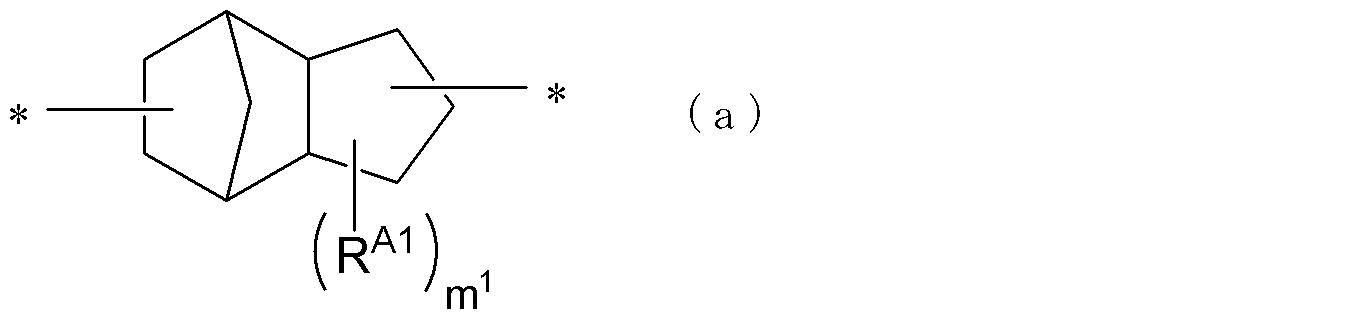
(一般式(a)中、RA1は炭素数1~12のアルキル基を表し、上記脂環式骨格中のどこに置換していてもよい。m1は0~6の整数である。*は他の構造への結合部位である。)
[7]前記(A1)エチレン性不飽和基と共に酸性置換基及び脂環式骨格を有する光重合性化合物が下記一般式(A-1)で表される、上記[1]~[6]のいずれかに記載の感光性樹脂組成物。
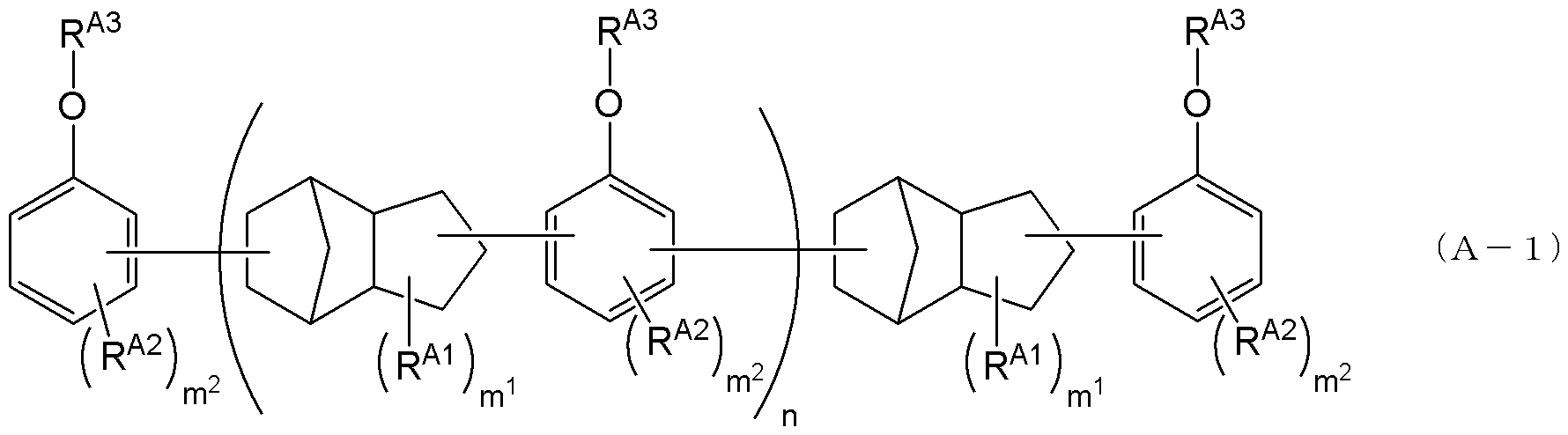
(一般式(A-1)中、RA1は炭素数1~12のアルキル基を表し、上記脂環式骨格中のどこに置換していてもよい。RA2は炭素数1~12のアルキル基を表す。RA3は、エチレン性不飽和基を有する有機基、エチレン性不飽和基及び酸性置換基を有する有機基又はグリシジル基であり、少なくとも1つのRA3はエチレン性不飽和基及び酸性置換基を有する有機基である。m1は0~6の整数、m2は0~3の整数である。nは0~10である。)
[8]前記(A1)エチレン性不飽和基と共に酸性置換基及び脂環式骨格を有する光重合性化合物において、前記酸性置換基が、カルボキシル基、スルホン酸基及びフェノール性水酸基からなる群から選択される少なくとも1種である、上記[1]~[7]のいずれかに記載の感光性樹脂組成物。
[9]さらに(C)熱硬化性樹脂を含有する、上記[1]~[8]のいずれかに記載の感光性樹脂組成物。
[10]さらに(D)エラストマを含有する、上記[1]~[9]のいずれかに記載の感光性樹脂組成物。
[11]前記(D)エラストマが、スチレン系エラストマ、オレフィン系エラストマ、ポリエステル系エラストマ、ウレタン系エラストマ、ポリアミド系エラストマ、アクリル系エラストマ及びシリコーン系エラストマからなる群から選択される少なくとも1種を含む、上記[1]~[10]のいずれかに記載の感光性樹脂組成物。
[12]さらに(F)無機充填材を含有する、上記[1]~[11]のいずれかに記載の感光性樹脂組成物。
[13]上記[1]~[12]のいずれかに記載の感光性樹脂組成物からなる、フォトビア形成用感光性樹脂組成物。
[14]上記[1]~[12]のいずれかに記載の感光性樹脂組成物からなる、層間絶縁層用感光性樹脂組成物。
[15]上記[1]~[12]のいずれかに記載の感光性樹脂組成物からなる、感光性樹脂フィルム。
[16]上記[1]~[12]のいずれかに記載の感光性樹脂組成物からなる、層間絶縁層用感光性樹脂フィルム。
[17]
上記[1]~[12]のいずれかに記載の感光性樹脂組成物を用いて形成される層間絶縁層を含有してなる多層プリント配線板。
[18]
上記[15]に記載の感光性樹脂フィルムを用いて形成される層間絶縁層を含有してなる多層プリント配線板。
[19]
上記[17]又は[18]に記載の多層プリント配線板に半導体素子を搭載してなる半導体パッケージ。
[20]
下記工程(1)~(4)を有する、多層プリント配線板の製造方法。
工程(1):上記[15]に記載の感光性樹脂フィルムを、回路基板の片面又は両面にラミネートする工程。
工程(2):前記工程(1)でラミネートされた感光性樹脂フィルムに対して露光及び現像することによって、ビアを有する層間絶縁層を形成する工程。
工程(3):前記ビア及び前記層間絶縁層を粗化処理する工程。
工程(4):前記層間絶縁層上に回路パターンを形成する工程。
さらに、高解像度のビアを有し、層間絶縁層とめっき銅との接着強度が高く、且つ電気絶縁信頼性に優れた多層プリント配線板を効率良く製造する方法を提供することができる。本発明の製造方法により得られる多層プリント配線板が有するビアは、レーザ加工により形成されるビアよりも小径のビアとすることが可能である。
さらに、本明細書において、感光性樹脂組成物中の各成分の含有率は、各成分に該当する物質が複数種存在する場合には、特に断らない限り、感光性樹脂組成物中に存在する当該複数種の物質の合計の含有率を意味する。
本明細書において「環形成炭素数」とは、環を形成するのに必要な炭素原子の数であり、環が有する置換基の炭素原子の数は含まれない。例えば、シクロヘキサン骨格及びメチルシクロヘキサン骨格のいずれも、環形成炭素数は6である。
また、本明細書における記載事項を任意に組み合わせた態様も本発明に含まれる。
本発明の一実施形態に係る(以下、単に本実施形態と称することがある。)の感光性樹脂組成物は、(A)エチレン性不飽和基を有する光重合性化合物及び(B)光重合開始剤を含有する感光性樹脂組成物であって、前記(A)エチレン性不飽和基を有する光重合性化合物が、(A1)エチレン性不飽和基と共に酸性置換基及び脂環式骨格を有する光重合性化合物を含む、感光性樹脂組成物である。
なお、本明細書において、前記成分はそれぞれ、(A)成分、(B)成分、(A1)成分等と称することがあり、その他の成分についても同様の略し方をすることがある。本明細書において、「樹脂成分」とは、前記(A)成分及び(B)成分等であり、必要に応じて含有してもよい他の成分(例えば、(C)、(D)、(E)及び(H)成分等)も含まれるが、後述する必要に応じて含有させてもよい(F)無機充填材及び(G)顔料は含まれない。また、「固形分」とは、感光性樹脂組成物に含まれる水及び溶媒等の揮発する物質を除いた不揮発分のことであり、該樹脂組成物を乾燥させた際に、揮発せずに残る成分を示し、また25℃付近の室温で液状、水飴状及びワックス状のものも含む。
なお、本実施形態の感光性樹脂組成物は、ネガ型感光性樹脂組成物として有用である。
以下、感光性樹脂組成物が含有し得る各成分について詳述する。
本実施形態の感光性樹脂組成物は、(A)成分としてエチレン性不飽和基を有する光重合性化合物を含む。(A)成分が有するエチレン性不飽和基としては、例えば、ビニル基、アリル基、プロパルギル基、ブテニル基、エチニル基、フェニルエチニル基、マレイミド基、ナジイミド基、(メタ)アクリロイル基等が挙げられる。エチレン性不飽和基としては、(メタ)アクリロイル基が好ましい。
本発明では、(A)成分は、後述する(A1)エチレン性不飽和基と共に酸性置換基及び脂環式骨格を有する光重合性化合物を含む。(A)成分が(A1)成分を含むことによって、ビアの解像性、めっき銅との接着強度、クラック耐性及び電気絶縁信頼性に優れた感光性樹脂組成物となる。
以下、(A1)成分について詳述する。
(A1)成分が有するエチレン性不飽和基としては、前述したエチレン性不飽和基と同じものが挙げられ、ビニル基、アリル基、プロパルギル基、ブテニル基、エチニル基、フェニルエチニル基、マレイミド基、ナジイミド基及び(メタ)アクリロイル基からなる群から選択される少なくとも1種が好ましく、ビニル基、アリル基、(メタ)アクリロイル基がより好ましく、(メタ)アクリロイル基がさらに好ましい。
(A1)成分が有する酸性置換基としては、例えば、カルボキシル基、スルホン酸基、フェノール性水酸基等からなる群から選択される少なくとも1種が好ましく、カルボキシル基がより好ましい。
また、前記脂環式骨格は、ビアの解像性、めっき銅との接着強度、クラック耐性及び電気絶縁信頼性の観点から、2環以上からなることが好ましく、2~4環からなることがより好ましく、3環からなることがさらに好ましい。2環以上の脂環式骨格としては、例えば、ノルボルナン骨格、デカリン骨格、ビシクロウンデカン骨格、飽和ジシクロペンタジエン骨格等が挙げられる。
前記脂環式骨格としては、ビアの解像性、めっき銅との接着強度、クラック耐性及び電気絶縁信頼性の観点から、飽和ジシクロペンタジエン骨格が好ましく、下記一般式(a)で表される脂環式骨格(飽和ジシクロペンタジエン骨格)がより好ましい。

(一般式(a)中、RA1は炭素数1~12のアルキル基を表し、上記脂環式骨格中のどこに置換していてもよい。m1は0~6の整数である。*は他の構造への結合部位である。)
m1は0~6の整数であり、0~2の整数が好ましく、0がより好ましい。
m1が2~6の整数である場合、複数のRA1はそれぞれ同一であってもよいし、異なっていてもよい。さらに、複数のRA1は、可能な範囲で同一炭素原子上に置換していてもよいし、異なる炭素原子上に置換していてもよい。
*は他の構造への結合部位であり、脂環式骨格上のいずれの炭素原子で結合されていてもよいが、下記一般式(a’)中の1又は2で示される炭素原子と、3~4のいずれかで示される炭素原子にて結合されていることが好ましい。
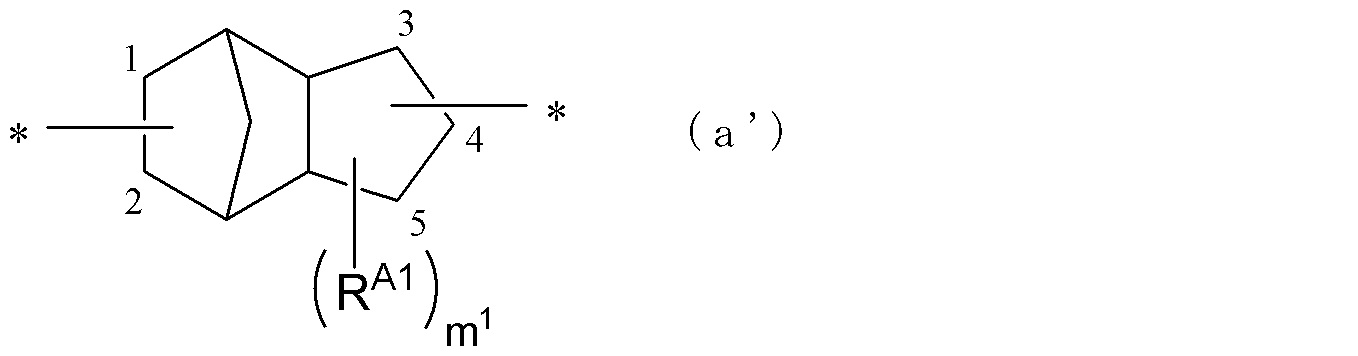
(一般式(a’)中、RA1、m1及び*は、一般式(a)中のものと同じである。)
前記(a1)脂環式骨格含有エポキシ樹脂としては、2個以上のエポキシ基を有するエポキシ樹脂であることが好ましい。エポキシ樹脂は、グリシジルエーテルタイプのエポキシ樹脂、グリシジルアミンタイプのエポキシ樹脂、グリシジルエステルタイプのエポキシ樹脂等に分類される。これらの中でも、グリシジルエーテルタイプのエポキシ樹脂が好ましい。
(a1)脂環式骨格含有エポキシ樹脂としては、下記一般式(a1-1)で表されるエポキシ樹脂が好ましい。また、下記一般式(a1-2)で表される構造単位を有するエポキシ樹脂も好ましい。

(一般式(a1-1)中、RA1は炭素数1~12のアルキル基を表し、上記脂環式骨格中のどこに置換していてもよい。RA2は炭素数1~12のアルキル基を表す。m1は0~6の整数、m2は0~3の整数である。nは0~10である。)
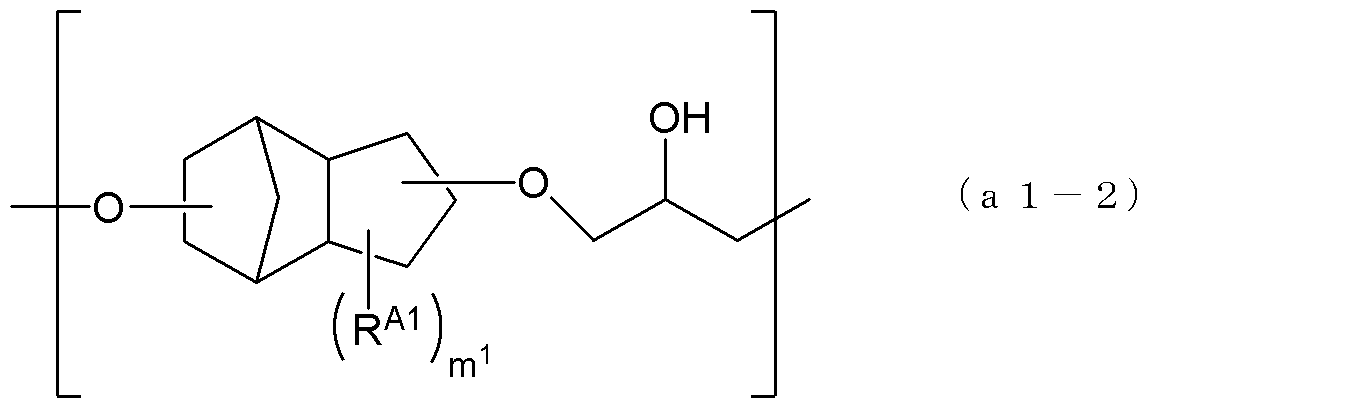
(一般式(a1-2)中、RA1は炭素数1~12のアルキル基を表し、上記脂環式骨格中のどこに置換していてもよい。m1は0~6の整数である。)
一般式(a1-1)中のRA2が表す炭素数1~12のアルキル基としては、例えば、メチル基、エチル基、n-プロピル基、イソプロピル基、n-ブチル基、イソブチル基、t-ブチル基、n-ペンチル基等が挙げられる。該アルキル基としては、炭素数1~6のアルキル基が好ましく、炭素数1~3のアルキル基がより好ましく、メチル基がさらに好ましい。
一般式(a1-1)及び一般式(a1-2)中のm1は一般式(a)中のm1と同じであり、好ましい態様も同じである。
一般式(a1-1)中のm2は0~3の整数であり、0又は1が好ましく、0がより好ましい。
一般式(a1-1)中のnは丸括弧内の構造単位の繰り返し数を表し、0~10である。通常、エポキシ樹脂は丸括弧内の構造単位の繰り返し数が異なるものの混合物となっているため、その場合、nはその混合物の平均値で表される。nとしては、2~10が好ましい。
前記(a2)エチレン性不飽和基含有有機酸としては、特に制限されるものではないが、エチレン性不飽和基含有モノカルボン酸が好ましい。エチレン性不飽和基としては、前記(A1)成分におけるエチレン性不飽和基の説明のとおりである。
該エチレン性不飽和基含有モノカルボン酸としては、例えば、アクリル酸;アクリル酸の二量体、メタクリル酸、β-フルフリルアクリル酸、β-スチリルアクリル酸、桂皮酸、クロトン酸、α-シアノ桂皮酸等のアクリル酸誘導体;水酸基含有アクリレートと二塩基酸無水物との反応生成物である半エステル化合物;エチレン性不飽和基含有モノグリシジルエーテル又はエチレン性不飽和基含有モノグリシジルエステルと二塩基酸無水物との反応生成物である半エステル化合物;などが挙げられる。これらの中でも、アクリル酸が好ましい。
(a2)成分は、1種を単独で使用してもよいし、2種以上を併用してもよい。
有機溶剤としては、例えば、メチルエチルケトン、シクロヘキサノン等のケトン類;トルエン、キシレン、テトラメチルベンゼン等の芳香族炭化水素類;メチルセロソルブ、ブチルセロソルブ、メチルカルビトール、ブチルカルビトール、プロピレングリコールモノメチルエーテル、ジプロピレングリコールモノエチルエーテル、ジプロピレングリコールジエチルエーテル、トリエチレングリコールモノエチルエーテル等のグリコールエーテル類;酢酸エチル、酢酸ブチル、ブチルセロソルブアセテート、カルビトールアセテート等のエステル類;オクタン、デカン等の脂肪族炭化水素類;石油エーテル、石油ナフサ、水添石油ナフサ、ソルベントナフサ等の石油系溶剤などが挙げられる。
触媒の使用量は、前記(a1)成分と前記(a2)成分との合計100質量部に対して、好ましくは0.01~10質量部、より好ましくは0.05~5質量部、さらに好ましくは0.1~2質量部である。前記の使用量であれば、前記(a1)成分と前記(a2)成分との反応が促進される傾向にある。
重合禁止剤を使用する場合、その使用量は、組成物の貯蔵安定性を向上させる観点から、前記(a1)成分と前記(a2)成分との合計100質量部に対して、好ましくは0.01~1質量部、より好ましくは0.02~0.8質量部、さらに好ましくは0.05~0.5質量部である。
前記(a3)成分としては、飽和基を含有するものであってもよいし、不飽和基を含有するものであってもよい。(a3)成分としては、例えば、無水コハク酸、無水マレイン酸、テトラヒドロ無水フタル酸、無水フタル酸、メチルテトラヒドロ無水フタル酸、エチルテトラヒドロ無水フタル酸、ヘキサヒドロ無水フタル酸、メチルヘキサヒドロ無水フタル酸、エチルヘキサヒドロ無水フタル酸、無水イタコン酸等が挙げられる。これらの中でも、ビアの解像性の観点から、好ましくはテトラヒドロ無水フタル酸である。
(A1-1)酸変性エチレン性不飽和基及び脂環式骨格含有エポキシ誘導体の酸価は、好ましくは20~150mgKOH/g、より好ましくは30~120mgKOH/g、さらに好ましくは40~100mgKOH/gである。酸価が20mgKOH/g以上であれば感光性樹脂組成物の希アルカリ溶液への溶解性に優れる傾向にあり、150mgKOH/g以下であれば硬化膜の電気特性が向上する傾向にある。
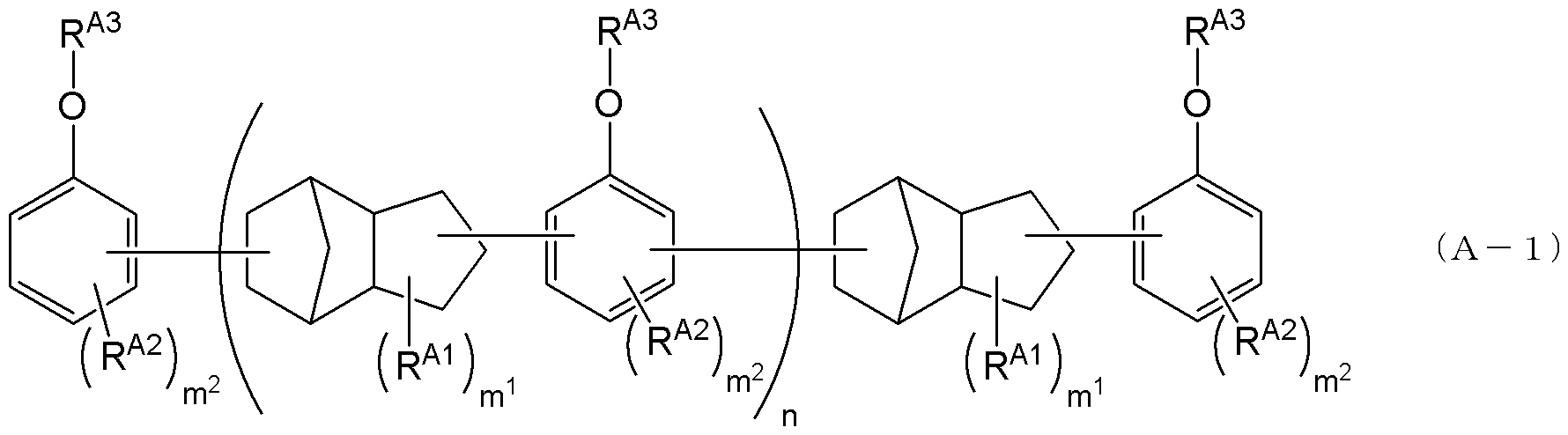
(一般式(A-1)中、RA1は炭素数1~12のアルキル基を表し、上記脂環式骨格中のどこに置換していてもよい。RA2は炭素数1~12のアルキル基を表す。RA3は、エチレン性不飽和基を有する有機基、エチレン性不飽和基及び酸性置換基を有する有機基又はグリシジル基であり、少なくとも1つのRA3はエチレン性不飽和基及び酸性置換基を有する有機基である。m1は0~6の整数、m2は0~3の整数である。nは0~10である。)
RA3は前記定義の通りであるが、前記一般式(a1-1)中のグリシジル基が前記(a2)成分及び前記(a3)成分と反応して形成される部位に相当し、一部の該グリシジル基が未反応となることも考慮した定義になっている。つまり、RA3の選択肢である「エチレン性不飽和基を有する有機基」は前記(a2)に由来する基であり、「エチレン性不飽和基及び酸性置換基を有する有機基」は、前記(a2)及び(a3)成分に由来する基であり、前記(a2)及び(a3)成分が前記一般式(a1-1)中の全てのグリシジル基と反応すればRA3は「エチレン性不飽和基及び酸性置換基を有する有機基」となるが、前記(a2)成分としか反応していない部位は「エチレン性不飽和基を有する有機基」となり、前記(a2)及び(a3)成分のいずれとも反応していない部位は「グリシジル基」となる。
(A1)成分の重量平均分子量(Mw)は、好ましくは1,000~30,000、より好ましくは2,000~25,000、さらに好ましくは3,000~18,000である。この範囲内であれば、めっき銅との接着強度、耐熱性及び電気絶縁信頼性が向上する。特に、前記(A1-1)酸変性エチレン性不飽和基及び脂環式骨格含有エポキシ誘導体の重量平均分子量(Mw)が前記範囲であることが好ましい。ここで、本明細書において、重量平均分子量は、ゲルパーミエーションクロマトグラフィー(GPC)(東ソー株式会社製)により、標準ポリスチレンの検量線を用いて測定した値であり、より詳細には、以下に記載の方法に従って測定した値である。
<重量平均分子量の測定方法>
重量平均分子量は、下記のGPC測定装置及び測定条件で測定し、標準ポリスチレンの検量線を使用して換算した値を重量平均分子量とした。また、検量線の作成は、標準ポリスチレンとして5サンプルセット(「PStQuick MP-H」及び「PStQuick B」、東ソー株式会社製)を用いた。
(GPC測定装置)
GPC装置:高速GPC装置「HCL-8320GPC」、検出器は示差屈折計又はUV、東ソー株式会社製
カラム :カラムTSKgel SuperMultipore HZ-H(カラム長さ:15cm、カラム内径:4.6mm)、東ソー株式会社製
(測定条件)
溶媒 :テトラヒドロフラン(THF)
測定温度 :40℃
流量 :0.35mL/分
試料濃度 :10mg/THF5mL
注入量 :20μL
(A)エチレン性不飽和基を有する光重合性化合物としては、さらに、(a21)エポキシ樹脂(但し、脂環式骨格を含有しない。)を(a22)エチレン性不飽和基含有有機酸で変性した化合物に、(a23)飽和基又は不飽和基含有多塩基酸無水物を反応させてなる、「(A2-1)脂環式骨格を含有しない酸変性エチレン性不飽和基含有エポキシ誘導体」を含む態様であってもよい。
また、前記(a21)エポキシ樹脂は、主骨格の違いによっても種々のエポキシ樹脂に分類され、上記それぞれのタイプのエポキシ樹脂において、さらに次の様に分類される。具体的には、ビスフェノールA型エポキシ樹脂、ビスフェノールF型エポキシ樹脂、ビスフェノールS型エポキシ樹脂等のビスフェノール系エポキシ樹脂;ビスフェノールAノボラック型エポキシ樹脂、ビスフェノールFノボラック型エポキシ樹脂等のビスフェノール系ノボラック型エポキシ樹脂;フェノールノボラック型エポキシ樹脂、クレゾールノボラック型エポキシ樹脂、ビフェニルノボラック型エポキシ樹脂等の、前記ビスフェノール系ノボラック型エポキシ樹脂以外のノボラック型エポキシ樹脂;フェノールアラルキル型エポキシ樹脂;スチルベン型エポキシ樹脂;ナフタレン型エポキシ樹脂、ナフトールノボラック型エポキシ樹脂、ナフトール型エポキシ樹脂、ナフトールアラルキル型エポキシ樹脂、ナフチレンエーテル型エポキシ樹脂等のナフタレン骨格含有型エポキシ樹脂;ビフェニル型エポキシ樹脂;ビフェニルアラルキル型エポキシ樹脂;キシリレン型エポキシ樹脂;ジヒドロアントラセン型エポキシ樹脂;脂肪族鎖状エポキシ樹脂;ゴム変性エポキシ樹脂などに分類される。これらの中でも、ビスフェノール系ノボラック型エポキシ樹脂が好ましく、ビスフェノールFノボラック型エポキシ樹脂がさらに好ましい。
また、前記(a21)成分を前記(a22)成分で変性した化合物に、前記(a23)成分を反応させる方法としては、前記(a1)成分を前記(a2)成分で変性した化合物に、前記(a3)成分を反応させる方法を参照することができる。
(A)エチレン性不飽和基を有する光重合性化合物としては、スチレン-無水マレイン酸共重合体のヒドロキシエチル(メタ)アクリレート変性物等の「(A2-2)スチレン-マレイン酸系樹脂」を併用することもできる。該(A2-2)成分は、脂環式骨格を含有しない。(A2-2)成分は、1種を単独で使用してもよいし、2種以上を併用してもよい。
また、(A)エチレン性不飽和基を有する光重合性化合物としては、前記(a21)エポキシ樹脂を(a22)エチレン性不飽和基含有有機酸で変性した化合物、つまり(A’)成分と、イソシアネート化合物とを反応させて得られる、「(A2-3)エポキシ系ポリウレタン樹脂」を併用することもできる。該(A2-3)成分は、脂環式骨格を含有しない。(A2-3)成分は、1種を単独で使用してもよいし、2種以上を併用してもよい。
(A)エチレン性不飽和基を有する光重合性化合物としては、硬化(露光)後の耐薬品性を高めて、露光部と未露光部の耐現像液性の差を大きくするという観点から、(A)エチレン性不飽和基を有する光重合性化合物として、さらに、(Ai)1つの重合可能なエチレン性不飽和基を有する一官能ビニルモノマー、(Aii)2つの重合可能なエチレン性不飽和基を有する二官能ビニルモノマー及び(Aiii)少なくとも3つの重合可能なエチレン性不飽和基を有する多官能ビニルモノマーからなる群から選択される少なくとも1種を含む態様が好ましく、前記(Aiii)成分を含む態様がより好ましい。(Ai)~(Aiii)成分としては、分子量が1,000以下のものが好ましい。但し、本発明では、前記(Ai)~(Aiii)成分は前記(A1)成分を包含しない。
前記1つの重合可能なエチレン性不飽和基を有する一官能ビニルモノマーとしては、例えば、(メタ)アクリル酸、(メタ)アクリル酸アルキルエステル等が挙げられる。該(メタ)アクリル酸アルキルエステルとしては、例えば、(メタ)アクリル酸メチルエステル、(メタ)アクリル酸エチルエステル、(メタ)アクリル酸ブチルエステル、(メタ)アクリル酸2-エチルヘキシルエステル、(メタ)アクリル酸ヒドロキシルエチルエステル等が挙げられる。(Ai)成分は、1種を単独で使用してもよいし、2種以上を併用してもよい。
前記2つの重合可能なエチレン性不飽和基を有する二官能ビニルモノマーとしては、例えば、ポリエチレングリコールジ(メタ)アクリレート、トリメチロールプロパンジ(メタ)アクリレート、ポリプロピレングリコールジ(メタ)アクリレート、2,2-ビス(4-(メタ)アクリロキシポリエトキシポリプロポキシフェニル)プロパン、ビスフェノールAジグリシジルエーテルジ(メタ)アクリレート等が挙げられる。(Aii)成分は、1種を単独で使用してもよいし、2種以上を併用してもよい。
前記少なくとも3つの重合可能なエチレン性不飽和基を有する多官能ビニルモノマーとしては、例えば、トリメチロールプロパントリ(メタ)アクリレート等のトリメチロールプロパン由来の骨格を有する(メタ)アクリレート化合物;テトラメチロールメタントリ(メタ)アクリレート、テトラメチロールメタンテトラ(メタ)アクリレート等のテトラメチロールメタン由来の骨格を有する(メタ)アクリレート化合物;ペンタエリスリトールトリ(メタ)アクリレート、ペンタエリスリトールテトラ(メタ)アクリレート等のペンタエリスリトール由来の骨格を有する(メタ)アクリレート化合物;ジペンタエリスリトールペンタ(メタ)アクリレート、ジペンタエリスリトールヘキサ(メタ)アクリレート等のジペンタエリスリトール由来の骨格を有する(メタ)アクリレート化合物;ジトリメチロールプロパンテトラ(メタ)アクリレート等のジトリメチロールプロパン由来の骨格を有する(メタ)アクリレート化合物;ジグリセリン由来の骨格を有する(メタ)アクリレート化合物などが挙げられる。これらの中でも、硬化(露光)後の耐薬品性を高めて、露光部と未露光部の耐現像液性の差を大きくするという観点から、ジペンタエリスリトール由来の骨格を有する(メタ)アクリレート化合物が好ましく、ジペンタエリスリトールペンタ(メタ)アクリレートがより好ましい。(Aiii)成分は、1種を単独で使用してもよいし、2種以上を併用してもよい。
ここで、前記「XXX由来の骨格を有する(メタ)アクリレート化合物」(但し、XXXは化合物名である。)とは、XXXと(メタ)アクリル酸とのエステル化物を意味し、当該エステル化物には、アルキレンオキシ基で変性された化合物も包含される。
(A)成分の含有量は、特に制限されるものではないが、耐熱性、電気特性及び耐薬品性の観点から、感光性樹脂組成物の固形分全量基準で、好ましくは5~60質量%、より好ましくは10~55質量%、さらに好ましくは20~50質量%、特に好ましくは25~50質量%、最も好ましくは30~45質量%である。
また(A)成分全量に対する(A1)成分の含有比率は、ビアの解像性、めっき銅との接着強度、クラック耐性及び電気絶縁信頼性の観点から、好ましくは20~95質量%、より好ましくは40~90質量%、さらに好ましくは55~90質量%、特に好ましくは70~90質量%である。
本実施形態で用いられる(B)成分としては、前記(A)成分を重合させることができるものであれば、特に制限はなく、通常用いられる光重合開始剤から適宜選択することができる。
(B)成分としては、例えば、ベンゾイン、ベンゾインメチルエーテル、ベンゾインイソプロピルエーテル等のベンゾイン類;アセトフェノン、2,2-ジメトキシ-2-フェニルアセトフェノン、2,2-ジエトキシ-2-フェニルアセトフェノン、1,1-ジクロロアセトフェノン、1-ヒドロキシシクロヘキシルフェニルケトン、2-ベンジル-2-ジメチルアミノ-1-(4-モルホリノフェニル)-1-ブタノン、2-メチル-1-[4-(メチルチオ)フェニル]-2-モルホリノ-1-プロパノン、N,N-ジメチルアミノアセトフェノン等のアセトフェノン類;2-メチルアントラキノン、2-エチルアントラキノン、2-tert-ブチルアントラキノン、1-クロロアントラキノン、2-アミルアントラキノン、2-アミノアントラキノン等のアントラキノン類;2,4-ジメチルチオキサントン、2,4-ジエチルチオキサントン、2-クロロチオキサントン、2,4-ジイソプロピルチオキサントン等のチオキサントン類;アセトフェノンジメチルケタール、ベンジルジメチルケタール等のケタール類;ベンゾフェノン、メチルベンゾフェノン、4,4’-ジクロロベンゾフェノン、4,4’-ビス(ジエチルアミノ)ベンゾフェノン、ミヒラーズケトン、4-ベンゾイル-4’-メチルジフェニルサルファイド等のベンゾフェノン類;9-フェニルアクリジン、1,7-ビス(9,9’-アクリジニル)ヘプタン等のアクリジン類;2,4,6-トリメチルベンゾイルジフェニルホスフィンオキサイド等のアシルホスフィンオキサイド類;1,2-オクタンジオン-1-[4-(フェニルチオ)フェニル]-2-(O-ベンゾイルオキシム)、1-[9-エチル-6-(2-メチルベンゾイル)-9H-カルバゾール-3-イル]エタノン1-(O-アセチルオキシム)、1-フェニル-1,2-プロパンジオン-2-[O-(エトキシカルボニル)オキシム]等のオキシムエステル類などが挙げられる。これらの中でも、アセトフェノン類、チオキサントン類が好ましく、2-メチル-1-[4-(メチルチオ)フェニル]-2-モルホリノ-1-プロパノン、2,4-ジエチルチオキサントンがより好ましい。アセトフェノン類は、揮発しにくく、アウトガスとして発生しにくいという利点があり、チオキサントン類は、可視光域でも光硬化が可能という利点がある。
(B)成分は、1種を単独で使用してもよいし、2種以上を併用してもよい。2種以上を併用する場合、アセトフェノン類とチオキサントン類とを併用することが好ましく、2-メチル-1-[4-(メチルチオ)フェニル]-2-モルホリノ-1-プロパノンと2,4-ジエチルチオキサントンとを併用することがより好ましい。
(B)成分の含有量は、特に制限されるものではないが、感光性樹脂組成物の固形分全量基準で、好ましくは0.1~15質量%、より好ましくは0.15~5質量%、さらに好ましくは0.2~1.5質量%、特に好ましくは0.2~0.8質量%である。(B)成分の含有量が0.1質量%以上であれば、感光性樹脂組成物を用いて形成される層間絶縁層において、露光される部位が現像中に溶出するおそれを低減する傾向にあり、15質量%以下であれば、耐熱性が向上する傾向にある。
本実施形態の感光性樹脂組成物は、上記の(B)成分と共に(B’)光重合開始助剤を含有してもよい。(B’)光重合開始助剤としては、例えば、N,N-ジメチルアミノ安息香酸エチルエステル、N,N-ジメチルアミノ安息香酸イソアミルエステル、ペンチル-4-ジメチルアミノベンゾエート、トリエチルアミン、トリエタノールアミン等の第三級アミン類などが挙げられる。(B’)成分は、1種を単独で使用してもよいし、2種以上を併用してもよい。
本実施形態の感光性樹脂組成物が(B’)成分を含有する場合、その含有量は、感光性樹脂組成物の樹脂成分全量基準で、好ましくは0.01~20質量%、より好ましくは0.2~5質量%、さらに好ましくは0.3~2質量%である。なお、本実施形態の感光性樹脂組成物は該(B’)成分を含有していなくてもよい。
本実施形態の感光性樹脂組成物は、さらに(C)成分として熱硬化性樹脂を含有していてもよく、含有していることが好ましい。(C)成分には前記(A)成分に相当するものは含まれず、その点で、(C)成分はエチレン性不飽和基を有さないものと言える。また、当該条件を満たした上でエポキシ基を有する物質は、(C)成分に包含される。
本実施形態の感光性樹脂組成物が(C)熱硬化性樹脂を含有することにより、めっき銅との接着強度及び絶縁信頼性の向上に加えて、耐熱性が向上する傾向にある。
熱硬化性樹脂としては、例えば、エポキシ樹脂、フェノール樹脂、不飽和イミド樹脂、シアネート樹脂、イソシアネート樹脂、ベンゾオキサジン樹脂、オキセタン樹脂、アミノ樹脂、不飽和ポリエステル樹脂、アリル樹脂、ジシクロペンタジエン樹脂、シリコーン樹脂、トリアジン樹脂、メラミン樹脂等が挙げられる。また、特にこれらに制限されず、公知の熱硬化性樹脂を使用できる。これらの中でも、エポキシ樹脂が好ましい。
(C)成分は、1種を単独で使用してもよいし、2種以上を併用してもよい。
(C)成分は、1種を単独で使用してもよいし、2種以上を併用してもよい。
これらは市販品を使用することもでき、例えば、ビスフェノールA型エポキシ樹脂(三菱ケミカル株式会社製「jER828EL」、「YL980」)、ビスフェノールF型エポキシ樹脂(三菱ケミカル株式会社製「jER806H」、「YL983U」)、ナフタレン型エポキシ樹脂(DIC株式会社製「HP4032D」、「HP4710」)、ナフタレン骨格含有型多官能エポキシ樹脂(日本化薬株式会社製「NC7000」)、ナフトール型エポキシ樹脂(日鉄ケミカル&マテリアル株式会社製「ESN-475V」)、ビフェニル構造を有するエポキシ樹脂(日本化薬株式会社製「NC3000H」、「NC3500」)、三菱ケミカル株式会社製「YX4000HK」、「YL6121」)、アントラセン型エポキシ樹脂(三菱ケミカル株式会社製「YX8800」)、グリセロール型エポキシ樹脂(日鉄ケミカル&マテリアル株式会社製「ZX1542」)、ナフチレンエーテル型エポキシ樹脂(DIC株式会社製「EXA7311-G4」)、クレゾールノボラック型エポキシ樹脂(DIC株式会社製「EPICLON N-680」)等が挙げられる。
前記エポキシ変性ポリブタジエンは、めっき銅との接着強度、耐熱性、熱膨張係数及び柔軟性の観点から、下記一般式(C-1)で表されるエポキシ変性ポリブタジエンであることが好ましい。

(上記式(C-1)中、a、b及びcはそれぞれ、丸括弧内の構造単位の比率を表しており、aは0.05~0.40、bは0.02~0.30、cは0.30~0.80であり、さらに、a+b+c=1.00、且つ(a+c)>bを満たす。yは、角括弧内の構造単位の数を表し、10~250の整数である。)
めっき銅との接着強度、耐熱性、熱膨張係数及び柔軟性の観点から、aは好ましくは0.10~0.30、bは好ましくは0.10~0.30、cは好ましくは0.40~0.80である。また、これと同様の観点から、yは好ましくは30~180の整数である。
本実施形態の感光性樹脂組成物が(C)成分を含有する場合、その含有量は、特に制限されるものではないが、感光性樹脂組成物の固形分全量基準で、好ましくは5~70質量%であり、より好ましくは5~40質量%であり、さらに好ましくは7~30質量%、特に好ましくは10~20質量%である。(C)成分の含有量が5質量%以上であれば、感光性樹脂組成物の十分な架橋が得られ、めっき銅との接着強度及び電気絶縁信頼性が向上する傾向にある。一方、70質量%以下であれば、ビアの解像性が良好となる傾向にある。
本実施形態の感光性樹脂組成物は、(D)成分としてエラストマを含有していてもよく、含有していることが好ましい。(D)成分を含有することにより、ビアの解像性、めっき銅との接着強度及び電気絶縁信頼性に優れた感光性樹脂組成物となる傾向にある。また、(D)成分によって、前記(A)成分の硬化収縮による、硬化物内部の歪み(内部応力)に起因した、可とう性及びめっき銅との接着強度の低下を抑制する効果も有する。
(D)成分としては25℃において液状であるエラストマが好ましい。
(D)成分は1種を単独で使用してもよいし、2種以上を併用してもよい。
(D)成分としては、前記例示の中でも、相容性、溶解性及びめっき銅との接着強度の観点から、オレフィン系エラストマ、ポリエステル系エラストマ及びウレタン系エラストマからなる群から選択される少なくとも1種を含むことが好ましく、ポリエステル系エラストマを含むことがより好ましい。また、(D)成分がオレフィン系エラストマ、ポリエステル系エラストマ及びウレタン系エラストマからなる群から選択される少なくとも1種であることがさらに好ましく、ポリエステル系エラストマであることが特に好ましい。
前記スチレン系エラストマとしては、スチレン-ブタジエン-スチレンブロックコポリマー、スチレン-イソプレン-スチレンブロックコポリマー、スチレン-エチレン-ブチレン-スチレンブロックコポリマー、スチレン-エチレン-プロピレン-スチレンブロックコポリマー等が挙げられる。スチレン系エラストマは1種を単独で使用してもよいし、2種以上を併用してもよい。
スチレン系エラストマを構成する成分としては、スチレン;α-メチルスチレン、3-メチルスチレン、4-プロピルスチレン、4-シクロヘキシルスチレン等のスチレン誘導体などが挙げられる。
スチレン系エラストマとしては、数平均分子量が1,000~50,000のものが好ましく、3,000~20,000のものがより好ましい。
本明細書において、数平均分子量は、テトラヒドロフランを溶媒としたゲルパーミエーションクロマトグラフィー(GPC)法により標準ポリスチレン換算で求めた値である。
前記オレフィン系エラストマは、例えば、エチレン、プロピレン、1-ブテン、1-ヘキセン、4-メチル-ペンテン等の炭素数2~20のα-オレフィンの重合体又は共重合体である。なお、オレフィン系エラストマは、分子末端に水酸基を有するものであってもよく、分子末端に水酸基を有するものであることが好ましい。オレフィン系エラストマは1種を単独で使用してもよいし、2種以上を併用してもよい。
オレフィン系エラストマとしては、例えば、ポリエチレン、ポリブタジエン、水酸基含有ポリブタジエン、水酸基含有ポリイソプロピレン、エチレン-プロピレン共重合体(EPR)、エチレン-プロピレン-ジエン共重合体(EPDM)等が好適に挙げられる。また、前記炭素数2~20のα-オレフィンと、ジシクロペンタジエン、1,4-ヘキサジエン、シクロオクタジエン、メチレンノルボルネン、エチリデンノルボルネン、ブタジエン、イソプレン等の炭素数2~20の非共役ジエンとの共重合体等も挙げられる。さらには、ブタジエン-アクニロニトリル共重合体にメタクリル酸を共重合したカルボキシ変性NBR等も挙げられる。
オレフィン系エラストマとしては、数平均分子量が1,000~5,000のものが好ましく、1,500~3,500のものがより好ましい。
前記ポリエステル系エラストマとしては、ジカルボン酸又はその誘導体及びジオール化合物又はその誘導体を重縮合して得られるものが挙げられる。ポリエステル系エラストマは1種を単独で使用してもよいし、2種以上を併用してもよい。
前記ジカルボン酸としては、例えば、テレフタル酸、イソフタル酸、ナフタレンジカルボン酸等の芳香族ジカルボン酸;前記芳香族ジカルボン酸の芳香環の水素原子がメチル基、エチル基、フェニル基等で置換された芳香族ジカルボン酸;アジピン酸、セバシン酸、ドデカンジカルボン酸等の炭素数2~20の脂肪族ジカルボン酸;シクロヘキサンジカルボン酸等の脂環式ジカルボン酸;などが挙げられる。ジカルボン酸としては、基材との密着性の観点から、天然物由来のダイマー酸を使用することも好ましい。ジカルボン酸は、1種を単独で使用してもよいし、2種以上を併用してもよい。
前記ジカルボン酸の誘導体としては、前記ジカルボン酸の無水物等が挙げられる。

(一般式(D-1)中、XD1は炭素数1~10のアルキレン基、炭素数2~10のアルキリデン基、炭素数4~8のシクロアルキレン基、-O-、-S-、-SO2-を表す。RD1及びRD2は、それぞれ独立に、ハロゲン原子又は炭素数1~12のアルキル基を表す。p及びqはそれぞれ独立に0~4の整数であり、rは0又は1である。)
XD1が表す炭素数2~10のアルキリデン基としては、例えば、エチリデン基、プロピリデン基、イソプロピリデン基、ブチリデン基、イソブチリデン基、ペンチリデン基、イソペンチリデン基等が挙げられる。該アルキリデン基としては、ビアの解像性、めっき銅との接着強度及び電気絶縁信頼性の観点から、イソプロピリデン基が好ましい。
XD1が表す炭素数4~8のシクロアルキレン基としては、例えば、シクロペンチレン基、シクロヘキシレン基、シクロオクチレン基等が挙げられる。
XD1としては、以上の中でも、炭素数1~10のアルキレン基、炭素数2~10のアルキリデン基が好ましく、メチレン基、イソプロピリデン基がより好ましい。
RD1及びRD2が表す炭素数1~12のアルキル基としては、例えば、メチル基、エチル基、n-プロピル基、イソプロピル基、n-ブチル基、イソブチル基、t-ブチル基、n-ペンチル基等が挙げられる。該アルキル基としては、炭素数1~6のアルキル基が好ましく、炭素数1~3のアルキル基がより好ましく、メチル基がさらに好ましい。
p及びqはそれぞれ独立に0~4の整数であり、それぞれ0又は1が好ましい。
rは0又は1であり、いずれであってもよいが、rが0のときは下記一般式(D-1’)で表される構造となる。

(一般式(D-1’)中、XD1、RD1及びpは、いずれも一般式(D-1)中のものと同じであり、好ましい態様も同じである。)
前記ウレタン系エラストマとしては、例えば、短鎖ジオールとジイソシアネートとからなるハードセグメントと、高分子(長鎖)ジオールとジイソシアネートとからなるソフトセグメントとを含有するものが好適に挙げられる。ウレタン系エラストマは1種を単独で使用してもよいし、2種以上を併用してもよい。
高分子(長鎖)ジオールとしては、ポリプロピレングリコール、ポリテトラメチレンオキサイド、ポリ(1,4-ブチレンアジペート)、ポリ(エチレン-1,4-ブチレンアジペート)、ポリカプロラクトン、ポリ(1,6-ヘキシレンカーボネート)、ポリ(1,6-へキシレン-ネオペンチレンアジペート)等が挙げられる。高分子(長鎖)ジオールの数平均分子量は、500~10,000が好ましい。
短鎖ジオールとしては、エチレングリコール、プロピレングリコール、1,4-ブタンジオール、ビスフェノールA等が挙げられる。短鎖ジオールの数平均分子量は、48~500が好ましい。
ウレタン系エラストマとしては、数平均分子量が1,000~25,000のものが好ましく、1,500~20,000のものがより好ましく、2,000~15,000のものがさらに好ましい。
ポリアミド系エラストマは、ハードセグメントにポリアミドを、ソフトセグメントにポリエーテルを用いたポリエーテルブロックアミド型;ハードセグメントにポリアミドを、ソフトセグメントにポリエステルを用いたポリエーテルエステルブロックアミド型の2種類に大別される。
前記ポリアミド系エラストマの具体例としては、例えば、ポリアミドをハードセグメント成分とし、ポリブタジエン、ブタジエン-アクリロニトリル共重合体、スチレン-ブタジエン共重合体、ポリイソプレン、エチレンプロピレン共重合体、ポリエーテル、ポリエステル、ポリブタジエン、ポリカーボネート、ポリアクリレート、ポリメタクリレート、ポリウレタン、シリコーンゴム等をソフトセグメント成分としたブロック共重合体が挙げられる。ポリアミド系エラストマは1種を単独で使用してもよいし、2種以上を併用してもよい。
ポリアミド系エラストマとしては、数平均分子量が1,000~50,000のものが好ましく、2,000~30,000のものがより好ましい。
前記アクリル系エラストマとしては、例えば、アクリル酸エステルを主成分とする原料モノマーの重合体が挙げられる。アクリル酸エステルとしては、エチルアクリレート、ブチルアクリレート、メトキシエチルアクリレート、エトキシエチルアクリレート等が好適に挙げられる。また、架橋点モノマーとして、グリシジルメタクリレート、アリルグリシジルエーテル等を共重合させたものであってもよく、さらに、アクリロニトリル、エチレン等を共重合させたものであってもよい。具体的には、アクリロニトリル-ブチルアクリレート共重合体、アクリロニトリル-ブチルアクリレート-エチルアクリレート共重合体、アクリロニトリル-ブチルアクリレート-グリシジルメタクリレート共重合体等が挙げられる。アクリル系エラストマは1種を単独で使用してもよいし、2種以上を併用してもよい。
アクリル系エラストマとしては、数平均分子量が1,000~50,000のものが好ましく、2,000~30,000のものがより好ましい。
前記シリコーン系エラストマは、オルガノポリシロキサンを主成分とするエラストマであり、例えば、ポリジメチルシロキサン系エラストマ、ポリメチルフェニルシロキサン系エラストマ、ポリジフェニルシロキサン系エラストマ等に分類される。シリコーン系エラストマは1種を単独で使用してもよいし、2種以上を併用してもよい。
シリコーン系エラストマとしては、数平均分子量が1,000~50,000のものが好ましく、2,000~30,000のものがより好ましい。
また、(D)成分としては、ポリフェニレンエーテル樹脂、フェノキシ樹脂、ポリカーボネート樹脂、ポリアミドイミド樹脂、ポリイミド樹脂、キシレン樹脂、ポリフェニレンスルフィド樹脂、ポリエーテルイミド樹脂、ポリエーテルエーテルケトン樹脂、テトラフルオロエチレン樹脂、ポリアクリロニトリル樹脂、無水マレイン酸変性ポリブタジエン、フェノール変性ポリブタジエン及びカルボキシ変性ポリアクリロニトリルからなる群から選択される少なくとも1種を含む態様であってもよい。
本実施形態の感光性樹脂組成物が(D)成分を含有する場合、その含有量は、感光性樹脂組成物の固形分全量基準で、好ましくは0.5~20質量%、より好ましくは1~20質量%、さらに好ましくは1~15質量%、特に好ましくは1~10質量%、最も好ましくは1~6質量%である。(D)成分の含有量が0.5質量%以上であれば、めっき銅との接着強度の改善効果が十分となり、且つ、電気絶縁信頼性により一層優れる傾向にある。(D)成分の含有量が20質量%以下であれば、ビアの解像性、めっき銅との接着強度及び電気絶縁信頼性が共に十分となる傾向にある。
本実施形態の感光性樹脂組成物は、(E)成分として熱重合開始剤を含有していてもよい。
熱重合開始剤としては、特に制限されるものではないが、例えば、ジイソプロピルベンゼンハイドロパーオキサイド「パークミルP」(商品名、日油株式会社製(以下同じ))、クメンハイドロパーオキサイド「パークミルH」、t-ブチルハイドロパーオキサイド「パーブチルH」等のハイドロパーオキサイド類;α,α-ビス(t-ブチルペルオキシ-m-イソプロピル)ベンゼン「パーブチルP」、ジクミルパーオキサイド「パークミルD」、2,5-ジメチル-2,5-ビス(t-ブチルパーオキシ)ヘキサン「パーヘキサ25B」、t-ブチルクミルパーオキサイド「パーブチルC」、ジ-t-ブチルパーオキサイド「パーブチルD」、2,5-ジメチル-2,5-ビス(t-ブチルパーオキシ)ヘキシン-3「パーヘキシン25B」、t-ブチルパーオキシ-2-エチルヘキサノエート「パーブチルO」等のジアルキルパーオキサシド類;ケトンパーオキサイド類;n-ブチル4,4-ジ-(t-ブチルパーオキシ)バレレート「パーヘキサV」等のパーオキシケタール類;ジアシルパーオキサイド類;パーオキシジカーボネート類;パーオキシエステル類等の有機過酸化物;2,2’-アゾビスイソブチルニトリル、2,2’-アゾビス(2-シクロプロピルプロピオニトリル)、2,2’-アゾビス(2,4-ジメチルバレロニトリル)等のアゾ化合物;などが挙げられる。これらの中でも、光重合性を阻害しないで、且つ感光性樹脂組成物の物性及び特性を向上する効果が大きいという観点から、ジアルキルパーオキサシド類が好ましく、2,5-ジメチル-2,5-ビス(t-ビチルパーオキシ)ヘキシン-3がより好ましい。
熱重合開始剤は、1種を単独で使用してもよいし、2種以上を併用してもよい。
本実施形態の感光性樹脂組成物が(E)成分を含有する場合、その含有量は、特に制限されるものではないが、感光性樹脂組成物の樹脂成分全量基準で、好ましくは0.01~5質量%、より好ましくは0.02~3質量%、さらに好ましくは0.03~2質量%である。0.01質量%以上であれば、十分な熱硬化ができる傾向にあり、5質量%以下であれば、感光特性と耐熱性が良好となる傾向にある。
本実施形態の感光性樹脂組成物は(F)成分として、無機充填材を含有していてもよく、無機充填材を含有していることが好ましい。無機充填材を含有することで、低熱膨張化することができ、反りが発生するおそれが少なくなる。多層プリント配線板の層間絶縁層として従来使用されてきた熱硬化性樹脂組成物では無機充填材を含有させることによって低熱膨張化が図られてきたが、感光性樹脂組成物に無機充填材を含有させると、無機充填材が光の散乱の原因となって現像の障害になるために多量に含有させて低熱膨張化を図ることは困難であった。このように、無機充填材を含有させることに対して、感光性樹脂組成物ならではの新しい課題が存在するが、本実施形態の感光性樹脂組成物は、多量の無機充填材を含有させたとしても、ビアの解像性が高くなる傾向にある。そのため、本実施形態の感光性樹脂組成物であれば、低熱膨張化とビアの高解像性とを両立することが可能である。
本実施形態の感光性樹脂組成物が(F)成分を含有する場合、その含有量は、特に制限されるものではないが、感光性樹脂組成物の固形分全量基準で、好ましくは5~80質量%、より好ましくは15~60質量%、さらに好ましくは25~55質量%、特に好ましくは30~50質量%である。(F)成分の含有量が上記範囲内であれば、機械的強度、耐熱性及びビアの解像性等を向上させることができる。
本実施形態の感光性樹脂組成物は、感光性の調整等のため、所望の色に応じて(G)成分として顔料を含有してもよい。(G)成分としては、所望の色を発色する着色剤を適宜選択して用いればよく、例えば、フタロシアニンブルー、フタロシアニングリーン、アイオディングリーン、ジアゾイエロー、クリスタルバイオレット、酸化チタン、カーボンブラック、ナフタレンブラック等の公知の着色剤が好ましく挙げられる。
本実施形態の感光性樹脂組成物が(G)成分を含有する場合、その含有量は、感光性の調整等の観点から、感光性樹脂組成物の固形分全量基準で、好ましくは0.01~5質量%、より好ましくは0.03~3質量%、さらに好ましくは0.05~2質量%である。
本実施形態の感光性樹脂組成物には、耐熱性、めっき銅との接着強度及び耐薬品性等の諸特性をさらに向上させる観点から、硬化剤を含有させてもよい。特に、前記(C)熱硬化性樹脂がエポキシ樹脂を含有する場合、硬化剤としてはエポキシ樹脂硬化剤を含有することが好ましい。
(H)成分としては、例えば、2-メチルイミダゾール、2-エチル-4-メチルイミダゾール、1-ベンジル-2-メチルイミダゾール、2-フェニルイミダゾール、2-フェニル-4-メチル-5-ヒドロキシメチルイミダゾール等のイミダゾール誘導体;アセトグアナミン、ベンゾグアナミン等のグアナミン類;ジアミノジフェニルメタン、m-フェニレンジアミン、m-キシレンジアミン、ジアミノジフェニルスルフォン、ジシアンジアミド、尿素、尿素誘導体、メラミン、多塩基ヒドラジド等のポリアミン類;これらの有機酸塩及び/又はエポキシアダクト;三フッ化ホウ素のアミン錯体;エチルジアミノ-S-トリアジン、2,4-ジアミノ-S-トリアジン、2,4-ジアミノ-6-キシリル-S-トリアジン等のトリアジン誘導体類;トリメチルアミン、N,N-ジメチルオクチルアミン、N-ベンジルジメチルアミン、ピリジン、N-メチルモルホリン、ヘキサ(N-メチル)メラミン、2,4,6-トリス(ジメチルアミノフェノール)、テトラメチルグアニジン、m-アミノフェノール等の第三級アミン類;ポリビニルフェノール、ポリビニルフェノール臭素化物、フェノールノボラック、アルキルフェノールノボラック等のポリフェノール類;トリブチルホスフィン、トリフェニルホスフィン、トリス-2-シアノエチルホスフィン等の有機ホスフィン類;トリ-n-ブチル(2,5-ジヒドロキシフェニル)ホスホニウムブロマイド、ヘキサデシルトリブチルホスニウムクロライド等のホスホニウム塩類;ベンジルトリメチルアンモニウムクロライド、フェニルトリブチルアンモニウムクロライド等の第四級アンモニウム塩類;前記の多塩基酸無水物;ジフェニルヨードニウムテトラフルオロボレート、トリフェニルスルホニウムヘキサフルオロアンチモネート、2,4,6-トリフェニルチオピリリウムヘキサフルオロホスフェートなどが挙げられる。
これらの中でも、耐熱性、めっき銅との接着強度及び耐薬品性等の諸特性をさらに向上させる観点から、ポリアミン類が好ましく、メラミンがより好ましい。
本実施形態の感光性樹脂組成物が(H)成分を含有する場合、その含有量は、感光性樹脂組成物の樹脂成分全量基準で、好ましくは0.01~20質量%、より好ましくは0.02~10質量%、さらに好ましくは0.03~3質量%である。
本実施形態の感光性樹脂組成物には、必要に応じて希釈剤を使用することができる。希釈剤としては、例えば、有機溶剤等が使用できる。有機溶剤としては、例えば、メチルエチルケトン、シクロヘキサノン等のケトン類;トルエン、キシレン、テトラメチルベンゼン等の芳香族炭化水素類;メチルセロソルブ、ブチルセロソルブ、メチルカルビトール、ブチルカルビトール、プロピレングリコールモノメチルエーテル、ジプロピレングリコールモノエチルエーテル、ジプロピレングリコールジエチルエーテル、トリエチレングリコールモノエチルエーテル等のグリコールエーテル類;酢酸エチル、酢酸ブチル、プロピレングリコールモノエチルエーテルアセテート、ブチルセロソルブアセテート、カルビトールアセテート等のエステル類;オクタン、デカン等の脂肪族炭化水素類;石油エーテル、石油ナフサ、水添石油ナフサ、ソルベントナフサ等の石油系溶剤などが挙げられる。希釈剤は、1種を単独で使用してもよいし、2種以上を併用してもよい。
希釈剤の含有量は、感光性樹脂組成物中の固形分全量の濃度が好ましくは40~90質量%、より好ましくは50~80質量%、さらに好ましくは55~65質量%となるように適宜選択すればよい。希釈剤の使用量をこのように調整することで、感光性樹脂組成物の塗布性が向上し、より高精細なパターンの形成が可能となる。
本実施形態の感光性樹脂組成物には、必要に応じて、ハイドロキノン、メチルハイドロキノン、ハイドロキノンモノメチルエーテル、カテコール、ピロガロール等の重合禁止剤;ベントン、モンモリロナイト等の増粘剤;シリコーン系消泡剤、フッ素系消泡剤、ビニル樹脂系消泡剤等の消泡剤;シランカップリング剤;などの公知慣用の各種添加剤を含有させることができる。さらに、臭素化エポキシ化合物、酸変性臭素化エポキシ化合物、アンチモン化合物及びリン系化合物のホスフェート化合物、芳香族縮合リン酸エステル、含ハロゲン縮合リン酸エステル等の難燃剤を含有させることができる。
ここで、本実施形態の感光性樹脂組成物は、液状として使用してもよいし、フィルム状として使用してもよい。
液状として使用する場合、本実施形態の感光性樹脂組成物の塗布方法は特に制限はないが、例えば、印刷法、スピンコート法、スプレーコート法、ジェットディスペンス法、インクジェット法、浸漬塗布法等の各種塗布方法が挙げられる。これらの中でも、感光層をより容易に形成する観点から、印刷法、スピンコート法から適宜選択すればよい。
また、フィルム状として用いる場合は、例えば、後述する感光性樹脂フィルムの形態で用いることができ、この場合はラミネーター等を用いてキャリアフィルム上に積層することで所望の厚みの感光層を形成することができる。なお、フィルム状として使用する方が、多層プリント配線板の製造効率が高くなるために好ましい。
本実施形態の感光性樹脂フィルムは、後に層間絶縁層となる感光層であって、本実施形態の感光性樹脂組成物からなるものである。本実施形態の感光性樹脂フィルムは、キャリアフィルム上に感光性樹脂フィルムが設けられている態様であってもよい。
感光性樹脂フィルム(感光層)の厚み(乾燥後の厚み)は、特に制限されるものではないが、多層プリント配線板の薄型化の観点から、好ましくは1~100μm、より好ましくは1~50μm、さらに好ましくは5~40μmである。
キャリアフィルムとしては、ポリエチレンテレフタレートフィルム、ポリブチレンテレフタレートフィルム等のポリエステルフィルム;ポリプロピレンフィルム、ポリエチレンフィルム等のポリオレフィンフィルムなどが挙げられる。キャリアフィルムの厚みは、5~100μmの範囲から適宜選択すればよいが、好ましくは5~60μm、より好ましくは15~45μmである。
本発明は、本実施形態の感光性樹脂組成物又は感光性樹脂フィルムを用いて形成される層間絶縁層を含有してなる多層プリント配線板も提供する。本実施形態の多層プリント配線板は、本実施形態の感光性樹脂組成物を用いた層間絶縁層を形成する工程を有していればその製造方法には特に制限はなく、例えば、以下の本実施形態の多層プリント配線板の製造方法により容易に製造することができる。
多層プリント配線板100Aは、例えば、下記工程(1)~(4)を含む製造方法により製造することができる。
工程(1):本実施形態の感光性樹脂フィルムを、回路基板の片面又は両面にラミネートする工程(以下、「ラミネート工程(1)」と称する)。
工程(2):工程(1)でラミネートされた感光性樹脂フィルムに対して露光及び現像することによって、ビアを有する層間絶縁層を形成する工程(以下、「フォトビア形成工程(2)」と称する)。
工程(3):前記ビア及び前記層間絶縁層を粗化処理する工程(以下、「粗化処理工程(3)」と称する)。
工程(4):前記層間絶縁層上に回路パターンを形成する工程(以下、「回路パターン形成工程(4)」と称する)。
ラミネート工程(1)は、真空ラミネーターを用いて、本実施形態の感光性樹脂フィルム(層間絶縁層用感光性樹脂フィルム)を回路基板(回路パターン102を有する基板101)の片面又は両面にラミネートする工程である。真空ラミネーターとしては、ニチゴー・モートン株式会社製のバキュームアップリケーター、株式会社名機製作所製の真空加圧式ラミネーター、株式会社日立製作所製のロール式ドライコーター、日立化成エレクトロニクス株式会社製の真空ラミネーター等が挙げられる。
該ラミネートは、例えば、感光性樹脂フィルム及び回路基板を必要に応じて予備加熱してから、圧着温度70~130℃、圧着圧力0.1~1.0MPa、空気圧20mmHg(26.7hPa)以下の減圧下で実施することができるが、特にこの条件に制限されるものではない。また、ラミネートの方法は、バッチ式であっても、ロールでの連続式であってもよい。
最後に、回路基板にラミネートされた感光性樹脂フィルム(以下、感光層と称することがある。)を室温付近に冷却し、層間絶縁層103とする。キャリアフィルムをここで剥離してもよいし、後述するように露光後に剥離してもよい。
フォトビア形成工程(2)では、回路基板にラミネートされた感光性樹脂フィルムの少なくとも一部に対して露光し、次いで現像を行う。露光によって、活性光線が照射された部分が光硬化してパターンが形成される。露光方法に特に制限はなく、例えば、アートワークと呼ばれるネガ又はポジマスクパターンを介して活性光線を画像状に照射する方法(マスク露光法)を採用してもよいし、LDI(Laser Direct Imaging)露光法、DLP(Digital Light Processing)露光法等の直接描画露光法により、活性光線を画像状に照射する方法を採用してもよい。
活性光線の光源としては、公知の光源を用いることができる。光源としては、具体的には、カーボンアーク灯、水銀蒸気アーク灯、高圧水銀灯、キセノンランプ、アルゴンレーザ等のガスレーザ;YAGレーザ等の固体レーザ;半導体レーザ等の紫外線又は可視光線を有効に放射するもの;などが挙げられる。露光量は、使用する光源及び感光層の厚み等によって適宜選定されるが、例えば高圧水銀灯からの紫外線照射の場合、感光層の厚み1~100μmでは、通常、10~1,000mJ/cm2程度が好ましく、15~500mJ/cm2がより好ましい。
感光層上にキャリアフィルムが存在している場合には、該キャリアフィルムを除去してから、未露光部分の除去(現像)を行う。現像方法には、ウェット現像とドライ現像があり、いずれを採用してもよいが、ウェット現像が広く用いられており、本実施形態においてもウェット現像を採用できる。
ウェット現像の場合、感光性樹脂組成物に対応した現像液を用いて、公知の現像方法により現像する。現像方法としては、ディップ方式、バトル方式、スプレー方式、ブラッシング、スラッピング、スクラッピング、揺動浸漬等を用いた方法が挙げられる。これらの中でも、解像性向上の観点からは、スプレー方式が好ましく、スプレー方式の中でも高圧スプレー方式がより好ましい。現像は、1種の方法で実施すればよいが、2種以上の方法を組み合わせて実施してもよい。
現像液の構成は、感光性樹脂組成物の構成に応じて適宜選択される。例えば、アルカリ性水溶液、水系現像液及び有機溶剤系現像液が挙げられ、これらの中でもアルカリ性水溶液が好ましい。
以上のようにして、ビア104を有する層間絶縁層が形成される。ビアの形状に特に制限はなく、断面形状で説明すると、例えば、四角形、逆台形(上辺が下辺より長い)等が挙げられ、正面(ビア底が見える方向)から見た形状で説明すると、円形、四角形等が挙げられる。本実施形態におけるフォトリソ法によるビアの形成では、断面形状が逆台形(上辺が下辺より長い)のビアを形成することができ、この場合、めっき銅のビア壁面への付き回り性が高くなるために好ましい。
但し、本工程によって形成されるビアのサイズ(直径)は必ずしも60μm以下に限定されるものではなく、例えば200μm以下程度であってもよく、例えば15~300μmの範囲で任意に選択することも可能である。
粗化処理工程(3)では、ビア及び層間絶縁層の表面を粗化液により粗化処理を行う。なお、前記フォトビア形成工程(2)においてスミアが発生した場合には、該スミアを前記粗化液によって除去してもよい。粗化処理と、スミアの除去は同時に行うことができる。
前記粗化液としては、クロム/硫酸粗化液、アルカリ過マンガン酸粗化液(例えば、過マンガン酸ナトリウム粗化液等)、フッ化ナトリウム/クロム/硫酸粗化液等が挙げられる。
粗化処理により、ビア及び層間絶縁層の表面に凹凸のアンカーが形成する。
回路パターン形成工程(4)は、前記粗化処理工程(3)の後に、前記層間絶縁層上に回路パターンを形成する工程である。
回路パターンの形成は微細配線形成の観点から、セミアディティブプロセスにより実施することが好ましい。セミアディティブプロセスにより回路パターンの形成と共にビアの導通が行われる。
セミアディティブプロセスにおいては、まず、前記粗化処理工程(3)後のビア底、ビア壁面及び層間絶縁層の表面全体にパラジウム触媒等を用いた上で無電解銅めっき処理を施してシード層105を形成する。該シード層は電解銅めっきを施すための給電層を形成するためのものであり、好ましくは0.1~2.0μm程度の厚みで形成される。該シード層の厚みが0.1μm以上であれば、電解銅めっき時の接続信頼性が低下するのを抑制できる傾向にあり、2.0μm以下であれば、配線間のシード層をフラッシュエッチする際のエッチング量を大きくする必要がなく、エッチングの際に配線に与えるダメージを抑えられる傾向にある。
前記無電解めっき処理方法及び前記電解めっき処理方法は公知の方法でよく、特に限定されるものではないが、無電解めっき処理工程の触媒は、好ましくはパラジウム-スズ混合触媒であり、該触媒の1次粒子径は好ましくは10nm以下である。また、無電解めっき処理工程のめっき組成としては、次亜リン酸を還元剤として含有することが好ましい。
無電解銅めっき液としては市販品を使用することができ、市販品としては、例えば、アトテックジャパン株式会社製の「MSK-DK」、上村工業株式会社製「スルカップ(登録商標)PEA ver.4」シリーズ等が挙げられる。
ドライフィルムレジストの熱圧着後、例えば、所望の配線パターンが描画されたマスクを通してドライフィルムレジストの露光を行う。露光は、前記感光性樹脂フィルムにビアを形成する際に使用し得るものと同様の装置及び光源で行うことができる。露光後、ドライフィルムレジスト上のキャリアフィルムを剥離し、アルカリ水溶液を用いて現像を行い、未露光部分を除去し、レジストパターン106を形成する。この後、必要に応じてプラズマ等を用いてドライフィルムレジストの現像残渣を除去する作業を行ってもよい。
現像後、電気銅めっきを行うことにより、銅の回路層107の形成及びビアフィリングを行う。
さらには、本実施形態の感光性樹脂組成物は、ソルダーレジスト等の表面保護膜としても有用である。
本発明は、本実施形態の多層プリント配線板に半導体素子を搭載してなる半導体パッケージも提供する。本実施形態の半導体パッケージは、本発明の多層プリント配線板の所定の位置に半導体チップ、メモリ等の半導体素子を搭載し、封止樹脂等によって半導体素子を封止することによって製造できる。
なお、実施例1~3及び比較例1~2で得られた感光性樹脂組成物は、以下に示す方法により特性を評価した。
(1-1)評価用積層体の作製
12μm厚の銅箔をガラスエポキシ基材に積層したプリント配線板用基板(日立化成株式会社製、商品名「MCL-E-679」)の銅箔表面を、粗化前処理液(メック株式会社製、商品名「CZ-8100」)で処理した後、水洗及び乾燥して、粗化前処理済のプリント配線板用基板を得た。次に、各実施例及び比較例で製造したキャリアフィルム及び保護フィルム付き感光性樹脂フィルムから保護フィルムを剥離除去し、露出した感光性樹脂フィルムを、上記粗化前処理済のプリント配線板用基板の銅箔と当接するように載置した後、プレス式真空ラミネーター(株式会社名機製作所製、商品名「MVLP-500」)を用いて、ラミネート処理を施した。なお、ラミネートの条件は、プレス熱板温度70℃、真空引き時間20秒、ラミネートプレス時間30秒、気圧4kPa以下、圧着圧力0.4MPaとした。ラミネート処理後、室温で1時間以上放置して、プリント配線板用基板の銅箔表面上に、感光性樹脂フィルム及びキャリアフィルムがこの順に積層された評価用積層体を得た。
(1-2)感光性樹脂フィルムの感度測定
上記で得た評価用積層体のキャリアフィルムを剥離及び除去してから41段ステップタブレットを配置し、超高圧水銀ランプを光源としたダイレクトイメージング露光装置「DXP-3512」(株式会社オーク製作所製)を用いて露光を行った。露光パターンは、ドットが格子状に配列したパターン(ドットの直径:ドットの中心間の距離=1:2)を用いた。ドットの直径はφ30~100μmの範囲で直径を5μm刻みで変化させた。
露光後、室温で30分間放置した後、30℃の1質量%炭酸ナトリウム水溶液を用いて、未露光部の感光性樹脂組成物を60秒間スプレー現像した。現像後、41段ステップタブレットの光沢残存ステップ段数が8.0となる露光エネルギー量を感光性樹脂フィルムの感度(単位;mJ/cm2)とした。この感度で露光したパターンを用いて、下記評価基準に従って感光性樹脂フィルムに設けたビアの解像性の評価を行った。
(1-3)解像性の評価
解像性の評価は、前記(1-2)で測定した感光性樹脂フィルムの感度、つまりステップ段数が8.0となる露光エネルギー量で露光し、次いでスプレー現像した後に、光学顕微鏡を用いてビアパターンを観察し、下記基準に従って評価した。上記の「開口」という状態は、光学顕微鏡を用いてドットパターンのビア部分を観察した際に、プリント配線板用基材の銅箔を確認できる状態を指す。「A」の判定が良好な特性を示す。
A:ドットパターンのφ60μmビア部分が開口している。
B:ドットパターンのφ60μmビア部分が開口していない。
C:光硬化しなかった。
上記感光性フィルムの保護層を剥離しながら、厚さ1.0mmの銅張積層基板上にプレス式真空ラミネータ(株式会社名機製作所製、商品名「MVLP-500」)を用いて、圧着圧力0.4MPa、プレス熱板温度80℃、真空引き時間25秒間、ラミネートプレス時間25秒間、気圧4kPa以下でラミネートを行い、積層体を得た。
得られた積層体について、超高圧水銀ランプを光源とした平行光露光機(株式会社オーク製作所製、商品名「EXM-1201」)を用いて500mJ/cm2で全面露光した。次に、紫外線露光装置を用いて2,000mJ/cm2の露光量で露光し、170℃で1時間加熱し、銅張積層基板上に硬化膜を得た。
次に、デスミア処理された硬化物の表面を、60℃のアルカリクリーナ(クリーナーセキュリガント902)で5分間処理し、脱脂洗浄した。洗浄後、デスミア処理された硬化物を23℃のプリディップ液(プリディップネオガントB)で1分間処理した。その後、上記硬化物を35℃のアクチベーター液(アクチベーターネオガント834)で5分間処理し、次に、30℃の還元液(リデューサーネオガントWA)により硬化物を5分間処理した。
こうして得られた積層体を化学銅液(ベーシックプリントガントMSK-DK、カッパープリントガントMSK、スタビライザープリントガントMSK)に入れ、無電解めっきをめっき厚0.5μm程度になるまで実施した。該無電解めっき後に、残留している水素ガスを除去するため、120℃の温度で30分間アニールを行った。その後、硫酸銅電解めっきを行い、アニール処理を180℃で60分間行い、厚さ25μmの導体層を形成した。
A:めっき銅との接着強度が0.40kN/m以上であった。
B:めっき銅との接着強度が0.40kN/m未満0.30kN/m以上であった。
C:めっき銅との接着強度が0.30kN/m未満であった。
上記[2.めっき銅との接着強度(ピール強度)の評価]において、厚さ25μmの導体層を形成する代わりに、厚さ35μmの導体層を形成したこと以外は同様に操作を行い、導体層が形成された積層体を得た。
形成した導体層について、φ6mmの円形電極となるようにエッチングした。続いて電極及び硬化膜上に、層の厚みが25μmとなるように感光性ソルダーレジストフィルム「FZ-2700GA」(日立化成株式会社製、商品名)を、プレス式真空ラミネータ(株式会社名機製作所製、商品名「MVLP-500」)を用いて、圧着圧力0.4MPa、プレス熱板温度80℃、真空引き時間25秒間、ラミネートプレス時間40秒間、気圧4kPa以下で形成し、評価用積層体を得た。
続いて、円形電極が+極、銅張積層基板の円形電極を形成した側の銅箔が-極となるように配線を行い、プレッシャークッカー(機種名「不飽和型超加速寿命試験装置PC-422RP」、株式会社平山製作所製)により、135℃、85%、5.5V条件下に200時間晒した。電極間の抵抗値を測定し、下記評価基準に従って評価した。
A:200時間経過時の抵抗値が10×107Ω以上であった。
B:200時間経過時の抵抗値が10×107Ω以下、且つ、10×106Ω以上であった。
C:200時間経過時の抵抗値が10×106Ω未満であった。
ジシクロペンタジエン型エポキシ樹脂(日本化薬株式会社製「XD-1000」、エポキシ当量252g/eq、軟化点74.2℃、(a1)成分に該当し、前記一般式(a1-1)で表される。脂環式骨格の環形成炭素数:10)350質量部、アクリル酸((a2)成分に該当)70質量部、メチルハイドロキノン0.5質量部、カルビトールアセテート120質量部を仕込み、90℃に加熱して攪拌することにより反応させ、混合物を溶解した。
次に、得られた溶液を60℃に冷却し、トリフェニルホスフィン2質量部を加え、100℃に加熱して、溶液の酸価が1mgKOH/gになるまで反応させた。反応後の溶液に、テトラヒドロ無水フタル酸((a3)成分に該当)98質量部とカルビトールアセテート85質量部とを加え、80℃に加熱して、6時間反応させた。
その後、室温まで冷却し、固形分濃度73質量%の酸変性ジシクロペンタジエン型エポキシアクリレート((A1-1)成分に該当。以下、「酸変性エチレン性不飽和基及び脂環式骨格含有エポキシ誘導体1」と称する。)を得た。
ジシクロペンタジエン型エポキシ樹脂(DIC株式会社製「EPICLON(登録商標)HP-7200」、エポキシ当量254~264g/eq、軟化点56~66℃、(a1)成分に該当し、前記一般式(a1-1)で表される。脂環式骨格の環形成炭素数:10)350質量部、アクリル酸((a2)成分に該当)70質量部、メチルハイドロキノン0.5質量部、カルビトールアセテート120質量部を仕込み、90℃に加熱して攪拌することにより反応させ、混合物を溶解した。
次に、得られた溶液を60℃に冷却し、トリフェニルホスフィン2質量部を加え、100℃に加熱して、溶液の酸価が1mgKOH/gになるまで反応させた。反応後の溶液に、テトラヒドロ無水フタル酸((a3)成分に該当)98質量部とカルビトールアセテート85質量部とを加え、80℃に加熱して、6時間反応させた。
その後、室温まで冷却し、固形分濃度74質量%の酸変性ジシクロペンタジエン型エポキシアクリレート((A1-1)成分に該当。以下、「酸変性エチレン性不飽和基及び脂環式骨格含有エポキシ誘導体2」と称する。)を得た。
ビスフェノールFノボラック型エポキシ樹脂(DIC株式会社製「EXA-7376」、(a21)成分に該当)350質量部、アクリル酸((a22)成分に該当)70質量部、メチルハイドロキノン0.5質量部、カルビトールアセテート120質量部を仕込み、90℃に加熱して攪拌することにより反応させ、混合物を溶解した。
次に、得られた溶液を60℃に冷却し、トリフェニルホスフィン2質量部を加え、100℃に加熱して、溶液の酸価が1mgKOH/gになるまで反応させた。反応後の溶液に、テトラヒドロ無水フタル酸((a23)成分に該当)98質量部とカルビトールアセテート85質量部とを加え、80℃に加熱して、6時間反応させた。
その後、室温まで冷却し、固形分濃度73質量%の酸変性ビスフェノールF型エポキシアクリレート((A2-1)成分に該当。以下、「酸変性エチレン性不飽和基含有エポキシ誘導体3」と称する。)を得た。
(感光性樹脂組成物の調製)
表1に示す配合組成及び配合量に従って組成物を配合し、3本ロールミルで混練して感光性樹脂組成物を調製した。各例において、適宜、カルビトールアセテートを加えて濃度を調整し、固形分濃度が60質量%の感光性樹脂組成物を得た。
(感光性樹脂フィルムの作製)
厚み25μmのポリエチレンテレフタレートフィルム(G2-25、帝人株式会社製、商品名)をキャリアフィルムとし、該キャリアフィルム上に、各例で調製した感光性樹脂組成物を、乾燥後の膜厚が25μmとなるように塗布し、熱風対流式乾燥機を用いて100℃で10分間乾燥し、感光性樹脂フィルム(感光層)を形成した。続いて、該感光性樹脂フィルム(感光層)のキャリアフィルムと接している側とは反対側の表面上に、二軸延伸ポリプロピレンフィルム(MA-411、王子エフテックス株式会社製、商品名)を保護フィルムとして貼り合わせ、キャリアフィルム及び保護フィルムを貼り合わせた感光性樹脂フィルムを作製した。
作製した感光性樹脂フィルムを用いて、前記方法に従って各評価を行った。結果を表1に示す。

(A)成分;
・酸変性エチレン性不飽和基及び脂環式骨格含有エポキシ誘導体1[(A1-1)成分]:合成例1で得たものを用いた。
・酸変性エチレン性不飽和基及び脂環式骨格含有エポキシ誘導体2[(A1-1)成分]:合成例2で得たものを用いた。
・酸変性エチレン性不飽和基含有エポキシ誘導体3[(A2-1)成分]:合成例3で得たものを用いた。
・ジペンタエリスリトールペンタアクリレート[(Aiii)成分]
(B)成分;
・光重合開始剤1:2-メチル-1-[4-(メチルチオ)フェニル]-2-モルホリノ-1-プロパノン、アセトフェノン類
・光重合開始剤2:2,4-ジエチルチオキサントン、チオキサントン類
(C)成分;
・ビフェニル型エポキシ樹脂:「YX-4000」(三菱ケミカル株式会社製、商品名)
・エポキシ化ポリブタジエン:「PB3600」(ダイセル化学株式会社製、商品名)
(D)成分;
・ポリエステル:「エスペル(登録商標)1108」(日立化成株式会社製、商品名)
(F)成分;
・シリカ:「SFP-20M」(デンカ株式会社製、平均粒径0.3μm、商品名)
[4.ビアの解像性の評価]
(4-1)評価用積層体の作製
12μm厚の銅箔をガラスエポキシ基材に積層したプリント配線板用基板(日立化成株式会社製、商品名「MCL-E-679」)の銅箔表面を砥粒ブラシで研磨し、水洗後、乾燥し、粗化前処理済のプリント配線板用基板を得た。次に、各実施例及び比較例で製造したキャリアフィルム及び保護フィルム付き感光性樹脂フィルムから保護フィルムを剥離除去し、露出した感光性樹脂フィルムを、上記粗化前処理済のプリント配線板用基板の銅箔と当接するように載置した後、プレス式真空ラミネーター(株式会社名機製作所製、商品名「MVLP-500」)を用いて、ラミネート処理を施した。なお、ラミネートの条件は、プレス熱板温度70℃、真空引き時間20秒、ラミネートプレス時間20秒、気圧4kPa以下、圧着圧力0.4MPaとした。ラミネート処理後、室温で1時間以上放置して、プリント配線板用基板の銅箔表面上に、感光性樹脂フィルム及びキャリアフィルムがこの順に積層された評価用積層体を得た。
(4-2)感光性樹脂フィルムの感度測定
上記で得た評価用積層体のキャリアフィルムを剥離及び除去してから41段ステップタブレットを配置し、超高圧水銀ランプを光源としたダイレクトイメージング露光装置「DXP-3512」(株式会社オーク製作所製)を用いて露光を行った。露光パターンは、正方形が格子状に配列したパターン(1辺の長さ:正方形の中心間の距離=1:2)を用いた。
露光後、室温で30分間放置した後、支持体のポリエチレンテレフタレートを除去し、30℃の1質量%炭酸ナトリウム水溶液を用いて、未露光部の感光性樹脂組成物を60秒間スプレー現像した。現像後、41段ステップタブレットの光沢残存ステップ段数が10.0となる露光エネルギー量を感光性樹脂フィルムの感度(単位;mJ/cm2)とした。この感度で露光したパターンを用いて、下記評価基準に従って感光性樹脂フィルムに設けたビアの解像性の評価を行った。
(4-3)解像性の評価
解像性の評価は、前記(4-2)で測定した感光性樹脂フィルムの感度、つまりステップ段数が10.0となる露光エネルギー量で露光し、次いでスプレー現像した後に、光学顕微鏡を用いてビアパターンを観察し、下記基準に従って評価した。上記の「開口」という状態は、光学顕微鏡を用いてドットパターンのビア部分を観察した際に、プリント配線板用基材の銅箔を確認できる状態を指す。「A」の判定が良好な特性を示す。
A:1辺60μmのビアパターンのボトムの寸法が1辺50μm以上である。
B:1辺60μmのビアパターンのボトムの寸法が1辺40μm以上50μm未満である。
C:1辺60μmのビアパターンのボトムの寸法が1辺30μm以上40μm未満である。
前記(4-1)と同様にして作製した評価用積層体を-65℃の大気中に15分間晒した後、180℃/分の昇温速度で昇温し、次いで、150℃の大気中に15分間晒した後、180℃/分の降温速度で降温するという熱サイクルを1,000回繰り返した。
その後、評価用積層体を倍率100倍の金属顕微鏡により、2mm角の正方形状ビアの開口部の任意の10箇所を観察し、クラック及び剥離の程度について、下記評価基準に従って評価した。
A:クラック及び剥離を全く観察できなかった。
B:10箇所中、1箇所又は2箇所でクラック及び剥離が観察された。
C:10箇所中、3箇所でクラック及び剥離が観察された。
D:10箇所中、4箇所以上でクラック及び剥離が観察された。
ジシクロペンタジエン型エポキシ樹脂(DIC株式会社製「EPICLON(登録商標)HP-7200」、エポキシ当量254~264g/eq、軟化点56~66℃、(a1)成分に該当し、前記一般式(a1-1)で表される。脂環式骨格の環形成炭素数:10)350質量部、アクリル酸((a2)成分に該当)70質量部、メチルハイドロキノン0.5質量部、カルビトールアセテート120質量部を仕込み、90℃に加熱して攪拌することにより反応させ、混合物を溶解した。
次に、得られた溶液を60℃に冷却し、トリフェニルホスフィン2質量部を加え、100℃に加熱して、溶液の酸価が1mgKOH/gになるまで反応させた。反応後の溶液に、テトラヒドロ無水フタル酸((a3)成分に該当)とカルビトールアセテートとを加え、80℃に加熱して、約6時間反応させた。なお、テトラヒドロ無水フタル酸の使用量は、得られる酸変性ジシクロペンタジエン型エポキシアクリレートの酸価が60mgKOH/g、80mgKOH/gになるように調整した。
その後、室温まで冷却し、固形分の酸価が60mgKOH/gの酸変性ジシクロペンタジエン型エポキシアクリレート((A1-1)成分に該当。以下、「酸変性エチレン性不飽和基及び脂環式骨格含有エポキシ誘導体4」と称する。)と、固形分の酸価が80mgKOH/gの酸変性ジシクロペンタジエン型エポキシアクリレート((A1-1)成分に該当。以下、「酸変性エチレン性不飽和基及び脂環式骨格含有エポキシ誘導体5」と称する。)とを得た。
ジシクロペンタジエン型エポキシ樹脂(日本化薬株式会社製「XD-1000」、エポキシ当量252g/eq、軟化点74.2℃、(a1)成分に該当し、前記一般式(a1-1)で表される。脂環式骨格の環形成炭素数:10)350質量部、アクリル酸((a2)成分に該当)70質量部、メチルハイドロキノン0.5質量部、カルビトールアセテート120質量部を仕込み、90℃に加熱して攪拌することにより反応させ、混合物を溶解した。
次に、得られた溶液を60℃に冷却し、トリフェニルホスフィン2質量部を加え、100℃に加熱して、溶液の酸価が1mgKOH/gになるまで反応させた。反応後の溶液に、テトラヒドロ無水フタル酸((a3)成分に該当)とカルビトールアセテートとを加え、80℃に加熱して、約6時間反応させた。なお、テトラヒドロ無水フタル酸の使用量は、得られる酸変性ジシクロペンタジエン型エポキシアクリレートの酸価が60mgKOH/g、80mgKOH/g、100mgKOH/gになるように調整した。
その後、室温まで冷却し、固形分の酸価が60mgKOH/gの酸変性ジシクロペンタジエン型エポキシアクリレート((A1-1)成分に該当。以下、「酸変性エチレン性不飽和基及び脂環式骨格含有エポキシ誘導体6」と称する。)と、固形分の酸価が80mgKOH/gの酸変性ジシクロペンタジエン型エポキシアクリレート((A1-1)成分に該当。以下、「酸変性エチレン性不飽和基及び脂環式骨格含有エポキシ誘導体7」と称する。)と、固形分の酸価が100mgKOH/gの酸変性ジシクロペンタジエン型エポキシアクリレート((A1-1)成分に該当。以下、「酸変性エチレン性不飽和基及び脂環式骨格含有エポキシ誘導体8」と称する。)とを得た。
オキサゾリドン環含有エポキシ樹脂682質量部、アクリル酸104質量部、メチルハイドロキノン0.5質量部、カルビトールアセテート219質量部を仕込み、90℃に加熱して攪拌することにより反応させ、混合物を溶解した。
次に、得られた溶液を60℃に冷却し、トリフェニルホスフィン4質量部を加え、100℃に加熱して、溶液の酸価が1mgKOH/gになるまで反応させた。反応後の溶液に、テトラヒドロ無水フタル酸とカルビトールアセテートを加え、80℃に加熱して約6時間反応させた後に冷却し、固形分酸価80mgKOH/gの酸変性エチレン性不飽和基含有エポキシアクリレート((A2-1)成分に該当。以下、「酸変性エチレン性不飽和基含有エポキシ誘導体9」と称する。)を得た。
(感光性樹脂組成物の調製)
表2に示す配合組成及び配合量に従って組成物を配合し、3本ロールミルで混練して感光性樹脂組成物を調製した。各例において、適宜、プロピレングリコールモノメチルエーテルアセテートを加えて濃度を調整し、固形分濃度が50質量%の感光性樹脂組成物を得た。
(感光性樹脂フィルムの作製)
厚み25μmのポリエチレンテレフタレートフィルム(G2-25、帝人株式会社製、商品名)をキャリアフィルムとし、該キャリアフィルム上に、各例で調製した感光性樹脂組成物を、乾燥後の膜厚が25μmとなるように塗布し、熱風対流式乾燥機を用いて100℃で10分間乾燥し、感光性樹脂フィルム(感光層)を形成した。続いて、該感光性樹脂フィルム(感光層)のキャリアフィルムと接している側とは反対側の表面上に、二軸延伸ポリプロピレンフィルム(MA-411、王子エフテックス株式会社製、商品名)を保護フィルムとして貼り合わせ、キャリアフィルム及び保護フィルムを貼り合わせた感光性樹脂フィルムを作製した。
作製した感光性樹脂フィルムを用いて、前記方法に従って各評価を行った。結果を表2に示す。

(A)成分;
・酸変性エチレン性不飽和基及び脂環式骨格含有エポキシ誘導体4[(A1-1)成分]:合成例4で得たものを用いた。
・酸変性エチレン性不飽和基及び脂環式骨格含有エポキシ誘導体5[(A1-1)成分]:合成例5で得たものを用いた。
・酸変性エチレン性不飽和基及び脂環式骨格含有エポキシ誘導体6[(A1-1)成分]:合成例6で得たものを用いた。
・酸変性エチレン性不飽和基及び脂環式骨格含有エポキシ誘導体7[(A1-1)成分]:合成例7で得たものを用いた。
・酸変性エチレン性不飽和基及び脂環式骨格含有エポキシ誘導体8[(A1-1)成分]:合成例8で得たものを用いた。
・酸変性エチレン性不飽和基含有エポキシ誘導体9[(A2-1)成分]:合成例9で得たものを用いた。
・ジペンタエリスリトールペンタアクリレート[(Aiii)成分]
(B)成分;
・光重合開始剤1:2-メチル-1-[4-(メチルチオ)フェニル]-2-モルホリノ-1-プロパノン、アセトフェノン類
・光重合開始剤2:2,4-ジエチルチオキサントン、チオキサントン類
(C)成分;
・ビフェニル型エポキシ樹脂:「YX-4000」(三菱ケミカル株式会社製、商品名)
・o-クレゾールノボラック型エポキシ樹脂:「EPICLON N-680」(DIC株式会社製、商品名)
(F)成分;
・シリカ:「SFP-20M」(デンカ株式会社製、平均粒径0.3μm、商品名)
(G)成分;
・顔料:C.I.Pigment Blue 15(フタロシアニン系顔料、山陽色素株式会社製、商品名)
(H)成分;
・硬化剤1:微粉砕メラミン(日産化学工業株式会社製、商品名)
・硬化剤2:2-エチル-4-メチルイミダゾール
102 回路パターン
103 層間絶縁層
104 ビア(ビアホール)
105 シード層
106 レジストパターン
107 銅の回路層
108 ソルダーレジスト層
Claims (20)
- (A)エチレン性不飽和基を有する光重合性化合物及び(B)光重合開始剤を含有する感光性樹脂組成物であって、
前記(A)エチレン性不飽和基を有する光重合性化合物が、(A1)エチレン性不飽和基と共に酸性置換基及び脂環式骨格を有する光重合性化合物を含む、感光性樹脂組成物。 - 前記(A)エチレン性不飽和基を有する光重合性化合物が、さらに、(Ai)1つの重合可能なエチレン性不飽和基を有する一官能ビニルモノマー、(Aii)2つの重合可能なエチレン性不飽和基を有する二官能ビニルモノマー及び(Aiii)少なくとも3つの重合可能なエチレン性不飽和基を有する多官能ビニルモノマーからなる群から選択される少なくとも1種を含む、請求項1に記載の感光性樹脂組成物。
- 前記(A1)エチレン性不飽和基と共に酸性置換基及び脂環式骨格を有する光重合性化合物において、前記脂環式骨格が環形成炭素数5~20の脂環式骨格である、請求項1又は2に記載の感光性樹脂組成物。
- 前記(A1)エチレン性不飽和基と共に酸性置換基及び脂環式骨格を有する光重合性化合物において、前記脂環式骨格が2環以上からなる、請求項1又は2に記載の感光性樹脂組成物。
- 前記(A1)エチレン性不飽和基と共に酸性置換基及び脂環式骨格を有する光重合性化合物において、前記脂環式骨格が3環からなる、請求項1、2又は4に記載の感光性樹脂組成物。
- 前記(A1)エチレン性不飽和基と共に酸性置換基及び脂環式骨格を有する光重合性化合物において、前記脂環式骨格が下記一般式(a)で表される、請求項1~5のいずれか1項に記載の感光性樹脂組成物。

(一般式(a)中、RA1は炭素数1~12のアルキル基を表し、上記脂環式骨格中のどこに置換していてもよい。m1は0~6の整数である。*は他の構造への結合部位である。) - 前記(A1)エチレン性不飽和基と共に酸性置換基及び脂環式骨格を有する光重合性化合物が下記一般式(A-1)で表される、請求項1~6のいずれか1項に記載の感光性樹脂組成物。
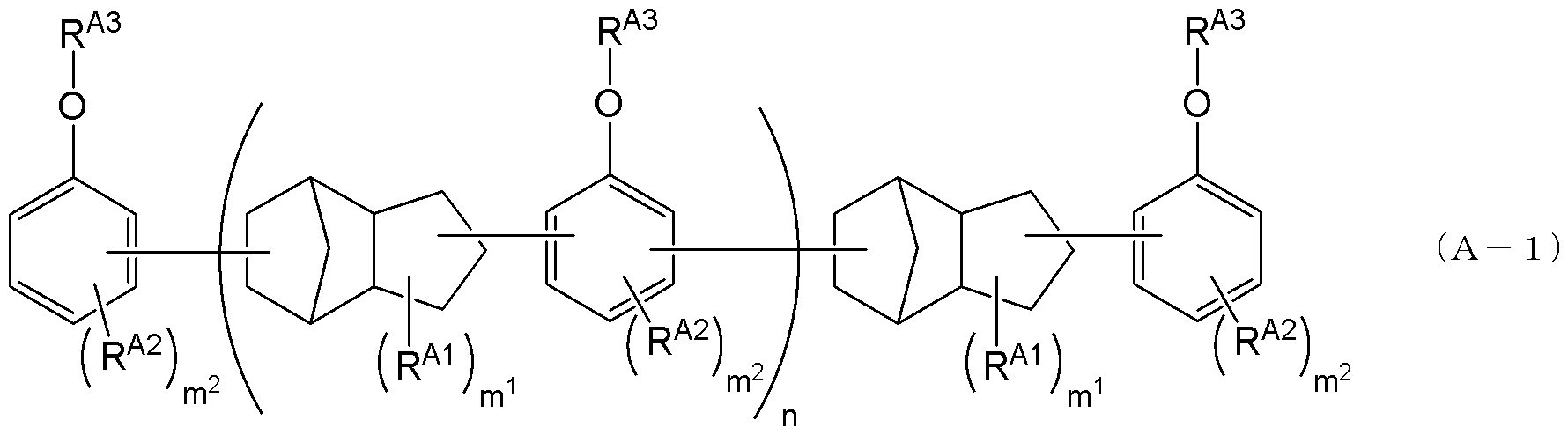
(一般式(A-1)中、RA1は炭素数1~12のアルキル基を表し、上記脂環式骨格中のどこに置換していてもよい。RA2は炭素数1~12のアルキル基を表す。RA3は、エチレン性不飽和基を有する有機基、エチレン性不飽和基及び酸性置換基を有する有機基又はグリシジル基であり、少なくとも1つのRA3はエチレン性不飽和基及び酸性置換基を有する有機基である。m1は0~6の整数、m2は0~3の整数である。nは0~10である。) - 前記(A1)エチレン性不飽和基と共に酸性置換基及び脂環式骨格を有する光重合性化合物において、前記酸性置換基が、カルボキシル基、スルホン酸基及びフェノール性水酸基からなる群から選択される少なくとも1種である、請求項1~7のいずれか1項に記載の感光性樹脂組成物。
- さらに(C)熱硬化性樹脂を含有する、請求項1~8のいずれか1項に記載の感光性樹脂組成物。
- さらに(D)エラストマを含有する、請求項1~9のいずれか1項に記載の感光性樹脂組成物。
- 前記(D)エラストマが、スチレン系エラストマ、オレフィン系エラストマ、ポリエステル系エラストマ、ウレタン系エラストマ、ポリアミド系エラストマ、アクリル系エラストマ及びシリコーン系エラストマからなる群から選択される少なくとも1種を含む、請求項1~10のいずれか1項に記載の感光性樹脂組成物。
- さらに(F)無機充填材を含有する、請求項1~11のいずれか1項に記載の感光性樹脂組成物。
- 請求項1~12のいずれか1項に記載の感光性樹脂組成物からなる、フォトビア形成用感光性樹脂組成物。
- 請求項1~12のいずれか1項に記載の感光性樹脂組成物からなる、層間絶縁層用感光性樹脂組成物。
- 請求項1~12のいずれか1項に記載の感光性樹脂組成物からなる、感光性樹脂フィルム。
- 請求項1~12のいずれか1項に記載の感光性樹脂組成物からなる、層間絶縁層用感光性樹脂フィルム。
- 請求項1~12のいずれか1項に記載の感光性樹脂組成物を用いて形成される層間絶縁層を含有してなる多層プリント配線板。
- 請求項15に記載の感光性樹脂フィルムを用いて形成される層間絶縁層を含有してなる多層プリント配線板。
- 請求項17又は18に記載の多層プリント配線板に半導体素子を搭載してなる半導体パッケージ。
- 下記工程(1)~(4)を有する、多層プリント配線板の製造方法。
工程(1):請求項15に記載の感光性樹脂フィルムを、回路基板の片面又は両面にラミネートする工程。
工程(2):前記工程(1)でラミネートされた感光性樹脂フィルムに対して露光及び現像することによって、ビアを有する層間絶縁層を形成する工程。
工程(3):前記ビア及び前記層間絶縁層を粗化処理する工程。
工程(4):前記層間絶縁層上に回路パターンを形成する工程。
Priority Applications (10)
| Application Number | Priority Date | Filing Date | Title |
|---|---|---|---|
| CN201980094348.2A CN113597580B (zh) | 2019-05-31 | 2019-05-31 | 感光性树脂组合物、感光性树脂膜、多层印刷配线板和半导体封装体、以及多层印刷配线板的制造方法 |
| KR1020217029946A KR102797795B1 (ko) | 2019-05-31 | 2019-05-31 | 감광성 수지 조성물, 감광성 수지 필름, 다층 프린트 배선판 및 반도체 패키지, 및 다층 프린트 배선판의 제조 방법 |
| PCT/JP2019/021804 WO2020240848A1 (ja) | 2019-05-31 | 2019-05-31 | 感光性樹脂組成物、感光性樹脂フィルム、多層プリント配線板及び半導体パッケージ、並びに多層プリント配線板の製造方法 |
| US17/440,238 US20220179308A1 (en) | 2019-05-31 | 2019-05-31 | Photosensitive resin composition, photosensitive resin film, multilayer printed wiring board, semiconductor package, and method for producing multilayer printed wiring board |
| JP2021522585A JPWO2020240848A1 (ja) | 2019-05-31 | 2019-05-31 | |
| KR1020257006161A KR20250035021A (ko) | 2019-05-31 | 2019-05-31 | 감광성 수지 조성물, 감광성 수지 필름, 다층 프린트 배선판 및 반도체 패키지, 및 다층 프린트 배선판의 제조 방법 |
| TW109114776A TWI892987B (zh) | 2019-05-31 | 2020-05-04 | 感光性樹脂組成物、感光性樹脂薄膜、多層印刷線路板及半導體封裝體、以及多層印刷線路板的製造方法 |
| TW113104671A TWI893642B (zh) | 2019-05-31 | 2020-05-04 | 感光性樹脂組成物、感光性樹脂薄膜、多層印刷線路板及半導體封裝體、以及多層印刷線路板的製造方法 |
| JP2024003360A JP2024028474A (ja) | 2019-05-31 | 2024-01-12 | 感光性樹脂組成物、感光性樹脂フィルム、多層プリント配線板及び半導体パッケージ、並びに多層プリント配線板の製造方法 |
| JP2025079891A JP2025109835A (ja) | 2019-05-31 | 2025-05-12 | 感光性樹脂組成物、感光性樹脂フィルム、多層プリント配線板及び半導体パッケージ、並びに多層プリント配線板の製造方法 |
Applications Claiming Priority (1)
| Application Number | Priority Date | Filing Date | Title |
|---|---|---|---|
| PCT/JP2019/021804 WO2020240848A1 (ja) | 2019-05-31 | 2019-05-31 | 感光性樹脂組成物、感光性樹脂フィルム、多層プリント配線板及び半導体パッケージ、並びに多層プリント配線板の製造方法 |
Publications (1)
| Publication Number | Publication Date |
|---|---|
| WO2020240848A1 true WO2020240848A1 (ja) | 2020-12-03 |
Family
ID=73553702
Family Applications (1)
| Application Number | Title | Priority Date | Filing Date |
|---|---|---|---|
| PCT/JP2019/021804 Ceased WO2020240848A1 (ja) | 2019-05-31 | 2019-05-31 | 感光性樹脂組成物、感光性樹脂フィルム、多層プリント配線板及び半導体パッケージ、並びに多層プリント配線板の製造方法 |
Country Status (6)
| Country | Link |
|---|---|
| US (1) | US20220179308A1 (ja) |
| JP (3) | JPWO2020240848A1 (ja) |
| KR (2) | KR102797795B1 (ja) |
| CN (1) | CN113597580B (ja) |
| TW (2) | TWI893642B (ja) |
| WO (1) | WO2020240848A1 (ja) |
Families Citing this family (4)
| Publication number | Priority date | Publication date | Assignee | Title |
|---|---|---|---|---|
| US10957807B2 (en) * | 2017-04-19 | 2021-03-23 | The Board Of Trustees Of The University Of Alabama | PLZT thin film capacitors apparatus with enhanced photocurrent and power conversion efficiency and method thereof |
| JP7363105B2 (ja) * | 2019-05-31 | 2023-10-18 | 株式会社レゾナック | 感光性樹脂組成物、感光性樹脂フィルム、プリント配線板及び半導体パッケージ、並びにプリント配線板の製造方法 |
| TWI836568B (zh) * | 2022-08-23 | 2024-03-21 | 嘉聯益科技股份有限公司 | 具導通孔之電路板線路結構的製作方法及所製成的具導通孔之電路板線路結構 |
| CN115216117B (zh) * | 2022-09-21 | 2022-12-16 | 深圳市板明科技股份有限公司 | 一种线路板用改性塞孔树脂及其制备方法 |
Citations (5)
| Publication number | Priority date | Publication date | Assignee | Title |
|---|---|---|---|---|
| JP2010266556A (ja) * | 2009-05-13 | 2010-11-25 | Tamura Seisakusho Co Ltd | 感光性樹脂組成物、プリント配線板用のソルダーレジスト組成物およびプリント配線板 |
| JP2011227460A (ja) * | 2010-03-30 | 2011-11-10 | Fujifilm Corp | 感光性組成物 |
| JP2017161859A (ja) * | 2016-03-11 | 2017-09-14 | 山栄化学株式会社 | アルカリ現像型ソルダーレジストインキ及びそのプリント配線板加工法とその配線板 |
| WO2018101314A1 (ja) * | 2016-12-02 | 2018-06-07 | 三菱ケミカル株式会社 | 着色感光性樹脂組成物、顔料分散液、隔壁、有機電界発光素子、画像表示装置及び照明 |
| JP2019066792A (ja) * | 2017-10-05 | 2019-04-25 | 日立化成株式会社 | 感光性樹脂組成物、感光性エレメント及びプリント配線板とその製造方法 |
Family Cites Families (10)
| Publication number | Priority date | Publication date | Assignee | Title |
|---|---|---|---|---|
| JP3290296B2 (ja) | 1994-05-13 | 2002-06-10 | 太陽インキ製造株式会社 | 多層プリント配線板及びその製造方法 |
| JPH101596A (ja) * | 1996-06-19 | 1998-01-06 | Dainippon Ink & Chem Inc | 多層プリント配線板用層間電気絶縁材料 |
| JP2000321765A (ja) * | 1999-05-13 | 2000-11-24 | Showa Highpolymer Co Ltd | 感光性樹脂組成物 |
| TW200303895A (en) * | 2002-03-06 | 2003-09-16 | Hitachi Chemical Co Ltd | Photosensitive resin composition |
| JP6061576B2 (ja) * | 2012-09-10 | 2017-01-18 | 株式会社タムラ製作所 | 感光性樹脂組成物及び感光性樹脂組成物の硬化被膜を有するプリント配線板 |
| WO2014136897A1 (ja) * | 2013-03-07 | 2014-09-12 | 日立化成株式会社 | 感光性樹脂組成物、それを用いたドライフィルム、プリント配線板、及びプリント配線板の製造方法 |
| JP6652338B2 (ja) * | 2015-06-30 | 2020-02-19 | 太陽ホールディングス株式会社 | 光硬化性熱硬化性樹脂組成物、その硬化物、およびプリント配線板 |
| KR101822144B1 (ko) | 2016-04-11 | 2018-01-26 | 덕양산업 주식회사 | 자동차 부품용 폴리올레핀계 복합 수지 조성물 |
| JP2018138968A (ja) * | 2017-02-24 | 2018-09-06 | 日立化成株式会社 | 感光性樹脂組成物、それを用いた感光性エレメント、半導体装置、及び半導体装置の製造方法 |
| JP6845469B2 (ja) * | 2017-02-27 | 2021-03-17 | 三菱ケミカル株式会社 | 画像表示装置用着色硬化膜、画像表示装置用感光性着色組成物及び画像表示装置 |
-
2019
- 2019-05-31 KR KR1020217029946A patent/KR102797795B1/ko active Active
- 2019-05-31 US US17/440,238 patent/US20220179308A1/en active Pending
- 2019-05-31 WO PCT/JP2019/021804 patent/WO2020240848A1/ja not_active Ceased
- 2019-05-31 CN CN201980094348.2A patent/CN113597580B/zh active Active
- 2019-05-31 KR KR1020257006161A patent/KR20250035021A/ko active Pending
- 2019-05-31 JP JP2021522585A patent/JPWO2020240848A1/ja active Pending
-
2020
- 2020-05-04 TW TW113104671A patent/TWI893642B/zh active
- 2020-05-04 TW TW109114776A patent/TWI892987B/zh active
-
2024
- 2024-01-12 JP JP2024003360A patent/JP2024028474A/ja active Pending
-
2025
- 2025-05-12 JP JP2025079891A patent/JP2025109835A/ja active Pending
Patent Citations (5)
| Publication number | Priority date | Publication date | Assignee | Title |
|---|---|---|---|---|
| JP2010266556A (ja) * | 2009-05-13 | 2010-11-25 | Tamura Seisakusho Co Ltd | 感光性樹脂組成物、プリント配線板用のソルダーレジスト組成物およびプリント配線板 |
| JP2011227460A (ja) * | 2010-03-30 | 2011-11-10 | Fujifilm Corp | 感光性組成物 |
| JP2017161859A (ja) * | 2016-03-11 | 2017-09-14 | 山栄化学株式会社 | アルカリ現像型ソルダーレジストインキ及びそのプリント配線板加工法とその配線板 |
| WO2018101314A1 (ja) * | 2016-12-02 | 2018-06-07 | 三菱ケミカル株式会社 | 着色感光性樹脂組成物、顔料分散液、隔壁、有機電界発光素子、画像表示装置及び照明 |
| JP2019066792A (ja) * | 2017-10-05 | 2019-04-25 | 日立化成株式会社 | 感光性樹脂組成物、感光性エレメント及びプリント配線板とその製造方法 |
Also Published As
| Publication number | Publication date |
|---|---|
| KR20220016451A (ko) | 2022-02-09 |
| TWI893642B (zh) | 2025-08-11 |
| JPWO2020240848A1 (ja) | 2020-12-03 |
| TW202436376A (zh) | 2024-09-16 |
| TWI892987B (zh) | 2025-08-11 |
| TW202104282A (zh) | 2021-02-01 |
| CN113597580A (zh) | 2021-11-02 |
| KR20250035021A (ko) | 2025-03-11 |
| JP2024028474A (ja) | 2024-03-04 |
| JP2025109835A (ja) | 2025-07-25 |
| KR102797795B1 (ko) | 2025-04-23 |
| CN113597580B (zh) | 2024-08-02 |
| US20220179308A1 (en) | 2022-06-09 |
Similar Documents
| Publication | Publication Date | Title |
|---|---|---|
| JP7567969B2 (ja) | 感光性樹脂組成物、感光性樹脂フィルム、多層プリント配線板、半導体パッケージ、及び多層プリント配線板の製造方法 | |
| CN113632004B (zh) | 感光性树脂组合物、感光性树脂膜、多层印刷配线板和半导体封装体、以及多层印刷配线板的制造方法 | |
| JP2025109835A (ja) | 感光性樹脂組成物、感光性樹脂フィルム、多層プリント配線板及び半導体パッケージ、並びに多層プリント配線板の製造方法 | |
| JP7501710B2 (ja) | 感光性樹脂組成物、感光性樹脂フィルム、多層プリント配線板及び半導体パッケージ、並びに多層プリント配線板の製造方法及び感光性樹脂組成物の製造方法 | |
| JP7683174B2 (ja) | 感光性樹脂組成物、感光性樹脂フィルム、多層プリント配線板及び半導体パッケージ、並びに多層プリント配線板の製造方法 | |
| JP7831289B2 (ja) | 感光性樹脂組成物、感光性樹脂フィルム、多層プリント配線板及び半導体パッケージ、並びに多層プリント配線板の製造方法 | |
| JP7497608B2 (ja) | 感光性樹脂組成物、感光性樹脂フィルム、多層プリント配線板及び半導体パッケージ、並びに多層プリント配線板の製造方法 | |
| JP7251323B2 (ja) | 感光性樹脂組成物、感光性樹脂フィルム、多層プリント配線板、半導体パッケージ、及び多層プリント配線板の製造方法 | |
| TWI862816B (zh) | 感光性樹脂組成物、感光性樹脂膜、多層印刷配線板和半導體封裝、以及多層印刷配線板的製造方法 | |
| TWI895452B (zh) | 感光性樹脂組成物、感光性樹脂膜、多層印刷配線板及半導體封裝、以及多層印刷配線板的製造方法 | |
| JP7622353B2 (ja) | 感光性樹脂組成物、感光性樹脂フィルム、多層プリント配線板及び半導体パッケージ、並びに多層プリント配線板の製造方法 | |
| KR102959152B1 (ko) | 감광성 수지 조성물, 감광성 수지 필름, 다층 프린트 배선판 및 반도체 패키지, 및 다층 프린트 배선판의 제조 방법 | |
| JP2024040191A (ja) | 感光性樹脂組成物、感光性樹脂フィルム、多層プリント配線板及び半導体パッケージ、並びに多層プリント配線板の製造方法 |
Legal Events
| Date | Code | Title | Description |
|---|---|---|---|
| 121 | Ep: the epo has been informed by wipo that ep was designated in this application |
Ref document number: 19930364 Country of ref document: EP Kind code of ref document: A1 |
|
| ENP | Entry into the national phase |
Ref document number: 2021522585 Country of ref document: JP Kind code of ref document: A |
|
| NENP | Non-entry into the national phase |
Ref country code: DE |
|
| 32PN | Ep: public notification in the ep bulletin as address of the adressee cannot be established |
Free format text: NOTING OF LOSS OF RIGHTS PURSUANT TO RULE 112(1) EPC (EPO FORM 1205A DATED 10/03/2022) |
|
| 122 | Ep: pct application non-entry in european phase |
Ref document number: 19930364 Country of ref document: EP Kind code of ref document: A1 |
|
| WWP | Wipo information: published in national office |
Ref document number: 1020257006161 Country of ref document: KR |