WO2020213641A1 - 光応答性ポリビニルエーテル化合物および光可逆接着剤 - Google Patents
光応答性ポリビニルエーテル化合物および光可逆接着剤 Download PDFInfo
- Publication number
- WO2020213641A1 WO2020213641A1 PCT/JP2020/016564 JP2020016564W WO2020213641A1 WO 2020213641 A1 WO2020213641 A1 WO 2020213641A1 JP 2020016564 W JP2020016564 W JP 2020016564W WO 2020213641 A1 WO2020213641 A1 WO 2020213641A1
- Authority
- WO
- WIPO (PCT)
- Prior art keywords
- adhesive
- photoreversible
- sample
- photoresponsive
- less
- Prior art date
- Legal status (The legal status is an assumption and is not a legal conclusion. Google has not performed a legal analysis and makes no representation as to the accuracy of the status listed.)
- Ceased
Links
- JBEJCKHKQWNFRA-FOCLMDBBSA-N Cc(cc1)ccc1/N=N/c(cc1)ccc1OC Chemical compound Cc(cc1)ccc1/N=N/c(cc1)ccc1OC JBEJCKHKQWNFRA-FOCLMDBBSA-N 0.000 description 1
Images







Classifications
-
- C—CHEMISTRY; METALLURGY
- C08—ORGANIC MACROMOLECULAR COMPOUNDS; THEIR PREPARATION OR CHEMICAL WORKING-UP; COMPOSITIONS BASED THEREON
- C08F—MACROMOLECULAR COMPOUNDS OBTAINED BY REACTIONS ONLY INVOLVING CARBON-TO-CARBON UNSATURATED BONDS
- C08F16/00—Homopolymers and copolymers of compounds having one or more unsaturated aliphatic radicals, each having only one carbon-to-carbon double bond, and at least one being terminated by an alcohol, ether, aldehydo, ketonic, acetal or ketal radical
- C08F16/12—Homopolymers and copolymers of compounds having one or more unsaturated aliphatic radicals, each having only one carbon-to-carbon double bond, and at least one being terminated by an alcohol, ether, aldehydo, ketonic, acetal or ketal radical by an ether radical
- C08F16/14—Monomers containing only one unsaturated aliphatic radical
- C08F16/28—Monomers containing nitrogen
-
- C—CHEMISTRY; METALLURGY
- C09—DYES; PAINTS; POLISHES; NATURAL RESINS; ADHESIVES; COMPOSITIONS NOT OTHERWISE PROVIDED FOR; APPLICATIONS OF MATERIALS NOT OTHERWISE PROVIDED FOR
- C09J—ADHESIVES; NON-MECHANICAL ASPECTS OF ADHESIVE PROCESSES IN GENERAL; ADHESIVE PROCESSES NOT PROVIDED FOR ELSEWHERE; USE OF MATERIALS AS ADHESIVES
- C09J129/00—Adhesives based on homopolymers or copolymers of compounds having one or more unsaturated aliphatic radicals, each having only one carbon-to-carbon double bond, and at least one being terminated by an alcohol, ether, aldehydo, ketonic, acetal, or ketal radical; Adhesives based on hydrolysed polymers of esters of unsaturated alcohols with saturated carboxylic acids; Adhesives based on derivatives of such polymers
- C09J129/10—Homopolymers or copolymers of unsaturated ethers
-
- C—CHEMISTRY; METALLURGY
- C09—DYES; PAINTS; POLISHES; NATURAL RESINS; ADHESIVES; COMPOSITIONS NOT OTHERWISE PROVIDED FOR; APPLICATIONS OF MATERIALS NOT OTHERWISE PROVIDED FOR
- C09J—ADHESIVES; NON-MECHANICAL ASPECTS OF ADHESIVE PROCESSES IN GENERAL; ADHESIVE PROCESSES NOT PROVIDED FOR ELSEWHERE; USE OF MATERIALS AS ADHESIVES
- C09J5/00—Adhesive processes in general; Adhesive processes not provided for elsewhere, e.g. relating to primers
-
- C—CHEMISTRY; METALLURGY
- C08—ORGANIC MACROMOLECULAR COMPOUNDS; THEIR PREPARATION OR CHEMICAL WORKING-UP; COMPOSITIONS BASED THEREON
- C08F—MACROMOLECULAR COMPOUNDS OBTAINED BY REACTIONS ONLY INVOLVING CARBON-TO-CARBON UNSATURATED BONDS
- C08F293/00—Macromolecular compounds obtained by polymerisation on to a macromolecule having groups capable of inducing the formation of new polymer chains bound exclusively at one or both ends of the starting macromolecule
Definitions
- the present application relates to a photoresponsive polyvinyl ether compound that changes to a softened state and a cured state by light irradiation, and a photoreversible adhesive containing this photoresponsive polyvinyl ether compound as an active ingredient.
- a liquid crystal azobenzene compound which is a single molecule of a sugar alcohol derivative having a molecular weight of several thousand, is known as a material that is reversibly softened and cured by irradiating with ultraviolet light and visible light (Patent Document 1, non-patent document 1, non-patent document 1, non-patent document 1. Patent Document 1 and Non-Patent Document 2). Further, as such other materials, a liquid crystal azobenzene compound which is a poly (meth) acrylate derivative having an average molecular weight of several thousand to tens of thousands is also known (Patent Document 2, Non-Patent Document 3, and Non-Patent Document). 4).
- a photoreversible adhesive that can be reversibly bonded and peeled by light irradiation.
- a general adhesive heat or stress is applied to the base material, the adhesive, or the object to be adhered to peel the object to be adhered from the base material, so that the base material and the object to be adhered are loaded.
- this photoreversible adhesive is used, the object to be adhered can be peeled off without damaging the base material, so that the base material, the photoreversible adhesive, and the object to be adhered can be reused.
- the liquid crystal azobenzene compound having a sugar alcohol skeleton has a small adhesive force, for example, the adhesive force to glass is 50 N / cm 2 . Therefore, a poly (meth) acrylate derivative, which is a polymer compound, has been developed. However, the heat resistance of this poly (meth) acrylate derivative is 50 ° C. at the maximum, and it cannot be used for adhesion where heat resistance is required.
- Patent Document 3 describes a material in which poly (glycidyl methacrylate) is used as a main chain skeleton and a hydrogen-bonding hydroxyl group is introduced into the main chain skeleton. The heat resistance of this material is improved up to 80 ° C. However, this material does not sufficiently soften when irradiated with ultraviolet light, and it is difficult for the adherend to be adhered to or peeled off from the base material by light irradiation.
- An object of the present application is to provide a photoreversible adhesive that can maintain adhesive strength even at high temperatures and can be reversibly bonded and peeled by light irradiation.
- a polymer liquid crystal compound having a poly (vinyl ether) skeleton in the main chain and azobenzene in the side chain can maintain adhesive strength up to 100 ° C. and is below the heat resistant temperature.
- the present invention was completed by finding that it is reversibly softened and cured by light irradiation.
- the photoresponsive polyvinyl ether compound of the present application is represented by the following general formula (1).
- x is an integer of 1 or more and 20 or less
- y is an integer of 0 or more and 20 or less
- n is 2 or more.
- the method for producing a photoresponsive polyvinyl ether compound of the present application includes a polymerization step of polymerizing a compound represented by the following general formula (2).
- x is an integer of 1 or more and 20 or less
- y is an integer of 0 or more and 20 or less.
- the photoreversible adhesive of the present application contains the photoresponsive polyvinyl ether compound of the present application as an active ingredient.
- the other photoreversible adhesive of the present application includes a plurality of functional blocks composed of the photoresponsive polyvinyl ether compound of the present application and a bonding block composed of a polymer compound and joining the plurality of functional blocks. It has a copolymer and has a film shape.
- the method for peeling the adherend of the present application is a method of peeling the adherend adhered to the base material via the photoreversible adhesive of the present application from the base material, and the light of the first wavelength is applied to the photoreversible adhesive. It has a peeling step of irradiating the adhesive to soften the photoreversible adhesive and separating the adherend from the substrate.
- the method of adhering the adherend of the present application is a method of adhering the adherend to the base material via the photoreversible adhesive of the present application, and is a photoreversible adhesive in a softened state between the base material and the adherend. It has an bonding step of irradiating the photoreversible adhesive with light of a second wavelength to cure the photoreversible adhesive and attaching the object to be adhered to the substrate.
- a photoresponsive polyvinyl ether compound having heat resistance and capable of being reversibly cured and softened by light irradiation a method for producing this compound, and using this compound as an active ingredient, reversibly by light irradiation.
- a photoreversible adhesive capable of bonding and peeling, and a method for peeling and bonding an object to be adhered using this photoreversible adhesive can be obtained.
- the photoresponsive polyvinyl ether compound of the embodiment of the present application is represented by the following general formula (1).
- x is an integer of 1 or more and 20 or less
- y is an integer of 0 or more and 20 or less
- n is 2 or more.
- x is preferably 2 or more and 11 or less, and more preferably 6 or more and 11 or less. This is because the adhesive strength is greatly reduced by the irradiation with ultraviolet light.
- y is preferably 0 or more and 8 or less, and more preferably 0 or more and 4 or less.
- the weight average molecular weight of the photoresponsive polyvinyl ether compound of the present embodiment is preferably 1000 or more and 100,000 or less.
- the method for producing a photoresponsive polyvinyl ether compound according to the embodiment of the present application includes a polymerization step of polymerizing the following general formula (2).
- x is an integer of 1 or more and 20 or less
- y is an integer of 0 or more and 20 or less. It is preferable that x is 2 or more and 11 or less. It is preferable that y is 0 or more and 4 or less.
- the photoreversible adhesive of the embodiment of the present application contains the photoresponsive polyvinyl ether compound of the present embodiment as a main component.
- This photoresponsive polyvinyl ether compound is an active ingredient of the photoreversible adhesive of the present embodiment. That is, the photoresponsive polyvinyl ether compound of the present embodiment exhibits a photoreversible adhesive function.
- the photoreversible adhesive includes a plurality of functional blocks composed of the photoresponsive polyvinyl ether compound of the present embodiment and a block including a bonding block composed of a polymer compound and joining the plurality of functional blocks. It may have a polymer and have a film shape. Photoreversible adhesives with a film shape are easy to use.
- the polymer compound constituting the bonding block is preferably a polymer having a glass transition point and a melting point of 20 ° C. or less and being liquid or plastically deformable at room temperature.
- the polymer compound constituting the bonding block include polyalkylene oxide, polysiloxane, polyalkyl vinyl ether, and a part of polyacrylic acid ester. Since the functional blocks are joined by such a joining block, this photoreversible adhesive having the functional block and the joining block can be formed into a film. Further, by raising the glass transition temperature, softening point, or melting point of the polymer compound constituting the functional block, heat resistance can be imparted to this photoreversible adhesive.
- This block copolymer is represented by, for example, the following chemical formula, where A is the functional block and B is the bonding block.
- the photoreversible adhesive of the present embodiment contains a solvent such as acetone, a tackifier such as terpene resin, a diluent such as liquid petroleum-derived resin, calcium carbonate, silica and the like. Fillers (bulking agents), thickeners such as methylcellulose and vinyl alcohol, plasticizers such as adipates, pigments such as titanium oxide, flame retardants such as aluminum hydroxide, and antioxidants such as phosphines. It may be contained.
- a solvent such as acetone
- a tackifier such as terpene resin
- a diluent such as liquid petroleum-derived resin, calcium carbonate, silica and the like.
- Fillers bulkeners
- thickeners such as methylcellulose and vinyl alcohol
- plasticizers such as adipates
- pigments such as titanium oxide
- flame retardants such as aluminum hydroxide
- antioxidants such as phosphines. It may be contained.
- the photoreversible adhesive of the present embodiment reversibly causes softening that occurs when light of the first wavelength is irradiated and hardening that occurs when light of a second wavelength different from the first wavelength is irradiated.
- the softening includes not only changing the cured product into, for example, a softened product having fluidity, but also liquefying the solid into a liquid.
- curing includes, for example, solidification in which a softened body having fluidity is changed to a hardened body and a liquid is changed to a solid.
- the first wavelength is, for example, 300 nm or more and 400 nm or less
- the second wavelength is, for example, 400 nm or more and 600 nm or less.
- the method for peeling the adherend according to the embodiment of the present application is to peel the adherend adhered to the base material via the photoreversible adhesive of the present embodiment.
- This method of peeling the adherend includes a peeling step.
- the photoreversible adhesive is irradiated with light of the first wavelength to soften the photoreversible adhesive and separate the adherend from the substrate.
- the adherend is adhered to the base material via the photoreversible adhesive of the present embodiment.
- This method of adhering the object to be adhered includes an adhering step.
- a softened photoreversible adhesive is placed between the base material and the adherend, and the photoreversible adhesive is irradiated with light of a second wavelength to cure the photoreversible adhesive to cure the adherend. Is attached to the base material.
- this bonding step and this peeling step may be repeated.
- the amount of light exposed in the bonding step and the peeling step is preferably 0.1 to 200 J / cm 2 .
- Example 1 Synthesis of 4- (4-butylphenylazo) phenoxyethyl vinyl ether According to the following chemical reaction formula, 4- (4-butylphenylazo) phenoxyethyl vinyl ether, which is a compound represented by the above formula (2), ( Hereinafter, it may be described as “M (2: 4)”).
- Example 2 Synthesis of 4- (4-butylphenylazo) phenoxyundecyl vinyl ether 4- (4-butylphenylazo) phenoxyundecyl, which is a compound represented by the above formula (2), according to the following chemical reaction formula.
- Vinyl ether (hereinafter sometimes referred to as "M (11: 4)) was synthesized. The synthesis of compounds with similar skeletons has already been reported (Macromolecules, 29, 6730-6736 (1996)).
- Example 3 Synthesis of 4- (4-butylphenylazo) phenoxyhexyl vinyl ether According to the following chemical reaction formula, 4- (4-butylphenylazo) phenoxyhexyl vinyl ether, which is a compound represented by the above formula (2), ( Hereinafter, it may be described as “M (6: 4)”).
- Example 4 Synthesis of 4- (phenylazo) phenoxyundecyl vinyl ether According to the following chemical reaction formula, 4- (phenylazo) phenoxyundecyl vinyl ether, which is a compound represented by the above formula (2) (hereinafter, "M (11: 11:)" 0) ”may be described).
- Example 5 Synthesis of 4- (phenylazo) phenoxyhexyl vinyl ether According to the following chemical reaction formula, 4- (phenylazo) phenoxyhexyl vinyl ether, which is a compound represented by the above formula (2) (hereinafter, “M (6: 0)) ”) was synthesized.
- Example 6 Synthesis of photoresponsive polyvinyl ether compound M (2: 4) is polymerized according to the following chemical reaction formula, and poly (4- (4-butyl 4-butyl), which is a compound represented by the above formula (1), is polymerized. Phenylazo) phenoxyethyl vinyl ether) (hereinafter sometimes referred to as “PM (2: 4)”) was synthesized.
- Poly (4- (4-butylphenylazo) phenoxyhexyl vinyl ether) hereinafter sometimes referred to as "PM (6: 4)
- poly (4- (4- (4- (4-) ) are obtained by polymerizing 11: 0), respectively.
- butylphenylazo) phenoxyundecyl vinyl ether (hereinafter sometimes referred to as "PM (11: 4)"), poly (4- (phenylazo) phenoxyhexyl vinyl ether) (hereinafter referred to as “PM (6: 0)” (Sometimes) and poly (4- (phenylazo) phenoxyundecyl vinyl ether) (hereinafter sometimes referred to as “PM (11: 0)”) were synthesized.
- the polymerization was carried out by appropriately changing the ratio of the n-butyl vinyl ether-acetic acid adduct, which is a polymerization initiator, to the monomer.
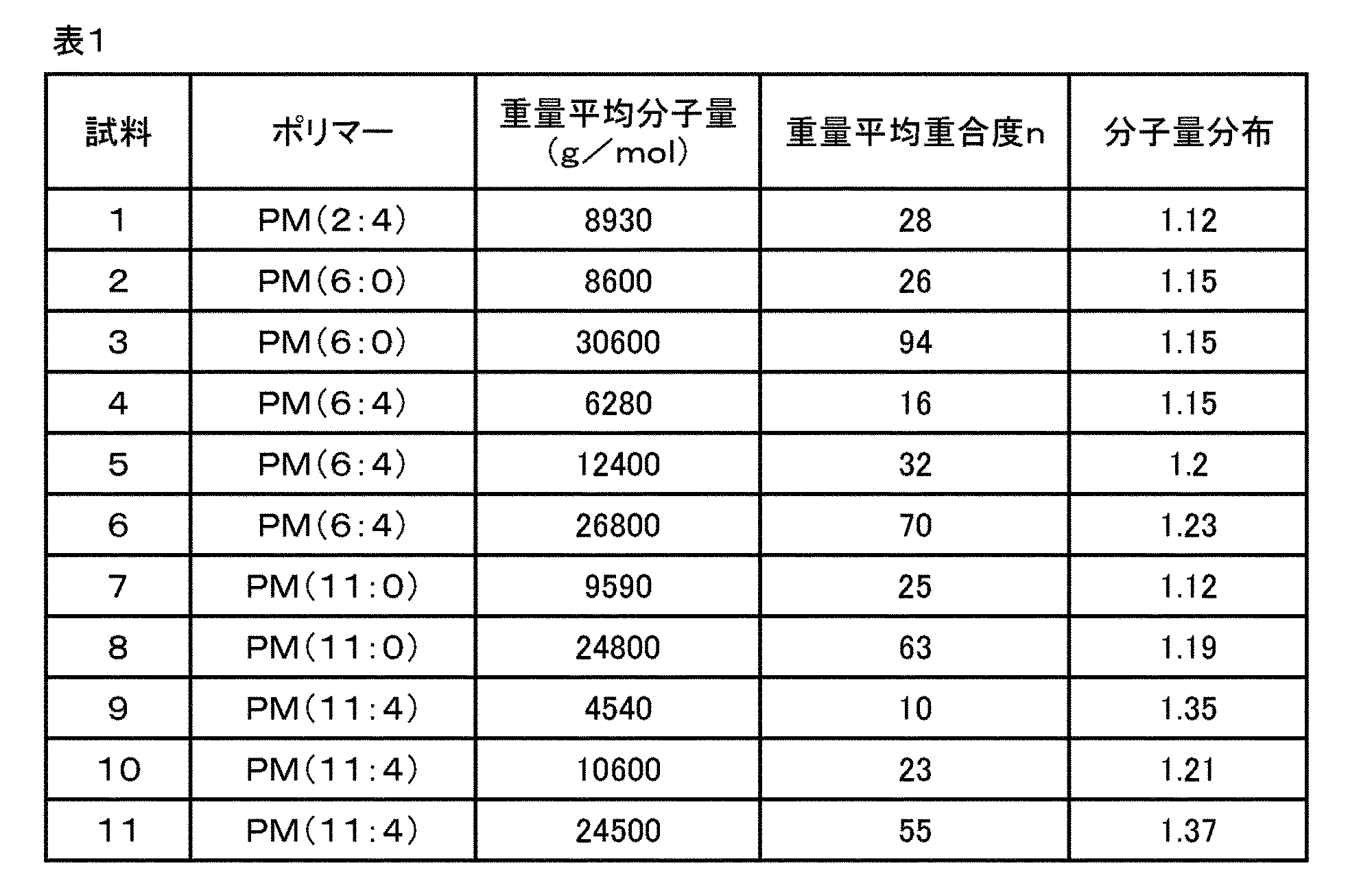
- the results are shown in Table 1.
- photoresponsive polyvinyl ether compounds having a weight average molecular weight of about 4.5 ⁇ 10 3 to about 30 ⁇ 10 3 were obtained.
- Example 7 Thermal Properties of Photoresponsive Polyvinyl Ether Compound Differential scanning calorimetry (DSC, temperature rise at 10 ° C./min) and X-ray diffraction for Sample 1, Sample 2, Sample 6, Sample 8, and Sample 11.
- the thermal properties and phase structure were investigated by (XRD). The result is shown in FIG.
- Sample 1 was in a liquid crystal glass state at room temperature, and changed to a liquid crystal state and an isotropic liquid state at about 120 ° C. and 140 ° C., respectively.
- Sample 2 was in a liquid crystal glass state at room temperature, and showed a glass transition at 57 ° C. and a liquid crystal phase-isotropic phase transition at around 74 ° C.
- Sample 6 was in a crystalline state at room temperature, and changed to an isotropic liquid state through a glass transition at 97 ° C. and crystal melting at 117 ° C.
- Sample 8 was in a crystalline state at room temperature, transitioned to a liquid crystal phase at around 75 ° C., and transitioned to an isotropic liquid at 104 ° C.
- Sample 11 was in a liquid crystal glass state at room temperature, and changed to an isotropic liquid state at 124 ° C. through a glass transition at 60 ° C. and a liquid crystal-liquid crystal transition at 88 ° C. Therefore, PM (2: 4), PM (6: 0), and PM (11: 4) are liquid crystalline amorphous polymers, and PM (6: 4) and PM (11: 0) are crystalline polymers. is there.
- Example 8 Observation of curing and softening of the photoresponsive polyvinyl ether compound by light irradiation Weigh 1 mg each of the 11 types of samples synthesized in Example 6 on a slide glass, and heat them to 150 ° C. or higher on a hot plate. The sample was melted. Another slide glass was superposed on the sample, and the sample was crushed and then cooled to prepare 11 composites of two slide glasses bonded by the sample. Then, at room temperature, each complex, that is, each sample was irradiated with ultraviolet light (center wavelength 365 nm, 50 mW / cm 2 , CCS LED light (HLV-24UV365-4WNRBTNJ)) for 1 minute.
- ultraviolet light center wavelength 365 nm, 50 mW / cm 2 , CCS LED light (HLV-24UV365-4WNRBTNJ)
- the slide glass could be manually displaced regardless of the weight average molecular weight of the sample. From this, it was found that PM (6: 4), PM (11: 0), and PM (11: 4) were softened by irradiation with ultraviolet light. On the other hand, the composite containing PM (2: 4) and PM (6: 0) was hard even when irradiated with ultraviolet light, and the slide glass could not be moved by hand. However, as will be described later, when PM (2: 4) and PM (6: 0) are irradiated with ultraviolet light for a long time, for example, 5 minutes or more, PM (2: 4) and PM (6: 0) are adhered. Power is reduced.
- Sample 11 was in a softened state with G ′′> G ′ under ultraviolet light irradiation. Therefore, the elastic modulus of each sample can be reduced by irradiation with ultraviolet light, and the sample having a longer methylene spacer has a greater degree of softening and a solid-liquid phase transition is possible.
- Example 9 Control of adhesive force by light irradiation of a photoresponsive polyvinyl ether compound Using Sample 1, Sample 2, Sample 6, Sample 8 and Sample 11, the adhesive force was controlled by light irradiation.
- Adhesion test pieces are obtained by sandwiching 1 to 2 mg of each sample between two glass plates (TEMPAX glass, 15 mm x 50 mm x 5 mm thick), heating and melting each sample, and then cooling to bond the two glass plates. A single wrap joint was manufactured. The adhesive area was 75 mm 2 (15 mm ⁇ 5 mm).
- adhesion test pieces were pulled in the shear direction by a tensile tester (Shimadzu Autograph AGS-10kN, load cell SLBL-500N, jig SCG-1kNA), and the maximum test force was measured.
- the shear adhesive strength which is the adhesive strength, was calculated from the maximum test force and the adhesive area.
- the four types of adhesion test pieces prepared in the same manner as above were subjected to ultraviolet light (365 nm, 50 mW / cm 2 ). Was irradiated for 15 seconds or 5 minutes, and then a tensile test was performed to calculate the shear adhesive force. The result is shown in FIG. Note that FIG. 7 shows the average value measured three times under the same conditions and its standard deviation as an error.
- the shear adhesive force under normal conditions without ultraviolet light irradiation was 3 to 5 MPa.
- the shear adhesive force decreased.
- the tendency of decrease in shear adhesive force was in good agreement with the tendency of decrease in elastic modulus in dynamic viscoelasticity measurement.
- the sample which is an adhesive
- the adhesive strength was lowered.
- the two glass plates of the adhesion test piece once peeled off were overlapped again with the softened sample sandwiched between them, and irradiated with green light. The sample was cured and the two glass plates were reattached.
- the adhesive strength also recovered to the normal adhesive strength. Therefore, adhesion and peeling could be reversibly controlled by ultraviolet light irradiation and green light irradiation.
- Example 10 Measurement of temperature range in which solid-liquid phase transition of photoresponsive polyvinyl ether compound is possible and estimation of temperature range in which adhesive strength can be maintained For sample 1, sample 2, sample 6, sample 8 and sample 11, light
- dynamic viscoelasticity measurement with variable temperature was performed. The dynamic viscoelasticity was measured using the same apparatus as in Example 8 while lowering the temperature of each temperature range at 3 ° C./min.
- sample 1 the strain was continuously changed from 30% to 0.01% at 180 ° C. to 150 ° C., and the strain was kept constant at 0.01% at 150 ° C. or lower.
- Sample 2 the strain was continuously changed from 30% to 0.01% at 130 ° C. to 60 ° C., and the strain was kept constant at 0.01% at 60 ° C. or lower.
- Sample 6 the strain was continuously changed from 30% to 0.01% at 150 ° C. to 105 ° C., and the strain was kept constant at 0.01% at 105 ° C. or lower.
- the strain was kept constant at 30% from 140 ° C. to 100 ° C., and the strain was continuously changed from 30% to 0.01% from 100 ° C. to 60 ° C. at 60 ° C. or lower.
- the strain was constant at 0.01%.
- the strain was kept constant at 30% from 140 ° C to 120 ° C, and the strain was continuously changed from 30% to 0.01% from 120 ° C to 85 ° C, and at 85 ° C or lower.
- the strain was kept constant at 0.01%.
- the frequency was set to 1 Hz at all temperatures. The results are shown in FIGS. 8 to 12.
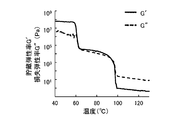
- Sample 1, Sample 2, Sample 6, Sample 8, and Sample 11 are cured at 100 ° C., 58 ° C., 100 ° C., 60 ° C., and 80 ° C. or lower, which are G'> G ′′, respectively.
- each sample can adjust the elastic modulus by light irradiation or control the softened state and cured state by light irradiation.
- the storage elastic modulus is one digit from the storage elastic modulus at room temperature of 20 ° C.
- the temperature range in which the sample does not decrease is the temperature range in which the sample can maintain the adhesive strength.
- the temperature ranges in which the sample 1, sample 2, sample 6, sample 8 and sample 11 can maintain the adhesive strength are 100 ° C. and 58 ° C., respectively.
- the temperatures were 100 ° C., 60 ° C., and 75 ° C. Therefore, below these temperatures, the sample can retain its adhesive strength and the adhesive strength of the sample can be adjusted by light irradiation.
- the adhesive containing the photoresponsive polyvinyl ether compound can maintain the adhesive strength even at a high temperature of 100 ° C.
- Example 11 Synthesis of photoresponsive polyvinyl ether-containing block copolymer A precursor of the photoresponsive polyvinyl ether-containing block copolymer was synthesized according to the following chemical reaction formula.
- Triol polypropylene glycol (molecular weight 4000 g / mol, 5 g, 1.25 mmol) dried under reduced pressure at 50 ° C. for 16 hours, sodium hydride (oil-based, content 60%, 1.5 g, 37.5 mmol), potassium iodide (catalyst) Amount) and 30 mL of dehydrated tetrahydrofuran were placed in a Schlenk flask. 2-Chloroethyl vinyl ether (7.99 g, 75.0 mmol) was added thereto, and the mixture was refluxed under an argon atmosphere for 3 days.
- Tetrahydrofuran in the reaction solution was distilled off under reduced pressure, water was added, and vinyl etherified polypropylene glycol was obtained by extraction with chloroform and drying under reduced pressure (5.25 g, yield 99%).
- 1 g of acetic acid and 1 g of tetrahydrofuran were added to 1 g of vinyl etherified polypropylene glycol, and the mixture was stirred at 60 ° C. for 4 hours.
- Chloroform was added to the reaction solution, washed with water, and dried under reduced pressure to obtain a polypropylene glycol-acetic acid adduct (sample 12) (yield 95%).
- a three-chain star-shaped photoresponsive polyvinyl ether-containing block copolymer was synthesized according to the following chemical reaction formula.
- the standard polystyrene-equivalent number average molecular weight Mn of Sample 13 was 13300, and the molecular weight distribution Mw / Mn was 1.12.
- the number average molecular weight Mn of the polypropylene glycol-acetic acid adduct (Sample 12) used as the polymerization initiator was 5780. Since a higher polymer was obtained as compared with the polymerization initiator, it was found that the sample 13 was the target triple-chain star-shaped block copolymer, that is, a photoresponsive polyvinyl ether-containing block copolymer. ..
- a chart of gel permeation chromatography of Sample 12 and Sample 13 is shown in FIG.
- a 1 H-NMR chart of sample 13 is shown in FIG.
- the weight composition ratio of polypropylene glycol and PM (6: 4) was 46:54.
- Example 12 Observation of curing and softening of the photoresponsive polyvinyl ether-containing block copolymer by light irradiation
- curing and softening of Sample 13 by ultraviolet light irradiation and green light irradiation were observed.
- the slide glass could be shifted by hand. From this, it was found that the sample 13 was softened by irradiation with ultraviolet light. Further, when the composite containing the softened sample 13 was irradiated with green light, the slide glass could not be moved by hand. From this, the sample 13 is cured by irradiation with green light.
- softening by ultraviolet light irradiation and curing by visible light irradiation were repeated 10 times or more.
- Example 13 Control of the adhesive force of the photoresponsive polyvinyl ether-containing block copolymer by light irradiation
- the adhesion test piece containing the sample 13 was pulled in the shear direction by a tensile tester, and the maximum test force was measured. The average value and standard deviation of the three tests were 0.38 ⁇ 0.07 MPa.
- the shear adhesive force was 0.01 MPa or less when calculated from the weight of the glass plate.
- the two glass plates of the adhesive test piece once peeled off were re-bonded, and the normal adhesive strength was restored. Therefore, adhesion and peeling could be reversibly controlled by ultraviolet light irradiation and green light irradiation.
Landscapes
- Chemical & Material Sciences (AREA)
- Organic Chemistry (AREA)
- Health & Medical Sciences (AREA)
- Chemical Kinetics & Catalysis (AREA)
- Medicinal Chemistry (AREA)
- Polymers & Plastics (AREA)
- Addition Polymer Or Copolymer, Post-Treatments, Or Chemical Modifications (AREA)
- Adhesives Or Adhesive Processes (AREA)
Abstract
高温でも接着力が維持でき、光照射によって可逆的に接着と剥離が可能な光可逆接着剤を提供する。光可逆接着剤は、下記一般式(1)で表される光応答性ポリビニルエーテル化合物を有効成分とする。 式(1)中、xは1以上20以下の整数で、yは0以上20以下の整数で、nは2以上である。
Description
本願は、光照射によって軟化状態と硬化状態に変化する光応答性ポリビニルエーテル化合物と、この光応答性ポリビニルエーテル化合物を有効成分とする光可逆接着剤に関する。
紫外光と可視光を照射することにより、可逆的に軟化および硬化する材料として、分子量が数千の糖アルコール誘導体の単一分子である液晶性アゾベンゼン化合物が知られている(特許文献1、非特許文献1、および非特許文献2)。また、このような他の材料として、平均分子量が数千から数万のポリ(メタ)アクリレート誘導体である液晶性アゾベンゼン化合物も知られている(特許文献2、非特許文献3、および非特許文献4)。
これらの液晶性アゾベンゼン化合物の用途として、光照射によって可逆的に接着と剥離が行える光可逆接着剤が提案されている。一般の接着剤を用いる場合、基材、接着剤、または被接着物に熱または応力を与えて被接着物を基材から剥離するため、基材および被接着物に負荷がかかる。これに対して、この光可逆接着剤を用いれば、基材を傷めることなく被接着物の剥離ができるため、基材、光可逆接着剤、および被接着物の再利用が可能となる。
しかしながら、糖アルコール骨格を有する液晶性アゾベンゼン化合物は、例えばガラスへの接着力が50N/cm2であるなど、接着力が小さい。そこで、高分子化合物であるポリ(メタ)アクリレート誘導体が開発された。しかし、このポリ(メタ)アクリレート誘導体の耐熱性は最大で50℃であり、耐熱性が求められる接着に使用できない。特許文献3には、ポリ(グリシジルメタアクリレート)を主鎖骨格として用い、この主鎖骨格に水素結合性の水酸基を導入した材料が記載されている。この材料の耐熱性は、最大80℃まで向上している。しかしながら、この材料は、紫外光照射時に十分に軟化せず、光照射によって被接着物を基材に接着したり、基材から剥離したりすることが難しい。
Advanced Materials, 24, 2353-2356 (2012).
ACS Applied Materials and Interfaces, 6, 7933-7941 (2014).
Journal of Adhesion, 93, 823-830 (2017).
Macromolecules, 51, 3243-3253 (2018).
本願の課題は、高温でも接着力が維持でき、光照射によって可逆的に接着と剥離が可能な光可逆接着剤を提供することである。
本願の発明者は、鋭意研究を重ねた結果、主鎖にポリ(ビニルエーテル)骨格を、側鎖にアゾベンゼンをそれぞれ有する高分子液晶性化合物が、最大100℃まで接着力を維持でき、耐熱温度以下で光照射によって可逆的に軟化および硬化することを見出し、本発明を完成させた。
本願の光応答性ポリビニルエーテル化合物は、下記一般式(1)で表される。

本願の光応答性ポリビニルエーテル化合物の製造方法は、下記一般式(2)で表される化合物を重合する重合工程を有する。

本願の光可逆接着剤は、本願の光応答性ポリビニルエーテル化合物を有効成分とする。本願の他の光可逆接着剤は、本願の光応答性ポリビニルエーテル化合物から構成される複数の機能性ブロックと、高分子化合物から構成され、複数の機能性ブロックを接合する接合ブロックとを含むブロック共重合体を有し、フィルム形状を備えている。
本願の被接着物の剥離方法は、本願の光可逆接着剤を介して基材に接着されている被接着物を基材から剥離する方法であって、光可逆接着剤に第一波長の光を照射して光可逆接着剤を軟化させて、被接着物を基材から離す剥離工程を有する。本願の被接着物の接着方法は、本願の光可逆接着剤を介して、基材に被接着物を接着する方法であって、基材と被接着物の間に軟化状態の光可逆接着剤を配置し、光可逆接着剤に第二波長の光を照射して光可逆接着剤を硬化させて、被接着物を基材に着ける接着工程を有する。
本願によれば、耐熱性を備え、光照射によって可逆的に硬化と軟化が可能な光応答性ポリビニルエーテル化合物と、この化合物の製造方法と、この化合物を有効成分とし、光照射によって可逆的に接着と剥離が可能な光可逆接着剤と、この光可逆接着剤を用いる被接着物の剥離方法および接着方法が得られる。
本願の実施形態の光応答性ポリビニルエーテル化合物は、下記一般式(1)で表される。

式(1)中、xは1以上20以下の整数で、yは0以上20以下の整数で、nは2以上である。xは2以上11以下であることが好ましく、6以上11以下であることがより好ましい。紫外光照射による接着力の低下が大きいからである。yは0以上8以下であることが好ましく、0以上4以下であることがより好ましい。また、本実施形態の光応答性ポリビニルエーテル化合物の重量平均分子量は、1000以上100000以下であることが好ましい。
本願の実施形態の光応答性ポリビニルエーテル化合物の製造方法は、下記一般式(2)を重合する重合工程を有する。

式(2)中、xは1以上20以下の整数で、yは0以上20以下の整数である。xは2以上11以下であることが好ましい。yは0以上4以下であることが好ましい。この重合工程によって、上記式(1)の光応答性ポリビニルエーテル化合物が得られる。なお、モノマーに対して添加する重合開始剤の量を減少させることによって、得られる光応答性ポリビニルエーテル化合物の重量平均分子量を大きくできる。
本願の実施形態の光可逆接着剤は、本実施形態の光応答性ポリビニルエーテル化合物を主成分として含有している。この光応答性ポリビニルエーテル化合物は、本実施形態の光可逆接着剤の有効成分である。つまり、本実施形態の光応答性ポリビニルエーテル化合物が光可逆接着機能を発揮する。光可逆接着剤は、本実施形態の光応答性ポリビニルエーテル化合物から構成される複数の機能性ブロックと、高分子化合物から構成され、この複数の機能性ブロックを接合する接合ブロックとを含むブロック共重合体を有し、フィルム形状を備えていてもよい。フィルム形状を備える光可逆接着剤は、使用しやすい。
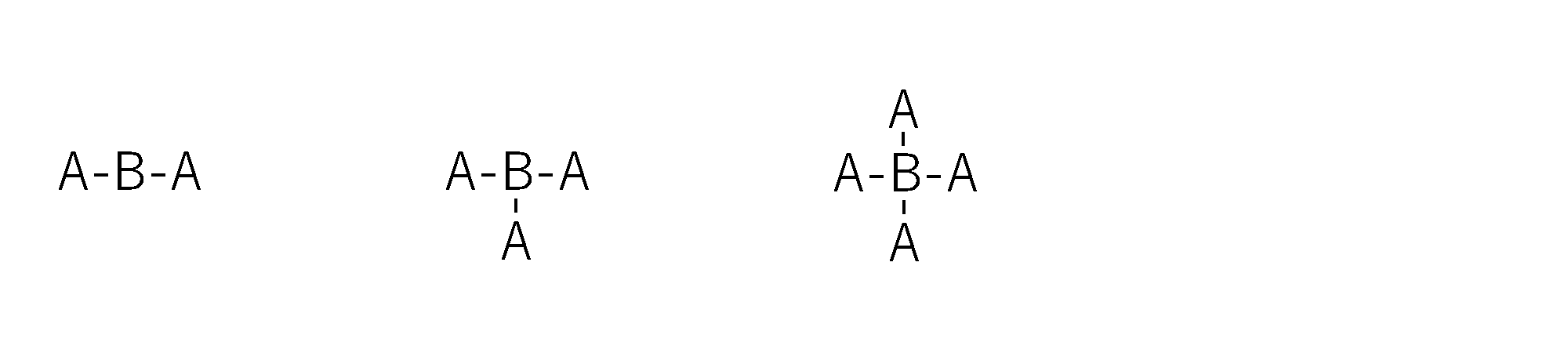
接合ブロックを構成する高分子化合物は、ガラス転移点および融点が20℃以下で、室温で液状または塑性変形可能なポリマーが好ましい。接合ブロックを構成する高分子化合物としては、ポリアルキレンオキシド、ポリシロキサン、ポリアルキルビニルエーテル、およびポリアクリル酸エステルの一部などが挙げられる。このような接合ブロックによって機能性ブロックが接合されているので、機能性ブロックと接合ブロックを有するこの光可逆接着剤は、フィルム状に成形できる。また、機能性ブロックを構成する高分子化合物のガラス転移温度、軟化点、または融点を高くすることで、この光可逆接着剤に耐熱性を付与できる。このブロック共重合体は、機能性ブロックをAと、接合ブロックをBとすると、例えば下記の化学式で表される。
本実施形態の光可逆接着剤は、有効成分の光応答性ポリビニルエーテル化合物以外に、アセトンなどの溶剤、テルペン樹脂などの粘着付与剤、液状石油由来樹脂などの希釈剤、炭酸カルシウムやシリカなどの充填剤(増量剤)、メチルセルロースやビニルアルコールなどの増粘剤、アジピン酸エステル類などの可塑剤、酸化チタンなどの顔料、水酸化アルミニウムなどの難燃剤、またはホスフィン類などの酸化防止剤などを含有していてもよい。
本実施形態の光可逆接着剤は、第一波長の光が照射されたときに起きる軟化と、第一波長と異なる第二波長の光が照射されたときに起きる硬化が可逆的に生じる。なお、軟化には、硬化体が、例えば流動性を備える軟化体に変化するだけでなく、固体が液体に変化する液化を含む。また、硬化には、例えば流動性を備える軟化体が硬化体に変化するだけでなく、液体が固体に変化する固化を含む。第一波長は、例えば300nm以上400nm以下で、第二波長は、例えば400nm以上600nm以下である。
本願の実施形態の被接着物の剥離方法は、本実施形態の光可逆接着剤を介して基材に接着されている被接着物を基材から剥離する。この被接着物の剥離方法は剥離工程を備えている。剥離工程では、この光可逆接着剤に第一波長の光を照射して光可逆接着剤を軟化させて、被接着物を基材から離す。
本願の実施形態の被接着物の接着方法は、本実施形態の光可逆接着剤を介して基材に被接着物を接着する。この被接着物の接着方法は接着工程を備えている。接着工程では、基材と被接着物の間に軟化状態の光可逆接着剤を配置し、光可逆接着剤に第二波長の光を照射して光可逆接着剤を硬化させて、被接着物を基材に着ける。本実施形態の光可逆接着剤を用いて、この接着工程とこの剥離工程を繰り返し行ってもよい。また、接着工程と剥離工程での光の露光量は、0.1~200J/cm2であることが好ましい。
以下、実施例により本願の発明をさらに詳しく説明するが、本願の発明はこの実施例に限定されない。
実施例1:4-(4-ブチルフェニルアゾ)フェノキシエチルビニルエーテルの合成
下記の化学反応式に従って、上記式(2)で表される化合物である4-(4-ブチルフェニルアゾ)フェノキシエチルビニルエーテル(以下「M(2:4)」と記載することがある)を合成した。
下記の化学反応式に従って、上記式(2)で表される化合物である4-(4-ブチルフェニルアゾ)フェノキシエチルビニルエーテル(以下「M(2:4)」と記載することがある)を合成した。

4-(4-ブチルフェニルアゾ)フェノール(5.12g、20.1mmol)、2-クロロエチルビニルエーテル(2.57g、24.1mmol)、炭酸カリウム(4.16g、30.2mmol)、ヨウ化カリウム(触媒量)、およびN,N-ジメチルホルムアミド(DMF、100mL)をアルゴン雰囲気下で混合し、80℃で12時間撹拌した。固形物を濾別し、得られた濾液に200mLの水を加え、沈殿物を濾過で回収し、減圧下で乾燥させた。ヘキサンと塩化メチレンの混合溶媒(容量比1:1)を用いたシリカゲルカラムクロマトグラフィー(Rf=0.26)と、クロロホルムとメタノールの混合溶媒からの再結晶を行い、黄色粉末のM(2:4)を得た(3.31g、収率51%)。
1H NMR (400MHz, CDCl3): δ 7.90 (dd, J=8.8, 5.2Hz, 2H, C6H4), 7.80 (dd, J=8.8, 4.0Hz, 2H, C6H4), 7.30 (dd, J=8.8, 5.2Hz, 2H, C6H4), 7.04 (dd, J=9.2, 5.6Hz, 2H, C6H4), 6.56 (dd, J=14.8, 6.8Hz, 1H, =CH-O-), 4.30 (t, J=5.2Hz, 2H, CH2OC6H4), 4.27 (dd, J=14.8, 2.0Hz, 1H, CH2=CH (cis)), 4.09 (dd, J=6.8, 2.0Hz, 1H, CH2=CH (trans)), 4.08 (t, J=4.8Hz, 2H, =CHOCH2), 2.68 (t, J=7.6Hz, 2H, C6H4CH2), 1.65 (m, 2H, CH2CH2CH2), 1.38 (m, 2H, CH2CH2CH2), 0.95 (t, J=7.6Hz, 3H, CH3).
13C NMR (100MHz, CDCl3): δ 161.89, 151.11, 147.45, 146.05, 129.20, 124.69, 122.70, 114.94 (C6H4), 151.70 (=CH-O-), 87.27 (CH2=), 66.75, 66.33 (OCH2CH2), 35.70 (CH2C6H4), 33.62, 22.49 (CH2CH2CH2CH2), 14.09 (CH3).
MALDI-TOF MS calcd for [M+H (C20H25N2O2)]+ 325.1910, found 325.1836; calcd for [M+Na (C20H24N2O2Na)]+ 347.1730, found 347.1604.
MALDI-TOF MS calcd for [M+H (C20H25N2O2)]+ 325.1910, found 325.1836; calcd for [M+Na (C20H24N2O2Na)]+ 347.1730, found 347.1604.
実施例2:4-(4-ブチルフェニルアゾ)フェノキシウンデシルビニルエーテルの合成
下記の化学反応式に従って、上記式(2)で表される化合物である4-(4-ブチルフェニルアゾ)フェノキシウンデシルビニルエーテル(以下「M(11:4)」と記載することがある)を合成した。なお、同様の骨格を持つ化合物の合成はすでに報告されている(Macromolecules, 29, 6730-6736 (1996))。
下記の化学反応式に従って、上記式(2)で表される化合物である4-(4-ブチルフェニルアゾ)フェノキシウンデシルビニルエーテル(以下「M(11:4)」と記載することがある)を合成した。なお、同様の骨格を持つ化合物の合成はすでに報告されている(Macromolecules, 29, 6730-6736 (1996))。
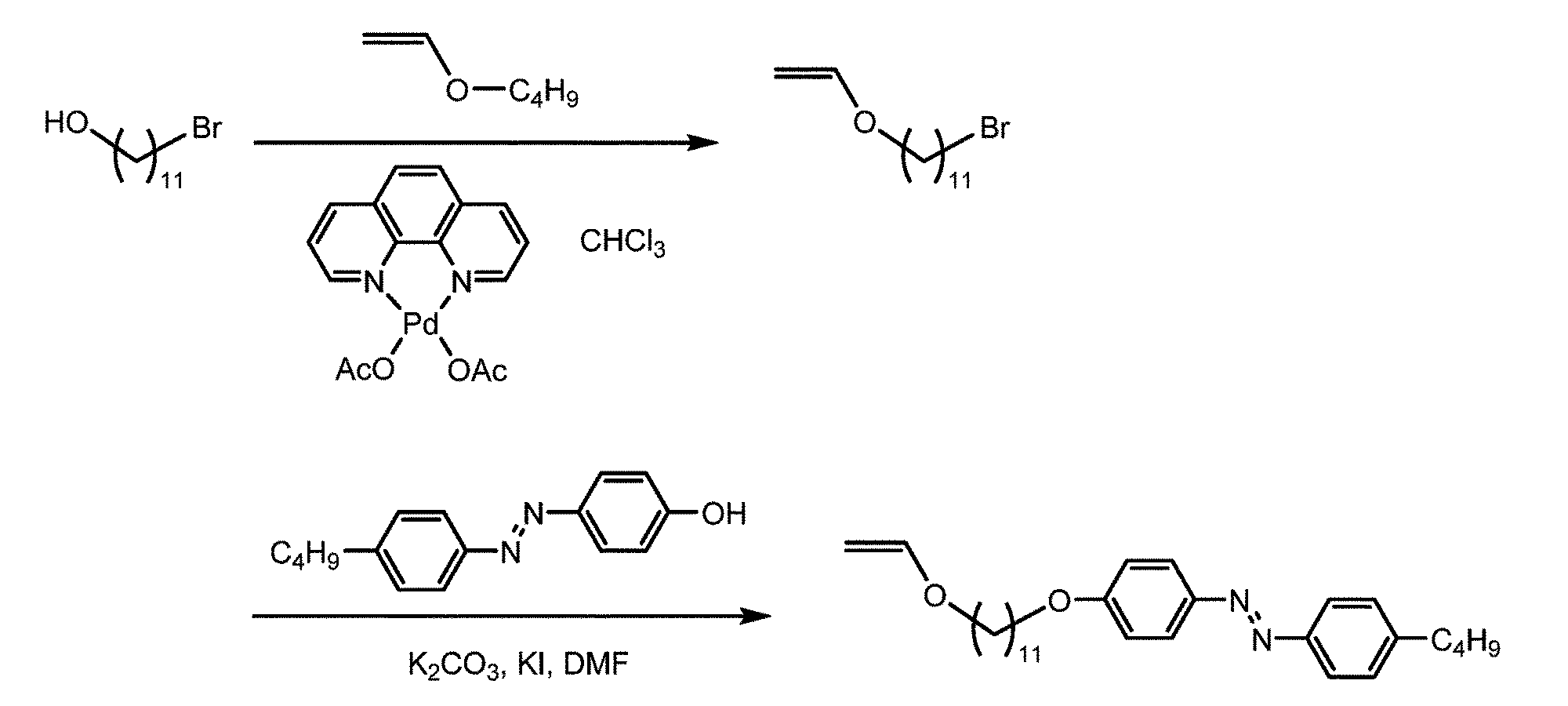
ジアセト(1,10-フェナントロリン)パラジウム(II)(0.80g、1.97mmol)、11-ブロモ-1-ウンデカノール(15.0g、59.7mmol)、n-ブチルビニルエーテル(150mL)、およびクロロホルム(35mL)をアルゴン雰囲気下で混合し、60℃で3時間撹拌した。反応混合物をセライトで濾過し、過剰のn-ブチルビニルエーテルとクロロホルムを減圧留去した。ヘキサンと塩化メチレンの混合溶媒(容量比9:1)を用いたシリカゲルカラムクロマトグラフィー(Rf=0.42)で精製を行い、無色液体状の11-ブロモウンデシルビニルエーテルを得た(15.7g、収率95%)。
11-ブロモウンデシルビニルエーテルと4-(4-ブチルフェニルアゾ)フェノールを用い、実施例1と同様にしてエーテル合成反応を行った。シリカゲルカラムクロマトグラフィーと、クロロホルムとメタノールの混合溶媒からの再結晶による精製を行い、黄色結晶状のM(11:4)を得た(6.75g、収率83%)。
1H NMR (400MHz, CDCl3): δ 7.90 (dd, J=9.2, 4.8Hz, 2H, C6H4), 7.81 (dd, J=8.0, 2.4Hz, 2H, C6H4), 7.31 (dd, J=8.4, 4.0Hz, 2H, C6H4), 7.00 (dd, J=9.2, 5.6Hz, 2H, C6H4), 6.48 (dd, J=14.8, 6.8Hz, 1H, =CH-O-), 4.18 (dd, J=14.8, 2.0Hz, 1H, CH2=CH (cis)), 4.03 (t, J=6.4Hz, 2H, CH2OC6H4), 3.96 (dd, J=6.8, 2.0Hz, 1H, CH2=CH (trans)), 3.68 (t, J=6.8Hz, 2H, =CHOCH2), 2.69 (t, J=7.2Hz, 2H, C6H4CH2), 1.82 (quint, 2H, CH2CH2CH2), 1.52-1.26 (br, 16H, CH2CH2CH2), 0.95 (t, J=7.2Hz, 3H, CH3).
13C NMR (100MHz, CDCl3): δ 161.58, 151.16, 147.05, 145.85, 129.16, 124.68, 122.64, 114.77 (C6H4), 152.12 (=CH-O-), 86.29 (CH2=), 68.44, 68.23 (OCH2CH2), 35.68 (CH2C6H4), 33.61, 29.66-29.20, 26.15, 22.48 (CH2CH2CH2), 14.09 (CH3).
MALDI-TOF MS calcd for [M+H (C29H43N2O2)]+ 451.3319, found 451.3168; calcd for [M+Na (C29H42N2O2Na)]+ 473.3138, found 473.2984.
MALDI-TOF MS calcd for [M+H (C29H43N2O2)]+ 451.3319, found 451.3168; calcd for [M+Na (C29H42N2O2Na)]+ 473.3138, found 473.2984.
実施例3:4-(4-ブチルフェニルアゾ)フェノキシヘキシルビニルエーテルの合成
下記の化学反応式に従って、上記式(2)で表される化合物である4-(4-ブチルフェニルアゾ)フェノキシヘキシルビニルエーテル(以下「M(6:4)」と記載することがある)を合成した。
下記の化学反応式に従って、上記式(2)で表される化合物である4-(4-ブチルフェニルアゾ)フェノキシヘキシルビニルエーテル(以下「M(6:4)」と記載することがある)を合成した。

実施例2と同様にして、原料である11-ブロモ-1-ウンデカノールを6-ブロモ-1-ヘキサノールに変更することで、黄色結晶状のM(6:4)を得た(3.88g、全収率24%)。
1H NMR (400MHz, CDCl3): δ 7.90 (dd, J=9.2, 4.8Hz, 2H, C6H4), 7.81 (dd, J=8.0, 2.4Hz, 2H, C6H4), 7.31 (dd, J=8.4, 4.0Hz, 2H, C6H4), 7.00 (dd, J=9.2, 5.6Hz, 2H, C6H4), 6.48 (dd, J=14.8, 6.8Hz, 1H, =CH-O-), 4.19 (dd, J=14.8, 2.0Hz, 1H, CH2=CH (cis)), 4.04 (t, J=6.4Hz, 2H, CH2OC6H4), 4.00 (dd, J=6.8, 2.0Hz, 1H, CH2=CH (trans)), 3.71 (t, J=6.8Hz, 2H, =CHOCH2), 2.67 (t, J=7.2Hz, 2H, C6H4CH2), 1.85 (quint, 2H, CH2CH2CH2), 1.75-1.33 (br, 12H, CH2CH2CH2), 0.95 (t, J=7.2Hz, 3H, CH3).
13C NMR (100MHz, CDCl3): δ 161.51, 151.15, 147.08, 145.88, 129.16, 124.69, 122.64, 114.77 (C6H4), 152.06 (=CH-O-), 86.41 (CH2=), 68.25, 68.00 (OCH2CH2), 35.68 (CH2C6H4), 33.61, 29.26, 29.12, 25.96, 22.48 (CH2CH2CH2), 14.09 (CH3).
MALDI-TOF MS calcd for [M+H (C24H33N2O2)]+ 381.2536, found 381.2556; calcd for [M+Na (C24H32N2O2Na)]+ 403.2356, found 403.2364.
MALDI-TOF MS calcd for [M+H (C24H33N2O2)]+ 381.2536, found 381.2556; calcd for [M+Na (C24H32N2O2Na)]+ 403.2356, found 403.2364.
実施例4:4-(フェニルアゾ)フェノキシウンデシルビニルエーテルの合成
下記の化学反応式に従って、上記式(2)で表される化合物である4-(フェニルアゾ)フェノキシウンデシルビニルエーテル(以下「M(11:0)」と記載することがある)を合成した。
下記の化学反応式に従って、上記式(2)で表される化合物である4-(フェニルアゾ)フェノキシウンデシルビニルエーテル(以下「M(11:0)」と記載することがある)を合成した。

11-ブロモウンデシルビニルエーテルと4-(フェニルアゾ)フェノールを用い、実施例1と同様にしてエーテル合成反応を行った。シリカゲルカラムクロマトグラフィーと、クロロホルムとアセトンとメタノールの混合溶媒から再結晶による精製を行い、黄色結晶状のM(11:0)を得た(4.98g、全収率68%)。
1H NMR (400 MHz, CDCl3): δ 7.93-7.85 (m, 4H, C6H4), 7.52-7.41 (m, 3H, C6H4), 7.00 (dd, J=8.8, 5.2Hz, 2H, C6H4), 6.47 (dd, J=14.8, 6.8Hz, 1H, =CH-O-), 4.17 (dd, J=14.4, 1.6Hz, 1H, CH2=CH (cis)), 4.04 (t, J=7.2Hz, 2H, CH2OC6H4), 3.97 (dd, J=6.8, 2.0Hz, 1H, CH2=CH (trans)), 3.67 (t, J=6.4Hz, 2H, =CHOCH2), 1.82 (quint, 2H, CH2CH2CH2), 1.66 (quint, 2H, CH2CH2CH2), 1.51-1.25 (br, 14H, CH2CH2CH2).
13C NMR (100 MHz, CDCl3): δ 161.82, 152.90, 146.95, 130.39, 129.11, 124.86, 122.66, 114.79 (C6H4), 152.10 (=CH-O-), 86.29 (CH2=), 68.44, 68.21 (OCH2CH2), 29.65, 29.61, 29.49, 29.31, 29.19, 26.13 (CH2CH2CH2).
MALDI-TOF MS calcd for [M+H (C25H35N2O2)]+ 395.2693, found 395.2699; calcd for [M+Na (C25H34N2O2Na)]+ 417.2512, found 417.2580.
MALDI-TOF MS calcd for [M+H (C25H35N2O2)]+ 395.2693, found 395.2699; calcd for [M+Na (C25H34N2O2Na)]+ 417.2512, found 417.2580.
実施例5:4-(フェニルアゾ)フェノキシヘキシルビニルエーテルの合成
下記の化学反応式に従って、上記式(2)で表される化合物である4-(フェニルアゾ)フェノキシヘキシルビニルエーテル(以下「M(6:0)」と記載することがある)を合成した。
下記の化学反応式に従って、上記式(2)で表される化合物である4-(フェニルアゾ)フェノキシヘキシルビニルエーテル(以下「M(6:0)」と記載することがある)を合成した。

実施例4と同様にして、原料である11-ブロモ-1-ウンデカノールを6-ブロモ-1-ヘキサノールに変更することで、黄色結晶状のM(6:0)を得た(6.06g、全収率32%)。
1H NMR (400 MHz, CDCl3): δ 7.93-7.85 (m, 4H, C6H4), 7.52-7.41 (m, 3H, C6H4), 7.00 (dd, J=8.8, 5.2Hz, 2H, C6H4), 6.48 (dd, J=14.8, 6.8Hz, 1H, =CH-O-), 4.18 (dd, J=14.4, 1.6Hz, 1H, CH2=CH (cis)), 4.05 (t, J=7.2Hz, 2H, CH2OC6H4), 3.98 (dd, J=6.8, 2.0Hz, 1H, CH2=CH (trans)), 3.70 (t, J=6.4Hz, 2H, =CHOCH2), 1.84 (quint, 2H, CH2CH2CH2), 1.71 (quint, 2H, CH2CH2CH2), 1.58-1.42 (br, 4H, CH2CH2CH2).
13C NMR (100 MHz, CDCl3): δ 161.75, 152.89, 146.98, 130.42, 129.13, 124.87, 122.66, 114.79 (C6H4), 152.05 (=CH-O-), 86.41 (CH2=), 68.26, 67.98 (OCH2CH2), 29.23, 29.11, 25.93 (CH2CH2CH2).
MALDI-TOF MS calcd for [M+H (C20H25N2O2)]+ 325.1910, found 325.1920; calcd for [M+Na (C20H24N2O2Na)]+ 347.1730, found 347.1757.
MALDI-TOF MS calcd for [M+H (C20H25N2O2)]+ 325.1910, found 325.1920; calcd for [M+Na (C20H24N2O2Na)]+ 347.1730, found 347.1757.
実施例6:光応答性ポリビニルエーテル化合物の合成
下記の化学反応式に従って、M(2:4)を重合して、上記式(1)で表される化合物であるポリ(4-(4-ブチルフェニルアゾ)フェノキシエチルビニルエーテル)(以下「PM(2:4)」と記載することがある)を合成した。
下記の化学反応式に従って、M(2:4)を重合して、上記式(1)で表される化合物であるポリ(4-(4-ブチルフェニルアゾ)フェノキシエチルビニルエーテル)(以下「PM(2:4)」と記載することがある)を合成した。

アルゴン雰囲気下で、乾燥したシュレンクフラスコに、脱水トルエン(3.15mL)、脱水酢酸エチル(0.35mL)、n-ブチルビニルエーテル-酢酸付加体(8.00mg、0.05mmol)、エチルアルミニウムジクロリド(1.0Mヘキサン溶液、50μL、50mmol)、M(2:4)(0.50g)、および四塩化スズ(1.0M塩化メチレン溶液、63μL、63mmol)をこの順に加え、20℃でM(2:4)を重合した。
10分後、1%アンモニア水を含むエタノール(0.5mL)を加え、反応溶液をメタノールに注ぎ、得られたPM(2:4)を回収して、減圧乾燥を行った(0.36g、収率72%)。光散乱検出器付きゲルろ過クロマトグラフィーで分子量を測定したところ、数平均絶対分子量Mnは7970で、重量平均分子量Mwは8930であった。これより、重量平均重合度nは28で、分子量分布Mw/Mnは1.12であった。
PM(2:4)の合成と同様にして、M(2:4)とメチレン鎖長が異なるモノマーM(6:4)、M(11:4)、M(6:0)、およびM(11:0)をそれぞれ重合して、ポリ(4-(4-ブチルフェニルアゾ)フェノキシヘキシルビニルエーテル)(以下「PM(6:4)」と記載することがある)、ポリ(4-(4-ブチルフェニルアゾ)フェノキシウンデシルビニルエーテル)(以下「PM(11:4)」と記載することがある)、ポリ(4-(フェニルアゾ)フェノキシヘキシルビニルエーテル)(以下「PM(6:0」と記載することがある)、およびポリ(4-(フェニルアゾ)フェノキシウンデシルビニルエーテル)(以下「PM(11:0)」と記載することがある)をそれぞれ合成した。
なお、得られるポリマーの分子量(重合度)を変化させるため、重合開始剤であるn-ブチルビニルエーテル-酢酸付加体とモノマーの比を適宜変化させて重合を行った。その結果を表1に示す。表1に示すように、重量平均分子量が約4.5×10³~約30×103である光応答性ポリビニルエーテル化合物が得られた。
実施例7:光応答性ポリビニルエーテル化合物の熱的性質
試料1、試料2、試料6、試料8、および試料11について、示差走査熱量測定(DSC、10℃/分で昇温)およびX線回折(XRD)により熱的性質と相構造を調べた。その結果を図1に示す。試料1は、室温で液晶ガラス状態であり、約120℃と140℃の相転移で、それぞれ液晶状態と等方液体状態に変化した。試料2は、室温で液晶ガラス状態であり、57℃でガラス転移を、74℃付近で液晶相-等方相転移を示した。
試料1、試料2、試料6、試料8、および試料11について、示差走査熱量測定(DSC、10℃/分で昇温)およびX線回折(XRD)により熱的性質と相構造を調べた。その結果を図1に示す。試料1は、室温で液晶ガラス状態であり、約120℃と140℃の相転移で、それぞれ液晶状態と等方液体状態に変化した。試料2は、室温で液晶ガラス状態であり、57℃でガラス転移を、74℃付近で液晶相-等方相転移を示した。
試料6は、室温で結晶状態であり、97℃のガラス転移、117℃の結晶融解を経て、等方液体状態に変化した。試料8は、室温で結晶状態であり、75℃付近で液晶相に転移し、104℃で等方液体に転移した。試料11は、室温で液晶ガラス状態であり、60℃のガラス転移と、88℃の液晶-液晶転移を経て、124℃で等方液体状態に変化した。したがって、PM(2:4)、PM(6:0)、およびPM(11:4)は液晶性アモルファス高分子で、PM(6:4)およびPM(11:0)は結晶性高分子である。
実施例8:光応答性ポリビニルエーテル化合物の光照射による硬化と軟化の観察
スライドガラス上に、実施例6で合成した11種類の試料を1mgずつ量り取り、ホットプレート上で150℃以上に加熱して、試料を溶融させた。試料の上にもう一枚のスライドガラスを重ね合わせ、試料を押しつぶした後に冷却して、試料によって接着されたスライドガラス2枚組の複合体を11個作製した。そして、室温下で紫外光(中心波長365nm、50mW/cm2、CCS製LEDライト(HLV-24UV365-4WNRBTNJ))を各複合体に、すなわち各試料に1分間照射した。
スライドガラス上に、実施例6で合成した11種類の試料を1mgずつ量り取り、ホットプレート上で150℃以上に加熱して、試料を溶融させた。試料の上にもう一枚のスライドガラスを重ね合わせ、試料を押しつぶした後に冷却して、試料によって接着されたスライドガラス2枚組の複合体を11個作製した。そして、室温下で紫外光(中心波長365nm、50mW/cm2、CCS製LEDライト(HLV-24UV365-4WNRBTNJ))を各複合体に、すなわち各試料に1分間照射した。
PM(6:4)、PM(11:0)、およびPM(11:4)を含む複合体では、試料の重量平均分子量に関わらず、手でスライドガラスをずらすことができた。これより、PM(6:4)、PM(11:0)、およびPM(11:4)は紫外光照射により軟化することがわかった。これに対して、PM(2:4)およびPM(6:0)を含む複合体は、紫外光照射しても硬いままで、スライドガラスを手でずらすことはできなかった。ただし、後述するように、PM(2:4)およびPM(6:0)に、長時間、例えば5分間以上紫外光照射をすると、PM(2:4)およびPM(6:0)の接着力が低下する。
軟化したPM(6:4)、PM(11:0)、およびPM(11:4)を含む複合体に、室温下で緑色光(中心波長520nm、40mW/cm2、CCS製LEDライト(HLV2-22GR-3W))を1分間照射すると、スライドガラスを手でずらすことができなくなった。これより、PM(6:4)、PM(11:0)、およびPM(11:4)は緑色光照射により硬化する。また、紫外光照射による軟化と可視光照射による硬化は10回以上繰り返せた。
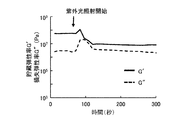
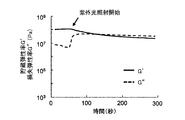
紫外光照射による弾性率の変化を明らかにするため、光照射下で、試料1、試料2、試料6、試料8、および試料11の動的粘弾性測定(Anton Paar製 MCR302)を行った。測定には、直径8mmのパラレルプレートとガラス製の台座を用い、厚み150μmの試料に対して、下面から紫外光照射を行った。ひずみ0.1%、周波数1Hz、温度30℃として測定した。その結果を図2から図6に示す。
図2から図6に示すように、紫外光照射前は、いずれの試料も硬化状態であり、107~108Paの貯蔵弾性率(G′)を示した。紫外光照射開始から約1分後、試料1および試料2のG′が約1桁、試料6のG′が2桁、試料8および試料11のG′が3桁それぞれ低下し、各試料は柔らかくなった。ただし、紫外光照射下の試料1は、G′が損失弾性率(G″)より大きく、紫外光照射下でも硬化状態であった。これに対して、試料2、試料6、試料8、および試料11は、紫外光照射下でG″>G′となり軟化状態であった。したがって、いずれの試料も紫外光照射により弾性率を低下させることが可能であり、より長いメチレンスペーサーを持つ試料ほど、柔らかくなる度合いが大きく、固液相転移が可能であった。
実施例9:光応答性ポリビニルエーテル化合物の光照射による接着力の制御
試料1、試料2、試料6、試料8、および試料11を用いて、光照射による接着力の制御を行った。2枚のガラス板(TEMPAXガラス、15mm×50mm×5mm厚)で1~2mgの各試料を挟み、各試料を加熱溶融した後に冷却することで2枚のガラス板を接着して、接着試験片であるシングルラップ継手を作製した。なお、接着面積は75mm2(15mm×5mm)とした。
試料1、試料2、試料6、試料8、および試料11を用いて、光照射による接着力の制御を行った。2枚のガラス板(TEMPAXガラス、15mm×50mm×5mm厚)で1~2mgの各試料を挟み、各試料を加熱溶融した後に冷却することで2枚のガラス板を接着して、接着試験片であるシングルラップ継手を作製した。なお、接着面積は75mm2(15mm×5mm)とした。
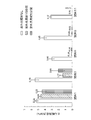
引張試験機(島津製オートグラフAGS-10kN、ロードセルSLBL-500N、冶具SCG-1kNA)により、これらの接着試験片をせん断方向に引っ張り、最大試験力を測定した。最大試験力と接着面積から接着強度であるせん断接着力を算出した。また、接着試験片への、すなわち各試料への紫外光照射による接着力の低下を確認するため、上記と同様に作製した4種類の接着試験片に、紫外光(365nm、50mW/cm2)を15秒間または5分間照射した後に、引張試験を行い、せん断接着力を算出した。その結果を図7に示す。なお、図7には、同条件で3回測定した平均値と、誤差としてのその標準偏差を示している。
図7に示すように、紫外光照射をしていない通常時のせん断接着力は3~5MPaを示した。これに対して、接着試験片に紫外光照射を行うとせん断接着力が低下した。せん断接着力の低下の傾向は、動的粘弾性測定の弾性率低下の傾向とよく一致していた。これより、紫外光照射によって、接着剤である試料が柔らかくなって接着力が低下した。さらに、軟化した試料を挟んで、一度剥離した接着試験片の2枚のガラス板を再度重ね合わせて緑色光を照射した。試料が硬化して2枚のガラス板は再接着した。接着強度も通常時の接着強度まで回復した。したがって、紫外光照射と緑色光照射によって、可逆的に接着と剥離を制御することができた。
実施例10:光応答性ポリビニルエーテル化合物の固液相転移可能な温度範囲の測定と接着強度が保持可能な温度範囲の推定
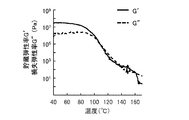
試料1、試料2、試料6、試料8、および試料11について、光照射による固液相転移が可能な温度範囲と、接着力が保持可能な温度範囲を明らかにするため、温度可変の動的粘弾性測定を行った。動的粘弾性は、実施例8と同様の装置を用い、それぞれの温度範囲を3℃/minで降温させながら測定した。
試料1、試料2、試料6、試料8、および試料11について、光照射による固液相転移が可能な温度範囲と、接着力が保持可能な温度範囲を明らかにするため、温度可変の動的粘弾性測定を行った。動的粘弾性は、実施例8と同様の装置を用い、それぞれの温度範囲を3℃/minで降温させながら測定した。
試料1については、180℃から150℃までで、ひずみを30%から0.01%まで連続的に変化させ、150℃以下で、ひずみを0.01%の一定にした。試料2については、130℃から60℃までで、ひずみを30%から0.01%まで連続的に変化させ、60℃以下で、ひずみを0.01%の一定にした。試料6では、150℃から105℃までで、ひずみを30%から0.01%まで連続的に変化させ、105℃以下で、ひずみを0.01%の一定にした。
試料8については、140℃から100℃までで、ひずみを30%の一定にし、100℃から60℃までで、ひずみを30%から0.01%まで連続的に変化させ、60℃以下で、ひずみを0.01%の一定とした。試料11については、140℃から120℃までで、ひずみを30%の一定にし、120℃から85℃までで、ひずみを30%から0.01%に連続的に変化させ、85℃以下で、ひずみを0.01%の一定にした。なお、すべての温度で周波数を1Hzとした。その結果を図8から図12に示す。
試料1、試料2、試料6、試料8、および試料11は、それぞれG′>G″である100℃、58℃、100℃、60℃、および80℃以下で硬化状態である。したがって、これらの温度以下で、各試料は、光照射による弾性率の調節または光照射による軟化状態と硬化状態の制御が可能である。また、室温の20℃での貯蔵弾性率から貯蔵弾性率が一桁低下しない温度範囲を、試料が接着力を保持できる温度範囲とする。試料1、試料2、試料6、試料8、および試料11が接着力を保持できる温度範囲は、それぞれ100℃、58℃、100℃、60℃、および75℃であった。したがって、これらの温度以下では、試料が接着力を保持でき、かつ光照射による試料の接着力の調節が可能である。このように、本願の光応答性ポリビニルエーテル化合物を含む接着剤は、100℃の高温でも接着力が維持できる。
実施例11:光応答性ポリビニルエーテル含有ブロック共重合体の合成
下記の化学反応式に従って、光応答性ポリビニルエーテル含有ブロック共重合体の前駆体を合成した。
下記の化学反応式に従って、光応答性ポリビニルエーテル含有ブロック共重合体の前駆体を合成した。

50℃で16時間減圧乾燥したトリオール型ポリプロピレングリコール(分子量4000g/mol、5g、1.25mmol)、水素化ナトリウム(油性、含有量60%、1.5g、37.5mmol)、ヨウ化カリウム(触媒量)、および脱水テトラヒドロフラン30mLをシュレンクフラスコに入れた。これに2-クロロエチルビニルエーテル(7.99g、75.0mmol)を加えて、アルゴン雰囲気下で3日間還流させた。
反応溶液中のテトラヒドロフランを減圧留去し、水を加えて、クロロホルムを用いた抽出と減圧乾燥によりビニルエーテル化ポリプロピレングリコールを得た(5.25g、収率99%)。つぎに、ビニルエーテル化ポリプロピレングリコール1gに対して、酢酸1g、テトラヒドロフラン1gを加え、60℃で4時間撹拌した。反応溶液にクロロホルムを加え、水で洗浄し、減圧乾燥させることで、ポリプロピレングリコール-酢酸付加体(試料12)を得た(収率95%)。
下記の化学反応式に従って、3本鎖星型の光応答性ポリビニルエーテル含有ブロック共重合体を合成した。
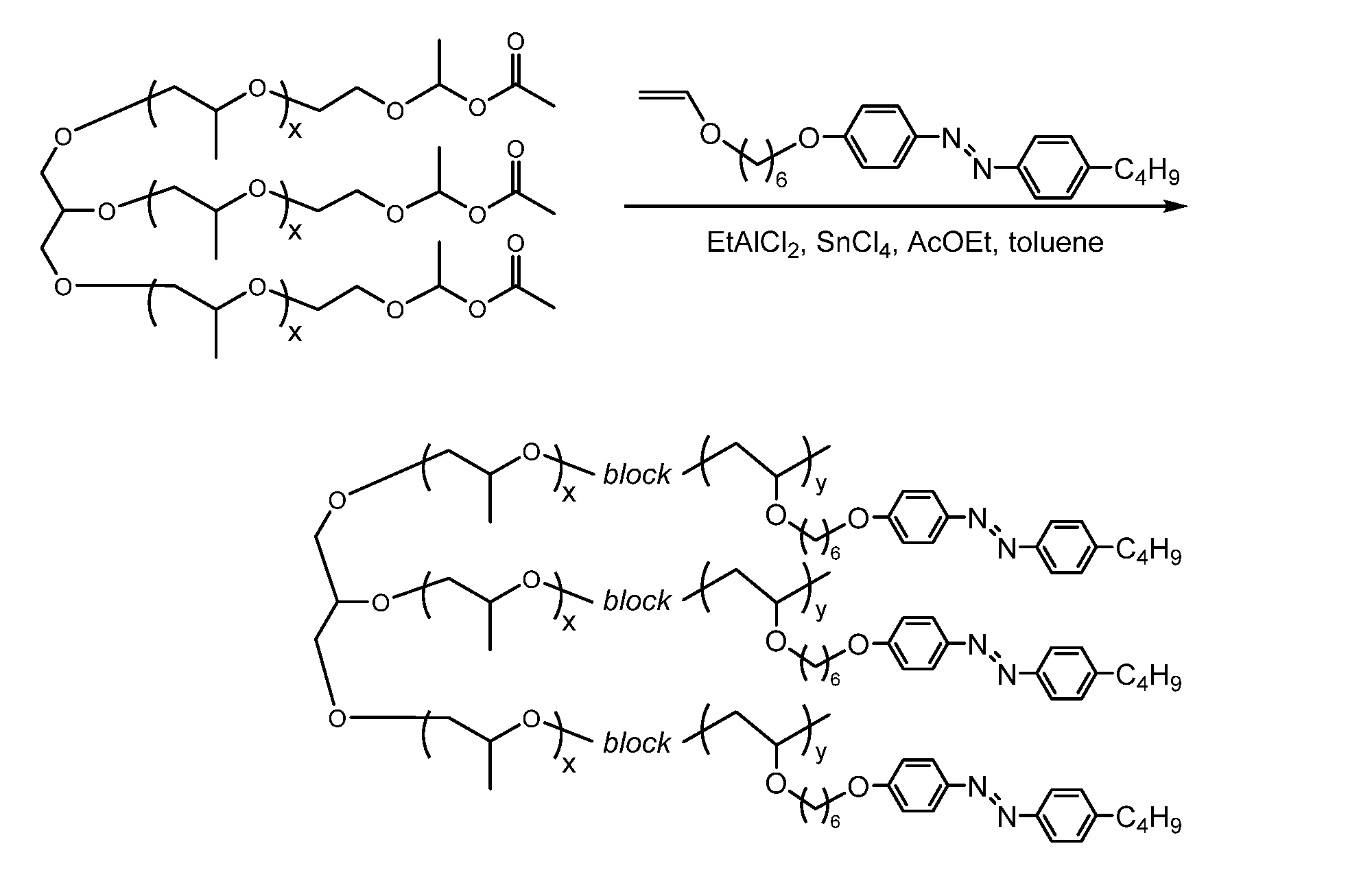
アルゴン雰囲気下で、乾燥したシュレンクフラスコに、脱水トルエン(8.00mL)、脱水酢酸エチル(1.50mL)、試料12(0.36g、0.09mmol)、エチルアルミニウムジクロリド(1.0Mヘキサン溶液、27μL、27mmol)、M(6:4)(0.72g)、および四塩化スズ(1.0M塩化メチレン溶液、30μL、30mmol)をこの順に加え、20℃でM(6:4)を重合した。2分後、1%アンモニア水を含むエタノール(0.5mL)を加え、反応溶液をメタノールに注ぎ、得られたポリマーを回収して、減圧乾燥を行った。ゲル浸透クロマトグラフィーでこのポリマーの分子量を測定したところ、二峰性であった。このため、分取ゲル浸透クロマトグラフィーを用いて、高分子量体を単離した(試料13)。
試料13の標準ポリスチレン換算の数平均分子量Mnは13300であり、分子量分布Mw/Mnは1.12であった。重合開始剤として用いたポリプロピレングリコール-酢酸付加体(試料12)の数平均分子量Mnは5780であった。重合開始剤と比べてより高分子量体が得られたことから、試料13は、目的の3本鎖星型ブロック共重合体、すなわち光応答性ポリビニルエーテル含有ブロック共重合体であることが分かった。試料12と試料13のゲル浸透クロマトグラフィーのチャートを図13に示す。また、試料13の1H-NMRチャートを図14に示す。プロトン核磁気共鳴により試料13の組成解析を行った結果、ポリプロピレングリコールとPM(6:4)の重量組成比は、46:54であった。
実施例12:光応答性ポリビニルエーテル含有ブロック共重合体の光照射による硬化と軟化の観察
実施例8と同様にして、試料13の紫外光照射による硬化と緑色光照射による軟化を観察した。その結果、紫外光照射後の複合体では、手でスライドガラスをずらすことができた。これより、試料13は紫外光照射により軟化することがわかった。また、軟化した試料13を含む複合体に緑色光照射すると、スライドガラスを手でずらすことができなくなった。これより、試料13は緑色光照射により硬化する。また、紫外光照射による軟化と可視光照射による硬化は10回以上繰り返せた。
実施例8と同様にして、試料13の紫外光照射による硬化と緑色光照射による軟化を観察した。その結果、紫外光照射後の複合体では、手でスライドガラスをずらすことができた。これより、試料13は紫外光照射により軟化することがわかった。また、軟化した試料13を含む複合体に緑色光照射すると、スライドガラスを手でずらすことができなくなった。これより、試料13は緑色光照射により硬化する。また、紫外光照射による軟化と可視光照射による硬化は10回以上繰り返せた。
実施例13:光応答性ポリビニルエーテル含有ブロック共重合体の光照射による接着力の制御
実施例9と同様にして、試料13の光照射による接着力の制御を行った。引張試験機により、試料13を含む接着試験片をせん断方向に引っ張り、最大試験力を測定した。3回の試験の平均値と標準偏差として0.38±0.07MPaを示した。また、試料13を含む接着試験片に、紫外光を15秒間照射すると、ガラス板の重さによって接着試験片の接着状態を保つことができなかった。ガラス板の重さから計算すると、せん断接着力は0.01MPa以下であった。さらに、一度剥離した接着試験片の2枚のガラス板は再接着し、通常時の接着強度まで回復した。したがって、紫外光照射と緑色光照射によって、可逆的に接着と剥離を制御することができた。
実施例9と同様にして、試料13の光照射による接着力の制御を行った。引張試験機により、試料13を含む接着試験片をせん断方向に引っ張り、最大試験力を測定した。3回の試験の平均値と標準偏差として0.38±0.07MPaを示した。また、試料13を含む接着試験片に、紫外光を15秒間照射すると、ガラス板の重さによって接着試験片の接着状態を保つことができなかった。ガラス板の重さから計算すると、せん断接着力は0.01MPa以下であった。さらに、一度剥離した接着試験片の2枚のガラス板は再接着し、通常時の接着強度まで回復した。したがって、紫外光照射と緑色光照射によって、可逆的に接着と剥離を制御することができた。
Claims (12)
- 下記一般式(1)で表される光応答性ポリビニルエーテル化合物。

- 請求項1において、
xが2以上11以下である光応答性ポリビニルエーテル化合物。 - 請求項1または2において、
yが0以上4以下である光応答性ポリビニルエーテル化合物。 - 請求項1から3のいずれかにおいて、
重量平均分子量が1000以上100000以下である光応答性ポリビニルエーテル化合物。 - 下記一般式(2)で表される化合物を重合する重合工程を有する光応答性ポリビニルエーテル化合物の製造方法。

- 請求項1から4のいずれかの光応答性ポリビニルエーテル化合物を有効成分とする光可逆接着剤。
- 請求項1から4のいずれかの光応答性ポリビニルエーテル化合物から構成される複数の機能性ブロックと、高分子化合物から構成され、前記複数の機能性ブロックを接合する接合ブロックとを含むブロック共重合体を有し、フィルム形状を備える光可逆接着剤。
- 請求項7において、
第一波長の光が照射されたときに起きる軟化と、第一波長と異なる第二波長の光が照射されたときに起きる硬化が可逆的に生じる光可逆接着剤。 - 請求項7または8において、
第一波長が、300nm以上400nm以下である光可逆接着剤。 - 請求項7から9のいずれかにおいて、
第二波長が、400nm以上600nm以下である光可逆接着剤。 - 請求項7から10のいずれかの光可逆接着剤を介して基材に接着されている被接着物を基材から剥離する被接着物の剥離方法であって、
光可逆接着剤に第一波長の光を照射して光可逆接着剤を軟化させて、被接着物を基材から離す剥離工程を有する被接着物の剥離方法。 - 請求項7から10のいずれかの光可逆接着剤を介して、基材に被接着物を接着する被接着物の接着方法であって、
基材と被接着物の間に軟化状態の光可逆接着剤を配置し、光可逆接着剤に第二波長の光を照射して光可逆接着剤を硬化させて、被接着物を基材に着ける接着工程を有する被接着物の接着方法。
Priority Applications (1)
| Application Number | Priority Date | Filing Date | Title |
|---|---|---|---|
| JP2021514195A JP7129729B2 (ja) | 2019-04-19 | 2020-04-15 | 光応答性ポリビニルエーテル化合物および光可逆接着剤 |
Applications Claiming Priority (2)
| Application Number | Priority Date | Filing Date | Title |
|---|---|---|---|
| JP2019-080183 | 2019-04-19 | ||
| JP2019080183 | 2019-04-19 |
Publications (1)
| Publication Number | Publication Date |
|---|---|
| WO2020213641A1 true WO2020213641A1 (ja) | 2020-10-22 |
Family
ID=72837273
Family Applications (1)
| Application Number | Title | Priority Date | Filing Date |
|---|---|---|---|
| PCT/JP2020/016564 Ceased WO2020213641A1 (ja) | 2019-04-19 | 2020-04-15 | 光応答性ポリビニルエーテル化合物および光可逆接着剤 |
Country Status (2)
| Country | Link |
|---|---|
| JP (1) | JP7129729B2 (ja) |
| WO (1) | WO2020213641A1 (ja) |
Cited By (1)
| Publication number | Priority date | Publication date | Assignee | Title |
|---|---|---|---|---|
| WO2022080405A1 (ja) * | 2020-10-14 | 2022-04-21 | 昭和電工マテリアルズ株式会社 | 光硬化性組成物及びその硬化物、光融解性樹脂組成物、並びに接着剤セット |
Citations (9)
| Publication number | Priority date | Publication date | Assignee | Title |
|---|---|---|---|---|
| JP2005154603A (ja) * | 2003-11-26 | 2005-06-16 | Sekisui Chem Co Ltd | 表面処理剤及び高分子成形体 |
| JP2009064496A (ja) * | 2007-09-05 | 2009-03-26 | Ricoh Co Ltd | 有機薄膜及びそれを用いた光記録媒体 |
| WO2013081155A1 (ja) * | 2011-12-01 | 2013-06-06 | 独立行政法人産業技術総合研究所 | 感光性アゾベンゼン誘導体 |
| WO2013099427A1 (ja) * | 2011-12-28 | 2013-07-04 | 丸善石油化学株式会社 | Abc型アゾ系トリブロック共重合体 |
| JP2013136035A (ja) * | 2011-12-28 | 2013-07-11 | Maruzen Petrochem Co Ltd | 吸着材及びこれを用いた金の回収方法 |
| WO2016121651A1 (ja) * | 2015-01-27 | 2016-08-04 | 国立研究開発法人産業技術総合研究所 | 光感応性複合材料とその製造方法、および光感応性複合材料フィルムの使用方法 |
| WO2017119412A1 (ja) * | 2016-01-07 | 2017-07-13 | 国立研究開発法人産業技術総合研究所 | 光可逆接着剤 |
| WO2019181784A1 (ja) * | 2018-03-19 | 2019-09-26 | 国立研究開発法人産業技術総合研究所 | 光応答性アゾ化合物、光応答性組成物、光応答性高分子化合物、接着剤、光応答体、および光応答性高分子化合物の製造方法 |
| JP2019189731A (ja) * | 2018-04-24 | 2019-10-31 | 日本ペイント株式会社 | 顔料分散樹脂、顔料分散体および塗料組成物 |
-
2020
- 2020-04-15 WO PCT/JP2020/016564 patent/WO2020213641A1/ja not_active Ceased
- 2020-04-15 JP JP2021514195A patent/JP7129729B2/ja active Active
Patent Citations (9)
| Publication number | Priority date | Publication date | Assignee | Title |
|---|---|---|---|---|
| JP2005154603A (ja) * | 2003-11-26 | 2005-06-16 | Sekisui Chem Co Ltd | 表面処理剤及び高分子成形体 |
| JP2009064496A (ja) * | 2007-09-05 | 2009-03-26 | Ricoh Co Ltd | 有機薄膜及びそれを用いた光記録媒体 |
| WO2013081155A1 (ja) * | 2011-12-01 | 2013-06-06 | 独立行政法人産業技術総合研究所 | 感光性アゾベンゼン誘導体 |
| WO2013099427A1 (ja) * | 2011-12-28 | 2013-07-04 | 丸善石油化学株式会社 | Abc型アゾ系トリブロック共重合体 |
| JP2013136035A (ja) * | 2011-12-28 | 2013-07-11 | Maruzen Petrochem Co Ltd | 吸着材及びこれを用いた金の回収方法 |
| WO2016121651A1 (ja) * | 2015-01-27 | 2016-08-04 | 国立研究開発法人産業技術総合研究所 | 光感応性複合材料とその製造方法、および光感応性複合材料フィルムの使用方法 |
| WO2017119412A1 (ja) * | 2016-01-07 | 2017-07-13 | 国立研究開発法人産業技術総合研究所 | 光可逆接着剤 |
| WO2019181784A1 (ja) * | 2018-03-19 | 2019-09-26 | 国立研究開発法人産業技術総合研究所 | 光応答性アゾ化合物、光応答性組成物、光応答性高分子化合物、接着剤、光応答体、および光応答性高分子化合物の製造方法 |
| JP2019189731A (ja) * | 2018-04-24 | 2019-10-31 | 日本ペイント株式会社 | 顔料分散樹脂、顔料分散体および塗料組成物 |
Non-Patent Citations (2)
| Title |
|---|
| YOSHIDA, TOMOHIDE ET AL.: "Fast living cationic polymerization accelerated by SnCI4. I. New base-stabilized living system for various vinyl ethers with SnCl4/EtAlCl2", JOURNAL OF POLYMER SCIENCE , PART A: POLYMER CHEMISTRY, vol. 43, 2005, pages 468 - 472, XP055751566, DOI: 10.1002/pola.20564 * |
| YOSHIDA, TOMOHIDE ET AL.: "Photosensitive copolymers with various types of azobenzene side groups synthesized by living cationic polymerization", JOURNAL OF POLYMER SCIENCE , PART A: POLYMER CHEMISTRY, vol. 43, 2005, pages 4292 - 4297, XP055333281, DOI: 10.1002/pola.20892 * |
Cited By (3)
| Publication number | Priority date | Publication date | Assignee | Title |
|---|---|---|---|---|
| WO2022080405A1 (ja) * | 2020-10-14 | 2022-04-21 | 昭和電工マテリアルズ株式会社 | 光硬化性組成物及びその硬化物、光融解性樹脂組成物、並びに接着剤セット |
| JPWO2022080405A1 (ja) * | 2020-10-14 | 2022-04-21 | ||
| JP7708118B2 (ja) | 2020-10-14 | 2025-07-15 | 株式会社レゾナック | 光硬化性組成物及びその硬化物、光融解性樹脂組成物、並びに接着剤セット |
Also Published As
| Publication number | Publication date |
|---|---|
| JPWO2020213641A1 (ja) | 2021-12-09 |
| JP7129729B2 (ja) | 2022-09-02 |
Similar Documents
| Publication | Publication Date | Title |
|---|---|---|
| Ito et al. | Light-induced reworkable adhesives based on ABA-type triblock copolymers with azopolymer termini | |
| EP3401377A1 (en) | Photoreversible adhesive agent | |
| JP5822369B2 (ja) | 光応答性接着剤 | |
| EP3142617B1 (en) | Photoresponsive polymers for adhesive applications | |
| JP3948799B2 (ja) | 3官能化合物および高分子液晶 | |
| EP3271323B1 (en) | Uv curable hot melt pressure sensitive adhesives | |
| CN102099432A (zh) | 压敏粘合剂组合物、偏振片和液晶显示器 | |
| US10934486B2 (en) | Liquid crystal composition, liquid crystal mixture, reverse-mode polymer dispersed liquid crystal element, and associated selectively dimmable device | |
| JPH09323911A (ja) | 重合性ハイブリッドモノマー | |
| JP5908795B2 (ja) | 易剥離性粘着剤およびそれを用いた粘着材料ならびに処理装置 | |
| JP7129729B2 (ja) | 光応答性ポリビニルエーテル化合物および光可逆接着剤 | |
| CN114605960B (zh) | 一种可逆光热响应的胶粘剂及其制备方法和用途 | |
| JP2011252102A (ja) | ポリ乳酸系接着剤及びその製造方法 | |
| JP2019026817A (ja) | 光応答性粘接着剤 | |
| JPH0341043A (ja) | 液晶モノマーの重合法 | |
| WO2018025808A1 (ja) | (メタ)アクリル系トリブロック共重合体およびその製造方法、粘着剤組成物ならびに粘着シート | |
| JP2017193601A (ja) | 光硬化型粘着剤前駆体組成物、光硬化型粘着剤、及び光硬化型粘着剤の製造方法 | |
| JP2000109779A (ja) | 紫外線硬化型粘着剤組成物 | |
| TWI542603B (zh) | 含有(甲基)丙烯酸酯共聚物之黏著劑組成物及其製造方法,以及控制其物性之方法 | |
| DE102014202947A1 (de) | UV-vernetzbare Polymerzusammensetzung | |
| JP4010583B2 (ja) | 単官能重合性化合物及びその重合物からなる液晶性高分子 | |
| JP2691300B2 (ja) | 有機ホウ素含有ポリマー | |
| TWI660992B (zh) | 光硬化性組成物及使用於該組成物之蒽衍生物 | |
| US20260042938A1 (en) | Polymer | |
| KR20240050135A (ko) | 폴리머 |
Legal Events
| Date | Code | Title | Description |
|---|---|---|---|
| 121 | Ep: the epo has been informed by wipo that ep was designated in this application |
Ref document number: 20791733 Country of ref document: EP Kind code of ref document: A1 |
|
| ENP | Entry into the national phase |
Ref document number: 2021514195 Country of ref document: JP Kind code of ref document: A |
|
| NENP | Non-entry into the national phase |
Ref country code: DE |
|
| 122 | Ep: pct application non-entry in european phase |
Ref document number: 20791733 Country of ref document: EP Kind code of ref document: A1 |