WO2020203345A1 - 塗膜剥離剤及び塗膜剥離方法 - Google Patents
塗膜剥離剤及び塗膜剥離方法 Download PDFInfo
- Publication number
- WO2020203345A1 WO2020203345A1 PCT/JP2020/012255 JP2020012255W WO2020203345A1 WO 2020203345 A1 WO2020203345 A1 WO 2020203345A1 JP 2020012255 W JP2020012255 W JP 2020012255W WO 2020203345 A1 WO2020203345 A1 WO 2020203345A1
- Authority
- WO
- WIPO (PCT)
- Prior art keywords
- coating film
- acid
- fibrous cellulose
- mass
- group
- Prior art date
- Legal status (The legal status is an assumption and is not a legal conclusion. Google has not performed a legal analysis and makes no representation as to the accuracy of the status listed.)
- Ceased
Links
Images

Classifications
-
- B—PERFORMING OPERATIONS; TRANSPORTING
- B05—SPRAYING OR ATOMISING IN GENERAL; APPLYING FLUENT MATERIALS TO SURFACES, IN GENERAL
- B05D—PROCESSES FOR APPLYING FLUENT MATERIALS TO SURFACES, IN GENERAL
- B05D3/00—Pretreatment of surfaces to which liquids or other fluent materials are to be applied; After-treatment of applied coatings, e.g. intermediate treating of an applied coating preparatory to subsequent applications of liquids or other fluent materials
- B05D3/12—Pretreatment of surfaces to which liquids or other fluent materials are to be applied; After-treatment of applied coatings, e.g. intermediate treating of an applied coating preparatory to subsequent applications of liquids or other fluent materials by mechanical means
-
- C—CHEMISTRY; METALLURGY
- C09—DYES; PAINTS; POLISHES; NATURAL RESINS; ADHESIVES; COMPOSITIONS NOT OTHERWISE PROVIDED FOR; APPLICATIONS OF MATERIALS NOT OTHERWISE PROVIDED FOR
- C09D—COATING COMPOSITIONS, e.g. PAINTS, VARNISHES OR LACQUERS; FILLING PASTES; CHEMICAL PAINT OR INK REMOVERS; INKS; CORRECTING FLUIDS; WOODSTAINS; PASTES OR SOLIDS FOR COLOURING OR PRINTING; USE OF MATERIALS THEREFOR
- C09D9/00—Chemical paint or ink removers
Definitions
- the present invention relates to a coating film removing agent and a coating film removing method.
- the surface of the outer wall of steel structures and concrete structures has been painted for the purpose of corrosion protection and imparting design.
- a coating film on the surface of the outer wall, deterioration and corrosion of the outer wall base material are prevented.
- aged deterioration may cause stains and swelling of the coating film and cracks in the coating film, so that the coating film needs to be repainted.
- various coating film release agents are used to peel off the coating film.
- such a coating film removing agent is applied to the coating film to swell and soften the coating film, and then the coating film is peeled off.
- Patent Document 1 describes a coating film containing ethylene, propylene, butylene glycol ether ester having a predetermined structure, an organic protic solvent, and water and not containing a substantial amount of a chlorinating solvent, and a release agent for plastic tiles. Is disclosed. Further, Patent Document 2 discloses a coating film peeling composition containing a solvent and a fatty acid ester.
- the solvent a nitrogen-containing solvent having a cyclic structure or the like is used.
- Patent Document 3 discloses a coating film release agent containing a solvent component as a release component and further containing a fluorescent agent.
- the solvent a nitrogen-containing compound having a cyclic structure, an aprotic polar solvent, or the like is used.
- Patent Document 4 discloses a two-agent type coating film release agent composition, in which agent A contains a water-soluble coating film release agent, agent B contains an exothermic agent, and agent A is used.
- a method for preparing a coating film peeling composition by mixing the B agent and the B agent is disclosed.
- Patent Document 5 discloses a peeling composition which is an aqueous dispersion containing abrasive grains, fine celluloses and water.
- fine cellulose is used as a dispersion stabilizer for abrasive grains.
- unmodified fine cellulose is used as the fine celluloses.
- the coating film release agent preferably has a certain viscosity, and more preferably, the viscosity decreases when a shearing force is applied as in the case of coating on a coating film, and shearing occurs after coating.
- the force is lost, it is required to have the property of thickening again and adhering to the coating film, that is, so-called thixotropic property. Therefore, the addition of various thickeners is being studied as a coating film release agent. Even in Patent Document 5 in which fine celluloses are used as a thickener, no study has been made on imparting thixotropic properties for both coating property and prevention of liquid dripping.
- Japanese Unexamined Patent Publication No. 2000-001637 Japanese Unexamined Patent Publication No. 2014-177599 Japanese Unexamined Patent Publication No. 2018-070725 JP-A-2017-0959596 Japanese Unexamined Patent Publication No. 2019-026749
- the present inventors examined the coating film release agent as described above, it was found that there was room for improvement in the release performance. For example, when a sufficient amount of thickener is added in order to suppress liquid dripping, there is a tendency that the coatability is lowered and the peeling performance is impaired. On the other hand, it was found that when the amount of the thickener added was suppressed, the coating film removing agent could not stay on the coating film surface, and even in such a case, the peeling performance tended to decrease.
- the present inventors have proceeded with studies for the purpose of providing a coating film release agent capable of exhibiting excellent release performance.
- the present inventors have used fibrous cellulose having an ionic substituent having a fiber width of 1000 nm or less instead of the conventionally used thickener. , It was found that a coating film release agent capable of exhibiting excellent release performance can be obtained by using a coating film release agent containing a solvent and a fibrous cellulose having an ionic substituent having a fiber width of 1000 nm or less. .. Specifically, the present invention has the following configuration.
- the viscosity of the coating remover is measured with an E-type viscometer, and the measurement is performed using a cone plate with an inclination angle of 2 °; the measurement temperature is 23 ° C, the rotation speed is in the range of 0.01 to 1000 s- 1 , and the steady flow.
- the shear viscosity is measured a curve mode; shear viscosity at rotational speeds of 1s -1 and eta 1, if the shear viscosity in the rotation speed of 1000 s -1 was eta 2, thixotropic index value of eta 1 / eta 2 Let it be a value (TI value).
- a coating including a step of applying the coating film release agent according to any one of [1] to [9] to a coating film provided on the surface of the substrate and a step of peeling and removing the coating film from the substrate. Membrane peeling method.
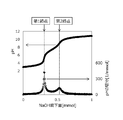
- FIG. 1 is a graph showing the relationship between the amount of NaOH added dropwise and the pH of a fibrous cellulose-containing slurry having a phosphoric acid group.
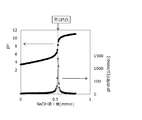
- FIG. 2 is a graph showing the relationship between the amount of NaOH added dropwise to the fibrous cellulose-containing slurry having a carboxy group and the pH.
- FIG. 3 is a schematic view illustrating a method of peeling the coating film.
- the present invention relates to a coating film release agent containing a solvent and a fibrous cellulose having an ionic substituent having a fiber width of 1000 nm or less.
- a fibrous cellulose having an ionic substituent having a fiber width of 1000 nm or less may be referred to as fine fibrous cellulose or CNF.
- the coating film release agent contains a release component for removing the coating film from the substrate.
- the peeling component may be a solvent.
- the solvent is selected from the solvents capable of exerting the peeling function.
- the coating film peeling agent preferably contains a peeling aid or the like as described later as a peeling component. That is, in the coating film release agent of the present invention, it is preferable that the solvent is a solvent capable of exerting a release function, or the coating film release agent contains a release aid.
- the solvent may be a solvent capable of exerting a peeling function, and the coating film stripping agent may contain a peeling aid.
- the coating film release agent of the present invention Since the coating film release agent of the present invention has the above-mentioned structure, it exhibits excellent release performance. Specifically, since the coating film release agent of the present invention does not drip, the infiltration property into the coating film is enhanced, which improves the peeling performance. Further, since the fibrous cellulose having a fiber width of 1000 nm or less can impart a desired viscosity to the coating film release agent even by adding a small amount, the relative content of the release component can be increased. This also enhances the peeling performance of the coating film stripping agent.
- the peeling performance of the coating film peeling agent can be evaluated by the peeling rate (%) when the coating film peeling test is carried out by a method as described later.
- the coating film peeling test can be carried out by the following method. First, a steel plate (SS400) cut to a predetermined size is blasted to form a coating film on it.
- the coating film was formed by laminating a wash primer layer having a thickness of 20 ⁇ m, an intermediate coating layer using a super-long oil phthalate resin paint having a thickness of 40 ⁇ m, and a top coat layer using a long oil phthalate resin paint having a thickness of 40 ⁇ m in this order. It is configured.
- the peeling rate (%) calculated in this way is preferably 70% or more, more preferably 80% or more, further preferably 85% or more, and particularly preferably 90% or more. preferable.
- the B-type viscosity of the coating film release agent is preferably 5000 mPa ⁇ s or more, more preferably 6000 mPa ⁇ s or more, further preferably 7000 mPa ⁇ s or more, and preferably 8000 mPa ⁇ s or more. Especially preferable.
- the upper limit of the B-type viscosity of the coating film release agent is not particularly limited, but is preferably 100,000 mPa ⁇ s or less.
- the B-type viscosity of the coating film release agent is measured using a B-type viscometer, the rotation speed is 3 rpm, and the viscosity value is 3 minutes after the start of measurement.
- the coating film release agent was allowed to stand in an environment of 23 ° C.
- the liquid temperature of the coating film release agent at the time of measurement was set to 23 ° C.
- an analog viscometer T-LVT manufactured by BLOOKFIELD can be used as the B-type viscometer.
- the thixotropic index value (TI value) calculated under the following condition a of the coating film release agent is preferably 200 or more, more preferably 250 or more, and further preferably 300 or more.
- the upper limit of the thixotropic index value (TI value) is not particularly limited, but is preferably 1000 or less.
- the viscosity of the coating remover is measured with an E-type viscometer, and the measurement is performed using a cone plate with an inclination angle of 2 °; the measurement temperature is 23 ° C, the rotation speed is in the range of 0.01 to 1000 s- 1 , and the steady flow.
- the shear viscosity is measured a curve mode; shear viscosity at rotational speeds of 1s -1 and eta 1, if the shear viscosity in the rotation speed of 1000 s -1 was eta 2, thixotropic index value of eta 1 / eta 2 Let it be a value (TI value).
- the thixotropic index value is a value representing the ratio of viscosities under each condition when the viscosity of the coating film release agent is measured under two conditions having different shear rates.
- the thixotropic index value (TI value) is a value obtained by dividing the viscosity when measured under a low shear rate condition by the viscosity when measured under a high shear rate condition, and when the TI value is large, shearing is performed. The slower the velocity, the higher the viscosity of the suspension, and the faster the shear rate, the lower the viscosity of the suspension.
- the coating film remover of the present invention can exhibit high thixotropy by setting the TI value to the above lower limit value or more.
- the shearing force becomes very low, so that the viscosity of the coating film release agent rapidly increases.
- the coating film release agent adheres to the surface of the coating film and stays efficiently, and the infiltration property of the coating film release agent into the coating film is enhanced.
- the shear viscosity ( ⁇ 1 ) of the coating film remover at a rotation speed of 1s -1 is preferably 3000 mPa ⁇ s or more, more preferably 4000 mPa ⁇ s or more, and further preferably 6000 mPa ⁇ s or more. It is more preferably 8000 mPa ⁇ s or more, and particularly preferably 10000 mPa ⁇ s or more.
- the shear viscosity ( ⁇ 1 ) of the coating film remover at a rotation speed of 1s -1 is preferably 100,000 mPa ⁇ s or less.
- the shear viscosity ( ⁇ 2 ) at a rotation speed of 1000s -1 is preferably 100 mPa ⁇ s or less, more preferably 80 mPa ⁇ s or less, further preferably 60 mPa ⁇ s or less, and 40 mPa ⁇ s or less. -It is particularly preferable that it is under s.
- the shear viscosity ( ⁇ 2 ) at a rotation speed of 1000 s -1 is preferably 1 mPa ⁇ s or more.
- the coating film release agent of the present invention contains fibrous cellulose having an ionic substituent having a fiber width of 1000 nm or less. Fibrous cellulose having an ionic substituent having a fiber width of 1000 nm or less exerts its function as a thickener in a coating film release agent.
- the fiber width of the fibrous cellulose having an ionic substituent is preferably 100 nm or less, and more preferably 8 nm or less.
- the content of the fibrous cellulose is preferably 0.01% by mass or more, more preferably 0.05% by mass or more, and 0.1% by mass or more, based on the total mass of the coating film release agent. Is more preferable.
- the content of the fibrous cellulose is preferably 20% by mass or less, more preferably 10% by mass or less, and preferably 5% by mass or less, based on the total mass of the coating film release agent. More preferred.
- the coating film release agent of the present invention contains fibrous cellulose having an ionic substituent having a fiber width of 1000 nm or less, and the fibrous cellulose having an ionic substituent in the coating film release agent has an excellent thickening effect. Therefore, the amount of the thickener added can be made lower than that of the conventionally used thickener. Therefore, it is possible to increase the content of the peeling component, and the peeling performance can be more effectively improved. Further, since the coating film release agent contains fibrous cellulose having an ionic substituent having a fiber width of 1000 nm or less, the coating film release agent can exhibit high thixotropy and has a low viscosity at the time of coating. As a result, the workability is improved, and the viscosity becomes high immediately after coating, and the coating film release agent easily adheres to the surface of the coating film and stays there. This makes it possible to efficiently peel off the coating film.
- the fiber width of fibrous cellulose can be measured, for example, by observation with an electron microscope.
- the average fiber width of the fibrous cellulose is, for example, 1000 nm or less.
- the average fiber width of the fibrous cellulose is, for example, 2 nm or more and 1000 nm or less, more preferably 2 nm or more and 100 nm or less, further preferably 2 nm or more and 50 nm or less, and 2 nm or more and 10 nm or less. Especially preferable.
- the fibrous cellulose is, for example, monofibrous cellulose.
- the average fiber width of fibrous cellulose is measured, for example, using an electron microscope as follows. First, an aqueous suspension of fibrous cellulose having a concentration of 0.05% by mass or more and 0.1% by mass or less is prepared, and this suspension is cast on a hydrophilized carbon film-coated grid to prepare a sample for TEM observation. And. If it contains wide fibers, an SEM image of the surface cast on the glass may be observed. Next, observation is performed using an electron microscope image at a magnification of 1000 times, 5000 times, 10000 times, or 50,000 times depending on the width of the fiber to be observed. However, the sample, observation conditions and magnification should be adjusted so as to satisfy the following conditions.
- a straight line X is drawn at an arbitrary position in the observation image, and 20 or more fibers intersect the straight line X.
- a straight line Y that intersects the straight line perpendicularly is drawn in the same image, and 20 or more fibers intersect the straight line Y.
- the width of the fiber intersecting the straight line X and the straight line Y is visually read with respect to the observation image satisfying the above conditions. In this way, at least three sets of observation images of surface portions that do not overlap each other are obtained.
- the fiber length of the fibrous cellulose is not particularly limited, but is preferably 0.1 ⁇ m or more and 1000 ⁇ m or less, more preferably 0.1 ⁇ m or more and 800 ⁇ m or less, and further preferably 0.1 ⁇ m or more and 600 ⁇ m or less. preferable.
- the fiber length of the fibrous cellulose can be obtained by, for example, image analysis by TEM, SEM, or AFM.
- the fibrous cellulose preferably has an I-type crystal structure.
- the ratio of the type I crystal structure to the fine fibrous cellulose is, for example, preferably 30% or more, more preferably 40% or more, and further preferably 50% or more. As a result, even better performance can be expected in terms of heat resistance and low coefficient of linear thermal expansion.
- the crystallinity is determined by measuring the X-ray diffraction profile and using the pattern by a conventional method (Seagal et al., Textile Research Journal, Vol. 29, p. 786, 1959).
- the axial ratio (fiber length / fiber width) of the fibrous cellulose is not particularly limited, but is preferably 20 or more and 10000 or less, and more preferably 50 or more and 1000 or less.
- the axial ratio is not particularly limited, but is preferably 20 or more and 10000 or less, and more preferably 50 or more and 1000 or less.
- the fibrous cellulose in the present embodiment has, for example, both a crystalline region and a non-crystalline region.
- fine fibrous cellulose having both a crystalline region and a non-crystalline region and having a high axial ratio is realized by a method for producing fine fibrous cellulose described later.
- the fibrous cellulose in the present invention has an ionic substituent.
- the fibrous cellulose has an ionic substituent, the dispersibility of the fibrous cellulose in the dispersion medium can be improved, and the defibration efficiency in the defibration treatment can be improved. Further, since the fibrous cellulose has an ionic substituent, the fibrous cellulose can exert an excellent thickening effect and further develop thixotropy. This makes it possible to efficiently peel off the coating film.
- the ionic substituent can include, for example, either one or both of an anionic group and a cationic group. In the present embodiment, it is particularly preferable to have an anionic group as an ionic substituent.
- anionic group as an ionic substituent examples include a phosphoric acid group or a substituent derived from a phosphoric acid group (sometimes simply referred to as a phosphoric acid group), a carboxy group or a substituent derived from a carboxy group (simply a carboxy group). It is preferably at least one selected from (sometimes referred to as), a carboxymethyl group, and a sulfone group or a substituent derived from a sulfone group (sometimes simply referred to as a sulfone group).
- the anionic group is more preferably at least one selected from a phosphorus oxo acid group, a carboxy group and a carboxymethyl group, and particularly preferably a phosphorus oxo acid group.
- a phosphorus oxo acid group as an anionic group, for example, the dispersibility of the fibrous cellulose can be further enhanced even under alkaline conditions or acidic conditions, and as a result, the peelability of the coating film can be enhanced. ..
- a phosphorus oxo acid group as an anionic group, it is possible to more effectively suppress the liquid dripping of the coating film release agent.
- the phosphate group or the substituent derived from the phosphorusoxo acid group is, for example, a substituent represented by the following formula (1).
- the phosphorus oxo acid group is, for example, a divalent functional group obtained by removing a hydroxy group from phosphoric acid. Specifically, it is a group represented by -PO 3 H 2 .
- Substituents derived from a phosphorus oxo acid group include substituents such as a salt of a phosphorus oxo acid group and a phosphorus oxo acid ester group.
- the substituent derived from the phosphoric acid group may be contained in the fibrous cellulose as a group in which the phosphoric acid group is condensed (for example, a pyrophosphate group).
- the phosphorous acid group may be, for example, a phosphorous acid group (phosphonic acid group), and the substituent derived from the phosphorous acid group is a salt of a phosphorous acid group, a phosphorous acid ester group, or the like. May be good.
- R is a hydrogen atom, a saturated-linear hydrocarbon group, a saturated-branched chain hydrocarbon group, a saturated-cyclic hydrocarbon group, an unsaturated-linear hydrocarbon group, and an unsaturated-branched chain hydrocarbon, respectively.
- Examples of the saturated-linear hydrocarbon group include a methyl group, an ethyl group, an n-propyl group, an n-butyl group and the like, but are not particularly limited.
- Examples of the saturated-branched chain hydrocarbon group include an i-propyl group and a t-butyl group, but are not particularly limited.
- Examples of the saturated-cyclic hydrocarbon group include, but are not limited to, a cyclopentyl group, a cyclohexyl group and the like.
- Examples of the unsaturated-linear hydrocarbon group include a vinyl group, an allyl group and the like, but are not particularly limited.
- Examples of the unsaturated-branched chain hydrocarbon group include an i-propenyl group and a 3-butenyl group, but the group is not particularly limited.
- Examples of the unsaturated-cyclic hydrocarbon group include, but are not limited to, a cyclopentenyl group, a cyclohexenyl group and the like.
- Examples of the aromatic group include a phenyl group and a naphthyl group, but are not particularly limited.
- the inducing group in R a functional group in which at least one of functional groups such as a carboxy group, a hydroxy group, or an amino group is added or substituted with respect to the main chain or side chain of the above-mentioned various hydrocarbon groups.
- the group is mentioned, but is not particularly limited.
- the number of carbon atoms constituting the main chain of R is not particularly limited, but is preferably 20 or less, and more preferably 10 or less.
- ⁇ b + is a monovalent or higher cation composed of an organic substance or an inorganic substance.
- monovalent or higher cations composed of organic substances include aliphatic ammonium or aromatic ammonium
- monovalent or higher valent cations composed of inorganic substances include ions of alkali metals such as sodium, potassium, and lithium.
- alkali metals such as sodium, potassium, and lithium
- divalent metals such as calcium and magnesium, hydrogen ions, and the like, but the present invention is not particularly limited. These may be applied alone or in combination of two or more.
- the monovalent or higher cation composed of an organic substance or an inorganic substance is preferably sodium or potassium ion which is hard to yellow when the fiber raw material containing ⁇ is heated and is easily industrially used, but is not particularly limited.
- ⁇ b + may be an organic onium ion, and in this case, it is particularly preferable that it is an organic ammonium ion.
- the organic onium ion preferably satisfies at least one of the conditions selected from the following (a) and (b).
- (A) Contains a hydrocarbon group having 5 or more carbon atoms.
- the hydrocarbon group having 5 or more carbon atoms is preferably an alkyl group having 5 or more carbon atoms or an alkylene group having 5 or more carbon atoms, and an alkyl group having 6 or more carbon atoms or an alkylene group having 6 or more carbon atoms. It is more preferably a group, more preferably an alkyl group having 7 or more carbon atoms or an alkylene group having 7 or more carbon atoms, and an alkyl group having 10 or more carbon atoms or an alkylene group having 10 or more carbon atoms. It is particularly preferable to have.
- the organic onium ion preferably has an alkyl group having 5 or more carbon atoms, and more preferably an organic onium ion having an alkyl group having 5 or more carbon atoms and having a total carbon number of 17 or more. preferable.
- the organic onium ion is preferably an organic onium ion represented by the following general formula (A).
- M is a nitrogen atom or a phosphorus atom
- R 1 to R 4 independently represent a hydrogen atom or an organic group, respectively.
- at least one of R 1 to R 4 is an organic group having 5 or more carbon atoms, or the total number of carbon atoms of R 1 to R 4 is 17 or more.
- M is preferably a nitrogen atom. That is, the organic onium ion is preferably an organic ammonium ion.
- at least one of R 1 to R 4 is an alkyl group having 5 or more carbon atoms, and the total number of carbon atoms of R 1 to R 4 is 17 or more.
- organic onium ions examples include lauryltrimethylammonium, cetyltrimethylammonium, stearyltrimethylammonium, octyldimethylethylammonium, lauryldimethylethylammonium, didecyldimethylammonium, lauryldimethylbenzylammonium, tributylbenzylammonium, and methyltri-n.
- the central element of the organic onium ion is bonded to a total of four groups or hydrogen.
- the remaining hydrogen atoms are bonded to form an organic onium ion.
- N N-didodecylmethylammonium
- hydrogen is bonded to the remaining one to form an organic onium ion.
- the amount of the ionic substituent introduced into the fibrous cellulose is, for example, 0.10 mmol / g or more, more preferably 0.20 mmol / g or more, and 0.50 mmol / g per 1 g (mass) of the fibrous cellulose. It is more preferably / g or more, and particularly preferably 1.00 mmol / g or more.
- the amount of the ionic substituent introduced into the fibrous cellulose is preferably 5.20 mmol / g or less per 1 g (mass) of the fibrous cellulose, and more preferably 3.65 mmol / g or less.
- the amount of the ionic substituent introduced within the above range it is possible to facilitate the miniaturization of the fiber raw material and enhance the stability of the fibrous cellulose. Further, by setting the amount of the ionic substituent introduced within the above range, good properties can be exhibited in various applications such as a thickener for fibrous cellulose.
- the denominator in the unit mmol / g indicates the mass of fibrous cellulose when the counter ion of the ionic substituent is a hydrogen ion (H + ).
- the amount of the ionic substituent introduced into the fibrous cellulose can be measured by, for example, the neutralization titration method.
- the introduction amount is measured by determining the change in pH while adding an alkali such as an aqueous sodium hydroxide solution to the obtained slurry containing fibrous cellulose.
- FIG. 1 is a graph showing the relationship between the amount of NaOH added dropwise and the pH of a fibrous cellulose-containing slurry having a phosphoric acid group as an ionic substituent.
- the amount of the phosphorus oxo acid group introduced into the fibrous cellulose is measured, for example, as follows. First, the slurry containing fibrous cellulose is treated with a strongly acidic ion exchange resin. If necessary, the same defibration treatment as the defibration treatment step described later may be performed on the measurement target before the treatment with the strongly acidic ion exchange resin. Next, the change in pH is observed while adding an aqueous sodium hydroxide solution, and a titration curve as shown in the upper part of FIG. 1 is obtained.
- the titration curve shown in the upper part of FIG. 1 plots the measured pH with respect to the amount of alkali added
- the titration curve shown in the lower part of FIG. 1 plots the pH with respect to the amount of alkali added.
- the increment (differential value) (1 / mmol) is plotted.
- two points are confirmed in which the increment (differential value of pH with respect to the amount of alkali dropped) becomes maximum in the curve plotting the measured pH with respect to the amount of alkali added.
- the maximum point of the increment obtained first when alkali is added is called the first end point
- the maximum point of the increment obtained next is called the second end point.
- the amount of alkali required from the start of titration to the first end point is equal to the amount of first dissociating acid of the fibrous cellulose contained in the slurry used for titration, and the amount of alkali required from the first end point to the second end point.
- the amount is equal to the amount of the second dissociating acid of the fibrous cellulose contained in the slurry used for the titration, and the amount of alkali required from the start to the second end point of the titration is the fibrous cellulose contained in the slurry used for the titration. Is equal to the total amount of dissociated acid.
- the value obtained by dividing the amount of alkali required from the start of titration to the first end point by the solid content (g) in the slurry to be titrated is the amount of phosphorus oxo acid group introduced (mmol / g).
- the amount of phosphorus oxo acid group introduced (or the amount of phosphorus oxo acid group) simply means the amount of the first dissociated acid.
- the region from the start of titration to the first end point is referred to as a first region, and the region from the first end point to the second end point is referred to as a second region.
- the amount of weakly acidic groups (second dissociated acid amount) in the phosphoric acid group apparently decreases, and the first region
- the amount of alkali required for the second region is smaller than the amount of alkali required for the second region.
- the amount of the strongly acidic group (the amount of the first dissociated acid) in the phosphorus oxo acid group is the same as the amount of the phosphorus atom regardless of the presence or absence of condensation.
- the phosphorous acid group is a phosphorous acid group
- the weakly acidic group does not exist in the phosphorous acid group, so that the amount of alkali required for the second region is reduced or the amount of alkali required for the second region is reduced. May be zero.
- the titration curve has one point where the pH increment is maximized.
- the denominator of the above-mentioned phosphorus oxo acid group introduction amount indicates the mass of the acid type fibrous cellulose
- the phosphorus oxo acid group amount of the acid type fibrous cellulose (hereinafter, the amount of the phosphorus oxo acid group). (Called (acid type))).
- the denominator is converted to the mass of fibrous cellulose when the cation C is a counterion.
- the amount of phosphorus oxo acid groups (hereinafter, the amount of phosphorus oxo acid groups (C type)) possessed by the fibrous cellulose in which the cation C is a counterion. That is, it is calculated by the following formula.
- Phosphoric acid group amount (C type) Phosphoric acid group amount (acid type) / ⁇ 1+ (W-1) x A / 1000 ⁇ A [mmol / g]: Total anion amount derived from the phosphoric acid group of the fibrous cellulose (total dissociated acid amount of the phosphoric acid group)
- W Formula unit of cation C per valence (for example, Na is 23, Al is 9)
- FIG. 2 is a graph showing the relationship between the amount of NaOH added dropwise to a dispersion containing fibrous cellulose having a carboxy group as an ionic substituent and pH.
- the amount of carboxy group introduced into the fibrous cellulose is measured, for example, as follows. First, the dispersion containing fibrous cellulose is treated with a strongly acidic ion exchange resin. If necessary, the same defibration treatment as the defibration treatment step described later may be performed on the measurement target before the treatment with the strongly acidic ion exchange resin. Next, the change in pH is observed while adding an aqueous sodium hydroxide solution, and a titration curve as shown in the upper part of FIG. 2 is obtained.
- the titration curve shown in the upper part of FIG. 2 plots the measured pH with respect to the amount of alkali added
- the titration curve shown in the lower part of FIG. 2 plots the pH with respect to the amount of alkali added.
- the increment (differential value) (1 / mmol) is plotted.
- the increment (differential value of pH with respect to the amount of alkali dropped) became maximum, and this maximum point was the first. Called one end point.
- the region from the start of titration to the first end point in FIG. 2 is referred to as a first region.
- the amount of alkali required in the first region is equal to the amount of carboxy groups in the dispersion used for titration. Then, the amount of alkali (mmol) required in the first region of the titration curve is divided by the solid content (g) in the dispersion liquid containing the fibrous cellulose to be titrated, so that the amount of carboxy group introduced (mmol). / G) is calculated.
- the denominator of the above-mentioned carboxy group introduction amount (mmol / g) is the mass of the acid type fibrous cellulose, the carboxy group amount of the acid type fibrous cellulose (hereinafter, the carboxy group amount (acid type)). ) Is shown.
- the counterion of the carboxy group is replaced with an arbitrary cation C so as to have a charge equivalent, the denominator is converted to the mass of fibrous cellulose when the cation C is a counterion. Then, the amount of carboxy group (hereinafter, carboxy group amount (C type)) possessed by the fibrous cellulose in which the cation C is a counter ion can be obtained.
- Carboxylic acid group amount (C type) Carboxylic acid group amount (acid type) / ⁇ 1+ (W-1) x (carboxyl group amount (acid type)) / 1000 ⁇ W: Formula unit of cation C per valence (for example, Na is 23, Al is 9)
- the amount of ionic substituents In the measurement of the amount of ionic substituents by the titration method, if the amount of one drop of the sodium hydroxide aqueous solution is too large or the titration interval is too short, the amount of ionic substituents will be lower than originally intended. The value may not be obtained.
- As an appropriate dropping amount and titration interval for example, it is desirable to titrate 10 to 50 ⁇ L of a 0.1 N sodium hydroxide aqueous solution every 5 to 30 seconds.
- Fine fibrous cellulose is produced from a fiber raw material containing cellulose.
- the fiber raw material containing cellulose is not particularly limited, but pulp is preferably used because it is easily available and inexpensive. Examples of pulp include wood pulp, non-wood pulp, and deinked pulp.
- the wood pulp is not particularly limited, and is, for example, broadleaf kraft pulp (LBKP), coniferous kraft pulp (NBKP), sulfite pulp (SP), dissolved pulp (DP), soda pulp (AP), and unbleached kraft pulp (UKP).
- the non-wood pulp is not particularly limited, and examples thereof include cotton pulp such as cotton linter and cotton lint, and non-wood pulp such as hemp, straw and bagasse.
- the deinking pulp is not particularly limited, and examples thereof include deinking pulp made from used paper. As the pulp of the present embodiment, one of the above types may be used alone, or two or more types may be mixed and used. Among the above pulps, for example, wood pulp and deinked pulp are preferable from the viewpoint of availability.
- long fiber fine fibrous cellulose having a small decomposition of cellulose in pulp and a large axial ratio can be obtained.
- chemical pulp is more preferable, and kraft pulp and sulfite pulp are further preferable.
- long fiber fine fibrous cellulose having a large axial ratio is used, the viscosity tends to increase.
- the fiber raw material containing cellulose for example, cellulose contained in ascidians and bacterial cellulose produced by acetobacter can be used. Further, instead of the fiber raw material containing cellulose, a fiber formed by a linear nitrogen-containing polysaccharide polymer such as chitin or chitosan can also be used.
- the process for producing fine fibrous cellulose includes, for example, a phosphorus oxo acid group introduction step as an ionic substituent introduction step.
- a phosphorus oxo acid group introduction step at least one compound (hereinafter, also referred to as “compound A”) selected from compounds capable of introducing a phosphorus oxo acid group by reacting with a hydroxyl group of a fiber raw material containing cellulose is introduced into cellulose. It is a step of acting on a fiber raw material containing. By this step, a phosphorus oxo acid group-introduced fiber can be obtained.
- the reaction between the fiber raw material containing cellulose and Compound A is carried out in the presence of at least one selected from urea and its derivatives (hereinafter, also referred to as “Compound B”). You may.
- the reaction of the fiber raw material containing cellulose with the compound A may be carried out in the absence of the compound B.
- the method of causing the compound A to act on the fiber raw material in the coexistence with the compound B there is a method of mixing the compound A and the compound B with the fiber raw material in a dry state, a wet state or a slurry state.
- a fiber raw material in a dry state or a wet state since the reaction uniformity is high, it is preferable to use a fiber raw material in a dry state or a wet state, and it is particularly preferable to use a fiber raw material in a dry state.
- the form of the fiber raw material is not particularly limited, but is preferably cotton-like or thin sheet-like, for example.
- Examples of the compound A and the compound B include a method of adding the compound A and the compound B to the fiber raw material in the form of a powder or a solution dissolved in a solvent, or in a state of being heated to a melting point or higher and melted. Of these, since the reaction uniformity is high, it is preferable to add the solution in the form of a solution dissolved in a solvent, particularly in the state of an aqueous solution. Further, the compound A and the compound B may be added to the fiber raw material at the same time, may be added separately, or may be added as a mixture.
- the method for adding the compound A and the compound B is not particularly limited, but when the compound A and the compound B are in the form of a solution, the fiber raw material may be immersed in the solution to absorb the liquid and then taken out, or the fiber raw material may be taken out. The solution may be dropped into the water. Further, the required amounts of Compound A and Compound B may be added to the fiber raw material, or after the excess amounts of Compound A and Compound B are added to the fiber raw material, respectively, the surplus Compound A and Compound B are added by pressing or filtering. It may be removed.
- the compound A used in this embodiment may be a compound having a phosphorus atom and capable of forming an ester bond with cellulose, and may be phosphoric acid or a salt thereof, phosphoric acid or a salt thereof, dehydration-condensed phosphoric acid or a salt thereof.
- Examples thereof include salts and anhydrous phosphoric acid (diphosphorus pentoxide), but the present invention is not particularly limited.
- the phosphoric acid those having various puritys can be used, and for example, 100% phosphoric acid (normal phosphoric acid) or 85% phosphoric acid can be used.
- Examples of phosphorous acid include 99% phosphorous acid (phosphonic acid).
- the dehydration-condensed phosphoric acid is one in which two or more molecules of phosphoric acid are condensed by a dehydration reaction, and examples thereof include pyrophosphoric acid and polyphosphoric acid.
- Phosphates, phosphorous acids, dehydration-condensed phosphates include phosphoric acid, phosphorous acid or dehydration-condensed phosphoric acid lithium salts, sodium salts, potassium salts, ammonium salts, etc. It can be a sum.
- sodium phosphate and sodium phosphate Salt potassium salt of phosphoric acid, ammonium or phosphite of phosphoric acid, sodium salt of phosphite, potassium salt of phosphite, ammonium salt of phosphite are preferred, phosphoric acid, sodium dihydrogen phosphate, Disodium hydrogen phosphate, ammonium dihydrogen phosphate, or phosphoric acid and sodium phosphite are more preferred.
- the amount of compound A added to the fiber raw material is not particularly limited, but for example, when the amount of compound A added is converted to the phosphorus atomic weight, the amount of phosphorus atom added to the fiber raw material (absolute dry mass) is 0.5% by mass or more. It is preferably 100% by mass or less, more preferably 1% by mass or more and 50% by mass or less, and further preferably 2% by mass or more and 30% by mass or less.
- the amount of phosphorus atoms added to the fiber raw material within the above range, the yield of fine fibrous cellulose can be further improved.
- the addition amount of the phosphorus atom to the fiber raw material to be equal to or less than the above upper limit value, the effect of improving the yield and the cost can be balanced.
- Compound B used in this embodiment is at least one selected from urea and its derivatives as described above.
- Examples of compound B include urea, biuret, 1-phenylurea, 1-benzylurea, 1-methylurea, 1-ethylurea and the like.
- compound B is preferably used as an aqueous solution. Further, from the viewpoint of further improving the uniformity of the reaction, it is preferable to use an aqueous solution in which both compound A and compound B are dissolved.
- the amount of compound B added to the fiber raw material is not particularly limited, but is preferably 1% by mass or more and 500% by mass or less, and more preferably 10% by mass or more and 400% by mass or less. It is more preferably 100% by mass or more and 350% by mass or less.
- amides or amines may be contained in the reaction system in addition to compound B.
- amides include formamide, dimethylformamide, acetamide, dimethylacetamide and the like.
- amines include methylamine, ethylamine, trimethylamine, triethylamine, monoethanolamine, diethanolamine, triethanolamine, pyridine, ethylenediamine, hexamethylenediamine and the like. Among these, triethylamine is known to act as a good reaction catalyst.
- the heat treatment temperature it is preferable to select a temperature at which a phosphorus oxo acid group can be efficiently introduced while suppressing the thermal decomposition and hydrolysis reaction of the fiber.
- the heat treatment temperature is, for example, preferably 50 ° C. or higher and 300 ° C. or lower, more preferably 100 ° C. or higher and 250 ° C. or lower, and further preferably 130 ° C. or higher and 200 ° C. or lower.
- equipment having various heat media can be used for the heat treatment, for example, a stirring drying device, a rotary drying device, a disk drying device, a roll type heating device, a plate type heating device, a fluidized layer drying device, and an air stream.
- a drying device, a vacuum drying device, an infrared heating device, a far infrared heating device, and a microwave heating device can be used.
- a method of adding compound A to a thin sheet-shaped fiber raw material by a method such as impregnation and then heating, or a method of heating while kneading or stirring the fiber raw material and compound A with a kneader or the like. can be adopted. This makes it possible to suppress uneven concentration of the compound A in the fiber raw material and more uniformly introduce the phosphorus oxo acid group onto the surface of the cellulose fiber contained in the fiber raw material.
- the heating device used for the heat treatment always keeps the water content retained by the slurry and the water content generated by the dehydration condensation (phosphate esterification) reaction between the compound A and the hydroxyl group contained in the cellulose or the like in the fiber raw material. It is preferable that the device can be discharged to the outside of the device system. Examples of such a heating device include a ventilation type oven and the like. By constantly discharging the water in the apparatus system, it is possible to suppress the hydrolysis reaction of the phosphate ester bond, which is the reverse reaction of the phosphate esterification, and also to suppress the acid hydrolysis of the sugar chain in the fiber. it can. Therefore, it is possible to obtain fine fibrous cellulose having a high axial ratio.
- the heat treatment time is preferably 1 second or more and 300 minutes or less, more preferably 1 second or more and 1000 seconds or less, and 10 seconds or more and 800 seconds or less after the water is substantially removed from the fiber raw material. Is more preferable.
- the amount of the phosphorus oxo acid group introduced can be within a preferable range by setting the heating temperature and the heating time within an appropriate range.
- the phosphorus oxo acid group introduction step may be performed at least once, but may be repeated twice or more. By performing the phosphorus oxo acid group introduction step two or more times, many phosphorus oxo acid groups can be introduced into the fiber raw material. In the present embodiment, as an example of a preferable embodiment, there is a case where the phosphorus oxo acid group introduction step is performed twice.
- the amount of the phosphorus oxo acid group introduced into the fiber raw material is, for example, 0.10 mmol / g or more, more preferably 0.20 mmol / g or more, and 0.50 mmol / g / g per 1 g (mass) of fine fibrous cellulose. It is more preferably g or more, and particularly preferably 1.00 mmol / g or more.
- the amount of the phosphorus oxo acid group introduced into the fiber raw material is preferably 5.20 mmol / g or less per 1 g (mass) of fine fibrous cellulose, more preferably 3.65 mmol / g or less. It is more preferably 00 mmol / g or less.
- the process for producing fine fibrous cellulose may include, for example, a carboxy group introduction step as an ionic substituent introduction step.
- the carboxy group introduction step has an oxidation treatment such as ozone oxidation, oxidation by the Fenton method, TEMPO oxidation treatment, a compound having a group derived from carboxylic acid or a derivative thereof, or a group derived from carboxylic acid with respect to the fiber raw material containing cellulose. This is done by treating with an acid anhydride of the compound or a derivative thereof.
- the compound having a group derived from a carboxylic acid is not particularly limited, but for example, a dicarboxylic acid compound such as maleic acid, succinic acid, phthalic acid, fumaric acid, glutaric acid, adipic acid, itaconic acid, citric acid, aconitic acid and the like.
- Examples include tricarboxylic acid compounds.
- the derivative of the compound having a group derived from a carboxylic acid is not particularly limited, and examples thereof include an imide of an acid anhydride of a compound having a carboxy group and a derivative of an acid anhydride of a compound having a carboxy group.
- the imide of the acid anhydride of the compound having a carboxy group is not particularly limited, and examples thereof include an imide of a dicarboxylic acid compound such as maleimide, succinateimide, and phthalateimide.
- the acid anhydride of the compound having a group derived from carboxylic acid is not particularly limited, but for example, a dicarboxylic acid compound such as maleic anhydride, succinic anhydride, phthalic anhydride, glutaric anhydride, adipic anhydride, itaconic anhydride and the like. Acid anhydride can be mentioned.
- the acid anhydride derivative of the compound having a group derived from carboxylic acid is not particularly limited, but for example, a compound having a carboxy group such as dimethylmaleic anhydride, diethylmaleic anhydride, diphenylmaleic anhydride and the like. Examples thereof include those in which at least a part of the hydrogen atom of the acid anhydride is substituted with a substituent such as an alkyl group or a phenyl group.
- the aldehyde generated in the oxidation process can be efficiently oxidized to the carboxy group.
- the TEMPO oxidation treatment may be carried out under the condition that the pH is 10 or more and 11 or less. Such a treatment is also referred to as an alkaline TEMPO oxidation treatment.
- the alkaline TEMPO oxidation treatment can be carried out, for example, by adding a nitroxy radical such as TEMPO as a catalyst, sodium bromide as a co-catalyst, and sodium hypochlorite as an oxidizing agent to pulp as a fiber raw material. ..
- the amount of the carboxy group introduced into the fiber raw material varies depending on the type of the substituent, but for example, when the carboxy group is introduced by TEMPO oxidation, it is preferably 0.10 mmol / g or more per 1 g (mass) of the fine fibrous cellulose. , 0.20 mmol / g or more, more preferably 0.50 mmol / g or more, and particularly preferably 0.90 mmol / g or more. Further, it is preferably 2.5 mmol / g or less, more preferably 2.20 mmol / g or less, and further preferably 2.00 mmol / g or less. In addition, when the substituent is a carboxymethyl group, it may be 5.8 mmol / g or less per 1 g (mass) of fine fibrous cellulose.
- a washing step can be performed on the ionic substituent-introduced fiber as needed.
- the washing step is performed by washing the ionic substituent-introduced fiber with, for example, water or an organic solvent. Further, the cleaning step may be performed after each step described later, and the number of cleanings performed in each cleaning step is not particularly limited.
- an alkali treatment may be performed on the fiber raw material between the ionic substituent introduction step and the defibration treatment step described later.
- the alkaline treatment method is not particularly limited, and examples thereof include a method of immersing the ionic substituent-introduced fiber in an alkaline solution.
- the alkaline compound contained in the alkaline solution is not particularly limited, and may be an inorganic alkaline compound or an organic alkaline compound.
- sodium hydroxide or potassium hydroxide is preferably used as the alkaline compound because of its high versatility.
- the solvent contained in the alkaline solution may be either water or an organic solvent.
- the solvent contained in the alkaline solution is preferably a polar solvent containing water or a polar organic solvent exemplified by alcohol, and more preferably an aqueous solvent containing at least water.
- an aqueous solution of sodium hydroxide or an aqueous solution of potassium hydroxide is preferable because of its high versatility.
- the temperature of the alkaline solution in the alkaline treatment step is not particularly limited, but is preferably 5 ° C. or higher and 80 ° C. or lower, and more preferably 10 ° C. or higher and 60 ° C. or lower.
- the immersion time of the ionic substituent-introduced fiber in the alkaline solution in the alkali treatment step is not particularly limited, but is preferably 5 minutes or more and 30 minutes or less, and more preferably 10 minutes or more and 20 minutes or less.
- the amount of the alkaline solution used in the alkaline treatment is not particularly limited, but is preferably 100% by mass or more and 100,000% by mass or less, and 1000% by mass or more and 10000% by mass or less, based on the absolute dry mass of the ionic substituent-introduced fiber. The following is more preferable.
- the ionic substituent introduction fiber may be washed with water or an organic solvent after the ionic substituent introduction step and before the alkali treatment step. After the alkali treatment step and before the defibration treatment step, it is preferable to wash the alkali-treated ionic substituent-introduced fiber with water or an organic solvent from the viewpoint of improving handleability.
- the fiber raw material may be subjected to acid treatment between the step of introducing an ionic substituent and the defibration treatment step described later.
- the ionic substituent introduction step, the acid treatment, the alkali treatment, and the defibration treatment may be performed in this order.
- the method of acid treatment is not particularly limited, and examples thereof include a method of immersing the fiber raw material in an acidic liquid containing an acid.
- the concentration of the acidic liquid used is not particularly limited, but is preferably 10% by mass or less, and more preferably 5% by mass or less, for example.
- the pH of the acidic solution used is not particularly limited, but is preferably 0 or more and 4 or less, and more preferably 1 or more and 3 or less.
- an inorganic acid, a sulfonic acid, a carboxylic acid or the like can be used.
- Examples of the inorganic acid include sulfuric acid, nitric acid, hydrochloric acid, hydrobromic acid, hydroiodic acid, hypochlorous acid, chloric acid, chloric acid, perchloric acid, phosphoric acid, boric acid and the like.
- Examples of the sulfonic acid include methanesulfonic acid, ethanesulfonic acid, benzenesulfonic acid, p-toluenesulfonic acid, trifluoromethanesulfonic acid and the like.
- Examples of the carboxylic acid include formic acid, acetic acid, citric acid, gluconic acid, lactic acid, oxalic acid, tartaric acid and the like. Among these, it is particularly preferable to use hydrochloric acid or sulfuric acid.
- the temperature of the acid solution in the acid treatment is not particularly limited, but is preferably 5 ° C. or higher and 100 ° C. or lower, and more preferably 20 ° C. or higher and 90 ° C. or lower.
- the immersion time in the acid solution in the acid treatment is not particularly limited, but is preferably 5 minutes or more and 120 minutes or less, and more preferably 10 minutes or more and 60 minutes or less.
- the amount of the acid solution used in the acid treatment is not particularly limited, but is preferably 100% by mass or more and 100,000% by mass or less, and 1,000% by mass or more and 10,000% by mass or less, for example, with respect to the absolute dry mass of the fiber raw material. Is more preferable.
- Fine fibrous cellulose can be obtained by defibrating the ionic substituent-introduced fiber in the defibration treatment step.
- a defibration treatment apparatus can be used.
- the defibrating apparatus is not particularly limited, but for example, a high-speed defibrator, a grinder (stone mill type crusher), a high-pressure homogenizer or an ultra-high pressure homogenizer, a high-pressure collision type crusher, a ball mill, a bead mill, a disc type refiner, a conical refiner, and a twin shaft.
- a kneader, a vibration mill, a homomixer under high speed rotation, an ultrasonic disperser, or a beater can be used.
- the defibration treatment step for example, it is preferable to dilute the ionic substituent-introduced fiber with a dispersion medium to form a slurry.
- a dispersion medium one or more selected from water and an organic solvent such as a polar organic solvent can be used.
- the polar organic solvent is not particularly limited, but for example, alcohols, polyhydric alcohols, ketones, ethers, esters, aprotic polar solvents and the like are preferable.
- alcohols include methanol, ethanol, isopropanol, n-butanol, isobutyl alcohol and the like.
- polyhydric alcohols include ethylene glycol, propylene glycol, glycerin and the like.
- ketones include acetone, methyl ethyl ketone (MEK) and the like.
- ethers include diethyl ether, tetrahydrofuran, ethylene glycol monomethyl ether, ethylene glycol monoethyl ether, ethylene glycol monon-butyl ether, propylene glycol monomethyl ether and the like.
- esters include ethyl acetate, butyl acetate and the like.
- the aprotic polar solvent include dimethyl sulfoxide (DMSO), dimethylformamide (DMF), dimethylacetamide (DMAc), N-methyl-2-pyrrolidinone (NMP) and the like.
- the solid content concentration of fine fibrous cellulose during the defibration treatment can be set as appropriate.
- the slurry obtained by dispersing the ionic substituent-introduced fiber in a dispersion medium may contain a solid content other than the ionic substituent-introduced fiber such as urea having a hydrogen bond property.
- the coating film release agent of the present invention contains a solvent.
- the solvent preferably contains a solvent capable of exerting a peeling function.
- the solvent capable of exerting the peeling function is a solvent in which the solvent permeates into the coating film and can swell the coating film or soften the coating film to lift the coating film from the coated surface. is there.
- the solvent examples include 2-pyrrolidone, 3-pyrrolidone, N-alkyl-2-pyrrolidone (for example, N-methyl-2-pyrrolidone, N-ethyl-2-pyrrolidone, N-propyl-2-pyrrolidone), 5 -Alkyl-2-pyrrolidone (eg, 5-methyl-2-pyrrolidone, 5-ethyl-2-pyrrolidone, 5-propyl-2-pyrrolidone), N-vinyl-2-pyrrolidone, N-alkyl-3-pyrrolidone (eg, 5-methyl-2-pyrrolidone, 5-propyl-2-pyrrolidone)
- pyrrolidone compounds such as N-methyl-3-pyrrolidone, N-ethyl-3-pyrrolidone, N-propyl-3-pyrrolidone), formamide, N-methylformamide, N, N-dimethylformamide, N, N- Nitrogen-containing solvent
- the solvent is preferably at least one selected from a nitrogen-containing solvent and an alcohol-based solvent, and more preferably a nitrogen-containing solvent.
- the nitrogen-containing solvent is preferably a solvent containing a nitrogen-containing compound having a cyclic structure
- the alcohol-based solvent is preferably a solvent containing a compound having an aromatic ring.
- the solvent is preferably at least one selected from benzyl alcohol and N-methyl-2-pyrrolidone (NMP), and more preferably N-methyl-2-pyrrolidone (NMP).
- the solvent may be an aqueous solvent.
- the aqueous solvent may be water, a hydrophilic organic solvent, or a mixed solvent of a hydrophilic organic solvent and water.
- the hydrophilic organic solvent include lower aliphatic alcohols such as methanol, ethanol, isopropanol, n-butanol and isobutanol; ethylene glycol derivatives such as ethylene glycol, ethylene glycol monobutyl ether and ethylene glycol monoethyl ether; diethylene glycol. , Diethylene glycol derivatives such as diethylene glycol monobutyl ether; diacetone alcohol and the like can be mentioned.
- the solvent preferably contains water.
- the solvent may be a solvent containing water as a main component.
- the solvent may be a solvent containing 50% by mass or more of water.
- the content of the solvent is preferably 50% by mass or more, more preferably 60% by mass or more, and further preferably 70% by mass or more with respect to the total mass of the coating film release agent.
- the content of the solvent is preferably 99.99% by mass or less, more preferably 99.95% by mass or less, and 99.90% by mass or less with respect to the total mass of the coating film release agent. Is more preferable.
- the coating film release agent of the present invention preferably further contains a release aid.
- the solvent is a solvent capable of exerting a peeling function
- the coating film peeling agent may not contain a peeling aid, but even in such a case, the coating film peeling agent uses a peeling aid. It is preferable to contain it.
- peeling aid examples include metal hydroxides such as sodium hydroxide, potassium hydroxide, lithium hydroxide and calcium hydroxide; amines such as monomethylamine, monoethylamine, isopropylamine, monobutylamine and cyclohexylamine; Alkanol amines such as ethanolamine, diethanolamine, triethanolamine, isopropanolamine; acrylic acid, adipic acid, ascorbic acid, aspartic acid, aminobenzoic acid, alginic acid, benzoic acid, oleic acid, formic acid, citric acid, glycolic acid, glucon Acids, glutamate, silicic acid, succinic acid, acetic acid, salicylic acid, oxalic acid, tartaric acid, toluenesulfonic acid, nicotinic acid, lactic acid, uric acid, halogen-substituted acetic acid, phthalic acid, benzenesulfonic acid, malonic
- Oleic acid formic acid, citric acid, glycolic acid, gluconic acid, glutamic acid, silicic acid, succinic acid, acetic acid, salicylic acid, oxalic acid, tartaric acid, toluenesulfonic acid, nicotinic acid, lactic acid, uric acid, halogen-substituted acetic acid, phthalic acid, It is preferably an oxidizing agent such as benzenesulfonic acid, malonic acid, butyric acid, malic acid, hydrogen peroxide, perchlorate and perborate, and is at least one selected from sodium hydroxide and hydrogen peroxide. Is more preferable.
- the solvent is preferably a solvent containing a compound having an aromatic ring, and oxidation of hydrogen peroxide or the like as the peeling aid.
- the solvent is preferably a solvent containing a compound having an aromatic ring.
- the content of the peeling aid is preferably 0.1% by mass or more, more preferably 0.2% by mass or more, and 0.5% by mass or more, based on the total mass of the coating film removing agent. Is more preferable.
- the content of the peeling aid is preferably 50% by mass or less, more preferably 40% by mass or less, and more preferably 30% by mass or less, based on the total mass of the coating film removing agent. More preferred.
- the coating film release agent of the present invention may further contain an optional component in addition to the above-mentioned components.
- Optional components include, for example, surfactants, inorganic layered compounds, inorganic acicular minerals, defoamers, inorganic particles, organic particles, lubricants, antioxidants, UV absorbers, stabilizers, plasticizers, crosslinkers. Agents and the like can be mentioned.
- the coating film release agent may contain a hydrophilic polymer, a hydrophilic low molecule, an organic ion or the like as an optional component.
- the surfactant examples include anionic surfactants, cationic surfactants, nonionic surfactants, amphoteric surfactants and the like.
- anionic surfactants sodium dodecylbenzene sulfonate, sodium lauryl sulfate, sodium polyoxyethylene lauryl sulfate, phosphoric acid ester type, ⁇ -olefin sulfonic acid, higher alcohol ethoxysulfate ester and dialkyl sulfosuccinate.
- the cationic surfactant examples include lauryldimethylpentylammonium chloride and the like
- nonionic surfactant include polyoxyethylene nonylphenol ether and polyoxyethylene oleyl ether.
- the hydrophilic polymer is preferably a hydrophilic oxygen-containing organic compound (excluding the above-mentioned cellulose fibers), and examples of the oxygen-containing organic compound include polyethylene glycol, polyethylene oxide, casein, dextrin, starch, and modification. Distillate, polyvinyl alcohol, modified polyvinyl alcohol (acetoacetylated polyvinyl alcohol, etc.), polyvinylpyrrolidone, polyvinylmethyl ether, polyacrylates, acrylic acid alkyl ester copolymer, urethane-based copolymer, cellulose derivative (hydroxyethyl cellulose, carboxy) Ethyl cellulose, carboxymethyl cellulose, etc.) and the like.
- the oxygen-containing organic compound include polyethylene glycol, polyethylene oxide, casein, dextrin, starch, and modification. Distillate, polyvinyl alcohol, modified polyvinyl alcohol (acetoacetylated polyvinyl alcohol, etc.), polyvinylpyrrolidone,
- the hydrophilic low molecule is preferably a hydrophilic oxygen-containing organic compound, and more preferably a polyhydric alcohol.
- the polyhydric alcohol include glycerin, sorbitol, ethylene glycol and the like.
- Examples of the organic ion include tetraalkylammonium ion and tetraalkylphosphonium ion.
- Examples of the tetraalkylammonium ion include tetramethylammonium ion, tetraethylammonium ion, tetrapropylammonium ion, tetrabutylammonium ion, tetrapentylammonium ion, tetrahexylammonium ion, tetraheptylammonium ion, tributylmethylammonium ion, and lauryltrimethyl.
- Examples thereof include ammonium ion, cetyltrimethylammonium ion, stearyltrimethylammonium ion, octyldimethylethylammonium ion, lauryldimethylethylammonium ion, didecyldimethylammonium ion, lauryldimethylbenzylammonium ion and tributylbenzylammonium ion.
- Examples of the tetraalkylphosphonium ion include tetramethylphosphonium ion, tetraethylphosphonium ion, tetrapropylphosphonium ion, tetrabutylphosphonium ion, and lauryltrimethylphosphonium ion. Further, examples of the tetrapropyl onium ion and the tetrabutyl onium ion include tetra n-propyl onium ion and tetra n-butyl onium ion, respectively.
- a metal component can be mentioned.
- the coating film stripping agent may contain a polyvalent metal component.
- the polyvalent metal component include metal components such as aluminum, calcium, magnesium, copper, iron, and lead.
- the content of the optional component is preferably 20% by mass or less, more preferably 10% by mass or less, and further preferably 5% by mass or less, based on the total mass of the coating film release agent.
- the coating film release agent of the present invention may contain a thickener other than fine fibrous cellulose.
- the content of the thickener other than the fine fibrous cellulose is preferably 30% by mass or less with respect to the total mass of the coating film release agent.
- thickeners other than fine fibrous cellulose include thickening polysaccharides such as guar gum and xanthan gum, inorganic thickeners such as bentonite, smectite, silica and montmorillonite, and the above-mentioned hydrophilic polymers.
- Organic thickeners can be mentioned.
- the coating film release agent of the present invention may contain abrasive grains as an optional component, but may not substantially contain abrasive grains.
- the embodiment in which the coating film release agent does not substantially contain abrasive grains means that the content of the abrasive grains is 0.1% by mass or less with respect to the total mass of the coating film release agent. ..
- the coating film release agent of the present invention can exhibit excellent release performance even if it does not contain abrasive grains.
- the coating film release agent may be produced, for example, by obtaining a dispersion liquid in which fibrous cellulose having a fiber width of 1000 nm or less is dispersed in a solvent, and the fiber width having an ionic substituent may be obtained. It may be produced by redispersing a concentrated or solid body of fibrous cellulose having a diameter of 1000 nm or less in a solvent.
- the coating film release agent is produced by obtaining a dispersion liquid in which fibrous cellulose having an ionic substituent having a fiber width of 1000 nm or less is dispersed in a solvent, the fine fibers obtained in the above-mentioned defibration treatment step. It is preferable to include a step of mixing a peeling aid with the cellulose-containing dispersion (slurry). In the step of mixing the peeling aid, it is preferable to mix the solution in which the peeling aid is dissolved with the fine fibrous cellulose-containing dispersion.
- the coating film release agent is obtained by obtaining a step of redispersing a concentrated or solid body of fibrous cellulose having an ionic substituent having a fiber width of 1000 nm or less in a solvent, first, the fiber width is obtained.
- a step of obtaining a concentrate of fibrous cellulose having a solvent of 1000 nm or less is provided.
- a coagulant such as a polyvalent metal salt is added to the fine fibrous cellulose-containing dispersion (slurry) obtained in the defibration treatment step. Examples thereof include a step and a step of adding an organic onium ion or a compound that forms an organic onium ion by neutralization.
- the step of obtaining the concentrate of fibrous cellulose having a fiber width of 1000 nm or less is the step of adding a coagulant such as a polyvalent metal salt
- the fine fibrous cellulose-containing dispersion (slurry) obtained in the defibration treatment step. ) includes a step of adding a coagulant such as a polyvalent metal salt.
- the polyvalent metal salt is preferably added as an aqueous solution containing the polyvalent metal salt.
- polyvalent metal salt examples include aluminum sulfate (sulfate band), aluminum chloride, polyaluminum chloride, calcium chloride, magnesium chloride, calcium sulfate, magnesium sulfate, copper chloride, copper sulfate, iron chloride, iron sulfate, lead chloride, and the like.
- examples include lead sulfide.
- the process of adding the polyvalent metal salt is also called the aggregation process because the fine fibrous cellulose is aggregated by the metal component.
- a metal salt containing a polyvalent metal in an amount of 1 part by mass or more, preferably 5 parts by mass or more, to 100 parts by mass of the fine fibrous cellulose contained in the dispersion liquid. It is more preferable to add to.
- a metal salt containing a polyvalent metal to 100 parts by mass or less of the fine fibrous cellulose contained in the dispersion liquid so as to be 100 parts by mass or less, and to add 50 parts by mass or less. It is more preferable to do so.
- the aggregation step preferably includes a filtration step after adding a polyvalent metal salt and stirring.
- a concentrate can be obtained.
- the filter medium used in the filtration step is not particularly limited, but a filter medium made of stainless steel, filter paper, polypropylene, nylon, polyethylene, polyester or the like can be used.
- a polypropylene filter medium is preferable because an acid may be used.
- the filtration step may further include a compression step.
- a squeezing device can also be used in the compression step.
- a general press device such as a belt press, a screw press, or a filter press can be used, and the device is not particularly limited.
- the pressure at the time of compression is preferably 0.2 MPa or more, and more preferably 0.4 MPa or more.
- the step of obtaining a concentrate of fibrous cellulose having a fiber width of 1000 nm or less is a step of adding an organic onium ion or a compound that forms an organic onium ion by neutralization
- a defibration treatment step includes a step of adding an organic onium ion or a compound that forms an organic onium ion by neutralization to a fine fibrous cellulose-containing dispersion (slurry).
- the above-mentioned organic onium ion or a compound that forms an organic onium ion by neutralization is added to the fine fibrous cellulose-containing dispersion (slurry) obtained in the above-mentioned defibration treatment step.
- the organic onium ion is preferably added as a solution containing the organic onium ion, and more preferably added as an aqueous solution containing the organic onium ion.
- An aqueous solution containing organic onium ions usually contains organic onium ions and a counter ion (anion).
- organic onium ions and a counter ion anion
- they may be dissolved in water as they are.
- organic onium ions may be produced only after being neutralized by an acid, such as dodecylamine.
- the organic onium ion is obtained by the reaction of the compound that forms the organic onium ion by neutralization with the acid.
- the acid used for neutralization include inorganic acids such as hydrochloric acid, sulfuric acid and nitric acid, and organic acids such as lactic acid, acetic acid, formic acid and oxalic acid.
- the step of adding the organic onium ion or the compound that forms the organic onium ion by neutralization to the fine fibrous cellulose-containing slurry preferably further includes a stirring step.
- the liquid temperature of the fine fibrous cellulose-containing slurry to which the organic onium ion is added (hereinafter, also referred to as the stirring treatment temperature) is preferably 60 ° C., more preferably 50 ° C. It is more preferably 40 ° C., and particularly preferably 30 ° C.
- the stirring treatment temperature by setting the stirring treatment temperature within the above range, the motility of organic onium ions can be controlled within an appropriate range, whereby counterion exchange in fine fibrous cellulose can be sufficiently promoted. Can be done.
- the amount of the organic onium ion added is preferably 2% by mass or more, more preferably 10% by mass or more, still more preferably 50% by mass or more, based on the total mass of the fine fibrous cellulose. It is particularly preferable that it is 100% by mass or more.
- the amount of organic onium ions added is preferably 1000% by mass or less with respect to the total mass of the fine fibrous cellulose.
- the number of moles of organic onium ions to be added is preferably 0.2 times or more, preferably 1.0 times or more the value obtained by multiplying the amount (number of moles) of phosphorus oxo acid groups contained in the fine fibrous cellulose by the valence. More preferably, it is more preferably 2.0 times or more.
- the number of moles of organic onium ions to be added is preferably 10 times or less the value obtained by multiplying the amount (number of moles) of phosphorus oxo acid groups contained in the fine fibrous cellulose by the valence.
- This agglomerate is agglomerates of fine fibrous cellulose having an organic onium ion as a counter ion.
- the fine fibrous cellulose agglomerates can be recovered by filtering the fine fibrous cellulose-containing slurry in which the agglomerates are formed under reduced pressure.
- the obtained fine fibrous cellulose aggregate may be washed with ion-exchanged water. By repeatedly washing the fine fibrous cellulose aggregates with ion-exchanged water, excess organic onium ions and the like contained in the fine fibrous cellulose aggregates can be removed.
- the content of fibrous cellulose with respect to the total mass of the fine fibrous cellulose concentrate obtained through the steps as described above is preferably 5% by mass or more, more preferably 10% by mass or more, and 15% by mass. The above is more preferable.
- the upper limit of the content of fibrous cellulose with respect to the total mass of the fine fibrous cellulose concentrate is preferably 99% by mass.
- a redispersion step is provided after the step of obtaining the concentrate.
- the fine fibrous cellulose concentrate is redispersed in the solvent.
- the solvent used for redispersion is preferably selected as appropriate in consideration of the flocculant and the like used in the concentrate step.
- a concentrate is obtained by adding a polyvalent metal salt
- an aqueous solution containing tetraalkylonium hydroxide or the like is preferable as the redispersion liquid, and tetraalkylammonium hydroxide and tetraalkylphosphonium hydroxide are particularly preferable.
- a working solution containing tetraalkylammonium hydroxide is more preferable.
- the tetraalkylammonium hydroxide include tetramethylammonium hydroxide, tetraethylammonium hydroxide, tetrapropylammonium hydroxide, tetrabutylammonium hydroxide, triethylmethylammonium hydroxide, tetrapentylammonium hydroxide, tetrahexylammonium hydroxide, and tetra.
- Heptylammonium hydroxide lauryltrimethylammonium hydroxide, cetyltrimethylammonium hydroxide, stearyltrimethylammonium hydroxide, octyldimethylethylammonium hydroxide, lauryldimethylethylammonium hydroxide, didecyldimethylammonium hydroxide, lauryldimethylbenzylammonium hydroxide , Tributylbenzylammonium hydroxide, methyltri-n-octylammonium hydroxide, alkyldimethylbenzylammonium hydroxide, di-n-alkyldimethylammonium hydroxide, behenyltrimethylammonium hydroxide, and the like.
- tetraalkylphosphonium hydroxide examples include tetramethylphosphonium hydroxide, tetraethylphosphonium hydroxide, tetrapropylphosphonium hydroxide, tetrabutylphosphonium hydroxide, triethylmethylphosphonium hydroxide, tetraphenylphosphonium hydroxide, tetraoctylphosphonium hydroxide, and aceto.
- nyltriphenylphosphonium hydroxide allyltriphenylphosphonium hydroxide, amyltriphenylphosphonium hydroxide, benzyltriphenylphosphonium hydroxide, ethyltriphenylphosphonium hydroxide and the like.
- a concentrate was obtained by adding organic onium ions, water, methanol, ethanol, n-propyl alcohol, isopropyl alcohol (IPA), 1-butanol, m-cresol, glycerin, etc. were used as redispersions.
- redispersion may be performed using the defibration treatment apparatus used in the defibration treatment step described above.
- the above-mentioned release aid may be mixed in the step after redispersing the concentrate or in the step of redispersing the concentrate.
- mixing the peeling aid it is preferable to mix the solution in which the peeling aid is dissolved with the redispersion liquid.
- the present invention also relates to a coating film peeling method including a step of applying the above-mentioned coating film removing agent to a coating film provided on the surface of a base material and a step of peeling and removing the coating film from the base material.
- FIG. 3 is a schematic view illustrating a method for peeling the coating film.
- a coating film 20 is provided on at least one surface side of the base material (wall surface) 10, and the coating film release agent is applied on the surface of the base material 10. It is applied to the film 20. Since the coating film release agent is actually liquid, it cannot be visually observed as particles as shown in the figure. However, in FIG. 3, the coating film release agent 100 is shown as a particle shape for convenience of explanation. ing.
- the method of applying the coating film release agent 100 is not particularly limited, and examples thereof include methods such as spray coating, roller coating, and brush coating.
- the coating film remover 100 of the present invention can exhibit high thixotropy, so that when a high shear rate is applied, that is, a high shearing force is applied.
- the viscosity is low, while the viscosity is high when the shear rate is low, that is, when a low shear force is applied.
- a high shearing force is applied to the coating film removing agent by stirring when applying the coating film removing agent, applying while applying a shearing force by brush coating, or applying a spray application.
- the coating workability can be improved.
- the coating amount of the coating film release agent 100 is preferably 50 g / m 2 or more, more preferably 100 g / m 2 or more, and further preferably 200 g / m 2 or more.
- the coating amount of the coating film release agent 100 is preferably 5000 g / m 2 or less, more preferably 3000 g / m 2 or less, and further preferably 2000 g / m 2 or less.
- the release component of the coating film release agent 100 adheres to the coating film 20 and then gradually permeates (FIG. 3 (b)).
- FIG. 3B it is preferable that the peeling component of the coating film removing agent 100 permeates in the thickness direction of the coating film 20. In this way, the peeling component of the coating film release agent 100 permeates the coating film 20, so that the swelling of the coating film and the softening of the coating film can be promoted, and as a result, the coating film can be formed. It can be easily peeled off.
- the peeling component in order to allow the peeling component to permeate after peeling the coating film release agent 100 onto the coating film 20, it is preferable to leave it for 1 minute or more and 50 hours or less after application, and it is possible to leave it for 30 minutes or more and 20 hours or less. More preferable.
- a step of peeling and removing the coating film 20 from the base material 10 is provided as shown in FIG. 3C.
- various tools used in the conventional method such as the cleaning tool 50, can be used.
- a scraper, a wire brush, or the like can be used.
- the peeling rate (%) of the coating film 20 in the above step is preferably 70% or more, more preferably 80% or more, further preferably 85% or more, and preferably 90% or more. Especially preferable. As described above, in the coating film peeling method of the present invention, a high coating film peeling rate can be achieved.
- the coating film release agent of the present invention is used to remove a coating film provided on the surface of a base material such as a wall surface.
- the coating film include fluororesin-based coating film, epoxy resin-based coating film, silicon resin-based coating film, polyurethane-based coating film, lead-containing coating film, phthalate-based coating film, phenol resin-based coating film, and rubber chloride-based coating film.
- Examples include membranes.
- Examples of the structure provided with such a coating film include bridges, bridges, outer and inner walls of concrete structures, outer and inner walls of steel structures, and the like.
- the coating film release agent of the present invention is preferably used when repairing or reforming such a structure.
- the raw material pulp was subjected to phosphorus oxo oxidation treatment as follows. First, a mixed aqueous solution of ammonium dihydrogen phosphate and urea is added to 100 parts by mass (absolute dry mass) of the raw material pulp to obtain 45 parts by mass of ammonium dihydrogen phosphate, 120 parts by mass of urea, and 150 parts by mass of water. To obtain a chemical-impregnated pulp. Next, the obtained chemical-impregnated pulp was heated in a hot air dryer at 165 ° C. for 200 seconds to introduce a phosphate group into the cellulose in the pulp to obtain a phosphorus oxo-oxidized pulp.
- the obtained phosphorus oxo oxide pulp was washed.
- the pulp dispersion obtained by pouring 10 L of ion-exchanged water into 100 g (absolutely dry mass) of phosphorus oxo-oxidized pulp is stirred so that the pulp is uniformly dispersed, and then filtration and dehydration are repeated.
- the electrical conductivity of the filtrate became 100 ⁇ S / cm or less, the washing end point was set.
- the washed phosphorus oxo oxide pulp was further subjected to the above phosphorus oxo oxidation treatment and the above washing treatment once in this order.
- the washed phosphorus oxo oxide pulp was neutralized as follows. First, the washed phosphorus oxo oxide pulp was diluted with 10 L of ion-exchanged water, and then a 1N aqueous sodium hydroxide solution was added little by little with stirring to obtain a phosphorus oxo oxide pulp slurry having a pH of 12 or more and 13 or less. .. Next, the phosphorus oxo oxide pulp slurry was dehydrated to obtain a neutralized phosphorus oxo oxide pulp. Next, the phosphorylated pulp after the neutralization treatment was subjected to the above washing treatment.
- the infrared absorption spectrum of the resulting phosphorus oxo-oxidized pulp was measured using FT-IR. As a result, absorption based on the phosphate group was observed around 1230 cm -1 , and it was confirmed that the phosphate group was added to the pulp.
- Ion-exchanged water was added to the obtained phosphorus oxo-oxidized pulp to prepare a slurry having a solid content concentration of 2% by mass.
- This slurry was treated with a wet atomizing device (manufactured by Sugino Machine Limited, Starburst) 6 times at a pressure of 200 MPa to obtain a fine fibrous cellulose-containing dispersion having a solid content concentration of 2% by mass.
- the fine fibrous cellulose contained in the fine fibrous cellulose-containing dispersion obtained in this production example was used as CNF-A in Examples described later.
- the amount of phosphorus oxo acid groups (strongly acidic groups) contained in CNF-A is such that the content of the fine fibrous cellulose-containing dispersion containing the target fine fibrous cellulose is 0.2% by mass in ion-exchanged water.
- the fine fibrous cellulose-containing slurry prepared by diluting the mixture was treated with an ion exchange resin and then titrated with an alkali.
- a strongly acidic ion exchange resin (Amberjet 1024; Organo Corporation, conditioned) having a volume of 1/10 was added to the fine fibrous cellulose-containing slurry, and the mixture was shaken for 1 hour.
- the change in the pH value indicated by the slurry is changed while adding 10 ⁇ L of a 0.1 N sodium hydroxide aqueous solution to the fine fibrous cellulose-containing slurry treated with the ion exchange resin every 5 seconds. It was done by measuring. The titration was carried out while blowing nitrogen gas into the slurry from 15 minutes before the start of the titration.
- the increment (differential value of pH with respect to the amount of alkali dropped) becomes maximum in the curve plotting the measured pH with respect to the amount of alkali added.
- the maximum point of the increment obtained first when alkali is added is called the first end point, and the maximum point of the increment obtained next is called the second end point (FIG. 1).
- the amount of alkali required from the start of the titration to the first end point is equal to the amount of the first dissociated acid in the slurry used for the titration. Further, the amount of alkali required from the start of titration to the second end point becomes equal to the total amount of dissociated acid in the slurry used for titration.
- the amount of alkali (mmol) required from the start of titration to the first end point was divided by the solid content (g) in the slurry to be titrated, and the value was defined as the amount of phosphorus oxo acid groups (mmol / g).
- the obtained fine fibrous cellulose aggregate was resuspended in ion-exchanged water so that the content of the fine fibrous cellulose was 2.0% by mass. Then, it was washed by repeating the operation of filtering and squeezing again to obtain a fine fibrous cellulose concentrate. The end point of washing was a point where the electric conductivity of the filtrate was 100 ⁇ S / cm or less. The solid content concentration of the obtained fine fibrous cellulose concentrate was 17% by mass. The fine fibrous cellulose contained in this concentrate was used as CNF-B in the examples described later.
- the fine fibrous cellulose-containing dispersion in which the agglomerates were formed was filtered under reduced pressure to obtain fine fibrous cellulose agglomerates.
- excess N, N-didodecylmethylamine, hydrochloric acid, eluted ions, etc. contained in the fine fibrous cellulose aggregates are removed, and fine particles are removed.
- a fibrous cellulose concentrate was obtained.
- the counterion of the phosphorus oxo acid group contained in the fine fibrous cellulose concentrate was N, N-didodecylmethylammonium (DDMA + ).
- the solid content concentration of the obtained fine fibrous cellulose concentrate was 89% by mass.
- the fine fibrous cellulose having a counterion of DDMA + contained in this concentrate was used as CNF-C in the examples described later.
- Ion-exchanged water was added to the obtained phosphorus oxo-oxidized pulp to prepare a slurry having a solid content concentration of 2% by mass.
- This slurry was treated with a wet atomizing device (manufactured by Sugino Machine Limited, Starburst) 6 times at a pressure of 200 MPa to obtain a fine fibrous cellulose-containing dispersion.
- the fine fibrous cellulose contained in the fine fibrous cellulose-containing dispersion obtained in this production example was used as CNF-D in Examples described later.
- the fiber width of the fine fibrous cellulose was measured using a transmission electron microscope and found to be 3 to 5 nm.
- the amount of phosphorous acid group (first dissociated acid amount) of the obtained fine fibrous cellulose was 1.50 mmol / g.
- the amount of the second dissociated acid was 0.03 mmol / g.
- the above-mentioned raw material pulp equivalent to 100 parts by mass of dry mass, 1.6 parts by mass of TEMPO (2,2,6,6-tetramethylpiperidin-1-oxyl), and 10 parts by mass of sodium bromide are added to 10000 parts by mass of water. Dispersed in parts. Then, a 13 mass% sodium hypochlorite aqueous solution was added to 1.0 g of pulp so as to be 10 mmol, and the reaction was started. During the reaction, a 0.5 M aqueous sodium hydroxide solution was added dropwise to keep the pH at 10 or more and 10.5 or less, and the reaction was considered to be completed when no change was observed in the pH.
- the washing treatment is carried out by dehydrating the pulp slurry after TEMPO oxidation to obtain a dehydrated sheet, pouring 5000 parts by mass of ion-exchanged water, stirring and uniformly dispersing, and then repeating the operation of filtration and dehydration. It was. When the electrical conductivity of the filtrate became 100 ⁇ S / cm or less, the washing end point was set.
- Ion-exchanged water was added to the obtained TEMPO oxidized pulp to prepare a slurry having a solid content concentration of 2% by mass.
- This slurry was treated with a wet atomizing device (manufactured by Sugino Machine Limited, Starburst) 6 times at a pressure of 200 MPa to obtain a fine fibrous cellulose-containing dispersion containing fine fibrous cellulose.
- the fine fibrous cellulose contained in the fine fibrous cellulose-containing dispersion obtained in this production example was used as CNF-E in Examples described later.
- this fine fibrous cellulose maintained cellulose type I crystals.
- the fiber width of the fine fibrous cellulose was measured using a transmission electron microscope and found to be 3 to 5 nm.
- the amount of carboxy group measured by the measuring method described later was 1.80 mmol / g.
- the amount of carboxy group contained in the fine fibrous cellulose was prepared by diluting a fine fibrous cellulose-containing dispersion containing the target fine fibrous cellulose with ion-exchanged water so that the content was 0.2% by mass.
- the fine fibrous cellulose-containing slurry was treated with an ion exchange resin and then titrated with an alkali for measurement.
- the treatment with an ion exchange resin is carried out by adding a 1/10 volume of strongly acidic ion exchange resin (Amberjet 1024; manufactured by Organo Corporation, conditioned) to a slurry containing 0.2% by mass of fine fibrous cellulose for 1 hour. After the shaking treatment, the resin and the slurry were separated by pouring onto a mesh having a mesh size of 90 ⁇ m.
- the change in the pH value indicated by the slurry is changed while adding 10 ⁇ L of a 0.1 N sodium hydroxide aqueous solution to the fine fibrous cellulose-containing slurry treated with the ion exchange resin every 5 seconds. It was done by measuring. By observing the change in pH while adding an aqueous sodium hydroxide solution, a titration curve as shown in FIG. 2 can be obtained. As shown in FIG. 2, in this neutralization titration, there is one point in which the increment (differential value of pH with respect to the amount of alkaline drop) becomes maximum in the curve plotting the measured pH with respect to the amount of alkali added. Observed.
- the maximum point of this increment is called the first end point.
- the region from the start of titration to the first end point in FIG. 2 is referred to as a first region.
- the amount of alkali required in the first region is equal to the amount of carboxy groups in the slurry used for titration.
- the amount of alkali (mmol) required in the first region of the titration curve is divided by the solid content (g) in the fine fibrous cellulose-containing slurry to be titrated, so that the amount of carboxy group introduced (mmol / g). ) was calculated.
- Example 1 As shown in Table 1-1, benzyl alcohol is 35% by mass, hydrogen peroxide (H 2 O 2 ) is 2% by mass, CNF-A is 0.4% by mass, and the rest is water, and various components are mixed with a disperser. To prepare a coating film release agent.
- Example 2 With respect to 1 part by mass of the concentrate containing CNF-B produced in Production Example 2, a 55% by mass tetrabutylammonium hydroxide (TBAH) aqueous solution and 0.35 parts by mass of tetrabutylammonium hydroxide (TBAH) were added. The mixture was added so as to obtain a CNF-B / TBAH mixed composition. Using this CNF-B / TBAH mixed composition, as shown in Table 1-1, benzyl alcohol is 35% by mass, H 2 O 2 is 2% by mass, TBAH is 0.45% by mass, and CNF-B is 0. A coating film remover was prepared by mixing various components with a disperser, with 4% by mass and the rest being water.
- TBAH tetrabutylammonium hydroxide
- Example 3 A coating film release agent was prepared in the same manner as in Example 1 except that CNF-D was used instead of CNF-A.
- Example 4 A coating film release agent was prepared in the same manner as in Example 1 except that CNF-E was used instead of CNF-A.
- Example 7 A coating film release agent was prepared in the same manner as in Example 5 except that CNF-E was used instead of CNF-A.
- ⁇ Comparative example 1> As shown in Table 2-1. Benzyl alcohol is 35% by mass, H 2 O 2 is 2% by mass, guar gum (Wako Pure Chemical Industries, Ltd.) is 0.4% by mass, and the rest is water, and various components are mixed with a disperser. A coating film remover was prepared.
- Ion-exchanged water is added to softwood bleached kraft pulp (NBKP), diluted to a solid content concentration of 2% by mass, and then subjected to refiner treatment and measured according to JIS P 8121.
- Canadian standard drainage degree (CSF) ) was beaten (pre-deflated) until it became 50 mL or less.
- Ion-exchanged water was further added to the pulp dispersion after pre-defibration, diluted to a solid content concentration of 0.5% by mass, and then twice at a processing pressure of 200 MPa with a high-pressure homogenizer "Starburst" manufactured by Sugino Machine Limited. The treatment was carried out to obtain a fine fibrous cellulose-containing dispersion.
- the number average fiber width of the fine fibrous cellulose contained in the dispersion was 1000 nm or less, but it was visually confirmed that the fibrous material remained without the miniaturization progressing completely.
- the fine fibrous cellulose contained in the dispersion was designated as unmodified CNF.
- benzyl alcohol is 35% by mass
- H 2 O 2 is 2% by mass
- unmodified CNF is 0.4% by mass
- the rest is water, and various components are mixed with a disperser to peel off the coating film.
- the agent was prepared.
- Peeling rate (%) peeling area / total coating area x 100 A: Peeling rate ⁇ 90% B: 90%> Peeling rate ⁇ 80% C: Peeling rate ⁇ 80%
- the viscosity of the coating film remover was measured using a B-type viscometer (analog viscometer T-LVT manufactured by BLOOKFIELD). The measurement conditions were a rotation speed of 3 rpm, and the viscosity value 3 minutes after the start of the measurement was taken as the viscosity of the coating film release agent.
- the coating film release agent to be measured was allowed to stand in an environment of 23 ° C. and a relative humidity of 50% for 24 hours before the measurement.
- the liquid temperature of the coating film release agent at the time of measurement was 23 ° C.
- E-type viscosity measurement The viscosity of the coating film release agent was measured using an E-type viscometer (RheoStress1 manufactured by HAAKE). The measurement was performed on a cone plate with an inclination angle of 2 °. The measurement temperature was set to 23 ° C., the rotation speed was in the range of 0.01 to 1000 s- 1 , and the shear viscosity was measured in the steady flow curve mode.
- the TI value was calculated as an index of thixotropic property. The TI value was calculated by dividing the value of shear viscosity at a rotation speed of 1s -1 by the value of shear viscosity at a rotation speed of 1000s -1 .
- the coating film remover obtained in the examples exhibited excellent peeling performance.
- the coating film release agent obtained in Examples had a sufficient viscosity.
- the state in which the coating film release agent adhered to the test piece was maintained without causing liquid dripping after the coating film release agent was applied. was there. It is presumed that this resulted in good peeling performance.
- the peeling rate was 90% or more, and good peeling performance was shown.
- the B-type viscosity was 8000 mPa ⁇ s or more, and sufficient viscosity was imparted.
- the TI value was 200 or more, indicating high thixotropic property. That is, it is shown that in the coating film release agent coating process such as brush coating or spray coating, the viscosity is lowered and good workability can be realized, and after the coating process is completed, the viscosity is increased and liquid dripping can be prevented. Was done.
Landscapes
- Chemical & Material Sciences (AREA)
- Engineering & Computer Science (AREA)
- Chemical Kinetics & Catalysis (AREA)
- General Chemical & Material Sciences (AREA)
- Life Sciences & Earth Sciences (AREA)
- Materials Engineering (AREA)
- Wood Science & Technology (AREA)
- Organic Chemistry (AREA)
- Mechanical Engineering (AREA)
- Paints Or Removers (AREA)
Abstract
本発明は、優れた剥離性能を発揮し得る塗膜剥離剤を提供することを課題とする。本発明は、溶媒と、繊維幅が1000nm以下の繊維状セルロースとを含み、繊維状セルロースがイオン性置換基を有する塗膜剥離剤に関する。また、本発明は、塗膜剥離剤を用いた塗膜剥離方法に関するものでもある。
Description
本発明は、塗膜剥離剤及び塗膜剥離方法に関する。
従来、鋼構造物やコンクリート構造物の外壁の表面には、防食や意匠性付与を目的として塗装が施さている。例えば、外壁の表面に塗膜を形成することで外壁素地の劣化や腐食を防止している。しかし、経年劣化により、塗膜の汚れや膨潤が発生したり、塗膜にひび割れが生じることがあるため、塗膜の塗り替えが必要となる。塗膜を塗り替える際には、塗膜を外壁素地から剥離する必要があり、塗膜を剥離するために、各種塗膜剥離剤が使用されている。塗膜を外壁素地から剥離する際には、このような塗膜剥離剤を塗膜に塗布し、塗膜を膨潤・軟化させた後に、塗膜を剥離することが行われている。
塗膜剥離剤としては、塩化メチレン等の塩素系溶剤が多用されてきたが、環境保全の意識の高まりから、近年は、塩素系溶剤を使用しない塗膜剥離剤の開発も進められている。例えば、特許文献1には、所定構造を有するエチレン、プロピレン、ブチレングリコールエーテルエステルと、有機プロトン性溶媒と、水とを含み、実質量の塩素化溶剤を含まない塗膜並びにプラスチックタイル用剥離剤が開示されている。また、特許文献2には、溶剤と脂肪酸エステルを含有する塗膜剥離用組成物が開示されている。ここでは、溶剤として、環状構造を有する含窒素溶剤等が用いられている。
特許文献3には、剥離成分として溶剤成分を含有し、さらに蛍光剤を含有する塗膜剥離剤が開示されている。ここでは、溶剤として、環状構造を有する含窒素化合物や非プロトン性極性溶媒等が用いられている。また、特許文献4には、2剤型塗膜剥離剤組成物が開示されており、A剤が水溶性塗膜剥離剤を含有し、B剤が加水発熱剤を含有し、使用時にA剤とB剤を混合することで塗膜剥離組成物を調製する方法が開示されている。
また、特許文献5には、研磨砥粒、微細セルロース類及び水を含む水分散体である剥離用組成物が開示されている。この剥離用組成物においては、微細セルロースは研磨砥粒の分散安定剤として用いられている。特許文献5では、微細セルロース類として、未変性の微細セルロースが用いられている。
なお、このような塗膜剥離剤には、塗布性に優れ、塗膜に塗布された後に液ダレせずに塗膜に密着して留まり、その後、塗膜内に浸潤する性質が求められている。このため、塗膜剥離剤はある程度の粘度を有していることが好ましいとされており、より好ましくは塗膜への塗布時のようなせん断力がかかる際には粘度が下がり、塗布後にせん断力が無くなった状態では再び増粘し塗膜に密着する性質、いわゆるチキソトロピック性を有することが求められる。そのため、塗膜剥離剤においては各種増粘剤の添加が検討されている。なお、微細セルロース類を増粘剤として用いている特許文献5においても、塗布性と液ダレ防止の両立のためのチキソトロピック性の付与について何ら検討がなされていない。
本発明者らが、上述したような塗膜剥離剤について検討したところ、剥離性能に改善の余地があることがわかった。例えば、液ダレを抑制するために、十分量の増粘剤を添加した場合などに、塗布性が低下したり、剥離性能が損なわれたりする傾向が見られた。一方で、増粘剤の添加量を抑えた場合には、塗膜剥離剤が塗膜表面に留まることができず、そのような場合においても剥離性能が低下する傾向にあることがわかった。
そこで本発明者らは、このような従来技術の課題を解決するために、優れた剥離性能を発揮し得る塗膜剥離剤を提供することを目的として検討を進めた。
上記の課題を解決するために鋭意検討を行った結果、本発明者らは、従来使用されていた増粘剤に代えて、繊維幅が1000nm以下のイオン性置換基を有する繊維状セルロースを用い、溶媒と、繊維幅が1000nm以下のイオン性置換基を有する繊維状セルロースとを含む塗膜剥離剤とすることにより、優れた剥離性能を発揮し得る塗膜剥離剤が得られることを見出した。
具体的に、本発明は、以下の構成を有する。
具体的に、本発明は、以下の構成を有する。
[1] 溶媒と、繊維幅が1000nm以下の繊維状セルロースとを含み、繊維状セルロースがイオン性置換基を有する塗膜剥離剤。
[2] イオン性置換基がアニオン性基である[1]に記載の塗膜剥離剤。
[3] 繊維状セルロースが、I型結晶構造を有する[1]又は[2]に記載の塗膜剥離剤。
[4] イオン性置換基がリンオキソ酸基又はリンオキソ酸基に由来する置換基である[1]~[3]のいずれかに記載の塗膜剥離剤。
[5] イオン性置換基がカルボキシ基又はカルボキシ基に由来する置換基である[1]~[3]のいずれかに記載の塗膜剥離剤。
[6] イオン性置換基がカルボキシメチル基である[1]~[3]のいずれかに記載の塗膜剥離剤。
[7] 下記条件aで算出されたチキソトロピックインデックス値(TI値)が200以上である[1]~[6]のいずれかに記載の塗膜剥離剤;
(条件a)
塗膜剥離剤の粘度をE型粘度計により測定し、測定は傾斜角2°のコーンプレートを用いて行う;測定温度23℃、回転速度を0.01~1000s-1の範囲とし、定常フローカーブモードでせん断粘度を測定する;1s-1の回転速度におけるせん断粘度をη1とし、1000s-1の回転速度におけるせん断粘度をη2とした場合、η1/η2の値をチキソトロピックインデックス値(TI値)とする。
[8] 溶媒は、水を含む[1]~[7]のいずれかに記載の塗膜剥離剤。
[9] さらに剥離補助剤を含む[1]~[8]のいずれかに記載の塗膜剥離剤。
[10] [1]~[9]のいずれかに記載の塗膜剥離剤を基材表面に設けられた塗膜に塗布する工程と、塗膜を基材から剥離除去する工程とを含む塗膜剥離方法。
[2] イオン性置換基がアニオン性基である[1]に記載の塗膜剥離剤。
[3] 繊維状セルロースが、I型結晶構造を有する[1]又は[2]に記載の塗膜剥離剤。
[4] イオン性置換基がリンオキソ酸基又はリンオキソ酸基に由来する置換基である[1]~[3]のいずれかに記載の塗膜剥離剤。
[5] イオン性置換基がカルボキシ基又はカルボキシ基に由来する置換基である[1]~[3]のいずれかに記載の塗膜剥離剤。
[6] イオン性置換基がカルボキシメチル基である[1]~[3]のいずれかに記載の塗膜剥離剤。
[7] 下記条件aで算出されたチキソトロピックインデックス値(TI値)が200以上である[1]~[6]のいずれかに記載の塗膜剥離剤;
(条件a)
塗膜剥離剤の粘度をE型粘度計により測定し、測定は傾斜角2°のコーンプレートを用いて行う;測定温度23℃、回転速度を0.01~1000s-1の範囲とし、定常フローカーブモードでせん断粘度を測定する;1s-1の回転速度におけるせん断粘度をη1とし、1000s-1の回転速度におけるせん断粘度をη2とした場合、η1/η2の値をチキソトロピックインデックス値(TI値)とする。
[8] 溶媒は、水を含む[1]~[7]のいずれかに記載の塗膜剥離剤。
[9] さらに剥離補助剤を含む[1]~[8]のいずれかに記載の塗膜剥離剤。
[10] [1]~[9]のいずれかに記載の塗膜剥離剤を基材表面に設けられた塗膜に塗布する工程と、塗膜を基材から剥離除去する工程とを含む塗膜剥離方法。
本発明によれば、優れた剥離性能を発揮し得る塗膜剥離剤を得ることができる。
以下において、本発明について詳細に説明する。以下に記載する構成要件の説明は、代表的な実施形態や具体例に基づいてなされることがあるが、本発明はそのような実施形態に限定されるものではない。
(塗膜剥離剤)
本発明は、溶媒と、繊維幅が1000nm以下のイオン性置換基を有する繊維状セルロースとを含む塗膜剥離剤に関する。なお、本明細書において、繊維幅が1000nm以下のイオン性置換基を有する繊維状セルロースを微細繊維状セルロースもしくはCNFと呼ぶこともある。
本発明は、溶媒と、繊維幅が1000nm以下のイオン性置換基を有する繊維状セルロースとを含む塗膜剥離剤に関する。なお、本明細書において、繊維幅が1000nm以下のイオン性置換基を有する繊維状セルロースを微細繊維状セルロースもしくはCNFと呼ぶこともある。
塗膜剥離剤は、塗膜を基材から剥離させるための剥離成分を含む。ここで、剥離成分は、溶媒であってもよい。この場合、溶媒は剥離機能を発揮し得る溶媒から選択される。また、溶媒が剥離機能を発揮し得る溶媒ではない場合は、塗膜剥離剤には、剥離成分として、後述するような剥離補助剤等が含まれることが好ましい。すなわち、本発明の塗膜剥離剤においては、溶媒が剥離機能を発揮し得る溶媒であるか、もしくは、塗膜剥離剤が剥離補助剤を含むものであることが好ましい。なお、溶媒が剥離機能を発揮し得る溶媒であり、かつ塗膜剥離剤が剥離補助剤を含むものであってもよい。
本発明の塗膜剥離剤は、上記構成を有するものであるため、優れた剥離性能を発揮する。具体的には、本発明の塗膜剥離剤は、液ダレしないため、塗膜への浸潤性が高められており、これにより剥離性能が向上する。また、繊維幅が1000nm以下の繊維状セルロースは、少量の添加によっても塗膜剥離剤に所望の粘性を付与することができるため、剥離成分の相対的含有量を高めることができる。これによっても、塗膜剥離剤の剥離性能が高められる。
塗膜剥離剤の剥離性能は、後述するような方法で塗膜剥離試験を実施した際の剥離率(%)によって評価することができる。ここで、塗膜剥離試験は以下の方法で実施できる。まず、所定の大きさにカットした製鋼板(SS400)をブラスト処理し、その上に塗膜を形成する。塗膜は、厚みが20μmのウォッシュプライマー層、厚みが40μmの超長油フタル酸樹脂塗料を用いた中塗層、厚みが40μmの長油フタル酸樹脂塗料を用いた上塗層を順に積層した構成とする。この塗膜表面に塗膜剥離剤を500g/m2の塗布量となるように塗布し、3時間経過後にスクレーパーを用いて手作業でケレン処理を実施し、下記式で剥離率(%)を算出する。
剥離率(%)=剥離面積/塗膜全体面積×100
このように算出された剥離率(%)は、70%以上であることが好ましく、80%以上であることがより好ましく、85%以上であることがさらに好ましく、90%以上であることが特に好ましい。
剥離率(%)=剥離面積/塗膜全体面積×100
このように算出された剥離率(%)は、70%以上であることが好ましく、80%以上であることがより好ましく、85%以上であることがさらに好ましく、90%以上であることが特に好ましい。
塗膜剥離剤のB型粘度は、5000mPa・s以上であることが好ましく、6000mPa・s以上であることがより好ましく、7000mPa・s以上であることがさらに好ましく、8000mPa・s以上であることが特に好ましい。なお、塗膜剥離剤のB型粘度の上限値は特に限定されるものではないが、100000mPa・s以下であることが好ましい。塗膜剥離剤のB型粘度は、B型粘度計を用いて測定し、回転速度3rpmとし、測定開始から3分後の粘度値である。塗膜剥離剤は測定前に23℃、相対湿度50%の環境下に24時間静置した。測定時の塗膜剥離剤の液温を23℃とした。なお、B型粘度計としては、例えば、BLOOKFIELD社製、アナログ粘度計T-LVTを用いることができる。
塗膜剥離剤の下記条件aで算出されたチキソトロピックインデックス値(TI値)は、200以上であることが好ましく、250以上であることがより好ましく、300以上であることがさらに好ましい。なお、チキソトロピックインデックス値(TI値)の上限値は特に限定されるものではないが、1000以下であることが好ましい。
(条件a)
塗膜剥離剤の粘度をE型粘度計により測定し、測定は傾斜角2°のコーンプレートを用いて行う;測定温度23℃、回転速度を0.01~1000s-1の範囲とし、定常フローカーブモードでせん断粘度を測定する;1s-1の回転速度におけるせん断粘度をη1とし、1000s-1の回転速度におけるせん断粘度をη2とした場合、η1/η2の値をチキソトロピックインデックス値(TI値)とする。
(条件a)
塗膜剥離剤の粘度をE型粘度計により測定し、測定は傾斜角2°のコーンプレートを用いて行う;測定温度23℃、回転速度を0.01~1000s-1の範囲とし、定常フローカーブモードでせん断粘度を測定する;1s-1の回転速度におけるせん断粘度をη1とし、1000s-1の回転速度におけるせん断粘度をη2とした場合、η1/η2の値をチキソトロピックインデックス値(TI値)とする。
ここで、チキソトロピックインデックス値(TI値)は、塗膜剥離剤について、せん断速度が異なる2つ条件で粘度を測定した際の各条件における粘度の比を表す値である。チキソトロピックインデックス値(TI値)は、せん断速度が遅い条件で測定した際の粘度を、せん断速度が速い条件で測定した際の粘度で除した値であり、TI値が大きい場合には、せん断速度が遅いと懸濁液の粘度は高く、せん断速度が速いと懸濁液の粘度は低くなる。本発明の塗膜剥離剤は、TI値を上記下限値以上とすることで、高いチキソトロピー性を発揮することができるため、せん断速度が速い条件、すなわち高いせん断力がかけられた際には、粘度が低くなり、一方で、せん断速度が遅い条件、すなわちせん断力が低いか、もしくはせん断力がかけられない場合には、粘度が高くなる。このため、塗膜剥離剤を塗布する際に撹拌を行ったり、スプレー塗布をすることで塗膜剥離剤に高いせん断力をかけた際には、低粘度化することで、その塗工作業性を高めることができる。なお、塗膜剥離剤のTI値が上記下限値以上である場合には、スプレー塗布も可能となるため、塗工方法の選択肢も広がり、塗工作業性が格段に高まる。一方で、塗膜剥離剤が塗膜表面に塗布された後には、せん断力が非常に低い状態となるため、塗膜剥離剤の粘度が急激に上昇する。これにより、塗膜表面に塗膜剥離剤が密着して効率よく留まり、塗膜剥離剤の塗膜への浸潤性が高められる。
1s-1の回転速度における塗膜剥離剤のせん断粘度(η1)は、3000mPa・s以上であることが好ましく、4000mPa・s以上であることがより好ましく、6000mPa・s以上であることがさらに好ましく、8000mPa・s以上であることが一層好ましく、10000mPa・s以上であることが特に好ましい。なお、1s-1の回転速度における塗膜剥離剤のせん断粘度(η1)は100000mPa・s以下であることが好ましい。また、1000s-1の回転速度におけるせん断粘度(η2)は、100mPa・s以下であることが好ましく、80mPa・s以下であることがより好ましく、60mPa・s以下であることがさらに好ましく、40mPa・s下であることが特に好ましい。なお、1000s-1の回転速度におけるせん断粘度(η2)は、1mPa・s以上であることが好ましい。塗膜剥離剤の各回転速度におけるせん断粘度を上記範囲内とすることにより、塗工作業性を高めつつ、剥離性能をより効果的に高めることができる。
(繊維状セルロース)
本発明の塗膜剥離剤は、繊維幅が1000nm以下のイオン性置換基を有する繊維状セルロースを含有する。繊維幅が1000nm以下のイオン性置換基を有する繊維状セルロースは塗膜剥離剤中において増粘剤としてその機能を発揮する。イオン性置換基を有する繊維状セルロースの繊維幅は100nm以下であることが好ましく、8nm以下であることがより好ましい。これにより、溶媒に対する分散性をより効果的に高めることができ、塗膜剥離剤の粘度やTI値を所望の範囲内に調整しやすくなる。
本発明の塗膜剥離剤は、繊維幅が1000nm以下のイオン性置換基を有する繊維状セルロースを含有する。繊維幅が1000nm以下のイオン性置換基を有する繊維状セルロースは塗膜剥離剤中において増粘剤としてその機能を発揮する。イオン性置換基を有する繊維状セルロースの繊維幅は100nm以下であることが好ましく、8nm以下であることがより好ましい。これにより、溶媒に対する分散性をより効果的に高めることができ、塗膜剥離剤の粘度やTI値を所望の範囲内に調整しやすくなる。
繊維状セルロースの含有量は、塗膜剥離剤の全質量に対して、0.01質量%以上であることが好ましく、0.05質量%以上であることがより好ましく、0.1質量%以上であることがさらに好ましい。また、繊維状セルロースの含有量は、塗膜剥離剤の全質量に対して、20質量%以下であることが好ましく、10質量%以下であることがより好ましく、5質量%以下であることがさらに好ましい。繊維状セルロースの含有量を上記範囲内とすることにより、より剥離性能に優れた塗膜剥離剤が得られやすくなる。
本発明の塗膜剥離剤は繊維幅が1000nm以下のイオン性置換基を有する繊維状セルロースを含有しており、塗膜剥離剤中においてイオン性置換基を有する繊維状セルロースは優れた増粘効果を発揮することができるため、その添加量を従来用いられていた増粘剤と比べて低くすることができる。このため、剥離成分の含有量を高めることも可能となり、剥離性能をより効果的に高めることができる。また、塗膜剥離剤が、繊維幅が1000nm以下のイオン性置換基を有する繊維状セルロースを含有することで、塗膜剥離剤は高いチキソトロピー性を発揮することができ、塗工時には低粘度となることで作業容易性を高めつつ、塗工後にはすぐに高粘度となり、塗膜の表面に塗膜剥離剤が密着して留まりやすい。これにより、効率良く塗膜を剥離することが可能となる。
繊維状セルロースの繊維幅は、たとえば電子顕微鏡観察などにより測定することが可能である。繊維状セルロースの平均繊維幅は、たとえば1000nm以下である。繊維状セルロースの平均繊維幅は、たとえば2nm以上1000nm以下であることが好ましく、2nm以上100nm以下であることがより好ましく、2nm以上50nm以下であることがさらに好ましく、2nm以上10nm以下であることが特に好ましい。繊維状セルロースの平均繊維幅を2nm以上とすることにより、セルロース分子として水に溶解することを抑制し、繊維状セルロースの増粘機能を発現しやすくできる。なお、繊維状セルロースは、たとえば単繊維状のセルロースである。
繊維状セルロースの平均繊維幅は、たとえば電子顕微鏡を用いて以下のようにして測定される。まず、濃度0.05質量%以上0.1質量%以下の繊維状セルロースの水系懸濁液を調製し、この懸濁液を親水化処理したカーボン膜被覆グリッド上にキャストしてTEM観察用試料とする。幅の広い繊維を含む場合には、ガラス上にキャストした表面のSEM像を観察してもよい。次いで、観察対象となる繊維の幅に応じて1000倍、5000倍、10000倍あるいは50000倍のいずれかの倍率で電子顕微鏡画像による観察を行う。但し、試料、観察条件や倍率は下記の条件を満たすように調整する。
(1)観察画像内の任意箇所に一本の直線Xを引き、該直線Xに対し、20本以上の繊維が交差する。
(2)同じ画像内で該直線と垂直に交差する直線Yを引き、該直線Yに対し、20本以上の繊維が交差する。
上記条件を満足する観察画像に対し、直線X、直線Yと交差する繊維の幅を目視で読み取る。このようにして、少なくとも互いに重なっていない表面部分の観察画像を3組以上得る。次いで、各画像に対して、直線X、直線Yと交差する繊維の幅を読み取る。これにより、少なくとも20本×2×3=120本の繊維幅を読み取る。そして、読み取った繊維幅の平均値を、繊維状セルロースの平均繊維幅とする。
(1)観察画像内の任意箇所に一本の直線Xを引き、該直線Xに対し、20本以上の繊維が交差する。
(2)同じ画像内で該直線と垂直に交差する直線Yを引き、該直線Yに対し、20本以上の繊維が交差する。
上記条件を満足する観察画像に対し、直線X、直線Yと交差する繊維の幅を目視で読み取る。このようにして、少なくとも互いに重なっていない表面部分の観察画像を3組以上得る。次いで、各画像に対して、直線X、直線Yと交差する繊維の幅を読み取る。これにより、少なくとも20本×2×3=120本の繊維幅を読み取る。そして、読み取った繊維幅の平均値を、繊維状セルロースの平均繊維幅とする。
繊維状セルロースの繊維長は、特に限定されないが、たとえば0.1μm以上1000μm以下であることが好ましく、0.1μm以上800μm以下であることがより好ましく、0.1μm以上600μm以下であることがさらに好ましい。繊維長を上記範囲内とすることにより、繊維状セルロースの結晶領域の破壊を抑制できる。また、繊維状セルロースのスラリー粘度を適切な範囲とすることも可能となる。なお、繊維状セルロースの繊維長は、たとえばTEM、SEM、AFMによる画像解析より求めることができる。
繊維状セルロースはI型結晶構造を有していることが好ましい。ここで、繊維状セルロースがI型結晶構造を有することは、グラファイトで単色化したCuKα(λ=1.5418Å)を用いた広角X線回折写真より得られる回折プロファイルにおいて同定できる。具体的には、2θ=14°以上17°以下付近と2θ=22°以上23°以下付近の2箇所の位置に典型的なピークをもつことから同定することができる。微細繊維状セルロースに占めるI型結晶構造の割合は、たとえば30%以上であることが好ましく、40%以上であることがより好ましく、50%以上であることがさらに好ましい。これにより、耐熱性と低線熱膨張率発現の点でさらに優れた性能が期待できる。結晶化度については、X線回折プロファイルを測定し、そのパターンから常法により求められる(Seagalら、Textile Research Journal、29巻、786ページ、1959年)。
繊維状セルロースの軸比(繊維長/繊維幅)は、特に限定されないが、たとえば20以上10000以下であることが好ましく、50以上1000以下であることがより好ましい。軸比を上記下限値以上とすることにより、微細繊維状セルロースを含有するシートを形成しやすい。軸比を上記上限値以下とすることにより、たとえば繊維状セルロースを分散液として扱う際に、希釈等のハンドリングがしやすくなる点で好ましい。
本実施形態における繊維状セルロースは、たとえば結晶領域と非結晶領域をともに有している。特に、結晶領域と非結晶領域をともに有し、かつ軸比が高い微細繊維状セルロースは、後述する微細繊維状セルロースの製造方法により実現されるものである。
本発明における繊維状セルロースは、イオン性置換基を有する。繊維状セルロースがイオン性置換基を有することで、分散媒中における繊維状セルロースの分散性を向上させ、解繊処理における解繊効率を高めることができる。また、繊維状セルロースがイオン性置換基を有することで、繊維状セルロースは優れた増粘効果を発揮することができ、さらに高いチキソトロピー性の発現を可能とする。これにより、効率良く塗膜を剥離することが可能となる。イオン性置換基としては、たとえばアニオン性基およびカチオン性基のいずれか一方または双方を含むことができる。本実施形態においては、イオン性置換基としてアニオン性基を有することが特に好ましい。
イオン性置換基としてのアニオン性基としては、たとえばリンオキソ酸基又はリンオキソ酸基に由来する置換基(単にリンオキソ酸基ということもある)、カルボキシ基またはカルボキシ基に由来する置換基(単にカルボキシ基ということもある)、カルボキシメチル基、およびスルホン基またはスルホン基に由来する置換基(単にスルホン基ということもある)から選択される少なくとも1種であることが好ましい。中でも、アニオン性基は、リンオキソ酸基、カルボキシ基およびカルボキシメチル基から選択される少なくとも1種であることがより好ましく、リンオキソ酸基であることが特に好ましい。アニオン性基としてリンオキソ酸基を導入することにより、例えば、アルカリ性条件下や酸性条件下においても、繊維状セルロースの分散性をより高めることができ、結果として塗膜の剥離性を高めることができる。さらに、アニオン性基としてリンオキソ酸基を導入することにより、塗膜剥離剤の液ダレをより効果的に抑制することができる。
リンオキソ酸基又はリンオキソ酸基に由来する置換基は、たとえば下記式(1)で表される置換基である。リンオキソ酸基は、たとえばリン酸からヒドロキシ基を取り除いたものにあたる、2価の官能基である。具体的には-PO3H2で表される基である。リンオキソ酸基に由来する置換基には、リンオキソ酸基の塩、リンオキソ酸エステル基などの置換基が含まれる。なお、リンオキソ酸基に由来する置換基は、リン酸基が縮合した基(たとえばピロリン酸基)として繊維状セルロースに含まれていてもよい。また、リンオキソ酸基は、たとえば、亜リン酸基(ホスホン酸基)であってもよく、リンオキソ酸基に由来する置換基は、亜リン酸基の塩、亜リン酸エステル基などであってもよい。
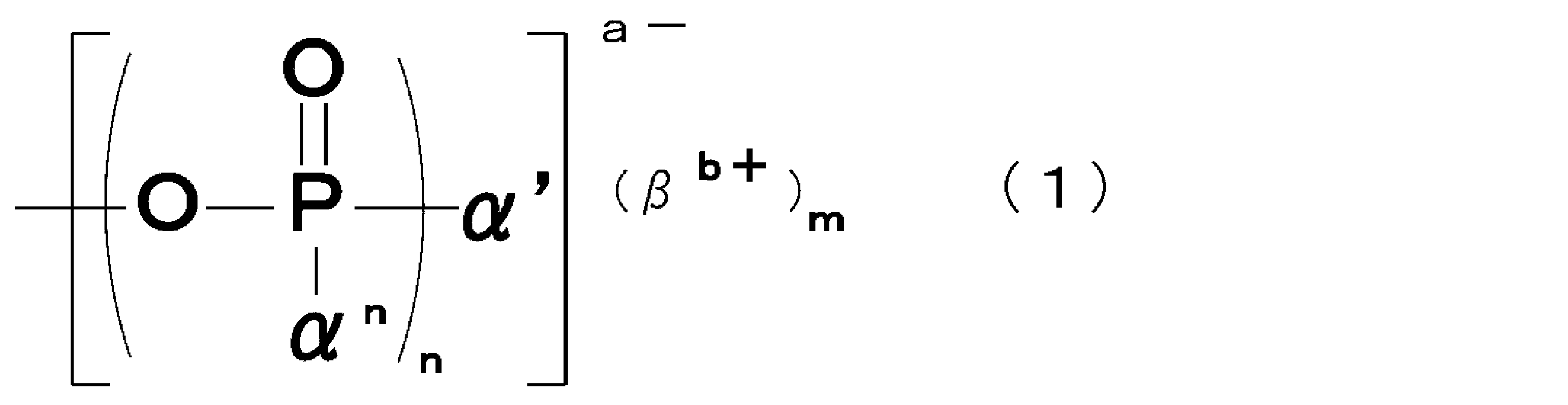
式(1)中、a、bおよびnは自然数である(ただし、a=b×mである)。α1,α2,・・・,αnおよびα’のうちa個がO-であり、残りはR,ORのいずれかである。なお、各αnおよびα’の全てがO-であっても構わない。Rは、各々、水素原子、飽和-直鎖状炭化水素基、飽和-分岐鎖状炭化水素基、飽和-環状炭化水素基、不飽和-直鎖状炭化水素基、不飽和-分岐鎖状炭化水素基、不飽和-環状炭化水素基、芳香族基、またはこれらの誘導基である。
飽和-直鎖状炭化水素基としては、メチル基、エチル基、n-プロピル基、又はn-ブチル基等が挙げられるが、特に限定されない。飽和-分岐鎖状炭化水素基としては、i-プロピル基、又はt-ブチル基等が挙げられるが、特に限定されない。飽和-環状炭化水素基としては、シクロペンチル基、又はシクロヘキシル基等が挙げられるが、特に限定されない。不飽和-直鎖状炭化水素基としては、ビニル基、又はアリル基等が挙げられるが、特に限定されない。不飽和-分岐鎖状炭化水素基としては、i-プロペニル基、又は3-ブテニル基等が挙げられるが、特に限定されない。不飽和-環状炭化水素基としては、シクロペンテニル基、シクロヘキセニル基等が挙げられるが、特に限定されない。芳香族基としては、フェニル基、又はナフチル基等が挙げられるが、特に限定されない。
また、Rにおける誘導基としては、上記各種炭化水素基の主鎖又は側鎖に対し、カルボキシ基、ヒドロキシ基、又はアミノ基などの官能基のうち、少なくとも1種類が付加又は置換した状態の官能基が挙げられるが、特に限定されない。また、Rの主鎖を構成する炭素原子数は特に限定されないが、20以下であることが好ましく、10以下であることがより好ましい。Rの主鎖を構成する炭素原子数を上記範囲とすることにより、リンオキソ酸基の分子量を適切な範囲とすることができ、繊維原料への浸透を容易にし、微細セルロース繊維の収率を高めることもできる。
βb+は有機物又は無機物からなる1価以上の陽イオンである。有機物からなる1価以上の陽イオンとしては、脂肪族アンモニウム、又は芳香族アンモニウムが挙げられ、無機物からなる1価以上の陽イオンとしては、ナトリウム、カリウム、若しくはリチウム等のアルカリ金属のイオンや、カルシウム、若しくはマグネシウム等の2価金属の陽イオン、又は水素イオン等が挙げられるが、特に限定されない。これらは1種又は2種類以上を組み合わせて適用することもできる。有機物又は無機物からなる1価以上の陽イオンとしては、βを含む繊維原料を加熱した際に黄変しにくく、また工業的に利用し易いナトリウム、又はカリウムのイオンが好ましいが、特に限定されない。なお、βb+は有機オニウムイオンであってもよく、この場合、有機アンモニウムイオンであることが特に好ましい。
ここで、有機オニウムイオンは、下記(a)及び(b)から選択される少なくとも一方の条件を満たすものであることが好ましい。
(a)炭素数が5以上の炭化水素基を含む。
(b)総炭素数が17以上である。
すなわち、βb+が有機オニウムイオンである場合、繊維状セルロースは、炭素数が5以上の炭化水素基を含む有機オニウムイオン、及び総炭素数が17以上の有機オニウムイオンから選択される少なくとも一方を、リンオキソ酸基の対イオンとして含むことが好ましい。有機オニウムイオンを、上記(a)及び(b)から選択される少なくとも一方の条件を満たすものとすることにより、有機溶媒に対する繊維状セルロースの分散性をより効果的に高めることができる。
(a)炭素数が5以上の炭化水素基を含む。
(b)総炭素数が17以上である。
すなわち、βb+が有機オニウムイオンである場合、繊維状セルロースは、炭素数が5以上の炭化水素基を含む有機オニウムイオン、及び総炭素数が17以上の有機オニウムイオンから選択される少なくとも一方を、リンオキソ酸基の対イオンとして含むことが好ましい。有機オニウムイオンを、上記(a)及び(b)から選択される少なくとも一方の条件を満たすものとすることにより、有機溶媒に対する繊維状セルロースの分散性をより効果的に高めることができる。
炭素数が5以上の炭化水素基は、炭素数が5以上のアルキル基又は炭素数が5以上のアルキレン基であることが好ましく、炭素数が6以上のアルキル基又は炭素数が6以上のアルキレン基であることがより好ましく、炭素数が7以上のアルキル基又は炭素数が7以上のアルキレン基であることがさらに好ましく、炭素数が10以上のアルキル基又は炭素数が10以上のアルキレン基であることが特に好ましい。中でも、有機オニウムイオンは炭素数が5以上のアルキル基を有するものであることが好ましく、炭素数が5以上のアルキル基を含み、かつ総炭素数が17以上の有機オニウムイオンであることがより好ましい。
有機オニウムイオンは、下記一般式(A)で表される有機オニウムイオンであることが好ましい。
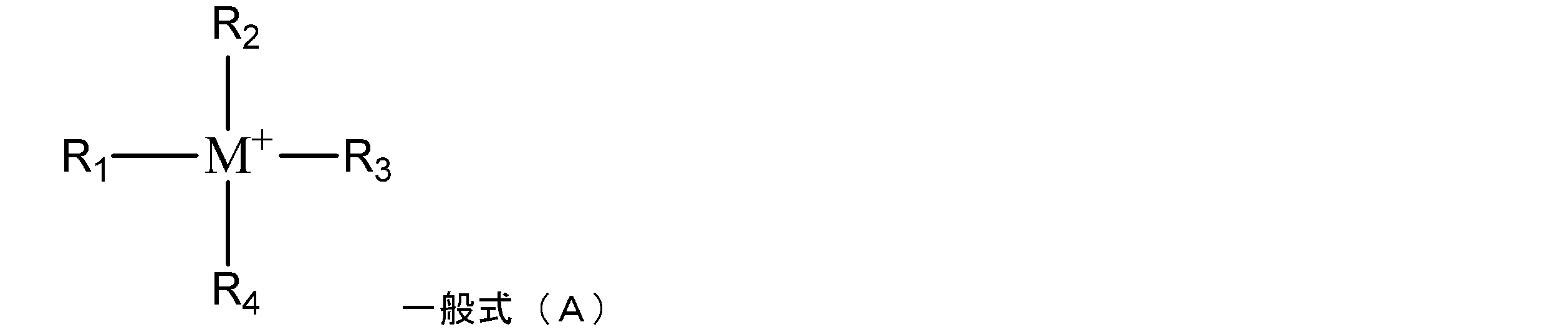
上記一般式(A)中、Mは窒素原子又はリン原子であり、R1~R4は、それぞれ独立に水素原子又は有機基を表す。但し、R1~R4の少なくとも1つは、炭素数が5以上の有機基であるか、R1~R4の炭素数の合計が17以上であることが好ましい。
中でも、Mは、窒素原子であることが好ましい。すなわち、有機オニウムイオンは有機アンモニウムイオンであることが好ましい。また、R1~R4の少なくとも1つは、炭素数が5以上のアルキル基であり、かつR1~R4の炭素数の合計が17以上であることが好ましい。
中でも、Mは、窒素原子であることが好ましい。すなわち、有機オニウムイオンは有機アンモニウムイオンであることが好ましい。また、R1~R4の少なくとも1つは、炭素数が5以上のアルキル基であり、かつR1~R4の炭素数の合計が17以上であることが好ましい。
このような有機オニウムイオンとしては、例えば、ラウリルトリメチルアンモニウム、セチルトリメチルアンモニウム、ステアリルトリメチルアンモニウム、オクチルジメチルエチルアンモニウム、ラウリルジメチルエチルアンモニウム、ジデシルジメチルアンモニウム、ラウリルジメチルベンジルアンモニウム、トリブチルベンジルアンモニウム、メチルトリ-n-オクチルアンモニウム、ヘキシルアンモニウム、n-オクチルアンモニウム、ドデシルアンモニウム、テトラデシルアンモニウム、ヘキサデシルアンモニウム、ステアリルアンモニウム、N,N-ジメチルドデシルアンモニウム、N,N-ジメチルテトラデシルアンモニウム、N,N-ジメチルヘキサデシルアンモニウム、N,N-ジメチル-n-オクタデシルアンモニウム、ジヘキシルアンモニウム、ジ(2-エチルヘキシル)アンモニウム、ジーn-オクチルアンモニウム、ジデシルアンモニウム、ジドデシルアンモニウム、ジデシルメチルアンモニウム、N,N-ジドデシルメチルアンモニウム、ポリオキシエチレンドデシルアンモニウム、アルキルジメチルベンジルアンモニウム、ジ-n-アルキルジメチルアンモニウム、ベヘニルトリメチルアンモニウム、テトラフェニルホスホニウム、テトラオクチルホスホニウム、アセトニルトリフェニルホスホニウム、アリルトリフェニルホスホニウム、アミルトリフェニルホスホニウム、ベンジルトリフェニルホスホニウム、エチルトリフェニルホスホニウム、ジフェニルプロピルホスホニウム、トリフェニルホスホニウム、トリシクロヘキシルホスホニウム、トリ-n-オクチルホスホニウム等を挙げることができる。なお、アルキルジメチルベンジルアンモニウム、ジ-n-アルキルジメチルアンモニウムにおけるアルキル基として、炭素数が8以上18以下の直鎖アルキル基が挙げられる。
なお、一般式(A)に示した通り、有機オニウムイオンの中心元素は合計4つの基または水素と結合している。上述した有機オニウムイオンの名称で、結合している基が4つ未満である場合、残りは水素原子が結合して有機オニウムイオンを形成している。例えば、N,N-ジドデシルメチルアンモニウムであれば、名称からドデシル基が2つ、メチル基が1つ結合していると判断できる。この場合、残りの1つには水素が結合し、有機オニウムイオンを形成している。
<イオン性置換基の導入量>
繊維状セルロースに対するイオン性置換基の導入量は、たとえば繊維状セルロース1g(質量)あたり0.10mmol/g以上であることが好ましく、0.20mmol/g以上であることがより好ましく、0.50mmol/g以上であることがさらに好ましく、1.00mmol/g以上であることがとくに好ましい。また、繊維状セルロースに対するイオン性置換基の導入量は、たとえば繊維状セルロース1g(質量)あたり5.20mmol/g以下であることが好ましく、3.65mmol/g以下であることがより好ましく、3.50mmol/g以下であることがさらに好ましく、3.00mmol/g以下であることが一層好ましい。イオン性置換基の導入量を上記範囲内とすることにより、繊維原料の微細化を容易とすることができ、繊維状セルロースの安定性を高めることが可能となる。また、イオン性置換基の導入量を上記範囲内とすることにより、繊維状セルロースの増粘剤などの種々用途において良好な特性を発揮することができる。ここで、単位mmol/gにおける分母は、イオン性置換基の対イオンが水素イオン(H+)であるときの繊維状セルロースの質量を示す。
繊維状セルロースに対するイオン性置換基の導入量は、たとえば繊維状セルロース1g(質量)あたり0.10mmol/g以上であることが好ましく、0.20mmol/g以上であることがより好ましく、0.50mmol/g以上であることがさらに好ましく、1.00mmol/g以上であることがとくに好ましい。また、繊維状セルロースに対するイオン性置換基の導入量は、たとえば繊維状セルロース1g(質量)あたり5.20mmol/g以下であることが好ましく、3.65mmol/g以下であることがより好ましく、3.50mmol/g以下であることがさらに好ましく、3.00mmol/g以下であることが一層好ましい。イオン性置換基の導入量を上記範囲内とすることにより、繊維原料の微細化を容易とすることができ、繊維状セルロースの安定性を高めることが可能となる。また、イオン性置換基の導入量を上記範囲内とすることにより、繊維状セルロースの増粘剤などの種々用途において良好な特性を発揮することができる。ここで、単位mmol/gにおける分母は、イオン性置換基の対イオンが水素イオン(H+)であるときの繊維状セルロースの質量を示す。
繊維状セルロースに対するイオン性置換基の導入量は、たとえば中和滴定法により測定することができる。中和滴定法による測定では、得られた繊維状セルロースを含有するスラリーに、水酸化ナトリウム水溶液などのアルカリを加えながらpHの変化を求めることにより、導入量を測定する。
図1は、イオン性置換基としてリンオキソ酸基を有する繊維状セルロース含有スラリーに対するNaOH滴下量とpHの関係を示すグラフである。繊維状セルロースに対するリンオキソ酸基の導入量は、たとえば次のように測定される。
まず、繊維状セルロースを含有するスラリーを強酸性イオン交換樹脂で処理する。なお、必要に応じて、強酸性イオン交換樹脂による処理の前に、後述の解繊処理工程と同様の解繊処理を測定対象に対して実施してもよい。
次いで、水酸化ナトリウム水溶液を加えながらpHの変化を観察し、図1の上側部に示すような滴定曲線を得る。図1の上側部に示した滴定曲線では、アルカリを加えた量に対して測定したpHをプロットしており、図1の下側部に示した滴定曲線では、アルカリを加えた量に対するpHの増分(微分値)(1/mmol)をプロットしている。この中和滴定では、アルカリを加えた量に対して測定したpHをプロットした曲線において、増分(pHのアルカリ滴下量に対する微分値)が極大となる点が二つ確認される。これらのうち、アルカリを加えはじめて先に得られる増分の極大点を第1終点と呼び、次に得られる増分の極大点を第2終点と呼ぶ。滴定開始から第1終点までに必要としたアルカリ量が、滴定に使用したスラリー中に含まれる繊維状セルロースの第1解離酸量と等しくなり、第1終点から第2終点までに必要としたアルカリ量が滴定に使用したスラリー中に含まれる繊維状セルロースの第2解離酸量と等しくなり、滴定開始から第2終点までに必要としたアルカリ量が滴定に使用したスラリー中に含まれる繊維状セルロースの総解離酸量と等しくなる。そして、滴定開始から第1終点までに必要としたアルカリ量を滴定対象スラリー中の固形分(g)で除して得られる値が、リンオキソ酸基導入量(mmol/g)となる。なお、単にリンオキソ酸基導入量(またはリンオキソ酸基量)と言った場合は、第1解離酸量のことを表す。
なお、図1において、滴定開始から第1終点までの領域を第1領域と呼び、第1終点から第2終点までの領域を第2領域と呼ぶ。例えば、リンオキソ酸基がリン酸基の場合であって、このリン酸基が縮合を起こす場合、見かけ上、リンオキソ酸基における弱酸性基量(第2解離酸量)が低下し、第1領域に必要としたアルカリ量と比較して第2領域に必要としたアルカリ量が少なくなる。一方、リンオキソ酸基における強酸性基量(第1解離酸量)は、縮合の有無に関わらずリン原子の量と一致する。また、リンオキソ酸基が亜リン酸基の場合は、リンオキソ酸基に弱酸性基が存在しなくなるため、第2領域に必要としたアルカリ量が少なくなるか、第2領域に必要としたアルカリ量はゼロとなる場合もある。この場合、滴定曲線において、pHの増分が極大となる点は一つとなる。
まず、繊維状セルロースを含有するスラリーを強酸性イオン交換樹脂で処理する。なお、必要に応じて、強酸性イオン交換樹脂による処理の前に、後述の解繊処理工程と同様の解繊処理を測定対象に対して実施してもよい。
次いで、水酸化ナトリウム水溶液を加えながらpHの変化を観察し、図1の上側部に示すような滴定曲線を得る。図1の上側部に示した滴定曲線では、アルカリを加えた量に対して測定したpHをプロットしており、図1の下側部に示した滴定曲線では、アルカリを加えた量に対するpHの増分(微分値)(1/mmol)をプロットしている。この中和滴定では、アルカリを加えた量に対して測定したpHをプロットした曲線において、増分(pHのアルカリ滴下量に対する微分値)が極大となる点が二つ確認される。これらのうち、アルカリを加えはじめて先に得られる増分の極大点を第1終点と呼び、次に得られる増分の極大点を第2終点と呼ぶ。滴定開始から第1終点までに必要としたアルカリ量が、滴定に使用したスラリー中に含まれる繊維状セルロースの第1解離酸量と等しくなり、第1終点から第2終点までに必要としたアルカリ量が滴定に使用したスラリー中に含まれる繊維状セルロースの第2解離酸量と等しくなり、滴定開始から第2終点までに必要としたアルカリ量が滴定に使用したスラリー中に含まれる繊維状セルロースの総解離酸量と等しくなる。そして、滴定開始から第1終点までに必要としたアルカリ量を滴定対象スラリー中の固形分(g)で除して得られる値が、リンオキソ酸基導入量(mmol/g)となる。なお、単にリンオキソ酸基導入量(またはリンオキソ酸基量)と言った場合は、第1解離酸量のことを表す。
なお、図1において、滴定開始から第1終点までの領域を第1領域と呼び、第1終点から第2終点までの領域を第2領域と呼ぶ。例えば、リンオキソ酸基がリン酸基の場合であって、このリン酸基が縮合を起こす場合、見かけ上、リンオキソ酸基における弱酸性基量(第2解離酸量)が低下し、第1領域に必要としたアルカリ量と比較して第2領域に必要としたアルカリ量が少なくなる。一方、リンオキソ酸基における強酸性基量(第1解離酸量)は、縮合の有無に関わらずリン原子の量と一致する。また、リンオキソ酸基が亜リン酸基の場合は、リンオキソ酸基に弱酸性基が存在しなくなるため、第2領域に必要としたアルカリ量が少なくなるか、第2領域に必要としたアルカリ量はゼロとなる場合もある。この場合、滴定曲線において、pHの増分が極大となる点は一つとなる。
なお、上述のリンオキソ酸基導入量(mmol/g)は、分母が酸型の繊維状セルロースの質量を示すことから、酸型の繊維状セルロースが有するリンオキソ酸基量(以降、リンオキソ酸基量(酸型)と呼ぶ)を示している。一方で、リンオキソ酸基の対イオンが電荷当量となるように任意の陽イオンCに置換されている場合は、分母を当該陽イオンCが対イオンであるときの繊維状セルロースの質量に変換することで、陽イオンCが対イオンである繊維状セルロースが有するリンオキソ酸基量(以降、リンオキソ酸基量(C型))を求めることができる。
すなわち、下記計算式によって算出する。
リンオキソ酸基量(C型)=リンオキソ酸基量(酸型)/{1+(W-1)×A/1000}
A[mmol/g]:繊維状セルロースが有するリンオキソ酸基由来の総アニオン量(リンオキソ酸基の総解離酸量)
W:陽イオンCの1価あたりの式量(たとえば、Naは23、Alは9)
すなわち、下記計算式によって算出する。
リンオキソ酸基量(C型)=リンオキソ酸基量(酸型)/{1+(W-1)×A/1000}
A[mmol/g]:繊維状セルロースが有するリンオキソ酸基由来の総アニオン量(リンオキソ酸基の総解離酸量)
W:陽イオンCの1価あたりの式量(たとえば、Naは23、Alは9)
図2は、イオン性置換基としてカルボキシ基を有する繊維状セルロースを含有する分散液に対するNaOH滴下量とpHの関係を示すグラフである。繊維状セルロースに対するカルボキシ基の導入量は、たとえば次のように測定される。
まず、繊維状セルロースを含有する分散液を強酸性イオン交換樹脂で処理する。なお、必要に応じて、強酸性イオン交換樹脂による処理の前に、後述の解繊処理工程と同様の解繊処理を測定対象に対して実施してもよい。
次いで、水酸化ナトリウム水溶液を加えながらpHの変化を観察し、図2の上側部に示すような滴定曲線を得る。図2の上側部に示した滴定曲線では、アルカリを加えた量に対して測定したpHをプロットしており、図2の下側部に示した滴定曲線では、アルカリを加えた量に対するpHの増分(微分値)(1/mmol)をプロットしている。この中和滴定では、アルカリを加えた量に対して測定したpHをプロットした曲線において、増分(pHのアルカリ滴下量に対する微分値)が極大となる点が一つ確認され、この極大点を第1終点と呼ぶ。ここで、図2における滴定開始から第1終点までの領域を第1領域と呼ぶ。第1領域で必要としたアルカリ量が、滴定に使用した分散液中のカルボキシ基量と等しくなる。そして、滴定曲線の第1領域で必要としたアルカリ量(mmol)を、滴定対象の繊維状セルロースを含有する分散液中の固形分(g)で除すことで、カルボキシ基の導入量(mmol/g)を算出する。
まず、繊維状セルロースを含有する分散液を強酸性イオン交換樹脂で処理する。なお、必要に応じて、強酸性イオン交換樹脂による処理の前に、後述の解繊処理工程と同様の解繊処理を測定対象に対して実施してもよい。
次いで、水酸化ナトリウム水溶液を加えながらpHの変化を観察し、図2の上側部に示すような滴定曲線を得る。図2の上側部に示した滴定曲線では、アルカリを加えた量に対して測定したpHをプロットしており、図2の下側部に示した滴定曲線では、アルカリを加えた量に対するpHの増分(微分値)(1/mmol)をプロットしている。この中和滴定では、アルカリを加えた量に対して測定したpHをプロットした曲線において、増分(pHのアルカリ滴下量に対する微分値)が極大となる点が一つ確認され、この極大点を第1終点と呼ぶ。ここで、図2における滴定開始から第1終点までの領域を第1領域と呼ぶ。第1領域で必要としたアルカリ量が、滴定に使用した分散液中のカルボキシ基量と等しくなる。そして、滴定曲線の第1領域で必要としたアルカリ量(mmol)を、滴定対象の繊維状セルロースを含有する分散液中の固形分(g)で除すことで、カルボキシ基の導入量(mmol/g)を算出する。
なお、上述のカルボキシ基導入量(mmol/g)は、分母が酸型の繊維状セルロースの質量であることから、酸型の繊維状セルロースが有するカルボキシ基量(以降、カルボキシ基量(酸型)と呼ぶ)を示している。一方で、カルボキシ基の対イオンが電荷当量となるように任意の陽イオンCに置換されている場合は、分母を当該陽イオンCが対イオンであるときの繊維状セルロースの質量に変換することで、陽イオンCが対イオンである繊維状セルロースが有するカルボキシ基量(以降、カルボキシ基量(C型))を求めることができる。すなわち、下記計算式によって算出する。
カルボキシ基量(C型)=カルボキシ基量(酸型)/{1+(W-1)×(カルボキシ基量(酸型))/1000}
W:陽イオンCの1価あたりの式量(たとえば、Naは23、Alは9)
カルボキシ基量(C型)=カルボキシ基量(酸型)/{1+(W-1)×(カルボキシ基量(酸型))/1000}
W:陽イオンCの1価あたりの式量(たとえば、Naは23、Alは9)
なお、滴定法によるイオン性置換基量の測定においては、水酸化ナトリウム水溶液1滴の滴下量が多すぎる場合や、滴定間隔が短すぎる場合、本来より低いイオン性置換基量となるなど正確な値が得られないことがある。適切な滴下量、滴定間隔としては、例えば、0.1N水酸化ナトリウム水溶液を5~30秒に10~50μLずつ滴定するなどが望ましい。また、繊維状セルロース含有スラリーに溶解した二酸化炭素の影響を排除するため、例えば、滴定開始の15分前から滴定終了まで、窒素ガスなどの不活性ガスをスラリーに吹き込みながら測定するなどが望ましい。
<微細繊維状セルロースの製造工程>
<繊維原料>
微細繊維状セルロースは、セルロースを含む繊維原料から製造される。セルロースを含む繊維原料としては、特に限定されないが、入手しやすく安価である点からパルプを用いることが好ましい。パルプとしては、たとえば木材パルプ、非木材パルプ、および脱墨パルプが挙げられる。木材パルプとしては、特に限定されないが、たとえば広葉樹クラフトパルプ(LBKP)、針葉樹クラフトパルプ(NBKP)、サルファイトパルプ(SP)、溶解パルプ(DP)、ソーダパルプ(AP)、未晒しクラフトパルプ(UKP)および酸素漂白クラフトパルプ(OKP)等の化学パルプ、セミケミカルパルプ(SCP)およびケミグラウンドウッドパルプ(CGP)等の半化学パルプ、砕木パルプ(GP)およびサーモメカニカルパルプ(TMP、BCTMP)等の機械パルプ等が挙げられる。非木材パルプとしては、特に限定されないが、たとえばコットンリンターおよびコットンリント等の綿系パルプ、麻、麦わらおよびバガス等の非木材系パルプが挙げられる。脱墨パルプとしては、特に限定されないが、たとえば古紙を原料とする脱墨パルプが挙げられる。本実施態様のパルプは上記の1種を単独で用いてもよいし、2種以上混合して用いてもよい。上記パルプの中でも、入手のしやすさという観点からは、たとえば木材パルプおよび脱墨パルプが好ましい。また、木材パルプの中でも、セルロース比率が大きく解繊処理時の微細繊維状セルロースの収率が高い観点や、パルプ中のセルロースの分解が小さく軸比の大きい長繊維の微細繊維状セルロースが得られる観点から、たとえば化学パルプがより好ましく、クラフトパルプ、サルファイトパルプがさらに好ましい。なお、軸比の大きい長繊維の微細繊維状セルロースを用いると粘度が高くなる傾向がある。
<繊維原料>
微細繊維状セルロースは、セルロースを含む繊維原料から製造される。セルロースを含む繊維原料としては、特に限定されないが、入手しやすく安価である点からパルプを用いることが好ましい。パルプとしては、たとえば木材パルプ、非木材パルプ、および脱墨パルプが挙げられる。木材パルプとしては、特に限定されないが、たとえば広葉樹クラフトパルプ(LBKP)、針葉樹クラフトパルプ(NBKP)、サルファイトパルプ(SP)、溶解パルプ(DP)、ソーダパルプ(AP)、未晒しクラフトパルプ(UKP)および酸素漂白クラフトパルプ(OKP)等の化学パルプ、セミケミカルパルプ(SCP)およびケミグラウンドウッドパルプ(CGP)等の半化学パルプ、砕木パルプ(GP)およびサーモメカニカルパルプ(TMP、BCTMP)等の機械パルプ等が挙げられる。非木材パルプとしては、特に限定されないが、たとえばコットンリンターおよびコットンリント等の綿系パルプ、麻、麦わらおよびバガス等の非木材系パルプが挙げられる。脱墨パルプとしては、特に限定されないが、たとえば古紙を原料とする脱墨パルプが挙げられる。本実施態様のパルプは上記の1種を単独で用いてもよいし、2種以上混合して用いてもよい。上記パルプの中でも、入手のしやすさという観点からは、たとえば木材パルプおよび脱墨パルプが好ましい。また、木材パルプの中でも、セルロース比率が大きく解繊処理時の微細繊維状セルロースの収率が高い観点や、パルプ中のセルロースの分解が小さく軸比の大きい長繊維の微細繊維状セルロースが得られる観点から、たとえば化学パルプがより好ましく、クラフトパルプ、サルファイトパルプがさらに好ましい。なお、軸比の大きい長繊維の微細繊維状セルロースを用いると粘度が高くなる傾向がある。
セルロースを含む繊維原料としては、たとえばホヤ類に含まれるセルロースや、酢酸菌が生成するバクテリアセルロースを利用することもできる。また、セルロースを含む繊維原料に代えて、キチン、キトサンなどの直鎖型の含窒素多糖高分子が形成する繊維を用いることもできる。
<リンオキソ酸基導入工程>
微細繊維状セルロースの製造工程は、イオン性置換基導入工程として、例えば、リンオキソ酸基導入工程を含む。リンオキソ酸基導入工程は、セルロースを含む繊維原料が有する水酸基と反応することで、リンオキソ酸基を導入できる化合物から選択される少なくとも1種の化合物(以下、「化合物A」ともいう)を、セルロースを含む繊維原料に作用させる工程である。この工程により、リンオキソ酸基導入繊維が得られることとなる。
微細繊維状セルロースの製造工程は、イオン性置換基導入工程として、例えば、リンオキソ酸基導入工程を含む。リンオキソ酸基導入工程は、セルロースを含む繊維原料が有する水酸基と反応することで、リンオキソ酸基を導入できる化合物から選択される少なくとも1種の化合物(以下、「化合物A」ともいう)を、セルロースを含む繊維原料に作用させる工程である。この工程により、リンオキソ酸基導入繊維が得られることとなる。
本実施形態に係るリンオキソ酸基導入工程では、セルロースを含む繊維原料と化合物Aの反応を、尿素及びその誘導体から選択される少なくとも1種(以下、「化合物B」ともいう)の存在下で行ってもよい。一方で、化合物Bが存在しない状態において、セルロースを含む繊維原料と化合物Aの反応を行ってもよい。
化合物Aを化合物Bとの共存下で繊維原料に作用させる方法の一例としては、乾燥状態、湿潤状態またはスラリー状の繊維原料に対して、化合物Aと化合物Bを混合する方法が挙げられる。これらのうち、反応の均一性が高いことから、乾燥状態または湿潤状態の繊維原料を用いることが好ましく、特に乾燥状態の繊維原料を用いることが好ましい。繊維原料の形態は、特に限定されないが、たとえば綿状や薄いシート状であることが好ましい。化合物Aおよび化合物Bは、それぞれ粉末状または溶媒に溶解させた溶液状または融点以上まで加熱して溶融させた状態で繊維原料に添加する方法が挙げられる。これらのうち、反応の均一性が高いことから、溶媒に溶解させた溶液状、特に水溶液の状態で添加することが好ましい。また、化合物Aと化合物Bは繊維原料に対して同時に添加してもよく、別々に添加してもよく、混合物として添加してもよい。化合物Aと化合物Bの添加方法としては、特に限定されないが、化合物Aと化合物Bが溶液状の場合は、繊維原料を溶液内に浸漬し吸液させたのちに取り出してもよいし、繊維原料に溶液を滴下してもよい。また、必要量の化合物Aと化合物Bを繊維原料に添加してもよいし、過剰量の化合物Aと化合物Bをそれぞれ繊維原料に添加した後に、圧搾や濾過によって余剰の化合物Aと化合物Bを除去してもよい。
本実施態様で使用する化合物Aとしては、リン原子を有し、セルロースとエステル結合を形成可能な化合物であればよく、リン酸もしくはその塩、亜リン酸もしくはその塩、脱水縮合リン酸もしくはその塩、無水リン酸(五酸化二リン)などが挙げられるが特に限定されない。リン酸としては、種々の純度のものを使用することができ、たとえば100%リン酸(正リン酸)や85%リン酸を使用することができる。亜リン酸としては、99%亜リン酸(ホスホン酸)が挙げられる。脱水縮合リン酸は、リン酸が脱水反応により2分子以上縮合したものであり、例えばピロリン酸、ポリリン酸等を挙げることができる。リン酸塩、亜リン酸塩、脱水縮合リン酸塩としては、リン酸、亜リン酸または脱水縮合リン酸のリチウム塩、ナトリウム塩、カリウム塩、アンモニウム塩などが挙げられ、これらは種々の中和度とすることができる。これらのうち、リン酸基の導入効率が高く、後述する解繊工程で解繊効率がより向上しやすく、低コストであり、かつ工業的に適用しやすい観点から、リン酸、リン酸のナトリウム塩、リン酸のカリウム塩、リン酸のアンモニウム塩または亜リン酸、亜リン酸のナトリウム塩、亜リン酸のカリウム塩、亜リン酸のアンモニウム塩が好ましく、リン酸、リン酸二水素ナトリウム、リン酸水素二ナトリウム、リン酸二水素アンモニウム、または亜リン酸、亜リン酸ナトリウムがより好ましい。
繊維原料に対する化合物Aの添加量は、特に限定されないが、たとえば化合物Aの添加量をリン原子量に換算した場合において、繊維原料(絶乾質量)に対するリン原子の添加量が0.5質量%以上100質量%以下となることが好ましく、1質量%以上50質量%以下となることがより好ましく、2質量%以上30質量%以下となることがさらに好ましい。繊維原料に対するリン原子の添加量を上記範囲内とすることにより、微細繊維状セルロースの収率をより向上させることができる。一方で、繊維原料に対するリン原子の添加量を上記上限値以下とすることにより、収率向上の効果とコストのバランスをとることができる。
本実施態様で使用する化合物Bは、上述のとおり尿素及びその誘導体から選択される少なくとも1種である。化合物Bとしては、たとえば尿素、ビウレット、1-フェニル尿素、1-ベンジル尿素、1-メチル尿素、および1-エチル尿素などが挙げられる。反応の均一性を向上させる観点から、化合物Bは水溶液として用いることが好ましい。また、反応の均一性をさらに向上させる観点からは、化合物Aと化合物Bの両方が溶解した水溶液を用いることが好ましい。
繊維原料(絶乾質量)に対する化合物Bの添加量は、特に限定されないが、たとえば1質量%以上500質量%以下であることが好ましく、10質量%以上400質量%以下であることがより好ましく、100質量%以上350質量%以下であることがさらに好ましい。
セルロースを含む繊維原料と化合物Aの反応においては、化合物Bの他に、たとえばアミド類またはアミン類を反応系に含んでもよい。アミド類としては、たとえばホルムアミド、ジメチルホルムアミド、アセトアミド、ジメチルアセトアミドなどが挙げられる。アミン類としては、たとえばメチルアミン、エチルアミン、トリメチルアミン、トリエチルアミン、モノエタノールアミン、ジエタノールアミン、トリエタノールアミン、ピリジン、エチレンジアミン、ヘキサメチレンジアミンなどが挙げられる。これらの中でも、特にトリエチルアミンは良好な反応触媒として働くことが知られている。
リンオキソ酸基導入工程においては、繊維原料に化合物A等を添加又は混合した後、当該繊維原料に対して加熱処理を施すことが好ましい。加熱処理温度としては、繊維の熱分解や加水分解反応を抑えながら、リンオキソ酸基を効率的に導入できる温度を選択することが好ましい。加熱処理温度は、たとえば50℃以上300℃以下であることが好ましく、100℃以上250℃以下であることがより好ましく、130℃以上200℃以下であることがさらに好ましい。また、加熱処理には、種々の熱媒体を有する機器を利用することができ、たとえば撹拌乾燥装置、回転乾燥装置、円盤乾燥装置、ロール型加熱装置、プレート型加熱装置、流動層乾燥装置、気流乾燥装置、減圧乾燥装置、赤外線加熱装置、遠赤外線加熱装置、マイクロ波加熱装置を用いることができる。
本実施形態に係る加熱処理においては、たとえば薄いシート状の繊維原料に化合物Aを含浸等の方法により添加した後、加熱する方法や、ニーダー等で繊維原料と化合物Aを混練又は撹拌しながら加熱する方法を採用することができる。これにより、繊維原料における化合物Aの濃度ムラを抑制して、繊維原料に含まれるセルロース繊維表面へより均一にリンオキソ酸基を導入することが可能となる。これは、乾燥に伴い水分子が繊維原料表面に移動する際、溶存する化合物Aが表面張力によって水分子に引き付けられ、同様に繊維原料表面に移動してしまう(すなわち、化合物Aの濃度ムラを生じてしまう)ことを抑制できることに起因するものと考えられる。
また、加熱処理に用いる加熱装置は、たとえばスラリーが保持する水分、及び化合物Aと繊維原料中のセルロース等が含む水酸基等との脱水縮合(リン酸エステル化)反応に伴って生じる水分、を常に装置系外に排出できる装置であることが好ましい。このような加熱装置としては、例えば送風方式のオーブン等が挙げられる。装置系内の水分を常に排出することにより、リン酸エステル化の逆反応であるリン酸エステル結合の加水分解反応を抑制できることに加えて、繊維中の糖鎖の酸加水分解を抑制することもできる。このため、軸比の高い微細繊維状セルロースを得ることが可能となる。
加熱処理の時間は、たとえば繊維原料から実質的に水分が除かれてから1秒以上300分以下であることが好ましく、1秒以上1000秒以下であることがより好ましく、10秒以上800秒以下であることがさらに好ましい。本実施形態では、加熱温度と加熱時間を適切な範囲とすることにより、リンオキソ酸基の導入量を好ましい範囲内とすることができる。
リンオキソ酸基導入工程は、少なくとも1回行えば良いが、2回以上繰り返して行うこともできる。2回以上のリンオキソ酸基導入工程を行うことにより、繊維原料に対して多くのリンオキソ酸基を導入することができる。本実施形態においては、好ましい態様の一例として、リンオキソ酸基導入工程を2回行う場合が挙げられる。
繊維原料に対するリンオキソ酸基の導入量は、たとえば微細繊維状セルロース1g(質量)あたり0.10mmol/g以上であることが好ましく、0.20mmol/g以上であることがより好ましく、0.50mmol/g以上であることがさらに好ましく、1.00mmol/g以上であることがとくに好ましい。また、繊維原料に対するリンオキソ酸基の導入量は、たとえば微細繊維状セルロース1g(質量)あたり5.20mmol/g以下であることが好ましく、3.65mmol/g以下であることがより好ましく、3.00mmol/g以下であることがさらに好ましい。リンオキソ酸基の導入量を上記範囲内とすることにより、繊維原料の微細化を容易にし、微細繊維状セルロースの安定性を高めることができる。
<カルボキシ基導入工程>
微細繊維状セルロースの製造工程は、イオン性置換基導入工程として、例えば、カルボキシ基導入工程を含んでもよい。カルボキシ基導入工程は、セルロースを含む繊維原料に対し、オゾン酸化やフェントン法による酸化、TEMPO酸化処理などの酸化処理やカルボン酸由来の基を有する化合物もしくはその誘導体、またはカルボン酸由来の基を有する化合物の酸無水物もしくはその誘導体によって処理することにより行われる。
微細繊維状セルロースの製造工程は、イオン性置換基導入工程として、例えば、カルボキシ基導入工程を含んでもよい。カルボキシ基導入工程は、セルロースを含む繊維原料に対し、オゾン酸化やフェントン法による酸化、TEMPO酸化処理などの酸化処理やカルボン酸由来の基を有する化合物もしくはその誘導体、またはカルボン酸由来の基を有する化合物の酸無水物もしくはその誘導体によって処理することにより行われる。
カルボン酸由来の基を有する化合物としては、特に限定されないが、たとえばマレイン酸、コハク酸、フタル酸、フマル酸、グルタル酸、アジピン酸、イタコン酸等のジカルボン酸化合物やクエン酸、アコニット酸等のトリカルボン酸化合物が挙げられる。また、カルボン酸由来の基を有する化合物の誘導体としては、特に限定されないが、たとえばカルボキシ基を有する化合物の酸無水物のイミド化物、カルボキシ基を有する化合物の酸無水物の誘導体が挙げられる。カルボキシ基を有する化合物の酸無水物のイミド化物としては、とくに限定されないが、たとえばマレイミド、コハク酸イミド、フタル酸イミド等のジカルボン酸化合物のイミド化物が挙げられる。
カルボン酸由来の基を有する化合物の酸無水物としては、特に限定されないが、たとえば無水マレイン酸、無水コハク酸、無水フタル酸、無水グルタル酸、無水アジピン酸、無水イタコン酸等のジカルボン酸化合物の酸無水物が挙げられる。また、カルボン酸由来の基を有する化合物の酸無水物の誘導体としては、特に限定されないが、たとえばジメチルマレイン酸無水物、ジエチルマレイン酸無水物、ジフェニルマレイン酸無水物等のカルボキシ基を有する化合物の酸無水物の少なくとも一部の水素原子が、アルキル基、フェニル基等の置換基により置換されたものが挙げられる。
カルボキシ基導入工程において、TEMPO酸化処理を行う場合には、たとえばその処理をpHが6以上8以下の条件で行うことが好ましい。このような処理は、中性TEMPO酸化処理ともいう。中性TEMPO酸化処理は、たとえばリン酸ナトリウム緩衝液(pH=6.8)に、繊維原料としてパルプと、触媒としてTEMPO(2,2,6,6-テトラメチルピペリジン-1-オキシル)等のニトロキシラジカル、犠牲試薬として次亜塩素酸ナトリウムを添加することで行うことができる。さらに亜塩素酸ナトリウムを共存させることによって、酸化の過程で発生するアルデヒドを、効率的にカルボキシ基まで酸化することができる。また、TEMPO酸化処理は、その処理をpHが10以上11以下の条件で行ってもよい。このような処理は、アルカリTEMPO酸化処理ともいう。アルカリTEMPO酸化処理は、たとえば繊維原料としてのパルプに対し、触媒としてTEMPO等のニトロキシラジカルと、共触媒として臭化ナトリウムと、酸化剤として次亜塩素酸ナトリウムを添加することにより行うことができる。
繊維原料に対するカルボキシ基の導入量は、置換基の種類によっても変わるが、たとえばTEMPO酸化によりカルボキシ基を導入する場合、微細繊維状セルロース1g(質量)あたり0.10mmol/g以上であることが好ましく、0.20mmol/g以上であることがより好ましく、0.50mmol/g以上であることがさらに好ましく、0.90mmol/g以上であることがとくに好ましい。また、2.5mmol/g以下であることが好ましく、2.20mmol/g以下であることがより好ましく、2.00mmol/g以下であることがさらに好ましい。その他、置換基がカルボキシメチル基である場合、微細繊維状セルロース1g(質量)あたり5.8mmol/g以下であってもよい。
<洗浄工程>
本実施形態における微細繊維状セルロースの製造方法においては、必要に応じてイオン性置換基導入繊維に対して洗浄工程を行うことができる。洗浄工程は、たとえば水や有機溶媒によりイオン性置換基導入繊維を洗浄することにより行われる。また、洗浄工程は後述する各工程の後に行われてもよく、各洗浄工程において実施される洗浄回数は、特に限定されない。
本実施形態における微細繊維状セルロースの製造方法においては、必要に応じてイオン性置換基導入繊維に対して洗浄工程を行うことができる。洗浄工程は、たとえば水や有機溶媒によりイオン性置換基導入繊維を洗浄することにより行われる。また、洗浄工程は後述する各工程の後に行われてもよく、各洗浄工程において実施される洗浄回数は、特に限定されない。
<アルカリ処理工程>
微細繊維状セルロースを製造する場合、イオン性置換基導入工程と、後述する解繊処理工程との間に、繊維原料に対してアルカリ処理を行ってもよい。アルカリ処理の方法としては、特に限定されないが、例えばアルカリ溶液中に、イオン性置換基導入繊維を浸漬する方法が挙げられる。
微細繊維状セルロースを製造する場合、イオン性置換基導入工程と、後述する解繊処理工程との間に、繊維原料に対してアルカリ処理を行ってもよい。アルカリ処理の方法としては、特に限定されないが、例えばアルカリ溶液中に、イオン性置換基導入繊維を浸漬する方法が挙げられる。
アルカリ溶液に含まれるアルカリ化合物は、特に限定されず、無機アルカリ化合物であってもよいし、有機アルカリ化合物であってもよい。本実施形態においては、汎用性が高いことから、たとえば水酸化ナトリウムまたは水酸化カリウムをアルカリ化合物として用いることが好ましい。また、アルカリ溶液に含まれる溶媒は、水または有機溶媒のいずれであってもよい。中でも、アルカリ溶液に含まれる溶媒は、水、またはアルコールに例示される極性有機溶媒などを含む極性溶媒であることが好ましく、少なくとも水を含む水系溶媒であることがより好ましい。アルカリ溶液としては、汎用性が高いことから、たとえば水酸化ナトリウム水溶液、または水酸化カリウム水溶液が好ましい。
アルカリ処理工程におけるアルカリ溶液の温度は、特に限定されないが、たとえば5℃以上80℃以下であることが好ましく、10℃以上60℃以下であることがより好ましい。アルカリ処理工程におけるイオン性置換基導入繊維のアルカリ溶液への浸漬時間は、特に限定されないが、たとえば5分以上30分以下であることが好ましく、10分以上20分以下であることがより好ましい。アルカリ処理におけるアルカリ溶液の使用量は、特に限定されないが、たとえばイオン性置換基導入繊維の絶対乾燥質量に対して100質量%以上100000質量%以下であることが好ましく、1000質量%以上10000質量%以下であることがより好ましい。
アルカリ処理工程におけるアルカリ溶液の使用量を減らすために、イオン性置換基導入工程の後であってアルカリ処理工程の前に、イオン性置換基導入繊維を水や有機溶媒により洗浄してもよい。アルカリ処理工程の後であって解繊処理工程の前には、取り扱い性を向上させる観点から、アルカリ処理を行ったイオン性置換基導入繊維を水や有機溶媒により洗浄することが好ましい。
<酸処理工程>
微細繊維状セルロースを製造する場合、イオン性置換基を導入する工程と、後述する解繊処理工程の間に、繊維原料に対して酸処理を行ってもよい。例えば、イオン性置換基導入工程、酸処理、アルカリ処理及び解繊処理をこの順で行ってもよい。
微細繊維状セルロースを製造する場合、イオン性置換基を導入する工程と、後述する解繊処理工程の間に、繊維原料に対して酸処理を行ってもよい。例えば、イオン性置換基導入工程、酸処理、アルカリ処理及び解繊処理をこの順で行ってもよい。
酸処理の方法としては、特に限定されないが、たとえば酸を含有する酸性液中に繊維原料を浸漬する方法が挙げられる。使用する酸性液の濃度は、特に限定されないが、たとえば10質量%以下であることが好ましく、5質量%以下であることがより好ましい。また、使用する酸性液のpHは、特に限定されないが、たとえば0以上4以下であることが好ましく、1以上3以下であることがより好ましい。酸性液に含まれる酸としては、たとえば無機酸、スルホン酸、カルボン酸等を用いることができる。無機酸としては、たとえば硫酸、硝酸、塩酸、臭化水素酸、ヨウ化水素酸、次亜塩素酸、亜塩素酸、塩素酸、過塩素酸、リン酸、ホウ酸等が挙げられる。スルホン酸としては、たとえばメタンスルホン酸、エタンスルホン酸、ベンゼンスルホン酸、p-トルエンスルホン酸、トリフルオロメタンスルホン酸等が挙げられる。カルボン酸としては、たとえばギ酸、酢酸、クエン酸、グルコン酸、乳酸、シュウ酸、酒石酸等が挙げられる。これらの中でも、塩酸または硫酸を用いることが特に好ましい。
酸処理における酸溶液の温度は、特に限定されないが、たとえば5℃以上100℃以下が好ましく、20℃以上90℃以下がより好ましい。酸処理における酸溶液への浸漬時間は、特に限定されないが、たとえば5分以上120分以下が好ましく、10分以上60分以下がより好ましい。酸処理における酸溶液の使用量は、特に限定されないが、たとえば繊維原料の絶対乾燥質量に対して100質量%以上100000質量%以下であることが好ましく、1000質量%以上10000質量%以下であることがより好ましい。
<解繊処理>
イオン性置換基導入繊維を解繊処理工程で解繊処理することにより、微細繊維状セルロースが得られる。解繊処理工程においては、たとえば解繊処理装置を用いることができる。解繊処理装置は、特に限定されないが、たとえば高速解繊機、グラインダー(石臼型粉砕機)、高圧ホモジナイザーや超高圧ホモジナイザー、高圧衝突型粉砕機、ボールミル、ビーズミル、ディスク型リファイナー、コニカルリファイナー、二軸混練機、振動ミル、高速回転下でのホモミキサー、超音波分散機、またはビーターなどを使用することができる。上記解繊処理装置の中でも、粉砕メディアの影響が少なく、コンタミネーションのおそれが少ない高速解繊機、高圧ホモジナイザー、超高圧ホモジナイザーを用いるのがより好ましい。
イオン性置換基導入繊維を解繊処理工程で解繊処理することにより、微細繊維状セルロースが得られる。解繊処理工程においては、たとえば解繊処理装置を用いることができる。解繊処理装置は、特に限定されないが、たとえば高速解繊機、グラインダー(石臼型粉砕機)、高圧ホモジナイザーや超高圧ホモジナイザー、高圧衝突型粉砕機、ボールミル、ビーズミル、ディスク型リファイナー、コニカルリファイナー、二軸混練機、振動ミル、高速回転下でのホモミキサー、超音波分散機、またはビーターなどを使用することができる。上記解繊処理装置の中でも、粉砕メディアの影響が少なく、コンタミネーションのおそれが少ない高速解繊機、高圧ホモジナイザー、超高圧ホモジナイザーを用いるのがより好ましい。
解繊処理工程においては、たとえばイオン性置換基導入繊維を、分散媒により希釈してスラリー状にすることが好ましい。分散媒としては、水、および極性有機溶媒などの有機溶媒から選択される1種または2種以上を使用することができる。極性有機溶媒としては、特に限定されないが、たとえばアルコール類、多価アルコール類、ケトン類、エーテル類、エステル類、非プロトン性極性溶媒等が好ましい。アルコール類としては、たとえばメタノール、エタノール、イソプロパノール、n-ブタノール、イソブチルアルコール等が挙げられる。多価アルコール類としては、たとえばエチレングリコール、プロピレングリコール、グリセリンなどが挙げられる。ケトン類としては、アセトン、メチルエチルケトン(MEK)等が挙げられる。エーテル類としては、たとえばジエチルエーテル、テトラヒドロフラン、エチレングリコールモノメチルエーテル、エチレングリコールモノエチルエーテル、エチレングリコールモノn-ブチルエーテル、プロピレングリコールモノメチルエーテル等が挙げられる。エステル類としては、たとえば酢酸エチル、酢酸ブチル等が挙げられる。非プロトン性極性溶媒としてはジメチルスルホキシド(DMSO)、ジメチルホルムアミド(DMF)、ジメチルアセトアミド(DMAc)、N-メチル-2-ピロリジノン(NMP)等が挙げられる。
解繊処理時の微細繊維状セルロースの固形分濃度は適宜設定できる。また、イオン性置換基導入繊維を分散媒に分散させて得たスラリー中には、例えば水素結合性のある尿素などのイオン性置換基導入繊維以外の固形分が含まれていてもよい。
(溶媒)
本発明の塗膜剥離剤は、溶媒を含有する。溶媒は、剥離機能を発揮し得る溶媒を含むことが好ましい。ここで、剥離機能を発揮し得る溶媒とは、溶媒が塗膜中に浸透し、塗膜を膨潤させたり、塗膜を軟化させたりして塗装面から塗膜を浮き上がらせることができる溶媒である。
本発明の塗膜剥離剤は、溶媒を含有する。溶媒は、剥離機能を発揮し得る溶媒を含むことが好ましい。ここで、剥離機能を発揮し得る溶媒とは、溶媒が塗膜中に浸透し、塗膜を膨潤させたり、塗膜を軟化させたりして塗装面から塗膜を浮き上がらせることができる溶媒である。
溶媒としては、例えば、2-ピロリドン、3-ピロリドン、N-アルキル-2-ピロリドン(例えば、N-メチル-2-ピロリドン、N-エチル-2-ピロリドン、N-プロピル-2-ピロリドン)、5-アルキル-2-ピロリドン(例えば、5-メチル-2-ピロリドン、5-エチル-2-ピロリドン、5-プロピル-2-ピロリドン)、N-ビニル-2-ピロリドン、N-アルキル-3-ピロリドン(例えば、N-メチル-3-ピロリドン、N-エチル-3-ピロリドン、N-プロピル-3-ピロリドン)などのピロリドン系化合物、ホルムアミド、N-メチルホルムアミド、N,N-ジメチルホルムアミド、N,N-ジエチルホルムアミド、アセトアミド、N-メチルアセトアミド、N,N-ジメチルアセトアミド等の含窒素系溶媒;メチルアルコール、エチルアルコール、プロピルアルコール、ブチルアルコール、1-プロパノール、2-プロパノール、イソプロピルアルコール、エチレングリコール、サリチルアルコール、シンナミルアルコール、ベラリルアルコール、シナビルアルコール、ジフェニルメタノール、バニリルアルコール、ベンジルアルコール、2-メチルベンジルアルコール、3-メチルベンジルアルコール、3-ニトリルベンジルアルコール、4-メチルベンジルアルコール、α-メチルベンジルアルコール、アリルアルコール、プロパギルアルコール、フェネチルアルコール、ヒドロキシベンジルアルコール、ヒドロキシフェネチルアルコール等のアルコール系溶媒;クロロホルム、四塩化炭素、塩化メチレン、トリクロロエチレンあるいはテトラクロロエチレン等の塩素系溶媒等を挙げることができる。中でも、溶媒は、含窒素系溶媒及びアルコール系溶媒から選択される少なくとも1種であることが好ましく、含窒素系溶媒であることがより好ましい。なお、含窒素系溶媒は環状構造を有する含窒素化合物を含有する溶媒であることが好ましく、アルコール系溶媒は、芳香族環を有する化合物を含有する溶媒であることが好ましい。特に、溶媒は、ベンジルアルコール及びN-メチル-2-ピロリドン(NMP)から選択される少なくとも1種であることが好ましく、N-メチル-2-ピロリドン(NMP)であることがより好ましい。
溶媒は、水系溶媒であってもよい。水系溶媒は、水や親水性有機溶媒であってもよく、親水性有機溶媒と水の混合溶媒であってもよい。親水性有機溶媒としては、例えば、メタノール、エタノール、イソプロパノール、n-ブタノール、イソブタノール等の低級脂肪族アルコール類;エチレングリコール、エチレングリコールモノブチルエーテル、酢酸エチレングリコールモノエチルエーテル等のエチレングリコール誘導体;ジエチレングリコール、ジエチレングリコールモノブチルエーテル等のジエチレングリコール誘導体;ジアセトンアルコール等を挙げることができる。
溶媒は、水を含むことが好ましい。なお、溶媒は、水を主成分として含む溶媒であってもよい。具体的には、溶媒は水を50質量%以上含む溶媒であってもよい。溶媒として、水を主成分とする溶媒を用いることにより、環境負荷を低減することができる。また、水を主成分とする溶媒を用いることにより、塗膜剥離を行う作業者の安全面にもより配慮することができる。
溶媒の含有量は、塗膜剥離剤の全質量に対して、50質量%以上であることが好ましく、60質量%以上であることがより好ましく、70質量%以上であることがさらに好ましい。また、溶媒の含有量は、塗膜剥離剤の全質量に対して、99.99質量%以下であることが好ましく、99.95質量%以下であることがより好ましく、99.90質量%以下であることがさらに好ましい。溶媒の含有量を上記範囲内とすることにより、より剥離性能に優れた塗膜剥離剤が得られやすくなる。
(剥離補助剤)
本発明の塗膜剥離剤は、さらに剥離補助剤を含有することが好ましい。なお、溶媒は剥離機能を発揮し得る溶媒である場合には、塗膜剥離剤は剥離補助剤を含まない場合もあるが、このような場合においても、塗膜剥離剤は、剥離補助剤を含有することが好ましい。
本発明の塗膜剥離剤は、さらに剥離補助剤を含有することが好ましい。なお、溶媒は剥離機能を発揮し得る溶媒である場合には、塗膜剥離剤は剥離補助剤を含まない場合もあるが、このような場合においても、塗膜剥離剤は、剥離補助剤を含有することが好ましい。
剥離補助剤としては、例えば、水酸化ナトリウム、水酸化カリウム、水酸化リチウム、水酸化カルシウム等の金属水酸化物;モノメチルアミン、モノエチルアミン、イソプロピルアミン、モノブチルアミンやシクロヘキシルアミン等のアミン類;モノエタノールアミン、ジエタノールアミン、トリエタノールアミン、イソプロパノールアミン等のアルカノールアミン類;アクリル酸、アジピン酸、アスコルビン酸、アスパラギン酸、アミノ安息香酸、アルギン酸、安息香酸、オレイン酸、蟻酸、クエン酸、グリコール酸、グルコン酸、グルタミン酸、ケイ皮酸、コハク酸、酢酸、サリチル酸、シュウ酸、酒石酸、トルエンスルホン酸、ニコチン酸、乳酸、尿酸、ハロゲン置換酢酸、フタル酸、ベンゼンスルホン酸、マロン酸、酪酸、リンゴ酸、過酸化水素、過塩素酸塩、過硼酸塩等の酸化剤;が挙げられる。中でも、剥離補助剤は、水酸化ナトリウム、水酸化カリウム、水酸化リチウム、水酸化カルシウム等の金属水酸化物やアクリル酸、アジピン酸、アスコルビン酸、アスパラギン酸、アミノ安息香酸、アルギン酸、安息香酸、オレイン酸、蟻酸、クエン酸、グリコール酸、グルコン酸、グルタミン酸、ケイ皮酸、コハク酸、酢酸、サリチル酸、シュウ酸、酒石酸、トルエンスルホン酸、ニコチン酸、乳酸、尿酸、ハロゲン置換酢酸、フタル酸、ベンゼンスルホン酸、マロン酸、酪酸、リンゴ酸、過酸化水素、過塩素酸塩、過硼酸塩等の酸化剤であることが好ましく、水酸化ナトリウム及び過酸化水素から選択される少なくとも1種であることがより好ましい。なお、剥離補助剤として水酸化ナトリウム等の金属水酸化物が用いられる場合には、溶媒は芳香族環を有する化合物を含有する溶媒であることが好ましく、剥離補助剤として過酸化水素等の酸化剤が用いられる場合には、溶媒は芳香族環を有する化合物を含有する溶媒であることが好ましい。
剥離補助剤の含有量は、塗膜剥離剤の全質量に対して、0.1質量%以上であることが好ましく、0.2質量%以上であることがより好ましく、0.5質量%以上であることがさらに好ましい。また、剥離補助剤の含有量は、塗膜剥離剤の全質量に対して、50質量%以下であることが好ましく、40質量%以下であることがより好ましく、30質量%以下であることがさらに好ましい。剥離補助剤の含有量を上記範囲内とすることにより、より剥離性能に優れた塗膜剥離剤が得られやすくなる。
(任意成分)
本発明の塗膜剥離剤は、上述した成分の他にさらに任意成分を含んでいてもよい。任意成分としては、例えば、界面活性剤、無機層状化合物、無機針状鉱物、消泡剤、無機系粒子、有機系粒子、潤滑剤、酸化防止剤、紫外線吸収剤、安定剤、可塑剤、架橋剤等を挙げることができる。また、塗膜剥離剤は、任意成分として、親水性高分子、親水性低分子、有機イオン等を含有していてもよい。
本発明の塗膜剥離剤は、上述した成分の他にさらに任意成分を含んでいてもよい。任意成分としては、例えば、界面活性剤、無機層状化合物、無機針状鉱物、消泡剤、無機系粒子、有機系粒子、潤滑剤、酸化防止剤、紫外線吸収剤、安定剤、可塑剤、架橋剤等を挙げることができる。また、塗膜剥離剤は、任意成分として、親水性高分子、親水性低分子、有機イオン等を含有していてもよい。
界面活性剤としては、アニオン性界面活性剤、カチオン性界面活性剤、ノニオン性界面活性剤、両性界面活性剤等を挙げることができる。これらのうち、アニオン性界面活性剤としては、ドデシルベンゼンスルホン酸ナトリウム、ラウリル硫酸ナトリウム、ポリオキシエチレンラウリル硫酸ナトリウム、リン酸エステル系、α-オレフィンスルフォン酸、高級アルコールエトキシ硫酸エステルやジアルキルスルホサクシネートなどが挙げられる。カチオン性界面活性剤としては、ラウリルジメチルペンジルアンモニウムクロライドなどが挙げられ、ノニオン性界面活性剤としては、ポリオキシエチレンノニルフェノールエーテル、ポリオキシエチレンオレイルエーテルが挙げられる。
親水性高分子は、親水性の含酸素有機化合物(但し、上記セルロース繊維は除く)であることが好ましく、含酸素有機化合物としては、例えば、ポリエチレングリコール、ポリエチレンオキサイド、カゼイン、デキストリン、澱粉、変性澱粉、ポリビニルアルコール、変性ポリビニルアルコール(アセトアセチル化ポリビニルアルコール等)、ポリビニルピロリドン、ポリビニルメチルエーテル、ポリアクリル酸塩類、アクリル酸アルキルエステル共重合体、ウレタン系共重合体、セルロース誘導体(ヒドロキシエチルセルロース、カルボキシエチルセルロース、カルボキシメチルセルロース等)等が挙げられる。
親水性低分子は、親水性の含酸素有機化合物であることが好ましく、多価アルコールであることがさらに好ましい。多価アルコールとしては、例えば、グリセリン、ソルビトール、エチレングリコール等が挙げられる。
有機イオンとしては、テトラアルキルアンモニウムイオンやテトラアルキルホスホニウムイオンを挙げることができる。テトラアルキルアンモニウムイオンとしては、例えば、テトラメチルアンモニウムイオン、テトラエチルアンモニウムイオン、テトラプロピルアンモニウムイオン、テトラブチルアンモニウムイオン、テトラペンチルアンモニウムイオン、テトラヘキシルアンモニウムイオン、テトラヘプチルアンモニウムイオン、トリブチルメチルアンモニウムイオン、ラウリルトリメチルアンモニウムイオン、セチルトリメチルアンモニウムイオン、ステアリルトリメチルアンモニウムイオン、オクチルジメチルエチルアンモニウムイオン、ラウリルジメチルエチルアンモニウムイオン、ジデシルジメチルアンモニウムイオン、ラウリルジメチルベンジルアンモニウムイオン、トリブチルベンジルアンモニウムイオンが挙げられる。テトラアルキルホスホニウムイオンとしては、例えばテトラメチルホスホニウムイオン、テトラエチルホスホニウムイオン、テトラプロピルホスホニウムイオン、テトラブチルホスホニウムイオン、およびラウリルトリメチルホスホニウムイオンが挙げられる。また、テトラプロピルオニウムイオン、テトラブチルオニウムイオンとして、それぞれテトラn-プロピルオニウムイオン、テトラn-ブチルオニウムイオンなども挙げることができる。
また、任意成分としては、金属成分を挙げることができる。特に、後述するような塗膜剥離剤の製造方法において微細繊維状セルロース濃縮物を得る工程において多価金属塩を用いる場合、塗膜剥離剤は、多価金属成分を含有していてもよい。多価金属成分としては、アルミニウム、カルシウム、マグネシウム、銅、鉄、鉛等の金属成分を挙げることができる。
任意成分の含有量は、塗膜剥離剤の全質量に対して、20質量%以下であることが好ましく、10質量%以下であることがより好ましく、5質量%以下であることがさらに好ましい。
なお、本発明の塗膜剥離剤は、微細繊維状セルロース以外の増粘剤を含有してもよい。微細繊維状セルロース以外の増粘剤の含有量は塗膜剥離剤の全質量に対して、30質量%以下であることが好ましい。なお、微細繊維状セルロース以外の増粘剤としては、例えば、グアーガム、キサンタンガム、等の増粘性多糖類、ベントナイト、スメクタイト、シリカ、モンモリロナイト等の無機系増粘剤、および上述した親水性高分子等の有機系増粘剤が挙げられる。
また、本発明の塗膜剥離剤は、任意成分として研磨砥粒を含有してもよいが、研磨砥粒を実質的に含有しなくてもよい。本明細書において、塗膜剥離剤が研磨砥粒を実質的に含有しない態様は、研磨砥粒の含有量は塗膜剥離剤の全質量に対して0.1質量%以下である場合をいう。本発明の塗膜剥離剤は研磨砥粒を含有しなくとも優れた剥離性能を発揮することができる。
(塗膜剥離剤の製造方法)
塗膜剥離剤は、例えば、溶媒中に繊維幅が1000nm以下のイオン性置換基を有する繊維状セルロースが分散した分散液を得ることで製造されてもよく、イオン性置換基を有する繊維幅が1000nm以下の繊維状セルロースの濃縮物や固形状体を溶媒中に再分散させることで製造されてもよい。
塗膜剥離剤は、例えば、溶媒中に繊維幅が1000nm以下のイオン性置換基を有する繊維状セルロースが分散した分散液を得ることで製造されてもよく、イオン性置換基を有する繊維幅が1000nm以下の繊維状セルロースの濃縮物や固形状体を溶媒中に再分散させることで製造されてもよい。
塗膜剥離剤が、溶媒中に繊維幅が1000nm以下のイオン性置換基を有する繊維状セルロースが分散した分散液を得ることで製造される場合、上述した解繊処理工程で得られた微細繊維状セルロース含有分散液(スラリー)に、剥離補助剤を混合する工程を含むことが好ましい。なお、剥離補助剤を混合する工程では、剥離補助剤を溶解した溶液を微細繊維状セルロース含有分散液に混合することが好ましい。
塗膜剥離剤が、繊維幅が1000nm以下のイオン性置換基を有する繊維状セルロースの濃縮物や固形状体を溶媒中に再分散させる工程を得て得られるものである場合、まず、繊維幅が1000nm以下の繊維状セルロースの濃縮物を得る工程が設けられる。繊維幅が1000nm以下の繊維状セルロースの濃縮物を得る工程としては、例えば、解繊処理工程で得られた微細繊維状セルロース含有分散液(スラリー)に多価金属塩等の凝集剤を添加する工程や、有機オニウムイオンまたは、中和により有機オニウムイオンを形成する化合物を添加する工程が挙げられる。
繊維幅が1000nm以下の繊維状セルロースの濃縮物を得る工程が、多価金属塩等の凝集剤を添加する工程である場合、解繊処理工程で得られた微細繊維状セルロース含有分散液(スラリー)に、多価金属塩等の凝集剤を添加する工程を含む。この際、多価金属塩は、多価金属塩を含有した水溶液として添加することが好ましい。多価金属塩としては、例えば、硫酸アルミニウム(硫酸バンド)、塩化アルミニウム、ポリ塩化アルミニウム、塩化カルシウム、塩化マグネシウム、硫酸カルシウム、硫酸マグネシウム、塩化銅、硫酸銅、塩化鉄、硫酸鉄、塩化鉛、硫化鉛等が挙げられる。
多価金属塩を添加する工程は、微細繊維状セルロースを金属成分によって凝集させるため、凝集工程とも呼ばれる。凝集工程では、分散液中に含まれる微細繊維状セルロース100質量部に対して、多価金属を含む金属塩を1質量部以上となるように添加することが好ましく、5質量部以上となるように添加することがより好ましい。また、分散液中に含まれる微細繊維状セルロース100質量部に対して、多価金属を含む金属塩を100質量部以下となるように添加することが好ましく、50質量部以下となるように添加することがより好ましい。
凝集工程は、多価金属塩を添加し、撹拌を行った後に濾過工程をさらに含むことが好ましい。このような濾過工程を設けることで、濃縮物を得ることができる。濾過工程で使用する濾材は特に限定されないが、ステンレス製、濾紙、ポリプロピレン製、ナイロン製、ポリエチレン製、ポリエステル製などの濾材を使用できる。酸を使用することもあるため、ポリプロピレン製の濾材が好ましい。濾材の通気度は低いほど歩留りが高まるため、30cm3/cm2・sec以下、より好ましくは10cm3/cm2・sec以下、さらに好ましくは1cm3/cm2・sec以下である。
濾過工程はさらに圧縮工程を含んでもよい。圧縮工程では、圧搾装置を用いることもできる。このような装置としては、ベルトプレス、スクリュープレス、フィルタープレスなど一般的なプレス装置を用いることができ、装置は特に限定されない。圧縮時の圧力は0.2MPa以上であることが好ましく、0.4MPa以上であることがより好ましい。
また、繊維幅が1000nm以下の繊維状セルロースの濃縮物を得る工程が、有機オニウムイオンまたは、中和により有機オニウムイオンを形成する化合物を添加する工程である場合、解繊処理工程で得られた微細繊維状セルロース含有分散液(スラリー)に、有機オニウムイオンまたは、中和により有機オニウムイオンを形成する化合物を添加する工程を含む。具体的には、上述した解繊処理工程で得られた微細繊維状セルロース含有分散液(スラリー)に、上述したような有機オニウムイオンまたは、中和により有機オニウムイオンを形成する化合物を添加する。この際、有機オニウムイオンは、有機オニウムイオンを含有した溶液として添加することが好ましく、有機オニウムイオンを含有した水溶液として添加することがより好ましい。
有機オニウムイオンを含有した水溶液は、通常、有機オニウムイオンと、対イオン(アニオン)を含んでいる。有機オニウムイオンの水溶液を調製する際、有機オニウムイオンと、対応する対イオンが既に塩を形成している場合は、そのまま水に溶解させればよい。有機オニウムイオンの水溶液を調製する際、有機オニウムイオンと、対応する対イオンが既に塩を形成している場合は、水又は熱水に溶解することが好ましい。
また、有機オニウムイオンは、例えば、ドデシルアミンなどのように、酸によって中和されて始めて生成する場合もある。この場合、有機オニウムイオンは、中和により有機オニウムイオンを形成する化合物と酸との反応により得られる。この場合、中和に使用する酸としては、塩酸、硫酸、硝酸等の無機酸や乳酸、酢酸、ギ酸、シュウ酸等の有機酸が挙げられる。
微細繊維状セルロース含有スラリーに、有機オニウムイオンまたは、中和により有機オニウムイオンを形成する化合物を添加する工程は、さらに撹拌工程を含むことが好ましい。そして、撹拌工程においては、有機オニウムイオンを添加した微細繊維状セルロース含有スラリーの液温(以下、撹拌処理温度ともいう)は、60℃であることが好ましく、50℃であることがより好ましく、40℃であることがさらに好ましく、30℃であることが特に好ましい。本発明においては、撹拌処理温度を上記範囲内とすることにより、有機オニウムイオンの運動性を適切な範囲にコントロールすることができ、それにより微細繊維状セルロースにおける対イオン交換を十分に進行させることができる。
有機オニウムイオンの添加量は、微細繊維状セルロースの全質量に対し、2質量%以上であることが好ましく、10質量%以上であることがより好ましく、50質量%以上であることがさらに好ましく、100質量%以上であることが特に好ましい。なお、有機オニウムイオンの添加量は、微細繊維状セルロースの全質量に対し、1000質量%以下であることが好ましい。
また、添加する有機オニウムイオンのモル数は、微細繊維状セルロースが含むリンオキソ酸基の量(モル数)に価数を乗じた値の0.2倍以上であることが好ましく、1.0倍以上であることがより好ましく、2.0倍以上であることがさらに好ましい。なお、添加する有機オニウムイオンのモル数は、微細繊維状セルロースが含むリンオキソ酸基の量(モル数)に価数を乗じた値の10倍以下であることが好ましい。
また、添加する有機オニウムイオンのモル数は、微細繊維状セルロースが含むリンオキソ酸基の量(モル数)に価数を乗じた値の0.2倍以上であることが好ましく、1.0倍以上であることがより好ましく、2.0倍以上であることがさらに好ましい。なお、添加する有機オニウムイオンのモル数は、微細繊維状セルロースが含むリンオキソ酸基の量(モル数)に価数を乗じた値の10倍以下であることが好ましい。
有機オニウムイオンを添加し、撹拌を行うと、微細繊維状セルロース含有スラリー中に凝集物が生じる。この凝集物は、対イオンとして有機オニウムイオンを有する微細繊維状セルロースが凝集したものである。凝集物が生じた微細繊維状セルロース含有スラリーを減圧濾過することで、微細繊維状セルロース凝集物を回収することができる。
得られた微細繊維状セルロース凝集物は、イオン交換水で洗浄されてもよい。微細繊維状セルロース凝集物をイオン交換水で繰り返し洗うことで、微細繊維状セルロース凝集物に含まれる余剰な有機オニウムイオン等を除去することができる。
上述したような工程を経て得られる微細繊維状セルロース濃縮物の全質量に対する繊維状セルロースの含有量は5質量%以上であることが好ましく、10質量%以上であることがより好ましく、15質量%以上であることがさらに好ましい。なお微細繊維状セルロース濃縮物の全質量に対する繊維状セルロースの含有量の上限値は99質量%であることが好ましい。
塗膜剥離剤の製造工程において、上述した濃縮物を得る工程が含まれる場合、濃縮物を得る工程の後には再分散工程が設けられる。再分散工程では、微細繊維状セルロース濃縮物を溶媒中に再分散させる。なお、再分散に用いられる溶媒は、濃縮物工程で用いられた凝集剤等を考慮して適宜選択されることが好ましい。例えば、多価金属塩を添加することで濃縮物を得た際には、再分散液としてテトラアルキルオニウムヒドロキシド等を含む水溶液が好ましく、特にテトラアルキルアンモニウムヒドロキシド及びテトラアルキルホスホニウムヒドロキシドが好ましく、テトラアルキルアンモニウムヒドロキシドを含む使用液がより好ましい。テトラアルキルアンモニウムヒドロキシドとしては、テトラメチルアンモニウムヒドロキシド、テトラエチルアンモニウムヒドロキシド、テトラプロピルアンモニウムヒドロキシド、テトラブチルアンモニウムヒドロキシド、トリエチルメチルアンモニウムヒドロキシド、テトラペンチルアンモニウムヒドロキシド、テトラヘキシルアンモニウムヒドロキシド、テトラヘプチルアンモニウムヒドロキシド、ラウリルトリメチルアンモニウムヒドロキシド、セチルトリメチルアンモニウムヒドロキシド、ステアリルトリメチルアンモニウムヒドロキシド、オクチルジメチルエチルアンモニウムヒドロキシド、ラウリルジメチルエチルアンモニウムヒドロキシド、ジデシルジメチルアンモニウムヒドロキシド、ラウリルジメチルベンジルアンモニウムヒドロキシド、トリブチルベンジルアンモニウムヒドロキシド、メチルトリ-n-オクチルアンモニウムヒドロキシド、アルキルジメチルベンジルアンモニウムヒドロキシド、ジ-n-アルキルジメチルアンモニウムヒドロキシド、ベヘニルトリメチルアンモニウムヒドロキシド、等が挙げられる。
テトラアルキルホスホニウムヒドロキシドとしては、テトラメチルホスホニウムヒドロキシド、テトラエチルホスホニウムヒドロキシド、テトラプロピルホスホニウムヒドロキシド、テトラブチルホスホニウムヒドロキシド、トリエチルメチルホスホニウムヒドロキシド、テトラフェニルホスホニウムヒドロキシド、テトラオクチルホスホニウムヒドロキシド、アセトニルトリフェニルホスホニウムヒドロキシド、アリルトリフェニルホスホニウムヒドロキシド、アミルトリフェニルホスホニウムヒドロキシド、ベンジルトリフェニルホスホニウムヒドロキシド、エチルトリフェニルホスホニウムヒドロキシド等を選択することが好ましい。また、有機オニウムイオンを添加することで濃縮物を得た際には、再分散液として水、メタノール、エタノール、n-プロピルアルコール、イソプロピルアルコール(IPA)、1-ブタノール、m-クレゾール、グリセリン、酢酸、ピリジン、テトラヒドロフラン(THF)、アセトン、メチルエチルケトン(MEK)、酢酸エチル、アニリン、N-メチル-2-ピロリドン(NMP)、ジメチルスルホキシド(DMSO)、N,N-ジメチルホルムアミド(DMF)、ヘキサン、シクロヘキサン、ベンゼン、トルエン、p-キシレン、ジエチルエーテルクロロホルム等を挙げることができる。これらの溶媒は混合して用いても良い。中でも、N-メチル-2-ピロリドン(NMP)、ジメチルスルホキシド(DMSO)、メチルエチルケトン(MEK)、トルエンは好ましく用いられる。なお、再分散工程では、上述した解繊処理工程で用いられる解繊処理装置を用いて再分散を行ってもよい。
テトラアルキルホスホニウムヒドロキシドとしては、テトラメチルホスホニウムヒドロキシド、テトラエチルホスホニウムヒドロキシド、テトラプロピルホスホニウムヒドロキシド、テトラブチルホスホニウムヒドロキシド、トリエチルメチルホスホニウムヒドロキシド、テトラフェニルホスホニウムヒドロキシド、テトラオクチルホスホニウムヒドロキシド、アセトニルトリフェニルホスホニウムヒドロキシド、アリルトリフェニルホスホニウムヒドロキシド、アミルトリフェニルホスホニウムヒドロキシド、ベンジルトリフェニルホスホニウムヒドロキシド、エチルトリフェニルホスホニウムヒドロキシド等を選択することが好ましい。また、有機オニウムイオンを添加することで濃縮物を得た際には、再分散液として水、メタノール、エタノール、n-プロピルアルコール、イソプロピルアルコール(IPA)、1-ブタノール、m-クレゾール、グリセリン、酢酸、ピリジン、テトラヒドロフラン(THF)、アセトン、メチルエチルケトン(MEK)、酢酸エチル、アニリン、N-メチル-2-ピロリドン(NMP)、ジメチルスルホキシド(DMSO)、N,N-ジメチルホルムアミド(DMF)、ヘキサン、シクロヘキサン、ベンゼン、トルエン、p-キシレン、ジエチルエーテルクロロホルム等を挙げることができる。これらの溶媒は混合して用いても良い。中でも、N-メチル-2-ピロリドン(NMP)、ジメチルスルホキシド(DMSO)、メチルエチルケトン(MEK)、トルエンは好ましく用いられる。なお、再分散工程では、上述した解繊処理工程で用いられる解繊処理装置を用いて再分散を行ってもよい。
濃縮物を再分散させた後の工程、もしくは濃縮物を再分散させる工程において、上述した剥離補助剤を混合してもよい。剥離補助剤を混合する際には、剥離補助剤を溶解した溶液を再分散液に混合することが好ましい。
(塗膜剥離方法)
本発明は、上述した塗膜剥離剤を基材表面に設けられた塗膜に塗布する工程と、塗膜を基材から剥離除去する工程とを含む塗膜剥離方法に関するものでもある。
本発明は、上述した塗膜剥離剤を基材表面に設けられた塗膜に塗布する工程と、塗膜を基材から剥離除去する工程とを含む塗膜剥離方法に関するものでもある。
図3は、塗膜の剥離方法を説明する概略図である。まず、図3(a)に示されるように、基材(壁面)10の少なくとも一方の面側には塗膜20が設けられており、塗膜剥離剤は基材10表面に設けられた塗膜20に塗布される。なお、塗膜剥離剤は、実際には液状であるため、図示したような粒状として目視することはできないが、図3においては説明のための便宜上、塗膜剥離剤100を粒子形状として図示している。塗膜剥離剤100を塗布する方法は特に限定されるものではないが、例えば、スプレー塗布、ローラー塗工、刷毛塗工等の方法が挙げられる。なお、本発明の塗膜剥離剤100は上述したように、塗膜剥離剤は高いチキソトロピー性を発揮することができるため、せん断速度が速い条件、すなわち高いせん断力がかけられた際には、粘度が低くなり、一方で、せん断速度が遅い条件、すなわち低いせん断力がかけられた際には、粘度が高くなる。このため、塗膜剥離剤を塗布する際に撹拌を行ったり、刷毛塗りによりせん断力をかけながら塗布したり、スプレー塗布をしたりすることで塗膜剥離剤に高いせん断力をかけた際には、低粘度化することで、その塗工作業性を高めることができる。
塗膜剥離剤100の塗布量は、50g/m2以上であることが好ましく、100g/m2以上であることがより好ましく、200g/m2以上であることがさらに好ましい。また、塗膜剥離剤100の塗布量は、5000g/m2以下であることが好ましく、3000g/m2以下であることがより好ましく、2000g/m2以下であることがさらに好ましい。塗膜剥離剤100の塗布量を上記範囲内とすることにより、塗膜をより効果的に剥離することができる。
塗膜剥離剤100が塗膜20の表面に塗布された後には、塗膜剥離剤100の剥離成分が塗膜20に密着したのち、徐々に浸透する(図3(b))。図3(b)に示されるように、塗膜剥離剤100の剥離成分は塗膜20の厚み方向に対して浸透することが好ましい。このように、塗膜剥離剤100の剥離成分が塗膜20に浸透することで、塗膜の膨潤を促進したり、塗膜の軟化を促進したりすることができ、その結果、塗膜を剥離しやすい状態とすることができる。なお、塗膜剥離剤100を塗膜20に剥離してから剥離成分を浸透させるために、塗布後1分以上50時間以下静置することが好ましく、30分以上20時間以下静置することがより好ましい。
塗膜剥離剤100の剥離成分が塗膜20に浸透した後には、図3(c)に示されるように、塗膜20を基材10から剥離除去する工程が設けられる。この工程では、例えば、ケレン用工具50といった、従来法において用いられている各種工具を用いることができる。剥離除去する工程では、例えば、スクレーパー、ワイヤーブラシ等を用いることもできる。
このような工程を経て、塗膜20が基材10から剥離除去される。上記工程における塗膜20の剥離率(%)は、70%以上であることが好ましく、80%以上であることがより好ましく、85%以上であることがさらに好ましく、90%以上であることが特に好ましい。このように、本発明の塗膜剥離方法においては、高い塗膜の剥離率を達成することができる。
(用途)
本発明の塗膜剥離剤は、壁面等の基材表面に設けられた塗膜を剥離するために用いられる。塗膜としては例えば、ふっ素樹脂系塗膜、エポキシ樹脂系塗膜、シリコン樹脂系塗膜、ポリウレタン系塗膜、鉛含有塗膜、フタル酸系塗膜、フェノール樹脂系塗膜、塩化ゴム系塗膜等が挙げられる。このような塗膜が設けられている構造物としては、例えば、橋、橋梁、コンクリート構造物の外壁および内壁、鋼構造物の外壁および内壁等を挙げることができる。本発明の塗膜剥離剤は、このような構造物を修繕やリフォームなどする際に好ましく用いられる。
本発明の塗膜剥離剤は、壁面等の基材表面に設けられた塗膜を剥離するために用いられる。塗膜としては例えば、ふっ素樹脂系塗膜、エポキシ樹脂系塗膜、シリコン樹脂系塗膜、ポリウレタン系塗膜、鉛含有塗膜、フタル酸系塗膜、フェノール樹脂系塗膜、塩化ゴム系塗膜等が挙げられる。このような塗膜が設けられている構造物としては、例えば、橋、橋梁、コンクリート構造物の外壁および内壁、鋼構造物の外壁および内壁等を挙げることができる。本発明の塗膜剥離剤は、このような構造物を修繕やリフォームなどする際に好ましく用いられる。
以下に実施例と比較例を挙げて本発明の特徴をさらに具体的に説明する。以下の実施例に示す材料、使用量、割合、処理内容、処理手順等は、本発明の趣旨を逸脱しない限り適宜変更することができる。したがって、本発明の範囲は以下に示す具体例により限定的に解釈されるべきものではない。
<微細繊維状セルロースの製造例1>
〔CNF-Aの製造〕
原料パルプとして、王子製紙(株)製の針葉樹クラフトパルプ(固形分93質量%、坪量208g/m2シート状、離解してJIS P 8121に準じて測定されるカナダ標準濾水度(CSF)が700ml)を使用した。
〔CNF-Aの製造〕
原料パルプとして、王子製紙(株)製の針葉樹クラフトパルプ(固形分93質量%、坪量208g/m2シート状、離解してJIS P 8121に準じて測定されるカナダ標準濾水度(CSF)が700ml)を使用した。
この原料パルプに対してリンオキソ酸化処理を次のようにして行った。まず、上記原料パルプ100質量部(絶乾質量)に、リン酸二水素アンモニウムと尿素の混合水溶液を添加して、リン酸二水素アンモニウム45質量部、尿素120質量部、水150質量部となるように調製し、薬液含浸パルプを得た。次いで、得られた薬液含浸パルプを165℃の熱風乾燥機で200秒加熱し、パルプ中のセルロースにリン酸基を導入し、リンオキソ酸化パルプを得た。
次いで、得られたリンオキソ酸化パルプに対して洗浄処理を行った。洗浄処理は、100g(絶乾質量)のリンオキソ酸化パルプに対して10Lのイオン交換水を注いで得たパルプ分散液を、パルプが均一に分散するよう撹拌した後、濾過脱水する操作を繰り返すことにより行った。ろ液の電気伝導度が100μS/cm以下となった時点で、洗浄終点とした。
洗浄後のリンオキソ酸化パルプに対して、さらに上記リンオキソ酸化処理、上記洗浄処理をこの順に1回ずつ行った。
次いで、洗浄後のリンオキソ酸化パルプに対して中和処理を次のようにして行った。まず、洗浄後のリンオキソ酸化パルプを10Lのイオン交換水で希釈した後、撹拌しながら1Nの水酸化ナトリウム水溶液を少しずつ添加することにより、pHが12以上13以下のリンオキソ酸化パルプスラリーを得た。次いで、当該リンオキソ酸化パルプスラリーを脱水し、中和処理が施されたリンオキソ酸化パルプを得た。次いで、中和処理後のリンオキソ酸化パルプに対して、上記洗浄処理を行った。
これにより得られたリンオキソ酸化パルプに対しFT-IRを用いて赤外線吸収スペクトルの測定を行った。その結果、1230cm-1付近にリン酸基に基づく吸収が観察され、パルプにリン酸基が付加されていることが確認された。
また、得られたリンオキソ酸化パルプを供試して、X線回折装置にて分析を行ったところ、2θ=14°以上17°以下付近と2θ=22°以上23°以下付近の2箇所の位置に典型的なピークが確認され、セルロースI型結晶を有していることが確認された。
得られたリンオキソ酸化パルプにイオン交換水を添加し、固形分濃度が2質量%のスラリーを調製した。このスラリーを、湿式微粒化装置((株)スギノマシン製、スターバースト)で200MPaの圧力にて6回処理し、固形分濃度が2質量%の微細繊維状セルロース含有分散液を得た。本製造例で得られた微細繊維状セルロース含有分散液に含まれる微細繊維状セルロースをCNF-Aとして、後述の実施例に用いた。
X線回折により、このCNF-AがセルロースI型結晶を維持していることが確認された。また、CNF-Aの繊維幅を、透過型電子顕微鏡を用いて測定したところ、3~5nmであった。後述する測定方法で測定されるリン酸基量(第1解離酸量)は、2.00mmol/gだった。総解離酸量は、3.30mmol/gであった。
CNF-Aに含まれるリンオキソ酸基量(強酸性基量)は、対象となる微細繊維状セルロースを含む微細繊維状セルロース含有分散液をイオン交換水で含有量が0.2質量%となるように希釈して作製した微細繊維状セルロース含有スラリーに対し、イオン交換樹脂による処理を行った後、アルカリを用いた滴定を行うことにより測定した。
イオン交換樹脂による処理は、上記微細繊維状セルロース含有スラリーに体積で1/10の強酸性イオン交換樹脂(アンバージェット1024;オルガノ株式会社、コンディショング済)を加え、1時間振とう処理を行った後、目開き90μmのメッシュ上に注いで樹脂とスラリーを分離することにより行った。
また、アルカリを用いた滴定は、イオン交換樹脂による処理後の微細繊維状セルロース含有スラリーに、0.1Nの水酸化ナトリウム水溶液を5秒に10μLずつ加えながら、スラリーが示すpHの値の変化を計測することにより行った。なお、滴定開始の15分前から窒素ガスをスラリーに吹き込みながら滴定を行った。この中和滴定では、アルカリを加えた量に対して測定したpHをプロットした曲線において、増分(pHのアルカリ滴下量に対する微分値)が極大となる点が二つ観測される。これらのうち、アルカリを加えはじめて先に得られる増分の極大点を第1終点と呼び、次に得られる増分の極大点を第2終点と呼ぶ(図1)。滴定開始から第1終点までに必要としたアルカリ量が、滴定に使用したスラリー中の第1解離酸量と等しくなる。また、滴定開始から第2終点までに必要としたアルカリ量が滴定に使用したスラリー中の総解離酸量と等しくなる。なお、滴定開始から第1終点までに必要としたアルカリ量(mmol)を、滴定対象スラリー中の固形分(g)で除した値をリンオキソ酸基量(mmol/g)とした。
イオン交換樹脂による処理は、上記微細繊維状セルロース含有スラリーに体積で1/10の強酸性イオン交換樹脂(アンバージェット1024;オルガノ株式会社、コンディショング済)を加え、1時間振とう処理を行った後、目開き90μmのメッシュ上に注いで樹脂とスラリーを分離することにより行った。
また、アルカリを用いた滴定は、イオン交換樹脂による処理後の微細繊維状セルロース含有スラリーに、0.1Nの水酸化ナトリウム水溶液を5秒に10μLずつ加えながら、スラリーが示すpHの値の変化を計測することにより行った。なお、滴定開始の15分前から窒素ガスをスラリーに吹き込みながら滴定を行った。この中和滴定では、アルカリを加えた量に対して測定したpHをプロットした曲線において、増分(pHのアルカリ滴下量に対する微分値)が極大となる点が二つ観測される。これらのうち、アルカリを加えはじめて先に得られる増分の極大点を第1終点と呼び、次に得られる増分の極大点を第2終点と呼ぶ(図1)。滴定開始から第1終点までに必要としたアルカリ量が、滴定に使用したスラリー中の第1解離酸量と等しくなる。また、滴定開始から第2終点までに必要としたアルカリ量が滴定に使用したスラリー中の総解離酸量と等しくなる。なお、滴定開始から第1終点までに必要としたアルカリ量(mmol)を、滴定対象スラリー中の固形分(g)で除した値をリンオキソ酸基量(mmol/g)とした。
<微細繊維状セルロースの製造例2>
〔CNF-Bの製造〕
製造例1と同様にしてCNF-Aを含む固形分濃度2質量%の微細繊維状セルロース含有分散液得た。この微細繊維状セルロース含有分散液を100g分取し、撹拌しながら0.39gの硫酸アルミニウムを添加した。さらに5時間撹拌を続けたところ、微細繊維状セルロースの凝集物が認められた。次いで、微細繊維状セルロース含有分散液を濾過した後、濾紙で圧搾し、微細繊維状セルロース凝集物を得た。得られた微細繊維状セルロース凝集物を、イオン交換水で微細繊維状セルロースの含有量が2.0質量%となるよう再懸濁した。その後、再び濾過と圧搾を行う操作を繰り返すことで洗浄し、微細繊維状セルロース濃縮物を得た。洗浄終点は、ろ液の電気伝導度が100μS/cm以下となった点とした。得られた微細繊維状セルロース濃縮物の固形分濃度は17質量%であった。この濃縮物に含まれる微細繊維状セルロースをCNF-Bとして後述の実施例に用いた。
〔CNF-Bの製造〕
製造例1と同様にしてCNF-Aを含む固形分濃度2質量%の微細繊維状セルロース含有分散液得た。この微細繊維状セルロース含有分散液を100g分取し、撹拌しながら0.39gの硫酸アルミニウムを添加した。さらに5時間撹拌を続けたところ、微細繊維状セルロースの凝集物が認められた。次いで、微細繊維状セルロース含有分散液を濾過した後、濾紙で圧搾し、微細繊維状セルロース凝集物を得た。得られた微細繊維状セルロース凝集物を、イオン交換水で微細繊維状セルロースの含有量が2.0質量%となるよう再懸濁した。その後、再び濾過と圧搾を行う操作を繰り返すことで洗浄し、微細繊維状セルロース濃縮物を得た。洗浄終点は、ろ液の電気伝導度が100μS/cm以下となった点とした。得られた微細繊維状セルロース濃縮物の固形分濃度は17質量%であった。この濃縮物に含まれる微細繊維状セルロースをCNF-Bとして後述の実施例に用いた。
<微細繊維状セルロースの製造例3>
〔CNF-Cの製造〕
製造例1と同様にしてCNF-Aを含む固形分濃度2質量%の微細繊維状セルロース含有分散液を得た。2.43質量%のN,N-ジドデシルメチルアミン水溶液100gに6.60mLの1N塩酸を添加して中和した後、上記微細繊維状セルロース含有分散液 100gに添加し、ディスパーザーで5分間撹拌処理を行ったところ、微細繊維状セルロース含有分散液中に凝集物が生じた。凝集物が生じた微細繊維状セルロース含有分散液を減圧濾過することにより、微細繊維状セルロース凝集物を得た。得られた微細繊維状セルロース凝集物をイオン交換水で繰り返し洗うことで、微細繊維状セルロース凝集物に含まれる余剰なN,N-ジドデシルメチルアミン、塩酸及び溶出したイオン等を除去し、微細繊維状セルロース濃縮物を得た。微細繊維状セルロース濃縮物に含まれるリンオキソ酸基の対イオンは、N,N-ジドデシルメチルアンモニウム(DDMA+)となっていた。得られた微細繊維状セルロース濃縮物の固形分濃度は89質量%であった。この濃縮物中に含まれる、対イオンがDDMA+となった微細繊維状セルロースをCNF-Cとして後述の実施例に用いた。
〔CNF-Cの製造〕
製造例1と同様にしてCNF-Aを含む固形分濃度2質量%の微細繊維状セルロース含有分散液を得た。2.43質量%のN,N-ジドデシルメチルアミン水溶液100gに6.60mLの1N塩酸を添加して中和した後、上記微細繊維状セルロース含有分散液 100gに添加し、ディスパーザーで5分間撹拌処理を行ったところ、微細繊維状セルロース含有分散液中に凝集物が生じた。凝集物が生じた微細繊維状セルロース含有分散液を減圧濾過することにより、微細繊維状セルロース凝集物を得た。得られた微細繊維状セルロース凝集物をイオン交換水で繰り返し洗うことで、微細繊維状セルロース凝集物に含まれる余剰なN,N-ジドデシルメチルアミン、塩酸及び溶出したイオン等を除去し、微細繊維状セルロース濃縮物を得た。微細繊維状セルロース濃縮物に含まれるリンオキソ酸基の対イオンは、N,N-ジドデシルメチルアンモニウム(DDMA+)となっていた。得られた微細繊維状セルロース濃縮物の固形分濃度は89質量%であった。この濃縮物中に含まれる、対イオンがDDMA+となった微細繊維状セルロースをCNF-Cとして後述の実施例に用いた。
<微細繊維状セルロースの製造例4>
〔CNF-Dの製造〕
リン酸二水素アンモニウムの代わりに亜リン酸(ホスホン酸)33質量部を用いた以外は、製造例1と同様に操作を行い、亜リン酸基(ホスホン酸基)を有するリンオキソ酸化パルプを得た。
〔CNF-Dの製造〕
リン酸二水素アンモニウムの代わりに亜リン酸(ホスホン酸)33質量部を用いた以外は、製造例1と同様に操作を行い、亜リン酸基(ホスホン酸基)を有するリンオキソ酸化パルプを得た。
これにより得られたリンオキソ酸化パルプに対しFT-IRを用いて赤外線吸収スペクトルの測定を行った。その結果、1210cm-1付近に亜リン酸基の互変異性体であるホスホン酸基のP=Oに基づく吸収が観察され、パルプに亜リン酸基(ホスホン酸基)が付加されていることが確認された。
また、得られたリンオキソ酸化パルプを供試して、X線回折装置にて分析を行ったところ、2θ=14°以上17°以下付近と2θ=22°以上23°以下付近の2箇所の位置に典型的なピークが確認され、セルロースI型結晶を有していることが確認された。
得られたリンオキソ酸化パルプにイオン交換水を添加し、固形分濃度が2質量%のスラリーを調製した。このスラリーを、湿式微粒化装置((株)スギノマシン製、スターバースト)で200MPaの圧力にて6回処理し、微細繊維状セルロース含有分散液を得た。本製造例で得られた微細繊維状セルロース含有分散液に含まれる微細繊維状セルロースをCNF-Dとして、後述の実施例に用いた。
X線回折により、この微細繊維状セルロースがセルロースI型結晶を維持していることが確認された。また、微細繊維状セルロースの繊維幅を、透過型電子顕微鏡を用いて測定したところ、3~5nmであった。また、得られた微細繊維状セルロースの亜リン酸基量(第1解離酸量)は1.50mmol/gだった。なお、第2解離酸量は、0.03mmol/gであった。
<微細繊維状セルロースの製造例5>
原料パルプとして、王子製紙(株)製の針葉樹クラフトパルプ(固形分93質量%、坪量208g/m2シート状、離解してJIS P 8121に準じて測定されるカナダ標準濾水度(CSF)が700ml)を使用した。この原料パルプに対してTEMPO酸化処理を次のようにして行った。
原料パルプとして、王子製紙(株)製の針葉樹クラフトパルプ(固形分93質量%、坪量208g/m2シート状、離解してJIS P 8121に準じて測定されるカナダ標準濾水度(CSF)が700ml)を使用した。この原料パルプに対してTEMPO酸化処理を次のようにして行った。
まず、乾燥質量100質量部相当の上記原料パルプと、TEMPO(2,2,6,6-テトラメチルピペリジン-1-オキシル)1.6質量部と、臭化ナトリウム10質量部を、水10000質量部に分散させた。次いで、13質量%の次亜塩素酸ナトリウム水溶液を、1.0gのパルプに対して10mmolになるように加えて反応を開始した。反応中は0.5Mの水酸化ナトリウム水溶液を滴下してpHを10以上10.5以下に保ち、pHに変化が見られなくなった時点で反応終了と見なした。
次いで、得られたTEMPO酸化パルプに対して洗浄処理を行った。洗浄処理は、TEMPO酸化後のパルプスラリーを脱水し、脱水シートを得た後、5000質量部のイオン交換水を注ぎ、撹拌して均一に分散させた後、濾過脱水する操作を繰り返すことにより行った。ろ液の電気伝導度が100μS/cm以下となった時点で、洗浄終点とした。
また、得られたTEMPO酸化パルプを供試して、X線回折装置にて分析を行ったところ、2θ=14°以上17°以下付近と2θ=22°以上23°以下付近の2箇所の位置に典型的なピークが確認され、セルロースI型結晶を有していることが確認された。
得られたTEMPO酸化パルプにイオン交換水を添加し、固形分濃度が2質量%のスラリーを調製した。このスラリーを、湿式微粒化装置((株)スギノマシン製、スターバースト)で200MPaの圧力にて6回処理し、微細繊維状セルロースを含む微細繊維状セルロース含有分散液を得た。本製造例で得られた微細繊維状セルロース含有分散液に含まれる微細繊維状セルロースをCNF-Eとして、後述の実施例に用いた。
X線回折により、この微細繊維状セルロースがセルロースI型結晶を維持していることが確認された。また、微細繊維状セルロースの繊維幅を、透過型電子顕微鏡を用いて測定したところ、3~5nmであった。後述する測定方法で測定されるカルボキシ基量は、1.80mmol/gだった。
微細繊維状セルロースに含まれるカルボキシ基量は、対象となる微細繊維状セルロースを含む微細繊維状セルロース含有分散液をイオン交換水で含有量が0.2質量%となるように希釈して作製した微細繊維状セルロース含有スラリーに対し、イオン交換樹脂による処理を行った後、アルカリを用いた滴定を行うことにより測定した。
イオン交換樹脂による処理は、0.2質量%の微細繊維状セルロース含有スラリーに体積で1/10の強酸性イオン交換樹脂(アンバージェット1024;オルガノ株式会社製、コンディショング済)を加え、1時間振とう処理を行った後、目開き90μmのメッシュ上に注いで樹脂とスラリーを分離することにより行った。
また、アルカリを用いた滴定は、イオン交換樹脂による処理後の微細繊維状セルロース含有スラリーに、0.1Nの水酸化ナトリウム水溶液を5秒に10μLずつ加えながら、スラリーが示すpHの値の変化を計測することにより行った。水酸化ナトリウム水溶液を加えながらpHの変化を観察すると、図2に示されるような滴定曲線が得られる。図2に示されるように、この中和滴定では、アルカリを加えた量に対して測定したpHをプロットした曲線において、増分(pHのアルカリ滴下量に対する微分値)が極大となる点が一つ観測される。この増分の極大点を第1終点と呼ぶ。ここで、図2における滴定開始から第1終点までの領域を第1領域と呼ぶ。第1領域で必要としたアルカリ量が、滴定に使用したスラリー中のカルボキシ基量と等しくなる。そして、滴定曲線の第1領域で必要としたアルカリ量(mmol)を、滴定対象の微細繊維状セルロース含有スラリー中の固形分(g)で除すことで、カルボキシ基の導入量(mmol/g)を算出した。
イオン交換樹脂による処理は、0.2質量%の微細繊維状セルロース含有スラリーに体積で1/10の強酸性イオン交換樹脂(アンバージェット1024;オルガノ株式会社製、コンディショング済)を加え、1時間振とう処理を行った後、目開き90μmのメッシュ上に注いで樹脂とスラリーを分離することにより行った。
また、アルカリを用いた滴定は、イオン交換樹脂による処理後の微細繊維状セルロース含有スラリーに、0.1Nの水酸化ナトリウム水溶液を5秒に10μLずつ加えながら、スラリーが示すpHの値の変化を計測することにより行った。水酸化ナトリウム水溶液を加えながらpHの変化を観察すると、図2に示されるような滴定曲線が得られる。図2に示されるように、この中和滴定では、アルカリを加えた量に対して測定したpHをプロットした曲線において、増分(pHのアルカリ滴下量に対する微分値)が極大となる点が一つ観測される。この増分の極大点を第1終点と呼ぶ。ここで、図2における滴定開始から第1終点までの領域を第1領域と呼ぶ。第1領域で必要としたアルカリ量が、滴定に使用したスラリー中のカルボキシ基量と等しくなる。そして、滴定曲線の第1領域で必要としたアルカリ量(mmol)を、滴定対象の微細繊維状セルロース含有スラリー中の固形分(g)で除すことで、カルボキシ基の導入量(mmol/g)を算出した。
<実施例1>
表1-1に記載の通りベンジルアルコールを35質量%、過酸化水素(H2O2)を2質量%、CNF-Aを0.4質量%、残りを水として各種成分をディスパーザーで混合して塗膜剥離剤を作製した。
表1-1に記載の通りベンジルアルコールを35質量%、過酸化水素(H2O2)を2質量%、CNF-Aを0.4質量%、残りを水として各種成分をディスパーザーで混合して塗膜剥離剤を作製した。
<実施例2>
製造例2で作製したCNF-Bを含む濃縮物の1質量部に対して、55質量%テトラブチルアンモニウムヒドロキシド(TBAH)水溶液を、テトラブチルアンモニウムヒドロキシド(TBAH)が0.35質量部となるように添加し、CNF-B/TBAH混合組成物を得た。このCNF-B/TBAH混合組成物を用いて、表1-1に記載の通りベンジルアルコールを35質量%、H2O2を2質量%、TBAHを0.45質量%、CNF-Bを0.4質量%、残りを水として各種成分をディスパーザーで混合して塗膜剥離剤を作製した。
製造例2で作製したCNF-Bを含む濃縮物の1質量部に対して、55質量%テトラブチルアンモニウムヒドロキシド(TBAH)水溶液を、テトラブチルアンモニウムヒドロキシド(TBAH)が0.35質量部となるように添加し、CNF-B/TBAH混合組成物を得た。このCNF-B/TBAH混合組成物を用いて、表1-1に記載の通りベンジルアルコールを35質量%、H2O2を2質量%、TBAHを0.45質量%、CNF-Bを0.4質量%、残りを水として各種成分をディスパーザーで混合して塗膜剥離剤を作製した。
<実施例3>
CNF-Aの代わりにCNF-Dを用いたこと以外は実施例1と同様にして塗膜剥離剤を作製した。
CNF-Aの代わりにCNF-Dを用いたこと以外は実施例1と同様にして塗膜剥離剤を作製した。
<実施例4>
CNF-Aの代わりにCNF-Eを用いたこと以外は実施例1と同様にして塗膜剥離剤を作製した。
CNF-Aの代わりにCNF-Eを用いたこと以外は実施例1と同様にして塗膜剥離剤を作製した。
<実施例5>
表1-2に記載の通りNMPを30質量%、NaOHを1質量%、CNF-Aを0.4質量%、残りを水として各種成分をディスパーザーで混合して塗膜剥離剤を作製した。
表1-2に記載の通りNMPを30質量%、NaOHを1質量%、CNF-Aを0.4質量%、残りを水として各種成分をディスパーザーで混合して塗膜剥離剤を作製した。
<実施例6>
表1-2に記載の通りNMPを30質量%、NaOHを1質量%、CNF-Cを0.4質量%、残りを水として各種成分をディスパーザーで混合して塗膜剥離剤を作製した。
表1-2に記載の通りNMPを30質量%、NaOHを1質量%、CNF-Cを0.4質量%、残りを水として各種成分をディスパーザーで混合して塗膜剥離剤を作製した。
<実施例7>
CNF-Aの代わりにCNF-Eを用いたこと以外は実施例5と同様にして塗膜剥離剤を作製した。
CNF-Aの代わりにCNF-Eを用いたこと以外は実施例5と同様にして塗膜剥離剤を作製した。
<比較例1>
表2-1に記載の通りベンジルアルコールを35質量%、H2O2を2質量%、グアーガム(和光純薬)を0.4質量%、残りを水として各種成分をディスパーザーで混合して塗膜剥離剤を作製した。
表2-1に記載の通りベンジルアルコールを35質量%、H2O2を2質量%、グアーガム(和光純薬)を0.4質量%、残りを水として各種成分をディスパーザーで混合して塗膜剥離剤を作製した。
<比較例2>
表2-1に記載の通りベンジルアルコールを35質量%、H2O2を2質量%、キサンタンガム(東京化成)を0.4質量%、残りを水として各種成分をディスパーザーで混合して塗膜剥離剤を作製した。
表2-1に記載の通りベンジルアルコールを35質量%、H2O2を2質量%、キサンタンガム(東京化成)を0.4質量%、残りを水として各種成分をディスパーザーで混合して塗膜剥離剤を作製した。
<比較例3>
表2-1に記載の通りベンジルアルコールを35質量%、H2O2を2質量%、カルボキシメチルセルロース(CMC、東京化成)を0.4質量%、残りを水として各種成分をディスパーザーで混合して塗膜剥離剤を作製した。
表2-1に記載の通りベンジルアルコールを35質量%、H2O2を2質量%、カルボキシメチルセルロース(CMC、東京化成)を0.4質量%、残りを水として各種成分をディスパーザーで混合して塗膜剥離剤を作製した。
<比較例4>
表2-1に記載の通りベンジルアルコールを35質量%、H2O2を2質量%、ベントナイト0.4質量%、残りを水として各種成分をディスパーザーで混合して塗膜剥離剤を作製した。
表2-1に記載の通りベンジルアルコールを35質量%、H2O2を2質量%、ベントナイト0.4質量%、残りを水として各種成分をディスパーザーで混合して塗膜剥離剤を作製した。
<比較例5>
表2-2に記載の通り、NMPを30質量%、NaOHを1質量%、スメクタイトを0.4質量%、残りを水として各種成分をディスパーザーで混合して塗膜剥離剤を作製した。
表2-2に記載の通り、NMPを30質量%、NaOHを1質量%、スメクタイトを0.4質量%、残りを水として各種成分をディスパーザーで混合して塗膜剥離剤を作製した。
<比較例6>
表2-2に記載の通りベンジルアルコールを35質量%、H2O2を2質量%、キサンタンガム(東京化成)を10質量%、残りを水として各種成分をディスパーザーで混合して塗膜剥離剤を作製した。
表2-2に記載の通りベンジルアルコールを35質量%、H2O2を2質量%、キサンタンガム(東京化成)を10質量%、残りを水として各種成分をディスパーザーで混合して塗膜剥離剤を作製した。
<比較例7>
表2-2に記載の通りベンジルアルコールを35質量%、H2O2を2質量%、ベントナイトを5質量%、残りを水として各種成分をディスパーザーで混合して塗膜剥離剤を作製した。
表2-2に記載の通りベンジルアルコールを35質量%、H2O2を2質量%、ベントナイトを5質量%、残りを水として各種成分をディスパーザーで混合して塗膜剥離剤を作製した。
<比較例8>
針葉樹晒クラフトパルプ(NBKP)にイオン交換水を加え、固形分濃度が2質量%となるように希釈した後、リファイナー処理に供してJIS P 8121に準じて測定されるカナダ標準濾水度(CSF)が50mL以下になるまで叩解(プレ解繊)した。プレ解繊後のパルプ分散液にイオン交換水をさらに加え、固形分濃度が0.5質量%になるように希釈した後、スギノマシン社製高圧ホモジナイザー「スターバースト」により処理圧力200MPaで2回処理を行い、微細繊維状セルロース含有分散液を得た。該分散液に含まれる微細繊維状セルロースの数平均繊維幅は1000nm以下であったが、微細化が完全に進行せずに繊維状物が残存している様子が目視で確認された。該分散液に含まれる微細繊維状セルロースを未変性CNFとした。表2-2に記載の通りベンジルアルコールを35質量%、H2O2を2質量%、未変性CNFを0.4質量%、残りを水として各種成分をディスパーザーで混合して塗膜剥離剤を作製した。
針葉樹晒クラフトパルプ(NBKP)にイオン交換水を加え、固形分濃度が2質量%となるように希釈した後、リファイナー処理に供してJIS P 8121に準じて測定されるカナダ標準濾水度(CSF)が50mL以下になるまで叩解(プレ解繊)した。プレ解繊後のパルプ分散液にイオン交換水をさらに加え、固形分濃度が0.5質量%になるように希釈した後、スギノマシン社製高圧ホモジナイザー「スターバースト」により処理圧力200MPaで2回処理を行い、微細繊維状セルロース含有分散液を得た。該分散液に含まれる微細繊維状セルロースの数平均繊維幅は1000nm以下であったが、微細化が完全に進行せずに繊維状物が残存している様子が目視で確認された。該分散液に含まれる微細繊維状セルロースを未変性CNFとした。表2-2に記載の通りベンジルアルコールを35質量%、H2O2を2質量%、未変性CNFを0.4質量%、残りを水として各種成分をディスパーザーで混合して塗膜剥離剤を作製した。
[評価方法]
[塗膜剥離試験]
100mm×100mm×6mmのSS400製鋼板をブラスト処理し、その上に厚み20μmの長暴型ウォッシュプライマー層、厚み40μmの超長油フタル酸樹脂塗料を用いた中塗層、厚み40μmの長油フタル酸樹脂塗料を用いた上塗層を形成し、塗膜剥離用試験片を作製した。この塗膜剥離用試験片を壁に垂直に固定し、500g/m2の塗布量となるように各実施例または比較例で作製した塗膜剥離剤を刷毛塗りした。3時間経過後に、スクレーパーを用いて手作業でケレン処理を実施し、下記式で剥離率(%)を算出し、以下の基準で評価した。
剥離率(%)=剥離面積/塗膜全体面積×100
A:剥離率≧90%
B:90%>剥離率≧80%
C:剥離率<80%
[塗膜剥離試験]
100mm×100mm×6mmのSS400製鋼板をブラスト処理し、その上に厚み20μmの長暴型ウォッシュプライマー層、厚み40μmの超長油フタル酸樹脂塗料を用いた中塗層、厚み40μmの長油フタル酸樹脂塗料を用いた上塗層を形成し、塗膜剥離用試験片を作製した。この塗膜剥離用試験片を壁に垂直に固定し、500g/m2の塗布量となるように各実施例または比較例で作製した塗膜剥離剤を刷毛塗りした。3時間経過後に、スクレーパーを用いて手作業でケレン処理を実施し、下記式で剥離率(%)を算出し、以下の基準で評価した。
剥離率(%)=剥離面積/塗膜全体面積×100
A:剥離率≧90%
B:90%>剥離率≧80%
C:剥離率<80%
[塗膜剥離剤の定着性評価]
上述した[塗膜剥離試験]において、塗膜剥離剤の定着性を評価した。具体的には塗膜剥離剤を塗布してから3時間経過後に、試験片上での塗膜剥離剤の液ダレの有無を目視で確認した。
上述した[塗膜剥離試験]において、塗膜剥離剤の定着性を評価した。具体的には塗膜剥離剤を塗布してから3時間経過後に、試験片上での塗膜剥離剤の液ダレの有無を目視で確認した。
[B型粘度測定]
塗膜剥離剤の粘度を、B型粘度計(BLOOKFIELD社製、アナログ粘度計T-LVT)を用いて測定した。測定条件は、回転速度3rpmとし、測定開始から3分後の粘度値を塗膜剥離剤の粘度とした。また、測定対象の塗膜剥離剤は測定前に23℃、相対湿度50%の環境下に24時間静置した。測定時の塗膜剥離剤の液温は23℃であった。
塗膜剥離剤の粘度を、B型粘度計(BLOOKFIELD社製、アナログ粘度計T-LVT)を用いて測定した。測定条件は、回転速度3rpmとし、測定開始から3分後の粘度値を塗膜剥離剤の粘度とした。また、測定対象の塗膜剥離剤は測定前に23℃、相対湿度50%の環境下に24時間静置した。測定時の塗膜剥離剤の液温は23℃であった。
[E型粘度測定]
塗膜剥離剤の粘度を、E型粘度計(HAAKE社製、RheoStress1)を用いて測定した。測定は傾斜角2°のコーンプレートにて行った。測定温度を23℃に設定し、回転速度を0.01~1000s-1の範囲とし、定常フローカーブモードでせん断粘度を測定した。また、チキソトロピック性の指標としてTI値を算出した。TI値は1s-1の回転速度におけるせん断粘度の値を1000s-1の回転速度におけるせん断粘度の値で除することによって算出した。
塗膜剥離剤の粘度を、E型粘度計(HAAKE社製、RheoStress1)を用いて測定した。測定は傾斜角2°のコーンプレートにて行った。測定温度を23℃に設定し、回転速度を0.01~1000s-1の範囲とし、定常フローカーブモードでせん断粘度を測定した。また、チキソトロピック性の指標としてTI値を算出した。TI値は1s-1の回転速度におけるせん断粘度の値を1000s-1の回転速度におけるせん断粘度の値で除することによって算出した。
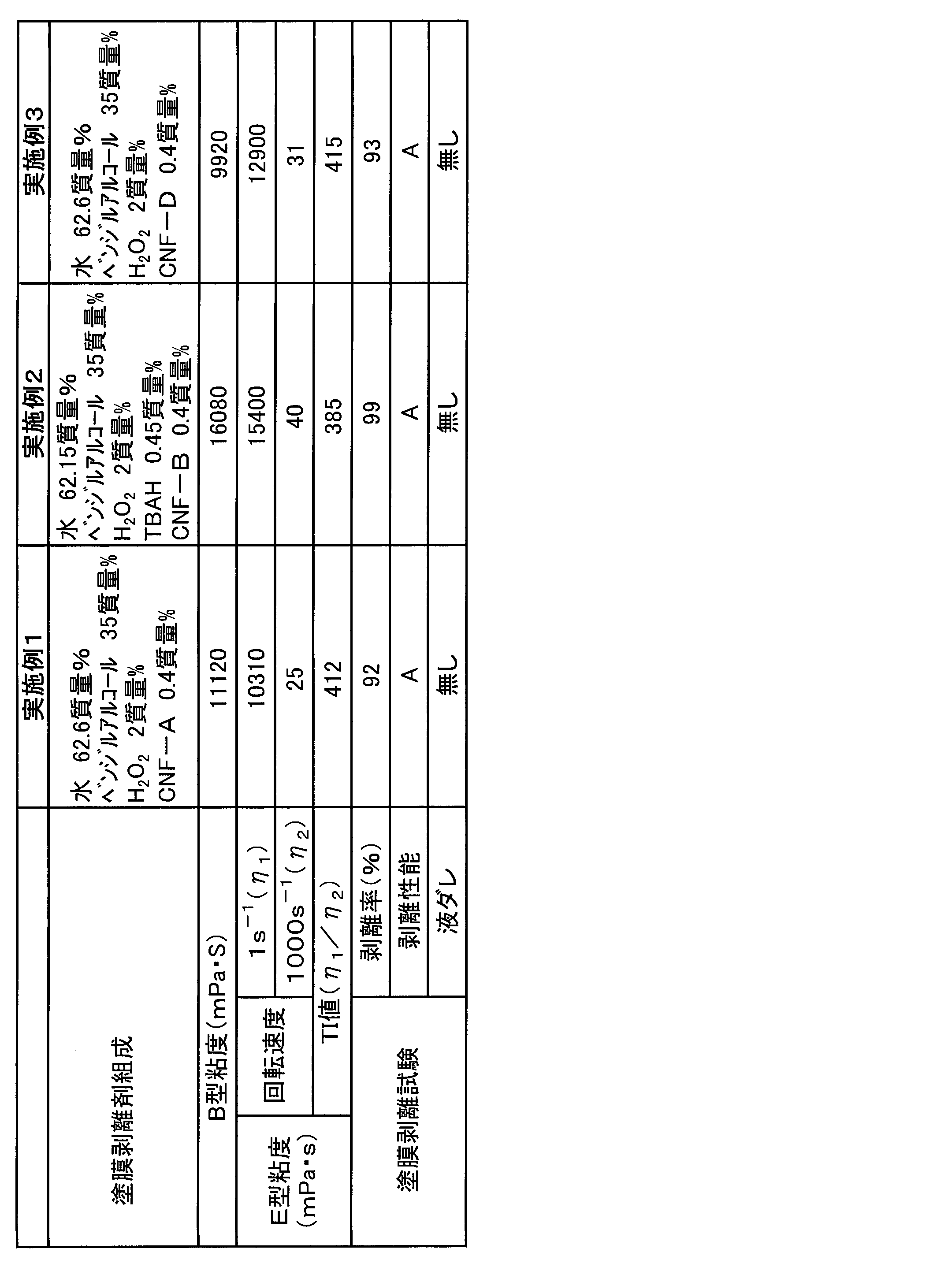


実施例で得られた塗膜剥離剤は優れた剥離性能を発揮した。また、実施例で得られた塗膜剥離剤は十分な粘度を有していた。実施例では、微細繊維状セルロースの添加により塗膜剥離剤に十分な粘度が付与されたため、塗膜剥離剤塗布後に液ダレが生じることなく試験片に塗膜剥離剤が付着した状態が維持されていた。これにより良好な剥離性能が発揮されたものと推察される。
特に、実施例1~3、5及び6においては剥離率が90%以上であり、良好な剥離性能が示された。また、実施例1~3、5及び6においてはB型粘度が8000mPa・s以上となっており、十分な粘度が付与されていた。
特に、実施例1~3、5及び6においては剥離率が90%以上であり、良好な剥離性能が示された。また、実施例1~3、5及び6においてはB型粘度が8000mPa・s以上となっており、十分な粘度が付与されていた。
また、実施例1~7においてE型粘度を測定したところ、TI値は200以上となり、高いチキソトロピック性が示された。すなわち、刷毛塗りやスプレー塗布等の塗膜剥離剤塗布工程においては粘度が低下して良好な作業性を実現でき、塗布工程終了後には粘度が上昇して液ダレ防止が可能となることが示された。
一方、比較例においては、十分な剥離性能が発揮されなかった。特に、比較例1~5ではB型粘度が実施例と比較して低いため、塗膜剥離剤塗布後に液ダレが生じてしまい、試験片上に剥離成分が付着した状態が維持されなかった。また、比較例2、3においてE型粘度を測定したところ、実施例と比較してTI値が低い値となり、塗膜剥離剤に要求されるチキソトロピック性を有していないことが示唆された。
また、比較例6、7においては増粘剤の添加量を過剰とすることで、塗膜剥離剤塗布後の液ダレは改善されが、増粘剤の添加量を過剰としたことで剥離成分の含有比率が低下してしまい、最終的な剥離率が低くなり、十分な剥離性能が得られなかった。
さらに、比較例8においてはイオン性置換基が導入されていない微細繊維状セルロースを用いたため、イオン性置換基が導入されている場合に比べて微細化が進行していない繊維が残存していた。このため、塗膜剥離剤において増粘効果が十分に得られず液ダレしてしまい、十分な剥離性能が得られなかった。
また、比較例6、7においては増粘剤の添加量を過剰とすることで、塗膜剥離剤塗布後の液ダレは改善されが、増粘剤の添加量を過剰としたことで剥離成分の含有比率が低下してしまい、最終的な剥離率が低くなり、十分な剥離性能が得られなかった。
さらに、比較例8においてはイオン性置換基が導入されていない微細繊維状セルロースを用いたため、イオン性置換基が導入されている場合に比べて微細化が進行していない繊維が残存していた。このため、塗膜剥離剤において増粘効果が十分に得られず液ダレしてしまい、十分な剥離性能が得られなかった。
10 基材(壁面)
20 塗膜
50 ケレン用工具
100 塗膜剥離剤
20 塗膜
50 ケレン用工具
100 塗膜剥離剤
Claims (10)
- 溶媒と、繊維幅が1000nm以下の繊維状セルロースとを含み、前記繊維状セルロースがイオン性置換基を有する塗膜剥離剤。
- 前記イオン性置換基がアニオン性基である請求項1に記載の塗膜剥離剤。
- 前記繊維状セルロースが、I型結晶構造を有する請求項1又は2に記載の塗膜剥離剤。
- 前記イオン性置換基がリンオキソ酸基又はリンオキソ酸基に由来する置換基である請求項1~3のいずれか1項に記載の塗膜剥離剤。
- 前記イオン性置換基がカルボキシ基又はカルボキシ基に由来する置換基である請求項1~3のいずれか1項に記載の塗膜剥離剤。
- 前記イオン性置換基がカルボキシメチル基である請求項1~3のいずれか1項に記載の塗膜剥離剤。
- 下記条件aで算出されたチキソトロピックインデックス値(TI値)が200以上である請求項1~6のいずれか1項に記載の塗膜剥離剤;
(条件a)
塗膜剥離剤の粘度をE型粘度計により測定し、測定は傾斜角2°のコーンプレートを用いて行う;測定温度23℃、回転速度を0.01~1000s-1の範囲とし、定常フローカーブモードでせん断粘度を測定する;1s-1の回転速度におけるせん断粘度をη1とし、1000s-1の回転速度におけるせん断粘度をη2とした場合、η1/η2の値をチキソトロピックインデックス値(TI値)とする。 - 前記溶媒は、水を含む請求項1~7のいずれか1項に記載の塗膜剥離剤。
- さらに剥離補助剤を含む請求項1~8のいずれか1項に記載の塗膜剥離剤。
- 請求項1~9のいずれか1項に記載の塗膜剥離剤を基材表面に設けられた塗膜に塗布する工程と、前記塗膜を前記基材から剥離除去する工程とを含む塗膜剥離方法。
Applications Claiming Priority (2)
| Application Number | Priority Date | Filing Date | Title |
|---|---|---|---|
| JP2019-068685 | 2019-03-29 | ||
| JP2019068685A JP2020164725A (ja) | 2019-03-29 | 2019-03-29 | 塗膜剥離剤及び塗膜剥離方法 |
Publications (1)
| Publication Number | Publication Date |
|---|---|
| WO2020203345A1 true WO2020203345A1 (ja) | 2020-10-08 |
Family
ID=72667657
Family Applications (1)
| Application Number | Title | Priority Date | Filing Date |
|---|---|---|---|
| PCT/JP2020/012255 Ceased WO2020203345A1 (ja) | 2019-03-29 | 2020-03-19 | 塗膜剥離剤及び塗膜剥離方法 |
Country Status (2)
| Country | Link |
|---|---|
| JP (1) | JP2020164725A (ja) |
| WO (1) | WO2020203345A1 (ja) |
Cited By (1)
| Publication number | Priority date | Publication date | Assignee | Title |
|---|---|---|---|---|
| CN115368814A (zh) * | 2022-07-01 | 2022-11-22 | 中国人民解放军军事科学院防化研究院 | 一种改性纤维素基可剥离膜去污剂及制备方法 |
Citations (6)
| Publication number | Priority date | Publication date | Assignee | Title |
|---|---|---|---|---|
| JPS59207974A (ja) * | 1983-05-07 | 1984-11-26 | ヘンケル・コマンデイ−トゲゼルシヤフト・アウフ・アクチエン | 液状で溶剤不含かつ水性の、皮膜形成性ポリマ−の保護塗膜除去剤 |
| JPH07133451A (ja) * | 1993-11-12 | 1995-05-23 | Ricoh Co Ltd | ホットメルト型インクジェット・プリンターで印字された被記録媒体の再生方法 |
| JP2004059675A (ja) * | 2002-07-26 | 2004-02-26 | Koyo Kagaku Kogyo Kk | 塗膜剥離組成物 |
| JP2008149545A (ja) * | 2006-12-15 | 2008-07-03 | Kurita Water Ind Ltd | 固形状インク除去剤及びインク除去具 |
| JP2017155199A (ja) * | 2016-03-04 | 2017-09-07 | 株式会社トウペ | 水性塗膜剥離剤 |
| WO2020045361A1 (ja) * | 2018-08-30 | 2020-03-05 | 株式会社ネオス | 塗膜剥離組成物及び塗膜の剥離方法 |
Family Cites Families (4)
| Publication number | Priority date | Publication date | Assignee | Title |
|---|---|---|---|---|
| CA3019766C (en) * | 2016-04-04 | 2021-06-15 | Kansai Paint Co., Ltd. | Bright pigment dispersion and method for forming multilayer coating film |
| JP6733627B2 (ja) * | 2017-08-29 | 2020-08-05 | 王子ホールディングス株式会社 | 繊維状セルロース含有組成物及び塗料 |
| JP6988269B2 (ja) * | 2017-08-29 | 2022-01-05 | 王子ホールディングス株式会社 | 繊維状セルロース含有組成物及び塗料 |
| JP6467536B1 (ja) * | 2018-02-26 | 2019-02-13 | 株式会社松村洋紙店 | 剥離層形成材料および剥離紙の製造方法 |
-
2019
- 2019-03-29 JP JP2019068685A patent/JP2020164725A/ja active Pending
-
2020
- 2020-03-19 WO PCT/JP2020/012255 patent/WO2020203345A1/ja not_active Ceased
Patent Citations (6)
| Publication number | Priority date | Publication date | Assignee | Title |
|---|---|---|---|---|
| JPS59207974A (ja) * | 1983-05-07 | 1984-11-26 | ヘンケル・コマンデイ−トゲゼルシヤフト・アウフ・アクチエン | 液状で溶剤不含かつ水性の、皮膜形成性ポリマ−の保護塗膜除去剤 |
| JPH07133451A (ja) * | 1993-11-12 | 1995-05-23 | Ricoh Co Ltd | ホットメルト型インクジェット・プリンターで印字された被記録媒体の再生方法 |
| JP2004059675A (ja) * | 2002-07-26 | 2004-02-26 | Koyo Kagaku Kogyo Kk | 塗膜剥離組成物 |
| JP2008149545A (ja) * | 2006-12-15 | 2008-07-03 | Kurita Water Ind Ltd | 固形状インク除去剤及びインク除去具 |
| JP2017155199A (ja) * | 2016-03-04 | 2017-09-07 | 株式会社トウペ | 水性塗膜剥離剤 |
| WO2020045361A1 (ja) * | 2018-08-30 | 2020-03-05 | 株式会社ネオス | 塗膜剥離組成物及び塗膜の剥離方法 |
Cited By (1)
| Publication number | Priority date | Publication date | Assignee | Title |
|---|---|---|---|---|
| CN115368814A (zh) * | 2022-07-01 | 2022-11-22 | 中国人民解放军军事科学院防化研究院 | 一种改性纤维素基可剥离膜去污剂及制备方法 |
Also Published As
| Publication number | Publication date |
|---|---|
| JP2020164725A (ja) | 2020-10-08 |
Similar Documents
| Publication | Publication Date | Title |
|---|---|---|
| JP7635597B2 (ja) | 粉塵飛散防止剤及び粉塵飛散防止方法 | |
| JP7290147B2 (ja) | 繊維状セルロース含有被膜の製造方法、樹脂組成物、被膜及び積層体 | |
| JP7556322B2 (ja) | 繊維状セルロース、繊維状セルロース分散液及び繊維状セルロースの製造方法 | |
| CA3116693C (en) | Fibrous cellulose, fibrous cellulose dispersion, and production method for fibrous cellulose | |
| JP6579286B1 (ja) | 樹脂組成物および成形体 | |
| WO2020203345A1 (ja) | 塗膜剥離剤及び塗膜剥離方法 | |
| JP7711383B2 (ja) | 微細繊維状セルロース・微細無機層状化合物含有物の製造方法及び微細繊維状セルロース・微細無機層状化合物含有物 | |
| JP6769468B2 (ja) | 繊維状セルロース、繊維状セルロース分散液及び繊維状セルロースの製造方法 | |
| JP2020033398A (ja) | 微細繊維状セルロース含有組成物およびその製造方法 | |
| JP7351305B2 (ja) | 繊維状セルロース含有組成物、液状組成物及び成形体 | |
| JP7346873B2 (ja) | シートの製造方法 | |
| JP2020132652A (ja) | 繊維状セルロース含有組成物、液状組成物及び成形体 | |
| JP6940008B2 (ja) | 繊維状セルロース、繊維状セルロース分散液及び繊維状セルロースの製造方法 | |
| JP7703857B2 (ja) | 微細繊維状セルロース・微細無機層状化合物含有物の製造方法及び微細繊維状セルロース・微細無機層状化合物含有物 | |
| JP7010206B2 (ja) | 繊維状セルロース | |
| JP2021098870A (ja) | 繊維状セルロース、繊維状セルロース分散液及び繊維状セルロースの製造方法 | |
| JP7497658B2 (ja) | 繊維状セルロース、繊維状セルロース分散液及び繊維状セルロースの製造方法 | |
| WO2020050349A1 (ja) | 固形状体及び繊維状セルロース含有組成物 | |
| JP7040576B2 (ja) | 繊維状セルロース、繊維状セルロース分散液及び繊維状セルロースの製造方法 | |
| JP7647568B2 (ja) | 分散液 | |
| JP6769510B2 (ja) | 繊維状セルロース、繊維状セルロース分散液及び繊維状セルロースの製造方法 | |
| JP6816837B1 (ja) | 分散液 | |
| JP2020165019A (ja) | 微細繊維状セルロース含有分散液の製造方法及び微細繊維状セルロース含有シートの製造方法 | |
| JP6708274B1 (ja) | 繊維状セルロース含有被膜の製造方法、樹脂組成物、被膜及び積層体 | |
| JP2025048575A (ja) | 積層シートの製造方法および積層体の製造方法 |
Legal Events
| Date | Code | Title | Description |
|---|---|---|---|
| 121 | Ep: the epo has been informed by wipo that ep was designated in this application |
Ref document number: 20785398 Country of ref document: EP Kind code of ref document: A1 |
|
| NENP | Non-entry into the national phase |
Ref country code: DE |
|
| 122 | Ep: pct application non-entry in european phase |
Ref document number: 20785398 Country of ref document: EP Kind code of ref document: A1 |