WO2020203323A1 - 検眼装置及び検眼プログラム - Google Patents
検眼装置及び検眼プログラム Download PDFInfo
- Publication number
- WO2020203323A1 WO2020203323A1 PCT/JP2020/012128 JP2020012128W WO2020203323A1 WO 2020203323 A1 WO2020203323 A1 WO 2020203323A1 JP 2020012128 W JP2020012128 W JP 2020012128W WO 2020203323 A1 WO2020203323 A1 WO 2020203323A1
- Authority
- WO
- WIPO (PCT)
- Prior art keywords
- optometry
- identifier
- optical system
- eye
- subject
- Prior art date
- Legal status (The legal status is an assumption and is not a legal conclusion. Google has not performed a legal analysis and makes no representation as to the accuracy of the status listed.)
- Ceased
Links
Images




Classifications
-
- A—HUMAN NECESSITIES
- A61—MEDICAL OR VETERINARY SCIENCE; HYGIENE
- A61B—DIAGNOSIS; SURGERY; IDENTIFICATION
- A61B3/00—Apparatus for testing the eyes; Instruments for examining the eyes
- A61B3/10—Objective types, i.e. instruments for examining the eyes independent of the patients' perceptions or reactions
Definitions
- the present disclosure relates to an optometry device and an optometry program for inspecting an eye to be inspected.
- an optometry device for inspecting an eye to be inspected an ophthalmologic optometry device for taking a tomographic image of the fundus of the eye to be inspected (Patent Document 1), an objective optometry device for objectively measuring the optical characteristics of the eye to be inspected (Patent Document 2), A conscious optometry device (Patent Document 3) that subjectively measures the optical characteristics of the eye to be inspected is used.
- the examiner When examining an eye to be inspected using an optometry device, the examiner inputs and searches for information about the subject, sets the positional relationship between the eye to be inspected and the device, the same inspection conditions as in the past, and so on. The inspection has started. For the examiner, such an operation is troublesome, and it is difficult to proceed with the inspection efficiently.
- the technical subject of the present disclosure is to provide an optometry device and an optometry program capable of efficiently performing an examination on an eye to be inspected.
- the optometry device is an optometry device that inspects the optometry of a subject, and is set to set an imaging optical system for imaging the optometry and inspection conditions of the optometry device.
- the imaging optical system is capable of imaging an identifier associated with individual inspection conditions preset for each subject, and the setting means is capable of imaging the identifier by the imaging optical system. Is imaged, the inspection conditions of the optometry apparatus are set based on the individual inspection conditions associated with the identifier.
- the optometry program is an optometry program used in an optometry device for inspecting an optometry of a subject, and is executed by a processor of the optometry device to image the optometry.
- the optometry step includes an imaging step for the purpose and a setting step for setting the inspection conditions of the optometry device, and the imaging step can image an identifier associated with individual inspection conditions preset for each subject.
- the setting step when the identifier is imaged by the imaging step, the inspection conditions of the optometry apparatus are set based on the individual inspection conditions associated with the identifier. , The optometry apparatus is made to execute.
- the optometry device is an optometry device for inspecting the optometry of a subject, and the optometry optical system in another optometry device provided with an optometry optical system for imaging the optometry.
- An optometry that can be read by the imaging optical system to output an identifier that enables the inspection conditions of the other optometry device to be set to individual inspection conditions preset for each subject. Provide output means.
- the optometry device is an optometry device for inspecting the subject's eye, which is an identifier read by another optometry device, and is read by the other optometry device.
- An output means for outputting an identifier that enables the inspection conditions of the other optometry device to be set to individual inspection conditions preset for each subject is provided.
- the optometry device is a device for inspecting the optometry of a subject.
- the optometry device may be a device that inspects the optometry by photographing the optometry.
- the optometry apparatus may be an ophthalmologic imaging apparatus that photographs the anterior segment of the eye to be inspected and acquires image data of the anterior segment of the eye to be inspected, the shape of the cornea of the inspected eye, and the like.
- the eye examination device may be an ophthalmologic imaging device that photographs the fundus of the eye to be inspected and acquires the fundus frontal image data of the eye to be inspected, the fundus tomographic image data of the eye to be inspected, and the like.
- the optometry device may be a device that inspects the optometry by measuring the optometry.
- the optometry device may be an objective optometry device that objectively measures the optical characteristics of the eye to be inspected.
- the optical power of the eye to be inspected for example, spherical power, cylindrical power, astigmatic axis angle, etc.
- binocular vision function for example, oblique amount, stereoscopic vision function, etc.
- contrast for example, oblique amount, stereoscopic vision function, etc.
- An objective optometry device that objectively measures sensitivity, etc. may be used.
- the optometry device may be a subjective optometry device that subjectively measures the optical characteristics of the eye to be inspected.
- a subjective optometry device that subjectively measures the refractive power of the eye to be inspected as an optical characteristic of the eye to be inspected may be used.
- the optometry device may be an optometry device that measures the visual field of the optometry subject by obtaining a visual response from the subject.
- an eye examination device an optical coherence tomography (OCT), a scanning laser ophthalmoscope, a fundus camera, an intraocular pressure measuring device, an axial length measuring device, a corneal shape measuring device, and a corneal curvature measuring device.
- OCT optical coherence tomography
- a scanning laser ophthalmoscope a scanning laser ophthalmoscope
- a fundus camera an intraocular pressure measuring device
- an axial length measuring device a corneal shape measuring device
- a corneal curvature measuring device At least one of an ultrasonic optometry device, an intraocular pressure measuring device, a folopter, a perimeter, and the like.
- an optical coherence tomography device (for example, OCT device 100) will be described as an example of such an optometry device.
- the optical coherence tomography may be a time domain OCT (Time Domain OCT: TD-OCT) or a Fourier domain OCT (Fourier Domain OCT: FD-OCT).
- TD-OCT Time Domain OCT
- FD-OCT Fourier Domain OCT
- Typical examples of FD-OCT are spectral domain OCT (Spectral Domain OCT: SD-OCT) and wavelength sweep type OCT (Swept Source OCT: SS-OCT).
- the optometry device may include inspection means (eg, OCT optical system 40).
- the inspection means is an inspection means for inspecting the eye to be inspected.
- the inspection means may include an inspection system that inspects the eye to be inspected by receiving light.
- the inspection system may be an imaging optical system for imaging the eye to be inspected.
- the inspection system may be a measurement optical system for measuring the eye to be inspected.
- the inspection means may be configured to include at least one of an imaging optical system and a measuring optical system.
- the inspection means is not limited to an inspection system that inspects the eye to be inspected by receiving light, and may be an inspection system that inspects the eye to be inspected by receiving ultrasonic waves.
- the inspection system may be an ultrasonic measurement system for measuring the eye to be inspected by emitting ultrasonic waves and detecting the reflected waves.
- the inspection means may be configured to include either an inspection system that inspects the eye to be inspected by receiving light and an inspection system that inspects the eye to be inspected by receiving ultrasonic waves.
- the configuration may include both an inspection system that inspects the eye to be inspected by receiving light and an inspection system that inspects the eye to be inspected by receiving ultrasonic waves.
- the optometry device includes an imaging optical system.
- the imaging optical system is an imaging optical system for imaging the eye to be inspected.
- the imaging optical system may be configured to image either the left eye or the right eye. Further, for example, the imaging optical system may be configured to image both the left eye and the right eye.
- the eye to be inspected is imaged by controlling the imaging optical system by a control unit (for example, control unit 107) included in the optometry device.
- the imaging optical system may be an imaging optical system for imaging so as to include the eye to be inspected.
- a face imaging optical system for example, a face imaging optical system 10 for imaging the face of a subject
- the subject's face may be imaged to include at least one of the left eye and the right eye.
- an anterior segment imaging optical system for example, anterior segment imaging optical system 20
- a fundus imaging optical system for imaging the fundus of the eye to be inspected may be used.
- the imaging optical system may be capable of imaging an identifier associated with individual inspection conditions preset for each subject. That is, the imaging optical system may be used for both the imaging of the eye to be examined and the imaging of the identifier.
- the imaging optical system By adopting such a configuration in which the imaging optical system is also used properly, the identifier can be imaged with a simple configuration without providing a new member in the apparatus.
- the imaging optical system when the imaging optical system is a face imaging optical system that images the face of the eye to be inspected, the face imaging optical system may be capable of imaging the identifier. That is, the face imaging optical system may serve as both an imaging optical system for imaging the face of the eye to be inspected and an imaging optical system for imaging an identifier.
- the imaging optical system when the imaging optical system is an anterior segment imaging optical system that images the anterior segment of the eye to be inspected, the anterior segment imaging optical system may be capable of imaging an identifier. That is, the anterior segment imaging optical system may serve both as an imaging optical system for imaging the anterior segment of the eye to be inspected and an imaging optical system for imaging an identifier.
- the fundus imaging optical system may be capable of imaging the identifier. That is, the fundus imaging optical system may serve as both an imaging optical system for imaging the fundus of the eye to be inspected and an imaging optical system for imaging an identifier.
- the individual inspection conditions preset for each subject are different inspection conditions for each subject in order to inspect the eye to be inspected by the subject.
- the test condition may be a measurement condition for measuring the eye to be inspected, which is set according to the subject (eye to be inspected).
- the imaging conditions for photographing the eye to be inspected may be set according to the subject (the eye to be inspected).
- the inspection conditions may be preset conditions based on information about the subject (for example, height, face size, eye shape, distance from the left eye to the right eye, etc.).
- the inspection condition may be a condition preset based on the past inspection condition for the eye to be inspected.
- the past inspection conditions may be the conditions when the inspection was performed in the past using the same device, or the conditions when the inspection was performed in the past using different devices. In this case, the inspection conditions may be appropriately changed by updating the identifier or by updating the cloud or server information associated with the identifier.
- the inspection condition may be a condition for setting the positional relationship between the subject (eye to be inspected) and the device.
- the inspection condition may be a condition for setting the position of the device with respect to the subject.
- it may be a condition for setting the moving position of the device according to the height of the line of sight of the subject.
- the inspection condition may be a condition for setting the position of the face support unit for supporting at least a part of the face of the subject provided in the optometry device.
- it may be a condition for setting the position of the forehead pad that abuts the forehead of the subject.
- it may be a condition for setting the position (height of the jaw stand) on which the jaw of the subject is placed.
- the inspection condition may be a condition for setting the inspection condition of the inspection means for the subject (the eye to be inspected).
- the inspection condition may be a condition that can be adjusted for each part of the optical system included in the inspection means and may affect the inspection result (for example, acquisition of a signal, acquisition of a captured image, etc.).
- At least one of the correction amount (focus), etc. can be mentioned.
- the inspection condition may be a condition related to processing when analyzing the inspection result obtained by the optical system provided in the inspection means.
- a brightness correction amount (brightness, contrast, etc.), a correction amount of the position of each part in the captured image, and the like can be mentioned.
- the individual inspection conditions preset for each subject include at least one of the above conditions, the optical path length difference between the measurement light and the reference light, the polarization state, and the like. It may be.
- the identifier may be associated with the above-mentioned individual inspection conditions. For example, by storing information in an identifier, an individual inspection condition may be associated with the identifier. Further, for example, by associating the identifier with the information stored in the cloud or the server in advance, the identifier may be associated with individual inspection conditions.
- identifier information that is different from the biological information of the subject (for example, iris, fingerprint, etc.) and can be recognized as an image can be used.
- a character string for example, a bar code, etc.
- a two-dimensional code for example, a QR code (registered trademark), a color code, etc.
- biometric information is used as an identifier
- the analysis process may be complicated because the iris pattern and the fingerprint pattern are diverse.
- a character string or a code is used for the identifier, these can be easily analyzed and the associated inspection conditions can be easily obtained.
- the identifier in the present embodiment may be associated with at least individual inspection conditions, and in addition to the inspection conditions, information different from the inspection conditions may be associated.
- the identifier may be associated with the subject information together with the inspection conditions.
- the subject information include personal information of the subject (for example, at least one of the name, gender, age, etc.), an ID given to each subject, and the like.
- Such an identifier for each subject may be output so that the subject can possess it. For example, it may be displayed on a display means for a subject (for example, at least one of a mobile terminal, a tablet terminal, a smartphone, and the like). Further, for example, it may be printed on paper or the like using a printer or the like.
- the optometry device includes setting means (eg, control unit 107).
- the setting means sets the inspection conditions of the optometry device.
- the setting means sets the inspection conditions of the optometry apparatus based on the individual inspection conditions associated with the identifier when the identifier is imaged by the imaging optical system. As a result, the examination conditions suitable for the subject are automatically set, and the examination for the eye to be examined can be efficiently performed.
- the identifier is associated with individual inspection conditions by storing information or associating it with information stored in the cloud or a server.
- the setting means may directly read the individual inspection conditions associated with the identifier by analyzing the image including the identifier.
- the setting means may analyze the image including the identifier and call the corresponding information based on the analysis result.
- the relevant information may be called by at least one of wired communication (for example, optical fiber, wired LAN, etc.) and wireless communication (for example, Wi-Fi (registered trademark), Bluetooth (registered trademark), etc.).
- the setting means may set the inspection condition by directly or indirectly acquiring the individual inspection condition associated with the identifier.
- the setting means may be configured to set the inspection conditions of the optometry device so that the inspection conditions are the same as the past inspection conditions for the optometry based on the individual inspection conditions of the subject.
- the setting means may be set so that the positional relationship between the subject (or the eye to be inspected) and the device is the same as in the past, based on the individual inspection conditions of the subject.
- the positional relationship between the subject (the eye to be examined) and the forehead pad or the chin rest may be set to be the same as in the past.
- the inspection conditions of the inspection means for the subject (or the eye to be inspected) may be set so as to be the same inspection conditions as in the past.
- At least one of the imaging conditions for imaging the eye to be inspected, the measurement conditions for measuring the eye to be inspected, the processing conditions for analyzing the inspection results, and the like are set to the same inspection conditions as in the past. It may be set to be. As a result, it is possible to save the trouble of setting the device under the same conditions every time the examination is performed on the same eye to be inspected, and the examination can be performed efficiently.
- the optometry device includes output means (eg, control unit 107).
- the output means outputs an identifier that enables the inspection conditions of another optometry device different from the optometry device to be set to individual inspection conditions preset for each subject.
- Another optometry device different from the optometry device may be provided with a reading means for reading the identifier.
- the output means of the optometry device is an identifier read by another optometry device, which enables the inspection conditions of the other optometry device to be set as individual inspection conditions by being read by the other optometry device. May be output.
- another optometry device different from the optometry device may have a configuration in which an imaging optical system for imaging the eye to be inspected is also used as the reading means.
- the output means of the optometry device is an identifier read by the imaging optical system in another optometry device, and by being read by the imaging optical system, the inspection conditions of the other optometry device can be set to individual inspection conditions.
- the identifier may be output.
- another optometry device different from the optometry device may be configured to separately include a scanner and a reader as reading means.
- the output means of the optometry device is an identifier read by a scanner or reader in another optometry device, and by being read by the scanner or reader, the inspection conditions of the other optometry device can be set to individual inspection conditions.
- the identifier may be output. For example, with such a configuration, it is not necessary to set inspection conditions with the next inspection device, such as when performing an inspection using a plurality of optometry devices for the eye to be inspected, and the inspection can proceed efficiently. Can be done.
- the output means may output the identifier by at least one of display on the display means, printing using a printer, and the like.
- information such as inspection conditions may be stored in the identifier output by the output means.
- Another optometry device which is different from the optometry device, may read such an identifier and set the test conditions based on the individual test conditions stored in the identifier.
- the output means is not limited to output by display on the display means or printing using a printer.
- the output means may output the identifier by display or printing, output the inspection condition to the cloud, the server, or the like, and store the identifier and the inspection condition in association with each other.
- another optometry device different from the optometry device reads such an identifier, obtains it by calling the individual inspection conditions associated with the identifier from the cloud (server), and inspects based on the individual inspection conditions. Conditions may be set.
- the present disclosure is not limited to the optometry apparatus described in the present embodiment.
- the terminal control software program
- the control unit for example, CPU
- the optometry device is used to inspect the subject's eye.
- an ophthalmologic imaging device is exemplified as the optometry device.
- the ophthalmologic imaging device may be an OCT device having a configuration of a so-called optical coherence tomography device for ophthalmology.
- the optometry device will be referred to as an OCT device.
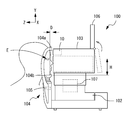
- FIG. 1 is an external view of the OCT device 100.
- the OCT device 100 includes a moving table 102, a measuring unit 103, a face support unit 104, a monitor 106, a control unit 107, and the like.
- the face support unit 104 supports the face of the subject P.
- the face support unit 104 has a forehead pad 104a and a chin rest 104b.
- the forehead of the subject P is brought into contact with the forehead pad 104a.
- the jaw of the subject P is placed on the jaw base 104b.
- the chin rest 104b is provided with a detector 105.
- the detector 105 detects whether or not the jaw of the subject P is placed on the jaw base 104b.
- the detector 105 may be composed of at least one of an optical sensor, a pressure sensor, a load sensor, an ultrasonic sensor, and the like.
- a load sensor is used as the detector 105, and the load sensor detects the load due to the jaw of the subject P being placed on the jaw base 104b.
- the detection result of the detector 105 is output to the control unit 107.
- the monitor 106 is a setting screen for obtaining OCT data by the OCT optical system (for example, a setting screen for setting a scanning position of measurement light, a scanning pattern, a region in the depth direction, etc.), and a tomographic image generated from the OCT data.
- a face image captured by the face imaging optical system 10 an anterior segment image captured by the anterior segment imaging optical system 20, an identifier described later captured by the anterior segment imaging optical system 20, and the like are displayed.
- the monitor 106 may be a touch panel, and the monitor 106 may also serve as an operation unit. For example, by operating the monitor 106, the X moving mechanism and the Z moving mechanism provided on the moving table 102 are driven, and the measuring unit 103 arranged on the upper part of the moving table 102 moves in the left-right direction (X direction) and back and forth. It may be moved in the direction (Z direction). Further, by operating the monitor 106, the Y moving mechanism provided in the measuring unit 103 may be driven, and the measuring unit 103 may be moved in the vertical direction (Y direction).
- FIG. 2 is a schematic view of the internal configuration of the measuring unit 103.
- the measuring unit 103 includes a face imaging optical system 10 (see FIG. 1), an anterior segment imaging optical system 20, an alignment index projection optical system 30, an OCT optical system 40, an observation optical system 50, a fixation induction optical system 60, and the like. Be prepared.
- the face imaging optical system 10 images a face including at least a part of the eye E (left eye and right eye) to be examined.
- the face imaging optical system 10 may include an imaging element (not shown).
- the image sensor captures the face of the subject supported by the face support unit 104.
- the anterior segment imaging optical system 20 images the anterior segment of the eye E to be inspected.
- the anterior segment imaging optical system 20 may include an imaging element 21.
- the image sensor 21 has sensitivity in the infrared region. Further, the image sensor 21 also serves as an image sensor for detecting the alignment index, and images the front eye portion illuminated by the infrared light source 35 and the alignment index.
- the alignment index projection optical system 30 projects the alignment index toward the cornea of the eye E to be inspected.
- the alignment index projection optical system 30 includes a first projection optical system 30a and a second projection optical system 30b.
- the first projection optical system 30a projects an alignment index at infinity toward the cornea of the eye E to be inspected.
- the first projection optical system 30a may include an infrared light source 31 and a collimator lens 32.
- the infrared light source 31 is arranged in a ring shape about the optical axis and emits near-infrared light.
- the collimator lens 32 converts the light emitted from the infrared light source 31 into a parallel luminous flux.
- the second projection optical system 30b projects a finite distance alignment index toward the cornea of the eye E to be inspected.
- the second projection optical system 30b may include an infrared light source 35.
- the infrared light source 35 is arranged in a ring shape at a position different from that of the infrared light source 31 about the optical axis, and emits near-infrared light.
- the light from the second projection optical system 30b is used not only as the alignment light but also as the anterior segment imaging light by the anterior segment imaging optical system 20.
- the OCT optical system 40 detects an interference signal due to the measurement light and the reference light applied to the eye E to be inspected.
- the OCT optical system 40 includes a light source 41, a coupler (optical divider) 42, a scanning unit (for example, an optical scanner) 43, a measurement optical system 44, a detector 45, a reference optical system 46, and the like.
- the light source 41, the measuring optical system 44, the detector 45, and the reference optical system 46 are connected to the coupler 42 by an optical fiber.
- the OCT optical system 40 divides the light emitted from the light source 41 into measurement light and reference light by the coupler 42.
- the measurement light is emitted into the air after passing through the optical fiber, and is guided to the fundus through the scanning unit 43 and the measurement optical system 44.
- the reference light passes through the optical fiber and is guided to the reference optical system 46.
- the measurement light reflected by the fundus of the eye and the reference light reflected by the reflected optical system (for example, a reference mirror) included in the reference optical system 46 (for example, a reference mirror) are returned to the optical fiber through the same path.
- the OCT optical system 40 causes the detector 45 to receive an interference signal (interference light) obtained by combining the measurement light and the reference light.
- the interference signal detected by the detector 45 is output to the control unit 107.
- the observation optical system 50 has a configuration of a so-called scanning laser ophthalmoscope (SLO) for ophthalmology, photographs the fundus of the eye E to be inspected, and acquires an SLO front image thereof.
- the observation optical system 200 may have a so-called fundus camera type configuration. Further, the observation optical system 200 may be an infrared imaging optical system that photographs the eye to be inspected using infrared light.
- the fixation guidance optical system 60 guides the line-of-sight direction of the eye E to be inspected.
- the fixation-guided optical system 60 has a fixation lamp to be presented to the eye E to be inspected, and the presentation position of the fixation lamp may be changed two-dimensionally. As a result, the line of sight of the eye E to be inspected is guided in a plurality of directions, and as a result, the imaging site is changed.
- the control unit 107 includes a general CPU (Central Processing Unit), RAM, ROM, and the like.
- the CPU controls the OCT device 100.
- the RAM temporarily stores various types of information.
- a program or the like for controlling the operation of the OCT device 100 is stored in the ROM.
- the control unit 107 includes a drive unit of a movement mechanism (X movement mechanism, Y movement mechanism, Z movement mechanism), a detector 105, a monitor 106, a light source and an image sensor included in each optical system, a storage unit (memory) 108, and the like. Is electrically connected.
- the storage unit 108 may be a non-transient storage medium that can retain the stored contents even when the power supply is cut off.
- the storage unit 108 may be a hard disk drive, a flash ROM, a detachable USB memory, or the like.
- the storage unit 108 may store information related to settings for obtaining OCT data, OCT data, and the like.
- ⁇ Control operation> The control operation of the OCT apparatus 100 having the above configuration will be described.
- the same examination for the eye to be inspected may be performed under the same conditions as the past examination, such as when observing the progress of the eye E to be inspected.
- such a situation is taken as an example, and a case where an inspection condition is set by using an identifier described later and an inspection is performed on the eye E to be inspected will be described.
- the examiner hands the card to the examinee.
- the examiner reads out the examination conditions at the time of the past examination for the eye E to be examined from an electronic medical record or the like, issues a card printed with an identifier described later, which is created by computerizing the past examination conditions. Give this to the subject.
- the subject follows the instructions of the examiner and heads for the OCT device 100 with the card.
- FIG. 3 is an example of the card 70 that the examiner gives to the examinee.
- the identifier 75 is printed on the card 70 that the examiner gives to the examinee.
- the identifier 75 is associated with an inspection condition set in advance for each subject to perform an inspection on the eye E to be inspected.
- the height of the jaw stand 104b, the moving position of the measuring unit 103 (in other words, the moving amount of the X moving mechanism, the Y moving mechanism, and the Z moving mechanism provided in the measuring unit 103), and imaging for acquiring OCT data.
- At least one of the conditions may be associated with the condition.
- a QR code (registered trademark) is printed as an identifier 75 on the card 70 that the examiner gives to the examinee, and the height of the jaw base 104b, the moving position of the measuring unit 103, and the photographing are performed on the QR code.
- the identifier 75 may be associated with these inspection conditions in advance based on the information obtained when the eye E to be inspected has previously performed the inspection using the OCT device 100.
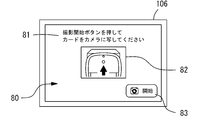
- FIG. 4A and 4B are views showing the screen of the monitor 106.
- FIG. 4A is an example of the guidance screen 80 for guiding the subject.
- FIG. 4B is an example of an imaging screen 90 including an captured image described later.
- the control unit 107 displays a guidance screen 80 for guiding the subject on the monitor 106.
- a message 81 for indicating the content of instructions to the subject, an operation diagram 82 for assisting the operation of the subject, a shooting start switch 83, and the like may be displayed.
- the case where the instruction content to the examinee is displayed as a message 81 is illustrated, but the instruction content to the examiner may be emitted as a voice guide from a speaker (not shown).
- the case of displaying a diagram showing the position of the camera, which will be described later is illustrated as the operation diagram 82, but a series of operations of the subject may be displayed by animation or the like.
- the control unit 107 controls the anterior segment imaging optical system 20 according to the start signal input from the switch, and starts imaging by the imaging element 21. For example, the control unit 107 moves the measurement unit 103 in the Z direction so that the focus of the anterior segment imaging optical system 20 is at a predetermined position (for example, the position of the chin rest 104b) in response to the start signal. .. Further, the control unit 107 sequentially processes the signals output from the image pickup device 21 to generate an image pickup image (live image), and displays the image pickup screen 90 on the monitor 106. On the imaging screen 90, a message 91 for indicating the content of instructions to the subject, a generated captured image 92, a guide mark 93 for aligning the position of the identifier 75, and the like may be displayed.
- control unit 107 controls the anterior segment imaging optical system 20 in response to the start signal input from the shooting start switch 83 has been described as an example, but the present invention is not limited to this.
- the control unit 107 may be configured to control the anterior segment imaging optical system 20 after a certain period of time has elapsed after displaying the guidance screen 80. That is, the image sensor 21 may automatically start imaging when a certain period of time has elapsed after displaying the guidance screen 80.
- FIG. 5 is a diagram showing the operation of the subject.
- the subject positions the card 70 in front of the anterior segment imaging optical system 20 (imaging element 21). For example, the subject positions the card 70 near the chin rest 104b. While checking the imaging screen 90, the subject searches for a state in which the focus of the anterior segment imaging optical system 20 is aligned with the card 70, and copies the identifier 75 so that the identifier 75 fits within the guide mark 93.
- the control unit 107 analyzes the live image, detects that the identifier 75 is included in the guide mark 93, and automatically captures the live image. For example, the control unit 107 searches for the QR code cutout symbol from the live image, recognizes the position of the QR code, and the position coordinates (pixel coordinates) of the QR code and the position coordinates (pixel coordinates) corresponding to the guide mark 93. By comparing with and, it may be detected that the QR code is included in the guide mark 93 and the live image may be automatically captured.
- control unit 107 analyzes the captured live image, reads the identifier 75, and acquires the above-mentioned inspection conditions associated with the identifier 75. For example, the control unit 107 scans the area surrounded by the cutout symbol of the QR code in the captured live image and decodes the read code to acquire the inspection conditions associated with the QR code. Good.
- the control unit 107 drives a Y movement mechanism (not shown) provided on the face support unit 104 based on the inspection conditions acquired from the identifier 75, moves the chin rest 104b in the vertical direction, and adjusts the height thereof. ..
- the control unit 107 sets the jaw base 104b so that the height H (see FIG. 1) from the measurement optical axis of the measurement unit 103 to the jaw base 104b becomes a predetermined height set for each subject. Move it up and down.
- the jaw base 104b is adjusted to the same height as the height of the jaw base 104b when the eye E to be inspected has previously performed an examination using the OCT device 100.
- control unit 107 drives an X movement mechanism, a Y movement mechanism, and a Z movement mechanism (not shown) provided in the measurement unit 103 based on the inspection conditions acquired from the identifier 75, and drives the measurement unit 103 in the left-right direction. Move it in the vertical direction and the Z direction to adjust its position.
- the control unit 107 moves the measurement unit 103 so that the distance D (see FIG. 1) between the measurement unit 103 and the chin rest 104b is a predetermined distance set for each subject.
- the predetermined distance may be the distance when the eye to be inspected E is aligned as described later and the apex position of the cornea of the eye to be inspected E is aligned with the measurement optical axis of the measuring unit 103.
- the measurement unit 103 is adjusted to the same position as the position of the measurement unit 103 when the eye E to be inspected has previously performed an examination using the OCT device 100.
- control unit 107 sets the imaging conditions for photographing the eye E to be inspected and acquiring the OCT data based on the inspection conditions acquired from the identifier 75. For example, the control unit 107 sets the scanning position of the measurement light with respect to the fundus of the eye E to be the same as the scanning position when the eye E has previously performed an examination using the OCT device 100. Further, for example, the control unit 107 uses the scanning pattern of the measurement light on the fundus of the eye E to be inspected (for example, line scan, raster scan, circle scan, radial scan, etc.), and the eye E to be inspected uses the OCT device 100 in the past. Set to the same pattern as the scanning pattern when the inspection was performed. That is, the control unit 107 sets the conditions for photographing the same eye E to be examined under the same imaging conditions as the imaging conditions executed in the past (so-called follow-up imaging conditions).
- the control unit 107 emits a voice announcement (for example, "Please put the chin on the chin rest") from a speaker (not shown) to guide the subject P.
- Subject P sits in front of the OCT device 100 and places his chin on the chin rest 104b according to the instructions.
- the detector 105 provided on the chin rest 104b detects a load from the outside, it converts this load into an electric signal and outputs it to the control unit 107.
- the control unit 107 detects that the jaw of the subject P is placed on the chin rest 104b when an electric signal is input from the detector 105.
- control unit 107 may detect that the jaw of the subject P is placed on the jaw stand 104b when the electric signal from the detector 105 is continuously input for a predetermined time or longer.
- the predetermined time may be a time that can be distinguished from the case where the subject P repositions the jaw on the jaw base 104b. As an example, it may be 5 seconds or longer.
- the control unit 107 can detect that the jaw of the subject P is placed on the jaw stand 104b and is ready to start the examination of the eye E to be inspected.
- the control unit 107 emits a voice announcement (for example, "Please observe the optotype") from a speaker (not shown) to cause the subject P to observe the optotype.
- a voice announcement for example, "Please observe the optotype”
- the subject P gazes at the fixation target displayed on the monitor (not shown) provided in the measuring unit 103.
- the control unit 107 of the OCT device 100 emits a voice announcement (for example, "Start the inspection. Press the start switch.") From a speaker (not shown) to start the inspection for the subject P. Operate a switch (not shown).
- the subject P operates the switch according to the instruction.
- the control unit 107 controls the anterior segment imaging optical system 20 according to the start signal input from the switch, and starts imaging by the imaging element 21. Further, the control unit 107 controls the alignment index projection optical system 30 according to the start signal input from the switch, turns on the infrared light source 31 and the infrared light source 35, and projects the alignment index on the cornea of the eye E to be inspected. To do.
- the control unit 107 generates an image (anterior eye image) based on the signal output from the image sensor 21, and uses the alignment index image to position the corneal apex of the eye E to be inspected with respect to the measurement optical axis of the measurement unit 103.
- misalignment approximately the position of the apex of the cornea
- the moving position of the measuring unit 103 is finely adjusted. It can be suppressed to the extent that it does.
- control unit 107 When the alignment between the OCT device 100 and the eye E to be inspected is completed, the control unit 107 performs optimization control (for example, adjustment of the optical path length) for observing the fundus portion of the eye E to be inspected desired by the examiner with high sensitivity and high resolution. , Focus adjustment, polarization state adjustment, etc.), and OCT data acquisition is executed under the inspection conditions set by using the identifier 75.
- optimization control for example, adjustment of the optical path length
- the optometry apparatus in this embodiment includes an imaging optical system for imaging the eye to be inspected and a setting means for setting inspection conditions of the apparatus, and is inspected by the imaging optical system.
- an identifier associated with an individual inspection condition preset for each person is imaged, the inspection condition of the device based on the individual inspection condition is set.
- the examination conditions suitable for the subject are automatically set, so that it is not necessary to set the examination conditions for each subject as in the conventional case, and the examination for the eye to be examined can be efficiently performed.
- the imaging optical system also serves as an imaging of the eye to be inspected and an imaging of an identifier, it is not necessary to provide a new member in the apparatus, and the apparatus can be easily configured.
- the anterior segment imaging optical system 20 serves as both an optical system for imaging the eye to be inspected for alignment and an optical system for imaging the identifier 75, thereby facilitating the apparatus. It can be configured as such.
- the optometry apparatus in this embodiment uses an anterior segment imaging optical system that images the anterior segment of the eye to be inspected to image an identifier. That is, the anterior segment imaging optical system also serves as an optical system for imaging an identifier. As a result, the identifier can be imaged with a simple configuration.
- the optometry device in this embodiment captures a two-dimensional code as an identifier.
- a two-dimensional code as an identifier.
- the optometry device in this embodiment sets the inspection conditions of the optometry device so that the inspection conditions are the same as the past inspection conditions for the eye to be inspected based on the individual inspection conditions associated with the identifier. ..
- the optometry device in this embodiment sets the inspection conditions of the optometry device so that the inspection conditions are the same as the past inspection conditions for the eye to be inspected based on the individual inspection conditions associated with the identifier. ..
- the optometry device in the present embodiment includes a face support unit for supporting at least a part of the face of the subject, and the position of the face support unit is based on the individual examination conditions associated with the identifier.
- the position of the forehead pad that brings the subject's forehead into contact, the chin rest on which the subject's chin is placed, and the like are set.
- the positional relationship between the eye to be examined and the device is kept constant, so that the subject does not have to reposition the face on the forehead or the chin rest and readjust. The inspection can proceed efficiently.
- the anterior segment imaging optical system 20 that images the anterior segment of the eye E to be inspected is used to image the identifier 75 associated with the inspection conditions preset for each subject.
- the face imaging optical system 10 that images the face of the eye E to be inspected to take an image of the identifier 75 associated with the inspection conditions preset for each subject. is there.
- the control unit 107 controls the face imaging optical system 10 to image the identifier 75
- the setting based on the inspection conditions associated with the identifier 75 may be made. Good.
- the measuring unit when the identifier 75 is imaged by the anterior segment imaging optical system 20, the measuring unit is previously measured so that the focus of the anterior segment imaging optical system 20 comes to a predetermined position (position of the jaw stand 104b).
- a predetermined position position of the jaw stand 104b.
- the configuration in which the 103 is moved in the Z direction has been described as an example, but the present invention is not limited to this.
- the focus is automatically adjusted by moving the measuring unit 103 in the Z direction with respect to the identifier 75 presented by the subject P. May be.
- the configuration in which the identifier 75 is imaged in monochrome by providing the image pickup element 21 having the sensitivity in the infrared region in the anterior segment imaging optical system 20 has been described as an example, but the present invention is not limited to this. ..
- the anterior segment imaging optical system 20 may include an imaging element having sensitivity in the visible region, and may be capable of imaging the identifier 75 in color.
- a color code capable of expressing information in an array of colors may be used, and more information may be associated with the identifier 75.
- the identifier 75 may be associated with a predetermined inspection condition for the eye E to be inspected.
- the height of the jaw stand 104b may be associated with the identifier 75.
- the control unit 107 may move the jaw base 104b in the vertical direction. Further, in this case, the control unit 107 may move the jaw base 104b in the vertical direction and adjust the movement position of the measurement unit 103 based on the movement amount of the jaw base 104b. That is, the jaw base 104b may be directly controlled based on the predetermined inspection conditions associated with the identifier 75, and the measurement unit 103 may be indirectly controlled in conjunction with the control of the jaw base 104b.
- the configuration in which the identifier 75 is associated with the inspection conditions when the eye E to be inspected has previously performed the inspection using the OCT device 100 has been described as an example, but the present invention is not limited to this.
- the identifier 75 may be associated with the inspection conditions when the eye E to be inspected performs the inspection using a device different from the OCT device 100.
- the position of the chin rest when the examination is performed using a device different from the OCT device 100 may be associated.
- the configuration in which the identifier 75 is associated with the imaging conditions related to the scanning of the measurement light in the OCT apparatus 100 has been described as an example, but the present invention is not limited to this.
- the identifier 75 may be associated with a shooting condition (for example, at least one of an optical path length difference, a focus, a polarization state, etc.) different from the scanning of the measurement light.
- a shooting condition for example, at least one of an optical path length difference, a focus, a polarization state, etc.
- the above-mentioned optimization control in the examination of the eye E to be inspected can be omitted, and the examination can proceed more efficiently.
- the identifier 75 may be associated with both a shooting condition related to scanning of the measurement light and a shooting condition different from the scanning of the measurement light.
- the OCT device 100 in this embodiment is a new identifier associated with the inspection conditions for examining the eye to be inspected by the OCT device 100, and outputs an identifier that can be read by a device different from the OCT device 100. You may.
- the inspection conditions of the device other than the OCT device 100 are set based on the inspection conditions associated with the new identifier, and the inspection conditions of the other device and the inspection conditions of the OCT device 100 are set to be the same. May be done.
- control unit 107 of the OCT device 100 may print a new identifier on paper with a printer or the like (not shown). Further, as an example, the control unit 107 of the OCT device 100 may display a new identifier on the monitor 106.
- the subject P acquires a paper on which a new identifier is printed (or an image of the identifier captured by a terminal device or the like), heads to another device, and has the identifier read by another device. Even if the control unit of another device sets the inspection conditions of the device other than the OCT device 100 to the same inspection conditions as when the OCT device 100 is used, based on the inspection conditions associated with the identifier. Good.
- the height of the jaw base of a device different from the OCT device 100 may be set to the same height as the height of the jaw base when the OCT device 100 is used. As a result, it is not necessary to set the inspection conditions in the device used next to the OCT device 100, and the inspection for the eye to be inspected can be efficiently advanced.
- the inspection condition for inspecting the eye to be inspected by the OCT apparatus 100 is associated with a new identifier
- the present invention is not limited to this.
- the inspection conditions for inspecting the eye to be inspected by the OCT apparatus 100 and the inspection results may be associated with a new identifier.
- the inspection condition may be output as an identifier stored
- the inspection result may be output to the cloud (server)
- a record such as an electronic medical record may be updated.
- the OCT device 100 in this embodiment may have a configuration in which at least a part of its operation is restricted when the examination for the eye E to be inspected is not performed.
- an operation related to alignment between the eye E to be examined and the device, an operation related to imaging of the eye E to be examined, and the like can be executed. It may be restricted.
- the control unit 107 controls the anterior eye portion imaging optical system 20 to image the identifier 75 and reads the inspection conditions from the identifier 75, the restriction on the operation of the device is released and the eye E to be inspected is released.
- the configuration may be such that the inspection can be started.
- the OCT device 100 in the present embodiment may be configured to input authentication information for authenticating the subject in addition to imaging the identifier 75 using the anterior segment imaging optical system 20.
- the authentication information may be an ID, a personal identification number, a password, or the like given to each subject.
- the authentication information may be imaged using the anterior segment imaging optical system 20 as an identifier that can be recognized as an image.
- the control unit 107 determines whether or not the identifier 75 associated with the inspection conditions for each subject and the authentication information given for each subject match, and match. At that time, the inspection condition associated with the identifier 75 may be set to execute the inspection for the eye E to be inspected.
Landscapes
- Life Sciences & Earth Sciences (AREA)
- Health & Medical Sciences (AREA)
- Medical Informatics (AREA)
- Biophysics (AREA)
- Ophthalmology & Optometry (AREA)
- Engineering & Computer Science (AREA)
- Biomedical Technology (AREA)
- Heart & Thoracic Surgery (AREA)
- Physics & Mathematics (AREA)
- Molecular Biology (AREA)
- Surgery (AREA)
- Animal Behavior & Ethology (AREA)
- General Health & Medical Sciences (AREA)
- Public Health (AREA)
- Veterinary Medicine (AREA)
- Eye Examination Apparatus (AREA)
Priority Applications (1)
| Application Number | Priority Date | Filing Date | Title |
|---|---|---|---|
| JP2021511432A JP7559750B2 (ja) | 2019-03-29 | 2020-03-18 | 検眼装置及び検眼プログラム |
Applications Claiming Priority (2)
| Application Number | Priority Date | Filing Date | Title |
|---|---|---|---|
| JP2019-067312 | 2019-03-29 | ||
| JP2019067312 | 2019-03-29 |
Publications (1)
| Publication Number | Publication Date |
|---|---|
| WO2020203323A1 true WO2020203323A1 (ja) | 2020-10-08 |
Family
ID=72668839
Family Applications (1)
| Application Number | Title | Priority Date | Filing Date |
|---|---|---|---|
| PCT/JP2020/012128 Ceased WO2020203323A1 (ja) | 2019-03-29 | 2020-03-18 | 検眼装置及び検眼プログラム |
Country Status (2)
| Country | Link |
|---|---|
| JP (1) | JP7559750B2 (https=) |
| WO (1) | WO2020203323A1 (https=) |
Cited By (2)
| Publication number | Priority date | Publication date | Assignee | Title |
|---|---|---|---|---|
| WO2022053387A1 (en) * | 2020-09-10 | 2022-03-17 | Ivis Technologies S.R.L. | Medical device for automatic exam acquisition |
| JP2024541031A (ja) * | 2021-10-28 | 2024-11-06 | クーパーヴィジョン インターナショナル リミテッド | 眼科用器具の位置合わせシステム |
Citations (5)
| Publication number | Priority date | Publication date | Assignee | Title |
|---|---|---|---|---|
| JPH09234186A (ja) * | 1996-03-01 | 1997-09-09 | Nikon Corp | 検眼装置 |
| JPH1085189A (ja) * | 1996-09-11 | 1998-04-07 | Nikon Corp | 眼科用撮影装置 |
| JP2012217710A (ja) * | 2011-04-12 | 2012-11-12 | Mtex Matsumura Co | 眼科検査装置における顎台と光学ヘッドの設定制御システム |
| JP2015112436A (ja) * | 2013-12-13 | 2015-06-22 | 株式会社トプコン | 眼科装置 |
| JP2018171368A (ja) * | 2017-03-31 | 2018-11-08 | 株式会社ニデック | 画像撮影装置および画像撮影制御プログラム |
Family Cites Families (1)
| Publication number | Priority date | Publication date | Assignee | Title |
|---|---|---|---|---|
| JP2004065527A (ja) | 2002-08-06 | 2004-03-04 | Olympus Corp | 電子瞳孔計 |
-
2020
- 2020-03-18 WO PCT/JP2020/012128 patent/WO2020203323A1/ja not_active Ceased
- 2020-03-18 JP JP2021511432A patent/JP7559750B2/ja active Active
Patent Citations (5)
| Publication number | Priority date | Publication date | Assignee | Title |
|---|---|---|---|---|
| JPH09234186A (ja) * | 1996-03-01 | 1997-09-09 | Nikon Corp | 検眼装置 |
| JPH1085189A (ja) * | 1996-09-11 | 1998-04-07 | Nikon Corp | 眼科用撮影装置 |
| JP2012217710A (ja) * | 2011-04-12 | 2012-11-12 | Mtex Matsumura Co | 眼科検査装置における顎台と光学ヘッドの設定制御システム |
| JP2015112436A (ja) * | 2013-12-13 | 2015-06-22 | 株式会社トプコン | 眼科装置 |
| JP2018171368A (ja) * | 2017-03-31 | 2018-11-08 | 株式会社ニデック | 画像撮影装置および画像撮影制御プログラム |
Cited By (2)
| Publication number | Priority date | Publication date | Assignee | Title |
|---|---|---|---|---|
| WO2022053387A1 (en) * | 2020-09-10 | 2022-03-17 | Ivis Technologies S.R.L. | Medical device for automatic exam acquisition |
| JP2024541031A (ja) * | 2021-10-28 | 2024-11-06 | クーパーヴィジョン インターナショナル リミテッド | 眼科用器具の位置合わせシステム |
Also Published As
| Publication number | Publication date |
|---|---|
| JP7559750B2 (ja) | 2024-10-02 |
| JPWO2020203323A1 (https=) | 2020-10-08 |
Similar Documents
| Publication | Publication Date | Title |
|---|---|---|
| US9022569B2 (en) | Ophthalmologic apparatus, control method therefore, and recording program executing the method | |
| JP6009935B2 (ja) | 眼科装置 | |
| JP6141140B2 (ja) | 眼科撮影装置 | |
| JP2015033472A (ja) | 眼科撮影装置 | |
| JP2009142313A (ja) | 前眼部光干渉断層撮影装置及び前眼部光干渉断層撮影方法 | |
| US9326679B2 (en) | Medical system | |
| US9326674B2 (en) | Optical tomographic imaging apparatus and method for controlling the same | |
| US9538913B2 (en) | Ophthalmic system | |
| CN103654717B (zh) | 眼科设备和眼科设备的控制方法 | |
| JP7559750B2 (ja) | 検眼装置及び検眼プログラム | |
| JP2020089408A (ja) | 検眼システム、検眼プログラム、検眼装置、及び検査室 | |
| JP6392408B2 (ja) | 眼科装置 | |
| JP7400204B2 (ja) | 検眼装置、検眼プログラム、及び検眼システム | |
| US11478147B2 (en) | Optometry system and storage medium | |
| JP6422529B2 (ja) | プログラムおよび眼科システム | |
| JP7345716B2 (ja) | 検眼システム、検眼プログラム、及び検眼装置 | |
| US10165944B2 (en) | Control apparatus, control method and program | |
| WO2024009841A1 (ja) | 被検者情報取得装置および眼科システム | |
| JP2023158820A (ja) | 眼科装置、眼科装置の制御方法、及びプログラム | |
| JP6701250B2 (ja) | 眼科撮影装置及びその制御方法、並びにプログラム | |
| WO2023203992A1 (ja) | 情報処理装置、情報処理装置の制御方法、及びプログラム | |
| JP2025056865A (ja) | 眼科撮影装置及び眼科撮影システム | |
| JP2025017165A (ja) | 眼科装置、及び眼科装置の処理プログラム | |
| JP2024139950A (ja) | 眼科装置 | |
| JP2023158821A (ja) | 情報処理装置、情報処理装置の制御方法、及びプログラム |
Legal Events
| Date | Code | Title | Description |
|---|---|---|---|
| 121 | Ep: the epo has been informed by wipo that ep was designated in this application |
Ref document number: 20782685 Country of ref document: EP Kind code of ref document: A1 |
|
| ENP | Entry into the national phase |
Ref document number: 2021511432 Country of ref document: JP Kind code of ref document: A |
|
| NENP | Non-entry into the national phase |
Ref country code: DE |
|
| 122 | Ep: pct application non-entry in european phase |
Ref document number: 20782685 Country of ref document: EP Kind code of ref document: A1 |