WO2020203248A1 - 4-ハロゲノベンジルアミン誘導体の製造方法 - Google Patents
4-ハロゲノベンジルアミン誘導体の製造方法 Download PDFInfo
- Publication number
- WO2020203248A1 WO2020203248A1 PCT/JP2020/011651 JP2020011651W WO2020203248A1 WO 2020203248 A1 WO2020203248 A1 WO 2020203248A1 JP 2020011651 W JP2020011651 W JP 2020011651W WO 2020203248 A1 WO2020203248 A1 WO 2020203248A1
- Authority
- WO
- WIPO (PCT)
- Prior art keywords
- halogenobenzylamine
- derivative
- producing
- formula
- dimethylhydantoin
- Prior art date
- Legal status (The legal status is an assumption and is not a legal conclusion. Google has not performed a legal analysis and makes no representation as to the accuracy of the status listed.)
- Ceased
Links
Classifications
-
- A—HUMAN NECESSITIES
- A61—MEDICAL OR VETERINARY SCIENCE; HYGIENE
- A61K—PREPARATIONS FOR MEDICAL, DENTAL OR TOILETRY PURPOSES
- A61K31/00—Medicinal preparations containing organic active ingredients
- A61K31/33—Heterocyclic compounds
- A61K31/395—Heterocyclic compounds having nitrogen as a ring hetero atom, e.g. guanethidine or rifamycins
- A61K31/435—Heterocyclic compounds having nitrogen as a ring hetero atom, e.g. guanethidine or rifamycins having six-membered rings with one nitrogen as the only ring hetero atom
- A61K31/47—Quinolines; Isoquinolines
-
- A—HUMAN NECESSITIES
- A61—MEDICAL OR VETERINARY SCIENCE; HYGIENE
- A61P—SPECIFIC THERAPEUTIC ACTIVITY OF CHEMICAL COMPOUNDS OR MEDICINAL PREPARATIONS
- A61P31/00—Antiinfectives, i.e. antibiotics, antiseptics, chemotherapeutics
- A61P31/04—Antibacterial agents
-
- C—CHEMISTRY; METALLURGY
- C07—ORGANIC CHEMISTRY
- C07C—ACYCLIC OR CARBOCYCLIC COMPOUNDS
- C07C231/00—Preparation of carboxylic acid amides
- C07C231/12—Preparation of carboxylic acid amides by reactions not involving the formation of carboxamide groups
-
- C—CHEMISTRY; METALLURGY
- C07—ORGANIC CHEMISTRY
- C07C—ACYCLIC OR CARBOCYCLIC COMPOUNDS
- C07C233/00—Carboxylic acid amides
- C07C233/01—Carboxylic acid amides having carbon atoms of carboxamide groups bound to hydrogen atoms or to acyclic carbon atoms
- C07C233/02—Carboxylic acid amides having carbon atoms of carboxamide groups bound to hydrogen atoms or to acyclic carbon atoms having nitrogen atoms of carboxamide groups bound to hydrogen atoms or to carbon atoms of unsubstituted hydrocarbon radicals
- C07C233/04—Carboxylic acid amides having carbon atoms of carboxamide groups bound to hydrogen atoms or to acyclic carbon atoms having nitrogen atoms of carboxamide groups bound to hydrogen atoms or to carbon atoms of unsubstituted hydrocarbon radicals with carbon atoms of carboxamide groups bound to acyclic carbon atoms of an acyclic saturated carbon skeleton
- C07C233/05—Carboxylic acid amides having carbon atoms of carboxamide groups bound to hydrogen atoms or to acyclic carbon atoms having nitrogen atoms of carboxamide groups bound to hydrogen atoms or to carbon atoms of unsubstituted hydrocarbon radicals with carbon atoms of carboxamide groups bound to acyclic carbon atoms of an acyclic saturated carbon skeleton having the nitrogen atoms of the carboxamide groups bound to hydrogen atoms or to acyclic carbon atoms
-
- Y—GENERAL TAGGING OF NEW TECHNOLOGICAL DEVELOPMENTS; GENERAL TAGGING OF CROSS-SECTIONAL TECHNOLOGIES SPANNING OVER SEVERAL SECTIONS OF THE IPC; TECHNICAL SUBJECTS COVERED BY FORMER USPC CROSS-REFERENCE ART COLLECTIONS [XRACs] AND DIGESTS
- Y02—TECHNOLOGIES OR APPLICATIONS FOR MITIGATION OR ADAPTATION AGAINST CLIMATE CHANGE
- Y02P—CLIMATE CHANGE MITIGATION TECHNOLOGIES IN THE PRODUCTION OR PROCESSING OF GOODS
- Y02P20/00—Technologies relating to chemical industry
- Y02P20/50—Improvements relating to the production of bulk chemicals
- Y02P20/55—Design of synthesis routes, e.g. reducing the use of auxiliary or protecting groups
Definitions
- the present invention relates to a novel method for producing a 4-halogenobenzylamine derivative, which is an important synthetic intermediate such as garenoxacin.
- Non-Patent Document 1 the ratio of the 4-bromobenzylamine derivative to the 2-bromobenzylamine derivative in the product is 5: 2, and the position selectivity of the halogenation reaction is improved. There was room for improvement. Further, in the synthesis method described in Non-Patent Document 1, it was necessary to use expensive methanesulfonic acid.
- An object of the present invention is to provide a method for producing a 4-halogenobenzylamine derivative, which does not require the use of expensive methanesulfonic acid and can improve the regioselectivity of the halogenation reaction.
- the halogenating agent is N-halogenosuccinimide, N-halogenophthalimide, and the following formula (3): (In the formula, X represents a halogen atom.)
- ⁇ 3> The method for producing a 4-halogenobenzylamine derivative according to ⁇ 1> or ⁇ 2>, wherein the protecting group for the amino group is a trifluoroacetyl group.
- ⁇ 4> The method for producing a 4-halogenobenzylamine derivative according to any one of ⁇ 1> to ⁇ 3>, wherein the halogen atom is a chlorine atom, a bromine atom, or an iodine atom.
- the 1,3-dihalogeno-5,5-dimethylhydantin is 1,3-dichloro-5,5-dimethylhydantin, 1,3-dibromo-5,5-dimethylhydantin, or 1,3-diiode.
- ⁇ 6> The method for producing a 4-halogenobenzylamine derivative according to ⁇ 2>, wherein the N-halogenosuccinimide and the N-halogenophthalimide are N-bromosuccinimide and N-bromophthalimide, respectively.
- the reaction proceeds rapidly even at a low temperature, and the regioselectivity of the halogenation reaction can be improved. Therefore, according to the production method of the present invention, a 4-halogenobenzylamine derivative can be obtained industrially and efficiently.
- R 1 and R 2 independently represent a hydrogen atom or an amino protecting group. However, R 1 and R 2 do not become hydrogen atoms at the same time.
- X indicates a halogen atom.
- a combination of R 1 and R 2 a combination of a methoxycarbonyl group and a hydrogen atom or a combination of a trifluoroacetyl group and a hydrogen atom is preferable, and a combination of a trifluoroacetyl group and a hydrogen atom is more preferable.
- halogenating agent a halogen atom can be introduced into the 1-methylbenzylamine derivative represented by the above formula (1) to obtain a 4-halogenobenzylamine derivative represented by the above formula (2). If there is, there is no particular limitation.
- the halogen atom introduced into the 1-methylbenzylamine derivative represented by the above formula (1) include a chlorine atom, a bromine atom, an iodine atom and the like, and a bromine atom or an iodine atom is preferable.
- N-halogenophthalimide examples include N-bromophthalimide, N-chlorophthalimide, N-iodophthalimide and the like, and N-bromophthalimide is preferable.
- One of these N-halogenophthalimides may be used alone, or two or more thereof may be used in combination.
- Examples of the 1,3-dihalogeno-5,5-dimethylhydantoin represented by the above formula (3) include 1,3-dichloro-5,5-dimethylhydantoin and 1,3-dibromo-5,5-dimethylhydantoin. Examples thereof include 1,3-diiodo-5,5-dimethylhydantoin, and 1,3-dibromo-5,5-dimethylhydantoin is preferable. These 1,3-dihalogeno-5,5-dimethylhydantoin may be used alone or in combination of two or more.
- the solvent examples include ethyl acetate, methyl acetate, butyl acetate, isopropyl acetate, acetonitrile, propionitrile, tetrahydrofuran, 2-methyl tetrahydrofuran, 1,4-dioxane, tert-butylmethyl ether, cyclopentylmethyl ether, dimethoxyethane, and the like.
- Examples thereof include diglime, methylene chloride, chloroform, carbon tetrachloride, 1,2-dichloroethane, chlorobenzene, toluene, xylene, hexane, heptane and the like, with methylene chloride, chloroform and chlorobenzene being preferred.
- One of these solvents may be used alone, or two or more of these solvents may be used in combination.
- the amount of solvent used is not particularly limited.
- the amount of the solvent used is, for example, preferably 1 to 100 mL, more preferably 2 to 10 mL, based on 1 g of the 1-methylbenzylamine derivative represented by the above formula (1).
- the amount of sulfuric acid and halogenating agent added is not particularly limited.
- the amount of sulfuric acid added is, for example, preferably 0.01 to 100 equivalents, preferably 0.1 to 10 equivalents, relative to 1 equivalent of the 1-methylbenzylamine derivative represented by the above formula (1). More preferred.
- the amount of the halogenating agent added is, for example, preferably 0.5 to 2 equivalents with respect to 1 equivalent of the 1-methylbenzylamine derivative represented by the above formula (1), and 0.5 to 1 equivalent. Is more preferable.
- the reaction temperature and reaction time for halogenating the 1-methylbenzylamine derivative represented by the above formula (1) are not particularly limited.
- the reaction temperature is usually in the range of ⁇ 40 to 100 ° C., preferably in the range of ⁇ 20 to 20 ° C., and more preferably in the range of ⁇ 10 to 20 ° C.
- the reaction time is usually in the range of 0.5 to 48 hours, preferably 1 to 24 hours.
- HPLC analysis an e2695 measuring device manufactured by Waters was used.
- the analysis conditions for HPLC are as follows. (HPLC analysis conditions) Sample concentration: 0.5% Tetrahydrofuran Injection volume: 5 ⁇ L Detection wavelength: 210 nm Flow velocity: 1.0 mL / min Column temperature: 30 ° C Mobile phase: 50-100% acetonitrile (0-20 minutes) Filler: X Bridge C18 (particle diameter 5 ⁇ m, 4.6 mm ⁇ 150 mm)
Landscapes
- Chemical & Material Sciences (AREA)
- Organic Chemistry (AREA)
- Health & Medical Sciences (AREA)
- General Health & Medical Sciences (AREA)
- Veterinary Medicine (AREA)
- Chemical Kinetics & Catalysis (AREA)
- Life Sciences & Earth Sciences (AREA)
- Animal Behavior & Ethology (AREA)
- Medicinal Chemistry (AREA)
- Public Health (AREA)
- Pharmacology & Pharmacy (AREA)
- Epidemiology (AREA)
- Communicable Diseases (AREA)
- Oncology (AREA)
- General Chemical & Material Sciences (AREA)
- Nuclear Medicine, Radiotherapy & Molecular Imaging (AREA)
- Organic Low-Molecular-Weight Compounds And Preparation Thereof (AREA)
- Pharmaceuticals Containing Other Organic And Inorganic Compounds (AREA)
Abstract
下記式(1)で表される1-メチルベンジルアミン誘導体を、硫酸存在下、ハロゲン化剤と接触させてハロゲン化し、下記式(2)で表される4-ハロゲノベンジルアミン誘導体を得ることを含む、4-ハロゲノベンジルアミン誘導体の製造方法を提供する。式中、R1及びR2はそれぞれ独立に、水素原子、又はアミノ基の保護基を示す。ただし、R1及びR2は同時に水素原子とならない。Xはハロゲン原子を示す。
Description
本発明は、ガレノキサシン等の重要な合成中間体である4-ハロゲノベンジルアミン誘導体の新規な製造方法に関する。
下記式(4)で表されるガレノキサシン等のキノロンカルボン酸骨格を有する化合物は、キノロン系合成抗菌剤として感染症の治療に用いられている(例えば、特許文献1参照)。

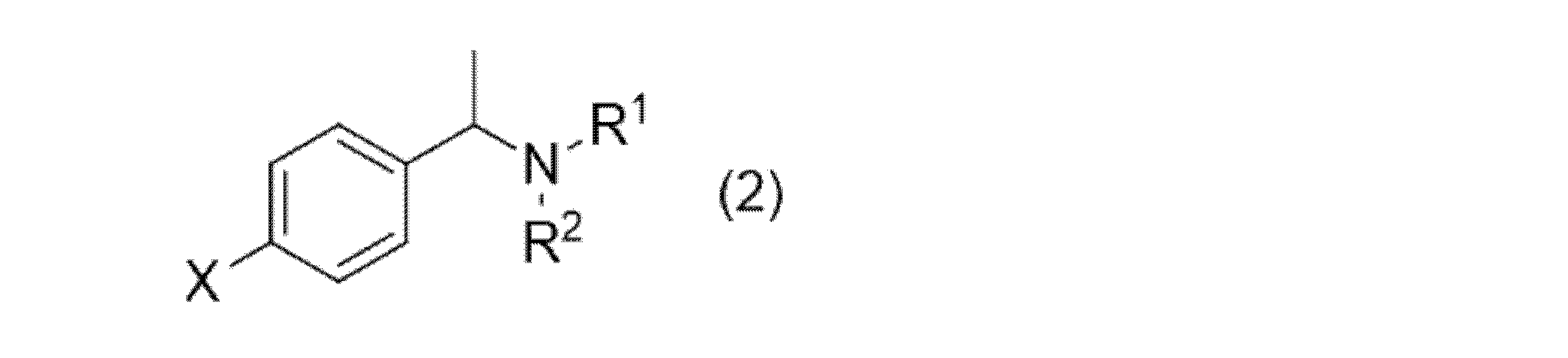
下記式(2)で表される4-ハロゲノベンジルアミン誘導体は、ガレノキサシンの合成中間体として知られており、無置換ベンジルアミン誘導体のハロゲン化により合成されている。
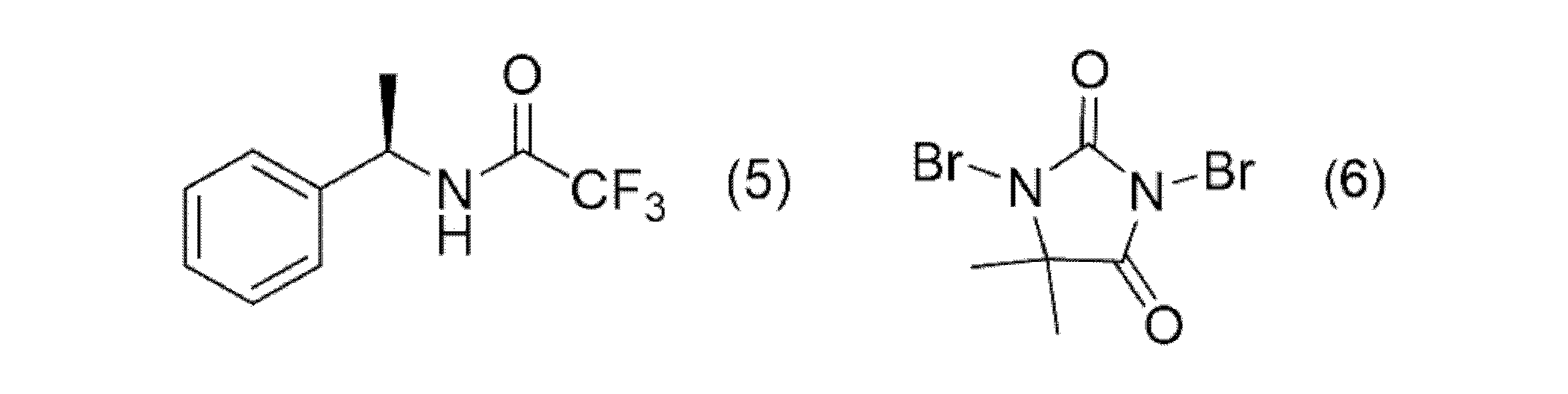
例えば、非特許文献1には、下記式(5)で表される(R)-N-トリフルオロアセチル-1-メチルベンジルアミンを、メタンスルホン酸存在下、下記式(6)で表される1,3-ジブロモ-5,5-ジメチルヒダントイン(DBDMH)と接触させてハロゲン化することにより、上記式(2)で表される4-ハロゲノベンジルアミン誘導体(4-ブロモベンジルアミン誘導体)を得る合成方法が報告されている。
Bioorg. Med. Chem. Lett.,2002,No.12,p.795-798
しかし、非特許文献1に記載の合成方法では、生成物中の4-ブロモベンジルアミン誘導体と2-ブロモベンジルアミン誘導体との比が5:2であり、ハロゲン化反応の位置選択性の点で改善の余地があった。また、非特許文献1に記載の合成方法では、高価なメタンスルホン酸を使用する必要があった。
本発明は、高価なメタンスルホン酸を使用する必要がなく、且つ、ハロゲン化反応の位置選択性を向上させることが可能な4-ハロゲノベンジルアミン誘導体の製造方法を提供することを課題とする。
上記課題を解決するための具体的な手段には、以下の実施態様が含まれる。
<1> 下記式(1):

(式中、R1及びR2はそれぞれ独立に、水素原子、又はアミノ基の保護基を示す。ただし、R1及びR2は同時に水素原子とならない。)
で表される1-メチルベンジルアミン誘導体を、硫酸存在下、ハロゲン化剤と接触させてハロゲン化し、下記式(2):
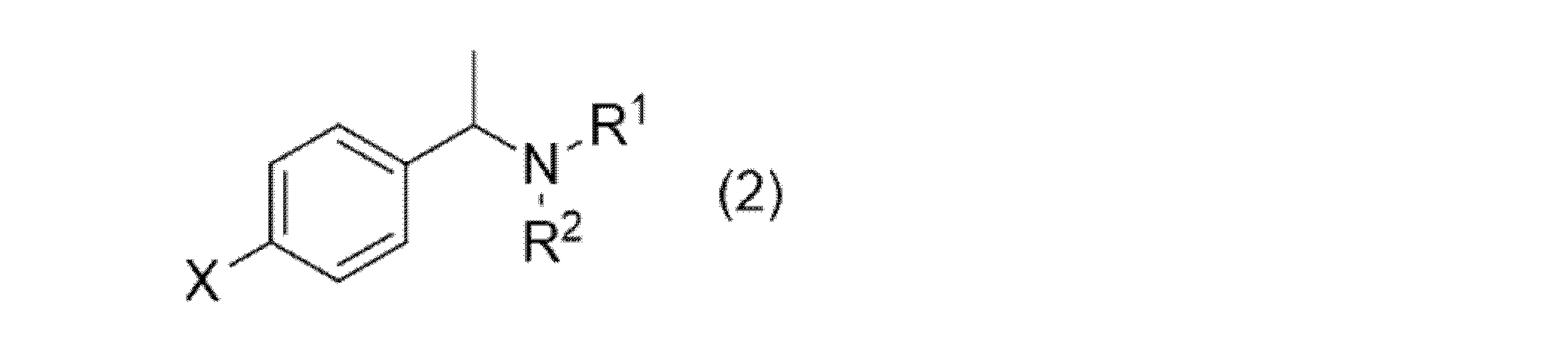
(式中、Xはハロゲン原子を示す。R1及びR2は前記式(1)と同義である。)
で表される4-ハロゲノベンジルアミン誘導体を得ることを含む、4-ハロゲノベンジルアミン誘導体の製造方法。
<1> 下記式(1):
で表される1-メチルベンジルアミン誘導体を、硫酸存在下、ハロゲン化剤と接触させてハロゲン化し、下記式(2):
で表される4-ハロゲノベンジルアミン誘導体を得ることを含む、4-ハロゲノベンジルアミン誘導体の製造方法。
<2> 前記ハロゲン化剤が、N-ハロゲノスクシンイミド、N-ハロゲノフタルイミド、及び下記式(3):

(式中、Xはハロゲン原子を示す。)
で表される1,3-ジハロゲノ-5,5-ジメチルヒダントインから選ばれる少なくとも1種である、<1>に記載の4-ハロゲノベンジルアミン誘導体の製造方法。
で表される1,3-ジハロゲノ-5,5-ジメチルヒダントインから選ばれる少なくとも1種である、<1>に記載の4-ハロゲノベンジルアミン誘導体の製造方法。
<3> 前記アミノ基の保護基がトリフルオロアセチル基である、<1>又は<2>に記載の4-ハロゲノベンジルアミン誘導体の製造方法。
<4> 前記ハロゲン原子が、塩素原子、臭素原子、又はヨウ素原子である、<1>~<3>のいずれか1項に記載の4-ハロゲノベンジルアミン誘導体の製造方法。
<5> 前記1,3-ジハロゲノ-5,5-ジメチルヒダントインが、1,3-ジクロロ-5,5-ジメチルヒダントイン、1,3-ジブロモ-5,5-ジメチルヒダントイン、又は1,3-ジヨード-5,5-ジメチルヒダントインである、<2>に記載の4-ハロゲノベンジルアミン誘導体の製造方法。
<6> 前記N-ハロゲノスクシンイミド及び前記N-ハロゲノフタルイミドが、それぞれN-ブロモスクシンイミド及びN-ブロモフタルイミドである、<2>に記載の4-ハロゲノベンジルアミン誘導体の製造方法。
<7> 前記1-メチルベンジルアミン誘導体を前記ハロゲン化剤と接触させてハロゲン化する際の反応温度が-20~20℃である、<1>~<6>のいずれか1項に記載の4-ハロゲノベンジルアミン誘導体の製造方法。
本発明の製造方法によれば、高価なメタンスルホン酸の代わりに硫酸を使用することで、反応が低温でも速やかに進行し、ハロゲン化反応の位置選択性を向上させることができる。このため、本発明の製造方法によれば、工業的に効率良く4-ハロゲノベンジルアミン誘導体を得ることができる。
以下、本発明の実施形態について詳細に説明する。ただし、本発明は以下の実施形態に限定されるものではない。
本明細書においては特に断らない限り、数値A及びBを用いた「A~B」という表記は「A以上B以下」を意味するものとする。かかる表記において数値Bのみに単位を付した場合には、当該単位が数値Aにも適用されるものとする。
本明細書においては特に断らない限り、数値A及びBを用いた「A~B」という表記は「A以上B以下」を意味するものとする。かかる表記において数値Bのみに単位を付した場合には、当該単位が数値Aにも適用されるものとする。
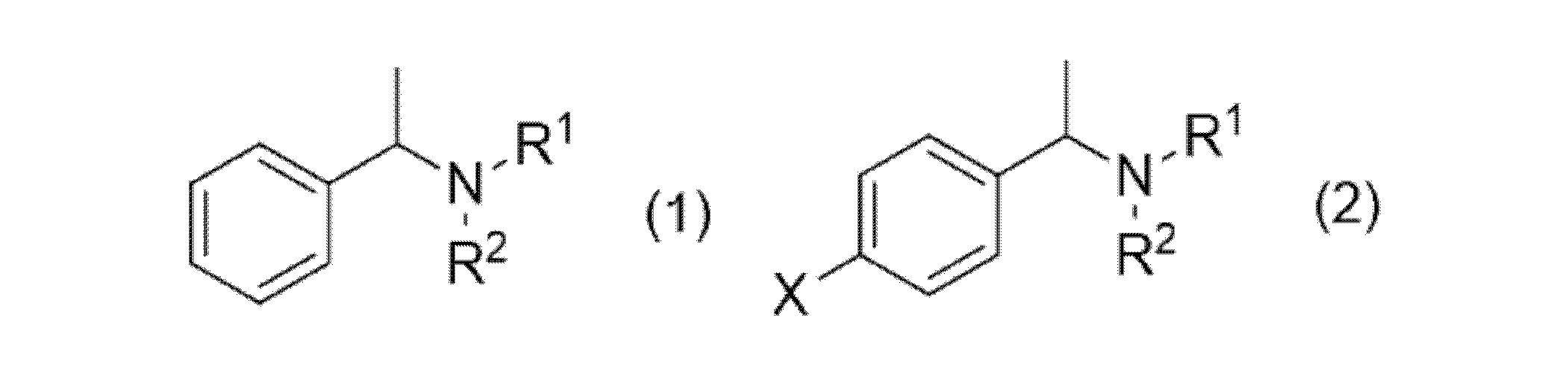
本実施形態に係る4-ハロゲノベンジルアミン誘導体の製造方法は、下記式(1)で表される1-メチルベンジルアミン誘導体を、硫酸存在下、ハロゲン化剤と接触させてハロゲン化し、下記式(2)で表される4-ハロゲノベンジルアミン誘導体を得ることを含む。
<上記式(1)で表される1-メチルベンジルアミン誘導体>
上記式(1)中、R1及びR2はそれぞれ独立に、水素原子、又はアミノ基の保護基を示す。ただし、R1及びR2は同時に水素原子とならない。すなわち、R1及びR2の一方が水素原子である場合、他方はアミノ基の保護基である。
上記式(1)中、R1及びR2はそれぞれ独立に、水素原子、又はアミノ基の保護基を示す。ただし、R1及びR2は同時に水素原子とならない。すなわち、R1及びR2の一方が水素原子である場合、他方はアミノ基の保護基である。
アミノ基の保護基としては、例えば、カルバメート系、アミド系、イミド系、スルホンアミド系の保護基が挙げられ、カルバメート系又はアミド系の保護基が好ましい。具体的には、メトキシカルボニル基又はトリフルオロアセチル基が好ましい。
R1及びR2の組み合わせとしては、メトキシカルボニル基と水素原子との組み合わせ、又はトリフルオロアセチル基と水素原子との組み合わせが好ましく、トリフルオロアセチル基と水素原子との組み合わせがより好ましい。
<ハロゲン化剤>
ハロゲン化剤としては、上記式(1)で表される1-メチルベンジルアミン誘導体にハロゲン原子を導入し、上記式(2)で表される4-ハロゲノベンジルアミン誘導体を得ることができるものであれば特に制限されない。上記式(1)で表される1-メチルベンジルアミン誘導体に導入するハロゲン原子としては、塩素原子、臭素原子、ヨウ素原子等が挙げられ、臭素原子又はヨウ素原子が好ましい。
ハロゲン化剤としては、上記式(1)で表される1-メチルベンジルアミン誘導体にハロゲン原子を導入し、上記式(2)で表される4-ハロゲノベンジルアミン誘導体を得ることができるものであれば特に制限されない。上記式(1)で表される1-メチルベンジルアミン誘導体に導入するハロゲン原子としては、塩素原子、臭素原子、ヨウ素原子等が挙げられ、臭素原子又はヨウ素原子が好ましい。
ハロゲン化剤の具体例としては、例えば、N-ハロゲノスクシンイミド、N-ハロゲノフタルイミド、及び下記式(3)で表される1,3-ジハロゲノ-5,5-ジメチルヒダントインから選ばれる少なくとも1種が挙げられる。下記式(3)中、Xはハロゲン原子を示す。

N-ハロゲノスクシンイミドとしては、N-ブロモスクシンイミド、N-クロロスクシンイミド等が挙げられ、N-ブロモスクシンイミドが好ましい。これらのN-ハロゲノスクシンイミドは、1種を単独で使用してもよく、2種以上を併用してもよい。
N-ハロゲノフタルイミドとしては、N-ブロモフタルイミド、N-クロロフタルイミド、N-ヨードフタルイミド等が挙げられ、N-ブロモフタルイミドが好ましい。これらのN-ハロゲノフタルイミドは、1種を単独で使用してもよく、2種以上を併用してもよい。
上記式(3)で表される1,3-ジハロゲノ-5,5-ジメチルヒダントインとしては、1,3-ジクロロ-5,5-ジメチルヒダントイン、1,3-ジブロモ-5,5-ジメチルヒダントイン、1,3-ジヨード-5,5-ジメチルヒダントイン等が挙げられ、1,3-ジブロモ-5,5-ジメチルヒダントインが好ましい。これらの1,3-ジハロゲノ-5,5-ジメチルヒダントインは、1種を単独で使用してもよく、2種以上を併用してもよい。
<反応条件等>
上記式(1)で表される1-メチルベンジルアミン誘導体をハロゲン化する際には、例えば、上記式(1)で表される1-メチルベンジルアミン誘導体を溶媒に溶解した溶液に硫酸及びハロゲン化剤を添加し、硫酸存在下で、上記式(1)で表される1-メチルベンジルアミン誘導体とハロゲン化剤とを反応させればよい。
上記式(1)で表される1-メチルベンジルアミン誘導体をハロゲン化する際には、例えば、上記式(1)で表される1-メチルベンジルアミン誘導体を溶媒に溶解した溶液に硫酸及びハロゲン化剤を添加し、硫酸存在下で、上記式(1)で表される1-メチルベンジルアミン誘導体とハロゲン化剤とを反応させればよい。
溶媒としては、例えば、酢酸エチル、酢酸メチル、酢酸ブチル、酢酸イソプロピル、アセトニトリル、プロピオニトリル、テトラヒドロフラン、2-メチルテトラヒドロフラン、1,4-ジオキサン、tert-ブチルメチルエーテル、シクロペンチルメチルエーテル、ジメトキシエタン、ジグライム、塩化メチレン、クロロホルム、四塩化炭素、1,2-ジクロロエタン、クロロベンゼン、トルエン、キシレン、ヘキサン、ヘプタン等が挙げられ、塩化メチレン、クロロホルム、及びクロロベンゼンが好ましい。これらの溶媒は、1種を単独で使用してもよく、2種以上を併用してもよい。
溶媒の使用量は特に制限されない。溶媒の使用量は、例えば、上記式(1)で表される1-メチルベンジルアミン誘導体1gに対して1~100mLであることが好ましく、2~10mLであることがより好ましい。
硫酸及びハロゲン化剤の添加量は特に制限されない。硫酸の添加量は、例えば、上記式(1)で表される1-メチルベンジルアミン誘導体1当量に対して0.01~100当量であることが好ましく、0.1~10当量であることがより好ましい。また、ハロゲン化剤の添加量は、例えば、上記式(1)で表される1-メチルベンジルアミン誘導体1当量に対して0.5~2当量であることが好ましく、0.5~1当量であることがより好ましい。
上記式(1)で表される1-メチルベンジルアミン誘導体をハロゲン化する際の反応温度及び反応時間は特に制限されない。反応温度は、通常、-40~100℃の範囲であり、-20~20℃の範囲が好ましく、-10~20℃の範囲がより好ましい。反応時間は、通常、0.5~48時間の範囲であり、1~24時間の範囲が好ましい。
以上の反応により、上記式(2)で表される4-ハロゲノベンジルアミン誘導体を得ることができる。得られた4-ハロゲノベンジルアミン誘導体は、例えば、ガレノキサシンの合成中間体として用いることができる。すなわち、本実施形態に係る製造方法は、ガレノキサシンの製造方法の一部であってもよい。
以下、本発明の実施例について説明するが、本発明はこれら実施例に限定されるものではない。
なお、1H-NMRの測定では、日本電子株式会社製のNMR測定装置(400MHz)を使用した。
HPLC分析では、Waters社製のe2695測定装置を使用した。HPLCの分析条件は下記のとおりである。
(HPLC分析条件)
サンプル濃度:0.5% テトラヒドロフラン
注入量:5μL
検出波長:210nm
流速:1.0mL/分
カラム温度:30℃
移動相:50~100% アセトニトリル(0~20分)
充填剤:X Bridge C18(粒子径5μm、4.6mm×150mm)
(HPLC分析条件)
サンプル濃度:0.5% テトラヒドロフラン
注入量:5μL
検出波長:210nm
流速:1.0mL/分
カラム温度:30℃
移動相:50~100% アセトニトリル(0~20分)
充填剤:X Bridge C18(粒子径5μm、4.6mm×150mm)
<合成例1>
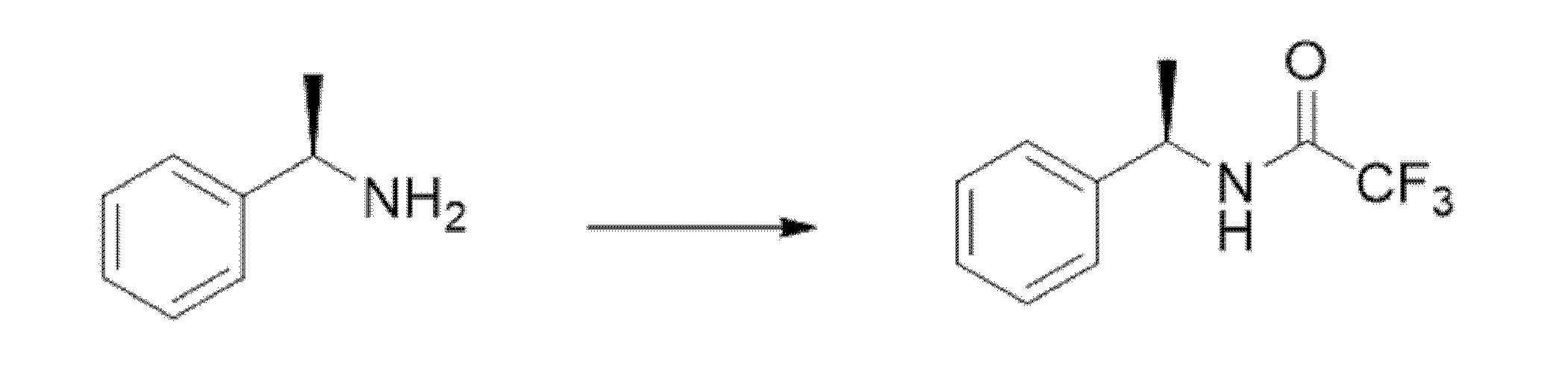
(R)-1-メチルベンジルアミン(13.8g、113.9mmol)の塩化メチレン(200mL)溶液を0℃まで冷却し、ピリジン(22.5g、284.5mmol)を加え、同温で30分間撹拌した。この溶液にトリフルオロ酢酸無水物(29.9g、142.4mmol)を5℃以下で40分間かけて滴下した。滴下終了後、20℃で3時間撹拌した。
反応終了後、反応液に0.5N HCl(200mL)を加えて5分間撹拌した後、分液した。水層を塩化メチレン(50mL)で抽出した。有機層を合わせ、0.5N HCl(150mL)、水(150mL×2)、及び飽和重曹水(150mL)で洗浄し、硫酸マグネシウムで乾燥した後、濾過及び減圧濃縮を行った。濃縮残渣にヘキサン(150mL)を加えて20℃で1時間撹拌した後、濾過及び乾燥を行うことにより、(R)-N-トリフルオロアセチル-1-メチルベンジルアミンを得た(21g、収率:定量的)。
<実施例1>
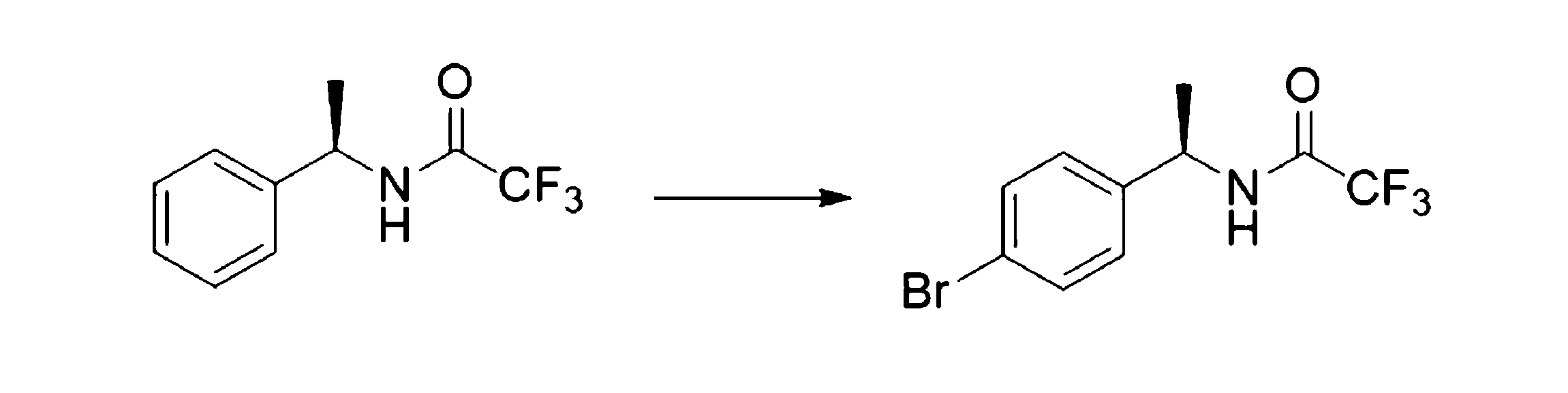
(R)-N-トリフルオロアセチル-1-メチルベンジルアミン(1.00g、4.60mmol)の塩化メチレン(5mL)溶液を-5℃まで冷却し、同温で硫酸(1.17g、11.97mmol)を加えて30分間撹拌した。この溶液に1,3-ジブロモ-5,5-ジメチルヒダントイン(DBDMH)(0.66g、2.31mmol)を同温で加え、-5℃で3時間撹拌した後、20℃で18時間撹拌した。
反応終了後、反応液をHPLC分析したところ、生成物の異性体混合比は、4-ブロモベンジルアミン誘導体(4-Br体)/2-ブロモベンジルアミン誘導体(2-Br体)=75/25であった。なお、HPLCにおける保持時間は、4-Br体が5.912分、2-Br体が5.588分であった。
上記反応液に、1N 亜硫酸水素ナトリウム水溶液(5mL)及び水(10mL)を順次加えて洗浄し、硫酸マグネシウムで乾燥した後、濾過及び減圧濃縮した。濃縮残渣にジエチルエーテル(5mL)を加え、20℃で2時間撹拌した後、得られた固体を濾取及び乾燥することにより、(R)-4-ブロモ-N-トリフルオロアセチル-1-メチルベンジルアミン(4-ブロモベンジルアミン誘導体)を得た(0.54g、4-Br体のみ含有、収率:40%)。
得られた4-ブロモベンジルアミン誘導体((R)-4-ブロモ-N-トリフルオロアセチル-1-メチルベンジルアミン)の1H-NMRの分析結果を以下に示す。
1H-NMR(CDCl3):δ 1.57(d,J=7.0Hz,3H),5.10(q,J=7.0Hz,1H),6.57(brs,1H),7.20(d,J=8.0Hz,2H),7.51(d,J=8.0Hz,2H)
1H-NMR(CDCl3):δ 1.57(d,J=7.0Hz,3H),5.10(q,J=7.0Hz,1H),6.57(brs,1H),7.20(d,J=8.0Hz,2H),7.51(d,J=8.0Hz,2H)
<比較例1>
(R)-N-トリフルオロアセチル-1-メチルベンジルアミン(1.00g、4.60mmol)の塩化メチレン(5mL)溶液を0℃まで冷却し、同温でメタンスルホン酸(1.15g、11.97mmol)を加えて30分間撹拌した。この溶液に1,3-ジブロモ-5,5-ジメチルヒダントイン(DBDMH)(0.66g、2.31mmol)を同温で加え、0℃で1時間撹拌した後、20℃で20時間撹拌した。
(R)-N-トリフルオロアセチル-1-メチルベンジルアミン(1.00g、4.60mmol)の塩化メチレン(5mL)溶液を0℃まで冷却し、同温でメタンスルホン酸(1.15g、11.97mmol)を加えて30分間撹拌した。この溶液に1,3-ジブロモ-5,5-ジメチルヒダントイン(DBDMH)(0.66g、2.31mmol)を同温で加え、0℃で1時間撹拌した後、20℃で20時間撹拌した。
反応終了後、反応液をHPLC分析したところ、生成物の異性体混合比は、4-Br体/2-Br体=69/31であった。
上記反応液に、1N 亜硫酸水素ナトリウム水溶液(5mL)及び水(10mL)を順次加えて洗浄し、硫酸マグネシウムで乾燥した後、濾過及び減圧濃縮した。濃縮残渣にジエチルエーテル(5mL)を加え、20℃で2時間撹拌した後、得られた固体を濾取及び乾燥することにより、(R)-4-ブロモ-N-トリフルオロアセチル-1-メチルベンジルアミン(4-ブロモベンジルアミン誘導体)を得た(0.54g、単離収率40%、4-Br体/2-Br体=96/4、異性体混合比を考慮した収率:39.7%)。
Claims (7)
- 下記式(1):

で表される1-メチルベンジルアミン誘導体を、硫酸存在下、ハロゲン化剤と接触させてハロゲン化し、下記式(2):

で表される4-ハロゲノベンジルアミン誘導体を得ることを含む、4-ハロゲノベンジルアミン誘導体の製造方法。 - 前記ハロゲン化剤が、N-ハロゲノスクシンイミド、N-ハロゲノフタルイミド、及び下記式(3):

で表される1,3-ジハロゲノ-5,5-ジメチルヒダントインから選ばれる少なくとも1種である、請求項1に記載の4-ハロゲノベンジルアミン誘導体の製造方法。 - 前記アミノ基の保護基がトリフルオロアセチル基である、請求項1又は2に記載の4-ハロゲノベンジルアミン誘導体の製造方法。
- 前記ハロゲン原子が、塩素原子、臭素原子、又はヨウ素原子である、請求項1~3のいずれか1項に記載の4-ハロゲノベンジルアミン誘導体の製造方法。
- 前記1,3-ジハロゲノ-5,5-ジメチルヒダントインが、1,3-ジクロロ-5,5-ジメチルヒダントイン、1,3-ジブロモ-5,5-ジメチルヒダントイン、又は1,3-ジヨード-5,5-ジメチルヒダントインである、請求項2に記載の4-ハロゲノベンジルアミン誘導体の製造方法。
- 前記N-ハロゲノスクシンイミド及び前記N-ハロゲノフタルイミドが、それぞれN-ブロモスクシンイミド及びN-ブロモフタルイミドである、請求項2に記載の4-ハロゲノベンジルアミン誘導体の製造方法。
- 前記1-メチルベンジルアミン誘導体を前記ハロゲン化剤と接触させてハロゲン化する際の反応温度が-20~20℃である、請求項1~6のいずれか1項に記載の4-ハロゲノベンジルアミン誘導体の製造方法。
Applications Claiming Priority (2)
| Application Number | Priority Date | Filing Date | Title |
|---|---|---|---|
| JP2019070370A JP2022081711A (ja) | 2019-04-02 | 2019-04-02 | 4-ハロゲノベンジルアミン誘導体の製造方法 |
| JP2019-070370 | 2019-04-02 |
Publications (1)
| Publication Number | Publication Date |
|---|---|
| WO2020203248A1 true WO2020203248A1 (ja) | 2020-10-08 |
Family
ID=72668746
Family Applications (1)
| Application Number | Title | Priority Date | Filing Date |
|---|---|---|---|
| PCT/JP2020/011651 Ceased WO2020203248A1 (ja) | 2019-04-02 | 2020-03-17 | 4-ハロゲノベンジルアミン誘導体の製造方法 |
Country Status (2)
| Country | Link |
|---|---|
| JP (1) | JP2022081711A (ja) |
| WO (1) | WO2020203248A1 (ja) |
Citations (1)
| Publication number | Priority date | Publication date | Assignee | Title |
|---|---|---|---|---|
| WO2016190326A1 (ja) * | 2015-05-27 | 2016-12-01 | 日産化学工業株式会社 | 電荷輸送性ワニス及び有機エレクトロルミネッセンス素子 |
-
2019
- 2019-04-02 JP JP2019070370A patent/JP2022081711A/ja active Pending
-
2020
- 2020-03-17 WO PCT/JP2020/011651 patent/WO2020203248A1/ja not_active Ceased
Patent Citations (1)
| Publication number | Priority date | Publication date | Assignee | Title |
|---|---|---|---|---|
| WO2016190326A1 (ja) * | 2015-05-27 | 2016-12-01 | 日産化学工業株式会社 | 電荷輸送性ワニス及び有機エレクトロルミネッセンス素子 |
Non-Patent Citations (2)
| Title |
|---|
| "Synthesis of Methyl-5-bromo-2-{(1R)-[(2, 2- dimethylpropanoyl)amino]ethyl}benzoate", IP. COM JOURNAL, vol. 17, no. 9B, 12 September 2017 (2017-09-12), pages 1 * |
| MCCOMBIE, STUART W. ET AL.: "Synthesis and Structure-Activity Relationships of M2-Selective Muscarinic Receptor Ligands in the 1-[4-(4- Arylsulfonyl)-phenylmethyl]-4-(4-piperidinyl)- piperazine Family", BIOORGANIC & MEDICINAL CHEMISTRY LETTERS, vol. 12, 11 March 2002 (2002-03-11), pages 795 - 798, XP002290280 * |
Also Published As
| Publication number | Publication date |
|---|---|
| JP2022081711A (ja) | 2022-06-01 |
Similar Documents
| Publication | Publication Date | Title |
|---|---|---|
| JP2011505364A (ja) | TMEDAを用いた5−シクロプロピル−5,11−ジヒドロ[1]ベンゾオキセピノ[3,4−b]−ピリジン−5−オールの製造方法 | |
| JP7730309B2 (ja) | 2-アミノ-5-クロロ-n,3-ジメチルベンズアミドの合成のための新規の効率的なプロセス | |
| JP6915189B1 (ja) | 高純度2−ナフチルアセトニトリル及びその製造方法 | |
| TWI488856B (zh) | 用於製備二硫雜己環并(dithiine)-四羧醯亞胺類之方法 | |
| CN110818661B (zh) | 5-ht4受体激动剂的关键中间体4-氨基-5-卤苯并呋喃-7-羧酸的制备方法 | |
| US9573881B2 (en) | Halogenated aniline and method for producing same | |
| JP2022081711A (ja) | 4-ハロゲノベンジルアミン誘導体の製造方法 | |
| JP2018502164A (ja) | インダンアミン誘導体の製法及び新規な合成中間体 | |
| JP5248078B2 (ja) | ジベンゾオキセピン化合物の製造方法 | |
| WO2015015512A2 (en) | Process for the preparation of silodosin and its gamma form | |
| JP4354436B2 (ja) | ミルナシプラン塩酸塩の製造方法 | |
| CN110386889B (zh) | 一种nsc128981的合成方法 | |
| CN110621660B (zh) | 盐酸罗匹尼罗的纯化方法 | |
| CN115335368B (zh) | 环溴虫酰胺的制造中间体的制造方法 | |
| JP2000239223A (ja) | 3−ブロモ−5−フルオロ安息香酸誘導体の製造方法 | |
| EP1807401B1 (en) | Process for the preparation of phenyl 2-pyrimidinyl ketones and their novel intermediates | |
| JP5364327B2 (ja) | ハロピラジンカルボキサミド化合物の製造方法 | |
| JP2025034981A (ja) | シクラニリプロールの製造中間体の製造方法 | |
| US10538503B2 (en) | Method for producing 3-methyl-2-thiophenecarboxylic acid | |
| JP2022114189A (ja) | 6-ハロゲノイソインドリノン誘導体の製造方法 | |
| JP5940418B2 (ja) | 3−ハロゲン化アニリンの製造方法 | |
| CN121758295A (zh) | 一种亚氨基芳基类化合物及中间体的制备方法 | |
| JP2021524463A (ja) | 2−(ヒドロキシアルキル)−アニリンから置換4−アミノインダン誘導体を製造する方法 | |
| JP3864763B2 (ja) | 3−ハロ−2−ヒドラゾノ−1−ヒドロキシイミノプロパン誘導体及びその製造法 | |
| JPH0812658A (ja) | シドノン類の製造法 |
Legal Events
| Date | Code | Title | Description |
|---|---|---|---|
| 121 | Ep: the epo has been informed by wipo that ep was designated in this application |
Ref document number: 20781956 Country of ref document: EP Kind code of ref document: A1 |
|
| NENP | Non-entry into the national phase |
Ref country code: DE |
|
| 122 | Ep: pct application non-entry in european phase |
Ref document number: 20781956 Country of ref document: EP Kind code of ref document: A1 |
|
| NENP | Non-entry into the national phase |
Ref country code: JP |