WO2020202535A1 - ヘッドホンカバーおよびその留め具 - Google Patents
ヘッドホンカバーおよびその留め具 Download PDFInfo
- Publication number
- WO2020202535A1 WO2020202535A1 PCT/JP2019/014984 JP2019014984W WO2020202535A1 WO 2020202535 A1 WO2020202535 A1 WO 2020202535A1 JP 2019014984 W JP2019014984 W JP 2019014984W WO 2020202535 A1 WO2020202535 A1 WO 2020202535A1
- Authority
- WO
- WIPO (PCT)
- Prior art keywords
- shaped member
- ring
- fabric
- headphone cover
- state
- Prior art date
- Legal status (The legal status is an assumption and is not a legal conclusion. Google has not performed a legal analysis and makes no representation as to the accuracy of the status listed.)
- Ceased
Links
Images





Classifications
-
- H—ELECTRICITY
- H04—ELECTRIC COMMUNICATION TECHNIQUE
- H04R—LOUDSPEAKERS, MICROPHONES, GRAMOPHONE PICK-UPS OR LIKE ACOUSTIC ELECTROMECHANICAL TRANSDUCERS; ELECTRIC HEARING AIDS; PUBLIC ADDRESS SYSTEMS
- H04R1/00—Details of transducers, loudspeakers or microphones
- H04R1/10—Earpieces; Attachments therefor ; Earphones; Monophonic headphones
- H04R1/1008—Earpieces of the supra-aural or circum-aural type
-
- A—HUMAN NECESSITIES
- A61—MEDICAL OR VETERINARY SCIENCE; HYGIENE
- A61F—FILTERS IMPLANTABLE INTO BLOOD VESSELS; PROSTHESES; DEVICES PROVIDING PATENCY TO, OR PREVENTING COLLAPSING OF, TUBULAR STRUCTURES OF THE BODY, e.g. STENTS; ORTHOPAEDIC, NURSING OR CONTRACEPTIVE DEVICES; FOMENTATION; TREATMENT OR PROTECTION OF EYES OR EARS; BANDAGES, DRESSINGS OR ABSORBENT PADS; FIRST-AID KITS
- A61F11/00—Methods or devices for treatment of the ears or hearing sense; Non-electric hearing aids; Methods or devices for enabling ear patients to achieve auditory perception through physiological senses other than hearing sense; Protective devices for the ears, carried on the body or in the hand
- A61F11/06—Protective devices for the ears
- A61F11/14—Protective devices for the ears external, e.g. earcaps or earmuffs
-
- H—ELECTRICITY
- H04—ELECTRIC COMMUNICATION TECHNIQUE
- H04R—LOUDSPEAKERS, MICROPHONES, GRAMOPHONE PICK-UPS OR LIKE ACOUSTIC ELECTROMECHANICAL TRANSDUCERS; ELECTRIC HEARING AIDS; PUBLIC ADDRESS SYSTEMS
- H04R1/00—Details of transducers, loudspeakers or microphones
- H04R1/02—Casings; Cabinets ; Supports therefor; Mountings therein
- H04R1/023—Screens for loudspeakers
-
- H—ELECTRICITY
- H04—ELECTRIC COMMUNICATION TECHNIQUE
- H04R—LOUDSPEAKERS, MICROPHONES, GRAMOPHONE PICK-UPS OR LIKE ACOUSTIC ELECTROMECHANICAL TRANSDUCERS; ELECTRIC HEARING AIDS; PUBLIC ADDRESS SYSTEMS
- H04R1/00—Details of transducers, loudspeakers or microphones
- H04R1/10—Earpieces; Attachments therefor ; Earphones; Monophonic headphones
- H04R1/1058—Manufacture or assembly
Definitions
- the present invention relates to a headphone cover and its fasteners, and more particularly to a headphone cover used by covering the ear pads (earmuffs) of an around-ear type headphone, and a fastener for fastening the headphone cover to the ear pads.
- Patent Document 1 a headphone cover that is used by covering the ear pads of headphones is known (see, for example, Patent Document 1).
- the headphone cover described in Patent Document 1 is a headphone cover formed by folding the peripheral edge portion of a stretchable fabric toward one surface side over the entire circumference to form an opening on the one surface side, and the peripheral edge of the opening. It has a structure in which flat rubber is sewn to the fabric at the periphery of the opening corresponding to.
- the headphone cover configured in this way By attaching the headphone cover configured in this way to the ear pad, it is possible to eliminate the discomfort caused by the stickiness and stuffiness of sweat and fat of the user using the headphones. In other words, by attaching a headphone cover made of a hygroscopic cloth to the ear pad, it is possible to reduce the stuffiness of the ears, and even if you continue listening to music with headphones for a long time, you will not feel discomfort due to stuffiness. be able to.
- around-ear type headphones a type in which the center part of the ear pad is dented and the ear is inserted into the concave space, it is also called an over-ear type
- the headphone cover is attached to the ear pad, the ear pad is used. Since the concave space created is closed by the headphone cover, the feeling of use is similar to that of on-ear headphones that are fixed by pressing the ears.
- Around-ear headphones and on-ear headphones have advantages and disadvantages.
- the around-ear type has the advantage that it can shut out ambient noise to some extent because it covers the entire ear, and the ear is close to the side of the speaker, so that a more powerful sound can be heard.
- the on-ear type has the advantage that it can be configured to be compact and lightweight, and it is difficult for the user to feel the weight even when wearing headphones.
- the present invention has been made to meet such needs, and even if the headphone cover is attached to the around-ear type headphones, the headphones can be used with a feeling close to that of the around-ear type.
- the purpose is to do.
- the headphone cover of the present invention has a fabric for covering the ear pad from the outer peripheral surface to the inner peripheral surface, and a part of the fabric is fixed to the inner peripheral surface of the ear pad or its vicinity.
- the opening peripheral edge which corresponds to the peripheral edge of the opening formed at a predetermined position of the fabric, can be fixed to the outer peripheral surface of the ear pad or the outer peripheral surface of the housing, and is configured as a separate body from the fabric.
- the fixing member acts in the direction from the concave space formed inside the ear pad toward the inner peripheral surface of the ear pad, so that a part of the fabric can be fixed to the inner peripheral surface of the ear pad or its vicinity.
- the ear pad is covered with the fabric from the outer peripheral surface to the inner peripheral surface in a state where the opening peripheral edge portion of the fabric is fixed to the outer peripheral surface of the ear pad or the outer peripheral surface of the housing, and the ear pad
- the concave space formed in the center of the ear pad is the headphone cover. It can be prevented from being blocked by the fabric.
- the headphone cover of the present invention is attached to the around-ear type headphones, the user can use the headphones with a feeling of use close to that of the around-ear type.
- FIG. 1st Embodiment It is a figure which shows the structural example of the headphone cover by 1st Embodiment. It is a schematic diagram which shows the state which attached the headphone cover to the headphone by 1st Embodiment. It is a figure which shows the state which attached the headphone cover by 1st Embodiment to the other type of headphones. It is a figure which shows another example of a fixing member. It is a figure which shows another example of a fixing member. It is a figure which shows another example of a fixing member. It is a figure which shows the structural example of the locking member which locks the ends of a band-shaped member. It is a figure which shows another example of a fixing member. It is a figure which shows another example of a fixing member.
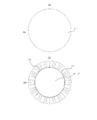
- FIG. 1A and 1B are views showing a configuration example of the headphone cover 1A according to the first embodiment, in which FIG. 1A shows the front surface, FIG. 1B shows the front surface, and FIG. 1C shows the top surface.
- the headphone cover 1A of the present embodiment has elasticity and is deformable, and FIG. 1 shows one aspect of the shape of the headphone cover 1A in a steady state to which no external force is applied.
- the headphone cover 1A of the present embodiment is used by covering the ear pad 101 of the around-ear type headphone 100, as will be described later with reference to FIG.
- the central portion is in a dented state, and a cylindrical concave space 105 is formed therein.
- the headphone cover 1A of the present embodiment has a cloth 11 for covering the ear pad 101 from the outer peripheral surface to the inner peripheral surface when the headphone cover 1A is attached to the headphone 100. There is. Openings 12-1 and 12-2 are formed at predetermined positions of the fabric 11.
- the dough 11 is formed in a tubular shape, a first opening 12-1 is formed at one end of the tubular shape, and a second opening 12-2 is formed at the other end of the tubular shape. It is formed.
- the two openings 12-1 and 12-2 are both formed in a circular shape, and the diameter of the second opening 12-2 is smaller than that of the first opening 12-1.
- the diameter of the first opening 12-1 is formed by the outer peripheral surface of the ear pad 101 or the outer peripheral surface of the housing 102 (particularly, the portion in contact with the ear pad 101) of the headphone 100 to which the headphone cover 1A is attached.
- the value should be smaller than the diameter of the circle.
- the outer peripheral surface of the ear pad 101 and the outer peripheral surface of the portion of the housing 102 in contact with the ear pad 101 are continuous. It is assumed that they are flush with each other, and the diameter of the circle formed by the outer peripheral surface of the ear pad 101 is the same as the diameter of the circle formed by the outer peripheral surface of the portion of the housing 102 in contact with the ear pad 101.
- the outer peripheral surface of the ear pad 101 and the outer peripheral surface of the portion of the housing 102 in contact with the ear pad 101 are discontinuous, and the diameter of the circle formed by the outer peripheral surface of the ear pad 101 is larger than that of the ear pad 101 of the housing 102.
- the diameter of the first opening 12-1 is preferably set to a value smaller than the diameter of the outer peripheral surface of the housing 102.
- the diameter of the second opening 12-2 is about the same as the diameter of the circle formed by the inner peripheral surface of the ear pad 101. However, since the fabric 11 around the second opening 12-2 is stretchable, the diameter of the second opening 12-2 is slightly smaller or larger than the diameter of the circle formed by the inner peripheral surface of the ear pad 101. You may. When the highly elastic fabric 11 is used, the diameter of the second opening 12-2 is set to be about the same as or slightly smaller than or larger than the diameter of the circle formed by the inner peripheral surface of the ear pad 101. The diameter of the opening 12-1 of 1 may be about the same as this.
- An elastic body 13 is provided on the peripheral edge of the first opening, which corresponds to the peripheral edge of the first opening 12-1.
- the elastic body 13 is for fixing the first opening peripheral edge portion of the fabric 11 to the outer peripheral surface of the ear pad 101 or the outer peripheral surface of the housing 102 when the headphone cover 1A is attached to the headphone 100. That is, the first opening 12-1 formed so as to have a relationship of (diameter of the first opening 12-1) ⁇ (diameter of the circle formed by the outer peripheral surface of the ear pad 101 (or housing 102)).
- the elastic body 13 Since the elastic body 13 is provided along the peripheral edge of the opening, the elastic body 13 is stretched and hung on the outer peripheral surface of the ear pad 101 or the outer peripheral surface of the housing 102, thereby causing the elastic body 13 to shrink to its original state.
- the first opening peripheral edge of the fabric 11 is fixed to the outer peripheral surface of the ear pad 101 or the outer peripheral surface of the housing 102.
- flat rubber is used as an example of the elastic body 13 (hereinafter, referred to as flat rubber 13).
- the flat rubber 13 is sewn with the thread 14 to the fabric 11 at the peripheral edge of the first opening in the first opening 12-1.
- the thread 14 used here is preferably one having elasticity.
- the flat rubber 13 is used because it can be easily sewn to the fabric 11 as compared with the round rubber.
- the size is set so that the circumference of the flat rubber 13 in the unstretched state and the circumference of the end portion of the fabric 11 in the unstretched state are substantially the same.
- the length of the thread 14 to be sewn is longer than the length of the entire circumference of the flat rubber 13 in the most contracted state (the length of the circumference of the flat rubber 13 in the steady state shown in FIG. 1).
- the thread is sewn substantially parallel to the longitudinal direction (circumferential direction) of the flat rubber 13. Specifically, the fabric 11 and the flat rubber 13 are stretched together, and the end portion of the fabric 11 and the flat rubber 13 are sewn together.
- the length of the thread 14 used for sewing is made longer than the entire circumference of the flat rubber 13 in the steady state, so that the flat rubber 13 is most shrunk.
- the thread 14 In the (non-stretched) state, the thread 14 is in a slackened state, and the amount of stretching allowance from the slackened state to the non-slackened state of the thread 14 exceeds the elongation limit of the thread 14 itself and is flat.
- the rubber 13 can be stretched.
- one type of headphone cover 1A can be used for the headphone 100 having as many sizes as possible. Further, not only the headphone 100 having a circular cross-sectional shape of the ear pad 101 and the housing 102, but also one type of headphone cover 1A can be used for the headphone 100 having various shapes.
- a part of the fabric 11 is fixed to the inner peripheral surface of the ear pad 101 or its vicinity when the headphone cover 1A is attached to the headphone 100 at the second opening peripheral edge portion corresponding to the peripheral edge of the second opening 12-2.
- Ring-shaped member 15 (an example of a fixing member and a fastener within the scope of claims) is provided.
- the part of the fabric 11 is the peripheral edge of the second opening in the second opening 12-2. That is, the ring-shaped member 15 is configured as a separate body from the fabric 11, and acts in the direction from the concave space 105 formed inside the ear pad 101 toward the inner peripheral surface of the ear pad 101 (this point will be described later).
- the cross-sectional shape of the ring-shaped member 15 is arbitrary.
- the ring-shaped member 15 may have a flat plate-like (rectangular cross-section) ring shape or a columnar (circular cross-section) ring shape.
- the ring-shaped member 15 is made of a material that can be deformed between a state of being narrowed inward and a state of being expanded outward, and the material is formed on or near the inner peripheral surface of the ear pad 101 by expanding outward. It is configured to be able to maintain a deformed state until a part of 11 (the peripheral edge of the second opening) is guided.
- the ring-shaped member 15 is a flexible resin member, which can be deformed into a state of being narrowed inward by applying an external force, and when the application of the external force is stopped. It has a restoring force that spreads outward and tries to return to the original ring shape.
- the ring-shaped member 15 in the process in which the ring-shaped member 15 deformed into a state of being narrowed inward by applying an external force expands outward by stopping the application of the external force and returns to the original ring shape, the ring-shaped member 15 becomes an ear pad.
- the second opening peripheral edge of the fabric 11 is guided to or near the inner peripheral surface of 101.
- the ring-shaped member 15 has a state in which the peripheral edge of the second opening of the fabric 11 is in contact with the inner peripheral surface of the ear pad 101 or the back surface of the ear pad 101 in the vicinity thereof, or the ring-shaped member 15 has the original ring shape.
- the returned state a state in which the peripheral edge of the second opening of the fabric 11 is located near the inner peripheral surface of the ear pad 101
- it acts to maintain that state.
- the ring-shaped member 15 may be a shape memory alloy wire (memory wire) made of a metal material such as copper, brass, aluminum, stainless steel, or iron.
- the ring-shaped member 15 is embedded in a bag-shaped portion 16 formed in a part of the fabric 11 (in the present embodiment, the peripheral portion of the second opening in the second opening 12-2) (FIG. 1 (c). ), The bag-shaped portion 16 is shown schematically). As a result, the fabric 11 and the ring-shaped member 15 are integrally formed (the fabric 11 and the ring-shaped member 15 cannot be separated). As shown in FIG. 1B, the bag-shaped portion 16 is formed by folding the second opening peripheral edge portion of the fabric 11 from the front side to the back side over the entire circumference and sewing the side close to the tip of the folded portion with the thread 17. It is formed.
- the ring-shaped member 15 is placed near the second opening peripheral edge of the fabric 11, and the ring is folded back from the front side to the back side over the entire circumference of the second opening peripheral edge of the fabric 11.
- the ring-shaped member 15 can be embedded in the bag-shaped portion 16.
- a bag-shaped portion is formed in the first opening peripheral edge as well as the bag-shaped portion 16, and the round rubber is formed therein.
- flat rubber may be buried.
- an elastic body such as a flat rubber 13 may not be provided on the peripheral edge of the first opening. In this case, the elastic force of the opening peripheral edge portion may be increased by folding and sewing the first opening peripheral edge portion in double or more.
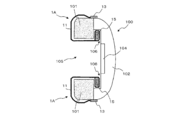
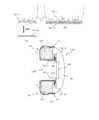
- FIG. 2 is a schematic view showing a state in which the headphone cover 1A configured as described above is attached to the headphone 100.
- FIG. 2 shows a cross section of one of the headphone units 100 including the headband and the pair of headphone units and the headphone cover 1A attached to the headphone unit 100 as a simple schematic diagram.
- the central portion of the ring-shaped ear pad 101 is in a dented state, and a cylindrical concave space 105 is formed therein.
- the speaker unit 104 exists at the bottom of the concave space 105. Further, at the bottom of the inner peripheral surface of the ear pad 101, there is a gap 106 formed between the back surface of the ear pad 101 and the housing 102.
- the ring-shaped member 15 is configured to fit in the gap 106, and inside the gap 106, the second opening peripheral edge of the fabric 11 is fixed in the vicinity of the inner peripheral surface of the ear pad 101.
- the ring-shaped member 15 can be inserted into the gap 106 even if the ring-shaped member 15 is actually formed to have a size slightly thicker than the gap 106. Is.
- the ring-shaped member 15 is configured to have such a size, it is possible to prevent the ring-shaped member 15 inserted into the gap 106 from coming off by receiving pressure or frictional force from the back surface of the ear pad 101.
- the ring-shaped member 15 has a size that abuts on the back surface of the ear pad 101 when it is inserted into the gap 106. That is, the ring-shaped member 15 may be sized so as to have a slight gap between it and the back surface of the ear pad 101. In this case, the ring-shaped member 15 is in a state where the second opening peripheral edge of the fabric 11 is in contact with the inner peripheral surface of the housing 102, which is located at the back of the gap 106, or the ring-shaped member 15 is originally in the gap 106. When it returns to the ring shape of, it acts to maintain that state.
- the ring-shaped member 15 is configured so as to have a gap between it and the back surface of the ear pad 101, the fabric 11 of the portion covering the inner peripheral surface or the outer peripheral surface of the ear pad 101 is pulled.
- the ring-shaped member 15 (actually, the cloth 11 covering the ring-shaped member 15) hits the back surface of the ear pad 101 in the gap 106, the ring-shaped member 15 can be made difficult to come out of the gap 106.
- the back surface of the headphone cover 1A is placed on the outside (the back surface can be seen from the outside), and the second cloth 11 is used.
- the ring-shaped member 15 (the second opening peripheral edge of the cloth 11) is inserted into the gap 106 over the entire circumference while deforming the ring-shaped member 15 embedded in the bag-shaped portion 16 formed on the peripheral edge of the opening.
- the inner peripheral surface to the outer peripheral surface of the ear pad 101 are covered with the fabric 11 in order. Then, by hanging the flat rubber 13 sewn on the outer peripheral surface of the first opening of the fabric 11 on the outer peripheral surface of the ear pad 101 or the housing 102, the first opening peripheral edge of the fabric 11 is hung on the outer peripheral surface of the ear pad 101 or the housing 102. Fix to the surface.
- the headphone cover 1A it is also possible to attach the headphone cover 1A in the reverse procedure. That is, as shown in FIG. 1A, the surface of the headphone cover 1A is on the outside (the surface can be seen from the outside), and the flat rubber 13 sewn on the peripheral edge of the first opening of the fabric 11 is attached to the ear pad. By hanging on the outer peripheral surface of the 101 or the housing 102, the first opening peripheral edge of the fabric 11 is fixed to the outer peripheral surface of the ear pad 101 or the housing 102.
- the outer peripheral surface to the inner peripheral surface of the ear pad 101 are covered with the cloth 11 in order, and the ring-shaped member 15 embedded in the bag-shaped portion 16 formed in the second opening peripheral edge of the cloth 11 is deformed. , The ring-shaped member 15 (the peripheral edge of the second opening of the fabric 11) is inserted into the gap 106 over the entire circumference.
- the first opening peripheral edge of the fabric 11 is fixed to the outer peripheral surface of the ear pad 101 or the housing 102 with the flat rubber 13, and the bottom portion of the inner peripheral surface of the ear pad 101 (between the back surface of the ear pad 101 and the housing 102).
- the outer peripheral surface and the inner circumference of the ear pad 101 are fixed by the ring-shaped member 15 in the vicinity of the inner peripheral surface of the ear pad 101.
- the surface is covered with the cloth 11.
- the fabric 11 is shown in a state of being separated from the ear pad 101 so that the appearance is easy to understand, but in reality, the fabric 11 can be fitted from the outer peripheral surface to the inner peripheral surface of the ear pad 101. ..
- the cylindrical concave space 105 formed in the center of the ear pad 101 is closed by the cloth 11 of the headphone cover 1A. Can be prevented.
- the headphone cover 1A of the present embodiment is attached to the around-ear type headphone 100, the user can use the headphone 100 with a feeling of use close to that of the around-ear type.
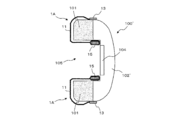
- FIG. 3 is a diagram showing a state in which the headphone cover 1A of the present embodiment is attached to another type of headphone 100'.
- FIG. 3 shows a state in which the headphone cover 1A is attached to the headphone 100'of a type in which there is no gap at the bottom of the inner peripheral surface of the ear pad 101.
- the ear pad 101 is covered with the cloth 11 so that the second opening peripheral edge of the cloth 11 is fixed to the bottom of the inner peripheral surface of the ear pad 101 or the inner peripheral surface of the housing 102'by the ring-shaped member 15. ..
- the headphones 100 are formed in a size such that the diameter of the inner peripheral surface of the ear pad 101 is smaller than the outer diameter of the ring-shaped member 15 in the most widened state (the original ring shape). If this is the case, even if the headphones 100 have different sizes and shapes, the ring-shaped member 15 is pressed against the inner peripheral surface of the ear pad 101, and the inner peripheral surface of the ear pad 101 is pressed against the second opening peripheral edge of the fabric 11. It is possible to fix the part.
- the headphone 100 is formed in a size such that the diameter of the inner peripheral surface of the ear pad 101 is larger than the outer diameter of the ring-shaped member 15 in the most widened state (the original ring shape state).
- the ring-shaped member 15 guides the second opening peripheral edge of the fabric 11 to the vicinity of the inner peripheral surface of the ear pad 101 so that the inner peripheral surface of the ear pad 101 is guided. It is possible to fix the second opening peripheral edge in the vicinity. In this case, a part of the fabric 11 is separated from the inner peripheral surface of the ear pad 101, but the usability close to that of the around ear type is not impaired.
- the fixing member As an example of a fixing member that can be deformed by applying an external force and has a restoring force that tries to return to the original ring shape by stopping the application of the external force, it is made of a flexible resin.
- the fixing member is not limited to this.
- the fixing member may be composed of a ring-shaped member 151 formed by sequentially connecting a plurality of plates 151a so as to form a ring as a whole.
- the material of each plate 151a is arbitrary and can be made of, for example, metal or resin.
- Each of the plurality of plates 151a is connected to another plate 151a via a rotating shaft 151b provided near both ends, and is configured to be rotatable around the rotating shaft 151b.
- a configuration in which ten rectangular plates 151a having chamfered corners are sequentially connected is shown.
- a ring shape is formed in a space region having a thickness twice the thickness of one plate 151a.
- FIG. 4A shows a state in which all the plates 151a are connected at the same angle, and the ring-shaped member 151 forms a regular decagon (ring shape) as a whole.
- FIG. 4B shows a state in which the ring-shaped member 151 is deformed into an arbitrary shape by rotating the plurality of plates 151a at an arbitrary angle.
- FIG. 4C shows a ring shape by rotating a plurality of plates 151a in such a manner that the portions of the five rotating shafts 151b are pushed by the same amount in the central direction of the regular decagon. It shows a state in which the member 151 is deformed into a star shape as a whole.
- the ring-shaped member 151 configured as shown in FIG. 4 is also embedded in the bag-shaped portion 16 formed at the peripheral edge of the second opening of the fabric 11, and is integrally formed with the fabric 11.
- the ring-shaped member 151 (the peripheral edge of the second opening of the fabric 11) is inserted into the gap 106 when the headphone cover 1A is attached to the headphone 100, the ring-shaped member 151 is inserted into FIG. 4 (b) or FIG. 4 (c). ) Is transformed.
- the ring-shaped member 151 is placed in the state shown in FIG. 4A so that the ring-shaped member 151 fits in the gap 106 over the entire circumference. ..
- the ring-shaped member 151 shown in FIG. 4 has a ring shape as shown in FIG. 4 (a) from a deformed state (narrowed inward) as shown in FIG. 4 (b) or FIG. 4 (c). It may have a restoring force to return to the outwardly spread state), or may not have a restoring force. That is, the user can manually deform the ring-shaped member 151 from the folded state as shown in FIG. 4 (b) or FIG. 4 (c) to the state of being unfolded into a ring shape as shown in FIG. 4 (a). It may be performed manually by using the above, or it may be performed automatically by utilizing the restoring force of the ring-shaped member 151 to return to the original ring shape. As an example of the configuration for applying the restoring force to the ring-shaped member 151, a configuration using the torsion spring 151c as shown in FIG. 4D can be considered.
- a part or all of the inside of the plate 151a is made hollow, and the torsion spring 151c is wound around the rotating shaft 151b in a single step. Then, both legs of the torsion spring 151c are configured to abut one on each of the inner walls of the two adjacent plates 151a.
- the center of the star shape is formed.
- the ring-shaped member 151 automatically returns to the ring shape as shown in FIG. 4A by receiving the restoring force of the torsion spring 151c wound around the five rotating shafts 151b in the vicinity.
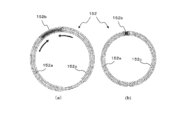
- the ring-shaped member 152 configured as shown in FIG. May be used.
- the ring-shaped member 152 shown in FIG. 5 includes, for example, a flexible member 152a made of resin and having flexibility, and a spring member (for example, a coil spring 152b) arranged between both ends of the flexible member 152a.
- the flexible member 152a and the coil spring 152b are configured to form a ring as a whole.
- the flexible member 152a and the coil spring 152b are configured as separate bodies, and by inserting these into the tube 152c, the unity as a whole is given.
- the tube 152c has a structure in which a part of the ring shape is missing, so that the coil spring 152b can be contracted without contracting or loosening the tube 152c. Both ends of the flexible member 152a and both ends of the coil spring 152b may be adhered to each other.
- the ring-shaped member 152 configured as shown in FIG. 5 is also embedded in the bag-shaped portion 16 formed at the peripheral edge of the second opening of the fabric 11, and is integrally formed with the fabric 11.
- the ring-shaped member 152 (the peripheral edge of the second opening of the fabric 11) is inserted into the gap 106 when the headphone cover 1A is attached to the headphone 100, the user applies an external force to the ring-shaped member 152 to obtain the coil spring 152b. Shrink as in 5 (b). Then, after inserting the ring-shaped member 152 into the gap 106, by releasing the hand from the ring-shaped member 152, the contracted coil spring 152b is extended and the ring-shaped member 152 is in a state as shown in FIG. 5A. The ring-shaped member 152 is set to fit in the gap 106 over the entire circumference.
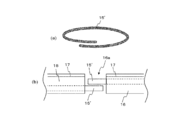
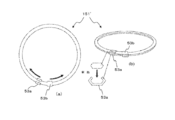
- a ring-shaped strip member 15' may be used as the fixing member.
- the band-shaped member 15' may be embedded in the bag-shaped portion 16 to be integrally formed with the cloth 11, or may be non-integral with the cloth 11 (a state in which the cloth 11 and the band-shaped member 15' can be separated). It may be configured.
- a defective portion 16a is provided in a part of the bag-shaped portion 16, and the defective portion 16a is provided when the headphone cover 1A is used.
- the band-shaped member 15' may be inserted (embedded) into the bag-shaped portion 16 from the portion 16a. In this case, both ends of the strip-shaped member 15'inserted into the bag-shaped portion 16 are exposed from the defective portion 16a, and the user holds both ends of the strip-shaped member 15'by hand and slides them into a ring shape.
- the size of the diameter of the strip-shaped member 15' may be adjustable. By doing so, it is possible to expand the range in which the headphone cover 1A of the present embodiment can be used for headphones 100 having various sizes of the cylindrical concave space 105 having different diameters.
- FIG. 6A When the band-shaped member 15'as shown in FIG. 6A is used as the fixing member, at least a part of the band-shaped member 15'is locked so that the ring-shaped formed state is stably maintained.
- a locking member may be provided.
- FIG. 7 is a diagram showing an example of the locking member.
- FIG. 7A shows a configuration example of a ring-shaped locking member 51 formed of a material such as an elastic vinyl chloride resin.
- the inner diameter of the ring-shaped locking member 51 is set to be about the same as or slightly smaller than the thickness of two strip-shaped members 15'.
- the ring-shaped locking member 51 configured in this way is in a state in which the band-shaped member 15'is inserted in the opposite direction from both ends thereof, and is pressed against the overlapping portions of the band-shaped member 15'.
- the band-shaped member 15'inserted into the ring-shaped locking member 51 is tightened by the ring-shaped locking member 51, and the state in which the band-shaped member 15'is formed into a ring shape having a desired diameter is stably maintained. Will be done.
- FIG. 7B shows a configuration example of a claw-shaped locking member 52 in which the ends of the strip-shaped member 15'are locked to each other by engaging the claws.
- the claw-shaped locking member 52 includes a casing 52a and a claw 52c that is rotatable about a shaft 52b.
- One end of the strip-shaped member 15' is fixed to the casing 52a, and the other end side of the strip-shaped member 15'is inserted into the casing 52a so that it can slide.
- a saw tooth 15a is formed on the other end side of the band-shaped member 15', and any one of the saw teeth 15a is locked to the claw 52c.
- the engagement relationship between the claw 52c and the saw tooth 15a is as follows. That is, even if the claw 52c is not rotated to retract from the saw tooth 15a, the diameter of the ring formed by the band-shaped member 15'is increased (the direction indicated by the right arrow in FIG. 7B). Can slide the strip-shaped member 15'. On the other hand, the band-shaped member 15'cannot be slid in the direction in which the diameter of the ring formed by the band-shaped member 15'is reduced (the direction indicated by the left arrow in FIG. 7B). In order to slide the band-shaped member 15'in this direction, it is necessary to rotate the claw 52c so that it retracts from the saw tooth 15a.
- the strip-shaped member 15'does not necessarily have a restoring force.
- the resilience may be weak. This also applies to the band-shaped members 151'and 152' described in FIGS. 8 and 9 below.
- FIG. 8 is a diagram showing another configuration example of the locking member.
- the strip-shaped member 151' is provided with locking members 53a and 53b at both ends thereof.
- the locking members 53a and 53b are composed of a fitting type locking member to which a part of the band-shaped member 151'is fitted. That is, as shown in FIG. 8, the locking members 53a and 53b are configured to stably grip a part of the band-shaped member 151'in accordance with the cross-sectional shape of the band-shaped member 151'.
- the part of the band-shaped member 151' means a part of the length of the band-shaped member 151'in the longitudinal direction and a part of the cross-sectional shape of the band-shaped member 151'in the circumferential direction.
- the shape may be such that the entire circumference is held instead of a part.
- one locking member 53a provided at one end of the strip member 151' grips a portion of the strip member 151'close to the other end.
- the other locking member 53b provided at the other end of the band-shaped member 151' grips a portion close to one end of the band-shaped member 151'.
- the locking members 53a and 53b at both ends are formed so that the top and bottom are opposite to each other.
- One locking member 53a grips the band-shaped member 151'from below, and the other locking member 53b holds the band-shaped member 151'. From above. Therefore, the band-shaped members 151'are overlapped between the locking members 53a and 53b at both ends.
- the locking members 53a and 53b are configured to have a shape that matches the cross-sectional shape of the strip-shaped member 151'.
- the shape matched to the cross-sectional shape means that the cross-sectional shape of the inner portion of the locking members 53a and 53b is substantially the same as the cross-sectional shape of the corresponding strip-shaped member 151', and the size is also substantially the same. Means that.
- the cross-sectional shape of the inner portion of the locking members 53a and 53b is that of the corresponding strip-shaped member 151'. It may be slightly smaller than the cross-sectional shape. With such a configuration, it is possible to maintain the state in which the strip-shaped member 151'is gripped at a specific portion unless an external force exceeding a certain level is applied.
- the user can slide the locking members 53a and 53b along the longitudinal direction of the band-shaped member 151'by applying an external force of the band-shaped member 151'.
- the band-shaped member 151' can be contracted or stretched by changing the portion of the band-shaped member 151'held by the locking members 53a and 53b in the longitudinal direction.
- shrinking the band-shaped member 151'means reducing the diameter of the ring shape formed by the band-shaped member 151', and the portion where the band-shaped member 151'overlaps between the locking members 53a and 53b at both ends is formed.
- the band-shaped member 151' can be removed from the locking members 53a and 53b simply by sliding the locking members 53a and 53b. There is no such thing.
- the strip-shaped member 151'in FIG. 8 can be regarded as a ring-shaped member. Therefore, the band-shaped member 151'structured as shown in FIG. 8 is pre-embedded in the bag-shaped portion 16 formed at the peripheral edge of the second opening of the cloth 11, and is integrally formed with the cloth 11.
- the band-shaped members 151' are removed from the locking members 53a and 53b by forming the locking members 53a and 53b with flexible members so that the opened portion can be expanded by hand. You may be able to do it. In this case, as in FIG. 6, it is also possible to insert the band-shaped member 151'afterwards into the bag-shaped portion 16 in which a part is missing.
- FIG. 8 shows a configuration in which the locking members 53a and 53b are provided at both ends of the strip-shaped member 151', a configuration in which the locking members 53a and 53b are provided may be provided on only one of them. In this case, the band-shaped member 151'can be pulled out from the locking member simply by sliding the locking member provided at one end of the band-shaped member 151'.
- FIG. 9 is a diagram showing still another configuration example of the locking member.
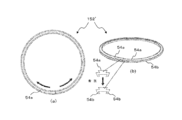
- the locking member is composed of a rail-type locking member including a rail portion 54a formed on the front surface of the strip-shaped member 152'and a leg portion 54b formed on the back surface of the strip-shaped member 152'.
- the rail portion 54a is one rail having a trapezoidal cross-sectional shape, and is formed along the entire surface of the strip-shaped member 152'along the longitudinal direction.
- the leg portion 54b is configured to sandwich the rail portion 54a from both sides in accordance with the cross-sectional trapezoidal shape of the rail portion 54a, and is formed along the entire back surface of the strip-shaped member 152'in the longitudinal direction. ..
- the locking member shown in FIG. 9 has a rail portion 54a formed on the front surface of the band-shaped member 152'on one end side and a leg portion 54b formed on the back surface of the band-shaped member 152'on the other end side. Is formed so as to mesh with. Therefore, in the portion where the rail portion 54a and the leg portion 54b are in mesh with each other, the strip-shaped member 152'is in an overlapping state.
- the leg portion 54b is configured to have a shape that matches the cross-sectional shape of the rail portion 54a.
- the shape adapted to the cross-sectional shape means that the length and angle of the leg portion 54b are substantially the same as the length and angle of the side surface of the rail portion 54a (the portion corresponding to both trapezoidal legs).
- the angle of the leg portion 54b may be slightly sharper than the angle of the side surface of the rail portion 54a.
- the leg portion 54b can be slid along the longitudinal direction of the rail portion 54a by applying an external force of the strip-shaped member 152'.
- the strip-shaped member 152' can be contracted or stretched by changing the length of the rail portion 54a sandwiched by the leg portion 54b in the longitudinal direction.
- the leg portion 54b can be removed from the rail portion 54a simply by sliding the leg portion 54b along the rail portion 54a. Therefore, the strip-shaped member 152'structured as shown in FIG. 9 may be embedded in the bag-shaped portion 16 formed in the peripheral edge of the second opening of the fabric 11 in advance, or as in FIG. , It may be inserted later into the bag-shaped portion 16 in which a part is missing.
- FIG. 9 shows a configuration in which the rail portion 54a is formed over the entire surface of the strip-shaped member 152'and the leg portion 54b is formed over the entire back surface of the strip-shaped member 152', the rail portion 54 and the leg portion are shown.
- the 54b may be formed only near the end of the strip-shaped member 152'.
- the locking members 53a and 53b configured in a fitting type into a shape that matches the cross-sectional shape of the strip-shaped member 151', the locking members 53a and 53b are formed into the strip-shaped member 151'. It is possible to stably grip a part of.
- a rail-type locking member is formed by the rail portion 54a and the leg portion 54b, and the leg portion 54b is shaped to match the cross-sectional shape of the rail portion 54a, whereby the locking members 54a and 54b are formed.
- a part of the strip-shaped member 152' can be stably gripped.
- the locking members 53a and 53b can easily slide along the strip-shaped member 151'.
- the strip-shaped member 151' is deformed into a state of being narrowed inward by receiving an external force (a state in which the strip-shaped member 151' is contracted), it expands outward when no external force is applied to the original.
- the band-shaped member 151' may be formed by a member having a restoring force to return to the shape (the state in which the band-shaped member 151'is extended).
- the leg portion 54b can be easily slid along the rail portion 54a, and the strip-shaped member 152'receives an external force. After being deformed into a state of being narrowed inward (a state in which the band-shaped member 152'is contracted), it expands outward and returns to the original shape (a state in which the band-shaped member 152' is extended) when no external force is applied.
- the band-shaped member 152' may be formed by a member having a restoring force to return.
- the locking members 53a and 53b in FIG. 8 and the locking members 54a and 54b in FIG. 9 are locking mechanisms for stably maintaining the band-shaped members 151'and 152'in a constant state. It does not function as a guide mechanism (guide member) for stably sliding the strip-shaped members 151'and 152' along the longitudinal direction thereof.
- FIG. 10A and 10B are views showing a configuration example of the headphone cover 1B according to the second embodiment, in which FIG. 10A shows a flat surface and FIG. 10B shows a bottom surface.
- the headphone cover 1B of the present embodiment has elasticity and is deformable, and FIG. 10 shows one aspect of the shape of the headphone cover 1B in a steady state in which no external force is applied.
- the headphone cover 1B according to the second embodiment is also used by covering the ear pad 101 of the around-ear type headphone 100.
- FIG. 10 those having the same reference numerals as those shown in FIG. 1 have the same functions, and therefore, duplicate description will be omitted here.
- the peripheral edge of the fabric 11' is folded back to one surface side (bottom surface side) over the entire circumference, and the first opening 12-1'is formed on the one surface side.
- a second opening 12-2' is formed on the non-folded surface side (planar side) opposite to the one surface side.
- the two openings 12-1'and 12-2' are both formed in a circular shape, and the diameter of the second opening 12-2'is smaller than that of the first opening 12-1'. ..
- the diameter of the first opening 12-1' is formed by the outer peripheral surface of the ear pad 101 or the outer peripheral surface of the housing 102 (particularly, the portion in contact with the ear pad 101) of the headphone 100 to which the headphone cover 1B is attached.
- the value shall be smaller than the diameter of the circle.
- the diameter of the second opening 12-2' is set to a value equal to or slightly smaller than the diameter of the circle formed by the inner peripheral surface of the ear pad 101.
- the diameters of the two openings 12-1'and 12-2' are designed so as to have a relationship (the diameter of the circle formed by the outer peripheral surfaces of 102).
- an elastic body for example, flat rubber for fixing the first opening peripheral edge portion to the outer peripheral surface of the ear pad 101 or the outer peripheral surface of the housing 102.
- the length of the thread to be sewn is longer than the length of the entire circumference of the flat rubber 13 in the most contracted state. Then, the thread is sewn substantially parallel to the longitudinal direction (circumferential direction) of the flat rubber 13.
- the flat rubber 13 is in a stretched state, and the end portion of the unstretched fabric 11'and the flat rubber 13 are sewn together. This also applies to the third embodiment described later.
- the size is set so that the circumference of the end portion of the fabric 11'in the unstretched state is longer than the circumference of the flat rubber 13 in the unstretched state. ..
- the peripheral edge of the first opening was shrunk by the force of the flat rubber 13 to cause wrinkles. It becomes a state. That is, the end portion of the fabric 11'is sewn to the flat rubber 13 in a state where the peripheral edge portion of the first opening is loosened.
- a part of the fabric 11' is fixed to the inner peripheral surface of the ear pad 101 or its vicinity when the headphone cover 1B is attached to the headphone 100 at the second opening peripheral edge portion corresponding to the peripheral edge of the second opening 12-2'.
- a fixing member is provided for this purpose.
- the part of the fabric 11' is the second opening peripheral edge portion in the second opening 12-2'.
- the same member as in the first embodiment can be used.
- the ring-shaped member 15 shown in FIG. 1 can be used as the fixing member.
- the ring-shaped member 15 is embedded in the bag-shaped portion 16'formed at the peripheral edge of the second opening in the second opening 12-2'.
- the bag-shaped portion 16' is formed by folding back the peripheral edge of the second opening of the fabric 11'over the entire circumference and sewing the side near the tip of the folded portion with a thread.
- the ring-shaped member 151 shown in FIG. 4 the ring-shaped member 152 shown in FIG. 5, or the band-shaped member 15'shown in FIG. 6 may be used.
- the band-shaped member 15' is used, the locking members 51 and 52 as shown in FIG. 7 may be used.
- the band-shaped member 151'shown in FIG. 8 or the band-shaped member 152'shown in FIG. 9 may be used.
- the cylinder formed in the center of the ear pad 101 can be prevented from being blocked by the fabric 11'of the headphone cover 1B.
- the headphone cover 1B of the present embodiment is attached to the around-ear type headphone 100, the user can use the headphone 100 with a feeling of use close to that of the around-ear type.
- the first opening peripheral edge portion of the fabric 11' is fixed to the outer peripheral surface of the ear pad 101 or the housing 102 by the flat rubber 13 while the fabric is fixed.
- the headphone cover 1B can also be used without inserting the second opening peripheral edge (fixing member) of 11'into the gap 106 between the back surface of the ear pad 101 and the housing 102. In this case, a part of the ear will come into contact with the fabric 11', but since the second opening 12-2'is open, it does not feel as oppressive as a complete on-ear type headphone, and , The direct sound that does not pass through the cloth 11'can be heard from the speaker unit 104.
- FIG. 12A and 12B are views showing a configuration example of the headphone cover 1C according to the third embodiment, in which FIG. 12A shows a flat surface and FIG. 12B shows a bottom surface.
- the headphone cover 1C of the present embodiment has elasticity and is deformable, and FIG. 12 shows one aspect of the shape of the headphone cover 1C in a steady state to which no external force is applied.
- the headphone cover 1C according to the third embodiment is also used by covering the ear pad 101 of the around-ear type headphone 100. Note that, in FIG. 12, those having the same reference numerals as those shown in FIG. 10 have the same functions, and therefore, duplicate description will be omitted here.
- the peripheral portion of the fabric 11 "is folded back to one surface side (bottom surface side) over the entire circumference, and an opening 12-1" is formed on the one surface side.
- This opening 12-1' is similar to the first opening 12-1'in the second embodiment.
- the second opening 12-2' in the second embodiment. Does not exist.
- An elastic body (for example, flat rubber) 13 for fixing the opening peripheral edge to the outer peripheral surface of the ear pad 101 or the outer peripheral surface of the housing 102 is provided on the opening peripheral edge portion corresponding to the peripheral edge of the opening 12-1 ".
- the points are the same as in the second embodiment.
- the fixing member is configured non-integrally with the fabric 11 ", that is, the structure in which the fixing member is embedded in the bag-shaped portion of the fabric 11" and becomes integral with the fabric 11 ". is not.
- the band-shaped member 15'as the fixing member and the locking member 51 or 52 as shown in FIG. 7.
- the strip-shaped member 151'shown in FIG. 8 the locking members 53a and 53b function as the locking mechanism
- the strip-shaped member 152'shown in FIG. 9 the locking members 54a and 54b function as the locking mechanism
- FIG. 1 shows a fixing member having a diameter that fits in the gap 106 between the ear pad 101 and the housing 102 and having a restoring force that tends to return to the original ring shape when no external force is applied.
- the band-shaped member 152'shown in FIG. 9 may be used.
- the fixing member is a part of the fabric 11 "on the non-folded surface side (flat side), which is opposite to the one surface side (bottom side) of the fabric 11". It is fixed to the inner peripheral surface of the above surface or its vicinity (gap 106).
- the part of the fabric 11 refers to the portion around the position where the opening peripheral edge portion of the second opening 12-2'in the second embodiment exists.
- FIG. 13 is a schematic view showing a state in which the headphone cover 1C according to the third embodiment is attached to the headphone 100.
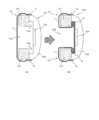
- the headphone cover 1C is attached to the headphone 100, first, as shown in FIG. 13 (a), the entire ear pad 101 is covered with the cloth 11 "while the opening 12-1" of the cloth 11 "is widened. Then, the flat rubber 13 sewn on the outer peripheral surface of the opening of the fabric 11 "is hung on the outer peripheral surface of the ear pad 101 or the housing 102 to fix the opening peripheral edge to the outer peripheral surface of the ear pad 101 or the housing 102. At this stage, the fabric 11 ”is in a state of blocking the cylindrical concave space 105.
- the fabric 11 "that is in a state of closing the cylindrical concave space 105 is stretched and pushed down toward the bottom of the ear pad 101 for fixing from above the fabric 11".
- a member is pressed against the member, and the fixing member is pushed into the gap 106 between the ear pad 101 and the housing 102 together with a part of the cloth 11 ". This makes the part of the cloth 11" fixed in the gap 106.
- the ear pad 101 is covered with the cloth 11 ”.
- the cylindrical concave space 105 formed in the center of the ear pad 101 is formed by the fabric 11 "of the headphone cover 1C. It can be prevented from being blocked.
- the headphone cover 1C of the present embodiment is attached to the around-ear type headphone 100, the user can use the headphone 100 with a feeling of use close to that of the around-ear type.
- the opening peripheral portion of the fabric 11 is fixed to the outer peripheral surface of the ear pad 101 or the housing 102 by the flat rubber 13 while the fabric is fixed.
- the headphone cover 1C can also be used without inserting a part of "11" into the gap 106 between the ear pad 101 and the housing 102. In this case, it is possible to obtain a feeling of use similar to that of on-ear headphones.
- the user can use the headphone cover 1C in either the state shown in FIG. 13A or the state shown in FIG. 13B, depending on the preference at that time.
- the present invention is not limited to this.
- the second opening 12-2'in the second embodiment By forming a bag-shaped portion at a position corresponding to the position where the opening peripheral portion of the above is present and embedding the fixing member in the bag-shaped portion, the fixing member is integrally formed with the cloth 11 ". It may be.
- the structure in which the fixing member is embedded in the bag-shaped portions 16, 16'formed at the second opening peripheral edge of the fabrics 11, 11' has been described. Is not limited to this.
- the fixing member is integrally formed with the fabrics 11 and 11'. It may be configured. Adhesion can be performed using, for example, an adhesive, a hook-and-loop fastener, or the like.
- 14 and 15 are views showing a configuration example in which the fixing member is adhered to the peripheral edge of the second opening of the fabrics 11 and 11'. Note that FIGS. 14 and 15 show an example in which the fixing member is adhered to the tubular fabric 11 shown in the first embodiment.
- the first ring-shaped member 15-1 is adhered to a portion inside the dough 11 by a predetermined length in the vicinity of the second opening peripheral edge of the dough 11.
- the portion of the fabric 11 protruding from the bonded first ring-shaped member 15-1 to the tip side is separated into the first ring-shaped member 15-1 and the second ring-shaped member.
- the second ring-shaped member 15-2 is brought into close contact with the first ring-shaped member 15-1 so as to be sandwiched between the second ring-shaped member 15-2 and the fabric 11. Adhere to.
- end treatment such as cutting the protruding portion is performed.
- FIG. 14C is a diagram showing a state in which the headphone cover 1A'consisting of a structure in which ring-shaped members 15-1 and 15-2 are adhered from the outside of the fabric 11 as shown in FIG. 14B is attached to the headphone 100. Is. The state is the same as that shown in FIG. 2, except that the ring-shaped members 15-1 and 15-2 are not covered with the cloth 11. Although the configuration in which the two ring-shaped members 15-1 and 15-2 are adhered to the fabric 11 in order to improve the appearance is shown here, only the first ring-shaped member 15-1 is used. May be good.
- FIG. 15 shows a configuration example in which the fabric 111 is provided inside the second ring-shaped member 15-2. It is the same as FIG. 14 except that the cloth 111 is present.
- a second ring-shaped member 15-2 is adhered to a portion inside the fabric 111 by a predetermined length from the tip of the fabric 111 in the vicinity of the peripheral edge portion. Further, the portion of the fabric 11 protruding from the first ring-shaped member 15-1 to the tip side and the portion of the fabric 111 protruding from the second ring-shaped member 15-2 to the tip side are both ring-shaped members 15-.
- the end of the dough 11 and the end of the dough 111 are sandwiched between 1, 15-2 and the second ring-shaped member 15-2 is brought into close contact with the first ring-shaped member 15-1. And glue. At this time, if the ends of the fabrics 11 and 111 protrude from between the two ring-shaped members 15-1 and 15-2, end treatment such as cutting the protruding portion is performed.
- the fixing member may be formed by a plurality of block-shaped members 15 "which are neither ring-shaped nor strip-shaped.
- FIG. 16 it is shown in the first embodiment.
- the fabric 11 is fixed by using the restoring force that returns to the original shape, such as the ring-shaped members 15, 151, 152 and the strip-shaped members 15', 151', 152'. Since it is not possible to fix the cloth 11 by maintaining the size of the ring shape by using the locking member, the block-shaped member 15 ”is embedded in the gap 106 to fix the cloth 11. Similarly, a part of the dough 11'shown in the second embodiment and a part of the dough 11 "shown in the third embodiment are fixed by a plurality of block-shaped members 15" in the gap 106. It is also possible to do so.
- the shape of the dough 11, 11', 11 is circular has been described, but the present invention is not limited to this.
- the shape of may be an ellipse, a triangle, a quadrangle, or a polygon more than a pentagon.
- the shape of the openings 12-1, 12-2, 12-1', 12-2', 12-1 may be an ellipse, a triangle, a quadrangle, or a polygon of pentagon or more.
- the present invention is not limited to this.
- the bag-shaped portions 16, 16' may not be provided, and the fixing member and the fabrics 11, 11'may be configured so as not to be integrated.
- first to third embodiments are merely examples of embodiment of the present invention, and the technical scope of the present invention should not be interpreted in a limited manner by these. It must not be. That is, the present invention can be implemented in various forms without departing from its gist or its main features.
Landscapes
- Physics & Mathematics (AREA)
- Engineering & Computer Science (AREA)
- Acoustics & Sound (AREA)
- Signal Processing (AREA)
- Health & Medical Sciences (AREA)
- Life Sciences & Earth Sciences (AREA)
- Biophysics (AREA)
- Otolaryngology (AREA)
- Psychology (AREA)
- Biomedical Technology (AREA)
- Heart & Thoracic Surgery (AREA)
- Vascular Medicine (AREA)
- Animal Behavior & Ethology (AREA)
- General Health & Medical Sciences (AREA)
- Public Health (AREA)
- Veterinary Medicine (AREA)
- Headphones And Earphones (AREA)
Priority Applications (4)
| Application Number | Priority Date | Filing Date | Title |
|---|---|---|---|
| PCT/JP2019/014984 WO2020202535A1 (ja) | 2019-04-04 | 2019-04-04 | ヘッドホンカバーおよびその留め具 |
| JP2021511037A JP7226850B2 (ja) | 2019-04-04 | 2019-04-04 | ヘッドホンカバーおよびその留め具 |
| CN201980095030.6A CN113661717B (zh) | 2019-04-04 | 2019-04-04 | 耳机套及其固定件 |
| US17/600,338 US11683622B2 (en) | 2019-04-04 | 2019-04-04 | Headphone cover and fastener therefor |
Applications Claiming Priority (1)
| Application Number | Priority Date | Filing Date | Title |
|---|---|---|---|
| PCT/JP2019/014984 WO2020202535A1 (ja) | 2019-04-04 | 2019-04-04 | ヘッドホンカバーおよびその留め具 |
Publications (1)
| Publication Number | Publication Date |
|---|---|
| WO2020202535A1 true WO2020202535A1 (ja) | 2020-10-08 |
Family
ID=72666441
Family Applications (1)
| Application Number | Title | Priority Date | Filing Date |
|---|---|---|---|
| PCT/JP2019/014984 Ceased WO2020202535A1 (ja) | 2019-04-04 | 2019-04-04 | ヘッドホンカバーおよびその留め具 |
Country Status (4)
| Country | Link |
|---|---|
| US (1) | US11683622B2 (https=) |
| JP (1) | JP7226850B2 (https=) |
| CN (1) | CN113661717B (https=) |
| WO (1) | WO2020202535A1 (https=) |
Cited By (2)
| Publication number | Priority date | Publication date | Assignee | Title |
|---|---|---|---|---|
| JP2021002812A (ja) * | 2019-06-24 | 2021-01-07 | 修司 横田 | ヘッドホンカバー |
| US20230319451A1 (en) * | 2020-08-19 | 2023-10-05 | Fifty Square Inc | Headphone cover and fastener therefor, and headphone cover mounting method |
Families Citing this family (1)
| Publication number | Priority date | Publication date | Assignee | Title |
|---|---|---|---|---|
| CN115519776B (zh) * | 2022-10-27 | 2026-03-20 | 东莞市达瑞电子股份有限公司 | 一种耳套面皮拉皮设备 |
Citations (6)
| Publication number | Priority date | Publication date | Assignee | Title |
|---|---|---|---|---|
| JPH0644290U (ja) * | 1992-11-09 | 1994-06-10 | 誠 五十嵐 | ヘッドホン用吸汗カバ− |
| US20080187151A1 (en) * | 2007-02-02 | 2008-08-07 | Mcclenon Dephillia J | Earphone cushion |
| JP2013063217A (ja) * | 2011-09-20 | 2013-04-11 | Tachi S Co Ltd | シートカバー |
| JP2015133609A (ja) * | 2014-01-14 | 2015-07-23 | フィフティスクエア株式会社 | ヘッドホンカバー |
| CN205249446U (zh) * | 2015-12-22 | 2016-05-18 | 广东欧珀移动通信有限公司 | 耳套 |
| US20170215000A1 (en) * | 2016-01-21 | 2017-07-27 | Jared Larsen | Headphone earpiece cover |
Family Cites Families (36)
| Publication number | Priority date | Publication date | Assignee | Title |
|---|---|---|---|---|
| CN2247969Y (zh) * | 1995-09-18 | 1997-02-26 | 广州华洋皮革制品有限公司 | 一种简易调整皮带松紧的皮带扣 |
| AT3254U1 (de) * | 1998-12-07 | 1999-12-27 | Mke Metall Kunststoffwaren | Vorrichtung zur montage von geschlitzten, federnden sicherungsringen |
| JP2001112520A (ja) * | 1999-10-18 | 2001-04-24 | Birumateru Kk | 腕部装着用精密器具 |
| CN2475254Y (zh) * | 2001-04-13 | 2002-01-30 | 陈诚忠 | 一种结构经改进的静电消除带 |
| CN100445110C (zh) * | 2003-08-04 | 2008-12-24 | 横滨橡胶株式会社 | 充气轮胎 |
| CN201114705Y (zh) * | 2007-07-31 | 2008-09-10 | 彭伟龙 | 耳机耳套 |
| CN201081051Y (zh) * | 2007-08-08 | 2008-07-02 | 中山市美图洁具实业有限公司 | 一种可调式圆管固定圈 |
| JP5131096B2 (ja) * | 2008-09-02 | 2013-01-30 | ソニー株式会社 | ヘッドホン |
| JP5131097B2 (ja) * | 2008-09-02 | 2013-01-30 | ソニー株式会社 | ヘッドホン |
| JP2010259627A (ja) * | 2009-05-07 | 2010-11-18 | Ykk Corp | スライドアジャスタ |
| JP2010263460A (ja) * | 2009-05-08 | 2010-11-18 | Audio Technica Corp | イヤーマフ及びヘッドホン |
| KR20110005421U (ko) * | 2009-11-25 | 2011-06-01 | 주식회사 신라명품 | 내경가변형 반지 |
| CN102232888B (zh) * | 2010-04-21 | 2013-08-21 | 声腾企业有限公司 | 耳罩结构 |
| CN201775107U (zh) * | 2010-07-23 | 2011-03-30 | 余跃萍 | 伸缩式戒指 |
| JP2012095434A (ja) * | 2010-10-26 | 2012-05-17 | Sumitomo Wiring Syst Ltd | バンドクリップ |
| JP5864164B2 (ja) * | 2011-08-30 | 2016-02-17 | 株式会社モリタホールディングス | 消防ホースの結合金具 |
| JP2013063149A (ja) * | 2011-09-16 | 2013-04-11 | Nifco Inc | バックル |
| CN202276922U (zh) * | 2011-10-25 | 2012-06-20 | 赵富春 | 防挂戒指 |
| CN202397542U (zh) * | 2011-12-28 | 2012-08-29 | 中国人民解放军第三军医大学第二附属医院 | 可调节式血管夹闭卡 |
| CN202603823U (zh) * | 2012-03-31 | 2012-12-19 | 深圳市佳德兴珠宝有限公司 | 内压式可调型戒指 |
| TWM489829U (en) * | 2014-08-07 | 2014-11-11 | Nifco Taiwan Corp | Restrain tie for preventing rotation and slide |
| CN105376969A (zh) * | 2014-08-29 | 2016-03-02 | 康准电子科技(昆山)有限公司 | 手腕带 |
| CN204158148U (zh) * | 2014-09-19 | 2015-02-18 | 高锋 | 可伸缩罩壳 |
| CN204407844U (zh) * | 2015-02-12 | 2015-06-17 | 武汉芯能融冰科技有限公司 | 一种电缆线折叠收放装置 |
| CN205545774U (zh) * | 2015-12-29 | 2016-08-31 | 易力声科技(深圳)有限公司 | 一种耳机耳套及设有该耳套的耳机 |
| CN205508272U (zh) * | 2016-03-25 | 2016-08-24 | 广西南亚热带农业科学研究所 | 一种植物资源标识牌 |
| KR101845055B1 (ko) * | 2016-04-26 | 2018-04-03 | (주)유니텍솔루션 | 케이블 타이 조임장치 |
| CN105947179B (zh) * | 2016-05-20 | 2018-03-16 | 天津大学 | 用于改变机翼翼展的折叠机构 |
| CN205945842U (zh) * | 2016-07-08 | 2017-02-08 | 广东欧珀移动通信有限公司 | 一种柔性显示装置及移动终端 |
| CN206039368U (zh) * | 2016-07-08 | 2017-03-22 | 广东欧珀移动通信有限公司 | 柔性屏支撑结构、柔性显示屏模组及移动终端 |
| CN206143495U (zh) * | 2016-08-31 | 2017-05-03 | 蒋景助 | 可微缩干衣机及其挂架 |
| CN206159238U (zh) * | 2016-09-14 | 2017-05-10 | 吴伟东 | 螺母松动紧固标 |
| CN206221539U (zh) * | 2016-11-30 | 2017-06-06 | 重庆市庆颖摩托车配件有限公司 | 具有制动间隙调整功能的内胀式制动器 |
| CN107288163B (zh) * | 2017-08-10 | 2023-06-02 | 山东建筑大学 | 用于富水软弱地层锚固体界面粘结性能测试的装置及方法 |
| CN207935587U (zh) * | 2018-02-25 | 2018-10-02 | 斯朗福(天津)汽车科技发展有限公司 | 一种便于调节直径的软管卡箍 |
| CN108379792A (zh) * | 2018-03-11 | 2018-08-10 | 邹祥茂 | 一种新型的手部康复运动装置 |
-
2019
- 2019-04-04 CN CN201980095030.6A patent/CN113661717B/zh active Active
- 2019-04-04 WO PCT/JP2019/014984 patent/WO2020202535A1/ja not_active Ceased
- 2019-04-04 US US17/600,338 patent/US11683622B2/en active Active
- 2019-04-04 JP JP2021511037A patent/JP7226850B2/ja active Active
Patent Citations (6)
| Publication number | Priority date | Publication date | Assignee | Title |
|---|---|---|---|---|
| JPH0644290U (ja) * | 1992-11-09 | 1994-06-10 | 誠 五十嵐 | ヘッドホン用吸汗カバ− |
| US20080187151A1 (en) * | 2007-02-02 | 2008-08-07 | Mcclenon Dephillia J | Earphone cushion |
| JP2013063217A (ja) * | 2011-09-20 | 2013-04-11 | Tachi S Co Ltd | シートカバー |
| JP2015133609A (ja) * | 2014-01-14 | 2015-07-23 | フィフティスクエア株式会社 | ヘッドホンカバー |
| CN205249446U (zh) * | 2015-12-22 | 2016-05-18 | 广东欧珀移动通信有限公司 | 耳套 |
| US20170215000A1 (en) * | 2016-01-21 | 2017-07-27 | Jared Larsen | Headphone earpiece cover |
Cited By (5)
| Publication number | Priority date | Publication date | Assignee | Title |
|---|---|---|---|---|
| JP2021002812A (ja) * | 2019-06-24 | 2021-01-07 | 修司 横田 | ヘッドホンカバー |
| JP7323160B2 (ja) | 2019-06-24 | 2023-08-08 | 修司 横田 | ヘッドホンカバー |
| US11792558B2 (en) | 2019-06-24 | 2023-10-17 | Shuji Yokota | Headphone cover |
| US20230319451A1 (en) * | 2020-08-19 | 2023-10-05 | Fifty Square Inc | Headphone cover and fastener therefor, and headphone cover mounting method |
| US12323754B2 (en) * | 2020-08-19 | 2025-06-03 | Fifty Square Inc. | Headphone cover and fastener therefor, and headphone cover mounting method |
Also Published As
| Publication number | Publication date |
|---|---|
| JP7226850B2 (ja) | 2023-02-21 |
| JPWO2020202535A1 (https=) | 2020-10-08 |
| CN113661717B (zh) | 2024-05-31 |
| US20220167070A1 (en) | 2022-05-26 |
| US11683622B2 (en) | 2023-06-20 |
| CN113661717A (zh) | 2021-11-16 |
Similar Documents
| Publication | Publication Date | Title |
|---|---|---|
| WO2020202535A1 (ja) | ヘッドホンカバーおよびその留め具 | |
| JP2009160453A (ja) | 歯科手術を障害なく歯に施すことを可能とする保護及び保持要素 | |
| US20090101162A1 (en) | Headband apparatus | |
| US10448145B1 (en) | Protective headphone cover | |
| US20220030973A1 (en) | Face masks, face masks convertible to hair accessories, and methods of making the same | |
| US11284185B2 (en) | Protective headphone cover | |
| US9808064B2 (en) | Headband | |
| US20190364356A1 (en) | Protective Headphone Cover | |
| CN105900451B (zh) | 耳机套 | |
| JPWO2020202535A5 (https=) | ||
| US11123057B2 (en) | Foreskin manipulator | |
| WO2022038706A1 (ja) | ヘッドホンカバーおよびその留め具、ヘッドホンカバー装着方法 | |
| JP2016093284A (ja) | 指用固定ベルト | |
| JP2016036360A (ja) | サポーター | |
| JP3186687U (ja) | 頭部装着具 | |
| JP2023112357A (ja) | マスク形状保持具およびそれを用いたマスク組立体とマスク形状の保持方法 | |
| JP6854788B2 (ja) | アームガード | |
| CN115916128A (zh) | 吸收性物品 | |
| JP6606752B2 (ja) | 腱鞘炎用サポーター | |
| JP2016036668A (ja) | 皮膚伸長テープ及びリラックス方法 | |
| JP2020168126A (ja) | 膝用サポーター | |
| JP6343410B1 (ja) | サポータ | |
| JP3208163U (ja) | 腕章 | |
| JPWO2022038706A5 (ja) | ヘッドホンカバーおよびその留め具 | |
| JP2025001797A (ja) | ヘッドホンカバー |
Legal Events
| Date | Code | Title | Description |
|---|---|---|---|
| 121 | Ep: the epo has been informed by wipo that ep was designated in this application |
Ref document number: 19923285 Country of ref document: EP Kind code of ref document: A1 |
|
| ENP | Entry into the national phase |
Ref document number: 2021511037 Country of ref document: JP Kind code of ref document: A |
|
| NENP | Non-entry into the national phase |
Ref country code: DE |
|
| 122 | Ep: pct application non-entry in european phase |
Ref document number: 19923285 Country of ref document: EP Kind code of ref document: A1 |