WO2020196199A1 - 半導体ウエハ表面の親水化処理液 - Google Patents
半導体ウエハ表面の親水化処理液 Download PDFInfo
- Publication number
- WO2020196199A1 WO2020196199A1 PCT/JP2020/012142 JP2020012142W WO2020196199A1 WO 2020196199 A1 WO2020196199 A1 WO 2020196199A1 JP 2020012142 W JP2020012142 W JP 2020012142W WO 2020196199 A1 WO2020196199 A1 WO 2020196199A1
- Authority
- WO
- WIPO (PCT)
- Prior art keywords
- group
- formula
- weight
- compound represented
- hydrophilization treatment
- Prior art date
- Legal status (The legal status is an assumption and is not a legal conclusion. Google has not performed a legal analysis and makes no representation as to the accuracy of the status listed.)
- Ceased
Links
Classifications
-
- C—CHEMISTRY; METALLURGY
- C08—ORGANIC MACROMOLECULAR COMPOUNDS; THEIR PREPARATION OR CHEMICAL WORKING-UP; COMPOSITIONS BASED THEREON
- C08G—MACROMOLECULAR COMPOUNDS OBTAINED OTHERWISE THAN BY REACTIONS ONLY INVOLVING UNSATURATED CARBON-TO-CARBON BONDS
- C08G65/00—Macromolecular compounds obtained by reactions forming an ether link in the main chain of the macromolecule
- C08G65/02—Macromolecular compounds obtained by reactions forming an ether link in the main chain of the macromolecule from cyclic ethers by opening of the heterocyclic ring
- C08G65/26—Macromolecular compounds obtained by reactions forming an ether link in the main chain of the macromolecule from cyclic ethers by opening of the heterocyclic ring from cyclic ethers and other compounds
- C08G65/2603—Macromolecular compounds obtained by reactions forming an ether link in the main chain of the macromolecule from cyclic ethers by opening of the heterocyclic ring from cyclic ethers and other compounds the other compounds containing oxygen
- C08G65/2606—Macromolecular compounds obtained by reactions forming an ether link in the main chain of the macromolecule from cyclic ethers by opening of the heterocyclic ring from cyclic ethers and other compounds the other compounds containing oxygen containing hydroxyl groups
- C08G65/2609—Macromolecular compounds obtained by reactions forming an ether link in the main chain of the macromolecule from cyclic ethers by opening of the heterocyclic ring from cyclic ethers and other compounds the other compounds containing oxygen containing hydroxyl groups containing aliphatic hydroxyl groups
-
- C—CHEMISTRY; METALLURGY
- C08—ORGANIC MACROMOLECULAR COMPOUNDS; THEIR PREPARATION OR CHEMICAL WORKING-UP; COMPOSITIONS BASED THEREON
- C08G—MACROMOLECULAR COMPOUNDS OBTAINED OTHERWISE THAN BY REACTIONS ONLY INVOLVING UNSATURATED CARBON-TO-CARBON BONDS
- C08G65/00—Macromolecular compounds obtained by reactions forming an ether link in the main chain of the macromolecule
-
- C—CHEMISTRY; METALLURGY
- C08—ORGANIC MACROMOLECULAR COMPOUNDS; THEIR PREPARATION OR CHEMICAL WORKING-UP; COMPOSITIONS BASED THEREON
- C08L—COMPOSITIONS OF MACROMOLECULAR COMPOUNDS
- C08L71/00—Compositions of polyethers obtained by reactions forming an ether link in the main chain; Compositions of derivatives of such polymers
- C08L71/02—Polyalkylene oxides
-
- C—CHEMISTRY; METALLURGY
- C08—ORGANIC MACROMOLECULAR COMPOUNDS; THEIR PREPARATION OR CHEMICAL WORKING-UP; COMPOSITIONS BASED THEREON
- C08L—COMPOSITIONS OF MACROMOLECULAR COMPOUNDS
- C08L71/00—Compositions of polyethers obtained by reactions forming an ether link in the main chain; Compositions of derivatives of such polymers
- C08L71/08—Polyethers derived from hydroxy compounds or from their metallic derivatives
-
- C—CHEMISTRY; METALLURGY
- C09—DYES; PAINTS; POLISHES; NATURAL RESINS; ADHESIVES; COMPOSITIONS NOT OTHERWISE PROVIDED FOR; APPLICATIONS OF MATERIALS NOT OTHERWISE PROVIDED FOR
- C09D—COATING COMPOSITIONS, e.g. PAINTS, VARNISHES OR LACQUERS; FILLING PASTES; CHEMICAL PAINT OR INK REMOVERS; INKS; CORRECTING FLUIDS; WOODSTAINS; PASTES OR SOLIDS FOR COLOURING OR PRINTING; USE OF MATERIALS THEREFOR
- C09D171/00—Coating compositions based on polyethers obtained by reactions forming an ether link in the main chain; Coating compositions based on derivatives of such polymers
- C09D171/02—Polyalkylene oxides
-
- C—CHEMISTRY; METALLURGY
- C09—DYES; PAINTS; POLISHES; NATURAL RESINS; ADHESIVES; COMPOSITIONS NOT OTHERWISE PROVIDED FOR; APPLICATIONS OF MATERIALS NOT OTHERWISE PROVIDED FOR
- C09G—POLISHING COMPOSITIONS; SKI WAXES
- C09G1/00—Polishing compositions
- C09G1/04—Aqueous dispersions
-
- H—ELECTRICITY
- H10—SEMICONDUCTOR DEVICES; ELECTRIC SOLID-STATE DEVICES NOT OTHERWISE PROVIDED FOR
- H10P—GENERIC PROCESSES OR APPARATUS FOR THE MANUFACTURE OR TREATMENT OF DEVICES COVERED BY CLASS H10
- H10P50/00—Etching of wafers, substrates or parts of devices
-
- H—ELECTRICITY
- H10—SEMICONDUCTOR DEVICES; ELECTRIC SOLID-STATE DEVICES NOT OTHERWISE PROVIDED FOR
- H10P—GENERIC PROCESSES OR APPARATUS FOR THE MANUFACTURE OR TREATMENT OF DEVICES COVERED BY CLASS H10
- H10P52/00—Grinding, lapping or polishing of wafers, substrates or parts of devices
-
- H—ELECTRICITY
- H10—SEMICONDUCTOR DEVICES; ELECTRIC SOLID-STATE DEVICES NOT OTHERWISE PROVIDED FOR
- H10P—GENERIC PROCESSES OR APPARATUS FOR THE MANUFACTURE OR TREATMENT OF DEVICES COVERED BY CLASS H10
- H10P52/00—Grinding, lapping or polishing of wafers, substrates or parts of devices
- H10P52/40—Chemomechanical polishing [CMP]
- H10P52/403—Chemomechanical polishing [CMP] of conductive or resistive materials
-
- H—ELECTRICITY
- H10—SEMICONDUCTOR DEVICES; ELECTRIC SOLID-STATE DEVICES NOT OTHERWISE PROVIDED FOR
- H10P—GENERIC PROCESSES OR APPARATUS FOR THE MANUFACTURE OR TREATMENT OF DEVICES COVERED BY CLASS H10
- H10P70/00—Cleaning of wafers, substrates or parts of devices
- H10P70/10—Cleaning before device manufacture, i.e. Begin-Of-Line process
- H10P70/15—Cleaning before device manufacture, i.e. Begin-Of-Line process by wet cleaning only
-
- H—ELECTRICITY
- H10—SEMICONDUCTOR DEVICES; ELECTRIC SOLID-STATE DEVICES NOT OTHERWISE PROVIDED FOR
- H10P—GENERIC PROCESSES OR APPARATUS FOR THE MANUFACTURE OR TREATMENT OF DEVICES COVERED BY CLASS H10
- H10P90/00—Preparation of wafers not covered by a single main group of this subclass, e.g. wafer reinforcement
- H10P90/12—Preparing bulk and homogeneous wafers
-
- H—ELECTRICITY
- H10—SEMICONDUCTOR DEVICES; ELECTRIC SOLID-STATE DEVICES NOT OTHERWISE PROVIDED FOR
- H10P—GENERIC PROCESSES OR APPARATUS FOR THE MANUFACTURE OR TREATMENT OF DEVICES COVERED BY CLASS H10
- H10P90/00—Preparation of wafers not covered by a single main group of this subclass, e.g. wafer reinforcement
- H10P90/12—Preparing bulk and homogeneous wafers
- H10P90/129—Preparing bulk and homogeneous wafers by polishing
-
- C—CHEMISTRY; METALLURGY
- C08—ORGANIC MACROMOLECULAR COMPOUNDS; THEIR PREPARATION OR CHEMICAL WORKING-UP; COMPOSITIONS BASED THEREON
- C08G—MACROMOLECULAR COMPOUNDS OBTAINED OTHERWISE THAN BY REACTIONS ONLY INVOLVING UNSATURATED CARBON-TO-CARBON BONDS
- C08G2650/00—Macromolecular compounds obtained by reactions forming an ether link in the main chain of the macromolecule
- C08G2650/28—Macromolecular compounds obtained by reactions forming an ether link in the main chain of the macromolecule characterised by the polymer type
- C08G2650/52—Macromolecular compounds obtained by reactions forming an ether link in the main chain of the macromolecule characterised by the polymer type obtained by dehydration of polyhydric alcohols
- C08G2650/54—Polyglycerols
Definitions
- the invention according to the present disclosure relates to a hydrophilization treatment liquid for the surface of a semiconductor wafer.
- the present application claims the priority of Japanese Patent Application No. 2019-054530 filed in Japan on March 22, 2019, the contents of which are incorporated herein by reference.
- the cut silicon single crystal ingot is subjected to a polishing process (usually, primary polishing, secondary polishing, and finish polishing) after the etching process. Stage).
- a polishing process usually, primary polishing, secondary polishing, and finish polishing
- the above-mentioned contaminated foreign matter causes surface defects (LPD: Light point defects) in the wafer inspection process.
- the wafer surface after finish polishing has been made hydrophilic by adjusting the composition of an abrasive such as a slurry.
- the finish-polished wafer is then subjected to a cleaning process.
- "water polishing” is performed.
- the polishing device is operated while supplying cleaning water onto the polishing pad to rinse the polished surface of the wafer.
- the surface of the wafer is prevented from being excessively etched by the alkaline abrasive, and the abrasive grains adhering to the polished surface are washed away.
- Patent Document 1 discloses a method for cleaning the surface of a semiconductor wafer substrate, which is a water polishing cleaning step in which only cleaning water containing no abrasive is supplied to the surface of the wafer substrate after polishing to polish the surface. ing.
- the Si surface of the silicon wafer is exposed due to scrubbing with the polishing pad. Since the Si surface is a hydrophobic surface, it is easily contaminated by contaminated foreign substances such as particles, metal impurities, and organic substances. Moreover, these contaminated foreign substances adhering to the hydrophobic wafer surface tend to be difficult to remove. For this reason, there is a problem that the surface of the wafer after finish polishing, which has become hydrophilic, returns to hydrophobicity by water polishing, adsorbs the above-mentioned contaminated foreign matter, and the degree of cleaning of the wafer surface is lowered.
- the present inventor contains water and a compound represented by the following formula (1), and the total content ratio of water and the compound represented by the following formula (1) is 95. It has been found that the hydrophilicity can be imparted to the surface of the semiconductor wafer by the hydrophilization treatment liquid on the surface of the semiconductor wafer having a weight of% by weight or more.
- the invention according to the present disclosure has been completed based on these findings.
- the invention according to the present disclosure is A hydrophilization treatment liquid for the surface of a semiconductor wafer containing water and a compound represented by the following formula (1), and the total content ratio of water and the compound represented by the following formula (1) is 95% by weight or more (hereinafter, (Sometimes referred to as "the hydrophilization treatment liquid of the present disclosure”).
- R 1 O- (C 3 H 6 O 2 ) n- H (1) (In the formula, R 1 represents a hydrogen atom, a hydrocarbon group of 1 to 24 carbon atoms which may have a hydroxyl group, or a group represented by R 2 CO, wherein R 2 is C 1 - It indicates 24 hydrocarbon groups.
- N indicates the average degree of polymerization of glycerin units shown in parentheses, which is 2 to 60).
- the content ratio of the compound represented by the formula (1) is preferably 0.01 to 1.5% by weight.
- the total content ratio of the abrasive grains and the basic compound is preferably 0.1% by weight or less.
- the pH of the hydrophilization treatment solution is preferably less than 8.
- the weight average molecular weight of the compound represented by the formula (1) is preferably 100 to 3000.
- the HLB value of the compound represented by the formula (1) is preferably 14 or more.
- the hydrophilization treatment solution may be a rinse polishing solution.
- the invention according to the present disclosure also provides a method for manufacturing a semiconductor device, which comprises a step of hydrophilizing the surface of a semiconductor wafer using the hydrophilizing treatment liquid.
- hydrophilicity when applied to the wafer surface, hydrophilicity can be imparted by forming a hydrophilic film. This makes it possible to prevent the adhesion of contaminated foreign substances such as particles, metal impurities, and organic substances to the wafer surface.
- hydrophilic treatment solution of the present disclosure is used as a rinse polishing solution for the wafer surface after finish polishing, hydrophilicity can be imparted to the wafer surface. As a result, the wafer surface does not return to hydrophobicity even after rinsing. Therefore, the hydrophilicity of the wafer surface is maintained, and the adhesion of contaminated foreign substances such as particles, metal impurities, and organic substances can be prevented.
- the hydrophilization treatment liquid of the present disclosure it is possible to manufacture a high-quality semiconductor wafer in which the cleanliness of the wafer surface is maintained and the surface defects (LPD) and surface roughness (haze) are reduced. Is realized.
- the hydrophilic treatment liquid for the present disclosure is used to impart hydrophilicity to the surface of a semiconductor wafer.
- the hydrophilization treatment liquid of the present disclosure contains water as an essential component and a compound represented by the following formula (1) (hereinafter, may be referred to as a "polyglycerin derivative"), and is represented by water and the following formula (1).
- the total content ratio of the represented compound is 95% by weight or more.
- R 1 O- (C 3 H 6 O 2 ) n- H (1)
- R 1 represents a hydrogen atom, a hydrocarbon group of 1 to 24 carbon atoms which may have a hydroxyl group, or a group represented by R 2 CO, wherein R 2 is C 1 - It indicates 24 hydrocarbon groups.
- N indicates the average degree of polymerization of glycerin units shown in parentheses, which is 2 to 60).
- C 3 H 6 O 2 in parentheses of the formula (1) may have only the structure represented by the following formula (2), or may have only the structure represented by the following formula (3). It may have both structures represented by the following formulas (2) and (3).
- R 1 5 to 75% of one molecule is a hydrogen atom.
- Examples of the hydrocarbon group in R 1 and R 2 include an aliphatic hydrocarbon group, an alicyclic hydrocarbon group, an aromatic hydrocarbon group, and a group in which two or more of these are bonded.
- Examples of the aliphatic hydrocarbon group include a methyl group, an ethyl group, a propyl group, a pentyl group, a hexyl group, a heptyl group, an octyl group, a decyl group, a dodecyl group (lauryl group), a tetradecyl group, a myristyl group and a cetyl group.
- a linear alkyl group having 1 to 24 carbon atoms such as a stearyl group; 2-ethylhexyl group, isooctyl group, isodecyl group, isododecyl.
- a branched chain alkyl group having 3 to 24 carbon atoms such as a group, an isomyristyl group, an isosetyl group, and an isostearyl group; a vinyl group, A linear or branched alkenyl group having 2 to 24 carbon atoms (preferably 10 to 20, more preferably 8 to 18) such as a propenyl group, an allyl group, a hexenyl group, a 2-ethylhexenyl group, and an oleyl group; A linear or branched alkapolinyl group having 2 to 24 (preferably 2 to 18) carbon atoms such as a group, an alkatoenyl group, an alktetraenyl group, a linoleyl group, a linolenyl group; an ethynyl group, a propynyl group, etc. Examples thereof include a linear or branched alkyl group having 3 to 24 carbon atoms (preferably 5 to 20,
- alkyl group a linear or branched alkyl group having 12 to 18 carbon atoms such as a dodecyl group and an isostearyl group is preferable.
- alkenyl group a linear or branched alkenyl group having 5 to 18 carbon atoms such as a hexenyl group and an oleyl group is preferable.
- the alicyclic hydrocarbon group includes, for example, a cycloalkyl group having 3 to 24 members (preferably 3 to 15 members, particularly preferably 5 to 8 members) such as a cyclopropyl group, a cyclobutyl group, a cyclopentyl group, and a cyclooctyl group.
- a cycloalkenyl group having 3 to 24 members preferably 3 to 15 members, particularly preferably 5 to 8 members
- such as a cyclopentenyl group and a cyclohexenyl group such as a cyclopentenyl group and a cyclohexenyl group; a perhydronaphthalene-1-yl group, a norbornyl group, an adamantyl group.
- a bridging cyclic hydrocarbon group such as a dodecane-3-yl group can be mentioned.
- aromatic hydrocarbon group examples include an aryl group having 6 to 24 carbon atoms (preferably 6 to 15) such as a phenyl group and a naphthyl group.
- the hydrocarbon group in which the aliphatic hydrocarbon group and the alicyclic hydrocarbon group are bonded includes a cycloalkyl-substituted alkyl group such as a cyclopentylmethyl group, a cyclohexylmethyl group, or a 2-cyclohexylethyl group (for example, C 3-20 cyclo). Alkyl-substituted C 1-4 alkyl groups, etc.) and the like.
- the hydrocarbon group in which the aliphatic hydrocarbon group and the aromatic hydrocarbon group are bonded includes an aralkyl group (for example, C 7-18 aralkyl group) and an alkyl-substituted aryl group (for example, about 1 to 4).
- a phenyl group or a naphthyl group substituted with a C 1-4 alkyl group) and the like can be mentioned.
- the group represented by R 2 CO includes, for example, an aliphatic acyl group such as an acetyl group, a propionyl group, a butyryl group, an isobutyryl group, a stearoyl group, and an oleoyl group; Group acyl groups and the like can be mentioned.
- the R 1 is preferably at least one selected from the group consisting of an alkyl group, an acyl group, and a hydrogen atom. Further, R 1 is a linear alkyl having 1 to 24 carbon atoms such as a linear alkyl group (among them, a methyl group, an ethyl group, a propyl group, a decyl group, a dodecyl group (lauryl group), and a stearyl group.
- Groups in particular, linear alkyl groups having 10 to 20 carbon atoms such as dodecyl groups), branched alkyl groups (particularly branched alkyl groups having 10 to 20 carbon atoms such as isostearyl groups), It is particularly preferable that it is at least one selected from the group consisting of an aliphatic acyl group (among them, an acetyl group, a butyl group, a stearoyl group, an oleoil group, particularly an acetyl group and an oleoil group), and a hydrogen atom. ..
- N in the formula (1) indicates the average degree of polymerization of glycerin.
- the value of n is, for example, when polyglycerin ether is produced from alcohol and glycidol, as shown in the method for producing a compound represented by the formula (1) described later, the alcohol reacting with 2,3-epoxy. It can be easily changed by adjusting the molar ratio of -1-propanol (trade name "glycidol", manufactured by Daicel Co., Ltd.).
- the average degree of polymerization n in the formula (1) is, for example, 2 to 60, preferably 2 to 40, more preferably 4 to 20, and even more preferably 4 to 10.
- n is 2 or more, the water solubility is further improved, so that the detergency is also excellent. In addition, it has good adsorptivity to the surface of the semiconductor wafer and is more excellent in forming a hydrophilic film.
- n is 60 or less, good hydrophilicity is exhibited and water dispersibility is further improved. Unnecessary foaming is suppressed and workability is further improved.
- the method for calculating the average degree of polymerization of glycerin constituting polyglycerin is not particularly limited, and for example, a method for calculating from hydroxyl value, gas chromatography, liquid chromatography, thin layer chromatography, gas chromatograph mass. Examples thereof include a method of determining the composition of polyglycerin from an analytical method or a liquid chromatograph mass analysis method and calculating the average degree of polymerization.
- R 1 in the formula (1) is an alkyl group (among others, a linear or branched alkyl group such as a lauryl group, a stearyl group, or an isostearyl group), n is 2 to 60. Among them, from the viewpoint of good adsorptivity to the surface of the semiconductor wafer and excellent formation of a hydrophilic film, 2 to 30 is preferable and more preferable as n when R 1 in the formula (1) is an alkyl group. It is 4 to 20, more preferably 4 to 15, and most preferably 4 to 10.
- n is 2 to 60.
- 2 to 30 is preferable and more preferable as n when R 1 in the formula (1) is a hydrogen atom. It is 4 to 20, more preferably 4 to 15, and most preferably 4 to 10.
- R 1 in the formula (1) is an acyl group
- n is 2 to 60.
- the formula (1) is excellent in adsorbability to the surface of the semiconductor wafer and excellent formation of a hydrophilic film.
- n is preferably 2 to 30, more preferably 4 to 20, still more preferably 4 to 15, and most preferably 4 to 10.
- n When the value of n is out of the above range, the adsorptivity to the surface of the semiconductor wafer tends to decrease. Further, when the value of n is less than the above range, the hydrophilicity is lowered and the hydrophilic film is not formed on the surface of the semiconductor wafer, and it tends to be difficult to impart hydrophilicity.
- the weight average molecular weight of the compound represented by the formula (1) is, for example, 100 to 3000.
- it is preferably 200 to 3000, more preferably 200 to 2000, still more preferably 300 to 2000, and most preferably 400 to 1500. is there.
- it is more preferably 400 to 1000, and most preferably 400 to 800 from the viewpoint of excellent workability.
- the weight average molecular weight is measured by gel permeation chromatography (GPC).
- the HLB value (Hydrophile-Lipophile Balance) of the compound represented by the formula (1) is, for example, 14 or more, preferably 14 to 20, and more preferably 14 to 18 from the viewpoint of excellent dispersion stability.
- the HLB value can be calculated by the Griffin method.
- At least one selected from the compounds represented by the following formulas (1-1) to (1-8) is preferable, and in particular, the following formula is used. At least one selected from the compounds represented by (1-1) to (1-4) and (1-6) to (1-8) is preferable.
- a compound represented by R 1 OH (the above R 1 is the same as above) may be used in a few cases.
- -Method of Addition Polymerization of Epoxy-1-propanol [2] A compound represented by R 1 X to polyglycerin (the X represents a halogen atom. R 1 is the same as above.
- alkyl halide acid halide.
- a method of reacting polyglycerin with a reactive derivative of a carboxylic acid such as an acid anhydride [4] Polyglycerin with the following formula (4). (In the formula, R 1 is the same as above) Examples thereof include a method of reacting with a polyol such as a glycidyl ether compound represented by.
- alkaline catalyst used in the method [1] above examples include sodium hydroxide, potassium hydroxide, lithium hydroxide, metallic sodium, sodium hydride and the like. These can be used alone or in combination of two or more.
- alkyl halide examples include alkyl chloride, alkyl bromide, and alkyl iodide.
- PGL 03P polyglycerin trimer
- PGL 06 polyglycerin hexamer
- PGL 10PSW PGL 10PSW
- Commercially available products such as “polyglycerin 10-mer” and “PGL XPW (polyglycerin 40-mer)” (manufactured by Daicel Corporation) can be preferably used.
- Examples of the polyol used in the above method [4] include 2,3-epoxy-1-propanol, ethylene glycol, propylene glycol, 1,3-propanediol (trimethylethylene glycol), glycerin, xylitol, and sorbitol. Can be mentioned.
- the hydrophilization treatment liquid of the present disclosure contains at least one compound represented by the above formula (1).
- the compound represented by the above formula (1) includes polyglycerin, polyglycerin monoether, and polyglycerin monoester. Therefore, the hydrophilization treatment solution of the present disclosure contains at least one polyglycerin derivative selected from polyglycerin, polyglycerin monoether, and polyglycerin monoester.
- the hydrophilization treatment liquid of the present disclosure contains, for example, polyglycerin diether or polyglycerin diester corresponding to the compound in addition to polyglycerin, polyglycerin monoether, and polyglycerin monoester as polyglycerin derivatives. You may.
- the total content ratio of polyglycerin, polyglycerin monoether, and polyglycerin monoester is the poly contained in the hydrophilization treatment solution of the present disclosure from the viewpoint of imparting good hydrophilicity. It is preferably 75% by weight or more, and more preferably 90% by weight or more of the total amount of the glycerin derivative.
- the total content of the polyglycerin diether and the polyglycerin diester is preferably 5% by weight or less, and particularly 1% by weight or less, based on the total amount of the polyglycerin derivative contained in the hydrophilization treatment solution of the present disclosure. Is preferable.
- the content ratio of each component contained in the polyglycerin derivative is obtained by separating each component by high performance liquid chromatography, calculating the peak area with a differential refractive index detector, and calculating the area ratio.
- the hydrophilization treatment liquid of the present disclosure contains a compound represented by the above formula (1) as a non-volatile component.
- the hydrophilization treatment liquid of the present disclosure may further contain other components (for example, a water-soluble polymer compound such as a cellulose derivative) as a non-volatile component, but the non-volatile component contained in the hydrophilization treatment liquid of the present disclosure.
- the hydrophilization treatment liquid of the present disclosure may substantially contain only the compound represented by the formula (1) as a non-volatile component.
- the content ratio of the compound represented by the above formula (1) in the hydrophilization treatment solution of the present disclosure is not particularly limited, but is preferably 0.01% by weight or more in 100% by weight of the hydrophilization treatment solution of the present disclosure. 0.02% by weight or more is more preferable, 0.05% by weight or more is further preferable, 0.1% by weight or more is particularly preferable, and 0.2% by weight or more is most preferable.
- the content ratio is preferably 1.5% by weight or less, more preferably 1.0% by weight or less, further preferably 0.7% by weight or less, and particularly preferably 0.5% by weight or less.
- the content ratio of the compound represented by the above formula (1) is within the above range, the adsorption property to the semiconductor wafer surface is excellent, and the effect of adsorbing to the semiconductor wafer to form a hydrophilic film and further protecting the surface is further enhanced. Excellent.
- the detergency is excellent and the hydrophilicity of the finish-polished semiconductor wafer surface can be more satisfactorily imparted.
- foaming due to the compound represented by the formula (1) remaining on the wafer surface is suppressed, and surface contamination (for example, acting like an adhesive to fix contaminated foreign matter on the surface) is suppressed. Does not cause problems such as).
- the content ratio of the compound represented by the above formula (1) is the total of the content ratios of all the compounds represented by the above formula (1) in the hydrophilization treatment liquid of the present disclosure.
- the hydrophilization treatment liquid of the present disclosure contains water as an essential component.
- water is, for example, a medium for cleaning the surface of a semiconductor wafer. Pure water is usually used, and among them, ultrapure water is preferable. Ultrapure water refers to water having an impurity content of 0.01 ⁇ g / L or less.
- the term "pure water" in the present specification also includes ultrapure water.
- the content ratio of the water in the hydrophilization treatment liquid of the present disclosure is not particularly limited, but is preferably 93.5% by weight or more, more preferably 95% by weight, based on 100% by weight of the hydrophilization treatment liquid of the present disclosure.
- the above for example, 98.5% by weight or more, 99% by weight or more, 99.5% by weight or more, 99.95% by weight or more, 99.98% by weight or more.
- the water content ratio is at least the above lower limit value, the cleaning effect on the surface of the semiconductor wafer is excellent, and the addition of hydrophilicity is further excellent.
- the hydrophilization treatment liquid of the present disclosure contains water and a compound represented by the above formula (1), and the total content ratio of water and the compound represented by the above formula (1) is, for example, 95% by weight or more (for example,). 98% by weight or more, 99% by weight or more), more preferably 99.5% by weight or more, further preferably 99.95% by weight or more, particularly preferably 99.98% by weight or more, and most preferably 100% by weight. is there.
- the hydrophilization treatment liquid of the present disclosure may further contain other components as long as the effects of the present disclosure are not impaired.
- the other components include pH adjusters, alcohols, chelates and the like.
- the hydrophilization treatment liquid of the present disclosure includes abrasive grains and basic compounds (for example, alkali metal hydroxides, amines, ammonia, water). It is preferable that it contains substantially no (ammonium oxide salt, etc.). That is, the total content ratio of the abrasive grains and the basic compound in the hydrophilization treatment liquid of the present disclosure is, for example, 0.1% by weight or less (0 to 0.1% by weight), preferably 0.001% by weight. It is the following (0 to 0.001% by weight), and most preferably no compounding (0%).
- abrasive grains and basic compounds for example, alkali metal hydroxides, amines, ammonia, water. It is preferable that it contains substantially no (ammonium oxide salt, etc.). That is, the total content ratio of the abrasive grains and the basic compound in the hydrophilization treatment liquid of the present disclosure is, for example, 0.1% by weight or less (0 to 0.1% by weight), preferably 0.001% by weight. It is the following (0 to 0.00
- the hydrophilized treatment liquid of the present disclosure contains water and other components other than the compound represented by the above formula (1) from the viewpoint of maintaining high cleanliness on the surface of the semiconductor wafer and forming a good hydrophilic film. , It is preferable that it is not substantially contained. That is, the content ratio of the other components to 100% by weight of the hydrophilization treatment liquid of the present disclosure is preferably less than 5% by weight (0 to 5% by weight), more preferably less than 3% by weight (0 to 3%). By weight%), more preferably less than 1% by weight (0 to 1% by weight), particularly preferably less than 0.01% by weight (0 to 0.01% by weight), no compounding (0% by weight). Is most preferable. When the above other components are not substantially contained (that is, less than 0 to 5% by weight), the surface of the semiconductor wafer can be cleaned and hydrophilized most effectively without being interfered by other components. ..
- the pH of the hydrophilized treatment solution of the present disclosure at 25 ° C. is, for example, less than 8.0, preferably 7.8 or less, more preferably 7.5 or less, still more preferably 7.3 or less.
- the pH at 25 ° C. can be measured using a commercially available pH meter, and means a value one minute after the electrode is immersed in the hydrophilization treatment solution of the present disclosure.
- the hydrophilization treatment liquid of the present disclosure can be produced according to a known method for producing a liquid agent, except that the water contains the compound represented by the above formula (1).
- the content ratio of each component of the hydrophilization treatment liquid of the present disclosure explained as described above is the content ratio at the time of use. Therefore, the hydrophilized treatment liquid of the present disclosure may be supplied in a form that can be prepared at the time of use (hereinafter, may be referred to as “material for preparing the hydrophilization treatment liquid of the present disclosure”).
- the material for preparing the hydrophilization treatment liquid of the present disclosure is a material that can prepare the hydrophilization treatment liquid of the present disclosure by diluting with water, for example.
- the material for preparing a hydrophilized treatment liquid of the present disclosure can be in various liquid forms such as a solution, an emulsion, and a suspension, and a gel obtained by solidifying, semi-solidifying, or encapsulating it. It can be in various forms such as a form, a capsule form, a powder form, a particle form, and a granular form.
- the dilution ratio is not particularly limited, but from the viewpoint of reducing distribution cost and storage space, 2 times or more is preferable, and 10 times or more is preferable. More preferably, 50 times or more is further preferable.
- the compound represented by the above formula (1) is contained in 100% by weight of the material for preparing the hydrophilization treatment liquid of the present disclosure.
- the ratio is, for example, preferably 3% by weight or more, and more preferably 15% by weight or more.
- the upper limit of the content ratio is preferably 75% by weight, more preferably 50% by weight. When it is at least the above lower limit, it is superior in reducing distribution cost and storage space. Further, when it is not more than the above upper limit value, it is excellent in handleability (easiness of preparation).
- the material for preparing a hydrophilization treatment liquid of the present disclosure is known as a liquid agent, a solid agent, a semi-solid agent, a gel agent, or a capsule, except that the water contains a compound represented by the above formula (1). It can be produced according to a production method such as an agent, a powder, or a granule.
- the compound represented by the formula (1) is adsorbed on the surface of the semiconductor wafer with excellent adsorptive power to form a good hydrophilic film and maintain high cleanliness on the surface of the semiconductor wafer. can do. As a result, it is possible to manufacture a high-quality semiconductor wafer with reduced surface defects (LPD) and surface roughness (haze).
- LPD surface defects
- haze surface roughness
- the hydrophilization treatment liquid of the present disclosure can be used, for example, in a step of subjecting a semiconductor wafer surface to a hydrophilization treatment in a semiconductor wafer manufacturing process.
- a step is not particularly limited, and is, for example, a cutting step of cutting a silicon single crystal ingot into a predetermined silicon wafer, and a polishing step of polishing the silicon wafer (usually, primary polishing, secondary polishing, finish polishing). There are three stages), a cleaning step of cleaning the silicon wafer, and the like.
- the hydrophilization treatment liquid of the present disclosure is preferably used as a rinse polishing solution in the cleaning step subsequent to the finish polishing step in the polishing step.
- the finish-polished semiconductor wafer is arranged in a polishing apparatus (not shown) provided with a holder for holding the semiconductor wafer and a polishing surface plate to which a polishing pad is attached.
- the supply amount of the hydrophilization treatment liquid of the present disclosure may be a state in which the surface of the polishing pad is always covered with the treatment liquid, and is not particularly limited, but is, for example, 100 ml / min or more, preferably 150 ml / min. More than a minute.
- the polishing pressure during rinsing is not particularly limited, but it is preferable to apply a pressure in the range of 50 to 300 gf / cm 2 , and more preferably in the range of 80 to 250 gf / cm 2 .
- the rotation speed of the polishing surface plate during rinsing polishing is not particularly limited, but is preferably in the range of 50 to 200 rpm, more preferably 60 to 150 rpm, for example.
- the rinsing time during rinsing polishing is not particularly limited, but can be appropriately set in the range of 1 to 10 minutes, preferably 2 to 7 minutes.
- water polishing water polish
- water polish water polish
- test solutions of Examples 1 to 36 were prepared according to the formulations shown in Table 1. Pure water was prepared as the test solution of Comparative Example 1.
- ⁇ PH 10 -Slurry: Nanopure NP8020 (manufactured by Nitta Haas Co., Ltd.) High-purity colloidal silica, abrasive grain concentration 9.5% by weight, abrasive grain size 60-80 nm
- Polishing pad Whitex-DV18 (manufactured by Nitta Haas Co., Ltd.)
- Grinder RN20 (manufactured by Nitta Hearth Co., Ltd.)
- Polishing surface plate rotation speed 115 rpm ⁇ Slurry flow velocity: 300 ml / min ⁇ Polishing pressure: 100 gf / cm 2
- a composition containing water and a compound represented by the following formula (1), and the total content ratio of water and the compound represented by the following formula (1) is 95% by weight or more.
- R 1 O- (C 3 H 6 O 2 ) n- H (1) (In the formula, R 1 represents a hydrogen atom, a hydrocarbon group of 1 to 24 carbon atoms which may have a hydroxyl group, or a group represented by R 2 CO, wherein R 2 is C 1 - It indicates 24 hydrocarbon groups.
- N indicates the average degree of polymerization of glycerin units shown in parentheses, which is 2 to 60).
- composition according to any one of [1] to [16], wherein the content ratio of the compound represented by the formula (1) is 0.05 to 0.7% by weight.
- the composition according to any one of [1] to [16], wherein the content ratio of the compound represented by the formula (1) is 0.05 to 0.5% by weight.
- the composition according to any one of [1] to [16], wherein the content ratio of the compound represented by the formula (1) is 0.1 to 1.5% by weight.
- the composition according to any one of [1] to [16], wherein the content ratio of the compound represented by the formula (1) is 0.1 to 1.0% by weight.
- the total content ratio of the abrasive grains and the basic compound is 0.001% by weight or less.
- composition according to any one of [1] to [34] which has a pH of less than 8.0.
- composition according to any one of [1] to [34] which has a pH of 7.8 or less.
- composition according to any one of [1] to [34] which has a pH of 7.5 or less.
- composition according to any one of [1] to [34] which has a pH of 7.3 or less.
- composition according to any one of [1] to [38] wherein the compound represented by the formula (1) has a weight average molecular weight of 100 to 3000.
- composition according to any one of [1] to [38], wherein the compound represented by the formula (1) has a weight average molecular weight of 100 to 2000.
- the composition according to any one of [1] to [38], wherein the compound represented by the formula (1) has a weight average molecular weight of 100 to 1500.
- the composition according to any one of [1] to [38], wherein the compound represented by the formula (1) has a weight average molecular weight of 100 to 1000.
- composition according to any one of [1] to [38], wherein the compound represented by the formula (1) has a weight average molecular weight of 100 to 800.
- composition according to any one of [1] to [38], wherein the compound represented by the formula (1) has a weight average molecular weight of 200 to 800.
- the composition according to any one of [1] to [38], wherein the compound represented by the formula (1) has a weight average molecular weight of 300 to 3000.
- the composition according to any one of [1] to [38], wherein the compound represented by the formula (1) has a weight average molecular weight of 300 to 2000.
- the composition according to any one of [1] to [38], wherein the compound represented by the formula (1) has a weight average molecular weight of 300 to 1500.
- composition according to any one of [1] to [38], wherein the compound represented by the formula (1) has a weight average molecular weight of 300 to 1000.
- the composition according to any one of [1] to [38], wherein the compound represented by the formula (1) has a weight average molecular weight of 300 to 800.
- the composition according to any one of [1] to [38], wherein the compound represented by the formula (1) has a weight average molecular weight of 400 to 3000.
- the composition according to any one of [1] to [38], wherein the compound represented by the formula (1) has a weight average molecular weight of 400 to 2000.
- composition according to any one of [1] to [38], wherein the compound represented by the formula (1) has a weight average molecular weight of 400 to 1500.
- the composition according to any one of [1] to [38], wherein the compound represented by the formula (1) has a weight average molecular weight of 400 to 1000.
- the composition according to any one of [1] to [38], wherein the compound represented by the formula (1) has a weight average molecular weight of 400 to 800.
- the composition according to any one of [1] to [58], wherein the compound represented by the formula (1) has an HLB value of 14 or more.
- the composition according to any one of [1] to [58], wherein the compound represented by the formula (1) has an HLB value of 14 to 20.
- a method for manufacturing a semiconductor device which comprises a step of hydrophilizing the surface of a semiconductor wafer using the composition according to any one of [1] to [63].
- a method for producing a composition which comprises the step of incorporating a compound represented by the above formula (1) in water to produce the composition according to any one of [1] to [61].
- [66] A method for producing a hydrophilization treatment liquid for a semiconductor wafer surface, wherein the composition according to [65] is a hydrophilization treatment liquid for the surface of a semiconductor wafer.
- [67] A method for producing a rinse polishing solution, wherein the composition according to [65] is a rinse polishing solution.
- [69] Use of the composition according to any one of [1] to [61] as a rinse polishing solution.
- hydrophilicity can be imparted by forming a hydrophilic film on the wafer surface. This makes it possible to prevent the adhesion of contaminated foreign substances such as particles, metal impurities, and organic substances to the wafer surface. Therefore, the present invention has industrial applicability.
Landscapes
- Chemical & Material Sciences (AREA)
- Organic Chemistry (AREA)
- Chemical Kinetics & Catalysis (AREA)
- Health & Medical Sciences (AREA)
- Medicinal Chemistry (AREA)
- Polymers & Plastics (AREA)
- Dispersion Chemistry (AREA)
- Life Sciences & Earth Sciences (AREA)
- Engineering & Computer Science (AREA)
- Materials Engineering (AREA)
- Wood Science & Technology (AREA)
- Mechanical Treatment Of Semiconductor (AREA)
- Detergent Compositions (AREA)
Abstract
半導体ウエハ表面に親水性を付与することができる半導体ウエハ表面の親水化処理液を提供する。 水及び下記式(1)で表される化合物を含み、水及び下記式(1)で表される化合物の総含有割合が、95重量%以上である半導体ウエハ表面の親水化処理液。 R1O-(C3H6O2)n-H (1) (式中、R1は、水素原子、ヒドロキシル基を有していてもよい炭素数1~24の炭化水素基、又はR2COで表される基を示し、前記R2は炭素数1~24の炭化水素基を示す。nは括弧内に示されるグリセリン単位の平均重合度を示し、2~60である)
Description
本開示に係る発明は、半導体ウエハの表面の親水化処理液に関する。本願は、2019年3月22日に日本に出願した、特願2019-054530号の優先権を主張し、その内容をここに援用する。
一般に、半導体ウエハ(以下、単に「ウエハ」と称する場合がある)の製造工程において、切断されたシリコン単結晶インゴットは、エッチング処理後に研磨工程(通常、一次研磨、二次研磨、仕上げ研磨の3段階)に付される。この研磨工程では、ウエハ表面の汚染を防ぐために、親水性の状態を保つことが重要となる。研磨直後にウエハ表面が乾燥すると、その間に付着したパーティクルや金属不純物、有機物などの汚染異物がウエハ表面に固着してしまい、後工程の洗浄工程においても除去されにくいからである。前述の汚染異物は、ウエハの検査工程において、表面欠陥(LPD:Light point defects)を招く原因となる。またLPDが増加すると、表面粗さ(ヘイズ)も上昇し、ウエハ表面の品質低下につながる。このため、従来から、スラリーなどの研磨材の組成を調整するなどによって、仕上げ研磨後のウエハ表面は親水化されてきた。
仕上げ研磨されたウエハは、次いで、洗浄工程に付される。この洗浄工程では、「水研磨(ウォーターポリッシュ)」が行われる。この水研磨は、仕上げ研磨後、洗浄水を研磨パッド上に供給しながら研磨装置を運転してウエハの研磨面をリンスする。これにより、アルカリ性の研磨材によってウエハ表面が過度にエッチングされるのを防ぐとともに、研磨面に付着した研磨砥粒を洗い流している。
例えば、特許文献1には、半導体ウエハ基板の表面洗浄方法であって、研磨後のウエハ基板の表面に対し、研磨材を含まない洗浄水のみを供給して研磨する水研磨洗浄工程が開示されている。
しかし、水のみを用いた水研磨では、研磨パッドによるスクラビングによって、シリコンウエハのSi面が露出してしまう。当該Si面は疎水性の面であるため、パーティクルや金属不純物、有機物などの汚染異物により汚染されやすい。しかも疎水性のウエハ表面に付着したこれらの汚染異物は除去されにくい傾向がある。このため、親水性となった仕上げ研磨後のウエハ表面が、水研磨により疎水性に戻ってしまい、前述の汚染異物を吸着し、ウエハ表面の洗浄度が低下してしまうという問題があった。
したがって、本開示の目的は、半導体ウエハ表面に親水性を付与することができる親水化処理液を提供することにある。
また、仕上げ研磨後に親水性となった半導体ウエハ表面に適用することにより、リンス研磨後においても親水性が維持されるリンス研磨溶液を提供することにある。
また、本開示の他の目的は、前記の親水化処理液を用いて、半導体ウエハ表面を親水化処理する工程を含む、半導体デバイスの製造方法を提供することにある。
また、仕上げ研磨後に親水性となった半導体ウエハ表面に適用することにより、リンス研磨後においても親水性が維持されるリンス研磨溶液を提供することにある。
また、本開示の他の目的は、前記の親水化処理液を用いて、半導体ウエハ表面を親水化処理する工程を含む、半導体デバイスの製造方法を提供することにある。
本発明者は、上記課題を解決するため鋭意検討した結果、水と下記式(1)で表される化合物を含み、水及び下記式(1)で表される化合物の総含有割合が、95重量%以上である半導体ウエハ表面の親水化処理液によれば、半導体ウエハ表面に親水性を付与することができることを見いだした。本開示に係る発明はこれらの知見に基づいて完成させたものである。
すなわち、本開示に係る発明は、
水及び下記式(1)で表される化合物を含み、水及び下記式(1)で表される化合物の総含有割合が、95重量%以上である半導体ウエハ表面の親水化処理液(以下、「本開示の親水化処理液」と称する場合がある)を提供する。
R1O-(C3H6O2)n-H (1)
(式中、R1は、水素原子、ヒドロキシル基を有していてもよい炭素数1~24の炭化水素基、又はR2COで表される基を示し、前記R2は炭素数1~24の炭化水素基を示す。nは括弧内に示されるグリセリン単位の平均重合度を示し、2~60である)
水及び下記式(1)で表される化合物を含み、水及び下記式(1)で表される化合物の総含有割合が、95重量%以上である半導体ウエハ表面の親水化処理液(以下、「本開示の親水化処理液」と称する場合がある)を提供する。
R1O-(C3H6O2)n-H (1)
(式中、R1は、水素原子、ヒドロキシル基を有していてもよい炭素数1~24の炭化水素基、又はR2COで表される基を示し、前記R2は炭素数1~24の炭化水素基を示す。nは括弧内に示されるグリセリン単位の平均重合度を示し、2~60である)
前記親水化処理液において、式(1)で表される化合物の含有割合は0.01~1.5重量%であることが好ましい。
前記親水化処理液において、砥粒及び塩基性化合物の合計の含有割合は、0.1重量%以下であることが好ましい。
前記親水化処理液のpHは8未満であることが好ましい。
前記親水化処理液において、式(1)で表される化合物の重量平均分子量が100~3000であることが好ましい。
前記親水化処理液において、式(1)で表される化合物のHLB値が、14以上であることが好ましい。
前記親水化処理液は、リンス研磨溶液であってもよい。
本開示に係る発明は、また、前記親水化処理液を用いて、半導体ウエハ表面を親水化処理する工程を含む、半導体デバイスの製造方法を提供する。
本開示の親水化処理液によれば、ウエハ表面に適用すると、親水性の膜を形成することにより、親水性を付与することができる。これにより、ウエハ表面へのパーティクルや金属不純物、有機物などの汚染異物の付着を防止することができる。
また、本開示の親水化処理液を、仕上げ研磨後のウエハ表面のリンス研磨溶液として使用すれば、ウエハ表面に親水性を付与することができる。これにより、リンス研磨後においても、ウエハ表面が疎水性に戻ることがない。したがって、ウエハ表面の親水性は維持され、パーティクルや金属不純物、有機物などの汚染異物の付着を防止することができる。
以上のとおり、本開示の親水化処理液によれば、ウエハ表面の清浄度が維持され、表面欠陥(LPD)や表面粗さ(ヘイズ)が低減された、高品質の半導体ウエハを製造することが実現される。
1.半導体ウエハ表面の親水化処理液
本開示の親水化処理液は、半導体ウエハ表面に親水性を付与するために使用される。本開示の親水化処理液は、必須成分として水と、下記式(1)で表される化合物(以下、「ポリグリセリン誘導体」と称する場合がある)を含み、水及び下記式(1)で表される化合物の総含有割合が、95重量%以上である。
本開示の親水化処理液は、半導体ウエハ表面に親水性を付与するために使用される。本開示の親水化処理液は、必須成分として水と、下記式(1)で表される化合物(以下、「ポリグリセリン誘導体」と称する場合がある)を含み、水及び下記式(1)で表される化合物の総含有割合が、95重量%以上である。
(式(1)で表される化合物)
R1O-(C3H6O2)n-H (1)
(式中、R1は、水素原子、ヒドロキシル基を有していてもよい炭素数1~24の炭化水素基、又はR2COで表される基を示し、前記R2は炭素数1~24の炭化水素基を示す。nは括弧内に示されるグリセリン単位の平均重合度を示し、2~60である)
R1O-(C3H6O2)n-H (1)
(式中、R1は、水素原子、ヒドロキシル基を有していてもよい炭素数1~24の炭化水素基、又はR2COで表される基を示し、前記R2は炭素数1~24の炭化水素基を示す。nは括弧内に示されるグリセリン単位の平均重合度を示し、2~60である)
式(1)の括弧内のC3H6O2は、下記式(2)で示される構造のみを有していてもよく、下記式(3)で示される構造のみを有していてもよく、下記式(2)及び(3)で示される両方の構造を有していてもよい。
-CH2-CHOH-CH2O- (2)
-CH(CH2OH)CH2O- (3)
-CH2-CHOH-CH2O- (2)
-CH(CH2OH)CH2O- (3)
前記R1は、1分子中の5~75%が水素原子である。
前記R1、R2における炭化水素基には、脂肪族炭化水素基、脂環式炭化水素基、芳香族炭化水素基、及びこれらの2個以上が結合してなる基が挙げられる。
前記脂肪族炭化水素基としては、例えば、メチル基、エチル基、プロピル基、ペンチル基、ヘキシル基、ヘプチル基、オクチル基、デシル基、ドデシル基(ラウリル基)、テトラデシル基、ミリスチル基、セチル基、ステアリル基などの炭素数1~24(好ましくは5~20、より好ましくは10~20、さらに好ましくは12~18)の直鎖状アルキル基;2-エチルヘキシル基、イソオクチル基、イソデシル基、イソドデシル基、イソミリスチル基、イソセチル基、イソステアリル基などの炭素数3~24(好ましくは5~20、より好ましくは10~20、さらに好ましくは12~18)の分岐鎖状アルキル基;ビニル基、プロペニル基、アリル基、ヘキセニル基、2-エチルヘキセニル基、オレイル基などの炭素数2~24(好ましくは10~20、より好ましくは8~18)の直鎖状又は分岐鎖状アルケニル基;アルカジエニル基、アルカトリエニル基、アルカテトラエニル基、リノレイル基、リノレニル基などの炭素数2~24(好ましくは2~18)の直鎖状又は分岐鎖状アルカポリエニル基;エチニル基、プロピニル基などの炭素数2~24の直鎖状又は分岐鎖状アルキニル基などを挙げることができる。
前記アルキル基としては、なかでも、ドデシル基、イソステアリル基などの炭素数12~18の直鎖状又は分岐鎖状アルキル基が好ましい。また、前記アルケニル基としては、なかでも、ヘキセニル基、オレイル基などの炭素数5~18の直鎖状又は分岐鎖状アルケニル基が好ましい。
脂環式炭化水素基としては、例えば、シクロプロピル基、シクロブチル基、シクロペンチル基、シクロオクチル基などの3~24員(好ましくは3~15員、特に好ましくは5~8員)のシクロアルキル基;シクロペンテニル基、シクロへキセニル基などの3~24員(好ましくは3~15員、特に好ましくは5~8員)のシクロアルケニル基;パーヒドロナフタレン-1-イル基、ノルボルニル基、アダマンチル基、トリシクロ[5.2.1.02,6]デカン-8-イル基、テトラシクロ[4.4.0.12,5.17,10]ドデカン-3-イル基などの橋かけ環式炭化水素基などを挙げることができる。
芳香族炭化水素基としては、例えば、フェニル基、ナフチル基などの炭素数6~24(好ましくは6~15)のアリール基を挙げることができる。
脂肪族炭化水素基と脂環式炭化水素基とが結合した炭化水素基には、シクロペンチルメチル基、シクロヘキシルメチル基、2-シクロヘキシルエチル基などのシクロアルキル置換アルキル基(例えば、C3-20シクロアルキル置換C1-4アルキル基など)などが挙げられる。また、脂肪族炭化水素基と芳香族炭化水素基とが結合した炭化水素基には、アラルキル基(例えば、C7-18アラルキル基など)、アルキル置換アリール基(例えば、1~4個程度のC1-4アルキル基が置換したフェニル基又はナフチル基など)などが挙げられる。
前記R2COで表される基には、例えば、アセチル基、プロピオニル基、ブチリル基、イソブチリル基、ステアロイル基、オレオイル基などの脂肪族アシル基;ベンゾイル基、トルオイル基、ナフトイル基などの芳香族アシル基などが挙げられる。
R1としては、なかでも、アルキル基、アシル基、及び水素原子からなる群から選択される少なくとも1種であることが好ましい。また、R1としては、直鎖状のアルキル基(なかでもメチル基、エチル基、プロピル基、デシル基、ドデシル基(ラウリル基)、ステアリル基などの炭素数1~24の直鎖状のアルキル基、特に、ドデシル基などの炭素数10~20の直鎖状のアルキル基)、分岐鎖状のアルキル基(なかでもイソステアリル基などの炭素数10~20の分岐鎖状のアルキル基)、脂肪族アシル基(なかでも、アセチル基、ブチル基、ステアロイル基、オレオイル基、特に、アセチル基、オレオイル基)、及び水素原子からなる群から選択される少なくとも1種であることが特に好ましい。
式(1)におけるnは、グリセリンの平均重合度を示す。nの値は、後述する式(1)で表される化合物の製造方法において示されるように、例えば、アルコールとグリシドールからポリグリセリンエーテルを製造する場合には、反応するアルコールと2,3-エポキシ-1-プロパノール(商品名「グリシドール」、株式会社ダイセル製)のモル比を調整することにより容易に変化させることができる。
式(1)における平均重合度nは、例えば、2~60、好ましくは2~40、より好ましくは4~20、さらに好ましくは4~10である。nが2以上であると、水溶性が一層向上するため、洗浄性にも優れる。また、半導体ウエハ表面に対する吸着性が良好で、親水性被膜の形成にも一層優れる。nが60以下であると、良好な親水性を示し、水分散性が一層向上する。不要な泡立ちが抑制され、作業性も一層向上される。本明細書において、ポリグリセリンを構成するグリセリンの平均重合度の算出方法は、特に限定されず、例えば、水酸基価から算出する方法、ガスクロマトグラフィー、液体クロマトグラフィー、薄層クロマトグラフィー、ガスクロマトグラフ質量分析法又は液体クロマトグラフ質量分析法などからポリグリセリンの組成を決定し、平均重合度を算出する方法などが挙げられる。
また、式(1)中のR1がアルキル基(なかでも、ラウリル基、ステアリル基、イソステアリル基などの直鎖状又は分岐鎖状アルキル基)の場合、nは2~60である。なかでも、半導体ウエハ表面に対する吸着性が良好で、親水性被膜の形成に優れる観点から、式(1)中のR1がアルキル基の場合のnとしては、2~30が好ましく、より好ましくは4~20、さらに好ましくは4~15、最も好ましくは4~10である。
また、式(1)中のR1が水素原子の場合、nは2~60である。なかでも、半導体ウエハ表面に対する吸着性が良好で、親水性被膜の形成に優れる観点から、式(1)中のR1が水素原子の場合のnとしては、2~30が好ましく、より好ましくは4~20、さらに好ましくは4~15、最も好ましくは4~10である。
一方、式(1)中のR1がアシル基の場合、nは2~60であり、なかでも、半導体ウエハ表面に対する吸着性が良好で、親水性被膜の形成に優れる観点から、式(1)中のR1がアシル基の場合のnとしては、2~30が好ましく、より好ましくは4~20、さらに好ましくは4~15、最も好ましくは4~10である。
nの値が前記範囲を外れると、半導体ウエハ表面に対する吸着性が低下する傾向がある。また、nの値が前記範囲を下回ると、親水性が低下して、半導体ウエハ表面に親水性被膜の形成されず、親水性を付与することが困難となる傾向がある。
式(1)で表される化合物の重量平均分子量は、例えば100~3000である。なかでも、半導体ウエハ表面に対する吸着性が良好で、親水性被膜の形成に優れる観点から、好ましくは200~3000、より好ましくは200~2000、さらに好ましくは300~2000、最も好ましくは400~1500である。また、上記の観点に加えて、作業性にも優れる点から、更に好ましくは400~1000、最も好ましくは400~800である。なお本明細書において、重量平均分子量の測定は、ゲルパーミエーションクロマトグラフ(GPC)による。
式(1)で表される化合物のHLB値(Hydrophile-Lipophile Balance)は、分散安定性に優れる観点から、例えば14以上であり、好ましくは14~20、より好ましくは14~18である。なお、上記HLB値は、グリフィン(Griffin)法により算出することができる。
本開示における式(1)で表される化合物としては、なかでも、下記式(1-1)~(1-8)で表される化合物から選択される少なくとも1種が好ましく、特に、下記式(1-1)~(1-4)、(1-6)~(1-8)で表される化合物から選択される少なくとも1種が好ましい。
C12H25O-(C3H6O2)4-H (1-1)
C12H25O-(C3H6O2)10-H (1-2)
C18H37-O-(C3H6O2)4-H (1-3)
C18H37-O-(C3H6O2)10-H (1-4)
CH2=CH-CH2-O-(C3H6O2)6-H (1-5)
HO-(C3H6O2)10-H (1-6)
HO-(C3H6O2)20-H (1-7)
C12H25O-(C3H6O2)6-H (1-8)
C12H25O-(C3H6O2)4-H (1-1)
C12H25O-(C3H6O2)10-H (1-2)
C18H37-O-(C3H6O2)4-H (1-3)
C18H37-O-(C3H6O2)10-H (1-4)
CH2=CH-CH2-O-(C3H6O2)6-H (1-5)
HO-(C3H6O2)10-H (1-6)
HO-(C3H6O2)20-H (1-7)
C12H25O-(C3H6O2)6-H (1-8)
本開示における式(1)で表される化合物の製造方法として、例えば、[1]アルカリ触媒の存在下、R1OHで表される化合物(前記R1は上記に同じ)に、2,3-エポキシ-1-プロパノールを付加重合する方法、[2]ポリグリセリンに、R1Xで表される化合物(前記Xはハロゲン原子を示す。R1は上記に同じ。例えば、アルキルハライド、酸ハライド)を反応させる方法、[3]ポリグリセリンに、酸無水物などのカルボン酸の反応性誘導体を反応させる方法、[4]ポリグリセリンに、下記式(4)

(式中、R1は上記に同じ)
で表されるグリシジルエーテル化合物などのポリオールと反応させる方法などが挙げられる。
で表されるグリシジルエーテル化合物などのポリオールと反応させる方法などが挙げられる。
上記[1]の方法で使用するアルカリ触媒としては、例えば、水酸化ナトリウム、水酸化カリウム、水酸化リチウム、金属ナトリウム、水素化ナトリウムなどが挙げられる。これらは1種を単独で、又は2種以上を組み合わせて使用することができる。
上記[2]の方法で使用するアルキルハライドとしては、例えば、塩化アルキル、臭化アルキル、ヨウ化アルキルなどを挙げることができる。
上記[2]ないし[4]の方法で使用するポリグリセリンとしては、例えば、商品名「PGL 03P(ポリグリセリン3量体)」、「PGL 06(ポリグリセリン6量体)」、「PGL 10PSW(ポリグリセリン10量体)」、「PGL XPW(ポリグリセリン40量体)」(株式会社ダイセル製)などの市販品を好適に使用することができる。
上記[4]の方法で使用するポリオールとしては、例えば、2,3-エポキシ-1-プロパノール、エチレングリコール、プロピレングリコール、1,3-プロパンジオール(トリメチレングリコール)、グリセリン、キシリトール、ソルビトールなどを挙げることができる。
本開示の親水化処理液は、上記式(1)で表される化合物を少なくとも1種含有する。上記式(1)で表される化合物には上述の通り、ポリグリセリン、ポリグリセリンモノエーテル、及びポリグリセリンモノエステルが含まれる。従って、本開示の親水化処理液は、ポリグリセリン、ポリグリセリンモノエーテル、及びポリグリセリンモノエステルから選択される少なくとも1種のポリグリセリン誘導体を含有する。
本開示の親水化処理液は、ポリグリセリン誘導体として、ポリグリセリン、ポリグリセリンモノエーテル、及びポリグリセリンモノエステル以外にも、例えば、前記化合物に対応するポリグリセリンジエーテルやポリグリセリンジエステルを含有していてもよい。本開示の親水化処理液において、ポリグリセリン、ポリグリセリンモノエーテル、及びポリグリセリンモノエステルの合計の含有割合は、良好な親水性を付与する観点から、本開示の親水化処理液に含まれるポリグリセリン誘導体全量の75重量%以上であることが好ましく、90重量%以上であることがより好ましい。また、ポリグリセリンジエーテル及びポリグリセリンジエステルの合計の含有割合は、本開示の親水化処理液に含まれるポリグリセリン誘導体全量の5重量%以下であることが好ましく、特に1重量%以下であることが好ましい。尚、ポリグリセリン誘導体に含まれる各成分の含有割合は、高速液体クロマトグラフィーで各成分を分離し、示差屈折率検出器でピーク面積を算出し、面積比を算出することによって求められる。
本開示の親水化処理液は、不揮発分として上記式(1)で表される化合物を含有する。本開示の親水化処理液は、不揮発分として更に他の成分(例えば、セルロース誘導体などの水溶性高分子化合物など)を含んでいてもよいが、本開示の親水化処理液に含まれる不揮発分全量において、式(1)で表される化合物の含有割合(=式(1)で表される化合物の含有割合の占める割合)は、例えば10重量%以上であることが、半導体ウエハへの吸着性に優れ、半導体ウエハに吸着して表面を保護する効果に優れる点で好ましく、より好ましくは30重量%以上、さらに好ましくは50重量%以上、特に好ましくは70重量%以上、最も好ましくは90重量%以上(例えば、95重量%、好ましくは97重量%、より好ましくは99.9重量%、さらに好ましくは99.99重量%)である。尚、上限は100重量%である。すなわち、本開示の親水化処理液は、不揮発分として、実質的に式(1)で表される化合物のみを含有していてもよい。
本開示の親水化処理液中、上記式(1)で表される化合物の含有割合は、特に限定されないが、本開示の親水化処理液100重量%において、0.01重量%以上が好ましく、0.02重量%以上がより好ましく、0.05重量%以上がさらに好ましく、0.1重量%以上が特に好ましく、0.2重量%以上が最も好ましい。また上記含有割合は、1.5重量%以下が好ましく、1.0重量%以下がより好ましく、0.7重量%以下がさらに好ましく、0.5重量%以下が特に好ましい。上記式(1)で表される化合物の含有割合が上記範囲内であると、半導体ウエハ表面に対する吸着性に優れ、半導体ウエハに吸着して親水性被膜を形成し、表面を保護する効果に一層優れる。特に、上記下限値以上であることにより、洗浄力に優れるとともに、仕上げ研磨した半導体ウエハ表面の親水性を一層良好に付与できる。また、上記上限値以下であることにより、ウエハ表面に残留した式(1)で表される化合物による泡立ちが抑制され、表面汚染(例えば、接着剤のように作用して汚染異物を表面に固着させる)などの不具合を生じさせることがない。上記式(1)で表される化合物の含有割合は、本開示の親水化処理液中の全ての上記式(1)で表される化合物の含有割合の合計である。
(水)
本開示の親水化処理液は、水を必須成分として含有する。本開示において、水は例えば、半導体ウエハ表面を洗浄する媒体となる。通常、純水が用いられ、なかでも、超純水が好ましい。超純水とは、不純物含有割合が0.01μg/L以下の水をいうものとする。なお本明細書における「純水」には、超純水も包含されるものとする。
本開示の親水化処理液は、水を必須成分として含有する。本開示において、水は例えば、半導体ウエハ表面を洗浄する媒体となる。通常、純水が用いられ、なかでも、超純水が好ましい。超純水とは、不純物含有割合が0.01μg/L以下の水をいうものとする。なお本明細書における「純水」には、超純水も包含されるものとする。
本開示の親水化処理液中の上記水の含有割合は、特に限定されないが、本開示の親水化処理液100重量%に対して、好ましくは93.5重量%以上、さらに好ましくは95重量%以上(例えば、98.5重量%以上、99重量%以上、99.5重量%以上、99.95重量%以上、99.98重量%以上)である。上記水の含有割合が、上記下限値以上であると、半導体ウエハ表面の洗浄効果に優れるとともに、親水性の付与に一層優れる。
本開示の親水化処理液は、水と上記式(1)で表される化合物を含み、水及び上記式(1)で表される化合物の総含有割合は、例えば95重量%以上(例えば、98重量%以上、99重量%以上)であり、より好ましくは99.5重量%以上、さらに好ましくは99.95重量%以上、特に好ましくは99.98重量%以上、最も好ましくは100重量%である。
(その他の成分)
本開示の親水化処理液は、本開示の効果が妨げられない範囲において、更に他の成分を含んでいてもよい。上記他の成分としては、pH調整剤、アルコール類、キレート類などが挙げられる。
本開示の親水化処理液は、本開示の効果が妨げられない範囲において、更に他の成分を含んでいてもよい。上記他の成分としては、pH調整剤、アルコール類、キレート類などが挙げられる。
本開示の親水化処理液は、半導体ウエハ表面の高い清浄度を維持し、過度のエッチングを抑制する観点から、砥粒及び塩基性化合物(例えば、アルカリ金属水酸化物、アミン類、アンモニア、水酸化アンモニウム塩など)を実質的に含有しないことが好ましい。すなわち、本開示の親水化処理液における砥粒及び塩基性化合物の合計の含有割合は、例えば、0.1重量%以下(0~0.1重量%)であり、好ましくは0.001重量%以下(0~0.001重量%)であり、無配合(0%)であることが最も好ましい。
本開示の親水化処理液は、半導体ウエハ表面の高い清浄度を維持するとともに、良好な親水性被膜を形成する観点から、水及び上記式(1)で表される化合物以外の他の成分は、実質的に含有しないことが好ましい。すなわち、本開示の親水化処理液100重量%に対する、上記他の成分の含有割合は5重量%未満(0~5重量%)であることが好ましく、より好ましくは3重量%未満(0~3重量%)、さらに好ましくは1重量%未満(0~1重量%)であり、特に好ましくは、0.01重量%未満(0~0.01重量%)、無配合(0重量%)であることが最も好ましい。上記他の成分を実質的に含有しない場合(すなわち、0~5重量%未満)、他の成分により干渉されることなく、半導体ウエハ表面の洗浄と親水化処理を最も効果的に行うことができる。
本開示の親水化処理液の25℃におけるpHは、例えば8.0未満であり、好ましくは7.8以下、より好ましくは7.5以下、さらに好ましくは7.3以下である。pHが8未満であると、仕上げ研磨後の半導体ウエハ表面を洗浄し、アルカリ度を低減することができ、過度のエッチングを抑制することができる。ここで、25℃におけるpHとは、市販のpHメータを用いて測定することができ、電極を本開示の親水化処理液に浸漬し1分後の数値をいうものとする。
次に本開示の親水化処理液の製造方法の一例について説明する。
本開示の親水化処理液は、上記水に、上記式(1)で表される化合物を含有させる工程を含む以外は、公知の液剤の製造方法に従って製造することができる。
上記のとおり説明した本開示の親水化処理液の各成分の含有割合は、使用時における含有割合である。このため、本開示の親水化処理液は、用時調製することができる形態(以降、「本開示の親水化処理液調製用材料」と称する場合がある)の状態で供給されてもよい。
本開示の親水化処理液調製用材料は、例えば水で希釈することにより、本開示の親水化処理液を調製することができる材料である。本開示の親水化処理液調製用材料は、溶液状、乳液状、懸濁状など、種々の液状の形態とすることができ、またそれを固形化若しくは半固形化した、又は封入した、ゲル状、カプセル状、又は粉末状、粒子状、顆粒状などの種々の形態とすることができる。
本開示の親水化処理液調製用材料が、溶液状(濃縮液)の場合、希釈倍率は特に限定されないが、流通コストや保管スペースの削減の観点から、2倍以上が好ましく、10倍以上がより好ましく、50倍以上がさらに好ましい。
本開示の親水化処理液調製用材料が、溶液状(濃縮液)の場合、本開示の親水化処理液調製用材料100重量%に対して、上記式(1)で表される化合物の含有割合は、例えば、3重量%以上が好ましく、より好ましくは15重量%以上である。また上記含有割合の上限値は、75重量%が好ましく、50重量%がより好ましい。上記下限値以上であると、流通コストや保管スペースの削減により優れる。また上記上限値以下であると、取扱い性(調製のしやすさ)により優れる。
本開示の親水化処理液調製用材料は、上記水に、上記式(1)で表される化合物を含有させる工程を含む以外は、公知の液剤、固形剤、半固形剤、ゲル剤、カプセル剤、散剤、顆粒剤などの製造方法に従って製造することができる。
本開示の親水化処理液は、式(1)で表される化合物が、半導体ウエハ表面に優れた吸着力で吸着し、良好な親水性被膜を形成し、半導体ウエハ表面の高い清浄度を維持することができる。これによって、表面欠陥(LPD)や表面粗さ(ヘイズ)が低減された、高品質の半導体ウエハを製造することが実現される。
本開示の親水化処理液は、例えば、半導体ウエハの製造工程において、半導体ウエハ表面に親水化処理を施す工程に用いることができる。このような工程としては、特に限定されないが、例えば、シリコン単結晶インゴットを所定のシリコンウエハに切断加工する切断工程、前記シリコンウエハを研磨する研磨工程(通常、一次研磨、二次研磨、仕上げ研磨の3段階がある)、前記シリコンウエハを洗浄する洗浄工程などが挙げられる。なかでも、本開示の親水化処理液は、前記研磨工程における仕上げ研磨工程後に引き続いて行う洗浄工程において、リンス研磨溶液として用いることが好ましい。
以下に、本開示の親水化処理液をリンス研磨溶液として用いる場合の一例を説明する。
仕上げ研磨が施された半導体ウエハは、半導体ウエハを保持するホルダーと、研磨パッドを取り付けた研磨定盤とを備える、研磨装置(図示せず)に配置されている。
次に、本開示の親水化処理液を前記研磨パッド上に供給しながら、リンス研磨を行う。この際の供給はポンプなどで連続的に供給する。本開示の親水化処理液の供給量は、前記研磨パッドの表面が常に処理液で覆われている状態であればよく、特に限定されないが、例えば、100ml/分以上であり、好ましくは150ml/分以上である。
リンス研磨時の研磨圧力は、特に限定されないが、50~300gf/cm2の範囲の圧力を加えることが好ましく、80~250gf/cm2の範囲がより好ましい。
リンス研磨時の研磨定盤の回転速度は、特に限定されないが、例えば、50~200rpmの範囲が好ましく、より好ましくは、60~150rpmである。
リンス研磨時のリンス時間は、特に限定されないが、例えば、1~10分の範囲で適宜設定することができ、好ましくは2~7分である。
なお、上記リンス研磨後に、水研磨(ウォーターポリッシュ)を別途追加してもよい。本開示の親水化処理液でリンス研磨を行った後に、さらに水研磨を施した場合でも、親水化された半導体ウエハ表面の状態は良好に維持される。
上記の各実施形態における各構成及びそれらの組み合わせ等は、一例であって、本開示に係る発明の主旨から逸脱しない範囲内で、適宜、構成の付加、省略、置換、及びその他の変更が可能である。本開示に係る発明は、実施形態によって限定されることはなく、クレームの範囲によってのみ限定される。
本明細書に開示された各々の態様は、本明細書に開示された他のいかなる特徴とも組み合わせることができる。
以下、実施例により本開示に係る発明をより具体的に説明するが、本開示に係る発明はこれらの実施例により限定されるものではない。
(製造例1)
ラウリルアルコール1molに、2,3-エポキシ-1-プロパノール(商品名「グリシドール」、株式会社ダイセル製)を4mol付加して、化合物(A1)(C12H25O-(C3H6O2)4-H、重量平均分子量:482)を得た。
ラウリルアルコール1molに、2,3-エポキシ-1-プロパノール(商品名「グリシドール」、株式会社ダイセル製)を4mol付加して、化合物(A1)(C12H25O-(C3H6O2)4-H、重量平均分子量:482)を得た。
(製造例2)
2,3-エポキシ-1-プロパノールの使用量を10molに変更した以外は実施例1と同様にして、化合物(A2)(C12H25O-(C3H6O2)10-H、重量平均分子量:926)を得た。
2,3-エポキシ-1-プロパノールの使用量を10molに変更した以外は実施例1と同様にして、化合物(A2)(C12H25O-(C3H6O2)10-H、重量平均分子量:926)を得た。
(製造例3)
2,3-エポキシ-1-プロパノールの使用量を6molに変更した以外は実施例1と同様にして、化合物(A3)(C12H25O-(C3H6O2)6-H、重量平均分子量:630)を得た。
2,3-エポキシ-1-プロパノールの使用量を6molに変更した以外は実施例1と同様にして、化合物(A3)(C12H25O-(C3H6O2)6-H、重量平均分子量:630)を得た。
(製造例4)
イソステアリルアルコール1molに、2,3-エポキシ-1-プロパノール(商品名「グリシドール」、株式会社ダイセル製)を10mol付加して、化合物(A4)(C18H37O-(C3H6O2)10-H、重量平均分子量:1010)を得た。
イソステアリルアルコール1molに、2,3-エポキシ-1-プロパノール(商品名「グリシドール」、株式会社ダイセル製)を10mol付加して、化合物(A4)(C18H37O-(C3H6O2)10-H、重量平均分子量:1010)を得た。
(製造例5)
グリセリン1molに、2,3-エポキシ-1-プロパノール(商品名「グリシドール」、株式会社ダイセル製)を9mol付加して、化合物(A5)(HO-(C3H6O2)10-H、重量平均分子量:758)を得た。
グリセリン1molに、2,3-エポキシ-1-プロパノール(商品名「グリシドール」、株式会社ダイセル製)を9mol付加して、化合物(A5)(HO-(C3H6O2)10-H、重量平均分子量:758)を得た。
(製造例6)
2,3-エポキシ-1-プロパノールの使用量を19molに変更した以外は実施例5と同様にして、化合物(A6)(HO-(C3H6O2)20-H、重量平均分子量:1498)を得た。
2,3-エポキシ-1-プロパノールの使用量を19molに変更した以外は実施例5と同様にして、化合物(A6)(HO-(C3H6O2)20-H、重量平均分子量:1498)を得た。
上記製造例1~6で得た化合物(A1)~(A6)を用い、表1に記載の処方に従って実施例1~36の試験液を調製した。比較例1の試験液として、純水を用意した。
1.リンス研磨後の半導体ウエハの親水性の評価
二次研磨を終えたウエハを多数枚用意した。下記条件で仕上げ研磨を実施し、次いで、研磨機に配置したままの仕上げ研磨後の各ウエハ対して下記条件でリンス研磨を実施した。リンス研磨には、実施例及び比較例1の各試験液を用いた。リンス研磨直後、及び1時間経過後の各ウエハ表面の状態を目視で観察し、下記評価基準に基づいて結果を評価した。表1に結果を示す。
二次研磨を終えたウエハを多数枚用意した。下記条件で仕上げ研磨を実施し、次いで、研磨機に配置したままの仕上げ研磨後の各ウエハ対して下記条件でリンス研磨を実施した。リンス研磨には、実施例及び比較例1の各試験液を用いた。リンス研磨直後、及び1時間経過後の各ウエハ表面の状態を目視で観察し、下記評価基準に基づいて結果を評価した。表1に結果を示す。
(仕上げ研磨の条件)
・pH:10
・スラリー:Nanopure NP8020(ニッタ・ハース株式会社製)高純度コロイダルシリカ、砥粒濃度9.5重量%、砥粒サイズ60~80nm
・研磨パッド:Whitex-DV18(ニッタ・ハース株式会社製)
・研磨機:RN20(ニッタ・ハース株式会社製)
・研磨定盤回転数:115rpm
・スラリー流速:300ml/分
・研磨圧力:100gf/cm2
・pH:10
・スラリー:Nanopure NP8020(ニッタ・ハース株式会社製)高純度コロイダルシリカ、砥粒濃度9.5重量%、砥粒サイズ60~80nm
・研磨パッド:Whitex-DV18(ニッタ・ハース株式会社製)
・研磨機:RN20(ニッタ・ハース株式会社製)
・研磨定盤回転数:115rpm
・スラリー流速:300ml/分
・研磨圧力:100gf/cm2
(リンス研磨の条件)
・リンス時間:5分
・研磨定盤回転数:115rpm
・リンス研磨溶液の流速:300ml/分
・研磨圧力:100gf/cm2
なお、リンス研磨後1分間、試験液の代わりに純水を用いて、リンス研磨と同じ条件により水研磨を実施した。
・リンス時間:5分
・研磨定盤回転数:115rpm
・リンス研磨溶液の流速:300ml/分
・研磨圧力:100gf/cm2
なお、リンス研磨後1分間、試験液の代わりに純水を用いて、リンス研磨と同じ条件により水研磨を実施した。
(評価基準)
○(良好):ウエハ表面の全面が濡れた状態であり、乾燥した部分がない。
×(不良):ウエハ表面の少なくとも一部に乾いた部分が存在する。
○(良好):ウエハ表面の全面が濡れた状態であり、乾燥した部分がない。
×(不良):ウエハ表面の少なくとも一部に乾いた部分が存在する。
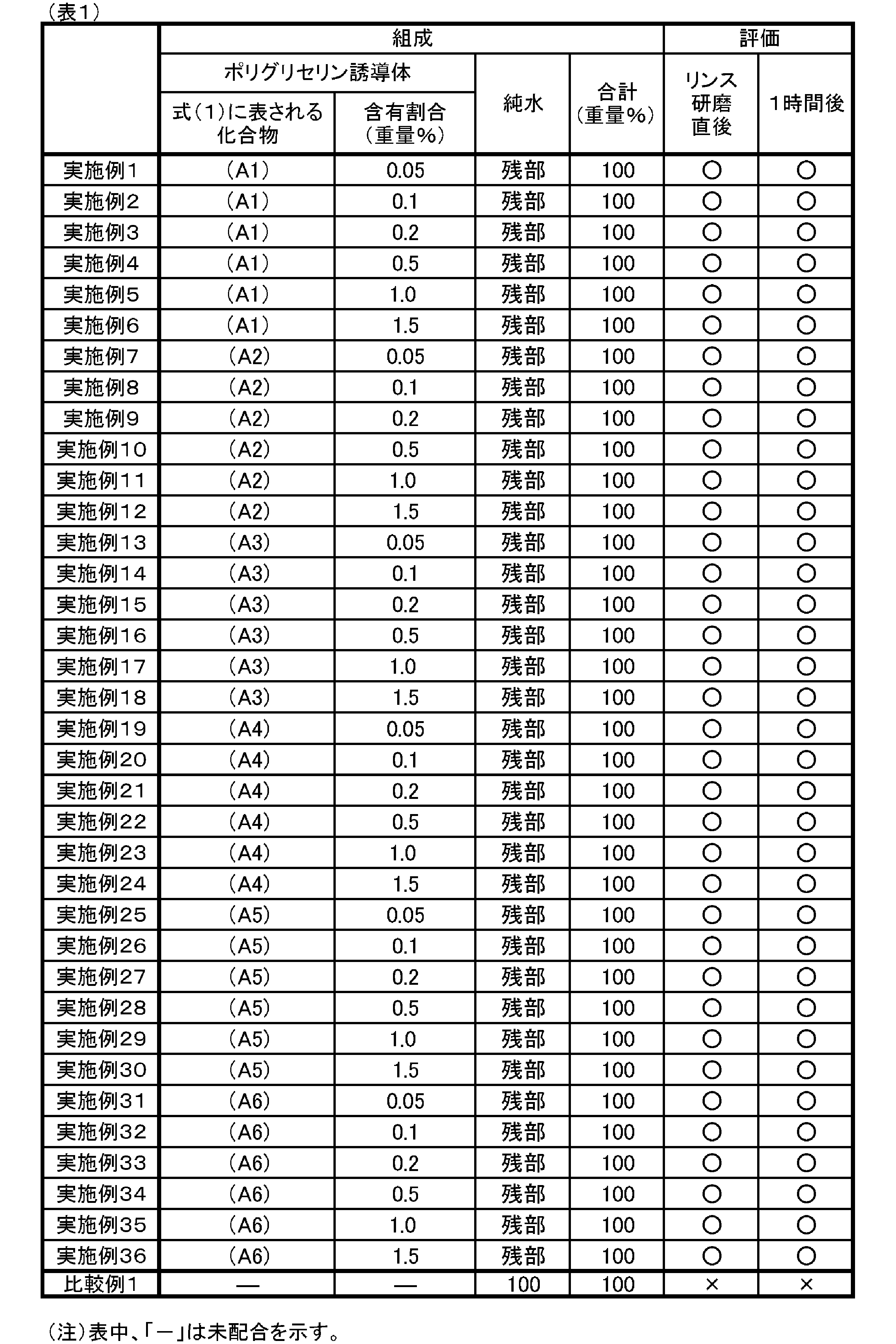
(結果の評価)
実施例の試験液でリンス研磨直後のウエハ表面は、強い親水性を示し、全面濡れた状態であった。さらに1時間経過後においてもウエハ表面の濡れ状態は維持されていた。一方、比較例1の試験液でリンス研磨したウエハ表面は、リンス研磨直後においても一部乾いた部分の存在を認め、水分が水滴を形成し、親水化されなかった。
実施例の試験液でリンス研磨直後のウエハ表面は、強い親水性を示し、全面濡れた状態であった。さらに1時間経過後においてもウエハ表面の濡れ状態は維持されていた。一方、比較例1の試験液でリンス研磨したウエハ表面は、リンス研磨直後においても一部乾いた部分の存在を認め、水分が水滴を形成し、親水化されなかった。
以上のまとめとして本開示にかかる発明の構成及びそのバリエーションを以下に付記する。
[1] 水及び下記式(1)で表される化合物を含み、水及び下記式(1)で表される化合物の総含有割合が、95重量%以上である組成物。
R1O-(C3H6O2)n-H (1)
(式中、R1は、水素原子、ヒドロキシル基を有していてもよい炭素数1~24の炭化水素基、又はR2COで表される基を示し、前記R2は炭素数1~24の炭化水素基を示す。nは括弧内に示されるグリセリン単位の平均重合度を示し、2~60である)
[2] 前記式中のR1が、炭素数12~18の炭化水素基である[1]に記載の組成物。
[3] 前記式中のR1が、ドデシル基、イソステアリル基及び水素原子からなる群から選択される少なくとも1種である、[1]に記載の組成物。
[4] 前記式中のR1が、ドデシル基である[1]に記載の組成物。
[5] 前記式中のR1が、イソステアリル基である[1]に記載の組成物。
[6] 前記式中のR1が、水素原子である[1]に記載の組成物。
[7] 前記式中のnが、2~40である[1]~[6]のいずれか一つに記載の組成物。
[8] 前記式中のnが、2~30である[1]~[6]のいずれか一つに記載の組成物。
[9] 前記式中のnが、2~20である[1]~[6]のいずれか一つに記載の組成物。
[10] 前記式中のnが、2~15である[1]~[6]のいずれか一つに記載の組成物。
[11] 前記式中のnが、2~10である[1]~[6]のいずれか一つに記載の組成物。
[12] 前記式中のnが、4~40である[1]~[6]のいずれか一つに記載の組成物。
[13] 前記式中のnが、4~30である[1]~[6]のいずれか一つに記載の組成物。
[14] 前記式中のnが、4~20である[1]~[6]のいずれか一つに記載の組成物。
[15] 前記式中のnが、4~15である[1]~[6]のいずれか一つに記載の組成物。
[16] 前記式中のnが、4~10である[1]~[6]のいずれか一つに記載の組成物。
[17] 式(1)で表される化合物の含有割合が0.01~1.5重量%である[1]~[16]のいずれか一つに記載の組成物。
[18] 式(1)で表される化合物の含有割合が0.01~1.0重量%である[1]~[16]のいずれか一つに記載の組成物。
[19] 式(1)で表される化合物の含有割合が0.01~0.7重量%である[1]~[16]のいずれか一つに記載の組成物。
[20] 式(1)で表される化合物の含有割合が0.01~0.5重量%である[1]~[16]のいずれか一つに記載の組成物。
[21] 式(1)で表される化合物の含有割合が0.02~1.5重量%である[1]~[16]のいずれか一つに記載の組成物。
[22] 式(1)で表される化合物の含有割合が0.02~1.0重量%である[1]~[16]のいずれか一つに記載の組成物。
[23] 式(1)で表される化合物の含有割合が0.02~0.7重量%である[1]~[16]のいずれか一つに記載の組成物。
[24] 式(1)で表される化合物の含有割合が0.02~0.5重量%である[1]~[16]のいずれか一つに記載の組成物。
[25] 式(1)で表される化合物の含有割合が0.05~1.5重量%である[1]~[16]のいずれか一つに記載の組成物。
[26] 式(1)で表される化合物の含有割合が0.05~1.0重量%である[1]~[16]のいずれか一つに記載の組成物。
[27] 式(1)で表される化合物の含有割合が0.05~0.7重量%である[1]~[16]のいずれか一つに記載の組成物。
[28] 式(1)で表される化合物の含有割合が0.05~0.5重量%である[1]~[16]のいずれか一つに記載の組成物。
[29] 式(1)で表される化合物の含有割合が0.1~1.5重量%である[1]~[16]のいずれか一つに記載の組成物。
[30] 式(1)で表される化合物の含有割合が0.1~1.0重量%である[1]~[16]のいずれか一つに記載の組成物。
[31] 式(1)で表される化合物の含有割合が0.1~0.7重量%である[1]~[16]のいずれか一つに記載の組成物。
[32] 式(1)で表される化合物の含有割合が0.1~0.5重量%である[1]~[16]のいずれか一つに記載の組成物。
[33] 砥粒及び塩基性化合物の合計の含有割合が、0.1重量%以下である[1]~[32]のいずれか一つに記載の組成物。
[34] 砥粒及び塩基性化合物の合計の含有割合が、0.001重量%以下である[1]~[32]のいずれか一つに記載の組成物。
[35] pHが8.0未満である[1]~[34]のいずれか一つに記載の組成物。
[36] pHが7.8以下である[1]~[34]のいずれか一つに記載の組成物。
[37] pHが7.5以下である[1]~[34]のいずれか一つに記載の組成物。
[38] pHが7.3以下である[1]~[34]のいずれか一つに記載の組成物。
[39] 前記式(1)で表される化合物の重量平均分子量が、100~3000である、[1]~[38]のいずれか一つに記載の組成物。
[40] 前記式(1)で表される化合物の重量平均分子量が、100~2000である、[1]~[38]のいずれか一つに記載の組成物。
[41] 前記式(1)で表される化合物の重量平均分子量が、100~1500である、[1]~[38]のいずれか一つに記載の組成物。
[42] 前記式(1)で表される化合物の重量平均分子量が、100~1000である、[1]~[38]のいずれか一つに記載の組成物。
[43] 前記式(1)で表される化合物の重量平均分子量が、100~800である、[1]~[38]のいずれか一つに記載の組成物。
[44] 前記式(1)で表される化合物の重量平均分子量が、200~3000である、[1]~[38]のいずれか一つに記載の組成物。
[45] 前記式(1)で表される化合物の重量平均分子量が、200~2000である、[1]~[38]のいずれか一つに記載の組成物。
[46] 前記式(1)で表される化合物の重量平均分子量が、200~1500である、[1]~[38]のいずれか一つに記載の組成物。
[47] 前記式(1)で表される化合物の重量平均分子量が、200~1000である、[1]~[38]のいずれか一つに記載の組成物。
[48] 前記式(1)で表される化合物の重量平均分子量が、200~800である、[1]~[38]のいずれか一つに記載の組成物。
[49] 前記式(1)で表される化合物の重量平均分子量が、300~3000である、[1]~[38]のいずれか一つに記載の組成物。
[50] 前記式(1)で表される化合物の重量平均分子量が、300~2000である、[1]~[38]のいずれか一つに記載の組成物。
[51] 前記式(1)で表される化合物の重量平均分子量が、300~1500である、[1]~[38]のいずれか一つに記載の組成物。
[52] 前記式(1)で表される化合物の重量平均分子量が、300~1000である、[1]~[38]のいずれか一つに記載の組成物。
[53] 前記式(1)で表される化合物の重量平均分子量が、300~800である、[1]~[38]のいずれか一つに記載の組成物。
[54] 前記式(1)で表される化合物の重量平均分子量が、400~3000である、[1]~[38]のいずれか一つに記載の組成物。
[55] 前記式(1)で表される化合物の重量平均分子量が、400~2000である、[1]~[38]のいずれか一つに記載の組成物。
[56] 前記式(1)で表される化合物の重量平均分子量が、400~1500である、[1]~[38]のいずれか一つに記載の組成物。
[57] 前記式(1)で表される化合物の重量平均分子量が、400~1000である、[1]~[38]のいずれか一つに記載の組成物。
[58] 前記式(1)で表される化合物の重量平均分子量が、400~800である、[1]~[38]のいずれか一つに記載の組成物。
[59] 式(1)で表される化合物のHLB値が14以上である、[1]~[58]のいずれか一つに記載の組成物。
[60] 式(1)で表される化合物のHLB値が14~20である、[1]~[58]のいずれか一つに記載の組成物。
[61] 式(1)で表される化合物のHLB値が14~18である、[1]~[58]のいずれか一つに記載の組成物。
[62] 半導体ウエハ表面の親水化処理液である、[1]~[61]のいずれか一つに記載の組成物。
[63] リンス研磨溶液である、[1]~[61]のいずれか一つに記載の組成物。
[64] [1]~[63]のいずれか1つに記載の組成物を用いて、半導体ウエハ表面を親水化処理する工程を含む、半導体デバイスの製造方法。
[65] 水に、上記式(1)で表される化合物を含有させる工程を含む、[1]~[61]のいずれか一つに記載の組成物を製造する、組成物の製造方法。
[66] [65]に記載の組成物が、半導体ウエハ表面の親水化処理液である、半導体ウエハ表面の親水化処理液の製造方法。
[67] [65]に記載の組成物が、リンス研磨溶液である、リンス研磨溶液の製造方法。
[68] [1]~[61]のいずれか1つに記載の組成物の、半導体ウエハ表面の親水化処理液としての使用。
[69] [1]~[61]のいずれか1つに記載の組成物の、リンス研磨溶液としての使用。
[1] 水及び下記式(1)で表される化合物を含み、水及び下記式(1)で表される化合物の総含有割合が、95重量%以上である組成物。
R1O-(C3H6O2)n-H (1)
(式中、R1は、水素原子、ヒドロキシル基を有していてもよい炭素数1~24の炭化水素基、又はR2COで表される基を示し、前記R2は炭素数1~24の炭化水素基を示す。nは括弧内に示されるグリセリン単位の平均重合度を示し、2~60である)
[2] 前記式中のR1が、炭素数12~18の炭化水素基である[1]に記載の組成物。
[3] 前記式中のR1が、ドデシル基、イソステアリル基及び水素原子からなる群から選択される少なくとも1種である、[1]に記載の組成物。
[4] 前記式中のR1が、ドデシル基である[1]に記載の組成物。
[5] 前記式中のR1が、イソステアリル基である[1]に記載の組成物。
[6] 前記式中のR1が、水素原子である[1]に記載の組成物。
[7] 前記式中のnが、2~40である[1]~[6]のいずれか一つに記載の組成物。
[8] 前記式中のnが、2~30である[1]~[6]のいずれか一つに記載の組成物。
[9] 前記式中のnが、2~20である[1]~[6]のいずれか一つに記載の組成物。
[10] 前記式中のnが、2~15である[1]~[6]のいずれか一つに記載の組成物。
[11] 前記式中のnが、2~10である[1]~[6]のいずれか一つに記載の組成物。
[12] 前記式中のnが、4~40である[1]~[6]のいずれか一つに記載の組成物。
[13] 前記式中のnが、4~30である[1]~[6]のいずれか一つに記載の組成物。
[14] 前記式中のnが、4~20である[1]~[6]のいずれか一つに記載の組成物。
[15] 前記式中のnが、4~15である[1]~[6]のいずれか一つに記載の組成物。
[16] 前記式中のnが、4~10である[1]~[6]のいずれか一つに記載の組成物。
[17] 式(1)で表される化合物の含有割合が0.01~1.5重量%である[1]~[16]のいずれか一つに記載の組成物。
[18] 式(1)で表される化合物の含有割合が0.01~1.0重量%である[1]~[16]のいずれか一つに記載の組成物。
[19] 式(1)で表される化合物の含有割合が0.01~0.7重量%である[1]~[16]のいずれか一つに記載の組成物。
[20] 式(1)で表される化合物の含有割合が0.01~0.5重量%である[1]~[16]のいずれか一つに記載の組成物。
[21] 式(1)で表される化合物の含有割合が0.02~1.5重量%である[1]~[16]のいずれか一つに記載の組成物。
[22] 式(1)で表される化合物の含有割合が0.02~1.0重量%である[1]~[16]のいずれか一つに記載の組成物。
[23] 式(1)で表される化合物の含有割合が0.02~0.7重量%である[1]~[16]のいずれか一つに記載の組成物。
[24] 式(1)で表される化合物の含有割合が0.02~0.5重量%である[1]~[16]のいずれか一つに記載の組成物。
[25] 式(1)で表される化合物の含有割合が0.05~1.5重量%である[1]~[16]のいずれか一つに記載の組成物。
[26] 式(1)で表される化合物の含有割合が0.05~1.0重量%である[1]~[16]のいずれか一つに記載の組成物。
[27] 式(1)で表される化合物の含有割合が0.05~0.7重量%である[1]~[16]のいずれか一つに記載の組成物。
[28] 式(1)で表される化合物の含有割合が0.05~0.5重量%である[1]~[16]のいずれか一つに記載の組成物。
[29] 式(1)で表される化合物の含有割合が0.1~1.5重量%である[1]~[16]のいずれか一つに記載の組成物。
[30] 式(1)で表される化合物の含有割合が0.1~1.0重量%である[1]~[16]のいずれか一つに記載の組成物。
[31] 式(1)で表される化合物の含有割合が0.1~0.7重量%である[1]~[16]のいずれか一つに記載の組成物。
[32] 式(1)で表される化合物の含有割合が0.1~0.5重量%である[1]~[16]のいずれか一つに記載の組成物。
[33] 砥粒及び塩基性化合物の合計の含有割合が、0.1重量%以下である[1]~[32]のいずれか一つに記載の組成物。
[34] 砥粒及び塩基性化合物の合計の含有割合が、0.001重量%以下である[1]~[32]のいずれか一つに記載の組成物。
[35] pHが8.0未満である[1]~[34]のいずれか一つに記載の組成物。
[36] pHが7.8以下である[1]~[34]のいずれか一つに記載の組成物。
[37] pHが7.5以下である[1]~[34]のいずれか一つに記載の組成物。
[38] pHが7.3以下である[1]~[34]のいずれか一つに記載の組成物。
[39] 前記式(1)で表される化合物の重量平均分子量が、100~3000である、[1]~[38]のいずれか一つに記載の組成物。
[40] 前記式(1)で表される化合物の重量平均分子量が、100~2000である、[1]~[38]のいずれか一つに記載の組成物。
[41] 前記式(1)で表される化合物の重量平均分子量が、100~1500である、[1]~[38]のいずれか一つに記載の組成物。
[42] 前記式(1)で表される化合物の重量平均分子量が、100~1000である、[1]~[38]のいずれか一つに記載の組成物。
[43] 前記式(1)で表される化合物の重量平均分子量が、100~800である、[1]~[38]のいずれか一つに記載の組成物。
[44] 前記式(1)で表される化合物の重量平均分子量が、200~3000である、[1]~[38]のいずれか一つに記載の組成物。
[45] 前記式(1)で表される化合物の重量平均分子量が、200~2000である、[1]~[38]のいずれか一つに記載の組成物。
[46] 前記式(1)で表される化合物の重量平均分子量が、200~1500である、[1]~[38]のいずれか一つに記載の組成物。
[47] 前記式(1)で表される化合物の重量平均分子量が、200~1000である、[1]~[38]のいずれか一つに記載の組成物。
[48] 前記式(1)で表される化合物の重量平均分子量が、200~800である、[1]~[38]のいずれか一つに記載の組成物。
[49] 前記式(1)で表される化合物の重量平均分子量が、300~3000である、[1]~[38]のいずれか一つに記載の組成物。
[50] 前記式(1)で表される化合物の重量平均分子量が、300~2000である、[1]~[38]のいずれか一つに記載の組成物。
[51] 前記式(1)で表される化合物の重量平均分子量が、300~1500である、[1]~[38]のいずれか一つに記載の組成物。
[52] 前記式(1)で表される化合物の重量平均分子量が、300~1000である、[1]~[38]のいずれか一つに記載の組成物。
[53] 前記式(1)で表される化合物の重量平均分子量が、300~800である、[1]~[38]のいずれか一つに記載の組成物。
[54] 前記式(1)で表される化合物の重量平均分子量が、400~3000である、[1]~[38]のいずれか一つに記載の組成物。
[55] 前記式(1)で表される化合物の重量平均分子量が、400~2000である、[1]~[38]のいずれか一つに記載の組成物。
[56] 前記式(1)で表される化合物の重量平均分子量が、400~1500である、[1]~[38]のいずれか一つに記載の組成物。
[57] 前記式(1)で表される化合物の重量平均分子量が、400~1000である、[1]~[38]のいずれか一つに記載の組成物。
[58] 前記式(1)で表される化合物の重量平均分子量が、400~800である、[1]~[38]のいずれか一つに記載の組成物。
[59] 式(1)で表される化合物のHLB値が14以上である、[1]~[58]のいずれか一つに記載の組成物。
[60] 式(1)で表される化合物のHLB値が14~20である、[1]~[58]のいずれか一つに記載の組成物。
[61] 式(1)で表される化合物のHLB値が14~18である、[1]~[58]のいずれか一つに記載の組成物。
[62] 半導体ウエハ表面の親水化処理液である、[1]~[61]のいずれか一つに記載の組成物。
[63] リンス研磨溶液である、[1]~[61]のいずれか一つに記載の組成物。
[64] [1]~[63]のいずれか1つに記載の組成物を用いて、半導体ウエハ表面を親水化処理する工程を含む、半導体デバイスの製造方法。
[65] 水に、上記式(1)で表される化合物を含有させる工程を含む、[1]~[61]のいずれか一つに記載の組成物を製造する、組成物の製造方法。
[66] [65]に記載の組成物が、半導体ウエハ表面の親水化処理液である、半導体ウエハ表面の親水化処理液の製造方法。
[67] [65]に記載の組成物が、リンス研磨溶液である、リンス研磨溶液の製造方法。
[68] [1]~[61]のいずれか1つに記載の組成物の、半導体ウエハ表面の親水化処理液としての使用。
[69] [1]~[61]のいずれか1つに記載の組成物の、リンス研磨溶液としての使用。
本発明の親水化処理液によれば、ウエハ表面に親水性の膜を形成することにより、親水性を付与することができる。これにより、ウエハ表面へのパーティクルや金属不純物、有機物などの汚染異物の付着を防止することができる。したがって、本発明は、産業上の利用可能性を有する。
Claims (8)
- 水及び下記式(1)で表される化合物を含み、水及び下記式(1)で表される化合物の総含有割合が、95重量%以上である半導体ウエハ表面の親水化処理液。
R1O-(C3H6O2)n-H (1)
(式中、R1は、水素原子、ヒドロキシル基を有していてもよい炭素数1~24の炭化水素基、又はR2COで表される基を示し、前記R2は炭素数1~24の炭化水素基を示す。nは括弧内に示されるグリセリン単位の平均重合度を示し、2~60である) - 式(1)で表される化合物の含有割合が0.01~1.5重量%である請求項1に記載の親水化処理液。
- 砥粒及び塩基性化合物の合計の含有割合が、0.1重量%以下である請求項1又は2に記載の親水化処理液。
- pHが8未満である請求項1~3のいずれか1項に記載の親水化処理液。
- 式(1)で表される化合物の重量平均分子量が100~3000である、請求項1~4のいずれか1項に記載の親水化処理液。
- 式(1)で表される化合物のHLB値が、14以上である請求項1~5のいずれか1項に記載の親水化処理液。
- リンス研磨溶液である、請求項1~6のいずれか1項に記載の親水化処理液。
- 請求項1~7のいずれか1項に記載の親水化処理液を用いて、半導体ウエハ表面を親水化処理する工程を含む、半導体デバイスの製造方法。
Priority Applications (4)
| Application Number | Priority Date | Filing Date | Title |
|---|---|---|---|
| US17/261,931 US12060498B2 (en) | 2019-03-22 | 2020-03-18 | Hydrophilization treatment liquid for semiconductor wafer surface |
| CN202080005194.8A CN112740371A (zh) | 2019-03-22 | 2020-03-18 | 半导体晶片表面的亲水化处理液 |
| JP2020555243A JP7712768B2 (ja) | 2019-03-22 | 2020-03-18 | 半導体ウエハ表面の親水化処理液 |
| KR1020217003185A KR20210142583A (ko) | 2019-03-22 | 2020-03-18 | 반도체 웨이퍼 표면의 친수화 처리액 |
Applications Claiming Priority (2)
| Application Number | Priority Date | Filing Date | Title |
|---|---|---|---|
| JP2019054530 | 2019-03-22 | ||
| JP2019-054530 | 2019-03-22 |
Publications (1)
| Publication Number | Publication Date |
|---|---|
| WO2020196199A1 true WO2020196199A1 (ja) | 2020-10-01 |
Family
ID=72611870
Family Applications (1)
| Application Number | Title | Priority Date | Filing Date |
|---|---|---|---|
| PCT/JP2020/012142 Ceased WO2020196199A1 (ja) | 2019-03-22 | 2020-03-18 | 半導体ウエハ表面の親水化処理液 |
Country Status (6)
| Country | Link |
|---|---|
| US (1) | US12060498B2 (ja) |
| JP (1) | JP7712768B2 (ja) |
| KR (1) | KR20210142583A (ja) |
| CN (1) | CN112740371A (ja) |
| TW (1) | TW202100736A (ja) |
| WO (1) | WO2020196199A1 (ja) |
Cited By (1)
| Publication number | Priority date | Publication date | Assignee | Title |
|---|---|---|---|---|
| JP2022155989A (ja) * | 2021-03-31 | 2022-10-14 | 株式会社フジミインコーポレーテッド | 基板の製造方法および表面処理方法 |
Families Citing this family (1)
| Publication number | Priority date | Publication date | Assignee | Title |
|---|---|---|---|---|
| WO2019163455A1 (ja) * | 2018-02-22 | 2019-08-29 | 株式会社ダイセル | 基板親水化処理剤 |
Citations (3)
| Publication number | Priority date | Publication date | Assignee | Title |
|---|---|---|---|---|
| JP2018006538A (ja) * | 2016-06-30 | 2018-01-11 | 花王株式会社 | シリコンウェーハ用研磨液組成物 |
| JP2018078287A (ja) * | 2016-10-28 | 2018-05-17 | 花王株式会社 | シリコンウェーハ用リンス剤組成物 |
| JP2018128638A (ja) * | 2017-02-10 | 2018-08-16 | 株式会社ダイセル | レジスト親水化処理剤 |
Family Cites Families (20)
| Publication number | Priority date | Publication date | Assignee | Title |
|---|---|---|---|---|
| US3637774A (en) * | 1969-11-03 | 1972-01-25 | Vigen K Babayan | Process for preparation and purification of polyglycerols and esters thereof |
| JP3537447B2 (ja) | 1996-10-29 | 2004-06-14 | トル‐シ・テクノロジーズ・インコーポレイテッド | 集積回路及びその製造方法 |
| JPH10270492A (ja) | 1997-03-24 | 1998-10-09 | Ricoh Co Ltd | Lsiパッケージ |
| EP1036836B1 (en) | 1999-03-18 | 2004-11-03 | Kabushiki Kaisha Toshiba | Aqueous dispersion for chemical mechanical polishing |
| US20060000808A1 (en) | 2004-07-01 | 2006-01-05 | Fuji Photo Film Co., Ltd. | Polishing solution of metal and chemical mechanical polishing method |
| JP2006049790A (ja) | 2004-07-01 | 2006-02-16 | Fuji Photo Film Co Ltd | 金属用研磨液及び研磨方法 |
| JP4012180B2 (ja) | 2004-08-06 | 2007-11-21 | 株式会社東芝 | Cmp用スラリー、研磨方法、および半導体装置の製造方法 |
| EP1785410A4 (en) | 2004-08-30 | 2010-04-21 | Daicel Chem | Polyglycerol monoethers and process for producing the same |
| JP2009099819A (ja) | 2007-10-18 | 2009-05-07 | Daicel Chem Ind Ltd | Cmp用研磨組成物及び該cmp用研磨組成物を使用したデバイスウェハの製造方法 |
| JP5781287B2 (ja) * | 2009-10-01 | 2015-09-16 | ニッタ・ハース株式会社 | 研磨組成物 |
| JP5544244B2 (ja) | 2010-08-09 | 2014-07-09 | 株式会社フジミインコーポレーテッド | 研磨用組成物および研磨方法 |
| EP2813483A1 (en) * | 2012-02-08 | 2014-12-17 | Daicel Corporation | Polyglycerin dialkyl or alkenyl ether, and cosmetic composition containing same |
| JP6044629B2 (ja) | 2012-02-21 | 2016-12-14 | 日立化成株式会社 | 研磨剤、研磨剤セット及び基体の研磨方法 |
| JP2015205348A (ja) * | 2012-08-30 | 2015-11-19 | 日立化成株式会社 | 研磨剤、研磨剤セット及び基体の研磨方法 |
| WO2017170167A1 (ja) * | 2016-03-30 | 2017-10-05 | 東京応化工業株式会社 | 表面処理方法、及び表面処理液 |
| JP6720791B2 (ja) * | 2016-09-13 | 2020-07-08 | Agc株式会社 | 研磨剤と研磨方法、および研磨用添加液 |
| KR102370806B1 (ko) * | 2016-10-28 | 2022-03-04 | 카오카부시키가이샤 | 실리콘 웨이퍼용 린스제 조성물 |
| JP6899220B2 (ja) | 2017-01-11 | 2021-07-07 | 株式会社ダイセル | レジスト除去用組成物 |
| US11279905B2 (en) | 2017-01-17 | 2022-03-22 | Daicel Corporation | Semiconductor substrate cleaning agent |
| KR102588218B1 (ko) * | 2017-09-22 | 2023-10-13 | 가부시키가이샤 후지미인코퍼레이티드 | 표면 처리 조성물, 표면 처리 조성물의 제조 방법, 표면 처리 방법 및 반도체 기판의 제조 방법 |
-
2020
- 2020-03-18 WO PCT/JP2020/012142 patent/WO2020196199A1/ja not_active Ceased
- 2020-03-18 CN CN202080005194.8A patent/CN112740371A/zh active Pending
- 2020-03-18 US US17/261,931 patent/US12060498B2/en active Active
- 2020-03-18 JP JP2020555243A patent/JP7712768B2/ja active Active
- 2020-03-18 KR KR1020217003185A patent/KR20210142583A/ko not_active Ceased
- 2020-03-20 TW TW109109432A patent/TW202100736A/zh unknown
Patent Citations (3)
| Publication number | Priority date | Publication date | Assignee | Title |
|---|---|---|---|---|
| JP2018006538A (ja) * | 2016-06-30 | 2018-01-11 | 花王株式会社 | シリコンウェーハ用研磨液組成物 |
| JP2018078287A (ja) * | 2016-10-28 | 2018-05-17 | 花王株式会社 | シリコンウェーハ用リンス剤組成物 |
| JP2018128638A (ja) * | 2017-02-10 | 2018-08-16 | 株式会社ダイセル | レジスト親水化処理剤 |
Cited By (2)
| Publication number | Priority date | Publication date | Assignee | Title |
|---|---|---|---|---|
| JP2022155989A (ja) * | 2021-03-31 | 2022-10-14 | 株式会社フジミインコーポレーテッド | 基板の製造方法および表面処理方法 |
| JP7663395B2 (ja) | 2021-03-31 | 2025-04-16 | 株式会社フジミインコーポレーテッド | 基板の製造方法および表面処理方法 |
Also Published As
| Publication number | Publication date |
|---|---|
| JPWO2020196199A1 (ja) | 2020-10-01 |
| JP7712768B2 (ja) | 2025-07-24 |
| US12060498B2 (en) | 2024-08-13 |
| US20210343542A1 (en) | 2021-11-04 |
| KR20210142583A (ko) | 2021-11-25 |
| TW202100736A (zh) | 2021-01-01 |
| CN112740371A (zh) | 2021-04-30 |
Similar Documents
| Publication | Publication Date | Title |
|---|---|---|
| KR101374039B1 (ko) | 연마용 조성물 및 연마 방법 | |
| JP6044629B2 (ja) | 研磨剤、研磨剤セット及び基体の研磨方法 | |
| JP5967370B2 (ja) | シリコンウェーハ用研磨組成物及びシリコンウェーハの研磨方法 | |
| JP2016084371A (ja) | 研磨用組成物 | |
| JPH10309660A (ja) | 仕上げ研磨剤 | |
| JP2008270584A (ja) | 半導体ウエハ研磨用組成物及び研磨加工方法 | |
| TW201137095A (en) | Polishing composition and polishing method using the same | |
| TW201728734A (zh) | 研磨用組合物 | |
| EP4067449A1 (en) | Polishing composition for semiconductor process and method for manufacturing semiconductor device by using the same | |
| JP7712768B2 (ja) | 半導体ウエハ表面の親水化処理液 | |
| JP6348927B2 (ja) | シリコンウェーハ研磨用組成物 | |
| KR101645036B1 (ko) | 웨이퍼 다이싱용 세정제 조성물 | |
| JP6586799B2 (ja) | 研磨剤、研磨剤セット及び基体の研磨方法 | |
| JP2013021292A (ja) | 研磨用組成物 | |
| WO2020196162A1 (ja) | 半導体配線研磨用組成物 | |
| CN113544248B (zh) | 半导体晶片清洗液组合物及利用其的清洗方法 | |
| JP2005303060A (ja) | リンス研磨溶液 | |
| TWI821448B (zh) | 半導體晶圓表面保護劑 | |
| CN106233423A (zh) | 硅晶圆研磨用组合物 | |
| JP7569677B2 (ja) | シリコンウェーハ用リンス剤組成物 | |
| JP7405567B2 (ja) | 研磨液組成物 | |
| JP2013016832A (ja) | 研磨用組成物、lpd低減剤及びそれを用いたlpd低減方法 | |
| KR20260064296A (ko) | 세리아 연마 입자 세정용 조성물 | |
| CN117801684A (zh) | 一种硅片精抛液 |
Legal Events
| Date | Code | Title | Description |
|---|---|---|---|
| ENP | Entry into the national phase |
Ref document number: 2020555243 Country of ref document: JP Kind code of ref document: A |
|
| 121 | Ep: the epo has been informed by wipo that ep was designated in this application |
Ref document number: 20779302 Country of ref document: EP Kind code of ref document: A1 |
|
| NENP | Non-entry into the national phase |
Ref country code: DE |
|
| 122 | Ep: pct application non-entry in european phase |
Ref document number: 20779302 Country of ref document: EP Kind code of ref document: A1 |