WO2020195773A1 - 有機溶媒の処理方法及び処理材 - Google Patents
有機溶媒の処理方法及び処理材 Download PDFInfo
- Publication number
- WO2020195773A1 WO2020195773A1 PCT/JP2020/010212 JP2020010212W WO2020195773A1 WO 2020195773 A1 WO2020195773 A1 WO 2020195773A1 JP 2020010212 W JP2020010212 W JP 2020010212W WO 2020195773 A1 WO2020195773 A1 WO 2020195773A1
- Authority
- WO
- WIPO (PCT)
- Prior art keywords
- organic solvent
- treatment material
- water
- treatment
- treating
- Prior art date
- Legal status (The legal status is an assumption and is not a legal conclusion. Google has not performed a legal analysis and makes no representation as to the accuracy of the status listed.)
- Ceased
Links
Classifications
-
- B—PERFORMING OPERATIONS; TRANSPORTING
- B01—PHYSICAL OR CHEMICAL PROCESSES OR APPARATUS IN GENERAL
- B01J—CHEMICAL OR PHYSICAL PROCESSES, e.g. CATALYSIS OR COLLOID CHEMISTRY; THEIR RELEVANT APPARATUS
- B01J47/00—Ion-exchange processes in general; Apparatus therefor
- B01J47/014—Ion-exchange processes in general; Apparatus therefor in which the adsorbent properties of the ion-exchanger are involved, e.g. recovery of proteins or other high-molecular compounds
-
- B—PERFORMING OPERATIONS; TRANSPORTING
- B01—PHYSICAL OR CHEMICAL PROCESSES OR APPARATUS IN GENERAL
- B01D—SEPARATION
- B01D15/00—Separating processes involving the treatment of liquids with solid sorbents; Apparatus therefor
- B01D15/08—Selective adsorption, e.g. chromatography
- B01D15/26—Selective adsorption, e.g. chromatography characterised by the separation mechanism
- B01D15/36—Selective adsorption, e.g. chromatography characterised by the separation mechanism involving ionic interaction, e.g. ion-exchange, ion-pair, ion-suppression or ion-exclusion
- B01D15/361—Ion-exchange
- B01D15/363—Anion-exchange
-
- B—PERFORMING OPERATIONS; TRANSPORTING
- B01—PHYSICAL OR CHEMICAL PROCESSES OR APPARATUS IN GENERAL
- B01J—CHEMICAL OR PHYSICAL PROCESSES, e.g. CATALYSIS OR COLLOID CHEMISTRY; THEIR RELEVANT APPARATUS
- B01J39/00—Cation exchange; Use of material as cation exchangers; Treatment of material for improving the cation exchange properties
- B01J39/04—Processes using organic exchangers
- B01J39/05—Processes using organic exchangers in the strongly acidic form
-
- B—PERFORMING OPERATIONS; TRANSPORTING
- B01—PHYSICAL OR CHEMICAL PROCESSES OR APPARATUS IN GENERAL
- B01J—CHEMICAL OR PHYSICAL PROCESSES, e.g. CATALYSIS OR COLLOID CHEMISTRY; THEIR RELEVANT APPARATUS
- B01J41/00—Anion exchange; Use of material as anion exchangers; Treatment of material for improving the anion exchange properties
- B01J41/04—Processes using organic exchangers
- B01J41/05—Processes using organic exchangers in the strongly basic form
-
- B—PERFORMING OPERATIONS; TRANSPORTING
- B01—PHYSICAL OR CHEMICAL PROCESSES OR APPARATUS IN GENERAL
- B01J—CHEMICAL OR PHYSICAL PROCESSES, e.g. CATALYSIS OR COLLOID CHEMISTRY; THEIR RELEVANT APPARATUS
- B01J41/00—Anion exchange; Use of material as anion exchangers; Treatment of material for improving the anion exchange properties
- B01J41/04—Processes using organic exchangers
- B01J41/07—Processes using organic exchangers in the weakly basic form
-
- B—PERFORMING OPERATIONS; TRANSPORTING
- B01—PHYSICAL OR CHEMICAL PROCESSES OR APPARATUS IN GENERAL
- B01J—CHEMICAL OR PHYSICAL PROCESSES, e.g. CATALYSIS OR COLLOID CHEMISTRY; THEIR RELEVANT APPARATUS
- B01J41/00—Anion exchange; Use of material as anion exchangers; Treatment of material for improving the anion exchange properties
- B01J41/08—Use of material as anion exchangers; Treatment of material for improving the anion exchange properties
- B01J41/12—Macromolecular compounds
- B01J41/13—Macromolecular compounds obtained otherwise than by reactions only involving unsaturated carbon-to-carbon bonds
-
- B—PERFORMING OPERATIONS; TRANSPORTING
- B01—PHYSICAL OR CHEMICAL PROCESSES OR APPARATUS IN GENERAL
- B01J—CHEMICAL OR PHYSICAL PROCESSES, e.g. CATALYSIS OR COLLOID CHEMISTRY; THEIR RELEVANT APPARATUS
- B01J41/00—Anion exchange; Use of material as anion exchangers; Treatment of material for improving the anion exchange properties
- B01J41/08—Use of material as anion exchangers; Treatment of material for improving the anion exchange properties
- B01J41/12—Macromolecular compounds
- B01J41/14—Macromolecular compounds obtained by reactions only involving unsaturated carbon-to-carbon bonds
-
- B—PERFORMING OPERATIONS; TRANSPORTING
- B01—PHYSICAL OR CHEMICAL PROCESSES OR APPARATUS IN GENERAL
- B01J—CHEMICAL OR PHYSICAL PROCESSES, e.g. CATALYSIS OR COLLOID CHEMISTRY; THEIR RELEVANT APPARATUS
- B01J47/00—Ion-exchange processes in general; Apparatus therefor
- B01J47/12—Ion-exchange processes in general; Apparatus therefor characterised by the use of ion-exchange material in the form of ribbons, filaments, fibres or sheets, e.g. membranes
-
- B—PERFORMING OPERATIONS; TRANSPORTING
- B01—PHYSICAL OR CHEMICAL PROCESSES OR APPARATUS IN GENERAL
- B01J—CHEMICAL OR PHYSICAL PROCESSES, e.g. CATALYSIS OR COLLOID CHEMISTRY; THEIR RELEVANT APPARATUS
- B01J47/00—Ion-exchange processes in general; Apparatus therefor
- B01J47/12—Ion-exchange processes in general; Apparatus therefor characterised by the use of ion-exchange material in the form of ribbons, filaments, fibres or sheets, e.g. membranes
- B01J47/127—Ion-exchange processes in general; Apparatus therefor characterised by the use of ion-exchange material in the form of ribbons, filaments, fibres or sheets, e.g. membranes in the form of filaments or fibres
Definitions
- the present invention relates to a treatment method and a treatment material for removing fine particles from an organic solvent used in an electronic component manufacturing process.
- a distillation method has been conventionally used as a method for removing fine particles from an organic solvent (Patent Documents 1 and 2). Further, the organic solvent is also filtered with a filter (Patent Document 3).
- Patent Document 4 describes that in order to remove fine particles from isopropyl alcohol, not only distillation but also ion exchange resin (cationic resin, anionic resin or a mixture thereof) is brought into contact with the isopropyl alcohol.
- ion exchange resin cationic resin, anionic resin or a mixture thereof
- Patent Document 5 describes that water is brought into contact with an anion adsorption membrane having an anion exchange group in order to reduce the silica concentration in ultrapure water.
- An object of the present invention is to provide a treatment method and a treatment material for an organic solvent capable of removing fine particles from an organic solvent used in an electronic component manufacturing process.
- the method for treating an organic solvent used in the electronic component manufacturing process of the present invention is a step of contacting a treatment material having a positive or negative charge in water and having a water content of 3% by mass or more with the organic solvent.
- ultrapure water is added to the organic solvent before the contact step.
- a treated material that has been contact-treated with water is used as the treated material.
- the treatment material is made of a polymer having an anion exchange group.
- the treated material is in the form of fibers.
- the treatment material of the present invention is an organic solvent treatment material that removes fine particles from an organic solvent by contacting with an organic solvent used in an electronic component manufacturing process, and has a positive or negative charge in water. ..
- fine particles in an organic solvent can be adsorbed on the treatment material and removed.
- the organic solvent used in the electronic component manufacturing process is brought into contact with a treatment material having a positive or negative charge in water and having a water content of 3% by mass or more in a liquid state to remove fine particles.
- a treatment material having a positive or negative charge in water and having a water content of 3% by mass or more in a liquid state to remove fine particles.
- the fine particles include silica fine particles and various inorganic or organic fine particles, particularly fine particles having a negative or positive charge.
- a treatment material that has been brought into contact with water before being brought into contact with an organic solvent is used.
- ultrapure water is added to an organic solvent and then brought into contact with the treatment material.
- This treatment material is preferably made of a polymer to which a cation exchange group or an anion exchange group is added.
- polystyrene resin examples include polyolefins such as polyethylene and polypropylene, polyetheroxides such as polyethylene oxide and polypropylene oxide, fluororesins such as PTFE, CTFE, PFA and polyvinylidene fluoride (PVDF), halogenated polyolefins such as polyvinyl chloride, and nylon-6.
- polyolefins such as polyethylene and polypropylene
- polyetheroxides such as polyethylene oxide and polypropylene oxide
- fluororesins such as PTFE, CTFE, PFA and polyvinylidene fluoride (PVDF)
- PVDF polyvinylidene fluoride
- halogenated polyolefins such as polyvinyl chloride, and nylon-6.
- Nylon-66 and other polyamides urea resin, phenol resin, melamine resin, polystyrene, cellulose, cellulose acetate, cellulose nitrate, polyetherketone, polyetherketoneketone, polyetheretherketone, polysulfone, polyethersulfone, polyimide, poly Materials such as etherimide, polyamideimide, polybenzoimidazole, polycarbonate, polyethylene terephthalate, polybutylene terephthalate, polyphenylene sulfide, polyacrylic nitrile, polyether nitrile, polyvinyl alcohol and copolymers thereof can be used, but are not limited to this. ..
- the material is not particularly limited to one type, and various materials can be selected as needed. However, it is necessary to have resistance to organic solvents.
- the ion exchange groups include a sulfonic acid group, a phosphoric acid group, a phosphonic acid group, a phosphinic acid group, a carboxylic acid group, a hydroxyl group, a phenol group, a quaternary ammonium group, and a primary to tertiary amine.
- a sulfonic acid group a phosphoric acid group, a phosphonic acid group, a phosphinic acid group, a carboxylic acid group, a hydroxyl group, a phenol group, a quaternary ammonium group, and a primary to tertiary amine.
- These functional groups may be not only H-type and OH-type but also salt-type such as Na.
- a thread in which at least one of these functional groups is introduced may be used, or a plurality of types of threads in which different
- the method of introducing the functional group differs depending on the polymer material, and an appropriate introduction method is selected.
- a sulfonic acid group can be introduced by adding an appropriate amount of paraformaldehyde to a sulfuric acid solution and heat-crosslinking.
- a functional group can be introduced by allowing a trialkoxysilane group, a trichlororosilane group, an epoxy group, or the like to act on the hydroxyl group. If the functional group cannot be directly introduced depending on the material, first, a highly reactive monomer such as styrene (called a reactive monomer) is introduced, and then the functional group is introduced.
- the desired functional group may be introduced.
- these reactive monomers include, but are not limited to, glycidyl methacrylate, styrene, chloromethylstyrene, acrolein, vinylpyridine, and acrylonitrile.
- the functional group may be introduced before the nanofibers are formed, but when the fibers are focused, a polymer or resin having an ion exchange ability is dissolved or finely pulverized, and the functional group is applied or kneaded.
- Ion exchange groups may be introduced by binding by a chemical reaction.
- the form of the treatment material may be any of a flat film, a fibrous, a hollow thread, and the like.
- the treatment material may be a porous membrane.
- the fine particle removing performance of the treated material can be improved.
- the treatment of bringing the treated material into contact with water is preferably performed when the organic solvent to be treated is 100% organic solvent to which ultrapure water is not added.
- the treatment of bringing the treated material into contact with ultrapure water and then bringing the treated material into contact with the organic solvent to be treated may be hereinafter referred to as water contact treatment.
- the treatment material and ultrapure water are placed in a container and brought into contact with each other, and then the organic solvent to be treated is injected into the container, and then the organic solvent is discharged. Further, the column may be filled with the treatment material, ultrapure water may be circulated, and then the organic solvent to be treated may be circulated. In the latter case, the organic solvent may be continued to flow as it is to shift to the organic solvent treatment step.
- the treatment material In order to bring the treatment material into contact with an organic solvent or an organic solvent to which ultrapure water is added (hereinafter, may be referred to as an organic solvent or the like), the treatment material is placed in a container containing the organic solvent or the like and immersed.
- an organic solvent or the like In addition to the method, there are a method of passing an organic solvent or the like through a column containing the treatment material, and a method of contacting the treatment material in a form of allowing the organic solvent or the like to permeate when the treatment material is a porous membrane. Not limited.
- the organic solvent used in the electronic component manufacturing process to be processed by the present invention is not particularly limited, but the following are typical examples thereof. That is, alcohols such as methanol, ethanol, and isopropyl alcohol; methylene chloride, chloroform, carbon tetrachloride, trichloroethylene, pachlorethylene, 1,1,1-trichloroethane, freon 113, chlorobenzene, o-, m-, Halogenized hydrocarbons such as p-dichlorobenzene, o-, m-, p-dichlorobenzene, o-, m-, p-chlorotoluene; ethers such as ethyl ether; epoxys such as PO and BO; Hydrocarbons such as hexane, cyclohexane, benzene, toluene and xylene; ketones such as acetone, MEK and MIBK; esters such as ethyl
- the present invention is particularly suitable for treating organic solvents used in semiconductor manufacturing processes, such as isopropyl alcohol (hereinafter sometimes referred to as IPA) and N-methyl-2-pyrrolidone (NMP).
- organic solvents used in semiconductor manufacturing processes such as isopropyl alcohol (hereinafter sometimes referred to as IPA) and N-methyl-2-pyrrolidone (NMP).
- the amount of ultrapure water is 5 to 80% by mass based on the total solvent (total of organic solvent and ultrapure water). It is particularly preferable, but not limited to, the addition is made in an amount of 5 to 50% by mass.
- Test solution 1 50 mg / L of silica fine particles (sicastar manufactured by Corefront Co., Ltd .: particle size 30 nm) added to IPA (high-purity IPA manufactured by Kanto Chemical Co., Inc.).
- Test solution 2 The IPA and ultrapure water are mixed at a ratio of 50:50, and the silica fine particles are added in the above amount.
- Treatment material A Ion exchange fiber DMAEMA fiber 20m (7.7g) manufactured by Environmental Purification Research Institute
- Treatment material B Astom anion exchange membrane AHA approx. 30 cm x 20 cm, thickness 220 ⁇ m (16 g in wet state)
- ⁇ Contact method> The treatment material is filled in a polyethylene container (250 mL), 100 mL of the test solution is injected, and the mixture is immersed for 30 minutes.
- Examples 1 to 4 Comparative Examples 1 and 2
- the test solution 1 or 2 was brought into contact with each of the treated materials treated as described below according to the contact method 1.
- the silica concentration after contact was measured by the molybdenum absorptiometry, and the silica removal rate was calculated. The results are shown in Table 1.
- Example 1 The above-mentioned treatment material A (used as it is without treatment)
- Example 2 The above-mentioned treatment material B (used as it is without treatment)
- Example 3 A water-contacted product in which the treated material B and 100 mL of ultrapure water are contained in a polyethylene container (250 mL), immersed for 30 minutes, and then the ultrapure water is discharged.
- Example 4 The treated material A (treated) Use as it is) Comparative Example 1: A dried product in which the treated material A was dried at 110 ° C. for 24 hours
- Comparative Example 2 A dried product in which the treated material B was dried at 110 ° C. for 24 hours.
Landscapes
- Chemical & Material Sciences (AREA)
- Chemical Kinetics & Catalysis (AREA)
- Organic Chemistry (AREA)
- Analytical Chemistry (AREA)
- Treatment Of Water By Ion Exchange (AREA)
- Cleaning Or Drying Semiconductors (AREA)
- Separation Using Semi-Permeable Membranes (AREA)
Abstract
電子部品製造工程で使用される有機溶媒から微粒子を除去する有機溶媒の処理方法において、水中において正、あるいは負の荷電を有し、含水率が3質量%以上である処理材と該有機溶媒とを接触させる工程を有することを特徴とする有機溶媒の処理方法。電子部品製造工程で使用される有機溶媒と接触することにより有機溶媒から微粒子を除去する電子部品製造工程向け有機溶媒処理材であって、水中において正、あるいは負の電荷を有する有機溶媒処理材。
Description
本発明は、電子部品製造工程で使用される有機溶媒から微粒子を除去する処理方法及び処理材に関する。
近年、半導体製造プロセスの発展により、水中の微粒子管理が益々厳しくなってきており、例えば、国際半導体技術ロードマップ(ITRS:International Technology Roadmap for Semiconductors)では、2019年には、粒子径>11.9nmの保証値として、<1000個/Lとすることが求められている。それに関連し、半導体製造時に用いられる溶媒中の微粒子除去については、上記超純水のように、明確な微粒子管理は設定されていないが、半導体構造の微細化に伴って、パターン倒壊を防ぐために、表面張力の小さな溶媒がウエハ洗浄時に用いられるようになってきている。その結果として、溶媒中の微粒子等の除去ニーズは高まってきている。
有機溶媒から微粒子を除去する方法としては蒸留法が従来より行われている(特許文献1,2)。また、有機溶媒をフィルターで濾過することも行われている(特許文献3)。
特許文献4には、イソプロピルアルコールから微粒子を除去するために、蒸留するだけでなく、さらにイオン交換樹脂(カチオン性樹脂、アニオン性樹脂又はそれらの混合物)を接触させることが記載されている。
なお、超純水中のシリカ濃度を低下させるために、アニオン交換基を有するアニオン吸着膜と水とを接触させることが特許文献5に記載されている。
本発明は、電子部品製造工程で使用される有機溶媒から微粒子を除去することができる有機溶媒の処理方法及び処理材を提供することを目的とする。
本発明の電子部品製造工程で使用される有機溶媒の処理方法は、水中において正、あるいは負の荷電を有し、含水率が3質量%以上である処理材と該有機溶媒とを接触させる工程を有する。
本発明の一態様では、前記接触工程の前に、前記有機溶媒に超純水を添加する。
本発明の一態様では、前記処理材として、水と接触処理した処理材を用いる。
本発明の一態様では、前記処理材は、アニオン交換基を有するポリマーよりなる。
本発明の一態様では、前記処理材は繊維の形態となっている。
本発明の処理材は、電子部品製造工程で使用される有機溶媒と接触することにより有機溶媒から微粒子を除去する有機溶媒処理材であって、水中において正、あるいは負の電荷を有するものである。
本発明の処理方法及び処理材によると、有機溶媒中の微粒子を処理材に吸着させて除去することができる。
以下、本発明についてさらに詳細に説明する。
本発明方法では、電子部品製造工程で使用される有機溶媒を液体状態において、水中において正又は負の荷電を有し、含水率が3質量%以上である処理材と接触させて、微粒子を除去する。微粒子としては、シリカ微粒子のほか、各種の無機又は有機物微粒子、特に負又は正の荷電を有する微粒子が挙げられる。
本発明の一態様では、処理材として、有機溶媒との接触前に水と接触させたものを用いる。
本発明の別の一態様では、有機溶媒に超純水を添加した後、該処理材と接触させる。
この処理材は、好ましくは、カチオン交換基又はアニオン交換基が付与されたポリマーよりなる。
ポリマーとしては、ポリエチレン、ポリプロピレンなどのポリオレフィン、ポリエチレンオキサイド、ポリプロピレンオキサイドなどのポリエーテル、PTFE、CTFE、PFA、ポリフッ化ビニリデン(PVDF)などのフッ素樹脂、ポリ塩化ビニルなどのハロゲン化ポリオレフィン、ナイロン-6、ナイロン-66などのポリアミド、ユリア樹脂、フェノール樹脂、メラミン樹脂、ポリスチレン、セルロース、酢酸セルロース、硝酸セルロース、ポリエーテルケトン、ポリエーテルケトンケトン、ポリエーテルエーテルケトン、ポリスルホン、ポリエーテルスルホン、ポリイミド、ポリエーテルイミド、ポリアミドイミド、ポリベンゾイミダゾール、ポリカーボネート、ポリエチレンテレフタレート、ポリブチレンテレフタレート、ポリフェニレンサルファイド、ポリアクリルニトリル、ポリエーテルニトリル、ポリビニルアルコールおよびこれらの共重合体などの素材が使用できるが、この限りではない。特に1種類の素材に限定されることはなく、必要に応じて種々の素材を選択できる。ただし、有機溶媒に耐性を有することが必要である。
ポリマーにイオン交換能を与える場合、イオン交換基としては、スルホン酸基、リン酸基、ホスホン酸基、ホスフィン酸基、カルボン酸基、水酸基、フェノール基、4級アンモニウム基、1~3級アミン基、ピリジン基、アミド基、などがあるがこの限りではない。これらの官能基はH型、OH型だけでなく、Naなどの塩型であってもよい。本発明では、これらの官能基が少なくとも一種類以上導入された糸を使用してもよいし、それぞれ異なったイオン交換基が導入された糸を複数種用いて、異なる交換基をもつ複合フィルタとしてもよい。
官能基の導入方法はポリマー材質によって異なり、適当な導入方法を選択する。例えば、ポリスチレンの場合、硫酸溶液中にパラホルムアルデヒドを適量添加し、加熱架橋することで、スルホン酸基の導入が可能である。ポリビニルアルコールの場合は、水酸基に、トリアルコキシシラン基やトリクロロロシラン基、あるいはエポキシ基などを作用させることなどにより、官能基を導入することができる。材質によって直接官能基を導入できない場合は、まず、スチレンなどの反応性の高いモノマー(反応性モノマーと呼ぶ)を導入した上で、官能基を導入するといったような、2段階以上の導入操作を経て、目的とする官能基を導入しても良い。これらの反応性モノマーとしては、グリシジルメタクリレート、スチレン、クロロメチルスチレン、アクロレイン、ビニルピリジン、アクリロニトリルなどがあるが、この限りではない。官能基は、ナノファイバ化する前に導入されていてもよいが、繊維を集束する際に、イオン交換能を有する高分子や樹脂を溶解あるいは微粉砕したものを、塗布したり、混練したり、化学反応によって結合させることによって、イオン交換基を導入しても良い。
処理材の形態は、平面状の膜のほか、繊維状、中空糸状などのいずれでもよい。処理材は多孔膜であってもよい。
処理材を有機溶媒と接触させる前に水と接触させることにより、処理材の微粒子除去性能を向上させることができる。このように処理材を水(超純水)と接触させる処理は、処理される有機溶媒が超純水を添加していない有機溶媒100%のものである場合に行われることが好ましい。なお、本発明では、処理材を超純水と接触させた後、この処理材を処理予定有機溶媒と接触させる処理を、以下、水接処理ということがある。
水接処理を行うには、例えば、処理材と超純水を容器に収容して接触させた後、該容器に処理予定有機溶媒を注入し、その後、有機溶媒を排出する。また、処理材をカラムに充填し、超純水を流通させた後、処理予定有機溶媒を流通させてもよい。後者の場合、有機溶媒をそのまま流し続けて有機溶媒処理工程に移行してもよい。
処理材と有機溶媒又は超純水を添加した有機溶媒(以下、有機溶媒等ということがある。)とを接触させるには、有機溶媒等を収容した容器内に処理材を投入し、浸漬させる方法のほか、処理材を収容したカラムに有機溶媒等を通液する方法や、処理材が多孔膜である場合、有機溶媒等を透過させる形態にて接触させる方法などが挙げられるが、これらに限定されない。
本発明が処理対象とする電子部品製造工程で使用される有機溶媒としては、特に限定はないが、その代表的なものを挙げれば次のものがある。即ち、メタノール、エタノール、イソプロピルアルコールなどのアルコール類;メチレンクロライド、クロロホルム、四塩化炭素、トリクロルエチレン、パクロルエチレン、1,1,1-トリクロルエタン、フロン113、クロルベンゼン、o-、m-、p-ジクロルベンゼン、o-、m-、p-ジクロルベンゼン、o-、m-、p-クロルトルエンなどのハロゲン化炭化水素;エチルエーテルなどのエーテル類;PO、BOなどのエポキシ類;ヘキサン、シクロヘキサン、ベンゼン、トルエン、キシレンなどの炭化水素類;アセトン、MEK、MIBKなどのケトン類;酢酸エチル、n-プロピル、iso-プロピル、n-ブチル、sec-ブチル、tert-ブチルなどのエステル類、N-メチル-2-ピロリドン(NMP)。
本発明は、特に、イソプロピルアルコール(以下、IPAと記載することがある。)、N-メチル-2-ピロリドン(NMP)など、半導体製造プロセスで使用される有機溶媒の処理に好適である。
処理材に対し超純水添加有機溶媒を接触させて有機溶媒中の微粒子を除去する場合、超純水は、全溶媒(有機溶媒と超純水との合計)に対して5~80質量%、特に5~50質量%となるよう添加することが好ましいが、これに限定されない。
以下、実施例及び比較例について説明する。
以下の実施例1~4及び比較例1では、次のIPA系試験液と下記の処理材とを、下記の接触方法1で接触させた。
<試験液>
試験液1:IPA(関東化学社製高純度IPA)にシリカ微粒子(コアフロント社製sicastar:粒径30nm)を50mg/L添加したもの。
試験液1:IPA(関東化学社製高純度IPA)にシリカ微粒子(コアフロント社製sicastar:粒径30nm)を50mg/L添加したもの。
試験液2:上記IPAと超純水とを50:50の割合で混合し、上記シリカ微粒子を上記量添加したもの。
<処理材>
処理材A:環境浄化研究所製イオン交換繊維DMAEMA繊維20m(7.7g)
処理材B:アストム社製アニオン交換膜AHA約30cm×20cm、厚さ220μm(湿潤状態で16g)
処理材A:環境浄化研究所製イオン交換繊維DMAEMA繊維20m(7.7g)
処理材B:アストム社製アニオン交換膜AHA約30cm×20cm、厚さ220μm(湿潤状態で16g)
<接触方法>
処理材をポリエチレン容器(250mL容)に充填し、試験液を100mL注入し、30分浸漬する。
処理材をポリエチレン容器(250mL容)に充填し、試験液を100mL注入し、30分浸漬する。
[実施例1~4,比較例1,2]
上記試験液1又は2を、下記のように処理した各処理材と、上記接触方法1に従って接触させた。接触後のシリカ濃度をモリブデン吸光光度法によって測定し、シリカ除去率を算出した。結果を表1に示す。
上記試験液1又は2を、下記のように処理した各処理材と、上記接触方法1に従って接触させた。接触後のシリカ濃度をモリブデン吸光光度法によって測定し、シリカ除去率を算出した。結果を表1に示す。
実施例1:上記処理材A(処理せず、そのまま使用)
実施例2:上記処理材B(処理せず、そのまま使用)
実施例3:ポリエチレン容器(250mL容)に処理材B及び超純水100mLを収容し、30分間浸漬した後、超純水を排出した水接処理品
実施例4:上記処理材A(処理せず、そのまま使用)
比較例1:処理材Aを110℃で24時間乾燥した乾燥処理品
比較例2:処理材Bを110℃で24時間乾燥した乾燥処理品
実施例2:上記処理材B(処理せず、そのまま使用)
実施例3:ポリエチレン容器(250mL容)に処理材B及び超純水100mLを収容し、30分間浸漬した後、超純水を排出した水接処理品
実施例4:上記処理材A(処理せず、そのまま使用)
比較例1:処理材Aを110℃で24時間乾燥した乾燥処理品
比較例2:処理材Bを110℃で24時間乾燥した乾燥処理品

[考察]
含水率が3%以上であるコンディショニング状態で行った実施例1,2では、比較例1,2よりも良好なシリカ除去率が得られる。
含水率が3%以上であるコンディショニング状態で行った実施例1,2では、比較例1,2よりも良好なシリカ除去率が得られる。
さらに処理材の含水率をさらに高める(実施例3)と、より高いシリカ除去率が得られる。
また、IPA中へ超純水を添加することで、処理材Aへの水コンディショングを実施していなくても、非常に良好なシリカ除去率を得られる。
[参考例1~3]
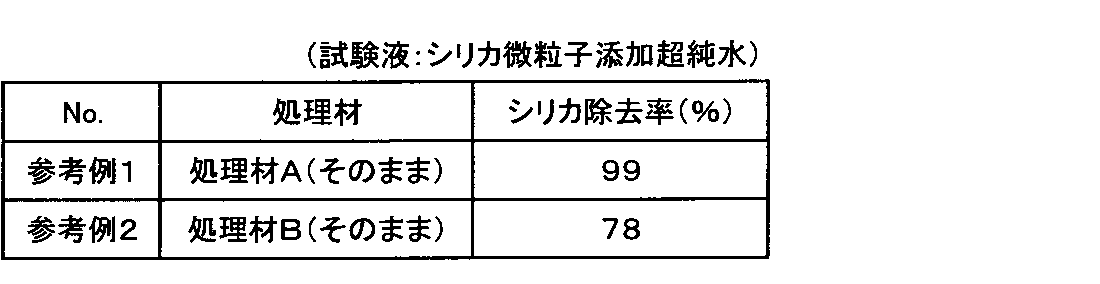
上記処理材A,Bとシリカ微粒子添加超純水(シリカ微粒子添加量50μg/L)とを接触方法1に準じて接触させ、シリカ除去率を求めた。
上記処理材A,Bとシリカ微粒子添加超純水(シリカ微粒子添加量50μg/L)とを接触方法1に準じて接触させ、シリカ除去率を求めた。
結果を表2に示す。
本発明を特定の態様を用いて詳細に説明したが、本発明の意図と範囲を離れることなく様々な変更が可能であることは当業者に明らかである。
本出願は、2019年3月27日付で出願された日本特許出願2019-060899に基づいており、その全体が引用により援用される。
本出願は、2019年3月27日付で出願された日本特許出願2019-060899に基づいており、その全体が引用により援用される。
Claims (8)
- 電子部品製造工程で使用される有機溶媒から微粒子を除去する有機溶媒の処理方法において、
水中において正、あるいは負の荷電を有し、含水率が3質量%以上である処理材と該有機溶媒とを接触させる工程を有することを特徴とする有機溶媒の処理方法。 - 前記接触工程の前に、前記有機溶媒に超純水を添加することを特徴とする請求項1に記載の有機溶媒の処理方法。
- 前記処理材として、水と接触処理した処理材を用いることを特徴とする請求項1に記載の有機溶媒の処理方法。
- 前記処理材は、アニオン交換基を有するポリマーよりなることを特徴とする請求項1~3のいずれか1項に記載の有機溶媒の処理方法。
- 処理材は、アニオン交換膜よりなることを特徴とする請求項1~3のいずれか1項に記載の有機溶媒の処理方法。
- 前記処理材は繊維の形態となっていることを特徴とする請求項4に記載の有機溶媒の処理方法。
- 処理材はイオン交換繊維よりなることを特徴とする請求項1~4のいずれか1項に記載の有機溶媒の処理方法。
- 電子部品製造工程で使用される有機溶媒と接触することにより有機溶媒から微粒子を除去する電子部品製造工程向け有機溶媒処理材であって、水中において正、あるいは負の電荷を有する有機溶媒処理材。
Priority Applications (3)
| Application Number | Priority Date | Filing Date | Title |
|---|---|---|---|
| KR1020217022161A KR102875893B1 (ko) | 2019-03-27 | 2020-03-10 | 유기 용매의 처리 방법 및 처리재 |
| US17/442,573 US20220184596A1 (en) | 2019-03-27 | 2020-03-10 | Organic solvent treatment method |
| CN202080024017.4A CN113631269B (zh) | 2019-03-27 | 2020-03-10 | 有机溶剂的处理方法及处理材料 |
Applications Claiming Priority (2)
| Application Number | Priority Date | Filing Date | Title |
|---|---|---|---|
| JP2019-060899 | 2019-03-27 | ||
| JP2019060899A JP6819713B2 (ja) | 2019-03-27 | 2019-03-27 | 有機溶媒の処理方法及び処理材 |
Publications (1)
| Publication Number | Publication Date |
|---|---|
| WO2020195773A1 true WO2020195773A1 (ja) | 2020-10-01 |
Family
ID=72610484
Family Applications (1)
| Application Number | Title | Priority Date | Filing Date |
|---|---|---|---|
| PCT/JP2020/010212 Ceased WO2020195773A1 (ja) | 2019-03-27 | 2020-03-10 | 有機溶媒の処理方法及び処理材 |
Country Status (6)
| Country | Link |
|---|---|
| US (1) | US20220184596A1 (ja) |
| JP (1) | JP6819713B2 (ja) |
| KR (1) | KR102875893B1 (ja) |
| CN (1) | CN113631269B (ja) |
| TW (1) | TWI827816B (ja) |
| WO (1) | WO2020195773A1 (ja) |
Families Citing this family (4)
| Publication number | Priority date | Publication date | Assignee | Title |
|---|---|---|---|---|
| WO2022254873A1 (ja) * | 2021-06-03 | 2022-12-08 | 栗田工業株式会社 | 微粒子吸着材及び微粒子除去方法 |
| JP7411158B2 (ja) * | 2021-06-03 | 2024-01-11 | 栗田工業株式会社 | 微粒子吸着材及び微粒子除去方法 |
| JP7259919B1 (ja) * | 2021-12-01 | 2023-04-18 | 栗田工業株式会社 | 有機溶媒の不純物除去方法 |
| JP7248090B1 (ja) * | 2021-12-01 | 2023-03-29 | 栗田工業株式会社 | 有機溶媒の不純物除去方法 |
Citations (4)
| Publication number | Priority date | Publication date | Assignee | Title |
|---|---|---|---|---|
| JPH0669175A (ja) * | 1993-01-27 | 1994-03-11 | Tokuyama Soda Co Ltd | 半導体基材の洗浄方法 |
| JP2013023439A (ja) * | 2011-07-15 | 2013-02-04 | Japan Organo Co Ltd | アルコールの精製方法及び装置 |
| JP2013023442A (ja) * | 2011-07-15 | 2013-02-04 | Japan Organo Co Ltd | アルコールの精製方法及び装置 |
| WO2017169832A1 (ja) * | 2016-03-31 | 2017-10-05 | 富士フイルム株式会社 | 半導体製造用処理液、半導体製造用処理液が収容された収容容器、パターン形成方法及び電子デバイスの製造方法 |
Family Cites Families (8)
| Publication number | Priority date | Publication date | Assignee | Title |
|---|---|---|---|---|
| JPS58211000A (ja) | 1982-06-03 | 1983-12-08 | 株式会社トクヤマ | 有機溶剤の精製方法 |
| JPH02119901A (ja) | 1989-09-08 | 1990-05-08 | Tokuyama Soda Co Ltd | 有機溶剤の精製方法 |
| JPH10216721A (ja) | 1997-02-07 | 1998-08-18 | Kurita Water Ind Ltd | 超純水製造装置 |
| US6733637B1 (en) | 2000-06-02 | 2004-05-11 | Exxonmobil Chemical Patents Inc. | Process for producing ultra-high purity isopropanol |
| JP4570380B2 (ja) * | 2004-03-19 | 2010-10-27 | 日本化成株式会社 | メタノールの製造方法 |
| JP6440156B2 (ja) | 2014-07-29 | 2018-12-19 | オルガノ株式会社 | 有機溶剤精製システム及び方法 |
| JP2017119234A (ja) * | 2015-12-28 | 2017-07-06 | ダウ グローバル テクノロジーズ エルエルシー | 親水性有機溶媒のための精製プロセス |
| KR20180056369A (ko) * | 2016-11-18 | 2018-05-28 | 삼성전자주식회사 | 다공성막, 이를 포함하는 세퍼레이터, 이를 포함하는 전기화학 소자, 및 다공성막 제조방법 |
-
2019
- 2019-03-27 JP JP2019060899A patent/JP6819713B2/ja active Active
-
2020
- 2020-03-10 US US17/442,573 patent/US20220184596A1/en not_active Abandoned
- 2020-03-10 KR KR1020217022161A patent/KR102875893B1/ko active Active
- 2020-03-10 CN CN202080024017.4A patent/CN113631269B/zh active Active
- 2020-03-10 WO PCT/JP2020/010212 patent/WO2020195773A1/ja not_active Ceased
- 2020-03-18 TW TW109109032A patent/TWI827816B/zh active
Patent Citations (4)
| Publication number | Priority date | Publication date | Assignee | Title |
|---|---|---|---|---|
| JPH0669175A (ja) * | 1993-01-27 | 1994-03-11 | Tokuyama Soda Co Ltd | 半導体基材の洗浄方法 |
| JP2013023439A (ja) * | 2011-07-15 | 2013-02-04 | Japan Organo Co Ltd | アルコールの精製方法及び装置 |
| JP2013023442A (ja) * | 2011-07-15 | 2013-02-04 | Japan Organo Co Ltd | アルコールの精製方法及び装置 |
| WO2017169832A1 (ja) * | 2016-03-31 | 2017-10-05 | 富士フイルム株式会社 | 半導体製造用処理液、半導体製造用処理液が収容された収容容器、パターン形成方法及び電子デバイスの製造方法 |
Also Published As
| Publication number | Publication date |
|---|---|
| JP6819713B2 (ja) | 2021-01-27 |
| TWI827816B (zh) | 2024-01-01 |
| CN113631269A (zh) | 2021-11-09 |
| TW202041487A (zh) | 2020-11-16 |
| KR102875893B1 (ko) | 2025-10-23 |
| CN113631269B (zh) | 2022-11-18 |
| JP2020157249A (ja) | 2020-10-01 |
| US20220184596A1 (en) | 2022-06-16 |
| KR20210137430A (ko) | 2021-11-17 |
Similar Documents
| Publication | Publication Date | Title |
|---|---|---|
| WO2020195773A1 (ja) | 有機溶媒の処理方法及び処理材 | |
| US20070007196A1 (en) | Filter cartridge for fluid for treating surface of electronic device substrate | |
| CN101247880A (zh) | 含有交换树脂的多孔膜 | |
| JP5177506B2 (ja) | フィルタ及び液処理方法 | |
| CN108779006A (zh) | 超纯水制造系统 | |
| CN115301088A (zh) | 多孔聚(环烯烃)膜 | |
| TW202039404A (zh) | 有機溶劑的製造方法 | |
| JP7853325B2 (ja) | 炭素質材料を含む液体精製膜及びそれらの形成方法 | |
| JP7017169B2 (ja) | 溶媒中の微粒子除去装置 | |
| TWI831057B (zh) | 用於自胺類移除金屬物種之膜及方法 | |
| JP7411158B2 (ja) | 微粒子吸着材及び微粒子除去方法 | |
| KR20230085919A (ko) | 정제수 생성을 위한 여과 멤브레인, 시스템, 및 방법 | |
| WO2022254873A1 (ja) | 微粒子吸着材及び微粒子除去方法 | |
| JP7259919B1 (ja) | 有機溶媒の不純物除去方法 | |
| KR102704707B1 (ko) | 유체 내 금속 불순물 여과용 필터 | |
| KR20170020104A (ko) | 양전하, 음전하 또는 중성입자로 표면개질된 내오염성 수처리 분리막 및 그 제조방법 | |
| US20220340430A1 (en) | Method for purifying iodosilanes | |
| JP7248090B1 (ja) | 有機溶媒の不純物除去方法 | |
| CN119034506A (zh) | 一种复合纳滤膜及其制备方法和应用 | |
| TW202330089A (zh) | 用於移除陰離子材料的膜 | |
| JP2022126354A (ja) | 微粒子除去装置及び微粒子除去方法 |
Legal Events
| Date | Code | Title | Description |
|---|---|---|---|
| 121 | Ep: the epo has been informed by wipo that ep was designated in this application |
Ref document number: 20779831 Country of ref document: EP Kind code of ref document: A1 |
|
| NENP | Non-entry into the national phase |
Ref country code: DE |
|
| 122 | Ep: pct application non-entry in european phase |
Ref document number: 20779831 Country of ref document: EP Kind code of ref document: A1 |