WO2020195143A1 - 自動車用冷却システム用チューブおよびその製造方法 - Google Patents
自動車用冷却システム用チューブおよびその製造方法 Download PDFInfo
- Publication number
- WO2020195143A1 WO2020195143A1 PCT/JP2020/003333 JP2020003333W WO2020195143A1 WO 2020195143 A1 WO2020195143 A1 WO 2020195143A1 JP 2020003333 W JP2020003333 W JP 2020003333W WO 2020195143 A1 WO2020195143 A1 WO 2020195143A1
- Authority
- WO
- WIPO (PCT)
- Prior art keywords
- tube
- alloy
- cooling system
- component
- weight
- Prior art date
- Legal status (The legal status is an assumption and is not a legal conclusion. Google has not performed a legal analysis and makes no representation as to the accuracy of the status listed.)
- Ceased
Links
Images
Classifications
-
- C—CHEMISTRY; METALLURGY
- C08—ORGANIC MACROMOLECULAR COMPOUNDS; THEIR PREPARATION OR CHEMICAL WORKING-UP; COMPOSITIONS BASED THEREON
- C08K—Use of inorganic or non-macromolecular organic substances as compounding ingredients
- C08K3/00—Use of inorganic substances as compounding ingredients
- C08K3/01—Use of inorganic substances as compounding ingredients characterized by their specific function
- C08K3/013—Fillers, pigments or reinforcing additives
-
- C—CHEMISTRY; METALLURGY
- C08—ORGANIC MACROMOLECULAR COMPOUNDS; THEIR PREPARATION OR CHEMICAL WORKING-UP; COMPOSITIONS BASED THEREON
- C08K—Use of inorganic or non-macromolecular organic substances as compounding ingredients
- C08K5/00—Use of organic ingredients
- C08K5/04—Oxygen-containing compounds
- C08K5/13—Phenols; Phenolates
-
- C—CHEMISTRY; METALLURGY
- C08—ORGANIC MACROMOLECULAR COMPOUNDS; THEIR PREPARATION OR CHEMICAL WORKING-UP; COMPOSITIONS BASED THEREON
- C08K—Use of inorganic or non-macromolecular organic substances as compounding ingredients
- C08K5/00—Use of organic ingredients
- C08K5/16—Nitrogen-containing compounds
- C08K5/34—Heterocyclic compounds having nitrogen in the ring
- C08K5/3467—Heterocyclic compounds having nitrogen in the ring having more than two nitrogen atoms in the ring
- C08K5/3477—Six-membered rings
-
- C—CHEMISTRY; METALLURGY
- C08—ORGANIC MACROMOLECULAR COMPOUNDS; THEIR PREPARATION OR CHEMICAL WORKING-UP; COMPOSITIONS BASED THEREON
- C08L—COMPOSITIONS OF MACROMOLECULAR COMPOUNDS
- C08L23/00—Compositions of homopolymers or copolymers of unsaturated aliphatic hydrocarbons having only one carbon-to-carbon double bond; Compositions of derivatives of such polymers
- C08L23/02—Compositions of homopolymers or copolymers of unsaturated aliphatic hydrocarbons having only one carbon-to-carbon double bond; Compositions of derivatives of such polymers not modified by chemical after-treatment
- C08L23/04—Homopolymers or copolymers of ethene
-
- C—CHEMISTRY; METALLURGY
- C08—ORGANIC MACROMOLECULAR COMPOUNDS; THEIR PREPARATION OR CHEMICAL WORKING-UP; COMPOSITIONS BASED THEREON
- C08L—COMPOSITIONS OF MACROMOLECULAR COMPOUNDS
- C08L23/00—Compositions of homopolymers or copolymers of unsaturated aliphatic hydrocarbons having only one carbon-to-carbon double bond; Compositions of derivatives of such polymers
- C08L23/02—Compositions of homopolymers or copolymers of unsaturated aliphatic hydrocarbons having only one carbon-to-carbon double bond; Compositions of derivatives of such polymers not modified by chemical after-treatment
- C08L23/10—Homopolymers or copolymers of propene
-
- F—MECHANICAL ENGINEERING; LIGHTING; HEATING; WEAPONS; BLASTING
- F16—ENGINEERING ELEMENTS AND UNITS; GENERAL MEASURES FOR PRODUCING AND MAINTAINING EFFECTIVE FUNCTIONING OF MACHINES OR INSTALLATIONS; THERMAL INSULATION IN GENERAL
- F16L—PIPES; JOINTS OR FITTINGS FOR PIPES; SUPPORTS FOR PIPES, CABLES OR PROTECTIVE TUBING; MEANS FOR THERMAL INSULATION IN GENERAL
- F16L11/00—Hoses, i.e. flexible pipes
- F16L11/04—Hoses, i.e. flexible pipes made of rubber or flexible plastics
Definitions
- the present invention relates to an automobile cooling system tube used for piping of an automobile cooling system and a method for manufacturing the same.
- a polyamide resin has been used as a piping material for a cooling system in a gasoline vehicle because of its excellent strength and heat resistance (see, for example, Patent Document 1). Further, as a piping material for a cooling system in an electric vehicle, a polyamide resin similar to that of a gasoline vehicle has been conventionally used.
- a tube made of polypropylene resin has been conventionally secured for high-temperature strength by containing a filler, there remains a problem that the tube is liable to break due to deterioration.
- the causes of tube breakage as described above are, for example, deterioration of polypropylene resin due to trace metal elements in the filler, thermal deterioration of polypropylene resin caused when the tube material is extruded, and heat load when the tube is actually driven. It is conceivable that heat aging caused by receiving the product.
- the present invention has been made in view of such circumstances, and provides a tube for an automobile cooling system and a method for manufacturing the same, which can realize improvement in heat aging resistance, impact resistance, high temperature strength, etc. at low cost. ..
- the present inventors have conducted extensive research to solve the above problems.
- the present inventors use polypropylene, which is a low-cost material, as the main raw material of the polymer in the forming material of the tube for the cooling system for automobiles, and in order to improve the impact resistance, the sea of polypropylene components.
- the alloy (A) in which the island phase of the polyethylene component, which is a soft component, was dispersed in the phase was used as a polymer for a tube material for an automobile cooling system.
- the compound (B) appropriately coats the surface of the inorganic filler (D), and the phenolic antioxidant (C) on the surface of the inorganic filler (D) is used. It is considered that because the adsorption was suppressed, it was possible to prevent the antioxidant function of the phenolic antioxidant (C) from being invalidated by the adsorption. In addition to this, it is considered that the heat deterioration prevention performance of polypropylene by the compound (B) itself also worked advantageously.
- the compound (B) and the inorganic filler (D) are unevenly distributed in the sea phase of the alloy (A), but tentatively in the island phase which is a soft component of the alloy (A). ,
- the presence of the inorganic filler (D) and the above compound (B) is considered to cause problems such as an increase in the hardness of the entire tube and impaired impact resistance, and the intended purpose could not be achieved. Conceivable.
- the gist of the present invention is the following [1] to [9].
- the following components (A) are the main components, the following components (B) to (D) are contained, and the components (B) and (D) are unevenly distributed in the sea phase of the component (A).
- Tubes for automotive cooling systems characterized by being made of alloys.
- B A compound having a guanamine skeleton.
- C Phenolic antioxidant.
- D Inorganic filler.
- [II] A step of kneading the compound (B) having a guanamine skeleton and the inorganic filler (D) with the kneaded product obtained in the above step [I].
- [III] A step of melt-extruding the kneaded product obtained in the above step [II] into a tube shape.
- the tube for an automobile cooling system of the present invention can be reduced in cost and can be improved in heat aging resistance, impact resistance, high temperature strength and the like.
- the tube for an automobile cooling system of the present invention contains the following components (A) as a main component and the following components (B) to (D), and (B) and
- the component (D) is composed of alloys unevenly distributed in the sea phase of the component (A).
- the above-mentioned "main component” is a component that has a great influence on the characteristics of the automobile cooling system tube of the present invention, and is usually the following material for forming the automobile cooling system tube. It shows that 50% by weight or more of the whole polypropylene resin composition containing the components (A) to (D) is the following component (A).
- A An alloy in which the island phase of the polyethylene component is dispersed in the sea phase of the polypropylene component.
- B A compound having a guanamine skeleton.
- C Phenolic antioxidant.
- D Inorganic filler.
- the components (B) and (D) are unevenly distributed in the sea phase of the component (A)
- the identification of the sea-island structure and the identification of the uneven distribution state as described above include, for example, the cross section of the tube for the automobile cooling system (or the polypropylene resin composition for forming the tube for the automobile cooling system).
- the cross section of the cured product is cut or polished, surfaced, stained, and then the reflected electron image is observed with a scanning electron microscope at an observation magnification of 5000 times.
- the average particle size of the island phase measured from the above observation results is preferably 0.01 to 100 ⁇ m, more preferably 0.1 to 10 ⁇ m, from the viewpoint of impact resistance, heat aging resistance, and the like.
- the ratio of the island phase (polyethylene component) to the entire resin portion (alloy) measured from the above observation results is preferably in the range of 1 to 49% by weight, more preferably in the range of 2.5 to 20% by weight. Is.
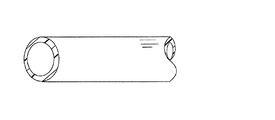
- the tube for an automobile cooling system of the present invention is made of an alloy containing the above components (A) to (D), and usually has a single-layer structure as shown in FIG. 1, but if necessary, other
- the resin layer and the reinforcing thread layer of the above may be further laminated to form a tube having a multilayer structure provided with the layer made of the alloy.
- alloy (A) As the alloy (A), as described above, an alloy in which the island phase of the polyethylene component is dispersed in the sea phase of the polypropylene component is used.
- polypropylene (oligocarbon) used as the material of the alloy in addition to the homopolymer of propylene, a block copolymer of ⁇ -olefin other than propylene such as butene-1 and propylene, and a random copolymer. , Copolymers such as graft copolymers, modified polypropylene modified with acid anhydrides such as maleic anhydride, and the like. These may be used alone or in combination of two or more.
- a homopolymer of propylene (homopolypropylene) is preferable because it can form a good sea-island structure with a polyethylene component and is also excellent in melt extrusion moldability and the like.
- an ethylene homopolymer, an ethylene-vinyl acetate copolymer, an ethylene-acrylic acid copolymer, and an ethylene-methacrylic acid in order to form the island phase of the polyethylene component as described above, an ethylene homopolymer, an ethylene-vinyl acetate copolymer, an ethylene-acrylic acid copolymer, and an ethylene-methacrylic acid
- One or more ethylene-based copolymers such as copolymers, ethylene- ⁇ -olefin copolymers (ethylene-propylene copolymer, ethylene-butene copolymer, ethylene-octene copolymer), etc. It is also used.
- X in the above general formula (1) is a functional group containing an amino group, an aryl group, an alkyl group, an alkoxy group, a hydroxy group, or any one of them. It is preferable to use the base compound (melamine compound) from the viewpoint of the action and effect of the present invention.
- Specific examples of the compound represented by the above general formula (1) include melamine, acetoguanamine, benzoguanamine and the like. These may be used alone or in combination of two or more. Of these, melamine is preferable because it is more excellent in adsorbability to fillers.
- the content ratio of the compound (B) having a guanamine skeleton is preferably 0.01 to 10 parts by weight, more preferably 0.1 to 5 parts by weight, based on 100 parts by weight of the alloy (A). .. By containing it in such an amount, the antioxidant function of the phenolic antioxidant (C) and the like can be satisfactorily exhibited.
- Phenolic antioxidant (C) >> Examples of the phenolic antioxidant (C) used in the present invention include tetrakis [3- (3', 5'-di-tert-butyl-4'-hydroxyphenyl) propionic acid] pentaerythritol, 2,2.
- the content ratio of the phenolic antioxidant (C) is preferably 0.01 to 10 parts by weight, more preferably 0.01 to 9 parts by weight, and particularly preferably 0.01 to 9 parts by weight, based on 100 parts by weight of the alloy (A). It is in the range of 0.1 to 5 parts by weight. By containing it in such an amount, the antioxidant function of the phenolic antioxidant (C) and the like can be satisfactorily exhibited.
- Inorganic filler (D) examples include talc, silica, mica, kaolin, calcium carbonate, potassium titanate, apatite, mica and the like. These may be used alone or in combination of two or more. Of these, talc is preferable from the viewpoint of extrusion processability, reinforcing property and the like.
- the content ratio of the inorganic filler (D) is preferably 1 to 100 parts by weight, more preferably 10 to 70 parts by weight, based on 100 parts by weight of the alloy (A). By containing in such an amount, good tube strength can be obtained.
- the material for forming the tube for the automobile cooling system of the present invention includes weather-resistant stabilizers, lubricants, pigments, dyes, antistatic agents, plasticizers and the like. Various additives may be appropriately blended as needed.
- the tube for an automobile cooling system of the present invention comprises the steps shown in the following [I] to [III] in this order. It can be manufactured satisfactorily.
- [I] A step of kneading the alloy (A) or a polypropylene-ethylene copolymer which is a constituent material of the alloy (A) and a phenolic antioxidant (C).
- [II] A step of kneading the compound (B) and the inorganic filler (D) with the kneaded product obtained in the above step [I].
- [III] A step of melt-extruding the kneaded product obtained in the above step [II] into a tube shape.
- the step [I] is carried out by, for example, kneading the alloy (A) and the phenolic antioxidant (C) at 160 to 230 ° C. for 0.01 to 10 minutes using a twin-screw kneading extruder or the like. It is said. Further, instead of the alloy (A), polypropylene (oligoform), which is a constituent material of the alloy (A), and the ethylene-based copolymer (oligoene) are blended in a predetermined ratio, and the phenol-based After blending the antioxidant (C), knead at 160 to 230 ° C.
- the agent (C) may be mixed at the same time.
- step [II] the compound (B) having a guanamine skeleton and the inorganic filler (D) are kneaded with respect to the kneaded product obtained in the above step [I], and the compound (B) having a guanamine skeleton is used.
- the compound (B) having a guanamine skeleton and the inorganic filler (D) in advance and knead it with the kneaded product obtained in the above step [I]. ..
- the kneading is carried out by kneading at 160 to 270 ° C. for 0.01 to 10 minutes with a twin-screw kneading extruder or the like.
- the mixing timing of the optional components other than the components (A) to (D) is not particularly limited as long as it is before the step [III], but it is preferable to mix the components after the step [II].
- the kneaded product obtained in the above step [II] is melt-extruded into a tube shape at 160 to 270 ° C. by a melt extrusion molding machine equipped with a cylindrical die.
- a melt extrusion molding machine equipped with a cylindrical die.
- pelletized products it is preferable to use pelletized products from the viewpoint of productivity.
- the tube for an automobile cooling system of the present invention thus obtained has an inner diameter in the range of 2.5 to 30 mm and a thickness in the range of 0.5 to 5.0 mm from the viewpoint of its application. Is preferable.
- the tube for an automobile cooling system of the present invention is used for piping a refrigerant such as cooling water in an automobile, and is used, for example, for a radiator hose, a heater hose, an air conditioner hose, etc., an electric vehicle, a fuel cell vehicle, etc. Used for cooling tubes of battery packs.
- Examples 1 to 14 Homo PP, EP, and phenolic antioxidants were kneaded with a twin-screw kneading extruder (TEM-18SS, manufactured by Toshiba Machine Co., Ltd.) at 200 ° C. for 5 minutes at the weight ratios and combinations shown in Tables 1 and 2 below. After that, the melamine compound and talc were added at the same time in the weight ratios and combinations shown in Tables 1 and 2 below, and further kneaded at 200 ° C. for 5 minutes by the above twin-screw kneading extruder. For materials not listed in the table below, the above kneading was performed without adding the material.
- TEM-18SS twin-screw kneading extruder
- the kneaded product is pelletized, and the pellets are melt-extruded into a tube at 250 ° C. by a melt extrusion molding machine (GT-40, manufactured by Plastic Engineering Laboratory) equipped with a cylindrical die.
- GT-40 melt extrusion molding machine
- a resin tube having an inner diameter of 18 mm and an outer diameter of 20 mm was obtained.
- the resin tube was cut in half and punched into strips with a width of 10 mm and a length of 15 cm.
- the strip-shaped sample thus obtained was subjected to a heat aging treatment (heat treatment at 120 ° C. for 1000 hours), and then the elongation at break [Eb] of the sample was adjusted to JIS K 6251. It was measured by a tensile tester (AGS-X, manufactured by Shimadzu Corporation). Then, the elongation of the sample was evaluated as “ ⁇ ” when it was 50% or more of the length of the sample, and “x” when it was less than 50% of the length of the sample.
- the cross section of the resin tube of the example was cut or polished, surfaced, stained, and then the reflected electron image was observed with a scanning electron microscope at an observation magnification of 5000 times. As a result, any resin tube was used. , It was confirmed that the island phase of the polyethylene component was dispersed in the sea phase of the polypropylene component, and further, it was confirmed that the melamine compound and talc were unevenly distributed in the sea phase of the alloy component. It was.
- the ratio of the island phase (polyethylene component) to the entire resin portion (alloy) observed in the cross section of the resin tube of the above-mentioned example was measured based on the above-mentioned reflected electron image, and all of them were 1 to 1. It was in the range of 49% by weight.
- Comparative Example 1 polypropylene was not used as the polymer, but only the ethylene-propylene copolymer was used, and the result was that the resin was dissolved during tube molding.
- Comparative Example 2 an ethylene-propylene copolymer was not used as the polymer, and only polypropylene was used, resulting in inferior impact resistance.
- Comparative Example 3 the result was inferior in heat aging resistance.
- a resin tube was produced by kneading melamine and an ethylene-propylene copolymer in advance with homo-PP, a phenolic antioxidant, and talc to produce a resin tube.
- the tube for an automobile cooling system of the present invention is used for piping a refrigerant such as cooling water in an automobile, and is used for, for example, a radiator hose, a heater hose, an air conditioner hose, etc., and an electric vehicle or a fuel cell vehicle. Used for cooling tubes of battery packs. Further, the tube for an automobile cooling system of the present invention is used for cooling not only automobiles but also other transportation machines (industrial transportation vehicles such as airplanes, forklifts, excavators, cranes, railroad vehicles, etc.) and vending machines. It can also be used as a tube for use.
Landscapes
- Chemical & Material Sciences (AREA)
- Medicinal Chemistry (AREA)
- Health & Medical Sciences (AREA)
- Chemical Kinetics & Catalysis (AREA)
- Polymers & Plastics (AREA)
- Organic Chemistry (AREA)
- General Engineering & Computer Science (AREA)
- Engineering & Computer Science (AREA)
- Mechanical Engineering (AREA)
- Compositions Of Macromolecular Compounds (AREA)
- Rigid Pipes And Flexible Pipes (AREA)
- Manufacture Of Macromolecular Shaped Articles (AREA)
- Extrusion Moulding Of Plastics Or The Like (AREA)
Priority Applications (1)
| Application Number | Priority Date | Filing Date | Title |
|---|---|---|---|
| JP2020545822A JP7471226B2 (ja) | 2019-03-28 | 2020-01-30 | 自動車用冷却システム用チューブおよびその製造方法 |
Applications Claiming Priority (2)
| Application Number | Priority Date | Filing Date | Title |
|---|---|---|---|
| JP2019062278 | 2019-03-28 | ||
| JP2019-062278 | 2019-03-28 |
Publications (1)
| Publication Number | Publication Date |
|---|---|
| WO2020195143A1 true WO2020195143A1 (ja) | 2020-10-01 |
Family
ID=72610003
Family Applications (1)
| Application Number | Title | Priority Date | Filing Date |
|---|---|---|---|
| PCT/JP2020/003333 Ceased WO2020195143A1 (ja) | 2019-03-28 | 2020-01-30 | 自動車用冷却システム用チューブおよびその製造方法 |
Country Status (2)
| Country | Link |
|---|---|
| JP (1) | JP7471226B2 (https=) |
| WO (1) | WO2020195143A1 (https=) |
Cited By (1)
| Publication number | Priority date | Publication date | Assignee | Title |
|---|---|---|---|---|
| JP2023148501A (ja) * | 2022-03-30 | 2023-10-13 | 株式会社ユポ・コーポレーション | 印刷用紙及びその製造方法 |
Citations (6)
| Publication number | Priority date | Publication date | Assignee | Title |
|---|---|---|---|---|
| JPH10298417A (ja) * | 1997-02-28 | 1998-11-10 | Asahi Chem Ind Co Ltd | 難燃性ポリカーボネート系樹脂組成物 |
| JP2002241546A (ja) * | 2001-02-22 | 2002-08-28 | Toray Ind Inc | 燃料取扱用部材 |
| JP2003128846A (ja) * | 2001-10-26 | 2003-05-08 | Toray Ind Inc | 樹脂構造体 |
| JP2010254994A (ja) * | 2009-04-01 | 2010-11-11 | Asahi Kasei Chemicals Corp | 樹脂組成物及びその成形体 |
| WO2017094738A1 (ja) * | 2015-12-01 | 2017-06-08 | トヨタ紡織株式会社 | 改質剤及びその使用方法、改質剤の製造方法並びに添加材用担体 |
| JP2019507227A (ja) * | 2016-02-29 | 2019-03-14 | クラリアント・プラスティクス・アンド・コーティングス・リミテッド | 難燃性ポリアミド組成物 |
-
2020
- 2020-01-30 WO PCT/JP2020/003333 patent/WO2020195143A1/ja not_active Ceased
- 2020-01-30 JP JP2020545822A patent/JP7471226B2/ja active Active
Patent Citations (6)
| Publication number | Priority date | Publication date | Assignee | Title |
|---|---|---|---|---|
| JPH10298417A (ja) * | 1997-02-28 | 1998-11-10 | Asahi Chem Ind Co Ltd | 難燃性ポリカーボネート系樹脂組成物 |
| JP2002241546A (ja) * | 2001-02-22 | 2002-08-28 | Toray Ind Inc | 燃料取扱用部材 |
| JP2003128846A (ja) * | 2001-10-26 | 2003-05-08 | Toray Ind Inc | 樹脂構造体 |
| JP2010254994A (ja) * | 2009-04-01 | 2010-11-11 | Asahi Kasei Chemicals Corp | 樹脂組成物及びその成形体 |
| WO2017094738A1 (ja) * | 2015-12-01 | 2017-06-08 | トヨタ紡織株式会社 | 改質剤及びその使用方法、改質剤の製造方法並びに添加材用担体 |
| JP2019507227A (ja) * | 2016-02-29 | 2019-03-14 | クラリアント・プラスティクス・アンド・コーティングス・リミテッド | 難燃性ポリアミド組成物 |
Cited By (2)
| Publication number | Priority date | Publication date | Assignee | Title |
|---|---|---|---|---|
| JP2023148501A (ja) * | 2022-03-30 | 2023-10-13 | 株式会社ユポ・コーポレーション | 印刷用紙及びその製造方法 |
| JP7783109B2 (ja) | 2022-03-30 | 2025-12-09 | 株式会社ユポ・コーポレーション | 印刷用紙及びその製造方法 |
Also Published As
| Publication number | Publication date |
|---|---|
| JP7471226B2 (ja) | 2024-04-19 |
| JPWO2020195143A1 (https=) | 2020-10-01 |
Similar Documents
| Publication | Publication Date | Title |
|---|---|---|
| US12071541B2 (en) | Thermoplastic resin composition for refrigerant transporting piping, and method for producing same | |
| CN101445639A (zh) | 用于车辆内部材料的聚丙烯树脂组合物 | |
| US20150175790A1 (en) | Polypropylene resin composition | |
| JPWO2003022920A1 (ja) | ポリエチレン樹脂組成物 | |
| EP3385331B1 (en) | Polyamide resin composition with high fluidity | |
| JP6115386B2 (ja) | 熱可塑性樹脂組成物並びにそれを用いたタイヤ及びホース | |
| CN108602996B (zh) | 分散直径的调整方法和热塑性树脂组合物 | |
| CN103443231A (zh) | 粘合性树脂组合物及使用其的多层结构体 | |
| JP2009040947A (ja) | 電線絶縁体用樹脂組成物及び被覆電線 | |
| WO2020195143A1 (ja) | 自動車用冷却システム用チューブおよびその製造方法 | |
| JP7390931B2 (ja) | 自動車用水系多層チューブ | |
| JP2010037496A (ja) | 熱可塑性エラストマー組成物並びにその製造方法及びそれを用いた空気入りタイヤ | |
| US20250333591A1 (en) | Resin composition for coolant transport tube for vehicles and coolant transport tube for vehicles | |
| WO2024190356A1 (ja) | 車両用冷却液輸送チューブ用樹脂組成物および車両用冷却液輸送チューブ | |
| CN108570193A (zh) | 聚丙烯树脂组合物及其成型产品 | |
| JPH09111061A (ja) | 熱可塑性樹脂組成物 | |
| CN120051531A (zh) | 车辆用冷却液输送管用树脂组合物及车辆用冷却液输送管 | |
| JP2024168404A (ja) | 車両用冷却液輸送チューブ用樹脂組成物および車両用冷却液輸送チューブ | |
| JP2001131364A (ja) | 耐不凍液系統自動車部品材料 | |
| CN113454156B (zh) | 树脂组合物及成型体 | |
| CN114787280B (zh) | 树脂组合物的制造方法及成型体的制造方法 | |
| CN121127705A (zh) | 层叠管 | |
| JP2024131492A (ja) | 車両用冷却液輸送チューブ用樹脂組成物および車両用冷却液輸送チューブ | |
| JPH04239559A (ja) | ポリアミド樹脂組成物 | |
| CN121195128A (zh) | 层叠管 |
Legal Events
| Date | Code | Title | Description |
|---|---|---|---|
| ENP | Entry into the national phase |
Ref document number: 2020545822 Country of ref document: JP Kind code of ref document: A |
|
| 121 | Ep: the epo has been informed by wipo that ep was designated in this application |
Ref document number: 20779114 Country of ref document: EP Kind code of ref document: A1 |
|
| NENP | Non-entry into the national phase |
Ref country code: DE |
|
| 122 | Ep: pct application non-entry in european phase |
Ref document number: 20779114 Country of ref document: EP Kind code of ref document: A1 |