WO2020189337A1 - ガラス基板 - Google Patents
ガラス基板 Download PDFInfo
- Publication number
- WO2020189337A1 WO2020189337A1 PCT/JP2020/009669 JP2020009669W WO2020189337A1 WO 2020189337 A1 WO2020189337 A1 WO 2020189337A1 JP 2020009669 W JP2020009669 W JP 2020009669W WO 2020189337 A1 WO2020189337 A1 WO 2020189337A1
- Authority
- WO
- WIPO (PCT)
- Prior art keywords
- glass substrate
- less
- glass
- temperature
- content
- Prior art date
- Legal status (The legal status is an assumption and is not a legal conclusion. Google has not performed a legal analysis and makes no representation as to the accuracy of the status listed.)
- Ceased
Links
Images
Classifications
-
- C—CHEMISTRY; METALLURGY
- C03—GLASS; MINERAL OR SLAG WOOL
- C03C—CHEMICAL COMPOSITION OF GLASSES, GLAZES OR VITREOUS ENAMELS; SURFACE TREATMENT OF GLASS; SURFACE TREATMENT OF FIBRES OR FILAMENTS MADE FROM GLASS, MINERALS OR SLAGS; JOINING GLASS TO GLASS OR OTHER MATERIALS
- C03C3/00—Glass compositions
- C03C3/04—Glass compositions containing silica
- C03C3/076—Glass compositions containing silica with 40% to 90% silica, by weight
- C03C3/097—Glass compositions containing silica with 40% to 90% silica, by weight containing phosphorus, niobium or tantalum
-
- C—CHEMISTRY; METALLURGY
- C03—GLASS; MINERAL OR SLAG WOOL
- C03C—CHEMICAL COMPOSITION OF GLASSES, GLAZES OR VITREOUS ENAMELS; SURFACE TREATMENT OF GLASS; SURFACE TREATMENT OF FIBRES OR FILAMENTS MADE FROM GLASS, MINERALS OR SLAGS; JOINING GLASS TO GLASS OR OTHER MATERIALS
- C03C3/00—Glass compositions
- C03C3/04—Glass compositions containing silica
- C03C3/076—Glass compositions containing silica with 40% to 90% silica, by weight
- C03C3/089—Glass compositions containing silica with 40% to 90% silica, by weight containing boron
- C03C3/091—Glass compositions containing silica with 40% to 90% silica, by weight containing boron containing aluminium
- C03C3/093—Glass compositions containing silica with 40% to 90% silica, by weight containing boron containing aluminium containing zinc or zirconium
-
- C—CHEMISTRY; METALLURGY
- C03—GLASS; MINERAL OR SLAG WOOL
- C03B—MANUFACTURE, SHAPING, OR SUPPLEMENTARY PROCESSES
- C03B15/00—Drawing glass upwardly from the melt
- C03B15/02—Drawing glass sheets
-
- C—CHEMISTRY; METALLURGY
- C03—GLASS; MINERAL OR SLAG WOOL
- C03C—CHEMICAL COMPOSITION OF GLASSES, GLAZES OR VITREOUS ENAMELS; SURFACE TREATMENT OF GLASS; SURFACE TREATMENT OF FIBRES OR FILAMENTS MADE FROM GLASS, MINERALS OR SLAGS; JOINING GLASS TO GLASS OR OTHER MATERIALS
- C03C3/00—Glass compositions
- C03C3/04—Glass compositions containing silica
- C03C3/076—Glass compositions containing silica with 40% to 90% silica, by weight
- C03C3/083—Glass compositions containing silica with 40% to 90% silica, by weight containing aluminium oxide or an iron compound
-
- C—CHEMISTRY; METALLURGY
- C03—GLASS; MINERAL OR SLAG WOOL
- C03C—CHEMICAL COMPOSITION OF GLASSES, GLAZES OR VITREOUS ENAMELS; SURFACE TREATMENT OF GLASS; SURFACE TREATMENT OF FIBRES OR FILAMENTS MADE FROM GLASS, MINERALS OR SLAGS; JOINING GLASS TO GLASS OR OTHER MATERIALS
- C03C3/00—Glass compositions
- C03C3/04—Glass compositions containing silica
- C03C3/076—Glass compositions containing silica with 40% to 90% silica, by weight
- C03C3/083—Glass compositions containing silica with 40% to 90% silica, by weight containing aluminium oxide or an iron compound
- C03C3/085—Glass compositions containing silica with 40% to 90% silica, by weight containing aluminium oxide or an iron compound containing an oxide of a divalent metal
-
- C—CHEMISTRY; METALLURGY
- C03—GLASS; MINERAL OR SLAG WOOL
- C03C—CHEMICAL COMPOSITION OF GLASSES, GLAZES OR VITREOUS ENAMELS; SURFACE TREATMENT OF GLASS; SURFACE TREATMENT OF FIBRES OR FILAMENTS MADE FROM GLASS, MINERALS OR SLAGS; JOINING GLASS TO GLASS OR OTHER MATERIALS
- C03C3/00—Glass compositions
- C03C3/04—Glass compositions containing silica
- C03C3/076—Glass compositions containing silica with 40% to 90% silica, by weight
- C03C3/083—Glass compositions containing silica with 40% to 90% silica, by weight containing aluminium oxide or an iron compound
- C03C3/085—Glass compositions containing silica with 40% to 90% silica, by weight containing aluminium oxide or an iron compound containing an oxide of a divalent metal
- C03C3/087—Glass compositions containing silica with 40% to 90% silica, by weight containing aluminium oxide or an iron compound containing an oxide of a divalent metal containing calcium oxide, e.g. common sheet or container glass
-
- C—CHEMISTRY; METALLURGY
- C03—GLASS; MINERAL OR SLAG WOOL
- C03C—CHEMICAL COMPOSITION OF GLASSES, GLAZES OR VITREOUS ENAMELS; SURFACE TREATMENT OF GLASS; SURFACE TREATMENT OF FIBRES OR FILAMENTS MADE FROM GLASS, MINERALS OR SLAGS; JOINING GLASS TO GLASS OR OTHER MATERIALS
- C03C3/00—Glass compositions
- C03C3/04—Glass compositions containing silica
- C03C3/076—Glass compositions containing silica with 40% to 90% silica, by weight
- C03C3/089—Glass compositions containing silica with 40% to 90% silica, by weight containing boron
- C03C3/091—Glass compositions containing silica with 40% to 90% silica, by weight containing boron containing aluminium
-
- G—PHYSICS
- G02—OPTICS
- G02F—OPTICAL DEVICES OR ARRANGEMENTS FOR THE CONTROL OF LIGHT BY MODIFICATION OF THE OPTICAL PROPERTIES OF THE MEDIA OF THE ELEMENTS INVOLVED THEREIN; NON-LINEAR OPTICS; FREQUENCY-CHANGING OF LIGHT; OPTICAL LOGIC ELEMENTS; OPTICAL ANALOGUE/DIGITAL CONVERTERS
- G02F1/00—Devices or arrangements for the control of the intensity, colour, phase, polarisation or direction of light arriving from an independent light source, e.g. switching, gating or modulating; Non-linear optics
- G02F1/01—Devices or arrangements for the control of the intensity, colour, phase, polarisation or direction of light arriving from an independent light source, e.g. switching, gating or modulating; Non-linear optics for the control of the intensity, phase, polarisation or colour
- G02F1/13—Devices or arrangements for the control of the intensity, colour, phase, polarisation or direction of light arriving from an independent light source, e.g. switching, gating or modulating; Non-linear optics for the control of the intensity, phase, polarisation or colour based on liquid crystals, e.g. single liquid crystal display cells
- G02F1/133—Constructional arrangements; Operation of liquid crystal cells; Circuit arrangements
- G02F1/1333—Constructional arrangements; Manufacturing methods
Definitions
- the present invention relates to a glass substrate, specifically, a glass substrate suitable for an organic EL (OLED) display and a liquid crystal display, and further, a glass suitable for an oxide TFT and a low temperature p—Si TFT (LTPS) driven display. Regarding the substrate.
- OLED organic EL
- LTPS low temperature p—Si TFT
- glass substrates have been widely used as substrates for flat panel displays such as liquid crystal displays, hard disks, filters, and sensors.
- OLED displays have been actively developed for reasons such as self-luminous, high color reproducibility, high viewing angle, high-speed response, and high definition, and some have already been put into practical use. Has been done.
- liquid crystal displays and OLED displays of mobile devices are required to display a large amount of information even though they have a small area, so an ultra-high-definition screen is required. Furthermore, high-speed response is also required to display moving images.
- an OLED display or a liquid crystal display driven by LTPS is suitable.
- the OLED display emits light when a current flows through the OLED elements constituting the pixels. Therefore, a material having low resistance and high electron mobility is used as the drive TFT element.
- oxide TFTs typified by IGZO (indium, gallium, zinc oxide) are attracting attention.
- the oxide TFT has low resistance, high mobility, and can be formed at a relatively low temperature.
- Conventional p-Si / TFTs, especially LTPS form devices on a large-area glass substrate due to the instability of an excimer laser used when polycrystallizing a film of amorphous Si (a-Si).
- oxide TFTs are attracting attention as a promising TFT forming material because they are excellent in homogeneity of TFT characteristics when forming an element on a glass substrate having a large area, and some of them have already been put into practical use.
- alkaline ions diffuse into the semiconductor material on which the alkali ions are formed during the heat treatment, causing deterioration of the characteristics of the film. Therefore, the content of the alkaline component (particularly, Li component and Na component) is low or substantially not contained.
- the glass substrate is heat-treated to several hundred degrees Celsius in steps such as film formation, dehydrogenation, crystallization of the semiconductor layer, and annealing.
- steps such as film formation, dehydrogenation, crystallization of the semiconductor layer, and annealing.
- the glass substrate is required to have a small dimensional change during heat treatment.
- the main factors of dimensional change during heat treatment are heat shrinkage and film stress after film formation. Therefore, in order to reduce the dimensional change during heat treatment, it is required that the strain point is high and the Young's modulus (or specific Young's modulus) is high, for example, 78 GPa or more.
- the glass substrate is required to have the following characteristics (3) to (5).
- the molding temperature is low in order to extend the life of the molding equipment.
- Excellent meltability in order to prevent melting defects such as bubbles, bumps, and veins.
- Excellent devitrification resistance to avoid contamination of devitrified crystals in the glass substrate.
- the present invention has been made in view of the above circumstances, and a technical problem thereof is to provide a glass substrate capable of reducing dimensional changes during heat treatment without lowering production efficiency.
- the present inventors have found that the above technical problems can be solved by restricting the glass properties of the glass substrate within a predetermined range, and propose the present invention. That is, the glass substrate of the present invention, the strain point is 695 ⁇ 740 °C, 10 4.5 dPa ⁇ Temperature in s is 1300 ° C. or less, the liquidus viscosity of 10 4.5 dPa ⁇ s or more, a Young's modulus of more than 78 GPa, Moreover, the heat shrinkage rate when heat-treated at 500 ° C. for 1 hour is 20 ppm or less.
- the "distortion point” refers to a value measured based on the method of ASTM C336.
- “Temperature at 10 4.5 dPa ⁇ s” refers to a value measured by the platinum ball pulling method.
- “Liquid phase viscosity” refers to a value obtained by measuring the viscosity of glass at the liquidus temperature by the platinum ball pulling method.
- the “liquid phase temperature” is set in a temperature gradient furnace set from 1100 ° C. to 1350 ° C. for 24 hours by putting the glass powder remaining in 50 mesh (300 ⁇ m) through a standard sieve 30 mesh (500 ⁇ m) into a platinum boat. After holding, the platinum boat is taken out, and it refers to the temperature at which devitrified crystals (crystal foreign matter) are found in the glass.
- “Young's modulus” refers to a value measured based on a dynamic elastic modulus measurement method (resonance method) based on JIS R1602.
- the "heat shrinkage rate when heat-treated at 500 ° C. for 1 hour” was measured by the following method.
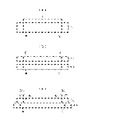
- a strip-shaped sample G having a size of 160 mm ⁇ 30 mm was prepared as a measurement sample. Marking M was formed at both ends of the strip-shaped sample G in the long side direction at a position 20 to 40 mm away from the edge using # 1000 water-resistant abrasive paper. Then, as shown in FIG.
- the strip-shaped sample G on which the marking M was formed was folded in two along the direction orthogonal to the marking M to prepare sample pieces Ga and Gb. Then, only one sample piece Gb was subjected to a heat treatment in which the temperature was raised from room temperature to 500 ° C. at 5 ° C./min, held at 500 ° C. for 1 hour, and then lowered at 5 ° C./min. After the heat treatment, as shown in FIG. 1 (c), the markings M of the two sample pieces Ga and Gb are arranged in parallel with the non-heat-treated sample piece Ga and the heat-treated sample piece Gb. The amount of misalignment ( ⁇ L 1 , ⁇ L 2 ) was read with a laser microscope, and the heat shrinkage rate was calculated by the following formula. In addition, l0mm of the following formula is the distance between the initial markings M.
- Heat shrinkage rate (ppm) [ ⁇ L 1 ( ⁇ m) + ⁇ L 2 ( ⁇ m) ⁇ ⁇ 10 3 ] / l0 (mm)
- the strain point is 695 to 740 ° C.
- the temperature at 10 4.5 dPa ⁇ s is 1300 ° C. or less
- the liquidus viscosity is 10 4.5 dPa ⁇ s or more
- the Young's modulus is 78 GPa or more
- 500 The heat shrinkage rate when heat-treated at ° C. for 1 hour is regulated to 20 ppm or less. As a result, it is possible to obtain a glass substrate capable of reducing dimensional changes during heat treatment without lowering production efficiency.
- the strain point is regulated to 740 ° C. or lower, and the heat shrinkage rate when heat-treated at 500 ° C. for 1 hour is regulated to 20 ppm or less. Both characteristics are difficult to be compatible with conventional manufacturing equipment and manufacturing methods, but for example, if a method of lengthening the slow cooling path and slowing the slow cooling rate is adopted, both characteristics can be compatible. It will be possible. However, with this method, the productivity of the glass substrate may decrease. However, if two G6 size glass substrates are collected from the glass original plate after molding a G10.5 super-large size glass original plate, The production efficiency of the glass substrate can be maintained.
- the glass substrate of the present invention has a glass composition of SiO 2 60 to 70%, Al 2 O 3 10 to 15%, B 2 O 30 to 5%, Li 2 O 0 to 0.1 in mol%. %, Na 2 O 0 to 0.1%, K 2 O 0 to 1%, MgO 0 to 8%, CaO 0 to 10%, SrO 0 to 10%, BaO 0 to 10%, ZnO 0 to 10%, P 2 O 5 0 ⁇ 10% , preferably contains SnO 2 0 ⁇ 1%.
- the heat shrinkage rate when heat-treated at 500 ° C. for 1 hour is 20 ppm or less, preferably 19 ppm or less, 18 ppm or less, 17 ppm or less, 16 ppm or less, 15 ppm or less, 14 ppm or less, 13 ppm or less, In particular, it is 12 ppm or less. In this way, even if heat treatment is performed in the LTPS manufacturing process, problems such as pattern misalignment are less likely to occur. If the heat shrinkage rate is too low, the production efficiency of the glass substrate tends to decrease. Therefore, the heat shrinkage rate is preferably 1 ppm or more, 2 ppm or more, 3 ppm or more, 4 ppm or more, and particularly 5 ppm or more.
- the strain point is 695 ° C or higher, preferably 697 ° C or higher, 700 ° C or higher, 702 ° C or higher, 705 ° C or higher, 710 ° C or higher, 711 ° C or higher, 712 ° C or higher, 713 ° C or higher, 714 ° C or higher, especially 715 ° C. That is all.
- the strain point is 740 ° C. or lower, preferably 735 ° C. or lower, 730 ° C. or lower, 725 ° C. or lower, 720 ° C. or lower, and particularly 715 ° C. or lower.
- the most preferable range of strain points is 715 to 735 ° C.
- the temperature at 10 4.5 dPa ⁇ s is 1300 ° C. or lower, preferably 1290 ° C. or lower, 1280 ° C. or lower, 1275 ° C. or lower, 1270 ° C. or lower, 1265 ° C. or lower, 1260 ° C. or lower, 1255 ° C. or lower, especially 1250 ° C. or lower. Is.
- the temperature at 10 4.5 dPa ⁇ s is preferably 1150 ° C. or higher, 1170 ° C. or higher, 1180 ° C. or higher, 1185 ° C. or higher, 1190 ° C. or higher, 1195 ° C. or higher, and particularly 1200 ° C. or higher.
- the liquidus temperature is preferably 1300 ° C. or lower and 1280 ° C. or lower. , 1270 ° C. or lower, 1250 ° C. or lower, 1240 ° C. or lower, 1230 ° C. or lower, 1220 ° C. or lower, 1210 ° C. or lower, particularly 1200 ° C. or lower.
- the liquidus viscosity is 10 4.5 dPa ⁇ s or more, preferably 10 4.6 dPa ⁇ s or more, 10 4.7 dPa ⁇ s or more, 10 4.8 dPa ⁇ s or more, and 10 4.9. It is dPa ⁇ s or more, 10 5.0 dPa ⁇ s or more, 10 5.2 dPa ⁇ s or more, and particularly 10 5.3 dPa ⁇ s or more.
- Young's modulus is 78 GPa or more, preferably 78.5 GPa or more, 79 GPa or more, 79.5 GPa or more, and particularly 80 to 120 GPa.
- the glass substrate of the present invention preferably has the following characteristics in addition to the above characteristics.
- the preferred upper limit range of the coefficient of thermal expansion is 45 ⁇ 10 -7 / ° C or less, 42 ⁇ 10 -7 / ° C or less, 41 ⁇ 10 -7 / ° C or less, and particularly 40 ⁇ 10 -7 / ° C or less, which is preferable.
- the lower limit range is 35 ⁇ 10 -7 / ° C or higher, 36 ⁇ 10 -7 / ° C or higher, and particularly 37 ⁇ 10 -7 / ° C or higher. If the coefficient of thermal expansion is out of the above range, it becomes inconsistent with the coefficient of thermal expansion of various films (for example, a-Si, p-Si), and problems such as film peeling and dimensional change during heat treatment are likely to occur.
- the "coefficient of thermal expansion” refers to the average coefficient of thermal expansion measured in the temperature range of 30 to 380 ° C., and can be measured with, for example, a dilatometer.
- the etching depth when immersed in a 10 mass% HF aqueous solution at room temperature for 30 minutes is preferably 20 ⁇ m or more, 23 ⁇ m or more, 25 ⁇ m or more, 27 ⁇ m or more, 28 ⁇ m or more, 29 to 50 ⁇ m, and particularly preferably 30 to 40 ⁇ m. If the etching depth is too small, it becomes difficult to thin the glass substrate in the slimming process.
- the etching depth is an index of the etching rate. That is, when the etching depth is large, the etching rate becomes high, and when the etching depth is small, the etching rate becomes slow.
- the ⁇ -OH value is preferably 0.50 / mm or less, 0.45 / mm or less, 0.40 / mm or less, 0.35 / mm or less, 0.30 / mm or less, 0.25 / mm or less, It is 0.20 / mm or less, 0.15 / mm or less, and particularly 0.10 / mm or less.
- the distortion point can be increased.
- the method for lowering the ⁇ -OH value include the following methods. (1) Select a raw material with a low water content. (2) Add components (Cl, SO 3, etc.) that reduce the amount of water in the glass. (3) Reduce the amount of water in the atmosphere inside the furnace. (4) performing the N 2 bubbling in the molten glass.
- the " ⁇ -OH value” refers to a value obtained by measuring the transmittance of glass using FT-IR and using the following formula.
- ⁇ -OH value (1 / X) log (T 1 / T 2 )
- X Glass wall thickness (mm)
- T 1 Transmittance (%) at a reference wavelength of 3846 cm -1
- T 2 Minimum transmittance (%) near hydroxyl group absorption wavelength 3600 cm -1
- the glass substrate of the present invention has a glass composition of SiO 2 60 to 70%, Al 2 O 3 10 to 15%, B 2 O 30 to 5%, Li 2 O 0 to 0.1%, in terms of glass composition.
- Na 2 O 0 to 0.1%, K 2 O 0 to 1%, MgO 0 to 8%, CaO 0 to 10%, SrO 0 to 10%, BaO 0 to 10%, ZnO 0 to 10%, P 2 O 5 0 ⁇ 10% preferably contains SnO 2 0 ⁇ 1%.
- the reason for limiting the content range of each component as described above is shown below.
- % notation means mol%.
- the preferred upper limit content of SiO 2 is 70%, 69.5%, 69%, 68.5%, 68%, especially 67.5%
- the preferred lower limit content is 60%, 61%. 62%, 62.5%, 63%, 63.5%, 64%, 64.5%, especially 65%.
- the most preferable content range is 65 to 67.5%.
- the content of Al 2 O 3 is too small, the strain point is lowered, the amount of heat shrinkage is increased, the Young's modulus is lowered, and the glass substrate is easily bent.
- the content of Al 2 O 3 is too large, the BHF (buffered hydrofluoric acid) resistance tends to decrease, the glass surface tends to become cloudy, and the crack resistance tends to decrease.
- SiO 2- Al 2 O 3 system crystals, particularly mullite are precipitated in the glass, and the liquidus viscosity tends to decrease.
- the preferred upper limit content of Al 2 O 3 is 15%, 14.5%, especially 14%, and the preferred lower limit content is 10%, 10.5%, 11%, 11.5%, especially 12%. Is.
- the most preferable content range is 12 to 14%.
- B 2 O 3 is a component that acts as a flux, reduces viscosity and improves meltability. If the content of B 2 O 3 is too small, it does not act sufficiently as a flux, and the BHF resistance and crack resistance tend to decrease. Further, the liquidus temperature tends to rise. On the other hand, if the content of B 2 O 3 is too large, the strain point, heat resistance, and acid resistance tend to decrease, and in particular, the strain point tends to decrease. In addition, the glass is easily separated.
- the preferred upper limit content of B 2 O 3 is 5%, especially 4.5%, and the preferred lower limit content is 0%, 1%, 1.5%, 2%, especially 2.5%. The most preferable content range is 2.5 to 4.5%.
- Alkali metal oxides (Li 2 O, Na 2 O, K 2 O) deteriorate the characteristics of various films and semiconductor elements formed on the glass substrate, so the content of each is 0.1% (desirably). Is preferably reduced to 0.06%, 0.05%, 0.02%, particularly 0.01%).
- MgO is a component that lowers high-temperature viscosity without lowering the strain point and improves meltability. Further, MgO has the effect of lowering the density most in RO, but if it is introduced excessively, SiO 2- based crystals, particularly cristobalite, are precipitated, and the liquidus viscosity tends to be lowered. Further, MgO is a component that easily reacts with BHF to form a product. This reaction product may adhere to the element on the surface of the glass substrate or adhere to the glass substrate to make the element or the glass substrate cloudy. Further, impurities such as Fe 2 O 3 may be mixed into the glass from the raw material for introducing MgO such as dolomite, and the transmittance of the glass substrate may decrease.
- the preferred upper limit content of MgO is 8%, 7.5%, 7%, 6.5%, especially 6%
- the preferred lower limit content is 0%, 1%, 1.5%, 2 %, 2.5%, 3%, 3.5%, 4%, especially 4.5%.
- the most preferable content range is 4.5 to 6%.
- CaO is a component that lowers the high-temperature viscosity without lowering the strain point and remarkably improves the meltability.
- the CaO content is too high, SiO 2- Al 2 O 3- RO crystals, especially anorthite, tend to precipitate, the liquid phase viscosity tends to decrease, and the BHF resistance decreases, resulting in a reaction.
- the product may stick to the element on the glass surface or adhere to the glass substrate to make the element or the glass substrate cloudy. Therefore, the preferred upper limit content of CaO is 10%, 9.5%, 9%, especially 8.5%, and the preferred lower limit content is 0%, 1%, 2%, 3%, 3.5. %, 4%, 4.5%, 5%, 5.5%, 5.6%, 6%, especially 6.5%.
- the most preferable content range is 6.5 to 8.5%.
- SrO is a component that enhances chemical resistance and devitrification resistance, but if the proportion of SrO is too high in the entire RO, the meltability tends to decrease and the density and coefficient of thermal expansion tend to increase. .. Therefore, the content of SrO is preferably 0 to 10%, 0 to 9%, 0 to 8%, 0 to 7%, 0 to 6%, and particularly 0 to 5%.
- BaO is a component that enhances chemical resistance and devitrification resistance, but if the content is too large, the density tends to increase. Further, since SiO 2- Al 2 O 3- B 2 O 3- RO glass is generally difficult to melt, the meltability is improved from the viewpoint of supplying a high-quality glass substrate in a large amount at low cost. It is very important to reduce the defective rate due to bubbles, foreign substances, etc. However, BaO has a poor effect of increasing meltability in RO. Therefore, the preferred upper limit content of BaO is 10%, 9%, 8%, 7%, 6%, especially 5%, and the preferred lower limit content is 0%, 0.1%, 0.3%, Especially 0.2%.
- the ZnO is a component that improves meltability and BHF resistance, but if the content is too large, the glass tends to be devitrified and the strain point is lowered, making it difficult to secure heat resistance. .. Therefore, the ZnO content is preferably 0 to 10%, 0 to 5%, 0 to 3%, 0 to 2%, and particularly 0 to 1%.
- P 2 O 5 is a component that lowers the liquidus temperature of SiO 2- Al 2 O 3- CaO crystals (particularly anorthite) and SiO 2- Al 2 O 3 crystals (particularly mullite).
- the content of P 2 O 5 is preferably 0 to 10%, 0 to 5%, 0 to 3%, 0 to 2%, 0-1%, and particularly 0 to 0.1%.
- SnO 2 has a function as a fining agent that reduces bubbles in the glass.
- the content of SnO 2 is too large, devitrified crystals of SnO 2 are likely to be generated in the glass.
- Suitable upper limit contents of SnO 2 are 1%, 0.5%, 0.4%, especially 0.3%, and suitable lower limit contents are 0%, 0.01%, 0.03%, especially. It is 0.05%.
- the most preferable content range is 0.05 to 0.3%.
- the amount introduced is preferably 5% or less, 3% or less, and particularly 1% or less.
- ZrO 2 is a component that enhances chemical durability, but when the amount introduced is large, crystals of ZrSiO 4 are likely to be generated.
- the preferred upper limit content of ZrO 2 is 1%, 0.5%, 0.3%, 0.2%, particularly 0.1%, and 0.001% or more is introduced from the viewpoint of chemical durability. Is preferable. The most preferable content range is 0.001% to 0.1%.
- ZrO 2 may be introduced from the raw material or by elution from the refractory.
- TiO 2 is a component that lowers high-temperature viscosity and enhances meltability, and is a component that enhances chemical durability, but if it is excessively introduced, the ultraviolet transmittance tends to decrease.
- the content of TiO 2 is preferably 3% or less, 1% or less, 0.5% or less, 0.1% or less, 0.05% or less, 0.03%, and particularly 0.01% or less. When a very small amount of TiO 2 is introduced (for example, 0.0001% or more), the effect of suppressing coloring due to ultraviolet rays can be obtained.
- the most preferable content range is 0.0001 to 0.01%.
- As 2 O 3 and Sb 2 O 3 are components that act as fining agents, but since they are environmentally hazardous chemical substances, it is desirable not to use them as much as possible.
- the contents of As 2 O 3 and Sb 2 O 3 are less than 0.3%, less than 0.1%, less than 0.09%, less than 0.05%, less than 0.03%, and less than 0.01%, respectively. , Less than 0.005%, particularly preferably less than 0.003%.
- the suitable lower limit content of iron is 0.0001%, 0.0005%, 0.001%, particularly 0.0015% in terms of Fe 2 O 3
- the suitable upper limit content is In terms of Fe 2 O 3 , it is 0.01%, 0.009%, 0.008%, 0.007%, particularly 0.006%.
- the most preferable content range is 0.0015% to 0.006%.
- Cr 2 O 3 is a component mixed from the raw material as an impurity, but if the content of Cr 2 O 3 is too large, light is incident from the end face of the glass substrate and the inside of the glass substrate is inspected by scattered light. In some cases, light transmission is less likely to occur, and there is a risk of problems in foreign matter inspection. In particular, when the substrate size is 730 mm ⁇ 920 mm or more, this problem is likely to occur. Further, if the thickness of the glass substrate is small (for example, 0.5 mm or less, 0.4 mm or less, particularly 0.3 mm or less), the amount of light incident from the end face of the glass substrate is reduced, so that the content of Cr 2 O 3 is regulated. The significance of doing this increases.
- the preferred upper limit content of Cr 2 O 3 is 0.001%, 0.0008%, 0.0006%, 0.0005%, especially 0.0003%, and the preferred lower limit content is 0.00001%. is there. The most preferable content range is 0.00001 to 0.0003%.
- SO 3 is a component mixed from the raw material as an impurity, but if the content of SO 3 is too large, bubbles called riboyl may be generated during melting or molding, which may cause defects in the glass. ..
- the preferred upper limit content of SO 3 is 0.005%, 0.003%, 0.002%, particularly 0.001%, and the preferred lower limit content is 0.0001%.
- the most preferable content range is 0.0001% to 0.001%.
- the glass substrate of the present invention is preferably molded by the overflow down draw method.
- the overflow down draw method is a method in which molten glass is overflowed from both sides of a wedge-shaped gutter-shaped refractory, and the overflowed molten glass is merged at the lower end of the wedge shape and stretched downward to form a glass substrate.
- the surface of the glass substrate that should be the surface does not come into contact with the refractory and is formed in a free surface state. Therefore, it is easy to produce a glass substrate that is unpolished and has good surface quality, and it is also easy to increase the area and reduce the thickness.
- overflow downdraw method it is also possible to form a glass substrate by, for example, other downdraw methods (slot down method, redraw method, etc.), float method, or the like.
- the plate thickness is not particularly limited, but is preferably 0.5 mm or less, 0.4 mm or less, 0.35 mm or less, and particularly 0.3 mm or less.
- the smaller the plate thickness the easier it is to reduce the weight of the device.
- the smaller the plate thickness the easier it is for the glass substrate to bend.
- the plate thickness can be adjusted by adjusting the flow rate at the time of glass production, the plate pulling speed, and the like.
- Tables 1 to 5 show examples (Sample Nos. 1 to 51) of the present invention.
- Each sample was prepared as follows. First, a glass batch prepared with a glass raw material was placed in a platinum crucible so as to have the glass composition shown in the table, and melted at 1600 ° C. for 24 hours. When melting the glass batch, it was stirred using a platinum stirrer to homogenize it. Next, the molten glass was poured onto a carbon plate and molded into a flat plate shape. For each sample obtained, beta-OH value, density, thermal expansion coefficient, Young's modulus, strain point, temperature at 10 4.5 dPa ⁇ s, the liquid phase temperature was evaluated liquidus viscosity and thermal shrinkage.
- the ⁇ -OH value is a value calculated by the above formula.
- Density is a value measured by the well-known Archimedes method.
- the coefficient of thermal expansion is the average coefficient of thermal expansion measured with a dilatometer in the temperature range of 30 to 380 ° C.
- Young's modulus is a value measured by a dynamic elastic modulus measurement method (resonance method) based on JIS R1602.
- the strain point is a value measured based on the method of ASTM C336.
- the temperature at a high temperature viscosity of 10 4.5 dPa ⁇ s is a value measured by the platinum ball pulling method.
- the liquidus temperature is a temperature gradient set from 1100 ° C. to 1350 ° C. by crushing each sample, passing through a standard sieve of 30 mesh (500 ⁇ m), and putting the glass powder remaining in 50 mesh (300 ⁇ m) into a platinum boat. After holding the glass in the furnace for 24 hours, the platinum boat was taken out, and the temperature was such that devitrified crystals (crystal foreign matter) were observed in the glass.
- the liquidus viscosity is a value obtained by measuring the viscosity of glass at the liquidus temperature by the platinum ball pulling method.
- a sample for measuring the heat shrinkage rate was prepared by the following method. First, a 160 mm ⁇ 30 mm glass substrate was prepared. After raising the temperature to 900 ° C., the temperature was lowered to 500 ° C. over about 180 seconds, and then naturally allowed to cool. This slow cooling condition corresponds to the slow cooling condition in which the slow cooling path is made longer than before by the overflow down draw method and the slow cooling rate is slower than before. The heat shrinkage rate of this measurement sample was measured according to the above measurement method.
- Sample No. 1 to 51 have a coefficient of thermal expansion of 37 ⁇ 10-7 to 40 ⁇ 10-7 / ° C, a Young's modulus of 80 GPa or more, a strain point of 715 ° C. or more, and a thermal shrinkage rate of 14.0 ppm or less. It is considered that the dimensional change of the above can be reduced.
- sample No. 1-51 are 10 4.5 Temperature in dPa ⁇ s is 1270 ° C. or less, the liquidus temperature is 1260 ° C. or less, because liquidus viscosity of 10 4.5 dPa ⁇ s or more to increase the production efficiency of the glass substrate be able to.
- a glass batch having a glass composition of 1 to 51 was melted in a test melting furnace to obtain molten glass, and then a G10.5 size glass original plate having a plate thickness of 0.5 mm was formed by an overflow down draw method. Then, this glass original plate was cut, and two G6 size glass substrates were collected.
- the sample Nos. A glass substrate having a heat shrinkage ratio corresponding to 1 to 51 was obtained.
Landscapes
- Chemical & Material Sciences (AREA)
- Engineering & Computer Science (AREA)
- Materials Engineering (AREA)
- Organic Chemistry (AREA)
- Chemical Kinetics & Catalysis (AREA)
- General Chemical & Material Sciences (AREA)
- Geochemistry & Mineralogy (AREA)
- Life Sciences & Earth Sciences (AREA)
- Physics & Mathematics (AREA)
- Nonlinear Science (AREA)
- Mathematical Physics (AREA)
- Crystallography & Structural Chemistry (AREA)
- Ceramic Engineering (AREA)
- General Physics & Mathematics (AREA)
- Optics & Photonics (AREA)
- Glass Compositions (AREA)
Priority Applications (5)
| Application Number | Priority Date | Filing Date | Title |
|---|---|---|---|
| JP2021507207A JPWO2020189337A1 (enExample) | 2019-03-20 | 2020-03-06 | |
| CN202310265999.1A CN116161866A (zh) | 2019-03-20 | 2020-03-06 | 玻璃基板 |
| CN202080021641.9A CN113574023A (zh) | 2019-03-20 | 2020-03-06 | 玻璃基板 |
| KR1020217024870A KR20210138571A (ko) | 2019-03-20 | 2020-03-06 | 유리 기판 |
| US17/438,290 US12209052B2 (en) | 2019-03-20 | 2020-03-06 | Glass substrate |
Applications Claiming Priority (2)
| Application Number | Priority Date | Filing Date | Title |
|---|---|---|---|
| JP2019-052377 | 2019-03-20 | ||
| JP2019052377 | 2019-03-20 |
Publications (1)
| Publication Number | Publication Date |
|---|---|
| WO2020189337A1 true WO2020189337A1 (ja) | 2020-09-24 |
Family
ID=72521024
Family Applications (1)
| Application Number | Title | Priority Date | Filing Date |
|---|---|---|---|
| PCT/JP2020/009669 Ceased WO2020189337A1 (ja) | 2019-03-20 | 2020-03-06 | ガラス基板 |
Country Status (6)
| Country | Link |
|---|---|
| US (1) | US12209052B2 (enExample) |
| JP (1) | JPWO2020189337A1 (enExample) |
| KR (1) | KR20210138571A (enExample) |
| CN (2) | CN116161866A (enExample) |
| TW (1) | TW202037569A (enExample) |
| WO (1) | WO2020189337A1 (enExample) |
Citations (3)
| Publication number | Priority date | Publication date | Assignee | Title |
|---|---|---|---|---|
| WO2012063643A1 (ja) * | 2010-11-08 | 2012-05-18 | 日本電気硝子株式会社 | 無アルカリガラス |
| WO2012121283A1 (ja) * | 2011-03-08 | 2012-09-13 | 日本電気硝子株式会社 | 無アルカリガラス |
| JP2013151407A (ja) * | 2011-12-29 | 2013-08-08 | Nippon Electric Glass Co Ltd | 無アルカリガラス |
Family Cites Families (2)
| Publication number | Priority date | Publication date | Assignee | Title |
|---|---|---|---|---|
| CN101400614B (zh) * | 2006-02-10 | 2013-03-27 | 康宁股份有限公司 | 具有高的热稳定性和化学稳定性的玻璃组合物及其制备方法 |
| JP6149284B2 (ja) * | 2010-10-06 | 2017-06-21 | コーニング インコーポレイテッド | 高熱および化学安定性を有する無アルカリガラス組成物 |
-
2020
- 2020-03-06 US US17/438,290 patent/US12209052B2/en active Active
- 2020-03-06 CN CN202310265999.1A patent/CN116161866A/zh active Pending
- 2020-03-06 JP JP2021507207A patent/JPWO2020189337A1/ja active Pending
- 2020-03-06 WO PCT/JP2020/009669 patent/WO2020189337A1/ja not_active Ceased
- 2020-03-06 CN CN202080021641.9A patent/CN113574023A/zh active Pending
- 2020-03-06 KR KR1020217024870A patent/KR20210138571A/ko not_active Ceased
- 2020-03-18 TW TW109108855A patent/TW202037569A/zh unknown
Patent Citations (3)
| Publication number | Priority date | Publication date | Assignee | Title |
|---|---|---|---|---|
| WO2012063643A1 (ja) * | 2010-11-08 | 2012-05-18 | 日本電気硝子株式会社 | 無アルカリガラス |
| WO2012121283A1 (ja) * | 2011-03-08 | 2012-09-13 | 日本電気硝子株式会社 | 無アルカリガラス |
| JP2013151407A (ja) * | 2011-12-29 | 2013-08-08 | Nippon Electric Glass Co Ltd | 無アルカリガラス |
Also Published As
| Publication number | Publication date |
|---|---|
| JPWO2020189337A1 (enExample) | 2020-09-24 |
| CN116161866A (zh) | 2023-05-26 |
| KR20210138571A (ko) | 2021-11-19 |
| US12209052B2 (en) | 2025-01-28 |
| TW202037569A (zh) | 2020-10-16 |
| CN113574023A (zh) | 2021-10-29 |
| US20220204385A1 (en) | 2022-06-30 |
Similar Documents
| Publication | Publication Date | Title |
|---|---|---|
| US9598307B2 (en) | Glass and glass substrate | |
| US10173922B2 (en) | Glass | |
| JP6801651B2 (ja) | ガラス | |
| TWI623505B (zh) | 無鹼玻璃 | |
| JP6532218B2 (ja) | ガラス | |
| JP6770984B2 (ja) | ガラス及びガラス基板 | |
| JP2018177556A (ja) | ガラス基板 | |
| JP6709519B2 (ja) | ガラス及びガラス基板 | |
| JP6323730B2 (ja) | ガラス及びガラス基板 | |
| JP6955522B2 (ja) | ガラス及びガラス基板 | |
| WO2020189337A1 (ja) | ガラス基板 | |
| JP6354943B2 (ja) | ガラス | |
| JP7610187B2 (ja) | ガラス基板の製造方法 | |
| JP6172481B2 (ja) | ガラス基板及びその製造方法 |
Legal Events
| Date | Code | Title | Description |
|---|---|---|---|
| 121 | Ep: the epo has been informed by wipo that ep was designated in this application |
Ref document number: 20774008 Country of ref document: EP Kind code of ref document: A1 |
|
| ENP | Entry into the national phase |
Ref document number: 2021507207 Country of ref document: JP Kind code of ref document: A |
|
| NENP | Non-entry into the national phase |
Ref country code: DE |
|
| 122 | Ep: pct application non-entry in european phase |
Ref document number: 20774008 Country of ref document: EP Kind code of ref document: A1 |
|
| WWR | Wipo information: refused in national office |
Ref document number: 1020217024870 Country of ref document: KR |
|
| WWR | Wipo information: refused in national office |
Ref document number: 1020217024870 Country of ref document: KR |
|
| WWC | Wipo information: continuation of processing after refusal or withdrawal |
Ref document number: 1020217024870 Country of ref document: KR |