WO2020185532A1 - Methods of treating cancer with an fgfr inhibitor - Google Patents
Methods of treating cancer with an fgfr inhibitor Download PDFInfo
- Publication number
- WO2020185532A1 WO2020185532A1 PCT/US2020/021313 US2020021313W WO2020185532A1 WO 2020185532 A1 WO2020185532 A1 WO 2020185532A1 US 2020021313 W US2020021313 W US 2020021313W WO 2020185532 A1 WO2020185532 A1 WO 2020185532A1
- Authority
- WO
- WIPO (PCT)
- Prior art keywords
- pemigatinib
- patient
- strong
- cyp3
- cancer
- Prior art date
- Legal status (The legal status is an assumption and is not a legal conclusion. Google has not performed a legal analysis and makes no representation as to the accuracy of the status listed.)
- Ceased
Links
- CWKOUGPJRVVYQX-UHFFFAOYSA-N CCNc1c(cc[nH]2)c2ncc1C=O Chemical compound CCNc1c(cc[nH]2)c2ncc1C=O CWKOUGPJRVVYQX-UHFFFAOYSA-N 0.000 description 1
Classifications
-
- A—HUMAN NECESSITIES
- A61—MEDICAL OR VETERINARY SCIENCE; HYGIENE
- A61K—PREPARATIONS FOR MEDICAL, DENTAL OR TOILETRY PURPOSES
- A61K31/00—Medicinal preparations containing organic active ingredients
- A61K31/33—Heterocyclic compounds
- A61K31/395—Heterocyclic compounds having nitrogen as a ring hetero atom, e.g. guanethidine or rifamycins
- A61K31/435—Heterocyclic compounds having nitrogen as a ring hetero atom, e.g. guanethidine or rifamycins having six-membered rings with one nitrogen as the only ring hetero atom
- A61K31/4353—Heterocyclic compounds having nitrogen as a ring hetero atom, e.g. guanethidine or rifamycins having six-membered rings with one nitrogen as the only ring hetero atom ortho- or peri-condensed with heterocyclic ring systems
- A61K31/4375—Heterocyclic compounds having nitrogen as a ring hetero atom, e.g. guanethidine or rifamycins having six-membered rings with one nitrogen as the only ring hetero atom ortho- or peri-condensed with heterocyclic ring systems the heterocyclic ring system containing a six-membered ring having nitrogen as a ring heteroatom, e.g. quinolizines, naphthyridines, berberine, vincamine
-
- A—HUMAN NECESSITIES
- A61—MEDICAL OR VETERINARY SCIENCE; HYGIENE
- A61K—PREPARATIONS FOR MEDICAL, DENTAL OR TOILETRY PURPOSES
- A61K31/00—Medicinal preparations containing organic active ingredients
- A61K31/33—Heterocyclic compounds
- A61K31/395—Heterocyclic compounds having nitrogen as a ring hetero atom, e.g. guanethidine or rifamycins
- A61K31/535—Heterocyclic compounds having nitrogen as a ring hetero atom, e.g. guanethidine or rifamycins having six-membered rings with at least one nitrogen and one oxygen as the ring hetero atoms, e.g. 1,2-oxazines
- A61K31/5375—1,4-Oxazines, e.g. morpholine
-
- A—HUMAN NECESSITIES
- A61—MEDICAL OR VETERINARY SCIENCE; HYGIENE
- A61K—PREPARATIONS FOR MEDICAL, DENTAL OR TOILETRY PURPOSES
- A61K31/00—Medicinal preparations containing organic active ingredients
- A61K31/33—Heterocyclic compounds
- A61K31/395—Heterocyclic compounds having nitrogen as a ring hetero atom, e.g. guanethidine or rifamycins
- A61K31/535—Heterocyclic compounds having nitrogen as a ring hetero atom, e.g. guanethidine or rifamycins having six-membered rings with at least one nitrogen and one oxygen as the ring hetero atoms, e.g. 1,2-oxazines
- A61K31/5375—1,4-Oxazines, e.g. morpholine
- A61K31/5377—1,4-Oxazines, e.g. morpholine not condensed and containing further heterocyclic rings, e.g. timolol
-
- A—HUMAN NECESSITIES
- A61—MEDICAL OR VETERINARY SCIENCE; HYGIENE
- A61K—PREPARATIONS FOR MEDICAL, DENTAL OR TOILETRY PURPOSES
- A61K45/00—Medicinal preparations containing active ingredients not provided for in groups A61K31/00 - A61K41/00
- A61K45/06—Mixtures of active ingredients without chemical characterisation, e.g. antiphlogistics and cardiaca
-
- A—HUMAN NECESSITIES
- A61—MEDICAL OR VETERINARY SCIENCE; HYGIENE
- A61P—SPECIFIC THERAPEUTIC ACTIVITY OF CHEMICAL COMPOUNDS OR MEDICINAL PREPARATIONS
- A61P35/00—Antineoplastic agents
Definitions
- This application relates to methods of treating cancer in a patient in need thereof, comprising administering a Fibroblast Growth Factor Receptors (FGFR) inhibitor to the patient.
- FGFR Fibroblast Growth Factor Receptors
- the Fibroblast Growth Factor Receptors are receptor tyrosine kinases that bind to fibroblast growth factor (FGF) ligands.
- FGF fibroblast growth factor
- FGFR1-4 FGFR proteins that are capable of binding ligands and are involved in the regulation of many physiological processes including tissue development, angiogenesis, wound healing, and metabolic regulation.
- the receptors Upon ligand binding, the receptors undergo dimerization and phosphorylation leading to stimulation of the protein kinase activity and recruitment of many intracellular docking proteins.
- These interactions facilitate the activation of an array of intracellular signaling pathways including Ras-MAPK, AKT-PI3K, and phospholipase C that are important for cellular growth, proliferation and survival (Reviewed in Eswarakumar et al. Cytokine & Growth Factor Reviews, 2005).
- Mechanisms that lead to aberrant ligand-dependent signaling in human disease include overexpression of FGFs and changes in FGFR splicing that lead to receptors with more promiscuous ligand binding abilities (Reviewed in Knights and Cook Pharmacology & Therapeutics, 2010; Turner and Grose, Nature Reviews Cancer, 2010). Therefore, development of inhibitors targeting FGFR may be useful in the clinical treatment of diseases that have elevated FGF or FGFR activity.
- carcinomas e.g., bladder, breast, cervical, colorectal, endometrial, gastric, head and neck, kidney, liver, lung, ovarian, prostate
- hematopoietic malignancies e.g., multiple myeloma, chronic lymphocytic lymphoma, adult T cell leukemia, acute myelogenous leukemia, non- Hodgkin lymphoma, myeloproliferative neoplasms, and Waldenstrom's Macroglubulinemia
- other neoplasms e.g., glioblastoma, melanoma, and rhabdosarcoma.
- FGFR activation has also been implicated in skeletal and chondrocyte disorders including, but not limited to, achrondroplasia and craniosynostosis syndromes.
- the FGFR4-FGF19 signaling axis specifically, has been implicated in the pathogenesis of a number of cancers including hepatocellular carcinoma (Heinzle et ak, Cur. Pharm. Des. 2014, 20:2881). Ectopic expression of FGF19 in transgenic mice was shown to lead to tumor formation in the liver and a neutralizing antibody to FGF19 was found to inhibit tumor growth in mice. In addition, overexpression of FGFR4 has been observed in a multiple tumor types including hepatocellular carcinoma, colorectal, breast, pancreatic, prostate, lung, and thyroid cancers. Furthermore, activating mutations in FGFR4 have been reported in rhabdomyosarcoma (Taylor et al. JCI 2009,119:3395).
- Inhibitors of FGFR are currently being developed for the treatment of cancer.
- pemigatinib or 3-(2,6-difluoro-3,5-dimethoxyphenyl)-l-ethyl-8-(morpholin-4- ylmethyl)-l,3,4,7-tetrahydro-2H-pyrrolo[3',2':5,6]pyrido[4,3-d]pyrimidin-2-one, and other small molecule inhibitors of FGFR are reported in e.g., US Patent No. 9,611,267, and US Publication Nos.: 2012/0165305; 2014/0045814; 2013/0338134; 2014/0171405;
- cancer therapeutics e.g., pemigatinib
- a method of treating cancer comprising administering a therapy to a patient in need thereof, wherein the therapy comprises administering a therapeutically effective amount of pemigatinib to the patient while avoiding the concomitant administration of a CYP3A4 perpetrator.
- a method of treating cancer comprising administering a therapy to a patient in need thereof, wherein the therapy comprises:
- Also provided herein is a method of treating cancer comprising administering a therapy to a patient in need thereof, wherein the therapy comprises:
- the CYP3 A4 perpetrator is a strong CYP3 A4 inhibitor. In some embodiments, the CYP3 A4 perpetrator is a moderate to strong CYP3 A4 inducer.
- a method of treating cancer comprising administering a therapy to a patient in need thereof, wherein the therapy comprises:
- a method of treating cancer comprising administering a therapy to a patient in need thereof, wherein the therapy comprises:
- FIG. 1 shows the plasma concentration of pemigatinib in healthy volunteers after administration of pemigatinib with or without coadministration of itraconazole.
- FIG. 2 shows the plasma concentration of pemigatinib in healthy volunteers after administration of pemigatinib with or without coadministration of rifampin.
- FIG. 3 A shows the observed and simulated mean plasma concentration-time profiles for pemigatinib following a single oral dose of 4.5 mg pemigatinib tablet alone.
- FIG. 3B shows the observed and simulated mean plasma concentration-time profiles for pemigatinib following a single oral dose of 13.5 mg pemigatinib tablet alone.
- FIG. 4A shows the simulated and observed mean plasma concentration-time profiles of pemigatinib following a multiple oral dose of pemigatinib tablets at 6 mg in cancer patients.
- the solid line shows the simulated mean.
- the dashed line shows the simulated 5% and 95%.
- the circles show the observed data.
- FIG. 4B shows the simulated and observed mean plasma concentration-time profiles of pemigatinib following a multiple oral dose of pemigatinib tablets at 9 mg in cancer patients.
- the solid line shows the simulated mean.
- the dashed line shows the simulated 5% and 95%.
- the circles show the observed data.
- FIG. 4C shows the simulated and observed mean plasma concentration-time profiles of pemigatinib following a multiple oral dose of pemigatinib tablets at 13.5 mg in cancer patients.
- the solid line shows the simulated mean.
- the dashed line shows the simulated 5% and 95%.
- the circles show the observed data.
- FIG. 4D shows the simulated and observed mean plasma concentration-time profiles of pemigatinib following a multiple oral dose of pemigatinib tablets at 20 mg in cancer patients.
- the solid line shows the simulated mean.
- the dashed line shows the simulated 5% and 95%.
- the circles show the observed data.
- the dashed line shows the simulated mean for pemigatinib alone; the solid line shows the simulated mean for pemigatinib when co-administered with itraconazole; the open circle shows the observed mean for pemigatinib alone; the closed circle shows the observed mean for pemigatinib when co-administered with itraconazole.
- the dashed line shows the simulated mean for pemigatinib alone; the solid line shows the simulated mean for pemigatinib when co-administered with itraconazole; the open circle shows the observed mean for pemigatinib alone; the closed circle shows the observed mean for pemigatinib when co-administered with itraconazole.
- the dashed line shows the simulated mean for pemigatinib alone; the solid line shows the simulated mean for pemigatinib when co-administered with itraconazole; the open circle shows the observed mean for pemigatinib alone; the closed circle shows the observed mean for pemigatinib when co-administered with itraconazole.
- the dashed line shows the simulated mean for pemigatinib alone; the solid line shows the simulated mean for pemigatinib when co-administered with itraconazole; the open circle shows the observed mean for pemigatinib alone; the closed circle shows the observed mean for pemigatinib when co-administered with itraconazole.
- FIG. 6A shows the simulated and observed plasma concentration-time profiles of pemigatinib following a single oral dose of 4.5 mg pemigatinib tablets alone (without itraconazole administration).
- FIG. 6B shows the simulated and observed plasma concentration-time profiles of pemigatinib following a single oral dose of 4.5 mg pemigatinib tablets coadministered with itraconazole.
- FIG. 7A shows the simulated and observed plasma concentration-time profiles of pemigatinib following a single oral dose of 13.5 mg pemigatinib tablets alone (without rifampin administration).
- FIG. 7B shows the simulated and observed plasma concentration-time profiles of pemigatinib following a single oral dose of 13.5 mg pemigatinib tablets coadministered with rifampin.
- FIG. 8 shows the observed and simulated pemigatinib AUC and Cmax ratios with various CYP3A4 inhibitors and inducers.
- the present disclosure is directed to, inter alia , methods of treating cancer in a patient in need thereof, comprising administering pemigatinib, which is 3-(2,6-difluoro-3,5- dimethoxyphenyl)-l-ethyl-8-(morpholin-4-ylmethyl)-l,3,4,7-tetrahydro-2H-pyrrolo[3',2':5, 6]pyrido[4,3-d]pyrimidin-2-one, having the structure shown below:
- Pemigatinib is described in US Patent No. 9,611,267, the entirety of which is incorporated herein by reference. Pemigatinib is further described in US Publication Nos.: 2019/0337948 and 2020/0002338, the entireties of which are incorporated herein by reference.
- a method of treating cancer comprising administering a therapy to a patient in need thereof, wherein the therapy comprises administering a therapeutically effective amount of pemigatinib to the patient while avoiding the concomitant administration of a CYP3A4 perpetrator.
- Also provided herein is a method of treating cancer comprising administering a therapy to a patient in need thereof, wherein the therapy comprises:
- Also provided herein is a method of treating cancer comprising administering a therapy to a patient in need thereof, wherein the therapy comprises:
- Also provided herein is a method of treating cancer comprising administering a therapy to a patient in need thereof, wherein the therapy comprises:
- the CYP3 A4 perpetrator is a strong CYP3 A4 inhibitor. In some embodiments, the CYP3 A4 perpetrator is a moderate to strong CYP3 A4 inducer.
- a method of treating cancer comprising administering a therapy to a patient in need thereof, wherein the therapy comprises administering a therapeutically effective amount of pemigatinib to the patient while avoiding the concomitant administration of a strong CYP3 A4 inhibitor.
- provided herein is a method of treating cancer comprising administering a therapy to a patient in need thereof, wherein the therapy comprises administering a therapeutically effective amount of pemigatinib to the patient while avoiding the concomitant administration of itraconazole.
- the therapy comprises:
- Also provided herein is a method of treating cancer comprising administering a therapy to a patient in need thereof, wherein the therapy comprises:
- CYP3 A4 inhibitor to the patient is 6 or more half-lives of the strong CYP3 A4 inhibitor.
- the time period of discontinuing administration of a strong CYP3 A4 inhibitor to the patient is 7 or more half-lives of the strong CYP3 A4 inhibitor.
- Also provided herein is a method of treating cancer comprising administering a therapy to a patient in need thereof, wherein the therapy comprises:
- Also provided herein is a method of treating cancer in a patient in need thereof, comprising orally administering an adjusted daily dosage amount of pemigatinib to the patient who is receiving concomitant administration of a strong CYP3 A4 inhibitor, wherein the adjusted daily dosage amount of pemigatinib is about 25% to about 75% of an intended daily dosage amount of pemigatinib, and wherein:
- the intended daily dosage amount of pemigatinib is a dosage amount suitable for the patient if the patient is not receiving a concomitant strong CYP3 A4 inhibitor;
- the intended daily dosage amount of pemigatinib is about 9 mg to 13.5 mg for an adult patient.
- the administration of pemigatinib comprises:
- the adjusted daily dosage amount of pemigatinib is about 40% to about 70% of the intended dosage amount of pemigatinib. In some embodiments, the adjusted daily dosage amount of pemigatinib is about 50% of the intended dosage amount of pemigatinib. In some embodiments, the adjusted daily dosage amount of pemigatinib is about 60% to about 70% of the intended dosage amount of pemigatinib. In some embodiments, the adjusted daily dosage amount of pemigatinib is about 25%, about 30%, about 40%, about 50%, about 60%, about 70%, or about 75% of the intended dosage amount of pemigatinib.
- the intended daily dosage amount of pemigatinib is the dosage amount suitable for the patient if the patient is not receiving administration of a strong CYP3A4 inhibitor. In some embodiments, the intended daily dosage of pemigatinib is about 9 mg to about 13.5 mg. In some embodiments, the adjusted daily dosage amount of pemigatinib is about 9 mg for patients on an intended dose of about 13.5 mg of pemigatinib. In some embodiments, the adjusted daily dosage amount of pemigatinib is about 4.5 mg for patients on an intended dose of about 9 mg of pemigatinib. In some embodiments, the adjusted daily dosage amount of pemigatinib is about 4.5 mg to about 9 mg.
- the concomitant administration of pemigatinib and a strong CYP3 A4 inhibitor provides an altered therapeutic effect or adverse reaction profile of pemigatinib.
- Also provided herein is a method of treating cancer in a patient in need thereof, wherein the method comprises orally administering a therapeutically effective amount of pemigatinib to the patient and any one or more of the following:
- the method comprises advising the patient that strong CYP3 A4 inhibitors should be avoided or discontinued. In some embodiments, the method comprises advising the patient that use of pemigatinib in patients being treated with strong CYP3 A4 inhibitors is contraindicated. In some embodiments, the method comprises advising the patient that the concomitant administration of pemigatinib and strong CYP3 A4 inhibitors can alter the therapeutic effect of pemigatinib. In some embodiments, the method comprises advising the patient that the concomitant administration of pemigatinib and strong CYP3 A4 inhibitors resulted in about 2-fold increase in exposure to pemigatinib.
- the method comprises advising the patient that strong CYP3 A4 inhibitors should be used with caution in patients receiving pemigatinib due to the potential for reduced pemigatinib clearance. In some embodiments, the method comprises advising the patient that the concomitant administration of pemigatinib and strong CYP3A4 inhibitors resulted in about 2- fold decrease in pemigatinib clearance.
- the adjusted daily dosage amount of pemigatinib is the amount that provides ti/2 values substantially the same as ti/2 values when pemigatinib is administered alone.
- the targeted ti/2 value for a patient who is also receiving concomitant administration of pemigatinib and a strong CYP3 A4 inhibitor is substantially the same as the ti/2 value if the patient is receiving administration of pemigatinib alone.
- the ti/2 when 4.5 mg of pemigatinib is administered alone is about 12 hours.
- the ti/2 when 4.5 mg of pemigatinib is administered alone is about 11 hours to about 13 hours.
- the ti/2 when 4.5 mg of pemigatinib is administered alone is about 10 hours to about 14 hours. In some embodiments, the ti/2 when 13.5 mg of pemigatinib is administered alone is about 13 hours. In some embodiments, the ti/2 when 13.5 mg of pemigatinib is administered alone is about 12 hour to about 14 hours. In some embodiments, the ti/2 when 13.5 mg of pemigatinib is administered alone is about 11 hours to about 15 hours. In some embodiments, the ti/2 when 13.5 mg of pemigatinib is administered alone is about 10 hours to about 16 hours.
- the adjusted daily dosage amount of pemigatinib is the amount that provides Cmax values substantially the same as Cmax values when pemigatinib is administered alone.
- the targeted Cmax value for a patient who is also receiving concomitant administration of pemigatinib and a strong CYP3 A4 inhibitor is substantially the same as the Cmax value if the patient is receiving administration of pemigatinib alone.
- the Cmax when 4.5 mg of pemigatinib is administered alone is about 40 nM to about 80 nM.
- the Cmax when 4.5 mg of pemigatinib is administered alone is about 50 nM to about 70 nM.
- the Cmax when 4.5 mg of pemigatinib is administered alone is about 55 nM to about 65 nM. In some embodiments, the Cmax when 4.5 mg of pemigatinib is administered alone is about 60 nM. In some embodiments, the Cmax when 4.5 mg of pemigatinib is administered alone is from about 20 to about 120 nM.
- the Cmax when 9 mg of pemigatinib is administered alone is from about 50 to about 450 nM.
- the Cmax when 13.5 mg of pemigatinib is administered alone is about 190 nM to about 210 nM. In some embodiments, the Cmax when 13.5 mg of
- pemigatinib is administered alone is about 195 nM to about 205 nM. In some embodiments, the Cmax when 13.5 mg of pemigatinib is administered alone is about 200 nM. In some embodiments, the Cmax when 13.5 mg of pemigatinib is administered alone is about 90 nM to about 300 nM. In some embodiments, the Cmax when 13.5 mg of pemigatinib is administered alone is about 70 nM to about 700 nM.
- the adjusted daily dosage amount of pemigatinib is the amount that provides AUCo- values substantially the same as AUCo- values when pemigatinib is administered alone.
- the targeted AUCo- value for a patient who is also receiving concomitant administration of pemigatinib and a strong CYP3 A4 inhibitor is substantially the same as the AUCo- value if the patient is receiving administration of pemigatinib alone.
- the AUCo- when 4.5 mg of pemigatinib is administered alone is about 500 nM-h to about 900 nM-h.
- the AUCo- when 4.5 mg of pemigatinib is administered alone is about 600 nM-h to about 800 nM-h. In some embodiments, the AUCo- when 4.5 mg of pemigatinib is administered alone is about 650 nM-h to about 750 nM-h. In some embodiments, the AUCo- when 4.5 mg of pemigatinib is administered alone is about 700 nM-h. In some embodiments, the AUCo- when 4.5 mg of pemigatinib is administered alone is about 430 nM-h to about 1180 nM-h. In some embodiments, the AUCo- when 4.5 mg of pemigatinib is administered alone is about 1100 nM-h to about 1300 nM-h.
- the AUCo- when 9 mg of pemigatinib is administered alone is about 250 nM-h to about 7000 nM-h.
- the AUCo- when 13.5 mg of pemigatinib is administered alone is about 1700 nM-h to about 2100 nM-h. In some embodiments, the AUCo- when 13.5 mg of pemigatinib is administered alone is about 1800 nM-h to about 2000 nM-h. In some embodiments, the AUCo- when 13.5 mg of pemigatinib is administered alone is about 1850 nM-h to about 1950 nM-h. In some embodiments, the AUCo- when 13.5 mg of pemigatinib is administered alone is about 1900 nM-h. In some embodiments, the AUCo- when 13.5 mg of pemigatinib is administered alone is about 900 nM-h to about 13000 nM-h.
- Also provided herein is a method of treating cancer comprising administering a therapy to a patient in need thereof, wherein the therapy comprises the concomitant administering of a therapeutically effective amount of pemigatinib and a mild to moderate CYP3 A4 inhibitor, and wherein the concomitant administration provides substantially the same therapeutic effect or adverse reaction profile of pemigatinib compared to when pemigatinib is administered alone.
- Also provided herein is a method of treating cancer comprising administering a therapy to a patient in need thereof, wherein the therapy comprises the concomitant administering of a therapeutically effective amount of pemigatinib and a mild to moderate CYP3A4 inhibitor, wherein the concomitant administering demonstrated no significant pharmacokinetic interaction.
- a method of treating cancer comprising administering a therapy to a patient in need thereof, wherein the therapy comprises administering a therapeutically effective amount of pemigatinib to the patient while avoiding the concomitant administration of a moderate to strong CYP3 A4 inducer.
- a method of treating cancer comprising administering a therapy to a patient in need thereof, wherein the therapy comprises administering a therapeutically effective amount of pemigatinib to the patient while avoiding the concomitant administration of rifampin.
- a method of treating cancer comprising administering a therapy to a patient in need thereof, wherein the therapy comprises:
- Also provided herein is a method of treating cancer comprising administering a therapy to a patient in need thereof, wherein the therapy comprises: (a) discontinuing administration of a moderate to strong CYP3 A4 inducer to the patient for a time period of about 5 or more half-lives of the moderate to strong CYP3 A4 inducer; and
- the time period of discontinuing administration of a moderate to strong CYP3 A4 inducer to the patient is 6 or more half-lives of the moderate to strong CYP3 A4 inducer. In some embodiments, the time period of discontinuing administration of a moderate to strong CYP3 A4 inducer to the patient is 7 or more half-lives of the moderate to strong CYP3A4 inducer.
- Also provided herein is a method of treating cancer comprising administering a therapy to a patient in need thereof, wherein the therapy comprises:
- the total daily amount of pemigatinib is about 9 mg to about 13.5 mg.
- the concomitant administration of pemigatinib and a moderate to strong CYP3A4 inducer provides an altered therapeutic effect of pemigatinib.
- Also provided herein is a method of treating cancer in a patient in need thereof, wherein the method comprises orally administering a therapeutically effective amount of pemigatinib to the patient and any one or more of the following:
- the method further comprises advising the patient that moderate to strong CYP3 A4 inducers should be avoided or discontinued. In some
- the method comprises advising the patient that use of pemigatinib in patients being treated with moderate to strong CYP3 A4 inducers is contraindicated. In some embodiments, the method comprises advising the patient that the concomitant administration of pemigatinib and moderate to strong CYP3 A4 inducers can alter the therapeutic effect of pemigatinib. In some embodiments, the method comprises advising the patient that moderate to strong CYP3 A4 inducers should be used with caution in patients receiving pemigatinib due to the potential for increased pemigatinib clearance.
- the method comprises advising the patient that the concomitant administration of pemigatinib and strong CYP3 A4 inducers resulted in about 6-fold to about 7-fold increase in pemigatinib clearance. In some embodiments, the method comprises advising the patient that the concomitant administration of pemigatinib and moderate to strong CYP3 A4 inducers resulted in about 6- fold to about 7-fold decrease in exposure to pemigatinib. In some embodiments, the method comprises advising the patient that the concomitant administration of pemigatinib and moderate to strong CYP3 A4 inducers resulted in about 2-fold decrease in exposure to pemigatinib. In some embodiments, the method comprises advising the patient that the concomitant administration of pemigatinib and moderate to strong CYP3A4 inducers resulted in about 7-fold decrease in exposure to pemigatinib.
- Also provided herein is a method of treating cancer comprising administering a therapy to a patient in need thereof, wherein the therapy comprises the concomitant administering a therapeutically effective amount of pemigatinib and a mild CYP3 A4 inducer, and wherein the concomitant administration provides substantially the same therapeutic effect or adverse reaction profile of pemigatinib compared to when pemigatinib is administered alone.
- Also provided herein is a method of treating cancer comprising administering a therapy to a patient in need thereof, wherein the therapy comprises the concomitant administering of a therapeutically effective amount of pemigatinib and a mild CYP3 A4 inducer, wherein the concomitant administering demonstrated no significant pharmacokinetic interaction.
- Also provided herein is a method of increasing the effectiveness of pemigatinib therapy by avoiding decreased exposure to pemigatinib, in a patient in need of pemigatinib therapy that is receiving a moderate to strong CYP3 A4 inducer comprising discontinuing the moderate to strong CYP3 A4 inducer to decrease the levels of CYP3 A4 induction, and then administering a therapeutically effective amount of pemigatinib.
- the time period of discontinuing administration of a moderate to strong CYP3 A4 inducer is 5 or more half-lives of the moderate to strong CYP3 A4 inducer. In some embodiments, the time period of discontinuing administration of a moderate to strong CYP3 A4 inducer is 6 or more half-lives of the moderate to strong CYP3 A4 inducer. In some embodiments, the time period of discontinuing administration of a moderate to strong CYP3 A4 inducer is 7 or more half-lives of the moderate to strong CYP3 A4 inducer. In some embodiments, the time period of discontinuing administration of a moderate to strong CYP3 A4 inducer is two to three weeks prior to pemigatinib administration.
- Also provided herein is a method of treating a patient with pemigatinib wherein the patient is coadministering a substance that is a known strong inhibitor of CYP3 A4, said method comprising adjusting administration to the patient of the substance to avoid an adverse event associated with a change in the metabolism of pemigatinib.
- Also provided herein is a method of treating a patient with pemigatinib wherein the patient is coadministering a substance that is a known strong inhibitor or a known moderate to strong inducer of CYP3 A4, said method comprising adjusting administration of pemigatinib or the substance to the patient to avoid an adverse reaction or a subtherapeutic outcome with pemigatinib.
- the adjusting administration of pemigatinib is a dosage amount suitable for the patient if the patient is not receiving a concomitant strong CYP3 A4 inhibitor. In some embodiments, the adjusting administration of the substance is avoiding the coadministration of the substance that is a known moderate to strong inducer of CYP3A4.
- Also provided herein is a method of avoiding an adverse event when administering pemigatinib, comprising determining that a patient in need of pemigatinib therapy is taking a substance that is a known strong inhibitor or a known moderate to strong inducer of
- CYP3 A4 CYP3 A4; and adjusting administration to the patient of pemigatinib or the substance to avoid an adverse event associated with a change in the metabolism of pemigatinib, wherein the adjusting administration comprises ceasing to administer the substance if the substance is a moderate to strong inducer of CYP3 A4 or decreasing the dosage of pemigatinib if the substance is a strong inhibitor of CYP3 A4.
- Also provided herein is a method of avoiding an adverse event when administering pemigatinib, comprising avoiding coadministration of pemigatinib with moderate to strong CYP3A4 inducers or strong CYP3A4 inhibitors.
- Also provided herein is a method of avoiding an adverse event when administering pemigatinib, comprising avoiding concomitant administration of pemigatinib with moderate to strong CYP3A4 inducers or strong CYP3A4 inhibitors.
- Also provided herein is a method of avoiding an adverse event when administering pemigatinib, comprising avoiding concomitant use of pemigatinib with moderate to strong CYP3A4 inducers or strong CYP3A4 inhibitors.
- CYP3A inhibitors e.g., strong CYP3A4 inhibitors, moderate CYP3A4 inhibitors, and mild CYP3 A4 inhibitors are shown below in the following table.
- the strong CYP3 A4 inhibitor is itraconazole, ketoconazole or clarithromycin. In some embodiments, the strong CYP3 A4 inhibitor is itraconazole. In some embodiments, the moderate CYP3 A4 inhibitor is erythromycin or diltiazem. In some embodiments, the mild CYP3 A4 inhibitor is fluvoxamine. In some embodiments, the CYP3 A4 inhibitor is erythromycin, diltiazem, or fluvoxamine.
- CYP3A inducers e.g., strong CYP3A4 inducers, moderate CYP3A4 inducers, and mild CYP3 A4 inducers
- Table 2 CYP3A Inducers
- the strong CYP3 A4 inducer is rifampin.
- the moderate CYP3 A4 inducer is efavirenz. In some embodiments, the mild CYP3 A4 inducer is dexamethasone. In some embodiments, the CYP3 A4 inducer is rifampin or efavirenz.
- Pemigatinib as described herein can inhibit the activity of the FGFR enzyme.
- pemigatinib can be used to inhibit activity of an FGFR enzyme in a cell or in an individual or patient in need of inhibition of the enzyme by administering an inhibiting amount of pemigatinib to the cell, individual, or patient.
- pemigatinib is useful in the treatment of various diseases associated with abnormal expression or activity of the FGFR enzyme or FGFR ligands.
- Compounds which inhibit FGFR will be useful in providing a means of preventing the growth or inducing apoptosis in tumors, particularly by inhibiting angiogenesis. It is therefore anticipated that pemigatinib will prove useful in treating or preventing proliferative disorders such as cancers.
- tumors with activating mutants of receptor tyrosine kinases or upregulation of receptor tyrosine kinases may be particularly sensitive to the inhibitors.
- the disclosure provides a method for treating a FGFR- mediated disorder in a patient in need thereof, comprising the step of administering to said patient pemigatinib, or a pharmaceutically acceptable composition thereof.
- pemigatinib is useful in the treatment of cancer.
- Example cancers include bladder cancer, breast cancer (e.g., hormone R positive, triple negative), cervical cancer, colorectal cancer, cancer of the small intestine, colon cancer, rectal cancer, cancer of the anus, endometrial cancer, gastric cancer (e.g., gastrointestinal stromal tumors), head and neck cancer (e.g., cancers of the larynx, hypopharynx, nasopharynx, oropharynx, lips, and mouth, squamous head and neck cancers), kidney cancer (e.g., renal cell carcinoma, urothelial carcinoma, sarcoma, Wilms tumor), liver cancer (e.g., hepatocellular carcinoma, cholangiocellular carcinoma, liver angiosarcoma, hepatoblastoma), lung cancer (e.g., adenocarcinoma, small cell lung cancer and non-small cell lung carcinomas, parvicellular and non-parvi
- stomach cancer thyroid cancer
- parathyroid cancer neuroendocrine cancer (e.g., pheochromocytoma, Merkel cell cancer, neuroendocrine carcinoma), skin cancer (e.g., squamous cell carcinoma, Kaposi sarcoma, Merkel cell skin cancer), and brain cancer (e.g., astrocytoma, medulloblastoma, ependymoma, neuro-ectodermal tumors, pineal tumors).
- neuroendocrine cancer e.g., pheochromocytoma, Merkel cell cancer, neuroendocrine carcinoma
- skin cancer e.g., squamous cell carcinoma, Kaposi sarcoma, Merkel cell skin cancer
- brain cancer e.g., astrocytoma, medulloblastoma, ependymoma, neuro-ectodermal tumors, pineal tumors.
- cancers include hematopoietic malignancies such as leukemia or lymphoma, multiple myeloma, chronic lymphocytic lymphoma, adult T cell leukemia, B-cell lymphoma, cutaneous T-cell lymphoma, acute myelogenous leukemia, Hodgkin’s or non- Hodgkin’s lymphoma, myeloproliferative neoplasms (e.g., 8pl l myeloproliferative syndrome, polycythemia vera, essential thrombocythemia, and primary myelofibrosis), myelodysplastic syndrome, chronic eosinophilic leukemia, Waldenstrom's
- Macroglubulinemia hairy cell lymphoma, chronic myelogenic lymphoma, acute
- lymphoblastic lymphoma AIDS-related lymphomas
- Burkitf s lymphoma Burkitf s lymphoma
- provided herein is a method of treating myeloid/lymphoid neoplasms in a patient in need thereof.
- the myeloid/lymphoid neoplasms are 8pl 1 myeloproliferative syndrome.
- myeloproliferative syndrome is meant to refer to myeloid/lymphoid neoplasms associated with eosinophilia and abnormalities of FGFR1 or myeloid/lymphoid neoplasms (MLN) with FGFR1 rearrangement.
- Eight P eleven myeloproliferative syndrome is reviewed in Jackson, Courtney C., et.al. Human Pathology, 2010, 41, 461-476.
- the myeloid/lymphoid neoplasm exhibits an 8pl l translocation.
- the 8pl 1 translocation is associated with activation of FGFR1.
- the patient has failed at least one previous treatment for myeloid/lymphoid neoplasms (e.g., 8pl 1 myeloproliferative syndrome).
- the previous treatment is surgery or radiation therapy.
- the patient has a history of hepatitis.
- the hepatitis is chronic hepatitis B or hepatitis C.
- the patient does not have a history of hepatitis.
- the cancer is selected from bladder cancer, breast cancer, cervical cancer, cancer of the small intestine, colorectal cancer, endometrial cancer, gastric cancer, head and neck cancer, kidney cancer, liver cancer, lung cancer, ovarian cancer, prostate cancer, testicular cancer, uterine cancer, vulvar cancer, esophageal cancer, gall bladder cancer, pancreatic cancer, thyroid cancer, skin cancer, brain cancer, leukemia, multiple myeloma, chronic lymphocytic lymphoma, adult T cell leukemia, B-cell lymphoma, acute myelogenous leukemia, Hodgkin’s or non-Hodgkin’s lymphoma, Waldenstrom's
- Macroglubulinemia myeloproliferative neoplasms, chronic myelogenic lymphoma, acute lymphoblastic lymphoma, hairy cell lymphoma, Burkett's lymphoma, glioblastoma, melanoma, rhabdosarcoma, lymphosarcoma, and osteosarcoma.
- the cancer is bladder cancer (e.g., urothelial carcinoma, squamous cell carcinoma, adenocarcinoma).
- bladder cancer e.g., urothelial carcinoma, squamous cell carcinoma, adenocarcinoma.
- the liver cancer is cholangiocellular carcinoma (e.g., intrahepatic, hilar or perihilar, distal extrahepatic).
- cholangiocellular carcinoma is the same as cholangiocarcinoma or bile duct cancer.
- the cholangiocarcinoma is advanced or metastatic cholangiocarcinoma.
- the cholangiocarcinoma is surgically unresectable. In certain embodiments, the cholangiocarcinoma is intrahepatic. In certain embodiments, the cholangiocarcinoma is extrahepatic. In certain embodiments, the cholangiocarcinoma exhibits FGFR2 tyrosine kinase fusions which define a unique molecular subtype as described in Arai, Yasuhito, et. al. Hepatology , 2014, 59, 1427-1434. In some embodiments, the cholangiocarcinoma is characterized by FGF/FGFR genetically altered tumors. In some embodiments, the tumors exhibit FGFR2 fusions.
- the FGFR2 fusion can be a translocation, interstitial deletion, or a chromosomal inversion.
- the FGFR2 fusion is an FGFR2 translocation.
- the FGFR2 translocations can be selected from a group including, but not limited to, FGFR2-BICC1, FGFR2-AHCYL1, FGFR2-MACF1, FGFR2 intron 17 rearrangement.
- the tumor exhibits FGF/FGFR alterations other than FGFR2
- the cholangiocarcinoma does not exhibit FGF/FGFR genetically altered tumors.
- cancers treatable with the methods provided herein include tumors of the eye, glioblastoma, melanoma, rhabdosarcoma, lymphosarcoma, leiomyosarcoma, urothelial carcinoma (e.g., ureter, urethra, bladder, urachus), and osteosarcoma.
- Pemigatinib can also be useful in the inhibition of tumor metastases.
- the term“individual” or“patient,” used interchangeably, refers to any animal, including mammals, preferably mice, rats, other rodents, rabbits, dogs, cats, swine, cattle, sheep, horses, or primates, and most preferably humans.
- the phrase“therapeutically effective amount” refers to the amount of active compound or pharmaceutical agent that elicits the biological or medicinal response that is being sought in a tissue, system, animal, individual or human by a researcher, veterinarian, medical doctor or other clinician.
- the term“treating” or“treatment” refers to one or more of (1) inhibiting the disease; for example, inhibiting a disease, condition or disorder in an individual who is experiencing or displaying the pathology or symptomatology of the disease, condition or disorder (i.e., arresting further development of the pathology and/or symptomatology); and (2) ameliorating the disease; for example, ameliorating a disease, condition or disorder in an individual who is experiencing or displaying the pathology or symptomatology of the disease, condition or disorder (i.e., reversing the pathology and/or symptomatology) such as decreasing the severity of disease.
- the term“treating” or“treatment” refers to inhibiting or ameliorating the disease.
- the term“coadministering” or“concomitant administering” refers to administering pemigatinib and one or more additional drugs (e.g., a CYP3 A4 perpetrator) at or almost at the same time.
- pemigatinib may be administered, e.g., on the same day, within a week, or within a month as the one or more additional drugs.
- the one or more additional drugs is administered between administrations of pemigatinib.
- therapy refers to administration of a compound that is suitable for treating cancer.
- therapy can refer to the administration of pemigatinib for treating cancer.
- the term“perpetrator” refers to a drug or compound that causes an effect on the substrate drug by inhibiting or inducing enzymes or transporters (e.g.,
- the substrate drug is pemigatinib.
- a perpetrator can refer to, e.g., a CYP3 A4 inhibitor or a CYP3 A4 inducer.
- Cmax refers to the maximum (or peak) serum concentration that a drug (e.g., pemigatinib) achieves in a specified compartment or test area of the body after the drug has been administered and before the administration of a second dose.
- a drug e.g., pemigatinib
- the term“AUC” refers to the definite integral in a plot of drug (e.g., pemigatinib) concentration in blood plasma vs. time.
- the term“AUCo-” refers to the area under the concentration vs. time curve extrapolated to infinity.
- the term“AUCo-t” refers to the area under the concentration vs. time curve up to the last measurable concentration.
- the term“ti/2” refers to the time it takes for the serum concentration of a drug (e.g., pemigatinib) to fall to half of its original value. In other words, ti/2 refers to the biological half-life of a drug (e.g., pemigatinib).
- the term “about”, when used in connection with a numeric value or range of values, indicate that the value or range of values may deviate to an extent deemed reasonable by one of ordinary skill in the art. Specifically, the term “about”, when used in this context, indicates that the numeric value or range of values may vary by 5%, 4%, 3%, 2%, 1%, 0.9%, 0.8%, 0.7%, 0.6%, 0.5%, 0.4%, 0.3%, 0.2% or 0.1% of the recited value or range of values.
- numeric value or range of values when used in connection with a numeric value or range of values, indicate that the value or range of values may deviate to an extended deemed reasonable by one of ordinary skill in the art. Specifically, the term“substantially the same,” when used in this context, indicates that the numeric value or range of values may vary by 20%, 10%, 15%, 5%, or 1% of the recited value or range of values. In some embodiments, the phrase “substantially the same” indicates that the numeric value or range of values may vary by 10%.
- an ex vivo cell can be part of a tissue sample excised from an organism such as a mammal.
- an in vitro cell can be a cell in a cell culture.
- an in vivo cell is a cell living in an organism such as a mammal.
- the term“contacting” refers to the bringing together of indicated moieties in an in vitro system or an in vivo system.
- “contacting” the FGFR enzyme with pemigatinib includes the administration of a compound described herein to an individual or patient, such as a human, having FGFR, as well as, for example, introducing pemigatinib into a sample containing a cellular or purified preparation containing the FGFR enzyme.
- phrases "pharmaceutically acceptable” is used herein to refer to those compounds, materials, compositions, and/or dosage forms which are, within the scope of sound medical judgment, suitable for use in contact with the tissues of human beings and animals without excessive toxicity, irritation, allergic response, immunogenicity or other problem or complication, commensurate with a reasonable benefit/risk ratio.
- pharmaceutically acceptable carrier or excipient refers to a pharmaceutically-acceptable material, composition, or vehicle, such as a liquid or solid filler, diluent, solvent, or encapsulating material. Excipients or carriers are generally safe, non-toxic and neither biologically nor otherwise undesirable and include excipients or carriers that are acceptable for veterinary use as well as human pharmaceutical use.
- each component is "pharmaceutically acceptable” as defined herein. See, e.g., Remington: The Science and Practice of Pharmacy, 21st ed.; Lippincott Williams & Wilkins: Philadelphia, Pa., 2005; Handbook of Pharmaceutical Excipients, 6th ed.; Rowe et al., Eds.; The Pharmaceutical Press and the American Pharmaceutical Association: 2009; Handbook of Pharmaceutical Additives, 3rd ed.; Ash and Ash Eds.; Gower Publishing Company: 2007; Pharmaceutical Preformulation and Formulation, 2nd ed.; Gibson Ed.; CRC Press LLC: Boca Raton, Fla., 2009.
- a pharmaceutically acceptable salt of pemigatinib is used in the methods and combination therapies described herein. Salt forms of pemigatinib are described in U.S. Provisional Application No. 62/667,040.
- Solid forms (e.g., crystalline forms) of pemigatinib can also be used in the methods and combination therapies described herein. Solid forms of pemigatinib, and methods of preparing solid forms of pemigatinib, are described in U.S. Provisional Application No.
- One or more additional pharmaceutical agents or treatment methods such as, for example, anti-viral agents, chemotherapeutics or other anti-cancer agents, immune enhancers, immunosuppressants, radiation, anti-tumor and anti-viral vaccines, cytokine therapy (e.g.,
- IL2, GM-CSF, etc. can be used in combination with pemigatinib for treatment of FGFR-associated diseases, disorders or conditions, or diseases or conditions as described herein.
- the agents can be combined with the present compounds in a single dosage form, or the agents can be administered simultaneously or sequentially as separate dosage forms.
- Pemigatinib can be used in combination with one or more other kinase inhibitors for the treatment of diseases, such as cancer, that are impacted by multiple signaling pathways.
- a combination can include one or more inhibitors of the following kinases for the treatment of cancer: Aktl, Akt2, Akt3, TGF-bK, Pirn, PKA, PKG, PKC, CaM-kinase, phosphorylase kinase, MEKK, ERK, MAPK, mTOR, EGFR, HER2, HER3, HER4, INS-R, IGF-1R, IR-R, PDGFaR, PDGF R, CSFIR, KIT, FLK-II, KDR/FLK-1, FLK-4, flt-1,
- pemigatinib can be combined with inhibitors of kinases associated with the PIK3/Akt/mTOR signaling pathway, such as PI3K, Akt (including Aktl, Akt2 and Akt3) and mTOR kinases.
- pemigatinib can be used in combination with one or more inhibitors of the enzyme or protein receptors such as HPK1, SB LB, TUT4, A2A/A2B, CD47, CDK2, STING, ALK2, LIN28, ADARl, MAT2a, RIOK1, HDAC8, WDR5, SMARCA2, and DCLK1 for the treatment of diseases and disorders.
- exemplary diseases and disorders include cancer, infection, inflammation and neurodegenerative disorders.
- pemigatinib can be used in combination with a therapeutic agent that targets an epigenetic regulator.
- epigenetic regulators include bromodomain inhibitors, the histone lysine methyltransferases, histone arginine methyl transferases, histone demethylases, histone deacetylases, histone acetylases, and DNA methyltransferases.
- Histone deacetylase inhibitors include, e.g, vorinostat.
- pemigatinib can be used in combination with targeted therapies, including JAK kinase inhibitors (Ruxolitinib, additional JAK1/2 and JAK 1 -selective, baricitinib or INCB39110), Pirn kinase inhibitors (e.g., JAK kinase inhibitors (Ruxolitinib, additional JAK1/2 and JAK 1 -selective, baricitinib or INCB39110), Pirn kinase inhibitors (e.g., JAK kinase inhibitors (Ruxolitinib, additional JAK1/2 and JAK 1 -selective, baricitinib or INCB39110), Pirn kinase inhibitors (e.g., JAK kinase inhibitors (Ruxolitinib, additional JAK1/2 and JAK 1 -selective, baricitinib or INCB39110), Pirn kinase inhibitors (e.g
- PI3 kinase inhibitors including PI3K-delta selective and broad spectrum PI3K inhibitors (e.g., INCB50465 and INCB54707), PI3K-gamma inhibitors such as PI3K-gamma selective inhibitors, MEK inhibitors, CSFIR inhibitors, TAM receptor tyrosine kinases inhibitors (Tyro-3, Axl, and Mer; e.g., INCB81776), angiogenesis inhibitors, interleukin receptor inhibitors, Cyclin Dependent kinase inhibitors, BRAF inhibitors, mTOR inhibitors, proteasome inhibitors (Bortezomib, Carfilzomib), HD AC -inhibitors (panobinostat, vorinostat), DNA methyl transferase inhibitors, dexamethasone, bromo and extra terminal family members inhibitors (for example, bromodomain inhibitors or BET inhibitors, such as INCB543
- pemigatinib can be used in combination with chemotherapeutic agents, agonists or antagonists of nuclear receptors, or other anti-proliferative agents.
- Pemigatinib can also be used in combination with a medical therapy such as surgery or radiotherapy, e.g., gamma-radiation, neutron beam radiotherapy, electron beam radiotherapy, proton therapy, brachytherapy, and systemic radioactive isotopes.
- suitable chemotherapeutic agents include any of: abarelix, aldesleukin, alemtuzumab, alitretinoin, allopurinol, altretamine, anastrozole, arsenic trioxide,
- doxorubicin dromostanolone propionate
- eculizumab epirubicin
- erlotinib estramustine
- etoposide phosphate etoposide
- exemestane fentanyl citrate
- filgrastim floxuridine
- fludarabine fluorouracil
- fulvestrant gefitinib
- gemcitabine gemtuzumab ozogamicin
- goserelin acetate histrelin acetate, ibritumomab tiuxetan, idarubicin, ifosfamide, imatinib mesylate, interferon alfa 2a, irinotecan, lapatinib ditosylate, lenalidomide, letrozole, leucovorin, leuprolide acetate, levamisole, lomustine, meclorethamine, megestrol acetate,
- pegfilgrastim pemetrexed di sodium, pentostatin, pipobroman, plicamycin, procarbazine, quinacrine, rasburicase, rituximab, rucaparib, ruxolitinib, sorafenib, streptozocin, sunitinib, sunitinib maleate, tamoxifen, temozolomide, teniposide, testolactone, thalidomide, thioguanine, thiotepa, topotecan, toremifene, tositumomab, trastuzumab, tretinoin, uracil mustard, valrubicin, vinblastine, vincristine, vinorelbine, vorinostat, veliparib, talazoparib and zoledronate.
- pemigatinib can be used in combination with immune checkpoint inhibitors.
- immune checkpoint inhibitors include inhibitors against immune checkpoint molecules such as CD27, CD28, CD40, CD 122, CD96, CD73, CD47, 0X40, GITR, CSF1R, JAK, PI3K delta, PI3K gamma, TAM, arginase, CD137 (also known as 4-1BB), ICOS, A2AR, B7-H3, B7-H4, BTLA, CTLA-4, LAG3 (e g., INCAGN2385), TIM3 (e.g., INCB2390), VISTA, PD-1, PD-L1 and PD-L2.
- the immune checkpoint molecule is a stimulatory checkpoint molecule selected from CD27, CD28, CD40, ICOS, 0X40 (e.g., INCAGN1949), GITR (e.g., INCAGN1876) and CD137.
- the immune checkpoint molecule is an inhibitory checkpoint molecule selected from A2AR, B7-H3, B7-H4, BTLA, CTLA-4, IDO, KIR, LAG3, PD-1, TIM3, and VISTA.
- the compounds provided herein can be used in combination with one or more agents selected from KIR inhibitors, TIGIT inhibitors, LAIR1 inhibitors,
- CD 160 inhibitors CD 160 inhibitors, 2B4 inhibitors and TGFR beta inhibitors.
- the inhibitor of an immune checkpoint molecule is anti -PD 1 antibody, anti-PD-Ll antibody, or anti-CTLA-4 antibody.
- the inhibitor of an immune checkpoint molecule is a small molecule PD-L1 inhibitor.
- the small molecule PD-L1 inhibitor has an IC50 less than 1 mM, less than 100 nM, less than 10 nM or less than 1 nM in a PD-L1 assay described in US Patent Publication Nos. US 20170107216, US 20170145025, US
- the inhibitor of an immune checkpoint molecule is an inhibitor of PD-1, e.g., an anti -PD-1 monoclonal antibody.
- the anti -PD-1 monoclonal antibody is MGA012, nivolumab, pembrolizumab (also known as MK-3475), pidilizumab, SHR-1210, PDR001, ipilumimab or AMP -224.
- the anti- PD-1 monoclonal antibody is nivolumab or pembrolizumab.
- the anti- PD1 antibody is nivolumab.
- the anti-PDl antibody is pembrolizumab.
- the anti-PD-1 monoclonal antibody is MGA012. In some
- the anti-PDl antibody is SHR-1210.
- Other anti-cancer agent(s) include antibody therapeutics such as 4-1BB (e.g. urelumab, utomilumab.
- the inhibitor of an immune checkpoint molecule is an inhibitor of PD-L1, e.g., an anti-PD-Ll monoclonal antibody.
- the anti-PD-Ll monoclonal antibody is BMS-935559, MEDI4736, MPDL3280A (also known as RG7446), or MSB0010718C.
- the anti-PD-Ll monoclonal antibody is MPDL3280A or MEDI4736.
- the PD-L1 inhibitor is INCB086550.
- the inhibitor of an immune checkpoint molecule is an inhibitor of CTLA-4, e.g., an anti-CTLA-4 antibody.
- the anti-CTLA- 4 antibody is ipilimumab.
- the inhibitor of an immune checkpoint molecule is an inhibitor of LAG3, e.g., an anti-LAG3 antibody.
- the anti-LAG3 antibody is BMS-986016 or LAG525.
- the inhibitor of an immune checkpoint molecule is an inhibitor of GITR, e.g., an anti-GITR antibody.
- the anti-GITR antibody is TRX518 or MK-4166.
- the inhibitor of an immune checkpoint molecule is an inhibitor of 0X40, e.g., an anti-OX40 antibody or OX40L fusion protein.
- the anti-OX40 antibody is MEDI0562.
- the OX40L fusion protein is MEDI6383.
- pemigatinib can be used in combination with one or more agents for the treatment of diseases such as cancer.
- the agent is an alkylating agent, a proteasome inhibitor, a corticosteroid, or an immunomodulatory agent.
- an alkylating agent include cyclophosphamide (CY), melphalan (MEL), and bendamustine.
- the proteasome inhibitor is carfilzomib.
- the corticosteroid is dexamethasone (DEX).
- the immunomodulatory agent is lenalidomide (LEN) or pomalidomide (POM).
- Suitable antiviral agents contemplated for use in combination with pemigatinib can comprise nucleoside and nucleotide reverse transcriptase inhibitors (NRTIs), non-nucleoside reverse transcriptase inhibitors (NNRTIs), protease inhibitors and other antiviral drugs.
- NRTIs nucleoside and nucleotide reverse transcriptase inhibitors
- NRTIs non-nucleoside reverse transcriptase inhibitors
- protease inhibitors and other antiviral drugs.
- Example suitable NRTIs include zidovudine (AZT); didanosine (ddl); zalcitabine (ddC); stavudine (d4T); lamivudine (3TC); abacavir (1592U89); adefovir dipivoxil
- NNRTIs include nevirapine (BI-RG-587); delaviradine (BHAP, U-90152); efavirenz (DMP-266); PNU-142721; AG-1549; MKC-442 (l-(ethoxy-methyl)-5-(l-methylethyl)-6-(phenylmethyl)- (2,4(lH,3H)-pyrimidinedione); and (+)-calanolide A (NSC-675451) and B.
- Typical suitable protease inhibitors include saquinavir (Ro 31-8959); ritonavir (ABT-538); indinavir (MK- 639); nelfnavir (AG-1343); amprenavir (141W94); lasinavir (BMS-234475); DMP-450; BMS-2322623; ABT-378; and AG-1 549.
- Other antiviral agents include hydroxyurea, ribavirin, IL-2, IL-12, pentafuside and Yissum Project No.11607.
- Suitable agents for use in combination with pemigatinib for the treatment of cancer include chemotherapeutic agents, targeted cancer therapies, immunotherapies or radiation therapy.
- Pemigatinib may be effective in combination with anti-hormonal agents for treatment of breast cancer and other tumors.
- anti-estrogen agents including but not limited to tamoxifen and toremifene, aromatase inhibitors including but not limited to letrozole, anastrozole, and exemestane, adrenocorticosteroids (e.g. prednisone), progestins (e.g. megastrol acetate), and estrogen receptor antagonists (e.g. fulvestrant).
- Suitable anti-hormone agents used for treatment of prostate and other cancers may also be combined with pemigatinib.
- anti-androgens including but not limited to flutamide, bicalutamide, and nilutamide, luteinizing hormone-releasing hormone (LHRH) analogs including leuprolide, goserelin, triptorelin, and histrelin, LHRH antagonists (e.g. degarelix), androgen receptor blockers (e.g. enzalutamide) and agents that inhibit androgen production (e.g. abiraterone).
- LHRH luteinizing hormone-releasing hormone
- LHRH antagonists e.g. degarelix
- androgen receptor blockers e.g. enzalutamide
- agents that inhibit androgen production e.g. abiraterone
- Pemigatinib may be combined with or in sequence with other agents against membrane receptor kinases especially for patients who have developed primary or acquired resistance to the targeted therapy.
- These therapeutic agents include inhibitors or antibodies against EGFR, Her2, VEGFR, c-Met, Ret, IGFR1, or Flt-3 and against cancer-associated fusion protein kinases such as Bcr-Abl and EML4-Alk.
- Inhibitors against EGFR include gefitinib and erlotinib, and inhibitors against EGFR/Her2 include but are not limited to dacomitinib, afatinib, lapitinib and neratinib.
- Antibodies against the EGFR include but are not limited to cetuximab, panitumumab and necitumumab.
- Inhibitors of c-Met may be used in combination with FGFR inhibitors. These include onartumzumab, tivantnib, and INC-280.
- Agents against Abl (or Bcr-Abl) include imatinib, dasatinib, nilotinib, and ponatinib and those against Aik (or EML4-ALK) include crizotinib.
- Angiogenesis inhibitors may be efficacious in some tumors in combination with FGFR inhibitors. These include antibodies against VEGF or VEGFR or kinase inhibitors of VEGFR. Antibodies or other therapeutic proteins against VEGF include bevacizumab and aflibercept. Inhibitors of VEGFR kinases and other anti -angiogenesis inhibitors include but are not limited to sunitinib, sorafenib, axitinib, cediranib, pazopanib, regorafenib, brivanib, and vandetanib
- agents targeting components of these pathways have been combined with receptor targeting agents to enhance efficacy and reduce resistance.
- agents that may be combined with pemigatinib include inhibitors of the PI3K-AKT-mTOR pathway, inhibitors of the Raf- MAPK pathway, inhibitors of JAK-STAT pathway, and inhibitors of protein chaperones and cell cycle progression.
- Agents against the PI3 kinase include but are not limited topilaralisib, idelalisib, buparlisib.
- Inhibitors of mTOR such as rapamycin, sirolimus, temsirolimus, and everolimus may be combined with FGFR inhibitors.
- Other suitable examples include but are not limited to vemurafenib and dabrafenib (Raf inhibitors) and trametinib, selumetinib and GDC-0973 (MEK inhibitors).
- Inhibitors of one or more JAKs e.g., ruxolitinib, baricitinib, tofacitinib), Hsp90 (e.g., tanespimycin), cyclin dependent kinases (e.g., palbociclib), HDACs (e.g., panobinostat), PARP (e.g., olaparib), and proteasomes (e.g., bortezomib, carfilzomib) can also be combined with pemigatinib.
- the JAK inhibitor is selective for JAK1 over JAK2 and JAK3.
- Suitable agents for use in combination with pemigatinib include chemotherapy combinations such as platinum-based doublets used in lung cancer and other solid tumors (cisplatin or carboplatin plus gemcitabine; cisplatin or carboplatin plus docetaxel; cisplatin or carboplatin plus paclitaxel; cisplatin or carboplatin plus pemetrexed) or gemcitabine plus paclitaxel bound particles (Abraxane®).
- chemotherapy combinations such as platinum-based doublets used in lung cancer and other solid tumors (cisplatin or carboplatin plus gemcitabine; cisplatin or carboplatin plus docetaxel; cisplatin or carboplatin plus paclitaxel; cisplatin or carboplatin plus pemetrexed) or gemcitabine plus paclitaxel bound particles (Abraxane®).
- Suitable chemotherapeutic or other anti-cancer agents include, for example, alkylating agents (including, without limitation, nitrogen mustards, ethylenimine derivatives, alkyl sulfonates, nitrosoureas and triazenes) such as uracil mustard, chlormethine,
- cyclophosphamide (CytoxanTM), ifosfamide, melphalan, chlorambucil, pipobroman, triethylene-melamine, triethylenethiophosphoramine, busulfan, carmustine, lomustine, streptozocin, dacarbazine, and temozolomide.
- Suitable agents for use in combination with pemigatinib include: dacarbazine (DTIC), optionally, along with other chemotherapy drugs such as carmustine (BCNU) and cisplatin; the“Dartmouth regimen,” which consists of DTIC, BCNU, cisplatin and tamoxifen; a combination of cisplatin, vinblastine, and DTIC; or temozolomide.
- DTIC dacarbazine
- BCNU carmustine
- cisplatin the“Dartmouth regimen,” which consists of DTIC, BCNU, cisplatin and tamoxifen
- a combination of cisplatin, vinblastine, and DTIC or temozolomide.
- Pemigatinib may also be combined with immunotherapy drugs, including cytokines such as interferon alpha, interleukin 2, and tumor necrosis factor (TNF) in.
- TNF tumor necrosis factor
- Suitable chemotherapeutic or other anti-cancer agents include, for example, antimetabolites (including, without limitation, folic acid antagonists, pyrimidine analogs, purine analogs and adenosine deaminase inhibitors) such as methotrexate, 5-fluorouracil, floxuridine, cytarabine, 6-mercaptopurine, 6-thioguanine, fludarabine phosphate, pentostatine, and gemcitabine.
- antimetabolites including, without limitation, folic acid antagonists, pyrimidine analogs, purine analogs and adenosine deaminase inhibitors
- methotrexate including, without limitation, folic acid antagonists, pyrimidine analogs, purine analogs and adenosine deaminase inhibitors
- methotrexate including, without limitation, folic acid antagonists, pyrimidine analogs, purine analogs and adenosine deaminase inhibitors
- Suitable chemotherapeutic or other anti-cancer agents further include, for example, certain natural products and their derivatives (for example, vinca alkaloids, antitumor antibiotics, enzymes, lymphokines and epipodophyllotoxins) such as vinblastine, vincristine, vindesine, bleomycin, dactinomycin, daunorubicin, doxorubicin, epirubicin, idarubicin, ara- C, paclitaxel (TAXOLTM), mithramycin, deoxycoformycin, mitomycin-C, L-asparaginase, interferons (especially IFN-a), etoposide, and teniposide.
- certain natural products and their derivatives for example, vinca alkaloids, antitumor antibiotics, enzymes, lymphokines and epipodophyllotoxins
- vinblastine vincristine, vindesine
- bleomycin dactinomycin
- daunorubicin daunor
- cytotoxic agents include navelbene, CPT-11, anastrazole, letrazole,
- capecitabine reloxafme, cyclophosphamide, ifosamide, and droloxafme.
- cytotoxic agents such as epidophyllotoxin; an antineoplastic enzyme; a topoisomerase inhibitor; procarbazine; mitoxantrone; platinum coordination complexes such as cis-platin and carboplatin; biological response modifiers; growth inhibitors; antihormonal therapeutic agents; leucovorin; tegafur; and haematopoietic growth factors.
- anti-cancer agent(s) include antibody therapeutics such as trastuzumab
- IL-10 antibodies to costimulatory molecules such as CTLA-4, 4- IBB, PD-L1 and PD-1 antibodies, or antibodies to cytokines (IL-10, TGF-b, etc.).
- costimulatory molecules such as CTLA-4, 4- IBB, PD-L1 and PD-1 antibodies
- cytokines IL-10, TGF-b, etc.
- anti-cancer agents also include those that block immune cell migration such as antagonists to chemokine receptors, including CCR2 and CCR4.
- anti-cancer agents also include those that augment the immune system such as adjuvants or adoptive T cell transfer.
- Anti-cancer vaccines include dendritic cells, synthetic peptides, DNA vaccines and recombinant viruses.
- pemigatinib as described herein can be administered in the form of pharmaceutical compositions which refers to a combination of pemigatinib as described herein, and at least one pharmaceutically acceptable carrier.
- compositions can be prepared in a manner well known in the pharmaceutical art, and can be administered by a variety of routes, depending upon whether local or systemic treatment is desired and upon the area to be treated.
- Administration may be topical (including ophthalmic and to mucous membranes including intranasal, vaginal and rectal delivery), pulmonary ( e.g ., by inhalation or insufflation of powders or aerosols, including by nebulizer; intratracheal, intranasal, epidermal and transdermal), ocular, oral or parenteral.
- Methods for ocular delivery can include topical administration (eye drops), subconjunctival, periocular or intravitreal injection or introduction by balloon catheter or ophthalmic inserts surgically placed in the conjunctival sac.
- Parenteral administration includes intravenous, intraarterial, subcutaneous, intraperitoneal, or intramuscular injection or infusion; or intracranial, e.g., intrathecal or intraventricular, administration.
- Parenteral administration can be in the form of a single bolus dose, or may be, for example, by a continuous perfusion pump.
- Pharmaceutical compositions and formulations for topical administration may include transdermal patches, ointments, lotions, creams, gels, drops, suppositories, sprays, liquids and powders. Conventional pharmaceutical carriers, aqueous, powder or oily bases, thickeners and the like may be necessary or desirable.
- compositions which contain, as the active ingredient, pemigatinib in combination with one or more pharmaceutically acceptable carriers.
- the active ingredient is typically mixed with an excipient, diluted by an excipient or enclosed within such a carrier in the form of, for example, a capsule, sachet, paper, or other container.
- the excipient serves as a diluent, it can be a solid, semi-solid, or liquid material, which acts as a vehicle, carrier or medium for the active ingredient.
- compositions can be in the form of tablets, pills, powders, lozenges, sachets, cachets, elixirs, suspensions, emulsions, solutions, syrups, aerosols (as a solid or in a liquid medium), ointments containing, for example, up to 10 % by weight of the active compound, soft and hard gelatin capsules, suppositories, sterile injectable solutions, and sterile packaged powders.
- the active compound can be milled to provide the appropriate particle size prior to combining with the other ingredients. If the active compound is substantially insoluble, it can be milled to a particle size of less than 200 mesh. If the active compound is substantially water soluble, the particle size can be adjusted by milling to provide a substantially uniform distribution in the formulation, e.g. about 40 mesh.
- excipients include lactose, dextrose, sucrose, sorbitol, mannitol, starches, gum acacia, calcium phosphate, alginates, tragacanth, gelatin, calcium silicate, microcrystalline cellulose, polyvinylpyrrolidone, cellulose, water, syrup, and methyl cellulose.
- the formulations can additionally include: lubricating agents such as talc, magnesium stearate, and mineral oil; wetting agents; emulsifying and suspending agents; preserving agents such as methyl- and propylhydroxy-benzoates; sweetening agents; and flavoring agents.
- the compositions described herein can be formulated so as to provide quick, sustained or delayed release of the active ingredient after administration to the patient by employing procedures known in the art.
- compositions can be formulated in a unit dosage form, each dosage containing from about 4 to about 5 mg, or about 4.5 mg, of the active ingredient.
- the unit dosage form contains about 9 mg of the active ingredient.
- the unity dosage form contains about 13.5 mg of the active ingredient.
- unit dosage forms refers to physically discrete units suitable as unitary dosages for human subjects and other mammals, each unit containing a predetermined quantity of active material calculated to produce the desired therapeutic effect, in association with a suitable pharmaceutical excipient.
- the active compound can be effective over a wide dosage range and is generally administered in a pharmaceutically effective amount. It will be understood, however, that the amount of the compound actually administered will usually be determined by a physician, according to the relevant circumstances, including the condition to be treated, the chosen route of administration, the actual compound administered, the age, weight, and response of the individual patient, the severity of the patient's symptoms, and the like.
- the principal active ingredient is mixed with a pharmaceutical excipient to form a solid pre-formulation composition containing a homogeneous mixture of pemigatinib.
- the active ingredient is typically dispersed evenly throughout the composition so that the composition can be readily subdivided into equally effective unit dosage forms such as tablets, pills and capsules.
- This solid pre-formulation is then subdivided into unit dosage forms of the type described above containing from, for example, 0.1 to about 500 mg of the active ingredient of the present disclosure.
- pemigatinib is administered orally.
- pemigatinib is administered once daily.
- pemigatinib is administered in a daily dose of about 5 mg to about 20 mg.
- pemigatinib is
- pemigatinib is administered in a daily dose of about 10 mg to about 15 mg.
- pemigatinib is administered in a daily dose of about 13.5 mg.
- pemigatinib is administered as a tablet.
- the tablet comprises about 0.5 mg to about 10 mg of pemigatinib.
- the tablet comprises about 0.5 mg to about 5 mg pemigatinib.
- the tablet comprises about 2 mg, about 4.5 mg, about 9 mg, about 13.5 mg, or about 18 mg of pemigatinib.
- the tablet comprises about 0.5 mg of pemigatinib.
- the tablet comprises about 2 mg of pemigatinib.
- the tablet comprises about 4.5 mg of pemigatinib. In some embodiments, the tablet comprises about 9 mg of pemigatinib. In some embodiments, the tablet comprises about 13.5 mg of pemigatinib. In some embodiments, the tablet comprises about 18 mg of pemigatinib.
- the tablets or pills of the present disclosure can be coated or otherwise compounded to provide a dosage form affording the advantage of prolonged action.
- the tablet or pill can comprise an inner dosage and an outer dosage component, the latter being in the form of an envelope over the former.
- the two components can be separated by an enteric layer which serves to resist disintegration in the stomach and permit the inner component to pass intact into the duodenum or to be delayed in release.
- enteric layers or coatings such materials including a number of polymeric acids and mixtures of polymeric acids with such materials as shellac, cetyl alcohol, and cellulose acetate.
- liquid forms in which the pemigatinib, or compositions as described herein can be incorporated for administration orally or by injection include aqueous solutions, suitably flavored syrups, aqueous or oil suspensions, and flavored emulsions with edible oils such as cottonseed oil, sesame oil, coconut oil, or peanut oil, as well as elixirs and similar
- compositions for inhalation or insufflation include solutions and suspensions in pharmaceutically acceptable, aqueous or organic solvents, or mixtures thereof, and powders.
- the liquid or solid compositions may contain suitable pharmaceutically acceptable excipients as described supra.
- the compositions are administered by the oral or nasal respiratory route for local or systemic effect.
- Compositions in can be nebulized by use of inert gases. Nebulized solutions may be breathed directly from the nebulizing device or the nebulizing device can be attached to a face masks tent, or intermittent positive pressure breathing machine. Solution, suspension, or powder compositions can be administered orally or nasally from devices which deliver the formulation in an appropriate manner.
- compositions can be administered to a patient already suffering from a disease in an amount sufficient to cure or at least partially arrest the symptoms of the disease and its complications. Effective doses will depend on the disease condition being treated as well as by the judgment of the attending clinician depending upon factors such as the severity of the disease, the age, weight and general condition of the patient, and the like.
- compositions administered to a patient can be in the form of pharmaceutical compositions described above. These compositions can be sterilized by conventional sterilization techniques, or may be sterile filtered. Aqueous solutions can be packaged for use as is, or lyophilized, the lyophilized preparation being combined with a sterile aqueous carrier prior to administration.
- the pH of the compound preparations typically will be between 3 and 11, more preferably from 5 to 9 and most preferably from 7 to 8. It will be understood that use of certain of the foregoing excipients, carriers, or stabilizers will result in the formation of pharmaceutical salts.
- the therapeutic dosage of pemigatinib can vary according to, for example, the particular use for which the treatment is made, the manner of administration of the compound, the health and condition of the patient, and the judgment of the prescribing physician.
- the proportion or concentration of pemigatinib in a pharmaceutical composition can vary depending upon a number of factors including dosage, chemical characteristics (e.g., hydrophobicity), and the route of administration.
- pemigatinib can be provided in an aqueous physiological buffer solution containing about 0.1 to about 10% w/v of the compound for parenteral administration. Some typical dose ranges are from about 1 pg/kg to about 1 g/kg of body weight per day.
- the dose range is from about 0.01 mg/kg to about 100 mg/kg of body weight per day.
- the dosage is likely to depend on such variables as the type and extent of progression of the disease or disorder, the overall health status of the particular patient, the relative biological efficacy of the compound selected, formulation of the excipient, and its route of administration. Effective doses can be extrapolated from dose-response curves derived from in vitro or animal model test systems.
- Pemigatinib can also be formulated in combination with one or more additional active ingredients which can include any pharmaceutical agent such as anti-viral agents, vaccines, antibodies, immune enhancers, immune suppressants, anti-inflammatory agents and the like.
- kits useful useful, e.g ., in the treatment of cancer, which include one or more containers containing a pharmaceutical composition comprising a therapeutically effective amount of pemigatinib, or any of the embodiments thereof.
- kits can further include one or more of various conventional pharmaceutical kit components, such as, e.g. , containers with one or more pharmaceutically acceptable carriers, additional containers, etc ., as will be readily apparent to those skilled in the art.
- the kit further comprises a CYP3 A4 inhibitor. Instructions, either as inserts or as labels, indicating quantities of the components to be administered, guidelines for administration, and/or guidelines for mixing the components, can also be included in the kit.
- Step 3 3-(2, 6-Difluoro-3,5-dimethoxyphenyl)-l-ethyl-l,3,4, 7-tetrahydro-2H- pyrrolo[ 3 2 ':5, 6 ] pyrido[ 4, 3-d]pyrimidin-2-one
- Step 4 3-(2, 6-difluoro-3, 5-dimethoxyphenyl)-l -ethyl- 7-(phenylsulfonyl)-l, 3, 4, 7-tetrahydro- 2H-pyrrolo[ 3 2 ':5, 6 ]pyrido[ 4, 3-d]pyrimidin-2-one
- Step 5 3-(2, 6-difluoro-3,5-dimethoxyphenyl)-l-ethyl-2-oxo-7-(phenylsulfonyl)-2,3,4, 7- tetrahydro-lH-pyrrolo[ 3 2 ':5, 6 ]pyrido[ 4, 3-d]pyrimidine-8-carbaldehyde
- Step 6 3-(2, 6-difluoro-3,5-dimethoxyphenyl)-l-ethyl-8-(morpholin-4-ylmethyl)-7- (phenylsulfonyl)-l, 3, 4, 7-tetrahydro-2H-pyrrolo[ 3 2 ':5,6]pyrido[ 4, 3-d]pyrimidin-2-one
- Step 7 3-(2,6-difluoro-3,5-dimethoxyphenyl)-l-ethyl-8-(morpholin-4-ylmethyl)-l,3,4, 7- tetrahydro-2H-pyrrolo[ 3 2 ':5, 6 ]pyrido[ 4, 3-d]pyrimidin-2-one (pemigatinib)
- Example A Study to Assess the Effect of Itraconazole and Rifampin on Pemigatinib Pharmacokinetics when Administered Orally in Healthy Patients
- This Example describes an ongoing Phase 1 clinical study to assess the effect of multiple doses of itraconazole, a potent CYP3A4 inhibitor, or rifampin, a potent CYP3A4 inducer, on the single-dose pharmacokinetics (e.g., Cmax, AUCo-tand AUCo- ) of pemigatinib.
- pharmacokinetics e.g., Cmax, AUCo-tand AUCo-
- this study also evaluates the safety and tolerability of pemigatinib when administered alone or in combination with itraconazole or rifampin. Safety and tolerability is assessed by monitoring adverse events, vital signs, physical examinations, 12-lead ECGs, and clinical laboratory blood and urine sample assessments. Pharmacokinetic endpoints include tmax, AUCo-t, AUCo- , ti/2, CL/F, and Vz/F.
- the study is an open-label, fixed sequence, drug-drug interaction (DDI) study to assess the effect of multiple doses of itraconazole or rifampin on the single-dose PK of pemigatinib. Thirty-six healthy participants are divided into 2 cohorts of 18 participants. The study enrolls healthy adult participants aged 18 to 55 years.
- DPI drug-drug interaction
- Pemigatinib is administered as follows: Participants enter the CRU on Day -1 and remain in the clinic until discharged on Day 12. They receive a single oral dose of pemigatinib 4.5 mg under fasted conditions on Day 1. On Days 4 through 7, they receive itraconazole 200 mg QD under fed conditions. On Day 8, participants receive single doses of pemigatinib 4.5 mg and itraconazole 200 mg under fasted conditions. On Days 9 through 11, participants will receive itraconazole 200 mg QD dose under fed conditions. Participants are discharged from the unit on Day 12.
- Pemigatinib is administered as follows: Participants enter the CRU on Day -1 and remain in the clinic until discharged on Day 13. They receive a single oral dose of
- Days 4 through 10 they will receive rifampin 600 mg QD under fasted conditions.
- participants receive single doses of pemigatinib 13.5 mg and rifampin 600 mg under fasted conditions.
- participants receive rifampin 600 mg QD under fasted conditions. Participants are discharged from the unit on Day 12.
- Blood samples for PK analysis are collected at 0 hour (predose) and at 0.5, 1, 2, 3, 4, 6, 8, 12, and 16 hours postdose on Day 1; at 24 hours postdose on Day 2; at 48 hours postdose on Day 3; at 72 hours postdose on Day 4; at 0 hour (predose) and at 0.5, 1, 2, 3, 4, 6, 8, 12, and 16 hours postdose on Day 11; at 24 hours postdose on Day 12; and at 48 hours postdose on Day 13.
- each participant undergoes a screening period, a treatment period, and a post-treatment period.
- a screening period up to 28 days
- participants sign an informed consent form and are assessed for eligibility.
- PK blood samples are collected at scheduled times after each pemigatinib administration to determine plasma concentrations of pemigatinib.
- the post-treatment period will include a follow-up visit 30 + 3 days after the final dose of pemigatinib.
- Screening lasts up to 28 days.
- the planned length of treatment is 12 days for Cohort 1 and 13 days for Cohort 2.
- Follow-up is 30 + 3 days after the last dose of the study drug.
- Total duration is up to 66 + 3 days for Cohort 1 and 69 + 3 days for Cohort 2.
- the key inclusion criteria is male or female healthy adult participants aged 18 to 55 years, with a body mass index between 18 and 32 kg/m 2 inclusive.
- the participants should exhibit no clinically significant findings on screening evaluations (e.g., no current or recent history of a clinically significant bacterial, fungal, parasitic, mycobacterial, or viral infection, and not receiving systemic antibiotics).
- the participants must be willing to avoid pregnancy or fathering children.
- the key exclusion criteria include the following:
- ALT and AST Hepatic transaminases
- alkaline phosphatase alkaline phosphatase
- total bilirubin except volunteers with Gilbert’s disease, for which total bilirubin must be ⁇ 2.0 x ULN) > 1.25 above the laboratory-defined ULN at screening or check in, confirmed by repeat testing;
- nonprescription preparations including vitamins, minerals, and phytotherapeutic/herbal/plant-derived preparations
- pemigatinib is administered orally as a tablet with a unit dose strength of 4.5 mg and a dosage level of 4.5 mg.
- Itraconazole is administered orally as a capsule with a unit dose strength of 100 mg and a dosage level of 200 mg.
- pemigatinib is administered orally as a tablet with a unit dosage strength of 4.5 mg and a dosage level of 13.5 mg.
- Rifampin is administered orally as a capsule with a unit dose strength of 300 mg and a dosage level of 6oo mg.
- Plasma concentrations of pemigatinib are quantified by LC-MS.
- Pemigatinib was assayed with a linear range of 1 nM to 1000 nM.
- PK parameters of pemigatinib are derived by non-compartmental analysis. The log-transformed PK parameters are compared by treatment using ANOVA. The geometric mean ratios and two-sided 90% confidence intervals of Cmax, AUCO-t, and AUCo- for pemigatinib are calculated by ANOVA.
- Figure 1 shows the PK of pemigatinib in healthy volunteers after administration of pemigatinib with or without coadministration of itraconazole.
- Pemigatinib plasma concentrations subsequently declined in a biphasic manner.
- the estimated geometric mean ti/2 was significantly shorter for pemigatinib alone versus pemigatinib coadministered with itraconazole (11.8 vs. 18.8 h, respectively; P ⁇ 0.0001).
- the Cmax and AUC 0 ⁇ of pemigatinib increased by 17% and 88%, respectively, upon
- FIG 2 shows the PK of pemigatinib in healthy volunteers after administration of pemigatinib with or without coadministration of rifampin.
- Pemigatinib plasma concentrations subsequently declined in a biphasic manner.
- the estimated geometric mean ti/2 was significantly longer for pemigatinib alone versus pemigatinib coadministered with rifampin (12.7 vs. 4.7 h, respectively; P ⁇ 0.0001).
- the Cmax and AUC 0 ⁇ of pemigatinib decreased by 62% and 88%, respectively, upon coadministration with rifampin; both decreases were significant (P ⁇ 0.0001).
- Table 4 shows the PK paramters of Cohort 1 and Cohort 2.
- Treatment-emergent adverse events were reported n 7 (39%) volunteers in Cohort 1 and 6 (33%) volunteers in Cohort 2 with headache reported as the most common TEAE in both cohorts. There were no TEAEs of grade 3 or high, no treatment
- Pemigatinib when administered alone or in combination with itraconazole or rifampin, was safe and generally well tolerated in this group of healthy male and female volunteers.
- Example B In Vitro Metabolism of Pemigatinib by Individual Recombinant Human Cytochrome P450 Isozymes
- ketoconazole a potent CYP3 A4 inhibitor.
- CYP1A2, CYP2B6, CYP2C8, CYP2C9, CYP2C19, and CYP2D6 was negligible. Thus, it is concluded that pemigatinib is predominately metabolized by CYP3A4.
- Pemigatinib was incubated with human liver microsomes in the absence and presence of selective chemical inhibitors of CYP1A2, CYP2B6, CYP2C8, CYP2C9, CYP2C19, CYP2D6, and CYP3A4.
- the chromatographic separation was achieved using a gradient elution consisting of mobile phase A: 5 mM ammonium formate in deionized water (Millipore Inc., Billerica, MA) that had been pH adjusted to pH 3.4 with formic acid (approximately 0.1%), and mobile phase B: 100% methanol
- this compound was incubated in triplicate with human liver microsomes and selective chemical inhibitors of CYP1A2, CYP2B6, CYP2C8, CYP2C9, CYP2C19, CYP2D6, and CYP3A4.
- CYP1A2, CYP2B6, CYP2C8, CYP2C9, CYP2C19, CYP2D6, and CYP3A4 When pemigatinib was incubated with human liver microsomes in the absence of chemical inhibitors, 72% of parent remained after 30 minutes, but when co-incubated with ketoconazole (2 mM), a selective inhibitor of CYP3A4, the metabolism of pemigatinib was inhibited (97% of the parent compound remained). Other selective inhibitors had marginal effects on the metabolism of pemigatinib; therefore these data are supportive of the conclusion that pemigatinib is predominantly metabolized by CYP3A4.
- PBPK physiologically based pharmacokinetic
- ADAM advanced dissolution absorption and metabolism
- PBPK models that have been validated with clinical pharmacokinetic and DDI data can be used to predict other unknown DDI scenarios.
- the simulation results can also be used to support dose adjustment and label statements.
- the aims of this modeling and simulation study were to develop a PBPK model for pemigatinib, using in silico, in vitro, and clinical data to predict the drug-drug interaction.
- the initial PBPK model for pemigatinib was built using in vitro and in silico data. Data from in vitro studies (Example B) have indicated that CYP3A4 is the major isozyme responsible for the metabolism of pemigatinib. Based on mass balance and metabolite identification data, the oral absorption of pemigatinib is nearly complete (1.3% of the administered radioactive dose was recovered as unchanged pemigatinib in feces) and renal excreation is low ( ⁇ 1.0% of the dose is excreted in urine as unchanged pemigatinib), and liver metabolism is inferred to be the major clearance pathway for pemigatinib.
- pemigatinib model was then used to simulate the observed effect of itraconazole on pemigatib pharmacokinetics, and to confirm the contribution of CYP3 A4 (fmCYP3A4) to pemigatinib metabolic clearance. Finally, the pemigatinib PBPK model was applied to simulate the effect of other inhibitors and inducers on pemigatinib
- pemigatinib PBPK model was validated by simulation of DDIs between pemigatinib and itraconazole or rifampin using a Simcyp virtual population, with the study design matching the corresponding clinical DDI study in healthy volunteers.
- the itraconazole capsule 200 mg was administered daily from Day 1 to Day 6 and a single 4.5-mg dose of pemigatinib tablet was administered orally with itraconazole on Day 5.
- the rifampin capsule (600 mg) was administered daily from Day 1 to Day 8 and a single 13.5-mg dose of pemigatinib tablet was administered orally with rifampin on Day 8.
- the simulations were performed using an age range of 18-55 years (proportion of female volunteers: 0.5).
- the verified Pemigatinib PBPK model was used to predict the effect of other strong (clarithromycin), moderate (diltiazem, erythromycin, and cyclosporine), and mild
- CYP3 A4 inducers on pemigatinib PK.
- the Simcyp default PBPK models for clarithromycin, erythromycin, diltiazem, cyclosporine, fluvoxamine, and efavirenz were used in these simulations.
- Dexamethasone PBPK models are not available in the Simcyp model library. Therefore, a literature reported dexamethasone PBPK model was used for simulation.
- the inhibitors/inducers were administered daily from Day 1 to Day 12 and a single 13.5-mg dose of pemigatinib tablet was administered orally on Day 8. The simulations were performed using an age range of 18-55 years
- Figure 3 shows the observed and simulated mean plasma concentration-time profiles for pemigatinib following a single oral dose of 4.5 mg (Figure 3A) and 13.5 (Figre 3B) mg pemigatinib tablet alone.
- Predicted and observed geometric mean plasma Cmax and AUCo- values for pemigatinib tablets are shown in Table 8.
- the simulated profiles of pemigatinib are comparable to the clinical data and the predicted geometric mean Cmax and AUCo- values are within 0.93- to 1.11-fold of the observed data.
- the pemigatinib PBPK model was developed from healthy volunteer was used to describe cancer patients PK data from phase I dose escalation and dose expansion study (6-20 mg). The model was used to predict pemigatinib plasma concentration-time curves in cancer patients after multiple oral dose of 6, 9, 13.5 and 20 mg pemigatinib because only one patient was dosed for 1, 2 and 4 mg, respectively.
- Figure 4 shows the observed (circles) and simulated (lines) mean plasma concentration-time profiles for pemigatinib following a multiple oral dose administration. Predicted and observed geometric mean plasma Cmax and AUC values for pemigatinib tablets are shown in Table 9. The simulated PK profiles of pemigatinib are comparable to the clinical data and the predicted geometric mean Cmax and AUC values are within 0.676- to 1.18-fold of the observed data.
- Model -predicted pemigatinib AUC ratio of 0.323 (90% Cl: 0.299, 0.349) and Cmax ratio of 0.604 (90% Cl: 0.572, 0.638) are approximately 1.5 to 2-fold higher comparing to the observed AUC ratio of 0.149 (90% Cl: 0.139, 0.161) and Cmax ratio of 0.380 (90% Cl: 0.332, 0.425) for rifampin DDI.
- Example A the observation of an 85% reduction in AUC and 63% decrease in half-life of pemigatinib following rifampin coadministration.
- the first pass gut and liver metabolism is expected to be low due to high permeability and low oral clearance of pemigatinib. All of these suggest that a decrease in bioavailability of pemigatinib occurred with rifampin coadministration, in addition to an increase in systemic clearance (eg, reduced absorption).
- the final pemigatinib PBPK model was not able to accurately predict drug-drug interaction between pemigatinib and rifampin which could be due to additional DDI effect on absorption of pemigatinib.
- the model with 55% fmCYP3A4 was used to predict DDI efftect on pemigatinib PK when co-administration with moderate and mild CYP3 A4 inducers. Results of the simulated effect of strong, moderate, and mild CYP3 A inhibitors/inducers on pemigatinib pharmacokinetics are summarized in Table 12 and illustrated in Figure 8.
- the simulated DDI results for co-administraion with various CYP3 A4 inhibitors or inducers were used for pemigatinib dose recommadation.
- the model-simulated pemigatinib geometric mean Cmax and AUC ratios are 1.20 and 1.89, 1.16 and 1.66, 1.13 and 1.51, 1.05 and 1.08, 0.758 and 0.482, and 1.00 and 1.00, respectively, when coadministration with strong inhibitors clarithromycin, moderate inhibitors erythromycin and diltiazem, a mild inhibitor fluvoxamine, a moderate inducer efavirenz and a mild inducer dexamethasone.
- the recommendation based on this simulation and clinical DDI result is to reduce pemigatinib dose by approximately 50% for coadministration with strong CYP3 A4 inhibitors.
- the model-simulated pemigatinib AUCs are increased by approximately 50% and it is covered by safety margin. Therefore, no dose adjustment is required with coadministration of pemigatinib and moderate and mild CYP3 A4 inhibitors.
- the simulation and clinical DDI result also suggest that co-administration of a strong and moderate CYP3 A4 inducers should be avoided due to larger than 50% of pemigatinib AUC decrease and no dose adjustment is required with coadministration of pemigatinib and mild CYP3A4 inducers with clinical data.
- the estimated fmCYP3A4 (55%) for pemigatinib was verified using the observed clinical DDI study with itraconazole.
Landscapes
- Health & Medical Sciences (AREA)
- Animal Behavior & Ethology (AREA)
- Public Health (AREA)
- Pharmacology & Pharmacy (AREA)
- Veterinary Medicine (AREA)
- Life Sciences & Earth Sciences (AREA)
- Chemical & Material Sciences (AREA)
- General Health & Medical Sciences (AREA)
- Medicinal Chemistry (AREA)
- Epidemiology (AREA)
- Chemical Kinetics & Catalysis (AREA)
- General Chemical & Material Sciences (AREA)
- Nuclear Medicine, Radiotherapy & Molecular Imaging (AREA)
- Organic Chemistry (AREA)
- Pharmaceuticals Containing Other Organic And Inorganic Compounds (AREA)
Abstract
This application relates to methods of treating cancer in a patient in need thereof, comprising administering a Fibroblast Growth Factor Receptors (FGFR) inhibitor to the patient.
Description
METHODS OF TREATING CANCER WITH AN FGFR INHIBITOR
FIELD OF THE INVENTION
This application relates to methods of treating cancer in a patient in need thereof, comprising administering a Fibroblast Growth Factor Receptors (FGFR) inhibitor to the patient.
BACKGROUND OF THE INVENTION
The Fibroblast Growth Factor Receptors (FGFR) are receptor tyrosine kinases that bind to fibroblast growth factor (FGF) ligands. There are four FGFR proteins (FGFR1-4) that are capable of binding ligands and are involved in the regulation of many physiological processes including tissue development, angiogenesis, wound healing, and metabolic regulation. Upon ligand binding, the receptors undergo dimerization and phosphorylation leading to stimulation of the protein kinase activity and recruitment of many intracellular docking proteins. These interactions facilitate the activation of an array of intracellular signaling pathways including Ras-MAPK, AKT-PI3K, and phospholipase C that are important for cellular growth, proliferation and survival (Reviewed in Eswarakumar et al. Cytokine & Growth Factor Reviews, 2005).
Aberrant activation of this pathway either through overexpression of FGF ligands or FGFR or activating mutations in the FGFRs can lead to tumor development, progression, and resistance to conventional cancer therapies. In human cancer, genetic alterations including gene amplification, chromosomal translocations and somatic mutations that lead to ligand- independent receptor activation have been described. Large scale DNA sequencing of thousands of tumor samples has revealed that components of the FGFR pathway are among the most frequently mutated in human cancer. Many of these activating mutations are identical to germline mutations that lead to skeletal dysplasia syndromes. Mechanisms that lead to aberrant ligand-dependent signaling in human disease include overexpression of FGFs and changes in FGFR splicing that lead to receptors with more promiscuous ligand binding abilities (Reviewed in Knights and Cook Pharmacology & Therapeutics, 2010; Turner and Grose, Nature Reviews Cancer, 2010). Therefore, development of inhibitors targeting FGFR may be useful in the clinical treatment of diseases that have elevated FGF or FGFR activity.
The cancer types in which FGF/FGFRs are implicated include, but are not limited to: carcinomas (e.g., bladder, breast, cervical, colorectal, endometrial, gastric, head and neck, kidney, liver, lung, ovarian, prostate); hematopoietic malignancies (e.g., multiple myeloma,
chronic lymphocytic lymphoma, adult T cell leukemia, acute myelogenous leukemia, non- Hodgkin lymphoma, myeloproliferative neoplasms, and Waldenstrom's Macroglubulinemia); and other neoplasms (e.g., glioblastoma, melanoma, and rhabdosarcoma). In addition to a role in oncogenic neoplasms, FGFR activation has also been implicated in skeletal and chondrocyte disorders including, but not limited to, achrondroplasia and craniosynostosis syndromes.
The FGFR4-FGF19 signaling axis, specifically, has been implicated in the pathogenesis of a number of cancers including hepatocellular carcinoma (Heinzle et ak, Cur. Pharm. Des. 2014, 20:2881). Ectopic expression of FGF19 in transgenic mice was shown to lead to tumor formation in the liver and a neutralizing antibody to FGF19 was found to inhibit tumor growth in mice. In addition, overexpression of FGFR4 has been observed in a multiple tumor types including hepatocellular carcinoma, colorectal, breast, pancreatic, prostate, lung, and thyroid cancers. Furthermore, activating mutations in FGFR4 have been reported in rhabdomyosarcoma (Taylor et al. JCI 2009,119:3395).
Inhibitors of FGFR are currently being developed for the treatment of cancer. For example, pemigatinib, or 3-(2,6-difluoro-3,5-dimethoxyphenyl)-l-ethyl-8-(morpholin-4- ylmethyl)-l,3,4,7-tetrahydro-2H-pyrrolo[3',2':5,6]pyrido[4,3-d]pyrimidin-2-one, and other small molecule inhibitors of FGFR are reported in e.g., US Patent No. 9,611,267, and US Publication Nos.: 2012/0165305; 2014/0045814; 2013/0338134; 2014/0171405;
2014/0315902; 2016/0115164; 2016/0244448; 2016/0244449; and 2016/0244450; and U.S. Provisional Application Nos.: 62/667,166 and 62/667,040 (corresponding to US Publication Nos.: 2019/0337948 and 2020/0002338, respectively).
It has been estimated that 6.5-23% of adverse reactions from exposure to multiple drugs results from drug-drug interactions. Each year, a number of deaths occur as a result of patients adding concomitant prescription pharmaceutical products to their existing medication regimen. Thus, there needs for increased understanding of drug-drug interactions and improved methods for administering cancer therapeutics (e.g., pemigatinib) to individuals who are concomitantly being treated with other active agents.
SUMMARY OF THE INVENTION
Provided herein is a method of treating cancer comprising administering a therapy to a patient in need thereof, wherein the therapy comprises administering a therapeutically effective amount of pemigatinib to the patient while avoiding the concomitant administration of a CYP3A4 perpetrator.
Also provided herein is a method of treating cancer comprising administering a therapy to a patient in need thereof, wherein the therapy comprises:
(a) determining if the patient is receiving administration of a CYP3 A4 perpetrator; and
(b) administering a therapeutically effective amount of pemigatinib to the patient while avoiding the concomitant administration of the CYP3 A4 perpetrator.
Also provided herein is a method of treating cancer comprising administering a therapy to a patient in need thereof, wherein the therapy comprises:
(a) discontinuing administration of a CYP3 A4 perpetrator to the patient for a time period of about 5 or more halfdives of the CYP3 A4 perpetrator; and
(b) administering a therapeutically effective amount of pemigatinib to the patient.
In some embodiments, the CYP3 A4 perpetrator is a strong CYP3 A4 inhibitor. In some embodiments, the CYP3 A4 perpetrator is a moderate to strong CYP3 A4 inducer.
Provided herein is a method of treating cancer comprising administering a therapy to a patient in need thereof, wherein the therapy comprises:
(a) determining if the patient is receiving administration of a strong CYP3 A4 inhibitor; and
(b) administering a therapeutically effective amount of pemigatinib to the patient while avoiding the concomitant administration of a strong CYP3 A4 inhibitor.
Provided herein is a method of treating cancer comprising administering a therapy to a patient in need thereof, wherein the therapy comprises:
(a) determining if the patient is receiving administration of a moderate to strong CYP3A4 inducer; and
(b) administering a therapeutically effective amount of pemigatinib to the patient while avoiding the concomitant administration of a moderate to strong CYP3 A4 inducer.
BRIEF DESCRIPTION OF THE DRAWINGS
FIG. 1 shows the plasma concentration of pemigatinib in healthy volunteers after administration of pemigatinib with or without coadministration of itraconazole.
FIG. 2 shows the plasma concentration of pemigatinib in healthy volunteers after administration of pemigatinib with or without coadministration of rifampin.
FIG. 3 A shows the observed and simulated mean plasma concentration-time profiles for pemigatinib following a single oral dose of 4.5 mg pemigatinib tablet alone.
FIG. 3B shows the observed and simulated mean plasma concentration-time profiles for pemigatinib following a single oral dose of 13.5 mg pemigatinib tablet alone.
FIG. 4A shows the simulated and observed mean plasma concentration-time profiles of pemigatinib following a multiple oral dose of pemigatinib tablets at 6 mg in cancer patients. The solid line shows the simulated mean. The dashed line shows the simulated 5% and 95%. The circles show the observed data.
FIG. 4B shows the simulated and observed mean plasma concentration-time profiles of pemigatinib following a multiple oral dose of pemigatinib tablets at 9 mg in cancer patients. The solid line shows the simulated mean. The dashed line shows the simulated 5% and 95%. The circles show the observed data.
FIG. 4C shows the simulated and observed mean plasma concentration-time profiles of pemigatinib following a multiple oral dose of pemigatinib tablets at 13.5 mg in cancer patients. The solid line shows the simulated mean. The dashed line shows the simulated 5% and 95%. The circles show the observed data.
FIG. 4D shows the simulated and observed mean plasma concentration-time profiles of pemigatinib following a multiple oral dose of pemigatinib tablets at 20 mg in cancer patients. The solid line shows the simulated mean. The dashed line shows the simulated 5% and 95%. The circles show the observed data.
FIG. 5A shows the Sensitivity analysis of pemigatinib fmCYP3A4 on drug interaction with itraconazole, at fmCYP3A4 = 0.25. The dashed line shows the simulated mean for pemigatinib alone; the solid line shows the simulated mean for pemigatinib when co-administered with itraconazole; the open circle shows the observed mean for pemigatinib alone; the closed circle shows the observed mean for pemigatinib when co-administered with itraconazole.
FIG. 5B shows the Sensitivity analysis of pemigatinib fmCYP3A4 on drug interaction with itraconazole, at fmCYP3A4 = 0.55. The dashed line shows the simulated mean for pemigatinib alone; the solid line shows the simulated mean for pemigatinib when co-administered with itraconazole; the open circle shows the observed mean for pemigatinib alone; the closed circle shows the observed mean for pemigatinib when co-administered with itraconazole.
FIG. 5C shows the Sensitivity analysis of pemigatinib fmCYP3A4 on drug interaction with itraconazole, at fmCYP3A4 = 0.75. The dashed line shows the simulated mean for pemigatinib alone; the solid line shows the simulated mean for pemigatinib when co-administered with
itraconazole; the open circle shows the observed mean for pemigatinib alone; the closed circle shows the observed mean for pemigatinib when co-administered with itraconazole.
FIG. 5D shows the Sensitivity analysis of pemigatinib fmCYP3A4 on drug interaction with itraconazole, at fmCYP3A4 = 0.95. The dashed line shows the simulated mean for pemigatinib alone; the solid line shows the simulated mean for pemigatinib when co-administered with itraconazole; the open circle shows the observed mean for pemigatinib alone; the closed circle shows the observed mean for pemigatinib when co-administered with itraconazole.
FIG. 6A shows the simulated and observed plasma concentration-time profiles of pemigatinib following a single oral dose of 4.5 mg pemigatinib tablets alone (without itraconazole administration).
FIG. 6B shows the simulated and observed plasma concentration-time profiles of pemigatinib following a single oral dose of 4.5 mg pemigatinib tablets coadministered with itraconazole.
FIG. 7A shows the simulated and observed plasma concentration-time profiles of pemigatinib following a single oral dose of 13.5 mg pemigatinib tablets alone (without rifampin administration).
FIG. 7B shows the simulated and observed plasma concentration-time profiles of pemigatinib following a single oral dose of 13.5 mg pemigatinib tablets coadministered with rifampin.
FIG. 8 shows the observed and simulated pemigatinib AUC and Cmax ratios with various CYP3A4 inhibitors and inducers.
DETAILED DESCRIPTION
The present disclosure is directed to, inter alia , methods of treating cancer in a patient in need thereof, comprising administering pemigatinib, which is 3-(2,6-difluoro-3,5- dimethoxyphenyl)-l-ethyl-8-(morpholin-4-ylmethyl)-l,3,4,7-tetrahydro-2H-pyrrolo[3',2':5, 6]pyrido[4,3-d]pyrimidin-2-one, having the structure shown below:

Provided herein is a method of treating cancer comprising administering a therapy to a patient in need thereof, wherein the therapy comprises administering a therapeutically effective amount of pemigatinib to the patient while avoiding the concomitant administration of a CYP3A4 perpetrator.
Also provided herein is a method of treating cancer comprising administering a therapy to a patient in need thereof, wherein the therapy comprises:
(a) determining if the patient is receiving administration of a CYP3 A4 perpetrator; and
(b) administering a therapeutically effective amount of pemigatinib to the patient while avoiding the concomitant administration of the CYP3 A4 perpetrator.
Also provided herein is a method of treating cancer comprising administering a therapy to a patient in need thereof, wherein the therapy comprises:
(a) discontinuing administration of a CYP3 A4 perpetrator to the patient for a time period of about 5 or more halfdives of the CYP3 A4 perpetrator; and
(b) administering a therapeutically effective amount of pemigatinib to the patient.
Also provided herein is a method of treating cancer comprising administering a therapy to a patient in need thereof, wherein the therapy comprises:
(a) discontinuing administration of a CYP3 A4 perpetrator to the patient for a time period, wherein the time period is the shorter of i) about 5 or more half-lives of the CYP3 A4 perpetrator and ii) 14 days; and
(b) administering a therapeutically effective amount of pemigatinib to the patient.
In some embodiments, the CYP3 A4 perpetrator is a strong CYP3 A4 inhibitor. In some embodiments, the CYP3 A4 perpetrator is a moderate to strong CYP3 A4 inducer.
In some embodiments, provided herein is a method of treating cancer comprising administering a therapy to a patient in need thereof, wherein the therapy comprises administering a therapeutically effective amount of pemigatinib to the patient while avoiding the concomitant administration of a strong CYP3 A4 inhibitor.
In some embodiments, provided herein is a method of treating cancer comprising administering a therapy to a patient in need thereof, wherein the therapy comprises administering a therapeutically effective amount of pemigatinib to the patient while avoiding the concomitant administration of itraconazole.
In some embodiments, provided herein is a method of treating cancer comprising administering a therapy to a patient in need thereof, wherein the therapy comprises:
(a) determining if the patient is receiving administration of a strong CYP3 A4 inhibitor; and
(b) administering a therapeutically effective amount of pemigatinib to the patient while avoiding the concomitant administration of a strong CYP3 A4 inhibitor.
Also provided herein is a method of treating cancer comprising administering a therapy to a patient in need thereof, wherein the therapy comprises:
(a) discontinuing administration of a strong CYP3 A4 inhibitor to the patient for a time period of about 5 or more halfdives of the strong CYP3 A4 inhibitor; and
(b) administering a therapeutically effective amount of pemigatinib to the patient.
In some embodiments, the time period of discontinuing administration of a strong
CYP3 A4 inhibitor to the patient is 6 or more half-lives of the strong CYP3 A4 inhibitor.
In some embodiments, the time period of discontinuing administration of a strong CYP3 A4 inhibitor to the patient is 7 or more half-lives of the strong CYP3 A4 inhibitor.
Also provided herein is a method of treating cancer comprising administering a therapy to a patient in need thereof, wherein the therapy comprises:
(a) discontinuing administration of a strong CYP3 A4 inhibitor to the patient for a time period of about 5 or more half-lives of the strong CYP3 A4 inhibitor; and
(b) administering a therapeutically effective amount of pemigatinib to the patient while avoiding the administration of the strong CYP3 A4 inhibitor during treatment.
Also provided herein is a method of treating cancer in a patient in need thereof, comprising orally administering an adjusted daily dosage amount of pemigatinib to the patient who is receiving concomitant administration of a strong CYP3 A4 inhibitor, wherein the adjusted daily dosage amount of pemigatinib is about 25% to about 75% of an intended daily dosage amount of pemigatinib, and wherein:
(a) the intended daily dosage amount of pemigatinib is a dosage amount suitable for the patient if the patient is not receiving a concomitant strong CYP3 A4 inhibitor; or
(b) the intended daily dosage amount of pemigatinib is about 9 mg to 13.5 mg for an adult patient.
In some embodiments, the administration of pemigatinib comprises:
(a) a continuous daily administration of an intended amount or adjusted amount of pemigatinib to the patient in need thereof; or
(b) a 21-day dosing cycle comprising: 14 days of daily administration of an intended amount or adjusted amount of pemigatinib to the patient in need thereof and 7 days without administration of pemigatinib.
In some embodiments, the adjusted daily dosage amount of pemigatinib is about 40% to about 70% of the intended dosage amount of pemigatinib. In some embodiments, the adjusted daily dosage amount of pemigatinib is about 50% of the intended dosage amount of pemigatinib. In some embodiments, the adjusted daily dosage amount of pemigatinib is about 60% to about 70% of the intended dosage amount of pemigatinib. In some embodiments, the adjusted daily dosage amount of pemigatinib is about 25%, about 30%, about 40%, about 50%, about 60%, about 70%, or about 75% of the intended dosage amount of pemigatinib.
In some embodiments, the intended daily dosage amount of pemigatinib is the dosage amount suitable for the patient if the patient is not receiving administration of a strong CYP3A4 inhibitor. In some embodiments, the intended daily dosage of pemigatinib is about 9 mg to about 13.5 mg. In some embodiments, the adjusted daily dosage amount of pemigatinib is about 9 mg for patients on an intended dose of about 13.5 mg of pemigatinib. In some embodiments, the adjusted daily dosage amount of pemigatinib is about 4.5 mg for patients on an intended dose of about 9 mg of pemigatinib. In some embodiments, the adjusted daily dosage amount of pemigatinib is about 4.5 mg to about 9 mg.
In some embodiments, the concomitant administration of pemigatinib and a strong CYP3 A4 inhibitor provides an altered therapeutic effect or adverse reaction profile of pemigatinib.
Also provided herein is a method of treating cancer in a patient in need thereof, wherein the method comprises orally administering a therapeutically effective amount of pemigatinib to the patient and any one or more of the following:
(a) advising the patient that strong CYP3 A4 inhibitors should be avoided or discontinued;
(b) advising the patient that use of pemigatinib in patients being treated with strong CYP3A4 inhibitors is contraindicated;
(c) advising the patient that the concomitant administration of pemigatinib and strong CYP3 A4 inhibitors can alter the therapeutic effect of pemigatinib;
(d) advising the patient that strong CYP3 A4 inhibitors should be used with caution in patients receiving pemigatinib due to the potential for reduced pemigatinib clearance;
(e) advising the patient that the concomitant administration of pemigatinib and strong CYP3 A4 inhibitors resulted in about 2-fold decrease in pemigatinib clearance; or
(f) advising the patient that the concomitant administration of pemigatinib and strong CYP3A4 inhibitors resulted in about 2-fold increase in exposure to pemigatinib.
In some embodiments, the method comprises advising the patient that strong CYP3 A4 inhibitors should be avoided or discontinued. In some embodiments, the method comprises advising the patient that use of pemigatinib in patients being treated with strong CYP3 A4 inhibitors is contraindicated. In some embodiments, the method comprises advising the patient that the concomitant administration of pemigatinib and strong CYP3 A4 inhibitors can alter the therapeutic effect of pemigatinib. In some embodiments, the method comprises advising the patient that the concomitant administration of pemigatinib and strong CYP3 A4 inhibitors resulted in about 2-fold increase in exposure to pemigatinib. In some embodiments, the method comprises advising the patient that strong CYP3 A4 inhibitors should be used with caution in patients receiving pemigatinib due to the potential for reduced pemigatinib clearance. In some embodiments, the method comprises advising the patient that the concomitant administration of pemigatinib and strong CYP3A4 inhibitors resulted in about 2- fold decrease in pemigatinib clearance.
In some embodiments, the adjusted daily dosage amount of pemigatinib is the amount that provides ti/2 values substantially the same as ti/2 values when pemigatinib is administered alone. In some embodiments, the targeted ti/2 value for a patient who is also receiving concomitant administration of pemigatinib and a strong CYP3 A4 inhibitor is substantially the same as the ti/2 value if the patient is receiving administration of pemigatinib alone. In some embodiments, the ti/2 when 4.5 mg of pemigatinib is administered alone is about 12 hours. In some embodiments, the ti/2 when 4.5 mg of pemigatinib is administered alone is about 11 hours to about 13 hours. In some embodiments, the ti/2 when 4.5 mg of pemigatinib is administered alone is about 10 hours to about 14 hours. In some embodiments, the ti/2 when 13.5 mg of pemigatinib is administered alone is about 13 hours. In some embodiments, the ti/2 when 13.5 mg of pemigatinib is administered alone is about 12 hour to about 14 hours. In some embodiments, the ti/2 when 13.5 mg of pemigatinib is administered alone is about 11 hours to about 15 hours. In some embodiments, the ti/2 when 13.5 mg of pemigatinib is administered alone is about 10 hours to about 16 hours.
In some embodiments, the adjusted daily dosage amount of pemigatinib is the amount that provides Cmax values substantially the same as Cmax values when pemigatinib is administered alone. In some embodiments, the targeted Cmax value for a patient who is also receiving concomitant administration of pemigatinib and a strong CYP3 A4 inhibitor is substantially the same as the Cmax value if the patient is receiving administration of
pemigatinib alone. In some embodiments, the Cmax when 4.5 mg of pemigatinib is administered alone is about 40 nM to about 80 nM. In some embodiments, the Cmax when 4.5 mg of pemigatinib is administered alone is about 50 nM to about 70 nM. In some
embodiments, the Cmax when 4.5 mg of pemigatinib is administered alone is about 55 nM to about 65 nM. In some embodiments, the Cmax when 4.5 mg of pemigatinib is administered alone is about 60 nM. In some embodiments, the Cmax when 4.5 mg of pemigatinib is administered alone is from about 20 to about 120 nM.
In some embodiments, the Cmax when 9 mg of pemigatinib is administered alone is from about 50 to about 450 nM.
In some embodiments, the Cmax when 13.5 mg of pemigatinib is administered alone is about 190 nM to about 210 nM. In some embodiments, the Cmax when 13.5 mg of
pemigatinib is administered alone is about 195 nM to about 205 nM. In some embodiments, the Cmax when 13.5 mg of pemigatinib is administered alone is about 200 nM. In some embodiments, the Cmax when 13.5 mg of pemigatinib is administered alone is about 90 nM to about 300 nM. In some embodiments, the Cmax when 13.5 mg of pemigatinib is administered alone is about 70 nM to about 700 nM.
In some embodiments, the adjusted daily dosage amount of pemigatinib is the amount that provides AUCo- values substantially the same as AUCo- values when pemigatinib is administered alone. In some embodiments, the targeted AUCo- value for a patient who is also receiving concomitant administration of pemigatinib and a strong CYP3 A4 inhibitor is substantially the same as the AUCo- value if the patient is receiving administration of pemigatinib alone. In some embodiments, the AUCo- when 4.5 mg of pemigatinib is administered alone is about 500 nM-h to about 900 nM-h. In some embodiments, the AUCo- when 4.5 mg of pemigatinib is administered alone is about 600 nM-h to about 800 nM-h. In some embodiments, the AUCo- when 4.5 mg of pemigatinib is administered alone is about 650 nM-h to about 750 nM-h. In some embodiments, the AUCo- when 4.5 mg of pemigatinib is administered alone is about 700 nM-h. In some embodiments, the AUCo- when 4.5 mg of pemigatinib is administered alone is about 430 nM-h to about 1180 nM-h. In some embodiments, the AUCo- when 4.5 mg of pemigatinib is administered alone is about 1100 nM-h to about 1300 nM-h.
In some embodiments, the AUCo- when 9 mg of pemigatinib is administered alone is about 250 nM-h to about 7000 nM-h.
In some embodiments, the AUCo- when 13.5 mg of pemigatinib is administered alone is about 1700 nM-h to about 2100 nM-h. In some embodiments, the AUCo- when 13.5
mg of pemigatinib is administered alone is about 1800 nM-h to about 2000 nM-h. In some embodiments, the AUCo- when 13.5 mg of pemigatinib is administered alone is about 1850 nM-h to about 1950 nM-h. In some embodiments, the AUCo- when 13.5 mg of pemigatinib is administered alone is about 1900 nM-h. In some embodiments, the AUCo- when 13.5 mg of pemigatinib is administered alone is about 900 nM-h to about 13000 nM-h.
Also provided herein is a method of treating cancer comprising administering a therapy to a patient in need thereof, wherein the therapy comprises the concomitant administering of a therapeutically effective amount of pemigatinib and a mild to moderate CYP3 A4 inhibitor, and wherein the concomitant administration provides substantially the same therapeutic effect or adverse reaction profile of pemigatinib compared to when pemigatinib is administered alone.
Also provided herein is a method of treating cancer comprising administering a therapy to a patient in need thereof, wherein the therapy comprises the concomitant administering of a therapeutically effective amount of pemigatinib and a mild to moderate CYP3A4 inhibitor, wherein the concomitant administering demonstrated no significant pharmacokinetic interaction.
Provided herein is a method of treating cancer comprising administering a therapy to a patient in need thereof, wherein the therapy comprises administering a therapeutically effective amount of pemigatinib to the patient while avoiding the concomitant administration of a moderate to strong CYP3 A4 inducer.
Provided herein is a method of treating cancer comprising administering a therapy to a patient in need thereof, wherein the therapy comprises administering a therapeutically effective amount of pemigatinib to the patient while avoiding the concomitant administration of rifampin.
Provided herein is a method of treating cancer comprising administering a therapy to a patient in need thereof, wherein the therapy comprises:
(a) determining if the patient is receiving administration of a moderate to strong CYP3A4 inducer; and
(b) administering a therapeutically effective amount of pemigatinib to the patient while avoiding the concomitant administration of a moderate to strong CYP3 A4 inducer.
Also provided herein is a method of treating cancer comprising administering a therapy to a patient in need thereof, wherein the therapy comprises:
(a) discontinuing administration of a moderate to strong CYP3 A4 inducer to the patient for a time period of about 5 or more half-lives of the moderate to strong CYP3 A4 inducer; and
(b) administering a therapeutically effective amount of pemigatinib to the patient.
In some embodiments, the time period of discontinuing administration of a moderate to strong CYP3 A4 inducer to the patient is 6 or more half-lives of the moderate to strong CYP3 A4 inducer. In some embodiments, the time period of discontinuing administration of a moderate to strong CYP3 A4 inducer to the patient is 7 or more half-lives of the moderate to strong CYP3A4 inducer.
Also provided herein is a method of treating cancer comprising administering a therapy to a patient in need thereof, wherein the therapy comprises:
(a) discontinuing administration of a moderate to strong CYP3 A4 inducer to the patient for a time period of about 5 or more half-lives of the moderate to strong CYP3 A4 inducer; and
(b) administering a therapeutically effective amount of pemigatinib to the patient while avoiding the administration of the moderate to strong CYP3 A4 inducer during treatment.
In some embodiments, the total daily amount of pemigatinib is about 9 mg to about 13.5 mg.
In some embodiments, the concomitant administration of pemigatinib and a moderate to strong CYP3A4 inducer provides an altered therapeutic effect of pemigatinib.
Also provided herein is a method of treating cancer in a patient in need thereof, wherein the method comprises orally administering a therapeutically effective amount of pemigatinib to the patient and any one or more of the following:
(a) advising the patient that moderate to strong CYP3 A4 inducers should be avoided or discontinued;
(b) advising the patient that use of pemigatinib in patients being treated with moderate to strong CYP3A4 inducers is contraindicated;
(c) advising the patient that the concomitant administration of pemigatinib and moderate to strong CYP3 A4 inducers can alter the therapeutic effect of pemigatinib;
(d) advising the patient that moderate to strong CYP3 A4 inducers should be used with caution in patients receiving pemigatinib due to the potential for increased pemigatinib clearance;
(e) advising the patient that the concomitant administration of pemigatinib and strong CYP3 A4 inducers resulted in about 6-fold to about 7-fold increase in pemigatinib clearance; or
(f) advising the patient that the concomitant administration of pemigatinib and moderate to strong CYP3 A4 inducers resulted in about 6-fold to about 7-fold decrease in exposure to pemigatinib.
In some embodiments, the method further comprises advising the patient that moderate to strong CYP3 A4 inducers should be avoided or discontinued. In some
embodiments, the method comprises advising the patient that use of pemigatinib in patients being treated with moderate to strong CYP3 A4 inducers is contraindicated. In some embodiments, the method comprises advising the patient that the concomitant administration of pemigatinib and moderate to strong CYP3 A4 inducers can alter the therapeutic effect of pemigatinib. In some embodiments, the method comprises advising the patient that moderate to strong CYP3 A4 inducers should be used with caution in patients receiving pemigatinib due to the potential for increased pemigatinib clearance. In some embodiments, the method comprises advising the patient that the concomitant administration of pemigatinib and strong CYP3 A4 inducers resulted in about 6-fold to about 7-fold increase in pemigatinib clearance. In some embodiments, the method comprises advising the patient that the concomitant administration of pemigatinib and moderate to strong CYP3 A4 inducers resulted in about 6- fold to about 7-fold decrease in exposure to pemigatinib. In some embodiments, the method comprises advising the patient that the concomitant administration of pemigatinib and moderate to strong CYP3 A4 inducers resulted in about 2-fold decrease in exposure to pemigatinib. In some embodiments, the method comprises advising the patient that the concomitant administration of pemigatinib and moderate to strong CYP3A4 inducers resulted in about 7-fold decrease in exposure to pemigatinib.
Also provided herein is a method of treating cancer comprising administering a therapy to a patient in need thereof, wherein the therapy comprises the concomitant administering a therapeutically effective amount of pemigatinib and a mild CYP3 A4 inducer, and wherein the concomitant administration provides substantially the same therapeutic effect or adverse reaction profile of pemigatinib compared to when pemigatinib is administered alone.
Also provided herein is a method of treating cancer comprising administering a therapy to a patient in need thereof, wherein the therapy comprises the concomitant administering of a therapeutically effective amount of pemigatinib and a mild CYP3 A4
inducer, wherein the concomitant administering demonstrated no significant pharmacokinetic interaction.
Also provided herein is a method of increasing the effectiveness of pemigatinib therapy by avoiding decreased exposure to pemigatinib, in a patient in need of pemigatinib therapy that is receiving a moderate to strong CYP3 A4 inducer comprising discontinuing the moderate to strong CYP3 A4 inducer to decrease the levels of CYP3 A4 induction, and then administering a therapeutically effective amount of pemigatinib.
In some embodiments, the time period of discontinuing administration of a moderate to strong CYP3 A4 inducer is 5 or more half-lives of the moderate to strong CYP3 A4 inducer. In some embodiments, the time period of discontinuing administration of a moderate to strong CYP3 A4 inducer is 6 or more half-lives of the moderate to strong CYP3 A4 inducer. In some embodiments, the time period of discontinuing administration of a moderate to strong CYP3 A4 inducer is 7 or more half-lives of the moderate to strong CYP3 A4 inducer. In some embodiments, the time period of discontinuing administration of a moderate to strong CYP3 A4 inducer is two to three weeks prior to pemigatinib administration.
Also provided herein is a method of treating a patient with pemigatinib wherein the patient is coadministering a substance that is a known strong inhibitor of CYP3 A4, said method comprising adjusting administration to the patient of the substance to avoid an adverse event associated with a change in the metabolism of pemigatinib.
Also provided herein is a method of treating a patient with pemigatinib wherein the patient is coadministering a substance that is a known strong inhibitor or a known moderate to strong inducer of CYP3 A4, said method comprising adjusting administration of pemigatinib or the substance to the patient to avoid an adverse reaction or a subtherapeutic outcome with pemigatinib.
In some embodiments, the adjusting administration of pemigatinib is a dosage amount suitable for the patient if the patient is not receiving a concomitant strong CYP3 A4 inhibitor. In some embodiments, the adjusting administration of the substance is avoiding the coadministration of the substance that is a known moderate to strong inducer of CYP3A4.
Also provided herein is a method of avoiding an adverse event when administering pemigatinib, comprising determining that a patient in need of pemigatinib therapy is taking a substance that is a known strong inhibitor or a known moderate to strong inducer of
CYP3 A4; and adjusting administration to the patient of pemigatinib or the substance to avoid an adverse event associated with a change in the metabolism of pemigatinib, wherein the adjusting administration comprises ceasing to administer the substance if the substance is a
moderate to strong inducer of CYP3 A4 or decreasing the dosage of pemigatinib if the substance is a strong inhibitor of CYP3 A4.
Also provided herein is a method of avoiding an adverse event when administering pemigatinib, comprising avoiding coadministration of pemigatinib with moderate to strong CYP3A4 inducers or strong CYP3A4 inhibitors.
Also provided herein is a method of avoiding an adverse event when administering pemigatinib, comprising avoiding concomitant administration of pemigatinib with moderate to strong CYP3A4 inducers or strong CYP3A4 inhibitors.
Also provided herein is a method of avoiding an adverse event when administering pemigatinib, comprising avoiding concomitant use of pemigatinib with moderate to strong CYP3A4 inducers or strong CYP3A4 inhibitors.
Exemplary CYP3A inhibitors (e.g., strong CYP3A4 inhibitors, moderate CYP3A4 inhibitors, and mild CYP3 A4 inhibitors) are shown below in the following table.
Table 1. CYP3 A Inhibitors


In some embodiments, the strong CYP3 A4 inhibitor is itraconazole, ketoconazole or clarithromycin. In some embodiments, the strong CYP3 A4 inhibitor is itraconazole. In some embodiments, the moderate CYP3 A4 inhibitor is erythromycin or diltiazem. In some embodiments, the mild CYP3 A4 inhibitor is fluvoxamine. In some embodiments, the CYP3 A4 inhibitor is erythromycin, diltiazem, or fluvoxamine.
Exemplary CYP3A inducers (e.g., strong CYP3A4 inducers, moderate CYP3A4 inducers, and mild CYP3 A4 inducers) are shown below in the following table.
Table 2. CYP3A Inducers


In some embodiments, the strong CYP3 A4 inducer is rifampin. In some
embodiments, the moderate CYP3 A4 inducer is efavirenz. In some embodiments, the mild CYP3 A4 inducer is dexamethasone. In some embodiments, the CYP3 A4 inducer is rifampin or efavirenz.
Pemigatinib as described herein can inhibit the activity of the FGFR enzyme. For example, pemigatinib can be used to inhibit activity of an FGFR enzyme in a cell or in an individual or patient in need of inhibition of the enzyme by administering an inhibiting amount of pemigatinib to the cell, individual, or patient.
As an FGFR inhibitor, pemigatinib is useful in the treatment of various diseases associated with abnormal expression or activity of the FGFR enzyme or FGFR ligands. Compounds which inhibit FGFR will be useful in providing a means of preventing the growth or inducing apoptosis in tumors, particularly by inhibiting angiogenesis. It is therefore anticipated that pemigatinib will prove useful in treating or preventing proliferative disorders such as cancers. In particular tumors with activating mutants of receptor tyrosine kinases or upregulation of receptor tyrosine kinases may be particularly sensitive to the inhibitors.
In certain embodiments, the disclosure provides a method for treating a FGFR- mediated disorder in a patient in need thereof, comprising the step of administering to said patient pemigatinib, or a pharmaceutically acceptable composition thereof.
For example, pemigatinib is useful in the treatment of cancer. Example cancers include bladder cancer, breast cancer (e.g., hormone R positive, triple negative), cervical cancer, colorectal cancer, cancer of the small intestine, colon cancer, rectal cancer, cancer of the anus, endometrial cancer, gastric cancer (e.g., gastrointestinal stromal tumors), head and neck cancer (e.g., cancers of the larynx, hypopharynx, nasopharynx, oropharynx, lips, and mouth, squamous head and neck cancers), kidney cancer (e.g., renal cell carcinoma, urothelial carcinoma, sarcoma, Wilms tumor), liver cancer (e.g., hepatocellular carcinoma, cholangiocellular carcinoma, liver angiosarcoma, hepatoblastoma), lung cancer (e.g., adenocarcinoma, small cell lung cancer and non-small cell lung carcinomas, parvicellular and
non-parvicellular carcinoma, bronchial carcinoma, bronchial adenoma, pleuropulmonary blastoma), ovarian cancer, prostate cancer, testicular cancer, uterine cancer, vulvar cancer, esophageal cancer, gall bladder cancer, pancreatic cancer (e.g. exocrine pancreatic
carcinoma), stomach cancer, thyroid cancer, parathyroid cancer, neuroendocrine cancer (e.g., pheochromocytoma, Merkel cell cancer, neuroendocrine carcinoma), skin cancer (e.g., squamous cell carcinoma, Kaposi sarcoma, Merkel cell skin cancer), and brain cancer (e.g., astrocytoma, medulloblastoma, ependymoma, neuro-ectodermal tumors, pineal tumors).
Further example cancers include hematopoietic malignancies such as leukemia or lymphoma, multiple myeloma, chronic lymphocytic lymphoma, adult T cell leukemia, B-cell lymphoma, cutaneous T-cell lymphoma, acute myelogenous leukemia, Hodgkin’s or non- Hodgkin’s lymphoma, myeloproliferative neoplasms (e.g., 8pl l myeloproliferative syndrome, polycythemia vera, essential thrombocythemia, and primary myelofibrosis), myelodysplastic syndrome, chronic eosinophilic leukemia, Waldenstrom's
Macroglubulinemia, hairy cell lymphoma, chronic myelogenic lymphoma, acute
lymphoblastic lymphoma, AIDS-related lymphomas, and Burkitf s lymphoma.
In certain embodiments, provided herein is a method of treating myeloid/lymphoid neoplasms in a patient in need thereof. In certain embodiments, the myeloid/lymphoid neoplasms are 8pl 1 myeloproliferative syndrome. As used herein, the term“8pl 1
myeloproliferative syndrome” (EMS) is meant to refer to myeloid/lymphoid neoplasms associated with eosinophilia and abnormalities of FGFR1 or myeloid/lymphoid neoplasms (MLN) with FGFR1 rearrangement. Eight P eleven myeloproliferative syndrome is reviewed in Jackson, Courtney C., et.al. Human Pathology, 2010, 41, 461-476. In certain embodiments, the myeloid/lymphoid neoplasm exhibits an 8pl l translocation. In certain embodiments, the 8pl 1 translocation is associated with activation of FGFR1. In certain embodiments, the patient has failed at least one previous treatment for myeloid/lymphoid neoplasms (e.g., 8pl 1 myeloproliferative syndrome). In some embodiments, the previous treatment is surgery or radiation therapy. In some embodiments, the patient has a history of hepatitis. In some embodiments, the hepatitis is chronic hepatitis B or hepatitis C. In some embodiments, the patient does not have a history of hepatitis.
In certain embodiments, provided herein is a method of treating cancer comprising administering to a patient in need thereof a therapeutically effect amount of pemigatinib. In certain embodiments, the cancer is selected from bladder cancer, breast cancer, cervical cancer, cancer of the small intestine, colorectal cancer, endometrial cancer, gastric cancer, head and neck cancer, kidney cancer, liver cancer, lung cancer, ovarian cancer, prostate
cancer, testicular cancer, uterine cancer, vulvar cancer, esophageal cancer, gall bladder cancer, pancreatic cancer, thyroid cancer, skin cancer, brain cancer, leukemia, multiple myeloma, chronic lymphocytic lymphoma, adult T cell leukemia, B-cell lymphoma, acute myelogenous leukemia, Hodgkin’s or non-Hodgkin’s lymphoma, Waldenstrom's
Macroglubulinemia, myeloproliferative neoplasms, chronic myelogenic lymphoma, acute lymphoblastic lymphoma, hairy cell lymphoma, Burkett's lymphoma, glioblastoma, melanoma, rhabdosarcoma, lymphosarcoma, and osteosarcoma.
In certain embodiments, the cancer is bladder cancer (e.g., urothelial carcinoma, squamous cell carcinoma, adenocarcinoma).
In certain embodiments, the liver cancer is cholangiocellular carcinoma (e.g., intrahepatic, hilar or perihilar, distal extrahepatic). As used herein, cholangiocellular carcinoma is the same as cholangiocarcinoma or bile duct cancer. In certain embodiments, the cholangiocarcinoma is advanced or metastatic cholangiocarcinoma. In certain
embodiments, the cholangiocarcinoma is surgically unresectable. In certain embodiments, the cholangiocarcinoma is intrahepatic. In certain embodiments, the cholangiocarcinoma is extrahepatic. In certain embodiments, the cholangiocarcinoma exhibits FGFR2 tyrosine kinase fusions which define a unique molecular subtype as described in Arai, Yasuhito, et. al. Hepatology , 2014, 59, 1427-1434. In some embodiments, the cholangiocarcinoma is characterized by FGF/FGFR genetically altered tumors. In some embodiments, the tumors exhibit FGFR2 fusions. The FGFR2 fusion can be a translocation, interstitial deletion, or a chromosomal inversion. In some embodiments, the FGFR2 fusion is an FGFR2 translocation. The FGFR2 translocations can be selected from a group including, but not limited to, FGFR2-BICC1, FGFR2-AHCYL1, FGFR2-MACF1, FGFR2 intron 17 rearrangement. In some embodiments, the tumor exhibits FGF/FGFR alterations other than FGFR2
translocations. In some embodiments, the cholangiocarcinoma does not exhibit FGF/FGFR genetically altered tumors.
Other cancers treatable with the methods provided herein include tumors of the eye, glioblastoma, melanoma, rhabdosarcoma, lymphosarcoma, leiomyosarcoma, urothelial carcinoma (e.g., ureter, urethra, bladder, urachus), and osteosarcoma.
Pemigatinib can also be useful in the inhibition of tumor metastases.
As used herein, the term“individual” or“patient,” used interchangeably, refers to any animal, including mammals, preferably mice, rats, other rodents, rabbits, dogs, cats, swine, cattle, sheep, horses, or primates, and most preferably humans.
As used herein, the phrase“therapeutically effective amount” refers to the amount of active compound or pharmaceutical agent that elicits the biological or medicinal response that is being sought in a tissue, system, animal, individual or human by a researcher, veterinarian, medical doctor or other clinician.
As used herein, the term“treating” or“treatment” refers to one or more of (1) inhibiting the disease; for example, inhibiting a disease, condition or disorder in an individual who is experiencing or displaying the pathology or symptomatology of the disease, condition or disorder (i.e., arresting further development of the pathology and/or symptomatology); and (2) ameliorating the disease; for example, ameliorating a disease, condition or disorder in an individual who is experiencing or displaying the pathology or symptomatology of the disease, condition or disorder (i.e., reversing the pathology and/or symptomatology) such as decreasing the severity of disease. In some embodiments, the term“treating” or“treatment” refers to inhibiting or ameliorating the disease.
As used herein, the term“coadministering” or“concomitant administering” refers to administering pemigatinib and one or more additional drugs (e.g., a CYP3 A4 perpetrator) at or almost at the same time. For example, pemigatinib may be administered, e.g., on the same day, within a week, or within a month as the one or more additional drugs. In some embodiments, the one or more additional drugs is administered between administrations of pemigatinib.
As used herein, the term“therapy” refers to administration of a compound that is suitable for treating cancer. For example, therapy can refer to the administration of pemigatinib for treating cancer.
As used herein, the term“perpetrator” refers to a drug or compound that causes an effect on the substrate drug by inhibiting or inducing enzymes or transporters (e.g.,
CYP3A4). In some embodiments, the substrate drug is pemigatinib. A perpetrator can refer to, e.g., a CYP3 A4 inhibitor or a CYP3 A4 inducer.
As used herein, the term“Cmax” refers to the maximum (or peak) serum concentration that a drug (e.g., pemigatinib) achieves in a specified compartment or test area of the body after the drug has been administered and before the administration of a second dose.
As used herein, the term“AUC” refers to the definite integral in a plot of drug (e.g., pemigatinib) concentration in blood plasma vs. time. The term“AUCo-” refers to the area under the concentration vs. time curve extrapolated to infinity. The term“AUCo-t” refers to the area under the concentration vs. time curve up to the last measurable concentration.
As used herein, the term“ti/2” refers to the time it takes for the serum concentration of a drug (e.g., pemigatinib) to fall to half of its original value. In other words, ti/2 refers to the biological half-life of a drug (e.g., pemigatinib).
As used herein, and unless otherwise specified, the term "about", when used in connection with a numeric value or range of values, indicate that the value or range of values may deviate to an extent deemed reasonable by one of ordinary skill in the art. Specifically, the term "about", when used in this context, indicates that the numeric value or range of values may vary by 5%, 4%, 3%, 2%, 1%, 0.9%, 0.8%, 0.7%, 0.6%, 0.5%, 0.4%, 0.3%, 0.2% or 0.1% of the recited value or range of values.
As used herein, and unless otherwise specified, the term“substantial” or
“substantially the same,” when used in connection with a numeric value or range of values, indicate that the value or range of values may deviate to an extended deemed reasonable by one of ordinary skill in the art. Specifically, the term“substantially the same,” when used in this context, indicates that the numeric value or range of values may vary by 20%, 10%, 15%, 5%, or 1% of the recited value or range of values. In some embodiments, the phrase “substantially the same” indicates that the numeric value or range of values may vary by 10%.
As used herein, the term“cell” is meant to refer to a cell that is in vitro , ex vivo or in vivo. In some embodiments, an ex vivo cell can be part of a tissue sample excised from an organism such as a mammal. In some embodiments, an in vitro cell can be a cell in a cell culture. In some embodiments, an in vivo cell is a cell living in an organism such as a mammal.
As used herein, the term“contacting” refers to the bringing together of indicated moieties in an in vitro system or an in vivo system. For example,“contacting” the FGFR enzyme with pemigatinib includes the administration of a compound described herein to an individual or patient, such as a human, having FGFR, as well as, for example, introducing pemigatinib into a sample containing a cellular or purified preparation containing the FGFR enzyme.
The phrase "pharmaceutically acceptable" is used herein to refer to those compounds, materials, compositions, and/or dosage forms which are, within the scope of sound medical judgment, suitable for use in contact with the tissues of human beings and animals without excessive toxicity, irritation, allergic response, immunogenicity or other problem or complication, commensurate with a reasonable benefit/risk ratio.
As used herein, the phrase "pharmaceutically acceptable carrier or excipient" refers to a pharmaceutically-acceptable material, composition, or vehicle, such as a liquid or solid filler, diluent, solvent, or encapsulating material. Excipients or carriers are generally safe, non-toxic and neither biologically nor otherwise undesirable and include excipients or carriers that are acceptable for veterinary use as well as human pharmaceutical use. In one embodiment, each component is "pharmaceutically acceptable" as defined herein. See, e.g., Remington: The Science and Practice of Pharmacy, 21st ed.; Lippincott Williams & Wilkins: Philadelphia, Pa., 2005; Handbook of Pharmaceutical Excipients, 6th ed.; Rowe et al., Eds.; The Pharmaceutical Press and the American Pharmaceutical Association: 2009; Handbook of Pharmaceutical Additives, 3rd ed.; Ash and Ash Eds.; Gower Publishing Company: 2007; Pharmaceutical Preformulation and Formulation, 2nd ed.; Gibson Ed.; CRC Press LLC: Boca Raton, Fla., 2009.
In some embodiments, a pharmaceutically acceptable salt of pemigatinib is used in the methods and combination therapies described herein. Salt forms of pemigatinib are described in U.S. Provisional Application No. 62/667,040.
Solid forms (e.g., crystalline forms) of pemigatinib can also be used in the methods and combination therapies described herein. Solid forms of pemigatinib, and methods of preparing solid forms of pemigatinib, are described in U.S. Provisional Application No.
62/667,166.
It is appreciated that certain features of the invention, which are, for clarity, described in the context of separate embodiments, can also be provided in combination in a single embodiment (while the embodiments are intended to be combined as if written in multiply dependent form). Conversely, various features of the invention which are, for brevity, described in the context of a single embodiment, can also be provided separately or in any suitable subcombination.
Combination Therapy
One or more additional pharmaceutical agents or treatment methods such as, for example, anti-viral agents, chemotherapeutics or other anti-cancer agents, immune enhancers, immunosuppressants, radiation, anti-tumor and anti-viral vaccines, cytokine therapy (e.g.,
IL2, GM-CSF, etc.), and/or tyrosine kinase inhibitors can be used in combination with pemigatinib for treatment of FGFR-associated diseases, disorders or conditions, or diseases or conditions as described herein. The agents can be combined with the present compounds in
a single dosage form, or the agents can be administered simultaneously or sequentially as separate dosage forms.
Pemigatinib can be used in combination with one or more other kinase inhibitors for the treatment of diseases, such as cancer, that are impacted by multiple signaling pathways. For example, a combination can include one or more inhibitors of the following kinases for the treatment of cancer: Aktl, Akt2, Akt3, TGF-bK, Pirn, PKA, PKG, PKC, CaM-kinase, phosphorylase kinase, MEKK, ERK, MAPK, mTOR, EGFR, HER2, HER3, HER4, INS-R, IGF-1R, IR-R, PDGFaR, PDGF R, CSFIR, KIT, FLK-II, KDR/FLK-1, FLK-4, flt-1,
FGFR1, FGFR2, FGFR3, FGFR4, c-Met, Ron, Sea, TRKA, TRKB, TRKC, FLT3,
VEGFR/Flt2, Flt4, EphAl, EphA2, EphA3, EphB2, EphB4, Tie2, Src, Fyn, Lck, Fgr, Btk, Fak, SYK, FRK, JAK, ABL, ALK and B-Raf. Additionally, pemigatinib can be combined with inhibitors of kinases associated with the PIK3/Akt/mTOR signaling pathway, such as PI3K, Akt (including Aktl, Akt2 and Akt3) and mTOR kinases.
In some embodiments, pemigatinib can be used in combination with one or more inhibitors of the enzyme or protein receptors such as HPK1, SB LB, TUT4, A2A/A2B, CD47, CDK2, STING, ALK2, LIN28, ADARl, MAT2a, RIOK1, HDAC8, WDR5, SMARCA2, and DCLK1 for the treatment of diseases and disorders. Exemplary diseases and disorders include cancer, infection, inflammation and neurodegenerative disorders.
In some embodiments, pemigatinib can be used in combination with a therapeutic agent that targets an epigenetic regulator. Examples of epigenetic regulators include bromodomain inhibitors, the histone lysine methyltransferases, histone arginine methyl transferases, histone demethylases, histone deacetylases, histone acetylases, and DNA methyltransferases. Histone deacetylase inhibitors include, e.g, vorinostat.
For treating cancer and other proliferative diseases, pemigatinib can be used in combination with targeted therapies, including JAK kinase inhibitors (Ruxolitinib, additional JAK1/2 and JAK 1 -selective, baricitinib or INCB39110), Pirn kinase inhibitors (e.g.,
INCB53914), PI3 kinase inhibitors including PI3K-delta selective and broad spectrum PI3K inhibitors (e.g., INCB50465 and INCB54707), PI3K-gamma inhibitors such as PI3K-gamma selective inhibitors, MEK inhibitors, CSFIR inhibitors, TAM receptor tyrosine kinases inhibitors (Tyro-3, Axl, and Mer; e.g., INCB81776), angiogenesis inhibitors, interleukin receptor inhibitors, Cyclin Dependent kinase inhibitors, BRAF inhibitors, mTOR inhibitors, proteasome inhibitors (Bortezomib, Carfilzomib), HD AC -inhibitors (panobinostat, vorinostat), DNA methyl transferase inhibitors, dexamethasone, bromo and extra terminal
family members inhibitors (for example, bromodomain inhibitors or BET inhibitors, such as INCB54329 or INCB57643), LSD1 inhibitors (e.g., INCB59872 or INCB60003), arginase inhibitors (e.g., INCB1158), indoleamine 2,3-dioxygenase inhibitors (e.g., epacadostat, NLG919 or BMS-986205), and PARP inhibitors (e.g., olaparib or rucaparib).
For treating cancer and other proliferative diseases, pemigatinib can be used in combination with chemotherapeutic agents, agonists or antagonists of nuclear receptors, or other anti-proliferative agents. Pemigatinib can also be used in combination with a medical therapy such as surgery or radiotherapy, e.g., gamma-radiation, neutron beam radiotherapy, electron beam radiotherapy, proton therapy, brachytherapy, and systemic radioactive isotopes. Examples of suitable chemotherapeutic agents include any of: abarelix, aldesleukin, alemtuzumab, alitretinoin, allopurinol, altretamine, anastrozole, arsenic trioxide,
asparaginase, azacitidine, baricitinib, bendamustine, bevacizumab, bexarotene, bleomycin, bortezombi, bortezomib, busulfan intravenous, busulfan oral, calusterone, capecitabine, carboplatin, carmustine, cetuximab, chlorambucil, cisplatin, cladribine, clofarabine, cyclophosphamide, cytarabine, dacarbazine, dactinomycin, dalteparin sodium, dasatinib, daunorubicin, decitabine, denileukin, denileukin diftitox, dexrazoxane, docetaxel,
doxorubicin, dromostanolone propionate, eculizumab, epirubicin, erlotinib, estramustine, etoposide phosphate, etoposide, exemestane, fentanyl citrate, filgrastim, floxuridine, fludarabine, fluorouracil, fulvestrant, gefitinib, gemcitabine, gemtuzumab ozogamicin, goserelin acetate, histrelin acetate, ibritumomab tiuxetan, idarubicin, ifosfamide, imatinib mesylate, interferon alfa 2a, irinotecan, lapatinib ditosylate, lenalidomide, letrozole, leucovorin, leuprolide acetate, levamisole, lomustine, meclorethamine, megestrol acetate, melphalan, mercaptopurine, methotrexate, methoxsalen, mitomycin C, mitotane,
mitoxantrone, nandrolone phenpropionate, nelarabine, niraparib, nofetumomab, olaparib, oxaliplatin, paclitaxel, pamidronate, panobinostat, panitumumab, pegaspargase,
pegfilgrastim, pemetrexed di sodium, pentostatin, pipobroman, plicamycin, procarbazine, quinacrine, rasburicase, rituximab, rucaparib, ruxolitinib, sorafenib, streptozocin, sunitinib, sunitinib maleate, tamoxifen, temozolomide, teniposide, testolactone, thalidomide, thioguanine, thiotepa, topotecan, toremifene, tositumomab, trastuzumab, tretinoin, uracil mustard, valrubicin, vinblastine, vincristine, vinorelbine, vorinostat, veliparib, talazoparib and zoledronate.
In some embodiments, pemigatinib can be used in combination with immune checkpoint inhibitors. Exemplary immune checkpoint inhibitors include inhibitors against immune checkpoint molecules such as CD27, CD28, CD40, CD 122, CD96, CD73, CD47,
0X40, GITR, CSF1R, JAK, PI3K delta, PI3K gamma, TAM, arginase, CD137 (also known as 4-1BB), ICOS, A2AR, B7-H3, B7-H4, BTLA, CTLA-4, LAG3 (e g., INCAGN2385), TIM3 (e.g., INCB2390), VISTA, PD-1, PD-L1 and PD-L2. In some embodiments, the immune checkpoint molecule is a stimulatory checkpoint molecule selected from CD27, CD28, CD40, ICOS, 0X40 (e.g., INCAGN1949), GITR (e.g., INCAGN1876) and CD137. In some embodiments, the immune checkpoint molecule is an inhibitory checkpoint molecule selected from A2AR, B7-H3, B7-H4, BTLA, CTLA-4, IDO, KIR, LAG3, PD-1, TIM3, and VISTA. In some embodiments, the compounds provided herein can be used in combination with one or more agents selected from KIR inhibitors, TIGIT inhibitors, LAIR1 inhibitors,
CD 160 inhibitors, 2B4 inhibitors and TGFR beta inhibitors.
In some embodiments, the inhibitor of an immune checkpoint molecule is anti -PD 1 antibody, anti-PD-Ll antibody, or anti-CTLA-4 antibody.
In some embodiments, the inhibitor of an immune checkpoint molecule is a small molecule PD-L1 inhibitor. In some embodiments, the small molecule PD-L1 inhibitor has an IC50 less than 1 mM, less than 100 nM, less than 10 nM or less than 1 nM in a PD-L1 assay described in US Patent Publication Nos. US 20170107216, US 20170145025, US
20170174671, US 20170174679, US 20170320875, US 20170342060, US 20170362253, and US 20180016260, each of which is incorporated by reference in its entirety for all purposes.
In some embodiments, the inhibitor of an immune checkpoint molecule is an inhibitor of PD-1, e.g., an anti -PD-1 monoclonal antibody. In some embodiments, the anti -PD-1 monoclonal antibody is MGA012, nivolumab, pembrolizumab (also known as MK-3475), pidilizumab, SHR-1210, PDR001, ipilumimab or AMP -224. In some embodiments, the anti- PD-1 monoclonal antibody is nivolumab or pembrolizumab. In some embodiments, the anti- PD1 antibody is nivolumab. In some embodiments, the anti-PDl antibody is pembrolizumab. In some embodiments, the anti-PD-1 monoclonal antibody is MGA012. In some
embodiments, the anti-PDl antibody is SHR-1210. Other anti-cancer agent(s) include antibody therapeutics such as 4-1BB (e.g. urelumab, utomilumab.
In some embodiments, the inhibitor of an immune checkpoint molecule is an inhibitor of PD-L1, e.g., an anti-PD-Ll monoclonal antibody. In some embodiments, the anti-PD-Ll monoclonal antibody is BMS-935559, MEDI4736, MPDL3280A (also known as RG7446), or MSB0010718C. In some embodiments, the anti-PD-Ll monoclonal antibody is MPDL3280A or MEDI4736. In some embodiments, the PD-L1 inhibitor is INCB086550.
In some embodiments, the inhibitor of an immune checkpoint molecule is an inhibitor of CTLA-4, e.g., an anti-CTLA-4 antibody. In some embodiments, the anti-CTLA- 4 antibody is ipilimumab.
In some embodiments, the inhibitor of an immune checkpoint molecule is an inhibitor of LAG3, e.g., an anti-LAG3 antibody. In some embodiments, the anti-LAG3 antibody is BMS-986016 or LAG525.
In some embodiments, the inhibitor of an immune checkpoint molecule is an inhibitor of GITR, e.g., an anti-GITR antibody. In some embodiments, the anti-GITR antibody is TRX518 or MK-4166.
In some embodiments, the inhibitor of an immune checkpoint molecule is an inhibitor of 0X40, e.g., an anti-OX40 antibody or OX40L fusion protein. In some embodiments, the anti-OX40 antibody is MEDI0562. In some embodiments, the OX40L fusion protein is MEDI6383.
In some embodiments, pemigatinib can be used in combination with one or more agents for the treatment of diseases such as cancer. In some embodiments, the agent is an alkylating agent, a proteasome inhibitor, a corticosteroid, or an immunomodulatory agent. Examples of an alkylating agent include cyclophosphamide (CY), melphalan (MEL), and bendamustine. In some embodiments, the proteasome inhibitor is carfilzomib. In some embodiments, the corticosteroid is dexamethasone (DEX). In some embodiments, the immunomodulatory agent is lenalidomide (LEN) or pomalidomide (POM).
Suitable antiviral agents contemplated for use in combination with pemigatinib can comprise nucleoside and nucleotide reverse transcriptase inhibitors (NRTIs), non-nucleoside reverse transcriptase inhibitors (NNRTIs), protease inhibitors and other antiviral drugs.
Example suitable NRTIs include zidovudine (AZT); didanosine (ddl); zalcitabine (ddC); stavudine (d4T); lamivudine (3TC); abacavir (1592U89); adefovir dipivoxil
[bis(POM)-PMEA]; lobucavir (BMS-180194); BCH-10652; emitricitabine [(-)-FTC]; beta-L- FD4 (also called beta-L-D4C and named beta-L-2', 3'-dicleoxy-5-fluoro-cytidene); DAPD, ((- )-beta-D-2, 6, -diamino-purine dioxolane); and lodenosine (FddA). Typical suitable NNRTIs include nevirapine (BI-RG-587); delaviradine (BHAP, U-90152); efavirenz (DMP-266); PNU-142721; AG-1549; MKC-442 (l-(ethoxy-methyl)-5-(l-methylethyl)-6-(phenylmethyl)- (2,4(lH,3H)-pyrimidinedione); and (+)-calanolide A (NSC-675451) and B. Typical suitable protease inhibitors include saquinavir (Ro 31-8959); ritonavir (ABT-538); indinavir (MK- 639); nelfnavir (AG-1343); amprenavir (141W94); lasinavir (BMS-234475); DMP-450;
BMS-2322623; ABT-378; and AG-1 549. Other antiviral agents include hydroxyurea, ribavirin, IL-2, IL-12, pentafuside and Yissum Project No.11607.
Suitable agents for use in combination with pemigatinib for the treatment of cancer include chemotherapeutic agents, targeted cancer therapies, immunotherapies or radiation therapy. Pemigatinib may be effective in combination with anti-hormonal agents for treatment of breast cancer and other tumors. Suitable examples are anti-estrogen agents including but not limited to tamoxifen and toremifene, aromatase inhibitors including but not limited to letrozole, anastrozole, and exemestane, adrenocorticosteroids (e.g. prednisone), progestins (e.g. megastrol acetate), and estrogen receptor antagonists (e.g. fulvestrant).
Suitable anti-hormone agents used for treatment of prostate and other cancers may also be combined with pemigatinib. These include anti-androgens including but not limited to flutamide, bicalutamide, and nilutamide, luteinizing hormone-releasing hormone (LHRH) analogs including leuprolide, goserelin, triptorelin, and histrelin, LHRH antagonists (e.g. degarelix), androgen receptor blockers (e.g. enzalutamide) and agents that inhibit androgen production (e.g. abiraterone).
Pemigatinib may be combined with or in sequence with other agents against membrane receptor kinases especially for patients who have developed primary or acquired resistance to the targeted therapy. These therapeutic agents include inhibitors or antibodies against EGFR, Her2, VEGFR, c-Met, Ret, IGFR1, or Flt-3 and against cancer-associated fusion protein kinases such as Bcr-Abl and EML4-Alk. Inhibitors against EGFR include gefitinib and erlotinib, and inhibitors against EGFR/Her2 include but are not limited to dacomitinib, afatinib, lapitinib and neratinib. Antibodies against the EGFR include but are not limited to cetuximab, panitumumab and necitumumab. Inhibitors of c-Met may be used in combination with FGFR inhibitors. These include onartumzumab, tivantnib, and INC-280. Agents against Abl (or Bcr-Abl) include imatinib, dasatinib, nilotinib, and ponatinib and those against Aik (or EML4-ALK) include crizotinib.
Angiogenesis inhibitors may be efficacious in some tumors in combination with FGFR inhibitors. These include antibodies against VEGF or VEGFR or kinase inhibitors of VEGFR. Antibodies or other therapeutic proteins against VEGF include bevacizumab and aflibercept. Inhibitors of VEGFR kinases and other anti -angiogenesis inhibitors include but are not limited to sunitinib, sorafenib, axitinib, cediranib, pazopanib, regorafenib, brivanib, and vandetanib
Activation of intracellular signaling pathways is frequent in cancer, and agents targeting components of these pathways have been combined with receptor targeting agents
to enhance efficacy and reduce resistance. Examples of agents that may be combined with pemigatinib include inhibitors of the PI3K-AKT-mTOR pathway, inhibitors of the Raf- MAPK pathway, inhibitors of JAK-STAT pathway, and inhibitors of protein chaperones and cell cycle progression.
Agents against the PI3 kinase include but are not limited topilaralisib, idelalisib, buparlisib. Inhibitors of mTOR such as rapamycin, sirolimus, temsirolimus, and everolimus may be combined with FGFR inhibitors. Other suitable examples include but are not limited to vemurafenib and dabrafenib (Raf inhibitors) and trametinib, selumetinib and GDC-0973 (MEK inhibitors). Inhibitors of one or more JAKs (e.g., ruxolitinib, baricitinib, tofacitinib), Hsp90 (e.g., tanespimycin), cyclin dependent kinases (e.g., palbociclib), HDACs (e.g., panobinostat), PARP (e.g., olaparib), and proteasomes (e.g., bortezomib, carfilzomib) can also be combined with pemigatinib. In some embodiments, the JAK inhibitor is selective for JAK1 over JAK2 and JAK3.
Other suitable agents for use in combination with pemigatinib include chemotherapy combinations such as platinum-based doublets used in lung cancer and other solid tumors (cisplatin or carboplatin plus gemcitabine; cisplatin or carboplatin plus docetaxel; cisplatin or carboplatin plus paclitaxel; cisplatin or carboplatin plus pemetrexed) or gemcitabine plus paclitaxel bound particles (Abraxane®).
Suitable chemotherapeutic or other anti-cancer agents include, for example, alkylating agents (including, without limitation, nitrogen mustards, ethylenimine derivatives, alkyl sulfonates, nitrosoureas and triazenes) such as uracil mustard, chlormethine,
cyclophosphamide (Cytoxan™), ifosfamide, melphalan, chlorambucil, pipobroman, triethylene-melamine, triethylenethiophosphoramine, busulfan, carmustine, lomustine, streptozocin, dacarbazine, and temozolomide.
Other suitable agents for use in combination with pemigatinib include: dacarbazine (DTIC), optionally, along with other chemotherapy drugs such as carmustine (BCNU) and cisplatin; the“Dartmouth regimen,” which consists of DTIC, BCNU, cisplatin and tamoxifen; a combination of cisplatin, vinblastine, and DTIC; or temozolomide. Pemigatinib may also be combined with immunotherapy drugs, including cytokines such as interferon alpha, interleukin 2, and tumor necrosis factor (TNF) in.
Suitable chemotherapeutic or other anti-cancer agents include, for example, antimetabolites (including, without limitation, folic acid antagonists, pyrimidine analogs, purine analogs and adenosine deaminase inhibitors) such as methotrexate, 5-fluorouracil,
floxuridine, cytarabine, 6-mercaptopurine, 6-thioguanine, fludarabine phosphate, pentostatine, and gemcitabine.
Suitable chemotherapeutic or other anti-cancer agents further include, for example, certain natural products and their derivatives (for example, vinca alkaloids, antitumor antibiotics, enzymes, lymphokines and epipodophyllotoxins) such as vinblastine, vincristine, vindesine, bleomycin, dactinomycin, daunorubicin, doxorubicin, epirubicin, idarubicin, ara- C, paclitaxel (TAXOL™), mithramycin, deoxycoformycin, mitomycin-C, L-asparaginase, interferons (especially IFN-a), etoposide, and teniposide.
Other cytotoxic agents include navelbene, CPT-11, anastrazole, letrazole,
capecitabine, reloxafme, cyclophosphamide, ifosamide, and droloxafme.
Also suitable are cytotoxic agents such as epidophyllotoxin; an antineoplastic enzyme; a topoisomerase inhibitor; procarbazine; mitoxantrone; platinum coordination complexes such as cis-platin and carboplatin; biological response modifiers; growth inhibitors; antihormonal therapeutic agents; leucovorin; tegafur; and haematopoietic growth factors.
Other anti-cancer agent(s) include antibody therapeutics such as trastuzumab
(Herceptin), antibodies to costimulatory molecules such as CTLA-4, 4- IBB, PD-L1 and PD-1 antibodies, or antibodies to cytokines (IL-10, TGF-b, etc.).
Other anti-cancer agents also include those that block immune cell migration such as antagonists to chemokine receptors, including CCR2 and CCR4.
Other anti-cancer agents also include those that augment the immune system such as adjuvants or adoptive T cell transfer.
Anti-cancer vaccines include dendritic cells, synthetic peptides, DNA vaccines and recombinant viruses.
Methods for the safe and effective administration of most of these chemotherapeutic agents are known to those skilled in the art. In addition, their administration is described in the standard literature. For example, the administration of many of the chemotherapeutic agents is described in the "Physicians' Desk Reference" (PDR, e.g., 1996 edition, Medical Economics Company, Montvale, NJ), the disclosure of which is incorporated herein by reference as if set forth in its entirety.
Pharmaceutical Formulations and Dosage Forms
When employed as pharmaceuticals, pemigatinib as described herein can be administered in the form of pharmaceutical compositions which refers to a combination of pemigatinib as described herein, and at least one pharmaceutically acceptable carrier. These compositions can be prepared in a manner well known in the pharmaceutical art, and can be administered by a variety of routes, depending upon whether local or systemic treatment is desired and upon the area to be treated. Administration may be topical (including ophthalmic and to mucous membranes including intranasal, vaginal and rectal delivery), pulmonary ( e.g ., by inhalation or insufflation of powders or aerosols, including by nebulizer; intratracheal, intranasal, epidermal and transdermal), ocular, oral or parenteral. Methods for ocular delivery can include topical administration (eye drops), subconjunctival, periocular or intravitreal injection or introduction by balloon catheter or ophthalmic inserts surgically placed in the conjunctival sac. Parenteral administration includes intravenous, intraarterial, subcutaneous, intraperitoneal, or intramuscular injection or infusion; or intracranial, e.g., intrathecal or intraventricular, administration. Parenteral administration can be in the form of a single bolus dose, or may be, for example, by a continuous perfusion pump. Pharmaceutical compositions and formulations for topical administration may include transdermal patches, ointments, lotions, creams, gels, drops, suppositories, sprays, liquids and powders. Conventional pharmaceutical carriers, aqueous, powder or oily bases, thickeners and the like may be necessary or desirable.
This disclosure also includes pharmaceutical compositions which contain, as the active ingredient, pemigatinib in combination with one or more pharmaceutically acceptable carriers. In making the compositions described herein, the active ingredient is typically mixed with an excipient, diluted by an excipient or enclosed within such a carrier in the form of, for example, a capsule, sachet, paper, or other container. When the excipient serves as a diluent, it can be a solid, semi-solid, or liquid material, which acts as a vehicle, carrier or medium for the active ingredient. Thus, the compositions can be in the form of tablets, pills, powders, lozenges, sachets, cachets, elixirs, suspensions, emulsions, solutions, syrups, aerosols (as a solid or in a liquid medium), ointments containing, for example, up to 10 % by weight of the active compound, soft and hard gelatin capsules, suppositories, sterile injectable solutions, and sterile packaged powders.
In preparing a formulation, the active compound can be milled to provide the appropriate particle size prior to combining with the other ingredients. If the active compound is substantially insoluble, it can be milled to a particle size of less than 200 mesh. If the active
compound is substantially water soluble, the particle size can be adjusted by milling to provide a substantially uniform distribution in the formulation, e.g. about 40 mesh.
Some examples of suitable excipients include lactose, dextrose, sucrose, sorbitol, mannitol, starches, gum acacia, calcium phosphate, alginates, tragacanth, gelatin, calcium silicate, microcrystalline cellulose, polyvinylpyrrolidone, cellulose, water, syrup, and methyl cellulose. The formulations can additionally include: lubricating agents such as talc, magnesium stearate, and mineral oil; wetting agents; emulsifying and suspending agents; preserving agents such as methyl- and propylhydroxy-benzoates; sweetening agents; and flavoring agents. The compositions described herein can be formulated so as to provide quick, sustained or delayed release of the active ingredient after administration to the patient by employing procedures known in the art.
The compositions can be formulated in a unit dosage form, each dosage containing from about 4 to about 5 mg, or about 4.5 mg, of the active ingredient. In some embodiments, the unit dosage form contains about 9 mg of the active ingredient. In some embodiments, the unity dosage form contains about 13.5 mg of the active ingredient. The term "unit dosage forms" refers to physically discrete units suitable as unitary dosages for human subjects and other mammals, each unit containing a predetermined quantity of active material calculated to produce the desired therapeutic effect, in association with a suitable pharmaceutical excipient.
The active compound can be effective over a wide dosage range and is generally administered in a pharmaceutically effective amount. It will be understood, however, that the amount of the compound actually administered will usually be determined by a physician, according to the relevant circumstances, including the condition to be treated, the chosen route of administration, the actual compound administered, the age, weight, and response of the individual patient, the severity of the patient's symptoms, and the like.
For preparing solid compositions such as tablets, the principal active ingredient is mixed with a pharmaceutical excipient to form a solid pre-formulation composition containing a homogeneous mixture of pemigatinib. When referring to these pre-formulation compositions as homogeneous, the active ingredient is typically dispersed evenly throughout the composition so that the composition can be readily subdivided into equally effective unit dosage forms such as tablets, pills and capsules. This solid pre-formulation is then subdivided into unit dosage forms of the type described above containing from, for example, 0.1 to about 500 mg of the active ingredient of the present disclosure.
In some embodiments, pemigatinib is administered orally. In some embodiments, pemigatinib is administered once daily. In some embodiments, pemigatinib is administered in a daily dose of about 5 mg to about 20 mg. In some embodiments, pemigatinib is
administered in a daily dose of about 10 mg to about 15 mg. In some embodiments, pemigatinib is administered in a daily dose of about 13.5 mg. In some embodiments, pemigatinib is administered as a tablet. In some embodiments, the tablet comprises about 0.5 mg to about 10 mg of pemigatinib. In some embodiments, the tablet comprises about 0.5 mg to about 5 mg pemigatinib. In some embodiments, the tablet comprises about 2 mg, about 4.5 mg, about 9 mg, about 13.5 mg, or about 18 mg of pemigatinib. In some embodiments, the tablet comprises about 0.5 mg of pemigatinib. In some embodiments, the tablet comprises about 2 mg of pemigatinib. In some embodiments, the tablet comprises about 4.5 mg of pemigatinib. In some embodiments, the tablet comprises about 9 mg of pemigatinib. In some embodiments, the tablet comprises about 13.5 mg of pemigatinib. In some embodiments, the tablet comprises about 18 mg of pemigatinib.
The tablets or pills of the present disclosure can be coated or otherwise compounded to provide a dosage form affording the advantage of prolonged action. For example, the tablet or pill can comprise an inner dosage and an outer dosage component, the latter being in the form of an envelope over the former. The two components can be separated by an enteric layer which serves to resist disintegration in the stomach and permit the inner component to pass intact into the duodenum or to be delayed in release. A variety of materials can be used for such enteric layers or coatings, such materials including a number of polymeric acids and mixtures of polymeric acids with such materials as shellac, cetyl alcohol, and cellulose acetate.
The liquid forms in which the pemigatinib, or compositions as described herein can be incorporated for administration orally or by injection include aqueous solutions, suitably flavored syrups, aqueous or oil suspensions, and flavored emulsions with edible oils such as cottonseed oil, sesame oil, coconut oil, or peanut oil, as well as elixirs and similar
pharmaceutical vehicles.
Compositions for inhalation or insufflation include solutions and suspensions in pharmaceutically acceptable, aqueous or organic solvents, or mixtures thereof, and powders. The liquid or solid compositions may contain suitable pharmaceutically acceptable excipients as described supra. In some embodiments, the compositions are administered by the oral or nasal respiratory route for local or systemic effect. Compositions in can be nebulized by use of inert gases. Nebulized solutions may be breathed directly from the nebulizing device or the
nebulizing device can be attached to a face masks tent, or intermittent positive pressure breathing machine. Solution, suspension, or powder compositions can be administered orally or nasally from devices which deliver the formulation in an appropriate manner.
The amount of compound or composition administered to a patient will vary depending upon what is being administered, the purpose of the administration, such as prophylaxis or therapy, the state of the patient, the manner of administration, and the like. In therapeutic applications, compositions can be administered to a patient already suffering from a disease in an amount sufficient to cure or at least partially arrest the symptoms of the disease and its complications. Effective doses will depend on the disease condition being treated as well as by the judgment of the attending clinician depending upon factors such as the severity of the disease, the age, weight and general condition of the patient, and the like.
The compositions administered to a patient can be in the form of pharmaceutical compositions described above. These compositions can be sterilized by conventional sterilization techniques, or may be sterile filtered. Aqueous solutions can be packaged for use as is, or lyophilized, the lyophilized preparation being combined with a sterile aqueous carrier prior to administration. The pH of the compound preparations typically will be between 3 and 11, more preferably from 5 to 9 and most preferably from 7 to 8. It will be understood that use of certain of the foregoing excipients, carriers, or stabilizers will result in the formation of pharmaceutical salts.
The therapeutic dosage of pemigatinib can vary according to, for example, the particular use for which the treatment is made, the manner of administration of the compound, the health and condition of the patient, and the judgment of the prescribing physician. The proportion or concentration of pemigatinib in a pharmaceutical composition can vary depending upon a number of factors including dosage, chemical characteristics (e.g., hydrophobicity), and the route of administration. For example, pemigatinib can be provided in an aqueous physiological buffer solution containing about 0.1 to about 10% w/v of the compound for parenteral administration. Some typical dose ranges are from about 1 pg/kg to about 1 g/kg of body weight per day. In some embodiments, the dose range is from about 0.01 mg/kg to about 100 mg/kg of body weight per day. The dosage is likely to depend on such variables as the type and extent of progression of the disease or disorder, the overall health status of the particular patient, the relative biological efficacy of the compound selected, formulation of the excipient, and its route of administration. Effective doses can be extrapolated from dose-response curves derived from in vitro or animal model test systems.
Pemigatinib can also be formulated in combination with one or more additional active ingredients which can include any pharmaceutical agent such as anti-viral agents, vaccines, antibodies, immune enhancers, immune suppressants, anti-inflammatory agents and the like.
Kits
The present disclosure also includes pharmaceutical kits useful, e.g ., in the treatment of cancer, which include one or more containers containing a pharmaceutical composition comprising a therapeutically effective amount of pemigatinib, or any of the embodiments thereof. Such kits can further include one or more of various conventional pharmaceutical kit components, such as, e.g. , containers with one or more pharmaceutically acceptable carriers, additional containers, etc ., as will be readily apparent to those skilled in the art. In some embodiments, the kit further comprises a CYP3 A4 inhibitor. Instructions, either as inserts or as labels, indicating quantities of the components to be administered, guidelines for administration, and/or guidelines for mixing the components, can also be included in the kit.
EXAMPLES
Example 1. Synthesis of Pemigatinib

A mixture of 4-chloro-lH-pyrrolo[2,3-b]pyridine-5-carbaldehyde (CAS # 958230-19- 8, Lakestar Tech, Lot: 124-132-29: 3.0 g, 17 mmol) and ethylamine (10M in water, 8.3 mL,
83 mmol) in 2-methoxy ethanol (20 mL, 200 mmol) was heated to 130 °C and stirred overnight. The mixture was cooled to room temperature then concentrated under reduced pressure. The residue was treated with IN HC1 (30 mL) and stirred at room temperature for 1 h then neutralized with saturated NaHCCh aqueous solution. The precipitate was collected via filtration then washed with water and dried to provide the desired product (2.9 g, 92 %). LC- MS calculated for C10H12N3O [M+H]+ m/z: 190.1; found: 190.1.
Step 2: 5-{[(2, 6-difluoro-3,5-dimethoxyphenyl)amino]methyl}-N-ethyl-lH-pyrrolo[2,3- b ]pyridin-4-amine

A mixture of 4-(ethylamino)-lH-pyrrolo[2,3-b]pyridine-5-carbaldehyde (7.0 g, 37 mmol), 2,6-difluoro-3,5-dimethoxyaniline (9.1 g, 48 mmol) and [(lS)-7,7-dimethyl-2- oxobicyclo[2.2.1]hept-l-yl]methanesulfonic acid (Aldrich, cat# 21360: 2 g, 7 mmol) in xylenes (250 mL) was heated to reflux with azeotropic removal of water using Dean-Stark for 2 days at which time LC-MS showed the reaction was complete. The mixture was cooled to room temperature and the solvent was removed under reduced pressure. The residue was dissolved in tetrahydrofuran (500 mL) and then 2.0 M lithium tetrahydroaluminate in THF (37 mL, 74 mmol) was added slowly and the resulting mixture was stirred at 50 °C for 3 h then cooled to room temperature. The reaction was quenched by addition of water, 15% aqueous NaOH and water. The mixture was filtered and washed with THF. The filtrate was concentrated and the residue was washed with CH2CI2 and then filtered to get the pure product (11 g, 82 %). LC-MS calculated for C18H21F2N4O2 [M+H]+ m/z: 363.2; found: 363.1.
Step 3: 3-(2, 6-Difluoro-3,5-dimethoxyphenyl)-l-ethyl-l,3,4, 7-tetrahydro-2H- pyrrolo[ 3 2 ':5, 6 ] pyrido[ 4, 3-d]pyrimidin-2-one

A solution of triphosgene (5.5 g, 18 mmol) in tetrahydrofuran (30 mL) was added slowly to a mixture of 5-{[(2,6-difluoro-3,5-dimethoxyphenyl)amino]methyl}-N-ethyl-lH- pyrrolo[2,3-b]pyridin-4-amine (5.6 g, 15 mmol) in tetrahydrofuran (100 mL) at 0 °C and then the mixture was stirred at room temperature for 6 h. The mixture was cooled to 0 °C and
then 1.0 M sodium hydroxide in water (100 mL, 100 mmol) was added slowly. The reaction mixture was stirred at room temperature overnight and the formed precipitate was collected via filtration, washed with water, and then dried to provide the first batch of the purified desired product. The organic layer in the filtrate was separated and the aqueous layer was extracted with methylene chloride. The combined organic layer was concentrated and the residue was triturated with methylene chloride then filtered and dried to provide another batch of the product (total 5.5 g, 92 %). LC-MS calculated for C19H19F2N4O3 [M+H]+ m/z: 389.1; found: 389.1. Step 4: 3-(2, 6-difluoro-3, 5-dimethoxyphenyl)-l -ethyl- 7-(phenylsulfonyl)-l, 3, 4, 7-tetrahydro- 2H-pyrrolo[ 3 2 ':5, 6 ]pyrido[ 4, 3-d]pyrimidin-2-one

To a solution of 3-(2,6-difluoro-3,5-dimethoxyphenyl)-l-ethyl-l,3,4,7-tetrahydro-2H- pyrrolo[3',2':5,6]pyrido[4,3-d]pyrimidin-2-one (900 mg, 2.32 mmol) in N,N- dimethylformamide (20 mL) cooled to 0 °C was added sodium hydride (185 mg, 4.63 mmol, 60 wt % in mineral oil). The resulting mixture was stirred at 0 °C for 30 min then
benzenesulfonyl chloride (0.444 mL, 3.48 mmol) was added. The reaction mixture was stirred at 0 °C for 1.5 h at which time LC-MS showed the reaction completed to the desired product. The reaction was quenched with saturated NLLCl solution and diluted with water. The white precipitate was collected via filtration then washed with water and hexanes, dried to afford the desired product (1.2 g, 98 %) as a white solid which was used in the next step without further purification. LC-MS calculated for C25H23F2N4O5S [M+H]+ m/z: 529.1; found: 529.1.
Step 5: 3-(2, 6-difluoro-3,5-dimethoxyphenyl)-l-ethyl-2-oxo-7-(phenylsulfonyl)-2,3,4, 7- tetrahydro-lH-pyrrolo[ 3 2 ':5, 6 ]pyrido[ 4, 3-d]pyrimidine-8-carbaldehyde

To a solution of 3-(2,6-difluoro-3,5-dimethoxyphenyl)-l-ethyl-7-(phenylsulfonyl)- l,3,4,7-tetrahydro2H-pyrrolo[3',2':5,6]pyrido[4,3-d]pyrimidin-2-one (1.75 g, 3.31 mmol) in tetrahydrofuran (80 mL) at -78 °C was added freshly prepared lithium diisopropylamide (1M in tetrahydrofuran (THF), 3.48 mL, 3.48 mmol). The resulting mixture was stirred at -78 °C for 30 min then N,N-dimethylformamide (1.4 mL, 18 mmol) was added slowly. The reaction mixture was stirred at -78 °C for 30 min then quenched with water and extracted with EtOAc. The organic extracts were combined then washed with water and brine. The organic layer was dried over Na2S04 and concentrated. The residue was purified by flash chromatography eluted with 0 to 20 % EtOAc in DCM to give the desired product as a white solid (1.68 g,
91 %). LC-MS calculated for C26H23F2N4O6S (M+H)+ m/z: 557.1; found: 556.9.
Step 6: 3-(2, 6-difluoro-3,5-dimethoxyphenyl)-l-ethyl-8-(morpholin-4-ylmethyl)-7- (phenylsulfonyl)-l, 3, 4, 7-tetrahydro-2H-pyrrolo[ 3 2 ':5,6]pyrido[ 4, 3-d]pyrimidin-2-one

To a solution 3-(2,6-difluoro-3,5-dimethoxyphenyl)-l-ethyl-2-oxo-7- (phenylsulfonyl)-2,3,4,7-tetrahydro-lH-pyrrolo[3',2':5,6]pyrido[4,3-d]pyrimidine-8- carbaldehyde (1.73 g, 3.11 mmol) in dichloromethane (50 mL) was added morpholine (0.95 mL, 11 mmol), followed by acetic acid (2 mL, 30 mmol). The resulting yellow solution was stirred at room temperature overnight then sodium triacetoxyborohydride (2.3 g, 11 mmol) was added. The mixture was stirred at room temperature for 3 h at which time LC-MS showed the reaction went to completion to the desired product. The reaction was quenched
with saturated NaHCCb then extracted with ethyl acetate (EtOAc). The organic extracts were combined then washed with water and brine. The organic layer was dried over Na2S04 and concentrated. The residue was purified by flash chromatography eluted with 0 to 40 % EtOAc in DCM to give the desired product as a yellow solid (1.85 g, 95 %). LC-MS calculated for C30H32F2N5O6S (M+H)+ m/z: 628.2; found: 628.0.
Step 7: 3-(2,6-difluoro-3,5-dimethoxyphenyl)-l-ethyl-8-(morpholin-4-ylmethyl)-l,3,4, 7- tetrahydro-2H-pyrrolo[ 3 2 ':5, 6 ]pyrido[ 4, 3-d]pyrimidin-2-one (pemigatinib)
To a solution of 3-(2,6-difluoro-3,5-dimethoxyphenyl)-l-ethyl-8-(morpholin-4- ylmethyl)-7-(phenylsulfonyl)-l,3,4,7-tetrahydro-2H-pyrrolo[3',2':5,6]pyrido[4,3-d]pyrimidin- 2-one (1.5 g, 2.4 mmol) in tetrahydrofuran (40 mL) was added tetra-n-butyl ammonium fluoride (1M in THF, 7.2 mL, 7.2 mmol). The resulting solution was stirred at 50 °C for 1.5 h then cooled to room temperature and quenched with water. The mixture was extracted with dichloromethane (DCM) and the organic extracts were combined then washed with water and brine. The organic layer was dried over Na2S04 and concentrated. The residue was purified by flash chromatography eluted with 0 to 10 % MeOH in DCM to give the desired product as a white solid, which was further purified by prep HPLC (pH = 2, acetonitrile/H20). LC-MS calculated for C24H28F2N5O4 (M+H)+ m/z: 488.2; found: 488.0. Ή NMR (500 MHz, DMSO) d 12.09 (s, 1H), 8.06 (s, 1H), 7.05 (t, J= 8.1 Hz, 1H), 6.87 (s, 1H), 4.78 (s, 2H), 4.50 (s, 2H), 4.17 (q, J= 6.8 Hz, 2H), 3.97 (br, 2H), 3.89 (s, 6H), 3.65 (br, 2H), 3.37 (br, 2H), 3.15 (br, 2H), 1.37 (t, J= 6.8 Hz, 3H).
Example A. Study to Assess the Effect of Itraconazole and Rifampin on Pemigatinib Pharmacokinetics when Administered Orally in Healthy Patients
This Example describes an ongoing Phase 1 clinical study to assess the effect of multiple doses of itraconazole, a potent CYP3A4 inhibitor, or rifampin, a potent CYP3A4 inducer, on the single-dose pharmacokinetics (e.g., Cmax, AUCo-tand AUCo- ) of pemigatinib.
In addition, this study also evaluates the safety and tolerability of pemigatinib when administered alone or in combination with itraconazole or rifampin. Safety and tolerability is assessed by monitoring adverse events, vital signs, physical examinations, 12-lead ECGs, and clinical laboratory blood and urine sample assessments. Pharmacokinetic endpoints include tmax, AUCo-t, AUCo- , ti/2, CL/F, and Vz/F.
The study is an open-label, fixed sequence, drug-drug interaction (DDI) study to assess the effect of multiple doses of itraconazole or rifampin on the single-dose PK of
pemigatinib. Thirty-six healthy participants are divided into 2 cohorts of 18 participants. The study enrolls healthy adult participants aged 18 to 55 years.
In the first cohort, Cohort 1, participants receive each of the following treatments in succession:
• Day 1 : pemigatinib 4.5 mg (4.5 mg x 1) single dose administered orally in the fasted state;
• Days 4 through 7: Itraconazole 200 mg (100 mg x 2) QD in the fed state (4 doses);
• Day 8: pemigatinib 4.5 mg (4.5 mg xl) single dose and itraconazole 200 mg (100 mg x 2) single dose in the fasted state; and
• Day 9 through 11 : Itraconazole 200 mg (100 mg x 2) single dose in the fed state. Vital signs (oral temperature; respiratory rate; automated, seated blood pressure; and pulse) are obtained at screening, check-in, and follow-up; at 0 hour (predose) on Days 1 and 8; and at approximately 1, 2, 3, 6, and 24 hours after the morning dose on Day 4 and Day 9. Clinical safety laboratory assessments are performed at screening; on Days -1, 2, 5, 9, 10, and 11; and at follow-up. A serum pregnancy is obtained at screening and follow-up. A urine pregnancy test is obtained at check-in for each visit for all women. On Day 8, a 12-lead ECG is performed predose, 2 hours postdose, and approximately 24 hours postdose. On other days, 12-lead ECGs are performed only at predose.
Pemigatinib is administered as follows: Participants enter the CRU on Day -1 and remain in the clinic until discharged on Day 12. They receive a single oral dose of pemigatinib 4.5 mg under fasted conditions on Day 1. On Days 4 through 7, they receive itraconazole 200 mg QD under fed conditions. On Day 8, participants receive single doses of pemigatinib 4.5 mg and itraconazole 200 mg under fasted conditions. On Days 9 through 11, participants will receive itraconazole 200 mg QD dose under fed conditions. Participants are discharged from the unit on Day 12.
In the second cohort, Cohort 2, participants receive each of the following treatments in succession:
• Day 1 : pemigatinib 13.5mg (4.5 mg x 3) single dose administered orally in the fasted state;
• Days 4 through 10: Rifampin 600 mg (300 mg x 2) QD in the fasted state (7 doses);
• Day 11 : pemigatinib 13.5 mg (4.5 mg x 3) single dose and rifampin 600 mg (300 mg x 2) single dose in the fasted state;
• Day 12: Rifampin 600 mg (300 mg x 2) QD in the fasted state.
Vital signs (oral temperature; respiratory rate; automated, seated blood pressure; and pulse) are obtained at screening, check-in and follow-up; at 0 hour (predose) on Days 1 and 11; and at approximately 1, 2, 3, 6, and 24 hours after the morning dose on Days 4, 10, and 12. Clinical safety laboratory assessments are performed at screening; on Days -1, 2, 8, and 13; and at follow-up. A serum pregnancy test is obtained at screening and follow-up. A urine pregnancy test is obtained at check-in for each visit for all women. On Day 11, a 12-lead ECG is performed predose, 2 hours postdose, and approximately 24 hours postdose. On other days, 12-lead ECGs is performed only at predose.
Pemigatinib is administered as follows: Participants enter the CRU on Day -1 and remain in the clinic until discharged on Day 13. They receive a single oral dose of
pemigatinib 13.5 mg under fasted conditions on Day 1. On Days 4 through 10, they will receive rifampin 600 mg QD under fasted conditions. On Day 11, participants receive single doses of pemigatinib 13.5 mg and rifampin 600 mg under fasted conditions. On Day 12, participants receive rifampin 600 mg QD under fasted conditions. Participants are discharged from the unit on Day 12. Blood samples for PK analysis are collected at 0 hour (predose) and at 0.5, 1, 2, 3, 4, 6, 8, 12, and 16 hours postdose on Day 1; at 24 hours postdose on Day 2; at 48 hours postdose on Day 3; at 72 hours postdose on Day 4; at 0 hour (predose) and at 0.5, 1, 2, 3, 4, 6, 8, 12, and 16 hours postdose on Day 11; at 24 hours postdose on Day 12; and at 48 hours postdose on Day 13.
In both cohorts, each participant undergoes a screening period, a treatment period, and a post-treatment period. During the screening period (up to 28 days), participants sign an informed consent form and are assessed for eligibility. In the treatment period, PK blood samples are collected at scheduled times after each pemigatinib administration to determine plasma concentrations of pemigatinib. The post-treatment period will include a follow-up visit 30 + 3 days after the final dose of pemigatinib.
Screening lasts up to 28 days. The planned length of treatment is 12 days for Cohort 1 and 13 days for Cohort 2. Follow-up is 30 + 3 days after the last dose of the study drug. Total duration is up to 66 + 3 days for Cohort 1 and 69 + 3 days for Cohort 2.
The key inclusion criteria is male or female healthy adult participants aged 18 to 55 years, with a body mass index between 18 and 32 kg/m2 inclusive. In addition, the participants should exhibit no clinically significant findings on screening evaluations (e.g., no current or recent history of a clinically significant bacterial, fungal, parasitic, mycobacterial, or viral infection, and not receiving systemic antibiotics). The participants must be willing to avoid pregnancy or fathering children.
The key exclusion criteria include the following:
• History or clinical manifestations of significant metabolic, hepatic, renal
(eGFR < 90 mL/min/1.73 m2), hematological, pulmonary, cardiovascular, GI, urological, neurological, or psychiatric disorders;
• History of clinically significant corneal and retinal disorders;
• History of a calcium/phosphate homeostasis disorder and/or extensive ectopic mineralization/calcification;
• Serum calcium and phosphorus outside of the institutional normal range;
• Current or recent history (< 30 days before screening) of a clinically
significant bacterial, fungal, parasitic, or mycobacterial infection, or currently receiving systemic antibiotics. Current clinically significant viral infection at screening or check-in;
• Clinically meaningful findings on screening assessments (clinical, laboratory, and ECG);
• Inability or unwillingness to comply with study procedures;
• History of malignancy, with the exception of cured basal cell or squamous cell carcinoma of the skin;
• History or presence of an abnormal ECG before dose administration that, in the investigator’s opinion, is clinically significant (QTcF interval > 450 milliseconds);
• Resting pulse < 45 bpm or > 100 bpm, confirmed by repeat testing at
screening;
• History of unstable ischemic heart disease or uncontrolled hypertension (blood pressure > 140/90 mm Hg at screening, confirmed by repeat testing);
• History of stomach, cholecystectomy, or intestinal surgery, except that
appendectomy will be allowed;
• Presence of a malabsorption syndrome possibly affecting drug absorption (eg, Crohn’s disease or chronic pancreatitis);
• Use of any tobacco-containing or nicotine-containing products (including cigarette, pipe, cigar, chewing tobacco, nicotine patch, or nicotine gum) within 1 -month of screening;
• Hemoglobin, white blood cell, or platelet count below the lower reference limit of the testing laboratory at screening or check-in, confirmed by repeat
testing. Absolute neutrophil count < laboratory lower limit of normal at screening or check-in, confirmed by repeat testing;
• Hepatic transaminases (ALT and AST), alkaline phosphatase, or total bilirubin (except volunteers with Gilbert’s disease, for which total bilirubin must be < 2.0 x ULN) > 1.25 above the laboratory-defined ULN at screening or check in, confirmed by repeat testing;
• Evidence of hepatitis B virus or hepatitis C virus infection or risk of reactivation or HIV: positive result for hepatitis B surface antigen, hepatitis B core antibody, hepatitis C antibody, or positive HIV antibody screening tests;
• Current treatment or treatment within 30 days or 5 half-lives (whichever is longer) before the first dose of study medication with another investigational medication or current enrollment in another investigational drug protocol;
• Use of any medications (including prescription and over-the-counter) or
nonprescription preparations (including vitamins, minerals, and phytotherapeutic/herbal/plant-derived preparations) within 7 days before study entry, unless deemed acceptable by the investigator;
• Any condition that would, in the investigator’ s judgment, interfere with full participation in the study, including administration of study drug and attending required study visits, pose a significant risk to the participant, or interfere with interpretation of study data; and
• Known hypersensitivity or severe reaction to pemigatinib or excipients of pemigatinib.
In Cohort 1, pemigatinib is administered orally as a tablet with a unit dose strength of 4.5 mg and a dosage level of 4.5 mg. Itraconazole is administered orally as a capsule with a unit dose strength of 100 mg and a dosage level of 200 mg.
In Cohort 2, pemigatinib is administered orally as a tablet with a unit dosage strength of 4.5 mg and a dosage level of 13.5 mg. Rifampin is administered orally as a capsule with a unit dose strength of 300 mg and a dosage level of 6oo mg.
Plasma concentrations of pemigatinib are quantified by LC-MS. Pemigatinib was assayed with a linear range of 1 nM to 1000 nM. PK parameters of pemigatinib are derived by non-compartmental analysis. The log-transformed PK parameters are compared by treatment using ANOVA. The geometric mean ratios and two-sided 90% confidence intervals of Cmax, AUCO-t, and AUCo- for pemigatinib are calculated by ANOVA.
Preliminary Results
Of the 36 volunteers enrolled (cohort 1, n = 18; cohort 2, n = 18), all completed the study. Demographics and baseline characteristics are shown below in Table 3.
Table 3. Patient Demographics and Baseline Characteristics

Figure 1 shows the PK of pemigatinib in healthy volunteers after administration of pemigatinib with or without coadministration of itraconazole. Pemigatinib was absorbed quickly with or without itraconazole coadministration (median Tmax = 2.0 h in each case). Pemigatinib plasma concentrations subsequently declined in a biphasic manner. The estimated geometric mean ti/2 was significantly shorter for pemigatinib alone versus pemigatinib coadministered with itraconazole (11.8 vs. 18.8 h, respectively; P < 0.0001). The Cmax and AUC0 ¥ of pemigatinib increased by 17% and 88%, respectively, upon
coadministration with itraconazole; both increases were significant (/J<0.0001 )
Figure 2 shows the PK of pemigatinib in healthy volunteers after administration of pemigatinib with or without coadministration of rifampin. Pemigatinib was absorbed quickly with or without rifampin coadministration (median Tmax = 1.5 h vs. 1.0 h for pemigatinib with vs. without rifampin coadministration, respectifvely). Pemigatinib plasma concentrations subsequently declined in a biphasic manner. The estimated geometric mean ti/2 was significantly longer for pemigatinib alone versus pemigatinib coadministered with rifampin (12.7 vs. 4.7 h, respectively; P < 0.0001). The Cmax and AUC0 ¥ of pemigatinib decreased by
62% and 88%, respectively, upon coadministration with rifampin; both decreases were significant (P<0.0001).
Table 4 shows the PK paramters of Cohort 1 and Cohort 2.
Table 4. PK parameters

Values are presented in the format of“Mean ± SD and Geometric Mean except that Tmax is reported as median (range)
Safety and Tolerability
Treatment-emergent adverse events (TEAEs) were reported n 7 (39%) volunteers in Cohort 1 and 6 (33%) volunteers in Cohort 2 with headache reported as the most common TEAE in both cohorts. There were no TEAEs of grade 3 or high, no treatment
discontinuations or dose interruptions due to TEAEs, and no serious TEAEs or deaths.
A safety summary of the study is provided in Table 5.
Table 5. Safety Summary

Conclusion
Coadministration of pemigatinib with itraconzole, a potent CYP3 A4 inhibitor, resulted in a clinically significant increase in pemigatinib exposure. Coadministration of pemigatinib with rifampin, a potent CYP3 A4 inducer, resulted in a clinically significant decrease in pemigatinib exposure. Based on these results, it is recommended that the dose of pemigatinib be reduced by approximately 50% when a strong CYP3 A4 inhibitor is coadministered, and that coadministration of pemigatinib with a strong CYP3 A4 inducer shoul d b e avoi ded .
Pemigatinib, when administered alone or in combination with itraconazole or rifampin, was safe and generally well tolerated in this group of healthy male and female volunteers. Example B. In Vitro Metabolism of Pemigatinib by Individual Recombinant Human Cytochrome P450 Isozymes
In vitro metabolism studies were conducted to determine the human cytochrome P450 (CYP) isozyme(s) capable of metabolizing pemigatinib. Experiments using individual recombinant human CYPs showed that pemigatinib was predominantly metabolized by
CYP3 A4. In agreement, experiments using human liver microsomes and selective chemical inhibitors of CYPs showed the metabolism of pemigatinib was only inhibited by
ketoconazole, a potent CYP3 A4 inhibitor. The in vitro metabolism of pemigatinib by
CYP1A2, CYP2B6, CYP2C8, CYP2C9, CYP2C19, and CYP2D6 was negligible. Thus, it is concluded that pemigatinib is predominately metabolized by CYP3A4.
Pemigatinib was incubated with human liver microsomes in the absence and presence of selective chemical inhibitors of CYP1A2, CYP2B6, CYP2C8, CYP2C9, CYP2C19, CYP2D6, and CYP3A4. Pemigatinib (1 mM) was incubated (N = 3) with human liver microsomes (1 mg/mL of protein), NADPH (2 mM), and 100 mM potassium phosphate buffer (pH 7.4) at 37°C. Parallel incubations using the same conditions included either furafylline (10 mM), ticlopidine (2 pM), quercetin (10 pM), sulfaphenazole (10 pM), tranylcypromine (20 pM), quinidine (1 pM), or ketoconazole (1 pM) to selectively inhibit CYP1A2, CYP2B6, CYP2C8, CYP2C9, CYP2C19, CYP2D6, and CYP3A, respectively (Walsky and Obach 2004, Walsky et al 2006, Khojasteh et al 2011). Aliquots were taken at 0, 10, 20, and 30 minutes and denatured with methanol. After centrifugation to remove the denatured proteins, the resulting supernatants were analyzed by LC/MS.
To measure pemigatinib levels from in vitro incubations, samples were injected onto an Agilent Zorbax 5 pm SB-C18 column (2.1 x 50 mm) coupled to a ThermoFinnigan LCQ Fleet Ion-Trap mass spectrometer (Thermo-Fisher Scientific, Waltham, MA) operated in positive ionization mode. The mass spectrometer was coupled to a Shimadzu Sil HT-C combined autosampler/controller combined with a Shimadzu LC-IOA binary gradient pump system (Shimadzu Scientific Instruments, Columbia, MD). The chromatographic separation was achieved using a gradient elution consisting of mobile phase A: 5 mM ammonium formate in deionized water (Millipore Inc., Billerica, MA) that had been pH adjusted to pH 3.4 with formic acid (approximately 0.1%), and mobile phase B: 100% methanol
(recombinant isozyme study) or 100% acetonitrile (chemical inhibitor study).
In vitro metabolism studies were conducted to determine the individual human recombinant CYP isozymes capable of metabolizing pemigatinib (1 pM) and included CYP1A2, CYP2B6, CYP2C8, CYP2C9, CYP2C19, CYP2D6, or CYP3A4. The percent of pemigatinib remaining after a 30-minute incubation with individual CYPs is shown in Table 6. Of the CYP isozymes evaluated, pemigatinib was metabolized to the greatest extent by CYP3A4. The metabolism of pemigatinib by CYP1A2, CYP2B6, CYP2C8, CYP2C9, CYP2C19, and CYP2D6, was negligible.
Table 6. The In Vitro Metabolism of Pemigatinib by Individual Human Recombinant CYP Isozymes

To determine the relative contributions of CYP isozymes to the metabolism of pemigatinib in the liver, this compound was incubated in triplicate with human liver microsomes and selective chemical inhibitors of CYP1A2, CYP2B6, CYP2C8, CYP2C9, CYP2C19, CYP2D6, and CYP3A4. When pemigatinib was incubated with human liver microsomes in the absence of chemical inhibitors, 72% of parent remained after 30 minutes, but when co-incubated with ketoconazole (2 mM), a selective inhibitor of CYP3A4, the metabolism of pemigatinib was inhibited (97% of the parent compound remained). Other selective inhibitors had marginal effects on the metabolism of pemigatinib; therefore these data are supportive of the conclusion that pemigatinib is predominantly metabolized by CYP3A4.
Table 7. Effects of Chemical Inhibitors on the Matebolism of Pemigatinib in Human Liver Microsomes.
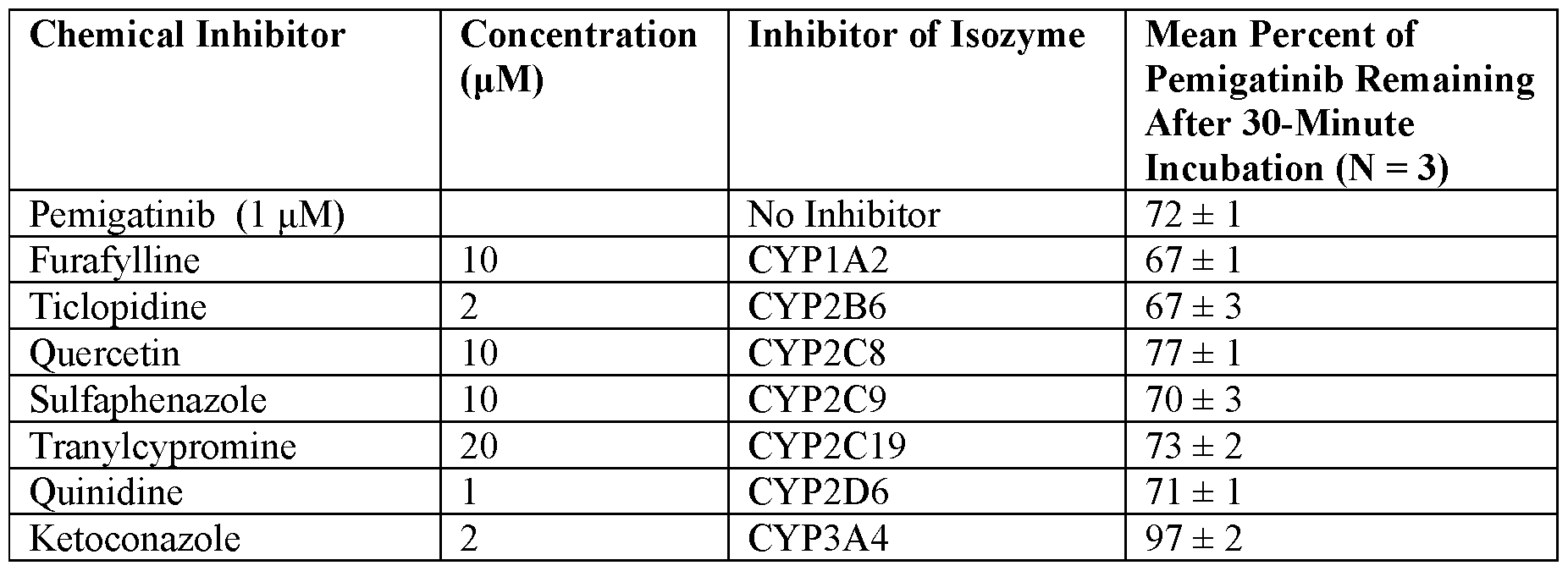
Example C. Model Development for Pemigatinib and Evaluation of Drug-Drug
Interactions
A minimal physiologically based pharmacokinetic (PBPK) with advanced dissolution absorption and metabolism (ADAM) absorption model for pemigatinib that incorporates
CYP3 A4-mediated metabolism derived from in vitro data, mass balance data, and clinical PK data (Example A) was developed. Data from in vitro studies have indicated that CYP3 A4 is the major isozyme responsible for the metabolism of pemigatinib (Example B). Based on mass balance and metabolite identification data, the oral absorption of pemigatinib is nearly complete and renal excretion is low (~ 1.0%), and liver metabolism is inferred to be the major clearance pathway for pemigatinib.
PBPK models that have been validated with clinical pharmacokinetic and DDI data can be used to predict other unknown DDI scenarios. The simulation results can also be used to support dose adjustment and label statements. The aims of this modeling and simulation study were to develop a PBPK model for pemigatinib, using in silico, in vitro, and clinical data to predict the drug-drug interaction.
Model Development
The initial PBPK model for pemigatinib was built using in vitro and in silico data. Data from in vitro studies (Example B) have indicated that CYP3A4 is the major isozyme responsible for the metabolism of pemigatinib. Based on mass balance and metabolite identification data, the oral absorption of pemigatinib is nearly complete (1.3% of the administered radioactive dose was recovered as unchanged pemigatinib in feces) and renal excreation is low (~ 1.0% of the dose is excreted in urine as unchanged pemigatinib), and liver metabolism is inferred to be the major clearance pathway for pemigatinib. Therefore, a minimal PBPK with ADAM absorption model for pemigatinib that incorporates CYP3 Ad- mediated metabolism derived from in vitro data and human ADME data was then further developed and model was used to describe the clinical PK data from pemigatinib alone cohorts in Example A. The sensitivity analysis of pemigatinib fmCYP3A4 on drug interaction with itraconazole suggested that CYP3A4 contributes ~ 55% of the metabolic clearance for pemigatinib. The verified pemigatinib model was then used to simulate the observed effect of itraconazole on pemigatib pharmacokinetics, and to confirm the contribution of CYP3 A4 (fmCYP3A4) to pemigatinib metabolic clearance. Finally, the pemigatinib PBPK model was applied to simulate the effect of other inhibitors and inducers on pemigatinib
pharmacokinetics.
Simulations were performed using pemigatinib PBPK model and compared with the observations in the clinical studies available. The pemigatinib PBPK model was validated by simulation of DDIs between pemigatinib and itraconazole or rifampin using a Simcyp virtual population, with the study design matching the corresponding clinical DDI study in healthy
volunteers. The itraconazole capsule (200 mg) was administered daily from Day 1 to Day 6 and a single 4.5-mg dose of pemigatinib tablet was administered orally with itraconazole on Day 5. The rifampin capsule (600 mg) was administered daily from Day 1 to Day 8 and a single 13.5-mg dose of pemigatinib tablet was administered orally with rifampin on Day 8. The simulations were performed using an age range of 18-55 years (proportion of female volunteers: 0.5).
The verified Pemigatinib PBPK model was used to predict the effect of other strong (clarithromycin), moderate (diltiazem, erythromycin, and cyclosporine), and mild
(fluvoxamine) CYP3 A4 inhibitors and moderate (efavirenz) and mild (dexamethasone)
CYP3 A4 inducers on pemigatinib PK. The Simcyp default PBPK models for clarithromycin, erythromycin, diltiazem, cyclosporine, fluvoxamine, and efavirenz were used in these simulations. Dexamethasone PBPK models are not available in the Simcyp model library. Therefore, a literature reported dexamethasone PBPK model was used for simulation. For CYP3 A4-mediated inhibition/induction simulation, the inhibitors/inducers were administered daily from Day 1 to Day 12 and a single 13.5-mg dose of pemigatinib tablet was administered orally on Day 8. The simulations were performed using an age range of 18-55 years
(proportion of female volunteers: 0.5).
Results
A minimal PBPK with ADAM absorption model for pemigatinib that incorporates CYP3 A4-mediated metabolism derived from in vitro data and in vivo clinical data was developed. Figure 3 shows the observed and simulated mean plasma concentration-time profiles for pemigatinib following a single oral dose of 4.5 mg (Figure 3A) and 13.5 (Figre 3B) mg pemigatinib tablet alone. Predicted and observed geometric mean plasma Cmax and AUCo- values for pemigatinib tablets are shown in Table 8. The simulated profiles of pemigatinib are comparable to the clinical data and the predicted geometric mean Cmax and AUCo- values are within 0.93- to 1.11-fold of the observed data.
Table 8: Predicted and Observed Exposures (Geometric Mean) Following a Single Oral Dose of 4.5 mg or 13.5 mg Pemigatinib Tablets

Table 9. Predicted and Observed Exposures (Geometric Mean) Following a Multiple Dose of Pemigatinib Tablets

The sensitivity analysis of pemigatinib fmCYP3A4 on drug interaction with itraconazole were used to determine CYP3A4 contribution of metabolic clearance for pemigatinib. The input of CYP3A4 CLint was varied to obtain a range of fmCYP3A from 0.25 to 0.95 (using the Simcyp retrograde calculator). The simulations of itraconazole-pemigatinib DDIs with different fmCYP3A values for pemigatinib were compared with the observed DDI data. When fmCYP3A4 was assigned to be 55%, the best prediction was achieved by PBPK model for the effect of DDI between pemigatinib and itraconazole (Figure 5 and Table 10).
Table 10: Simulated Pemigatinib Geometric Mean Cmax and AUC Ratios using PBPK Model with Various fmCYP3A4 Values

The comparison between simulated and observed pemigatinib PK in the presence and absence of itaconazole or rifampin are presented in Figure 6 and Figure 7, respectively. The predicted and observed geometric mean plasma Cmax and AUC values for pemigatinib tablets are shown in Table 11.
Table 11 :Predicted and Observed Pemigatinib Cmax and AUC Ratios Following a Single Oral Dose of Pemigatinib Tablets With and Without Itraconazole or Rifampin Administration

Values are presented in the format of geometric mean (90% confidence intervals). The model-predicted pemigatinib AUC ratio of 1.98 (90% Cl: 1.91, 2.05) and Cmax ratio of 1.22 (90% Cl: 1.20, 1.24) are similar to the observed AUC ratio of 1.88 (90% Cl:
1.75, 2.03) and Cmax ratio of 1.17 (90% Cl: 1.07, 1.29) for itraconazole DDI. The predicted geometric mean AUC ratios and Cmax ratios are within the 90% Cl of the observed data.
However, underprediction is observed for rifampin DDI. Model -predicted pemigatinib AUC ratio of 0.323 (90% Cl: 0.299, 0.349) and Cmax ratio of 0.604 (90% Cl: 0.572, 0.638) are approximately 1.5 to 2-fold higher comparing to the observed AUC ratio of 0.149 (90% Cl: 0.139, 0.161) and Cmax ratio of 0.380 (90% Cl: 0.332, 0.425) for rifampin DDI. In Example A, the observation of an 85% reduction in AUC and 63% decrease in half-life of pemigatinib following rifampin coadministration. In addition, the first pass gut and liver metabolism is expected to be low due to high permeability and low oral clearance of pemigatinib. All of these suggest that a decrease in bioavailability of pemigatinib occurred
with rifampin coadministration, in addition to an increase in systemic clearance (eg, reduced absorption).
The final pemigatinib PBPK model was not able to accurately predict drug-drug interaction between pemigatinib and rifampin which could be due to additional DDI effect on absorption of pemigatinib. The model with 55% fmCYP3A4 was used to predict DDI efftect on pemigatinib PK when co-administration with moderate and mild CYP3 A4 inducers. Results of the simulated effect of strong, moderate, and mild CYP3 A inhibitors/inducers on pemigatinib pharmacokinetics are summarized in Table 12 and illustrated in Figure 8.
Table 12. Simulated Pemigatinib Drug-Drug Interactions With Various CYP3A4 Inhibitors or Inducers

Values are presented in the format of geometric mean (90% confidence intervals).
The simulated DDI results for co-administraion with various CYP3 A4 inhibitors or inducers were used for pemigatinib dose recommadation. The model-simulated pemigatinib geometric mean Cmax and AUC ratios are 1.20 and 1.89, 1.16 and 1.66, 1.13 and 1.51, 1.05 and 1.08, 0.758 and 0.482, and 1.00 and 1.00, respectively, when coadministration with strong inhibitors clarithromycin, moderate inhibitors erythromycin and diltiazem, a mild
inhibitor fluvoxamine, a moderate inducer efavirenz and a mild inducer dexamethasone.
The recommendation based on this simulation and clinical DDI result is to reduce pemigatinib dose by approximately 50% for coadministration with strong CYP3 A4 inhibitors. For coadministration with moderate CYP3A4 inhibitors, the model-simulated pemigatinib AUCs are increased by approximately 50% and it is covered by safety margin. Therefore, no dose adjustment is required with coadministration of pemigatinib and moderate and mild CYP3 A4 inhibitors. The simulation and clinical DDI result also suggest that co-administration of a strong and moderate CYP3 A4 inducers should be avoided due to larger than 50% of pemigatinib AUC decrease and no dose adjustment is required with coadministration of pemigatinib and mild CYP3A4 inducers with clinical data. The estimated fmCYP3A4 (55%) for pemigatinib was verified using the observed clinical DDI study with itraconazole.
Various modifications of the invention, in addition to those described herein, will be apparent to those skilled in the art from the foregoing description. Such modifications are also intended to fall within the scope of the appended claims. Each reference, including all patent, patent applications, and publications, cited in the present application is incorporated herein by reference in its entirety.
Claims
1. A method of treating cancer comprising administering a therapy to a patient in need thereof, wherein the therapy comprises administering a therapeutically effective amount of pemigatinib to the patient while avoiding the concomitant administration of a CYP3A4 perpetrator.
2. A method of treating cancer comprising administering a therapy to a patient in need thereof, wherein the therapy comprises:
(a) determining if the patient is receiving administration of a CYP3 A4 perpetrator; and
(b) administering a therapeutically effective amount of pemigatinib to the patient while avoiding the concomitant administration of the CYP3 A4 perpetrator.
3. A method of treating cancer comprising administering a therapy to a patient in need thereof, wherein the therapy comprises:
(a) discontinuing administration of a CYP3 A4 perpetrator to the patient for a time period of about 5 or more half-lives of the CYP3 A4 perpetrator; and
(b) administering a therapeutically effective amount of pemigatinib to the patient.
4. The method of any one of claims 1-3, wherein the CYP3A4 perpetrator is a strong CYP3A4 inhibitor.
5. The method of any one of claims 1-3, wherein the CYP3A4 perpetrator is a moderate to strong CYP3A4 inducer.
6. A method of treating cancer comprising administering a therapy to a patient in need thereof, wherein the therapy comprises administering a therapeutically effective amount of pemigatinib to the patient while avoiding the concomitant administration of a strong CYP3A4 inhibitor.
7. A method of treating cancer comprising administering a therapy to a patient in need thereof, wherein the therapy comprises administering a therapeutically effective amount of pemigatinib to the patient while avoiding the concomitant administration of itraconazole.
8. A method of treating cancer comprising administering a therapy to a patient in need thereof, wherein the therapy comprises:
(a) determining if the patient is receiving administration of a strong CYP3 A4 inhibitor; and
(b) administering a therapeutically effective amount of pemigatinib to the patient while avoiding the concomitant administration of the strong CYP3 A4 inhibitor.
9. A method of treating cancer comprising administering a therapy to a patient in need thereof, wherein the therapy comprises:
(a) discontinuing administration of a strong CYP3 A4 inhibitor to the patient for a time period of about 5 or more half-lives of the strong CYP3 A4 inhibitor; and
(b) administering a therapeutically effective amount of pemigatinib to the patient.
10. The method of claim 9, wherein the time period of discontinuing administration of a strong CYP3 A4 inhibitor to the patient is 6 or more half-lives of the strong CYP3 A4 inhibitor.
11. The method of claim 9, wherein the time period of discontinuing administration of a strong CYP3 A4 inhibitor to the patient is 7 or more half-lives of the strong CYP3 A4 inhibitor.
12. A method of treating cancer in a patient in need thereof, comprising orally administering an adjusted daily dosage amount of pemigatinib to the patient who is receiving concomitant administration of a strong CYP3 A4 inhibitor, wherein the adjusted daily dosage amount of pemigatinib is about 25% to about 75% of an intended daily dosage amount of pemigatinib, and wherein:
(a) the intended daily dosage amount of pemigatinib is a dosage amount suitable for the patient if the patient is not receiving a concomitant strong CYP3 A4 inhibitor; or
(b) the intended daily dosage amount of pemigatinib is about 9 mg to 13.5 mg for an adult patient.
13. The method of any one of claims 1-12, wherein the administration of pemigatinib comprises:
(a) a continuous daily administration of an intended amount or adjusted amount of pemigatinib to the patient in need thereof; or
(b) a 21-day dosing cycle comprising: 14 days of daily administration of an intended amount or adjusted amount of pemigatinib to the patient in need thereof and 7 days without administration of pemigatinib.
14. The method of claim 13, wherein the adjusted daily amount of pemigatinib is about 40% to about 70% of the intended dosage amount of pemigatinib.
15. The method of claim 13, wherein the adjusted daily amount of pemigatinib is about 50% of the intended dosage amount of pemigatinib.
16. The method of claim 13, wherein the adjusted daily amount of pemigatinib is about 60% to about 70% of the intended dosage amount of pemigatinib.
17. The method of any one of claims 12-16, wherein the intended daily amount of pemigatinib is the dosage amount suitable for the patient if the patient is not receiving administration of a strong CYP3A4 inhibitor.
18. The method of any one of claims 12-16, wherein the intended daily amount of pemigatinib is about 9 mg to about 13.5 mg.
19. The method of claim 12 or 13, wherein the adjusted daily amount of pemigatinib is about 9 mg for patients on an intended dose of about 13.5 mg of pemigatinib.
20. The method of claim 12 or 13, wherein the adjusted daily dosage amount of pemigatinib is about 4.5 mg for patients on an intended dose of about 9 mg of pemigatinib.
21. The method of claim 12 or 13, wherein the adjusted daily dosage amount of pemigatinib is about 4.5 mg to about 9 mg.
22. The method of any one of claims 12-21, wherein the concomitant administration of pemigatinib and a strong CYP3 A4 inhibitor provides an altered therapeutic effect or adverse reaction profile of pemigatinib.
23. The method of any one of claims 12-22, wherein the adjusted daily dosage amount of pemigatinib is the amount that provides ti/2 values substantially the same as ti/2 values when pemigatinib is administered alone.
24. The method of any one of claims 12-22, wherein the ti/2 when 4.5 mg of pemigatinib is administered alone is about 12 hours.
25. The method of any one of claims 12-24, wherein the adjusted daily dosage amount of pemigatinib is the amount that provides Cmax values substantially the same as Cmax values when pemigatinib is administered alone.
26. The method of any one of claims 12-24, wherein the Cmax when 4.5 mg of pemigatinib is administered alone is about 50 nM to about 70 nM.
27. The method of any one of claims 12-24, wherein the Cmax when 4.5 mg of pemigatinib is administered alone is about 60 nM.
28. The method of any one of claims 12-27, wherein the adjusted daily dosage amount of pemigatinib is the amount that provides AUCo- values substantially the same as AUCo- values when pemigatinib is administered alone.
29. The method of any one of claims 12-27, wherein the AUCo- when 4.5 mg of pemigatinib is administered alone is about 500 nM-h to about 900 nM-h.
30. The method of any one of claims 12-27, wherein the AUCo- when 4.5 mg of pemigatinib is administered alone is about 600 nM-h to about 800 nM-h.
31. The method of any one of claims 12-27, wherein the AUCo- when 4.5 mg of pemigatinib is administered alone is about 700 nM-h.
32. The method of any one of claims 12-31, wherein the tin when 13.5 mg of pemigatinib is administered alone is about 13 hours.
33. The method of any one of claims 12-32, wherein the Cmax when 13.5 mg of pemigatinib is administered alone is about 190 nM to about 210 nM.
34. The method of any one of claims 12-32, wherein the Cmax when 13.5 mg of pemigatinib is administered alone is about 200 nM.
35. The method of any one of claims 12-34, wherein the AUCo- when 13.5 mg of pemigatinib is administered alone is about 1700 nM-h to about 2100 nM-h.
36. The method of any one of claims 12-34, wherein the AUCo- when 13.5 mg of pemigatinib is administered alone is about 1800 nM-h to about 2000 nM-h.
37. The method of any one of claims 12-34, wherein the AUCo- when 13.5 mg of pemigatinib is administered alone is about 1900 nM-h.
38. A method of treating cancer in a patient in need thereof, wherein the method comprises orally administering a therapeutically effective amount of pemigatinib to the patient and any one or more of the following:
(a) advising the patient that strong CYP3 A4 inhibitors should be avoided or discontinued;
(b) advising the patient that use of pemigatinib in patients being treated with strong CYP3 A4 inhibitors is contraindicated;
(c) advising the patient that the concomitant administration of pemigatinib and strong CYP3 A4 inhibitors can alter the therapeutic effect of pemigatinib;
(d) advising the patient that strong CYP3 A4 inhibitors should be used with caution in patients receiving pemigatinib due to the potential for reduced pemigatinib clearance;
(e) advising the patient that the concomitant administration of pemigatinib and strong CYP3 A4 inhibitors resulted in about 2-fold decrease in pemigatinib clearance; or
(f) advising the patient that the concomitant administration of pemigatinib and strong
CYP3A4 inhibitors resulted in 2-fold increase in exposure to pemigatinib.
39. The method of claim 38, comprising advising the patient that strong CYP3A4 inhibitors should be avoided or discontinued.
40. The method of claim 38, comprising advising the patient that use of pemigatinib in patients being treated with strong CYP3 A4 inhibitors is contraindicated.
41. The method of claim 38, comprising advising the patient that the concomitant administration of pemigatinib and strong CYP3 A4 inhibitors can alter the therapeutic effect of pemigatinib.
42. The method of claim 38, comprising advising the patient that the concomitant administration of pemigatinib and strong CYP3 A4 inhibitors resulted in 2-fold increase in exposure to pemigatinib.
43. The method of claim 38, comprising advising the patient that strong CYP3A4 inhibitors should be used with caution in patients receiving pemigatinib due to the potential for reduced pemigatinib clearance.
44. The method of claim 38, comprising advising the patient that the concomitant administration of pemigatinib and strong CYP3 A4 inhibitors resulted in about 2-fold decrease in pemigatinib clearance.
45. The method of any one of claims 8-44, wherein the strong CYP3A4 inhibitor is itraconazole, ketoconazole, or clarithromycin.
46. A method of treating cancer comprising administering a therapy to a patient in need thereof, wherein the therapy comprises the concomitant administering a therapeutically effective amount of pemigatinib and a mild to moderate CYP3 A4 inhibitor, and wherein the concomitant administration provides substantially the same therapeutic effect or adverse reaction profile of pemigatinib compared to when pemigatinib is administered alone.
47. A method of treating cancer comprising administering a therapy to a patient in need thereof, wherein the therapy comprises administering a therapeutically effective amount of pemigatinib to the patient while avoiding the concomitant administration of a moderate to strong CYP3A4 inducer.
48. A method of treating cancer comprising administering a therapy to a patient in need thereof, wherein the therapy comprises administering a therapeutically effective amount of pemigatinib to the patient while avoiding the concomitant administration of rifampin.
49. A method of treating cancer comprising administering a therapy to a patient in need thereof, wherein the therapy comprises:
(a) determining if the patient is receiving administration of a moderate to strong CYP3 A4 inducer; and
(b) administering a therapeutically effective amount of pemigatinib to the patient while avoiding the concomitant administration of a moderate to strong CYP3A4 inducer.
50. A method of treating cancer comprising administering a therapy to a patient in need thereof, wherein the therapy comprises:
(a) discontinuing administration of a moderate to strong CYP3 A4 inducer to the patient for a time period of about 5 or more half-lives of the moderate to strong CYP3 A4 inducer; and
(b) administering a therapeutically effective amount of pemigatinib to the patient.
51. The method of claim 50, wherein the time period of discontinuing administration of a moderate to strong CYP3 A4 inducer to the patient is 6 or more half-lives of the moderate to strong CYP3A4 inducer.
52. The method of claim 50, wherein the time period of discontinuing administration of a moderate to strong CYP3 A4 inducer to the patient is 7 or more half-lives of the moderate to strong CYP3A4 inducer.
53. The method of any one of claims 49-52, wherein the total daily amount of pemigatinib is about 9 mg to about 13.5 mg.
54. The method of any one of claims 49-53, wherein the concomitant administration of pemigatinib and a moderate to strong CYP3 A4 inducer provides an altered therapeutic effect of pemigatinib.
55. A method of treating cancer in a patient in need thereof, wherein the method comprises orally administering a therapeutically effective amount of pemigatinib to the patient and any one or more of the following:
(a) advising the patient that moderate to strong CYP3 A4 inducers should be avoided or discontinued;
(b) advising the patient that use of pemigatinib in patients being treated with moderate to strong CYP3A4 inducers is contraindicated;
(c) advising the patient that the concomitant administration of pemigatinib and moderate to strong CYP3 A4 inducers can alter the therapeutic effect of pemigatinib;
(d) advising the patient that moderate to strong CYP3 A4 inducers should be used with caution in patients receiving pemigatinib due to the potential for increased pemigatinib clearance;
(e) advising the patient that the concomitant administration of pemigatinib and strong CYP3 A4 inducers resulted in about 6-fold to about 7-fold increase in pemigatinib clearance; or
(f) advising the patient that the concomitant administration of pemigatinib and moderate to strong CYP3 A4 inducers resulted in about 6-fold to about 7-fold decrease in exposure to pemigatinib.
56. The method of claim 55 comprising advising the patient that moderate to strong CYP3 A4 inducers should be avoided or discontinued.
57. The method of claim 55 comprising advising the patient that use of pemigatinib in patients being treated with moderate to strong CYP3 A4 inducers is contraindicated.
58. The method of claim 55 comprising advising the patient that the concomitant administration of pemigatinib and moderate to strong CYP3 A4 inducers can alter the therapeutic effect of pemigatinib.
59. The method of claim 55 comprising advising the patient that moderate to strong CYP3 A4 inducers should be used with caution in patients receiving pemigatinib due to the potential for increased pemigatinib clearance.
60. The method of claim 55 comprising advising the patient that the concomitant administration of pemigatinib and strong CYP3 A4 inducers resulted in about 6-fold to about 7-fold increase in pemigatinib clearance.
61. The method of claim 55 comprising advising the patient that the concomitant administration of pemigatinib and moderate to strong CYP3 A4 inducers resulted in about 6- fold to about 7-fold decrease in exposure to pemigatinib.
62. The method of claim 55, wherein the CYP3A4 inducer is rifampin or efavirenz.
63. A method of treating cancer comprising administering a therapy to a patient in need thereof, wherein the therapy comprises concomitant administering a therapeutically effective amount of pemigatinib and a mild CYP3 A4 inducer, and wherein the concomitant administration provides substantially the same therapeutic effect or adverse reaction profile of pemigatinib compared to when pemigatinib is administered alone.
64. The method of claim 63, wherein the mild CYP3A4 inducer is dexamethasone
65. The method of any one of claims 1-64, wherein the cancer is bladder cancer, breast cancer, cervical cancer, cancer of the small intestine, colorectal cancer, endometrial cancer, gastric cancer, head and neck cancer, kidney cancer, liver cancer, lung cancer, ovarian cancer, prostate cancer, testicular cancer, uterine cancer, vulvar cancer, esophageal cancer, gall bladder cancer, pancreatic cancer, thyroid cancer, skin cancer, brain cancer, leukemia, multiple myeloma, chronic lymphocytic lymphoma, adult T cell leukemia, B-cell lymphoma, acute myelogenous leukemia, Hodgkin’s or non-Hodgkin’s lymphoma, Waldenstrom's Macroglubulinemia, myeloproliferative neoplasms, chronic myelogenic lymphoma, acute lymphoblastic lymphoma, hairy cell lymphoma, Burkett's lymphoma, glioblastoma, melanoma, rhabdosarcoma, lymphosarcoma, osteosarcoma, solid tumor, cholangiocellular carcinoma, and myeloid/lymphoid neoplasms.
66. The method of claim 65, wherein the myeloid/lymphoid neoplasm is 8p 11 myeloproliferative syndrome.
67. The method of claim 65, wherein the cancer is cholangiocellular carcinoma.
68 The method of claim 65, wherein the cancer is bladder cancer.
Applications Claiming Priority (2)
| Application Number | Priority Date | Filing Date | Title |
|---|---|---|---|
| US201962815772P | 2019-03-08 | 2019-03-08 | |
| US62/815,772 | 2019-03-08 |
Publications (1)
| Publication Number | Publication Date |
|---|---|
| WO2020185532A1 true WO2020185532A1 (en) | 2020-09-17 |
Family
ID=70166142
Family Applications (1)
| Application Number | Title | Priority Date | Filing Date |
|---|---|---|---|
| PCT/US2020/021313 Ceased WO2020185532A1 (en) | 2019-03-08 | 2020-03-06 | Methods of treating cancer with an fgfr inhibitor |
Country Status (2)
| Country | Link |
|---|---|
| US (2) | US11628162B2 (en) |
| WO (1) | WO2020185532A1 (en) |
Cited By (20)
| Publication number | Priority date | Publication date | Assignee | Title |
|---|---|---|---|---|
| WO2022193227A1 (en) * | 2021-03-18 | 2022-09-22 | Nutshell Biotech (Shanghai) Co., Ltd. | Fused ring compounds as inhibitors of fgfr tyrosine kinases |
| WO2023242825A1 (en) * | 2022-06-18 | 2023-12-21 | Novocure Gmbh | Compositions and methods for treating with a combination of alternating electric fields and fgf inhibitors |
| WO2024206858A1 (en) | 2023-03-30 | 2024-10-03 | Revolution Medicines, Inc. | Compositions for inducing ras gtp hydrolysis and uses thereof |
| WO2024229406A1 (en) | 2023-05-04 | 2024-11-07 | Revolution Medicines, Inc. | Combination therapy for a ras related disease or disorder |
| WO2025034702A1 (en) | 2023-08-07 | 2025-02-13 | Revolution Medicines, Inc. | Rmc-6291 for use in the treatment of ras protein-related disease or disorder |
| WO2025080946A2 (en) | 2023-10-12 | 2025-04-17 | Revolution Medicines, Inc. | Ras inhibitors |
| WO2025171296A1 (en) | 2024-02-09 | 2025-08-14 | Revolution Medicines, Inc. | Ras inhibitors |
| WO2025240847A1 (en) | 2024-05-17 | 2025-11-20 | Revolution Medicines, Inc. | Ras inhibitors |
| WO2025255438A1 (en) | 2024-06-07 | 2025-12-11 | Revolution Medicines, Inc. | Methods of treating a ras protein-related disease or disorder |
| WO2025265060A1 (en) | 2024-06-21 | 2025-12-26 | Revolution Medicines, Inc. | Therapeutic compositions and methods for managing treatment-related effects |
| WO2026006747A1 (en) | 2024-06-28 | 2026-01-02 | Revolution Medicines, Inc. | Ras inhibitors |
| WO2026015790A1 (en) | 2024-07-12 | 2026-01-15 | Revolution Medicines, Inc. | Methods of treating a ras related disease or disorder |
| WO2026015796A1 (en) | 2024-07-12 | 2026-01-15 | Revolution Medicines, Inc. | Methods of treating a ras related disease or disorder |
| WO2026015825A1 (en) | 2024-07-12 | 2026-01-15 | Revolution Medicines, Inc. | Use of ras inhibitor for treating pancreatic cancer |
| WO2026015801A1 (en) | 2024-07-12 | 2026-01-15 | Revolution Medicines, Inc. | Methods of treating a ras related disease or disorder |
| WO2026050446A1 (en) | 2024-08-29 | 2026-03-05 | Revolution Medicines, Inc. | Ras inhibitors |
| WO2026072904A2 (en) | 2024-09-26 | 2026-04-02 | Revolution Medicines, Inc. | Compositions and methods for treating lung cancer |
| WO2026090116A2 (en) | 2024-10-21 | 2026-04-30 | Revolution Medicines, Inc. | Ras inhibitors |
| WO2026090245A1 (en) | 2024-10-22 | 2026-04-30 | Revolution Medicines, Inc. | Use of ras inhibitors for treating cancer |
| WO2026090127A1 (en) | 2024-10-22 | 2026-04-30 | Revolution Medicines, Inc. | Methods of treating a ras protein-related disease or disorder |
Families Citing this family (6)
| Publication number | Priority date | Publication date | Assignee | Title |
|---|---|---|---|---|
| LT3495367T (en) | 2012-06-13 | 2021-02-25 | Incyte Holdings Corporation | MODIFIED TRICYCLIC COMPOUNDS AS FGFR INHIBITORS |
| MX2020011718A (en) | 2018-05-04 | 2021-02-15 | Incyte Corp | SOLID FORMS OF A FIBROBLAST GROWTH FACTOR RECEPTOR (FGFR) INHIBITOR AND PROCESSES FOR PREPARING THEM. |
| ES3061844T3 (en) | 2018-05-04 | 2026-04-07 | Incyte Corp | Salts of an fgfr inhibitor |
| WO2021113462A1 (en) | 2019-12-04 | 2021-06-10 | Incyte Corporation | Derivatives of an fgfr inhibitor |
| TW202304459A (en) | 2021-04-12 | 2023-02-01 | 美商英塞特公司 | Combination therapy comprising an fgfr inhibitor and a nectin-4 targeting agent |
| WO2024137821A1 (en) * | 2022-12-21 | 2024-06-27 | Elevar Therapeutics, Inc. | Effect of rivoceranib on cytochrome p450 enzyme substrates |
Citations (19)
| Publication number | Priority date | Publication date | Assignee | Title |
|---|---|---|---|---|
| US20120165305A1 (en) | 2010-12-22 | 2012-06-28 | Wenqing Yao | Substituted imidazopyridazines and benzimidazoles as inhibitors of fgfr3 |
| US20130338134A1 (en) | 2012-06-13 | 2013-12-19 | Incyte Corporation | Substituted tricyclic compounds as fgfr inhibitors |
| US20140045814A1 (en) | 2012-08-10 | 2014-02-13 | Incyte Corporation | Pyrazine derivatives as fgfr inhibitors |
| US20140171405A1 (en) | 2012-12-19 | 2014-06-19 | Incyte Corporation | Fused Pyrazoles as FGFR Inhibitors |
| US20140315902A1 (en) | 2013-04-19 | 2014-10-23 | Incyte Corporation | Bicyclic heterocycles as fgfr inhibitors |
| US20160115164A1 (en) | 2014-10-22 | 2016-04-28 | Incyte Corporation | Bicyclic heterocycles as fgfr4 inhibitors |
| US20160244450A1 (en) | 2015-02-20 | 2016-08-25 | Incyte Corporation | Bicyclic heterocycles as fgfr4 inhibitors |
| US20160244449A1 (en) | 2015-02-20 | 2016-08-25 | Incyte Corporation | Bicyclic heterocycles as fgfr4 inhibitors |
| US20160244448A1 (en) | 2015-02-20 | 2016-08-25 | Incyte Corporation | Bicyclic heterocycles as fgfr4 inhibitors |
| US20170107216A1 (en) | 2015-10-19 | 2017-04-20 | Incyte Corporation | Heterocyclic compounds as immunomodulators |
| US20170145025A1 (en) | 2015-11-19 | 2017-05-25 | Incyte Corporation | Heterocyclic compounds as immunomodulators |
| US20170174671A1 (en) | 2015-12-17 | 2017-06-22 | Incyte Corporation | Heterocyclic compounds as immunomodulators |
| US20170174679A1 (en) | 2015-12-22 | 2017-06-22 | Incyte Corporation | Heterocyclic compounds as immunomodulators |
| US20170320875A1 (en) | 2016-05-06 | 2017-11-09 | Incyte Corporation | Heterocyclic compounds as immunomodulators |
| US20170342060A1 (en) | 2016-05-26 | 2017-11-30 | Incyte Corporation | Heterocyclic compounds as immunomodulators |
| US20170362253A1 (en) | 2016-06-20 | 2017-12-21 | Incyte Corporation | Heterocyclic compounds as immunomodulators |
| US20180016260A1 (en) | 2016-07-14 | 2018-01-18 | Incyte Corporation | Heterocyclic compounds as immunomodulators |
| US20190337948A1 (en) | 2018-05-04 | 2019-11-07 | Incyte Corporation | Solid forms of an fgfr inhibitor and processes for preparing the same |
| US20200002338A1 (en) | 2018-05-04 | 2020-01-02 | Incyte Corporation | Salts of an fgfr inhibitor |
Family Cites Families (783)
| Publication number | Priority date | Publication date | Assignee | Title |
|---|---|---|---|---|
| DE280853C (en) | ||||
| US850370A (en) | 1906-06-05 | 1907-04-16 | William L Hynes | Water-automobile. |
| DE2156720A1 (en) | 1971-11-16 | 1973-05-24 | Bayer Ag | Pyrimido(4,5-d) pyrimidines - prepd from polychloroalkylimino acid chloride and 4-amino uracils, are starting materials for plant |
| US3894021A (en) | 1974-01-28 | 1975-07-08 | Squibb & Sons Inc | Derivatives of 1,7-dihydro-2H-pyrazolo{8 4{40 ,3{40 :5,6{9 pyrido{8 4,3-D{9 pyrimidine-2,4-(3H)-diones |
| JPS5120580B2 (en) | 1974-06-19 | 1976-06-25 | ||
| US4347348A (en) | 1978-06-05 | 1982-08-31 | Chernikhov Alexei Y | Heat-resistant heterocyclic polymers and methods for producing same |
| FR2428654A1 (en) | 1978-06-13 | 1980-01-11 | Chernikhov Alexei | Heat-stable heterocyclic polymer prepn. - by reacting polyfunctional nitrile with polyfunctional isocyanate opt. contg. silicon, halogen, nitrogen, phosphorus and/or boron atoms |
| CH635828A5 (en) | 1978-08-30 | 1983-04-29 | Ciba Geigy Ag | N-SUBSTITUTED IMIDES AND BISIMIDS. |
| CH641470A5 (en) | 1978-08-30 | 1984-02-29 | Ciba Geigy Ag | SILANES CONTAINING IMID GROUPS. |
| US4339267A (en) | 1980-01-18 | 1982-07-13 | E. I. Du Pont De Nemours And Company | Herbicidal sulfonamides |
| US4402878A (en) | 1980-10-22 | 1983-09-06 | Plastics Engineering Company | Addition products of di-acetylene-terminated polyimide derivatives with a polyimide having terminal non-conjugated acetylene groups |
| US4405519A (en) | 1980-10-22 | 1983-09-20 | Plastics Engineering Company | Di-Acetylene-terminated polyimide derivatives |
| US4405786A (en) | 1980-10-22 | 1983-09-20 | Plastics Engineering Company | Addition products of di-acetylene-terminated polyimide derivatives and an dienophile having ethylene groups |
| US4405520A (en) | 1980-10-22 | 1983-09-20 | Plastics Engineering Company | Addition products of di-acetylene-terminated polymide derivatives and dienophiles having terminal maleimide grops |
| JPS5857170A (en) | 1981-09-30 | 1983-04-05 | シャープ株式会社 | Study apparatus |
| US4460773A (en) | 1982-02-05 | 1984-07-17 | Lion Corporation | 1-Phenyl-1H-pyrazolo [3,4-b]pyrazine derivatives and process for preparing same |
| DE3432983A1 (en) | 1983-09-07 | 1985-04-18 | Lion Corp., Tokio/Tokyo | 1,5-disubstituted 1H-pyrazolo[3,4-b]pyrazine derivatives and antitumour agents which contain them |
| JPS62273979A (en) | 1986-05-21 | 1987-11-28 | Lion Corp | 1,5-substituted-1H-pyrazolo[3,4-b]pyrazine derivatives and antitumor agents containing the compounds |
| JPS6310630A (en) | 1986-06-23 | 1988-01-18 | Teijin Ltd | Production of aromatic polyamide-imide ether |
| JPS6317882A (en) | 1986-07-09 | 1988-01-25 | Lion Corp | 5-substituted-1H-pyrazolo[3,4-b]pyrazine derivatives and antitumor agents containing the compounds |
| US4859672A (en) | 1986-10-29 | 1989-08-22 | Rorer Pharmaceutical Corporation | Pyrido[2,3-d]pyrimidinone and imidazo[4,5-b]pyrimidinone |
| US4874803A (en) | 1987-09-21 | 1989-10-17 | Pennwalt Corporation | Dianhydride coupled polymer stabilizers |
| DE3814549A1 (en) | 1987-10-30 | 1989-05-18 | Bayer Ag | N-SUBSTITUTED DERIVATIVES OF 1-DESOXYNOJIRIMYCIN AND 1-DESOXYMANNONOJIRIMYCIN, METHOD FOR THE PRODUCTION AND USE THEREOF IN MEDICINAL PRODUCTS |
| JPH029895A (en) | 1988-06-28 | 1990-01-12 | Lion Corp | Nucleoside analog compound and antitumor agent |
| US5159054A (en) | 1989-05-16 | 1992-10-27 | The United States Of America As Represented By The Secretary Of The Navy | Synthesis of phthalonitrile resins containing ether and imide linkages |
| JP2845957B2 (en) | 1989-07-17 | 1999-01-13 | 三井化学株式会社 | Novel diphenols having imide ring and process for producing the same |
| US5726302A (en) | 1989-09-15 | 1998-03-10 | Gensia Inc. | Water soluble adenosine kinase inhibitors |
| DE3937633A1 (en) | 1989-11-11 | 1991-05-16 | Bayer Ag | HETEROCYCLIC COMPOUNDS AND THEIR USE AS PIGMENTS AND DYES |
| US5329046A (en) | 1989-12-28 | 1994-07-12 | Hoechst Aktiengesellschaft | Biscationic acid amide and imide derivatives and processes for their preparation |
| WO1991010172A1 (en) | 1989-12-28 | 1991-07-11 | Hoechst Aktiengesellschaft | Biscationic acid amide and acid imide derivatives as charge controllers |
| JP2883670B2 (en) | 1990-03-23 | 1999-04-19 | 三井化学株式会社 | Novel bisphenol having imide ring and method for producing the same |
| GB9113137D0 (en) | 1990-07-13 | 1991-08-07 | Ici Plc | Thioxo heterocycles |
| EP0552197B1 (en) | 1990-10-03 | 1999-01-13 | Commonwealth Scientific And Industrial Research Organisation | Epoxy resins based on diaminobisimide compounds |
| JPH04158084A (en) | 1990-10-22 | 1992-06-01 | Fuji Photo Film Co Ltd | Recording material |
| JPH04179576A (en) | 1990-11-14 | 1992-06-26 | Fuji Photo Film Co Ltd | Recording material |
| JPH04328121A (en) | 1991-04-26 | 1992-11-17 | Sumitomo Bakelite Co Ltd | Epoxy resin composition for sealing semiconductor |
| KR100207360B1 (en) | 1991-06-14 | 1999-07-15 | 돈 더블유. 슈미츠 | Imidazon (1,5-a) quinoxalines |
| DE4119767A1 (en) | 1991-06-15 | 1992-12-17 | Dresden Arzneimittel | Prepn. of (pyrimid-2-yl-thio- or seleno-) acetic acid derivs. - by reacting the corresp. chloro:alkanoyl-amino cpd. with a rhodanide and water or an alcohol |
| US5521184A (en) | 1992-04-03 | 1996-05-28 | Ciba-Geigy Corporation | Pyrimidine derivatives and processes for the preparation thereof |
| JP3279635B2 (en) | 1992-05-18 | 2002-04-30 | 鐘淵化学工業株式会社 | Hydrosilyl group-containing imide compound |
| JP3232123B2 (en) | 1992-05-20 | 2001-11-26 | 鐘淵化学工業株式会社 | Curable composition |
| US5616666A (en) | 1992-05-28 | 1997-04-01 | Commonwealth Scientific And Industrial Research Organisation | Bismaleimide compounds |
| JPH08504196A (en) | 1992-12-07 | 1996-05-07 | コモンウェルス・サイエンティフィック・アンド・インダストリアル・リサーチ・オーガニゼイション | Bisnadimide |
| CA2153595A1 (en) | 1993-01-11 | 1994-07-21 | Anthony F. Garito | Polycyclic aromatic compounds having nonlinear optical properties |
| WO1994025438A1 (en) | 1993-04-28 | 1994-11-10 | The Du Pont Merck Pharmaceutical Company | Novel trisubstituted aromatic amines useful for the treatment of cognitive deficits |
| US5536725A (en) | 1993-08-25 | 1996-07-16 | Fmc Corporation | Insecticidal substituted-2,4-diamino-5,6,7,8-tetrahydroquinazolines |
| RO118291B1 (en) | 1993-11-30 | 2003-04-30 | Searle & Co | PIRAZOL DERIVATIVES 1,3,4,5 - TETRASUBSTITUITIS AND PHARMACEUTICAL COMPOSITION CONTAINING CONTAINERS |
| US5480887A (en) | 1994-02-02 | 1996-01-02 | Eli Lilly And Company | Protease inhibitors |
| CA2182090A1 (en) | 1994-02-02 | 1995-08-10 | William Joseph Hornback | Hiv protease inhibitors and intermediates |
| MX9702245A (en) | 1994-11-14 | 1997-06-28 | Warner Lambert Co | 6-ARYL PYRIDO[2,3-d]PYRIMIDINES AND NAPHTHYRIDINES FOR INHIBITING PROTEIN TYROSINE KINASE MEDIATED CELLULAR PROLIFERATION. |
| US7067664B1 (en) | 1995-06-06 | 2006-06-27 | Pfizer Inc. | Corticotropin releasing factor antagonists |
| US5783577A (en) | 1995-09-15 | 1998-07-21 | Trega Biosciences, Inc. | Synthesis of quinazolinone libraries and derivatives thereof |
| JPH09188812A (en) | 1996-01-11 | 1997-07-22 | Mitsui Toatsu Chem Inc | Crystallization accelerator |
| AU2980797A (en) | 1996-06-11 | 1998-01-07 | Yoshitomi Pharmaceutical Industries, Ltd. | Fused heterocyclic compounds and medicinal uses thereof |
| NZ333727A (en) | 1996-08-06 | 2000-09-29 | Pfizer | Substituted pyrido- or pyrimido-containing 6,6- or 6,7-bicyclic arylsulfonylamino hydroxamic acid derivatives |
| EP0927167A1 (en) | 1996-08-14 | 1999-07-07 | Warner-Lambert Company | 2-phenyl benzimidazole derivatives as mcp-1 antagonists |
| JP3669783B2 (en) | 1996-08-21 | 2005-07-13 | 三井化学株式会社 | Organic electroluminescence device |
| US5994364A (en) | 1996-09-13 | 1999-11-30 | Schering Corporation | Tricyclic antitumor farnesyl protein transferase inhibitors |
| WO1998018781A2 (en) | 1996-10-28 | 1998-05-07 | Versicor, Inc. | Fused 2,4-pyrimidinedione combinatorial libraries, their preparation and the use of fused 2,4-pyrimidinediones derivatives as antimicrobial agents |
| AU5330698A (en) | 1996-12-23 | 1998-07-17 | Celltech Therapeutics Limited | Fused polycyclic 2-aminopyrimidine derivatives, their preparation and their use as protein tyrosine kinase inhibitors |
| KR20000070751A (en) | 1997-02-05 | 2000-11-25 | 로즈 암스트롱, 크리스틴 에이. 트러트웨인 | Pyrido[2,3-D]pyrimidines and 4-Aminopyrimidines as Inhibitors of Cellular Proliferation |
| JP2001521523A (en) | 1997-04-11 | 2001-11-06 | アボツト・ラボラトリーズ | Furopyridine, thienopyridine, pyrrolopyridine and related pyrimidine, pyridazine and triazine compounds useful in controlling chemical synaptic transmission |
| AU742739B2 (en) | 1997-05-28 | 2002-01-10 | Aventis Pharmaceuticals Inc. | Quinoline and quinoxaline compounds which inhibit platelet-derived growth factor and/or p56 lck tyrosine kinases |
| GB9716231D0 (en) | 1997-07-31 | 1997-10-08 | Amersham Int Ltd | Base analogues |
| WO1999007732A1 (en) | 1997-08-11 | 1999-02-18 | Cor Therapeutics, Inc. | SELECTIVE FACTOR Xa INHIBITORS |
| AU742999B2 (en) | 1997-08-20 | 2002-01-17 | Warner-Lambert Company | Naphthyridinones for inhibiting protein tyrosine kinase and cell cycle kinase mediated cellular proliferation |
| US6465484B1 (en) | 1997-09-26 | 2002-10-15 | Merck & Co., Inc. | Angiogenesis inhibitors |
| JPH11171865A (en) | 1997-12-04 | 1999-06-29 | Yoshitomi Pharmaceut Ind Ltd | Fused heterocyclic compound |
| CA2316944A1 (en) | 1998-02-20 | 1999-08-26 | Mitsuru Shiraishi | Aminoguanidinehydrazone derivative, production and use thereof |
| CA2332239A1 (en) | 1998-05-15 | 1999-11-25 | Guilford Pharmaceuticals Inc. | Fused tricyclic compounds which inhibit parp activity |
| US20040044012A1 (en) | 1998-05-26 | 2004-03-04 | Dobrusin Ellen Myra | Bicyclic pyrimidines and bicyclic 3,4-dihydropyrimidines as inhibitors of cellular proliferation |
| EE200000706A (en) | 1998-05-26 | 2002-06-17 | Warner-Lambert Company | Bicyclic pyrimidines and bicyclic 3,4-dihydropyrimidines as inhibitors of cell proliferation |
| WO1999064400A1 (en) | 1998-06-12 | 1999-12-16 | Vertex Pharmaceuticals Incorporated | INHIBITORS OF p38 |
| EP1107964B8 (en) | 1998-08-11 | 2010-04-07 | Novartis AG | Isoquinoline derivatives with angiogenesis inhibiting activity |
| JP2000123973A (en) | 1998-10-09 | 2000-04-28 | Canon Inc | Organic light emitting device |
| CN1150195C (en) | 1998-10-23 | 2004-05-19 | 霍夫曼-拉罗奇有限公司 | bicyclic nitrogen heterocycle |
| GB9823103D0 (en) | 1998-10-23 | 1998-12-16 | Pfizer Ltd | Pharmaceutically active compounds |
| US6133031A (en) | 1999-08-19 | 2000-10-17 | Isis Pharmaceuticals Inc. | Antisense inhibition of focal adhesion kinase expression |
| GB9905075D0 (en) | 1999-03-06 | 1999-04-28 | Zeneca Ltd | Chemical compounds |
| DE19912638A1 (en) | 1999-03-20 | 2000-09-21 | Bayer Ag | Naphthylcarboxamide substituted sulfonamides |
| DE19920790A1 (en) | 1999-05-06 | 2000-11-09 | Bayer Ag | Bis-sulfonamides with anti-HCMV activity |
| PE20010306A1 (en) | 1999-07-02 | 2001-03-29 | Agouron Pharma | INDAZOLE COMPOUNDS AND PHARMACEUTICAL COMPOSITIONS CONTAINING THEM USEFUL FOR THE INHIBITION OF PROTEIN KINASE |
| JP4041624B2 (en) | 1999-07-21 | 2008-01-30 | 三井化学株式会社 | Organic electroluminescence device |
| DE60025837T2 (en) | 1999-09-24 | 2006-11-02 | Janssen Pharmaceutica N.V. | ANTIVIRAL SOLID DISPERSIONS |
| DE19946289A1 (en) | 1999-09-28 | 2001-03-29 | Basf Ag | Benzodiazepine derivatives, their production and use |
| KR100523120B1 (en) | 1999-10-21 | 2005-10-20 | 에프. 호프만-라 로슈 아게 | Heteroalkylamino-substituted bicyclic nitrogen heterocycles as inhibitors of p38 protein kinase |
| PL357494A1 (en) | 1999-10-21 | 2004-07-26 | F.Hoffmann-La Roche Ag | Alkylamino substituted bicyclic nitrogen heterocycles as inhibitors of p38 protein kinase |
| TWI271406B (en) | 1999-12-13 | 2007-01-21 | Eisai Co Ltd | Tricyclic condensed heterocyclic compounds, preparation method of the same and pharmaceuticals comprising the same |
| DK1242382T3 (en) | 1999-12-29 | 2007-05-07 | Wyeth Corp | Tricyclic protein kinase inhibitors |
| YU55902A (en) | 2000-01-24 | 2006-01-16 | Warner-Lambert Company | 3-aminoquinazolin-2,4-dione antibacterial agents |
| CZ20022521A3 (en) | 2000-01-27 | 2003-02-12 | Warner-Lambert Company | Pyridopyrimidinone derivatives for treating neurodegenerative diseases |
| US7041675B2 (en) | 2000-02-01 | 2006-05-09 | Abbott Gmbh & Co. Kg | Heterocyclic compounds and their use as PARP inhibitors |
| DE60114994T2 (en) | 2000-02-04 | 2006-08-03 | Portola Pharmaceuticals, Inc., South San Francisco | PLATELET ADP RECEPTOR INHIBITORS |
| PT1254138E (en) | 2000-02-09 | 2005-09-30 | Novartis Ag | PYRIDINE DERIVATIVES THAT INHIBIT ANGIOGENESE AND / OR VIRUS TYROSINE KINASE RECEPTOR |
| GB0004890D0 (en) | 2000-03-01 | 2000-04-19 | Astrazeneca Uk Ltd | Chemical compounds |
| ATE300303T1 (en) | 2000-03-06 | 2005-08-15 | Astrazeneca Ab | USE OF QUINAZOLINE DERIVATIVES AS INHIBITORS OF ANGIOGENesis |
| DE10012549A1 (en) | 2000-03-15 | 2001-09-20 | Bayer Ag | New heterocyclic-substituted dihydropyrimidine derivatives useful for treatment of viral infections, especially hepatitis B infections |
| JP2001265031A (en) | 2000-03-15 | 2001-09-28 | Fuji Xerox Co Ltd | Electrophotographic photoreceptor, process cartridge and electrophotographic device |
| RU2269523C2 (en) | 2000-04-28 | 2006-02-10 | Акадиа Фармасьютикалз, Инк. | Muscarinic agonists |
| CA2408156A1 (en) | 2000-05-05 | 2001-11-15 | Millennium Pharmaceuticals, Inc. | Heterobicyclic sulfonamides and their use as platelet adp receptor inhibitors |
| AU2001268712A1 (en) | 2000-06-23 | 2002-01-08 | Bristol-Myers Squibb Company | 1 - (heteroaryl-phenyl) - condensed pyrazol derivatives as factor Xa inhibitors |
| KR100786927B1 (en) | 2000-06-28 | 2007-12-17 | 스미스클라인비이참피이엘시이 | Wet Grinding Method |
| US20050009876A1 (en) | 2000-07-31 | 2005-01-13 | Bhagwat Shripad S. | Indazole compounds, compositions thereof and methods of treatment therewith |
| CA2420967A1 (en) | 2000-08-07 | 2002-02-14 | Neurogen Corporation | Heterocyclic compounds as ligands of the gabaa receptor |
| RU2317988C2 (en) | 2000-08-14 | 2008-02-27 | Орто-Макнейл Фармасьютикал, Инк. | Substituted pyrazoles, pharmaceutical composition based on thereof, using pharmaceutical composition and method for inhibition of cathepsin s activity |
| DE60136546D1 (en) | 2000-09-06 | 2008-12-24 | Ortho Mcneil Pharm Inc | METHOD FOR COMBATING ALLERGIES THROUGH THE USE OF SUBSTITUTED PYRAZOLES |
| GB0025782D0 (en) | 2000-10-20 | 2000-12-06 | Pfizer Ltd | Use of inhibitors |
| EP1217000A1 (en) | 2000-12-23 | 2002-06-26 | Aventis Pharma Deutschland GmbH | Inhibitors of factor Xa and factor VIIa |
| GB0100621D0 (en) | 2001-01-10 | 2001-02-21 | Vernalis Res Ltd | Chemical compounds VI |
| GB0103926D0 (en) | 2001-02-17 | 2001-04-04 | Astrazeneca Ab | Chemical compounds |
| AP1699A (en) | 2001-03-21 | 2006-12-26 | Warner Lambert Co | New spirotricyclic derivatives and their use as phosphodiesterase-7 inhibitors |
| US6998408B2 (en) | 2001-03-23 | 2006-02-14 | Bristol-Myers Squibb Pharma Company | 6-5, 6-6, or 6-7 Heterobicycles as factor Xa inhibitors |
| JP2002296731A (en) | 2001-03-30 | 2002-10-09 | Fuji Photo Film Co Ltd | Heat developable color image recording material |
| WO2002083648A1 (en) | 2001-04-16 | 2002-10-24 | Eisai Co., Ltd. | Novel 1h-indazole compound |
| JP4310109B2 (en) | 2001-04-26 | 2009-08-05 | エーザイ・アール・アンド・ディー・マネジメント株式会社 | Nitrogen-containing fused ring compound having pyrazolyl group as substituent and pharmaceutical composition thereof |
| WO2002088095A1 (en) | 2001-04-30 | 2002-11-07 | Glaxo Group Limited | Fused pyrimidines as antagonists of the corticotropin releasing factor (crf) |
| WO2002094825A1 (en) | 2001-05-22 | 2002-11-28 | Banyu Pharmaceutical Co., Ltd. | Novel spiropiperidine derivative |
| US20030114448A1 (en) | 2001-05-31 | 2003-06-19 | Millennium Pharmaceuticals, Inc. | Inhibitors of factor Xa |
| AU2002302894A1 (en) | 2001-06-19 | 2003-01-02 | Warner-Lambert Company Llc | Quinazolinediones as antibacterial agents |
| GB0115109D0 (en) | 2001-06-21 | 2001-08-15 | Aventis Pharma Ltd | Chemical compounds |
| EP1463742A4 (en) | 2001-06-21 | 2006-05-10 | Ariad Pharma Inc | Novel pyrazolo-and pyrrolo-pyrimidines and uses thereof |
| WO2003000690A1 (en) | 2001-06-25 | 2003-01-03 | Aventis Pharmaceuticals Inc. | Synthesis of heterocyclic compounds employing microwave technology |
| US20040235867A1 (en) | 2001-07-24 | 2004-11-25 | Bilodeau Mark T. | Tyrosine kinase inhibitors |
| US7205417B2 (en) | 2001-08-07 | 2007-04-17 | Banyu Pharmaceutical Co., Ltd. | Spiro compounds |
| AU2002337142B2 (en) | 2001-09-19 | 2007-10-11 | Aventis Pharma S.A. | Indolizines as kinase protein inhibitors |
| IL161156A0 (en) | 2001-10-30 | 2004-08-31 | Novartis Ag | Staurosporine derivatives as inhibitors of flt3 receptor tyrosine kinase activity |
| MXPA04004178A (en) | 2001-11-01 | 2004-09-06 | Janssen Pharmaceutica Nv | Heteroaryl amines as glycogen synthase kinase 3beta inhibitors (gsk3 inhibitors). |
| RU2308455C2 (en) | 2001-11-07 | 2007-10-20 | Ф.Хоффманн-Ля Рош Аг | Aminopyrimidines and pyridines |
| CA2466279A1 (en) | 2001-11-13 | 2003-05-22 | Dana-Farber Cancer Institute, Inc. | Agents that modulate immune cell activation and methods of use thereof |
| GB0129476D0 (en) | 2001-12-10 | 2002-01-30 | Syngenta Participations Ag | Organic compounds |
| ATE314370T1 (en) | 2002-01-22 | 2006-01-15 | Warner Lambert Co | 2-(PYRIDINE-2-YLAMINO)-PYRIDO(2,3-D)PYRIMIDINE-7-ONE |
| JP4201716B2 (en) | 2002-03-05 | 2008-12-24 | メルク フロスト カナダ リミテツド | Cathepsin cysteine protease inhibitor |
| US6815519B2 (en) | 2002-03-22 | 2004-11-09 | Chung-Shan Institute Of Science & Technology | Acidic fluorine-containing poly (siloxane amideimide) silica hybrids |
| PL374544A1 (en) | 2002-04-03 | 2005-10-31 | F.Hoffmann-La Roche Ag | Imidazo fused compounds |
| AU2003234567A1 (en) | 2002-05-15 | 2003-12-02 | Janssen Pharmaceutica N.V. | N-substituted tricyclic 3-aminopyrazoles as pdfg receptor inhibitors |
| JP4499342B2 (en) | 2002-05-16 | 2010-07-07 | 株式会社カネカ | Method for producing nitrogen-containing organic compound containing SiH group |
| DE60333937D1 (en) | 2002-05-23 | 2010-10-07 | Novartis Vaccines & Diagnostic | SUBSTITUTED QUINAZOLINONE COMPOUNDS |
| US7119111B2 (en) | 2002-05-29 | 2006-10-10 | Amgen, Inc. | 2-oxo-1,3,4-trihydroquinazolinyl derivatives and methods of use |
| TW200406374A (en) | 2002-05-29 | 2004-05-01 | Novartis Ag | Diaryl urea derivatives useful for the treatment of protein kinase dependent diseases |
| US7105526B2 (en) | 2002-06-28 | 2006-09-12 | Banyu Pharmaceuticals Co., Ltd. | Benzimidazole derivatives |
| GB0215676D0 (en) | 2002-07-05 | 2002-08-14 | Novartis Ag | Organic compounds |
| US7196090B2 (en) | 2002-07-25 | 2007-03-27 | Warner-Lambert Company | Kinase inhibitors |
| BR0313059B8 (en) | 2002-07-29 | 2021-07-27 | Rigel Pharmaceuticals | compound, and, pharmaceutical composition |
| CA2492112A1 (en) | 2002-08-06 | 2004-02-19 | F. Hoffmann-La Roche Ag | 6-alkoxy-pyrido-pyrimidines as p-38 map kinase inhibitors |
| EP1388541A1 (en) | 2002-08-09 | 2004-02-11 | Centre National De La Recherche Scientifique (Cnrs) | Pyrrolopyrazines as kinase inhibitors |
| US7084270B2 (en) | 2002-08-14 | 2006-08-01 | Hoffman-La Roche Inc. | Pyrimido compounds having antiproliferative activity |
| GB0220187D0 (en) | 2002-08-30 | 2002-10-09 | Novartis Ag | Organic compounds |
| GB0223349D0 (en) | 2002-10-08 | 2002-11-13 | Merck Sharp & Dohme | Therapeutic agents |
| US7112676B2 (en) | 2002-11-04 | 2006-09-26 | Hoffmann-La Roche Inc. | Pyrimido compounds having antiproliferative activity |
| TW200413381A (en) | 2002-11-04 | 2004-08-01 | Hoffmann La Roche | Novel amino-substituted dihydropyrimido [4,5-d]pyrimidinone derivatives, their manufacture and use as pharmaceutical agents |
| WO2004043367A2 (en) | 2002-11-06 | 2004-05-27 | Bristol-Myers Squibb Company | Fused heterocyclic compounds and use thereof |
| AR042052A1 (en) | 2002-11-15 | 2005-06-08 | Vertex Pharma | USEFUL DIAMINOTRIAZOLS AS INHIBITORS OF PROTEINQUINASES |
| PL377620A1 (en) | 2002-11-18 | 2006-02-06 | F. Hoffmann-La Roche Ag | Diazinopyrimidines |
| KR20050084027A (en) | 2002-11-28 | 2005-08-26 | 쉐링 악티엔게젤샤프트 | Chk-, pdk- and akt-inhibitory pyrimidines, their production and use as pharmaceutical agents |
| EP1567497B1 (en) | 2002-12-06 | 2009-09-23 | Purdue Research Foundation | Pyridines for treating injured mammalian nerve tissue |
| WO2004052862A1 (en) | 2002-12-10 | 2004-06-24 | Ono Pharmaceutical Co., Ltd. | Nitrogen-containing heterocyclic compounds and medicinal use thereof |
| UA80171C2 (en) | 2002-12-19 | 2007-08-27 | Pfizer Prod Inc | Pyrrolopyrimidine derivatives |
| US7098332B2 (en) | 2002-12-20 | 2006-08-29 | Hoffmann-La Roche Inc. | 5,8-Dihydro-6H-pyrido[2,3-d]pyrimidin-7-ones |
| UA80767C2 (en) | 2002-12-20 | 2007-10-25 | Pfizer Prod Inc | Pyrimidine derivatives for the treatment of abnormal cell growth |
| WO2004056875A1 (en) | 2002-12-23 | 2004-07-08 | Wyeth | Antibodies against pd-1 and uses therefor |
| JP2004203749A (en) | 2002-12-24 | 2004-07-22 | Kanegafuchi Chem Ind Co Ltd | Method for producing nitrogen-containing organic compound containing SiH group |
| MXPA05007503A (en) | 2003-01-17 | 2005-09-21 | Warner Lambert Co | 2-aminopyridine substituted heterocycles as inhibitors of cellular proliferation. |
| GB0305929D0 (en) | 2003-03-14 | 2003-04-23 | Novartis Ag | Organic compounds |
| US7135469B2 (en) | 2003-03-18 | 2006-11-14 | Bristol Myers Squibb, Co. | Linear chain substituted monocyclic and bicyclic derivatives as factor Xa inhibitors |
| CA2518465A1 (en) | 2003-03-25 | 2004-10-14 | Takeda San Diego, Inc. | Dipeptidyl peptidase inhibitors |
| GB0308208D0 (en) | 2003-04-09 | 2003-05-14 | Glaxo Group Ltd | Chemical compounds |
| JP2006522756A (en) | 2003-04-10 | 2006-10-05 | エフ.ホフマン−ラ ロシュ アーゲー | Pyrimido compounds |
| BRPI0409986A (en) | 2003-05-05 | 2006-05-09 | Hoffmann La Roche | fused pyrimidine derivatives with crf activity |
| JP2004346145A (en) | 2003-05-21 | 2004-12-09 | Teijin Ltd | Imide composition, resin composition comprising the same, and method for producing the same |
| KR20060018217A (en) | 2003-05-23 | 2006-02-28 | 카이론 코포레이션 | Guanidino-substituted quinazolinone compounds as Mc4-R agonists |
| US7872052B2 (en) | 2003-06-06 | 2011-01-18 | Arexis Ab | Use of heterocyclic compounds as SCCE inhibitors |
| IL156495A0 (en) | 2003-06-17 | 2004-01-04 | Prochon Biotech Ltd | Use of fgfr3 antagonists for treating t cell mediated diseases |
| EP1637523A4 (en) | 2003-06-18 | 2009-01-07 | Ube Industries | PROCESS FOR PREPARING A PYRIMIDINE-4-ON COMPOUND |
| JP2005015395A (en) | 2003-06-26 | 2005-01-20 | Japan Science & Technology Agency | A novel pyrimidopyrimidine nucleoside and its structural analogs |
| WO2005003100A2 (en) | 2003-07-03 | 2005-01-13 | Myriad Genetics, Inc. | 4-arylamino-quinazolines as activators of caspases and inducers of apoptosis |
| AR045037A1 (en) | 2003-07-10 | 2005-10-12 | Aventis Pharma Sa | TETRAHIDRO-1H-PIRAZOLO [3,4-C] SUBSTITUTED PYRIDINS, COMPOSITIONS THAT CONTAIN THEM AND ITS USE. |
| WO2005011597A2 (en) | 2003-07-29 | 2005-02-10 | Irm Llc | Compounds and compositions as protein kinase inhibitors |
| US7390820B2 (en) | 2003-08-25 | 2008-06-24 | Amgen Inc. | Substituted quinolinone derivatives and methods of use |
| WO2005028480A2 (en) | 2003-09-03 | 2005-03-31 | Neurogen Corporation | 5-aryl-pyrazolo[4,3-d]pyrimidines, pyridines, and pyrazines and related compounds |
| NZ546611A (en) | 2003-09-18 | 2010-02-26 | Conforma Therapeutics Corp | Novel heterocyclic compounds as HSP90-inhibitors |
| WO2005028478A1 (en) | 2003-09-19 | 2005-03-31 | Gilead Sciences, Inc. | Aza-quinolinol phosphonate integrase inhibitor compounds |
| AR045944A1 (en) | 2003-09-24 | 2005-11-16 | Novartis Ag | ISOQUINOLINE DERIVATIVES 1.4-DISPOSED |
| WO2005040119A1 (en) | 2003-10-01 | 2005-05-06 | Bayer Healthcare Ag | Tetrahydro-naphthalene and urea derivatives |
| JP4758349B2 (en) | 2003-10-08 | 2011-08-24 | アイアールエム・リミテッド・ライアビリティ・カンパニー | Compounds and compositions as protein kinase inhibitors |
| US20090099165A1 (en) | 2003-10-14 | 2009-04-16 | Arizona Board Of Regents On Behalf Of The University Of Arizona | Protein Kinase Inhibitors |
| CN1897950A (en) | 2003-10-14 | 2007-01-17 | 惠氏公司 | Fused aryl and heteroaryl derivatives and methods of use |
| JP2007511596A (en) | 2003-11-17 | 2007-05-10 | ファイザー・プロダクツ・インク | Pyrrolopyrimidine compounds useful in the treatment of cancer |
| WO2005056524A2 (en) | 2003-12-09 | 2005-06-23 | Euro-Celtique S.A. | Therapeutic agents useful for treating pain |
| US20080188527A1 (en) | 2003-12-23 | 2008-08-07 | Cashman John R | Synthetic Compounds and Derivatives as Modulators of Smoking or Nicotine Ingestion and Lung Cancer |
| KR100703068B1 (en) | 2003-12-30 | 2007-04-05 | 에스케이케미칼주식회사 | Pyridine derivatives and preparation method thereof, and pharmaceutical composition |
| US20050222171A1 (en) | 2004-01-22 | 2005-10-06 | Guido Bold | Organic compounds |
| ATE444068T1 (en) | 2004-01-23 | 2009-10-15 | Janssen Pharmaceutica Nv | QUINOLINE DERIVATIVES AND THEIR USE AS MYCOBACTERIAL INHIBITORS |
| JP2007524673A (en) | 2004-01-23 | 2007-08-30 | アムジエン・インコーポレーテツド | Vanilloid receptor ligands and their use in therapy |
| AU2005208938A1 (en) | 2004-01-29 | 2005-08-11 | Elixir Pharmaceuticals, Inc | Anti-viral therapeutics |
| GB0402137D0 (en) | 2004-01-30 | 2004-03-03 | Smithkline Beecham Corp | Novel compounds |
| CA2553785C (en) | 2004-02-14 | 2011-02-08 | Irm Llc | Compounds and compositions as protein kinase inhibitors |
| JP2007523151A (en) | 2004-02-18 | 2007-08-16 | ワーナー−ランバート カンパニー リミテッド ライアビリティー カンパニー | 2- (Pyridin-3-ylamino) -pyrido [2,3-d] pyrimidin-7-one |
| JP2007523938A (en) | 2004-02-27 | 2007-08-23 | エフ.ホフマン−ラ ロシュ アーゲー | Condensed derivatives of pyrazole |
| KR100844864B1 (en) | 2004-02-27 | 2008-07-09 | 에프. 호프만-라 로슈 아게 | Heteroaryl-fused pyrazolo derivatives |
| US20080004263A1 (en) | 2004-03-04 | 2008-01-03 | Santora Vincent J | Ligands of Follicle Stimulating Hormone Receptor and Methods of Use Thereof |
| JPWO2005085210A1 (en) | 2004-03-10 | 2008-01-17 | 小野薬品工業株式会社 | Nitrile compound and pharmaceutical composition containing the compound as an active ingredient |
| WO2005092901A1 (en) | 2004-03-29 | 2005-10-06 | Mitsui Chemicals, Inc. | Novel compound and organic electronic device using such compound |
| WO2005105097A2 (en) | 2004-04-28 | 2005-11-10 | Gpc Biotech Ag | Pyridopyrimidines for treating inflammatory and other diseases |
| JP2005320288A (en) | 2004-05-10 | 2005-11-17 | Mitsui Chemicals Inc | Tetracarboxylic acid derivative, electrophotographic photoreceptor given by using the compound, and electrophotographic device |
| US20050256309A1 (en) | 2004-05-12 | 2005-11-17 | Altenbach Robert J | Tri-and bi-cyclic heteroaryl histamine-3 receptor ligands |
| EP1773836B1 (en) | 2004-05-27 | 2012-09-05 | Pfizer Products Inc. | Pyrrolopyrimidine derivatives useful in cancer treatment |
| PE20060426A1 (en) | 2004-06-02 | 2006-06-28 | Schering Corp | TARTARIC ACID DERIVATIVES AS INHIBITORS OF MMPs, ADAMs, TACE AND TNF-alpha |
| ES2396135T3 (en) | 2004-06-10 | 2013-02-19 | Irm Llc | Compounds and compositions as protein kinase inhibitors |
| PT2298768E (en) | 2004-06-11 | 2012-12-05 | Japan Tobacco Inc | 5-amino-2,4,7-trioxo-3,4,7,8-tetrahydro-2h-pyrido[2,3-d]pyrimidine derivatives and related compounds for the treatment of cancer |
| GB0512324D0 (en) | 2005-06-16 | 2005-07-27 | Novartis Ag | Organic compounds |
| JP2006028027A (en) | 2004-07-12 | 2006-02-02 | Mitsui Chemicals Inc | Tetracarboxylic acid derivative, electrophotographic photoconductor using the compound and electrohptographic apparatus |
| MX2007002434A (en) | 2004-08-31 | 2007-05-04 | Astrazeneca Ab | Quinazolinone derivatives and their use as b-raf inhibitors. |
| BRPI0514750A (en) | 2004-08-31 | 2008-06-24 | Hoffmann La Roche | 7-amino-3-phenyl-dihydropyrime [4,5-d] pyrimidinones amide derivatives, their manufacture and use as protein kinase inhibitors |
| JP2008510690A (en) | 2004-08-31 | 2008-04-10 | エフ.ホフマン−ラ ロシュ アーゲー | Amide derivatives of 3-phenyl-dihydropyrimido [4,5-d] pyrimidinone, their preparation and use as pharmaceuticals |
| DE102004042667A1 (en) | 2004-09-01 | 2006-03-30 | Ewald Dörken Ag | Multilayered building wall |
| KR101165653B1 (en) | 2004-09-10 | 2012-07-17 | 우베 고산 가부시키가이샤 | Modified polyimide resin and curable resin composition |
| CA2584412C (en) | 2004-09-14 | 2017-05-09 | Minerva Biotechnologies Corporation | Methods for diagnosis and treatment of cancer |
| GB0420719D0 (en) | 2004-09-17 | 2004-10-20 | Addex Pharmaceuticals Sa | Novel allosteric modulators |
| WO2006038112A1 (en) | 2004-10-01 | 2006-04-13 | Warner-Lambert Company Llc | Use of kinase inhibitors to promote neochondrogenesis |
| FR2876582B1 (en) | 2004-10-15 | 2007-01-05 | Centre Nat Rech Scient Cnrse | USE OF PYRROLO-PYRAZINE DERIVATIVES FOR THE MANUFACTURE OF MEDICAMENTS FOR THE TREATMENT OF MUCOVISCIDOSIS AND DISEASES ASSOCIATED WITH A DEFECT OF ADDRESSING PROTEINS IN CELLS |
| WO2006050162A2 (en) | 2004-10-28 | 2006-05-11 | Phenomix Corporation | Imidazole derivatives |
| US7855205B2 (en) | 2004-10-29 | 2010-12-21 | Janssen Pharmaceutica Nv | Pyrimidinyl substituted fused-pyrrolyl compounds useful in treating kinase disorders |
| US20060110462A1 (en) | 2004-11-08 | 2006-05-25 | Pavlos Papadopoulos | Nanoparticulate compositions of tubulin inhibitor compounds |
| MX2007005820A (en) | 2004-11-18 | 2007-07-18 | Incyte Corp | Inhibitors of 11-beta hydroxyl steroid dehydrogenase type 1 and methods of using the same. |
| ZA200704888B (en) | 2004-11-22 | 2009-02-25 | Vertex Pharma | Pyrrolopyrazines and pyrazolopyrazines useful as inhibitors of protein kinases |
| KR20070085433A (en) | 2004-11-24 | 2007-08-27 | 노파르티스 아게 | Combination of BAA inhibitors with one or more of BC-ALL, FLT-3, FA or RAF kinase inhibitors |
| MY140748A (en) | 2004-12-06 | 2010-01-15 | Astrazeneca Ab | Novel pyrrolo [3,2-d] pyrimidin-4-one derivatives and their use in therapy |
| EP1828186A1 (en) | 2004-12-13 | 2007-09-05 | Sunesis Pharmaceuticals, Inc. | Pyrido pyrimidinones, dihydro pyrimido pyrimidinones and pteridinones useful as raf kinase inhibitors |
| WO2006074293A2 (en) | 2005-01-07 | 2006-07-13 | President And Fellows Of Harvard College | Bicyclic dihydropyrimidines as eg5 inhibitors |
| DE102005008310A1 (en) | 2005-02-17 | 2006-08-24 | Schering Ag | Use of CDKII inhibitors for fertility control |
| US20090111837A1 (en) | 2005-03-01 | 2009-04-30 | Peter Cox | Use of pde7 inhibitors for the treatment of neuropathic pain |
| US7297700B2 (en) | 2005-03-24 | 2007-11-20 | Renovis, Inc. | Bicycloheteroaryl compounds as P2X7 modulators and uses thereof |
| JP2008543276A (en) | 2005-03-30 | 2008-12-04 | ミネルバ バイオテクノロジーズ コーポレーション | Proliferation of MUC1-expressing cells |
| JP2006284843A (en) | 2005-03-31 | 2006-10-19 | Mitsui Chemicals Inc | Electrophotographic photoreceptor using tetracarboxylic acid derivative and electrophotographing device |
| US20060223993A1 (en) | 2005-04-01 | 2006-10-05 | Connor Daniel M | Colorant compounds, intermediates, and compositions |
| JP2006316054A (en) | 2005-04-15 | 2006-11-24 | Tanabe Seiyaku Co Ltd | High conductance calcium-sensitive K channel opener |
| KR100781704B1 (en) | 2005-04-20 | 2007-12-03 | 에스케이케미칼주식회사 | Novel pyridine derivatives, process for preparing thereof and pharmaceutical compositions containing them |
| WO2006119504A2 (en) | 2005-05-04 | 2006-11-09 | Renovis, Inc. | Fused heterocyclic compounds, and compositions and uses thereof |
| PL2161336T5 (en) | 2005-05-09 | 2017-10-31 | Ono Pharmaceutical Co | Human monoclonal antibodies to programmed death 1(PD-1) and methods for treating cancer using anti-PD-1 antibodies alone or in combination with other immunotherapeutics |
| WO2006124731A2 (en) | 2005-05-12 | 2006-11-23 | Irm Llc | Compounds and compositions as protein kinase inhibitors |
| DE602006019088D1 (en) | 2005-05-13 | 2011-02-03 | Irm Llc | COMPOUNDS AND COMPOSITIONS AS PROTEIN KINASE INHIBITORS |
| US20060279115A1 (en) | 2005-06-09 | 2006-12-14 | Ash Tisdelle | Vehicular head and neck safety system and method |
| GB0512844D0 (en) | 2005-06-23 | 2005-08-03 | Novartis Ag | Organic compounds |
| CA2612241C (en) | 2005-07-01 | 2018-11-06 | Medarex, Inc. | Human monoclonal antibodies to programmed death ligand 1 (pd-l1) |
| US7932257B2 (en) | 2005-07-22 | 2011-04-26 | Sunesis Pharmaceuticals, Inc. | Substituted pyrazolo[4,3-d]pyrimidines as aurora kinase inhibitors |
| JP2009502734A (en) | 2005-07-29 | 2009-01-29 | アステラス製薬株式会社 | Fused heterocycles as Lck inhibitors |
| ES2270715B1 (en) | 2005-07-29 | 2008-04-01 | Laboratorios Almirall S.A. | NEW DERIVATIVES OF PIRAZINA. |
| AU2006279992A1 (en) | 2005-08-09 | 2007-02-22 | Irm Llc | Compounds and compositions as protein kinase inhibitors |
| MX2008002165A (en) | 2005-08-16 | 2008-04-29 | Irm Llc | Compounds and compositions as protein kinase inhibitors. |
| BRPI0615270A2 (en) | 2005-08-25 | 2009-08-04 | Hoffmann La Roche | fused pyrazole as p38 map kinase inhibitors |
| US7678917B2 (en) | 2005-09-01 | 2010-03-16 | Hoffman-La Roche Inc. | Factor Xa inhibitors |
| MX2008003172A (en) | 2005-09-06 | 2008-03-18 | Smithkline Beecham Corp | Regioselective process for preparing benzimidazole thiophenes. |
| CN101268073B (en) | 2005-09-15 | 2011-10-19 | Aska制药株式会社 | Heterocyclic compound, preparation method and use thereof |
| US20070116984A1 (en) | 2005-09-21 | 2007-05-24 | Doosan Corporation | Spiro-compound for electroluminescent display device and electroluminescent display device comprising the same |
| CA2623026A1 (en) | 2005-09-23 | 2007-04-05 | Schering Corporation | Fused tetracyclic mglur1 antagonists as therapeutic agents |
| DE102005048072A1 (en) | 2005-09-24 | 2007-04-05 | Bayer Cropscience Ag | Thiazoles as fungicides |
| AU2006302179C1 (en) | 2005-10-07 | 2013-06-20 | Exelixis, Inc. | N- (3-amino-quinoxalin-2-yl) -sulfonamide derivatives and their use as phosphatidylinositol 3-kinase inhibitors |
| WO2007044698A1 (en) | 2005-10-07 | 2007-04-19 | Exelixis, Inc. | PYRIDOPYRIMIDINONE INHIBITORS OF PI3Kα |
| WO2007061554A2 (en) | 2005-10-21 | 2007-05-31 | Purdue Research Foundation | Dosage of 4-aminopyridine derivatives for treatment of central nervous system injuries |
| US20070111981A1 (en) | 2005-10-26 | 2007-05-17 | Roth Gerald J | New (hetero)aryl compounds with MCH antagonistic activity and medicaments comprising these compounds |
| US7528143B2 (en) | 2005-11-01 | 2009-05-05 | Targegen, Inc. | Bi-aryl meta-pyrimidine inhibitors of kinases |
| US8067457B2 (en) | 2005-11-01 | 2011-11-29 | Millennium Pharmaceuticals, Inc. | Compounds useful as antagonists of CCR2 |
| US8604042B2 (en) | 2005-11-01 | 2013-12-10 | Targegen, Inc. | Bi-aryl meta-pyrimidine inhibitors of kinases |
| JP5116687B2 (en) | 2005-11-02 | 2013-01-09 | バイエル・ファルマ・アクチェンゲゼルシャフト | Pyrrolo [2,1-f] [1,2,4] triazin-4-ylamine IGF-1R kinase inhibitors for the treatment of cancer and other hyperproliferative diseases |
| US20070161645A1 (en) | 2005-11-02 | 2007-07-12 | Targegen, Inc. | Thiazole inhibitors targeting resistant kinase mutations |
| DE602006018057D1 (en) | 2005-11-10 | 2010-12-16 | Chemocentryx Inc | SUBSTITUTED CHINOLINES AND USE PROCESS |
| ES2381205T3 (en) | 2005-11-10 | 2012-05-24 | Msd K.K. | Aza-substituted spiro derivative |
| WO2007058626A1 (en) | 2005-11-16 | 2007-05-24 | S*Bio Pte Ltd | Indazole compounds |
| EP1953147A1 (en) | 2005-11-21 | 2008-08-06 | Japan Tobacco, Inc. | Heterocyclic compound and medicinal application thereof |
| PE20070855A1 (en) | 2005-12-02 | 2007-10-14 | Bayer Pharmaceuticals Corp | DERIVATIVES OF 4-AMINO-PYRROLOTRIAZINE SUBSTITUTE AS KINASE INHIBITORS |
| KR101461680B1 (en) | 2005-12-02 | 2014-11-19 | 바이엘 헬스케어 엘엘씨 | Substituted 4-amino-pyrrolotriazine derivatives useful for the treatment of diseases associated with hyper-proliferative disorders and angiogenesis |
| AU2006322094A1 (en) | 2005-12-08 | 2007-06-14 | Millennium Pharmaceuticals, Inc. | Bicyclic compounds with kinase inhibitory activity |
| WO2007066189A2 (en) | 2005-12-09 | 2007-06-14 | Pfizer Products Inc. | Salts, prodrugs and formulations of 1-[5-(4-amino-7-isopropyl-7h-pyrrolo[2,3-d]pyrimidine-5-carbonyl)-2-methoxy-phenyl]-3-(2,4-dichloro-phenyl)-urea |
| WO2007120339A1 (en) | 2005-12-19 | 2007-10-25 | Genentech, Inc. | Pyrimidine kinase inhibitors |
| WO2007071752A2 (en) | 2005-12-21 | 2007-06-28 | Novartis Ag | Pyrimidinyl aryl urea derivatives being fgf inhibitors |
| WO2007084314A2 (en) | 2006-01-12 | 2007-07-26 | Incyte Corporation | MODULATORS OF 11-ß HYDROXYL STEROID DEHYDROGENASE TYPE 1, PHARMACEUTICAL COMPOSITIONS THEREOF, AND METHODS OF USING THE SAME |
| UY30118A1 (en) | 2006-01-31 | 2007-06-29 | Tanabe Seiyaku Co | AMIS TRISUSTITUDE COMPUTER |
| US7427625B2 (en) | 2006-02-08 | 2008-09-23 | Janssen Pharmaceutica, N.V. | Substituted thiatriazaacenaphthylene-6-carbonitrile kinase inhibitors |
| JP2009528989A (en) | 2006-02-17 | 2009-08-13 | ファイザー・リミテッド | 3-Deazapurine derivatives as TLR7 modulators |
| US8349850B2 (en) | 2006-03-28 | 2013-01-08 | Atir Holding S.A. | Heterocyclic compounds and uses thereof in the treatment of sexual disorders |
| WO2007112347A1 (en) | 2006-03-28 | 2007-10-04 | Takeda Pharmaceutical Company Limited | Dipeptidyl peptidase inhibitors |
| WO2008117269A2 (en) | 2007-03-28 | 2008-10-02 | Atir Holding S.A. | Heterotri cyciii c compounds as serotonergic and/or dopaminergic agents and uses thereof |
| EP2007373A4 (en) | 2006-03-29 | 2012-12-19 | Foldrx Pharmaceuticals Inc | INHIBITION OF THE TOXICITY OF ALPHA-SYNUCLEIN |
| MX2008012912A (en) | 2006-04-06 | 2008-11-26 | Wisconsin Alumni Res Found | ANALOGS OF 2-METHYLENE-1A, 25-DIHYDROXI-19,21-DINORVITAMINE D3 AND ITS USES. |
| WO2007120097A1 (en) | 2006-04-13 | 2007-10-25 | Astrazeneca Ab | Thioxanthine derivatives and their use as inhibitors of mpo |
| GB0608386D0 (en) | 2006-04-27 | 2006-06-07 | Senexis Ltd | Compounds |
| CA2651072A1 (en) | 2006-05-01 | 2007-11-08 | Pfizer Products Inc. | Substituted 2-amino-fused heterocyclic compounds |
| JP5241704B2 (en) | 2006-05-11 | 2013-07-17 | アイアールエム・リミテッド・ライアビリティ・カンパニー | Compounds and compositions as protein kinase inhibitors |
| MX2008014618A (en) | 2006-05-15 | 2008-11-28 | Irm Llc | Compositions and methods for fgf receptor kinases inhibitors. |
| US7910108B2 (en) | 2006-06-05 | 2011-03-22 | Incyte Corporation | Sheddase inhibitors combined with CD30-binding immunotherapeutics for the treatment of CD30 positive diseases |
| DE102006027156A1 (en) | 2006-06-08 | 2007-12-13 | Bayer Schering Pharma Ag | New sulfimide compounds are protein kinase inhibitors useful to treat e.g. cancer, Hodgkin's lymphoma, Kaposi's sarcoma, cardiovascular disease, Crohn's disease, endometriosis and hemangioma |
| WO2007147217A1 (en) | 2006-06-22 | 2007-12-27 | Prana Biotechnology Limited | Method of treatment of glioma brain tumour |
| MX2008016523A (en) | 2006-06-30 | 2009-01-19 | Astrazeneca Ab | Pyrimidine derivatives useful in the treatment of cancer. |
| US20090281115A1 (en) | 2006-06-30 | 2009-11-12 | Board of Regents, The University of Texas System, a Texas University | Inhibitors of c-kit and uses thereof |
| US8258129B2 (en) | 2006-07-06 | 2012-09-04 | Boehringer Ingelheim International Gmbh | 4-heterocycloalkylpyri(mi)dines, process for the preparation thereof and their use as medicaments |
| US8030487B2 (en) | 2006-07-07 | 2011-10-04 | Targegen, Inc. | 2-amino—5-substituted pyrimidine inhibitors |
| TW200811134A (en) | 2006-07-12 | 2008-03-01 | Irm Llc | Compounds and compositions as protein kinase inhibitors |
| WO2008012635A2 (en) | 2006-07-26 | 2008-01-31 | Pfizer Products Inc. | Amine derivatives useful as anticancer agents |
| JP2010500372A (en) | 2006-08-09 | 2010-01-07 | スミスクライン ビーチャム コーポレーション | Novel compounds as antagonists or inverse agonists for opioid receptors |
| CA2658725A1 (en) | 2006-08-16 | 2008-02-21 | Exelixis, Inc. | Using pi3k and mek modulators in treatments of cancer |
| DE102006041382A1 (en) | 2006-08-29 | 2008-03-20 | Bayer Schering Pharma Ag | Carbamoyl sulfoximides as protein kinase inhibitors |
| US7956064B2 (en) | 2006-09-01 | 2011-06-07 | Cylene Pharmaceuticals, Inc. | Fused tricyclic compounds as serine-threonine protein kinase and PARP modulators |
| EP2471529A3 (en) | 2006-09-05 | 2012-10-10 | Emory University | Kinase Inhibitors for Preventing or Treating Pathogen Infection and Method of Use Thereof |
| JP2010502751A (en) | 2006-09-11 | 2010-01-28 | シージーアイ ファーマシューティカルズ,インコーポレイティド | Kinase inhibitors and methods of using and identifying kinase inhibitors |
| US7897762B2 (en) | 2006-09-14 | 2011-03-01 | Deciphera Pharmaceuticals, Llc | Kinase inhibitors useful for the treatment of proliferative diseases |
| US7858587B2 (en) | 2006-09-21 | 2010-12-28 | Boehringer Ingelheim International Gmbh | Glucopyranosyl-substituted difluorobenzyl-benzene derivates, medicaments containing such compounds, their use and process for their manufacture |
| ATE493411T1 (en) | 2006-09-22 | 2011-01-15 | Glaxo Group Ltd | PYRROLOÄ2, 3-BÜPYRIDINE-4-YL-BENZENESULFONAMIDE COMPOUNDS AS IKK2 INHIBITORS |
| MX2009002995A (en) | 2006-09-28 | 2009-04-01 | Novartis Ag | Pyrazolo [1, 5-a] pyrimidine derivatives and their therapeutic use. |
| MX2009003456A (en) | 2006-10-02 | 2009-04-14 | Irm Llc | Compounds and compositions as protein kinase inhibitors. |
| AR063420A1 (en) | 2006-10-30 | 2009-01-28 | Glaxo Group Ltd | DERIVATIVES OF 2-CIANO-4-PIRIMIDINIL SUBSTITUTED, PROCESS OF PREPARATION OF THE SAME, MEDICINES THAT CONTAIN THEM AND ITS USE FOR THE TREATMENT OF THE MALARIA. |
| US7858645B2 (en) | 2006-11-01 | 2010-12-28 | Hoffmann-La Roche Inc. | Indazole derivatives |
| US8148361B2 (en) | 2006-11-10 | 2012-04-03 | Bristol-Myers Squibb Company | Kinase inhibitors |
| EP2086974B1 (en) | 2006-11-17 | 2013-07-24 | Polyera Corporation | Diimide-based semiconductor materials and methods of preparing and using the same |
| WO2008063583A1 (en) | 2006-11-17 | 2008-05-29 | Polyera Corporation | Acene-based organic semiconductor materials and methods of preparing and using the same |
| KR20080045536A (en) | 2006-11-20 | 2008-05-23 | 에스케이케미칼주식회사 | Pharmaceutical composition having a hepatitis treatment and prevention or hepatoprotective effect comprising a pyridine compound |
| EP2104501B1 (en) | 2006-12-13 | 2014-03-12 | Merck Sharp & Dohme Corp. | Methods of cancer treatment with igf1r inhibitors |
| WO2008071455A1 (en) | 2006-12-15 | 2008-06-19 | Bayer Schering Pharma Aktiengesellschaft | Bicyclic acyltryptophanols |
| WO2008074068A1 (en) | 2006-12-20 | 2008-06-26 | Prana Biotechnology Limited | Substituted quinoline derivatives as antiamyloidogeneic agents |
| US7737149B2 (en) | 2006-12-21 | 2010-06-15 | Astrazeneca Ab | N-[5-[2-(3,5-dimethoxyphenyl)ethyl]-2H-pyrazol-3-yl]-4-(3,5-dimethylpiperazin-1-yl)benzamide and salts thereof |
| JP5442449B2 (en) | 2006-12-22 | 2014-03-12 | アステックス、セラピューティックス、リミテッド | New compounds |
| EP2114941B1 (en) | 2006-12-22 | 2015-03-25 | Astex Therapeutics Limited | Bicyclic heterocyclic compounds as fgfr inhibitors |
| WO2008079933A2 (en) | 2006-12-22 | 2008-07-03 | Novartis Ag | Heteroaryl-heteroaryl compounds as cdk inhibitors for the treatment of cancer, inflammation and viral infections |
| FR2911140B1 (en) | 2007-01-05 | 2009-02-20 | Sanofi Aventis Sa | NOVEL 2-ANILINO 4-HETEROARYL PYRIMIDES DERIVATIVES, THEIR PREPARATION AS MEDICAMENTS, PHARMACEUTICAL COMPOSITIONS, AND IN PARTICULAR AS INHIBITORS OF IKK |
| EP2104676A2 (en) | 2007-01-08 | 2009-09-30 | Polyera Corporation | Methods for preparing arene-bis(dicarboximide)-based semiconducting materials and related intermediates for preparing same |
| CN101007778A (en) | 2007-01-10 | 2007-08-01 | 复旦大学 | Chain-prolonged type fluorenyl bimaleimide and its preparation method |
| SI2114980T1 (en) | 2007-01-12 | 2012-11-30 | Biocryst Pharm Inc | Antiviral nucleoside analogs |
| TW200900061A (en) | 2007-01-12 | 2009-01-01 | Astellas Pharma Inc | Condensed pyridine compound |
| FR2911604B1 (en) | 2007-01-19 | 2009-04-17 | Sanofi Aventis Sa | N- (HETEROARYL-1H-INDOLE-2-CARBOXAMIDE DERIVATIVES, THEIR PREPARATION AND THEIR THERAPEUTIC USE |
| JP5358962B2 (en) | 2007-02-06 | 2013-12-04 | 住友化学株式会社 | Composition and light-emitting device using the composition |
| JP2008198769A (en) | 2007-02-13 | 2008-08-28 | Nippon Steel Chem Co Ltd | Organic electroluminescent device |
| AU2008223831B2 (en) | 2007-03-06 | 2012-07-05 | Novartis Ag | Bicyclic organic compounds suitable for the treatment of inflammatory or allergic conditions |
| AU2008223348A1 (en) | 2007-03-07 | 2008-09-12 | Alantos Pharmaceuticals Holding, Inc. | Metalloprotease inhibitors containing a heterocyclic moiety |
| US8486941B2 (en) | 2007-03-12 | 2013-07-16 | Ym Biosciences Australia Pty Ltd | Phenyl amino pyrimidine compounds and uses thereof |
| US20080234262A1 (en) | 2007-03-21 | 2008-09-25 | Wyeth | Pyrazolopyrimidine analogs and their use as mtor kinase and pi3 kinase inhibitors |
| JP5191497B2 (en) | 2007-03-21 | 2013-05-08 | エピックス ファーマシューティカルズ,インコーポレイテッド | S1P receptor modulating compounds and uses thereof |
| AU2008231384B2 (en) | 2007-03-23 | 2011-09-15 | Amgen Inc. | Heterocyclic compounds and their use |
| KR20080091948A (en) | 2007-04-10 | 2008-10-15 | 에스케이케미칼주식회사 | Pharmaceutical composition for the prevention and treatment of ischemic diseases containing lactam type pyridine compound |
| WO2008128141A2 (en) | 2007-04-12 | 2008-10-23 | Advanced Technology Materials, Inc. | Zirconium, hafnuim, titanium, and silicon precursors for ald/cvd |
| EP2148870A1 (en) | 2007-04-20 | 2010-02-03 | Schering Corporation | Pyrimidinone derivatives and methods of use thereof |
| EP1985612A1 (en) | 2007-04-26 | 2008-10-29 | Bayer Schering Pharma Aktiengesellschaft | Arymethylen substituted N-Acyl-gamma-aminoalcohols |
| EP1990342A1 (en) | 2007-05-10 | 2008-11-12 | AEterna Zentaris GmbH | Pyridopyrazine Derivatives, Process of Manufacturing and Uses thereof |
| PE20090288A1 (en) | 2007-05-10 | 2009-04-03 | Smithkline Beecham Corp | QUINOXALINE DERIVATIVES AS PI3 KINASE INHIBITORS |
| WO2008144253A1 (en) | 2007-05-14 | 2008-11-27 | Irm Llc | Protein kinase inhibitors and methods for using thereof |
| GB2449293A (en) | 2007-05-17 | 2008-11-19 | Evotec | Compounds having Hsp90 inhibitory activity |
| NZ581817A (en) | 2007-06-03 | 2012-05-25 | Univ Vanderbilt | Benzamide mglur5 positive allosteric modulators and methods of making and using same |
| JP2010529120A (en) | 2007-06-07 | 2010-08-26 | メルク・シャープ・エンド・ドーム・コーポレイション | Tricyclic anilide heterocyclic CGRP receptor antagonist |
| US7928111B2 (en) | 2007-06-08 | 2011-04-19 | Senomyx, Inc. | Compounds including substituted thienopyrimidinone derivatives as ligands for modulating chemosensory receptors |
| US8633186B2 (en) | 2007-06-08 | 2014-01-21 | Senomyx Inc. | Modulation of chemosensory receptors and ligands associated therewith |
| CA2689429C (en) | 2007-06-15 | 2012-08-21 | Banyu Pharmaceutical Co., Ltd. | Bicycloaniline derivatives |
| KR101586617B1 (en) | 2007-06-18 | 2016-01-20 | 머크 샤프 앤 도메 비.브이. | Antibodies to human programmed death receptor PD-1 |
| EP2018859A1 (en) | 2007-07-26 | 2009-01-28 | Bayer Schering Pharma Aktiengesellschaft | Arylmethylene substituted N-acyl-beta-amino alcohols |
| PE20090506A1 (en) | 2007-07-26 | 2009-05-28 | Novartis Ag | DERIVATIVES OF IMIDAZO- [1,2-b] -PYRIDAZINE AS INHIBITORS OF ALK5 AND / OR ALK4 |
| EP2020404A1 (en) | 2007-08-01 | 2009-02-04 | Bayer Schering Pharma Aktiengesellschaft | Cyanomethyl substituted N-Acyl Tryptamines |
| WO2009021083A1 (en) | 2007-08-09 | 2009-02-12 | Smithkline Beecham Corporation | Quinoxaline derivatives as pi3 kinase inhibitors |
| WO2009019518A1 (en) | 2007-08-09 | 2009-02-12 | Astrazeneca Ab | Pyrimidine compounds having a fgfr inhibitory effect |
| US7960400B2 (en) | 2007-08-27 | 2011-06-14 | Duquesne University Of The Holy Ghost | Tricyclic compounds having cytostatic and/or cytotoxic activity and methods of use thereof |
| WO2009029625A1 (en) | 2007-08-27 | 2009-03-05 | Kalypsys, Inc. | 4- [heterocyclyl-methyl] -8-fluoro-quinolin-2-ones useful as nitric oxide synthase inhibitors |
| ES2535166T3 (en) | 2007-09-04 | 2015-05-06 | The Scripps Research Institute | Substituted pyrimidinyl amines as protein kinase inhibitors |
| WO2009030871A1 (en) | 2007-09-07 | 2009-03-12 | Vernalis R & D Ltd | Pyrrolopyrimidine derivatives having hsp90 inhibitory activity |
| TW200920357A (en) | 2007-09-10 | 2009-05-16 | Curis Inc | HSP90 inhibitors containing a zinc binding moiety |
| AU2008308691B2 (en) | 2007-10-01 | 2013-11-07 | Isis Pharmaceuticals, Inc. | Antisense modulation of fibroblast growth factor receptor 4 expression |
| CA2701406C (en) | 2007-10-05 | 2016-01-26 | Banyu Pharmaceutical Co., Ltd. | Benzoxazinone derivative |
| US20100298289A1 (en) | 2007-10-09 | 2010-11-25 | Ucb Pharma, S.A. | Heterobicyclic compounds as histamine h4-receptor antagonists |
| WO2009049018A1 (en) | 2007-10-10 | 2009-04-16 | Syndax Pharmaceuticals, Inc. | Novel compounds and methods of using them |
| WO2009046606A1 (en) | 2007-10-11 | 2009-04-16 | Shanghai Institute Of Materia Medica, Cas | Pyrimidinyl-propionic acid derivatives and their use as ppar agonists |
| GB0720038D0 (en) | 2007-10-12 | 2007-11-21 | Astex Therapeutics Ltd | New compounds |
| GB0720041D0 (en) | 2007-10-12 | 2007-11-21 | Astex Therapeutics Ltd | New Compounds |
| WO2009047993A1 (en) | 2007-10-13 | 2009-04-16 | Konica Minolta Holdings, Inc. | Organic electroluminescent device, display device and illuminating device |
| CA2702838A1 (en) | 2007-10-16 | 2009-04-23 | Wyeth Llc | Thienopyrimidine and pyrazolopyrimidine compounds and their use as mtor kinase and pi3 kinase inhibitors |
| MX2010004244A (en) | 2007-10-17 | 2010-04-30 | Novartis Ag | Organic compounds. |
| RU2007139634A (en) | 2007-10-25 | 2009-04-27 | Сергей Олегович Бачурин (RU) | NEW THIAZOLE-, TRIAZOLE- OR OXADIAZOLE-CONTAINING TETRACYCLIC COMPOUNDS |
| JP2011500778A (en) | 2007-10-25 | 2011-01-06 | アストラゼネカ・アクチエボラーグ | Pyridine and pyrazine derivatives-083 |
| WO2009056886A1 (en) | 2007-11-01 | 2009-05-07 | Astrazeneca Ab | Pyrimidine derivatives and their use as modulators of fgfr activity |
| ES2734288T3 (en) | 2007-11-28 | 2019-12-05 | Dana Farber Cancer Inst Inc | Bcr-abl small molecule myristate inhibitors and methods of use |
| WO2009071535A1 (en) | 2007-12-03 | 2009-06-11 | Boehringer Ingelheim International Gmbh | Diaminopyridines for the treatment of diseases which are characterised by excessive or anomal cell proliferation |
| MX2010006457A (en) | 2007-12-19 | 2010-07-05 | Amgen Inc | Fused pyridine, pyrimidine and triazine compounds as cell cycle inhibitors. |
| US8642660B2 (en) | 2007-12-21 | 2014-02-04 | The University Of Rochester | Method for altering the lifespan of eukaryotic organisms |
| WO2009086130A1 (en) | 2007-12-21 | 2009-07-09 | Wyeth | Imidazo [1,2-b] pyridazine compounds as modulators of liver x receptors |
| US8153827B2 (en) | 2007-12-27 | 2012-04-10 | Purdue Research Foundation | Reagents for biomolecular labeling, detection and quantification employing Raman spectroscopy |
| FR2926297B1 (en) | 2008-01-10 | 2013-03-08 | Centre Nat Rech Scient | INHIBITORY CHEMICAL MOLECULES IN THE SPLICE MECHANISM FOR TREATING DISEASES RESULTING FROM SPLICE ANOMALIES. |
| NZ586399A (en) | 2008-01-24 | 2011-12-22 | Ucb Pharma Sa | Compounds comprising a cyclobutoxy group |
| EP2248814A4 (en) | 2008-01-24 | 2011-01-12 | Alla Chem Llc | SUBSTITUTED CYCLOALCANO[e AND d] PYRAZOLO [1,5-a] PYRIMIDINES/ANTAGONISTS OF SEROTONIN 5-HT6 RECEPTORS AND METHODS FOR PRODUCTION AND THE USE THEREOF |
| US8471009B2 (en) | 2008-01-24 | 2013-06-25 | Andrey Alexandrovich Ivashchenko | (EN) 2-alkylamino-3-arylsulfonyl-cycloalcano [e OR d] pyrazolo [1,5-A]pyrimidines / antagonists of serotonin 5-HT6 receptors, methods for the production and the use thereof |
| KR101709141B1 (en) | 2008-01-25 | 2017-02-22 | 브이티브이 테라퓨틱스 엘엘씨 | - 4 3 tricyclic compounds as modulators of tnf- synthesis and as pde4 inhibitors |
| CA2711759A1 (en) | 2008-01-30 | 2009-08-06 | Genentech, Inc. | Pyrazolopyrimidine pi3k inhibitor compounds and methods of use |
| EP2265270A1 (en) | 2008-02-04 | 2010-12-29 | OSI Pharmaceuticals, Inc. | 2-aminopyridine kinase inhibitors |
| EA201001329A1 (en) | 2008-02-22 | 2011-04-29 | Айрм Ллк | COMPOUNDS AND COMPOSITIONS AS GPR119 ACTIVITY MODULATORS |
| AU2009216851B2 (en) | 2008-02-22 | 2013-11-07 | F. Hoffmann-La Roche Ag | Modulators for amyloid beta |
| WO2009108332A1 (en) | 2008-02-27 | 2009-09-03 | Vitae Pharmaceuticals, Inc. | INHIBITORS OF 11β -HYDROXYSTEROID DEHYDROGENASE TYPE 1 |
| WO2009108827A1 (en) | 2008-02-29 | 2009-09-03 | Wyeth | Fused tricyclic pyrazolo[1, 5-a]pyrimidines, methods for preparation and uses thereof |
| US8168757B2 (en) | 2008-03-12 | 2012-05-01 | Merck Sharp & Dohme Corp. | PD-1 binding proteins |
| GB0804701D0 (en) | 2008-03-13 | 2008-04-16 | Amura Therapeutics Ltd | Compounds |
| US8993580B2 (en) | 2008-03-14 | 2015-03-31 | Intellikine Llc | Benzothiazole kinase inhibitors and methods of use |
| JP5547099B2 (en) | 2008-03-14 | 2014-07-09 | インテリカイン, エルエルシー | Kinase inhibitors and methods of use |
| US20090246198A1 (en) | 2008-03-31 | 2009-10-01 | Takeda Pharmaceutical Company Limited | Mapk/erk kinase inhibitors and methods of use thereof |
| US20100056524A1 (en) | 2008-04-02 | 2010-03-04 | Mciver Edward Giles | Compound |
| US8436005B2 (en) | 2008-04-03 | 2013-05-07 | Abbott Laboratories | Macrocyclic pyrimidine derivatives |
| MX2010010975A (en) | 2008-04-07 | 2010-11-01 | Amgen Inc | Gem-disubstituted and spirocyclic amino pyridines/pyrimidines as cell cycle inhibitors. |
| WO2009124755A1 (en) | 2008-04-08 | 2009-10-15 | European Molecular Biology Laboratory (Embl) | Compounds with novel medical uses and method of identifying such compounds |
| WO2009125809A1 (en) | 2008-04-11 | 2009-10-15 | 第一三共株式会社 | Piperidine derivatives |
| WO2009125808A1 (en) | 2008-04-11 | 2009-10-15 | 第一三共株式会社 | Aminocyclohexyl derivative |
| EP2277881A4 (en) | 2008-04-18 | 2011-09-07 | Shionogi & Co | Heterocyclic compound having inhibitory activity on p13k |
| JP2011518219A (en) | 2008-04-22 | 2011-06-23 | ポートラ ファーマシューティカルズ, インコーポレイテッド | Inhibitors of protein kinases |
| US8309577B2 (en) | 2008-04-23 | 2012-11-13 | Bristol-Myers Squibb Company | Quinuclidine compounds as α-7 nicotinic acetylcholine receptor ligands |
| US7863291B2 (en) | 2008-04-23 | 2011-01-04 | Bristol-Myers Squibb Company | Quinuclidine compounds as alpha-7 nicotinic acetylcholine receptor ligands |
| JP5302389B2 (en) | 2008-04-29 | 2013-10-02 | エフ.ホフマン−ラ ロシュ アーゲー | JNK's pyrimidinyl pyridone inhibitor |
| MX2010011959A (en) | 2008-04-29 | 2010-11-30 | Novartis Ag | Methods of monitoring the modulation of the kinase activity of fibroblast growth factor receptor and uses of said methods. |
| AR071523A1 (en) | 2008-04-30 | 2010-06-23 | Merck Serono Sa | FUSIONATED BICYCLE COMPOUNDS, A PROCESS FOR THEIR PREPARATION, THE COMPOSITE TO BE USED AS A MEDICINAL PRODUCT IN THE TREATMENT AND PROFILAXIS OF DISEASES, A PHARMACEUTICAL COMPOSITION AND A SET THAT INCLUDES SEPARATE PACKAGES OF THE COMPOUND AND OF AN INGREDIENT |
| US9315449B2 (en) | 2008-05-15 | 2016-04-19 | Duke University | Substituted pyrazoles as heat shock transcription factor activators |
| JP5351254B2 (en) | 2008-05-23 | 2013-11-27 | ノバルティス アーゲー | Quinoxaline- and quinoline-carboxamide derivatives |
| WO2009144205A1 (en) | 2008-05-30 | 2009-12-03 | Basf Se | Rylene-based semiconductor materials and methods of preparation and use thereof |
| AU2009255358A1 (en) | 2008-06-03 | 2009-12-10 | Msd K.K. | Inhibitors of Akt activity |
| US8377332B2 (en) | 2008-06-10 | 2013-02-19 | Basf Se | Transition metal complexes and use thereof in organic light emitting diodes—III |
| ES2430053T3 (en) | 2008-06-12 | 2013-11-18 | Merck Sharp & Dohme Corp. | Procedure to produce bicycloaniline derivatives |
| GB0810902D0 (en) | 2008-06-13 | 2008-07-23 | Astex Therapeutics Ltd | New compounds |
| WO2009153592A1 (en) | 2008-06-19 | 2009-12-23 | Astrazeneca Ab | Pyrazole compounds 436 |
| WO2009157423A1 (en) | 2008-06-24 | 2009-12-30 | 財団法人乙卯研究所 | Oxazolidinone derivative having fused ring |
| US8338439B2 (en) | 2008-06-27 | 2012-12-25 | Celgene Avilomics Research, Inc. | 2,4-disubstituted pyrimidines useful as kinase inhibitors |
| NZ602832A (en) | 2008-07-14 | 2014-04-30 | Gilead Sciences Inc | Fused heterocyclic hdac inhibitor compounds |
| CA2726460C (en) | 2008-07-15 | 2017-02-21 | F. Hoffmann-La Roche Ag | Novel phenyl-imidazopyridines and pyridazines |
| WO2010007099A1 (en) | 2008-07-15 | 2010-01-21 | Cellzome Limited | 2-aminoimidazo[1,2-b]pyridazine derivatives as pi3k inhibitors |
| US20110118286A1 (en) | 2008-07-16 | 2011-05-19 | Santhosh Francis Neelamkavil | Bicyclic heterocycle derivatives and their use as gpcr modulators |
| MX2011000664A (en) | 2008-07-16 | 2011-02-24 | Schering Corp | Bicyclic heterocycle derivatives and use thereof as gpr119 modulators. |
| UY31982A (en) | 2008-07-16 | 2010-02-26 | Boehringer Ingelheim Int | DERIVATIVES OF 1,2-DIHYDROPIRIDIN-3-CARBOXAMIDS N-SUBSTITUTED |
| WO2010009735A2 (en) | 2008-07-23 | 2010-01-28 | Dako Denmark A/S | Combinatorial analysis and repair |
| EP2320907A4 (en) | 2008-08-05 | 2012-09-05 | Merck Sharp & Dohme | THERAPEUTIC COMPOUNDS |
| AR072906A1 (en) | 2008-08-06 | 2010-09-29 | Novartis Ag | MODIFIED NUCLEOSIDS USEFUL AS ANTIVIRAL |
| AU2009282480B2 (en) | 2008-08-11 | 2015-05-07 | Children's Medical Center Corporation | Halofuginone analogs for inhibition of tRNA synthetases and uses thereof |
| UY32049A (en) | 2008-08-14 | 2010-03-26 | Takeda Pharmaceutical | CMET INHIBITORS |
| EP2342191B1 (en) | 2008-09-10 | 2013-03-20 | Mitsubishi Tanabe Pharma Corporation | Aromatic nitrogen-containing 6-membered ring compounds and their use |
| PL2342226T3 (en) | 2008-09-26 | 2017-01-31 | Dana-Farber Cancer Institute, Inc. | Human anti-pd-1, pd-l1, and pd-l2 antibodies and uses thereof |
| TW201016676A (en) | 2008-10-03 | 2010-05-01 | Astrazeneca Ab | Heterocyclic derivatives and methods of use thereof |
| US20100267748A1 (en) | 2008-10-15 | 2010-10-21 | Gilead Palo Alto, Inc. | HETEROCYCLIC COMPOUNDS USEFUL AS STEAROYL CoA DESATURASE INHIBITORS |
| US8110578B2 (en) | 2008-10-27 | 2012-02-07 | Signal Pharmaceuticals, Llc | Pyrazino[2,3-b]pyrazine mTOR kinase inhibitors for oncology indications and diseases associated with the mTOR/PI3K/Akt pathway |
| UY32203A (en) | 2008-10-29 | 2010-05-31 | Astrazeneca Ab | AMINO PIRIMIDINAS AND ITS USE IN THERAPY |
| US8476282B2 (en) | 2008-11-03 | 2013-07-02 | Intellikine Llc | Benzoxazole kinase inhibitors and methods of use |
| WO2010052448A2 (en) | 2008-11-05 | 2010-05-14 | Ucb Pharma S.A. | Fused pyrazine derivatives as kinase inhibitors |
| WO2010059552A1 (en) | 2008-11-18 | 2010-05-27 | Glaxosmithkline Llc | Prolyl hydroxylase inhibitors |
| US8697685B2 (en) | 2008-11-20 | 2014-04-15 | Glaxosmithkline Llc | Chemical compounds |
| WO2010064621A1 (en) | 2008-12-03 | 2010-06-10 | コニカミノルタホールディングス株式会社 | Organic electroluminescent element, organic electroluminescent element material, display device, and illuminating device |
| KR101061599B1 (en) | 2008-12-05 | 2011-09-02 | 한국과학기술연구원 | Novel indazole derivatives that are protein kinase inhibitors for the treatment of abnormal cell growth diseases, pharmaceutically acceptable salts thereof, and pharmaceutical compositions containing the same as active ingredients |
| CN106336400A (en) | 2008-12-08 | 2017-01-18 | 萌蒂制药国际有限公司 | Compositions of protein receptor tyrosine kinase inhibitors |
| US8110265B2 (en) | 2008-12-09 | 2012-02-07 | The Coca-Cola Company | Pet container and compositions having enhanced mechanical properties and gas barrier properties |
| EP4209510B1 (en) | 2008-12-09 | 2024-01-31 | F. Hoffmann-La Roche AG | Anti-pd-l1 antibodies and their use to enhance t-cell function |
| US8575179B2 (en) | 2008-12-12 | 2013-11-05 | Msd K.K. | Dihydropyrazolopyrimidinone derivatives |
| CA2745970A1 (en) | 2008-12-12 | 2010-06-17 | Msd K.K. | Dihydropyrimidopyrimidine derivative |
| NZ593537A (en) | 2008-12-19 | 2013-07-26 | Genentech Inc | Isoquinoline derivatives and methods of use |
| PA8852901A1 (en) | 2008-12-22 | 2010-07-27 | Lilly Co Eli | PROTEIN CINASE INHIBITORS |
| US8263610B2 (en) | 2008-12-30 | 2012-09-11 | Arqule, Inc. | Substituted imidazolyl-5,6-dihydrobenzo[N]isoquinoline compounds |
| ES2554623T3 (en) | 2008-12-30 | 2015-12-22 | Arqule, Inc. | Compounds of substituted 5,6-dihydro-6-phenylbenzo [f] isoquinolin-2-amine |
| CA2748181C (en) | 2009-01-06 | 2019-07-16 | Nathanael S. Gray | Pyrimido-diazepinone kinase scaffold compounds and methods of treating disorders |
| PE20211639A1 (en) | 2009-01-15 | 2021-08-24 | Incyte Holdings Corp | PROCESSES FOR PREPARING JAK INHIBITORS AND RELATED INTERMEDIARY COMPOUNDS |
| WO2010083145A1 (en) | 2009-01-16 | 2010-07-22 | Merck Sharp & Dohme Corp. | IMIDAZO[1,2-a]PYRIDINES AND IMIDAZO[1,2-b]PYRIDAZINES AS MARK INHIBITORS |
| DE102009007038A1 (en) | 2009-02-02 | 2010-08-05 | Merck Patent Gmbh | metal complexes |
| JP2010180147A (en) | 2009-02-04 | 2010-08-19 | Mitsubishi Gas Chemical Co Inc | Cyanic acid ester compound and cured product thereof |
| EP3192811A1 (en) | 2009-02-09 | 2017-07-19 | Université d'Aix-Marseille | Pd-1 antibodies and pd-l1 antibodies and uses thereof |
| TW201038569A (en) | 2009-02-16 | 2010-11-01 | Abbott Gmbh & Co Kg | Heterocyclic compounds, pharmaceutical compositions containing them, and their use in therapy |
| TW201035102A (en) | 2009-03-04 | 2010-10-01 | Gruenethal Gmbh | Sulfonylated tetrahydroazolopyrazines and their use as medicinal products |
| WO2010103306A1 (en) | 2009-03-10 | 2010-09-16 | Astrazeneca Uk Limited | Benzimidazole derivatives and their use as antivaral agents |
| WO2010104047A1 (en) | 2009-03-11 | 2010-09-16 | 国立大学法人京都大学 | Polycyclic aromatic compound |
| US20120022057A1 (en) | 2009-03-18 | 2012-01-26 | Schering Corporation | Bicyclic compounds as inhibitors of diacyglycerol acyltransferase |
| EP2411057B1 (en) | 2009-03-23 | 2020-05-06 | Eli Lilly and Company | Imaging agents for detecting neurological disorders |
| ES2540119T3 (en) | 2009-03-27 | 2015-07-08 | Abbvie Inc. | Compounds as cannabinoid receptor ligands |
| WO2010117425A1 (en) | 2009-03-31 | 2010-10-14 | Biogen Idec Ma Inc. | Certain substituted pyrimidines, pharmaceutical compositions thereof, and methods for their use |
| EP2417127B1 (en) | 2009-04-06 | 2014-02-26 | University Health Network | Kinase inhibitors and method of treating cancer with same |
| BRPI1013984A2 (en) | 2009-04-07 | 2018-06-19 | Astrazeneca Ab | compound, pharmaceutical composition, method for treating or prophylaxis of a disease or condition, and use of a compound. |
| GB0906470D0 (en) | 2009-04-15 | 2009-05-20 | Astex Therapeutics Ltd | New compounds |
| GB0906472D0 (en) | 2009-04-15 | 2009-05-20 | Astex Therapeutics Ltd | New compounds |
| JP5531446B2 (en) | 2009-04-20 | 2014-06-25 | コニカミノルタ株式会社 | ORGANIC ELECTROLUMINESCENT ELEMENT, ORGANIC ELECTROLUMINESCENT ELEMENT MATERIAL, DISPLAY DEVICE AND LIGHTING DEVICE |
| WO2010126960A1 (en) | 2009-04-29 | 2010-11-04 | Locus Pharmaceuticals, Inc. | Pyrrolotriazine compounds |
| ES2347630B1 (en) | 2009-04-29 | 2011-09-08 | Universitat Ramon Llull | SYNTHESIS AND USES OF 4-CIANOPENTANOATOS AND 4-CIANOPENTENOATS SUBSTITUTED. |
| WO2010127212A1 (en) | 2009-04-30 | 2010-11-04 | Forest Laboratories Holdings Limited | Inhibitors of acetyl-coa carboxylase |
| AR078411A1 (en) | 2009-05-07 | 2011-11-09 | Lilly Co Eli | IMIDAZOLIL VINYL COMPOUND AND PHARMACEUTICAL COMPOSITION THAT INCLUDES IT |
| JP5600891B2 (en) | 2009-05-15 | 2014-10-08 | コニカミノルタ株式会社 | Organic electroluminescence element, display device and lighting device |
| JP5604808B2 (en) | 2009-05-20 | 2014-10-15 | コニカミノルタ株式会社 | Organic electroluminescence element, display device and lighting device |
| JP5629980B2 (en) | 2009-05-22 | 2014-11-26 | コニカミノルタ株式会社 | Organic electroluminescence element, display device and lighting device |
| JP5568889B2 (en) | 2009-05-22 | 2014-08-13 | コニカミノルタ株式会社 | ORGANIC ELECTROLUMINESCENT ELEMENT, DISPLAY DEVICE, LIGHTING DEVICE, AND ORGANIC ELECTROLUMINESCENT ELEMENT MATERIAL |
| JP5499519B2 (en) | 2009-05-27 | 2014-05-21 | コニカミノルタ株式会社 | Organic electroluminescence element, display device and lighting device |
| EP2435472A1 (en) | 2009-05-27 | 2012-04-04 | Københavns Universitet | Fibroblast growth factor receptor-derived peptides binding to ncam |
| GB0910003D0 (en) | 2009-06-11 | 2009-07-22 | Univ Leuven Kath | Novel compounds for the treatment of neurodegenerative diseases |
| JP5600894B2 (en) | 2009-06-24 | 2014-10-08 | コニカミノルタ株式会社 | White organic electroluminescence element, display device and lighting device |
| ES3031438T3 (en) | 2009-06-25 | 2025-07-08 | Alkermes Pharma Ireland Ltd | Heterocyclic compounds for the treatment of neurological and psychological disorders |
| WO2011002038A1 (en) | 2009-06-30 | 2011-01-06 | 日本ゼオン株式会社 | Novel diarylamine compound, and anti-aging agent, polymer composition, crosslinked rubber product and molded article thereof, and method for producing diarylamine compound |
| JPWO2011007819A1 (en) | 2009-07-17 | 2012-12-27 | 塩野義製薬株式会社 | Pharmaceuticals containing lactam or benzenesulfonamide compounds |
| WO2011011597A1 (en) | 2009-07-24 | 2011-01-27 | Duke University | Prochelators useful for inhibiting metal-associated toxicity |
| FR2948568B1 (en) | 2009-07-30 | 2012-08-24 | Sanofi Aventis | PHARMACEUTICAL FORMULATION |
| TWI468402B (en) | 2009-07-31 | 2015-01-11 | 必治妥美雅史谷比公司 | Compounds for the reduction of β-amyloid production |
| CN102596946B (en) | 2009-08-05 | 2015-06-17 | 港大科桥有限公司 | Antiviral compounds and methods of making and using same |
| JP2012197231A (en) | 2009-08-06 | 2012-10-18 | Oncotherapy Science Ltd | Pyridine and pyrimidine derivative having ttk-inhibiting action |
| AR084370A1 (en) | 2009-08-07 | 2013-05-15 | Chugai Pharmaceutical Co Ltd | AMINOPIRAZOL DERIVATIVES |
| WO2011018894A1 (en) | 2009-08-10 | 2011-02-17 | Raqualia Pharma Inc. | Pyrrolopyrimidine derivatives as potassium channel modulators |
| MY162604A (en) | 2009-08-17 | 2017-06-30 | Intellikine Llc | Heterocyclic compounds and uses thereof |
| JP5577650B2 (en) | 2009-08-24 | 2014-08-27 | コニカミノルタ株式会社 | ORGANIC ELECTROLUMINESCENT ELEMENT, ORGANIC ELECTROLUMINESCENT ELEMENT MATERIAL, DISPLAY DEVICE AND LIGHTING DEVICE |
| KR101184115B1 (en) | 2009-08-31 | 2012-09-18 | 일동제약주식회사 | New peptide deformylase inhibitor compounds and the manufacturing process thereof |
| EA021275B9 (en) | 2009-09-03 | 2015-08-31 | Байоэнердженикс | Heterocyclic compounds, pharmaceutical composition comprising same and use thereof for treatment of pask-mediated disease |
| JP5728683B2 (en) | 2009-09-04 | 2015-06-03 | バイエル・インテレクチュアル・プロパティ・ゲゼルシャフト・ミット・ベシュレンクテル・ハフツングBayer Intellectual Property GmbH | Substituted aminoquinoxalines as tyrosine threonine kinase inhibitors |
| WO2011031740A1 (en) | 2009-09-09 | 2011-03-17 | Achaogen, Inc. | Antibacterial fluoroquinolone analogs |
| WO2011032050A2 (en) | 2009-09-11 | 2011-03-17 | Trius Therapeutics, Inc. | Gyrase inhibitors |
| EP2483275B1 (en) | 2009-10-01 | 2014-10-15 | Merck Sharp & Dohme Corp. | HETEROCYCLIC-FUSED PYRAZOLO[4,3-c]PYRIDIN-3-ONE M1 RECEPTOR POSITIVE ALLOSTERIC MODULATORS |
| US8466155B2 (en) | 2009-10-02 | 2013-06-18 | Boehringer Ingelheim International Gmbh | Pyrimidines |
| GB0917571D0 (en) | 2009-10-07 | 2009-11-25 | Karobio Ab | Novel estrogen receptor ligands |
| EP2308866A1 (en) | 2009-10-09 | 2011-04-13 | Bayer CropScience AG | Phenylpyri(mi)dinylpyrazoles and their use as fungicides |
| FR2951172B1 (en) | 2009-10-13 | 2014-09-26 | Pf Medicament | PYRAZOLOPYRIDINE DERIVATIVES AS ANTI-CANCER AGENT |
| US20120232062A1 (en) | 2009-10-20 | 2012-09-13 | Eiger Biopharmaceuticals, Inc. | Azaindazoles to treat flaviviridae virus infection |
| KR20110043270A (en) | 2009-10-21 | 2011-04-27 | (주)씨에스엘쏠라 | Organic light emitting compound and organic light emitting device having same |
| MX2012004706A (en) | 2009-10-22 | 2012-06-08 | Gilead Sciences Inc | Derivatives of purine or deazapurine useful for the treatment of (inter alia) viral infections. |
| WO2011050245A1 (en) | 2009-10-23 | 2011-04-28 | Yangbo Feng | Bicyclic heteroaryls as kinase inhibitors |
| NZ618135A (en) | 2009-10-26 | 2015-05-29 | Signal Pharm Llc | Methods of synthesis and purification of heteroaryl compounds |
| ES2524548T3 (en) | 2009-10-30 | 2014-12-10 | Novartis Ag | 3- (2,6-Dichloro-3,5-dimethoxy-phenyl) -1- {6- [4- (4-ethyl-piperazin-1-yl) -phenylamino] -pyrimidin-4-yl N-oxide } -1-methyl-urea |
| KR20110049217A (en) | 2009-11-04 | 2011-05-12 | 다우어드밴스드디스플레이머티리얼 유한회사 | Novel organic light emitting compound and organic electroluminescent device employing the same |
| GB0919432D0 (en) | 2009-11-05 | 2009-12-23 | Glaxosmithkline Llc | Use |
| ES2633317T3 (en) | 2009-11-06 | 2017-09-20 | Plexxikon, Inc. | Compounds and methods for kinase modulation, and indications for it |
| US8629132B2 (en) | 2009-11-13 | 2014-01-14 | Genosco | Kinase inhibitors |
| JP2013511541A (en) | 2009-11-18 | 2013-04-04 | プレキシコン インコーポレーテッド | Compounds and methods for kinase regulation and indications thereof |
| JP2013032290A (en) | 2009-11-20 | 2013-02-14 | Dainippon Sumitomo Pharma Co Ltd | Novel fused pyrimidine derivative |
| US20120232073A1 (en) | 2009-11-23 | 2012-09-13 | Santhosh Francis Neelamkavil | Fused bicyclic pyrimidine derivatives and methods of use thereof |
| US20130017199A1 (en) | 2009-11-24 | 2013-01-17 | AMPLIMMUNE ,Inc. a corporation | Simultaneous inhibition of pd-l1/pd-l2 |
| EP2332939A1 (en) | 2009-11-26 | 2011-06-15 | Æterna Zentaris GmbH | Novel Naphthyridine derivatives and the use thereof as kinase inhibitors |
| AU2010326030A1 (en) | 2009-12-01 | 2012-06-07 | Abbvie Inc. | Novel tricyclic compounds |
| JP2011116840A (en) | 2009-12-02 | 2011-06-16 | Fujifilm Corp | Pigment fine particle dispersion, photocurable composition using the same, and color filter |
| AR079257A1 (en) | 2009-12-07 | 2012-01-04 | Novartis Ag | CRYSTAL FORMS OF 3- (2,6-DICLORO-3-5-DIMETOXI-PHENYL) -1- {6- [4- (4-ETIL-PIPERAZIN-1-IL) -PENYL-AMINO] -PIRIMIDIN-4- IL} -1-METHYL-UREA AND SALTS OF THE SAME |
| WO2011075517A1 (en) | 2009-12-17 | 2011-06-23 | Merck Sharp & Dohme Corp. | Aminopyrimidines as syk inhibitors |
| US20120258940A1 (en) | 2009-12-18 | 2012-10-11 | Giordano Caponigro | Method for treating haematological cancers |
| EP3309152B1 (en) | 2009-12-22 | 2020-09-09 | Vertex Pharmaceuticals Incorporated | Isoindolinone inhibitors of phosphatidylinositol 3-kinase |
| FR2954317B1 (en) | 2009-12-23 | 2012-01-27 | Galderma Res & Dev | NOVEL PHENOLIC DERIVATIVES, AND THEIR PHARMACEUTICAL OR COSMETIC USE |
| US20110207736A1 (en) | 2009-12-23 | 2011-08-25 | Gatekeeper Pharmaceuticals, Inc. | Compounds that modulate egfr activity and methods for treating or preventing conditions therewith |
| FR2954315B1 (en) | 2009-12-23 | 2012-02-24 | Galderma Res & Dev | NOVEL PHENOLIC DERIVATIVES, AND THEIR PHARMACEUTICAL OR COSMETIC USE |
| US20130096115A1 (en) | 2009-12-28 | 2013-04-18 | Afraxis, Inc. | Methods for treating autism |
| JP2013515785A (en) | 2009-12-29 | 2013-05-09 | ポリエラ コーポレイション | Thionated aromatic bisimides as organic semiconductors and devices incorporating them |
| EP2937345B1 (en) | 2009-12-29 | 2018-03-21 | Dana-Farber Cancer Institute, Inc. | Type ii raf kinase inhibitors |
| WO2011080755A1 (en) | 2009-12-29 | 2011-07-07 | Advinus Therapeutics Private Limited | Fused nitrogen heterocyclic compounds, process of preparation and uses thereof |
| US8563567B2 (en) | 2009-12-30 | 2013-10-22 | Arqule, Inc. | Substituted heterocyclic compounds |
| AU2010339444A1 (en) | 2009-12-30 | 2012-07-19 | Arqule, Inc. | Substituted pyrrolo-aminopyrimidine compounds |
| US8329705B2 (en) | 2009-12-30 | 2012-12-11 | Arqule, Inc. | Substituted triazolo-pyrazine compounds |
| CN102115026A (en) | 2009-12-31 | 2011-07-06 | 清华大学 | One-dimensional nano-structure, preparation method thereof and method for marking by using one-dimensional nano-structure |
| WO2011082400A2 (en) | 2010-01-04 | 2011-07-07 | President And Fellows Of Harvard College | Modulators of immunoinhibitory receptor pd-1, and methods of use thereof |
| US20130109758A1 (en) | 2010-01-06 | 2013-05-02 | The University Of British Columbia | Bisphenol derivative therapeutics and methods for their use |
| KR101483215B1 (en) | 2010-01-29 | 2015-01-16 | 한미약품 주식회사 | Bicyclic heteroaryl derivatives having inhibitory activity for protein kinases |
| WO2011094890A1 (en) | 2010-02-02 | 2011-08-11 | Argusina Inc. | Phenylalanine derivatives and their use as non-peptide glp-1 receptor modulators |
| WO2011097717A1 (en) | 2010-02-15 | 2011-08-18 | University Of Victoria Innovation And Development Corporation | Synthesis of bicyclic compounds and method for their use as therapeutic agents |
| SA111320200B1 (en) | 2010-02-17 | 2014-02-16 | ديبيوفارم اس ايه | Bicyclic Compounds and their Uses as Dual C-SRC / JAK Inhibitors |
| JP2013519732A (en) | 2010-02-17 | 2013-05-30 | アムジエン・インコーポレーテツド | Arylcarboxamide derivatives as sodium channel inhibitors for the treatment of pain |
| WO2011103460A1 (en) | 2010-02-18 | 2011-08-25 | Medivation Technologies, Inc. | Fused tetracyclic pyrido[4,3-b]indole and pyrido[3,4-b]ondole derivatives and methods of use |
| WO2011102441A1 (en) | 2010-02-18 | 2011-08-25 | Ntn株式会社 | Thickener, grease, method for producing thickener, method for producing grease, and greased bearing |
| US9433621B2 (en) | 2010-02-18 | 2016-09-06 | Merck Sharp & Dohme Corp. | Substituted pyridine and pyrimidine derivatives and their use in treating viral infections |
| UY33227A (en) | 2010-02-19 | 2011-09-30 | Novartis Ag | PIRROLOPIRIMIDINE COMPOUNDS AS INHIBITORS OF THE CDK4 / 6 |
| US9403769B2 (en) | 2010-02-22 | 2016-08-02 | Advanced Cancer Therapeutics, Llc | Small molecule inhibitors of PFKFB3 and glycolytic flux and their methods of use as anti-cancer therapeutics |
| US8986858B2 (en) | 2010-02-26 | 2015-03-24 | Nippon Steel & Sumikin Chemical Co., Ltd. | Organic electroluminescent device |
| US20130045203A1 (en) | 2010-03-02 | 2013-02-21 | Emory University | Uses of Noscapine and Derivatives in Subjects Diagnosed with FAP |
| WO2011111880A1 (en) | 2010-03-08 | 2011-09-15 | 주식회사 메디젠텍 | Pharmaceutical composition for treating or preventing diseases caused by the nuclear export of gsk3, including a compound for inhibiting the nuclear export of gsk3 |
| US20110237599A1 (en) | 2010-03-10 | 2011-09-29 | Kalypsys, Inc. | Heterocyclic inhibitors of histamine receptors for the treatment of disease |
| ES2530449T3 (en) | 2010-03-11 | 2015-03-02 | Gilead Connecticut Inc | Imidazopyridine Syk inhibitors |
| BR112012023021A2 (en) | 2010-03-16 | 2016-05-31 | Dana Farber Cancer Inst Inc | indazole compounds and their uses |
| MX339192B (en) | 2010-03-24 | 2016-05-13 | Amitech Therapeutic Solutions Inc | Heterocyclic compounds useful for kinase inhibition. |
| JP5752232B2 (en) | 2010-03-31 | 2015-07-22 | ブリストル−マイヤーズ スクイブ カンパニーBristol−Myers Squibb Company | Substituted pyrrolotriazine compounds as protein kinase inhibitors |
| CN102153551B (en) | 2010-04-02 | 2012-04-25 | 济南海乐医药技术开发有限公司 | Indazole/azaindazole-based diarylcarbamide/thiocarbamide-structure antineoplastic drug |
| JP5724204B2 (en) | 2010-04-07 | 2015-05-27 | コニカミノルタ株式会社 | Organic electroluminescence element, display device, and lighting device |
| CA2792278C (en) | 2010-04-13 | 2019-05-14 | Rigel Pharmaceuticals, Inc. | 2,4-pyrimidinediamine compounds and prodrugs thereof and their uses |
| EP2558095B1 (en) | 2010-04-16 | 2018-10-24 | Novartis AG | Organic compound for use in the treatment of liver cancer |
| JP2013525370A (en) | 2010-04-22 | 2013-06-20 | ヤンセン ファーマシューティカ エヌ.ベー. | Indazole compounds useful as keto hexokinase inhibitors |
| KR20130069640A (en) | 2010-04-23 | 2013-06-26 | 키네타, 인크. | Anti-viral compounds |
| AR081331A1 (en) | 2010-04-23 | 2012-08-08 | Cytokinetics Inc | AMINO- PYRIMIDINES COMPOSITIONS OF THE SAME AND METHODS FOR THE USE OF THE SAME |
| CN103025744A (en) | 2010-04-30 | 2013-04-03 | 百时美施贵宝公司 | Aza-bicyclic amine n-oxide compounds as alpha-7 nicotinic acetylcholine receptor ligand pro-drugs |
| GB201007286D0 (en) | 2010-04-30 | 2010-06-16 | Astex Therapeutics Ltd | New compounds |
| US8759398B2 (en) | 2010-05-03 | 2014-06-24 | Biolink Life Sciences, Inc. | Phosphorus binder composition for treatment of hyperphosphatemia |
| WO2011140338A1 (en) | 2010-05-05 | 2011-11-10 | Gatekeeper Pharmaceuticals, Inc. | Compounds that modulate egfr activity and methods for treating or preventing conditions therewith |
| TWI513694B (en) | 2010-05-11 | 2015-12-21 | Amgen Inc | Pyrimidine compounds that inhibit anaplastic lymphoma kinase |
| JP2013528598A (en) | 2010-05-11 | 2013-07-11 | ファイザー・インク | Morpholine compounds as mineralocorticoid receptor antagonists |
| US8481688B2 (en) | 2010-05-11 | 2013-07-09 | Aveo Pharmaceuticals, Inc. | Anti-FGFR2 antibodies |
| CN102958927A (en) | 2010-05-12 | 2013-03-06 | Abbvie公司 | Indazole inhibitors of kinase |
| KR101940207B1 (en) | 2010-05-12 | 2019-01-18 | 스펙트럼 파마슈티컬즈 인크 | Lanthanum carbonate hydroxide, lanthanum oxycarbonate and methods of their manufacture and use |
| GB201008134D0 (en) | 2010-05-14 | 2010-06-30 | Medical Res Council Technology | Compounds |
| WO2011147198A1 (en) | 2010-05-28 | 2011-12-01 | Versitech Limited | Compounds and methods for treatment of proliferative diseases |
| WO2011147199A1 (en) | 2010-05-28 | 2011-12-01 | Versitech Limited | Compounds and methods for treating viral infections |
| US8354420B2 (en) | 2010-06-04 | 2013-01-15 | Genentech, Inc. | Aminopyrimidine derivatives as LRRK2 inhibitors |
| WO2011153553A2 (en) | 2010-06-04 | 2011-12-08 | The Regents Of The University Of California | Methods and compositions for kinase inhibition |
| WO2011155983A1 (en) | 2010-06-07 | 2011-12-15 | Bikam Pharmaceuticals Inc. | Opsin-binding ligands, compositions and methods of use |
| TW201210597A (en) | 2010-06-09 | 2012-03-16 | Gilead Sciences Inc | Inhibitors of hepatitis C virus |
| US8299117B2 (en) | 2010-06-16 | 2012-10-30 | Metabolex Inc. | GPR120 receptor agonists and uses thereof |
| CA2802344C (en) | 2010-06-18 | 2023-06-13 | The Brigham And Women's Hospital, Inc. | Bi-specific antibodies against tim-3 and pd-1 for immunotherapy in chronic immune conditions |
| EP2584903B1 (en) | 2010-06-24 | 2018-10-24 | Merck Sharp & Dohme Corp. | Novel heterocyclic compounds as erk inhibitors |
| US8907053B2 (en) | 2010-06-25 | 2014-12-09 | Aurigene Discovery Technologies Limited | Immunosuppression modulating compounds |
| WO2012000103A1 (en) | 2010-07-02 | 2012-01-05 | University Health Network | Methods of targeting pten mutant diseases and compositions therefor |
| JP2013530199A (en) | 2010-07-06 | 2013-07-25 | ノバルティス アーゲー | Cyclic ether compounds useful as kinase inhibitors |
| FR2962438B1 (en) | 2010-07-06 | 2012-08-17 | Sanofi Aventis | INDOLIZINE DERIVATIVES, PREPARATION METHODS AND THERAPEUTIC APPLICATION |
| FR2962437B1 (en) | 2010-07-06 | 2012-08-17 | Sanofi Aventis | IMIDAZOPYRIDINE DERIVATIVES, PROCESS FOR PREPARING THEM AND THEIR THERAPEUTIC APPLICATION |
| JP5810157B2 (en) | 2010-07-09 | 2015-11-11 | ザ・ウォルター・アンド・エリザ・ホール・インスティテュート・オブ・メディカル・リサーチ | Protein kinase inhibitors and methods of treatment |
| WO2012009258A2 (en) | 2010-07-13 | 2012-01-19 | Edward Roberts | Peptidomimetic galanin receptor modulators |
| EP2595996A2 (en) | 2010-07-14 | 2013-05-29 | Merck Sharp & Dohme Corp. | Tricyclic compounds as allosteric modulators of metabotropic glutamate receptors |
| TW201206946A (en) | 2010-07-15 | 2012-02-16 | Bristol Myers Squibb Co | Compounds for the reduction of beta-amyloid production |
| WO2012008564A1 (en) | 2010-07-16 | 2012-01-19 | 協和発酵キリン株式会社 | Nitrogenated aromatic heterocyclic ring derivative |
| US20130225581A1 (en) | 2010-07-16 | 2013-08-29 | Kyowa Hakko Kirin Co., Ltd | Nitrogen-containing aromatic heterocyclic derivative |
| ES2539257T3 (en) | 2010-07-28 | 2015-06-29 | Bayer Intellectual Property Gmbh | Imidazo [1,2-b] substituted pyridazines |
| EP2413140A1 (en) | 2010-07-29 | 2012-02-01 | Sanofi | Method for identifying a compound having an antiarrhythmic effect as well as uses relating thereto |
| WO2012015274A2 (en) | 2010-07-30 | 2012-02-02 | 롬엔드하스전재재로코리아유한회사 | Organic electroluminescent device employing organic light emitting compound as light emitting material |
| WO2012019093A1 (en) | 2010-08-05 | 2012-02-09 | Human Biomolecular Research Institute | Synthetic compounds and methods to decrease nicotine self-administration |
| US8883839B2 (en) | 2010-08-13 | 2014-11-11 | Abbott Laboratories | Tetraline and indane derivatives, pharmaceutical compositions containing them, and their use in therapy |
| US9051280B2 (en) | 2010-08-13 | 2015-06-09 | AbbVie Deutschland GmbH & Co. KG | Tetraline and indane derivatives, pharmaceutical compositions containing them, and their use in therapy |
| WO2012027239A1 (en) | 2010-08-23 | 2012-03-01 | Schering Corporation | NOVEL PYRAZOLO[1,5-a]PYRROLO[3,2-e]PYRIMIDINE DERIVATIVES AS mTOR INHIBITORS |
| US8883801B2 (en) | 2010-08-23 | 2014-11-11 | Merck Sharp & Dohme Corp. | Substituted pyrazolo[1,5-a]pyrimidines as mTOR inhibitors |
| WO2012030990A1 (en) | 2010-09-01 | 2012-03-08 | Gilead Connecticut, Inc. | Pyridazinones, method of making, and method of use thereof |
| WO2012031004A1 (en) | 2010-09-01 | 2012-03-08 | Gilead Connecticut, Inc. | Pyridinones/pyrazinones, method of making, and method of use thereof |
| JP5876051B2 (en) | 2010-09-08 | 2016-03-02 | グラクソスミスクライン、インテレクチュアル、プロパティー、ディベロップメント、リミテッドGlaxosmithkline Intellectual Property Development Limited | Indazole derivatives for use in the treatment of influenza virus infection |
| AR082799A1 (en) | 2010-09-08 | 2013-01-09 | Ucb Pharma Sa | DERIVATIVES OF QUINOLINE AND QUINOXALINE AS QUINASE INHIBITORS |
| RS54286B1 (en) | 2010-09-08 | 2016-02-29 | Glaxosmithkline Intellectual Property Development Limited | POLYMORPHS AND SALTS N- [5- [4- (5 - {[(2R, 6S) -2,6-DIMETHYL-4-MORPHOLINYL] METHYL} -1,3-OXAZOL-2-yl) -1H-INDAZZOL- 6-IL] -2 (methyloxy) -3-pyridinyl] -methanesulfonamide |
| TWI541243B (en) | 2010-09-10 | 2016-07-11 | 拜耳知識產權公司 | Substituted imidazopyridazines |
| KR20130103503A (en) | 2010-09-14 | 2013-09-23 | 호도가야 가가쿠 고교 가부시키가이샤 | Charge control agent and toner using same |
| CN102399233B (en) | 2010-09-15 | 2014-08-13 | 山东轩竹医药科技有限公司 | Dual PI3K and mTOR inhibitor compounds |
| CN102399220A (en) | 2010-09-15 | 2012-04-04 | 黄振华 | Tricyclic dual PI3K and mTOR inhibitors |
| WO2012036233A1 (en) | 2010-09-17 | 2012-03-22 | 塩野義製薬株式会社 | Condensed heterocyclic derivative having melanine-concentrating hormone receptor antagonistic activity |
| GB201015949D0 (en) | 2010-09-22 | 2010-11-03 | Medical Res Council Technology | Compounds |
| JO3062B1 (en) | 2010-10-05 | 2017-03-15 | Lilly Co Eli | Crystalline (r)-(e)-2-(4-(2-(5-(1-(3,5-dichloropyridin-4-yl)ethoxy)-1h-indazol-3-yl)vinyl)-1h-pyrazol-1-yl)ethanol |
| US8937077B2 (en) | 2010-10-22 | 2015-01-20 | Merck Sharp & Dohme Corp. | Bicyclic diamines as janus kinase inhibitors |
| CN103429243B (en) | 2010-10-25 | 2016-06-08 | G1治疗公司 | CDK inhibitors |
| JP2012092049A (en) | 2010-10-27 | 2012-05-17 | Sumitomo Chemical Co Ltd | Pest control composition and method for controlling pest |
| US9868728B2 (en) | 2010-10-29 | 2018-01-16 | Emory University | Quinazoline derivatives, compositions, and uses related thereto |
| WO2012061337A1 (en) | 2010-11-02 | 2012-05-10 | Exelixis, Inc. | Fgfr2 modulators |
| CA2816769A1 (en) | 2010-11-10 | 2012-05-18 | Gruenenthal Gmbh | Substituted heteroaromatic carboxamide and urea derivatives as vanilloid receptor ligands |
| WO2012063207A1 (en) | 2010-11-10 | 2012-05-18 | Actelion Pharmaceuticals Ltd | Lactam derivatives useful as orexin receptor antagonists |
| JP2012116825A (en) | 2010-11-11 | 2012-06-21 | Ehime Univ | Method for producing acene diimide compound |
| KR101171232B1 (en) | 2010-11-15 | 2012-08-06 | 단국대학교 산학협력단 | Spiro Compound and Organic Light Emitting Device Including the Same |
| WO2012065297A1 (en) | 2010-11-16 | 2012-05-24 | Impact Therapeutics, Inc. | 3-ARYL-6-ARYL-[1,2,4]TRIAZOLO[4,3-a]PYRIDINES AS INHIBITORS OF CELL PROLIFERATION AND THE USE THEREOF |
| WO2012068343A1 (en) | 2010-11-17 | 2012-05-24 | Amgen Inc. | Quinoline derivatives as pik3 inhibitors |
| KR101817221B1 (en) | 2010-11-18 | 2018-01-10 | 카시나 라일라 이노바 파마슈티칼스 프라이빗 리미티드 | Substituted 4-(selenophen-2(or 3)-ylamino)pyrimidine compounds and methods of use thereof |
| GB201020179D0 (en) | 2010-11-29 | 2011-01-12 | Astex Therapeutics Ltd | New compounds |
| US9090593B2 (en) | 2010-12-09 | 2015-07-28 | Amgen Inc. | Bicyclic compounds as Pim inhibitors |
| US20140031547A1 (en) | 2010-12-14 | 2014-01-30 | Electrophoretics Limited | CASEIN KINASE 1delta (CK 1delta) INHIBITORS AND THEIR USE IN THE TREATMENT OF NEURODE-GENERATIVE DISEASES SUCH AS TAUOPATHIES |
| WO2012084704A1 (en) | 2010-12-20 | 2012-06-28 | Merck Serono S.A. | Indazolyl triazole derivatives as irak inhibitors |
| EP2468258A1 (en) | 2010-12-22 | 2012-06-27 | LEK Pharmaceuticals d.d. | Process for the preparation of a pharmaceutical composition comprising a low soluble pharmaceutically active ingredient |
| WO2012083866A1 (en) | 2010-12-22 | 2012-06-28 | The Hong Kong Polytechnic University | Quinoline derivatives as anti-cancer agents |
| AU2011348638B2 (en) | 2010-12-22 | 2015-05-21 | Leo Laboratories Limited | 3-acyl-ingenols II |
| TWI548616B (en) | 2010-12-22 | 2016-09-11 | 理奧實驗有限公司 | Ingenol-3-acylates iii and ingenol-3-carbamates |
| WO2012087784A1 (en) | 2010-12-23 | 2012-06-28 | Amgen Inc. | Heterocyclic compounds and their uses |
| JP5691508B2 (en) | 2010-12-27 | 2015-04-01 | Jnc株式会社 | Diimide compound and inkjet ink and use thereof |
| KR101466150B1 (en) | 2010-12-31 | 2014-11-27 | 제일모직 주식회사 | Compound for organic photoelectric device and organic photoelectric device including the same |
| CN103328488B (en) | 2011-01-06 | 2015-12-09 | 吉坤日矿日石能源株式会社 | Imide compound and manufacture method, lubricating grease thickening material and grease composition |
| US8362023B2 (en) | 2011-01-19 | 2013-01-29 | Hoffmann-La Roche Inc. | Pyrazolo pyrimidines |
| FR2970967B1 (en) | 2011-01-27 | 2013-02-15 | Pf Medicament | AZAINDAZOLE OR DIAZAINDAZOLE DERIVATIVES AS A MEDICINAL PRODUCT |
| EP2487159A1 (en) | 2011-02-11 | 2012-08-15 | MSD Oss B.V. | RorgammaT inhibitors |
| WO2012112961A1 (en) | 2011-02-18 | 2012-08-23 | Medivation Technologies, Inc. | Compounds and methods of treating hypertension |
| EP2678016B1 (en) | 2011-02-23 | 2016-08-10 | Intellikine, LLC | Heterocyclic compounds and uses thereof |
| TWI532742B (en) | 2011-02-28 | 2016-05-11 | 艾伯維有限公司 | Tricyclic inhibitors of kinases |
| US20130345234A1 (en) | 2011-03-17 | 2013-12-26 | Humphrey Athelstan Roy Gardner | Fgfr and ligands thereof as biomarkers for breast cancer in hr positive subjects |
| DK2937349T3 (en) | 2011-03-23 | 2017-02-20 | Amgen Inc | CONDENSED TRICYCLIC DUAL INHIBITORS OF CDK 4/6 AND FLT3 |
| ITPD20110091A1 (en) | 2011-03-24 | 2012-09-25 | Univ Padova | USEFUL INHIBITORS FOR RELATED PATHOLOGIES: PHARMACOFORIC MODELS, IDENTIFIED COMPOUNDS BY THESE MODELS, METHODS FOR THEIR PREPARATION, THEIR FORMULATION AND THEIR THERAPEUTIC USE. |
| CN103635458B (en) | 2011-03-25 | 2016-10-19 | 艾伯维公司 | TRPV1 antagonist |
| BR112013024717A2 (en) | 2011-04-07 | 2017-08-08 | Genentech Inc | isolated antibody, isolated nucleic acid, host cell, immunoconjugate, pharmaceutical formulation, method of treating an individual who has cancer and method of inhibiting cell proliferation in an individual |
| FR2974088A1 (en) | 2011-04-12 | 2012-10-19 | Pf Medicament | TRI- AND TETRACYCLIC PYRAZOLO [3,4-B] PYRIDINE COMPOUNDS AS ANTI-CANCER AGENTS |
| KR101623246B1 (en) | 2011-05-16 | 2016-05-20 | 제넨테크, 인크. | Fgfr1 agonists and methods of use |
| WO2012156367A1 (en) | 2011-05-17 | 2012-11-22 | Bayer Intellectual Property Gmbh | Amino-substituted imidazopyridazines as mknk1 kinase inhibitors |
| WO2012158795A1 (en) | 2011-05-17 | 2012-11-22 | Principia Biopharma Inc. | Pyrazolopyrimidine derivatives as tyrosine kinase inhibitors |
| MX2013013437A (en) | 2011-05-19 | 2013-12-06 | Novartis Ag | 4-amino-5-fluoro-3- [6- (4 -methylpiperazin- 1 - yl) - 1h - benzimidazol - 2 - yl] - 1h - quinoli n-2-one for use in the treatment of adenoid cystic carcinoma. |
| CN103717604B (en) | 2011-06-01 | 2016-06-01 | 拜耳知识产权有限责任公司 | Replace aminooimidazole and pyridazine |
| AR086656A1 (en) | 2011-06-03 | 2014-01-15 | Millennium Pharm Inc | COMBINATION OF MEK INHIBITORS AND SELECTIVE INHIBITORS OF QUINASA AURORA A |
| WO2012173369A2 (en) | 2011-06-13 | 2012-12-20 | 주식회사 엘지화학 | Novel compounds and organic electronic device using same |
| HK1197063A1 (en) | 2011-06-22 | 2015-01-02 | 拜耳知识产权有限责任公司 | Heterocyclyl aminoimidazopyridazines |
| US8846656B2 (en) | 2011-07-22 | 2014-09-30 | Novartis Ag | Tetrahydropyrido-pyridine and tetrahydropyrido-pyrimidine compounds and use thereof as C5a receptor modulators |
| BR112014002472A2 (en) | 2011-08-12 | 2017-04-11 | Nissan Chemical Ind Ltd | "tricyclic heterocyclic compounds, their use, therapeutic agent for joint rheumatism and drug" |
| KR20140071361A (en) | 2011-08-12 | 2014-06-11 | 에프. 호프만-라 로슈 아게 | PYRAZOLO[3,4-c]PYRIDINE COMPOUNDS AND METHODS OF USE |
| JP2013049251A (en) | 2011-08-31 | 2013-03-14 | Fujifilm Corp | Relief printing plate original plate for laser engraving, and, relief printing plate and method for producing the same |
| WO2013033981A1 (en) | 2011-09-06 | 2013-03-14 | 江苏先声药物研究有限公司 | 2,7-naphthyridine derivative, preparation method therefor and use thereof |
| EP2755482B1 (en) | 2011-09-15 | 2016-06-01 | Merck Sharp & Dohme Corp. | Combination of mk-1775 and mk-8776 for treating cancer |
| CN103814029B (en) | 2011-09-23 | 2016-10-12 | 拜耳知识产权有限责任公司 | Substituted imidazopyridazines |
| US9376435B2 (en) | 2011-09-23 | 2016-06-28 | Jawaharlal Nehru Centre For Advanced Scientific Research | Chromophores for the detection of volatile organic compounds |
| SG11201401082XA (en) | 2011-09-30 | 2014-04-28 | Kineta Inc | Anti-viral compounds |
| UA111382C2 (en) | 2011-10-10 | 2016-04-25 | Оріон Корпорейшн | Protein kinase inhibitors |
| US9580390B2 (en) | 2011-10-12 | 2017-02-28 | University Health Network | Indazole compounds as kinase inhibitors and method of treating cancer with same |
| KR101897044B1 (en) | 2011-10-20 | 2018-10-23 | 에스에프씨 주식회사 | Organic metal compounds and organic light emitting diodes comprising the same |
| WO2013063003A1 (en) | 2011-10-28 | 2013-05-02 | Novartis Ag | Method of treating gastrointestinal stromal tumors |
| WO2013063000A1 (en) | 2011-10-28 | 2013-05-02 | Novartis Ag | Method of treating gastrointestinal stromal tumors |
| WO2013088191A1 (en) | 2011-12-12 | 2013-06-20 | Institut National De La Sante Et De La Recherche Medicale (Inserm) | Antagonist of the fibroblast growth factor receptor 3 (fgfr3) for use in the treatment or the prevention of skeletal disorders linked with abnormal activation of fgfr3 |
| FR2985258A1 (en) | 2011-12-28 | 2013-07-05 | Sanofi Sa | FGFS RECEPTOR AGONISTIC DIMERS (FGFRS), PREPARATION METHOD AND THERAPEUTIC USE THEREOF |
| FR2985257B1 (en) | 2011-12-28 | 2014-02-14 | Sanofi Sa | FGFS RECEPTOR AGONISTIC DIMERS (FGFRS), PREPARATION METHOD AND THERAPEUTIC USE THEREOF |
| WO2013109027A1 (en) | 2012-01-18 | 2013-07-25 | 덕산하이메탈(주) | Compound, organic electronic element using same and electronic device thereof |
| US10026905B2 (en) | 2012-01-18 | 2018-07-17 | Duk San Neolux Co., Ltd. | Compound, organic electric element using the same, and an electronic device thereof |
| MX351513B (en) | 2012-01-19 | 2017-10-17 | Taiho Pharmaceutical Co Ltd | 3,5-disubstituted alkynylbenzene compound and salt thereof. |
| CA2865021C (en) | 2012-02-23 | 2020-06-30 | Bayer Intellectual Property Gmbh | Substituted benzothienyl-pyrrolotriazines and uses thereof |
| JP2013179181A (en) | 2012-02-28 | 2013-09-09 | Sumitomo Chemical Co Ltd | Organic photoelectric conversion element |
| IN2014MN01754A (en) | 2012-03-14 | 2015-07-03 | Lupin Ltd | |
| AU2013241664B2 (en) | 2012-03-30 | 2016-05-19 | Novartis Ag | FGFR inhibitor for use in the treatment of hypophosphatemic disorders |
| JP5120580B1 (en) | 2012-05-14 | 2013-01-16 | Jsr株式会社 | Liquid crystal alignment agent |
| LT2852354T (en) | 2012-05-20 | 2020-09-25 | Tel Hashomer Medical Research Infrastructure And Services Ltd. | MITRAL VALVE PROSTHESIS |
| RU2015104537A (en) | 2012-07-11 | 2016-08-27 | Новартис Аг | METHODS FOR TREATING STOMAL TUMORS OF THE GASTROINTESTINAL TRACT |
| NZ703495A (en) | 2012-07-11 | 2018-02-23 | Blueprint Medicines Corp | Inhibitors of the fibroblast growth factor receptor |
| WO2014022528A1 (en) | 2012-08-02 | 2014-02-06 | Merck Sharp & Dohme Corp. | Antidiabetic tricyclic compounds |
| WO2014019186A1 (en) | 2012-08-02 | 2014-02-06 | Merck Sharp & Dohme Corp. | Antidiabetic tricyclic compounds |
| KR101985259B1 (en) | 2012-08-10 | 2019-06-03 | 제이에스알 가부시끼가이샤 | Liquid crystal aligning agent and compound |
| WO2014044846A1 (en) | 2012-09-24 | 2014-03-27 | Evotec (Uk) Ltd. | 3-(aryl- or heteroaryl-amino)-7-(3,5-dimethoxyphenyl)isoquinoline derivatives as fgfr inhibitors useful for the treatment of proliferative disorders or dysplasia |
| WO2014048878A1 (en) | 2012-09-26 | 2014-04-03 | Evotec (Uk) Ltd. | Phenyl- or pyridyl- pyrrolo[2,3b]pyrazine derivatives useful in the treatment or prevention of proliferative disorders or dysplasia |
| WO2014062454A1 (en) | 2012-10-15 | 2014-04-24 | Merck Sharp & Dohme Corp. | Compositions and methods for treating cancer |
| KR102000211B1 (en) | 2012-10-29 | 2019-09-30 | 삼성디스플레이 주식회사 | Organometallic compound and organic light emitting diode comprising the same |
| US20140148548A1 (en) | 2012-11-28 | 2014-05-29 | Central Glass Company, Limited | Fluorine-Containing Polymerizable Monomer And Polymer Compound Using Same |
| DK2925888T3 (en) | 2012-11-28 | 2017-12-18 | Merck Sharp & Dohme | COMPOSITIONS AND METHODS OF CANCER TREATMENT |
| CN104968664A (en) | 2012-12-12 | 2015-10-07 | 山东亨利医药科技有限责任公司 | Bicyclic compound functioning as tyrosine kinase inhibitor |
| TWI629266B (en) | 2012-12-28 | 2018-07-11 | 藍印藥品公司 | Inhibitors of the fibroblast growth factor receptor |
| WO2014105849A1 (en) | 2012-12-28 | 2014-07-03 | Xoma (Us) Llc | Antibodies specific for fgfr4 and methods of use |
| KR102030587B1 (en) | 2013-01-09 | 2019-10-10 | 에스에프씨주식회사 | Asymmetric antracene derivatives having two naphthyl groups and organic light-emitting diode including the same |
| CN103694236B (en) | 2013-01-15 | 2017-05-31 | 苏州开拓药业股份有限公司 | A kind of pyrimidine scaffold has the antitumoral compounds of activity of hedgehog path antagonist |
| EP2945623B1 (en) | 2013-01-15 | 2018-09-05 | Suzhou Kintor Pharmaceuticals, Inc. | Hedgehog pathway signaling inhibitors and therapeutic applications thereof |
| KR101456626B1 (en) | 2013-02-01 | 2014-11-03 | 대영이앤비 주식회사 | Apparatus for protecting negative pressure of refrigerator |
| WO2014136972A1 (en) | 2013-03-07 | 2014-09-12 | 国立大学法人九州大学 | Supramolecular complex, light-emitting body, and sensor element for detecting organic compound |
| WO2014138485A1 (en) | 2013-03-08 | 2014-09-12 | Irm Llc | Ex vivo production of platelets from hematopoietic stem cells and the product thereof |
| US9498532B2 (en) | 2013-03-13 | 2016-11-22 | Novartis Ag | Antibody drug conjugates |
| US20140371238A1 (en) | 2013-03-13 | 2014-12-18 | Flatley Discovery Lab | Compounds and methods for the treatment of cystic fibrosis |
| WO2014140184A1 (en) | 2013-03-14 | 2014-09-18 | AbbVie Deutschland GmbH & Co. KG | Novel inhibitor compounds of phosphodiesterase type 10a |
| WO2014160521A1 (en) | 2013-03-15 | 2014-10-02 | Blueprint Medicines Corporation | Piperazine derivatives and their use as kit modulators |
| US9321786B2 (en) | 2013-03-15 | 2016-04-26 | Celgene Avilomics Research, Inc. | Heteroaryl compounds and uses thereof |
| JP6576325B2 (en) | 2013-03-15 | 2019-09-18 | セルジーン シーエーアール エルエルシー | Heteroaryl compounds and their use |
| CA2907243C (en) | 2013-03-15 | 2021-12-28 | Celgene Avilomics Research, Inc. | Substituted dihydropyrimidopyrimidinone compounds and pharmaceutical compositions thereof use fgfr4 inhibitor |
| TWI628176B (en) | 2013-04-04 | 2018-07-01 | 奧利安公司 | Protein kinase inhibitors |
| KR101573611B1 (en) | 2013-04-17 | 2015-12-01 | 주식회사 엘지화학 | Fullerene derivatives, organic solar cell using the same and fabricating method thereof |
| CN105189544A (en) | 2013-04-19 | 2015-12-23 | 科瓦根股份公司 | Novel bispecific binding molecules with antitumoral activity |
| GB201307577D0 (en) | 2013-04-26 | 2013-06-12 | Astex Therapeutics Ltd | New compounds |
| CA2911706A1 (en) | 2013-05-09 | 2014-11-13 | Principia Biopharma Inc. | Quinolone derivatives as fibroblast growth factor inhibitors |
| EA030558B1 (en) | 2013-06-14 | 2018-08-31 | Санофи | Pyrazolopyridine derivatives for use in the treatment of bladder cancer |
| JP6380861B2 (en) | 2013-06-28 | 2018-08-29 | ベイジーン リミテッド | Condensed tricyclic urea compounds as Raf kinase and / or dimer inhibitors of Raf kinase |
| US9670231B2 (en) | 2013-06-28 | 2017-06-06 | Beigene, Ltd. | Fused tricyclic amide compounds as multiple kinase inhibitors |
| US10939682B2 (en) | 2013-07-02 | 2021-03-09 | Syngenta Participations Ag | Pesticidally active bi- or tricyclic heterocycles with sulfur containing substituents |
| JP6018547B2 (en) | 2013-07-09 | 2016-11-02 | 大成ロテック株式会社 | Paving machine |
| AU2014287209B2 (en) | 2013-07-09 | 2019-01-24 | Dana-Farber Cancer Institute, Inc. | Kinase inhibitors for the treatment of disease |
| KR102173433B1 (en) | 2013-07-11 | 2020-11-04 | 에이시아 바이오사이언시스 인코포레이티드. | Pyrimidine derivatives as kinase inhibitors |
| AR097455A1 (en) | 2013-08-28 | 2016-03-16 | Astellas Pharma Inc | PHARMACEUTICAL COMPOSITION CONTAINING PYRIMIDINE COMPOSITE AS AN ACTIVE INGREDIENT |
| SMT201800379T1 (en) | 2013-10-18 | 2018-09-13 | Eisai R&D Man Co Ltd | Pyrimidine fgfr4 inhibitors |
| DK3395814T3 (en) | 2013-10-25 | 2022-07-04 | Blueprint Medicines Corp | Inhibitors of the fibroblast growth factor receptor |
| BR112016008276B1 (en) | 2013-10-25 | 2021-03-02 | Novartis Ag | ring-fused bicyclic pyridyl derivatives, their uses and their intermediate, and pharmaceutical composition |
| FR3012330B1 (en) | 2013-10-29 | 2015-10-23 | Oreal | BIPHASE COMPOSITION COMPRISING AN ESTER OF FATTY ACID AND SUGAR OR A LIQUID ALKYLPOLYGLUCOSIDE OF HLB <8, AND A C8-C18 BRANCHED ALKANE |
| WO2015066452A2 (en) | 2013-11-01 | 2015-05-07 | Foundation Medicine, Inc. | Methods of treating pediatric cancers |
| WO2015108992A1 (en) | 2014-01-15 | 2015-07-23 | Blueprint Medicines Corporation | Heterobicyclic compounds and their use as fgfr4 receptor inhibitors |
| CA2958503C (en) | 2014-08-19 | 2021-01-19 | Shanghai Haihe Pharmaceutical Co., Ltd. | Indazole compounds as fgfr kinase inhibitor, preparation and use thereof |
| CN104262330B (en) | 2014-08-27 | 2016-09-14 | 广东东阳光药业有限公司 | A kind of urea substituted biphenyl compounds and combinations thereof thing and purposes |
| MX2017003664A (en) | 2014-09-19 | 2017-07-13 | Bayer Pharma AG | Benzyl substituted indazoles as bub1 inhibitors. |
| US10851105B2 (en) | 2014-10-22 | 2020-12-01 | Incyte Corporation | Bicyclic heterocycles as FGFR4 inhibitors |
| JP2018510849A (en) | 2015-02-20 | 2018-04-19 | オレゴン・ヘルス・アンド・サイエンス・ユニバーシティ | Derivatives of sobetyrom |
| EP4512394A3 (en) | 2015-06-03 | 2025-10-22 | Triastek, Inc. | Dosage forms and use thereof |
| UA123772C2 (en) | 2015-07-15 | 2021-06-02 | Протагоніст Терепьютікс, Інк. | INTERLEUKIN-23 RECEPTOR PETTIDE INHIBITOR AND METHOD OF TREATMENT OF INFLAMMATORY INTESTINAL DISEASE (IBD) |
| ES2733468T3 (en) | 2015-07-15 | 2019-11-29 | Hoffmann La Roche | Ethinyl derivatives as modulators of metabotropic glutamate receptors |
| IT201600073305A1 (en) | 2015-07-15 | 2018-01-13 | Cabot Corp | Silica-reinforced elastomer composite and products containing it. |
| GB201512369D0 (en) | 2015-07-15 | 2015-08-19 | Immatics Biotechnologies Gmbh | Novel peptides and combination of peptides for use in immunotherapy against epithelial ovarian cancer and other cancers |
| AU2016298227B9 (en) | 2015-07-30 | 2019-10-31 | Macrogenics, Inc. | PD-1-binding molecules and methods of use thereof |
| WO2017023989A1 (en) | 2015-08-03 | 2017-02-09 | Samumed, Llc. | 3-(1h-benzo[d]imidazol-2-yl)-1h-pyrazolo[4,3-b]pyridines and therapeutic uses thereof |
| WO2017024003A1 (en) | 2015-08-03 | 2017-02-09 | Samumed, Llc | 3-(1h-pyrrolo[3,2-c]pyridin-2-yl)-1h-pyrazolo[4,3-b]pyridines and therapeutic uses thereof |
| WO2017024004A1 (en) | 2015-08-03 | 2017-02-09 | Samumed, Llc. | 3-(1h-pyrrolo[2,3-b]pyridin-2-yl)-1h-pyrazolo[4,3-b]pyridines and therapeutic uses thereof |
| WO2017023988A1 (en) | 2015-08-03 | 2017-02-09 | Samumed, Llc. | 3-(3h-imidazo[4,5-c]pyridin-2-yl)-1h-pyrazolo[4,3-b]pyridines and therapeutic uses thereof |
| US10519169B2 (en) | 2015-08-03 | 2019-12-31 | Samumed, Llc | 3-(1H-pyrrolo[2,3-C]pyridin-2-yl)-1 H-pyrazolo[4,3-B]pyridines and therapeutic uses thereof |
| WO2017024015A1 (en) | 2015-08-03 | 2017-02-09 | Samumed, Llc. | 3-(3h-imidazo[4,5-b]pyridin-2-yl)-1h-pyrazolo[4,3-b]pyridines and therapeutic uses thereof |
| US10195185B2 (en) | 2015-08-03 | 2019-02-05 | Samumed, Llc | 3-(1H-imidazo[4,5-C]pyridin-2-yl)-1H-pyrazolo[4,3-B]pyridines and therapeutic uses thereof |
| US10696687B2 (en) | 2015-08-20 | 2020-06-30 | Changzhou Jiekai Pharmatech Co., Ltd. | Pyrazolo fused heterocyclic compounds as ERK inhibitors |
| EP3356349A1 (en) | 2015-09-28 | 2018-08-08 | Araxes Pharma LLC | Inhibitors of kras g12c mutant proteins |
| EP3365335B1 (en) | 2015-10-23 | 2024-02-14 | Array Biopharma, Inc. | 2-aryl- and 2-heteroaryl-substituted 2-pyridazin-3(2h)-one compounds as inhibitors of fgfr tyrosine kinases |
| AR108875A1 (en) | 2016-06-24 | 2018-10-03 | Incyte Corp | HETEROCYCLIC COMPOUNDS AS PI3K-g INHIBITORS |
| WO2018044783A1 (en) | 2016-08-29 | 2018-03-08 | Incyte Corporation | Heterocyclic compounds as immunomodulators |
| CN109641868B (en) | 2016-08-30 | 2021-12-03 | 广东东阳光药业有限公司 | Inhibitors of influenza virus replication and methods of use and uses thereof |
| US20180072718A1 (en) | 2016-09-09 | 2018-03-15 | Incyte Corporation | Pyrazolopyridine compounds and uses thereof |
| US10934304B2 (en) | 2016-10-05 | 2021-03-02 | Recurium Ip Holdings, Llc | Spirocyclic compounds |
| KR101755556B1 (en) | 2016-11-18 | 2017-07-07 | 주식회사 케마스 | Pharmaceutical composition for prevention or treatment of brain cancer comprising polymorphic form of tetraarsenic oxide and preparation method thereof |
| KR101834366B1 (en) | 2016-11-21 | 2018-03-05 | 주식회사 케마스 | Pharmaceutical composition for prevention or treatment of breast cancer comprising polymorphic form of tetraarsenic oxide and preparation method thereof |
| KR101844049B1 (en) | 2016-12-05 | 2018-03-30 | 주식회사 케마스 | Pharmaceutical composition for prevention or treatment of liver cancer comprising polymorphic form of tetraarsenic oxide |
| KR101844050B1 (en) | 2016-12-09 | 2018-05-14 | 주식회사 케마스 | Pharmaceutical composition for prevention or treatment of cancer comprising polymorphic form of tetraarsenic oxide |
| US20180177784A1 (en) | 2016-12-22 | 2018-06-28 | Incyte Corporation | Heterocyclic compounds as immunomodulators |
| CA3047991A1 (en) | 2016-12-22 | 2018-06-28 | Incyte Corporation | Bicyclic heteroaromatic compounds as immunomodulators |
| PE20191532A1 (en) | 2016-12-22 | 2019-10-23 | Incyte Corp | HETEROCYCLIC COMPOUNDS AS IMMUNOMODULATORS |
| WO2018119224A1 (en) | 2016-12-22 | 2018-06-28 | Incyte Corporation | Tetrahydro imidazo[4,5-c]pyridine derivatives as pd-l1 internalization inducers |
| EP3558973B1 (en) | 2016-12-22 | 2021-09-15 | Incyte Corporation | Pyridine derivatives as immunomodulators |
| EP3558989B1 (en) | 2016-12-22 | 2021-04-14 | Incyte Corporation | Triazolo[1,5-a]pyridine derivatives as immunomodulators |
| AR111960A1 (en) | 2017-05-26 | 2019-09-04 | Incyte Corp | CRYSTALLINE FORMS OF A FGFR INHIBITOR AND PROCESSES FOR ITS PREPARATION |
| WO2018234354A1 (en) | 2017-06-20 | 2018-12-27 | Grünenthal GmbH | NOVEL SUBSTITUTED 3-INDOLE AND 3-INDAZOLE COMPOUNDS AS PHOSPHODIESTERASE INHIBITORS |
| WO2019037640A1 (en) | 2017-08-22 | 2019-02-28 | Js Innopharm (Shanghai) Ltd | Heterocyclic compounds as kinase inhibitors, compositions comprising the heterocyclic compound, and methods of use thereof |
| EP3697777A1 (en) | 2017-10-19 | 2020-08-26 | eFFECTOR Therapeutics, Inc. | Benzimidazole-indole inhibitors of mnk1 and mnk2 |
| PH12020550725B1 (en) | 2017-12-02 | 2024-05-24 | Galapagos Nv | Novel compounds and pharmaceutical compositions thereof for the treatment of diseases |
| RS64055B1 (en) | 2018-03-30 | 2023-04-28 | Incyte Corp | Heterocyclic compounds as immunomodulators |
| MD3790877T2 (en) | 2018-05-11 | 2023-08-31 | Incyte Corp | Tetrahydro-imidazo[4,5-c]pyridine derivatives as pd-l1 immunomodulators |
| ES3004565T3 (en) | 2018-08-14 | 2025-03-12 | Ossifi Therapeutics Llc | Pyrrolo - dipyridine compounds for the treatment of bone loss |
| IL281212B2 (en) | 2018-09-07 | 2023-12-01 | Merck Patent Gmbh | The history of 5-morpholine-4-yl-pyrazolo[[4,3-Bpyridine and their use |
| WO2020081898A1 (en) | 2018-10-20 | 2020-04-23 | The Johns Hopkins University | Non-invasive urinary biomarkers for the detection of urothelial carcinoma of the bladder |
| CN113474337A (en) | 2018-12-19 | 2021-10-01 | 奥瑞生物药品公司 | 7- ((3, 5-dimethoxyphenyl) amino) quinoxaline derivatives as FGFR inhibitors for the treatment of cancer |
| EP3898626A1 (en) | 2018-12-19 | 2021-10-27 | Array Biopharma, Inc. | Substituted pyrazolo[1,5-a]pyridine compounds as inhibitors of fgfr tyrosine kinases |
| US11591329B2 (en) | 2019-07-09 | 2023-02-28 | Incyte Corporation | Bicyclic heterocycles as FGFR inhibitors |
| US12122767B2 (en) | 2019-10-01 | 2024-10-22 | Incyte Corporation | Bicyclic heterocycles as FGFR inhibitors |
| TWI891666B (en) | 2019-10-14 | 2025-08-01 | 美商英塞特公司 | Bicyclic heterocycles as fgfr inhibitors |
| US11566028B2 (en) | 2019-10-16 | 2023-01-31 | Incyte Corporation | Bicyclic heterocycles as FGFR inhibitors |
| CA3163875A1 (en) | 2019-12-04 | 2021-06-10 | Incyte Corporation | Tricyclic heterocycles as fgfr inhibitors |
| WO2021113462A1 (en) | 2019-12-04 | 2021-06-10 | Incyte Corporation | Derivatives of an fgfr inhibitor |
| US12012409B2 (en) | 2020-01-15 | 2024-06-18 | Incyte Corporation | Bicyclic heterocycles as FGFR inhibitors |
-
2020
- 2020-03-06 US US16/811,640 patent/US11628162B2/en active Active
- 2020-03-06 WO PCT/US2020/021313 patent/WO2020185532A1/en not_active Ceased
-
2023
- 2023-03-03 US US18/117,075 patent/US20230218591A1/en not_active Abandoned
Patent Citations (20)
| Publication number | Priority date | Publication date | Assignee | Title |
|---|---|---|---|---|
| US20120165305A1 (en) | 2010-12-22 | 2012-06-28 | Wenqing Yao | Substituted imidazopyridazines and benzimidazoles as inhibitors of fgfr3 |
| US20130338134A1 (en) | 2012-06-13 | 2013-12-19 | Incyte Corporation | Substituted tricyclic compounds as fgfr inhibitors |
| US9611267B2 (en) | 2012-06-13 | 2017-04-04 | Incyte Holdings Corporation | Substituted tricyclic compounds as FGFR inhibitors |
| US20140045814A1 (en) | 2012-08-10 | 2014-02-13 | Incyte Corporation | Pyrazine derivatives as fgfr inhibitors |
| US20140171405A1 (en) | 2012-12-19 | 2014-06-19 | Incyte Corporation | Fused Pyrazoles as FGFR Inhibitors |
| US20140315902A1 (en) | 2013-04-19 | 2014-10-23 | Incyte Corporation | Bicyclic heterocycles as fgfr inhibitors |
| US20160115164A1 (en) | 2014-10-22 | 2016-04-28 | Incyte Corporation | Bicyclic heterocycles as fgfr4 inhibitors |
| US20160244450A1 (en) | 2015-02-20 | 2016-08-25 | Incyte Corporation | Bicyclic heterocycles as fgfr4 inhibitors |
| US20160244449A1 (en) | 2015-02-20 | 2016-08-25 | Incyte Corporation | Bicyclic heterocycles as fgfr4 inhibitors |
| US20160244448A1 (en) | 2015-02-20 | 2016-08-25 | Incyte Corporation | Bicyclic heterocycles as fgfr4 inhibitors |
| US20170107216A1 (en) | 2015-10-19 | 2017-04-20 | Incyte Corporation | Heterocyclic compounds as immunomodulators |
| US20170145025A1 (en) | 2015-11-19 | 2017-05-25 | Incyte Corporation | Heterocyclic compounds as immunomodulators |
| US20170174671A1 (en) | 2015-12-17 | 2017-06-22 | Incyte Corporation | Heterocyclic compounds as immunomodulators |
| US20170174679A1 (en) | 2015-12-22 | 2017-06-22 | Incyte Corporation | Heterocyclic compounds as immunomodulators |
| US20170320875A1 (en) | 2016-05-06 | 2017-11-09 | Incyte Corporation | Heterocyclic compounds as immunomodulators |
| US20170342060A1 (en) | 2016-05-26 | 2017-11-30 | Incyte Corporation | Heterocyclic compounds as immunomodulators |
| US20170362253A1 (en) | 2016-06-20 | 2017-12-21 | Incyte Corporation | Heterocyclic compounds as immunomodulators |
| US20180016260A1 (en) | 2016-07-14 | 2018-01-18 | Incyte Corporation | Heterocyclic compounds as immunomodulators |
| US20190337948A1 (en) | 2018-05-04 | 2019-11-07 | Incyte Corporation | Solid forms of an fgfr inhibitor and processes for preparing the same |
| US20200002338A1 (en) | 2018-05-04 | 2020-01-02 | Incyte Corporation | Salts of an fgfr inhibitor |
Non-Patent Citations (14)
| Title |
|---|
| "Handbook of Pharmaceutical Additives", 2007, GOWER PUBLISHING COMPANY |
| "PDR", MEDICAL ECONOMICS COMPANY |
| "Pharmaceutical Preformulation and Formulation", 2009, THE PHARMACEUTICAL PRESS |
| "Remington: The Science and Practice of Pharmacy", 2005, LIPPINCOTT WILLIAMS & WILKINS |
| ANONYMOUS: "American Society for Clinical Pharmacology and Therapeutics", CLINICAL PHARMACOLOGY AND THERAPEUTICS, vol. 105, no. S1, 13 February 2019 (2019-02-13), US, pages S5 - S121, XP055703177, ISSN: 0009-9236, DOI: 10.1002/cpt.1344 * |
| ANONYMOUS: "History of Changes for Study: NCT03656536; A Study to Evaluate the Efficacy and Safety of Pemigatinib Versus Chemotherapy in Unresectable or Metastatic Chol (FIGHT-302)", CLINICALTRIALS.GOV ARCHIVE: VERSION OF 6.3.2019, 6 March 2019 (2019-03-06), XP055703156, Retrieved from the Internet <URL:https://www.clinicaltrials.gov/ct2/history/NCT03656536?V_5=View#StudyPageTop> [retrieved on 20200609] * |
| ANONYMOUS: "In Vitro Metabolism- and Transporter- Mediated Drug-Drug Interaction Studies Guidance for Industry", 1 October 2017 (2017-10-01), XP055703171, Retrieved from the Internet <URL:https://www.fda.gov/media/108130/download> [retrieved on 20200609] * |
| ARAI, YASUHITO, HEPATOLOGY, vol. 59, 2014, pages 1427 - 1434 |
| HEINZLE ET AL., CUR. PHARM. DES., vol. 20, 2014, pages 2881 |
| JACKSON, COURTNEY C., HUMAN PATHOLOGY, vol. 41, 2010, pages 461 - 476 |
| SRDAN VERSTOVSEK ET AL: "Interim Results from Fight-203, a Phase 2, Open-Label, Multicenter Study Evaluating the Efficacy and Safety of Pemigatinib (INCB054828) in Patients with Myeloid/Lymphoid Neoplasms with Rearrangement of Fibroblast Growth Factor Receptor 1 (FGFR1) | Blood | American Society of Hematology", BLOOD: 634. MYELOPROLIFERATIVE SYNDROMES: CLINICAL: EMERGING THERAPIES AND PROGNOSTIC SCORING IN MYELOFIBROSIS AND OTHER MPNS | NOVEMBER 29, 2018, 1 November 2018 (2018-11-01), XP055703147, Retrieved from the Internet <URL:https://ashpublications.org/blood/article/132/Supplement%201/690/266005/Interim-Results-from-Fight203-a-Phase-2-OpenLabel> [retrieved on 20200609] * |
| T JI ET AL: "Embase abstract: Modeling and simulation as gating for clinical pharmacology studies of INCB054828", 119TH ANNUAL MEETING OF THE AMERICAN SOCIETY FOR CLINICAL PHARMACOLOGY AND THERAPEUTICS, ASCPT 2018 - 20180321 TO 20180324, 1 March 2018 (2018-03-01), Embase Database: EMB-620836161, XP055703132 * |
| TAYLOR ET AL., JCI, vol. 119, 2009, pages 3395 |
| ZHANG LEI ET AL: "Predicting Drug-Drug Interactions: An FDA Perspective", THE AAPS JOURNAL, SPRINGER US, BOSTON, vol. 11, no. 2, 6 May 2009 (2009-05-06), pages 300 - 306, XP035719024, DOI: 10.1208/S12248-009-9106-3 * |
Cited By (20)
| Publication number | Priority date | Publication date | Assignee | Title |
|---|---|---|---|---|
| WO2022193227A1 (en) * | 2021-03-18 | 2022-09-22 | Nutshell Biotech (Shanghai) Co., Ltd. | Fused ring compounds as inhibitors of fgfr tyrosine kinases |
| WO2023242825A1 (en) * | 2022-06-18 | 2023-12-21 | Novocure Gmbh | Compositions and methods for treating with a combination of alternating electric fields and fgf inhibitors |
| WO2024206858A1 (en) | 2023-03-30 | 2024-10-03 | Revolution Medicines, Inc. | Compositions for inducing ras gtp hydrolysis and uses thereof |
| WO2024229406A1 (en) | 2023-05-04 | 2024-11-07 | Revolution Medicines, Inc. | Combination therapy for a ras related disease or disorder |
| WO2025034702A1 (en) | 2023-08-07 | 2025-02-13 | Revolution Medicines, Inc. | Rmc-6291 for use in the treatment of ras protein-related disease or disorder |
| WO2025080946A2 (en) | 2023-10-12 | 2025-04-17 | Revolution Medicines, Inc. | Ras inhibitors |
| WO2025171296A1 (en) | 2024-02-09 | 2025-08-14 | Revolution Medicines, Inc. | Ras inhibitors |
| WO2025240847A1 (en) | 2024-05-17 | 2025-11-20 | Revolution Medicines, Inc. | Ras inhibitors |
| WO2025255438A1 (en) | 2024-06-07 | 2025-12-11 | Revolution Medicines, Inc. | Methods of treating a ras protein-related disease or disorder |
| WO2025265060A1 (en) | 2024-06-21 | 2025-12-26 | Revolution Medicines, Inc. | Therapeutic compositions and methods for managing treatment-related effects |
| WO2026006747A1 (en) | 2024-06-28 | 2026-01-02 | Revolution Medicines, Inc. | Ras inhibitors |
| WO2026015790A1 (en) | 2024-07-12 | 2026-01-15 | Revolution Medicines, Inc. | Methods of treating a ras related disease or disorder |
| WO2026015796A1 (en) | 2024-07-12 | 2026-01-15 | Revolution Medicines, Inc. | Methods of treating a ras related disease or disorder |
| WO2026015825A1 (en) | 2024-07-12 | 2026-01-15 | Revolution Medicines, Inc. | Use of ras inhibitor for treating pancreatic cancer |
| WO2026015801A1 (en) | 2024-07-12 | 2026-01-15 | Revolution Medicines, Inc. | Methods of treating a ras related disease or disorder |
| WO2026050446A1 (en) | 2024-08-29 | 2026-03-05 | Revolution Medicines, Inc. | Ras inhibitors |
| WO2026072904A2 (en) | 2024-09-26 | 2026-04-02 | Revolution Medicines, Inc. | Compositions and methods for treating lung cancer |
| WO2026090116A2 (en) | 2024-10-21 | 2026-04-30 | Revolution Medicines, Inc. | Ras inhibitors |
| WO2026090245A1 (en) | 2024-10-22 | 2026-04-30 | Revolution Medicines, Inc. | Use of ras inhibitors for treating cancer |
| WO2026090127A1 (en) | 2024-10-22 | 2026-04-30 | Revolution Medicines, Inc. | Methods of treating a ras protein-related disease or disorder |
Also Published As
| Publication number | Publication date |
|---|---|
| US20200281907A1 (en) | 2020-09-10 |
| US20230218591A1 (en) | 2023-07-13 |
| US11628162B2 (en) | 2023-04-18 |
Similar Documents
| Publication | Publication Date | Title |
|---|---|---|
| US20230218591A1 (en) | Methods of treating cancer with an fgfr inhibitor | |
| US12473286B2 (en) | Salts of an FGFR inhibitor | |
| ES2952281T3 (en) | Deuterated compounds for use in cancer treatment | |
| US11939331B2 (en) | Tricyclic heterocycles as FGFR inhibitors | |
| CN118453608A (en) | CSF1R inhibitors for the treatment of cancer | |
| US12065494B2 (en) | Combination therapy comprising an FGFR inhibitor and a Nectin-4 targeting agent | |
| US20230226040A1 (en) | Combination therapy comprising an fgfr inhibitor and a kras inhibitor | |
| JP2024521791A (en) | EGFR degraders for treating cancer metastasis to the brain or CNS | |
| CN118632696A (en) | Combination therapy containing FGFR inhibitors and KRAS inhibitors | |
| WO2026090333A1 (en) | Combination using a kras g12d inhibitor and chemotherapy combinations as well as their use in the treatment of cancer | |
| CN118891255A (en) | New compounds and their use in inhibiting checkpoint kinase 2 | |
| BR112019027967A2 (en) | isolated crystalline form b, pharmaceutical composition, method for treating a disorder, method of a compound or composition, and, process for producing crystalline form b. |
Legal Events
| Date | Code | Title | Description |
|---|---|---|---|
| 121 | Ep: the epo has been informed by wipo that ep was designated in this application |
Ref document number: 20717007 Country of ref document: EP Kind code of ref document: A1 |
|
| NENP | Non-entry into the national phase |
Ref country code: DE |
|
| 122 | Ep: pct application non-entry in european phase |
Ref document number: 20717007 Country of ref document: EP Kind code of ref document: A1 |