WO2020184713A1 - リチウムイオン二次電池用負極及びリチウムイオン二次電池 - Google Patents
リチウムイオン二次電池用負極及びリチウムイオン二次電池 Download PDFInfo
- Publication number
- WO2020184713A1 WO2020184713A1 PCT/JP2020/011190 JP2020011190W WO2020184713A1 WO 2020184713 A1 WO2020184713 A1 WO 2020184713A1 JP 2020011190 W JP2020011190 W JP 2020011190W WO 2020184713 A1 WO2020184713 A1 WO 2020184713A1
- Authority
- WO
- WIPO (PCT)
- Prior art keywords
- negative electrode
- ion secondary
- lithium ion
- secondary battery
- active material
- Prior art date
- Legal status (The legal status is an assumption and is not a legal conclusion. Google has not performed a legal analysis and makes no representation as to the accuracy of the status listed.)
- Ceased
Links
Images


Classifications
-
- H—ELECTRICITY
- H01—ELECTRIC ELEMENTS
- H01M—PROCESSES OR MEANS, e.g. BATTERIES, FOR THE DIRECT CONVERSION OF CHEMICAL ENERGY INTO ELECTRICAL ENERGY
- H01M4/00—Electrodes
- H01M4/02—Electrodes composed of, or comprising, active material
- H01M4/13—Electrodes for accumulators with non-aqueous electrolyte, e.g. for lithium-accumulators; Processes of manufacture thereof
-
- H—ELECTRICITY
- H01—ELECTRIC ELEMENTS
- H01M—PROCESSES OR MEANS, e.g. BATTERIES, FOR THE DIRECT CONVERSION OF CHEMICAL ENERGY INTO ELECTRICAL ENERGY
- H01M4/00—Electrodes
- H01M4/02—Electrodes composed of, or comprising, active material
- H01M4/13—Electrodes for accumulators with non-aqueous electrolyte, e.g. for lithium-accumulators; Processes of manufacture thereof
- H01M4/133—Electrodes based on carbonaceous material, e.g. graphite-intercalation compounds or CFx
-
- H—ELECTRICITY
- H01—ELECTRIC ELEMENTS
- H01M—PROCESSES OR MEANS, e.g. BATTERIES, FOR THE DIRECT CONVERSION OF CHEMICAL ENERGY INTO ELECTRICAL ENERGY
- H01M4/00—Electrodes
- H01M4/02—Electrodes composed of, or comprising, active material
- H01M4/36—Selection of substances as active materials, active masses, active liquids
-
- H—ELECTRICITY
- H01—ELECTRIC ELEMENTS
- H01M—PROCESSES OR MEANS, e.g. BATTERIES, FOR THE DIRECT CONVERSION OF CHEMICAL ENERGY INTO ELECTRICAL ENERGY
- H01M4/00—Electrodes
- H01M4/02—Electrodes composed of, or comprising, active material
- H01M4/36—Selection of substances as active materials, active masses, active liquids
- H01M4/48—Selection of substances as active materials, active masses, active liquids of inorganic oxides or hydroxides
-
- H—ELECTRICITY
- H01—ELECTRIC ELEMENTS
- H01M—PROCESSES OR MEANS, e.g. BATTERIES, FOR THE DIRECT CONVERSION OF CHEMICAL ENERGY INTO ELECTRICAL ENERGY
- H01M4/00—Electrodes
- H01M4/02—Electrodes composed of, or comprising, active material
- H01M4/62—Selection of inactive substances as ingredients for active masses, e.g. binders, fillers
-
- Y—GENERAL TAGGING OF NEW TECHNOLOGICAL DEVELOPMENTS; GENERAL TAGGING OF CROSS-SECTIONAL TECHNOLOGIES SPANNING OVER SEVERAL SECTIONS OF THE IPC; TECHNICAL SUBJECTS COVERED BY FORMER USPC CROSS-REFERENCE ART COLLECTIONS [XRACs] AND DIGESTS
- Y02—TECHNOLOGIES OR APPLICATIONS FOR MITIGATION OR ADAPTATION AGAINST CLIMATE CHANGE
- Y02E—REDUCTION OF GREENHOUSE GAS [GHG] EMISSIONS, RELATED TO ENERGY GENERATION, TRANSMISSION OR DISTRIBUTION
- Y02E60/00—Enabling technologies; Technologies with a potential or indirect contribution to GHG emissions mitigation
- Y02E60/10—Energy storage using batteries
Definitions
- the present invention relates to a negative electrode for a lithium ion secondary battery and a lithium ion secondary battery.
- Lithium-ion secondary batteries are used as large-scale stationary power sources for power storage, power sources for electric vehicles, etc. In recent years, lithium-ion secondary batteries with even higher energy densities have been used to further increase the capacity of batteries. It is desired.
- a method of obtaining such a lithium ion secondary battery having a high energy density for example, a method of using a Si-based material as a negative electrode material can be mentioned.
- the theoretical volume density of Si is 4200 mAh / g, which is more than 10 times higher than the theoretical volume density of carbon-based materials (for example, 372 mAh / g in the case of graphite).
- a Si-based material as the negative electrode material, a high-capacity lithium ion secondary battery can be obtained.
- the Si-based material has a problem that the volume increases up to about 4 times when Li ions are absorbed. Therefore, if the Si-based material is used as it is as the negative electrode material, the charge / discharge cycle characteristics of the lithium ion secondary battery deteriorate. Therefore, in order to reduce the influence of expansion and contraction of the Si-based material, a negative electrode for a lithium ion secondary battery using a mixture obtained by mixing a Si-based material and a carbon-based material as a negative electrode material is known as a prior art. (See, for example, Patent Document 1).
- the ratio of the carbon-based material must be increased in order to reduce the influence of expansion and contraction of the Si-based material. Therefore, if the ratio of the carbon material in the negative electrode material is increased for the purpose of improving the charge / discharge cycle characteristics of the lithium ion secondary battery, the ratio of the Si-based material in the negative electrode material is reduced, and the capacity of the lithium ion secondary battery is increased. There was a problem that it became low.
- the present invention includes a negative electrode for a lithium ion secondary battery containing a Si-based material and a negative electrode for the lithium ion secondary battery, which can increase the capacity of the lithium ion secondary battery and improve the charge / discharge cycle characteristics.
- An object of the present invention is to provide a lithium ion secondary battery.
- a negative electrode for a lithium ion secondary battery provided with a negative electrode active material and a negative electrode active material layer containing a binder, wherein the negative electrode active material contains a Si-based material, the binder contains a polymer solid electrolyte, and the above.
- Negative electrode for. The content of the Si-based material in the negative electrode active material layer is 15 to 75 parts by mass with respect to 100 parts by mass in total of the contents of the Si-based material and the polymer solid electrolyte.
- the negative electrode active material further contains graphite, and the Si-based material is a compound represented by the general formula SiOx (x is a number of 0.5 to 1.5 in the formula), and the negative electrode active material layer.
- the content of the polymer solid electrolyte in the negative electrode active material layer is 25 to 40 parts by mass with respect to 100 parts by mass in total of the contents of the Si-based material, the graphite and the polymer solid electrolyte.
- the present invention includes a negative electrode for a lithium ion secondary battery containing a Si-based material and a negative electrode for the lithium ion secondary battery, which can increase the capacity of the lithium ion secondary battery and improve the charge / discharge cycle characteristics.
- a lithium ion secondary battery can be provided.
- FIG. 1 is an exploded view of a jig for evaluating battery characteristics.
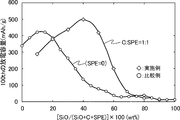
- FIG. 2 is a graph showing the discharge capacity of the lithium ion secondary battery provided with the negative electrode for the lithium ion secondary battery of the first embodiment when the ratio of SiO in the negative electrode active material layer is changed in the 100th cycle.
- FIG. 3 is a graph showing the discharge capacity of the lithium ion secondary battery provided with the negative electrode for the lithium ion secondary battery of the second embodiment when the ratio of SiO in the negative electrode active material layer is changed in the 100th cycle. ..
- the negative electrode for a lithium ion secondary battery according to the first embodiment of the present invention includes a negative electrode active material and a negative electrode active material layer containing a binder.
- the negative electrode active material contains a Si-based material
- the binder contains a polymer solid electrolyte.
- the content of the polymer solid electrolyte in the negative electrode active material layer is 25 to 85 parts by mass with respect to 100 parts by mass in total of the contents of the Si-based material and the polymer solid electrolyte.
- the binder contains a polymer solid electrolyte, so that the binder has ionic conductivity. As a result, the binder can suppress the inhibition of lithium ion occlusion and release of the Si-based material. Further, even if the negative electrode active material layer contains a sufficient amount of binder to improve the charge / discharge cycle characteristics of the lithium ion secondary battery, the capacity of the lithium ion secondary battery can be increased.
- the negative electrode active material layer contains a negative electrode active material and a binder.
- the negative electrode active material layer is formed by binding the negative electrode active material with a binder.
- the negative electrode active material and the binder will be described in detail.
- this binder the polymer solid electrolyte used as the electrolyte of the all-solid-state battery does not soak into the negative electrode active material layer. That is, this binder excludes the polymer solid electrolyte used as the electrolyte of the all-solid-state battery soaked into the negative electrode active material layer.
- the negative electrode active material includes a Si-based material.
- the Si-based material is not particularly limited as long as it expands when it absorbs Li ions.
- Examples of the Si-based material include Si, a compound represented by the general formula SiOx (where x is a number of 0.5 to 1.5), a Si-C-based nanocomposite material, and a Si-SiO-C-based nano. Examples include composite materials.
- the compound represented by the general formula SiOx (where x is a number of 0.5 to 1.5) is preferable because the expansion and contraction is relatively small.
- the SiO is an amorphous SiO or is around the Si of the nanocluster so that the molar ratio of Si: SiO 2 is about 1: 1. It is a composite of Si and SiO 2 in which SiO 2 is present. It is presumed that SiO 2 has a buffering action against the expansion and contraction of Si during charging and discharging.
- the Si-based material may be a material obtained by coating particles of a compound represented by the general formula SiOx (in the formula, x is a number of 0.5 to 1.5) with carbon such as nanocarbon.
- the Si-based material is preferably in the form of powder, more preferably in the form of particles, for example, the average particle size is preferably 30 ⁇ m or less, more preferably 20 ⁇ m or less, and 10 ⁇ m or less. Is particularly preferable, and 2.0 ⁇ m or less is most preferable.
- the lower limit of the range of the average particle size of the Si-based material is not particularly limited, but is 0.5 ⁇ m.
- the average particle size means the particle size (D50) when the volume integration is 50% in the particle size distribution of the Si-based material obtained by the laser diffraction / scattering method.
- the Si-based material can be adjusted to a desired value by pulverizing the Si-based material by, for example, a known method using a ball mill or the like.
- the content of the Si-based material in the negative electrode active material layer is preferably 15 to 75 parts by mass with respect to 100 parts by mass in total of the contents of the Si-based material and the polymer solid electrolyte.
- the content of the Si-based material in the negative electrode active material layer is 15 parts by mass or more, the capacity of the lithium ion secondary battery can be increased.
- the content of the Si-based material in the negative electrode active material layer is 75 parts by mass or less, the amount of the polymer solid electrolyte as a binder can be secured, and the charge / discharge cycle characteristics of the lithium ion secondary battery can be improved.
- the content of the Si-based material in the negative electrode active material layer is more preferably 15 to 60 parts by mass, further preferably 20 to 55 parts by mass, and even more preferably 25 to 55 parts by mass. Yes, more preferably 30 to 50 parts by mass, even more preferably 35 to 50 parts by mass, and particularly preferably 40 to 50 parts by mass.
- a part or all of the Si-based material may be pre-doped with lithium or lithium ions.
- silicon dioxide in the negative electrode active material layer reacts irreversibly with lithium to produce lithium silicate (Li 4 SiO 4 ).
- lithium silicate Li 4 SiO 4
- the predoping method for Si-based materials is not particularly limited, and the predoping method applied to a conventional lithium ion secondary battery can be applied.
- a lithium layer may be formed on the surface of the negative electrode active material layer by a sputtering method.
- a lithium foil may be provided on the surface of the negative electrode active material layer.
- the amount of lithium to be pre-doped is not particularly limited, and is preferably 1 to 4 times the molar amount of silicon oxide in the negative electrode active material layer.
- the negative electrode active material may contain a negative electrode active material other than the Si-based material.
- Negative negative active materials other than Si-based materials include, for example, graphite, Sb-based materials, Sn-based materials, conversion-reacting metal compounds, titanium dioxide, lithium titanium oxide, niobium pentoxide, tungsten oxide, molybdenum oxide, and Li. Examples thereof include first-period transition metal nitrides and phospholides of transition metals having a one-dimensional or two-dimensional structure that does not contain Li.
- the content of the Si-based material in the negative electrode active material is preferably 80% by mass or more, more preferably 90% by mass or more, still more preferably 95% by mass or more. ..
- the upper limit of the content range of the Si-based material in the negative electrode active material is not particularly limited, but is preferably 100% by mass.
- the binder contains a polymeric solid electrolyte.
- the polymer solid electrolyte is a material that is mainly composed of a polymer and exhibits ionic conductivity.
- Examples of the polymer solid electrolyte include a dry type polymer electrolyte and a gel type polymer electrolyte. In dry-type polymer electrolytes, it is considered that ion conduction is essentially caused by the movement of the polymer skeleton. On the other hand, in the gel type polymer electrolyte, ion conduction occurs through the electrolytic solution containing a large amount. From the viewpoint of high mechanical strength, the preferred polymer solid electrolyte is a dry type polymer electrolyte. Since the polymer solid electrolyte receives stress due to expansion and contraction of the Si-based material, it is preferable that the polymer solid electrolyte has high mechanical strength.
- the preferred dry type polymer solid electrolyte is a polyether electrolyte.
- the polymer serving as the matrix of the polyether electrolyte preferably has an ethylene oxide structure, a propylene oxide structure, or both structures.
- Examples of the polymer serving as a matrix of the polyether electrolyte include polyethylene oxide, polypropylene oxide, ethylene oxide-propylene copolymer, and dimethylsiloxane-ethylene oxide copolymer.
- a comb-shaped polymer having a polyether side chain containing an ethylene oxide structure a copolymer of a monomer other than ethylene oxide and ethylene oxide, a crosslinked polyethylene oxide or a polyether oligomer using a cross-linking agent, and a branch.
- examples thereof include branched-type polyether polymers and those obtained by thermally polymerizing or photopolymerizing macromonomers having a molecular weight of several hundred to several thousand. These polymers may be used alone or in combination of two or more.
- the polymer serving as the matrix of the polyether electrolyte is more preferably a polymer having at least an ethylene oxide structure, and further preferably polyethylene oxide.
- the ethylene oxide structure is composed of a basic unit consisting of ethylene and oxygen.
- the polymer solid electrolyte preferably contains a lithium salt.
- the polymer solid electrolyte is a polyether electrolyte
- the ion-dipole interaction between the cation of the lithium salt (lithium ion) and the isolated electron pair of ether oxygen in the polymer that forms the matrix of the polyether electrolyte It is thought that the lithium salt forms a complex and dissolves in the polymer that forms the matrix. Then, a part of the dissolved lithium salt is dissociated, and it is considered that the ionic conductivity of the polyether electrolyte becomes higher.
- Lithium salts used for high molecular weight solid electrolytes include, for example, LiCl, LiBr, LiI, LiClO 4 , LiBF 4 , LiPF 6 , LiAlCl 4 , LiSbF 6 , LiSCN, LiCF 3 SO 3 , LiAsF 6 , LiB 10 Cl 10 , low grade.
- Examples thereof include lithium aliphatic carboxylate, lithium chloroborane, LiBPh 4 (lithium tetraphenylborate), LiTFSA (lithium bistrifluoromethylsulfonylamide), LiTFSI (lithium bistrifluoromethylsulfonylimide) and the like.
- These lithium salts may be used alone or in combination of two or more. Among these, LiTFSA and LiTFSI are preferable, and LiTFSI is more preferable, from the viewpoint that the dissociability of the lithium salt in the polymer solid electrolyte can be increased.
- the blending amount of the lithium salt with respect to 100 parts by mass of the polymer serving as the matrix of the polymer solid electrolyte is preferably 1 to 100 parts by mass. , More preferably 5 to 80 parts by mass, and even more preferably 10 to 50 parts by mass.
- the content of the polymer solid electrolyte in the negative electrode active material layer is 25 to 85 parts by mass with respect to 100 parts by mass in total of the contents of the Si-based material and the polymer solid electrolyte. If the content of the polymer solid electrolyte in the negative electrode active material layer is less than 25 parts by mass, the polymer solid electrolyte that relaxes the expansion and contraction of the Si-based material is insufficient, and the cycle characteristics of the lithium ion secondary battery are improved. May not be possible. On the other hand, when the content of the polymer solid electrolyte in the negative electrode active material layer is larger than 85 parts by mass, the content of the Si-based material in the negative electrode active material layer may decrease and the capacity of the lithium ion secondary battery may be increased.
- the content of the polymer solid electrolyte in the negative electrode active material layer is preferably 40 to 85 parts by mass, more preferably 45 to 80 parts by mass, and further preferably 45 to 75 parts by mass. , More preferably 50 to 70 parts by mass, even more preferably 50 to 65 parts by mass, and particularly preferably 50 to 60 parts by mass.
- the binder may contain a binder other than the polymer solid electrolyte.
- Binders other than the polymer solid electrolyte include, for example, poly (meth) acrylic acid, poly (meth) acrylic acid lithium, polyvinylidene fluoride (PVdF), polyvinylidene fluoride-hexafluoropropylene copolymer (PVdF-HFP), and the like.
- Fluorine-containing resin such as polytetrafluoroethylene (PTFE), acrylic resin such as polymethylacrylate (PMA) and polymethylmethacrylate (PMMA), polyvinylidene acetate, polyimide (PI), polyamide (PA), polyvinylidene chloride (PVC) ), Polyether nitrile (PEN), polyethylene (PE), polypropylene (PP), polyacrylonitrile (PAN), acryliconitrile butadiene rubber, styrene butadiene rubber (SBR), carboxymethyl cellulose (CMC), hydroxyethyl cellulose, polyvinyl alcohol, etc. Can be mentioned. These binders may be used alone or in combination of two or more. Further, carboxymethyl cellulose (CMC) or the like may be used in the form of a salt such as a sodium salt.
- CMC carboxymethyl cellulose
- the content of the polymer solid electrolyte in the binder is preferably 90% by mass or more, more preferably 95% by mass or more.
- the upper limit of the content of the polymer solid electrolyte in the binder is not particularly limited, but is preferably 100% by mass, more preferably 99% by mass.
- the negative electrode active material layer may contain a conductive auxiliary agent from the viewpoint of imparting conductivity and mitigating expansion and contraction of the Si-based material.
- a conductive auxiliary agent a material having higher conductivity than the Si-based material is used.
- examples of the conductive auxiliary agent include carbon materials such as Ketjen black, acetylene black, carbon nanotubes, and rod-shaped carbon. These conductive auxiliaries may be used alone or in combination of two or more.
- the content of the conductive auxiliary agent is preferably 1 to 30% by mass, more preferably 2 to 20% by mass, based on the total amount of the negative electrode active material layer. ..
- the thickness of the negative electrode active material layer is not particularly limited, but is preferably 5 to 100 ⁇ m, and more preferably 5 to 20 ⁇ m.
- the negative electrode active material layer may contain arbitrary components other than the negative electrode active material, the binder and the conductive auxiliary agent as long as the effects of the present invention are not impaired.
- the total content of the negative electrode active material, the binder and the conductive auxiliary agent in the total mass of the electrode active material layer is preferably 90% by mass or more, and more preferably 95% by mass or more.
- the negative electrode for a lithium ion secondary battery may include a current collector.
- the negative electrode active material layer may be laminated on the surface of the current collector.
- the negative electrode active material layer may be laminated on one surface of the current collector, or may be laminated on both sides of the current collector.
- the material constituting the current collector examples include conductive metals such as copper, aluminum, titanium, nickel, and stainless steel. Among these, aluminum or copper is preferable, and copper is preferable. Is more preferable.
- the current collector is generally made of a metal foil, and its thickness is not particularly limited, but is preferably 1 to 50 ⁇ m.
- the negative electrode for a lithium ion secondary battery of the present invention is produced, for example, by applying a composition for a negative electrode active material layer on the surface of a current collector and drying the applied composition for a negative electrode active material layer. ..
- the composition for the negative electrode active material layer used for forming the negative electrode active material layer contains a negative electrode active material containing a Si-based material, a binder containing a polymer solid electrolyte, and a solvent.
- the composition for the negative electrode active material layer may contain other components such as a conductive additive to be blended if necessary.
- the negative electrode active material, the binder, the conductive auxiliary agent and the like are as described above.
- the composition for the negative electrode active material layer is a slurry.
- Water is preferably used as the solvent in the composition for the negative electrode active material layer. By using water, the binder can be easily dissolved in the composition for the negative electrode active material layer.
- the solid content concentration of the composition for the negative electrode active material layer is preferably 5 to 75% by mass, more preferably 20 to 65% by mass.
- the negative electrode active material layer can be formed by applying the composition for the negative electrode active material layer on the current collector and drying it.
- the method of applying the composition for the negative electrode active material layer to the surface of the current collector is not particularly limited, and for example, a dip coating method, a spray coating method, a roll coating method, a doctor blade method, a bar coating method, a gravure coating method, a screen The printing method and the like can be mentioned.
- the bar coating method or the gravure coating method is preferable from the viewpoint of uniformly applying the composition for the negative electrode active material layer.
- the drying temperature is not particularly limited as long as the solvent can be removed, but is, for example, 40 to 120 ° C, preferably 50 to 90 ° C.
- the drying time is not particularly limited, but is, for example, 30 seconds to 10 minutes.
- the negative electrode for a lithium ion secondary battery of the second embodiment of the present invention includes a negative electrode active material and a negative electrode active material layer containing a binder.
- the negative electrode active material preferably contains a Si-based material and graphite, and the binder preferably contains a polymer solid electrolyte.
- the Si-based material is preferably a compound represented by the general formula SiOx (where x is a number of 0.5 to 1.5).
- the binder contains a polymer solid electrolyte, so that the binder has ionic conductivity, whereby the Si-based material by the binder is obtained. Inhibition of lithium ion occlusion and release can be suppressed. Further, even if the negative electrode active material layer contains a sufficient amount of binder to improve the charge / discharge cycle characteristics of the lithium ion secondary battery, the capacity of the lithium ion secondary battery can be increased. Further, since the binder contains the polymer solid electrolyte, the content of the carbon-based material in the negative electrode active material can be reduced. As a result, the capacity of the lithium ion secondary battery can be further increased.
- the negative electrode active material layer contains a negative electrode active material and a binder.
- the negative electrode active material layer is formed by binding the negative electrode active material with a binder.
- the negative electrode active material and the binder will be described in detail.
- the polymer solid electrolyte used as the electrolyte of the all-solid-state battery has penetrated into the negative electrode electrode active material layer. It's not a thing. That is, this binder excludes the polymer solid electrolyte used as the electrolyte of the all-solid-state battery soaked into the negative electrode active material layer.
- the negative electrode active material preferably contains a Si-based material and graphite.
- the Si-based material is a compound represented by the general formula SiOx (where x is a number of 0.5 to 1.5) as described above.
- SiOx has a small expansion / contraction among Si-based materials, it is necessary to reduce the content of graphite in the negative electrode active material, which is blended to alleviate the expansion / contraction of the Si-based material. Can be done. As a result, the capacity of the lithium ion secondary battery can be increased.
- this SiO is an amorphous SiO or is around the Si of the nanocluster so that the molar ratio of Si: SiO 2 is about 1: 1. It is a composite of Si and SiO 2 in which SiO 2 is present. It is presumed that SiO 2 has a buffering action against the expansion and contraction of Si during charging and discharging. Further, the Si-based material may be one in which particles of the above compound represented by the general formula SiOx are coated with carbon such as nanocarbon.
- the Si-based material is preferably in the form of powder, more preferably in the form of particles, for example, having an average particle diameter of 30 ⁇ m. It is preferably less than or equal to, more preferably 20 ⁇ m or less, particularly preferably 10 ⁇ m or less, and most preferably 2.0 ⁇ m or less. By using such a fine powder Si-based material, pulverization due to expansion and contraction of the Si-based material is suppressed.
- the lower limit of the range of the average particle size of the Si-based material is not particularly limited, but is 0.5 ⁇ m.
- the average particle size is 50% in volume integration in the particle size distribution of the Si-based material obtained by the laser diffraction / scattering method. It means the particle size (D50).
- the Si-based material can be adjusted to a desired value by pulverizing the Si-based material by, for example, a known method using a ball mill or the like.
- the content of the Si-based material in the negative electrode active material layer is preferably 20 to 50 parts by mass with respect to 100 parts by mass in total of the contents of the Si-based material, graphite and the polymer solid electrolyte.
- the content of the Si-based material in the negative electrode active material layer is 20 parts by mass or more, the capacity of the lithium ion secondary battery can be increased.
- the content of the Si-based material in the negative electrode active material layer is 50 parts by mass or less, the amount of the binder and the amount of graphite can be kept above a certain level, and the charge / discharge cycle characteristics of the lithium ion secondary battery can be improved. Can be done.
- the content of the Si-based material in the negative electrode active material layer is more preferably 30 to 50 parts by mass.
- a part or all of the Si-based material may be pre-doped with lithium or lithium ions.
- silicon dioxide in the negative electrode active material layer reacts irreversibly with lithium to produce lithium silicate (Li 4 SiO 4 ).
- lithium silicate Li 4 SiO 4
- the predoping method for the Si-based material is not particularly limited, and the predoping method applied to the conventional lithium ion secondary battery can be applied.
- a lithium layer may be formed on the surface of the negative electrode active material layer by a sputtering method.
- a lithium foil may be provided on the surface of the negative electrode active material layer.
- the amount of lithium to be pre-doped is not particularly limited, and is preferably 1 to 4 times the molar amount of silicon oxide in the negative electrode active material layer.
- Graphite is one of the allotropes of carbon and is a thermodynamically stable phase under normal pressure. Graphite is also called graphite. Examples of graphite include natural graphite and artificial graphite. Natural graphite is naturally occurring graphite. Examples of natural graphite include scaly graphite, lump graphite, earth graphite and the like. On the other hand, artificial graphite is a material in which a graphite structure is developed by further heat-treating a carbon material produced by thermal decomposition and carbonization of an organic compound to a high temperature of 2500 ° C. or higher.
- the average particle size of graphite is preferably 1 to 30 ⁇ m.
- the graphite particles can be interposed between the particles of the Si-based material, and the expansion and contraction of the Si-based material can be sufficiently relaxed.
- the average particle size of graphite is more preferably 2 to 20 ⁇ m, still more preferably 3 to 10 ⁇ m.
- Examples of the method of adjusting the average particle size of graphite to a desired value include a method of pulverizing by a known method using a ball mill or the like.
- the average particle size means the particle size (D50) when the volume integration is 50% in the particle size distribution of graphite obtained by the laser diffraction / scattering method.
- the content of graphite in the negative electrode active material layer is preferably 25 to 40 parts by mass with respect to 100 parts by mass in total of the contents of the Si-based material, graphite and the polymer solid electrolyte.
- the content of the Si-based material in the negative electrode active material layer is 25 parts by mass or more, graphite can sufficiently relax the expansion and contraction of the Si-based material.
- the content of graphite in the negative electrode active material layer is 40 parts by mass or less, the content of the Si-based material can be increased, and the capacity of the lithium ion secondary battery can be increased.
- the graphite content in the negative electrode active material layer is more preferably 25 to 35 parts by mass.
- the negative electrode active material may include a negative electrode active material other than Si-based material and graphite.
- the total content of the Si-based material and the graphite in the negative electrode active material is preferably 80% by mass or more, more preferably 90% by mass or more, still more preferably. It is 95% by mass or more.
- the upper limit of the content range of the Si-based material and graphite in the negative electrode active material is not particularly limited, but is preferably 100% by mass.
- the binder contains a polymeric solid electrolyte.
- the polymer solid electrolyte is a material exhibiting ionic conductivity mainly composed of a polymer.
- the polymer solid electrolyte include a dry type polymer electrolyte and a gel type polymer electrolyte. In dry-type polymer electrolytes, it is considered that ion conduction is essentially caused by the movement of the polymer skeleton. On the other hand, in the gel type polymer electrolyte, ion conduction occurs through the electrolytic solution containing a large amount.
- the preferred polymer solid electrolyte is a dry type polymer electrolyte. Since the polymer solid electrolyte receives stress due to expansion and contraction of the Si-based material, it is preferable that the polymer solid electrolyte has high mechanical strength.
- the preferred dry type polymer solid electrolyte is a polyether electrolyte.
- the polymer serving as the matrix of the polyether electrolyte preferably has an ethylene oxide structure, a propylene oxide structure, or both structures.
- the polymer serving as the matrix of the polyether electrolyte the same polymer as that in the negative electrode for the lithium ion secondary battery of the first embodiment of the present invention can be used.
- the polymer serving as the matrix of the polyether electrolyte is more preferably a polymer having at least an ethylene oxide structure, and further preferably polyethylene oxide.
- the ethylene oxide structure is composed of a basic unit consisting of ethylene and oxygen.
- the polymer solid electrolyte preferably contains a lithium salt from the viewpoint of increasing the ionic conductivity of the polymer solid electrolyte.
- the polymer solid electrolyte is a polyether electrolyte
- the ion-dipole interaction between the cation of the lithium salt (lithium ion) and the isolated electron pair of ether oxygen in the polymer that forms the matrix of the polyether electrolyte It is thought that the lithium salt forms a complex and dissolves in the polymer that forms the matrix. Then, a part of the dissolved lithium salt is dissociated, and it is considered that the ionic conductivity of the polyether electrolyte becomes higher.
- the same one as that used for the negative electrode for the lithium ion secondary battery of the first embodiment of the present invention can be used.
- LiTFSA and LiTFSI are preferable, and LiTFSI is more preferable.
- the blending amount of the lithium salt with respect to 100 parts by mass of the polymer serving as the matrix of the polymer solid electrolyte is preferably 1 to 100 parts by mass. , More preferably 5 to 80 parts by mass, and even more preferably 10 to 50 parts by mass.
- the content of the polymer solid electrolyte in the negative electrode active material layer is 100 mass in total of the contents of the Si-based material and the polymer solid electrolyte. It is 25 to 85 parts by mass with respect to the part.
- the content of the polymer solid electrolyte in the negative electrode active material layer is preferably 25 to 40 parts by mass with respect to 100 parts by mass in total of the contents of the Si-based material, graphite and the polymer solid electrolyte.
- the content of the polymer solid electrolyte in the negative electrode active material layer is 25 parts by mass or more, the cycle characteristics of the lithium ion secondary battery can be improved.
- the content of the polymer solid electrolyte in the negative electrode active material layer is 40 parts by mass or less, the content of the Si-based material can be set to a certain amount or more, and the capacity of the lithium ion secondary battery can be increased. Can be done. From the above viewpoint, the content of the polymer solid electrolyte in the negative electrode active material layer is more preferably 25 to 35 parts by mass.
- the mass ratio of the content of the polymer solid electrolyte to the content of graphite in the negative electrode active material layer effectively expands and contracts the Si-based material due to the synergistic effect of the polymer solid electrolyte and graphite. From the viewpoint of relaxation, it is preferably 30/70 to 70/30, more preferably 40/60 to 60/40, and even more preferably 45/55 to 55/45.
- the binder may contain a binder other than the polymer solid electrolyte.
- the binder other than the polymer solid electrolyte the same binder as the negative electrode for the lithium ion secondary battery of the first embodiment of the present invention can be used.
- the content of the polymer solid electrolyte in the binder is preferably 60% by mass or more, more preferably 70% by mass or more, still more preferably 80% by mass or more, still more preferably 90% by mass. is there.
- the upper limit of the range of the content of the polymer solid electrolyte in the binder is not particularly limited, but is preferably 97% by mass, more preferably 95% by mass.
- the negative electrode active material layer may contain a conductive auxiliary agent.
- the conductive auxiliary agent the same one used in the negative electrode for the lithium ion secondary battery of the first embodiment of the present invention can be used.
- the content of the conductive auxiliary agent is preferably 1 to 30% by mass, more preferably 2 to 20% by mass, based on the total amount of the negative electrode active material layer. ..
- the thickness of the negative electrode active material layer is not particularly limited, but is preferably 5 to 100 ⁇ m, preferably 5 to 20 ⁇ m. Is more preferable.
- the negative electrode active material layer is other than the negative electrode active material, the binder and the conductive auxiliary agent as long as the effect of the present invention is not impaired. It may contain any component of. However, the total content of the negative electrode active material, the binder and the conductive auxiliary agent in the total mass of the electrode active material layer is preferably 90% by mass or more, and more preferably 95% by mass or more.
- the negative electrode for a lithium ion secondary battery may include a current collector.
- the negative electrode active material layer may be laminated on the surface of the current collector.
- the negative electrode active material layer may be laminated on one surface of the current collector, or may be laminated on both sides of the current collector.
- the same material as that used in the negative electrode for the lithium ion secondary battery of the first embodiment of the present invention can be used.
- the current collector is generally made of a metal foil, and its thickness is not particularly limited, but is preferably 1 to 50 ⁇ m.
- the composition for the negative electrode active material layer used for forming the negative electrode active material layer contains a negative electrode active material containing a Si-based material and graphite, a binder containing a polymer solid electrolyte, and a solvent.
- the negative electrode for the lithium ion secondary battery of the second embodiment of the present invention can be manufactured by the same method as the negative electrode for the lithium ion secondary battery of the first embodiment of the present invention.
- the lithium ion secondary battery of the present invention includes the above-mentioned negative electrode for a lithium ion secondary battery.
- the lithium ion secondary battery of the present invention includes a positive electrode and a negative electrode arranged so as to face each other, and the negative electrode is a negative electrode for a lithium ion secondary battery having the above-mentioned negative electrode active material layer.
- the lithium ion secondary battery of the present invention is for at least one type of negative electrode for a lithium ion secondary battery of the first embodiment and a negative electrode for a lithium ion secondary battery of the second embodiment described above. It has a negative electrode.
- the lithium ion secondary battery of the present invention includes a positive electrode and a negative electrode arranged so as to face each other, and the negative electrode is a negative electrode for a lithium ion secondary battery having the above-mentioned negative electrode active material layer.
- the positive electrode of the lithium ion secondary battery of the present invention is not particularly limited.
- the positive electrode includes, for example, a positive electrode active material layer and a current collector, and the positive electrode active material layer contains a positive electrode active material and a binder for a positive electrode.
- the positive electrode active material include lithium metallic acid compounds.
- the lithium metal oxide compound include lithium cobalt oxide (LiCoO 2 ), lithium nickel oxide (LiNiO 2 ), and lithium manganate (LiMn 2 O 4 ). Further, it may be olivine type lithium iron phosphate (LiFePO 4 ) or the like. Further, a plurality of metals other than lithium may be used, and NCM (nickel cobalt manganese) oxides, NCA (nickel cobalt aluminum) oxides and the like, which are called ternary oxides, may be used.
- binder for the positive electrode examples include a fluorine-containing resin such as polyvinylidene fluoride (PVDF), polyvinylidene fluoride-hexafluoropropylene copolymer (PVDF-HFP), and polytetrafluoroethylene (PTFE), and polymethyl acrylate (PMA).
- PVDF polyvinylidene fluoride
- PVDF-HFP polyvinylidene fluoride-hexafluoropropylene copolymer
- PTFE polytetrafluoroethylene
- PMA polymethyl acrylate
- Acrylic resin such as polyvinylidene methacrylate (PMMA), polyvinylidene acetate, polyimide (PI), polyamide (PA), polyvinylidene chloride (PVC), polyether nitrile (PEN), polyethylene (PE), polypropylene (PP), Examples thereof include polyacrylonitrile (PAN), acrylonitrile butadiene rubber, styrene butadiene rubber, poly (meth) acrylic acid, carboxymethyl cellulose (CMC), hydroxyethyl cellulose, polyvinyl alcohol and the like. These binders may be used alone or in combination of two or more. Further, carboxymethyl cellulose and the like may be used in the form of a salt such as a sodium salt.
- the material used as the current collector is the same as that of the compound used for the negative electrode current collector, but aluminum or copper is preferably used, and more preferably aluminum is used.
- the lithium ion secondary battery of the present invention preferably further includes a separator arranged between the positive electrode and the negative electrode.
- a separator By providing the separator, a short circuit between the positive electrode and the negative electrode is effectively prevented. Further, the separator may retain an electrolyte described later.
- the separator include a porous polymer film, a non-woven fabric, and glass fiber, and among these, a porous polymer film is preferable.
- the porous polymer film include an olefin-based porous film.
- the lithium ion secondary battery may have a multilayer structure in which a plurality of negative electrodes and a plurality of positive electrodes are laminated.
- the negative electrode and the positive electrode may be provided alternately along the stacking direction.
- the separator may be arranged between each negative electrode and each positive electrode.
- the negative electrode and the positive electrode, or the negative electrode, the positive electrode, and the separator described above are housed in the battery cell.
- the battery cell may be a square type, a cylindrical type, a laminated type or the like.
- Lithium ion secondary batteries include an electrolyte.
- the electrolyte is not particularly limited, and a known electrolyte used in a lithium ion secondary battery may be used.
- an electrolytic solution is used.
- the electrolytic solution include an organic solvent and an electrolytic solution containing an electrolyte salt.
- the organic solvent include ethylene carbonate, propylene carbonate, dimethyl carbonate, diethyl carbonate, ethyl methyl carbonate, ⁇ -butyrolactone, sulfolane, dimethyl sulfoxide, acetonitrile, dimethylformamide, dimethylacetamide, 1,2-dimethoxyethane, 1,2.
- Examples thereof include polar solvents such as -diethoxyethane, tetrahydrofuran, 2-methyltetrahydrofuran, 1,3-dioxolane, and methylacetamide, or mixtures of two or more of these solvents.
- polar solvents such as -diethoxyethane, tetrahydrofuran, 2-methyltetrahydrofuran, 1,3-dioxolane, and methylacetamide, or mixtures of two or more of these solvents.
- Electrolyte salts include LiClO 4 , LiPF 6 , LiBF 4 , LiAsF 6 , LiSbF 6 , LiCF 3 CO 2 , LiPF 6 SO 3 , LiN (SO 2 CF 3 ) 2 , LiN (SO 2 CF 2 CF 3 ) 2 , Examples include lithium-containing salts such as LiN (COCF 3 ) 2, LiN (COCF 2 CF 3 ) 2 , and lithium bisoxalate borate (LiB (C 2 O 4 ) 2 ). Further, a complex such as a lithium organic acid salt-boron trifluoride complex and a complex hydride such as LiBH 4 can be mentioned.
- the electrolyte may be a gel-like electrolyte in which the above-mentioned electrolyte solution further contains a polymer compound.
- the polymer compound include a fluoropolymer such as polyvinylidene fluoride and a polyacrylic polymer such as poly(meth)acrylate.
- the gel electrolyte may be used as a separator.
- the electrolyte may be arranged between the negative electrode and the positive electrode.
- the electrolyte is filled in the above-mentioned negative electrode and positive electrode, or in a battery cell in which the negative electrode, the positive electrode, and the separator are housed. Further, the electrolyte may be applied on the negative electrode or the positive electrode and arranged between the negative electrode and the positive electrode, for example.
- the mass of the negative electrode active material in the negative electrode was calculated by subtracting the mass of a copper foil having a diameter of 16 mm and a thickness of 12 ⁇ m in the electrode size from the mass of a circular negative electrode having an electrode size of 16 mm in diameter.
- This slurry for the positive electrode active material layer was applied to an aluminum foil having a thickness of 15 ⁇ m as a positive electrode current collector, pre-dried, and then vacuum dried at 120 ° C. Then, the positive electrode current collector coated with the slurry for the positive electrode active material layer is pressure-pressed by a roller at a linear pressure of 400 kN / m, and further punched into a circle having an electrode size of 14 mm in diameter to have a positive electrode having a positive electrode active material layer. And said.
- the thickness of the positive electrode active material layer was 50 ⁇ m.
- a lithium salt solution was prepared by dissolving 2.6 parts by mass of LiTFSI (lithium bistrifluoromethylsulfonylimide) in 87 parts by mass of N-methylpyrrolidone (NMP). 10.4 parts by mass of polyethylene oxide was added to the obtained lithium salt solution, and the mixture was mixed and stirred to prepare an SPE (solid polymer electrolyte) solution. Further, 100 parts by mass of silicon monoxide (SiO, average particle size 1.0 ⁇ m) is mixed with 1.5 parts by mass of styrene-butadiene rubber (SBR) and 1.5 parts by mass of carboxymethyl cellulose (CMC) in a solution.
- SiO silicon monoxide
- SBR styrene-butadiene rubber
- CMC carboxymethyl cellulose
- the negative electrode current collector coated with the SiO-SPE slurry was pressure-pressed by a roller at a linear pressure of 500 kN / m, and further punched into a circle having an electrode size of 16 mm in diameter to obtain a negative electrode having a negative electrode active material layer. ..
- the thickness of the negative electrode active material layer was 40 ⁇ m.
- LiPF 6 as an electrolyte salt is dissolved in a solvent in which ethylene carbonate (EC) and diethyl carbonate (DEC) are mixed at a volume ratio of 3: 7 (EC: DEC) so as to be 1 mol / liter, and the electrolytic solution is prepared.
- EC ethylene carbonate
- DEC diethyl carbonate
- a lithium ion secondary battery for characteristic evaluation was produced by arranging the positive electrode, the separator, and the negative electrode on the battery characteristic evaluation jig 100 shown in FIG. 1 and injecting the electrolytic solution. Specifically, between the negative electrode body 106 and the positive electrode body 107, a negative electrode 108, a separator 109, an electrode guide 110, a positive electrode 111, an electrode retainer 112, and a spring 113 are placed in this order from the negative electrode body 106 side in a jig 100 for evaluating battery characteristics. Placed in. Then, the electrolytic solution was injected into the battery characteristic evaluation jig 100 to prepare a lithium ion secondary battery having a SiO-SPE negative electrode.
- a lithium ion secondary battery having a SiO-graphite negative electrode was prepared in the same manner as in the examples except that the negative electrode was prepared using a graphite slurry instead of the SPE solution.
- a negative electrode in which the ratio of SiO and graphite in the negative electrode active material layer was changed as shown in Tables 3 and 4 was produced.
- Tables 1 to 4 show the discharge capacities of the lithium ion secondary battery having the SiO-SPE negative electrode and the lithium ion secondary battery having the SiO-graphite negative electrode, and FIG. 2 shows the result of the discharge capacity in the 100th cycle.
- the lithium ion secondary battery having a SiO-SPE negative electrode has a discharge capacity at the 100th cycle as compared with the lithium ion secondary battery having a SiO-graphite negative electrode. I found that I could make it higher.
- the maximum discharge capacity of the lithium ion secondary battery having a SiO-SPE negative electrode is 441 mAh / g, and the maximum discharge capacity of the lithium ion secondary battery having a SiO-graphite negative electrode is 419 mAh / g. there were.
- the maximum discharge capacity of the lithium ion secondary battery having a SiO-SPE negative electrode was about 5% higher than the maximum discharge capacity of the lithium ion secondary battery having a SiO-graphite negative electrode.
- the binder contains the polymer solid electrolyte, and the content of the polymer solid electrolyte in the negative electrode active material layer is 25 to 85 parts by mass with respect to the total content of the Si-based material and the polymer solid electrolyte of 100 parts by mass. It was found that the charge / discharge cycle characteristics of the lithium ion secondary battery can be improved and the capacity can be increased by preferably 40 to 85 parts by mass.
- [Lithium-ion secondary battery 1] 100 parts by mass of NCA-based oxide (average particle size 10 ⁇ m) as the positive electrode active material, 4 parts by mass of acetylene black as the conductive auxiliary agent, 4 parts by mass of polyvinylidene fluoride as the electrode binder, and N as the solvent.
- -Methylpyrrolidone (NMP) was mixed to obtain a slurry for a positive electrode active material layer adjusted to a solid content concentration of 60% by mass.
- This slurry for the positive electrode active material layer was applied to an aluminum foil having a thickness of 15 ⁇ m as a positive electrode current collector, pre-dried, and then vacuum dried at 120 ° C.
- the positive electrode current collector coated with the slurry for the positive electrode active material layer is pressure-pressed by a roller at a linear pressure of 400 kN / m, and further punched into a circle having an electrode size of 14 mm in diameter to have a positive electrode having a positive electrode active material layer. And said.
- the thickness of the positive electrode active material layer was 50 ⁇ m.
- a lithium salt solution was prepared by dissolving 2.6 parts by mass of LiTFSI (lithium bistrifluoromethylsulfonylimide) in 87 parts by mass of N-methylpyrrolidone (NMP). 10.4 parts by mass of polyethylene oxide was added to the obtained lithium salt solution, and the mixture was mixed and stirred to prepare an SPE (solid polymer electrolyte) solution. Further, 100 parts by mass of silicon monoxide (SiO, average particle diameter 1.0 ⁇ m) is mixed with 1.5 parts by mass of styrene-butadiene rubber (SBR) and 1.5 parts by mass of carboxymethyl cellulose (CMC). , Mixing at 2000 rpm for 2 minutes using a revolving mixer.
- LiTFSI lithium bistrifluoromethylsulfonylimide
- NMP N-methylpyrrolidone
- SPE solid polymer electrolyte
- this mixture was dispersed with an ultrasonic homogenizer for 10 minutes, and then the dispersion was mixed again at 2000 rpm for 2 minutes using a rotation / revolution mixer to prepare a SiO slurry.
- 100 parts by mass of graphite (average particle size 10 ⁇ m) is mixed with a solution in which 1.5 parts by mass of styrene-butadiene rubber (SBR) and 1.5 parts by mass of carboxymethyl cellulose (CMC) are mixed, and the solid content is 50.
- SBR styrene-butadiene rubber
- CMC carboxymethyl cellulose
- this SiO—C—SPE slurry was applied to a copper foil having a thickness of 12 ⁇ m as a negative electrode current collector, and vacuum dried at 100 ° C. Then, the negative electrode current collector coated with the SiO-C-SPE slurry is pressure-pressed by a roller at a linear pressure of 500 kN / m, and further punched into a circle having an electrode size of 16 mm in diameter to have a negative electrode active material layer. And said.
- the thickness of the negative electrode active material layer was 40 ⁇ m.
- the proportions of the SPE solution, SiO slurry and graphite slurry in the SiO—C—SPE slurry were changed as shown in Tables 5 and 6.
- a negative electrode was prepared.
- the SiO—C—SPE slurry was prepared so that the mass ratio of graphite and polyethylene oxide in the SiO—C—SPE slurry was 1: 1.
- LiPF 6 as an electrolyte salt is dissolved in a solvent in which ethylene carbonate (EC) and diethyl carbonate (DEC) are mixed at a volume ratio of 3: 7 (EC: DEC) so as to be 1 mol / liter, and the electrolytic solution is prepared.
- EC ethylene carbonate
- DEC diethyl carbonate
- a lithium ion secondary battery for characteristic evaluation was produced by arranging the positive electrode, the separator, and the negative electrode on the battery characteristic evaluation jig 100 shown in FIG. 1 and injecting the electrolytic solution. Specifically, between the negative electrode body 106 and the positive electrode body 107, a negative electrode 108, a separator 109, an electrode guide 110, a positive electrode 111, an electrode retainer 112, and a spring 113 are placed in this order from the negative electrode body 106 side in a jig 100 for evaluating battery characteristics. Placed in. Then, the electrolytic solution was injected into the battery characteristic evaluation jig 100 to prepare a lithium ion secondary battery 1.
- Lithium-ion secondary battery 2 As shown in Tables 7 and 8, SiO-C slurry is prepared by mixing SiO slurry and graphite slurry without adding SPE solution, and the negative electrode is used instead of SiO—C—SPE slurry.
- the lithium ion secondary battery 2 was manufactured in the same manner as in the examples except that the above was prepared.
- a negative electrode in which the ratio of SiO and graphite in the negative electrode active material layer was changed was produced.
- the discharge capacities of the lithium ion secondary battery 1 and the lithium ion secondary battery 2 are shown in Tables 5 to 8, and the results of the discharge capacities in the 100th cycle are shown in FIG.
- the lithium ion secondary battery of the example can have a higher discharge capacity in the 100th cycle than the lithium ion secondary battery of the comparative example.
- the maximum value of the discharge capacity of the example was 496 mAh / g, and the maximum value of the discharge capacity of the comparative example was 419 mAh / g.
- the maximum value of the discharge capacity of the example was about 18% higher than the maximum value of the discharge capacity of the comparative example.
- a lithium ion secondary battery can be obtained. It was found that the capacity can be further increased and the charge / discharge cycle characteristics can be further improved.
Landscapes
- Chemical & Material Sciences (AREA)
- Chemical Kinetics & Catalysis (AREA)
- Electrochemistry (AREA)
- General Chemical & Material Sciences (AREA)
- Engineering & Computer Science (AREA)
- Materials Engineering (AREA)
- Inorganic Chemistry (AREA)
- Battery Electrode And Active Subsutance (AREA)
Abstract
本発明は、負極活物質及びバインダーを含む負極活物質層を備えたリチウムイオン二次電池用負極であって、負極活物質はSi系材料を含み、バインダーは高分子固体電解質を含み、負極活物質層における高分子固体電解質の含有量がSi系材料及び高分子固体電解質の含有量の合計100質量部に対して25~85質量部である。本発明のリチウムイオン二次電池は正極と本発明のリチウムイオン二次電池用負極とを備える。これにより、リチウムイオン二次電池の容量を高くし、かつ充放電サイクル特性を良好にできる、Si系材料を含むリチウムイオン二次電池用負極及びそのリチウムイオン二次電池用負極を備えるリチウムイオン二次電池を提供できる。
Description
本発明は、リチウムイオン二次電池用負極及びリチウムイオン二次電池に関する。
リチウムイオン二次電池は、電力貯蔵用の大型定置用電源、電気自動車用等の電源として利用されており、近年では電池のさらなる高容量化のため、エネルギー密度がさらに高いリチウムイオン二次電池が望まれている。このようなエネルギー密度の高いリチウムイオン二次電池を得る方法として、例えば、負極材料にSi系材料を用いる方法が挙げられる。Siの理論容量密度は4200mAh/gであり、カーボン系材料の理論容量密度(例えば、黒鉛の場合、372mAh/g)に比べて10倍以上高い。このため、負極材料にSi系材料を用いることによって、高容量のリチウムイオン二次電池を得ることができる。
しかし、Si系材料には、Liイオンを吸収すると体積が最大約4倍に増えるという問題がある。このため、Si系材料をそのまま負極材料として使用するとリチウムイオン二次電池の充放電サイクル特性が悪くなる。そこで、Si系材料の膨張収縮の影響を小さくするために、Si系材料及びカーボン系材料を混合して得られた混合物を負極材料として用いたリチウムイオン二次電池用負極が従来技術として知られている(例えば、特許文献1参照)。
しかし、Si系材料には、Liイオンを吸収すると体積が最大約4倍に増えるという問題がある。このため、Si系材料をそのまま負極材料として使用するとリチウムイオン二次電池の充放電サイクル特性が悪くなる。そこで、Si系材料の膨張収縮の影響を小さくするために、Si系材料及びカーボン系材料を混合して得られた混合物を負極材料として用いたリチウムイオン二次電池用負極が従来技術として知られている(例えば、特許文献1参照)。
しかしながら、従来のSi系材料及びカーボン系材料の混合物を使用した負極材料は、Si系材料の膨張収縮の影響を小さくするために、カーボン系材料の割合を高くしなければならなかった。このため、リチウムイオン二次電池の充放電サイクル特性を良好にする目的で、負極材料におけるカーボン材料の割合を高くすると、負極材料におけるSi系材料の割合が低くなり、リチウムイオン二次電池の容量が低くなるという問題があった。
そこで、本発明は、リチウムイオン二次電池の容量を高くし、かつ充放電サイクル特性を良好にできる、Si系材料を含むリチウムイオン二次電池用負極及びそのリチウムイオン二次電池用負極を備えるリチウムイオン二次電池を提供することを課題とする。
そこで、本発明は、リチウムイオン二次電池の容量を高くし、かつ充放電サイクル特性を良好にできる、Si系材料を含むリチウムイオン二次電池用負極及びそのリチウムイオン二次電池用負極を備えるリチウムイオン二次電池を提供することを課題とする。
本発明者らは、鋭意検討の結果、Si系材料を結着させるバインダーとして所定量の高分子固体電解質を用いることにより、リチウムイオン二次電池の容量を高くし、かつ充放電サイクル特性を良好にできることを見出し、以下の本発明を完成させた。本発明の要旨は、以下の[1]~[10]である。
[1]負極活物質及びバインダーを含む負極活物質層を備えたリチウムイオン二次電池用負極であって、前記負極活物質はSi系材料を含み、前記バインダーは高分子固体電解質を含み、前記負極活物質層における前記高分子固体電解質の含有量が前記Si系材料及び前記高分子固体電解質の含有量の合計100質量部に対して25~85質量部であるリチウムイオン二次電池用負極。
[2]前記高分子固体電解質の含有量が、前記Si系材料及び前記高分子固体電解質の含有量の合計100質量部に対して40~85質量部である上記[1]に記載のリチウムイオン二次電池用負極。
[3]前記Si系材料が一般式SiOx(式中、xは0.5~1.5の数)で表される化合物である上記[1]又は[2]に記載のリチウムイオン二次電池用負極。
[4]前記負極活物質層における前記Si系材料の含有量が前記Si系材料及び前記高分子固体電解質の含有量の合計100質量部に対して15~75質量部である上記[1]~[3]のいずれか1つに記載のリチウムイオン二次電池用負極。
[5]前記負極活物質は黒鉛をさらに含み、前記Si系材料は一般式SiOx(式中、xは0.5~1.5の数)で表される化合物であり、前記負極活物質層における前記黒鉛の含有量が、前記Si系材料、前記黒鉛及び前記高分子固体電解質の含有量の合計100質量部に対して25~40質量部である上記[1]に記載のリチウムイオン二次電池用負極。
[6]前記負極活物質層における前記高分子固体電解質の含有量が、前記Si系材料、前記黒鉛及び前記高分子固体電解質の含有量の合計100質量部に対して25~40質量部である上記[5]に記載のリチウムイオン二次電池用負極。
[7]前記高分子固体電解質がポリエーテル系電解質である上記[1]~[6]のいずれか1つに記載のリチウムイオン二次電池用負極。
[8]前記ポリエーテル系電解質のマトリックスとなるポリマーは、エチレンオキシド構造を有するポリマーである上記[7]に記載のリチウムイオン二次電池用負極。
[9]前記高分子固体電解質がリチウム塩を含む上記[1]~[8]のいずれか1つに記載のリチウムイオン二次電池用負極。
[10]正極と、上記[1]~[9]のいずれか1つに記載のリチウムイオン二次電池用負極とを備えたリチウムイオン二次電池。
[1]負極活物質及びバインダーを含む負極活物質層を備えたリチウムイオン二次電池用負極であって、前記負極活物質はSi系材料を含み、前記バインダーは高分子固体電解質を含み、前記負極活物質層における前記高分子固体電解質の含有量が前記Si系材料及び前記高分子固体電解質の含有量の合計100質量部に対して25~85質量部であるリチウムイオン二次電池用負極。
[2]前記高分子固体電解質の含有量が、前記Si系材料及び前記高分子固体電解質の含有量の合計100質量部に対して40~85質量部である上記[1]に記載のリチウムイオン二次電池用負極。
[3]前記Si系材料が一般式SiOx(式中、xは0.5~1.5の数)で表される化合物である上記[1]又は[2]に記載のリチウムイオン二次電池用負極。
[4]前記負極活物質層における前記Si系材料の含有量が前記Si系材料及び前記高分子固体電解質の含有量の合計100質量部に対して15~75質量部である上記[1]~[3]のいずれか1つに記載のリチウムイオン二次電池用負極。
[5]前記負極活物質は黒鉛をさらに含み、前記Si系材料は一般式SiOx(式中、xは0.5~1.5の数)で表される化合物であり、前記負極活物質層における前記黒鉛の含有量が、前記Si系材料、前記黒鉛及び前記高分子固体電解質の含有量の合計100質量部に対して25~40質量部である上記[1]に記載のリチウムイオン二次電池用負極。
[6]前記負極活物質層における前記高分子固体電解質の含有量が、前記Si系材料、前記黒鉛及び前記高分子固体電解質の含有量の合計100質量部に対して25~40質量部である上記[5]に記載のリチウムイオン二次電池用負極。
[7]前記高分子固体電解質がポリエーテル系電解質である上記[1]~[6]のいずれか1つに記載のリチウムイオン二次電池用負極。
[8]前記ポリエーテル系電解質のマトリックスとなるポリマーは、エチレンオキシド構造を有するポリマーである上記[7]に記載のリチウムイオン二次電池用負極。
[9]前記高分子固体電解質がリチウム塩を含む上記[1]~[8]のいずれか1つに記載のリチウムイオン二次電池用負極。
[10]正極と、上記[1]~[9]のいずれか1つに記載のリチウムイオン二次電池用負極とを備えたリチウムイオン二次電池。
本発明によれば、リチウムイオン二次電池の容量を高くし、かつ充放電サイクル特性を良好にできる、Si系材料を含むリチウムイオン二次電池用負極及びそのリチウムイオン二次電池用負極を備えるリチウムイオン二次電池を提供することができる。
<第1の実施形態のリチウムイオン二次電池用負極>
以下、本発明の第1の実施形態のリチウムイオン二次電池用負極について詳細に説明する。
本発明の第1の実施形態のリチウムイオン二次電池用負極は、負極活物質及びバインダーを含む負極活物質層を備えるものである。そして、負極活物質はSi系材料を含み、バインダーは高分子固体電解質を含む。さらに、負極活物質層における高分子固体電解質の含有量がSi系材料及び高分子固体電解質の含有量の合計100質量部に対して25~85質量部である。
以下、本発明の第1の実施形態のリチウムイオン二次電池用負極について詳細に説明する。
本発明の第1の実施形態のリチウムイオン二次電池用負極は、負極活物質及びバインダーを含む負極活物質層を備えるものである。そして、負極活物質はSi系材料を含み、バインダーは高分子固体電解質を含む。さらに、負極活物質層における高分子固体電解質の含有量がSi系材料及び高分子固体電解質の含有量の合計100質量部に対して25~85質量部である。
バインダーが高分子固体電解質を含むことにより、バインダーはイオン伝導性を有するようになる。これにより、バインダーによるSi系材料のリチウムイオン吸蔵放出の阻害を抑制できる。そして、リチウムイオン二次電池の充放電サイクル特性を改善するのに十分な量のバインダーを負極活物質層に含有させても、リチウムイオン二次電池の容量を高くすることができる。
(負極活物質層)
負極電極活物質層は負極活物質及びバインダーを含む。負極活物質層は、負極活物質がバインダーによって結着されて構成される。以下、負極活物質及びバインダーについて詳細に説明する。なお、このバインダーは、全固体電池の電解質として用いられている高分子固体電解質が負極電極活物質層にしみ込んだものではない。すなわち、このバインダーは、全固体電池の電解質として用いられている高分子固体電解質が負極電極活物質層にしみ込んだものを除くものである。
負極電極活物質層は負極活物質及びバインダーを含む。負極活物質層は、負極活物質がバインダーによって結着されて構成される。以下、負極活物質及びバインダーについて詳細に説明する。なお、このバインダーは、全固体電池の電解質として用いられている高分子固体電解質が負極電極活物質層にしみ込んだものではない。すなわち、このバインダーは、全固体電池の電解質として用いられている高分子固体電解質が負極電極活物質層にしみ込んだものを除くものである。
<負極活物質>
負極活物質はSi系材料を含む。Si系材料は、Liイオンを吸収すると膨張するものであれば特に限定されない。Si系材料には、例えば、Si、一般式SiOx(式中、xは0.5~1.5の数)で表される化合物、Si-C系ナノ複合材料、Si-SiO-C系ナノ複合材料等が挙げられる。Si系材料の中でも比較的膨張収縮が小さいことから、これらの中で、一般式SiOx(式中、xは0.5~1.5の数)で表される化合物が好ましい。ここで上記化合物を「SiO」単位で見た場合、このSiOは、アモルファス状のSiOであるか、又はSi:SiO2のモル比が約1:1となるように、ナノクラスターのSiの周囲にSiO2が存在する、Si及びSiO2の複合物である。SiO2は、充放電時におけるSiの膨張収縮に対して緩衝作用を有すると推測される。また、Si系材料は、一般式SiOx(式中、xは0.5~1.5の数)で表される化合物の粒子をナノカーボン等のカーボンで被覆したものでもよい。
負極活物質はSi系材料を含む。Si系材料は、Liイオンを吸収すると膨張するものであれば特に限定されない。Si系材料には、例えば、Si、一般式SiOx(式中、xは0.5~1.5の数)で表される化合物、Si-C系ナノ複合材料、Si-SiO-C系ナノ複合材料等が挙げられる。Si系材料の中でも比較的膨張収縮が小さいことから、これらの中で、一般式SiOx(式中、xは0.5~1.5の数)で表される化合物が好ましい。ここで上記化合物を「SiO」単位で見た場合、このSiOは、アモルファス状のSiOであるか、又はSi:SiO2のモル比が約1:1となるように、ナノクラスターのSiの周囲にSiO2が存在する、Si及びSiO2の複合物である。SiO2は、充放電時におけるSiの膨張収縮に対して緩衝作用を有すると推測される。また、Si系材料は、一般式SiOx(式中、xは0.5~1.5の数)で表される化合物の粒子をナノカーボン等のカーボンで被覆したものでもよい。
Si系材料は、粉末状であることが好ましく、粒子状であることがより好ましく、例えば、平均粒子径が30μm以下であることが好ましく、20μm以下であることがより好ましく、10μm以下であることが特に好ましく、2.0μm以下であることが最も好ましい。このような微粉末状のSi系材料を用いることで、Si系材料の膨張収縮による微粉化が抑制される。また、Si系材料の平均粒子径の範囲の下限値は、とくに限定されないが、0.5μmである。なお、平均粒子径は、レーザー回折散乱法によって求めたSi系材料の粒度分布において、体積積算が50%での粒径(D50)を意味する。また、Si系材料は、例えば、ボールミル等を用いる公知の手法で粉砕することにより、平均粒子径を所望の値に調節できる。
負極活物質層におけるSi系材料の含有量は、Si系材料及び高分子固体電解質の含有量の合計100質量部に対して、好ましくは15~75質量部である。負極活物質層におけるSi系材料の含有量が15質量部以上であると、リチウムイオン二次電池の容量を高くすることができる。一方、負極活物質層におけるSi系材料の含有量が75質量部以下であると、バインダーとしての高分子固体電解質の量を確保でき、リチウムイオン二次電池の充放電サイクル特性を改善できる。上述の観点から、負極活物質層におけるSi系材料の含有量は、より好ましくは15~60質量部であり、さらに好ましくは20~55質量部であり、よりさらに好ましくは25~55質量部であり、よりさらに好ましくは30~50質量部であり、よりさらに好ましくは35~50質量部であり、とくに好ましくは40~50質量部である。
Si系材料の一部又は全部に、リチウム又はリチウムイオンを含ませるプレドープ処理を施していてもよい。プレドープ処理により、負極活物質層中の二酸化ケイ素とリチウムとが不可逆的に反応し、リチウムシリケート(Li4SiO4)が生成される。この結果、初期充電工程において負極活物質層にリチウムが吸蔵されたときにリチウムシリケートの生成が起こらないため、放電容量の低下が抑制される。
Si系材料に対するプレドープの方法は特に限定されず、従来のリチウムイオン二次電池に施されるプレドープ方法が適用可能である。例えば、スパッタリング法により負極活物質層の表面にリチウム層を形成してもよい。また、負極活物質層の表面にリチウム箔を設けてもよい。プレドープするリチウムの量は特に限定されず、例えば、負極活物質層中の酸化ケイ素に対して、1~4倍モル量であることが好ましい。
負極活物質は、Si系材料以外の負極活物質を含んでもよい。Si系材料以外の負極活物質には、例えば、黒鉛、Sb系材料、Sn系材料、コンバージョン反応する金属化合物、二酸化チタン、リチウムチタン酸化物、五酸化ニオブ、酸化タングステン、酸化モリブデン、Liを含む第一周期遷移金属窒化物、Liを含まない一次元もしくは二次元構造を有する遷移金属のリン化物等が挙げられる。リチウムイオン二次電池の容量を高くするという観点から、負極活物質におけるSi系材料の含有量は、好ましくは80質量%以上、より好ましくは90質量%以上、さらに好ましくは95質量%以上である。また、負極活物質におけるSi系材料の含有量の範囲の上限値は、とくに限定されないが、好ましくは100質量%である。
<バインダー>
上述したように、バインダーは高分子固体電解質を含む。高分子固体電解質は、主に高分子から構成されるイオン伝導性を示す材料である。高分子固体電解質には、例えば、ドライタイプの高分子電解質、ゲルタイプの高分子電解質等が挙げられる。ドライタイプの高分子電解質は、本質的には、高分子の骨格の運動によりイオンの伝導が起こると考えられている。一方、ゲルタイプの高分子電解質は、多量に含む電解液を介してイオンの伝導が起こる。機械的強度が高いという観点から、好ましい高分子固体電解質はドライタイプの高分子電解質である。なお、Si系材料の膨張収縮に伴う応力を高分子固体電解質は受けるので、高分子固体電解質の機械的強度は高いことが好ましい。
上述したように、バインダーは高分子固体電解質を含む。高分子固体電解質は、主に高分子から構成されるイオン伝導性を示す材料である。高分子固体電解質には、例えば、ドライタイプの高分子電解質、ゲルタイプの高分子電解質等が挙げられる。ドライタイプの高分子電解質は、本質的には、高分子の骨格の運動によりイオンの伝導が起こると考えられている。一方、ゲルタイプの高分子電解質は、多量に含む電解液を介してイオンの伝導が起こる。機械的強度が高いという観点から、好ましい高分子固体電解質はドライタイプの高分子電解質である。なお、Si系材料の膨張収縮に伴う応力を高分子固体電解質は受けるので、高分子固体電解質の機械的強度は高いことが好ましい。
イオン伝導性が高く、機械的強度の高いという観点、及びこれまで分子設計について膨大な検討がなされているという観点から、好ましいドライタイプの高分子固体電解質は、ポリエーテル系電解質である。ポリエーテル系電解質のマトリックスとなるポリマーは、エチレンオキシド構造、プロピレンオキシド構造、又はその両方の構造を有することが好ましい。ポリエーテル系電解質のマトリックスとなるポリマーには、例えば、ポリエチレンオキシド、ポリプロピレンオキシド、エチレンオキシド-プロピレン共重合体、ジメチルシロキサン-エチレンオキシド共重合体等が挙げられる。また、エチレンオキシド構造が含まれるポリエーテル側鎖を有するくし型ポリマー、エチレンオキシド以外のモノマーとエチレンオキシドとの共重合体、架橋剤を用いてポリエチレンオキシドもしくはポリエーテルオリゴマーを架橋させたもの、分岐を持たせた分岐型ポリエーテル系ポリマー、分子量が数百~数千程度のマクロモノマーを熱重合や光重合したものなども挙げられる。これらのポリマーは、1種単独で使用してもよいし、2種以上を併用してもよい。イオン伝導性が高く、機械的強度が高いという観点から、ポリエーテル系電解質のマトリックスとなるポリマーは、少なくともエチレンオキシド構造を有するポリマーであることがより好ましく、ポリエチレンオキシドであることがさらに好ましい。なお、エチレンオキシド構造は、エチレンと酸素とによる基本ユニットによって構成される。
(リチウム塩)
高分子固体電解質のイオン伝導性をより高くするという観点から、高分子固体電解質はリチウム塩を含むことが好ましい。例えば、高分子固体電解質がポリエーテル系電解質である場合、リチウム塩のカチオン(リチウムイオン)と、ポリエーテル系電解質のマトリックスとなるポリマーにおけるエーテル酸素の孤立電子対とによるイオン-双極子相互作用によって錯形成し、リチウム塩はマトリックスとなるポリマーに溶解すると考えられる。そして、溶解したリチウム塩の一部が解離した状態となり、ポリエーテル系電解質のイオン伝導性はより高くなると考えられる。
高分子固体電解質のイオン伝導性をより高くするという観点から、高分子固体電解質はリチウム塩を含むことが好ましい。例えば、高分子固体電解質がポリエーテル系電解質である場合、リチウム塩のカチオン(リチウムイオン)と、ポリエーテル系電解質のマトリックスとなるポリマーにおけるエーテル酸素の孤立電子対とによるイオン-双極子相互作用によって錯形成し、リチウム塩はマトリックスとなるポリマーに溶解すると考えられる。そして、溶解したリチウム塩の一部が解離した状態となり、ポリエーテル系電解質のイオン伝導性はより高くなると考えられる。
高分子固体電解質に用いるリチウム塩には、例えば、LiCl、LiBr、LiI、LiClO4、LiBF4、LiPF6、LiAlCl4、LiSbF6、LiSCN、LiCF3SO3、LiAsF6、LiB10Cl10、低級脂肪族カルボン酸リチウム、クロロボランリチウム、LiBPh4(リチウムテトラフェニルボレート)、LiTFSA(リチウムビストリフルオロメチルスルホニルアミド)、LiTFSI(リチウムビストリフルオロメチルスルホニルイミド)等が挙げられる。これらのリチウム塩は、1種単独で使用してもよいし、2種以上を併用してもよい。これらの中で、高分子固体電解質中のリチウム塩の解離性を高くできるという観点から、LiTFSA及びLiTFSIが好ましく、LiTFSIがより好ましい。
高分子固体電解質のイオン伝導性及び高分子固体電解質の機械的強度の観点から、高分子固体電解質のマトリックスとなるポリマー100質量部に対するリチウム塩の配合量は、好ましくは1~100質量部であり、より好ましくは5~80質量部であり、さらに好ましくは10~50質量部である。
負極活物質層における高分子固体電解質の含有量は、Si系材料及び高分子固体電解質の含有量の合計100質量部に対して、25~85質量部である。負極活物質層における高分子固体電解質の含有量が25質量部未満であると、Si系材料の膨張収縮を緩和する高分子固体電解質が不足し、リチウムイオン二次電池のサイクル特性を改善することができない場合がある。一方、負極活物質層における高分子固体電解質の含有量が85質量部よりも大きいと、負極活物質層におけるSi系材料の含有量が低下してリチウムイオン二次電池の容量を高くすることができない場合がある。上述の観点から、負極活物質層における高分子固体電解質の含有量は、好ましくは40~85質量部であり、より好ましくは45~80質量部であり、さらに好ましくは45~75質量部であり、よりさらに好ましくは50~70質量部であり、よりさらに好ましくは50~65質量部であり、とくに好ましくは50~60質量部である。
バインダーは、高分子固体電解質以外のバインダーを含んでもよい。高分子固体電解質以外のバインダーには、例えば、ポリ(メタ)アクリル酸、ポリ(メタ)アクリル酸リチウム、ポリフッ化ビニリデン(PVdF)、ポリフッ化ビニリデン-ヘキサフルオロプロピレン共重合体(PVdF-HFP)、ポリテトラフルオロエチレン(PTFE)等のフッ素含有樹脂、ポリメチルアクリレート(PMA)、ポリメチルメタクリレート(PMMA)等のアクリル樹脂、ポリ酢酸ビニル、ポリイミド(PI)、ポリアミド(PA)、ポリ塩化ビニル(PVC)、ポリエーテルニトリル(PEN)、ポリエチレン(PE)、ポリプロピレン(PP)、ポリアクリロニトリル(PAN)、アクリロニトリル・ブタジエンゴム、スチレンブタジエンゴム(SBR)、カルボキシメチルセルロース(CMC)、ヒドロキシエチルセルロース、及びポリビニルアルコール等が挙げられる。これらバインダーは、1種単独で使用されてもよいし、2種以上が併用されてもよい。また、カルボキシメチルセルロース(CMC)等は、ナトリウム塩等の塩の態様にて使用されていてもよい。
高分子固体電解質以外のバインダーの含有量が高くなると、バインダーのイオン伝導性が低下し、Si系材料のリチウムイオン吸蔵放出がバインダーにより阻害されるようになる。このような観点から、バインダーにおける高分子固体電解質の含有量は、好ましくは90質量%以上、より好ましくは95質量%以上である。また、バインダーにおける高分子固体電解質の含有量の範囲の上限値は、とくに限定されないが、好ましくは100質量%であり、より好ましくは99質量%である。
<導電助剤>
負極活物質層は、導電性付与及びSi系材料の膨張収縮に対する緩和の観点から、導電助剤を含有してもよい。導電助剤は、Si系材料よりも導電性が高い材料が使用される。具体的には、導電助剤には、例えば、ケッチェンブラック、アセチレンブラック、カーボンナノチューブ、棒状カーボン等の炭素材料等が挙げられる。これらの導電助剤は1種単独で使用してもよいし、2種以上を併用してもよい。
負極活物質層が導電助剤を含む場合、導電助剤の含有量は、負極活物質層全量基準で、1~30質量%であることが好ましく、2~20質量%であることがより好ましい。
負極活物質層は、導電性付与及びSi系材料の膨張収縮に対する緩和の観点から、導電助剤を含有してもよい。導電助剤は、Si系材料よりも導電性が高い材料が使用される。具体的には、導電助剤には、例えば、ケッチェンブラック、アセチレンブラック、カーボンナノチューブ、棒状カーボン等の炭素材料等が挙げられる。これらの導電助剤は1種単独で使用してもよいし、2種以上を併用してもよい。
負極活物質層が導電助剤を含む場合、導電助剤の含有量は、負極活物質層全量基準で、1~30質量%であることが好ましく、2~20質量%であることがより好ましい。
(厚さ)
負極活物質層の厚さは、特に限定されないが、5~100μmであることが好ましく、5~20μmであることがより好ましい。
負極活物質層の厚さは、特に限定されないが、5~100μmであることが好ましく、5~20μmであることがより好ましい。
負極活物質層は、本発明の効果を損なわない範囲内において、負極活物質、バインダー及び導電助剤以外の他の任意成分を含んでもよい。ただし、電極活物質層の総質量のうち、負極活物質、バインダー及び導電助剤の総含有量は、90質量%以上であることが好ましく、95質量%以上であることがより好ましい。
(集電体)
リチウムイオン二次電池用負極は集電体を含んでもよい。この場合、負極活物質層は集電体の表面に積層されてもよい。そして、負極活物質層は集電体の一方の面に積層されてもよいし、集電体の両面に積層されてもよい。
リチウムイオン二次電池用負極は集電体を含んでもよい。この場合、負極活物質層は集電体の表面に積層されてもよい。そして、負極活物質層は集電体の一方の面に積層されてもよいし、集電体の両面に積層されてもよい。
集電体(電極集電体)を構成する材料としては、例えば、銅、アルミニウム、チタン、ニッケル、ステンレス鋼等の導電性を有する金属が挙げられ、これらの中ではアルミニウム又は銅が好ましく、銅がより好ましい。集電体は、一般的に金属箔からなり、その厚さは、特に限定されないが、1~50μmが好ましい。
<リチウムイオン二次電池用負極の製造方法>
次に、リチウムイオン二次電池用負極の製造方法の一実施形態について詳細に説明する。本発明のリチウムイオン二次電池用負極は、例えば、集電体の表面上に、負極活物質層用組成物を塗布し、塗布した負極活物質層用組成物を乾燥することにより作製される。
次に、リチウムイオン二次電池用負極の製造方法の一実施形態について詳細に説明する。本発明のリチウムイオン二次電池用負極は、例えば、集電体の表面上に、負極活物質層用組成物を塗布し、塗布した負極活物質層用組成物を乾燥することにより作製される。
(負極活物質層の形成)
負極活物質層の形成に使用する負極活物質層用組成物は、Si系材料を含有する負極活物質と、高分子固体電解質を含有するバインダーと、溶媒とを含む。負極活物質層用組成物は、必要に応じて配合される導電助剤等のその他成分を含んでもよい。負極活物質、バインダー、導電助剤等は上記で説明したとおりである。負極活物質層用組成物はスラリーとなる。
負極活物質層の形成に使用する負極活物質層用組成物は、Si系材料を含有する負極活物質と、高分子固体電解質を含有するバインダーと、溶媒とを含む。負極活物質層用組成物は、必要に応じて配合される導電助剤等のその他成分を含んでもよい。負極活物質、バインダー、導電助剤等は上記で説明したとおりである。負極活物質層用組成物はスラリーとなる。
負極活物質層用組成物における溶媒は、好ましくは水を使用する。水を使用することで、上記バインダーを負極活物質層用組成物中に容易に溶解できる。負極活物質層用組成物の固形分濃度は、好ましくは5~75質量%、より好ましくは20~65質量%である。
負極活物質層は、負極活物質層用組成物を、集電体の上に塗布して乾燥することによって形成することができる。負極活物質層用組成物を集電体の表面に塗布する方法は特に限定されず、例えば、ディップコート法、スプレーコート法、ロールコート法、ドクターブレード法、バーコート法、グラビアコート法、スクリーン印刷法等が挙げられる。これらの中では、負極活物質層用組成物を均一に塗布するという観点から、バーコート法又はグラビアコート法が好ましい。
また、乾燥温度は、上記溶媒を除去できれば特に限定されないが、例えば40~120℃、好ましくは50~90℃である。また、乾燥時間は、特に限定されないが、例えば、30秒~10分間である。
また、乾燥温度は、上記溶媒を除去できれば特に限定されないが、例えば40~120℃、好ましくは50~90℃である。また、乾燥時間は、特に限定されないが、例えば、30秒~10分間である。
<第2の実施形態のリチウムイオン二次電池用負極>
以下、本発明の第2の実施形態のリチウムイオン二次電池用負極について詳細に説明する。
本発明の第2の実施形態のリチウムイオン二次電池用負極は、負極活物質及びバインダーを含む負極活物質層を備えるものである。そして、負極活物質はSi系材料と黒鉛とを含み、バインダーは高分子固体電解質を含むことが好ましい。さらに、Si系材料は一般式SiOx(式中、xは0.5~1.5の数)で表される化合物であることが好ましい。
以下、本発明の第2の実施形態のリチウムイオン二次電池用負極について詳細に説明する。
本発明の第2の実施形態のリチウムイオン二次電池用負極は、負極活物質及びバインダーを含む負極活物質層を備えるものである。そして、負極活物質はSi系材料と黒鉛とを含み、バインダーは高分子固体電解質を含むことが好ましい。さらに、Si系材料は一般式SiOx(式中、xは0.5~1.5の数)で表される化合物であることが好ましい。
本発明の第1の実施形態のリチウムイオン二次電池用負極と同じように、バインダーが高分子固体電解質を含むことにより、バインダーはイオン伝導性を有するようになり、これによりバインダーによるSi系材料のリチウムイオン吸蔵放出の阻害を抑制できる。そして、リチウムイオン二次電池の充放電サイクル特性を改善するのに十分な量のバインダーを負極活物質層に含有させても、リチウムイオン二次電池の容量を高くすることができる。また、バインダーが高分子固体電解質を含むことにより、負極活物質中のカーボン系材料の含有量を減らすことができる。これにより、リチウムイオン二次電池の容量をさらに高くすることができる。
(負極活物質層)
本発明の第1の実施形態のリチウムイオン二次電池用負極と同じように、負極電極活物質層は負極活物質及びバインダーを含む。負極活物質層は、負極活物質がバインダーによって結着されて構成される。以下、負極活物質及びバインダーについて詳細に説明する。なお、本発明の第1の実施形態のリチウムイオン二次電池用負極と同じように、このバインダーは、全固体電池の電解質として用いられている高分子固体電解質が負極電極活物質層にしみ込んだものではない。すなわち、このバインダーは、全固体電池の電解質として用いられている高分子固体電解質が負極電極活物質層にしみ込んだものを除くものである。
本発明の第1の実施形態のリチウムイオン二次電池用負極と同じように、負極電極活物質層は負極活物質及びバインダーを含む。負極活物質層は、負極活物質がバインダーによって結着されて構成される。以下、負極活物質及びバインダーについて詳細に説明する。なお、本発明の第1の実施形態のリチウムイオン二次電池用負極と同じように、このバインダーは、全固体電池の電解質として用いられている高分子固体電解質が負極電極活物質層にしみ込んだものではない。すなわち、このバインダーは、全固体電池の電解質として用いられている高分子固体電解質が負極電極活物質層にしみ込んだものを除くものである。
<負極活物質>
負極活物質はSi系材料と黒鉛とを含むことが好ましい。
Si系材料は、上記のとおり一般式SiOx(式中、xは0.5~1.5の数)で表される化合物である。上述したように、SiOxで表される化合物はSi系材料の中でも膨張収縮が小さいことから、Si系材料の膨張収縮を緩和するために配合される黒鉛の負極活物質における含有率を低減することができる。これにより、リチウムイオン二次電池の容量を高くすることができる。ここで上記化合物を「SiO」単位で見た場合、このSiOは、アモルファス状のSiOであるか、又はSi:SiO2のモル比が約1:1となるように、ナノクラスターのSiの周囲にSiO2が存在する、Si及びSiO2の複合物である。SiO2は、充放電時におけるSiの膨張収縮に対して緩衝作用を有すると推測される。また、Si系材料は、一般式SiOxで表される上記化合物の粒子をナノカーボン等のカーボンで被覆したものでもよい。
負極活物質はSi系材料と黒鉛とを含むことが好ましい。
Si系材料は、上記のとおり一般式SiOx(式中、xは0.5~1.5の数)で表される化合物である。上述したように、SiOxで表される化合物はSi系材料の中でも膨張収縮が小さいことから、Si系材料の膨張収縮を緩和するために配合される黒鉛の負極活物質における含有率を低減することができる。これにより、リチウムイオン二次電池の容量を高くすることができる。ここで上記化合物を「SiO」単位で見た場合、このSiOは、アモルファス状のSiOであるか、又はSi:SiO2のモル比が約1:1となるように、ナノクラスターのSiの周囲にSiO2が存在する、Si及びSiO2の複合物である。SiO2は、充放電時におけるSiの膨張収縮に対して緩衝作用を有すると推測される。また、Si系材料は、一般式SiOxで表される上記化合物の粒子をナノカーボン等のカーボンで被覆したものでもよい。
本発明の第1の実施形態のリチウムイオン二次電池用負極と同じように、Si系材料は、粉末状であることが好ましく、粒子状であることがより好ましく、例えば、平均粒子径が30μm以下であることが好ましく、20μm以下であることがより好ましく、10μm以下であることが特に好ましく、2.0μm以下であることが最も好ましい。このような微粉末状のSi系材料を用いることで、Si系材料の膨張収縮による微粉化が抑制される。また、Si系材料の平均粒子径の範囲の下限値は、とくに限定されないが、0.5μmである。なお、本発明の第1の実施形態のリチウムイオン二次電池用負極と同じように、平均粒子径は、レーザー回折散乱法によって求めたSi系材料の粒度分布において、体積積算が50%での粒径(D50)を意味する。また、Si系材料は、例えば、ボールミル等を用いる公知の手法で粉砕することにより、平均粒子径を所望の値に調節できる。
負極活物質層におけるSi系材料の含有量は、Si系材料、黒鉛及び高分子固体電解質の含有量の合計100質量部に対して、好ましくは20~50質量部である。負極活物質層におけるSi系材料の含有量が20質量部以上であると、リチウムイオン二次電池の容量を高くすることができる。一方、負極活物質層におけるSi系材料の含有量が50質量部以下であると、バインダー量及び黒鉛量を一定以上とすることができ、リチウムイオン二次電池の充放電サイクル特性を改善することができる。上述の観点から、負極活物質層におけるSi系材料の含有量は、より好ましくは30~50質量部である。
本発明の第1の実施形態のリチウムイオン二次電池用負極と同じように、Si系材料の一部又は全部に、リチウム又はリチウムイオンを含ませるプレドープ処理を施していてもよい。プレドープ処理により、負極活物質層中の二酸化ケイ素とリチウムとが不可逆的に反応し、リチウムシリケート(Li4SiO4)が生成される。この結果、初期充電工程において負極活物質層にリチウムが吸蔵されたときにリチウムシリケートの生成が起こらないため、放電容量の低下が抑制される。
本発明の第1の実施形態のリチウムイオン二次電池用負極と同じように、Si系材料に対するプレドープの方法は特に限定されず、従来のリチウムイオン二次電池に施されるプレドープ方法が適用可能である。例えば、スパッタリング法により負極活物質層の表面にリチウム層を形成してもよい。また、負極活物質層の表面にリチウム箔を設けてもよい。プレドープするリチウムの量は特に限定されず、例えば、負極活物質層中の酸化ケイ素に対して、1~4倍モル量であることが好ましい。
黒鉛は、炭素の同素体の一つであり、常圧下での熱力学的安定相である。黒鉛はグラファイトとも呼ばれる。黒鉛には、例えば、天然黒鉛、人造黒鉛等が挙げられる。天然黒鉛は天然に産する黒鉛である。天然黒鉛には、例えば、鱗片状黒鉛、塊状黒鉛、土状黒鉛等が挙げられる。一方、人造黒鉛は、有機化合物の熱分解及び炭素化によって作られた炭素材を、さらに2500℃以上の高温に加熱処理することで黒鉛構造を発達させた材料である。
黒鉛の平均粒子径は、好ましくは1~30μmである。黒鉛の平均粒子径が1~30μmであると、Si系材料の粒子間に黒鉛の粒子を介在させることができ、Si系材料の膨張収縮を十分に緩和することができる。このような観点から、黒鉛の平均粒子径は、より好ましくは2~20μmであり、さらに好ましくは3~10μmである。黒鉛の平均粒子径を所望の値に調節する方法として、ボールミル等を用いる公知の手法で粉砕する方法等が挙げられる。平均粒子径は、レーザー回折散乱法によって求めた黒鉛の粒度分布において、体積積算が50%での粒径(D50)を意味する。
負極活物質層における黒鉛の含有量は、Si系材料、黒鉛及び高分子固体電解質の含有量の合計100質量部に対して、好ましくは25~40質量部である。負極活物質層におけるSi系材料の含有量が25質量部以上であると、黒鉛はSi系材料の膨張収縮を十分に緩和することができる。一方、負極活物質層における黒鉛の含有量が40質量部以下であると、Si系材料の含有量を高くすることができ、リチウムイオン二次電池の容量を高くすることができる。上述の観点から、負極活物質層における黒鉛の含有量は、より好ましくは25~35質量部である。
負極活物質は、Si系材料及び黒鉛以外の負極活物質を含んでもよい。しかし、リチウムイオン二次電池の容量を高くするという観点から、負極活物質におけるSi系材料及び黒鉛の含有量の合計は、好ましくは80質量%以上、より好ましくは90質量%以上、さらに好ましくは95質量%以上である。また、負極活物質におけるSi系材料及び黒鉛の含有量の範囲の上限値は、とくに限定されないが、好ましくは100質量%である。
<バインダー>
上述したように、バインダーは高分子固体電解質を含む。本発明の第1の実施形態のリチウムイオン二次電池用負極と同じように、高分子固体電解質は、主に高分子から構成されるイオン伝導性を示す材料である。高分子固体電解質には、例えば、ドライタイプの高分子電解質、ゲルタイプの高分子電解質等が挙げられる。ドライタイプの高分子電解質は、本質的には、高分子の骨格の運動によりイオンの伝導が起こると考えられている。一方、ゲルタイプの高分子電解質は、多量に含む電解液を介してイオンの伝導が起こる。機械的強度が高いという観点から、好ましい高分子固体電解質はドライタイプの高分子電解質である。なお、Si系材料の膨張収縮に伴う応力を高分子固体電解質は受けるので、高分子固体電解質の機械的強度は高いことが好ましい。
上述したように、バインダーは高分子固体電解質を含む。本発明の第1の実施形態のリチウムイオン二次電池用負極と同じように、高分子固体電解質は、主に高分子から構成されるイオン伝導性を示す材料である。高分子固体電解質には、例えば、ドライタイプの高分子電解質、ゲルタイプの高分子電解質等が挙げられる。ドライタイプの高分子電解質は、本質的には、高分子の骨格の運動によりイオンの伝導が起こると考えられている。一方、ゲルタイプの高分子電解質は、多量に含む電解液を介してイオンの伝導が起こる。機械的強度が高いという観点から、好ましい高分子固体電解質はドライタイプの高分子電解質である。なお、Si系材料の膨張収縮に伴う応力を高分子固体電解質は受けるので、高分子固体電解質の機械的強度は高いことが好ましい。
本発明の第1の実施形態のリチウムイオン二次電池用負極と同じように、好ましいドライタイプの高分子固体電解質は、ポリエーテル系電解質である。ポリエーテル系電解質のマトリックスとなるポリマーは、エチレンオキシド構造、プロピレンオキシド構造、又はその両方の構造を有することが好ましい。ポリエーテル系電解質のマトリックスとなるポリマーには、本発明の第1の実施形態のリチウムイオン二次電池用負極におけるものと同様のものを使用できる。イオン伝導性が高く、機械的強度が高いという観点から、ポリエーテル系電解質のマトリックスとなるポリマーは、少なくともエチレンオキシド構造を有するポリマーであることがより好ましく、ポリエチレンオキシドであることがさらに好ましい。なお、エチレンオキシド構造は、エチレンと酸素とによる基本ユニットによって構成される。
(リチウム塩)
本発明の第1の実施形態のリチウムイオン二次電池用負極と同じように、高分子固体電解質のイオン伝導性をより高くするという観点から、高分子固体電解質はリチウム塩を含むことが好ましい。例えば、高分子固体電解質がポリエーテル系電解質である場合、リチウム塩のカチオン(リチウムイオン)と、ポリエーテル系電解質のマトリックスとなるポリマーにおけるエーテル酸素の孤立電子対とによるイオン-双極子相互作用によって錯形成し、リチウム塩はマトリックスとなるポリマーに溶解すると考えられる。そして、溶解したリチウム塩の一部が解離した状態となり、ポリエーテル系電解質のイオン伝導性はより高くなると考えられる。
本発明の第1の実施形態のリチウムイオン二次電池用負極と同じように、高分子固体電解質のイオン伝導性をより高くするという観点から、高分子固体電解質はリチウム塩を含むことが好ましい。例えば、高分子固体電解質がポリエーテル系電解質である場合、リチウム塩のカチオン(リチウムイオン)と、ポリエーテル系電解質のマトリックスとなるポリマーにおけるエーテル酸素の孤立電子対とによるイオン-双極子相互作用によって錯形成し、リチウム塩はマトリックスとなるポリマーに溶解すると考えられる。そして、溶解したリチウム塩の一部が解離した状態となり、ポリエーテル系電解質のイオン伝導性はより高くなると考えられる。
高分子固体電解質に用いるリチウム塩には、本発明の第1の実施形態のリチウムイオン二次電池用負極に用いられるものと同様のものを使用できる。本発明の第1の実施形態のリチウムイオン二次電池用負極と同じように、LiTFSA及びLiTFSIが好ましく、LiTFSIがより好ましい。
本発明の第1の実施形態のリチウムイオン二次電池用負極と同じように、高分子固体電解質のマトリックスとなるポリマー100質量部に対するリチウム塩の配合量は、好ましくは1~100質量部であり、より好ましくは5~80質量部であり、さらに好ましくは10~50質量部である。
本発明の第1の実施形態のリチウムイオン二次電池用負極と同じように、負極活物質層における高分子固体電解質の含有量は、Si系材料及び高分子固体電解質の含有量の合計100質量部に対して、25~85質量部である。
負極活物質層における高分子固体電解質の含有量は、Si系材料、黒鉛及び高分子固体電解質の含有量の合計100質量部に対して、好ましくは25~40質量部である。負極活物質層における高分子固体電解質の含有量が25質量部以上であると、リチウムイオン二次電池のサイクル特性を改善することができる。一方、負極活物質層における高分子固体電解質の含有量が40質量部以下であると、Si系材料の含有量を一定量以上とすることができ、リチウムイオン二次電池の容量を高くすることができる。上述の観点から、負極活物質層における高分子固体電解質の含有量は、より好ましくは25~35質量部である。
負極活物質層における黒鉛の含有量に対する高分子固体電解質の含有量の質量比(高分子固体電解質/黒鉛)は、高分子固体電解質及び黒鉛の相乗効果によりSi系材料の膨張収縮を効果的に緩和するという観点から、好ましくは30/70~70/30であり、より好ましくは40/60~60/40であり、さらに好ましくは45/55~55/45である。
本発明の第1の実施形態のリチウムイオン二次電池用負極と同じように、バインダーは、高分子固体電解質以外のバインダーを含んでもよい。高分子固体電解質以外のバインダーには、本発明の第1の実施形態のリチウムイオン二次電池用負極と同様のものが使用できる。
高分子固体電解質以外のバインダーの含有量が高くなると、バインダーのイオン伝導性が低下し、Si系材料のリチウムイオン吸蔵放出がバインダーにより阻害されるようになる。このような観点から、バインダーにおける高分子固体電解質の含有量は、好ましくは60質量%以上、より好ましくは70質量%以上、さらに好ましくは80質量%以上であり、よりさらに好ましくは90質量%である。また、バインダーにおける高分子固体電解質の含有量の範囲の上限値は、とくに限定されないが、好ましくは97質量%であり、より好ましくは95質量%である。
<導電助剤>
本発明の第1の実施形態のリチウムイオン二次電池用負極と同じように、負極活物質層は、導電助剤を含有してもよい。導電助剤には、本発明の第1の実施形態のリチウムイオン二次電池用負極で使用されたものと同様のものを使用できる。
負極活物質層が導電助剤を含む場合、導電助剤の含有量は、負極活物質層全量基準で、1~30質量%であることが好ましく、2~20質量%であることがより好ましい。
本発明の第1の実施形態のリチウムイオン二次電池用負極と同じように、負極活物質層は、導電助剤を含有してもよい。導電助剤には、本発明の第1の実施形態のリチウムイオン二次電池用負極で使用されたものと同様のものを使用できる。
負極活物質層が導電助剤を含む場合、導電助剤の含有量は、負極活物質層全量基準で、1~30質量%であることが好ましく、2~20質量%であることがより好ましい。
(厚さ)
本発明の第1の実施形態のリチウムイオン二次電池用負極と同じように、負極活物質層の厚さは、特に限定されないが、5~100μmであることが好ましく、5~20μmであることがより好ましい。
本発明の第1の実施形態のリチウムイオン二次電池用負極と同じように、負極活物質層の厚さは、特に限定されないが、5~100μmであることが好ましく、5~20μmであることがより好ましい。
本発明の第1の実施形態のリチウムイオン二次電池用負極と同じように、負極活物質層は、本発明の効果を損なわない範囲内において、負極活物質、バインダー及び導電助剤以外の他の任意成分を含んでもよい。ただし、電極活物質層の総質量のうち、負極活物質、バインダー及び導電助剤の総含有量は、90質量%以上であることが好ましく、95質量%以上であることがより好ましい。
(集電体)
本発明の第1の実施形態のリチウムイオン二次電池用負極と同じように、リチウムイオン二次電池用負極は集電体を含んでもよい。この場合、負極活物質層は集電体の表面に積層されてもよい。そして、負極活物質層は集電体の一方の面に積層されてもよいし、集電体の両面に積層されてもよい。
本発明の第1の実施形態のリチウムイオン二次電池用負極と同じように、リチウムイオン二次電池用負極は集電体を含んでもよい。この場合、負極活物質層は集電体の表面に積層されてもよい。そして、負極活物質層は集電体の一方の面に積層されてもよいし、集電体の両面に積層されてもよい。
集電体(電極集電体)を構成する材料としては、本発明の第1の実施形態のリチウムイオン二次電池用負極で用いられたものと同様のものを用いることができる。集電体は、一般的に金属箔からなり、その厚さは、特に限定されないが、1~50μmが好ましい。
<リチウムイオン二次電池用負極の製造方法>
負極活物質層の形成に使用する負極活物質層用組成物は、Si系材料及び黒鉛を含有する負極活物質と、高分子固体電解質を含有するバインダーと、溶媒とを含む。それ以外は、本発明の第1の実施形態のリチウムイオン二次電池用負極と同様な方法で、本発明の第2の実施形態のリチウムイオン二次電池用負極を製造することができる。
負極活物質層の形成に使用する負極活物質層用組成物は、Si系材料及び黒鉛を含有する負極活物質と、高分子固体電解質を含有するバインダーと、溶媒とを含む。それ以外は、本発明の第1の実施形態のリチウムイオン二次電池用負極と同様な方法で、本発明の第2の実施形態のリチウムイオン二次電池用負極を製造することができる。
<リチウムイオン二次電池>
本発明のリチウムイオン二次電池は、上記したリチウムイオン二次電池用負極を備える。具体的には、本発明のリチウムイオン二次電池は、互いに対向するように配置された正極、及び負極を備え、負極が上記した負極活物質層を有するリチウムイオン二次電池用負極となる。
本発明のリチウムイオン二次電池は、上記したリチウムイオン二次電池用負極を備える。具体的には、本発明のリチウムイオン二次電池は、互いに対向するように配置された正極、及び負極を備え、負極が上記した負極活物質層を有するリチウムイオン二次電池用負極となる。
<リチウムイオン二次電池>
本発明のリチウムイオン二次電池は、上記した第1の実施形態のリチウムイオン二次電池用負極及び第2の実施形態のリチウムイオン二次電池用負極の少なくとも1種のリチウムイオン二次電池用負極を備える。具体的には、本発明のリチウムイオン二次電池は、互いに対向するように配置された正極、及び負極を備え、負極が上記した負極活物質層を有するリチウムイオン二次電池用負極となる。
本発明のリチウムイオン二次電池は、上記した第1の実施形態のリチウムイオン二次電池用負極及び第2の実施形態のリチウムイオン二次電池用負極の少なくとも1種のリチウムイオン二次電池用負極を備える。具体的には、本発明のリチウムイオン二次電池は、互いに対向するように配置された正極、及び負極を備え、負極が上記した負極活物質層を有するリチウムイオン二次電池用負極となる。
(正極)
本発明のリチウムイオン二次電池の正極は、特に限定されない。正極は、例えば、正極活物質層と集電体とを含み、正極活物質層は、正極活物質と正極用バインダーとを含む。
正極活物質としては、金属酸リチウム化合物が挙げられる。金属酸リチウム化合物としては、コバルト酸リチウム(LiCoO2)、ニッケル酸リチウム(LiNiO2)、マンガン酸リチウム(LiMn2O4)等が例示できる。また、オリビン型リン酸鉄リチウム(LiFePO4)等であってもよい。さらに、リチウム以外の金属を複数使用したものでもよく、三元系と呼ばれるNCM(ニッケルコバルトマンガン)系酸化物、NCA(ニッケルコバルトアルミニウム系)系酸化物等を使用してもよい。
本発明のリチウムイオン二次電池の正極は、特に限定されない。正極は、例えば、正極活物質層と集電体とを含み、正極活物質層は、正極活物質と正極用バインダーとを含む。
正極活物質としては、金属酸リチウム化合物が挙げられる。金属酸リチウム化合物としては、コバルト酸リチウム(LiCoO2)、ニッケル酸リチウム(LiNiO2)、マンガン酸リチウム(LiMn2O4)等が例示できる。また、オリビン型リン酸鉄リチウム(LiFePO4)等であってもよい。さらに、リチウム以外の金属を複数使用したものでもよく、三元系と呼ばれるNCM(ニッケルコバルトマンガン)系酸化物、NCA(ニッケルコバルトアルミニウム系)系酸化物等を使用してもよい。
正極用バインダーには、例えば、ポリフッ化ビニリデン(PVDF)、ポリフッ化ビニリデン-ヘキサフルオロプロピレン共重合体(PVDF-HFP)、ポリテトラフルオロエチレン(PTFE)等のフッ素含有樹脂、ポリメチルアクリレート(PMA)、ポリメチルメタクリレート(PMMA)などのアクリル樹脂、ポリ酢酸ビニル、ポリイミド(PI)、ポリアミド(PA)、ポリ塩化ビニル(PVC)、ポリエーテルニトリル(PEN)、ポリエチレン(PE)、ポリプロピレン(PP)、ポリアクリロニトリル(PAN)、アクリロニトリル・ブタジエンゴム、スチレンブタジエンゴム、ポリ(メタ)アクリル酸、カルボキシメチルセルロース(CMC)、ヒドロキシエチルセルロース、及びポリビニルアルコール等が挙げられる。これらバインダーは、1種単独で使用されてもよいし、2種以上が併用されてもよい。また、カルボキシメチルセルロースなどは、ナトリウム塩などの塩の態様にて使用されていてもよい。
また、集電体となる材料は、上記負極集電体に使用される化合物と同様であるが、好ましくはアルミニウム又は銅、より好ましくはアルミニウムが使用される。
(セパレータ)
本発明のリチウムイオン二次電池は、好ましくは正極及び負極の間に配置されるセパレータをさらに備える。セパレータが設けられることで、正極及び負極の間の短絡が効果的に防止される。また、セパレータは、後述する電解質を保持してもよい。
セパレータとしては、多孔性の高分子膜、不織布、ガラスファイバー等が挙げられ、これらの中では多孔性の高分子膜が好ましい。多孔性の高分子膜としては、オレフィン系多孔質フィルムが例示される。
本発明のリチウムイオン二次電池は、好ましくは正極及び負極の間に配置されるセパレータをさらに備える。セパレータが設けられることで、正極及び負極の間の短絡が効果的に防止される。また、セパレータは、後述する電解質を保持してもよい。
セパレータとしては、多孔性の高分子膜、不織布、ガラスファイバー等が挙げられ、これらの中では多孔性の高分子膜が好ましい。多孔性の高分子膜としては、オレフィン系多孔質フィルムが例示される。
リチウムイオン二次電池は、負極、正極がそれぞれ複数積層された多層構造であってもよい。この場合、負極及び正極は、積層方向に沿って交互に設けられればよい。また、セパレータが使用される場合、セパレータは各負極と各正極の間に配置されればよい。
リチウムイオン二次電池において、上記した負極及び正極、又は負極、正極、及びセパレータは、バッテリーセル内に収納される。バッテリーセルは、角型、円筒型、ラミネート型等のいずれでもよい。
リチウムイオン二次電池において、上記した負極及び正極、又は負極、正極、及びセパレータは、バッテリーセル内に収納される。バッテリーセルは、角型、円筒型、ラミネート型等のいずれでもよい。
(電解質)
リチウムイオン二次電池は、電解質を備える。電解質は特に限定されず、リチウムイオン二次電池で使用される公知の電解質を使用すればよい。電解質としては例えば電解液を使用する。
電解液としては、有機溶媒と、電解質塩を含む電解液が例示できる。有機溶媒としては、例えば、エチレンカーボネート、プロピレンカーボネート、ジメチルカーボネート、ジエチルカーボネート、エチルメチルカーボネート、γ-ブチロラクトン、スルホラン、ジメチルスルホキシド、アセトニトリル、ジメチルホルムアミド、ジメチルアセトアミド、1,2-ジメトキシエタン、1,2-ジエトキシエタン、テトラヒドロフラン、2-メチルテトラヒドロフラン、1,3-ジオキソラン、メチルアセテート等の極性溶媒、又はこれら溶媒の2種類以上の混合物が挙げられる。電解質塩としては、LiClO4、LiPF6、LiBF4、LiAsF6、LiSbF6、LiCF3CO2、LiPF6SO3、LiN(SO2CF3)2、LiN(SO2CF2CF3)2、LiN(COCF3)2及びLiN(COCF2CF3)2、リチウムビスオキサレートボラート(LiB(C2O4)2)等のリチウムを含む塩が挙げられる。また、有機酸リチウム塩-三フッ化ホウ素錯体、LiBH4等の錯体水素化物等の錯体が挙げられる。これらの塩又は錯体は、1種単独で使用してもよいが、2種以上の混合物であってもよい。
また、電解質は、上記電解液に更に高分子化合物を含むゲル状電解質であってもよい。高分子化合物としては、例えば、ポリフッ化ビニリデン等のフッ素系ポリマー、ポリ(メタ)アクリル酸メチル等のポリアクリル系ポリマーが挙げられる。なお、ゲル状電解質は、セパレータとして使用されてもよい。
電解質は、負極及び正極間に配置されればよく、例えば、電解質は、上記した負極及び正極、又は負極、正極、及びセパレータが内部に収納されたバッテリーセル内に充填される。また、電解質は、例えば、負極又は正極上に塗布されて負極及び正極間に配置されてもよい。
リチウムイオン二次電池は、電解質を備える。電解質は特に限定されず、リチウムイオン二次電池で使用される公知の電解質を使用すればよい。電解質としては例えば電解液を使用する。
電解液としては、有機溶媒と、電解質塩を含む電解液が例示できる。有機溶媒としては、例えば、エチレンカーボネート、プロピレンカーボネート、ジメチルカーボネート、ジエチルカーボネート、エチルメチルカーボネート、γ-ブチロラクトン、スルホラン、ジメチルスルホキシド、アセトニトリル、ジメチルホルムアミド、ジメチルアセトアミド、1,2-ジメトキシエタン、1,2-ジエトキシエタン、テトラヒドロフラン、2-メチルテトラヒドロフラン、1,3-ジオキソラン、メチルアセテート等の極性溶媒、又はこれら溶媒の2種類以上の混合物が挙げられる。電解質塩としては、LiClO4、LiPF6、LiBF4、LiAsF6、LiSbF6、LiCF3CO2、LiPF6SO3、LiN(SO2CF3)2、LiN(SO2CF2CF3)2、LiN(COCF3)2及びLiN(COCF2CF3)2、リチウムビスオキサレートボラート(LiB(C2O4)2)等のリチウムを含む塩が挙げられる。また、有機酸リチウム塩-三フッ化ホウ素錯体、LiBH4等の錯体水素化物等の錯体が挙げられる。これらの塩又は錯体は、1種単独で使用してもよいが、2種以上の混合物であってもよい。
また、電解質は、上記電解液に更に高分子化合物を含むゲル状電解質であってもよい。高分子化合物としては、例えば、ポリフッ化ビニリデン等のフッ素系ポリマー、ポリ(メタ)アクリル酸メチル等のポリアクリル系ポリマーが挙げられる。なお、ゲル状電解質は、セパレータとして使用されてもよい。
電解質は、負極及び正極間に配置されればよく、例えば、電解質は、上記した負極及び正極、又は負極、正極、及びセパレータが内部に収納されたバッテリーセル内に充填される。また、電解質は、例えば、負極又は正極上に塗布されて負極及び正極間に配置されてもよい。
以下に実施例を用いて本発明をさらに詳しく説明するが、本発明はこれら実施例に限定されるものではない。
[評価試験1]
得られたリチウムイオン二次電池は、以下の評価方法により評価した。
(容量)
作製したリチウムイオン二次電池について、45℃において0.2Cの定電流充電を1.2Vまで行った。次いで、45℃において0.2Cの定電流放電を0Vまで行い、放電容量(mAh/g)を測定した。この充放電サイクルを100サイクルまで行った。そして、100サイクル目の放電容量(mAh/g)を比較することにより、作製したリチウムイオン二次電池を評価した。なお、負極における負極活物質の質量は、電極寸法の直径16mmの円形の負極の質量から、電極寸法の直径16mmの厚さ12μmの銅箔の質量を引き算して算出した。
得られたリチウムイオン二次電池は、以下の評価方法により評価した。
(容量)
作製したリチウムイオン二次電池について、45℃において0.2Cの定電流充電を1.2Vまで行った。次いで、45℃において0.2Cの定電流放電を0Vまで行い、放電容量(mAh/g)を測定した。この充放電サイクルを100サイクルまで行った。そして、100サイクル目の放電容量(mAh/g)を比較することにより、作製したリチウムイオン二次電池を評価した。なお、負極における負極活物質の質量は、電極寸法の直径16mmの円形の負極の質量から、電極寸法の直径16mmの厚さ12μmの銅箔の質量を引き算して算出した。
[SiO-SPE系負極を有するリチウムイオン二次電池の作製]
(正極の作製)
正極活物質としてNCA系酸化物(平均粒子径10μm)を100質量部と、導電助剤としてのアセチレンブラックを4質量部と、電極用バインダーとしてのポリフッ化ビニリデン4質量部と、溶媒としてのN-メチルピロリドン(NMP)とを混合し、固形分濃度60質量%に調整した正極活物質層用スラリーを得た。この正極活物質層用スラリーを、正極集電体としての厚さ15μmのアルミニウム箔に塗布し、予備乾燥後、120℃で真空乾燥した。その後、正極活物質層用スラリーを塗布した正極集電体を、400kN/mの線圧でローラにより加圧プレスし、さらに電極寸法の直径14mmの円形に打ち抜いて、正極活物質層を有する正極とした。なお、正極活物質層の厚さは50μmであった。
(正極の作製)
正極活物質としてNCA系酸化物(平均粒子径10μm)を100質量部と、導電助剤としてのアセチレンブラックを4質量部と、電極用バインダーとしてのポリフッ化ビニリデン4質量部と、溶媒としてのN-メチルピロリドン(NMP)とを混合し、固形分濃度60質量%に調整した正極活物質層用スラリーを得た。この正極活物質層用スラリーを、正極集電体としての厚さ15μmのアルミニウム箔に塗布し、予備乾燥後、120℃で真空乾燥した。その後、正極活物質層用スラリーを塗布した正極集電体を、400kN/mの線圧でローラにより加圧プレスし、さらに電極寸法の直径14mmの円形に打ち抜いて、正極活物質層を有する正極とした。なお、正極活物質層の厚さは50μmであった。
(負極の作製)
2.6質量部のLiTFSI(リチウムビストリフルオロメチルスルホニルイミド)を87質量部の質量部のN-メチルピロリドン(NMP)に溶解させることによってリチウム塩溶液を作製した。得られたリチウム塩溶液に10.4質量部のポリエチレンオキシドを加えて混合及び攪拌を行って、SPE(固体高分子電解質)溶液を作製した。
また、100質量部の一酸化ケイ素(SiO、平均粒子径1.0μm)を、1.5質量部のスチレンブタジエンゴム(SBR)及び1.5質量部のカルボキシメチルセルロース(CMC)と混合した溶液に、自公転ミキサーを用いて2000rpmで2分間混合した。そして、この混合物を超音波ホモジナイザーで10分間、分散処理した後、再度、自公転ミキサーを用いて、この分散物を2000rpmで2分間混合することにより、SiOスラリーを作製した。
上述のSPE溶液とSiOスラリーとを混合してSiO-SPEスラリーを作製した。そして、このSiO-SPEスラリーを、負極集電体としての厚さ12μmの銅箔に塗布して100℃で真空乾燥した。その後、SiO-SPEスラリーを塗布した負極集電体を、500kN/mの線圧でローラにより加圧プレスし、さらに電極寸法の直径16mmの円形に打ち抜いて、負極活物質層を有する負極とした。負極活物質層の厚さは40μmであった。
なお、SiO-SPEスラリーにおけるSPE溶液及びSiOスラリーの割合を変えることにより、負極活物質層におけるSiO及びポリエチレンオキシドの割合を表1及び表2に示すように変更した負極を作製した。
2.6質量部のLiTFSI(リチウムビストリフルオロメチルスルホニルイミド)を87質量部の質量部のN-メチルピロリドン(NMP)に溶解させることによってリチウム塩溶液を作製した。得られたリチウム塩溶液に10.4質量部のポリエチレンオキシドを加えて混合及び攪拌を行って、SPE(固体高分子電解質)溶液を作製した。
また、100質量部の一酸化ケイ素(SiO、平均粒子径1.0μm)を、1.5質量部のスチレンブタジエンゴム(SBR)及び1.5質量部のカルボキシメチルセルロース(CMC)と混合した溶液に、自公転ミキサーを用いて2000rpmで2分間混合した。そして、この混合物を超音波ホモジナイザーで10分間、分散処理した後、再度、自公転ミキサーを用いて、この分散物を2000rpmで2分間混合することにより、SiOスラリーを作製した。
上述のSPE溶液とSiOスラリーとを混合してSiO-SPEスラリーを作製した。そして、このSiO-SPEスラリーを、負極集電体としての厚さ12μmの銅箔に塗布して100℃で真空乾燥した。その後、SiO-SPEスラリーを塗布した負極集電体を、500kN/mの線圧でローラにより加圧プレスし、さらに電極寸法の直径16mmの円形に打ち抜いて、負極活物質層を有する負極とした。負極活物質層の厚さは40μmであった。
なお、SiO-SPEスラリーにおけるSPE溶液及びSiOスラリーの割合を変えることにより、負極活物質層におけるSiO及びポリエチレンオキシドの割合を表1及び表2に示すように変更した負極を作製した。
(電解液の調製)
エチレンカーボネート(EC)とジエチルカーボネート(DEC)とを3:7の体積比(EC:DEC)で混合した溶媒に、電解質塩としてLiPF6を1モル/リットルとなるように溶解して、電解液を調製した。
エチレンカーボネート(EC)とジエチルカーボネート(DEC)とを3:7の体積比(EC:DEC)で混合した溶媒に、電解質塩としてLiPF6を1モル/リットルとなるように溶解して、電解液を調製した。
(セパレータ)
樹脂フィルム(積水化学工業株式会社製、商品名:ESFINO、微多孔ポリプロピレン樹脂フィルム、厚さ24μm、空孔率54%)を直径16mmの円形に打ち抜いたものをセパレータとして使用した。
樹脂フィルム(積水化学工業株式会社製、商品名:ESFINO、微多孔ポリプロピレン樹脂フィルム、厚さ24μm、空孔率54%)を直径16mmの円形に打ち抜いたものをセパレータとして使用した。
(リチウムイオン二次電池の製造)
図1に示す電池特性評価用ジグ100に、上記の正極、セパレータ及び負極を配置するとともに上記電解液を注入することにより特性評価用のリチウムイオン二次電池を作製した。具体的には、負極ボディ106と正極ボディ107との間に、負極ボディ106側から順に、負極108、セパレータ109、電極ガイド110、正極111、電極押さえ112及びスプリング113を電池特性評価用ジグ100に配置した。そして、電池特性評価用ジグ100に上記電解液を注入して、SiO-SPE系負極を有するリチウムイオン二次電池を作製した。
図1に示す電池特性評価用ジグ100に、上記の正極、セパレータ及び負極を配置するとともに上記電解液を注入することにより特性評価用のリチウムイオン二次電池を作製した。具体的には、負極ボディ106と正極ボディ107との間に、負極ボディ106側から順に、負極108、セパレータ109、電極ガイド110、正極111、電極押さえ112及びスプリング113を電池特性評価用ジグ100に配置した。そして、電池特性評価用ジグ100に上記電解液を注入して、SiO-SPE系負極を有するリチウムイオン二次電池を作製した。
[SiO-グラファイト系負極を有するリチウムイオン二次電池の作製]
SPE溶液の代わりにグラファイトスラリーを用いて負極を作製した点を除いて、実施例と同様な方法で、SiO-グラファイト系負極を有するリチウムイオン二次電池を作製した。なお、SiO-グラファイトスラリーにおけるグラファイトスラリー及びSiOスラリーの割合を変えることにより、負極活物質層におけるSiO及びグラファイトの割合を表3及び表4に示すように変更した負極を作製した。
グラファイト(平均粒子径10μm)100質量部と、カルボキシメチルセルロース(CMC)のナトリウム塩を1.5質量部と、スチレンブタジエンゴム(SBR)1.5質量部と、溶媒として水とを混合し、固形分50質量%に調整したグラファイトスラリーを得た。
SPE溶液の代わりにグラファイトスラリーを用いて負極を作製した点を除いて、実施例と同様な方法で、SiO-グラファイト系負極を有するリチウムイオン二次電池を作製した。なお、SiO-グラファイトスラリーにおけるグラファイトスラリー及びSiOスラリーの割合を変えることにより、負極活物質層におけるSiO及びグラファイトの割合を表3及び表4に示すように変更した負極を作製した。
グラファイト(平均粒子径10μm)100質量部と、カルボキシメチルセルロース(CMC)のナトリウム塩を1.5質量部と、スチレンブタジエンゴム(SBR)1.5質量部と、溶媒として水とを混合し、固形分50質量%に調整したグラファイトスラリーを得た。
SiO-SPE系負極を有するリチウムイオン二次電池及びSiO-グラファイト系負極を有するリチウムイオン二次電池の放電容量を表1~4に示し、100サイクル目の放電容量の結果を図2に示す。

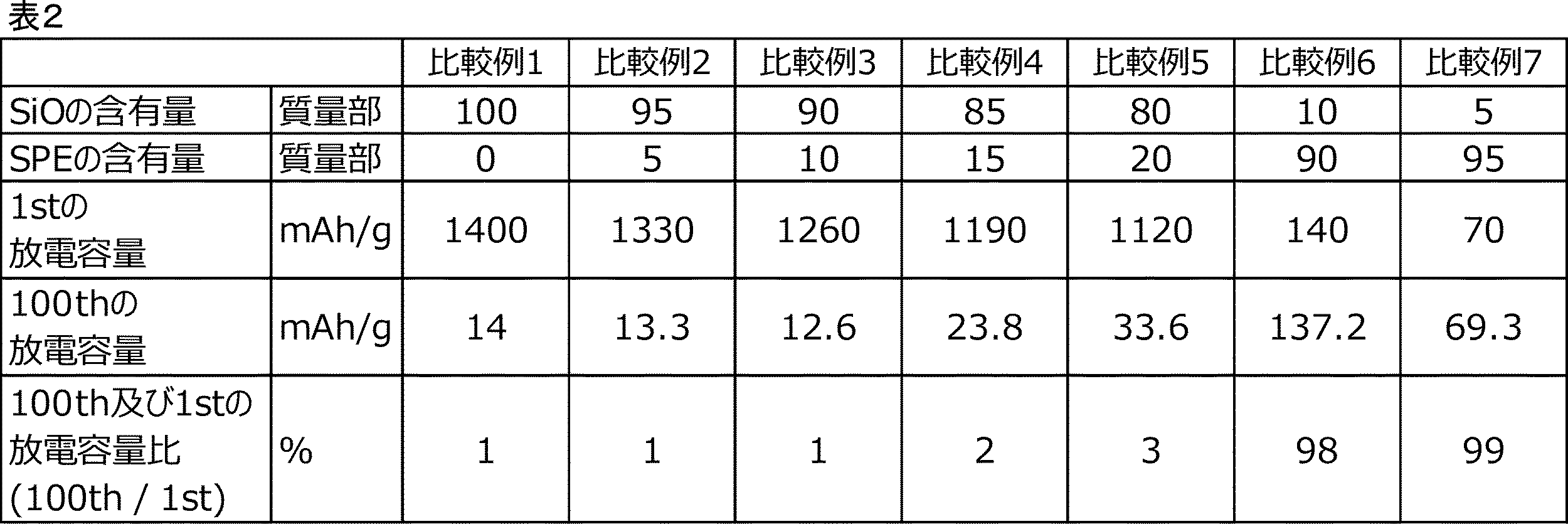
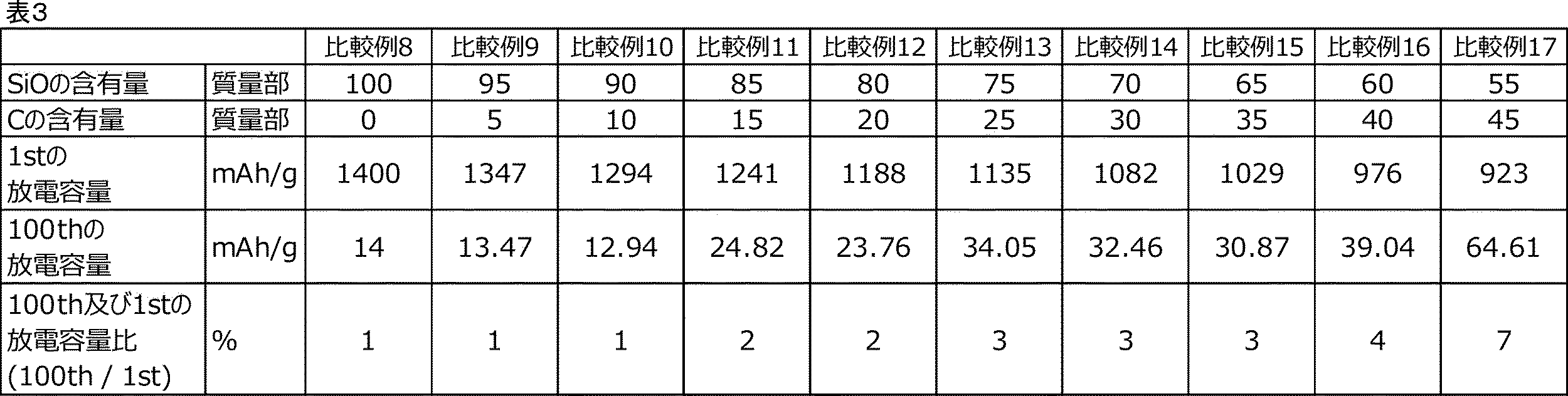

表1~4及び図2が示すように、SiO-グラファイト系負極を有するリチウムイオン二次電池に比べて、SiO-SPE系負極を有するリチウムイオン二次電池の方が100サイクル目の放電容量を高くできることがわかった。なお、SiO-SPE系負極を有するリチウムイオン二次電池の放電容量の最大値は441mAh/gであり、SiO-グラファイト系負極を有するリチウムイオン二次電池の放電容量の最大値は419mAh/gであった。SiO-SPE系負極を有するリチウムイオン二次電池の放電容量の最大値はSiO-グラファイト系負極を有するリチウムイオン二次電池の放電容量の最大値に比べて5%程高かった。また、高分子固体電解質の含有量を25~85質量部とすると、100サイクル目の放電容量が高かった。これにより、バインダーに高分子固体電解質を含有させ、負極活物質層における高分子固体電解質の含有量をSi系材料及び高分子固体電解質の含有量の合計100質量部に対して25~85質量部、好ましくは40~85質量部とすることにより、リチウムイオン二次電池の充放電サイクル特性を改善できるとともに、容量を高くできることがわかった。
[評価試験2]
得られたリチウムイオン二次電池は、以下の評価方法により評価した。
(容量)
上述の評価試験1と同様にして、作製したリチウムイオン二次電池の容量を評価した。
得られたリチウムイオン二次電池は、以下の評価方法により評価した。
(容量)
上述の評価試験1と同様にして、作製したリチウムイオン二次電池の容量を評価した。
[リチウムイオン二次電池1]
(正極の作製)
正極活物質としてNCA系酸化物(平均粒子径10μm)を100質量部と、導電助剤としてのアセチレンブラックを4質量部と、電極用バインダーとしてのポリフッ化ビニリデン4質量部と、溶媒としてのN-メチルピロリドン(NMP)とを混合し、固形分濃度60質量%に調整した正極活物質層用スラリーを得た。この正極活物質層用スラリーを、正極集電体としての厚さ15μmのアルミニウム箔に塗布し、予備乾燥後、120℃で真空乾燥した。その後、正極活物質層用スラリーを塗布した正極集電体を、400kN/mの線圧でローラにより加圧プレスし、さらに電極寸法の直径14mmの円形に打ち抜いて、正極活物質層を有する正極とした。なお、正極活物質層の厚さは50μmであった。
(正極の作製)
正極活物質としてNCA系酸化物(平均粒子径10μm)を100質量部と、導電助剤としてのアセチレンブラックを4質量部と、電極用バインダーとしてのポリフッ化ビニリデン4質量部と、溶媒としてのN-メチルピロリドン(NMP)とを混合し、固形分濃度60質量%に調整した正極活物質層用スラリーを得た。この正極活物質層用スラリーを、正極集電体としての厚さ15μmのアルミニウム箔に塗布し、予備乾燥後、120℃で真空乾燥した。その後、正極活物質層用スラリーを塗布した正極集電体を、400kN/mの線圧でローラにより加圧プレスし、さらに電極寸法の直径14mmの円形に打ち抜いて、正極活物質層を有する正極とした。なお、正極活物質層の厚さは50μmであった。
(負極の作製)
2.6質量部のLiTFSI(リチウムビストリフルオロメチルスルホニルイミド)を87質量部の質量部のN-メチルピロリドン(NMP)に溶解させることによってリチウム塩溶液を作製した。得られたリチウム塩溶液に10.4質量部のポリエチレンオキシドを加えて混合及び攪拌を行って、SPE(固体高分子電解質)溶液を作製した。
また、100質量部の一酸化ケイ素(SiO、平均粒子径1.0μm)を、1.5質量部のスチレンブタジエンゴム(SBR)及び1.5質量部のカルボキシメチルセルロース(CMC)を混合した溶液と、自公転ミキサーを用いて2000rpmで2分間混合した。そして、この混合物を超音波ホモジナイザーで10分間、分散処理した後、再度、自公転ミキサーを用いて、この分散物を2000rpmで2分間混合することにより、SiOスラリーを作製した。
さらに、100質量部の黒鉛(平均粒子径10μm)を、1.5質量部のスチレンブタジエンゴム(SBR)及び1.5質量部のカルボキシメチルセルロース(CMC)を混合した溶液と混合し、固形分50質量%に調整した黒鉛スラリーを得た。
上述のSPE溶液とSiOスラリーと黒鉛スラリーとを混合してSiO-C-SPEスラリーを作製した。そして、このSiO-C-SPEスラリーを、負極集電体としての厚さ12μmの銅箔に塗布して100℃で真空乾燥した。その後、SiO-C-SPEスラリーを塗布した負極集電体を、500kN/mの線圧でローラにより加圧プレスし、さらに電極寸法の直径16mmの円形に打ち抜いて、負極活物質層を有する負極とした。負極活物質層の厚さは40μmであった。
なお、SiO-C-SPEスラリーにおけるSPE溶液、SiOスラリー及び黒鉛スラリーの割合を変えることにより、負極活物質層におけるSiO、黒鉛及びポリエチレンオキシドの割合を、表5及び表6に示すように変更した負極を作製した。なお、SiO-C-SPEスラリーにおける黒鉛及びポリエチレンオキシドの質量比が1:1になるように、SiO-C-SPEスラリーを調製した。
2.6質量部のLiTFSI(リチウムビストリフルオロメチルスルホニルイミド)を87質量部の質量部のN-メチルピロリドン(NMP)に溶解させることによってリチウム塩溶液を作製した。得られたリチウム塩溶液に10.4質量部のポリエチレンオキシドを加えて混合及び攪拌を行って、SPE(固体高分子電解質)溶液を作製した。
また、100質量部の一酸化ケイ素(SiO、平均粒子径1.0μm)を、1.5質量部のスチレンブタジエンゴム(SBR)及び1.5質量部のカルボキシメチルセルロース(CMC)を混合した溶液と、自公転ミキサーを用いて2000rpmで2分間混合した。そして、この混合物を超音波ホモジナイザーで10分間、分散処理した後、再度、自公転ミキサーを用いて、この分散物を2000rpmで2分間混合することにより、SiOスラリーを作製した。
さらに、100質量部の黒鉛(平均粒子径10μm)を、1.5質量部のスチレンブタジエンゴム(SBR)及び1.5質量部のカルボキシメチルセルロース(CMC)を混合した溶液と混合し、固形分50質量%に調整した黒鉛スラリーを得た。
上述のSPE溶液とSiOスラリーと黒鉛スラリーとを混合してSiO-C-SPEスラリーを作製した。そして、このSiO-C-SPEスラリーを、負極集電体としての厚さ12μmの銅箔に塗布して100℃で真空乾燥した。その後、SiO-C-SPEスラリーを塗布した負極集電体を、500kN/mの線圧でローラにより加圧プレスし、さらに電極寸法の直径16mmの円形に打ち抜いて、負極活物質層を有する負極とした。負極活物質層の厚さは40μmであった。
なお、SiO-C-SPEスラリーにおけるSPE溶液、SiOスラリー及び黒鉛スラリーの割合を変えることにより、負極活物質層におけるSiO、黒鉛及びポリエチレンオキシドの割合を、表5及び表6に示すように変更した負極を作製した。なお、SiO-C-SPEスラリーにおける黒鉛及びポリエチレンオキシドの質量比が1:1になるように、SiO-C-SPEスラリーを調製した。
(電解液の調製)
エチレンカーボネート(EC)とジエチルカーボネート(DEC)とを3:7の体積比(EC:DEC)で混合した溶媒に、電解質塩としてLiPF6を1モル/リットルとなるように溶解して、電解液を調製した。
エチレンカーボネート(EC)とジエチルカーボネート(DEC)とを3:7の体積比(EC:DEC)で混合した溶媒に、電解質塩としてLiPF6を1モル/リットルとなるように溶解して、電解液を調製した。
(セパレータ)
樹脂フィルム(積水化学工業株式会社製、商品名:ESFINO、微多孔ポリプロピレン樹脂フィルム、厚さ24μm、空孔率54%)を直径16mmの円形に打ち抜いたものをセパレータとして使用した。
樹脂フィルム(積水化学工業株式会社製、商品名:ESFINO、微多孔ポリプロピレン樹脂フィルム、厚さ24μm、空孔率54%)を直径16mmの円形に打ち抜いたものをセパレータとして使用した。
(リチウムイオン二次電池の製造)
図1に示す電池特性評価用ジグ100に、上記の正極、セパレータ及び負極を配置するとともに上記電解液を注入することにより特性評価用のリチウムイオン二次電池を作製した。具体的には、負極ボディ106と正極ボディ107との間に、負極ボディ106側から順に、負極108、セパレータ109、電極ガイド110、正極111、電極押さえ112及びスプリング113を電池特性評価用ジグ100に配置した。そして、電池特性評価用ジグ100に上記電解液を注入して、リチウムイオン二次電池1を作製した。
図1に示す電池特性評価用ジグ100に、上記の正極、セパレータ及び負極を配置するとともに上記電解液を注入することにより特性評価用のリチウムイオン二次電池を作製した。具体的には、負極ボディ106と正極ボディ107との間に、負極ボディ106側から順に、負極108、セパレータ109、電極ガイド110、正極111、電極押さえ112及びスプリング113を電池特性評価用ジグ100に配置した。そして、電池特性評価用ジグ100に上記電解液を注入して、リチウムイオン二次電池1を作製した。
[リチウムイオン二次電池2]
表7及び8に示すように、SPE溶液を加えないでSiOスラリーと黒鉛スラリーとを混合してSiO-Cスラリーを作製し、SiO-C-SPEスラリーの代わりにSiO-Cスラリーを用いて負極を作製した点を除いて、実施例と同様な方法で、リチウムイオン二次電池2を作製した。なお、SiO-Cスラリーにおける黒鉛スラリー及びSiOスラリーの割合を変えることにより、負極活物質層におけるSiO及び黒鉛の割合を変更した負極を作製した。
表7及び8に示すように、SPE溶液を加えないでSiOスラリーと黒鉛スラリーとを混合してSiO-Cスラリーを作製し、SiO-C-SPEスラリーの代わりにSiO-Cスラリーを用いて負極を作製した点を除いて、実施例と同様な方法で、リチウムイオン二次電池2を作製した。なお、SiO-Cスラリーにおける黒鉛スラリー及びSiOスラリーの割合を変えることにより、負極活物質層におけるSiO及び黒鉛の割合を変更した負極を作製した。
リチウムイオン二次電池1及びリチウムイオン二次電池2の放電容量を表5~8に示し、100サイクル目の放電容量の結果を図3に示す。

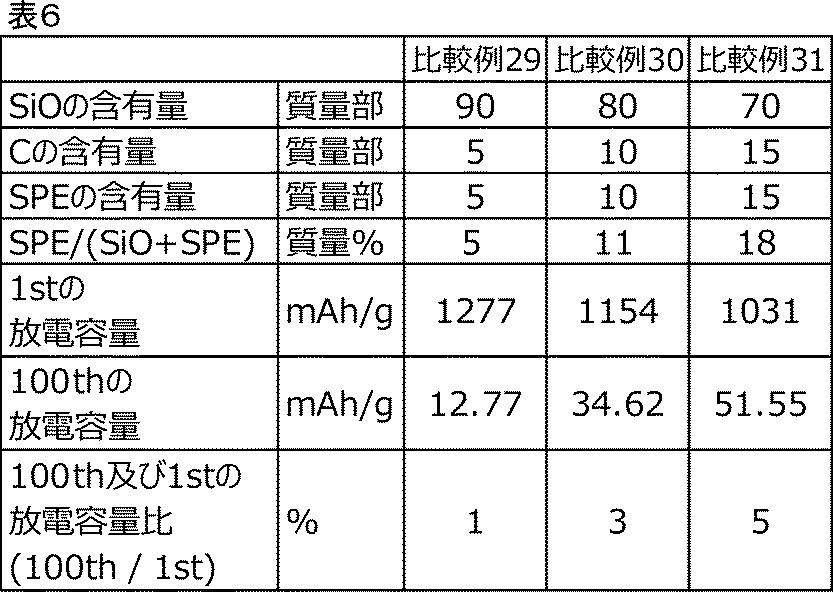
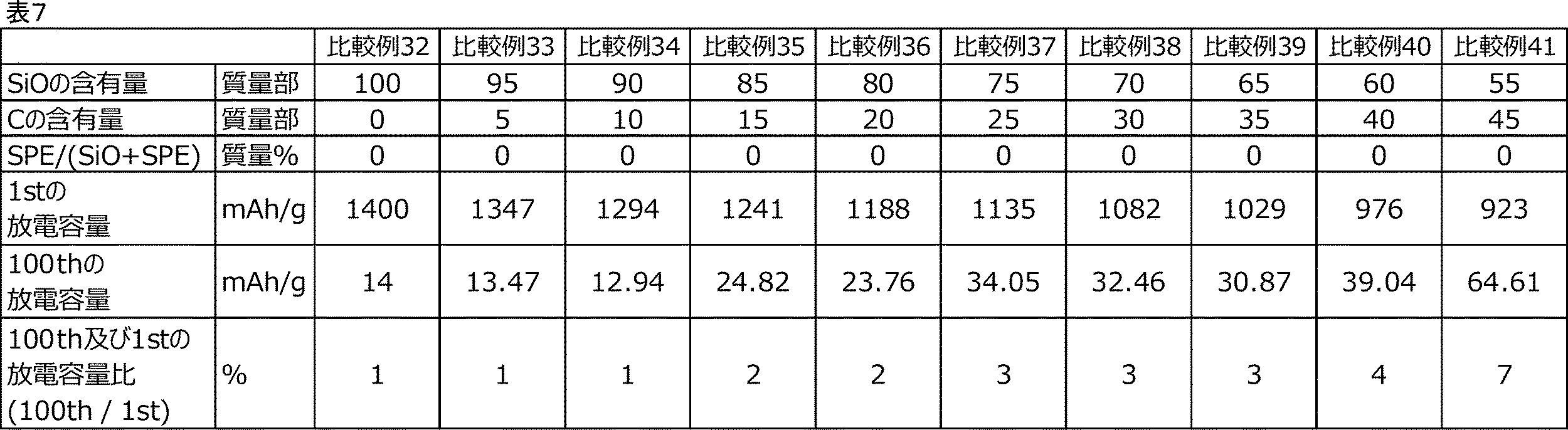

表5~8及び図3が示すように、比較例のリチウムイオン二次電池に比べて、実施例のリチウムイオン二次電池の方が100サイクル目の放電容量を高くできることがわかった。なお、実施例の放電容量の最大値は496mAh/gであり、比較例の放電容量の最大値は419mAh/gであった。実施例の放電容量の最大値は比較例の放電容量の最大値に比べて18%程高かった。これより、一般式SiOxで表される化合物及び黒鉛を含有する負極活物質と高分子固体電解質を含有するバインダーとを含む負極活物質層を備えた負極を用いることによって、リチウムイオン二次電池の容量をさらに高くし、かつ充放電サイクル特性をさらに良好にできることがわかった。
100 電池特性評価用ジグ
106 負極ボディ
107 正極ボディ
108 負極
109 セパレータ
110 電極ガイド
111 正極
112 電極押さえ
113 スプリング
106 負極ボディ
107 正極ボディ
108 負極
109 セパレータ
110 電極ガイド
111 正極
112 電極押さえ
113 スプリング
Claims (10)
- 負極活物質及びバインダーを含む負極活物質層を備えたリチウムイオン二次電池用負極であって、
前記負極活物質はSi系材料を含み、
前記バインダーは高分子固体電解質を含み、
前記負極活物質層における前記高分子固体電解質の含有量が前記Si系材料及び前記高分子固体電解質の含有量の合計100質量部に対して25~85質量部であるリチウムイオン二次電池用負極。 - 前記高分子固体電解質の含有量が、前記Si系材料及び前記高分子固体電解質の含有量の合計100質量部に対して40~85質量部である請求項1に記載のリチウムイオン二次電池用負極。
- 前記Si系材料が一般式SiOx(式中、xは0.5~1.5の数)で表される化合物である請求項1又は2に記載のリチウムイオン二次電池用負極。
- 前記負極活物質層における前記Si系材料の含有量が前記Si系材料及び前記高分子固体電解質の含有量の合計100質量部に対して15~75質量部である請求項1~3のいずれか1項に記載のリチウムイオン二次電池用負極。
- 前記負極活物質は黒鉛をさらに含み、
前記Si系材料は一般式SiOx(式中、xは0.5~1.5の数)で表される化合物であり、
前記負極活物質層における前記黒鉛の含有量が、前記Si系材料、前記黒鉛及び前記高分子固体電解質の含有量の合計100質量部に対して25~40質量部である請求項1に記載のリチウムイオン二次電池用負極。 - 前記負極活物質層における前記高分子固体電解質の含有量が、前記Si系材料、前記黒鉛及び前記高分子固体電解質の含有量の合計100質量部に対して25~40質量部である請求項5に記載のリチウムイオン二次電池用負極。
- 前記高分子固体電解質がポリエーテル系電解質である請求項1~6のいずれか1項に記載のリチウムイオン二次電池用負極。
- 前記ポリエーテル系電解質のマトリックスとなるポリマーは、エチレンオキシド構造を有するポリマーである請求項7に記載のリチウムイオン二次電池用負極。
- 前記高分子固体電解質がリチウム塩を含む請求項1~8のいずれか1項に記載のリチウムイオン二次電池用負極。
- 正極と、請求項1~9のいずれか1項に記載のリチウムイオン二次電池用負極とを備えたリチウムイオン二次電池。
Applications Claiming Priority (4)
| Application Number | Priority Date | Filing Date | Title |
|---|---|---|---|
| JP2019047753A JP2020149912A (ja) | 2019-03-14 | 2019-03-14 | リチウムイオン二次電池用負極及びリチウムイオン二次電池 |
| JP2019-047748 | 2019-03-14 | ||
| JP2019047748A JP2020149911A (ja) | 2019-03-14 | 2019-03-14 | リチウムイオン二次電池用負極及びリチウムイオン二次電池 |
| JP2019-047753 | 2019-03-14 |
Publications (1)
| Publication Number | Publication Date |
|---|---|
| WO2020184713A1 true WO2020184713A1 (ja) | 2020-09-17 |
Family
ID=72426812
Family Applications (1)
| Application Number | Title | Priority Date | Filing Date |
|---|---|---|---|
| PCT/JP2020/011190 Ceased WO2020184713A1 (ja) | 2019-03-14 | 2020-03-13 | リチウムイオン二次電池用負極及びリチウムイオン二次電池 |
Country Status (1)
| Country | Link |
|---|---|
| WO (1) | WO2020184713A1 (ja) |
Cited By (2)
| Publication number | Priority date | Publication date | Assignee | Title |
|---|---|---|---|---|
| CN112018327A (zh) * | 2020-09-21 | 2020-12-01 | 珠海冠宇电池股份有限公司 | 一种负极片及制备方法、电池 |
| CN115020684A (zh) * | 2022-07-26 | 2022-09-06 | 蜂巢能源科技股份有限公司 | 一种石墨、硅氧化物和硅复合的负极材料及其应用 |
Citations (4)
| Publication number | Priority date | Publication date | Assignee | Title |
|---|---|---|---|---|
| JP2011018575A (ja) * | 2009-07-09 | 2011-01-27 | Mie Univ | リチウムイオン二次電池用の負極材料及びリチウムイオン二次電池 |
| CN104617254A (zh) * | 2013-11-01 | 2015-05-13 | 中国科学院物理研究所 | 一种用于锂离子电池的复合负极材料 |
| US20150228980A1 (en) * | 2014-02-12 | 2015-08-13 | GM Global Technology Operations LLC | High performance silicon electrodes having improved interfacial adhesion between binder and silicon |
| WO2017168947A1 (ja) * | 2016-03-30 | 2017-10-05 | 住友精化株式会社 | 非水電解質二次電池電極用バインダー、非水電解質二次電池用電極合剤、非水電解質二次電池用電極、非水電解質二次電池、および電気機器 |
-
2020
- 2020-03-13 WO PCT/JP2020/011190 patent/WO2020184713A1/ja not_active Ceased
Patent Citations (4)
| Publication number | Priority date | Publication date | Assignee | Title |
|---|---|---|---|---|
| JP2011018575A (ja) * | 2009-07-09 | 2011-01-27 | Mie Univ | リチウムイオン二次電池用の負極材料及びリチウムイオン二次電池 |
| CN104617254A (zh) * | 2013-11-01 | 2015-05-13 | 中国科学院物理研究所 | 一种用于锂离子电池的复合负极材料 |
| US20150228980A1 (en) * | 2014-02-12 | 2015-08-13 | GM Global Technology Operations LLC | High performance silicon electrodes having improved interfacial adhesion between binder and silicon |
| WO2017168947A1 (ja) * | 2016-03-30 | 2017-10-05 | 住友精化株式会社 | 非水電解質二次電池電極用バインダー、非水電解質二次電池用電極合剤、非水電解質二次電池用電極、非水電解質二次電池、および電気機器 |
Cited By (3)
| Publication number | Priority date | Publication date | Assignee | Title |
|---|---|---|---|---|
| CN112018327A (zh) * | 2020-09-21 | 2020-12-01 | 珠海冠宇电池股份有限公司 | 一种负极片及制备方法、电池 |
| CN115020684A (zh) * | 2022-07-26 | 2022-09-06 | 蜂巢能源科技股份有限公司 | 一种石墨、硅氧化物和硅复合的负极材料及其应用 |
| CN115020684B (zh) * | 2022-07-26 | 2023-10-20 | 蜂巢能源科技股份有限公司 | 一种石墨、硅氧化物和硅复合的负极材料及其应用 |
Similar Documents
| Publication | Publication Date | Title |
|---|---|---|
| JP5882516B2 (ja) | リチウム二次電池 | |
| JP5270050B1 (ja) | 複合黒鉛粒子およびその用途 | |
| JP5611453B2 (ja) | リチウムイオン二次電池用負極及びその負極を用いたリチウムイオン二次電池 | |
| US12431497B2 (en) | Globular carbon-based anode active material, method for manufacturing same, and anode and lithium secondary battery comprising same | |
| JPWO2011115247A1 (ja) | リチウムイオン二次電池 | |
| WO2017057123A1 (ja) | リチウムイオン二次電池用負極及びリチウムイオン二次電池 | |
| US12476251B2 (en) | Globular carbon-based anode active material, method for manufacturing same, and anode and lithium secondary battery comprising same | |
| WO2018155207A1 (ja) | 二次電池およびその製造方法 | |
| JP2020149911A (ja) | リチウムイオン二次電池用負極及びリチウムイオン二次電池 | |
| JP6567289B2 (ja) | リチウムイオン二次電池 | |
| JP2020140896A (ja) | リチウムイオン二次電池用電極及びリチウムイオン二次電池 | |
| JP5435622B2 (ja) | フィルム外装型非水系電解質二次電池 | |
| KR102320977B1 (ko) | 실리콘 복합체를 포함하는 음극 활물질 및 이를 포함하는 리튬 이차전지 | |
| WO2020184713A1 (ja) | リチウムイオン二次電池用負極及びリチウムイオン二次電池 | |
| JP2020053282A (ja) | リチウムイオン二次電池用負極及びリチウムイオン二次電池 | |
| JP5279362B2 (ja) | 非水電解質二次電池 | |
| JP2020140895A (ja) | リチウムイオン二次電池用電極及びリチウムイオン二次電池 | |
| JP6961939B2 (ja) | 非水電解質二次電池用負極剤、非水電解質二次電池用負極及び非水電解質二次電池 | |
| JP2020155378A (ja) | リチウムイオン二次電池用電解液、及びリチウムイオン二次電池 | |
| JP6832474B2 (ja) | リチウムイオン二次電池用正極材料、正極活物質層、及びリチウムイオン二次電池 | |
| JP2022153190A (ja) | リチウムイオン二次電池用電極およびリチウムイオン二次電池 | |
| JP2020149912A (ja) | リチウムイオン二次電池用負極及びリチウムイオン二次電池 | |
| JP2020170610A (ja) | リチウムイオン二次電池 | |
| CN121839571A (zh) | 具有极快充电的高功率混合硅阳极 | |
| WO2026039722A1 (en) | Electrolyte compositions including quaternary ammonium compounds for secondary batteries |
Legal Events
| Date | Code | Title | Description |
|---|---|---|---|
| 121 | Ep: the epo has been informed by wipo that ep was designated in this application |
Ref document number: 20769806 Country of ref document: EP Kind code of ref document: A1 |
|
| NENP | Non-entry into the national phase |
Ref country code: DE |
|
| 122 | Ep: pct application non-entry in european phase |
Ref document number: 20769806 Country of ref document: EP Kind code of ref document: A1 |