WO2020179546A1 - 無線通信システムおよび無線通信方法 - Google Patents
無線通信システムおよび無線通信方法 Download PDFInfo
- Publication number
- WO2020179546A1 WO2020179546A1 PCT/JP2020/007476 JP2020007476W WO2020179546A1 WO 2020179546 A1 WO2020179546 A1 WO 2020179546A1 JP 2020007476 W JP2020007476 W JP 2020007476W WO 2020179546 A1 WO2020179546 A1 WO 2020179546A1
- Authority
- WO
- WIPO (PCT)
- Prior art keywords
- wireless
- radio station
- station
- wireless communication
- area coverage
- Prior art date
- Legal status (The legal status is an assumption and is not a legal conclusion. Google has not performed a legal analysis and makes no representation as to the accuracy of the status listed.)
- Ceased
Links
Images



Classifications
-
- H—ELECTRICITY
- H04—ELECTRIC COMMUNICATION TECHNIQUE
- H04W—WIRELESS COMMUNICATION NETWORKS
- H04W16/00—Network planning, e.g. coverage or traffic planning tools; Network deployment, e.g. resource partitioning or cells structures
- H04W16/14—Spectrum sharing arrangements between different networks
-
- H—ELECTRICITY
- H04—ELECTRIC COMMUNICATION TECHNIQUE
- H04W—WIRELESS COMMUNICATION NETWORKS
- H04W72/00—Local resource management
- H04W72/50—Allocation or scheduling criteria for wireless resources
- H04W72/51—Allocation or scheduling criteria for wireless resources based on terminal or device properties
-
- H—ELECTRICITY
- H04—ELECTRIC COMMUNICATION TECHNIQUE
- H04W—WIRELESS COMMUNICATION NETWORKS
- H04W72/00—Local resource management
- H04W72/04—Wireless resource allocation
- H04W72/044—Wireless resource allocation based on the type of the allocated resource
- H04W72/0453—Resources in frequency domain, e.g. a carrier in FDMA
-
- H—ELECTRICITY
- H04—ELECTRIC COMMUNICATION TECHNIQUE
- H04W—WIRELESS COMMUNICATION NETWORKS
- H04W8/00—Network data management
- H04W8/22—Processing or transfer of terminal data, e.g. status or physical capabilities
-
- H—ELECTRICITY
- H04—ELECTRIC COMMUNICATION TECHNIQUE
- H04W—WIRELESS COMMUNICATION NETWORKS
- H04W84/00—Network topologies
- H04W84/02—Hierarchically pre-organised networks, e.g. paging networks, cellular networks, WLAN [Wireless Local Area Network] or WLL [Wireless Local Loop]
- H04W84/10—Small scale networks; Flat hierarchical networks
- H04W84/12—WLAN [Wireless Local Area Networks]
Definitions
- the present invention relates to a wireless communication system and a wireless communication method for improving an area coverage rate and a throughput of the entire system in a wireless LAN (Local Area Network) system by selecting an operating frequency band of a wireless station.
- a wireless LAN Local Area Network
- the wireless LAN of the IEEE802.11 standard includes a wireless LAN of the IEEE802.11b/g/n standard that uses the 2.4 GHz band and a wireless LAN of the IEEE802.11a/n/ac standard that uses the 5 GHz band.
- 13 channels are prepared at 5MHz intervals between 2400MHz and 2483.5MHz.
- a maximum of 3 channels, and in some cases up to 4 channels can be used at the same time.
- the IEEE802.11a standard wireless LAN defines a total of 19 channels, 8 channels and 11 channels that do not overlap each other, between 5170 MHz and 5330 MHz and between 5490 MHz and 5710 MHz, respectively.
- the bandwidth per channel is fixed at 20 MHz.
- the maximum transmission speed of the wireless LAN is 11 Mbps for the IEEE 802.11b standard and 54 Mbps for the IEEE 802.11a standard and the IEEE 802.11g standard.
- the transmission rate here is the transmission rate on the physical layer.
- the transmission efficiency in the MAC (Medium Access Control) layer is about 50 to 70%, so the upper limit of the actual throughput is about 5 Mbps in the IEEE802.11b standard, and 30 Mbps in the IEEE802.11a standard and the IEEE802.11g standard. It is a degree.
- the transmission rate further decreases as the number of wireless stations that transmit information increases.
- the channel bandwidth which was previously fixed at 20 MHz, has been expanded to a maximum of 40 MHz, and the spatial multiplex transmission technology (MIMO: Multiple input multiple output) technology.
- MIMO Multiple input multiple output
- the channel bandwidth can be expanded to 80 MHz or up to 160 MHz (or 80 + 80 MHz), and multi-access (SDMA: Space Division Multiple Access) is applied. It has been decided to introduce a user MIMO (MU-MIMO) transmission method. By applying all the functions specified in the IEEE802.11ac standard for transmission and reception, it is possible to achieve a maximum communication speed of approximately 6.9 Gbps in the physical layer.
- SDMA Space Division Multiple Access
- the IEEE802.11ax standard that is currently being formulated is expected to define OFDMA (Orthogonal Frequency Division Multiple Access) that can transmit and receive frames by dividing the above 20 MHz, 40 MHz, 80 MHz, 160 MHz, 80+80 MHz channels into fine subchannels. Is. When OFDMA is used, the channel is divided into small subchannels, and simultaneous transmission by a plurality of radio stations is possible for each resource unit. Further, the IEEE802.11ax standard is expected to specify a function of increasing communication opportunities while suppressing interference from other peripheral cells by controlling a carrier sense threshold (CCA threshold).
- CCA carrier sense threshold
- the IEEE802.11 standard wireless base station is used when forming a wireless LAN cell (BSS: Basic Service Set).
- BSS Basic Service Set
- one frequency channel is selected from the frequency channels supported by the own radio base station and operated.
- the channel used in the own cell, the bandwidth and the setting values of other parameters and other parameters that can be supported by the own wireless base station are the Beacon frame that is periodically transmitted and the Probe Request frame that is received from the wireless terminal.
- the cell is operated by describing it in the response frame or the like, transmitting the frame on the frequency channel whose operation is determined, and notifying the subordinate wireless terminal and other wireless stations in the vicinity.
- a radio base station there are four methods for selecting and setting frequency channels, bandwidths, and other parameters.
- Each wireless base station A method of autonomously selecting and setting parameter values based on the wireless environment information detected by the local station at startup (4) A method of setting parameter values determined by a centralized control station such as a wireless LAN controller
- Non-Patent Document 2 The number of channels that can be used at the same location at the same time depends on the channel bandwidth used for communication, and is 3, 4, or 9, or 19 in 2.4 GHz band wireless LAN and 5 GHz band wireless LAN. Therefore, when actually introducing a wireless LAN, it is necessary for the wireless base station to select a channel to be used in its own BSS (Non-Patent Document 2).
- the number of channels that can be used simultaneously at the same location in the 5 GHz band is 9 channels, 4 channels, and 2 channels instead of 19 channels at 20 MHz. Less. That is, as the channel bandwidth increases, the number of usable channels decreases.
- OBSS Overlapping BSS
- CSMA / CA Carrier Sense Multiple Access with Collision Avoidance
- the radio station in which the transmission request is generated first performs carrier sense for a predetermined sensing period (DIFS: Distributed Inter-Frame Space) to monitor the state of the radio medium, and during this period, transmission by another radio station is performed. If there is no signal, then random backoff is performed. The radio station continues to perform carrier sense during the random backoff period, during which time it gains the right to use the channel if there is no transmission signal from another radio station. Note that transmission/reception by another wireless station is determined by whether or not a signal larger than a preset carrier sense threshold is received. A radio station that has obtained the right to use a channel can transmit data to other radio stations in the same BSS and receive data from those radio stations.
- DIFS Distributed Inter-Frame Space
- the method of selecting the above parameters such as the 2.4 GHz / 5 GHz type, which is the operating frequency band of the wireless base station, and the selection of the channel to be used in the operating frequency band is not defined by the IEEE802.11 standard, so each vendor has its own method. Has been adopted.
- each radio station since each radio station selects the above parameters in an autonomous and decentralized manner, the system as a whole cannot be optimized, and there is a problem that user quality is significantly deteriorated especially in an environment with a large number of radio stations.
- the few channels should be used by multiple radio stations unless the 2.4 GHz band and 5 GHz band are properly distributed. become.
- the service area cannot be secured in either frequency band, or the service area overlaps unnecessarily, resulting in inefficient operation.
- the present invention provides wireless communication in which the operating frequency band of each wireless station can be appropriately set in order to provide each user with a high-quality wireless environment by improving the area coverage rate and throughput of the entire wireless LAN system.
- An object is to provide a system and a wireless communication method.
- the first invention is a wireless communication system in which a plurality of wireless stations transmit on a shared frequency band, in which the wireless station transmits the capability / environmental information including the capability information of the own radio station and the surrounding environment information to the radio station control device.
- the radio station control device is provided with a means for notifying the radio station, based on the capability / environmental information collected from the radio station, and based on a predetermined control guideline for the radio station capable of using a plurality of frequency bands.
- a control means for selecting and setting a frequency band to be used is provided.
- control means has a configuration in which, as a control guideline, a frequency band in which the area coverage rate is improved is selected for a wireless station below a predetermined threshold value based on the area coverage rate by the wireless station. is there.
- a second invention is a wireless communication method in which a plurality of wireless stations transmit on a shared frequency band, wherein the wireless station sends capability/environment information including capability information of its own wireless station and surrounding environment information to the wireless station control device.
- the radio station control device has a step of executing a process of notifying the radio station, and the radio station control device controls predetermined control for a radio station capable of using a plurality of frequency bands based on the capability / environment information collected from the radio station. It has a control step of selecting and setting a frequency band to be used based on the guide.
- control step selects, as a control guideline, a frequency band in which the area coverage is improved for wireless stations having a predetermined threshold value or less based on the area coverage by the wireless station.
- the present invention by appropriately setting the operating frequency band of each wireless station, it is possible to improve the area coverage and throughput of the wireless LAN system as a whole and provide each user with a high-quality wireless environment. ..
- FIG. 1 shows a configuration example of a wireless communication system according to the present invention.
- a plurality of wireless stations 10-1 to 10-2 are connected to the wireless station control device 20.
- Each of the wireless stations 10-1 and 10-2 notifies the wireless station control device 20 of capability/environment information (details will be described later), and is operated based on the parameter setting information notified from the wireless station control device 20.
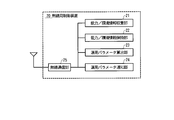
- FIG. 2 shows a configuration example of the wireless station 10.
- the wireless station 10 includes a local wireless station capability information holding unit 11 that holds capability information of its own wireless station, a peripheral wireless environment information collection unit 12 that collects surrounding environment information, capability information and peripheral environment information (capability /Environmental information) to the radio station controller 20, the operation/environment information notification unit 13, an operation parameter setting unit 14 that sets operation parameters based on the operation parameter information notified from the radio station controller 20, and wireless communication. It is composed of the unit 15.
- the capability information of the wireless station is information such as a corresponding wireless frequency (2.4 GHz/5 GHz), a corresponding wireless standard (11a/b/g/n/ac/ax), and the number of accommodated antennas.
- FIG. 3 shows a configuration example of the radio station controller 20.
- the wireless station control device 20 includes an ability/environment information collecting unit 21 for collecting ability/environment information notified from each wireless station and an ability/environment information holding unit for holding the collected ability/environment information. 22, an operation parameter calculation unit 23 that determines operation parameters in each wireless station based on the collected capability/environment information, an operation parameter notification unit 24 that notifies the determined operation parameters, and a radio that communicates with the wireless station.
- the communication unit 25 is included.
- FIG. 4 shows an operation flow of the radio station controller 20 according to the present invention.
- the operation flow is executed by the operation parameter calculation unit 23 of the radio station controller 20.
- each wireless station is classified into two lists A and B according to a predetermined rule based on the confirmation result ( S1).
- list A is an available wireless station of 5 GHz.
- List B is a wireless station that cannot use 5 GHz but can use only 2.4 GHz. Therefore, 2.4 GHz/5 GHz switchable wireless stations are classified in list A.
- the 2.4 GHz/5 GHz switchable wireless stations may be classified in the list C as described later.
- the area coverage contribution is calculated using, for example, the following equation (S2).
- Area coverage contribution of radio station X (number of measurement points covered only by X) / (total number of measurement points covered by X)
- “covering” means having a signal strength (RSSI value) equal to or higher than the service area threshold value R (for example, -75 dBm).
- the number of measurement points may be an area having the signal strength. For example, in the example of FIG. 5, in the service area of the wireless station AP1, only AP1 covers three measurement points ( ⁇ ), and AP1 covers five measurement points ( ⁇ ). The area coverage contribution of will be 3/5. Similarly, the area coverage contribution of the wireless station AP2 is 1/3.
- the index of the area coverage contribution of the radio station X is not limited to this, and may be determined according to, for example, the importance of the measurement point.
- the premium points may be weighted and reflected in the area cover contribution rate.
- the one wireless station X selected in step S4 will be randomly selected from them, or You may select in order with a small cover contribution.
- step S7 the area coverage contribution of each wireless station belonging to the list B is calculated (S7), and it is determined whether the area coverage contribution of the wireless station X in the list B is improved as compared with the list A. Yes (S8). If the area coverage contribution is improved by moving the wireless station X from the list A to the list B, that is, switching to 2.4 GHz, the process returns to step S2, and the area coverage contribution of each wireless station belonging to the list A is recalculated. Then, the processing from step S3 onward is repeated.
- step S4 if the area coverage contribution is not improved by switching the radio station X to 2.4 GHz, the radio station X is moved (returned) from the list B to the list A (S9). Then, returning to step S3, if there is another unselected radio station whose area cover contribution degree is equal to or less than a predetermined threshold value among the radio stations belonging to the list A, the process of step S4 or less is repeated.
- FIGS. 6 and 7 show an example of calculating the operating frequency band of a radio station (AP).
- AP1 can use only the 2.4 GHz band
- AP2, AP3, and AP4 can use the 2.4 / 5 GHz band.
- the service area threshold R of each AP is ⁇ 75 dBm, which is the inner point of the circle.
- the area coverage contribution threshold is 0.65.
- step S4 when there are a plurality of APs (AP3, AP4) whose area coverage contribution is equal to or less than the threshold value among AP1 to AP4, the APs that use 2.4 GHz will be replaced depending on the selection method in step S4. Further, when returning from step S8 to step S2, the area cover contribution degree is recalculated, so that the area cover contribution degree of the AP that was not selected last time does not necessarily fall below the threshold value again.
- the relation between the area coverage contribution corresponding to the range of the service area determined by the RSSI from the wireless station (AP) and the frequency band used is the control guideline.
- the carrier sense threshold and the transmission power are used. It may be a control mode in which the relationship between the area cover contribution degree corresponding to the range determined by the value and the magnitude of the carrier sense threshold value or the transmission power value is used as a control guideline.
- Radio station 20 Radio station control device 11 Own radio station capacity information holding unit 12 Peripheral radio environment information collection unit 13 Capacity / environment information notification unit 14 Operation parameter setting unit 15 Wireless communication unit 21 Capacity / environment information collection unit 22 Capacity / environment Information holding unit 23 Operation parameter calculation unit 24 Operation parameter notification unit 25 Wireless communication unit
Landscapes
- Engineering & Computer Science (AREA)
- Computer Networks & Wireless Communication (AREA)
- Signal Processing (AREA)
- Databases & Information Systems (AREA)
- Mobile Radio Communication Systems (AREA)
Abstract
共用周波数帯上で複数の無線局が送信する無線通信システムにおいて、無線局は、自無線局の能力情報および周辺の環境情報を含めた能力/環境情報を無線局制御装置に通知する手段を備え、無線局制御装置は、無線局より収集した能力/環境情報を基に、複数の周波数帯の使用が可能な無線局に対して予め定められた制御指針に基づいて、使用する周波数帯を選択して設定する制御手段を備える。制御指針は、無線局によるエリアカバー率を基に、所定の閾値以下の無線局についてはエリアカバー率が改善される周波数帯を選択する。
Description
本発明は、無線LAN(Local Area Network)システムにおいて、無線局の運用周波数帯の選択により、システム全体としてのエリアカバー率の向上とスループットの改善を行う無線通信システムおよび無線通信方法に関する。
近年、ノートパソコンやスマートフォン等の持ち運び可能で高性能な無線端末の普及により企業や公共スペースだけではなく、一般家庭でもIEEE802.11標準規格の無線LANが広く使われるようになっている。IEEE802.11標準規格の無線LANには、 2.4GHz帯を用いるIEEE802.11b/g/n 規格の無線LANと、5GHz帯を用いるIEEE802.11a/n/ac規格の無線LANがある。
IEEE802.11b規格やIEEE802.11g規格の無線LANでは、2400MHzから2483.5MHz間に5MHz間隔で13チャネルが用意されている。ただし、同一場所で複数のチャネルを使用する際は、干渉を避けるためスペクトルが重ならないようにチャネルを使用すると最大で3チャネル、場合によっては4チャネルまで同時に使用できる。
IEEE802.11a規格の無線LANでは、日本の場合は、5170MHzから5330MHz間と、5490MHzから5710MHz間で、それぞれ互いに重ならない8チャネルおよび11チャネルの合計19チャネルが規定されている。なお、IEEE802.11a規格では、チャネル当たりの帯域幅が20MHzに固定されている。
無線LANの最大伝送速度は、IEEE802.11b規格の場合は11Mbps であり、IEEE802.11a規格やIEEE802.11g規格の場合は54Mbps である。ただし、ここでの伝送速度は物理レイヤ上での伝送速度である。実際にはMAC(Medium Access Control )レイヤでの伝送効率が50~70%程度であるため、実際のスループットの上限値はIEEE802.11b規格では5Mbps 程度、IEEE802.11a規格やIEEE802.11g規格では30Mbps 程度である。また、伝送速度は、情報を送信しようとする無線局が増えればさらに低下する。
一方で、有線LANでは、Ethernet(登録商標)の100Base-T インタフェースをはじめ、各家庭にも光ファイバを用いたFTTH(Fiber to the home)の普及から、 100Mbps ~1Gbps 級の高速回線の提供が普及しており、無線LANにおいても更なる伝送速度の高速化が求められている。
そのため、2009年に標準化が完了したIEEE802.11n規格では、これまで20MHzと固定されていたチャネル帯域幅が最大で40MHzに拡大され、また、空間多重送信技術(MIMO:Multiple input multiple output)技術の導入が決定された。IEEE802.11n規格で規定されているすべての機能を適用して送受信を行うと、物理レイヤでは最大で 600Mbps の通信速度を実現可能である。
さらに、2013年に標準化が完了したIEEE802.11ac規格では、チャネル帯域幅を80MHzや最大で 160MHz(または80+80MHz)まで拡大することや、空間分割多元接続(SDMA:Space Division Multiple Access)を適用したマルチユーザMIMO(MU-MIMO)送信方法の導入が決定している。IEEE802.11ac規格で規定されているすべての機能を適用して送受信を行うと、物理レイヤでは最大で約 6.9Gbps の通信速度を実現可能である。
また、現在策定中のIEEE802.11ax規格では、上記の20MHz,40MHz,80MHz, 160MHz,80+80MHzのチャネルを細かいサブチャネルに分け、フレームの送受信ができるOFDMA(Orthogonal Frequency Division Multiple Access) が規定される見込みである。OFDMAを用いると、上記チャネルを細かいサブチャネルに分けてリソースユニット単位で複数の無線局による同時送信が可能となる。さらに、IEEE802.11ax規格では、キャリアセンス閾値(CCA閾値)制御により周辺の他セルからの干渉を抑えつつ通信機会を増大する機能が規定される見込みである。
IEEE802.11規格の無線LANは、 2.4GHz帯または5GHz帯の免許不要な周波数帯で運用するため、IEEE802.11規格の無線基地局は、無線LANセル(BSS:Basic Service Set )を形成する際に、自無線基地局で対応可能な周波数チャネルの中から1つの周波数チャネルを選択して運用する。
自セルで使用するチャネル、帯域幅およびそれ以外のパラメータの設定値および自無線基地局において対応可能なその他のパラメータは、定期的に送信するBeaconフレームや、無線端末から受信するProbe Request フレームに対するProbe responseフレーム等に記載し、運用が決定された周波数チャネル上でフレームを送信し、配下の無線端末および周辺の他無線局に通知することで、セルの運用を行っている。
無線基地局において、周波数チャネルや帯域幅およびその他のパラメータの選択および設定方法には、次の4つの方法がある。
(1) 無線基地局の製造メーカで設定されたデフォルトのパラメータ値をそのまま使用する方法
(2) 無線基地局を運用するユーザが手動で設定した値を使用する方法
(3) 各無線基地局が起動時に自局において検知する無線環境情報に基づいて自律的にパラメータ値を選択して設定する方法
(4) 無線LANコントローラなどの集中制御局で決定されたパラメータ値を設定する方法
(1) 無線基地局の製造メーカで設定されたデフォルトのパラメータ値をそのまま使用する方法
(2) 無線基地局を運用するユーザが手動で設定した値を使用する方法
(3) 各無線基地局が起動時に自局において検知する無線環境情報に基づいて自律的にパラメータ値を選択して設定する方法
(4) 無線LANコントローラなどの集中制御局で決定されたパラメータ値を設定する方法
また、同一場所で同時に使えるチャネル数は、通信に用いるチャネル帯域幅によって、 2.4GHz帯の無線LANでは3つ、5GHz帯の無線LANでは2つ,4つ,9つ,または19のチャネルになるので、実際に無線LANを導入する際には無線基地局が自BSS内で使用するチャネルを選択する必要がある(非特許文献2)。
チャネル帯域幅を40MHz、80MHz、 160MHzまたは80+80MHzと広くする場合、5GHz帯において同一場所で同時に使えるチャネル数は、チャネル帯域幅が20MHzで19チャネルだったものが、9チャネル、4チャネル、2チャネルと少なくなる。すなわち、チャネル帯域幅が増加するにつれて、使えるチャネル数が低減することになる。
使用可能なチャネル数よりもBSS数が多い無線LANの稠密環境では、複数のBSSが同一チャネルを使うことになる(OBSS:Overlapping BSS )。そのため無線LANでは、CSMA/CA(Carrier Sense Multiple Access with Collision Avoidance)を用いて、キャリアセンスによりチャネルが空いているときにのみデータの送信を行う自律分散的なアクセス制御が使われている。
具体的には、送信要求が発生した無線局は、まず所定のセンシング期間(DIFS:Distributed Inter-Frame Space )だけキャリアセンスを行って無線媒体の状態を監視し、この間に他の無線局による送信信号が存在しなければ、ランダム・バックオフを行う。無線局は、引き続きランダム・バックオフ期間中もキャリアセンスを行うが、この間にも他の無線局による送信信号が存在しない場合に、チャネルの利用権を得る。なお、他の無線局による送受信は、予め設定されたキャリアセンス閾値よりも大きな信号を受信するか否かで判断される。チャネルの利用権を得た無線局は、同一BSS内の他の無線局にデータを送信し、またそれらの無線局からデータを受信できる。このようなCSMA/CA制御を行う場合、同一チャネルを使用する無線LANの稠密環境では、キャリアセンスによりチャネルがビジーになる頻度が高くなるためスループットが低下する。したがって、周辺環境をモニタリングし、使用するチャネル、送信電力値、キャリアセンス閾値、減衰値、OFDMAリソースユニット、収容トラヒック量や、環境情報に応じて同時送信の選定などを適切に実施することが重要になる。
守倉正博、久保田周治 監修、改定三版802.11高速無線LAN教科書、pp.5-10 、2008年4月、インプレスR&D
無線基地局の運用周波数帯である 2.4GHz/5GHz種別や、運用周波数帯における利用チャネルの選択などの上記パラメータの選択方法は、IEEE802.11標準規格で定まっていないため、各ベンダーが独自の方法を採用している。
また、各無線局は自律分散的に上記パラメータを選択するため、システム全体としても最適化はできなく、特に無線局数が多い環境ではユーザ品質が大きく劣化する問題がある。
例えば、 2.4GHzと5GHzの周波数帯を選択して運用できる複数の無線局が存在する場合は、 2.4GHz帯と5GHz帯を適切に振り分けしなければ、数少ないチャネルを複数の無線局で供用することになる。また、どちらかの周波数帯でサービスエリアの確保ができなかったり、また不要にオーバーラップしたりし、効率の悪い運用をすることになる。
本発明は、無線LANシステム全体としてエリアカバー率の向上とスループットの改善により各ユーザに品質の高い無線環境を提供するために、各無線局の運用周波数帯を適切に設定することができる無線通信システムおよび無線通信方法を提供することを目的とする。
第1の発明は、共用周波数帯上で複数の無線局が送信する無線通信システムにおいて、無線局は、自無線局の能力情報および周辺の環境情報を含めた能力/環境情報を無線局制御装置に通知する手段を備え、無線局制御装置は、無線局より収集した能力/環境情報を基に、複数の周波数帯の使用が可能な無線局に対して予め定められた制御指針に基づいて、使用する周波数帯を選択して設定する制御手段を備える。
第1の発明の無線通信システムにおいて、制御手段は、制御指針として、無線局によるエリアカバー率を基に、所定の閾値以下の無線局についてエリアカバー率が改善される周波数帯を選択する構成である。
第2の発明は、共用周波数帯上で複数の無線局が送信する無線通信方法において、無線局は、自無線局の能力情報および周辺の環境情報を含めた能力/環境情報を無線局制御装置に通知する処理を実行するステップを有し、無線局制御装置は、無線局より収集した能力/環境情報を基に、複数の周波数帯の使用が可能な無線局に対して予め定められた制御指針に基づいて、使用する周波数帯を選択して設定する制御ステップを有する。
第2の発明の無線通信方法において、制御ステップは、制御指針として、無線局によるエリアカバー率を基に、所定の閾値以下の無線局についてエリアカバー率が改善される周波数帯を選択する。
本発明は、各無線局の運用周波数帯を適切に設定することにより、無線LANシステム全体としてエリアカバー率の向上とスループットの改善を図り、各ユーザに品質の高い無線環境を提供することができる。
図1は、本発明における無線通信システムの構成例を示す。
図1において、無線通信システムは、複数の無線局10-1~10-2が無線局制御装置20に接続されている。各無線局10-1~10-2は、無線局制御装置20に能力/環境情報(詳しくは後述)を通知し、無線局制御装置20より通知されたパラメータ設定情報を基に運用される。
図1において、無線通信システムは、複数の無線局10-1~10-2が無線局制御装置20に接続されている。各無線局10-1~10-2は、無線局制御装置20に能力/環境情報(詳しくは後述)を通知し、無線局制御装置20より通知されたパラメータ設定情報を基に運用される。
図2は、無線局10の構成例を示す。
図2において、無線局10は、自無線局の能力情報を保持する自無線局能力情報保持部11、周辺の環境情報を収集する周辺無線環境情報収集部12、能力情報および周辺環境情報(能力/環境情報)を無線局制御装置20に通知する能力/環境情報通知部13、無線局制御装置20から通知される運用パラメータ情報を基に運用パラメータを設定する運用パラメータ設定部14、および無線通信部15より構成される。ここで、無線局の能力情報とは、対応する無線周波数( 2.4GHz/5GHz)、対応する無線規格(11a/b/g/n/ac/ax )、収容アンテナ数などの情報である。
図2において、無線局10は、自無線局の能力情報を保持する自無線局能力情報保持部11、周辺の環境情報を収集する周辺無線環境情報収集部12、能力情報および周辺環境情報(能力/環境情報)を無線局制御装置20に通知する能力/環境情報通知部13、無線局制御装置20から通知される運用パラメータ情報を基に運用パラメータを設定する運用パラメータ設定部14、および無線通信部15より構成される。ここで、無線局の能力情報とは、対応する無線周波数( 2.4GHz/5GHz)、対応する無線規格(11a/b/g/n/ac/ax )、収容アンテナ数などの情報である。
図3は、無線局制御装置20の構成例を示す。
図3において、無線局制御装置20は、各無線局から通知される能力/環境情報を収集する能力/環境情報収集部21と、収集された能力/環境情報を保持する能力/環境情報保持部22と、収集された能力/環境情報を基に各無線局における運用パラメータを決定する運用パラメータ算出部23と、決定した運用パラメータを通知する運用パラメータ通知部24、無線局との通信を行う無線通信部25より構成される。
図3において、無線局制御装置20は、各無線局から通知される能力/環境情報を収集する能力/環境情報収集部21と、収集された能力/環境情報を保持する能力/環境情報保持部22と、収集された能力/環境情報を基に各無線局における運用パラメータを決定する運用パラメータ算出部23と、決定した運用パラメータを通知する運用パラメータ通知部24、無線局との通信を行う無線通信部25より構成される。
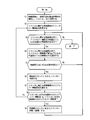
図4は、本発明における無線局制御装置20の動作フローを示す。なお、本動作フローは、無線局制御装置20の運用パラメータ算出部23で実行される。
図4において、本動作フローが開始すると、各無線局毎に、使用可能な周波数帯域を確認し、確認結果を基に各無線局を所定のルールに従って2つのリストA,リストBに分類する(S1)。例えば、リストAは、5GHzの使用可能な無線局とする。リストBは、5GHzが使用不可で 2.4GHzのみ使用可能な無線局とする。したがって、 2.4GHz/5GHzの切り替え可能な無線局は、リストAに分類される。あるいは 2.4GHz/5GHzの切り替え可能な無線局は、後述するようにリストCに分類してもよい。
次に、リストAに属する各無線局について、例えば次式を用いてエリアカバー貢献度を計算する(S2)。
無線局Xのエリアカバー貢献度
=(Xのみがカバーする測定ポイント数)/(Xがカバーする全測定ポイント数)
無線局Xのエリアカバー貢献度
=(Xのみがカバーする測定ポイント数)/(Xがカバーする全測定ポイント数)
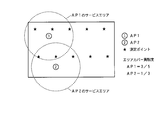
ここで、「カバーする」とは、サービスエリア閾値R(例えば-75dBm)以上の信号強度(RSSI値)を有することである。測定ポイント数は、当該信号強度を有する面積でもよい。例えば、図5の例では、無線局AP1のサービスエリアに、AP1のみがカバーする測定ポイント(★)は3個であり、AP1がカバーする全測定ポイント(★)は5個であるので、AP1のエリアカバー貢献度は3/5となる。同様に、無線局AP2のエリアカバー貢献度は1/3となる。
また、無線局Xのエリアカバー貢献度の指標はこれに限らず、例えば測定ポイントの重要度に応じて決めてもよい。例えば、プレミアポイントに重み付けし、エリアカバー貢献度に反映させてもよい。
次に、リストAに属する無線局の中に、エリアカバー貢献度が所定の閾値以下となる未選択の無線局があるか否かを判定し(S3)、なければ終了する。一方、リストAに属する無線局の中に、エリアカバー貢献度が所定の閾値以下となる未選択の無線局があれば、その1台の無線局Xを選択し(S4)、当該無線局Xの周波数帯が 2.4GHzを使用可能か否かを確認する(S5)。そして、選択された無線局Xが 2.4GHzを使用できれば、本無線局XをリストAからリストBへ移動する(S6)。
なお、ステップS4で選択する1台の無線局Xは、エリアカバー貢献度が所定の閾値以下となる未選択の無線局が複数台あれば、その中からランダムに1台選択するか、またはエリアカバー貢献度が小さい順に選択してもよい。
また、S4~S5の処理は、リストAの 2.4GHz/5GHzの切り替え可能な無線局の中から、エリアカバー貢献度が所定の閾値以下となる未選択の1台の無線局Xを選択するとしてもよい。もしくは、上述のように、 2.4GHz/5GHzの切り替え可能な無線局をリストCに分類している場合には、リストCの無線局を対象にしてもよい。
次に、リストBに属する各無線局のエリアカバー貢献度を計算し(S7)、当該無線局XのリストBにおけるエリアカバー貢献度が、リストAの時に比べて改善されているか否かを判定する(S8)。無線局XをリストAからリストBに移動、すなわち 2.4GHzに切り替えることによりエリアカバー貢献度が改善されていれば、ステップS2に戻り、リストAに属する各無線局のエリアカバー貢献度を再計算し、ステップS3以下の処理を繰り返す。
一方、無線局Xを 2.4GHzに切り替えることによりエリアカバー貢献度が改善されていなければ、無線局XをリストBからリストAに移動(復帰)する(S9)。そして、ステップS3に戻り、リストAに属する無線局の中に、エリアカバー貢献度が所定の閾値以下となる未選択の無線局が他にあれば、ステップS4以下の処理を繰り返す。
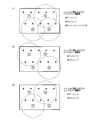
図6および図7は、無線局(AP)の運用周波数帯の算出例を示す。
図6および図7において、AP1は 2.4GHz帯のみ使用可能、AP2,AP3,AP4は 2.4/5GHz帯使用可能とする。各APのサービスエリア閾値Rは-75dBmとし、円の内側ポイントとする。エリアカバー貢献度の閾値は0.65とする。
図6および図7において、AP1は 2.4GHz帯のみ使用可能、AP2,AP3,AP4は 2.4/5GHz帯使用可能とする。各APのサービスエリア閾値Rは-75dBmとし、円の内側ポイントとする。エリアカバー貢献度の閾値は0.65とする。
(シナリオ1:図6)
図6(1) :
S1 リストA:{AP2,AP3,AP4}
リストB:{AP1}
S2 リストAに属するAPのエリアカバー貢献度
AP2=2/3
AP3=3/5
AP4=1/3
S3 エリアカバー貢献度が閾値以下:{AP3,AP4}
S4 AP3を選択
図6(1) :
S1 リストA:{AP2,AP3,AP4}
リストB:{AP1}
S2 リストAに属するAPのエリアカバー貢献度
AP2=2/3
AP3=3/5
AP4=1/3
S3 エリアカバー貢献度が閾値以下:{AP3,AP4}
S4 AP3を選択
図6(2) :
S6 AP3をリストBに移動、リストB:{AP1,AP3}
S7 リストBに属するAPのエリアカバー貢献度
AP1=4/5
AP3=4/5
S8 AP3のエリアカバー貢献度は、3/5から4/5に改善
AP3は 2.4GHzを使用
S6 AP3をリストBに移動、リストB:{AP1,AP3}
S7 リストBに属するAPのエリアカバー貢献度
AP1=4/5
AP3=4/5
S8 AP3のエリアカバー貢献度は、3/5から4/5に改善
AP3は 2.4GHzを使用
図6(3) :
S2 リストAに属するAPのエリアカバー貢献度
AP2=2/3
AP4=2/3
S3 エリアカバー貢献度が閾値以下:なし(終了)
5GHz:AP2,AP4
2.4GHz:AP1,AP3
S2 リストAに属するAPのエリアカバー貢献度
AP2=2/3
AP4=2/3
S3 エリアカバー貢献度が閾値以下:なし(終了)
5GHz:AP2,AP4
2.4GHz:AP1,AP3
(シナリオ2:図7)
図7(1) :
S1 リストA:{AP2,AP3,AP4}
リストB:{AP1}
S2 リストAに属するAPのエリアカバー貢献度
AP2=2/3
AP3=3/5
AP4=1/3
S3 エリアカバー貢献度が閾値以下:{AP3,AP4}
S4 AP4を選択
図7(1) :
S1 リストA:{AP2,AP3,AP4}
リストB:{AP1}
S2 リストAに属するAPのエリアカバー貢献度
AP2=2/3
AP3=3/5
AP4=1/3
S3 エリアカバー貢献度が閾値以下:{AP3,AP4}
S4 AP4を選択
図7(2) :
S6 AP4をリストBに移動、リストB:{AP1,AP4}
S7 リストBに属するAPのエリアカバー貢献度
AP1=5/5
AP4=3/3
S8 AP4のエリアカバー貢献度は、3/5から3/3に改善
AP4は 2.4GHzを使用
S6 AP4をリストBに移動、リストB:{AP1,AP4}
S7 リストBに属するAPのエリアカバー貢献度
AP1=5/5
AP4=3/3
S8 AP4のエリアカバー貢献度は、3/5から3/3に改善
AP4は 2.4GHzを使用
図7(3) :
S2 リストAに属するAPのエリアカバー貢献度
AP2=2/3
AP3=4/5
S3 エリアカバー貢献度が閾値以下:なし(終了)
5GHz:AP2,AP3
2.4GHz:AP1,AP4
S2 リストAに属するAPのエリアカバー貢献度
AP2=2/3
AP3=4/5
S3 エリアカバー貢献度が閾値以下:なし(終了)
5GHz:AP2,AP3
2.4GHz:AP1,AP4
このように、AP1~AP4のうち、エリアカバー貢献度が閾値以下となるAPが複数(AP3,AP4)ある場合、ステップS4の選択の仕方によって 2.4GHzを使用するAPが入れ替わることになる。また、ステップS8からステップS2に戻ったときに、エリアカバー貢献度の再計算が行われるので、前回未選択だったAPのエリアカバー貢献度が再度閾値以下になるとは限らない。
なお、以上の説明は、5GHzから 2.4GHzへ移行する例を示したが、逆に 2.4GHzから5GHzへ移行する無線局を選択する処理であってもよい。
また、以上の説明は、無線局(AP)からのRSSIで決まるサービスエリアの範囲に対応するエリアカバー貢献度と、使用する周波数帯との関係を制御指針としたが、キャリアセンス閾値や送信電力値で決まる範囲に対応するエリアカバー貢献度と、キャリアセンス閾値や送信電力値の大きさとの関係を制御指針とする制御形態であってもよい。
10 無線局
20 無線局制御装置
11 自無線局能力情報保持部
12 周辺無線環境情報収集部
13 能力/環境情報通知部
14 運用パラメータ設定部
15 無線通信部
21 能力/環境情報収集部
22 能力/環境情報保持部
23 運用パラメータ算出部
24 運用パラメータ通知部
25 無線通信部
20 無線局制御装置
11 自無線局能力情報保持部
12 周辺無線環境情報収集部
13 能力/環境情報通知部
14 運用パラメータ設定部
15 無線通信部
21 能力/環境情報収集部
22 能力/環境情報保持部
23 運用パラメータ算出部
24 運用パラメータ通知部
25 無線通信部
Claims (4)
- 共用周波数帯上で複数の無線局が送信する無線通信システムにおいて、
前記無線局は、自無線局の能力情報および周辺の環境情報を含めた能力/環境情報を無線局制御装置に通知する手段を備え、
前記無線局制御装置は、前記無線局より収集した能力/環境情報を基に、複数の周波数帯の使用が可能な前記無線局に対して予め定められた制御指針に基づいて、使用する周波数帯を選択して設定する制御手段を備えた
ことを特徴とする無線通信システム。 - 請求項1に記載の無線通信システムにおいて、
前記制御手段は、前記制御指針として、前記無線局によるエリアカバー率を基に、所定の閾値以下の無線局についてエリアカバー率が改善される周波数帯を選択する構成である
ことを特徴とする無線通信システム。 - 共用周波数帯上で複数の無線局が送信する無線通信方法において、
前記無線局は、自無線局の能力情報および周辺の環境情報を含めた能力/環境情報を無線局制御装置に通知する処理を実行するステップを有し、
前記無線局制御装置は、前記無線局より収集した能力/環境情報を基に、複数の周波数帯の使用が可能な前記無線局に対して予め定められた制御指針に基づいて、使用する周波数帯を選択して設定する制御ステップを有する
ことを特徴とする無線通信方法。 - 請求項3に記載の無線通信方法において、
前記制御ステップは、前記制御指針として、前記無線局によるエリアカバー率を基に、所定の閾値以下の無線局についてエリアカバー率が改善される周波数帯を選択する
ことを特徴とする無線通信方法。
Priority Applications (1)
| Application Number | Priority Date | Filing Date | Title |
|---|---|---|---|
| US17/435,290 US12035336B2 (en) | 2019-03-04 | 2020-02-25 | Wireless communication system, and wireless communication method |
Applications Claiming Priority (2)
| Application Number | Priority Date | Filing Date | Title |
|---|---|---|---|
| JP2019039035A JP7124765B2 (ja) | 2019-03-04 | 2019-03-04 | 無線通信システムおよび無線通信方法 |
| JP2019-039035 | 2019-03-04 |
Publications (1)
| Publication Number | Publication Date |
|---|---|
| WO2020179546A1 true WO2020179546A1 (ja) | 2020-09-10 |
Family
ID=72337741
Family Applications (1)
| Application Number | Title | Priority Date | Filing Date |
|---|---|---|---|
| PCT/JP2020/007476 Ceased WO2020179546A1 (ja) | 2019-03-04 | 2020-02-25 | 無線通信システムおよび無線通信方法 |
Country Status (3)
| Country | Link |
|---|---|
| US (1) | US12035336B2 (ja) |
| JP (1) | JP7124765B2 (ja) |
| WO (1) | WO2020179546A1 (ja) |
Cited By (1)
| Publication number | Priority date | Publication date | Assignee | Title |
|---|---|---|---|---|
| WO2026013750A1 (ja) * | 2024-07-09 | 2026-01-15 | Ntt株式会社 | 無線通信システム、無線通信方法、無線通信装置及び無線通信プログラム |
Citations (1)
| Publication number | Priority date | Publication date | Assignee | Title |
|---|---|---|---|---|
| JP2014060536A (ja) * | 2012-09-14 | 2014-04-03 | Toshiba Corp | 無線通信システム、管理装置及び試験端末 |
Family Cites Families (5)
| Publication number | Priority date | Publication date | Assignee | Title |
|---|---|---|---|---|
| NZ611993A (en) * | 2011-01-14 | 2015-02-27 | Ericsson Telefon Ab L M | Capability reporting for relay nodes in wireless networks |
| US9642146B2 (en) * | 2013-06-05 | 2017-05-02 | Huawei Technologies Co., Ltd. | System and method for an agile wireless access network |
| US10536945B2 (en) * | 2018-01-31 | 2020-01-14 | Hewlett Packard Enterprise Development Lp | Splitting communication channels |
| US10973028B2 (en) * | 2018-05-23 | 2021-04-06 | Google Llc | Intelligent band selection for wireless access point |
| US11057495B2 (en) * | 2019-05-01 | 2021-07-06 | Ciena Corporation | Selecting where to process data associated with Internet of Things (IoT) devices |
-
2019
- 2019-03-04 JP JP2019039035A patent/JP7124765B2/ja active Active
-
2020
- 2020-02-25 WO PCT/JP2020/007476 patent/WO2020179546A1/ja not_active Ceased
- 2020-02-25 US US17/435,290 patent/US12035336B2/en active Active
Patent Citations (1)
| Publication number | Priority date | Publication date | Assignee | Title |
|---|---|---|---|---|
| JP2014060536A (ja) * | 2012-09-14 | 2014-04-03 | Toshiba Corp | 無線通信システム、管理装置及び試験端末 |
Non-Patent Citations (1)
| Title |
|---|
| HIRANTHA ABEYSEKERA, TOMOKI MURAKAMI, AKIYOSHI INOKI, TOSHIRO NAKAHIRA, KEISUKE WAKAO, YASUSHI TAKATORI, TAKAFUMI HAYASHI, HIROYUK: "Strategy Management Architecture for Wireless Resource Optimization (WiSMA)", IEICE TECHNICAL REPORT. CQ, vol. 118, no. 8, 12 April 2018 (2018-04-12), pages 13 - 16, XP009523529 * |
Cited By (1)
| Publication number | Priority date | Publication date | Assignee | Title |
|---|---|---|---|---|
| WO2026013750A1 (ja) * | 2024-07-09 | 2026-01-15 | Ntt株式会社 | 無線通信システム、無線通信方法、無線通信装置及び無線通信プログラム |
Also Published As
| Publication number | Publication date |
|---|---|
| US20220159644A1 (en) | 2022-05-19 |
| JP7124765B2 (ja) | 2022-08-24 |
| US12035336B2 (en) | 2024-07-09 |
| JP2020145521A (ja) | 2020-09-10 |
Similar Documents
| Publication | Publication Date | Title |
|---|---|---|
| TWI691232B (zh) | 無線通訊系統及無線通訊方法 | |
| JP7038379B2 (ja) | 無線通信システムおよび無線通信方法 | |
| JP6449188B2 (ja) | 無線通信システムおよび無線通信方法 | |
| JP6434929B2 (ja) | 無線通信システムおよび無線通信方法 | |
| JP6891733B2 (ja) | 無線通信システム、無線通信方法、無線基地局および制御局 | |
| US12063643B2 (en) | Wireless communication system, wireless communication method, and wireless station device | |
| JP7124765B2 (ja) | 無線通信システムおよび無線通信方法 | |
| JP6579447B2 (ja) | 無線通信システムおよび無線通信方法 | |
| JP6544585B2 (ja) | 無線通信システムおよび無線通信方法 | |
| US11818670B2 (en) | Wireless communication system, wireless communication method, and wireless station device | |
| JP7209292B2 (ja) | 無線通信システムおよび無線通信方法 | |
| JP7468549B2 (ja) | 無線通信システム、基地局制御装置、通信制御方法及び通信制御プログラム | |
| JP7272435B2 (ja) | 無線通信システムおよび無線通信方法 | |
| JP7318747B2 (ja) | 無線通信システム、基地局制御装置、及び通信制御方法 | |
| JP2020188437A (ja) | 無線通信システムおよび無線通信方法 | |
| JP7314996B2 (ja) | 無線通信システム、無線通信方法、無線局装置および無線局装置の制御装置 | |
| JP7260004B2 (ja) | 無線通信システム、通信制御方法及び通信制御プログラム | |
| JP7272434B2 (ja) | 無線通信システムおよび無線通信方法 | |
| JP7022965B2 (ja) | 無線通信システム、無線通信方法および無線基地局 | |
| JP2018196043A (ja) | 無線通信システムおよび無線通信方法 |
Legal Events
| Date | Code | Title | Description |
|---|---|---|---|
| 121 | Ep: the epo has been informed by wipo that ep was designated in this application |
Ref document number: 20767230 Country of ref document: EP Kind code of ref document: A1 |
|
| NENP | Non-entry into the national phase |
Ref country code: DE |
|
| 122 | Ep: pct application non-entry in european phase |
Ref document number: 20767230 Country of ref document: EP Kind code of ref document: A1 |