WO2020179076A1 - 脱硝触媒、及びその製造方法 - Google Patents
脱硝触媒、及びその製造方法 Download PDFInfo
- Publication number
- WO2020179076A1 WO2020179076A1 PCT/JP2019/009201 JP2019009201W WO2020179076A1 WO 2020179076 A1 WO2020179076 A1 WO 2020179076A1 JP 2019009201 W JP2019009201 W JP 2019009201W WO 2020179076 A1 WO2020179076 A1 WO 2020179076A1
- Authority
- WO
- WIPO (PCT)
- Prior art keywords
- denitration catalyst
- metal
- vanadium
- catalyst
- denitration
- Prior art date
- Legal status (The legal status is an assumption and is not a legal conclusion. Google has not performed a legal analysis and makes no representation as to the accuracy of the status listed.)
- Ceased
Links
Images


Classifications
-
- B—PERFORMING OPERATIONS; TRANSPORTING
- B01—PHYSICAL OR CHEMICAL PROCESSES OR APPARATUS IN GENERAL
- B01D—SEPARATION
- B01D53/00—Separation of gases or vapours; Recovering vapours of volatile solvents from gases; Chemical or biological purification of waste gases, e.g. engine exhaust gases, smoke, fumes, flue gases, aerosols
- B01D53/34—Chemical or biological purification of waste gases
- B01D53/74—General processes for purification of waste gases; Apparatus or devices specially adapted therefor
- B01D53/86—Catalytic processes
-
- B—PERFORMING OPERATIONS; TRANSPORTING
- B01—PHYSICAL OR CHEMICAL PROCESSES OR APPARATUS IN GENERAL
- B01D—SEPARATION
- B01D53/00—Separation of gases or vapours; Recovering vapours of volatile solvents from gases; Chemical or biological purification of waste gases, e.g. engine exhaust gases, smoke, fumes, flue gases, aerosols
- B01D53/34—Chemical or biological purification of waste gases
- B01D53/74—General processes for purification of waste gases; Apparatus or devices specially adapted therefor
- B01D53/86—Catalytic processes
- B01D53/90—Injecting reactants
-
- B—PERFORMING OPERATIONS; TRANSPORTING
- B01—PHYSICAL OR CHEMICAL PROCESSES OR APPARATUS IN GENERAL
- B01J—CHEMICAL OR PHYSICAL PROCESSES, e.g. CATALYSIS OR COLLOID CHEMISTRY; THEIR RELEVANT APPARATUS
- B01J23/00—Catalysts comprising metals or metal oxides or hydroxides, not provided for in group B01J21/00
- B01J23/16—Catalysts comprising metals or metal oxides or hydroxides, not provided for in group B01J21/00 of arsenic, antimony, bismuth, vanadium, niobium, tantalum, polonium, chromium, molybdenum, tungsten, manganese, technetium or rhenium
- B01J23/20—Vanadium, niobium or tantalum
- B01J23/22—Vanadium
-
- B—PERFORMING OPERATIONS; TRANSPORTING
- B01—PHYSICAL OR CHEMICAL PROCESSES OR APPARATUS IN GENERAL
- B01J—CHEMICAL OR PHYSICAL PROCESSES, e.g. CATALYSIS OR COLLOID CHEMISTRY; THEIR RELEVANT APPARATUS
- B01J23/00—Catalysts comprising metals or metal oxides or hydroxides, not provided for in group B01J21/00
- B01J23/16—Catalysts comprising metals or metal oxides or hydroxides, not provided for in group B01J21/00 of arsenic, antimony, bismuth, vanadium, niobium, tantalum, polonium, chromium, molybdenum, tungsten, manganese, technetium or rhenium
- B01J23/24—Chromium, molybdenum or tungsten
- B01J23/28—Molybdenum
-
- B—PERFORMING OPERATIONS; TRANSPORTING
- B01—PHYSICAL OR CHEMICAL PROCESSES OR APPARATUS IN GENERAL
- B01J—CHEMICAL OR PHYSICAL PROCESSES, e.g. CATALYSIS OR COLLOID CHEMISTRY; THEIR RELEVANT APPARATUS
- B01J23/00—Catalysts comprising metals or metal oxides or hydroxides, not provided for in group B01J21/00
- B01J23/16—Catalysts comprising metals or metal oxides or hydroxides, not provided for in group B01J21/00 of arsenic, antimony, bismuth, vanadium, niobium, tantalum, polonium, chromium, molybdenum, tungsten, manganese, technetium or rhenium
- B01J23/24—Chromium, molybdenum or tungsten
- B01J23/30—Tungsten
-
- B—PERFORMING OPERATIONS; TRANSPORTING
- B01—PHYSICAL OR CHEMICAL PROCESSES OR APPARATUS IN GENERAL
- B01J—CHEMICAL OR PHYSICAL PROCESSES, e.g. CATALYSIS OR COLLOID CHEMISTRY; THEIR RELEVANT APPARATUS
- B01J23/00—Catalysts comprising metals or metal oxides or hydroxides, not provided for in group B01J21/00
- B01J23/70—Catalysts comprising metals or metal oxides or hydroxides, not provided for in group B01J21/00 of the iron group metals or copper
- B01J23/76—Catalysts comprising metals or metal oxides or hydroxides, not provided for in group B01J21/00 of the iron group metals or copper combined with metals, oxides or hydroxides provided for in groups B01J23/02 - B01J23/36
- B01J23/84—Catalysts comprising metals or metal oxides or hydroxides, not provided for in group B01J21/00 of the iron group metals or copper combined with metals, oxides or hydroxides provided for in groups B01J23/02 - B01J23/36 with arsenic, antimony, bismuth, vanadium, niobium, tantalum, polonium, chromium, molybdenum, tungsten, manganese, technetium or rhenium
- B01J23/847—Vanadium, niobium or tantalum or polonium
-
- B—PERFORMING OPERATIONS; TRANSPORTING
- B01—PHYSICAL OR CHEMICAL PROCESSES OR APPARATUS IN GENERAL
- B01J—CHEMICAL OR PHYSICAL PROCESSES, e.g. CATALYSIS OR COLLOID CHEMISTRY; THEIR RELEVANT APPARATUS
- B01J37/00—Processes, in general, for preparing catalysts; Processes, in general, for activation of catalysts
- B01J37/08—Heat treatment
Definitions
- the present invention relates to a denitration catalyst and a method for producing the same. More specifically, the present invention relates to a denitration catalyst used for purifying exhaust gas generated by combustion of fuel, and a method for producing the same.
- Nitrogen oxides cause acid rain, ozone layer depletion, photochemical smog, etc., and have a serious impact on the environment and the human body, so their treatment has become an important issue.
- a selective catalytic reduction reaction (NH 3 —SCR) using ammonia (NH 3 ) as a reducing agent is known.
- a catalyst used for the selective catalytic reduction reaction a catalyst using titanium oxide as a carrier and supporting vanadium oxide is widely used. Titanium oxide is considered to be the best carrier because of its low activity against sulfur oxides and high stability.
- vanadium oxide plays a major role in NH 3 —SCR, it oxidizes SO 2 to SO 3, and therefore vanadium oxide could not be supported by about 1 wt% or more.
- the catalyst in which vanadium oxide is supported on the titanium oxide carrier hardly reacts at a low temperature, so that the catalyst must be used at a high temperature of 350 to 400°C.
- An object of the present invention is to provide a catalyst having better denitration efficiency at a low temperature as compared with the prior art in a selective catalytic reduction reaction using ammonia as a reducing agent.
- the present invention is a denitration catalyst containing vanadium oxide as a main component, wherein the content of the oxide of the second metal is 1 wt% or more and 40 wt% or less, and the second metal is Co, W, Mo, It relates to a denitration catalyst which is at least one metal element selected from the group consisting of Nb, Ce, Sn, Ni and Fe.
- the denitration catalyst is preferably used for denitration at 300°C or lower.
- the denitration catalyst further contains carbon.
- the carbon content is preferably 0.05 wt% or more.
- the method for producing a denitration catalyst according to the present invention preferably has a step of firing a mixture of vanadate, a chelate compound, and the compound of the second metal.
- the mixture further contains ethylene glycol.
- the firing step is preferably a step of firing at a temperature of 270° C. or lower.
- the denitration catalyst according to the present invention has even better denitration efficiency at low temperatures than in the prior art during a selective catalytic reduction reaction using ammonia as a reducing agent.
- the denitration catalyst of the present invention is a denitration catalyst containing vanadium oxide as a main component, wherein the content of the oxide of the second metal is 1 wt% or more and 40 wt% or less, and the second metal is Co or W. , Mo, Nb, Ce, Sn, Ni, and Fe, at least one metal element selected from the group.
- a denitration catalyst can exhibit a higher denitration effect even in a low temperature environment as compared with a denitration catalyst such as a vanadium / titanium catalyst conventionally used.
- the denitration catalyst of the present invention contains vanadium oxide as a main component.
- This vanadium oxide is vanadium (II) oxide (VO), vanadium (III) trioxide (V 2 O 3 ), vanadium tetraoxide (IV) (V 2 O 4 ), vanadium pentoxide (V) (V 2 O). 5 ) is included, and the V element of vanadium pentoxide (V 2 O 5 ) may take a pentavalent, tetravalent, trivalent or divalent form during the denitration reaction.
- This vanadium oxide is the main component of the denitration catalyst of the present invention, and may contain other substances within the range that does not impair the effects of the present invention.
- vanadium pentoxide conversion it is preferable that the content is 50 wt% or more. More preferably, vanadium oxide is present in the denitration catalyst of the present invention in an amount of 60 wt% or more in terms of vanadium pentoxide.
- the denitration catalyst of the present invention has a second metal oxide content of 1 wt% or more and 40 wt% or less, but it has been conventionally used by including such a second metal oxide.
- a higher denitration effect can be exhibited even in a low temperature environment.
- impurities enter into the denitration catalyst of the present invention an amorphous part is generated in the denitration catalyst, so that the crystal structure is not continuous, and the lines and planes in the crystal lattice are distorted, thereby exhibiting a high denitration effect.
- the higher the amount of the oxide of the second metal as the impurity the higher the denitration effect will be exhibited.
- the coexistence of water is present.
- the NO conversion rate was 79% to 100%, and when it was in the presence of water, the NO conversion rate was 38% to 90%.
- a selective catalytic reduction reaction at a reaction temperature of 200° C. or less using a denitration catalyst having a cobalt oxide content of 0 wt% as the oxide of the second metal 76% NO was obtained in the absence of water.
- the conversion rate and the NO conversion rate of 32% were only shown in the presence of water.
- the denitration catalyst of the present invention has the second metal oxide content of 1 wt% or more and 40 wt% or less, but it is preferably 3 wt% or more and 38 wt% or less. Further, the content of the oxide of the second metal is more preferably 3 wt% or more and 10 wt% or less. Further, the content of the oxide of the second metal is more preferably 5 wt% or more and 10 wt% or less. Further, the content of the oxide of the second metal is more preferably 5 wt% or more and 8 wt% or less. The oxide content of the second metal is more preferably 6 wt% or more and 8 wt% or less. Further, the content of the oxide of the second metal is more preferably 6 wt% or more and 7 wt% or less.
- the second metal is at least one metal element selected from the group consisting of Co, W, Mo, Nb, Ce, Sn, Ni and Fe.
- the crystal structure of vanadium oxide is disturbed, and Lewis acidity can be enhanced.
- Co, Mo, Ce, Sn, Ni, and Fe it accelerates the redox cycle of V 2 O 5 .
- Co is known to have a strong oxidizing power.
- W, Mo, and Nb functions as a solid acid and provides an adsorption site for ammonia, so that ammonia can efficiently contact and react with NO.
- the selective catalytic reduction reaction at a reaction temperature of 200° C. or less using a denitration catalyst having a molybdenum oxide content of 5.4 wt% as the second metal oxide The NO conversion rate of 97% was shown without coexistence, and the NO conversion rate of 62% was shown without water coexistence.
- the selective catalytic reduction reaction at a reaction temperature of 200 ° C. or lower using a denitration catalyst having a niobium pentoxide content of 5.0 wt% as the oxide of the second metal the water content is reduced.
- the NO conversion rate of 96.7% was shown when not coexisting, and the NO conversion rate was 61.7% when not coexisting with water.
- the NO conversion rate of 89.8% was shown when not coexisting, and the NO conversion rate was 52.9% when not coexisting with water.
- in the embodiment of the present invention in the selective catalytic reduction reaction at a reaction temperature of 200° C.
- the denitration catalyst of the present invention is preferably used for denitration at 300°C or lower. This is because the denitration catalyst of the present invention has a firing temperature of 300°C.
- the denitration catalyst of the present invention exerted a high denitration effect in the selective catalytic reduction reaction at a reaction temperature of 200° C. or lower, so that the denitration catalyst of the present invention It can be used for denitration. Since oxidation of SO 2 to SO 3 does not occur at 200° C. or lower, as was found in Patent Document 2 described above, during selective catalytic reduction reaction at 200° C. or lower, SO 2 is converted to SO 3 Not accompanied by oxidation.
- the denitration catalyst of the present invention is preferably used for denitration at 300° C. or lower, but may be preferably used for denitration at 200° C. or lower, more preferably, the reaction temperature is It may be used for denitration at 100 to 200°C. More preferably, it may be used for denitration at a reaction temperature of 160-200 ° C. Alternatively, it may be used for denitration with a reaction temperature of 80-150 ° C.
- the denitration catalyst of the present invention preferably further contains carbon.
- the carbon content is preferably 0.05 wt% or more.
- the carbon content may be 0.07 wt% or more. More preferably, the carbon content may be 0.11 wt% or more. More preferably, the carbon content may be 0.12 wt% or more. More preferably, the carbon content may be 0.14 wt% or more. More preferably, the carbon content may be 0.16 wt% or more. More preferably, the carbon content may be 0.17 wt% or more. More preferably, the carbon content may be 0.70 wt% or more.
- a denitration catalyst containing vanadium oxide as a main component wherein the content of the oxide of the second metal is 1 wt% or more and 40 wt% or less, and the second metal is Co, W, Mo, Nb,
- a method for producing a denitration catalyst that is at least one metal element selected from the group consisting of Ce, Sn, Ni, and Fe will be described.
- the above method for producing a denitration catalyst includes a step of calcining a mixture of vanadate, a chelate compound, and a compound of a second metal.
- vanadate for example, ammonium vanadate, magnesium vanadate, strontium vanadate, barium vanadate, zinc vanadate, lead vanadate, lithium vanadate, etc. may be used.
- the chelate compound include those having a plurality of carboxyl groups such as oxalic acid and citric acid, those having a plurality of amino groups such as acetylacetonate and ethylenediamine, and those having a plurality of hydroxyl groups such as ethylene glycol. Etc. may be used.
- the compound of the second metal may be a chelate complex, a hydrate, an ammonium compound or a phosphoric acid compound.
- the chelate complex may be, for example, a complex such as oxalic acid or citric acid.
- the hydrate for example, (NH 4) may be 10 W 12 O 41 ⁇ 5H 2 O and H 3 PW 12 O 40 ⁇ nH 2 O.
- the ammonium compound for example, (NH 4) may be 10 W 12 O 41 ⁇ 5H 2 O.
- Examples of the phosphoric acid compound may be, for example, H 3 PW 12 O 40 ⁇ nH 2 O.
- the above mixture further contains ethylene glycol.
- the denitration catalyst produced by these methods can exhibit a high denitration effect even in a low temperature environment as compared with denitration catalysts such as vanadium/titanium catalysts that have been conventionally used.
- denitration catalysts such as vanadium/titanium catalysts that have been conventionally used.
- the denitration catalyst prepared by the method of calcining a mixture of ammonium vanadate, oxalic acid, and an oxalic acid complex of a second metal has a denitration rate of 74.5 to 100% in the absence of water.
- the NO conversion was 33.9 to 90% in the presence of water.
- the denitration catalyst produced by the method in which the above mixture further contains ethylene glycol has a NO conversion rate of 100% in the absence of water and an NO conversion rate of 89% in the presence of water. Indicated.
- a denitration catalyst manufactured by a method not including such a step for example, ammonium vanadate and oxalic acid are mixed, but a method of firing without mixing the oxide of the second metal is used.
- the denitration catalyst thus obtained showed a NO conversion of 76% in the absence of water and a NO conversion of 32% in the presence of water.
- the above-mentioned firing is preferably performed at a temperature of 270° C. or lower.
- the structure of the vanadium pentoxide crystal contained in the denitration catalyst is locally disordered by firing at a temperature of 270° C. or lower, which is lower than the normal 300° C., Although a high denitration effect can be exerted, it is speculated that a high denitration effect is exerted particularly by the appearance of sites lacking oxygen atoms in the crystal structure of vanadium pentoxide. Note that the “site devoid of oxygen atoms” is also referred to as “oxygen defect site”.
- the denitration catalyst prepared in this manner is a denitration catalyst containing vanadium oxide as a main component, wherein the content of the oxide of the second metal is 1 wt% or more and 40 wt% or less, and the second metal Is at least one metal element selected from the group consisting of Co, W, Mo, Nb, Ce, Sn, Ni, and Fe.
- the denitration catalyst containing vanadium as a main component, wherein the content of the oxide of the second metal is 1 wt% or more and 40 wt% or less, It is assumed that the second metal is at least one metal element selected from the group consisting of Co, W, Mo, Nb, Ce, Sn, Ni and Fe.
- the denitration catalyst in the case of a selective catalytic reduction reaction using ammonia as a reducing agent at a reaction temperature of 200 ° C. or lower, the effect that the denitration efficiency at a low temperature is higher can be exhibited as compared with the prior art. Further, this denitration catalyst easily adsorbs NO and can exhibit a higher NO conversion rate.
- the denitration catalyst according to the above embodiment is preferably used for denitration at 300°C or lower.
- a high denitration effect is brought about without oxidizing SO 2 .
- the denitration catalyst according to the above embodiment preferably further contains carbon.
- the denitration catalyst according to the above-described embodiment can exhibit a NO conversion rate of 100% or more under the condition that it does not coexist with water.
- the carbon content is preferably 0.05 wt% or more.
- the denitration catalyst according to the above-described embodiment can exhibit a NO conversion rate of 100% or more under the condition that it does not coexist with water.
- the method for producing a denitration catalyst according to the above embodiment preferably includes a step of calcining a mixture of vanadate, a chelate compound, and the compound of the second metal.
- the denitration catalyst according to the above embodiment contains the second metal, and the denitration effect in the selective catalytic reduction reaction at a reaction temperature of 200° C. or less using the denitration catalyst according to the above embodiment is improved.
- the above mixture preferably further contains ethylene glycol.
- the denitration catalyst according to the above embodiment contains carbon and the second metal, and the denitration effect in the selective catalytic reduction reaction at the reaction temperature of 200° C. or less using the denitration catalyst according to the above embodiment is improved. To do.
- the firing step in the above manufacturing method is preferably a firing step at a temperature of 270° C. or lower.
- Example 1 4.96 g (42.4 mmol) of ammonium vanadate (NH 4 VO 3 ) and 11.5 g (127.6 mmol) of oxalic acid ((COOH) 2 ) were dissolved in pure water to synthesize a precursor complex.
- a oxalic acid complex of cobalt (Co) which is a second metal, is added so that cobalt (Co) is 3.5 mol% in terms of metal atom, that is, Co 3 O in terms of metal oxide. 4 was added so as to be 3.1 wt %.
- the resulting vanadium - 4 hours at a temperature of 300 ° C. by an electric furnace heterogeneous metal complex mixture, by firing twice, to obtain a denitration catalyst of vanadium pentoxide containing cobalt (Co) (V 2 O 5 ) ..
- Example 2 4.96 g (42.4 mmol) of ammonium vanadate (NH 4 VO 3 ) and 11.5 g (127.6 mmol) of oxalic acid ((COOH) 2 ) were dissolved in pure water to synthesize a precursor complex.
- the oxalic acid complex of tungsten (W) which is the second metal, is added so that the tungsten (W) is 3.5 mol% in terms of metal atom, that is, WO 3 is converted into metal oxide. It was added so as to be 8.4 wt%.
- the resulting vanadium - 4 hours at a temperature of 300 ° C. by an electric furnace heterogeneous metal complex mixture, by firing twice, to obtain a denitration catalyst of vanadium pentoxide containing tungsten (W) (V 2 O 5 ) ..
- Example 3 4.96 g (42.4 mmol) of ammonium vanadate (NH 4 VO 3 ) and 11.5 g (127.6 mmol) of oxalic acid ((COOH) 2 ) were dissolved in pure water to synthesize a precursor complex.
- the oxalic acid complex of molybdenum (Mo) which is the second metal, has molybdenum (Mo) of 3.5 mol% in terms of metal atoms, that is, MoO 3 in terms of metal oxides. It was added so as to be 5.4 wt%.
- the resulting vanadium - 4 hours at a temperature of 300 ° C. by an electric furnace heterogeneous metal complex mixture, by firing twice, to obtain a denitration catalyst of vanadium pentoxide containing molybdenum (Mo) (V 2 O 5 ) ..
- Example 4 4.96 g (42.4 mmol) of ammonium vanadate (NH 4 VO 3 ) and 11.5 g (127.6 mmol) of oxalic acid ((COOH) 2 ) were dissolved in pure water to synthesize a precursor complex.
- the obtained vanadium-different metal complex mixture was baked twice in an electric furnace at a temperature of 300° C. for 4 hours to obtain a vanadium pentoxide (V 2 O 5 ) denitration catalyst containing niobium (Nb). ..
- Example 5 4.96 g (42.4 mmol) of ammonium vanadate (NH 4 VO 3 ) and 11.5 g (127.6 mmol) of oxalic acid ((COOH) 2 ) were dissolved in pure water to synthesize a precursor complex. With respect to this precursor complex, an oxalic acid complex of cesium (Ce), which is the second metal, was added so that cesium (Ce) would be 3.5 mol% in terms of metal atom, that is, CeO 2 in terms of metal oxide. It was added so as to be 6.4 wt%. The vanadium-dissimilar metal complex mixture thus obtained was calcined twice in an electric furnace at a temperature of 300° C. for 4 hours to obtain a vanadium pentoxide (V 2 O 5 ) denitration catalyst containing cesium (Ce). ..
- V 2 O 5 vanadium pentoxide
- Example 6 4.96 g (42.4 mmol) of ammonium vanadate (NH 4 VO 3 ) and 11.5 g (127.6 mmol) of oxalic acid ((COOH) 2 ) were dissolved in pure water to synthesize a precursor complex.
- the oxalic acid complex of the second metal tin (Sn) is added to the precursor complex so that tin (Sn) is 3.5 mol% in terms of metal atom, that is, SnO 2 is in terms of metal oxide. It was added so as to be 5.6 wt%.
- the resulting vanadium - 4 hours at a temperature of 300 ° C. by an electric furnace heterogeneous metal complex mixture, by firing twice, to obtain a denitration catalyst of vanadium pentoxide containing tin (Sn) (V 2 O 5 ) ..
- Example 7 4.96 g (42.4 mmol) of ammonium vanadate (NH 4 VO 3 ) and 11.5 g (127.6 mmol) of oxalic acid ((COOH) 2 ) were dissolved in pure water to synthesize a precursor complex.
- 0.113 g of nickel (Ni) as a second metal as nickel carbonate and 3.5 mol% of nickel (Ni) in terms of metal atoms, that is, NiO in terms of metal oxides. was added so as to be 2.9 wt %.
- the vanadium-different metal complex mixture thus obtained was calcined twice in an electric furnace at a temperature of 300° C. for 4 hours to obtain a vanadium pentoxide (V 2 O 5 ) denitration catalyst containing nickel (Ni). ..
- Example 8 4.96 g (42.4 mmol) of ammonium vanadate (NH 4 VO 3 ) and 11.5 g (127.6 mmol) of oxalic acid ((COOH) 2 ) were dissolved in pure water to synthesize a precursor complex.
- the oxalic acid complex of iron (Fe) which is the second metal, is added so that iron (Fe) is 3.5 mol% in terms of metal atom, that is, Fe 2 O in terms of metal oxide. 3 was added so as to be 3.1 wt %.
- the resulting vanadium - 4 hours at a temperature of 300 ° C. by an electric furnace heterogeneous metal complex mixture, by firing twice, to obtain a denitration catalyst of vanadium pentoxide containing iron (Fe) (V 2 O 5 ) ..
- NO conversion rate was calculated by the following formula (1). Note that NO in is the NO concentration at the reaction tube inlet, and NO out is the NO concentration at the reaction tube outlet.
- Table 2 shows the NO conversion rates of each vanadium pentoxide catalyst in both the case where water does not coexist and the case where water coexists.
- FIG. 1 is a graph of this Table 2.
- the denitration catalyst of the example In both the case where water did not coexist and the case where water coexisted, the denitration catalyst of the example generally showed a higher NO conversion rate than the denitration catalyst of the comparative example.
- the denitration catalyst obtained by adding cobalt, tungsten, molybdenum, and niobium to ammonium vanadate and firing showed a high NO conversion rate.
- Example 3 adding molybdenum
- Example 1 adding cobalt
- Example 1 (adding cobalt) showed the highest NO conversion rate, so the amount of cobalt added was changed. As a result, vanadium catalysts according to the following examples were produced.
- Example 9 Ammonium vanadate (NH 4 VO 3 ) and oxalic acid ((COOH) 2 ) were dissolved in pure water to synthesize a precursor complex. An oxalic acid complex of the second metal, cobalt (Co), was added to this precursor complex such that Co 3 O 4 was 1 wt% in terms of metal oxide. The resulting vanadium - 4 hours at a temperature of 300 ° C. The cobalt complex mixture by an electric furnace and fired twice to obtain a denitration catalyst of vanadium pentoxide containing cobalt (Co) (V 2 O 5 ).
- Co vanadium pentoxide containing cobalt
- Example 10 Ammonium vanadate (NH 4 VO 3 ) and oxalic acid ((COOH) 2 ) were dissolved in pure water to synthesize a precursor complex. An oxalic acid complex of cobalt (Co), which is the second metal, was added to this precursor complex such that Co 3 O 4 was 3 wt% in terms of metal oxide. The resulting vanadium - 4 hours at a temperature of 300 ° C. The cobalt complex mixture by an electric furnace and fired twice to obtain a denitration catalyst of vanadium pentoxide containing cobalt (Co) (V 2 O 5 ).
- Co cobalt
- Example 11 Ammonium vanadate (NH 4 VO 3 ) and oxalic acid ((COOH) 2 ) were dissolved in pure water to synthesize a precursor complex. An oxalic acid complex of cobalt (Co), which is the second metal, was added to this precursor complex such that Co 3 O 4 was 5 wt% in terms of metal oxide. The resulting vanadium - 4 hours at a temperature of 300 ° C. The cobalt complex mixture by an electric furnace and fired twice to obtain a denitration catalyst of vanadium pentoxide containing cobalt (Co) (V 2 O 5 ).
- Co cobalt
- Example 12 Ammonium vanadate (NH 4 VO 3 ) and oxalic acid ((COOH) 2 ) were dissolved in pure water to synthesize a precursor complex. To this precursor complex, an oxalic acid complex of the second metal, cobalt (Co), was added so that Co 3 O 4 was 6 wt% in terms of metal oxide. The resulting vanadium - 4 hours at a temperature of 300 ° C. The cobalt complex mixture by an electric furnace and fired twice to obtain a denitration catalyst of vanadium pentoxide containing cobalt (Co) (V 2 O 5 ).
- Co vanadium pentoxide containing cobalt
- Example 13 Ammonium vanadate (NH 4 VO 3 ) and oxalic acid ((COOH) 2 ) were dissolved in pure water to synthesize a precursor complex. An oxalic acid complex of the second metal, cobalt (Co), was added to this precursor complex such that Co 3 O 4 was 7 wt% in terms of metal oxide. The resulting vanadium - 4 hours at a temperature of 300 ° C. The cobalt complex mixture by an electric furnace and fired twice to obtain a denitration catalyst of vanadium pentoxide containing cobalt (Co) (V 2 O 5 ).
- Co cobalt
- Example 14 Ammonium vanadate (NH 4 VO 3 ) and oxalic acid ((COOH) 2 ) were dissolved in pure water to synthesize a precursor complex. An oxalic acid complex of the second metal, cobalt (Co), was added to this precursor complex so that Co 3 O 4 was 8 wt% in terms of metal oxide. The resulting vanadium - 4 hours at a temperature of 300 ° C. The cobalt complex mixture by an electric furnace and fired twice to obtain a denitration catalyst of vanadium pentoxide containing cobalt (Co) (V 2 O 5 ).
- Co cobalt
- Example 15 Ammonium vanadate (NH 4 VO 3 ) and oxalic acid ((COOH) 2 ) were dissolved in pure water to synthesize a precursor complex.
- a oxalic acid complex which is a precursor of cobalt (Co), which is a second metal, was added so that Co 3 O 4 was 10 wt% in terms of metal oxide.
- the cobalt complex mixture by an electric furnace and fired twice to obtain a denitration catalyst of vanadium pentoxide containing cobalt (Co) (V 2 O 5 ).
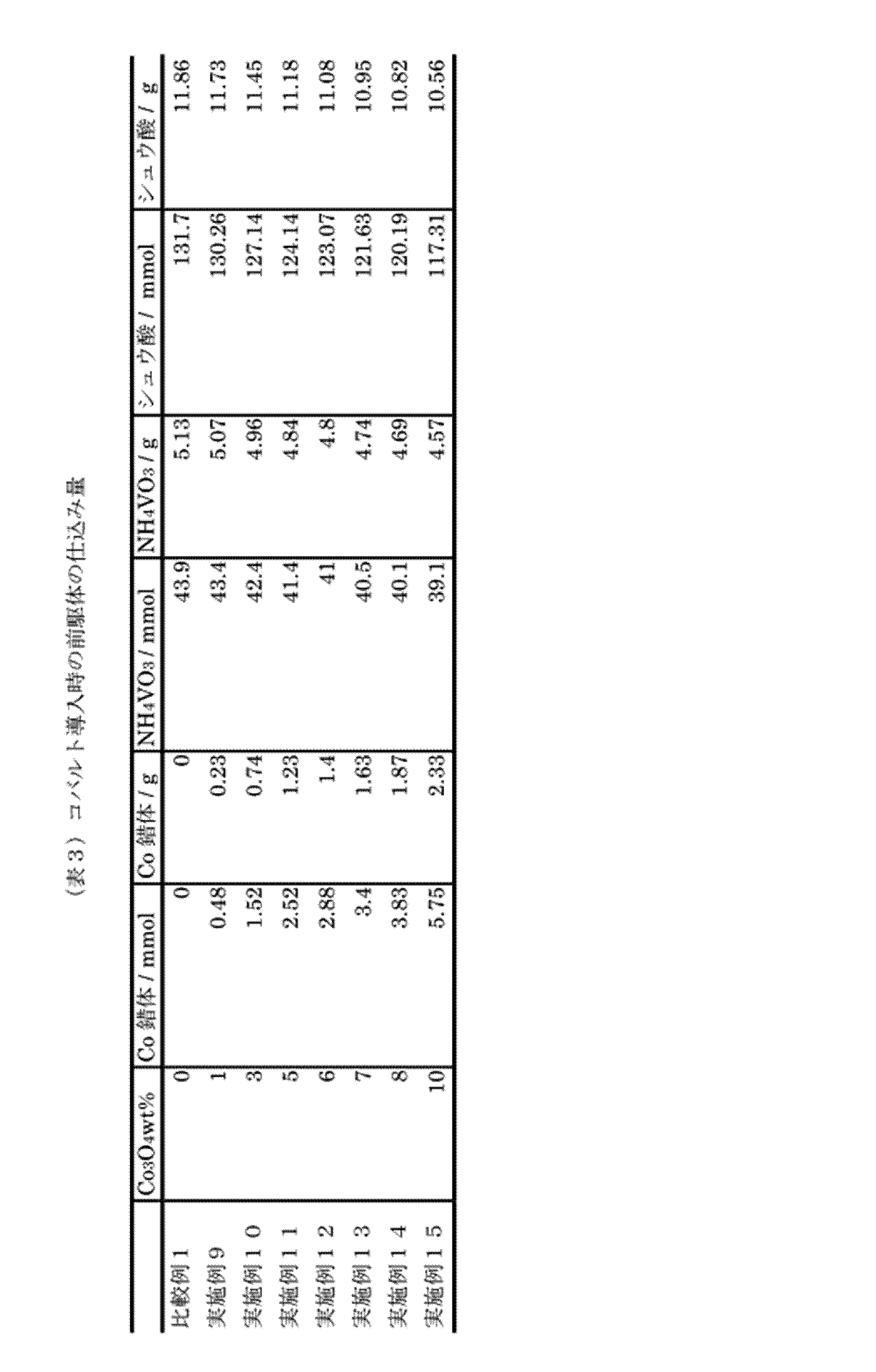
- Table 3 shows the charged amount of the precursor in Example 9 to Example 15 when cobalt was introduced.
- the NH 3 —SCR reaction was carried out at a reaction temperature of 150° C. using a fixed bed flow type catalytic reactor.
- NO was analyzed by Jasco FT-IR-4700. Further, the NO conversion rate was calculated by the above equation (1).
- Table 4 shows the NO conversion of each vanadium oxide catalyst both in the absence of water and in the presence of water.
- FIG. 2 is a graph of this Table 4.
- the denitration catalysts of the examples all showed higher NO conversion than the denitration catalysts of the comparative examples both in the absence of water and in the presence of water. Particularly, in the case where water does not coexist, Example 12 (6 wt%) and Example 13 (7 wt%) show the highest NO conversion, and in the case where water coexists, Example 14 (8 wt%). The highest NO conversion was shown.
- Powder X-ray diffraction> (Diffraction method) The powder X-ray diffraction was measured by Rigaku smart lab using Cu-K ⁇ .
- FIG. 3 shows powder XRD of Example 9 (1 wt %), Example 10 (3 wt %), Example 12 (6 wt %), Example 15 (10 wt %), and Comparative Example 1 (None: 0 wt %).
- X-Ray Diffraction pattern is shown. It was shown that V 2 O 5, which is a stable phase, is present as a main component, and that when the addition rate of Co is increased, a Co 3 O 4 phase also appears.
- Raman spectra were measured by Raman spectroscopy to analyze the crystal structure of each vanadium pentoxide catalyst. More specifically, a small amount of each catalyst sample was placed on a slide glass, and the Raman spectrum was measured by a Raman spectroscope. A NRS-4100 Raman spectrophotometer manufactured by JASCO Corporation was used as a measuring instrument.
- FIG. 4 shows the Raman spectrum of each catalyst. It was shown that when the amount of Co added was increased, the crystal structure of V 2 O 5 collapsed and the pattern strength weakened.
- Example 9 ⁇ 2.2.4 X-ray photoelectron spectrum (XPS) measurement> (Measuring method) To analyze the electronic state of Example 9 (1 wt%), Example 10 (3 wt%), Example 12 (6 wt%), Example 15 (10 wt%), and Comparative Example 1 (None: 0 wt%). , X-ray photoelectron spectrum (XPS: X-Ray Photoelectron Spectrom) was measured. More specifically, powder samples of the catalysts of Examples and Comparative Examples were fixed to a sample holder using a carbon tape, and X-ray photoelectron spectra were measured. As a measuring device, a JPS-9010MX photoelectron spectrometer manufactured by JEOL Ltd. was used.
- FIG. 5A shows an XPS spectrum in the V2p region.
- FIG. 5B shows an XPS spectrum in the Co2p region. It was shown that increasing the added amount of Co increased the V 4+ and Co 2+ components.
- Example 2 in the case where water coexists, Example 2 (adding tungsten) showed the second highest NO conversion rate, so the amount of tungsten added was changed.
- a vanadium catalyst according to each of the following examples was produced. It should be noted that not only the amount of tungsten added is changed, but also when K 2 WO 4 is used as the precursor and when H 3 PW 12 O 40 ⁇ nH 2 O is used as a precursor, tungsten is used as described later. The amount added was changed.
- Example 16 To a mixture of ammonium vanadate (NH 4 VO 3 ), 43.9 mmol of K 2 WO 4 and 20 ml of pure water, 11.9 g (131.7 mmol) of oxalic acid ((COOH) 2 ) was added, and the mixture was cooled to room temperature. After stirring for 10 minutes at 70° C. for 12 hours. By firing this precursor sample at 300° C. for 4 hours, a denitration catalyst of vanadium pentoxide (V 2 O 5 ) containing tungsten (W) was obtained. The amount of ammonium vanadate as a raw material was adjusted so that the total weight ratio of WO 3 in the produced denitration catalyst was 4.9 wt%.
- V 2 O 5 vanadium pentoxide
- Example 17 To a mixture of ammonium vanadate (NH 4 VO 3 ), 43.9 mmol of K 2 WO 4 and 20 ml of pure water, 11.9 g (131.7 mmol) of oxalic acid ((COOH) 2 ) was added, and the mixture was cooled to room temperature. After stirring for 10 minutes at 70° C. for 12 hours. By firing this precursor sample at 300° C. for 4 hours, a denitration catalyst of vanadium pentoxide (V 2 O 5 ) containing tungsten (W) was obtained. The amount of ammonium vanadate as a raw material was adjusted so that the total weight ratio of WO 3 in the produced denitration catalyst was 11.8 wt %.
- V 2 O 5 vanadium pentoxide
- Example 18 11.9 g (131.7 mmol) of oxalic acid was added to a mixture of ammonium vanadate (NH 4 VO 3 ), 43.9 mmol of K 2 WO 4 and 20 ml of pure water, and the mixture was stirred at room temperature for 10 minutes. , 70 ° C. for 12 hours. By firing this precursor sample at 300° C. for 4 hours, a denitration catalyst of vanadium pentoxide (V 2 O 5 ) containing tungsten (W) was obtained. The amount of ammonium vanadate as a raw material was adjusted so that the total weight ratio of WO 3 in the produced denitration catalyst was 22.1 wt%.
- V 2 O 5 vanadium pentoxide
- Table 5 shows the amount of the precursor charged at the time of introducing tungsten in Examples 16 to 18 and Comparative Example 2.
- Example 19 Ammonium vanadate (NH 4 VO 3), and H 3 PW 12 O 40 ⁇ nH 2 O, a mixture of pure water 20 ml, oxalic acid ((COOH) 2) a 11.9g (131.7mmol) was added The mixture was stirred at room temperature for 10 minutes and then at 70° C. for 12 hours. By firing this precursor sample at 300° C. for 4 hours, a denitration catalyst of vanadium pentoxide (V 2 O 5 ) containing tungsten (W) was obtained. Incidentally, the total weight ratio of WO 3 in the denitration catalyst to be generated, so that the 38.4Wt%, and adjust the amount of ammonium vanadate and H 3 PW 12 O 40 ⁇ nH 2 O as raw materials.
- V 2 O 5 vanadium pentoxide
- W tungsten
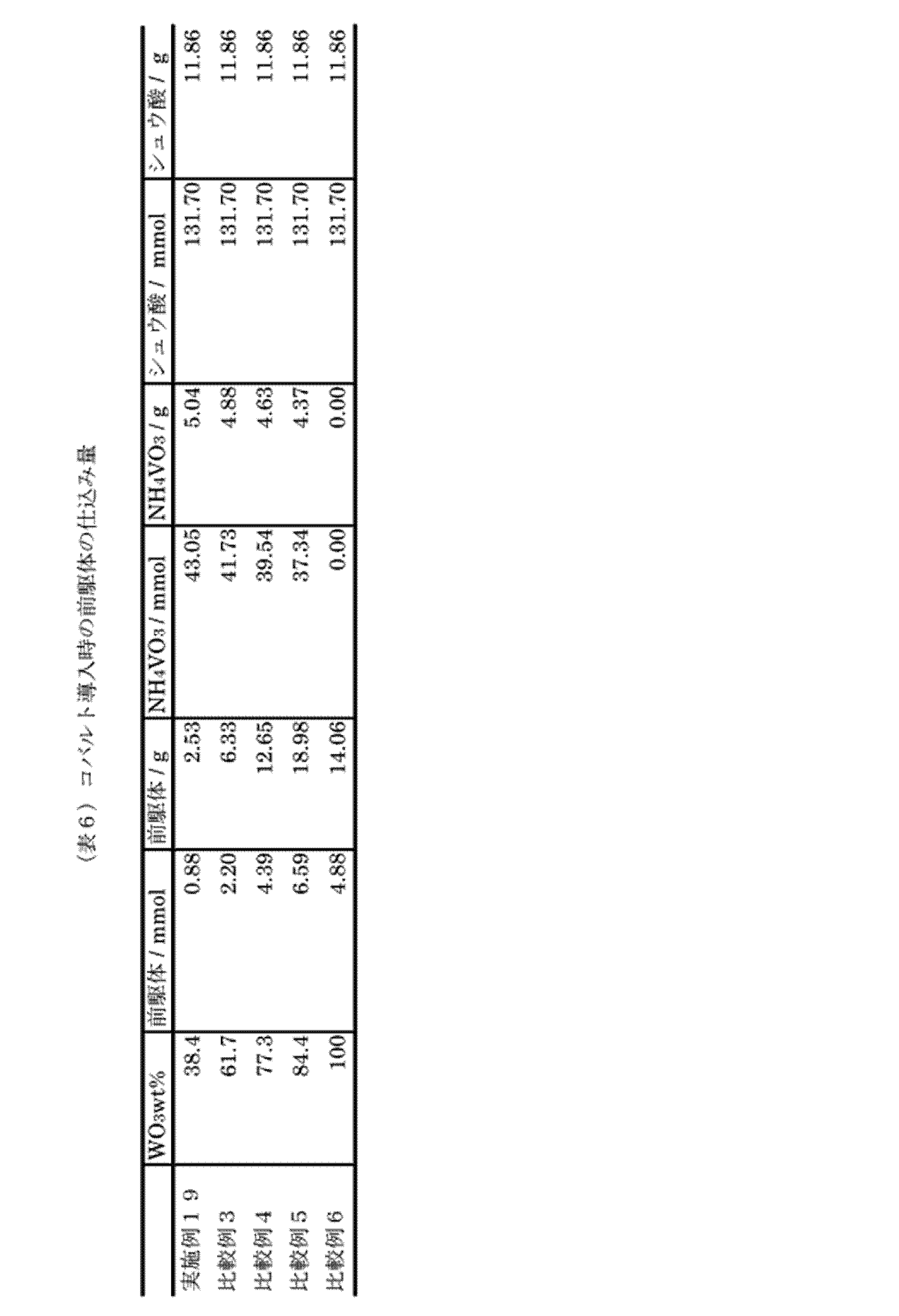
- Table 6 shows the amount of precursor charged at the time of introducing tungsten in Example 19 and Comparative Examples 3 to 6. ⁇ 3.2 Evaluation> ⁇ 3.2.1 Outline> Under the conditions shown in Table 1 above, the NH 3- SCR reaction was carried out at a reaction temperature of approximately 150 ° C. using a fixed bed flow type catalytic reaction apparatus. Of the gas that passed through the catalyst layer, NO was analyzed by Jasco FT-IR-4700. Further, the NO conversion rate was calculated by the above equation (1).
- Table 7 shows the NO conversion rates of each vanadium pentoxide catalyst in both the case where water does not coexist and the case where water coexists.
- FIG. 6 is a graph of Table 7.
- Comparative Example 1 having a tungsten content of 0 wt% and Comparative Examples 2-5 and 7 having a tungsten content of 39 wt% to 100 wt% both in the case where water does not coexist and in the case where water coexists.
- the addition amount of tungsten between 10 and 38 wt% is effective.
- FIG. 7 shows Example 16 (4.9 wt %), Example 17 (11.8 wt %), Example 18 (22.1 wt %), Comparative Example 1 (0 wt %), and Comparative Example 2 (100 wt %).
- 3 shows a powder XRD pattern.
- FIG. 8 shows the percentage (%) of the tungsten element when the horizontal axis represents mol% of K 2 WO 4 .
- Table 8 shows the NO conversion rates of each vanadium pentoxide catalyst in both the case where water does not coexist and the case where water coexists.
- FIG. 9 is a graph of this Table 6.
- Powder X-ray diffraction and elemental analysis> Measured method
- a measurement was performed using Cu—K ⁇ by Rigaku smart lab.
- elemental analysis by SEM-EDS was performed.
- FIG. 10 shows Example 19 (38.4 wt %), Comparative Example 4 (61.7 wt %), Comparative Example 5 (77.3 wt %), Comparative Example 6 (84.4 wt %), Comparative Example 7 (100 wt %).
- FIG. 11 shows the proportion (%) of the tungsten element when the horizontal axis is mol% of H 3 PW 12 O 40 ⁇ nH 2 O.
- Table 9 shows the NO conversion rates of each vanadium pentoxide catalyst in both the case where water does not coexist and the case where water coexists.
- FIG. 12 is a graph of this Table 9.
- Example 4 shows the second highest NO conversion rate, and water coexists.
- the vanadium catalyst according to each of the following examples was produced by changing the addition amount of niobium.
- Example 20 Ammonium vanadate (NH 4 VO 3 ) and oxalic acid ((COOH) 2 ) were dissolved in pure water to synthesize a precursor complex.
- a oxalic acid complex of niobium (Nb) was added so that Nb 2 O 5 was 1.8 wt% in terms of metal oxide.
- the obtained vanadium-niobium complex mixture was calcined twice at a temperature of 300° C. for 4 hours in an electric furnace to obtain a denitration catalyst of vanadium pentoxide (V 2 O 5 ) containing niobium (Nb).
- Example 21 Ammonium vanadate (NH 4 VO 3 ) and oxalic acid ((COOH) 2 ) were dissolved in pure water to synthesize a precursor complex.
- a oxalic acid complex of niobium (Nb) was added so that Nb 2 O 5 was 5.2 wt% in terms of metal oxide.
- the obtained vanadium-niobium complex mixture was calcined twice at a temperature of 300° C. for 4 hours in an electric furnace to obtain a denitration catalyst of vanadium pentoxide (V 2 O 5 ) containing niobium (Nb).
- Example 22 Ammonium vanadate (NH 4 VO 3 ) and oxalic acid ((COOH) 2 ) were dissolved in pure water to synthesize a precursor complex.
- a oxalic acid complex of niobium (Nb) which is a second metal, was added so that Nb 2 O 5 was 8.5 wt% in terms of metal oxide.
- the cobalt complex mixture by an electric furnace and fired twice to obtain a denitration catalyst of vanadium pentoxide containing cobalt (Co) (V 2 O 5 ).
- Example 23 Ammonium vanadate (NH 4 VO 3 ) and oxalic acid ((COOH) 2 ) were dissolved in pure water to synthesize a precursor complex.
- a oxalic acid complex of niobium (Nb) which is a second metal, was added so that Nb 2 O 5 was 11.7 wt% in terms of metal oxide.
- Example 24 Ammonium vanadate (NH 4 VO 3 ) and oxalic acid ((COOH) 2 ) were dissolved in pure water to synthesize a precursor complex.
- a oxalic acid complex of niobium (Nb) which is a second metal, was added so that Nb 2 O 5 was 16.2 wt% in terms of metal oxide.
- Table 10 shows the amount of the precursor charged at the time of introducing niobium in Examples 20 to 24.
- ⁇ 4.2 Evaluation> ⁇ 4.2.1 NO conversion> (Measuring method) Under the conditions shown in Table 1 above, the NH 3- SCR reaction was carried out at a reaction temperature of 150 ° C. using a fixed-bed flow catalytic reactor. Of the gas that passed through the catalyst layer, NO was analyzed by Jasco FT-IR-4700. Further, the NO conversion rate was calculated by the above equation (1).
- Table 11 shows the NO conversion of each vanadium oxide catalyst both in the absence of water and in the presence of water.
- FIG. 13 is a graph of this table 11.
- the denitration catalysts of the examples all showed higher NO conversion than the denitration catalysts of the comparative examples both in the absence of water and in the presence of water.
- Example 22 9 wt%) showed the highest NO conversion
- Example 21 5 wt%) showed the highest NO conversion. ..
- Example 25 Ammonium vanadate (NH 4 VO 3 ) and oxalic acid were dissolved in pure water to synthesize a precursor complex. To this precursor complex, ethylene glycol and an oxalic acid complex which is a precursor of cobalt (Co) which is the second metal were added so that Co 3 O 4 was 6 wt% in terms of metal oxide. The obtained catalyst skeleton was fired in an electric furnace at a temperature of 270° C. for 2 hours to obtain a vanadium oxide denitration catalyst containing carbon and cobalt (Co). In addition, Table 12 below shows the charged amount of the precursor when cobalt was introduced in Example 25.
- each vanadium pentoxide catalyst When measuring the carbon content of each vanadium pentoxide catalyst, the carbon content was quantified by elemental analysis of C (carbon), H (hydrogen), and N (nitrogen). More specifically, each denitration catalyst is completely combusted and decomposed in a high-temperature reaction tube inside the CE-440F manufactured by Starbucks Analytical Co., and C, H, and N, which are main constituent elements, are CO 2 , H 2 O, After conversion to N 2 , these three components were sequentially quantified by three thermal conductivity detectors, and the contents of C, H, and N in the constituent elements were measured.
- Table 13 shows the NO conversion rates of the vanadium pentoxide catalysts of Comparative Example 1, Example 12, and Example 25 in both the case where water does not coexist and the case where water coexists.
- FIG. 14 is a graph of this table 13.
- the denitration catalyst of Example 25 showed the highest NO conversion rate in both the case where water did not coexist and the case where water coexisted.
Landscapes
- Chemical & Material Sciences (AREA)
- Engineering & Computer Science (AREA)
- Chemical Kinetics & Catalysis (AREA)
- Materials Engineering (AREA)
- Organic Chemistry (AREA)
- Environmental & Geological Engineering (AREA)
- Biomedical Technology (AREA)
- Health & Medical Sciences (AREA)
- Analytical Chemistry (AREA)
- General Chemical & Material Sciences (AREA)
- Oil, Petroleum & Natural Gas (AREA)
- Thermal Sciences (AREA)
- Physics & Mathematics (AREA)
- Catalysts (AREA)
- Exhaust Gas Treatment By Means Of Catalyst (AREA)
Abstract
アンモニアを還元剤とする選択的触媒還元反応の際、従来技術に比較して、低温での脱硝効率が更に良い触媒を提供する。酸化バナジウムを主成分とする脱硝触媒であって、第2の金属の酸化物の含有量が1wt%以上40wt%以下であり、前記第2の金属が、Co、W、Mo、Nb、Ce、Sn、Ni、及びFeからなる群から選ばれる少なくとも一つの金属元素である脱硝触媒。
Description
本発明は、脱硝触媒、及びその製造方法に関する。より詳しくは、本発明は、燃料が燃焼することによって発生する排ガスを浄化する際に用いる脱硝触媒、及びその製造方法に関する。
燃料の燃焼により大気中に排出される汚染物質の一つとして、窒素酸化物(NO,NO2,NO3,N2O,N2O3,N2O4,N2O5)が挙げられる。窒素酸化物は、酸性雨、オゾン層破壊、光化学スモッグ等を引き起こし、環境や人体に深刻な影響を与えるため、その処理が重要な課題となっている。
上記の窒素酸化物を取り除く技術として、アンモニア(NH3)を還元剤とする選択的触媒還元反応(NH3-SCR)が知られている。特許文献1に記載のように、選択的触媒還元反応に用いられる触媒としては、酸化チタンを担体とし、酸化バナジウムを担持した触媒が広く使用されている。酸化チタンは硫黄酸化物に対して活性が低く、また安定性が高いため最も良い担体とされている。
一方で、酸化バナジウムはNH3-SCRにおいて主要な役割を果たすものの、SO2をSO3に酸化するので、酸化バナジウムを1wt%程度以上担持できなかった。また、従来のNH3-SCRでは、酸化チタン担体に酸化バナジウムを担持させた触媒が低温ではほとんど反応しないので,350-400℃という高温で使用せざるを得なかった。
しかし、NH3-SCRを実施する装置や設備の設計の自由度を高め、効率化するためには、低温でも高い窒素酸化物還元率活性を示す触媒の開発が求められていた。
しかし、NH3-SCRを実施する装置や設備の設計の自由度を高め、効率化するためには、低温でも高い窒素酸化物還元率活性を示す触媒の開発が求められていた。
その後、本発明者らは、五酸化バナジウムが43wt%以上存在し、BET比表面積が30m2/g以上であり、200℃以下での脱硝に用いられる脱硝触媒を見出した(特許文献2)。
本発明者らは、上記特許文献2の更なる改良を試みて鋭意検討した結果、更に優れた窒素酸化物の還元率活性を示す脱硝触媒を見出した。
本発明は、アンモニアを還元剤とする選択的触媒還元反応の際、従来技術に比較して、低温での脱硝効率が更に良い触媒を提供することを目的とする。
本発明は、酸化バナジウムを主成分とする脱硝触媒であって、第2の金属の酸化物の含有量が1wt%以上40wt%以下であり、前記第2の金属が、Co、W、Mo、Nb、Ce、Sn、Ni、Feからなる群から選ばれる少なくとも一つの金属元素である脱硝触媒に関する。
また、前記脱硝触媒は、300℃以下での脱硝に用いられることが好ましい。
また、前記脱硝触媒は、更に炭素を含有することが好ましい。
また、炭素含有量は、0.05wt%以上であることが好ましい。
また、本発明に係る脱硝触媒の製造方法は、バナジン酸塩、キレート化合物、及び前記第2の金属の化合物の混合物を焼成する工程を有することが好ましい。
また、本発明に係る脱硝触媒の製造方法において、前記混合物には、更にエチレングリコールが含まれることが好ましい。
前記焼成する工程は、270℃以下の温度で焼成する工程であることが好ましい。
本発明に係る脱硝触媒は、アンモニアを還元剤とする選択的触媒還元反応の際、従来技術に比較して、低温での脱硝効率が更に良い。
以下、本発明の実施形態について説明する。
本発明の脱硝触媒は、酸化バナジウムを主成分とする脱硝触媒であって、第2の金属の酸化物の含有量が1wt%以上40wt%以下であり、前記第2の金属が、Co、W、Mo、Nb、Ce、Sn、Ni、及びFeからなる群から選ばれる少なくとも一つの金属元素である。このような脱硝触媒は、従来用いられているバナジウム/チタン触媒等の脱硝触媒に比べて、低温環境下でも高い脱硝効果を発揮できる。
第1に、本発明の脱硝触媒は、酸化バナジウムを主成分とする。この酸化バナジウムは、酸化バナジウム(II)(VO)、三酸化バナジウム(III)(V2O3)、四酸化バナジウム(IV)(V2O4)、五酸化バナジウム(V)(V2O5)を含み、脱硝反応中、五酸化バナジウム(V2O5)のV元素は、5価、4価、3価、2価の形態を取ってもよい。
なお、この酸化バナジウムは、本発明の脱硝触媒の主成分であり、本発明の効果を阻害しない範囲内で他の物質を含んでいても良いが、本発明の脱硝触媒中、五酸化バナジウム換算で50wt%以上存在することが好ましい。更に好ましくは、酸化バナジウムが、本発明の脱硝触媒中、五酸化バナジウム換算で60wt%以上存在することが好ましい。
なお、この酸化バナジウムは、本発明の脱硝触媒の主成分であり、本発明の効果を阻害しない範囲内で他の物質を含んでいても良いが、本発明の脱硝触媒中、五酸化バナジウム換算で50wt%以上存在することが好ましい。更に好ましくは、酸化バナジウムが、本発明の脱硝触媒中、五酸化バナジウム換算で60wt%以上存在することが好ましい。
第2に、本発明の脱硝触媒は、第2の金属の酸化物の含有量が1wt%以上40wt%以下であるが、このような第2の金属の酸化物を含むことにより、従来用いられているバナジウム/チタン触媒等の脱硝触媒に比べて、低温環境下でも高い脱硝効果を発揮できる。本発明の脱硝触媒中に不純物が入り込むと、脱硝触媒中にアモルファスの部分が生成されるために結晶構造が連続せず、結晶格子中の線や面がひずむことにより高い脱硝効果が発揮されるが、この不純物としての第2の金属の酸化物が多く存在するほど、高い脱硝効果が発揮されることが推察される。
本発明の実施形態において、第2の金属の酸化物として、酸化コバルトの含有量が1wt%~10wt%の脱硝触媒を用いた反応温度200℃以下の選択的触媒還元反応においては、水分の共存下でない場合で79%~100%のNO転化率を、水分の共存下の場合で38%~90%のNO転化率を示した。
一方、第2の金属の酸化物として、酸化コバルトの含有量が0wt%の脱硝触媒を用いた反応温度200℃以下の選択的触媒還元反応においては、水分の共存下でない場合で76%のNO転化率、水分の共存下の場合で32%のNO転化率しか示されなかった。
一方、第2の金属の酸化物として、酸化コバルトの含有量が0wt%の脱硝触媒を用いた反応温度200℃以下の選択的触媒還元反応においては、水分の共存下でない場合で76%のNO転化率、水分の共存下の場合で32%のNO転化率しか示されなかった。
また、第2の金属の酸化物として、酸化タングステンの含有量が12wt%~38wt%の脱硝触媒を用いた反応温度200℃以下の選択的触媒還元反応においては、水分の共存下でない場合で83%~96%のNO転化率を、水分の共存下の場合で50%~55%のNO転化率を示した。
一方、第2の金属の酸化物として、酸化タングステンの含有量が0wt%の脱硝触媒を用いた反応温度200℃以下の選択的触媒還元反応においては、水分の共存下でない場合で76%のNO転化率、水分の共存下の場合で32%のNO転化率しか示されなかった。
また、第2の金属の酸化物として、酸化タングステンの含有量が62wt%~100wt%の脱硝触媒を用いた反応温度200℃以下の選択的触媒還元反応においては、水分の共存下でない場合で3~69%のNO転化率、水分の共存下の場合で0%~29%のNO転化率しか示されなかった。
一方、第2の金属の酸化物として、酸化タングステンの含有量が0wt%の脱硝触媒を用いた反応温度200℃以下の選択的触媒還元反応においては、水分の共存下でない場合で76%のNO転化率、水分の共存下の場合で32%のNO転化率しか示されなかった。
また、第2の金属の酸化物として、酸化タングステンの含有量が62wt%~100wt%の脱硝触媒を用いた反応温度200℃以下の選択的触媒還元反応においては、水分の共存下でない場合で3~69%のNO転化率、水分の共存下の場合で0%~29%のNO転化率しか示されなかった。
また、第2の金属の酸化物として、酸化ニオブの含有量が2wt%~16wt%の脱硝触媒を用いた選択触媒還元反応においては、水分の共存下でない場合で76wt%~97%のNO転化率、水分の共存化の場合で32%~73%のNO転化率を示した。
また、上述の記載では、本発明の脱硝触媒は、第2の金属の酸化物の含有量が1wt%以上40wt%以下であるとしたが、3wt%以上38wt%以下とすると好ましい。また、第2の金属の酸化物の含有量は、3wt%以上10wt%以下とするとより好ましい。また、第2の金属の酸化物の含有量は、5wt%以上10wt%以下とするとより好ましい。また、第2の金属の酸化物の含有量は、5wt%以上8wt%以下とするとより好ましい。また、第2の金属の酸化物の含有量は、6wt%以上8wt%以下とするとより好ましい。また、第2の金属の酸化物の含有量は、6wt%以上7wt%以下とするとより好ましい。
第3に、第2の金属は、Co、W、Mo、Nb、Ce、Sn、Ni、Feからなる群から選ばれる少なくとも一つの金属元素である。これにより、酸化バナジウムの結晶構造を乱し、ルイス酸性を高めることができる。とりわけ、Co、Mo、Ce、Sn、Ni、Feの場合は、V2O5の酸化還元サイクルを促進する。また、これらの元素のうち、Coは、酸化力が強いことが知られている。W、Mo、Nbは、いずれも固体酸として機能すると共に、アンモニアの吸着サイトを提供することで、アンモニアが効率的にNOと接触し反応することが可能となる。
本発明の実施形態において、第2の金属の酸化物として、酸化コバルトの含有量が3.1wt%の脱硝触媒を用いた反応温度200℃以下の選択的触媒還元反応においては、水分の共存下でない場合で94.6%のNO転化率を、水分の共存下の場合で69.4%のNO転化率を示した。
また、本発明の実施形態において、第2の金属の酸化物として、酸化タングステンの含有量が8.4wt%の脱硝触媒を用いた反応温度200℃以下の選択的触媒還元反応においては、水分の共存下でない場合で92%のNO転化率を、水分の共存下の場合で64%のNO転化率を示した。
また、本発明の実施形態において、第2の金属の酸化物として、酸化モリブデンの含有量が5.4wt%の脱硝触媒を用いた反応温度200℃以下の選択的触媒還元反応においては、水分の共存下でない場合で97%のNO転化率を、水分の共存下の場合で62%のNO転化率を示した。
また、本発明の実施形態において、第2の金属の酸化物として、酸化ニオブの含有量が5.0wt%の脱硝触媒を用いた反応温度200℃以下の選択的触媒還元反応においては、水分の共存下でない場合で96.7%のNO転化率を、水分の共存下の場合で61.7%のNO転化率を示した。
また、本発明の実施形態において、第2の金属の酸化物として、酸化セシウムの含有量が6.4wt%の脱硝触媒を用いた反応温度200℃以下の選択的触媒還元反応においては、水分の共存下でない場合で89.8%のNO転化率を、水分の共存下の場合で52.9%のNO転化率を示した。
また、本発明の実施形態において、第2の金属の酸化物として、酸化スズの含有量が5.6wt%の脱硝触媒を用いた反応温度200℃以下の選択的触媒還元反応においては、水分の共存下でない場合で88.1%のNO転化率を、水分の共存下の場合で45.5%のNO転化率を示した。
また、本発明の実施形態において、第2の金属の酸化物として、酸化ニッケルの含有量が2.9wt%の脱硝触媒を用いた反応温度200℃以下の選択的触媒還元反応においては、水分の共存下でない場合で81.9%のNO転化率を、水分の共存下の場合で37.9%のNO転化率を示した。
また、本発明の実施形態において、第2の金属の酸化物として、酸化鉄の含有量が3.1wt%の脱硝触媒を用いた反応温度200℃以下の選択的触媒還元反応においては、水分の共存下でない場合で74.5%のNO転化率を、水分の共存下の場合で33.9%のNO転化率を示した。
一方、第2の金属の酸化物を含有しない脱硝触媒を用いた反応温度200℃以下の選択的触媒還元反応においては、水分の共存下でない場合で75.5%のNO転化率を、水分の共存下の場合で32%のNO転化率しか示されなかった。
また、本発明の実施形態において、第2の金属の酸化物として、酸化タングステンの含有量が8.4wt%の脱硝触媒を用いた反応温度200℃以下の選択的触媒還元反応においては、水分の共存下でない場合で92%のNO転化率を、水分の共存下の場合で64%のNO転化率を示した。
また、本発明の実施形態において、第2の金属の酸化物として、酸化モリブデンの含有量が5.4wt%の脱硝触媒を用いた反応温度200℃以下の選択的触媒還元反応においては、水分の共存下でない場合で97%のNO転化率を、水分の共存下の場合で62%のNO転化率を示した。
また、本発明の実施形態において、第2の金属の酸化物として、酸化ニオブの含有量が5.0wt%の脱硝触媒を用いた反応温度200℃以下の選択的触媒還元反応においては、水分の共存下でない場合で96.7%のNO転化率を、水分の共存下の場合で61.7%のNO転化率を示した。
また、本発明の実施形態において、第2の金属の酸化物として、酸化セシウムの含有量が6.4wt%の脱硝触媒を用いた反応温度200℃以下の選択的触媒還元反応においては、水分の共存下でない場合で89.8%のNO転化率を、水分の共存下の場合で52.9%のNO転化率を示した。
また、本発明の実施形態において、第2の金属の酸化物として、酸化スズの含有量が5.6wt%の脱硝触媒を用いた反応温度200℃以下の選択的触媒還元反応においては、水分の共存下でない場合で88.1%のNO転化率を、水分の共存下の場合で45.5%のNO転化率を示した。
また、本発明の実施形態において、第2の金属の酸化物として、酸化ニッケルの含有量が2.9wt%の脱硝触媒を用いた反応温度200℃以下の選択的触媒還元反応においては、水分の共存下でない場合で81.9%のNO転化率を、水分の共存下の場合で37.9%のNO転化率を示した。
また、本発明の実施形態において、第2の金属の酸化物として、酸化鉄の含有量が3.1wt%の脱硝触媒を用いた反応温度200℃以下の選択的触媒還元反応においては、水分の共存下でない場合で74.5%のNO転化率を、水分の共存下の場合で33.9%のNO転化率を示した。
一方、第2の金属の酸化物を含有しない脱硝触媒を用いた反応温度200℃以下の選択的触媒還元反応においては、水分の共存下でない場合で75.5%のNO転化率を、水分の共存下の場合で32%のNO転化率しか示されなかった。
また、本発明の脱硝触媒は、300℃以下での脱硝に用いられることが好ましい。これは、本発明の脱硝触媒の焼成温度が300℃であることに由来する。一方で、後述の実施例において、本発明の脱硝触媒は、反応温度200℃以下での選択的触媒還元反応において、高い脱硝効果を発揮したことから、本発明の脱硝触媒は、200℃以下での脱硝に用いることが可能である。200℃以下ではSO2からSO3への酸化が発生しないため、上記の特許文献2でも知見が得られたように、200℃以下での選択的触媒還元反応時には、SO2のSO3への酸化が伴わない。
また、上述の記載では、本発明の脱硝触媒は、300℃以下の脱硝に用いられることが好ましいとしたが、好ましくは200℃以下の脱硝に用いられてもよい、更に好ましくは、反応温度が100―200℃の脱硝に用いられてもよい。更に好ましくは、反応温度160-200℃の脱硝に用いられてもよい。あるいは、反応温度が80-150℃の脱硝に用いられてもよい。
また、本発明の脱硝触媒は、更に炭素を含有することが好ましい。とりわけ炭素含有率が0.05wt%以上であることが好ましい。なお好ましくは、炭素含有率が0.07wt%以上であってもよい。更に好ましくは、炭素含有率が0.11wt%以上であってもよい。更に好ましくは、炭素含有率が0.12wt%以上であってもよい。更に好ましくは、炭素含有率が0.14wt%以上であってもよい。更に好ましくは、炭素含有率が0.16wt%以上であってもよい。更に好ましくは、炭素含有率が0.17wt%以上であってもよい。更に好ましくは、炭素含有率が0.70wt%以上であってもよい。
炭素を含むことにより、従来用いられているバナジウム/チタン触媒等の脱硝触媒に比べて、低温環境下でも高い脱硝効果を発揮できる。本発明の脱硝触媒中に不純物が入り込むと、脱硝触媒中にアモルファスの部分が生成されるために結晶構造が連続せず、結晶格子中の線や面がひずむことにより高い脱硝効果が発揮されるが、この不純物としての炭素が存在することにより、高い脱硝効果が発揮されることが推察される。
炭素を含むことにより、従来用いられているバナジウム/チタン触媒等の脱硝触媒に比べて、低温環境下でも高い脱硝効果を発揮できる。本発明の脱硝触媒中に不純物が入り込むと、脱硝触媒中にアモルファスの部分が生成されるために結晶構造が連続せず、結晶格子中の線や面がひずむことにより高い脱硝効果が発揮されるが、この不純物としての炭素が存在することにより、高い脱硝効果が発揮されることが推察される。
以下、酸化バナジウムを主成分とする脱硝触媒であって、第2の金属の酸化物の含有量が1wt%以上40wt%以下であり、前記第2の金属が、Co、W、Mo、Nb、Ce、Sn、Ni、及びFeからなる群から選ばれる少なくとも一つの金属元素である脱硝触媒を作製する方法を示す。
上記の脱硝触媒の作製方法は、バナジン酸塩、キレート化合物、及び第2の金属の化合物の混合物を焼成する工程を備える。
バナジン酸塩としては、例えば、バナジン酸アンモニウム、バナジン酸マグネシウム、バナジン酸ストロンチウム、バナジン酸バリウム、バナジン酸亜鉛、バナジン酸鉛、バナジン酸リチウム等を用いてもよい。
また、キレート化合物としては、例えば、シュウ酸やクエン酸等の複数のカルボキシル基を有するもの、アセチルアセトナート、エチレンジアミン等の複数のアミノ基を有するもの、エチレングリコール等の複数のヒドロキシル基を有するもの等を用いてもよい。
また、第2の金属の化合物としては、キレート錯体、水和物、アンモニウム化合物、リン酸化合物であってよい。キレート錯体としては、例えば、シュウ酸やクエン酸等の錯体であってよい。水和物としては、例えば(NH4)10W12O41・5H2OやH3PW12O40・nH2Oであってよい。アンモニウム化合物としては、例えば(NH4)10W12O41・5H2Oであってよい。リン酸化合物としては、例えばH3PW12O40・nH2Oであってよい。
バナジン酸塩としては、例えば、バナジン酸アンモニウム、バナジン酸マグネシウム、バナジン酸ストロンチウム、バナジン酸バリウム、バナジン酸亜鉛、バナジン酸鉛、バナジン酸リチウム等を用いてもよい。
また、キレート化合物としては、例えば、シュウ酸やクエン酸等の複数のカルボキシル基を有するもの、アセチルアセトナート、エチレンジアミン等の複数のアミノ基を有するもの、エチレングリコール等の複数のヒドロキシル基を有するもの等を用いてもよい。
また、第2の金属の化合物としては、キレート錯体、水和物、アンモニウム化合物、リン酸化合物であってよい。キレート錯体としては、例えば、シュウ酸やクエン酸等の錯体であってよい。水和物としては、例えば(NH4)10W12O41・5H2OやH3PW12O40・nH2Oであってよい。アンモニウム化合物としては、例えば(NH4)10W12O41・5H2Oであってよい。リン酸化合物としては、例えばH3PW12O40・nH2Oであってよい。
また、上記の混合物には、更にエチレングリコールが含まれることが好ましい。
これらの方法で製造された脱硝触媒は、従来用いられているバナジウム/チタン触媒等の脱硝触媒に比べて、低温環境下でも高い脱硝効果を発揮できる。本発明の脱硝触媒中に不純物が入り込むと、脱硝触媒中にアモルファスの部分が生成されるために結晶構造が連続せず、結晶格子中の線や面がひずむことにより高い脱硝効果が発揮されるが、この不純物としての炭素が多く存在するほど、高い脱硝効果が発揮されることが推察される。
本発明の実施形態において、バナジン酸アンモニウム、シュウ酸、第2の金属のシュウ酸錯体の混合物を焼成する方法によって製造された脱硝触媒は、水分の共存下でない場合で74.5~100%のNO転化率を、水分の共存下の場合で33.9~90%のNO転化率を示した。
また、上記の混合物に更にエチレングリコールが含まれる方法によって製造された脱硝触媒は、水分の共存下でない場合で100%のNO転化率を、水分の共存下の場合で89%のNO転化率を示した。
一方、このような工程を含まない方法で製造された脱硝触媒として、例えば、バナジン酸アンモニウムとシュウ酸とを混合するが、第2の金属の酸化物を混合せずに、焼成する方法で製造された脱硝触媒は、水分の共存下でない場合で76%のNO転化率、水分の共存下の場合で32%のNO転化率しか示さなかった。
また、上記の混合物に更にエチレングリコールが含まれる方法によって製造された脱硝触媒は、水分の共存下でない場合で100%のNO転化率を、水分の共存下の場合で89%のNO転化率を示した。
一方、このような工程を含まない方法で製造された脱硝触媒として、例えば、バナジン酸アンモニウムとシュウ酸とを混合するが、第2の金属の酸化物を混合せずに、焼成する方法で製造された脱硝触媒は、水分の共存下でない場合で76%のNO転化率、水分の共存下の場合で32%のNO転化率しか示さなかった。
また、上記の焼成は270℃以下の温度で行われることが好ましい。
本実施形態に係る脱硝触媒の生成時に、通常の300℃に比較して低温の270℃以下の温度で焼成することにより、当該脱硝触媒に含まれる五酸化バナジウム結晶の構造が局所的に乱れ、高い脱硝効果を発揮できるが、とりわけ五酸化バナジウムの結晶構造中に酸素原子が欠乏しているサイトが出現することで高い脱硝効果が発揮されることが推察される。なお、「酸素原子が欠乏しているサイト」のことを「酸素欠陥サイト」とも呼称する。
本実施形態に係る脱硝触媒の生成時に、通常の300℃に比較して低温の270℃以下の温度で焼成することにより、当該脱硝触媒に含まれる五酸化バナジウム結晶の構造が局所的に乱れ、高い脱硝効果を発揮できるが、とりわけ五酸化バナジウムの結晶構造中に酸素原子が欠乏しているサイトが出現することで高い脱硝効果が発揮されることが推察される。なお、「酸素原子が欠乏しているサイト」のことを「酸素欠陥サイト」とも呼称する。
このようにして調製される脱硝触媒においては、酸化バナジウムを主成分とする脱硝触媒であって、第2の金属の酸化物の含有量が1wt%以上40wt%以下であり、前記第2の金属が、Co、W、Mo、Nb、Ce、Sn、Ni、及びFeからなる群から選ばれる少なくとも一つの金属元素である。
上記実施形態に係る脱硝触媒によれば、以下の効果が奏される。
(1)上記のように、上記実施形態に係る脱硝触媒において、バナジウムを主成分とする脱硝触媒であって、第2の金属の酸化物の含有量が1wt%以上40wt%以下であり、前記第2の金属が、Co、W、Mo、Nb、Ce、Sn、Ni、Feからなる群から選ばれる少なくとも一つの金属元素であるとした。
この脱硝触媒を用いることにより、アンモニアを還元剤とする反応温度200℃以下の選択的触媒還元反応の際、従来技術に比較して、低温での脱硝効率が更に高いという効果を発揮できる。また、この脱硝触媒は、NOの吸着がしやすく、より高いNO転化率を発揮できる。
この脱硝触媒を用いることにより、アンモニアを還元剤とする反応温度200℃以下の選択的触媒還元反応の際、従来技術に比較して、低温での脱硝効率が更に高いという効果を発揮できる。また、この脱硝触媒は、NOの吸着がしやすく、より高いNO転化率を発揮できる。
(2)上記のように、上記実施形態に係る脱硝触媒は、300℃以下での脱硝に用いられることが好ましい。
これにより、上記実施形態に係る脱硝触媒を用いた反応温度200℃以下の選択的触媒還元反応において、SO2を酸化させることなく、高い脱硝効果がもたらされる。
これにより、上記実施形態に係る脱硝触媒を用いた反応温度200℃以下の選択的触媒還元反応において、SO2を酸化させることなく、高い脱硝効果がもたらされる。
(3)上記のように、上記実施形態に係る脱硝触媒は、更に炭素を含有することが好ましい。
これにより、上記実施形態に係る脱硝触媒は、水分と共存しない状況下で、100%以上のNO転化率を発揮できる。
これにより、上記実施形態に係る脱硝触媒は、水分と共存しない状況下で、100%以上のNO転化率を発揮できる。
(4)上記のように、炭素含有量が0.05wt%以上であることが好ましい。
これにより、上記実施形態に係る脱硝触媒は、水分と共存しない状況下で、100%以上のNO転化率を発揮できる。
これにより、上記実施形態に係る脱硝触媒は、水分と共存しない状況下で、100%以上のNO転化率を発揮できる。
(5)上記のように、上記実施形態に係る脱硝触媒の製造方法は、バナジン酸塩、キレート化合物、及び前記第2の金属の化合物の混合物を焼成する工程を有することが好ましい。
これにより、上記実施形態に係る脱硝触媒に第2の金属が含有されることとなり、上記実施形態に係る脱硝触媒を用いた反応温度200℃以下の選択的触媒還元反応における脱硝効果が向上する。
これにより、上記実施形態に係る脱硝触媒に第2の金属が含有されることとなり、上記実施形態に係る脱硝触媒を用いた反応温度200℃以下の選択的触媒還元反応における脱硝効果が向上する。
(6)上記の混合物には更にエチレングリコールが含まれることが好ましい。
これにより、上記実施形態に係る脱硝触媒に炭素及び第2の金属が含有されることとなり、上記実施形態に係る脱硝触媒を用いた反応温度200℃以下の選択的触媒還元反応における脱硝効果が向上する。
これにより、上記実施形態に係る脱硝触媒に炭素及び第2の金属が含有されることとなり、上記実施形態に係る脱硝触媒を用いた反応温度200℃以下の選択的触媒還元反応における脱硝効果が向上する。
(7)上記の製造方法において焼成する工程は、270℃以下の温度で焼成する工程であることが好ましい。
これにより、脱硝触媒に含まれる五酸化バナジウム結晶の構造が局所的に乱れ、高い脱硝効果を発揮できる
これにより、脱硝触媒に含まれる五酸化バナジウム結晶の構造が局所的に乱れ、高い脱硝効果を発揮できる
なお、本発明は上記実施形態に限定されるものではなく、本発明の目的を達成できる範囲での変形、改良等は本発明に含まれる。
以下、本発明の実施例を比較例と共に、具体的に説明する。なお、本発明は、これらの実施例によって限定されるものではない。
<1 第2の金属として各種金属を含有するバナジウム触媒>
<1.1 各実施例と比較例>
<1.1 各実施例と比較例>
[実施例1]
バナジン酸アンモニウム(NH4VO3)4.96g(42.4mmol)とシュウ酸((COOH)2)11.5g(127.6mmol)とを純水に溶解させ、前駆体錯体を合成した。この前駆体錯体に対し、第2の金属であるコバルト(Co)のシュウ酸錯体を、金属原子換算でコバルト(Co)が3.5mol%となるように、すなわち金属酸化物換算でCo3O4が3.1wt%となるように添加した。得られたバナジウム-異種金属錯体混合物を電気炉によって300℃の温度で4時間、2回焼成することにより、コバルト(Co)を含有する五酸化バナジウム(V2O5)の脱硝触媒を得た。
バナジン酸アンモニウム(NH4VO3)4.96g(42.4mmol)とシュウ酸((COOH)2)11.5g(127.6mmol)とを純水に溶解させ、前駆体錯体を合成した。この前駆体錯体に対し、第2の金属であるコバルト(Co)のシュウ酸錯体を、金属原子換算でコバルト(Co)が3.5mol%となるように、すなわち金属酸化物換算でCo3O4が3.1wt%となるように添加した。得られたバナジウム-異種金属錯体混合物を電気炉によって300℃の温度で4時間、2回焼成することにより、コバルト(Co)を含有する五酸化バナジウム(V2O5)の脱硝触媒を得た。
[実施例2]
バナジン酸アンモニウム(NH4VO3)4.96g(42.4mmol)とシュウ酸((COOH)2)11.5g(127.6mmol)とを純水に溶解させ、前駆体錯体を合成した。この前駆体錯体に対し、第2の金属であるタングステン(W)のシュウ酸錯体を、金属原子換算でタングステン(W)が3.5mol%となるように、すなわち金属酸化物換算でWO3が8.4wt%となるように添加した。得られたバナジウム-異種金属錯体混合物を電気炉によって300℃の温度で4時間、2回焼成することにより、タングステン(W)を含有する五酸化バナジウム(V2O5)の脱硝触媒を得た。
バナジン酸アンモニウム(NH4VO3)4.96g(42.4mmol)とシュウ酸((COOH)2)11.5g(127.6mmol)とを純水に溶解させ、前駆体錯体を合成した。この前駆体錯体に対し、第2の金属であるタングステン(W)のシュウ酸錯体を、金属原子換算でタングステン(W)が3.5mol%となるように、すなわち金属酸化物換算でWO3が8.4wt%となるように添加した。得られたバナジウム-異種金属錯体混合物を電気炉によって300℃の温度で4時間、2回焼成することにより、タングステン(W)を含有する五酸化バナジウム(V2O5)の脱硝触媒を得た。
[実施例3]
バナジン酸アンモニウム(NH4VO3)4.96g(42.4mmol)とシュウ酸((COOH)2)11.5g(127.6mmol)とを純水に溶解させ、前駆体錯体を合成した。この前駆体錯体に対し、第2の金属であるモリブデン(Mo)のシュウ酸錯体を、金属原子換算でモリブデン(Mo)が3.5mol%となるように、すなわち金属酸化物換算でMoO3が5.4wt%となるように添加した。得られたバナジウム-異種金属錯体混合物を電気炉によって300℃の温度で4時間、2回焼成することにより、モリブデン(Mo)を含有する五酸化バナジウム(V2O5)の脱硝触媒を得た。
バナジン酸アンモニウム(NH4VO3)4.96g(42.4mmol)とシュウ酸((COOH)2)11.5g(127.6mmol)とを純水に溶解させ、前駆体錯体を合成した。この前駆体錯体に対し、第2の金属であるモリブデン(Mo)のシュウ酸錯体を、金属原子換算でモリブデン(Mo)が3.5mol%となるように、すなわち金属酸化物換算でMoO3が5.4wt%となるように添加した。得られたバナジウム-異種金属錯体混合物を電気炉によって300℃の温度で4時間、2回焼成することにより、モリブデン(Mo)を含有する五酸化バナジウム(V2O5)の脱硝触媒を得た。
[実施例4]
バナジン酸アンモニウム(NH4VO3)4.96g(42.4mmol)とシュウ酸((COOH)2)11.5g(127.6mmol)とを純水に溶解させ、前駆体錯体を合成した。この前駆体錯体に対し、第2の金属であるニオブ(Nb)のシュウ酸錯体を、金属原子換算でニオブ(Nb)が3.5mol%となるように、すなわち金属酸化物換算でNb2O5が5.0wt%となるように添加した。得られたバナジウム-異種金属錯体混合物を電気炉によって300℃の温度で4時間、2回焼成することにより、ニオブ(Nb)を含有する五酸化バナジウム(V2O5)の脱硝触媒を得た。
バナジン酸アンモニウム(NH4VO3)4.96g(42.4mmol)とシュウ酸((COOH)2)11.5g(127.6mmol)とを純水に溶解させ、前駆体錯体を合成した。この前駆体錯体に対し、第2の金属であるニオブ(Nb)のシュウ酸錯体を、金属原子換算でニオブ(Nb)が3.5mol%となるように、すなわち金属酸化物換算でNb2O5が5.0wt%となるように添加した。得られたバナジウム-異種金属錯体混合物を電気炉によって300℃の温度で4時間、2回焼成することにより、ニオブ(Nb)を含有する五酸化バナジウム(V2O5)の脱硝触媒を得た。
[実施例5]
バナジン酸アンモニウム(NH4VO3)4.96g(42.4mmol)とシュウ酸((COOH)2)11.5g(127.6mmol)とを純水に溶解させ、前駆体錯体を合成した。この前駆体錯体に対し、第2の金属であるセシウム(Ce)のシュウ酸錯体を、金属原子換算でセシウム(Ce)が3.5mol%となるように、すなわち金属酸化物換算でCeO2が6.4wt%となるように添加した。得られたバナジウム-異種金属錯体混合物を電気炉によって300℃の温度で4時間、2回焼成することにより、セシウム(Ce)を含有する五酸化バナジウム(V2O5)の脱硝触媒を得た。
バナジン酸アンモニウム(NH4VO3)4.96g(42.4mmol)とシュウ酸((COOH)2)11.5g(127.6mmol)とを純水に溶解させ、前駆体錯体を合成した。この前駆体錯体に対し、第2の金属であるセシウム(Ce)のシュウ酸錯体を、金属原子換算でセシウム(Ce)が3.5mol%となるように、すなわち金属酸化物換算でCeO2が6.4wt%となるように添加した。得られたバナジウム-異種金属錯体混合物を電気炉によって300℃の温度で4時間、2回焼成することにより、セシウム(Ce)を含有する五酸化バナジウム(V2O5)の脱硝触媒を得た。
[実施例6]
バナジン酸アンモニウム(NH4VO3)4.96g(42.4mmol)とシュウ酸((COOH)2)11.5g(127.6mmol)とを純水に溶解させ、前駆体錯体を合成した。この前駆体錯体に対し、第2の金属であるスズ(Sn)のシュウ酸錯体を、金属原子換算でスズ(Sn)が3.5mol%となるように、すなわち金属酸化物換算でSnO2が5.6wt%となるように添加した。得られたバナジウム-異種金属錯体混合物を電気炉によって300℃の温度で4時間、2回焼成することにより、スズ(Sn)を含有する五酸化バナジウム(V2O5)の脱硝触媒を得た。
バナジン酸アンモニウム(NH4VO3)4.96g(42.4mmol)とシュウ酸((COOH)2)11.5g(127.6mmol)とを純水に溶解させ、前駆体錯体を合成した。この前駆体錯体に対し、第2の金属であるスズ(Sn)のシュウ酸錯体を、金属原子換算でスズ(Sn)が3.5mol%となるように、すなわち金属酸化物換算でSnO2が5.6wt%となるように添加した。得られたバナジウム-異種金属錯体混合物を電気炉によって300℃の温度で4時間、2回焼成することにより、スズ(Sn)を含有する五酸化バナジウム(V2O5)の脱硝触媒を得た。
[実施例7]
バナジン酸アンモニウム(NH4VO3)4.96g(42.4mmol)とシュウ酸((COOH)2)11.5g(127.6mmol)とを純水に溶解させ、前駆体錯体を合成した。この前駆体錯体に対し、第2の金属であるニッケル(Ni)を炭酸ニッケルとして0.113g、金属原子換算でニッケル(Ni)が3.5mol%となるように、すなわち金属酸化物換算でNiOが2.9wt%となるように添加した。得られたバナジウム-異種金属錯体混合物を電気炉によって300℃の温度で4時間、2回焼成することにより、ニッケル(Ni)を含有する五酸化バナジウム(V2O5)の脱硝触媒を得た。
バナジン酸アンモニウム(NH4VO3)4.96g(42.4mmol)とシュウ酸((COOH)2)11.5g(127.6mmol)とを純水に溶解させ、前駆体錯体を合成した。この前駆体錯体に対し、第2の金属であるニッケル(Ni)を炭酸ニッケルとして0.113g、金属原子換算でニッケル(Ni)が3.5mol%となるように、すなわち金属酸化物換算でNiOが2.9wt%となるように添加した。得られたバナジウム-異種金属錯体混合物を電気炉によって300℃の温度で4時間、2回焼成することにより、ニッケル(Ni)を含有する五酸化バナジウム(V2O5)の脱硝触媒を得た。
[実施例8]
バナジン酸アンモニウム(NH4VO3)4.96g(42.4mmol)とシュウ酸((COOH)2)11.5g(127.6mmol)とを純水に溶解させ、前駆体錯体を合成した。この前駆体錯体に対し、第2の金属である鉄(Fe)のシュウ酸錯体を、金属原子換算で鉄(Fe)が3.5mol%となるように、すなわち金属酸化物換算でFe2O3が3.1wt%となるように添加した。得られたバナジウム-異種金属錯体混合物を電気炉によって300℃の温度で4時間、2回焼成することにより、鉄(Fe)を含有する五酸化バナジウム(V2O5)の脱硝触媒を得た。
バナジン酸アンモニウム(NH4VO3)4.96g(42.4mmol)とシュウ酸((COOH)2)11.5g(127.6mmol)とを純水に溶解させ、前駆体錯体を合成した。この前駆体錯体に対し、第2の金属である鉄(Fe)のシュウ酸錯体を、金属原子換算で鉄(Fe)が3.5mol%となるように、すなわち金属酸化物換算でFe2O3が3.1wt%となるように添加した。得られたバナジウム-異種金属錯体混合物を電気炉によって300℃の温度で4時間、2回焼成することにより、鉄(Fe)を含有する五酸化バナジウム(V2O5)の脱硝触媒を得た。
[比較例1]
バナジン酸アンモニウム(NH4VO3)4.96g(42.4mmol)とシュウ酸((COOH)2)11.5g(127.6mmol)とを純水に溶解させ、前駆体錯体を合成した。この前駆体錯体を電気炉によって300℃の温度で4時間、2回焼成することにより、第2の金属を含有しない五酸化バナジウム(V2O5)の脱硝触媒を得た。
バナジン酸アンモニウム(NH4VO3)4.96g(42.4mmol)とシュウ酸((COOH)2)11.5g(127.6mmol)とを純水に溶解させ、前駆体錯体を合成した。この前駆体錯体を電気炉によって300℃の温度で4時間、2回焼成することにより、第2の金属を含有しない五酸化バナジウム(V2O5)の脱硝触媒を得た。
<1.2 評価>
<1.2.1 NO転化率>
以下の表1の条件の下、反応温度150℃で、固定床流通式触媒反応装置を用いてNH3-SCR反応を行った。触媒層を通過したガスのうち、NOをJasco FT-IR-4700で分析した。
<1.2.1 NO転化率>
以下の表1の条件の下、反応温度150℃で、固定床流通式触媒反応装置を用いてNH3-SCR反応を行った。触媒層を通過したガスのうち、NOをJasco FT-IR-4700で分析した。

また、NO転化率を、下記の式(1)により算出した。なお、NOinは反応管入口のNO濃度、NOoutは反応管出口のNO濃度である。

(測定結果)
表2に各五酸化バナジウム触媒の、水分が共存しない場合と水分の共存下の場合との双方のNO転化率を示す。図1は、この表2をグラフ化したものである。
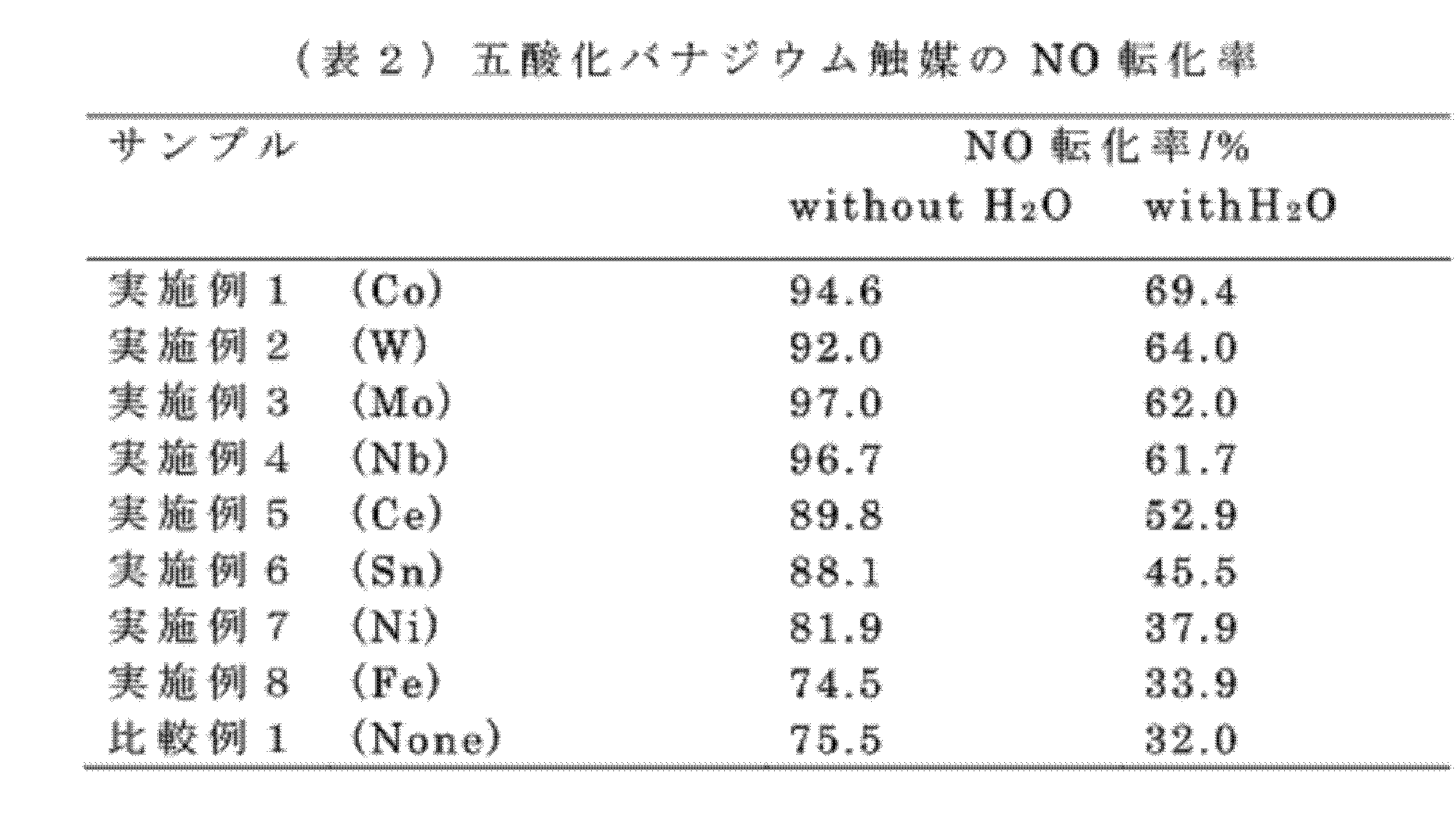
表2に各五酸化バナジウム触媒の、水分が共存しない場合と水分の共存下の場合との双方のNO転化率を示す。図1は、この表2をグラフ化したものである。
水分が共存しない場合と水分の共存下の場合との双方で、実施例の脱硝触媒は、概ね、比較例の脱硝触媒よりも高いNO転化率を示した。とりわけ、バナジン酸アンモニウムに対し、コバルト、タングステン、モリブデン、ニオブを添加し焼成した脱硝触媒が高いNO転化率を示した。中でも、水分が共存しない場合においては、実施例3(モリブデンを添加)、水分が共存する場合においては、実施例1(コバルトを添加)が、最も高いNO転化率を示した。
<2 第2の金属としてコバルトを含有するバナジウム触媒>
<2.1 各実施例>
<2.1 各実施例>
上記のように、実施例1~実施例8のバナジウム触媒において、水分が共存する場合では、実施例1(コバルトを添加)が、最も高いNO転化率を示したため、コバルトの添加量を変化させることにより、以下の各実施例に係るバナジウム触媒を生成した。
[実施例9]
バナジン酸アンモニウム(NH4VO3)とシュウ酸((COOH)2)とを純水に溶解させ、前駆体錯体を合成した。この前駆体錯体に対し、第2の金属であるコバルト(Co)のシュウ酸錯体を、金属酸化物換算でCo3O4が1wt%となるように添加した。得られたバナジウム-コバルト錯体混合物を電気炉によって300℃の温度で4時間、2回焼成することにより、コバルト(Co)を含有する五酸化バナジウム(V2O5)の脱硝触媒を得た。
バナジン酸アンモニウム(NH4VO3)とシュウ酸((COOH)2)とを純水に溶解させ、前駆体錯体を合成した。この前駆体錯体に対し、第2の金属であるコバルト(Co)のシュウ酸錯体を、金属酸化物換算でCo3O4が1wt%となるように添加した。得られたバナジウム-コバルト錯体混合物を電気炉によって300℃の温度で4時間、2回焼成することにより、コバルト(Co)を含有する五酸化バナジウム(V2O5)の脱硝触媒を得た。
[実施例10]
バナジン酸アンモニウム(NH4VO3)とシュウ酸((COOH)2)とを純水に溶解させ、前駆体錯体を合成した。この前駆体錯体に対し、第2の金属であるコバルト(Co)のシュウ酸錯体を、金属酸化物換算でCo3O4が3wt%となるように添加した。得られたバナジウム-コバルト錯体混合物を電気炉によって300℃の温度で4時間、2回焼成することにより、コバルト(Co)を含有する五酸化バナジウム(V2O5)の脱硝触媒を得た。
バナジン酸アンモニウム(NH4VO3)とシュウ酸((COOH)2)とを純水に溶解させ、前駆体錯体を合成した。この前駆体錯体に対し、第2の金属であるコバルト(Co)のシュウ酸錯体を、金属酸化物換算でCo3O4が3wt%となるように添加した。得られたバナジウム-コバルト錯体混合物を電気炉によって300℃の温度で4時間、2回焼成することにより、コバルト(Co)を含有する五酸化バナジウム(V2O5)の脱硝触媒を得た。
[実施例11]
バナジン酸アンモニウム(NH4VO3)とシュウ酸((COOH)2)とを純水に溶解させ、前駆体錯体を合成した。この前駆体錯体に対し、第2の金属であるコバルト(Co)のシュウ酸錯体を、金属酸化物換算でCo3O4が5wt%となるように添加した。得られたバナジウム-コバルト錯体混合物を電気炉によって300℃の温度で4時間、2回焼成することにより、コバルト(Co)を含有する五酸化バナジウム(V2O5)の脱硝触媒を得た。
バナジン酸アンモニウム(NH4VO3)とシュウ酸((COOH)2)とを純水に溶解させ、前駆体錯体を合成した。この前駆体錯体に対し、第2の金属であるコバルト(Co)のシュウ酸錯体を、金属酸化物換算でCo3O4が5wt%となるように添加した。得られたバナジウム-コバルト錯体混合物を電気炉によって300℃の温度で4時間、2回焼成することにより、コバルト(Co)を含有する五酸化バナジウム(V2O5)の脱硝触媒を得た。
[実施例12]
バナジン酸アンモニウム(NH4VO3)とシュウ酸((COOH)2)とを純水に溶解させ、前駆体錯体を合成した。この前駆体錯体に対し、第2の金属であるコバルト(Co)のシュウ酸錯体を、金属酸化物換算でCo3O4が6wt%となるように添加した。得られたバナジウム-コバルト錯体混合物を電気炉によって300℃の温度で4時間、2回焼成することにより、コバルト(Co)を含有する五酸化バナジウム(V2O5)の脱硝触媒を得た。
バナジン酸アンモニウム(NH4VO3)とシュウ酸((COOH)2)とを純水に溶解させ、前駆体錯体を合成した。この前駆体錯体に対し、第2の金属であるコバルト(Co)のシュウ酸錯体を、金属酸化物換算でCo3O4が6wt%となるように添加した。得られたバナジウム-コバルト錯体混合物を電気炉によって300℃の温度で4時間、2回焼成することにより、コバルト(Co)を含有する五酸化バナジウム(V2O5)の脱硝触媒を得た。
[実施例13]
バナジン酸アンモニウム(NH4VO3)とシュウ酸((COOH)2)とを純水に溶解させ、前駆体錯体を合成した。この前駆体錯体に対し、第2の金属であるコバルト(Co)のシュウ酸錯体を、金属酸化物換算でCo3O4が7wt%となるように添加した。得られたバナジウム-コバルト錯体混合物を電気炉によって300℃の温度で4時間、2回焼成することにより、コバルト(Co)を含有する五酸化バナジウム(V2O5)の脱硝触媒を得た。
バナジン酸アンモニウム(NH4VO3)とシュウ酸((COOH)2)とを純水に溶解させ、前駆体錯体を合成した。この前駆体錯体に対し、第2の金属であるコバルト(Co)のシュウ酸錯体を、金属酸化物換算でCo3O4が7wt%となるように添加した。得られたバナジウム-コバルト錯体混合物を電気炉によって300℃の温度で4時間、2回焼成することにより、コバルト(Co)を含有する五酸化バナジウム(V2O5)の脱硝触媒を得た。
[実施例14]
バナジン酸アンモニウム(NH4VO3)とシュウ酸((COOH)2)とを純水に溶解させ、前駆体錯体を合成した。この前駆体錯体に対し、第2の金属であるコバルト(Co)のシュウ酸錯体を、金属酸化物換算でCo3O4が8wt%となるように添加した。得られたバナジウム-コバルト錯体混合物を電気炉によって300℃の温度で4時間、2回焼成することにより、コバルト(Co)を含有する五酸化バナジウム(V2O5)の脱硝触媒を得た。
バナジン酸アンモニウム(NH4VO3)とシュウ酸((COOH)2)とを純水に溶解させ、前駆体錯体を合成した。この前駆体錯体に対し、第2の金属であるコバルト(Co)のシュウ酸錯体を、金属酸化物換算でCo3O4が8wt%となるように添加した。得られたバナジウム-コバルト錯体混合物を電気炉によって300℃の温度で4時間、2回焼成することにより、コバルト(Co)を含有する五酸化バナジウム(V2O5)の脱硝触媒を得た。
[実施例15]
バナジン酸アンモニウム(NH4VO3)とシュウ酸((COOH)2)とを純水に溶解させ、前駆体錯体を合成した。この前駆体錯体に対し、第2の金属であるコバルト(Co)の前駆体であるシュウ酸錯体を、金属酸化物換算でCo3O4が10wt%となるように添加した。得られたバナジウム-コバルト錯体混合物を電気炉によって300℃の温度で4時間、2回焼成することにより、コバルト(Co)を含有する五酸化バナジウム(V2O5)の脱硝触媒を得た。
バナジン酸アンモニウム(NH4VO3)とシュウ酸((COOH)2)とを純水に溶解させ、前駆体錯体を合成した。この前駆体錯体に対し、第2の金属であるコバルト(Co)の前駆体であるシュウ酸錯体を、金属酸化物換算でCo3O4が10wt%となるように添加した。得られたバナジウム-コバルト錯体混合物を電気炉によって300℃の温度で4時間、2回焼成することにより、コバルト(Co)を含有する五酸化バナジウム(V2O5)の脱硝触媒を得た。
なお、以下の表3は、実施例9~実施例15における、コバルト導入時の前駆体の仕込み量を示す。
<2.2 評価>
<2.2.1 NO転化率>
(測定方法)
上記の表1の条件の下、反応温度150℃で、固定床流通式触媒反応装置を用いてNH3-SCR反応を行った。触媒層を通過したガスのうち、NOをJasco FT-IR-4700で分析した。
また、NO転化率を、上記の式(1)により算出した。
<2.2.1 NO転化率>
(測定方法)
上記の表1の条件の下、反応温度150℃で、固定床流通式触媒反応装置を用いてNH3-SCR反応を行った。触媒層を通過したガスのうち、NOをJasco FT-IR-4700で分析した。
また、NO転化率を、上記の式(1)により算出した。
(測定結果)
表4に各酸化バナジウム触媒の、水分が共存しない場合と水分の共存下の場合との双方のNO転化率を示す。図2は、この表4をグラフ化したものである。
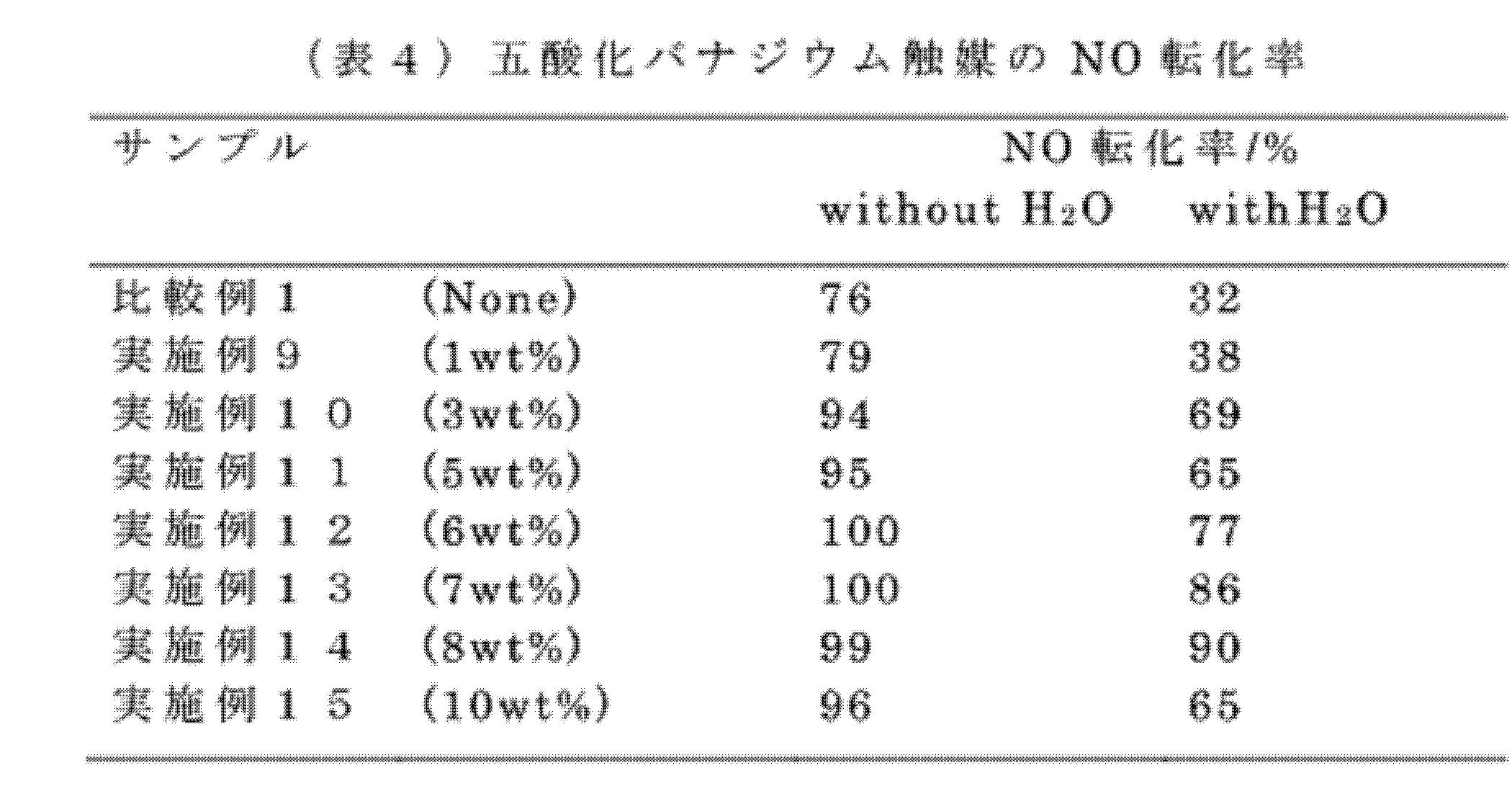
表4に各酸化バナジウム触媒の、水分が共存しない場合と水分の共存下の場合との双方のNO転化率を示す。図2は、この表4をグラフ化したものである。
水分が共存しない場合と水分の共存下の場合との双方で、実施例の脱硝触媒は、全て、比較例の脱硝触媒よりも高いNO転化率を示した。とりわけ、水分が共存しない場合においては、実施例12(6wt%)、実施例13(7wt%)が最も高いNO転化率を示し、水分が共存する場合においては、実施例14(8wt%)が最も高いNO転化率を示した。
<2.2.2 粉末X線回折>
(回折方法)
粉末X線回折としては、Rigaku smart labにより、Cu-Kαを用いて測定を行った。
(回折方法)
粉末X線回折としては、Rigaku smart labにより、Cu-Kαを用いて測定を行った。
(回折結果)
図3は、実施例9(1wt%)、実施例10(3wt%)、実施例12(6wt%)、実施例15(10wt%)、及び比較例1(None:0wt%)の粉末XRD(X-Ray Diffraction)パターンを示す。
安定相であるV2O5が主成分として存在すると共に、Coの添加率を上げると、Co3O4相も出現することが示された。
図3は、実施例9(1wt%)、実施例10(3wt%)、実施例12(6wt%)、実施例15(10wt%)、及び比較例1(None:0wt%)の粉末XRD(X-Ray Diffraction)パターンを示す。
安定相であるV2O5が主成分として存在すると共に、Coの添加率を上げると、Co3O4相も出現することが示された。
<2.2.3 ラマンスペクトル>
(測定方法)
各五酸化バナジウム触媒の結晶構造について分析するため、ラマン分光法によりラマンスペクトルを測定した。より詳細には、スライドガラス上に、各触媒のサンプルを少量置き、ラマン分光装置によってラマンスペクトルを測定した。測定機器としては、日本分光製NRS-4100ラマン分光光度計を用いた。
(測定方法)
各五酸化バナジウム触媒の結晶構造について分析するため、ラマン分光法によりラマンスペクトルを測定した。より詳細には、スライドガラス上に、各触媒のサンプルを少量置き、ラマン分光装置によってラマンスペクトルを測定した。測定機器としては、日本分光製NRS-4100ラマン分光光度計を用いた。
(測定結果)
図4は、各触媒のラマンスペクトルを示す。Coの添加量を上げると、V2O5の結晶構造が崩れ、パターン強度が弱くなることが示された。
図4は、各触媒のラマンスペクトルを示す。Coの添加量を上げると、V2O5の結晶構造が崩れ、パターン強度が弱くなることが示された。
<2.2.4 X線光電子スペクトル(XPS)測定>
(測定方法)
実施例9(1wt%)、実施例10(3wt%)、実施例12(6wt%)、実施例15(10wt%)、及び比較例1(None:0wt%)につき、電子状態について分析するため、X線光電子スペクトル(XPS:X-Ray Photoelectron Spectrum)を測定した。より詳細には、各実施例及び比較例の触媒の粉末試料を、カーボンテープを用いてサンプルホルダーに固定し、X線光電子スペクトルを測定した。測定装置としては、日本電子製JPS-9010MX光電子分光計を用いた。
(測定方法)
実施例9(1wt%)、実施例10(3wt%)、実施例12(6wt%)、実施例15(10wt%)、及び比較例1(None:0wt%)につき、電子状態について分析するため、X線光電子スペクトル(XPS:X-Ray Photoelectron Spectrum)を測定した。より詳細には、各実施例及び比較例の触媒の粉末試料を、カーボンテープを用いてサンプルホルダーに固定し、X線光電子スペクトルを測定した。測定装置としては、日本電子製JPS-9010MX光電子分光計を用いた。
(測定結果)
図5Aは、V2p領域におけるXPSスペクトルを示す。図5Bは、Co2p領域におけるXPSスペクトルを示す。Coの添加量を上げると、V4+及びCo2+成分が増大することが示された。
図5Aは、V2p領域におけるXPSスペクトルを示す。図5Bは、Co2p領域におけるXPSスペクトルを示す。Coの添加量を上げると、V4+及びCo2+成分が増大することが示された。
<3 第2の金属としてタングステンを含有するバナジウム触媒>
<3.1 各実施例>
上記のように、実施例1~実施例8のバナジウム触媒において、水分が共存する場合では、実施例2(タングステンを添加)が2番目に高いNO転化率を示したため、タングステンの添加量を変化させることにより、以下の各実施例に係るバナジウム触媒を生成した。なお、単にタングステンの添加量を変化させるのみならず、後述のように、前駆体として、K2WO4を用いる場合と、H3PW12O40・nH2Oを用いる場合のそれぞれにおいて、タングステンの添加量を変化させた。
<3.1 各実施例>
上記のように、実施例1~実施例8のバナジウム触媒において、水分が共存する場合では、実施例2(タングステンを添加)が2番目に高いNO転化率を示したため、タングステンの添加量を変化させることにより、以下の各実施例に係るバナジウム触媒を生成した。なお、単にタングステンの添加量を変化させるのみならず、後述のように、前駆体として、K2WO4を用いる場合と、H3PW12O40・nH2Oを用いる場合のそれぞれにおいて、タングステンの添加量を変化させた。
[実施例16]
バナジン酸アンモニウム(NH4VO3)と、43.9mmolのK2WO4と、20mlの純水の混合物に、シュウ酸((COOH)2)を11.9g(131.7mmol)添加し、室温で10分間攪拌した後、70℃で12時間攪拌した。この前駆体試料を、300℃で4時間焼成することにより、タングステン(W)を含有する五酸化バナジウム(V2O5)の脱硝触媒を得た。なお、生成される脱硝触媒中のWO3の全重量比が、4.9wt%となるように、原料としてのバナジン酸アンモニウムの量を調整した。
バナジン酸アンモニウム(NH4VO3)と、43.9mmolのK2WO4と、20mlの純水の混合物に、シュウ酸((COOH)2)を11.9g(131.7mmol)添加し、室温で10分間攪拌した後、70℃で12時間攪拌した。この前駆体試料を、300℃で4時間焼成することにより、タングステン(W)を含有する五酸化バナジウム(V2O5)の脱硝触媒を得た。なお、生成される脱硝触媒中のWO3の全重量比が、4.9wt%となるように、原料としてのバナジン酸アンモニウムの量を調整した。
[実施例17]
バナジン酸アンモニウム(NH4VO3)と、43.9mmolのK2WO4と、20mlの純水の混合物に、シュウ酸((COOH)2)を11.9g(131.7mmol)添加し、室温で10分間攪拌した後、70℃で12時間攪拌した。この前駆体試料を、300℃で4時間焼成することにより、タングステン(W)を含有する五酸化バナジウム(V2O5)の脱硝触媒を得た。なお、生成される脱硝触媒中のWO3の全重量比が、11.8wt%となるように、原料としてのバナジン酸アンモニウムの量を調整した。
バナジン酸アンモニウム(NH4VO3)と、43.9mmolのK2WO4と、20mlの純水の混合物に、シュウ酸((COOH)2)を11.9g(131.7mmol)添加し、室温で10分間攪拌した後、70℃で12時間攪拌した。この前駆体試料を、300℃で4時間焼成することにより、タングステン(W)を含有する五酸化バナジウム(V2O5)の脱硝触媒を得た。なお、生成される脱硝触媒中のWO3の全重量比が、11.8wt%となるように、原料としてのバナジン酸アンモニウムの量を調整した。
[実施例18]
バナジン酸アンモニウム(NH4VO3)と、43.9mmolのK2WO4と、20mlの純水の混合物に、シュウ酸を11.9g(131.7mmol)添加し、室温で10分間攪拌した後、70℃で12時間攪拌した。この前駆体試料を、300℃で4時間焼成することにより、タングステン(W)を含有する五酸化バナジウム(V2O5)の脱硝触媒を得た。なお、生成される脱硝触媒中のWO3の全重量比が、22.1wt%となるように、原料としてのバナジン酸アンモニウムの量を調整した。
バナジン酸アンモニウム(NH4VO3)と、43.9mmolのK2WO4と、20mlの純水の混合物に、シュウ酸を11.9g(131.7mmol)添加し、室温で10分間攪拌した後、70℃で12時間攪拌した。この前駆体試料を、300℃で4時間焼成することにより、タングステン(W)を含有する五酸化バナジウム(V2O5)の脱硝触媒を得た。なお、生成される脱硝触媒中のWO3の全重量比が、22.1wt%となるように、原料としてのバナジン酸アンモニウムの量を調整した。
[比較例2]
バナジン酸アンモニウム(NH4VO3)と、43.9mmolのK2WO4と、20mlの純水の混合物に、シュウ酸((COOH)2)を11.9g(131.7mmol)添加し、室温で10分間攪拌した後、70℃で12時間攪拌した。この前駆体試料を、300℃で4時間焼成することにより、タングステン(W)を含有する五酸化バナジウム(V2O5)の脱硝触媒を得た。なお、生成される脱硝触媒中のWO3の全重量比が、略100wt%となるように、原料としてのバナジン酸アンモニウムの量を調整した。
バナジン酸アンモニウム(NH4VO3)と、43.9mmolのK2WO4と、20mlの純水の混合物に、シュウ酸((COOH)2)を11.9g(131.7mmol)添加し、室温で10分間攪拌した後、70℃で12時間攪拌した。この前駆体試料を、300℃で4時間焼成することにより、タングステン(W)を含有する五酸化バナジウム(V2O5)の脱硝触媒を得た。なお、生成される脱硝触媒中のWO3の全重量比が、略100wt%となるように、原料としてのバナジン酸アンモニウムの量を調整した。
なお、以下の表5は、実施例16~実施例18、及び比較例2における、タングステン導入時の前駆体の仕込み量を示す。

[実施例19]
バナジン酸アンモニウム(NH4VO3)と、H3PW12O40・nH2Oと、20mlの純水の混合物に、シュウ酸((COOH)2)を11.9g(131.7mmol)添加し、室温で10分間攪拌した後、70℃で12時間攪拌した。この前駆体試料を、300℃で4時間焼成することにより、タングステン(W)を含有する五酸化バナジウム(V2O5)の脱硝触媒を得た。なお、生成される脱硝触媒中のWO3の全重量比が、38.4wt%となるように、原料としてのバナジン酸アンモニウム及びH3PW12O40・nH2Oの量を調整した。
バナジン酸アンモニウム(NH4VO3)と、H3PW12O40・nH2Oと、20mlの純水の混合物に、シュウ酸((COOH)2)を11.9g(131.7mmol)添加し、室温で10分間攪拌した後、70℃で12時間攪拌した。この前駆体試料を、300℃で4時間焼成することにより、タングステン(W)を含有する五酸化バナジウム(V2O5)の脱硝触媒を得た。なお、生成される脱硝触媒中のWO3の全重量比が、38.4wt%となるように、原料としてのバナジン酸アンモニウム及びH3PW12O40・nH2Oの量を調整した。
[比較例3]
バナジン酸アンモニウム(NH4VO3)と、H3PW12O40・nH2Oと、20mlの純水の混合物に、シュウ酸((COOH)2)を11.9g(131.7mmol)添加し、室温で10分間攪拌した後、70℃で12時間攪拌した。この前駆体試料を、300℃で4時間焼成することにより、タングステン(W)を含有する五酸化バナジウム(V2O5)の脱硝触媒を得た。なお、生成される脱硝触媒中のWO3の全重量比が、61.7wt%となるように、原料としてのバナジン酸アンモニウム及びH3PW12O40・nH2Oの量を調整した。
バナジン酸アンモニウム(NH4VO3)と、H3PW12O40・nH2Oと、20mlの純水の混合物に、シュウ酸((COOH)2)を11.9g(131.7mmol)添加し、室温で10分間攪拌した後、70℃で12時間攪拌した。この前駆体試料を、300℃で4時間焼成することにより、タングステン(W)を含有する五酸化バナジウム(V2O5)の脱硝触媒を得た。なお、生成される脱硝触媒中のWO3の全重量比が、61.7wt%となるように、原料としてのバナジン酸アンモニウム及びH3PW12O40・nH2Oの量を調整した。
[比較例4]
バナジン酸アンモニウム(NH4VO3)と、H3PW12O40・nH2Oと、20mlの純水の混合物に、シュウ酸((COOH)2)を11.9g(131.7mmol)添加し、室温で10分間攪拌した後、70℃で12時間攪拌した。この前駆体試料を、300℃で4時間焼成することにより、タングステン(W)を含有する五酸化バナジウム(V2O5)の脱硝触媒を得た。なお、生成される脱硝触媒中のWO3の全重量比が、77.3wt%となるように、原料としてのバナジン酸アンモニウム及びH3PW12O40・nH2Oの量を調整した。
バナジン酸アンモニウム(NH4VO3)と、H3PW12O40・nH2Oと、20mlの純水の混合物に、シュウ酸((COOH)2)を11.9g(131.7mmol)添加し、室温で10分間攪拌した後、70℃で12時間攪拌した。この前駆体試料を、300℃で4時間焼成することにより、タングステン(W)を含有する五酸化バナジウム(V2O5)の脱硝触媒を得た。なお、生成される脱硝触媒中のWO3の全重量比が、77.3wt%となるように、原料としてのバナジン酸アンモニウム及びH3PW12O40・nH2Oの量を調整した。
[比較例5]
バナジン酸アンモニウム(NH4VO3)と、H3PW12O40・nH2Oと、20mlの純水の混合物に、シュウ酸((COOH)2)を11.9g(131.7mmol)添加し、室温で10分間攪拌した後、70℃で12時間攪拌した。この前駆体試料を、300℃で4時間焼成することにより、タングステン(W)を含有する五酸化バナジウム(V2O5)の脱硝触媒を得た。なお、生成される脱硝触媒中のWO3の全重量比が、84.4wt%となるように、原料としてのバナジン酸アンモニウム及びH3PW12O40・nH2Oの量を調整した。
バナジン酸アンモニウム(NH4VO3)と、H3PW12O40・nH2Oと、20mlの純水の混合物に、シュウ酸((COOH)2)を11.9g(131.7mmol)添加し、室温で10分間攪拌した後、70℃で12時間攪拌した。この前駆体試料を、300℃で4時間焼成することにより、タングステン(W)を含有する五酸化バナジウム(V2O5)の脱硝触媒を得た。なお、生成される脱硝触媒中のWO3の全重量比が、84.4wt%となるように、原料としてのバナジン酸アンモニウム及びH3PW12O40・nH2Oの量を調整した。
[比較例6]
バナジン酸アンモニウム(NH4VO3)と、H3PW12O40・nH2Oと、20mlの純水の混合物に、シュウ酸((COOH)2)を11.9g(131.7mmol)添加し、室温で10分間攪拌した後、70℃で12時間攪拌した。この前駆体試料を、300℃で4時間焼成することにより、タングステン(W)を含有する五酸化バナジウム(V2O5)の脱硝触媒を得た。なお、生成される脱硝触媒中のWO3の全重量比が、略100wt%となるように、原料としてのバナジン酸アンモニウム及びH3PW12O40・nH2Oの量を調整した。
バナジン酸アンモニウム(NH4VO3)と、H3PW12O40・nH2Oと、20mlの純水の混合物に、シュウ酸((COOH)2)を11.9g(131.7mmol)添加し、室温で10分間攪拌した後、70℃で12時間攪拌した。この前駆体試料を、300℃で4時間焼成することにより、タングステン(W)を含有する五酸化バナジウム(V2O5)の脱硝触媒を得た。なお、生成される脱硝触媒中のWO3の全重量比が、略100wt%となるように、原料としてのバナジン酸アンモニウム及びH3PW12O40・nH2Oの量を調整した。
なお、以下の表6は、実施例19、及び比較例3~比較例6における、タングステン導入時の前駆体の仕込み量を示す。
<3.2 評価>
<3.2.1 概略>
上記の表1の条件の下、反応温度略150℃で、固定床流通式触媒反応装置を用いてNH3-SCR反応を行った。触媒層を通過したガスのうち、NOをJasco FT-IR-4700で分析した。
また、NO転化率を、上記の式(1)により算出した。
<3.2.1 概略>
上記の表1の条件の下、反応温度略150℃で、固定床流通式触媒反応装置を用いてNH3-SCR反応を行った。触媒層を通過したガスのうち、NOをJasco FT-IR-4700で分析した。
また、NO転化率を、上記の式(1)により算出した。
(測定結果)
表7に各五酸化バナジウム触媒の、水分が共存しない場合と水分の共存下の場合との双方のNO転化率を示す。図6は、この表7をグラフ化したものである。
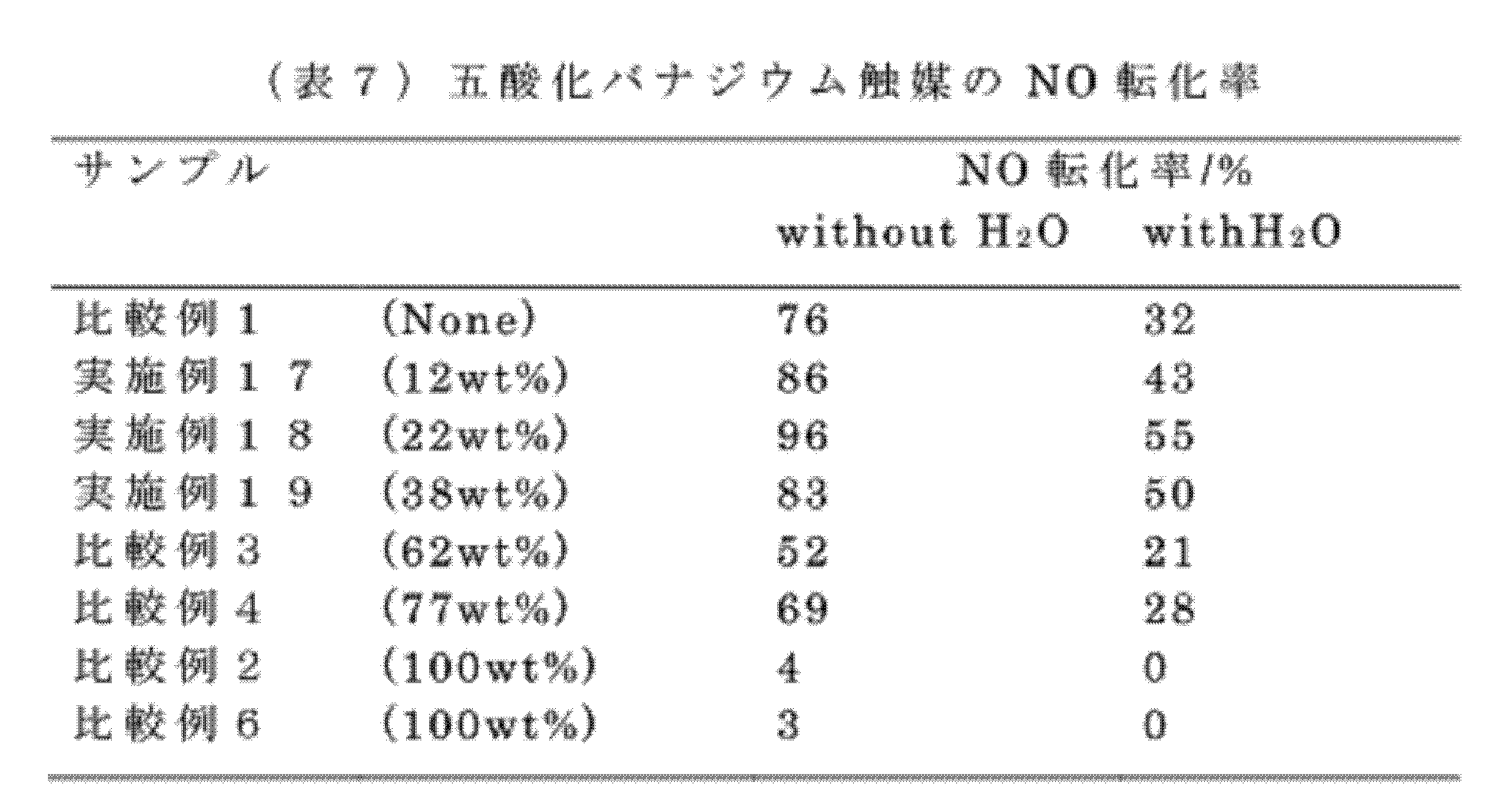
表7に各五酸化バナジウム触媒の、水分が共存しない場合と水分の共存下の場合との双方のNO転化率を示す。図6は、この表7をグラフ化したものである。
水分が共存しない場合と水分の共存下の場合との双方で、タングステン含有量が0wt%の比較例1、及びタングステン含有量が39wt%~100wt%の比較例2~5及び7に比較すると、概して、タングステンの添加量が10~38wt%の間の添加が有効であることが示された。
以下、前駆体として、K2WO4を用いる場合と、H3PW12O40・nH2Oを用いる場合のそれぞれについて、粉末X線回折及びSEM-EDSによる元素分析を実施すると共に、各々の場合における、タングステン含有率毎のNO転化率をグラフ化した。
<3.2.2 前駆体としてK2WO4を用いる場合>
<3.2.2.1 粉末X線回折及び元素分析>
(測定方法)
粉末X線回折としては、Rigaku smart labにより、Cu-Kαを用いて測定を行った。また、SEM-EDSによる元素分析を行った。
<3.2.2.1 粉末X線回折及び元素分析>
(測定方法)
粉末X線回折としては、Rigaku smart labにより、Cu-Kαを用いて測定を行った。また、SEM-EDSによる元素分析を行った。
(測定結果)
図7は、実施例16(4.9wt%)、実施例17(11.8wt%)、実施例18(22.1wt%)、比較例1(0wt%)、比較例2(100wt%)の粉末XRDパターンを示す。
また、図8は、横軸をK2WO4のmol%とした場合の、タングステン元素の割合(%)を示す。
図7は、実施例16(4.9wt%)、実施例17(11.8wt%)、実施例18(22.1wt%)、比較例1(0wt%)、比較例2(100wt%)の粉末XRDパターンを示す。
また、図8は、横軸をK2WO4のmol%とした場合の、タングステン元素の割合(%)を示す。
図7及び図8から、K2WO4を増やすことで、結晶相は三斜晶V4O7(12wt%)を経て、単斜晶WO3(100wt%)となったこと、及び、触媒に含まれるタングステン原子の比率が比例的に増加することが示された。
<3.2.2.2 NO転化率>
(測定結果)
表8に各五酸化バナジウム触媒の、水分が共存しない場合と水分の共存下の場合との双方のNO転化率を示す。図9は、この表6をグラフ化したものである。

(測定結果)
表8に各五酸化バナジウム触媒の、水分が共存しない場合と水分の共存下の場合との双方のNO転化率を示す。図9は、この表6をグラフ化したものである。
表8及び図9から分かるように、三斜晶V4O7(22.1wt%)にて、触媒活性が最大(96.3%)となった。また、過剰のK2WO4は、触媒活性の低下を招き、タングステンの含有量が100wt%では、触媒活性はなかった。
<3.2.3 前駆体としてH3PW12O40・nH2Oを用いる場合>
<3.2.3.1 粉末X線回折及び元素分析>
(測定方法)
粉末X線回折としては、Rigaku smart labにより、Cu-Kαを用いて測定を行った。また、SEM-EDSによる元素分析を行った。
<3.2.3.1 粉末X線回折及び元素分析>
(測定方法)
粉末X線回折としては、Rigaku smart labにより、Cu-Kαを用いて測定を行った。また、SEM-EDSによる元素分析を行った。
(測定結果)
図10は、実施例19(38.4wt%)、比較例4(61.7wt%)、比較例5(77.3wt%)、比較例6(84.4wt%)、比較例7(100wt%)の粉末XRDパターンを示す。
また、図11は、横軸をH3PW12O40・nH2Oのmol%とした場合の、タングステン元素の割合(%)を示す。
図10は、実施例19(38.4wt%)、比較例4(61.7wt%)、比較例5(77.3wt%)、比較例6(84.4wt%)、比較例7(100wt%)の粉末XRDパターンを示す。
また、図11は、横軸をH3PW12O40・nH2Oのmol%とした場合の、タングステン元素の割合(%)を示す。
図10及び図11から、H3PW12O40・nH2Oの仕込み量を増やすことで、H3PW12O40・nH2O由来の回折ピークが大きくなること、及び、比較的少量の仕込み量でタングステンの含有量が多くなることが示された。
<3.2.3.2 NO転化率>
(測定結果)
表9に各五酸化バナジウム触媒の、水分が共存しない場合と水分の共存下の場合との双方のNO転化率を示す。図12は、この表9をグラフ化したものである。
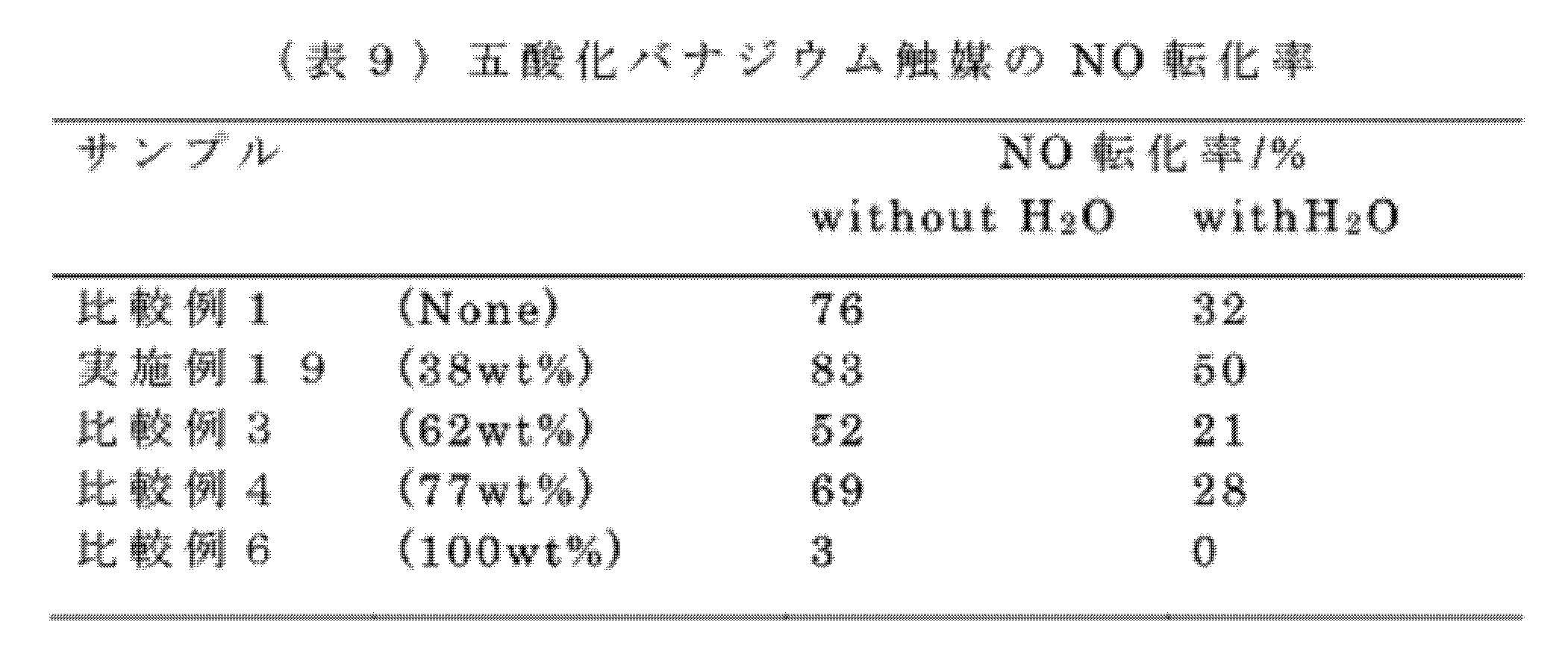
(測定結果)
表9に各五酸化バナジウム触媒の、水分が共存しない場合と水分の共存下の場合との双方のNO転化率を示す。図12は、この表9をグラフ化したものである。
表9及び図12から分かるように、H3PW12O40・nH2Oを前駆体とする場合は、タングステンの含有率が38.4wt%において触媒活性が最大(82.9%)となったものの、K2WO4を前駆体とする、タングステンの含有率が22.1wt%のバナジウム触媒の方が触媒活性が高い結果となった。
<4 第2の金属としてニオブを含有するバナジウム触媒>
<4.1 各実施例>
<4.1 各実施例>
上記のように、実施例1~実施例8のバナジウム触媒において、水分が共存しない場合では、実施例4(ニオブを添加)が、2番目に最も高いNO転化率を示し、水分が共存する場合でも、比較的高いNO転化率を示したため、ニオブの添加量を変化させることにより、以下の各実施例に係るバナジウム触媒を生成した。
[実施例20]
バナジン酸アンモニウム(NH4VO3)とシュウ酸((COOH)2)とを純水に溶解させ、前駆体錯体を合成した。この前駆体錯体に対し、第2の金属であるニオブ(Nb)のシュウ酸錯体を、金属酸化物換算でNb2O5が1.8wt%となるように添加した。得られたバナジウム-ニオブ錯体混合物を電気炉によって300℃の温度で4時間、2回焼成することにより、ニオブ(Nb)を含有する五酸化バナジウム(V2O5)の脱硝触媒を得た。
バナジン酸アンモニウム(NH4VO3)とシュウ酸((COOH)2)とを純水に溶解させ、前駆体錯体を合成した。この前駆体錯体に対し、第2の金属であるニオブ(Nb)のシュウ酸錯体を、金属酸化物換算でNb2O5が1.8wt%となるように添加した。得られたバナジウム-ニオブ錯体混合物を電気炉によって300℃の温度で4時間、2回焼成することにより、ニオブ(Nb)を含有する五酸化バナジウム(V2O5)の脱硝触媒を得た。
[実施例21]
バナジン酸アンモニウム(NH4VO3)とシュウ酸((COOH)2)とを純水に溶解させ、前駆体錯体を合成した。この前駆体錯体に対し、第2の金属であるニオブ(Nb)のシュウ酸錯体を、金属酸化物換算でNb2O5が5.2wt%となるように添加した。得られたバナジウム-ニオブ錯体混合物を電気炉によって300℃の温度で4時間、2回焼成することにより、ニオブ(Nb)を含有する五酸化バナジウム(V2O5)の脱硝触媒を得た。
バナジン酸アンモニウム(NH4VO3)とシュウ酸((COOH)2)とを純水に溶解させ、前駆体錯体を合成した。この前駆体錯体に対し、第2の金属であるニオブ(Nb)のシュウ酸錯体を、金属酸化物換算でNb2O5が5.2wt%となるように添加した。得られたバナジウム-ニオブ錯体混合物を電気炉によって300℃の温度で4時間、2回焼成することにより、ニオブ(Nb)を含有する五酸化バナジウム(V2O5)の脱硝触媒を得た。
[実施例22]
バナジン酸アンモニウム(NH4VO3)とシュウ酸((COOH)2)とを純水に溶解させ、前駆体錯体を合成した。この前駆体錯体に対し、第2の金属であるニオブ(Nb)のシュウ酸錯体を、金属酸化物換算でNb2O5が8.5wt%となるように添加した。得られたバナジウム-コバルト錯体混合物を電気炉によって300℃の温度で4時間、2回焼成することにより、コバルト(Co)を含有する五酸化バナジウム(V2O5)の脱硝触媒を得た。
バナジン酸アンモニウム(NH4VO3)とシュウ酸((COOH)2)とを純水に溶解させ、前駆体錯体を合成した。この前駆体錯体に対し、第2の金属であるニオブ(Nb)のシュウ酸錯体を、金属酸化物換算でNb2O5が8.5wt%となるように添加した。得られたバナジウム-コバルト錯体混合物を電気炉によって300℃の温度で4時間、2回焼成することにより、コバルト(Co)を含有する五酸化バナジウム(V2O5)の脱硝触媒を得た。
[実施例23]
バナジン酸アンモニウム(NH4VO3)とシュウ酸((COOH)2)とを純水に溶解させ、前駆体錯体を合成した。この前駆体錯体に対し、第2の金属であるニオブ(Nb)のシュウ酸錯体を、金属酸化物換算でNb2O5が11.7wt%となるように添加した。得られたバナジウム-ニオブ錯体混合物を電気炉によって300℃の温度で4時間、2回焼成することにより、ニオブ(Nb)を含有する五酸化バナジウム(V2O5)の脱硝触媒を得た。
バナジン酸アンモニウム(NH4VO3)とシュウ酸((COOH)2)とを純水に溶解させ、前駆体錯体を合成した。この前駆体錯体に対し、第2の金属であるニオブ(Nb)のシュウ酸錯体を、金属酸化物換算でNb2O5が11.7wt%となるように添加した。得られたバナジウム-ニオブ錯体混合物を電気炉によって300℃の温度で4時間、2回焼成することにより、ニオブ(Nb)を含有する五酸化バナジウム(V2O5)の脱硝触媒を得た。
[実施例24]
バナジン酸アンモニウム(NH4VO3)とシュウ酸((COOH)2)とを純水に溶解させ、前駆体錯体を合成した。この前駆体錯体に対し、第2の金属であるニオブ(Nb)のシュウ酸錯体を、金属酸化物換算でNb2O5が16.2wt%となるように添加した。得られたバナジウム-ニオブ錯体混合物を電気炉によって300℃の温度で4時間、2回焼成することにより、ニオブ(Nb)を含有する五酸化バナジウム(V2O5)の脱硝触媒を得た。
バナジン酸アンモニウム(NH4VO3)とシュウ酸((COOH)2)とを純水に溶解させ、前駆体錯体を合成した。この前駆体錯体に対し、第2の金属であるニオブ(Nb)のシュウ酸錯体を、金属酸化物換算でNb2O5が16.2wt%となるように添加した。得られたバナジウム-ニオブ錯体混合物を電気炉によって300℃の温度で4時間、2回焼成することにより、ニオブ(Nb)を含有する五酸化バナジウム(V2O5)の脱硝触媒を得た。
なお、以下の表10は、実施例20~実施例24における、ニオブ導入時の前駆体の仕込み量を示す。

<4.2 評価>
<4.2.1 NO転化率>
(測定方法)
上記の表1の条件の下、反応温度150℃で、固定床流通式触媒反応装置を用いてNH3-SCR反応を行った。触媒層を通過したガスのうち、NOをJasco FT-IR-4700で分析した。
また、NO転化率を、上記の式(1)により算出した。
<4.2.1 NO転化率>
(測定方法)
上記の表1の条件の下、反応温度150℃で、固定床流通式触媒反応装置を用いてNH3-SCR反応を行った。触媒層を通過したガスのうち、NOをJasco FT-IR-4700で分析した。
また、NO転化率を、上記の式(1)により算出した。
(測定結果)
表11に各酸化バナジウム触媒の、水分が共存しない場合と水分の共存下の場合との双方のNO転化率を示す。図13は、この表11をグラフ化したものである。
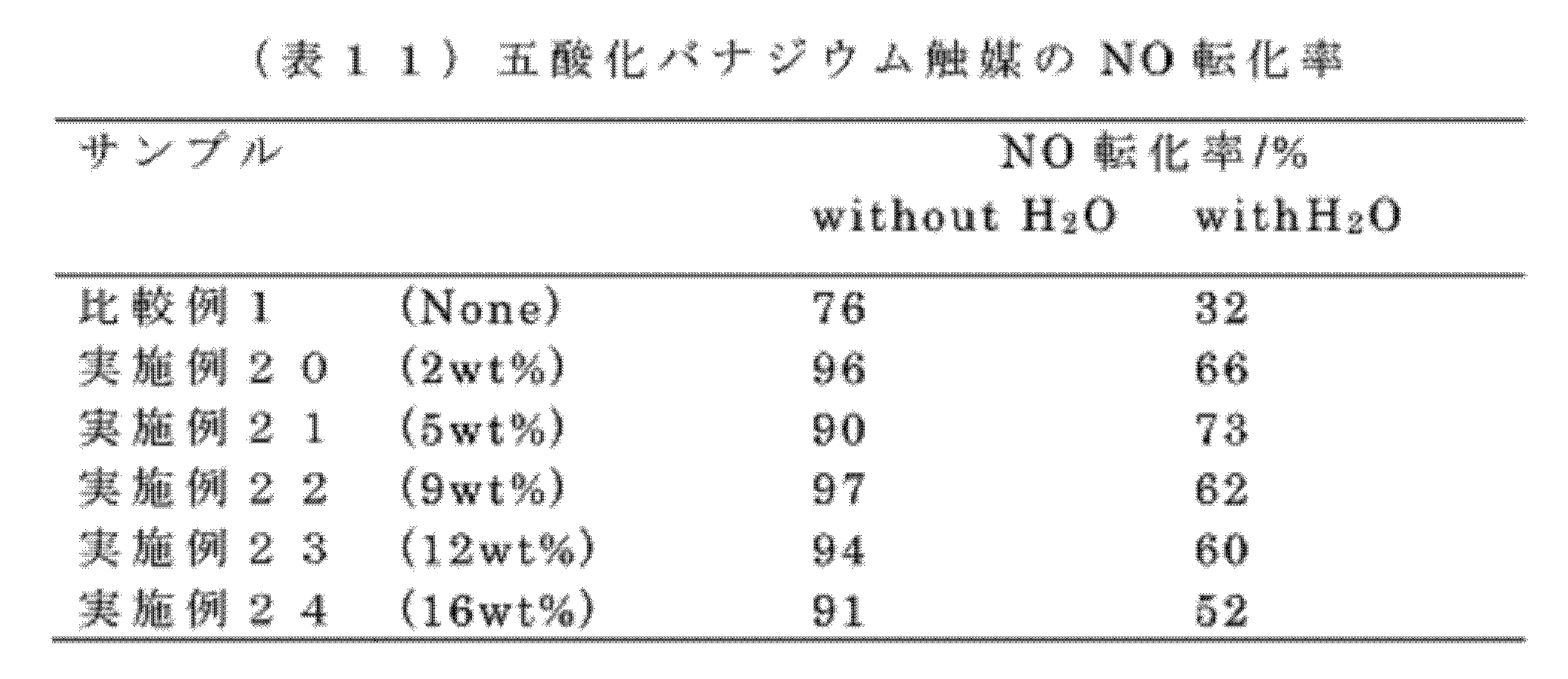
表11に各酸化バナジウム触媒の、水分が共存しない場合と水分の共存下の場合との双方のNO転化率を示す。図13は、この表11をグラフ化したものである。
水分が共存しない場合と水分の共存下の場合との双方で、実施例の脱硝触媒は、全て、比較例の脱硝触媒よりも高いNO転化率を示した。とりわけ、水分が共存しない場合においては、実施例22(9wt%)が最も高いNO転化率を示し、水分が共存する場合においては、実施例21(5wt%)が最も高いNO転化率を示した。
<5 炭素と第2の金属としてのコバルトを含有し、低温で焼成されたバナジウム触媒>
<5.1 各実施例と比較例>
[実施例25]
バナジン酸アンモニウム(NH4VO3)とシュウ酸とを純水に溶解させ、前駆体錯体を合成した。この前駆体錯体に対し、エチレングリコールと、第2の金属であるコバルト(Co)の前駆体であるシュウ酸錯体を、金属酸化物換算でCo3O4が6wt%となるように添加した。得られた触媒躯体を電気炉によって270℃の温度で2時間焼成することにより、炭素及びコバルト(Co)を含有する酸化バナジウムの脱硝触媒を得た。
なお、以下の表12は、実施例25における、コバルト導入時の前駆体の仕込み量を示す。

<5.1 各実施例と比較例>
[実施例25]
バナジン酸アンモニウム(NH4VO3)とシュウ酸とを純水に溶解させ、前駆体錯体を合成した。この前駆体錯体に対し、エチレングリコールと、第2の金属であるコバルト(Co)の前駆体であるシュウ酸錯体を、金属酸化物換算でCo3O4が6wt%となるように添加した。得られた触媒躯体を電気炉によって270℃の温度で2時間焼成することにより、炭素及びコバルト(Co)を含有する酸化バナジウムの脱硝触媒を得た。
なお、以下の表12は、実施例25における、コバルト導入時の前駆体の仕込み量を示す。
<5.2 評価>
<5.2.1 炭素含有量>
(測定方法)
各五酸化バナジウム触媒の炭素含有量の測定の際は、C(炭素)、H(水素)、N(窒素)の元素分析によって炭素含有量を定量した。より詳細には、エグゼタ-アナリティカル社製CE-440F内部の高温の反応管内で、各脱硝触媒を完全燃焼・分解し、主構成元素であるC、H、NをCO2、H2O、N2に変換した後、これらの三成分を三つの熱伝導度検出器で順次定量し、構成元素中のC、H、Nの含有量を測定した。
<5.2.1 炭素含有量>
(測定方法)
各五酸化バナジウム触媒の炭素含有量の測定の際は、C(炭素)、H(水素)、N(窒素)の元素分析によって炭素含有量を定量した。より詳細には、エグゼタ-アナリティカル社製CE-440F内部の高温の反応管内で、各脱硝触媒を完全燃焼・分解し、主構成元素であるC、H、NをCO2、H2O、N2に変換した後、これらの三成分を三つの熱伝導度検出器で順次定量し、構成元素中のC、H、Nの含有量を測定した。
(測定結果)
実施例25のバナジウム触媒に含まれる炭素含有量は、0.70wt%であった。
実施例25のバナジウム触媒に含まれる炭素含有量は、0.70wt%であった。
<5.2.2 NO転化率>
(測定方法)
上記の表1の条件の下、反応温度150℃で、固定床流通式触媒反応装置を用いてNH3-SCR反応を行った。触媒層を通過したガスのうち、NOをJasco FT-IR-4700で分析した。
また、NO転化率を、上記の式(1)により算出した。
(測定方法)
上記の表1の条件の下、反応温度150℃で、固定床流通式触媒反応装置を用いてNH3-SCR反応を行った。触媒層を通過したガスのうち、NOをJasco FT-IR-4700で分析した。
また、NO転化率を、上記の式(1)により算出した。
(測定結果)
表13に、比較例1、実施例12、実施例25の各五酸化バナジウム触媒の、水分が共存しない場合と水分の共存下の場合との双方のNO転化率を示す。図14は、この表13をグラフ化したものである。

表13に、比較例1、実施例12、実施例25の各五酸化バナジウム触媒の、水分が共存しない場合と水分の共存下の場合との双方のNO転化率を示す。図14は、この表13をグラフ化したものである。
水分が共存しない場合と水分の共存下の場合との双方で、実施例25の脱硝触媒が最も高いNO転化率を示した。
Claims (7)
- 酸化バナジウムを主成分とする脱硝触媒であって、第2の金属の酸化物の含有量が1wt%以上40wt%以下であり、前記第2の金属が、Co、W、Mo、Nb、Ce、Sn、Ni、及びFeからなる群から選ばれる少なくとも一つの金属元素である脱硝触媒。
- 300℃以下での脱硝に用いられる、請求項1に記載の脱硝触媒。
- 更に炭素を含有する、請求項1から又は請求項2に記載の脱硝触媒。
- 炭素含有量が0.05wt%以上である、請求項3に記載の脱硝触媒。
- バナジン酸塩、キレート化合物、及び前記第2の金属の化合物の混合物を焼成する工程を有する、請求項1又は請求項2に記載の脱硝触媒の製造方法。
- 前記混合物には、更にエチレングリコールが含まれる、請求項5に記載の製造方法。
- 前記焼成する工程は、270℃以下の温度で焼成する工程である、請求項5又は6に記載の製造方法。
Priority Applications (14)
| Application Number | Priority Date | Filing Date | Title |
|---|---|---|---|
| PCT/JP2019/009201 WO2020179076A1 (ja) | 2019-03-07 | 2019-03-07 | 脱硝触媒、及びその製造方法 |
| JP2019538453A JP7388653B2 (ja) | 2019-03-07 | 2019-03-07 | 脱硝触媒、及びその製造方法 |
| PCT/JP2020/009542 WO2020179891A1 (ja) | 2019-03-07 | 2020-03-05 | 脱硝触媒、及びその製造方法 |
| EP20766854.2A EP3936230B1 (en) | 2019-03-07 | 2020-03-05 | Denitration catalyst and method for manufacturing same |
| CN202080019195.8A CN113874109A (zh) | 2019-03-07 | 2020-03-05 | 脱硝催化剂及其制造方法 |
| CN202080019137.5A CN113631804A (zh) | 2019-03-07 | 2020-03-05 | 燃烧系统 |
| PCT/JP2020/009543 WO2020179892A1 (ja) | 2019-03-07 | 2020-03-05 | 燃焼システム |
| US17/436,958 US20220168712A1 (en) | 2019-03-07 | 2020-03-05 | Denitration catalyst and method for manufacturing same |
| US17/436,965 US20220170403A1 (en) | 2019-03-07 | 2020-03-05 | Combustion system |
| JP2020549727A JP7445925B2 (ja) | 2019-03-07 | 2020-03-05 | 燃焼システム |
| SG11202109733U SG11202109733UA (en) | 2019-03-07 | 2020-03-05 | Denitration catalyst and method for manufacturing same |
| EP20767017.5A EP3936706B1 (en) | 2019-03-07 | 2020-03-05 | Combustion system |
| SG11202109743T SG11202109743TA (en) | 2019-03-07 | 2020-03-05 | Combustion system |
| JP2020549726A JP7429012B2 (ja) | 2019-03-07 | 2020-03-05 | 脱硝触媒、及びその製造方法 |
Applications Claiming Priority (1)
| Application Number | Priority Date | Filing Date | Title |
|---|---|---|---|
| PCT/JP2019/009201 WO2020179076A1 (ja) | 2019-03-07 | 2019-03-07 | 脱硝触媒、及びその製造方法 |
Publications (1)
| Publication Number | Publication Date |
|---|---|
| WO2020179076A1 true WO2020179076A1 (ja) | 2020-09-10 |
Family
ID=72337721
Family Applications (1)
| Application Number | Title | Priority Date | Filing Date |
|---|---|---|---|
| PCT/JP2019/009201 Ceased WO2020179076A1 (ja) | 2019-03-07 | 2019-03-07 | 脱硝触媒、及びその製造方法 |
Country Status (2)
| Country | Link |
|---|---|
| JP (1) | JP7388653B2 (ja) |
| WO (1) | WO2020179076A1 (ja) |
Cited By (3)
| Publication number | Priority date | Publication date | Assignee | Title |
|---|---|---|---|---|
| JPWO2020179891A1 (ja) * | 2019-03-07 | 2020-09-10 | ||
| CN113926466A (zh) * | 2021-11-23 | 2022-01-14 | 商河县格尔环保科技服务中心 | 一种脱硝催化剂及其制备方法 |
| EP4512510A4 (en) * | 2022-04-18 | 2026-03-04 | Chugoku Electric Power | EXHAUST FUME DENITRITION PROCESS |
Citations (6)
| Publication number | Priority date | Publication date | Assignee | Title |
|---|---|---|---|---|
| JPS5055577A (ja) * | 1973-09-18 | 1975-05-15 | ||
| JPH01258746A (ja) * | 1988-04-08 | 1989-10-16 | Mitsubishi Heavy Ind Ltd | 触媒フイルター及びその製造方法 |
| JP2001509432A (ja) * | 1997-07-10 | 2001-07-24 | エス ケー コーポレイション | 窒素酸化物の除去のための選択的触媒還元及びその触媒体 |
| JP2003053147A (ja) * | 2001-08-22 | 2003-02-25 | Nkk Corp | 有機塩素化合物、窒素酸化物の除去方法 |
| JP6093101B1 (ja) * | 2016-09-12 | 2017-03-08 | 中国電力株式会社 | 脱硝触媒、及びその製造方法 |
| CN107349935A (zh) * | 2017-08-31 | 2017-11-17 | 复旦大学 | 一种低温脱硝催化剂及其制备方法和应用 |
Family Cites Families (2)
| Publication number | Priority date | Publication date | Assignee | Title |
|---|---|---|---|---|
| CN103623814B (zh) | 2012-08-27 | 2016-08-17 | 中国科学院生态环境研究中心 | 一种用于氨选择性催化还原氮氧化物的锰钒复合氧化物催化剂 |
| SG11202109743TA (en) | 2019-03-07 | 2021-10-28 | The Chugoku Electric Power Co Inc | Combustion system |
-
2019
- 2019-03-07 JP JP2019538453A patent/JP7388653B2/ja active Active
- 2019-03-07 WO PCT/JP2019/009201 patent/WO2020179076A1/ja not_active Ceased
Patent Citations (6)
| Publication number | Priority date | Publication date | Assignee | Title |
|---|---|---|---|---|
| JPS5055577A (ja) * | 1973-09-18 | 1975-05-15 | ||
| JPH01258746A (ja) * | 1988-04-08 | 1989-10-16 | Mitsubishi Heavy Ind Ltd | 触媒フイルター及びその製造方法 |
| JP2001509432A (ja) * | 1997-07-10 | 2001-07-24 | エス ケー コーポレイション | 窒素酸化物の除去のための選択的触媒還元及びその触媒体 |
| JP2003053147A (ja) * | 2001-08-22 | 2003-02-25 | Nkk Corp | 有機塩素化合物、窒素酸化物の除去方法 |
| JP6093101B1 (ja) * | 2016-09-12 | 2017-03-08 | 中国電力株式会社 | 脱硝触媒、及びその製造方法 |
| CN107349935A (zh) * | 2017-08-31 | 2017-11-17 | 复旦大学 | 一种低温脱硝催化剂及其制备方法和应用 |
Non-Patent Citations (2)
| Title |
|---|
| INGLOT, A. ET AL.: "Phases in vanadium pentoxide- tungsten trioxide catalysts", JOURNAL OF THE CHEMICAL SOCIETY FARADAY TRANSACTIONS, vol. 91, 7 January 1995 (1995-01-07), pages 145 - 148, XP000485492, DOI: 10.1039/ft9959100145 * |
| NAJBAR, M. ET AL.: "Low-temperature reactivity of the surface species of vanadia-tungsta catalyst", SOLID STATE IONICS, vol. 141, no. 142, 1 May 2001 (2001-05-01), pages 499 - 506, XP085645831, DOI: 10.1016/S0167-2738(01)00780-9 * |
Cited By (4)
| Publication number | Priority date | Publication date | Assignee | Title |
|---|---|---|---|---|
| JPWO2020179891A1 (ja) * | 2019-03-07 | 2020-09-10 | ||
| JP7429012B2 (ja) | 2019-03-07 | 2024-02-07 | 中国電力株式会社 | 脱硝触媒、及びその製造方法 |
| CN113926466A (zh) * | 2021-11-23 | 2022-01-14 | 商河县格尔环保科技服务中心 | 一种脱硝催化剂及其制备方法 |
| EP4512510A4 (en) * | 2022-04-18 | 2026-03-04 | Chugoku Electric Power | EXHAUST FUME DENITRITION PROCESS |
Also Published As
| Publication number | Publication date |
|---|---|
| JP7388653B2 (ja) | 2023-11-29 |
| JPWO2020179076A1 (ja) | 2020-09-10 |
Similar Documents
| Publication | Publication Date | Title |
|---|---|---|
| JP7429012B2 (ja) | 脱硝触媒、及びその製造方法 | |
| France et al. | Ceria modified FeMnOx—Enhanced performance and sulphur resistance for low-temperature SCR of NOx | |
| Venkataswamy et al. | Nanostructured manganese doped ceria solid solutions for CO oxidation at lower temperatures | |
| Chen et al. | Cr–MnOx mixed-oxide catalysts for selective catalytic reduction of NOx with NH3 at low temperature | |
| Salazar et al. | Hybrid catalysts—an innovative route to improve catalyst performance in the selective catalytic reduction of NO by NH3 | |
| Liu et al. | Doping effect of Sm on the TiO 2/CeSmO x catalyst in the NH 3-SCR reaction: structure–activity relationship, reaction mechanism and SO 2 tolerance | |
| US8361925B2 (en) | Exhaust gas-purifying catalyst | |
| Zhang et al. | Effect of metal oxide partial substitution of V2O5 in V2O5–WO3/TiO2 on selective catalytic reduction of NO with NH3 | |
| JPH01176431A (ja) | 窒素酸化物除去方法および除去用触媒 | |
| WO2013043371A1 (en) | Mixed metal oxide catalysts | |
| JP7388653B2 (ja) | 脱硝触媒、及びその製造方法 | |
| CN116457090B (zh) | 催化剂和耐硫变换催化反应的方法 | |
| Andonova et al. | Nature of the Ti− Ba Interactions on the BaO/TiO2/Al2O3 NO x Storage System | |
| Zhao et al. | Characterization study on the promoting effect of F-doping V 2 O 5/TiO 2 SCR catalysts | |
| KR20130089348A (ko) | 내구성이 개선된 질소산화물 환원제거용 촉매 | |
| EP4282523A1 (en) | Denitration catalyst and method for producing same | |
| Kim et al. | Systematic analysis of dual-functional catalysts for simultaneous CO-NOx reduction: Toward an effective catalyst design strategy | |
| CN112569992B (zh) | 含沉淀型χ碳化铁组合物及其制备方法、催化剂和应用以及费托合成的方法 | |
| JP7278555B1 (ja) | 排ガスの脱硝方法 | |
| Khristova et al. | Catalytic reduction of NO by CO over Pd—doped Perovskite-type catalysts | |
| EP4512522A1 (en) | Denitration catalyst and method for producing same, and denitration method | |
| JP6949476B2 (ja) | バナジン酸セシウムの製造方法 | |
| Li | The effect of calcination temperature on the structure and activity relationship of V/Ti catalysts for NH 3-SCR | |
| Xuan et al. | Ce-doped Mn/Co catalyst: Analysis of performance and mechanism underlying NH3+ NO+ CO model reaction | |
| EP3560576B1 (en) | Use of a nitrogen oxide storage material and exhaust gas purification method |
Legal Events
| Date | Code | Title | Description |
|---|---|---|---|
| ENP | Entry into the national phase |
Ref document number: 2019538453 Country of ref document: JP Kind code of ref document: A |
|
| 121 | Ep: the epo has been informed by wipo that ep was designated in this application |
Ref document number: 19918423 Country of ref document: EP Kind code of ref document: A1 |
|
| NENP | Non-entry into the national phase |
Ref country code: DE |
|
| 122 | Ep: pct application non-entry in european phase |
Ref document number: 19918423 Country of ref document: EP Kind code of ref document: A1 |