WO2020166703A1 - 洗浄剤組成物及び洗浄方法 - Google Patents
洗浄剤組成物及び洗浄方法 Download PDFInfo
- Publication number
- WO2020166703A1 WO2020166703A1 PCT/JP2020/005809 JP2020005809W WO2020166703A1 WO 2020166703 A1 WO2020166703 A1 WO 2020166703A1 JP 2020005809 W JP2020005809 W JP 2020005809W WO 2020166703 A1 WO2020166703 A1 WO 2020166703A1
- Authority
- WO
- WIPO (PCT)
- Prior art keywords
- group
- cleaning
- adhesive
- units
- methyl
- Prior art date
- Legal status (The legal status is an assumption and is not a legal conclusion. Google has not performed a legal analysis and makes no representation as to the accuracy of the status listed.)
- Ceased
Links
- 0 CCC(C)(N(*)*)OC Chemical compound CCC(C)(N(*)*)OC 0.000 description 3
- WUKUJFNYTULCOP-UHFFFAOYSA-N CCCC1CC2OC2CC1 Chemical compound CCCC1CC2OC2CC1 WUKUJFNYTULCOP-UHFFFAOYSA-N 0.000 description 1
Classifications
-
- C—CHEMISTRY; METALLURGY
- C11—ANIMAL OR VEGETABLE OILS, FATS, FATTY SUBSTANCES OR WAXES; FATTY ACIDS THEREFROM; DETERGENTS; CANDLES
- C11D—DETERGENT COMPOSITIONS; USE OF SINGLE SUBSTANCES AS DETERGENTS; SOAP OR SOAP-MAKING; RESIN SOAPS; RECOVERY OF GLYCEROL
- C11D7/00—Compositions of detergents based essentially on non-surface-active compounds
- C11D7/50—Solvents
- C11D7/5004—Organic solvents
- C11D7/5013—Organic solvents containing nitrogen
-
- C—CHEMISTRY; METALLURGY
- C11—ANIMAL OR VEGETABLE OILS, FATS, FATTY SUBSTANCES OR WAXES; FATTY ACIDS THEREFROM; DETERGENTS; CANDLES
- C11D—DETERGENT COMPOSITIONS; USE OF SINGLE SUBSTANCES AS DETERGENTS; SOAP OR SOAP-MAKING; RESIN SOAPS; RECOVERY OF GLYCEROL
- C11D3/00—Other compounding ingredients of detergent compositions covered in group C11D1/00
- C11D3/16—Organic compounds
- C11D3/18—Hydrocarbons
- C11D3/187—Hydrocarbons aromatic
-
- C—CHEMISTRY; METALLURGY
- C11—ANIMAL OR VEGETABLE OILS, FATS, FATTY SUBSTANCES OR WAXES; FATTY ACIDS THEREFROM; DETERGENTS; CANDLES
- C11D—DETERGENT COMPOSITIONS; USE OF SINGLE SUBSTANCES AS DETERGENTS; SOAP OR SOAP-MAKING; RESIN SOAPS; RECOVERY OF GLYCEROL
- C11D3/00—Other compounding ingredients of detergent compositions covered in group C11D1/00
- C11D3/16—Organic compounds
- C11D3/26—Organic compounds containing nitrogen
- C11D3/28—Heterocyclic compounds containing nitrogen in the ring
-
- C—CHEMISTRY; METALLURGY
- C11—ANIMAL OR VEGETABLE OILS, FATS, FATTY SUBSTANCES OR WAXES; FATTY ACIDS THEREFROM; DETERGENTS; CANDLES
- C11D—DETERGENT COMPOSITIONS; USE OF SINGLE SUBSTANCES AS DETERGENTS; SOAP OR SOAP-MAKING; RESIN SOAPS; RECOVERY OF GLYCEROL
- C11D3/00—Other compounding ingredients of detergent compositions covered in group C11D1/00
- C11D3/16—Organic compounds
- C11D3/26—Organic compounds containing nitrogen
- C11D3/30—Amines; Substituted amines ; Quaternized amines
-
- C—CHEMISTRY; METALLURGY
- C11—ANIMAL OR VEGETABLE OILS, FATS, FATTY SUBSTANCES OR WAXES; FATTY ACIDS THEREFROM; DETERGENTS; CANDLES
- C11D—DETERGENT COMPOSITIONS; USE OF SINGLE SUBSTANCES AS DETERGENTS; SOAP OR SOAP-MAKING; RESIN SOAPS; RECOVERY OF GLYCEROL
- C11D7/00—Compositions of detergents based essentially on non-surface-active compounds
- C11D7/22—Organic compounds
- C11D7/32—Organic compounds containing nitrogen
-
- C—CHEMISTRY; METALLURGY
- C11—ANIMAL OR VEGETABLE OILS, FATS, FATTY SUBSTANCES OR WAXES; FATTY ACIDS THEREFROM; DETERGENTS; CANDLES
- C11D—DETERGENT COMPOSITIONS; USE OF SINGLE SUBSTANCES AS DETERGENTS; SOAP OR SOAP-MAKING; RESIN SOAPS; RECOVERY OF GLYCEROL
- C11D7/00—Compositions of detergents based essentially on non-surface-active compounds
- C11D7/22—Organic compounds
- C11D7/32—Organic compounds containing nitrogen
- C11D7/3209—Amines or imines with one to four nitrogen atoms; Quaternized amines
-
- C—CHEMISTRY; METALLURGY
- C11—ANIMAL OR VEGETABLE OILS, FATS, FATTY SUBSTANCES OR WAXES; FATTY ACIDS THEREFROM; DETERGENTS; CANDLES
- C11D—DETERGENT COMPOSITIONS; USE OF SINGLE SUBSTANCES AS DETERGENTS; SOAP OR SOAP-MAKING; RESIN SOAPS; RECOVERY OF GLYCEROL
- C11D7/00—Compositions of detergents based essentially on non-surface-active compounds
- C11D7/50—Solvents
- C11D7/5004—Organic solvents
- C11D7/5027—Hydrocarbons
-
- H—ELECTRICITY
- H10—SEMICONDUCTOR DEVICES; ELECTRIC SOLID-STATE DEVICES NOT OTHERWISE PROVIDED FOR
- H10P—GENERIC PROCESSES OR APPARATUS FOR THE MANUFACTURE OR TREATMENT OF DEVICES COVERED BY CLASS H10
- H10P50/00—Etching of wafers, substrates or parts of devices
- H10P50/20—Dry etching; Plasma etching; Reactive-ion etching
- H10P50/28—Dry etching; Plasma etching; Reactive-ion etching of insulating materials
- H10P50/282—Dry etching; Plasma etching; Reactive-ion etching of insulating materials of inorganic materials
- H10P50/283—Dry etching; Plasma etching; Reactive-ion etching of insulating materials of inorganic materials by chemical means
-
- H—ELECTRICITY
- H10—SEMICONDUCTOR DEVICES; ELECTRIC SOLID-STATE DEVICES NOT OTHERWISE PROVIDED FOR
- H10P—GENERIC PROCESSES OR APPARATUS FOR THE MANUFACTURE OR TREATMENT OF DEVICES COVERED BY CLASS H10
- H10P70/00—Cleaning of wafers, substrates or parts of devices
- H10P70/20—Cleaning during device manufacture
-
- H—ELECTRICITY
- H10—SEMICONDUCTOR DEVICES; ELECTRIC SOLID-STATE DEVICES NOT OTHERWISE PROVIDED FOR
- H10P—GENERIC PROCESSES OR APPARATUS FOR THE MANUFACTURE OR TREATMENT OF DEVICES COVERED BY CLASS H10
- H10P72/00—Handling or holding of wafers, substrates or devices during manufacture or treatment thereof
- H10P72/70—Handling or holding of wafers, substrates or devices during manufacture or treatment thereof for supporting or gripping
- H10P72/74—Handling or holding of wafers, substrates or devices during manufacture or treatment thereof for supporting or gripping using temporarily an auxiliary support
-
- H—ELECTRICITY
- H10—SEMICONDUCTOR DEVICES; ELECTRIC SOLID-STATE DEVICES NOT OTHERWISE PROVIDED FOR
- H10P—GENERIC PROCESSES OR APPARATUS FOR THE MANUFACTURE OR TREATMENT OF DEVICES COVERED BY CLASS H10
- H10P72/00—Handling or holding of wafers, substrates or devices during manufacture or treatment thereof
- H10P72/70—Handling or holding of wafers, substrates or devices during manufacture or treatment thereof for supporting or gripping
- H10P72/74—Handling or holding of wafers, substrates or devices during manufacture or treatment thereof for supporting or gripping using temporarily an auxiliary support
- H10P72/7416—Handling or holding of wafers, substrates or devices during manufacture or treatment thereof for supporting or gripping using temporarily an auxiliary support used during dicing or grinding
-
- C—CHEMISTRY; METALLURGY
- C11—ANIMAL OR VEGETABLE OILS, FATS, FATTY SUBSTANCES OR WAXES; FATTY ACIDS THEREFROM; DETERGENTS; CANDLES
- C11D—DETERGENT COMPOSITIONS; USE OF SINGLE SUBSTANCES AS DETERGENTS; SOAP OR SOAP-MAKING; RESIN SOAPS; RECOVERY OF GLYCEROL
- C11D2111/00—Cleaning compositions characterised by the objects to be cleaned; Cleaning compositions characterised by non-standard cleaning or washing processes
- C11D2111/10—Objects to be cleaned
- C11D2111/14—Hard surfaces
- C11D2111/22—Electronic devices, e.g. PCBs or semiconductors
-
- C—CHEMISTRY; METALLURGY
- C11—ANIMAL OR VEGETABLE OILS, FATS, FATTY SUBSTANCES OR WAXES; FATTY ACIDS THEREFROM; DETERGENTS; CANDLES
- C11D—DETERGENT COMPOSITIONS; USE OF SINGLE SUBSTANCES AS DETERGENTS; SOAP OR SOAP-MAKING; RESIN SOAPS; RECOVERY OF GLYCEROL
- C11D7/00—Compositions of detergents based essentially on non-surface-active compounds
- C11D7/22—Organic compounds
- C11D7/24—Hydrocarbons
- C11D7/247—Hydrocarbons aromatic
-
- C—CHEMISTRY; METALLURGY
- C11—ANIMAL OR VEGETABLE OILS, FATS, FATTY SUBSTANCES OR WAXES; FATTY ACIDS THEREFROM; DETERGENTS; CANDLES
- C11D—DETERGENT COMPOSITIONS; USE OF SINGLE SUBSTANCES AS DETERGENTS; SOAP OR SOAP-MAKING; RESIN SOAPS; RECOVERY OF GLYCEROL
- C11D7/00—Compositions of detergents based essentially on non-surface-active compounds
- C11D7/22—Organic compounds
- C11D7/32—Organic compounds containing nitrogen
- C11D7/3281—Heterocyclic compounds
Definitions
- the present invention relates to a cleaning composition and a cleaning method used for removing an adhesive residue after peeling temporary adhesion by an adhesive layer obtained by using a polysiloxane adhesive formed on a semiconductor substrate, for example. ..
- each integrated wafer is thinned by polishing the side opposite to the formed circuit surface (that is, the back surface), and the thinned semiconductor wafers are stacked.
- a semiconductor wafer before thinning (also simply referred to as a wafer here) is adhered to a support for polishing with a polishing apparatus. Since the adhesion at that time must be easily peeled off after polishing, it is called temporary adhesion. This temporary adhesion must be easily removed from the support, and if a large force is applied to the removal, the thinned semiconductor wafer may be cut or deformed. Easily removed. However, it is not preferable that the back surface of the semiconductor wafer be removed or displaced by polishing stress during polishing. Therefore, the performance required for temporary adhesion is to withstand the stress during polishing and be easily removed after polishing.
- the performance is required to have high stress (strong adhesive force) in the plane direction during polishing and low stress (weak adhesive force) in the vertical direction during removal.
- the processing step may reach a high temperature of 150° C. or higher, and heat resistance is also required.
- polysiloxane adhesives that can provide these properties are mainly used as temporary adhesives. Then, in polysiloxane-based adhesion using a polysiloxane-based adhesive, adhesive residue often remains on the substrate surface after peeling the thinned substrate, but in order to avoid problems in subsequent steps.
- a cleaning agent composition for removing this residue and cleaning the surface of the semiconductor substrate has been developed (for example, Patent Documents 1 and 2), and in the recent semiconductor field, a new cleaning agent composition has been developed. There is always a desire for.
- Patent Document 1 discloses a siloxane resin remover containing a polar aprotic solvent and a quaternary ammonium hydroxide
- Patent Document 2 discloses a cured resin remover containing alkyl fluoride ammonium.
- the emergence of a more effective detergent composition is desired.
- the present invention has been made in view of the above circumstances, and when cleaning a substrate such as a semiconductor substrate, an adhesive residue after peeling temporary adhesion by an adhesive layer obtained using a polysiloxane adhesive is used. It is an object of the present invention to provide a cleaning composition and a cleaning method that can obtain a good cleaning property and that can clean a substrate with high efficiency without corroding the substrate.
- the inventors of the present invention have conducted extensive studies to solve the above problems, and as a result, a semiconductor substrate or the like to which an adhesive residue has adhered after peeling off temporary adhesion by an adhesive layer obtained using a polysiloxane adhesive.
- tetra(hydrocarbon) ammonium fluoride and an organic solvent are contained, and the organic solvent is an aromatic compound represented by the formula (1) and a lactam compound represented by the formula (2).
- Patent Documents 1 and 2 do not include a description that teaches or suggests a specific configuration of the cleaning composition of the present invention.
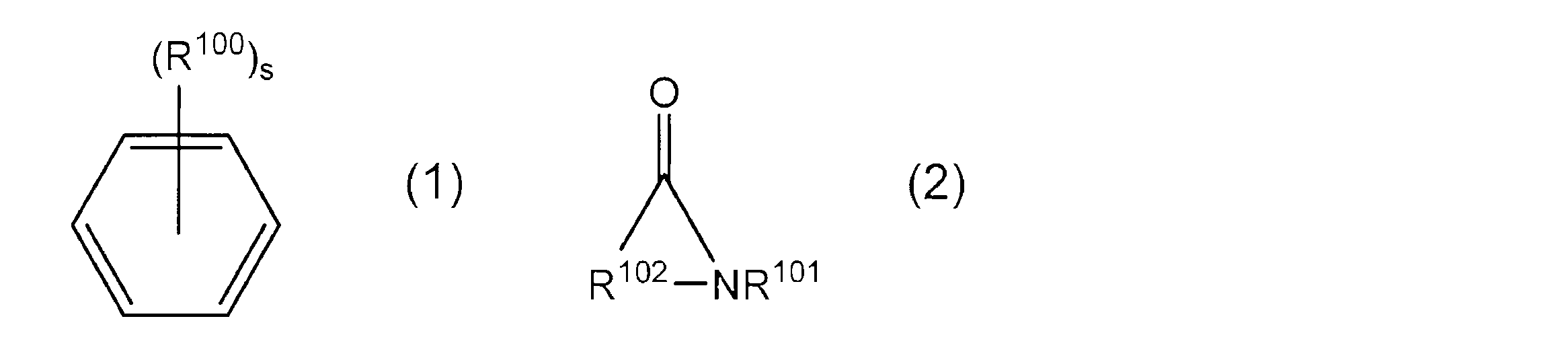
- a cleaning composition used for removing a polysiloxane-based adhesive remaining on a substrate comprising tetra(hydrocarbon)ammonium fluoride and an organic solvent, wherein the organic solvent has the formula (1).
- a cleaning composition comprising an aromatic compound represented by: and a lactam compound represented by formula (2), (In the formula, s represents the number of the substituents R 100 substituting on the benzene ring and is 2 or 3, and the s R 100 s independently represent an alkyl group having 1 to 6 carbon atoms.
- the total number of carbon atoms of the s number of alkyl groups having 1 to 6 carbon atoms is 3 or more
- R 101 represents an alkyl group having 1 to 6 carbon atoms
- R 102 is an alkylene group having 1 to 6 carbon atoms. Represents.
- the aromatic compound is 1,2,3-trimethylbenzene, 1,2,4-trimethylbenzene, 1,2,5-trimethylbenzene, 1,3,5-trimethylbenzene, 4-ethyltoluene, 4-n 1 or 2 detergent containing at least one selected from propyltoluene, 4-isopropyltoluene, 4-n-butyltoluene, 4-s-butyltoluene, 4-isobutyltoluene and 4-t-butyltoluene Composition, 4.
- the lactam compound contains at least one selected from N-methyl-2-pyrrolidone and N-ethyl-2-pyrrolidone, and the aromatic compound is 1,2,3-trimethylbenzene, 1,2,4 -Trimethylbenzene, 1,2,5-trimethylbenzene, 1,3,5-trimethylbenzene, 4-ethyltoluene, 4-n-propyltoluene, 4-isopropyltoluene, 4-n-butyltoluene, 4-s- At least one selected from butyltoluene, 4-isobutyltoluene and 4-t-butyltoluene, wherein the tetra(hydrocarbon)ammonium fluoride is tetramethylammonium fluoride, tetraethylammonium fluoride or tetrapropylammonium fluoride.
- a cleaning composition comprising at least one selected from ammonium and tetrabutylammonium fluoride; 7.
- the detergent composition according to 6, wherein the ratio of the aromatic compound to the lactam compound is the aromatic compound:the lactam compound 30:70 to 80:20.
- Agent composition 9.
- a cleaning method which comprises removing the adhesive residue remaining on a substrate by using the cleaning composition according to any one of 1 to 8. 10.
- the cleaning composition comprises: a third step of performing cleaning, and a fourth step of cleaning and removing the adhesive residue remaining on the peeled semiconductor substrate with a cleaning composition.
- a method for manufacturing a processed semiconductor substrate which comprises using the cleaning composition according to any one of 1 to 8.
- a surface to be cleaned of a substrate such as a semiconductor substrate to which an adhesive residue is attached after peeling temporary adhesion by an adhesive layer obtained by using a polysiloxane-based adhesive is desired. It is possible to perform the substrate with high efficiency without corroding the substrate only by the simple operation of bringing the substrate into contact with the cleaning composition.
- the cleaning composition of the present invention is a cleaning composition used for removing a polysiloxane adhesive remaining on a substrate, and contains tetra(hydrocarbon)ammonium fluoride and an organic solvent,
- the organic solvent contains an aromatic compound represented by formula (1) and a lactam compound represented by formula (2).
- s represents the number of the substituents R 100 substituting on the benzene ring and is 2 or 3, and the s R 100 s independently represent an alkyl group having 1 to 6 carbon atoms.
- the total number of carbon atoms of the s number of alkyl groups having 1 to 6 carbon atoms is 3 or more
- R 101 represents an alkyl group having 1 to 6 carbon atoms
- R 102 is an alkylene group having 1 to 6 carbon atoms. Represents.
- hydrocarbon group in tetra(hydrocarbon)ammonium fluoride examples include alkyl groups having 1 to 20 carbon atoms, alkenyl groups having 2 to 20 carbon atoms, alkynyl groups having 2 to 20 carbon atoms, and 6 to 20 carbon atoms.
- alkyl groups having 1 to 20 carbon atoms alkenyl groups having 2 to 20 carbon atoms, alkynyl groups having 2 to 20 carbon atoms, and 6 to 20 carbon atoms.
- Aryl groups and the like are examples of the hydrocarbon group in tetra(hydrocarbon)ammonium fluoride.
- the tetra(hydrocarbon)ammonium fluoride comprises tetraalkylammonium fluoride.
- Specific examples of the tetraalkylammonium fluoride include, but are not limited to, tetramethylammonium fluoride, tetraethylammonium fluoride, tetrapropylammonium fluoride, tetrabutylammonium fluoride and the like. Of these, tetrabutylammonium fluoride is preferable.
- a hydrate may be used. Further, tetra(hydrocarbon)ammonium fluoride may be used alone or in combination of two or more kinds.
- the amount of tetra(hydrocarbon)ammonium fluoride is not particularly limited as long as it dissolves in the solvent contained in the detergent composition, but is usually 0.1 to 30% by mass with respect to the detergent composition. is there.
- alkyl group having 1 to 6 carbon atoms examples include methyl group, ethyl group, n-propyl group, n-butyl group, isobutyl, s-butyl, t-butyl and the like. However, it is not limited to these.
- s represents the number of substituents R 100 substituting on the benzene ring, and is 2 or 3.
- the aromatic compound represented by formula (1) is an aromatic compound represented by formula (1-1-1) or (1-2).
- R 100 independently represents an alkyl group having 1 to 6 carbon atoms, and the total carbon number of the 3 alkyl groups having 1 to 6 carbon atoms of R 100 in the formula (1-1). Is 3 or more, and the total number of carbon atoms of the two R 100 alkyl groups having 1 to 6 carbon atoms in the formula (1-2) is 3 or more.
- aromatic compound represented by the formula (1) examples include 1,2,3-trimethylbenzene, 1,2,4-trimethylbenzene, 1,2,5-trimethylbenzene, 1,3,5- Trimethylbenzene (mesitylene), 4-ethyltoluene, 4-n-propyltoluene, 4-isopropyltoluene, 4-n-butyltoluene, 4-s-butyltoluene, 4-isobutyltoluene, 4-t-butyltoluene, etc. Examples include, but are not limited to: Of these, mesitylene and 4-t-butyltoluene are preferable.
- the amount of the aromatic compound represented by the above formula (1) is usually 1 to 98.9 mass% with respect to the detergent composition.
- alkyl group having 1 to 6 carbon atoms examples include methyl group, ethyl group, n-propyl group, n-butyl group, isobutyl, s-butyl, t-butyl group and the like.
- alkylene group having 1 to 6 carbon atoms include, but are not limited to, methylene group, ethylene group, trimethylene group, tetramethylene, pentamethylene group, hexamethylene group and the like.
- lactam compound represented by the above formula (2) examples include an ⁇ -lactam compound, a ⁇ -lactam compound, a ⁇ -lactam compound, and a ⁇ -lactam compound. These may be used alone or in combination. Two or more kinds can be used in combination.
- the lactam compound represented by the above formula (2) contains 1-alkyl-2-pyrrolidone (N-alkyl- ⁇ -butyrolactam), and in a more preferred embodiment, N- It contains methylpyrrolidone (NMP) or N-ethylpyrrolidone (NEP), and in an even more preferred embodiment, it contains N-methylpyrrolidone (NMP).
- the amount of the lactam compound represented by the above formula (2) is usually 1 to 98.9 mass% with respect to the detergent composition.
- the ratio (mass ratio) of the aromatic compound represented by the formula (1) to the lactam compound represented by the formula (2) is arbitrary, but preferably the aromatic compound represented by the formula (1).
- Compound: Lactam compound represented by the above formula (2) 30:70 to 80:20, more preferably 35:65 to 76:24, still more preferably 40:60 to 73:27, and further preferably It is from 45:55 to 70:30.
- the cleaning composition of the present invention usually contains only an organic solvent as a solvent.
- only organic solvent means that only the organic solvent is intentionally used as a solvent, and the existence of water contained in the organic solvent and other components is not denied.
- the detergent composition of the present invention contains only the aromatic compound represented by the above formula (1) and the lactam compound represented by the above formula (2) as the organic solvent.
- the above-mentioned tetra(hydrocarbon)ammonium fluoride is dissolved in the solvent contained in the detergent composition.
- the detergent composition of the present invention comprises the above-mentioned tetra(hydrocarbon)ammonium fluoride, the aromatic compound represented by the above formula (1), the lactam compound represented by the above formula (2), and optionally other components.
- the order of mixing the respective components may be any as long as there is no problem such as problems such as precipitation or separation of liquid that cannot achieve the object of the present invention. Can be mixed in order. That is, a part of all the components of the cleaning composition may be mixed in advance and then the remaining components may be mixed, or all the components may be mixed at once. If necessary, the detergent composition may be filtered. Further, when the components used have hygroscopicity or deliquescent, for example, all or part of the work of preparing the detergent composition may be performed under an inert gas.
- the above-described cleaning composition of the present invention has good cleaning properties for polysiloxane adhesives, and has excellent cleaning speed and cleaning durability. Specifically, regarding the cleaning rate, at room temperature (23° C.), when the adhesive layer obtained from the adhesive composition was brought into contact with the cleaning composition of the present invention for 5 minutes, the film thickness decreased before and after the contact.
- the etching rate [ ⁇ m/min] calculated by dividing the measured amount by the cleaning time is usually 5.0 [ ⁇ m/min] or more, and in a preferred embodiment, 7.0 [ ⁇ m/min] or more, It is 7.5 [ ⁇ m/min] or more in a more preferred embodiment, 8.0 [ ⁇ m/min] or more in an even more preferred embodiment, and 9.0 [ ⁇ m/min] or more in an even more preferred embodiment.
- the cleaning durability when the adhesive solid 1 g obtained from the adhesive composition is brought into contact with the cleaning composition 2 g of the present invention at room temperature (23° C.), the cleaning composition of the present invention is obtained. Usually dissolves most of the adhesive solid in 12 to 24 hours, dissolves and removes the adhesive solid in 2 to 12 hours in a preferred embodiment, and dissolves the adhesive solid in 1 to 2 hours in a more preferred embodiment. Cut off.
- the present invention it is possible to wash the substrate in a short time by washing and removing the polysiloxane-based adhesive remaining on the substrate such as a semiconductor substrate by using the above-mentioned detergent composition, and it is possible to achieve high efficiency.
- excellent cleaning of substrates such as semiconductor substrates can be performed.
- the cleaning composition of the present invention is used for cleaning the surface of various substrates such as semiconductor substrates, and the object of the cleaning is not limited to silicon semiconductor substrates, for example, germanium substrates.
- Suitable use of the cleaning composition of the present invention in a semiconductor process includes use in a method of manufacturing a thinned substrate used in a semiconductor packaging technology such as TSV. Specifically, a first step of manufacturing a laminated body including a semiconductor substrate, a supporting substrate, and an adhesive layer obtained from an adhesive composition, a second step of processing the semiconductor substrate of the obtained laminated body, and a processing In the manufacturing method including a third step of peeling the semiconductor substrate later and a fourth step of cleaning and removing the adhesive residue remaining on the peeled semiconductor substrate with a cleaning composition, the cleaning of the present invention as a cleaning composition An agent composition is used.
- the adhesive composition used for forming the adhesive layer in the first step is typically at least silicone, acrylic resin, epoxy resin, polyamide, polystyrene, polyimide or phenol resin. Although an adhesive selected from one kind may be used, it is effective to employ the cleaning composition of the present invention particularly for cleaning a polysiloxane-based adhesive, and among them, a component which is cured by a hydrosilylation reaction.
- the cleaning composition of the present invention is effective for cleaning and removing the adhesive residue of the polysiloxane adhesive containing (A).
- the component (A) which is cured by the hydrosilylation reaction contained in the adhesive composition is, for example, a siloxane unit (Q unit) represented by SiO 2 or a siloxane unit (R 1 R 2 R 3 SiO 1/2 ) represented by M unit), one or two kinds selected from the group consisting of a siloxane unit (D unit) represented by R 4 R 5 SiO 2/2 and a siloxane unit (T unit) represented by R 6 SiO 3/2.
- polysiloxane (A1) containing the above units and a platinum group metal-based catalyst (A2)
- the polysiloxane (A1) is a siloxane unit (Q′ unit) represented by SiO 2 , R 1 ′R 2 'R 3' siloxane units (M 'units), R 4' represented by SiO 1/2 R 5 'siloxane units (D represented by SiO 2/2' units) and R 6 'SiO 3/2
- M'units, D'units and T'units which contains one or more units selected from the group consisting of siloxane units (T' units) represented by Containing a polyorganosiloxane (a1), a siloxane unit represented by SiO 2 (Q′′ unit), a siloxane unit represented by R 1 ′′R 2 ′′R 3 ′′SiO 1/2 (M′′ unit), R 4 "R 5" siloxane units (D represented by
- R 1 to R 6 are groups or atoms bonded to a silicon atom, and each independently represent an alkyl group, an alkenyl group or a hydrogen atom.
- R 1 ′ to R 6 ′ are groups bonded to a silicon atom, and each independently represent an alkyl group or an alkenyl group, and at least one of R 1 ′ to R 6 ′ is an alkenyl group.
- R 1 ′′ to R 6 ′′ are groups or atoms bonded to a silicon atom, and each independently represent an alkyl group or a hydrogen atom, but at least one of R 1 ′′ to R 6 ′′ is a hydrogen atom. ..
- the alkyl group may be linear, branched or cyclic, but is preferably a linear or branched alkyl group, and the carbon number thereof is not particularly limited, but is usually 1 to 40. It is preferably 30 or less, more preferably 20 or less, still more preferably 10 or less.
- linear or branched alkyl group examples include methyl group, ethyl group, n-propyl group, i-propyl group, n-butyl group, i-butyl group, s-butyl group, t-butyl group.
- N-pentyl group 1-methyl-n-butyl group, 2-methyl-n-butyl group, 3-methyl-n-butyl group, 1,1-dimethyl-n-propyl group, 1,2-dimethyl- n-propyl group, 2,2-dimethyl-n-propyl group, 1-ethyl-n-propyl group, n-hexyl, 1-methyl-n-pentyl group, 2-methyl-n-pentyl group, 3-methyl -N-pentyl group, 4-methyl-n-pentyl group, 1,1-dimethyl-n-butyl group, 1,2-dimethyl-n-butyl group, 1,3-dimethyl-n-butyl group, 2, 2-dimethyl-n-butyl group, 2,3-dimethyl-n-butyl group, 3,3-dimethyl-n-butyl group, 1-ethyl-n-butyl group, 2-ethyl-n-butyl group, 1-e
- cyclic alkyl group examples include cyclopropyl group, cyclobutyl group, 1-methyl-cyclopropyl group, 2-methyl-cyclopropyl group, cyclopentyl group, 1-methyl-cyclobutyl group, 2-methyl-cyclobutyl group, 3 -Methyl-cyclobutyl group, 1,2-dimethyl-cyclopropyl group, 2,3-dimethyl-cyclopropyl group, 1-ethyl-cyclopropyl group, 2-ethyl-cyclopropyl group, cyclohexyl group, 1-methyl-cyclopentyl group Group, 2-methyl-cyclopentyl group, 3-methyl-cyclopentyl group, 1-ethyl-cyclobutyl group, 2-ethyl-cyclobutyl group, 3-ethyl-cyclobutyl group, 1,2-dimethyl-cyclobutyl group, 1,3- Dimethyl-cyclobutyl group, 2,2-dimethyl-methyl-
- the alkenyl group may be linear or branched, and the carbon number thereof is not particularly limited, but is usually 2 to 40, preferably 30 or less, more preferably 20 or less, and still more It is preferably 10 or less.
- alkenyl group examples include ethenyl group, 1-propenyl group, 2-propenyl group, 1-methyl-1-ethenyl group, 1-butenyl group, 2-butenyl group, 3-butenyl group and 2-methyl-1.
- the polysiloxane (A1) includes the polyorganosiloxane (a1) and the polyorganosiloxane (a2), but is included in the alkenyl group contained in the polyorganosiloxane (a1) and the polyorganosiloxane (a2).
- a hydrogen atom (Si—H group) forms a crosslinked structure by a hydrosilylation reaction with the platinum group metal-based catalyst (A2) and is cured.
- the polyorganosiloxane (a1) contains one or more units selected from the group consisting of Q'units, M'units, D'units and T'units, as well as the M'units, D'units and It contains at least one selected from the group consisting of T′ units.
- the polyorganosiloxane (a1) two or more kinds of polyorganosiloxane satisfying such conditions may be used in combination.
- Preferred combinations of two or more selected from the group consisting of Q'units, M'units, D'units and T'units include (Q' units and M'units), (D' units and M'units), (T′ unit and M′ unit), (Q′ unit, T′ unit and M′ unit), but not limited thereto.
- the polyorganosiloxane (a2) contains one or more units selected from the group consisting of Q′′ units, M′′ units, D′′ units and T′′ units, and the above M′′ units, D′′ units and It contains at least one selected from the group consisting of T′′ units.
- the polyorganosiloxane (a2) two or more polyorganosiloxanes satisfying such a condition may be used in combination.
- Preferred combinations of two or more selected from the group consisting of Q′′ unit, M′′ unit, D′′ unit and T′′ unit include (M′′ unit and D′′ unit), (Q′′ unit and M′′ unit), (Q′′ unit, T′′ unit, M′′ unit), but not limited thereto.
- the polyorganosiloxane (a1) is composed of a siloxane unit in which an alkyl group and/or an alkenyl group is bonded to its silicon atom, and the alkenyl in all the substituents represented by R 1 ′ to R 6 ′.
- the ratio of the groups is preferably 0.1 mol% to 50.0 mol%, more preferably 0.5 mol% to 30.0 mol%, and the remaining R 1 ′ to R 6 ′ are alkyl groups. be able to.
- the polyorganosiloxane (a2) is composed of a siloxane unit in which an alkyl group and/or a hydrogen atom is bonded to its silicon atom, and all the substituents and the substituents represented by R 1 ′′ to R 6 ′′.
- the proportion of hydrogen atoms in the atoms is preferably 0.1 mol% to 50.0 mol%, more preferably 10.0 mol% to 40.0 mol%, and the remaining R 1 ′′ to R 6 ′′ are It can be an alkyl group.
- the polysiloxane (A1) contains the polyorganosiloxane (a1) and the polyorganosiloxane (a2), but in a preferred embodiment of the present invention, the alkenyl group contained in the polyorganosiloxane (a1) and the polyorganosiloxane
- the molar ratio with the hydrogen atom constituting the Si—H bond contained in (a2) is in the range of 1.0:0.5 to 1.0:0.66.
- the weight average molecular weight of each of the polyorganosiloxane (a1) and the polyorganosiloxane (a2) is usually 500 to 1,000,000, but preferably 5,000 to 50,000.
- the weight average molecular weight is, for example, GPC device (EcoSEC, HLC-8320GPC manufactured by Tosoh Corp.) and GPC column (Shodex (registered trademark), KF-803L, KF-802 and KF-801 manufactured by Showa Denko KK. ) Is used, the column temperature is 40° C., tetrahydrofuran is used as an eluent (elution solvent), the flow rate (flow rate) is 1.0 mL/min, and polystyrene (manufactured by Sigma-Aldrich) is used as a standard sample for measurement. be able to.
- GPC device EcoSEC, HLC-8320GPC manufactured by Tosoh Corp.
- GPC column Shodex (registered trademark), KF-803L, KF-802 and KF-801 manufactured by Showa Denko KK. ) Is used, the column temperature is 40° C., tetrahydrofuran is used as
- the polyorganosilosan (a1) and the polyorganosilosan (a2) contained in the adhesive composition react with each other by a hydrosilylation reaction to form a cured film. Therefore, the mechanism of its curing is different from that through, for example, a silanol group, and therefore any siloxane has a silanol group or a functional group capable of forming a silanol group by hydrolysis such as an alkyloxy group. It need not be included.
- the component (A) contains a platinum group metal-based catalyst (A2).
- a platinum-based metal catalyst is a catalyst for promoting the hydrosilylation reaction between the alkenyl group of the polyorganosiloxane (a1) and the Si—H group of the polyorganosiloxane (a2).
- platinum-based metal catalysts include platinum black, secondary platinum chloride, chloroplatinic acid, reaction products of chloroplatinic acid and monohydric alcohols, complexes of chloroplatinic acid and olefins, platinum bisacetoacetate and the like. Platinum-based catalysts, but are not limited thereto. Examples of the complex of platinum and olefins include, but are not limited to, a complex of divinyltetramethyldisiloxane and platinum.
- the amount of the platinum group metal catalyst (A2) is usually in the range of 1.0 to 50.0 ppm with respect to the total amount of the polyorganosiloxane (a1) and the polyorganosiloxane (a2).
- the component (A) may include a polymerization inhibitor (A3). That is, by including a polymerization inhibitor in the adhesive composition, it is possible to suitably control the curing by heating during bonding, and to obtain an adhesive composition that gives an adhesive layer excellent in adhesiveness and releasability with good reproducibility. You can
- the polymerization inhibitor is not particularly limited as long as it can suppress the progress of the hydrosilylation reaction, and specific examples thereof include 1-ethynyl-1-cyclohexanol and 1,1-diphenyl-2-propyne-1-. Examples thereof include, but are not limited to, an alkynylalkyl alcohol which may be substituted with an aryl group such as all.
- the amount of the polymerization inhibitor is usually 1000.0 ppm or more with respect to the polyorganosiloxane (a1) and the polyorganosiloxane (a2) from the viewpoint of obtaining the effect, and from the viewpoint of preventing excessive suppression of the hydrosilylation reaction. To 10000.0 ppm or less.
- the adhesive composition contains at least one component (B) selected from the group consisting of a component containing an epoxy-modified polyorganosiloxane, a component containing a methyl group-containing polyorganosiloxane and a component containing a phenyl group-containing polyorganosiloxane (B ) May be included.
- a component (B) selected from the group consisting of a component containing an epoxy-modified polyorganosiloxane, a component containing a methyl group-containing polyorganosiloxane and a component containing a phenyl group-containing polyorganosiloxane (B ) May be included.
- Examples of the epoxy-modified polyorganosiloxane include a siloxane unit represented by R 210 R 220 SiO 2/2 (D 200 unit), preferably a siloxane unit represented by R 11 R 12 SiO 2/2 (D 10 unit). ) Is included.
- R 11 is a group bonded to a silicon atom and represents an alkyl group
- R 12 is a group bonded to a silicon atom, and represents an epoxy group or an organic group containing an epoxy group, and specific examples of the alkyl group include The above-mentioned examples can be given.
- the epoxy group in the organic group containing an epoxy group may be an independent epoxy group without being condensed with other rings, and may be condensed with other rings such as a 1,2-epoxycyclohexyl group. It may be an epoxy group formed.
- organic group containing an epoxy group examples include, but are not limited to, 3-glycidoxypropyl and 2-(3,4-epoxycyclohexyl)ethyl.
- a preferable example of the epoxy-modified polyorganosiloxane may include, but is not limited to, an epoxy-modified polydimethylsiloxane.
- the epoxy-modified polyorganosiloxane contains the above-mentioned siloxane unit (D 10 unit), but may contain the above Q unit, M unit and/or T unit in addition to D 10 unit.
- epoxy-modified polyorganosiloxane examples include a polyorganosiloxane consisting of D 10 units only, a polyorganosiloxane containing D 10 units and Q units, and a polyorganosiloxane containing D 10 units and M units.
- the epoxy-modified polyorganosiloxane is preferably an epoxy-modified polydimethylsiloxane having an epoxy value of 0.1 to 5, and the weight average molecular weight thereof is usually 1,500 to 500,000. From the viewpoint of suppressing precipitation, it is preferably 100,000 or less.
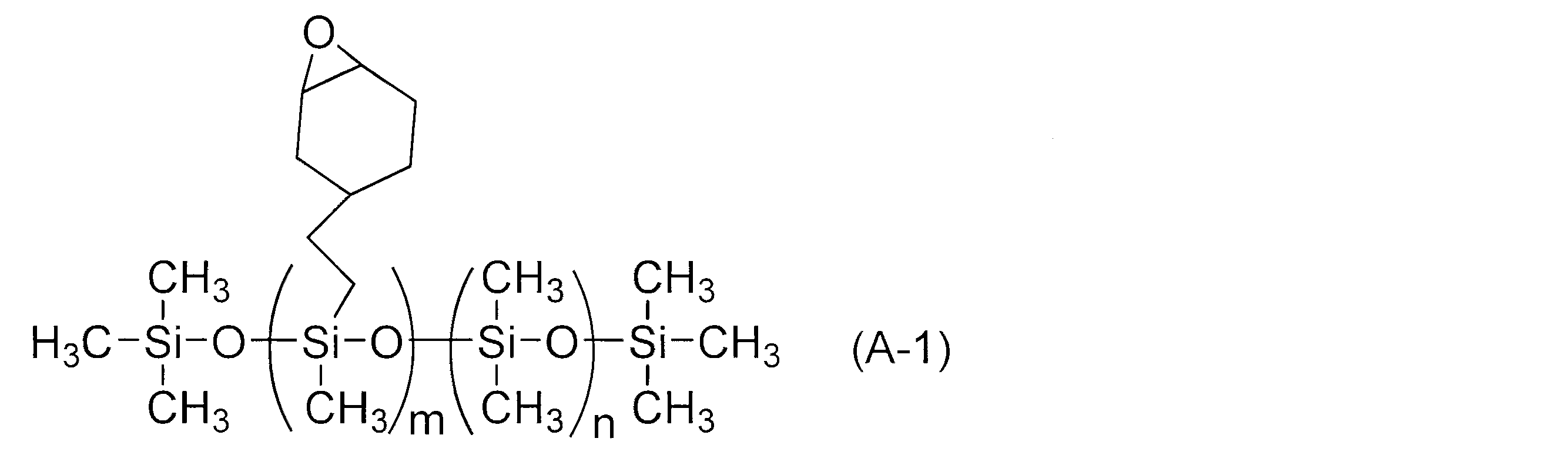
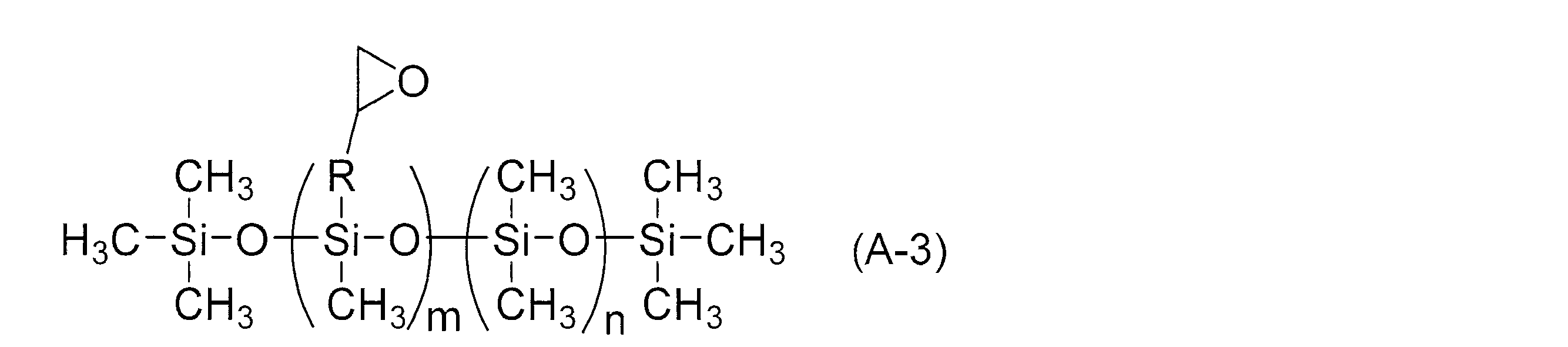
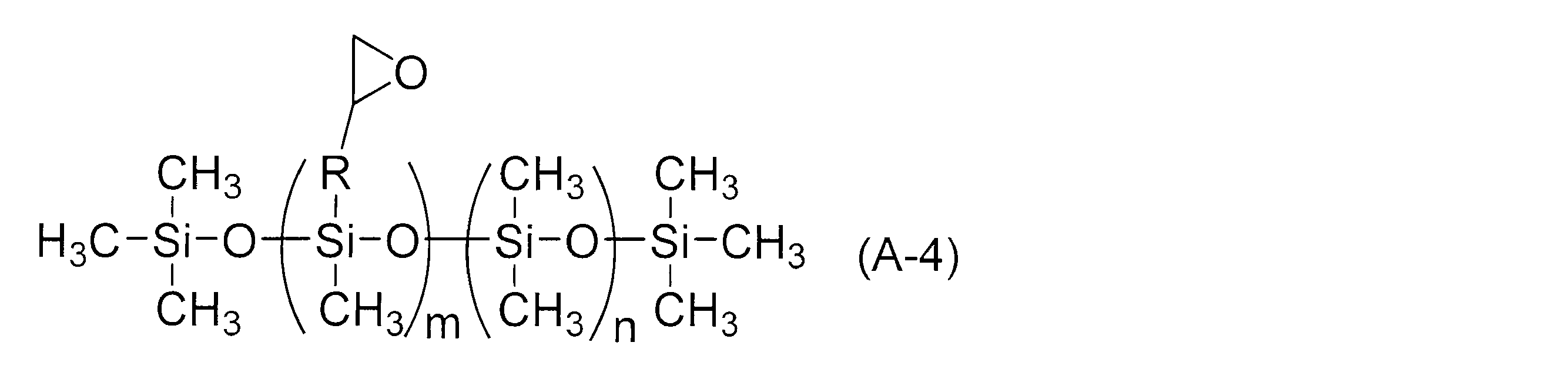
- epoxy-modified polyorganosiloxane examples include a trade name CMS-227 represented by the formula (A-1) (manufactured by Gerest Co., weight average molecular weight 27,000) and a product represented by the formula (A-2).
- R is an alkylene group having 1 to 10 carbon atoms.
- R is an alkylene group having 1 to 10 carbon atoms.
- R is an alkylene group having 1 to 10 carbon atoms.
- R is an alkylene group having 1 to 10 carbon atoms.
- R is an alkylene group having 1 to 10 carbon atoms.
- methyl group-containing polyorganosiloxane for example, a siloxane unit represented by R 210 R 220 SiO 2/2 (D 200 unit), preferably a siloxane unit represented by R 21 R 21 SiO 2/2 (D 20 Units) are included.
- R 210 and R 220 are groups bonded to a silicon atom, and each independently represent an alkyl group, but at least one is a methyl group, and specific examples of the alkyl group include the above-mentioned examples. it can.
- R 21 is a group bonded to a silicon atom and represents an alkyl group. Specific examples of the alkyl group include the above-mentioned examples. Of these, a methyl group is preferable as R 21 .
- a preferable example of the methyl group-containing polyorganosiloxane may include, but is not limited to, polydimethylsiloxane.
- the methyl group-containing polyorganosiloxane contains the above-mentioned siloxane unit (D 200 unit or D 20 unit), but contains the above Q unit, M unit and/or T unit in addition to D 200 unit and D 20 unit. You may stay.
- methyl group-containing polyorganosiloxane examples include polyorganosiloxane consisting of D 200 units only, polyorganosiloxane containing D 200 units and Q units, and D 200 units and M units.
- methyl group-containing polyorganosiloxane comprises a polyorganosiloxane comprising only D 20 units, a polyorganosiloxane containing a D 20 and Q units, and a D 20 units and M units Polyorganosiloxane, polyorganosiloxane containing D 20 units and T units, polyorganosiloxane containing D 20 units, Q units and M units, polyorganosiloxane containing D 20 units, M units and T units, D Mention may be made of polyorganosiloxanes containing 20 units, Q units, M units and T units.
- the viscosity of the methyl group-containing polyorganosiloxane is usually 1,000 to 2,000,000 mm 2 /s, preferably 10,000 to 1,000,000 mm 2 /s.
- the methyl group-containing polyorganosiloxane is typically dimethyl silicone oil made of polydimethylsiloxane.
- the kinematic viscosity can be measured with a kinematic viscometer. It can also be obtained by dividing the viscosity (mPa ⁇ s) by the density (g/cm 3 ).
- methyl group-containing polyorganosiloxane examples include WACKER (registered trademark SILICONE FLUID AK series) manufactured by Wacker and dimethyl silicone oil (KF-96L, KF-96A, KF-96, KF manufactured by Shin-Etsu Chemical Co., Ltd.). -96H, KF-69, KF-965, KF-968), cyclic dimethyl silicone oil (KF-995) and the like, but are not limited thereto.
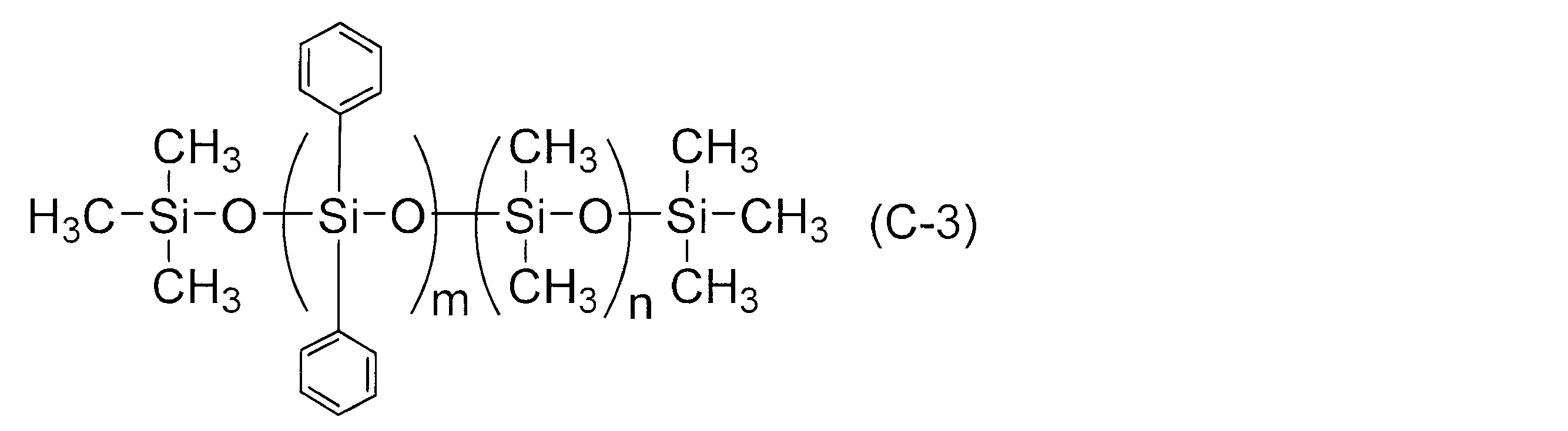
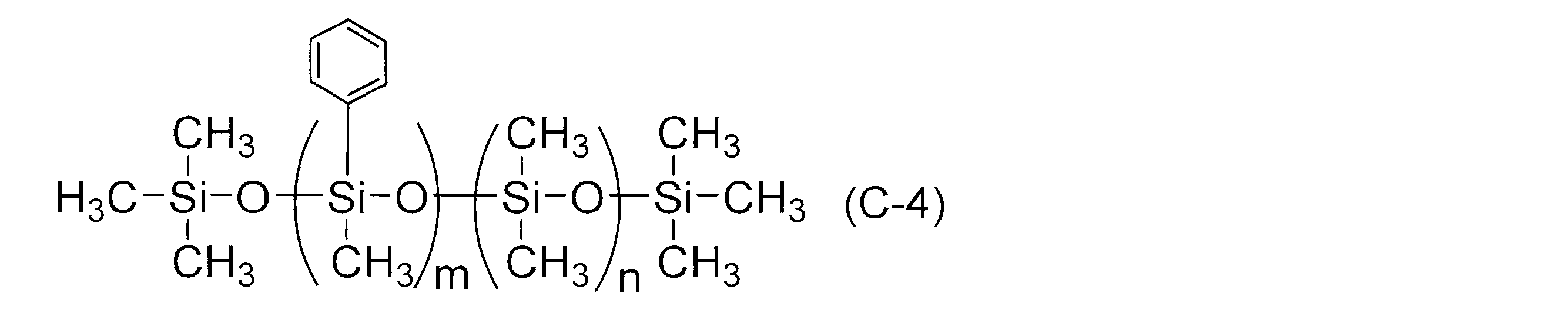
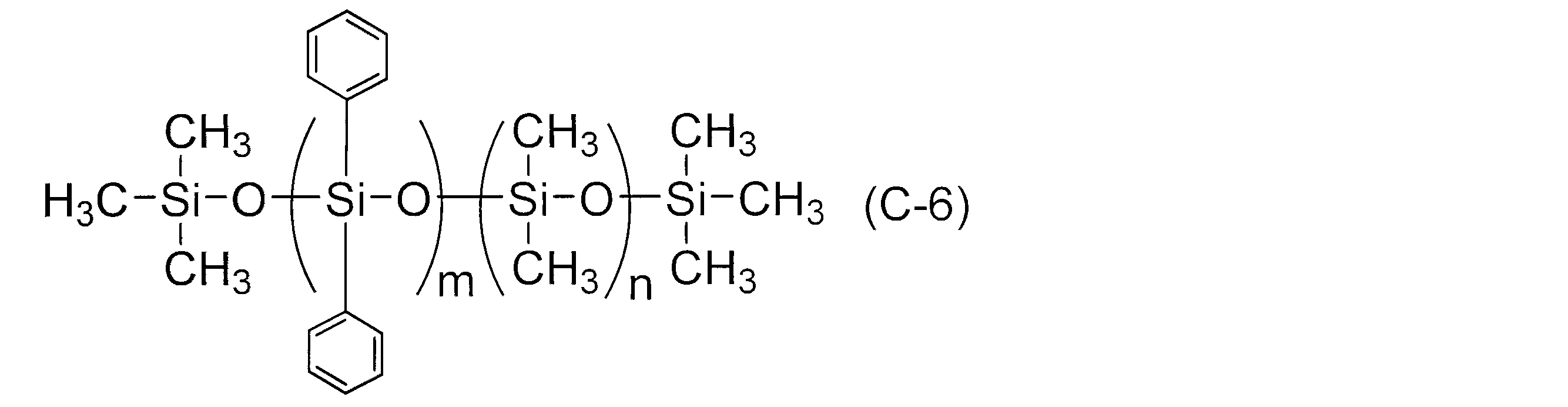
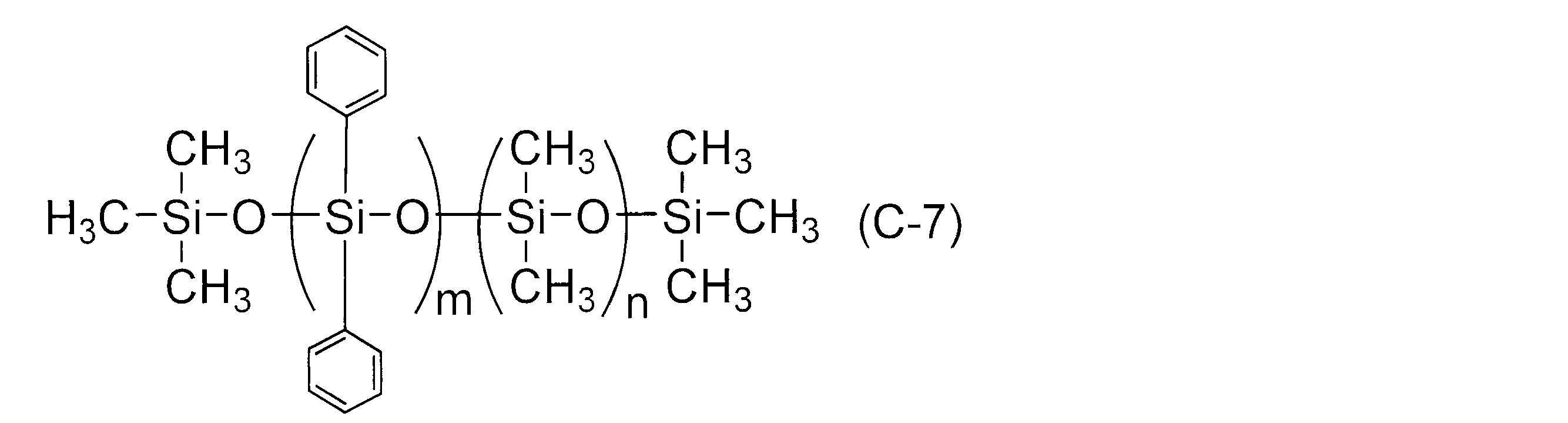
- Examples of the phenyl group-containing polyorganosiloxane include those containing a siloxane unit (D 30 unit) represented by R 31 R 32 SiO 2/2 .
- R 31 represents a group bonded to a silicon atom and represents a phenyl group or an alkyl group
- R 32 represents a group bonded to a silicon atom and represents a phenyl group
- specific examples of the alkyl group include the above-mentioned examples.
- a methyl group is preferable.
- the phenyl group-containing polyorganosiloxane contains the above-mentioned siloxane unit (D 30 unit), but may contain the above Q unit, M unit and/or T unit in addition to the D 30 unit.
- phenyl group-containing polyorganosiloxane examples include a polyorganosiloxane consisting of D 30 units only, a polyorganosiloxane containing D 30 units and Q units, and a D 30 unit and M units.
- the weight average molecular weight of the phenyl group-containing polyorganosiloxane is usually 1,500 to 500,000, but is preferably 100,000 or less from the viewpoint of suppressing precipitation in the adhesive composition.
- phenyl group-containing polyorganosiloxane examples include trade name PMM-1043 represented by formula (C-1) (manufactured by Gelest, Inc., weight average molecular weight 67,000, viscosity 30,000 mm 2 /s), Product name PMM-1025 represented by formula (C-2) (manufactured by Gelest, Inc., weight average molecular weight 25,200, viscosity 500 mm 2 /s), product name KF50- represented by formula (C-3) 3000CS (manufactured by Shin-Etsu Chemical Co., Ltd., weight average molecular weight 39,400, viscosity 3000 mm 2 /s), trade name TSF431 represented by formula (C-4) (manufactured by MOMENTIVE, weight average molecular weight 1,800, viscosity) 100 mm 2 /s), trade name represented by formula (C-5) TSF433 (manufactured by MOMENTIVE, weight average molecular weight 3,000, viscosity
- the polysiloxane-based adhesive composition may contain the component (A) and the component (B) in an arbitrary ratio, but in consideration of the balance between adhesiveness and releasability, the component (A) and the component (B) are combined.
- the ratio is a mass ratio, preferably 99.995:0.005 to 30:70, and more preferably 99.9:0.1 to 75:25.
- Such an adhesive composition may contain a solvent for the purpose of adjusting viscosity, and specific examples thereof include, but are not limited to, aliphatic hydrocarbon water, aromatic hydrocarbon, and ketone. ..
- the content thereof is appropriately set in consideration of the viscosity of the desired adhesive composition, the coating method to be used, the thickness of the thin film to be produced, etc. It is in the range of about 10 to 90% by mass with respect to the entire agent composition.
- the viscosity of the adhesive composition at 25° C. is usually 500 to 20,000 mPa ⁇ s, preferably 1,000 to 5,000 mPa ⁇ s. Considering various factors such as the coating method used and the desired film thickness. Then, it can be adjusted by changing the type of the organic solvent to be used, the ratio thereof, the concentration of the film constituent components, and the like.
- the film constituent component means a component other than the solvent.
- the adhesive composition used in the present invention can be produced by mixing a film constituent component and a solvent. However, when the solvent is not contained, the adhesive composition used in the present invention can be manufactured by mixing the film constituent components.
- the first step is, specifically, a step of applying the adhesive composition to the surface of the semiconductor substrate or the supporting substrate to form an adhesive coating layer, and the semiconductor substrate and the supporting substrate using the adhesive.
- the semiconductor substrate, the adhesive coating layer, and the support are applied by applying a load in the thickness direction of the semiconductor substrate and the support substrate while performing at least one of heat treatment and depressurization treatment by putting together via the coating layer.
- a post-process of bringing the substrate into close contact and then performing a post-heat treatment By the post-heat treatment in the post-process, the adhesive coating layer is finally suitably cured to form an adhesive layer, and the laminate is manufactured.
- the semiconductor substrate is a wafer and the support substrate is a support.
- the target to which the adhesive composition is applied may be either or both of the semiconductor substrate and the supporting substrate.
- the wafer include, but are not limited to, a silicon wafer and a glass wafer having a diameter of 300 mm and a thickness of about 770 ⁇ m.
- the support (carrier) is not particularly limited, and may be, for example, a silicon wafer having a diameter of 300 mm and a thickness of 700 ⁇ m, but is not limited thereto.
- the thickness of the adhesive coating layer is usually 5 to 500 ⁇ m, but from the viewpoint of maintaining the film strength, it is preferably 10 ⁇ m or more, more preferably 20 ⁇ m or more, still more preferably 30 ⁇ m or more, which is caused by a thick film. From the viewpoint of avoiding nonuniformity, it is preferably 200 ⁇ m or less, more preferably 150 ⁇ m or less, still more preferably 120 ⁇ m or less, and further preferably 70 ⁇ m or less.
- the coating method is not particularly limited, but is usually spin coating.
- a method in which a coating film is separately formed by a spin coating method and a sheet-shaped coating film is attached may be adopted, which is also referred to as coating or coating film.
- the temperature of the heat treatment is usually 80° C. or higher, and preferably 150° C. or lower from the viewpoint of preventing excessive curing.
- the time of the heat treatment is usually 30 seconds or more, preferably 1 minute or more from the viewpoint of surely expressing the temporary adhesion ability, but usually 10 minutes or less from the viewpoint of suppressing deterioration of the adhesive layer and other members, It is preferably 5 minutes or less.
- the reduced pressure treatment may be performed by placing the two substrates and the adhesive coating layer between them under an atmospheric pressure of 10 to 10,000 Pa.
- the time for the reduced pressure treatment is usually 1 to 30 minutes.
- the two substrates and the layers between them are bonded, preferably by heat treatment, more preferably by a combination of heat treatment and reduced pressure treatment.
- the load in the thickness direction of the semiconductor substrate and the supporting substrate is not particularly limited as long as it does not adversely affect the semiconductor substrate and the supporting substrate and layers between them, and can firmly adhere them. However, it is usually in the range of 10 to 1,000 N.
- the post-heating temperature is preferably 120° C. or higher from the viewpoint of obtaining a sufficient curing rate, and is preferably 260° C. or lower from the viewpoint of preventing deterioration of the substrate or the adhesive.
- the heating time is usually 1 minute or more from the viewpoint of realizing a preferable bonding of the wafers by curing, and preferably 5 minutes or more from the viewpoint of stabilizing the physical properties of the adhesive. From the viewpoint of avoiding adverse effects on the composition, it is usually 180 minutes or less, preferably 120 minutes or less.
- the heating can be performed using a hot plate, an oven or the like.
- one purpose of the post heat treatment is to cure the component (A) more preferably.
- An example of processing applied to the laminate used in the present invention is processing of the back surface of the surface of the semiconductor substrate opposite to the circuit surface, and typically, thinning of the wafer by polishing the back surface of the wafer is mentioned.
- a through silicon via (TSV) or the like is formed, and then the thinned wafer is peeled from the support to form a laminated body of wafers for three-dimensional mounting. Further, before and after that, the wafer back surface electrode and the like are formed. Heat of 250 to 350° C.
- a wafer having a diameter of 300 mm and a thickness of about 770 ⁇ m can be thinned to a thickness of about 80 ⁇ m to 4 ⁇ m by polishing the back surface opposite to the circuit surface.
- the method for peeling the laminate used in the present invention includes, but is not limited to, solvent peeling, laser peeling, mechanical peeling using a machine having a sharp portion, peeling peeling between a support and a wafer, and the like. Usually, peeling is performed after processing such as thinning.
- the adhesive is not necessarily completely adhered to the supporting substrate side and peeled off, but may be partially left on the processed substrate. Therefore, in the fourth step, the surface of the substrate to which the residual adhesive is attached is washed with the cleaning composition of the present invention, whereby the adhesive residue on the substrate can be sufficiently washed and removed.
- the fourth step is a step of cleaning and removing the adhesive residue remaining on the substrate after peeling with the cleaning composition of the present invention.
- a thinned substrate on which the adhesive remains is The adhesive residue is immersed in the cleaning composition of the present invention, and if necessary, ultrasonic cleaning or the like is also used to clean and remove the adhesive residue.
- ultrasonic cleaning the conditions are appropriately determined in consideration of the surface condition of the substrate, but normally, the cleaning treatment is performed under the conditions of 20 kHz to 5 MHz and 10 seconds to 30 minutes. Adhesive residue remaining on the top can be sufficiently removed.
- the method for manufacturing a thinned substrate of the present invention includes the above-described first to fourth steps, but may include steps other than these steps.
- the substrate is immersed in various solvents or tape peeling is performed as necessary to remove the adhesive residue. May be.
- the apparatus used in the present invention is as follows.
- Viscometer Toki Sangyo Co., Ltd. rotational viscometer TVE-22H
- Stirrer Mix rotor variable 1-1118-12 made by AS ONE
- Stirrer H Aswan heating type rocking mixer HRM-1
- Contact-type film thickness meter Tokyo Seimitsu Co., Ltd. wafer thickness measuring device WT-425
- the resulting mixture contains (a2) SiH group-containing linear polydimethylsiloxane having a viscosity of 100 mPa ⁇ s (manufactured by Wacker Chemie) and (a1) vinyl group-containing linear polydimethylsiloxane having a viscosity of 200 mPa ⁇ s (Wacker Chemi). 29.5 g, (B) polyorganosiloxane having a viscosity of 1,000,000 mm 2 /s (Wacker Chemie, trade name AK1000000), (A3) 1-ethynyl-1-cyclohexanol (Wacker Chemie) 0.41 g was added, and the mixture was further stirred for 5 minutes with a rotation and revolution mixer.
- Example 2 A detergent composition was obtained in the same manner as in Example 1 except that 4-t-butyltoluene (manufactured by Kanto Chemical Co., Inc.) was used instead of mesitylene.
- Example 3 A detergent composition was obtained in the same manner as in Example 1 except that o-xylene (produced by Kanto Chemical Co., Inc.) was used instead of mesitylene.
- Example 4 A detergent composition was obtained in the same manner as in Example 1 except that m-xylene (manufactured by Kanto Chemical Co., Inc.) was used instead of mesitylene.
- Example 5 A detergent composition was obtained in the same manner as in Example 1 except that p-xylene (manufactured by Kanto Chemical Co., Inc.) was used instead of mesitylene.
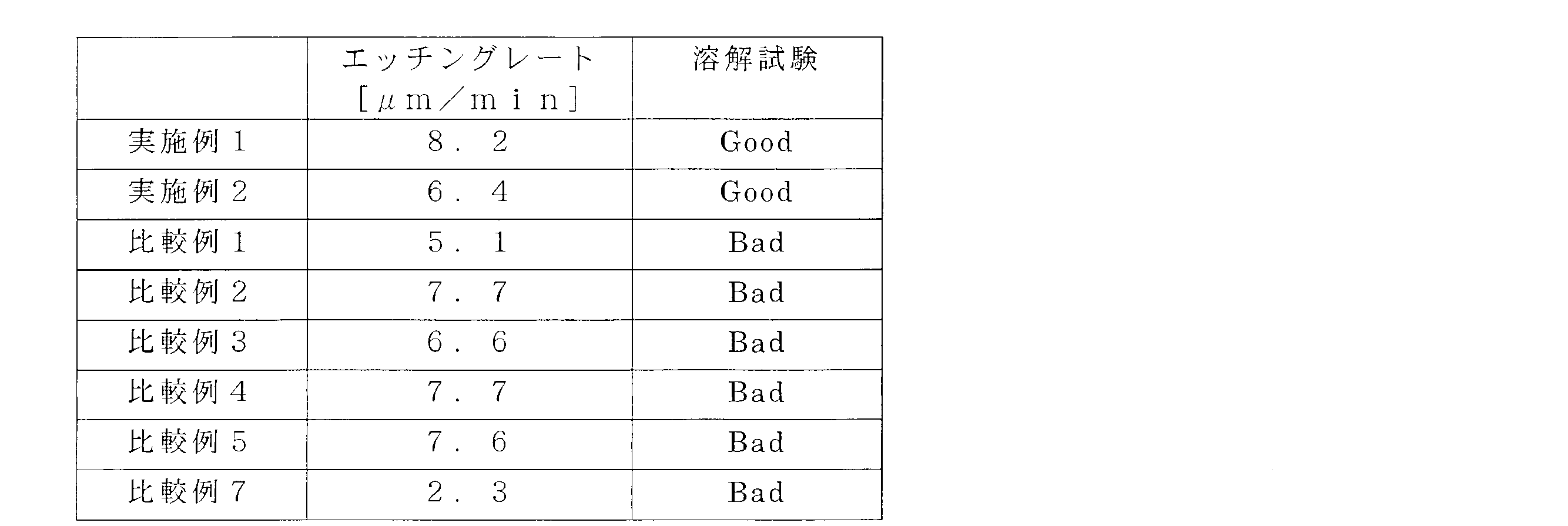
- the wafer after film formation was cut into chips of 4 cm square and the film thickness was measured using a contact type film thickness meter. Then, the chip was put in a stainless petri dish having a diameter of 9 cm, 7 mL of the obtained cleaning composition was added and the lid was covered, and then the chip was placed on a stirrer H and stirred and washed at 23° C. for 5 minutes. After washing, take out the chip, wash with isopropanol and pure water, dry bake at 150°C for 1 minute, then measure the film thickness again with a contact-type film thickness meter, and measure the decrease in film thickness before and after cleaning. Then, the reduced rate was divided by the cleaning time to calculate the etching rate [ ⁇ m/min], which was used as an index of the cleaning power. The results are shown in Table 1.
- the cleaning composition of the present invention showed an excellent cleaning rate and good durability as compared with the cleaning composition of the comparative example.
Landscapes
- Chemical & Material Sciences (AREA)
- Life Sciences & Earth Sciences (AREA)
- Engineering & Computer Science (AREA)
- Chemical Kinetics & Catalysis (AREA)
- Oil, Petroleum & Natural Gas (AREA)
- Wood Science & Technology (AREA)
- Organic Chemistry (AREA)
- Detergent Compositions (AREA)
- Adhesives Or Adhesive Processes (AREA)
- Cleaning Or Drying Semiconductors (AREA)
Abstract
Description
なお、特許文献1,2には、本発明の洗浄剤組成物の具体的構成を教示・示唆する記載はない。
1.基体上に残留するポリシロキサン系接着剤を除去するために用いられる洗浄剤組成物であって、フッ化テトラ(炭化水素)アンモニウムと、有機溶媒とを含み、上記有機溶媒が、式(1)で表される芳香族化合物及び式(2)で表されるラクタム化合物を含むことを特徴とする洗浄剤組成物、
2.上記ラクタム化合物が、N-メチル-2-ピロリドン及びN-エチル-2-ピロリドンから選択される少なくとも1種を含む、1の洗浄剤組成物、
3.上記芳香族化合物が、1,2,3-トリメチルベンゼン、1,2,4-トリメチルベンゼン、1,2,5-トリメチルベンゼン、1,3,5-トリメチルベンゼン、4-エチルトルエン、4-n-プロピルトルエン、4-イソプロピルトルエン、4-n-ブチルトルエン、4-s-ブチルトルエン、4-イソブチルトルエン及び4-t-ブチルトルエンから選択される少なくとも1種を含む、1又は2の洗浄剤組成物、
4.上記フッ化テトラ(炭化水素)アンモニウムが、フッ化テトラメチルアンモニウム、フッ化テトラエチルアンモニウム、フッ化テトラプロピルアンモニウム及びフッ化テトラブチルアンモニウムから選択される少なくとも1種を含む、1~3のいずれかの洗浄剤組成物、
5.上記芳香族化合物と上記ラクタム化合物との比が、質量比で、上記芳香族化合物:上記ラクタム化合物=30:70~80:20である、1~4のいずれかの洗浄剤組成物、
6.上記ラクタム化合物が、N-メチル-2-ピロリドン及びN-エチル-2-ピロリドンから選択される少なくとも1種を含み、上記芳香族化合物が、1,2,3-トリメチルベンゼン、1,2,4-トリメチルベンゼン、1,2,5-トリメチルベンゼン、1,3,5-トリメチルベンゼン、4-エチルトルエン、4-n-プロピルトルエン、4-イソプロピルトルエン、4-n-ブチルトルエン、4-s-ブチルトルエン、4-イソブチルトルエン及び4-t-ブチルトルエンから選択される少なくとも1種を含み、上記フッ化テトラ(炭化水素)アンモニウムが、フッ化テトラメチルアンモニウム、フッ化テトラエチルアンモニウム、フッ化テトラプロピルアンモニウム及びフッ化テトラブチルアンモニウムから選択される少なくとも1種を含む、1の洗浄剤組成物、
7.上記芳香族化合物と上記ラクタム化合物との比が、上記芳香族化合物:上記ラクタム化合物=30:70~80:20である、6の洗浄剤組成物、
8.上記基体上に残留するポリシロキサン系接着剤が、ヒドロシリル化反応により硬化する成分(A)を含む接着剤組成物から得られた接着層の接着剤残留物である1~7のいずれかの洗浄剤組成物、
9.1~8のいずれかの洗浄剤組成物を用い、基体上に残存した接着剤残留物を除去することを特徴とする洗浄方法、
10.半導体基板と、支持基板と、接着剤組成物から得られる接着層とを備える積層体を製造する第1工程、得られた積層体の半導体基板を加工する第2工程、加工後に半導体基板を剥離する第3工程、及び剥離した半導体基板上に残存する接着剤残留物を洗浄剤組成物により洗浄除去する第4工程を含む、加工された半導体基板の製造方法において、上記洗浄剤組成物として1~8のいずれかの洗浄剤組成物を用いることを特徴とする、加工された半導体基板の製造方法
を提供する。
本発明の洗浄剤組成物は、基体上に残留するポリシロキサン系接着剤を除去するために用いられる洗浄剤組成物であって、フッ化テトラ(炭化水素)アンモニウムと、有機溶媒とを含み、上記有機溶媒が、式(1)で表される芳香族化合物及び式(2)で表されるラクタム化合物を含む。

フッ化テトラアルキルアンモニウムの具体例としては、フッ化テトラメチルアンモニウム、フッ化テトラエチルアンモニウム、フッ化テトラプロピルアンモニウム、フッ化テトラブチルアンモニウム等が挙げられるが、これらに限定されない。中でも、フッ化テトラブチルアンモニウムが好ましい。
なお、フッ化テトラ(炭化水素)アンモニウムは、水和物を用いてもよい。また、フッ化テトラ(炭化水素)アンモニウムは、1種単独で又は2種以上組み合わせて用いてもよい。
sは、ベンゼン環に置換する置換基R100の数を表し、2又は3である。

中でも、メシチレン、4-t-ブチルトルエンが好ましい。
具体的には、洗浄速度については、室温(23℃)において、接着剤組成物から得られる接着層を本発明の洗浄剤組成物に5分間接触させた場合において接触の前後で膜厚減少を測定し、減少した分を洗浄時間で割ることにより算出されるエッチングレート[μm/min]が、通常5.0[μm/分]以上、好ましい態様においては7.0[μm/分]以上、より好ましい態様においては7.5[μm/分]以上、より一層好ましい態様においては8.0[μm/分]以上、更に好ましい態様においては9.0[μm/分]以上である。
また、洗浄持続力については、室温(23℃)において、接着剤組成物から得られる接着性固体1gを、本発明の洗浄剤組成物2gに接触させた場合において、本発明の洗浄剤組成物は、通常12~24時間で接着性固体の大部分を溶解し、好ましい態様においては2~12時間で接着性固体を溶解し切り、より好ましい態様においては1~2時間で接着性固体を溶解し切る。
本発明の洗浄剤組成物は、半導体基板等の各種基板の表面を洗浄するために用いられるものであり、その洗浄の対象物は、シリコン半導体基板に限定されるものではなく、例えば、ゲルマニウム基板、ガリウム-ヒ素基板、ガリウム-リン基板、ガリウム-ヒ素-アルミニウム基板、アルミメッキシリコン基板、銅メッキシリコン基板、銀メッキシリコン基板、金メッキシリコン基板、チタンメッキシリコン基板、窒化ケイ素膜形成シリコン基板、酸化ケイ素膜形成シリコン基板、ポリイミド膜形成シリコン基板、ガラス基板、石英基板、液晶基板、有機EL基板等の各種基板をも含む。
具体的には、半導体基板と、支持基板と、接着剤組成物から得られる接着層とを備える積層体を製造する第1工程、得られた積層体の半導体基板を加工する第2工程、加工後に半導体基板を剥離する第3工程、及び剥離した半導体基板上に残存する接着剤残留物を洗浄剤組成物により洗浄除去する第4工程を含む製造方法において、洗浄剤組成物として本発明の洗浄剤組成物が使用される。
従って、以下、ヒドロシリル化反応により硬化する成分(A)を含むポリシロキサン系接着剤(接着剤組成物)と本発明の洗浄剤組成物とを用いた薄化基板の製造方法について説明するが、本発明は、これに限定されるわけではない。
接着剤組成物が含むヒドロシリル化反応により硬化する成分(A)は、例えば、SiO2で表されるシロキサン単位(Q単位)、R1R2R3SiO1/2で表されるシロキサン単位(M単位)、R4R5SiO2/2で表されるシロキサン単位(D単位)及びR6SiO3/2で表されるシロキサン単位(T単位)からなる群より選ばれる1種又は2種以上の単位を含むポリシロキサン(A1)と、白金族金属系触媒(A2)とを含み、上記ポリシロキサン(A1)は、SiO2で表されるシロキサン単位(Q’単位)、R1’R2’R3’SiO1/2で表されるシロキサン単位(M’単位)、R4’R5’SiO2/2で表されるシロキサン単位(D’単位)及びR6’SiO3/2で表されるシロキサン単位(T’単位)からなる群より選ばれ1種又は2種以上の単位を含むとともに、上記M’単位、D’単位及びT’単位からなる群より選ばれる少なくとも1種を含むポリオルガノシロキサン(a1)と、SiO2で表されるシロキサン単位(Q”単位)、R1”R2”R3”SiO1/2で表されるシロキサン単位(M”単位)、R4”R5”SiO2/2で表されるシロキサン単位(D”単位)及びR6”SiO3/2で表されるシロキサン単位(T”単位)からなる群より選ばれる1種又は2種以上の単位を含むとともに、上記M”単位、D”単位及びT”単位からなる群より選ばれる少なくとも1種を含むポリオルガノシロキサン(a2)とを含む。
R1’~R6’は、ケイ素原子に結合する基であり、互いに独立に、アルキル基又はアルケニル基を表すが、R1’~R6’の少なくとも1つは、アルケニル基である。
R1”~R6”は、ケイ素原子に結合する基又は原子であり、互いに独立に、アルキル基又は水素原子を表すが、R1”~R6”の少なくとも1つは、水素原子である。
中でも、メチル基が好ましい。
中でも、エテニル基、2-プロペニル基が好ましい。
このような白金系の金属触媒は、ポリオルガノシロキサン(a1)のアルケニル基とポリオルガノシロキサン(a2)のSi-H基とのヒドロシリル化反応を促進するための触媒である。
白金とオレフィン類との錯体としては、例えばジビニルテトラメチルジシロキサンと白金との錯体が挙げられるが、これに限定されない。
本発明において、エポキシ変性ポリオルガノシロキサンの好ましい一例としては、エポキシ変性ポリジメチルシロキサンを挙げることができるが、これに限定されない。

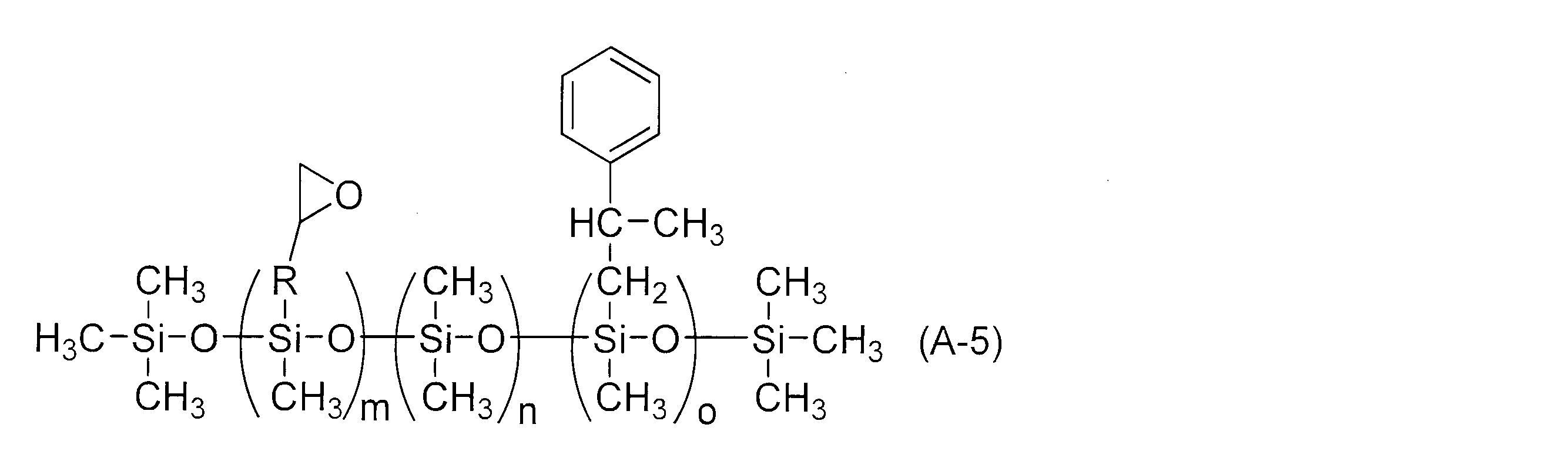
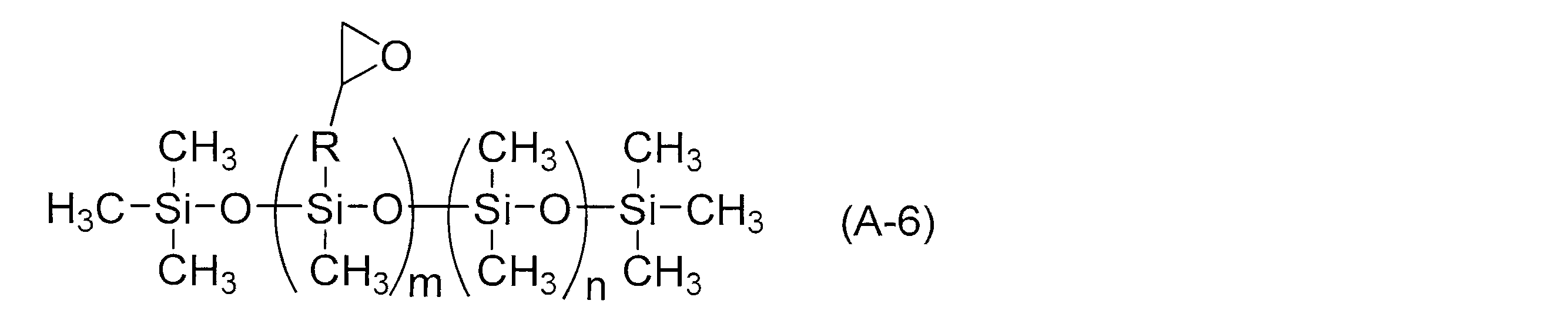
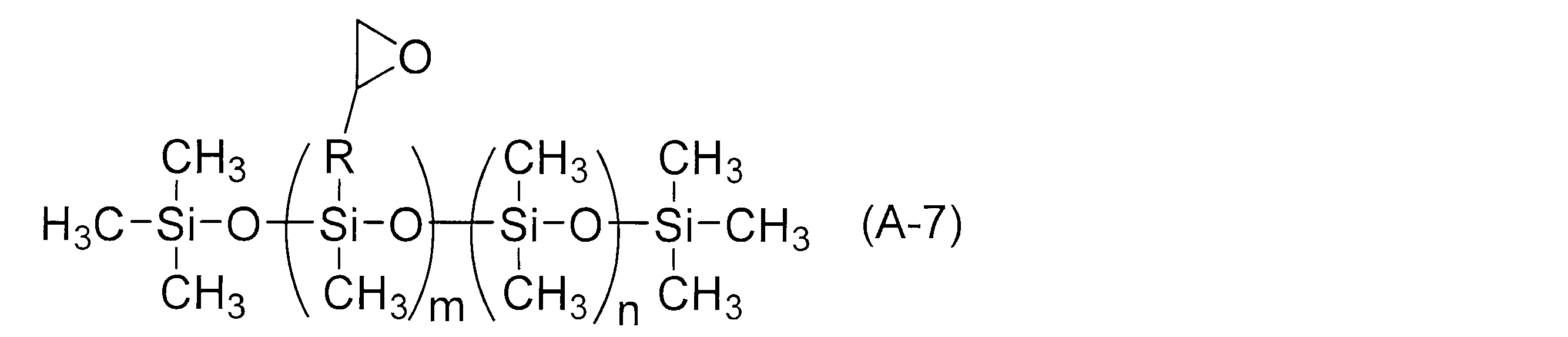

R21は、ケイ素原子に結合する基であり、アルキル基を表し、アルキル基の具体例としては、上述の例示を挙げることができる。中でも、R21としては、メチル基が好ましい。
メチル基含有ポリオルガノシロキサンとの好ましい一例としては、ポリジメチルシロキサンを挙げることができるが、これに限定されない。
好ましい一態様においては、メチル基含有ポリオルガノシロキサンの具体例としては、D20単位のみからなるポリオルガノシロキサン、D20単位とQ単位とを含むポリオルガノシロキサン、D20単位とM単位とを含むポリオルガノシロキサン、D20単位とT単位とを含むポリオルガノシロキサン、D20単位とQ単位とM単位とを含むポリオルガノシロキサン、D20単位とM単位とT単位とを含むポリオルガノシロキサン、D20単位とQ単位とM単位とT単位とを含むポリオルガノシロキサンが挙げられる。

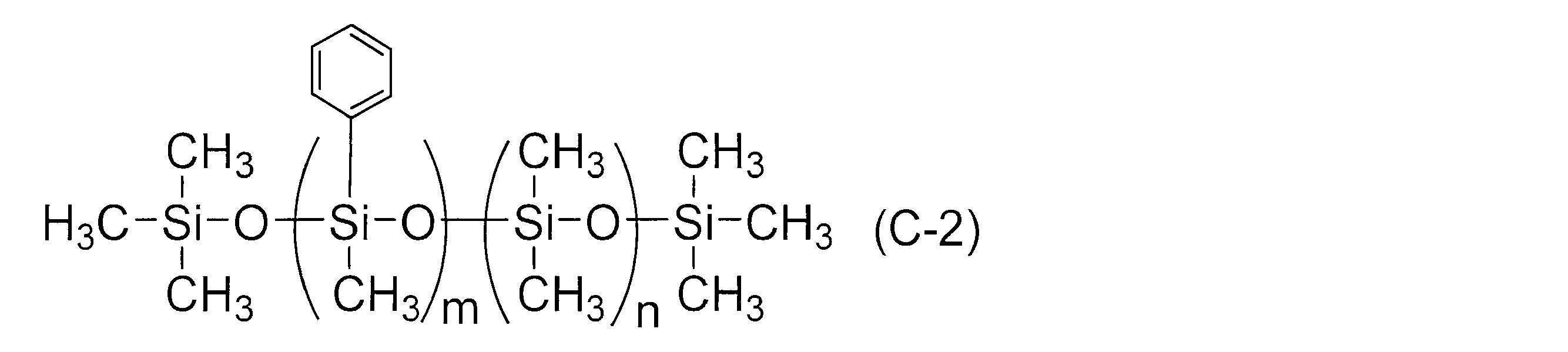

ウエハーとしては、例えば直径300mm、厚さ770μm程度のシリコンウエハーやガラスウエハーが挙げられるが、これらに限定されない。
支持体(キャリア)は、特に限定されるものではないが、例えば直径300mm、厚さ700μm程度のシリコンウエハーを挙げることができるが、これに限定されない。
本発明で用いる積層体に施される加工の一例としては、半導体基板の表面の回路面とは反対の裏面の加工が挙げられ、典型的には、ウエハー裏面の研磨によるウエハーの薄化が挙げられる。このような薄化されたウエハーを用いて、シリコン貫通電極(TSV)等の形成を行い、次いで支持体から薄化ウエハーを剥離してウエハーの積層体を形成し、3次元実装化される。また、それに前後してウエハー裏面電極等の形成も行われる。ウエハーの薄化とTSVプロセスには支持体に接着された状態で250~350℃の熱が負荷されるが、本発明で用いる積層体が含む接着層は、その熱に対する耐熱性を有している。
例えば、直径300mm、厚さ770μm程度のウエハーは、表面の回路面とは反対の裏面を研磨して、厚さ80μm~4μm程度まで薄化することができる。
本発明で用いる積層体の剥離方法は、溶剤剥離、レーザー剥離、鋭部を有する機材による機械的な剥離、支持体とウエハーとの間で引きはがす剥離等が挙げられるが、これらに限定されない。通常、剥離は、薄化等の加工の後に行われる。
第3工程では、必ずしも接着剤が完全に支持基板側に付着して剥離されるものではなく、加工された基板上に一部取り残されることがある。そこで、第4工程において、残留した接着剤が付着された基板の表面を、本発明の洗浄剤組成物で洗浄することにより、基板上の接着剤残留物を十分に洗浄除去することができる。
第4工程は、剥離後の基板に残存する接着剤残留物を、本発明の洗浄剤組成物により洗浄除去する工程であり、具体的には、例えば、接着剤が残留する薄化基板を本発明の洗浄剤組成物に浸漬し、必要があれば超音波洗浄等の手段も併用して、接着剤残留物を洗浄除去するものである。
超音波洗浄を用いる場合、その条件は、基板の表面の状態を考慮して適宜決定されるものであるが、通常、20kHz~5MHz、10秒~30分の条件で洗浄処理することにより、基板上に残る接着剤残留物を十分取り除くことができる。
(1)攪拌機(自転公転ミキサー):(株)シンキー製 自転公転ミキサー ARE―500
(2)粘度計:東機産業(株)製 回転粘度計TVE-22H
(3)撹拌機:アズワン製 ミックスローターバリアブル 1―1186-12
(4)撹拌機H:アズワン製 加温型ロッキングミキサー HRM-1
(5)接触式膜厚計:(株)東京精密製 ウエハー厚さ測定装置 WT-425
[調製例1]
自転公転ミキサー専用600mL撹拌容器に(a1)として粘度200mPa・sのビニル基含有直鎖状ポリジメチルシロキサンとビニル基含有MQ樹脂からなるベースポリマー(ワッカーケミ社製)150g、(a2)として粘度100mPa・sのSiH基含有直鎖上ポリジメチルシロキサン(ワッカーケミ社製)15.81g、(A3)として1-エチニル-1-シクロヘキサノール(ワッカーケミ社製)0.17gを添加し、自転公転ミキサーで5分間撹拌した。
得られた混合物に、スクリュー管50mLに(A2)として白金触媒(ワッカーケミ社製)0.33gと(a1)として粘度1000mPa・sのビニル基含有直鎖状ポリジメチルシロキサン(ワッカーケミ社製)9.98gを自転公転ミキサーで5分間撹拌して得られた混合物から0.52gを加え、自転公転ミキサーで5分間撹拌し、得られた混合物をナイロンフィルター300メッシュでろ過し、接着剤組成物を得た。なお、回転粘度計を用いて測定した接着剤組成物の粘度は、9900mPa・sであった。
自転公転ミキサー専用600mL撹拌容器に(a1)としてビニル基含有MQ樹脂(ワッカーケミ社製)95g、溶媒としてp‐メンタン(日本テルペン化学(株)製)93.4g及び1,1-ジフェニル-2-プロピン-1-オール(東京化成工業(株)製)0.41gを添加し、自転公転ミキサーで5分間撹拌した。
得られた混合物に、(a2)として粘度100mPa・sのSiH基含有直鎖状ポリジメチルシロキサン(ワッカーケミ社製)、(a1)として粘度200mPa・sのビニル基含有直鎖状ポリジメチルシロキサン(ワッカーケミ社製)29.5g、(B)として粘度1000000mm2/sのポリオルガノシロキサン(ワッカーケミ社製、商品名AK1000000)、(A3)として1-エチニル-1-シクロヘキサノール(ワッカーケミ社製)0.41gを加え、自転公転ミキサーで更に5分間撹拌した。
その後、得られた混合物に、スクリュー管50mLに(A2)として白金触媒(ワッカーケミ社製)0.20gと(a1)として粘度1000mPa・sのビニル基含有直鎖状ポリジメチルシロキサン(ワッカーケミ社製)17.7gを自転公転ミキサーで5分間撹拌して別途得られた混合物から14.9gを加え、自転公転ミキサーで更に5分間撹拌し、得られた混合物をナイロンフィルター300メッシュでろ過し、接着剤組成物を得た。なお、回転粘度計を用いて測定した接着剤組成物の粘度は、4600mPa・sであった。
[実施例1]
テトラブチルアンモニウムフルオリド3水和物(関東化学(株)製)5gに、溶媒としてN―メチル―2-ピロリドン脱水(関東化学(株)製)47.5g及びメシチレン(東京化成工業(株)製)47.5gの混合溶媒を加え、得られた混合物を撹拌し、洗浄剤組成物を得た。
メシチレンの代わりに、4-t-ブチルトルエン(関東化学(株)製)を用いた以外は、実施例1と同様の方法で、洗浄剤組成物を得た。
溶媒としてN-メチル-2-ピロリドン脱水95gを用いた以外は、実施例1と同様の方法で、洗浄剤組成物を得た。
メシチレンの代わりに、トルエン(関東化学(株)製)を用いた以外は、実施例1と同様の方法で、洗浄剤組成物を得た。
メシチレンの代わりに、o-キシレン(関東化学(株)製)を用いた以外は、実施例1と同様の方法で、洗浄剤組成物を得た。
メシチレンの代わりに、m-キシレン(関東化学(株)製)を用いた以外は、実施例1と同様の方法で、洗浄剤組成物を得た。
メシチレンの代わりに、p-キシレン(関東化学(株)製)を用いた以外は、実施例1と同様の方法で、洗浄剤組成物を得た。
溶媒としてメシチレン95gを用いた以外は、実施例1と同様の方法で、洗浄剤組成物の調製を試みたが、テトラブチルアンモニウムフルオリド3水和物が溶け残った。
市販のシリコーンクリーナー 「KSR-1」(関東化学(株)製)を洗浄液組成物として使用した。
優れた洗浄剤組成物は、接着剤残留物と接触した直後からそれを溶解させる高い洗浄速度と、それを持続する優れた洗浄持続力が必要であることから、以下の評価を行った。より高い洗浄速度とより優れた洗浄持続力を兼ね備えることで、より効果的な洗浄が期待できる。
[3-1]エッチングレートの測定
得られた洗浄剤組成物の洗浄速度を測定するためにエッチングレートの測定を行った。調製例1で得られた接着剤組成物をスピンコーターで12インチシリコンウエハーに厚さ100μmとなるように塗布し、150℃/15分、次いで190℃/10分で硬化した。成膜後のウエハーを4cm角のチップに切り出し、接触式膜厚計を用いて膜厚を測定した。その後、チップを直径9cmのステンレスシャーレに入れ、得られた洗浄剤組成物7mLを添加して蓋をした後、撹拌機Hに載せて、23℃で5分間撹拌・洗浄した。洗浄後、チップを取り出し、イソプロパノール、純水で洗浄して150℃で1分間、ドライベークをしたのち、再度、接触式膜厚計で膜厚を測定し、洗浄の前後で膜厚減少を測定し、減少した分を洗浄時間で割ることによりエッチングレート[μm/min]を算出し、洗浄力の指標とした。結果は表1に示す。
得られた洗浄剤組成物の洗浄持続力を測定するために接着剤の溶解試験を行った。調整例2で得られた接着剤組成物をスピンコーターで12インチシリコンウエハーに塗布し、120℃/1.5分、次いで200℃/10分で硬化した。その後、カッターの刃を使用して、12インチウエハーから接着剤組成物の硬化物を削り出した。9mLのスクリュー管に接着剤組成物の硬化物1gを量り取り、その後、得られた洗浄剤組成物2gを添加して、23℃で硬化物の溶解状況を確認した。12~24時間で硬化物の大部分を溶かす場合を「Good」、時間をかけても硬化物の大部分が溶け残る場合を「Bad」と表記した。結果は表1に示す。
実施例1,2で得られた各洗浄剤組成物に、シリコンウエハーを5分間浸漬した結果、いずれの組成物を用いた場合も、シリコンウエハーの腐食は確認されなかった。
Claims (10)
- 基体上に残留するポリシロキサン系接着剤を除去するために用いられる洗浄剤組成物であって、フッ化テトラ(炭化水素)アンモニウムと、有機溶媒とを含み、上記有機溶媒が、式(1)で表される芳香族化合物及び式(2)で表されるラクタム化合物を含むことを特徴とする洗浄剤組成物。

- 上記ラクタム化合物が、N-メチル-2-ピロリドン及びN-エチル-2-ピロリドンから選択される少なくとも1種を含む、請求項1記載の洗浄剤組成物。
- 上記芳香族化合物が、1,2,3-トリメチルベンゼン、1,2,4-トリメチルベンゼン、1,2,5-トリメチルベンゼン、1,3,5-トリメチルベンゼン、4-エチルトルエン、4-n-プロピルトルエン、4-イソプロピルトルエン、4-n-ブチルトルエン、4-s-ブチルトルエン、4-イソブチルトルエン及び4-t-ブチルトルエンから選択される少なくとも1種を含む、請求項1又は2記載の洗浄剤組成物。
- 上記フッ化テトラ(炭化水素)アンモニウムが、フッ化テトラメチルアンモニウム、フッ化テトラエチルアンモニウム、フッ化テトラプロピルアンモニウム及びフッ化テトラブチルアンモニウムから選択される少なくとも1種を含む、請求項1~3のいずれか1項記載の洗浄剤組成物。
- 上記芳香族化合物と上記ラクタム化合物との比が、質量比で、上記芳香族化合物:上記ラクタム化合物=30:70~80:20である、請求項1~4のいずれか1項記載の洗浄剤組成物。
- 上記ラクタム化合物が、N-メチル-2-ピロリドン及びN-エチル-2-ピロリドンから選択される少なくとも1種を含み、
上記芳香族化合物が、1,2,3-トリメチルベンゼン、1,2,4-トリメチルベンゼン、1,2,5-トリメチルベンゼン、1,3,5-トリメチルベンゼン、4-エチルトルエン、4-n-プロピルトルエン、4-イソプロピルトルエン、4-n-ブチルトルエン、4-s-ブチルトルエン、4-イソブチルトルエン及び4-t-ブチルトルエンから選択される少なくとも1種を含み、
上記フッ化テトラ(炭化水素)アンモニウムが、フッ化テトラメチルアンモニウム、フッ化テトラエチルアンモニウム、フッ化テトラプロピルアンモニウム及びフッ化テトラブチルアンモニウムから選択される少なくとも1種を含む、請求項1記載の洗浄剤組成物。 - 上記芳香族化合物と上記ラクタム化合物との比が、質量比で、上記芳香族化合物:上記ラクタム化合物=30:70~80:20である、請求項6記載の洗浄剤組成物。
- 上記基体上に残留するポリシロキサン系接着剤が、ヒドロシリル化反応により硬化する成分(A)を含む接着剤組成物から得られた接着層の接着剤残留物である請求項1~7のいずれか1項記載の洗浄剤組成物。
- 請求項1~8のいずれか1項記載の洗浄剤組成物を用い、基体上に残存した接着剤残留物を除去することを特徴とする洗浄方法。
- 半導体基板と、支持基板と、接着剤組成物から得られる接着層とを備える積層体を製造する第1工程、
得られた積層体の半導体基板を加工する第2工程、
加工後に半導体基板を剥離する第3工程、及び
剥離した半導体基板上に残存する接着剤残留物を洗浄剤組成物により洗浄除去する第4工程
を含む、加工された半導体基板の製造方法において、
上記洗浄剤組成物として請求項1~8のいずれか1項記載の洗浄剤組成物を用いることを特徴とする、加工された半導体基板の製造方法。
Priority Applications (4)
| Application Number | Priority Date | Filing Date | Title |
|---|---|---|---|
| KR1020217029059A KR102859312B1 (ko) | 2019-02-15 | 2020-02-14 | 세정제 조성물 및 세정 방법 |
| JP2020572338A JP7530048B2 (ja) | 2019-02-15 | 2020-02-14 | 洗浄剤組成物及び洗浄方法 |
| CN202080014683.XA CN113454759A (zh) | 2019-02-15 | 2020-02-14 | 清洗剂组合物以及清洗方法 |
| US17/430,966 US12441964B2 (en) | 2019-02-15 | 2020-02-14 | Cleaning agent composition and cleaning method |
Applications Claiming Priority (2)
| Application Number | Priority Date | Filing Date | Title |
|---|---|---|---|
| JP2019-026053 | 2019-02-15 | ||
| JP2019026053 | 2019-02-15 |
Publications (1)
| Publication Number | Publication Date |
|---|---|
| WO2020166703A1 true WO2020166703A1 (ja) | 2020-08-20 |
Family
ID=72044228
Family Applications (1)
| Application Number | Title | Priority Date | Filing Date |
|---|---|---|---|
| PCT/JP2020/005809 Ceased WO2020166703A1 (ja) | 2019-02-15 | 2020-02-14 | 洗浄剤組成物及び洗浄方法 |
Country Status (6)
| Country | Link |
|---|---|
| US (1) | US12441964B2 (ja) |
| JP (1) | JP7530048B2 (ja) |
| KR (1) | KR102859312B1 (ja) |
| CN (1) | CN113454759A (ja) |
| TW (1) | TWI831921B (ja) |
| WO (1) | WO2020166703A1 (ja) |
Cited By (3)
| Publication number | Priority date | Publication date | Assignee | Title |
|---|---|---|---|---|
| WO2023042813A1 (ja) * | 2021-09-16 | 2023-03-23 | 日産化学株式会社 | 半導体基板の洗浄方法、加工された半導体基板の製造方法、及び、剥離及び溶解用組成物 |
| CN116568875A (zh) * | 2021-08-23 | 2023-08-08 | 株式会社德山 | Iii族氮化物单晶基板的清洗方法及制造方法 |
| WO2024176810A1 (ja) * | 2023-02-20 | 2024-08-29 | 日産化学株式会社 | 半導体基板の製造方法、及び加工された半導体基板の製造方法、並びに、剥離及び溶解用組成物 |
Families Citing this family (1)
| Publication number | Priority date | Publication date | Assignee | Title |
|---|---|---|---|---|
| KR102848930B1 (ko) * | 2025-01-31 | 2025-08-21 | 국립한밭대학교 산학협력단 | 고분자 세정액 조성물 및 이를 이용한 웨이퍼 고정용 접착제의 세척 방법 |
Citations (3)
| Publication number | Priority date | Publication date | Assignee | Title |
|---|---|---|---|---|
| JP2015505886A (ja) * | 2011-12-16 | 2015-02-26 | ワッカー ケミー アクチエンゲゼルシャフトWacker Chemie AG | シリコーン可溶化剤 |
| KR20160087089A (ko) * | 2015-01-13 | 2016-07-21 | 동우 화인켐 주식회사 | 실리콘계 수지 제거용 조성물 및 이를 이용한 박막 기판 제조 방법 |
| US20170158888A1 (en) * | 2015-12-04 | 2017-06-08 | Dongwoo Fine-Chem Co., Ltd. | Composition for removing silicone resins and method of thinning substrate by using the same |
Family Cites Families (15)
| Publication number | Priority date | Publication date | Assignee | Title |
|---|---|---|---|---|
| MY139607A (en) * | 2001-07-09 | 2009-10-30 | Avantor Performance Mat Inc | Ammonia-free alkaline microelectronic cleaning compositions with improved substrate compatibility |
| US6818608B2 (en) | 2002-02-01 | 2004-11-16 | John C. Moore | Cured polymers dissolving compositions |
| EP1680806A4 (en) * | 2003-10-28 | 2008-07-30 | Sachem Inc | CLEANING SOLUTIONS AND MEDICAMENTS AND METHOD FOR THEIR USE |
| TWI276929B (en) * | 2003-12-16 | 2007-03-21 | Showa Denko Kk | Photosensitive composition remover |
| BRPI0418529A (pt) * | 2004-02-11 | 2007-05-15 | Mallinckrodt Baker Inc | composições de limpeza para microeletrÈnicos contendo ácidos de halogênio oxigenados, sais e derivados dos mesmos |
| US20060255315A1 (en) * | 2004-11-19 | 2006-11-16 | Yellowaga Deborah L | Selective removal chemistries for semiconductor applications, methods of production and uses thereof |
| JP2008521246A (ja) | 2004-11-19 | 2008-06-19 | ハネウエル・インターナシヨナル・インコーポレーテツド | 半導体用途のための選択的除去化学薬品、この製造方法およびこの使用 |
| EP1701218A3 (en) * | 2005-03-11 | 2008-10-15 | Rohm and Haas Electronic Materials LLC | Polymer remover |
| KR101449774B1 (ko) * | 2006-12-21 | 2014-10-14 | 어드밴스드 테크놀러지 머티리얼즈, 인코포레이티드 | 에칭 후 잔류물의 제거를 위한 액체 세정제 |
| JP5813280B2 (ja) * | 2008-03-19 | 2015-11-17 | 富士フイルム株式会社 | 半導体デバイス用洗浄液、および洗浄方法 |
| JP2014133855A (ja) | 2012-12-11 | 2014-07-24 | Fujifilm Corp | シロキサン樹脂の除去剤、それを用いたシロキサン樹脂の除去方法並びに半導体基板製品及び半導体素子の製造方法 |
| JP6350080B2 (ja) * | 2014-07-31 | 2018-07-04 | Jsr株式会社 | 半導体基板洗浄用組成物 |
| US11319513B2 (en) * | 2016-03-24 | 2022-05-03 | Avantor Performance Materials, Llc | Non-aqueous tungsten compatible metal nitride selective etchants and cleaners |
| US20170330762A1 (en) * | 2016-05-10 | 2017-11-16 | Jsr Corporation | Semiconductor treatment composition and treatment method |
| JP2018131433A (ja) | 2017-02-16 | 2018-08-23 | 株式会社ダイセル | シリコーン系界面活性剤、及びそれを含むシリコーン溶解洗浄剤 |
-
2020
- 2020-02-14 KR KR1020217029059A patent/KR102859312B1/ko active Active
- 2020-02-14 JP JP2020572338A patent/JP7530048B2/ja active Active
- 2020-02-14 WO PCT/JP2020/005809 patent/WO2020166703A1/ja not_active Ceased
- 2020-02-14 CN CN202080014683.XA patent/CN113454759A/zh active Pending
- 2020-02-14 US US17/430,966 patent/US12441964B2/en active Active
- 2020-02-15 TW TW109104891A patent/TWI831921B/zh active
Patent Citations (3)
| Publication number | Priority date | Publication date | Assignee | Title |
|---|---|---|---|---|
| JP2015505886A (ja) * | 2011-12-16 | 2015-02-26 | ワッカー ケミー アクチエンゲゼルシャフトWacker Chemie AG | シリコーン可溶化剤 |
| KR20160087089A (ko) * | 2015-01-13 | 2016-07-21 | 동우 화인켐 주식회사 | 실리콘계 수지 제거용 조성물 및 이를 이용한 박막 기판 제조 방법 |
| US20170158888A1 (en) * | 2015-12-04 | 2017-06-08 | Dongwoo Fine-Chem Co., Ltd. | Composition for removing silicone resins and method of thinning substrate by using the same |
Cited By (4)
| Publication number | Priority date | Publication date | Assignee | Title |
|---|---|---|---|---|
| CN116568875A (zh) * | 2021-08-23 | 2023-08-08 | 株式会社德山 | Iii族氮化物单晶基板的清洗方法及制造方法 |
| US11859312B2 (en) | 2021-08-23 | 2024-01-02 | Tokuyama Corporation | Method of cleaning a group III-nitride single crystal substrate comprising cleaning a nitrogen-polar face with a detergent including a fluoroorganic compound |
| WO2023042813A1 (ja) * | 2021-09-16 | 2023-03-23 | 日産化学株式会社 | 半導体基板の洗浄方法、加工された半導体基板の製造方法、及び、剥離及び溶解用組成物 |
| WO2024176810A1 (ja) * | 2023-02-20 | 2024-08-29 | 日産化学株式会社 | 半導体基板の製造方法、及び加工された半導体基板の製造方法、並びに、剥離及び溶解用組成物 |
Also Published As
| Publication number | Publication date |
|---|---|
| CN113454759A (zh) | 2021-09-28 |
| JPWO2020166703A1 (ja) | 2021-12-16 |
| US20220010242A1 (en) | 2022-01-13 |
| US12441964B2 (en) | 2025-10-14 |
| TWI831921B (zh) | 2024-02-11 |
| JP7530048B2 (ja) | 2024-08-07 |
| KR102859312B1 (ko) | 2025-09-12 |
| KR20210126668A (ko) | 2021-10-20 |
| TW202041664A (zh) | 2020-11-16 |
Similar Documents
| Publication | Publication Date | Title |
|---|---|---|
| KR102453332B1 (ko) | 세정제 조성물 및 세정 방법 | |
| JP7583377B2 (ja) | 洗浄剤組成物及び洗浄方法 | |
| JP7530048B2 (ja) | 洗浄剤組成物及び洗浄方法 | |
| TWI911151B (zh) | 洗淨劑組成物及洗淨方法 | |
| US12624318B2 (en) | Cleaning agent composition and cleaning method | |
| JP7530049B2 (ja) | 洗浄剤組成物及び洗浄方法 | |
| WO2021201047A1 (ja) | 洗浄剤組成物及び加工された半導体基板の製造方法 |
Legal Events
| Date | Code | Title | Description |
|---|---|---|---|
| 121 | Ep: the epo has been informed by wipo that ep was designated in this application |
Ref document number: 20756183 Country of ref document: EP Kind code of ref document: A1 |
|
| ENP | Entry into the national phase |
Ref document number: 2020572338 Country of ref document: JP Kind code of ref document: A |
|
| NENP | Non-entry into the national phase |
Ref country code: DE |
|
| ENP | Entry into the national phase |
Ref document number: 20217029059 Country of ref document: KR Kind code of ref document: A |
|
| 122 | Ep: pct application non-entry in european phase |
Ref document number: 20756183 Country of ref document: EP Kind code of ref document: A1 |
|
| WWG | Wipo information: grant in national office |
Ref document number: 17430966 Country of ref document: US |